EP2113497A2 - Hochreines kohlefaserverstärktes Kohlenstoffverbundmaterial für Halbleiterherstellungsvorrichtung und Verfahren zu dessen Herstellung - Google Patents
Hochreines kohlefaserverstärktes Kohlenstoffverbundmaterial für Halbleiterherstellungsvorrichtung und Verfahren zu dessen Herstellung Download PDFInfo
- Publication number
- EP2113497A2 EP2113497A2 EP20090006011 EP09006011A EP2113497A2 EP 2113497 A2 EP2113497 A2 EP 2113497A2 EP 20090006011 EP20090006011 EP 20090006011 EP 09006011 A EP09006011 A EP 09006011A EP 2113497 A2 EP2113497 A2 EP 2113497A2
- Authority
- EP
- European Patent Office
- Prior art keywords
- carbon
- composite
- carbon composite
- carbon fiber
- fiber
- Prior art date
- Legal status (The legal status is an assumption and is not a legal conclusion. Google has not performed a legal analysis and makes no representation as to the accuracy of the status listed.)
- Withdrawn
Links
Images


Classifications
-
- C—CHEMISTRY; METALLURGY
- C01—INORGANIC CHEMISTRY
- C01B—NON-METALLIC ELEMENTS; COMPOUNDS THEREOF; METALLOIDS OR COMPOUNDS THEREOF NOT COVERED BY SUBCLASS C01C
- C01B32/00—Carbon; Compounds thereof
- C01B32/70—Compounds containing carbon and sulfur, e.g. thiophosgene
-
- C—CHEMISTRY; METALLURGY
- C04—CEMENTS; CONCRETE; ARTIFICIAL STONE; CERAMICS; REFRACTORIES
- C04B—LIME, MAGNESIA; SLAG; CEMENTS; COMPOSITIONS THEREOF, e.g. MORTARS, CONCRETE OR LIKE BUILDING MATERIALS; ARTIFICIAL STONE; CERAMICS; REFRACTORIES; TREATMENT OF NATURAL STONE
- C04B35/00—Shaped ceramic products characterised by their composition; Ceramics compositions; Processing powders of inorganic compounds preparatory to the manufacturing of ceramic products
- C04B35/71—Ceramic products containing macroscopic reinforcing agents
- C04B35/78—Ceramic products containing macroscopic reinforcing agents containing non-metallic materials
- C04B35/80—Fibres, filaments, whiskers, platelets, or the like
- C04B35/83—Carbon fibres in a carbon matrix
-
- C—CHEMISTRY; METALLURGY
- C04—CEMENTS; CONCRETE; ARTIFICIAL STONE; CERAMICS; REFRACTORIES
- C04B—LIME, MAGNESIA; SLAG; CEMENTS; COMPOSITIONS THEREOF, e.g. MORTARS, CONCRETE OR LIKE BUILDING MATERIALS; ARTIFICIAL STONE; CERAMICS; REFRACTORIES; TREATMENT OF NATURAL STONE
- C04B35/00—Shaped ceramic products characterised by their composition; Ceramics compositions; Processing powders of inorganic compounds preparatory to the manufacturing of ceramic products
- C04B35/515—Shaped ceramic products characterised by their composition; Ceramics compositions; Processing powders of inorganic compounds preparatory to the manufacturing of ceramic products based on non-oxide ceramics
- C04B35/52—Shaped ceramic products characterised by their composition; Ceramics compositions; Processing powders of inorganic compounds preparatory to the manufacturing of ceramic products based on non-oxide ceramics based on carbon, e.g. graphite
- C04B35/524—Shaped ceramic products characterised by their composition; Ceramics compositions; Processing powders of inorganic compounds preparatory to the manufacturing of ceramic products based on non-oxide ceramics based on carbon, e.g. graphite obtained from polymer precursors, e.g. glass-like carbon material
-
- C—CHEMISTRY; METALLURGY
- C04—CEMENTS; CONCRETE; ARTIFICIAL STONE; CERAMICS; REFRACTORIES
- C04B—LIME, MAGNESIA; SLAG; CEMENTS; COMPOSITIONS THEREOF, e.g. MORTARS, CONCRETE OR LIKE BUILDING MATERIALS; ARTIFICIAL STONE; CERAMICS; REFRACTORIES; TREATMENT OF NATURAL STONE
- C04B41/00—After-treatment of mortars, concrete, artificial stone or ceramics; Treatment of natural stone
- C04B41/0072—Heat treatment
-
- C—CHEMISTRY; METALLURGY
- C04—CEMENTS; CONCRETE; ARTIFICIAL STONE; CERAMICS; REFRACTORIES
- C04B—LIME, MAGNESIA; SLAG; CEMENTS; COMPOSITIONS THEREOF, e.g. MORTARS, CONCRETE OR LIKE BUILDING MATERIALS; ARTIFICIAL STONE; CERAMICS; REFRACTORIES; TREATMENT OF NATURAL STONE
- C04B41/00—After-treatment of mortars, concrete, artificial stone or ceramics; Treatment of natural stone
- C04B41/80—After-treatment of mortars, concrete, artificial stone or ceramics; Treatment of natural stone of only ceramics
-
- C—CHEMISTRY; METALLURGY
- C30—CRYSTAL GROWTH
- C30B—SINGLE-CRYSTAL GROWTH; UNIDIRECTIONAL SOLIDIFICATION OF EUTECTIC MATERIAL OR UNIDIRECTIONAL DEMIXING OF EUTECTOID MATERIAL; REFINING BY ZONE-MELTING OF MATERIAL; PRODUCTION OF A HOMOGENEOUS POLYCRYSTALLINE MATERIAL WITH DEFINED STRUCTURE; SINGLE CRYSTALS OR HOMOGENEOUS POLYCRYSTALLINE MATERIAL WITH DEFINED STRUCTURE; AFTER-TREATMENT OF SINGLE CRYSTALS OR A HOMOGENEOUS POLYCRYSTALLINE MATERIAL WITH DEFINED STRUCTURE; APPARATUS THEREFOR
- C30B15/00—Single-crystal growth by pulling from a melt, e.g. Czochralski method
- C30B15/10—Crucibles or containers for supporting the melt
-
- C—CHEMISTRY; METALLURGY
- C30—CRYSTAL GROWTH
- C30B—SINGLE-CRYSTAL GROWTH; UNIDIRECTIONAL SOLIDIFICATION OF EUTECTIC MATERIAL OR UNIDIRECTIONAL DEMIXING OF EUTECTOID MATERIAL; REFINING BY ZONE-MELTING OF MATERIAL; PRODUCTION OF A HOMOGENEOUS POLYCRYSTALLINE MATERIAL WITH DEFINED STRUCTURE; SINGLE CRYSTALS OR HOMOGENEOUS POLYCRYSTALLINE MATERIAL WITH DEFINED STRUCTURE; AFTER-TREATMENT OF SINGLE CRYSTALS OR A HOMOGENEOUS POLYCRYSTALLINE MATERIAL WITH DEFINED STRUCTURE; APPARATUS THEREFOR
- C30B35/00—Apparatus not otherwise provided for, specially adapted for the growth, production or after-treatment of single crystals or of a homogeneous polycrystalline material with defined structure
-
- C—CHEMISTRY; METALLURGY
- C30—CRYSTAL GROWTH
- C30B—SINGLE-CRYSTAL GROWTH; UNIDIRECTIONAL SOLIDIFICATION OF EUTECTIC MATERIAL OR UNIDIRECTIONAL DEMIXING OF EUTECTOID MATERIAL; REFINING BY ZONE-MELTING OF MATERIAL; PRODUCTION OF A HOMOGENEOUS POLYCRYSTALLINE MATERIAL WITH DEFINED STRUCTURE; SINGLE CRYSTALS OR HOMOGENEOUS POLYCRYSTALLINE MATERIAL WITH DEFINED STRUCTURE; AFTER-TREATMENT OF SINGLE CRYSTALS OR A HOMOGENEOUS POLYCRYSTALLINE MATERIAL WITH DEFINED STRUCTURE; APPARATUS THEREFOR
- C30B35/00—Apparatus not otherwise provided for, specially adapted for the growth, production or after-treatment of single crystals or of a homogeneous polycrystalline material with defined structure
- C30B35/002—Crucibles or containers
-
- H—ELECTRICITY
- H10—SEMICONDUCTOR DEVICES; ELECTRIC SOLID-STATE DEVICES NOT OTHERWISE PROVIDED FOR
- H10W—GENERIC PACKAGES, INTERCONNECTIONS, CONNECTORS OR OTHER CONSTRUCTIONAL DETAILS OF DEVICES COVERED BY CLASS H10
- H10W76/00—Containers; Fillings or auxiliary members therefor; Seals
- H10W76/10—Containers or parts thereof
- H10W76/17—Containers or parts thereof characterised by their materials
-
- C—CHEMISTRY; METALLURGY
- C04—CEMENTS; CONCRETE; ARTIFICIAL STONE; CERAMICS; REFRACTORIES
- C04B—LIME, MAGNESIA; SLAG; CEMENTS; COMPOSITIONS THEREOF, e.g. MORTARS, CONCRETE OR LIKE BUILDING MATERIALS; ARTIFICIAL STONE; CERAMICS; REFRACTORIES; TREATMENT OF NATURAL STONE
- C04B2235/00—Aspects relating to ceramic starting mixtures or sintered ceramic products
- C04B2235/02—Composition of constituents of the starting material or of secondary phases of the final product
- C04B2235/50—Constituents or additives of the starting mixture chosen for their shape or used because of their shape or their physical appearance
- C04B2235/52—Constituents or additives characterised by their shapes
- C04B2235/5208—Fibers
- C04B2235/5216—Inorganic
- C04B2235/524—Non-oxidic, e.g. borides, carbides, silicides or nitrides
- C04B2235/5248—Carbon, e.g. graphite
-
- C—CHEMISTRY; METALLURGY
- C04—CEMENTS; CONCRETE; ARTIFICIAL STONE; CERAMICS; REFRACTORIES
- C04B—LIME, MAGNESIA; SLAG; CEMENTS; COMPOSITIONS THEREOF, e.g. MORTARS, CONCRETE OR LIKE BUILDING MATERIALS; ARTIFICIAL STONE; CERAMICS; REFRACTORIES; TREATMENT OF NATURAL STONE
- C04B2235/00—Aspects relating to ceramic starting mixtures or sintered ceramic products
- C04B2235/02—Composition of constituents of the starting material or of secondary phases of the final product
- C04B2235/50—Constituents or additives of the starting mixture chosen for their shape or used because of their shape or their physical appearance
- C04B2235/52—Constituents or additives characterised by their shapes
- C04B2235/5208—Fibers
- C04B2235/526—Fibers characterised by the length of the fibers
-
- C—CHEMISTRY; METALLURGY
- C04—CEMENTS; CONCRETE; ARTIFICIAL STONE; CERAMICS; REFRACTORIES
- C04B—LIME, MAGNESIA; SLAG; CEMENTS; COMPOSITIONS THEREOF, e.g. MORTARS, CONCRETE OR LIKE BUILDING MATERIALS; ARTIFICIAL STONE; CERAMICS; REFRACTORIES; TREATMENT OF NATURAL STONE
- C04B2235/00—Aspects relating to ceramic starting mixtures or sintered ceramic products
- C04B2235/02—Composition of constituents of the starting material or of secondary phases of the final product
- C04B2235/50—Constituents or additives of the starting mixture chosen for their shape or used because of their shape or their physical appearance
- C04B2235/52—Constituents or additives characterised by their shapes
- C04B2235/5208—Fibers
- C04B2235/5264—Fibers characterised by the diameter of the fibers
-
- C—CHEMISTRY; METALLURGY
- C04—CEMENTS; CONCRETE; ARTIFICIAL STONE; CERAMICS; REFRACTORIES
- C04B—LIME, MAGNESIA; SLAG; CEMENTS; COMPOSITIONS THEREOF, e.g. MORTARS, CONCRETE OR LIKE BUILDING MATERIALS; ARTIFICIAL STONE; CERAMICS; REFRACTORIES; TREATMENT OF NATURAL STONE
- C04B2235/00—Aspects relating to ceramic starting mixtures or sintered ceramic products
- C04B2235/02—Composition of constituents of the starting material or of secondary phases of the final product
- C04B2235/50—Constituents or additives of the starting mixture chosen for their shape or used because of their shape or their physical appearance
- C04B2235/52—Constituents or additives characterised by their shapes
- C04B2235/5208—Fibers
- C04B2235/5268—Orientation of the fibers
-
- C—CHEMISTRY; METALLURGY
- C04—CEMENTS; CONCRETE; ARTIFICIAL STONE; CERAMICS; REFRACTORIES
- C04B—LIME, MAGNESIA; SLAG; CEMENTS; COMPOSITIONS THEREOF, e.g. MORTARS, CONCRETE OR LIKE BUILDING MATERIALS; ARTIFICIAL STONE; CERAMICS; REFRACTORIES; TREATMENT OF NATURAL STONE
- C04B2235/00—Aspects relating to ceramic starting mixtures or sintered ceramic products
- C04B2235/02—Composition of constituents of the starting material or of secondary phases of the final product
- C04B2235/50—Constituents or additives of the starting mixture chosen for their shape or used because of their shape or their physical appearance
- C04B2235/54—Particle size related information
- C04B2235/5418—Particle size related information expressed by the size of the particles or aggregates thereof
- C04B2235/5436—Particle size related information expressed by the size of the particles or aggregates thereof micrometer sized, i.e. from 1 to 100 micron
-
- C—CHEMISTRY; METALLURGY
- C04—CEMENTS; CONCRETE; ARTIFICIAL STONE; CERAMICS; REFRACTORIES
- C04B—LIME, MAGNESIA; SLAG; CEMENTS; COMPOSITIONS THEREOF, e.g. MORTARS, CONCRETE OR LIKE BUILDING MATERIALS; ARTIFICIAL STONE; CERAMICS; REFRACTORIES; TREATMENT OF NATURAL STONE
- C04B2235/00—Aspects relating to ceramic starting mixtures or sintered ceramic products
- C04B2235/65—Aspects relating to heat treatments of ceramic bodies such as green ceramics or pre-sintered ceramics, e.g. burning, sintering or melting processes
- C04B2235/656—Aspects relating to heat treatments of ceramic bodies such as green ceramics or pre-sintered ceramics, e.g. burning, sintering or melting processes characterised by specific heating conditions during heat treatment
- C04B2235/6565—Cooling rate
-
- C—CHEMISTRY; METALLURGY
- C04—CEMENTS; CONCRETE; ARTIFICIAL STONE; CERAMICS; REFRACTORIES
- C04B—LIME, MAGNESIA; SLAG; CEMENTS; COMPOSITIONS THEREOF, e.g. MORTARS, CONCRETE OR LIKE BUILDING MATERIALS; ARTIFICIAL STONE; CERAMICS; REFRACTORIES; TREATMENT OF NATURAL STONE
- C04B2235/00—Aspects relating to ceramic starting mixtures or sintered ceramic products
- C04B2235/70—Aspects relating to sintered or melt-casted ceramic products
- C04B2235/72—Products characterised by the absence or the low content of specific components, e.g. alkali metal free alumina ceramics
- C04B2235/724—Halogenide content
-
- C—CHEMISTRY; METALLURGY
- C04—CEMENTS; CONCRETE; ARTIFICIAL STONE; CERAMICS; REFRACTORIES
- C04B—LIME, MAGNESIA; SLAG; CEMENTS; COMPOSITIONS THEREOF, e.g. MORTARS, CONCRETE OR LIKE BUILDING MATERIALS; ARTIFICIAL STONE; CERAMICS; REFRACTORIES; TREATMENT OF NATURAL STONE
- C04B2235/00—Aspects relating to ceramic starting mixtures or sintered ceramic products
- C04B2235/70—Aspects relating to sintered or melt-casted ceramic products
- C04B2235/72—Products characterised by the absence or the low content of specific components, e.g. alkali metal free alumina ceramics
- C04B2235/726—Sulfur content
-
- C—CHEMISTRY; METALLURGY
- C04—CEMENTS; CONCRETE; ARTIFICIAL STONE; CERAMICS; REFRACTORIES
- C04B—LIME, MAGNESIA; SLAG; CEMENTS; COMPOSITIONS THEREOF, e.g. MORTARS, CONCRETE OR LIKE BUILDING MATERIALS; ARTIFICIAL STONE; CERAMICS; REFRACTORIES; TREATMENT OF NATURAL STONE
- C04B2235/00—Aspects relating to ceramic starting mixtures or sintered ceramic products
- C04B2235/70—Aspects relating to sintered or melt-casted ceramic products
- C04B2235/74—Physical characteristics
- C04B2235/77—Density
-
- C—CHEMISTRY; METALLURGY
- C04—CEMENTS; CONCRETE; ARTIFICIAL STONE; CERAMICS; REFRACTORIES
- C04B—LIME, MAGNESIA; SLAG; CEMENTS; COMPOSITIONS THEREOF, e.g. MORTARS, CONCRETE OR LIKE BUILDING MATERIALS; ARTIFICIAL STONE; CERAMICS; REFRACTORIES; TREATMENT OF NATURAL STONE
- C04B2235/00—Aspects relating to ceramic starting mixtures or sintered ceramic products
- C04B2235/70—Aspects relating to sintered or melt-casted ceramic products
- C04B2235/96—Properties of ceramic products, e.g. mechanical properties such as strength, toughness, wear resistance
-
- Y—GENERAL TAGGING OF NEW TECHNOLOGICAL DEVELOPMENTS; GENERAL TAGGING OF CROSS-SECTIONAL TECHNOLOGIES SPANNING OVER SEVERAL SECTIONS OF THE IPC; TECHNICAL SUBJECTS COVERED BY FORMER USPC CROSS-REFERENCE ART COLLECTIONS [XRACs] AND DIGESTS
- Y10—TECHNICAL SUBJECTS COVERED BY FORMER USPC
- Y10T—TECHNICAL SUBJECTS COVERED BY FORMER US CLASSIFICATION
- Y10T428/00—Stock material or miscellaneous articles
- Y10T428/249921—Web or sheet containing structurally defined element or component
- Y10T428/249924—Noninterengaged fiber-containing paper-free web or sheet which is not of specified porosity
- Y10T428/249928—Fiber embedded in a ceramic, glass, or carbon matrix
-
- Y—GENERAL TAGGING OF NEW TECHNOLOGICAL DEVELOPMENTS; GENERAL TAGGING OF CROSS-SECTIONAL TECHNOLOGIES SPANNING OVER SEVERAL SECTIONS OF THE IPC; TECHNICAL SUBJECTS COVERED BY FORMER USPC CROSS-REFERENCE ART COLLECTIONS [XRACs] AND DIGESTS
- Y10—TECHNICAL SUBJECTS COVERED BY FORMER USPC
- Y10T—TECHNICAL SUBJECTS COVERED BY FORMER US CLASSIFICATION
- Y10T428/00—Stock material or miscellaneous articles
- Y10T428/249921—Web or sheet containing structurally defined element or component
- Y10T428/249953—Composite having voids in a component [e.g., porous, cellular, etc.]
-
- Y—GENERAL TAGGING OF NEW TECHNOLOGICAL DEVELOPMENTS; GENERAL TAGGING OF CROSS-SECTIONAL TECHNOLOGIES SPANNING OVER SEVERAL SECTIONS OF THE IPC; TECHNICAL SUBJECTS COVERED BY FORMER USPC CROSS-REFERENCE ART COLLECTIONS [XRACs] AND DIGESTS
- Y10—TECHNICAL SUBJECTS COVERED BY FORMER USPC
- Y10T—TECHNICAL SUBJECTS COVERED BY FORMER US CLASSIFICATION
- Y10T428/00—Stock material or miscellaneous articles
- Y10T428/30—Self-sustaining carbon mass or layer with impregnant or other layer
Definitions
- the present invention relates to a high-purity carbon fiber-reinforced carbon composite (C/C composite) used in an apparatus for manufacturing a semiconductor of silicon, SiC, a compound or the like.
- C/C composite high-purity carbon fiber-reinforced carbon composite
- a carbon fiber-reinforced carbon composite (hereinafter also referred to as a C/C composite) has the advantage of being light in weight, strong and able to easily grow in size. Therefore, it is widely used for silicon single crystal pulling-up apparatus, silicon polycrystal manufacturing apparatus, semiconductor manufacturing apparatus and the like.
- a C/C composite is obtained by shaping carbon fibers or graphite fibers into a formed article by a method such as filament winding, impregnating the formed article with a binder containing a thermosetting resin such as a phenol resin, and curing and burning it.
- the obtained C/C composite is refined with a halogen gas, and thereafter used for the above-mentioned application (see JP-A-10-152391 and JP-A-2002-173392 ).
- the thermosetting resin used in impregnation becomes amorphous glassy carbon in the course of burning.
- the related-art C/C composite is low in gas permeability.
- a matrix of the C/C composite is mainly composed of amorphous glassy carbon, which is gas impermeable.
- the impregnation process is repeated several times, so that continuous pores leading from a surface layer of the composite to its inside become extremely thin, or the pores become partially closed and thus no longer lead to the outside of the composite. Therefore, it is difficult to remove an impurity mainly composed of metal elements from the inside of the composite by the related-art refining method of heating the composite in the halogen gas.
- Such a three-component C/C composite includes: a small amount of the glassy carbon, which is originally gas-impermeable and from the inside of which impurities are hard to remove; high-density crystalline carbon-based material; low-density carbon fibers; and low-density glassy carbon for binding these, which is obtained by carbonizing a phenol resin or the like. Accordingly, the three-component C/C composite can have more voids on the inside than the related-art two-component C/C composite that contain the low-density carbon fibers and the low-density glassy carbon, even when the three-component C/C composite has the same bulk density as the related-art two-component C/C composite. Therefore, a refining gas (halogen gas) can penetrate into the inside of the composite, thereby making it easy to remove impurities, especially those containing metal elements.
- halogen gas halogen gas
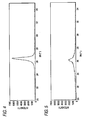
- Table 1 shows the physical properties of one example of a three-component C/C composite and one example of a two-component C/C composite. Further, Fig. 1 shows a graph of the pore distribution of a three-component C/C composite measured by a mercury penetration method using a porosimeter manufactured by Thermo Finnigan, Fig. 2 shows a graph of the pore distribution of a two-component C/C composite, Fig. 3 shows a graph of the cumulative pore distribution of the three-component C/C composite and the related-art two-component C/C composite, Fig. 4 shows a graph of the X-ray diffraction measurement of the three-component C/C composite, and Fig. 5 shows a graph of the X-ray diffraction measurement of the two-component C/C composite.
- Fig. 1 reveals that in the three-component system, pores must have a radius of about 10 ⁇ m.
- Fig. 2 reveals that in the two-component system, pores are widely distributed between 0.1 and 10 ⁇ m.
- Fig. 3 reveals that the three-component system has more pores compared to the two-component system. Further, Table 1 reveals that the three-component system is more porous than the two-component system because of its high true density, although the three-component system and the two-component system are practically equal in bulk density.
- Table 1 reveals that the tensile strength in the fiber-orientation direction of the three-component system even exceeds 50 MPa. That is, the strength of the three-component system is sufficient for its use as a member of a semiconductor manufacturing apparatus.
- the three-component C/C composite has few binders such as a phenol resin which produces a large amount of volatile matter in raw materials, so that the high-density C/C composite can be obtained after a single impregnation step without repeated impregnation. It would therefore be advantageous to substantially simplify the processes as compared to those of the two-component system.
- the present invention has been made in view of the above circumstances, and an object thereof is to provide a carbon fiber-reinforced carbon composite having high purity and high strength.
- an exemplary embodiment of the present invention provides the following high-purity carbon fiber-reinforced carbon composite and method for producing the same.
- a high-purity carbon fiber-reinforced carbon composite for a semiconductor manufacturing apparatus comprising: a matrix including a crystalline carbon-based powder, glassy carbon, and a carbon fiber, wherein the sulfur content is 5 ppm by mass or less.
- the high-purity carbon fiber-reinforced carbon composite for a semiconductor manufacturing apparatus described in the above [1] may have a true density from 2.0 to 2.265 g/cm 3 , as measured with a pycnometer using a helium gas; a bulk density from 1.40 to 1.80 g/cm 3 ; a half-value width of 0.5° or less on a 002 plane determined by X-ray diffraction measurement; and a tensile strength of 50 MPa or more in a fiber orientation direction.
- the high-purity carbon fiber-reinforced carbon composite for a semiconductor manufacturing apparatus described in the above [1] or [2] may have a porosity from 10 to 35%, as measured by a mercury penetration method.
- the high-purity carbon fiber-reinforced carbon composite for a semiconductor manufacturing apparatus described in the above [1] or [2] may have a sulfur content of 4 ppm by mass or less.
- a method for producing a high-purity carbon fiber-reinforced carbon composite for a semiconductor manufacturing apparatus comprising; refining a carbon fiber-reinforced carbon composite comprising: a matrix including a crystalline carbon-based powder, glassy carbon and a carbon fiber, the refining process comprising the steps of heating the carbon composite at 1,800 to 2,400 °C after vacuuming in a refining furnace and alternately repeating a first step of introducing a halogen-based gas to 50 kPa or more, and a second step of vacuuming to 20 kPa or less.
- the refining process further comprises hydrogen baking the carbon composite between the first step and the second step.
- the three-component C/C composite in which the metal elements are easily removed and the production processes are decreased can even decrease the pollution of silicon or corrosion of the copper alloy or silver contacting therewith in the silicon single crystal pulling-up apparatus.
- Fig. 1 is a graph showing the pore distribution of a three-component C/C composite
- Fig. 2 is a graph showing the pore distribution of a two-component C/C composite
- Fig. 3 is a graph showing the cumulative pore distribution of the three-component C/C composite and the related-art two-component C/C composite;
- Fig. 4 is a graph showing the X-ray diffraction measurement of the three-component C/C composite
- Fig. 5 is a graph showing the X-ray diffraction measurement of the two-component C/C composite.
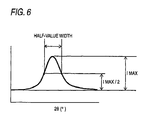
- Fig. 6 is a conceptual diagram showing the half-value width.
- the carbon fibers that can be used for the high-purity carbon fiberreinforced carbon composite according to an exemplary embodiment of the present invention are a pitch-based or PAN-based carbon fiber or a further heat treated graphite fiber.
- PAN-based carbon fiber the advantages of the PAN-based carbon fiber are its adhesion with a binder resin and its adequate flexibility, which easily adjusts to some deformation. Therefore, even when external force is applied to deform it, the C/C composite is hardly cracked or crushed.
- the high-purity carbon fiber-reinforced carbon composite according to the exemplary embodiment further comprises a matrix including a crystalline carbon-based powder and glassy carbon.
- the crystalline carbon-based powder which is one of the constituents of the matrix, is obtained by carbonizing an easily crystallizable carbon-based material by heat treatment. Petroleum-derived or coal-derived coke or graphite can be used for the easily crystallizable carbon-based material.
- the crystalline carbon-based powder does not necessarily have to be crystalline as a raw material (namely, the easily crystallizable carbon-based material), and includes a carbonaceous powder convertible to a crystalline carbonaceous powder by burning, such as green coke and mesocarbon. Of these, it is particularly preferred to use a coke in which crystallization has not sufficiently proceeded, because such coke has many functional groups at terminals of aromatic rings, so that it exhibits good adhesion with the binder resin.
- the content of the crystalline carbon-based powder is from 20 to 75% by mass, and preferably from 30 to 50% by mass, based on the total mass of the carbon fiber, crystalline carbon-based powder and glassy carbon.
- the metal impurities do not become difficult to refine, and it does not substantially become the two-component system. Accordingly, the strength needed to withstand practical application is achieved without having to repeat the impregnation process several times.
- the content of the carbon fibers does not decrease, so that the strength needed to withstand practical application is achieved.
- the content of the crystalline carbon-based powder can be controlled by adjusting the content of the easily crystallizable carbon-based material as a raw material to the above-mentioned range based on the total mass of the carbon fiber, the easily crystallizable carbon-based material and the binder resin.
- the glassy carbon which is one of the constituents of the matrix, is obtained by carbonizing the binder resin through heat treatment.
- a thermosetting resin having a high carbonization yield such as a novolac or resol phenol resin, a furan resin, a polyimide resin or a cyanate ester compound can be used for the binder resin. Of these, the phenol resin is preferred.
- the content of the glassy carbon is preferably from 10 to 40% by mass, and more preferably from 15 to 35% by mass, based on the total mass of the carbon fiber, the crystalline carbon-based powder and the glassy carbon. When the content is within the range of 10 to 40% by mass, sufficient strength can be achieved without having to repeat the impregnation process.
- the content of the glassy carbon can be controlled by adjusting the content of the binder resin as a raw material to the above-mentioned range based on the total mass of the carbon fibers, the easily crystallizable carbon-based material and the binder resin.
- an additive such as silicon, SiC or a metal can be added to the high-purity carbon fiber-reinforced carbon composite in addition to the above.
- the high-purity carbon fiber-reinforced carbon composite preferably has a true density from 2.0 to 2.265 g/cm 3 , and more preferably from 2.05 to 2.265 g/cm 3 .
- the true density of the glassy carbon obtained by carbonizing the binder resin is approximately from 1.4 to 1.6 g/cm 3
- the true density of the carbon fiber is from 1.5 to 2.0 g/cm 3 .
- the true density of the related-art two-component C/C composite obtained therefrom can be roughly calculated to range from at most 1.4 to 2.0 g/cm 3 .
- the easily crystallizable carbon-based material such as coke or graphite, which has a true density of 2.10 to 2.265 g/cm 3 after heat treatment, is used in the three-component C/C composite according to an exemplary embodiment of the present invention, and the content of the binder resin and the like, which is lower in true density after heat treatment, is small by the amount.
- the true density of the whole C/C composite therefore exhibits a value as high as 2.0 to 2.265 g/cm 3 as described above.
- the true density can be measured, for example, with a commercially available true density meter (Penta-Pyenometer manufactured by Yuasa Ionics Inc.) or the like.
- the bulk density is preferably from 1.40 to 1.80 g/cm 3 , and more preferably from 1.45 to 1.70 g/cm 3 .
- the bulk density is within the above-mentioned range, sufficient strength can be obtained, and the continuous pores leading to the outside of the material are easily formed, so that the impurities present in the C/C composite are easily removed with a refining gas.
- the bulk density can be measured, for example, by dividing the mass of the carbon composite by the volume of the carbon composite obtained by dimension measurement.
- a half-value width on the 002 plane (26.0 degree) in X-ray diffraction measurement is preferably 0.5° or less, and more preferably 0.4° or less.
- the crystallinity of the carbon material can be measured by X-ray diffraction measurement.
- the half-value width means the width of strength at a height of one-half the peak height from the background.
- a lower half-value width shows a broadening of the crystal face and expresses higher crystallinity.
- the X-ray diffraction measurement can be performed using a pulverized powder of the carbon fiber-reinforced carbon composite as a sample and using, for example, an X-ray diffractometer with Cu K ⁇ radiation.
- the crystallinity of the glassy carbon obtained by carbonizing the carbon fiber, the binder resin or the like by heat treatment or the like is low, and the crystallinity of the crystalline carbon-based powder obtained by heat treating coke, graphite or the like (the easily crystallizable carbon-based material) is high.
- the C/C composite according to an exemplary embodiment of the present invention includes a large amount of the crystalline carbon-based powder, and a small amount of binder resin and glassy carbon. Accordingly, the half-value width on the 002 plane becomes a value within the above-mentioned range.
- the half-value width on the 002 plane is deduced to become 0.5° or more.
- the true density is from 2.0 to 2.265 g/cm 3
- the bulk density is from 1.40 to 1.80 g/cm 3 .
- the C/C composite exhibits sufficient strength to withstand practical application since the theoretical value of its porosity ranges from about 10 to about 38%.
- the half-value width on the 002 plane (26.0 degree) in X-ray diffraction measurement is 0.5° or less. This means that it exhibits high crystallinity. Accordingly, the continuous pores are easily formed in the C/C composite, so that the gas used to achieve high refinement can easily penetrate to the inside. It is therefore possible to remove the impurities present in the C/C composite with the refining gas while sufficiently securing the strength of the C/C composite.
- the high-purity carbon fiber-reinforced carbon composite according to an exemplary embodiment of the present invention exhibits a porosity that preferably ranges from 10 to 35%, and more preferably from 20 to 35%.
- the porosity can be measured by the mercury penetration method, for example, using a porosimeter manufactured by Thermo Finnigan. When the porosity measured by the mercury penetration method is within such a range, a sufficient number of continuous pores are formed.
- the tensile strength in a fiber orientation direction of the high-purity carbon fiber-reinforced carbon composite according to an exemplary embodiment of the present invention is preferably 50 MPa or more.
- the tensile strength is 50 MPa or more, the strength necessary for a member of a semiconductor manufacturing apparatus can be obtained.
- the sulfur content is 5 ppm by mass or less, and preferably 4 ppm by mass or less.
- the probability that sulfur or a sulfur compound will be diffused or released from the member when used over the years at high temperatures exponentially increases with an increase in sulfur content. Therefore, for example, when the sulfur content is 10 ppm by mass, the diffusion and release of sulfur or the sulfur compound usually becomes not negligible before the member reaches the end of its lifetime. In this respect, when the sulfur content can be suppressed to about 5 ppm by mass, the time when the diffusion and release of sulfur or a sulfur compound appears approximately coincides with the time when the member reaches the end of its lifetime.
- the sulfur content is 5 ppm by mass or less, a high purity product can be obtained, and no corrosion problems arise at points of contact with silver or copper alloy.
- the sulfur content is preferably as small as possible and most preferably 0 ppm by mass.
- the sulfur content can be measured using a sample having a disk shape with a diameter of 20 mm and a thickness of 1 mm by Glow-Discharge Mass Spectrometry (GDMS).
- the high-purity C/C composite according to an exemplary embodiment of the present invention can be produced by the following method.
- a method according to an exemplary embodiment of the present inventionhigh-purity C/C composite can be obtained by refining the three-component C/C composite comprising a carbon fiber, a crystalline carbon-based powder and glassy carbon, which has been prepared using a carbon fiber, easily crystallizable carbon-based material and binder resin as raw materials.
- a related-art three-component C/C composite can be utilized for the three-component C/C composite.
- the three-component C/C composite can be produced by a method described in JP-A-07-48191 or WO2006-3774 .
- the easily crystallizable carbon-based material used in the high-purity carbon fiber-reinforced carbon composite according to an exemplary embodiment of the present invention can be petroleum-derived coke to be carbonized in a liquid phase or coal-derived coke, graphite obtained by carbonizing these cokes, or the like.
- the raw material used to obtain the easily crystallizable carbon-based material is a mineral resource formed from the conversion of animal or plant plankton, so that it contains high concentrations of amino acids such as cysteine, methionine, and sulfur of biologic origin.
- the refining treatment process is performed mainly to remove the sulfur.
- the three-component C/C composite is first vacuumed in a refining furnace, and then heated at 1,800 to 2,400°C, preferably at 1,900 to 2,300°C. At 1,800°C or higher, removal of other metal elements does not become difficult, and at 2,400°C or lower, there is no fear that the crystallinity of the carbon fibers will increase to such an extent that it will become brittle. Vacuuming is preferably performed to 10 kPa or less. Further, the retention time after heating is preferably from 0.1 to 4 hours.
- a halogen-based gas is introduced into the refining furnace with the composite to 50 kPa or more.
- a second, vacuuming step which is carried out to 20 kPa or less.
- the composite is then again subjected to the first step, the second step, the first step and the second step, at which point the treatment is terminated.
- impurities such as sulfur matter can be flowed out together to the outside of the pores as a sulfur-based gas.
- halogen-based gases that can be used for this are chlorine gas or fluorine gas, an organic halogen-based gas such as CF 4 or CHCl 3 , or the like. Chlorine gas is particularly preferred.
- Introduction of the halogen-based gas is performed up to 50 kPa, and preferably up to 60 kPa. This is because the metal impurities can be sufficiently removed.
- Vacuuming is performed up to a degree of vacuum of 20 kPa or less, more preferably 10 kPa or less. This is because the impurities in the pores can be efficiently removed by performing vacuuming at a high degree of vacuum.
- refinement is not performed at a constant pressure.
- the introduction of the halogen-based gas (the first step) and vacuuming (the second step) are alternately repeated a number of times, preferably 4 times or more. This is because repeating the above-mentioned steps can efficiently remove the impurity-containing gas generated in the inside of the pores to the outside of the system.
- a hydrogen baking step may be added between the introduction of the halogen-based gas (the first step) and vacuuming (the second step). Sulfur can easily be removed by baking it with hydrogen because it forms the compound (H 2 S). Furthermore, the impurity gas generated in the vacuuming step is easily removed, similarly to the above.
- Coal-derived green coke having an average particle size of 2 ⁇ m was used as an easily crystallizable carbon-based material
- a PAN-based chopped fiber having an average diameter of 7 ⁇ m and a length of 5 mm was used as a carbon fiber
- a resol-based phenol resin was used as a binder resin.
- 30% by mass of the easily crystallizable carbon-based material, 45% by mass of the carbon fiber and 25% by mass of the binder resin were mixed using a mixer, and pressed using a mold having a 100 ⁇ 100 mm cavity at 20 MPa and 90°C for 15 minutes to perform cursing.
- the resulting molded article was further treated at 150°C for 30 minutes to completely cure it, and then burned under a reducing atmosphere (hydrocarbon gas) up to 900°C at a rate of temperature increase of 4°C/hour. Thereafter, it was burned in a subsequent high-temperature treating furnace under a nitrogen atmosphere up to 2,000°C at a rate of temperature increase of 50°C/hour.
- the C/C composite thus obtained was processed to a size of 70 ⁇ 70 ⁇ 20 mm.
- the fiber therein is biaxially orientated in 70x70 directions.
- the above-mentioned C/C composite was placed in a refining furnace, and vacuuming was performed to 20 kPa and heated. When the temperature reached 2,100°C, chlorine gas was introduced until the pressure reached 60 kPa, and this state was retained for 1 minute (the first step). Vacuuming was performed again until the pressure reached 20 kPa (the second step). When the pressure reached 20 kPa, the process continued with the above-mentioned first step. Thus, the first step and the second step were alternately repeated three times. After the high refinement process was completed, the C/C composite was cooled, and then the pressure was recovered with nitrogen gas. Thereafter, the C/C composite was exposed to the atmosphere.
- Example 2 Sulfur analysis and chlorine analysis were performed on the sample of Example 1 and a commercially available three-component C/C composite, which bad not undergone refining treatment (Comparative Example 1). The results thereof are shown in Table 2.
- Example 1 Comparative Example 1 Sulfur Content (ppm by mass) 3.5 6.5 Chlorine Content (ppm by mass) 0.61 0.42 True density (g/cm 3 ) 2.24 2.24 Bulk Density (g/cm 3 ) 1.57 1.57 Porosity (%) 24.8 24.5 X-Ray Diffraction Measurement (002) Half-Value Width (°) 0.4 0.4 Tensile Strength in Fiber Orientation Direction (MPa) 92 87
- the sulfur content of the C/C composite of Example 1 was found to have been decreased by the refining treatment according to an exemplary embodiment of the present invention. Further, the chlorine content, the true density, the bulk density, the porosity, the half-value width on the 002 plane and the tensile strength in a fiber orientation direction were found to scarcely vary, and there was little left of the chlorine gas used for the refinement. That is, the characteristics were found to have changed very little. In the case of chlorine, its content has been somewhat increased by the high refinement, but it is far less than 5 ppm by mass. If the content of chlorine is 5 ppm by mass or more, its influence will increase over the years through use. Accordingly, the influence of chlorine is negligible.
Landscapes
- Chemical & Material Sciences (AREA)
- Engineering & Computer Science (AREA)
- Organic Chemistry (AREA)
- Ceramic Engineering (AREA)
- Materials Engineering (AREA)
- Structural Engineering (AREA)
- Crystallography & Structural Chemistry (AREA)
- Metallurgy (AREA)
- Manufacturing & Machinery (AREA)
- Composite Materials (AREA)
- Chemical Kinetics & Catalysis (AREA)
- Physics & Mathematics (AREA)
- Thermal Sciences (AREA)
- Inorganic Chemistry (AREA)
- Ceramic Products (AREA)
- Carbon And Carbon Compounds (AREA)
- Crystals, And After-Treatments Of Crystals (AREA)
Applications Claiming Priority (1)
| Application Number | Priority Date | Filing Date | Title |
|---|---|---|---|
| JP2008119400A JP2009269774A (ja) | 2008-04-30 | 2008-04-30 | 高純度炭素繊維強化炭素複合材およびその製造方法 |
Publications (2)
| Publication Number | Publication Date |
|---|---|
| EP2113497A2 true EP2113497A2 (de) | 2009-11-04 |
| EP2113497A3 EP2113497A3 (de) | 2012-05-30 |
Family
ID=40872260
Family Applications (1)
| Application Number | Title | Priority Date | Filing Date |
|---|---|---|---|
| EP20090006011 Withdrawn EP2113497A3 (de) | 2008-04-30 | 2009-04-30 | Hochreines kohlefaserverstärktes Kohlenstoffverbundmaterial für Halbleiterherstellungsvorrichtung und Verfahren zu dessen Herstellung |
Country Status (6)
| Country | Link |
|---|---|
| US (1) | US7998584B2 (de) |
| EP (1) | EP2113497A3 (de) |
| JP (1) | JP2009269774A (de) |
| KR (1) | KR101031689B1 (de) |
| CN (1) | CN101570435B (de) |
| TW (1) | TW200944490A (de) |
Families Citing this family (6)
| Publication number | Priority date | Publication date | Assignee | Title |
|---|---|---|---|---|
| JP2009203093A (ja) * | 2008-02-26 | 2009-09-10 | Ibiden Co Ltd | ルツボ保持部材 |
| JP2009269774A (ja) * | 2008-04-30 | 2009-11-19 | Ibiden Co Ltd | 高純度炭素繊維強化炭素複合材およびその製造方法 |
| CN101880039B (zh) * | 2010-06-24 | 2012-07-04 | 上海交通大学 | 基于玻璃碳和石墨烯的复合薄膜及其制备方法 |
| CN108752030B (zh) * | 2018-06-06 | 2021-04-30 | 苏州宏久航空防热材料科技有限公司 | 一种SiC泡沫内填充Cf/C-玻璃碳超高温真空隔热圆管的制备方法 |
| US20230150888A1 (en) * | 2020-04-10 | 2023-05-18 | Toyo Tanso Co., Ltd. | C/c composite and method for producing same, and heat-treatment jig and method for producing same |
| JP7722854B2 (ja) * | 2021-06-30 | 2025-08-13 | 東洋炭素株式会社 | C/Cコンポジット及びSi単結晶引き上げ炉用部材 |
Citations (4)
| Publication number | Priority date | Publication date | Assignee | Title |
|---|---|---|---|---|
| JPH0748191A (ja) | 1993-08-06 | 1995-02-21 | Mitsubishi Gas Chem Co Inc | 炭素繊維強化炭素複合セミカーボン材の製造法 |
| JPH10152391A (ja) | 1996-06-27 | 1998-06-09 | Toyo Tanso Kk | 単結晶引き上げ用ルツボ及びその製造方法 |
| JP2002173392A (ja) | 2000-12-05 | 2002-06-21 | Tokai Carbon Co Ltd | 単結晶引上げ装置用c/c部材 |
| WO2006003774A1 (ja) | 2004-07-06 | 2006-01-12 | Mitsubishi Corporation | 半導体用ヒートシンクに好適な炭素繊維強化炭素複合材料の製造方法 |
Family Cites Families (10)
| Publication number | Priority date | Publication date | Assignee | Title |
|---|---|---|---|---|
| US2814076A (en) * | 1953-10-27 | 1957-11-26 | Union Carbide Corp | Sulphur sequestration of high sulphur coke |
| DE69739830D1 (de) | 1996-06-27 | 2010-05-20 | Toyo Tanso Co | Tiegel für kristallziehung und verfahren zu dessen herstellung |
| JP3116005B2 (ja) * | 1996-11-26 | 2000-12-11 | 日本カーボン株式会社 | 半導体単結晶引上げ用c/c製ルツボの製法 |
| JPH11180781A (ja) * | 1997-12-19 | 1999-07-06 | Toyo Tanso Kk | 炭素繊維強化炭素複合材料の製造方法及び炭素繊維強化炭素複合材料 |
| JPH11209115A (ja) * | 1998-01-23 | 1999-08-03 | Toyo Tanso Kk | 高純度c/cコンポジットおよびその製造方法 |
| JP4514846B2 (ja) * | 1999-02-24 | 2010-07-28 | 東洋炭素株式会社 | 高純度炭素繊維強化炭素複合材料とその製造方法 |
| JP2000351689A (ja) * | 1999-06-08 | 2000-12-19 | Toyo Tanso Kk | 熱分解炭素被覆炭素繊維強化炭素複合材料及び単結晶引き上げ装置用部品 |
| JP2003055057A (ja) * | 2001-08-23 | 2003-02-26 | Nippon Carbon Co Ltd | 炭素繊維強化炭素材料の製造方法 |
| JP3764157B2 (ja) * | 2003-10-10 | 2006-04-05 | 東洋炭素株式会社 | 高純度炭素系材料及びセラミックス膜被覆高純度炭素系材料 |
| JP2009269774A (ja) * | 2008-04-30 | 2009-11-19 | Ibiden Co Ltd | 高純度炭素繊維強化炭素複合材およびその製造方法 |
-
2008
- 2008-04-30 JP JP2008119400A patent/JP2009269774A/ja active Pending
-
2009
- 2009-04-28 US US12/431,223 patent/US7998584B2/en active Active
- 2009-04-29 KR KR1020090037640A patent/KR101031689B1/ko not_active Expired - Fee Related
- 2009-04-29 TW TW98114202A patent/TW200944490A/zh unknown
- 2009-04-29 CN CN2009101374858A patent/CN101570435B/zh active Active
- 2009-04-30 EP EP20090006011 patent/EP2113497A3/de not_active Withdrawn
Patent Citations (4)
| Publication number | Priority date | Publication date | Assignee | Title |
|---|---|---|---|---|
| JPH0748191A (ja) | 1993-08-06 | 1995-02-21 | Mitsubishi Gas Chem Co Inc | 炭素繊維強化炭素複合セミカーボン材の製造法 |
| JPH10152391A (ja) | 1996-06-27 | 1998-06-09 | Toyo Tanso Kk | 単結晶引き上げ用ルツボ及びその製造方法 |
| JP2002173392A (ja) | 2000-12-05 | 2002-06-21 | Tokai Carbon Co Ltd | 単結晶引上げ装置用c/c部材 |
| WO2006003774A1 (ja) | 2004-07-06 | 2006-01-12 | Mitsubishi Corporation | 半導体用ヒートシンクに好適な炭素繊維強化炭素複合材料の製造方法 |
Also Published As
| Publication number | Publication date |
|---|---|
| KR20090115073A (ko) | 2009-11-04 |
| CN101570435A (zh) | 2009-11-04 |
| US20090274888A1 (en) | 2009-11-05 |
| EP2113497A3 (de) | 2012-05-30 |
| JP2009269774A (ja) | 2009-11-19 |
| CN101570435B (zh) | 2012-06-27 |
| TW200944490A (en) | 2009-11-01 |
| KR101031689B1 (ko) | 2011-04-29 |
| US7998584B2 (en) | 2011-08-16 |
Similar Documents
| Publication | Publication Date | Title |
|---|---|---|
| JP3764157B2 (ja) | 高純度炭素系材料及びセラミックス膜被覆高純度炭素系材料 | |
| EP2113497A2 (de) | Hochreines kohlefaserverstärktes Kohlenstoffverbundmaterial für Halbleiterherstellungsvorrichtung und Verfahren zu dessen Herstellung | |
| EP1225160A2 (de) | Kohlenstoffschaum, Graphitschaum und Verfahren zu ihrer Herstellung | |
| JP2010503605A (ja) | 低cte高等方性黒鉛 | |
| CA2661950C (en) | High purity nuclear graphite | |
| CN118026684B (zh) | 一种改性多孔石墨及其制备方法和应用 | |
| Mochida et al. | Carbon disc of high density and strength prepared from heat-treated mesophase pitch grains | |
| US3993738A (en) | High strength graphite and method for preparing same | |
| JP2591967B2 (ja) | 炭素質フェルト加工品並びにその製造方法 | |
| JP2000351689A (ja) | 熱分解炭素被覆炭素繊維強化炭素複合材料及び単結晶引き上げ装置用部品 | |
| EP0575748A1 (de) | Selbsthaftende körnige Kohlenstoffmaterialien und daraus hergestellte Kohlenstoffgegenstände von hoher Dichte | |
| JP7722854B2 (ja) | C/Cコンポジット及びSi単結晶引き上げ炉用部材 | |
| JP4490304B2 (ja) | サセプタ | |
| KR102887557B1 (ko) | 수간 냉각 방식을 이용한 밀도가 향상된 등방압 성형 탄소블록 및 이의 제조 방법 | |
| JP2024094924A (ja) | 炭化ケイ素高含有成型品の製造方法、及び、炭化ケイ素高含有成型品を用いた炭化ケイ素単結晶の製造方法 | |
| JP2697482B2 (ja) | ピッチ系素材の製造方法及びそれを原料とした炭素材の製造方法 | |
| CN108675292A (zh) | 联合法制备各向同性石墨材料的方法 | |
| CN121377770A (zh) | 一种基于压力焙烧的超细颗粒等静压石墨的制备方法 | |
| CN121627406A (zh) | 一种高致密低气孔等静压石墨的制备方法 | |
| KR101880605B1 (ko) | 콜타르로부터 2단 열처리를 이용하여 자기소결성 코크스의 제조 방법 | |
| JP2806408B2 (ja) | 自己融着性炭素質粉体および高密度炭素材 | |
| WO2024121901A1 (ja) | C/Cコンポジット及びSi単結晶引き上げ炉用部材 | |
| JPH06144812A (ja) | 自己融着性炭素質粉体および高密度炭素材料 | |
| JPH05270971A (ja) | 単結晶引き上げ用黒鉛ルツボ及びその製造方法 | |
| JPH01115882A (ja) | 多孔質炭素材の製造方法 |
Legal Events
| Date | Code | Title | Description |
|---|---|---|---|
| PUAI | Public reference made under article 153(3) epc to a published international application that has entered the european phase |
Free format text: ORIGINAL CODE: 0009012 |
|
| 17P | Request for examination filed |
Effective date: 20090430 |
|
| AK | Designated contracting states |
Kind code of ref document: A2 Designated state(s): AT BE BG CH CY CZ DE DK EE ES FI FR GB GR HR HU IE IS IT LI LT LU LV MC MK MT NL NO PL PT RO SE SI SK TR |
|
| PUAL | Search report despatched |
Free format text: ORIGINAL CODE: 0009013 |
|
| AK | Designated contracting states |
Kind code of ref document: A3 Designated state(s): AT BE BG CH CY CZ DE DK EE ES FI FR GB GR HR HU IE IS IT LI LT LU LV MC MK MT NL NO PL PT RO SE SI SK TR |
|
| AX | Request for extension of the european patent |
Extension state: AL BA RS |
|
| RIC1 | Information provided on ipc code assigned before grant |
Ipc: C04B 35/524 20060101ALI20120420BHEP Ipc: C04B 41/45 20060101ALI20120420BHEP Ipc: C04B 41/80 20060101ALI20120420BHEP Ipc: C04B 35/83 20060101AFI20120420BHEP Ipc: C30B 35/00 20060101ALI20120420BHEP |
|
| STAA | Information on the status of an ep patent application or granted ep patent |
Free format text: STATUS: THE APPLICATION IS DEEMED TO BE WITHDRAWN |
|
| 18D | Application deemed to be withdrawn |
Effective date: 20121201 |