EP2077458A1 - Film en polyester blanc destiné à une plaque réfléchissant la lumière - Google Patents
Film en polyester blanc destiné à une plaque réfléchissant la lumière Download PDFInfo
- Publication number
- EP2077458A1 EP2077458A1 EP07830316A EP07830316A EP2077458A1 EP 2077458 A1 EP2077458 A1 EP 2077458A1 EP 07830316 A EP07830316 A EP 07830316A EP 07830316 A EP07830316 A EP 07830316A EP 2077458 A1 EP2077458 A1 EP 2077458A1
- Authority
- EP
- European Patent Office
- Prior art keywords
- layer
- light
- film
- polyester film
- reflective plate
- Prior art date
- Legal status (The legal status is an assumption and is not a legal conclusion. Google has not performed a legal analysis and makes no representation as to the accuracy of the status listed.)
- Ceased
Links
- 229920006267 polyester film Polymers 0.000 title claims abstract description 66
- 239000004973 liquid crystal related substance Substances 0.000 claims abstract description 83
- 238000000034 method Methods 0.000 claims abstract description 63
- 230000003595 spectral effect Effects 0.000 claims abstract description 12
- 239000002245 particle Substances 0.000 claims description 124
- 239000012798 spherical particle Substances 0.000 claims description 104
- 229920005989 resin Polymers 0.000 claims description 77
- 239000011347 resin Substances 0.000 claims description 77
- 239000011230 binding agent Substances 0.000 claims description 37
- 239000004611 light stabiliser Substances 0.000 claims description 32
- 239000006097 ultraviolet radiation absorber Substances 0.000 claims description 32
- 229920000728 polyester Polymers 0.000 claims description 31
- 239000000178 monomer Substances 0.000 claims description 25
- 229920001577 copolymer Polymers 0.000 claims description 19
- 229920006243 acrylic copolymer Polymers 0.000 claims description 17
- 229920002554 vinyl polymer Polymers 0.000 claims description 15
- 239000010954 inorganic particle Substances 0.000 claims description 14
- 239000011146 organic particle Substances 0.000 claims description 14
- 239000006096 absorbing agent Substances 0.000 claims description 12
- PPBRXRYQALVLMV-UHFFFAOYSA-N Styrene Natural products C=CC1=CC=CC=C1 PPBRXRYQALVLMV-UHFFFAOYSA-N 0.000 claims description 11
- 239000012964 benzotriazole Substances 0.000 claims description 10
- QRUDEWIWKLJBPS-UHFFFAOYSA-N benzotriazole Chemical compound C1=CC=C2N[N][N]C2=C1 QRUDEWIWKLJBPS-UHFFFAOYSA-N 0.000 claims description 9
- 239000004925 Acrylic resin Substances 0.000 claims description 8
- 239000004793 Polystyrene Substances 0.000 claims description 8
- 150000001412 amines Chemical class 0.000 claims description 8
- 229920002223 polystyrene Polymers 0.000 claims description 8
- 229920000178 Acrylic resin Polymers 0.000 claims description 7
- RWCCWEUUXYIKHB-UHFFFAOYSA-N benzophenone Chemical compound C=1C=CC=CC=1C(=O)C1=CC=CC=C1 RWCCWEUUXYIKHB-UHFFFAOYSA-N 0.000 claims description 7
- 239000012965 benzophenone Substances 0.000 claims description 7
- 238000004132 cross linking Methods 0.000 claims description 7
- VVQNEPGJFQJSBK-UHFFFAOYSA-N Methyl methacrylate Chemical compound COC(=O)C(C)=C VVQNEPGJFQJSBK-UHFFFAOYSA-N 0.000 claims description 4
- 229920005990 polystyrene resin Polymers 0.000 claims description 4
- JYEUMXHLPRZUAT-UHFFFAOYSA-N 1,2,3-triazine Chemical compound C1=CN=NN=C1 JYEUMXHLPRZUAT-UHFFFAOYSA-N 0.000 claims description 3
- PQJZHMCWDKOPQG-UHFFFAOYSA-N 2-anilino-2-oxoacetic acid Chemical compound OC(=O)C(=O)NC1=CC=CC=C1 PQJZHMCWDKOPQG-UHFFFAOYSA-N 0.000 claims description 3
- DBCAQXHNJOFNGC-UHFFFAOYSA-N 4-bromo-1,1,1-trifluorobutane Chemical compound FC(F)(F)CCCBr DBCAQXHNJOFNGC-UHFFFAOYSA-N 0.000 claims description 3
- 229920001651 Cyanoacrylate Polymers 0.000 claims description 3
- MWCLLHOVUTZFKS-UHFFFAOYSA-N Methyl cyanoacrylate Chemical compound COC(=O)C(=C)C#N MWCLLHOVUTZFKS-UHFFFAOYSA-N 0.000 claims description 3
- STVZJERGLQHEKB-UHFFFAOYSA-N ethylene glycol dimethacrylate Substances CC(=C)C(=O)OCCOC(=O)C(C)=C STVZJERGLQHEKB-UHFFFAOYSA-N 0.000 claims description 3
- 229920002050 silicone resin Polymers 0.000 claims description 3
- 239000010410 layer Substances 0.000 description 174
- 239000011248 coating agent Substances 0.000 description 42
- 238000000576 coating method Methods 0.000 description 42
- 230000000052 comparative effect Effects 0.000 description 40
- 239000000243 solution Substances 0.000 description 36
- -1 polymethylene terephthalate Polymers 0.000 description 34
- NIXOWILDQLNWCW-UHFFFAOYSA-N acrylic acid group Chemical group C(C=C)(=O)O NIXOWILDQLNWCW-UHFFFAOYSA-N 0.000 description 33
- 229920000642 polymer Polymers 0.000 description 31
- 239000000203 mixture Substances 0.000 description 28
- VYPSYNLAJGMNEJ-UHFFFAOYSA-N Silicium dioxide Chemical compound O=[Si]=O VYPSYNLAJGMNEJ-UHFFFAOYSA-N 0.000 description 23
- 230000000694 effects Effects 0.000 description 23
- 239000000758 substrate Substances 0.000 description 21
- 239000000463 material Substances 0.000 description 19
- XLOMVQKBTHCTTD-UHFFFAOYSA-N Zinc monoxide Chemical compound [Zn]=O XLOMVQKBTHCTTD-UHFFFAOYSA-N 0.000 description 16
- 229920000139 polyethylene terephthalate Polymers 0.000 description 14
- 239000005020 polyethylene terephthalate Substances 0.000 description 14
- 239000006185 dispersion Substances 0.000 description 13
- XEKOWRVHYACXOJ-UHFFFAOYSA-N Ethyl acetate Chemical compound CCOC(C)=O XEKOWRVHYACXOJ-UHFFFAOYSA-N 0.000 description 12
- 125000000391 vinyl group Chemical group [H]C([*])=C([H])[H] 0.000 description 12
- LYCAIKOWRPUZTN-UHFFFAOYSA-N Ethylene glycol Chemical compound OCCO LYCAIKOWRPUZTN-UHFFFAOYSA-N 0.000 description 11
- 230000001965 increasing effect Effects 0.000 description 11
- 150000001875 compounds Chemical class 0.000 description 10
- 238000009792 diffusion process Methods 0.000 description 10
- 230000005484 gravity Effects 0.000 description 10
- 230000006872 improvement Effects 0.000 description 10
- 239000007788 liquid Substances 0.000 description 10
- 229920003023 plastic Polymers 0.000 description 9
- 239000000377 silicon dioxide Substances 0.000 description 9
- 238000004383 yellowing Methods 0.000 description 9
- 239000003054 catalyst Substances 0.000 description 8
- 238000011156 evaluation Methods 0.000 description 8
- 238000005259 measurement Methods 0.000 description 8
- 239000003960 organic solvent Substances 0.000 description 8
- 238000012360 testing method Methods 0.000 description 8
- 239000011787 zinc oxide Substances 0.000 description 8
- 230000008859 change Effects 0.000 description 7
- 229920001223 polyethylene glycol Polymers 0.000 description 7
- 239000011148 porous material Substances 0.000 description 7
- 239000000126 substance Substances 0.000 description 7
- 239000011800 void material Substances 0.000 description 7
- 239000002202 Polyethylene glycol Substances 0.000 description 6
- QQVIHTHCMHWDBS-UHFFFAOYSA-N isophthalic acid Chemical compound OC(=O)C1=CC=CC(C(O)=O)=C1 QQVIHTHCMHWDBS-UHFFFAOYSA-N 0.000 description 6
- 229910052751 metal Inorganic materials 0.000 description 6
- 239000002184 metal Substances 0.000 description 6
- 150000002894 organic compounds Chemical class 0.000 description 6
- 238000003756 stirring Methods 0.000 description 6
- 230000003247 decreasing effect Effects 0.000 description 5
- 230000003287 optical effect Effects 0.000 description 5
- 229920001296 polysiloxane Polymers 0.000 description 5
- KKEYFWRCBNTPAC-UHFFFAOYSA-N Terephthalic acid Chemical compound OC(=O)C1=CC=C(C(O)=O)C=C1 KKEYFWRCBNTPAC-UHFFFAOYSA-N 0.000 description 4
- GWEVSGVZZGPLCZ-UHFFFAOYSA-N Titan oxide Chemical compound O=[Ti]=O GWEVSGVZZGPLCZ-UHFFFAOYSA-N 0.000 description 4
- 239000000654 additive Substances 0.000 description 4
- WNLRTRBMVRJNCN-UHFFFAOYSA-N adipic acid Chemical compound OC(=O)CCCCC(O)=O WNLRTRBMVRJNCN-UHFFFAOYSA-N 0.000 description 4
- 229910000420 cerium oxide Inorganic materials 0.000 description 4
- 239000011521 glass Substances 0.000 description 4
- WGCNASOHLSPBMP-UHFFFAOYSA-N hydroxyacetaldehyde Natural products OCC=O WGCNASOHLSPBMP-UHFFFAOYSA-N 0.000 description 4
- BMMGVYCKOGBVEV-UHFFFAOYSA-N oxo(oxoceriooxy)cerium Chemical compound [Ce]=O.O=[Ce]=O BMMGVYCKOGBVEV-UHFFFAOYSA-N 0.000 description 4
- XNGIFLGASWRNHJ-UHFFFAOYSA-N phthalic acid Chemical compound OC(=O)C1=CC=CC=C1C(O)=O XNGIFLGASWRNHJ-UHFFFAOYSA-N 0.000 description 4
- 229920006122 polyamide resin Polymers 0.000 description 4
- 229920001707 polybutylene terephthalate Polymers 0.000 description 4
- 238000006116 polymerization reaction Methods 0.000 description 4
- 229920000306 polymethylpentene Polymers 0.000 description 4
- 239000011116 polymethylpentene Substances 0.000 description 4
- CXMXRPHRNRROMY-UHFFFAOYSA-N sebacic acid Chemical compound OC(=O)CCCCCCCCC(O)=O CXMXRPHRNRROMY-UHFFFAOYSA-N 0.000 description 4
- 229910052814 silicon oxide Inorganic materials 0.000 description 4
- 230000003746 surface roughness Effects 0.000 description 4
- OGIDPMRJRNCKJF-UHFFFAOYSA-N titanium oxide Inorganic materials [Ti]=O OGIDPMRJRNCKJF-UHFFFAOYSA-N 0.000 description 4
- YXFVVABEGXRONW-UHFFFAOYSA-N Toluene Chemical compound CC1=CC=CC=C1 YXFVVABEGXRONW-UHFFFAOYSA-N 0.000 description 3
- 229910052787 antimony Inorganic materials 0.000 description 3
- 238000000149 argon plasma sintering Methods 0.000 description 3
- 238000006243 chemical reaction Methods 0.000 description 3
- 238000007334 copolymerization reaction Methods 0.000 description 3
- 238000001514 detection method Methods 0.000 description 3
- MTHSVFCYNBDYFN-UHFFFAOYSA-N diethylene glycol Chemical compound OCCOCCO MTHSVFCYNBDYFN-UHFFFAOYSA-N 0.000 description 3
- 150000002009 diols Chemical class 0.000 description 3
- 229910052744 lithium Inorganic materials 0.000 description 3
- 229910052749 magnesium Inorganic materials 0.000 description 3
- 239000011777 magnesium Substances 0.000 description 3
- 238000004519 manufacturing process Methods 0.000 description 3
- 238000002844 melting Methods 0.000 description 3
- 229910052698 phosphorus Inorganic materials 0.000 description 3
- 229920001515 polyalkylene glycol Polymers 0.000 description 3
- 229920000098 polyolefin Polymers 0.000 description 3
- 229910052700 potassium Inorganic materials 0.000 description 3
- 150000003254 radicals Chemical class 0.000 description 3
- 235000012239 silicon dioxide Nutrition 0.000 description 3
- 239000002344 surface layer Substances 0.000 description 3
- 229910052719 titanium Inorganic materials 0.000 description 3
- 239000010936 titanium Substances 0.000 description 3
- XLYOFNOQVPJJNP-UHFFFAOYSA-N water Substances O XLYOFNOQVPJJNP-UHFFFAOYSA-N 0.000 description 3
- VBICKXHEKHSIBG-UHFFFAOYSA-N 1-monostearoylglycerol Chemical compound CCCCCCCCCCCCCCCCCC(=O)OCC(O)CO VBICKXHEKHSIBG-UHFFFAOYSA-N 0.000 description 2
- VCYCUECVHJJFIQ-UHFFFAOYSA-N 2-[3-(benzotriazol-2-yl)-4-hydroxyphenyl]ethyl 2-methylprop-2-enoate Chemical class CC(=C)C(=O)OCCC1=CC=C(O)C(N2N=C3C=CC=CC3=N2)=C1 VCYCUECVHJJFIQ-UHFFFAOYSA-N 0.000 description 2
- VTYYLEPIZMXCLO-UHFFFAOYSA-L Calcium carbonate Chemical compound [Ca+2].[O-]C([O-])=O VTYYLEPIZMXCLO-UHFFFAOYSA-L 0.000 description 2
- OFOBLEOULBTSOW-UHFFFAOYSA-N Malonic acid Chemical compound OC(=O)CC(O)=O OFOBLEOULBTSOW-UHFFFAOYSA-N 0.000 description 2
- GRYLNZFGIOXLOG-UHFFFAOYSA-N Nitric acid Chemical compound O[N+]([O-])=O GRYLNZFGIOXLOG-UHFFFAOYSA-N 0.000 description 2
- NBIIXXVUZAFLBC-UHFFFAOYSA-N Phosphoric acid Chemical compound OP(O)(O)=O NBIIXXVUZAFLBC-UHFFFAOYSA-N 0.000 description 2
- 239000004372 Polyvinyl alcohol Substances 0.000 description 2
- 239000001361 adipic acid Substances 0.000 description 2
- 235000011037 adipic acid Nutrition 0.000 description 2
- 239000003963 antioxidant agent Substances 0.000 description 2
- 239000002216 antistatic agent Substances 0.000 description 2
- 239000012298 atmosphere Substances 0.000 description 2
- TZCXTZWJZNENPQ-UHFFFAOYSA-L barium sulfate Chemical compound [Ba+2].[O-]S([O-])(=O)=O TZCXTZWJZNENPQ-UHFFFAOYSA-L 0.000 description 2
- 230000015572 biosynthetic process Effects 0.000 description 2
- WERYXYBDKMZEQL-UHFFFAOYSA-N butane-1,4-diol Chemical compound OCCCCO WERYXYBDKMZEQL-UHFFFAOYSA-N 0.000 description 2
- 230000015556 catabolic process Effects 0.000 description 2
- 239000003795 chemical substances by application Substances 0.000 description 2
- 229920006026 co-polymeric resin Polymers 0.000 description 2
- 238000006731 degradation reaction Methods 0.000 description 2
- 238000009826 distribution Methods 0.000 description 2
- 239000003792 electrolyte Substances 0.000 description 2
- 238000000572 ellipsometry Methods 0.000 description 2
- 238000001914 filtration Methods 0.000 description 2
- WSFSSNUMVMOOMR-UHFFFAOYSA-N formaldehyde Natural products O=C WSFSSNUMVMOOMR-UHFFFAOYSA-N 0.000 description 2
- MSYLJRIXVZCQHW-UHFFFAOYSA-N formaldehyde;6-phenyl-1,3,5-triazine-2,4-diamine Chemical compound O=C.NC1=NC(N)=NC(C=2C=CC=CC=2)=N1 MSYLJRIXVZCQHW-UHFFFAOYSA-N 0.000 description 2
- 125000000524 functional group Chemical group 0.000 description 2
- 230000004927 fusion Effects 0.000 description 2
- 238000009998 heat setting Methods 0.000 description 2
- 238000005286 illumination Methods 0.000 description 2
- 238000010030 laminating Methods 0.000 description 2
- PQXKHYXIUOZZFA-UHFFFAOYSA-M lithium fluoride Chemical compound [Li+].[F-] PQXKHYXIUOZZFA-UHFFFAOYSA-M 0.000 description 2
- 239000000113 methacrylic resin Substances 0.000 description 2
- 239000010445 mica Substances 0.000 description 2
- 229910052618 mica group Inorganic materials 0.000 description 2
- 229910017604 nitric acid Inorganic materials 0.000 description 2
- 210000004940 nucleus Anatomy 0.000 description 2
- JRZJOMJEPLMPRA-UHFFFAOYSA-N olefin Natural products CCCCCCCC=C JRZJOMJEPLMPRA-UHFFFAOYSA-N 0.000 description 2
- TWNQGVIAIRXVLR-UHFFFAOYSA-N oxo(oxoalumanyloxy)alumane Chemical compound O=[Al]O[Al]=O TWNQGVIAIRXVLR-UHFFFAOYSA-N 0.000 description 2
- 239000011941 photocatalyst Substances 0.000 description 2
- BASFCYQUMIYNBI-UHFFFAOYSA-N platinum Chemical compound [Pt] BASFCYQUMIYNBI-UHFFFAOYSA-N 0.000 description 2
- 229920001225 polyester resin Polymers 0.000 description 2
- 239000004645 polyester resin Substances 0.000 description 2
- 229920005749 polyurethane resin Polymers 0.000 description 2
- 229920002451 polyvinyl alcohol Polymers 0.000 description 2
- YPFDHNVEDLHUCE-UHFFFAOYSA-N propane-1,3-diol Chemical compound OCCCO YPFDHNVEDLHUCE-UHFFFAOYSA-N 0.000 description 2
- 239000002904 solvent Substances 0.000 description 2
- BJZYYSAMLOBSDY-QMMMGPOBSA-N (2s)-2-butoxybutan-1-ol Chemical compound CCCCO[C@@H](CC)CO BJZYYSAMLOBSDY-QMMMGPOBSA-N 0.000 description 1
- YHQXBTXEYZIYOV-UHFFFAOYSA-N 3-methylbut-1-ene Chemical compound CC(C)C=C YHQXBTXEYZIYOV-UHFFFAOYSA-N 0.000 description 1
- HVBSAKJJOYLTQU-UHFFFAOYSA-M 4-aminobenzenesulfonate Chemical compound NC1=CC=C(S([O-])(=O)=O)C=C1 HVBSAKJJOYLTQU-UHFFFAOYSA-M 0.000 description 1
- YKVAWSVTEWXJGJ-UHFFFAOYSA-N 4-chloro-2-methylsulfanylthieno[3,2-d]pyrimidine Chemical compound CSC1=NC(Cl)=C2SC=CC2=N1 YKVAWSVTEWXJGJ-UHFFFAOYSA-N 0.000 description 1
- WSSSPWUEQFSQQG-UHFFFAOYSA-N 4-methyl-1-pentene Chemical compound CC(C)CC=C WSSSPWUEQFSQQG-UHFFFAOYSA-N 0.000 description 1
- JIDDFPFGMDDOLO-UHFFFAOYSA-N 5-fluoro-1-(1-oxothiolan-2-yl)pyrimidine-2,4-dione Chemical compound O=C1NC(=O)C(F)=CN1C1S(=O)CCC1 JIDDFPFGMDDOLO-UHFFFAOYSA-N 0.000 description 1
- GZVHEAJQGPRDLQ-UHFFFAOYSA-N 6-phenyl-1,3,5-triazine-2,4-diamine Chemical compound NC1=NC(N)=NC(C=2C=CC=CC=2)=N1 GZVHEAJQGPRDLQ-UHFFFAOYSA-N 0.000 description 1
- 239000005995 Aluminium silicate Substances 0.000 description 1
- IJGRMHOSHXDMSA-UHFFFAOYSA-N Atomic nitrogen Chemical compound N#N IJGRMHOSHXDMSA-UHFFFAOYSA-N 0.000 description 1
- 229920002284 Cellulose triacetate Polymers 0.000 description 1
- 229920001634 Copolyester Polymers 0.000 description 1
- 241000156978 Erebia Species 0.000 description 1
- VGGSQFUCUMXWEO-UHFFFAOYSA-N Ethene Chemical compound C=C VGGSQFUCUMXWEO-UHFFFAOYSA-N 0.000 description 1
- 239000005977 Ethylene Substances 0.000 description 1
- IAYPIBMASNFSPL-UHFFFAOYSA-N Ethylene oxide Chemical compound C1CO1 IAYPIBMASNFSPL-UHFFFAOYSA-N 0.000 description 1
- YCKRFDGAMUMZLT-UHFFFAOYSA-N Fluorine atom Chemical compound [F] YCKRFDGAMUMZLT-UHFFFAOYSA-N 0.000 description 1
- YIVJZNGAASQVEM-UHFFFAOYSA-N Lauroyl peroxide Chemical compound CCCCCCCCCCCC(=O)OOC(=O)CCCCCCCCCCC YIVJZNGAASQVEM-UHFFFAOYSA-N 0.000 description 1
- 239000004677 Nylon Substances 0.000 description 1
- 239000004743 Polypropylene Substances 0.000 description 1
- 229920001328 Polyvinylidene chloride Polymers 0.000 description 1
- DAKWPKUUDNSNPN-UHFFFAOYSA-N Trimethylolpropane triacrylate Chemical compound C=CC(=O)OCC(CC)(COC(=O)C=C)COC(=O)C=C DAKWPKUUDNSNPN-UHFFFAOYSA-N 0.000 description 1
- 235000010724 Wisteria floribunda Nutrition 0.000 description 1
- FMRLDPWIRHBCCC-UHFFFAOYSA-L Zinc carbonate Chemical compound [Zn+2].[O-]C([O-])=O FMRLDPWIRHBCCC-UHFFFAOYSA-L 0.000 description 1
- 239000005083 Zinc sulfide Substances 0.000 description 1
- NNLVGZFZQQXQNW-ADJNRHBOSA-N [(2r,3r,4s,5r,6s)-4,5-diacetyloxy-3-[(2s,3r,4s,5r,6r)-3,4,5-triacetyloxy-6-(acetyloxymethyl)oxan-2-yl]oxy-6-[(2r,3r,4s,5r,6s)-4,5,6-triacetyloxy-2-(acetyloxymethyl)oxan-3-yl]oxyoxan-2-yl]methyl acetate Chemical compound O([C@@H]1O[C@@H]([C@H]([C@H](OC(C)=O)[C@H]1OC(C)=O)O[C@H]1[C@@H]([C@@H](OC(C)=O)[C@H](OC(C)=O)[C@@H](COC(C)=O)O1)OC(C)=O)COC(=O)C)[C@@H]1[C@@H](COC(C)=O)O[C@@H](OC(C)=O)[C@H](OC(C)=O)[C@H]1OC(C)=O NNLVGZFZQQXQNW-ADJNRHBOSA-N 0.000 description 1
- 238000007754 air knife coating Methods 0.000 description 1
- WNROFYMDJYEPJX-UHFFFAOYSA-K aluminium hydroxide Chemical compound [OH-].[OH-].[OH-].[Al+3] WNROFYMDJYEPJX-UHFFFAOYSA-K 0.000 description 1
- PNEYBMLMFCGWSK-UHFFFAOYSA-N aluminium oxide Inorganic materials [O-2].[O-2].[O-2].[Al+3].[Al+3] PNEYBMLMFCGWSK-UHFFFAOYSA-N 0.000 description 1
- 229910000147 aluminium phosphate Inorganic materials 0.000 description 1
- 235000012211 aluminium silicate Nutrition 0.000 description 1
- 239000007864 aqueous solution Substances 0.000 description 1
- 125000003118 aryl group Chemical group 0.000 description 1
- 238000001636 atomic emission spectroscopy Methods 0.000 description 1
- CJDPJFRMHVXWPT-UHFFFAOYSA-N barium sulfide Chemical compound [S-2].[Ba+2] CJDPJFRMHVXWPT-UHFFFAOYSA-N 0.000 description 1
- 230000008901 benefit Effects 0.000 description 1
- 150000001565 benzotriazoles Chemical class 0.000 description 1
- 230000005540 biological transmission Effects 0.000 description 1
- 239000001273 butane Substances 0.000 description 1
- 229910000019 calcium carbonate Inorganic materials 0.000 description 1
- WUKWITHWXAAZEY-UHFFFAOYSA-L calcium difluoride Chemical compound [F-].[F-].[Ca+2] WUKWITHWXAAZEY-UHFFFAOYSA-L 0.000 description 1
- 229910001634 calcium fluoride Inorganic materials 0.000 description 1
- 239000001506 calcium phosphate Substances 0.000 description 1
- 229910000389 calcium phosphate Inorganic materials 0.000 description 1
- 235000011010 calcium phosphates Nutrition 0.000 description 1
- 238000004364 calculation method Methods 0.000 description 1
- 239000001913 cellulose Substances 0.000 description 1
- 229920002678 cellulose Polymers 0.000 description 1
- 239000004927 clay Substances 0.000 description 1
- 229910052570 clay Inorganic materials 0.000 description 1
- 229910052681 coesite Inorganic materials 0.000 description 1
- 238000001816 cooling Methods 0.000 description 1
- 239000007822 coupling agent Substances 0.000 description 1
- 229910052906 cristobalite Inorganic materials 0.000 description 1
- 239000003431 cross linking reagent Substances 0.000 description 1
- 210000002858 crystal cell Anatomy 0.000 description 1
- VEIOBOXBGYWJIT-UHFFFAOYSA-N cyclohexane;methanol Chemical compound OC.OC.C1CCCCC1 VEIOBOXBGYWJIT-UHFFFAOYSA-N 0.000 description 1
- 230000007547 defect Effects 0.000 description 1
- AQEFLFZSWDEAIP-UHFFFAOYSA-N di-tert-butyl ether Chemical compound CC(C)(C)OC(C)(C)C AQEFLFZSWDEAIP-UHFFFAOYSA-N 0.000 description 1
- 150000001991 dicarboxylic acids Chemical class 0.000 description 1
- 229910001873 dinitrogen Inorganic materials 0.000 description 1
- 238000007598 dipping method Methods 0.000 description 1
- HXOLFXRMWWHLMH-UHFFFAOYSA-L disodium boric acid carbonate Chemical compound [Na+].[Na+].OB(O)O.[O-]C([O-])=O HXOLFXRMWWHLMH-UHFFFAOYSA-L 0.000 description 1
- 239000002270 dispersing agent Substances 0.000 description 1
- 239000002612 dispersion medium Substances 0.000 description 1
- GVGUFUZHNYFZLC-UHFFFAOYSA-N dodecyl benzenesulfonate;sodium Chemical compound [Na].CCCCCCCCCCCCOS(=O)(=O)C1=CC=CC=C1 GVGUFUZHNYFZLC-UHFFFAOYSA-N 0.000 description 1
- 239000000975 dye Substances 0.000 description 1
- 238000005516 engineering process Methods 0.000 description 1
- 230000002708 enhancing effect Effects 0.000 description 1
- 238000004299 exfoliation Methods 0.000 description 1
- 239000000945 filler Substances 0.000 description 1
- 239000010419 fine particle Substances 0.000 description 1
- 239000011737 fluorine Substances 0.000 description 1
- 229910052731 fluorine Inorganic materials 0.000 description 1
- 210000005224 forefinger Anatomy 0.000 description 1
- 239000007789 gas Substances 0.000 description 1
- 229940075507 glyceryl monostearate Drugs 0.000 description 1
- 238000007756 gravure coating Methods 0.000 description 1
- 239000012760 heat stabilizer Substances 0.000 description 1
- 238000010191 image analysis Methods 0.000 description 1
- 230000001771 impaired effect Effects 0.000 description 1
- 239000012535 impurity Substances 0.000 description 1
- 238000002354 inductively-coupled plasma atomic emission spectroscopy Methods 0.000 description 1
- 239000012797 inorganic spherical particle Substances 0.000 description 1
- NLYAJNPCOHFWQQ-UHFFFAOYSA-N kaolin Chemical compound O.O.O=[Al]O[Si](=O)O[Si](=O)O[Al]=O NLYAJNPCOHFWQQ-UHFFFAOYSA-N 0.000 description 1
- 238000003475 lamination Methods 0.000 description 1
- 230000007774 longterm Effects 0.000 description 1
- 239000000314 lubricant Substances 0.000 description 1
- ZLNQQNXFFQJAID-UHFFFAOYSA-L magnesium carbonate Chemical compound [Mg+2].[O-]C([O-])=O ZLNQQNXFFQJAID-UHFFFAOYSA-L 0.000 description 1
- 239000001095 magnesium carbonate Substances 0.000 description 1
- 229910000021 magnesium carbonate Inorganic materials 0.000 description 1
- HCWCAKKEBCNQJP-UHFFFAOYSA-N magnesium orthosilicate Chemical compound [Mg+2].[Mg+2].[O-][Si]([O-])([O-])[O-] HCWCAKKEBCNQJP-UHFFFAOYSA-N 0.000 description 1
- 239000000395 magnesium oxide Substances 0.000 description 1
- CPLXHLVBOLITMK-UHFFFAOYSA-N magnesium oxide Inorganic materials [Mg]=O CPLXHLVBOLITMK-UHFFFAOYSA-N 0.000 description 1
- 239000000391 magnesium silicate Substances 0.000 description 1
- 229910052919 magnesium silicate Inorganic materials 0.000 description 1
- 235000019792 magnesium silicate Nutrition 0.000 description 1
- AXZKOIWUVFPNLO-UHFFFAOYSA-N magnesium;oxygen(2-) Chemical compound [O-2].[Mg+2] AXZKOIWUVFPNLO-UHFFFAOYSA-N 0.000 description 1
- 239000011159 matrix material Substances 0.000 description 1
- 230000008018 melting Effects 0.000 description 1
- 125000000956 methoxy group Chemical group [H]C([H])([H])O* 0.000 description 1
- 238000012544 monitoring process Methods 0.000 description 1
- 239000001788 mono and diglycerides of fatty acids Substances 0.000 description 1
- KYTZHLUVELPASH-UHFFFAOYSA-N naphthalene-1,2-dicarboxylic acid Chemical compound C1=CC=CC2=C(C(O)=O)C(C(=O)O)=CC=C21 KYTZHLUVELPASH-UHFFFAOYSA-N 0.000 description 1
- RXOHFPCZGPKIRD-UHFFFAOYSA-N naphthalene-2,6-dicarboxylic acid Chemical compound C1=C(C(O)=O)C=CC2=CC(C(=O)O)=CC=C21 RXOHFPCZGPKIRD-UHFFFAOYSA-N 0.000 description 1
- SLCVBVWXLSEKPL-UHFFFAOYSA-N neopentyl glycol Chemical compound OCC(C)(C)CO SLCVBVWXLSEKPL-UHFFFAOYSA-N 0.000 description 1
- 239000002667 nucleating agent Substances 0.000 description 1
- 229920001778 nylon Polymers 0.000 description 1
- 239000011242 organic-inorganic particle Substances 0.000 description 1
- RVTZCBVAJQQJTK-UHFFFAOYSA-N oxygen(2-);zirconium(4+) Chemical compound [O-2].[O-2].[Zr+4] RVTZCBVAJQQJTK-UHFFFAOYSA-N 0.000 description 1
- 239000000049 pigment Substances 0.000 description 1
- 229910052697 platinum Inorganic materials 0.000 description 1
- 229920002493 poly(chlorotrifluoroethylene) Polymers 0.000 description 1
- 229920003207 poly(ethylene-2,6-naphthalate) Polymers 0.000 description 1
- 229920003229 poly(methyl methacrylate) Polymers 0.000 description 1
- 229920000058 polyacrylate Polymers 0.000 description 1
- 239000005023 polychlorotrifluoroethylene (PCTFE) polymer Substances 0.000 description 1
- 238000006068 polycondensation reaction Methods 0.000 description 1
- 239000011112 polyethylene naphthalate Substances 0.000 description 1
- 229920013716 polyethylene resin Polymers 0.000 description 1
- 239000003505 polymerization initiator Substances 0.000 description 1
- 230000000379 polymerizing effect Effects 0.000 description 1
- 239000004926 polymethyl methacrylate Substances 0.000 description 1
- 229920001155 polypropylene Polymers 0.000 description 1
- 229920001451 polypropylene glycol Polymers 0.000 description 1
- 229920000874 polytetramethylene terephthalate Polymers 0.000 description 1
- 229920002689 polyvinyl acetate Polymers 0.000 description 1
- 239000011118 polyvinyl acetate Substances 0.000 description 1
- 239000004800 polyvinyl chloride Substances 0.000 description 1
- 229920000915 polyvinyl chloride Polymers 0.000 description 1
- 229920002620 polyvinyl fluoride Polymers 0.000 description 1
- 239000005033 polyvinylidene chloride Substances 0.000 description 1
- 230000002265 prevention Effects 0.000 description 1
- 230000008569 process Effects 0.000 description 1
- 230000035484 reaction time Effects 0.000 description 1
- 230000009467 reduction Effects 0.000 description 1
- 238000007761 roller coating Methods 0.000 description 1
- 238000000926 separation method Methods 0.000 description 1
- 229910052708 sodium Inorganic materials 0.000 description 1
- 239000011734 sodium Substances 0.000 description 1
- 229940080264 sodium dodecylbenzenesulfonate Drugs 0.000 description 1
- 239000012321 sodium triacetoxyborohydride Substances 0.000 description 1
- 238000004528 spin coating Methods 0.000 description 1
- 239000003381 stabilizer Substances 0.000 description 1
- 229910052682 stishovite Inorganic materials 0.000 description 1
- 238000006467 substitution reaction Methods 0.000 description 1
- 239000004094 surface-active agent Substances 0.000 description 1
- 239000000454 talc Substances 0.000 description 1
- 229910052623 talc Inorganic materials 0.000 description 1
- KKEYFWRCBNTPAC-UHFFFAOYSA-L terephthalate(2-) Chemical compound [O-]C(=O)C1=CC=C(C([O-])=O)C=C1 KKEYFWRCBNTPAC-UHFFFAOYSA-L 0.000 description 1
- BJQWBACJIAKDTJ-UHFFFAOYSA-N tetrabutylphosphanium Chemical compound CCCC[P+](CCCC)(CCCC)CCCC BJQWBACJIAKDTJ-UHFFFAOYSA-N 0.000 description 1
- 229920006346 thermoplastic polyester elastomer Polymers 0.000 description 1
- 229920002803 thermoplastic polyurethane Polymers 0.000 description 1
- QORWJWZARLRLPR-UHFFFAOYSA-H tricalcium bis(phosphate) Chemical compound [Ca+2].[Ca+2].[Ca+2].[O-]P([O-])([O-])=O.[O-]P([O-])([O-])=O QORWJWZARLRLPR-UHFFFAOYSA-H 0.000 description 1
- 229910052905 tridymite Inorganic materials 0.000 description 1
- 230000002087 whitening effect Effects 0.000 description 1
- 239000011667 zinc carbonate Substances 0.000 description 1
- 229910000010 zinc carbonate Inorganic materials 0.000 description 1
- 235000004416 zinc carbonate Nutrition 0.000 description 1
- 229910052984 zinc sulfide Inorganic materials 0.000 description 1
- DRDVZXDWVBGGMH-UHFFFAOYSA-N zinc;sulfide Chemical compound [S-2].[Zn+2] DRDVZXDWVBGGMH-UHFFFAOYSA-N 0.000 description 1
- 229910001928 zirconium oxide Inorganic materials 0.000 description 1
Images
Classifications
-
- G—PHYSICS
- G02—OPTICS
- G02B—OPTICAL ELEMENTS, SYSTEMS OR APPARATUS
- G02B5/00—Optical elements other than lenses
- G02B5/02—Diffusing elements; Afocal elements
- G02B5/0273—Diffusing elements; Afocal elements characterized by the use
- G02B5/0284—Diffusing elements; Afocal elements characterized by the use used in reflection
-
- B—PERFORMING OPERATIONS; TRANSPORTING
- B32—LAYERED PRODUCTS
- B32B—LAYERED PRODUCTS, i.e. PRODUCTS BUILT-UP OF STRATA OF FLAT OR NON-FLAT, e.g. CELLULAR OR HONEYCOMB, FORM
- B32B27/00—Layered products comprising a layer of synthetic resin
- B32B27/18—Layered products comprising a layer of synthetic resin characterised by the use of special additives
-
- B—PERFORMING OPERATIONS; TRANSPORTING
- B32—LAYERED PRODUCTS
- B32B—LAYERED PRODUCTS, i.e. PRODUCTS BUILT-UP OF STRATA OF FLAT OR NON-FLAT, e.g. CELLULAR OR HONEYCOMB, FORM
- B32B27/00—Layered products comprising a layer of synthetic resin
- B32B27/36—Layered products comprising a layer of synthetic resin comprising polyesters
-
- C—CHEMISTRY; METALLURGY
- C08—ORGANIC MACROMOLECULAR COMPOUNDS; THEIR PREPARATION OR CHEMICAL WORKING-UP; COMPOSITIONS BASED THEREON
- C08J—WORKING-UP; GENERAL PROCESSES OF COMPOUNDING; AFTER-TREATMENT NOT COVERED BY SUBCLASSES C08B, C08C, C08F, C08G or C08H
- C08J5/00—Manufacture of articles or shaped materials containing macromolecular substances
- C08J5/18—Manufacture of films or sheets
-
- C—CHEMISTRY; METALLURGY
- C08—ORGANIC MACROMOLECULAR COMPOUNDS; THEIR PREPARATION OR CHEMICAL WORKING-UP; COMPOSITIONS BASED THEREON
- C08J—WORKING-UP; GENERAL PROCESSES OF COMPOUNDING; AFTER-TREATMENT NOT COVERED BY SUBCLASSES C08B, C08C, C08F, C08G or C08H
- C08J7/00—Chemical treatment or coating of shaped articles made of macromolecular substances
- C08J7/04—Coating
- C08J7/0427—Coating with only one layer of a composition containing a polymer binder
-
- C—CHEMISTRY; METALLURGY
- C08—ORGANIC MACROMOLECULAR COMPOUNDS; THEIR PREPARATION OR CHEMICAL WORKING-UP; COMPOSITIONS BASED THEREON
- C08J—WORKING-UP; GENERAL PROCESSES OF COMPOUNDING; AFTER-TREATMENT NOT COVERED BY SUBCLASSES C08B, C08C, C08F, C08G or C08H
- C08J7/00—Chemical treatment or coating of shaped articles made of macromolecular substances
- C08J7/04—Coating
- C08J7/043—Improving the adhesiveness of the coatings per se, e.g. forming primers
-
- G—PHYSICS
- G02—OPTICS
- G02B—OPTICAL ELEMENTS, SYSTEMS OR APPARATUS
- G02B5/00—Optical elements other than lenses
- G02B5/02—Diffusing elements; Afocal elements
- G02B5/0205—Diffusing elements; Afocal elements characterised by the diffusing properties
- G02B5/021—Diffusing elements; Afocal elements characterised by the diffusing properties the diffusion taking place at the element's surface, e.g. by means of surface roughening or microprismatic structures
- G02B5/0226—Diffusing elements; Afocal elements characterised by the diffusing properties the diffusion taking place at the element's surface, e.g. by means of surface roughening or microprismatic structures having particles on the surface
-
- G—PHYSICS
- G02—OPTICS
- G02B—OPTICAL ELEMENTS, SYSTEMS OR APPARATUS
- G02B5/00—Optical elements other than lenses
- G02B5/04—Prisms
- G02B5/045—Prism arrays
-
- G—PHYSICS
- G02—OPTICS
- G02F—OPTICAL DEVICES OR ARRANGEMENTS FOR THE CONTROL OF LIGHT BY MODIFICATION OF THE OPTICAL PROPERTIES OF THE MEDIA OF THE ELEMENTS INVOLVED THEREIN; NON-LINEAR OPTICS; FREQUENCY-CHANGING OF LIGHT; OPTICAL LOGIC ELEMENTS; OPTICAL ANALOGUE/DIGITAL CONVERTERS
- G02F1/00—Devices or arrangements for the control of the intensity, colour, phase, polarisation or direction of light arriving from an independent light source, e.g. switching, gating or modulating; Non-linear optics
- G02F1/01—Devices or arrangements for the control of the intensity, colour, phase, polarisation or direction of light arriving from an independent light source, e.g. switching, gating or modulating; Non-linear optics for the control of the intensity, phase, polarisation or colour
- G02F1/13—Devices or arrangements for the control of the intensity, colour, phase, polarisation or direction of light arriving from an independent light source, e.g. switching, gating or modulating; Non-linear optics for the control of the intensity, phase, polarisation or colour based on liquid crystals, e.g. single liquid crystal display cells
- G02F1/133—Constructional arrangements; Operation of liquid crystal cells; Circuit arrangements
- G02F1/1333—Constructional arrangements; Manufacturing methods
- G02F1/1335—Structural association of cells with optical devices, e.g. polarisers or reflectors
- G02F1/1336—Illuminating devices
- G02F1/133602—Direct backlight
- G02F1/133605—Direct backlight including specially adapted reflectors
-
- C—CHEMISTRY; METALLURGY
- C08—ORGANIC MACROMOLECULAR COMPOUNDS; THEIR PREPARATION OR CHEMICAL WORKING-UP; COMPOSITIONS BASED THEREON
- C08J—WORKING-UP; GENERAL PROCESSES OF COMPOUNDING; AFTER-TREATMENT NOT COVERED BY SUBCLASSES C08B, C08C, C08F, C08G or C08H
- C08J2367/00—Characterised by the use of polyesters obtained by reactions forming a carboxylic ester link in the main chain; Derivatives of such polymers
- C08J2367/02—Polyesters derived from dicarboxylic acids and dihydroxy compounds
-
- C—CHEMISTRY; METALLURGY
- C09—DYES; PAINTS; POLISHES; NATURAL RESINS; ADHESIVES; COMPOSITIONS NOT OTHERWISE PROVIDED FOR; APPLICATIONS OF MATERIALS NOT OTHERWISE PROVIDED FOR
- C09K—MATERIALS FOR MISCELLANEOUS APPLICATIONS, NOT PROVIDED FOR ELSEWHERE
- C09K2323/00—Functional layers of liquid crystal optical display excluding electroactive liquid crystal layer characterised by chemical composition
-
- G—PHYSICS
- G02—OPTICS
- G02B—OPTICAL ELEMENTS, SYSTEMS OR APPARATUS
- G02B5/00—Optical elements other than lenses
- G02B5/08—Mirrors
-
- Y—GENERAL TAGGING OF NEW TECHNOLOGICAL DEVELOPMENTS; GENERAL TAGGING OF CROSS-SECTIONAL TECHNOLOGIES SPANNING OVER SEVERAL SECTIONS OF THE IPC; TECHNICAL SUBJECTS COVERED BY FORMER USPC CROSS-REFERENCE ART COLLECTIONS [XRACs] AND DIGESTS
- Y10—TECHNICAL SUBJECTS COVERED BY FORMER USPC
- Y10T—TECHNICAL SUBJECTS COVERED BY FORMER US CLASSIFICATION
- Y10T428/00—Stock material or miscellaneous articles
- Y10T428/24—Structurally defined web or sheet [e.g., overall dimension, etc.]
- Y10T428/24942—Structurally defined web or sheet [e.g., overall dimension, etc.] including components having same physical characteristic in differing degree
-
- Y—GENERAL TAGGING OF NEW TECHNOLOGICAL DEVELOPMENTS; GENERAL TAGGING OF CROSS-SECTIONAL TECHNOLOGIES SPANNING OVER SEVERAL SECTIONS OF THE IPC; TECHNICAL SUBJECTS COVERED BY FORMER USPC CROSS-REFERENCE ART COLLECTIONS [XRACs] AND DIGESTS
- Y10—TECHNICAL SUBJECTS COVERED BY FORMER USPC
- Y10T—TECHNICAL SUBJECTS COVERED BY FORMER US CLASSIFICATION
- Y10T428/00—Stock material or miscellaneous articles
- Y10T428/25—Web or sheet containing structurally defined element or component and including a second component containing structurally defined particles
-
- Y—GENERAL TAGGING OF NEW TECHNOLOGICAL DEVELOPMENTS; GENERAL TAGGING OF CROSS-SECTIONAL TECHNOLOGIES SPANNING OVER SEVERAL SECTIONS OF THE IPC; TECHNICAL SUBJECTS COVERED BY FORMER USPC CROSS-REFERENCE ART COLLECTIONS [XRACs] AND DIGESTS
- Y10—TECHNICAL SUBJECTS COVERED BY FORMER USPC
- Y10T—TECHNICAL SUBJECTS COVERED BY FORMER US CLASSIFICATION
- Y10T428/00—Stock material or miscellaneous articles
- Y10T428/25—Web or sheet containing structurally defined element or component and including a second component containing structurally defined particles
- Y10T428/254—Polymeric or resinous material
-
- Y—GENERAL TAGGING OF NEW TECHNOLOGICAL DEVELOPMENTS; GENERAL TAGGING OF CROSS-SECTIONAL TECHNOLOGIES SPANNING OVER SEVERAL SECTIONS OF THE IPC; TECHNICAL SUBJECTS COVERED BY FORMER USPC CROSS-REFERENCE ART COLLECTIONS [XRACs] AND DIGESTS
- Y10—TECHNICAL SUBJECTS COVERED BY FORMER USPC
- Y10T—TECHNICAL SUBJECTS COVERED BY FORMER US CLASSIFICATION
- Y10T428/00—Stock material or miscellaneous articles
- Y10T428/25—Web or sheet containing structurally defined element or component and including a second component containing structurally defined particles
- Y10T428/256—Heavy metal or aluminum or compound thereof
-
- Y—GENERAL TAGGING OF NEW TECHNOLOGICAL DEVELOPMENTS; GENERAL TAGGING OF CROSS-SECTIONAL TECHNOLOGIES SPANNING OVER SEVERAL SECTIONS OF THE IPC; TECHNICAL SUBJECTS COVERED BY FORMER USPC CROSS-REFERENCE ART COLLECTIONS [XRACs] AND DIGESTS
- Y10—TECHNICAL SUBJECTS COVERED BY FORMER USPC
- Y10T—TECHNICAL SUBJECTS COVERED BY FORMER US CLASSIFICATION
- Y10T428/00—Stock material or miscellaneous articles
- Y10T428/31504—Composite [nonstructural laminate]
- Y10T428/31786—Of polyester [e.g., alkyd, etc.]
Definitions
- the present invention relates to a white polyester film for a light reflective plate.
- the present invention relates to a white polyester film for a liquid crystal display reflective plate used in reflective plates for relatively compact reverse prism type liquid crystal displays such as laptop computers and mobile phones, for side light type liquid crystal displays using conventional BEF systems, and for direct type liquid crystal displays such as flat-screen televisions.
- the present invention relates to a super-white polyester film having an excellent reflective property of blue light.
- light sources of a backlight type in which light is irradiated from a backside of a display and a light reflective film described in Patent document 1 are heretofore widely used because they have an advantage that they are low-profile and can illuminate uniformly.
- a light reflective plate On the backside of a screen in order to prevent the escape of illuminating light to the backside of a screen. Since a small thickness and a high reflective property of light are required for this light reflective plate, white films whitened by containing fine air bubbles within the film and reflecting light at the interface of the air bubble are principally used as a light reflective plate.
- Formation of the fine air bubbles is achieved by dispersing a non-compatible polymer having a high-melting point finely in a film base material, for example polyester, and stretching (e.g., biaxial stretching) the resulting film.
- Voids air bubbles
- the void exhibits an effect on light reflection, and therefore the film can be whitened and a high reflectance can be attained (Patent document 2).
- Light reflected off the reflective plate is diffused and light other than light having upward directivity is reflected by a prism, and the reflection is repeated between the reflective plate and the prism, and light is ultimately sent to a liquid crystal cell in a state in which the directivity of light is enhanced.
- the light reflective plate is requested to reflect all color (wavelength) of light uniformly from the viewpoint of color reproducibility of a display.
- a method for improving properties on the brightness is disclosed (Patent document 5).
- a method, in which light diffuseness is controlled by selecting a difference in refractive indexes between a spherical particle and a binder and front brightness is improved by a light diffusion sheet is disclosed (Patent document 6).
- a method, in which brightness unevenness of a backlight is improved by controlling the diffuseness of a film surface on the light source side in a reflective sheet in a direct backlight is disclosed (Patent document 7).
- the white polyester film for a liquid crystal display reflective plate of the present invention to meet this object relates to:
- the white polyester film for a liquid crystal display reflective plate of the present invention unprecedented high brightness can be attained in side light type liquid crystal displays and direct backlight type liquid crystal displays.
- the present invention relates to a white polyester film and this white polyester film exhibits high reflective performance particularly in big direct backlight type liquid crystal displays such as a TV set. Further, the white polyester film for a liquid crystal display reflective plate of the present invention has high reflective performance as relatively compact side light type liquid crystal displays such as laptop computers and mobile phones.
- a white reflective film in which on at least one side thereof a specific applied layer is provided, it is possible to absorb ultraviolet rays from a lamp, improve reflectance, and contribute to improvement in brightness of a backlight when applied to the backlight.
- a film of the present invention desirably has a thickness of 200 ⁇ m or more.
- the thickness is preferably 225 ⁇ m, and more preferably 300 ⁇ m. Further, when the thickness is more than 500 ⁇ m, a weigh of a panel may be increased when the film is incorporated into the liquid crystal display.
- M satisfies preferably a relationship of M ⁇ -0.0140 (%/nm), and more preferably a relationship of M ⁇ -0.020 (%/nm).
- the lowest limit of M is not particularly specified, but it is preferable that M falls within a range of M ⁇ -0.060 (%/nm) because the light reflective plate is requested to reflect all color (wavelength) of light uniformly from the viewpoint of color reproducibility of a display.
- M satisfies furthermore preferably a relationship of M ⁇ -0.050 (%/nm).
- the film satisfying a relationship of a wavelength coefficient M ⁇ -0.0110 (%/nm) is hitherto found in the films containing pigments, but R560 of these films is less than 100%.
- one of methods for satisfying a relationship of M ⁇ -0.0110 (%/nm) is a method of removing light-scattering components and light-absorbing components in the film as far as possible.
- Light is scattered/absorbed by impurities, metal components (catalyst), unsaturated bonds and the like in the reflective film and loses energy in its process.
- a part of scattered light is consumed within the reflective film and becomes a component not contributing to the brightness of a screen. Its effect increases as a wavelength becomes short and a short wavelength region of the spectral reflectance becomes relatively low.
- the slope M can fall within the region by adjusting the degree of purity of polymer, metal components (catalyst), and color tone of polymer.
- the degree of purity of polymer refers to a quantity of unsaturated bond in a polymer and a polymer having less unsaturated bond is preferably used in the film of the present invention.
- the metal components (catalyst) comprise the following element group. Examples of the metal components (catalyst) include compounds using an element group of Sb, K, P, Mg, Li, Ca, Ge and Ti, but preferably, the amounts of the components are so small that polymerization of polymer may not be affected.
- color tone of the polymer in color tone of material chips, a polymer having a high L value (brightness) and a low b value (degree of yellow) is preferably used.
- a reflectance in a short wavelength region becomes relatively high and a slope M becomes small.
- the reflectance in a short wavelength region is improved as the slope M becomes small, and this contributes to the improvement in the brightness of a screen.
- the estimated reflectance is less than 100%, the brightness as backlights of a side light type liquid crystal display or a direct type liquid crystal display is deteriorated.
- the reflectance R560 is preferably 102% or more, and more preferably 104% or more. There is not an upper limit on the reflectance R560, but the reflectance R560 is preferably 110% or less because it is necessary to increase an addition amount of the void nucleus for increasing the reflectance R560 and in that case, a film forming property may become unstable.
- a gloss level (60 degrees) of at least one side (side A) is preferably 100% or more.
- the gloss level is more preferably 115% or more, and furthermore preferably 120% or more.
- the gloss level 100% or more it is important that number of inorganic or organic particles contained in the film be decreased. If the inorganic or organic particles having particle sizes similar to wavelengths of visible light are present in the vicinity of the film surface, the gloss level is reduced below 100%. Further, in many cases, since these particles have refractive indexes which are different from that of the film, light is also scattered within the film. This effect is significant in light of short wavelength and it is not preferable in the present invention that a large amount of particles be present within the film.
- a surface in which a gloss level at an incident angle of 60 degrees is 70% or less.
- the side light type backlight since the incident angle of light is shallow, light needs to be diffused forward. And so, it is possible to preferably apply a surface in which a gloss level at an incident angle of 60 degrees is 70% or less by a method of controlling surface roughness.
- the method of controlling surface roughness include a method of adding particles having a refractive index close to that of a film matrix resin, and a method of thinning a layer A' to a thickness of 0.1 to 3 ⁇ m.
- the interface of the layer B becomes a rough surface due to the presence of the void and this rough interface resulting from the voids of the layer B can affect the layer A' to change the surface roughness.
- the thickness of the layer A' is preferably 0.5 to 2 ⁇ m, and more preferably 0.8 to 1.5 ⁇ m.
- Polyester constituting the present invention is a polymer prepared from diol and dicarboxylic acid by polycondensation.
- dicarboxylic acids include terephthalic acid, isophthalic acid, phthalic acid, naphthalenedicarboxylic acid, adipic acid, and sebacic acid
- diol include ethylene glycol, trimethylene glycol, tetramethylene glycol, and cyclohexane dimethanol.
- Polyesters include polymethylene terephthalate, polytetramethylene terephthalate, polyethylene-p-oxybenzoate, poly(1,4-cyclohexylenedimethylene terephthalate), and polyethylene-2,6-naphthalenedicarboxylate.
- polyethylene terephthalate and polyethylene naphthalate are preferable.
- polyesters may be a homopolyester or a copolyester, and examples of the copolymer components include diol components such as diethylene glycol, neopentyl glycol and polyalkylene glycol; and dicarboxylic acid components such as adipic acid, sebacic acid, phthalic acid, isophthalic acid, 2,6-naphthalenedicarboxylic acid and 5-sodium sulfoisophthalic acid.
- diol components such as diethylene glycol, neopentyl glycol and polyalkylene glycol
- dicarboxylic acid components such as adipic acid, sebacic acid, phthalic acid, isophthalic acid, 2,6-naphthalenedicarboxylic acid and 5-sodium sulfoisophthalic acid.
- polyester used in the present invention polyethylene terephthalate is preferable.
- a polyethylene terephthalate film is superior in water resistance, durability and chemical resistance.
- the film of the present invention is preferably whitened by containing fine air bubbles within the film. Formation of the fine air bubbles is preferably achieved by dispersing a high-melting point polymer which is non-compatible with polyester finely in a film base material, for example polyester, and stretching (e.g., biaxial stretching) the resulting film. Voids (air bubbles) are formed around this non-compatible polymer particles upon this stretching, and the void generates a difference in refractive indexes between the resin and the air layer to reflect light, and therefore the film can be whitened and a high reflectance can be attained.
- a high-melting point polymer which is non-compatible with polyester finely in a film base material, for example polyester
- stretching e.g., biaxial stretching
- the polymer non-compatible with polyester is, for example, a polymer having a melting point of 180°C or higher, selected from poly-3-methylbutene-1, poly-4-methylpentene-1, polyvinyl-t-butane, 1,4-trans-poly-2,3-dimethylbutadiene, polyvinylcyclohexane, polystyrene, polymethylstyrene, polydimethylstyrene, polyfluorostyrene, poly-2-methyl-4-fluorostyrene, polyvinyl t-butyl ether, cellulose triacetate, cellulose tripropionate, polyvinyl fluoride, amorphous polyolefin, cyclic olefins copolymer resin, and polychlorotrifluoroethylene.
- non-compatible polymer is, for example, a polymer having a melting point of 180°C or higher, selected from poly-3-methylbutene-1, poly-4-methylpentene-1,
- Cyclic olefins copolymer resin is a copolymer of ethylene and at least one cyclic olefin selected from the group consisting of bicycloalkenes and tricycloalkenes.
- An addition amount of the non-compatible polymer is preferably 5% by weight or more and 40% by weight or less, taking an amount of the whole layer containing the non-conipatible polymer as 100% by weight.
- the addition amount is more preferably 10% by weight or more and 30% by weight or less, and furthermore preferably 15% by weight or more and 25% by weight or less.
- the addition amount is less than 5% by weight, an effect of whitening becomes low and a high reflectance is hardly attained, and when the addition amount is more than 25% by weight, mechanical properties such as strength of a film itself may become too small and there causes a problem that the film is apt to break in stretching and therefore productivity is deteriorated.
- the specific gravity-decreasing material is a compound having an effect of decreasing a specific gravity and specific compounds have such an effect.
- thermoplastic polyester elastomer is used as the specific gravity-decreasing material.
- representative examples thereof include polyalkylene glycols such as polyethylene glycol, methoxy polyethylene glycol, polytetramethylene glycol and polypropylene glycol, ethylene oxide/propylene oxide copolymer, sodium dodecylbenzene sulfonate, sodium alkylsulfonate, glyceryl monostearate, tetrabutylphosphonium, and p-aminobenzenesulfonate.
- polyalkylene glycols such as polyethylene glycol, methoxy polyethylene glycol, polytetramethylene glycol and polypropylene glycol, ethylene oxide/propylene oxide copolymer, sodium dodecylbenzene sulfonate, sodium alkylsulfonate, glyceryl monostearate, tetrabutylphosphonium, and p-aminobenzenesulfonate.
- polyalkylene glycols among them, polyethylene glycol is preferable.
- a copolymer of polybutylene terephthalate and polytetramethylene glycol is preferably used in order to improve the dispersibility of a non-compatible polymer.
- An addition amount of the specific gravity-decreasing material is preferably 3% by weight or more and 40% by weight or less, taking an amount of the whole layer containing the non-compatible polymer as 100% by weight. When the addition amount is less than 3% by weight, an effect of addition becomes low and the dispersibility of a polymer is deteriorated, and when the addition amount is more than 40% by weight, intrinsic characteristics of a base material of the film may be impaired.
- Such the specific gravity-decreasing material can be controlled by being added to a film base material polymer in advance to prepare a master polymer (master chip).
- a dispersion diameter becomes extremely small by adding a dispersion aid, number of void layers per the same thickness increases and the reflectance is improved, and this contributes to increase in brightness of a screen.
- a dispersion diameter may not become small and may have no effect.
- the apparent specific gravity of the polyester film becomes lower than that of a common polyester film. If further adding the specific gravity-decreasing material, the specific gravity is further decreased. That is, a white and light film can be obtained.
- the apparent specific gravity be 0.5 or more and 1.2 or less.
- the apparent specific gravity is preferably 0.5 or more and 1.0 or less, and more preferably 0.55 or more and 0.8 or less.
- the specific gravity-decreasing material for example polymethylpentene having a specific gravity of 0.83, as described above, the specific gravity-decreasing material is contained in an amount 5% by weight or more and 25% by weight or less with respect to the total weight of all layers and the film is stretched by 2.5 times to 4.5 times.
- the apparent specific gravity falls within the range of the present invention, it is possible to allow a large number of fine air bubbles to exist while maintaining film strength and a high reflectance can be attained. That is, when the white film of the present invention is used as a liquid crystal display reflective plate, it exhibits significantly excellent brightness in the brightness of a screen.
- the constitution of the white polyester film for a liquid crystal display reflective plate may be a two-layer constitution of layer A/layer B, or may be a three-layer constitution of layer A/layer B/layer A, layer A/layer B/layer A' or layer A/layer B/layer C, or may be a multi-layer constitution of layer A/layer B/ ⁇ /layer B/layer A, for example, constitutions composed of at least 20 layers and at most 3000 layers. It is preferable for achieving a high reflectance and a film forming property simultaneously that the layer B become a layer containing the foregoing fine air bubbles.
- a thickness of the layer A' is made smaller than that of the layer A.
- a preferable thickness of the layer A' is 0.1 to 3 ⁇ m, and more preferably 0.5 to 2 ⁇ m.
- the layer A (layer A') and/or the layer C corresponding to the surface of the film be layers formed by including inorganic particles and/or organic particles in polyester in an amount at least 0.01% by weight and at most 0.5% by weight, preferably at most 0.1% by weight, more preferably at most 0.07% by weight with respect to the total weight of the layer A and/or the layer C (layers containing inorganic particles and/or organic particles).
- the particles are added, as described above, a mirror reflective property is improved and therefore the gloss level can be increased to 110% or more.
- the addition amount of inorganic particles and/or organic particles is less than 0.01% by weight, since the surface becomes extremely smooth, the slidability of a flat surface is deteriorated and wind defects are apt to occur to decrease yield.
- the addition amount of inorganic particles and/or organic particles is preferably 0.01% by weight or more from the viewpoint of handling ability (prevention of surface flaws).
- Light diffuseness may be required depending on the form of other members of a backlight in which the reflective film is used. In this case, it is also possible to bring the gloss level into 70% or less by including more particles in the layer A'.
- particles of a material selected from the group consisting of calcium carbonate, silica, magnesium carbonate, zinc carbonate, titanium oxide, zinc oxide, cerium oxide, magnesium oxide, barium sulfate, zinc suLfide, calcium phosphate, alumina, mica, titanated mica, talc, clay, kaolin, lithium fluoride and calcium fluoride can be used.
- silica is desirably used in order to maintain a high gloss of the surface.
- an addition amount of the particles is preferably ultimately 0% by weight, but since in this case slidability of the film is deteriorated and productivity is deteriorated, it is preferable to add a small amount of the particles.
- the addition amount of the particles preferably falls within the region in consideration of an effect on an M value resulting from light scattering due to particle addition.
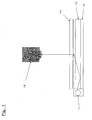
- the reverse prism type has a structure in which the reflective plate 12 adheres tightly to the light guide plate 13 due to the constitution of this type in Fig. 1 and therefore there readily causes a problem that inorganic particles are exfoliated to damage the light guide plate.
- the addition amount of the particles exceeds 0.5% by weight, the exfoliation of particles is apt to cause the flaws.
- the addition amount of the particles is preferably 0.5% by weight or less, and more preferably 0.1% by weight or less.
- a number average particle size of the particles added for this purpose is preferably 3 ⁇ m or more and 7 ⁇ m or less, and more preferably 3 to 5 ⁇ m. When the number average particle size on number is less than 3 ⁇ m, the roughness of the surface is lowered and adhesion between the film and the light guide plate may become high.
- the average particle size is more than 7 ⁇ m, since the particle becomes coarse, it tends to exfoliate and this may damage the light guide plate.
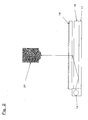
- the direct type since a cold cathode ray tube exists between the light guide plate and the reflective film, the light guide plate does not come into contact with the reflective film and there is not a possibility of occurrence of flaws of the light guide plate and the screen non-uniformity due to adhesion.
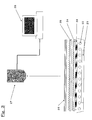
- the white polyester film of the present invention preferably has an applied layer containing spherical particles on at least one side of the white polyester film.
- an applied layer containing spherical particles, a projection shape is formed at the surface of the applied layer, and the light, which is reflected off the white film surface and passes through the applied layer, is concentrated by a lens effect through the projection shape at the surface of the applied layer and this contributes to improvement in the brightness in a front direction of a backlight.
- a type of the spherical particle of the present invention is not particularly limited, and any of organic particles and inorganic particles can be employed.
- organic spherical particles acrylic resin particles, silicone resin particles, nylon resin particles, polystyrene resin particles, polyamide resin particles such as benzoguanamine, and urethane resin particles can be used.
- inorganic spherical particles silicon oxide, aluminum hydroxide, aluminum oxide, zinc oxide, barium sulfide, magnesium silicate, and mixtures thereof can be used. It is preferable to use the organic spherical particles from the viewpoint of dispersibility of the particles in a resin binder commonly used, ability to be applied and economy.
- acrylic polymers, polystyrene polymers, and copolymers of acrylic-based vinyl monomer and styrene-based vinyl monomer are preferable, and particularly, and copolymers of acrylic-based vinyl monomer and styrene-based vinyl monomer can be suitably used in the present invention because a refractive index can be changed by adjusting a copolymerization proportion of two kinds of vinyl monomers.
- a refractive index differential an absolute value of a difference in refractive indexes between the spherical particle contained in the applied layer and the binder resin constituting the applied layer.
- a refractive index differential an absolute value of a difference in refractive indexes between the spherical particle contained in the applied layer and the binder resin constituting the applied layer.
- the refractive index differential is preferably 0.08 or less, more preferably 0.05 or less, and particularly preferably 0.01 or less.
- the refractive index herein refers to a proportion in which the undulation (such as light) traveling in a straight line changes an angle of a traveling direction at an interface between mediums, and it is a vacuum-based substance-specific value, that is, an absolute refractive index. Since the refractive index is an observed wavelength-specific value, the refractive index differential is a difference between values measured at the same observed wavelength. For example, a refractive index of poly(methyl methacrylate), a typical acrylic resin, is 1.49 for light having a wavelength of 589.3 nm.
- the refractive index differential referred to herein refers to an absolute value of a difference between a refractive index of the spherical particle and a refractive index of the binder resin, and even when the refractive index of the spherical particle is smaller than that of the binder resin and the refractive index differential is a negative value, its absolute value, that is, a positive value is a refractive index differential.
- the refractive index of the spherical particle and “the refractive index of the binder” are determined as follows.
- the volume average particle size is not particularly limited as long as the projection shape is formed at the surface of the applied layer, but the volume average particle size is preferably 0.05 ⁇ m or more, more preferably 0.5 ⁇ m or more, furthermore preferably 1 ⁇ m or more, and particularly preferably 3 ⁇ m or more.
- an upper limit of the volume average particle size is not particularly limited, but it is preferably 100 ⁇ m or less since the ability to be applied may be poor if it exceeds 100 ⁇ m.
- a coefficient of variation CV of the volume average particle size is preferably 30% or less.
- the coefficient of variation CV herein refers to a value obtained by dividing a standard deviation of the volume average particle size by the volume average particle size. This coefficient of variation CV is measured by a method described in Example described later.
- the coefficient of variation CV is more preferably 20% or less, particularly preferably 15% or less, and the most preferably 10% or less.
- the CV value can be reduced by classifying the particles and removing the particles having an uneven particle size.
- the spherical particle is preferably nonporous from the viewpoint of improvement in reflectance and light resistance. If the spherical particle is porous, an area of refractive interface between the binder resin and the spherical particle increases, and therefore light loss due to internal diffusion is increased and the reflectance is apt to decrease. Further, when a light resistant resin is used as a binder resin of the applied layer, if the spherical particle is porous, the binder resin is penetrated into pores. Therefore, even if the binder resin is added in the same amount as that of the binder resin in a case where nonporous spherical particles are used, a thickness of the applied layer becomes relatively small and the light resistance may be deteriorated.
- the content of the spherical particles in the applied layer is not particularly limited as long as the reflectance is improved, but the content of the spherical particle is preferably 3% by weight or more with respect to the whole applied layer, though it cannot be uniquely limited because it depends on the types of the particle and the dispersibility of the particle in a coating solution.
- the content is more preferably 5% by weight or more, furthermore preferably 10% by weight or more, and particularly preferably 15% by weight or more.
- an upper limit of the content is not particularly limited, but the content is preferably 30% by weight or less since the ability to be applied may be poor if it exceeds 30% by weight.
- the spherical particle When the applied layer is provided, since the spherical particle needs to be dispersed in a solvent during an applying step, the spherical particle requires solvent resistance and therefore the spherical particles preferably have a crosslinking structure. When the spherical particles do not have a crosslinking structure, the spherical particles are eluted during the applying step and there may be cases where the applied layer in which particle shapes and particle sizes are maintained cannot be provided.
- crosslinking structure it is preferable to form the crosslinking structure by use of vinyl compounds having a plurality of functional groups in a molecule, and it is particularly preferable to use polyfunctional acrylic compounds such as difunctional acrylic compounds, trifunctional acrylic compounds, and at least tetrafunctional acrylic compounds as vinyl compounds having a plurality of functional groups in a molecule
- TECHPOLYMER manufactured by SEKISUI PLASTICS Co., Ltd.
- S series in the "TECHPOLYMER” products are preferable, and when a coefficient of variation is 15% or less, spherical particles made of a copolymer of methyl methacrylate and ethylene glycol dimethacrylate such as SSX series products can be most suitably used.
- an ultraviolet absorber and/or a light stabilizer be added and that in producing these resins, the resin be chemically combined with an ultraviolet absorber and/or a light stabilizer, having a reactive double bond, by copolymerization. It is preferable to fix the ultraviolet absorber and/or the light stabilizer by chemically combining like the latter in that bleed out from the spherical particle is less.
- the ultraviolet absorber and the light stabilizer contained in the spherical particle are broadly divided into inorganic agents and organic agents.
- titanium oxide, zinc oxide, cerium oxide and the like are commonly known, and among them, zinc oxide is the most preferable in point of economy, an ultraviolet absorbing property and photocatalyst activity.
- organic-based ultraviolet absorbers may include benzotriazole-based, benzophenone-based, oxalic anilide-based, cyanoacrylate-based and triazine-based ultraviolet absorbers. Since these ultraviolet absorbers just absorb ultraviolet rays and cannot capture organic radicals produced by ultraviolet irradiation, this radical may cause chain reaction degradation of a white film to become a substrate. It is preferable to use the ultraviolet absorber in combination with the light stabilizer in order to capture these radicals and particularly a light stabilizer of a hindered amine-based compound is suitably used.
- acrylic-based or styrene-based vinyl monomers are preferable because of high general versatility and economy. Since styrene-based vinyl monomers have aromatic rings and are susceptible to yellowing, they are the most preferably copolymerized with the acrylic-based vinyl monomer from the viewpoint of light resistance.
- a reactive vinyl monomer-substituted benzotriazole 2-(2'-hydroxy-5'-methacryloxyethylphenyl)-2H-benzotriazole (trade name: RUVA-93, manufactured by Otsuka Chemical Co., Ltd.) can be used.
- a reactive vinyl monomer-substituted hindered amine compound 4-methacryloyloxy-2,2,6,6-tetramethylpiperidyne ("ADK STAB LA-82" manufactured by Adeka Argus Industry Co., Ltd.) can be used.
- copolymer components and monomer composition of the binder resin be identical to those of the spherical particle. Furthermore, when both of the binder resin and the spherical particle are composed of resins to which an ultraviolet absorber and/or a light stabilizer is added, the light resistance of the applied layer can also be improved.
- the white film of a substrate may be deteriorated (e.g., photodeterioration such as yellowing, or degradation in which a molecular weight is decreased) during being used as a backlight by light, particularly ultraviolet rays, emitted from a lamp of a cold cathode ray tube or the like, and therefore it is preferable that the ultraviolet absorber and/or the light stabilizer be contained in a layer of the white film of a substrate and/or in the binder resin layer provided on one side.
- the ultraviolet absorber and/or the light stabilizer be contained in a layer of the white film of a substrate and/or in the binder resin layer provided on one side.
- Materials of the binder resin layer is not particularly limited, but resins principally containing organic components are preferable and examples of the resins include polyester resin, polyurethane resin, acrylic resin, methacrylic resin, polyamide resin, polyethylene resin, polypropylene resin, polyvinyl chloride resin, polyvinylidene chloride resin, polystyrene resin, polyvinyl acetate resin, and fluorine-based resins. These resins may be used alone or as a copolymer or a mixture of two or more kinds of them. Among them, the polyester resin, the polyurethane resin, and acrylic or methacrylic resin are preferably used from the viewpoint of heat resistance, dispersibility of particles, an ability to be applied and a gloss level. From the viewpoint of the light resistance of the applied layer, it is more preferable that the binder resin layer also contain an ultraviolet absorber and a light stabilizer.
- a resin constituting a resin layer containing an ultraviolet absorber is not particularly limited, and resins containing an inorganic ultraviolet absorber, resins containing an organic ultraviolet absorber, and resins formed by copolymerizing a benzotriazole-based or a benzophenone-based reactive monomer can be used.
- organic ultraviolet absorbing resins containing a resin formed by copolymerizing a hindered amine (HALS)-based reactive monomer and the like are preferably used.
- the inorganic-based ultraviolet absorber zinc oxide, titanium oxide, cerium oxide and zirconium oxide are common.
- these absorbers at least one selected from the group consisting of zinc oxide, titanium oxide and cerium oxide is preferably used because it does not cause bleed out and has an excellent light resistance.
- Such ultraviolet absorber may be used in combination of several kinds as required.
- zinc oxide is the most preferable in point of economy, an ultraviolet absorbing property and photocatalyst activity.
- FINEX-25 LP, FINEX-50 LP manufactured by Sakai Chemical Industry Co., Ltd.
- organic-based ultraviolet absorbers resins containing an organic ultraviolet absorber such as benzotriazole and benzophenone, resins formed by copolymerizing a benzotriazole-based or a benzophenone-based reactive monomer, or resins formed by copolymerizing these resins with a light stabilizer such as a hindered amine (HALS)-based reactive monomer can be used.
- an organic ultraviolet absorber such as benzotriazole and benzophenone
- a light stabilizer such as a hindered amine (HALS)-based reactive monomer
- resins formed by copolymerizing a benzotriazole-based or a benzophenone-based reactive monomer and organic ultraviolet absorbing resins containing a resin formed by copolymerizing a hindered amine (HALS)-based reactive monomer with the resins are more preferable because of a large effect of absorbing ultraviolet light in a thin layer.
- HALS hindered amine
- HALSHYBRID registered trademark
- NIPPON SHOKUBAI CO., LTD. a copolymer of an acrylic monomer and an ultraviolet absorber as an active component, and the like
- copolymer components, monomer composition, ultraviolet absorbers and light stabilizers of the resin binder be identical to those of the spherical particle.
- purity of terephthalic acid being a base of polyethylene terephthalate is increased to reduce a total amount of metal catalyst compounds such as compounds using an element group of Sb, K, P, Mg, Li, Ca, Ge and Ti at the time of forming polyester being a base by polymerization, and by controlling reaction time and reaction temperature, polyethylene terephthalate, which has less catalyst residue and has a high L value and a low b value, is obtained.
- metal catalyst compounds such as compounds using an element group of Sb, K, P, Mg, Li, Ca, Ge and Ti
- polymethylpentene as a non-compatible polymer and polyethylene glycol and a copolymer of polybutylene terephthalate and polytetramethylene glycol as a specific gravity-decreasing material are mixed in the polyethylene terephthalate formed by polymerization by the above method, and the resulting mixture is adequately mixed and dried, and then supplied to an extruder A heated to a temperature of 270 to 300°C.
- polyethylene terephthalate including inorganic additives such as SiO 2 may be supplied to an extruder B by a common method, and a layer of the extruder A and a layer of the extruder B may be laminated in a three-layer constitution of layer A/layer B/layer A in a T-die three-layer nozzle so that a polymer of the layer of the extruder B becomes both surface layers.
- This melted sheet was brought into close contact with a drum, a surface temperature of which is cooled to 10 to 60°C, by an electrostatic force, cooled, and solidified to obtain a non-stretched film, and the non-stretched film is guided to a series of rolls heated to a temperature of 80 to 120°C, stretched by 2.0 to 5.0 times in a longitudinal direction, and cooled with a series of rolls of 20 to 50°C. Subsequently, the film stretched in a longitudinal direction was led to a tenter while grasping both ends of the film with clips, and was transversely stretched in a direction perpendicular to a longitudinal direction in an atmosphere heated to a temperature of 90 to 140°C.
- the film is stretched by 2.5 to 4.5 times in a longitudinal or transverse direction, but a ratio of area of the stretched film to original area (longitudinal draw ratio ⁇ transverse draw ratio) is preferably 9 to 16.
- a ratio of area of the stretched film to original area is preferably 9 to 16.
- whiteness of the resulting film becomes poor, and when the ratio is more than 16, the film is apt to break in stretching and a film forming property tends to become poor.
- the film is subjected to heat setting at a temperature of 150 to 230°C in the tenter and is slowly cooled uniformly to room temperature and wound to obtain a film of the present invention.
- additives may be added to the white film and/or the applied layer of the present invention within the range of not impairing the effects of the present invention.
- additives for example, organic and/or inorganic fine particles, fluorescent brighteners, crosslinking agents, heat stabilizers, antioxidants, organic lubricants, antistatic agents, nucleating agents, dyes, fillers, dispersants, coupling agents and the like can be used.
- an average reflectance at a wavelength of 400 to 700 nm measured from a plane in which the applied layer is provided is preferably 85% or more, more preferably 87% or more, and particularly preferably 90% or more.
- the average reflectance is less than 85%, some liquid crystal displays to which the white film of the present invention is applied may be low in brightness.
- the applied layer is provided on both sides of the white film, the average reflectance measured from any one of applied layers on both sides may be 85% or more.
- a coating solution may be applied by any method.
- the methods such as gravure coating, roller coating, spin coating, reverse coating, bar coating, screen coating, blade coating, air knife coating, and dipping may be employed.
- the coating solution for forming the applied layer may be applied (in line coating) concurrently with the production of the white film of a substrate may be used, or may be applied (off line coating) onto a white film in which the crystalline orientation has been completed.
- the white reflective film of the present invention thus obtained can realize an improvement in the brightness of the liquid crystal backlight, and in accordance with the further preferred aspect, the white reflective film can be favorably used as reflective plates for area light sources of edge-light and direct type for a liquid crystal screen and as reflectors since the reduction in reflectance is low even long-term use.
- the white reflective film of the present invention is used in these area light sources, it is installed with its applied layer directed to the light sources.
- the white polyester film for a liquid crystal display reflective plate of the present invention thus obtained has fine air bubbles formed within the film to achieve a high reflectance and can attain high brightness when it is used as a reflective plate of side light type liquid crystal displays and direct type liquid crystal displays.
- the spectral reflectance at a wavelength range of 450 to 600 nm is measured.
- R represents a light reflectance (%)
- ⁇ represents a wavelength of light (nm)
- M represents a wavelength coefficient (%/nm)
- B represents a constant (%)
- a reflective film 12 of a backlight of VAIO (VGN-S52B/S) manufactured by SONY Corp. is changed to a prescribed film and the brightness is measured at a measuring distance of 850 mm with a luminance colorimeter 15 (BM-7 fast manufactured by Topcon Cord .). Measurement is performed three times and averaged.
- the brightness was rated according to the following criteria. 3000 cd/m 2 or more is excellent, 2950 cd/m 2 or more and less than 3000 cd/m 2 is good, 2900 cd/m 2 or more and less than 2950 cd/m 2 is acceptable, and less than 2900 cd/m 2 is bad.
- a reflective film bonded in a backlight of 181BLM07 (manufactured by NEC Corp.) was changed to a prescribed film sample and a liquid crystal display was lit up.
- the film sample was held for one hour in this state to stabilize a light source, and a screen portion of a liquid crystal display was taken with a CCD camera (DXC-390 manufactured by SONY Corp.) and images were captured by an image analyzer EyeScale manufactured by I.System Corp. Thereafter, the brightness level of the taken images was controlled in 30000 steps and automatically detected and detected data was converted to brightness.
- the brightness was rated according to the following criteria.
- 5100 cd/m 2 or more is excellent, 5000 cd/m 2 or more and less than 5100 cd/m 2 is good, 4900 cd/m 2 or more and less than 5000 cd/m 2 is acceptable, and less than 4900 cd/m 2 is bad.
- the gloss level was measured at an incident angle of 60 degrees and an acceptance angle of 60 degrees according to JIS K 7105 with a digital variable gloss meter (UGU-4D) manufactured by SUGA TEST INSTRUMENTS Co., Ltd.
- a reflective film 12 of a backlight of VAIO (VGN-S52B/S) manufactured by SONY Corp. was changed to a prescribed film and the prescribed film was brought into contact with the light guide plate 13, then the reflective film was removed, the surface of the light guide plate was observed, and the presence or absence of the flaw was visually identified.
- the flaw of the light guide plate the light guide plate having no flaw is good, the light guide plate having a few flaws is acceptable, and the light guide plate having flaws and being at an impracticable level is bad.
- a reflective film 12 of a backlight of VAIO (VGN-S52B/S) manufactured by SONY Corp. was changed to a prescribed film and a liquid crystal display was lit up in this state.
- a metal plate on a backside of a liquid crystal display was removed, a back of the reflective plate was pressed with a forefinger, and the brightness unevenness of the screen at that time was visually identified.
- the display in which the screen non-uniformity due to adhesion has not occurred, is excellent, the display, in which the screen non-uniformity due to adhesion has occurred but an area of the screen non-uniformity is less than 2 mm ⁇ 2 mm, is good, the display, in which the screen non-uniformity due to adhesion has occurred but an area of the screen non-uniformity is 2 mm ⁇ 2 mm or more and less than 5 mm ⁇ 5 mm, is acceptable, and the display, in which the screen non-uniformity due to adhesion has occurred but an area of the screen non-uniformity is 5 mm ⁇ 5 mm or more, is bad.
- the area of the screen non-uniformity indicates a region where the distribution of the screen brightness is uneven and a region which looks like bright whitish portion over the backlight, due to its adhesion to the light guide plate.
- the refractive indexes of the binder resin and the spherical particle are unknown, they are determined according the following procedure.
- a volume average particle size and a coefficient of variation CV of the spherical particles sampled in (11) were measured using Coulter Multisizer III (manufactured by Beckman Coulter, Inc.) as a particle size distribution measuring apparatus utilizing a pore electric resistance method. Number of particles and,a particle volume were measured by measuring electric resistance of an electrolyte fraction corresponding to a volume of particles at the time when the particles pass through the pores.
- a trace amount of samples were dispersed in a dilute aqueous solution of a surfactant, then this dispersion was added to a container of a designated electrolyte by a quantity in which a percentage of passing through an aperture (pore at detection section) was 10 to 20% while monitoring the display, measurement of a particle size was continued until number of particles passing through the pore reached 100000, and data was automatically calculated to determine a volume average particle size, and a standard deviation and a coefficient of variation of the volume average particle size.
- the coefficient of variation can be calculated from the following formula.
- ⁇ Coefficient of variation CV % standard deviation ⁇ m of volume average particle size ⁇ 100 / volume average particle size ⁇ m
- a b value representing a degree of yellow was determined by a reflection measuring method with a C/2° light source. b values of three samples were calculated and this was taken as a degree of yellow.
- Class A Change Rate in Yellowing is less than 5
- Class B Change Rate in Yellowing is not less than 5 and less than 15
- Class C Change Rate in Yellowing is not less than 15.
- a cold cathode ray tube lamp was lit up for 60 minutes to stabilize a light source and then brightness (cd/m 2 ) was measured using a luminance colorimeter model BM-7 fast (manufactured by TOPCON Corp.). An average value of brightness of three samples was determined and this average value was taken as average brightness.
- polyethylene terephthalate where a total amount of Sb, K, P, Mg, Li, Ca, Ge and Ti compounds, catalysts used in polymerization of polyethylene terephthalate, was 2.985 moles per 1 ton of polyethylene terephthalate and which was formed by polymerizing polyethylene glycol having a molecular weight of 4000 has an L value of 62.8 and a b value of 0.5 in color tone (according to JIS K 7105) as well as a haze value of 0.2%, 65 parts by weight of polyethylene terephthalate, .5 parts by weight of a copolymer of polybutylene terephthalate and polytetramethylene glycol (PBT/PTMG) (trade name: Hytrel manufactured by DU PONT-TORAY Co., Ltd.), 10 parts by weight of a copolymer formed by copolymerizing polyethylene terephthalate, 10 mol% of isophthalic acid and 5 mol% of polyethylene glycol having a
- a non-stretched film obtained by cooling and solidifying this film on a chill drum having a surface temperature of 25°C was guided to a series of rolls heated to a temperature of 85 to 98°C, stretched by 3.4 times in a longitudinal direction, and cooled with a series of rolls of 21°C. Subsequently, the film stretched in a longitudinal direction was led to a tenter while grasping both ends of the film with clips, and stretched by 3.6 times in a direction perpendicular to a longitudinal direction under an atmosphere heated to 120°C. Thereafter, the film was subjected to heat setting at 190°C in the tenter, and was slowly cooled uniformly to room temperature and wound to obtain a film having a thickness of 300 ⁇ m. The gloss level (60 degrees) of the resulting film was 122%.
- Properties as a substrate for a direct type liquid crystal display reflective plate are as shown in Table 1. High brightness was achieved in the direct type liquid crystal display.
- a film having a thickness of 300 ⁇ m was prepared by the same procedure as in Example 1 except for changing the composition of the polyester layer (A) to that described in Table 1.
- the gloss level (60 degrees) of the resulting film was 120%.
- Properties as a substrate for a direct type liquid crystal display reflective plate are as shown in Table 1. High brightness was achieved in the direct type liquid crystal display.
- a film having a thickness of 300 ⁇ m was prepared by the same procedure as in Example 1 except for changing the composition of the polyester layer (A) to that described in Table 1.
- the gloss level (60 degrees) of the resulting film was 42%.
- Properties as a substrate for a liquid crystal display reflective plate are as shown in Table 1. Very high brightness was achieved in the direct type liquid crystal display.
- a film having a thickness of 300 ⁇ m was prepared by the same procedure as in Example 1 except for changing the composition of the polyester layer (A) to that described in Table 1.
- the gloss level (60 degrees) of the resulting film was 55%.
- Properties as a substrate for a liquid crystal display reflective plate are as shown in Table 1. Very high brightness was achieved in the direct type liquid crystal display.
- a film having a thickness of 225 ⁇ m was prepared by the same procedure as in Example 1 except for changing the composition of the polyester layer (A) to that described in Table 1.
- the gloss level (60 degrees) of the resulting film was 56%.
- Properties as a substrate for a liquid crystal display reflective plate are as shown in Table 1. Very high brightness was achieved in the edge light type liquid crystal display and the direct type liquid crystal display.
- a film having a thickness of 250 ⁇ m was prepared by the same procedure as in Example 1 except for changing the compositions of the polyester layers (A) and (B) to those described in Table 1.
- the gloss level (60 degrees) of the resulting film was 113%.
- Properties as a substrate for a side light type and a direct type liquid crystal display reflective plates are as shown in Table 1. There was no flaw on the light guide plate and screen non-uniformity due to adhesion was not produced. Further, very high brightness was achieved in the edge light type liquid crystal display and the direct type liquid crystal display.
- a film having a thickness of 300 ⁇ m was prepared by the same procedure as in Example 1 except for changing the composition of the polyester layer (A) to that described in Table 1 and changing the lamination constitution of the layer A and the layer B from a three-layer to a two-layer.
- the gloss level (60 degrees) of the resulting film was 120%.
- Properties as a substrate for a side light type and a direct type liquid crystal display reflective plates are as shown in Table 1. There are a few flaws on the light guide plate but this film can be used in the application of the direct type liquid crystal display. Further, high brightness was achieved in the side light type liquid crystal display and the direct type liquid crystal display.
- a film having a thickness of 225 ⁇ m was prepared by the same procedure as in Example 1 except for changing the compositions of the polyester layers (A) and (B) to those described in Table 1.
- the gloss level (60 degrees) of the resulting film was 114%.
- Properties as a substrate for a side light type and a direct type liquid crystal display reflective plates are as shown in Table 1. There was no flaw on the light guide plate, screen non-uniformity due to adhesion was not produced, and very high brightness was achieved.
- a film having a thickness of 250 ⁇ m was prepared by-the same procedure as in Example 1 except for changing the composition of the polyester layer (A) to that described in Table 1.
- the gloss level (60 degrees) of the resulting film was 115%.
- Properties as a substrate for a side light type and a direct type liquid crystal display reflective plates are as shown in Table 1. There was no flaw on the light guide plate, a degree of screen non-uniformity due to adhesion was low, and high brightness was achieved in the edge light type liquid crystal display and the direct type liquid crystal display.
- a film having a thickness of 188 ⁇ m was prepared by the same procedure as in Example 1 except for changing the compositions of the polyester layers (A) and (B) to those described in Table 1.
- the gloss level (60 degrees) of the resulting film was 104%.
- Properties as a substrate for a side light type and a direct type liquid crystal display reflective plates are as shown in Table 1. There was no flaw on the light guide plate, screen non-uniformity due to adhesion was not produced, and high brightness was achieved in the edge light type liquid crystal display and the direct type liquid crystal display.
- a film having a thickness of 188 ⁇ m was prepared by the same procedure as in Example 1 except for changing the composition of the polyester layer (A) and a thickness of the film to those described in Table 1.
- the gloss level (60 degrees) of the resulting film was 48%.
- Properties as a substrate for a side light type and a direct type liquid crystal display reflective plates are as shown in Table 1.
- a level of the flaw of the light guide plate was impracticable but screen non-uniformity due to adhesion was not produced. High brightness was not achieved in the edge light type liquid crystal display nor the direct type liquid crystal display.
- a film having a thickness of 300 ⁇ m was prepared by the same procedure as in Example 1 except for changing the composition of the polyester layer (A) to that described in Table 1.
- the gloss level (60 degrees) of the resulting film was 99%.
- Properties as a substrate for a side light type and a direct type liquid crystal display reflective plates are as shown in Table 1. The flaw of the light guide plate was no problem but screen non-uniformity due to adhesion was found. High brightness was not achieved in the side light type liquid crystal display nor the direct type liquid crystal display.
- a film having a thickness of 250 ⁇ m was prepared by the same procedure as in Comparative Example 1 except for changing the compositions of the polyester layers (A) and (B) and a thickness of the film to those described in Table 1.
- the gloss level (60 degrees) of the resulting film was 27%.
- Properties as a substrate for a side light type and a direct type liquid crystal display reflective plates are as shown in Table 1. A level of the flaw of the light guide plate was impracticable but screen non-uniformity due to adhesion was not found. High brightness was not achieved in the side light type liquid crystal display nor the direct type liquid crystal display.
- a film having a thickness of 188 ⁇ m was prepared by the same procedure as in Example 1 except for changing the compositions of the polyester layers (A) and (B) and a thickness of the film to those described in Table 1.
- the gloss level (60 degrees) of the resulting film was 26%.
- Properties as a substrate for a side light type and a direct type liquid crystal display reflective plates are as shown in Table 1. A level of the flaw of the light guide plate was impracticable but screen non-uniformity due to adhesion was not found. High brightness was not achieved in the side light type liquid crystal display nor the direct type liquid crystal display.
- a film having a thickness of 100 ⁇ m was prepared by the same procedure as in Example 1 except for adjusting the composition of the polyester layer (A) so as to have the same composition as that of the polyester layer (B) and changing a thickness of the film to that described in Table 1.
- the gloss level (60 degrees) of the resulting film was 35%.
- Properties as a substrate for a side light type and a direct type liquid crystal display reflective plates are as shown in Table 1. A level of the flaw of the light guide plate was impracticable but screen non-uniformity due to adhesion was not found. High brightness was not achieved in the side light type liquid crystal display nor the direct type liquid crystal display.
- a coating solution formed by adding 10.0 parts by weight of HALSHYBRID (registered trademark) UV-G13 (acrylic copolymer, solution having a concentration of 40%, refractive index 1.49, manufactured by NIPPON SHOKUBAI CO., LTD.), 9.9 parts by weight of ethyl acetate, and 0.45 parts by weight of nonporous acrylic particles (manufactured by SEKISUI PLASTICS Co., Ltd., TECHPOLYMER (registered trademark) SSX series, SSX-105, refractive index 1.49, volume average particle size 5.0 ⁇ m, coefficient of variation CV 9%, acrylic copolymer, crosslinked, without an ultraviolet absorber and a light stabilizer) as a spherical particle while stirring a mixture, was prepared.
- This coating solution was applied onto one surface of the polyester film of Example 8 with a coating bar No. 12 manufactured by Metava corporation and dried at 120°C for one minute to obtain a white film on which 4.0 g/m 2 of
- a coating solution formed by adding 10.0 parts by weight of HALSHYBRID (registered trademark) UV-G13 (acrylic copolymer, solution having a concentration of 40%, refractive index 1.49, manufactured by NIPPON SHOKUBAI CO., LTD.), 14.5 parts by weight of ethyl acetate, and 1.75 parts by weight of nonporous acrylic particles (manufactured by SEKISUI PLASTICS Co., Ltd., TECHPOLYMER (registered trademark) SSX series, SSX-105, refractive index 1.49, volume average particle size 5.0 ⁇ m, coefficient of variation CV 9%, acrylic copolymer, crosslinked, without an ultraviolet absorber and a light stabilizer) as a spherical particle while stirring a mixture, was prepared.
- This coating solution was applied onto one surface of the polyester film of Example 8 with a coating bar No. 12 manufactured by Metava corporation and dried at 120°C for one minute to obtain a white film on which 4.0 g/m 2 of
- a coating solution formed by adding 10.0 parts by weight of HALSHYBRID (registered trademark) UV-G13 (acrylic copolymer, solution having a concentration of 40%, refractive index 1.49, manufactured by NIPPON SHOKUBAI CO., LTD.), 14.5 parts by weight of ethyl acetate, and 1.75 parts by weight of nonporous acrylic particles (manufactured by SEKISUI PLASTICS Co., Ltd., TECHPOLYMER (registered trademark) SSX series, SSX-105, refractive index 1.49, volume average particle size 5.0 ⁇ m, coefficient of variation CV 9%, acrylic copolymer, crosslinked, without an ultraviolet absorber and a light stabilizer) as a spherical particle while stirring a mixture, was prepared.
- This coating solution was applied onto one surface of the polyester film of Example 8 with a coating bar No. 12 manufactured by Metava corporation to obtain a white film on which 4.0 g/m 2 of the coating solution was applied.
- nonporous acrylic particles manufactured by SEKISUI PLASTICS Co., Ltd., TECHPOLYMER (registered trademark) SSX-102, refractive index 1.49, volume average particle size 2.5 ⁇ m, coefficient of variation CV 10%, acrylic copolymer, crosslinked, without an ultraviolet absorber and a light stabilizer
- nonporous acrylic particles manufactured by SEKISUI PLASTICS Co., Ltd., TECHPOLYMER (registered trademark) MBX series, XX-09FP, refractive index 1.49, volume average particle size 5.0 ⁇ m, coefficient of variation CV 27%, acrylic copolymer, crosslinked, without an ultraviolet absorber and a light stabilizer
- nonporous acrylic particles manufactured by SEKISUI PLASTICS Co., Ltd., TECHPOLYMER (registered trademark) MBX series, MB30X-8, refractive index 1.49, volume average particle size 8.0 ⁇ m, coefficient of variation CV 32%, acrylic copolymer, crosslinked, without an ultraviolet absorber and a light stabilizer
- porous acrylic particles manufactured by SEKISUI PLASTICS Co., Ltd., TECHPOLYMER (registered trademark) MBP series, MBP-8, refractive index 1.49, volume average particle size 8.0 ⁇ m, coefficient of variation CV 44%, acrylic copolymer, crosslinked, without an ultraviolet absorber and a light stabilizer
- the dispersion was cooled to room temperature and filtrated with a mesh filter having an opening of 40 ⁇ m to eliminate flocculated substances. There was no flocculated substance in the resulting dispersion and the filtration of the dispersion was very excellent.
- the resin particles dispersed in the dispersion thus filtrated have a volume average particle size of 6.4 ⁇ m and this resin particle was completely spherical.
- the dispersion of the resin particles was washed according to a normal method and then filtrated to separate the resin particles from a dispersion medium, and separated resin particles were dried and classified to obtain spherical particles A (coefficient of variation CV 15%).
- a coating solution formed by adding 10.0 parts by weight of HALSHYBRID (registered trademark) UV-G13 (acrylic copolymer, solution having a concentration of 40%, refractive index 1.49, manufactured by NIPPON SHOKUBAI CO., LTD.), 11.9 parts by weight of ethyl acetate, and 1.0 part by weight of spherical particles A (refractive index 1.49, average particle size 6.4 ⁇ m, coefficient of variation CV 15%, acrylic copolymer, crosslinked, ultraviolet absorber: benzotriazole, light stabilizer: hindered amine) while stirring a mixture, was prepared.
- This coating solution was applied onto one surface of the polyester film of Example 8 with a coating bar No.12 manufactured by Metava corporation and dried at 120°C for one minute to obtain a white film on which 4.0 g/m 2 of the coating solution was applied.
- nonporous silicon oxide (silica) particles manufactured by FUSO CHEMICAL Co., Ltd., QUARTRON (registered trademark) SP series, SP-3C, refractive index 1.45, volume average particle size 3.0 ⁇ m, coefficient of variation CV 16%, crosslinked, without an ultraviolet absorber and a light stabilizer
- nonporous silicone particles manufactured by GE-Toshiba Silicone Co., Ltd., Tospearl (registered trademark), Tospearl 145, refractive index 1.42, volume average particle size 4.5 ⁇ m, coefficient of variation CV 12%, crosslinked, without an ultraviolet absorber and a light stabilizer
- nonporous polystyrene particles manufactured by SEKISUI PLASTICS Co., Ltd., TECHPOLYMER (registered trademark) SBX series, SBX-8, refractive index 1.59, volume average particle size 8.0 ⁇ m, coefficient of variation CV 37%, styrene copolymer, crosslinked, without an ultraviolet absorber and a light stabilizer
- a coating solution formed by adding 10.0 parts by weight of HALSHYBRID (registered trademark) UV-G13 (acrylic copolymer, solution having a concentration of 40%, refractive index 1.49, manufactured by NIPPON SHOKUBAI CO., LTD.) and 18.9 parts by weight of toluene while stirring a mixture, was prepared.
- This coating solution was applied onto one surface of the polyester film of Comparative Example 4 with a coating bar No. 12 manufactured by Metava corporation and dried at 120°C for one minute to obtain a white film on which 4.0 g/m 2 of only the binder resin was applied.
- Nonporous benzoguanamine-formaldehyde condensate particles manufactured by NIPPON SHOKUBAI CO., LTD., EPOSTAR (registered trademark), EPOSTAR M05, refractive index 1.66, volume average particle size 5.2 ⁇ m, coefficient of variation CV 35%, polyamide resin particle, crosslinked, without an ultraviolet absorber and a light stabilizer
- EPOSTAR M05 refractive index 1.66
- volume average particle size 5.2 ⁇ m coefficient of variation CV 35%
- polyamide resin particle crosslinked, without an ultraviolet absorber and a light stabilizer
- Nonporous silica particles manufactured by FUJI SILYSIA CHEMICAL Ltd. SYLOPHOBIC 100 (registered trademark), refractive index 1.45, volume average particle size 2.5 ⁇ m, coefficient of variation CV 49%, polyamide resin particle, crosslinked, without an ultraviolet absorber and a light stabilizer
- SYLOPHOBIC 100 registered trademark
- refractive index 1.45 refractive index 1.45
- volume average particle size 2.5 ⁇ m, coefficient of variation CV 49% polyamide resin particle, crosslinked, without an ultraviolet absorber and a light stabilizer
- this coating solution was applied onto one surface of the polyester film of Comparative Example 4 with a coating bar No.12 manufactured by Metava corporation and dried at 120°C for one minute to obtain a white film on which 4.0 g/m 2 of the coating solution was applied.
Landscapes
- Physics & Mathematics (AREA)
- Chemical & Material Sciences (AREA)
- Optics & Photonics (AREA)
- General Physics & Mathematics (AREA)
- Health & Medical Sciences (AREA)
- Chemical Kinetics & Catalysis (AREA)
- Medicinal Chemistry (AREA)
- Polymers & Plastics (AREA)
- Organic Chemistry (AREA)
- Engineering & Computer Science (AREA)
- Manufacturing & Machinery (AREA)
- Nonlinear Science (AREA)
- Materials Engineering (AREA)
- Crystallography & Structural Chemistry (AREA)
- Mathematical Physics (AREA)
- Optical Elements Other Than Lenses (AREA)
- Laminated Bodies (AREA)
- Manufacture Of Macromolecular Shaped Articles (AREA)
Applications Claiming Priority (2)
| Application Number | Priority Date | Filing Date | Title |
|---|---|---|---|
| JP2006292294 | 2006-10-27 | ||
| PCT/JP2007/070582 WO2008053739A1 (fr) | 2006-10-27 | 2007-10-23 | Film en polyester blanc destiné à une plaque réfléchissant la lumière |
Publications (2)
| Publication Number | Publication Date |
|---|---|
| EP2077458A1 true EP2077458A1 (fr) | 2009-07-08 |
| EP2077458A4 EP2077458A4 (fr) | 2012-03-28 |
Family
ID=39344082
Family Applications (1)
| Application Number | Title | Priority Date | Filing Date |
|---|---|---|---|
| EP07830316A Ceased EP2077458A4 (fr) | 2006-10-27 | 2007-10-23 | Film en polyester blanc destiné à une plaque réfléchissant la lumière |
Country Status (7)
| Country | Link |
|---|---|
| US (1) | US8227073B2 (fr) |
| EP (1) | EP2077458A4 (fr) |
| JP (1) | JP5292812B2 (fr) |
| KR (1) | KR101398507B1 (fr) |
| CN (2) | CN101529281B (fr) |
| TW (1) | TWI449967B (fr) |
| WO (1) | WO2008053739A1 (fr) |
Cited By (1)
| Publication number | Priority date | Publication date | Assignee | Title |
|---|---|---|---|---|
| EP2148227A4 (fr) * | 2007-05-08 | 2010-09-01 | Toray Industries | Film reflechissant blanc |
Families Citing this family (57)
| Publication number | Priority date | Publication date | Assignee | Title |
|---|---|---|---|---|
| WO2009072464A1 (fr) * | 2007-12-03 | 2009-06-11 | Nippon Shokubai Co., Ltd. | Particules de polymère |
| JP2010026231A (ja) * | 2008-07-18 | 2010-02-04 | Jiroo Corporate Plan:Kk | 光学シート及びこれを用いたバックライトユニット |
| JP2010026222A (ja) * | 2008-07-18 | 2010-02-04 | Jiroo Corporate Plan:Kk | 光学シート用基材シート |
| KR20160003894A (ko) * | 2008-08-13 | 2016-01-11 | 데이진 듀폰 필름 가부시키가이샤 | 조명 장치용 반사 필름 |
| JP5369605B2 (ja) * | 2008-10-23 | 2013-12-18 | 東レ株式会社 | 白色反射フィルム |
| JP5369625B2 (ja) * | 2008-11-06 | 2013-12-18 | 東レ株式会社 | 白色反射フィルム |
| KR101727766B1 (ko) * | 2009-10-28 | 2017-04-17 | 도레이 카부시키가이샤 | 이축 배향 폴리에스테르 필름 |
| CN103467762B (zh) * | 2010-02-26 | 2016-01-20 | 东丽株式会社 | 白色膜的制造方法 |
| JP5045851B2 (ja) * | 2010-03-23 | 2012-10-10 | 東レ株式会社 | 白色ポリエステルフィルム、それを用いた光反射板および液晶ディスプレイ用バックライト |
| JP5623892B2 (ja) * | 2010-12-10 | 2014-11-12 | 帝人デュポンフィルム株式会社 | 2軸延伸白色ポリエステルフィルム |
| JP5817165B2 (ja) * | 2011-03-24 | 2015-11-18 | 東レ株式会社 | 反射板用白色積層ポリエステルフィルムおよびバックライト装置 |
| CN103443529A (zh) * | 2011-03-29 | 2013-12-11 | 东丽株式会社 | 边光型背光源用白色反射膜及使用其的液晶显示器用背光源 |
| US9235057B2 (en) | 2012-05-18 | 2016-01-12 | Reald Inc. | Polarization recovery in a directional display device |
| US9678267B2 (en) | 2012-05-18 | 2017-06-13 | Reald Spark, Llc | Wide angle imaging directional backlights |
| US9350980B2 (en) * | 2012-05-18 | 2016-05-24 | Reald Inc. | Crosstalk suppression in a directional backlight |
| WO2013173695A1 (fr) | 2012-05-18 | 2013-11-21 | Reald Inc. | Commande de sources de lumière d'un rétroéclairage directionnel |
| US9188731B2 (en) | 2012-05-18 | 2015-11-17 | Reald Inc. | Directional backlight |
| CN104704400B (zh) * | 2012-10-01 | 2018-01-09 | 阿科玛法国公司 | 光学光漫射器及用于其测量的方法 |
| JP6087189B2 (ja) * | 2013-03-29 | 2017-03-01 | 積水化成品工業株式会社 | 多孔質樹脂粒子及びその製造方法、並びに、その用途 |
| US9488891B2 (en) * | 2013-04-22 | 2016-11-08 | National University Of Singapore | Thin-surface liquid crystal based voltage sensor |
| WO2014196534A1 (fr) * | 2013-06-07 | 2014-12-11 | 東レ株式会社 | Film réfléchissant la lumière et rétro-éclairage de type lumière latérale |
| WO2014204950A1 (fr) | 2013-06-17 | 2014-12-24 | Reald Inc. | Commande de sources de lumière d'un rétroéclairage directionnel |
| JP2014052636A (ja) * | 2013-09-10 | 2014-03-20 | Teijin Dupont Films Japan Ltd | 液晶表示装置用反射フィルム |
| JP6235287B2 (ja) * | 2013-09-30 | 2017-11-22 | 日東電工株式会社 | 光学積層体 |
| EP3058422B1 (fr) | 2013-10-14 | 2019-04-24 | RealD Spark, LLC | Entrée de lumière pour rétroéclairage directionnel |
| CN106068533B (zh) | 2013-10-14 | 2019-01-11 | 瑞尔D斯帕克有限责任公司 | 定向显示器的控制 |
| JP6235299B2 (ja) * | 2013-10-22 | 2017-11-22 | 帝人フィルムソリューション株式会社 | 白色反射フィルム |
| EP3161550A4 (fr) | 2014-06-26 | 2018-04-18 | RealD Spark, LLC | Dispositif d'affichage intime directionnel |
| EP3204686B1 (fr) | 2014-10-08 | 2019-07-17 | RealD Spark, LLC | Unité de connexion pour un rétroéclairage directionnel |
| US10356383B2 (en) | 2014-12-24 | 2019-07-16 | Reald Spark, Llc | Adjustment of perceived roundness in stereoscopic image of a head |
| RU2596062C1 (ru) | 2015-03-20 | 2016-08-27 | Автономная Некоммерческая Образовательная Организация Высшего Профессионального Образования "Сколковский Институт Науки И Технологий" | Способ коррекции изображения глаз с использованием машинного обучения и способ машинного обучения |
| WO2016168305A1 (fr) | 2015-04-13 | 2016-10-20 | Reald Inc. | Dispositifs de rétroéclairage directionnel d'imagerie à grand angle |
| EP3304188B1 (fr) | 2015-05-27 | 2020-10-07 | RealD Spark, LLC | Rétroéclairages directionnels d'imagerie à grand angle |
| WO2017074951A1 (fr) | 2015-10-26 | 2017-05-04 | Reald Inc. | Système de confidentialité intelligent, appareil et procédé associés |
| US10459321B2 (en) | 2015-11-10 | 2019-10-29 | Reald Inc. | Distortion matching polarization conversion systems and methods thereof |
| US10330843B2 (en) | 2015-11-13 | 2019-06-25 | Reald Spark, Llc | Wide angle imaging directional backlights |
| EP4293417A3 (fr) | 2015-11-13 | 2024-01-24 | RealD Spark, LLC | Éléments de surface pour rétroéclairages directionnels d'imagerie |
| ES2912310T3 (es) | 2016-01-05 | 2022-05-25 | Reald Spark Llc | Corrección de la mirada en imágenes multivista |
| KR102717276B1 (ko) * | 2016-02-15 | 2024-10-14 | 주식회사 쿠라레 | 열가소성 수지 필름과 그 제조 방법, 및 적층체 |
| CN114554177A (zh) | 2016-05-19 | 2022-05-27 | 瑞尔D斯帕克有限责任公司 | 广角成像定向背光源 |
| WO2017205183A1 (fr) | 2016-05-23 | 2017-11-30 | Reald Spark, Llc | Rétroéclairages directionnels d'imagerie à grand angle |
| KR102473525B1 (ko) * | 2016-05-31 | 2022-12-02 | 엘지디스플레이 주식회사 | 에지형 백라이트 유닛 및 이를 포함하는 디스플레이 장치 |
| WO2017217178A1 (fr) * | 2016-06-17 | 2017-12-21 | 東レ株式会社 | Composition de résine, film durci, procédé de production d'un film durci, et dispositif d'affichage |
| CN110178072B (zh) | 2017-01-04 | 2022-03-11 | 瑞尔D斯帕克有限责任公司 | 用于成像定向背光源的光学叠堆 |
| US10408992B2 (en) | 2017-04-03 | 2019-09-10 | Reald Spark, Llc | Segmented imaging directional backlights |
| WO2019032604A1 (fr) | 2017-08-08 | 2019-02-14 | Reald Spark, Llc | Ajustement d'une représentation numérique d'une région de tête |
| WO2019090252A1 (fr) | 2017-11-06 | 2019-05-09 | Reald Spark, Llc | Appareil d'affichage de confidentialité |
| KR102759510B1 (ko) | 2018-01-25 | 2025-02-04 | 리얼디 스파크, 엘엘씨 | 프라이버시 디스플레이를 위한 터치스크린 |
| KR102078451B1 (ko) * | 2018-03-09 | 2020-02-17 | 도레이첨단소재 주식회사 | 백색 폴리에스테르 필름 및 이를 이용한 반사 시트 |
| JP2019164898A (ja) * | 2018-03-19 | 2019-09-26 | 三井化学株式会社 | 導光板 |
| CN108773135A (zh) * | 2018-05-04 | 2018-11-09 | 苏州奥美材料科技有限公司 | 一种高耐候性聚碳酸酯反光膜 |
| CN112297552A (zh) * | 2019-07-31 | 2021-02-02 | 宁波长阳科技股份有限公司 | 一种白色反射聚酯薄膜 |
| CN116194812A (zh) | 2020-09-16 | 2023-05-30 | 瑞尔D斯帕克有限责任公司 | 车辆外部照明装置 |
| CN112485946B (zh) * | 2020-12-02 | 2022-11-04 | 合肥乐凯科技产业有限公司 | 一种用于薄型直下式液晶显示装置的反射膜及其制备方法 |
| CN119790347A (zh) | 2022-06-22 | 2025-04-08 | 瑞尔D斯帕克有限责任公司 | 变形定向照明装置 |
| US11966049B2 (en) | 2022-08-02 | 2024-04-23 | Reald Spark, Llc | Pupil tracking near-eye display |
| US12282168B2 (en) | 2022-08-11 | 2025-04-22 | Reald Spark, Llc | Anamorphic directional illumination device with selective light-guiding |
Family Cites Families (35)
| Publication number | Priority date | Publication date | Assignee | Title |
|---|---|---|---|---|
| DE69219371T3 (de) * | 1991-01-22 | 2003-04-17 | Toray Industries | Reflektor für flächenartige Lichtquelle |
| JPH0816175B2 (ja) * | 1991-01-22 | 1996-02-21 | 東レ株式会社 | 液晶ディスプレイ反射板用白色ポリエステルフイルム |
| JPH07228611A (ja) * | 1994-02-15 | 1995-08-29 | Japan Synthetic Rubber Co Ltd | ポリマーエマルジョン |
| JP3641877B2 (ja) * | 1996-05-27 | 2005-04-27 | 東レ株式会社 | 白色フィルムおよびその製造方法 |
| US20030108730A1 (en) * | 2000-02-14 | 2003-06-12 | John Francis | Opaque polyester film as substrate with white coatings on both sides |
| GB9617078D0 (en) * | 1996-08-14 | 1996-09-25 | Ici Plc | Polymeric film |
| US6143408A (en) * | 1997-10-24 | 2000-11-07 | Mitsubishi Polyester Film Corporation | White laminated polyester film and imaging medium |
| JPH11320795A (ja) | 1998-03-19 | 1999-11-24 | Toray Ind Inc | 白色複合ポリエステルフィルム |
| US7067188B1 (en) * | 1999-01-21 | 2006-06-27 | Arkema | Polymeric articles having a textured surface and frosted appearance |
| DE19932384A1 (de) * | 1999-07-14 | 2001-01-18 | Mitsubishi Polyester Film Gmbh | Weiße, biaxial orientierte Polyesterfolie mit Cycloolefincopolymer (COC), Verfahren zu ihrer Herstellung und ihre Verwendung |
| JP2001209038A (ja) * | 1999-11-17 | 2001-08-03 | Nippon Sheet Glass Co Ltd | 液晶表示素子用基板 |
| JP2001166295A (ja) | 1999-12-03 | 2001-06-22 | Cosmo Tec:Kk | 液晶表示装置バックライト用ランプリフレクター |
| JP4501042B2 (ja) | 1999-12-21 | 2010-07-14 | 東洋紡績株式会社 | 白色ポリエステルフィルム積層体 |
| JP2001200129A (ja) * | 2000-01-18 | 2001-07-24 | Jsr Corp | 複合粒子、その分散体、分散体の製造方法、およびコーテイング材 |
| DE10009246A1 (de) * | 2000-02-28 | 2001-08-30 | Mitsubishi Polyester Film Gmbh | Weiße, biaxial orientierte und UV-stabilisierte Polyesterfolie mit Cycloolefinocopolymer (COC), Verfahren zu ihrer Herstellung und ihre Verwendung |
| DE10009295A1 (de) * | 2000-02-28 | 2001-08-30 | Mitsubishi Polyester Film Gmbh | Weisse, biaxial orientierte, schwer entflammbare Polyesterfolie mit Cycloolefincopolymer, Verfahren zu ihrer Herstellung und ihre Verwendung |
| DE10022942A1 (de) * | 2000-05-11 | 2001-11-15 | Mitsubishi Polyester Film Gmbh | Weisse, zumindest einseitig matte, biaxial orientierte Polyesterfolie mit Cycloolefincopolymer, Verfahren zu ihrer Herstellung und ihre Verwendung |
| JP4573946B2 (ja) | 2000-05-16 | 2010-11-04 | 株式会社きもと | 光拡散性シート |
| JP3870731B2 (ja) * | 2000-07-12 | 2007-01-24 | 東レ株式会社 | 面光源反射部材用白色フィルム |
| TWI235866B (en) * | 2000-12-14 | 2005-07-11 | Mitsui Chemicals Inc | Reflector, sidelight type backlighting apparatus and reflector substrate |
| JP4945032B2 (ja) * | 2001-05-08 | 2012-06-06 | 恵和株式会社 | 反射シート及びこれを用いたバックライトユニット |
| JP4766805B2 (ja) * | 2001-09-20 | 2011-09-07 | 恵和株式会社 | 反射シート及びこれを用いたバックライトユニット |
| JP2003160682A (ja) | 2001-11-27 | 2003-06-03 | Toray Ind Inc | 光反射フィルム |
| US20030128313A1 (en) * | 2001-12-14 | 2003-07-10 | Eastman Kodak Company | Light diffusion material with color temperature correction |
| EP1596225A1 (fr) * | 2003-02-21 | 2005-11-16 | Mitsui Chemicals, Inc. | Reflecteur et son utilisation |
| KR100553655B1 (ko) * | 2003-03-12 | 2006-02-24 | 도레이새한 주식회사 | 미세기공 함유 폴리에스테르 필름 |
| JPWO2004097468A1 (ja) * | 2003-04-28 | 2006-07-13 | 三菱樹脂株式会社 | 液晶ディスプレイ用反射シート及びその製造方法、ならびにこの反射シートを用いたバックライトユニット |
| KR101050982B1 (ko) * | 2003-06-17 | 2011-07-21 | 테이진 카세이 가부시키가이샤 | 직하형 백라이트식 액정 표시 장치 및 광확산판 |
| JP3946183B2 (ja) * | 2003-10-27 | 2007-07-18 | 帝人デュポンフィルム株式会社 | 白色ポリエステルフィルム |
| JP2005173546A (ja) * | 2003-11-18 | 2005-06-30 | Toray Ind Inc | 光反射フィルムおよびそれを用いた面光源 |
| JP4933060B2 (ja) * | 2004-05-31 | 2012-05-16 | 株式会社ユポ・コーポレーション | 光反射体およびそれを用いた面光源装置 |
| WO2005116699A1 (fr) | 2004-05-31 | 2005-12-08 | Yupo Corporation | Réflecteur de lumière et dispositif produisant une lumière de surface à partir de ce réflecteur |
| JP2006095944A (ja) | 2004-09-30 | 2006-04-13 | Furukawa Electric Co Ltd:The | 熱可塑性樹脂発泡体 |
| EP1728815B1 (fr) * | 2005-06-01 | 2008-07-23 | Mitsubishi Polyester Film GmbH | Feuille blanche opaque qui présente une faible transparence à haute rigidité diélectrique |
| KR100716144B1 (ko) * | 2005-10-21 | 2007-05-10 | 도레이새한 주식회사 | 박막트랜지스터 액정디스플레이용 확산시트 |
-
2007
- 2007-10-23 WO PCT/JP2007/070582 patent/WO2008053739A1/fr not_active Ceased
- 2007-10-23 US US12/446,605 patent/US8227073B2/en active Active
- 2007-10-23 KR KR1020097007340A patent/KR101398507B1/ko not_active Expired - Fee Related
- 2007-10-23 CN CN2007800400888A patent/CN101529281B/zh active Active
- 2007-10-23 CN CN2011101993997A patent/CN102269831B/zh not_active Expired - Fee Related
- 2007-10-23 JP JP2007558374A patent/JP5292812B2/ja not_active Expired - Fee Related
- 2007-10-23 EP EP07830316A patent/EP2077458A4/fr not_active Ceased
- 2007-10-26 TW TW96140182A patent/TWI449967B/zh not_active IP Right Cessation
Cited By (2)
| Publication number | Priority date | Publication date | Assignee | Title |
|---|---|---|---|---|
| EP2148227A4 (fr) * | 2007-05-08 | 2010-09-01 | Toray Industries | Film reflechissant blanc |
| US8300172B2 (en) | 2007-05-08 | 2012-10-30 | Toray Industries, Inc. | White reflective film |
Also Published As
| Publication number | Publication date |
|---|---|
| EP2077458A4 (fr) | 2012-03-28 |
| CN102269831A (zh) | 2011-12-07 |
| CN102269831B (zh) | 2013-09-18 |
| US8227073B2 (en) | 2012-07-24 |
| TWI449967B (zh) | 2014-08-21 |
| CN101529281A (zh) | 2009-09-09 |
| JPWO2008053739A1 (ja) | 2010-02-25 |
| TW200829962A (en) | 2008-07-16 |
| JP5292812B2 (ja) | 2013-09-18 |
| KR20090073148A (ko) | 2009-07-02 |
| CN101529281B (zh) | 2011-09-07 |
| WO2008053739A1 (fr) | 2008-05-08 |
| US20100034987A1 (en) | 2010-02-11 |
| KR101398507B1 (ko) | 2014-06-27 |
Similar Documents
| Publication | Publication Date | Title |
|---|---|---|
| US8227073B2 (en) | White polyester film for light reflective plate | |
| TWI515393B (zh) | 白色反射薄膜 | |
| JP4889055B2 (ja) | 白色反射フィルム | |
| CN102782532B (zh) | 白色聚酯膜、使用其的光反射板以及液晶显示器用背光源 | |
| CN103080784B (zh) | 白色层合膜的制造方法及白色层合聚酯膜 | |
| CN106133561A (zh) | 反射片、面光源装置用反射单元及面光源装置 | |
| JP5098834B2 (ja) | 白色反射フィルム | |
| CN101375185B (zh) | 面光源反射部件用膜 | |
| JP5532799B2 (ja) | 白色反射フィルム | |
| TWI459045B (zh) | 白色反射薄膜 | |
| JP5817165B2 (ja) | 反射板用白色積層ポリエステルフィルムおよびバックライト装置 | |
| JP2008286907A (ja) | 反射用積層体 | |
| JP2007072429A (ja) | 液晶ディスプレー反射板用白色ポリエステルフイルム |
Legal Events
| Date | Code | Title | Description |
|---|---|---|---|
| PUAI | Public reference made under article 153(3) epc to a published international application that has entered the european phase |
Free format text: ORIGINAL CODE: 0009012 |
|
| 17P | Request for examination filed |
Effective date: 20090423 |
|
| AK | Designated contracting states |
Kind code of ref document: A1 Designated state(s): AT BE BG CH CY CZ DE DK EE ES FI FR GB GR HU IE IS IT LI LT LU LV MC MT NL PL PT RO SE SI SK TR |
|
| RIN1 | Information on inventor provided before grant (corrected) |
Inventor name: FUJII, HIDEKI Inventor name: OKUDA, MASAHIRO Inventor name: TANAKA, KAZUNORI |
|
| A4 | Supplementary search report drawn up and despatched |
Effective date: 20120229 |
|
| RIC1 | Information provided on ipc code assigned before grant |
Ipc: G02B 5/08 20060101AFI20120223BHEP Ipc: B32B 27/36 20060101ALI20120223BHEP Ipc: C08J 5/18 20060101ALI20120223BHEP Ipc: C08J 7/04 20060101ALI20120223BHEP Ipc: G02F 1/1335 20060101ALI20120223BHEP |
|
| DAX | Request for extension of the european patent (deleted) | ||
| 17Q | First examination report despatched |
Effective date: 20120927 |
|
| REG | Reference to a national code |
Ref country code: DE Ref legal event code: R003 |
|
| STAA | Information on the status of an ep patent application or granted ep patent |
Free format text: STATUS: THE APPLICATION HAS BEEN REFUSED |
|
| 18R | Application refused |
Effective date: 20141211 |