EP2053465B1 - Positiv-resistverarbeitungs-flüssigkeitszusammensetzung und flüssigentwickler - Google Patents
Positiv-resistverarbeitungs-flüssigkeitszusammensetzung und flüssigentwickler Download PDFInfo
- Publication number
- EP2053465B1 EP2053465B1 EP07792334A EP07792334A EP2053465B1 EP 2053465 B1 EP2053465 B1 EP 2053465B1 EP 07792334 A EP07792334 A EP 07792334A EP 07792334 A EP07792334 A EP 07792334A EP 2053465 B1 EP2053465 B1 EP 2053465B1
- Authority
- EP
- European Patent Office
- Prior art keywords
- positive resist
- ammonium hydroxide
- quaternary ammonium
- liquid composition
- process liquid
- Prior art date
- Legal status (The legal status is an assumption and is not a legal conclusion. Google has not performed a legal analysis and makes no representation as to the accuracy of the status listed.)
- Not-in-force
Links
- 239000007788 liquid Substances 0.000 title claims description 64
- 239000000203 mixture Substances 0.000 title claims description 50
- 238000012545 processing Methods 0.000 title claims description 16
- 238000000034 method Methods 0.000 claims description 90
- 239000000908 ammonium hydroxide Substances 0.000 claims description 36
- 125000001453 quaternary ammonium group Chemical group 0.000 claims description 33
- 239000000758 substrate Substances 0.000 claims description 32
- XLYOFNOQVPJJNP-UHFFFAOYSA-N water Substances O XLYOFNOQVPJJNP-UHFFFAOYSA-N 0.000 claims description 29
- 238000005498 polishing Methods 0.000 claims description 17
- 239000004065 semiconductor Substances 0.000 claims description 12
- 125000000217 alkyl group Chemical group 0.000 claims description 11
- 125000004432 carbon atom Chemical group C* 0.000 claims description 11
- 238000003672 processing method Methods 0.000 claims description 9
- 239000007864 aqueous solution Substances 0.000 claims description 8
- 230000006378 damage Effects 0.000 claims description 7
- 238000001035 drying Methods 0.000 claims description 7
- 239000002245 particle Substances 0.000 claims description 7
- 238000011161 development Methods 0.000 claims description 6
- 238000000889 atomisation Methods 0.000 claims description 5
- 238000007654 immersion Methods 0.000 claims description 5
- 125000002496 methyl group Chemical group [H]C([H])([H])* 0.000 claims description 5
- 239000007921 spray Substances 0.000 claims description 5
- WGTYBPLFGIVFAS-UHFFFAOYSA-M tetramethylammonium hydroxide Chemical compound [OH-].C[N+](C)(C)C WGTYBPLFGIVFAS-UHFFFAOYSA-M 0.000 description 54
- 235000011114 ammonium hydroxide Nutrition 0.000 description 36
- 230000000052 comparative effect Effects 0.000 description 20
- VHUUQVKOLVNVRT-UHFFFAOYSA-N Ammonium hydroxide Chemical compound [NH4+].[OH-] VHUUQVKOLVNVRT-UHFFFAOYSA-N 0.000 description 14
- 229940125904 compound 1 Drugs 0.000 description 14
- 239000000243 solution Substances 0.000 description 12
- -1 hydroxyethyldimethyloctyl amine Chemical class 0.000 description 11
- 230000003247 decreasing effect Effects 0.000 description 9
- 239000004615 ingredient Substances 0.000 description 8
- 238000004519 manufacturing process Methods 0.000 description 8
- 239000004094 surface-active agent Substances 0.000 description 8
- 239000003795 chemical substances by application Substances 0.000 description 7
- 229940125782 compound 2 Drugs 0.000 description 7
- 230000000694 effects Effects 0.000 description 7
- 239000003513 alkali Substances 0.000 description 6
- 238000012360 testing method Methods 0.000 description 6
- BFSVOASYOCHEOV-UHFFFAOYSA-N 2-diethylaminoethanol Chemical compound CCN(CC)CCO BFSVOASYOCHEOV-UHFFFAOYSA-N 0.000 description 4
- XUIMIQQOPSSXEZ-UHFFFAOYSA-N Silicon Chemical compound [Si] XUIMIQQOPSSXEZ-UHFFFAOYSA-N 0.000 description 4
- 238000011156 evaluation Methods 0.000 description 4
- 229910052710 silicon Inorganic materials 0.000 description 4
- 239000010703 silicon Substances 0.000 description 4
- 238000009987 spinning Methods 0.000 description 4
- 150000003512 tertiary amines Chemical class 0.000 description 4
- LFQSCWFLJHTTHZ-UHFFFAOYSA-N Ethanol Chemical compound CCO LFQSCWFLJHTTHZ-UHFFFAOYSA-N 0.000 description 3
- KFZMGEQAYNKOFK-UHFFFAOYSA-N Isopropanol Chemical compound CC(C)O KFZMGEQAYNKOFK-UHFFFAOYSA-N 0.000 description 3
- OKKJLVBELUTLKV-UHFFFAOYSA-N Methanol Chemical compound OC OKKJLVBELUTLKV-UHFFFAOYSA-N 0.000 description 3
- KWYUFKZDYYNOTN-UHFFFAOYSA-M Potassium hydroxide Chemical compound [OH-].[K+] KWYUFKZDYYNOTN-UHFFFAOYSA-M 0.000 description 3
- HEMHJVSKTPXQMS-UHFFFAOYSA-M Sodium hydroxide Chemical compound [OH-].[Na+] HEMHJVSKTPXQMS-UHFFFAOYSA-M 0.000 description 3
- ZMANZCXQSJIPKH-UHFFFAOYSA-N Triethylamine Chemical compound CCN(CC)CC ZMANZCXQSJIPKH-UHFFFAOYSA-N 0.000 description 3
- 125000003118 aryl group Chemical group 0.000 description 3
- 239000002585 base Substances 0.000 description 3
- OEYIOHPDSNJKLS-UHFFFAOYSA-N choline Chemical compound C[N+](C)(C)CCO OEYIOHPDSNJKLS-UHFFFAOYSA-N 0.000 description 3
- 229960001231 choline Drugs 0.000 description 3
- 239000011248 coating agent Substances 0.000 description 3
- 238000000576 coating method Methods 0.000 description 3
- 229940126214 compound 3 Drugs 0.000 description 3
- 230000030609 dephosphorylation Effects 0.000 description 3
- 238000006209 dephosphorylation reaction Methods 0.000 description 3
- 239000003599 detergent Substances 0.000 description 3
- 230000002209 hydrophobic effect Effects 0.000 description 3
- 239000000693 micelle Substances 0.000 description 3
- 238000010534 nucleophilic substitution reaction Methods 0.000 description 3
- 229920005989 resin Polymers 0.000 description 3
- 239000011347 resin Substances 0.000 description 3
- 229920003169 water-soluble polymer Polymers 0.000 description 3
- QUSNBJAOOMFDIB-UHFFFAOYSA-N Ethylamine Chemical compound CCN QUSNBJAOOMFDIB-UHFFFAOYSA-N 0.000 description 2
- 229920002153 Hydroxypropyl cellulose Polymers 0.000 description 2
- NQRYJNQNLNOLGT-UHFFFAOYSA-N Piperidine Chemical compound C1CCNCC1 NQRYJNQNLNOLGT-UHFFFAOYSA-N 0.000 description 2
- KAESVJOAVNADME-UHFFFAOYSA-N Pyrrole Chemical compound C=1C=CNC=1 KAESVJOAVNADME-UHFFFAOYSA-N 0.000 description 2
- CDBYLPFSWZWCQE-UHFFFAOYSA-L Sodium Carbonate Chemical compound [Na+].[Na+].[O-]C([O-])=O CDBYLPFSWZWCQE-UHFFFAOYSA-L 0.000 description 2
- 239000004115 Sodium Silicate Substances 0.000 description 2
- 229920002125 Sokalan® Polymers 0.000 description 2
- 239000006061 abrasive grain Substances 0.000 description 2
- 150000001298 alcohols Chemical class 0.000 description 2
- 238000004140 cleaning Methods 0.000 description 2
- JQVDAXLFBXTEQA-UHFFFAOYSA-N dibutylamine Chemical compound CCCCNCCCC JQVDAXLFBXTEQA-UHFFFAOYSA-N 0.000 description 2
- 238000005530 etching Methods 0.000 description 2
- 239000001863 hydroxypropyl cellulose Substances 0.000 description 2
- 235000010977 hydroxypropyl cellulose Nutrition 0.000 description 2
- 230000003287 optical effect Effects 0.000 description 2
- 229920002120 photoresistant polymer Polymers 0.000 description 2
- 238000001020 plasma etching Methods 0.000 description 2
- WGYKZJWCGVVSQN-UHFFFAOYSA-N propylamine Chemical compound CCCN WGYKZJWCGVVSQN-UHFFFAOYSA-N 0.000 description 2
- 150000003242 quaternary ammonium salts Chemical class 0.000 description 2
- 238000011160 research Methods 0.000 description 2
- NTHWMYGWWRZVTN-UHFFFAOYSA-N sodium silicate Chemical compound [Na+].[Na+].[O-][Si]([O-])=O NTHWMYGWWRZVTN-UHFFFAOYSA-N 0.000 description 2
- 229910052911 sodium silicate Inorganic materials 0.000 description 2
- FUGYGGDSWSUORM-UHFFFAOYSA-N 4-hydroxystyrene Chemical compound OC1=CC=C(C=C)C=C1 FUGYGGDSWSUORM-UHFFFAOYSA-N 0.000 description 1
- QGZKDVFQNNGYKY-UHFFFAOYSA-O Ammonium Chemical compound [NH4+] QGZKDVFQNNGYKY-UHFFFAOYSA-O 0.000 description 1
- 229920002134 Carboxymethyl cellulose Polymers 0.000 description 1
- 229920001661 Chitosan Polymers 0.000 description 1
- IAYPIBMASNFSPL-UHFFFAOYSA-N Ethylene oxide Chemical compound C1CO1 IAYPIBMASNFSPL-UHFFFAOYSA-N 0.000 description 1
- PXGOKWXKJXAPGV-UHFFFAOYSA-N Fluorine Chemical compound FF PXGOKWXKJXAPGV-UHFFFAOYSA-N 0.000 description 1
- 229920000663 Hydroxyethyl cellulose Polymers 0.000 description 1
- 239000004354 Hydroxyethyl cellulose Substances 0.000 description 1
- 229920001479 Hydroxyethyl methyl cellulose Polymers 0.000 description 1
- UEEJHVSXFDXPFK-UHFFFAOYSA-N N-dimethylaminoethanol Chemical compound CN(C)CCO UEEJHVSXFDXPFK-UHFFFAOYSA-N 0.000 description 1
- 229920003171 Poly (ethylene oxide) Polymers 0.000 description 1
- GSEJCLTVZPLZKY-UHFFFAOYSA-N Triethanolamine Chemical compound OCCN(CCO)CCO GSEJCLTVZPLZKY-UHFFFAOYSA-N 0.000 description 1
- ZUQAPLKKNAQJAU-UHFFFAOYSA-N acetylenediol Chemical class OC#CO ZUQAPLKKNAQJAU-UHFFFAOYSA-N 0.000 description 1
- 239000002253 acid Substances 0.000 description 1
- 150000007513 acids Chemical class 0.000 description 1
- 150000004703 alkoxides Chemical class 0.000 description 1
- 150000003973 alkyl amines Chemical class 0.000 description 1
- 150000005215 alkyl ethers Chemical class 0.000 description 1
- 125000005211 alkyl trimethyl ammonium group Chemical group 0.000 description 1
- 125000002947 alkylene group Chemical group 0.000 description 1
- XAGFODPZIPBFFR-UHFFFAOYSA-N aluminium Chemical compound [Al] XAGFODPZIPBFFR-UHFFFAOYSA-N 0.000 description 1
- 229910052782 aluminium Inorganic materials 0.000 description 1
- 239000003945 anionic surfactant Substances 0.000 description 1
- 239000004566 building material Substances 0.000 description 1
- 239000006227 byproduct Substances 0.000 description 1
- 239000003990 capacitor Substances 0.000 description 1
- 239000001768 carboxy methyl cellulose Substances 0.000 description 1
- 235000010948 carboxy methyl cellulose Nutrition 0.000 description 1
- 229920003064 carboxyethyl cellulose Polymers 0.000 description 1
- 229920003090 carboxymethyl hydroxyethyl cellulose Polymers 0.000 description 1
- 239000008112 carboxymethyl-cellulose Substances 0.000 description 1
- 239000003093 cationic surfactant Substances 0.000 description 1
- 229920002678 cellulose Polymers 0.000 description 1
- 235000010980 cellulose Nutrition 0.000 description 1
- WOWHHFRSBJGXCM-UHFFFAOYSA-M cetyltrimethylammonium chloride Chemical compound [Cl-].CCCCCCCCCCCCCCCC[N+](C)(C)C WOWHHFRSBJGXCM-UHFFFAOYSA-M 0.000 description 1
- 150000001875 compounds Chemical class 0.000 description 1
- 239000000356 contaminant Substances 0.000 description 1
- 229960002887 deanol Drugs 0.000 description 1
- ZBCBWPMODOFKDW-UHFFFAOYSA-N diethanolamine Chemical compound OCCNCCO ZBCBWPMODOFKDW-UHFFFAOYSA-N 0.000 description 1
- HPNMFZURTQLUMO-UHFFFAOYSA-N diethylamine Chemical compound CCNCC HPNMFZURTQLUMO-UHFFFAOYSA-N 0.000 description 1
- PHDAZHGCTGTQAS-UHFFFAOYSA-M dimethyl-tetradecyl-(3-trimethoxysilylpropyl)azanium;chloride Chemical compound [Cl-].CCCCCCCCCCCCCC[N+](C)(C)CCC[Si](OC)(OC)OC PHDAZHGCTGTQAS-UHFFFAOYSA-M 0.000 description 1
- VFFDVELHRCMPLY-UHFFFAOYSA-N dimethyldodecyl amine Natural products CC(C)CCCCCCCCCCCN VFFDVELHRCMPLY-UHFFFAOYSA-N 0.000 description 1
- 239000012972 dimethylethanolamine Substances 0.000 description 1
- 238000010410 dusting Methods 0.000 description 1
- 229910052731 fluorine Inorganic materials 0.000 description 1
- 239000011737 fluorine Substances 0.000 description 1
- 238000005187 foaming Methods 0.000 description 1
- 239000012634 fragment Substances 0.000 description 1
- 239000011521 glass Substances 0.000 description 1
- FMYXJWIWOSTZQF-UHFFFAOYSA-M hexadecyl-(2-hydroxyethyl)-dimethylazanium;hydroxide Chemical compound [OH-].CCCCCCCCCCCCCCCC[N+](C)(C)CCO FMYXJWIWOSTZQF-UHFFFAOYSA-M 0.000 description 1
- 235000019447 hydroxyethyl cellulose Nutrition 0.000 description 1
- 239000000463 material Substances 0.000 description 1
- 229920000609 methyl cellulose Polymers 0.000 description 1
- 239000001923 methylcellulose Substances 0.000 description 1
- 235000010981 methylcellulose Nutrition 0.000 description 1
- YWFWDNVOPHGWMX-UHFFFAOYSA-N n,n-dimethyldodecan-1-amine Chemical compound CCCCCCCCCCCCN(C)C YWFWDNVOPHGWMX-UHFFFAOYSA-N 0.000 description 1
- GNVRJGIVDSQCOP-UHFFFAOYSA-N n-ethyl-n-methylethanamine Chemical compound CCN(C)CC GNVRJGIVDSQCOP-UHFFFAOYSA-N 0.000 description 1
- 239000002736 nonionic surfactant Substances 0.000 description 1
- 229920003986 novolac Polymers 0.000 description 1
- 125000005702 oxyalkylene group Chemical group 0.000 description 1
- 238000000059 patterning Methods 0.000 description 1
- 230000002093 peripheral effect Effects 0.000 description 1
- 230000035699 permeability Effects 0.000 description 1
- 229920000636 poly(norbornene) polymer Polymers 0.000 description 1
- 239000004584 polyacrylic acid Substances 0.000 description 1
- 229920000036 polyvinylpyrrolidone Polymers 0.000 description 1
- 239000001267 polyvinylpyrrolidone Substances 0.000 description 1
- 235000013855 polyvinylpyrrolidone Nutrition 0.000 description 1
- 235000011118 potassium hydroxide Nutrition 0.000 description 1
- 238000007781 pre-processing Methods 0.000 description 1
- 150000003141 primary amines Chemical class 0.000 description 1
- 150000003856 quaternary ammonium compounds Chemical class 0.000 description 1
- 150000003254 radicals Chemical class 0.000 description 1
- 150000003335 secondary amines Chemical class 0.000 description 1
- 229910000029 sodium carbonate Inorganic materials 0.000 description 1
- 235000017550 sodium carbonate Nutrition 0.000 description 1
- 235000011121 sodium hydroxide Nutrition 0.000 description 1
- 229940083608 sodium hydroxide Drugs 0.000 description 1
- 235000019795 sodium metasilicate Nutrition 0.000 description 1
- 235000019794 sodium silicate Nutrition 0.000 description 1
- 239000002904 solvent Substances 0.000 description 1
- 238000004659 sterilization and disinfection Methods 0.000 description 1
- 238000003756 stirring Methods 0.000 description 1
- 229940073455 tetraethylammonium hydroxide Drugs 0.000 description 1
- LRGJRHZIDJQFCL-UHFFFAOYSA-M tetraethylazanium;hydroxide Chemical compound [OH-].CC[N+](CC)(CC)CC LRGJRHZIDJQFCL-UHFFFAOYSA-M 0.000 description 1
- 239000004753 textile Substances 0.000 description 1
- 238000009736 wetting Methods 0.000 description 1
Classifications
-
- G—PHYSICS
- G03—PHOTOGRAPHY; CINEMATOGRAPHY; ANALOGOUS TECHNIQUES USING WAVES OTHER THAN OPTICAL WAVES; ELECTROGRAPHY; HOLOGRAPHY
- G03F—PHOTOMECHANICAL PRODUCTION OF TEXTURED OR PATTERNED SURFACES, e.g. FOR PRINTING, FOR PROCESSING OF SEMICONDUCTOR DEVICES; MATERIALS THEREFOR; ORIGINALS THEREFOR; APPARATUS SPECIALLY ADAPTED THEREFOR
- G03F7/00—Photomechanical, e.g. photolithographic, production of textured or patterned surfaces, e.g. printing surfaces; Materials therefor, e.g. comprising photoresists; Apparatus specially adapted therefor
- G03F7/26—Processing photosensitive materials; Apparatus therefor
- G03F7/30—Imagewise removal using liquid means
- G03F7/32—Liquid compositions therefor, e.g. developers
- G03F7/322—Aqueous alkaline compositions
-
- G—PHYSICS
- G03—PHOTOGRAPHY; CINEMATOGRAPHY; ANALOGOUS TECHNIQUES USING WAVES OTHER THAN OPTICAL WAVES; ELECTROGRAPHY; HOLOGRAPHY
- G03F—PHOTOMECHANICAL PRODUCTION OF TEXTURED OR PATTERNED SURFACES, e.g. FOR PRINTING, FOR PROCESSING OF SEMICONDUCTOR DEVICES; MATERIALS THEREFOR; ORIGINALS THEREFOR; APPARATUS SPECIALLY ADAPTED THEREFOR
- G03F7/00—Photomechanical, e.g. photolithographic, production of textured or patterned surfaces, e.g. printing surfaces; Materials therefor, e.g. comprising photoresists; Apparatus specially adapted therefor
- G03F7/004—Photosensitive materials
- G03F7/039—Macromolecular compounds which are photodegradable, e.g. positive electron resists
-
- G—PHYSICS
- G03—PHOTOGRAPHY; CINEMATOGRAPHY; ANALOGOUS TECHNIQUES USING WAVES OTHER THAN OPTICAL WAVES; ELECTROGRAPHY; HOLOGRAPHY
- G03F—PHOTOMECHANICAL PRODUCTION OF TEXTURED OR PATTERNED SURFACES, e.g. FOR PRINTING, FOR PROCESSING OF SEMICONDUCTOR DEVICES; MATERIALS THEREFOR; ORIGINALS THEREFOR; APPARATUS SPECIALLY ADAPTED THEREFOR
- G03F7/00—Photomechanical, e.g. photolithographic, production of textured or patterned surfaces, e.g. printing surfaces; Materials therefor, e.g. comprising photoresists; Apparatus specially adapted therefor
- G03F7/004—Photosensitive materials
- G03F7/038—Macromolecular compounds which are rendered insoluble or differentially wettable
Definitions
- the present invention relates to a positive resist process liquid composition according to claim 1 that prevents contaminant sources such as polishing scraps from adhering on the positive resist surface that is a surface protection film of a wafer in the manufacturing process in which polishing of the periphery of a semiconductor substrate is carried out, and to a developer for a positive resist that prevents a resist pattern from being destroyed at the time of rinsing and drying in the development process.
- a peripheral part of a substrate of a semiconductor wafer etc. is polished (for example, see Patent document 1).
- This step is the step in which, needle-shaped projections, which are formed by adhesion of by-products formed during etching on the bevel part and edge part of the Si wafer and further interacting with a mask of the etching in RIE (Reactive Ion Etching) step to form a trench (deep trench) of a trench capacitor on the surface of an Si wafer, are polished and removed by a polishing tape provided with polishing abrasive grain etc.
- RIE Reactive Ion Etching
- Methods for preventing fragments of wafer and particles derived from the abrasive grains in the polishing tape from dispersing and adhering onto the wafer surface at the time of polishing in the above-described process include the method in which a surface protection film of the positive resist etc. is formed in advance, and further pure water is supplied over the wafer during polishing to cover the positive resist surface with water, etc.
- a surface protection film of the positive resist etc. is formed in advance, and further pure water is supplied over the wafer during polishing to cover the positive resist surface with water, etc.
- Measures for this include a method for increasing the affinity between the resist film and water by imparting hydrophilicity to the positive resist surface employing a certain means.
- hydrophilization processing of the positive resist surface though the method by plasma processing is known generally, this method has the problem that it needs to introduce an equipment for plasma processing, which leads to increase of the cost.
- Patent document 2 discloses a method for increasing hydrophilicity wherein -OH group is provided by dropping pure water onto the positive resist surface for 5 minutes or more in the method for manufacturing an optical disc.
- this method has the problem that the hydrophilization processing is time-consuming, therefore the throughput is decreased.
- Patent document 3 discloses the method for increasing hydrophilicity in which TMAH (tetramethylammonium hydroxide), diethyl ethanolamine aqueous solution etc. are used as hydrophilization process agents which have an excellent wettability of a developer, and these hydrophilization process agents are supplied onto the positive resist surface for several minutes.
- TMAH tetramethylammonium hydroxide
- diethyl ethanolamine aqueous solution etc. are used as hydrophilization process agents which have an excellent wettability of a developer, and these hydrophilization process agents are supplied onto the positive resist surface for several minutes.
- this method also has the problem that the hydrophilization processing is time-consuming, therefore the throughput is decreased.
- Patent document 4 discloses the method for preventing particles from adhering onto the substrate surface in which, when polishing the periphery of a substrate to be processed, a coating of a surfactant or a water-soluble polymer agent is provided on the substrate surface by supplying a surfactant or a water-soluble polymer agent on the substrate surface in advance.
- a coating of a surfactant or a water-soluble polymer agent is provided on the substrate surface by supplying a surfactant or a water-soluble polymer agent on the substrate surface in advance.
- the surfactant and the water-soluble polymer is removed by supplying pure water onto the substrate surface, which leads to loss of the coating effect, it is necessary to supply the surfactant continuously or intermittently during polish processing, and a large amount of process liquid is thus necessary, which is not economical.
- hydrophilization of the positive resist surface can be accomplished by slightly dissolving the surface with a common organic alkali solution such as TMAH, choline etc.
- a common organic alkali solution such as TMAH, choline etc.
- hydrophilization is insufficient as the process liquid is not expanded uniformly to the whole wafer surface, because the above-described organic alkali solution has a high surface tension, therefore a large amount of the process liquid is necessary, and the solution shows inferior wet and expand properties.
- a problem is concerned that the pattern is destroyed by the interface tension between a positive resist pattern and a rinse liquid (for example, water) at the time of rinsing and drying in the development process with advancement of nano-patterning and higher aspect ratio.
- GB-A-459309 discloses quaternary ammonium bases which are readily water-soluble and have great foaming and wetting power. These quaternary ammonium bases are considered as valuable assistants for the textile and related industries, or for disinfection purposes.
- the quaternary ammonium bases are obtained by reacting water-insoluble tertiary amines with alkylene oxides, preferably ethylene oxide, in the presence of water.
- the tertiary amines contain at least one radical with at least 8 carbon atoms; dimethyloctodecylamine and dimethyl-dodecylamine are mentioned as examples of tertiary amines.
- US-A1-2007-0167434 relates to a surfactant which is useful as a detergent in cleaning processes during manufacturing processes of electronic components.
- the detergent optionally comprises a quaternary ammonium hydroxide wherein the ammonium cation may comprise 1 to 4 alkyl groups each containing 1 to 24 carbon atoms, and/or 1 to 4 oxyalkylene groups.
- the detergent has the effect of quickly removing oily stains on the substrate surface, and to decrease the contact angle of water on a glass substrate surface in a short time.
- the cleanser comprises an alkali component, e. g. an organic alkali such as hydroxyethyldimethyloctyl amine.
- JP-A-63-006548 discloses an agent for preprocessing a positive type photoresist to prevent film wear.
- a basic aqueous solution containing a quaternary ammonium cation-type surface active agent is used, e. g. tetradecyl-dimethyl(3-trimethoxysilylpropyl)ammonium chloride or hexadecyltrimethylammonium chloride.
- JP-64-072155 discloses a developing solution for positive type photoresist.
- An aqueous solution of an organic quaternary ammonium hydroxide is used to improve the wettability of the developing solution with a resist surface.
- the developing solution may additionally contain a quaternary ammonium compound comprising three alkyl groups with 1-4 carbon atoms and one alkyl group with 8-18 C atoms.
- Patent document 1 JP, A, 2004-241434
- Patent document 2 JP, A, 9-212922
- Patent document 3 JP, A, 9-106081
- Patent document 4 JP, A, 2005-277050
- the present inventors have found that the process liquid composition comprising quaternary ammonium hydroxide having an alkyl group with 12 to 18 carbon atoms and a hydroxyethyl group has an excellent surface tension reducing ability, and as a result of a further research, completed the present invention.
- the present invention relates to a positive resist process liquid composition consisting of an aqueous solution comprising quaternary ammonium hydroxide represented by the following general formula (I): wherein R 1 and R 3 each represent a methyl group, R 2 represents an alkyl group with 12 to 18 carbon atoms and wherein the concentration of said quaternary ammonium hydroxide is 0.01 to 10% by mass.
- quaternary ammonium hydroxide represented by the following general formula (I): wherein R 1 and R 3 each represent a methyl group, R 2 represents an alkyl group with 12 to 18 carbon atoms and wherein the concentration of said quaternary ammonium hydroxide is 0.01 to 10% by mass.
- the present invention relates to a positive resist surface processing method, wherein the positive resist surface is processed using the above-described positive resist process liquid composition.
- the present invention relates to the positive resist surface processing method according to claim 3, wherein the positive resist surface is processed using the above-described positive resist process liquid composition in advance when the periphery of a semiconductor substrate is polished.
- the present invention relates to the positive resist surface processing method, wherein processing is carried out by spray atomization method, dropping method or immersion method.
- the present invention relates to a developer for a positive resist according to claim 7 consisting of an aqueous solution comprising quaternary ammonium hydroxide represented by the above general formula (I) according to claim 1.
- the positive resist process liquid composition of the present invention has an excellent surface tension reducing ability, and can be coated onto a substrate uniformly with a small amount of a process liquid composition, by comprising quaternary ammonium hydroxide having an alkyl group with 12 to 18 carbon atoms and a hydroxyethyl group. Also, because permeability against a resist is increased, it is possible to dissolve the positive resist surface within a short time in the range of tens to hundreds of angstroms in thickness, thereby facilitating hydrophilization. Further, in case of being processed by the positive resist process liquid composition of the present invention, once hydrophilized, the effect is maintained, so that the coating effect is not lost by supplying pure water and polishing liquid onto the substrate surface.
- hydrophilization used in the present specification means to impart hydrophilicity to a resist surface, and hydrophilization can be evaluated by a so-called wettability. For example, it can be evaluated by whether water on the resist surface is shed (hydrophobic) or the whole resist surface remains in the wet condition (hydrophilic) after pure water is supplied onto the substrate surface.
- the positive resist process liquid composition of the present invention exerts the above-described excellent effect by comprising quaternary ammonium hydroxide represented by the above general formula (I). Also, for example, since it has a low surface tension unlike TMAH and choline (all of R 1 to R 3 in the general formula (I) represent methyl groups), the amount of the necessary process liquid composition is smaller than these organic alkalis, and since it has a weak alkali property, it does not damage the substrate (resist).
- the developer for a positive resist of the present invention reduces the interface tension between the positive resist and rinse liquid (for example, water) at the time of rinsing and drying by hydrophilizing the positive resist surface, thereby preventing destruction of the resist pattern.
- rinse liquid for example, water
- the developer of the present invention imparts wettability to the resist surface, so that the developer covers the whole substrate surface, and also has the suppressing effect on occurrence of uneven development.
- the particles in the manufacturing process in which the periphery (bevel part, edge part, notch part, etc.) of the semiconductor substrate is polished, the particles can be prevented from adhering onto the positive resist surface only by supplying pure water during polishing, which can contribute to increase of throughput, because hydrophilicity can rapidly be imparted to the positive resist surface that is a surface protection film, and the imparted hydrophilicity is maintained. Also, the amount of the process liquid composition used for hydrophilization of the positive resist surface can be reduced, and at the same time it can be coated on the substrate uniformly, because the surface tension of the process liquid composition is low. Also, according to the developer for the positive resist of the present invention, destruction of the resist pattern at the time of drying can be prevented, because the resist surface is hydrophilized in accordance with development of the positive resist.
- the process liquid composition of the present invention is the process liquid capable of imparting hydrophilicity to a positive resist surface, and comprises quaternary ammonium hydroxide having a methyl group, an alkyl group with 12 to 18 carbon atoms and a hydroxyethyl group, represented by the following general formula (I).
- R 1 and R 3 each represent a methyl group
- R 2 represents an alkyl group with 12 to 18 carbon atoms.
- R 2 can be either straight chain or branched chain, preferably a straight chain alkyl group.
- quaternary ammonium hydroxides represented by the general formula (I) 2-hydroxyethyl-(N,N-dimethyl-N-lauryl)ammonium hydroxide represented by the following formula (Ia), 2-hydroxyethyl-(N,N-dimethyl-N-myristyl)ammonium hydroxide represented by the formula (Ib), 2-hydroxyethyl-(N,N-dimethyl-N-stearyl)ammonium hydroxide represented by the formula (Ic), etc. are exemplified. Quaternary ammonium hydroxides represented by the general formula (I) may be used alone or two or more may be used in combination.
- the concentration of quaternary ammonium hydroxide in the process liquid composition is preferably 0.01 to 10 % by mass, particularly preferably 0.5 to 5 % by mass. If the concentration of quaternary ammonium hydroxide is low, hydrophilization may be insufficient and processing for a long time may be necessary in order to impart sufficient hydrophilicity, and if the concentration of quaternary ammonium hydroxide is high, damage against resist becomes large. As the preferable concentration of quaternary ammonium hydroxide varies depending on the resist type, it is preferable to properly adjust the concentration of quaternary ammonium hydroxide in the process liquid composition in accordance with the resist type.
- the process liquid composition of the present invention may comprise other ingredients other than the above-described quaternary ammonium hydroxides to the extent that the object of the present invention is not interfered.
- anionic surfactants polycarboxylic acids, polyacrylic acids, alkylbenzene sulfonic acids, etc.
- cationic surfactants quaternary ammonium salts, such as alkyl trimethylammonium chloride, alkyl pyridinium chloride, etc.
- water-soluble polymeric agents [celluloses (methyl cellulose, methyl hydroxyethyl cellulose, methyl hydroxypropyl cellulose, hydroxyethyl cellulose, hydroxypropyl cellulose, carboxymethyl cellulose, carboxyethyl cellulose, carboxymethyl hydroxyethyl cellulose, etc.), chitosans, etc.]
- nonionic surfactants acetylene diols, polyoxyalkylene alkyl ether, polyoxyethylene alkylamine, polyvin
- various methods for contacting the process liquid composition onto the resist surface are exemplified, such as (1) spray atomization method, (2) dropping method, (3) immersion method, etc.
- (1) spray atomization method or (2) dropping method the process liquid composition is sprayed or dropped from a nozzle located over a substrate to be processed while spinning the substrate to be processed using a single-wafer apparatus, etc., and coated so that the process liquid composition is spread over the whole positive resist area of the surface of the substrate to be processed.
- (3) immersion method a substrate to be processed is immersed so that the whole positive resist are of the surface of the substrate to be processed is immersed with the process liquid composition.
- the processing time for hydrophilization is, in any method, preferably 5 seconds to 60 seconds, particularly preferably 10 seconds to 30 seconds. If the processing time is short, hydrophilization is insufficient, and if the processing time is excessively long, damage against the resist becomes large.
- (2) dropping method it is generally known that the amount of the process liquid composition necessary for covering the whole wafer surface is smaller in the case of the process liquid composition with low surface tension than in the case of the process liquid composition with high surface tension. Therefore, for the process liquid composition of the present invention with low surface tension, the supplying amount of the process liquid composition can be reduced as compared to organic alkalis, such as TMAH, choline, etc. with high surface tension.
- the developer for a positive resist of the present invention comprises quaternary ammonium hydroxide represented by the above general formula (I).
- Preferred examples of the quaternary ammonium hydroxides used for the developer and the content of the quaternary ammonium hydroxides in the developer are similar to those of the positive resist process liquid composition.
- the developer for a positive resist of the present invention can comprise, as other ingredients other than quaternary ammonium hydroxides represented by the general formula (I), ingredients usually added to a developer, such as inorganic alkalis (sodium- hydroxide, potassium hydroxide, sodium carbonate, sodium silicate, sodium metasilicate, ammonia water, etc.), primary amines (ethylamine, n-propylamine, etc.), secondary amines (diethylamine, di-n-butylamine, etc.), tertiary amines (triethylamine, methyl diethylamine, etc.), alcohol amines (dimethyl ethanolamine, triethanolamine, etc.), quaternary ammonium salts (tetramethyl ammonium hydroxide, tetraethyl ammonium hydroxide, etc.), cyclic amines (pyrrole, piperidine, etc.), alcohols, surfactants.
- inorganic alkalis sodium-
- a resist pattern is obtained by exposing a substrate in which a resist film is formed through a given mask, and baking, developing, rinsing and drying.
- developing process developing and rinse processing can be carried out by spray atomization method, dropping method, immersion method etc. similarly to the processing method by the above-described process liquid composition.
- the substrate is processed by supplying a developer and a rinsing liquid onto the surface of the substrate to be processed from a developer nozzle and rinsing liquid nozzle located over the substrate to be processed while spinning the substrate to be processed.
- the positive resist to which the process liquid composition of the present invention or the developer of the present invention is applied is not limited specifically, for example, positive resist using novolac resin, polyacrylic acid, poly-p-hydroxy styrene, polynorbornene resin, resins in which fluorine is introduced thereto, etc. as materials is exemplified.
- a positive resist [820, manufactured by Nagase & Co., Ltd., film thickness of approximately 17,000 angstroms] was spin coated onto a silicon wafer, which was thereafter baked at 120 °C for 10 minutes for the purpose of removing a solvent and increasing adhesion with the substrate.
- a process liquid composition was prepared with each ingredient shown in Table 1 dissolved respectively in pure water so as to be the composition shown in Table.
- a silicon wafer to which the above-described positive resist film was formed as a test piece was immersed in each process liquid composition at 25 °C for 10 seconds without stirring, which was then rinsed with running super pure water for 3 minutes. After rinsing, the test piece was drawn up, and wettability of the resist surface was observed visually. Also, the decreased amount of the film thickness before and after processing was measured by means of an optical interferometric film thickness meter, and damage to the resist was evaluated. The results are shown in Table 1.
Landscapes
- Physics & Mathematics (AREA)
- General Physics & Mathematics (AREA)
- Spectroscopy & Molecular Physics (AREA)
- Photosensitive Polymer And Photoresist Processing (AREA)
- Exposure Of Semiconductors, Excluding Electron Or Ion Beam Exposure (AREA)
- Cleaning Or Drying Semiconductors (AREA)
Claims (9)
- Prozessflüssigkeitszusammensetzung für Positivlack zur Erzeugung einer über die ganze Positivlack-Fläche gleichmäßigen Hydrophilie, wobei die Zusammensetzung aus einer wässrigen Lösung besteht, die quaternäres Ammoniumhydroxid umfasst, welches durch die folgende allgemeine Formel (I) dargestellt ist:
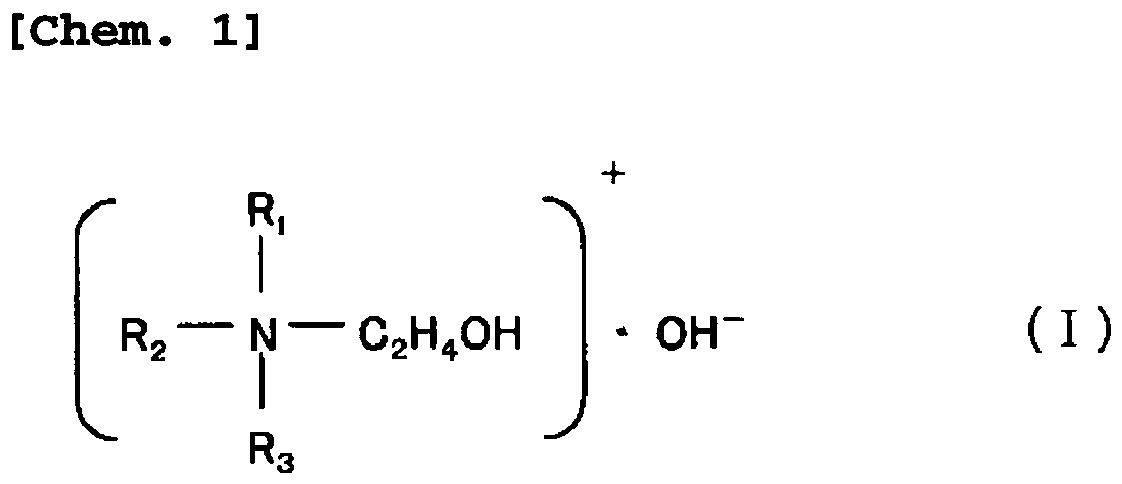
R1 und R3 jeweils eine Methylgruppe bedeuten;
R2 eine Alkylgruppe mit 12 bis 18 Kohlenstoffatomen bedeutet,
und bei der die Konzentration des quaternären Ammoniumhydroxids 0,01 bis 10 Massenprozent beträgt. - Prozessflüssigkeitszusammensetzung für eine Positivlack-Fläche nach Anspruch 1, bei welcher die Konzentration des quaternären Ammoniumhydroxids 0,5 bis 5 Massenprozent beträgt.
- Verfahren zur Behandlung einer Positivlack-Fläche zur Erzeugung einer über die ganze Positivlack-Fläche gleichmäßigen Hydrophilie, bei welchem die Positivlack-Fläche unter Verwendung der Prozessflüssigkeitszusammensetzung für Positivlack nach Anspruch 1 oder 2 behandelt wird.
- Verfahren zur Behandlung einer Positivlack-Fläche nach Anspruch 3, bei welchem die Positivlack-Fläche, unter Verwendung der Prozessflüssigkeitszusammensetzung für Positivlack nach Anspruch 1, vor dem Polieren der Peripherie eines Halbleitersubstrats behandelt wird.
- Verfahren nach Anspruch 4, bei welchem das Anhaften von Partikeln an der Positivlack-Fläche alleine durch Zuführen von reinem Wasser oder einer Polierflüssigkeit während des Polierens, vorzugsweise durch Zuführen von reinem Wasser, verhindert wird.
- Verfahren zur Behandlung einer Positivlack-Fläche nach einem der Ansprüche 3 bis 5, bei welchem die Behandlung mittels Sprühatomisierungsverfahren, Tropfverfahren oder Tauchverfahren erfolgt.
- Entwickler für einen Positivlack, bestehend aus einer wässrigen Lösung, die ein quaternäres Ammoniumhydroxid umfasst, welches durch die allgemeine Formel (I) nach Anspruch 1 oder 2 wiedergegeben ist.
- Verwendung einer wässrigen Lösung eines durch die allgemeine Formel (I) dargestellten quaternären Ammoniumhydroxids nach Anspruch 1 zur Verhinderung des Anhaftens von verunreinigenden Partikeln an der Positivlack-Fläche eines Halbleiterbauelements während der Durchführung des Polierens der Peripherie eines Halbleitersubstrats.
- Verwendung eines durch die allgemeine Formel (I) dargestellten quaternären Ammoniumhydroxids nach Anspruch 1, um das Auftreten ungleichmäßiger Entwicklung bei der Entwicklung eines Positivlacks eines Halbleiterbauelements zu unterdrücken, oder um eine nachfolgende Zerstörung der Fotolackstruktur zum Zeitpunkt des Trocknens zu verhindern, bei welcher das quaternäre Ammoniumhydroxid in dem zur Entwicklung des Positivlacks verwendeten Entwickler enthalten ist.
Applications Claiming Priority (2)
| Application Number | Priority Date | Filing Date | Title |
|---|---|---|---|
| JP2006218695A JP5053592B2 (ja) | 2006-08-10 | 2006-08-10 | ポジ型レジスト処理液組成物及び現像液 |
| PCT/JP2007/065689 WO2008018580A1 (en) | 2006-08-10 | 2007-08-10 | Positive resist processing liquid composition and liquid developer |
Publications (3)
| Publication Number | Publication Date |
|---|---|
| EP2053465A1 EP2053465A1 (de) | 2009-04-29 |
| EP2053465A4 EP2053465A4 (de) | 2011-04-13 |
| EP2053465B1 true EP2053465B1 (de) | 2013-01-16 |
Family
ID=39033108
Family Applications (1)
| Application Number | Title | Priority Date | Filing Date |
|---|---|---|---|
| EP07792334A Not-in-force EP2053465B1 (de) | 2006-08-10 | 2007-08-10 | Positiv-resistverarbeitungs-flüssigkeitszusammensetzung und flüssigentwickler |
Country Status (7)
| Country | Link |
|---|---|
| US (1) | US8323880B2 (de) |
| EP (1) | EP2053465B1 (de) |
| JP (1) | JP5053592B2 (de) |
| KR (1) | KR101323818B1 (de) |
| CN (1) | CN101490626A (de) |
| TW (1) | TW200815945A (de) |
| WO (1) | WO2008018580A1 (de) |
Families Citing this family (6)
| Publication number | Priority date | Publication date | Assignee | Title |
|---|---|---|---|---|
| JP5994736B2 (ja) * | 2013-06-10 | 2016-09-21 | 東京エレクトロン株式会社 | 基板処理方法、基板処理装置及び記憶媒体 |
| JP2015028576A (ja) * | 2013-07-01 | 2015-02-12 | 富士フイルム株式会社 | パターン形成方法 |
| JP6455979B2 (ja) * | 2014-03-18 | 2019-01-23 | Hoya株式会社 | レジスト層付ブランク、その製造方法、マスクブランクおよびインプリント用モールドブランク、ならびに転写用マスク、インプリント用モールドおよびそれらの製造方法 |
| CN108885412B (zh) * | 2016-03-31 | 2022-04-05 | 富士胶片株式会社 | 半导体制造用处理液及图案形成方法 |
| US10174687B2 (en) | 2017-01-04 | 2019-01-08 | Hyundai Motor Company | Method of controlling engine |
| JP6879765B2 (ja) | 2017-02-10 | 2021-06-02 | 株式会社ダイセル | レジスト親水化処理剤 |
Family Cites Families (17)
| Publication number | Priority date | Publication date | Assignee | Title |
|---|---|---|---|---|
| GB459309A (en) | 1935-07-11 | 1937-01-06 | Ig Farbenindustrie Ag | Improvements in the manufacture and production of quaternary ammonium bases |
| CA1112243A (en) * | 1978-09-08 | 1981-11-10 | Manfred Bock | Process for the preparation of polyisocyanates containing isocyanurate groups and the use thereof |
| US4628023A (en) * | 1981-04-10 | 1986-12-09 | Shipley Company Inc. | Metal ion free photoresist developer composition with lower alkyl quaternary ammonium hydrozide as alkalai agent and a quaternary ammonium compound as surfactant |
| JPS636548A (ja) * | 1986-06-27 | 1988-01-12 | Kanto Kagaku Kk | ポジ型フオトレジストの現像前処理剤及び現像処理方法 |
| JPS6472155A (en) | 1987-09-12 | 1989-03-17 | Tama Kagaku Kogyo Kk | Developing solution for positive type photoresist |
| JPH01129250A (ja) | 1987-11-16 | 1989-05-22 | Tama Kagaku Kogyo Kk | ポジ型フォトレジスト用現像液 |
| JP3475314B2 (ja) | 1995-10-12 | 2003-12-08 | 大日本印刷株式会社 | レジストパターン形成方法 |
| JPH09212922A (ja) | 1996-01-31 | 1997-08-15 | Ricoh Co Ltd | 光ディスクの製造方法及び光ディスク |
| US6328641B1 (en) * | 2000-02-01 | 2001-12-11 | Advanced Micro Devices, Inc. | Method and apparatus for polishing an outer edge ring on a semiconductor wafer |
| JP4125148B2 (ja) | 2003-02-03 | 2008-07-30 | 株式会社荏原製作所 | 基板処理装置 |
| FR2866246B1 (fr) * | 2004-02-17 | 2006-05-12 | Commissariat Energie Atomique | Membranes catanioniques cristallisees stabilisees par des polymeres, leur procede de preparation et applications |
| JP4284215B2 (ja) | 2004-03-24 | 2009-06-24 | 株式会社東芝 | 基板処理方法 |
| KR100617855B1 (ko) | 2004-04-30 | 2006-08-28 | 산요가세이고교 가부시키가이샤 | 알칼리 세정제 |
| JP2005336470A (ja) * | 2004-04-30 | 2005-12-08 | Sanyo Chem Ind Ltd | アルカリ洗浄剤 |
| KR101102800B1 (ko) * | 2004-08-31 | 2012-01-05 | 산요가세이고교 가부시키가이샤 | 계면 활성제 |
| FR2880032B1 (fr) | 2004-12-23 | 2007-04-20 | Commissariat Energie Atomique | Nanodisques catanioniques cristallises stabilises, procede de preparation et applications |
| CN101213493B (zh) * | 2005-06-13 | 2011-08-24 | 株式会社德山 | 光致抗蚀剂显影液及使用该显影液的基板的制造方法 |
-
2006
- 2006-08-10 JP JP2006218695A patent/JP5053592B2/ja not_active Expired - Fee Related
-
2007
- 2007-08-10 EP EP07792334A patent/EP2053465B1/de not_active Not-in-force
- 2007-08-10 KR KR1020097002677A patent/KR101323818B1/ko not_active Expired - Fee Related
- 2007-08-10 US US12/310,054 patent/US8323880B2/en not_active Expired - Fee Related
- 2007-08-10 WO PCT/JP2007/065689 patent/WO2008018580A1/ja not_active Ceased
- 2007-08-10 TW TW096129692A patent/TW200815945A/zh unknown
- 2007-08-10 CN CNA2007800269406A patent/CN101490626A/zh active Pending
Also Published As
| Publication number | Publication date |
|---|---|
| KR101323818B1 (ko) | 2013-10-31 |
| JP5053592B2 (ja) | 2012-10-17 |
| US20100086882A1 (en) | 2010-04-08 |
| TW200815945A (en) | 2008-04-01 |
| WO2008018580A1 (en) | 2008-02-14 |
| CN101490626A (zh) | 2009-07-22 |
| EP2053465A1 (de) | 2009-04-29 |
| EP2053465A4 (de) | 2011-04-13 |
| US8323880B2 (en) | 2012-12-04 |
| JP2008046153A (ja) | 2008-02-28 |
| KR20090035588A (ko) | 2009-04-09 |
Similar Documents
| Publication | Publication Date | Title |
|---|---|---|
| EP2053465B1 (de) | Positiv-resistverarbeitungs-flüssigkeitszusammensetzung und flüssigentwickler | |
| EP1080170B1 (de) | Reinigungszusammensetzungen sowie verfahren zum entfernen von rückständen | |
| KR100748410B1 (ko) | 기판표면 세정액 및 세정방법 | |
| US7888301B2 (en) | Resist, barc and gap fill material stripping chemical and method | |
| US7208049B2 (en) | Process solutions containing surfactants used as post-chemical mechanical planarization treatment | |
| KR20150087224A (ko) | 유리 기판의 세정 방법 | |
| WO2009076233A1 (en) | Particle removal cleaning method and composition | |
| EP2812422B1 (de) | Reinigungszusammensetzung zum einsatz nach einer chemisch-mechanischen polierung mit einer spezifischen schwefelhaltigen verbindung und einem zuckeralkohol | |
| WO2012161270A1 (ja) | 洗浄剤およびガラス基板の洗浄方法 | |
| JP3377938B2 (ja) | 洗浄剤組成物及び洗浄方法 | |
| US6245155B1 (en) | Method for removing photoresist and plasma etch residues | |
| JP3962468B2 (ja) | 洗浄剤組成物 | |
| KR100200272B1 (ko) | 세정제 조성물 및 그것을 이용한 세정방법 | |
| JP2000319699A (ja) | 精密洗浄剤組成物 | |
| US20070078074A1 (en) | Cleaning solutions including nucleophilic amine compound having reduction and oxidation potentials | |
| JP3600363B2 (ja) | 表面処理剤及び表面処理方法 | |
| JP3803360B2 (ja) | 洗浄剤組成物 | |
| WO2006125461A1 (en) | Treatment solution and method of applying a passivating layer | |
| WO1999051796A1 (en) | Method for removing photoresist and plasma etch residues | |
| US12378504B2 (en) | Cleaning solution for removing cerium compound, cleaning method, and method for producing semiconductor wafer | |
| JP4837467B2 (ja) | レジスト親水化処理液組成物およびその処理方法 |
Legal Events
| Date | Code | Title | Description |
|---|---|---|---|
| PUAI | Public reference made under article 153(3) epc to a published international application that has entered the european phase |
Free format text: ORIGINAL CODE: 0009012 |
|
| 17P | Request for examination filed |
Effective date: 20090217 |
|
| AK | Designated contracting states |
Kind code of ref document: A1 Designated state(s): AT BE BG CH CY CZ DE DK EE ES FI FR GB GR HU IE IS IT LI LT LU LV MC MT NL PL PT RO SE SI SK TR |
|
| AX | Request for extension of the european patent |
Extension state: AL BA HR MK RS |
|
| DAX | Request for extension of the european patent (deleted) | ||
| RBV | Designated contracting states (corrected) |
Designated state(s): DE FR GB IT |
|
| RIN1 | Information on inventor provided before grant (corrected) |
Inventor name: ARAKI, RYOSUKE Inventor name: SAITO, KENJI Inventor name: MURATA, TAKU Inventor name: ISHIKAWA, NORIO Inventor name: MURAKAMI, YUTAKA |
|
| A4 | Supplementary search report drawn up and despatched |
Effective date: 20110311 |
|
| GRAP | Despatch of communication of intention to grant a patent |
Free format text: ORIGINAL CODE: EPIDOSNIGR1 |
|
| GRAS | Grant fee paid |
Free format text: ORIGINAL CODE: EPIDOSNIGR3 |
|
| GRAP | Despatch of communication of intention to grant a patent |
Free format text: ORIGINAL CODE: EPIDOSNIGR1 |
|
| GRAA | (expected) grant |
Free format text: ORIGINAL CODE: 0009210 |
|
| AK | Designated contracting states |
Kind code of ref document: B1 Designated state(s): DE FR GB IT |
|
| REG | Reference to a national code |
Ref country code: GB Ref legal event code: FG4D |
|
| REG | Reference to a national code |
Ref country code: DE Ref legal event code: R096 Ref document number: 602007028105 Country of ref document: DE Effective date: 20130314 |
|
| PGFP | Annual fee paid to national office [announced via postgrant information from national office to epo] |
Ref country code: DE Payment date: 20130821 Year of fee payment: 7 |
|
| PLBE | No opposition filed within time limit |
Free format text: ORIGINAL CODE: 0009261 |
|
| STAA | Information on the status of an ep patent application or granted ep patent |
Free format text: STATUS: NO OPPOSITION FILED WITHIN TIME LIMIT |
|
| PGFP | Annual fee paid to national office [announced via postgrant information from national office to epo] |
Ref country code: FR Payment date: 20130823 Year of fee payment: 7 |
|
| 26N | No opposition filed |
Effective date: 20131017 |
|
| PGFP | Annual fee paid to national office [announced via postgrant information from national office to epo] |
Ref country code: IT Payment date: 20130829 Year of fee payment: 7 |
|
| REG | Reference to a national code |
Ref country code: DE Ref legal event code: R097 Ref document number: 602007028105 Country of ref document: DE Effective date: 20131017 |
|
| GBPC | Gb: european patent ceased through non-payment of renewal fee |
Effective date: 20130810 |
|
| PG25 | Lapsed in a contracting state [announced via postgrant information from national office to epo] |
Ref country code: GB Free format text: LAPSE BECAUSE OF NON-PAYMENT OF DUE FEES Effective date: 20130810 |
|
| REG | Reference to a national code |
Ref country code: DE Ref legal event code: R119 Ref document number: 602007028105 Country of ref document: DE |
|
| PG25 | Lapsed in a contracting state [announced via postgrant information from national office to epo] |
Ref country code: IT Free format text: LAPSE BECAUSE OF NON-PAYMENT OF DUE FEES Effective date: 20140810 |
|
| REG | Reference to a national code |
Ref country code: FR Ref legal event code: ST Effective date: 20150430 |
|
| REG | Reference to a national code |
Ref country code: DE Ref legal event code: R119 Ref document number: 602007028105 Country of ref document: DE Effective date: 20150303 |
|
| PG25 | Lapsed in a contracting state [announced via postgrant information from national office to epo] |
Ref country code: DE Free format text: LAPSE BECAUSE OF NON-PAYMENT OF DUE FEES Effective date: 20150303 |
|
| PG25 | Lapsed in a contracting state [announced via postgrant information from national office to epo] |
Ref country code: FR Free format text: LAPSE BECAUSE OF NON-PAYMENT OF DUE FEES Effective date: 20140901 |