EP2040261B1 - Medienverarbeitungsvorrichtung und Steuerverfahren für eine Medienverarbeitungsvorrichtung - Google Patents
Medienverarbeitungsvorrichtung und Steuerverfahren für eine Medienverarbeitungsvorrichtung Download PDFInfo
- Publication number
- EP2040261B1 EP2040261B1 EP08015720.9A EP08015720A EP2040261B1 EP 2040261 B1 EP2040261 B1 EP 2040261B1 EP 08015720 A EP08015720 A EP 08015720A EP 2040261 B1 EP2040261 B1 EP 2040261B1
- Authority
- EP
- European Patent Office
- Prior art keywords
- media
- value
- storage unit
- stack
- processing device
- Prior art date
- Legal status (The legal status is an assumption and is not a legal conclusion. Google has not performed a legal analysis and makes no representation as to the accuracy of the status listed.)
- Ceased
Links
- 238000000034 method Methods 0.000 title claims description 66
- 238000012545 processing Methods 0.000 title claims description 66
- 230000008569 process Effects 0.000 claims description 59
- 230000007246 mechanism Effects 0.000 claims description 47
- 238000013500 data storage Methods 0.000 claims 5
- 238000012546 transfer Methods 0.000 description 9
- 230000009471 action Effects 0.000 description 4
- 238000001514 detection method Methods 0.000 description 4
- 238000013459 approach Methods 0.000 description 2
- 238000010586 diagram Methods 0.000 description 2
- 238000005286 illumination Methods 0.000 description 1
- 238000012544 monitoring process Methods 0.000 description 1
- 230000004044 response Effects 0.000 description 1
- 230000032258 transport Effects 0.000 description 1
Images



Classifications
-
- G—PHYSICS
- G11—INFORMATION STORAGE
- G11B—INFORMATION STORAGE BASED ON RELATIVE MOVEMENT BETWEEN RECORD CARRIER AND TRANSDUCER
- G11B17/00—Guiding record carriers not specifically of filamentary or web form, or of supports therefor
- G11B17/08—Guiding record carriers not specifically of filamentary or web form, or of supports therefor from consecutive-access magazine of disc records
-
- G—PHYSICS
- G11—INFORMATION STORAGE
- G11B—INFORMATION STORAGE BASED ON RELATIVE MOVEMENT BETWEEN RECORD CARRIER AND TRANSDUCER
- G11B17/00—Guiding record carriers not specifically of filamentary or web form, or of supports therefor
- G11B17/08—Guiding record carriers not specifically of filamentary or web form, or of supports therefor from consecutive-access magazine of disc records
- G11B17/10—Guiding record carriers not specifically of filamentary or web form, or of supports therefor from consecutive-access magazine of disc records with horizontal transfer to the turntable from a stack arranged with a vertical axis
Definitions
- the present invention relates to a media processing device that applies specific processes such as writing data to disc-shaped media such as CDs and DVDs and printing on the label side of the media, and to a control method for the media processing device.
- Media processing systems for reading and writing data on disc media such as CDs and DVDs, and printing on the label side of the media, generally include a media processing device and a host computer.
- the media processing device in this type of media processing system has a media storage unit for storing the disc media, a media drive for writing data to the media, a label printer for printing on the label side of the media, and a media transportation mechanism for holding and carrying the media to the media storage unit, the media transfer position of the media tray disposed to the media drive, and the media transfer position of the label printer.
- the host computer controls operation of the media drive, the label printer, and the media transportation mechanism in the media processing device.
- the media storage unit of the media processing device may include both a supply stacker and a discharge stacker.
- the supply stacker stores numerous blank media stacked vertically.
- the discharge stacker similarly stores numerous processed media in a vertical stack after the data writing process or label printing process is completed. See, for example, Japanese Unexamined Patent Appl. Pub. JP-A-2000-260172 and Japanese Unexamined Patent Appl. Pub. JP-A-2002-056584 .
- the media processing device may execute various media transportation processes, including, for example, carrying the blank media stored in the supply stacker to the media transfer position of the internal media drive, and then carrying the processed media after the data writing process is completed in the media drive from the media transfer position of the media drive to the discharge stacker.
- the media may alternatively be carried after the data writing process to the media transfer position of the internal label printer, and the processed media is then carried after the label is printed by the label printer from the media transfer position of the label printer to the discharge stacker.
- the actual height of the media stack in the discharge stacker may exceed the maximum stackable height of the discharge stacker.
- Japanese Unexamined Patent Appl. Pub. JP-A-H06-247617 teaches a full stacker detection device that detects if the number of printed sheets stored in the discharge stacker of a printer exceeds a certain level. A similar teaching is disclosed in EP 0 729 077 A2 .
- a media processing device is known from US 2005/0157605 A1 .
- This document discloses a disc processor, such as a printer or a recorder, or a combination processor, that has a robotic arm that will pick a compact disc to be processed from a storage stack and move it to a tray associated with the processor.
- the robotic arm includes a sensor to sense when a disc is in a position to be held In a picker on the arm.
- the sensor signal can be used for determining whether or not the stack of discs in the input bin is of the correct height: for determining whether or not more than one disc has been picked up by the handler; and also for determining the presence of a disc in the tray or held on the picker arm.
- the transportation arm of the media transportation mechanism may collide with media stacked in the discharge stacker, possibly resulting in damage to the media transportation mechanism, damage to the stacked media, or damage to the media being carried to the discharge stacker, for example.
- the invention thus monitors the media stack height in the media storage unit and outputs a warning if the media stack height approaches a condition exceeding the maximum stack height.
- the operator of the media processing device can thus take action appropriate to the warning, More specifically. before the media transportation mechanism operates the operator can take action to remove media stacked above the maximum stack height from the media storage unit. Damage to the media transportation mechanism and damage to the media resulting from collision between the media transportation mechanism and media stacked above the maximum stack height can thus be prevented.
- the controller of the media processing device determines if the media stack height detected by the media detector exceeds a full stack level that is set lower than the maximum stack height, and if the media stack height exceeds the full stack level the controlled outputs a warning that the full stack level is exceeded.
- This aspect of the invention outputs a warning that the full stack level is exceeded if the media stack height exceeds the full stack level.
- the full stack level is below the maximum stack height and is a height at which the media picking process is possible but the media release process is not possible.
- the operator can therefore be warned during the initialization process and the operator can quickly remove media before media is stacked to the maximum stack height during normal media processing. Damage to the media transportation mechanism and damage to the media resulting from collision between the media transportation mechanism and media stacked above the maximum stack height can thus be prevented during normal media processing.
- the controller determines if the media stack height exceeds the maximum stack height when the media transportation mechanism executes the media picking process, detects the media stack height in the media storage unit from which media was picked after picking up media, and updates and stores the media stack height in the storage unit.
- the controller determines if the media stack height exceeds the maximum stack height and determines if the media stack height exceeds the full stack level when the media transportation mechanism executes the media release process, detects the media stack height in the media storage unit in which media was released after releasing the media, and updates and stores the media stack height in the storage unit.
- This aspect of the invention enables determining only if the maximum stack height is exceeded when picking up media, and therefore enables quickly executing the media picking process.
- whether the full stack level is exceeded can be determined in addition to determining if the maximum stack height is exceeded, and the media releasing process can therefore be restricted when the media stack height exceeds the full stack level. It is therefore possible to prevent stacking media to the maximum stack height when proceeding to normal media processing and the media release process after the initialization process.
- the media detector detects the distance descended by the media transportation mechanism from a predetermined height until the media on the top of the stack in the media storage unit is detected, and calculates the height of media stacked in the media storage unit by subtracting the distance descended from the predetermined height of the media transportation mechanism before descending.
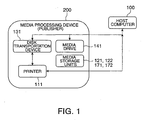
- FIG. 1 is a schematic block diagram of a preferred embodiment of a media processing system incorporating a media processing device according to the present invention.
- FIG. 2 is an oblique view showing the internal structure of the media processing device shown in FIG. 1 .
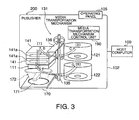
- FIG. 3 describes the movement of the transportation arm of the media transportation mechanism in the media processing device shown in FIG. 2 .
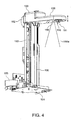
- FIG. 4 is an enlarged oblique view of the media transportation mechanism shown in FIG. 2 .
- FIG. 5 describes the media stacking conditions in the media storage unit shown in FIG. 1 .
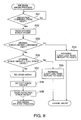
- FIG. 6 is a flow chart describing the initialization process that is executed by the media processing device shown in FIG. 1 when the power turns on or the cover is closed.
- FIG. 7 is a flow chart describing the media picking process that is executed when the host computer sends a media picking command.
- FIG. 8 is a flow chart describing the release process that is executed when the host computer sends a media release command.
- the media processing system shown in FIG. 1 includes a media processing device 200 and a host computer 100.
- the media processing device 200 reads and writes data on disc-shaped media such as CDs and DVDs, and prints on the label side of the media.
- the invention is not limited to this configuration, however, and can be applied to any processing device that has a media storage unit, a mechanism for transporting media, and a configuration for detecting the media.
- the media processing device 200 has first to fourth media storage units 121, 122, 171, and 172 for storing disc-shaped media such as CDs and DVDs, two media drives 141 for writing data to the media, a printer 111 for printing on the label side of the media, and a media transportation mechanism 131.
- the media transportation mechanism 131 holds and carries the media between the media storage units 121, 122, 171, and 172, the media transfer position A of the drive trays 141a of the media drives 141, and the media transfer position of the printer 111.
- Operation of the media drives 141, the printer 111, and the media transportation mechanism 131 of the media processing device 200 can be controlled by the host computer 100.
- FIG. 2 shows the arrangement of the devices inside the media processing device 200 with the outside walls rendered by a box-like case 102 not shown. Access covers not shown that can open to the right and left sides are also disposed to the front of the case 102. An operating panel 105 populated with indicators and operating buttons is disposed to the top right part of the case 102 as shown in FIG. 3 .
- the access covers not shown disposed to the front of the case 102 are opened, the media storage units 121, 122, 171, and 172, printer 111, and other components shown in FIG. 2 are exposed, enabling the operator to load and remove media from the media storage units 121, 122, 171, and 172 and replace the ink cartridge of the printer 111.
- each of the first to fourth media storage units 121, 122, 171, and 172 is preset.
- the first media storage unit 121 shown at the top right in FIG. 2 is basically used as a supply stacker for storing a plurality of (such as 50) blank media (unused media to which data has not been written) in a vertical stack, but can also be used to store processed media after the data writing process or the label printing process.
- the second media storage unit 122 located directly below the first media storage unit 121, and the fourth media storage unit 172 located on the left side of the second media storage unit 122, are basically used as discharge stackers for storing a plurality of (such as 50) processed media (the media after the data writing process or the label printing process is completed) in a vertical stack, but can also be used to store blank media.
- the fourth media storage unit 172 holds a removable third media storage unit 171, which is shaped like a bucket with a handle.
- the third media storage unit 171 is used to store a smaller number of media in a recess formed in a drawer 170 that can slide in and out at the front of the media processing device 200.
- the media transportation mechanism 131 has a vertical guide shaft 135 disposed vertically inside the case 102, and a transportation arm 136 supported so that it can move up and down and pivot on the vertical guide shaft 135. Fingers 151 for holding the center hole of the media are disposed in the middle at the distal end of the transportation arm 136.
- a part of the transportation arm 136 is connected to a timing belt 153, which is driven in a loop behind the vertical guide shaft 135 by means of an elevator motor 152, so that as the timing belt 153 moves the transportation arm 136 travels up or down on the vertical guide shaft 135.
- the transportation arm 136 is rendered in unison with a horizontal support plate 154 attached pivotably to the bottom end of the vertical guide shaft 135, and can swing around the vertical guide shaft 135 when a fan-shaped gear not shown affixed to the top of the horizontal support plate 154 is driven rotationally around the vertical guide shaft 135 by the pivot motor 155.
- the media detector 156 is disposed so that it can descend and retract from the bottom of the transportation arm 136, and detects that media is present when the transportation arm 136 descends to the top of the media in the media storage unit, for example, and the media detector 156 contacts the media and is pushed inside the transportation arm 136.
- the detection result from the media detector 156 is used to get the start timing of the media picking operation of the fingers 151, and to detect the stack height of media in the media storage units 121, 122, 171, and 172.
- the transportation arm 136 moves the position of the fingers 151 to the points indicated by numbers [1] to [6] in the figure, and carries media between the media storage units 121, 122, 171, and 172, the drive trays 141a of the media drives 141, and the media transfer position of the printer 111.
- the points [1] to [6] in FIG. 3 are: [1] the home position (standby position) of the transportation arm 136; [2] the position of the first media storage unit 121; [3] a desired position between the home position and the first media storage unit 121; [4] a midpoint; [5] the position of the second media storage unit 122; and [6] a desired position between the midpoint and the second media storage unit 122.
- the media processing device 200 has a media transportation mechanism control unit 190 that controls driving the media transportation mechanism 131.
- This media transportation mechanism control unit 190 can communicate with the host computer 100.
- the media transportation mechanism control unit 190 has firmware for controlling moving the transportation arm 136 in response to transportation arm 136 movement commands sent from the host computer 100, and thus transports the media according to the transportation arm 136 movement command sent from the host computer 100.
- the media processing device 200 continues carrying media between the media storage units 121, 122, 171, and 172, one or more of the media storage units could become filled beyond the maximum stack height H (first value) to which media can be stacked in the media storage unit by the media transportation mechanism 131.
- H maximum stack height
- FIG. 5 shows the media stack that grows in the second media storage unit 122.
- This embodiment of the invention sets two reference heights for the second media storage unit 122.
- the maximum stack height H is set to a value at which the transportation arm 136 can be expected to collide with the stacked media if the media is stacked to a height exceeding this value.
- the maximum stack height H is the maximum height at which the transportation arm 136 can pivot normally without touching the stacked media during the transportation process.
- the full stack level h (second value) is the height at which the transportation arm 136 can pick up media but cannot release media, and is set lower than the maximum stack height H.
- the range from the bottom of the media storage unit to the full stack level h is normal range B, and the range from the maximum stack height H to the full stack level h is the full stack range C. If the disc M at the top of the stack is within the full stack range C, the stack is said to be full (a full stack), and if the disc M at the top of the stack is above the maximum stack height H, the stack is said to be over capacity. If the transportation arm 136 tries to pass over the second media storage unit 122 when the stack is over capacity, the transportation arm 136 will collide with the top disc M in the stack.
- the media processing device 200 enables controlling operation so that the transportation arm 136 of the media transportation mechanism 131 does not pass over the second media storage unit 122 and collide with the media. More specifically, the media processing device 200 monitors the media stack height in each of the media storage units 121, 122, 171, and 172, and issues a warning or limits operation of the media transportation mechanism 131 according to the stack height.
- the initialization process shown in FIG. 6 is executed.
- the process shown in FIG. 6 is the initialization process that is executed when the media processing device 200 power turns on or an access cover not shown for loading and removing media from the media storage units 121, 122, 171, and 172 is closed. It is assumed below that the fourth media storage unit 172 is set in the third media storage unit 171.
- the operator may have loaded or removed media from the media storage units 121, 122, 171, and 172 and the height of the media stack may have changed.
- the media stack height in each of the media storage units 121, 122, 171, and 172 is therefore detected again.
- the initialization process starts and the transportation arm 136 of the media transportation mechanism 131 detects the height of the media stack in each of the stackers 121, 122, 172 (step S11).
- the detected media height is then stored in a predetermined recording means (storage means) in the media transportation mechanism control unit 190 (step S12).
- the media height in each media storage unit is detected as follows.
- the transportation arm 136 moves to a position above the media storage unit in which the media height is to be measured, and the transportation arm 136 then descends.
- the transportation arm 136 moves to position [2] above the stacker 121 shown in FIG. 3 and then descends.
- the number of steps the elevator motor 152 moves until the media detector 156 detects the top disc is counted.
- the distance of the descent corresponding to the number of counted steps is then subtracted from the height of the transportation arm 136 at a predetermined position before descent starts to calculate the stack height of the media in the media storage unit.
- step S13 Whether the media stack height saved in step S12 exceeds the maximum stack height H shown in FIG. 5 is then determined (step S13). If the media stack height exceeds the maximum stack height H (step S13 returns Yes), an over capacity warning is output by causing an indicator on the operating panel 105 to light, for example. The media storage unit where the over capacity state was detected is also reported to the host computer 100 (step S14).
- step S13 If in step S13 the media stack height does not exceed the maximum stack height H (step S13 returns No), whether the media stack height saved in step S12 exceeds the full stack level h is determined (step S15). If the media stack height exceeds the full stack level h (step S15 returns Yes), a full stack warning is output by causing an indicator on the operating panel 105 to light, for example. The media storage unit where the full stack was detected is also reported to the host computer 100 (step S16).
- step S15 If in step S15 the full stack level h is not exceeded (step S15 returns No), neither the over capacity or the full stack conditions apply. More specifically, the media stacked in the media storage unit are within the normal range B, and the transportation arm 136 is confirmed to be able to operate normally.
- the normal media transportation process that executes after the initialization process is described next with reference to FIG. 7 and FIG. 8 .
- the media picking process is described first with reference to FIG. 7 .
- the process shown in FIG. 7 is executed when a media pick command is received from the host computer 100 after the initialization process.
- step S21 When a media pick command is received from the host computer 100 (step S21 returns Yes), the media height of the specified media storage unit is read from the media height values of the media storage units saved in the recording means in step S12 in FIG. 6 (step S22).
- step S23 Whether the read media height exceeds the maximum stack height H shown in FIG. 5 is then determined (step S23). If the media stack height exceeds the maximum stack height H (step S23 returns Yes), an over capacity warning is output by causing an indicator on the operating panel 105 to light, for example. The media storage unit where the over capacity state was detected is also reported to the host computer 100 (step S24).
- step S23 If in step S23 the media stack height does not exceed the maximum stack height H (step S23 returns No), the transportation arm 136 moves to the position of the specified media storage unit, descends, and picks up the single media M on the top of the stack (step S25). After the media M is picked up, the height of the remaining stack is detected (step S26). Media height detection in this case does not use the transportation arm 136, and subtracts the height equal to the thickness of one disc is subtracted from the media stack height read in step S22. The detected media stack height is updated and saved (step S27), and the media picking process ends.
- the media release process is described next with reference to FIG. 8 .
- the process shown in FIG. 8 executes when a media release command is received from the host computer 100 after the initialization process.
- step S31 When a media release command is received from the host computer 100 (step S31 returns Yes), the media height of the specified media storage unit is read from the media height values of the media storage units saved in the recording means (step S32).
- step S33 Whether the read media height exceeds the maximum stack height H shown in FIG. 5 is then determined (step S33). If the media stack height exceeds the maximum stack height H (step S33 returns Yes), an over capacity warning is output by causing an indicator on the operating panel 105 to light, for example. The media storage unit where the over capacity state was detected is also reported to the host computer 100 (step S34).
- step S33 If in step S33 the media stack height does not exceed the maximum stack height H (step S33 returns No), whether the read media stack height exceeds the full stack level h is determined (step S35). If the media stack height exceeds the full stack level h (step S35 returns Yes), a full stack warning is output by causing an indicator on the operating panel 105 to light, for example. The media storage unit where the full stack was detected is also reported to the host computer 100 (step S36).
- step S35 If in step S35 the full stack level h is not exceeded (step S35 returns No), neither the over capacity or the full stack conditions apply. More specifically, the media stacked in the media storage unit specified for releasing the disc are within the normal range B, and the transportation arm 136 is confirmed to be able to operate normally. The transportation arm 136 therefore moves to the position of the media storage unit where the media is to be released, descends, and releases the held single media M held by the transportation arm 136 onto the top of the stack (step S37). After the media M is released, the height of the stack is detected (step S38). Media height detection in this case uses the transportation arm 136, and detects the stack height in the same way as in the initialization process described in step S11 in FIG. 6 . The detected media stack height is updated and saved (step S39), and the media release process ends.
- This embodiment of the invention monitors the stack height of media in each media storage unit during operation of the media processing device 200, and outputs a warning if any media storage unit is detected to be in an over capacity state or full stack state. If a command for releasing media into a media storage unit that is in a full stack state is received from the host computer, the media processing device 200 does not execute the release command.
- the media processing device 200 issues a warning without executing the pickup command or release command received from the host computer 100. Damage to the media transportation mechanism, damage to the media, and other problems caused by the transportation arm 136 colliding with media stacked in a media storage unit can thus be reliably prevented.
- the media processing device 200 executes the initialization process shown in FIG. 6 whenever the power turns on or the cover closes to remeasure the stack height of media in each media storage unit.
- the media processing device 200 executes the initialization process shown in FIG. 6 whenever the power turns on or the cover closes to remeasure the stack height of media in each media storage unit.
- the media stack height stored in the recording means can be updated.
Landscapes
- Automatic Disk Changers (AREA)
- Controlling Sheets Or Webs (AREA)
- Pile Receivers (AREA)
Claims (8)
- Medienverarbeitungsvorrichtung, umfassend:mindestens eine Medienspeichereinheit (121, 122, 171, 172), die geeignet ist, um plattenförmige Medien entgegenzunehmen und zu speichern;einen Medientransportmechanismus (131), der einen Transportarm (136) aufweist und geeignet ist, um einen Medienentnahmeprozess, indem er plattenförmige Medien einzeln aus einer Quelle entnimmt, einen Medienbeförderungsprozess, indem er ein entnommenes Medium bis zu der mindestens einen Medienspeichereinheit (121, 122, 171, 172) befördert, und einen Medienablageprozess, indem er das beförderte Medium auf einen Stapel plattenförmiger Medien in der mindestens einen Medienspeichereinheit (121, 122, 171, 172) ablegt, auszuführen;einen Mediendetektor (156), der geeignet ist, um die Stapelhöhe des Medienstapels in einer Medienspeichereinheit (121, 122, 171, 172) zu ermitteln;eine Datenspeichereinheit; undeinen Controller, der geeignet ist, um den Wert einer ermittelten Stapelhöhe in der Datenspeichereinheit zu speichern;dadurch gekennzeichnet, dassder Mediendetektor (156) und der Controller darauf reagieren, dass die Medienverarbeitungsvorrichtung (200) eingeschaltet wird, um bei jedem Einschalten die Stapelhöhe des Medienstapels in der mindestens einen Medienspeichereinheit (121, 122, 171, 172) zu ermitteln, um den Wert der ermittelten Stapelhöhe in der Datenspeichereinheit zu speichern, und um zu bestimmen, ob die ermittelte Stapelhöhe einen ersten Wert oder einen zweiten Wert, der niedriger als der erste Wert ist, für die mindestens eine Medienspeichereinheit (121, 122, 171, 172) übersteigt,wobei der Controller ferner geeignet ist, um den gespeicherten Wert der Stapelhöhe der mindestens einen Medienspeichereinheit (121, 122, 171, 172) zu lesen und zu bestimmen, ob der gelesene Wert den ersten Wert oder den zweiten Wert übersteigt, und zwar jedes Mal bevor der Medientransportmechanismus (131) dazu veranlasst wird, den Medienablageprozess auszuführen, und- falls der gelesene Wert den zweiten Wert nicht überschreitet, den Medientransportmechanismus (131) zu veranlassen, den Medienablageprozess auszuführen und den gespeicherten Wert der Stapelhöhe der mindestens einen Medienspeichereinheit (121, 122, 171, 172) zu aktualisieren,- falls der gelesene Wert den ersten oder den zweiten Wert überschreitet, eine Warnung auszugeben, dass der erste oder zweite Wert überschritten wurde, und- falls der gelesene Wert den ersten Wert überschreitet, den Transportarm (136) des Medientransportmechanismus (131) zu veranlassen, nicht über die mindestens eine Medienspeichereinheit (121, 122, 171, 172) zu fahren, um zu verhindern, dass der Transportarm (136) mit den Medien zusammenstößt.
- Medienverarbeitungsvorrichtung nach Anspruch 1, ferner umfassend:ein Medienlaufwerk (141), das geeignet ist, um Daten auf die plattenförmigen Medien zu schreiben;wobei der Medientransportmechanismus (131) geeignet ist, um ein entnommenes plattenförmiges Medium zu einem Laufwerkeinschub des Medienlaufwerks (141) zu befördern und um das Medium von dem Laufwerkeinschub zu der mindestens einen Medienspeichereinheit (121, 122, 171, 172) zu befördern, und es auf dem Medienstapel in der mindestens einen Medienspeichereinheit (121, 122, 171, 172) abzulegen; undwobei der erste Wert eine maximale Stapelhöhe für die erste Medienspeichereinheit (121, 122, 171, 172) ist.
- Medienverarbeitungsvorrichtung nach Anspruch 1 oder 2, wobei der zweite Wert eine volle Stapelhöhe ist.
- Medienverarbeitungsvorrichtung nach einem der vorhergehenden Ansprüche, wobei der Controller geeignet ist, um zu bestimmen, ob der gespeicherte Wert der Stapelhöhe den ersten Wert überschreitet, bevor der Medientransportmechanismus (131) den Medienentnahmeprozess ausführt.
- Medienverarbeitungsvorrichtung nach einem der vorhergehenden Ansprüche, wobei die Quelle eine von zwei oder mehreren Medienspeichervorrichtungen (121, 122, 171, 172) ist, und der Mediendetektor (156) und der Controller geeignet sind, um die Stapelhöhe in jeder der Medienspeichereinheiten (121, 122, 171, 172) zu erkennen und um die Werte der jeweiligen Stapelhöhe jeweils in der Datenspeichereinheit zu speichern und zu aktualisieren.
- Medienverarbeitungsvorrichtung nach einem der vorhergehenden Ansprüche, wobei der Mediendetektor (156) geeignet ist, um die Strecke zu ermitteln, über welche der Medientransportmechanismus (131) von einer vorbestimmten Höhe absteigt, bis das Medium oben auf dem Stapel in der Medienspeichereinheit (121, 122, 171, 172) ermittelt wird.
- Medienverarbeitungsvorrichtung nach Anspruch 6, wobei der Mediendetektor (156) geeignet ist, um die Höhe eines Medienstapels in einer Medienspeichereinheit (121, 122, 171, 172) zu berechnen, indem er die ermittelte Strecke von der vorbestimmten Höhe subtrahiert.
- Steuerverfahren für die Medienverarbeitungsvorrichtung nach mindestens einem der Ansprüche 1 bis 7 und umfassend mindestens eine Medienspeichereinheit (121, 122, 171, 172), die geeignet ist, um plattenförmige Medien entgegenzunehmen und zu speichern, einen Medientransportmechanismus (131), der einen Transportarm (136) aufweist und geeignet ist, um einen Medienentnahmeprozess, indem er plattenförmige Medien einzeln aus einer Quelle entnimmt, einen Medienbeförderungsprozess, indem er ein entnommenes Medium bis zu der mindestens einen Medienspeichereinheit (121, 122, 171, 172) befördert, und einen Medienablageprozess, indem er das beförderte Medium auf einen Stapel plattenförmiger Medien in der mindestens einen Medienspeichereinheit (121, 122, 171, 172) ablegt, auszuführen, und einen Mediendetektor (156), der geeignet ist, um die Stapelhöhe des Medienstapels in der mindestens einen Medienspeichereinheit (121, 122, 171, 172) zu ermitteln; wobei das Steuerverfahren folgende Schritte umfasst:a) Ermitteln der Stapelhöhe in der mindestens einen Medienspeichereinheit (121, 122, 171, 172); undb) Speichern des Wertes der ermittelten Stapelhöhe in einer Datenspeichereinheit;
wobei das Steuerverfahren durch folgende Schritte gekennzeichnet istc) Bestimmen, ob die ermittelte Stapelhöhe einen ersten Wert oder einen zweiten Wert, der niedriger als der erste Wert ist, für die mindestens eine Medienspeichereinheit (121, 122, 171, 172) überschreitet; undd) Ausgeben einer Warnung, dass der erste Wert oder der zweite Wert überschritten ist, falls die Stapelhöhe den ersten Wert oder den zweiten Wert überschreitet,
wobei die Schritte a) und d) jedes Mal ausgeführt werden, wenn die Medienverarbeitungsvorrichtung eingeschaltet wird, und wobei das Verfahren ferner folgende Schritte umfasst:e) Lesen des gespeicherten Wertes der Stapelhöhe für die mindestens eine Medienspeichereinheit (121, 122, 171, 172) und Bestimmen, ob der gelesene Wert den ersten Wert oder den zweiten Wert überschreitet, und zwar jedes Mal bevor der Medienablageprozess ausgeführt wird, und- falls der gelesene Wert den zweiten Wert nicht überschreitet, Veranlassen, dass der Medientransportmechanismus (131) den Medienablageprozess ausführt, und Aktualisieren des gespeicherten Wertes der Stapelhöhe der mindestens einen Medienspeichereinheit (121, 122, 171, 172),- falls der gelesene Wert den ersten oder den zweiten Wert überschreitet, Ausgeben der Warnung, dass der erste oder zweite Wert überschritten wird, und- falls der gelesene Wert den ersten Wert überschreitet, Veranlassen, dass der Transportarm (136) des Medientransportmechanismus (131) nicht über die mindestens eine Medienspeichereinheit (121, 122, 171, 172) fährt, um zu verhindern, dass der Transportarm (136) mit den Medien zusammenstößt.
Applications Claiming Priority (1)
| Application Number | Priority Date | Filing Date | Title |
|---|---|---|---|
| JP2007240724A JP5205890B2 (ja) | 2007-09-18 | 2007-09-18 | メディア処理装置及びメディア処理装置の制御方法 |
Publications (3)
| Publication Number | Publication Date |
|---|---|
| EP2040261A2 EP2040261A2 (de) | 2009-03-25 |
| EP2040261A3 EP2040261A3 (de) | 2009-10-07 |
| EP2040261B1 true EP2040261B1 (de) | 2014-03-05 |
Family
ID=40011173
Family Applications (1)
| Application Number | Title | Priority Date | Filing Date |
|---|---|---|---|
| EP08015720.9A Ceased EP2040261B1 (de) | 2007-09-18 | 2008-09-05 | Medienverarbeitungsvorrichtung und Steuerverfahren für eine Medienverarbeitungsvorrichtung |
Country Status (5)
| Country | Link |
|---|---|
| US (2) | US8181191B2 (de) |
| EP (1) | EP2040261B1 (de) |
| JP (1) | JP5205890B2 (de) |
| CN (1) | CN101393756B (de) |
| TW (1) | TWI391917B (de) |
Families Citing this family (5)
| Publication number | Priority date | Publication date | Assignee | Title |
|---|---|---|---|---|
| JP4835363B2 (ja) * | 2006-10-04 | 2011-12-14 | セイコーエプソン株式会社 | メディア処理装置及びメディア処理装置の制御方法 |
| JP5205890B2 (ja) | 2007-09-18 | 2013-06-05 | セイコーエプソン株式会社 | メディア処理装置及びメディア処理装置の制御方法 |
| JP5874294B2 (ja) * | 2011-10-13 | 2016-03-02 | セイコーエプソン株式会社 | メディア搬送機構、メディア搬送機構の制御方法およびメディア処理装置 |
| US10329108B2 (en) * | 2017-08-25 | 2019-06-25 | Carestream Health, Inc. | System and method for detecting a media supply |
| EP3955243A3 (de) * | 2018-10-11 | 2022-05-11 | Google LLC | Spracherzeugung unter verwendung von sprachübergreifender phonemabbildung |
Family Cites Families (19)
| Publication number | Priority date | Publication date | Assignee | Title |
|---|---|---|---|---|
| US5371573A (en) * | 1992-03-25 | 1994-12-06 | Kabushiki Kaisha Toshiba | Image forming apparatus providing a sheet tray in the image forming section when the stacking device is filled |
| JPH06127809A (ja) | 1992-03-25 | 1994-05-10 | Toshiba Corp | 大容量用紙収容装置および画像形成装置 |
| JPH06247617A (ja) | 1993-02-26 | 1994-09-06 | Oki Electric Ind Co Ltd | スタッカフル検出装置 |
| US5551686A (en) * | 1995-02-23 | 1996-09-03 | Xerox Corporation | Printing and mailbox system for shared users with bins almost full sensing |
| JP2000222809A (ja) * | 1999-01-28 | 2000-08-11 | Chugai Boeki Kk | 搬送装置及びディスク処理装置 |
| JP3907335B2 (ja) | 1999-01-29 | 2007-04-18 | キヤノン株式会社 | シート積載装置 |
| JP3551815B2 (ja) * | 1999-03-08 | 2004-08-11 | ティアック株式会社 | ディスク作製装置 |
| US6481093B1 (en) * | 1999-08-20 | 2002-11-19 | Seagate Technology Llc | Automated clampring installation station |
| JP2002056584A (ja) | 2000-08-08 | 2002-02-22 | Ekisupaato Magnetics Kk | 記録媒体の書込みと印刷を行なう装置 |
| US7349294B2 (en) * | 2004-01-20 | 2008-03-25 | Primera Technology Inc. | Disc error checking sensor for printers and duplicators |
| JP2006172559A (ja) * | 2004-12-14 | 2006-06-29 | Funai Electric Co Ltd | ディスク装置 |
| JP4839621B2 (ja) * | 2005-01-19 | 2011-12-21 | ティアック株式会社 | ディスク処理装置 |
| US7673309B2 (en) * | 2005-01-20 | 2010-03-02 | Hie Electronics, Inc. | Scalable integrated high density optical data/media storage delivery system |
| JP2006321648A (ja) | 2005-05-20 | 2006-11-30 | Canon Inc | 画像形成装置及び画像形成装置の搬送制御方法 |
| US8601123B2 (en) * | 2006-01-16 | 2013-12-03 | Seiko Epson Corporation | Media management method for a media processing device |
| JP4784515B2 (ja) * | 2006-01-16 | 2011-10-05 | セイコーエプソン株式会社 | メディア処理装置のメディア管理方法 |
| CN101159150B (zh) * | 2006-10-03 | 2010-06-02 | 精工爱普生株式会社 | 介质处理装置以及介质处理装置的控制方法 |
| JP5205890B2 (ja) | 2007-09-18 | 2013-06-05 | セイコーエプソン株式会社 | メディア処理装置及びメディア処理装置の制御方法 |
| JP5176815B2 (ja) * | 2008-09-24 | 2013-04-03 | セイコーエプソン株式会社 | メディア処理装置、メディア処理装置の制御方法及びその制御プログラム |
-
2007
- 2007-09-18 JP JP2007240724A patent/JP5205890B2/ja not_active Expired - Fee Related
-
2008
- 2008-09-05 EP EP08015720.9A patent/EP2040261B1/de not_active Ceased
- 2008-09-08 TW TW097134439A patent/TWI391917B/zh not_active IP Right Cessation
- 2008-09-18 CN CN2008102152107A patent/CN101393756B/zh not_active Expired - Fee Related
- 2008-09-18 US US12/284,196 patent/US8181191B2/en not_active Expired - Fee Related
-
2012
- 2012-04-04 US US13/439,252 patent/US8321881B2/en not_active Expired - Fee Related
Also Published As
| Publication number | Publication date |
|---|---|
| TW200933611A (en) | 2009-08-01 |
| JP2009070527A (ja) | 2009-04-02 |
| US8181191B2 (en) | 2012-05-15 |
| CN101393756B (zh) | 2011-05-18 |
| JP5205890B2 (ja) | 2013-06-05 |
| EP2040261A3 (de) | 2009-10-07 |
| US8321881B2 (en) | 2012-11-27 |
| US20120198486A1 (en) | 2012-08-02 |
| EP2040261A2 (de) | 2009-03-25 |
| CN101393756A (zh) | 2009-03-25 |
| TWI391917B (zh) | 2013-04-01 |
| US20090073821A1 (en) | 2009-03-19 |
Similar Documents
| Publication | Publication Date | Title |
|---|---|---|
| EP2040261B1 (de) | Medienverarbeitungsvorrichtung und Steuerverfahren für eine Medienverarbeitungsvorrichtung | |
| US8132506B2 (en) | Media processing device and control method for a media processing device | |
| JP2007188615A (ja) | ライブラリ装置、ライブラリ装置のカートリッジ型センサおよびライブラリ装置のカートリッジ型センサ位置付け方法 | |
| EP2117005B1 (de) | Plattenverarbeitungsvorrichtung und Steuerverfahren für eine Plattenverarbeitungsvorrichtung | |
| US8682481B2 (en) | Media processing device, control method for a media processing device, and a control program therefor | |
| US7882272B2 (en) | Media processing device and control method for a media processing | |
| EP2581907A2 (de) | Medientransportmechanismus, Verfahren zur Steuerung eines Medientransportmechanismus, und Medienverarbeitungsvorrichtung | |
| US8166493B2 (en) | Media processing device including host computer capable of measuring the height of blank media | |
| US8665470B2 (en) | Method of displaying expected service life values collected by replaceable unit in an electronic device, and a display program | |
| CN212433851U (zh) | 自动售货机 | |
| JP5500228B2 (ja) | メディア処理装置及びメディア処理装置の制御方法 | |
| JP5130756B2 (ja) | メディア処理装置及びメディア処理装置の制御方法 | |
| JP5187516B2 (ja) | ディスク収納量検出装置及びディスク処理装置 | |
| JP5050704B2 (ja) | メディア処理装置及びメディア処理装置の制御方法 | |
| JP2008112553A (ja) | メディア処理装置及びメディア処理装置の制御方法 | |
| JP2008234730A (ja) | ディスク処理装置 | |
| JP5196165B2 (ja) | ディスクソータ及びディスク処理装置 | |
| JPH08208004A (ja) | 磁気テープ装置 | |
| JP2013191253A (ja) | メディアドライブの制御方法および制御装置 | |
| JP2009076131A (ja) | メディア処理システム及びメディア処理システムの制御方法 | |
| JP2007141343A (ja) | 光ディスク装置 |
Legal Events
| Date | Code | Title | Description |
|---|---|---|---|
| PUAI | Public reference made under article 153(3) epc to a published international application that has entered the european phase |
Free format text: ORIGINAL CODE: 0009012 |
|
| AK | Designated contracting states |
Kind code of ref document: A2 Designated state(s): AT BE BG CH CY CZ DE DK EE ES FI FR GB GR HR HU IE IS IT LI LT LU LV MC MT NL NO PL PT RO SE SI SK TR |
|
| AX | Request for extension of the european patent |
Extension state: AL BA MK RS |
|
| PUAL | Search report despatched |
Free format text: ORIGINAL CODE: 0009013 |
|
| AK | Designated contracting states |
Kind code of ref document: A3 Designated state(s): AT BE BG CH CY CZ DE DK EE ES FI FR GB GR HR HU IE IS IT LI LT LU LV MC MT NL NO PL PT RO SE SI SK TR |
|
| AX | Request for extension of the european patent |
Extension state: AL BA MK RS |
|
| 17P | Request for examination filed |
Effective date: 20100331 |
|
| AKX | Designation fees paid |
Designated state(s): DE FR GB |
|
| 17Q | First examination report despatched |
Effective date: 20130422 |
|
| GRAP | Despatch of communication of intention to grant a patent |
Free format text: ORIGINAL CODE: EPIDOSNIGR1 |
|
| INTG | Intention to grant announced |
Effective date: 20130924 |
|
| GRAS | Grant fee paid |
Free format text: ORIGINAL CODE: EPIDOSNIGR3 |
|
| GRAA | (expected) grant |
Free format text: ORIGINAL CODE: 0009210 |
|
| AK | Designated contracting states |
Kind code of ref document: B1 Designated state(s): DE FR GB |
|
| REG | Reference to a national code |
Ref country code: GB Ref legal event code: FG4D |
|
| REG | Reference to a national code |
Ref country code: DE Ref legal event code: R096 Ref document number: 602008030548 Country of ref document: DE Effective date: 20140417 |
|
| REG | Reference to a national code |
Ref country code: DE Ref legal event code: R097 Ref document number: 602008030548 Country of ref document: DE |
|
| PLBE | No opposition filed within time limit |
Free format text: ORIGINAL CODE: 0009261 |
|
| STAA | Information on the status of an ep patent application or granted ep patent |
Free format text: STATUS: NO OPPOSITION FILED WITHIN TIME LIMIT |
|
| 26N | No opposition filed |
Effective date: 20141208 |
|
| REG | Reference to a national code |
Ref country code: DE Ref legal event code: R097 Ref document number: 602008030548 Country of ref document: DE Effective date: 20141208 |
|
| REG | Reference to a national code |
Ref country code: FR Ref legal event code: PLFP Year of fee payment: 9 |
|
| REG | Reference to a national code |
Ref country code: FR Ref legal event code: PLFP Year of fee payment: 10 |
|
| REG | Reference to a national code |
Ref country code: FR Ref legal event code: PLFP Year of fee payment: 11 |
|
| PGFP | Annual fee paid to national office [announced via postgrant information from national office to epo] |
Ref country code: GB Payment date: 20200826 Year of fee payment: 13 Ref country code: FR Payment date: 20200812 Year of fee payment: 13 Ref country code: DE Payment date: 20200826 Year of fee payment: 13 |
|
| REG | Reference to a national code |
Ref country code: DE Ref legal event code: R119 Ref document number: 602008030548 Country of ref document: DE |
|
| GBPC | Gb: european patent ceased through non-payment of renewal fee |
Effective date: 20210905 |
|
| PG25 | Lapsed in a contracting state [announced via postgrant information from national office to epo] |
Ref country code: GB Free format text: LAPSE BECAUSE OF NON-PAYMENT OF DUE FEES Effective date: 20210905 Ref country code: FR Free format text: LAPSE BECAUSE OF NON-PAYMENT OF DUE FEES Effective date: 20210930 Ref country code: DE Free format text: LAPSE BECAUSE OF NON-PAYMENT OF DUE FEES Effective date: 20220401 |