EP2016221B1 - Metal cord and process and apparatus for manufacturing a metal cord - Google Patents
Metal cord and process and apparatus for manufacturing a metal cord Download PDFInfo
- Publication number
- EP2016221B1 EP2016221B1 EP06753540.1A EP06753540A EP2016221B1 EP 2016221 B1 EP2016221 B1 EP 2016221B1 EP 06753540 A EP06753540 A EP 06753540A EP 2016221 B1 EP2016221 B1 EP 2016221B1
- Authority
- EP
- European Patent Office
- Prior art keywords
- cord
- metal
- elementary
- metal wire
- elementary metal
- Prior art date
- Legal status (The legal status is an assumption and is not a legal conclusion. Google has not performed a legal analysis and makes no representation as to the accuracy of the status listed.)
- Expired - Lifetime
Links
Images



Classifications
-
- D—TEXTILES; PAPER
- D07—ROPES; CABLES OTHER THAN ELECTRIC
- D07B—ROPES OR CABLES IN GENERAL
- D07B1/00—Constructional features of ropes or cables
- D07B1/06—Ropes or cables built-up from metal wires, e.g. of section wires around a hemp core
- D07B1/0606—Reinforcing cords for rubber or plastic articles
- D07B1/0646—Reinforcing cords for rubber or plastic articles comprising longitudinally preformed wires
-
- D—TEXTILES; PAPER
- D07—ROPES; CABLES OTHER THAN ELECTRIC
- D07B—ROPES OR CABLES IN GENERAL
- D07B7/00—Details of, or auxiliary devices incorporated in, rope- or cable-making machines; Auxiliary apparatus associated with such machines
- D07B7/02—Machine details; Auxiliary devices
- D07B7/025—Preforming the wires or strands prior to closing
-
- D—TEXTILES; PAPER
- D07—ROPES; CABLES OTHER THAN ELECTRIC
- D07B—ROPES OR CABLES IN GENERAL
- D07B2201/00—Ropes or cables
- D07B2201/20—Rope or cable components
- D07B2201/2001—Wires or filaments
- D07B2201/2007—Wires or filaments characterised by their longitudinal shape
-
- D—TEXTILES; PAPER
- D07—ROPES; CABLES OTHER THAN ELECTRIC
- D07B—ROPES OR CABLES IN GENERAL
- D07B2201/00—Ropes or cables
- D07B2201/20—Rope or cable components
- D07B2201/2001—Wires or filaments
- D07B2201/2007—Wires or filaments characterised by their longitudinal shape
- D07B2201/2008—Wires or filaments characterised by their longitudinal shape wavy or undulated
-
- D—TEXTILES; PAPER
- D07—ROPES; CABLES OTHER THAN ELECTRIC
- D07B—ROPES OR CABLES IN GENERAL
- D07B2201/00—Ropes or cables
- D07B2201/20—Rope or cable components
- D07B2201/2015—Strands
- D07B2201/2022—Strands coreless
-
- D—TEXTILES; PAPER
- D07—ROPES; CABLES OTHER THAN ELECTRIC
- D07B—ROPES OR CABLES IN GENERAL
- D07B2201/00—Ropes or cables
- D07B2201/20—Rope or cable components
- D07B2201/2015—Strands
- D07B2201/2024—Strands twisted
-
- D—TEXTILES; PAPER
- D07—ROPES; CABLES OTHER THAN ELECTRIC
- D07B—ROPES OR CABLES IN GENERAL
- D07B2201/00—Ropes or cables
- D07B2201/20—Rope or cable components
- D07B2201/2015—Strands
- D07B2201/2024—Strands twisted
- D07B2201/2029—Open winding
-
- D—TEXTILES; PAPER
- D07—ROPES; CABLES OTHER THAN ELECTRIC
- D07B—ROPES OR CABLES IN GENERAL
- D07B2201/00—Ropes or cables
- D07B2201/20—Rope or cable components
- D07B2201/2015—Strands
- D07B2201/2038—Strands characterised by the number of wires or filaments
- D07B2201/2039—Strands characterised by the number of wires or filaments three to eight wires or filaments respectively forming a single layer
-
- D—TEXTILES; PAPER
- D07—ROPES; CABLES OTHER THAN ELECTRIC
- D07B—ROPES OR CABLES IN GENERAL
- D07B2207/00—Rope or cable making machines
- D07B2207/20—Type of machine
- D07B2207/202—Double twist unwinding
-
- D—TEXTILES; PAPER
- D07—ROPES; CABLES OTHER THAN ELECTRIC
- D07B—ROPES OR CABLES IN GENERAL
- D07B2501/00—Application field
- D07B2501/20—Application field related to ropes or cables
- D07B2501/2046—Tyre cords
-
- D—TEXTILES; PAPER
- D07—ROPES; CABLES OTHER THAN ELECTRIC
- D07B—ROPES OR CABLES IN GENERAL
- D07B2501/00—Application field
- D07B2501/20—Application field related to ropes or cables
- D07B2501/2076—Power transmissions
-
- Y—GENERAL TAGGING OF NEW TECHNOLOGICAL DEVELOPMENTS; GENERAL TAGGING OF CROSS-SECTIONAL TECHNOLOGIES SPANNING OVER SEVERAL SECTIONS OF THE IPC; TECHNICAL SUBJECTS COVERED BY FORMER USPC CROSS-REFERENCE ART COLLECTIONS [XRACs] AND DIGESTS
- Y10—TECHNICAL SUBJECTS COVERED BY FORMER USPC
- Y10T—TECHNICAL SUBJECTS COVERED BY FORMER US CLASSIFICATION
- Y10T428/00—Stock material or miscellaneous articles
- Y10T428/12—All metal or with adjacent metals
- Y10T428/12333—Helical or with helical component
-
- Y—GENERAL TAGGING OF NEW TECHNOLOGICAL DEVELOPMENTS; GENERAL TAGGING OF CROSS-SECTIONAL TECHNOLOGIES SPANNING OVER SEVERAL SECTIONS OF THE IPC; TECHNICAL SUBJECTS COVERED BY FORMER USPC CROSS-REFERENCE ART COLLECTIONS [XRACs] AND DIGESTS
- Y10—TECHNICAL SUBJECTS COVERED BY FORMER USPC
- Y10T—TECHNICAL SUBJECTS COVERED BY FORMER US CLASSIFICATION
- Y10T428/00—Stock material or miscellaneous articles
- Y10T428/12—All metal or with adjacent metals
- Y10T428/12424—Mass of only fibers
Definitions
- This invention relates to a metal cord and to a process for manufacturing a metal cord.
- the present invention relates to a metal cord, usually used as a reinforcing element in elastomeric manufactured articles, comprising at least one preformed elementary metal wire.
- the present invention also relates to a process for manufacturing a metal cord.
- the present invention also relates to an apparatus for manufacturing a metal cord.
- the above disclosed metal cord may be employed to produce reinforced elastomeric manufactured articles such as, for example, tires, pipes for high pressure fluids, belts, belt conveyors, and the like.
- the metal cords usually employed to reinforce elastomeric manufactured articles are generally made of several elementary metal wires twisted along an axis which coincides with the longitudinal development of the cords themselves.
- Said metal cords especially when employed in the manufacturing of tires, are generally required to be provided with high mechanical resistance and to allow a good physico-chemical adhesion with the elastomeric material in which they are embedded, as well as a good penetration of said elastomeric material in the space between the adjacent elementary metal wires of said metal cords.
- the elementary metal wires forming said metal cords are compacted, i.e. positioned intimately in contact with one another, leading to the formation of one or more closed cavities inside said metal cords which extend along the longitudinal development of the same.
- the presence of said closed cavities which cannot be reached by the elastomeric material involves a reduced adhesion of the metal wires to the elastomeric material which may cause an undesired tendency of the metal wires to separate from the same.
- the use of the so-called "open” cords has been disclosed.
- the metal wires generally from three to five
- the metal wires are loosely associated so that they are at a certain distance from one another and this distance is maintained during the entire rubberizing phase, for example, by keeping a low traction load (usually not exceeding five kilograms) applied to the cord.
- Cords of the type above disclosed namely the so-called "open" cords, are described, for example, in United States Patent US 4,258,543 in the name of the Applicant.
- the cords therein disclosed are said to allow an excellent penetration of the elastomeric material between the adjacent metal wires forming the cords.
- United States Patent US 6,698,179 in the name of the Applicant, relates to a process for manufacturing a metal cord including the steps of permanently deforming at least one wire using a substantially sinusoidal deformation lying in a plane and stranding the at least one wire together with one or more other wires by twisting the wires around a longitudinal axis of the metal cords, as well as to a metal cord so obtained.
- the abovementioned metal cord is said to have a good rubber penetration as well as an improved elongation at break.
- the tension to which they are subjected before they reach the rubberizing device may cause the compacting of the wires one against the other, thus hindering the elastomeric material from penetrating between the adjacent metal wires of the cords. Consequently, although being endowed with a high part load elongation (PLE), i.e. a high elongation to low load (lower than or equal to 50 N), said cords may not allow a good elastomeric material penetration so causing a corrosion of the metal wires, and severely compromising the structural resistance of both the cords and of the reinforced elastomeric manufactured articles containing the same.
- PLE part load elongation
- the metal cords of the prior art such as, for example, those disclosed in International Patent Applications WO 95/16816 , in WO 99/28547 , or in United States Patent US 6,698,179 above reported, although being endowed with high elongation at break as well as a good elastomeric material penetration, may show a low part load elongation (PLE).
- Said low part load elongation (PLE) may cause problems during the manufacturing of the reinforced elastomeric manufactured articles comprising the same, in particular when used in tires manufacturing where remarkable elongations of the metal cords are required during the various manufacturing steps.
- the Applicant has now found a metal cord comprising one or more elementary metal wires, provided with both a high elongation at break and a high part load elongation (PLE), said characteristics being maintained substantially unchanged even after the metal cord has been rubberized and vulcanized. Moreover, said metal cord shows an improved elastomeric material penetration between the adjacent elementary metal wires forming said metal cord.
- PLE part load elongation
- the present invention relates to a metal cord according to claim 1.
- said metal cord has at least one preformed elementary metal wire, while the remaining elementary metal wires forming said metal cord may be of the non-preformed type. Prior to undergoing a given preforming action, the elementary metal wires have a straight configuration.
- the elementary metal wire is subjected along its longitudinal development, at positions substantially regularly spaced, to a deformation by applying a transverse force above the elastic threshold of the material forming said elementary metal wire, so that the deformation remains when the applied force is removed.
- Said elementary metal wire is firstly preformed so that it assumes substantially sinusoidal undulations; secondly, said firstly preformed elementary metal wire is helicoidally preformed, along its longitudinal axis, so that it assumes a helical wave-shaped configuration (hereinafter referred also to as "double-preformed elementary metal wire").
- double-preformed elementary metal wire The result of said double preforming is an elementary metal wire tri-dimensionally preformed.
- said sinusoidal undulations have a wavelength (or pitch) of from 1.0 mm to 15 mm, more preferably of from 2.0 mm to 8.0 mm.
- said sinusoidal undulations have a wave amplitude of from 0.10 mm to 1.0 mm, more preferably of from 0.20 mm to 0.50 mm.
- the wavelength and wave amplitude ranges referred to above may be measured directly on the non-rubberized elementary metal wire before it is inserted into the elastomeric material which will be subsequently vulcanized.
- the measurement of said parameters may be performed on the elementary metal wire by using a magnifying lens and a graduated scale (for example a graduated ruler).
- a magnifying lens and a graduated scale for example a graduated ruler.
- solvents for example by treating it with dichlorobenzene, at a temperature of at least 100°C, preferably of 140°C, for at least 12 hours.
- said elementary metal wire has a diameter (D) of from 0.10 mm to 0.50 mm, preferably of from 0.12 mm to 0.40 mm.
- said elementary metal wire is made of steel.
- the breaking strength of a standard NT (normal tensile) steel ranges between about 2,600 N/mm 2 (or 2,600 MPa - MegaPascal) and about 3,200 N/mm 2
- the breaking strength of a HT (High Tensile) steel ranges between about 3,000 N/mm 2 and about 3,600 N/mm 2
- the breaking strength of a SHT (Super High Tensile) steel ranges between about 3,300 N/mm 2 and about 3,900 N/mm 2
- the breaking strength of a UHT (Ultra High Tensile) steel ranges between about 3,600 N/mm 2 and about 4,200 N/mm 2 .
- Said breaking strength values depend in particular on the quantity of carbon contained in the steel.
- the above disclosed HT, SHT and UHT elementary metal wire type are made of steel having a very high carbon content, usually greater than 0.9%).
- said elementary metal wire is provided with a brass coating (Cu of between 60% and 75% by weight, Zn of between 40% and 25% by weight), having a thickness of between 0.10 ⁇ m and 0.50 ⁇ m. Said coating ensures better adhesion of the elementary metal wire to the rubberizing compound and provides for protection against corrosion of the metal, both during production of the reinforced elastomeric manufactured articles and during use thereof.
- a brass coating Cu of between 60% and 75% by weight, Zn of between 40% and 25% by weight
- said elementary metal wire may be advantageously provided with an anti-corrosive coating other than brass, able to ensure a greater corrosion resistance, such as, for example, a coating based on zinc, zinc/manganese (ZnMn) alloys, zinc/cobalt (ZnCo) alloys or zinc/cobalt/manganese (ZnCoMn) alloys.
- an anti-corrosive coating other than brass able to ensure a greater corrosion resistance, such as, for example, a coating based on zinc, zinc/manganese (ZnMn) alloys, zinc/cobalt (ZnCo) alloys or zinc/cobalt/manganese (ZnCoMn) alloys.
- said metal cord has a structure of the type n x D, wherein n is the number of elementary metal wires forming the cord and D is the diameter of each elementary metal wire.
- n ranges of from 2 to 6. Particularly preferred is n equal to 5.
- Preferred metal cord constructions are, for example: 2x (i.e. two elementary metal wires twisted together), 3x, 4x, 5x, 6x, 2+1 (i.e. one strand of two metal wires and one strand of one metal wires, said two strands being twisted together), 2+2, 3+2, 1+4.
- said metal cord has a stranding pitch of from 2.5 mm to 25 mm, more preferably of from 6 mm to 18 mm.
- said metal cord has the following characteristics:
- Gap Area it is intended the area, in a cord cross-section, defined by segments connected together to form a polygon, each of said segments having its extremity on the outer circumferences of a couple of adjacent elementary metal wires.
- the present invention relates to a process for manufacturing a metal cord comprising the steps of:
- the preformed metal wire obtained according to step (a) and step (b) is substantially devoid of sharp edges and/or discontinuities in curvature along its longitudinal development. Said feature is particularly advantageous since, the absence of said sharp edges/corners, results in a favourable increasing of the breaking load of the elementary metal wire.
- the present invention also relates to an apparatus for manufacturing a metal cord comprising:
- apparutus may comprise at least one first preforming device for each elementary metal wire of the metal cord.
- said at least one first preforming device comprises a first and a second pulley, each pulley having a plurality of circumferentially arranged pins, said pulleys being positioned at a distance so that during rotation the pins of the first and the second pulley interpenetrate so as to induce a substantially sinusoidal deformation without sharp edges on a wire passing through the space between the pins of the first pulley and the corresponding pins of the second pulley.
- said at least one second preforming device comprises a pulley and a rotating pin, said roating pin being positioned between said pulley and the first end section of the stranding path in such a way that, the internal angle ( ⁇ ) formed by the rotating pin inlet elementary metal wire and the rotating pin outlet elementary metal wire is lower than or equal to 180°, preferably of from 45° to 90°.
- said rotating pin may have at least one groove, more preferably a plurality of parallel grooves.
- saids pulley is an adjustable pulley.
- Said appartus may comprise at least one second preforming device for each elementary metal wire.
- reference sign 1 indicates the metal cord 1.
- Said metal cord 1 comprises several elementary metal wires (not illustrated in Fig. 1 ), preferably made of steel, and more preferably provided with a brass coating, having a diameter (D) of from 0.10 mm to 0.50 mm, preferably of from 0.12 mm to 0.40 mm twisted around the longitudinal axis of the metal cord.
- Fig. 1 shows an example of an apparatus 10 for forming a metal cord 1 consisting of five elementary metal wires.
- the device 10 for the production of the metal cord 1 comprises, in a known configuration, a supporting structure 100 to which a rotor 5 is rotatively engaged, the latter being rotated by means of a motor or similar devices (not illustrated in Fig. 1 ). Furthermore, a cradle (not illustrated in Fig. 1 is connected to said supporting structure and can rock about the rotation axis of rotor 5. Several feeding spools 8 are operatively engaged on the cradle. At least one elementary metal wire of said metal cord 1 is wound on each of the feeding spools 8.
- unwinding devices (not illustrated in Fig. 1 because known per se and conventional) are coupled to feeding spools 8, which are fitted on the cradle to guide the elementary metal wires coming from the feeding spools 8.
- the elementary metal wires at the outlet from the cradle are driven onto rotor 5 according to a predefined stranding path along which the metal cord 1 is formed through the effect of rotation imposed on rotor 5 by means of said motor or equivalent device, in combination with the drive produced on the metal cord 1 by means of collection devices (not illustrated in Fig. 1 since known and not relevant to the scope of the invention).
- the stranding path comprises a first end section 10a essentially coinciding with the rotation axis of rotor 5 and delimited by a first rotating transmission device 12, solidly fastened to rotor 5, and an assembly unit 11 consisting, in a known way, of a plate with five holes, solidly fastened to the cradle and, consequently, stationary.
- the elementary metal wires are subjected to a first torsion around the rotation axis of rotor 5 through the effect of the rotating pull which the rotor imposes on the first rotating transmission device 12.
- the elementary metal wires follow a central section 10b of the stranding path which extends to rotor 5 and is radially spaced from the rotation axis of the rotor so as to skip cradle (not illustrated in Fig. 1 ) and reach a second transmission device 13 solidly fastened to the rotor 5 on the axially opposite end.
- the stranding path presents a second end section 10c substantially coinciding with the rotation axis of rotor 5 and extending beyond second rotating transmission device 13.
- this second end section through the effect of the rotating pull imposed by rotor 5 on second rotating transmission device 13, a second torsion of the elementary wires is performed, thus completing the formation of the metal cord 1 which is progressively pulled away by the aforesaid collection devices.
- the ratio between the speed of rotation of rotor 5, preferably of from 2000 rpm to 6000 rpm, and the pulling speed of metal cord 1 and, consequently, of the elementary metal wires which form it, preferably of from 60 m/min to 250 m/min defines the value of the stranding pitch, i.e. the stranding pitch according to which said elementary metal wires are twisted on finished metal cord 1.
- said stranding pitch is kept at a value of from 2.5 mm to 25 mm, preferably of from 6 mm to 18 mm.
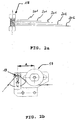
- inlet guiding pulleys 14 first preforming devices 15, outlet guiding pulley 16 consisting of a pulley turned at 90° with ) respect to the pair of pulleys of the first preforming device said turned pulley has the purpose of conveying the elementary metal wires coming out of the first preforming devices 15, to a second preforming device comprising an adjustable pulley 17 and a rotating pin 18 according to the present invention (shown in detail in Fig. 2a and in Fig. 2b ).
- Fig. 1 both at the exit of the outlet guiding pulley 16 and of the adjustable pulley 17, the five elementary metal wires coming from the first preforming device 15 and the adjustable pulley 17 respectively, are ) represented, for simplicity, by means of a single line.
- a second outlet guiding pulley may be present detween the rotating pin 18 and the assembly device 11 (not represented in Fig. 1 ).
- Fig. 2a shows a partial top view of a rotating pin 18 of the second preforming device according to the present invention comprising a.plurality of grooves.
- the reference sign 201 indicate the five elementary metal wires coming from the adjustable pulley 17.
- Said rotating pin is preferably of steel.
- Fig. 2b shows a partial top view of the second preforming device according to the present invention comprising an adjustable pulley 17 and a rotating pin 18, wherein A represents the distance between the central axis of the adjustable pulley 17 and the central axis of rotating pin 18, said distance being preferably of from 5 mm to 50 mm, d represents the diameter, in a cross-section, of the rotating pin 18, said diameter being preferably of from 1 mm to 10 mm, and ( ⁇ ) represents the internal angle formed by the rotating pin inlet elementary metal wire and the rotating pin outlet elementary metal wire. Varying both the distance A, the diameter d, and the internal angle ( ⁇ ), it is possible to obtain elementary metal wires having different pitch and wave amplitude. Also in Fig. 2b , the five elementary metal wires coming from both the outlet guiding pulley 16 (not represented in Fig. 2b ) and from the adjustable pulley 17, are represented, for simplicity, by means of a single line.
- the device 10 comprises a stretching device (capstan), a device for collecting the produced metal cord and the usual elementary metal wire straightening devices, such as the false twister, to eliminate residual tension in the finished metal cord.
- a stretching device capstan
- the usual elementary metal wire straightening devices such as the false twister
- the first and the second preforming devices according to the present invention may be applied to all types of known stranding systems, for example a double twist system or an arrangement system.
- a double twist system may present internal collection (if the collection spool of the finished product is inside of the cradle, between the rotors) or external collection (if the feeding spools are inside of the cradle while the collection spool of the finished product is outside the cradle).
- the arrangement system finally, differentiates from the double twist system as in arrangement machines each rotor turn corresponds to a single stranding pitch ) while in double twist machines each turn of the rotors corresponds to an advancement equal to two stranding pitches. Consequently, the difference between these two systems lies in their productivity.
- the elementary metal wire has, preferably, a wavelength (or pitch) of from 1.0 mm to 15 mm, more preferably of from 2.0 mm to 8.0 mm, and a wave amplitude of from 0.10 mm to 1.0 mm, more preferably of from 0.20 mm to 0.50 mm.
- Fig. 3 shows a cross-section of a metal cord of the following type 5 x 0.25 (i.e., five elementary metal wires having 0.25 mm of diameter stranded together to form a metal cord), wherein l 1 , l 2 , l 3 , l 4 and l 5 are the distance between the centres of two adjacent elementary metal wire in a cross-section, s 1 , s 2 , s 3 , s 4 and s 5 are the distance between each couple of adjacent elementary metal wires in a cross-section, 20 is the gap area.
- all the elementary metal wires have the same diameter D (not represented in Fig. 3 ).
- Fig. 4 shows a photographic top view of a particular embodiment of a metal cord according to the present invention, said metal cord comprising five double-preformed elementary metal wires.
- the breaking load, the elongation at break, and the part load elongation (PLE) at 50 N were measured both on bare steel cord and on rubberized/vulcanized cord (namely, the steel cord which was previuosly embedded in the elastomeric material and subjected to vulcanisation according to methods known in the art). Said measurements were carried out according to method BISFA as disclosed above and the obtained data were given in Table 1.
- the part load elongation (PLE) at 50 N is defined as the increase in length of the steel cord, which results from subjecting the steel cord to a defined force of 50 N and is expressed as a percentage of the initial length of the steel cord under a defined pre-tension (for example, 2.5 N).
- Example 1 shows both high elongation at break and high part load elongation (PLE) and that said characteristics are maintained even in the rubberized/vulcanized cord.
- the breaking load, the elongation at break, and the part load elongation (PLE) were measured on bare steel cord: the measurements were carried out according to method BISFA as disclosed above and the obtained data were given in Table 2.
- PLE part load elongation
- the sample to be examined consisting of a strip of the type described above with dimensions equal to 5 cm x 5 cm, was submerged in the bowl and positioned at the inlet of the funnel.
- Ethyl alcohol has the property of expelling the air which may be contained in the elastomeric material and to take its place. This fact caused a decrease with respect to the aforesaid zero level of the level of ethyl alcohol in the scaled stem.
- This measurement allowed to define the volume of air possessed by the elastomeric material in which the steel wires are embedded and, consequently, the penetration degree of the rubber between the steel wires forming the steel cord.
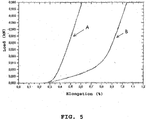
- EXAMPLE 5 (a) Stranding Pitch (mm) 12.5 S 12.5 S Breaking load (*) (N) 596 558 Elongation at break (*) (MPa) 4.20 4.04 Part load elongation (PLE) at 50 N (%) (**) 0.605 0.240 Rubber penetration (mm 3 /cm of cord) 0.28 0.10 (a) : comparative; (*) : method BISFA E6; (**) : method BISFA E7.
- Example 4 shows improved mechanical characteristics (in particular, a part load elongation - see also Fig. 5 ) with respect to the steel cord of the prior art (Example 5). Moreover the steel cord according to the present invention (Example 4) shows an improved rubber penetration with respect to the steel cord of the prior art (Example 5).
- each portion was subjected to five cross-sections (in particular, one stranding pitch of each portion was subjected to five cross-sections, said cross-sections having all the same length) and the above reported measurements were made for each cross-section.
- the measurements were made by using a magnifying lens and a graduated ruler: the obtained data are given in Table 3.
- the steel cord according to the present invention maintains the above reported characteristics, i.e. the gap area (G.A.) and the sum of the distance between each couple of adjacent metal wires in a cross-section ( ⁇ s n ), along its entire longitudinal development.
Landscapes
- Ropes Or Cables (AREA)
Priority Applications (1)
| Application Number | Priority Date | Filing Date | Title |
|---|---|---|---|
| PL06753540.1T PL2016221T3 (pl) | 2006-05-10 | 2006-05-10 | Lina metalowa oraz sposób i urządzenie do wytwarzania liny metalowej |
Applications Claiming Priority (1)
| Application Number | Priority Date | Filing Date | Title |
|---|---|---|---|
| PCT/EP2006/004353 WO2007128335A1 (en) | 2006-05-10 | 2006-05-10 | Metal cord and process for manufacturing a metal cord |
Publications (2)
| Publication Number | Publication Date |
|---|---|
| EP2016221A1 EP2016221A1 (en) | 2009-01-21 |
| EP2016221B1 true EP2016221B1 (en) | 2016-04-13 |
Family
ID=37536117
Family Applications (1)
| Application Number | Title | Priority Date | Filing Date |
|---|---|---|---|
| EP06753540.1A Expired - Lifetime EP2016221B1 (en) | 2006-05-10 | 2006-05-10 | Metal cord and process and apparatus for manufacturing a metal cord |
Country Status (7)
| Country | Link |
|---|---|
| US (1) | US7975463B2 (pl) |
| EP (1) | EP2016221B1 (pl) |
| CN (1) | CN101473088B (pl) |
| BR (1) | BRPI0621667B1 (pl) |
| ES (1) | ES2582192T3 (pl) |
| PL (1) | PL2016221T3 (pl) |
| WO (1) | WO2007128335A1 (pl) |
Families Citing this family (13)
| Publication number | Priority date | Publication date | Assignee | Title |
|---|---|---|---|---|
| WO2011070542A1 (en) * | 2009-12-11 | 2011-06-16 | Pirelli Tyre S.P.A. | Tyre for a wheel of a heavy load vehicle |
| WO2012055677A2 (en) * | 2010-10-27 | 2012-05-03 | Nv Bekaert Sa | Open steel cord |
| JP6302297B2 (ja) * | 2014-03-12 | 2018-03-28 | 住友ゴム工業株式会社 | 重荷重用空気入りタイヤ |
| CN108699789B (zh) * | 2016-02-23 | 2021-02-23 | 贝卡尔特公司 | 能量吸收组件 |
| WO2020021007A1 (fr) | 2018-07-25 | 2020-01-30 | Compagnie Generale Des Etablissements Michelin | Cables metalliques bi-modules |
| US11760128B2 (en) | 2018-07-25 | 2023-09-19 | Compagnie Generale Des Etablissements Michelin | Highly compressible open cord |
| CN110077905A (zh) * | 2019-06-03 | 2019-08-02 | 广州市鸿辉电工机械有限公司 | 一种控制绞线机收线张力的方法及其装置 |
| CN114786961B (zh) * | 2019-12-17 | 2024-07-09 | 倍耐力轮胎股份公司 | 用于车轮轮胎的金属增强帘线 |
| BR112022009771A2 (pt) | 2019-12-17 | 2022-08-16 | Pirelli | Cabo de reforço metálico para pneus de rodas de veículos |
| BR112022009694A2 (pt) | 2019-12-17 | 2022-08-09 | Pirelli | Processo e aparelho para fabricar um cabo de reforço metálico para pneus para rodas de veículos |
| WO2021140288A1 (fr) | 2020-01-07 | 2021-07-15 | Compagnie Generale Des Etablissements Michelin | Câble multi-torons à deux couches à énergie à rupture améliorée et à module tangent bas |
| JP7737379B2 (ja) | 2020-01-07 | 2025-09-10 | コンパニー ゼネラール デ エタブリッスマン ミシュラン | 改良された破断時エネルギー及び改良された全伸びを有する単層マルチストランドコード |
| BR112023002877A2 (pt) | 2020-09-25 | 2023-04-11 | Pirelli | Cabo metálico de reforço para pneus de rodas de veículo, e, pneu para rodas de veículo |
Family Cites Families (27)
| Publication number | Priority date | Publication date | Assignee | Title |
|---|---|---|---|---|
| US427698A (en) * | 1890-05-13 | Boot or shoe tree | ||
| BE435829A (pl) * | 1938-08-04 | |||
| US2729030A (en) * | 1954-07-02 | 1956-01-03 | Owens Corning Fiberglass Corp | Method of and apparatus for linearly feeding an untwisted, multifilament strand |
| FR1568875A (pl) | 1968-01-24 | 1969-05-30 | ||
| DE2840122C2 (de) | 1978-09-15 | 1980-11-13 | Hoechst Ag, 6000 Frankfurt | Vorrichtung zum Ablegen eines Endlosgutes mit Hilfe eines Profilwalzenpaares |
| IT1099869B (it) * | 1978-10-31 | 1985-09-28 | Pirelli | Cordicella metallica |
| GB2106816B (en) * | 1981-10-05 | 1985-11-06 | Mitsubishi Heavy Ind Ltd | Narrow gap arc welding process and apparatus therefor |
| JPS60137536A (ja) * | 1983-12-26 | 1985-07-22 | Sumitomo Electric Ind Ltd | 異形素線の撚線方法および装置 |
| GB8418509D0 (en) | 1984-07-20 | 1984-08-22 | Bekaert Sa Nv | Steel cord construction |
| JPH0718103B2 (ja) | 1989-05-23 | 1995-03-01 | 興国鋼線索株式会社 | タイヤ用スチールコードおよびその製造方法 |
| US5213652A (en) * | 1989-09-11 | 1993-05-25 | The Yokohama Rubber Co., Ltd. | Pneumatic radial tire including 1×2 steel cords |
| DE69110771T2 (de) | 1990-06-16 | 1996-03-21 | Tokusen Kogyo Kk | Stahlkabel zur Verstärkung von elastomeren Erzeugnissen. |
| JP2672749B2 (ja) | 1991-08-06 | 1997-11-05 | 住友電気工業株式会社 | 金属コード及びこれとゴムとの複合物 |
| ES2116356T3 (es) * | 1992-01-09 | 1998-07-16 | Bridgestone Corp | Cuerda de acero. |
| KR100367116B1 (ko) | 1993-12-15 | 2003-02-25 | 엔.브이. 베카에르트 에스.에이. | 개방구조의스틸코드및그것의제조방법 |
| WO1995018259A1 (en) * | 1993-12-27 | 1995-07-06 | Tokyo Rope Manufacturing Co., Ltd. | Steel cord and radial tire using the same as a reinforcing material |
| US5581990A (en) * | 1994-04-07 | 1996-12-10 | N.V. Bekaert S.A. | Twisting steel cord with wavy filament |
| US5661966A (en) * | 1996-06-27 | 1997-09-02 | Tokyo Rope Manufacturing Co. Ltd. | Steel cord for reinforcement of off-road tire, method of manufacturing the same, and off-road tire |
| IT1277689B1 (it) | 1995-12-21 | 1997-11-11 | Pirelli | Cordicella metallica di rinforzo da impiegarsi particolarmente in manufatti compositi a matrice elastomerica procedimento ed apparato |
| ZA9810315B (en) | 1997-11-27 | 1999-05-18 | Bekaert Sa Nv | Steel cord with spatially waved elements |
| US6016647A (en) * | 1998-05-06 | 2000-01-25 | Tokyo Rope Manufacturing Co., Ltd. | Manufacturing method and apparatus of steel cord for rubber product reinforcement |
| KR100680159B1 (ko) * | 1998-12-24 | 2007-02-08 | 피렐리 타이어 소시에떼 퍼 아찌오니 | 강화 엘라스토머 제품, 특히 타이어용의 금속 코오드 제작방법 및 장치 |
| JP4057317B2 (ja) * | 2002-03-13 | 2008-03-05 | 住友ゴム工業株式会社 | ゴム物品補強用のスチールコード、及びそれを用いた空気入りタイヤ |
| JP4608270B2 (ja) * | 2004-08-30 | 2011-01-12 | 住友ゴム工業株式会社 | 空気入りタイヤ |
| JP2007177362A (ja) * | 2005-12-27 | 2007-07-12 | Tokusen Kogyo Co Ltd | ゴム製品補強用スチールコード |
| CN101126209A (zh) * | 2007-09-07 | 2008-02-20 | 江苏法尔胜股份有限公司 | 抽油杆用钢丝绳生产工艺 |
| CN100545351C (zh) * | 2007-09-12 | 2009-09-30 | 巨力索具股份有限公司 | 缆悬索及其制作方法 |
-
2006
- 2006-05-10 CN CN2006800550255A patent/CN101473088B/zh not_active Expired - Fee Related
- 2006-05-10 BR BRPI0621667A patent/BRPI0621667B1/pt not_active IP Right Cessation
- 2006-05-10 US US12/226,975 patent/US7975463B2/en active Active
- 2006-05-10 EP EP06753540.1A patent/EP2016221B1/en not_active Expired - Lifetime
- 2006-05-10 PL PL06753540.1T patent/PL2016221T3/pl unknown
- 2006-05-10 WO PCT/EP2006/004353 patent/WO2007128335A1/en not_active Ceased
- 2006-05-10 ES ES06753540.1T patent/ES2582192T3/es not_active Expired - Lifetime
Also Published As
| Publication number | Publication date |
|---|---|
| US7975463B2 (en) | 2011-07-12 |
| BRPI0621667B1 (pt) | 2016-11-29 |
| WO2007128335A1 (en) | 2007-11-15 |
| BRPI0621667A2 (pt) | 2012-07-10 |
| CN101473088A (zh) | 2009-07-01 |
| ES2582192T3 (es) | 2016-09-09 |
| CN101473088B (zh) | 2012-12-05 |
| EP2016221A1 (en) | 2009-01-21 |
| PL2016221T3 (pl) | 2016-10-31 |
| US20090176119A1 (en) | 2009-07-09 |
Similar Documents
| Publication | Publication Date | Title |
|---|---|---|
| US7975463B2 (en) | Metal cord and process for manufacturing a metal cord | |
| EP3647488B1 (en) | Steel cord for rubber component reinforcement and production method therefor | |
| US6698179B2 (en) | Metal cord and process for manufacturing a metal cord | |
| EP2060673A1 (en) | Steel cord | |
| WO2012055677A2 (en) | Open steel cord | |
| CN101838873B (zh) | 橡胶制品增强用钢丝帘线及其制造方法 | |
| EP3647487A1 (en) | Rubber component reinforcing-steel cord | |
| JP4741080B2 (ja) | エラストマー製品(特にタイヤ)を補強するための金属コードを製造するための方法および装置 | |
| EP3851575A1 (en) | Steel cord for reinforcing rubber article | |
| JP3588402B2 (ja) | ゴム物品補強用スチ−ルコ−ド及びその製法並びに製造装置 | |
| JP2004277968A (ja) | スチールコード及び空気入りラジアルタイヤ | |
| JP3805064B2 (ja) | ゴム物品補強用スチールコード、その製造方法及びそれを補強材とした空気入りラジアルタイヤ | |
| JP2009293165A (ja) | スチール・コード | |
| JP2008025040A (ja) | スチールコード及びその製造方法 | |
| JP2719862B2 (ja) | ゴム製品補強用スチールコード | |
| JPH10280289A (ja) | ゴム製品補強用スチールコードおよびその製造方法 | |
| JP2000256976A (ja) | タイヤ補強用スチ−ルコ−ド | |
| JPH07126992A (ja) | ゴム補強用スチ−ルコ−ド | |
| JPH08226084A (ja) | ゴム物品補強用スチ−ルコ−ド及びその製造方法 | |
| JP2531771B2 (ja) | 重荷重用ラジアルタイヤ | |
| JP2920422B2 (ja) | スチールコードおよびこれを補強材として使用したラジアルタイヤ | |
| JPH08170286A (ja) | 金属コードとその製造方法および同金属コードとゴムの複合物 | |
| JP2005307362A (ja) | ゴム物品補強用金属コード及びそのコードの製造方法 |
Legal Events
| Date | Code | Title | Description |
|---|---|---|---|
| PUAI | Public reference made under article 153(3) epc to a published international application that has entered the european phase |
Free format text: ORIGINAL CODE: 0009012 |
|
| 17P | Request for examination filed |
Effective date: 20081118 |
|
| AK | Designated contracting states |
Kind code of ref document: A1 Designated state(s): AT BE BG CH CY CZ DE DK EE ES FI FR GB GR HU IE IS IT LI LT LU LV MC NL PL PT RO SE SI SK TR |
|
| AX | Request for extension of the european patent |
Extension state: AL BA HR MK YU |
|
| DAX | Request for extension of the european patent (deleted) | ||
| RAP1 | Party data changed (applicant data changed or rights of an application transferred) |
Owner name: PIRELLI TYRE S.P.A. |
|
| 17Q | First examination report despatched |
Effective date: 20140401 |
|
| GRAP | Despatch of communication of intention to grant a patent |
Free format text: ORIGINAL CODE: EPIDOSNIGR1 |
|
| INTG | Intention to grant announced |
Effective date: 20150820 |
|
| RAP1 | Party data changed (applicant data changed or rights of an application transferred) |
Owner name: NV BEKAERT SA |
|
| GRAS | Grant fee paid |
Free format text: ORIGINAL CODE: EPIDOSNIGR3 |
|
| GRAA | (expected) grant |
Free format text: ORIGINAL CODE: 0009210 |
|
| AK | Designated contracting states |
Kind code of ref document: B1 Designated state(s): AT BE BG CH CY CZ DE DK EE ES FI FR GB GR HU IE IS IT LI LT LU LV MC NL PL PT RO SE SI SK TR |
|
| REG | Reference to a national code |
Ref country code: GB Ref legal event code: FG4D |
|
| REG | Reference to a national code |
Ref country code: AT Ref legal event code: REF Ref document number: 790301 Country of ref document: AT Kind code of ref document: T Effective date: 20160415 Ref country code: CH Ref legal event code: EP |
|
| REG | Reference to a national code |
Ref country code: IE Ref legal event code: FG4D |
|
| REG | Reference to a national code |
Ref country code: FR Ref legal event code: PLFP Year of fee payment: 11 |
|
| REG | Reference to a national code |
Ref country code: DE Ref legal event code: R096 Ref document number: 602006048677 Country of ref document: DE |
|
| REG | Reference to a national code |
Ref country code: RO Ref legal event code: EPE |
|
| REG | Reference to a national code |
Ref country code: LT Ref legal event code: MG4D |
|
| PG25 | Lapsed in a contracting state [announced via postgrant information from national office to epo] |
Ref country code: BE Free format text: LAPSE BECAUSE OF NON-PAYMENT OF DUE FEES Effective date: 20160531 |
|
| REG | Reference to a national code |
Ref country code: ES Ref legal event code: FG2A Ref document number: 2582192 Country of ref document: ES Kind code of ref document: T3 Effective date: 20160909 |
|
| REG | Reference to a national code |
Ref country code: AT Ref legal event code: MK05 Ref document number: 790301 Country of ref document: AT Kind code of ref document: T Effective date: 20160413 |
|
| REG | Reference to a national code |
Ref country code: NL Ref legal event code: MP Effective date: 20160413 |
|
| PG25 | Lapsed in a contracting state [announced via postgrant information from national office to epo] |
Ref country code: NL Free format text: LAPSE BECAUSE OF FAILURE TO SUBMIT A TRANSLATION OF THE DESCRIPTION OR TO PAY THE FEE WITHIN THE PRESCRIBED TIME-LIMIT Effective date: 20160413 Ref country code: FI Free format text: LAPSE BECAUSE OF FAILURE TO SUBMIT A TRANSLATION OF THE DESCRIPTION OR TO PAY THE FEE WITHIN THE PRESCRIBED TIME-LIMIT Effective date: 20160413 Ref country code: LT Free format text: LAPSE BECAUSE OF FAILURE TO SUBMIT A TRANSLATION OF THE DESCRIPTION OR TO PAY THE FEE WITHIN THE PRESCRIBED TIME-LIMIT Effective date: 20160413 |
|
| PG25 | Lapsed in a contracting state [announced via postgrant information from national office to epo] |
Ref country code: AT Free format text: LAPSE BECAUSE OF FAILURE TO SUBMIT A TRANSLATION OF THE DESCRIPTION OR TO PAY THE FEE WITHIN THE PRESCRIBED TIME-LIMIT Effective date: 20160413 Ref country code: LV Free format text: LAPSE BECAUSE OF FAILURE TO SUBMIT A TRANSLATION OF THE DESCRIPTION OR TO PAY THE FEE WITHIN THE PRESCRIBED TIME-LIMIT Effective date: 20160413 Ref country code: PT Free format text: LAPSE BECAUSE OF FAILURE TO SUBMIT A TRANSLATION OF THE DESCRIPTION OR TO PAY THE FEE WITHIN THE PRESCRIBED TIME-LIMIT Effective date: 20160816 Ref country code: GR Free format text: LAPSE BECAUSE OF FAILURE TO SUBMIT A TRANSLATION OF THE DESCRIPTION OR TO PAY THE FEE WITHIN THE PRESCRIBED TIME-LIMIT Effective date: 20160714 Ref country code: SE Free format text: LAPSE BECAUSE OF FAILURE TO SUBMIT A TRANSLATION OF THE DESCRIPTION OR TO PAY THE FEE WITHIN THE PRESCRIBED TIME-LIMIT Effective date: 20160413 |
|
| REG | Reference to a national code |
Ref country code: SK Ref legal event code: T3 Ref document number: E 21492 Country of ref document: SK |
|
| PG25 | Lapsed in a contracting state [announced via postgrant information from national office to epo] |
Ref country code: BE Free format text: LAPSE BECAUSE OF FAILURE TO SUBMIT A TRANSLATION OF THE DESCRIPTION OR TO PAY THE FEE WITHIN THE PRESCRIBED TIME-LIMIT Effective date: 20160413 |
|
| REG | Reference to a national code |
Ref country code: CH Ref legal event code: PL |
|
| REG | Reference to a national code |
Ref country code: DE Ref legal event code: R097 Ref document number: 602006048677 Country of ref document: DE |
|
| PG25 | Lapsed in a contracting state [announced via postgrant information from national office to epo] |
Ref country code: LI Free format text: LAPSE BECAUSE OF NON-PAYMENT OF DUE FEES Effective date: 20160531 Ref country code: CZ Free format text: LAPSE BECAUSE OF FAILURE TO SUBMIT A TRANSLATION OF THE DESCRIPTION OR TO PAY THE FEE WITHIN THE PRESCRIBED TIME-LIMIT Effective date: 20160413 Ref country code: DK Free format text: LAPSE BECAUSE OF FAILURE TO SUBMIT A TRANSLATION OF THE DESCRIPTION OR TO PAY THE FEE WITHIN THE PRESCRIBED TIME-LIMIT Effective date: 20160413 Ref country code: CH Free format text: LAPSE BECAUSE OF NON-PAYMENT OF DUE FEES Effective date: 20160531 Ref country code: MC Free format text: LAPSE BECAUSE OF FAILURE TO SUBMIT A TRANSLATION OF THE DESCRIPTION OR TO PAY THE FEE WITHIN THE PRESCRIBED TIME-LIMIT Effective date: 20160413 Ref country code: EE Free format text: LAPSE BECAUSE OF FAILURE TO SUBMIT A TRANSLATION OF THE DESCRIPTION OR TO PAY THE FEE WITHIN THE PRESCRIBED TIME-LIMIT Effective date: 20160413 |
|
| PLBE | No opposition filed within time limit |
Free format text: ORIGINAL CODE: 0009261 |
|
| STAA | Information on the status of an ep patent application or granted ep patent |
Free format text: STATUS: NO OPPOSITION FILED WITHIN TIME LIMIT |
|
| REG | Reference to a national code |
Ref country code: IE Ref legal event code: MM4A |
|
| 26N | No opposition filed |
Effective date: 20170116 |
|
| GBPC | Gb: european patent ceased through non-payment of renewal fee |
Effective date: 20160713 |
|
| REG | Reference to a national code |
Ref country code: FR Ref legal event code: PLFP Year of fee payment: 12 |
|
| PG25 | Lapsed in a contracting state [announced via postgrant information from national office to epo] |
Ref country code: SI Free format text: LAPSE BECAUSE OF FAILURE TO SUBMIT A TRANSLATION OF THE DESCRIPTION OR TO PAY THE FEE WITHIN THE PRESCRIBED TIME-LIMIT Effective date: 20160413 Ref country code: IE Free format text: LAPSE BECAUSE OF NON-PAYMENT OF DUE FEES Effective date: 20160510 Ref country code: GB Free format text: LAPSE BECAUSE OF NON-PAYMENT OF DUE FEES Effective date: 20160713 |
|
| REG | Reference to a national code |
Ref country code: FR Ref legal event code: PLFP Year of fee payment: 13 |
|
| PG25 | Lapsed in a contracting state [announced via postgrant information from national office to epo] |
Ref country code: HU Free format text: LAPSE BECAUSE OF FAILURE TO SUBMIT A TRANSLATION OF THE DESCRIPTION OR TO PAY THE FEE WITHIN THE PRESCRIBED TIME-LIMIT; INVALID AB INITIO Effective date: 20060510 Ref country code: CY Free format text: LAPSE BECAUSE OF FAILURE TO SUBMIT A TRANSLATION OF THE DESCRIPTION OR TO PAY THE FEE WITHIN THE PRESCRIBED TIME-LIMIT Effective date: 20160413 |
|
| PG25 | Lapsed in a contracting state [announced via postgrant information from national office to epo] |
Ref country code: IS Free format text: LAPSE BECAUSE OF FAILURE TO SUBMIT A TRANSLATION OF THE DESCRIPTION OR TO PAY THE FEE WITHIN THE PRESCRIBED TIME-LIMIT Effective date: 20160413 Ref country code: LU Free format text: LAPSE BECAUSE OF NON-PAYMENT OF DUE FEES Effective date: 20160510 |
|
| PG25 | Lapsed in a contracting state [announced via postgrant information from national office to epo] |
Ref country code: BG Free format text: LAPSE BECAUSE OF FAILURE TO SUBMIT A TRANSLATION OF THE DESCRIPTION OR TO PAY THE FEE WITHIN THE PRESCRIBED TIME-LIMIT Effective date: 20160413 |
|
| PGFP | Annual fee paid to national office [announced via postgrant information from national office to epo] |
Ref country code: DE Payment date: 20200520 Year of fee payment: 15 |
|
| PGFP | Annual fee paid to national office [announced via postgrant information from national office to epo] |
Ref country code: SK Payment date: 20200511 Year of fee payment: 15 Ref country code: PL Payment date: 20200430 Year of fee payment: 15 |
|
| PGFP | Annual fee paid to national office [announced via postgrant information from national office to epo] |
Ref country code: ES Payment date: 20200728 Year of fee payment: 15 |
|
| PGFP | Annual fee paid to national office [announced via postgrant information from national office to epo] |
Ref country code: IT Payment date: 20210527 Year of fee payment: 16 Ref country code: FR Payment date: 20210525 Year of fee payment: 16 |
|
| REG | Reference to a national code |
Ref country code: DE Ref legal event code: R119 Ref document number: 602006048677 Country of ref document: DE |
|
| REG | Reference to a national code |
Ref country code: SK Ref legal event code: MM4A Ref document number: E 21492 Country of ref document: SK Effective date: 20210510 |
|
| PG25 | Lapsed in a contracting state [announced via postgrant information from national office to epo] |
Ref country code: SK Free format text: LAPSE BECAUSE OF NON-PAYMENT OF DUE FEES Effective date: 20210510 |
|
| PG25 | Lapsed in a contracting state [announced via postgrant information from national office to epo] |
Ref country code: DE Free format text: LAPSE BECAUSE OF NON-PAYMENT OF DUE FEES Effective date: 20211201 |
|
| REG | Reference to a national code |
Ref country code: ES Ref legal event code: FD2A Effective date: 20220729 |
|
| PG25 | Lapsed in a contracting state [announced via postgrant information from national office to epo] |
Ref country code: ES Free format text: LAPSE BECAUSE OF NON-PAYMENT OF DUE FEES Effective date: 20210511 |
|
| PG25 | Lapsed in a contracting state [announced via postgrant information from national office to epo] |
Ref country code: PL Free format text: LAPSE BECAUSE OF NON-PAYMENT OF DUE FEES Effective date: 20210510 |
|
| PG25 | Lapsed in a contracting state [announced via postgrant information from national office to epo] |
Ref country code: FR Free format text: LAPSE BECAUSE OF NON-PAYMENT OF DUE FEES Effective date: 20220531 |
|
| P01 | Opt-out of the competence of the unified patent court (upc) registered |
Effective date: 20230619 |
|
| PG25 | Lapsed in a contracting state [announced via postgrant information from national office to epo] |
Ref country code: IT Free format text: LAPSE BECAUSE OF NON-PAYMENT OF DUE FEES Effective date: 20220510 |
|
| PGFP | Annual fee paid to national office [announced via postgrant information from national office to epo] |
Ref country code: RO Payment date: 20230503 Year of fee payment: 18 |
|
| PGFP | Annual fee paid to national office [announced via postgrant information from national office to epo] |
Ref country code: TR Payment date: 20230508 Year of fee payment: 18 |
|
| PG25 | Lapsed in a contracting state [announced via postgrant information from national office to epo] |
Ref country code: RO Free format text: LAPSE BECAUSE OF NON-PAYMENT OF DUE FEES Effective date: 20240510 |
|
| PG25 | Lapsed in a contracting state [announced via postgrant information from national office to epo] |
Ref country code: RO Free format text: LAPSE BECAUSE OF NON-PAYMENT OF DUE FEES Effective date: 20240510 |