EP2014202B1 - Affichage du mûrissement de fruits - Google Patents
Affichage du mûrissement de fruits Download PDFInfo
- Publication number
- EP2014202B1 EP2014202B1 EP08166594A EP08166594A EP2014202B1 EP 2014202 B1 EP2014202 B1 EP 2014202B1 EP 08166594 A EP08166594 A EP 08166594A EP 08166594 A EP08166594 A EP 08166594A EP 2014202 B1 EP2014202 B1 EP 2014202B1
- Authority
- EP
- European Patent Office
- Prior art keywords
- fruit
- ripening
- display part
- display
- chambers
- Prior art date
- Legal status (The legal status is an assumption and is not a legal conclusion. Google has not performed a legal analysis and makes no representation as to the accuracy of the status listed.)
- Expired - Lifetime
Links
- 230000004345 fruit ripening Effects 0.000 title claims abstract description 47
- 235000013399 edible fruits Nutrition 0.000 claims abstract description 443
- 230000005070 ripening Effects 0.000 claims abstract description 225
- 238000000034 method Methods 0.000 claims abstract description 31
- 239000000463 material Substances 0.000 claims description 19
- 238000004519 manufacturing process Methods 0.000 claims description 4
- 238000000465 moulding Methods 0.000 claims 1
- 239000000088 plastic resin Substances 0.000 claims 1
- 230000001105 regulatory effect Effects 0.000 claims 1
- 208000034656 Contusions Diseases 0.000 abstract description 15
- 239000008369 fruit flavor Substances 0.000 abstract description 9
- 239000007789 gas Substances 0.000 description 68
- 238000002474 experimental method Methods 0.000 description 38
- 239000005977 Ethylene Substances 0.000 description 26
- VGGSQFUCUMXWEO-UHFFFAOYSA-N Ethene Chemical compound C=C VGGSQFUCUMXWEO-UHFFFAOYSA-N 0.000 description 25
- 235000019640 taste Nutrition 0.000 description 16
- 238000012360 testing method Methods 0.000 description 16
- CURLTUGMZLYLDI-UHFFFAOYSA-N Carbon dioxide Chemical compound O=C=O CURLTUGMZLYLDI-UHFFFAOYSA-N 0.000 description 13
- 239000000796 flavoring agent Substances 0.000 description 11
- 235000019634 flavors Nutrition 0.000 description 10
- 238000005096 rolling process Methods 0.000 description 10
- 239000011521 glass Substances 0.000 description 9
- 238000004806 packaging method and process Methods 0.000 description 9
- 230000008569 process Effects 0.000 description 9
- 241000220225 Malus Species 0.000 description 8
- 235000021016 apples Nutrition 0.000 description 8
- 239000004033 plastic Substances 0.000 description 8
- 229920003023 plastic Polymers 0.000 description 8
- 238000009423 ventilation Methods 0.000 description 8
- 229910002092 carbon dioxide Inorganic materials 0.000 description 7
- 235000012976 tarts Nutrition 0.000 description 7
- 239000001569 carbon dioxide Substances 0.000 description 6
- 238000003306 harvesting Methods 0.000 description 6
- 230000014759 maintenance of location Effects 0.000 description 6
- 230000000284 resting effect Effects 0.000 description 6
- 229910001220 stainless steel Inorganic materials 0.000 description 6
- 239000010935 stainless steel Substances 0.000 description 6
- 238000003860 storage Methods 0.000 description 6
- 241000234295 Musa Species 0.000 description 5
- 229910052782 aluminium Inorganic materials 0.000 description 5
- XAGFODPZIPBFFR-UHFFFAOYSA-N aluminium Chemical compound [Al] XAGFODPZIPBFFR-UHFFFAOYSA-N 0.000 description 5
- 235000021015 bananas Nutrition 0.000 description 5
- 239000003795 chemical substances by application Substances 0.000 description 5
- 238000013461 design Methods 0.000 description 5
- 230000036571 hydration Effects 0.000 description 5
- 238000006703 hydration reaction Methods 0.000 description 5
- 239000012528 membrane Substances 0.000 description 5
- 235000013311 vegetables Nutrition 0.000 description 5
- 241000220324 Pyrus Species 0.000 description 4
- 239000005388 borosilicate glass Substances 0.000 description 4
- 230000008859 change Effects 0.000 description 4
- 235000012055 fruits and vegetables Nutrition 0.000 description 4
- 235000021017 pears Nutrition 0.000 description 4
- 238000000926 separation method Methods 0.000 description 4
- 240000008790 Musa x paradisiaca Species 0.000 description 3
- 235000018290 Musa x paradisiaca Nutrition 0.000 description 3
- QVGXLLKOCUKJST-UHFFFAOYSA-N atomic oxygen Chemical compound [O] QVGXLLKOCUKJST-UHFFFAOYSA-N 0.000 description 3
- 230000000903 blocking effect Effects 0.000 description 3
- 208000034526 bruise Diseases 0.000 description 3
- 235000009508 confectionery Nutrition 0.000 description 3
- 235000013305 food Nutrition 0.000 description 3
- 229910052760 oxygen Inorganic materials 0.000 description 3
- 239000001301 oxygen Substances 0.000 description 3
- 239000000123 paper Substances 0.000 description 3
- 230000000717 retained effect Effects 0.000 description 3
- 230000002441 reversible effect Effects 0.000 description 3
- 239000007787 solid Substances 0.000 description 3
- 239000002023 wood Substances 0.000 description 3
- XMTQQYYKAHVGBJ-UHFFFAOYSA-N 3-(3,4-DICHLOROPHENYL)-1,1-DIMETHYLUREA Chemical compound CN(C)C(=O)NC1=CC=C(Cl)C(Cl)=C1 XMTQQYYKAHVGBJ-UHFFFAOYSA-N 0.000 description 2
- 244000298697 Actinidia deliciosa Species 0.000 description 2
- 235000009436 Actinidia deliciosa Nutrition 0.000 description 2
- 229910000831 Steel Inorganic materials 0.000 description 2
- 238000007664 blowing Methods 0.000 description 2
- 239000005293 duran Substances 0.000 description 2
- 230000000694 effects Effects 0.000 description 2
- 229940117927 ethylene oxide Drugs 0.000 description 2
- 239000006260 foam Substances 0.000 description 2
- 235000021022 fresh fruits Nutrition 0.000 description 2
- 230000005484 gravity Effects 0.000 description 2
- 229910052751 metal Inorganic materials 0.000 description 2
- 239000002184 metal Substances 0.000 description 2
- 238000012856 packing Methods 0.000 description 2
- 229920003229 poly(methyl methacrylate) Polymers 0.000 description 2
- 239000004926 polymethyl methacrylate Substances 0.000 description 2
- 238000011160 research Methods 0.000 description 2
- 239000010959 steel Substances 0.000 description 2
- WSLDOOZREJYCGB-UHFFFAOYSA-N 1,2-Dichloroethane Chemical compound ClCCCl WSLDOOZREJYCGB-UHFFFAOYSA-N 0.000 description 1
- 244000144730 Amygdalus persica Species 0.000 description 1
- 238000012935 Averaging Methods 0.000 description 1
- VYZAMTAEIAYCRO-UHFFFAOYSA-N Chromium Chemical compound [Cr] VYZAMTAEIAYCRO-UHFFFAOYSA-N 0.000 description 1
- 244000060011 Cocos nucifera Species 0.000 description 1
- 235000013162 Cocos nucifera Nutrition 0.000 description 1
- 101100010343 Drosophila melanogaster lobo gene Proteins 0.000 description 1
- 241000132456 Haplocarpha Species 0.000 description 1
- 239000004698 Polyethylene Substances 0.000 description 1
- 235000006040 Prunus persica var persica Nutrition 0.000 description 1
- 239000006096 absorbing agent Substances 0.000 description 1
- 239000004411 aluminium Substances 0.000 description 1
- 238000000137 annealing Methods 0.000 description 1
- 235000008429 bread Nutrition 0.000 description 1
- 239000011111 cardboard Substances 0.000 description 1
- 239000011248 coating agent Substances 0.000 description 1
- 238000000576 coating method Methods 0.000 description 1
- 238000007596 consolidation process Methods 0.000 description 1
- 238000001816 cooling Methods 0.000 description 1
- 239000007799 cork Substances 0.000 description 1
- 210000003298 dental enamel Anatomy 0.000 description 1
- 230000001419 dependent effect Effects 0.000 description 1
- 238000011161 development Methods 0.000 description 1
- 230000018109 developmental process Effects 0.000 description 1
- 238000007599 discharging Methods 0.000 description 1
- 238000009826 distribution Methods 0.000 description 1
- 230000009977 dual effect Effects 0.000 description 1
- 238000004534 enameling Methods 0.000 description 1
- 239000003292 glue Substances 0.000 description 1
- 239000005346 heat strengthened glass Substances 0.000 description 1
- 239000011796 hollow space material Substances 0.000 description 1
- 238000003898 horticulture Methods 0.000 description 1
- 238000003780 insertion Methods 0.000 description 1
- 230000037431 insertion Effects 0.000 description 1
- 230000001788 irregular Effects 0.000 description 1
- 230000007246 mechanism Effects 0.000 description 1
- 239000000203 mixture Substances 0.000 description 1
- 238000012986 modification Methods 0.000 description 1
- 230000004048 modification Effects 0.000 description 1
- 239000002991 molded plastic Substances 0.000 description 1
- 230000036961 partial effect Effects 0.000 description 1
- 230000002093 peripheral effect Effects 0.000 description 1
- 230000035699 permeability Effects 0.000 description 1
- 235000021018 plums Nutrition 0.000 description 1
- -1 polyethylene Polymers 0.000 description 1
- 229920000573 polyethylene Polymers 0.000 description 1
- 229920000642 polymer Polymers 0.000 description 1
- 239000002861 polymer material Substances 0.000 description 1
- 238000003825 pressing Methods 0.000 description 1
- 230000001012 protector Effects 0.000 description 1
- 230000002829 reductive effect Effects 0.000 description 1
- 238000005057 refrigeration Methods 0.000 description 1
- HUAUNKAZQWMVFY-UHFFFAOYSA-M sodium;oxocalcium;hydroxide Chemical compound [OH-].[Na+].[Ca]=O HUAUNKAZQWMVFY-UHFFFAOYSA-M 0.000 description 1
- 230000003319 supportive effect Effects 0.000 description 1
- 210000004243 sweat Anatomy 0.000 description 1
- 229920003002 synthetic resin Polymers 0.000 description 1
- 239000000057 synthetic resin Substances 0.000 description 1
- 125000005931 tert-butyloxycarbonyl group Chemical group [H]C([H])([H])C(OC(*)=O)(C([H])([H])[H])C([H])([H])[H] 0.000 description 1
- 239000005341 toughened glass Substances 0.000 description 1
- 238000005406 washing Methods 0.000 description 1
- 230000003313 weakening effect Effects 0.000 description 1
Images


















Classifications
-
- A—HUMAN NECESSITIES
- A23—FOODS OR FOODSTUFFS; TREATMENT THEREOF, NOT COVERED BY OTHER CLASSES
- A23B—PRESERVATION OF FOODS, FOODSTUFFS OR NON-ALCOHOLIC BEVERAGES; CHEMICAL RIPENING OF FRUIT OR VEGETABLES
- A23B7/00—Preservation of fruit or vegetables; Chemical ripening of fruit or vegetables
- A23B7/14—Preserving or ripening with chemicals not covered by group A23B7/08 or A23B7/10
-
- A—HUMAN NECESSITIES
- A23—FOODS OR FOODSTUFFS; TREATMENT THEREOF, NOT COVERED BY OTHER CLASSES
- A23B—PRESERVATION OF FOODS, FOODSTUFFS OR NON-ALCOHOLIC BEVERAGES; CHEMICAL RIPENING OF FRUIT OR VEGETABLES
- A23B7/00—Preservation of fruit or vegetables; Chemical ripening of fruit or vegetables
-
- A—HUMAN NECESSITIES
- A23—FOODS OR FOODSTUFFS; TREATMENT THEREOF, NOT COVERED BY OTHER CLASSES
- A23B—PRESERVATION OF FOODS, FOODSTUFFS OR NON-ALCOHOLIC BEVERAGES; CHEMICAL RIPENING OF FRUIT OR VEGETABLES
- A23B7/00—Preservation of fruit or vegetables; Chemical ripening of fruit or vegetables
- A23B7/14—Preserving or ripening with chemicals not covered by group A23B7/08 or A23B7/10
- A23B7/144—Preserving or ripening with chemicals not covered by group A23B7/08 or A23B7/10 in the form of gases, e.g. fumigation; Compositions or apparatus therefor
- A23B7/148—Preserving or ripening with chemicals not covered by group A23B7/08 or A23B7/10 in the form of gases, e.g. fumigation; Compositions or apparatus therefor in a controlled atmosphere, e.g. partial vacuum, comprising only CO2, N2, O2 or H2O
-
- A—HUMAN NECESSITIES
- A23—FOODS OR FOODSTUFFS; TREATMENT THEREOF, NOT COVERED BY OTHER CLASSES
- A23B—PRESERVATION OF FOODS, FOODSTUFFS OR NON-ALCOHOLIC BEVERAGES; CHEMICAL RIPENING OF FRUIT OR VEGETABLES
- A23B7/00—Preservation of fruit or vegetables; Chemical ripening of fruit or vegetables
- A23B7/14—Preserving or ripening with chemicals not covered by group A23B7/08 or A23B7/10
- A23B7/144—Preserving or ripening with chemicals not covered by group A23B7/08 or A23B7/10 in the form of gases, e.g. fumigation; Compositions or apparatus therefor
- A23B7/152—Preserving or ripening with chemicals not covered by group A23B7/08 or A23B7/10 in the form of gases, e.g. fumigation; Compositions or apparatus therefor in a controlled atmosphere comprising other gases in addition to CO2, N2, O2 or H2O ; Elimination of such other gases
-
- A—HUMAN NECESSITIES
- A47—FURNITURE; DOMESTIC ARTICLES OR APPLIANCES; COFFEE MILLS; SPICE MILLS; SUCTION CLEANERS IN GENERAL
- A47F—SPECIAL FURNITURE, FITTINGS, OR ACCESSORIES FOR SHOPS, STOREHOUSES, BARS, RESTAURANTS OR THE LIKE; PAYING COUNTERS
- A47F7/00—Show stands, hangers, or shelves, adapted for particular articles or materials
- A47F7/0071—Show stands, hangers, or shelves, adapted for particular articles or materials for perishable goods
Definitions
- the invention relates to an apparatus and a method for fruit ripening, and a method for manufacturing an apparatus for fruit ripening
- a Filio Fruit Tray by Mono Tabletop comprises a brushed 18/10 stainless steel sheet that has been bent into a wave profile;
- a Rosendahl stainless steel fruit dish comprises polished matte 18/08 stainless steel that has been bent into a curve profile with two rectangular legs that form two of its sides;
- a Lobo fruit bowl/bread basket comprises a square sheet of stainless steel having its sides elevated to form a receptacle having a gradual slope;
- Stacks and Stacks offers a banana tree/fruit bowl comprising an open chrome wire basket for storing fruit and an integral hook for suspending bananas;
- Stacks and Stacks also offers a fruit bowl made of natural wood having aluminum legs; and
- Gumps's of San Francisco offers a bowl made of an unwound coconut palm spathe having four legs.
- Fruit ripening Expos to concentrated ripening gas accelerates fruit ripening and improves fruit flavor.
- Fruit falls into two categories: 1) fruit that can continue the ripening process after harvesting and 2) fruit that cannot continue the ripening process after harvesting.
- Fruits that can continue ripening after harvesting are called climacteric fruits. They include many of the most popular fruits including apples, banana, pears, plums and peaches. After harvesting, these fruits continue to respire and naturally produce their own fruit ripening gas-ethylene.
- ripening gas accelerates fruit ripening and improves fruits flavor
- each of the foregoing fruit holders lacks a chamber for retaining fruit ripening gas. They also only have one fruit-ripening environment. As a result, these fruit holders have at least the following disadvantages: they do not exceptionally accelerate fruit ripening, they only marginally improve the taste of the fruit, they do not accommodate variations in ripening rates of different fruits, and they do not readily allow the user to change the ripening rates for select fruit.
- Hammacher-Schlemmer describes a "ripening bowl” comprising a clear dish with a clear bell-shaped top containing ventilation holes. According to Hammacher-Schlemmer, the "ripening bowl” is "specially designed with a domed lid that provides an ideal climate"; U.S. Des. Pat. No. 247,945 , awarded to Saunders in 1978, shows a design for a ripening bowl with ventilation holes. The bowl has a convex bell-shaped top containing ventilation holes; the Koller-Craft division of Koller Enterprises, Inc.
- DE 2259561 teaches a storage device keeping vegetables and fruit fresh by cooling inside the storage container, avoiding a ripening or decaying process, extending the time span for distribution.
- a stackable, tray-like card board box is known that can be folded up from a flat stencil.
- the side walls comprise some ventilation openings.
- Applicants provide a simple solution to the problem of ripening hard, unripe fruit.
- applicants solve each of the foregoing problems through the use of multiple support surfaces for ripening fruit.
- This aspect allows fruit purchasers to easily control the ripening process.
- such ripening displays may comprise a chamber for retaining ripening gas that is substantially hemispherical, or another non-domed shape, to Improve fruit flavor and hydration.
- each support surface may be separately used as part of a traditional fruit bowl.
- the applicants provide, in one aspect, multi-support surface apparatuses and methods for ripening and displaying fruit.
- an apparatus for fruit ripening and display may comprise two or more display parts that, when combined, form at least one chamber for retaining ripening gas.
- the apparatus also has two or more support surfaces for ripening fruit. At least one of these is located inside a chamber for retaining ripening gas. At least one other support surface for ripening fruit is located outside of the chamber for retaining ripening gas.
- the support surface located outside the chamber is at least in part concave and at least in part inwardly sloping to reduce fruit rolling and bruising and to increase fruit stability.
- the apparatus' chamber for retaining ripening gas may take a variety of non-domed shapes and still improve fruit flavor and hydration and accelerate ripening.
- at least one chamber for retaining ripening gas is substantially hemispherical.
- Platform top means a first display part that does not have walls extending down past the lowest point on the underside of a fruit support surface for ripening fruit.
- Non-domed is defined as not spherical.
- Ripening gas is defined as ethylene or any other gas that causes fruit to ripen.
- Space surface for fruit is defined as any surface that supports fruit. It may support the fruit laterally, from above, from below, or any combination thereof.
- Raceing may occur within a chamber for retaining ripening gas or In room atmosphere.
- Spheroidal describes an ellipsoid that is generated by revolving an ellipse around of its axes.
- an apparatus for fruit display's fruit platform area is uniquely increased thereby reducing risk of bruising and over ripening of select fruit while maintaining close fruit proximity for ripening other select fruit.
- This aspect provides a ripening display that has at least two support surfaces for ripening fruit.
- a preferred embodiment of a ripening display and a method for displaying and ripening fruit according to this aspect is illustrated, by way of example, in FIGS. 1-2 .
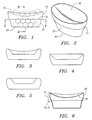
- the embodiment comprises a first display part 10 and a second display part 20. Together the first display part 10 and the second display part 20 create a fruit ripening chamber with the first display part 10 providing a first support surface for ripening fruit 30 and the second display part 20 providing a second support surface for ripening fruit 40.
- first and second display parts shown herein are top and bottom parts, in each embodiment disclosed in this application they may be side parts (such as parts that combine laterally thereby splitting the chamber in a vertical rather than horizontal plane), a combination of side part, top part and/or bottom part, or some other variation.
- this aspect teaches a first display part having a concave support surface for ripening fruit 30.
- ripe fruit fruit that ripens quickly or fruit that is being kept (such as fruit kept for accelerated ripening in the future) can be stored on the first display part's fruit support surface 30 to selectively regulate fruit ripening rates.
- the support surface for ripening fruit 30 is preferably at least partly concave, more preferably at least partly concave and at least partly inward sloping (see for example FIGS. 1-6 ), still more preferably at least partly concave, at least partly inward sloping and at least partly curvilinear (for example FIGS. 1-3,5-6 ), still more preferably at least partly concave, at least partly inward sloping, and at least partly upwardly curvilinear (for example FIGS. 1-2, 5-6 ), or at least partly concave, at least partly inward sloping and predominantly upwardly curvilinear (for example FIGS.
- FIGS. 1-2, 6 This improves fruit stability, reduces rolling, and reduces bruising on the outside fruit support surface.
- the support surfaces may also be entirely concave.
- the surfaces and the parts are preferably all or In part rigid, at least when in use.
- the first display part 10 and the second display part 20 are preferably entirely or partially transparent for assessing the fruit in the ripening chamber.
- the display parts and their support surfaces for ripening fruit may, however, be entirely or partly opaque, may be colored and may contain swirls, stripes, or other types of decorative design.
- the various shapes, positions and/or markings on the display parts, display part vents and/or vent inserts may serve a source identification function.
- the display parts and the fruit support surface for ripening fruits may also be textured, Including coated or stippled, so as to increase surface area and/or surface friction.
- the support surfaces may also comprise fruit guides (such as elevated portions, or recessed , portions), vent inserts, or other surface features.
- the display parts may be separated by hand using a separation surface, such as an extended portion of a display part, a gripping portion, a lifting portion, or even a button to mechanically separate the display parts.
- the display parts may be martial or completely separated in order to access the chambers for retaining ripening gas.
- the parts and surfaces of the first aspect may further comprise gas impermeable material (such as glass or polymethyl methacrylate), oxygen permeable material, carbon dioxide permeable material, or a combination of the group; and are ventilated by air vents.
- gas impermeable material such as glass or polymethyl methacrylate
- oxygen permeable material such as glass or polymethyl methacrylate
- carbon dioxide permeable material such as glass or polymethyl methacrylate
- Embodiments without air vents provided in the support surface do not belong to the present invention as claimed.
- Fruit support surface for ripening fruit 40 and second display part 20 may be made all or in part of a carbon dioxide permeable material; and are ventilated by air vents.
- fruit support surface for ripening fruit 30 and first display part 10 may be made all or In part of oxygen permeable material; they may be additionally or alternatively ventilated.
- the vents may be integral to the display parts. Alternately or additionally, the vents may be formed by a gap
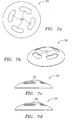
- vent insert 700 may be metal, such as steel or aluminium. But polymer materials and other solids, including wood, may be used. Further, the vents of the vent insert may be higher than the surrounding fruit support surface so that fruit will tend to roll off of them, rather than cover them.
- the support surface for ripening fruit is concave and at least partly Inward sloping, but comprises a raised area. The raised area may act as a fruit guide to improve fruit stability and reduce rolling on the support surface, and may alternately or additionally comprise a vent insert as shown. It may also comprise integral vents, such that the fruit tends not to cover the vents.
- each vent is preferably 18 mm by 8 mm for a substantially hemispherical ripening chamber approximately 260 mm in diameter at its widest point by 156 mm high.
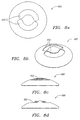
- Another vent insert 800 is shown in FIG. 8a-d .
- the outer radius of each vent 802 is approximately 17 mm from the center of the vent insert, 32 mm wide and 8 mm high. Both are preferably made of stamped sheet metal, such as stainless steel, but also may be made of aluminum or other materials.
- the support surface for ripening fruit may also comprise a lowered area, which may optionally act as fruit guide to improve stability and reduce rolling on the fruit support surface.
- the lowered area may additionally or alternatively further comprise integral vents, such that the fruit tends not to cover the vents.
- the second display part may also comprise a vent insert.
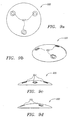
- FIG. 9a-d shows a vent insert 900 for a second display part comprising vents 902.
- one vent may be used, at least two vents are preferred, and at least three are more preferred, for reasons of gas exchange.
- the vents (here about 8mm in diameter) are preferably spaced apart uniformly, and may be equidistant from the center of the second display part (here about 53mm away).
- vent inserts for any display part described herein may be secured by a securing agent, such as glue, sealer, grommet, display part feature, (such as a tab, indent, lock or latch on the display part itself), or one or more securing pieces, such as a securing piece that attaches to the vent insert from the other side of the display part thereby securing the vent insert in place.
- a securing agent such as glue, sealer, grommet, display part feature, (such as a tab, indent, lock or latch on the display part itself), or one or more securing pieces, such as a securing piece that attaches to the vent insert from the other side of the display part thereby securing the vent insert in place.
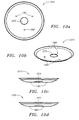
- FIG. 10a-d shows a first display part, 1010, with a vent insert receiving area, 1015, for receiving a vent insert.
- the vent insert may be the vent insert shown in FIGS. 7a-d and FIG. 8a-d , or some other kind of vent insert.
- the receiving area may be raised relative to the surrounding fruit surface as shown; alternately the receiving area may be lowered relative to the surrounding fruit support surface, or it may comprise an opening level with the surrounding fruit support surface.
- the first display part 1010 has a balancing surface, such as a balancing surface comprising feet 1095 or some other balancing surface. As shown in the preferred embodiment of FIG.
- the first display part comprises a balancing surface such that it can securely balance on a countertop so that the first display part and second display part may be separated and separately rested on the countertop while their support surfaces still support fruit.
- the balancing surfaces comprise feet 1095.
- FIG. 11a-d shows a second display part, 1120, with a receiving area, 1125, for receiving a vent insert (such as for the vent insert of FIG. 9 ).
- the deceiving area may be raised relative to the surrounding fruit support surface for ripening fruit, as shown; alternatively, the receiving area may be lowered relative to the surrounding fruit support surface for ripening fruit, or it may simply comprise an opening level with the surrounding fruit support surface for ripening fruit.
- the second display part as shown in FIG. 11a-d can be elevated with feet (not shown) or by a base part (not shown).
- first display part and/or second display part of the fruit displays disclosed herein may have vents integral to display part Itself.
- These integral vents may be holes formed in the fruit support surface for ripening fruit. They may be formed In a raised area relative to the surrounding support surface for ripening fruit, a lowered area relative to the surrounding support surface for ripening fruit, or in an area level with the surrounding support surface for ripening fruit.
- the integral vents may be formed by the intersection of one display part with another surface, such as the surface of another display part, and may contain a partial or total conduit. See FIG. 16c .
- Figs. 12-14 are shown for the combination and separation aspect. It is to be understood that only such embodiments belong to the invention as claimed that include vents provided in the one or more fruit support surfaces located outside the one or more ripening chambers.
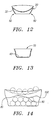
- FIG. 12 shows a cross-sectional perspective view of FIG. 1 's first display part 10 taken through plane x-x.
- first display part 10 includes a first display part side wall 50 that, along with the underside of fruit support surface 30 forms a hollow space underneath fruit support surface 30.
- a top part support Interface 60 (here formed by recessed portion of first display part wall 50) Is designed to rest on and at least In part reciprocates the contour of the weight-bearing rim 70 (shown in FIG. 13 ).
- the top part support interface is defined as the first display part surface that supports the first display part while the first display part is combined with the second display part.
- the weight-bearing rim 70 is substantially level on parts of its surface. Since, as shown In FIG. 12 , the first display part comprises a balancing surface (namely its flat underside) it can balance, fruit support-surface-up, on a flat surface, thereby providing additional fruit support surface area.
- a display part comprising a fruit support surface may also be reversible. That is, it may have an upward-facing fruit support surface for ripening fruit when In a face-up or face-down position.
- the fruit support-surface-up balancing function can also be achieved by having at least one balancing point (shown here as balancing points 80, 90, and 100) on the support interface of the first display part walls.
- a balancing surface may comprise the support surface including a balancing point or points that permit the first display part to separately balance on a flat surface.
- the weight-bearing rim of the second display part and the support interface of the first display part have, at least in part, a reciprocal contour.
- FIG. 15a shows a cross-section of a first display part 1610 (a platform top) and a second display part, 1620.
- the fruit support surface of the first display part is concave and inwardly sloped, as is the fruit support surface of the second display part, 1620.
- the two fruit support surfaces comprise raised areas, 1615 and 1625, respectively.
- Raised area 1615 of the outside fruit support surface preferably comprises a vent insert receiving area for receiving a vent insert.
- the raised area may have a hole forming part of a vent insert receiving area.
- the raised area may also be shaped to receive a vent insert, such as, for example, the type of vent inserts shown in FIGS. 7a-d and 8a-d .
- the vent insert may also be level with the surrounding fruit support surface or contain a recessed portion relative to the surrounding fruit support surface.
- the raised area may also comprise integral vents above, level with, or below the surrounding fruit support surface.
- the raised area 1625 of the second display part's fruit support surface may also comprise a vent insert receiving area. It may also be shaped to receive a vent insert, such as, for example, the type of vent insert shown in FIG. 9 .
- the vent insert may also be level with the surrounding fruit support surface, or contained in a recessed portion relative to the surrounding fruit support surface.
- the fruit support surface of the second display part may comprise integral vents.
- FIG. 15b shows a cross-section of the most preferred embodiment, wherein the first display part comprises a balancing surface (in this case an integral ring represented in cross-section by the two dips in the underside of the first display part),
- the balancing surface can balance the first display part on a tabletop when it is separated from the second display part, 1620.
- the balancing surface may be attached to the first display part, or be an integral part of the display part, as shown. It may lie within the rim of the second display part, 1620, when the parts are combined. Alternately, the first display part may have a balancing surface that rests outside the rim of the second display part when the parts are combined.
- the fruit support surface of the second display part preferably comprises integral vents instead of a vent insert.
- These integral vents may be formed on the raised area itself (on its top surface or more preferably on its slopes as represented by the left-most pair of dotted lines on raised area 1625). They may also be formed along the outside perimeter of the raised area or in a lowered area relative to the surrounding support surface for ripening fruit. These characteristics inhibit fruit from covering the vents while resting on the fruit support surface.
- Integral vents for the second display part preferably comprise at least three holes (most preferably precisely three) that are equidistant from the center of the fruit support surface. In the case of the most preferred embodiment, these holes are 8mm in diameter, and spaced 53 mm from the center of the fruit surface platform.
- the first display part, 1610 is a platform top with a raised area for a vent insert in its center.
- the vent insert receiving area is located directly above the chamber for retaining ripening gas. Due to the effects of gravity on gas and circulation, vents that overlay the chamber are preferred to chamber side vents such as shown in FIG. 50.
- the chambers of FIGS. 15a and b are substantially hemispherical, although other chamber shapes, including other non-domed shapes, substantially ellipsoidal shapes, substantially spheroidal shapes, and other shapes with rounded inner surfaces (like over-inflated box shape or substantially cylindrical shape) are possible.
- FIG. 15b also shows a cutaway of a preferred feature, base part 1645.
- the base part 1645 rests on a tabletop or other resting surface while supporting another display part.
- the base part 1645 is shaped to receive either display part 1620 or, with 1620 removed, display part 1610. This permits the base to be used in various types of ripening and display formats, and permits the user to separately display fruit on the first display part and base without carrying or using the larger second display part, or forming the chamber.
- the base part 1645 is shown (in dotted line) to receive the first display part 1610 on its outer rim, it may also receive the first display part 1610 on its inner rim, or some other way. A variety of materials may be used for base part 1645.
- the base part may also be made out of enameling steel using the same process, and coated with enamel for color. Alternately, the base may be made out of aluminum, such as anodized aluminum, glass, wood, or other supportive material.
- the preferred aperture size for the base part is simply the diameter of the vent area on the bottom of the chamber (here about 120 mm).
- the display parts of FIG. 15a and b can be used with feet or some other balancing surface rather than base part 1645, as shown. In all cases, it is preferable to have about a 1,27 cm (half-inch) of clearance between any vents and the ground to ensure adequate ventilation of the chamber. With or without feet, both the first display part and second display part may each balance, support surface up, on a flat tabletop.
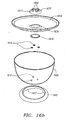
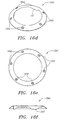
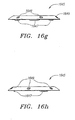
- FiG. 16a-g show a variety of features of the preferred ripening display of FIG. 15a and b.
- the second display part, 1620 may be elevated by a base part, 1645, to permit gas exchange between the ripening chamber and the room's atmosphere. Additionally, or alternately, the second display part 1620 may comprise a balancing surface, such as feet that elevate it from its resting surface.
- the base part shown in detail in FIG. 16e-g , may be hollow in its center. Additionally, it may be concave and nestle the second display part. It is preferably a ring shape, as shown.
- base part 1645 is elevated (preferably about a half inch) off the ground, and the inner perimeter has several cut away surfaces next to balancing surfaces 1647 that permit gas exchange between the ripening chamber and the surrounding atmosphere.
- base part 1645 may comprise vents, or vent inserts, to permit gas exchange from the ripening chamber to the outside atmosphere. Vent inserts may be secured by a securing agent, such as the securing piece 1616, which attach to the vent insert and fix it in place on the display part (here first display part 1610).
- the display part may comprise recessed area through which room air may be exchange with the chamber.
- the base part may also comprise decorative elements, such as the embossed figures, 1649, as shown.
- the decorative elements may double as vents or vent inserts.
- FIG. 16 may be used without a base part, and instead use feet or recessed portions in the second display part to permit air exchange between the ripening chamber and the room's atmosphere.
- a base part 1645 such as the base part shown in FIG. 16a-g , may securely receive the first display part after the second display part is removed.
- the ripening display may convert to an alternate configuration for fruit display and ripening with the first display part 1610 resting directly on base part 1645.
- the base part 1645 may be a multi-purpose base part.
- the first display part may also be reversible, having at least one fruit support surface for ripening fruits on both its sides. As a result, it may rest upside down or right side up on a table top and/or on base 1645.
- both the first display part and the second display part may have locating features, such as notches, guides, circumferential indents, or a locating ring (such as a locating ring integral to the first display part as shown in FIG. 15b or attached to it) so that the display parts may be readily positioned on one another and/or on the base part.
- the base part may have a security surface, such as a rubberized contact surface, or other physical feature, which helps secure the first display part and or second display part to it.
- the surfaces and the parts described herein are preferably all or in part rigid, at least when in use.
- the second display part, 1620 when combined with first display part, 1610, comprises a substantially hemispherical inner surface, such as shown in FIGS. 11a-d , 15 and 16a-g and other figures.
- a substantially hemispherical inner surface such as shown in FIGS. 11a-d , 15 and 16a-g and other figures.
- combined display parts comprising substantially hemispherical contours furthers ripening by forcing the fruit closer together, even when the ripening display is not full.
- a domed chamber is not needed.
- a non-domed chamber such as the substantially hemispherical shaped chamber as shown in FIG. 16 , may provide exceptional fruit flavor and hydration while substantially accelerating fruit ripening. See Experimental Results section below.
- the fruit support surface of the second display part is preferably at least in part concave, more preferably at least in part concave and at least partly inward sloping, still more preferably at least in part concave, at least partly inward sloping and at least partly curvilinear, or at least in part concave, at least partly inward sloping, and at least partly upwardly curvilinear, or at least in part concave, at least partly inward sloping and predominantly upwardly curvilinear.
- the second display part fruit support surface for ripening fruit is at least in part concave and inwardly sloped. As shown in FIG.
- vents level with the surrounding support surface or off-level, such as elevated relative to the surrounding support surface recessed relative to the surrounding fruit support surface (such as shown with the recessed vents on the slopes of the elevated portion 1625 in FIG. 15b ).
- first display part's vents and/or vent inserts may be located In various locations on the first display part, In the most preferred embodiment, shown in FIG. 16a-d , it is preferred to have those vent inserts or integral vents located substantially in the center of the first display part. Further, as shown in FIG. 16a and b , the vents 1602 (shown as part of vent insert 1617) may be elevated relative to the surrounding support surface, or level with the surrounding support surface or recessed relative to the surrounding fruit support surface (such as the integral vents shown in FIG. 15b ). In all events, It is preferred that the walls of the first display part are at most only slightly higher than the vents in the first display part.
- first display part support surface be able to hold two full size apples, more preferably three full size apples, still more preferably four full size apples, more preferably five full size apples, and more preferably, six or more full size apples.
- the chamber may be split into a plurality of chambers, or be one of a plurality of chambers.
- the display parts including any base parts, may be split into a plurality of parts, or be one of a plurality of display parts, and the fruit support surfaces likewise may be split into a plurality of fruit support surfaces or be two of two or more fruit support surfaces.
- FIG. 15 and 16 contemplates a plurality of chambers, parts, and support surfaces.
- the underside of the platform top, 1610 may take a variety of shapes, including a downwardly curved surface or level surface, rather than the upwardly curved surface shown.
- the first display part may be other than a platform top, such as one of the other first display parts described herein.
- the first display's balancing surfaces may lie outside the rim of the second display part, rather than inside, as shown in FIGS. 15a and b.
- the interface between the display parts may be unrestricted, with only combining force being gravity as shown in FIG. 15 .
- the first display part may comprise an extending portion or other lifting surface to permit the user to readily separate two or more display parts.
- the extending portion of the first display part preferably has a low profile relative to the other display parts.
- the outermost diameter of the extending portion of the first display part relative to the display parts with which it is combined is less than 1.3 to 1, and more preferably less than 1.1 to 1, as shown (276 mm to 260 mm).
- the extending portion may be located close to the interface when the display parts are combined, or located away from the interface, higher up on the first display part, as shown in the gradually broadening extending portion of the first display part of FIG. 38 .
- the preferred embodiments described and shown in FIG. 15 and 16 may also be combined with various other features of the five aspects described herein.
- it may employ fruit guides in various forms (including in the form of a vent insert or surface feature) to improve fruit stability or bias fruit position.
- the surfaces of the display parts, support surfaces, and chambers may be textured or colored.
- the apparatus may employ a ripening agent unit, including a ripening solid, either with or without a casing.
- the display parts, chambers, and fruit support surfaces described herein may comprise an anti-fog agent either as a coating or integral to its surface material.
- the apparatus may comprise a holder for a ripening solid, such as shown in the platform of FIG.42b , or an enclosed holder.
- the best mode of practicing the first aspect may be found in several methods of ripening using the apparatuses described herein.
- the user should separate unripe fruits that can be ripened from those that cannot be ripened. Do not wash the fruit before placing it in the chamber for retaining ripening gas.
- Fruit that cannot be ripened or that is ripe can be placed on the outside fruit support surface. It is further advisable to stagger ripening by placing some unripe fruit on the fruit support surface located outside the chamber for ripening later on. That way the user has a few ripe, ready-to-eat pieces available each day rather than a large batch of ripe fruit that needs to be consumed immediately.
- first and second display parts to enclose a fruit support surface in a chamber for retaining an effective amount of ripening gas. Place fruits that cannot be ripened or ready to eat fruits on the fruit support surface located outside the chamber. Visually inspect the fruit in the chamber daily though a transparent portion of the chamber. Market-hard fruit may require anywhere from 1 to 4 days to ripen, although most fruit can be ripened within three day in the apparatus. If some fruit appears to be ripe, separate the display parts thereby opening the chamber and touch and/or smell the fruit for ripeness. Remove ripe fruits from the fruit support surface that becomes enclosed in the chamber when the parts are combined. Recombine first and second display parts to enclose the fruit support surface in a chamber.
- the display parts may be separated and used as traditional, non-chambered fruit bowls.
- a user may ripen fruit by: a) placing fruit capable of ripening on one or more fruit support surfaces of an apparatus comprised by one or more display parts; b) combining two or more display parts to form one or more chambers for ripening fruit thereby enclosing at least some of the fruit in one or more chambers wherein the size of said two or more display parts permits them to fit entirely on a countertop 61.0 cm (two feet) long by 61.0 cm (two feet) wide when combined; and at least one of said one or more of the chambers at least is in part transparent and ventilated with at least two vents; c) separating two or more of said display parts; d) removing at least some of the fruit capable of ripening from one or more of the open chambers; e) combining two or more display parts to form one or more chambers for ripening fruit f) placing at least some of the removed fruit on one
- One method for ripening fruit comprises the steps of: a) placing fruit on a display part's fruit support surface for ripening; b) combining that display part with another display part thereby substantially enclosing the fruit support surface within a chamber for retaining ripening gas; c) at least partly separating the two display parts after a period of time; d) removing at least one piece of fruit from the fruit support surface; e) recombining the display parts thereby substantially enclosing the fruit support surface in the chamber for retaining ripening gas f) placing the removed fruit on a display part's support surface that is located outside the chamber.
- Another method for ripening fruit comprises the steps of: a) placing unripe fruit on a support surface located inside a bottom display part; b) placing a top display part over the bottom display part thereby enclosing the unripe fruit in a ventilated chamber; c) arranging fruit that cannot be ripened or ripe fruit on the top part's fruit support surface; d) visually inspecting the fruit located inside the bottom display part through a transparent surfaces of a display part; e) removing the top display part from the bottom display part; e) inspecting the fruit by touch or smell to confirm ripeness; f) removing ripe fruits from the bottom part's fruit support surface and leaving unripe fruit on the same fruit support surface; g) placing a top display part over the bottom display part; and h) placing the removed fruit on the top display part's fruit support surface located outside the bowl.
- the method may include the step of separating the top display part and bottom display part and using them separately like traditional fruit bowls once all the fruit is ripe.
- unripe fruit is added to the bottom display part's fruit support surface while it still supports fruit that has ripened for a time in the ventilated chamber. This helps accelerate ripening and promotes flavor development of the newly introduced fruit in the chamber as compared to wholesale replacement of ripe fruit with the new fruit.
- the apparatuses and methods herein may thus help fruit purchaser to readily organize their fruit and execute a ripening schedule.
- borosilicate glass is preferred over plastic for the display because of its absolute clarity and lack of distortion. This is important for an apparatus that a user will look for to make subtle determination of ripeness. Further, borosilicate glass seems to retain its clarity after washing, unlike many clear plastics. As a result, in the preferred embodiment of FIG. 15 and 16 , the interface between the rim of the second display part and the support interface of the first display part is perpendicular. That is because for borosilicate glass parts, as the preferred material for this preferred embodiment, a perpendicular interface reduces the chance of breakage.
- the preferred materials for a glass apparatus further include Schott Duran 3.3 borosilicate glass of 2.5 mm thickness for the display parts (for its balance of clarity and strength), although soda lime or other glass types may be used. It is preferred to create a mold for machine blowing and machine blow the Duran 3.3 glass parts for consistency. But hand blown techniques may be used and may in fact be required when blowing parts larger than 280 mm in diameter due to manufacturing limitations. Further, when burning integral vents, care must be taken to have the vent area away from the balancing surfaces (usually 2 to 3 mm) to reduce uneven surfaces and ensure proper balancing surfaces of the parts.
- the holes are preferably core-drilled, but may be flame jet cut, laser jet cut, or cut by some other method.
- the display part interface preferably may be at other angles, such as shown in FIG. 10 and 11 . It may also take on irregular contours that do not readily permit the first display part to separately and stably balance. In this case, the support interface of the first display part still rests on the rim when the parts are combined. But when the first display part is removed and balanced, support-surface-up, on a flat surface, the first display part is preferably supported by distinct balancing surfaces rather than by the support interface. By way of illustration, FIG.
- FIG. 17 shows the fruit-support-surface-up balancing function may be achieved by deploying at least one balancing surface (here shown as balancing surfaces 180) that rest inside the perimeter of rim 170 of the second display part walls when the first display part and second display part are combined.
- balancing surfaces 180 at least one balancing surface that rest inside the perimeter of rim 170 of the second display part walls when the first display part and second display part are combined.
- Figs. 17-26 are shown for the combination and separation aspect and for illustrating various shapes only. It is to be understood that only such embodiments belong to the invention as claimed that include vents provided in the one or more fruit support surfaces located outside the one or more ripening chambers.
- FIG. 17 shows that support interface 160 will rest on the reciprocally contoured weight-bearing rim 170 of the second display part wall when the parts are combined. Yet the second display part and its rim can take on any shape since the balancing surface or surfaces 180 support first display part 110 once the first display part is separated and placed on a flat surface.
- the first display part wall has an inner level 190 and an outer level 192 whose juncture forms at least part of support interface 160.
- the balancing surfaces are the bottom of the inner level 190 of the first display part.
- the inner level 190 lies inside the perimeter of the second display part's rim when the parts are joined. (The inner level may be an extended version of the recessed portion of FIG. 1 ).
- the balancing surfaces may be part of an inner sleeve that attaches to the first display part and lies inside the perimeter of the second display part's rim when the parts are joined.
- the inner level or inner sleeve rests within the rim, efficiently reducing the height of the display, yet having expanded fruit stacking space when the parts are separated.
- the inner and outer level junction may be on the first display part's interior surface.
- the support interface formed at their junction is inside the first display part (causing the second display part's rim to lie within the perimeter of the first display part's bottom when the second display parts are joined).
- FIG. 18 shows an alternative preferred embodiment in which the balancing surface may also be one or more feet (here shown as foot 195).
- the one or more feet are preferably suspended from the underside of fruit support surface for ripening fruit 130. This is also shown in FIG. 10 .
- the fruit support surface for ripening fruit comprises one or more feet that are integral to the underside of fruit support surface for ripening fruit 130 so that they extend to or below the lowest point of the first display part wall. Both configurations may be used in the preferred embodiment of FIGS. 15 and 16 .
- the balancing surface 180 of the preferred embodiment may also be substantially flat portions of the first display part's bottom, wherein the support surface of the first display part is a lip 140, that, at least in part, reciprocates the contour of and rests on the weight-bearing rim 170 of the second display part walls.
- This may be done (as with the preferred embodiment of FIGS. 15 and 16 by having the bottom of the first display part comprise an underside ring (not shown) as a balancing surface.
- the balancing surface comprising the underside ring may double as a locating feature to help position the platform top in the base part.
- the lip may be outside the first display part side wall, as shown, or alternately inside of the first display part, in which case when the parts are combined the rim of the second display part rests within the perimeter of the first display part's bottom.
- the first display part may be a platform top-defined as a first display part that does not have walls extending down past the lowest point on the underside of fruit support surface for ripening fruit.
- these platform tops comprise a fruit support surface for ripening fruit that is at least in part concave, more preferably at least in part concave and at least partly inward sloping, and still more preferably at least in part concave, at least partly inward sloping and at least partly curvilinear, or at least in part concave, at least partly inward sloping, and at least partly upwardly curvilinear, or concave, at least partly inward sloping, and predominantly upwardly curvilinear, or concave, at least partly inward sloping, and substantially entirely upwardly curvilinear.
- These platform tops may also be substantially or entirely concave. These configurations improve fruit stability, reduce fruit rolling, and reduce fruit bruising on the platform top.
- the support surface for ripening fruit of the platform top is concave and at least partly inward sloping, but comprises a raised area.
- the raised area may comprise a fruit guide (e.g. slope 1635 and/or 1637) to improve stability and reduce rolling on the support surface for ripening fruit.
- the raised area may comprise a first display part vent insert, such as shown in FIG. 7a-d , or comprise integral vents, such that the fruit tends not to cover the vents.
- the size of each vent is preferably 18 x 8 mm for a ripening chamber approximately 260 mm in top diameter by 156 mm high.
- the platform top's support surface may comprise a lowered area, which may further comprise a fruit guide (e.g. slope 1619) to improve stability and reduce rolling on the fruit support surface.
- the lowered area may additionally or alternatively further comprise integral vents, so that the fruit tends not to cover the vents. See Aspect 5 below.
- the platform top of the preferred embodiment shown in FIGS. 15 and 16 is preferably substantially rigid, may vary in its thickness and may be any thickness. More preferably, if in glass, the platform top is substantially rigid and between a sixteenth of an inch (2mm) and three inches thick (approximately 76mm), more preferably between a sixteenth of an inch (2mm) and two inches (51 mm) thick, and most preferably 2.5 mm thick. If made in plastic, tempered glass, or some other less breakable material, the platform top may easily be thinner. As with the first display parts shown in FIG. 15 and 16 , the first display part may be multilevel, thereby permitting the first display part to drop into the second display part.
- Second display part rim 170 may alternately or additionally have at least one recessed portion 172 that permits the user to access and lift the platform top out of the second display part.
- the platform top may have a recessed portion (like that shown in FIG. 12 , 15 and 16 ) that forms a support surface thereby leaving a liftable side surface exposed when the parts are joined. As shown in FIG. 15 and 16 , when the parts are combined, this liftable exposed side surface permits the user to readily remove the first display part with fruit on it.
- the first display part may include a gripping portion, such as a hook or handle, so that the user may lift and separate the first display part from the second display part.
- FIG. 15 and 16 the first display part may include a gripping portion, such as a hook or handle, so that the user may lift and separate the first display part from the second display part.
- the first display part may comprise a vent insert that further comprises a gripping portion, so that the first display part may be lifted from the vent insert.
- the gripping portion may be integral to the first display part or attached to it.
- the gripping portion may further comprise a hook for suspending a banana.
- the platform top may comprise a balancing surface (such that the platform top balances on a tabletop when separated from the second display part) that comprises a support interface 160 (for resting on the second display part rim, as shown, for example, in FIG. 20 ).
- the platform top may alternately or additionally comprise one or more balancing surfaces that may further comprise one or more feet 195 (as shown, for example, in FIGS. 18 , 21 ).
- the platform top may alternately or additionally comprise any other balancing surface that rests within the perimeter of the second display part's rim when the first display part and second display part are combined, such as the underside ring described in connection with FIG. 16 .
- FIG. 16 By way of further example, FIG.
- the first display part may comprise an integral inner level 190 whose junction with an outer level forms support surface 160, and balancing surface 180 comprises at least part of the first display part's underside.
- the first display part may comprise an inner sleeve (not shown).
- FIGS. 16 and 23 comprise a support surface that is a lip 182, which rests on the weight-bearing rim of the second display part, and the underside of the platform top comprises a balancing surface.
- FIG. 16 also shows this configuration.
- a ripener may be a variety of overall structures, including in the form of an oval "collapsed cake” FIG. 24 , a “curved rectangle” FIG. 25 , and a “leaf” FIG. 26 .
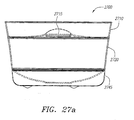
- FIG. 27a-b shows one ripening display embodiment, 2700, with first display part 2710, second display part 2720, base part 2745 and vent insert receiving area 2715.
- FIG. 27a-b also shows a vent insert, such as described in FIGS. 7 and 8 .
- second display part 2720 may have a vent insert receiving area and a vent insert as shown in FIG. 9 .
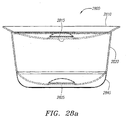
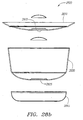
- FIGS. 28a-b shows another variation, 2800, with a convex base part, 2845, that nestles the second display part 2820.
- the base part, 2845 comprises feet (not shown) or other balancing surfaces such that gas may be exchanged between the ripening chamber and the outside atmosphere.
- This embodiment has vent insert receiving areas, 2815 and 2825, that receive vent inserts, such as described in FIGS. 7-9 .
- integral vents may be used in both a first display part and second display part.
- the base part may alternately or additionally have integral vents.
- FIG. 29 shows a fruit ripening display, 2900, comprising a first display part, 2910, second display part, 2920, and base part 2945.
- Base part 2945 like all base parts disclosed herein, may have integral vents, such as 2949.
- the vent size need not vary, but their number may vary with the size of the ripening display to gain an evenly distributed gas exchange.
- FIG. 30 shows a fruit ripening display, 3000, comprising a first display part, 3010, a second display part, 3020, and a base part, 3045.
- base part 3045 has recessed areas, 3049, through which gas from the ripening chamber may pass to the outside atmosphere.
- the base, 3045 is taiier and wider than the second display part, 3020, and thus can substantially contain the entire second display part.
- first display part, 3010 comprises a vent insert receiving area, 3015.
- the vent insert receiving area may receive a vent insert, such as shown in FIGS. 7-9 , or some other kind of vent insert.
- the second display part comprises integral vents, though vent inserts and a vent insert receiving area may be used.
- FIG. 31 shows a fruit ripening display, 3100, comprising a first display part, 3110, second display part, 3120, and base part 3145.
- Base part 3145 may have integral vents, it may have recessed areas, and may be additionally, or alternately, elevated by balancing surfaces, such as feet, to promote gas exchange from the ripening chamber to the outside atmosphere.
- first display part, 3210 comprises a vent insert (shown in dotted lines) and a vent insert receiving area that is level with the surrounding support surface for ripening fruit.
- the second display part comprises integral vents, although vent inserts and a vent insert receiving area may be used.
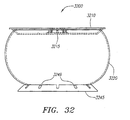
- FIG. 32 shows a fruit ripening display, 3200, comprising a first display part, 3210, second display part, 3220, and base part 3245.
- Base part 3245 like all base parts disclosed herein, may have integral vents, such as shown 3249.
- the base part vent size is proportional to the size of the ripening display. Generally, the smaller the vents are, the more that are needed.
- the base part may be additionally, or alternately, elevated by balancing surfaces, such as feet, to promote gas exchange from the ripening chamber to the outside.
- first display part, 3210 comprises a vent insert receiving area, 3215.
- the vent insert receiving area may receive a vent insert, such as shown in FIGS. 7-9 , or some other kind of vent insert.
- the second display part comprises integral vents, though vent inserts and a vent insert receiving area may be used.
- FIG. 33 shows a fruit ripening display, 3300, comprising a first display part, 3310, a second display part, 3320, and a base part, 3345.
- base part 3345 has substantially recessed areas through which gas from the ripening chamber may pass to the outside atmosphere.
- first display part, 3310 comprises a vent insert receiving area.
- the vent insert receiving area may receive a vent insert, such as shown in FIGS. 7-9 , or some other kind of vent insert.
- the second display part comprises integral vents, although vent inserts and a vent insert receiving area may be used.
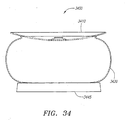
- FiG. 34 shows a fruit ripening display, 3400, comprising a first display part, 3410, second display part, 3420, and base part 3445.
- Base part 3445 may have integral vents, it may have recessed areas, and may be additionally, or alternately, elevated by balancing surfaces, such as feet, to promote gas exchange from the ripening chamber to the outside.
- first display part, 3410 comprises a vent insert receiving area that is elevated relative to the surrounding support surface for ripening fruit, and a flat vent insert, both shown in dotted lines.
- the second display part comprises integral vents, although vent inserts and a vent insert receiving area may be used.
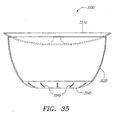
- FIG. 35 shows a fruit ripening display, 3500, comprising a first display part, 3510, second display part, 3520, and base part 3545.
- Base part 3545 is concave and nestles the second display part 3520.
- Base part 3545 also has integral vents, 3549. Like the other base parts disclosed herein, it may have recessed areas, and may be additionally, or alternately, elevated by balancing surfaces, such as feet, to promote gas exchange from the ripening chamber to the outside.
- first display part, 3510 comprises a vent insert receiving area that is level with the elevated relative to the surrounding support surface for ripening fruit, and a flat vent insert, both shown in dotted lines.
- the second display part comprises integral vents, although vent inserts and a vent insert receiving area may be used.
- FIG. 36 shows an embodiment, 3600, tested as Unit 3 as described in the Experimental Results section, comprising a first display part that is a platform top 3610 and a second display part 3620.
- Second display part 3620 comprises a double wall, that is preferably transparent to permit examination of the fruit.
- the first display part and the second display part form a substantially hemispherical fruit ripening chamber.
- the platform top 3620 comprises a central vent insert receiving area, and a vent insert like the one in FIG. 7a-c , but with a flattened top, rather than a domed top.
- the second display part 3620 comprises a central vent insert receiving area and a vent insert, similar to the one in FIG. 9a-c .
- the second display part is elevated by a thin base part 3645 (not shown) that is open through its middle and comprises balancing surfaces in the form of feet (three of which are visible in the drawing).
- the chamber is substantially hemispherical.
- the vent insert vents at the bottom of the chamber were about 6 mm in diameter and located about 53 mm from the center of the vent; the four vent insert vents at the top of the chamber were about 32 mm from the center, and, when half covered with tape (as was done with the working examples), measured about 18 mm by 8 mm.
- the substantially hemispherical chamber had an internal height of about 155 mm, a diameter of about 270 mm at its top and the internal fruit support surface which comprises the vent insert, had a diameter of about 140 mm.
- the first display part a platter top, had a diameter of about 370 mm. As shown, for both vent inserts the vents were raised relative to the surrounding fruit support surface in order to inhibit fruit from blocking the vents.
- the vent insert of the second display part creates a convex area at the bottom of the substantially hemispherical chamber.
- FIG. 37 shows an embodiment 3700 that was tested as Unit 8 as described in the Experimental Results section. It comprises a platform top 3710, having a support surface for ripening fruit 3730, and second display part, 3720, with a second display part vent insert receiving area, 3725, and a vent insert as shown. As shown, vent insert's vents were raised relative to the surrounding surface for ripening fruit to inhibit fruit from blocking the holes.
- the vent insert of the second display part creates a convex area at the bottom of the over-inflated box shaped chamber. On the inside, the over-inflated box formed a chamber about 260 mm wide, 260 mm long, and 110 mm high. During testing half of every third slot-shaped vent was left open, and the rest were taped over.
- the second display part comprises a first display part receiving area, 3715, which in turn comprises a notched bezel, 3717, which receives first display part 3710.
- the notches of the bezel approximated half circles with radii of about 8mm.
- Gas is exchanged between the chamber and room atmosphere through the gap between the notched bezel and the underside of the platform top 3710, rather than through a vent insert.
- First display part fruit platform 3730 may be ridged or have other fruit guides to prevent fruit rolling and bruising and promote fruit stability.
- the chamber is the shape of an over-inflated box, which is defined as a box-like chamber whose internal edges have been rounded.
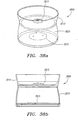
- FIG. 38a-b shows an embodiment, 3800, tested as Unit 4 as described in the Experimental Results section. It comprises a first display part that is a platform top 3810 but with high side walls relative to the vent insert receiving area 3815 and the vent insert. It further comprises a second display part 3820. When combined with the first display part, the second display part 3820 comprises a substantially cylindrical fruit ripening chamber, which along with the high side walls of the first display part creates less consistent in its fruit flavor. See Experimental Results below.
- the support surface inside the chamber had a diameter of 235 mm, an internal height of 140 mm, and a top opening 270 mm in diameter.
- the platform top 3820 had an internal height of about 55 mm, a diameter on its fruit support surface of 210 mm, and a diameter at its top opening of 240 mm. It comprises a central vent insert receiving area, 3815, and a vent insert, with a single central hole surrounded by a plurality of smaller holes as shown.
- the second display part 3820 comprises a central vent insert receiving area 3825 and a vent insert similar to the one shown in FIG. 9a-c , with vents about 5 mm in diameter.
- the second display part is elevated with balancing surfaces in the form of feet (not shown).
- the chamber is substantially cylindrical, with the cylinder getting wider at the top, but with substantially flat top and bottom surfaces. As shown, for both vent inserts the vents are raised relative to the surrounding surface for ripening fruit so as inhibit fruit from blocking the vents. Further, the vent insert of the second display part creates a convex area at the bottom of the substantially cylindrical chamber.
- FIGS. 39-47 show various alternate ripening displays that have unique features or illustrate additional concepts that may be combined with the other embodiments.
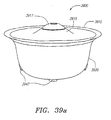
- FIG. 39a-b shows a ripening display 3900 with a first display part 3910, second display part, 3920, and vent insert receiving areas, 3915, and 3925.
- the second display part, 3920 may rest on a balancing surface comprising feet 3947.
- the vent insert receiving area is elevated such that when it receives the vent insert 3917, the vents are higher than the rim of the first display part 3910. This elevated vent feature may be beneficially employed in the other embodiments disclosed herein, including that of FIGS. 15 and 16 .
- FIG. 40a-b shows an alternate ripening display, 4000,
- the receiving area, 4015 comprises a vent insert that further comprises a lifting surface for the first display part, 4010.
- the lifting surface may be on the side of the first display part, as shown.
- a second vent insert receiving area and a vent insert comprising a lifting surface may be included on the opposite side of the first display part.
- the lifting surface functions as a side handle as shown, in a preferred embodiment, the lifting surface may be located on fruit support surface 4030 itself, and may be comprised by a vent insert. It is to be understood that only such embodiments belong to the invention as claimed that include vents provided in the one or more fruit support surfaces located outside the one or more ripening chambers. These features may be beneficially employed in the other embodiments disclosed herein, including that of FIGS. 15 and 16 .
- FIG. 41a-b shows an alternate ripening display where the first display part, 4110, and the second display part, 4120, are near identical parts that combine together like a shell.
- One or both parts may have balancing surfaces such as feet 4147 to elevate the ripening display off the table or other surface and permit gas exchange between the ripening chamber and the outside environment.
- the vents in the first and/or second display parts can be created through lettering that is cut, punched or otherwise formed through the parts. This is shown for fruit platform 4130.
- the fruit support surface for ripening fruit may comprise a vent insert receiving area 4145 and a vent insert, whose vents are formed by lettering cut, punch or otherwise formed through the vent insert.
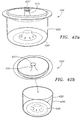
- FIG. 42a-b shows an alternate ripening display where the vent insert receiving area, 4215, comprises a lifting surface.
- the vent insert 4217 may function as a knob for lifting.
- the vent insert receiving area may comprise additional integral vents (not shown).
- the second display part may comprise an elevated area for holding a piece of fruit. It may be desirable to place a piece of already ripened fruit In the center of the ripening chamber to facilitate ripening. But the ripened fruit is beneficially kept from significant direct contact from the fruit to be ripened.
- the ripening display may comprise a ripe fruit holding area within the ripening chamber.
- the second display part's vent insert receiving area 4225 comprises a vent insert that contains an elevated portion upon which a ripe piece of fruit may rest.
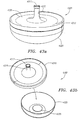
- FIG. 43a-b shows a variation on the alternative ripening display of FIG. 42a-b .
- the first display part comprises a lifting surface, in this case, a handle.
- the vent insert receiving area, 4315 comprises the lifting surface.
- the vent insert, 4317 comprises a ring.
- the lifting surface may be integral or attached to the first display part, without a vent insert receiving area or a vent insert.
- the first display part may comprise a vent insert that itself comprises the lifting surface.
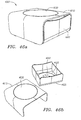
- FIG. 44a-b shows a less preferred ripening display 4400, having a rectangular, flat bottom fruit chamber. (A rectangular flat bottom is less desired at least because the fruit spreads out and the ripening gas exposure is uneven).
- the first display part 4410 comprises a vent insert 4417 and second display part 4420 comprises a vent insert 4427.
- FiG. 45a-b shows a less preferred ripening display 4500, with squared shape fruit ripening chamber, having rounded internal surfaces.
- the first display part comprises a vent insert receiving area, 4515, and a vent insert, 4517.
- the second display part comprises a vent insert receiving area, 4525, and a vent insert.
- the top and second display parts may comprise integral vents.
- FIG. 46 likewise shows a less preferred ripening display with a rounded square-like fruit chamber.
- the first display part vent is formed by a gap in the intersection of the first display part 4610 and the second display part 4620.
- the vents are shown as formed on the sides, more preferably the vents are located on the first display part for reasons of gas exchange.
- the first display part may have the sloped edge that creates a gap with a straight edged side surface.
- this display demonstrates a first display part 4610 that may slide off the second display part in a horizontal direction.
- FIG. 47a-b shows a distinct, alternate embodiment, 4700 where the second fruit platform is separable from the ripening chamber without opening the chamber to air.
- the fruit platform 4730 comprises a ring that receives both a first display part 4710 and a second display part 4720.
- the first display part may have a vent insert receiving area, 4715, and a vent insert, 4717, as shown.
- the second display part may comprise a vent insert receiving area, 4725, and a vent insert, 4727, in this case, a disc, such that air is passed between the vent insert and the vent insert receiving area.
- the first display part and second display parts may comprise integral vents.
- Feet may be used to elevate the base part 4720 and the fruit platform 4730 to permit gas exchange from the fruit- ripening chamber to the outside atmosphere.
- the separable support surface for ripening fruit is shown as a ring, it may take a variety of shapes and locations. Preferably it may be separated without opening the ripening chamber to air.
- FIGS. 36 , 37 , and 38 were prototyped in SLA (stereolithograpy) plastic models and tested against a Koller-Craft (division of Koller-Enterprises, Inc.) "Ripen Rite” fruit ripening dome (whose shape is shown in the Koller-Craft product insert described in the Background section above) and, for comparison, an open bowl with three vents in its bottom (the bottom half of the "Ripen Rite.")
- a paper bag Gas, temperature, and humidity readings were taken, and blind taste tests performed.
- the chamber was opened to air daily or every other day and certain of the fruit briefly examined by hand in order to simulate consumer behavior. Upon final removal of the fruit from the units, the fruit was then promptly washed, peeled, cut and eaten in a blind taste test.
- Applicants also increased the chamber's ethylene gas retention in certain cases by covering all or part of a subset of vents in the vent inserts located at the top of the chamber.
- applicants switched to a vent insert with less vent area.
- Units 3 and 4 were performing suitably.
- we arrived at vent sizes for all three of the prototype units such that substantially greater than 4 parts per million of ethylene was retained in each chamber on each day. This proved true even at the lowest ethylene concentration average, between 4 and 5ppm of ethylene for Unit 3, as shown in Table 3C, occurred at average temperature and humidity of 70 degrees.
- 4ppm is an effective amount of ripening gas to accelerate fruit ripening.
- ethylene concentrations of 8ppm and higher are more preferred, and 10ppm and higher even more preferred.
- Unit 3 was tested as a working unit with the configuration described above (vents half covered) and it delivered exemplary results.
- Unit 4 tested satisfactory using the vent insert shown in FIG. 38 but its fruit taste test performance was weaker compared to the other units.
- Unit 8 was tested with two of every three vents and half of the third vent in the second display part's vent insert covered with tape. This led to better ethylene retention in the chamber, and better taste test results.
- Experiment 3 was performed three times for consistency. The results are shown in Tables 3a-c below. All three units accelerated ripening adequately, averaging greater than 4ppm of ethylene each day, yet results suggest Unit 3 was the best for consistency of flavor and texture, and had fewer off-flavor fruits relative to the other units, including the open unit.
- Unit 3 had an "enclosing ring,” essentially a large washershaped disc that was placed between the slotted base part shown in Fig. 36 and the chamber.
- the washer's outer diameter was the same as the base part and its inner diameter was about the diameter of the vent insert. Both the washer's outer and inner diameters had an upturned edge, giving it a slight outer and inner rim. Its purpose was to keep dirt from collecting between the outside of the chamber and the inside of the double wall. It was intended be formed integral to the bottom part of the apparatus.
- Unit 3 performed well in this test, it appeared difficult to make an integral enclosing ring (designed to keep the unit clean) out of glass. So applicants did not test it further.
- Experiment 8 we added solar powered fans inside the ripening chambers. Wires ran from the solar powered fan to a small solar panel taped to the apparatus or table and connected to a constant light source. Relative to the other experiments, the fan's motion apparently reduced ethylene retention by the chambers (perhaps because it blew ethylene out of the chamber) without improving fruit flavor.
- Experiment 9 was the same as Experiments 6-7 but two "Ripen Rites" were used, one with a fan and one without, to confirm Experiment 8's results. Finally, Experiment 10 reprised Experiments 6-7 but changed the variety of pears to one that exhibited more color change upon ripening.
- chamber ripening gas retention was of an effective amount to substantially accelerate fruit ripening in each of the prototypes at all atmospheres tested, including for temperatures around 70 degrees and 70 % humidity (See Table 3c).
- the prototypes also consistently provided better tasting fruit than "Ripen Rite” and the "open” unit, but not in every case.
- the various units provided very similar tastes.
- the results were often close, Unit 3 seemed to consistently perform better than the other prototypes as far as taste was concerned.
- the ripener comprises one or more fruit support surfaces having fruit guides.
- the fruit support surfaces including ones that are all or partly flat, may beneficially comprise one or more fruit guides to reduce fruit rolling and increase stability.
- the fruit guides may comprise surface tabs, ridges, pits, dips or any other surface feature that provides lateral support for the fruit (inhibits lateral motion).
- This aspect may be combined with any of the other aspects, and may be used in connection with non-gas permeable ripener materials, such as glass or polymethyl methacrylate, or gas permeable ripener materials.
Landscapes
- Chemical & Material Sciences (AREA)
- Life Sciences & Earth Sciences (AREA)
- Engineering & Computer Science (AREA)
- Chemical Kinetics & Catalysis (AREA)
- General Chemical & Material Sciences (AREA)
- Wood Science & Technology (AREA)
- Zoology (AREA)
- Food Science & Technology (AREA)
- Polymers & Plastics (AREA)
- Packaging Frangible Articles (AREA)
- Storage Of Fruits Or Vegetables (AREA)
- Packging For Living Organisms, Food Or Medicinal Products That Are Sensitive To Environmental Conditiond (AREA)
- Seasonings (AREA)
- Packages (AREA)
- Chemical And Physical Treatments For Wood And The Like (AREA)
- Agricultural Chemicals And Associated Chemicals (AREA)
- Medicines Containing Plant Substances (AREA)
- Jellies, Jams, And Syrups (AREA)
- Preparation Of Fruits And Vegetables (AREA)
- Fats And Perfumes (AREA)
- Preparation Of Compounds By Using Micro-Organisms (AREA)
- Transition And Organic Metals Composition Catalysts For Addition Polymerization (AREA)
- Control Of Motors That Do Not Use Commutators (AREA)
Claims (15)
- Appareil conçu pour le mûrissement de fruits comprenanta) deux ou plusieurs parties présentoir (1610, 1620), dans lesquelles la taille desdites deux ou plusieurs parties présentoir permet de les monter entièrement sur un plan de travail d'une longueur de 61, 0 cm et d'une largeur de 61, 0 cm (deux pieds de long sur deux pieds de large), lorsque les parties présentoir sont combinées ;b) une ou plusieurs chambres de rétention du gaz de mûrissement, dans la ou lesquellesi) l'une ou plusieurs des chambres est (sont) formée(s) au moins en partie en combinant deux ou plusieurs des parties présentoir (1610, 1620),ii) au moins une chambre sélectionnée parmi une ou plusieurs des chambres comporte une ou plusieurs paroi(s) constituée(s) d'un matériau étanche au gaz et au moins une surface interne arrondie ;c) deux ou plusieurs surfaces de support destinées au mûrissement des fruits, dans lesquellesi) une ou plusieurs parties présentoir sélectionnée(s) parmi lesdites deux ou plusieurs parties présentoir constitue(nt) au moins une partie de l'une des deux ou plusieurs surfaces de support destinées au mûrissement des fruits ;ii) au moins une surface de support destinée au mûrissement des fruits est contenue dans une ou plusieurs chambres de rétention du gaz de mûrissement des fruits, lorsque l'une ou plusieurs des chambres est (sont) formée(s) au moins en partie en combinant deux ou plusieurs des parties présentoir ;iii) une ou plusieurs surfaces de support de fruits destinée(s) au mûrissement des fruits est (sont) située(s) à l'extérieur d'une ou plusieurs chambres de rétention du gaz de mûrissement, lorsque l'une ou plusieurs des chambres est (sont) formée(s) en combinant deux ou plusieurs des parties présentoir ;iv) l'une ou plusieurs des surfaces de support de fruits située(s) à l'extérieur d'une ou plusieurs chambres de mûrissement est (sont) au moins en partie concave(s) ; etv) un ou plusieurs évent(s) (1602) est (sont) ménagé(s) dans l'une ou plusieurs des surfaces de support de fruits située(s) à l'extérieur d'une ou de plusieurs chambres de mûrissement, lesdits évents se trouvant dans une zone rehaussée ou abaissée par rapport à la surface de support environnante destinée au mûrissement des fruits ou dans une zone qui se trouve au même niveau que la surface de support environnante destinée au mûrissement des fruits.
- Appareil de mûrissement selon la revendication 1, dans lequel un ou plusieurs évent(s) (1602) ne se trouve(nt) pas au même niveau que la surface de support environnante.
- Appareil de mûrissement selon la revendication 1, dans lequel au moins une chambre est de forme sensiblement hémisphérique.
- Appareil de mûrissement selon la revendication 1, dans lequel au moins une chambre est de forme sensiblement ellipsoïdale.
- Appareil de mûrissement selon la revendication 1, dans lequel un ou plusieurs évent(s) est (sont) situé(s) au même niveau que la surface de support environnante et l'une ou plusieurs des surfaces de support de fruits située(s) à l'extérieur d'une ou de plusieurs chambres de mûrissement comprend (nent) un élément de guidage des fruits.
- Appareil de mûrissement selon la revendication 2, dans lequel l'une ou plusieurs des surfaces de support de fruits située(s) à l'extérieur d'une ou de plusieurs chambres de mûrissement comprend (nent) un élément de guidage des fruits (par exemple, 1619 et/ou 1635).
- Appareil de mûrissement selon la revendication 1, dans lequel l'une ou plusieurs desdites deux ou plusieurs parties présentoir comprend (nent) des pieds (3645).
- Appareil de mûrissement selon la revendication 1, dans lequel les au moins deux parties présentoir comprennent une partie présentoir inférieure et une partie présentoir supérieure, ladite partie présentoir supérieure étant empilée sur la partie présentoir inférieure et ayant une forme différente de la partie présentoir inférieure.
- Appareil de mûrissement selon la revendication 8, dans lequel la surface de support de la partie présentoir supérieure qui est située à l'extérieur d'une ou de plusieurs chambre(s) de mûrissement est moins profonde que la surface de support de la partie présentoir inférieure contenue dans une ou plusieurs chambre(s).
- Appareil de mûrissement selon la revendication 1, dans lequel une ou plusieurs chambre(s) est (sont) ventilée(s) pour sensiblement accélérer le mûrissement des fruits.
- Appareil de mûrissement selon la revendication 10, dans lequel un ou plusieurs évent(s) (1602) ménagé(s) dans l'une ou plusieurs des surfaces de support de fruits située(s) à l'extérieur d'une ou de plusieurs chambre(s) de mûrissement est (sont) plus haut(s) que leur surface de support environnante, de sorte que le fruit ne bouche généralement pas les évents.
- Appareil de mûrissement selon la revendication 10, dans lequel les au moins deux parties présentoir comprennent une partie présentoir inférieure et une partie présentoir supérieure, ladite partie présentoir supérieure étant empilée sur la partie présentoir inférieure et ayant une forme différente de la partie présentoir inférieure.
- Appareil de mûrissement selon la revendication 10, dans lequel les parties présentoir peuvent être séparées.
- Procédé de mûrissement de fruits comprenant les étapes suivantes :a) une étape de placement des fruits aptes à mûrir sur une ou plusieurs surface(s) de support de fruits constituée(s) d'une ou de plusieurs partie(s) présentoir ;b) une étape de combinaison de deux ou plusieurs parties présentoir pour former une ou plusieurs chambre(s) de mûrissement de fruits, par laquellei) la taille desdites deux ou plusieurs parties présentoir permet de les monter entièrement sur un plan de travail d'une longueur de 61, 0 cm et d'une largeur de 61, 0 cm (deux pieds de long sur deux pieds de large), lorsqu'elles sont combinées ;ii) au moins certains des fruits placés sur une ou plusieurs surface(s) de support de fruits sont contenus dans une ou plusieurs des chambres, lorsque deux ou plusieurs des parties présentoir sont combinées ; etiii) au moins une chambre sélectionnée parmi ladite ou lesdites chambre(s) comprend au moins une surface interne arrondie et est ventilée par un ou plusieurs évent(s) ménagé(s) dans une surface de support située à l'extérieur d'une ou de plusieurs chambre(s) ;c) une étape de mûrissement à vitesse accélérée des fruits contenus sur une ou plusieurs surface(s) de support de fruits ;d) une étape de séparation de deux ou plusieurs desdites parties présentoir et de retrait de certains desdits fruits aptes à mûrir d'une ou de plusieurs des chambres ouvertes ; ete) une étape de placement et de régulation sélective du mûrissement des fruits sous atmosphère ambiante d'au moins une partie des fruits mûrs, qui mûrissent rapidement ou qui sont conservés sur une ou plusieurs surface(s) de support de fruits constituée(s) d' une ou de plusieurs partie(s) présentoir et située(s) à l'extérieur d'une ou de plusieurs chambre(s) de rétention du gaz de mûrissement, lorsque l'une ou plusieurs des chambres est (sont) formée(s) de deux ou plusieurs parties présentoir.
- Procédé de fabrication d'un appareil de mûrissement et de présentation de fruits, ledit procédé comprenant les actions suivantes :a) injecter de la résine plastique dans un moule conçu pour une ou plusieurs partie(s) présentoir, ce qui permet de créer une pluralité de parties présentoir, dans lequel la taille et la forme de la surface de moulagei) permet de monter entièrement les parties présentoir sur un plan de travail d'une longueur de 61, 0 cm et d'une largeur de 61, 0 cm (deux pieds de long sur deux pieds de large), lorsqu'elles sont combinées ;ii) permet de combiner les parties présentoir pour former au moins en partie une ou plusieurs chambre(s) ;iii) permet qu'une ou plusieurs desdites deux ou plusieurs parties présentoir constitue(nt) au moins une partie de l'une des deux ou plusieurs surfaces de support destinées au mûrissement des fruits ;iv) permet qu'au moins une surface de support destinée au mûrissement des fruits soit contenue dans une ou plusieurs chambre(s) de rétention du gaz de mûrissement des fruits, lorsque les chambres sont formées au moins en partie par les première et seconde parties présentoir ;v) permet qu'une ou plusieurs surface(s) de support destinée(s) au mûrissement des fruits soi(en)t située(s) à l'extérieur d'une ou de plusieurs chambre(s) de rétention du gaz de mûrissement, lorsque l'une ou plusieurs des chambres est (sont) formée(s) par au moins les première et seconde parties présentoir,vi) dans lequel la ou les surface(s) de support destinée(s) au mûrissement des fruits située(s) à l'extérieur d'une ou plusieurs chambre(s) de rétention du gaz de mûrissement, lorsque les chambres sont formées par au moins les première et seconde parties, sont au moins en partie concaves et au moins en partie inclinées vers l'intérieur ; etb) créer des trous dans deux ou plusieurs parties présentoir, de sorte qu'au moins une chambre sélectionnée parmi la ou les chambres formée(s) au moins en partie par deux ou plusieurs parties présentoir comporte un ou plusieurs évent(s) ménagé(s) dans la surface de support de fruits située à l'extérieur de la ou des chambre(s).
Applications Claiming Priority (2)
| Application Number | Priority Date | Filing Date | Title |
|---|---|---|---|
| US49549703P | 2003-08-15 | 2003-08-15 | |
| EP04781445A EP1657998B1 (fr) | 2003-08-15 | 2004-08-16 | Presentoir de murissement ameliore pour fruits |
Related Parent Applications (2)
| Application Number | Title | Priority Date | Filing Date |
|---|---|---|---|
| EP04781445.4 Division | 2004-08-16 | ||
| EP04781445A Division EP1657998B1 (fr) | 2003-08-15 | 2004-08-16 | Presentoir de murissement ameliore pour fruits |
Publications (3)
| Publication Number | Publication Date |
|---|---|
| EP2014202A1 EP2014202A1 (fr) | 2009-01-14 |
| EP2014202B1 true EP2014202B1 (fr) | 2009-11-18 |
| EP2014202B9 EP2014202B9 (fr) | 2010-06-23 |
Family
ID=34193317
Family Applications (2)
| Application Number | Title | Priority Date | Filing Date |
|---|---|---|---|
| EP08166594A Expired - Lifetime EP2014202B9 (fr) | 2003-08-15 | 2004-08-16 | Affichage du mûrissement de fruits |
| EP04781445A Expired - Lifetime EP1657998B1 (fr) | 2003-08-15 | 2004-08-16 | Presentoir de murissement ameliore pour fruits |
Family Applications After (1)
| Application Number | Title | Priority Date | Filing Date |
|---|---|---|---|
| EP04781445A Expired - Lifetime EP1657998B1 (fr) | 2003-08-15 | 2004-08-16 | Presentoir de murissement ameliore pour fruits |
Country Status (14)
| Country | Link |
|---|---|
| US (1) | US7340995B2 (fr) |
| EP (2) | EP2014202B9 (fr) |
| KR (1) | KR20060090659A (fr) |
| CN (1) | CN1717189B (fr) |
| AT (2) | ATE410939T1 (fr) |
| AU (1) | AU2004264984B2 (fr) |
| CA (1) | CA2535544C (fr) |
| DE (2) | DE602004017190D1 (fr) |
| DK (1) | DK1657998T3 (fr) |
| ES (1) | ES2317049T3 (fr) |
| MX (1) | MXPA06001816A (fr) |
| SG (1) | SG131124A1 (fr) |
| TW (2) | TWI275379B (fr) |
| WO (1) | WO2005016013A2 (fr) |
Families Citing this family (40)
| Publication number | Priority date | Publication date | Assignee | Title |
|---|---|---|---|---|
| WO2003092388A1 (fr) * | 2002-04-29 | 2003-11-13 | Kdc Foods, Inc. | Produits surgeles de boulangerie pour fours a micro-ondes |
| US20080260926A1 (en) * | 2003-04-29 | 2008-10-23 | First Products, Inc. | Frozen Microwavable Bakery Products |
| US7866258B2 (en) * | 2003-06-10 | 2011-01-11 | Maersk Container Industri A/S | Apparatus for controlling the composition of gases within a container |
| USD547600S1 (en) | 2004-08-16 | 2007-07-31 | Brent D. Sokol | Vent and base portions of a fruit ripening display |
| USD559628S1 (en) | 2004-08-16 | 2008-01-15 | Chia C. Chiang | Vent portion of a fruit ripening display |
| US20060121167A1 (en) * | 2004-12-02 | 2006-06-08 | Dole Food Company, Inc. | Controlling the ripening of bananas |
| USD548017S1 (en) | 2005-02-23 | 2007-08-07 | Chia C. Chiang | Portions of a fruit ripening container |
| USD545117S1 (en) | 2005-02-23 | 2007-06-26 | Chiang Chia C | Combined platter and base |
| USD533394S1 (en) | 2005-02-23 | 2006-12-12 | Chiang Chia C | Combined platter and base |
| US20060198064A1 (en) * | 2005-02-23 | 2006-09-07 | Chiang Chia C | Buffer interface for fruit ripening display |
| US9198444B2 (en) * | 2005-07-08 | 2015-12-01 | Chiquita Brands, Inc. | Device for controlling the gas medium inside a container |
| CN101242758B (zh) * | 2005-08-18 | 2011-11-09 | 汉斯·格雷戈里·尚茨 | 婴孩碗 |
| EP2023740A4 (fr) * | 2006-04-20 | 2009-10-28 | First Products Inc | Produits congelés à base de pâte pouvant être cuits au four à micro-ondes |
| JP2009538620A (ja) * | 2006-06-02 | 2009-11-12 | ブレント ディー. ソコル | 果物熟成ディスプレイのためのバッファ・インターフェイス |
| CA2641660A1 (fr) * | 2006-08-31 | 2008-03-06 | Progressive International Corporation | Garde-fruits et legumes frais |
| US20080110352A1 (en) * | 2006-11-14 | 2008-05-15 | Lifetime Brands, Inc. | Enclosable crisper baker assembly having an adjustable baking volume |
| US20080160141A1 (en) * | 2006-12-29 | 2008-07-03 | Lee Jones | System and method for packaging vegetables |
| US20080226775A1 (en) * | 2007-03-12 | 2008-09-18 | Kevin Forsyth | Controlled Atmosphere Package for Bananas |
| US20090045095A1 (en) * | 2007-08-13 | 2009-02-19 | Bag Innovations Group, Llc | Packaging for Extending Life of Respiring Produce and Other Perishable Foodstuffs |
| KR100835557B1 (ko) * | 2007-08-16 | 2008-06-09 | 주식회사 장충동왕족발 | 발효 및 숙성기능이 보강된 김치용 저장용기, 이를 이용한김치 숙성방법 및 이에 의해 제조된 김치 |
| US20090200200A1 (en) * | 2008-02-13 | 2009-08-13 | Cvs Pharmacy, Inc. | Dump bin insert |
| US20110132909A1 (en) * | 2009-12-08 | 2011-06-09 | Wen-Cheng Chiou | Container for conserving fresh fruit |
| USD651476S1 (en) | 2011-02-05 | 2012-01-03 | Progressive International Corporation | Collapsible produce keeper |
| US20150099044A1 (en) * | 2013-10-07 | 2015-04-09 | Sheena W. Bowa | Container |
| CN105589493A (zh) * | 2014-10-22 | 2016-05-18 | 天津盛唐气体有限公司 | 水果催熟自动化控制系统 |
| KR101719718B1 (ko) * | 2015-09-01 | 2017-04-04 | 경희대학교 산학협력단 | 발광 미생물을 이용한 숙성도 측정 장치 및 방법 |
| KR101713527B1 (ko) * | 2015-09-07 | 2017-03-08 | 이승원 | 신선도를 유지하기 위한 장치 |
| USD786516S1 (en) | 2015-09-29 | 2017-05-09 | Daniel R. Schumaier | Dryer appliance |
| USD786515S1 (en) | 2015-09-29 | 2017-05-09 | Daniel R. Schumaier | Dryer appliance |
| USD804912S1 (en) | 2016-02-22 | 2017-12-12 | Gennis Bernard | Combined pineapple holder and towel rack |
| US10132564B1 (en) * | 2016-03-23 | 2018-11-20 | THC Therapeutics, Inc. | Plant dryer with improved convection flow |
| US10440969B2 (en) | 2016-09-16 | 2019-10-15 | Christophe Obolo | Produce ripening system and method |
| US10849332B2 (en) | 2016-09-16 | 2020-12-01 | Christophe Obolo | Produce ripening system and apparatus |
| WO2018151918A1 (fr) | 2017-02-14 | 2018-08-23 | Walmart Apollo, Llc | Table de présentation de fruits et légumes alimentée par panneau |
| US10327390B2 (en) | 2017-05-09 | 2019-06-25 | Barbara Hanshew | Food storage system |
| USD857497S1 (en) | 2018-02-22 | 2019-08-27 | Stolle Machinery Company, Llc | Push button closure |
| CN111319874B (zh) * | 2020-02-18 | 2021-07-06 | 六盘水师范学院 | 一种用于猕猴桃的可控制催熟包装盒 |
| CN114098459A (zh) | 2020-09-01 | 2022-03-01 | 即时品牌公司 | 空气烹饪装置 |
| KR102609079B1 (ko) * | 2021-05-06 | 2023-12-06 | 농업회사법인 유한회사 비와이 | 과일 숙성도 조절 캡슐 |
| USD1100595S1 (en) | 2023-05-24 | 2025-11-04 | John Edgar Curry | Fruit ripening container |
Family Cites Families (93)
| Publication number | Priority date | Publication date | Assignee | Title |
|---|---|---|---|---|
| US1126258A (en) * | 1915-01-26 | Charles H Myers | Transparent cover. | |
| US247945A (en) | 1881-10-04 | Easel | ||
| US273652A (en) | 1883-03-06 | Injector | ||
| US1829951A (en) | 1929-08-13 | 1931-11-03 | James O Walsh | Fruit ripening apparatus |
| US1985670A (en) | 1934-06-16 | 1934-12-25 | Sykes George | Ripe fruit corrugated packing tray |
| US2412325A (en) | 1944-07-21 | 1946-12-10 | James H Devine | Receptacle and cover therefor |
| US3069274A (en) | 1959-10-14 | 1962-12-18 | Nathan K Concannon | Protector and ripener for fruit |
| US3030212A (en) | 1961-06-01 | 1962-04-17 | Du Pont | Process for ripening bananas and citrus fruit |
| US3298511A (en) * | 1963-11-26 | 1967-01-17 | Charles B Schertz | Packaging and shipping container |
| US3459116A (en) * | 1965-02-01 | 1969-08-05 | Gerald F Mcdonnell | Apparatus for controlling the ripening of bananas |
| GB1127487A (en) * | 1966-04-07 | 1968-09-18 | Monsanto Chemicals | Containers formed with gas passages |
| US3578464A (en) | 1967-05-18 | 1971-05-11 | Sylvania Electric Prod | Method of ripening fruit |
| US3620765A (en) | 1968-10-14 | 1971-11-16 | Banana Control Inc | Method and apparatus for ripening fruit and the like |
| DE2259561A1 (de) | 1972-12-06 | 1974-06-12 | Willi Kraft | Distribution von frischem obst, gemuese und dergl., sowie packung zu ihrer durchfuehrung |
| US3924010A (en) | 1973-07-27 | 1975-12-02 | Union Carbide Corp | Method for ripening fruit in atmosphere of ethylene and carbon dioxide |
| FR2242872A5 (en) * | 1973-09-04 | 1975-03-28 | Barrez Ste Normande Carton Ond | Cardboard tray ripening fruit or vegetables - is inverted truncated pyramid form with projections spacing stacked trays |
| USD244246S (en) | 1975-09-10 | 1977-05-10 | Dart Industries Inc. | Covered bowl or the like |
| USD247945S (en) | 1976-10-08 | 1978-05-23 | Saunders Caryl H | Ripening bowl with cover |
| USD252312S (en) | 1977-02-02 | 1979-07-10 | Zyliss Zysset Ag | Fruit holder |
| USD259400S (en) | 1978-02-21 | 1981-06-02 | Phillips Petroleum Company | Tote box for fruit or the like |
| USD267071S (en) | 1980-06-05 | 1982-11-30 | Brian Davis And Company Proprietary Limited | Covered canister |
| CA49834S (fr) | 1982-02-25 | 1982-06-07 | Plastiques Modernes Inc | Garde-manger cylindrique |
| USD273652S (en) | 1982-04-19 | 1984-05-01 | Lederman Susan F | Fruit ripener |
| DE3219079A1 (de) | 1982-05-21 | 1983-11-24 | Edwin 3563 Dautphetal Schmidt | Florasaeule |
| US4440321A (en) | 1982-06-16 | 1984-04-03 | Hilldale Enterprises | Debris receptacle, cover, and contents compressor and discharge assembly |
| USD291397S (en) | 1984-04-13 | 1987-08-18 | Syracuse China Corporation | Saucer or similar article |
| EP0162674A3 (fr) | 1984-05-21 | 1987-04-01 | Gaetano Russo | Appareil et procédé de contrôle pour le mûrissement, la véraison et le stockage des fruits |
| USD293082S (en) | 1985-04-25 | 1987-12-08 | Butler John J | Container for fruit or the like |
| USD305618S (en) | 1986-03-06 | 1990-01-23 | Potter, Inc. | Display tray for fruit or the like |
| JPS63152638A (ja) * | 1986-10-06 | 1988-06-25 | アプライド・エクストルージョン・テクノロジーズ・インコーポレーテッド | 調整雰囲気の包装用フィルム |
| GB2200618B (en) | 1987-02-19 | 1989-06-14 | Michael Greengrass | Controlled ripening of produce and fruits |
| JPS6484871A (en) | 1987-09-22 | 1989-03-30 | Oishi Sangyo Kk | Kiwi fruit packaging method and its packaging tray |
| JPS6485064A (en) | 1987-09-26 | 1989-03-30 | Matsushita Electric Works Ltd | Device for ripening fruits |
| JPH064101B2 (ja) | 1987-10-05 | 1994-01-19 | 義勝 伊地知 | 建物内の自動消火方法及び装置 |
| USD312555S (en) | 1988-02-02 | 1990-12-04 | Dart Industries, Inc. | Covered bowl or the like |
| GB2215173A (en) | 1988-02-23 | 1989-09-20 | Michael Allen Beaven | Portable protective and ripening controller |
| USD322186S (en) | 1988-09-14 | 1991-12-10 | Rubbico Joseph M | Fruit display stand or similar article |
| ES2008626A6 (es) | 1988-10-06 | 1989-07-16 | Baixauli Bau Agustin | Nuevo procedimiento para la maduracion natural del kaki. |
| USD327394S (en) | 1989-01-25 | 1992-06-30 | Villeroy & Boch S.A.R.L. | Plate or similar article |
| US5254354A (en) | 1990-12-07 | 1993-10-19 | Landec Corporation | Food package comprised of polymer with thermally responsive permeability |
| US5121877A (en) | 1989-09-12 | 1992-06-16 | Chiquita Brands, Inc. | Stackable container for ripening of fruit during shipment and storage |
| GB9000286D0 (en) | 1990-01-05 | 1990-03-07 | Boc Group Plc | Apparatus and processes for the storage and/or ripening of produce |
| US5165947A (en) * | 1990-03-26 | 1992-11-24 | Dowbrands, Inc. | Controlled atmosphere, controlled humidity package for red-ripe tomatoes |
| USD336596S (en) | 1991-08-07 | 1993-06-22 | Osgood Lisa M | Salad cooler |
| US5427808A (en) * | 1992-02-04 | 1995-06-27 | United Foods, Inc. | Method for preserving and displaying fresh mushrooms |
| FR2689865B1 (fr) | 1992-04-10 | 1995-05-24 | Otor Sa | Boîte destinée au conditionnement et au transport de produits susceptibles d'exsuder et/ou de produire du liquide. |
| US5316178A (en) | 1992-08-05 | 1994-05-31 | Garber Jr Edward E | Fruit ripening ethylene gas storage and dispensing system and container therefor |
| NL9201778A (nl) | 1992-10-13 | 1994-05-02 | Binair Groep Bv | Werkwijze en inrichting voor het rijpen van fruit. |
| NL194635C (nl) | 1992-10-13 | 2002-10-04 | Binair Groep Bv | Inrichting voor het rijpen van fruit. |
| USD346552S (en) | 1993-03-16 | 1994-05-03 | Ultra Pac, Inc. | Fruit clamshell container |
| US5348752A (en) | 1993-05-20 | 1994-09-20 | World Class Packaging Systems, Inc. | Dual state food packaging |
| US5345784A (en) * | 1993-06-01 | 1994-09-13 | Bazemore Gertrude R | Salad bowl having a refrigerant chamber |
| US5658607A (en) | 1993-07-08 | 1997-08-19 | Chiquita Brands, Inc. | Process for shipping and ripening fruits and vegetables |
| US5419153A (en) | 1993-12-28 | 1995-05-30 | Multiplex Contracts Limited | Method and apparatus for ripening fruit |
| USD360825S (en) | 1994-07-11 | 1995-08-01 | Ultra Pac, Inc. | Fruit container |
| NZ264453A (en) * | 1994-09-14 | 1998-06-26 | Meat Research Corp | Package wherein the production of carbon dioxide is independent of the removal of oxygen |
| DE69623116T2 (de) | 1995-05-30 | 2003-05-08 | Landec Corp., Menlo Park | Gasdurchlässiges membran |
| USD379300S (en) | 1995-06-30 | 1997-05-20 | Ultra Pac, Inc. | Fruit container |
| US5667827A (en) | 1995-10-16 | 1997-09-16 | Transhumance | Process of packaging fresh meat |
| US5738890A (en) * | 1996-01-24 | 1998-04-14 | Plexiform Company | Method and container for the improved packing and cooling of produce |
| USD380381S (en) | 1996-02-13 | 1997-07-01 | Ultra Pac, Inc. | Fruit container |
| US5661979A (en) | 1996-04-08 | 1997-09-02 | Deboer; Ed | Self-contained refrigeration device for fruit |
| US5758794A (en) | 1996-05-17 | 1998-06-02 | Genpak Corporation | Tabless container closure |
| USD396408S (en) | 1996-08-02 | 1998-07-28 | Michelsen Packaging Co. | Fruit packing tray |
| US5829602A (en) | 1996-11-15 | 1998-11-03 | St. John Danko; Patricia | Ripening device for fruits and vegetables |
| USD398448S (en) | 1997-02-10 | 1998-09-22 | Thunderbird Plastics Ltd. | Fruit and vegetable container |
| USD442834S1 (en) | 1997-02-28 | 2001-05-29 | Vivian G. Perez | Container, in particular for transportation of apple-shaped fruit |
| USD442031S1 (en) | 1997-02-28 | 2001-05-15 | Vivian G. Perez | Container, in particular for transportation of pear-shaped fruit |
| US5878881A (en) * | 1997-06-02 | 1999-03-09 | Hunt; Ricardo | Storage saver system |
| JPH1146677A (ja) | 1997-07-31 | 1999-02-23 | T K Supply:Kk | 青果物用包装容器 |
| US6013293A (en) | 1997-09-10 | 2000-01-11 | Landec Corporation | Packing respiring biological materials with atmosphere control member |
| IL123665A (en) | 1998-03-13 | 2000-08-13 | Atifon Ltd | Container for agricultural produce |
| USD411714S (en) | 1998-06-24 | 1999-06-29 | S. C. Johnson Home Storage, Inc. | Round container with lid |
| US6168044B1 (en) * | 1998-06-25 | 2001-01-02 | S. C. Johnson Home Storage, Inc. | Container having a snap fit selectively detachable lid |
| US6548132B1 (en) | 1998-07-23 | 2003-04-15 | Landec Corporation | Packaging biological materials |
| US6135307A (en) | 1998-10-29 | 2000-10-24 | Fahy; Joseph B. | Cereal sieve bowl |
| JP3084630B1 (ja) | 1999-04-16 | 2000-09-04 | 公成商事株式会社 | 生鮮食品保存ケース |
| US7017775B2 (en) * | 1999-08-10 | 2006-03-28 | S.C. Johnson & Son, Inc. | Container lid including venting and denesting features, and container having such a lid |
| DE19949190A1 (de) | 1999-10-12 | 2001-04-19 | Linde Gas Ag | Vorrichtung zur Aufrechterhaltung einer Gasatmosphäre |
| US6527121B1 (en) * | 2000-03-23 | 2003-03-04 | Flynn Produce Ltd. | Display packaging for fruits or vegetables |
| CN1306748A (zh) | 2000-01-27 | 2001-08-08 | 杨岚 | 气体型果蔬催熟剂 |
| CN1093742C (zh) * | 2000-03-22 | 2002-11-06 | 华南农业大学 | 香蕉贮运保鲜方法 |
| US6409041B1 (en) * | 2000-09-21 | 2002-06-25 | Rehrig Pacific Company | Container |
| US7601374B2 (en) | 2000-09-26 | 2009-10-13 | Landec Corporation | Packaging of respiring biological materials |
| US8110232B2 (en) | 2000-09-26 | 2012-02-07 | Apio, Inc. | Packaging of bananas |
| USD475897S1 (en) | 2001-12-21 | 2003-06-17 | S.C. Johnson Home Storage, Inc. | Plate with cover |
| USD476506S1 (en) | 2002-03-15 | 2003-07-01 | Joseph G. Sneider | Fruit display |
| USD487698S1 (en) | 2002-05-13 | 2004-03-23 | Clasen & Ejby Aps | Container for a piece of fruit |
| USD475621S1 (en) | 2002-06-27 | 2003-06-10 | W. Y. Industries, Inc. | Round stackable container |
| US6651445B1 (en) | 2002-07-10 | 2003-11-25 | Delta T, Llc | Food chiller with ductless air circulation |
| US6625991B1 (en) * | 2002-07-10 | 2003-09-30 | Delta T, Llc | Space saving food chiller |
| USD494062S1 (en) | 2002-11-08 | 2004-08-10 | Pactiv Corporation | Bowl with a lid |
| USD533394S1 (en) | 2005-02-23 | 2006-12-12 | Chiang Chia C | Combined platter and base |
-
2004
- 2004-08-16 DK DK04781445T patent/DK1657998T3/da active
- 2004-08-16 SG SG200701960-7A patent/SG131124A1/en unknown
- 2004-08-16 US US10/920,044 patent/US7340995B2/en not_active Expired - Fee Related
- 2004-08-16 KR KR1020067003174A patent/KR20060090659A/ko not_active Ceased
- 2004-08-16 CN CN2004800014530A patent/CN1717189B/zh not_active Expired - Fee Related
- 2004-08-16 MX MXPA06001816A patent/MXPA06001816A/es active IP Right Grant
- 2004-08-16 CA CA2535544A patent/CA2535544C/fr not_active Expired - Fee Related
- 2004-08-16 DE DE602004017190T patent/DE602004017190D1/de not_active Expired - Lifetime
- 2004-08-16 EP EP08166594A patent/EP2014202B9/fr not_active Expired - Lifetime
- 2004-08-16 AT AT04781445T patent/ATE410939T1/de active
- 2004-08-16 WO PCT/US2004/026751 patent/WO2005016013A2/fr not_active Ceased
- 2004-08-16 EP EP04781445A patent/EP1657998B1/fr not_active Expired - Lifetime
- 2004-08-16 AU AU2004264984A patent/AU2004264984B2/en not_active Ceased
- 2004-08-16 TW TW093124587A patent/TWI275379B/zh not_active IP Right Cessation
- 2004-08-16 DE DE602004024262T patent/DE602004024262D1/de not_active Expired - Lifetime
- 2004-08-16 ES ES04781445T patent/ES2317049T3/es not_active Expired - Lifetime
- 2004-08-16 AT AT08166594T patent/ATE448717T1/de not_active IP Right Cessation
-
2005
- 2005-02-16 TW TW094300856F patent/TWD115379S1/zh unknown
Also Published As
| Publication number | Publication date |
|---|---|
| DE602004024262D1 (de) | 2009-12-31 |
| ATE448717T1 (de) | 2009-12-15 |
| EP1657998B1 (fr) | 2008-10-15 |
| CN1717189A (zh) | 2006-01-04 |
| KR20060090659A (ko) | 2006-08-14 |
| AU2004264984B2 (en) | 2009-04-23 |
| SG131124A1 (en) | 2007-04-26 |
| WO2005016013A3 (fr) | 2005-07-07 |
| TWI275379B (en) | 2007-03-11 |
| WO2005016013A2 (fr) | 2005-02-24 |
| EP1657998A2 (fr) | 2006-05-24 |
| ES2317049T3 (es) | 2009-04-16 |
| EP2014202A1 (fr) | 2009-01-14 |
| EP2014202B9 (fr) | 2010-06-23 |
| DK1657998T3 (da) | 2009-02-09 |
| TWD115379S1 (zh) | 2007-02-01 |
| ATE410939T1 (de) | 2008-10-15 |
| MXPA06001816A (es) | 2007-06-08 |
| TW200522907A (en) | 2005-07-16 |
| US7340995B2 (en) | 2008-03-11 |
| CA2535544C (fr) | 2010-02-23 |
| DE602004017190D1 (de) | 2008-11-27 |
| AU2004264984A1 (en) | 2005-02-24 |
| US20050056158A1 (en) | 2005-03-17 |
| CN1717189B (zh) | 2011-12-28 |
| CA2535544A1 (fr) | 2005-02-24 |
Similar Documents
| Publication | Publication Date | Title |
|---|---|---|
| EP2014202B1 (fr) | Affichage du mûrissement de fruits | |
| US4795033A (en) | Packaging and storage container | |
| US4753808A (en) | Packaged pre-cut vegetables | |
| US4189868A (en) | Package for perishable produce | |
| AU2005250421A1 (en) | Packaging material and method for microwave and steam cooking of perishable food product | |
| US20050266129A1 (en) | Packaging material and method for perishable food product | |
| US20090226584A1 (en) | Fruit Ripening Display | |
| NL1037183C2 (en) | New method in commercial mushroom harvesting. | |
| US4628697A (en) | Air-flow temperature and humidity management for maintaining freshness of delicate produce | |
| Collins et al. | Postharvest changes in strawberry fruit stored under simulated retail display conditions 1 | |
| US20090155435A1 (en) | Flip Tray | |
| JP2006506288A (ja) | 青果物等の梱包システム | |
| US20080289513A1 (en) | Fruit Ripening Display | |
| HK1120382A (en) | Fruit ripening display | |
| Ballinger et al. | Quality of Muscadine Grapes after Storage with Sulfur Dioxide Generators1 | |
| US5393112A (en) | Unitary multi-tiered display device with axis encircling article receiving portions | |
| JP2009000054A (ja) | とうもろこしの劣化防止用容器及び劣化防止方法 | |
| Fisher | Handling apples from tree to table | |
| Artes et al. | Modified atmosphere packaging of strawberry under selfadhesive films | |
| GB2213799A (en) | A container for a living plant | |
| Nanthachai | Postharvest development for use in quality assurance for Durian | |
| AU2011250754A1 (en) | Packaging material and method for microwave and steam cooking of perishable food product | |
| KR20000013750U (ko) | 개선된 기능을 갖는 과일 포장 박스 | |
| MXPA06011625A (es) | Arreglos frutales con formas y figuras multiples, y proceso de realizacion. |
Legal Events
| Date | Code | Title | Description |
|---|---|---|---|
| PUAI | Public reference made under article 153(3) epc to a published international application that has entered the european phase |
Free format text: ORIGINAL CODE: 0009012 |
|
| AC | Divisional application: reference to earlier application |
Ref document number: 1657998 Country of ref document: EP Kind code of ref document: P |
|
| AK | Designated contracting states |
Kind code of ref document: A1 Designated state(s): AT BE BG CH CY CZ DE DK EE ES FI FR GB GR HU IE IT LI LU MC NL PL PT RO SE SI SK TR |
|
| 17P | Request for examination filed |
Effective date: 20090204 |
|
| REG | Reference to a national code |
Ref country code: HK Ref legal event code: DE Ref document number: 1120382 Country of ref document: HK |
|
| 17Q | First examination report despatched |
Effective date: 20090306 |
|
| GRAP | Despatch of communication of intention to grant a patent |
Free format text: ORIGINAL CODE: EPIDOSNIGR1 |
|
| AKX | Designation fees paid |
Designated state(s): AT BE BG CH CY CZ DE DK EE ES FI FR GB GR HU IE IT LI LU MC NL PL PT RO SE SI SK TR |
|
| GRAS | Grant fee paid |
Free format text: ORIGINAL CODE: EPIDOSNIGR3 |
|
| GRAA | (expected) grant |
Free format text: ORIGINAL CODE: 0009210 |
|
| AC | Divisional application: reference to earlier application |
Ref document number: 1657998 Country of ref document: EP Kind code of ref document: P |
|
| AK | Designated contracting states |
Kind code of ref document: B1 Designated state(s): AT BE BG CH CY CZ DE DK EE ES FI FR GB GR HU IE IT LI LU MC NL PL PT RO SE SI SK TR |
|
| REG | Reference to a national code |
Ref country code: GB Ref legal event code: FG4D |
|
| REG | Reference to a national code |
Ref country code: CH Ref legal event code: EP |
|
| REG | Reference to a national code |
Ref country code: IE Ref legal event code: FG4D |
|
| REF | Corresponds to: |
Ref document number: 602004024262 Country of ref document: DE Date of ref document: 20091231 Kind code of ref document: P |
|
| REG | Reference to a national code |
Ref country code: NL Ref legal event code: VDEP Effective date: 20091118 |
|
| PG25 | Lapsed in a contracting state [announced via postgrant information from national office to epo] |
Ref country code: FI Free format text: LAPSE BECAUSE OF FAILURE TO SUBMIT A TRANSLATION OF THE DESCRIPTION OR TO PAY THE FEE WITHIN THE PRESCRIBED TIME-LIMIT Effective date: 20091118 Ref country code: PT Free format text: LAPSE BECAUSE OF FAILURE TO SUBMIT A TRANSLATION OF THE DESCRIPTION OR TO PAY THE FEE WITHIN THE PRESCRIBED TIME-LIMIT Effective date: 20100318 Ref country code: SE Free format text: LAPSE BECAUSE OF FAILURE TO SUBMIT A TRANSLATION OF THE DESCRIPTION OR TO PAY THE FEE WITHIN THE PRESCRIBED TIME-LIMIT Effective date: 20091118 Ref country code: ES Free format text: LAPSE BECAUSE OF FAILURE TO SUBMIT A TRANSLATION OF THE DESCRIPTION OR TO PAY THE FEE WITHIN THE PRESCRIBED TIME-LIMIT Effective date: 20100228 |
|
| PG25 | Lapsed in a contracting state [announced via postgrant information from national office to epo] |
Ref country code: CY Free format text: LAPSE BECAUSE OF FAILURE TO SUBMIT A TRANSLATION OF THE DESCRIPTION OR TO PAY THE FEE WITHIN THE PRESCRIBED TIME-LIMIT Effective date: 20091118 Ref country code: PL Free format text: LAPSE BECAUSE OF FAILURE TO SUBMIT A TRANSLATION OF THE DESCRIPTION OR TO PAY THE FEE WITHIN THE PRESCRIBED TIME-LIMIT Effective date: 20091118 Ref country code: SI Free format text: LAPSE BECAUSE OF FAILURE TO SUBMIT A TRANSLATION OF THE DESCRIPTION OR TO PAY THE FEE WITHIN THE PRESCRIBED TIME-LIMIT Effective date: 20091118 |
|
| PG25 | Lapsed in a contracting state [announced via postgrant information from national office to epo] |
Ref country code: AT Free format text: LAPSE BECAUSE OF FAILURE TO SUBMIT A TRANSLATION OF THE DESCRIPTION OR TO PAY THE FEE WITHIN THE PRESCRIBED TIME-LIMIT Effective date: 20091118 Ref country code: BE Free format text: LAPSE BECAUSE OF FAILURE TO SUBMIT A TRANSLATION OF THE DESCRIPTION OR TO PAY THE FEE WITHIN THE PRESCRIBED TIME-LIMIT Effective date: 20091118 |
|
| PG25 | Lapsed in a contracting state [announced via postgrant information from national office to epo] |
Ref country code: NL Free format text: LAPSE BECAUSE OF FAILURE TO SUBMIT A TRANSLATION OF THE DESCRIPTION OR TO PAY THE FEE WITHIN THE PRESCRIBED TIME-LIMIT Effective date: 20091118 Ref country code: EE Free format text: LAPSE BECAUSE OF FAILURE TO SUBMIT A TRANSLATION OF THE DESCRIPTION OR TO PAY THE FEE WITHIN THE PRESCRIBED TIME-LIMIT Effective date: 20091118 Ref country code: DK Free format text: LAPSE BECAUSE OF FAILURE TO SUBMIT A TRANSLATION OF THE DESCRIPTION OR TO PAY THE FEE WITHIN THE PRESCRIBED TIME-LIMIT Effective date: 20091118 Ref country code: RO Free format text: LAPSE BECAUSE OF FAILURE TO SUBMIT A TRANSLATION OF THE DESCRIPTION OR TO PAY THE FEE WITHIN THE PRESCRIBED TIME-LIMIT Effective date: 20091118 Ref country code: BG Free format text: LAPSE BECAUSE OF FAILURE TO SUBMIT A TRANSLATION OF THE DESCRIPTION OR TO PAY THE FEE WITHIN THE PRESCRIBED TIME-LIMIT Effective date: 20100218 |
|
| PG25 | Lapsed in a contracting state [announced via postgrant information from national office to epo] |
Ref country code: SK Free format text: LAPSE BECAUSE OF FAILURE TO SUBMIT A TRANSLATION OF THE DESCRIPTION OR TO PAY THE FEE WITHIN THE PRESCRIBED TIME-LIMIT Effective date: 20091118 Ref country code: CZ Free format text: LAPSE BECAUSE OF FAILURE TO SUBMIT A TRANSLATION OF THE DESCRIPTION OR TO PAY THE FEE WITHIN THE PRESCRIBED TIME-LIMIT Effective date: 20091118 |
|
| PLBE | No opposition filed within time limit |
Free format text: ORIGINAL CODE: 0009261 |
|
| STAA | Information on the status of an ep patent application or granted ep patent |
Free format text: STATUS: NO OPPOSITION FILED WITHIN TIME LIMIT |
|
| 26N | No opposition filed |
Effective date: 20100819 |
|
| PG25 | Lapsed in a contracting state [announced via postgrant information from national office to epo] |
Ref country code: GR Free format text: LAPSE BECAUSE OF FAILURE TO SUBMIT A TRANSLATION OF THE DESCRIPTION OR TO PAY THE FEE WITHIN THE PRESCRIBED TIME-LIMIT Effective date: 20100219 |
|
| PGFP | Annual fee paid to national office [announced via postgrant information from national office to epo] |
Ref country code: DE Payment date: 20100831 Year of fee payment: 7 Ref country code: FR Payment date: 20100901 Year of fee payment: 7 |
|
| PGFP | Annual fee paid to national office [announced via postgrant information from national office to epo] |
Ref country code: GB Payment date: 20100823 Year of fee payment: 7 |
|
| PG25 | Lapsed in a contracting state [announced via postgrant information from national office to epo] |
Ref country code: IT Free format text: LAPSE BECAUSE OF FAILURE TO SUBMIT A TRANSLATION OF THE DESCRIPTION OR TO PAY THE FEE WITHIN THE PRESCRIBED TIME-LIMIT Effective date: 20091118 Ref country code: MC Free format text: LAPSE BECAUSE OF NON-PAYMENT OF DUE FEES Effective date: 20100831 |
|
| REG | Reference to a national code |
Ref country code: CH Ref legal event code: PL |
|
| PG25 | Lapsed in a contracting state [announced via postgrant information from national office to epo] |
Ref country code: CH Free format text: LAPSE BECAUSE OF NON-PAYMENT OF DUE FEES Effective date: 20100831 Ref country code: LI Free format text: LAPSE BECAUSE OF NON-PAYMENT OF DUE FEES Effective date: 20100831 |
|
| PG25 | Lapsed in a contracting state [announced via postgrant information from national office to epo] |
Ref country code: IE Free format text: LAPSE BECAUSE OF NON-PAYMENT OF DUE FEES Effective date: 20100816 |
|
| GBPC | Gb: european patent ceased through non-payment of renewal fee |
Effective date: 20110816 |
|
| REG | Reference to a national code |
Ref country code: FR Ref legal event code: ST Effective date: 20120430 |
|
| REG | Reference to a national code |
Ref country code: DE Ref legal event code: R119 Ref document number: 602004024262 Country of ref document: DE Effective date: 20120301 |
|
| PG25 | Lapsed in a contracting state [announced via postgrant information from national office to epo] |
Ref country code: FR Free format text: LAPSE BECAUSE OF NON-PAYMENT OF DUE FEES Effective date: 20110831 Ref country code: GB Free format text: LAPSE BECAUSE OF NON-PAYMENT OF DUE FEES Effective date: 20110816 |
|
| PG25 | Lapsed in a contracting state [announced via postgrant information from national office to epo] |
Ref country code: LU Free format text: LAPSE BECAUSE OF NON-PAYMENT OF DUE FEES Effective date: 20100816 Ref country code: HU Free format text: LAPSE BECAUSE OF FAILURE TO SUBMIT A TRANSLATION OF THE DESCRIPTION OR TO PAY THE FEE WITHIN THE PRESCRIBED TIME-LIMIT Effective date: 20100519 |
|
| PG25 | Lapsed in a contracting state [announced via postgrant information from national office to epo] |
Ref country code: TR Free format text: LAPSE BECAUSE OF FAILURE TO SUBMIT A TRANSLATION OF THE DESCRIPTION OR TO PAY THE FEE WITHIN THE PRESCRIBED TIME-LIMIT Effective date: 20091118 |
|
| PG25 | Lapsed in a contracting state [announced via postgrant information from national office to epo] |
Ref country code: DE Free format text: LAPSE BECAUSE OF NON-PAYMENT OF DUE FEES Effective date: 20120301 |
|
| REG | Reference to a national code |
Ref country code: HK Ref legal event code: WD Ref document number: 1120382 Country of ref document: HK |