EP1984009B1 - Pharmaceutical compositions with enhanced stability - Google Patents
Pharmaceutical compositions with enhanced stability Download PDFInfo
- Publication number
- EP1984009B1 EP1984009B1 EP07718050A EP07718050A EP1984009B1 EP 1984009 B1 EP1984009 B1 EP 1984009B1 EP 07718050 A EP07718050 A EP 07718050A EP 07718050 A EP07718050 A EP 07718050A EP 1984009 B1 EP1984009 B1 EP 1984009B1
- Authority
- EP
- European Patent Office
- Prior art keywords
- acid
- peptide agent
- peptide
- polymer
- polymeric composition
- Prior art date
- Legal status (The legal status is an assumption and is not a legal conclusion. Google has not performed a legal analysis and makes no representation as to the accuracy of the status listed.)
- Active
Links
Images


Classifications
-
- A—HUMAN NECESSITIES
- A61—MEDICAL OR VETERINARY SCIENCE; HYGIENE
- A61K—PREPARATIONS FOR MEDICAL, DENTAL OR TOILETRY PURPOSES
- A61K47/00—Medicinal preparations characterised by the non-active ingredients used, e.g. carriers or inert additives; Targeting or modifying agents chemically bound to the active ingredient
- A61K47/30—Macromolecular organic or inorganic compounds, e.g. inorganic polyphosphates
- A61K47/34—Macromolecular compounds obtained otherwise than by reactions only involving carbon-to-carbon unsaturated bonds, e.g. polyesters, polyamino acids, polysiloxanes, polyphosphazines, copolymers of polyalkylene glycol or poloxamers
-
- A—HUMAN NECESSITIES
- A61—MEDICAL OR VETERINARY SCIENCE; HYGIENE
- A61K—PREPARATIONS FOR MEDICAL, DENTAL OR TOILETRY PURPOSES
- A61K38/00—Medicinal preparations containing peptides
- A61K38/04—Peptides having up to 20 amino acids in a fully defined sequence; Derivatives thereof
- A61K38/08—Peptides having 5 to 11 amino acids
- A61K38/09—Luteinising hormone-releasing hormone [LHRH], i.e. Gonadotropin-releasing hormone [GnRH]; Related peptides
-
- A—HUMAN NECESSITIES
- A61—MEDICAL OR VETERINARY SCIENCE; HYGIENE
- A61K—PREPARATIONS FOR MEDICAL, DENTAL OR TOILETRY PURPOSES
- A61K38/00—Medicinal preparations containing peptides
- A61K38/16—Peptides having more than 20 amino acids; Gastrins; Somatostatins; Melanotropins; Derivatives thereof
- A61K38/17—Peptides having more than 20 amino acids; Gastrins; Somatostatins; Melanotropins; Derivatives thereof from animals; from humans
- A61K38/22—Hormones
- A61K38/2292—Thymosin; Related peptides
-
- A—HUMAN NECESSITIES
- A61—MEDICAL OR VETERINARY SCIENCE; HYGIENE
- A61K—PREPARATIONS FOR MEDICAL, DENTAL OR TOILETRY PURPOSES
- A61K47/00—Medicinal preparations characterised by the non-active ingredients used, e.g. carriers or inert additives; Targeting or modifying agents chemically bound to the active ingredient
- A61K47/06—Organic compounds, e.g. natural or synthetic hydrocarbons, polyolefins, mineral oil, petrolatum or ozokerite
- A61K47/08—Organic compounds, e.g. natural or synthetic hydrocarbons, polyolefins, mineral oil, petrolatum or ozokerite containing oxygen, e.g. ethers, acetals, ketones, quinones, aldehydes, peroxides
- A61K47/14—Esters of carboxylic acids, e.g. fatty acid monoglycerides, medium-chain triglycerides, parabens or PEG fatty acid esters
-
- A—HUMAN NECESSITIES
- A61—MEDICAL OR VETERINARY SCIENCE; HYGIENE
- A61K—PREPARATIONS FOR MEDICAL, DENTAL OR TOILETRY PURPOSES
- A61K47/00—Medicinal preparations characterised by the non-active ingredients used, e.g. carriers or inert additives; Targeting or modifying agents chemically bound to the active ingredient
- A61K47/06—Organic compounds, e.g. natural or synthetic hydrocarbons, polyolefins, mineral oil, petrolatum or ozokerite
- A61K47/22—Heterocyclic compounds, e.g. ascorbic acid, tocopherol or pyrrolidones
-
- A—HUMAN NECESSITIES
- A61—MEDICAL OR VETERINARY SCIENCE; HYGIENE
- A61K—PREPARATIONS FOR MEDICAL, DENTAL OR TOILETRY PURPOSES
- A61K9/00—Medicinal preparations characterised by special physical form
- A61K9/0012—Galenical forms characterised by the site of application
- A61K9/0019—Injectable compositions; Intramuscular, intravenous, arterial, subcutaneous administration; Compositions to be administered through the skin in an invasive manner
-
- A—HUMAN NECESSITIES
- A61—MEDICAL OR VETERINARY SCIENCE; HYGIENE
- A61K—PREPARATIONS FOR MEDICAL, DENTAL OR TOILETRY PURPOSES
- A61K9/00—Medicinal preparations characterised by special physical form
- A61K9/0012—Galenical forms characterised by the site of application
- A61K9/0019—Injectable compositions; Intramuscular, intravenous, arterial, subcutaneous administration; Compositions to be administered through the skin in an invasive manner
- A61K9/0024—Solid, semi-solid or solidifying implants, which are implanted or injected in body tissue
-
- A—HUMAN NECESSITIES
- A61—MEDICAL OR VETERINARY SCIENCE; HYGIENE
- A61K—PREPARATIONS FOR MEDICAL, DENTAL OR TOILETRY PURPOSES
- A61K9/00—Medicinal preparations characterised by special physical form
- A61K9/0012—Galenical forms characterised by the site of application
- A61K9/0031—Rectum, anus
-
- A—HUMAN NECESSITIES
- A61—MEDICAL OR VETERINARY SCIENCE; HYGIENE
- A61K—PREPARATIONS FOR MEDICAL, DENTAL OR TOILETRY PURPOSES
- A61K9/00—Medicinal preparations characterised by special physical form
- A61K9/0012—Galenical forms characterised by the site of application
- A61K9/0034—Urogenital system, e.g. vagina, uterus, cervix, penis, scrotum, urethra, bladder; Personal lubricants
-
- A—HUMAN NECESSITIES
- A61—MEDICAL OR VETERINARY SCIENCE; HYGIENE
- A61K—PREPARATIONS FOR MEDICAL, DENTAL OR TOILETRY PURPOSES
- A61K9/00—Medicinal preparations characterised by special physical form
- A61K9/0012—Galenical forms characterised by the site of application
- A61K9/007—Pulmonary tract; Aromatherapy
- A61K9/0073—Sprays or powders for inhalation; Aerolised or nebulised preparations generated by other means than thermal energy
-
- A—HUMAN NECESSITIES
- A61—MEDICAL OR VETERINARY SCIENCE; HYGIENE
- A61K—PREPARATIONS FOR MEDICAL, DENTAL OR TOILETRY PURPOSES
- A61K9/00—Medicinal preparations characterised by special physical form
- A61K9/02—Suppositories; Bougies; Bases therefor; Ovules
-
- A—HUMAN NECESSITIES
- A61—MEDICAL OR VETERINARY SCIENCE; HYGIENE
- A61K—PREPARATIONS FOR MEDICAL, DENTAL OR TOILETRY PURPOSES
- A61K9/00—Medicinal preparations characterised by special physical form
- A61K9/06—Ointments; Bases therefor; Other semi-solid forms, e.g. creams, sticks, gels
-
- A—HUMAN NECESSITIES
- A61—MEDICAL OR VETERINARY SCIENCE; HYGIENE
- A61K—PREPARATIONS FOR MEDICAL, DENTAL OR TOILETRY PURPOSES
- A61K9/00—Medicinal preparations characterised by special physical form
- A61K9/08—Solutions
-
- A—HUMAN NECESSITIES
- A61—MEDICAL OR VETERINARY SCIENCE; HYGIENE
- A61K—PREPARATIONS FOR MEDICAL, DENTAL OR TOILETRY PURPOSES
- A61K9/00—Medicinal preparations characterised by special physical form
- A61K9/10—Dispersions; Emulsions
-
- A—HUMAN NECESSITIES
- A61—MEDICAL OR VETERINARY SCIENCE; HYGIENE
- A61K—PREPARATIONS FOR MEDICAL, DENTAL OR TOILETRY PURPOSES
- A61K9/00—Medicinal preparations characterised by special physical form
- A61K9/48—Preparations in capsules, e.g. of gelatin, of chocolate
- A61K9/50—Microcapsules having a gas, liquid or semi-solid filling; Solid microparticles or pellets surrounded by a distinct coating layer, e.g. coated microspheres, coated drug crystals
- A61K9/5005—Wall or coating material
- A61K9/5021—Organic macromolecular compounds
- A61K9/5031—Organic macromolecular compounds obtained otherwise than by reactions only involving carbon-to-carbon unsaturated bonds, e.g. polyethylene glycol, poly(lactide-co-glycolide)
-
- A—HUMAN NECESSITIES
- A61—MEDICAL OR VETERINARY SCIENCE; HYGIENE
- A61K—PREPARATIONS FOR MEDICAL, DENTAL OR TOILETRY PURPOSES
- A61K9/00—Medicinal preparations characterised by special physical form
- A61K9/14—Particulate form, e.g. powders, Processes for size reducing of pure drugs or the resulting products, Pure drug nanoparticles
- A61K9/141—Intimate drug-carrier mixtures characterised by the carrier, e.g. ordered mixtures, adsorbates, solid solutions, eutectica, co-dried, co-solubilised, co-kneaded, co-milled, co-ground products, co-precipitates, co-evaporates, co-extrudates, co-melts; Drug nanoparticles with adsorbed surface modifiers
- A61K9/146—Intimate drug-carrier mixtures characterised by the carrier, e.g. ordered mixtures, adsorbates, solid solutions, eutectica, co-dried, co-solubilised, co-kneaded, co-milled, co-ground products, co-precipitates, co-evaporates, co-extrudates, co-melts; Drug nanoparticles with adsorbed surface modifiers with organic macromolecular compounds
Definitions
- peptide agents such as peptides, oligopeptides, polypeptides, and proteins have been discovered and have received much attention as drug candidates.
- many peptide agents are not stable as they are easily hydrolyzed or degraded in vivo by enzymes resulting in a very short circulation half-life. Therefore, most of peptide medicines have been administered by injection, typically multiple times per day.
- peptide agents particularly hormones
- it requires the drug to be delivered continuously at a controlled rate over a long period of time, and thus a controlled release delivery system is desirable.
- Such systems may be provided by incorporating the peptide agents in biodegradable and biocompatible polymer matrices.
- the polymer is dissolved in an organic solvent and then mixed with the peptide agents that is fabricated into the forms of microcapsules, microgranules or implantable rods by removing the organic solvent.
- the peptide agent is entrapped within the polymer matrices.
- the biodegradable polymer and the peptide agents are dissolved in a biocompatible organic solvent to provide a liquid composition.
- the solvent dissipates into the surrounding aqueous environment, and the polymer forms a solid or gel depot from which the bioactive agent is released over a long period of time.
- bioactive agent containing basic functional groups interacts with biodegradable polymer to catalyze (or expedite) the degradation of the polymer and form conjugate with the polymer and/or its degradation products.
- the interaction/reaction between the basic bioactive agents and polymer carriers may occur: 1) during formulation when the basic bioactive agents are incorporated in the polymer carrier, such as microencapsulation, injection molding, extrusion molding, mixing with polymer solutions in organic solvent, and the like; 2) during storage and 3) during the process of biodegradation and the release of bioactive agents in vivo.
- the controlled release delivery system is commonly fabricated through a step that involves dissolving/dispersing peptide agent into biodegradable polymer solution in an organic solvent
- the stabilization of all the components in the composition at this step represents a very significant formulation challenge.
- One common approach that has been used to overcome the challenge of manufacturing and storage stability of peptide agent and biodegradable polymer in solution or suspension is to keep the peptide agent and the polymer solution in two separate containers and mix them just before use. This assumes that the organic solvent may be separated from polymeric matrix quickly through diffusion, extraction or evaporation after the peptide agents and polymer solution are mixed.
- the solvent dissipation process can take a few hours to several days depending upon the solvents used. During this period, the presence of an organic solvent could also promote the interaction/reaction between the peptide agents and the polymer. Therefore, there is a need to develop a pharmaceutical composition that will minimize or prevent the interaction/reaction between the peptide agent and the polymer in an organic solution. There is a further need to develop a pharmaceutical composition that is stable with a satisfactory storage shelf life in a ready-to-use product configuration.
- injectable biodegradable polymeric compositions comprising peptide agents in the form of a salt formed with a strong acid (e.g., hydrochloric acid) exhibit much higher stability than those in the form of a salt formed with a weak acid (e.g., acetic acid) or in the form of the free base.
- a strong acid e.g., hydrochloric acid
- Such beneficial salts of peptide agents may be formed through the neutralization of any basic groups of the peptide agents with a strong acid.
- beneficial salts of peptide agents formed with a strong acid were formulated into injectable biodegradable polymeric compositions, the interactions/reactions between the peptide agents and the polymer are minimized or prevented.
- beneficial salts of peptide agents formed with a strong acid allows for the preparation of a stabilized injectable composition pre-filled in a single syringe in a ready-to-use configuration with satisfactory storage stability.
- the use of the salt of peptide agent formed with a strong acid to enhance the stability of the injectable polymeric compositions is not contemplated by the prior art.
- the present invention provides a stabilized injectable biodegradable polymeric composition for forming an economical, practical, and efficient controlled release delivery system for peptide agents as defined in the claims.
- the present invention also provides a method of manufacturing and a method of use thereof as defined in the claims.
- the drug delivery system is produced easily and delivered conveniently to a subject such as a mammal or human.
- the compositions deliver therapeutic amount of peptide agents over a desired, extended period of time, preferably from several weeks to one year.
- the compositions are both biocompatible and biodegradable, and disappear harmlessly after delivering the dose of the peptide agents.
- compositions in accordance with the present disclosure comprise a) a beneficial salt of a peptide agent formed with a strong acid that minimizes or prevents the interaction/reaction between the peptide agent and the polymer in an organic solution; b) a biodegradable polymer; c) a pharmaceutically acceptable organic solvent.
- the pharmaceutical composition may optionally include excipients to achieve optimal delivery of the peptide. agent.
- the pharmaceutical composition may be a viscous or non-viscous liquid, gel or semisolid that moves as a fluid so that it may be injected using a syringe.
- the pharmaceutical composition may be pre-filled into one syringe to form a product in a ready-to-use configuration.
- the peptide agent used in the present invention contains at least one basic group.
- the peptide agent may be any peptide, oligopeptide, polypeptide, or protein that is capable of providing a biological, physiological or therapeutic effect in an animal or human.
- the peptide agent may be any one or more of known biologically active peptide, oligopeptide, polypeptide, or protein recognized in any documents cited herein or otherwise recognized in the art.
- the peptide agent may also stimulate or inhibit a desired biological or physiological activity within the animal or human, including without limitation, stimulate an immunogenic or immunological response.
- the peptide agent has an N-terminus that is not a primary amine (e.g., LHRH agonists, such as leuprorelin, goserelin, LHRH antagonists, such as cetrorelix, enfuvirtide, thymosin ⁇ 1, abarelix, and the like).
- the peptide agent has a side chain primary amine group covalently modified with hydrophilic and/or lipophilic moieties that may be produced through pegylation, acylation, and the like.
- both N-terminal primary amine and side chain primary amine groups of the peptide agent may also be covalently modified simultaneously with hydrophilic and/or lipophilic moieties through pegylation, acylation, and the like.
- the strong acid may be any acid having a pKa in water less than 3, preferably less than 0, more preferably less than -3.
- a strong acid may be selected from, but not limited to, the group consisting of hydrochloric acid, hydrobromic acid, sulfuric acid, organic sulfuric acids, alkyl sulfuric acids of 1-40 carbons, nitric acid, chromic acid, methanesulfonic acid, trifluromethane sulfonic acid, organic sulfonic acids, trichloroacetic acid, dichloroacetic acid, bromoacetic acid, chloroacetic acid, cyanoacetic acid, 2-chloropropanoic acid, 2-oxobutanoic acid, 2-chlorobutanoic acid, 4-cyanobutanoic with hydrophilic and/or lipophilic moieties that may be produced through pegylation, acylation, and the like.
- both N-terminal primary amine and side chain primary amine groups of the peptide agent may also
- the strong acid used in the invention is selected from the group consisting of hydrochloric acid, hydrobromic acid ,hydroiodic acid sulfuric acid, nitric acid, chromic acid, methanesulfonic acid, trifluromethane sulfonic acid, trichloroacetic acid, dichloroacetic acid, bromoacetic acid, chloroacetic acid, cyanoacetic acid, 2-chloropropanoic acid, 2-oxobutanoic acid, 2-chlorobutanoic acid, 4-cyanobutanoic acid, perchloric acid, phosphoric acid.
- the biodegradable polymer can be any biocompatible and pharmaceutically acceptable polymers.
- the biodegradable polymers may be thermoplastic, which melts upon heating and solidifies upon cooling.
- the biodegradable polymers used in the invention are substantially insoluble in aqueous or body fluid, but are capable of substantially dissolving or dispersing in a water-miscible organic solvent to form a solution or suspension. Upon contact with an aqueous fluid, the water-miscible organic solvent diffuses/dissipates from the inventive composition, which causes the coagulation of the polymer to form a gel, or solid matrix encapsulating the peptide agent.
- polymers suitable for the present composition includes, without limitation, polylactides, polyglycolides, polycaprolactones, polyanhydrides, polyurethanes, polyesteramides, polyorthoesters, polydioxanones, polyacetals, polyketals, polycarbonates, polyorthocarbonates, polyphosphazenes, polyhydroxybutyrates, polyhydroxyvalerates, polyalkylene oxalates, polyalkylene succinates, poly(malic acid), poly(maleic anhydride), and copolymers, terpolymers, or combinations or mixtures therein.
- Lactic acid-based polymers, and copolymers of lactic acid and glycolic acid are preferably used in the present invention.
- the PLGA polymers have a weight average molecular weights of between about 2,000 to about 100,000 and monomer ratios of lactic acid to glycolic acid of between about 50:50 to about 100:0.
- the pharmaceutically acceptable organic solvents may be selected from a group consisting of N-methyl-2-pyrrolidone, methoxypolyethylene glycol, alkoxypolyethylene glycol, polyethylene glycol esters, glycofurol, glycerol formal, methyl acetate, ethyl acetate, methyl ethyl ketone, dimethylformamide, dimethyl sulfoxide, tetrahydrofuran, caprolactam, decylmethylsulfoxide, benzyl benzoate, ethyl benzoate, triacetin, diacetin, tributyrin, triethyl citrate, tributyl citrate, acetyl triethyl citrate, acetyl tributyl citrate, triethylglycerides, triethyl phosphate, diethyl phthalate, diethyl tartrate, ethyl lactate, propylene carbonate, ethylene
- one or more excipients may be incorporated in the inventive composition to achieve optimal delivery of the peptide agent.
- Suitable excipients may include release rate modifying agents, burst effect reducing materials, buffering materials, antioxidants, and the like.
- suitable release rate modifying agents include, but are not limited to, amphiphilic compounds or copolymers, such alkanecarboxylic acid, oleic acid, alkyl alcohol, polar lipids, surfactants, copolymers of polyethyleneglycol and polylactide or poly(lactide-co-glycolide), poloxamers, polyvinylpyrrolidone, polysorbates, and the like; esters of mono-, di-, and tricarboxylic acids, such as 2-ethoxyethyl acetate, triethyl citrate, acetyl tributyl citrate, acetyl triethyl citrate, glycerol triacetate, di(n-butyl) sebecate, and the like; polyhydroxy alcohols, such as polyethylene glycol, sorbitol, and the like; fatty acids; triesters of glycerol, such as triglycerides, medium-chain t
- suitable buffering agents include, but are not limited to, inorganic and organic salts including calcium carbonate, calcium hydroxide, calcium myristate; calcium oleate, calcium palmitate, calcium stearate, calcium phosphate, magnesium carbonate, magnesium hydroxide, magnesium phosphate, magnesium myristate, magnesium oleate, magnesium palmitate, magnesium stearate, zinc carbonate, zinc hydroxide, zinc myristate, zinc oleate, zinc palmitate, zinc stearate, zinc phosphate, and combinations thereof.
- inorganic and organic salts including calcium carbonate, calcium hydroxide, calcium myristate; calcium oleate, calcium palmitate, calcium stearate, calcium phosphate, magnesium carbonate, magnesium hydroxide, magnesium phosphate, magnesium myristate, magnesium oleate, magnesium palmitate, magnesium stearate, zinc carbonate, zinc hydroxide, zinc myristate, zinc oleate, zinc palmitate, zinc stearate, zinc phosphate, and combinations thereof.
- suitable antioxidants include, but are not limited to, d-alpha tocopherol acetate, ascorbyl palpitate, butylated hydroxyanidole, butylated hydroxyanisole, butylatedhydroxyquinone, hydroxycomarin, butylated hydroxytoluene, ethyl gallate, propyl gallate, octyl gallate, lauryl gallate, propylhydroxybenzoate, trihydroxybutylrophenone, vitamin E, pegylated vitamin E or vitamin E-TPGS, and the like.
- compositions comprising the neutralization of basic amine groups of peptide agents to form a beneficial salt to minimize or prevent the interaction/reaction of the basic amine group with the polymer; and the combination of the beneficial salt with other components and optionally one or more excipients.
- the beneficial salt of the peptide agent is formed first, and then combined with the polymer dissolved in an organic solvent.
- Such compositions are physico-chemically stable prior to and during the fabrication process of a controlled delivery system such as microparticle formation or other implantable matrix formation.
- injectable compositions are physico-chemically stable during preparation, storage, and subsequent administration to a subject and form consistent and controlled release implants upon administration to a tissue site.
- the present disclosure further provides a kit for administration of the injectable composition to form a consistent and controlled release depot system
- the kit comprises: a biodegradable polymer dissolved in a pharmaceutically acceptable solvent; a beneficial salt of a peptide agent containing at least one basic amine group formed with a strong acid dissolved or dispersed in the polymeric vehicle; and optionally one or more excipients.
- the uniform mixture of all the components is packaged into one container.
- the container is a syringe.
- the present disclosure also provides a method comprising a step of filling a syringe with the composition to form a stable product in a ready-to-use configuration.
- the present disclosure further provides a method for in-situ forming implant capable of functioning as a controlled release delivery system of the peptide agent in a subject.
- the peptide agent is preferably incorporated into the in situ formed implant, and subsequently released into the surrounding tissue fluids and to the pertinent body tissue or organ as the polymer degrades.
- the method comprises: administration of the injectable compositions of the present invention to an implant site by any suitable method for applying a liquid, as for example, by means of a syringe, needle, cannula, catheter, pressure applicator, and the like.
- the present invention provides a stabilized injectable biodegradable polymeric composition for forming an economical, practical, and efficient controlled release delivery system for peptide agents as defined in the claims.
- the present invention also provides a method of manufacturing and a method of use thereof as defined in the claims.
- compositions of the present disclosure comprise a) a beneficial salt of a peptide agent formed with a strong acid that minimizes or prevents the interaction/reaction between the peptide agent and the polymer in an organic solution wherein the peptide agent has an N-terminus that is not a primary amine, and wherein the peptide agent comprises at least one basic group; b) a biodegradable polymer; c) a pharmaceutically acceptable organic solvent.
- the pharmaceutical composition may optionally include one or more excipients to achieve optimal delivery of the peptide agent.
- the injectable polymeric composition of the present invention may be a viscous or non-viscous liquid, gel or semisolid that moves as a fluid so that it may be injected using a syringe.
- the injectable polymeric composition may be pre-filled into one syringe to form a product kit in a ready-to-use configuration.
- the controlled release delivery system of the present invention may be formed as an implantable polymeric matrix in vitro , or alternatively, it may be formed in-situ in the forms of a gel or a solid implant.
- the controlled release of the peptide agent can be sustained for a desired period of time depending upon the composition of the implant. With the selections of the biodegradable polymer and other components, the duration of the sustained release of the peptide agent can be controlled over a period of time from several weeks to one year.
- stabilized refers to a significant improvement in the stability of the components in the injectable polymeric composition, which is necessary to achieve a stable state required to develop a viable product.
- stabilized injectable polymeric composition means that the components, e.g., the polymer and the peptide agent, of the composition retains at least 80%, preferably at least 90%, of their original molecular weight, structure and/or biological activity during manufacturing and after storage for an extended time period, e.g., months to years, preferably more than 12 months, under appropriate conditions.
- controlled release delivery is intended to refer to the delivery of a peptide agent in vivo over a desired, extended period of time following administration, preferably from at least several weeks to one year.
- peptide agent as used herein is in a generic sense to include poly(amino acids) that are normally generally referred to as “peptides”, “oligopeptides”, and “polypeptides” or “proteins” which are used interchangeably herein.
- the term also includes peptide agent analogs, derivatives, acylated derivatives, glycosylated derivatives, pegylated derivatives, fusion proteins and the like.
- the "basic peptide agent” is a peptide which is basic in nature, arising from the presence of basic amino acids, for example arginine or lysine, or arising from the N-terminus of the peptide agent, or simply a peptide agent which contains at least one basic group, optionally in the presence of one or more acidic amino acid groups.
- the term also includes synthetic analogues of peptides, unnatural amino acids having basic functionality, or any other form of introduced basicity.
- peptide agent is meant to include any peptide agents having diagnostic and/or therapeutic properties including, but not limited to, antimetabolic, antifungal, anti-inflammatory, antitumoral, antiinfectious, antibiotics, nutrient, agonist, and antagonist properties.
- the peptide agents may be any peptides capable of forming a beneficial salt with a strong acid, in particular a peptide agent containing an electron donor base group such as a basic nitrogen atom, e.g. an amine, imine or ring nitrogen, wherein the peptide agent has an N-terminus that is not a primary amine.
- the peptide agents preferably contain one or more exposed protonatable amine functionalities.
- Peptide agents useful in the preparation of the compositions of the present invention as well as peptide agents outside of the claimed scope of the invention include, but are not limited to, oxytocin, vasopressin, adrenocorticotropic hormone (ACTH), epidermal growth factor (EGF), platelet-derived growth factor (PDGF), prolactin, luteinising hormone, luteinizing hormone releasing hormone (LHRH), LHRH agonists, LHRH antagonists, growth hormones (including human, porcine, and bovine), growth hormone releasing factor, insulin, erythropoietin (including all proteins with erythropoietic activity), somatostatin, glucagon, interleukin (which includes IL-2, IL-11, IL-12, etc.), interferon-alpha, interferon-beta, interferon-gamma, gastrin, tetragastrin, pentagastrin, urogastrone, secretin, calcitonin,
- the peptide agents used in the invention are peptide agents wherein the N-terminus is not a primary amine.
- the N-terminus of the peptide agents may be a pyroglutamic acid, e.g., LHRH, and LHRH agonists such as leuprorelin, buserelin, gonadorelin, deslorelin, fertirelin, histrelin, lutrelin, goserelin, nafarelin, triptorelin, and the like.
- the N-terminal amine group may be capped or acylated, e.g., cetrorelix, enfuvirtide, thymosin ⁇ 1, abarelix, and the like.
- the preferred peptide agents used herein also include the peptide agents wherein the N-terminal primary amine is covalently modified with hydrophilic and/or lipophilic moieties such as through pegylation, acylation, and the like.
- the peptide agents used herein further include the peptide agents wherein the side chain primary amine(s) are covalently modified with hydrophilic and/or lipophilic moieties such as through pegylation, acylation, and the like.
- the preferred peptide agents used herein further include the peptide agents wherein both N-terminal primary amine and side chain primary amine groups are covalently modified simultaneously with hydrophilic and/or lipophilic moieties such as through pegylation, acylation, and the like.
- lipophilic moiety refers to any molecules having a solubility in water at 20 °C less than 5 mg/ml, preferably less than 0.5 mg/ml, more preferably less than 0.1 mg/mL. Such a lipophilic moiety is preferably selected from C 2-39 -alkyl, C 2-39 -alkenyl, C 2-39 -alkadienyl and steroidal residues.
- C 2-39 -alkyl, C 2-39 -alkenyl, C 2-39 -alkadienyl are intended to cover straight chain and branched, preferably straight chain, saturated, monounsaturated and di-unsaturated hydrocarbon of 2-39 carbon atoms.
- a lipophilic moiety covalently to a peptide agent thereof leads to a lipophilically modified peptide that may have improved therapeutic effect comparing to the native molecule.
- This can be typically done by reacting an amine group in a peptide agent with an acid or other reactive groups in a lipophilic molecule.
- the conjugation between peptide agent and lipophilic molecule is accomplished through an additional moiety such as a bridge, spacer, or linkage moiety, which can be degradable or non-degradable.
- strong acid is meant to include any acids with a pKa less than 3, preferably less than 0, and more preferably less than - 3.
- the strong acids suitable for the present invention are selected from the group consisting of hydrochloric acid, hydrobromic acid, nitric acid, chromic acid, hydroiodic acid sulfuric acid, methanesulfonic acid, trifluromethane sulfonic acid, trichloroacetic acid, dichloroacetic acid, bromoacetic acid, chloroacetic acid, cyanoacetic acid, 2-chloropropanoic acid, 2-oxobutanoic acid, 2-chlorobutanoic acid, 4-cyanobutanoic acid, perchloric acid, phosphoric acid .
- the "strong acid” of the present disclosure also includes any organic sulfuric acids such as alkyl, aryl or alkylaryl sulfuric acids of 1-40 carbons, preferably less than 18 carbons, and more preferably less than 6 carbons, and organic sulfonic acids such as alkane, arylalkane, arene, or alkene sulfonic acids of 1-40 carbons, preferably less than 18 carbons, and more preferably less than 6 carbons.
- organic sulfuric acids such as alkyl, aryl or alkylaryl sulfuric acids of 1-40 carbons, preferably less than 18 carbons, and more preferably less than 6 carbons
- organic sulfonic acids such as alkane, arylalkane, arene, or alkene sulfonic acids of 1-40 carbons, preferably less than 18 carbons, and more preferably less than 6 carbons.
- a beneficial salt of a peptide agent is meant to include any salts of a peptide agent formed with a strong acid.
- the beneficial salts of peptide agents can be prepared by simple acid and base titration or neutralization.
- the beneficial salts of peptide agents can be prepared during its synthesis and purification processes. Alternatively, they can be prepared from peptide agent in the form of a free base. The free base is dissolved in a suitable liquid medium. This solution of the peptide agent is mixed with a solution of a strong acid to form the beneficial salts by removing the solvent through suitable means such as filtration or lyophilization.
- the peptide agent is in its common commercially available form of a salt formed with a weak acid (i.e., pKa>3)
- the weak acid can be replaced by a strong acid through common ion-exchange methods such as lyophilization, precipitation or other methods known in the art.
- leuprolide acetate is dissolved in a suitable liquid medium, e.g., water.
- This solution of the peptide agent is mixed with an aqueous solution of a strong acid such as hydrochloric acid.
- the peptide agent When the peptide acetate and a strong acid such as hydrochloric acid are dissolved in water, the peptide tends to be associated with chloride ion, as the stronger acid HCl displaces the weaker carboxylic acetic acid.
- the solvent and liberated acetic acid (or other weak but volatile carboxylic acid) may be removed under vacuum.
- the mixture solution is freeze-dried to remove water and weaker acid to form the beneficial salts. If the peptide agent is not stable under low pH, the beneficial salts of the peptide agent can be prepared through extensive dialysis against very low concentration of a strong acid.
- the injectable polymeric compositions of the present invention may contain peptide agent in a range of 0.01 to 40% by weight.
- the optimal drug loading depends upon the period of release desired and the potency of the peptide agent. Obviously, for peptide agent of low potency and longer period of release, higher levels of incorporation may be required.
- biodegradable refers to a material that gradually decomposes, dissolves, hydrolyzes and/or erodes in situ .
- biodegradable polymers are polymers that are hydrolyzable, and/or bioerode in situ primarily through hydrolysis and/or enzymolysis.
- biodegradable polymer as used herein is meant to include any biocompatible and/or biodegradable synthetic and natural polymers that can be used in vivo, provided the polymer is at least substantially insoluble in aqueous medium or body fluid.
- substantially insoluble refers that the insolubility of the polymer must be sufficient to result in precipitation of the polymer in aqueous medium or body fluid.
- the solubility of the polymers is less than 1% by weight, and more preferably less than 0.1%.
- Suitable biodegradable polymers are disclosed, e.g., in U.S. Pat. Nos. 4,938,763 ; 5,278,201 ; 5,278,2012 ; 5,324,519 ; 5,702,716 ; 5,744,153 ; 5,990,194 ; and 6,773,714 .
- polymers are polylactides, polyglycolides, polycaprolactones, polydioxanones, polycarbonates, polyhydroxybutyrates, polyalkylene oxalates, polyanhydrides, polyesteramides, polyurethanes, polyacetals, polyorthocarbonates, polyphosphazenes, polyhydroxyvalerates, polyalkylene succinates, poly(malic acid), and polyorthoesters, and copolymers, block copolymers, branched copolymers, terpolymers and combinations and mixtures thereof.
- the block copolymers include A-B-A block copolymers, B-A-B block copolymers, and/or A-B block copolymers and/or branched copolymers.
- the preferred block copolymers are those wherein the A block comprises a hydrophobic polymer and the B block comprises a hydrophilic polymer.
- the most preferred polymeric matrices are defined where the A block is a biodegradable polymer selected from the group consisting of polylactides, polyglycolides, poly(lactide-co-glycolide)s, polyanhydrides, poly(ortho ester)s, polyetheresters, polycaprolactones, polyesteramides, poly( ⁇ -caprolactone)s, poly(hydroxybutyric acid)s, and blends and copolymers thereof, and the B block is polyethylene glycol or monofunctionally derivatized polyethylene glycol such as methoxy polyethylene glycol. Many of these combinations may form acceptable thermal reversible gels.
- the A block is a biodegradable polymer selected from the group consisting of polylactides, polyglycolides, poly(lactide-co-glycolide)s, polyanhydrides, poly(ortho ester)s, polyetheresters, polycaprolactones, polyesteramides, poly( ⁇ -caprolactone)s,
- Suitable molecular weights for polymers may be determined by a person of ordinary skill in the art. Factors that may be considered when determining molecular weights include desired polymer degradation rate, mechanical strength, and rate of dissolution of polymer in organic solvents. Typically, a suitable range of weight averaged molecular weights of polymers is of about 2,000 Daltons to about 100,000 Daltons with a polydispersity of from 1.1 to 2.5, depending upon which polymer is selected for use, among other factors.
- the injectable polymeric compositions of the present invention may contain biodegradable polymer in a range of 10% to 70% by weight.
- the viscosity of the injectable compositions of the invention depends on the molecular weight of the polymer and organic solvent used. Typically, when the same solvent is used, the higher the molecular weight and the concentration of the polymer, the higher the viscosity.
- concentration of the polymer in the compositions is less than 70% by weight. More preferably concentration of the polymer in the compositions is between 30 to 60% by weight.
- Poly(lactic acid), and copolymers of lactic acid and glycolic acid (PLGA), including poly(D,L-lactide-co-glycolide) and poly(L-lactide-co-glycolide) are preferably used in the present invention.
- the polymers (or thermoplastic polyesters) have monomer ratios of lactic acid to glycolic acid of between about 50:50 to about 100:0 and weight average molecular weights of between about 2,000 to about 100,000.
- the biodegradable thermoplastic polyesters can be prepared using the methods known in the art, e.g., polycondensation and ring-opening polymerization (e.g., U.S.Pat. No. 4,443,340 ; 5,242,910 ; 5,310,865 .
- the terminal groups of the poly(DL-lactide-co-glycolide) can either be hydroxyl, carboxylic, or ester depending upon the method of polymerization.
- the suitable polymers may include a monofunctional alcohol or a polyol residue and may not have a carboxylic acid terminus. Examples of monofunctional alcohols are methanol, ethanol, or 1-dodecanol.
- the polyol may be a diol, triol, tetraol, pentaol and hexaol including ethylene glycol, 1,6-hexanediol, polyethylene glycol, glycerol, saccharides, reduced saccharides such as sorbitol, and the like.
- PLGAs are available commercially, and the PLGAs of specific compositions can be readily prepared according to the prior art.
- the PLGAs of various monomer ratios and molecular weights are available from Boehringer-Ingelheim (Petersburg, Va, USA), Lakeshore Biomaterials (Birmingham, AL, USA), DURECT Corporation (Pelham, AL).
- the type, molecular weight, and amount of biodegradable polymer present in the compositions can influence the length of time in which the peptide agent is released from the controlled release implant.
- the selection of the type, molecular weight, and amount of biodegradable polymer present in the compositions to achieve desired properties of the controlled release implant can be determined by simple experimentations.
- the liquid composition can be used to formulate a controlled release delivery system for leuprolide hydrochloride.
- the biodegradable thermoplastic polyester can preferably be 85/15 poly (DL-lactide-co-glycolide) containing a hydroxyl terminal group and a lauryl ester terminus; can be present in about 30% to about 60% of the composition by weight; and can have an average molecular weight of about 15,000 to about 50,000.
- the liquid composition can be used to formulate a controlled release delivery system for leuprolide hydrochloride.
- the biodegradable thermoplastic polyester can preferably be 85/15 poly (DL-lactide-co-glycolide) containing two hydroxyl terminal groups; can be present in about 30% to about 60% of the composition by weight; and can have an average molecular weight of about 15,000 to about 50,000.
- the liquid composition can be used to formulate a controlled release delivery system for leuprolide hydrochloride.
- the biodegradable thermoplastic polyester can preferably be 85/15 poly (DL-lactide-co-glycolide) containing a carboxylic acid terminal groups; can be present in about 30% to about 60% of the composition by weight; and can have an average molecular weight of about 15,000 to about 50,000.
- the composition can be used to formulate a controlled release delivery system of leuprolide.
- the biodegradable polymer can preferably be 100/0 poly (DL-lactide) with/without carboxylic acid terminal groups; can be present in about 40% to about 60% of the composition by weight; and can have an average molecular weight of about 8,000 to about 50,000.
- the term "pharmaceutically acceptable organic solvent” is meant to include any biocompatible organic solvents that are miscible or dispersible in aqueous or body fluid.
- the term “dispersible” means that the solvent partially soluble or miscible in water.
- a single solvent or a mixture of solvents has a solubility or miscibility in water of greater than 0.1% by weight. More preferably, the solvent has a solubility or miscibility in water of greater than 3% by weight. Most preferably, the solvent has a solubility or miscibility in water of greater than 7% by weight.
- the suitable organic solvent should be able to diffuse into body fluid so that the liquid composition coagulates or solidifies. Single and/or mixture of such solvents can be employed; the suitability of such solvents can be determined readily by simple experimentations.
- Examples of pharmaceutically acceptable organic solvent include, but not limited to, N-methyl-2-pyrrolidone, methoxypolyethylene glycol, alkoxypolyethylene glycol, polyethylene glycol esters, glycofurol, glycerol formal, methyl acetate, ethyl acetate, methyl ethyl ketone, dimethylformamide, dimethyl sulfoxide, tetrahydrofuran, caprolactam, decylmethylsulfoxide, benzyl benzoate, ethyl benzoate, triacetin, diacetin, tributyrin, triethyl citrate, tributyl citrate, acetyl triethyl citrate, acetyl tributyl citrate, triethylglycerides, triethyl phosphate, diethyl phthalate, diethyl tartrate, ethyl lactate, propylene carbonate, ethylene carbonate,
- the solubility of the biodegradable polymers in various pharmaceutically acceptable organic solvents will differ depending upon the characteristics of the polymers and their compatibility with various solvents. Thus, the same polymer will not be soluble to the same extent in different solvents.
- PLGA has a much higher solubility in N-methyl-2-pyrrolidone (NMP) than that in triacetin.
- NMP N-methyl-2-pyrrolidone
- NMP N-methyl-2-pyrrolidone
- the injectable polymeric compositions of the present invention typically contain an organic solvent in a range of 30% to 80% by weight.
- the viscosity of the injectable compositions of the invention depends on the molecular weight of the polymer and organic solvent used.
- concentration of the polymer in the compositions is less than 70% by weight. More preferably concentration of the polymer in solutions is between 30 to 60% by weight.
- excipients as used herein is meant to include any useful ingredient in the composition aside from the peptide agent or the biodegradable polymers used to form the composition. Suitable excipients include release rate modifying agents, burst effect reducing materials, buffering materials, antioxidants, and the like.
- suitable release rate modifying agents include, but not limited to, amphiphilic compounds or copolymers, such alkanecarboxylic acid, oleic acid, alkyl alcohol, polar lipids, surfactants, copolymers of polyethyleneglycol and polylactide or poly(lactide-co-glycolide), poloxamers, polyvinylpyrrolidone, polysorbates, and the like; esters of mono-, di-, and tricarboxylic acids, such as 2-ethoxyethyl acetate, triethyl citrate, acetyl tributyl citrate, acetyl triethyl citrate, glycerol triacetate, di(n-butyl) sebecate, and the like; polyhydroxy alcohols, such as polyethylene glycol, sorbitol, and the like; fatty acids; triesters of glycerol, such as triglycerides, medium-chain trig
- suitable antioxidants include, but are not limited to, d-alpha tocopherol acetate, ascorbyl palmitate, butylated hydroxyanidole, butylated hydroxyanisole, butylatedhydroxyquinone, hydroxycomarin, butylated hydroxytoluene, ethyl gallate, propyl gallate, octyl gallate, lauryl gallate, propylhydroxybenzoate, trihydroxybutylrophenone, vitamin E, pegylated vitamin E or vitamin E-TPGS, and the like.
- the injectable composition is packaged into a kit comprising a step to fill the composition into a syringe in a ready-to-use configuration.
- composition in the kit is stable for a reasonable period of time, preferably at least one year, to have a suitable storage shelf-life under controlled storage conditions.
- the composition is preferably injected into a subject to form in situ an implant, from which the peptide agent is released in a therapeutic effective amount over a desired, extended period of time.
- the stabilized injectable biodegradable polymeric composition can be prepared by appropriately combining a beneficial salt of a peptide agent, a biodegradable polymer, a pharmaceutically acceptable organic solvent, and an optional excipient.
- the composition for administration may conveniently presented in dosage unit form and may be prepared by any of the methods known in the art of pharmacy.
- One preferred method of preparing the composition of the present invention is to dissolve a biodegradable polymer and/or an excipient in a pharmaceutically acceptable organic solvent to obtain a uniform polymer solution/suspension first. Then the beneficial salt of a peptide agent is added to this solution/suspension. The components are thoroughly mixed using any proper means to obtain a uniform solution or suspension. Then an appropriate amount of the solution or suspension is transferred into a syringe to obtain a ready-to-use product.
- the level of incorporation of the beneficial salt and polymer in the composition of the invention will naturally vary, depending upon the potency of the peptide agent component, the period of time over which delivery of the agent is desired, the solubility of the polymer in the solvent, and the volume and viscosity of the injectable composition which is desired to administer.
- the injectable biodegradable polymeric composition for forming an economical, practical, and efficient controlled release delivery system for peptide agents contains about 0.01% to 40% of the beneficial salt of a peptide agent and about 10% to 70% of a poly(lactide-co-glycolide) polymer.
- the composition further contains about 30% to 70% of a pharmaceutically acceptable organic solvent.
- the injectable composition is transferred into a sterile container suitable for injection administration, e.g., a syringe.
- a sterile container suitable for injection administration e.g., a syringe.
- the container is packaged for storage and the components of the composition retains at least 80%, preferably 90%, of their original molecular weight, structure and/or biological activity during manufacturing and storage processes or prior to administration to a subject such as an animal or human.
- the stabilized compositions can be administered to a subject where controlled release delivery of a peptide agent is desired.
- subject is intended to include warm-blooded animals, preferably mammals, most preferably humans.
- the term "administered to a subject” is intended to refer to dispensing, delivering or applying a composition (e.g., pharmaceutical formulation) to a subject by any suitable route for delivery of the composition to the desired location in the subject.
- a composition e.g., pharmaceutical formulation
- the composition of the present invention can be administered by injection and/or implantation subcutaneously, intramuscularly, intraperitoneally, or intradermally to provide the desired dosage based on the known parameters for treatment of the various medical conditions with the peptide agent.
- controlled release delivery is intended to refer to continual delivery of a peptide agent in vivo over a period of time following administration, preferably from at least several weeks to one year.
- Sustained controlled release delivery of the agent can be demonstrated by, for example, the continued therapeutic effect of the agent over time (e.g., for an LHRH analogue, sustained delivery of the analogue can be demonstrated by continued suppression of testosterone synthesis over time).
- sustained delivery of the peptide agent may be demonstrated by detecting the presence of the agent in vivo over time.
- the amount of the injectable composition administered will typically depend upon the desired properties of the controlled release implant.
- the amount of the injectable composition can influence the length of time in which the peptide agent is released from the controlled release implant.
- the volume of the injectable polymeric composition of the present invention to be injected to a subject ranges from 0.1 mL to 2.0 mL; preferably from 0.2 mL to 1.0 mL; and more preferably from 0.3 mL to 0.5 mL.
- the present disclosure further provides a method for in situ forming an implant in a subject comprising administering to a subject an effective amount of the injectable composition comprising: a) a beneficial salt of a peptide agent formed with a strong acid which minimizes or prevents the interaction/reaction between the peptide agent and the polymer in an organic solution; b) a biodegradable polymer; c) a pharmaceutically acceptable organic solvent; and d) optionally one or more excipients to achieve optimal delivery of the peptide agent; and allowing the solvent to dissipate into the surrounding aqueous environment to transform the liquid composition into a depot by phase separation.
- the depot may be a viscous gel, a semi-solid, or a solid matrix.
- the depot may also be porous or non-porous.
- the depot serves as the delivery system from which the peptide agent is released over a desired and extended period of time.
- the injectable composition of the present invention may be administered to fit into a body cavity to form a depot system.
- Such cavities include the cavities created after a surgery or natural body cavity such as vagina, anus, and the like.
- the liquid biodegradable polymeric composition may be fabricated into implantable polymeric matrices. Wherein the liquid biodegradable polymeric composition retains at least 90%, preferably 95%, of their original molecular weight, structure and/or biological activity before and during the fabrication process.
- the term of “implantable polymeric matrices” is intended to include particles, films, pellets, cylinders, discs, microcapsules, microspheres, nanospheres, microparticles, wafers, and other known polymeric configurations used for drug delivery.
- the implantable polymeric matrices in the form of microspheres are produced by encapsulating the beneficial salt of peptide agents into the polymer.
- the beneficial salt of peptide agents can be encapsulated using various biocompatible and/or biodegradable polymers having unique properties that are suitable for delivery to different biological environments or for effecting specific functions.
- the rate of dissolution and, therefore, delivery of peptide agent is determined by the particular encapsulation technique, polymer composition, polymer crosslinking, polymer thickness, polymer solubility, size and solubility of biologically active compound/polyanion complex.
- the beneficial salts of peptide agents to be encapsulated are dissolved or suspended in a polymer solution in an organic solvent.
- the polymer solution must be concentrated enough to completely coat the beneficial salt after they are added to the solution.
- Such an amount is one that provides a weight ratio of the beneficial salt of peptide agents to polymer between about 0.01 and about 50, preferably between about 0.1 and about 30.
- the beneficial salt of peptide agents should be kept suspended and not allowed to aggregate as they are coated by contact with the polymer.
- a polymer solution of the beneficial salts of peptide agents can therefore be subjected to a variety of microencapsulation techniques including spray drying, spray congealing, emulsion, and solvent evaporation emulsion.
- the beneficial salt of peptide agents is dissolved or suspended in a polymer solution in an organic solvent.
- the solution or suspension is transferred to a larger volume of an aqueous solution containing an emulsifier.
- the organic phase is emulsified, where the organic solvent evaporates or diffuses away from the polymer.
- the solidified polymer encapsulates the beneficial salt of peptide agents to form a polymer matrix.
- the emulsifier helps to reduce the interfacial surface tension between the various phases of matter in the system during the hardening phase of the process. Alternatively, if the encapsulating polymer has some inherent surface activity, there may be no need for addition of a separate surface-active agent.
- Emulsifiers useful to prepare encapsulated the beneficial salt of peptide agents according to the present invention include poloxamers and polyvinyl alcohol as exemplified herein, surfactants and other surface active compounds which can reduce the surface tension between the polymer encapsulated beneficial salt of peptide agents and the solution.
- Organic solvents useful to prepare the microspheres also include acetic acid, acetone, methylene chloride, ethyl acetate, chloroform and other non-toxic solvents that will depend on the properties of the polymer. Solvents should be chosen to dissolve the polymer and are ultimately non-toxic.
- these implantable polymeric matrices can be administered to a subject where sustained controlled release delivery of a peptide agent is desired.
- the implantable polymeric matrices can be administered by injection and/or implantation subcutaneously, intramuscularly, intraperitoneally, or intradermally to provide the desired dosage based on the known parameters for treatment of the various medical conditions with the peptide agent.
- Peptide agent or peptide derivative containing at least one basic functional group is dissolved in water. Stoichiometric amounts of a strong acid are added to the aqueous solution of the peptide agent, resulting in neutralization of the basic groups in the peptide agent.
- the salt is obtained by precipitation, filtration and/or lyophilization.
- Leuprolide is a luteinizing hormone releasing hormone (LHRH) agonist containing 9 amino acid residues and two basic functionalities (a histidine and an arginine group). Its N-terminal amine was blocked in the form of pyroglutamic acid. It has been used in the treatment of prostate cancer and endometriosis.
- LHRH leuprolide acetate
- LA-Ac Leuprolide acetate
- LA-HCl Leuprolide Hydrochloride
- Example 3 Preparation of leuprolide mesylate 343.5 mg of leuprolide acetate (PPL Lot#PPL-LEUP0401A) was dissolved in 20 mL water. 32 ⁇ L of methanesulfonic acid was added and mixed well (molar ratio of leuprolide acetate to methanesulfonic acid ⁇ 1:2). The solution was freeze-dried for 72 h to remove acetic acid. The dried powder was re-dissolved in water and freeze-dried again.
- leuprolide mesylate 343.5 mg of leuprolide acetate (PPL Lot#PPL-LEUP0401A) was dissolved in 20 mL water. 32 ⁇ L of methanesulfonic acid was added and mixed well (molar ratio of leuprolide acetate to methanesulfonic acid ⁇ 1:2). The solution was freeze-dried for 72 h to remove acetic acid. The dried powder was re-dissolved in water and freeze-dried again.
- octreotide acetate 50 mg was dissolved in 1000 uL of anhydrous DMSO containing 100 uL TEA. 17.1 mg of Palmitic acid N-hydroxysuccinimide ester (Mw 353.50) was dissolved in 3 mL anhydrous DMSO and added by direct injection to the peptide solution. The reaction was allowed to proceed for overnight at room temperature. The mixture was poured into diethyl ether to precipitate palmitoylated octreotide. The precipitate was washed with diethyl ether twice and then dried under vacuum. The resulting acylated peptide was in a form of white powder. The beneficial salt of the acylated peptide was formed by neutralizing the residual basic amine groups using a strong acid.
- the mobile phase was run with a linear gradient from 30 to 60% eluent B for 20 min at a flow rate of 1ml/min and the UV absorbance of the elution was monitored at 215 nm.
- the elution fractions corresponding to respective peaks were collected separately, purged with nitrogen, and lyophilized.
- site-specific PEGylation of octreotide can be obtained.
- a solution of octreotide acetate (10 mg/mL) in 20 mM sodium cyanoborohydride (NaCNBH 3 ) and 0.1 M acetate buffer at pH 5 was added to a vial containing 3 molar equivalent amount of monomethoxy PEG-propionaldehyde (ALD-mPEG, MW 2000 dalton) in water.
- ALD-mPEG monomethoxy PEG-propionaldehyde
- the reaction was allowed to proceed with stirring at 4 °C overnight.
- the reaction mixture was separated by using reversed-phase HPLC (RP-HPLC) on C-18 (YMC ODS-A 5 ⁇ m, 4.6x250 mm, Waters Corporation).
- the mobile phase consisted of 0.1% TFA in water (A) and CAN containing 0.1% TFA (B).
- the mobile phase was run with a linear gradient from 30 to 60% eluent B for 20 min at a flow rate of 1ml/min and the UV absorbance of the elution was monitored at 215 nm.
- the elution fractions corresponding to respective peaks were collected separately, purged with nitrogen, and lyophilized.
- the beneficial salt of the pegylated peptide is formed by neutralizing the residual basic amine groups using a strong acid.
- Example 8 Stability of peptide agent and biodegradable polymer in injectable polymeric compositions
- Poly(DL-lactide-co-glycolide) (PLGA) of an 85/15 ratio of lactide to glycolide (DLPLG85/15. IV: 0.28) with a lauryl ester end group was dissolved in N-methyl-2-pyrrolidone (NMP) to give a 50% solution by weight.
- NMP N-methyl-2-pyrrolidone
- the leuprolide salts were mixed with the PLGA solution in NMP to give a uniform injectable composition at ratios shown in the Table 1.
- the injectable compositions were filled into 1.2mlL polypropylene syringes with luer-lock tips. Then the pre-filled syringes were sealed using luer-lock caps.
- the capped syringes were packaged in a container and sealed in a plastic bag under vacuum and then stored at 4 °C and room temperature ( ⁇ 22 °C) for up to 18 months.
- the injectable composition was sampled at 24 h, 1, 2, 3, 6, 12, and 18 month time points. Purity of leuprolide in the sample was determined by HPLC. Molecular weight of the polymer was determined by gel permeation chromatography (GPC) using polystyrene standards with known molecular weights.
- Table 4 and 5 showed the changes of molecular weight of the polymer in different formulations. Comparing to blank control, the molecular weight of PLGA in leuprolide acetate formulation decreased more than 10% at 4 °C and more than 90% at room temperature after 6 months. The molecular weight of PLGA in leuprolide hydrochloride and leuprolide mesylate formulations was the same as that of the blank control at both 4 °C and RT even after 12 months. However, after 12 months, more than 90% of the polymer from both blank control and leuprolide hydrochloride and leuprolide mesylate formulations was degraded.
- Poly(DL-lactide-co-glycolide) (PLGA) of an 85/15 ratio of lactide to glycolide (DLPLG85/15, IV: 0.28) with a lauryl ester end group was dissolved in dimethylsulfoxide (DMSO) to give a 50% solution by weight.
- DMSO dimethylsulfoxide
- the leuprolide salts were mixed with the PLGA solution in DMSO to give a uniform injectable composition at ratios shown in the Table 6.
- the injectable compositions were filled into 1.2mlL polypropylene syringes with luer-lock tips. Then the pre-filled syringes were sealed using luer-lock caps.
- the capped syringes were packaged in a container and sealed in a plastic bag under vacuum and then stored at 4 °C and room temperature ( ⁇ 22°C) for up to 16 months.
- the injectable composition was sampled at pre-defined time points. Purity of leuprolide in the sample was determined by HPLC. Molecular weight of the polymer was determined by gel permeation chromatography (GPC) using polystyrene standards with known molecular weights. Table 6: Injectable polymeric compositions tested Samples Leuprolide Salt (mg) DLPLG 8515 in DMSO (mg) Drug load (%, w/w) Blank 0 4000 0 LAAc 200.4 4788 4 LAMS-3 200.0 4806 4 LAHCl-3 202.8 4810 4
- the molecular weight of PLGA in leuprolide acetate formulation decreased about 40% at 4 °C after 16 months.
- the molecular weight of PLGA in injectable polymeric compositions containing leuprolide hydrochloride and leuprolide mesylate was comparable to that of the control at 4 °C after 16 months.
- the results indicate that the salts of leuprolide formed with strong acid such as HCl and methanesulfonic acid almost completely prevent the interaction/reaction between the peptide and PLGA in DMSO solution. While the weak acid such as acetic acid does not prevent the deleterious interaction/reaction between the peptide and PLGA in DMSO solution.
- the polymer vehicle solutions with and without excipients were prepared as following: PLA 100DLPL (0.26 IV, Lakeshore, AL) with a lauryl ester end group and Vitamin E TPGS were dissolved in NMP at suitable amount according to the Table 7. Then suitable amount of leuprolide hydrochloride (LAHCl) was mixed with the polymer solutions at 15% by weight. The formulations were thoroughly mixed to obtain uniform formulations. Table 7. Effect of excipients on the in vitro release of leuprolide Sample PLA 100DLPL (%) NMP (%) Vitamin E TPGS (°C) LAHCl (%) Formulation-1 47 38 0 15 Formulation-2 44.5 36.4 4.2 15
- Vitamin E TPGS may be useful for extending the delivery of the peptide and also functioning as an antioxidant.
- the polymer vehicle solutions with and without excipients were prepared as following: PLA 100D040 (0.34 IV, Durect, CA) with a lauryl ester end group and medium chain triglyceride Miglyol 812 were dissolved in NMP at suitable amount according to the Table 8. Then suitable amount of leuprolide hydrochloride (LAHCl) was mixed with the polymer solutions at 15% by weight. The formulations were thoroughly mixed to obtain uniform formulations. Table 8. Effect of excipients on the in vitro release of leuprolide Sample PLA 100D040 (%) NMP (%) Miglyol 812 (%) LAHCl (%) Formulation-1 42.5 42.5 0 15 Formulation-2 42.5 38.3 4.2 15
- Miglyol 812 did significantly reduced the initial burst release of leuprolide, and seem to maintain the release rate of leuprolide at later stages. Thus, Miglyol 812 may be useful for extending the delivery of the peptide. Comparing to the results in Example 11, it seems the molecular weight of the polymer also significantly affect the initial burst release of leuprolide. It seems that the smaller molecular weight of the PLA, the smaller the initial burst release rate of leuprolide.
- Poly(DL-lactide-co-glycolide) of an 85/15 ratio of lactide to glycolide (DLPLG85/15, IV: 0.28) containing a lauryl ester end group was dissolved in N-methyl-2-pyrrolidone (NMP) to give a 55% solution by weight.
- NMP N-methyl-2-pyrrolidone
- the leuprolide salt, i.e., Leuprolide mesylate or Leuprolide HCl were mixed with the PLGA solution in NMP to give a uniform injectable formulation at a drug loading of about 12%.
- the injectable formulations were transferred into 1.2ml polypropylene syringes with luer-lock tips and a 19 gauge thin-wall needle attached.
- Each formulation was then injected into the rats subcutaneously at a volume of about 100 ⁇ L with 6 animals per group.
- the serum samples were collected from each animal at 3 hour, 1, 3, 7, 14, 28, 42, 56, and 70 days post injection.
- the serum samples were analyzed for leuprolide concentration by ELISA using the kits available from Peninsula Laboratories Inc.
- the leuprolide remaining in the implants at various times was analyzed by HPLC.
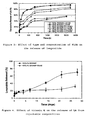
- Figure 6 shows the release profile of leuprolide from two different formulations up to 70 days. Both formulations showed initial burst release of leuprolide. The formulation containing LAHCl reached C max of 661.6 ng/mL at 3 hours, and the formulation containing LAMS reached C max of 370.6 ng/mL also at 3 hours. Both formulations showed sustained release of leuprolide over an extended time period. The formulation containing LAMS showed a more constant serum levels of leuprolide than that obtained from the formulation containing LAHCl.
- Poly(DL-lactide-co-glycolide) of a 85/15 ratio of lactide to glycolide (DLPLG85/15, IV: 0.27) containing a 1,6-hexanediol moiety is dissolved in N-methyl-2-pyrrolidone (NMP) to give a 50% solution by weight.
- NMP N-methyl-2-pyrrolidone
- the leuprolide salt, i.e., Leuprolide acetate or Leuprolide HCl are mixed with the PLGA solution in NMP to give a uniform injectable formulation at a drug loading of about 12%.
- the injectable formulations are transferred into 1.2ml polypropylene syringes with luer-lock tips and a 19 gauge thin-wall needle attached.
- Each formulation is then injected into the rats subcutaneously at a volume of about 100 ⁇ L with 6 animals per group.
- the serum samples are collected from each animal at 3 hour, 1, 3, 7, 14, 28, 42, 56, 70, 91, 112, 133, 154, 175, and 206 days post injection.
- the serum samples are analyzed for leuprolide concentration by ELISA using the kits available from Peninsula Laboratories Inc., and for testosterone concentration by LC/MS/MS.
- the leuprolide remaining in the implants at various times may be analyzed by HPLC.
- LHRH analogues such as buserelin, deslorelin, fertirelin, histrelin, lutrelin, goserelin, nafarelin, triptorelin, cetrorelix, abarelix, and other peptides, such as GLP-1, PYY, etc, and other polymers and solvents.
- a biodegradable polymeric composition may be injected subcutaneously or intramuscularly to form an implant in situ, applied as a transdermal cream, and also introduced to the patient as a rectal or vaginal suppository.
- Poly(lactide-co-glycolide (PLGA) microspheres are prepared by an oil-in-water (O/W) single emulsion technique.
- PLGA is dissolved in methylene chloride (DCM).
- DCM methylene chloride
- the drug is mixed with the PLGA solution in DCM.
- the mixed solution or suspension is emulsified in 500 mL of 0.5-1% (w/v) PVA (PVA, 88% hydrolyzed, average molecular weight of 31,000-50,000, Sigma-Aldrich) solution pre-cooled in the refrigerator at 4 °C.
- the emulsion is stirred continuously for 3 h at RT to evaporate the DCM.
- the hardened microspheres are collected, washed three times with deionized water, and then freeze-dried.
- Example 17 Use of the stabilized liquid polymeric composition for preparing implantable polymer matrices
- the biodegradable polymer consisting of a poly-(lactic acid -co- glycolic acid) having a ratio of lactide to glycolide of 50:50 to 100:0 such as RG503H (Boehringer Ingelheim Chemicals, Inc. USA) is dissolved in a volatile organic solvent, such as ethyl acetate or methylene chloride.
- a beneficial salt as defined herein such as goserelin mesylate (0.01%-30% by weight relative to the polymer) is dissolved/dispersed in the polymer solution.
- the solution is thoroughly mixed to obtain a uniform solution or suspension.
- the solvent is removed by evaporation. This is done by a spray drying procedure to form small uniform particles for injection. This can be done also in a mold to form an implant.
- the resulting polymer matrices can also be ground to a powder and formulated as an injectable suspension.
- solid dosage forms can be injected subcutaneously or intramuscularly, or can be placed surgically under the skin in the form of an implant, or given orally as part of an oral delivery system for peptide agents.
- the solid microparticles may also be prepared as a suspension or a non-aqueous solution, which may also be administered to a patient via inhalation, for pulmonary drug delivery.
- the microparticles may also be suspended in oil and introduced to the patient as a rectal or vaginal suppository.
Landscapes
- Health & Medical Sciences (AREA)
- Life Sciences & Earth Sciences (AREA)
- Chemical & Material Sciences (AREA)
- Veterinary Medicine (AREA)
- Epidemiology (AREA)
- Medicinal Chemistry (AREA)
- Animal Behavior & Ethology (AREA)
- General Health & Medical Sciences (AREA)
- Public Health (AREA)
- Pharmacology & Pharmacy (AREA)
- Engineering & Computer Science (AREA)
- Bioinformatics & Cheminformatics (AREA)
- Proteomics, Peptides & Aminoacids (AREA)
- Immunology (AREA)
- Dermatology (AREA)
- Gastroenterology & Hepatology (AREA)
- Endocrinology (AREA)
- Reproductive Health (AREA)
- Chemical Kinetics & Catalysis (AREA)
- General Chemical & Material Sciences (AREA)
- Oil, Petroleum & Natural Gas (AREA)
- Inorganic Chemistry (AREA)
- Neurosurgery (AREA)
- Biomedical Technology (AREA)
- Zoology (AREA)
- Pulmonology (AREA)
- Otolaryngology (AREA)
- Dispersion Chemistry (AREA)
- Gynecology & Obstetrics (AREA)
- Urology & Nephrology (AREA)
- Medicines That Contain Protein Lipid Enzymes And Other Medicines (AREA)
- Medicinal Preparation (AREA)
Priority Applications (1)
| Application Number | Priority Date | Filing Date | Title |
|---|---|---|---|
| SI200731130T SI1984009T1 (sl) | 2006-01-18 | 2007-01-16 | Farmacevtski sestavki z izboljĺ ano stabilnostjo |
Applications Claiming Priority (2)
| Application Number | Priority Date | Filing Date | Title |
|---|---|---|---|
| US75989106P | 2006-01-18 | 2006-01-18 | |
| PCT/US2007/001039 WO2007084460A2 (en) | 2006-01-18 | 2007-01-16 | Pharmaceutical compositions with enhanced stability |
Publications (3)
| Publication Number | Publication Date |
|---|---|
| EP1984009A2 EP1984009A2 (en) | 2008-10-29 |
| EP1984009A4 EP1984009A4 (en) | 2009-08-05 |
| EP1984009B1 true EP1984009B1 (en) | 2012-10-24 |
Family
ID=38288166
Family Applications (1)
| Application Number | Title | Priority Date | Filing Date |
|---|---|---|---|
| EP07718050A Active EP1984009B1 (en) | 2006-01-18 | 2007-01-16 | Pharmaceutical compositions with enhanced stability |
Country Status (13)
| Country | Link |
|---|---|
| US (5) | US20070196416A1 (enExample) |
| EP (1) | EP1984009B1 (enExample) |
| JP (1) | JP5242415B2 (enExample) |
| KR (2) | KR20150017777A (enExample) |
| CN (1) | CN101400363B (enExample) |
| AU (1) | AU2007207618B2 (enExample) |
| CA (1) | CA2637569C (enExample) |
| DK (1) | DK1984009T3 (enExample) |
| ES (1) | ES2397712T3 (enExample) |
| MX (1) | MX2008009125A (enExample) |
| RU (1) | RU2427383C2 (enExample) |
| SI (1) | SI1984009T1 (enExample) |
| WO (1) | WO2007084460A2 (enExample) |
Families Citing this family (103)
| Publication number | Priority date | Publication date | Assignee | Title |
|---|---|---|---|---|
| US6828415B2 (en) * | 1993-02-19 | 2004-12-07 | Zentaris Gmbh | Oligopeptide lyophilisate, their preparation and use |
| US7731947B2 (en) | 2003-11-17 | 2010-06-08 | Intarcia Therapeutics, Inc. | Composition and dosage form comprising an interferon particle formulation and suspending vehicle |
| WO2006083761A2 (en) | 2005-02-03 | 2006-08-10 | Alza Corporation | Solvent/polymer solutions as suspension vehicles |
| US11246913B2 (en) | 2005-02-03 | 2022-02-15 | Intarcia Therapeutics, Inc. | Suspension formulation comprising an insulinotropic peptide |
| US8852638B2 (en) | 2005-09-30 | 2014-10-07 | Durect Corporation | Sustained release small molecule drug formulation |
| EP2020990B1 (en) | 2006-05-30 | 2010-09-22 | Intarcia Therapeutics, Inc | Two-piece, internal-channel osmotic delivery system flow modulator |
| PL2359808T3 (pl) | 2006-08-09 | 2013-10-31 | Intarcia Therapeutics Inc | Osmotyczne systemy dostawcze i zespoły tłokowe |
| EP1917971A1 (en) * | 2006-10-27 | 2008-05-07 | Société de Conseils de Recherches et d'Applications Scientifiques ( S.C.R.A.S.) | Substained release formulations comprising very low molecular weight polymers |
| US8946200B2 (en) | 2006-11-02 | 2015-02-03 | Southwest Research Institute | Pharmaceutically active nanosuspensions |
| EP2157967B1 (en) * | 2007-04-23 | 2013-01-16 | Intarcia Therapeutics, Inc | Suspension formulations of insulinotropic peptides and uses thereof |
| CN101677952B (zh) | 2007-05-18 | 2012-12-05 | 杜雷科特公司 | 改进的贮库制剂 |
| EP2152315B1 (en) | 2007-05-25 | 2016-01-06 | Indivior UK Limited | Sustained delivery formulations of risperidone compounds |
| EP2219666A4 (en) * | 2007-11-15 | 2011-05-25 | Univ North Carolina | PROSTATE ACID PHOSPHATASE FOR THE TREATMENT OF PAIN |
| US9161943B2 (en) * | 2007-12-31 | 2015-10-20 | Industrial Technology Research Institute | Sustained release composition and manufacturing method thereof |
| US20090196905A1 (en) * | 2008-02-06 | 2009-08-06 | Spada Lon T | Stabilization of mitochondrial membranes in ocular diseases and conditions |
| EP2240155B1 (en) | 2008-02-13 | 2012-06-06 | Intarcia Therapeutics, Inc | Devices, formulations, and methods for delivery of multiple beneficial agents |
| US8404850B2 (en) | 2008-03-13 | 2013-03-26 | Southwest Research Institute | Bis-quaternary pyridinium-aldoxime salts and treatment of exposure to cholinesterase inhibitors |
| GB0810990D0 (en) * | 2008-06-16 | 2008-07-23 | Q Chip Ltd | Device and method of making solid beads |
| US8071537B2 (en) | 2008-06-25 | 2011-12-06 | Endo Pharmaceuticals Solutions Inc. | Implantable device for the sustained release of a polypeptide |
| US8722706B2 (en) | 2008-08-15 | 2014-05-13 | Southwest Research Institute | Two phase bioactive formulations of bis-quaternary pyridinium oxime sulfonate salts |
| PL2331075T3 (pl) * | 2008-08-29 | 2016-04-29 | Genzyme Corp | Formulacje peptydowe o kontrolowanym uwalnianiu |
| US8309134B2 (en) | 2008-10-03 | 2012-11-13 | Southwest Research Institute | Modified calcium phosphate nanoparticle formation |
| EP3323423B1 (en) * | 2009-09-28 | 2020-06-17 | Intarcia Therapeutics, Inc | Rapid establishment and/or termination of substantial steady-state drug delivery |
| JP5486690B2 (ja) | 2009-11-16 | 2014-05-07 | イプセン ファルマ ソシエテ パール アクシオン サンプリフィエ | メラノコルチン受容体リガンドの医薬組成物 |
| US9028873B2 (en) | 2010-02-08 | 2015-05-12 | Southwest Research Institute | Nanoparticles for drug delivery to the central nervous system |
| BR112012023303A2 (pt) * | 2010-03-15 | 2020-08-25 | Ipsen Pharma S.A.S. | composição farmacêutica de ligantes do receptor do secretagogo do hormônio de crescimento. |
| JP2013523752A (ja) * | 2010-03-29 | 2013-06-17 | エボニック デグサ コーポレイション | 局所投与部位における医薬組成物の保持改善のための組成物および方法 |
| CN101810583B (zh) * | 2010-04-09 | 2013-09-11 | 佟丽 | Hiv融合抑制剂缓释微球 |
| WO2011161531A1 (en) * | 2010-06-24 | 2011-12-29 | Torrent Pharmaceuticals Limited | Pharmaceutical composition containing goserelin for in-situ implant |
| US20120046225A1 (en) * | 2010-07-19 | 2012-02-23 | The Regents Of The University Of Colorado, A Body Corporate | Stable glucagon formulations for the treatment of hypoglycemia |
| RU2446173C1 (ru) * | 2010-08-13 | 2012-03-27 | Зао "Биокад" | Новый функционально активный, высокоочищенный стабильный конъюгат гранулоцитарного колониестимулирующего фактора (г-ксф) с полиэтиленгликолем с пролонгированным биологическим действием, пригодный для медицинского применения, и иммунобиологическое средство на его основе |
| CA2808978A1 (en) * | 2010-08-23 | 2012-03-01 | Shmuel Ben-Sasson | Compositions for gastric delivery of active agents |
| CN101934068B (zh) * | 2010-09-26 | 2012-07-25 | 武汉华龙生物制药有限公司 | 胸腺肽注射液的制备方法 |
| GB201016433D0 (en) | 2010-09-30 | 2010-11-17 | Q Chip Ltd | Apparatus and method for making solid beads |
| GB201016436D0 (en) | 2010-09-30 | 2010-11-17 | Q Chip Ltd | Method of making solid beads |
| US20120208755A1 (en) | 2011-02-16 | 2012-08-16 | Intarcia Therapeutics, Inc. | Compositions, Devices and Methods of Use Thereof for the Treatment of Cancers |
| CN102145160A (zh) * | 2011-03-07 | 2011-08-10 | 深圳市健元医药科技有限公司 | 一种lhrh拮抗剂注射用的缓释植入制剂 |
| WO2012122535A2 (en) | 2011-03-10 | 2012-09-13 | Xeris Pharmaceuticals, Inc. | Stable formulations for parenteral injection of peptide drugs |
| ES2694424T3 (es) | 2011-06-23 | 2018-12-20 | British American Tobacco (Investments) Ltd | Material filtrante que comprende fibras de polilactida |
| GB201112402D0 (en) | 2011-07-19 | 2011-08-31 | British American Tobacco Co | Cellulose acetate compositions |
| JP6117811B2 (ja) | 2011-10-31 | 2017-04-19 | ゼリス ファーマシューティカルズ インコーポレイテッド | 糖尿病を処置するための製剤 |
| GB201208293D0 (en) * | 2012-05-11 | 2012-06-20 | Circassia Ltd | Hydrochlorice salt of peptide |
| US9125805B2 (en) | 2012-06-27 | 2015-09-08 | Xeris Pharmaceuticals, Inc. | Stable formulations for parenteral injection of small molecule drugs |
| UA116217C2 (uk) | 2012-10-09 | 2018-02-26 | Санофі | Пептидна сполука як подвійний агоніст рецепторів glp1-1 та глюкагону |
| HUE035803T2 (en) | 2012-12-21 | 2018-05-28 | Sanofi Sa | Dual GLP1 / GIP or trigonal GLP1 / GIP / glucagon agonists |
| US9018162B2 (en) | 2013-02-06 | 2015-04-28 | Xeris Pharmaceuticals, Inc. | Methods for rapidly treating severe hypoglycemia |
| WO2014164754A1 (en) | 2013-03-11 | 2014-10-09 | Durect Corporation | Injectable controlled release composition comprising high viscosity liquid carrier |
| US20140308352A1 (en) | 2013-03-11 | 2014-10-16 | Zogenix Inc. | Compositions and methods involving polymer, solvent, and high viscosity liquid carrier material |
| US9040034B2 (en) | 2013-04-09 | 2015-05-26 | International Business Machines Corporation | Vitamin functionalized gel-forming block copolymers for biomedical applications |
| US9642893B2 (en) * | 2013-07-03 | 2017-05-09 | Joseph Cummins | Method for reducing injury and stabilizing muscle using orally administered interferon |
| US9757330B2 (en) | 2013-10-18 | 2017-09-12 | Industrial Technology Research Institute | Recipe for in-situ gel, and implant, drug delivery system formed thereby |
| WO2015088990A1 (en) | 2013-12-09 | 2015-06-18 | Durect Corporation | Pharmaceutically active agent complexes, polymer complexes, and compositions and methods involving the same |
| WO2015086730A1 (en) | 2013-12-13 | 2015-06-18 | Sanofi | Non-acylated exendin-4 peptide analogues |
| TW201609797A (zh) | 2013-12-13 | 2016-03-16 | 賽諾菲公司 | 雙重glp-1/升糖素受體促效劑 |
| WO2015086728A1 (en) | 2013-12-13 | 2015-06-18 | Sanofi | Exendin-4 peptide analogues as dual glp-1/gip receptor agonists |
| EP3080154B1 (en) | 2013-12-13 | 2018-02-07 | Sanofi | Dual glp-1/gip receptor agonists |
| CN104073482A (zh) | 2013-12-30 | 2014-10-01 | 江苏众红生物工程创药研究院有限公司 | 聚乙二醇化的组织激肽释放酶及其制备方法和应用 |
| WO2015120231A2 (en) * | 2014-02-06 | 2015-08-13 | Xeris Phrmaceuticals, Inc. | Stable peptide formulations and methods for preparation |
| RU2557925C1 (ru) * | 2014-03-17 | 2015-07-27 | Новиков Сергей Викторович | Биодеградируемый многослойный имплант для введения лекарственных веществ в витреальную полость глаза |
| TW201625668A (zh) | 2014-04-07 | 2016-07-16 | 賽諾菲公司 | 作為胜肽性雙重glp-1/昇糖素受體激動劑之艾塞那肽-4衍生物 |
| TW201625670A (zh) | 2014-04-07 | 2016-07-16 | 賽諾菲公司 | 衍生自exendin-4之雙重glp-1/升糖素受體促效劑 |
| TW201625669A (zh) | 2014-04-07 | 2016-07-16 | 賽諾菲公司 | 衍生自艾塞那肽-4(Exendin-4)之肽類雙重GLP-1/升糖素受體促效劑 |
| WO2015158823A1 (de) | 2014-04-16 | 2015-10-22 | Veyx-Pharma Gmbh | Veterinärpharmazeutische zusammensetzung und deren verwendung |
| US9932381B2 (en) | 2014-06-18 | 2018-04-03 | Sanofi | Exendin-4 derivatives as selective glucagon receptor agonists |
| KR102428675B1 (ko) | 2014-08-06 | 2022-08-02 | 엑스에리스 파머수티클스, 인크. | 페이스트의 피내 및/또는 피하 주사를 위한 주사기, 키트, 및 방법 |
| US9889085B1 (en) | 2014-09-30 | 2018-02-13 | Intarcia Therapeutics, Inc. | Therapeutic methods for the treatment of diabetes and related conditions for patients with high baseline HbA1c |
| US20160106804A1 (en) * | 2014-10-15 | 2016-04-21 | Yuhua Li | Pharmaceutical composition with improved stability |
| WO2016059587A1 (en) * | 2014-10-16 | 2016-04-21 | Piramal Enterprises Limited | Stable injectable composition of pharmaceutically active agents and process for its preparation |
| WO2016059592A1 (en) * | 2014-10-16 | 2016-04-21 | Piramal Enterprises Limited | Stable injectable composition of peptide drugs and process for its preparation |
| US20160151511A1 (en) | 2014-12-02 | 2016-06-02 | Antriabio, Inc. | Proteins and protein conjugates with increased hydrophobicity |
| ES2968262T3 (es) | 2015-06-03 | 2024-05-08 | I2O Therapeutics Inc | Sistemas de colocación de implantes |
| US9649364B2 (en) | 2015-09-25 | 2017-05-16 | Xeris Pharmaceuticals, Inc. | Methods for producing stable therapeutic formulations in aprotic polar solvents |
| AR105319A1 (es) | 2015-06-05 | 2017-09-27 | Sanofi Sa | Profármacos que comprenden un conjugado agonista dual de glp-1 / glucagón conector ácido hialurónico |
| TW201706291A (zh) | 2015-07-10 | 2017-02-16 | 賽諾菲公司 | 作為選擇性肽雙重glp-1/升糖素受體促效劑之新毒蜥外泌肽(exendin-4)衍生物 |
| US10786515B2 (en) | 2015-08-03 | 2020-09-29 | Tolmar International Limited | Liquid polymer delivery system for extended administration of drugs |
| US11590205B2 (en) | 2015-09-25 | 2023-02-28 | Xeris Pharmaceuticals, Inc. | Methods for producing stable therapeutic glucagon formulations in aprotic polar solvents |
| HRP20250215T1 (hr) * | 2016-04-12 | 2025-06-20 | Tonix Pharma Limited | Formulacije oksitocina koje sadrže magnezij i postupci upotrebe |
| KR20240037175A (ko) | 2016-05-16 | 2024-03-21 | 인타르시아 세라퓨틱스 인코포레이티드 | 글루카곤-수용체 선택적 폴리펩티드 및 이들의 이용 방법 |
| USD860451S1 (en) | 2016-06-02 | 2019-09-17 | Intarcia Therapeutics, Inc. | Implant removal tool |
| USD840030S1 (en) | 2016-06-02 | 2019-02-05 | Intarcia Therapeutics, Inc. | Implant placement guide |
| AU2018206539A1 (en) | 2017-01-03 | 2019-07-18 | Intarcia Therapeutics, Inc. | Methods comprising continuous administration of a GLP-1 receptor agonist and co-administration of a drug |
| EP3576771B1 (en) * | 2017-01-31 | 2022-03-09 | Veru Inc. | Compositions and methods for long term release of ganadotropin-releasing hormone (gnrh) antagonists |
| CN117085022A (zh) | 2017-06-02 | 2023-11-21 | Xeris药物公司 | 抗沉淀的小分子药物制剂 |
| CN111511385B (zh) * | 2017-12-18 | 2024-05-03 | 逸达生物科技股份有限公司 | 具有选定的释放持续时间的药物组合物 |
| EP3737415A4 (en) | 2018-01-12 | 2021-06-30 | President and Fellows of Harvard College | COMPOSITIONS AND PROCEDURES RELATED TO MACROPHAGE AND / OR MONOCYTE WITH ATTACHED PARTICLES |
| US20210205404A1 (en) * | 2018-05-16 | 2021-07-08 | Jiangsu Hengrui Medicine Co., Ltd. | Pharmaceutical composition of kor receptor agonist |
| CN109316371B (zh) * | 2018-09-21 | 2021-09-03 | 珀莱雅化妆品股份有限公司 | 一种芹菜素缓释制剂的制备方法 |
| KR20200051916A (ko) * | 2018-11-05 | 2020-05-14 | 주식회사 메디포럼제약 | 고세렐린을 포함하는 실리카 하이드로겔 조성물 |
| MY210034A (en) | 2019-03-15 | 2025-08-22 | Novo Nordisk As | Process for spray drying a glp-1 peptide |
| KR102249104B1 (ko) | 2019-04-30 | 2021-05-07 | (주)인벤티지랩 | 데슬로렐린을 포함하는 서방성 마이크로 입자 및 이의 제조 방법 |
| SG11202112888RA (en) * | 2019-05-27 | 2021-12-30 | Tolmar International Ltd | Leuprolide acetate compositions and methods of using the same to treat breast cancer |
| EP3979994A4 (en) * | 2019-06-07 | 2023-08-09 | President And Fellows Of Harvard College | Compositions and methods relating to erythrocytes with adhered particles |
| CA3160665A1 (en) * | 2019-11-08 | 2021-05-14 | Lyndra Therapeutics, Inc. | Gastric residence systems for administration of active agents |
| CA3180060A1 (en) | 2020-05-29 | 2021-12-02 | Zongmin ZHAO | Living cells engineered with polyphenol-functionalized biologically active nanocomplexes |
| CN114246840B (zh) * | 2020-09-22 | 2024-10-11 | 鲁南制药集团股份有限公司 | 一种口服用紫杉醇胶囊 |
| US20220331395A1 (en) * | 2021-04-07 | 2022-10-20 | Proneurogen, Inc. | Extended-release injectable gel formulations containing angiotensin-(1-7) oligopeptides or variants thereof |
| US12678476B2 (en) | 2021-07-02 | 2026-07-14 | Foresee Pharmaceuticals Co., Ltd. | Methods of manufacturing injectable sustained release formulations |
| MX2024001681A (es) | 2021-08-05 | 2024-03-04 | Medincell S A | Composicion farmaceutica. |
| CN118201599A (zh) * | 2021-12-24 | 2024-06-14 | 四川科伦药物研究院有限公司 | 一种可平稳释放的持续性递送制剂及其制备方法 |
| KR20240079177A (ko) * | 2022-11-28 | 2024-06-04 | 동국제약 주식회사 | 인-시튜 임플란트를 형성할 수 있는 서방형 약학 조성물 및 이의 제조방법 |
| CN115969954A (zh) * | 2023-01-09 | 2023-04-18 | 开封明仁药业有限公司 | 一种注射用西曲瑞克冻干药物组合物及其制备方法 |
| AU2024248975A1 (en) * | 2023-03-27 | 2025-11-13 | Cellular Longevity, Inc. | Pharmaceutical formulations for longevity in mammals |
| WO2025215195A1 (en) * | 2024-04-11 | 2025-10-16 | Dsm Ip Assets B.V. | Particles comprising biotherapeutic encapsulated with biodegradable polymer |
Family Cites Families (75)
| Publication number | Priority date | Publication date | Assignee | Title |
|---|---|---|---|---|
| US444340A (en) * | 1891-01-06 | Coupling-shoe | ||
| IE52535B1 (en) * | 1981-02-16 | 1987-12-09 | Ici Plc | Continuous release pharmaceutical compositions |
| US4443340A (en) | 1981-10-09 | 1984-04-17 | Betz Laboratories, Inc. | Control of iron induced fouling in water systems |
| JP2551756B2 (ja) | 1985-05-07 | 1996-11-06 | 武田薬品工業株式会社 | ポリオキシカルボン酸エステルおよびその製造法 |
| US6312679B1 (en) * | 1986-08-18 | 2001-11-06 | The Dow Chemical Company | Dense star polymer conjugates as dyes |
| DE3708916A1 (de) | 1987-03-19 | 1988-09-29 | Boehringer Ingelheim Kg | Verfahren zur reinigung resorbierbarer polyester |
| US5702716A (en) | 1988-10-03 | 1997-12-30 | Atrix Laboratories, Inc. | Polymeric compositions useful as controlled release implants |
| US4938763B1 (en) * | 1988-10-03 | 1995-07-04 | Atrix Lab Inc | Biodegradable in-situ forming implants and method of producing the same |
| US5349052A (en) * | 1988-10-20 | 1994-09-20 | Royal Free Hospital School Of Medicine | Process for fractionating polyethylene glycol (PEG)-protein adducts and an adduct for PEG and granulocyte-macrophage colony stimulating factor |
| US5324519A (en) * | 1989-07-24 | 1994-06-28 | Atrix Laboratories, Inc. | Biodegradable polymer composition |
| US5487897A (en) * | 1989-07-24 | 1996-01-30 | Atrix Laboratories, Inc. | Biodegradable implant precursor |
| JPH0818999B2 (ja) * | 1990-01-05 | 1996-02-28 | 藤沢薬品工業株式会社 | インシュリン様成長因子iの乾燥製剤 |
| DE4004430A1 (de) * | 1990-02-09 | 1991-08-14 | Schering Ag | Aus polyaldehyden aufgebaute kontrastmittel |
| ATE168391T1 (de) | 1990-04-13 | 1998-08-15 | Takeda Chemical Industries Ltd | Biologisch abbaubare hochmolekulare polymere, ihre herstellung und ihre verwendung |
| USRE37950E1 (en) | 1990-04-24 | 2002-12-31 | Atrix Laboratories | Biogradable in-situ forming implants and methods of producing the same |
| IE912365A1 (en) * | 1990-07-23 | 1992-01-29 | Zeneca Ltd | Continuous release pharmaceutical compositions |
| US5529914A (en) * | 1990-10-15 | 1996-06-25 | The Board Of Regents The Univeristy Of Texas System | Gels for encapsulation of biological materials |
| US5410016A (en) * | 1990-10-15 | 1995-04-25 | Board Of Regents, The University Of Texas System | Photopolymerizable biodegradable hydrogels as tissue contacting materials and controlled-release carriers |
| AU2605592A (en) * | 1991-10-15 | 1993-04-22 | Atrix Laboratories, Inc. | Polymeric compositions useful as controlled release implants |
| KR970007322B1 (ko) | 1991-12-19 | 1997-05-07 | 미쓰이도오아쓰 가가쿠 가부시키가이샤 | 폴리히드록시 카르복실산 및 그 제조방법 |
| EP0560014A1 (en) * | 1992-03-12 | 1993-09-15 | Atrix Laboratories, Inc. | Biodegradable film dressing and method for its formation |
| US5338822A (en) | 1992-10-02 | 1994-08-16 | Cargill, Incorporated | Melt-stable lactide polymer composition and process for manufacture thereof |
| US5242910A (en) * | 1992-10-13 | 1993-09-07 | The Procter & Gamble Company | Sustained release compositions for treating periodontal disease |
| JP2944419B2 (ja) * | 1993-05-10 | 1999-09-06 | ノバルティス アクチエンゲゼルシャフト | 持続性遊離組成物中の薬理学的活性成分の安定 |
| NZ273285A (en) | 1993-09-17 | 1997-10-24 | Novo Nordisk As | Insulin derivatives and compositions thereof |
| US5681873A (en) * | 1993-10-14 | 1997-10-28 | Atrix Laboratories, Inc. | Biodegradable polymeric composition |
| US5919455A (en) * | 1993-10-27 | 1999-07-06 | Enzon, Inc. | Non-antigenic branched polymer conjugates |
| US5446090A (en) * | 1993-11-12 | 1995-08-29 | Shearwater Polymers, Inc. | Isolatable, water soluble, and hydrolytically stable active sulfones of poly(ethylene glycol) and related polymers for modification of surfaces and molecules |
| EP1125577B1 (en) * | 1994-04-08 | 2006-02-15 | QLT USA, Inc. | Liquid drug delivery compositions |
| US5478921A (en) | 1994-08-25 | 1995-12-26 | United States Surgical Corporation | Method of purifying bioabsorable polymer |
| US5693609A (en) | 1994-11-17 | 1997-12-02 | Eli Lilly And Company | Acylated insulin analogs |
| US5698213A (en) * | 1995-03-06 | 1997-12-16 | Ethicon, Inc. | Hydrogels of absorbable polyoxaesters |
| US5869602A (en) | 1995-03-17 | 1999-02-09 | Novo Nordisk A/S | Peptide derivatives |
| US6551610B2 (en) * | 1995-04-13 | 2003-04-22 | Poly-Med, Inc. | Multifaceted compositions for post-surgical adhesion prevention |
| US7033608B1 (en) | 1995-05-22 | 2006-04-25 | The United States Of America As Represented By The Secretary Of The Army | “Burst-free” sustained release poly-(lactide/glycolide) microspheres |
| US5736152A (en) | 1995-10-27 | 1998-04-07 | Atrix Laboratories, Inc. | Non-polymeric sustained release delivery system |
| EP0929576A1 (en) | 1996-08-30 | 1999-07-21 | Novo Nordisk A/S | Glp-2 derivatives |
| DE122009000079I2 (de) | 1996-08-30 | 2011-06-16 | Novo Nordisk As Novo Alle | Glp-1 derivate |
| US6126919A (en) | 1997-02-07 | 2000-10-03 | 3M Innovative Properties Company | Biocompatible compounds for pharmaceutical drug delivery systems |
| AR012448A1 (es) * | 1997-04-18 | 2000-10-18 | Ipsen Pharma Biotech | Composicion en forma de microcapsulas o de implantes que comprende un excipiente biodegradable, polimero o co-polimero, o una mezcla de talesexcipientes, y una sustancia activa o una mezcla de sustancias activas, procedimiento para la preparacion de una sustancia soluble en agua de elevada |
| EP1028748B1 (en) * | 1997-11-07 | 2003-05-02 | Chiron Corporation | Compositions providing for increased igf-i solubility |
| AU3247799A (en) | 1998-02-27 | 1999-09-15 | Novo Nordisk A/S | Glp-1 derivatives of glp-1 and exendin with protracted profile of action |
| US6410044B1 (en) * | 1998-03-19 | 2002-06-25 | Surmodics, Inc. | Crosslinkable macromers |
| US6261583B1 (en) | 1998-07-28 | 2001-07-17 | Atrix Laboratories, Inc. | Moldable solid delivery system |
| US6565874B1 (en) | 1998-10-28 | 2003-05-20 | Atrix Laboratories | Polymeric delivery formulations of leuprolide with improved efficacy |
| US6143314A (en) * | 1998-10-28 | 2000-11-07 | Atrix Laboratories, Inc. | Controlled release liquid delivery compositions with low initial drug burst |
| US6355657B1 (en) * | 1998-12-30 | 2002-03-12 | Atrix Laboratories, Inc. | System for percutaneous delivery of opioid analgesics |
| DE19908753C2 (de) | 1999-02-20 | 2003-10-02 | Jenapharm Gmbh | Bioabbaubare, injizierbare Oligomer-Polymer-Zusammensetzung |
| US6461631B1 (en) * | 1999-11-16 | 2002-10-08 | Atrix Laboratories, Inc. | Biodegradable polymer composition |
| FR2806727A1 (fr) * | 2000-03-23 | 2001-09-28 | Pf Medicament | Molecule d'interet pharmaceutique comprotant en son extremite n-terminale un acide glutamique ou une glutamine sous forme de sel d'addition d'acide fort physiologiquement acceptable |
| US6626870B1 (en) | 2000-03-27 | 2003-09-30 | Artix Laboratories, Inc. | Stoppering method to maintain sterility |
| ES2256276T5 (es) | 2000-08-07 | 2011-02-22 | Wako Pure Chemical Industries, Ltd. | Polímero de ácido láctico y procedimiento para su producción. |
| US8470359B2 (en) | 2000-11-13 | 2013-06-25 | Qlt Usa, Inc. | Sustained release polymer |
| TW200526267A (en) | 2001-06-29 | 2005-08-16 | Takeda Chemical Industries Ltd | Controlled release composition and method of producing the same |
| TWI225416B (en) | 2001-06-29 | 2004-12-21 | Takeda Chemical Industries Ltd | Sustained-release composition and process for producing the same |
| US7098305B2 (en) * | 2001-09-06 | 2006-08-29 | Ardana Bioscience Limited | Sustained release of microcrystalline peptide suspensions |
| US20040001889A1 (en) | 2002-06-25 | 2004-01-01 | Guohua Chen | Short duration depot formulations |
| WO2004012703A1 (en) | 2002-07-31 | 2004-02-12 | Alza Corporation | Injectable depot compositions and uses thereof |
| US6966990B2 (en) | 2002-10-11 | 2005-11-22 | Ferro Corporation | Composite particles and method for preparing |
| UY28213A1 (es) | 2003-02-28 | 2004-09-30 | Bayer Pharmaceuticals Corp | Nuevos derivados de cianopiridina útiles en el tratamiento de cáncer y otros trastornos. |
| EP1660039B1 (en) * | 2003-07-18 | 2016-09-28 | Oakwood Laboratories L.L.C. | Prevention of molecular weight reduction of the polymer, impurity formation and gelling in polymer compositions |
| US20050281879A1 (en) * | 2003-11-14 | 2005-12-22 | Guohua Chen | Excipients in drug delivery vehicles |
| CA2552241C (en) * | 2003-12-30 | 2013-10-01 | Durect Corporation | Co-polymeric devices for controlled release of active agents |
| US7989490B2 (en) * | 2004-06-02 | 2011-08-02 | Cordis Corporation | Injectable formulations of taxanes for cad treatment |
| ES2323141T3 (es) * | 2004-08-12 | 2009-07-07 | Quest Pharmaceutical Services | Composiciones farmaceuticas para el suministro por liberacion controlada de compuestos biologicamente activos. |
| US8313763B2 (en) | 2004-10-04 | 2012-11-20 | Tolmar Therapeutics, Inc. | Sustained delivery formulations of rapamycin compounds |
| EP1824460B1 (en) | 2004-11-10 | 2014-12-24 | Tolmar Therapeutics, Inc. | A stabilized polymeric delivery system |
| US7342048B2 (en) | 2005-04-28 | 2008-03-11 | Nipro Corporation | Bioabsorbable pharmaceutical formulation |
| EP2079767B1 (en) | 2006-10-11 | 2014-08-27 | Tolmar Therapeutics, Inc. | Preparation of biodegradable polyesters with low-burst properties by supercritical fluid extraction |
| US8076448B2 (en) | 2006-10-11 | 2011-12-13 | Tolmar Therapeutics, Inc. | Preparation of biodegradable polyesters with low-burst properties by supercritical fluid extraction |
| EP3202814B1 (en) | 2007-02-15 | 2019-10-16 | Tolmar Therapeutics, Inc. | Low burst poly-(lactide/glycolide) and methods to produce polymers |
| US8877225B2 (en) | 2008-06-03 | 2014-11-04 | Tolmar Therapeutics, Inc. | Controlled release copolymer formulation with improved release kinetics |
| DK2291174T3 (en) | 2008-06-03 | 2015-03-09 | Tolmar Therapeutics Inc | Liquid compositions comprising biocompatible oligomer-polymer compositions |
| GEP20207086B (en) | 2014-12-04 | 2020-04-10 | Therapeutics Inc Tolmar | Syringe plunger system with self-locking threaded geometry |
| US10786515B2 (en) | 2015-08-03 | 2020-09-29 | Tolmar International Limited | Liquid polymer delivery system for extended administration of drugs |
-
2007
- 2007-01-16 CA CA2637569A patent/CA2637569C/en active Active
- 2007-01-16 DK DK07718050.3T patent/DK1984009T3/da active
- 2007-01-16 KR KR1020157002423A patent/KR20150017777A/ko not_active Ceased
- 2007-01-16 AU AU2007207618A patent/AU2007207618B2/en active Active
- 2007-01-16 US US11/653,636 patent/US20070196416A1/en not_active Abandoned
- 2007-01-16 EP EP07718050A patent/EP1984009B1/en active Active
- 2007-01-16 ES ES07718050T patent/ES2397712T3/es active Active
- 2007-01-16 WO PCT/US2007/001039 patent/WO2007084460A2/en not_active Ceased
- 2007-01-16 JP JP2008551315A patent/JP5242415B2/ja not_active Expired - Fee Related
- 2007-01-16 MX MX2008009125A patent/MX2008009125A/es active IP Right Grant
- 2007-01-16 SI SI200731130T patent/SI1984009T1/sl unknown
- 2007-01-16 CN CN2007800089333A patent/CN101400363B/zh active Active
- 2007-01-16 RU RU2008129201/15A patent/RU2427383C2/ru active
- 2007-01-16 KR KR1020087020179A patent/KR101728868B1/ko active Active
-
2016
- 2016-08-06 US US15/230,413 patent/US9572857B2/en active Active
-
2017
- 2017-01-13 US US15/406,321 patent/US9744207B2/en active Active
- 2017-07-27 US US15/661,066 patent/US10251956B2/en active Active
-
2019
- 2019-04-05 US US16/376,028 patent/US10646572B2/en active Active
Non-Patent Citations (1)
| Title |
|---|
| UNITED STATES DEPARTMENT OF HEALTH AND HUMAN SERVICES: "Eleventh Report on Carcinogens - 1,4-Dioxane CAS No. 123-91-1" * |
Also Published As
Similar Documents
| Publication | Publication Date | Title |
|---|---|---|
| US10646572B2 (en) | Pharmaceutical compositions with enhanced stability | |
| US12133878B2 (en) | Pharmaceutical compositions having a selected release duration | |
| CA3084339C (en) | Pharmaceutical compositions having a selected release duration | |
| NZ766167B2 (en) | Pharmaceutical compositions having a selected release duration | |
| HK1126975B (en) | Pharmaceutical compositions with enhanced stability | |
| BRPI0706558B1 (pt) | Composição polimérica injetável, métodos para preparar uma composição polimérica injetável e métodos para preparar um sal de um análogo de hormônio de liberação de hormônio luteínico (lhrh) |
Legal Events
| Date | Code | Title | Description |
|---|---|---|---|
| PUAI | Public reference made under article 153(3) epc to a published international application that has entered the european phase |
Free format text: ORIGINAL CODE: 0009012 |
|
| 17P | Request for examination filed |
Effective date: 20080813 |
|
| AK | Designated contracting states |
Kind code of ref document: A2 Designated state(s): AT BE BG CH CY CZ DE DK EE ES FI FR GB GR HU IE IS IT LI LT LU LV MC NL PL PT RO SE SI SK TR |
|
| RIN1 | Information on inventor provided before grant (corrected) |
Inventor name: CHIEN, BENJAMIN Inventor name: LI, YUHUA |
|
| A4 | Supplementary search report drawn up and despatched |
Effective date: 20090706 |
|
| 17Q | First examination report despatched |
Effective date: 20091021 |
|
| GRAP | Despatch of communication of intention to grant a patent |
Free format text: ORIGINAL CODE: EPIDOSNIGR1 |
|
| DAX | Request for extension of the european patent (deleted) | ||
| GRAS | Grant fee paid |
Free format text: ORIGINAL CODE: EPIDOSNIGR3 |
|
| GRAA | (expected) grant |
Free format text: ORIGINAL CODE: 0009210 |
|
| AK | Designated contracting states |
Kind code of ref document: B1 Designated state(s): AT BE BG CH CY CZ DE DK EE ES FI FR GB GR HU IE IS IT LI LT LU LV MC NL PL PT RO SE SI SK TR |
|
| REG | Reference to a national code |
Ref country code: GB Ref legal event code: FG4D |
|
| REG | Reference to a national code |
Ref country code: CH Ref legal event code: EP |
|
| REG | Reference to a national code |
Ref country code: AT Ref legal event code: REF Ref document number: 580539 Country of ref document: AT Kind code of ref document: T Effective date: 20121115 |
|
| REG | Reference to a national code |
Ref country code: IE Ref legal event code: FG4D |
|
| REG | Reference to a national code |
Ref country code: CH Ref legal event code: NV Representative=s name: MURGITROYD AND COMPANY, CH |
|
| REG | Reference to a national code |
Ref country code: DE Ref legal event code: R096 Ref document number: 602007026241 Country of ref document: DE Effective date: 20121220 |
|
| REG | Reference to a national code |
Ref country code: SE Ref legal event code: TRGR |
|
| REG | Reference to a national code |
Ref country code: DK Ref legal event code: T3 |
|
| REG | Reference to a national code |
Ref country code: NL Ref legal event code: T3 |
|
| REG | Reference to a national code |
Ref country code: ES Ref legal event code: FG2A Ref document number: 2397712 Country of ref document: ES Kind code of ref document: T3 Effective date: 20130308 |
|
| REG | Reference to a national code |
Ref country code: AT Ref legal event code: MK05 Ref document number: 580539 Country of ref document: AT Kind code of ref document: T Effective date: 20121024 |
|
| PG25 | Lapsed in a contracting state [announced via postgrant information from national office to epo] |
Ref country code: IS Free format text: LAPSE BECAUSE OF FAILURE TO SUBMIT A TRANSLATION OF THE DESCRIPTION OR TO PAY THE FEE WITHIN THE PRESCRIBED TIME-LIMIT Effective date: 20130224 Ref country code: FI Free format text: LAPSE BECAUSE OF FAILURE TO SUBMIT A TRANSLATION OF THE DESCRIPTION OR TO PAY THE FEE WITHIN THE PRESCRIBED TIME-LIMIT Effective date: 20121024 |
|
| RAP2 | Party data changed (patent owner data changed or rights of a patent transferred) |
Owner name: FORESEEACER PHARMACEUTICALS, INC. |
|
| PG25 | Lapsed in a contracting state [announced via postgrant information from national office to epo] |
Ref country code: PL Free format text: LAPSE BECAUSE OF FAILURE TO SUBMIT A TRANSLATION OF THE DESCRIPTION OR TO PAY THE FEE WITHIN THE PRESCRIBED TIME-LIMIT Effective date: 20121024 Ref country code: LV Free format text: LAPSE BECAUSE OF FAILURE TO SUBMIT A TRANSLATION OF THE DESCRIPTION OR TO PAY THE FEE WITHIN THE PRESCRIBED TIME-LIMIT Effective date: 20121024 Ref country code: GR Free format text: LAPSE BECAUSE OF FAILURE TO SUBMIT A TRANSLATION OF THE DESCRIPTION OR TO PAY THE FEE WITHIN THE PRESCRIBED TIME-LIMIT Effective date: 20130125 Ref country code: PT Free format text: LAPSE BECAUSE OF FAILURE TO SUBMIT A TRANSLATION OF THE DESCRIPTION OR TO PAY THE FEE WITHIN THE PRESCRIBED TIME-LIMIT Effective date: 20130225 Ref country code: CY Free format text: LAPSE BECAUSE OF FAILURE TO SUBMIT A TRANSLATION OF THE DESCRIPTION OR TO PAY THE FEE WITHIN THE PRESCRIBED TIME-LIMIT Effective date: 20121024 |
|
| PG25 | Lapsed in a contracting state [announced via postgrant information from national office to epo] |
Ref country code: AT Free format text: LAPSE BECAUSE OF FAILURE TO SUBMIT A TRANSLATION OF THE DESCRIPTION OR TO PAY THE FEE WITHIN THE PRESCRIBED TIME-LIMIT Effective date: 20121024 |
|
| REG | Reference to a national code |
Ref country code: DE Ref legal event code: R097 Ref document number: 602007026241 Country of ref document: DE |
|
| PG25 | Lapsed in a contracting state [announced via postgrant information from national office to epo] |
Ref country code: CZ Free format text: LAPSE BECAUSE OF FAILURE TO SUBMIT A TRANSLATION OF THE DESCRIPTION OR TO PAY THE FEE WITHIN THE PRESCRIBED TIME-LIMIT Effective date: 20121024 Ref country code: BG Free format text: LAPSE BECAUSE OF FAILURE TO SUBMIT A TRANSLATION OF THE DESCRIPTION OR TO PAY THE FEE WITHIN THE PRESCRIBED TIME-LIMIT Effective date: 20130124 Ref country code: EE Free format text: LAPSE BECAUSE OF FAILURE TO SUBMIT A TRANSLATION OF THE DESCRIPTION OR TO PAY THE FEE WITHIN THE PRESCRIBED TIME-LIMIT Effective date: 20121024 Ref country code: SK Free format text: LAPSE BECAUSE OF FAILURE TO SUBMIT A TRANSLATION OF THE DESCRIPTION OR TO PAY THE FEE WITHIN THE PRESCRIBED TIME-LIMIT Effective date: 20121024 |
|
| REG | Reference to a national code |
Ref country code: CH Ref legal event code: NV Representative=s name: AMMANN PATENTANWAELTE AG BERN, CH Ref country code: CH Ref legal event code: PUE Owner name: FORESEEACER PHARMACEUTICALS, INC., US Free format text: FORMER OWNER: QPS, LLC, US |
|
| REG | Reference to a national code |
Ref country code: NL Ref legal event code: V1 Effective date: 20130801 |
|
| PG25 | Lapsed in a contracting state [announced via postgrant information from national office to epo] |
Ref country code: RO Free format text: LAPSE BECAUSE OF FAILURE TO SUBMIT A TRANSLATION OF THE DESCRIPTION OR TO PAY THE FEE WITHIN THE PRESCRIBED TIME-LIMIT Effective date: 20121024 Ref country code: MC Free format text: LAPSE BECAUSE OF NON-PAYMENT OF DUE FEES Effective date: 20130131 |
|
| PLBE | No opposition filed within time limit |
Free format text: ORIGINAL CODE: 0009261 |
|
| REG | Reference to a national code |
Ref country code: SI Ref legal event code: SP73 Owner name: FORESEEACER PHARMACEUTICALS, INC.; US Effective date: 20130731 |
|
| STAA | Information on the status of an ep patent application or granted ep patent |
Free format text: STATUS: NO OPPOSITION FILED WITHIN TIME LIMIT |
|
| REG | Reference to a national code |
Ref country code: GB Ref legal event code: 732E Free format text: REGISTERED BETWEEN 20130822 AND 20130828 |
|
| REG | Reference to a national code |
Ref country code: HU Ref legal event code: GB9C Owner name: FORESEEACER PHARMACEUTICALS, INC., US Free format text: FORMER OWNER(S): QPS, LLC, US |
|
| 26N | No opposition filed |
Effective date: 20130725 |
|
| REG | Reference to a national code |
Ref country code: DE Ref legal event code: R082 Ref document number: 602007026241 Country of ref document: DE Representative=s name: EPPING HERMANN FISCHER, PATENTANWALTSGESELLSCH, DE |
|
| PG25 | Lapsed in a contracting state [announced via postgrant information from national office to epo] |
Ref country code: NL Free format text: LAPSE BECAUSE OF NON-PAYMENT OF DUE FEES Effective date: 20130801 |
|
| REG | Reference to a national code |
Ref country code: DE Ref legal event code: R081 Ref document number: 602007026241 Country of ref document: DE Owner name: FORESEEACER PHARMACEUTICALS, INC., US Free format text: FORMER OWNER: QPS, LLC, NEWARK, US Effective date: 20131004 Ref country code: DE Ref legal event code: R097 Ref document number: 602007026241 Country of ref document: DE Effective date: 20130725 Ref country code: DE Ref legal event code: R082 Ref document number: 602007026241 Country of ref document: DE Representative=s name: EPPING HERMANN FISCHER, PATENTANWALTSGESELLSCH, DE Effective date: 20131004 Ref country code: HU Ref legal event code: AG4A Ref document number: E017204 Country of ref document: HU Ref country code: DE Ref legal event code: R081 Ref document number: 602007026241 Country of ref document: DE Owner name: FORESEEACER PHARMACEUTICALS, INC., WOODSIDE, US Free format text: FORMER OWNER: QPS, LLC, NEWARK, DEL. 19711, US Effective date: 20131004 Ref country code: DE Ref legal event code: R081 Ref document number: 602007026241 Country of ref document: DE Owner name: FORESEEACER PHARMACEUTICALS CO., LTD., TW Free format text: FORMER OWNER: QPS, LLC, NEWARK, DEL. 19711, US Effective date: 20131004 Ref country code: DE Ref legal event code: R081 Ref document number: 602007026241 Country of ref document: DE Owner name: FORESEE PHARMACEUTICALS CO., LTD., TW Free format text: FORMER OWNER: QPS, LLC, NEWARK, DEL. 19711, US Effective date: 20131004 Ref country code: DE Ref legal event code: R082 Ref document number: 602007026241 Country of ref document: DE Representative=s name: EPPING HERMANN FISCHER PATENTANWALTSGESELLSCHA, DE Effective date: 20131004 |
|
| PG25 | Lapsed in a contracting state [announced via postgrant information from national office to epo] |
Ref country code: LT Free format text: LAPSE BECAUSE OF FAILURE TO SUBMIT A TRANSLATION OF THE DESCRIPTION OR TO PAY THE FEE WITHIN THE PRESCRIBED TIME-LIMIT Effective date: 20121024 |
|
| REG | Reference to a national code |
Ref country code: FR Ref legal event code: PLFP Year of fee payment: 9 |
|
| PG25 | Lapsed in a contracting state [announced via postgrant information from national office to epo] |
Ref country code: TR Free format text: LAPSE BECAUSE OF FAILURE TO SUBMIT A TRANSLATION OF THE DESCRIPTION OR TO PAY THE FEE WITHIN THE PRESCRIBED TIME-LIMIT Effective date: 20121024 |
|
| REG | Reference to a national code |
Ref country code: DE Ref legal event code: R082 Ref document number: 602007026241 Country of ref document: DE Representative=s name: EPPING HERMANN FISCHER, PATENTANWALTSGESELLSCH, DE Ref country code: DE Ref legal event code: R081 Ref document number: 602007026241 Country of ref document: DE Owner name: FORESEE PHARMACEUTICALS CO., LTD., TW Free format text: FORMER OWNER: FORESEEACER PHARMACEUTICALS, INC., WOODSIDE, CALIF., US Ref country code: DE Ref legal event code: R082 Ref document number: 602007026241 Country of ref document: DE Representative=s name: EPPING HERMANN FISCHER PATENTANWALTSGESELLSCHA, DE |
|
| PG25 | Lapsed in a contracting state [announced via postgrant information from national office to epo] |
Ref country code: LU Free format text: LAPSE BECAUSE OF NON-PAYMENT OF DUE FEES Effective date: 20130116 |
|
| REG | Reference to a national code |
Ref country code: CH Ref legal event code: PUE Owner name: FORESEE PHARMACEUTICALS CO., LTD., TW Free format text: FORMER OWNER: FORESEEACER PHARMACEUTICALS, INC., US |
|
| REG | Reference to a national code |
Ref country code: DE Ref legal event code: R082 Ref document number: 602007026241 Country of ref document: DE Representative=s name: EPPING HERMANN FISCHER, PATENTANWALTSGESELLSCH, DE Ref country code: DE Ref legal event code: R081 Ref document number: 602007026241 Country of ref document: DE Owner name: FORESEE PHARMACEUTICALS CO., LTD., TW Free format text: FORMER OWNER: FORESEEACER PHARMACEUTICALS CO., LTD., TAIPEI, TW Ref country code: DE Ref legal event code: R082 Ref document number: 602007026241 Country of ref document: DE Representative=s name: EPPING HERMANN FISCHER PATENTANWALTSGESELLSCHA, DE |
|
| REG | Reference to a national code |
Ref country code: ES Ref legal event code: PC2A Owner name: FORESEE PHARMACEUTICALS CO., LTD. Effective date: 20150807 |
|
| REG | Reference to a national code |
Ref country code: GB Ref legal event code: 732E Free format text: REGISTERED BETWEEN 20150730 AND 20150805 |
|
| REG | Reference to a national code |
Ref country code: HU Ref legal event code: FH1C Free format text: FORMER REPRESENTATIVE(S): PINTZ ES TARSAI SZABADALMI, VEDJEGY ES JOGI IRODA KFT., HU Representative=s name: DANUBIA SZABADALMI ES JOGI IRODA KFT., HU Ref country code: HU Ref legal event code: GB9C Owner name: FORESEE PHARMACEUTICALS CO., LTD., TW Free format text: FORMER OWNER(S): QPS, LLC, US; FORESEEACER PHARMACEUTICALS, INC., US |
|
| REG | Reference to a national code |
Ref country code: FR Ref legal event code: PLFP Year of fee payment: 10 |
|
| REG | Reference to a national code |
Ref country code: FR Ref legal event code: TP Owner name: FORESEE PHARMACEUTICALS CO., LTD., TW Effective date: 20151130 |
|
| REG | Reference to a national code |
Ref country code: FR Ref legal event code: PLFP Year of fee payment: 11 |
|
| REG | Reference to a national code |
Ref country code: FR Ref legal event code: PLFP Year of fee payment: 12 |
|
| PGFP | Annual fee paid to national office [announced via postgrant information from national office to epo] |
Ref country code: SI Payment date: 20251230 Year of fee payment: 20 |
|
| REG | Reference to a national code |
Ref country code: CH Ref legal event code: U11 Free format text: ST27 STATUS EVENT CODE: U-0-0-U10-U11 (AS PROVIDED BY THE NATIONAL OFFICE) Effective date: 20260201 |
|
| PGFP | Annual fee paid to national office [announced via postgrant information from national office to epo] |
Ref country code: HU Payment date: 20260109 Year of fee payment: 20 |
|
| PGFP | Annual fee paid to national office [announced via postgrant information from national office to epo] |
Ref country code: SE Payment date: 20260127 Year of fee payment: 20 |
|
| PGFP | Annual fee paid to national office [announced via postgrant information from national office to epo] |
Ref country code: GB Payment date: 20260127 Year of fee payment: 20 |
|
| PGFP | Annual fee paid to national office [announced via postgrant information from national office to epo] |
Ref country code: ES Payment date: 20260202 Year of fee payment: 20 |
|
| PGFP | Annual fee paid to national office [announced via postgrant information from national office to epo] |
Ref country code: DE Payment date: 20260128 Year of fee payment: 20 Ref country code: DK Payment date: 20260126 Year of fee payment: 20 Ref country code: IE Payment date: 20260127 Year of fee payment: 20 |
|
| PGFP | Annual fee paid to national office [announced via postgrant information from national office to epo] |
Ref country code: BE Payment date: 20260127 Year of fee payment: 20 Ref country code: IT Payment date: 20260121 Year of fee payment: 20 |
|
| PGFP | Annual fee paid to national office [announced via postgrant information from national office to epo] |
Ref country code: FR Payment date: 20260126 Year of fee payment: 20 |
|
| PGFP | Annual fee paid to national office [announced via postgrant information from national office to epo] |
Ref country code: CH Payment date: 20260201 Year of fee payment: 20 |