EP1909206A1 - Messbereichserweiterung chromatografischer Schnellteste - Google Patents
Messbereichserweiterung chromatografischer Schnellteste Download PDFInfo
- Publication number
- EP1909206A1 EP1909206A1 EP06019008A EP06019008A EP1909206A1 EP 1909206 A1 EP1909206 A1 EP 1909206A1 EP 06019008 A EP06019008 A EP 06019008A EP 06019008 A EP06019008 A EP 06019008A EP 1909206 A1 EP1909206 A1 EP 1909206A1
- Authority
- EP
- European Patent Office
- Prior art keywords
- analyte
- signal
- specific substance
- quantitative determination
- reaction time
- Prior art date
- Legal status (The legal status is an assumption and is not a legal conclusion. Google has not performed a legal analysis and makes no representation as to the accuracy of the status listed.)
- Ceased
Links
Images

Classifications
-
- G—PHYSICS
- G01—MEASURING; TESTING
- G01N—INVESTIGATING OR ANALYSING MATERIALS BY DETERMINING THEIR CHEMICAL OR PHYSICAL PROPERTIES
- G01N33/00—Investigating or analysing materials by specific methods not covered by groups G01N1/00 - G01N31/00
- G01N33/48—Biological material, e.g. blood, urine; Haemocytometers
- G01N33/50—Chemical analysis of biological material, e.g. blood, urine; Testing involving biospecific ligand binding methods; Immunological testing
- G01N33/53—Immunoassay; Biospecific binding assay; Materials therefor
- G01N33/543—Immunoassay; Biospecific binding assay; Materials therefor with an insoluble carrier for immobilising immunochemicals
- G01N33/54366—Apparatus specially adapted for solid-phase testing
- G01N33/54386—Analytical elements
- G01N33/54387—Immunochromatographic test strips
-
- G—PHYSICS
- G01—MEASURING; TESTING
- G01N—INVESTIGATING OR ANALYSING MATERIALS BY DETERMINING THEIR CHEMICAL OR PHYSICAL PROPERTIES
- G01N33/00—Investigating or analysing materials by specific methods not covered by groups G01N1/00 - G01N31/00
- G01N33/48—Biological material, e.g. blood, urine; Haemocytometers
- G01N33/50—Chemical analysis of biological material, e.g. blood, urine; Testing involving biospecific ligand binding methods; Immunological testing
- G01N33/74—Chemical analysis of biological material, e.g. blood, urine; Testing involving biospecific ligand binding methods; Immunological testing involving hormones or other non-cytokine intercellular protein regulatory factors such as growth factors, including receptors to hormones and growth factors
-
- G—PHYSICS
- G01—MEASURING; TESTING
- G01N—INVESTIGATING OR ANALYSING MATERIALS BY DETERMINING THEIR CHEMICAL OR PHYSICAL PROPERTIES
- G01N33/00—Investigating or analysing materials by specific methods not covered by groups G01N1/00 - G01N31/00
- G01N33/48—Biological material, e.g. blood, urine; Haemocytometers
- G01N33/50—Chemical analysis of biological material, e.g. blood, urine; Testing involving biospecific ligand binding methods; Immunological testing
- G01N33/53—Immunoassay; Biospecific binding assay; Materials therefor
- G01N33/5306—Improving reaction conditions, e.g. reduction of non-specific binding, promotion of specific binding
-
- G—PHYSICS
- G01—MEASURING; TESTING
- G01N—INVESTIGATING OR ANALYSING MATERIALS BY DETERMINING THEIR CHEMICAL OR PHYSICAL PROPERTIES
- G01N33/00—Investigating or analysing materials by specific methods not covered by groups G01N1/00 - G01N31/00
- G01N33/48—Biological material, e.g. blood, urine; Haemocytometers
- G01N33/50—Chemical analysis of biological material, e.g. blood, urine; Testing involving biospecific ligand binding methods; Immunological testing
- G01N33/53—Immunoassay; Biospecific binding assay; Materials therefor
- G01N33/557—Immunoassay; Biospecific binding assay; Materials therefor using kinetic measurement, i.e. time rate of progress of an antigen-antibody interaction
Definitions
- the present invention relates to methods and apparatus for the quantitative determination of an analyte in a sample.
- a widely used analytical method for rapid determination of analytes such as drugs, pregnancy hormones, infectious diseases or CARDIAC markers relies on the use of immunological test strips. Both qualitative tests, which are read out purely visually (eg CARDIAC D-Dimer, Trop T sensitive, etc.) as well as quantitative tests, which are evaluated by means of a read-out device (eg Elecsys® proBNP, Roche CARDIAC proBNP, etc.), wide application.
- Such quantitative immunological test strips are characterized in particular by their easy handling.
- the test strips are generally based on the presence of a reagent in the test strip which results in a detectable signal upon reaction with the analyte in the sample.
- the detectable signal is generally determined by remission measurement after a specified period of time. The period between contacting of analyte and reagent and the signal measurement is chosen as long as possible. This ensures a long reaction time between reagent and analyte and thus the highest possible sensitivity of such test strips. For reaction kinetic reasons, however, after such a long reaction time, a quantitative determination of analytes which are present in a high concentration in a sample is no longer possible.
- Test strips Compared to conventional laboratory analysis systems, such as Elecsys (Roche Diagnostics), IM (Abbott), Dimension (Dade Behring), have such Test strips therefore still have significant weaknesses in terms of their performance.
- the measurement accuracy and the dynamic measurement range are significantly deteriorated in test strips, for example, compared to reactions in solution. This limits their application in the determination of analytes which require both a high sensitivity and the largest possible measuring range.
- test or a method could be provided, which due to its high sensitivity on the one hand certain diseases could be safely excluded, but on the other hand, a large measuring range would be provided.
- a large measuring range for an analyte is desirable, in particular in risk stratification and in therapy monitoring.
- a range extension of assays would be particularly desirable for those pathological conditions in which the concentration of an analyte or marker characteristic of the condition correlates with the severity of the disease state.
- an increased marker concentration eg NT-proBNP
- An object of the invention was therefore to provide a method for expanding the quantitative measuring range of an analyte in a sample.
- steps (f) (ii), (g) and (h) (i) of the method can be repeated as often as desired.
- these steps are repeated two or three times, i. Accordingly, two or three calibration graphs for two or three predetermined reaction times are created or specified.
- the process can be ended at this time.
- the inventively extended measuring range of a test may make it possible to dispense with additional, often expensive tests (for example invasive diagnostic methods, etc.).
- the methods of the invention allow for faster concentration determination than methods or assays as described in the prior art.
- the methods of the invention allow for a faster assessment of the cardiospecific condition of a patient in emergency situations.
- a consequent benefit is that in the presence of acute cardiac events such as acute myocardial infarction, patients may be identified earlier and adequately treated than is the case with current diagnostic procedures.
- the attending physician can quickly initiate appropriate countermeasures and reduce other cardiac complications as well as the frequency of deaths.
- a liquid preferably derived from body fluid sample is used.
- a blood, plasma, serum, saliva or urine sample is used.
- the analyte to be quantitatively determined is preferably selected from nucleic acids, lipids, carbohydrate proteins, and in particular from DNA, RNA, antibodies, antigens, metabolic products, hormones, viruses, microorganisms, cells, cardiospecific markers, neurohormonal markers, ischemic markers and muscle-specific markers.
- lipids include cholesterol, HDL cholesterol and triglycerides.
- a particularly preferred carbohydrate analyte is glucose.
- enzymes to be determined include alkaline phosphatase and amylase.
- Uric acid, bilirubin and urobilinogen are preferred examples of metabolites.
- neurohormonal markers include atrial (A-type) natriuretic peptide (ANP), B-type natriuretic peptide (BNP) or N-terminal fragments of the respective pro-peptides NT-ProANP and NT-ProBNP.
- ischemic markers include ischemic modified albumin (IMA), fatty acid binding protein, free fatty acid, pregnancy-associated plasma protein A, glycogen phosphorylase isoenzyme BB, and sphingosine -1-phosphate.
- IMA ischemic modified albumin
- fatty acid binding protein free fatty acid
- free fatty acid free fatty acid
- glycogen phosphorylase isoenzyme BB glycogen phosphorylase isoenzyme
- sphingosine -1-phosphate examples include ischemic modified albumin (IMA), fatty acid binding protein, free fatty acid, pregnancy-associated plasma protein A, glycogen phosphorylase isoenzyme BB, and sphingosine -1-phosphate.
- Myoglobin and creatine kinase MB are preferred examples of muscle specific markers.
- CD 40 is a preferred example of a platelet activator marker.
- Preferred cardiospecific ischemic-necrotic markers are troponin T or troponin I.
- At least one CARDIAC marker or cardiospecific marker is determined, which is preferably in turn selected from troponin T, myoglobin, D-dimer and NT-proBNP.
- the analyte-specific substance is preferably selected from analyte-binding receptors, antibodies, antigens, lectin, nucleic acids and nucleic acid analogs.
- the analyte-specific substance is further coupled to a detection reagent or enzyme which produces a detectable signal upon binding to the analyte.
- the binding of the analyte to the analyte-specific substance by reaction leads directly to a detectable signal.
- a substrate can be added which is reacted with the delivery of a detectable signal from either the analyte or the analyte-specific substance.
- Preferred detection systems are e.g. colloidal metal particles, especially gold, fluorescent nanoparticles, e.g. Latex, up-converting phosphors, quantum dots, or super-paramagnetic particles.
- the detection of the invention preferably determined analytes BNP or NT-proBNP is for example Richards et al., Circulation 97 (1998) 1921-1929 ) Struthers (Eur. Heart J. 20 (1999), 1374-1375 ) Hunt et al., Clin. Endocrinol. 47 (1997, 287-296 ) Talwar et al. (Eur. Heart, J. 20 (1999), 1736-1744 ) Darba et al. (Am J. Cardiol 78 (1996), 286-287 ) as in EP-0 648 228 and WO 00/45176 described.
- the reaction between analyte and analyte-specific substance is an immune reaction.
- calibration graph in the sense of the present invention is understood to mean a function which is defined by assigning defined amounts of test analyte to the parameter which describes the detectable signal. A defined amount of test analyte is assigned to a parameter describing a defined signal. For the creation of the calibration graph, average values which result from a plurality of, preferably independent, measurements can also be used.
- parameters describing the detectable signal are parameters that describe adsorption or emission of light of any wavelength as a result of the reaction of the analyte with the analyte-specific substance.
- Preferred examples of signal descriptive parameters are remission, emission and adsorption values.
- Magnetic particles are used, so that the signal descriptive parameters also magnetic fields (magnetic field states) come into question.
- the parameters describing the detectable signal are preferably measured by reaction of the analyte-specific substance with different amounts of a test analyte for each predetermined reaction time.
- the respective amount of the test analyte is reacted with the analyte-specific substance and the detectable signal is measured after the predetermined reaction time.
- the experimentally determined values can also be subjected to a kinetic evaluation method, whereby values determined by the evaluation method can then be used to generate the calibration graph
- test analyte and the analyte to be quantitatively detected are preferably identical.
- the signal measured after a predetermined reaction time between analyte and analyte-specific substance is compared with the calibration graph given for the corresponding predetermined reaction time.
- the desired accuracy for the amount of analyte to be determined is achieved when the considered calibration graph has the largest slope of all given calibration curves with respect to the corresponding amount of test analyte.
- the at least two predetermined reaction times for determining the calibration graphs are selected so that both a detection of higher concentrations of analyte in the sample and a required test sensitivity is achieved.
- a long reaction time necessary. With shorter reaction times fewer complexes between analyte-specific substance and analyte, preferably immune complexes are formed. It is detected a correspondingly lower signal intensity.
- too few complexes, preferably immune complexes are formed and the sensitivity of the assay is lost.
- high concentrations however, significantly more complexes are available, so that even with short reaction times clear signals or high signal intensities can be detected.
- a reaction time long in relation to the reaction of analyte and analyte-specific substance is selected as a predetermined reaction time, according to which the reaction between analyte and analyte-specific substance is in a saturation region or a stationary state.
- Further predetermined reaction times are preferably chosen correspondingly shorter, so that reaction between analyte-specific substance and analyte is not in a saturation region or a stationary state at these predetermined short reaction times.
- a time is selected as at least a short reaction time, which corresponds to about half of the long reaction time.
- the analyte-specific substance is provided on any carrier, preferably a test strip or rapid test strip (also referred to as reagent carrier or device).
- a test strip or rapid test strip also referred to as reagent carrier or device.
- the determination of the analyte (s) can of course also be performed in liquid tests.
- test devices test carrier, especially test strips
- all commercially available test strips which are suitable for the quantitative determination of an analyte according to a predetermined fixed time value can be used in the method according to the invention.
- the measuring range limits of the test strip used can be extended by a factor of 2 to 5 and preferably more than 3 by the method according to the invention.
- analytes are determined qualitatively and / or quantitatively on the same carrier.
- the carrier then has correspondingly a plurality of analyte-specific substances.
- detection reagents coupled to analyte-specific substances, which allow determination of all analytes, quantitatively or qualitatively, by a single assay format, for example an enzyme assay, an electrochemiluminescence assay, a fluorescence or absorption assay, or a turbidimetric assay.
- detection reagents coupled to analyte-specific substances, which allow determination of all analytes, quantitatively or qualitatively, by a single assay format, for example an enzyme assay, an electrochemiluminescence assay, a fluorescence or absorption assay, or a turbidimetric assay.
- detection reagents it is also possible for different detection reagents to be present on the different analyte-specific substances on a single test strip.
- the Roche CARDIAC-proBNP test strip is used.
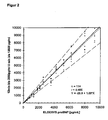
- the measuring range of the Roche-CARDIAC-proBNP test strip which lies in a range of 60-3000 pg / mL, can be extended to a range of 60-10000 pg / mL.
- a preferred embodiment of the present invention therefore relates to the quantitative determination of an analyte concentration, wherein the In turn, analyte is preferably selected from troponin T, myoglobin, D-dimer and NT-proBNP.
- the determination takes place in the range of 3000-10000 pg / mL with a short reaction time between analyte-specific substance and analyte of 3-9 minutes, preferably 8 minutes.
- the determination of NT-proBNP in the concentration range of 60-3000 pg / mL is preferably carried out with a long reaction time of 10-15 minutes, preferably 12 minutes.
- the quantitative determination of the detectable signal is preferably carried out by optical methods, in particular by reflection photometric or fluorimetric detection or electrochemistry luminescence.
- optical methods in particular by reflection photometric or fluorimetric detection or electrochemistry luminescence.
- Other preferred quantitative determination methods include measurements to change dielectric constants, conductance measurements, changes in magnetic fields, or a change in the angle of optical rotation of polarized light.
- the method is carried out automatically, for example in an automatic analyzer.
- This device comprises a storage element on which the calibration graphs once created for an analyte are stored.
- a memory element include all common data carriers such as ROM keys, hard disks, CDs, floppy disks, DVDs, USB sticks, etc.
- the stored calibration graphs can then be specified for the sequential quantitative determination of multiple analyte samples.
- the inventive method can be used in particular for the identification of patients with acute coronary syndrome, in particular for Improve the early detection of acute coronary events, for example, to improve early detection in acute myocardial infarction.
- the CARCIAC-proBNP test carried out according to the invention with the two different reaction times has a quantitative measurement range of 60 to approx. 10000 pg / mL.
- the upper measuring range limit has thus been increased by more than three times.
Landscapes
- Health & Medical Sciences (AREA)
- Life Sciences & Earth Sciences (AREA)
- Immunology (AREA)
- Engineering & Computer Science (AREA)
- Chemical & Material Sciences (AREA)
- Molecular Biology (AREA)
- Urology & Nephrology (AREA)
- Hematology (AREA)
- Biomedical Technology (AREA)
- Physics & Mathematics (AREA)
- Analytical Chemistry (AREA)
- Cell Biology (AREA)
- Pathology (AREA)
- Food Science & Technology (AREA)
- Medicinal Chemistry (AREA)
- Biotechnology (AREA)
- Microbiology (AREA)
- Biochemistry (AREA)
- General Health & Medical Sciences (AREA)
- General Physics & Mathematics (AREA)
- Chemical Kinetics & Catalysis (AREA)
- Endocrinology (AREA)
- Investigating Or Analysing Materials By The Use Of Chemical Reactions (AREA)
- Investigating Or Analysing Biological Materials (AREA)
Priority Applications (9)
| Application Number | Priority Date | Filing Date | Title |
|---|---|---|---|
| EP06019008A EP1909206A1 (de) | 2006-09-11 | 2006-09-11 | Messbereichserweiterung chromatografischer Schnellteste |
| CA2600221A CA2600221C (en) | 2006-09-11 | 2007-09-06 | Measuring range extension of chromatographic rapid tests |
| EP07017673.0A EP1909207B1 (de) | 2006-09-11 | 2007-09-10 | Messbereichserweiterung chromatografischer Schnellteste |
| ES07017673.0T ES2533467T3 (es) | 2006-09-11 | 2007-09-10 | Ampliación del rango de medición de ensayos cromatográficos rápidos |
| JP2007234331A JP4823178B2 (ja) | 2006-09-11 | 2007-09-10 | クロマトグラフ迅速試験の測定範囲の拡張 |
| CN200710148772XA CN101144810B (zh) | 2006-09-11 | 2007-09-11 | 色谱快速试验的测定范围扩大 |
| US11/853,100 US20080070234A1 (en) | 2006-09-11 | 2007-09-11 | Measuring Range Extension of Chromatographic Rapid Tests |
| HK08110069.7A HK1118608B (en) | 2006-09-11 | 2008-09-10 | Measuring range extension of chromatographic rapid tests |
| US14/330,179 US9285376B2 (en) | 2006-09-11 | 2014-07-14 | Measuring range extension of chromatographic rapid tests |
Applications Claiming Priority (1)
| Application Number | Priority Date | Filing Date | Title |
|---|---|---|---|
| EP06019008A EP1909206A1 (de) | 2006-09-11 | 2006-09-11 | Messbereichserweiterung chromatografischer Schnellteste |
Publications (1)
| Publication Number | Publication Date |
|---|---|
| EP1909206A1 true EP1909206A1 (de) | 2008-04-09 |
Family
ID=37696091
Family Applications (1)
| Application Number | Title | Priority Date | Filing Date |
|---|---|---|---|
| EP06019008A Ceased EP1909206A1 (de) | 2006-09-11 | 2006-09-11 | Messbereichserweiterung chromatografischer Schnellteste |
Country Status (6)
| Country | Link |
|---|---|
| US (2) | US20080070234A1 (enExample) |
| EP (1) | EP1909206A1 (enExample) |
| JP (1) | JP4823178B2 (enExample) |
| CN (1) | CN101144810B (enExample) |
| CA (1) | CA2600221C (enExample) |
| ES (1) | ES2533467T3 (enExample) |
Families Citing this family (6)
| Publication number | Priority date | Publication date | Assignee | Title |
|---|---|---|---|---|
| WO2010017972A1 (en) * | 2008-08-13 | 2010-02-18 | Roche Diagnostics Gmbh | D-dimer, troponin, nt-probnp for pulmonary embolism |
| KR101789893B1 (ko) * | 2012-12-20 | 2017-11-20 | 에프. 호프만-라 로슈 아게 | 의학적 측정 곡선들을 평가하기 위한 방법 |
| EP2936155B1 (en) | 2012-12-20 | 2018-12-12 | Roche Diabetes Care GmbH | Method for analyzing a sample of a body fluid |
| CN104714025B (zh) * | 2014-11-28 | 2017-05-17 | 威海纽普生物技术有限公司 | NT‑proBNP检测试剂盒及检测方法 |
| CN107505299A (zh) * | 2017-09-04 | 2017-12-22 | 中国人民解放军第三军医大学 | 一种从尿液中检测骨骼肌微损伤标志物肌红蛋白的方法 |
| KR20190076624A (ko) * | 2017-12-22 | 2019-07-02 | 삼성전자주식회사 | 검사 장치 및 그 제어방법 |
Citations (2)
| Publication number | Priority date | Publication date | Assignee | Title |
|---|---|---|---|---|
| WO1996024062A1 (en) * | 1995-02-01 | 1996-08-08 | Cornell Research Foundation, Inc. | Liposome-enhanced immunoaggregation assay and test device |
| WO2000045176A2 (de) * | 1999-01-29 | 2000-08-03 | Roche Diagnostics Gmbh | VERFAHREN ZUM NACHWEIS VON N-TERMINALEM proBNP |
Family Cites Families (15)
| Publication number | Priority date | Publication date | Assignee | Title |
|---|---|---|---|---|
| JP2946850B2 (ja) * | 1991-06-30 | 1999-09-06 | 株式会社島津製作所 | 抗原抗体反応におけるプロゾーン判定方法及び分析方法 |
| FR2693213B1 (fr) | 1992-07-03 | 1994-08-05 | Kaysersberg Sa | Procede destine a diminuer l'interaction entre fibres dans un tissue et mise en óoeuvre de ce procede, notamment pour fabriquer des tissues multi-strates. |
| JPH0696697A (ja) | 1992-09-11 | 1994-04-08 | Hitachi Ltd | カラー陰極線管 |
| JPH0875740A (ja) * | 1994-08-31 | 1996-03-22 | Shimadzu Corp | 免疫比濁分析方法 |
| US6830731B1 (en) * | 1998-01-05 | 2004-12-14 | Biosite, Inc. | Immunoassay fluorometer |
| DE60117699T2 (de) * | 2000-12-26 | 2006-10-19 | Matsushita Electric Industrial Co., Ltd., Kadoma | Analyseverfahren durch spezifisches binden und vorrichtung, die das verfahren einsetzt |
| KR100550707B1 (ko) * | 2001-08-09 | 2006-02-08 | 마츠시타 덴끼 산교 가부시키가이샤 | 바이오센서 및 측정방법 |
| JPWO2003029822A1 (ja) * | 2001-09-28 | 2005-01-20 | 松下電器産業株式会社 | 特異結合分析装置および特異結合分析方法 |
| US7054759B2 (en) * | 2001-12-27 | 2006-05-30 | Arkray, Inc | Concentration measuring method |
| EP1365240B1 (en) * | 2002-05-22 | 2006-09-13 | Sysmex Corporation | Immunoassay methods, immunoassay apparatuses, and reagents for immunoassays |
| JP2006526140A (ja) * | 2002-12-24 | 2006-11-16 | バイオサイト インコーポレイテッド | 鑑別診断のためのマーカーおよびその使用方法 |
| US20050250141A1 (en) * | 2004-03-30 | 2005-11-10 | Lambert James L | Diagnostic assays including multiplexed lateral flow immunoassays with quantum dots |
| DE102004023402A1 (de) * | 2004-05-12 | 2005-12-08 | Roche Diagnostics Gmbh | Verfahren zur Erhöhung des dynamischen Messbereichs von auf spezifischen Bindereaktionen basierenden, insbesondere immunologischen Testelementen |
| JP4805564B2 (ja) * | 2004-10-22 | 2011-11-02 | シスメックス株式会社 | 生体試料分析装置および方法 |
| WO2006096697A2 (en) * | 2005-03-08 | 2006-09-14 | Tanox, Inc. | Methods for determining the bivalency of protein and antibody therapeutics |
-
2006
- 2006-09-11 EP EP06019008A patent/EP1909206A1/de not_active Ceased
-
2007
- 2007-09-06 CA CA2600221A patent/CA2600221C/en not_active Expired - Fee Related
- 2007-09-10 ES ES07017673.0T patent/ES2533467T3/es active Active
- 2007-09-10 JP JP2007234331A patent/JP4823178B2/ja not_active Expired - Fee Related
- 2007-09-11 US US11/853,100 patent/US20080070234A1/en not_active Abandoned
- 2007-09-11 CN CN200710148772XA patent/CN101144810B/zh active Active
-
2014
- 2014-07-14 US US14/330,179 patent/US9285376B2/en active Active
Patent Citations (2)
| Publication number | Priority date | Publication date | Assignee | Title |
|---|---|---|---|---|
| WO1996024062A1 (en) * | 1995-02-01 | 1996-08-08 | Cornell Research Foundation, Inc. | Liposome-enhanced immunoaggregation assay and test device |
| WO2000045176A2 (de) * | 1999-01-29 | 2000-08-03 | Roche Diagnostics Gmbh | VERFAHREN ZUM NACHWEIS VON N-TERMINALEM proBNP |
Non-Patent Citations (2)
| Title |
|---|
| LAGERSTEDT SUSAN A ET AL: "Measurement of plasma free metanephrine and normetanephrine by liquid chromatography-tandem mass spectrometry for diagnosis of pheochromocytoma.", CLINICAL CHEMISTRY MAR 2004, vol. 50, no. 3, March 2004 (2004-03-01), pages 603 - 611, XP002419018, ISSN: 0009-9147 * |
| SHIN IN SOO ET AL: "An improved, reliable and practical kinetic assay for the detection of prekallikrein activator in blood products.", ARCHIVES OF PHARMACAL RESEARCH (SEOUL), vol. 25, no. 4, August 2002 (2002-08-01), pages 505 - 510, XP009078638, ISSN: 0253-6269 * |
Also Published As
| Publication number | Publication date |
|---|---|
| CA2600221C (en) | 2017-05-30 |
| US20140322703A1 (en) | 2014-10-30 |
| ES2533467T3 (es) | 2015-04-10 |
| CN101144810B (zh) | 2012-12-05 |
| CN101144810A (zh) | 2008-03-19 |
| CA2600221A1 (en) | 2008-03-11 |
| HK1118608A1 (en) | 2009-02-13 |
| JP4823178B2 (ja) | 2011-11-24 |
| JP2008070366A (ja) | 2008-03-27 |
| US9285376B2 (en) | 2016-03-15 |
| US20080070234A1 (en) | 2008-03-20 |
Similar Documents
| Publication | Publication Date | Title |
|---|---|---|
| DE69422210T2 (de) | Biospezifischer Festphasenträger | |
| DE68924064T2 (de) | Verfahren zur Bestimmung eines oder mehrerer Analyte durch Anwendung verschiedene Typen von Partikeln, welche durchflusszytometrisch unterschieden sind. | |
| EP1451586B1 (de) | Verfahren und vorrichtung zur bestimmung der konzentration von in einer zu untersuchenden probe enthaltenen liganden | |
| DE69733488T2 (de) | Verfahren zur besserung der wiederfindung troponin i und t | |
| DE69410636T2 (de) | Bindungsbestimmung | |
| DE602004001533T2 (de) | Immunoassay von kardialem Troponin I | |
| DE69633780T2 (de) | Verfahren zum assay von troponin i und t und komplexen von troponin i und t und auswahl von antikörpern zur verwendung in immunoassays | |
| WO1999005525A1 (de) | Verwendung von kontrollflächen zur detektion von störproben in einem nachweisverfahren | |
| DE3784479T2 (de) | Diagnostisches hilfsmittel, seine herstellung und seine verwendung. | |
| US9285376B2 (en) | Measuring range extension of chromatographic rapid tests | |
| DE69411189T2 (de) | Rücktitrations-messverfahren unter verwendung von zweiverschiedenen markern | |
| DE2602068C2 (de) | Reagens zur Unlöslichmachung eines Antigen/Antikörper-Komplexes | |
| EP3293521B1 (de) | Herstellung lipämischer plasma- oder serumproben für die bestimmung einer lipidinterferenz | |
| DE10211818B4 (de) | Verfahren zur quantitativen Bestimmung mehrerer Analyten | |
| DE69523027T2 (de) | Kalibrierung und Prüfung von Immunoassays zur Verminderung von Störungen | |
| DE102007017906A1 (de) | Verfahren zur Bestimmung der Reaktions-Lag-Phase in einer analytabhängigen Reaktion | |
| DE3787706T2 (de) | Verfahren zur quantitativen Bestimmung der Antigene und Antikörper. | |
| EP2634584B1 (de) | Screening-Methode zum Auffinden von Proben mit Antiphospholipid-Antikörpern | |
| EP1909207B1 (de) | Messbereichserweiterung chromatografischer Schnellteste | |
| EP0571939A1 (de) | Verfahren und Mittel zur Bestimmung eines Analyts | |
| DE60110755T2 (de) | Testverfahren zum nachweiss von lipoproteinen | |
| DE69114376T2 (de) | Element zur Bestimmung von Katechin und Katechin-bildenden Substanzen. | |
| DE2318044A1 (de) | Verfahren zur analytischen bestimmung von bestandteilen in einer materialprobe wie einer biologischen fluessigkeit | |
| EP1269190B1 (de) | Verfahren zum nachweisen und/oder quantifizieren erster moleküle | |
| WO2002029430A1 (de) | Verfahren und vorrichtung zur untersuchung biologischer und/oder chemischer proben mittels giant-magnetoimpedanz (gmi) |
Legal Events
| Date | Code | Title | Description |
|---|---|---|---|
| PUAI | Public reference made under article 153(3) epc to a published international application that has entered the european phase |
Free format text: ORIGINAL CODE: 0009012 |
|
| AK | Designated contracting states |
Kind code of ref document: A1 Designated state(s): AT BE BG CH CY CZ DE DK EE ES FI FR GB GR HU IE IS IT LI LT LU LV MC NL PL PT RO SE SI SK TR |
|
| AX | Request for extension of the european patent |
Extension state: AL BA HR MK RS |
|
| STAA | Information on the status of an ep patent application or granted ep patent |
Free format text: STATUS: THE APPLICATION HAS BEEN REFUSED |
|
| 18R | Application refused |
Effective date: 20080426 |