EP1846469B1 - A polyurea compound - Google Patents
A polyurea compound Download PDFInfo
- Publication number
- EP1846469B1 EP1846469B1 EP06700743.5A EP06700743A EP1846469B1 EP 1846469 B1 EP1846469 B1 EP 1846469B1 EP 06700743 A EP06700743 A EP 06700743A EP 1846469 B1 EP1846469 B1 EP 1846469B1
- Authority
- EP
- European Patent Office
- Prior art keywords
- mono
- amine
- polyurea
- chiral
- polyurea compound
- Prior art date
- Legal status (The legal status is an assumption and is not a legal conclusion. Google has not performed a legal analysis and makes no representation as to the accuracy of the status listed.)
- Active
Links
- 229920002396 Polyurea Polymers 0.000 title claims description 113
- 150000001875 compounds Chemical class 0.000 title claims description 112
- 239000000203 mixture Substances 0.000 claims description 120
- WGQKYBSKWIADBV-UHFFFAOYSA-N benzylamine Chemical compound NCC1=CC=CC=C1 WGQKYBSKWIADBV-UHFFFAOYSA-N 0.000 claims description 108
- 150000001412 amines Chemical class 0.000 claims description 50
- 239000003795 chemical substances by application Substances 0.000 claims description 50
- 239000008199 coating composition Substances 0.000 claims description 44
- 238000000518 rheometry Methods 0.000 claims description 43
- 239000011230 binding agent Substances 0.000 claims description 42
- 230000004048 modification Effects 0.000 claims description 36
- 238000012986 modification Methods 0.000 claims description 36
- 239000005056 polyisocyanate Substances 0.000 claims description 32
- 229920001228 polyisocyanate Polymers 0.000 claims description 32
- 239000012948 isocyanate Substances 0.000 claims description 30
- RQEUFEKYXDPUSK-UHFFFAOYSA-N 1-phenylethylamine Chemical compound CC(N)C1=CC=CC=C1 RQEUFEKYXDPUSK-UHFFFAOYSA-N 0.000 claims description 18
- 229910052799 carbon Inorganic materials 0.000 claims description 18
- 239000007795 chemical reaction product Substances 0.000 claims description 16
- 125000005842 heteroatom Chemical group 0.000 claims description 14
- 238000006243 chemical reaction Methods 0.000 claims description 13
- 238000000576 coating method Methods 0.000 claims description 12
- 125000003118 aryl group Chemical group 0.000 claims description 11
- 125000001183 hydrocarbyl group Chemical group 0.000 claims description 11
- 239000000047 product Substances 0.000 claims description 11
- 239000000463 material Substances 0.000 claims description 10
- 229920000768 polyamine Polymers 0.000 claims description 10
- 229920006395 saturated elastomer Polymers 0.000 claims description 10
- 125000000217 alkyl group Chemical group 0.000 claims description 9
- 239000011248 coating agent Substances 0.000 claims description 9
- 239000002904 solvent Substances 0.000 claims description 9
- 125000004429 atom Chemical group 0.000 claims description 8
- 238000002844 melting Methods 0.000 claims description 8
- 230000008018 melting Effects 0.000 claims description 8
- 238000000034 method Methods 0.000 claims description 8
- 125000002496 methyl group Chemical group [H]C([H])([H])* 0.000 claims description 7
- 230000008569 process Effects 0.000 claims description 7
- HDOUGSFASVGDCS-UHFFFAOYSA-N pyridin-3-ylmethanamine Chemical compound NCC1=CC=CN=C1 HDOUGSFASVGDCS-UHFFFAOYSA-N 0.000 claims description 7
- 239000004594 Masterbatch (MB) Substances 0.000 claims description 6
- 239000007787 solid Substances 0.000 claims description 6
- 235000001014 amino acid Nutrition 0.000 claims description 5
- 150000001413 amino acids Chemical class 0.000 claims description 5
- 125000004432 carbon atom Chemical group C* 0.000 claims description 4
- 230000001376 precipitating effect Effects 0.000 claims description 4
- 238000002360 preparation method Methods 0.000 claims description 4
- 239000002244 precipitate Substances 0.000 claims description 3
- 238000001556 precipitation Methods 0.000 claims description 2
- 125000004076 pyridyl group Chemical group 0.000 claims 1
- 239000005057 Hexamethylene diisocyanate Substances 0.000 description 70
- 238000002474 experimental method Methods 0.000 description 58
- 230000000052 comparative effect Effects 0.000 description 57
- 238000009472 formulation Methods 0.000 description 28
- 125000001424 substituent group Chemical group 0.000 description 26
- 150000002513 isocyanates Chemical class 0.000 description 19
- 239000004971 Cross linker Substances 0.000 description 13
- 150000001721 carbon Chemical group 0.000 description 13
- RRAMGCGOFNQTLD-UHFFFAOYSA-N hexamethylene diisocyanate Chemical compound O=C=NCCCCCCN=C=O RRAMGCGOFNQTLD-UHFFFAOYSA-N 0.000 description 13
- UHOVQNZJYSORNB-UHFFFAOYSA-N Benzene Chemical compound C1=CC=CC=C1 UHOVQNZJYSORNB-UHFFFAOYSA-N 0.000 description 12
- 238000001723 curing Methods 0.000 description 12
- 229920005862 polyol Polymers 0.000 description 12
- -1 3-aminomethyl-pyridyl Chemical group 0.000 description 10
- 230000008901 benefit Effects 0.000 description 9
- 150000003077 polyols Chemical class 0.000 description 9
- 238000003756 stirring Methods 0.000 description 9
- 235000013350 formula milk Nutrition 0.000 description 8
- 238000002156 mixing Methods 0.000 description 8
- 229940008841 1,6-hexamethylene diisocyanate Drugs 0.000 description 7
- CTQNGGLPUBDAKN-UHFFFAOYSA-N O-Xylene Chemical compound CC1=CC=CC=C1C CTQNGGLPUBDAKN-UHFFFAOYSA-N 0.000 description 7
- 150000002148 esters Chemical class 0.000 description 7
- IVJISJACKSSFGE-UHFFFAOYSA-N formaldehyde;1,3,5-triazine-2,4,6-triamine Chemical compound O=C.NC1=NC(N)=NC(N)=N1 IVJISJACKSSFGE-UHFFFAOYSA-N 0.000 description 7
- UPMLOUAZCHDJJD-UHFFFAOYSA-N 4,4'-Diphenylmethane Diisocyanate Chemical compound C1=CC(N=C=O)=CC=C1CC1=CC=C(N=C=O)C=C1 UPMLOUAZCHDJJD-UHFFFAOYSA-N 0.000 description 6
- HBAQYPYDRFILMT-UHFFFAOYSA-N 8-[3-(1-cyclopropylpyrazol-4-yl)-1H-pyrazolo[4,3-d]pyrimidin-5-yl]-3-methyl-3,8-diazabicyclo[3.2.1]octan-2-one Chemical class C1(CC1)N1N=CC(=C1)C1=NNC2=C1N=C(N=C2)N1C2C(N(CC1CC2)C)=O HBAQYPYDRFILMT-UHFFFAOYSA-N 0.000 description 6
- DKPFZGUDAPQIHT-UHFFFAOYSA-N Butyl acetate Natural products CCCCOC(C)=O DKPFZGUDAPQIHT-UHFFFAOYSA-N 0.000 description 6
- RTZKZFJDLAIYFH-UHFFFAOYSA-N Diethyl ether Chemical compound CCOCC RTZKZFJDLAIYFH-UHFFFAOYSA-N 0.000 description 6
- WSFSSNUMVMOOMR-UHFFFAOYSA-N Formaldehyde Chemical compound O=C WSFSSNUMVMOOMR-UHFFFAOYSA-N 0.000 description 6
- LRHPLDYGYMQRHN-UHFFFAOYSA-N N-Butanol Chemical compound CCCCO LRHPLDYGYMQRHN-UHFFFAOYSA-N 0.000 description 6
- XSQUKJJJFZCRTK-UHFFFAOYSA-N Urea Natural products NC(N)=O XSQUKJJJFZCRTK-UHFFFAOYSA-N 0.000 description 6
- 239000000654 additive Substances 0.000 description 6
- 125000003277 amino group Chemical group 0.000 description 6
- 229940043232 butyl acetate Drugs 0.000 description 6
- FUZZWVXGSFPDMH-UHFFFAOYSA-N hexanoic acid Chemical compound CCCCCC(O)=O FUZZWVXGSFPDMH-UHFFFAOYSA-N 0.000 description 6
- NIXOWILDQLNWCW-UHFFFAOYSA-N acrylic acid group Chemical group C(C=C)(=O)O NIXOWILDQLNWCW-UHFFFAOYSA-N 0.000 description 5
- 125000003545 alkoxy group Chemical group 0.000 description 5
- 125000004435 hydrogen atom Chemical group [H]* 0.000 description 5
- 229920005989 resin Polymers 0.000 description 5
- 239000011347 resin Substances 0.000 description 5
- 229920001187 thermosetting polymer Polymers 0.000 description 5
- 230000009974 thixotropic effect Effects 0.000 description 5
- 241001362551 Samba Species 0.000 description 4
- 229920006243 acrylic copolymer Polymers 0.000 description 4
- 125000003342 alkenyl group Chemical group 0.000 description 4
- 229940024606 amino acid Drugs 0.000 description 4
- 150000003862 amino acid derivatives Chemical class 0.000 description 4
- 125000003710 aryl alkyl group Chemical group 0.000 description 4
- 125000004122 cyclic group Chemical group 0.000 description 4
- 230000000694 effects Effects 0.000 description 4
- 125000001495 ethyl group Chemical group [H]C([H])([H])C([H])([H])* 0.000 description 4
- IQPQWNKOIGAROB-UHFFFAOYSA-N isocyanate group Chemical group [N-]=C=O IQPQWNKOIGAROB-UHFFFAOYSA-N 0.000 description 4
- 239000003973 paint Substances 0.000 description 4
- 239000000049 pigment Substances 0.000 description 4
- 229920005906 polyester polyol Polymers 0.000 description 4
- QTBSBXVTEAMEQO-UHFFFAOYSA-N Acetic acid Chemical compound CC(O)=O QTBSBXVTEAMEQO-UHFFFAOYSA-N 0.000 description 3
- CSCPPACGZOOCGX-UHFFFAOYSA-N Acetone Chemical compound CC(C)=O CSCPPACGZOOCGX-UHFFFAOYSA-N 0.000 description 3
- OKTJSMMVPCPJKN-UHFFFAOYSA-N Carbon Chemical compound [C] OKTJSMMVPCPJKN-UHFFFAOYSA-N 0.000 description 3
- 239000004593 Epoxy Substances 0.000 description 3
- JOYRKODLDBILNP-UHFFFAOYSA-N Ethyl urethane Chemical compound CCOC(N)=O JOYRKODLDBILNP-UHFFFAOYSA-N 0.000 description 3
- QUSNBJAOOMFDIB-UHFFFAOYSA-N Ethylamine Chemical compound CCN QUSNBJAOOMFDIB-UHFFFAOYSA-N 0.000 description 3
- 229930194542 Keto Natural products 0.000 description 3
- 229920000877 Melamine resin Polymers 0.000 description 3
- SECXISVLQFMRJM-UHFFFAOYSA-N N-Methylpyrrolidone Chemical compound CN1CCCC1=O SECXISVLQFMRJM-UHFFFAOYSA-N 0.000 description 3
- ABLZXFCXXLZCGV-UHFFFAOYSA-N Phosphorous acid Chemical compound OP(O)=O ABLZXFCXXLZCGV-UHFFFAOYSA-N 0.000 description 3
- YXFVVABEGXRONW-UHFFFAOYSA-N Toluene Chemical compound CC1=CC=CC=C1 YXFVVABEGXRONW-UHFFFAOYSA-N 0.000 description 3
- 239000002253 acid Substances 0.000 description 3
- 125000001931 aliphatic group Chemical group 0.000 description 3
- 230000015572 biosynthetic process Effects 0.000 description 3
- 239000004202 carbamide Substances 0.000 description 3
- 239000012530 fluid Substances 0.000 description 3
- 239000001257 hydrogen Substances 0.000 description 3
- 229910052739 hydrogen Inorganic materials 0.000 description 3
- 125000002887 hydroxy group Chemical group [H]O* 0.000 description 3
- RAXXELZNTBOGNW-UHFFFAOYSA-N imidazole Natural products C1=CNC=N1 RAXXELZNTBOGNW-UHFFFAOYSA-N 0.000 description 3
- 150000004658 ketimines Chemical class 0.000 description 3
- 125000000468 ketone group Chemical group 0.000 description 3
- 229940078552 o-xylene Drugs 0.000 description 3
- 230000003287 optical effect Effects 0.000 description 3
- 238000007665 sagging Methods 0.000 description 3
- 150000003839 salts Chemical class 0.000 description 3
- 239000000243 solution Substances 0.000 description 3
- 239000013638 trimer Substances 0.000 description 3
- AVWRKZWQTYIKIY-UHFFFAOYSA-N urea-1-carboxylic acid Chemical compound NC(=O)NC(O)=O AVWRKZWQTYIKIY-UHFFFAOYSA-N 0.000 description 3
- RQEUFEKYXDPUSK-SSDOTTSWSA-N (1R)-1-phenylethanamine Chemical compound C[C@@H](N)C1=CC=CC=C1 RQEUFEKYXDPUSK-SSDOTTSWSA-N 0.000 description 2
- 125000006686 (C1-C24) alkyl group Chemical group 0.000 description 2
- 125000004178 (C1-C4) alkyl group Chemical group 0.000 description 2
- 239000004925 Acrylic resin Substances 0.000 description 2
- 229920000178 Acrylic resin Polymers 0.000 description 2
- WHUUTDBJXJRKMK-UHFFFAOYSA-N Glutamic acid Natural products OC(=O)C(N)CCC(O)=O WHUUTDBJXJRKMK-UHFFFAOYSA-N 0.000 description 2
- ZRALSGWEFCBTJO-UHFFFAOYSA-N Guanidine Chemical compound NC(N)=N ZRALSGWEFCBTJO-UHFFFAOYSA-N 0.000 description 2
- SIKJAQJRHWYJAI-UHFFFAOYSA-N Indole Chemical compound C1=CC=C2NC=CC2=C1 SIKJAQJRHWYJAI-UHFFFAOYSA-N 0.000 description 2
- CKLJMWTZIZZHCS-REOHCLBHSA-N L-aspartic acid Chemical compound OC(=O)[C@@H](N)CC(O)=O CKLJMWTZIZZHCS-REOHCLBHSA-N 0.000 description 2
- FFFHZYDWPBMWHY-VKHMYHEASA-N L-homocysteine Chemical compound OC(=O)[C@@H](N)CCS FFFHZYDWPBMWHY-VKHMYHEASA-N 0.000 description 2
- AGPKZVBTJJNPAG-WHFBIAKZSA-N L-isoleucine Chemical compound CC[C@H](C)[C@H](N)C(O)=O AGPKZVBTJJNPAG-WHFBIAKZSA-N 0.000 description 2
- ROHFNLRQFUQHCH-YFKPBYRVSA-N L-leucine Chemical compound CC(C)C[C@H](N)C(O)=O ROHFNLRQFUQHCH-YFKPBYRVSA-N 0.000 description 2
- SNDPXSYFESPGGJ-UHFFFAOYSA-N L-norVal-OH Natural products CCCC(N)C(O)=O SNDPXSYFESPGGJ-UHFFFAOYSA-N 0.000 description 2
- LRQKBLKVPFOOQJ-YFKPBYRVSA-N L-norleucine Chemical compound CCCC[C@H]([NH3+])C([O-])=O LRQKBLKVPFOOQJ-YFKPBYRVSA-N 0.000 description 2
- COLNVLDHVKWLRT-QMMMGPOBSA-N L-phenylalanine Chemical compound OC(=O)[C@@H](N)CC1=CC=CC=C1 COLNVLDHVKWLRT-QMMMGPOBSA-N 0.000 description 2
- OUYCCCASQSFEME-QMMMGPOBSA-N L-tyrosine Chemical compound OC(=O)[C@@H](N)CC1=CC=C(O)C=C1 OUYCCCASQSFEME-QMMMGPOBSA-N 0.000 description 2
- KDXKERNSBIXSRK-UHFFFAOYSA-N Lysine Natural products NCCCCC(N)C(O)=O KDXKERNSBIXSRK-UHFFFAOYSA-N 0.000 description 2
- KZSNJWFQEVHDMF-UHFFFAOYSA-N Valine Natural products CC(C)C(N)C(O)=O KZSNJWFQEVHDMF-UHFFFAOYSA-N 0.000 description 2
- 150000007513 acids Chemical class 0.000 description 2
- 125000003647 acryloyl group Chemical group O=C([*])C([H])=C([H])[H] 0.000 description 2
- 239000000853 adhesive Substances 0.000 description 2
- 230000001070 adhesive effect Effects 0.000 description 2
- 239000002671 adjuvant Substances 0.000 description 2
- 150000001408 amides Chemical class 0.000 description 2
- 125000000732 arylene group Chemical group 0.000 description 2
- HQABUPZFAYXKJW-UHFFFAOYSA-N butan-1-amine Chemical compound CCCCN HQABUPZFAYXKJW-UHFFFAOYSA-N 0.000 description 2
- RJJXSCQQRYCPLW-LURJTMIESA-N butyl (2s)-2-aminopropanoate Chemical compound CCCCOC(=O)[C@H](C)N RJJXSCQQRYCPLW-LURJTMIESA-N 0.000 description 2
- 150000001732 carboxylic acid derivatives Chemical class 0.000 description 2
- 239000002537 cosmetic Substances 0.000 description 2
- 238000004132 cross linking Methods 0.000 description 2
- 230000001186 cumulative effect Effects 0.000 description 2
- PAFZNILMFXTMIY-UHFFFAOYSA-N cyclohexylamine Chemical compound NC1CCCCC1 PAFZNILMFXTMIY-UHFFFAOYSA-N 0.000 description 2
- 230000007423 decrease Effects 0.000 description 2
- 239000003599 detergent Substances 0.000 description 2
- 150000004985 diamines Chemical class 0.000 description 2
- 125000005442 diisocyanate group Chemical group 0.000 description 2
- 239000006185 dispersion Substances 0.000 description 2
- 238000006073 displacement reaction Methods 0.000 description 2
- 150000002170 ethers Chemical class 0.000 description 2
- 238000010438 heat treatment Methods 0.000 description 2
- 230000006872 improvement Effects 0.000 description 2
- 239000000976 ink Substances 0.000 description 2
- ZFSLODLOARCGLH-UHFFFAOYSA-N isocyanuric acid Chemical group OC1=NC(O)=NC(O)=N1 ZFSLODLOARCGLH-UHFFFAOYSA-N 0.000 description 2
- 239000007788 liquid Substances 0.000 description 2
- 238000005259 measurement Methods 0.000 description 2
- 230000007246 mechanism Effects 0.000 description 2
- 238000005065 mining Methods 0.000 description 2
- 239000000123 paper Substances 0.000 description 2
- 239000011087 paperboard Substances 0.000 description 2
- 238000007639 printing Methods 0.000 description 2
- 239000007858 starting material Substances 0.000 description 2
- 239000000758 substrate Substances 0.000 description 2
- 239000004753 textile Substances 0.000 description 2
- 150000003573 thiols Chemical class 0.000 description 2
- DVKJHBMWWAPEIU-UHFFFAOYSA-N toluene 2,4-diisocyanate Chemical compound CC1=CC=C(N=C=O)C=C1N=C=O DVKJHBMWWAPEIU-UHFFFAOYSA-N 0.000 description 2
- XLYOFNOQVPJJNP-UHFFFAOYSA-N water Substances O XLYOFNOQVPJJNP-UHFFFAOYSA-N 0.000 description 2
- XINQFOMFQFGGCQ-UHFFFAOYSA-L (2-dodecoxy-2-oxoethyl)-[6-[(2-dodecoxy-2-oxoethyl)-dimethylazaniumyl]hexyl]-dimethylazanium;dichloride Chemical compound [Cl-].[Cl-].CCCCCCCCCCCCOC(=O)C[N+](C)(C)CCCCCC[N+](C)(C)CC(=O)OCCCCCCCCCCCC XINQFOMFQFGGCQ-UHFFFAOYSA-L 0.000 description 1
- 125000000229 (C1-C4)alkoxy group Chemical group 0.000 description 1
- 125000006527 (C1-C5) alkyl group Chemical group 0.000 description 1
- 125000004209 (C1-C8) alkyl group Chemical group 0.000 description 1
- XMKLTEGSALONPH-UHFFFAOYSA-N 1,2,4,5-tetrazinane-3,6-dione Chemical compound O=C1NNC(=O)NN1 XMKLTEGSALONPH-UHFFFAOYSA-N 0.000 description 1
- AUHZEENZYGFFBQ-UHFFFAOYSA-N 1,3,5-trimethylbenzene Chemical group CC1=CC(C)=CC(C)=C1 AUHZEENZYGFFBQ-UHFFFAOYSA-N 0.000 description 1
- YFIJHKACBGRMFQ-UHFFFAOYSA-N 1-(4-methoxyphenyl)butan-1-amine Chemical compound CCCC(N)C1=CC=C(OC)C=C1 YFIJHKACBGRMFQ-UHFFFAOYSA-N 0.000 description 1
- JTDGKQNNPKXKII-UHFFFAOYSA-N 1-(4-methoxyphenyl)ethanamine Chemical compound COC1=CC=C(C(C)N)C=C1 JTDGKQNNPKXKII-UHFFFAOYSA-N 0.000 description 1
- WOEIOKRLEJXFEF-UHFFFAOYSA-N 1-(4-methoxyphenyl)propan-1-amine Chemical compound CCC(N)C1=CC=C(OC)C=C1 WOEIOKRLEJXFEF-UHFFFAOYSA-N 0.000 description 1
- UZDDXUMOXKDXNE-UHFFFAOYSA-N 1-(4-methylphenyl)ethanamine Chemical compound CC(N)C1=CC=C(C)C=C1 UZDDXUMOXKDXNE-UHFFFAOYSA-N 0.000 description 1
- XBWOPGDJMAJJDG-UHFFFAOYSA-N 1-cyclohexylethanamine Chemical compound CC(N)C1CCCCC1 XBWOPGDJMAJJDG-UHFFFAOYSA-N 0.000 description 1
- BMVXCPBXGZKUPN-UHFFFAOYSA-N 1-hexanamine Chemical compound CCCCCCN BMVXCPBXGZKUPN-UHFFFAOYSA-N 0.000 description 1
- NXMXETCTWNXSFG-UHFFFAOYSA-N 1-methoxypropan-2-amine Chemical compound COCC(C)N NXMXETCTWNXSFG-UHFFFAOYSA-N 0.000 description 1
- IKYFHRVPKIFGMH-UHFFFAOYSA-N 1-phenoxypropan-2-amine Chemical compound CC(N)COC1=CC=CC=C1 IKYFHRVPKIFGMH-UHFFFAOYSA-N 0.000 description 1
- DFQWOAPAERBEID-UHFFFAOYSA-N 1-phenylmethoxybutan-2-amine Chemical compound CCC(N)COCC1=CC=CC=C1 DFQWOAPAERBEID-UHFFFAOYSA-N 0.000 description 1
- HYUZZQIAJWNRAQ-UHFFFAOYSA-N 1-phenylmethoxypropan-2-amine Chemical compound CC(N)COCC1=CC=CC=C1 HYUZZQIAJWNRAQ-UHFFFAOYSA-N 0.000 description 1
- NTHNRYLIXJZHRZ-UHFFFAOYSA-N 2-phenylmethoxycyclohexan-1-amine Chemical compound NC1CCCCC1OCC1=CC=CC=C1 NTHNRYLIXJZHRZ-UHFFFAOYSA-N 0.000 description 1
- JIMSXLUBRRQALI-UHFFFAOYSA-N 2-phenylmethoxycyclopentan-1-amine Chemical compound NC1CCCC1OCC1=CC=CC=C1 JIMSXLUBRRQALI-UHFFFAOYSA-N 0.000 description 1
- DXSUORGKJZADET-UHFFFAOYSA-N 3,3-dimethylbutan-2-amine Chemical compound CC(N)C(C)(C)C DXSUORGKJZADET-UHFFFAOYSA-N 0.000 description 1
- FAXDZWQIWUSWJH-UHFFFAOYSA-N 3-methoxypropan-1-amine Chemical compound COCCCN FAXDZWQIWUSWJH-UHFFFAOYSA-N 0.000 description 1
- JOZZAIIGWFLONA-UHFFFAOYSA-N 3-methylbutan-2-amine Chemical compound CC(C)C(C)N JOZZAIIGWFLONA-UHFFFAOYSA-N 0.000 description 1
- 239000004475 Arginine Substances 0.000 description 1
- UAJRSHJHFRVGMG-UHFFFAOYSA-N COc1ccc(C=C)cc1 Chemical compound COc1ccc(C=C)cc1 UAJRSHJHFRVGMG-UHFFFAOYSA-N 0.000 description 1
- DRSHXJFUUPIBHX-UHFFFAOYSA-N COc1ccc(cc1)N1N=CC2C=NC(Nc3cc(OC)c(OC)c(OCCCN4CCN(C)CC4)c3)=NC12 Chemical compound COc1ccc(cc1)N1N=CC2C=NC(Nc3cc(OC)c(OC)c(OCCCN4CCN(C)CC4)c3)=NC12 DRSHXJFUUPIBHX-UHFFFAOYSA-N 0.000 description 1
- KXDHJXZQYSOELW-UHFFFAOYSA-M Carbamate Chemical group NC([O-])=O KXDHJXZQYSOELW-UHFFFAOYSA-M 0.000 description 1
- QIMMUPPBPVKWKM-UHFFFAOYSA-N Cc1cc2ccccc2cc1 Chemical compound Cc1cc2ccccc2cc1 QIMMUPPBPVKWKM-UHFFFAOYSA-N 0.000 description 1
- OTMSDBZUPAUEDD-UHFFFAOYSA-N Ethane Chemical compound CC OTMSDBZUPAUEDD-UHFFFAOYSA-N 0.000 description 1
- LFQSCWFLJHTTHZ-UHFFFAOYSA-N Ethanol Chemical compound CCO LFQSCWFLJHTTHZ-UHFFFAOYSA-N 0.000 description 1
- UFHFLCQGNIYNRP-UHFFFAOYSA-N Hydrogen Chemical compound [H][H] UFHFLCQGNIYNRP-UHFFFAOYSA-N 0.000 description 1
- AVXURJPOCDRRFD-UHFFFAOYSA-N Hydroxylamine Chemical compound ON AVXURJPOCDRRFD-UHFFFAOYSA-N 0.000 description 1
- SNDPXSYFESPGGJ-BYPYZUCNSA-N L-2-aminopentanoic acid Chemical compound CCC[C@H](N)C(O)=O SNDPXSYFESPGGJ-BYPYZUCNSA-N 0.000 description 1
- AHLPHDHHMVZTML-BYPYZUCNSA-N L-Ornithine Chemical compound NCCC[C@H](N)C(O)=O AHLPHDHHMVZTML-BYPYZUCNSA-N 0.000 description 1
- QNAYBMKLOCPYGJ-REOHCLBHSA-N L-alanine Chemical compound C[C@H](N)C(O)=O QNAYBMKLOCPYGJ-REOHCLBHSA-N 0.000 description 1
- FFEARJCKVFRZRR-BYPYZUCNSA-N L-methionine Chemical compound CSCC[C@H](N)C(O)=O FFEARJCKVFRZRR-BYPYZUCNSA-N 0.000 description 1
- QIVBCDIJIAJPQS-VIFPVBQESA-N L-tryptophane Chemical compound C1=CC=C2C(C[C@H](N)C(O)=O)=CNC2=C1 QIVBCDIJIAJPQS-VIFPVBQESA-N 0.000 description 1
- KZSNJWFQEVHDMF-BYPYZUCNSA-N L-valine Chemical compound CC(C)[C@H](N)C(O)=O KZSNJWFQEVHDMF-BYPYZUCNSA-N 0.000 description 1
- ROHFNLRQFUQHCH-UHFFFAOYSA-N Leucine Natural products CC(C)CC(N)C(O)=O ROHFNLRQFUQHCH-UHFFFAOYSA-N 0.000 description 1
- 239000004472 Lysine Substances 0.000 description 1
- NTIZESTWPVYFNL-UHFFFAOYSA-N Methyl isobutyl ketone Chemical compound CC(C)CC(C)=O NTIZESTWPVYFNL-UHFFFAOYSA-N 0.000 description 1
- UIHCLUNTQKBZGK-UHFFFAOYSA-N Methyl isobutyl ketone Natural products CCC(C)C(C)=O UIHCLUNTQKBZGK-UHFFFAOYSA-N 0.000 description 1
- CHJJGSNFBQVOTG-UHFFFAOYSA-N N-methyl-guanidine Natural products CNC(N)=N CHJJGSNFBQVOTG-UHFFFAOYSA-N 0.000 description 1
- AHLPHDHHMVZTML-UHFFFAOYSA-N Orn-delta-NH2 Natural products NCCCC(N)C(O)=O AHLPHDHHMVZTML-UHFFFAOYSA-N 0.000 description 1
- UTJLXEIPEHZYQJ-UHFFFAOYSA-N Ornithine Natural products OC(=O)C(C)CCCN UTJLXEIPEHZYQJ-UHFFFAOYSA-N 0.000 description 1
- BHHGXPLMPWCGHP-UHFFFAOYSA-N Phenethylamine Chemical compound NCCC1=CC=CC=C1 BHHGXPLMPWCGHP-UHFFFAOYSA-N 0.000 description 1
- 229920000805 Polyaspartic acid Polymers 0.000 description 1
- MTCFGRXMJLQNBG-UHFFFAOYSA-N Serine Natural products OCC(N)C(O)=O MTCFGRXMJLQNBG-UHFFFAOYSA-N 0.000 description 1
- AYFVYJQAPQTCCC-UHFFFAOYSA-N Threonine Natural products CC(O)C(N)C(O)=O AYFVYJQAPQTCCC-UHFFFAOYSA-N 0.000 description 1
- 239000004473 Threonine Substances 0.000 description 1
- QIVBCDIJIAJPQS-UHFFFAOYSA-N Tryptophan Natural products C1=CC=C2C(CC(N)C(O)=O)=CNC2=C1 QIVBCDIJIAJPQS-UHFFFAOYSA-N 0.000 description 1
- 238000003848 UV Light-Curing Methods 0.000 description 1
- 229960003767 alanine Drugs 0.000 description 1
- 235000004279 alanine Nutrition 0.000 description 1
- 150000001298 alcohols Chemical class 0.000 description 1
- 150000001338 aliphatic hydrocarbons Chemical class 0.000 description 1
- QWCKQJZIFLGMSD-UHFFFAOYSA-N alpha-aminobutyric acid Chemical compound CCC(N)C(O)=O QWCKQJZIFLGMSD-UHFFFAOYSA-N 0.000 description 1
- 235000020616 amino acid formula Nutrition 0.000 description 1
- 229940124277 aminobutyric acid Drugs 0.000 description 1
- 150000008064 anhydrides Chemical class 0.000 description 1
- ODKSFYDXXFIFQN-UHFFFAOYSA-N arginine Natural products OC(=O)C(N)CCCNC(N)=N ODKSFYDXXFIFQN-UHFFFAOYSA-N 0.000 description 1
- 235000009582 asparagine Nutrition 0.000 description 1
- 150000001508 asparagines Chemical class 0.000 description 1
- 235000003704 aspartic acid Nutrition 0.000 description 1
- OQFSQFPPLPISGP-UHFFFAOYSA-N beta-carboxyaspartic acid Natural products OC(=O)C(N)C(C(O)=O)C(O)=O OQFSQFPPLPISGP-UHFFFAOYSA-N 0.000 description 1
- OHJMTUPIZMNBFR-UHFFFAOYSA-N biuret Chemical compound NC(=O)NC(N)=O OHJMTUPIZMNBFR-UHFFFAOYSA-N 0.000 description 1
- 239000002981 blocking agent Substances 0.000 description 1
- 230000001680 brushing effect Effects 0.000 description 1
- 238000005266 casting Methods 0.000 description 1
- 238000004140 cleaning Methods 0.000 description 1
- 238000002288 cocrystallisation Methods 0.000 description 1
- 229940125782 compound 2 Drugs 0.000 description 1
- 238000010276 construction Methods 0.000 description 1
- 239000004035 construction material Substances 0.000 description 1
- 238000010924 continuous production Methods 0.000 description 1
- 239000003431 cross linking reagent Substances 0.000 description 1
- 238000002425 crystallisation Methods 0.000 description 1
- 125000004956 cyclohexylene group Chemical group 0.000 description 1
- 235000018417 cysteine Nutrition 0.000 description 1
- XUJNEKJLAYXESH-UHFFFAOYSA-N cysteine Natural products SCC(N)C(O)=O XUJNEKJLAYXESH-UHFFFAOYSA-N 0.000 description 1
- 230000003247 decreasing effect Effects 0.000 description 1
- 239000003085 diluting agent Substances 0.000 description 1
- 238000010790 dilution Methods 0.000 description 1
- 239000012895 dilution Substances 0.000 description 1
- SWSQBOPZIKWTGO-UHFFFAOYSA-N dimethylaminoamidine Natural products CN(C)C(N)=N SWSQBOPZIKWTGO-UHFFFAOYSA-N 0.000 description 1
- 238000007598 dipping method Methods 0.000 description 1
- 238000002845 discoloration Methods 0.000 description 1
- 239000002270 dispersing agent Substances 0.000 description 1
- 238000004090 dissolution Methods 0.000 description 1
- JRBPAEWTRLWTQC-UHFFFAOYSA-N dodecylamine Chemical compound CCCCCCCCCCCCN JRBPAEWTRLWTQC-UHFFFAOYSA-N 0.000 description 1
- 239000000975 dye Substances 0.000 description 1
- 238000007590 electrostatic spraying Methods 0.000 description 1
- 229920006351 engineering plastic Polymers 0.000 description 1
- 125000003700 epoxy group Chemical group 0.000 description 1
- 238000001704 evaporation Methods 0.000 description 1
- 230000008020 evaporation Effects 0.000 description 1
- BTCSSZJGUNDROE-UHFFFAOYSA-N gamma-aminobutyric acid Chemical compound NCCCC(O)=O BTCSSZJGUNDROE-UHFFFAOYSA-N 0.000 description 1
- 235000013922 glutamic acid Nutrition 0.000 description 1
- 239000004220 glutamic acid Substances 0.000 description 1
- ZDXPYRJPNDTMRX-UHFFFAOYSA-N glutamine Natural products OC(=O)C(N)CCC(N)=O ZDXPYRJPNDTMRX-UHFFFAOYSA-N 0.000 description 1
- 125000004404 heteroalkyl group Chemical group 0.000 description 1
- HNDVDQJCIGZPNO-UHFFFAOYSA-N histidine Natural products OC(=O)C(N)CC1=CN=CN1 HNDVDQJCIGZPNO-UHFFFAOYSA-N 0.000 description 1
- 238000011065 in-situ storage Methods 0.000 description 1
- PZOUSPYUWWUPPK-UHFFFAOYSA-N indole Natural products CC1=CC=CC2=C1C=CN2 PZOUSPYUWWUPPK-UHFFFAOYSA-N 0.000 description 1
- RKJUIXBNRJVNHR-UHFFFAOYSA-N indolenine Natural products C1=CC=C2CC=NC2=C1 RKJUIXBNRJVNHR-UHFFFAOYSA-N 0.000 description 1
- 239000012442 inert solvent Substances 0.000 description 1
- 239000003999 initiator Substances 0.000 description 1
- 229960000310 isoleucine Drugs 0.000 description 1
- AGPKZVBTJJNPAG-UHFFFAOYSA-N isoleucine Natural products CCC(C)C(N)C(O)=O AGPKZVBTJJNPAG-UHFFFAOYSA-N 0.000 description 1
- 239000010985 leather Substances 0.000 description 1
- JDSHMPZPIAZGSV-UHFFFAOYSA-N melamine Chemical compound NC1=NC(N)=NC(N)=N1 JDSHMPZPIAZGSV-UHFFFAOYSA-N 0.000 description 1
- 229930182817 methionine Natural products 0.000 description 1
- 125000000956 methoxy group Chemical group [H]C([H])([H])O* 0.000 description 1
- 230000003278 mimic effect Effects 0.000 description 1
- NHTSGMVYLGOYRJ-UHFFFAOYSA-N n',n'-diethyl-1-phenylpentane-1,5-diamine Chemical compound CCN(CC)CCCCC(N)C1=CC=CC=C1 NHTSGMVYLGOYRJ-UHFFFAOYSA-N 0.000 description 1
- 239000002105 nanoparticle Substances 0.000 description 1
- 125000001624 naphthyl group Chemical group 0.000 description 1
- 239000012454 non-polar solvent Substances 0.000 description 1
- 229960003104 ornithine Drugs 0.000 description 1
- 230000001590 oxidative effect Effects 0.000 description 1
- 239000002245 particle Substances 0.000 description 1
- 239000003208 petroleum Substances 0.000 description 1
- 125000001997 phenyl group Chemical group [H]C1=C([H])C([H])=C(*)C([H])=C1[H] 0.000 description 1
- COLNVLDHVKWLRT-UHFFFAOYSA-N phenylalanine Natural products OC(=O)C(N)CC1=CC=CC=C1 COLNVLDHVKWLRT-UHFFFAOYSA-N 0.000 description 1
- 239000002798 polar solvent Substances 0.000 description 1
- 108010064470 polyaspartate Proteins 0.000 description 1
- 229920000642 polymer Polymers 0.000 description 1
- 239000002952 polymeric resin Substances 0.000 description 1
- 229920002635 polyurethane Polymers 0.000 description 1
- 239000000843 powder Substances 0.000 description 1
- 125000002924 primary amino group Chemical group [H]N([H])* 0.000 description 1
- 230000005855 radiation Effects 0.000 description 1
- 239000000376 reactant Substances 0.000 description 1
- 230000009467 reduction Effects 0.000 description 1
- 230000004044 response Effects 0.000 description 1
- 238000005096 rolling process Methods 0.000 description 1
- 238000007650 screen-printing Methods 0.000 description 1
- 238000004088 simulation Methods 0.000 description 1
- 239000000126 substance Substances 0.000 description 1
- 229920003002 synthetic resin Polymers 0.000 description 1
- 238000012360 testing method Methods 0.000 description 1
- 229920001169 thermoplastic Polymers 0.000 description 1
- 239000004416 thermosoftening plastic Substances 0.000 description 1
- RUELTTOHQODFPA-UHFFFAOYSA-N toluene 2,6-diisocyanate Chemical compound CC1=C(N=C=O)C=CC=C1N=C=O RUELTTOHQODFPA-UHFFFAOYSA-N 0.000 description 1
- JOXIMZWYDAKGHI-UHFFFAOYSA-N toluene-4-sulfonic acid Chemical compound CC1=CC=C(S(O)(=O)=O)C=C1 JOXIMZWYDAKGHI-UHFFFAOYSA-N 0.000 description 1
- 230000001960 triggered effect Effects 0.000 description 1
- VSRBKQFNFZQRBM-UHFFFAOYSA-N tuaminoheptane Chemical compound CCCCCC(C)N VSRBKQFNFZQRBM-UHFFFAOYSA-N 0.000 description 1
- OUYCCCASQSFEME-UHFFFAOYSA-N tyrosine Natural products OC(=O)C(N)CC1=CC=C(O)C=C1 OUYCCCASQSFEME-UHFFFAOYSA-N 0.000 description 1
- 229920006305 unsaturated polyester Polymers 0.000 description 1
- 239000004474 valine Substances 0.000 description 1
- 239000008096 xylene Substances 0.000 description 1
Images
Classifications
-
- C—CHEMISTRY; METALLURGY
- C08—ORGANIC MACROMOLECULAR COMPOUNDS; THEIR PREPARATION OR CHEMICAL WORKING-UP; COMPOSITIONS BASED THEREON
- C08G—MACROMOLECULAR COMPOUNDS OBTAINED OTHERWISE THAN BY REACTIONS ONLY INVOLVING UNSATURATED CARBON-TO-CARBON BONDS
- C08G18/00—Polymeric products of isocyanates or isothiocyanates
- C08G18/06—Polymeric products of isocyanates or isothiocyanates with compounds having active hydrogen
- C08G18/08—Processes
- C08G18/16—Catalysts
-
- C—CHEMISTRY; METALLURGY
- C08—ORGANIC MACROMOLECULAR COMPOUNDS; THEIR PREPARATION OR CHEMICAL WORKING-UP; COMPOSITIONS BASED THEREON
- C08G—MACROMOLECULAR COMPOUNDS OBTAINED OTHERWISE THAN BY REACTIONS ONLY INVOLVING UNSATURATED CARBON-TO-CARBON BONDS
- C08G18/00—Polymeric products of isocyanates or isothiocyanates
- C08G18/06—Polymeric products of isocyanates or isothiocyanates with compounds having active hydrogen
- C08G18/28—Polymeric products of isocyanates or isothiocyanates with compounds having active hydrogen characterised by the compounds used containing active hydrogen
-
- C—CHEMISTRY; METALLURGY
- C07—ORGANIC CHEMISTRY
- C07C—ACYCLIC OR CARBOCYCLIC COMPOUNDS
- C07C273/00—Preparation of urea or its derivatives, i.e. compounds containing any of the groups, the nitrogen atoms not being part of nitro or nitroso groups
- C07C273/18—Preparation of urea or its derivatives, i.e. compounds containing any of the groups, the nitrogen atoms not being part of nitro or nitroso groups of substituted ureas
-
- C—CHEMISTRY; METALLURGY
- C08—ORGANIC MACROMOLECULAR COMPOUNDS; THEIR PREPARATION OR CHEMICAL WORKING-UP; COMPOSITIONS BASED THEREON
- C08G—MACROMOLECULAR COMPOUNDS OBTAINED OTHERWISE THAN BY REACTIONS ONLY INVOLVING UNSATURATED CARBON-TO-CARBON BONDS
- C08G18/00—Polymeric products of isocyanates or isothiocyanates
- C08G18/06—Polymeric products of isocyanates or isothiocyanates with compounds having active hydrogen
- C08G18/28—Polymeric products of isocyanates or isothiocyanates with compounds having active hydrogen characterised by the compounds used containing active hydrogen
- C08G18/2805—Compounds having only one group containing active hydrogen
- C08G18/285—Nitrogen containing compounds
- C08G18/2865—Compounds having only one primary or secondary amino group; Ammonia
-
- C—CHEMISTRY; METALLURGY
- C08—ORGANIC MACROMOLECULAR COMPOUNDS; THEIR PREPARATION OR CHEMICAL WORKING-UP; COMPOSITIONS BASED THEREON
- C08G—MACROMOLECULAR COMPOUNDS OBTAINED OTHERWISE THAN BY REACTIONS ONLY INVOLVING UNSATURATED CARBON-TO-CARBON BONDS
- C08G18/00—Polymeric products of isocyanates or isothiocyanates
- C08G18/06—Polymeric products of isocyanates or isothiocyanates with compounds having active hydrogen
- C08G18/70—Polymeric products of isocyanates or isothiocyanates with compounds having active hydrogen characterised by the isocyanates or isothiocyanates used
- C08G18/72—Polyisocyanates or polyisothiocyanates
-
- C—CHEMISTRY; METALLURGY
- C09—DYES; PAINTS; POLISHES; NATURAL RESINS; ADHESIVES; COMPOSITIONS NOT OTHERWISE PROVIDED FOR; APPLICATIONS OF MATERIALS NOT OTHERWISE PROVIDED FOR
- C09D—COATING COMPOSITIONS, e.g. PAINTS, VARNISHES OR LACQUERS; FILLING PASTES; CHEMICAL PAINT OR INK REMOVERS; INKS; CORRECTING FLUIDS; WOODSTAINS; PASTES OR SOLIDS FOR COLOURING OR PRINTING; USE OF MATERIALS THEREFOR
- C09D11/00—Inks
- C09D11/02—Printing inks
- C09D11/03—Printing inks characterised by features other than the chemical nature of the binder
-
- C—CHEMISTRY; METALLURGY
- C09—DYES; PAINTS; POLISHES; NATURAL RESINS; ADHESIVES; COMPOSITIONS NOT OTHERWISE PROVIDED FOR; APPLICATIONS OF MATERIALS NOT OTHERWISE PROVIDED FOR
- C09D—COATING COMPOSITIONS, e.g. PAINTS, VARNISHES OR LACQUERS; FILLING PASTES; CHEMICAL PAINT OR INK REMOVERS; INKS; CORRECTING FLUIDS; WOODSTAINS; PASTES OR SOLIDS FOR COLOURING OR PRINTING; USE OF MATERIALS THEREFOR
- C09D5/00—Coating compositions, e.g. paints, varnishes or lacquers, characterised by their physical nature or the effects produced; Filling pastes
- C09D5/04—Thixotropic paints
-
- C—CHEMISTRY; METALLURGY
- C09—DYES; PAINTS; POLISHES; NATURAL RESINS; ADHESIVES; COMPOSITIONS NOT OTHERWISE PROVIDED FOR; APPLICATIONS OF MATERIALS NOT OTHERWISE PROVIDED FOR
- C09D—COATING COMPOSITIONS, e.g. PAINTS, VARNISHES OR LACQUERS; FILLING PASTES; CHEMICAL PAINT OR INK REMOVERS; INKS; CORRECTING FLUIDS; WOODSTAINS; PASTES OR SOLIDS FOR COLOURING OR PRINTING; USE OF MATERIALS THEREFOR
- C09D7/00—Features of coating compositions, not provided for in group C09D5/00; Processes for incorporating ingredients in coating compositions
- C09D7/40—Additives
- C09D7/43—Thickening agents
-
- C—CHEMISTRY; METALLURGY
- C08—ORGANIC MACROMOLECULAR COMPOUNDS; THEIR PREPARATION OR CHEMICAL WORKING-UP; COMPOSITIONS BASED THEREON
- C08L—COMPOSITIONS OF MACROMOLECULAR COMPOUNDS
- C08L75/00—Compositions of polyureas or polyurethanes; Compositions of derivatives of such polymers
- C08L75/02—Polyureas
Definitions
- the invention relates to a polyurea compound obtainable by reacting one or more polyisocyanates with amines and to the use of said polyurea compound as a rheology modification agent, in particular as sag control agent (SCA) in coating compositions.
- SCA sag control agent
- the invention further relates to sag control agent compositions, coating compositions and coatings comprising the polyurea compound as sag control agent.
- US-4,311,622 discloses thixotropic coating compositions prepared from a binder and a sag control agent, which is the reaction product of a diisocyanate and a monoamine or hydroxy monoamine.
- EP-A-0.261.863 discloses fluidity controlling agents for paints which give thixotropic properties to a coating film when it is applied to the paint and hardly produces sagging in the formation of thick coating films.
- a polyurea compound obtainable by reacting one or more polyisocyanates with one or more non-chiral mono-amines (I) and one or more chiral mono-amines (II) and coprecipitating the reaction products to form the polyurea compound, wherein 2 - 98 mole % of the mono-amines in the polyurea compound are chiral mono-amines, provided in enantiomeric excess of at least 20%.
- the polyurea compound according to the invention is a very powerful rheology modification agent.
- even low amounts of chiral mono-amine in the mono-amine mixture result, in a sag simulation test, in a significant decrease in the compliance value, which is considered proportional to the cumulative amount of flow exhibited by a wet coating film at room temperature.
- Polyurea compounds based on essentially pure chiral amines are described in not pre-published application EP2004/007597 and EP2004/007602 .
- the disadvantage of these compounds is that they are relatively expensive because the chiral compound is expensive.
- the polyurea compounds according to the invention are not only less expensive but may even have an improved rheology modification efficiency compared to a polyurea based on pure chiral amine.
- the flash-off period flow of a coating composition can be decreased, the viscosity; particular at low shear, can be increased, the rate of viscosity build up can be improved, and/or its response to shear stress or level of dilution, to give good sag control and good leveling under application conditions.
- the increased rheology modification efficiency can also be used to reduce the amount of rheology modification agent, which results in a cost-saving and may result in improved optical properties of a coating prepared from a coating composition comprising the polyurea compound as sag control agent.
- the fine structure of the polyurea compounds of this invention contributes to a low haze level.
- a further advantage of the polyurea compound of the invention over the prior art polyurea compounds based on non-chiral mono-amines, is that the high temperature flow is improved, resulting in smoother and more glossy coating surfaces than in prior art polyurea compounds based on non chiral mono-amines.
- the high temperature flow can be controlled by tuning the chiral mono-amine content.
- the polyurea compound is obtained in a process according to the invention wherein one or more polyisocyanates are reacted with a mixture of one or more non-chiral mono-amines and one or more chiral mono-amines, provided in enantiomeric excess of at least 20% followed by precipitating the reaction products forming the polyurea compound.
- a great number of different reaction products can exist.
- a di-isocyanate is reacted with a mixture of one non-chiral monoamine and one chiral mono-amine
- at least 3 different polyurea reaction products are formed. Because the chiral mono-amine has two or more enantiomers, an even larger number of different stereoisomers of said polyurea reaction products is formed.
- a tri- isocyanate a multitude of different reaction products is formed.
- the polyurea compound can be obtained in a process, wherein in step A one or more polyisocyanates are reacted with one or more non-chiral mono-amines and wherein, in a separate step B, one or more polyisocyanates are reacted with one or more chiral mono-amines followed by combining the reaction products of step A and step B and precipitating the combined reaction products to form the solid co-precipitate polyurea compound.
- the reaction step and the radiation step can be done in separate stages, wherin a first stage, after the reaction step, a separate intermediate polyurea product is produced and wherein the intermediate polyurea product, in a later stage is compounded with other compounds to precipitate the polyurea compound.
- the intermediate polyurea product comprising the polyurea compounds in a dissolved state can be used in an application in which the dissolved polyurea compounds co-crystallize to form the polyurea compound the invention.
- poly polyisocyanates and polyamines indicates that at least two of the mentioned functionalities are present in the respective “poly” compound. It is noted that when a polyurea product is prepared, i.e. the reaction product of amines with a polyisocyanate or the reaction product of isocyanates with a polyamine, it is preferred to prepare a diurea product or triurea product. It is also noted that although a chiral amine or isocyanate is used, the polyurea reaction product that is obtained is not necessarily optically active.
- non-chiral amine an amine covalently bonded to a carbon atom, which carbon atom has two identical substituents such that it is not chiral.
- non-chiral mono-amines in principle a wide range of different non chiral mono-amines can be used. Suitable non-chiral mono-amines I for example are cyclohexylamine, butylamine, laurylamine, 2-phenethylamine, benzyl amine, methoxypropyl amine, hexyl amine, 3-aminomethyl-pyridyl amine etc.
- the carbon adjacent to the amine group can have one, two or three (non-hydrogen) substituents, albeit that two of the substituents must be identical such that the carbon atom is non chiral.
- the non-chiral mono-amines are amines having 2 hydrogen atoms on the carbon atom next to the amine group and one substituent R1.
- polyamines can be used to influence the crystallisation behaviour. However, if polyamines are used it is preferred that the polyamines are used next to the mono-amines in a small amount, preferably less than 20, more preferably less than 15, even more preferably less than 10 mole% and most preferably less than 5 mole%. A too high polyamine content can lead to polymerisation and reduction in anti-sagging properties.
- a polyurea is described having next to a chiral mono-amine (S-AMBA) about 20 % of a non-chiral di-amine. This polyurea does not comprise non-chiral mono-amines.
- a polyurea compound is described having non-chiral mono-amines and 50 mol% chiral di-amines wherein the chiral centre is, as opposed to the present invention, not on the carbon next to the amine group.
- the product does not comprise chiral mono-amines.
- the prior art polyurea compounds have considerably less anti-sag properties even at a considerably higher content of expensive chiral amines.
- a polyurea compound is described obtained by reacting chiral di-isocyanate and non-chiral diamine. The polyurea does not comprise mono-amines and is in fact a polymer for use as a coating material.
- US-A_20020166630 describes a polyurea formed from a polyisocyanate, a non-chiral cycloaliphatic diamine and a chiral poly-amine (polyaspartic acid ester).
- the polyurea does not comprise non-chiral mono-amine and only polyamines, because of which this polyurea is in fact a polymer resin for use as a structural engineering resin.
- chiral mono-amine an amine covalently bonded to a carbon atom, which carbon atom has three different substituents such that it is chiral.
- the chiral mono-amines in principle a wide range of different mono-amines can be used.
- the chiral mono-amines are amines having on the carbon atom next to the amine group one hydrogen atom and two different substituents R 2 , and R 3 .
- Suitable chiral mono-amines are for example described in not pre-published application EP2004/007597 and EP2004/007602 , which are herewith enclosed by reference.
- the polyurea compound according to the invention is obtainable by reacting one or more polyisocyanates with a mixture of non-chiral mono-amines of the formula (I) and chiral mono-amines of the formula (II), provided in enantiomeric excess of at least 20%, wherein the mixture comprises 2 - 98 mole % of chiral mono-amine II, wherein each of R 1 to R 3 are independently selected from the group consisting of linear or branched, substituted or unsubstituted, saturated or unsaturated hydrocarbyl or a heteroatom containing group, whereby R 2 and R 3 of each chiral mono-amine II is different such that the carbon atom in mono-amine l is a chiral center.
- Formula I and Formula II reflect the general chemical structure and do not reflect a particular enantiomers structure of the chiral mono-amine II.
- Chiral mono-amine II can be a mixture of enantiomers of chiral mono-amine II.
- Substantially isomorphous is meant that the size and shape of the substituents R 1 of mono-amine I and R 3 of mono-amine II are substantially the same. It is emphasized that these substituents do not need to be identical and that the advantages of the polyurea compound according to the invention can also be obtained, albeit at a lower level, if there is a substantial difference in size and shape of the substituents. The skilled man can on the basis of the description determine without undue experimentation which combination of substituents R 1 of mono-amine I and R3 of mono-amine II result in high rheology modification efficiency.
- R 1 of mono-amine I and R 3 of mono-amine II comprise approximately the same number of atoms or if R 1 of mono-amine I and R 3 of mono-amine II both comprise an aryl group having approximately the same number of atoms in the aryl group, or wherein R 1 of mono-amine I and R 3 of mono-amine II comprise an alkyl or hetero alkyl group having approximately the same number of atoms.
- R 1 of mono-amine I and R 3 of mono-amine II are the same. Suitable combinations are methyl/ethyl than all.
- R 1 of mono-amine I and of chiral mono-amine II comprise the same basic aryl, alkyl or heteroatom containing group optionally with different substituents.
- the substituents preferably are small, preferably methyl, ethyl, or methoxy groups.
- the substituents may differ in type or in position on them basic aryl, alkyl or heteroatom containing group.
- R 1 of mono-amine I and of chiral mono-amine II are identical.
- chiral mono-amine II is alpha-methylbenzylamine (AMBA) or an aminoacid, optionally esterified.
- mono-amine I is benzyl amine (BA) and chiral mono-amine II is alpha-methylbenzylamine (AMBA).
- R 1 in mono-amine I and/or R 3 chiral mono-amine II is a -pyridyl moiety.
- mono-amine I is 3-aminomethylpyridine (AMP) and chiral mono-amine II is alpha-methylbenzylamine (AMBA).
- the polyurea compound 2 - 98 mole % are chiral mono-amines.
- the chiral mono-amine content is preferably at least two mole percent to achieve significantly improved rheology modification, in particular to achieve significantly reduced compliance and/or to achieve in improved high-temperature flow.
- the content is at least 5%, more preferably at least 10%.
- the chiral mono-amine content preferably is below 98%. Too high chiral mono-amine content may result in a too low melting temperature and a reduced shelf life of sag control agent compositions comprising the polyurea compound.
- the content is preferably not unnecessarily high.
- the mono-amine content is below 90%, more preferably below 80%, even more preferably below 70% and most preferably below 55%.
- the melting (dissolution) temperatures of the polyurea compounds in their application environment can be tuned with the ratio of mono-amine I and mono-amine II to create the desired amount of high temperature flow; this optimum ratio will depend on the exact application method, and the polyisocyanate used.
- the content of chiral mono-amine II (relative to the total mono-amine content) is between 5 and 80 mole %, more preferably between 7 and 70 mole% and most preferably between 10 and 55 mole %.
- any enantiomer mixture of type II mono-amines can be used to make a polyurea compound according to the invention. Good results can even be obtained if the chiral mono-amine II is a racemic mixture of enantiomers. It is however preferred that in the polyurea compound according to the invention chiral mono-amine compound II is provided in a significant enantiomeric excess.
- enantiomeric excess hereinafter also referred to as “ee” is used to indicate the excess of one enantiomer over racemic material in a sample that comprises both enantiomers of the chiral mono-amine II. The enantiomeric excess is expressed as a percentage: A racemic sample, i.e.
- a 50:50 mixture of both enantiomers has an ee of 0% and an enantiomerically pure sample has an ee of 100%. It is noted that optimum results are usually obtained at higher ee values, but not necessarily at 100%.
- the ee is at least 20% (as in 60:40 ratio), even more preferably at least 40% (as in 70:30 ratio), and most preferably at least 50% (as in 75:25 ratio) are even at least 80%.
- the invention further relates to a blended polyurea compound comprising a physical blend of two or more different polyurea compounds having different melting temperatures.
- the high-temperature flow properties of a coating compositions can be improved by adding to a temperature resistant polyurea compound an adequate amount of a polyurea compound having a lower melting temperature.
- a different melting temperature can be achieved by choosing the appropriate type of mono-amine and polyisocyanate components and/or more preferably by choosing a different chiral mono-amine content.
- at least one of the polyurea compounds is a polyurea compound according to the invention as described above.
- the blended polyurea compound comprises two polyurea compounds according to the invention with different melting temperatures and preferably with different chiral mono-amine contents
- the substituents on the carbon adjacent to the amine group are independently selected from hydrogen, linear or branched, substituted or unsubstituted, saturated or unsaturated hydrocarbyl or hetero atom containing group, including substituted or unsubstituted phenyl or naphthyl, whereby each of the substituents is different such that the carbon atom is a chiral centre.
- the substituent is a hydrocarbyl, it is preferably independently selected from the group consisting of linear, cyclic or branched, substituted or unsubstituted, saturated or unsaturated, optionally hetero atom-containing, C 1 -C 25 alkyl, aryl, aralkyl, and alkenyl, fulfilling the above-mentioned provisos.
- the substituents R 2 , and R 3 are independently selected from one of the above-indicated C 1 -C 25 groups.
- two of R 1 , R 2 , and R 3 can be taken together with the carbon atom to which they are attached and form a substituted or unsubstituted ring containing 4 to 8 carbon atoms.
- the substituents are preferably selected from the group consisting of alkyl, alkoxy, hydroxy, (preferably non-primary) amine, phosphonic acid, phosphonic ester, keto, ketimine, urethane, allophanate, amide, and urea groups, most preferably the substituents are selected from alkyl or alkoxy groups. If one or more of the substituents is a hetero atom-containing C 1 -C 25 group, it is preferably in the form of an ether unit.
- the chiral mono-amine is selected from compounds of the formulae and wherein R is a linear or branched, substituted or unsubstituted, saturated or unsaturated hydrocarbyl.
- the substituents on R are preferably selected from the group consisting of hydroxy, amine, carboxylic acid, phosphonic acid, keto, ketimine, amine, ether, urethane, allophanate, urea, and isocyanurate groups.
- R is selected from the group consisting of linear or branched, substituted or unsubstituted, saturated or unsaturated C 1 -C 25 alkyl, aryl, aralkyl, and alkenyl. More preferably, R is a linear or branched C 1 -C 25 alkyl. Even more preferably R is linear or branched C 1 -C 5 alkyl. Most preferably R is a methyl or ethyl group.
- the chiral mono-amine is selected from the group consisting of alpha-methylbenzylamine, alpha-methyl(4-methyl)benzylamine, 1,1-(1-naphtyl)aminoethane, alpha-methyl(4-methoxy)benzylamine, 1,1-(2-naphtyl)aminoethane, 2-amino,3-methylbutane, 1-phenyl,1-amino,5-diethylaminopentane, 1-indyl,1-aminoethane, 3,3-dimethyl,2-aminobutane, 2-aminoheptane, 3-methoxy-2-aminopropane, 1-cyclohexyl,1-aminoethane, 1-amino,1-(1-tetrahydronaphyl)ethane, 3-benzyloxy,2-aminopropane, 1-benzyloxy,2-aminobutane, 3-
- the chiral mono-amine can also be optically active amino acids, esters and/or salts thereof of the formula (AA) wherein each of R 1 , R 2 , and R 3 is independently selected from hydrogen and linear, cyclic, or branched, substituted or unsubstituted, saturated or unsaturated hydrocarbyl, or heteroatom containing group, with each of R 1 and R 2 being different such that the carbon atom C* is a chiral centre.
- amino acids, esters and/or salts thereof are also referred to as "amino acid derivatives”.
- R 1 and/or R 2 of formula (AA) is a hydrocarbyl
- the hydrocarbyl is preferably independently selected from the group consisting of linear, cyclic or branched, substituted or unsubstituted, saturated or unsaturated, optionally hetero atom-containing C 1 -C 24 alkyl, aryl, aralkyl, and alkenyl, fulfilling the above-mentioned provisos, more preferably selected from the group consisting of linear or branched C 1 -C 24 alkyl, even more preferably from the group consisting of linear or branched C 1 -C 4 alkyl, and most preferably the hydrocarbyl is a methyl or ethyl group.
- one substituent is hydrogen and the other is a hydrocarbyl selected from one of the above-indicated C 1 -C 25 groups. If the substituent is a hetero atom-containing C 1 -C 25 group, it is preferably in the form of an ether unit.
- the substituents can be taken together with the chiral carbon atom C* to which they are attached and form a substituted or unsubstituted ring containing 4 to 8 carbon atoms, provided that said ring is such that chirality at the carbon atom C* is maintained.
- the substituents on R 1 and/or R 2 in the amino acid and on the above-mentioned ring are preferably selected from the group consisting of alkyl, aryl, alkoxy, hydroxy, (preferably non-primary) amine, carboxylic acid, ester, phosphonic acid, phosphonic ester, keto, ketimine, urethane, allophanate, amide, thiol, imidazole, indole, guanidine, alkyl sulphide, and urea groups, most preferably from alkyl or alkoxy groups.
- R3 in the amino acid formula AA is a hydrocarbyl as defined above, it is preferably selected from the group consisting of linear, cyclic or branched, substituted or unsubstituted, saturated or unsaturated, optionally hetero atom-containing C1-C25 alkyl, aryl, aralkyl, and alkenyl; more preferably, R3 is selected from the group consisting of linear or branched, substituted or unsubstituted, optionally hetero atom-containing C1-C25 alkyl, even more preferably from the group consisting of linear or branched, substituted or unsubstituted C1-C8 alkyl, ether and/or, optionally esterified C1-C8 (poly)alkoxy, and most preferably from the group consisting of linear C1-C4 alkyl and, optionally alkoxylated, linear C1-C4 alkoxy.
- alkoxylated it is preferred to use ethoxylated, propoxylated, and/or butoxylated compounds. If present, the substituents on R3 are preferably selected from the group consisting of monoether alcohol and alkoxylated compounds.
- the chiral mono-amine is an active amino acid derivatives preferably in their naturally occurring configuration, selected from the group consisting of: alanine (Ala), amino butyric acid (Abu), arginine (Arg), asparagines (Asn), aspartic acid (Asp), cysteine (Cys), glutamic acid (Glu), glutamine (Gln), histidine (His), homocysteine (Hcy), isoleucine (Ile), leucine (Leu), lysine (Lys), methionine (Met), norleucine (Nle) norvaline (Nva), ornithine (Orn), phenylalanine (Phe), serine (Ser), threonine (Thr), tryptophan (Trp), tyrosine (Tyr), valine (Val),ester derivatives and salts thereof.
- alanine Al
- Aminine amino butyric acid
- Arg arginine
- the polyisocyanates are preferably selected from the group consisting of aliphatic, cycloaliphatic, aralkylene, and arylene polyisocyanates, more preferably from the group consisting of substituted or unsubstituted linear aliphatic polyisocyanates (and their isocyanurates, biurets, uretdiones) and substituted or unsubstituted arylene, aralkylene, and cyclohexylene polyisocyanates.
- the polyisocyanate usually contains 2 to 40 and preferably 4 to 12 carbon atoms between the NCO groups.
- the polyisocyanate preferably contains at most four isocyanate groups, more preferably at most three isocyanate groups, and most preferably two isocyanate groups. It is even more preferred to use a symmetrical aliphatic or cyclohexylene diisocyanate.
- Suitable examples of diisocyanates are preferably selected from the group consisting of tetramethylene-1,4-diisocyanate, hexamethylene-1,6-diisocyanate (HMDI), trans-cyclohexyl-1,4-diisocyanate, dicycfohexylmethane-4,4'-diisocyanate, 1,5-dimethyl-(2,4- ⁇ -diisocyanato methyl) benzene, 1,5-dimethyl(2,4- ⁇ -diisocyanatoethyl) benzene, 1,3,5-trimethyl(2,4- ⁇ -diisocyanato-methyl) benzene, 1,3,5-triethyl(2,4- ⁇ -diisocyanatomethyl) benzene, meta-xylylene diisocyanate, para-xylylene diisocyanate, dicyclohexyl-dimethylmethane-4,4'-
- polyisocyanates are preferably selected from the group consisting of polyisocyanates based on HMDI, including condensed derivatives of HMDI, such as uretdiones, biurets, isocyanurates (trimers), and asymmetrical trimers, etc., many of which are marketed as Desmodur ® N and Tolonate ® HDB and Tolonate ® HDT, and polyisocyanates known as "polymeric MDI".
- Polymeric MDI typically is a mixture of pure MDI and oligomers of MDI.
- Particularly preferred polyisocyanates are selected from the group consisting of HMDI, its isocyanurate trimer, its biuret, trans-cyclohexyl-1,4-diisocyanate, para- and meta-xylylene diisocyanate, and toluene diisocyanate.
- HMDI is selected.
- polyisocyanate is used to denominate all polyisocyanates and polyisocyanate-generating compounds.
- the ratio of the number of amino groups of the amino compounds to the number of (generated) isocyanate groups may be in the range of 0.7 to 1.5. Preferably, the ratio is about 0.9 to 1.1.
- the reaction between the isocyanate and the mono-amine components can be carried out in any arbitrarily chosen way by combining the reaction components, optionally at elevated temperature, as will be clear to a person skilled in the art. It is preferred that the reaction is carried out at temperatures in the range of 0°C to 150C, more particularly in the range of 20°C to 80°C. Although in general the reaction components are combined in any arbitrarily chosen manner, preferably the isocyanate is added to the mono-amine components, which may be done in several steps, if desired.
- the reaction may be carried out in the presence of an inert solvent, for example acetone, methyl isobutyl ketone, N-methyl pyrrolidone, benzene, toluene, xylene, or an aliphatic hydrocarbon such as petroleum ether, alcohols, and water, or mixtures thereof.
- an inert solvent for example acetone, methyl isobutyl ketone, N-methyl pyrrolidone, benzene, toluene, xylene, or an aliphatic hydrocarbon such as petroleum ether, alcohols, and water, or mixtures thereof.
- inert solvent for example acetone, methyl isobutyl ketone, N-methyl pyrrolidone, benzene, toluene, xylene, or an aliphatic hydrocarbon such as petroleum ether, alcohols, and water, or mixtures thereof.
- inert solvent for example acetone, methyl isobutyl ket
- the preparation of the polyurea compounds optionally may also be carried out in the presence of a binder.
- a binder This can be done by mixing a mixture of the binder and the isocyanate with the amine components or by mixing the isocyanates with a mixture of the binder and the amine components, or by mixing two mixtures of binder with amine components and NCO-components, respectively. It will be obvious that if the binder is highly reactive with either the amines or the isocyanate, the binder and that particular susceptible compound cannot be premixed.
- highly reactive is meant here that more than 30% of the susceptible amino acid derivative or isocyanate reacts with the binder before the amino acid derivative and the isocyanate are mixed in order to prepare the rheology modification agent.
- the mixing operation may be carried out in any convenient manner, with the reactants being vigorously stirred, in a batch or in a continuous process.
- Amine components may be added to isocyanate or isocyanate may be added to amine components, whichever is most convenient. If a binder is used and either the amine components or the isocyanate is highly reactive with the binder, then the compound that is most reactive with the binder is preferably added to the mixture of the binder with the compound that is least reactive with the binder.
- the polyurea compounds are produced in the binder or curing component of the final coating composition in such a low concentration, preferably 0.1-8%, that the binder dispersion can still be handled as a fluid and can be subsequently used in the coating composition, optionally using further binder, curing component and/or other (conventional) additives.
- the rheology modification agent is produced in the binder, it is preferably prepared at a temperature in the range of 20-80°C, under adequate stirring.
- the invention further relates to the use of a polyurea compound as described above as a rheology modification agent, in particular in adhesives, printing inks, detergents, paper, paperboard, textiles, construction materials, engineering plastics, pigments, mining fluids, or cosmetics.
- a polyurea compound as described above as a rheology modification agent, in particular in adhesives, printing inks, detergents, paper, paperboard, textiles, construction materials, engineering plastics, pigments, mining fluids, or cosmetics.
- the most important use of the polyurea compound is as a sag control agent in a coating composition.
- the invention further also relates to a coating composition
- a coating composition comprising a binder and, as a sag control agent, a polyurea compound or a sag control agent composition according to the invention.
- the coating composition preferably comprises between 0.05 and 10 wt percent of the polyurea compound (based on the total solids weight of the coating composition).
- the invention also relates to a coating prepared from a coating composition according to the invention. These coatings have a more homogeneous thickness, less sag and a better optical appearance
- the coating composition is prepared by mixing the polyurea compound, the binder and optional other coating composition components, most preferably in the form of a master batch of a sag control agent composition comprising a polyurea compound according to the invention dispersed in a binder material.
- the composition of that master-batch comprises a binder, a solvent and 0.1 to 10 wt%, preferably 0.2 to 7 wt% and most preferably between 0.5 to 5 wt % (relative to the total solid weight of the composition) of the polyurea compound, which is dispersed in the binder.
- the binder content preferably is between 50 and 80 wt% (relative to the total weight of the composition).
- This master batch SCA composition can be handled as a fluid and can easily be mixed with a coating composition.
- the polyurea compound can also be added to a coating composition in various different ways.
- the polyurea compound can be precipitated and separated and then mixed into a coating composition as a dry powder.
- the polyurea compound can be added to a coating composition in a dissolved state preferably as a concentrated, if necessary warm, solution, for example using N Methyl pyrrolidone (NMP), butanol or acetic acid as a solvent, optionally along with adjuvant materials followed by precipitation of the polyurea compounds in the coating composition.
- NMP N Methyl pyrrolidone
- butanol or acetic acid optionally along with adjuvant materials followed by precipitation of the polyurea compounds in the coating composition.
- the binder is mixed with such amounts of the isocyanate and the amine components that, upon conclusion of the reaction, a mixture is obtained as a solid-like material, which can be used as master batch of the rheology modification agent, consisting of 5-99, preferably 6-50, more preferably 7-25, parts by weight of the rheology modification agent relative to 95-1, preferably 94-50, more preferably 93-75, parts by weight of the binder.
- further diluents or adjuvants may be present.
- the binders in the final coating composition and in the master batch of the rheology modification agents may be of the same or different composition.
- binder or curing compositions comprising the rheology modification agent may also be prepared or modified in the presence of said rheology modification agent or by preparing the binder or curing compound as well as the rheology modification agent at the same time.
- the skilled person will have no problem combining the rheology modification agent, or the starting materials for a rheology modification agent, with the starting materials for the binder or curing compound, with subsequent reaction to form the rheology modification agent-containing binder or curing compositions.
- the invention further relates to coating compositions comprising a binder and the rheology modification agent according to the invention.
- the rheology modification agent is used to formulate coating compositions, the resulting coating compositions show an improved rheology, here dubbed thixotropic, and may have an opaque, opalescent or even transparent appearance, depending on the size and the refractive index of the dispersed particles of the rheology modification agent.
- conventional additives may be present in any of the coating compositions of the present invention, such as other co-binders, crosslinking agents, solvent and/or dispersing additives, pigment dispersants, dyes, pigments, nano-particles, UV curing additives, flow additives, other rheology control additives, solvents, and accelerators for the curing reaction, for instance acidic compounds such as p-toluene sulphonic acid or blocked products thereof.
- the coating compositions may comprise other conventional rheology modification agents which may be solvent based or solventless. In another embodiment, the liquid other conventional rheology modification agents are water based.
- the thixotropic coating compositions may be applied to a substrate in any desired manner, for instance by rolling, pneumatic or electrostatic spraying, brushing, sprinkling, casting, and dipping.
- the degree to which the rheology is changed depends, inter alia, on the proportion and the nature of the polyurea compound and the components of the composition and which the polyurea compound is used as rheology modification agent.
- the desired degree of thixotropy may be obtained by employing the rheology modification agent preferably in an amount of at least 0.01%, more preferably at least 0.05%, even more preferably at least 0.10%, and most preferably at least 0.15%, and preferably of at most 30%, more preferably at most 10%, even more preferably at most 3%, and most preferably at most 1.5%, based on the total weight of the composition.
- the thixotropic compositions according to the invention may contain polar and/or non-polar solvents.
- the thixotropy is present not only at room temperature but also at elevated temperature, so that the rheology modification agent according to the invention is suitable for use at room temperature and in baking paints (curing), for instance in the range of 50°C to 250°C, preferably less than 165°C of 2 to 120 minutes.
- the rheology modification agent used as an SCA according to the invention further has the considerable advantage that it does not or seldom decreases the gloss or brightness of the composition, especially for clear coats.
- the rheology modification agents can be used in all kinds of thermoplastic and crosslinking coatings formulations; they are preferably used in coating compositions based on polyol-isocyanate curing (including all blocked isocyanates, and compounds as Cylink 2000 (® Cytec) in which OH functions can be exchanges at carbamate groups), polyol-curing with formaldehyde based crosslinkers (e.g. the melamine formaldehyde types commonly used), polycarbamates with formaldehyde based crosslinkers, sterically hindered amines (e.g.
- hybrid curable coating compositions e.g. acryloyl based systems integrated in an OH-NCO curing system.
- crosslinking chemistries that may be used in combination with the rheology control agents of the invention, are based on keto-functional binders, or acetoacetoxy functional binders, or binders than can cure through an oxidative mechanism (e.g. using unsaturated polyesters), or by a radical mechanism triggered by a thermal radical initiator, a photoinitiating system, or high energy radiation.
- rheology control agents of the invention are adhesives, printing inks, e.g. in screen printing applications or anti-misting applications, detergents and cleaning applications, paper and paperboard industries, textile, leather, and carpet applications, construction compounds, pigment compositions, mining and cosmetics
- various sag control agents for coating compositions were prepared by reacting polyisocyanates and mono amines in the presence of a polyol binder (hereafter referred to as the polyol SCA mixture).
- One-component (1 K) polyol coating compositions were prepared by blending a polyol SCA mixture with an amount of unmodified polyol of the same nature, and an amount of US138 butylated melamine formaldehyde crosslinker, in a ratio of 70/30 by dry weight (polyol/melamine crosslinker), and diluted further with Solvesso 100 to a formulation with a high shear viscosity of 700 mPas; this is a viscosity level assumed to be typical of a paint being sprayed and arriving at the substrate.
- the amount of SCA reported is based on the amount of amine and isocyanate used, relative to total dry weight.
- Two- component (2K) polyol coating compositions were prepared by blending a polyol SCA mixture with an amount of unmodified polyol of the same nature, an amount of Tolonate HDT isocyanate crosslinker, in a ratio to obtain a OH-NCO stoichiometry of 1. This mixture was diluted further with butylacetate to obtain a high shear viscosity of 700 mPas.
- the amount of SCA reported is that based on total dry weight.
- the epoxy acid formulation was prepared by blending a relevant amount of epoxy-functional resin with SCA modification, with an amount of the same unmodified epoxy-functional resin, and a triacid solution prepared according to preparation C of EP 0275138 A2 , in order to obtain a 1:1 stoichiometry and acid and epoxy groups. This formulation was diluted further with butylacetate to obtain a high shear viscosity of 700 mPas.
- Compliance measurements were performed in a stress-controlled Rheometer, after short high shear treatment to break all rheological structure present, at a constant shear stress of 0.5 Pa, simulating gravitational effects on a vertical wet film of typical thickness.
- the compliance is considered proportional to the cumulative amount of flow exhibited by the wet film at room temperature.
- Example 1 (90/10) S/R-AMBA+BA+HDI in Setal® 166 SS-80. 100.00g of Setal® 166 SS-80 (80% polyester polyol in butylacetate/o-xylene) was added in a reactor, and mixed with 0.07g (0.58mmoles) of R-(+)- ⁇ -methylbenzylamine, 0.62g (5.1mmoles) S-(-)- ⁇ -methylbenzylamine and 0.61g (5.7mmoles) benzylamine, using a rotating disk dissolver at 1500rpm for 5 minutes. The stirring speed was raised to 4000rpm, and 0.99g (5.9mmoles) of 1,6-hexamethylenediisocyanate was added using a syringe. The mixture was stirred for an additional 30 seconds at 4000rpm.
- Comparative experiment 1 BA+HDI in Seal® 166 SS-80.
- the SCA mixture was prepared as an example 1 except that 1.22g (11.4mmoles) of benzylamine was used as the mono-amine component.
- the SCA mixture was prepared as in example one except that 0.14g (1.2 mmoles) of R-(+)- ⁇ -methylbenzylamine and 1.16g (9.6 mmoles) of S-(-)-alpha-methylbenzylamine were used as the amine component.
- Comparative experiment 3 Physical blend of comparative experiment 1 and 2.
- Two polyol-isocyanate 2K formulations were prepared as described above comprising respectively 1.2 wt% and is 0.5 wt% of the polyurea compounds relative to the total solids weight of the coating compositions.
- Theological compliance was measured as described above. The results are compared in Table 1. It can clearly be seen that the advantages in flash-off compliance that can be obtained using the high enantiomeric excess SAMBA-HDI based SCA relative to the conventional BA-HDI SCA, can be obtained to the same or even higher extent, by using a SAMBA-BA mixture to react with the HDI.
- Example 3 S-AMBA+BA(20:80)+HDI in Setal® 166 SS-80.
- the SCA mixture was prepared as in Example 2, except that 0.25g (2.1mmoles) S-(-)- ⁇ -methylbenzylamine and 0.99g (9.2mmoles) benzylamine, was used.
- the SCA mixture was prepared as in Example 2, except that 0.14g (1.2 mmoles) S-(-)- ⁇ -methylbenzylamine and 1.10g (10.3mmoles) benzylamine was used.
- the SCA mixture was prepared as in Example 2, except that 0.07g (0.6 mmoles) S-(-)- ⁇ -methylbenzylamine and 1.17g (10.9 mmoles) benzylamine was used.
- the SCA mixture was prepared as in example 2, except that 1.22g (11.4moles) S-(-)- ⁇ -methylbenzylamine was used as the amine component.
- Example 6 S-AMBA+BA( 1:1)+HDI in Setalux® 1770 VS-70.
- the SCA mixture was prepared as in Example 6, except that 1.13g (9.3mmoles) S-(-)- ⁇ -methylbenzylamine was used as the amine component.
- the SCA mixture was prepared as in Example 6, except that 1.07g (10.0mmoles) benzylamine was used as the amine component.
- the SCA mixture was prepared as in Example 6, except that 100.00g of Setalux® 1715 VX-74 (a 74% saturated polyester polyol resin in solvesso 100/o-Xylene) was used as the binder.
- the SCA mixture was prepared as in Example 7, except that 1.19g (9.82mmoles) S-(-)- ⁇ -methylbenzylamine was used as the amine component.
- the SCA mixture was prepared as in Example 7, except that 1.13g (10.5mmoles) benzylamine was used as the amine component.
- Example 8 S-AMBA+BA(1:1)+HDI in Setalux® 1757 VV-70
- the SCA mixture was prepared as in Example 7, except that 100.00g of Setalux® 1757 W-70 (a 70% thermosetting hydroxylated acrylic copolymer in Solvesso 100) was used as the binder.
- the SCA mixture was prepared as in Example 8, 1.13g (9.32mmoles) S-(-)- ⁇ -methylbenzylamine was used as the amine component.
- the SCA mixture was prepared as in Example 8, except that 1.06g (9.9mmoles) benzylamine was used as the amine component.
- the SCA mixture was prepared as in Example 8, except that Setalux® 1760 VB-64 (a 64% thermosetting hydroxylated acrylic copolymer in solvesso 100/n-butanol) was used as the binder.
- the SCA mixture was prepared as in Example 9, except that 1.03g (8.5mmoles) S-(-)- ⁇ -methylbenzylamine was used as the amine component.
- the SCA mixture was prepared as in Example 9, except that 0.98g (9.2mmoles) benzylamine was used as the aim in component.
- Coating formulations were prepared for the examples and comparative experiments based on Setalux® 1715, 1757, 1760 and 1770, using a Setamine® US138 butylated melamine formaldehyde crosslinker. Rheological compliance was measured, and the results are compared in table 3.
- Table 3 shows that the advantages shown in Table 1 are quite universal, and can be extended to other polyester polyol and acrylic polyol resins, and to 1 K type formulations based on a melamine formaldehyde crosslinker.
- Example 10A S-AMBA+BA (1:1)+HDI in Setalux® 1767 VV-65
- Example 10B S-AMBA+BA (2:1)+HDI in Setalux® 1767 VV-65
- the SCA mixture was prepared as in Example 10A, except that 5.90g (48.7mmoles) S-(-)- ⁇ -methylbenzylamine and 2.77g (25.9mmoles) benzylamine, was used as the amine component.
- the SCA mixture was prepared as in Example 10A, except that 100.0g of Setalux® 1767 VV-65 was added in a reactor, and mixed with 1.49g (12.3mmoles) S-(-)- ⁇ -methylbenzylamine is the aim in component.
- the SCA mixture was prepared as in comparative experiment 13, except that 1.42g (11.7mmoles) benzylamine was used as the amine component.
- Polyol-isocyanate 2K formulations were prepared of the Setalux® 1767 examples, and rheological compliance was measured. The results are compared in Table 4. Also in 2K formulations based on this acrylic polyol, the advantages can be observed. Table 4: compliances 1767 in 2K formulation, including comparatives Setalux® 1767 1.2 % SCA 2K formulation based on compliance after 100 s 0.5. Pa (1/Pa) Comparative experiment 13: SAMBA-HDI 26.4 Comparative experiment 14:8A-HDI 140 Example 10A SAMBA-6A mixed 1:1 / HDI 8.4 Example 10B SAMBA-BA mixed 2:1 / HDI 5.0
- the SCA mixture was prepared as in Example 11, except that 0.64g (5.3mmoles) of racemic (+/-)- ⁇ -methylbenzylamine and 0.59g (5.5mmoles) benzylamine, was used as the amine component.
- the SCA mixture was prepared as in Example 13, except that 0.97g (8.0moles) S-(-)- ⁇ -methylbenzylamine was used as the amine component.
- the SCA mixture was prepared as in Example 13, except that 0.92g (8.6mmoles) benzylamine was used as the amine component.
- Formulations were prepared based on Setalux® 8503 in combination with a triacid crosslinker as specified above. Rheological results are compared in Table 6. Table 6: 8503 /triacid compliance Setalux® 8503 1.2 % SCA 2K formulation based on compliance after 100 s 0.5 Pa (1/Pa)
- the SAMBA-HDI based SCA appears to be very active in the Setalux® 8503, but dissolves upon formulation with the triacid crosslinker solution, leaving a Newtonian clear liquid.
- a conventional HDI-BA SCA in this formulation has a very low rheological activity, although its colloidal character remains intact.
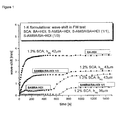
- Formulations were prepared from the examples based on Setalux® 1757, in combination with a Setamine® US138 butylated melamine formaldehyde crosslinker, and tested in a so-called falling wave setup.
- the displacement of an original surface profile due to gravitation pull can be followed as a function of time.
- These experiments include the effect of evaporation, as well as mimic a realistic flash-off time at room temperature, followed by a heating cycle.
- the wave displacement can be determined both in the flash-off period (5minutes), as well as that during heating (up to 140°C, at an initial rate of 30°C/min): see figure 1 .
- the BA-HDI SCA exhibits quite a wave shift during the flash-off period, but no longer exhibits flow when the SCA structure is built: it remains intact in the oven.
- the SAMBA-HDI SCA in contrast, only exhibits very little flow during flash-off, in line with the results of the compliance measurements used above. In the oven, due to the lowest melting point of this SAMBA-HDI SCA, the structure collapses, and some high temperature flow is allowed.
- the ratio flash-off flow vs. high T flow can be controlled by using the SAMBA-BA mixed amines, higher BA levels shifting this ratio towards the flash-off side.
- these mixed amines to prepare SCA's can be a tool to create a tailor-made rheological behavior in the whole application-cure cycle.
- Example 15 S-AMBA+AMP(1:1)+HDI in Setalux® 1760 VB-64
- the SCA mixture was prepared as in Example 15, except that 1.40g (12.9mmoles) 3-(aminomethyl)pyridine was used as the amine component.
- the SCA mixture was prepared as in Example 15, except that 1.47g (12.1moles) S-(-)- ⁇ -methylbenzylamine was used as the amine component.
- Example 16 L-alabu+BA(1:1)+HDI in Setalux® 1760 VB-64
- the SCA mixture was prepared as in Example 15, except that 0.77g (5.3mmoles) L-alanine butylester and 0.69g (6.4mmoles) benzylamine was used as the amine component.
- the SCA mixture was prepared as in Example 16, except that 1.58g (10.88mmoles) L-alanine butylester was used as the amine component.
- the SCA mixture was prepared as in Example 15, except that 1.40g (13.1mmoles) benzylamine was used as the aim in component.
Landscapes
- Chemical & Material Sciences (AREA)
- Organic Chemistry (AREA)
- Chemical Kinetics & Catalysis (AREA)
- Engineering & Computer Science (AREA)
- Materials Engineering (AREA)
- Wood Science & Technology (AREA)
- Life Sciences & Earth Sciences (AREA)
- Medicinal Chemistry (AREA)
- Health & Medical Sciences (AREA)
- Polymers & Plastics (AREA)
- General Chemical & Material Sciences (AREA)
- Polyurethanes Or Polyureas (AREA)
- Organic Low-Molecular-Weight Compounds And Preparation Thereof (AREA)
- Paints Or Removers (AREA)
- Inks, Pencil-Leads, Or Crayons (AREA)
- Compositions Of Macromolecular Compounds (AREA)
Priority Applications (1)
| Application Number | Priority Date | Filing Date | Title |
|---|---|---|---|
| EP06700743.5A EP1846469B1 (en) | 2005-01-11 | 2006-01-10 | A polyurea compound |
Applications Claiming Priority (4)
| Application Number | Priority Date | Filing Date | Title |
|---|---|---|---|
| EP05075061 | 2005-01-11 | ||
| US65445505P | 2005-02-22 | 2005-02-22 | |
| EP06700743.5A EP1846469B1 (en) | 2005-01-11 | 2006-01-10 | A polyurea compound |
| PCT/EP2006/050134 WO2006075000A1 (en) | 2005-01-11 | 2006-01-10 | A polyurea compound |
Publications (2)
| Publication Number | Publication Date |
|---|---|
| EP1846469A1 EP1846469A1 (en) | 2007-10-24 |
| EP1846469B1 true EP1846469B1 (en) | 2014-04-30 |
Family
ID=34937986
Family Applications (1)
| Application Number | Title | Priority Date | Filing Date |
|---|---|---|---|
| EP06700743.5A Active EP1846469B1 (en) | 2005-01-11 | 2006-01-10 | A polyurea compound |
Country Status (8)
| Country | Link |
|---|---|
| US (1) | US8742052B2 (enExample) |
| EP (1) | EP1846469B1 (enExample) |
| JP (2) | JP2008527126A (enExample) |
| KR (1) | KR20070100947A (enExample) |
| CN (2) | CN101103061B (enExample) |
| BR (1) | BRPI0606710A2 (enExample) |
| RU (1) | RU2007130730A (enExample) |
| WO (1) | WO2006075000A1 (enExample) |
Families Citing this family (40)
| Publication number | Priority date | Publication date | Assignee | Title |
|---|---|---|---|---|
| EP1838747B1 (en) * | 2005-01-11 | 2018-04-18 | Allnex Netherlands B.V. | Comixtures for use in rheology modification |
| FR2907336A1 (fr) * | 2006-10-19 | 2008-04-25 | Oreal | Vernis a ongles contenant un agent gelifiant polyuree |
| GB2462105A (en) | 2008-07-24 | 2010-01-27 | Nuplex Resins Bv | Thixotropic aqueous coating composition |
| CN102834474A (zh) * | 2010-04-09 | 2012-12-19 | 拜尔材料科学有限公司 | 双组分聚天冬氨酸类涂料组合物 |
| CN102372655B (zh) * | 2010-08-26 | 2014-03-26 | 中国石油化工股份有限公司 | 一种碳酰四胺化合物及其制备方法 |
| EP2463340A1 (de) | 2010-12-09 | 2012-06-13 | Sika Technology AG | Thixotrope Polyharnstoffaddukte |
| CN105985724A (zh) | 2011-10-07 | 2016-10-05 | 树脂核动力工业有限公司 | 可交联组合物 |
| EP2644633A1 (en) * | 2012-03-29 | 2013-10-02 | Huntsman International Llc | Isocyanate-based prepolymer |
| EP2644632A1 (en) * | 2012-03-29 | 2013-10-02 | Huntsman International Llc | Isocyanate-based prepolymer |
| ES2669524T3 (es) | 2013-04-08 | 2018-05-28 | Allnex Netherlands B.V. | Composición reticulable por reacción de adición de Michael Real (RMA) |
| US20150175834A1 (en) * | 2013-12-19 | 2015-06-25 | Axalta Coating Systems Ip Co., Llc | Low bake temperature curable coating compositions and processes for producing coatings at low bake temperatures |
| US20150175836A1 (en) * | 2013-12-19 | 2015-06-25 | Axalta Coating Systems Ip Co., Llc | Low bake temperature curable coating compositions and processes for producing coatings at low bake temperatures |
| JP6295706B2 (ja) * | 2014-02-19 | 2018-03-20 | 東ソー株式会社 | ポリオール組成物 |
| US9856384B2 (en) * | 2014-07-21 | 2018-01-02 | Axalta Coatings Systems Ip Co., Llc | Sag control compositions, methods of forming the same, and methods of forming coating systems using the same |
| CN107667146B (zh) | 2015-04-17 | 2021-01-01 | 欧尼克斯荷兰有限公司 | 制造可交联组合物的方法 |
| CN107660227B (zh) | 2015-04-17 | 2021-07-16 | 欧尼克斯荷兰有限公司 | 地板涂料组合物 |
| EP3283588B1 (en) | 2015-04-17 | 2025-06-18 | Allnex Netherlands B.V. | A method for curing a rma crosslinkable resin coating, rma crosslinkable compositions and resins for use therein |
| EP3283585B1 (en) | 2015-04-17 | 2023-11-15 | Allnex Netherlands B.V. | Adhesion promotor for real michael addition crosslinkable compositions |
| JP6580166B2 (ja) * | 2015-07-27 | 2019-09-25 | ビイク−ヒエミー ゲゼルシャフト ミツト ベシユレンクテル ハフツングBYK−Chemie GmbH | レオロジーコントロールのためのウレアウレタン |
| KR101835720B1 (ko) * | 2015-11-30 | 2018-03-08 | 케이에스케미칼 주식회사 | 전단유동화 특성을 갖는 점탄성 조절제의 제조방법 |
| CA3030942C (en) * | 2016-07-15 | 2020-04-07 | Kansai Paint Co., Ltd. | Coating composition |
| JP7004537B2 (ja) * | 2016-09-30 | 2022-01-21 | ライオン株式会社 | 粒子分散洗浄剤組成物 |
| ES2935646T3 (es) * | 2016-11-07 | 2023-03-08 | Allnex Netherlands Bv | Un procedimiento para la preparación de una composición tixotrópica |
| US20210054228A1 (en) * | 2017-12-28 | 2021-02-25 | Kansai Paint Co., Ltd. | Coating composition |
| JPWO2019235256A1 (ja) * | 2018-06-05 | 2021-06-24 | 東京エレクトロン株式会社 | 半導体装置の製造方法、成膜用組成物および成膜装置 |
| EP3663326A1 (en) | 2018-12-04 | 2020-06-10 | Allnex Netherlands B.V. | Rma crosslinkable polymer |
| CN113454175A (zh) * | 2019-02-15 | 2021-09-28 | 关西涂料株式会社 | 流变控制剂和涂料组合物 |
| JP7408586B2 (ja) * | 2019-02-15 | 2024-01-05 | 関西ペイント株式会社 | 塗料組成物 |
| MX2021011707A (es) | 2019-03-26 | 2021-10-22 | Kansai Paint Co Ltd | Composicion de pintura. |
| US11760897B2 (en) | 2019-07-30 | 2023-09-19 | Axalta Coating Systems Ip Co., Llc | Coating compositions including a sag control agent and wax |
| CN113045972A (zh) * | 2019-12-27 | 2021-06-29 | 深圳市精彩科技有限公司 | 聚脲涂料 |
| CN111303378A (zh) * | 2020-03-06 | 2020-06-19 | 长春工业大学 | 一种基于tmxdi的聚氨酯类抗流挂树脂及其制备方法 |
| CN111349370A (zh) * | 2020-04-24 | 2020-06-30 | 湖南湘江关西涂料有限公司 | 高触变性树脂及其制备方法与应用、涂料 |
| CN113024163B (zh) * | 2021-04-22 | 2021-11-23 | 广东省水利水电第三工程局有限公司 | 一种触变泥浆及其减阻方法 |
| EP4330337A1 (en) * | 2021-04-28 | 2024-03-06 | Allnex Netherlands B.V. | Process for overspray-free application of a resin composition and resin compositions for use in the process |
| CN114369219B (zh) * | 2021-12-20 | 2023-11-10 | 上海金仕迈树脂有限公司 | 一种聚脲颗粒改性触变树脂及其制备方法 |
| CN115820071B (zh) * | 2022-08-08 | 2023-08-18 | 山东奔腾漆业股份有限公司 | 一种耐腐蚀涂料及其制备方法 |
| CN116875160B (zh) * | 2023-08-05 | 2024-07-09 | 中海油常州涂料化工研究院有限公司 | 一种航空器蒙皮用珠光漆及其制备方法 |
| DE202024101935U1 (de) | 2024-04-18 | 2024-05-27 | Nippon Paint Automotive Europe Gmbh | Glitzernde Klarlackzusammensetzung und mehrschichtige Kraftfahrzeugbeschichtung, die diese Zusammensetzung enthält |
| EP4636045A1 (en) | 2024-04-18 | 2025-10-22 | NIPPON PAINT AUTOMOTIVE EUROPE GmbH | Sparkling clear coat composition and multilayer automotive coating including the same |
Family Cites Families (14)
| Publication number | Priority date | Publication date | Assignee | Title |
|---|---|---|---|---|
| US3367920A (en) | 1964-11-24 | 1968-02-06 | Merck & Co Inc | Polyurea and method of preparing same |
| US3620695A (en) * | 1969-04-10 | 1971-11-16 | Texaco Inc | Thickened compositions and process of preparing them |
| US4165329A (en) * | 1972-06-02 | 1979-08-21 | Chevron Research Company | Grease thickening agent |
| NL176864C (nl) | 1976-11-25 | 1985-06-17 | Akzo Nv | Werkwijze voor de bereiding van een thixotrope bekledingssamenstelling. |
| US4528319A (en) * | 1984-07-20 | 1985-07-09 | General Motors Corporation | Sag control of high solid polyurethane clearcoats by urea thixotrope/silica systems |
| JPH0637602B2 (ja) | 1986-09-25 | 1994-05-18 | 日本油脂株式会社 | 塗料用流動性制御剤 |
| US5176907A (en) * | 1991-08-13 | 1993-01-05 | The Johns Hopkins University School Of Medicine | Biocompatible and biodegradable poly (phosphoester-urethanes) |
| ZA981569B (en) * | 1997-04-08 | 1999-08-25 | Du Pont | An engineered seed protein having a higher percentage of essential amino acids. |
| US7196154B2 (en) * | 2000-12-11 | 2007-03-27 | Light Black Inc. | Method of producing polymer resins |
| EP1641747B1 (en) * | 2001-10-26 | 2010-08-04 | Nuplex Resins B.V. | Acicular crystals of hydrazine-based diurea derivatives and their use as rheology modifiers in coating and adhesive compositions |
| US20050119422A1 (en) * | 2002-04-24 | 2005-06-02 | Basf Corporation | Thermally curable, thixotropic mixtures containing carbamate and/or allophanate groups |
| AU2003258013A1 (en) * | 2002-08-01 | 2004-02-23 | California Institute Of Technology | Synthesis of macrocyclic polymers by ring insertion polymerization of cyclic olefin monomers |
| ES2383634T3 (es) | 2003-07-08 | 2012-06-22 | Nuplex Resins B.V. | Derivados de aminoácidos y su uso como agente de control del descolgamiento |
| CN101213230B (zh) * | 2005-06-28 | 2011-12-28 | 树脂核动力工业有限公司 | 作为触变流变改进剂的聚脲制品 |
-
2006
- 2006-01-10 RU RU2007130730/04A patent/RU2007130730A/ru not_active Application Discontinuation
- 2006-01-10 JP JP2007550741A patent/JP2008527126A/ja not_active Withdrawn
- 2006-01-10 WO PCT/EP2006/050134 patent/WO2006075000A1/en not_active Ceased
- 2006-01-10 JP JP2007550788A patent/JP2008526922A/ja not_active Withdrawn
- 2006-01-10 CN CN2006800020901A patent/CN101103061B/zh active Active
- 2006-01-10 EP EP06700743.5A patent/EP1846469B1/en active Active
- 2006-01-10 BR BRPI0606710A patent/BRPI0606710A2/pt not_active IP Right Cessation
- 2006-01-10 CN CNA2006800020865A patent/CN101103060A/zh active Pending
- 2006-01-10 US US11/795,095 patent/US8742052B2/en active Active
- 2006-01-10 KR KR1020077016675A patent/KR20070100947A/ko not_active Withdrawn
Also Published As
| Publication number | Publication date |
|---|---|
| CN101103061A (zh) | 2008-01-09 |
| JP2008527126A (ja) | 2008-07-24 |
| WO2006075000A1 (en) | 2006-07-20 |
| JP2008526922A (ja) | 2008-07-24 |
| US20080139755A1 (en) | 2008-06-12 |
| EP1846469A1 (en) | 2007-10-24 |
| CN101103061B (zh) | 2011-03-02 |
| US8742052B2 (en) | 2014-06-03 |
| RU2007130730A (ru) | 2009-02-20 |
| BRPI0606710A2 (pt) | 2017-07-11 |
| CN101103060A (zh) | 2008-01-09 |
| KR20070100947A (ko) | 2007-10-15 |
Similar Documents
| Publication | Publication Date | Title |
|---|---|---|
| EP1846469B1 (en) | A polyurea compound | |
| EP1902081B1 (en) | A polyurea product as thixotropic rheology modifying agent | |
| US7851530B2 (en) | Carbon-substituted methyl amine derivatives and their use as a rheology control agents | |
| CA1282890C (en) | Thixotropic coating composition, process for coating a substrate with such coating composition and the coated substrate thus obtained | |
| US7576151B2 (en) | Amino acid derivatives and their use as a sag control agent | |
| JPH0781099B2 (ja) | チキソトロピー性の塗料 | |
| EP1838747B1 (en) | Comixtures for use in rheology modification | |
| JPH083049B2 (ja) | 顔料組成物,分散方法および塗料 | |
| KR20060059956A (ko) | 아미노산 유도체 및 새그 조절제로서의 이의 용도 |
Legal Events
| Date | Code | Title | Description |
|---|---|---|---|
| PUAI | Public reference made under article 153(3) epc to a published international application that has entered the european phase |
Free format text: ORIGINAL CODE: 0009012 |
|
| 17P | Request for examination filed |
Effective date: 20070813 |
|
| AK | Designated contracting states |
Kind code of ref document: A1 Designated state(s): AT BE BG CH CY CZ DE DK EE ES FI FR GB GR HU IE IS IT LI LT LU LV MC NL PL PT RO SE SI SK TR |
|
| AX | Request for extension of the european patent |
Extension state: AL BA HR MK YU |
|
| 17Q | First examination report despatched |
Effective date: 20090219 |
|
| RIC1 | Information provided on ipc code assigned before grant |
Ipc: C09D 11/02 20060101ALI20131001BHEP Ipc: C09D 7/00 20060101ALI20131001BHEP Ipc: C09D 5/04 20060101ALI20131001BHEP Ipc: C07C 273/18 20060101ALI20131001BHEP Ipc: C08G 18/28 20060101AFI20131001BHEP Ipc: C08L 75/02 20060101ALI20131001BHEP |
|
| GRAP | Despatch of communication of intention to grant a patent |
Free format text: ORIGINAL CODE: EPIDOSNIGR1 |
|
| INTG | Intention to grant announced |
Effective date: 20131127 |
|
| GRAS | Grant fee paid |
Free format text: ORIGINAL CODE: EPIDOSNIGR3 |
|
| GRAA | (expected) grant |
Free format text: ORIGINAL CODE: 0009210 |
|
| AK | Designated contracting states |
Kind code of ref document: B1 Designated state(s): AT BE BG CH CY CZ DE DK EE ES FI FR GB GR HU IE IS IT LI LT LU LV MC NL PL PT RO SE SI SK TR |
|
| AX | Request for extension of the european patent |
Extension state: AL BA HR MK YU |
|
| REG | Reference to a national code |
Ref country code: GB Ref legal event code: FG4D Ref country code: CH Ref legal event code: EP |
|
| REG | Reference to a national code |
Ref country code: AT Ref legal event code: REF Ref document number: 665108 Country of ref document: AT Kind code of ref document: T Effective date: 20140515 |
|
| REG | Reference to a national code |
Ref country code: IE Ref legal event code: FG4D |
|
| REG | Reference to a national code |
Ref country code: DE Ref legal event code: R096 Ref document number: 602006041292 Country of ref document: DE Effective date: 20140612 |
|
| REG | Reference to a national code |
Ref country code: NL Ref legal event code: T3 |
|
| REG | Reference to a national code |
Ref country code: AT Ref legal event code: MK05 Ref document number: 665108 Country of ref document: AT Kind code of ref document: T Effective date: 20140430 |
|
| REG | Reference to a national code |
Ref country code: LT Ref legal event code: MG4D |
|
| PG25 | Lapsed in a contracting state [announced via postgrant information from national office to epo] |
Ref country code: LT Free format text: LAPSE BECAUSE OF FAILURE TO SUBMIT A TRANSLATION OF THE DESCRIPTION OR TO PAY THE FEE WITHIN THE PRESCRIBED TIME-LIMIT Effective date: 20140430 Ref country code: FI Free format text: LAPSE BECAUSE OF FAILURE TO SUBMIT A TRANSLATION OF THE DESCRIPTION OR TO PAY THE FEE WITHIN THE PRESCRIBED TIME-LIMIT Effective date: 20140430 Ref country code: GR Free format text: LAPSE BECAUSE OF FAILURE TO SUBMIT A TRANSLATION OF THE DESCRIPTION OR TO PAY THE FEE WITHIN THE PRESCRIBED TIME-LIMIT Effective date: 20140731 Ref country code: IS Free format text: LAPSE BECAUSE OF FAILURE TO SUBMIT A TRANSLATION OF THE DESCRIPTION OR TO PAY THE FEE WITHIN THE PRESCRIBED TIME-LIMIT Effective date: 20140830 Ref country code: CY Free format text: LAPSE BECAUSE OF FAILURE TO SUBMIT A TRANSLATION OF THE DESCRIPTION OR TO PAY THE FEE WITHIN THE PRESCRIBED TIME-LIMIT Effective date: 20140430 Ref country code: BG Free format text: LAPSE BECAUSE OF FAILURE TO SUBMIT A TRANSLATION OF THE DESCRIPTION OR TO PAY THE FEE WITHIN THE PRESCRIBED TIME-LIMIT Effective date: 20140730 |
|
| PG25 | Lapsed in a contracting state [announced via postgrant information from national office to epo] |
Ref country code: LV Free format text: LAPSE BECAUSE OF FAILURE TO SUBMIT A TRANSLATION OF THE DESCRIPTION OR TO PAY THE FEE WITHIN THE PRESCRIBED TIME-LIMIT Effective date: 20140430 Ref country code: AT Free format text: LAPSE BECAUSE OF FAILURE TO SUBMIT A TRANSLATION OF THE DESCRIPTION OR TO PAY THE FEE WITHIN THE PRESCRIBED TIME-LIMIT Effective date: 20140430 Ref country code: SE Free format text: LAPSE BECAUSE OF FAILURE TO SUBMIT A TRANSLATION OF THE DESCRIPTION OR TO PAY THE FEE WITHIN THE PRESCRIBED TIME-LIMIT Effective date: 20140430 Ref country code: ES Free format text: LAPSE BECAUSE OF FAILURE TO SUBMIT A TRANSLATION OF THE DESCRIPTION OR TO PAY THE FEE WITHIN THE PRESCRIBED TIME-LIMIT Effective date: 20140430 Ref country code: PL Free format text: LAPSE BECAUSE OF FAILURE TO SUBMIT A TRANSLATION OF THE DESCRIPTION OR TO PAY THE FEE WITHIN THE PRESCRIBED TIME-LIMIT Effective date: 20140430 |
|
| PG25 | Lapsed in a contracting state [announced via postgrant information from national office to epo] |
Ref country code: PT Free format text: LAPSE BECAUSE OF FAILURE TO SUBMIT A TRANSLATION OF THE DESCRIPTION OR TO PAY THE FEE WITHIN THE PRESCRIBED TIME-LIMIT Effective date: 20140901 |
|
| REG | Reference to a national code |
Ref country code: FR Ref legal event code: PLFP Year of fee payment: 10 |
|
| PG25 | Lapsed in a contracting state [announced via postgrant information from national office to epo] |
Ref country code: SK Free format text: LAPSE BECAUSE OF FAILURE TO SUBMIT A TRANSLATION OF THE DESCRIPTION OR TO PAY THE FEE WITHIN THE PRESCRIBED TIME-LIMIT Effective date: 20140430 Ref country code: BE Free format text: LAPSE BECAUSE OF FAILURE TO SUBMIT A TRANSLATION OF THE DESCRIPTION OR TO PAY THE FEE WITHIN THE PRESCRIBED TIME-LIMIT Effective date: 20140430 Ref country code: EE Free format text: LAPSE BECAUSE OF FAILURE TO SUBMIT A TRANSLATION OF THE DESCRIPTION OR TO PAY THE FEE WITHIN THE PRESCRIBED TIME-LIMIT Effective date: 20140430 Ref country code: DK Free format text: LAPSE BECAUSE OF FAILURE TO SUBMIT A TRANSLATION OF THE DESCRIPTION OR TO PAY THE FEE WITHIN THE PRESCRIBED TIME-LIMIT Effective date: 20140430 Ref country code: RO Free format text: LAPSE BECAUSE OF FAILURE TO SUBMIT A TRANSLATION OF THE DESCRIPTION OR TO PAY THE FEE WITHIN THE PRESCRIBED TIME-LIMIT Effective date: 20140430 Ref country code: CZ Free format text: LAPSE BECAUSE OF FAILURE TO SUBMIT A TRANSLATION OF THE DESCRIPTION OR TO PAY THE FEE WITHIN THE PRESCRIBED TIME-LIMIT Effective date: 20140430 |
|
| REG | Reference to a national code |
Ref country code: DE Ref legal event code: R097 Ref document number: 602006041292 Country of ref document: DE |
|
| PLBE | No opposition filed within time limit |
Free format text: ORIGINAL CODE: 0009261 |
|
| STAA | Information on the status of an ep patent application or granted ep patent |
Free format text: STATUS: NO OPPOSITION FILED WITHIN TIME LIMIT |
|
| PG25 | Lapsed in a contracting state [announced via postgrant information from national office to epo] |
Ref country code: IT Free format text: LAPSE BECAUSE OF FAILURE TO SUBMIT A TRANSLATION OF THE DESCRIPTION OR TO PAY THE FEE WITHIN THE PRESCRIBED TIME-LIMIT Effective date: 20140430 |
|
| 26N | No opposition filed |
Effective date: 20150202 |
|
| REG | Reference to a national code |
Ref country code: DE Ref legal event code: R097 Ref document number: 602006041292 Country of ref document: DE Effective date: 20150202 |
|
| PG25 | Lapsed in a contracting state [announced via postgrant information from national office to epo] |
Ref country code: SI Free format text: LAPSE BECAUSE OF FAILURE TO SUBMIT A TRANSLATION OF THE DESCRIPTION OR TO PAY THE FEE WITHIN THE PRESCRIBED TIME-LIMIT Effective date: 20140430 |
|
| REG | Reference to a national code |
Ref country code: CH Ref legal event code: PL |
|
| PG25 | Lapsed in a contracting state [announced via postgrant information from national office to epo] |
Ref country code: LU Free format text: LAPSE BECAUSE OF FAILURE TO SUBMIT A TRANSLATION OF THE DESCRIPTION OR TO PAY THE FEE WITHIN THE PRESCRIBED TIME-LIMIT Effective date: 20150110 |
|
| GBPC | Gb: european patent ceased through non-payment of renewal fee |
Effective date: 20150110 |
|
| PG25 | Lapsed in a contracting state [announced via postgrant information from national office to epo] |
Ref country code: MC Free format text: LAPSE BECAUSE OF FAILURE TO SUBMIT A TRANSLATION OF THE DESCRIPTION OR TO PAY THE FEE WITHIN THE PRESCRIBED TIME-LIMIT Effective date: 20140430 |
|
| PG25 | Lapsed in a contracting state [announced via postgrant information from national office to epo] |
Ref country code: LI Free format text: LAPSE BECAUSE OF NON-PAYMENT OF DUE FEES Effective date: 20150131 Ref country code: GB Free format text: LAPSE BECAUSE OF NON-PAYMENT OF DUE FEES Effective date: 20150110 Ref country code: CH Free format text: LAPSE BECAUSE OF NON-PAYMENT OF DUE FEES Effective date: 20150131 |
|
| REG | Reference to a national code |
Ref country code: IE Ref legal event code: MM4A |
|
| REG | Reference to a national code |
Ref country code: FR Ref legal event code: PLFP Year of fee payment: 11 |
|
| PG25 | Lapsed in a contracting state [announced via postgrant information from national office to epo] |
Ref country code: IE Free format text: LAPSE BECAUSE OF NON-PAYMENT OF DUE FEES Effective date: 20150110 |
|
| REG | Reference to a national code |
Ref country code: FR Ref legal event code: PLFP Year of fee payment: 12 |
|
| PG25 | Lapsed in a contracting state [announced via postgrant information from national office to epo] |
Ref country code: HU Free format text: LAPSE BECAUSE OF FAILURE TO SUBMIT A TRANSLATION OF THE DESCRIPTION OR TO PAY THE FEE WITHIN THE PRESCRIBED TIME-LIMIT; INVALID AB INITIO Effective date: 20060110 |
|
| PG25 | Lapsed in a contracting state [announced via postgrant information from national office to epo] |
Ref country code: TR Free format text: LAPSE BECAUSE OF FAILURE TO SUBMIT A TRANSLATION OF THE DESCRIPTION OR TO PAY THE FEE WITHIN THE PRESCRIBED TIME-LIMIT Effective date: 20140430 |
|
| REG | Reference to a national code |
Ref country code: FR Ref legal event code: PLFP Year of fee payment: 13 |
|
| REG | Reference to a national code |
Ref country code: DE Ref legal event code: R081 Ref document number: 602006041292 Country of ref document: DE Owner name: ALLNEX NETHERLANDS B.V., NL Free format text: FORMER OWNER: NUPLEX RESINS B.V., BERGEN OP ZOOM, NL |
|
| REG | Reference to a national code |
Ref country code: NL Ref legal event code: HC Owner name: ALLNEX NETHERLANDS B.V.; NL Free format text: DETAILS ASSIGNMENT: CHANGE OF OWNER(S), CHANGE OF OWNER(S) NAME; FORMER OWNER NAME: NUPLEX RESINS B.V. Effective date: 20190205 |
|
| PGFP | Annual fee paid to national office [announced via postgrant information from national office to epo] |
Ref country code: NL Payment date: 20250127 Year of fee payment: 20 |
|
| PGFP | Annual fee paid to national office [announced via postgrant information from national office to epo] |
Ref country code: DE Payment date: 20250129 Year of fee payment: 20 |
|
| PGFP | Annual fee paid to national office [announced via postgrant information from national office to epo] |
Ref country code: FR Payment date: 20250127 Year of fee payment: 20 |