EP1768069A1 - Method of processing radiographic image and processing apparatus - Google Patents
Method of processing radiographic image and processing apparatus Download PDFInfo
- Publication number
- EP1768069A1 EP1768069A1 EP06121153A EP06121153A EP1768069A1 EP 1768069 A1 EP1768069 A1 EP 1768069A1 EP 06121153 A EP06121153 A EP 06121153A EP 06121153 A EP06121153 A EP 06121153A EP 1768069 A1 EP1768069 A1 EP 1768069A1
- Authority
- EP
- European Patent Office
- Prior art keywords
- imaging
- image data
- data sets
- image
- threshold value
- Prior art date
- Legal status (The legal status is an assumption and is not a legal conclusion. Google has not performed a legal analysis and makes no representation as to the accuracy of the status listed.)
- Withdrawn
Links
Images


Classifications
-
- G—PHYSICS
- G06—COMPUTING OR CALCULATING; COUNTING
- G06T—IMAGE DATA PROCESSING OR GENERATION, IN GENERAL
- G06T11/00—2D [Two Dimensional] image generation
- G06T11/003—Reconstruction from projections, e.g. tomography
- G06T11/005—Specific pre-processing for tomographic reconstruction, e.g. calibration, source positioning, rebinning, scatter correction, retrospective gating
-
- G—PHYSICS
- G06—COMPUTING OR CALCULATING; COUNTING
- G06T—IMAGE DATA PROCESSING OR GENERATION, IN GENERAL
- G06T2211/00—Image generation
- G06T2211/40—Computed tomography
- G06T2211/412—Dynamic
Definitions
- the present invention relates to a method of processing radiographic images and a processing apparatus for obtaining a computerized tomographic (CT) image by obtaining a plurality of image data sets of images captured using a two-dimensional X-ray sensor and then carrying out processing for reconstructing the CT image of an object.
- CT computerized tomographic
- CT radiographic computerized tomography
- the CT image obtained by carrying out computerized tomography is displayed on a monitor so that whether or not re-imaging is required can be determined on the basis of the quality of the displayed image.
- a method in which the operator carries out visual judgment a method in which the CT apparatus automatically carries out determination based on the quality of the CT image, and, furthermore, a method combining the two former methods are known.
- Japanese Patent Laid-Open No. 2002-365239 described a method in which the operator judges the validity of various predetermined parameters from the quality of a CT image displayed for preview and, if the parameters are judged to be invalid, the operator changes the parameters and instructs re-imaging.
- the present invention mitigates the above-identified problems by determining whether or not re-imaging is required while computerized tomographic imaging is being carried out.
- a step of detecting information on the movement of a subject's body in the image data sets obtained in sequence while carrying out computerized tomographic imaging is provided to enable the radiographic image processing apparatus and the method of processing radiographic images according to the present invention to determine whether or not re-imaging is required before the CT imaging is completed.
- Fig. 1 is a block circuit diagram according to a first embodiment.
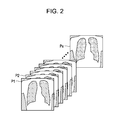
- Fig. 2 illustrates a projected image
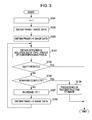
- Fig. 3 is a processing flow chart.
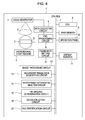
- Fig. 4 is a block circuit diagram according to a second embodiment.
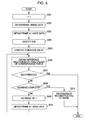
- Fig. 5 is a processing flow chart.
- Fig. 6 is a block circuit diagram according to a third embodiment.
- Fig. 7 is a processing flow chart.
- Fig. 1 illustrates a computerized tomography (CT) imaging device 1 having a function of determining whether or not re-imaging is required before a CT imaging process is completed, on the basis of image data sets obtained in sequence while CT imaging is being carried out.
- CT computerized tomography
- a subject S on a rotary device 2 is interposed between an X-ray generator 3 and a two-dimensional X-ray sensor 4.
- the rotary device 2, the X-ray generator 3, and the two-dimensional X-ray sensor 4 are electrically connected to a data collecting circuit 5.
- the data collecting circuit 5 is electrically connected to a pre-processing circuit 6.
- the data collecting circuit 5 and the pre-processing circuit 6 are connected to a CPU bus 7.
- the CPU bus 7 is connected to a CPU 8, a main memory 9 including various data sets and a work memory, an operation panel 10 for operating the entire apparatus, a display monitor 11, and an image processing circuit 12.
- the image processing circuit 12 includes a secondary image data acquisition circuit 13 configured to obtain, in sequence, image data sets processed by the pre-processing circuit 6 while CT imaging is being carried out, an inter-frame differential analysis circuit 14 configured to generate a difference value corresponding to the difference between pixel values of corresponding pixels in two consecutive frames included in the obtained image data sets, a re-imaging determination circuit 15 configured to determine whether re-imaging is required on the basis of the difference value between the two consecutive frames, and a reconstruction circuit 16 configured to reconstruct a CT image from a plurality of image data sets.
- a secondary image data acquisition circuit 13 configured to obtain, in sequence, image data sets processed by the pre-processing circuit 6 while CT imaging is being carried out
- an inter-frame differential analysis circuit 14 configured to generate a difference value corresponding to the difference between pixel values of corresponding pixels in two consecutive frames included in the obtained image data sets
- a re-imaging determination circuit 15 configured to determine whether re-imaging is required on the basis of the difference value between the two consecutive frames
- the pre-processing circuit 6, the CPU 8, the main memory 9, the operation panel 10, the display monitor 11, and the image processing circuit 12 are capable of sending and receiving data among each other via the CPU bus 7.
- the main memory 9 also has a work memory required for the processing carrying out by the CPU 8.
- the CPU 8 employs an operation sequence stored in the main memory 9 to control the operation of the entire apparatus in accordance with the operation instructions from the operation panel 10.
- the rotary device 2 is activated to control the X-ray generator 3 configured to continuously or discontinuously emit X-ray beams while rotating the subject S disposed on the rotary device 2. Then, an X-ray beam emitted from the X-ray generator 3 is incident on the subject S and is transmitted through the subject S, reaching the two-dimensional X-ray sensor 4. Accordingly, the two-dimensional X-ray sensor 4 outputs image data of the X-ray image transmitted through the subject S.
- the two-dimensional X-ray sensor 4 Since imaging operation is carried out continuously, the two-dimensional X-ray sensor 4 obtains X-rays images in sequence while carrying out CT imaging and sends the corresponding image data sets in sequence to the data collecting circuit 5. For example, primary image data sets corresponding to 512 frames are sent to the data collecting circuit 5 while rotating the subject S by 360 degrees.
- the data collecting circuit 5 converts the primary image data sets into image data signals and sends the image data signals to the pre-processing circuit 6.
- the pre-processing circuit 6 carries out pre-processing, such as offset correction processing and gain correction processing, on the primary image data signals from the data collecting circuit 5. Secondary image data signals obtained by carrying out pre-processing with the pre-processing circuit 6 are transferred to the main memory 9 and the image processing circuit 12 via the CPU bus 7 under the control of the CPU 8.
- secondary image data sets P1 to Px corresponding to the frames captured from different angles as the rotary device 2 is rotated are transferred, in sequence, to the image processing circuit 12.
- the secondary image data sets P1 to Px corresponding to the frames are transferred, in sequence, to and stored in the main memory 9.
- the two-dimensional X-ray sensor 4, the data collecting circuit 5, and the pre-processing circuit 6 are provided separately. However, these circuits may be provided as a single sensor unit. Furthermore, the two-dimensional X-ray sensor 4, the data collecting circuit 5, and the pre-processing circuit 6 may be connected to each other via a network.
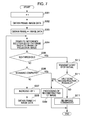
- Fig. 3 is a flow chart illustrating the process carried out by the image processing circuit 12 according to the first embodiment.
- a program code in accordance with this flow chart is stored in the main memory 9 or a read only memory (ROM), not shown in the drawings, and are read out and executed by the CPU 8.
- ROM read only memory
- the re-imaging determination circuit 15 operates to compare the difference value s(1) between pixel values of corresponding pixels in two consecutive frames and a predetermined threshold value. If s(1) is smaller than the threshold value, CT imaging is continued, whereas if s(1) is greater than the threshold value, it is determined that re-imaging is required (Step S105). Then, the operation of the image processing circuit 12 is completed.
- Step S105 if it is determined that CT imaging is to be continued, then, it is determined whether or not all secondary image data sets scheduled to be obtained are obtained (Step S106). If all data sets are not obtained, the subsequent frame is obtained (Steps S107 to S108), and the difference between pixel values of corresponding pixels in two consecutive frames is analyzed (Step S104). Subsequently, the steps are repeated.
- the amount of processing time required for repeating the steps may be less than the amount of time that elapses from moment the data collecting circuit 5 obtains a primary image data set during CT imaging to the moment the data collecting circuit 5 obtains the subsequent primary image data set or, in other words, the inverse of the imaging frame rate.
- Step S106 if all secondary image data sets scheduled to be obtained are obtained, a CT image is reconstructed from the secondary image data sets P1 to Px by the reconstruction circuit 16 (Step S109). Then, the operation of the image processing circuit 12 is completed. Since the method of obtaining a CT image group from an image data group by employing processing of reconstructing a CT image is well known, description thereof is omitted here.
- the subject S is rotated with the rotary device 2.
- the X-ray generator 3 and the two-dimensional X-ray sensor 4 may be rotated around the subject S. In either case, the same advantages are provided.
- the process of determining whether or not re-imaging is required can be automated, and the operator's workload can be lightened.
- Fig. 4 is a block circuit diagram of a CT imaging device 1' according to a second embodiment.
- the CT imaging device 1' according to the second embodiment has the same structure as the CT imaging device 1 according to the first embodiment, except that a frame rate setting circuit 21 and an image processing circuit 12' having a region-of-interest (ROI) identification circuit 22 are added.
- ROI region-of-interest
- the process from emitting X-ray beams X to transferring secondary image data sets is repeated continuously while the rotary device 2 of the CT imaging device 1' is rotated, and secondary image data sets obtained by carrying out CT imaging from different angles are transferred, in sequence, to the image processing circuit 12'.
- the image processing circuit 12' receives, in sequence, the secondary image data sets according to a frame rate fr set in advance by the frame rate setting circuit 21.
- Fig. 5 is a flow chart of the processing carried out by the image processing circuit 12' according to the second embodiment. Similar to the first embodiment, when CT imaging begins, the secondary image data acquisition circuit 13 obtains, in sequence, a first secondary image data set P1 and a second secondary image data set P2 of a projected image from the pre-processing circuit 6, where pre-processing is carried out, via the CPU bus 7 (Steps S201 to S203).
- ROI identification is carried out on the obtained first secondary image data set P1 and/or the second secondary image data set P2 by the ROI identification circuit 22 (Step S204).
- the ROI is identified as the edge of the diaphragm that is an anthropotomical structure prominently representing the body movement of the subject S.
- a technique for identify anatomical locations is well known. For example, Japanese Patent Laid-Open No.
- 11-151232 discusses a method of identifying a lung field by labeling a threshold-processed binary image, and, within the labeled fields, by identifying a field not including an area smaller than a predetermined value and the adjacent fields as the lung field.
- a method of segmenting anthropotomical structures by using a feature quantity to learn density information of pixels, anatomical address information, and entropy information of the periphery of the pixels through a neural network is discussed in "Automatic Segmentation of Anatomic Regions in Chest Radiographs using an Adaptive-Sized Hybrid Neural Network” (SPIE Medical Imaging 97).
- these methods are employed to identify the lung field, and then, the diaphragm is identified by taking into consideration the installation condition of the two-dimensional X-ray sensor 4.
- the diaphragm appears at the lower portion of the obtained projected images when a chest region image of the subject S is captured.
- the diaphragm can be identified on the basis of this limitation and the lung field identified above.
- the re-imaging determination circuit 15 computes a threshold value th on the basis of the frame rate fr for obtaining the image data sets set by the frame rate setting circuit 21 (Step S205).
- the threshold value th is used for determining whether or not re-imaging is required.
- a threshold function th(fr) may be set so that, as the frame rate fr increases, the threshold value th monotonically decreases. Since the difference between two consecutive frames is small when the frame rate fr is great, the computed threshold value th used for determining whether or not re-imaging is required is small. When the frame rate fr is small, the computed threshold value th is great.
- the inter-frame differential analysis circuit 14 is used to compute the pixel values of pixels corresponding in two consecutive frames for the identified ROI.
- the difference value s(i) between the pixel values of the pixels corresponding in the first secondary image data set P1 and the second secondary image data set P2, which are two consecutive frames, is analyzed (Step S206).
- the method of analysis and the subsequent steps S207 to S211 are the same as those according to the first embodiment.
- a threshold value that is used for determining whether re-imaging is required is suitably set on the basis of the frame rate fr for the primary image data sets. Therefore, whether or not re-imaging is required is determined with high accuracy. Moreover, since the difference value for corresponding pixels in two consecutive frames is analyzed on the basis of only an area around the region that prominently represents the body movement of the subject S, whether re-imaging is required is determined with high accuracy.
- Fig. 6 is a block circuit diagram of a CT imaging device 1" according to a third embodiment.
- the CT imaging device 1" according to the third embodiment has the same structure as the CT imaging device 1 according to the first embodiment, except that an X-ray stop command circuit 31 configured to transmit an X-ray stop command signal immediately after an image processing circuit 12" determines that re-imaging is required is added.
- the process from emitting X-ray beams X to transferring secondary image data sets is repeated continuously while the rotary device 2 of the CT imaging device 1" is rotated, and secondary image data sets obtained by carrying out CT imaging from different angles are transferred, in sequence, to the image processing circuit 12".
- Fig. 7 is a flow chart of the processing carried out by the image processing circuit 12" according to the third embodiment. Similar to the first embodiment, when CT imaging begins, secondary image data sets are obtained in sequence; the difference between the pixel values of the corresponding pixels of two consecutive frames is calculated; and the determination process for determining whether re-imaging is required is carried out repeatedly while CT imaging is being carried out (Steps S301 to S308).
- Step S305 The operation carried out when, in Steps S305, it is determined that re-imaging is required in the third embodiment differs from that in the first embodiment. More specifically, if, in Step S305, it is determined that re-imaging is required, the X-ray generator 3 is deactivated by transmitting an X-ray stop signal from the X-ray stop command circuit 31 to the data collecting circuit 5 via the CPU bus 7 (Step S310). At this time, the rotary device 2 may also be deactivated when the X-ray generator 3 is deactivated.
- Step S310 it is determined whether or not half-scan reconstruction is possible using the secondary image data group obtained before the X-ray emission was stopped (Step S311). It is generally known from the principle of CT image reconstruction that image reconstruction by half-scan is possible if the range of the projection angle of the image corresponding to the obtained secondary image data sets is greater than the sum of 180 degrees and the fan angle of the X ray.
- the third embodiment employs this generally known concept.
- Step S311 If, in Step S311, it is determined that reconstruction by half-scan is possible, a CT image is reconstructed from the secondary image data sets P1 to Px of the frames by the reconstruction circuit 16 (Step S309). Then, the operation of the image processing circuit 12" is completed. In contrast, if it is determined that reconstruction by half-scan is not possible, a message instructing the operator to carry out re-imaging is displayed on the display monitor 11 (Step S312). Then, the operation of the image processing circuit 12" is completed.
- the X-ray emission can be stopped immediately after body movement of the subject S is detected. Therefore, compared to a known method in which whether or not re-imaging is required is determined after scanning, the amount of X-ray exposure to the subject S can be reduced. Moreover, even if the X-ray emission is stopped due to the detection of body movement, so long as reconstruction of the image by half-scan is possible, the CT image can be reconstructed from the secondary image data sets that have already been obtained. Therefore, re-imaging is not required, and, as a result, the burden inflicted on the subject S is reduced, and the throughput of the computerized tomography is improved.
- a storage medium storing a software program code for realizing the functions of the apparatuses or systems according to the first to third embodiments may be supplied to another apparatus or system.
- the functions are realized by reading out and executing the program code stored on the supplied storage medium by a computer (CPU or MPU) included in the apparatus or system supplied with the storage medium.
- the program code read out from the storage medium realizes the functions according to the first to third embodiments, and the storage medium storing the program code and the program code itself constitute an embodiment of the present invention.
- the storage medium for supplying the program code may be a read only memory (ROM), a flexible disk, a hard disk, an optical disk, a magnetic optical disk, a compact disk read only memory (CD-ROM), a compact disk readable (CD-R), a magnetic tape, or a non-volatile memory card.
- the functions according to the first to third embodiments may be realized by executing the program code read out by the computer so that an operating system (OS) operating on the computer carries out part or all of the actual process according to the program code.
- OS operating system
- the program code read out from the storage medium can be written in a memory included in a function expansion board installed in the computer or a function expansion unit connected to the computer.
- the functions according to the first to third may be realized by a CPU included in the function expansion board or the function expansion unit carrying out part or all of the actual process according to the program code.
- the program constitutes a program code, for example, corresponding to the flow chart illustrated in Fig. 3, 5, or 7.
Landscapes
- Physics & Mathematics (AREA)
- General Physics & Mathematics (AREA)
- Engineering & Computer Science (AREA)
- Theoretical Computer Science (AREA)
- Apparatus For Radiation Diagnosis (AREA)
Applications Claiming Priority (1)
| Application Number | Priority Date | Filing Date | Title |
|---|---|---|---|
| JP2005277805A JP4928106B2 (ja) | 2005-09-26 | 2005-09-26 | Ct撮影装置 |
Publications (1)
| Publication Number | Publication Date |
|---|---|
| EP1768069A1 true EP1768069A1 (en) | 2007-03-28 |
Family
ID=37697596
Family Applications (1)
| Application Number | Title | Priority Date | Filing Date |
|---|---|---|---|
| EP06121153A Withdrawn EP1768069A1 (en) | 2005-09-26 | 2006-09-22 | Method of processing radiographic image and processing apparatus |
Country Status (4)
| Country | Link |
|---|---|
| US (1) | US20070071299A1 (enExample) |
| EP (1) | EP1768069A1 (enExample) |
| JP (1) | JP4928106B2 (enExample) |
| CN (1) | CN1939219B (enExample) |
Cited By (2)
| Publication number | Priority date | Publication date | Assignee | Title |
|---|---|---|---|---|
| JP2008253569A (ja) * | 2007-04-05 | 2008-10-23 | Rigaku Corp | 異常体動検出装置および異常体動検出方法 |
| WO2011155150A1 (en) * | 2010-06-08 | 2011-12-15 | Canon Kabushiki Kaisha | Image processing apparatus, image processing method, and program |
Families Citing this family (16)
| Publication number | Priority date | Publication date | Assignee | Title |
|---|---|---|---|---|
| JP2010158298A (ja) * | 2009-01-06 | 2010-07-22 | Fujifilm Corp | 断層撮影装置及び断層撮影方法 |
| JP6164842B2 (ja) * | 2009-04-17 | 2017-07-19 | コーニンクレッカ フィリップス エヌ ヴェKoninklijke Philips N.V. | 造影剤ベースの撮像 |
| US8718448B2 (en) * | 2011-05-04 | 2014-05-06 | Apple Inc. | Video pictures pattern detection |
| JP5610248B2 (ja) * | 2011-06-08 | 2014-10-22 | 株式会社島津製作所 | 放射線断層撮影装置 |
| JP6122269B2 (ja) | 2011-12-16 | 2017-04-26 | キヤノン株式会社 | 画像処理装置、画像処理方法、及びプログラム |
| JP6050356B2 (ja) * | 2012-07-17 | 2016-12-21 | 株式会社日立製作所 | X線透視撮影装置及びx線透視撮影装置の制御方法 |
| KR101517770B1 (ko) * | 2012-11-01 | 2015-05-06 | 삼성전자주식회사 | 방사선 영상 장치 및 그 동작 방법 |
| JP6174908B2 (ja) * | 2013-05-27 | 2017-08-02 | キヤノン株式会社 | 情報処理装置、情報処理方法、及び、コンピュータプログラム |
| CN105307571B (zh) * | 2013-06-18 | 2018-10-26 | 佳能株式会社 | 控制装置、摄像装置、摄像系统和控制方法 |
| JP6376783B2 (ja) * | 2014-03-12 | 2018-08-22 | キヤノン株式会社 | 乳房断層撮影装置および制御方法 |
| JP6413927B2 (ja) * | 2015-05-25 | 2018-10-31 | コニカミノルタ株式会社 | 動態解析装置及び動態解析システム |
| JP6700867B2 (ja) * | 2016-03-03 | 2020-05-27 | キヤノン株式会社 | 情報処理装置及びその方法、コンピュータプログラム |
| JP7116407B2 (ja) * | 2019-02-26 | 2022-08-10 | 国立大学法人静岡大学 | X線撮像装置 |
| JP7233972B2 (ja) * | 2019-03-04 | 2023-03-07 | キヤノンメディカルシステムズ株式会社 | X線診断システム |
| CN110335326A (zh) * | 2019-07-02 | 2019-10-15 | 上海联影医疗科技有限公司 | 一种重建数据的确定方法、装置、医疗影像设备及介质 |
| JP2023078875A (ja) * | 2021-11-26 | 2023-06-07 | キヤノン株式会社 | 放射線撮像装置、放射線撮像システム及び放射線撮像装置の制御方法 |
Citations (2)
| Publication number | Priority date | Publication date | Assignee | Title |
|---|---|---|---|---|
| US4858128A (en) * | 1986-08-11 | 1989-08-15 | General Electric Company | View-to-view image correction for object motion |
| EP1530162A2 (en) * | 2003-11-05 | 2005-05-11 | Canon Kabushiki Kaisha | Radiation image processing apparatus, radiation image processing method, program, and computer-readable medium |
Family Cites Families (14)
| Publication number | Priority date | Publication date | Assignee | Title |
|---|---|---|---|---|
| US4654876A (en) * | 1984-12-19 | 1987-03-31 | Itek Corporation | Digital image motion correction method |
| JPH04144550A (ja) * | 1990-10-04 | 1992-05-19 | Toshiba Corp | 医用画像装置 |
| JPH0584237A (ja) * | 1991-09-30 | 1993-04-06 | Shimadzu Corp | X線画像処理装置 |
| DE69433045T2 (de) * | 1993-11-26 | 2004-06-03 | Kabushiki Kaisha Toshiba | Computertomograph |
| JPH07178075A (ja) * | 1993-12-22 | 1995-07-18 | Toshiba Corp | 放射線診断装置 |
| JP3897925B2 (ja) * | 1999-01-29 | 2007-03-28 | 株式会社日立メディコ | コーンビームct装置 |
| JP4460695B2 (ja) * | 1999-11-24 | 2010-05-12 | 株式会社東芝 | X線コンピュータ断層撮影装置 |
| JP3388213B2 (ja) * | 2000-01-07 | 2003-03-17 | ジーイー横河メディカルシステム株式会社 | X線ct装置 |
| US6922457B2 (en) * | 2001-11-29 | 2005-07-26 | Kabushiki Kaisha Toshiba | Computer tomography apparatus |
| JP3911415B2 (ja) * | 2001-12-26 | 2007-05-09 | ジーイー・メディカル・システムズ・グローバル・テクノロジー・カンパニー・エルエルシー | X線ct装置 |
| US7177474B2 (en) * | 2003-11-10 | 2007-02-13 | Mobixell Networks Inc. | Video to animation conversion with file size constraint |
| JP2005177212A (ja) * | 2003-12-22 | 2005-07-07 | Canon Inc | 放射線画像処理装置、放射線画像処理システム、放射線撮影システム、放射線撮影装置、放射線画像処理方法、コンピュータ可読記憶媒体、及びプログラム |
| JP3944173B2 (ja) * | 2004-02-05 | 2007-07-11 | キヤノン株式会社 | 放射線画像処理装置及び処理方法 |
| US7751622B2 (en) * | 2005-08-22 | 2010-07-06 | Carestream Health, Inc. | Method and system for detection of undesirable images |
-
2005
- 2005-09-26 JP JP2005277805A patent/JP4928106B2/ja not_active Expired - Fee Related
-
2006
- 2006-09-22 EP EP06121153A patent/EP1768069A1/en not_active Withdrawn
- 2006-09-22 US US11/534,482 patent/US20070071299A1/en not_active Abandoned
- 2006-09-26 CN CN2006101395668A patent/CN1939219B/zh not_active Expired - Fee Related
Patent Citations (2)
| Publication number | Priority date | Publication date | Assignee | Title |
|---|---|---|---|---|
| US4858128A (en) * | 1986-08-11 | 1989-08-15 | General Electric Company | View-to-view image correction for object motion |
| EP1530162A2 (en) * | 2003-11-05 | 2005-05-11 | Canon Kabushiki Kaisha | Radiation image processing apparatus, radiation image processing method, program, and computer-readable medium |
Cited By (3)
| Publication number | Priority date | Publication date | Assignee | Title |
|---|---|---|---|---|
| JP2008253569A (ja) * | 2007-04-05 | 2008-10-23 | Rigaku Corp | 異常体動検出装置および異常体動検出方法 |
| WO2011155150A1 (en) * | 2010-06-08 | 2011-12-15 | Canon Kabushiki Kaisha | Image processing apparatus, image processing method, and program |
| US8983164B2 (en) | 2010-06-08 | 2015-03-17 | Canon Kabushiki Kaisha | Image processing apparatus, image processing method, and program |
Also Published As
| Publication number | Publication date |
|---|---|
| US20070071299A1 (en) | 2007-03-29 |
| CN1939219B (zh) | 2011-01-12 |
| JP2007082908A (ja) | 2007-04-05 |
| CN1939219A (zh) | 2007-04-04 |
| JP4928106B2 (ja) | 2012-05-09 |
Similar Documents
| Publication | Publication Date | Title |
|---|---|---|
| EP1768069A1 (en) | Method of processing radiographic image and processing apparatus | |
| US7327823B2 (en) | Radiation image processing apparatus, radiation image processing method, program, and computer-readable medium | |
| EP1501048B1 (en) | Method of segmenting a radiographic image into diagnostically relevant and diagnostically irrelevant regions | |
| US6775399B1 (en) | ROI segmentation image processing system | |
| US8428329B2 (en) | Image processing apparatus, image processing method, and computer-readable medium | |
| US8260025B2 (en) | Methods and apparatus for generating and archiving x-ray fluoroscopy images | |
| KR20200019572A (ko) | 화상 처리 장치, 화상 처리 방법 및 저장 매체 | |
| JP2004160208A (ja) | 結合フル画像再現用の部分放射線画像の自動配列決定方法 | |
| JP2001346786A (ja) | 異常陰影候補検出方法および再生方法並びに検出システム | |
| JP2001351091A (ja) | 画像処理装置、撮影装置、画像処理システム、画像処理方法、及び記憶媒体 | |
| CN113129343B (zh) | 用于x射线成像中的解剖结构/视图分类的方法和系统 | |
| EP1187070B1 (en) | Addition tomographic image producing method and X-ray CT apparatus | |
| US5283736A (en) | Radiographic image processing apparatus | |
| JP6642048B2 (ja) | 医療画像表示システム、医療画像表示プログラム及び医療画像表示方法 | |
| US7088851B2 (en) | Image processing apparatus, image processing system, image processing method and storage medium | |
| JP2001307064A (ja) | 照射領域抽出方法、装置および記録媒体 | |
| US7263155B2 (en) | Radiography apparatus and radiation image processing method | |
| JP3962557B2 (ja) | 画像処理方法、画像処理装置、画像処理システム、及びコンピュータ読み取り可能な記憶媒体 | |
| JP2001092948A (ja) | 画像処理装置及び画像処理方法 | |
| JP2000070261A (ja) | キャリブレーション成否判定装置、方法及びコンピュータ読み取り可能な記憶媒体 | |
| JP2006000223A (ja) | X線ct装置 | |
| JP4822607B2 (ja) | 画像処理装置、画像処理システム、記憶媒体、プログラム及び画像処理方法 | |
| JP3946809B2 (ja) | 放射線画像処理方法および装置 | |
| JP2006263224A (ja) | 放射線画像処理装置、放射線画像処理方法、プログラム及びコンピュータ可読媒体。 | |
| JP4560202B2 (ja) | 画像処理装置、画像処理システム、画像処理方法、及び記憶媒体 |
Legal Events
| Date | Code | Title | Description |
|---|---|---|---|
| PUAI | Public reference made under article 153(3) epc to a published international application that has entered the european phase |
Free format text: ORIGINAL CODE: 0009012 |
|
| AK | Designated contracting states |
Kind code of ref document: A1 Designated state(s): AT BE BG CH CY CZ DE DK EE ES FI FR GB GR HU IE IS IT LI LT LU LV MC NL PL PT RO SE SI SK TR |
|
| AX | Request for extension of the european patent |
Extension state: AL BA HR MK YU |
|
| 17P | Request for examination filed |
Effective date: 20070928 |
|
| AKX | Designation fees paid |
Designated state(s): DE FR GB IT NL |
|
| 17Q | First examination report despatched |
Effective date: 20080714 |
|
| STAA | Information on the status of an ep patent application or granted ep patent |
Free format text: STATUS: THE APPLICATION HAS BEEN WITHDRAWN |
|
| 18W | Application withdrawn |
Effective date: 20100121 |