EP1726606A1 - Bindemittelgemische aus Polyasparaginsäureestern und sulfonatmodifizierten Polyisocyanaten - Google Patents
Bindemittelgemische aus Polyasparaginsäureestern und sulfonatmodifizierten Polyisocyanaten Download PDFInfo
- Publication number
- EP1726606A1 EP1726606A1 EP06008049A EP06008049A EP1726606A1 EP 1726606 A1 EP1726606 A1 EP 1726606A1 EP 06008049 A EP06008049 A EP 06008049A EP 06008049 A EP06008049 A EP 06008049A EP 1726606 A1 EP1726606 A1 EP 1726606A1
- Authority
- EP
- European Patent Office
- Prior art keywords
- coating systems
- component coating
- systems according
- sulfonate
- groups
- Prior art date
- Legal status (The legal status is an assumption and is not a legal conclusion. Google has not performed a legal analysis and makes no representation as to the accuracy of the status listed.)
- Granted
Links
- 0 CC(C)(*N=C(C)*)N=C(*)* Chemical compound CC(C)(*N=C(C)*)N=C(*)* 0.000 description 1
Classifications
-
- C—CHEMISTRY; METALLURGY
- C09—DYES; PAINTS; POLISHES; NATURAL RESINS; ADHESIVES; COMPOSITIONS NOT OTHERWISE PROVIDED FOR; APPLICATIONS OF MATERIALS NOT OTHERWISE PROVIDED FOR
- C09D—COATING COMPOSITIONS, e.g. PAINTS, VARNISHES OR LACQUERS; FILLING PASTES; CHEMICAL PAINT OR INK REMOVERS; INKS; CORRECTING FLUIDS; WOODSTAINS; PASTES OR SOLIDS FOR COLOURING OR PRINTING; USE OF MATERIALS THEREFOR
- C09D175/00—Coating compositions based on polyureas or polyurethanes; Coating compositions based on derivatives of such polymers
- C09D175/02—Polyureas
-
- C—CHEMISTRY; METALLURGY
- C08—ORGANIC MACROMOLECULAR COMPOUNDS; THEIR PREPARATION OR CHEMICAL WORKING-UP; COMPOSITIONS BASED THEREON
- C08G—MACROMOLECULAR COMPOUNDS OBTAINED OTHERWISE THAN BY REACTIONS ONLY INVOLVING UNSATURATED CARBON-TO-CARBON BONDS
- C08G18/00—Polymeric products of isocyanates or isothiocyanates
- C08G18/06—Polymeric products of isocyanates or isothiocyanates with compounds having active hydrogen
- C08G18/28—Polymeric products of isocyanates or isothiocyanates with compounds having active hydrogen characterised by the compounds used containing active hydrogen
- C08G18/30—Low-molecular-weight compounds
- C08G18/38—Low-molecular-weight compounds having heteroatoms other than oxygen
- C08G18/3819—Low-molecular-weight compounds having heteroatoms other than oxygen having nitrogen
- C08G18/3821—Carboxylic acids; Esters thereof with monohydroxyl compounds
-
- C—CHEMISTRY; METALLURGY
- C08—ORGANIC MACROMOLECULAR COMPOUNDS; THEIR PREPARATION OR CHEMICAL WORKING-UP; COMPOSITIONS BASED THEREON
- C08G—MACROMOLECULAR COMPOUNDS OBTAINED OTHERWISE THAN BY REACTIONS ONLY INVOLVING UNSATURATED CARBON-TO-CARBON BONDS
- C08G18/00—Polymeric products of isocyanates or isothiocyanates
- C08G18/06—Polymeric products of isocyanates or isothiocyanates with compounds having active hydrogen
- C08G18/28—Polymeric products of isocyanates or isothiocyanates with compounds having active hydrogen characterised by the compounds used containing active hydrogen
- C08G18/30—Low-molecular-weight compounds
- C08G18/32—Polyhydroxy compounds; Polyamines; Hydroxyamines
- C08G18/3225—Polyamines
- C08G18/3253—Polyamines being in latent form
- C08G18/3256—Reaction products of polyamines with aldehydes or ketones
-
- C—CHEMISTRY; METALLURGY
- C08—ORGANIC MACROMOLECULAR COMPOUNDS; THEIR PREPARATION OR CHEMICAL WORKING-UP; COMPOSITIONS BASED THEREON
- C08G—MACROMOLECULAR COMPOUNDS OBTAINED OTHERWISE THAN BY REACTIONS ONLY INVOLVING UNSATURATED CARBON-TO-CARBON BONDS
- C08G18/00—Polymeric products of isocyanates or isothiocyanates
- C08G18/06—Polymeric products of isocyanates or isothiocyanates with compounds having active hydrogen
- C08G18/70—Polymeric products of isocyanates or isothiocyanates with compounds having active hydrogen characterised by the isocyanates or isothiocyanates used
- C08G18/72—Polyisocyanates or polyisothiocyanates
- C08G18/77—Polyisocyanates or polyisothiocyanates having heteroatoms in addition to the isocyanate or isothiocyanate nitrogen and oxygen or sulfur
- C08G18/775—Polyisocyanates or polyisothiocyanates having heteroatoms in addition to the isocyanate or isothiocyanate nitrogen and oxygen or sulfur sulfur
-
- C—CHEMISTRY; METALLURGY
- C08—ORGANIC MACROMOLECULAR COMPOUNDS; THEIR PREPARATION OR CHEMICAL WORKING-UP; COMPOSITIONS BASED THEREON
- C08G—MACROMOLECULAR COMPOUNDS OBTAINED OTHERWISE THAN BY REACTIONS ONLY INVOLVING UNSATURATED CARBON-TO-CARBON BONDS
- C08G18/00—Polymeric products of isocyanates or isothiocyanates
- C08G18/06—Polymeric products of isocyanates or isothiocyanates with compounds having active hydrogen
- C08G18/70—Polymeric products of isocyanates or isothiocyanates with compounds having active hydrogen characterised by the isocyanates or isothiocyanates used
- C08G18/72—Polyisocyanates or polyisothiocyanates
- C08G18/77—Polyisocyanates or polyisothiocyanates having heteroatoms in addition to the isocyanate or isothiocyanate nitrogen and oxygen or sulfur
- C08G18/78—Nitrogen
- C08G18/79—Nitrogen characterised by the polyisocyanates used, these having groups formed by oligomerisation of isocyanates or isothiocyanates
- C08G18/791—Nitrogen characterised by the polyisocyanates used, these having groups formed by oligomerisation of isocyanates or isothiocyanates containing isocyanurate groups
- C08G18/792—Nitrogen characterised by the polyisocyanates used, these having groups formed by oligomerisation of isocyanates or isothiocyanates containing isocyanurate groups formed by oligomerisation of aliphatic and/or cycloaliphatic isocyanates or isothiocyanates
-
- C—CHEMISTRY; METALLURGY
- C09—DYES; PAINTS; POLISHES; NATURAL RESINS; ADHESIVES; COMPOSITIONS NOT OTHERWISE PROVIDED FOR; APPLICATIONS OF MATERIALS NOT OTHERWISE PROVIDED FOR
- C09D—COATING COMPOSITIONS, e.g. PAINTS, VARNISHES OR LACQUERS; FILLING PASTES; CHEMICAL PAINT OR INK REMOVERS; INKS; CORRECTING FLUIDS; WOODSTAINS; PASTES OR SOLIDS FOR COLOURING OR PRINTING; USE OF MATERIALS THEREFOR
- C09D175/00—Coating compositions based on polyureas or polyurethanes; Coating compositions based on derivatives of such polymers
-
- C—CHEMISTRY; METALLURGY
- C09—DYES; PAINTS; POLISHES; NATURAL RESINS; ADHESIVES; COMPOSITIONS NOT OTHERWISE PROVIDED FOR; APPLICATIONS OF MATERIALS NOT OTHERWISE PROVIDED FOR
- C09D—COATING COMPOSITIONS, e.g. PAINTS, VARNISHES OR LACQUERS; FILLING PASTES; CHEMICAL PAINT OR INK REMOVERS; INKS; CORRECTING FLUIDS; WOODSTAINS; PASTES OR SOLIDS FOR COLOURING OR PRINTING; USE OF MATERIALS THEREFOR
- C09D175/00—Coating compositions based on polyureas or polyurethanes; Coating compositions based on derivatives of such polymers
- C09D175/04—Polyurethanes
- C09D175/12—Polyurethanes from compounds containing nitrogen and active hydrogen, the nitrogen atom not being part of an isocyanate group
Definitions
- the present invention relates to novel two-component polyurea coating systems based on sulfonate-modified polyisocyanates and specific amino-functional curing agents.
- Polyurethane or polyurea based two-component coating systems are known and widely used in the art. In general, they contain a liquid polyisocyanate component and a liquid isocyanate-reactive component. Reaction of polyisocyanates with amines produces highly crosslinked polyurea coatings. However, primary amines and isocyanates usually react very quickly with each other. Typical pot or gel times of such systems are therefore often only a few seconds to a few minutes. Therefore, such polyurea coatings can not be applied manually, but only with special spray equipment. However, such coatings have excellent physical properties and are therefore highly interesting despite the difficult application technique.
- Low-viscosity blocked amines such as ketimines and aldimines are used to control the reactivity ( Squiller, Wicks, Yeske, 'High solids Polyurethane Coatings' in Polymeric Materials Encyclopedia, JC Salamone, Ed., CRC Press, 1996, Vol . DE-OS 1 520 139 or DE-OS 3 308 418 ).
- the deblocking (hydrolysis) takes place under the influence of atmospheric moisture, whereby the primary amine is liberated.
- EP-A 403 921 and US Pat. No. 5,126,170 disclose the formation of polyurea coatings by reaction of polyaspartic esters with polyisocyanates.
- Polyaspartic esters have a low viscosity and reduced reactivity with polyisocyanates compared to other secondary aliphatic amines.
- different types of reactivity are available.
- solvent-free or low-solvent coatings with longer pot and drying times, as well as systems with very fast drying and shorter pot life can be produced.
- aldimines and ketimines already mentioned above are often combined with polyaspartic esters.
- the object underlying the present invention was now to provide new Polyhamstoffsysteme available that show the same or extended pot life significantly faster curing than the already known from the prior art systems.
- the polyisocyanates used in A) have, in addition to free NCO groups, also one or more sulfonic acid or sulfonate groups.
- the preparation of such modified polyisocyanates is in WO-A 01-88006 described in detail.
- organic polyisocyanates preferably having an average NCO functionality of at least 2 and a molecular weight of at least 140 g / mol.
- organic polyisocyanates preferably having an average NCO functionality of at least 2 and a molecular weight of at least 140 g / mol.
- polyisocyanates of group (i) are 1,4-diisocyanatobutane, 1,6-diisocyanatohexane (HDI), 1,5-diisocyanato-2,2-dimethylpentane, 2,2,4- and 2,4,4- Trimethyl-1,6-diisocyanatohexane, 1-isocyanato-3,3,5-trimethyl-5-isocyanatomethylcyclohexane (IPDI), 1-isocyanato-1-methyl-4- (3) -isocyanatomethylcyclohexane, bis ( 4-isocyanatocyclohexyl) methane, 1,10-diisocyanatodecane, 1,12-diisocyanato-dodecane, cyclohexane-1,3- and 1,4-diisocyanate, xylylene diisocyanate isomers, triisocyanatononane (TIN), 2,4-diiso
- Polyisocyanates of group (ii) are the conventional lacquer polyisocyanates.
- lacquer polyisocyanates is to be understood as meaning compounds or mixtures of compounds which are obtained by per se known oligomerization reaction of simple diisocyanates of the type mentioned under (i) by way of example.
- Suitable oligomerization reactions are e.g. carbodiimidization, dimerization, trimerization, biuretization, urea formation, urethanization, allophanatization and / or cyclization to form oxadiazine structures. Often, in "oligomerization", several of the reactions mentioned occur simultaneously or in succession.
- the "paint polyisocyanates” (ii) are preferably biuret polyisocyanates, isocyanurate group-containing polyisocyanates, isocyanurate- and uretdione-group-containing polyisocyanate mixtures, urethane and / or allophanate groups and / or oxadiazine-containing polyisocyanates or isocyanurate and allophanate and oxadic acid groups having polyisocyanate mixtures based on simple diisocyanates.
- Polyisocyanates of group (iii) are the per se known isocyanate group-containing prepolymers based on simple diisocyanates of the type exemplified above and / or based on lacquer polyisocyanates (ii) on the one hand and organic polyhydroxy compounds of a molecular weight above 300 g / mol on the other hand.
- urethane group-containing lacquer polyisocyanates of group (ii) are derivatives of low molecular weight polyols in the molecular weight range 62 to 300 g / mol
- suitable polyols are, for example, ethylene glycol, propylene glycol, trimethylolpropane, glycerol or mixtures of these alcohols are used to prepare the NCO -Prepolymers of group (iii) polyhydroxy compounds of over 300 g / mol, preferably over 500 g / mol, more preferably a number average molecular weight of 500 and 8000 g / mol used.
- Such polyhydroxy compounds are, in particular, those which have 2 to 6, preferably 2 to 3, hydroxyl groups per molecule and are selected from the group consisting of ether, ester, thioether, carbonate and polyacrylate polyols and mixtures of such polyols.
- diisocyanates (i) of the type exemplified above or lacquer polyisocyanates of the type exemplified under (ii) with the higher molecular weight hydroxy compounds or mixtures thereof with low molecular weight polyhydroxy compounds are exemplified mentioned type while maintaining an NCO / OH equivalent ratio of 1.1: 1 to 40: 1, preferably 2: 1 to 25: 1 reacted with urethane formation.
- an excess of distillable starting diisocyanate it may be removed by distillation following the reaction so that monomer-free NCO prepolymers, i. Mixtures of starting diisocyanates (i) and real NCO prepolymers (iii) are present.
- said higher molecular weight polyols can also be used in blends with said low molecular weight polyols, so that directly mixtures of low molecular weight urethane containing paint polyisocyanates (ii) and higher molecular weight NCO prepolymers (iii) result.
- the base isocyanates described above are reacted, if appropriate, with difunctional polyethers with partial neutralization of the NCO groups and then with compounds which, in addition to at least one sulfonic acid or sulfonate group, also have an NCO-reactive function, such as an OH or NH group have reacted.
- These are preferably 2- (cyclohexylamino) -ethanesulfonic acid and / or 3- (cyclohexylamino) -propanesulfonic acid.
- the sulfonic acid groups are completely or partially deprotonated by addition of a base, which is preferably a tertiary amine.
- the polyisocyanates used as base isocyanates are particularly preferably based on hexamethylene diisocyanate, isophorone diisocyanate and / or 4,4'-cyclohexylmethane diisocyanate.
- Such optionally incorporated polyether chains preferably have on average 5 to 35 ethylene oxide units.
- the sulfonate groups preferably have as counterion an ammonium ion formed from tertiary amines by protonation.
- the ratio of the sum of sulfonic acid groups and sulfonate groups to the sum of tertiary amine and the protonated ammonium ion derived therefrom is typically 0.2 to 2.0.
- tertiary amines are monoamines, such as trimethylamine, triethylamine, tripropylamine, tributylamine, dimethylcyclohexylamine, N-methylmorpholine, N-ethylmorpholine, N-methylpiperidine, N-ethylpiperidine, or tertiary diamines, such as 1,3-bis (dimethylamino) - propane, 1,4-bis (dimethylamino) butane or N, N'-dimethylpiperazine.
- monoamines such as trimethylamine, triethylamine, tripropylamine, tributylamine, dimethylcyclohexylamine, N-methylmorpholine, N-ethylmorpholine, N-methylpiperidine, N-ethylpiperidine, or tertiary diamines, such as 1,3-bis (dimethylamino) - propane, 1,4-bis (dimethylamino)
- suitable but less preferred neutralization amines are also tertiary amines bearing isocyanate-reactive groups, such as the alkanolamines dimethylethanolamine, methyldiethanolamine or triethanolamine. Preference is given to dimethylcyclohexylamine.
- non-sulfonate-modified polyisocyanates it is also possible for non-sulfonate-modified polyisocyanates to be present as further polyisocyanates in the coating compositions according to the invention.
- These sulfonate-free polyisocyanates correspond to those in the Preparation of the sulfonate-containing polyisocyanates used basic isocyanates, preferably of groups (i) to (iii).
- the weight ratio of sulfonate-containing to sulfonate-free polyisocyanates is 99: 1 to 10:90, preferably 80:20 to 20:80.
- the group X is preferably based on an n-valent polyamine selected from the group consisting of ethylenediamine, 1,2-diaminopropane, 1,4-diaminobutane, 1,6-diaminohexane, 2, 5-diamino-2,5-dimethylhexane, 2,2,4- and / or 2,4,4-trimethyl-1,6-diaminohexane, 1,11-diaminoundecane, 1,12-diaminododecane, 1-amino-3 , 3,5-trimethyl-5-aminomethyl-cyclohexane, 2,4- and / or 2,6-hexahydrotoluenediamine, 2,4'- and / or 4,4'-diamino-dicyclohexylmethane, 3,3'-dimethyl 4,4'-diamino-dicyclohexylmethane, 3,3'-dimethyl 4,4'
- the group X is based on 1,4-diaminobutane, 1,6-diaminohexane, 2,2,4- and / or 2,4,4-trimethyl-1,6-diaminohexane, 1-amino-3,3, 5-trimethyl-5-aminomethyl-cyclohexane, 4,4'-diamino-dlcyclohexylmethane or 3,3'-dimethyl-4,4'-dianiino-dlcyclohexylmethane.
- radicals R 1 and R 2 “inert under the reaction conditions with respect to isocyanate groups” means that these radicals do not contain groups having Zerewitinoff-active hydrogen (CH-acidic compounds; Römpp Chemie Lexikon, Georg Thieme Verlag Stuttgart ) such as OH, NH or SH.
- CH-acidic compounds Römpp Chemie Lexikon, Georg Thieme Verlag Stuttgart
- R 1 and R 2 are preferably independently of one another C 1 to C 10 -alkyl radicals, more preferably methyl or ethyl radicals.
- n in formula (I) is an integer from 2 to 6, more preferably 2 to 4.
- Suitable polyamines are the diamines mentioned above.
- suitable maleic or fumaric acid esters are dimethyl maleate, diethyl maleate, dibutyl maleate and the corresponding fumaric acid esters.
- the preparation of the amino-functional polyaspartic ester B) from the starting materials mentioned is preferably carried out within the temperature range from 0 to 100 ° C, the starting materials are used in proportions such that each primary amino group at least one, preferably exactly one olefinic double bond is omitted, in the connection to the reaction optionally used in excess starting materials can be separated by distillation.
- the reaction can be carried out in bulk or in the presence of suitable solvents such as methanol, ethanol, propanol or dioxane or mixtures of such solvents.
- the coating systems according to the invention may also contain compounds having a molecular weight range M n of from 112 to 6500 g / mol, which have at least two structural units of the formula (II) per molecule,
- polyaldimines or polyketimines have a molecular weight M n of 112 to 6500 g / mol, preferably 140 to 2500 g / mol and particularly preferably 140 to 458 g / mol .
- M n molecular weight
- the molecular weight can, if it can not be easily determined anyway as the sum of the atomic weights of the individual elements, for example, calculated from the functionality and the content of functional groups (for example, determined by determining the present after hydrolysis primary amino groups) or, for higher molecular weight compounds, gel permeation chromatography using polystyrene as standard.
- R 3 and R 4 are independently alkyl radicals having 1 to 8 carbon atoms.
- the polyamine on which the R 5 is based preferably has a number-average molecular weight M n of from 88 to 2000 g / mol.
- aldehydes or ketones which can be used for the preparation of the polyaldimines or polyketimines correspond to the formula (IV) and preferably have a molecular weight of 44 to 128 g / mol (Aldhehyde) or 58 to 198 g / mol (ketones).
- Suitable aldehydes are, for example, acetaldehyde, propionaldehyde, n-butyraldehyde, isobutyraldehyde, trimethylacetaldehyde, 2,2-dimethylpropanal, 2-ethylhexanal, 3-cyclohexane-1-carboxaldehyde, hexanal, heptanal, octanal, valeraldehyde, benzaldehyde, tetrahydrobenzaldehyde, Hexahydrobenzaldehyde, propargyladehyde, p-tolualdehyde, phenylethanal, 2-methylpentanal, 3-methylpentanal, 4-methylpentanal, sorbaldehyde.
- n-butyraldehyde isobutyraldehyde, trimethylacetaldehyde, 2-ethylhexanal and hexahydrobenzaldehyde.
- Suitable ketones are, for example, acetone, methyl ethyl ketone, methyl propyl ketone, methyl isopropyl ketone, methyl butyl ketone, methyl isobutyl ketone, methyl tert-butyl ketone, methyl n-amyl ketone, methyl isamyl ketone, methyl heptyl ketone, methyl undecyl ketone, diethyl ketone, ethyl butyl ketone, ethyl amyl ketone, diisopropyl ketone, diisobutyl ketone, cyclohexanone, cyclopentanone, Methylcyclohexanone, isophorone, 5-methyl-3-heptanone, 1-phenyl-2-propanone, acetophenone, methylnonyl ketone, dinoyl ketone, 3,3,5-trimethylcyclo
- ketones are cyclopentanone, cyclohexanone, methylcyclopentanone, methylcyclohexanone, 3,3,5-trimethylcyclopentanone, cyclobutanone, methylcyclobutanone, acetone, methyl ethyl ketone, methyl isobutyl ketone.
- the polyamines generally have a number average molecular weight of 60 to 6000 g / mol, preferably 88 to 2000 g / mol and particularly preferably 88 to 238 g / mol.
- Suitable polyamines for preparing these polyaldimines or polyketimines are, for example, the compounds already mentioned above in connection with component B). Of course, in each case different polyamines of the type mentioned by way of example can be used to prepare component B) and the optional polyaldimines or polyketimines.
- polyaldimines or polyketimines are prepared by methods known per se by reacting the starting components while maintaining a stoichiometric ratio of amino groups to aldehyde or keto groups of 1: 1 1 to 1: 1.5.
- catalytic amounts of acidic substances such as p-toluenesulfonic acid, hydrogen chloride, sulfuric acid or aluminum chloride can be used to accelerate the reaction.
- the reaction is generally carried out within the temperature range from 20 to 180 ° C, the reaction optionally using an entraining agent (eg toluene, xylene, cyclohexane and octane) to remove the water of reaction, is carried out until the calculated amount of water ( 1 mol of water per mole of primary amino group) is split off or until no more water is split off. Subsequently, the phases are separated or the entrainer and optionally present unreacted starting materials separated by distillation.
- an entraining agent eg toluene, xylene, cyclohexane and octane
- the weight ratio of B) to these optional polyaldimines or polyketimines is 99: 1 to 5:95, preferably 80:20 to 20:80.
- the ratio of free or blocked amino groups to free NCO groups is preferably 0.5: 1 to 1.5: 1, more preferably 1: 1 to 1.5: 1.
- the individual components are mixed together.
- the coating compositions mentioned can be applied to surfaces by known techniques such as spraying, dipping, flooding, rolling, brushing or pouring. After venting any solvent present, the coatings cure then at ambient conditions or at higher temperatures, for example 40 to 200 ° C.
- the abovementioned coating compositions can be applied, for example, to metals, plastics, ceramics, glass and natural substances, it being possible for the abovementioned substrates to have previously been subjected to any necessary pretreatment.
- the dynamic viscosities were determined at 23 ° C using a rotational viscometer (Viscotester ® 550, Thermo Haake GmbH, D-76227 Düsseldorf) was determined.
- the flow time was determined according to DIN 53211.
- the Hazen color number was determined according to DIN EN 1557
- the drying rate was determined according to DIN 53150, DIN EN ISO 1517.
- the pendulum hardness according to König was determined according to DIN 53157 (after drying for 10 min 60 ° C. and then 7 days room temperature storage)
- Examples 1 and 2 show rapid drying with a long pot life (flow time).
- Comparative Examples 6 shows a fast drying and long pot life (flow time), but the component B yellows very much.
Landscapes
- Chemical & Material Sciences (AREA)
- Organic Chemistry (AREA)
- Health & Medical Sciences (AREA)
- Chemical Kinetics & Catalysis (AREA)
- Medicinal Chemistry (AREA)
- Polymers & Plastics (AREA)
- Life Sciences & Earth Sciences (AREA)
- Engineering & Computer Science (AREA)
- Materials Engineering (AREA)
- Wood Science & Technology (AREA)
- Polyurethanes Or Polyureas (AREA)
- Paints Or Removers (AREA)
- Compositions Of Macromolecular Compounds (AREA)
- Organic Low-Molecular-Weight Compounds And Preparation Thereof (AREA)
Abstract
Description
- Die vorliegende Erfindung betrifft neuartige Zweikomponenten-Polyharnstoff-Beschichtungssysteme basierend auf sulfonatmodifizierten Polyisocyanaten und speziellen aminofunktionellen Härtern.
- Zweikomponenten-Beschichtungssysteme auf Polyurethan- oder Polyharnstoff-Basis sind bekannt und werden vielfältig in der Technik eingesetzt. In der Regel enthalten sie eine flüssige Polyisocyanat-Komponente und eine flüssige isocyanatreaktive Komponente. Durch Reaktion von Polyisocyanaten mit Aminen entstehen stark vernetzte Polyharnstoff-Beschichtungen. Primäre Amine und Isocyanate reagieren jedoch meistens sehr schnell miteinander. Typische Topf- oder Gelierzeiten solcher Systeme betragen daher oft nur einige Sekunden bis wenige Minuten. Deshalb können solche Polyharnstoff-Beschichtungen nicht manuell, sondern nur mit speziellen Spritzapparaturen appliziert werden. Solche Beschichtungen besitzen jedoch ausgezeichnete physikalische Eigenschaften und sind daher trotz der schwierigen Applikationstechnik hochinteressant.
- Niederviskose blockierte Amine wie Ketimine und Aldimine werden eingesetzt, um die Reaktivität zu kontrollieren (Squiller, Wicks, Yeske, 'High solids Polyurethane coatings' in Polymeric Materials Encyclopedia, J.C Salamone, Ed., CRC Press, 1996, Vol 5,
DE-OS 1 520 139 oderDE-OS 3 308 418 ). Die Deblockierung (Hydrolyse) findet unter Einfluss von Luftfeuchtigkeit statt, wobei das primäre Amin freigesetzt wird. - Eine weitere Möglichkeit die Reaktion zwischen Polyisocyanaten und Aminen zu verzögern ist die Verwendung von sterisch gehinderten sekundären Aminen.
EP-A 403 921 US-A 5 126 170 offenbaren die Bildung von Polyhamstoff-Beschichtungen durch Reaktion von Polyasparaginsäureestem mit Polyisocyanaten. Polyasparaginsäureester besitzen eine niedrige Viskosität und im Vergleich zu anderen sekundären aliphatischen Aminen eine verringerte Reaktivität gegenüber Polyisocyanaten. Dabei stehen je nach molekularem Aufbau Typen unterschiedlicher Reaktivität zur Verfügung. So können sowohl lösemittelfreie oder -arme Beschichtungen mit längeren Topf- und Trocknungszeiten, als auch Systeme mit sehr schnellen Trocknungs- und kürzeren Topfzeiten hergestellt werden. - In der Praxis werden die bereits oben erwähnten Aldimine und Ketimine oftmals mit Polyasparaginsäureestem kombiniert.
- Der Nachteil dieser Systeme bei Verwendung herkömmlichen Polyisocyanate als Härter besteht darin, dass entweder schnelle Trocknung bei kurzer Topfzeit oder lange Topfzeit mit langsamer Trocknung resultieren.
- Die der vorliegenden Erfindung zugrunde liegende Aufgabe bestand nun darin neue Polyhamstoffsysteme zur Verfügung zu stellen, die bei gleicher oder verlängerter Topfzeit eine deutlich schnellere Aushärtung zeigen als die bereits aus dem Stand der Technik bekannten Systeme.
- Überraschenderweise wurde nun gefunden, dass diese Aufgabe durch die Verwendung von sulfonatmodifizierten Polyisocyanaten als Reaktionspartner für die aminofunktionellen Bindemittel auf Basis von Polyasparaginsäureestern bzw. deren Mischung mit Aldiminen oder Ketiminen gelöst werden kann. Ein besonderer Vorteil der erfindungsgemäßen Systeme liegt in der Verarbeitbarkeit und Applizierbarkeit mittels handelsüblicher Techniken, die aus dem Bereich der 2K-PUR Lacke bekannt sind. Spezielle Vorrichtungen sind daher nicht mehr von Nöten.
- Gegenstand der Erfindung sind daher zweikomponentige Beschichtungssysteme zur Herstellung von Polyhamstoffbeschichtungen, mindestens enthaltend
- A) ein sulfonatgruppenhaltiges Polyisocyanat und
- B) einen aminofunktionellen Polyasparaginsäureester der allgemeinen Formel (I)
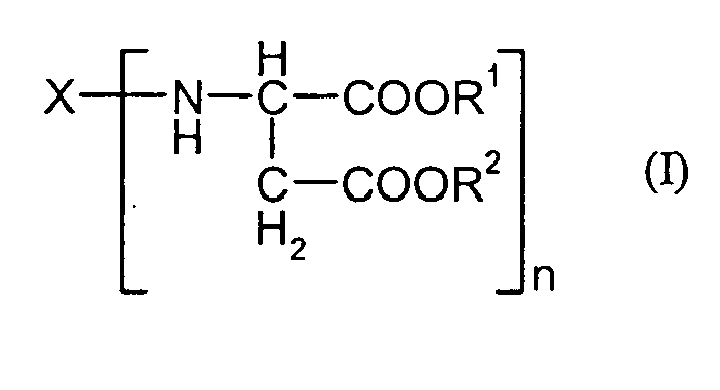
- X
- für einen n-wertigen organischen Rest steht, der durch Entfernung der primären Aminogruppen eines n-wertigen Polyamins erhalten wird,
- R1, R2
- für gleiche oder verschiedene organische Reste stehen, die unter den Reaktionsbedingungen gegenüber Isocyanatgruppen inert sind und
- n
- für eine ganze Zahl von mindestens 2 steht.
- Die in A) eingesetzten Polyisocyanate weisen neben freien NCO-Gruppen auch eine oder mehrere Sulfonsäure- oder Sulfonatgruppen auf. Die Herstellung solcher modifizierten Polyisocyanate ist in
WO-A 01-88006 - Diese basieren auf organischen Polyisocyanaten bevorzugt mit einer mittleren NCO-Funktionalität von mindestens 2 und einem Molekulargewicht von mindestens 140 g/mol. Gut geeignet sind vor allem (i) unmodifizierte organische Polyisocyanate des Molekulargewichtsbereichs 140 bis 300 g/mol, (ii) Lackpolyisocyanate eines Molekulargewichts von 300 bis 1000 g/mol sowie (iii) urethangruppenaufweisende NCO-Prepolymere eines über Mn = 1000 g/mol liegenden Molekulargewichtes oder Gemische aus (i) bis (iii).
- Beispiele für Polyisocyanate der Gruppe (i) sind 1,4-Diisocyanatobutan, 1,6-Diisocyanatohexan (HDI), 1,5-Diisocyanato-2,2-dimethylpentan, 2,2,4- bzw. 2,4,4-Trimethyl-1,6-diisocyanatohexan, 1-Isocyanato-3,3,5-trimethyl-5-isocyanatomethyl-cyclohexan (IPDI), 1-Isocyanato-1-methyl-4-(3)-isocyanatomethyl-cyclohexan, Bis-(4-isocyanatocyclohexyl)methan, 1,10-Diisocyanatodecan, 1,12-Diisocyanato-dodecan, Cyclohexan-1,3- und -1,4-diisocyanat, Xylylendüsocyanat-Isomere, Triisocyanatononan (TIN), 2,4-Diisocyanatotoluol oder dessen Gemische mit 2,6-Diisocyanatotoluol mit bevorzugt, bezogen auf Gemische, bis zu 35 Gew.-% 2,6-Diisocyanatotoluol, 2,2'-, 2,4'-, 4,4'-, Diisocyanatodiphenylmethan oder technische Polyisocyanatgemische der Diphenylmethanreihe oder beliebige Gemische der genannten Isocyanate.
- Polyisocyanate der Gruppe (ii) sind die an sich bekannten Lackpolyisocyanate. Unter dem Begriff "Lackpolyisocyanate" sind im Rahmen der Erfindung Verbindungen oder Gemische von Verbindungen zu verstehen, die durch an sich bekannte Oligomerisierungsreaktion von einfachen Diisocyanaten der unter (i) beispielhaft genannten Art erhalten werden. Geeignete Oligomerisierungsreaktionen sind z.B. die Carbodiimidisierung, Dimerisierung, Trimersisierung, Biuretisierung, Harnstoffbildung, Urethanisierung, Allophanatisierung und/oder Cyclisierung unter Ausbildung von Oxadiazinstrukturen. Oftmals laufen bei der "Oligomerisierung" mehrere der genannten Reaktionen gleichzeitig oder nacheinander ab.
- Bevorzugt handelt es sich bei den "Lackpolyisocyanaten" (ii) um Biuretpolyisocyanate, Isocyanuratgrupen-aufweisende Polyisocyanate, Isocyanurat- und Uretdiongruppen-aufweisende Polyisocyanatgemische, Urethan- und/oder Allophanatgruppen und/oder Oxadianzinstruktur-aufweisende Polyisocyanate oder um Isocyanurat- und Allophanat- und Oxadianzingruppen aufweisende Polyisocyanatgemische auf Basis einfacher Diisocyanate.
- Die Herstellung von derartigen Lackpolyisocyanaten ist bekannt und beispielweise in der
DE-A 1 595 273 ,DE-A 3 700 209 undDE-A 3 900 053 oder in derEP-A-0 330 966 ,EP-A 0 259 233 ,EP-A- 0 377 177 ,EP-A-0 496 208 ,EP-A-0 524 501 oderUS-A 4 385 171 beschrieben. - Polyisocyanate der Gruppe (iii) sind die an sich bekannten Isocyanatgruppen-aufweisenden Prepolymere auf Basis von einfachen Diisocyanaten der oben beispielhaft genannten Art und/oder auf Basis von Lackpolyisocyanaten (ii) einerseits und organischen Polyhydroxyverbindungen eines über 300 g/mol liegenden Molekulargewichts andererseits. Während es sich bei den Urethangruppen-aufweisenden Lackpolyisocyanaten der Gruppe (ii) um Derivate von niedermolekularen Polyolen des Molekulargewichtsbereichs 62 bis 300 g/mol handelt, geeignete Polyole sind beispielsweise Ethylenglykol, Propylenglykol, Trimethylolpropan, Glycerin oder Gemische dieser Alkohole, werden zur Herstellung der NCO-Prepolymere der Gruppe (iii) Polyhydroxyverbindungen eines über 300 g/mol, bevorzugt über 500 g/mol, besonders bevorzugt eines zahlenmittleren Molekulargewichts von 500 und 8 000 g/mol eingesetzt. Derartige Polyhydroxyverbindungen sind insbesondere solche, die pro Molekül 2 bis 6, bevorzugt 2 bis 3 Hydroxylgruppen aufweisen und aus der Gruppe, bestehend aus Ether-, Ester-, Thioether-, Carbonat- und Polyacrylatpoloyolen und Gemischen aus derartigen Polyolen ausgewählt sind.
- Zur Herstellung der NCO-Prepolymeren (iii) oder deren Gemische mit den Lackpolyisocyanaten (ii) werden Diisocyanate (i) der oben beispielhaft genannten Art oder Lackpolyisocyanate der unter (ii) beispielhaft genannten Art mit den höhermolekularen Hydroxyverbindungen oder deren Gemischen mit niedermolekularen Polyhydroxyverbindungen der beispielhaft genannten Art unter Einhaltung eines NCO/OH Äquivalentverhältnisses von 1,1:1 bis 40:1, bevorzugt 2:1 bis 25:1 unter Urethanbildung umgesetzt. Gegebenenfalls kann bei Verwendung eines Überschusses an destillierbarem Ausgangsdiisocyanat dieser im Anschluß an die Umsetzung destillativ entfernt werden, so dass monomerenfreie NCO-Prepolymere, d.h. Gemische aus Ausgangsdiisocyanaten (i) und echten NCO-Prepolymeren (iii) vorliegen.
- Bei der Herstellung der NCO-Prepolymeren (iii) können die genannten höhermolekularen Polyole auch in Abmischungen mit den genannten niedermolekularen Polyolen zur Anwendung gelangen, so dass unmittelbar Gemische aus niedermolekularen, Urethangruppen aufweisenden Lackpolyisocyanaten (ii) und höhermolekularen NCO-Prepolymeren (iii) resultieren.
- Zur Herstellung dieser sulfonatmodifizierten Polyisocyanate werden die vorstehend beschriebenen Basisisocyanate gegebenenfalls mit difunktionellen Polyethern unter partieller.Urethanisierung der NCO-Gruppen umgesetzt und dann mit Verbindungen, die neben wenigstens einer Sulfonsäure bzw. Sulfonatgruppe auch eine gegenüber NCO-Gruppen reaktive Funktion wie eine OH- oder NH-Gruppe aufweisen, zur Reaktion gebracht. Bevorzugt sind dies 2-(Cyclohexylamino)-ethansulfonsäure und/oder 3-(Cyclohexylamino)-propansulfonsäure. Nach dem Polymeraufbau werden die Sulfonsäuregruppen ganz oder teilweise durch Zugabe einer Base, die bevorzugt ein tertiäres Amin ist, deprotoniert.
- Besonders bevorzugt basieren die als Basisisocyanate verwandten Polyisocyanate auf Hexamethylendiisocyanat, Isophorondiisocyanat und/oder 4,4'-Dlcyclohexylmethandiisocyanat.
- Die so erhältlichen und in A) eingesetzten sulfonatmodifizierten Polyisocyanate weisen bevorzugt eine mittlere Isocyanatfunktionalität von mindestens 1,8, einem Gehalt an Isocyanatgruppen (berechnet als NCO; Molekulargewicht = 42) von 4,0 bis 26,0 Gew.-%, einem Gehalt an gebundenen Sulfonsäure- und Sulfonatgruppen (berechnet als SO3 -; Molekulargewicht = 80 g/mol) von 0,1 bis 7,7 Gew.-% auf.
- Sind Polyethereinheiten mit enthalten, so beträgt der Gehalt an innerhalb von Polyetherketten gebundenen Ethylenoxideinheiten (berechnet als C2H2O; Molekulargewicht = 44) im sulfonatmodifizierten Polyisocyanat 0 bis 19,5 Gew.-%.
- Solche optional eingebauten Polyetherketten weisen bevorzugt im statistischen Mittel 5 bis 35 Ethylenoxideinheiten auf.
- Die Sulfonatgruppen haben dabei als Gegenion bevorzugt ein aus tertiären Aminen durch Protonierung gebildetes Ammoniumion. Das Verhältnis der Summe aus Sulfonsäuregruppen und Sulfonatgruppen zur Summe aus tertiärem Amin und dem davon abgeleiteten protonierten Ammoniumion beträgt typischerweise 0,2 bis 2,0.
- Beispiele der tertiären Amine sind Monoamine, wie Trimethylamin, Triethylamin, Tripropylamin, Tributylamin, Dimethylcyclohexylamin, N-Methylmorpholin, N-Ethylmorpholin, N-Methylpiperidin, N-Ethylpiperidin, oder um tertiäre Diamine, wie 1,3-Bis-(dimethylamino)-propan, 1,4-Bis-(dimethylamino)-butan oder N,N'-Dimethylpiperazin. Geeignete, jedoch weniger bevorzugte Neutralisationsamine sind aber auch gegenüber Isocyanaten reaktive Gruppen tragende tertiäre Amine, wie die Alkanolamine Dimethylethanolamin, Methyldiethanolamin oder Triethanolamin. Bevorzugt ist Dimethylcyclohexylamin.
- Neben den sulfonatmodifizierten Polyisocyanaten der Komponente A) können auch nicht-sulfonatmodifizierte Polyisocyanate als weitere Polyisocyanate in den erfindungsgemäßen Beschichtungsmitteln enthalten sein. Diese sulfonatgruppenfreien Polyisocyanate entsprechen den bei der Herstellung der sulfonatgruppenhaltigen Polyisocyanate eingesetzten Basisisocyanate, bevorzugt der Gruppen (i) bis (iii).
- Sofern sulfonatgruppenfreie Polyisocyanate mitverwendet werden, beträgt das Gewichtsverhältnis von sulfonatgruppenhaltigen zu sulfonatgruppenfreien Polyisocyanaten 99 : 1 bis 10 : 90, bevorzugt 80 : 20 bis 20 : 80.
- In Formel (I) der Polyasparaginsäureester der Komponente B) basiert die Gruppe X bevorzugt auf einem n-wertigen Polyamin ausgewählt aus der Gruppe bestehend aus Ethylendiamin, 1,2-Diaminopropan, 1,4-Diaminobutan, 1,6-Diaminohexan, 2,5-Diamino-2,5-dimethylhexan, 2,2,4-und/oder 2,4,4-Trimethyl-1,6-diaminohexan, 1,11-Diaminoundecan, 1,12-Diaminododecan, 1-Amino-3,3,5-trimethyl-5-aminomethyl-cyclohexan, 2,4-und/oder 2,6-Hexahydrotoluylendiamin, 2,4'-und/oder 4,4'-Diarnino-dicyclohexylmethan, 3,3'-Dimethyl-4,4'-diamino-dicyclohexylmethan, 2,4,4'-Triamino-5-methyl-dicyclohexylmethan und Polyetherpolyaminen mit aliphatisch gebundenen primären Aminogruppen mit einem zahlenmittleren Molekulargewicht Mn von 148 bis 6000 g/mol.
- Besonders bevorzugt basiert die Gruppe X auf 1,4-Diaminobutan, 1,6-Diaminohexan, 2,2,4-und/oder 2,4,4-Trimethyl-1,6-diaminohexan, 1-Amino-3,3,5-trimethyl-5-aminomethyl-cyclohexan, 4,4'-Diamino-dlcyclohexylmethan oder 3,3'-Dimethyl-4,4'-dianiino-dlcyclohexylmethan.
- In Bezug auf die Reste R1 und R2 bedeutet "unter den Reaktionsbedingungen gegenüber Isocyanatgruppen inert", dass diese Reste keine Gruppen mit Zerewitinoff-aktivem Wasserstoff (CH-acide Verbindungen; vgl. Römpp Chemie Lexikon, Georg Thieme Verlag Stuttgart) wie OH, NH oder SH aufweisen.
- Bevorzugt sind R1 und R2 unabhängig voneinander C1 bis C10-Alkylreste, besonders bevorzugt Methyl oder Ethylreste.
- Für den Fall, dass X auf 2,4,4'-Triamino-5-methyl-dicyclohexylmethan basiert, sind bevorzugt R1 = R2 = Ethyl.
- Bevorzugt ist n in Formel (I) eine ganze Zahl von 2 bis 6, besonders bevorzugt 2 bis 4.
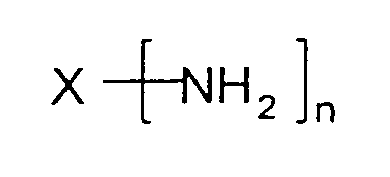
- Die Herstellung der aminofunktionellen Polyasparaginsäureester B) erfolgt in an sich bekannter Weise durch Umsetzung der entsprechenden primären Polyamine der Formel
R1OOC-CR3=CR4-COOR2
- Geeignete Polyamine sind die oben genannten Diamine. Beispiele geeigneter Malein- oder Fumarsäureester sind Maleinsäuredimethylester, Maleinsäurediethylester, Maleinsäuredibutylester und die entsprechenden Fumarsäureester.
- Die Herstellung der aminofunktionellen Polyasparaginsäureester B) aus den genannten Ausgangsmaterialien erfolgt bevorzugt innerhalb des Temperaturbereichs von 0 bis 100°C, wobei die Ausgangsmaterialien in solchen Mengenverhältnissen eingesetzt werden, dass auf jede primäre Aminogruppe mindestens eine, vorzugsweise genau eine olefinische Doppelbindung entfällt, wobei im Anschluss an die Umsetzung gegebenenfalls im Überschuss eingesetzte Ausgangsmaterialien destillativ abgetrennt werden können. Die Umsetzung kann in Substanz oder in Gegenwart geeigneter Lösungsmittel wie Methanol, Ethanol, Propanol oder Dioxan oder Gemischen derartiger Lösungsmittel erfolgen.
- Neben dem aminofunktionellen Polyasparaginsäureester der Komponente B) können in den erfindungsgemäßen Beschichtungssystemen auch Verbindungen des Molekulargewichtsbereichs Mn von 112 bis 6500 g/mol enthalten sein, die pro Molekül mindestens zwei Struktureinheiten der Formel (II) aufweisen,

- Diese optionalen Verbindungen mit verkappten Aminofunktionen, die im Rahmen der Erfindung als Polyaldimine bzw. Polyketimine bezeichnet werden, weisen ein Molekulargewicht Mn von 112 bis 6500 g/mol, vorzugsweise 140 bis 2500 g/mol und besonders bevorzugt 140 bis 458 g/mol auf. Das Molekulargewicht kann, falls es sich nicht als Summe der Atomgewichte der einzelnen Elemente ohnehin leicht ermitteln lässt, beispielsweise aus der Funktionalität und dem Gehalt an funktionellen Gruppen (beispielsweise ermittelbar durch Bestimmung der nach Hydrolyse vorliegenden primären Aminogruppen) errechnet oder auch, bei höhermolekularen Verbindungen, gelpermeationschromatographisch unter Verwendung von Polystyrol als Standard ermittelt werden.
- Zu den bevorzugten Polyaldiminen bzw. Polyketiminen gehören Verbindungen der allgemeinen Strukturformel (III)

- R3 und R4
- gleiche oder verschiedene Reste sind und Wasserstoff oder Kohlenwasserstoffreste mit bis zu 20 Kohlenstoffatomen sind, wobei R3 und R4 in letzterem Fall auch zusammen mit dem Kohlenstoffatom einen 5- oder 6-gliedrigen cycloaliphatischen Ring bilden können,
- R5
- ein (m+1)-wertiger Rest ist, wie er durch Entfernung der primären Aminogruppen aus einem entsprechenden, gegebenenfalls Sauerstoff- und/oder Stickstoffatome enthaltenden Polyamin erhalten wird.
- m
- eine ganze Zahl von 1 bis 3 ist.
- Bevorzugt sind R3 und R4 unabhängig voneinander Alkylreste mit 1 bis 8 Kohlenstoffatomen.
- Bevorzugt weist das R5 zugrunde liegende Polyamin ein zahlenmittleres Molekulargewicht Mn von 88 bis 2000 g/mol auf.
- Besonders bevorzugt sind Verbindungen der Formel (III), in der alle Reste R3 für Wasserstoff stehen, die Reste R4 für Kohlenwasserstoffreste mit bis zu 8 Kohlenstoffatomen stehen und m=1 ist.
- Die zur Herstellung der Polyaldimine bzw. Polyketimine verwendbaren Aldehyde bzw. Ketone entsprechen der Formel (IV)

- Geeignete Aldehyde sind beispielsweise Acetaldehyd, Propionaldehyd, n-Butyraldehyd, Isobutyraldehyd, Trimethylacetataldehyd, 2,2-Dimethylpropanal, 2-Ethylhexanal, 3-Cyclohexan-1-carboxaldehyd, Hexanal, Heptanal, Octanal, Valeraldehyd, Benzaldehyd, Tetrahydrobenzaldehyd, Hexahydrobenzaldehyd, Propargyladehyd, p-Toluylaldehyd, Phenylethanal, 2-Methylpentanal, 3-Methylpentanal, 4-Methylpentanal, Sorbinaldehyd.
- Besonders bevorzugt sind dabei n-Butyraldehyd, Isobutyraldehyd, Trimethlyacetaldehyd, 2-Ethylhexanal und Hexahydrobenzaldehyd.
- Geeignete Ketone sind beispielsweise Aceton, Methylethylketon, Methylpropylketon, Methylisopropylketon, Methylbutylketon, Methylisobutylketon, Methyl-tert-butylketon, Methyl-n-amylketon, Methylisamyl-keton, Methylheptylketon, Methylundecylketon, Diethylketon, Ethylbutylketon, Ethylamylketon, Diisopropylketon, Diisobutylketon, Cyclohexanon, Cyclopentanon, Methylcyclohexanon, Isophoron, 5-Methyl-3-heptanon, 1-Phenyl-2-propanon, Acetophenon, Methylnonylketon, Dinoylketon, 3,3,5-Trimethlycyclohexanon.
- Besonders bevorzugte Ketone sind Cyclopentanon, Cyclohexanon, Methylcyclopentanon, Methylcyclohexanon, 3,3,5-Trimethylcyclopentanon, Cyclobutanon, Methylcyclobutanon, Aceton, Methylethylketon, Methylisobutylketon.
- Es könnten selbstverständlich auch Mischungen verschiedener Ketone bzw. Aldehyde und auch Mischungen von Ketonen mit Aldehyden eingesetzt werden um spezielle Eigenschaften zu erzielen.
- Bei den zur Herstellung der Polyaldimine bzw. Polyketimine zum Einsatz gelangenden Polyaminen handelt es sich um organische Verbindungen, die mindestens zwei und vorzugsweise 2 (m = 1) aliphatisch und/oder cycloaliphatisch gebundene primäre Aminogruppen aufweisen. Die Verwendung von solchen Aminen, die aromatisch gebundene Aminogruppen aufweisen, ist zwar ebenfalls möglich, jedoch weniger bevorzugt. Die Polyamine weisen im allgemeinen ein zahlenmittleres Molekulargewicht von 60 bis 6000 g/mol, vorzugsweise 88 bis 2000 g/mol und besonders bevorzugt 88 bis 238 g/mol auf. Geeignete Polyamine zur Herstellung dieser der Polyaldimine bzw. Polyketimine sind beispielsweise die bereits oben im Zusammenhang mit der Komponente B) genannten Verbindungen. Selbstverständlich können zur Herstellung der Komponente B) und der optionalen Polyaldimine bzw. Polyketimine jeweils unterschiedliche Polyamine der beispielhaft genannten Art eingesetzt werden.
- Die Herstellung der Polyaldimine bzw. Polyketimine erfolgt nach an sich bekannten Methoden durch Umsetzung der Ausgangskomponenten unter Einhaltung eines Stöchiometrischen Verhältnisses von Aminogruppen zu Aldehyd- bzw. Ketogruppen von 1:1 1 bis 1:1,5. Gegebenfalls können zur Reaktionsbeschleunigung katalytische Mengen von sauren Substanzen wie z.B. p-Toluolsulfonsäure, Chlorwasserstoff, Schwefelsäure oder Aluminiumchlorid mit verwendet werden.
- Die Umsetzung erfolgt im allgemeinen innerhalb des Temperaturbereichs von 20 bis 180°C, wobei die Reaktion gegebenenfalls unter Verwendung eines Schleppmittels (z.B. Toluol, Xylol, Cyclohexan und Octan) zur Entfernung des Reaktionswassers, so lange durchgeführt wird, bis die berechnete Menge an Wasser (1 Mol Wasser pro Mol primäre Aminogruppe) abgespalten ist bzw. bis kein Wasser mehr abgespalten wird. Anschließend werden die Phasen getrennt bzw. das Schleppmittel und gegebenenfalls vorliegende nicht umgesetzte Edukte destillativ abgetrennt.
- Die so erhaltenen Produkte können ohne weitere Reinigung neben der Komponente B) eingesetzt werden.
- Sofern solche Polyaldimine bzw. Polyketimine neben den Asparaginsäureestern mitverwendet werden so beträgt das Gewichtsverhältnis von B) zu diesen optionalen Polyaldiminen bzw. Polyketiminen 99 : 1 bis 5 : 95, bevorzugt 80 : 20 bis 20 : 80.
- In den erfindungsgemäßen Beschichtungsmitteln beträgt das Verhältnis von freien oder blockierten Aminogruppen zu freien NCO-Gruppen bevorzugt 0,5 : 1 bis 1,5 : 1, besonders bevorzugt 1:1 bis 1,5:1.
- Zur Herstellung der erfindungsgemäße Zwei-Komponenten-Bindemittel werden die Einzelkomponenten miteinander vermischt.
- Die genannten Beschichtungsmittel können mit den an sich bekannten Techniken wie Sprühen, Tauchen, Fluten, Rollen, Streichen oder Gießen auf Oberflächen appliziert werden. Nach dem Ablüften gegebenenfalls vorhandener Lösungsmittel, härten die Beschichtungen dann bei Umgebungsbedingungen oder auch bei höheren Temperaturen von beispielsweise 40 bis 200°C.
- Die genannten Beschichtungsmittel können beispielsweise auf Metalle, Kunststoffe, Keramik, Glas sowie Naturstoffe aufgebracht werden, wobei die genannten Substrate zuvor einer gegebenenfalls notwendigen Vorbehandlung unterzogen worden sein können.
- Soweit nicht anders angegeben sind alle Prozentangaben als Gewichtsprozent zu verstehen.
- Die dynamischen Viskositäten wurden bei 23°C mit einem Rotationsviskosimeter (ViscoTester® 550, Thermo Haake GmbH, D-76227 Karlsruhe) bestimmt.
- Als Maß für die Verarbeitungszeit wurde die Auslaufzeit nach DIN 53211 bestimmt.
- Die Trocknungsgeschwindigkeit wurde nach DIN 53150, DIN EN ISO 1517 bestimmt.
- Die Pendelhärte nach König wurde nach DIN 53157 bestimmt (nach Trocknung 10 min 60°C und anschließend 7 Tage Raumtemperatur Lagerung)
-
- SN:
- Solvent Naphta wie Solvesso 100, Exxon Mobile, USA; höhersiedendes Kohlenwasserstoffgemisch mit einem Flammpunkt von 55 bis 100°C, lackübliches Lösemittel
- BA:
- Butylacetat
- Die Beispiel 1 und 2 zeigen im Gegensatz zum Vergleichsbeispiel 5 einen schnelle Trocknung bei langer Topfzeit (Auslaufzeit). Vergleichsbeispiele 6 zeigt zwar eine schnelle Trocknung und lange Topfzeit (Auslaufzeit), jedoch die Komponente B vergilbt sehr.
- Beispiel 3 und 4 zeigen im Gegensatz zum Vergleichsbeispiel 7 eine schnelle Trocknung bei langer Topfzeit (Auslaufzeit).
Tinuvin 292: Lichtschutzmittel, HALS, auf Basis eines sterisch gehinderten Amins, Ciba Specialty Chemicals, Basel, CH
Tinuvin 384-2: Lichtschutzmittel, UV-Absorber, auf Basis Benztriazol, Ciba Specialty Chemicals, Basel, CH
Polyisocyanat Al-I: Desmodur® XP 2570, sulfonatgruppenhaltiges aliphatisches Polyisocyanat auf Basis von HDI mit einem NCO-Gehalt von 20,6 % und einer Viskosität bei 23°C von 3500 mPas, Bayer MaterialScience AG, Leverkusen, DE
Polyisocyanat A1-II: Desmodur® XP 2487/1, sulfonatgruppenhaltiges aliphatisches Polyisocyanat auf Basis von HDI mit einem NCO-Gehalt von 20,9 % und einer Viskosität bei 23°C von 6900 mPas, Bayer MaterialScience AG, Leverkusen, DE
Polyisocyanat A2: Desmodur® XP 2410, asymmetrisches HDI Trimerisat mit einem NCO-Gehalt von 23,7 % und einer Viskosität bei 23°C von 700 mPas, Bayer MaterialScience AG, Leverkusen, DE
Polyasparaginsäureester B1-1: Desmophen NH 1420, erhalten durch Addition von 1 Mol 4,4'-Diaminodicyclohexylmethan und 2 Mol Maleinsäurediethylester, Äquivalentgewicht: 277 g mit einer Viskosität von 1500 mPa.s
Polyasparaginsäuerester B1-II: Desmophen VPLS 2973, erhalten durch Addition von 1 Mol 3,3'-Dimethyl-4,4'-Diaminodlcyclohexylmethan und 2 Mol Maleinsäurediethylester, 90 %-ig in BA, Äquivalentgewicht 323 g mit einer Viskosität von 150 mPa.s
Polyaldimin B2: Desmophen VPLS 2142, erhalten durch Addition von 1 Mol 1-Amino-3,3,5-trimetehyl-5-aminomethylcyclohexan (IPDA) und 2 Mol iso-Butyraldehyd, Äquivalentgewicht 139 g, Viskosität 25 mPa.s
| Beispiel | 1 | 2 | 3 | 4 |
| Komponente A: | ||||
| Polyisocyanat A1-I | 39,17 | 34,56 | ||
| Polyisocyanat AL-II | 38,59 | 34,29 | ||
| SN 100: BA 1:9 | 11,52 | 11,43 | ||
| Komponente B: | ||||
| Polyasparaginsäure A1-I | 26,75 | 26,75 | ||
| Polyasparaginsäure A1-II | 26,46 | 26,65 | ||
| Polyaldimin A2 | 13,36 | 13,36 | 13,22 | 13,31 |
| Baysilone OL17 10% in MPA | 0,36 | 0,36 | 0,36 | 0,36 |
| Tinuvin 292 | 1,00 | 1,00 | 1,00 | 1,00 |
| Tinuvin 384-2 | 1,51 | 1,51 | 1,50 | 1,50 |
| SN 100: BA 1:9 | 12,20 | 12,20 | 11,38 | 11,46 |
| Farbzahl Komponente A | ||||
| Sofort | 121 | 121 | ||
| 9 Wochen RT | 141 | 141 | ||
| Auslaufzeit DIN4 (sec) nach | ||||
| 0,0 h | 18 | 17 | 17 | 19 |
| 0,5 | 21 | 23 | 20 | 21 |
| 1,0 | 25 | 30 | 21 | 23 |
| 2,0 | 40 | 50 | 22 | 24 |
| 4,0 | 60 | 95 | 23 | 25 |
| Trocknungszeit RT | ||||
| T1 +min | 15 | 15 | 15 | 30 |
| T3+min | 30 | 30 | 40 | 45 |
| T4+min | 40 | 40 | 90 | 100 |
| Pendelhärte | ||||
| 1 d RT | 150 | 151 | 51 | 113 |
| 7 d RT | 160 | 157 | 112 | 129 |
| Beispiel | 5 | 6 | 7 |
| Komponente A: | |||
| Polyisocyanat A2 | 33,58 | 32,83 | |
| Polyisocyanat A1-I | 38,59 | ||
| Polyisocyanat A1-II | |||
| SN 100: BA 1:9 | 11,23 | ||
| Komponente B: | |||
| Polyasparaginsäure A1-I | 26,75 | 26,75 | |
| Polyasparaginsäure A1-II | 29,31 | ||
| Polyaldimin A2 | 13,36 | 13,36 | 14,64 |
| Baysilone OL17 10% in MPA | 0,36 | 0,36 | 0,37 |
| Tinuvin 292 | 1,00 | 1,00 | 1,00 |
| Tinuvin 384-2 | 1,51 | 1,51 | 1,50 |
| SN 100: BA 1:9 | 12,20 | 12,20 | 9,37 |
| Dodecylbenzoesäure 10% in Xylol | 2,0 | ||
| Farbzahl Komponente A | |||
| Sofort | 121 | 143 | |
| 9 Wochen RT | 141 | 303 | |
| Auslaufzeit DIN4 (sec) nach | |||
| 0,0 h | 16 | 17 | 15 |
| 0,5 | 19 | 23 | 15 |
| 1,0 | 25 | 30 | 16 |
| 2,0 | 47 | 50 | 17 |
| 4,0 | 90 | 95 | 19 |
| Trocknungszeit RT | |||
| T1 +min | 35 | 15 | 70 |
| T3+min | 60 | 30 | 180 |
| T4+min | 90 | 40 | 210 |
| Pendelhärte | |||
| 1 d RT | 154 | 151 | 155 |
| 7 d RT | 155 | 157 | 168 |
Claims (11)
- Zweikomponentige Beschichtungssysteme zur Herstellung von Polyharnstoffbeschichtungen, mindestens enthaltendA) ein sulfonatgruppenhaltiges Polyisocyanat undB) einen aminofunktionellen Polyasparaginsäureester der allgemeinen Formel (I)in der
 X für einen n-wertigen organischen Rest steht, der durch Entfernung der primären Aminogruppen eines n-wertigen Polyamins erhalten wird,R1, R2 für gleiche oder verschiedene organische Reste stehen, die unter den Reaktions-bedingungen gegenüber Isocyanatgruppen inert sind undn für eine ganze Zahl von mindestens 2 steht.
 - Zweikomponentige Beschichtungssysteme gemäß Anspruch 1, dadurch gekennzeichnet, dass die in A) eingesetzten sulfonatmodifizierten Polyisocyanate auf auf Hexamethylendiisocyanat, Isophorondiisocyanat und/oder 4,4'-Dicyclohexylmethandiisocyanat basieren.
- Zweikomponentige Beschichtungssysteme gemäß Anspruch 1 oder 2, dadurch gekennzeichnet, dass die in A) eingesetzten sulfonatmodifizierten Polyisocyanate eine mittlere Isocyanatfunktionalität von mindestens 1,8, einem Gehalt an Isocyanatgruppen (berechnet als NCO; Molekulargewicht = 42) von 4,0 bis 26,0 Gew.-%, einem Gehalt an gebundenen Sulfonsäure- und Sulfonatgruppen (berechnet als SO3 -; Molekulargewicht = 80 g/mol) von 0,1 bis 7,7 Gew.-% und 0 bis 19,5 Gew.-% an innerhalb von Polyetherketten gebundenen Ethylenoxideinheiten (berechnet als C2H2O; Molekulargewicht = 44) aufweisen.
- Zweikomponentige Beschichtungssysteme gemäß einem der Ansprüche 1 bis 3, dadurch gekennzeichnet, dass auch sulfonatgruppenfreie Polyisocyanate mit verwendet werden und dass das Gewichtsverhältnis von sulfonatgruppenhaltigen zu sulfonatgruppenfreien Polyisocyanaten 80 : 20 bis 20 : 80 beträgt.
- Zweikomponentige Beschichtungssysteme gemäß einem der Ansprüche 1 bis 4, dadurch gekennzeichnet, dass in Formel (I) der Polyasparaginsäureester X auf 1,4-Diaminobutan, 1,6-Diaminohexan, 2,2,4- und/oder 2,4,4-Trimethyl-1,6-diaminohexan, 1-Amino-3,3,5-trimethyl-5-aminomethyl-cyclohexan, 4,4'-Diamino-dicyclohexylmethan oder 3,3'-Dimethyl-4,4'-diamino-dlcyclohexylmethan basiert.
- Zweikomponentige Beschichtungssysteme gemäß einem der Ansprüche 1 bis 5, dadurch gekennzeichnet, dass in Formel (I) R1 = R2 = Methyl oder Ethyl sind.
- Zweikomponentige Beschichtungssysteme gemäß einem der Ansprüche 1 bis 6, dadurch gekennzeichnet, dass zusätzlich Polyaldimine und/oder Polyketimine mitenthalten sind.
- Zweikomponentige Beschichtungssysteme gemäß Anspruch 7, dadurch gekennzeichnet, dass die Polyaldimine und/oder Polyketimine der Formel (III) entsprechen
 R3, R4 gleiche oder verschiedene Reste sind und Wasserstoff oder Kohlenwasserstoffreste mit bis zu 20 Kohlenstoffatomen sind, wobei R3 und R4 in letzterem Fall auch zusammen mit dem Kohlenstoffatom einen 5- oder 6-gliedrigen cycloaliphatischen Ring bilden können,R5 ein (m+1)-wertiger Rest ist, wie er durch Entfernung der primären Aminogruppen aus einem entsprechenden, gegebenenfalls Sauerstoff- und/oder Stickstoffatome enthaltenden Polyamin erhalten wird.m eine ganze Zahl von 1 bis 3 ist.
 - Zweikomponentige Beschichtungssysteme gemäß Anspruch 7 oder 8, dadurch gekennzeichnet, dass das Verhältnis von Komponente B) zu Polyaldiminen und/oder Polyketiminen 80 : 20 bis 20 : 80 beträgt.
- Zweikomponentige Beschichtungssysteme gemäß einem der Ansprüche 1 bis 9, dadurch gekennzeichnet, dass das Verhältnis von freien oder blockierten Aminogruppen zu freien NCO-Gruppen 1 : 1 bis 1,5 : 1 beträgt.
- Beschichtungen erhältlich aus zweikomponentigen Beschichtungssystemen gemäß einem der Ansprüche 1 bis 10.
Priority Applications (2)
| Application Number | Priority Date | Filing Date | Title |
|---|---|---|---|
| PL06008049T PL1726606T3 (pl) | 2005-04-30 | 2006-04-19 | Mieszaniny substancji błonotwórczych zawierające poliestry kwasu asparaginowego i poliizocyjaniany modyfikowane sulfonianami |
| SI200630034T SI1726606T1 (sl) | 2005-04-30 | 2006-04-19 | Vezivne zmesi iz estrov poliasparaginske kisline in sulfonatno modificiranih poliizocianatov |
Applications Claiming Priority (1)
| Application Number | Priority Date | Filing Date | Title |
|---|---|---|---|
| DE102005020269A DE102005020269A1 (de) | 2005-04-30 | 2005-04-30 | Bindemittelgemische aus Polyasparaginsäureestern und sulfonatmodifizierten Polyisocyanaten |
Publications (2)
| Publication Number | Publication Date |
|---|---|
| EP1726606A1 true EP1726606A1 (de) | 2006-11-29 |
| EP1726606B1 EP1726606B1 (de) | 2008-03-05 |
Family
ID=36933508
Family Applications (1)
| Application Number | Title | Priority Date | Filing Date |
|---|---|---|---|
| EP06008049A Expired - Lifetime EP1726606B1 (de) | 2005-04-30 | 2006-04-19 | Bindemittelgemische aus Polyasparaginsäureestern und sulfonatmodifizierten Polyisocyanaten |
Country Status (18)
| Country | Link |
|---|---|
| US (1) | US20060247371A1 (de) |
| EP (1) | EP1726606B1 (de) |
| JP (1) | JP5273913B2 (de) |
| KR (1) | KR101277434B1 (de) |
| CN (1) | CN1880393A (de) |
| AT (1) | ATE388180T1 (de) |
| AU (1) | AU2006201793A1 (de) |
| BR (1) | BRPI0601475A (de) |
| CA (1) | CA2545037A1 (de) |
| DE (2) | DE102005020269A1 (de) |
| DK (1) | DK1726606T3 (de) |
| ES (1) | ES2302272T3 (de) |
| HR (1) | HRP20080211T3 (de) |
| MX (1) | MXPA06004603A (de) |
| NZ (1) | NZ546856A (de) |
| PL (1) | PL1726606T3 (de) |
| PT (1) | PT1726606E (de) |
| SI (1) | SI1726606T1 (de) |
Cited By (1)
| Publication number | Priority date | Publication date | Assignee | Title |
|---|---|---|---|---|
| WO2013006448A1 (en) * | 2011-07-01 | 2013-01-10 | Ppg Industries Ohio, Inc. | Polyurea coatings containing silane |
Families Citing this family (40)
| Publication number | Priority date | Publication date | Assignee | Title |
|---|---|---|---|---|
| DE102005047562A1 (de) * | 2005-10-04 | 2007-04-05 | Bayer Materialscience Ag | Zweitkomponenten-Systeme für die Herstellung flexibler Beschichtungen |
| KR100728388B1 (ko) * | 2007-02-14 | 2007-06-13 | 듀라케미 (주) | 방청방수용 지방족화합물계 폴리우레아 코팅제 |
| JP2013151645A (ja) * | 2011-12-27 | 2013-08-08 | Sumika Bayer Urethane Kk | 水性ウレタン系樹脂組成物 |
| CN105073815A (zh) | 2013-03-15 | 2015-11-18 | 拜耳材料科学有限责任公司 | 多天冬氨酸涂料组合物 |
| CN103351795B (zh) * | 2013-08-01 | 2016-05-18 | 天津科瑞达涂料化工有限公司 | 聚天门冬汽车涂料及制备方法与应用 |
| US10000686B2 (en) | 2013-12-18 | 2018-06-19 | Covestro Llc | Methods for treating a well bore within an underground formation |
| KR20160132844A (ko) * | 2014-03-14 | 2016-11-21 | 아크조노벨코팅스인터내셔널비.브이. | 코팅 조성물 |
| JP6425422B2 (ja) * | 2014-05-30 | 2018-11-21 | アイカ工業株式会社 | 外壁タイル剥落防止構造及び外壁タイル剥落防止工法 |
| JP6425432B2 (ja) * | 2014-06-30 | 2018-11-21 | アイカ工業株式会社 | 外壁タイル剥落防止構造及び外壁タイル剥落防止工法 |
| JP6425446B2 (ja) * | 2014-07-30 | 2018-11-21 | アイカ工業株式会社 | 外壁タイル剥落防止構造及び外壁タイル剥落防止工法 |
| JP6320223B2 (ja) * | 2014-07-30 | 2018-05-09 | アイカ工業株式会社 | コンクリート片剥落防止構造及びこの剥落防止工法及びこれらに使用する脂環式ポリアミン |
| EP3197926A1 (de) | 2014-09-24 | 2017-08-02 | Covestro LLC | Flexible polyharnstoffdichtungszusammensetzungen |
| WO2016210237A1 (en) | 2015-06-26 | 2016-12-29 | Covestro Llc | Polyaspartic ester based coatings for metal surfaces |
| CN105949987B (zh) * | 2016-07-11 | 2018-07-31 | 广东遂达工程技术有限公司 | 一种亚胺改性聚天门冬氨酸酯防水防腐涂料及制备方法与应用 |
| DK3515958T3 (da) * | 2016-09-20 | 2020-09-14 | Covestro Deutschland Ag | Anisotrope kompositmaterialer baseret på polyisocyanater |
| US20180346786A1 (en) | 2017-06-05 | 2018-12-06 | Covestro Llc | Methods and materials for refracturing a partially depleted oil and gas well |
| US20180362801A1 (en) | 2017-06-19 | 2018-12-20 | Covestro Llc | Coatings with fast return to service |
| WO2019032250A1 (en) | 2017-08-08 | 2019-02-14 | Covestro Llc | POLYURETHANES FOR THE STOPPING OF WATER FLOW IN OIL AND GAS WELLS |
| EP3489316A1 (de) * | 2017-11-22 | 2019-05-29 | Covestro Deutschland AG | Neue systeme für die grundierung und das kleben von bodenbelägen |
| US20190390066A1 (en) | 2018-06-22 | 2019-12-26 | Covestro Llc | Waterborne compositions containing inorganic ion-exchangers to improve corrosion resistance |
| US20190390063A1 (en) | 2018-06-22 | 2019-12-26 | Covestro Llc | Solventborne compositions containing organic ion-exchangers to improve corrosion resistance |
| US20190390065A1 (en) | 2018-06-22 | 2019-12-26 | Covestro Llc | Waterborne compositions containing organic ion-exchangers to improve corrosion resistance |
| US20190390064A1 (en) | 2018-06-22 | 2019-12-26 | Covestro Llc | Solventborne compositions containing inorganic ion-exchangers to improve corrosion resistance |
| CN110734693A (zh) * | 2018-07-20 | 2020-01-31 | 科思创德国股份有限公司 | 一种涂料组合物 |
| EP3626755A1 (de) | 2018-09-24 | 2020-03-25 | Covestro Deutschland AG | Beschichtungszusammensetzung |
| EP3824011B1 (de) | 2018-07-20 | 2023-08-09 | Covestro Intellectual Property GmbH & Co. KG | Beschichtungszusammensetzung |
| US10781339B2 (en) | 2018-09-13 | 2020-09-22 | Covestro Llc | Reduced discoloration of polyaspartic resins blended with acrylate resins |
| EP3666811A1 (de) | 2018-12-14 | 2020-06-17 | Covestro Deutschland AG | Beschichtungszusammensetzung |
| ES2982403T3 (es) | 2018-11-07 | 2024-10-16 | Covestro Deutschland Ag | Una composición de recubrimiento |
| US11673997B2 (en) | 2019-07-31 | 2023-06-13 | Covestro Llc | Work time to walk-on time ratio by adding a phenolic catalyst to polyaspartic flooring formulations |
| US11827788B2 (en) | 2019-10-07 | 2023-11-28 | Covestro Llc | Faster cure polyaspartic resins for faster physical property development in coatings |
| CN110845685B (zh) * | 2019-12-12 | 2021-11-09 | 中国科学院长春应用化学研究所 | 一种修补汽车仪表板聚氨酯泡沫的聚天门冬氨酸酯聚脲基修补材料、其制备方法及修补方法 |
| CN115181446B (zh) * | 2021-04-06 | 2026-01-06 | 立邦涂料(中国)有限公司 | 延长剂组合物及其应用 |
| CN113122129A (zh) * | 2021-04-19 | 2021-07-16 | 北京碧海云智新材料技术有限公司 | 一种低粘度无溶剂聚脲涂料及其制备方法和应用 |
| FR3123653B1 (fr) | 2021-06-04 | 2025-04-04 | Vencorex France | Compositions polyaspartiques |
| EP4105017B1 (de) | 2021-06-17 | 2023-06-07 | Schiefergruben Magog GmbH & Co. KG | Dünnsteinerzeugnis |
| CN114456691A (zh) * | 2022-01-26 | 2022-05-10 | 深圳飞扬骏研新材料股份有限公司 | 延长天冬聚脲涂料活化期的方法及涂料 |
| EP4406986A1 (de) | 2023-01-24 | 2024-07-31 | Covestro Deutschland AG | Harzzusammensetzung zur herstellung einer thermoplastischen polymermatrix |
| WO2024099826A1 (en) | 2022-11-07 | 2024-05-16 | Covestro Deutschland Ag | Resin composition for preparing a thermoplastic polymer matrix |
| CN118895082A (zh) * | 2024-07-23 | 2024-11-05 | 南京维新高分子科技有限公司 | 一种低粘度、缓凝胶无溶剂双组份脂肪族聚脲涂料及其应用 |
Citations (14)
| Publication number | Priority date | Publication date | Assignee | Title |
|---|---|---|---|---|
| DE1595273A1 (de) | 1965-06-23 | 1969-09-18 | American Cyanamid Co | Verfahren zur Herstellung von Polyurethanprepolymeren |
| DE1520139A1 (de) | 1963-02-04 | 1970-03-19 | Ici Ltd | Verfahren zur Herstellung von Polymeren |
| US4385171A (en) | 1982-04-30 | 1983-05-24 | Olin Corporation Research Center | Removal of unreacted diisocyanate from polyurethane prepolymers |
| DE3308418A1 (de) | 1983-03-09 | 1984-09-13 | Bayer Ag, 5090 Leverkusen | Verfahren zur herstellung von kombinationen aus organischen polyisocyanaten und zumindest teilweise blockierten polyaminen, die nach dem verfahren erhaeltlichen kombinationen und ihre verwendung zur herstellung von lacken, beschichtungs- oder dichtungsmassen |
| EP0259233A2 (de) | 1986-09-03 | 1988-03-09 | Rhone-Poulenc Chimie | Verfahren zur Herstellung von Polyisocyanaten mit Biuretstruktur |
| DE3700209A1 (de) | 1987-01-07 | 1988-07-21 | Bayer Ag | Verfahren zur herstellung von polyisocyanaten mit biuretstruktur |
| EP0330966A2 (de) | 1988-02-27 | 1989-09-06 | Bayer Ag | Verfahren zur Herstellung von Isocyanuratgruppen aufweisenden Polyisocyanaten |
| EP0377177A1 (de) | 1989-01-03 | 1990-07-11 | Bayer Ag | Verfahren zur Herstellung von Uretdion-und Isocyanuratgruppen aufweisenden Polyisocyanaten, die nach diesem Verfahren erhältlichen Polyisocyanate und ihre Verwendung in Zweikomponenten Polyurethanlacken |
| EP0403921A2 (de) | 1989-06-23 | 1990-12-27 | Bayer Ag | Verfahren zur Herstellung von Überzügen |
| EP0470461A2 (de) * | 1990-08-10 | 1992-02-12 | Bayer Ag | Verwendung von Zweikomponenten-Bindemittelkombinationen in Autoreparaturlacken |
| EP0496208A2 (de) | 1991-01-22 | 1992-07-29 | Bayer Corporation | Polyisocyanate mit Allophanat- und Isocyanuratgruppen, Verfahren zu ihrer Herstellung und ihre Verwendung in Zweikomponentenüberzugmassen |
| EP0524501A1 (de) | 1991-07-22 | 1993-01-27 | Bayer Corporation | Verfahren zur Herstellung von Allophanat- und Isocyanuratgruppen enthaltenden Polyisocyanaten |
| EP1038897A2 (de) * | 1999-03-23 | 2000-09-27 | Air Products And Chemicals, Inc. | Polyaspartatester die zusätzliche Isocyanatreaktive Funktionalität enthalten für Sprühpolyharnstoffbeschichtungen |
| WO2001088006A1 (de) | 2000-05-18 | 2001-11-22 | Bayer Aktiengesellschaft | Modifizierte polyisocyanate |
Family Cites Families (10)
| Publication number | Priority date | Publication date | Assignee | Title |
|---|---|---|---|---|
| DE4415778A1 (de) * | 1994-05-05 | 1995-11-09 | Bayer Ag | Verfahren zur Herstellung von Überzügen |
| US5489704A (en) * | 1994-08-29 | 1996-02-06 | Bayer Corporation | Polyisocyanate/polyamine mixtures and their use for the production of polyurea coatings |
| US5736604A (en) * | 1996-12-17 | 1998-04-07 | Bayer Corporation | Aqueous, two-component polyurea coating compositions |
| DE19822842A1 (de) * | 1998-05-22 | 1999-11-25 | Bayer Ag | 2K-PUR-Korrosionsschutz-Decklack |
| TW510916B (en) * | 1998-12-21 | 2002-11-21 | Bayer Ag | Aqueous reacitve filler compositions |
| US6613389B2 (en) * | 2001-12-26 | 2003-09-02 | Dow Global Technologies, Inc. | Coating process and composition for same |
| DE10213229A1 (de) * | 2002-03-25 | 2003-10-16 | Bayer Ag | Wässrige 2K-PUR-Systeme |
| US6774206B2 (en) * | 2002-09-26 | 2004-08-10 | Bayer Polymers Llc | Polyaspartate resins with improved flexibility |
| US6790925B2 (en) * | 2002-12-05 | 2004-09-14 | Bayer Polymers Llc | In-situ preparation of polyaspartic ester mixtures |
| US20050059790A1 (en) * | 2003-09-16 | 2005-03-17 | Roesler Richard R. | Process for preparing aspartates |
-
2005
- 2005-04-30 DE DE102005020269A patent/DE102005020269A1/de not_active Withdrawn
-
2006
- 2006-04-19 SI SI200630034T patent/SI1726606T1/sl unknown
- 2006-04-19 PT PT06008049T patent/PT1726606E/pt unknown
- 2006-04-19 DE DE502006000420T patent/DE502006000420D1/de not_active Expired - Lifetime
- 2006-04-19 PL PL06008049T patent/PL1726606T3/pl unknown
- 2006-04-19 DK DK06008049T patent/DK1726606T3/da active
- 2006-04-19 ES ES06008049T patent/ES2302272T3/es not_active Expired - Lifetime
- 2006-04-19 EP EP06008049A patent/EP1726606B1/de not_active Expired - Lifetime
- 2006-04-19 AT AT06008049T patent/ATE388180T1/de active
- 2006-04-25 US US11/410,405 patent/US20060247371A1/en not_active Abandoned
- 2006-04-25 MX MXPA06004603A patent/MXPA06004603A/es active IP Right Grant
- 2006-04-26 CA CA002545037A patent/CA2545037A1/en not_active Abandoned
- 2006-04-27 NZ NZ546856A patent/NZ546856A/en not_active IP Right Cessation
- 2006-04-28 AU AU2006201793A patent/AU2006201793A1/en not_active Abandoned
- 2006-04-28 JP JP2006125885A patent/JP5273913B2/ja not_active Expired - Fee Related
- 2006-04-28 KR KR1020060038649A patent/KR101277434B1/ko not_active Expired - Fee Related
- 2006-04-30 CN CNA2006100840245A patent/CN1880393A/zh active Pending
- 2006-05-02 BR BRPI0601475-5A patent/BRPI0601475A/pt not_active IP Right Cessation
-
2008
- 2008-05-14 HR HR20080211T patent/HRP20080211T3/xx unknown
Patent Citations (17)
| Publication number | Priority date | Publication date | Assignee | Title |
|---|---|---|---|---|
| DE1520139A1 (de) | 1963-02-04 | 1970-03-19 | Ici Ltd | Verfahren zur Herstellung von Polymeren |
| DE1595273A1 (de) | 1965-06-23 | 1969-09-18 | American Cyanamid Co | Verfahren zur Herstellung von Polyurethanprepolymeren |
| US4385171A (en) | 1982-04-30 | 1983-05-24 | Olin Corporation Research Center | Removal of unreacted diisocyanate from polyurethane prepolymers |
| DE3308418A1 (de) | 1983-03-09 | 1984-09-13 | Bayer Ag, 5090 Leverkusen | Verfahren zur herstellung von kombinationen aus organischen polyisocyanaten und zumindest teilweise blockierten polyaminen, die nach dem verfahren erhaeltlichen kombinationen und ihre verwendung zur herstellung von lacken, beschichtungs- oder dichtungsmassen |
| EP0259233A2 (de) | 1986-09-03 | 1988-03-09 | Rhone-Poulenc Chimie | Verfahren zur Herstellung von Polyisocyanaten mit Biuretstruktur |
| DE3700209A1 (de) | 1987-01-07 | 1988-07-21 | Bayer Ag | Verfahren zur herstellung von polyisocyanaten mit biuretstruktur |
| EP0330966A2 (de) | 1988-02-27 | 1989-09-06 | Bayer Ag | Verfahren zur Herstellung von Isocyanuratgruppen aufweisenden Polyisocyanaten |
| DE3900053A1 (de) | 1989-01-03 | 1990-07-12 | Bayer Ag | Verfahren zur herstellung von uretdion- und isocyanuratgruppen aufweisenden polyisocyanaten, die nach diesem verfahren erhaeltlichen polyisocyanate und ihre verwendung in zweikomponenten-polyurethanlacken |
| EP0377177A1 (de) | 1989-01-03 | 1990-07-11 | Bayer Ag | Verfahren zur Herstellung von Uretdion-und Isocyanuratgruppen aufweisenden Polyisocyanaten, die nach diesem Verfahren erhältlichen Polyisocyanate und ihre Verwendung in Zweikomponenten Polyurethanlacken |
| EP0403921A2 (de) | 1989-06-23 | 1990-12-27 | Bayer Ag | Verfahren zur Herstellung von Überzügen |
| US5126170A (en) | 1989-06-23 | 1992-06-30 | Bayer Aktiengesellschaft | Process for the production of polyurethane coatings |
| EP0470461A2 (de) * | 1990-08-10 | 1992-02-12 | Bayer Ag | Verwendung von Zweikomponenten-Bindemittelkombinationen in Autoreparaturlacken |
| EP0496208A2 (de) | 1991-01-22 | 1992-07-29 | Bayer Corporation | Polyisocyanate mit Allophanat- und Isocyanuratgruppen, Verfahren zu ihrer Herstellung und ihre Verwendung in Zweikomponentenüberzugmassen |
| EP0524501A1 (de) | 1991-07-22 | 1993-01-27 | Bayer Corporation | Verfahren zur Herstellung von Allophanat- und Isocyanuratgruppen enthaltenden Polyisocyanaten |
| EP1038897A2 (de) * | 1999-03-23 | 2000-09-27 | Air Products And Chemicals, Inc. | Polyaspartatester die zusätzliche Isocyanatreaktive Funktionalität enthalten für Sprühpolyharnstoffbeschichtungen |
| WO2001088006A1 (de) | 2000-05-18 | 2001-11-22 | Bayer Aktiengesellschaft | Modifizierte polyisocyanate |
| DE10024624A1 (de) * | 2000-05-18 | 2001-11-22 | Bayer Ag | Modifizierte Polyisocyanate |
Non-Patent Citations (2)
| Title |
|---|
| "RöMPP CHEMIE LEXIKON", GEORG THIEME VERLAG |
| SQUILLER; WICKS; YESKE: "HIGH SOLIDS POLYURETHANE COATINGS' IN POLYMERIC MATERIALS ENCYCLOPEDIA", vol. 5, 1996, CRC PRESS |
Cited By (3)
| Publication number | Priority date | Publication date | Assignee | Title |
|---|---|---|---|---|
| WO2013006448A1 (en) * | 2011-07-01 | 2013-01-10 | Ppg Industries Ohio, Inc. | Polyurea coatings containing silane |
| US8889259B2 (en) | 2011-07-01 | 2014-11-18 | Ppg Industries Ohio, Inc. | Polyurea coatings containing silane |
| RU2571136C2 (ru) * | 2011-07-01 | 2015-12-20 | Ппг Индастриз Огайо, Инк. | Полимочевинные покрытия, содержащие силан |
Also Published As
| Publication number | Publication date |
|---|---|
| KR101277434B1 (ko) | 2013-06-25 |
| JP5273913B2 (ja) | 2013-08-28 |
| MXPA06004603A (es) | 2007-12-11 |
| EP1726606B1 (de) | 2008-03-05 |
| SI1726606T1 (sl) | 2008-08-31 |
| PL1726606T3 (pl) | 2008-07-31 |
| ATE388180T1 (de) | 2008-03-15 |
| NZ546856A (en) | 2007-09-28 |
| DE102005020269A1 (de) | 2006-11-09 |
| DE502006000420D1 (de) | 2008-04-17 |
| DK1726606T3 (da) | 2008-06-23 |
| BRPI0601475A (pt) | 2006-12-26 |
| CN1880393A (zh) | 2006-12-20 |
| US20060247371A1 (en) | 2006-11-02 |
| HRP20080211T3 (en) | 2008-06-30 |
| CA2545037A1 (en) | 2006-10-30 |
| KR20060113530A (ko) | 2006-11-02 |
| JP2006307224A (ja) | 2006-11-09 |
| AU2006201793A1 (en) | 2006-11-16 |
| PT1726606E (pt) | 2008-05-16 |
| ES2302272T3 (es) | 2008-07-01 |
Similar Documents
| Publication | Publication Date | Title |
|---|---|---|
| EP1726606B1 (de) | Bindemittelgemische aus Polyasparaginsäureestern und sulfonatmodifizierten Polyisocyanaten | |
| EP0689881B1 (de) | Verfahren zur Herstellung von Überzügen | |
| DE69633036T2 (de) | Aspartat-funktionelle Polyhydantoin-Prepolymere sowie deren Verwendung in Beschichtungszusammensetzungen | |
| EP1937742B1 (de) | Zweikomponenten-systeme für die herstellung flexibler beschichtungen | |
| EP0689881A2 (de) | Verfahren zur Herstellung von Überzügen | |
| DE102006002153A1 (de) | Polyasparaginsäureester-haltige Bindemittel | |
| EP2970556A1 (de) | Polyasparaginsäure-beschichtungszusammensetzungen | |
| DE69606350T2 (de) | Hydroxyfunktionelle Polyhydantoin-Prepolymere sowie deren Verwendung in Beschichtungszusammensetzungen | |
| WO2010089034A1 (de) | Zweikomponenten-beschichtungszusammensetzungen für flexible beschichtungen | |
| EP2990398A1 (de) | Hydrophile Polyasparaginsäureester | |
| EP1616889B1 (de) | Wasserlösliche Aspartate | |
| DE69521192T2 (de) | Beschichtungszusammensetzungen auf der Basis von Aldiminen und Uretdiongruppen enthaltenden Polyisocyanaten | |
| EP2180011A1 (de) | Feuchtigkeitshärtende Polyisocyanatmischungen | |
| EP0868463B1 (de) | Verbindungen mit isocyanatgruppen und verkappten gegenüber isocyanaten reaktiven gruppen | |
| EP0118821B1 (de) | Verfahren zur Herstellung von Kombinationen aus organischen Polyisocyanaten und zumindest teilweise blockierten Polyaminen, die nach dem Verfahren erhältlichen Kombinationen und ihre Verwendung zur Herstellung von Lacken, Beschichtungs- oder Dichtungsmassen | |
| EP1924625B1 (de) | 2k pur-systeme enthaltend oh-funktionelle polydimethylsiloxane | |
| DD298414A5 (de) | Verfahren zur herstellung eines beschichtungsmittels | |
| EP3699218A1 (de) | Neue zweikomponenten-deckbeschichtungssysteme enthaltend polyasparaginsäureester | |
| DE69605242T2 (de) | Hydantoingruppe-Vorläufer enthaltende hydroxyfunktionelle Prepolymere sowie deren Verwendung in Beschichtungszusammensetzungen | |
| EP1669384B1 (de) | BOE- und/oder Polyorthoestergruppenhaltige Bindemittelgemische | |
| DE1110859B (de) | Verfahren zur Herstellung von hochmolekularen, vernetzten und gegebenenfalls verschaeumten Kunststoffen | |
| WO2025132730A1 (de) | Polyisocyanatgemisch | |
| EP4137524A1 (de) | Neue zweikomponenten-beschichtungssysteme enthaltend polyasparaginsäureester | |
| EP1047719A1 (de) | Diisocyanate mit allophanatgruppen abgeleitet von alicyclischen alkoholen | |
| HK1099562A (en) | Binder mixtures of polyaspartates and sulfonate-modified polyisocyanates |
Legal Events
| Date | Code | Title | Description |
|---|---|---|---|
| PUAI | Public reference made under article 153(3) epc to a published international application that has entered the european phase |
Free format text: ORIGINAL CODE: 0009012 |
|
| AK | Designated contracting states |
Kind code of ref document: A1 Designated state(s): AT BE BG CH CY CZ DE DK EE ES FI FR GB GR HU IE IS IT LI LT LU LV MC NL PL PT RO SE SI SK TR |
|
| AX | Request for extension of the european patent |
Extension state: AL BA HR MK YU |
|
| 17P | Request for examination filed |
Effective date: 20070529 |
|
| AKX | Designation fees paid |
Designated state(s): AT BE BG CH CY CZ DE DK EE ES FI FR GB GR HU IE IS IT LI LT LU LV MC NL PL PT RO SE SI SK TR |
|
| AXX | Extension fees paid |
Extension state: HR Payment date: 20070529 |
|
| GRAP | Despatch of communication of intention to grant a patent |
Free format text: ORIGINAL CODE: EPIDOSNIGR1 |
|
| GRAS | Grant fee paid |
Free format text: ORIGINAL CODE: EPIDOSNIGR3 |
|
| GRAA | (expected) grant |
Free format text: ORIGINAL CODE: 0009210 |
|
| AK | Designated contracting states |
Kind code of ref document: B1 Designated state(s): AT BE BG CH CY CZ DE DK EE ES FI FR GB GR HU IE IS IT LI LT LU LV MC NL PL PT RO SE SI SK TR |
|
| AX | Request for extension of the european patent |
Extension state: HR |
|
| REG | Reference to a national code |
Ref country code: GB Ref legal event code: FG4D Free format text: NOT ENGLISH |
|
| REG | Reference to a national code |
Ref country code: CH Ref legal event code: EP |
|
| REG | Reference to a national code |
Ref country code: IE Ref legal event code: FG4D Free format text: LANGUAGE OF EP DOCUMENT: GERMAN |
|
| REF | Corresponds to: |
Ref document number: 502006000420 Country of ref document: DE Date of ref document: 20080417 Kind code of ref document: P |
|
| REG | Reference to a national code |
Ref country code: CH Ref legal event code: NV Representative=s name: E. BLUM & CO. AG PATENT- UND MARKENANWAELTE VSP |
|
| REG | Reference to a national code |
Ref country code: HR Ref legal event code: TUEP Ref document number: P20080211 Country of ref document: HR |
|
| REG | Reference to a national code |
Ref country code: PT Ref legal event code: SC4A Free format text: AVAILABILITY OF NATIONAL TRANSLATION Effective date: 20080506 |
|
| REG | Reference to a national code |
Ref country code: GR Ref legal event code: EP Ref document number: 20080401230 Country of ref document: GR |
|
| REG | Reference to a national code |
Ref country code: DK Ref legal event code: T3 |
|
| REG | Reference to a national code |
Ref country code: HR Ref legal event code: T1PR Ref document number: P20080211 Country of ref document: HR |
|
| REG | Reference to a national code |
Ref country code: ES Ref legal event code: FG2A Ref document number: 2302272 Country of ref document: ES Kind code of ref document: T3 |
|
| PG25 | Lapsed in a contracting state [announced via postgrant information from national office to epo] |
Ref country code: FI Free format text: LAPSE BECAUSE OF FAILURE TO SUBMIT A TRANSLATION OF THE DESCRIPTION OR TO PAY THE FEE WITHIN THE PRESCRIBED TIME-LIMIT Effective date: 20080305 |
|
| REG | Reference to a national code |
Ref country code: PL Ref legal event code: T3 |
|
| REG | Reference to a national code |
Ref country code: HU Ref legal event code: AG4A Ref document number: E003492 Country of ref document: HU |
|
| ET | Fr: translation filed | ||
| PG25 | Lapsed in a contracting state [announced via postgrant information from national office to epo] |
Ref country code: RO Free format text: LAPSE BECAUSE OF FAILURE TO SUBMIT A TRANSLATION OF THE DESCRIPTION OR TO PAY THE FEE WITHIN THE PRESCRIBED TIME-LIMIT Effective date: 20080305 Ref country code: MC Free format text: LAPSE BECAUSE OF NON-PAYMENT OF DUE FEES Effective date: 20080430 |
|
| PG25 | Lapsed in a contracting state [announced via postgrant information from national office to epo] |
Ref country code: IS Free format text: LAPSE BECAUSE OF FAILURE TO SUBMIT A TRANSLATION OF THE DESCRIPTION OR TO PAY THE FEE WITHIN THE PRESCRIBED TIME-LIMIT Effective date: 20080705 |
|
| PLBE | No opposition filed within time limit |
Free format text: ORIGINAL CODE: 0009261 |
|
| STAA | Information on the status of an ep patent application or granted ep patent |
Free format text: STATUS: NO OPPOSITION FILED WITHIN TIME LIMIT |
|
| 26N | No opposition filed |
Effective date: 20081208 |
|
| PG25 | Lapsed in a contracting state [announced via postgrant information from national office to epo] |
Ref country code: BG Free format text: LAPSE BECAUSE OF FAILURE TO SUBMIT A TRANSLATION OF THE DESCRIPTION OR TO PAY THE FEE WITHIN THE PRESCRIBED TIME-LIMIT Effective date: 20080605 |
|
| PG25 | Lapsed in a contracting state [announced via postgrant information from national office to epo] |
Ref country code: CY Free format text: LAPSE BECAUSE OF FAILURE TO SUBMIT A TRANSLATION OF THE DESCRIPTION OR TO PAY THE FEE WITHIN THE PRESCRIBED TIME-LIMIT Effective date: 20080305 |
|
| PG25 | Lapsed in a contracting state [announced via postgrant information from national office to epo] |
Ref country code: LU Free format text: LAPSE BECAUSE OF NON-PAYMENT OF DUE FEES Effective date: 20080419 |
|
| REG | Reference to a national code |
Ref country code: HR Ref legal event code: ODRP Ref document number: P20080211 Country of ref document: HR Payment date: 20130408 Year of fee payment: 8 |
|
| PGFP | Annual fee paid to national office [announced via postgrant information from national office to epo] |
Ref country code: LT Payment date: 20130325 Year of fee payment: 8 Ref country code: EE Payment date: 20130325 Year of fee payment: 8 |
|
| PGFP | Annual fee paid to national office [announced via postgrant information from national office to epo] |
Ref country code: GR Payment date: 20130326 Year of fee payment: 8 |
|
| PGFP | Annual fee paid to national office [announced via postgrant information from national office to epo] |
Ref country code: PT Payment date: 20130318 Year of fee payment: 8 |
|
| PGFP | Annual fee paid to national office [announced via postgrant information from national office to epo] |
Ref country code: CH Payment date: 20130412 Year of fee payment: 8 Ref country code: IE Payment date: 20130417 Year of fee payment: 8 Ref country code: SK Payment date: 20130416 Year of fee payment: 8 Ref country code: DK Payment date: 20130410 Year of fee payment: 8 Ref country code: CZ Payment date: 20130417 Year of fee payment: 8 Ref country code: BE Payment date: 20130415 Year of fee payment: 8 |
|
| PGFP | Annual fee paid to national office [announced via postgrant information from national office to epo] |
Ref country code: HU Payment date: 20130322 Year of fee payment: 8 Ref country code: LV Payment date: 20130326 Year of fee payment: 8 Ref country code: SI Payment date: 20130409 Year of fee payment: 8 |
|
| REG | Reference to a national code |
Ref country code: DE Ref legal event code: R081 Ref document number: 502006000420 Country of ref document: DE Owner name: BAYER INTELLECTUAL PROPERTY GMBH, DE Free format text: FORMER OWNER: BAYER MATERIALSCIENCE AKTIENGESELLSCHAFT, 51373 LEVERKUSEN, DE Effective date: 20140317 Ref country code: DE Ref legal event code: R081 Ref document number: 502006000420 Country of ref document: DE Owner name: COVESTRO DEUTSCHLAND AG, DE Free format text: FORMER OWNER: BAYER MATERIALSCIENCE AKTIENGESELLSCHAFT, 51373 LEVERKUSEN, DE Effective date: 20140317 |
|
| PGFP | Annual fee paid to national office [announced via postgrant information from national office to epo] |
Ref country code: TR Payment date: 20120330 Year of fee payment: 7 |
|
| REG | Reference to a national code |
Ref country code: PT Ref legal event code: MM4A Free format text: LAPSE DUE TO NON-PAYMENT OF FEES Effective date: 20141020 |
|
| REG | Reference to a national code |
Ref country code: HR Ref legal event code: PBON Ref document number: P20080211 Country of ref document: HR Effective date: 20140419 |
|
| REG | Reference to a national code |
Ref country code: DK Ref legal event code: EBP Effective date: 20140430 |
|
| REG | Reference to a national code |
Ref country code: LT Ref legal event code: MM4D Effective date: 20140419 |
|
| REG | Reference to a national code |
Ref country code: CH Ref legal event code: PL |
|
| REG | Reference to a national code |
Ref country code: EE Ref legal event code: MM4A Ref document number: E002013 Country of ref document: EE Effective date: 20140430 |
|
| REG | Reference to a national code |
Ref country code: SK Ref legal event code: MM4A Ref document number: E 3530 Country of ref document: SK Effective date: 20140419 |
|
| REG | Reference to a national code |
Ref country code: GR Ref legal event code: ML Ref document number: 20080401230 Country of ref document: GR Effective date: 20141104 |
|
| REG | Reference to a national code |
Ref country code: IE Ref legal event code: MM4A |
|
| PG25 | Lapsed in a contracting state [announced via postgrant information from national office to epo] |
Ref country code: CH Free format text: LAPSE BECAUSE OF NON-PAYMENT OF DUE FEES Effective date: 20140430 Ref country code: LI Free format text: LAPSE BECAUSE OF NON-PAYMENT OF DUE FEES Effective date: 20140430 Ref country code: EE Free format text: LAPSE BECAUSE OF NON-PAYMENT OF DUE FEES Effective date: 20140430 Ref country code: SK Free format text: LAPSE BECAUSE OF NON-PAYMENT OF DUE FEES Effective date: 20140419 Ref country code: PT Free format text: LAPSE BECAUSE OF NON-PAYMENT OF DUE FEES Effective date: 20141020 Ref country code: LT Free format text: LAPSE BECAUSE OF NON-PAYMENT OF DUE FEES Effective date: 20140419 Ref country code: GR Free format text: LAPSE BECAUSE OF NON-PAYMENT OF DUE FEES Effective date: 20141104 Ref country code: CZ Free format text: LAPSE BECAUSE OF NON-PAYMENT OF DUE FEES Effective date: 20140419 |
|
| REG | Reference to a national code |
Ref country code: SI Ref legal event code: KO00 Effective date: 20141209 |
|
| PG25 | Lapsed in a contracting state [announced via postgrant information from national office to epo] |
Ref country code: LV Free format text: LAPSE BECAUSE OF NON-PAYMENT OF DUE FEES Effective date: 20140419 Ref country code: HU Free format text: LAPSE BECAUSE OF NON-PAYMENT OF DUE FEES Effective date: 20140420 Ref country code: SI Free format text: LAPSE BECAUSE OF NON-PAYMENT OF DUE FEES Effective date: 20140420 |
|
| PG25 | Lapsed in a contracting state [announced via postgrant information from national office to epo] |
Ref country code: DK Free format text: LAPSE BECAUSE OF NON-PAYMENT OF DUE FEES Effective date: 20140430 Ref country code: IE Free format text: LAPSE BECAUSE OF NON-PAYMENT OF DUE FEES Effective date: 20140419 |
|
| PGFP | Annual fee paid to national office [announced via postgrant information from national office to epo] |
Ref country code: NL Payment date: 20150325 Year of fee payment: 10 Ref country code: ES Payment date: 20150327 Year of fee payment: 10 |
|
| PGFP | Annual fee paid to national office [announced via postgrant information from national office to epo] |
Ref country code: PL Payment date: 20150327 Year of fee payment: 10 |
|
| PGFP | Annual fee paid to national office [announced via postgrant information from national office to epo] |
Ref country code: SE Payment date: 20150413 Year of fee payment: 10 |
|
| PGFP | Annual fee paid to national office [announced via postgrant information from national office to epo] |
Ref country code: AT Payment date: 20150325 Year of fee payment: 10 |
|
| REG | Reference to a national code |
Ref country code: DE Ref legal event code: R081 Ref document number: 502006000420 Country of ref document: DE Owner name: COVESTRO DEUTSCHLAND AG, DE Free format text: FORMER OWNER: BAYER INTELLECTUAL PROPERTY GMBH, 40789 MONHEIM, DE |
|
| REG | Reference to a national code |
Ref country code: FR Ref legal event code: PLFP Year of fee payment: 11 |
|
| REG | Reference to a national code |
Ref country code: SE Ref legal event code: EUG |
|
| REG | Reference to a national code |
Ref country code: NL Ref legal event code: MM Effective date: 20160501 |
|
| REG | Reference to a national code |
Ref country code: AT Ref legal event code: MM01 Ref document number: 388180 Country of ref document: AT Kind code of ref document: T Effective date: 20160419 |
|
| REG | Reference to a national code |
Ref country code: FR Ref legal event code: CA Effective date: 20161213 Ref country code: FR Ref legal event code: CD Owner name: COVESTRO DEUTSCHLAND AG, DE Effective date: 20161213 |
|
| PG25 | Lapsed in a contracting state [announced via postgrant information from national office to epo] |
Ref country code: NL Free format text: LAPSE BECAUSE OF NON-PAYMENT OF DUE FEES Effective date: 20160501 |
|
| PG25 | Lapsed in a contracting state [announced via postgrant information from national office to epo] |
Ref country code: AT Free format text: LAPSE BECAUSE OF NON-PAYMENT OF DUE FEES Effective date: 20160419 Ref country code: SE Free format text: LAPSE BECAUSE OF NON-PAYMENT OF DUE FEES Effective date: 20160420 |
|
| REG | Reference to a national code |
Ref country code: FR Ref legal event code: PLFP Year of fee payment: 12 |
|
| PG25 | Lapsed in a contracting state [announced via postgrant information from national office to epo] |
Ref country code: BE Free format text: LAPSE BECAUSE OF NON-PAYMENT OF DUE FEES Effective date: 20140430 |
|
| PG25 | Lapsed in a contracting state [announced via postgrant information from national office to epo] |
Ref country code: TR Free format text: LAPSE BECAUSE OF NON-PAYMENT OF DUE FEES Effective date: 20140419 Ref country code: PL Free format text: LAPSE BECAUSE OF NON-PAYMENT OF DUE FEES Effective date: 20160419 |
|
| REG | Reference to a national code |
Ref country code: FR Ref legal event code: PLFP Year of fee payment: 13 |
|
| PG25 | Lapsed in a contracting state [announced via postgrant information from national office to epo] |
Ref country code: ES Free format text: LAPSE BECAUSE OF NON-PAYMENT OF DUE FEES Effective date: 20160420 |
|
| REG | Reference to a national code |
Ref country code: ES Ref legal event code: FD2A Effective date: 20180628 |
|
| PGFP | Annual fee paid to national office [announced via postgrant information from national office to epo] |
Ref country code: GB Payment date: 20200408 Year of fee payment: 15 |
|
| GBPC | Gb: european patent ceased through non-payment of renewal fee |
Effective date: 20210419 |
|
| PG25 | Lapsed in a contracting state [announced via postgrant information from national office to epo] |
Ref country code: GB Free format text: LAPSE BECAUSE OF NON-PAYMENT OF DUE FEES Effective date: 20210419 |
|
| PGFP | Annual fee paid to national office [announced via postgrant information from national office to epo] |
Ref country code: FR Payment date: 20250321 Year of fee payment: 20 |
|
| PGFP | Annual fee paid to national office [announced via postgrant information from national office to epo] |
Ref country code: DE Payment date: 20250319 Year of fee payment: 20 |
|
| PGFP | Annual fee paid to national office [announced via postgrant information from national office to epo] |
Ref country code: IT Payment date: 20250326 Year of fee payment: 20 |
|
| REG | Reference to a national code |
Ref country code: DE Ref legal event code: R071 Ref document number: 502006000420 Country of ref document: DE |