EP1710793A1 - Metallchelate und ihre Verwendung in optischen Aufzeichnungsmedien mit hoher Speicherkapazität - Google Patents
Metallchelate und ihre Verwendung in optischen Aufzeichnungsmedien mit hoher Speicherkapazität Download PDFInfo
- Publication number
- EP1710793A1 EP1710793A1 EP05102673A EP05102673A EP1710793A1 EP 1710793 A1 EP1710793 A1 EP 1710793A1 EP 05102673 A EP05102673 A EP 05102673A EP 05102673 A EP05102673 A EP 05102673A EP 1710793 A1 EP1710793 A1 EP 1710793A1
- Authority
- EP
- European Patent Office
- Prior art keywords
- cycloalkyl
- ppm
- alkenyl
- alkyl
- halogen
- Prior art date
- Legal status (The legal status is an assumption and is not a legal conclusion. Google has not performed a legal analysis and makes no representation as to the accuracy of the status listed.)
- Withdrawn
Links
- NPSBYSVRXRQMPC-QIROLCGISA-N CC1(C)c(cccc2)c2N(C)/C1=C\C=C(\c1nc2ccccc2[s]1)/C#N Chemical compound CC1(C)c(cccc2)c2N(C)/C1=C\C=C(\c1nc2ccccc2[s]1)/C#N NPSBYSVRXRQMPC-QIROLCGISA-N 0.000 description 1
Classifications
-
- G—PHYSICS
- G11—INFORMATION STORAGE
- G11B—INFORMATION STORAGE BASED ON RELATIVE MOVEMENT BETWEEN RECORD CARRIER AND TRANSDUCER
- G11B7/00—Recording or reproducing by optical means, e.g. recording using a thermal beam of optical radiation by modifying optical properties or the physical structure, reproducing using an optical beam at lower power by sensing optical properties; Record carriers therefor
- G11B7/24—Record carriers characterised by shape, structure or physical properties, or by the selection of the material
- G11B7/241—Record carriers characterised by shape, structure or physical properties, or by the selection of the material characterised by the selection of the material
- G11B7/242—Record carriers characterised by shape, structure or physical properties, or by the selection of the material characterised by the selection of the material of recording layers
- G11B7/244—Record carriers characterised by shape, structure or physical properties, or by the selection of the material characterised by the selection of the material of recording layers comprising organic materials only
- G11B7/246—Record carriers characterised by shape, structure or physical properties, or by the selection of the material characterised by the selection of the material of recording layers comprising organic materials only containing dyes
-
- C—CHEMISTRY; METALLURGY
- C07—ORGANIC CHEMISTRY
- C07D—HETEROCYCLIC COMPOUNDS
- C07D263/00—Heterocyclic compounds containing 1,3-oxazole or hydrogenated 1,3-oxazole rings
- C07D263/52—Heterocyclic compounds containing 1,3-oxazole or hydrogenated 1,3-oxazole rings condensed with carbocyclic rings or ring systems
- C07D263/54—Benzoxazoles; Hydrogenated benzoxazoles
- C07D263/56—Benzoxazoles; Hydrogenated benzoxazoles with only hydrogen atoms, hydrocarbon or substituted hydrocarbon radicals, directly attached in position 2
-
- C—CHEMISTRY; METALLURGY
- C07—ORGANIC CHEMISTRY
- C07D—HETEROCYCLIC COMPOUNDS
- C07D277/00—Heterocyclic compounds containing 1,3-thiazole or hydrogenated 1,3-thiazole rings
- C07D277/60—Heterocyclic compounds containing 1,3-thiazole or hydrogenated 1,3-thiazole rings condensed with carbocyclic rings or ring systems
- C07D277/62—Benzothiazoles
- C07D277/64—Benzothiazoles with only hydrocarbon or substituted hydrocarbon radicals attached in position 2
-
- C—CHEMISTRY; METALLURGY
- C07—ORGANIC CHEMISTRY
- C07D—HETEROCYCLIC COMPOUNDS
- C07D403/00—Heterocyclic compounds containing two or more hetero rings, having nitrogen atoms as the only ring hetero atoms, not provided for by group C07D401/00
- C07D403/02—Heterocyclic compounds containing two or more hetero rings, having nitrogen atoms as the only ring hetero atoms, not provided for by group C07D401/00 containing two hetero rings
- C07D403/04—Heterocyclic compounds containing two or more hetero rings, having nitrogen atoms as the only ring hetero atoms, not provided for by group C07D401/00 containing two hetero rings directly linked by a ring-member-to-ring-member bond
-
- C—CHEMISTRY; METALLURGY
- C07—ORGANIC CHEMISTRY
- C07D—HETEROCYCLIC COMPOUNDS
- C07D413/00—Heterocyclic compounds containing two or more hetero rings, at least one ring having nitrogen and oxygen atoms as the only ring hetero atoms
- C07D413/02—Heterocyclic compounds containing two or more hetero rings, at least one ring having nitrogen and oxygen atoms as the only ring hetero atoms containing two hetero rings
- C07D413/04—Heterocyclic compounds containing two or more hetero rings, at least one ring having nitrogen and oxygen atoms as the only ring hetero atoms containing two hetero rings directly linked by a ring-member-to-ring-member bond
-
- C—CHEMISTRY; METALLURGY
- C07—ORGANIC CHEMISTRY
- C07D—HETEROCYCLIC COMPOUNDS
- C07D417/00—Heterocyclic compounds containing two or more hetero rings, at least one ring having nitrogen and sulfur atoms as the only ring hetero atoms, not provided for by group C07D415/00
- C07D417/02—Heterocyclic compounds containing two or more hetero rings, at least one ring having nitrogen and sulfur atoms as the only ring hetero atoms, not provided for by group C07D415/00 containing two hetero rings
- C07D417/04—Heterocyclic compounds containing two or more hetero rings, at least one ring having nitrogen and sulfur atoms as the only ring hetero atoms, not provided for by group C07D415/00 containing two hetero rings directly linked by a ring-member-to-ring-member bond
-
- C—CHEMISTRY; METALLURGY
- C07—ORGANIC CHEMISTRY
- C07F—ACYCLIC, CARBOCYCLIC OR HETEROCYCLIC COMPOUNDS CONTAINING ELEMENTS OTHER THAN CARBON, HYDROGEN, HALOGEN, OXYGEN, NITROGEN, SULFUR, SELENIUM OR TELLURIUM
- C07F9/00—Compounds containing elements of Groups 5 or 15 of the Periodic Table
- C07F9/02—Phosphorus compounds
- C07F9/547—Heterocyclic compounds, e.g. containing phosphorus as a ring hetero atom
- C07F9/645—Heterocyclic compounds, e.g. containing phosphorus as a ring hetero atom having two nitrogen atoms as the only ring hetero atoms
- C07F9/6503—Five-membered rings
- C07F9/6506—Five-membered rings having the nitrogen atoms in positions 1 and 3
- C07F9/65068—Five-membered rings having the nitrogen atoms in positions 1 and 3 condensed with carbocyclic rings or carbocyclic ring systems
-
- G—PHYSICS
- G11—INFORMATION STORAGE
- G11B—INFORMATION STORAGE BASED ON RELATIVE MOVEMENT BETWEEN RECORD CARRIER AND TRANSDUCER
- G11B7/00—Recording or reproducing by optical means, e.g. recording using a thermal beam of optical radiation by modifying optical properties or the physical structure, reproducing using an optical beam at lower power by sensing optical properties; Record carriers therefor
- G11B7/24—Record carriers characterised by shape, structure or physical properties, or by the selection of the material
- G11B7/241—Record carriers characterised by shape, structure or physical properties, or by the selection of the material characterised by the selection of the material
- G11B7/242—Record carriers characterised by shape, structure or physical properties, or by the selection of the material characterised by the selection of the material of recording layers
- G11B7/244—Record carriers characterised by shape, structure or physical properties, or by the selection of the material characterised by the selection of the material of recording layers comprising organic materials only
- G11B7/249—Record carriers characterised by shape, structure or physical properties, or by the selection of the material characterised by the selection of the material of recording layers comprising organic materials only containing organometallic compounds
-
- G—PHYSICS
- G11—INFORMATION STORAGE
- G11B—INFORMATION STORAGE BASED ON RELATIVE MOVEMENT BETWEEN RECORD CARRIER AND TRANSDUCER
- G11B7/00—Recording or reproducing by optical means, e.g. recording using a thermal beam of optical radiation by modifying optical properties or the physical structure, reproducing using an optical beam at lower power by sensing optical properties; Record carriers therefor
- G11B7/24—Record carriers characterised by shape, structure or physical properties, or by the selection of the material
- G11B7/241—Record carriers characterised by shape, structure or physical properties, or by the selection of the material characterised by the selection of the material
- G11B7/242—Record carriers characterised by shape, structure or physical properties, or by the selection of the material characterised by the selection of the material of recording layers
- G11B7/244—Record carriers characterised by shape, structure or physical properties, or by the selection of the material characterised by the selection of the material of recording layers comprising organic materials only
- G11B7/246—Record carriers characterised by shape, structure or physical properties, or by the selection of the material characterised by the selection of the material of recording layers comprising organic materials only containing dyes
- G11B2007/24612—Record carriers characterised by shape, structure or physical properties, or by the selection of the material characterised by the selection of the material of recording layers comprising organic materials only containing dyes two or more dyes in one layer
-
- G—PHYSICS
- G11—INFORMATION STORAGE
- G11B—INFORMATION STORAGE BASED ON RELATIVE MOVEMENT BETWEEN RECORD CARRIER AND TRANSDUCER
- G11B7/00—Recording or reproducing by optical means, e.g. recording using a thermal beam of optical radiation by modifying optical properties or the physical structure, reproducing using an optical beam at lower power by sensing optical properties; Record carriers therefor
- G11B7/24—Record carriers characterised by shape, structure or physical properties, or by the selection of the material
- G11B7/241—Record carriers characterised by shape, structure or physical properties, or by the selection of the material characterised by the selection of the material
- G11B7/252—Record carriers characterised by shape, structure or physical properties, or by the selection of the material characterised by the selection of the material of layers other than recording layers
- G11B7/257—Record carriers characterised by shape, structure or physical properties, or by the selection of the material characterised by the selection of the material of layers other than recording layers of layers having properties involved in recording or reproduction, e.g. optical interference layers or sensitising layers or dielectric layers, which are protecting the recording layers
- G11B2007/25705—Record carriers characterised by shape, structure or physical properties, or by the selection of the material characterised by the selection of the material of layers other than recording layers of layers having properties involved in recording or reproduction, e.g. optical interference layers or sensitising layers or dielectric layers, which are protecting the recording layers consisting essentially of inorganic materials
- G11B2007/25706—Record carriers characterised by shape, structure or physical properties, or by the selection of the material characterised by the selection of the material of layers other than recording layers of layers having properties involved in recording or reproduction, e.g. optical interference layers or sensitising layers or dielectric layers, which are protecting the recording layers consisting essentially of inorganic materials containing transition metal elements (Zn, Fe, Co, Ni, Pt)
-
- G—PHYSICS
- G11—INFORMATION STORAGE
- G11B—INFORMATION STORAGE BASED ON RELATIVE MOVEMENT BETWEEN RECORD CARRIER AND TRANSDUCER
- G11B7/00—Recording or reproducing by optical means, e.g. recording using a thermal beam of optical radiation by modifying optical properties or the physical structure, reproducing using an optical beam at lower power by sensing optical properties; Record carriers therefor
- G11B7/24—Record carriers characterised by shape, structure or physical properties, or by the selection of the material
- G11B7/241—Record carriers characterised by shape, structure or physical properties, or by the selection of the material characterised by the selection of the material
- G11B7/252—Record carriers characterised by shape, structure or physical properties, or by the selection of the material characterised by the selection of the material of layers other than recording layers
- G11B7/257—Record carriers characterised by shape, structure or physical properties, or by the selection of the material characterised by the selection of the material of layers other than recording layers of layers having properties involved in recording or reproduction, e.g. optical interference layers or sensitising layers or dielectric layers, which are protecting the recording layers
- G11B2007/25705—Record carriers characterised by shape, structure or physical properties, or by the selection of the material characterised by the selection of the material of layers other than recording layers of layers having properties involved in recording or reproduction, e.g. optical interference layers or sensitising layers or dielectric layers, which are protecting the recording layers consisting essentially of inorganic materials
- G11B2007/2571—Record carriers characterised by shape, structure or physical properties, or by the selection of the material characterised by the selection of the material of layers other than recording layers of layers having properties involved in recording or reproduction, e.g. optical interference layers or sensitising layers or dielectric layers, which are protecting the recording layers consisting essentially of inorganic materials containing group 14 elements except carbon (Si, Ge, Sn, Pb)
-
- G—PHYSICS
- G11—INFORMATION STORAGE
- G11B—INFORMATION STORAGE BASED ON RELATIVE MOVEMENT BETWEEN RECORD CARRIER AND TRANSDUCER
- G11B7/00—Recording or reproducing by optical means, e.g. recording using a thermal beam of optical radiation by modifying optical properties or the physical structure, reproducing using an optical beam at lower power by sensing optical properties; Record carriers therefor
- G11B7/24—Record carriers characterised by shape, structure or physical properties, or by the selection of the material
- G11B7/241—Record carriers characterised by shape, structure or physical properties, or by the selection of the material characterised by the selection of the material
- G11B7/252—Record carriers characterised by shape, structure or physical properties, or by the selection of the material characterised by the selection of the material of layers other than recording layers
- G11B7/257—Record carriers characterised by shape, structure or physical properties, or by the selection of the material characterised by the selection of the material of layers other than recording layers of layers having properties involved in recording or reproduction, e.g. optical interference layers or sensitising layers or dielectric layers, which are protecting the recording layers
- G11B2007/25705—Record carriers characterised by shape, structure or physical properties, or by the selection of the material characterised by the selection of the material of layers other than recording layers of layers having properties involved in recording or reproduction, e.g. optical interference layers or sensitising layers or dielectric layers, which are protecting the recording layers consisting essentially of inorganic materials
- G11B2007/25713—Record carriers characterised by shape, structure or physical properties, or by the selection of the material characterised by the selection of the material of layers other than recording layers of layers having properties involved in recording or reproduction, e.g. optical interference layers or sensitising layers or dielectric layers, which are protecting the recording layers consisting essentially of inorganic materials containing nitrogen
-
- G—PHYSICS
- G11—INFORMATION STORAGE
- G11B—INFORMATION STORAGE BASED ON RELATIVE MOVEMENT BETWEEN RECORD CARRIER AND TRANSDUCER
- G11B7/00—Recording or reproducing by optical means, e.g. recording using a thermal beam of optical radiation by modifying optical properties or the physical structure, reproducing using an optical beam at lower power by sensing optical properties; Record carriers therefor
- G11B7/24—Record carriers characterised by shape, structure or physical properties, or by the selection of the material
- G11B7/241—Record carriers characterised by shape, structure or physical properties, or by the selection of the material characterised by the selection of the material
- G11B7/252—Record carriers characterised by shape, structure or physical properties, or by the selection of the material characterised by the selection of the material of layers other than recording layers
- G11B7/257—Record carriers characterised by shape, structure or physical properties, or by the selection of the material characterised by the selection of the material of layers other than recording layers of layers having properties involved in recording or reproduction, e.g. optical interference layers or sensitising layers or dielectric layers, which are protecting the recording layers
- G11B2007/25705—Record carriers characterised by shape, structure or physical properties, or by the selection of the material characterised by the selection of the material of layers other than recording layers of layers having properties involved in recording or reproduction, e.g. optical interference layers or sensitising layers or dielectric layers, which are protecting the recording layers consisting essentially of inorganic materials
- G11B2007/25715—Record carriers characterised by shape, structure or physical properties, or by the selection of the material characterised by the selection of the material of layers other than recording layers of layers having properties involved in recording or reproduction, e.g. optical interference layers or sensitising layers or dielectric layers, which are protecting the recording layers consisting essentially of inorganic materials containing oxygen
-
- G—PHYSICS
- G11—INFORMATION STORAGE
- G11B—INFORMATION STORAGE BASED ON RELATIVE MOVEMENT BETWEEN RECORD CARRIER AND TRANSDUCER
- G11B7/00—Recording or reproducing by optical means, e.g. recording using a thermal beam of optical radiation by modifying optical properties or the physical structure, reproducing using an optical beam at lower power by sensing optical properties; Record carriers therefor
- G11B7/24—Record carriers characterised by shape, structure or physical properties, or by the selection of the material
- G11B7/241—Record carriers characterised by shape, structure or physical properties, or by the selection of the material characterised by the selection of the material
- G11B7/252—Record carriers characterised by shape, structure or physical properties, or by the selection of the material characterised by the selection of the material of layers other than recording layers
- G11B7/257—Record carriers characterised by shape, structure or physical properties, or by the selection of the material characterised by the selection of the material of layers other than recording layers of layers having properties involved in recording or reproduction, e.g. optical interference layers or sensitising layers or dielectric layers, which are protecting the recording layers
- G11B2007/25705—Record carriers characterised by shape, structure or physical properties, or by the selection of the material characterised by the selection of the material of layers other than recording layers of layers having properties involved in recording or reproduction, e.g. optical interference layers or sensitising layers or dielectric layers, which are protecting the recording layers consisting essentially of inorganic materials
- G11B2007/25716—Record carriers characterised by shape, structure or physical properties, or by the selection of the material characterised by the selection of the material of layers other than recording layers of layers having properties involved in recording or reproduction, e.g. optical interference layers or sensitising layers or dielectric layers, which are protecting the recording layers consisting essentially of inorganic materials containing sulfur
-
- G—PHYSICS
- G11—INFORMATION STORAGE
- G11B—INFORMATION STORAGE BASED ON RELATIVE MOVEMENT BETWEEN RECORD CARRIER AND TRANSDUCER
- G11B7/00—Recording or reproducing by optical means, e.g. recording using a thermal beam of optical radiation by modifying optical properties or the physical structure, reproducing using an optical beam at lower power by sensing optical properties; Record carriers therefor
- G11B7/24—Record carriers characterised by shape, structure or physical properties, or by the selection of the material
- G11B7/241—Record carriers characterised by shape, structure or physical properties, or by the selection of the material characterised by the selection of the material
- G11B7/242—Record carriers characterised by shape, structure or physical properties, or by the selection of the material characterised by the selection of the material of recording layers
- G11B7/244—Record carriers characterised by shape, structure or physical properties, or by the selection of the material characterised by the selection of the material of recording layers comprising organic materials only
- G11B7/246—Record carriers characterised by shape, structure or physical properties, or by the selection of the material characterised by the selection of the material of recording layers comprising organic materials only containing dyes
- G11B7/2467—Record carriers characterised by shape, structure or physical properties, or by the selection of the material characterised by the selection of the material of recording layers comprising organic materials only containing dyes azo-dyes
-
- G—PHYSICS
- G11—INFORMATION STORAGE
- G11B—INFORMATION STORAGE BASED ON RELATIVE MOVEMENT BETWEEN RECORD CARRIER AND TRANSDUCER
- G11B7/00—Recording or reproducing by optical means, e.g. recording using a thermal beam of optical radiation by modifying optical properties or the physical structure, reproducing using an optical beam at lower power by sensing optical properties; Record carriers therefor
- G11B7/24—Record carriers characterised by shape, structure or physical properties, or by the selection of the material
- G11B7/241—Record carriers characterised by shape, structure or physical properties, or by the selection of the material characterised by the selection of the material
- G11B7/242—Record carriers characterised by shape, structure or physical properties, or by the selection of the material characterised by the selection of the material of recording layers
- G11B7/244—Record carriers characterised by shape, structure or physical properties, or by the selection of the material characterised by the selection of the material of recording layers comprising organic materials only
- G11B7/246—Record carriers characterised by shape, structure or physical properties, or by the selection of the material characterised by the selection of the material of recording layers comprising organic materials only containing dyes
- G11B7/247—Record carriers characterised by shape, structure or physical properties, or by the selection of the material characterised by the selection of the material of recording layers comprising organic materials only containing dyes methine or polymethine dyes
- G11B7/2472—Record carriers characterised by shape, structure or physical properties, or by the selection of the material characterised by the selection of the material of recording layers comprising organic materials only containing dyes methine or polymethine dyes cyanine
-
- G—PHYSICS
- G11—INFORMATION STORAGE
- G11B—INFORMATION STORAGE BASED ON RELATIVE MOVEMENT BETWEEN RECORD CARRIER AND TRANSDUCER
- G11B7/00—Recording or reproducing by optical means, e.g. recording using a thermal beam of optical radiation by modifying optical properties or the physical structure, reproducing using an optical beam at lower power by sensing optical properties; Record carriers therefor
- G11B7/24—Record carriers characterised by shape, structure or physical properties, or by the selection of the material
- G11B7/241—Record carriers characterised by shape, structure or physical properties, or by the selection of the material characterised by the selection of the material
- G11B7/242—Record carriers characterised by shape, structure or physical properties, or by the selection of the material characterised by the selection of the material of recording layers
- G11B7/244—Record carriers characterised by shape, structure or physical properties, or by the selection of the material characterised by the selection of the material of recording layers comprising organic materials only
- G11B7/249—Record carriers characterised by shape, structure or physical properties, or by the selection of the material characterised by the selection of the material of recording layers comprising organic materials only containing organometallic compounds
- G11B7/2492—Record carriers characterised by shape, structure or physical properties, or by the selection of the material characterised by the selection of the material of recording layers comprising organic materials only containing organometallic compounds neutral compounds
-
- G—PHYSICS
- G11—INFORMATION STORAGE
- G11B—INFORMATION STORAGE BASED ON RELATIVE MOVEMENT BETWEEN RECORD CARRIER AND TRANSDUCER
- G11B7/00—Recording or reproducing by optical means, e.g. recording using a thermal beam of optical radiation by modifying optical properties or the physical structure, reproducing using an optical beam at lower power by sensing optical properties; Record carriers therefor
- G11B7/24—Record carriers characterised by shape, structure or physical properties, or by the selection of the material
- G11B7/241—Record carriers characterised by shape, structure or physical properties, or by the selection of the material characterised by the selection of the material
- G11B7/242—Record carriers characterised by shape, structure or physical properties, or by the selection of the material characterised by the selection of the material of recording layers
- G11B7/244—Record carriers characterised by shape, structure or physical properties, or by the selection of the material characterised by the selection of the material of recording layers comprising organic materials only
- G11B7/249—Record carriers characterised by shape, structure or physical properties, or by the selection of the material characterised by the selection of the material of recording layers comprising organic materials only containing organometallic compounds
- G11B7/2495—Record carriers characterised by shape, structure or physical properties, or by the selection of the material characterised by the selection of the material of recording layers comprising organic materials only containing organometallic compounds as anions
-
- G—PHYSICS
- G11—INFORMATION STORAGE
- G11B—INFORMATION STORAGE BASED ON RELATIVE MOVEMENT BETWEEN RECORD CARRIER AND TRANSDUCER
- G11B7/00—Recording or reproducing by optical means, e.g. recording using a thermal beam of optical radiation by modifying optical properties or the physical structure, reproducing using an optical beam at lower power by sensing optical properties; Record carriers therefor
- G11B7/24—Record carriers characterised by shape, structure or physical properties, or by the selection of the material
- G11B7/241—Record carriers characterised by shape, structure or physical properties, or by the selection of the material characterised by the selection of the material
- G11B7/252—Record carriers characterised by shape, structure or physical properties, or by the selection of the material characterised by the selection of the material of layers other than recording layers
- G11B7/253—Record carriers characterised by shape, structure or physical properties, or by the selection of the material characterised by the selection of the material of layers other than recording layers of substrates
- G11B7/2531—Record carriers characterised by shape, structure or physical properties, or by the selection of the material characterised by the selection of the material of layers other than recording layers of substrates comprising glass
-
- G—PHYSICS
- G11—INFORMATION STORAGE
- G11B—INFORMATION STORAGE BASED ON RELATIVE MOVEMENT BETWEEN RECORD CARRIER AND TRANSDUCER
- G11B7/00—Recording or reproducing by optical means, e.g. recording using a thermal beam of optical radiation by modifying optical properties or the physical structure, reproducing using an optical beam at lower power by sensing optical properties; Record carriers therefor
- G11B7/24—Record carriers characterised by shape, structure or physical properties, or by the selection of the material
- G11B7/241—Record carriers characterised by shape, structure or physical properties, or by the selection of the material characterised by the selection of the material
- G11B7/252—Record carriers characterised by shape, structure or physical properties, or by the selection of the material characterised by the selection of the material of layers other than recording layers
- G11B7/253—Record carriers characterised by shape, structure or physical properties, or by the selection of the material characterised by the selection of the material of layers other than recording layers of substrates
- G11B7/2533—Record carriers characterised by shape, structure or physical properties, or by the selection of the material characterised by the selection of the material of layers other than recording layers of substrates comprising resins
-
- G—PHYSICS
- G11—INFORMATION STORAGE
- G11B—INFORMATION STORAGE BASED ON RELATIVE MOVEMENT BETWEEN RECORD CARRIER AND TRANSDUCER
- G11B7/00—Recording or reproducing by optical means, e.g. recording using a thermal beam of optical radiation by modifying optical properties or the physical structure, reproducing using an optical beam at lower power by sensing optical properties; Record carriers therefor
- G11B7/24—Record carriers characterised by shape, structure or physical properties, or by the selection of the material
- G11B7/241—Record carriers characterised by shape, structure or physical properties, or by the selection of the material characterised by the selection of the material
- G11B7/252—Record carriers characterised by shape, structure or physical properties, or by the selection of the material characterised by the selection of the material of layers other than recording layers
- G11B7/253—Record carriers characterised by shape, structure or physical properties, or by the selection of the material characterised by the selection of the material of layers other than recording layers of substrates
- G11B7/2533—Record carriers characterised by shape, structure or physical properties, or by the selection of the material characterised by the selection of the material of layers other than recording layers of substrates comprising resins
- G11B7/2534—Record carriers characterised by shape, structure or physical properties, or by the selection of the material characterised by the selection of the material of layers other than recording layers of substrates comprising resins polycarbonates [PC]
-
- G—PHYSICS
- G11—INFORMATION STORAGE
- G11B—INFORMATION STORAGE BASED ON RELATIVE MOVEMENT BETWEEN RECORD CARRIER AND TRANSDUCER
- G11B7/00—Recording or reproducing by optical means, e.g. recording using a thermal beam of optical radiation by modifying optical properties or the physical structure, reproducing using an optical beam at lower power by sensing optical properties; Record carriers therefor
- G11B7/24—Record carriers characterised by shape, structure or physical properties, or by the selection of the material
- G11B7/241—Record carriers characterised by shape, structure or physical properties, or by the selection of the material characterised by the selection of the material
- G11B7/252—Record carriers characterised by shape, structure or physical properties, or by the selection of the material characterised by the selection of the material of layers other than recording layers
- G11B7/253—Record carriers characterised by shape, structure or physical properties, or by the selection of the material characterised by the selection of the material of layers other than recording layers of substrates
- G11B7/2533—Record carriers characterised by shape, structure or physical properties, or by the selection of the material characterised by the selection of the material of layers other than recording layers of substrates comprising resins
- G11B7/2535—Record carriers characterised by shape, structure or physical properties, or by the selection of the material characterised by the selection of the material of layers other than recording layers of substrates comprising resins polyesters, e.g. PET, PETG or PEN
-
- G—PHYSICS
- G11—INFORMATION STORAGE
- G11B—INFORMATION STORAGE BASED ON RELATIVE MOVEMENT BETWEEN RECORD CARRIER AND TRANSDUCER
- G11B7/00—Recording or reproducing by optical means, e.g. recording using a thermal beam of optical radiation by modifying optical properties or the physical structure, reproducing using an optical beam at lower power by sensing optical properties; Record carriers therefor
- G11B7/24—Record carriers characterised by shape, structure or physical properties, or by the selection of the material
- G11B7/241—Record carriers characterised by shape, structure or physical properties, or by the selection of the material characterised by the selection of the material
- G11B7/252—Record carriers characterised by shape, structure or physical properties, or by the selection of the material characterised by the selection of the material of layers other than recording layers
- G11B7/257—Record carriers characterised by shape, structure or physical properties, or by the selection of the material characterised by the selection of the material of layers other than recording layers of layers having properties involved in recording or reproduction, e.g. optical interference layers or sensitising layers or dielectric layers, which are protecting the recording layers
- G11B7/2572—Record carriers characterised by shape, structure or physical properties, or by the selection of the material characterised by the selection of the material of layers other than recording layers of layers having properties involved in recording or reproduction, e.g. optical interference layers or sensitising layers or dielectric layers, which are protecting the recording layers consisting essentially of organic materials
- G11B7/2575—Record carriers characterised by shape, structure or physical properties, or by the selection of the material characterised by the selection of the material of layers other than recording layers of layers having properties involved in recording or reproduction, e.g. optical interference layers or sensitising layers or dielectric layers, which are protecting the recording layers consisting essentially of organic materials resins
-
- G—PHYSICS
- G11—INFORMATION STORAGE
- G11B—INFORMATION STORAGE BASED ON RELATIVE MOVEMENT BETWEEN RECORD CARRIER AND TRANSDUCER
- G11B7/00—Recording or reproducing by optical means, e.g. recording using a thermal beam of optical radiation by modifying optical properties or the physical structure, reproducing using an optical beam at lower power by sensing optical properties; Record carriers therefor
- G11B7/24—Record carriers characterised by shape, structure or physical properties, or by the selection of the material
- G11B7/241—Record carriers characterised by shape, structure or physical properties, or by the selection of the material characterised by the selection of the material
- G11B7/252—Record carriers characterised by shape, structure or physical properties, or by the selection of the material characterised by the selection of the material of layers other than recording layers
- G11B7/258—Record carriers characterised by shape, structure or physical properties, or by the selection of the material characterised by the selection of the material of layers other than recording layers of reflective layers
- G11B7/2585—Record carriers characterised by shape, structure or physical properties, or by the selection of the material characterised by the selection of the material of layers other than recording layers of reflective layers based on aluminium
Definitions
- the invention relates to novel optical recording media containing certain novel metal chelates and having excellent recording and reproducing quality especially at a wavelength of 300 to 500 nm. Recording and playback can take place very advantageously at the same wavelength, and the achievable storage density is significantly higher than usual.
- the novel media are also well storable before and after the recording, even under harsh conditions such as exposure to sunlight or fluorescent tube light, heat and / or high humidity. Moreover, they can be produced easily and in a well reproducible manner by means of customary coating methods, such as spin-coating.
- JP S62 / 034957A and JP S63 / 089388A disclose oxonium dyes substituted with benzothiazolide groups and their use in optical recording materials. The latter are only suitable for high-wavelength lasers.
- DE 34 28 459 A discloses an optical recording medium containing indigoid dyes wherein holes can be burned and read with a He-Ne laser (633 nm).
- EP0182236A proposes reversible optical recording systems containing oriented monolayers of indigoid or thioindigoid dyes. The image is taken at 440 or 480 nm, whereby an E / Z isomerization takes place and the layer becomes colorless.
- this principle is incompatible with modern technology based on change of reflection.
- JP S61 / 143185 A and JP S61 / 180238 A may be mentioned as representative of a number of publications which attempt to improve such indigoid systems by complexing the Z-form with metals.
- the fundamental problem of unwanted reversibility under the influence of light remains consist.
- the write and read wavelengths are different.
- JP2003 / 039830A discloses the use of colorants whose longest wavelength absorption maximum is at a wavelength of 340 to 400 nm in optical recording materials recorded at a maximum wavelength of 440 nm.
- Compound HE-3 is a naphthoxazole derivative.
- WO 02/080164 discloses optical recording materials containing compounds having a ratio of pyrolysis temperature to absorption coefficient (k) between 950 and 4100 ° C, among others
- JP 2001 / 039034A discloses optical recording materials containing 2-aryl-substituted benzimidazole, benzoxazole or benzothiazole compounds.
- the optical properties in particular the spectral properties required for the highest possible storage density in or near the UV range, can not meet high requirements to a satisfactory degree.
- the image is taken with low sensitivity at 430 nm (405 nm is desirable) and a deep numerical aperture.
- the light stability meets high requirements in not quite satisfactory measure.
- US 2004/0 029 040 discloses optical recording media which can be used at a wavelength around 405 nm.
- compounds of the general formula used such as (S-7), (S-8) to (S-10), (S-23) to (S-25) and (S-27).
- These compounds may be replaced by dissociable groups optionally substituted as counterion alkali or metal complex ions, such as bisbenzene-1,2-dithiolatonickel (III).
- These media are described at a speed of only 3.5 m.s -1 .
- WO 03/063151 discloses high storage density optical recording media containing heterocyclic azo compounds, for example however, their absorption maxima are longer than desired, or O, N-coordinated metal chelates.
- EP 04101 933.2 is a patent application according to Art. 54 (3) EPC and Rule 64.3 PCT, which relates to metal chelates for optical recording media.
- the aim of the invention is an optical recording medium with high information density and high data security.
- This recording medium should be robust, durable and easy to use.
- it should be cheap to produce as a mass product, as small as possible and cheap devices require and a fast, accurate recording of the data in permanently reliable readable quality.
- Halogen is chlorine, bromine, fluorine or iodine, preferably fluorine, chlorine or bromine, particularly preferably fluorine (for example in trifluoromethyl, ⁇ , ⁇ -difluoroethyl, ⁇ , ⁇ , ⁇ -trifluoroethyl or perfluorinated alkyl groups such as heptafluoropropyl).
- Alkyl, cycloalkyl, alkenyl or cycloalkenyl can be straight-chain or branched, monocyclic or polycyclic.
- Alkyl is, for example, methyl, straight-chain C 2 -C 5 -alkyl or preferably branched C 3 -C 5 -alkyl.
- Alkenyl is, for example, straight-chain C 2 -C 5 alkenyl or branched C 3 -C 5 alkenyl.
- C 1 -C 5 alkyl is therefore, for example, methyl, ethyl, n-propyl, isopropyl, n-butyl, sec-butyl, isobutyl, tert-butyl, n-pentyl, 2-pentyl, 3-pentyl or 2, 2-dimethylpropyl.
- C 3 -C 5 cycloalkyl is, for example, cyclopropyl, cyclobutyl or cyclopentyl.
- Heterocycloalkyl is cycloalkyl in which one or more but not all C atoms are replaced by elements of groups 13 to 16, for example by N, O or S atoms.
- Preferred is oxa- and thiacycloalkyl, such as, for example, epoxides, episulfides, oxetyl, thietyl and tetrahydrofuryl, or else N-alkylated aziridines, such as 2- (1-aza-1-ethyl) -cyclopropyl or 2- (1-aza-1 -methyl) -cydopropyl-methyl.
- C 2 -C 5 alkenyl or C 3 -C 5 cycloalkenyl are C 2 -C 5 alkyl or C 3 -C 5 cycloalkyl which is mono- or diunsaturated, it being possible for two double bonds to be optionally isolated or conjugated, for example vinyl, Allyl, 2-propen-2-yl, 2-buten-1-yl, 3-buten-1-yl, 1,3-butadien-2-yl, 2-cyclobuten-1-yl, 2-pentene-1 yl, 3-penten-2-yl, 2-methyl-1-buten-3-yl, 2-methyl-3-buten-2-yl, 3-methyl-2-buten-1-yl, 1,4- Pentadien-3-yl or 2-cyclopenten-1-yl.
- Alkylene may likewise be straight-chain or branched and is, for example, methylene, straight-chain C 2 -C 10 -alkylene or preferably C 3 -C 10 -alkylene, which may optionally be mono- or polysubstituted.
- C 1 -C 10 alkylene is therefore for example methylene, methylidene, ethylene, 1,2-propylene, 1,3-propylene, 2-methyl-1,2-propylene, 2-methyl-1,3-propylene, 3 Methyl-1,3-propylene, 1,2-butylene, 1,3-butylene, 2,3-butylene, 1,4-butylene or any isomer of pentylene, Hexylene, heptylene, octylene, nonylene or decylene, such as the various stereoisomers of 2,3,4,5-tetramethyl-2,5-hexylene.
- C 2 -C 10 alkenylene is C 2 -C 10 alkylene, which is mono- or diunsaturated, where two double bonds may optionally be isolated or conjugated, provided, however, that no continuous conjugation results.
- the conjugation of the ⁇ system may need to be interrupted by at least one fully saturated C atom in the bridge between the two free valencies of the alkenylene dendriate. This fully saturated C atom may itself have a free valency, or lie elsewhere in the bridge between these two free valencies C atoms.
- C 2 -C 6 alkenylene is therefore, for example, 1-propen-1,3-ylene, 1-butene-1,3-ylene, 1-butene-1,4-ylene, 2-butene-1,4-ylene, 3-buten-1,3-ylene, 1-penten-1,3-ylene, 1-penten-1,4-ylene, 1-penten-1,5-ylene, 1-penten-2,3-ylene, 1-penten-2,4-ylene, 1-penten-2,5-ylene, 1-penten-3,4-ylene, 1-penten-3,5-ylene, 1-penten-4,5-ylene, 2-penten-1,3-ylene, 2-penten-1,4-ylene, 2-penten-1,5-ylene, 2-penten-2,4-ylene, 2-penten-2,5-ylene, 2-penten-3,4-ylene, 2-penten-3,5-ylene, 2-penten-4,5-ylene, 1,3-ylene, 2-penten-1,4-ylene, 2-
- C 7 -C 12 aralkyl is, for example, benzyl, 2-benzyl-2-propyl, ⁇ -phenyl-ethyl, ⁇ , ⁇ -dimethylbenzyl, ⁇ -phenyl-butyl or ⁇ -phenyl-hexyl, preferably benzyl. If C 7 -C 12 aralkyl is substituted, then both the alkyl and the aryl part of the aralkyl group may be substituted, the latter alternative being preferred.
- C 6 -C 10 aryl is, for example, phenyl, naphthyl or biphenylyl, preferably phenyl.
- C 1 -C 9 heteroaryl is an unsaturated or aromatic radical having 4n + 2 conjugated ⁇ electrons, for example 2-thienyl, 2-furyl, 2-pyridyl, 2-thiazolyl, 2-oxazolyl, 2-imidazolyl, isothiazolyl, thiadiazolyl, Triazolyl, tetrazolyl or any other, consisting of thiophene, furan, pyridine, thiazole, thiadiazole, oxazole, imidazole, isothiazole, triazole, pyridine and benzene rings, unsubstituted or having 1 to 6 ethyl, methyl, ethylene and / or methylene substituted ring system, for example benzotriazolyl, in N-heterocycles optionally also in the form of N-oxides.
- C 2 -C 12 heteroaralkyl is, for example, C 1 -C 8 -alkyl which is substituted by C 1 -C 11 heteroaryl.
- aryl and aralkyl may also be metal-linked aromatic groups, for example in the form of per se known transition metal metallocenes, most preferably wherein R 30 is CH 2 OH, CH 2 OR 17 or COOR 17 is.
- the stereochemistry of the double bond to CR 6 R 7 can be both E and Z.
- the compound of the formula (I) may also be a dimer or oligomer, where two or more radicals of the formula (I) are formed by direct bonds between substituents or by bridging with C 2 -C 10 -alkylene or C 2 -C 10. Alkenylene are bound together according to the definitions given above. However, in this case too, there should be no continuous conjugation. Oligomers are preferably composed of 3, 4 or 5 radicals of the formula (I) and may be cyclic or non-metallated radicals endowed with only one radical of the formula (I) and other ligands and / or unbridged radicals of the formula (I) ,
- M is suitably a transition metal of groups 6 to 12, preferably a transition metal of groups 8 to 12, in particular a transition metal of groups 9 to 11 (new IUPAC nomenclature), for example Au, Cd, Co, Cu, Cr, Ir, Mn, Mo, Ni, Fe, Os, Pd, Pt, Re, Rh, Ru, W or Zn, particularly preferably Co, Cu or Ni, in particular Co (II), Cu (II) or Ni (II).
- the transition metal cation is preferably a relatively large cation such as Ir 3+ or Rh 3+ .
- Such transition metals may be coordinated with other ligands.
- the other ligands are, for example, known compounds, for example ammonia, acetylacetone, water, amines, polyamines, alcohols, polyalcohols or olefins.
- the compounds of the formula (I) are expediently electronically neutral, which by no means precludes the presence of cations and anions if theirs Charges balance each other. These may optionally be both ion pairs and zwitterions.
- the counterion can be a proton, a metal, ammonium or phosphonium cation, an inorganic, organic or organometallic anion, or else a positively or negatively charged organic or organometallic chromophore.
- Anions are, for example, hydroxide, oxide, fluoride, chloride, bromide, iodide, perchlorate, periodate, carbonate, bicarbonate, sulfate, hydrogen sulfate, phosphate, hydrogen phosphate, dihydrogen phosphate, hexafluorophosphate, hexafluoroantimonate, tetrafluoroborate, acetate, oxalate, malonate, methanesulfonate, trifluoromethanesulfonate, tosylate , Methylsulfate, phenolate, benzoate or a negatively charged metal complex, for example a transition metal bisdithiolate such as Co 2+ , Co 3+ , Ni 2+ , Ni 3+ or especially Cu 2+ .
- a transition metal bisdithiolate such as Co 2+ , Co 3+ , Ni 2+ , Ni 3+ or especially Cu 2+ .
- metal, ammonium or phosphonium cations are Li + , Na + , K + , Mg 2+ , Ca 2+ , Cu 2+ , Ni 2+ , Fe 2+ , Co 2+ , Co 3+ , Zn 2 + , Sn 2+ , methylammonium, ethylammonium, pentadecylammonium, isopropylammonium, dicyclohexylammonium, tetramethylammonium, tetraethylammonium, tetrabutylammonium, benzyltrimethylammonium, benzyltriethylammonium, methyltrioctylammonium, tridodecylmethylammonium, 1,2-ethylenediammonium, 1,2-propylenediammonium, 1,4-butylenediammonium, 1, 6-hexylenediammonium, 1,8-octylenedi
- chromophores As positively charged organic chromophores it is possible to use any cations which absorb in the range from 300 to 1500 nm, in particular in the range from 300 to 800 nm.
- the person skilled in the art will particularly prefer to select chromophore cations which have hitherto been proposed for use in optical information media, for example cyanine, Xanthene, dipyrromethene, styryl, triphenylmethine, azo, metal complex, quinonediimmonium, bipyridinium and other cations. Cyanine, xanthene, dipyrromethene, azo metal complex and styryl cations are preferred.
- Other chromophores useful in cationic form are WO-01/75873 These examples are by no means to be considered as a limiting selection.
- R 1 in combination with Q 2 is O or S.
- the transition metal M may additionally Complex with Q 2 .
- particularly preferred ligands are of the formula (II), wherein the transition metal M with two vicinal radicals R 1, R 2, R 3 or R 4 is complexed.
- Either both complexing radicals as (Q 3 ) q R 13 to R 13 may have a negative charge (O - , S - or N - ), or preferably only one thereof, the complex having one heteroatom N, O or S. a vicinal residue is formed.
- a 5-, 6- or 7-membered ring is formed, particularly preferably a 6-membered ring.
- (3 Q) q R are provided by the radicals R 1, R 2, R 3 or R 4, which are not 13, is preferably a to (Q 3) q R 13 vicinal standing radical R 1, R 2, R 3 or R 4 is CH 2 NR 15 R 16 .
- the invention may be practiced in various embodiments, of which those having the following substructures M m + (L 1 ) are of particular interest (q may be 0 or 1 in each case): or
- L 1 and L 2 have the same complexing pattern with the metal M m + , that is to say in which M m + (L 1 ) and M m + (L 2 ) have the same substructure (III), (IV), ( V), (VI), (VII), (VIII) or (IX), wherein L 1 and L 2 may be identical or different.
- Alkyl, alkenyl, alkynyl, cycloalkyl, heterocycloalkyl or cycloalkenyl at any point is preferably methyl, ethyl, n-propyl, isopropyl, vinyl, allyl, propargyl, cyclopropyl, 2-oxacyclopropyl or 2-thiacyclopropyl, particularly preferably trifluoromethyl, ⁇ , ⁇ - Difluoroethyl, ⁇ , ⁇ , ⁇ -trifluoroethyl or heptafluoropropyl, most preferably as R 10 .
- the recording layer expediently contains a compound of the formula (I) or a mixture of such compounds as the main constituent or at least important component, for example from 1 to 100% by weight, preferably from 20 to 100% by weight, more preferably from 50 to 100% by weight .-%.
- Other common ingredients are possible, such as other chromophores (for example, those having an absorption maximum at 300 to 1000 nm), stabilizers, 1 O 2 , triplet or quencher, melting point depressants, decomposition accelerators, or any other additives have already been described in optical recording media. If appropriate, stabilizers or fluorescence quencher are preferably added.
- Chromophores which may optionally be used in the recording layer in addition to the compounds of the formula (I) are, for example, cyanines and cyanine metal complexes ( US 5,958,650 ), Aza- and phosphacyanines ( WO 02/082438 ), Styryl compounds ( US 6,103,331 ), Oxonol dyes ( EP 0833314 ), Azo dyes and azo metal complexes ( JP 11 / 028865A ), Phthalocyanines ( EP 0 232 427 . EP 0 337 209 . EP 0 373 643 . EP 0 463 550 . EP 0 492 508 . EP 0 509 423 . EP 0511590 .
- cyanines and cyanine metal complexes US 5,958,650
- Aza- and phosphacyanines WO 02/082438
- Styryl compounds US 6,103,331
- Oxonol dyes EP 0833314
- WO 03/042 990 Carbopyronines ( WO 03/007 296 ), Dipyrromethene dyes and their metal chelate compounds ( EP 0 822 544 . EP 0 903 733 ), Xanthene dyes and their metal complex salts ( US 5,851,621 . WO 03/098617 .
- WO 03/098618 Pyridone metal complexes ( WO 03/063 151 ) or squaric acid compounds ( EP 0 568 877 ), and also oxazines, dioxazines, Diazastyryle, formazans, anthraquinones or phenothiazines, this list is by no means exhaustive and the person skilled in the art read other known dyes, for example those WO 04/088649 or PCT / EP05 / 050673 ,
- UV absorbers such as, for example, azacyanines ( JP H11 / 34500 ), Merocyanines ( WO 02/080161 ), Triazines ( JP 2001/277720 . JP 2002/160452 . WO 04/106 311 . JP 2004/160883 ), Salicylaldehydes ( JP 2004/034 645 ), Style levels ( JP 2003/246142 ), other substituted olefins ( US 2004/0290401 ) or metal chelates ( WO 04/079732 . WO 05/012 228 ).
- azacyanines JP H11 / 34500
- Merocyanines WO 02/080161
- Triazines JP 2001/277720 . JP 2002/160452 .
- WO 04/106 311 . JP 2004/160883 Salicylaldehydes
- Style levels JP 2003/246142
- other substituted olefins US 2004/0290401
- Mixtures are known to have a number of advantages, for example better solubility and a lower crystallization tendency, so that it is easier to stably produce amorphous layers by spin coating.
- By optimizing the mixing ratios in a manner known per se solid recording layers are obtained with advantageous thermal and optical properties, in particular with steep absorption bands. In addition, this can often counteract the flattening of the spectral absorption edge in the solid state.
- Optimum mixing ratios are therefore usually determined by series experiments, whereby also different groove geometries are included.
- the amount of these chromophores should preferably be small, so that the absorption at the wavelength of the point of inflection (point of maximum slope) of the slope of the long-wave flank of recording decisive absorption band of the entire solid layer is a fraction of the absorption of the compounds of formula (I) in the entire solid layer at the same wavelength, advantageously at most 1 ⁇ 3, preferably at most 1/5, more preferably at most 1/10 min.
- the absorption maximum of dye mixtures in the spectral range from 300 to 500 nm is preferably at a wavelength lower than 450 nm, particularly preferably lower than 400 nm, in particular at 340-380 nm.
- Stabilizers, 1 O 2 -, triplet or luminescence are, for example, metal complexes of N or S-containing enolates, phenates, bisphenolates, thiolates, bisthiolates or azo, azomethine or formazan dyes, such as bis (4-dimethylaminodithiobenzil) nickel [CAS N ° 38465-55-3], ® Irgalan Bordeaux EL, ® Cibafast N or similar compounds, hindered phenols and their derivatives, such as ® Cibafast AO, o-hydroxyphenyl-triazoles, -triazines or other UV absorbers, such as ® Cibafast W or ®Cibafast P or hindered amines (TEMPO or HALS, also known as nitroxides or NOR-HALS, furthermore Dümmonium, Paraquat TM or Orthoquat TM salts, such as ® Kayasorb IRG 022, ® Kayasorb IRG 04
- Suitable concentrations of additives are, for example, from 0.001 to 1000% by weight, preferably from 1 to 50% by weight, based on the recording agent of the formula (I).
- the novel optical recording materials have excellent overall spectral properties of the solid, amorphous recording layer, whereby the refractive index is surprisingly high. Thanks to a surprisingly low aggregation tendency in the solid for such compounds, the absorption band is narrow and intense, with particularly high steepness of the absorption band on the long-wavelength side. Crystallites are formed unexpectedly and advantageously not or only to a negligible extent.
- the reflectivity of the layers in the range of the write and read wavelength is high in the unlabeled state.
- the sensitivity to laser radiation is high in the write mode; In the low-energy readout mode, however, the stability is high.
- solutions can also be used with high concentration without interfering precipitations, for example during storage, so that problems during spin-coating are largely eliminated. This is especially true for compounds containing branched C 3 -C 5 alkyl.
- Recording and reproduction can be carried out at the same wavelength with a laser source of suitably 300 to 500 nm, in particular 350 to 500 nm, preferably 370 to 450 nm.
- a laser source of suitably 300 to 500 nm, in particular 350 to 500 nm, preferably 370 to 450 nm.
- the UV range from 370 to 390 nm, especially about 380 nm, and mainly at the edge of the visible range of 390 to 430 nm, especially about 405 ⁇ 5 nm.
- blue or violet laser diodes such as Nichia GaN 405nm
- high numerical aperture optics e.g. 0.85
- At 380 nm can be about indium-doped UV-VCSELs (V ertical- C avity L aser S urface- E mitting) using ( Jung Han et al. MRS Internet J. Nitride Semicond. Res. 5S1, W6.2 [2000 ]).
- the invention therefore also relates to a method for recording or reproducing data, characterized in that the data are recorded or reproduced on an optical recording medium according to the invention at a wavelength of 300 to 500 nm.
- the recording preferably takes place at a linear velocity v of at least 4.5 m ⁇ s -1 , more preferably brands of different lengths are produced, of which the shortest are almost circular and the longest have a length which corresponds approximately to four times the width.
- the linear velocity is more preferably at least 9 m.s -1 (1 ⁇ ), 18 m ⁇ s -1 (2 ⁇ ) or 36 m ⁇ s -1 (4 ⁇ ).
- the recording medium may be based on the structure of known recording media and then analogous to, for example, those mentioned previously, such as DVD + R or DVD-R. It may therefore be constructed, for example, of a transparent substrate, a recording layer containing at least one of the compounds of the formula (I), a reflector layer and a cover layer, wherein the writing and reading takes place through the substrate.
- a transparent substrate for example, of a transparent substrate, a recording layer containing at least one of the compounds of the formula (I), a reflector layer and a cover layer, wherein the writing and reading takes place through the substrate.
- a recording layer containing at least one of the compounds of the formula (I) a reflector layer and a cover layer, wherein the writing and reading takes place through the substrate.
- Such, for recording and reproduction at a wavelength of 300 to 500 nm suitable system for example, (formerly known as a dvanced o ptical d isk AOD) HD DVD TM.
- Suitable substrates are, for example, glasses, minerals, ceramics and thermosetting or thermoplastic plastics.
- Preferred carriers are glasses and homo- or copolymeric plastics.
- Suitable plastics are, for example, thermoplastic polycarbonates, polyamides, polyesters, polyacrylates and polymethacrylates, polyurethanes, polyolefins, polyvinyl chloride, polyvinylidene fluoride, polyimides, thermosetting polyesters and epoxy resins.
- Particular preference is given to polycarbonate substrates which can be produced, for example, by means of injection molding ("injection molding").
- the substrate may be in pure form or contain conventional additives, for example UV absorbers or dyes, such as in JP 04 / 167239A is proposed as a light shield for the recording layer.
- the dye added to the carrier substrate may have no or at most a slight absorption in the region of the write-in wavelength (emission wavelength of the laser), preferably up to a maximum of about 20% of the laser light focused on the recording layer.
- the substrate is transparent in at least a portion of the range of 300 to 500 nm, such that, for example, it is at least 80% of that on it permeable to write-in or read-out wavelength falling light.
- the substrate expediently has a thickness of from 10 ⁇ m to 2 mm, preferably from 100 to 1200 ⁇ m, more preferably from 600 to 1100 ⁇ m, with a preferably spiral guide groove (trace) on the coating side, with a groove depth of 10 to 200 nm, preferably from 60 to 150 nm, a groove width of 100 to 400 nm, preferably from 150 to 250 nm and an axial distance between 2 grooves of 200 to 600 nm, preferably from 250 to 450 nm (for example with groove depth of 80 ⁇ 20 nm, groove width 200 ⁇ 50 nm and axis spacing between 2 turns 370 ⁇ 60 nm).
- Grooves of various cross-sectional profiles are known, for example rectangular, trapezoidal or V-shaped.
- the guide groove may additionally undergo a small periodic or quasi-periodic lateral wobble, thereby enabling the synchronization of the rotational speed and the absolute positioning of the read-out head ("pick-up") , The same function can be done instead of the deflection or additionally by markings between adjacent grooves ("pre-pits").
- the recording medium is applied, for example, by sputtering a solution, wherein a possible amorphous layer is to be formed, the thickness in the groove depending on the groove geometry expediently from 20 to 150 nm, preferably from 30 to 120 nm, more preferably from 30 to 80 nm and next door ("land") suitably from 0 to 70 nm, preferably from 1 to 20 nm, more preferably from 2 to 10 nm and be.
- the thickness of the recording layer may conveniently be in the groove 30 to 80 nm and adjacent ("land") 20 to 70 nm, the difference of the layer thicknesses in the groove and on the surface is less than 20 nm, preferably less than 10 nm. This makes it possible to write and read with HD DVD Rewritable TM compatible both in the grooves and on the surface.
- the track pitch is then only about half that, and the total storage capacity is higher.
- the writing and reading takes place from the substrate side.
- the laser beam is thereby transmitted through the substrate Directed recording layer and preferably has a wavelength of 300 to 500 nm, more preferably from 370 to 450 nm.
- a reflector layer is located on the side of the recording layer opposite the substrate.
- Particularly suitable as a reflective material for the reflector layer are metals which reflect well the laser radiation used for recording and reproduction, for example the metals of the third, fourth and fifth main groups and the subgroups of the periodic system of the chemical elements.
- Particularly suitable are Al, In, Sn, Pb, Sb, Bi, Cu, Ag, Au, Zn, Cd, Hg, Sc, Y, La, Ti, Zr, Hf, V, Nb, Ta, Cr, Mo, W , Fe, Co, Ni, Ru, Rh, Pd, Os, Ir, Pt and the lanthanide metals Ce, Pr, Nd, Pm, Sm, Eu, Gd, Tb, Dy, Ho, Er, Tm, Yb and Lu, and their alloys.
- a reflective layer of aluminum, silver, gold or an alloy thereof is particularly preferred, in particular aluminum for economic and ecological reasons.
- the reflector layer has a thickness of advantageously from 5 to 200 nm, preferably from 10 to 100 nm, particularly preferably from 20 to 80 nm, whereby thicker reflector layers are possible.
- Suitable materials for the cover layer are mainly plastics, which are applied in a thin layer either directly or with the aid of adhesion promoters on the reflector layer. It is expedient to choose mechanically and thermally stable plastics with good surface properties, which can still be modified, for example described. It can be both thermoset as well as thermoplastic materials. Preferred for directly applied cover layers are radiation-cured (for example with UV radiation) coatings, which are particularly simple and economical to produce. Radiation-curable materials are known in large numbers.
- radiation-curable monomers and oligomers are acrylates and methacrylates of diols, triols and tetrols, polyimides of aromatic tetracarboxylic acids and aromatic diamines with C 1 -C 4 alkyl groups in at least two ortho positions the amino groups, and oligomers with dialkyl, for example Dimethylmaleinimidyl phenomenon.
- the same materials as for the substrate layer are preferably used for cover layers applied by adhesion promoters, particularly preferably polycarbonates. As adhesion promoters it is likewise preferred to use radiation-curable monomers and oligomers.
- a second substrate containing a recording and reflector layer it is also possible to use a second substrate containing a recording and reflector layer, so that the recording medium can be played on both sides.
- a symmetrical structure wherein the two parts reflector side are joined together by a bonding agent directly or via an intermediate layer.
- the substrate is only about half as thick, so that the total disk composed of two substrates is about the same thickness as a disk consisting of only one substrate.
- the optical properties of the cover layer, or of the cover materials play essentially no role, if necessary, if their hardening is ensured, for example, by UV radiation.
- the function of the cover layer is to ensure the mechanical strength of the recording medium as a whole and, if necessary, the mechanical strength of thin reflector layers. With a sufficiently stable recording medium, for example in the presence of a thick reflector layer, it is therefore even possible to dispense with the cover layer altogether.
- the thickness of the cover layer depends on the thickness of the entire recording medium, which should preferably be at most about 2 mm thick.
- the cover layer preferably has a thickness of 10 ⁇ m to 1 mm.
- the recording media according to the invention may also have additional layers, for example interference layers or barrier layers. It is also possible to construct recording media having a plurality of (for example, 2 to 10) recording layers. The structure and use of such materials are known in the art. Preference is given to interference layers which are between the recording layer and the reflective layer, between the recording layer and the substrate and / or in particular between the recording layer and the protective layer are arranged and consist of a dielectric material, for example as in EP 0 353 393 described from TiO 2 , Si 3 N 4 , ZnS or silicone resins.
- a dielectric material for example as in EP 0 353 393 described from TiO 2 , Si 3 N 4 , ZnS or silicone resins.
- the novel recording media can be prepared by processes known per se, it being possible to use different coating methods depending on the materials used and their mode of operation.
- Suitable coating methods are, for example, dipping, pouring, brushing, knife coating and spin casting, as well as vapor deposition methods, which are carried out in a high vacuum.
- solutions in organic solvents are generally used.
- solvents it must be ensured that the carriers used are insensitive to these solvents.
- Suitable coating methods and solvents are, for example, in EP 0401 791 or EP 0 485 337 described.
- the recording layer is preferably applied by spin-coating a dye solution, in particular alcohols, such as, for example, 2-methoxyethanol, 1-methoxy-2-propanol, 2-propanol or n-butanol, hydroxy ketones, such as, for example, diacetone alcohol or 3-hydroxy 3-methyl-2-butanone, hydroxy esters, such as methyl lactate or methyl isobutyrate, or preferably fluorinated alcohols, such as 2,2,2-trifluoroethanol or 2,2,3,3-tetrafluoro-1-propanol, and mixtures thereof , have proven themselves.
- suitable solvents are, for example, in EP 0483387 disclosed.
- the application of the metallic reflector layer is preferably carried out by sputtering or vapor deposition in vacuo. These techniques are known and described in textbooks (eg JL Vossen and W. Kern, "Thin Film Processes", Academic Press, 1978 ). It is advantageous to work continuously and achieve a good reflectivity and high adhesion of the metallic reflector layer.
- the recording is carried out by known methods by writing pits (marks) of fixed or mostly variable length by means of a modulated, focused and constant or variable speed guided on the surface of the recording layer laser beam.
- the information is read out according to methods known per se by registering the change in the reflection using laser radiation, for example as in " CD player and R-DAT recorder "(Claus Biaesch-Wiepke, Vogel Buchverlag, Würzburg 1992 ).
- CD player and R-DAT recorder (Claus Biaesch-Wiepke, Vogel Buchverlag, Würzburg 1992 ).
- the requirements are known to the person skilled in the art.
- the novel information-containing medium is in particular an optical information material of the WORM type, it may, for example, analogously to CD-R. (C ompact d isc - r ecordable) or DVD ⁇ R (d igital v ideo d isc - r ecordable) in Computers are used, as well as storage material for ID and security cards or for the production of diffractive optical elements, such as holograms.
- HD DVD TM recording media allow the use of a laser with a maximum numerical aperture of about 0.7 (typically 0.60 to 0.65). At a take-up speed of 6.61 m.s -1 (or a multiple thereof), a storage capacity of 15 GB per recording layer is obtained for disks of 120 mm diameter.
- the compounds of the formula (I) according to the invention surprisingly also meet these increased requirements in the inverse layer structure. Preference is therefore given to an inverse layer structure, with the layer sequence substrate, reflector layer, recording layer and cover layer.
- the recording layer is thus located between the reflector layer and the cover layer.
- An approximately 50 to 400 microns thin top layer is particularly useful (typically 100 microns with a numerical aperture of 0.85).
- recording and reflector layers have the same function in inverse layer construction as stated above.
- the substrate usually has dimensions within the ranges given above.
- the preferred spiral guide groove (track) on the coating side has a groove depth of 10 to 100 nm, preferably 20 to 80 nm.
- Cross-sectional profile, periodic or quasiperiodic lateral deflection ("wobble") and optionally additional markings between adjacent grooves (“pre- pits ”) are based on the previously described HD DVD TM type.
- both the grooves and the intervening, rail-like pinnacles can be used, which is usually referred to in the first case of "in-groove” and in the second case of "on-groove” media.
- both embodiments can advantageously be implemented, if appropriate also simultaneously.
- the recording medium is applied, for example, as previously indicated. It is advantageous in particular that one can also choose solvents which would attack the substrate material, for example chlorinated or aromatic hydrocarbons.
- the thickness of the most amorphous layer may be uniform or different in the grooves and on the pinnacles. In the grooves, the thickness of the recording layer is expediently from 20 to 200 nm, preferably from 30 to 150 nm, particularly preferably from 30 to 100 nm Trace on the battlements are used for recording, their layer thickness is suitably from 10 to 120 nm, preferably from 20 to 100 nm, more preferably from 20 to 60 nm.
- a layer thickness of 0 to 100 is sufficient nm, preferably from 0 to 60 nm, more preferably from 0 to 20 nm.
- the inverse layer structure makes much higher demands which the compounds used according to the invention satisfy surprisingly well.
- Particularly high demands are made, for example, when the recording layer is applied to the metallic reflector layer and, in particular, when a cover layer is applied to the recording layer, which should adequately protect the latter from friction, photooxidation, fingerprints, moisture and other environmental influences and expediently has a thickness in the range of 0.01 to 0.5 mm, preferably in the range of 0.05 to 0.2 mm, particularly preferably in the range of 0.08 to 0.13 mm.
- the cover layer is preferably made of a material exhibiting a transmittance of 80% or higher at the write-in or read-out wavelength of the laser.
- Suitable materials for the cover layer are, for example, the materials specified above, but in particular polycarbonate (such as Pure Ace® or Panlite®, Teijin Ltd), cellulose triacetate (such as Fujitac®, Fuji Photo Film) or polyethylene terephthalate (such as Lumirror®, Toray Industry), polycarbonate being particularly preferred.
- Radiation-cured coatings, as already described above, are expedient, in particular for directly applied cover layers, for example SD 347 TM (Dainippon Ink).
- the cover layer can be applied directly onto the solid recording layer by means of a suitable adhesion promoter.
- an additional thin separating layer of a metallic, crosslinked organometallic or preferably dielectric inorganic substance is applied to the solid recording layer, for example in a thickness of 0.001 to 10 ⁇ m, preferably 0.005 to 1 ⁇ m, particularly preferably 0, 01 to 0.1 ⁇ m, for example from 0.05 to 0.08 ⁇ m for dielectric and from 0.01 to 0.03 ⁇ m for metallic separating layers.
- Separating layers and corresponding methods are in WO 02/082438 discloses what is expressly referred to here.
- such coatings may also be applied in the same thickness between the support material and the metallic reflector layer or between the metallic reflector layer and the optical recording layer. This can in some cases provide advantages, for example when using a silver reflector in combination with sulfur-containing additives in the recording layer.
- these recording media can be assembled from two halves, wherein two substrates are glued before or after the coating. It is also possible to use a substrate which is grooved on both sides.
- a very particular advantage of the compounds according to the invention are their performance values in the recording media corresponding to Blu-ray TM standard. Accordingly, the compounds according to the invention can also be used for the technical improvement of optical recording agents.
- the transparency of the substrate does not matter. It is therefore also possible to use, for example, colored (for example yellow, red, blue, green, blue, white, gray or black pigmented) plastics, or also other synthetic or natural materials, such as steel, aluminum or other metals, or paper (cf. Proceedings of SPIE Vol. 5380/04 "A 25GB paper disk ").
- colored plastics for example yellow, red, blue, green, blue, white, gray or black pigmented
- other synthetic or natural materials such as steel, aluminum or other metals, or paper (cf. Proceedings of SPIE Vol. 5380/04 "A 25GB paper disk ").
- novel compounds of the formula (I) are novel.
- the invention therefore also relates to a compound of the formula (I) according to the definition given above.
- the compounds of the formula (I) are advantageously prepared by reacting ligands with metal salts analogously to methods known per se. For example, the method which is useful in WO 05/000 972 is disclosed.
- Additional ligands are optionally present in 1.0 to 1.2-fold stoichiometric amount and are preferably added only in the last stage of preparation.
- the stoichiometric amount corresponds to the desired number of such ligands in the chelate of the formula (I).
- the precipitation of the desired product may be promoted or accelerated by diluting the mother liquor.
- diluents can be selected according to customary criteria known per se; water or apolar hydrocarbons are often suitable.
- the isolation of the chelates is usually done by filtration or by extraction from aqueous phase (optionally after the addition of water) by means of a water-immiscible solvent. Isolation of substances by shaking is well known, including all subsequent steps per se. However, it is also possible to use any alternative methods, for example flash chromatography.
- Example 11 1.0 g of the compound according to Example 6 is dissolved in 99 g of 3-methylcyclohexanone and filtered through a 0.45 ⁇ m Teflon filter. The dye solution is then applied by spin coating at 250 rev / min to a 1.2 mm thick, flat polycarbonate plate (diameter 120 mm) and the rotational speed increased to 500 rev / min, so that the excess of the solution is spun off and a uniform solid layer is formed. After drying, the solid layer has an absorbance of 0.16 at 370 nm. Using an optical measuring system (ETA-RT TM, STEAG ETA optics), the layer thickness and the complex refractive index are determined. At 405 nm, the dye layer has a layer thickness of 53 nm, a refractive index n of 1.92 and an extinction coefficient k of 0.097.
- ETA-RT TM ETA-RT TM, STEAG ETA optics
- Example 12 Analogously to Example 11, 1 g of the compound according to Example 9 is dissolved in 99 g of 2,2,3,3-tetrafluoro-1-propanol and filtered through a 0.45 ⁇ m Teflon filter. The dye solution is then applied by spin coating at 250 rev / min to a 1.2 mm thick polycarbonate plate (diameter 120 mm) and the rotational speed increased to 700 rev / min, so that the excess of the solution is spun off and a uniform solid layer is formed. After drying, the solid layer has an absorption of 0.45 at 377 nm. Using an optical measuring system (ETA-RT TM, STEAG ETA optics), the layer thickness and the complex refractive index are determined. At 405 nm, the film has a film thickness of 40 nm, a refractive index n of 2.10 and an extinction coefficient k of 0.135.
- ETA-RT TM ETA-RT TM, STEAG ETA optics
Landscapes
- Chemical & Material Sciences (AREA)
- Organic Chemistry (AREA)
- Health & Medical Sciences (AREA)
- Life Sciences & Earth Sciences (AREA)
- Biochemistry (AREA)
- General Health & Medical Sciences (AREA)
- Molecular Biology (AREA)
- Nitrogen Condensed Heterocyclic Rings (AREA)
Abstract
Die Erfindung betrifft neue optische Aufzeichnungsmedien, welche bestimmte, neue Metallchelate enthalten und eine ausgezeichnete Aufnahme- und Wiedergabequalität insbesondere bei einer Wellenlänge von 300 bis 500 nm aufweisen.
Verwendet werden Verbindungen der Formel Mm+(Xn)x(L1)(L2)y(L3)z (I), worin L1 und L2 unabhängig voneinander je für einen Liganden der Formel

(II) stehen, wobei
L1 und L2 über eine Direktbindung oder eine Verbrückung mit C2-C10Alkylen oder C2-C10Alkenylen zwischen zwei Radikalen L1 und L2 miteinander gebunden sein können;
L3 unabhängig von L1 und L2 für einen weiteren Liganden der Formel (II) steht;
M ein Übergangsmetall der Gruppen 6 bis 12 oder ein Element der Gruppe 13 ist, welches an mindestens einem von R1, R2, R3 und R4 gebunden ist und zusätzlich mit einem oder mehreren weiteren Liganden koordiniert sein kann und/oder gegebenenfalls zum Ausgleich einer überschüssigen Ladung mit einem oder mehreren weiteren Ionen innerhalb oder ausserhalb der Koordinationssphäre eine elektrostatische Wechselwirkung haben kann;
m eine Zahl 1, 2 oder 3 ist; n eine Ladung -2, -1, +1 oder +2 ist; p eine Zahl 1 oder 2 ist; q, x, y und z unabhängig voneinander eine Zahl 0 oder 1 bedeuten, mit der Bedingung, dass die Summe der Ladungen von Mm+, (Xn)x, (L1), (L2)y und (L3)z gleich 0 ist;
Q1 für CR6R7, Q2 für CR8R9, N-OR8, N-NR8R9, O, S oder NR8, und
Q3 für CR10R11, C=O, S=O, O=S=O oder P(O)R12 stehen;
und M an mindestens eins von R1, R2, R3 und R4 komplexiert ist.
L1 und L2 über eine Direktbindung oder eine Verbrückung mit C2-C10Alkylen oder C2-C10Alkenylen zwischen zwei Radikalen L1 und L2 miteinander gebunden sein können;
L3 unabhängig von L1 und L2 für einen weiteren Liganden der Formel (II) steht;
M ein Übergangsmetall der Gruppen 6 bis 12 oder ein Element der Gruppe 13 ist, welches an mindestens einem von R1, R2, R3 und R4 gebunden ist und zusätzlich mit einem oder mehreren weiteren Liganden koordiniert sein kann und/oder gegebenenfalls zum Ausgleich einer überschüssigen Ladung mit einem oder mehreren weiteren Ionen innerhalb oder ausserhalb der Koordinationssphäre eine elektrostatische Wechselwirkung haben kann;
m eine Zahl 1, 2 oder 3 ist; n eine Ladung -2, -1, +1 oder +2 ist; p eine Zahl 1 oder 2 ist; q, x, y und z unabhängig voneinander eine Zahl 0 oder 1 bedeuten, mit der Bedingung, dass die Summe der Ladungen von Mm+, (Xn)x, (L1), (L2)y und (L3)z gleich 0 ist;
Q1 für CR6R7, Q2 für CR8R9, N-OR8, N-NR8R9, O, S oder NR8, und
Q3 für CR10R11, C=O, S=O, O=S=O oder P(O)R12 stehen;
und M an mindestens eins von R1, R2, R3 und R4 komplexiert ist.
Für die genauen Definitionen von R1 bis R27 sei auf die Beschreibung verwiesen.
Beansprucht sind auch die neuen Verbindungen der Formel (I) sowie deren Verwendung zur technischen Verbesserung von optischen Aufzeichnungsmitteln.
Description
- Die Erfindung betrifft neue optische Aufzeichnungsmedien, welche bestimmte, neue Metallchelate enthalten und eine ausgezeichnete Aufnahme- und Wiedergabequalität insbesondere bei einer Wellenlänge von 300 bis 500 nm aufweisen. Aufnahme- und Wiedergabe können sehr vorteilhaft bei der gleichen Wellenlänge stattfinden, und die erreichbare Speicherdichte ist deutlich höher als bisher üblich. Die erfindungsgemässen Medien sind zudem vor und nach der Aufzeichnung gut lagerfähig, auch unter harschen Bedingungen wie Exposition zu Sonnen- oder Fluoreszenzröhrenlicht, Hitze und/oder hohe Feuchtigkeit. Sie lassen sich überdies mit üblichen Beschichtungsverfahren, wie Aufschleudern, einfach und gut reproduzierbar herstellen.
-
JP S62/034957A JP S63/089388A -
DE 34 28 459 A offenbart ein optisches Aufzeichnungsmedium enthaltend indigoide Farbstoffe, worin Löcher mit einem He-Ne Laser (633 nm) gebrannt und gelesen werden können. -
EP0182236A schlägt reversible optische Aufzeichnungssysteme vor, welche orientierte Monoschichten indigoider oder thioindigoider Farbstoffe enthält. Die Aufnahme erfolgt bei 440 oder 480 nm, wobei eine E/Z Isomerisierung stattfindet und die Schicht farblos wird. Dieses Prinzip ist jedoch mit moderner Technologie inkompatibel, welche auf Änderung der Reflexion basiert. -
JP S61/143185 A JP S61/180238 A -
JP2003/039830A -
WO 02/080164 
-
JP 2001/039034A -
US 2004/0 029 040 offenbart optische Aufzeichnungsmedien, welche bei einer Wellenlänge um 405 nm verwendet werden können. Als Aufzeichnungsschicht werden Verbindungen der allgemeinen Formel

- Obwohl diese Verbindungen angeblich auch in reiner Form verwendet werden können, soll jedoch üblicherweise zur Verbesserung der Lichtstabilität ein 1O2- Löscher in Mengen von besonders bevorzugt 5 - 25 Gew.-% zugesetzt werden (Absätze [0065] und [0070]). Dies führt allerdings bei Verwendung eines Lasers der Wellenlänge von 300 bis 500 nm zu einer Verschlechterung der Aufzeichnungsqualität. Wegen der zu hohen Kristallisierungstendenz kann zudem zum Beispiel S-7 nicht zu einer brauchbaren Aufnahmeschicht schleuderbeschichtet werden.
-
WO 03 / 063151 
- Die bisher bekannten optische Aufzeichnungsmaterialien genügen hohen Anforderungen jedoch nur teilweise, beziehungsweise nicht allen Anforderungen gleichzeitig in voll befriedigendem Mass.
-
EP 04101 933.2 - Ziel der Erfindung ist ein optisches Aufzeichnungsmedium mit hoher Informationsdichte und hoher Datensicherheit. Dieses Aufzeichnungsmedium sollte robust, beständig und einfach zu gebrauchen sein. Darüber hinaus sollte es als Massenprodukt billig herstellbar sein, möglichst kleine und billige Geräte erfordern sowie eine möglichst schnelle, präzise Aufzeichnung der Daten in dauerhaft zuverlässig lesbarer Qualität ermöglichen.
- Die Erfindung betrifft daher ein optisches Aufzeichnungsmedium, enthaltend ein Substrat, eine Aufzeichnungsschicht und gegebenenfalls eine reflektierende Schicht, dadurch gekennzeichnet, dass die Aufzeichnungsschicht eine Verbindung der Formel Mm+(Xn)x(L1)(L2)y(L3)z (I) enthält, worin L1 und L2 unabhängig voneinander je für einen Liganden der Formel

- L1 und L2 über eine Direktbindung oder eine Verbrückung mit C2-C10Alkylen oder C2-C10Alkenylen zwischen zwei Radikalen L1 und L2 miteinander gebunden sein können;
- L3 unabhängig von L1 und L2 für einen weiteren Liganden der Formel (II) steht;
- M ein Übergangsmetall der Gruppen 6 bis 12 oder ein Element der Gruppe 13 ist, welches an mindestens einem von R1, R2, R3 und R4 gebunden ist und zusätzlich mit einem oder mehreren weiteren Liganden koordiniert sein kann und/oder gegebenenfalls zum Ausgleich einer überschüssigen Ladung mit einem oder mehreren weiteren Ionen innerhalb oder ausserhalb der Koordinationssphäre eine elektrostatische Wechselwirkung haben kann;
- m eine Zahl 1, 2 oder 3 ist; n eine Ladung -2, -1, +1 oder +2 ist; p eine Zahl 1 oder 2 ist; q, x, y und z unabhängig voneinander eine Zahl 0 oder 1 bedeuten, mit der Bedingung, dass die Summe der Ladungen von Mm+, (Xn)x, (L1), (L2)y und (L3)z gleich 0 ist;
- Q1 für CR6R7, Q2 für CR8R9, N-OR8, N-NR8R9, O, S oder NR8, und Q3 für CR10R11, C=O, S=O, O=S=O oder P(O)R12 stehen;
- entweder eins von R1, R2, R3 und R4, oder zwei von R1, R2, R3 und R4 in einem Paar R1 und R2, R2 und R3 oder R3 und R4 je unabhängig voneinander (Q3)qR13 sind, und die weiteren zwei oder drei von R1, R2, R3 und R4 unabhängig voneinander R14, NR10NR8R9, NO2, SiR8R15R16, C(R10)=NR8, C(R10)=N-OR8, CON(R10)OR8, CON(R10)NR8R9, S(O)R15, S(O)2-R15, S(O)-OR8, S(O)N(R10)NR8R9, SO2NR8R9, SO2N(R10)NR8R9, SO3R8, P(O)R15R16, P(O)R15OR8, P(O)OR8OR9 oder P(O)(NR8R9)2 bedeuten, wobei eins der weiteren zwei oder drei R1, R2, R3 und R4 darüber hinaus unsubstituiertes oder mit einem oder mehreren, gegebenenfalls identischen oder unterschiedlichen Resten Halogen, OH, OR15, SR15, NH2, NHR15, NR15R16, Nitro, CN, OCN, SCN, CHO, COR15, CR17OR15OR16, COOH, COOR15, CONH2, CONHR15, CONR15R16, SO2R15, P(O)R15R16, P(O)R15OR16 und/oder P(O)OR15OR16 substituiertes C6-C10Aryl, C1-C9Heteroaryl, C7-C12Aralkyl oder C2-C12Heteroaralkyl sein kann;
- oder zwei der weiteren zwei oder drei R1, R2, R3 und R4 stehen als Paar R1 und R2, R2 und R3 oder R3 und R4 zu zweit zusammen für unsubstituiertes oder mit NR15R16, SR15, Halogen und/oder OR15 ein- oder mehrfach substituiertes C2-C10Alkylen oder C2-C10Alkenylen, wobei ein zusätzlicher Ring gebildet wird, welcher bevorzugt nicht durchkonjugiert ist;
- R5, R8, R9, R10 und R11 unabhängig voneinander und unabhängig von R1 bis R4, R6, R7 und R12 bis R19 für Wasserstoff, für unsubstituiertes oder mit NR15R16, SR15, Halogen und/oder OR15 ein- oder mehrfach substituiertes C1-C5Alkyl, C2-C5Alkenyl, C2-C5Alkinyl, C3-C5Cycloalkyl, Hetero-C2-C5cycloalkyl oder C3-C5Cycloalkenyl, oder für unsubstituiertes oder mit einem oder mehreren, gegebenenfalls identischen oder unterschiedlichen Resten Halogen, OH, OR15, SR15, NH2, NHR15, NR15R16, Nitro, CN, OCN, SCN, CHO, COR15, CR17OR15OR16, COOH, COOR15, CONH2, CONHR15, CONR15R16, SO2R15, P(O)R15R16, P(O)R15OR16 und/oder P(O)OR15OR16 substituiertes C6-C10Aryl, C1-C9Heteroaryl, C7-C12Aralkyl oder C2-C12Heteroaralkyl stehen; oder R8 und R9 und/oder R10 und R11 stehen zusammen für unsubstituiertes oder mit NR15R16, SR15, Halogen und/oder OR15 ein- oder mehrfach substituiertes C2-C10Alkylen oder C2-C10Alkenylen, welches durch O oder NR15 unterbrochen sein kann;
- R6 für Wasserstoff, R18, OR8, SR8, NR8R9; für unsubstituiertes oder mit COR10, COOR10, CONR8R9, CN, Halogen und/oder OR15 ein- oder mehrfach substituiertes C1-C5Alkyl, C2-C5Alkenyl, C2-C5Alkinyl, C3-C5Cycloalkyl, Hetero-C2-C5cycloalkyl oder C3-C5Cycloalkenyl steht;
- R7 und R18 unabhängig voneinander und unabhängig von R1 bis R6, R8 bis R17 und R19 für CN, COR10, C(R10)=NR20, COOR10, CONR8R9, SOR12, SO2R12 oder S02NR8R9 stehen;
- wobei R6 und R7 gegebenenfalls über eine Direktbindung, O, S, NR8, C=O, C=S oder C=NR8 zusammen gebunden sein können, so dass sich für Q1 ein 5-, 6- oder 7-gliedriger Ring ergibt;
- R12 für OR8, SR8, NR8R9 oder R11 steht;
- R13 für O-, S- oder N-R21 steht;
- R14, gegebenenfalls jedes R14 unabhängig von anderen R14, für Wasserstoff, Halogen, OR19, SR19, NR8R9, COR10, COOR10, CONR8R9, CN oder für unsubstituiertes oder mit NR15R16, SR15, Halogen und/oder OR15 ein- oder mehrfach substituiertes C1-C5Alkyl, C2-C5Alkenyl, C2-C5Alkinyl, C3-C5Cycloalkyl, Hetero-C2-C5Cycloalkyl oder C3-C5Cycloalkenyl steht;
- R15, R16 und R17 unabhängig voneinander für unsubstituiertes oder mit NR22R23, SR22, Halogen und/oder OR22 ein- oder mehrfach substituiertes C1-C5Alkyl, C2-C5Alkenyl, C2-C5Alkinyl, C3-C5Cycloalkyl, Hetero-C2-C5cycloalkyl oder C3-C5Cycloalkenyl stehen, oder R15 und R16 stehen zusammen für unsubstituiertes oder mit NR22R23, SR22, Halogen und/oder OR22 ein- oder mehrfach substituiertes C2-C10Alkylen oder C2-C10Alkenylen, welches durch O oder NR22 unterbrochen sein kann;
- R19 für Wasserstoff, COR10, COOR24, CR8OR9OR10, CN, CONR8R9, SO2R24, P(O)R24R25, P(O)R24OR25, P(O)OR24OR25 oder für unsubstituiertes oder mit NR15R16, SR15, Halogen und/oder OR15 ein- oder mehrfach substituiertes C1-C5Alkyl, C2-C5Alkenyl, C2-C5Alkinyl, C3-C5Cycloalkyl, Hetero-C2-C5cycloalkyl oder C3-C5Cycloalkenyl steht;
- R20 für NR8R9, OR9, SR9, R8 oder R21 steht;
- R21 für COR10, COOR24, CN, CONR8R9, SO2R24, P(O)R24R25, P(O)R24OR25 oder P(O)OR24OR25 steht;
- R22 und R23 unabhängig voneinander und unabhängig von R1 bis R19 für Wasserstoff, für unsubstituiertes oder mit Halogen, OR26 und/oder NR26R27 ein- oder mehrfach substituiertes C1-C5Alkyl, C2-C5Alkenyl , C2-C5Alkinyl, C3-C5Cycloalkyl, Hetero-C2-C5cycloalkyl oder C3-C5Cycloalkenyl, oder für unsubstituiertes oder mit einem oder mehreren, gegebenenfalls identischen oder unterschiedlichen Resten Halogen, OR26, NR26R27, Nitro, CN, OCN, SCN, COR26, CR26OR28OR29, COOR28, CONR26R27, SO2R28, P(O)R28R29, P(O)R28OR29 und/oder P(O)OR28OR29 substituiertes Phenyl, C1-C4Heteroaryl, Benzyl oder C2-C5Heteroaralkyl stehen; oder R22 und R23 stehen zusammen für unsubstituiertes oder mit NR26R27, SR26, Halogen und/oder OR26 ein- oder mehrfach substituiertes C2-C5Alkylen oder C2-C5Alkenylen, welches durch O oder NR26 unterbrochen sein kann;
- R24 und R25 unabhängig voneinander für unsubstituiertes oder mit NR26R27, SR26, Halogen und/oder OR26 ein- oder mehrfach substituiertes C1-C5Alkyl, C2-C5Alkenyl, C2-C5Alkinyl, C3-C5Cycloalkyl, Hetero-C2-C5cycloalkyl oder C3-C5Cycloalkenyl stehen, oder R24 und R25 stehen zusammen für unsubstituiertes oder mit NR26R27, SR26, Halogen und/oder OR26 ein- oder mehrfach substituiertes C2-C10Alkylen oder C2-C10Alkenylen, welches durch O oder NR26 unterbrochen sein kann;
- R26 und R27 unabhängig voneinander für Wasserstoff, Methyl oder Ethyl, sowie R28 und R29 unabhängig voneinander für Methyl oder Ethyl stehen; oder R26 und R27 und/oder R28 und R29 stehen zusammen für unsubstituiertes oder durch Methyl und/oder Ethyl 1- bis 5-fach substituiertes 1,5-Pentylen, 3-Oxa-1,5-pentylen oder 3-Oxa-1,5-pentylen; und
- Xn ein Gegenion bedeutet.
- Halogen ist Chlor, Brom, Fluor oder Jod, bevorzugt Fluor, Chlor oder Brom, besonders bevorzugt Fluor (zum Beispiel in Trifluormethyl, α,α-Difluorethyl, β,β,β-Trifluorethyl oder perfluorierten Alkylgruppen wie Heptafluorpropyl).
- Alkyl, Cycloalkyl, Alkenyl oder Cycloalkenyl kann geradkettig oder verzweigt, monozyclisch oder polyzyclisch sein. Alkyl ist beispielsweise Methyl, geradkettiges C2-C5Alkyl oder bevorzugt verzweigtes C3-C5Alkyl. Alkenyl ist beispielsweise geradkettiges C2-C5Alkenyl oder verzweigtes C3-C5Alkenyl. C1-C5Alkyl ist daher zum Beispiel Methyl, Ethyl, n-Propyl, Isopropyl, n-Butyl, sec.-Butyl, Isobutyl, tert.-Butyl, n-Pentyl, 2-Pentyl, 3-Pentyl oder 2,2-Dimethylpropyl. C3-C5Cycloalkyl ist zum Beispiel Cyclopropyl, Cyclobutyl oder Cyclopentyl.
- Heterocycloalkyl ist Cycloalkyl, worin eins oder mehrere, jedoch nicht alle C-Atome durch Elemente der Gruppen 13 bis 16 ersetzt sind, beispielsweise durch N-, O- oder S-Atome. Bevorzugt ist Oxa- und Thiacycloalkyl, wie zum Beispiel Epoxide, Episulfide, Oxetyl, Thietyl und Tetrahydrofuryl, oder auch N-alkylierte Aziridine, wie 2-(1-Aza-1-ethyl)-cyclopropyl oder 2-(1 -Aza-1-methyl)-cydopropyl-methyl.
- C2-C5Alkenyl oder C3-C5Cycloalkenyl sind C2-C5Alkyl beziehungsweise C3-C5Cycloalkyl, welches ein- oder zweifach ungesättigt ist, wobei zwei Doppelbindungen gegebenenfalls isoliert oder konjugiert sein können, zum Beispiel Vinyl, Allyl, 2-Propen-2-yl, 2-Buten-1-yl, 3-Buten-1-yl, 1,3-Butadien-2-yl, 2-Cyclobuten-1-yl, 2-Penten-1-yl, 3-Penten-2-yl, 2-Methyl-1-buten-3-yl, 2-Methyl-3-buten-2-yl, 3-Methyl-2-buten-1-yl, 1,4-Pentadien-3-yl oder2-Cyclopenten-1-yl.
- Alkylen kann ebenfalls geradkettig oder verzweigt sein und ist beispielsweise Methylen, geradkettiges C2-C10Alkylen oder bevorzugt C3-C10Alkylen, welches gegebenenfalls ein- oder mehrfach verzweigt sein kann. C1-C10Alkylen ist daher zum Beispiel Methylen, Methyliden, Ethylen, 1,2-Propylen, 1,3-Propylen, 2-Methyl-1,2-propylen, 2-Methyl-1,3-Propylen, 3-Methyl-1,3-Propylen, 1,2-Butylen, 1,3-Butylen, 2,3-Butylen, 1,4-Butylen oder ein beliebiges Isomer von Pentylen, Hexylen, Heptylen, Octylen, Nonylen oder Decylen, wie die verschiedenen Stereoisomere von 2,3,4,5-Tetramethyl-2,5-hexylen.
- C2-C10Alkenylen ist C2-C10Alkylen, welches ein- oder zweifach ungesättigt ist, wobei zwei Doppelbindungen gegebenenfalls isoliert oder konjugiert sein können, sofern jedoch keine durchgehende Konjugation entsteht. Die Konjugation des π-Systems muss gegebenenfalls durch mindestens einen voll gesättigten C-Atom in der Verbrückung zwischen den beiden freien Valenzen des Alkenylendiradikals unterbrochen sein. Dieser voll gesättigte C-Atom kann dabei selbst eine freie Valenz aufweisen, oder auch anderswo in der Verbrückung zwischen diesen beiden freie Valenzen aufweisenden C-Atomen liegen. C2-C6Alkenylen ist daher zum Beispiel 1-Propen-1,3-ylen, 1-Buten-1,3-ylen, 1-Buten-1,4-ylen, 2-Buten-1,4-ylen, 3-Buten-1,3-ylen, 1-Penten-1,3-ylen, 1-Penten-1,4-ylen, 1-Penten-1,5-ylen, 1-Penten-2,3-ylen, 1-Penten-2,4-ylen, 1-Penten-2,5-ylen, 1-Penten-3,4-ylen, 1-Penten-3,5-ylen, 1-Penten-4,5-ylen, 2-Penten-1,3-ylen, 2-Penten-1,4-ylen, 2-Penten-1,5-ylen, 2-Penten-2,4-ylen, 2-Penten-2,5-ylen, 2-Penten-3,4-ylen, 2-Penten-3,5-ylen, 2-Penten-4,5-ylen, 1,3-Pentadien-1,5-ylen, 1,3-Pentadien-2,5-ylen, 1,3-Pentadien-3,5-ylen, 1,3-Pentadien-4,5-ylen, 1,4-Pentadien-1,3-ylen, 1,4-Pentadien-1,4-ylen, 1,4-Pentadien-1,5-ylen, 1,4-Pentadien-2,4-ylen, 1-Hexen-1,3-ylen, 1-Hexen-1,4-ylen, 1-Hexen-1,5-ylen, 1-Hexen-1,6-ylen, 1-Hexen-2,3-ylen, 1-Hexen-2,4-ylen, 1-Hexen-2,5-ylen, 1-Hexen-2,6-ylen, 1-Hexen-3,4-ylen, 1-Hexen-3,5-ylen, 1-Hexen-3,6-ylen, 1-Hexen-4,5-ylen, 1-Hexen-4,6-ylen, 1-Hexen-5,6-ylen, 2-Hexen-1,3-ylen, 2-Hexen-1,4-ylen, 2-Hexen-1,5-ylen, 2-Hexen-1,6-ylen, 2-Hexen-2,4-ylen, 2-Hexen-2,5-ylen, 2-Hexen-2,6-ylen, 2-Hexen-3,4-ylen, 2-Hexen-3,5-ylen, 2-Hexen-3,6-ylen, 2-Hexen-4,5-ylen, 2-Hexen-4,6-ylen, 2-Hexen-5,6-ylen, 3-Hexen-1,2-ylen, 3-Hexen-1,3-ylen, 3-Hexen-1,4-ylen, 3-Hexen-1,5-ylen, 3-Hexen-1,6-ylen, 3-Hexen-2,3-ylen, 3-Hexen-2,4-ylen, 3-Hexen-2,5-ylen, 3-Hexen-2,6-ylen, 3-Hexen-3,5-ylen, 3-Hexen-3,6-ylen, 3-Hexen-4,5-ylen, 3-Hexen-4,6-ylen, 3-Hexen-5,6-ylen, 1,3-Hexadien-1,5-ylen, 1,3-Hexadien-1,6-ylen, 1,3-Hexadien-2,5-ylen, 1,3-Hexadien-2,6-ylen, 1,3-Hexadien-3,5-ylen, 1,3-Hexadien-3,6-ylen, 1,3-Hexadien-4,5-ylen, 1,3-Hexadien-4,6-ylen, 1,3-Hexadien-5,6-ylen, 1,4-Hexadien-1,3-ylen, 1,4-Hexadien-1,4-ylen, 1,4-Hexadien-1,5-ylen, 1,4-Hexadien-1,6-ylen, 1,4-Hexadien-2,3-ylen, 1,4-Hexadien-2,4-ylen, 1,4-Hexadien-2,5-ylen, 1,4-Hexadien-2,6-ylen, 1,4-Hexadien-3,4-ylen, 1,4-Hexadien-3,5-ylen, 1,4-Hexadien-3,6-ylen, 1,4-Hexadien-4,6-ylen, 1,4-Hexadien-5,6-ylen, 1,5-Hexadien-1,3-ylen, 1,5-Hexadien-1,4-ylen, 1,5-Hexadien-1,5-ylen, 1,5-Hexadien-1,6-ylen, 1,5-Hexadien-2,3-ylen, 1,5-Hexadien-2,4-ylen, 1,5-Hexadien-2,5-ylen, 1,5-Hexadien-3,4-ylen, 2,4-Hexadien-1,2-ylen, 2,4-Hexadien-1,3-ylen, 2,4-Hexadien-1,4-ylen, 2,4-Hexadien-1,5-ylen oder 2,4-Hexadien-1,6-ylen, jedoch beispielsweise weder 1,2-Ethylen noch Butadien-1,3-ylen noch Butadien-1,4-ylen. Dasselbe Prinzip gilt analog auch für höhere Analoge davon sowie für C7-C10Alkenylen.
- C7-C12Aralkyl ist zum Beispiel Benzyl, 2-Benzyl-2-propyl, β-Phenyl-ethyl, α,α-Dimethylbenzyl, ω-Phenyl-butyl oder ω-Phenyl-hexyl, bevorzugt Benzyl. Ist C7-C12Aralkyl substituiert, so können sowohl der Alkyl- als auch am Aryl-Teil der Aralkyl-Gruppe substituiert sein, wobei letztere Alternative bevorzugt ist.
- C6-C10Aryl ist zum Beispiel Phenyl, Naphthyl oder Biphenylyl, bevorzugt Phenyl.
- C1-C9Heteroaryl ist ein ungesättigtes oder aromatisches Radikal mit 4n+2 konjugierten π-Elektronen, beispielsweise 2-Thienyl, 2-Furyl, 2-Pyridyl, 2-Thiazolyl, 2-Oxazolyl, 2-Imidazolyl, Isothiazolyl, Thiadiazolyl, Triazolyl, Tetrazolyl oder ein beliebiges sonstiges, aus Thiophen-, Furan-, Pyridin, Thiazol, Thiadiazol, Oxazol, Imidazol, Isothiazol, Triazol, Pyridin- und Benzolringen bestehendes, unsubstituiertes oder mit 1 bis 6 Ethyl, Methyl, Ethylen und/oder Methylen substituiertes Ringsystem, zum Beispiel Benzotriazolyl, bei N-Heterozyklen gegebenenfalls auch in Form derer N-Oxide.
- C2-C12Heteroaralkyl ist beispielsweise mit C1-C11Heteroaryl substituiertes C1-C8Alkyl.
- Darüber hinaus können Aryl und Aralkyl auch mit einem Metall verbundene aromatische Gruppen sein, zum Beispiel in Form an sich bekannter Metallocene von Übergangsmetallen, ganz besonders bevorzugt

- Die Stereochemie der Doppelbindung zu CR6R7 kann sowohl E als auch Z sein.
- Bei der Verbindung der Formel (I) kann es sich auch um ein Dimer oder Oligomer handeln, wobei zwei oder mehr Radikale der Formel (I) durch Direktbindungen zwischen Substituenten oder durch Verbrückungen mit C2-C10Alkylen oder C2-C10-Alkenylen gemäss den zuvor gegebenen Definitionen miteinander gebunden sind. Allerdings soll auch in diesem Fall zweckmässig keine durchgehende Konjugation entstehen. Oligomere bestehen bevorzugt aus 3, 4 oder 5 Radikalen der Formel (I) und können zyklisch sein oder als Endgruppen nicht metallisierte, mit nur einem Radikal der Formel (I) sowie anderen Liganden koordinierte und /oder nicht verbrückte Radikale der Formel (I) aufweisen.
- M ist zweckmässig ein Übergangsmetall der Gruppen 6 bis 12, bevorzugt ein Übergangsmetall der Gruppen 8 bis 12, insbesondere ein Übergangsmetall der Gruppen 9 bis 11 (neue IUPAC-Nomenklatur), beispielsweise Au, Cd, Co, Cu, Cr, Ir, Mn, Mo, Ni, Fe, Os, Pd, Pt, Re, Rh, Ru, W oder Zn, besonders bevorzugt Co, Cu oder Ni, insbesondere Co(II), Cu(II) oder Ni(II). In Verbindungen der Formel (I), worin z gleich 1 ist, handelt es sich beim Übergangsmetallkation bevorzugt um ein relativ grosses Kation, wie Ir3+ oder Rh3+.
- Je nach Anzahl Elektronen in der äussersten d-Schale können solche Übergangsmetalle mit weiteren Liganden koordiniert sein. Bei den weiteren Liganden handelt es sich beispielsweise um bekannte Verbindungen, zum Beispiel Ammoniak, Acetylaceton, Wasser, Amine, Polyamine, Alkohole, Polyalkohole oder Olefine.
- Die Verbindungen der Formel (I) sind zweckmässig elektronisch neutral, was die Präsenz von Kationen und Anionen keineswegs ausschliesst sofern deren Ladungen sich gegenseitig ausgleichen. Dabei kann es sich gegebenenfalls sowohl um lonenpaare als auch um Zwitterionen handeln.
- Beim Gegenion kann es sich um ein Proton, ein Metall-, Ammonium- oder Phosphonium-Kation, um ein anorganisches, organisches oder metallorganisches Anion, oder auch um ein positiv oder negativ geladenes organisches oder metallorganisches Chromophor handeln.
- Anione sind beispielsweise Hydroxid, Oxid, Fluorid, Chlorid, Bromid, lodid, Perchlorat, Periodat, Carbonat, Hydrogencarbonat, Sulfat, Hydrogensulfat, Phosphat, Hydrogenphosphat, Dihydrogenphosphat, Hexafluorophosphat, Hexafluoroantimonat, Tetrafluoroborat, Acetat, Oxalat, Malonat, Methansulfonat, Trifluormethansulfonat, Tosylat, Methylsulfat, Phenolat, Benzoat oder ein negativ geladener Metallkomplex, zum Beispiel ein Bisdithiolat eines Übergangsmetalles, wie Co2+, Co3+, Ni2+, Ni3+ oder insbesondere Cu2+.
- Metall-, Ammonium- oder Phosphonium-Katione sind beispielsweise Li+, Na+, K+, Mg2+, Ca2+, Cu2+, Ni2+ , Fe2+, Co2+, Co3+, Zn2+, Sn2+, Methylammonium, Ethylammonium, Pentadecylamonium, Isopropylammonium, Dicyclohexylammonium, Tetramethylammonium, Tetraethylammonium, Tetrabutylammonium, Benzyltrimethylammonium, Benzyltriethylammonium, Methyltrioctylammonium, Tridodecylmethylammonium, 1,2-Ethylendiammonium, 1,2-Propylendiammonium, 1,4-Butylendiammonium, 1,6-Hexylendiammonium, 1,8-Octylendiammonium, Tetrabutylphosphonium, Tetraphenylphosphonium, Butyltriphenylphosphonium oder Ethyltriphenylphosphonium, oder auch protoniertes Primen 81 R™ oder Rosin Amin D™. Bevorzugt sind H, Na+, K+, NH4 +, primäres, sekundäres, tertiäres oder quaternäres Ammonium sowie kationische Chromophore.
- Als positiv geladene organische Chromophore können beliebige im Bereich von 300 bis 1500 nm, insbesondere im Bereich von 300 bis 800 nm absorbierende Kationen verwendet werden. Der Fachmann wird bevorzugt insbesondere Chromophorkationen auswählen, welche schon bisher zur Verwendung in optischen Informationsmedien vorgeschlagen wurden, beispielsweise Cyanin-, Xanthen-, Dipyrromethen-, Styryl-, Triphenylmethin-, Azo-, Metallkomplex-, Chinondiimmonium-, Bipyridinium- und andere Kationen. Bevorzugt sind Cyanin-, Xanthen-, Dipyrromethen-, Azometallkomplex- und Styryl-Kationen. Weitere in kationischer Form verwendbare Chromophore sind
WO-01/75873 - Ist nur eins von R1, R2, R3 und R4 gleich (Q3)qR13, so handelt es sich bevorzugt um R1 in Kombination mit Q2 gleich O oder S. In diesem Fall kann das Übergangsmetall M zusätzlich mit Q2 komplexieren.
- Besonders bevorzugt sind jedoch Liganden der Formel (II), worin das Übergangsmetall M mit zwei vicinalen Resten R1, R2, R3 oder R4 komplexiert. Dabei können entweder beide komplexierende Reste als (Q3)qR13an R13 eine negative Ladung (O-, S- oder N-) haben, oder bevorzugt nur eins davon, wobei der Komplex mit einem Heteroatom N, O oder S auf einem vicinalen Rest gebildet wird. Es bildet sich dabei inklusiv der Koordination mit dem Übergangsmetall M ein 5-, 6- oder 7-gliedriger Ring, besonders bevorzugt ein 6-gliedriger Ring. Von den Resten R1, R2, R3 oder R4, welche nicht (Q3)qR13 sind, ist bevorzugt ein zu (Q3)qR13 vicinal stehender Rest R1, R2, R3 oder R4 gleich CH2NR15R16.
- Dementsprechend kann die Erfindung in verschiedenen Ausführungsvarianten ausgeübt werden, wobei diejenigen mit den folgenden Teilstrukturen Mm+(L1) von besonderem Interesse sind (q kann dabei jeweils 0 oder 1 sein) :


- Die Definitionen gemäss den Formeln (I) und (II) gelten selbstverständlich auch für die Formel (III), (IV), (V), (VI), (VII), (VIII) und (IX). Dies ist auch der Fall für die nachfolgend angegebenen Bevorzugungen.
- R5, R8 und R9 sind bevorzugt unabhängig voneinander Wasserstoff, Methyl, Ethyl oder Benzyl;
- R6 ist bevorzugt Wasserstoff oder R18;
- R10 ist bevorzugt unsubstituiertes oder mit Halogen und/oder OR15 ein- oder mehrfach substituiertes C1-C5Alkyl, C2-C5Alkenyl, C2-C5Alkinyl, C3-C5Cycloalkyl, Hetero-C2-C5cycloalkyl oder C3-C5Cycloalkenyl, besonders bevorzugt Wasserstoff oder C1-C3Alkyl, ganz besonders bevorzugt Wasserstoff, Methyl oder Ethyl;
- R15 und R16 sind bevorzugt unabhängig voneinander C1-C5Alkyl oder C2-C5Alkenyl; bevorzugt sind m die Zahl 2, x die Zahl 0, y die Zahl 1, und z die Zahl 0;
- L1 und L2 sind bevorzugt Liganden der Formel
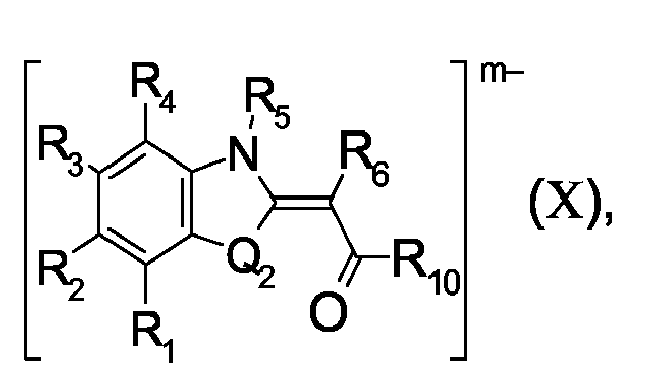

- Q2 ist bevorzugt CR8R9, S, O oder NR19, besonders bevorzugt S, O oder NR19, ganz besonders bevorzugt S.
- Besonders interessant sind diejenige Verbindungen, worin L1 und L2 das gleiche Komplexierungsmuster mit dem Metall Mm+ haben, das heisst worin Mm+(L1) und Mm+(L2) die gleiche Teilstruktur (111), (IV), (V), (VI), (VII), (VIII) oder (IX) aufweisen, wobei L1 und L2 identisch oder auch unterschiedlich sein können.
- Alkyl, Alkenyl, Alkinyl, Cycloalkyl, Heterocycloalkyl oder Cycloalkenyl an beliebiger Stelle ist bevorzugt Methyl, Ethyl, n-Propyl, Isopropyl, Vinyl, Allyl, Propargyl, Cyclopropyl, 2-Oxacyclopropyl oder 2-Thiacyclopropyl, besonders bevorzugt Trifluormethyl, α,α-Difluorethyl, β,β,β-Trifluorethyl oder Heptafluorpropyl, ganz besonders bevorzugt als R10.
- Diese Bevorzugungen gelten sowohl einzeln als auch in beliebiger Kombination, insbesondere auch mit allen Ausführungsvarianten (III) bis (XII). In der Regel weisen alle erfindungsgemässen Verbindungen desto vorteilhaftere Eigenschaften, je mehr bevorzugte Einzelmerkmale sie aufweisen.
- Die beachtlich hohe Vielseitigkeit der Erfindung ist anhand folgender rein illustrativer Beispiele erkennbar:


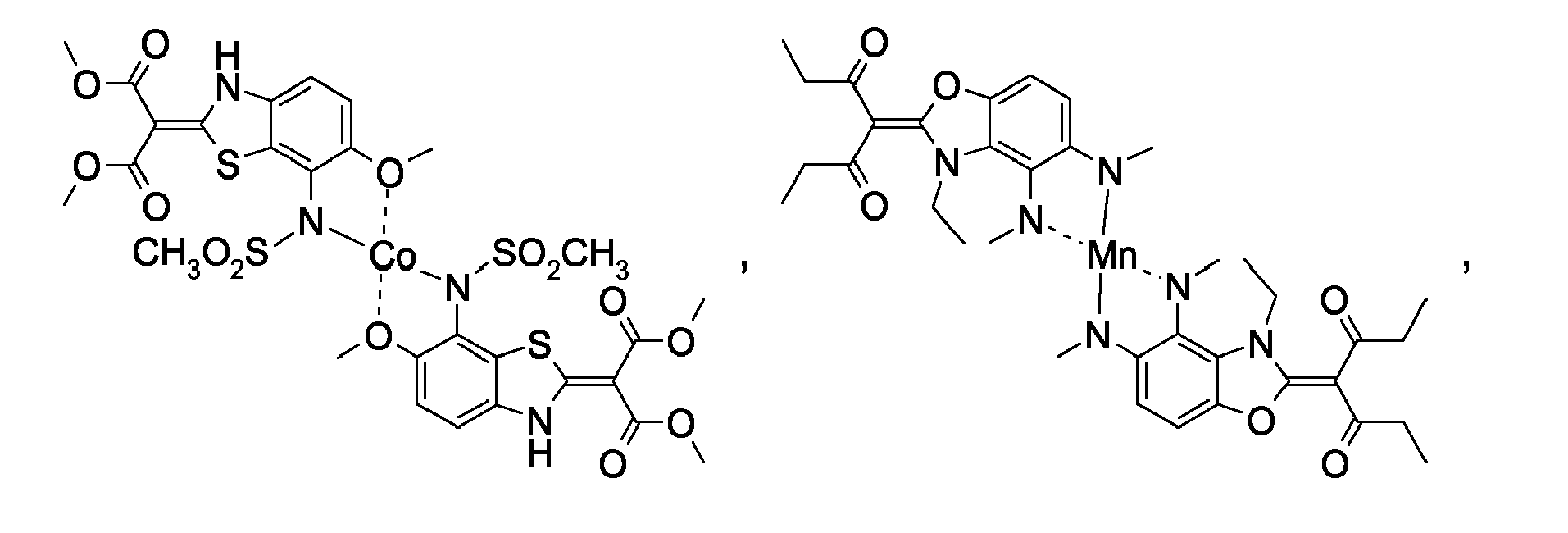

- Weitere Verbindungen sind hiernach als ausführliche Beispiele aufgeführt. Selbstverständlich können am Metall auch weitere Liganden vorhanden sein, welche meist nicht sehr stark gebunden sind und daher reversibel entfernbar sind.
- Die Aufzeichnungsschicht enthält zweckmässig eine Verbindung der Formel (I) oder ein Gemisch solcher Verbindungen als Hauptbestandteil oder zumindest wichtige Komponente, beispielsweise von 1 bis 100 Gew.-%, bevorzugt von 20 bis 100 Gew.-%, besonders bevorzugt von 50 bis 100 Gew.-%. Weitere übliche Bestandteile sind möglich, wie zum Beispiel andere Chromophore (beispielsweise solche mit einem Absorptionsmaximum bei 300 bis 1000 nm), Stabilisatoren, 1O2-, Triplett- oder Lumineszenzlöscher ("quencher"), Schmelzpunkterniedriger, Zersetzungsbeschleuniger oder alle andere Additive, welche in optischen Aufzeichnungsmitteln bereits beschrieben wurden. Bevorzugt werden gegebenenfalls Stabilisatoren oder Fluoreszenzlöscher zugegeben.
- Chromophore, welche gegebenenfalls in der Aufzeichnungsschicht zusätzlich zu den Verbindungen der Formel (I) verwendet werden können, sind zum Beispiel Cyanine und Cyaninmetallkomplexe (
US 5,958,650 ), Aza- und Phosphacyanine (WO 02/082438 US 6,103,331 ), Oxonolfarbstoffe (EP 0833314 ), Azofarbstoffe und Azometallkomplexe (JP 11/028865A EP 0 232 427 ,EP 0 337 209 ,EP 0 373 643 ,EP 0 463 550 ,EP 0 492 508 ,EP 0 509 423 ,EP 0511 590 ,EP 0 513 370 ,EP 0 514 799 ,EP 0 518 213 ,EP 0 519 419 ,EP 0 519 423 ,EP 0 575 816 ,EP 0600427 ,EP 0 676 751 ,EP 0 712 904 ,WO 98/14 520 WO 00/09 522 WO 02/25 648 WO 02/083 796 EP 1253 586 ,EP 1265 233 ,EP 1 271 500 ,WO 05/000 972 EP 0822546 ,US 5,998,093 ,JP 2001/277723A WO 03/042 990 WO 03/007 296 EP 0 822 544 ,EP 0 903 733 ), Xanthenfarbstoffe und deren Metallkomplexsalze (US 5,851,621 ,WO 03/098617 WO 03/098618 WO 03/063 151 EP 0 568 877 ), ferner auch Oxazine, Dioxazine, Diazastyryle, Formazane, Anthrachinone oder Phenothiazine, wobei diese Liste keineswegs abschliessend ist und der Fachmann weitere bekannte Farbstoffe mitliest, zum Beispiel diejenigen ausWO 04/088649 PCT/EP05/050673 - Weitere, bevorzugte Chromophore, welche gegebenenfalls in der Aufzeichnungsschicht zusätzlich zu den Verbindungen der Formel (I) verwendet werden können, sind bekannte UV-Absorber, wie beispielsweise Azacyanine (
JP H11/34 500 WO 02/080161 JP 2001/277720 JP 2002/160452 WO 04/106 311 JP 2004/160 883 JP 2004/034 645 JP 2003/246142 US 2004/0290401 ) oder Metallchelate (WO 04/079732 WO 05/012 228 - Gemische weisen bekanntlich eine Reihe von Vorteilen auf, zum Beispiel eine bessere Löslichkeit und eine geringere Kristallisationstendenz, so dass es einfacher ist, durch Schleuderbeschichtung stabil amorphe Schichten herzustellen. Durch Optimierung der Mischungsverhältnisse in an sich bekannter Weise erhält man feste Aufzeichnungsschichten mit vorteilhaft thermischen und optischen Eigenschaften, insbesondere mit steilen Absorptionsbanden. Zudem kann dadurch oft der Verflachung der spektralen Absorptionskante im Festzustand entgegen gewirkt werden. Optimale Mischungsverhältnisse werden daher in der Regel durch Reihenversuche ermittelt, wobei auch verschiedene Rillengeometrien mit einbezogen werden.
- Bevorzugt sind gegebenenfalls selbstverständlich solche zusätzliche Farbstoffe, welche für die Verwendung in optischen Aufzeichnungsmaterialien bei 300 bis 500 nm selbst bekannt sind. Besonders bevorzugt sind Mischungen der Verbindungen der Formel (I), beispielsweise Homologengemische und Mischungen enthaltend sowohl Verbindungen der Formel (I), worin L1, L2 und/oder L3 identisch sind, als auch Verbindungen der Formel (I), worin L1, L2 und/oder L3 verschieden sind, wie zum Beispiel M+(L1)-, M+(X+)(L1)-(L1)-, M+(X+)(L1)2-, M+(X+)(L1)-(L2)-, M+(X2+)(L1)-(L1)-(L1)-, M+(X2+)(L1)-(L1)-(L3)-,M+(X2+)(L1)-(L2)-(L3)-, M2+(X-)(L1)-, M2+(L1)2-, M2+(L1)-(L1)-, M2+(L1)-(L2)-, M2+(X+)(L1)-(L1)-(L1)-, M2+(X+)(L1)-(L1)-(L3)-, M2+(X+)(L1)-(L2)-(L3)-,M2+(X2+)(L1)2-(L1)2-, M2+(X2+)(L1)2-(L2)2-,M3+ M3+(X-)(L1)-(L2)-, M3+(X-)2(L1)-, M3+(L1)-(L2)2-, M3+(L1)-(L1)-(L1)-, M3+(L1)-(L1)-(L2)-, M3+(L1) -(L2)-(L3)-, M3+(X+)(L1)2-(L1)2-, M3+(X+)(L1)2-(L2)2-,M3+(X2+)(L1)2-(L1)2-(L3)- oder M3+(X2+)(L1)2-(L2)2-(L3)-, je entweder mit zusätzlichen, neutralen und/oder anionischen Liganden oder auch ohne zusätzliche Liganden. Asymmetrische Verbindungen der Formel (I) sowie Gemische enthaltend asymmetrische Verbindungen der Formel (I) weisen in der Regel vorteilhaft eine überraschend niedrigere Kristallisationstendenz auf.
- Enthält die Aufzeichnungsschicht sonstige, zur Verwendung bei 300 bis 500 nm an sich nicht geeignete Chromophore, so soll bevorzugt die Menge dieser Chromophore klein sein, so dass desser Absorption bei der Wellenlänge des Wendepunktes (Punkt der maximalen Steigung) der Steigung der langwelligen Flanke der für die Aufzeichnung massgebenden Absorptionsbande der gesamten festen Schicht einen Bruchteil der Absorption der Verbindungen der Formel (I) in der gesamten festen Schicht bei derselben Wellenlänge beträgt, zweckmässig höchstens ⅓, bevorzugt höchstens 1/5, besonders bevorzugt höchstens 1/10. Das Absorptionsmaximum von Farbstoffgemischen im spektralen Bereich von 300 bis 500 nm ist bevorzugt bei einer Wellenlänge tiefer als 450 nm, besonders bevorzugt tiefer als 400 nm, insbesondere bei 340-380 nm.
- Stabilisatoren, 1O2-, Triplett- oder Lumineszenzlöscher sind zum Beispiel Metallkomplexe von N oder S enthaltenden Enolaten, Phenolaten, Bisphenolaten, Thiolaten, Bisthiolaten oder von Azo-, Azomethin- oder Formazanfarbstoffen, wie Bis(4-dimethylaminodithiobenzil)nickel [CAS N° 38465-55-3], ® Irgalan Bordeaux EL, ® Cibafast N oder ähnliche Verbindungen, gehinderte Phenole und ihre Derivate, wie ® Cibafast AO, o-Hydroxyphenyl-triazole, -triazine oder andere UV-Absorber, wie ® Cibafast W oder ®Cibafast P oder gehinderte Amine (TEMPO oder HALS, auch als Nitroxide oder NOR-HALS, ferner Dümmonium-, Paraquat™- oder Orthoquat™-Salze, wie ® Kayasorb IRG 022, ® Kayasorb IRG 040, oder gegebenenfalls auch Radikalsalze, wie N,N,N',N'-Tetrakis(4-dibutylaminophenyl)-p-phenylenamin-ammoniumsalze. Die letzteren sind von Organica (Wolfen / DE), ® Kayasorb-Marken von Nippon Kayaku Co., Ltd. und ® Irgalan- sowie ® Cibafast-Marken von Ciba Spezialitätenchemie AG erhältlich.
- Viele solche Strukturen sind bekannt, teilweise auch in Zusammenhang mit optischen Aufzeichnungsmedien, beispielsweise aus
US 5,219,707 ,JP 06 / 199 045 A JP 07 / 76169 A JP 07 / 262 604 A JP 2000/272241 A 
- Der Fachmann weiss aus anderen optischen Informationsmedien oder wird aufgrund seines allgemeines Wissens sowie des Stands der Technik ohne Mühe erkennen, welche Additive in welcher Konzentration für welchen Zweck besonders gut geeignet sind. Geeignete Konzentrationen von Additiven sind zum Beispiel von 0,001 bis 1000 Gew.-%, bevorzugt von 1 bis 50 Gew.-%, bezogen auf das Aufzeichnungsmittel der Formel (I).
- Die erfindungsgemässen optischen Aufzeichnungsmaterialien weisen insgesamt hervorragende spektrale Eigenschaften der festen, amorphen Aufzeichnungsschicht auf, wobei auch der Brechungsindex überraschend hoch ist. Dank einer für solche Verbindungen überraschend geringen Aggregationstendenz im Feststoff ist die Absorptionsbande schmal und intensiv, mit besonders hoher Steilheit der Absorptionsbande auf der langwelligen Seite. Kristallite werden unerwartet und vorteilhaft nicht oder nur in vernachlässigbarem Mass gebildet. Die Reflektivität der Schichten im Bereich der Schreib- und Lesewellenlänge ist im unbeschrifteten Zustand hoch. Die Empfindlichkeit gegenüber Laserstrahlung ist im Schreibmodus hoch; im energieärmeren Auslesemodus ist die Stabilität dagegen hoch.
- Dank diesen hervorragenden Schichteigenschaften ist eine schnelle optische Aufzeichnung mit hoher Empfindlichkeit, hoher Reproduzierbarkeit und geometrisch sehr genauen Markenabgrenzungen möglich, wobei sich der Brechungsindex und die Reflektivität stark ändern, was einen hohen Kontrast ergibt. Die Abweichungen der Markenlängen und Intervalldistanzen ("jitter") sind sowohl bei normaler (zirka 4,5 bis 5,5 m · s-1) als auch bei höherer Aufnahmegeschwindigkeit (zum Beispiel von 9 m · s-1 bis 25 m · s-1 oder sogar höher) überraschend klein. Das ermöglicht eine hohe Speicherdichte durch einen schmalen Aufzeichnungskanal mit geringerem Spurabstand ("pitch"). Zudem werden die aufgezeichneten Daten mit erstaunlich kleiner Fehlerrate wiedergegeben, so dass kürzere Marken möglich sind, darunter zum Beispiel solche der Länge 0,15±0,01 µm (2T) im Einklang mit dem Blu-ray™ Standard, und die Fehlerkorrektur nur wenig Speicherplatz erfordert.
- Dank der ausgezeichneten Löslichkeit, teilweise auch in apolaren Lösungsmitteln, können Lösungen auch mit hoher Konzentration ohne störende Ausfällungen beispielsweise beim Lagern verwendet werden, so dass Probleme bei der Aufschleuderung weitgehend entfallen. Dies gilt insbesondere für Verbindungen enthaltend verzweigtes C3-C5Alkyl.
- Aufnahme und Wiedergabe können bei der gleichen Wellenlänge mit einer Laserquelle von zweckmässig 300 bis 500 nm, insbesondere 350 bis 500 nm, bevorzugt 370 bis 450 nm erfolgen. Besonders bevorzugt sind der UV-Bereich von 370 bis 390 nm, insbesondere etwa 380 nm, sowie hauptsächlich am Rande des sichtbaren Bereiches von 390 bis 430 nm, speziell etwa 405±5 nm. Im Bereich von kompakten, blauen oder violetten Laserdioden (wie Nichia GaN 405 nm) mit Optik hoher numerischer Apertur (beispielsweise 0,85) können die Marken so klein und die Spuren so eng dimensioniert sein, dass etwa 20 bis 30 Gb pro Aufzeichnungsschicht auf einer 120 mm Scheibe ("disc") erreichbar sind. Bei 380 nm kann man etwa mit Indium dotierten UV-VCSELs (Vertical-Cavity Surface-Emitting Laser) verwenden (Jung Han et al., vgl. MRS Internet J. Nitride Semicond. Res. 5S1, W6.2 [2000]).
- Die Erfindung betrifft daher auch ein Verfahren zur Aufzeichnung oder Wiedergabe von Daten, dadurch gekennzeichnet, dass die Daten auf einem erfindungsgemässen optischen Aufzeichnungsmedium bei einer Wellenlänge von 300 bis 500 nm aufgezeichnet oder wiedergegeben werden. Die Aufzeichnung findet bevorzugt bei einer linearen Geschwindigkeit v von mindestens 4,5 m·s-1 statt, wobei besonders bevorzugt Marken verschiedener Länge erzeugt werden, wovon die kürzesten fast kreisrund sind und die längsten eine Länge aufweisen, welche etwa der vierfachen Breite entspricht. Die lineare Geschwindigkeit beträgt besonders bevorzugt mindestens 9 m·s-1 (1×), 18 m·s-1 (2×) oder 36 m·s-1 (4×).
- Das Aufzeichnungsmedium kann sich am Aufbau bekannter Aufzeichnungsmedien anlehnen und ist dann zum Beispiel denjenigen analog, welche zuvor erwähnt wurden, wie DVD+R oder DVD-R. Es kann daher beispielsweise aus einem transparenten Substrat, einer Aufzeichnungsschicht, enthaltend mindestens eine der Verbindungen der Formel (I), einer Reflektorschicht und einer Deckschicht aufgebaut sein, wobei das Einschreiben und Auslesen durch das Substrat erfolgt. Ein solches, für Aufnahme und Wiedergabe bei einer Wellenlänge von 300 bis 500 nm geeignetes System ist beispielsweise HD DVD™ (ehemals advanced optical disk AOD genannt).
- Geeignete Substrate sind zum Beispiel Gläser, Mineralien, Keramiken und duroplastische oder thermoplastische Kunststoffe. Bevorzugte Träger sind Gläser und homo- oder copolymere Kunststoffe. Geeignete Kunststoffe sind zum Beispiel thermoplastische Polycarbonate, Polyamide, Polyester, Polyacrylate und Polymethacrylate, Polyurethane, Polyolefine, Polyvinylchlorid, Polyvinylidenfluorid, Polyimide, duroplastische Polyester und Epoxidharze. Besonders bevorzugt sind Polycarbonat-Substrate, die beispielsweise mittels Einspritzverfahren ("injectionmoulding") herstellbar sind. Das Substrat kann in reiner Form sein oder auch übliche Additive enthalten, beispielsweise UV-Absorber oder Farbstoffe, wie zum Beispiel in
JP 04/167239A - Zweckmässig ist das Substrat in mindestens einem Teil des Bereichs von 300 bis 500 nm transparent, so dass es für beispielsweise mindestens 80% des darauf fallenden Lichtes der Einschreib- oder Auslesewellenlänge durchlässig ist. Das Substrat weist zweckmässig eine Dicke von 10 µm bis 2 mm, bevorzugt von 100 bis 1200 µm, besonders bevorzugt von 600 bis 1100 µm auf, mit einer bevorzugt spiralförmigen Führungsrille (Spur) auf der Beschichtungsseite, mit einer Rillentiefe von 10 bis 200 nm, bevorzugt von 60 bis 150 nm, einer Rillenbreite von 100 bis 400 nm, bevorzugt von 150 bis 250 nm und einem Achsenabstand zwischen 2 Rillen von 200 bis 600 nm, bevorzugt von 250 bis 450 nm (beispielsweise mit Rillentiefe von 80±20 nm, Rillenbreite 200±50 nm und Achsenabstand zwischen 2 Windungen 370±60 nm). Rillen verschiedener Querschnittprofile sind bekannt, zum Beispiel rechteckige, trapez- oder V-förmige. Analog zu den bekannten CD-R und DVD±R Medien kann die Führungsrille zusätzlich eine kleine periodische oder quasiperiodische seitliche Auslenkung ("wobble") erfahren, wodurch die Synchronisation der Drehzahl und die absolute Positionierung des Auslesekopfs ("pick-up") ermöglicht wird. Dieselbe Funktion kann anstelle der Auslenkung oder zusätzlich durch Markierungen zwischen benachbarten Rillen erfolgen ("pre-pits").
- Das Aufzeichnungsmittel wird beispielsweise durch Aufschleuderung einer Lösung aufgetragen, wobei eine möglichst amorphe Schicht entstehen soll, deren Dicke in der Rille abhängig von der Rillengeometrie zweckmässig von 20 bis 150 nm, bevorzugt von 30 bis 120 nm, besonders bevorzugt von 30 bis 80 nm und nebenan ("land") zweckmässig von 0 bis 70 nm, bevorzugt von 1 bis 20 nm, besonders bevorzugt von 2 bis 10 nm und betragen. In einer anderen, mit den Verbindungen der Formel (I) realisierbaren Ausführungsform kann die Dicke der Aufzeichnungsschicht zweckmässig in der Rille 30 bis 80 nm und nebenan ("land") 20 bis 70 nm betragen, wobei die Differenz der Schichtdicken in der Rille und auf der Oberfläche weniger als 20 nm, bevorzugt weniger als 10 nm beträgt. Dadurch ist es möglich, mit HD DVD Rewritable™ kompatibel sowohl in den Rillen als auch auf der Oberfläche nebenbei zu schreiben und lesen. Der track pitch ist dann nur etwa halb so gross, und die gesamte Speicherkapazität ist höher.
- In beiden Ausführungsformen erfolgt das Einschreiben und Auslesen von der Substratseite her. Der Laserstrahl wird dabei durch das Substrat auf die Aufzeichnungsschicht gerichtet und weist bevorzugt eine Wellenlänge von 300 bis 500 nm, besonders bevorzugt von 370 bis 450 nm auf. Auf der dem Substrat entgegensesetzten Seite der Aufzeichnungsschicht befindet sich gegebenenfalls eine Reflektorschicht.
- Als reflektierendes Material für die Reflektorschicht eignen sich besonders Metalle, welche die zur Aufzeichnung und Wiedergabe verwendete Laserstrahlung gut reflektieren, zum Beispiel die Metalle der dritten, vierten und fünften Hauptgruppe und der Nebengruppen des periodischen Systems der chemischen Elemente. Besonders geeignet sind Al, In, Sn, Pb, Sb, Bi, Cu, Ag, Au, Zn, Cd, Hg, Sc, Y, La, Ti, Zr, Hf, V, Nb, Ta, Cr, Mo, W, Fe, Co, Ni, Ru, Rh, Pd, Os, Ir, Pt und die Lanthanidenmetalle Ce, Pr, Nd, Pm, Sm, Eu, Gd, Tb, Dy, Ho, Er, Tm, Yb und Lu, sowie deren Legierungen. Besonders bevorzugt ist aus Gründen der hohen Reflektivität und leichten Herstellbarkeit eine reflektierende Schicht aus Aluminium, Silber, Gold oder eine Legierung davon (beispielsweise eine Weissgold- oder Silber/Chrom-Legierung), aus ökonomischen und ökologischen Gründen insbesondere Aluminium. Die Reflektorschicht hat eine Dicke zweckmässig von 5 bis 200 nm, bevorzugt von 10 bis 100 nm, besonders bevorzugt von 20 bis 80 nm, wobei auch dickere Reflektorschichten möglich sind.
- Als Material für die Deckschicht eignen sich hauptsächlich Kunststoffe, die in dünner Schicht entweder direkt oder mit Hilfe von Haftvermittlern auf die Reflektorschicht aufgebracht werden. Man wählt zweckmässig mechanisch und thermisch stabile Kunststoffe mit guten Oberflächeneigenschaften, die noch modifiziert, zum Beispiel beschrieben werden können. Es kann sich sowohl um duroplastische wie auch um thermoplastische Kunststoffe handeln. Bevorzugt für direkt aufgebrachte Deckschichten sind strahlungsgehärtete (zum Beispiel mit UV-Strahlung) Beschichtungen, die besonders einfach und wirtschaftlich herstellbar sind. Strahlungshärtbare Materialien sind in grosser Vielzahl bekannt. Beispiele für strahlungshärtbare Monomere und Oligomere sind Acrylate und Methacrylate von Diolen, Triolen und Tetrolen, Polyimide aus aromatischen Tetracarbonsäuren und aromatischen Diaminen mit C1-C4Alkylgruppen in mindestens zwei Orthostellungen der Aminogruppen, und Oligomere mit Dialkyl-, zum Beispiel Dimethylmaleinimidylgruppen. Bevorzugt für durch Haftvermittler aufgebrachte Deckschichten werden die gleichen Materialien wie für die Substratschicht verwendet, besonders bevorzugt Polycarbonate. Als Haftvermittler werden bevorzugt ebenfalls strahlungshärtbare Monomere und Oligomere verwendet. Anstelle der durch einen Haftvermittler aufgebrachten Deckschicht kann auch ein zweites, eine Aufzeichnungs- und Reflektorschicht enthaltendes Substrat verwendet werden, so dass das Aufzeichnungsmedium beidseitig bespielbar ist. Bevorzugt ist ein symmetrischer Aufbau, wobei die beiden Teile reflektorseitig durch einen Haftvermittler direkt oder über eine Zwischenschicht zusammengefügt werden. In diesem Fall ist das Substrat selbstverständlich nur etwa halb so dick, so dass die gesamte, aus zwei Substraten zusammengesetzte Disk etwa gleich dick ist, wie eine aus nur einem Substrat bestehende Disk.
- Bei dieser Aufbauweise spielen an sich die optischen Eigenschaften der Deckschicht, beziehungsweise der Deckmaterialien, im wesentlichen keine Rolle, sofern gegebenenfalls deren Härtung beipielsweise durch UV-Strahlung gewährleistet ist. Die Funktion der Deckschicht ist, die mechanische Festigkeit des Aufzeichnungsmediums als Ganzes sowie wenn nötig die mechanische Festigkeit dünner Reflektorschichten zu gewährleisten. Bei genügend stabilem Aufzeichnungsmedium, zum Beispiel in Anwesenheit einer dicken Reflektorschicht kann man daher sogar auf die Deckschicht ganz verzichten. Die Dicke der Deckschicht hängt von der Dicke des gesamten Aufzeichnungsmediums ab, welches bevorzugt maximal etwa 2 mm dick sein sollte. Bevorzugt weist die Deckschicht ein Dicke von 10 µm bis 1 mm auf.
- Die erfindungsgemässen Aufzeichnungsmedien können auch zusätzliche Schichten aufweisen, wie zum Beispiel Interferenzschichten oder Barrierenschichten. Es ist auch möglich, Aufzeichnungsmedien mit mehreren (zum Beispiel 2 bis 10) Aufzeichnungsschichten aufzubauen. Der Aufbau und die Verwendung solcher Materialen sind dem Fachmann bekannt. Bevorzugt sind gegebenenfalls Interferenzschichten, welche zwischen der Aufzeichnungsschicht und der reflektierenden Schicht, zwischen der Aufzeichnungsschicht und dem Substrat und/oder insbesondere zwischen der Aufzeichnungsschicht und der Schutzschicht angeordnet sind und aus einem dielektrischen Material bestehen, zum Beispiel wie in
EP 0 353 393 beschrieben aus TiO2, Si3N4, ZnS oder Silikonharzen. - Die erfindungsgemässen Aufzeichnungsmedien können nach an sich bekannten Verfahren hergestellt werden, wobei man je nach verwendeten Materialien und deren Funktionsweise unterschiedliche Beschichtungsmethoden anwenden kann.
- Geeignete Beschichtungsverfahren sind zum Beispiel Tauchen, Giessen, Streichen, Rakeln und Schleudergiessen, sowie Aufdampfverfahren, die im Hochvakuum durchgeführt werden. Bei der Anwendung von zum Beispiel Giessverfahren werden im allgemeinen Lösungen in organischen Lösungsmitteln verwendet. Bei der Verwendung von Lösungsmitteln ist darauf zu achten, dass die verwendeten Träger gegen diese Lösungsmittel unempfindlich sind. Geeignete Beschichtungsverfahren und Lösungsmittel sind zum Beispiel in
EP 0401 791 oderEP 0 485 337 beschrieben. - Die Aufzeichnungsschicht wird bevorzugt durch Aufschleudern einer Farbstofflösung aufgebracht, wobei als Lösungsmittel insbesondere Alkohole, wie zum Beispiel 2-Methoxyethanol, 1-Methoxy-2-propanol, 2-Propanol oder n-Butanol, Hydroxyketone, wie zum Beispiel Diacetonalkohol oder 3-Hydroxy-3-methyl-2-butanon, Hydroxyester, wie zum Beispiel Milchsäuremethylester oder Isobuttersäuremethylester, oder bevorzugt fluorierte Alkohole, wie zum Beispiel 2,2,2-Trifluorethanol oder 2,2,3,3-Tetrafluor-1-propanol, und Gemische davon, sich bewährt haben. Weitere geeignete Lösungsmittel sind beispielsweise in
EP 0483387 offenbart. - Das Aufbringen der metallischen Reflektorschicht erfolgt bevorzugt durch Zerstäuben ("sputtern") oder Aufdampfen im Vakuum. Diese Techniken sind bekannt und in Fachbüchern beschrieben (z.B. J.L. Vossen und W. Kern, "Thin Film Processes", Academic Press, 1978). Man kann vorteilhaft kontinuierlich arbeiten und erreicht eine gute Reflektivität sowie eine hohe Haftfähigkeit der metallischen Reflektorschicht.
- Die Aufzeichnung erfolgt nach bekannten Verfahren durch Einschreiben von Pits (Marken) fester oder meist variabler Länge mittels eines modulierten, fokussierten und mit konstanter oder variabler Geschwindigkeit auf der Fläche der Aufzeichnungsschicht geführten Laserstrahls. Das Auslesen der Information erfolgt nach an sich bekannten Methoden durch Registrierung der Veränderung der Reflexion unter Verwendung von Laserstrahlung, zum Beispiel wie in "CD-Player und R-DAT Recorder" (Claus Biaesch-Wiepke, Vogel Buchverlag, Würzburg 1992) beschrieben. Die Anforderungen sind dem Fachmann bekannt.
- Das erfindungsgemässe Informationen enthaltende Medium stellt insbesondere ein optisches Informationsmaterial vom WORM-Typ dar. Es kann zum Beispiel analog zur CD-R (compact disc - recordable) oder DVD±R (digital video disc - recordable) in Rechnern verwendet werden, sowie auch als Speichermaterial für Ausweis- und Sicherheitskarten oder für die Herstellung von diffraktiven optischen Elementen, beispielsweise Hologrammen. Aufzeichnungsmedien des Typs HD DVD™ erlauben die Verwendung eines Lasers mit einer numerischen Apertur von maximal etwa 0,7 (üblicherweise 0,60 bis 0,65). Bei einer Aufnahmegeschwindigkeit von 6,61 m·s-1 (oder eines Mehrfaches davon) ergibt sich dabei für Disks mit 120 mm Durchmesser eine Speicherkapazität von 15 GB pro Aufzeichnungsschicht.
- Es gibt aber alternativ auch neuere Aufzeichnungsmedien, welche sich von CD-R oder DVD ± R stark unterscheiden, und worin Aufzeichnung und Wiedergabe nicht durch das Substrat, sondern durch die Deckschicht erfolgen. Somit sind die respektiven Rollen der Deckschicht und des Substrats, insbesondere die Geometrie und die optischen Eigenschaften, im Vergleich zum zuvor beschriebenen Aufbau vertauscht. Entsprechende Konzepte für digitale Videoaufnahmen in Verbund mit einer blauen GaN Laserdiode sind bekannt, zum Beispiel aus Proceedings SPIE-Int. Soc. Opt. Eng. 1999, 3864. In fortgeschrittener Entwicklung befindet sich auch Blu-ray™(ehemals Blu-ray Disk "BD") mit einer Aufnahmegeschwindigkeit von 5,0±0,3 m·s-1 (voraussichtlich bald ein Mehrfaches davon) und einer Speicherkapazität von 25±2 GB (vgl. Systembeschreibung "Blu-ray Disc Rewritable Format version 1.0" / Juni 2002 sowie Blu-ray.com).
- Die erfindungsgemässen Verbindungen der Formel (I) kommen aber auch diesen erhöhten Anforderungen beim inversen Schichtaufbau überraschend gut entgegen. Bevorzugt ist daher ein inverser Schichtaufbau, mit der Schichtabfolge Substrat, Reflektorschicht, Aufzeichnungsschicht und Deckschicht. Die Aufzeichnungsschicht befindet sich also zwischen der Reflektorschicht und der Deckschicht. Eine etwa 50 bis 400 µm dünne Deckschicht ist besonders zweckmässig (typischerweise 100 µm bei einer numerischen Apertur von 0,85).
- Aufzeichnungs- und Reflektorschichten haben beim inversen Schichtaufbau prinzipiell die gleiche Funktion, wie zuvor angegeben. Das Substrat weist üblicherweise Dimensionen innerhalb der zuvor angegebenen Bereichen auf. Zweckmässig hat die bevorzugt spiralförmige Führungsrille (Spur) auf der Beschichtungsseite eine Rillentiefe von 10 bis 100 nm, bevorzugt 20 bis 80 nm. Querschnittprofil, periodische oder quasiperiodische seitliche Auslenkung ("wobble") sowie gegebenenfalls zusätzliche Markierungen zwischen benachbarten Rillen erfolgen ("pre-pits") lehnen sich dem zuvor beschriebenen HD DVD™Typ an.
- Auf dem Substrat werden Reflektorschicht und Aufnahmeschicht in dieser Reihenfolge aufgetragen. Als Spur können sowohl die Rillen als auch die sich dazwischen erhebenden, schienenartigen Zinnen benützt werden, wobei man üblicherweise im ersten Fall von "in-groove" und im zweiten Fall von "on-groove" Medien spricht. Mit den Verbindungen der Formel (I) sind vorteilhaft beide Ausführungsformen realisierbar, gegebenenfalls auch simultan.
- Das Aufzeichnungsmittel wird beispielsweise wie zuvor angegeben aufgetragen. Vorteilhaft ist dabei insbesondere, dass man auch Lösungsmittel wählen kann, welche das Substratmaterial angreifen würden, zum Beispiel chlorierte oder aromatische Kohlenwasserstoffe. Die Dicke der möglichst amorphen Schicht kann gleichmässig oder in den Rillen und auf den Zinnen unterschiedlich sein. In den Rillen beträgt die Dicke der Aufzeichnungsschicht zweckmässig von 20 bis 200 nm, bevorzugt von 30 bis 150 nm, besonders bevorzugt von 30 bis 100 nm. Soll die Spur auf den Zinnen zur Aufzeichnung verwendet werden, beträgt deren Schichtdicke zweckmässig von 10 bis 120 nm, bevorzugt von 20 bis 100 nm, besonders bevorzugt von 20 bis 60 nm. Wird hingegen nur die Rille als Spur benützt, genügt eine Schichtdicke von 0 bis 100 nm, bevorzugt von 0 bis 60 nm, besonders bevorzugt von 0 bis 20 nm. In beiden Fällen beträgt die Spurbreite (Zinnen und/oder Kerben) von 100 bis 300 nm, bevorzugt von 120 bis 250 nm, besonders bevorzugt von 150 bis 200 nm, und der Achsenabstand zwischen 2 Spuren von 200 bis 600 nm, bevorzugt von 250 bis 400 nm, besonders bevorzugt von 300 bis 340 nm. Gute Resultate bekommt man beispielsweise mit einer 30± 10 nm tiefen und 180± 10 nm breiten Zinnenspur ("on-groove") mit einem Achsenabstand von 320± 10 nm). Der Laserstrahl geht dabei mit einer hohe Apertur durch die Deckschicht, was die Auflösung erhöht.
- Der inverse Schichtaufbau stellt aber wesentlich höhere Ansprüche, welchen die erfindungsgemäss verwendeten Verbindungen erstaunlich gut genügen. Besonders hohe Ansprüche stellen sich beispielsweise beim Aufbringen der Aufzeichnungsschicht auf die metallische Reflektorschicht sowie insbesondere beim Aufbringen einer Deckschicht auf die Aufzeichnungsschicht, welche letztere ausreichend vor Reibung, Photooxydation, Fingerabdrücken, Feuchtigkeit und anderen Umwelteinflüssen schützen soll und zweckmässig eine Dicke im Bereich von 0,01 bis 0,5 mm, vorzugsweise im Bereich von 0,05 bis 0,2 mm, besonders bevorzugt im Bereich von 0,08 bis 0,13 mm aufweist.
- Die Deckschicht besteht bevorzugt aus einem Material, das eine Transmission von 80% oder höher bei der Einschreib-oder Auslesewellenlänge des Lasers zeigt. Als Material für die Deckschicht eignen sich bespielsweise die zuvor angegebenen Materialien, insbesondere aber Polycarbonat (wie Pure Ace® oder Panlite® , Teijin Ltd), Cellulosetriacetat (wie Fujitac® , Fuji Photo Film) oder Polyethylenterephthalat (wie Lumirror® , Toray Industry), wobei Polycarbonat besonders bevorzugt ist. Besonders für direkt aufgebrachte Deckschichten sind strahlungsgehärtete Beschichtungen, wie bereits vorgängig beschrieben, zweckmässig, zum Beispiel SD 347™ (Dainippon Ink).
- Die Deckschicht kann durch einen geeigneten Haftvermittler direkt auf die feste Aufzeichnungsschicht aufgebracht werden. In einer anderen Ausführungsform wird auf die feste Aufzeichnungsschicht eine zusätzliche, dünne Trennschicht aus einem metallischen, vernetzten metallorganischen oder bevorzugt dielektrischen anorganischen Stoff aufgebracht, zum Beispiel in einer Dicke von 0,001 bis 10 µm, bevorzugt von 0,005 bis 1 µm, besonders bevorzugt von 0,01 bis 0,1 µm, beispielsweise von 0,05 bis 0,08 µm für dielektrische und von 0,01 bis 0,03 µm für metallische Trennschichten. Trennschichten sowie entsprechende Verfahren sind in
WO 02/082438 - Analog zum vorher beschriebenen Aufbau können selbstverständlich auch hier diese Aufzeichnungsmedien aus zwei Hälften zusammengefügt werden, wobei zwei Substrate vor oder nach der Beschichtung geklebt werden. Es ist zudem auch möglich, ein Substrat zu verwenden, welches auf beiden Seiten gerillt ist.
- Ein ganz besonderer Vorteil der erfindungsgemässen Verbindungen sind ihre Leistungswerte in dem Blu-ray™ Standard entsprechenden Aufzeichnungsmedien. Die erfindungsgemässen Verbindungen können dementsprechend auch zur technischen Verbesserung von optischen Aufzeichnungsmitteln verwendet werden.
- Bei einem Aufzeichnungsmedium mit inversem Schichtaufbau spielt andererseits die Transparenz des Substrates keine Rolle. Es ist also auch möglich, beispielsweise gefärbte (zum Beispiel gelb, rot, blau, grün, blau, weiss, grau oder schwarz pigmentierte) Kunststoffe zu verwenden, oder auch andere synthetische oder natürliche Materialien, wie Stahl-, Aluminium- oder andere Metalle, oder auch Papier (vgl. Proceedings of SPIE Vol. 5380 / 04 "A 25GB paper disk").
- Die erfindungsgemässen Verbindungen der Formel (I) sind neu. Die Erfindung betrifft daher auch eine Verbindung der Formel (I) gemäss der zuvor angegebenen Definition.
- Die Verbindungen der Formel (I) werden zweckmässig durch Umsetzung von Liganden mit Metallsalzen analog zu an sich bekannten Methoden hergestellt. Brauchbar ist zum Beispiel das Verfahren, welches in
WO 05/000 972 - Zusätzliche Liganden sind gegebenenfalls zweckmässig in 1,0 bis 1,2-facher stöchiometrischer Menge vorhanden und werden bevorzugt erst in der letzten Herstellungsstufe zugegeben. Die stöchiometrische Menge entspricht der gewünschten Anzahl solcher Liganden im Chelat der Formel (I).
- Gegebenenfalls kann die Ausfällung des gewünschten Produktes begünstigt oder beschleunigt werden, indem die Mutterlauge verdünnt wird. Verdünnungsmittel können je nach Reaktionsflüssigkeit und Polarität des gewünschten Produktes nach üblichen, an sich bekannten Kriterien ausgewählt werden, oft sind Wasser oder apolare Kohlenwasserstoffe geeignet.
- Die Isolierung der Chelate geschieht in der Regel durch Filtration oder durch Extraktion aus wässriger Phase (gegebenenfalls nach Zugabe von Wasser) mittels eines mit Wasser nicht mischbaren Lösemittels. Isolierung von Substanzen durch Ausschütteln sind inklusiv allen darauffolgenden Schritten an sich gut bekannt. Es können aber auch beliebige alternative Verfahren benützt werden, zum Beispiel Flash-Chromatographie.
- Die nachfolgenden Beispiele erläutern die Erfindung, ohne deren Umfang einzuschränken (wo nicht anders angegeben, handelt es sich bei "%" immer um Gewichts-%); die Stereochemie der Doppelbindung (E/Z) ist nicht überall gesichert.
- Stufe 1: In einem 1 l Mehrhalskolben, versehen mit Magnetrührer, Thermometer, Tropftrichter, Rückflusskühler und Stickstoffüberleitung, werden 44,0 g 5-Hydroxy-2-hydroxymethyl-pyran-4-on in 400 ml Chloroform vorgelegt und 71,4 g Thionylchlorid zugetropft. Das Gemisch wird während 3 Std. zum Rückfluss erhitzt, dann auf 0°C abgekühlt und 30 Min. gerührt. Die Suspension wird filtriert, der Rückstand mit 50 ml eiskaltem Chloroform gewaschen und 18 Std. bei 60°C/2,5 103 Pa getrocknet. Man erhält 40 g 2-Chlormethyl-5-hydroxy-pyran-4-on.
- 1H-NMR (DMSO-d6):
- 9,1 ppm (breiter s, 1H); 8,1 ppm (s, 1H); 6,55 ppm (s, 1H); 4,63 ppm (s, 2H).
- Stufe 2: In einem 1 l Mehrhalskolben, versehen mit Magnetrührer, Thermometer, Tropftrichter und Stickstoffüberleitung, werden 90 g 2-Chlormethyl-5-hydroxy-pyran-4-on vorgelegt und 245 ml 10%ige wässrige KOH-Lösung zugegeben. Anschliessend werden 42 ml Dimethylsulfat zugetropft und 30 Min. nachgerührt. Dann werden nochmals 245 ml 10%ige wässrige KOH-Lösung zugegeben, 42 ml Dimethylsulfat zugetropft und 15 Min. nachgerührt. Das Reaktionsgemisch wird drei Mal je mit 500 ml Chloroform extrahiert, die vereinigten organischen Phasen drei Mal mit je 300 ml Wasser gewaschen, über Natriumsulfat getrocknet, filtriert und eingedampft. Der Rückstand wird in einem Gemisch von 200 ml Chloroform und 600 ml Hexan gelöst, dann wird 4 g Aktivkohle zugegeben, 30 Min. zum Rückfluss erhitzt, filtriert und eingedampft. Man erhält 50 g 2-Chlormethyl-5-methoxy-pyran-4-on.
- 1H-NMR (CDCl3):
- 7,58 ppm (s, 1H); 6,47 ppm (s, 1H); 4,31 ppm (s, 2H); 3,78 ppm (s, 3H).
- Stufe 3: In einem 1 l Mehrhalskolben, versehen mit Magnetrührer, Thermometer, Rückflusskühler und Stickstoffüberleitung, werden 24,5 g 2-Chlormethyl-5-methoxy-pyran-4-on und 10,64 g Thioharnstoff in 420 ml 95%igem Ethanol vorgelegt und während 3 Std. unter Rückfluss erhitzt. Anschliessend werden 400 ml Ethanol abdestilliert und 18 Std. bei 23°C stehen gelassen. Die Suspension wird filtriert, der Rückstand mit Ethanol gewaschen und über Nacht bei 50°C/2,5·103 Pa getrocknet. Man erhält 20 g 2-Amino-5-hydroxy-6-methoxy-benzthiazol hydrochlorid.
- 1H-NMR (DMSO-d6):
- 9,61 ppm (s, 3H); 7,44 ppm (s, 1H); 7,02 ppm (s, 1H); 3,75 ppm (s, 3H); 2,49 ppm (s, 1H).
- Stufe 4: In einem 1 l Mehrhalskolben, versehen mit Magnetrührer, Thermometer, Tropftrichter und Stickstoffüberleitung, werden 21 g 2-Amino-5-hydroxy-6-methoxy-benzthiazol (frisch hergestellt aus 2-Amino-5-hydroxy-6-methoxy-benzthiazol hydrochlorid durch Neutralisation mit 10%iger wässriger Natriumcarbonat-Lösung, Extraktion mit Ethylacetat und Eindampfen) in 400 ml Dichlormethan gelöst, auf 0°C gekühlt und innerhalb von 10 Min. tropfenweise mit 16,3 ml Triethylamin versetzt. Innerhalb von 20 Min. werden anschliessend 22,3 g p-Toluolsulfonsäurechlorid gelöst in 200 ml Dichlormethan zugetropft und 2 Std. bei 23°C gerührt. Anschliessend werden nochmals 2 ml Triethylamin und 3 g p-Toluolsulfonsäurechlorid zugegeben und 1 Std gerührt. Das Reaktionsgemisch wird mit 1 l Ethylacetat und 500 ml Wasser während 15 Min. verrührt, die Phasen getrennt, die organische Phase mit Wasser und gesättigter wässriger NaCl-Lösung gewaschen, über Natriumsulfat getrocknet, filtriert und eingedampft. Man erhält 35 g p-Toluolsulfonsäure-2-amino-6-methoxy-benzthiazol-5-yl ester.
- 1H-NMR (DMSO-d6):
- 7,69 ppm (d, 2H); 7,46 - 7,41 ppm (m, 5H); 6,94 ppm (s, 1H); 3,47 ppm (s, 3H); 2,40 ppm (s, 3H).
- Stufe 5: In einem 1 l Mehrhalskolben, versehen mit Magnetrührer, Thermometer, Tropftrichter, Rückflusskühler und Stickstoffüberleitung, werden 50 ml Polyethylenglykol 300 und 200 ml Acetonitril vorgelegt, 16,06 g Kupfer(II)-chlorid, 35 g p-Toluolsulfonsäure-2-amino-6-methoxy-benzothiazol-5-yl-ester zugegeben und 23,9 g Isoamylnitrit, gelöst in 50 ml Polyethylenglykol 300 und 150 ml Acetonitril, zugetropft. Das Reaktionsgemisch wird während 2 Std. auf 65°C erwärmt, auf 23°C abgekühlt, mit 700 ml Eiswasser hydrolisiert und 20 Min. gerührt. Die Suspension wird filtriert, der Rückstand mit Wasser gewaschen und an der Luft getrocknet. Das Rohprodukt wird mit einem Gemisch von 200 ml Chloroform und 800 ml Hexan zum Rückfluss erhitzt, heiss filtriert und das Filtrat eingedampft. Man erhält 28 g p-Toluolsulfonsäure-2-chlor-6-methoxy-benzthiazol-5-yl ester.
- 1H-NMR (DMSO-d6):
- 7,79 ppm (s, 1H); 7,71 (d, 2H); 7,61 ppm (s, 1H); 7,44 ppm (d, 2H); 3,57 ppm (s, 3H); 2,41 ppm (s, 3H).
- Stufe 6: In einem 500 ml Mehrhalskolben, versehen mit Magnetrührer, Thermometer, Tropftrichter, Rückflusskühler und Stickstoffüberleitung, werden 11,1 g p-Toluolsulfonsäure-2-chlor-6-methoxy-benzthiazol-5-yl-ester, 12 g 1,3-Diethyl-2-thiobarbitursäure, 12,72 g Kaliumphosphat und 200 ml Diglyme während 18 Std auf 140°C erhitzt. Danach wird abgekühlt, auf 600 ml 6%ige wässrige Ammoniumchlorid-Lösung gegossen, die Suspension filtriert, der Rückstand mit Wasser gewaschen und 18 Std. bei 50°C /2,5 103 Pa getrocknet. Das Rohprodukt wird mittels Flash-Chromatographie (Laufmittel Chloroform) gereinigt. Man erhält 13 g Toluol-4-sulfonsäure-2-(1,3-diethyl-4,6-dioxo-2-thioxo-tetrahydro-pyrimidin-5-yliden)-6-methoxy-2,3-dihydro-benzthiazol-5-yl-ester.
- 1H-NMR (CDCl3):
- 13,92 ppm (s, 1H); 7,78 ppm (d, 2H); 7,41 (s, 1H); 7,35 ppm (d, 2H); 7,26 ppm (s, 1H); 7,22 ppm (s, 1H); 4,64 ppm (q, 4H); 3,69 ppm (s, 3H); 2,48 ppm (s, 3H); 1,34 (t, 6H).
- Stufe 7: In einem 500 ml Mehrhalskolben, versehen mit Magnetrührer, Thermometer, Rückflusskühler und Stickstoffüberleitung, werden 12,26 g Toluol-4-sulfonsäure-2-(1,3-diethyl-4,6-dioxo-2-thioxo-tetrahydro-pyrimidin-5-yliden)-6-methoxy-2,3-dihydro-benzthiazol-5-yl-ester, 250 ml Ethanol und 6,44 g Kaliumhydroxid vorgelegt und das Raktionsgemisch während 2 Std. unter Rückfluss gekocht. Danach wird abgekühlt und auf 600 ml 6%ige wässrige Ammoniumchlorid-Lösung gegossen. Die Suspension wird filtriert, der Rückstand mit Wasser gewaschen und an der Luft getrocknet. Das Rohprodukt wird aus Ethanol umkristallisiert. Man erhält 5,1 g 1,3-Diethyl-5-(5-hydroxy-6-methoxy-3H-benzthiazol-2-yliden)-2-thioxo-dihydro-pyrimidin-4,6-dion).
- 1H-NMR (DMSO-d6):
- 8,89 ppm (s, 1 H); 7,38 (s, 1 H); 7,23 ppm (s, 1 H); 4,48 ppm (q, 4H); 3,81 ppm (s, 3H); 1,19 (t, 6H);
- UV/VIS (Ethanol):
- λmax = 377 nm, ε = 30 080 I· mol-1· cm-1.
- Stufe 1: In einem 20 l Reaktionsgefäss, versehen mit Ankerrührer, Thermometer und Stickstoffüberleitung, werden 307 g p-Anisidin in 4 l Eisessig gelöst, 760 g Natriumthiocyanat und dann 1,2 kg Kupfer(II)chlorid gelöst in 2,5 l Ethanol zugegeben. Das Gemisch wird während 70 Min. auf 75°C und dann 5 Min auf 100°C erhitzt. Anschliessend werden das Reaktionsgemisch auf 60°C abgekühlt, 8 l 1,1N HCl zugegeben und filtriert. Das Filtrat wird unter Kühlung mit 50%iger wässriger NaOH-Lösung basisch gestellt und 18 Std. bei 0°C stehen gelassen. Danach wird filtriert, portionenweise mit 8 l Wasser gewaschen und unter 5·10-6 Pa getrocknet. Man erhält 527 g rohes 2-Amino-6-methoxy-benzthiazol.
- 1H-NMR (DMSO-d6):
- 7,3 ppm (d, 1H); 7,1 ppm (d, 1H); 6,6 ppm (s, 1H); 3,9 ppm (s, 3H).
- Stufe 2: In einem 10 l Reaktionsgefäss, versehen mit Ankerrührer, Thermometer und Stickstoffüberleitung, werden 454 g rohes 2-Amino-6-methoxy-benzthiazol gemäss Stufe 1 in 1,1 l Polyethylenglykol 300 und 1,6 l Acetonitril suspendiert. Es werden 400 g Kupfer(II)chlorid, suspendiert in 1,1 l Polyethylenglykol 300 und 1,6 l Acetonitril und anschliessend 500 ml Isopentylnitrit zugegeben und das Gemisch während 3 Std. auf 65°C erwärmt. Danach wird auf 23°C abgekühlt, auf 5 I 20%ige Salzsäure gegossen und drei Mal mit je 2 l Hexan extrahiert. Die vereinigten organischen Phasen werden über Natriumsulfat getrocknet, filtriert und eingedampft. Man erhält 151 g 2-Chlor-6-methoxy-benzthiazol als leicht gelbe Kristalle.
- 1H-NMR (CDCl3)
- 7,81 ppm (d, 1H); 7,22 ppm (d, 1H); 7,08 ppm (s, 1H); 3,80 ppm (s, 3H).
- Stufe 3: In einem 2,5 l Reaktionsgefäss, versehen mit Ankerrührer, Thermometer, Tropftrichter und Stickstoffüberleitung, werden 151 g 2-Chlor-6-methoxy-benzthiazol in 1,5 l Chloroform gelöst, unter Rühren auf 4°C gekühlt und innerhalb von 30 Min. 185 ml Brom zugetropft. Das Gemisch wird auf 23°C erwärmt und während 3 Std. gerührt. Danach wird unter Eiskühlung auf 3,5 l 10%ige wässrige Natriumthiosulfat-Lösung gegossen und 15 Min. gerührt. Die Phasen werden getrennt, die organische Phase mit 1 l Wasser gewaschen, über Natriumsulfat getrocknet, filtriert und eingedampft. Es werden 207 g Rohprodukt erhalten, welches mit 100 ml Hexan zum Rückfluss erhitzt und heiss filtriert wird. Man erhält 162 g 7-Brom-2-chlor-6-methoxy-benzthiazol.
- 1H-NMR (CDCl3)
- 7,82 ppm (d, 1H); 7,09 ppm (d, 1H); 3,97 ppm (s, 3H).
- Stufe 4: In einem 2,5 l Reaktionsgefäss, versehen mit Ankerrührer, Thermometer und Stickstoffüberleitung, werden 33 g 7-Brom-2-chlor-6-methoxy-benzthiazol, 24,2 g 1,3-Diethyl-2-thiobarbitursäure, 25,6 g Kaliumphosphat und 1 l Diglyme während 18 Std auf 180°C erhitzt. Danach wird abgekühlt, auf 3,9 l 6%ige wässrige Ammoniumchlorid-Lösung gegossen und 30 Min. gerührt. Die flüssige Phase wird abdekantiert und der Rückstand mit 3 l Eiswasser behandelt. Der braune Feststoff wird abfiltriert und getrocknet. Man erhält 44,7 g Rohprodukt, welches mit 500 ml Hexan zum Rückfluss erhitzt und heiss filtriert wird. Nach 18 Std. Trocknung bei 50°C/2,5 103 Pa erhält man 37,6 g 5-(7-Brom-6-methoxy-3H-benzthiazol-2-yliden)-1,3-diethyl-2-thioxo-dihydro-pyrimidin-4,6-dion als gelben Feststoff.
- 1H-NMR (CDCl3)
- 13,9 ppm (s, 1H); 7,49 ppm (d, 1H); 7,09 ppm (d, 1H); 4,66 ppm (q, 4H); 3,98 ppm (s, 3H); 1,36 ppm (t, 6H).
- Stufe 5: In einem 500 ml Mehrhalskolben, versehen mit Magnetrührer, Thermometer, Tropftrichter und Stickstoffüberleitung, wird eine Suspension von 6 g Kaliumhydrid (30%ig in Mineralöl) mit 40 ml Tetrahydrofuran gewaschen. Anschliessend werden bei 0°C 13,26 g 5-(7-Brom-6-methoxy-3H-benzthiazol-2-yliden)-1,3-diethyl-2-thioxo-dihydro-pyrimidin-4,6-dion, gelöst in 200 ml Tetrahydrofuran zugegeben und 1 Std. gerührt. Anschliessend wird mit einem CO2/Aceton-Bad auf -78°C abgekühlt und dann 40,8 ml tert.-Butyl-lithium (1,5 M in Pentan) zugegeben und 30 Min. bei dieser Temperatur gerührt. Danach werden 5,64 ml Dimethyldisulfid zugegeben und 1 Std. gerührt. Das Reaktionsgemisch wird mit 700 ml 6%iger wässriger Ammoniumchlorid-Lösung hydrolisiert und drei Mal je mit 250 ml Chloroform extrahiert. Die vereinigten organischen Phasen werden mit Wasser und gesättigter Natriumchlorid-Lösung gewaschen, über Natriumsulfat getrocknet, filtriert und eingedampft. Das Rohprodukt wird aus Ethylacetat umkristallisiert. Man erhält 9,1 g 1,3-Diethyl-5-(6-methoxy-7-methylsulfanyl-3H-benzthiazol-2-yliden)-2-thioxo-dihydro-pyrimidin-4,6-dion als gelben Feststoff.
- 1H-NMR (CDCl3)
- 7,49 ppm (d, 1H); 7,19 ppm (d, 1H); 4,66 ppm (q, 4H); 3,98 ppm (s, 3H); 2,40 ppm (s, 3H); 1,36 ppm (t, 6H)
- Stufe 6: In einem 1 l Mehrhalskolben, versehen mit Magnetrührer, Thermometer, Tropftrichter und Stickstoffüberleitung, werden 9 g 1,3-Diethyl-5-(6-methoxy-7-methylsulfanyl-3H-benzthiazol-2-ylidene)-2-thioxo-dihydro-pyrimidin-4,6-dion, gelöst in 400 ml Dichlormethan vorgelegt und auf 5°C abgekühlt. Anschliessend werden 11 g Bortribromid zugetropft und anschliessend 4 Std bei 23°C gerührt. Das Reaktionsgemisch wird mit gesättigter wässriger Natriumbicarbonat-Lösung neutralisiert und die Phasen getrennt. Die wässrige Phase wird mit 400 ml Dichlormethan extrahiert, die vereinigten organischen Phasen werden mit Wasser und gesättigter wässriger Natriumchlorid-Lösung gewaschen, über Natriumsulfat getrocknet, filtriert und eingedampft. Das Rohprodukt wird mittels Flash-Chromatographie (Laufmittel Chloroform) gereinigt. Man erhält 5 g 1,3-Diethyl-5-(6-hydroxy-7-methylsulfanyl-3H-benzthiazol-2-yliden)-2-thioxo-dihydro-pyrimidin-4,6-dion als leicht gelben Feststoff.
- 1H-NMR (CDCl3)
- 7,49 ppm (d, 1H); 7,19 ppm (d, 1H); 4,66 ppm (q, 4H); 2,40 ppm (s, 3H); 1,36 ppm (t, 6H);
- UV/VIS (Ethanol):
- λmax = 385 nm, ε = 55 330 I· mol-1· cm-1.
- Stufe 1: In einem 250 ml Mehrhalskolben, versehen mit Magnetrührer, Thermometer und Stickstoffüberleitung, werden 10 g 2-Methyl-benzthiazol-5-ol in 120 ml Pyridin gelöst und 60 ml Essigsäureanhydrid sowie 370 mg 4-Dimethylaminopyridin zugegeben. Die klare, farblose Lösung wird 90 Min. bei 23°C gerührt, auf 750 ml Eiswasser gegossen und die sich bildende Suspension 30 Min. gerührt. Danach wird filtriert, der Rückstand drei Mal je mit 100 ml Wasser gewaschen und 18 Std. bei 50°C /2,5 103 Pa getrocknet. Man erhält 9,45 g Essigsäure-2-methyl-benzthiazol-5-yl-ester als weissen Feststoff.
- 1H-NMR (CDCl3):
- 7,77 ppm (d, J = 8,8 Hz, 1H); 8,23 ppm (d, J = 2,3 Hz, 1H); 7,10 ppm (dxd, J1 = 8,8 Hz, J2= 2,3 Hz, 1H); 2,82 ppm (s, 3H); 2,34 ppm (s, 3H).
- Stufe 2: In einem 250 ml Mehrhalskolben, versehen mit Magnetrührer, Thermometer und Stickstoffüberleitung, werden 12,52 g Triethyloxonium-tetrafluoroborat in 100 ml wasserfreiem 1,2-Dichlorethan gelöst, 11,8 g der Verbindung gemäss Stufe 1 zugegeben und die resultierende klare, farblose Lösung 18 Std. bei 23°C gerührt. Danach wird die weisse Suspension filtriert, der Rückstand zwei Mal je mit 10 ml 0°C kaltem 1,2-Dichlorethan gewaschen und 18 Std. bei 40°C/2,5· 103 Pa getrocknet. Man erhält 16,55 g 5-Acetoxy-3-ethyl-2-methyl-benzthiazol-3-ium-tetrafluorborat als weissen Feststoff.
- 1H-NMR (DMSO-d6):
- 8,42 ppm (d, J = 9,1 Hz, 1H); 7,65 ppm (d, J = 2,1 Hz, 1H); 7,60 ppm (dxd, J1 = 9,1 Hz, J2= 2,1 Hz, 1H); 4,69 ppm (q, J = 7,3 Hz, 2H); 3,19 ppm (s, 3H); 2,36 ppm (s, 3H); 1,43 ppm (t, J = 7,3 Hz, 3H).
- Stufe 3: In einem 500 ml Mehrhalskolben, versehen mit Magnetrührer, Thermometer, Rückflusskühler, Septum und Stickstoffüberleitung, werden 16,5 g der Verbindung gemäss Stufe 2 in 250 ml Pyridin gelöst und die Lösung unter Rühren auf 3°C abgekühlt. Mit einer Spritze werden 7,23 g Acetylchlorid zugetropft, wobei sich ein Gel bildet. Das Reaktionsgemisch wird auf 23°C erwärmt, wobei sich wieder eine klare, braune Lösung bildet. Es wird 15 Min. bei dieser Temperatur nachgerührt, dann mit einem vorgeheizten Ölbad rasch auf 100°C Innentemperatur erhitzt und 10 Min. bei dieser Temperatur gehalten. Anschliessend wird rasch mit einem Eisbad auf etwa 25°C abgekühlt und das Pyridin bei 40°C Wasserbadtemperatur am Rotationsverdampfer eingedampft. Das Rohprodukt wird mittels Flash-Chromatographie mit Hexan/Ethylacetat (2 : 3) als Laufmittel gereinigt. Man erhält 9,86 g Essigsäure-(3-ethyl-2-[2-oxo-propyliden]-2,3-dihydro-benzthiazol-5-yl)-ester als gelben Feststoff.
- 1H-NMR (CDCl3):
- 7,50 ppm (d, J = 8,8 Hz, 1H); 6,89 - 6,85 ppm (m, 2H); 5,87 ppm (s, 1H); 4,00 ppm (q, J = 7,3 Hz, 2H); 2,33 ppm (s, 3H); 2,24 ppm (s, 3H); 1,37 ppm (t, J = 7,3 Hz, 3H).
- Stufe 4: In einem 500 ml Mehrhalskolben, versehen mit Magnetrührer, Thermometer, Tropftrichter und Stickstoffüberleitung, werden 9,8 g der Verbindung gemäss Stufe 3 in 300 ml Ethanol suspendiert und unter Rühren auf 3°C abgekühlt. Innerhalb von 20 Min. werden 38,8 ml 1N Kalilauge zugetropft, wobei die Innentemperatur bei <10°C gehalten wird. Danach wird das Eisbad entfernt und 30 Min. nachgerührt. Anschliessend werden 10 ml 4N Salzsäure zugetropft und die sich bildende Suspension auf 500 ml Phosphatpuffer pH = 6 gegossen und 15 Min. nachgerührt. Es wird filtriert, der Rückstand drei Mal je mit 100 ml Wasser gewaschen und dann 18 Std. bei 50°C /2,5·103 Pa getrocknet. Man erhält 7,5 g 1-[3-Ethyl-5-hydroxy-3H-benzthiazol-2-yliden]-propan-2-on als weissen Feststoff.
- 1H-NMR (DMSO-d6):
- 7,44 ppm (d, J = 8,2 Hz, 1H); 6,75 ppm (d, J = 2,4 Hz, 1H); 6,62 ppm (dxd, J1 = 8,2 Hz, J2 = 2,4 Hz, 1H); 6,03 ppm (s, 1 H); 4,05 ppm (q, J = 7,0 Hz, 2H); 2,07 ppm (s, 3H); 1,21 ppm (t, J = 7,0 Hz, 3H).
- Stufe 5: In einem 250 ml Mehrhalskolben, versehen mit Magnetrührer, Thermometer, Rückflusskühler und Stickstoffüberleitung, werden 7,5 g der Verbindung gemäss Stufe 4 in 100 ml Bis-(dimethylamino)-methan suspendiert und unter Rühren während 26 Std. auf Rückfluss erhitzt (Innentemperatur 82°C). Anschliessend wird das Lösungsmittel abdestilliert und der Rückstand mittels Flash-Chromatographie mit Ethylacetat/Methanol (1:1) als Laufmittel gereinigt. Man erhält 6,58 g 1-[6-Dimethylaminomethyl-3-ethyl-5-hydroxy-3H-benzthiazol-2-ylidene]-propan-2-on als leicht gelben Feststoff.
- 1H-NMR (DMSO-d6):
- 7,36 ppm (s, 1H); 6,80 ppm (s, 1H); 6,02 ppm (s, 1H); 4,06 ppm (q, J = 7,0 Hz, 2H); 3,62 ppm (s, 2H); 2,25 ppm (s, 6H); 2,07 ppm (s, 3H); 1,21 ppm (t, J = 7,0 Hz, 3H);
- UV/VIS (CH2Cl2):
- λmax = 365 nm, ε = 44420 I mol-1 cm-1.
- Stufe 1: In einem 350 ml Sulfierkolben, versehen mit Ankerrührer, Thermometer, Tropftrichter und Stickstoffüberleitung werden 200 ml 98%ige Schwefelsäure vorgelegt und unter Rühren mit einem Kochsalz/Eisbad auf -3°C abgekühlt. Innerhalb von 25 Min. werden 20 g 6-Methoxy-2-methylbenzthiazol zugetropft, wobei die Innentemperatur unter 3°C gehalten wird. Danach wird 5 Min. nachgerührt und dann innerhalb von 40 Min. 35,16 g 20%ige Salpetersäure zugetropft, wobei die Innentemperatur unter 5°C gehalten wird. Das Reaktionsgemisch wird unter starkem Rühren auf 1 kg Eis gegossen und die sich bildende Suspension 30 Min. nachgerührt. Die Suspension wird filtriert und der Rückstand drei Mal je mit 500 ml Eiswasser gewaschen und dann 18 Std. bei 50°C/2,5·103 Pa getrocknet. Man erhält 29,1 g eines gelben Feststoffes, welcher aus 500 ml Isopropanol umkristallisiert wird. Man erhält 17,0 g 6-Methoxy-2-methyl-7-nitro-benzthiazol als gelben Feststoff.
- 1H-NMR (DMSO-d6):
- 8,19 ppm (d, J = 8,8 Hz, 1 H); 7,50 ppm (d, J = 8,8 Hz, 1 H); 4,04 ppm (s, 3H); 2,76 ppm (s, 3H).
- Stufe 2: In einem 250 ml Mehrhalskolben, versehen mit Magnetrührer, Thermometer und Stickstoffüberleitung, werden 9,77 g Triethyloxonium-tetrafluoroborat in 90 ml wasserfreim 1,2-Dichlorethan gelöst, 10,0 g der Verbindung gemäss Stufe 1 zugegeben und die resultierende klare Lösung 18 Std. bei 23°C gerührt. Danach wird die Suspension filtriert, der Rückstand zwei Mal je mit 20 ml eiskaltem 1,2-Dichlorethan gewaschen und 18 Std. bei 45°C/2,5 103 Pa getrocknet. Man erhält 13,19 g 3-Ethyl-6-methoxy-2-methyl-7-nitro-benzthiazol-3-ium-tetrafluorborat als weissen Feststoff.
- 1H-NMR (DMSO-d6):
- 8,72 ppm (d, J = 9,4 Hz, 1 H); 7,97 ppm (d, J = 9,4 Hz, 1 H); 4,80 ppm (q, J = 7,3 Hz, 2H); 4,19 ppm (s, 3H); 3,21 ppm (s, 3H); 1,46 ppm (t, J = 7,3 Hz, 3H).
- Stufe 3: In einem 100 ml Mehrhalskolben, versehen mit Magnetrührer, Thermometer, Rückflusskühler, Septum und Stickstoffüberleitung, werden 2,0 g der Verbindung gemäss Stufe 2 in 25 ml Pyridin gelöst und die Lösung unter Rühren auf 3°C abgekühlt. Mit einer Spritze werden 0,83 g Acetylchlorid zugetropft. Es wird 15 Min. bei dieser Temperatur nachgerührt, dann mit einem vorgeheizten Ölbad rasch auf 100°C Innentemperatur erhitzt und 10 Min. bei dieser Temperatur gehalten. Anschliessend wird rasch mit einem Eisbad auf 20°C abgekühlt, auf 200 ml gesättigte NaCl-Lösung gegossen, filtriert, gut mit Wasser gewaschen und dann 18 Std. bei 50°C/2,5 103 Pa getrocknet. Man erhält 1,1 g eines rotbraunen Feststoffes, welcher unter Rückfluss in 15 ml Pyridin heiss gelöst wird. Die heisse Lösung wird unter Rühren auf 400 ml Wasser getropft, die sich bildende Suspension filtriert, der Rückstand drei Mal je mit 50 ml Wasser gewaschen und dann 18 Std. bei 50°C/2,5 103 Pa getrocknet. Man erhält 0,99 g 1-[3-Ethyl-6-methoxy-7-nitro-3H-benzthiazo-yliden]-propan-2-on als rotbraunen Feststoff.
- 1H-NMR (DMSO-d6):
- 7,73 ppm (d, J = 9,1 Hz, 1H); 7,38 ppm (d, J = 9,1 Hz, 1H); 6,10 (s, 1H); 4,16 ppm (q, J = 7,3 Hz, 2H); 3,96 ppm (s, 3H); 2,12 ppm (s, 3H); 1,22 ppm (t, J = 7,3 Hz, 3H).
- Stufe 4: In einem 50 ml Mehrhalskolben, versehen mit Magnetrührer, Thermometer, Rückflusskühler und Stickstoffüberleitung werden 4,60 g wasserfreies Zinn(II)chlorid in 10 ml konz. Salzsäure gelöst, 2,1 g der Verbindung genäss Stufe 3 zugegeben und unter Rühren während 3 Std. auf 60°C Innentemperatur erwärmt. Danach wird mit einem Eisbad abgekühlt, 20 ml 10N Natronlauge zugetropft und die grünliche Suspension drei Mal je mit 100 ml Dichlormethan extrahiert. Die vereinigten organischen Phasen werden mit Wasser gewaschen bis der pH ungefähr 5 beträgt, über Magnesiumsulfat getrocknet, filtriert und eingedampft. Man erhält 1,69 g eines dunkelbraunen Feststoffes, welcher mittels Flash-Chromatographie mit Ethylacetat/ Methanol (9: 1) als Laufmittel gereinigt wird. Man erhält 1,27 g 1-[7-Amino-3-ethyl-6-methoxy-3H-benzthiazol-2-yliden]-propan-2-on als leicht gelben Feststoff.
- 1H-NMR (DMSO-d6):
- 6,88 ppm (d, J = 8,5 Hz, 1H); 6,59 ppm (d, J = 8,5 Hz, 1H); 5,94 (s, 1 H); 5,11 ppm (s, 2H); 4,04 ppm (q, J = 7,0 Hz, 2H); 3,76 ppm (s, 3H); 2,07 ppm (s, 3H); 1,20 ppm (t, J = 7,0 Hz, 3H).
- Beispiel 5: In einem 50 ml Kolben, versehen mit Magnetrührer und Stickstoffüberleitung, werden 0,5 g der Verbindung gemäss Beispiel 1 in einem Gemisch von 10 ml Ethanol und 10 ml Tetrahydrofuran vorgelegt. Zu der gelbgrünen Suspension wird eine Lösung von 164 mg Co(II)-acetat tetrahydrat in 2 ml Ethanol zugegeben, wobei sich sofort eine braune Lösung bildet, welche 18 Std. unter Stickstoff bei 23°C gerührt wird. Danach wird die beige Suspension mit einem Eisbad während 15 Min. auf 0°C abgekühlt und dann filtriert. Der Rückstand wird mit wenig eiskaltem Ethanol, zwei Mal mit Wasser gewaschen und 18 Std. bei 40°C/2,5 103 Pa getrocknet. Man erhält 0,37 g eines beigen Feststoffes der

- UV/VIS (Ethanol):
- λmax = 369 nm, ε = 53 290 l·mol-1·cm-1.
- Beispiel 6: In einem 50 ml Kolben, versehen mit Magnetrührer und Stickstoffüberleitung, werden 0,5 g der Verbindung gemäss Beispiel 2 in einem Gemisch von 10 ml Ethanol und 10 ml Tetrahydrofuran vorgelegt. Zur gelben Suspension wird eine Lösung von 157 mg Co(II)-acetat tetrahydrat in 2 ml Ethanol zugegeben. Das Reaktionsgemisch wird 18 Std. unter Stickstoff bei 23°C gerührt. Danach wird die gelbe Lösung auf 3 ml eingedampft und zu der sich bildenden Suspension 5 ml Wasser gegeben. Die Suspension wird 15 Min. gerührt und dann filtriert. Der Rückstand wird mit wenig eiskaltem Ethanol und zwei Mal mit Wasser gewaschen und 18 Std. bei 40°C/2,5·103 Pa getrocknet. Man erhält 0,43 g eines beigen Feststoffes der Formel

- UV/VIS (Ethanol):
- λmax = 366 nm, ε = 71 240 l·mol-1·cm-1.
- Beispiel 7: In einem 25 ml Mehrhalskolben, versehen mit Magnetrührer, Thermometer, Septum und Stickstoffüberleitung, werden 0,5 g der Verbindung gemäss Beispiel 3 in 10 ml Ethanol vorgelegt. Zu der gelben Suspension werden mit einer Spritze 0,85 ml 2N-Natronlauge getropft, wobei sich eine gelbe Lösung bildet, zu welcher eine Lösung von 0,213 g Co(II)-acetat tetrahydrat in 2 ml Ethanol getropft wird. Die sich bildende grüne Lösung wird 18 Std. bei 23°C gerührt. Die graue Suspension wird auf etwa 3 ml eingedampft, mit 50 ml Wasser versetzt und 1 Std. gerührt. Der Rückstand wird anschliessend abfiltriert, mit Wasser gewaschen und 18 Std. bei 40°C/2,5 103 Pa getrocknet. Man erhält 0,47 g eines grünlichen Feststoffes der Formel

- UV/VIS (Ethanol):
- λmax = 369 nm, ε = 71 630 l·mol-1·cm-1.
- Beispiel 8: In einem 25 ml Mehrhalskolben, versehen mit Magnetrührer, Thermometer, Septum und Stickstoffüberleitung, werden 0,5 g der Verbindung gemäss Beispiel 3 in 10 ml EtOH vorgelegt. Zur gelben Suspension werden mit einer Spritze 0,85 ml 2N Natronlauge getropft, wobei sich eine gelbe Lösung bildet, zu welcher eine Lösung von 0,212 g Ni(II)-acetat tetrahydrat in 2 ml Ethanol getropft wird. Die sich bildende olivgrüne Lösung wird 18 Std. bei 23°C gerührt, dann auf etwa 3 ml eingedampft, mit 50 ml Wasser versetzt und 1 Std. gerührt, wobei sich eine Suspension bildet. Der Rückstand wird anschliessend abfiltriert, mit Wasser gewaschen und 18 Std. bei 40°C /2,5·103 Pa getrocknet. Man erhält 0,41 g eines hellbraunen Feststoffes der Formel

- UV/VIS (Ethanol):
- λmax = 368 nm, ε = 69 070 I·mol-1·cm-1.
- Beispiel 9: In einem 25 ml Mehrhalskolben, versehen mit Magnetrührer, Thermometer, Septum und Stickstoffüberleitung, werden 0,5 g der Verbindung gemäss Beispiel 3 in 10 ml Ethanol vorgelegt. Zur gelben Suspension werden mit einer Spritze 0,85 ml 2N Natronlauge getropft, wobei sich eine gelbe Lösung bildet, zu welcher eine Suspension von 0,171 g Cu(II)-acetat monohydrat in 2 ml Ethanol getropft wird. Die sich bildende braune Suspension wird 18 Std bei 23°C gerührt, dann auf etwa 3 ml eingedampft, mit 50 ml Wasser versetzt und 1 Std. gerührt. Der Rückstand wird anschliessend abfiltriert, mit Wasser gewaschen und 18 Std. bei 40°C/2,5·103 Pa getrocknet. Man erhält 0,53 g eines rotbraunen Feststoffes der Formel

- UV/VIS (Ethanol):
- λmax = 377 nm, ε = 72 970 l· mol-1· cm-1.
- Beispiel 10: In einem 50 ml Mehrhalskolben, versehen mit Magnetrührer, Thermometer, Septum und Stickstoffüberleitung, werden 0,422 g der Verbindung gemäss Beispiel 4 in einem Gemisch von 9 ml Ethanol und 9 ml Tetrahydrofuran vorgelegt. Zur gelben Lösung wird eine Lösung von 0,198 g Co(II)-acetat hexahydrat in 5 ml Ethanol getropft. Die klare, rotbraune Lösung wird 18 Std. bei 23°C gerührt. Das Reaktionsgemisch wird filtriert und der Rückstand mit wenig Ethanol gewaschen. Das Filtrat wird eingedampft und der Rückstand 18 Std. bei 40°C/2,5 103 Pa getrocknet. Man erhält 0,43 g eines beigen Feststoffes der Formel

- UV/NIS (Ethanol):
- λmax = 359 nm, ε = 66400 l·mol-1·cm-1.
- Beispiel 11: 1,0 g der Verbindung gemäss Beispiel 6 wird in 99 g 3-Methylcyclohexanon gelöst und über einen 0,45 µm Teflonfilter filtriert. Die Farbstofflösung wird anschliessend mittels Schleuderbeschichtung bei 250 U/min auf eine 1,2 mm dicke, plane Polycarbonatplatte (Durchmesser 120 mm) aufgetragen und die Drehgeschwindigkeit auf 500 U/min erhöht, so dass der Überschuss der Lösung abgeschleudert wird und eine gleichmässige Feststoffschicht entsteht. Nach dem Trocknen hat die Feststoffschicht eine Absorption von 0,16 bei 370 nm. Mittels eines optischen Messsytems (ETA-RT™, STEAG ETA-Optik) werden die Schichtdicke und der komplexe Brechungsindex ermittelt. Bei 405 nm weist die Farbstoffschicht eine Schichtdicke von 53 nm, einen Brechungsindex n von 1,92 und einen Extinktionskoeffizient k von 0,097 auf.
- Beispiel 12: Analog zu Beispiel 11 wird 1 g der Verbindung gemäss Beispiel 9 in 99 g 2,2,3,3-Tetrafluor-1-propanol gelöst und über einen 0,45 µm Teflonfilter filtriert. Die Farbstofflösung wird anschliessend mittels Schleuderbeschichtung bei 250 U/min auf eine 1,2 mm dick plane Polycarbonatplatte (Durchmesser 120 mm) aufgetragen und die Drehgeschwindigkeit auf 700 U/min erhöht, so dass der Überschuss der Lösung abgeschleudert wird und eine gleichmässige Feststoffschicht entsteht. Nach dem Trocknen hat die Feststoffschicht eine Absorption von 0,45 bei 377 nm. Mittels eines optischen Messsystems (ETA-RT™, STEAG ETA-Optik) werden die Schichtdicke und der komplexe Brechungsindex ermittelt. Bei 405 nm weist die Schicht eine Schichtdicke von 40 nm, ein Brechungsindex n von 2,10 und ein Extinktionskoeffizient k von 0,135 auf.
- Mit den erfindungsgemässen Medien erreicht man gleichzeitig hohe Modulation, hohe Reflexion und hohe Sensitivität bei tieferen Laserenergie.
Claims (10)
- Optisches Aufzeichnungsmedium, enthaltend ein Substrat, eine Aufzeichnungsschicht und gegebenenfalls eine reflektierende Schicht, dadurch gekennzeichnet, dass die Aufzeichnungsschicht eine Verbindung der Formel Mm+(Xn)x(L1)(L2)y(L3)z (I) enthält, worin L1 und L2 unabhängig voneinander je für einen Liganden der Formel
 L1 und L2 über eine Direktbindung oder eine Verbrückung mit C2-C10Alkylen oder C2-C10Alkenylen zwischen zwei Radikalen L1 und L2 miteinander gebunden sein können;L3 unabhängig von L1 und L2 für einen weiteren Liganden der Formel (II) steht;M ein Übergangsmetall der Gruppen 6 bis 12 oder ein Element der Gruppe 13 ist, welches an mindestens einem von R1, R2, R3 und R4 gebunden ist und zusätzlich mit einem oder mehreren weiteren Liganden koordiniert sein kann und/oder gegebenenfalls zum Ausgleich einer überschüssigen Ladung mit einem oder mehreren weiteren Ionen innerhalb oder ausserhalb der Koordinationssphäre eine elektrostatische Wechselwirkung haben kann;m eine Zahl 1, 2 oder 3 ist; n eine Ladung -2, -1, +1 oder +2 ist; p eine Zahl 1 oder 2 ist; q, x, y und z unabhängig voneinander eine Zahl 0 oder 1 bedeuten, mit der Bedingung, dass die Summe der Ladungen von Mm+, (Xn)x, (L1), (L2)y und (L3)z gleich 0 ist;Q1 für CR6R7, Q2 für CR8R9, N-OR8, N-NR8R9, O, S oder NR8, und Q3 für CR10R11, C=O, S=O, O=S=O oder P(O)R12 stehen;entweder eins von R1, R2, R3 und R4, oder zwei von R1, R2, R3 und R4 in einem Paar R1 und R2, R2 und R3 oder R3 und R4 je unabhängig voneinander (Q3)qR13 sind, und die weiteren zwei oder drei von R1, R2, R3 und R4 unabhängig voneinander R14, NR10NR8R9, NO2, SiR8R15R16, C(R10)=NR8, C(R10)=N-OR8, CON(R10)OR8, CON(R10)NR8R9, S(O)R15, S(O)2-R15, S(O)-OR8, S(O)N(R10)NR8R9, SO2NR8R9, SO2N(R10)NR8R9, SO3R8, P(O)R15R16, P(O)R15OR8, P(O)OR8OR9 oder P(O)(NR8R9)2 bedeuten, wobei eins der weiteren zwei oder drei R1, R2, R3 und R4 darüber hinaus unsubstituiertes oder mit einem oder mehreren, gegebenenfalls identischen oder unterschiedlichen Resten Halogen, OH, OR15, SR15, NH2, NHR15, NR15R16, Nitro, CN, OCN, SCN, CHO, COR15, CR17OR15OR16, COOH, COOR15, CONH2, CONHR15, CONR15R16, SO2R15, P(O)R15R16, P(O)R15OR16 und/oder P(O)OR15OR16 substituiertes C6-C10Aryl, C1-C9Heteroaryl, C7-C12Aralkyl oder C2-C12Heteroaralkyl sein kann;oder zwei der weiteren zwei oder drei R1, R2, R3 und R4 stehen als Paar R1 und R2, R2 und R3 oder R3 und R4 zu zweit zusammen für unsubstituiertes oder mit NR15R16, SR15, Halogen und/oder OR15 ein- oder mehrfach substituiertes C2-C10Alkylen oder C2-C10Alkenylen, wobei ein zusätzlicher Ring gebildet wird, welcher bevorzugt nicht durchkonjugiert ist;R5, R8, R9, R10 und R11 unabhängig voneinander und unabhängig von R1 bis R4, R6, R7 und R12 bis R19 für Wasserstoff, für unsubstituiertes oder mit NR15R16, SR15, Halogen und/oder OR15 ein- oder mehrfach substituiertes C1-C5Alkyl, C2-C5Alkenyl, C2-C5Alkinyl, C3-C5Cycloalkyl, Hetero-C2-C5cycloalkyl oder C3-C5Cycloalkenyl, oder für unsubstituiertes oder mit einem oder mehreren, gegebenenfalls identischen oder unterschiedlichen Resten Halogen, OH, OR15, SR15, NH2, NHR15, NR15R16, Nitro, CN, OCN, SCN, CHO, COR15, CR17OR15OR16, COOH, COOR15, CONH2, CONHR15, CONR15R16, SO2R15, P(O)R15R16, P(O)R15OR16 und/oder P(O)OR15OR16 substituiertes C6-C10Aryl, C1-C9Heteroaryl, C7-C12Aralkyl oder C2-C12Heteroaralkyl stehen; oder R8 und R9 und/oder R10 und R11 stehen zusammen für unsubstituiertes oder mit NR15R16, SR15, Halogen und/oder OR15 ein- oder mehrfach substituiertes C2-C10Alkylen oder C2-C10Alkenylen, welches durch O oder NR15 unterbrochen sein kann;R6 für Wasserstoff, R18, OR8, SR8, NR8R9; für unsubstituiertes oder mit COR10, COOR10, CONR8R9, CN, Halogen und/oder OR15 ein- oder mehrfach substituiertes C1-C5Alkyl, C2-C5Alkenyl, C2-C5Alkinyl, C3-C5Cycloalkyl, Hetero-C2-C5cycloalkyl oder C3-C5Cycloalkenyl steht;R7 und R18 unabhängig voneinander und unabhängig von R1 bis R6, R8 bis R17 und R19 für CN, COR10, C(R10)=NR20, COOR10, CONR8R9, SOR12, SO2R12 oder SO2NR8R9 stehen;wobei R6 und R7 gegebenenfalls über eine Direktbindung, O, S, NR8, C=O, C=S oder C=NR8 zusammen gebunden sein können, so dass sich für Q1 ein 5-, 6- oder 7-gliedriger Ring ergibt;R12 für OR8, SR8, NR8R9 oder R11 steht;R13 für O-, S- oder N-R21 steht;R14, gegebenenfalls jedes R14 unabhängig von anderen R14, für Wasserstoff, Halogen, OR19, SR19, NR8R9, COR10, COOR10, CONR8R9, CN oder für unsubstituiertes oder mit NR15R16, SR15, Halogen und/oder OR15 ein- oder mehrfach substituiertes C1-C5Alkyl, C2-C5Alkenyl, C2-C5Alkinyl, C3-C5Cycloalkyl, Hetero-C2-C5cycloalkyl oder C3-C5Cycloalkenyl steht;R15, R16 und R17 unabhängig voneinander für unsubstituiertes oder mit NR22R23, SR22, Halogen und/oder OR22 ein- oder mehrfach substituiertes C1-C5Alkyl, C2-C5Alkenyl, C2-C5Alkinyl, C3-C5Cycloalkyl, Hetero-C2-C5cycloalkyl oder C3-C5Cycloalkenyl stehen, oder R15 und R16 stehen zusammen für unsubstituiertes oder mit NR22R23, SR22, Halogen und/oder OR22 ein- oder mehrfach substituiertes C2-C10Alkylen oder C2-C10Alkenylen, welches durch O oder NR22 unterbrochen sein kann;R19 für Wasserstoff, COR10, COOR24, CR8OR9OR10, CN, CONR8R9, SO2R24, P(O)R24R25, P(O)R24OR25, P(O)OR24OR25 oder für unsubstituiertes oder mit NR15R16, SR15, Halogen und/oder OR15 ein- oder mehrfach substituiertes C1-C5Alkyl, C2-C5Alkenyl, C2-C5Alkinyl, C3-C5Cycloalkyl, Hetero-C2-C5cycloalkyl oder C3-C5Cycloalkenyl steht;R20 für NR8R9, OR9, SR9, R8 oder R21 steht;R21 für COR10, COOR24, CN, CONR8R9, SO2R24, P(O)R24R25, P(O)R24OR25 oder P(O)OR24OR25 steht;R22 und R23 unabhängig voneinander und unabhängig von R1 bis R19 für Wasserstoff, für unsubstituiertes oder mit Halogen, OR26 und/oder NR26R27 ein- oder mehrfach substituiertes C1-C5Alkyl, C2-C5Alkenyl , C2-C5Alkinyl, C3-C5Cycloalkyl, Hetero-C2-C5cycloalkyl oder C3-C5Cycloalkenyl, oder für unsubstituiertes oder mit einem oder mehreren, gegebenenfalls identischen oder unterschiedlichen Resten Halogen, OR26, NR26R27, Nitro, CN, OCN, SCN, COR26, CR26OR28OR29, COOR28, CONR26R27, SO2R28, P(O)R28R29, P(O)R28OR29 und/oder P(O)OR28OR29 substituiertes Phenyl, C1-C4Heteroaryl, Benzyl oder C2-C5Heteroaralkyl stehen; oder R22 und R23 stehen zusammen für unsubstituiertes oder mit NR26R27, SR26, Halogen und/oder OR26 ein- oder mehrfach substituiertes C2-C5Alkylen oder C2-C5Alkenylen, welches durch O oder NR26 unterbrochen sein kann;R24 und R25 unabhängig voneinander für unsubstituiertes oder mit NR26R27, SR26, Halogen und/oder OR26 ein- oder mehrfach substituiertes C1-C5Alkyl, C2-C5Alkenyl, C2-C5Alkinyl, C3-CsCycloalkyl, Hetero-C2-Cscycloalkyl oder C3-C5Cycloalkenyl stehen, oder R24 und R25 stehen zusammen für unsubstituiertes oder mit NR26R27, SR26, Halogen und/oder OR26 ein- oder mehrfach substituiertes C2-C10Alkylen oder C2-C10Alkenylen, welches durch O oder NR26 unterbrochen sein kann;R26 und R27 unabhängig voneinander für Wasserstoff, Methyl oder Ethyl, sowie R28 und R29 unabhängig voneinander für Methyl oder Ethyl stehen; oder R26 und R27 und/oder R28 und R29 stehen zusammen für unsubstituiertes oder durch Methyl und/oder Ethyl 1- bis 5-fach substituiertes 1,5-Pentylen, 3-Oxa-1,5-pentylen oder 3-Oxa-1,5-pentylen; undXn ein Gegenion bedeutet.
 - Optisches Aufzeichnungsmedium gemäss Anspruch 1, worin M für Au, Cd, Co, Cu, Cr, Ir, Mn, Mo, Ni, Fe, Os, Pd, Pt, Re, Rh, Ru, W oder Zn, bevorzugt für Co, Cu oder Ni, besonders bevorzugt für Co(II), Cu(II) oder Ni(II) steht.
- Optisches Aufzeichnungsmedium gemäss Anspruch 1 oder 2, worin n die Zahl 2 ist und Q2 für CR8R9, S, O oder NR19, bevorzugt für S steht.
- Optisches Aufzeichnungsmedium gemäss Anspruch 1, 2 oder 3, worin das Übergangsmetall M mit (Q3)qR13und einem Heteroatom N, O oder S auf einem vicinalen Rest R1, R2, R3 oder R4 einen 5-, 6- oder 7-gliedriger Komplex bildet.
- Optisches Aufzeichnungsmedium gemäss Anspruch 1, 2, 3 oder 4, worin die Verbindung der Formel (I) eine Teilstruktur Mm+(L1) der Formel


- Optisches Aufzeichnungsmedium gemäss Anspruch 1, 2, 3, 4 oder 5, worin R10 unsubstituiertes oder mit Halogen und/oder OR15 ein- oder mehrfach substituiertes C1-C5Alkyl, C2-C5Alkenyl, C2-C5Alkinyl, C3-C5Cycloalkyl, Hetero-C2-C5cycloalkyl oder C3-C5Cycloalkenyl ist.
- Optisches Aufzeichnungsmedium gemäss Anspruch 1, 2, 3, 4, 5 oder 6, worin Alkyl, Alkenyl, Alkinyl, Cycloalkyl, Heterocycloalkyl oder Cycloalkenyl für Methyl, Ethyl, n-Propyl, Isopropyl, Vinyl, Allyl, Propargyl, Cyclopropyl, 2-Oxacydopropyl oder 2-Thiacyclopropyl steht.
- Verfahren zur Aufzeichnung oder Wiedergabe von Daten, dadurch gekennzeichnet, dass die Daten auf einem optischen Aufzeichnungsmedium gemäss Anspruch 1, 2, 3, 4, 5, 6 oder 7 bei einer Wellenlänge von 300 bis 500 nm aufgezeichnet oder wiedergegeben werden.
- Verbindung der Formel (I) gemäss Anspruch 1, 2, 3, 4, 5, 6 oder 7.
- Verwendung einer Verbindung gemäss Anspruch 9 oder 3 zur technischen Verbesserung von optischen Aufzeichnungsmitteln.
Priority Applications (1)
| Application Number | Priority Date | Filing Date | Title |
|---|---|---|---|
| EP05102673A EP1710793A1 (de) | 2005-04-05 | 2005-04-05 | Metallchelate und ihre Verwendung in optischen Aufzeichnungsmedien mit hoher Speicherkapazität |
Applications Claiming Priority (1)
| Application Number | Priority Date | Filing Date | Title |
|---|---|---|---|
| EP05102673A EP1710793A1 (de) | 2005-04-05 | 2005-04-05 | Metallchelate und ihre Verwendung in optischen Aufzeichnungsmedien mit hoher Speicherkapazität |
Publications (1)
| Publication Number | Publication Date |
|---|---|
| EP1710793A1 true EP1710793A1 (de) | 2006-10-11 |
Family
ID=35482205
Family Applications (1)
| Application Number | Title | Priority Date | Filing Date |
|---|---|---|---|
| EP05102673A Withdrawn EP1710793A1 (de) | 2005-04-05 | 2005-04-05 | Metallchelate und ihre Verwendung in optischen Aufzeichnungsmedien mit hoher Speicherkapazität |
Country Status (1)
| Country | Link |
|---|---|
| EP (1) | EP1710793A1 (de) |
Citations (3)
| Publication number | Priority date | Publication date | Assignee | Title |
|---|---|---|---|---|
| EP1130584A2 (de) * | 2000-02-28 | 2001-09-05 | Mitsui Chemicals, Inc. | Dipyrromethen-metall Chelat und optisches Aufzeichnungsmedium worin es eingesetzt wird |
| WO2004079732A1 (en) * | 2003-03-03 | 2004-09-16 | Ciba Specialty Chemicals Holding Inc. | Optical recording materials having high storage density |
| WO2005012228A1 (en) * | 2003-07-22 | 2005-02-10 | Ciba Specialty Chemicals Holding Inc. | O-coordinated metal chelates and their use in optical recording media having high storage capacity |
-
2005
- 2005-04-05 EP EP05102673A patent/EP1710793A1/de not_active Withdrawn
Patent Citations (3)
| Publication number | Priority date | Publication date | Assignee | Title |
|---|---|---|---|---|
| EP1130584A2 (de) * | 2000-02-28 | 2001-09-05 | Mitsui Chemicals, Inc. | Dipyrromethen-metall Chelat und optisches Aufzeichnungsmedium worin es eingesetzt wird |
| WO2004079732A1 (en) * | 2003-03-03 | 2004-09-16 | Ciba Specialty Chemicals Holding Inc. | Optical recording materials having high storage density |
| WO2005012228A1 (en) * | 2003-07-22 | 2005-02-10 | Ciba Specialty Chemicals Holding Inc. | O-coordinated metal chelates and their use in optical recording media having high storage capacity |
Non-Patent Citations (1)
| Title |
|---|
| ABBOTTO A ET AL: "Metal Chelation Aptitudes of Bis(o-azaheteroaryl)methanes As Tuned by Heterocycle Charge Demands", JOURNAL OF ORGANIC CHEMISTRY, AMERICAN CHEMICAL SOCIETY. EASTON, US, vol. 67, 2002, pages 5753 - 5772, XP002329733, ISSN: 0022-3263 * |
Similar Documents
| Publication | Publication Date | Title |
|---|---|---|
| DE69725607T2 (de) | Polymethin-komplex-farbstoffe und ihre verwendung | |
| DE69422132T2 (de) | Metallisiertes Azo-Dianon mit zwei kationischen Farbstoff-Gegenionen für ein optisches Medium zur Aufzeichung von Informationen | |
| JP2007197726A (ja) | 高い記憶密度を有する光学記録材料 | |
| WO2002077984A1 (de) | Optischer datenträger enthaltend in der informationsschicht einen xanthenfarbstoff als lichtabsorbierende verbindung | |
| KR20050007401A (ko) | 펜타사이클릭 크산틸륨 염료를 포함하는 광학 저장 매체 | |
| DE10115227A1 (de) | Optischer Datenträger enthaltend in der Informationsschicht eine lichtabsorbierende Verbindung mit mehreren chromophoren Zentren | |
| DE10016669A1 (de) | Verwendung von lichtabsorbierenden Verbindungen in der Informationsschicht von optischen Datenträgern sowie optische Datenträger | |
| JP4657768B2 (ja) | トリメチン系化合物及びこれを用いた光記録媒体 | |
| WO2002080152A2 (de) | Optischer datenträger enthaltend in der informationsschicht einen heterocyclischen azofarbstoff als lichtabsorbierende verbindung | |
| DE602004001135T2 (de) | Materialien für optische aufzeichnung mit hoher speicherdichte | |
| EP0822546B1 (de) | Speichermedien mit hoher Kapazität | |
| KR20070051336A (ko) | 고용량 광 저장 매체 | |
| US20080130474A1 (en) | Optical Recording Materials Having High Stroage Density | |
| EP1709039A1 (de) | Metallkomplexe als lichtabsorbierende verbindungen in der informationsschicht von optischen datentr gern | |
| EP1597321A1 (de) | Azometallfarbstoffe sowie optischer datentr ger enthaltend i n der informationsschicht solche einen azometallfarbstoff als lichtabsorbierende verbindung | |
| JP2008502499A (ja) | 金属キレート及び高い記憶容量を有する光学記録媒体におけるそれらの使用 | |
| DE602004004524T2 (de) | Azoliganden auf der Basis von Aminoantipyrine und ihre Metallkomplexe zur Verwendung als optische Aufzeichnungsmedien | |
| US20060177621A1 (en) | O-coordinated metal chelates and their use in optical recording media having high storage capacity | |
| JP2007522973A (ja) | 青色レーザーを使用して書き込みが可能な光学記録材料 | |
| WO2004072087A2 (de) | Metallkomplexe als lichtabsorbierende verbindungen in der informationsschicht von optischen datenträgern | |
| DE10117461A1 (de) | Optischer Datenträger enthaltend in der Informationsschicht einen heterocyclischen Azofarbstoff als lichtabsorbierende Verbindung | |
| WO2004072184A1 (de) | Metallkomplexe als lichtabsorbierende verbindungen in der informationsschicht von optischen datenträgern | |
| JP2008509029A (ja) | 高い記憶密度を有する光記録材料 | |
| DE10117464A1 (de) | Optischer Datenträger enthaltend in der Informationsschicht einen Merocyaninfarbstoff als lichtabsorbierende Verbindung |
Legal Events
| Date | Code | Title | Description |
|---|---|---|---|
| PUAI | Public reference made under article 153(3) epc to a published international application that has entered the european phase |
Free format text: ORIGINAL CODE: 0009012 |
|
| AK | Designated contracting states |
Kind code of ref document: A1 Designated state(s): AT BE BG CH CY CZ DE DK EE ES FI FR GB GR HU IE IS IT LI LT LU MC NL PL PT RO SE SI SK TR |
|
| AX | Request for extension of the european patent |
Extension state: AL BA HR LV MK YU |
|
| STAA | Information on the status of an ep patent application or granted ep patent |
Free format text: STATUS: THE APPLICATION HAS BEEN WITHDRAWN |
|
| 18W | Application withdrawn |
Effective date: 20061106 |