EP0822546A2 - Speichermedien mit hoher Kapazität - Google Patents
Speichermedien mit hoher Kapazität Download PDFInfo
- Publication number
- EP0822546A2 EP0822546A2 EP97810439A EP97810439A EP0822546A2 EP 0822546 A2 EP0822546 A2 EP 0822546A2 EP 97810439 A EP97810439 A EP 97810439A EP 97810439 A EP97810439 A EP 97810439A EP 0822546 A2 EP0822546 A2 EP 0822546A2
- Authority
- EP
- European Patent Office
- Prior art keywords
- alkyl
- oder
- recording medium
- recording
- coor
- Prior art date
- Legal status (The legal status is an assumption and is not a legal conclusion. Google has not performed a legal analysis and makes no representation as to the accuracy of the status listed.)
- Granted
Links
Classifications
-
- G—PHYSICS
- G11—INFORMATION STORAGE
- G11B—INFORMATION STORAGE BASED ON RELATIVE MOVEMENT BETWEEN RECORD CARRIER AND TRANSDUCER
- G11B7/00—Recording or reproducing by optical means, e.g. recording using a thermal beam of optical radiation by modifying optical properties or the physical structure, reproducing using an optical beam at lower power by sensing optical properties; Record carriers therefor
- G11B7/24—Record carriers characterised by shape, structure or physical properties, or by the selection of the material
- G11B7/241—Record carriers characterised by shape, structure or physical properties, or by the selection of the material characterised by the selection of the material
-
- G—PHYSICS
- G11—INFORMATION STORAGE
- G11B—INFORMATION STORAGE BASED ON RELATIVE MOVEMENT BETWEEN RECORD CARRIER AND TRANSDUCER
- G11B7/00—Recording or reproducing by optical means, e.g. recording using a thermal beam of optical radiation by modifying optical properties or the physical structure, reproducing using an optical beam at lower power by sensing optical properties; Record carriers therefor
- G11B7/24—Record carriers characterised by shape, structure or physical properties, or by the selection of the material
- G11B7/241—Record carriers characterised by shape, structure or physical properties, or by the selection of the material characterised by the selection of the material
- G11B7/242—Record carriers characterised by shape, structure or physical properties, or by the selection of the material characterised by the selection of the material of recording layers
- G11B7/244—Record carriers characterised by shape, structure or physical properties, or by the selection of the material characterised by the selection of the material of recording layers comprising organic materials only
- G11B7/246—Record carriers characterised by shape, structure or physical properties, or by the selection of the material characterised by the selection of the material of recording layers comprising organic materials only containing dyes
- G11B7/248—Record carriers characterised by shape, structure or physical properties, or by the selection of the material characterised by the selection of the material of recording layers comprising organic materials only containing dyes porphines; azaporphines, e.g. phthalocyanines
-
- C—CHEMISTRY; METALLURGY
- C09—DYES; PAINTS; POLISHES; NATURAL RESINS; ADHESIVES; COMPOSITIONS NOT OTHERWISE PROVIDED FOR; APPLICATIONS OF MATERIALS NOT OTHERWISE PROVIDED FOR
- C09B—ORGANIC DYES OR CLOSELY-RELATED COMPOUNDS FOR PRODUCING DYES, e.g. PIGMENTS; MORDANTS; LAKES
- C09B47/00—Porphines; Azaporphines
-
- G—PHYSICS
- G11—INFORMATION STORAGE
- G11B—INFORMATION STORAGE BASED ON RELATIVE MOVEMENT BETWEEN RECORD CARRIER AND TRANSDUCER
- G11B7/00—Recording or reproducing by optical means, e.g. recording using a thermal beam of optical radiation by modifying optical properties or the physical structure, reproducing using an optical beam at lower power by sensing optical properties; Record carriers therefor
- G11B7/24—Record carriers characterised by shape, structure or physical properties, or by the selection of the material
- G11B7/241—Record carriers characterised by shape, structure or physical properties, or by the selection of the material characterised by the selection of the material
- G11B7/252—Record carriers characterised by shape, structure or physical properties, or by the selection of the material characterised by the selection of the material of layers other than recording layers
- G11B7/258—Record carriers characterised by shape, structure or physical properties, or by the selection of the material characterised by the selection of the material of layers other than recording layers of reflective layers
-
- G—PHYSICS
- G11—INFORMATION STORAGE
- G11B—INFORMATION STORAGE BASED ON RELATIVE MOVEMENT BETWEEN RECORD CARRIER AND TRANSDUCER
- G11B7/00—Recording or reproducing by optical means, e.g. recording using a thermal beam of optical radiation by modifying optical properties or the physical structure, reproducing using an optical beam at lower power by sensing optical properties; Record carriers therefor
- G11B7/24—Record carriers characterised by shape, structure or physical properties, or by the selection of the material
-
- Y—GENERAL TAGGING OF NEW TECHNOLOGICAL DEVELOPMENTS; GENERAL TAGGING OF CROSS-SECTIONAL TECHNOLOGIES SPANNING OVER SEVERAL SECTIONS OF THE IPC; TECHNICAL SUBJECTS COVERED BY FORMER USPC CROSS-REFERENCE ART COLLECTIONS [XRACs] AND DIGESTS
- Y10—TECHNICAL SUBJECTS COVERED BY FORMER USPC
- Y10S—TECHNICAL SUBJECTS COVERED BY FORMER USPC CROSS-REFERENCE ART COLLECTIONS [XRACs] AND DIGESTS
- Y10S430/00—Radiation imagery chemistry: process, composition, or product thereof
- Y10S430/146—Laser beam
Definitions
- the environment of the invention is the optical information storage can be labeled at once Storage media, whereby the information bits are distinguished by the different optical Properties of a colorant in described and blank areas differentiate.
- This technology is commonly referred to as “WORM” (for example “CD-R”, “SD-R” or “MMCD-R”); these terms have been adopted here.
- Compact discs that can be written on at a wavelength of 770 to 830 nm are made of "Optical Data Storage 1989", Technical Digest Series, Vol. 1, 45 (1989) reduced read output read. According to the Orange Book Standard, the medium must be included of the recording wavelength have a basic reflectivity of 65% and more.
- As Recording media can, for example, cyanine dyes (JP 58/125 246), Phthalocyanines (EP 676 751, EP 712 904), azo dyes (US 5 441 844), double salts (US 4,626,496), dithioethene metal complexes (JP 63/288 785, JP 63/288 786), Azometal complexes (US 5 272 047, US 5 294 471, EP 649 133, EP 649 880) or Mixtures thereof (EP 649 884) can be used.
- cyanine dyes JP 58/125 246)
- Phthalocyanines EP 676 751, EP 712 904
- azo dyes US 5 441 844
- double salts US 4,626,496
- dithioethene metal complexes JP 63/288 785, JP 63/288 786
- Azometal complexes US 5 272 047, US 5 294 471, EP 649 133, EP
- JP 03/127 791, JP 04/120 085 and JP 05/212 968 describe optical systems Recording media consisting of a polymer matrix and incorporated therein, with four Aryl group-substituted, metal-free porphyrins exist.
- EP 344 891 and JP 07/276 804 describe optical markings that can be written at 630 to 700 nm Recording media described in which the recording layer special tetraazaporphyrins with condensed, N-containing heteroaromatic rings.
- JP 02/238 061 describes green, tetraaryl-substituted Au, Sn or Pd metal complexes of porphyrin derivatives, the double bond system of which is interrupted by an sp 3 -hydrogenated carbon atom. These compounds can be used for all kinds of purposes, including what is said to be optical recording media.
- JP 02/029 385 describes Cu, Ni, Pt, Pd, In, VO or Ti metal complexes of multiply oxo-substituted seco porphyrins, which are high in optical recording media Should have heat stability.
- JP 07/304 256 and JP 07/304 257 further describe optical recording media, which consists of a polymer matrix and porphyrin metal complexes incorporated therein, as Example Zn complexes exist.
- the information is recorded in the Wavelength range from 400 to 500 nm, with sensitivity and color density should be high.
- JP 01/174 488 describes an optical recording medium which biologically occurring porphyrin metal complexes such as chlorophyll, cytochrome or heme contains.
- biologically occurring porphyrin metal complexes such as chlorophyll, cytochrome or heme contains.
- the recording medium is particularly sensitive and sensitive its too thick dye layer left something to be desired.
- the label of this biological occurring porphyrin-metal complexes also has a wavelength around Absorption maximum to take place, and their solids properties are not satisfactory enough.
- the object of the invention was to provide an optical recording medium, the Recording layer high storage capacity with excellent other properties owns.
- This recording medium should be used at wavelengths from 400 to 700 nm, in particular in the range from 600 to 700 nm, both labeled and read can.
- the main features of the recording layer according to the invention are the very high Initial reflectivity in the mentioned wavelength range of the laser diodes, which with high Sensitivity can be changed, the high refractive index, the high purity and the narrow absorption band in the solid state, the good uniformity of the font width with different pulse durations as well as the very good light resistance and the good Solubility in polar solvents.
- Alkyl, alkenyl or alkynyl for example C 1 -C 20 alkyl, C 2 -C 20 alkenyl or C 2 -C 20 alkynyl, can be straight-chain, branched, monocyclic or polycyclic.
- C 1 -C 6 alkyl is therefore, for example, methyl, ethyl, n-propyl, isopropyl, n-butyl, sec-butyl, isobutyl, tert-butyl, cyclobutyl, n-pentyl, 2-pentyl, 3-pentyl, 2,2-dimethylpropyl, cyclopentyl, n-hexyl, cyclohexyl, C 1 -C 20 alkyl furthermore, for example, n-octyl, 1,1,3,3-tetramethylbutyl, 2-ethylhexyl, nonyl, trimethylcyclohexyl, decyl, menthyl, Thujyl, Bomyl, 1-Adamantyl, 2-Adamantyl, Dodecyl, Tetradecyl, Hexadecyl, Octadecyl or Eicosyl.
- C 2 -C 20 alkenyl is C 2 -C 20 alkyl which is mono- or polyunsaturated, it being possible for two or more double bonds to be isolated or conjugated, for example vinyl, allyl, 2-propen-2-yl, 2- Buten-1-yl, 3-buten-1-yl, 1,3-butadien-2-yl, 2-cyclobuten-1-yl, 2-penten-1-yl, 3-penten-2-yl, 2- Methyl-1-buten-3-yl, 2-methyl-3-buten-2-yl, 3-methyl-2-buten-1-yl, 1,4-pentadien-3-yl, 2-cyclopenten-1- yl, 2-cyclohexen-1-yl, 3-cyclohexen-1-yl, 2,4-cyclohexadien-1-yl, 1- p- menthen-8-yl, 4 (10) -Thujen-10-yl, 2 -Norbomen-1-yl, 2,5
- C 2 -C 20 alkynyl is C 2 -C 20 alkyl or C 2 -C 20 alkenyl which is mono- or polyunsaturated, it being possible for the triple bonds to be isolated or to be conjugated with one another or conjugated with double bonds, for example 1-propyne -3-yl, 1-butyn-4-yl, 1-pentyn-5-yl, 2-methyl-3-butyn-2-yl, 1,4-pentadyn-3-yl, 1,3-pentadyn-5 -yl, 1-Hexin-6-yl, cis-3-methyl-2-penten-4-in-1-yl, trans-3-methyl-2-penten4-in-1-yl, 1,3-hexadiin -5-yl, 1-octin-8-yl, 1-nonin-9-yl, 1-decin-10-yl or 1-tetracosin-24-yl.
- C 7 -C 18 aralkyl is, for example, benzyl, 2-benzyl-2-propyl, ⁇ -phenyl-ethyl, 9-fluorenyl, ⁇ , ⁇ -dimethylbenzyl, ⁇ -phenyl-butyl, ⁇ -phenyl-octyl, ⁇ -phenyl -dodecyl or 3-methyl-5- (1 ', 1', 3 ', 3'-tetramethyl) butyl-benzyl.
- C 7 -C 24 aralkyl can also mean, for example, 2,4,6-tri-tert-butyl-benzyl or 1- (3,5-dibenzyl-phenyl) -3-methyl-2-propyl. If C 7 -C 18 aralkyl is substituted, both the alkyl and the aryl part of the aralkyl group can be substituted, the latter alternative being preferred.
- C 6 -C 18 aryl is, for example, phenyl, naphthyl, biphenylyl, 2-fluorenyl, phenanthryl, anthracenyl or terphenylyl.
- Divalent metal atoms are for example Cu (II), Zn (II), Fe (II), Ni (II), Ru (II), Rh (II), Pd (II), Pt (II), Mn (II), Mg (II), Be (II), Ca (II), Ba (II), Cd (II), Hg (II), Sn (II), Co (II) or Pb (II).
- Divalents Oxometals are, for example, V (IV) O, Mn (IV) O or Ti (IV) O.
- a divalent halogen metal is for example Fe (III) Cl.
- a divalent hydroxymetal is, for example, Al (III) OH.
- Coordinated neutral molecules may be common for transition metals suitable ligands, for example water, amines, ammonia, hydrazine, triethylamine, Carbon monoxide, nitrogen monoxide, acetone or heteroaromatic compounds such as for example pyridine, quinoline, furan, pyrrole, thiophene or methylimidazole.
- suitable ligands for example water, amines, ammonia, hydrazine, triethylamine, Carbon monoxide, nitrogen monoxide, acetone or heteroaromatic compounds such as for example pyridine, quinoline, furan, pyrrole, thiophene or methylimidazole.
- Halogen is chlorine, bromine, fluorine or iodine, preferably chlorine or bromine.
- Chlorination and bromination products of dyes of the formula (I) are the Reaction products of dyes of the formula (I) with customary chlorination and Understanding brominating agents.
- Common chlorination and bromination agents are for Example chlorine, bromine, hypochlorides and hypobromides, N-chloro- and N-bromosuccinimide, Phosphorus pentachloride and 1,3-dibromo-5,5-dimethyl-hydantoin.
- Chlorination and bromination agents appropriate chlorination or bromination conditions, as well as any suitable catalysts are also well known.
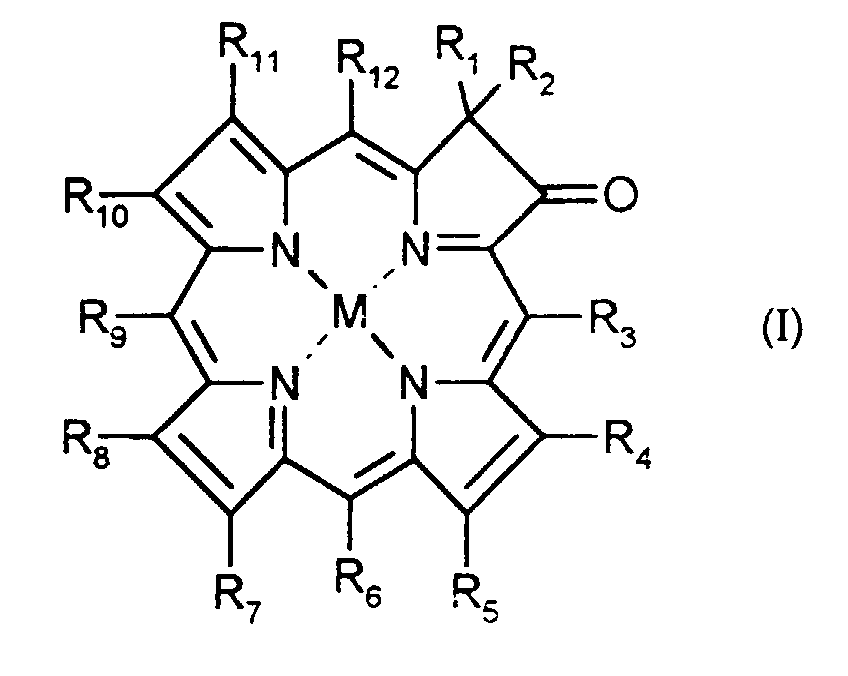
- R 1 and R 2 are preferably independently of one another unsubstituted or substituted by COOR 13 , CONR 14 R 15 or CN C 1 -C 8 alkyl.
- R 3 , R 6 , R 9 and R 12 are preferably, independently of one another, hydrogen, halogen, CN, CHO, C 1 -C 8 alkyl or unsubstituted or with halogen, NO 2 , C 1 -C 8 alkyl, OR 13 , SR 13 or COOR 13 substituted phenyl.
- R 4 , R 5 , R 7 , R 8 , R 10 and R 11 are independently hydrogen or C 1 -C 8 alkyl.
- the divalent metal atom, oxometal, halogenometal or hydroxymetal is preferably not coordinated with any additional neutral molecule.
- M is preferably H 2 , Cu (II), Zn (II), Ni (II), Pd (II), Pt (II), Mn (II) or Co (II).
- R 1 and R 2 independently of one another are methyl or ethyl; R 3 , R 6 , R 9 and R 12 are hydrogen; R 4 , R 5 , R 7 , R 8 , R 10 and R 11 independently of one another for unsubstituted or straight-chain C 1 -C 6 alkyl substituted in the ⁇ -position with COOH or COOC 1 -C 20 alkyl, in particular (CH 2 ) 2 COOC 1 -C 20 alkyl, and M represents H 2 , Pt or Pd.
- the compounds of the formulas (I) and (II) are known compounds which, for example, in Anal. Chem. 67 , 4112 (1995) are used primarily in sensor technology. If some of them are still new, they can be prepared analogously to the known compounds by methods known per se, for example by those described in J. Heterocyclic Chem. 22 , 1739 (1985), J. Org. Chem. 57 , 4820 (1992), Photochemistry and Photobiology 55 , 133 (1992), Inorg. Chem. 34 , 1333 (1995) or any other of the numerous publications known to those skilled in the art in this field. Quite surprisingly, they have a particularly advantageous, narrow absorption curve in the solid state.
- the oxoporphyrin dyes used according to the invention have longer-wave Flank of the absorption band has a high refractive index, which preferably one Peak value of over 1.8 in the ranges from 400 to 500 nm and from 600 to 700 nm achieved, whereby a medium with high reflectivity as well as high sensitivity and good Playback characteristics in the desired spectral range is made possible. It is also unnecessary to add another dye to the recording layer so that a very good light fastness is achieved.
- the substrate which acts as a carrier for the layers applied thereon expediently semi-transparent (T ⁇ 10%) or preferably transparent (T ⁇ 90%).
- the carrier can have a thickness of 0.01 to 10 mm, preferably 0.1 to 5 mm.
- the recording layer is preferably between the transparent substrate and the reflective layer attached.
- the thickness of the recording layer is from 10 to 1000 nm, preferably from 50 to 500 nm, particularly preferably around 100 nm, for example from 80 to 150 nm.
- the absorption of the recording layer is at the absorption maximum typically from 0.1 to 1.0.
- the reflective layer whose thickness can be from 10 to 150 nm, has preferred high reflectivity (R ⁇ 70%), coupled with low transparency (T ⁇ 10%).
- the top layer for example the reflection layer or the Recording layer, is appropriately additionally provided with a protective layer, which has a thickness of 0.1 to 1000 microns, preferably 0.1 to 50 microns and particularly preferred Can have 0.5 to 15 microns.
- This protective layer can optionally also act as an adhesion promoter serve for a second substrate layer attached thereon, which is preferred is 0.1 to 5 mm thick and is made of the same material as the carrier substrate.
- the reflectivity of the entire recording medium is preferably at least 60%.
- dyes of the formula (I) those according to the invention Recording media advantageously homogeneous, amorphous and low-scatter recording layers on, whose refractive index edge surprisingly, especially in the solid phase is steep. Further advantages are the high light stability in daylight with a simultaneous high one Sensitivity under laser radiation of high power density, the uniform font width as well as the good thermal and storage stability.
- Suitable substrates are, for example, glasses, minerals, ceramics and thermosets or thermoplastics.
- Preferred carriers are glasses and homo- or copolymer plastics.
- Suitable plastics are, for example, thermoplastic Polycarbonates, polyamides, polyesters, polyacrylates and polymethacrylates, polyurethanes, Polyolefins, polyvinyl chloride, polyvinylidene fluoride, polyimides, thermosetting polyesters and Epoxy resins.
- the substrate can be in pure form or can also contain conventional additives, for example UV absorbers or dyes, such as in JP 04/167 239 Light protection for the recording layer is proposed. In the latter case it is where appropriate expedient that the dye added to the carrier substrate is a relative to the dye of the recording layer by at least 10 nm, preferably by at least 20 nm hypsochromically shifted absorption maximum.
- the substrate is expedient in at least part of the range from 600 to 700 nm transparent so that it is at least 90% of the light falling on it Labeling or readout wavelength is transparent.
- the substrate preferably has a spiral guide groove on the coating side, with a groove depth of 50 to 500 nm, a groove width of 0.2 to 0.8 ⁇ m and a distance between 2 turns from 0.4 to 1.6 ⁇ m, particularly preferably with a groove depth of 100 to 200 nm, one Groove width of 0.3 ⁇ m and a distance between 2 turns of 0.6 to 0.8 ⁇ m.
- the Recording layer itself have a track groove.
- the recording layer can consist exclusively or essentially of one or several oxoporphyrin dyes according to the invention.
- known stabilizers can also be used to increase the resistance usual amounts are added, such as that described in JP 04/025 493 Nickel dithiolate as a light stabilizer.
- additional dyes are added, the amount of which, however, expediently at most 50% by weight, preferably is at most 10% by weight based on the recording layer.
- the Recording layer should consist essentially of a dye of formula (I) it is expedient that the optionally added dye is relative to the dye of the formula (I) hypsochromically shifted absorption maximum, and that the The amount of dye added is kept so small that the proportion of the latter the total absorption of the recording layer in the range of 600 to 700 nm at most 20%, preferably at most 10%. However, no additional is particularly preferred Dye added.
- Metals which are particularly suitable as reflective material for the reflective layer are reflect the laser radiation used for recording and playback well, for Example the metals of the third, fourth and fifth main group and the subgroups of the periodic system of chemical elements.
- Suitable materials for the protective layer are mainly plastics which are applied in a thin layer either directly or with the aid of adhesive layers to the support or the top layer. It is advisable to choose mechanically and thermally stable plastics with good surface properties that can be modified, for example described. It can be both thermosetting and thermoplastic. Radiation-hardened (for example with UV radiation) protective layers which are particularly simple and economical to produce are preferred. A large number of radiation-curable materials are known.
- radiation-curable monomers and oligomers are acrylates and methacrylates of diols, triols and tetrols, polyimides from aromatic tetracarboxylic acids and aromatic diamines with C 1 -C 4 alkyl groups in at least two ortho positions of the amino groups, and oligomers with dialkyl, for example dimethylmaleimidyl groups.
- the recording media according to the invention can also have additional layers, such as interference layers. It is also possible to construct recording media with several (e.g. two) recording layers. The structure and the use of such materials are known to the person skilled in the art. Interference layers, which are arranged between the recording layer and the reflecting layer and / or between the recording layer and the substrate and which consist of a dielectric material, for example, as described in EP 353 393, of TiO 2 , Si 3 N 4 , ZnS or are preferred Silicone resins.
- the recording media according to the invention can be produced by methods known per se are produced, depending on the materials used and their functionality different coating methods can be used.
- Suitable coating processes are, for example, dipping, pouring, brushing, knife coating and centrifugal casting, as well as vapor deposition processes carried out in a high vacuum will.
- casting processes in general Solutions used in organic solvents.
- solvents Care must be taken to ensure that the carrier used is compatible with these solvents are insensitive.
- a particular advantage of the dyes according to the invention is that that they are good in less polar solvents than previous dyes are soluble, so that aggressive solvents such as acetone are not used can be.
- Suitable coating processes and solvents are for example in EP 401 791.
- the recording layer is preferred by slurrying a dye solution applied, in particular alcohols, such as 2-methoxyethanol, Isopropanol, isobutanol or n-butanol, or preferably fluorinated alcohols, such as Example 2,2,2-trifluoroethanol or 2,2,3,3-tetrafluoro-1-propanol, and mixtures thereof have proven successful as a solvent.
- alcohols such as 2-methoxyethanol, Isopropanol, isobutanol or n-butanol
- fluorinated alcohols such as Example 2,2,2-trifluoroethanol or 2,2,3,3-tetrafluoro-1-propanol, and mixtures thereof have proven successful as a solvent.
- the metallic reflection layer is preferably applied by vapor deposition in a vacuum.
- the material to be applied is first filled into a suitable vessel, which may be provided with a resistance heater, and then placed in a vacuum chamber.
- the carrier to be vaporized is placed in a holder above the vessel with the material to be vaporized. This is designed so that the carrier can be rotated (for example at 50 rpm) and heated if necessary.
- the vacuum chamber is evacuated to approximately 1.3 ⁇ 10 -5 to 1.3 ⁇ 10 -6 mbar, and the heating is adjusted so that the temperature of the material to be evaporated rises to its evaporation temperature. The evaporation continues until the evaporated layer has the desired thickness.
- the organic recording compound is applied first and then the reflective layer, or the reverse can be done.
- a reflective layer can optionally be dispensed with.
- the sputtering technique is particularly preferred because of the high adhesion to the carrier for the application of the metallic reflection layer.
- the material to be applied e.g. aluminum
- the carrier is attached to the counter electrode.
- First the vacuum chamber is evacuated to about 10 -6 mbar and then inert gas, for example argon, is introduced up to about 10 -3 mbar.
- inert gas for example argon
- the metal particles sputtered (knocked out) by the Ar + ions from the "target” electrode are deposited uniformly and firmly on the substrate.
- the coating takes place within a few 10 seconds to several minutes depending on the target materials, sputtering method and sputtering conditions. This technique is described in detail in technical books (eg JL Vossen and W. Kem, "Thin Film Processes", Academic Press, 1978).
- the structure of the recording medium according to the invention mainly depends according to the selection method; known operating principles are the measurement of Change in transmission or, preferably, reflection.
- the following structures can be used: more transparent Carrier / recording layer (possibly multilayer) / reflection layer and if expedient, protective layer (not necessarily transparent), or carrier (not necessarily transparent) / reflection layer / recording layer and if appropriate transparent Protective layer.
- the light is radiated from the carrier side, while in in the latter case, the radiation from the recording layer or, if appropriate, from the Protective layer side collapses.
- the light detector is on the same Side like the light source.
- the first-mentioned structure of the invention recording material is generally preferred.
- the following other structure can be used: more transparent Carrier / recording layer (possibly multi-layered) and, if appropriate, transparent protective layer.
- the light for recording and reading out can either from the carrier side or the recording layer or, if appropriate, the Protective layer side are irradiated, the light detector in this case always located on the opposite side.
- Suitable lasers are, for example, commercially available diode lasers, in particular semiconductor diode lasers, for example He / Ne, Kr, GaAsAl, InGaAIP or GaAs laser diodes Wavelength of 602, 612, 633, 635, 647, 650, 670 or 680 nm, or ion laser, for Example HeCd or Ar laser with a wavelength of 442 or 457 nm.
- semiconductor diode lasers for example He / Ne, Kr, GaAsAl, InGaAIP or GaAs laser diodes Wavelength of 602, 612, 633, 635, 647, 650, 670 or 680 nm, or ion laser, for Example HeCd or Ar laser with a wavelength of 442 or 457 nm.
- the recording can be made point by point using a light modulator will.
- Diode lasers are preferably used, the radiation of which is directed onto the Recording layer is focused.
- the method according to the invention enables information to be stored with high reliability and durability, which is characterized by a very good mechanical and thermal stability as well as high light stability and sharp edge zones award.
- the surprisingly high signal / noise ratio of is particularly advantageous Carrier material for information marking, which allows perfect reading.
- the high storage capacity is particularly valuable in the video area.
- the information is read out by measuring the absorption using the reflection method or transmission method using laser radiation, wherein it It is particularly advantageous that laser radiation of the wavelength used for recording can be used, so no second laser device needs to be used.
- the recording and reading out of the Information at the same wavelength. When reading out, you generally reduce the Power of the laser used compared to the laser radiation used for recording, for example ten to fifty times.
- the information can be obtained from Recording material used according to the invention is read out one or more times will.
- the change in the absorption spectrum or the stored information can be read with a photodetector using a low-energy laser.
- Suitable photodetectors include PIN and AV photodiodes and microscope spectrophotometers (e.g. ®UMSP80 from Carl Zeiss), which enable the spectral Changes due to transmission or absorption and especially reflection measure up.
- the novel information-containing medium is in particular an optical information material of the WORM type. It may, for example, as a playable CD (c ompact d isc), as storage material for computers or as identity and security card or for the production of diffractive optical elements, for example, Holograms.
- Another object of the invention is therefore the use of the inventive Recording medium for optical recording, storage and playback of Information.
- the recording and the reproduction are preferably carried out in the wavelength range from 400 to 500 nm or particularly preferably from 600 to 700 nm.
- the record carrier has a basic reflectivity of 60% at 635 nm.
- a 10 mW laser diode with a wavelength of 635 nm is active with a power of 8 mW Inscribed layer, with each brand received an energy of 1.5 nJ / pixel. This The process causes a change in reflection from 60% to 30% at labeled points. With The brands can be read again with reduced performance.
- the reflectivity change of the marks is measured in the range of 450-550 nm.
- the Reflectivity changes from high to low with a modulation of 50%.
Landscapes
- Chemical & Material Sciences (AREA)
- Organic Chemistry (AREA)
- Optical Record Carriers And Manufacture Thereof (AREA)
- Thermal Transfer Or Thermal Recording In General (AREA)
- Nitrogen Condensed Heterocyclic Rings (AREA)
Abstract
Description

Bevorzugt steht M für H2, Cu(II), Zn(II), Ni(II), Pd(II), Pt(II), Mn(II) oder Co(II).


Claims (16)
- Optisches Aufzeichnungsmedium, enthaltend ein Substrat, eine reflektierende Schicht und eine Aufzeichnungsschicht, dadurch gekennzeichnet, dass diese Aufzeichnungsschicht im wesentlichen aus einem oder mehreren Farbstoffen der Formel (I) oder Chlorierungs- oder Bromierungsprodukten davon besteht,worin R1 und R2 unabhängig voneinander für unsubstituiertes oder mit OR13, NR14R15, COOR13, CONR14R15 oder CN substituiertes C1-C8Alkyl oder C2-C8Alkenyl stehen;
 R3, R6, R9 und R12 unabhängig voneinander für Wasserstoff, Halogen, CN, CHO, C1-C8Alkyl oder unsubstituiertes oder mit Halogen, NO2, C1-C8Alkyl, OR13, SR13, NR14R15, COOR13, CONR14R15 oder CN einfach oder mehrfach substituiertes C6-C14Aryl stehen;R4, R5, R7, R8, R10 und R11 unabhängig voneinander für Wasserstoff, Halogen, NO2, CHO, COOR13, CONR14R15, CN oder für unsubstituiertes oder mit OR13, NR14R15, COOR13, CONR14R15 oder CN substituiertes C1-C8Alkyl oder C2-C8Alkenyl stehen,oder unabhängig voneinander ein oder mehrere Paare R4 und R5, R7 und R8 und/oder R10 und R11 unsubstituiertes oder mit Halogen, NO2, C1-C8Alkyl, OR13, SR13, NR14R15, COOR13, CONR14R15 oder CN einfach oder mehrfach substituiertes 1,4-Buta-1,3-dienylen, oder unsubstituiertes oder mit C1-C8Alkyl, OR13, NR14R15, COOR13, CONR14R15 oder CN einfach oder mehrfach substituiertes 1,3-Propylen, 1,4-Butylen oder 2-Buten-1,4-ylen sind, so dass gegebenenfalls mit der gemeinsamen C-C- oder C=C-Gruppe ein fünfgliedriger oder sechsgliedriger Ring gebildet wird;wobei R13, R14 und R15 unabhängig voneinander für Wasserstoff, C1-C20Alkyl, C2-C20Alkenyl, C2-C20Alkinyl, C6-C14Aryl oder C7-C18Aralkyl stehen,oder NR14R15 einen fünf- oder sechsgliedrigen, gegebenenfalls einen weiteren N oder O-Atom enthaltenden Heterozyklus bedeutet, welcher einfach oder mehrfach mit C1-C8Alkyl substituiert sein kann;und M für H2 oder ein divalentes Metallatom, Oxometall, Halogenometall oder Hydroxymetall steht,wobei das divalente Oxometall, Halogenometall oder Hydroxymetall zusätzlich an einem, und das divalentes Metallatom zusätzlich an einem oder zwei gegebenenfalls voneinander unabhängigen neutralen Molekülen koordiniert sein kann, welche mindestens ein Heteroatom, ausgewählt aus der Gruppe bestehend aus N, O und S, enthalten.
 - Aufzeichnungsmedium nach Anspruch 1, worin R1 und R2 unabhängig voneinander unsubstituiertes oder mit COOR13, CONR14R15 oder CN substituiertes C1-C8Alkyl sind.
- Aufzeichnungsmedium nach Anspruch 1, worin R3, R6, R9 und R12 unabhängig voneinander Wasserstoff, Halogen, CN, CHO, C1-C8Alkyl oder unsubstituiertes oder mit Halogen, NO2, C1-C8Alkyl, OR13, SR13 oder COOR13 substituiertes Phenyl sind.
- Aufzeichnungsmedium nach Anspruch 1, worin R4, R5, R7, R8, R10 und R11 unabhängig voneinander Wasserstoff oder C1-C8Alkyl sind.
- Aufzeichnungsmedium nach Anspruch 1, worin M für H2, Cu(II), Zn(II), Ni(II), Pd(II), Pt(II), Mn(II) oder Co(II) steht.
- Aufzeichnungsmedium nach Anspruch 1, worin R1 und R2 unabhängig voneinander für Methyl oder Ethyl; R3, R6, R9 und R12 für Wasserstoff; R4, R5, R7, R8, R10 und R11 unabhängig voneinander für unsubstituiertes oder in ω-Stellung mit COOH oder COOC1-C20Alkyl substituiertes geradkettiges C1-C6Alkyl, insbesondere (CH2)2COOC1-C20Alkyl, und M für H2, Pt oder Pd steht.
- Aufzeichnungsmedium nach Anspruch 1, worin die Verbindung der Formel (I) eine Verbindung der Formel (II),oder ein Bromierungsprodukt davon ist, welches zwei oder vier Bromatome enthält.

- Aufzeichnungsmedium nach Anspruch 1, worin der Farbstoff einen Brechungsindex von über 1,8 in den Bereichen von 400 bis 500 nm und von 600 bis 700 nm besitzt.
- Aufzeichnungsmedium nach Anspruch 1, worin das Substrat eine Transparenz von mindestens 90% und eine Dicke von 0,01 bis 10 mm, bevorzugt von 0,1 bis 5 mm aufweist.
- Aufzeichnungsmedium nach Anspruch 1, worin die reflektierende Schicht aus Aluminium, Silber, Kupfer, Gold oder deren Legierungen besteht, und eine Reflektivität von mindestens 70% und eine Dicke von 10 bis 150 nm aufweist.
- Aufzeichnungsmedium nach Anspruch 1, worin die Aufzeichnungsschicht sich zwischen dem transparenten Substrat und der reflektierenden Schicht befindet, und eine Dicke von 10 bis 1000 nm, bevorzugt von 50 bis 500 nm, besonders bevorzugt von 80 bis 150 nm aufweist.
- Aufzeichnungsmedium nach Anspruch 1, welches mit einer zusätzlichen Schutzschicht, deren Dicke von 0,1 bis 1000 µm, bevorzugt 0,1 bis 50 µm und besonders bevorzugt 0,5 bis 15 µm beträgt, versehen ist, worauf gegebenenfalls noch eine zweite Substratschicht angebracht sein kann, welche bevorzugt von 0,1 bis 5 mm dick ist und aus dem gleichen Material wie das Trägersubstrat besteht.
- Aufzeichnungsmedium nach Anspruch 1, welches eine Reflektivität von mindestens 60% aufweist.
- Aufzeichnungsmedium nach Anspruch 1, worin zwischen der Aufzeichnungsschicht und der reflektierenden Schicht und/oder zwischen der Aufzeichnungsschicht und dem Substrat zusätzlich mindestens eine aus einem dielektrischen Material bestehende Interferenzschicht angeordnet ist.
- Verfahren zur optischen Aufzeichnung, Speicherung und Wiedergabe von Information, dadurch gekennzeichnet, dass ein Aufzeichnungsmedium nach Anspruch 1 verwendet wird.
- Verfahren nach Anspruch 15, worin die Aufzeichnung oder die Wiedergabe im Wellenlängenbereich von 400 bis 500 nm oder von 600 bis 700 nm erfolgen.
Applications Claiming Priority (3)
| Application Number | Priority Date | Filing Date | Title |
|---|---|---|---|
| CH1756/96 | 1996-07-12 | ||
| CH175696 | 1996-07-12 | ||
| CH175696 | 1996-07-12 |
Publications (3)
| Publication Number | Publication Date |
|---|---|
| EP0822546A2 true EP0822546A2 (de) | 1998-02-04 |
| EP0822546A3 EP0822546A3 (de) | 1998-04-22 |
| EP0822546B1 EP0822546B1 (de) | 2003-10-01 |
Family
ID=4217836
Family Applications (1)
| Application Number | Title | Priority Date | Filing Date |
|---|---|---|---|
| EP97810439A Expired - Lifetime EP0822546B1 (de) | 1996-07-12 | 1997-07-03 | Speichermedien mit hoher Kapazität |
Country Status (6)
| Country | Link |
|---|---|
| US (1) | US5871882A (de) |
| EP (1) | EP0822546B1 (de) |
| JP (1) | JPH10101953A (de) |
| KR (1) | KR100437975B1 (de) |
| CA (1) | CA2210634A1 (de) |
| DE (1) | DE59710799D1 (de) |
Cited By (2)
| Publication number | Priority date | Publication date | Assignee | Title |
|---|---|---|---|---|
| EP1262966A3 (de) * | 1999-12-28 | 2003-12-03 | Mitsui Chemicals, Inc. | Optisches Aufzeichnungsmedium und neue Azaporphyrinverbindung |
| US7625621B2 (en) | 2004-07-29 | 2009-12-01 | Clariant Finance (Bvi) Limited | Amino antipyrine based azo ligands and their metal complexes for use as optical recording media |
Families Citing this family (7)
| Publication number | Priority date | Publication date | Assignee | Title |
|---|---|---|---|---|
| GB9616353D0 (en) * | 1996-08-03 | 1996-09-11 | Secr Defence | Metallo-porphyrins |
| TW411436B (en) * | 1998-08-18 | 2000-11-11 | Ind Tech Res Inst | Improved structure of optically recordable media and its manufacture method |
| DE10016669A1 (de) * | 2000-04-04 | 2001-10-11 | Bayer Ag | Verwendung von lichtabsorbierenden Verbindungen in der Informationsschicht von optischen Datenträgern sowie optische Datenträger |
| US6765092B2 (en) * | 2000-07-21 | 2004-07-20 | North Carolina State University | Regioisomerically pure oxochlorins and methods of synthesis |
| AU2003212458A1 (en) | 2002-02-26 | 2003-09-09 | Board Of Regents, The University Of Texas System | Cyclo(n)pyrroles and methods thereto |
| JP2004160742A (ja) * | 2002-11-11 | 2004-06-10 | Tdk Corp | 光記録ディスクおよびその製造方法ならびに光記録ディスクの光記録再生方法 |
| US7884280B2 (en) * | 2003-05-27 | 2011-02-08 | North Carolina State University | Stepwise fabrication of molecular-based, cross linked, light harvesting arrays |
Family Cites Families (12)
| Publication number | Priority date | Publication date | Assignee | Title |
|---|---|---|---|---|
| JPS58197088A (ja) * | 1982-05-13 | 1983-11-16 | Tdk Corp | 光記録媒体 |
| DE3622294A1 (de) * | 1986-07-03 | 1988-01-07 | Basf Ag | Optisches aufzeichnungsmedium |
| JP2553359B2 (ja) * | 1987-08-27 | 1996-11-13 | 藤森工業株式会社 | 光テ−プ |
| JPH01174488A (ja) * | 1987-12-28 | 1989-07-11 | Dainippon Printing Co Ltd | 光情報記録媒体 |
| JP2656785B2 (ja) * | 1988-02-24 | 1997-09-24 | 日東電工株式会社 | 光デイスク |
| JP2605116B2 (ja) * | 1988-07-19 | 1997-04-30 | 株式会社リコー | 光情報記録媒体 |
| US4990388A (en) * | 1988-07-30 | 1991-02-05 | Taiyo Yuden Co., Ltd. | Optical information recording medium |
| US4908442A (en) * | 1988-09-23 | 1990-03-13 | General Petrochemical Industries, Limited | Tetra ketone porphyrin monomers and the process of preparation thereof |
| US5064952A (en) * | 1990-01-16 | 1991-11-12 | Board Of Trustees, A Constitutional Corporation Operating Michigan State University | Derivatives of porphyrin useful in photodynamic therapy |
| US5486437A (en) * | 1993-04-08 | 1996-01-23 | Sony Corporation | Optical recording method |
| JPH07276804A (ja) * | 1994-04-15 | 1995-10-24 | Mitsui Toatsu Chem Inc | 光記録媒体 |
| JP3451715B2 (ja) * | 1994-05-12 | 2003-09-29 | ソニー株式会社 | 光記録媒体及び光記録再生装置 |
-
1997
- 1997-07-03 DE DE59710799T patent/DE59710799D1/de not_active Expired - Fee Related
- 1997-07-03 EP EP97810439A patent/EP0822546B1/de not_active Expired - Lifetime
- 1997-07-09 US US08/890,163 patent/US5871882A/en not_active Expired - Fee Related
- 1997-07-10 CA CA002210634A patent/CA2210634A1/en not_active Abandoned
- 1997-07-11 JP JP9186174A patent/JPH10101953A/ja not_active Withdrawn
- 1997-07-11 KR KR1019970032301A patent/KR100437975B1/ko not_active Expired - Fee Related
Cited By (2)
| Publication number | Priority date | Publication date | Assignee | Title |
|---|---|---|---|---|
| EP1262966A3 (de) * | 1999-12-28 | 2003-12-03 | Mitsui Chemicals, Inc. | Optisches Aufzeichnungsmedium und neue Azaporphyrinverbindung |
| US7625621B2 (en) | 2004-07-29 | 2009-12-01 | Clariant Finance (Bvi) Limited | Amino antipyrine based azo ligands and their metal complexes for use as optical recording media |
Also Published As
| Publication number | Publication date |
|---|---|
| EP0822546B1 (de) | 2003-10-01 |
| JPH10101953A (ja) | 1998-04-21 |
| DE59710799D1 (de) | 2003-11-06 |
| KR100437975B1 (ko) | 2004-09-08 |
| EP0822546A3 (de) | 1998-04-22 |
| KR980011180A (ko) | 1998-04-30 |
| CA2210634A1 (en) | 1998-01-12 |
| US5871882A (en) | 1999-02-16 |
Similar Documents
| Publication | Publication Date | Title |
|---|---|---|
| EP0805441B1 (de) | Optische Speichermedien mit hoher Kapazität, die Xanthenfarbstoffe enthalten | |
| DE69725607T2 (de) | Polymethin-komplex-farbstoffe und ihre verwendung | |
| DE60204981T2 (de) | Zusammensetzungen enthaltend mindestens einen oxonol-farbstoff und mindestens einen metallkomplex | |
| DE69713512T2 (de) | Substituierte phtalocyanine und deren verwendung | |
| DE69422132T2 (de) | Metallisiertes Azo-Dianon mit zwei kationischen Farbstoff-Gegenionen für ein optisches Medium zur Aufzeichung von Informationen | |
| EP0540468B1 (de) | NIR-Farbstoffe, Verfahren zu ihrer Herstellung und ihre Verwendung | |
| DE69814258T2 (de) | Phthalocyaninverbindungen | |
| DE3927872C2 (de) | Dithiolat-Metallkomplexverbindungen, Verfahren zu ihrer Herstellung und sie enthaltendes optisches Informationsaufzeichnungsmaterial | |
| KR20020080353A (ko) | 광기록매체 및 신규한 아자포르피린 화합물 | |
| JP2007290401A (ja) | 高い記憶密度を有する光学記録材料 | |
| EP1377974A1 (de) | Optischer datenträger enthaltend in der informationsschicht einen xanthenfarbstoff als lichtabsorbierende verbindung | |
| DE69812259T2 (de) | Photostabilisierte cyaninfarbstoffe und optischer aufzeichnungsträger | |
| EP0822546B1 (de) | Speichermedien mit hoher Kapazität | |
| DE69839010T2 (de) | Beschreibbare und löschbare optische aufzeichnungsmedien mit hoher dichte | |
| EP1377968A2 (de) | Optischer datenträger enthaltend in der informationsschicht einen heterocyclischen azofarbstoff als lichtabsorbierende verbindung | |
| DE69316808T2 (de) | Optisches Aufzeichnungsmedium | |
| DE602004001135T2 (de) | Materialien für optische aufzeichnung mit hoher speicherdichte | |
| US20080130474A1 (en) | Optical Recording Materials Having High Stroage Density | |
| DE3724981A1 (de) | Optischer informationsaufzeichnungstraeger | |
| US20060177621A1 (en) | O-coordinated metal chelates and their use in optical recording media having high storage capacity | |
| TW200300549A (en) | Writable high-capacity optical storage media containing metal complexes | |
| JP2003191641A (ja) | 光情報記録媒体 | |
| DE102004026708A1 (de) | Metallkomplexe als lichtabsorbierende Verbindungen in der Informationsschicht von optischen Datenspeichern | |
| EP1710793A1 (de) | Metallchelate und ihre Verwendung in optischen Aufzeichnungsmedien mit hoher Speicherkapazität |
Legal Events
| Date | Code | Title | Description |
|---|---|---|---|
| PUAI | Public reference made under article 153(3) epc to a published international application that has entered the european phase |
Free format text: ORIGINAL CODE: 0009012 |
|
| AK | Designated contracting states |
Kind code of ref document: A2 Designated state(s): CH DE FR GB IT LI NL SE |
|
| AX | Request for extension of the european patent |
Free format text: AL;LT;LV;RO;SI |
|
| PUAL | Search report despatched |
Free format text: ORIGINAL CODE: 0009013 |
|
| AK | Designated contracting states |
Kind code of ref document: A3 Designated state(s): AT BE CH DE DK ES FI FR GB GR IE IT LI LU MC NL PT SE |
|
| AX | Request for extension of the european patent |
Free format text: AL;LT;LV;RO;SI |
|
| 17P | Request for examination filed |
Effective date: 19980615 |
|
| AKX | Designation fees paid |
Free format text: CH DE FR GB IT LI NL SE |
|
| RBV | Designated contracting states (corrected) |
Designated state(s): CH DE FR GB IT LI NL SE |
|
| GRAH | Despatch of communication of intention to grant a patent |
Free format text: ORIGINAL CODE: EPIDOS IGRA |
|
| GRAS | Grant fee paid |
Free format text: ORIGINAL CODE: EPIDOSNIGR3 |
|
| GRAA | (expected) grant |
Free format text: ORIGINAL CODE: 0009210 |
|
| AK | Designated contracting states |
Kind code of ref document: B1 Designated state(s): CH DE FR GB IT LI NL SE |
|
| REG | Reference to a national code |
Ref country code: GB Ref legal event code: FG4D Free format text: NOT ENGLISH |
|
| REG | Reference to a national code |
Ref country code: CH Ref legal event code: EP |
|
| REF | Corresponds to: |
Ref document number: 59710799 Country of ref document: DE Date of ref document: 20031106 Kind code of ref document: P |
|
| GBT | Gb: translation of ep patent filed (gb section 77(6)(a)/1977) |
Effective date: 20031112 |
|
| REG | Reference to a national code |
Ref country code: SE Ref legal event code: TRGR |
|
| ET | Fr: translation filed | ||
| PLBE | No opposition filed within time limit |
Free format text: ORIGINAL CODE: 0009261 |
|
| STAA | Information on the status of an ep patent application or granted ep patent |
Free format text: STATUS: NO OPPOSITION FILED WITHIN TIME LIMIT |
|
| 26N | No opposition filed |
Effective date: 20040702 |
|
| PGFP | Annual fee paid to national office [announced via postgrant information from national office to epo] |
Ref country code: FR Payment date: 20050617 Year of fee payment: 9 |
|
| PGFP | Annual fee paid to national office [announced via postgrant information from national office to epo] |
Ref country code: SE Payment date: 20050621 Year of fee payment: 9 Ref country code: NL Payment date: 20050621 Year of fee payment: 9 |
|
| PGFP | Annual fee paid to national office [announced via postgrant information from national office to epo] |
Ref country code: DE Payment date: 20050623 Year of fee payment: 9 |
|
| PGFP | Annual fee paid to national office [announced via postgrant information from national office to epo] |
Ref country code: GB Payment date: 20050627 Year of fee payment: 9 |
|
| PGFP | Annual fee paid to national office [announced via postgrant information from national office to epo] |
Ref country code: CH Payment date: 20050630 Year of fee payment: 9 |
|
| PG25 | Lapsed in a contracting state [announced via postgrant information from national office to epo] |
Ref country code: GB Free format text: LAPSE BECAUSE OF NON-PAYMENT OF DUE FEES Effective date: 20060703 |
|
| PG25 | Lapsed in a contracting state [announced via postgrant information from national office to epo] |
Ref country code: SE Free format text: LAPSE BECAUSE OF NON-PAYMENT OF DUE FEES Effective date: 20060704 |
|
| PG25 | Lapsed in a contracting state [announced via postgrant information from national office to epo] |
Ref country code: LI Free format text: LAPSE BECAUSE OF NON-PAYMENT OF DUE FEES Effective date: 20060731 Ref country code: CH Free format text: LAPSE BECAUSE OF NON-PAYMENT OF DUE FEES Effective date: 20060731 |
|
| PGFP | Annual fee paid to national office [announced via postgrant information from national office to epo] |
Ref country code: IT Payment date: 20060731 Year of fee payment: 10 |
|
| PG25 | Lapsed in a contracting state [announced via postgrant information from national office to epo] |
Ref country code: NL Free format text: LAPSE BECAUSE OF NON-PAYMENT OF DUE FEES Effective date: 20070201 Ref country code: DE Free format text: LAPSE BECAUSE OF NON-PAYMENT OF DUE FEES Effective date: 20070201 |
|
| REG | Reference to a national code |
Ref country code: CH Ref legal event code: PL |
|
| EUG | Se: european patent has lapsed | ||
| GBPC | Gb: european patent ceased through non-payment of renewal fee |
Effective date: 20060703 |
|
| NLV4 | Nl: lapsed or anulled due to non-payment of the annual fee |
Effective date: 20070201 |
|
| REG | Reference to a national code |
Ref country code: FR Ref legal event code: ST Effective date: 20070330 |
|
| PG25 | Lapsed in a contracting state [announced via postgrant information from national office to epo] |
Ref country code: FR Free format text: LAPSE BECAUSE OF NON-PAYMENT OF DUE FEES Effective date: 20060731 |
|
| PG25 | Lapsed in a contracting state [announced via postgrant information from national office to epo] |
Ref country code: IT Free format text: LAPSE BECAUSE OF NON-PAYMENT OF DUE FEES Effective date: 20070703 |