EP0373643A2 - Near infrared absorbers and display/recording materials prepared by using same - Google Patents
Near infrared absorbers and display/recording materials prepared by using same Download PDFInfo
- Publication number
- EP0373643A2 EP0373643A2 EP89123102A EP89123102A EP0373643A2 EP 0373643 A2 EP0373643 A2 EP 0373643A2 EP 89123102 A EP89123102 A EP 89123102A EP 89123102 A EP89123102 A EP 89123102A EP 0373643 A2 EP0373643 A2 EP 0373643A2
- Authority
- EP
- European Patent Office
- Prior art keywords
- group
- carbon atoms
- branched
- straight
- chain
- Prior art date
- Legal status (The legal status is an assumption and is not a legal conclusion. Google has not performed a legal analysis and makes no representation as to the accuracy of the status listed.)
- Granted
Links
- 0 CCc(c(C)c(c(C(C)=*)c1C(C)C)ON)*1OC Chemical compound CCc(c(C)c(c(C(C)=*)c1C(C)C)ON)*1OC 0.000 description 5
- QWBBPBRQALCEIZ-UHFFFAOYSA-N Cc1cccc(O)c1C Chemical compound Cc1cccc(O)c1C QWBBPBRQALCEIZ-UHFFFAOYSA-N 0.000 description 1
Images

Classifications
-
- C—CHEMISTRY; METALLURGY
- C09—DYES; PAINTS; POLISHES; NATURAL RESINS; ADHESIVES; COMPOSITIONS NOT OTHERWISE PROVIDED FOR; APPLICATIONS OF MATERIALS NOT OTHERWISE PROVIDED FOR
- C09K—MATERIALS FOR MISCELLANEOUS APPLICATIONS, NOT PROVIDED FOR ELSEWHERE
- C09K3/00—Materials not provided for elsewhere
-
- G—PHYSICS
- G11—INFORMATION STORAGE
- G11B—INFORMATION STORAGE BASED ON RELATIVE MOVEMENT BETWEEN RECORD CARRIER AND TRANSDUCER
- G11B7/00—Recording or reproducing by optical means, e.g. recording using a thermal beam of optical radiation by modifying optical properties or the physical structure, reproducing using an optical beam at lower power by sensing optical properties; Record carriers therefor
- G11B7/24—Record carriers characterised by shape, structure or physical properties, or by the selection of the material
- G11B7/241—Record carriers characterised by shape, structure or physical properties, or by the selection of the material characterised by the selection of the material
- G11B7/242—Record carriers characterised by shape, structure or physical properties, or by the selection of the material characterised by the selection of the material of recording layers
- G11B7/244—Record carriers characterised by shape, structure or physical properties, or by the selection of the material characterised by the selection of the material of recording layers comprising organic materials only
- G11B7/246—Record carriers characterised by shape, structure or physical properties, or by the selection of the material characterised by the selection of the material of recording layers comprising organic materials only containing dyes
- G11B7/248—Record carriers characterised by shape, structure or physical properties, or by the selection of the material characterised by the selection of the material of recording layers comprising organic materials only containing dyes porphines; azaporphines, e.g. phthalocyanines
-
- C—CHEMISTRY; METALLURGY
- C07—ORGANIC CHEMISTRY
- C07D—HETEROCYCLIC COMPOUNDS
- C07D487/00—Heterocyclic compounds containing nitrogen atoms as the only ring hetero atoms in the condensed system, not provided for by groups C07D451/00 - C07D477/00
- C07D487/22—Heterocyclic compounds containing nitrogen atoms as the only ring hetero atoms in the condensed system, not provided for by groups C07D451/00 - C07D477/00 in which the condensed system contains four or more hetero rings
-
- C—CHEMISTRY; METALLURGY
- C07—ORGANIC CHEMISTRY
- C07F—ACYCLIC, CARBOCYCLIC OR HETEROCYCLIC COMPOUNDS CONTAINING ELEMENTS OTHER THAN CARBON, HYDROGEN, HALOGEN, OXYGEN, NITROGEN, SULFUR, SELENIUM OR TELLURIUM
- C07F11/00—Compounds containing elements of Groups 6 or 16 of the Periodic Table
-
- C—CHEMISTRY; METALLURGY
- C07—ORGANIC CHEMISTRY
- C07F—ACYCLIC, CARBOCYCLIC OR HETEROCYCLIC COMPOUNDS CONTAINING ELEMENTS OTHER THAN CARBON, HYDROGEN, HALOGEN, OXYGEN, NITROGEN, SULFUR, SELENIUM OR TELLURIUM
- C07F5/00—Compounds containing elements of Groups 3 or 13 of the Periodic Table
-
- C—CHEMISTRY; METALLURGY
- C07—ORGANIC CHEMISTRY
- C07F—ACYCLIC, CARBOCYCLIC OR HETEROCYCLIC COMPOUNDS CONTAINING ELEMENTS OTHER THAN CARBON, HYDROGEN, HALOGEN, OXYGEN, NITROGEN, SULFUR, SELENIUM OR TELLURIUM
- C07F5/00—Compounds containing elements of Groups 3 or 13 of the Periodic Table
- C07F5/06—Aluminium compounds
- C07F5/069—Aluminium compounds without C-aluminium linkages
-
- C—CHEMISTRY; METALLURGY
- C07—ORGANIC CHEMISTRY
- C07F—ACYCLIC, CARBOCYCLIC OR HETEROCYCLIC COMPOUNDS CONTAINING ELEMENTS OTHER THAN CARBON, HYDROGEN, HALOGEN, OXYGEN, NITROGEN, SULFUR, SELENIUM OR TELLURIUM
- C07F7/00—Compounds containing elements of Groups 4 or 14 of the Periodic Table
-
- C—CHEMISTRY; METALLURGY
- C07—ORGANIC CHEMISTRY
- C07F—ACYCLIC, CARBOCYCLIC OR HETEROCYCLIC COMPOUNDS CONTAINING ELEMENTS OTHER THAN CARBON, HYDROGEN, HALOGEN, OXYGEN, NITROGEN, SULFUR, SELENIUM OR TELLURIUM
- C07F7/00—Compounds containing elements of Groups 4 or 14 of the Periodic Table
- C07F7/02—Silicon compounds
- C07F7/025—Silicon compounds without C-silicon linkages
-
- C—CHEMISTRY; METALLURGY
- C07—ORGANIC CHEMISTRY
- C07F—ACYCLIC, CARBOCYCLIC OR HETEROCYCLIC COMPOUNDS CONTAINING ELEMENTS OTHER THAN CARBON, HYDROGEN, HALOGEN, OXYGEN, NITROGEN, SULFUR, SELENIUM OR TELLURIUM
- C07F7/00—Compounds containing elements of Groups 4 or 14 of the Periodic Table
- C07F7/30—Germanium compounds
-
- C—CHEMISTRY; METALLURGY
- C07—ORGANIC CHEMISTRY
- C07F—ACYCLIC, CARBOCYCLIC OR HETEROCYCLIC COMPOUNDS CONTAINING ELEMENTS OTHER THAN CARBON, HYDROGEN, HALOGEN, OXYGEN, NITROGEN, SULFUR, SELENIUM OR TELLURIUM
- C07F9/00—Compounds containing elements of Groups 5 or 15 of the Periodic Table
-
- C—CHEMISTRY; METALLURGY
- C09—DYES; PAINTS; POLISHES; NATURAL RESINS; ADHESIVES; COMPOSITIONS NOT OTHERWISE PROVIDED FOR; APPLICATIONS OF MATERIALS NOT OTHERWISE PROVIDED FOR
- C09B—ORGANIC DYES OR CLOSELY-RELATED COMPOUNDS FOR PRODUCING DYES, e.g. PIGMENTS; MORDANTS; LAKES
- C09B47/00—Porphines; Azaporphines
- C09B47/04—Phthalocyanines abbreviation: Pc
- C09B47/045—Special non-pigmentary uses, e.g. catalyst, photosensitisers of phthalocyanine dyes or pigments
-
- C—CHEMISTRY; METALLURGY
- C09—DYES; PAINTS; POLISHES; NATURAL RESINS; ADHESIVES; COMPOSITIONS NOT OTHERWISE PROVIDED FOR; APPLICATIONS OF MATERIALS NOT OTHERWISE PROVIDED FOR
- C09K—MATERIALS FOR MISCELLANEOUS APPLICATIONS, NOT PROVIDED FOR ELSEWHERE
- C09K19/00—Liquid crystal materials
- C09K19/52—Liquid crystal materials characterised by components which are not liquid crystals, e.g. additives with special physical aspect: solvents, solid particles
- C09K19/60—Pleochroic dyes
-
- G—PHYSICS
- G11—INFORMATION STORAGE
- G11B—INFORMATION STORAGE BASED ON RELATIVE MOVEMENT BETWEEN RECORD CARRIER AND TRANSDUCER
- G11B7/00—Recording or reproducing by optical means, e.g. recording using a thermal beam of optical radiation by modifying optical properties or the physical structure, reproducing using an optical beam at lower power by sensing optical properties; Record carriers therefor
- G11B7/24—Record carriers characterised by shape, structure or physical properties, or by the selection of the material
- G11B7/241—Record carriers characterised by shape, structure or physical properties, or by the selection of the material characterised by the selection of the material
- G11B7/242—Record carriers characterised by shape, structure or physical properties, or by the selection of the material characterised by the selection of the material of recording layers
- G11B7/244—Record carriers characterised by shape, structure or physical properties, or by the selection of the material characterised by the selection of the material of recording layers comprising organic materials only
- G11B7/249—Record carriers characterised by shape, structure or physical properties, or by the selection of the material characterised by the selection of the material of recording layers comprising organic materials only containing organometallic compounds
- G11B7/2492—Record carriers characterised by shape, structure or physical properties, or by the selection of the material characterised by the selection of the material of recording layers comprising organic materials only containing organometallic compounds neutral compounds
-
- G—PHYSICS
- G02—OPTICS
- G02B—OPTICAL ELEMENTS, SYSTEMS OR APPARATUS
- G02B5/00—Optical elements other than lenses
- G02B5/20—Filters
- G02B5/28—Interference filters
- G02B5/281—Interference filters designed for the infrared light
-
- G—PHYSICS
- G02—OPTICS
- G02F—OPTICAL DEVICES OR ARRANGEMENTS FOR THE CONTROL OF LIGHT BY MODIFICATION OF THE OPTICAL PROPERTIES OF THE MEDIA OF THE ELEMENTS INVOLVED THEREIN; NON-LINEAR OPTICS; FREQUENCY-CHANGING OF LIGHT; OPTICAL LOGIC ELEMENTS; OPTICAL ANALOGUE/DIGITAL CONVERTERS
- G02F1/00—Devices or arrangements for the control of the intensity, colour, phase, polarisation or direction of light arriving from an independent light source, e.g. switching, gating or modulating; Non-linear optics
- G02F1/01—Devices or arrangements for the control of the intensity, colour, phase, polarisation or direction of light arriving from an independent light source, e.g. switching, gating or modulating; Non-linear optics for the control of the intensity, phase, polarisation or colour
- G02F1/13—Devices or arrangements for the control of the intensity, colour, phase, polarisation or direction of light arriving from an independent light source, e.g. switching, gating or modulating; Non-linear optics for the control of the intensity, phase, polarisation or colour based on liquid crystals, e.g. single liquid crystal display cells
- G02F1/133—Constructional arrangements; Operation of liquid crystal cells; Circuit arrangements
- G02F1/1333—Constructional arrangements; Manufacturing methods
- G02F1/133362—Optically addressed liquid crystal cells
-
- G—PHYSICS
- G11—INFORMATION STORAGE
- G11B—INFORMATION STORAGE BASED ON RELATIVE MOVEMENT BETWEEN RECORD CARRIER AND TRANSDUCER
- G11B7/00—Recording or reproducing by optical means, e.g. recording using a thermal beam of optical radiation by modifying optical properties or the physical structure, reproducing using an optical beam at lower power by sensing optical properties; Record carriers therefor
- G11B7/24—Record carriers characterised by shape, structure or physical properties, or by the selection of the material
- G11B7/241—Record carriers characterised by shape, structure or physical properties, or by the selection of the material characterised by the selection of the material
- G11B7/242—Record carriers characterised by shape, structure or physical properties, or by the selection of the material characterised by the selection of the material of recording layers
- G11B7/244—Record carriers characterised by shape, structure or physical properties, or by the selection of the material characterised by the selection of the material of recording layers comprising organic materials only
- G11B7/25—Record carriers characterised by shape, structure or physical properties, or by the selection of the material characterised by the selection of the material of recording layers comprising organic materials only containing liquid crystals
-
- G—PHYSICS
- G11—INFORMATION STORAGE
- G11B—INFORMATION STORAGE BASED ON RELATIVE MOVEMENT BETWEEN RECORD CARRIER AND TRANSDUCER
- G11B7/00—Recording or reproducing by optical means, e.g. recording using a thermal beam of optical radiation by modifying optical properties or the physical structure, reproducing using an optical beam at lower power by sensing optical properties; Record carriers therefor
- G11B7/24—Record carriers characterised by shape, structure or physical properties, or by the selection of the material
- G11B7/241—Record carriers characterised by shape, structure or physical properties, or by the selection of the material characterised by the selection of the material
- G11B7/252—Record carriers characterised by shape, structure or physical properties, or by the selection of the material characterised by the selection of the material of layers other than recording layers
- G11B7/253—Record carriers characterised by shape, structure or physical properties, or by the selection of the material characterised by the selection of the material of layers other than recording layers of substrates
- G11B7/2533—Record carriers characterised by shape, structure or physical properties, or by the selection of the material characterised by the selection of the material of layers other than recording layers of substrates comprising resins
-
- G—PHYSICS
- G11—INFORMATION STORAGE
- G11B—INFORMATION STORAGE BASED ON RELATIVE MOVEMENT BETWEEN RECORD CARRIER AND TRANSDUCER
- G11B7/00—Recording or reproducing by optical means, e.g. recording using a thermal beam of optical radiation by modifying optical properties or the physical structure, reproducing using an optical beam at lower power by sensing optical properties; Record carriers therefor
- G11B7/24—Record carriers characterised by shape, structure or physical properties, or by the selection of the material
- G11B7/241—Record carriers characterised by shape, structure or physical properties, or by the selection of the material characterised by the selection of the material
- G11B7/252—Record carriers characterised by shape, structure or physical properties, or by the selection of the material characterised by the selection of the material of layers other than recording layers
- G11B7/253—Record carriers characterised by shape, structure or physical properties, or by the selection of the material characterised by the selection of the material of layers other than recording layers of substrates
- G11B7/2533—Record carriers characterised by shape, structure or physical properties, or by the selection of the material characterised by the selection of the material of layers other than recording layers of substrates comprising resins
- G11B7/2534—Record carriers characterised by shape, structure or physical properties, or by the selection of the material characterised by the selection of the material of layers other than recording layers of substrates comprising resins polycarbonates [PC]
-
- G—PHYSICS
- G11—INFORMATION STORAGE
- G11B—INFORMATION STORAGE BASED ON RELATIVE MOVEMENT BETWEEN RECORD CARRIER AND TRANSDUCER
- G11B7/00—Recording or reproducing by optical means, e.g. recording using a thermal beam of optical radiation by modifying optical properties or the physical structure, reproducing using an optical beam at lower power by sensing optical properties; Record carriers therefor
- G11B7/24—Record carriers characterised by shape, structure or physical properties, or by the selection of the material
- G11B7/241—Record carriers characterised by shape, structure or physical properties, or by the selection of the material characterised by the selection of the material
- G11B7/252—Record carriers characterised by shape, structure or physical properties, or by the selection of the material characterised by the selection of the material of layers other than recording layers
- G11B7/253—Record carriers characterised by shape, structure or physical properties, or by the selection of the material characterised by the selection of the material of layers other than recording layers of substrates
- G11B7/2533—Record carriers characterised by shape, structure or physical properties, or by the selection of the material characterised by the selection of the material of layers other than recording layers of substrates comprising resins
- G11B7/2536—Record carriers characterised by shape, structure or physical properties, or by the selection of the material characterised by the selection of the material of layers other than recording layers of substrates comprising resins polystyrene [PS]
Definitions
- the present invention relates to near infrared absorbers and to optical recording media (including optical cards), filters (including spectacles) for transmission and cutoff of near infrared rays and liquid crystal display elements utilizing near infrared rays.
- Near infrared absorbers play an important role in the field of optoelectronics.
- such absorbers are useful for information recording devices, display sensors and protective spectacles.
- phthalocyanines As disclosed in Japanese Patent Laid Open Publication Nos. 209,583/1985, 152,769/1986, 154,888/1986, 197,280/1986, 246,091/1986 and 39,286/1987, it is known to use phthalocyanines as near infrared absorbers, but the disclosed phthalocyanines are poor in absorbance, since they are liable to associate. For this reason, in the case of the optical recording media manufactured by using these phthalocyanines, the reflectance at 780 to 830 nm is low and the sensitivity is also insufficient; in the case of filters, the absorption spectrum is broad, and thus selective transmission is poor; and in the case of liquid crystal display elements, contrast is also poor.
- each of Y1, Y2, Y3, Y4, Y5, Y6, Y7 and Y8 is independently a hydrogen atom, a straight-chain or branched alkyl group having 1 to 15 carbon atoms, a straight-chain, branched or cyclic alkoxy group having 4 to 15 carbon atoms, a straight-chain, branched or cyclic alkylthio group having 4 to 15 carbon atoms; provided that each pair of Y1 and Y2, Y3 and Y4, Y5 and Y6, and Y7 and Y8 is not a pair of hydrogen atoms, alkyl groups or alkylthio groups simultaneously, or a combination of an alkyl group and hydrogen atom; each of A1, A2, A3, A
- the present invention is directed to optical recording media, near infrared absorbing filters, liquid crystal display elements and optical cards manufactured by using the above-mentioned near infrared absorbers.
- the present near infrared absorbers represented by the formula (I) have a sharp absorption at 700 to 900 nm and a high molecular extinction coefficient, and therefore are effective in optical recording media for use with semiconductor lasers (optical discs and optical cards), near infrared absorption filters (laser-responsive elements, outside light cutoff filters and protective spectacles), laser beam writing or transmission type liquid crystal materials and shutters.
- Y1, Y2, Y3, Y4, Y5 Y6, Y7 and Y8 are groups for preventing the association between phthalocyanine molecules
- A1, A2, A3, A4, A5, A6, A7 and A8 are groups for assisting Y1, Y2, Y3, Y4, Y5, Y6, Y7 and Y8 in extending perpendicularly from the plane of the phthalocyanine ring. Therefore, on condition that the number of the carbon atoms in Y1, Y2, Y3, Y4, Y5, Y6, Y7 and Y8 is the same, the branched or cyclic type substituents tend to result in higher reflectance and refractive index than the straight-chain type.
- Typical examples of the alkoxyl group represented by Y1, Y2, Y3, Y4, Y5, Y6, Y7 and Y8 include an n-butyloxy group, iso-butyloxy group, tert-butyloxy group, sec-butyloxy group, n-pentyloxy group, iso-pentyloxy group, neo-pentyloxy group, 1-methylbutyloxy group, 2-methylbutyloxy group, n-hexyloxy group, 2-ethylbutyloxy group, 3-methylpentyloxy group, 4-tert- butylhexyloxy group, 1,2-dimethylpropyloxy group, n-octyloxy group, n-nonyloxy group and n-dodecyloxy group.
- examples of the particularly preferred alkoxyl groups include an iso-butyloxy group, iso-pentyloxy group, 1,2-dimethylpropyloxy group, 2-ethylbutyloxy group, 1-ethylbutyloxy group, 1-ethyl-2-methylpropyloxy group, 1-iso-propyl-2-methylpropyloxy group, 2-ethylhexyloxy group, 1-iso-propyl-3-methylbutyloxy group, 3,3,5-trimethylhexyloxy group, 1-iso-butyl-3-methylbutyloxy group, cyclohexyloxy group, 2-methylcyclohexyloxy group, 2-methylcyclohexyloxy group, 2-methylcyclohexyloxy group, 2-methylcyclohexyloxy group, 2-methylcyclohexyloxy group, 2-methylcyclohexyloxy group, 2-methylcyclohexyloxy group, 2-methylcyclohexyloxy group,
- Typical examples of the alkyl group represented by Y1, Y2, Y3, Y4, Y5, Y6, Y7 and Y8 include a methyl group, ethyl group, propyl group, n-butyl group, iso-butyl group, tert-butyl group, sec-butyl group, n-pentyl group, isopentyl group, neo-pentyl group, 1-methylbutyl group, 2-methylbutyl group, n-hexyl group, 2-ethylbutyl group, 3-methylpentyl group, 2,3-dimethylbutyl group, n-heptyl group, n-octyl group, 2-ethylhexyl group, n-nonyl group, 2,5,5-trimethylhexyl group, n-decyl group, 4-ethyloctyl group, 4-ethyl-4,5-dimethylhe
- alkylthio group examples include a methylthio group, ethylthio group, n-propylthio group, iso-propylthio group, n-butylthio group, iso-butylthio group, tert-butylthio group, sec-butylthio group, n-pentylthio group, iso-pentylthio group, neo-pentylthio group, 1,2-dimethylpropylthio group, n-hexylthio group, 1-ethyl-2-methylpropylthio group, 2-ethylbutylthio group, cyclohexylthio group, 2-methyl-1-iso-propylthio group, n-heptylthio group, 2-methylhexylthio group, 1-ethylpentylthio group, n-octylthio group, 2-ethylhex
- Examples of the alkyl group represented by A1, A2, A3, A4, A5, A6, A7 and A8 include a methyl group, ethyl group, n-propyl group, iso-propyl group, n-butyl group, iso-butyl group, tert-butyl group, n-pentyl group, iso-pentyl group, neo-pentyl group, n-hexyl group, cyclohexyl group, n-heptyl group, 1,1-diethylpropyl group, n-octyl group, n-nonyl group, n-decyl group, chloromethyl group, hydroxymethyl group, methoxymethyl group and methylthiomethyl group, but particularly preferable examples include the methyl group, ethyl group, iso-propyl group, n-butyl group, iso-butyl group and tert-butyl group.
- aralkyl group examples include a benzyl group, tert-butylbenzyl group, phenethyl group, 4-cyclohexylbenzyl group and naphthylmethyl group.
- alkenyl group examples include an allyl group, crotyl group and methallyl group
- alkynyl group examples include an ethynyl group, propynyl group and phenylethynyl group.
- alkoxyl group examples include a methoxy group, ethoxy group, n-propoxy group, iso-propoxy group, n-butoxy group, iso-butoxy group, tert-butoxy group, n-pentoxy group, iso-pentoxy group, neo-pentoxy group, n-hexyloxy group, iso-hexyloxy group, neo-hexyloxy group, cyclohexyloxy group, heptyloxy group, n-octyloxy group, n-nonyloxy group and n-decyloxy group.
- aryloxy group examples include a phenoxy group, 4-tert-butylphenyloxy group and naphthyloxy group.
- alkylthio group examples include a methylthio group, ethylthio group, n-propylthio group, iso-propylthio group, n-butylthio group, iso-butylthio group, n-pentylthio group, iso-pentylthio group and neo-pentylthio group.
- arylthio group examples include a phenylthio group, 4-tert-butylphenylthio group and naphthylthio group.
- halogen examples include fluorine, chlorine, bromine and iodine.
- examples of divalent metals represented by Met in the formula (I) include Cu (II) , Zn (II) , Fe (II) , Co (II) , Ni (II) , Ru (II) , Rh (II) , Pd (II) , Pt (II) , Mn (II) , Mg (II) , Ti (II) , Be (II) , Ca (II) , Ba (II) , Cd (II) , Hg (II) , Pb (II) and Sn (II) ;
- examples of mono-substituted trivalent metals include Al-Cl, Al-Br, Al-F, Al-I, Ga-Cl, Ga-F, Ga-I, Ga-Br, In-Cl, In-Br, In-I, In-F, Tl-Cl, Tl-Br, Tl-I, Tl-F, Al-C6
- di-substituted tetravalent metals include CrCl2, SiCl2, SiBr2, SiF2, SiI2, ZrCl2, GeCl2, GeBr2, GeI2, GeF2, SnCl2, SnBr2, SnI2, SnF2, TiCl2, TiBr2, TiF2, Si(OH)2, Ge(OH)2, Zr(OH)2, Mn(OH)2, Sn(OH)2, TiR2, CrR2, SiR2, SnR2, GeR2, wherein R is an alkyl group, phenyl group, naphthyl group or a substituted derivative thereof, Si(OR′)2, Sn(OR′)2, Ge(OR′)2, Ti(OR′)2, Cr(OR′)2 wherein R′ is an alkyl group, phenyl group, naphthyl group, trialkylsilyl group, dialkylalkoxysilyl group or a substituted derivative thereof, Sn(SR ⁇ )2 and Ge(SR ⁇ )2 wherein
- Examples of the oxymetal group include VO, MnO and TiO.
- the above-mentioned groups are preferable as the groups for Y1, Y2, Y3, Y4, Y5, Y6, Y7 and Y8 is that they are oriented perpendicular to the surface of each phthalocyanine ring and provide steric hindrance on the ring. Therefore, in the case of the alkyl group, it has 1 or more carbon atoms, preferably 4 or more carbon atoms; in the case of the alkoxyl group, it has 4 or more carbon atoms, preferably it is branched or cyclic; and in the case of the alkylthio group, it has 1 or more carbon atoms.
- the upper limit of a group size should be selected considering the fact that if the ratio of a chromophoric group in a certain volume is low, the light absorption per unit volume decreases.
- the upper limit of the carbon atom number is 15, preferably 10; and with regard to the alkoxyl group, the upper limit of the carbon atom number is 15, preferably 9.
- A1, A2, A3, A4, A5, A6, A7 and A8 are groups for assisting Y1, Y2, Y3, Y4, T5, Y6, Y7 and Y8 in extending perpendicularly from the phthalocyanine ring.
- the size of A1, A2, A3, A4, A5, A6, A7 and A8 should be selected so as not to decrease the light absorption per unit volume.
- the alkyl group, aralkyl group, alkenyl group, alkynyl group, alkoxyl group or alkylthio group has 1 to 4 carbon atoms when it is straight-chain, and it has 4 to 6 carbon atoms when it is branched or cyclic.
- the aryloxy group for example, the phenyloxy group, naphthyloxy group or 4-tertbutylphenoxy group preferably has 6 to 10 carbon atoms.
- the arylthio group for example, the phenylthio group, 4-tert-butylphenylthio group, naphthylthio group or 2-methylphenylthio group preferably has 6 to 10 carbon atoms.
- the near infrared absorber of the present invention is characterized in that the alkoxyl group having 4 to 15 carbon atoms, preferably 4 to 9 carbon atoms, is introduced into the ⁇ -position of the phthalocyanine, i.e., Y1, Y2, Y3, Y4, Y5, Y6, Y7 and Y8 in order to successfully inhibit the association of the phthalocyanine by the steric hindrance resulting from the introduced group.
- the compound represented by the formula (I) can be synthesized by mixing one to four kinds of compounds having the formula (II) or (III) in which the benzene ring may have such substituents as are mentioned in the paragraphs regarding the formula (I), and then thermally reacting the mixture with a metallic derivative in the presence of, e.g., 1,8-diazabicyclo[5.4.0]-7-undecene (DBU) in an alcohol, or alternatively reacting the mixture with a metallic derivative in a high-boiling solvent such as chloronapthalene, bromonaphthalene or trichlorobenzene.
- DBU 1,8-diazabicyclo[5.4.0]-7-undecene
- the manufacture of optical recording media by the use of the near infrared absorbers of the present invention can be achieved by a method comprising the step of applying or depositing the near infrared absorber on transparent substrates.
- a binder resin and the near infrared absorber are dissolved in a solvent so that the concentration of the binder resin and the near infrared absorbers may be 20% by weight or less, preferably 0%, i.e., absent and 0.05 to 20% by weight, preferably 0.5 to 20% by weight, respectively, and then application is carried out by using a spin coater.
- the near infrared absorber is deposited on substrates under 10 ⁇ 5 to 10 ⁇ 7 Torr at 100 to 300°C.
- the optical recording media may be WORM type or CD-WORM type.
- the WORM type recording medium can be manufactured only by disposing a recording layer comprising the near infrared absorber of the present invention on the substrate, and the CD-WORM type recording medium can be manufactured by disposing the recording layer on the substrate, then superposing thereon a reflective layer comprising gold or aluminum, and finally overcoating the layer with a resin.
- the substrates can be made from optically transparent resins.
- resins include acrylic resin, polyethylene resin, vinyl chloride resin, vinylidene chloride resin, polycarbonate resin, ethylene resin, polyolefin copolymer resin, vinyl chloride copolymer resin, vinylidene chloride copolymer resin and styrene copolymer resin.
- the substrates may be surface-treated with a thermosetting resin or an ultraviolet setting resin.
- a thermosetting resin or an ultraviolet setting resin In particular, the latter treated one is called 2P substrate.
- optical recording media optical discs and optical cards
- solvent such as solvent as exemplified below is preferably used in the spin coating.
- solvents include hydrocarbon halides (e.g., dichloromethane, chloroform, carbon tetrachloride, tetrachloroethylene, dichlorodifluoroethane), ethers (e.g., tetrahydrofuran and diethyl ether), ketones (e.g., acetone and methyl ethyl ketone), alcohols (e.g., methanol, ethanol and propanol), cellosolves (methyl cellosolve and ethyl cellosolve), and hydrocarbons (hexane, cyclohexane, octane, benzene, toluene and xylene).
- hydrocarbon halides e.g., dichloromethane, chloroform, carbon tetrachloride, tetrachloroethylene, dichlorodiflu
- the near infrared absorber compound represented by the formula (I) should have a heat resistance which permits the compound to be kneaded with the resin, and it is also required that the resin substrates can be dyed in the solvent, from the viewpoints of cost and workability.
- the molded articles, i.e., manufactured filters should possess sharp light absorption properties and high absorbance.
- the resins which can be used as filter base materials are preferably transparent.
- examples of such preferable resins include thermoplastic resins such as a polystyrene, polymethyl methacrylate, polycarbonate, polyethylene and polypropylene; and thermosetting resins such as CR-39 (trade name; made by PPG Co., Ltd.), MR-3 (trade name; made by Mitsui Toatsu Chemicals, Inc.) and MR-6 (trade name; made by Mitsui Toatsu Chemicals, Inc.).
- the absorber of the present invention when used as a display material together with liquid crystals, the absorber must be highly soluble in the liquid crystals, and when the state of the liquid crystals is changed by applying an electric field or heat thereto, it is necessary that the absorber does not impede this change of the liquid crystals.
- examples of the usable liquid crystals include nematic liquid crystals, smectic liquid crystals and cholesteric liquid crystals.
- suitable examples include a guest/host type display system and a liquid crystal panel system (the near infrared absorber is added to the liquid crystals, and an image is then written by the use of a laser beam).
- optical disc had a reflectance of 29% and a sensitivity of 50 dB at 8 mW, 780 nm and a linear velocity of 5.5 m/sec.
- optical disc had a reflectance of 27% and a sensitivity (C/N ratio) of 50 dB at 8 mW, 780 nm and a linear velocity of 5.5 m/sec.
- optical disc had a reflectance of 39% and a sensitivity of 51 dB at 8 mW, 780 nm and a linear velocity of 5.5 m/sec.
- optical card had a reflectance of 39% and a sensitivity of 50 dB at 8 mW, 780 nm and a linear velocity of 2.8 m/sec. Durability of this card was good.
- the carbon tetrachloride solution of this compound was applied onto a 2P substrate, and the thus-obtained medium was evaluated.
- Solubility was ranked as follows: O: when dissolved 5 g/l or more in n-hexane, ⁇ : when dissolved less than 5 g/l in n-hexane, and when dissolved 5 g/l or more in carbon tetrachloride, and X: when dissolved less than 5 g/l in carbon tetrachloride.
- Sensitivity was obtained from a C/N ratio when writing was carried out with a semiconductor laser at 780 nm, 8 mW and a linear velocity of 5.5 m/sec. O: 40 dB or more, ⁇ : 40 to 30 dB, and X: less than 30 dB.
- Table 1 ⁇ max ( ⁇ ) Solubility Maximum Reflectance Sensitivity
- Example 1 738 (2.27x10⁵) O 30 O
- phthalocyanine derivative (I-4) 5 parts was mixed with 1,000 parts of polystyrene resin with heating and then molded into the shape of a plate.
- the thus-obtained filter sufficiently absorbed rays at 750 to 850 nm.
- phthalocyanine derivative (I-6) 5 parts was mixed with 1,000 parts of polystyrene resin with heating and then molded into the shape of a plate.
- the thus-obtained filter sufficiently absorbed rays at 750 to 850 nm.
- the thus-prepared card had a reflectance of 35% and a sensitivity (C/N ratio) of 50 dB at 780 nm, 8 mW and a linear velocity of 2.8 m/sec. In addition, the durability of the card was also good.
- the thus-obtained optical disc had a reflectance of 36% and a sensitivity (C/N ratio) of 51 dB at 780 nm, 8 mW and a linear velocity of 5.5 m/sec.
- the thus-prepared card had a reflectance of 36% and a sensitivity (C/N ratio) of 51 dB at 780 nm, 8 mW and a linear velocity of 2.8 m/sec.
- Phthalocyanines shown in Table 4 were synthesized by reacting 1 to 4 kinds of phthalonitriles (Table 2) represented by the following formula (II) or diiminoisoindolines (Table 3) represented by the following formula (III) with metal derivatives.
- the synthesized compounds had great molecular extinction coefficients, and when optical recording media were prepared from these compounds, they were also excellent in reflectance, sensitivity and durability. The results are given in Table 4.
- the thus-prepared card had a reflectance of 33% and a sensitivity (C/N ratio) of 50 dB at 830 nm, 8 mW and a linear velocity of 2.8 m/sec. In addition, the durability of the card was also good.
- the thus-prepared optical disc had a reflectance of 40% and a sensitivity of 51 dB at 830 nm, 8 mW and a linear velocity of 5.5 m/sec.
- the thus-prepared optical card had a reflectance of 40% and a sensitivity (C/N ratio) of 50 dB at 830 nm, 8 mW and a linear velocity of 2.8 m/sec. The durability of this card was also good.
- the thus-prepared optical disc had a reflectance of 41% and a sensitivity of 50 dB at 830 nm, 8 mW and a linear velocity of 5.5 m/sec.
- the thus-prepared optical card had a reflectance of 41% and a sensitivity (C/N ratio) of 50 dB at 830 nm, 8 mW and a linear velocity of 2.8 m/sec. The durability of this card was also good.
- the thus-prepared optical disc had a reflectance of 34% and a sensitivity of 51 dB at 830 nm, 8 mW and a linear velocity of 5.5 m/sec.
- the thus-prepared optical card had a reflectance of 34% and a sensitivity (C/N ratio) of 50 dB at 830 nm, 8 mW and a linear velocity of 2.8 m/sec. The durability of this card was also good.
- the thus-prepared optical disc had a reflectance of 34% and a sensitivity of 52 dB at 830 nm, 8 mW and a linear velocity of 5.5 m/sec.
- the thus-prepared optical card had a reflectance of 34% and a sensitivity (C/N ratio) of 50 dB at 830 nm, 8 mW and a linear velocity of 2.8 m/sec. The durability of this card was also good.
- the thus-prepared optical disc had a reflectance of 33% and a sensitivity of 50 dB (C/N ratio) at 780 nm, 8 mW and a linear velocity of 5.5 m/sec.
- the thus-prepared optical card had a reflectance of 33% and a sensitivity (C/N ratio) of 50 dB at 780 nm, 8 mW and a linear velocity of 2.8 m/sec.
- the synthesized compounds had great molecular extinction coefficients, and optical recording media made from these compounds were also excellent in reflectance, sensitivity and durability.
- phthalocyanine compound (I-98) 1 part was dissolved in 100 parts of methylcyclohexane, and the resulting solution was then applied onto a polycarbonate substrate. Afterward, gold was sputtered thereon, and a UV setting resin was further applied and cured thereon, thereby preparing a CD-WORM type optical recording medium.
- the thus-prepared CD-WORM type optical recording medium had a reflectance of 72% and a sensitivity of 52 dB at 8 mW and a linear velocity of 2.5 m/sec.
- the compound (I-98) was applied onto polycarbonate to prepare a film thereon.
- This film had high refractive indexes, i.e., 2.78 (at 720 nm), 2.05 (at 780 nm) and 1.95 (at 830 nm).
- phthalocyanine compound (I-99) 1 part was dissolved in 100 parts of methylcyclohexane, and the resulting solution was then applied onto a polycarbonate substrate. Afterward, an acrylic UV setting resin was further applied and cured thereon, thereby preparing an optical card.
- the thus-prepared optical card had a reflectance of 28% and a sensitivity of 50 dB at 8 mW and a linear velocity of 1.8 m/sec.
- the compound (I-99) was applied onto polycarbonate to prepare a film thereon.
- This film had high refractive indexes, i.e., 2.37 (at 720 nm), 2.01 (at 780 nm) and 1.89 (at 830 nm).
- This compound (I-100) was applied onto polycarbonate to prepare a film thereon.
- This film had high refractive indexes, i.e., 1.96 (at 780 nm) and 1.86 (at 830 nm).
- phthalocyanine compound (I-101) 1 part was dissolved in 100 parts of methylcyclohexane, and the resulting solution was then applied onto a polycarbonate substrate. Afterward, gold was sputtered thereon, and a UV setting resin was further applied and cured thereon, thereby preparing a CD-WORM type optical recording medium.
- the thus-prepared CD-WORM type optical recording medium had a reflectance of 71% and a sensitivity of 52 dB at 7 mW and a linear velocity of 1.5 m/sec.
- the compound (I-101) was applied onto polycarbonate to prepare a film thereon.
- This film had high refractive index, i.e., 2.65 (at 718 nm), 2.08 (at 780 nm) and 1.94 (at 830 nm).
- phthalocyanine compound (I-102) 1 part was dissolved in 100 parts of methylcyclohexane, and the resulting solution was then applied onto a polycarbonate substrate. Afterward, an acrylic UV setting resin was further applied and cured thereon, thereby preparing an optical card.
- This optical card had a reflectance of 32% and a sensitivity of 50 dB at 780 nm, 8 mW and a linear velocity of 1.8 m/sec.
- the compound (I-102) was applied onto polycarbonate to prepare a film thereon.
- This film had high refractive indexes, i.e., 2.40 (at 720 nm), 2.02 (at 780 nm) and 1.88 (at 830 nm).
- phthalocyanine compound (I-103) 1 part was dissolved in 100 parts of methylcyclohexane, and the resulting solution was then applied onto a polycarbonate substrate. Afterward, an acrylic UV setting resin was further applied and cured thereon, thereby preparing an optical card.
- the thus prepared optical card had a reflectance of 28% and a sensitivity of 50 dB at 780 nm, 8 mW and a linear velocity of 1.8 m/sec.
- the compound (I-103) was applied onto polycarbonate to prepare a film thereon.
- This film had high refractive indexes, i.e., 2.47 (at 720 nm), 2.22 (at 780 nm) and 1.89 (at 830 nm).
- the thus-prepared medium had a reflectance of 50% and the C/N ratio was 30 dB at 8 mW, 780 nm and a linear velocity of 2.5 m/sec.
Landscapes
- Chemical & Material Sciences (AREA)
- Organic Chemistry (AREA)
- Engineering & Computer Science (AREA)
- Materials Engineering (AREA)
- Chemical Kinetics & Catalysis (AREA)
- Crystallography & Structural Chemistry (AREA)
- Optical Record Carriers And Manufacture Thereof (AREA)
- Thermal Transfer Or Thermal Recording In General (AREA)
- Liquid Crystal (AREA)
- Optical Filters (AREA)
Abstract
Description
- The present invention relates to near infrared absorbers and to optical recording media (including optical cards), filters (including spectacles) for transmission and cutoff of near infrared rays and liquid crystal display elements utilizing near infrared rays.
- Near infrared absorbers play an important role in the field of optoelectronics. In particular, such absorbers are useful for information recording devices, display sensors and protective spectacles.
- As disclosed in Japanese Patent Laid Open Publication Nos. 209,583/1985, 152,769/1986, 154,888/1986, 197,280/1986, 246,091/1986 and 39,286/1987, it is known to use phthalocyanines as near infrared absorbers, but the disclosed phthalocyanines are poor in absorbance, since they are liable to associate. For this reason, in the case of the optical recording media manufactured by using these phthalocyanines, the reflectance at 780 to 830 nm is low and the sensitivity is also insufficient; in the case of filters, the absorption spectrum is broad, and thus selective transmission is poor; and in the case of liquid crystal display elements, contrast is also poor.
- Accordingly, it is an object of the present invention to provide novel near infrared absorbers which do not exhibit the above-mentioned drawbacks.
- It is another object of the present invention to provide a method for preparing such near infrared absorbers.
- It is another object of the present invention to provide optoelectronics materials prepared by using such above-mentioned near infrared absorbers.
- These and other objects, which will become apparent during the course of the following detailed description, have been achieved by the inventors' discovery that novel phthalocyanine derivatives having a molecular extinction coefficient of 200,000 or more which are represented by the formula (I):

- Furthermore, the present invention is directed to optical recording media, near infrared absorbing filters, liquid crystal display elements and optical cards manufactured by using the above-mentioned near infrared absorbers.
- The present near infrared absorbers represented by the formula (I) have a sharp absorption at 700 to 900 nm and a high molecular extinction coefficient, and therefore are effective in optical recording media for use with semiconductor lasers (optical discs and optical cards), near infrared absorption filters (laser-responsive elements, outside light cutoff filters and protective spectacles), laser beam writing or transmission type liquid crystal materials and shutters.
- In the formula (I), Y¹, Y², Y³, Y⁴, Y⁵ Y⁶, Y⁷ and Y⁸ are groups for preventing the association between phthalocyanine molecules, and A¹, A², A³, A⁴, A⁵, A⁶, A⁷ and A⁸ are groups for assisting Y¹, Y², Y³, Y⁴, Y⁵, Y⁶, Y⁷ and Y⁸ in extending perpendicularly from the plane of the phthalocyanine ring. Therefore, on condition that the number of the carbon atoms in Y¹, Y², Y³, Y⁴, Y⁵, Y⁶, Y⁷ and Y⁸ is the same, the branched or cyclic type substituents tend to result in higher reflectance and refractive index than the straight-chain type.
- Typical examples of the alkoxyl group represented by Y¹, Y², Y³, Y⁴, Y⁵, Y⁶, Y⁷ and Y⁸ include an n-butyloxy group, iso-butyloxy group, tert-butyloxy group, sec-butyloxy group, n-pentyloxy group, iso-pentyloxy group, neo-pentyloxy group, 1-methylbutyloxy group, 2-methylbutyloxy group, n-hexyloxy group, 2-ethylbutyloxy group, 3-methylpentyloxy group, 4-tert- butylhexyloxy group, 1,2-dimethylpropyloxy group, n-octyloxy group, n-nonyloxy group and n-dodecyloxy group. However, as groups which have great steric hindrance, easily extend perpendicularly from the plane of the phthalocyanine ring and increase the light absorption per unit weight of the near infrared absorber, as groups which enhance sensitivity when optical recording media are manufactured, and as groups which are effective to improve solubility in a spin coating solvent, examples of the particularly preferred alkoxyl groups include an iso-butyloxy group, iso-pentyloxy group, 1,2-dimethylpropyloxy group, 2-ethylbutyloxy group, 1-ethylbutyloxy group, 1-ethyl-2-methylpropyloxy group, 1-iso-propyl-2-methylpropyloxy group, 2-ethylhexyloxy group, 1-iso-propyl-3-methylbutyloxy group, 3,3,5-trimethylhexyloxy group, 1-iso-butyl-3-methylbutyloxy group, cyclohexyloxy group, 2-methylcyclohexyloxy group and 2,4-dimethylcyclohexyloxy group.
- Typical examples of the alkyl group represented by Y¹, Y², Y³, Y⁴, Y⁵, Y⁶, Y⁷ and Y⁸ include a methyl group, ethyl group, propyl group, n-butyl group, iso-butyl group, tert-butyl group, sec-butyl group, n-pentyl group, isopentyl group, neo-pentyl group, 1-methylbutyl group, 2-methylbutyl group, n-hexyl group, 2-ethylbutyl group, 3-methylpentyl group, 2,3-dimethylbutyl group, n-heptyl group, n-octyl group, 2-ethylhexyl group, n-nonyl group, 2,5,5-trimethylhexyl group, n-decyl group, 4-ethyloctyl group, 4-ethyl-4,5-dimethylhexyl group, n-undecyl group, n-dodecyl group, 1,3,5,7-tetramethyloctyl group, 4-butyl-octyl group, 6,6-diethyloctyl group, n-tridecyl group, 6-methyl-4-butyloctyl group, n-tetradecyl group and n-pentadecyl group.
- Typical examples of the alkylthio group include a methylthio group, ethylthio group, n-propylthio group, iso-propylthio group, n-butylthio group, iso-butylthio group, tert-butylthio group, sec-butylthio group, n-pentylthio group, iso-pentylthio group, neo-pentylthio group, 1,2-dimethylpropylthio group, n-hexylthio group, 1-ethyl-2-methylpropylthio group, 2-ethylbutylthio group, cyclohexylthio group, 2-methyl-1-iso-propylthio group, n-heptylthio group, 2-methylhexylthio group, 1-ethylpentylthio group, n-octylthio group, 2-ethylhexylthio group, 3-methyl-1-iso-propylbutylthio group, n-nonylthio group, 3-methyl-1-iso-butylbutylthio group, 3,5,5-trimethylhexylthio group, and 4-tert-butylcyclohexylthio group.
- Examples of the alkyl group represented by A¹, A², A³, A⁴, A⁵, A⁶, A⁷ and A⁸ include a methyl group, ethyl group, n-propyl group, iso-propyl group, n-butyl group, iso-butyl group, tert-butyl group, n-pentyl group, iso-pentyl group, neo-pentyl group, n-hexyl group, cyclohexyl group, n-heptyl group, 1,1-diethylpropyl group, n-octyl group, n-nonyl group, n-decyl group, chloromethyl group, hydroxymethyl group, methoxymethyl group and methylthiomethyl group, but particularly preferable examples include the methyl group, ethyl group, iso-propyl group, n-butyl group, iso-butyl group and tert-butyl group.
- Examples of the aralkyl group include a benzyl group, tert-butylbenzyl group, phenethyl group, 4-cyclohexylbenzyl group and naphthylmethyl group.
- Examples of the alkenyl group include an allyl group, crotyl group and methallyl group, and examples of the alkynyl group include an ethynyl group, propynyl group and phenylethynyl group.
- Examples of the alkoxyl group include a methoxy group, ethoxy group, n-propoxy group, iso-propoxy group, n-butoxy group, iso-butoxy group, tert-butoxy group, n-pentoxy group, iso-pentoxy group, neo-pentoxy group, n-hexyloxy group, iso-hexyloxy group, neo-hexyloxy group, cyclohexyloxy group, heptyloxy group, n-octyloxy group, n-nonyloxy group and n-decyloxy group.
- Examples of the aryloxy group include a phenoxy group, 4-tert-butylphenyloxy group and naphthyloxy group.
- Examples of the alkylthio group include a methylthio group, ethylthio group, n-propylthio group, iso-propylthio group, n-butylthio group, iso-butylthio group, n-pentylthio group, iso-pentylthio group and neo-pentylthio group.
- Examples of the arylthio group include a phenylthio group, 4-tert-butylphenylthio group and naphthylthio group.
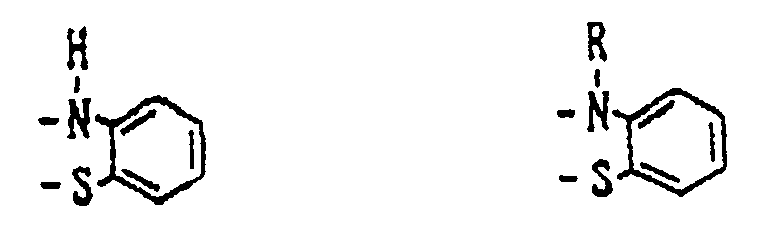
- Each pair of A¹ and A², A³ and A⁴, A⁵ and A⁶, and A⁷ and A⁸ may together form a ring and represent the groups:
-N=CH-CH=CH-, -O-CH₂CH₂-O-, -S-CH₂CH₂-S-, -NH-CH₂CH₂-S-, --CH₂CH₂-S-,
- Examples of the halogen include fluorine, chlorine, bromine and iodine.
- Moreover, examples of divalent metals represented by Met in the formula (I) include Cu(II), Zn(II), Fe(II), Co(II), Ni(II), Ru(II), Rh(II), Pd(II), Pt(II), Mn(II), Mg(II), Ti(II), Be(II), Ca(II), Ba(II), Cd(II), Hg(II), Pb(II) and Sn(II); examples of mono-substituted trivalent metals include Al-Cl, Al-Br, Al-F, Al-I, Ga-Cl, Ga-F, Ga-I, Ga-Br, In-Cl, In-Br, In-I, In-F, Tl-Cl, Tl-Br, Tl-I, Tl-F, Al-C₆H₅, Al-C₆H₄(CH₃), In-C₆H₅, In-C₆H₄(CH₃), In-C₁₀H₇, Mn(OH), Mn(OC₆H₅), Mn[OSi(CH₃)₃], FeCl and RuCl. Examples of di-substituted tetravalent metals include CrCl₂, SiCl₂, SiBr₂, SiF₂, SiI₂, ZrCl₂, GeCl₂, GeBr₂, GeI₂, GeF₂, SnCl₂, SnBr₂, SnI₂, SnF₂, TiCl₂, TiBr₂, TiF₂, Si(OH)₂, Ge(OH)₂, Zr(OH)₂, Mn(OH)₂, Sn(OH)₂, TiR₂, CrR₂, SiR₂, SnR₂, GeR₂, wherein R is an alkyl group, phenyl group, naphthyl group or a substituted derivative thereof, Si(OR′)₂, Sn(OR′)₂, Ge(OR′)₂, Ti(OR′)₂, Cr(OR′)₂ wherein R′ is an alkyl group, phenyl group, naphthyl group, trialkylsilyl group, dialkylalkoxysilyl group or a substituted derivative thereof, Sn(SR˝)₂ and Ge(SR˝)₂ where R˝ is an alkyl group, phenyl group, naphthyl group or a substituted derivative thereof.
- Examples of the oxymetal group include VO, MnO and TiO.
- The reason why the above-mentioned groups are preferable as the groups for Y¹, Y², Y³, Y⁴, Y⁵, Y⁶, Y⁷ and Y⁸ is that they are oriented perpendicular to the surface of each phthalocyanine ring and provide steric hindrance on the ring. Therefore, in the case of the alkyl group, it has 1 or more carbon atoms, preferably 4 or more carbon atoms; in the case of the alkoxyl group, it has 4 or more carbon atoms, preferably it is branched or cyclic; and in the case of the alkylthio group, it has 1 or more carbon atoms. On the other hand, the upper limit of a group size should be selected considering the fact that if the ratio of a chromophoric group in a certain volume is low, the light absorption per unit volume decreases. Thus, with regard to the alkyl group, the upper limit of the carbon atom number is 15, preferably 10; and with regard to the alkoxyl group, the upper limit of the carbon atom number is 15, preferably 9.
- Furthermore, A¹, A², A³, A⁴, A⁵, A⁶, A⁷ and A⁸ are groups for assisting Y¹, Y², Y³, Y⁴, T⁵, Y⁶, Y⁷ and Y⁸ in extending perpendicularly from the phthalocyanine ring. Likewise, the size of A¹, A², A³, A⁴, A⁵, A⁶, A⁷ and A⁸ should be selected so as not to decrease the light absorption per unit volume. Preferably, the alkyl group, aralkyl group, alkenyl group, alkynyl group, alkoxyl group or alkylthio group has 1 to 4 carbon atoms when it is straight-chain, and it has 4 to 6 carbon atoms when it is branched or cyclic. The aryloxy group, for example, the phenyloxy group, naphthyloxy group or 4-tertbutylphenoxy group preferably has 6 to 10 carbon atoms. Moreover, the arylthio group, for example, the phenylthio group, 4-tert-butylphenylthio group, naphthylthio group or 2-methylphenylthio group preferably has 6 to 10 carbon atoms.
- The near infrared absorber of the present invention is characterized in that the alkoxyl group having 4 to 15 carbon atoms, preferably 4 to 9 carbon atoms, is introduced into the α-position of the phthalocyanine, i.e., Y¹, Y², Y³, Y⁴, Y⁵, Y⁶, Y⁷ and Y⁸ in order to successfully inhibit the association of the phthalocyanine by the steric hindrance resulting from the introduced group.
- The compound represented by the formula (I) can be synthesized by mixing one to four kinds of compounds having the formula (II) or (III)

- The manufacture of optical recording media by the use of the near infrared absorbers of the present invention can be achieved by a method comprising the step of applying or depositing the near infrared absorber on transparent substrates. In the applying method, a binder resin and the near infrared absorber are dissolved in a solvent so that the concentration of the binder resin and the near infrared absorbers may be 20% by weight or less, preferably 0%, i.e., absent and 0.05 to 20% by weight, preferably 0.5 to 20% by weight, respectively, and then application is carried out by using a spin coater. Furthermore, in the above-mentioned depositing method, the near infrared absorber is deposited on substrates under 10⁻⁵ to 10⁻⁷ Torr at 100 to 300°C.
- However, for the purpose of exerting the performance of the near infrared absorber of the present invention which is superior to that of conventional absorbers, the application method of using the spin coater and a dipping method are preferable, and in particular, a method of applying the near infrared absorber of the present invention alone is best. The optical recording media may be WORM type or CD-WORM type. The WORM type recording medium can be manufactured only by disposing a recording layer comprising the near infrared absorber of the present invention on the substrate, and the CD-WORM type recording medium can be manufactured by disposing the recording layer on the substrate, then superposing thereon a reflective layer comprising gold or aluminum, and finally overcoating the layer with a resin.
- The substrates can be made from optically transparent resins. Examples of such resins include acrylic resin, polyethylene resin, vinyl chloride resin, vinylidene chloride resin, polycarbonate resin, ethylene resin, polyolefin copolymer resin, vinyl chloride copolymer resin, vinylidene chloride copolymer resin and styrene copolymer resin.
- Furthermore, the substrates may be surface-treated with a thermosetting resin or an ultraviolet setting resin. In particular, the latter treated one is called 2P substrate.
- When optical recording media (optical discs and optical cards) are manufactured, it is preferred from the viewpoints of cost and users' handling that the polyacrylate or polycarbonate substrates are employed and that the application is made by the spin coating technique.
- Considering solvent resistance of the substrates, such as solvent as exemplified below is preferably used in the spin coating. Examples of such preferably usable solvents include hydrocarbon halides (e.g., dichloromethane, chloroform, carbon tetrachloride, tetrachloroethylene, dichlorodifluoroethane), ethers (e.g., tetrahydrofuran and diethyl ether), ketones (e.g., acetone and methyl ethyl ketone), alcohols (e.g., methanol, ethanol and propanol), cellosolves (methyl cellosolve and ethyl cellosolve), and hydrocarbons (hexane, cyclohexane, octane, benzene, toluene and xylene).
- In the manufacture of the filters, the near infrared absorber compound represented by the formula (I) should have a heat resistance which permits the compound to be kneaded with the resin, and it is also required that the resin substrates can be dyed in the solvent, from the viewpoints of cost and workability. In addition, the molded articles, i.e., manufactured filters should possess sharp light absorption properties and high absorbance.
- As techniques of preparing the near infrared absorption filters by using the compound having the formula (I) or its derivative, there are (a) a method comprising the steps of mixing the near infrared absorber of the formula (I) with a resin, and then molding the mixture; (b) a method comprising the steps of mixing the near infrared absorber of the formula (I) with a resin monomer, and then cast-polymerizing the mixture; (c) a method comprising the step of dyeing molded resin articles with the near infrared absorber of the formula (I); and (d) a method comprising the step of applying or depositing the near infrared absorber of the formula (I) on the surface of the substrate materials.
- The resins which can be used as filter base materials are preferably transparent. Examples of such preferable resins include thermoplastic resins such as a polystyrene, polymethyl methacrylate, polycarbonate, polyethylene and polypropylene; and thermosetting resins such as CR-39 (trade name; made by PPG Co., Ltd.), MR-3 (trade name; made by Mitsui Toatsu Chemicals, Inc.) and MR-6 (trade name; made by Mitsui Toatsu Chemicals, Inc.).
- Furthermore, when the near infrared absorber of the present invention is used as a display material together with liquid crystals, the absorber must be highly soluble in the liquid crystals, and when the state of the liquid crystals is changed by applying an electric field or heat thereto, it is necessary that the absorber does not impede this change of the liquid crystals.
- In the case when display materials are prepared, examples of the usable liquid crystals include nematic liquid crystals, smectic liquid crystals and cholesteric liquid crystals. As display techniques, suitable examples include a guest/host type display system and a liquid crystal panel system (the near infrared absorber is added to the liquid crystals, and an image is then written by the use of a laser beam).
- Having generally described this invention, a further understanding can be obtained by reference to certain specific examples which are provided herein for purposes of illustration only and are not intended to be limiting unless otherwise specified.
- A mixture of 906 parts of a phthalonitrile derivative represented by the following structural formula (II-1), 79 parts of cuprous chloride, 608 parts of 1,8-diazabicyclo[5.4.0]-7-undecene (DBU) and 7,500 parts of n-amyl alcohol was heated under reflux for 5 hours:

- Methyl alcohol was then added to the resulting reaction solution in order to precipitate crystals, and the latter were collected by suction filtration and then purified through a column (silica gel/toluene), so that 600 parts (yield 60%) of a phthalocyanine compound represented by the following structural formula (I-1) was obtained (λmax 738 nm/hexane; εmax 227,000):

Results of elemental analysis (as Cu C₉₆H₁₃₆N₈O₈Cl₈): C H N Cl Calcd. (%) 61.42 7.30 5.97 15.11 Found (%) 61.20 7.27 5.93 15.09 - In 100 parts of n-octane was dissolved 1 part of the obtained compound (I-1), and the solution was then applied onto a polycarbonate optical disc substrate. The thus-obtained optical disc had a reflectance of 29% and a sensitivity of 50 dB at 8 mW, 780 nm and a linear velocity of 5.5 m/sec.
- Furthermore, 7 parts of the above compound (I-1) was mixed with 1,000 parts of a cyanobiphenyl liquid crystal mixture in order to prepare a liquid crystal panel. When an image was depicted on this panel by the use of a laser beam, it appeared distinctly thereon.
- A mixture of 320 parts of a phthalonitrile derivative represented by the structural formula (II-1), 75 parts of acetylacetone vanadium, 214 parts of DBU and 2,700 parts of n-amyl alcohol was heated under reflux for 10 hours. After the solvent was distilled off, the residue was purified through a column (toluene), so that 37 parts (yield 11%) of a phthalocyanine compound represented by the following structural formula (I-2) was obtained (λmax 762 nm/hexane; εmax 220,000):

Results of elemental analysis (as V C₉₆H₁₃₆N₈O₉Cl₈): C H N Cl Calcd. (%) 61.31 7.29 5.96 15.08 Found (%) 61.27 7.25 5.90 15.06 - In 1,000 parts of n-octane was dissolved 15 parts of the phthalocyanine represented by the formula (I-2), and the resulting solution was then applied onto a polycarbonate optical disc substrate. The thus-obtained optical disc had a reflectance of 27% and a sensitivity (C/N ratio) of 50 dB at 8 mW, 780 nm and a linear velocity of 5.5 m/sec.
- Furthermore, 1 part of the above compound (I-2) was dissolved in 100 parts of a liquid crystal mixture having the following formulae in order to prepare a liquid crystal panel.

- When an image was depicted on this panel by the use of a laser beam, it appeared distinctly thereon.
- A mixture of 368 parts of a phthalonitrile derivative represented by the following structural formula (II-2), 44 parts of 90% cuprous chloride, 304 parts of DBU and 3,100 parts of n-amyl alcohol was heated under reflux for 5.5 hours:

- Afterward, the resulting reaction solution was poured into 3,200 parts of methyl alcohol, and the product was isolated by suction filtration. The thus-obtained crystals were purified through a column (silica gel/hexane toluene = 1:1), so that 220 parts (yield 57%) of a phthalocyanine compound represented by the following structural formula (I-3) was obtained (λmax 778 nm/hexane; εmax 234,000):
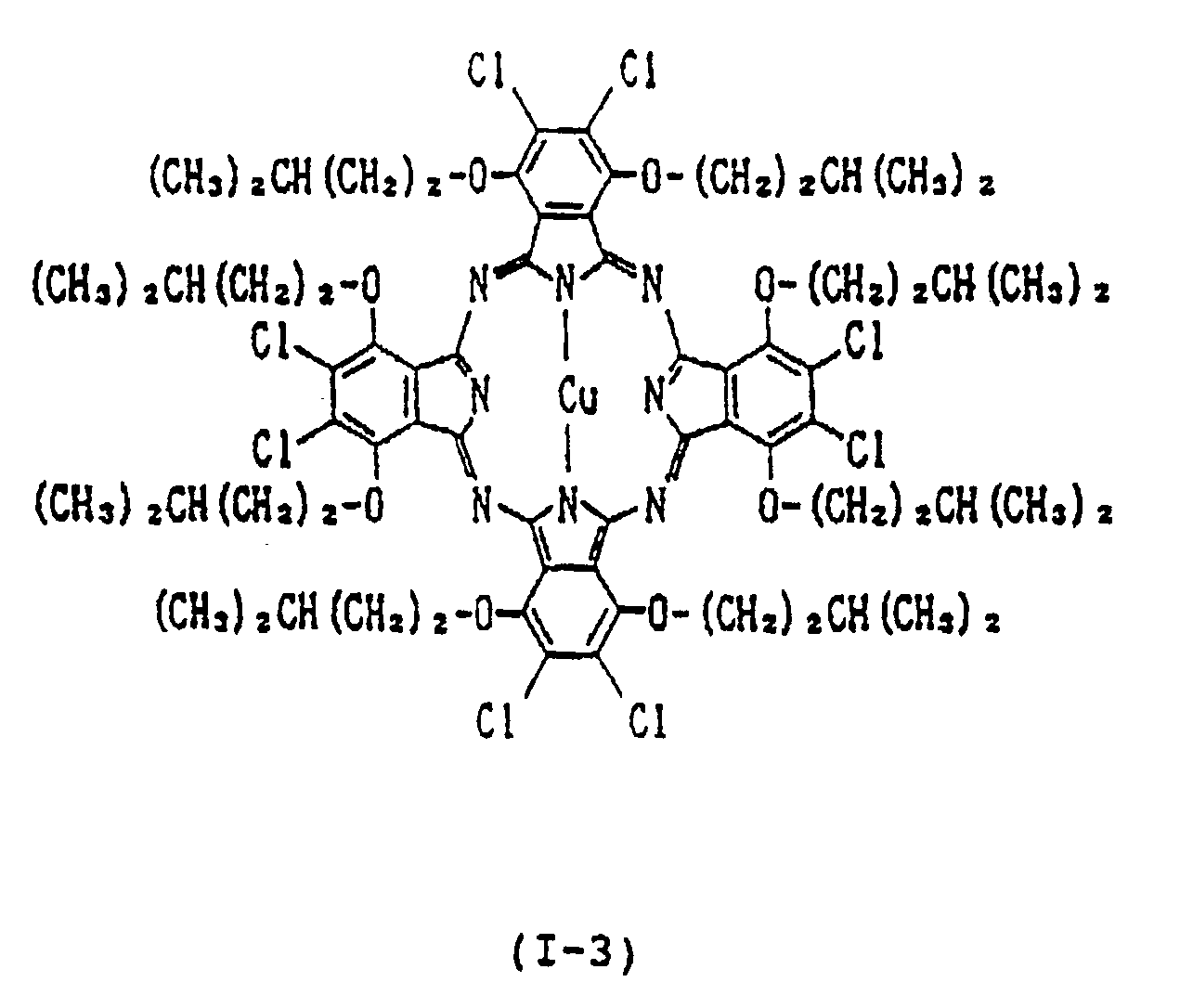
Results of elemental analysis (as Cu C₇₂H₈₈N₈O₈Cl₈): C H N Cl Calcd. (%) 56.13 5.76 7.27 18.41 Found (%) 56.02 5.80 7.24 18.34 - In 100 parts of dibutyl ether was dissolved 1 part of the above-mentioned compound (I-3), and the resulting solution was then applied onto a polycarbonate optical disc substrate. The thus-obtained optical disc had a reflectance of 39% and a sensitivity of 51 dB at 8 mW, 780 nm and a linear velocity of 5.5 m/sec.
- Furthermore, 7 parts of the above compound (I-3) was dissolved in 1,000 parts of a cyanobiphenyl liquid crystal mixture in order to prepare a liquid crystal panel. When an image was depicted on this panel by the use of a laser beam, it appeared distinctly thereon.
- In 100 parts of n-octane was dissolved 1 part of the above-mentioned compound (I-3), and the resulting solution was then applied onto a polycarbonate optical card substrate. Afterward, the applied substrate was further coated with a resin to prepare an optical card. The thus-obtained optical card had a reflectance of 39% and a sensitivity of 50 dB at 8 mW, 780 nm and a linear velocity of 2.8 m/sec. Durability of this card was good.
- Four parts of the above-mentioned compound (I-3) was mixed with 1,000 parts of polystyrene resin with heating, and then molded into the shape of a plate. The thus-prepared filter sufficiently absorbed rays at 750 to 850 nm.
- In each comparative example, the following known compound was used.
- In Table 1, the results of the above examples are compared with those of the comparative examples in regard to maximum absorption wavelength (λmax) in a solution state of each compound, molecular extinction coefficient (ε) at its wavelength, solubility, maximum reflectance and sensitivity.
-

- Since it is insoluble in n-octane, this compound was dissolved in chloroform, and the resulting solution was then applied onto a 2P substrate. Afterward, the thus-obtained medium was evaluated.
-

- Since it is insoluble in n-octane, this compound was dissolved in chloroform, and the resulting solution was then applied onto a 2P substrate. Afterward, the thus-obtained medium was evaluated.
- The carbon tetrachloride solution of this compound was applied onto a 2P substrate, and the thus-obtained medium was evaluated.
- The items to be measured, measurement procedures and expressions of measured results were as follows:
- Each of these items was measured at a concentration of 5 mg/l in n-hexane or chloroform.
- Solubility was ranked as follows:
O: when dissolved 5 g/l or more in n-hexane,
Δ: when dissolved less than 5 g/l in n-hexane,
and when dissolved 5 g/l or more in carbon tetrachloride, and
X: when dissolved less than 5 g/l in carbon tetrachloride. - Maximum reflectance was measured by applying a 5g/l n-hexane solution onto each polycarbonate substrate by the use of a spin coater, and then irradiating the applied substrate with rays at 780 nm.
- Sensitivity was obtained from a C/N ratio when writing was carried out with a semiconductor laser at 780 nm, 8 mW and a linear velocity of 5.5 m/sec.
O: 40 dB or more,
Δ: 40 to 30 dB, and
X: less than 30 dB.Table 1 λmax (ε) Solubility Maximum Reflectance Sensitivity Example 1 738 (2.27x10⁵) O 30 O Example 2 762 (2.2x10⁵) O 30 O Example 3 738 (2.34x10⁵) O 42 O Comp. Ex. 1 740 (1.5x10⁵) X 24 Δ Comp. Ex. 2 780 (1.5x10⁵) X 27 Δ Comp. Ex. 3 760(1.5x10⁵) Δ 20 X - A mixture of 4.11 parts of a phthalonitrile derivative represented by the following structural formula (II-3), 0.44 part of cuprous chloride, 3.04 parts of DBU and 37.5 parts of n-amyl alcohol was heated under reflux for 5 hours:

- The resulting reaction solution was poured into 400 parts of methyl alcohol in order to precipitate crystals, and the latter were collected by suction filtration and then purified through a column (silica gel/hexane:toluene = 5:2), so that 2.50 parts (yield 59%) of a phthalocyanine compound represented by the following structural formula (I-4) and its isomers were obtained (λmax 742 nm/hexane; εmax 2.3x10⁵):

Results of elemental analysis (as Cu C₈₄H₁₁₂N₈Cl₈O₈): C H N Cl Calcd. (%) 59.03 6.61 6.56 16.60 Found (%) 58.98 6.63 6.54 16.55 - Next, 5 parts of the obtained phthalocyanine derivative (I-4) was mixed with 1,000 parts of polystyrene resin with heating and then molded into the shape of a plate. The thus-obtained filter sufficiently absorbed rays at 750 to 850 nm.
- Furthermore, 1 part of the phthalocyanine (I-4) was dissolved in 100 parts of a liquid crystal mixture having the following formula, and a liquid crystal panel was then prepared by using the solution:

- When an image was written on this panel by the use of a laser beam, it appeared distinctly thereon.
- A mixture of 4.26 parts of a phthalonitrile derivative represented by the following structural formula (II-4), 0.53 part of cuprous chloride, 3.65 parts of DBU and 45.0 parts of n-amyl alcohol was heated under reflux for 6 hours:

- The resulting reaction mixture was poured into 500 parts of methyl alcohol in order to precipitate crystals, and the latter were collected by suction filtration and then purified through a column (silica gel/hexane:toluene = 5:3), so that 2.50 parts (yield 56%) of a phthalocyanine compound represented by the following structural formula (I-5) was obtained (λmax 739 nm/hexane; εmax 2.5x10⁵):
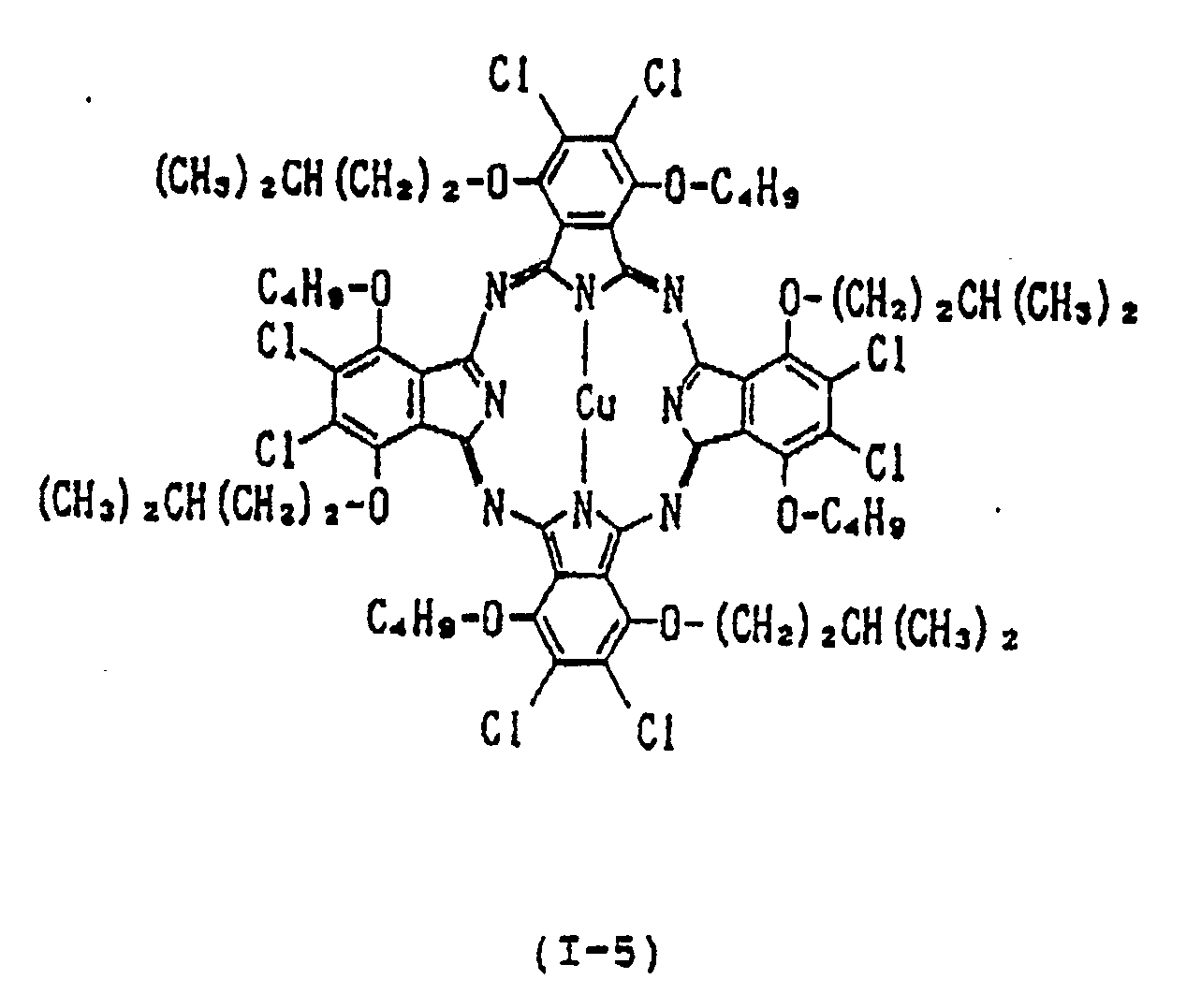
Results of elemental analysis (as Cu C₆₈H₈₀N₈Cl₈O₈): C H N Cl Calcd. (%) 55.01 5.43 7.55 19.10 Found (%) 54.98 5.44 7.53 19.07 - Next, 4 parts of the obtained phthalocyanine derivative (I-5) was mixed with 1,000 parts of polystyrene resin with heating and then molded into the shape of a plate. The thus-obtained filter sufficiently absorbed rays at 750 to 850 nm.
- Furthermore, 7 parts of the phthalocyanine (I-5) was dissolved in 1,000 parts of a cyanobiphenyl liquid crystal mixture, and a liquid crystal panel was then prepared by using the solution. When an image was written on this panel by the use of a laser beam, it appeared distinctly thereon:
- A mixture of 4.43 parts of a phthalonitrile derivative represented by the following structural formula (II-5), 0.53 part of cuprous chloride, 3.65 parts of DBU and 45.0 parts of n-amyl alcohol was heated under reflux for 6 hours:

- The resulting reaction mixture was poured into 500 parts of methyl alcohol in order to precipitate crystals, and the latter were collected by suction filtration and then purified through a column (silica gel/hexane:toluene = 5:2), so that 2.45 parts (yield 53%) of a phthalocyanine compound represented by the following structural formula (I-6) and its isomers were obtained (λmax 739 nm/hexane; εmax 2.42x10⁵):

Results of elemental analysis (as Cu C₈₀H₁₀₄N₈Cl₈O₈): C H N Cl Calcd. (%) 58.13 6.34 6.78 17.16 Found (%) 58.90 6.26 6.83 17.30 - Next, 5 parts of the obtained phthalocyanine derivative (I-6) was mixed with 1,000 parts of polystyrene resin with heating and then molded into the shape of a plate. The thus-obtained filter sufficiently absorbed rays at 750 to 850 nm.
- Furthermore, 8 parts of the phthalocyanine (I-6) was dissolved in 1,000 parts of a cyanobiphenyl liquid crystal mixture, and a liquid crystal panel was then prepared by using the solution. When an image was written on this panel by the use of a laser beam, it appeared distinctly thereon:
- A mixture of 4.06 parts of a phthalonitrile derivative represented by the following structural formula (II-6), 0.53 part of cuprous chloride, 3.65 parts of DBU and 45.0 parts of n-amyl alcohol was heated at reflux for 7 hours:

- The resulting reaction mixture was poured into 500 parts of methyl alcohol in order to precipitate crystals, and the latter were collected by suction filtration and then purified through a column (silica gel/hexane:toluene = 5:2), so that 2.63 parts (yield 55%) of a phthalocyanine compound represented by the following structural formula (I-7) and its isomers were obtained (λmax 739 nm/hexane; εmax 2.4x10⁵):

Results of elemental analysis (as Cu C₇₆H₉₆N₈Cl₈O₈): C H N Cl Calcd. (%) 57.17 6.06 7.02 17.76 Found (%) 57.15 6.09 7.00 17.73 - Next, 5 parts of the obtained phthalocyanine derivative (I-7) was mixed with 1,000 parts of polystyrene resin with heating and then molded into the shape of a plate. The thus-obtained filter sufficiently absorbed rays at 750 to 850 nm.
- Furthermore, 8 parts of the phthalocyanine (I-7) was dissolved in 1,000 parts of a cyanobiphenyl liquid crystal mixture, and a liquid crystal panel was then prepared by using the solution. When an image was written on this panel by the use of a laser beam, it appeared distinctly thereon:
- A mixture of 4.26 parts of a phthalonitrile derivative represented by the following structural formula (II-7), 0.53 part of cuprous chloride, 3.65 parts of DBU and 45.0 parts of n-amyl alcohol was heated at reflux for 7 hours:

- The resulting reaction mixture was poured into 500 parts of methyl alcohol in order to precipitate crystals, and the latter were collected by suction filtration and then purified through a column (silica gel/hexane:toluene = 5:2), so that 2.10 parts (yield 57%) of a phthalocyanine compound represented by the following structural formula (I-8) and its isomers were obtained (λmax 742 nm/hexane; εmax 2.23x10⁵):

Results of elemental analysis (as Cu C₆₈H₈₀N₈Cl₈O₈): C H N Cl Calcd. (%) 55.01 5.43 7.55 19.10 Found (%) 54.97 5.45 7.52 19.08 - Next, 4 parts of the obtained phthalocyanine derivative (I-8) was mixed with 1,000 parts of polystyrene resin with heating and then molded into the shape of a plate. The thus-obtained filter sufficiently absorbed rays at 750 to 850 nm.
- Furthermore, 7 parts of the phthalocyanine (I-8) was dissolved in 1,000 parts of a cyanobiphenyl liquid crystal mixture, and a liquid crystal panel was then prepared by using the solution. When an image was written on this panel by the use of a laser beam, it appeared distinctly thereon.
- Moreover, 1 part of the phthalocyanine derivative (I-8) was dissolved in 100 parts of dibutyl ether, and the resulting solution was then applied onto a polycarbonate optical card substrate. Afterward, the resulting recording layer was coated with a resin in order to prepare an optical card. The thus-prepared card had a reflectance of 35% and a sensitivity (C/N ratio) of 50 dB at 780 nm, 8 mW and a linear velocity of 2.8 m/sec. In addition, the durability of the card was also good.
- A mixture of 43 parts of SiCl₄ and 3,000 parts of quinoline was heated up to 200°C. To this mixture was added 386 parts of the diiminoisoindoline derivative represented by the following structural formula (III-1), and the solution was then heated at reflux for 5 hours:

- The resulting reaction solution was poured into 3,500 parts of methyl alcohol in order to precipitate crystals, and the latter were collected by suction filtration and then washed with methanol, followed by drying, thereby obtaining 157 parts (yield 40%) of a phthalocyanine compound represented by the following structural formula (I-9) (λmax 740 nm/hexane; εmax 2.4x10⁵):

Results of elemental analysis (as Si C₇₂H₈₈N₈O₈Cl₁₀): C H N Cl Calcd. (%) 54.87 5.63 7.11 22.49 Found (%) 54.69 5.59 7.09 22.36 - Next, 1 part of the obtained compound (I-9) was dissolved in 100 parts of dibutyl ether, and the resulting solution was applied onto a polycarbonate optical disc substrate. The thus-obtained optical disc had a reflectance of 36% and a sensitivity (C/N ratio) of 51 dB at 780 nm, 8 mW and a linear velocity of 5.5 m/sec.
- Furthermore, 7 parts of the phthalocyanine (I-9) was dissolved in 1,000 parts of a cyanobiphenyl liquid crystal mixture, and a liquid crystal panel was then prepared by using the solution. When an image was written on this panel by the use of a laser beam, it appeared distinctly thereon.
- Moreover, 1 part of the compound (I-9) was dissolved in 100 parts of dibutyl ether, and the resulting solution was then applied onto a polycarbonate optical card substrate. Afterward, the resulting recording layer was coated with a resin in order to prepare an optical card. The thus-prepared card had a reflectance of 36% and a sensitivity (C/N ratio) of 51 dB at 780 nm, 8 mW and a linear velocity of 2.8 m/sec.
- Next, 4 parts of the obtained compound (I-9) was mixed with 1,000 parts of polystyrene resin with heating and then molded into the shape of a plate. The thus-obtained filter sufficiently absorbed rays at 750 to 850 nm.
- Phthalocyanines shown in Table 4 were synthesized by reacting 1 to 4 kinds of phthalonitriles (Table 2) represented by the following formula (II) or diiminoisoindolines (Table 3) represented by the following formula (III) with metal derivatives. The synthesized compounds had great molecular extinction coefficients, and when optical recording media were prepared from these compounds, they were also excellent in reflectance, sensitivity and durability. The results are given in Table 4.


Table 3 Intermediate Y˝ Y′˝ A˝ A′˝ III-2 iso-C₅H₁₁-O iso-C₄H₉-O CH₃- CH₃- III-3 iso-C₅H₁₁-O CH₃(CH₂)₃CH(C₂H₅)CH₂-O C₆H₅O- C₆H₅O- III-4 CH₃- [(CH₃)₂CHCH₂]₂CH-O Cl- Cl- III-5 C₂H₅OC₂H₄-O n-C₈H₁₇-O Cl- Cl- III-6 C₂H₅SC₂H₄-O CH₃(CH₂)₃CH(C₂H₅)CH₂-O C₆H₅S- C₆H₅S- 


- A mixture of 240 parts of the phthalonitrile derivative represented by the following structural formula (II-33), 18 parts of cuprous chloride, 122 parts of DBU and 1,500 parts of n-amyl alcohol was heated at reflux for 5.5 hours:

- Afterward, methyl alcohol was added to the resulting reaction solution in order to precipitate crystals, and the latter were collected by suction filtration and then purified through a column (hexane-benzene = 1:1), so that 140 parts (yield 60%) of a phthalocyanine compound represented by the following structural formula (I-45) was obtained (λmax 778 nm/hexane; εmax 2.8x10⁵):
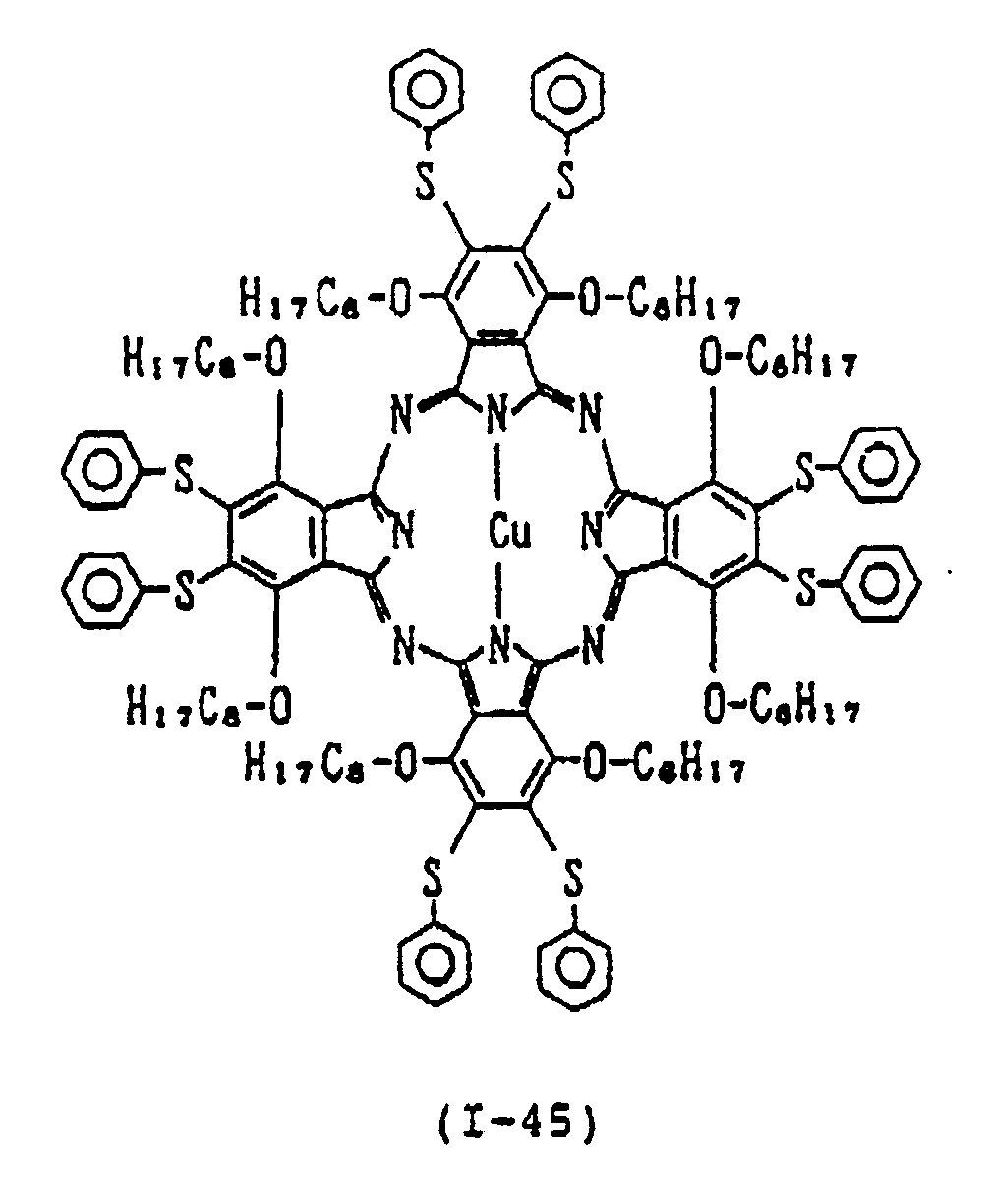
Results of elemental analysis (as Cu C₁₄₄H₁₇₆N₈O₈S₈): C H N S Calcd. (%) 70.11 7.19 4.54 10.40 Found (%) 70.08 7.13 4.52 10.36 - Next, 1 part of the obtained phthalocyanine compound (I-45) was mixed with 100 parts of n-octane, and the resulting solution was applied onto a polycarbonate optical card substrate. Afterward, the applied substrate was coated with a resin to prepare an optical card. The thus-prepared card had a reflectance of 33% and a sensitivity (C/N ratio) of 50 dB at 830 nm, 8 mW and a linear velocity of 2.8 m/sec. In addition, the durability of the card was also good.
- Moreover, 4 parts of the compound (I-45) was mixed with heating with 1,000 parts of polystyrene resin, and the mixture was then molded into the shape of a plate. The thus-obtained filter sufficiently absorbed rays at 750 to 850 nm.
- A mixture of 120 parts of the phthalonitrile derivative represented by the structural formula (II-33), 22 parts of acetylacetone vanadium, 61 parts of DBU and 750 parts of n-amyl alcohol was heated at reflux for 12 hours. After the solvent was distilled off, the resulting residue was then purified through a column (toluene), so that 19 parts (yield 15%) of the phthalocyanine compound represented by the following structural formula (I-46) was obtained (λmax 809 nm/hexane; εmax 2.4x10⁵):

Results of elemental analysis (as V C₁₄₄H₁₇₆N₈O₉S₈): C H N S Calcd. (%) 70.01 7.18 4.54 10.38 Found (%) 69.96 7.14 4.50 10.36 - A mixture of 280 parts of the phthalonitrile derivative represented by the following structural formula (II-34), 18 parts of cuprous chloride, 122 parts of DBU and 1,500 parts of n-amyl alcohol was heated at reflux for 5.5 hours:

- Afterward, methyl alcohol was added to the resulting reaction solution in order to precipitate crystals, and the latter were collected by suction filtration and then purified through a column (toluene), so that 190 parts (yield 66%) of a phthalocyanine compound represented by the following structural formula (I-47) was obtained (λmax 787 nm/chloroform; εmax 2.37x10⁵):

Results of elemental analysis (as Cu C₁₇₆H₁₉₂N₈O₈S₈): C H N S Calcd. (%) 73.72 6.75 3.91 8.95 Found (%) 73.66 6.72 3.88 8.91 - A mixture of 140 parts of the phthalonitrile derivative represented by the structural formula (II-34), 22 parts of acetylacetone vanadium, 61 parts of DBU and 750 parts of n-amyl alcohol was heated at reflux for 12 hours. After the solvent was distilled off, the resulting residue was purified through a column (toluene), so that 35 parts (yield 25%) of a phthalocyanine compound represented by the following structural formula (I-48) was obtained (λmax 815 nm/hexane; εmax 2.4x10⁵):

Results of elemental analysis (as V C₁₇₆H₁₉₂N₈O₉S₈): C H N S Calcd. (%) 73.63 6.74 3.90 8.93 Found (%) 73.58 6.71 3.86 8.87 - A mixture of 413 parts of a phthalonitrile derivative represented by the following structural formula (II-35), 22 parts of 90% cuprous chloride, 244 parts of DBU and 2,500 parts of n-amyl alcohol was heated at reflux for 5 hours:

- Afterward, the resulting reaction solution was poured into 2,400 parts of methyl alcohol in order to precipitate crystals, and the latter were collected by suction filtration and then purified through a column (silica gel/hexane:toluene = 1:1), so that 260 parts (yield 61%) of a phthalocyanine compound represented by the following structural formula (I-49) was obtained (λmax 778 nm/hexane; εmax 2.5x10⁵):

Results of elemental analysis (as Cu C₁₂₀H₁₂₈N₈O₈S₈): C H N S Calcd. (%) 67.65 6.06 5.26 12.04 Found (%) 67.59 6.07 5.22 12.00 - Next, 1 part of the obtained phthalocyanine compound (I-49) was dissolved in 100 parts of dibutyl ether, and the resulting solution was applied onto a polycarbonate optical disc substrate. The thus-prepared optical disc had a reflectance of 40% and a sensitivity of 51 dB at 830 nm, 8 mW and a linear velocity of 5.5 m/sec.
- Moreover, 7 parts of the compound (I-49) was dissolved in 1,000 parts of a cyanobiphenyl liquid crystal mixture, and a liquid crystal panel was then prepared by using the solution. When an image was written on this panel by the use of a laser beam, it appeared distinctly thereon.
- Moreover, 1 part of the phthalocyanine compound (I-49) was dissolved in 100 parts of dibutyl ether, and the resulting solution was then applied onto a polycarbonate optical card substrate. Afterward, the upper layer was further coated with a resin in order to prepare an optical card. The thus-prepared optical card had a reflectance of 40% and a sensitivity (C/N ratio) of 50 dB at 830 nm, 8 mW and a linear velocity of 2.8 m/sec. The durability of this card was also good.
- Furthermore, 4 parts of the compound (I-49) was mixed with heating with 1,000 parts of polystyrene resin, and then molded into the shape of a plate. The thus-prepared filter sufficiently absorbed rays at 750 to 850 nm.
- A mixture of 464 parts of a phthalonitrile derivative represented by the following structural formula (II-36), 40 parts of 90% cuprous chloride, 247 parts of DBU and 2,800 parts of n-amyl alcohol was heated at reflux for 6 hours:

- Afterward, the resulting reaction solution was poured into 3,160 parts of methyl alcohol in order to precipitate crystals, and the latter were collected by suction filtration and then purified through a column (silica gel/hexane:toluene = 1:1), so that 350 parts (yield 73%) of a phthalocyanine compound represented by the following structural formula (I-50) was obtained (λmax 778 nm/hexane; εmax 2.6x10⁵):

Results of elemental analysis (as Cu C₁₂₀H₁₂₈N₈O₈S₈): C H N S Calcd. (%) 67.65 6.06 5.26 12.04 Found (%) 67.58 6.08 5.25 12.02 - Next, 1 part of the obtained phthalocyanine compound (I-50) was dissolved in 100 parts of dibutyl ether, and the resulting solution was applied onto a polycarbonate optical disc substrate. The thus-prepared optical disc had a reflectance of 41% and a sensitivity of 50 dB at 830 nm, 8 mW and a linear velocity of 5.5 m/sec.
- Moreover, 7 parts of the compound (I-50) was dissolved in 1,000 parts of a cyanobiphenyl liquid crystal mixture, and a liquid crystal panel was then prepared by using the solution. When an image was written on this panel by the use of a laser beam, it appeared distinctly thereon.
- Moreover, 1 part of the phthalocyanine compound (I-50) was dissolved in 100 parts of dibutyl ether, and the resulting solution was then applied onto a polycarbonate optical card substrate. Afterward, the upper layer was further coated with a resin in order to prepare an optical card. The thus-prepared optical card had a reflectance of 41% and a sensitivity (C/N ratio) of 50 dB at 830 nm, 8 mW and a linear velocity of 2.8 m/sec. The durability of this card was also good.
- Furthermore, 4 parts of the compound (I-50) was mixed with heating with 1,000 parts of polystyrene resin, and then molded into the shape of a plate. The thus-prepared filter sufficiently absorbed rays at 750 to 850 nm.
- A mixture of 377 parts of a phthalonitrile derivative represented by the following structural formula (II-37), 27 parts of 90% cuprous chloride, 182 parts of DBU and 1,900 parts of n-amyl alcohol was heated at reflux for 6 hours:

- Afterward, the resulting reaction solution was poured into 3,200 parts of methyl alcohol in order to precipitate crystals, and the latter were collected by suction filtration and then purified through a column (silica gel/hexane:toluene = 1:1), so that 270 parts (yield 70%) of a phthalocyanine compound represented by the following structural formula (I-51) was obtained (λmax 778 nm/hexane; εmax 2.82x10⁵):

Results of elemental analysis (as Cu C₁₅₂H₁₉₂N₈O₈S₈) C H N S Calcd. (%) 70.78 7.50 4.34 9.95 Found (%) 70.51 7.47 4.36 9.90 - Next, 1 part of the obtained phthalocyanine compound (I-51) was dissolved in 100 parts of dibutyl ether, and the resulting solution was applied onto a polycarbonate optical disc substrate. The thus-prepared optical disc had a reflectance of 34% and a sensitivity of 51 dB at 830 nm, 8 mW and a linear velocity of 5.5 m/sec.
- Moreover, 7 parts of the compound (I-51) was dissolved in 1,000 parts of a cyanobiphenyl liquid crystal mixture, and a liquid crystal panel was then prepared by using the solution. When an image was written on this panel by the use of a laser beam, it appeared distinctly thereon.
- Moreover, 1 part of the phthalocyanine compound (I-51) was dissolved in 100 parts of dibutyl ether, and the resulting solution was then applied onto a polycarbonate optical card substrate. Afterward, the upper layer was further coated with a resin in order to prepare an optical card. The thus-prepared optical card had a reflectance of 34% and a sensitivity (C/N ratio) of 50 dB at 830 nm, 8 mW and a linear velocity of 2.8 m/sec. The durability of this card was also good.
- Furthermore, 4 parts of the compound (I-51) was mixed with heating with 1,000 parts of polystyrene resin, and then molded into the shape of a plate. The thus prepared filter sufficiently absorbed rays at 750 to 850 nm.
- A mixture of 377 parts of a phthalonitrile derivative represented by the following structural formula (II-38), 27 parts of 90% cuprous chloride, 182 parts of DBU and 1,900 parts of n-amyl alcohol was heated at reflux for 6 hours:

- Afterward, the resulting reaction solution was poured into 3,200 parts of methyl alcohol in order to precipitate crystals, and the latter were collected by suction filtration and then purified through a column (silica gel/hexane:toluene = 1:1), so that 290 parts (yield 75%) of a phthalocyanine compound represented by the following structural formula (I-52) was obtained (λmax 778 nm/hexane; εmax 2.66x10⁵):
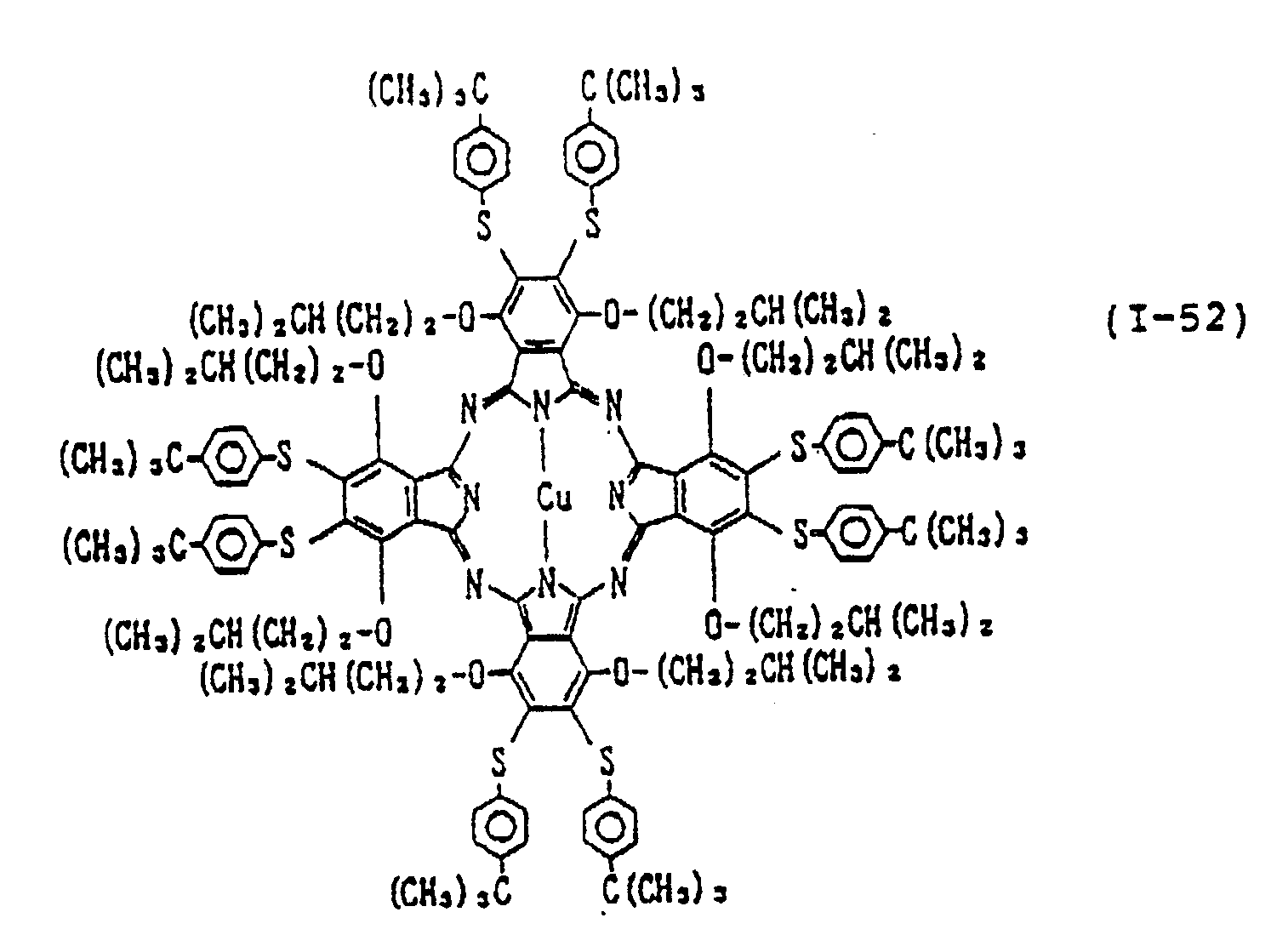
Results of elemental analysis (as Cu C₁₅₂H₁₉₂N₈O₈S₈): C H N S Calcd. (%) 70.78 7.50 4.34 9.95 Found (%) 70.59 7.48 4.33 9.89 - Next, 1 part of the obtained phthalocyanine compound (I-52) was dissolved in 100 parts of dibutyl ether, and the resulting solution was applied onto a polycarbonate optical disc substrate. The thus-prepared optical disc had a reflectance of 34% and a sensitivity of 52 dB at 830 nm, 8 mW and a linear velocity of 5.5 m/sec.
- Moreover, 7 parts of the compound (I-52) was dissolved in 1,000 parts of a cyanobiphenyl liquid crystal mixture, and a liquid crystal panel was then prepared by using the solution. When an image was written on this panel by the use of a laser beam, it appeared distinctly thereon.
- Moreover, 1 part of the phthalocyanine compound (I-52) was dissolved in 100 parts of dibutyl ether, and the resulting solution was then applied onto a polycarbonate optical card substrate. Afterward, the upper layer was further coated with a resin in order to prepare an optical card. The thus-prepared optical card had a reflectance of 34% and a sensitivity (C/N ratio) of 50 dB at 830 nm, 8 mW and a linear velocity of 2.8 m/sec. The durability of this card was also good.
- Furthermore, 4 parts of the compound (I-52) was mixed with heating with 1,000 parts of polystyrene resin, and then molded into the shape of a plate. The thus-prepared filter sufficiently absorbed rays at 750 to 850 nm.
- A mixture of 43 parts of SiCl₄ and 3,000 parts of quinoline was heated up to 200°C. To the heated mixture was added 533 parts of a diiminoisoindoline derivative represented by the following structural formula (III-7), and the solution was then heated at reflux for 5 hours:
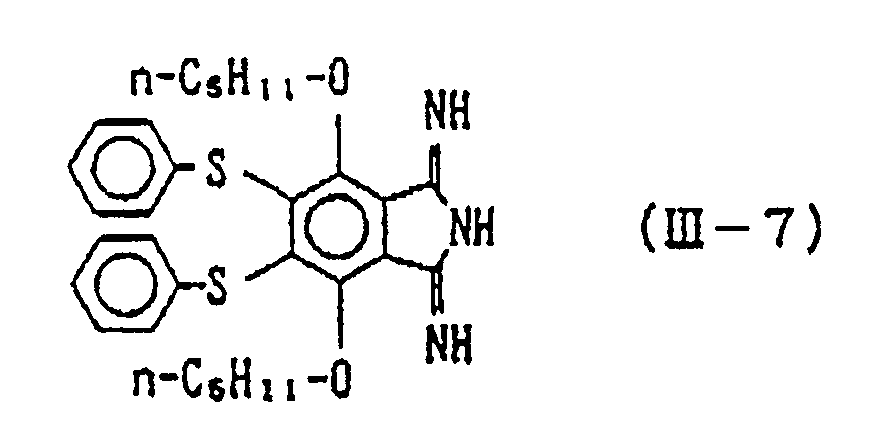
- Afterward, the resulting reaction solution was poured into 3,500 parts of methyl alcohol in order to precipitate crystals, and the latter were collected by suction filtration and then washed with methanol, followed by drying, thereby obtaining 195 parts (yield 36%) of a phthalocyanine compound represented by the following structural formula (I-53) (λmax 780 nm/hexane; εmax 2.48x10⁵):

Results of elemental analysis (as Si C₁₂₀H₁₂₈N₈O₈S₈Cl₂): C H N Cl S Calcd. (%) 66.57 5.92 5.18 3.28 11.84 Found (%) 66.46 5.95 5.14 3.22 11.79 - Next, 1 part of the obtained phthalocyanine compound (I-53) was dissolved in 100 parts of dibutyl ether, and the resulting solution was applied onto a polycarbonate optical disc substrate. The thus-prepared optical disc had a reflectance of 33% and a sensitivity of 50 dB (C/N ratio) at 780 nm, 8 mW and a linear velocity of 5.5 m/sec.
- Moreover, 7 parts of the compound (I-53) was dissolved in 1,000 parts of a cyanobiphenyl liquid crystal mixture, and a liquid crystal panel was then prepared by using the solution. When an image was written on this panel by the use of a laser beam, it appeared distinctly thereon.
- Moreover, 1 part of the phthalocyanine compound (I-53) was dissolved in 100 parts of dibutyl ether, and the resulting solution was then applied onto a polycarbonate optical card substrate. Afterward, the resulting recording layer was further coated with a resin in order to prepare an optical card. The thus-prepared optical card had a reflectance of 33% and a sensitivity (C/N ratio) of 50 dB at 780 nm, 8 mW and a linear velocity of 2.8 m/sec.
- Furthermore, 4 parts of the compound (I-53) was mixed with heating with 1,000 parts of polystyrene resin, and then molded into the shape of a plate. The thus prepared filter sufficiently absorbed rays at 750 to 850 nm.
- One to four kinds of phthalonitriles (Table 5) represented by the following formula (II) or diiminoisoindolines (Table 6) represented by the formula (III) were reacted with metal derivatives to synthesize the phthalocyanines shown in Table 7:
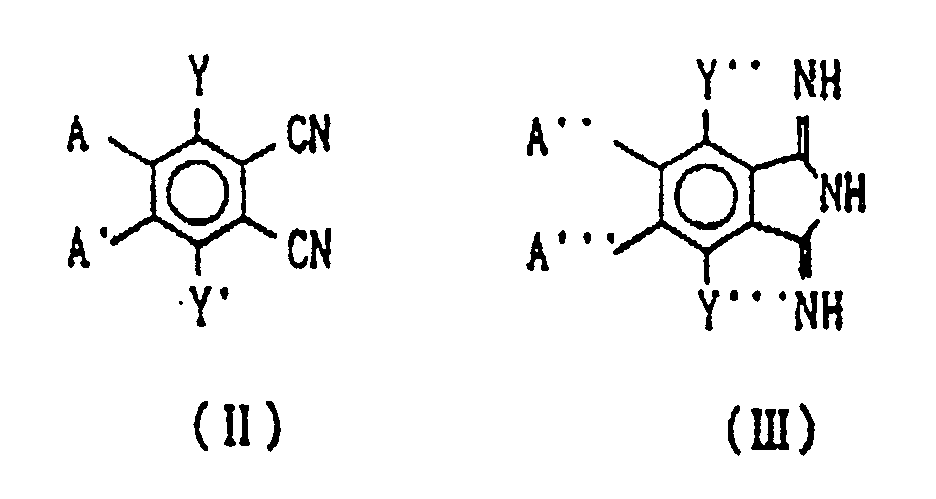
- The synthesized compounds had great molecular extinction coefficients, and optical recording media made from these compounds were also excellent in reflectance, sensitivity and durability.


- A mixture of 10 parts of a phthalonitrile derivative represented by the following structural formula (II-69), 2 parts of PdCl₂, 4 parts of DBU and 200 parts of n-amyl alcohol was heated at reflux:

- Afterward, the resulting reaction solution was poured into water, and the deposited tar was purified through column chromatography, so that 2 parts of a phthalocyanine compound represented by the following structural formula (I-98) was obtained (λmax 692 nm/hexane; εmax 2.5x10⁵):

Results of elemental analysis (as Pd C₆₀H₇₂N₈O₄): C H N Calcd. (%) 67.88 6.43 10.39 Found (%) 67.00 6.75 10.42 - Next, 1 part of the obtained phthalocyanine compound (I-98) was dissolved in 100 parts of methylcyclohexane, and the resulting solution was then applied onto a polycarbonate substrate. Afterward, gold was sputtered thereon, and a UV setting resin was further applied and cured thereon, thereby preparing a CD-WORM type optical recording medium.
- The thus-prepared CD-WORM type optical recording medium had a reflectance of 72% and a sensitivity of 52 dB at 8 mW and a linear velocity of 2.5 m/sec.
- Moreover, the compound (I-98) was applied onto polycarbonate to prepare a film thereon. This film had high refractive indexes, i.e., 2.78 (at 720 nm), 2.05 (at 780 nm) and 1.95 (at 830 nm).
- A mixture of 10 parts of a phthalonitrile derivative represented by the following structural formula (II-70), 2 parts of PdCl₂, 4 parts of DBU and 200 parts of n-amyl alcohol was heated at reflux:

- Afterward, the resulting reaction solution was poured into water, and the deposited tar was purified through column chromatography, so that 2.5 parts of a phthalocyanine compound represented by the following structural formula (I-99) was obtained (λmax 686 nm/hexane; εmax 2.5x10⁵):

Results of elemental analysis (as Pd C₅₂H₅₆N₈O₄): C H N Calcd. (%) 64.83 5.86 11.68 Found (%) 64.90 5.80 11.60 - Next, 1 part of the obtained phthalocyanine compound (I-99) was dissolved in 100 parts of methylcyclohexane, and the resulting solution was then applied onto a polycarbonate substrate. Afterward, an acrylic UV setting resin was further applied and cured thereon, thereby preparing an optical card.
- The thus-prepared optical card had a reflectance of 28% and a sensitivity of 50 dB at 8 mW and a linear velocity of 1.8 m/sec.
- Moreover, the compound (I-99) was applied onto polycarbonate to prepare a film thereon. This film had high refractive indexes, i.e., 2.37 (at 720 nm), 2.01 (at 780 nm) and 1.89 (at 830 nm).
- Following the same procedure as in Example 99, a compound having the structural formula (II-71)


- This compound (I-100) was applied onto polycarbonate to prepare a film thereon. This film had high refractive indexes, i.e., 1.96 (at 780 nm) and 1.86 (at 830 nm).
- Moreover, 4 parts of the compound (I-100) was heated and melted together with 1000 parts of poly(methyl methacrylate) (PMMA) resin, and the mixture was then stretched in order to prepare a film having a thickness of 200 µm. The thus-prepared film sufficiently absorbed rays at 700 to 830 nm.
- A mixture of 10 parts of a phthalonitrile derivative represented by the following structural formula (II-72), 2 parts of NiCl₂, 4 parts of DBU and 200 parts of n-amyl alcohol was heated a reflux:

- Afterward, the resulting reaction solution was poured into water, and the deposited tar was purified through column chromatography, so that 2 parts of a phthalocyanine compound represented by the following structural formula (I-101) was obtained (λmax 690 nm/hexane; εmax 2.4x10⁵):

Results of elemental analysis (as Ni C₆₀H₆₈N₁₂O₁₂): C H N Calcd. (%) 59.66 5.63 13.92 Found (%) 60.01 5.75 14.02 - Next, 1 part of the obtained phthalocyanine compound (I-101) was dissolved in 100 parts of methylcyclohexane, and the resulting solution was then applied onto a polycarbonate substrate. Afterward, gold was sputtered thereon, and a UV setting resin was further applied and cured thereon, thereby preparing a CD-WORM type optical recording medium.
- The thus-prepared CD-WORM type optical recording medium had a reflectance of 71% and a sensitivity of 52 dB at 7 mW and a linear velocity of 1.5 m/sec.
- Moreover, the compound (I-101) was applied onto polycarbonate to prepare a film thereon. This film had high refractive index, i.e., 2.65 (at 718 nm), 2.08 (at 780 nm) and 1.94 (at 830 nm).
- A mixture of 10 parts of a phthalonitrile derivative represented by the following structural formula (II-73), 2 parts of PdCl₂, 4 parts of DBU and 200 parts of n-amyl alcohol was heated at reflux:

- Afterward, the resulting reaction solution was poured into water, and the deposited tar was purified through column chromatography, so that 2.5 parts of a phthalocyanine compound represented by the following structural formula (I-102) was obtained (λmax 688 nm/hexane; εmax 2.4x10⁵):

Results of elemental analysis (as Pd C₅₂H₅₂N₈O₄Br₄): C H N Calcd. (%) 64.90 5.50 11.60 Found (%) 65.10 5.46 11.68 - Next, 1 part of the obtained phthalocyanine compound (I-102) was dissolved in 100 parts of methylcyclohexane, and the resulting solution was then applied onto a polycarbonate substrate. Afterward, an acrylic UV setting resin was further applied and cured thereon, thereby preparing an optical card.
- This optical card had a reflectance of 32% and a sensitivity of 50 dB at 780 nm, 8 mW and a linear velocity of 1.8 m/sec.
- Moreover, the compound (I-102) was applied onto polycarbonate to prepare a film thereon. This film had high refractive indexes, i.e., 2.40 (at 720 nm), 2.02 (at 780 nm) and 1.88 (at 830 nm).
- To 200 parts of acetic acid was added 10 parts of phthalocyanine of the above-mentioned formula (I-99), and 3 parts of fuming nitric acid (d = 1.68) was further added thereto dropwise. The solution was reacted at room temperature for 1 hour and at 50°C for 2 hours, thereby obtaining 8 parts of a phthalocyanine having the following structural formula (λmax 682 nm/hexane; εmax 2.03x10⁵):

- Next, 1 part of the obtained phthalocyanine compound (I-103) was dissolved in 100 parts of methylcyclohexane, and the resulting solution was then applied onto a polycarbonate substrate. Afterward, an acrylic UV setting resin was further applied and cured thereon, thereby preparing an optical card.
- The thus prepared optical card had a reflectance of 28% and a sensitivity of 50 dB at 780 nm, 8 mW and a linear velocity of 1.8 m/sec.
- Moreover, the compound (I-103) was applied onto polycarbonate to prepare a film thereon. This film had high refractive indexes, i.e., 2.47 (at 720 nm), 2.22 (at 780 nm) and 1.89 (at 830 nm).
- In 100 parts of cellosolve was dissolved 1 part of a compound represented by the following structural formula (A), and the resulting solution was then applied onto a polycarbonate substrate:

- Afterward, gold was sputtered on the substrate, and a UV setting resin was further applied and cured thereon, thereby preparing a CD-WORM type optical medium.
- The thus-prepared medium had a reflectance of 50% and the C/N ratio was 30 dB at 8 mW, 780 nm and a linear velocity of 2.5 m/sec.
- Moreover, a film was made of the above-mentioned compound (A), and the refractive index of this film was 1.70 (at 780 nm).
- Four parts of a compound represented by the structural formula (B)

- Obviously, numerous modifications and variations of the present invention are possible in light of the above teachings. It is therefore to be understood that, within the scope of the appended claims, the invention may be practiced otherwise than as specifically described herein.
Claims (20)


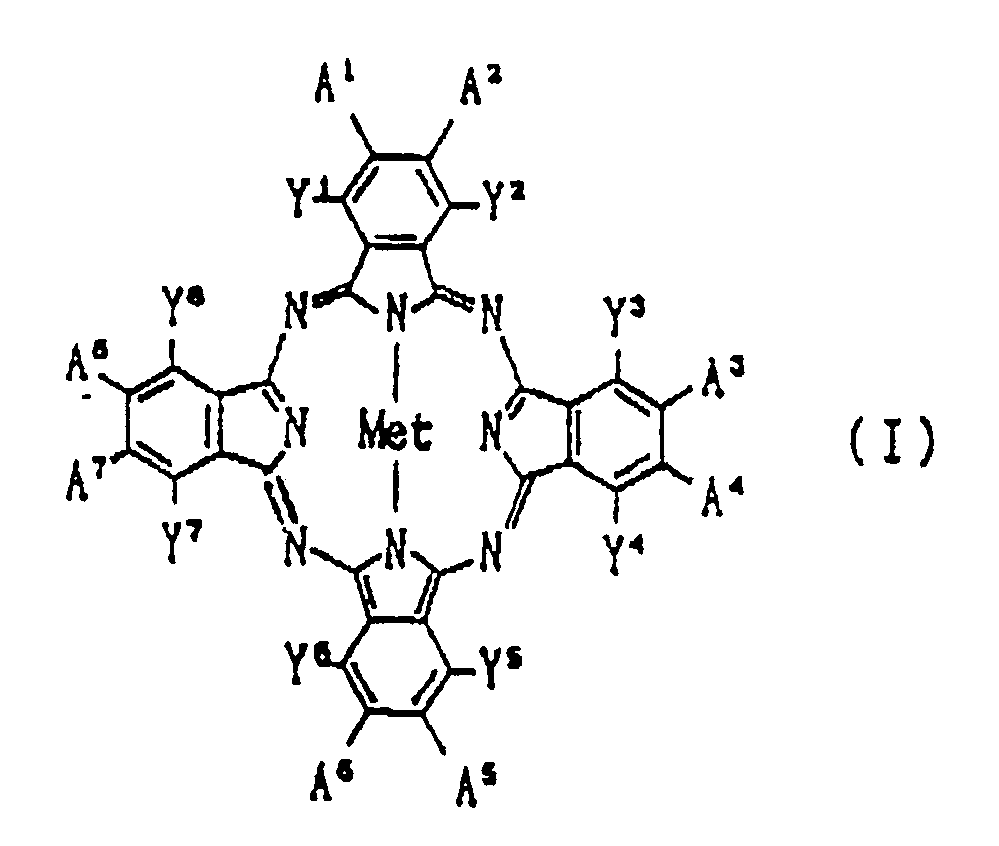

Applications Claiming Priority (8)
| Application Number | Priority Date | Filing Date | Title |
|---|---|---|---|
| JP31498688 | 1988-12-15 | ||
| JP314986/88 | 1988-12-15 | ||
| JP476489 | 1989-01-13 | ||
| JP476389 | 1989-01-13 | ||
| JP4764/89 | 1989-01-13 | ||
| JP4763/89 | 1989-01-13 | ||
| JP97604/89 | 1989-04-19 | ||
| JP9760489 | 1989-04-19 |
Publications (3)
| Publication Number | Publication Date |
|---|---|
| EP0373643A2 true EP0373643A2 (en) | 1990-06-20 |
| EP0373643A3 EP0373643A3 (en) | 1992-01-02 |
| EP0373643B1 EP0373643B1 (en) | 1998-01-21 |
Family
ID=27454154
Family Applications (1)
| Application Number | Title | Priority Date | Filing Date |
|---|---|---|---|
| EP89123102A Expired - Lifetime EP0373643B1 (en) | 1988-12-15 | 1989-12-14 | Near infrared absorbers and display/recording materials prepared by using same |
Country Status (6)
| Country | Link |
|---|---|
| US (3) | US5124067A (en) |
| EP (1) | EP0373643B1 (en) |
| JP (1) | JPH0756019B2 (en) |
| KR (1) | KR930009266B1 (en) |
| CA (1) | CA2005520A1 (en) |
| DE (1) | DE68928559T2 (en) |
Cited By (33)
| Publication number | Priority date | Publication date | Assignee | Title |
|---|---|---|---|---|
| EP0484018A3 (en) * | 1990-11-02 | 1992-06-10 | Imperial Chemical Industries Plc | Phthalocyanine compounds useful as an infrared absorber |
| EP0492508A1 (en) * | 1990-12-26 | 1992-07-01 | MITSUI TOATSU CHEMICALS, Inc. | Method for preparing alkoxyphthalocyanine |
| GB2259517A (en) * | 1991-09-02 | 1993-03-17 | Ici Plc | Phthalocyanine compounds |
| EP0463550A3 (en) * | 1990-06-22 | 1994-02-23 | Mitsui Toatsu Chemicals | |
| EP0519419A3 (en) * | 1991-06-21 | 1994-02-23 | Mitsui Toatsu Chemicals | |
| EP0519423A3 (en) * | 1991-06-19 | 1994-03-09 | Mitsui Toatsu Chemicals | |
| EP0607031A1 (en) * | 1993-01-13 | 1994-07-20 | Nippon Shokubai Co., Ltd. | Heat radiation-shielding material |
| US5350843A (en) * | 1990-11-06 | 1994-09-27 | Mitsui Toatsu Chemicals, Incorporated | Halogenated phthalocyanine compound, method for preparing same |
| US5380842A (en) * | 1991-06-20 | 1995-01-10 | Mitsui Toatsu Chemicals, Incorporated | Phthalocyanine compounds and usage thereof |
| EP0703280A1 (en) * | 1994-09-23 | 1996-03-27 | Ciba-Geigy Ag | Isomer mixtures of alkoxyphtalocyanines and process for their manufacture |
| EP0712904A1 (en) | 1994-09-23 | 1996-05-22 | Ciba-Geigy Ag | Phtalocyanines substituted with groups containing phosphorus |
| EP0687133A3 (en) * | 1994-06-10 | 1996-06-05 | Toyo Ink Mfg Co | Material carrying load holes |
| EP0418611B1 (en) * | 1989-08-30 | 1996-12-04 | Hitachi, Ltd. | Optical information recording medium, method and apparatus |
| EP0729140A3 (en) * | 1995-02-21 | 1997-04-16 | Eastman Kodak Co | Optical recording layers containing sulfur |
| EP0782164A1 (en) * | 1995-12-22 | 1997-07-02 | Mitsui Toatsu Chemicals, Incorporated | Plasma display filter |
| EP0799831A1 (en) * | 1996-04-02 | 1997-10-08 | Basf Aktiengesellschaft | IR absorbing phthalocyanines |
| GB2314844A (en) * | 1996-06-27 | 1998-01-14 | British Polythene Ltd | Improvements in or relating to film and/or coatings |
| US5712332A (en) * | 1993-01-13 | 1998-01-27 | Nippon Shokubai Co. | Method for absorbing heat radiation |
| EP0823432A3 (en) * | 1996-08-05 | 1998-02-18 | Ricoh Company, Ltd | Phthalocyanine compounds and their use as rewritable optical recording material |
| EP0833203A1 (en) * | 1996-09-30 | 1998-04-01 | Nippon Shokubai Co., Ltd. | Color filter grade photosensitive resin coloring composition, and color filter using the same |
| US5792860A (en) * | 1994-03-25 | 1998-08-11 | The Secretary Of State For Defence In Her Majesty's Government Of The United Kingdom Of Great Britain And Northern Ireland Of Defence Evaulation Research Agency | Substituted phthalocyanides with sulfonyl substituted with amino or carboxyl groups |
| US6087492A (en) * | 1996-10-03 | 2000-07-11 | Ciba Specialty Chemicals Corporation | Substituted phthalocyanines and their use |
| WO2001042368A1 (en) * | 1999-12-08 | 2001-06-14 | Gentian As | Substituted phthalocyanines and their precursors |
| US6399768B1 (en) | 1998-08-11 | 2002-06-04 | Ciba Specialty Chemicals Corporation | Metallocenyl-phthalocyanines |
| WO2004106436A1 (en) * | 2003-05-30 | 2004-12-09 | York University | Phthalocyanine compounds |
| USRE38979E1 (en) | 1992-12-02 | 2006-02-14 | Mitsui Chemicals, Inc. | Optical information recording medium and composition for optical information recording film |
| CN100373486C (en) * | 2002-11-01 | 2008-03-05 | 西巴特殊化学品控股有限公司 | Optical recording medium |
| WO2008037695A3 (en) * | 2006-09-26 | 2008-06-12 | Daehan Solvay Special Chemical | Soluble phthalocyanine derivatives for solar cell devices |
| US7625621B2 (en) | 2004-07-29 | 2009-12-01 | Clariant Finance (Bvi) Limited | Amino antipyrine based azo ligands and their metal complexes for use as optical recording media |
| WO2011074890A3 (en) * | 2009-12-18 | 2011-11-03 | 에스케이케미칼 주식회사 | Vanadyl phthalocyanine compounds and near-infrared absorption filters using same |
| WO2014140829A1 (en) | 2013-03-11 | 2014-09-18 | Saudi Basic Industries Corporation | Aryloxy-phthalocyanines of group iii metals |
| WO2014140850A2 (en) | 2013-03-11 | 2014-09-18 | Saudi Basic Industries Corporation | Aryloxy-phthalocyanines of group iv metals |
| WO2023241950A1 (en) | 2022-06-13 | 2023-12-21 | Basf Se | Mixtures of compounds having improved solubility for use as markers |
Families Citing this family (64)
| Publication number | Priority date | Publication date | Assignee | Title |
|---|---|---|---|---|
| JPH0730300B2 (en) * | 1988-04-01 | 1995-04-05 | 三井東圧化学株式会社 | Alkyl phthalocyanine near infrared absorber and display / recording material using the same |
| US5270463A (en) * | 1988-12-15 | 1993-12-14 | Mitsui Toatsu Chemicals, Incorporated | Halogenated alkoxyphthalocyanines |
| CA2005520A1 (en) * | 1988-12-15 | 1990-06-15 | Hisato Itoh | Near infrared absorbent and display/recording materials prepared by using same |
| US5449587A (en) * | 1988-12-15 | 1995-09-12 | Mitsui Toatsu Chemicals, Incorporated | Compact disk-write once type optical recording media |
| JPH08905B2 (en) * | 1990-04-07 | 1996-01-10 | 三井東圧化学株式会社 | Phthalocyanine near infrared absorber and optical recording medium using the same |
| US5280114A (en) * | 1990-04-07 | 1994-01-18 | Mitsui Toatsu Chemicals, Incorporated | Halogenation of alkoxyphthalocyanine |
| JPH07114018B2 (en) * | 1990-04-07 | 1995-12-06 | 三井東圧化学株式会社 | Optical recording medium using α-alkoxyphthalocyanine compound |
| EP0484027B1 (en) * | 1990-11-02 | 1996-12-18 | Zeneca Limited | Polysubstituted phthalocyanines |
| EP0513370B1 (en) * | 1990-11-06 | 1998-09-16 | Mitsui Chemicals, Inc. | Halogenated phthalocyanine compound, production thereof, and optical recording medium produced therefrom |
| JP2527281B2 (en) * | 1991-07-17 | 1996-08-21 | 三井東圧化学株式会社 | Method for producing alkoxy phthalocyanine |
| JPH0525179A (en) * | 1991-07-17 | 1993-02-02 | Mitsui Toatsu Chem Inc | Method for halogenating phthalocyanine and halogenated alkoxy phthalocyanine |
| JPH07116371B2 (en) * | 1991-09-30 | 1995-12-13 | 三井東圧化学株式会社 | Halogenated alkoxyphthalocyanine for recording / storing material, method for producing the same, and optical recording medium using the same |
| EP0575816B1 (en) | 1992-06-12 | 1999-09-22 | Mitsui Chemicals, Inc. | Light-absorbing compound and optical recording medium containing same |
| US5272047A (en) * | 1992-06-26 | 1993-12-21 | Eastman Kodak Company | Optical information recording medium using azo dyes |
| US6168901B1 (en) | 1993-01-08 | 2001-01-02 | Eastman Kodak Company | Recordable optical element using low absorption materials |
| US5294471A (en) * | 1993-02-01 | 1994-03-15 | Eastman Kodak Company | Optical information recording medium using metallized formazan dyes |
| US5362536A (en) * | 1993-02-19 | 1994-11-08 | Eastman Kodak Company | Recordable optical element having a leuco dye |
| US5356685A (en) * | 1993-02-19 | 1994-10-18 | Eastman Kodak Company | Recordable optical element having a leuco dye |
| US5326677A (en) * | 1993-02-19 | 1994-07-05 | Eastman Kodak Company | Optical retrieval apparatus using a tellurium (IV) leuco dye |
| DE69420169T2 (en) * | 1993-04-09 | 2000-03-09 | Mitsui Chemicals, Inc. | Phthalocyanine compound and optical recording medium containing it |
| GB9314251D0 (en) * | 1993-07-09 | 1993-08-18 | Zeneca Ltd | Phthalocyanines |
| US5426015A (en) * | 1993-10-18 | 1995-06-20 | Eastman Kodak Company | Metallized azo dianion with two cationic dye counter ions for optical information recording medium |
| JPH07118273A (en) * | 1993-10-22 | 1995-05-09 | Hiroyoshi Shirai | Naphthalocyanine compound, its production, naphthalocyanine polymer and its production |
| US5633106A (en) * | 1994-04-08 | 1997-05-27 | Mitsui Toatsu Chemicals, Inc. | Optical recording media and a method of recording and reproducing information |
| US5490700A (en) * | 1994-08-03 | 1996-02-13 | Emhart Inc. | Sheet metal U.L. screw |
| US5547728A (en) * | 1994-09-23 | 1996-08-20 | Eastman Kodak Company | Optical recording elements having recording layers containing mixtures of formazan and cyanine dyes |
| JP3604427B2 (en) * | 1994-09-27 | 2004-12-22 | 三井化学株式会社 | Phthalocyanine compound and optical recording medium containing the same |
| US5658707A (en) * | 1994-10-18 | 1997-08-19 | Mitsui Toatsu Chemicals, Inc. | Optical recording media |
| US5547727A (en) * | 1994-12-13 | 1996-08-20 | Eastman Kodak Company | Optical recording elements having recording layers containing cationic azo dyes |
| JP3604432B2 (en) * | 1994-12-15 | 2004-12-22 | 三井化学株式会社 | Phthalocyanine compound and optical recording medium containing the same |
| EP0718375B1 (en) * | 1994-12-21 | 2000-07-05 | Mitsui Chemicals, Inc. | Near infrared absorber, preparation process thereof and use thereof |
| TW454009B (en) | 1994-12-27 | 2001-09-11 | Mitsui Chemicals Inc | Near infrared light-absorbing dye of phthalocyanine compounds and optical recording media comprising them |
| JP3604435B2 (en) * | 1994-12-27 | 2004-12-22 | 三井化学株式会社 | Phthalocyanine compound and optical recording medium containing the same |
| JPH08188718A (en) * | 1995-01-13 | 1996-07-23 | Mitsui Toatsu Chem Inc | Phthalocyanine compound and optical recording medium containing the same |
| JP3604439B2 (en) * | 1995-01-18 | 2004-12-22 | 三井化学株式会社 | Phthalocyanine compound and optical recording medium containing the same |
| US5585158A (en) * | 1995-06-07 | 1996-12-17 | Eastman Kodak Company | Recordable optical element using low absorption materials |
| TW340864B (en) | 1995-07-20 | 1998-09-21 | Mitsui Toatsu Chemicals | Optical recording medium |
| JP3652017B2 (en) * | 1995-08-23 | 2005-05-25 | 三井化学株式会社 | Optical recording medium |
| JPH09324144A (en) * | 1996-04-03 | 1997-12-16 | Dainippon Toryo Co Ltd | Composition for forming near-infrared cut filter and near-infrared cut filter |
| US5770293A (en) * | 1996-04-12 | 1998-06-23 | Eastman Kodak Company | Method of forming recordable optical element using low absorption materials |
| US5725741A (en) * | 1996-04-12 | 1998-03-10 | Eastman Kodak Company | Method of forming recordable optical element using low absorption materials |
| TW446637B (en) * | 1996-05-28 | 2001-07-21 | Mitsui Chemicals Inc | Transparent laminates and optical filters for displays using the same |
| US5855979A (en) * | 1996-08-08 | 1999-01-05 | Mitsui Chemicals, Inc. | Optical recording medium |
| US5998609A (en) * | 1996-10-14 | 1999-12-07 | Nippon Shokubai Co., Ltd. | Phthalocyanine compounds, process for preparing the same, and optical recording medium made using the same |
| JP3309307B2 (en) * | 1997-07-31 | 2002-07-29 | 株式会社リコー | Optical recording medium and manufacturing method thereof |
| US5882760A (en) * | 1997-11-17 | 1999-03-16 | Eastman Kodak Company | Recordable optical disks with metallic interlayer |
| US6500510B1 (en) | 1999-11-04 | 2002-12-31 | Molecular Storage Technologies, Inc. | Molecular level optical information storage devices |
| JP4282292B2 (en) * | 2002-09-10 | 2009-06-17 | 独立行政法人科学技術振興機構 | Hexane-soluble hexaphylline |
| US20070010645A1 (en) * | 2005-07-05 | 2007-01-11 | Silverbrook Research Pty Ltd | Red-shifted water dispersible IR dyes |
| JP5010123B2 (en) * | 2005-08-23 | 2012-08-29 | 株式会社日本触媒 | Phthalocyanine compound and near-infrared absorbing dye comprising the same |
| JP5046515B2 (en) * | 2005-12-19 | 2012-10-10 | 株式会社日本触媒 | Phthalocyanine compound and production method and use thereof |
| US20070228341A1 (en) * | 2005-12-30 | 2007-10-04 | Hayes Richard A | Solar control laminates |
| US7622192B2 (en) | 2005-12-30 | 2009-11-24 | E.I. Du Pont De Nemours And Company | Solar control laminates |
| US20080057185A1 (en) * | 2005-12-30 | 2008-03-06 | Wall Jason S | Solar control laminates |
| KR20110053981A (en) * | 2008-08-29 | 2011-05-24 | 니폰 쇼쿠바이 컴파니 리미티드 | Phthalocyanine compound |
| JP5536394B2 (en) * | 2008-08-29 | 2014-07-02 | 株式会社日本触媒 | Phthalocyanine compounds |
| JP5489669B2 (en) * | 2008-11-28 | 2014-05-14 | Jsr株式会社 | Near-infrared cut filter and device using near-infrared cut filter |
| KR20100079783A (en) * | 2008-12-31 | 2010-07-08 | 에스케이케미칼주식회사 | Vanadium phthalocyanine compound and near infrared ray absorption filter using the same |
| JP2010265254A (en) * | 2009-04-16 | 2010-11-25 | Nippon Shokubai Co Ltd | Phthalocyanine compound |
| JP2012167145A (en) * | 2011-02-10 | 2012-09-06 | Fujifilm Corp | Colored curable composition, and color filter |
| KR101577693B1 (en) | 2013-12-27 | 2015-12-15 | 나노씨엠에스(주) | -Poly oxo crosslinked phthalocyanine compound method for production thereof and near infrared absorbing and reflecting composition using the same |
| WO2020071470A1 (en) * | 2018-10-05 | 2020-04-09 | 山本化成株式会社 | Phthalocyanine compound and use thereof |
| US12600734B2 (en) * | 2020-06-24 | 2026-04-14 | The University Of Tokyo | Photosensitizing dye |
| EP4206287A4 (en) * | 2020-09-17 | 2025-01-22 | Sumitomo Chemical Company, Limited | RESIN COMPOSITION |
Family Cites Families (27)
| Publication number | Priority date | Publication date | Assignee | Title |
|---|---|---|---|---|
| US3291746A (en) * | 1963-08-26 | 1966-12-13 | American Cyanamid Co | Metal phthalocyanines as infrared absorbers |
| US4039467A (en) * | 1975-06-16 | 1977-08-02 | American Cyanamid Company | Visibly opaque infrared transmitting optical filter containing a combination of copper and vanadyl phthalocyanine sulfonamides |
| US4529688A (en) * | 1983-10-13 | 1985-07-16 | Xerox Corporation | Infrared sensitive phthalocyanine compositions |
| EP0155780B1 (en) * | 1984-03-21 | 1990-03-28 | Imperial Chemical Industries Plc | Infra-red absorber |
| US4791023A (en) * | 1984-07-07 | 1988-12-13 | Fuji Photo Film Co., Ltd. | Infrared absorbent and optical material using the same |
| GB8431446D0 (en) * | 1984-12-13 | 1985-01-23 | Secr Defence | Alkoxyphthalocyanines |
| GB8431924D0 (en) * | 1984-12-18 | 1985-01-30 | Ici Plc | Optical recording medium |
| JPS61152769A (en) * | 1984-12-26 | 1986-07-11 | Tdk Corp | Phthalocyanine compound |
| JPS61197280A (en) * | 1985-02-27 | 1986-09-01 | Tdk Corp | Optical recording medium |
| JPS61197281A (en) * | 1985-02-27 | 1986-09-01 | Tdk Corp | Optical recording medium |
| JPS61246091A (en) * | 1985-04-24 | 1986-11-01 | Tdk Corp | Optical recording medium |
| JPH0739211B2 (en) * | 1985-08-06 | 1995-05-01 | 三井東圧化学株式会社 | Method of manufacturing optical recording medium |
| JPH0749231B2 (en) * | 1985-08-13 | 1995-05-31 | 三菱化学株式会社 | Optical recording body |
| JPS6239682A (en) * | 1985-08-13 | 1987-02-20 | Fuji Photo Film Co Ltd | Infrared ray absorbing composition |
| GB8619238D0 (en) * | 1986-08-06 | 1986-09-17 | Ici Plc | Organic photoconductor |
| JPS6348281A (en) * | 1986-08-15 | 1988-02-29 | Agency Of Ind Science & Technol | Production of thin film of phthalocyanine compound |
| DE3752180T2 (en) * | 1986-12-24 | 1998-07-30 | Canon Kk | Recording and playback device |
| KR960013076B1 (en) * | 1987-02-13 | 1996-09-30 | 더 세크 레터리 오브 스테이트 퍼 디펜스 인 허 브리태닉 머제스티스 가번먼트 오브 더 유나이티드 킹덤 오브 그레이트 브리튼 앤드 노던 아일랜드 | Substituted phthalocyanines |
| JPS63233887A (en) * | 1987-03-23 | 1988-09-29 | Toyobo Co Ltd | Optical recording medium |
| FR2613111B1 (en) * | 1987-03-23 | 1994-05-06 | Toyo Boseki Kk | OPTICAL RECORDING MEDIUM |
| JP2810379B2 (en) * | 1988-05-20 | 1998-10-15 | キヤノン株式会社 | Information recording medium |
| EP0302497B1 (en) * | 1987-08-05 | 1996-01-24 | Canon Kabushiki Kaisha | Data recording medium |
| EP0313943B1 (en) * | 1987-10-20 | 1993-08-04 | MITSUI TOATSU CHEMICALS, Inc. | 1,2-naphtalocyanine near-infrared absorbent and recording/display materials using same |
| JPH0730300B2 (en) * | 1988-04-01 | 1995-04-05 | 三井東圧化学株式会社 | Alkyl phthalocyanine near infrared absorber and display / recording material using the same |
| US5270463A (en) * | 1988-12-15 | 1993-12-14 | Mitsui Toatsu Chemicals, Incorporated | Halogenated alkoxyphthalocyanines |
| CA2005520A1 (en) * | 1988-12-15 | 1990-06-15 | Hisato Itoh | Near infrared absorbent and display/recording materials prepared by using same |
| JPH0348281A (en) * | 1990-01-19 | 1991-03-01 | Seiko Epson Corp | liquid crystal display device |
-
1989
- 1989-12-14 CA CA002005520A patent/CA2005520A1/en not_active Abandoned
- 1989-12-14 DE DE68928559T patent/DE68928559T2/en not_active Expired - Lifetime
- 1989-12-14 EP EP89123102A patent/EP0373643B1/en not_active Expired - Lifetime
- 1989-12-14 JP JP1322761A patent/JPH0756019B2/en not_active Expired - Lifetime
- 1989-12-15 KR KR1019890018679A patent/KR930009266B1/en not_active Expired - Fee Related
- 1989-12-15 US US07/451,175 patent/US5124067A/en not_active Expired - Lifetime
-
1991
- 1991-12-11 US US07/805,040 patent/US5409634A/en not_active Expired - Lifetime
-
1992
- 1992-03-02 US US07/846,796 patent/US5296162A/en not_active Expired - Lifetime
Cited By (49)
| Publication number | Priority date | Publication date | Assignee | Title |
|---|---|---|---|---|
| EP0418611B1 (en) * | 1989-08-30 | 1996-12-04 | Hitachi, Ltd. | Optical information recording medium, method and apparatus |
| EP0463550A3 (en) * | 1990-06-22 | 1994-02-23 | Mitsui Toatsu Chemicals | |
| US5391461A (en) * | 1990-06-22 | 1995-02-21 | Mitsui Toatsu Chemicals, Inc. | Optical recording medium and recording method |
| EP0484018A3 (en) * | 1990-11-02 | 1992-06-10 | Imperial Chemical Industries Plc | Phthalocyanine compounds useful as an infrared absorber |
| US5350843A (en) * | 1990-11-06 | 1994-09-27 | Mitsui Toatsu Chemicals, Incorporated | Halogenated phthalocyanine compound, method for preparing same |
| US5220010A (en) * | 1990-12-26 | 1993-06-15 | Mitsui Toatsu Chemicals, Incorporated | Method for preparation alkoxyphthalocyanine |
| EP0492508A1 (en) * | 1990-12-26 | 1992-07-01 | MITSUI TOATSU CHEMICALS, Inc. | Method for preparing alkoxyphthalocyanine |
| EP0519423A3 (en) * | 1991-06-19 | 1994-03-09 | Mitsui Toatsu Chemicals | |
| US5695911A (en) * | 1991-06-19 | 1997-12-09 | Mitsui Toatsu Chemicals, Incorporated | Optical recording medium |
| US5380842A (en) * | 1991-06-20 | 1995-01-10 | Mitsui Toatsu Chemicals, Incorporated | Phthalocyanine compounds and usage thereof |
| EP0519419A3 (en) * | 1991-06-21 | 1994-02-23 | Mitsui Toatsu Chemicals | |
| US5358833A (en) * | 1991-06-21 | 1994-10-25 | Mitsui Toatsu Chemicals, Inc. | Amorphous phthalocyanine compound or mixture of amorphous phthalocyanine compounds, and method for preparing same |
| GB2259517A (en) * | 1991-09-02 | 1993-03-17 | Ici Plc | Phthalocyanine compounds |
| USRE38979E1 (en) | 1992-12-02 | 2006-02-14 | Mitsui Chemicals, Inc. | Optical information recording medium and composition for optical information recording film |
| EP0607031A1 (en) * | 1993-01-13 | 1994-07-20 | Nippon Shokubai Co., Ltd. | Heat radiation-shielding material |
| US5712332A (en) * | 1993-01-13 | 1998-01-27 | Nippon Shokubai Co. | Method for absorbing heat radiation |
| US5792860A (en) * | 1994-03-25 | 1998-08-11 | The Secretary Of State For Defence In Her Majesty's Government Of The United Kingdom Of Great Britain And Northern Ireland Of Defence Evaulation Research Agency | Substituted phthalocyanides with sulfonyl substituted with amino or carboxyl groups |
| EP0687133A3 (en) * | 1994-06-10 | 1996-06-05 | Toyo Ink Mfg Co | Material carrying load holes |
| US5585213A (en) * | 1994-06-10 | 1996-12-17 | Toyo Ink Manufacturing Co., Ltd. | Hole-transporting material and its use |
| EP0703280A1 (en) * | 1994-09-23 | 1996-03-27 | Ciba-Geigy Ag | Isomer mixtures of alkoxyphtalocyanines and process for their manufacture |
| US5663326A (en) * | 1994-09-23 | 1997-09-02 | Ciba-Geigy Corporation | Mixtures of isomeric substituted phthalocyanines, and process for their preparation |
| US5817804A (en) * | 1994-09-23 | 1998-10-06 | Ciba Specialty Chemicals Corporation | Process for the preparation of mixtures of isometric substituted phthalocyanines |
| EP0712904A1 (en) | 1994-09-23 | 1996-05-22 | Ciba-Geigy Ag | Phtalocyanines substituted with groups containing phosphorus |
| US5641879A (en) * | 1994-09-23 | 1997-06-24 | Ciba-Geigy Corporation | Phthalocyanines substituted by phosphorus-containing groups |
| EP0729140A3 (en) * | 1995-02-21 | 1997-04-16 | Eastman Kodak Co | Optical recording layers containing sulfur |
| US5804102A (en) * | 1995-12-22 | 1998-09-08 | Mitsui Chemicals, Inc. | Plasma display filter |
| EP0782164A1 (en) * | 1995-12-22 | 1997-07-02 | Mitsui Toatsu Chemicals, Incorporated | Plasma display filter |
| EP0799831A1 (en) * | 1996-04-02 | 1997-10-08 | Basf Aktiengesellschaft | IR absorbing phthalocyanines |
| GB2314844A (en) * | 1996-06-27 | 1998-01-14 | British Polythene Ltd | Improvements in or relating to film and/or coatings |
| GB2314844B (en) * | 1996-06-27 | 2000-03-22 | British Polythene Ltd | Improvements in or relating to films and/or coatings |
| EP0823432A3 (en) * | 1996-08-05 | 1998-02-18 | Ricoh Company, Ltd | Phthalocyanine compounds and their use as rewritable optical recording material |
| US5932721A (en) * | 1996-08-05 | 1999-08-03 | Ricoh Company, Ltd. | Phthalocyanine compounds |
| EP0833203A1 (en) * | 1996-09-30 | 1998-04-01 | Nippon Shokubai Co., Ltd. | Color filter grade photosensitive resin coloring composition, and color filter using the same |
| US5968688A (en) * | 1996-09-30 | 1999-10-19 | Nippon Shokubai Co., Ltd. | Color filter grade photosensitive resin coloring composition and color filter using the same |
| US6087492A (en) * | 1996-10-03 | 2000-07-11 | Ciba Specialty Chemicals Corporation | Substituted phthalocyanines and their use |
| US6399768B1 (en) | 1998-08-11 | 2002-06-04 | Ciba Specialty Chemicals Corporation | Metallocenyl-phthalocyanines |
| US6790593B2 (en) | 1998-08-11 | 2004-09-14 | Ciba Specialty Chemicals Corporation | Metallocenyl-phthalocyanines |
| WO2001042368A1 (en) * | 1999-12-08 | 2001-06-14 | Gentian As | Substituted phthalocyanines and their precursors |
| CN100373486C (en) * | 2002-11-01 | 2008-03-05 | 西巴特殊化学品控股有限公司 | Optical recording medium |
| WO2004106436A1 (en) * | 2003-05-30 | 2004-12-09 | York University | Phthalocyanine compounds |
| US7625621B2 (en) | 2004-07-29 | 2009-12-01 | Clariant Finance (Bvi) Limited | Amino antipyrine based azo ligands and their metal complexes for use as optical recording media |
| WO2008037695A3 (en) * | 2006-09-26 | 2008-06-12 | Daehan Solvay Special Chemical | Soluble phthalocyanine derivatives for solar cell devices |
| WO2011074890A3 (en) * | 2009-12-18 | 2011-11-03 | 에스케이케미칼 주식회사 | Vanadyl phthalocyanine compounds and near-infrared absorption filters using same |
| KR101153787B1 (en) * | 2009-12-18 | 2012-06-13 | 에스케이케미칼주식회사 | Vanadyl phthalocyanine compound and near infrared ray absorption filter using the same |
| CN102762580A (en) * | 2009-12-18 | 2012-10-31 | Sk化学株式会社 | Vanadyl phthalocyanine compounds and near-infrared absorption filters using same |
| CN102762580B (en) * | 2009-12-18 | 2015-08-05 | Sk化学株式会社 | Vanadyl phthalocyanine compound and use its near-infrared absorption light filter |
| WO2014140829A1 (en) | 2013-03-11 | 2014-09-18 | Saudi Basic Industries Corporation | Aryloxy-phthalocyanines of group iii metals |
| WO2014140850A2 (en) | 2013-03-11 | 2014-09-18 | Saudi Basic Industries Corporation | Aryloxy-phthalocyanines of group iv metals |
| WO2023241950A1 (en) | 2022-06-13 | 2023-12-21 | Basf Se | Mixtures of compounds having improved solubility for use as markers |
Also Published As
| Publication number | Publication date |
|---|---|
| JPH0362878A (en) | 1991-03-18 |
| DE68928559T2 (en) | 1998-06-18 |
| US5409634A (en) | 1995-04-25 |
| CA2005520A1 (en) | 1990-06-15 |
| DE68928559D1 (en) | 1998-02-26 |
| JPH0756019B2 (en) | 1995-06-14 |
| KR900009914A (en) | 1990-07-05 |
| US5296162A (en) | 1994-03-22 |
| US5124067A (en) | 1992-06-23 |
| EP0373643A3 (en) | 1992-01-02 |
| KR930009266B1 (en) | 1993-09-25 |
| EP0373643B1 (en) | 1998-01-21 |
Similar Documents
| Publication | Publication Date | Title |
|---|---|---|
| EP0373643B1 (en) | Near infrared absorbers and display/recording materials prepared by using same | |
| EP0337209B1 (en) | Alkylphthalocyanine near-infrared absorbers and recording/display materials using the same | |
| EP0313943B1 (en) | 1,2-naphtalocyanine near-infrared absorbent and recording/display materials using same | |
| US20020128249A1 (en) | Phthalocyanine analogs | |
| EP0575816B1 (en) | Light-absorbing compound and optical recording medium containing same | |
| JPH02296885A (en) | Near infrared absorber, and displaying and recording material using the same absorber | |
| US5446141A (en) | Alkylphthalocyanine near-infrared absorbers and recording/display materials using the same | |
| KR930009257B1 (en) | Near infrared absorbing filter containing near infrared absorbing agent | |
| JPH03100066A (en) | Acyloxytin phthalocyanine and information recording material containing the same | |
| JPH0749530B2 (en) | Acyloxysilicon phthalocyanine and information recording material using the same | |
| JP3357153B2 (en) | Phthalocyanine compound and optical recording medium containing the same | |
| JPH089690B2 (en) | Near infrared absorber and optical recording medium using the same | |
| JP3732528B2 (en) | Light absorbing compound and optical recording medium containing the same | |
| US20110282052A1 (en) | Metallocenyl phthalocyanine compounds and use thereof | |
| JPH05171052A (en) | α-Alkoxy phthalocyanine compound and optical recording medium using the same | |
| JPH07114018B2 (en) | Optical recording medium using α-alkoxyphthalocyanine compound | |
| JPH0343461A (en) | Naphthalocyanine and information recording material using the same | |
| JPH06228532A (en) | Phthalocyanine compound and optical recording medium using the same | |
| JPH07207172A (en) | Phthalocyanine compound and optical recording medium containing the same |
Legal Events
| Date | Code | Title | Description |
|---|---|---|---|
| PUAI | Public reference made under article 153(3) epc to a published international application that has entered the european phase |
Free format text: ORIGINAL CODE: 0009012 |
|
| 17P | Request for examination filed |
Effective date: 19900205 |
|
| AK | Designated contracting states |
Kind code of ref document: A2 Designated state(s): CH DE FR GB IT LI NL |
|
| PUAL | Search report despatched |
Free format text: ORIGINAL CODE: 0009013 |
|
| AK | Designated contracting states |
Kind code of ref document: A3 Designated state(s): CH DE FR GB IT LI NL |
|
| 17Q | First examination report despatched |
Effective date: 19940225 |
|
| APAB | Appeal dossier modified |
Free format text: ORIGINAL CODE: EPIDOS NOAPE |
|
| APBJ | Interlocutory revision of appeal recorded |
Free format text: ORIGINAL CODE: EPIDOS IRAPE |
|
| GRAG | Despatch of communication of intention to grant |
Free format text: ORIGINAL CODE: EPIDOS AGRA |
|
| GRAG | Despatch of communication of intention to grant |
Free format text: ORIGINAL CODE: EPIDOS AGRA |
|
| GRAH | Despatch of communication of intention to grant a patent |
Free format text: ORIGINAL CODE: EPIDOS IGRA |
|
| GRAH | Despatch of communication of intention to grant a patent |
Free format text: ORIGINAL CODE: EPIDOS IGRA |
|
| GRAA | (expected) grant |
Free format text: ORIGINAL CODE: 0009210 |
|
| AK | Designated contracting states |
Kind code of ref document: B1 Designated state(s): CH DE FR GB IT LI NL |
|
| PG25 | Lapsed in a contracting state [announced via postgrant information from national office to epo] |
Ref country code: IT Free format text: LAPSE BECAUSE OF FAILURE TO SUBMIT A TRANSLATION OF THE DESCRIPTION OR TO PAY THE FEE WITHIN THE PRE;WARNING: LAPSES OF ITALIAN PATENTS WITH EFFECTIVE DATE BEFORE 2007 MAY HAVE OCCURRED AT ANY TIME BEFORE 2007. THE CORRECT EFFECTIVE DATE MAY BE DIFFERENT FROM THE ONE RECORDED.SCRIBED TIME-LIMIT Effective date: 19980121 Ref country code: CH Free format text: LAPSE BECAUSE OF FAILURE TO SUBMIT A TRANSLATION OF THE DESCRIPTION OR TO PAY THE FEE WITHIN THE PRESCRIBED TIME-LIMIT Effective date: 19980121 Ref country code: LI Free format text: LAPSE BECAUSE OF FAILURE TO SUBMIT A TRANSLATION OF THE DESCRIPTION OR TO PAY THE FEE WITHIN THE PRESCRIBED TIME-LIMIT Effective date: 19980121 |
|
| REG | Reference to a national code |
Ref country code: CH Ref legal event code: EP |
|
| REF | Corresponds to: |
Ref document number: 68928559 Country of ref document: DE Date of ref document: 19980226 |
|
| ET | Fr: translation filed | ||
| RAP2 | Party data changed (patent owner data changed or rights of a patent transferred) |
Owner name: YAMAMOTO CHEMICALS, INC. Owner name: MITSUI CHEMICALS, INC. |
|
| REG | Reference to a national code |
Ref country code: CH Ref legal event code: PL |
|
| NLT2 | Nl: modifications (of names), taken from the european patent patent bulletin |
Owner name: MITSUI CHEMICALS, INC. EN YAMAMOTO CHEMICALS, INC. |
|
| PLBE | No opposition filed within time limit |
Free format text: ORIGINAL CODE: 0009261 |
|
| STAA | Information on the status of an ep patent application or granted ep patent |
Free format text: STATUS: NO OPPOSITION FILED WITHIN TIME LIMIT |
|
| NLT1 | Nl: modifications of names registered in virtue of documents presented to the patent office pursuant to art. 16 a, paragraph 1 |
Owner name: MITSUI CHEMICALS, INC.;YAMAMOTO CHEMICALS, INC. |
|
| 26N | No opposition filed | ||
| REG | Reference to a national code |
Ref country code: GB Ref legal event code: 732E |
|
| REG | Reference to a national code |
Ref country code: GB Ref legal event code: IF02 |
|
| PGFP | Annual fee paid to national office [announced via postgrant information from national office to epo] |
Ref country code: NL Payment date: 20081215 Year of fee payment: 20 |
|
| PGFP | Annual fee paid to national office [announced via postgrant information from national office to epo] |
Ref country code: FR Payment date: 20081212 Year of fee payment: 20 |
|
| PGFP | Annual fee paid to national office [announced via postgrant information from national office to epo] |
Ref country code: DE Payment date: 20081211 Year of fee payment: 20 |
|
| PGFP | Annual fee paid to national office [announced via postgrant information from national office to epo] |
Ref country code: GB Payment date: 20081210 Year of fee payment: 20 |
|
| REG | Reference to a national code |
Ref country code: GB Ref legal event code: PE20 Expiry date: 20091213 |
|
| NLV7 | Nl: ceased due to reaching the maximum lifetime of a patent |
Effective date: 20091214 |
|
| PG25 | Lapsed in a contracting state [announced via postgrant information from national office to epo] |
Ref country code: NL Free format text: LAPSE BECAUSE OF EXPIRATION OF PROTECTION Effective date: 20091214 |
|
| PG25 | Lapsed in a contracting state [announced via postgrant information from national office to epo] |
Ref country code: GB Free format text: LAPSE BECAUSE OF EXPIRATION OF PROTECTION Effective date: 20091213 |