EP1678728B1 - Elektrode für energiespeichereinrichtungen und auf der elektrode basierender elektrochemischer superkondensator - Google Patents
Elektrode für energiespeichereinrichtungen und auf der elektrode basierender elektrochemischer superkondensator Download PDFInfo
- Publication number
- EP1678728B1 EP1678728B1 EP04770253A EP04770253A EP1678728B1 EP 1678728 B1 EP1678728 B1 EP 1678728B1 EP 04770253 A EP04770253 A EP 04770253A EP 04770253 A EP04770253 A EP 04770253A EP 1678728 B1 EP1678728 B1 EP 1678728B1
- Authority
- EP
- European Patent Office
- Prior art keywords
- electrode
- polymer
- group
- electrolyte
- redox polymer
- Prior art date
- Legal status (The legal status is an assumption and is not a legal conclusion. Google has not performed a legal analysis and makes no representation as to the accuracy of the status listed.)
- Expired - Lifetime
Links
Images


Classifications
-
- H—ELECTRICITY
- H01—ELECTRIC ELEMENTS
- H01G—CAPACITORS; CAPACITORS, RECTIFIERS, DETECTORS, SWITCHING DEVICES, LIGHT-SENSITIVE OR TEMPERATURE-SENSITIVE DEVICES OF THE ELECTROLYTIC TYPE
- H01G11/00—Hybrid capacitors, i.e. capacitors having different positive and negative electrodes; Electric double-layer [EDL] capacitors; Processes for the manufacture thereof or of parts thereof
- H01G11/22—Electrodes
- H01G11/30—Electrodes characterised by their material
- H01G11/50—Electrodes characterised by their material specially adapted for lithium-ion capacitors, e.g. for lithium-doping or for intercalation
-
- H—ELECTRICITY
- H01—ELECTRIC ELEMENTS
- H01G—CAPACITORS; CAPACITORS, RECTIFIERS, DETECTORS, SWITCHING DEVICES, LIGHT-SENSITIVE OR TEMPERATURE-SENSITIVE DEVICES OF THE ELECTROLYTIC TYPE
- H01G11/00—Hybrid capacitors, i.e. capacitors having different positive and negative electrodes; Electric double-layer [EDL] capacitors; Processes for the manufacture thereof or of parts thereof
- H01G11/02—Hybrid capacitors, i.e. capacitors having different positive and negative electrodes; Electric double-layer [EDL] capacitors; Processes for the manufacture thereof or of parts thereof using combined reduction-oxidation reactions, e.g. redox arrangement or solion
-
- H—ELECTRICITY
- H01—ELECTRIC ELEMENTS
- H01G—CAPACITORS; CAPACITORS, RECTIFIERS, DETECTORS, SWITCHING DEVICES, LIGHT-SENSITIVE OR TEMPERATURE-SENSITIVE DEVICES OF THE ELECTROLYTIC TYPE
- H01G11/00—Hybrid capacitors, i.e. capacitors having different positive and negative electrodes; Electric double-layer [EDL] capacitors; Processes for the manufacture thereof or of parts thereof
- H01G11/22—Electrodes
- H01G11/30—Electrodes characterised by their material
- H01G11/48—Conductive polymers
-
- H—ELECTRICITY
- H01—ELECTRIC ELEMENTS
- H01M—PROCESSES OR MEANS, e.g. BATTERIES, FOR THE DIRECT CONVERSION OF CHEMICAL ENERGY INTO ELECTRICAL ENERGY
- H01M14/00—Electrochemical current or voltage generators not provided for in groups H01M6/00 - H01M12/00; Manufacture thereof
-
- H—ELECTRICITY
- H01—ELECTRIC ELEMENTS
- H01M—PROCESSES OR MEANS, e.g. BATTERIES, FOR THE DIRECT CONVERSION OF CHEMICAL ENERGY INTO ELECTRICAL ENERGY
- H01M4/00—Electrodes
- H01M4/02—Electrodes composed of, or comprising, active material
-
- H—ELECTRICITY
- H01—ELECTRIC ELEMENTS
- H01M—PROCESSES OR MEANS, e.g. BATTERIES, FOR THE DIRECT CONVERSION OF CHEMICAL ENERGY INTO ELECTRICAL ENERGY
- H01M4/00—Electrodes
- H01M4/02—Electrodes composed of, or comprising, active material
- H01M4/13—Electrodes for accumulators with non-aqueous electrolyte, e.g. for lithium-accumulators; Processes of manufacture thereof
- H01M4/137—Electrodes based on electro-active polymers
-
- H—ELECTRICITY
- H01—ELECTRIC ELEMENTS
- H01M—PROCESSES OR MEANS, e.g. BATTERIES, FOR THE DIRECT CONVERSION OF CHEMICAL ENERGY INTO ELECTRICAL ENERGY
- H01M4/00—Electrodes
- H01M4/02—Electrodes composed of, or comprising, active material
- H01M4/36—Selection of substances as active materials, active masses, active liquids
- H01M4/362—Composites
-
- H—ELECTRICITY
- H01—ELECTRIC ELEMENTS
- H01M—PROCESSES OR MEANS, e.g. BATTERIES, FOR THE DIRECT CONVERSION OF CHEMICAL ENERGY INTO ELECTRICAL ENERGY
- H01M4/00—Electrodes
- H01M4/02—Electrodes composed of, or comprising, active material
- H01M4/36—Selection of substances as active materials, active masses, active liquids
- H01M4/38—Selection of substances as active materials, active masses, active liquids of elements or alloys
- H01M4/381—Alkaline or alkaline earth metals elements
-
- H—ELECTRICITY
- H01—ELECTRIC ELEMENTS
- H01M—PROCESSES OR MEANS, e.g. BATTERIES, FOR THE DIRECT CONVERSION OF CHEMICAL ENERGY INTO ELECTRICAL ENERGY
- H01M4/00—Electrodes
- H01M4/02—Electrodes composed of, or comprising, active material
- H01M4/36—Selection of substances as active materials, active masses, active liquids
- H01M4/38—Selection of substances as active materials, active masses, active liquids of elements or alloys
- H01M4/388—Halogens
-
- H—ELECTRICITY
- H01—ELECTRIC ELEMENTS
- H01M—PROCESSES OR MEANS, e.g. BATTERIES, FOR THE DIRECT CONVERSION OF CHEMICAL ENERGY INTO ELECTRICAL ENERGY
- H01M4/00—Electrodes
- H01M4/02—Electrodes composed of, or comprising, active material
- H01M4/36—Selection of substances as active materials, active masses, active liquids
- H01M4/60—Selection of substances as active materials, active masses, active liquids of organic compounds
-
- H—ELECTRICITY
- H01—ELECTRIC ELEMENTS
- H01M—PROCESSES OR MEANS, e.g. BATTERIES, FOR THE DIRECT CONVERSION OF CHEMICAL ENERGY INTO ELECTRICAL ENERGY
- H01M4/00—Electrodes
- H01M4/02—Electrodes composed of, or comprising, active material
- H01M4/36—Selection of substances as active materials, active masses, active liquids
- H01M4/60—Selection of substances as active materials, active masses, active liquids of organic compounds
- H01M4/602—Polymers
-
- H—ELECTRICITY
- H01—ELECTRIC ELEMENTS
- H01M—PROCESSES OR MEANS, e.g. BATTERIES, FOR THE DIRECT CONVERSION OF CHEMICAL ENERGY INTO ELECTRICAL ENERGY
- H01M2300/00—Electrolytes
- H01M2300/0085—Immobilising or gelification of electrolyte
-
- Y—GENERAL TAGGING OF NEW TECHNOLOGICAL DEVELOPMENTS; GENERAL TAGGING OF CROSS-SECTIONAL TECHNOLOGIES SPANNING OVER SEVERAL SECTIONS OF THE IPC; TECHNICAL SUBJECTS COVERED BY FORMER USPC CROSS-REFERENCE ART COLLECTIONS [XRACs] AND DIGESTS
- Y02—TECHNOLOGIES OR APPLICATIONS FOR MITIGATION OR ADAPTATION AGAINST CLIMATE CHANGE
- Y02E—REDUCTION OF GREENHOUSE GAS [GHG] EMISSIONS, RELATED TO ENERGY GENERATION, TRANSMISSION OR DISTRIBUTION
- Y02E60/00—Enabling technologies; Technologies with a potential or indirect contribution to GHG emissions mitigation
- Y02E60/10—Energy storage using batteries
-
- Y—GENERAL TAGGING OF NEW TECHNOLOGICAL DEVELOPMENTS; GENERAL TAGGING OF CROSS-SECTIONAL TECHNOLOGIES SPANNING OVER SEVERAL SECTIONS OF THE IPC; TECHNICAL SUBJECTS COVERED BY FORMER USPC CROSS-REFERENCE ART COLLECTIONS [XRACs] AND DIGESTS
- Y02—TECHNOLOGIES OR APPLICATIONS FOR MITIGATION OR ADAPTATION AGAINST CLIMATE CHANGE
- Y02E—REDUCTION OF GREENHOUSE GAS [GHG] EMISSIONS, RELATED TO ENERGY GENERATION, TRANSMISSION OR DISTRIBUTION
- Y02E60/00—Enabling technologies; Technologies with a potential or indirect contribution to GHG emissions mitigation
- Y02E60/13—Energy storage using capacitors
Definitions
- the invention claimed herein relates to electrical engineering, and more specifically, to electrodes and electrode-based energy storage devices and may be used for the creation of electrochemical energy storage devices or secondary sources of current, such as supercapacitors.
- Secondary sources of current make it possible to accumulate, store and release electric power to an external electric circuit.
- these secondary sources are conventional batteries, conventional capacitors and electrochemical capacitors (also called Supercapacitors or Ultracapacitors).
- An electrochemical supercapacitor usually comprises a hermetically sealed housing filled with an electrolyte, a positive electrode (cathode) and a negative electrode (anode) placed inside the housing, a separator, such as a membrane that separates the anode space from the cathode space and special lead terminals coupling the supercapacitor to external electric circuits.
- a separator such as a membrane that separates the anode space from the cathode space and special lead terminals coupling the supercapacitor to external electric circuits.
- Electrochemical supercapacitors are based on the capacitive (not battery type) or Faradic (battery type) method for storing electrical power.
- the capacity of the double electrical layer formed at the electrolyte/electrode boundary is used for energy storage.
- carbon materials having a large specific surface are used in capacitive devices as electrodes. During the charge/discharge process in a capacitive device no chemical or phase changes take place on the electrode surface or inside the electrode.
- the charge/discharge process is accompanied by redox reactions on the surfaces of the electrodes.
- these processes take place inside a thin layer of an electrically active compound on the surface of the electrodes.
- the surface of the electrodes is covered with metal oxides.
- Electrochemical supercapacitors exhibit a very high specific power up to as high as 10 kW/kg and a long service life of up to 1 million charge/discharge cycles. These characteristics provide for a wide range of potential applications for such electrochemical supercapacitors.
- electrochemical supercapacitors have disadvantages, of which the most important is their low specific energy capacity.
- the value of the specific energy capacity of commercially available products is within the range of 1-10 W ⁇ h/kg.
- a chemically modified electrode comprises a conducting substrate and a layer of an energy-accumulating redox polymer deposited onto the layer.
- the redox polymer is a stack-type polymer complex compound of a transition metal having at least two different degrees of oxidation.
- the redox polymer also comprises monomer fragments of a planar structure with a branched system of conjugated ⁇ -bonds and the deviation from the plane of no greater than 0.1 nm,.
- a polymer metal complex with a substituted tetra-dentate Schiff's base may be used as the polymer complex compound of a transition metal - for example, the compound from the group: poly-[Me(R, R'-Salen)], where:
- Energy-accumulating devices with electrodes comprising redox polymers can possess the properties of different types of supercapacitors and of electrochemical batteries, i.e. a high specific power and high specific energy capacity, respectively.
- the main distinguishing feature of the known electrochemical capacitor is the design of its electrodes -at least one of them is made as a chemically modified electrode.
- the present invention provides an electrode with a high specific energy capacity by using new polymer metal complexes with a substituted tetra-dentate Schiff's base, as well as provides an electrochemical capacitor based on this electrode.
- the electrode for energy storage devices comprises a conducting substrate with a deposited layer of an energy-accumulating redox polymer being a polymer metal complex with a substituted tetra-dentate Schiff's base from the group: poly-[Me(R, R'-Y)], where:
- the polymer metal complex has the following structure: where n may take any value within the range from 2 to 50000.
- the novel electrode differs from the one described in application WO03065536 in that an alkali metal - (X), for example Li or Na, is used in the functional group (X)O-, - COO(X) of the electron-donating substituent R.
- an alkali metal for example Li or Na
- Use of an alkali metal allows increasing the specific energy capacity of the energy storage device.
- Salen which is a residue of bis(salicylaldehyde)-ethylenediamine, can be used as a bridge group -Y binding the atoms of nitrogen in the Shiff's base.
- the compound has the following structure: which is a residue of bis(salicylaldehyde)-tetramethylethylenediamine, can be used as a bridge group -Y, binding the atoms of nitrogen in the Shiff's base.
- the compound has the following structure:
- Salphen which is a residue of bis-(salicylaldehyde)-o-phenylenediamine can be used as a bridge group-Y, binding the atoms of nitrogen in the Shiff's base.
- a metal selected from the group consisting of Ni, Pd, Co, Cu, and Fe can be used as a transition metal in a polymer complex compound.
- a structure having large specific surface made of a material which is electronically conductive and electrochemically inactive within the range of potentials from -3.0 V to +1.5 V can be used as a conducting substrate (hereinafter the potentials are given relative to the chlorine-silver reference electrode).
- a conducting substrate hereinafter the potentials are given relative to the chlorine-silver reference electrode.
- carbon fiber and other carbon materials with large specific surface, carbon materials with metal coating, metal electrodes with complex-relief surface can be used.
- polymers with electronic conduction in the form of films, porous structures, foams, etc. may be used as a conductive substrate material.
- the types of polymer metal complexes used in the above-described electrode belong to the class of redox polymers which have a directed electronic redox-conduction.
- the formation of the bonds between the fragments can be considered from the viewpoint of the donor-acceptor intermolecular interaction between a ligand of one molecule and a metal center of another molecule.
- the formation of the so-called “monomer” or “stack” macromolecules takes place. It is noted that the formation of the "stack" structures of the polymer, as it has also been discovered by the inventors, is possible only through the use of monomers having a square-planar spatial structure. Schematically this formation process may be depicted in the following way:
- Polymer metal complexes are bound to the surface of the inert electrode as a result of chemosorption.
- the charge transfer in polymer metal complexes happens due to "electron hopping" between the metal centers with different charge states and can be described in terms of a diffusion model. Oxidation or reduction of polymer metal complexes associated with the change of the charge state of the metal centers and with the directed charge transfer over the polymer chain is accompanied by the penetration of the charge-compensating counter-ions into the polymer or by their exiting from the polymer.
- the charge-compensating counter-ions are located in the electrolyte solution surrounding the polymer.
- the above-described electrode can be employed as a positive electrode of the electrochemical capacitor.
- the electrochemical capacitor comprises a case, housing a positive and negative electrodes disposed inside the case and an electrolyte that fills the space between the electrodes.
- the negative electrode can be made by different methods.
- the negative electrode comprises an active material containing the same alkali metal contained in the composition of the electron-donating substituent of the energy-accumulating redox polymer of the positive electrode.
- the electrode material is able to "absorb" the active the metal, which is used in the composition of the functional group (the radical) R of the positive electrode, from the electrolyte in order to retain in its structure and to release, described above.
- the group LiO- or -COOLi is used as R in the redox polymer
- graphite or any other material used as a negative electrode material in the commercially accessible lithium ion batteries can be used as a material of the negative electrode.
- lithium will be used as the active material.
- any material capable of retaining sodium in its structure and releasing sodium i.e. capable of reversible intercalation
- the negative electrode is made as a conducting substrate, onto which a layer of energy-accumulating redox polymer is deposited, with said redox polymer being a polymer metal complex with substituted tetra -dentate Schiff's base from the group: poly-[Me(R, R'-Y)], where:
- Sal?n - residue of bis(salicylaldehyde)-ethylenediamine, or Saltm?n - residue of bis(salicylaldehyde)-tetramethylethylenediamine or Salphen- residue of bis(salicylaldehyde)-o-phenylenediamine can be used as a bridge group - Y that binds the atoms of nitrogen in Schiff's base.
- the negative electrode can also be made as a conducting substrate, onto which a layer of energy-accumulating redox polymer is deposited, with said redox polymer being a polymer metal complex with a substituted tetra-dentate Schiff's base, from the group: poly-[Me(R, R'-Y)], where:
- Salen- residue of bis(salicylatdehyde)-ethylenediamine, or Saltmen- residue of bis(salicylaldehyde)-tetramethylethylenediamine, or Salphen- residue of bis(salicylaldehyde)-O-phenylenediamene may be used as a bridge group - Y that binds the atoms of nitrogen in Schiff's base.
- the electrolyte is a solution of a compound (in an organic solvent), which is soluble in the said solvent to a concentration of no less than 0.01 mol/l and which contains the electrochemically inactive (within the range of potentials from -3.0 to +1.5 V) ions - i.e. anions as well as cations of an alkali metal in its composition.
- the alkali metal is a component of the electron-donating substituent of the energy-accumulating redox polymer of the positive electrode. Salts of the used metal (for example, the salts of lithium - perchlorates, tetrafluoroborates, hexafluorophosphates and other compounds meeting the above requirements) are the examples of such compounds.
- a solvent is selected from the group consisting of acetonitrile, dimethyl ketone, and propylene carbonate can be used as the organic solvent.
- the electrolyte compostion can contain additional compounds - stabilizers extending the service life and enhancing the reliability and stability of properties and other parameters. Thickeners that transform the electrolyte into a gel-like state can be used to improve service properties. A gel electrolyte enables one to lower the sturdiness requirements of the case and therefore to create compact energy-storage devices of various shapes.
- a separator dividing the internal space of the capacitor into a cathode and anode space can be disposed between the electrodes in order to prevent any the short circuit between the electrodes.
- the case of the capacitor is made of a material resistant to the action of the electrolyte.
- Auxiliary components e.g. a device for pouring an electrolyte, safety valves and fastening elements are mounted on the case of the capacitor.
- the invention is illustrated with the following graphic materials.
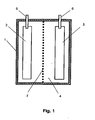
- the capacitor consists of a case 1, electrodes - 2 and 3, an electrolyte 4, lead terminals - 5 and 6, a separator 7, as illustrated in Fig. 1 .
- a positive electrode is performed by an electrode 11.
- Any of said redox polymers 13 having group LiO- or -COOLi as R can be deposited onto a conducting substrate 12, while the function of a negative electrode is performed by a lithium electrode 14 in which metal lithium 16 is implanted in a carbon base 15.
- the device is filled with an electrolyte containing one of the above-described lithium salts as a compound used for the creation of ionic conductivity of the electrolyte.
- the salt of the electrolyte is schematically shown in the form of lithium cations 17 and anions 18.
- positive and negative potentials are supplied to positive electrode 11 and negative electrode 14; respectively.
- the range of positive potentials may be from 0.85 V to 1.3 V
- the range of negative potentials may be from-2.7 V to -3.5 V.
- the design of the electrochemical energy-storage device described in the example with a graphite (lithium) negative electrode is advantageously different from the known lithium-ion batteries, because it has a higher energy capacity, which is achieved due to the higher potentials of the positive electrode (1.1 V- 1.3 V as compared to 0.4 V - 0.6 V) and a higher power.
- the latter is achieved due to the fact that the redox polymer may be reduction in the course of discharging at a rate which is many times higher than the rate of reduction of the positive electrode of lithium-ion batteries.
- This device also has a lower cost, since the electrode based on a less expensive redox polymer is employed instead of the expensive electrode based on the oxides of metals.
Landscapes
- Chemical & Material Sciences (AREA)
- Engineering & Computer Science (AREA)
- Chemical Kinetics & Catalysis (AREA)
- Electrochemistry (AREA)
- General Chemical & Material Sciences (AREA)
- Power Engineering (AREA)
- Materials Engineering (AREA)
- Microelectronics & Electronic Packaging (AREA)
- Composite Materials (AREA)
- Electric Double-Layer Capacitors Or The Like (AREA)
- Secondary Cells (AREA)
- Battery Electrode And Active Subsutance (AREA)
Claims (20)
- Elektrode, die ein elektrisch leitendes Substrat, eine Schicht von Energie akkurriulierendem Redoxpolymer, das auf dem Substrat abgelagert ist, aufweist, wobei das Redoxpolymer ein Polymer-Metall-Komplex mit einer substituierten tetradentaten Schiffschen Base ist, die ausgewählt ist aus der Gruppe: poly-[Me(R,R'-Y)],
wobei Me ein Übergangsmetall ist;
Y eine Brückengruppe ist, die die Stickstoff-Stome in der Schiffschen Base bindet;
R ein elektronenabgebender Substituent ist, der eine funktionelle Gruppe (X)O-, - COO(X) aufweist, wobei (X) ein Alkalimetall ist; R' Wasserstoff oder Halogen ist; und
wobei
der Polymer-Metall-Komplex die folgende Struktur aufweist:
- Elektrode nach Anspruch 1, wobei das Alkalimetall Li oder Na ist.
- Elektrode nach Anspruch 2, wobei die Brückengruppe Y, die die Stickstoffatome in der Schiffschen Base bindet, Salen aufweist, das ein Rest von Bis(Salicylaldehyd)-ethylendiamin ist.
- Elektrode nach Anspruch 2, wobei Saltmen, das ein Rest von Bis(salicylaldehyd)-tetramethylethylendiamin ist, als die Bürckengruppe Y verwendet wird, die die Stickstoffatome in der Schiffschen Base bindet.
- Elektrode nach Anspruch 2, wobei der Polymer-Metall-Komplex ein Übergangsmetall aufweist, das ausgewählt ist aus der Gruppe bestehend aus Ni, Pd, Co, Cu und Fe.
- Elektrode nach Anspruch 2, wobei das leitende Substrat aus Kohlenstofffaser oder Metall hergestellt ist und eine komplexe Relief-Oberfläche aufweist.
- Elektrode nach Anspruch 2, wobei das leitende Substrat aus Kohlenstoff hergestellt ist und einen Metallüberzug aufweist.
- Elektrode nach Anspruch 2, wobei das leitende Substrat aus einem Polymer mit einer elektronischen Leitung, die als ein Film, eine poröse Struktur oder ein Schaum ausgebildet ist, hergestellt ist.
- Elektrochemischer Kondensator, welcher ein Gehäuse, das eine positive Elektrode aufnimmt und eine negative Elektrode, die innerhalb des Gehäuses angeordnet ist, und einen Elektrolyten aufweist, der den Raum zwischen den Elektroden füllt, wobei die positive Elektrode eine Elektrode nach einem der Ansprüche 1 bis 8 ist.
- Kondensator nach Anspruch 9, wobei die negative Elektrode ein aktives Material aufweist, das das selbe Alkalimetall enthält, das in der Zusammensetzung des elektronenabgebenden Substituenten des Redoxpolymers der positiven Elektrode enthalten ist.
- Kondensator nach Anspruch 9, wobei die negative Elektrode ein elektrisch leitendes Substrat, eine Schicht von Energie akkumulierendem Redoxpolymer, das auf dem Substrat abgelagert ist, aufweist, wobei das Redoxpolymer ein Polymer-Metall-Komplex mit einer substituierten tetradentaten Schiffschen Base aufweist, die ausgewählt ist aus der Gruppe: poly-[Me(R,R'-Y)],
wobei Me ein Übergangsmetall ist;
Y eine Brückengruppe ist, die die Stickstoff-Atome in der Schiffschen Base bindet;
R ein elektronenabgebender Substituent ist, der eine funktionelle Gruppe (X)O-,-COO(X) aufweist, wobei (X) ein Alkalimetall ist, das in der Zusammensetzung des elektronenabgebenden Substituenten des Energie-Akkumulation Redoxpolymers der positiven Elektrode enthalten ist; R' Wasserstoff oder Halogen ist; und wobei
der Polymer-Metall-Komples die folgende Struktur aufweist:
- Kondensator nach Anspruch 9, wobei die negative Elektrode ein elektrisch leitendes Substrat und eine Schicht von Energie akkumulierendem Redoxpolymer, das auf dem Substrat abgelagert ist, aufweist, wobei das Redoxpolymer ein Polymer-Metall-Komplex mit einer substituierten tetradentaten Schiffschen Base ist, die ausgewählt ist aus der Gruppe: poly-[Me(R,R'-Y)],
wobei Me ein Übergangsmetall ist;
Y eine Brückengruppe ist, die die Stickstoff-Atome in der Schiffschen Base bindet;
R ein elektronenabgebender Substituent in der Form einer funktionellen Gruppe (X)O-,-COO(X) ist, wobei (X) ein Alkalimetall ist, das in der Zusammensetzung des elektronenabgebenden Substituenten des Energie-Akkumulation Redoxpolymers der positiven
Elektrode enthalten ist.;R'-H oder HIg ist,die Verbindung weiters die folgende Struktur aufweist: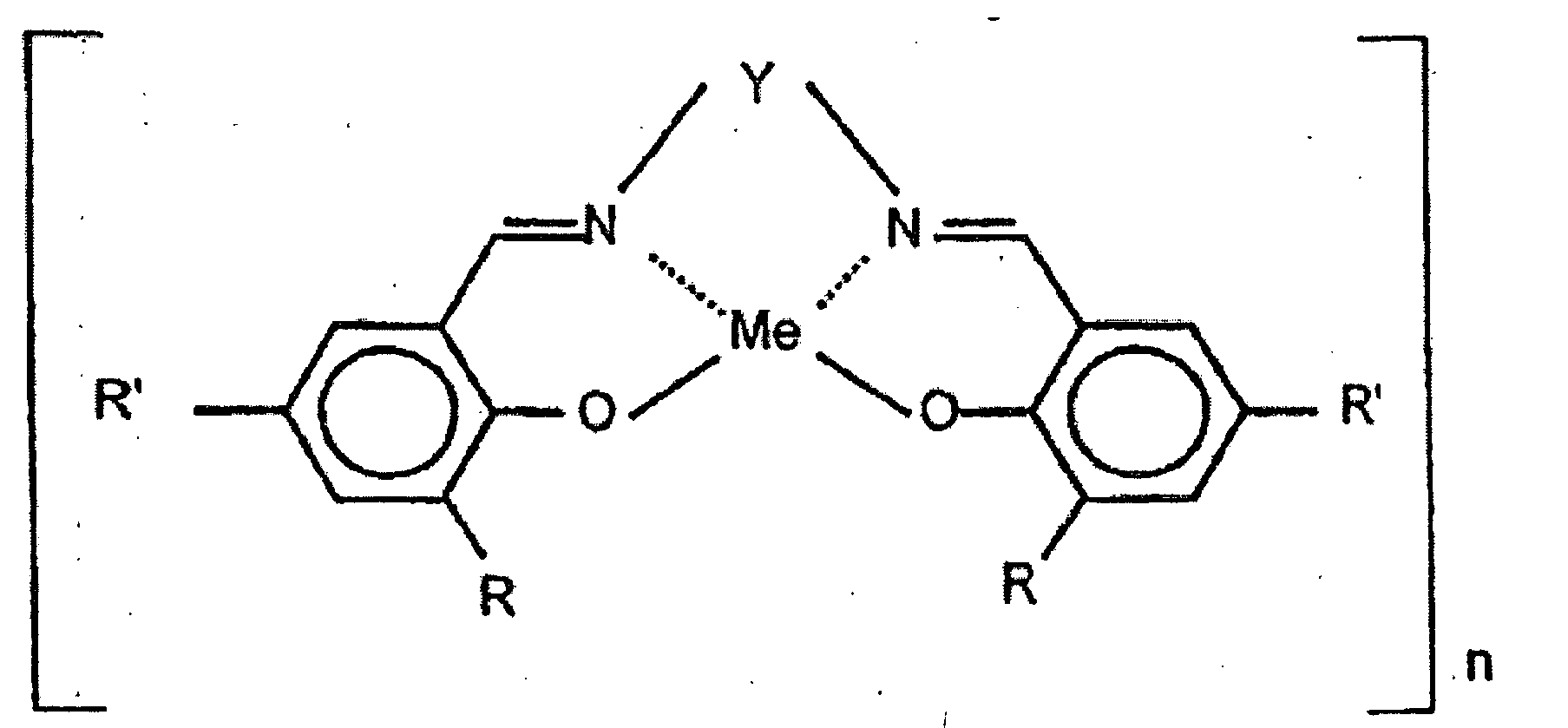
- Kondensator nach Anspruch 9, wobei der Elektrolyt eine Lösung einer Verbindung in einem organischen Lösungsmittel ist, welche Verbindung in dem Lösungsmittel auf eine Konzentration von nicht weniger als 0,01 mol/l löslich ist und welche Ionen enthält, die innerhalb des Potentialbereichs von -3,0 bis +1,5 V inaktiv sind.
- Kondensator nach Anspruch 13, wobei die Verbindung ein Salz des in dem elektronenabgebenden Substituenten des Energie-akkumulierenden Redoxpolymers der positiven Elektrode enthaltenden Alkalimetall ist, wobei das Salz des Alkalimetalls ausgewählt ist aus der Gruppe bestehend aus Perchloraten, Tetrafluorboraten und Hexafluorphosphaten.
- Kondensator nach Anspruch 13, wobei das organische Lösungsmittel ausgewählt ist aus der Gruppe bestehend aus Acetonitril, Dimethylketon, und Propylencarbonat.
- Kondensator nach Anspruch 9, wobei der Elektrolyt einen Stabilisator aufweist.
- Kondensator nach Anspruch 9, wobei der Elektrolyt ein Verdickungsmittel für das Überführen des Elektrolyten in einen gelartigen Zustand aufweist.
- Kondensator nach Anspruch 9, welcher weiters einen Separator aufweist, der zwischen den Elektroden angeordnet ist und einen internen Raum des Kondensators in einen Kathoden- und einen Anodenraum teilt.
- Kondensator nach Anspruch 9, wobei das Gehäuse aus einem Material hergestellt ist, das gegenüber der Wirkung des Elektrolyten resistent ist.
- Kondensator nach Anspruch 9, welcher weiters eine Vorrichtung zum Schütten eines Elektrolyten, ein Sicherheitsventil und ein Befestigungselement aufweist, das an dem Gehäuse des Kondensators befestigt ist.
Priority Applications (1)
| Application Number | Priority Date | Filing Date | Title |
|---|---|---|---|
| PL04770253T PL1678728T3 (pl) | 2003-10-14 | 2004-10-14 | Elektroda do urządzeń magazynujących energię i superkondensator elektrochemiczny na bazie tej elektrody |
Applications Claiming Priority (2)
| Application Number | Priority Date | Filing Date | Title |
|---|---|---|---|
| US51083803P | 2003-10-14 | 2003-10-14 | |
| PCT/IB2004/052091 WO2005036572A1 (en) | 2003-10-14 | 2004-10-14 | Electrode for energy storage devices and electrochemical supercapacitor based on said electrode |
Publications (2)
| Publication Number | Publication Date |
|---|---|
| EP1678728A1 EP1678728A1 (de) | 2006-07-12 |
| EP1678728B1 true EP1678728B1 (de) | 2009-08-19 |
Family
ID=34435132
Family Applications (1)
| Application Number | Title | Priority Date | Filing Date |
|---|---|---|---|
| EP04770253A Expired - Lifetime EP1678728B1 (de) | 2003-10-14 | 2004-10-14 | Elektrode für energiespeichereinrichtungen und auf der elektrode basierender elektrochemischer superkondensator |
Country Status (11)
| Country | Link |
|---|---|
| US (1) | US7382603B2 (de) |
| EP (1) | EP1678728B1 (de) |
| JP (1) | JP4551897B2 (de) |
| KR (1) | KR101087212B1 (de) |
| AT (1) | ATE440372T1 (de) |
| DE (1) | DE602004022693D1 (de) |
| DK (1) | DK1678728T3 (de) |
| ES (1) | ES2332138T3 (de) |
| PL (1) | PL1678728T3 (de) |
| PT (1) | PT1678728E (de) |
| WO (1) | WO2005036572A1 (de) |
Families Citing this family (32)
| Publication number | Priority date | Publication date | Assignee | Title |
|---|---|---|---|---|
| CA2501562A1 (en) * | 2002-10-07 | 2004-04-15 | Alexander Lyubomirskiy | Method of manufacture of an electrode for electrochemical devices |
| JP2008546210A (ja) * | 2005-06-10 | 2008-12-18 | 日本ケミコン株式会社 | 電気化学素子用電極の製造方法及びそれを有する電気化学素子の製造方法 |
| CA2647744A1 (en) * | 2006-03-24 | 2007-10-04 | Gen 3 Partners, Inc. | Method for manufacturing an energy storage device |
| EP2360758B1 (de) | 2006-04-07 | 2014-02-26 | Dow Global Technologies LLC | Wiederaufladbare elektrochemische lithiumzelle |
| JP5109323B2 (ja) * | 2006-09-29 | 2012-12-26 | 日本ケミコン株式会社 | 電気化学素子用電極及びその製造方法、並びに電気化学素子 |
| JP5151108B2 (ja) * | 2006-09-29 | 2013-02-27 | 日本ケミコン株式会社 | 電極活物質 |
| JP4797942B2 (ja) * | 2006-11-08 | 2011-10-19 | トヨタ自動車株式会社 | 蓄電装置とその使用方法 |
| JP2008185989A (ja) * | 2007-01-31 | 2008-08-14 | Ricoh Co Ltd | 画像形成装置 |
| CN101251505B (zh) * | 2008-04-03 | 2010-12-08 | 桂林工学院 | 一种席夫碱配合物修饰碳糊电极的制备方法 |
| US8699207B2 (en) * | 2008-10-21 | 2014-04-15 | Brookhaven Science Associates, Llc | Electrodes synthesized from carbon nanostructures coated with a smooth and conformal metal adlayer |
| WO2011060023A2 (en) | 2009-11-11 | 2011-05-19 | Amprius Inc. | Preloading lithium ion cell components with lithium |
| CN102754246A (zh) * | 2010-01-11 | 2012-10-24 | 安普雷斯股份有限公司 | 可变容量电池组件 |
| US8760846B1 (en) * | 2010-04-16 | 2014-06-24 | GranBlueTech, L.L.C. | Apparatus and method for capacitors having engineered electrodes with very high energy density |
| JP5954179B2 (ja) * | 2010-10-21 | 2016-07-20 | 株式会社豊田中央研究所 | 非水系二次電池用電極、それを備えた非水系二次電池及び組電池 |
| JP5348170B2 (ja) | 2011-04-08 | 2013-11-20 | 株式会社豊田中央研究所 | リチウム二次電池用負極及びリチウム二次電池 |
| US20120313586A1 (en) * | 2011-06-09 | 2012-12-13 | Fastcap Systems Corporation | Automotive electrified drive train systems with high temperature rechargeable energy storage device |
| KR20140057241A (ko) * | 2011-07-11 | 2014-05-12 | 가부시키가이샤 아이에이치아이 | 전기 2중층 커패시터용 재료 |
| JP5897971B2 (ja) | 2012-04-20 | 2016-04-06 | 株式会社豊田中央研究所 | 電極活物質、非水系二次電池用電極、非水系二次電池及び非水系二次電池用電極の製造方法 |
| USD758328S1 (en) * | 2012-12-18 | 2016-06-07 | Jm Energy Corporation | Lithium ion capacitor |
| US10050319B2 (en) * | 2014-05-28 | 2018-08-14 | John M. Guerra | Photoelectrochemical secondary cell and battery |
| EP3157079B1 (de) * | 2014-06-13 | 2018-10-17 | LG Chem, Ltd. | Lithiumelektrode und lithiumbatterie damit |
| US10312502B2 (en) | 2014-06-13 | 2019-06-04 | Lg Chem, Ltd. | Lithium electrode and lithium secondary battery comprising same |
| RU2675582C2 (ru) * | 2014-08-19 | 2018-12-19 | Пауэрмерс Инк. | Способ производства пористых металлоуглеродных материалов |
| WO2016044857A1 (en) * | 2014-09-15 | 2016-03-24 | Powermers Inc. | Metal air energy storage device |
| JP6361599B2 (ja) * | 2015-07-07 | 2018-07-25 | 株式会社豊田中央研究所 | 蓄電デバイス |
| RU2618232C1 (ru) | 2015-12-28 | 2017-05-03 | Пауэрмерс Инк. | Катод для металло-воздушных источников тока и металло-воздушный источник тока, включающий этот катод |
| EP3282461B1 (de) | 2016-08-12 | 2020-05-06 | Commissariat à l'Energie Atomique et aux Energies Alternatives | Elektrode mit beschichtung aus redoxpolymeren mit dioneinheiten, herstellungsverfahren und verwendungen davon |
| WO2018135395A1 (ja) * | 2017-01-20 | 2018-07-26 | 富士フイルム株式会社 | 非水二次電池用電解液、非水二次電池及び金属錯体 |
| CN106971861B (zh) * | 2017-05-09 | 2019-03-29 | 北京科技大学 | 提高超级电容器用Schiff碱过渡金属聚合物电极比容量的方法 |
| JP6982244B2 (ja) * | 2018-05-18 | 2021-12-17 | 日本電信電話株式会社 | リチウム二次電池 |
| CN113354666B (zh) * | 2020-10-22 | 2023-05-26 | 湘潭大学 | 四种D-A’-(π-A)2型聚合水杨醛席夫碱衍生物合金属配合物及其制备方法与用途 |
| CN115528210B (zh) * | 2022-11-10 | 2025-03-04 | 湖北亿纬动力有限公司 | 一种锂硫电池正极及其制备方法和应用 |
Family Cites Families (17)
| Publication number | Priority date | Publication date | Assignee | Title |
|---|---|---|---|---|
| JPS59196566A (ja) * | 1983-04-22 | 1984-11-07 | Showa Denko Kk | 電池 |
| US4999263A (en) | 1987-04-15 | 1991-03-12 | Ricoh Company, Ltd. | Sheet-shaped electrode, method or producing the same, and secondary battery |
| JPH04147511A (ja) * | 1990-10-09 | 1992-05-21 | Fuji Photo Film Co Ltd | 新規電子伝導性高分子及びそれを用いた導電性材料 |
| US5543326A (en) | 1994-03-04 | 1996-08-06 | Heller; Adam | Biosensor including chemically modified enzymes |
| JPH08213052A (ja) | 1994-08-04 | 1996-08-20 | Seiko Instr Inc | 非水電解質二次電池 |
| US5840443A (en) | 1995-07-31 | 1998-11-24 | Midwest Research Institute | Redox polymer electrodes for advanced batteries |
| US5729427A (en) | 1997-01-08 | 1998-03-17 | Motorola, Inc. | Macrocyclic complex modified electrodes and capacitors made therefrom |
| US6323309B1 (en) | 1997-12-01 | 2001-11-27 | Massachusetts Institute Of Technology | Conducting polymer transition metal hybrid materials and sensors |
| US6413676B1 (en) | 1999-06-28 | 2002-07-02 | Lithium Power Technologies, Inc. | Lithium ion polymer electrolytes |
| US6294245B1 (en) | 1999-09-22 | 2001-09-25 | Agilent Technologies, Inc. | Method for depositing electrically conducting polymer films via electrochemical deposition of precursor polymers |
| IL137796A0 (en) | 2000-08-10 | 2001-10-31 | Elestor Ltd | All-solid-state polymer electrochemical capacitors |
| JP3746202B2 (ja) * | 2001-02-06 | 2006-02-15 | 住友電装株式会社 | 分割コネクタ |
| JP2003045415A (ja) | 2001-07-31 | 2003-02-14 | Nec Corp | 二次電池用負極 |
| CA2474484C (en) * | 2002-01-25 | 2013-03-26 | Powermers, Inc. | Polymer-modified electrode for energy storage devices and electrochemical supercapacitor based on said polymer-modified electrode |
| WO2004030123A1 (en) | 2002-09-25 | 2004-04-08 | Gen3 Partners, Inc. | Method for the manufacture of electrode for energy-storage devices |
| AU2003269306A1 (en) | 2002-10-03 | 2004-04-23 | Gen3 Partners, Inc | Electrochemical capacitor and method of use |
| CA2501562A1 (en) | 2002-10-07 | 2004-04-15 | Alexander Lyubomirskiy | Method of manufacture of an electrode for electrochemical devices |
-
2004
- 2004-10-14 PT PT04770253T patent/PT1678728E/pt unknown
- 2004-10-14 JP JP2006534897A patent/JP4551897B2/ja not_active Expired - Fee Related
- 2004-10-14 DE DE602004022693T patent/DE602004022693D1/de not_active Expired - Lifetime
- 2004-10-14 WO PCT/IB2004/052091 patent/WO2005036572A1/en not_active Ceased
- 2004-10-14 PL PL04770253T patent/PL1678728T3/pl unknown
- 2004-10-14 KR KR1020067007104A patent/KR101087212B1/ko not_active Expired - Fee Related
- 2004-10-14 AT AT04770253T patent/ATE440372T1/de not_active IP Right Cessation
- 2004-10-14 EP EP04770253A patent/EP1678728B1/de not_active Expired - Lifetime
- 2004-10-14 ES ES04770253T patent/ES2332138T3/es not_active Expired - Lifetime
- 2004-10-14 DK DK04770253T patent/DK1678728T3/da active
-
2006
- 2006-04-10 US US11/401,173 patent/US7382603B2/en not_active Expired - Lifetime
Also Published As
| Publication number | Publication date |
|---|---|
| JP4551897B2 (ja) | 2010-09-29 |
| DE602004022693D1 (de) | 2009-10-01 |
| ATE440372T1 (de) | 2009-09-15 |
| PL1678728T3 (pl) | 2010-01-29 |
| KR20070022630A (ko) | 2007-02-27 |
| DK1678728T3 (da) | 2009-12-14 |
| US20070065719A1 (en) | 2007-03-22 |
| JP2007508709A (ja) | 2007-04-05 |
| US7382603B2 (en) | 2008-06-03 |
| HK1097952A1 (en) | 2007-07-06 |
| ES2332138T3 (es) | 2010-01-27 |
| KR101087212B1 (ko) | 2011-11-29 |
| PT1678728E (pt) | 2009-11-24 |
| WO2005036572A1 (en) | 2005-04-21 |
| EP1678728A1 (de) | 2006-07-12 |
Similar Documents
| Publication | Publication Date | Title |
|---|---|---|
| EP1678728B1 (de) | Elektrode für energiespeichereinrichtungen und auf der elektrode basierender elektrochemischer superkondensator | |
| JP2007508709A5 (de) | ||
| US9548509B2 (en) | Polyoxometalate active charge-transfer material for mediated redox flow battery | |
| US6795293B2 (en) | Polymer-modified electrode for energy storage devices and electrochemical supercapacitor based on said polymer-modified electrode | |
| JP4047372B2 (ja) | 二次電池の製造方法および二次電池用正極活物質の調製方法 | |
| EP3439086B1 (de) | Wässrige sekundärbatterie | |
| US20120328935A1 (en) | Active material for rechargeable battery | |
| He et al. | The Key Role of Magnesium Polysulfides in the Development of Mg-S Batteries | |
| EP2424030A1 (de) | Elektrolyt und sekundärbatterie | |
| US9728344B2 (en) | Energy storage device including a redox-enhanced electrolyte | |
| WO2017115151A2 (ru) | Катод для металло-воздушных источников тока и металло-воздушный источник тока, включающий этот катод | |
| Yang et al. | Simultaneously regulating solvation structure and interphase by strong donor cosolvent for stable Zn-metal batteries | |
| US5383089A (en) | Mixed-valence complex electrodes for a rechargeable electrical energy storage device | |
| Lin et al. | Solid‐Electrolyte Interphase for Ultra‐Stable Aqueous Dual‐Ion Storage | |
| JP2025538289A (ja) | 静的電池用混合ポリハロゲン化物電解質および静的電池セルを製造するための方法 | |
| HK1097952B (en) | Electrode for energy storage devices and electrochemical supercapacitor based on said electrode | |
| Fu et al. | Bidentate Coordination by Graphene Oxide‐Enhanced γ‐Cyclodextrin for Synergistic Solvation and Stabilization of the Zn Anode | |
| CN106571487A (zh) | 电化学器件用电解液和使用该电解液的电化学器件 | |
| CN104272516B (zh) | 用于可再充电镁离子电池的铟-锡二元阳极 | |
| JP2024114498A (ja) | マグネシウムイオン二次電池用電解液およびマグネシウムイオン二次電池 | |
| Tran et al. | Highly Reversible Transition Metal Deposition and Oxidation on Symmetric RuO2 Electrodes for Battery Applications |
Legal Events
| Date | Code | Title | Description |
|---|---|---|---|
| PUAI | Public reference made under article 153(3) epc to a published international application that has entered the european phase |
Free format text: ORIGINAL CODE: 0009012 |
|
| 17P | Request for examination filed |
Effective date: 20060515 |
|
| AK | Designated contracting states |
Kind code of ref document: A1 Designated state(s): AT BE BG CH CY CZ DE DK EE ES FI FR GB GR HU IE IT LI LU MC NL PL PT RO SE SI SK TR |
|
| GRAP | Despatch of communication of intention to grant a patent |
Free format text: ORIGINAL CODE: EPIDOSNIGR1 |
|
| DAX | Request for extension of the european patent (deleted) | ||
| GRAS | Grant fee paid |
Free format text: ORIGINAL CODE: EPIDOSNIGR3 |
|
| REG | Reference to a national code |
Ref country code: HK Ref legal event code: DE Ref document number: 1097952 Country of ref document: HK |
|
| GRAA | (expected) grant |
Free format text: ORIGINAL CODE: 0009210 |
|
| AK | Designated contracting states |
Kind code of ref document: B1 Designated state(s): AT BE BG CH CY CZ DE DK EE ES FI FR GB GR HU IE IT LI LU MC NL PL PT RO SE SI SK TR |
|
| REG | Reference to a national code |
Ref country code: GB Ref legal event code: FG4D |
|
| REG | Reference to a national code |
Ref country code: CH Ref legal event code: EP |
|
| REG | Reference to a national code |
Ref country code: IE Ref legal event code: FG4D |
|
| REF | Corresponds to: |
Ref document number: 602004022693 Country of ref document: DE Date of ref document: 20091001 Kind code of ref document: P |
|
| REG | Reference to a national code |
Ref country code: CH Ref legal event code: NV Representative=s name: KIRKER & CIE S.A. |
|
| REG | Reference to a national code |
Ref country code: RO Ref legal event code: EPE |
|
| REG | Reference to a national code |
Ref country code: PT Ref legal event code: SC4A Free format text: AVAILABILITY OF NATIONAL TRANSLATION Effective date: 20091118 |
|
| REG | Reference to a national code |
Ref country code: SE Ref legal event code: TRGR |
|
| REG | Reference to a national code |
Ref country code: DK Ref legal event code: T3 |
|
| REG | Reference to a national code |
Ref country code: ES Ref legal event code: FG2A Ref document number: 2332138 Country of ref document: ES Kind code of ref document: T3 |
|
| PGFP | Annual fee paid to national office [announced via postgrant information from national office to epo] |
Ref country code: AT Payment date: 20091201 Year of fee payment: 6 Ref country code: DK Payment date: 20091127 Year of fee payment: 6 Ref country code: EE Payment date: 20091130 Year of fee payment: 6 Ref country code: HU Payment date: 20091203 Year of fee payment: 6 Ref country code: LU Payment date: 20091207 Year of fee payment: 6 Ref country code: TR Payment date: 20091202 Year of fee payment: 6 |
|
| REG | Reference to a national code |
Ref country code: PL Ref legal event code: T3 |
|
| PG25 | Lapsed in a contracting state [announced via postgrant information from national office to epo] |
Ref country code: SI Free format text: LAPSE BECAUSE OF FAILURE TO SUBMIT A TRANSLATION OF THE DESCRIPTION OR TO PAY THE FEE WITHIN THE PRESCRIBED TIME-LIMIT Effective date: 20090819 |
|
| PGFP | Annual fee paid to national office [announced via postgrant information from national office to epo] |
Ref country code: PL Payment date: 20091207 Year of fee payment: 6 |
|
| REG | Reference to a national code |
Ref country code: SK Ref legal event code: T3 Ref document number: E 6349 Country of ref document: SK |
|
| REG | Reference to a national code |
Ref country code: HU Ref legal event code: AG4A Ref document number: E006864 Country of ref document: HU |
|
| PG25 | Lapsed in a contracting state [announced via postgrant information from national office to epo] |
Ref country code: CY Free format text: LAPSE BECAUSE OF FAILURE TO SUBMIT A TRANSLATION OF THE DESCRIPTION OR TO PAY THE FEE WITHIN THE PRESCRIBED TIME-LIMIT Effective date: 20090819 Ref country code: BG Free format text: LAPSE BECAUSE OF FAILURE TO SUBMIT A TRANSLATION OF THE DESCRIPTION OR TO PAY THE FEE WITHIN THE PRESCRIBED TIME-LIMIT Effective date: 20091119 |
|
| PGFP | Annual fee paid to national office [announced via postgrant information from national office to epo] |
Ref country code: RO Payment date: 20091119 Year of fee payment: 6 |
|
| REG | Reference to a national code |
Ref country code: HK Ref legal event code: GR Ref document number: 1097952 Country of ref document: HK |
|
| PG25 | Lapsed in a contracting state [announced via postgrant information from national office to epo] |
Ref country code: MC Free format text: LAPSE BECAUSE OF NON-PAYMENT OF DUE FEES Effective date: 20091031 |
|
| PLBE | No opposition filed within time limit |
Free format text: ORIGINAL CODE: 0009261 |
|
| STAA | Information on the status of an ep patent application or granted ep patent |
Free format text: STATUS: NO OPPOSITION FILED WITHIN TIME LIMIT |
|
| PGFP | Annual fee paid to national office [announced via postgrant information from national office to epo] |
Ref country code: BE Payment date: 20091127 Year of fee payment: 6 |
|
| 26N | No opposition filed |
Effective date: 20100520 |
|
| PG25 | Lapsed in a contracting state [announced via postgrant information from national office to epo] |
Ref country code: GR Free format text: LAPSE BECAUSE OF FAILURE TO SUBMIT A TRANSLATION OF THE DESCRIPTION OR TO PAY THE FEE WITHIN THE PRESCRIBED TIME-LIMIT Effective date: 20091120 |
|
| PGFP | Annual fee paid to national office [announced via postgrant information from national office to epo] |
Ref country code: PT Payment date: 20100715 Year of fee payment: 6 |
|
| BERE | Be: lapsed |
Owner name: GEN3 PARTNERS, INC. Effective date: 20101031 |
|
| REG | Reference to a national code |
Ref country code: DK Ref legal event code: EBP |
|
| REG | Reference to a national code |
Ref country code: EE Ref legal event code: MM4A Ref document number: E003896 Country of ref document: EE Effective date: 20101031 |
|
| REG | Reference to a national code |
Ref country code: PT Ref legal event code: MM4A Free format text: LAPSE DUE TO NON-PAYMENT OF FEES Effective date: 20110714 |
|
| PG25 | Lapsed in a contracting state [announced via postgrant information from national office to epo] |
Ref country code: HU Free format text: LAPSE BECAUSE OF NON-PAYMENT OF DUE FEES Effective date: 20101015 Ref country code: EE Free format text: LAPSE BECAUSE OF NON-PAYMENT OF DUE FEES Effective date: 20101031 |
|
| PG25 | Lapsed in a contracting state [announced via postgrant information from national office to epo] |
Ref country code: BE Free format text: LAPSE BECAUSE OF NON-PAYMENT OF DUE FEES Effective date: 20101031 Ref country code: AT Free format text: LAPSE BECAUSE OF NON-PAYMENT OF DUE FEES Effective date: 20101014 |
|
| PG25 | Lapsed in a contracting state [announced via postgrant information from national office to epo] |
Ref country code: PT Free format text: LAPSE BECAUSE OF NON-PAYMENT OF DUE FEES Effective date: 20110714 Ref country code: DK Free format text: LAPSE BECAUSE OF NON-PAYMENT OF DUE FEES Effective date: 20101031 |
|
| PG25 | Lapsed in a contracting state [announced via postgrant information from national office to epo] |
Ref country code: RO Free format text: LAPSE BECAUSE OF NON-PAYMENT OF DUE FEES Effective date: 20101014 |
|
| PG25 | Lapsed in a contracting state [announced via postgrant information from national office to epo] |
Ref country code: PL Free format text: LAPSE BECAUSE OF NON-PAYMENT OF DUE FEES Effective date: 20101014 |
|
| REG | Reference to a national code |
Ref country code: PL Ref legal event code: LAPE |
|
| PG25 | Lapsed in a contracting state [announced via postgrant information from national office to epo] |
Ref country code: LU Free format text: LAPSE BECAUSE OF NON-PAYMENT OF DUE FEES Effective date: 20101014 |
|
| PG25 | Lapsed in a contracting state [announced via postgrant information from national office to epo] |
Ref country code: TR Free format text: LAPSE BECAUSE OF NON-PAYMENT OF DUE FEES Effective date: 20101014 |
|
| REG | Reference to a national code |
Ref country code: FR Ref legal event code: PLFP Year of fee payment: 12 |
|
| REG | Reference to a national code |
Ref country code: GB Ref legal event code: 732E Free format text: REGISTERED BETWEEN 20150820 AND 20150826 |
|
| REG | Reference to a national code |
Ref country code: ES Ref legal event code: PC2A Owner name: POWERMERS, INC. Effective date: 20151002 |
|
| REG | Reference to a national code |
Ref country code: FR Ref legal event code: TP Owner name: POWERMERS, INC, US Effective date: 20151125 |
|
| REG | Reference to a national code |
Ref country code: NL Ref legal event code: PD Owner name: POWERMERS, INC.; US Free format text: DETAILS ASSIGNMENT: VERANDERING VAN EIGENAAR(S), OVERDRACHT; FORMER OWNER NAME: GEN3 PARTNERS, INC. Effective date: 20150907 |
|
| REG | Reference to a national code |
Ref country code: FR Ref legal event code: PLFP Year of fee payment: 13 |
|
| REG | Reference to a national code |
Ref country code: FR Ref legal event code: PLFP Year of fee payment: 14 |
|
| REG | Reference to a national code |
Ref country code: FR Ref legal event code: PLFP Year of fee payment: 15 |
|
| PGFP | Annual fee paid to national office [announced via postgrant information from national office to epo] |
Ref country code: FR Payment date: 20180913 Year of fee payment: 15 |
|
| PGFP | Annual fee paid to national office [announced via postgrant information from national office to epo] |
Ref country code: SK Payment date: 20180917 Year of fee payment: 15 |
|
| PGFP | Annual fee paid to national office [announced via postgrant information from national office to epo] |
Ref country code: NL Payment date: 20181017 Year of fee payment: 15 |
|
| PGFP | Annual fee paid to national office [announced via postgrant information from national office to epo] |
Ref country code: SE Payment date: 20181011 Year of fee payment: 15 Ref country code: IE Payment date: 20181009 Year of fee payment: 15 Ref country code: FI Payment date: 20181009 Year of fee payment: 15 Ref country code: CZ Payment date: 20180927 Year of fee payment: 15 Ref country code: DE Payment date: 20181002 Year of fee payment: 15 |
|
| PGFP | Annual fee paid to national office [announced via postgrant information from national office to epo] |
Ref country code: ES Payment date: 20181102 Year of fee payment: 15 Ref country code: CH Payment date: 20181015 Year of fee payment: 15 Ref country code: IT Payment date: 20181018 Year of fee payment: 15 |
|
| REG | Reference to a national code |
Ref country code: DE Ref legal event code: R119 Ref document number: 602004022693 Country of ref document: DE |
|
| REG | Reference to a national code |
Ref country code: FI Ref legal event code: MAE |
|
| REG | Reference to a national code |
Ref country code: CH Ref legal event code: PL |
|
| REG | Reference to a national code |
Ref country code: NL Ref legal event code: MM Effective date: 20191101 |
|
| REG | Reference to a national code |
Ref country code: SK Ref legal event code: MM4A Ref document number: E 6349 Country of ref document: SK Effective date: 20191014 |
|
| PG25 | Lapsed in a contracting state [announced via postgrant information from national office to epo] |
Ref country code: FI Free format text: LAPSE BECAUSE OF NON-PAYMENT OF DUE FEES Effective date: 20191014 Ref country code: CZ Free format text: LAPSE BECAUSE OF NON-PAYMENT OF DUE FEES Effective date: 20191014 Ref country code: DE Free format text: LAPSE BECAUSE OF NON-PAYMENT OF DUE FEES Effective date: 20200501 Ref country code: CH Free format text: LAPSE BECAUSE OF NON-PAYMENT OF DUE FEES Effective date: 20191031 Ref country code: LI Free format text: LAPSE BECAUSE OF NON-PAYMENT OF DUE FEES Effective date: 20191031 |
|
| PG25 | Lapsed in a contracting state [announced via postgrant information from national office to epo] |
Ref country code: NL Free format text: LAPSE BECAUSE OF NON-PAYMENT OF DUE FEES Effective date: 20191101 Ref country code: SK Free format text: LAPSE BECAUSE OF NON-PAYMENT OF DUE FEES Effective date: 20191014 Ref country code: SE Free format text: LAPSE BECAUSE OF NON-PAYMENT OF DUE FEES Effective date: 20191015 |
|
| GBPC | Gb: european patent ceased through non-payment of renewal fee |
Effective date: 20191014 |
|
| PG25 | Lapsed in a contracting state [announced via postgrant information from national office to epo] |
Ref country code: IE Free format text: LAPSE BECAUSE OF NON-PAYMENT OF DUE FEES Effective date: 20191014 Ref country code: IT Free format text: LAPSE BECAUSE OF NON-PAYMENT OF DUE FEES Effective date: 20191014 Ref country code: FR Free format text: LAPSE BECAUSE OF NON-PAYMENT OF DUE FEES Effective date: 20191031 Ref country code: GB Free format text: LAPSE BECAUSE OF NON-PAYMENT OF DUE FEES Effective date: 20191014 |
|
| REG | Reference to a national code |
Ref country code: ES Ref legal event code: FD2A Effective date: 20210301 |
|
| REG | Reference to a national code |
Ref country code: GB Ref legal event code: S28 Free format text: APPLICATION FILED |
|
| PG25 | Lapsed in a contracting state [announced via postgrant information from national office to epo] |
Ref country code: ES Free format text: LAPSE BECAUSE OF NON-PAYMENT OF DUE FEES Effective date: 20191015 |
|
| REG | Reference to a national code |
Ref country code: GB Ref legal event code: S28 Free format text: RESTORATION ALLOWED Effective date: 20210802 |
|
| PGFP | Annual fee paid to national office [announced via postgrant information from national office to epo] |
Ref country code: GB Payment date: 20210802 Year of fee payment: 18 |
|
| GBPC | Gb: european patent ceased through non-payment of renewal fee |
Effective date: 20221014 |
|
| PG25 | Lapsed in a contracting state [announced via postgrant information from national office to epo] |
Ref country code: GB Free format text: LAPSE BECAUSE OF NON-PAYMENT OF DUE FEES Effective date: 20221014 |