EP1623637A1 - Kleider - Google Patents
Kleider Download PDFInfo
- Publication number
- EP1623637A1 EP1623637A1 EP04729531A EP04729531A EP1623637A1 EP 1623637 A1 EP1623637 A1 EP 1623637A1 EP 04729531 A EP04729531 A EP 04729531A EP 04729531 A EP04729531 A EP 04729531A EP 1623637 A1 EP1623637 A1 EP 1623637A1
- Authority
- EP
- European Patent Office
- Prior art keywords
- elastic yarn
- edge
- piece
- garment
- cut
- Prior art date
- Legal status (The legal status is an assumption and is not a legal conclusion. Google has not performed a legal analysis and makes no representation as to the accuracy of the status listed.)
- Granted
Links
- 239000004744 fabric Substances 0.000 claims abstract description 480
- 238000009940 knitting Methods 0.000 claims abstract description 195
- 229920000742 Cotton Polymers 0.000 claims description 56
- 239000000463 material Substances 0.000 claims description 51
- 238000003287 bathing Methods 0.000 claims description 9
- 230000007704 transition Effects 0.000 claims description 2
- 229920001971 elastomer Polymers 0.000 description 37
- 210000001015 abdomen Anatomy 0.000 description 36
- 229920002635 polyurethane Polymers 0.000 description 35
- 239000004814 polyurethane Substances 0.000 description 35
- 239000004677 Nylon Substances 0.000 description 30
- 229920001778 nylon Polymers 0.000 description 30
- 239000011347 resin Substances 0.000 description 22
- 229920005989 resin Polymers 0.000 description 22
- 238000000034 method Methods 0.000 description 13
- 238000009958 sewing Methods 0.000 description 11
- 238000010586 diagram Methods 0.000 description 10
- 230000000694 effects Effects 0.000 description 10
- 238000010030 laminating Methods 0.000 description 10
- 238000010521 absorption reaction Methods 0.000 description 7
- 210000000481 breast Anatomy 0.000 description 7
- 238000006073 displacement reaction Methods 0.000 description 7
- 230000008569 process Effects 0.000 description 7
- 210000004243 sweat Anatomy 0.000 description 7
- 229920000728 polyester Polymers 0.000 description 6
- 239000000853 adhesive Substances 0.000 description 4
- 230000001070 adhesive effect Effects 0.000 description 4
- 238000009998 heat setting Methods 0.000 description 3
- 230000001788 irregular Effects 0.000 description 3
- 238000007493 shaping process Methods 0.000 description 3
- 230000008859 change Effects 0.000 description 2
- 238000007796 conventional method Methods 0.000 description 2
- 238000009957 hemming Methods 0.000 description 2
- 239000010410 layer Substances 0.000 description 2
- 230000007246 mechanism Effects 0.000 description 2
- 229920002994 synthetic fiber Polymers 0.000 description 2
- 239000012209 synthetic fiber Substances 0.000 description 2
- 239000002699 waste material Substances 0.000 description 2
- 229920000297 Rayon Polymers 0.000 description 1
- 230000001154 acute effect Effects 0.000 description 1
- 238000013459 approach Methods 0.000 description 1
- 230000015572 biosynthetic process Effects 0.000 description 1
- 229920002678 cellulose Polymers 0.000 description 1
- 239000001913 cellulose Substances 0.000 description 1
- 230000003247 decreasing effect Effects 0.000 description 1
- 230000002349 favourable effect Effects 0.000 description 1
- 239000000835 fiber Substances 0.000 description 1
- 239000002648 laminated material Substances 0.000 description 1
- 230000035699 permeability Effects 0.000 description 1
- 230000000704 physical effect Effects 0.000 description 1
- 230000002265 prevention Effects 0.000 description 1
- 239000002964 rayon Substances 0.000 description 1
- 238000007665 sagging Methods 0.000 description 1
- 239000002356 single layer Substances 0.000 description 1
- 230000000087 stabilizing effect Effects 0.000 description 1
- XLYOFNOQVPJJNP-UHFFFAOYSA-N water Substances O XLYOFNOQVPJJNP-UHFFFAOYSA-N 0.000 description 1
Images









Classifications
-
- D—TEXTILES; PAPER
- D04—BRAIDING; LACE-MAKING; KNITTING; TRIMMINGS; NON-WOVEN FABRICS
- D04B—KNITTING
- D04B21/00—Warp knitting processes for the production of fabrics or articles not dependent on the use of particular machines; Fabrics or articles defined by such processes
- D04B21/14—Fabrics characterised by the incorporation by knitting, in one or more thread, fleece, or fabric layers, of reinforcing, binding, or decorative threads; Fabrics incorporating small auxiliary elements, e.g. for decorative purposes
- D04B21/18—Fabrics characterised by the incorporation by knitting, in one or more thread, fleece, or fabric layers, of reinforcing, binding, or decorative threads; Fabrics incorporating small auxiliary elements, e.g. for decorative purposes incorporating elastic threads
Definitions
- the present invention relates to garments having an edge that does not require hem finishing when left as cut.
- edges for example a the bottom part of a garment
- edges tend to be frayed if left as cut, so that some sort of hem finishing is necessary in order to prevent fraying.
- Such finishing, or hem finishing is referred to as hemming, and there are various hemming methods, depending on position and material.
- hem finishing is ordinarily performed by folding over a cloth edge and sewing the two layers together, or another cloth or tape-like member is formed to a substantially U-shaped cross-section and put over the edge portion of the fabric, and they are sewed together.
- this operation causes a considerable burden in the sewing of garments.
- the lines at the upper and lower edge portions of the piece must be parallel, and there was the restriction that if a piece in which the lines of the upper and lower edge portions are not parallel is used for garments, then at least one side must be hem finished.
- garments have come to be used, which use a piece made of a fabric not requiring hem finishing for at least a portion of the fabric constituting the garment, such that, for example in a girdle or the like having for example a bottom line not requiring hem finishing, the edge portion of the fabric not requiring hem finishing serves as the bottom portion of the girdle.
- the edge portion of the fabric not requiring hem finishing serves as the bottom portion of the girdle.
- curling occurs at the edge portion, so that the edge portion fits the body poorly.
- Patent Document 1 JP 2000-303331A
- Patent Document 2 Japanese Patent 2997432
- Patent Document 3 Japanese Patent 3054384
- a garment according to the present invention is made including a piece of a stretchable warp-knitted fabric, comprising at least a non-elastic yarn arranged in a 1 ⁇ 1 tricot structure and an elastic yarn arranged in a looping structure, the piece being cut at an angle of at least 3° and at most 177° with respect to a knitting direction, the piece having an edge that does not require hem finishing when left as cut, so that at least one of the edge portions of the garment is formed by an edge that does not require hem finishing when left as cut.
- the edge that does not require hem finishing when left as cut is not an edge that does not require hem finishing formed by a method such as the above-described pulling out of yarn, but an edge that is left as cut, using a warp-knitted fabric whose edge does not require hem finishing when left as cut.
- a stretchable tricot knitted fabric may be used, including at least a non-elastic yarn arranged in a 1 ⁇ 1 tricot structure and an elastic yarn arranged in a looping structure.
- the elastic yarn arranged in a looping structure like a stretchable tricot, it may also have a structure other than a 1 ⁇ 1 structure (Denbigh structure), such as a half structure or an atlas structure, is also possible.
- fabrics having the following knitting structure can be used, but there is no limitation to the following, and as long as it is a fabric whose cut end (edge that is left as cut) becomes an edge that does not fray and does not require hem finishing, then the use of fabrics a knitting structure other than those specifically described herein also falls within the scope of the invention.
- a knitted fabric constituting a piece that is used for the present invention and that has an edge not requiring hem finishing when left as cut is for example (1) a stretchable warp-knit fabric with a 1 ⁇ 1 tricot structure in which a non-elastic yarn and a elastic yarn run in the same direction, and both the elastic yarn and the non-elastic yarn form open loops at each of the knitting stitches.
- a non-elastic yarn and an elastic yarn for the knitting yarn provides appropriate stretchability.
- a non-elastic yarn and an elastic yarn for the knitting yarn provides appropriate stretchability
- the knitted fabric of the piece (3) a fabric in which the non-elastic yarn is arranged in a 1 ⁇ 1 tricot structure (Denbigh structure) and the elastic yarn is arranged in a half structure.
- the knitted fabric of the piece (4) a fabric in which the non-elastic yarn is arranged in a 1x1 tricot structure and the elastic yarn is arranged in an atlas structure.
- the elastic yarn and the non-elastic yarn forms closed loops.
- the prevention of fraying of the edges that are left as cut is favorable, and is thus even more preferable.
- cotton yarn is used as the non-elastic yarn in this manner, then it is preferable that at least one of the non-elastic yarn and the elastic yarn forms closed loops, and it is even more preferable to use a warp-knitted fabric in which both the non-elastic yarn and the elastic yarn form closed loops, because this prevents the fraying of the edges that are left as cut even more effectively.
- the knitted fabric of the piece having an edge that does not fray easily when left as cut that is used for the present invention it is possible to use a knitted fabric with a specific knitting structure combining an non-elastic yarn and an elastic yarn as described above, and assuming that this knitted fabric is called "base knit,” then it is possible to form a suitable Jacquard pattern, such as a small pattern, by knitting a non-elastic yarn serving as the pattern yarn by Jacquard control.
- pattern yarn If the non-elastic yarn for forming the pattern that is knitted by Jacquard control is referred to as "pattern yarn,” then it is possible to form a Jacquard pattern or the like on a portion where a pattern is to be formed, by knitting the pattern yarn to a structure that is different from the knitting structure of the base knit.
- the portion where no pattern appears should be knitted with the same structure and running in the same direction as the non-elastic yarn or the elastic yarn of the base knit, for example.
- the pattern yarn of the portion where a pattern appears is chain stitched, but there is no limitation to chain stitches, and as long as the base knit has a 1 ⁇ 1 tricot structure in which the elastic yarn and the non-elastic yarn run in the same direction, it may also be a 1x1 tricot structure in which the direction of the sinker loop of the pattern yarn of the portion where the pattern is to appear runs in a direction that is different to that of the direction of the sinker loop of the base knit structure, or it is possible to form a pattern by selecting, as appropriate, a knitting structure that is different from the base knit structure, such as a half structure.
- a non-elastic yarn is passed through at least two yarn guides, and two kinds of non-elastic yarns are used that may be of the same or different types.
- two kinds of non-elastic yarns are used that may be of the same or different types.
- the strength of the knitted fabric is increased, and in particular the tear strength (at which the fabric tears so that it is split from the edge portion into two) can be increased, which is preferable.
- the non-elastic yarns that run in the same direction as or in a direction that is different to that of the elastic yarn it is possible that the non-elastic yarn forming the base knit portion runs in the same direction as the elastic yarn and the non-elastic yarn forming the Jacquard pattern runs in a direction that is different to that of the elastic yarn, but it is also possible that the non-elastic yarn forming the base knit portion runs in a direction that is different to that of the elastic yarn and the non-elastic yarn forming the Jacquard pattern runs in the same direction as the elastic yarn. In other words, in the embodiment explained above, the non-elastic yarns run in mutually different directions .
- Jacquard pattern it is suitable to use a small pattern, and even though there are no particular limitations, examples that can be given include floral patterns, such as a flower pattern, or other decorative patterns. There is no particular limitation with regard to size, but a small pattern in which the length of the portions with maximum length is not more than 10 cm, more preferably not more than 5 cm is preferable.
- the warp-knitted fabrics with these knitting structures are cut parallel to the knitting direction, then fraying or curling may occur, but if they are cut at an angle of at least 3° and at most 177° with respect to the knitting direction, and the cut end is used as an edge portion of the garment, then the garment edge portion can fit on the body without fraying or curling even when the edge portion is left as cut.
- stretchable warp-knitted fabrics are superior in practice:
- a stretchable warp-knitted fabric as shown in FIG. 10 in which a non-elastic yarn 47 and an elastic yarn 48 run in the same direction and have a 1x1 tricot structure, and both the non-elastic yarn 47 and the elastic yarn 48 are knitted with open loops.
- the direction of arrow 49 is the knitting direction of the knitted fabric.
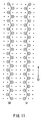
- a non-elastic yarn 50 and an elastic yarn 51 run in different directions and have a 1 ⁇ 1 tricot structure, and both the non-elastic yarn 50 and the elastic yarn 51 are knitted with closed loops.
- the direction of arrow 52 is the knitting direction of the knitted fabric.
- a stretchable warp-knitted fabric in which a non-elastic yarn and an elastic yarn run in different directions, and that is knitted such that either the non-elastic yarn or the elastic yarn forms closed loops, for example the non-elastic yarn forming closed loops and the elastic yarn forming open loops, or the non-elastic yarn forming open loops and the elastic yarn forming closed loops, is also superior in practice.
- the knitting structure shown in FIG. 12 is a stretchable warp-knitted fabric in which a non-elastic yarn 60 is arranged in a 1 ⁇ 1 tricot structure and an elastic yarn 61 is arranged in a half structure, and both are knitted with closed loops.
- FIG. 13 is a knitting structure diagram showing the non-elastic yarn 60 and the elastic yarn 61 shown in FIG. 12 superimposed upon one another. The direction of arrow 62 is the knitting direction of the knitted fabric.
- this structure is a particularly advantageous knitting structure when a cotton yarn is used for the non-elastic yarn 60.
- a stretchable warp-knitted fabric in which either the non-elastic yarn or the elastic yarn is knitted with closed loops, for example the non-elastic yarn is knitted with closed loops and the elastic yarn is knitted with open loops, or the non-elastic yarn is knitted with open loops and the elastic yarn is knitted with closed loops.
- FIG. 14 is an example in which a non-elastic yarn 65 is arranged in a 1 ⁇ 1 tricot structure and an elastic yarn 66 is arranged in an atlas structure (in this case, four-course atlas), and the non-elastic yarn 65 is knitted with closed loops.
- FIG. 15 is a knitting structure diagram showing the non-elastic yarn 65 and the elastic yarn 66 of FIG. 14 superimposed upon one another. The direction of arrow 67 is the knitting direction of the knitted fabric.
- the pieces described above can also be used as laminates that are laminated in two or more layers and bonded together with a resin adhesive or the like, as necessary. If a plurality of knitting fabrics are laminated together and used as the piece, then it is ordinarily sufficient to laminate two knitted fabrics together, but if necessary, it is also possible to laminate three or more together. If used as the material for a back cloth of a brassiere or the back cloth in the top of a two-piece bathing suit or a leotard, then it is preferable that a piece is used that is made by laminating together a plurality of knitted fabrics in this manner.
- the material (A) is (A-1) and the material (B) is (B-1). If a cotton yarn is used for the non-elastic yarn in this combination, then fraying of the edges left as cut can be favorably prevented, which is even more preferable.
- a laminated piece is formed from a piece having a Jacquard pattern as described above and a piece not having a Jacquard pattern, then it is preferable that the piece having the Jacquard pattern is arranged on the outer side of the garment.
- a laminated piece is formed from a piece having a Jacquard pattern as described above and a piece not having a Jacquard pattern, then it is preferable that in particular the above-described (A-1) or (A-2) is used as the material for the piece without the Jacquard pattern.
- A-1) or (A-2) is used as the material for the piece without the Jacquard pattern.
- the other laminated knitted fabric is a material into which a decorative pattern, such as a flower pattern, has been knitted by Jacquard control. If the material (A-1) or (A-2) is arranged on the skin side and the material into which the Jacquard pattern has been knitted is arranged on the outer side, then fraying does not occur, and a garment with superior design can be obtained, which is preferable.
- the laminated piece When fabricating the laminated piece, it is possible to first laminate a plurality of pieces layered on top of each other, bond them together and then cut them to the desired shape, or to cut the individual pieces to a predetermined shape, and then laminate them by layering the plurality of pieces and bonding them together.
- a piece results in which of a plurality of pieces of the same shape are bonded together, becoming one fabric in practice.
- knitted fabrics in which no fraying in any single one of them occurs are bonded together, there is no disentangling of the edge portions of the piece or protrusion of yarn ends, and the edge portions are neat. Needless to say, it is also possible to increase the tear strength.
- Form by laminating by bonding a plurality of pieces together means layering two or more pieces on top of each other and laminating them by bonding them together such that they cannot be easily peeled apart.
- the bonding means there is no particular limitation regarding the bonding means, and an adhesive such as a thermobonding resin can be used. Point adhesion in which the adhesive is applied at a multitude of points is preferable with regard to air permeability.
- the non-elastic yarn that is used depends on the type of the stretchable fabric. It is possible to use a synthetic fiber such as nylon or polyester, a semi-synthetic fiber such as rayon, or a natural fiber such as silk or cotton, and it is possible to use a filament yarn or a spun yarn. Of these, nylon yarn, which has excellent water absorption, is preferably used in knitted fabrics for inner wear. There is also no particular restriction with regard to the elastic yarn, and generally it is possible to use uncovered polyurethane elastic yarn or yarn in which such elastic yarn has been covered with a non-elastic yarn (covered yarn). With uncovered yarn, the knitting density can be easily increased. Moreover, cotton has superior skin touch and is also preferable with regard to sweat absorption.
- the density of the knitting loops can be increased more easily with finer yarns.
- the yarn is too fine, then its strength becomes too weak.
- 33 to 154 dtex is preferable, because the knitted fabric can be easily made with high density, and a knitting structure that is stable and strong can be achieved.
- the non-elastic fabric is more preferably 33 to 88 dtex, even more preferably 33 to 77 dtex or yet even more preferably 33 to 55 dtex, then a knitted fabric with high density is possible, and a knitting structure that is stable and strong can be achieved, which is preferable.
- cotton yarn If cotton yarn is used, then it is preferable that it can be knitted with a high knitting density, in order to ensure that there is no fraying at the edge portions that are left as cut, and consequently it is preferable that a relatively fine cotton yarn is used, because this way the knitting density can be increased easily.
- a cotton yarn with a yarn number that is finer than 50 more preferably a cotton yarn with a yarn number that is finer than 70 as the cotton yarn.
- a yarn that is as fine as possible is preferable, but at present, the finest cotton yarn that is commercially available has a yarn number of about 100. Consequently, if cotton yarn is used, a cotton yarn with a yarn number of 50 to 100 is preferable.
- the elastic yarn fabrics with higher densities can be made with finer yarns.
- the yarn is 154 dtex or more, then it is possible to achieve a knitted fabric having an edge that does not require hem finishing when left as cut, but the stretchability becomes small, so that it is preferable to use a fabric with not more than 154 dtex for garments worn closely to the body. More preferable is 15 to 100 dtex, and even more preferable is 33 to 88 dtex.
- fabrics are suitable that have been subjected to a presetting process and/or a heat-setting process, for the purpose of attaining stability of the knitting loops and the effect of preventing fraying of edges that are left as cut.
- the process temperature depends on the shape of the device, the presetting process time, the heat-setting process time, the type of material, and the thickness of the knitted fabric, but it is preferable that this process is performed at a temperature of at least 180°, preferably at least 185° or in a range of 190°C to 195°C in order to reliably attain the aforementioned effects, because in this case a portion of the fabric is softened, and the loops become slightly fused, thus stabilizing the fabric, and the edges that are left as cut become particularly resistant against fraying. If a device with a 6 to 8 chamber configuration (total length of the chambers: about 15 to 30 m) is used, then the heat-setting process time may be about 15 to 40 m/min, and preferably about 15 to 24 m/min.
- the finished width is set to about 160 cm, but in the stretchable warp-knitted fabrics of the present invention, the finished width is set shorter than that to 100 to 140 cm, more specifically to 110 cm, 120 cm or 130 cm, for example, and it is desirable that the fabric is knitted to a high density within the possible range in order to increase stability, while maintaining the attractiveness of the knitting loops in the stretchable garment.
- the knitted fabric is knitted at a high density of more than 55 wales, more preferably more than 60 wales, even more preferably more than 65 wales and most preferably at least 70 wales per 2.54 cm (1 inch), and that the proportion of lateral extensibility of the knitted fabric is large.
- this is not necessarily required when a cellulose yarn or cotton yarn is used as the non-elastic yarn.
- a stretchable warp-knitted fabric is preferably used, in which the used amount of non-elastic yarn is increased and longer, and the elastic yarn is shorter than in the ordinary case, and the runner length of the non-elastic yarn is much longer than runner length of the elastic yarn. More specifically, it is preferable that the runner of a non-elastic yarn of an ordinary 80 cm/rack or less is set to 85 to 120 cm/rack, more preferably 95 to 115 cm/rack, and the runner of an elastic yarn of an ordinary 60 cm/rack or less is set to 70 to 110 cm/rack, more preferably 75 to 105 cm/rack.
- runner means the length (in cm) of the yarn that is used to knit a predetermined number of courses (this is called “rack”; normally, 480 courses constitute one rack).
- the ratio (A/B) of the runner A of the non-elastic yarn to the runner B of the elastic yarn is preferably at least 1.15, more preferably at least 1.2, and most preferably at least 1.3.
- warp-knitted fabrics according to the present invention that can be provided with edges that do not require hem finishing when left as cut are not lace fabrics.
- edges of the piece made of the stretchable warp-knitted fabric that do not require hem finishing when left as cut at least one of the upper edge and the lower edge in the garment is an edge that does not require hem finishing, then fraying and curling of this edge can be prevented if it is cut at an angle that is not parallel to the knitting direction within a range of at least 3° to 177° with respect to the knitting direction of the knitted fabric.
- the edge is cut at an angle of 5° to 150°, more preferably 10° to 120°, even more preferably 15° to 90°, yet even more preferably 20° to 80°, more preferably 30° to 60°, even more preferably 40° to 50°, and most preferably 45° or thereabout (more specifically 43° to 47°).
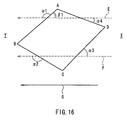
- FIG. 16 the portion enclosed by A-B-C-D-A is the cut piece.
- the arrows E, F and G indicate the knitting direction of this fabric.
- the side X in FIG. 16 is the "knitting start side” and the side Y in FIG. 16 is the “knitting end side.” Consequently, the edge A-D and the edge C-D are edges on the knitting start side, whereas the edge A-B and the edge B-C are edges on the knitting end side.
- the cutting angle of the edges refers to the acute angle ( ⁇ 4 or ⁇ 3) of the angles defined by the edge line and the knitting direction.
- the cutting angles of the edges refers to the obtuse angle ( ⁇ 1 or ⁇ 2) of the angles defined by the edge line and the knitting direction.
- the cutting angle of the edges in the present invention is the formal definition of the cutting angle of the edges in the present invention, but for the sake of convenience, the cutting angle of, for example, the edge A-B in FIG. 16 may also be described using the angle ß1, and it can be easily seen that then the cutting angle of the edge A-B is "180 - ß1"degree, as is evident from the above definition of the cutting angle of the edge.
- the cutting angles of the edge lines in the embodiments of the present invention are set as noted above, because this improves the body-fit of the edges that do not require hem finishing when left as cut, and prevents curling of the edge portions away from the wearer's body. That is to say, in garments having edges that do not require hem finishing when left as cut at the upper edge or lower edge of the garment, for example the waist or the bottom, it occurs that these edge portions curl away from the wearer's body. In order to ensure that such curling does not occur, it is preferable that the cutting line of the portions serving as the edges that do not require hem finishing are cut at the above-noted angles with respect to the knitting direction of the knitted fabric.
- the knitting direction of the knitted fabric corresponds to the direction in which the yarn is supplied when knitting the fabric.
- an angle of 20° to 80° with respect to the knitting direction means that there is an angle of 20° to 80° to either the left or the right side of the line of the knitting direction, or in other words, the angle in which the vertex side of the angle points in the direction in which the knitting direction advances, or an angle of ⁇ 20° to 80° with respect to the line in the direction in which the knitting direction advances.
- edges that do not require hem finishing when left as cut are used at parts for which there is little necessity to prevent curling away from the body, then it may be preferable that a piece is used that has edges that are cut at an angular range not exceeding 45°. Furthermore, it is preferable that a piece is used whose edges are cut not to straight lines but to wave-shaped lines, because then it can be prevented that the edge portions curl away from the body.
- edge portions When cutting a piece of garment, if a plurality of edge portions serve as edges that do not require hem finishing when left as cut, then there may be locations that cannot be cut at, for example, the preferable range of 20° to 80° within the range of 3° to 177° with respect to the knitting direction, and that must be cut at an angle of less than 20° to the knitting direction. If such edge portions are cut to a wave shape, then the cutting angle of the edge portions serving as the curves in the wave shape can be set to for example the preferable range of 20° to 80°, and the same effect can be attained as when the entire edge portion is cut to substantially 20° to 80°.
- both the waist line and the bottom line of a short girdle are edges not requiring hem finishing when left as cut, using one piece that is continuous in the vertical direction of the garment, it may occur that it is not possible to cut both edge portions at an angle of, for example, 20° to 80° with respect to the knitting direction, due to the design of the garment, and in such cases it is preferable that one edge is cut to a wave-shaped edge.
- bottom garments such as girdles or short panties
- using an edge portion of a piece that is cut at the above-noted angles for the waist or the bottom line can prevent fraying or curling of the edge portion.
- the piece of the back cloth is cut at an angle that is close to parallel or perpendicular, for example ⁇ 20° with respect to perpendicular or parallel to the knitting direction, then it is possible to provide stretchability in the lateral direction when wearing the back cloth, which is preferable because it improves the wearing comfort.
- the back cloth is substantially trapezoidal, and its width becomes narrow from the cup sides towards a rear central linking portion referred to as "hook and eye", with the upper edge and the lower edge corresponding to the two oblique sides of an isosceles triangle.
- one of the upper edge and the lower edge of the back cloth is preferably cut at an angle of 10° to 90°, more preferably 75° to 90° with respect to the knitting direction.
- the cutting angle of the one edge portion is ⁇ degree
- the other edge portion is cut at an angle that is close to the angle (180° - ⁇ ) degree. If cut at an angle that is close to a right angle, then the lower edge of the back portion is cut at 100° and the upper edge is cut at 80°, for example. If cut at an angle that is close to parallel to the knitting direction, then the upper edge of the back cloth is cut at 15° and the lower edge is cut at 165°.
- Cutting shape with a plurality of curves means not a simple convex or concave curve that is curved to one side, but a curve that is formed by a combination of a plurality of convex and concave curves, such as a curve with convex and concave wave lines.
- “Wave shape with a plurality of curves” thus means a curve that is "wave-shaped.”
- the wave shape is not limited to waves in which a regular simple curve is repeated, and may also be an irregular wave shape. If the shape of the curved edges that are left as cut is wave-shaped, then it is preferable that the curvature of the curves of the wave shape is not too small, because then the tear strength is not decreased, and there is no turning (curling) of the edge portion.
- two knitted fabrics may be laminated by bonding them together in order to increase the strength.
- the two knitted fabrics may be cut to the desired shape after they have been bonded and laminated, or they may be bonded and laminated after two pieces of knitted fabrics have been cut to the same shape. In either case, the two pieces of the same shape are laminated together by bonding, and become substantially one piece. Thus, there are no level differences in the back cloth. Also, because knitted fabrics in which no fraying occurs are bonded together, there is no disentangling of the edge portions of the piece or protrusion of yarn ends, and the edge portions are neat.
- the pieces may be cut to the same shape before laminating them together, or they may be cut to predetermined shape after bonding and laminating the knitted fabrics.
- a preferable embodiment for the laminated piece for the case that the laminated piece is used for the back cloth of a brassiere or the like is similar to the laminated piece described above.
- the cutting angle means the angle between the knitting direction and a virtual straight line leveling the concave and convex portions of the wave shape of the cut edge portion.
- the virtual straight line leveling the concave and convex portions of the wave shape of the cut edge portion may be the tangent line connecting the vertices of a scallop-shaped wave of an edge not requiring hem finishing, or the center line bisecting the wave into upper half and lower half.
- the cutting angle is the angle between the knitting direction and the straight line connecting both ends in the longitudinal direction of the edge line of the edge portion of the piece cut from the knitted fabric or the garment using the same. If one curve appears in the edge portion, then the cutting angle means the angle between the knitting direction and the straight line connecting both ends in the longitudinal direction of the curve.
- a scallop-shaped portion of an edge not requiring hem finishing is a wave-shaped curve, but the line of the overall edge corresponding to the forward direction of this wave can be expressed by a virtual straight line. This is the same treatment as with that light which undulates, but whose forward direction is drawn overall as a straight line.
- shape of the edge portion can be formed as one arc-shaped curve or as a wave shape with a plurality of curves, and by cutting the edge portion to a curve or a wave shape, it is possible to prevent fraying or curling.
- bottom garments such as girdles or short panties
- making the waist line a curve that concavely sags downwards prevents curling and allows fitting to the waist.
- Making the bottom line of short girdles or short panties a curve that convexly protrudes downward on the whole prevents curling and allows fitting to the hip line.
- making the bottom line wave-shaped prevents curling and allows fitting to the hip line.
- the overall bottom line (macroscopically) a curve that protrudes convexly downward, and to make it microscopically wave-shaped.
- continuous piece means a piece that is not made by patching together a plurality of parts, but made of one part that is continuous in the planar direction
- shape of the edge portion line may also be changed, with the line contacting the hip bottom and the edge portion line contacting the side of the abdomen portion.
- the hip bottom line may be curved protruding convexly downward or wave-shaped, or it may be overall curved protruding convexly downward in addition to being wave-shaped, and then the bottom line of the edge portion contacting the side of the abdomen portion may also be a curve protruding convexly upward.
- the shape of the upper edge is different from the shape of the lower edge, or that the upper edge and the lower edger are non-parallel, or that the shape of the upper edge and the lower edge are different and the upper edge and the lower edge are non-parallel, because this way, the garment can be fitted against the three-dimensional shape of the body.
- the fabric that can be formed with an edge that does not require hem finishing when left as cut is partially provided with a straight boundary line at which the stretching power changes due to the elastic yarn, because this way the body-shaping function is improved.
- "Straight boundary line at which the stretching power changes” means that a region of strong stretching power and a region of weak stretching power are formed such that the border between the region of strong stretching power and the region of weak stretching power is straight line (this encompasses the case that the region of strong stretching power and the region of weak stretching power include regions with two or more grades of different stretching powers; moreover, the stretching power may change continuously).
- strong stretching power means that the straining force is high and the stretchability is low.
- edge portion of the garment are provided with a flat surface and that no hem finishing by sewing is performed, but in order to strengthen portions where there tends to be tension when wearing the garment, it is also possible to provide a seam of about 0.5 to 2 cm length at these edge portions. Examples of such locations are the portion of the back cloth next to the cup wire at the upper edge of the back cloth of a brassiere, the back edge portion next to a rear central linking portion referred to as "hook and eye" in the rear center, or the vicinity of the seam of the crotch cloth of a short girdle or short panty.
- the present invention is effective in garments that fit the body closely.
- garments to which the present invention can be applied preferably are short girdles, long girdles, short panties, spats, brassieres, bathing suits, leotards, body slips, body camisoles, body suits and body teddies.
- FIG. 1 is a perspective view showing a semi-long girdle according to an embodiment of the present invention of a garment that has an edge that does not require hem finishing when left as cut and that has a body-shaping function, seen from the rear side.
- FIG. 2 is a perspective view of the semi-long girdle of FIG. 1, seen from the front side.
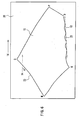
- FIG. 3 is a plane view showing, on a knitted fabric, a cutting line of a side front - side - hip portion - leg portion covering piece 1, corresponding to the left side of the wearer of the semi-long girdle shown in FIG. 2, as well as a plane view of a crotch portion.
- reference numeral 1 denotes the side front - side - hip portion - leg portion covering piece covering the side front - side - hip portion - leg portion, which is continuous in vertical direction of the girdle and made of one piece without a level difference in its surface.
- Reference numeral 6 denotes an abdomen portion covering piece covering the abdomen, which is continuous in the vertical direction of the girdle and made of one piece without a level difference in its surface.
- the side front - side - hip portion - leg portion covering pieces 1 on the left and right are sewn together by a rear center seam line 4, but not at the leg portion, and the side edges to the front of the side front - side - hip portion - leg portion covering pieces 1 are sewn to the side edges of the abdomen portion covering piece 6 at a seam line 5.
- a virtual dotted line 8 has been added to the figure, to indicate that roughly the region below the virtual dotted line 8 corresponds to the leg portions. Consequently, the seam line 4 above the virtual dotted line 8 is the rear center seam line, and leg portions are formed by dividing the region below the virtual dotted line 8 into left and right leg.
- the line A- B - C- D - E - F - G -A shown on the fabric 11 in FIG. 3 indicates the cutting line of the side front - side - hip portion - leg portion covering piece 1 for obtaining the piece of the half on the left side of the wearer, which is used for the portion from the side of the girdle rearward and for the leg portions.
- reference numeral 10 denotes a crotch piece, which may be made of the same fabric or a different fabric as the side front - side - hip portion - leg portion covering piece 1.
- the crotch piece 10 forms the crotch portion, and is not shown in FIGS. 1 and 2.
- the shape of the side front - side - hip portion - leg portion covering piece 1 for the right half is the mirror symmetric shape of the portion for the left half.
- the line A-B is sewn to the abdomen portion covering piece 6 in FIG. 1
- the line Q-C is sewn to the line E-D, thus forming the left leg portion
- the line G-F is sewn to the corresponding portion of the afore-mentioned piece of the right half (not shown in the drawings), forming the rear center seam line 4.
- the line P-O of the crotch piece 10 is sewn to the lower edge of the abdomen portion covering piece 6, the line O-I of the crotch piece 10 is sewn to the line B-Q of the piece 1, and the line H-I of the crotch piece 10 is sewn to the line F-E of the piece 1.
- the sewing for the piece 1 of the right half, which is not shown in the drawings, is similar, because it is left-right symmetric. In this manner, the girdle shown in FIGS. 1 and 2 can be fabricated. Also the girdles of the other embodiments are formed by sewing in substantially the same manner.
- the knitting direction of the warp-knitted fabric constituting the side front - side - hip portion - leg portion covering piece 1 is indicated by the arrow direction of arrow 9.
- the side front ⁇ side ⁇ hip portion ⁇ leg portion covering piece 1 has a 1 ⁇ 1 knitted structure in which a nylon yarn and a polyurethane yarn run in different directions as shown in FIG. 11, and is knitted such that both the elastic yarn and the non-elastic yarn form closed loops. It is knitted from a 44 dtex nylon yarn and 77 dtex polyurethane yarn, at a knitting density of 70 wales per inch (2.54 cm).
- the bottom line 2 is wave-shaped, and the direction of the bottom line 2 is the same direction as the straight line connecting the crests of this wave shape, that is, the direction indicated by arrow 12 (see FIG. 3).
- the bottom line is cut at an angle ß of about 30° with respect to the knitting direction. Overall, it is cut at about 30°, but the overall bottom line is cut to a plurality of wave shapes, and portions of the wave shapes are cut at angles exceeding 30°.
- the abdomen portion covering piece 6 has a 1 ⁇ 1 tricot structure in which an elastic yarn and an non-elastic yarn run in different directions, made from a cloth with the above-mentioned knitting structure such that the elastic yarn forms closed loops and the non-elastic yarn form open loops.
- Its upper edge 7 is an edge that does not require hem finishing when left as cut, and forms a curved line that is slightly curved downward. It should be noted that it can also be cut to a straight line and form a waist line. Alternatively, another fabric that requires hem finishing may be used for the abdomen portion covering piece 6, as appropriate.
- the abdomen portion covering piece 6 is knitted from a 44 dtex nylon yarn and 88 dtex polyurethane yarn, at a knitting density of 68 wales per inch (2.54 cm).
- the upper edge 7 of the abdomen portion covering piece 6, which abuts the waist line, is cut at an angle of 40° with respect to the knitting direction.
- all of the garment edge portions at the waist and the bottom line can be made as edge portions that are left as cut and not hem-finished, and the girdle is formed from pieces that are vertically continuous and do not have a level difference, so that the number of sewing spots can be reduced and a girdle with few level differences can be attained.
- the level differences at the edge portions can be eliminated, the cutting angle is at least 3° with respect to the knitting direction, and the cutting shape is a curved line or wave shape, so that the waist line and the bottom line are not frayed when left as cut, the girdle fits the wearer's body without curling, is not easily displaced, and waist and bottom line can be easily held in a stable position, which is preferable. It is also possible to partially knit in or insert a further elastic yarn or non-elastic yarn into the abdomen portion covering piece 6 or the side front - side - hip portion - leg portion covering piece 1, thus providing a portion with little stretch.
- the bottom line 2 and the waist line 3 are edges that do not require hem finishing when left as cut, and since they do not require hem finishing and do not use a rubber tape or the like, the waist is not firmly tied together in a line shape as with a rubber tape and the thickness is not increased, so that a clear-cut silhouette around the waist is achieved when wearing, and there are also no wear marks from a rubber tape left on the skin. This is also similar around the bottom line portion.
- the side front - side - hip portion - leg portion covering piece 1 and the abdomen portion covering piece 6 are not limited to the above-mentioned knitting structures, and may have any kind of knitting structure, as long as they are tricot warp-knitted fabrics that do not fray when left as cut.
- FIG. 4 is a perspective view showing a short girdle according to an embodiment of the present invention of a garment that has an edge that does not require hem finishing when left as cut and that has a body-shaping function, seen from the rear side.
- FIG. 5 is a perspective view showing the short girdle of FIG. 4, seen from the front side.
- FIG. 6 is a plane view showing, on a knitted fabric, a cutting line of a side front - side - hip portion covering piece 15, corresponding to the left side of the wearer of the short girdle shown in FIG. 5.
- reference numeral 15 denotes the side front - side - hip portion covering piece covering a side front - side - back portion, which is continuous in the vertical direction and made of one piece without a level difference.
- Reference numeral 16 denotes an abdomen covering piece covering the abdomen, which is continuous in the vertical direction and made of one piece without a level difference.
- Reference numeral 17 denotes a front center bottom piece, which is continuous in the vertical direction and made of one piece without a level difference.
- the side front - side - hip portion covering pieces 15 on the left and right are sewn together by a rear center seam line 18, and the side edges on the front side of the side front - side - hip portion covering pieces 15 are sewn to the side edges of the abdomen portion covering piece 16 and the front center bottom piece 17 at a seam line 19.
- the line M - N - O- P - Q - M shown on the fabric 20 in FIG. 6 indicates the cutting line of the side front - side - hip portion covering piece 15 for obtaining the piece of the half on the left side of the wearer, which is used for the portion from the side of the girdle to the hip portion.
- the shape of the side front ⁇ side - hip portion covering piece 15 for the right half is the mirror symmetric shape of the portion for the left half.
- the line M-N is sewn to the abdomen portion covering piece 16 and the front center bottom piece 17 in FIG. 5, and the line P-Q is sewn to the corresponding portion of the afore-mentioned piece of the right half (not shown in the drawings), forming the rear center seam line 18.
- the line O-P is sewn to a crotch portion 21.
- the line N-O forms a bottom line, and the line Q-M forms a waist line.
- the sewing for the piece 15 of the right half which is not shown in the drawings, is similar, because it is left-right symmetric. In this manner, the girdle shown in FIGS. 4 and 5 can be fabricated.
- the abdomen portion covering piece 16 and the front center bottom piece 17 pieces are used that have edges that do not require hem finishing when left as cut.
- the knitting direction of the warp-knitted fabric constituting the side front - side - hip portion covering piece 15 is indicated by the arrow direction of arrow 14.
- the side front - side - hip portion covering piece 15 has a 1 ⁇ 1 tricot structure in which a nylon yarn and a polyurethane yarn run in different directions as shown in FIG. 11, and is knitted at a knitting density of 70 wales per inch (2.54 cm) such that both the elastic yarn and the non-elastic yarn form closed loops. It is knitted from a 33 dtex nylon yarn and a 77 dtex polyurethane yarn.
- the edge of the side front - side - hip portion covering piece 15, which does not require hem finishing when left as cut, forms an edge of a bottom line 22 and an edge of a waist line 23.
- the bottom line 22 is wave-shaped, and the direction of the bottom line 22 is the same direction as the straight line connecting the crests of this wave shape, that is, the direction indicated by arrow 12, and forms an angle of 5° with the knitting direction 14.
- the waste line 23 is cut at an angle ⁇ (cutting angle) of about 40° with respect to the knitting direction 14.
- the waist line 23 is a curved line that is slightly curved downward, so that the curved portion is cut at an angle that surpasses and falls below 40°. In any case, the bottom line 22 and the waist line 23 are not parallel and have different shapes.
- the waist line 23 is a curved line that is slightly curved downward, and the virtual straight line connecting Q and M at the two ends of the waist line is an edge that is cut at an angle of 40° (cutting angle) with respect to the knitting direction 14 of the knitted fabric.
- the waist line 23 is a curved line that is slightly curved in downward direction of the garment, so that the actual cutting angle is an angle that surpasses and falls below 40°. That is to say, the waist line 23 forming the edge at the upper side is not parallel to the bottom line 23 forming the edge at the lower side.
- the edge 24 at the upper side of the abdomen portion covering piece 16 is an edge that does not require hem finishing when left as cut. It has a 1x1 tricot structure in which non-elastic yarn and elastic yarn run in the same direction, as shown in FIG. 10, and uses a knitted fabric in which both the elastic yarn and the non-elastic yarn form open loops.
- the abdomen portion covering piece 16 uses a 44 dtex nylon yarn and a 154 dtex polyurethane yarn, and is knitted at a knitting density of 65 wales per inch (2.54 cm). It is cut at an angle of 45° with respect to the knitting direction.
- the front center bottom piece 17 has a 1x1 tricot structure in which non-elastic yarn and elastic yarn run in the same direction, as shown in FIG. 10, and uses a knitted fabric in which both the elastic yarn and the non-elastic yarn form open loops. It is knitted from a 33 dtex nylon yarn and a 77 dtex polyurethane yarn, at a knitting density of 70 wales per inch (2.54 cm).
- a bottom line 25 of the front center bottom piece 17 is formed from an edge that does not require hem finishing when left as cut, and is cut at an angle of about 25° with respect to the knitting direction.
- the bottom line may also be a straight line.
- a knitted piece provided with an edge that does not require hem finishing obtained by the conventional method of pulling out yarn.
- all of the garment edge portions at the waist and the bottom line can be edge portions that are left as cut and not hem-finished, and the girdle is formed using pieces 15 that are vertically continuous and do not have a level difference, so that the number of sewing portions can be reduced and a girdle with few level differences having flat surface can be attained.
- the bottom line 22, 25 and the waist line 23 are edges that do not require hem finishing when left as cut, and since they do not require hem finishing and do not use a rubber tape or the like, the waist is not firmly tied together in a line shape as with a rubber tape and the thickness is not increased, so that a clear-cut silhouette around the waist is achieved when wearing, and there are also no wear marks from a rubber tape left on the skin. This is also similar around the bottom portion.
- the side front ⁇ side ⁇ hip portion covering piece 15, the abdomen portion covering piece 16 and the front center bottom piece 17 are not limited to the above-mentioned knitting structures, and may have any knitting structure, as long as it is a tricot warp-knitted fabric that does not fray when left as cut.
- FIG. 17 is a rear view of a short panty according to an embodiment of the present invention of a garment having an edge that does not require hem finishing when left as cut.
- FIG. 18 is a front view of the short panty shown in FIG. 17.
- FIG. 19 is a plane view showing, on a knitted fabric, a cutting line of a front flank ⁇ side ⁇ hip portion covering piece 75, corresponding to the left side of the wearer of the short panty shown in FIGS. 17 and 18.
- reference numeral 75 denotes the front flank - side - hip portion covering piece covering the front flank - side - back portion, which is continuous in the vertical direction and made of one piece without a level difference.
- Reference numeral 76 denotes an abdomen - crotch covering piece which covering the abdomen and crotch portion, which is continuous in the vertical direction and made of one piece without a level difference.
- the front flank - side - hip portion covering pieces 75 on the left and right are sewn together by a rear center seam line 78, and the side edges on the front of the front flank - side - hip portion covering pieces 75 are sewn to a portion of the side edges of the abdomen - crotch covering piece 76 with a seam line 79. That is to say, this short panty is made of three pieces.
- the line M - N - O- P - Q - M shown on the fabric 70 in FIG. 19 indicates the cutting line of the front flank - side - hip portion covering piece 75 for obtaining the piece of the half on the left side of the wearer, which is used for the portion from the side of the short panty to the hip portion.
- the shape of the front flank - side - hip portion covering piece 75 for the right half is the left-right symmetric shape of the portion for the left half.
- the line M-N is sewn to a portion of the abdomen - crotch covering piece 76 in FIG. 18, and the line P-Q is sewn to the corresponding portion of the afore-mentioned piece of the right half (not shown in the drawings), forming the rear center seam line 78.
- the line O-P is sewn to a crotch rear portion 81 of the abdomen ⁇ crotch covering piece 76.
- the line N-O forms a bottom line (of the line N-O, the line N-R is a front bottom line 84, and the line R-O is a rear bottom line 82), and the line Q-M forms a waist line 83.
- the sewing for the piece 75 of the right half, which is not shown in the drawings, is similar, because it is left-right symmetric. In this manner, the short panty shown in FIGS. 18 and 19 can be fabricated.
- front flank - side - hip portion covering piece 75 and the abdomen - crotch covering piece 76 pieces are used that do not require hem finishing when left as cut.
- the knitting direction of the warp-knitted fabric constituting the front flank - side - hip portion covering piece 75 is indicated by the arrow direction of arrow 74.
- the knitted fabric of the base knit has a 1 ⁇ 1 tricot structure in which a 33 dtex nylon yarn and 77 dtex polyurethane yarn run in the same direction forming closed loops, knitted at a knitting density of 63 wales per inch (2.54 cm).
- a 33 dtex nylon yarn is used as a pattern yarn that is Jacquard controlled in order to form a fine Jacquard pattern (flower pattern with 4 cm maximal diameter) 77.
- the portion where the pattern yarn does not form a pattern has a 1 ⁇ 1 tricot structure in which the pattern yarn runs in a different direction to an elastic yarn forming closed loops, and in the portion where the fine Jacquard pattern is expressed, a flower pattern 77 is formed by chain stitches. It should be noted that the portion expressing the fine Jacquard pattern may also be an atlas stitch.
- the edge of the front flank - side - hip portion covering piece 75 which does not require hem finishing when left as cut, forms an edge of a bottom line 84 and a rear bottom line 82, and an edge of a waist line 82.
- the rear bottom line 82 is wave-shaped, and the direction of the rear bottom line 82 is the same direction as the straight line connecting the crests of this wave shape, that is, the direction indicated by arrow 72, and forms an angle of 5° with the knitting direction 74.
- the front bottom line 84 (N-R) has an upwardly slightly convex irregular curve shape.
- the waste line 83 is cut at an angle ⁇ (cutting angle) of 3° with respect to the knitting direction 74. Consequently, the bottom line 82 and the waist line 83 are not parallel.
- the edge 85 at the upper side of the abdomen - crotch covering piece 76 is an edge that does not require hem finishing when left as cut.
- the same knitted fabric provided with the same fine Jacquard pattern as the front flank - side - hip portion covering piece 75 was used.
- the knitting direction and the direction of the cutting edges of the abdomen - crotch covering piece 76 are not shown in the drawings, but the abdomen - crotch covering piece 76 was cut such that its upper edge 85 formed an angle of 45° with respect to the knitting direction.
- all of the garment edge portions at the waist and the bottom can be made of edge portions that are left as cut and not hem-finished, and the short panty is formed from pieces that are vertically continuous and do not have a level difference, so that the number of sewing portions can be reduced and a short panty with a small flower pattern and having a flat surface with few level differences can be attained.
- the bottom line 82, 84 and the waist line 83 are edges that do not require hem finishing when left as cut, and since they do not require hem finishing and do not use a rubber tape or the like, the waist is not firmly tied together in a line shape as with a rubber tape and the thickness is not increased, so that a clear-cut silhouette around the waist is achieved when wearing, and there are also no wear marks from a rubber tape left on the skin. This is also similar around the bottom portion.
- the front flank - side - hip portion covering piece 75 and the abdomen - crotch covering piece 76 are not limited to the above-mentioned knitted structures, and may have any kind of knitting structure, as long as it is a tricot warp-knitted fabric that does not fray when left as cut.
- FIG. 7 is a perspective view of the principal portions of a brassiere according to an embodiment of the present invention of a garment having an edge that does not require hem finishing when left as cut.
- reference numeral 26 denotes a stretchable back cloth
- reference numeral 31 denotes a linking portion for linking the left and right back cloth when wearing the brassiere
- reference numeral 29 denotes a breast cup
- reference numeral 30 denotes a strap.
- the stretchable back cloth 26 is a piece that does not require hem finishing when left as cut, and is formed using one piece that is continuous in the vertical direction.
- the knitting direction of the warp-knitted fabric constituting this piece is the direction indicated by arrow 34.
- the knitting direction is the direction from the smaller width of the back cloth to the larger width of the back cloth, then the cloth can be cut from the knitting start side, so that fraying occurs less easily.
- the knitting direction of the back cloth placed on the right side of the wearer is the direction pointing in the opposite direction of the arrow 34. That is to say, the knitting direction is the direction from the smaller width of the back cloth to the larger width of the back cloth.
- the back cloth piece 26 has a 1 ⁇ 1 tricot structure in which a 33 dtex nylon yarn and a 44 dtex polyurethane yarn run in different directions as shown in FIG. 11, and is knitted such that both the elastic yarn and the non-elastic yarn form closed loops. It is knitted at a knitting density of 63 wales per inch (2.54 cm).
- the edges of the back cloth 26 that do not require hem finishing when left as cut are the portions of the lower edge 28 and the upper edge 27 of the back cloth.
- the lower edge 28 and the upper edge 27 are both wave-shaped with a plurality of waves.
- convex and concave portions are arranged at substantially the same intervals and with substantially same height in the upper edge 27 and the lower edge 28, and appear at substantially the same location at top and bottom.
- the wave shape is substantially mirror symmetric with the center line bisecting the back cloth in upper half and lower half as the symmetry line, so that where the upper edge 27 has an upward-pointing convex portion, the lower edge 28 has a downward-pointing convex portion, and where the upper edge 27 has a downward-pointing concave portion, the lower edge 28 has an upward-pointing concave portion.
- the back cloth 26 is linked to the cup portion, forming a brassiere without under-cup cloth.
- the wave line should be substantially mirror symmetric with respect to the center line bisecting the back cloth in upper half and lower half at the back portion outside the under-cup portion.
- the upper and lower edges of the back cloth or under-cup cloth which do not require hem finishing, are not limited to wave shapes, and may also be straight or of a curved shape other than a wave shape. Moreover, the wave shape may be an even or an uneven wave shape. Moreover, the shapes of the upper edge and the lower edge may be the same or different.
- the direction of the edge line of the lower edge 28 of the back cloth 26 is the same direction as the straight line connecting the crests of this wave shape, that is, the direction indicated by arrow 32, and forms an angle of 6° with the knitting direction.
- the direction of the edge line of the upper edge of the back cloth 27 is the same direction as the straight line connecting the crests of this wave shape, that is, the direction indicated by arrow 33, and forms an angle of 6° with the knitting direction. That is to say, the lines constituting the upper and lower edges of the back cloth, which do not require hem finishing when left as cut, are not parallel to one another. It should be noted that the edge lines are wave-shaped, so that portions of the wave shapes are cut at angles exceeding 6°.
- the broadest width of the back cloth is set to 9 cm and the narrowest width is set to 4 cm.
- a rubber tape is provided along the upper and lower edges of the back cloth 26, but no rubber tape is sewn to the upper and lower edges of the back cloth 26 of the brassiere of the present embodiment, so that there is no increase in thickness due to any rubber tape, a clear-cut silhouette around the bust is achieved when wearing, and there are also no wear marks from a rubber tape left on the skin. Consequently, the back cloth fits the body, and the edge portions fit the body closely without curling, displacements when moving are reduced to a minimum, preventing the garment from becoming loose.
- two vertically continuous pieces are laminated by bonding together with resin or the like. It is also possible to form the back cloth with one piece of cloth, but in the present embodiment, two like pieces having the same shape that were bonded together with resin were used. When bonding together two pieces with resin, they can be more easily bonded together if they are layered such that the knitting directions of the two pieces are the same. If the back cloth piece is cut after the two vertically continuous cloths were laminated by bonding together, then the edge portions become neat.
- the back cloth is made of two pieces that are bonded together, the two pieces are bonded together into one and the upper edge and the lower edge of the back cloth do not require hem finishing, the back cloth is made of a vertically continuous cloth, the surface is flat and without level differences from the upper edge to the lower edge, and there is no partial pressure when wearing.
- the knitted fabric used for the back cloth piece is a cloth whose cut edge portions do not easily fray, and since it is cut to a shape and angle at which the edge portions do not fray, the cut ends of the upper and lower edge portions are neat, and yarn end does not protrude from them.
- FIG. 8 is a perspective view of the principal portions of a brassiere according to an embodiment of the present invention of a garment having an edge that does not require hem finishing when left as cut.
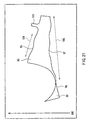
- FIG. 9 is a plane view showing, on a knitted fabric, a cutting line of a back cloth piece 35, corresponding to the left side of the wearer of the brassiere shown in FIG. 8. In FIG.
- reference numeral 35 denotes a stretchable back cloth
- reference numeral 38 denotes an under-cup portion
- reference numeral 39 denotes a front center portion
- reference numeral 42 denotes a linking portion for linking the left and right back cloth when wearing the brassiere
- reference numeral 40 denotes a breast cup
- reference numeral 41 denotes a strap
- reference numeral 43 denotes the location where the left and right front center portions are sewn together.
- the back cloth portion, the under-cup portion and the front center portion are made of one continuous piece of cloth.
- the stretchable back cloth 35 is a piece that does not require hem finishing when left as cut, and is formed using a cloth that is continuous in the vertical direction.
- the knitting direction of the warp-knitted fabric constituting this piece is the direction indicated by arrow 46 (see FIG. 9).
- the back cloth piece 35 has a 1 ⁇ 1 tricot structure in which a 33 dtex nylon yarn and a 44 dtex polyurethane yarn running in different directions, and is knitted such that the elastic yarn forms open loops and the non-elastic yarn forms closed loops. It is knitted at a knitting density of 63 wales per inch (2.54 cm).
- the edges of the back cloth 35 that do not require hem finishing when left as cut are the portions of the lower edge 37 and the upper edge 36 of the back cloth.
- the lower edge 37 and the upper edge 36 are both wave-shaped with a plurality of waves.
- mutually different convex and concave portions are arranged at the upper and the lower edges at substantially the same intervals and with substantially same height in the upper edge 36 and the lower edge 37. That is to say, where the upper edge 36 has an upward-pointing convex portion, the lower edge 37 has an upward-pointing concave portion, and where the upper edge 36 has a downward-pointing concave portion, the lower edge 37 has a downward-pointing convex portion.
- the lower edge 37 and the upper edge 36 have a similar wave shape, and also the overall back cloth is wave-shaped.
- the back cloth 35, the under-cup portion and the front center portion are formed from a continuous cloth.
- the edge on the lower side of the under-cup portion and the front center portion may be wave-shaped or have the shape of a straight line. If stretching of the front center portion is to be stopped, then the outward surface of the front center portion should be laminated to a cloth without extensibility.
- the direction of the edge line of the lower edge 37 of the back cloth 35 is the same direction as the straight line connecting the crests of this wave shape, that is, the direction indicated by arrow 45, and forms an angle of 85° (cutting angle) with the knitting direction.
- the direction of the edge line of the upper edge of the back cloth 36 is the same direction as the straight line connecting the crests of this wave shape, that is, the direction indicated by arrow 44, and forms an angle of 95° (cutting angle) with the knitting direction. That is to say, the lines constituting the upper and lower edges of the back cloth, which do not require hem finishing when left as cut, are not parallel to one another.
- the edge lines are wave-shaped, the wave-shaped portions of the edge line of the lower edge 37 are cut at an angle that surpasses and falls below 85° and the wave-shaped portions of the edge line of the upper edge 36 are cut at an angle that surpasses and falls below 95°.
- the under-cup portion 38 and the front center portion 39 are cut at an angle that is smaller than 85°.
- the wave-shaped portion of the under-cup portion 38 is cut at an angle that surpasses and falls below 85°.
- Reference numeral 53 denotes a strap attachment location.
- a strap 41 is attached by passing the strap 41 through a strap attachment ring at the strap attachment location 45, folding the strap attachment location 53 in two, and sewing its front end to the back cloth 35.
- the strap attachment location 53 is continuous with the back cloth 35, and is cut in one piece with the back cloth. Its edge portion is left as cut and does not require hem finishing.
- the broadest width of the back cloth 35 is set to 9 cm and the narrowest width is set to 4 cm.
- a rubber tape is provided along the upper and lower edges of the back cloth 35, but no rubber tape is sewn to the upper and lower edges of the back cloth 35 of the brassiere of the present embodiment, so that there is no increase in thickness due to any rubber tape, a clear-cut silhouette around the bust is achieved when wearing, and there are also no wear marks from a rubber tape left on the skin. Consequently, the back cloth fits the body, and the edge portions fit the body closely without curling, displacements when moving are reduced to a minimum, preventing the garment from becoming loose.
- the back cloth piece When bonding together two pieces with resin, they can be more easily bonded together if they are layered such that the knitting directions of the two pieces are the same. If the back cloth piece is cut after the two vertically continuous cloths were laminated by bonding together, then the edge portions become neat. Also if the back cloth is made of two pieces that are laminated by bonding together, the two pieces are layered and bonded together into one and the upper edge and the lower edge of the back cloth do not require hem finishing, the back cloth is made of a vertically continuous cloth, the surface is flat and without level differences from the upper edge to the lower edge, and there is no partial pressure when wearing.
- a brassiere was fabricated in substantially the same manner as in Example 4. What is different to Example 4 is mainly that when the two pieces forming the back cloth are laminated by bonding together with a thermobonding resin in order to increase the strength of the back cloth, a piece made by laminating two pieces corresponding to (B-1) mentioned above was used.
- Example 4 Unless indicated otherwise, other aspects are similar to Example 4 and FIG. 7, so that duplicate explanations for like aspects have been omitted.
- a back cloth piece was used that was made as follows: Two warp-knit fabrics were made using a cotton yarn with a yarn number of 80 for the non-elastic yarn and a 78 dtex polyurethane yarn for the elastic yarn (with a usage ratio of 65 wt% cotton and 35 wt% polyurethane), with the non-elastic yarn arranged in a 1 ⁇ 1 tricot structure (Denbigh structure) and the elastic yarn arranged in a half structure, and the non-elastic yarn and the elastic yarn both forming closed loops, as shown in FIG. 12 and FIG.
- a rubber tape is provided along the upper and lower edges of the back cloth 26, but no rubber tape is sewn to the upper and lower edges of the back cloth 26 of the brassiere of the present embodiment, so that there is no increase in thickness due to any rubber tape, a clear-cut silhouette around the bust is achieved when wearing, and there are also no wear marks from a rubber tape left on the skin. Consequently, the back cloth fits the body, and the edge portions fit the body closely without curling, displacements when moving are reduced to a minimum, preventing the garment from becoming loose.
- the back cloth is made of two knitted fabrics that are laminated together, the tear strength is large, and the upper edge and the lower edge of the back cloth do not require hem finishing, the back cloth is made of a vertically continuous cloth, the surface is flat and without level differences from the upper edge to the lower edge, and there is no partial pressure when wearing.
- the knitted fabric used for the back cloth piece is a cloth whose cut edge portions do not easily fray, and since it is cut to a shape and angle at which the edge portions do not fray, the cut ends of the upper and lower edge portions are neat, and yarn ends do not protrude from them.
- the knitted fabric used as the back cloth piece uses a cotton yarn as the non-elastic yarn, and since the upper edge and the lower edge of the back cloth do not tend to fray and a cotton yarn is used, there are the effects that the touch to the skin is good, the wearing comfort is increased, and sweat absorption and air-permeability are high.
- a cotton yarn when used, it tends to be difficult to increase the knitting density, but using an elastic yarn for a half structure, it was possible to increase the shrinkage of the elastic yarn more than in a Denbigh structure.
- it is possible to increase the knitting density of the overall material and to provide a material whose edges do not require hem finishing when left as cut, but still having the necessary extensibility.
- this use of laminates of two knitted fabrics for pieces forming a garment is not limited to the back cloths of brassieres, and is also possible for making bottoms such as short panties and girdles, lingerie and underwear.
- a brassiere was fabricated in substantially the same manner as in Example 4. What is different to Example 4 is mainly that when the two pieces forming the back cloth are laminated by bonding together with a thermobonding resin in order to increase the strength of the back cloth, a piece made by laminating together a total of two pieces, namely one piece corresponding to the above-mentioned (A-1) and one piece corresponding to the above-mentioned (B-1), such that the piece corresponding to (B-1) is formed on the skin side, was used.
- Example 4 Unless indicated otherwise, other aspects are similar to Example 4 and FIG. 7, so that duplicate explanations for like aspects have been omitted.
- a warp-knitted fabric with a knitting density of 75 wales per inch (2.54 cm) was used that was knitted with a nylon yarn of 44 dtex as the non-elastic yarn and a polyurethane yarn of 78 dtex as the elastic yarn (the usage ratio was 65 wt% nylon yarn and 35 wt% polyurethane yarn), the non-elastic yarn and the elastic yarn running in the same direction arranged in a 1 ⁇ 1 tricot structure, and both the non-elastic yarn and the elastic yarn forming closed loops.
- a warp-knitted fabric with a knitting density in wales of 60/inch (knitting density of 60 wales per inch (2.54 cm)) was used that was knitted with a cotton yarn with a yarn number of 80 as the non-elastic yarn and a polyurethane yarn of 78 dtex as the elastic yarn (the usage ratio was 65 wt% cotton and 35 wt% polyurethane), the non-elastic yarn arranged in a 1 ⁇ 1 tricot structure (Denbigh structure) and the elastic yarn arranged in a half structure, and the non-elastic yarn and the elastic yarn both forming closed loops, as shown in FIG. 12 and FIG. 13.
- the two knits were laid on top of each other such that their knitting direction was the same and bonded together with a resin, and then cut to a similar constitution and similar shape as that of the back cloth 26 shown in FIG. 7.
- a rubber tape is provided along the upper and lower edges of the back cloth 26, but no rubber tape is sewn to the upper and lower edges of the back cloth 26 of the brassiere of the present embodiment, so that there is no increase in thickness due to any rubber tape, a clear-cut silhouette around the bust is achieved when wearing, and there are also no wear marks from a rubber tape left on the skin. Consequently, the back cloth fits the body, and the edge portions fit the body closely without curling, displacements when moving are reduced to a minimum, preventing the garment from becoming loose.
- the back cloth is made of two knitted fabrics that are laminated together, the tear strength is large, and the upper edge and the lower edge of the back cloth do not require hem finishing, the back cloth is made of a vertically continuous cloth, the surface is flat and without level differences from the upper edge to the lower edge, and there is no partial pressure when wearing.
- the knitted fabric used for the back cloth piece is a cloth whose cut edge portions do not easily fray, and since it is cut to a shape and angle at which the edge portions do not fray, the cut ends of the upper and lower edge portions are neat, and yarn ends do not protrude from them.
- the knitted fabric corresponding to (B-1) used for the back cloth piece uses a cotton yarn as the non-elastic yarn, and since the upper edge and the lower edge of the back cloth do not tend to fray and the fabric corresponding to (B-1), which uses a cotton yarn, is arranged on the skin side, there are the effects that the touch to the skin is good, the wearing comfort is increased, and sweat absorption is high.
- a cotton yarn when used, it tends to be difficult to increase the knitting density, but using an elastic yarn for a half structure, it was possible to increase the shrinkage of the elastic yarn more than in a Denbigh structure.
- it is possible to increase the knitting density of the overall material and to provide a material whose edges do not require hem finishing when left as cut, but still having the necessary extensibility.
- This warp-knitted fabric was knitted with a nylon yarn of 44 dtex as the non-elastic yarn and a polyurethane yarn of 78 dtex as the elastic yarn (the usage ratio was 65 wt% nylon yarn and 35 wt% polyurethane yarn), the non-elastic yarn and the elastic yarn running in the same direction forming a 1 ⁇ 1 tricot structure, and both the non-elastic yarn and the elastic yarn forming closed loops.
- a warp-knitted fabric with a knitting density in wales of 60/inch (knitting density of 60 wales per inch (2.54 cm)) was used that was knitted with a cotton yarn with a yarn number of 80 as the non-elastic yarn and a polyurethane yarn of 78 dtex as the elastic yarn (the usage ratio was 65 wt% cotton and 35 wt% polyurethane), the non-elastic yarn arranged in a 1 ⁇ 1 tricot structure (Denbigh structure) and the elastic yarn arranged in a half structure, and the non-elastic yarn and the elastic yarn both forming closed loops.
- the two knits were laid on top of each other such that their knitting direction was the same and bonded together with a resin, and then cut to a similar constitution and similar shape as that of the back cloth 35 shown in Example 5 and FIGS. 8 and 9.
- this use of laminates of two knitted fabrics for pieces forming a garment is not limited to the back cloths of brassieres, and is also possible for making bottoms such as short panties and girdles, lingerie and underwear.
- a brassiere was fabricated in substantially the same manner as in Example 4. What is different to Example 4 is mainly that when the two pieces forming the back cloth are laminated by bonding together with a thermobonding resin in order to increase strength of the back cloth, a piece made by laminating together a total of two pieces, namely one piece corresponding to the above-mentioned (A-1) and one piece corresponding to the above-mentioned (B-2), such that the piece corresponding to (B-2) is formed on the skin side.
- Example 4 Unless indicated otherwise, other aspects are similar to Example 4 and FIG. 7, so that duplicate explanations for like aspects have been omitted.
- a warp-knitted fabric with a knitting density of 75 wales per inch (2.54 cm) was used that was knitted with a nylon yarn of 44 dtex as the non-elastic yarn and a polyurethane yarn of 78 dtex as the elastic yarn (the usage ratio was 65 wt% nylon yarn and 35 wt% polyurethane yarn), the non-elastic yarn and the elastic yarn running in the same direction forming a 1 ⁇ 1 tricot structure, and both the non-elastic yarn and the elastic yarn forming closed loops.
- a knitted fabric with a knitting density in wales of 70/inch (knitting density of 70 wales per inch (2.54 cm)) was used that was knitted with a nylon yarn of 44 dtex as the non-elastic yarn and a polyurethane yarn of 78 dtex as the elastic yarn (the usage ratio was 65 wt% cotton and 35 wt% polyurethane), the non-elastic yarn arranged in a 1x1 tricot structure (Denbigh structure) and the elastic yarn arranged in an atlas structure (in this case, a 4-course atlas structure), as shown in FIG. 14 and FIG. 15.
- the two knits were laid on top of each other such that their knitting direction was the same and bonded together with a resin, and then cut to a similar constitution and similar shape as that of the back cloth 26 shown in FIG. 7.
- a rubber tape is provided along the upper and lower edges of the back cloth 26, but no rubber tape is sewn to the upper and lower edges of the back cloth 26 of the brassiere of the present embodiment, so that there is no increase in thickness due to any rubber tape, a clear-cut silhouette around the bust is achieved when wearing, and there are also no wear marks from a rubber tape left on the skin. Consequently, the back cloth fits the body, and the edge portions fit the body closely without curling, and displacements when moving are reduced to a minimum, preventing the garment from becoming loose.
- the back cloth is made of the two above-described knitted fabrics laminated together, so that its tear strength is large.
- the elastic yarn is arranged in an atlas structure for the piece corresponding to (B-2), then the knitting structure is strong, the back cloth has the basic physical property that it is resistant to tear, and it does not fray easily.
- the upper edge and the lower edge of the back cloth of the brassiere of this example do not require hem finishing, the back cloth is made of a vertically continuous cloth, the surface is flat and without level differences from the upper edge to the lower edge, and there is no partial pressure when wearing.
- the end parts tend to curl more easily than with a Denbigh structure or a half structure.
- the cut end portions are cut at an angle in the range of 30° to 110° with respect to the knitting direction of the material. It is preferable that all locations that become edge portions of the garment when forming the garment are cut within this angular range. It is furthermore preferable that those locations that become edge portions of the garment and that are cut with a long edge length are cut in an angular range of 40° to 90°. It is even more preferable that all locations that become edge portions of the garment can be cut within an angular range of 40° to 90°.
- This warp-knitted fabric was knitted with a nylon yarn of 44 dtex as the non-elastic yarn and a polyurethane yarn of 78 dtex as the elastic yarn (the usage ratio was 65 wt% nylon yarn and 35 wt% polyurethane yarn), the non-elastic yarn and the elastic yarn running in the same direction and forming a 1 ⁇ 1 tricot structure, and both the non-elastic yarn and the elastic yarn forming closed loops.
- a warp-knitted fabric with a knitting density in wales of 70/inch (knitting density of 70 wales per inch (2.54 cm)) was used that was knitted with a nylon yarn of 44 dtex as the non-elastic yarn and a polyurethane yarn of 44 dtex as the elastic yarn (the usage ratio was 65 wt% cotton and 35 wt% polyurethane), the non-elastic yarn arranged in a 1 ⁇ 1 tricot structure (Denbigh structure) and the elastic yarn arranged in an atlas structure (in this case, a 4-course atlas structure), as shown in FIG. 14 and FIG. 15.
- the two knits were laid on top of each other such that their knitting direction was the same and bonded together with a resin, and then cut to a similar constitution and similar shape as that of the back cloth 35 shown in Example 5 and FIGS. 8 and 9.
- this use of laminates of two knitted fabrics for pieces forming a garment is not limited to the back cloths of brassieres, and is also possible for making bottoms such as short panties and girdles, lingerie and underwear.
- FIG. 20 is a perspective view of the principal portions of a brassiere according to an embodiment of the present invention of a garment having an edge that does not require hem finishing when left as cut.
- FIG. 21 is a plane view showing, on a knitted fabric, a cutting line of a back cloth piece 95, corresponding to the left side of the wearer of the brassiere shown in FIG. 20.
- FIG. 21 is a plane view showing, on a knitted fabric, a cutting line of a back cloth piece 95, corresponding to the left side of the wearer of the brassiere shown in FIG. 20.
- reference numeral 95 denotes a stretchable back cloth
- reference numeral 98 denotes an under-cup portion
- reference numeral 99 denotes a front center portion
- reference numeral 102 denotes a linking portion for linking the left and right back cloth when wearing the brassiere
- reference numeral 100 denotes a breast cup
- reference numeral 101 denotes a strap
- reference numeral 103 denotes the location where the left and right front center portions are sewn together.
- the back cloth portion, the under-cup portion and the front center portion are made of one continuous piece of cloth.
- the stretchable back cloth 95 is a piece that does not require hem finishing when left as cut, and is formed using a cloth that is continuous in the vertical direction.
- the knitting direction of the warp-knitted fabric constituting this piece is the direction indicated by arrow 106 (see FIG. 21).
- This back cloth portion 95 uses two pieces forming the back cloth that are laminated by bonding together with a thermobonding resin in order to increase strength of the back cloth, namely one piece corresponding to (A-1) and one piece corresponding to (B-1), such that the piece corresponding to (B-1) is formed on the skin side.
- a warp-knitted fabric with a knitting density of 75 wales per inch (2.54 cm) was used that was knitted with a nylon yarn of 44 dtex as the non-elastic yarn and a polyurethane yarn of 78 dtex as the elastic yarn, the non-elastic yarn and the elastic yarn running in the same direction forming a 1 ⁇ 1 tricot structure, and both the non-elastic yarn and the elastic yarn forming closed loops.
- a warp-knitted fabric with a knitting density in wales of 75/inch (knitting density of 75 wales per inch (2.54 cm)) was used that was knitted with a cotton yarn with a yarn number of 80 as the non-elastic yarn and a polyurethane yarn of 78 dtex as the elastic yarn (the usage ratio was 65 wt% cotton and 35 wt% polyurethane), the non-elastic yarn arranged in a 1 ⁇ 1 tricot structure (Denbigh structure) and the elastic yarn arranged in a half structure, and the non-elastic yarn and the elastic yarn both forming closed loops, as shown in FIG. 12 and FIG. 13.
- the two knits were laid on top of each other such that their knitting direction was the same and bonded together with a resin, and then cut to the shape of the back cloth 95 shown in FIG. 21.
- edges of the back cloth 95 that do not require hem finishing when left as cut are the portions of the edge 97 on the lower side of the back cloth (abbreviated as “lower edge”) and the edge 96 on the upper side of the back cloth (abbreviated as “upper edge”). Both the lower edge 97 and the upper edge 96 are formed by wave shapes of a plurality of waves.
- the wave shape of the upper edge 96 and the lower edge 97 of the back cloth concave and convex portions of the wave shape appear at substantially the same intervals.
- the wave shape of the upper edge 96 has an upward-pointing convex portion
- the wave shape of the lower edge 97 has a downward-pointing convex portion
- the wave shape of the lower edge 97 has an upward-pointing convex portion (downward-pointing concave portion).
- the convex and concave portions at the upper edge and the lower edge of the back cloth are substantially symmetric with the line bisecting the back cloth in upper half and lower half.
- the curved shape of the individual waves of the wave shape formed in the back cloth is a gentle curve (a curve with a large curvature radius), and forms a gentle wave shape with a long wavelength and little height differences in the wave shape.
- its shape is like that of a peapod.
- the upper edge 96 of the back cloth 95 forms a gentle curve that on the whole protrudes downward, and in this gentle curve portion, there is a gently wave-shaped curve portion
- the lower edge 97 of the back cloth 95 forms a gentle curve that on the whole protrudes upward, and in this gentle curve portion, there are four gently wave-shaped curve portions.
- the direction of the edge line of the edge 97 on the lower side of the back cloth 95 has on the whole a curved shape, so that it has the same direction as the straight line connecting the end of the lower edge 97 of the back cloth that is closer to the breast cup and the end that is close to the linking portion 102, that is, the direction shown by the arrow 105, and forms an angle (cutting angle) of 85° with respect to the knitting direction.
- the direction of the edge line of the edge 96 on the upper side of is the same direction as the straight line connecting the crests of this wave shape, that is, the direction indicated by arrow 104, and forms an angle of 105° (cutting angle) with the knitting direction.
- the lines constituting the upper and lower edges of the back cloth, which do not require hem finishing when left as cut, are not parallel to one another.
- the edge lines are wave-shaped, the wave-shaped portions of the edge line of the lower edge 97 are cut at an angle that surpasses and falls below 85° and the wave-shaped portions of the edge line of the upper edge 96 are cut at an angle that surpasses and falls below 105°.
- the under-cup portion 98 and the front center portion 99 are cut at an angle of substantially 75° with respect to the knitting direction.
- Reference numeral 113 denotes a strap attachment location.
- a strap 101 is attached to the end of this strap attachment location 113.
- the strap attachment location 113 is continuous with the back cloth 95, and is cut in one piece with the back cloth. Its edge portion is left as cut and does not require hem finishing.
- the broadest width of the back cloth 95 is set to 9 cm and the narrowest width is set to 4 cm.
- a rubber tape is provided along the upper and lower edges of the back cloth 95, but no rubber tape is sewn to the upper and lower edges of the back cloth 95 of the brassiere of the present embodiment, so that there is no increase in thickness due to any rubber tape, a clear-cut silhouette around the bust is achieved when wearing, and there are also no wear marks from a rubber tape left on the skin. Consequently, the back cloth fits the body, and displacements occurring when moving are reduced to a minimum, preventing the garment from becoming loose. Moreover, it can be effectively prevented that the edge portion of the back cloth turns over.
- the back cloth is made of two knitted fabrics that are laminated together, the tear strength is large, the upper edge and the lower edge of the back cloth do not require hem finishing, the back cloth is made of a vertically continuous cloth, the surface is flat and without level differences from the upper edge to the lower edge, and there is no partial pressure when wearing.
- the knitted fabric used for the back cloth piece is a cloth whose cut edge portions do not easily fray, and since it is cut to a shape and angle at which the edge portions do not fray, the cut ends of the upper and lower edge portions are neat, and yarn ends do not protrude from them.
- the knitted fabric corresponding to (B-1) used for the back cloth piece uses a cotton yarn as the non-elastic yarn, and since the upper edge and the lower edge of the back cloth do not tend to fray and the fabric corresponding to (B-1), which uses a cotton yarn, is arrenged on the skin side, there are the effects that the touch to the skin is good, the wearing comfort is increased, and sweat absorption is high.
- a cotton yarn when used, it tends to be difficult to increase the knitting density, but using a half structure for the elastic yarn, it was possible to increase the shrinkage of the elastic yarn more than in a Denbigh structure.
- it is possible to increase the knitting density of the overall material and to provide a material whose edges do not require hem finishing when left as cut, but still having the necessary extensibility.
- this use of laminates of two knitted fabrics for pieces forming a garment is not limited to the back cloths of brassieres, and is also possible for making bottoms such as short panties and girdles, lingerie and underwear.
- FIG. 22 is a perspective view of the principal portions of a brassiere according to an embodiment of the present invention of a garment having an edge that does not require hem finishing when left as cut.
- a plane view showing, on the knitted fabric, the cutting lines of the back cloth piece corresponding to the left side of the wearer of a brassiere as shown for FIG. 20 has been omitted. Its shape is slightly different, but it has substantially the same knitting direction and directions of the edge lines.
- reference numeral 130 denotes a breast cup
- reference numeral 125 denotes a stretchable back cloth
- reference numeral 129 denotes a front center cloth linking the left and right breast cups
- reference numeral 132 denotes linking portions for linking the left and right back cloths when wearing the brassiere
- reference numeral 131 denotes a strap.
- the stretchable back cloth 125 comprises a piece that does not require hem finishing when left as cut, and is formed using a cloth that is continuous in the vertical direction.
- the knitting direction of the warp-knitted fabric constituting this piece is the direction indicated by arrow 136.
- This back cloth portion 125 uses two pieces forming the back cloth that are laminated by bonding together with a thermobonding resin in order to increase the strength of the back cloth, namely one piece corresponding to (A-1) and one piece corresponding to (B-1), such that the piece corresponding to (B-1) is formed on the skin side.
- a warp-knitted fabric with a knitting density of 75 wales per inch (2.54 cm) was used that was knitted with a nylon yarn of 44 dtex as the non-elastic yarn and a polyurethane yarn of 78 dtex as the elastic yarn, the non-elastic yarn and the elastic yarn running in the same direction forming a 1 ⁇ 1 tricot structure, and both the non-elastic yarn and the elastic yarn forming closed loops.
- a warp-knitted fabric with a knitting density in wales of 75/inch (knitting density of 75 wales per inch (2.54 cm)) was used that was knitted with a cotton yarn with a yarn number of 80 as the non-elastic yarn and a polyurethane yarn of 78 dtex as the elastic yarn (the usage ratio was 65 wt% cotton and 35 wt% polyurethane), the non-elastic yarn arranged in a 1x1 tricot structure (Denbigh structure) and the elastic yarn arranged in a half structure, and the non-elastic yarn and the elastic yarn both forming closed loops, as shown in FIG. 12 and FIG. 13.
- the two knits were laid on top of each other such that their knitting direction was the same and bonded together with a resin, and then cut to the shape of the back cloth.
- edges of the back cloth 125 that do not require hem finishing when left as cut are the portions of the edge 127 on the lower side of the back cloth (abbreviated as “lower edge”) and the edge 126 on the upper side of the back cloth (abbreviated as "upper edge”). Both the lower edge 127 and the upper edge 126 are formed by wave shapes of a plurality of waves.
- the wave shape of the upper edge 126 and the wave shape of the lower edge 127 of the back cloth are different.
- the wave shape of the upper edge 126 has three convexly shaped portions pointing upward, whereas the wave shape of the lower edge 127 has five convexly shaped portions pointing downward, so that the number of waves is different.
- the number of waves of the upper edge 126 is smaller than the number of waves of the lower edge 126, but this may also be opposite to the above.
- the height of the wave shapes (corresponding to the wave amplitude) in the upper edge 126 and the lower edge 127 is different.
- the upper edge 126 has a wave shape of low height
- the lower edge 127 has a wave shape whose height is higher than that of the upper edge 126. It should be noted that the height of the wave shapes of the upper edge 126 and the lower edge 127.
- the height of the waves in the edge having fewer wave shapes is low, whereas the height of the waves in the edge having more wave shapes is high.
- curling at the respective edges tends to occur even less.
- the design of the upper edge 126 and the lower edge 127 differs in this manner, it is possible to strike a balance between the stresses acting on the upper edge and the lower edge of the back cloth more easily.
- the upper edge 126 of the back cloth 125 forms a gentle curve that on the whole protrudes downward, and in this gentle curve portion, there are several wave shaped curve portions
- the lower edge 127 of the back cloth 125 forms a gentle curve that on the whole protrudes upward, and in this gentle curve portion, there are several wave shaped curve portions.
- the direction of the edge line of the edge 127 on the lower side of the back cloth 125 has on the whole a curved shape, so that it has the same direction as the straight line connecting the end of the lower edge 127 of the back cloth that is closer to the breast cup and the end that is close to the linking portion 132, that is, the direction shown by the arrow 135, and forms an angle (cutting angle) of 85° with respect to the knitting direction 136.
- the direction of the edge line of the upper edge of the back cloth 126 is the same direction as the straight line connecting the crests of this wave shape, that is, the direction indicated by arrow 134, and forms an angle of 105° (cutting angle) with the knitting direction 136.
- the lines constituting the upper and lower edges of the back cloth, which do not require hem finishing when left as cut, are not parallel to one another.
- the edge lines are wave-shaped, the wave-shaped portions of the edge line of the lower edge 127 are cut at an angle that surpasses and falls below 85° and the wave-shaped portions of the edge line of the upper edge 126 are cut at an angle that surpasses and falls below 105°.
- the edge on the lower side of the front center portion 129 is cut at an angle of substantially 75° with respect to the knitting direction.
- Reference numeral 143 denotes a strap attachment location.
- a strap 131 is attached to the end of this strap attachment location 143.
- the strap attachment location 143 is continuous with the back cloth 125, similar to the case indicated by reference numeral 113 in FIG. 21, and is cut in one piece with the back cloth. Its edge portion is left as cut and does not require hem finishing.
- the broadest width of the back cloth 125 is set to 9 cm and the narrowest width is set to 4 cm.
- a rubber tape is provided along the upper and lower edges of the back cloth 125, but no rubber tape is sewn to the upper and lower edges of the back cloth 125 of the brassiere of the present embodiment, so that there is no increase in thickness due to any rubber tape, a clear-cut silhouette around the bust is achieved when wearing, and there are also no wear marks from a rubber tape left on the skin. Consequently, the back cloth fits the body, and displacements occurring when moving are reduced to a minimum, preventing the garment from becoming loose. Moreover, it can be effectively prevented that the edge portion of the back cloth turns over.
- the back cloth is made of two knitted fabrics that are laminated together, the tear strength is large, the upper edge and the lower edge of the back cloth do not require hem finishing, the back cloth is made of a vertically continuous cloth, the surface is flat and without level differences from the upper edge to the lower edge, and there is no partial pressure when wearing.
- the knitted fabric used for the back cloth piece is a cloth whose cut edge portions do not easily fray, and since it is cut to a shape and angle at which the edge portions do not fray, the cut ends of the upper and lower edge portions are neat, and yarn ends do not protrude from them.
- the knitted fabric corresponding to (B-1) used for the back cloth piece uses a cotton yarn as the non-elastic yarn, and since the upper edge and the lower edge of the back cloth do not tend to fray and the fabric corresponding to (B-1), which uses a cotton yarn, is arranged on the skin side, there are the effects that the touch to the skin is good, the wearing comfort is increased, and sweat absorption is high.
- a cotton yarn when used, it tends to be difficult to increase the knitting density, but using a half structure for the elastic yarn, it was possible to increase the shrinkage of the elastic yarn more than in a Denbigh structure.
- it is possible to increase the knitting density of the overall material and to provide a material whose edges do not require hem finishing when left as cut, but still having the necessary extensibility.
- a piece corresponding to (A-1) was used as the piece laid over and laminated to a piece corresponding to (B-1), but as mentioned above, it is also possible to use a piece corresponding to (A-2) instead of the piece corresponding to (A-1). Furthermore, instead of the cotton yarn of the piece corresponding to (B-1), it is also possible to use another non-elastic yarn, such as nylon yarn or polyester yarn.
- this use of laminates of two knitted fabrics for pieces forming a garment is not limited to the back cloths of brassieres, and is also possible for making bottoms such as short panties and girdles, lingerie and underwear.
- the garment of the present invention is formed from a piece of cloth that does not require hem finishing when left as cut, so that a garment can be provided that does not require edges hem finishing, in which level differences reflecting the bottom line or the waist line on an outer garment are not apparent, and the portion of the edge does not become thick.
- either the upper or the lower or both edge portions of the garment may be edges that do not require hem finishing, the degree of freedom of design of the garment can be increased, the garment fits the body without curling of the garment's edge portions, the garment has stretchability and high wearing comfort.
- the present invention is useful for garments that are worn tightly fitting the body, for example bottom garments such as girdles or shorts, for brassieres or tops of bathing suits or leotards, or the like in which the present invention is applied to the back cloth,
Landscapes
- Engineering & Computer Science (AREA)
- Textile Engineering (AREA)
- Knitting Of Fabric (AREA)
- Corsets Or Brassieres (AREA)
- Undergarments, Swaddling Clothes, Handkerchiefs Or Underwear Materials (AREA)
- Crystals, And After-Treatments Of Crystals (AREA)
- Iron Core Of Rotating Electric Machines (AREA)
- Details Of Garments (AREA)
Applications Claiming Priority (3)
| Application Number | Priority Date | Filing Date | Title |
|---|---|---|---|
| JP2003134586 | 2003-05-13 | ||
| JP2003369540 | 2003-10-29 | ||
| PCT/JP2004/006015 WO2004100689A1 (ja) | 2003-05-13 | 2004-04-26 | 衣料 |
Publications (3)
| Publication Number | Publication Date |
|---|---|
| EP1623637A1 true EP1623637A1 (de) | 2006-02-08 |
| EP1623637A4 EP1623637A4 (de) | 2006-07-26 |
| EP1623637B1 EP1623637B1 (de) | 2011-01-26 |
Family
ID=33455453
Family Applications (1)
| Application Number | Title | Priority Date | Filing Date |
|---|---|---|---|
| EP04729531A Revoked EP1623637B1 (de) | 2003-05-13 | 2004-04-26 | Kleider |
Country Status (8)
| Country | Link |
|---|---|
| US (1) | US7631521B2 (de) |
| EP (1) | EP1623637B1 (de) |
| JP (1) | JP3672920B2 (de) |
| KR (1) | KR100589501B1 (de) |
| AT (1) | ATE496543T1 (de) |
| DE (1) | DE602004031212D1 (de) |
| TW (1) | TWI268764B (de) |
| WO (1) | WO2004100689A1 (de) |
Cited By (1)
| Publication number | Priority date | Publication date | Assignee | Title |
|---|---|---|---|---|
| WO2011020984A1 (en) * | 2009-08-21 | 2011-02-24 | Kiniki Holdings Limited | Tan through material |
Families Citing this family (21)
| Publication number | Priority date | Publication date | Assignee | Title |
|---|---|---|---|---|
| TWI268764B (en) * | 2003-05-13 | 2006-12-21 | Wacoal Corp | Clothing |
| US7961431B2 (en) * | 2004-05-04 | 2011-06-14 | Illinois Tool Works Inc. | Additive-free fiber for metal texture of hard disk drives |
| US8286268B2 (en) * | 2005-04-01 | 2012-10-16 | Gunze Limited | Freely cuttable garment |
| JP4945115B2 (ja) * | 2005-11-07 | 2012-06-06 | 株式会社ワコール | 経編地および該経編地を有する衣料 |
| US7905117B2 (en) | 2006-09-28 | 2011-03-15 | Holt Hosiery Mills, Inc. | Process for manufacturing a shaping camisole and garment made thereby |
| US8661568B1 (en) * | 2009-07-29 | 2014-03-04 | Commando, Llc | Hybrid hosiery |
| CN102048246B (zh) * | 2010-09-20 | 2012-07-25 | 苏州美山子制衣有限公司 | 一种具有半边网纱的文胸模杯的制作工艺 |
| WO2012063316A1 (ja) * | 2010-11-08 | 2012-05-18 | 株式会社ワコール | 編地及び股付衣類 |
| US20130227766A1 (en) * | 2012-02-27 | 2013-09-05 | Commando, Llc | Methods of Making Lace Garments, and Systems, Software and Apparatuses for Performing Same, and Garments Made Thereby |
| JP6192920B2 (ja) * | 2012-11-02 | 2017-09-06 | 株式会社ワコール | ボトム衣類 |
| US20140137607A1 (en) * | 2012-11-21 | 2014-05-22 | Nicolette Dionne Mayer | Compression fabric manufacturing process |
| US9850601B2 (en) * | 2013-06-17 | 2017-12-26 | Reebok International Limited | Knitted athletic performance garment |
| US10470501B2 (en) | 2013-11-13 | 2019-11-12 | Jkl Ip Company Llc | Garment for containing moisture compositions |
| US10045569B2 (en) | 2013-11-13 | 2018-08-14 | Jkl Ip Company Llc | Garment for containing moisture compositions |
| US20160215420A1 (en) * | 2014-01-24 | 2016-07-28 | Best Pacific Textile Ltd. | Warp knitting elastic fabric and method of fabricating therefore |
| KR101539529B1 (ko) * | 2014-02-24 | 2015-07-27 | 김희정 | 올 풀림을 방지하는 리본형 직물의 재단방법 |
| JP6416153B2 (ja) * | 2016-06-02 | 2018-10-31 | 川田ニット株式会社 | 経編地 |
| JP6851746B2 (ja) * | 2016-08-12 | 2021-03-31 | 旭化成株式会社 | セルロース繊維交編経編地 |
| JP7297264B2 (ja) | 2019-02-08 | 2023-06-26 | カジレーネ株式会社 | 織物及びその製造方法並びに該織物を含む繊維製品 |
| CN112962212B (zh) * | 2021-02-01 | 2022-07-29 | 广东天情织绣有限公司 | 一种一体织造的用于文胸的布料及使用该布料制作的文胸 |
| KR102530574B1 (ko) * | 2022-11-10 | 2023-05-10 | 정창식 | 숨쉬기 편안한 기능성 속옷 |
Citations (2)
| Publication number | Priority date | Publication date | Assignee | Title |
|---|---|---|---|---|
| US20010042389A1 (en) | 1999-12-27 | 2001-11-22 | Toshio Fujiwara | Garment and method for providing thereof |
| US20020106970A1 (en) | 2001-02-06 | 2002-08-08 | Gloria Falla | Undergarments made from multi-layered fabric laminate material |
Family Cites Families (17)
| Publication number | Priority date | Publication date | Assignee | Title |
|---|---|---|---|---|
| US4244199A (en) * | 1979-07-05 | 1981-01-13 | Milliken Research Corporation | Warp knit elastic tape construction for use as waistband reinforcement |
| US4682479A (en) * | 1986-09-16 | 1987-07-28 | Pernick Bruce M | Seamless knit composite garment blank and method |
| DE3705137A1 (de) * | 1987-02-18 | 1987-10-08 | Mueller Textil Gmbh | Kettengewirkter v-foermiger slip |
| IT1228732B (it) * | 1989-03-16 | 1991-07-03 | Lonati Spa | Procedimento per l'esecuzione di un manufatto semilavorato con macchine circolari per maglieria, in particolare per la produzione di magliette, body mutande e simili |
| US5029457A (en) * | 1989-08-22 | 1991-07-09 | E. I. Du Pont De Nemours And Company | Method of warp knitting |
| US5669247A (en) * | 1996-08-28 | 1997-09-23 | Guilford Mills, Inc. | Underwire brassiere, warp knitted textile fabric for use in fabricating same, and method of warp knitting such fabric |
| JP2997432B2 (ja) | 1997-03-14 | 2000-01-11 | マツモト・テキスタイル株式会社 | 伸縮性編地および伸縮性編地の編成方法 |
| JP3054384B2 (ja) | 1997-06-05 | 2000-06-19 | マツモト・テキスタイル株式会社 | 伸縮性たて編地とその編成方法 |
| JP3023354B2 (ja) * | 1998-04-22 | 2000-03-21 | 株式会社ワコール | 体型補整機能または筋肉サポート機能を有する衣類 |
| JP4187348B2 (ja) | 1999-04-12 | 2008-11-26 | 旭化成せんい株式会社 | 異なる弾性力を有する複数の編地片から成る弾性経編地 |
| JP3286787B2 (ja) * | 1999-10-04 | 2002-05-27 | 株式会社三宅デザイン事務所 | 長尺布帛よりの衣類の形成方法 |
| JP2003119653A (ja) | 2001-10-10 | 2003-04-23 | Takeda Lace Co Ltd | レース編地 |
| JP4261791B2 (ja) * | 2001-11-05 | 2009-04-30 | 株式会社ワコール | 伸縮性衣類 |
| EP1443135A4 (de) * | 2001-11-05 | 2007-08-29 | Wacoal Corp | Dehnbares kettengewirk, verfahren zu seiner herstellung sowie dehnbares kleidungsstück |
| TW585945B (en) * | 2002-05-01 | 2004-05-01 | Wacoal Corp | Clothing having figure adjusting function |
| JP4067444B2 (ja) * | 2002-05-01 | 2008-03-26 | 株式会社ワコール | 経編地とそれを用いた衣料 |
| TWI268764B (en) * | 2003-05-13 | 2006-12-21 | Wacoal Corp | Clothing |
-
2004
- 2004-02-25 TW TW093104807A patent/TWI268764B/zh not_active IP Right Cessation
- 2004-04-26 AT AT04729531T patent/ATE496543T1/de not_active IP Right Cessation
- 2004-04-26 EP EP04729531A patent/EP1623637B1/de not_active Revoked
- 2004-04-26 KR KR1020047012628A patent/KR100589501B1/ko not_active Expired - Fee Related
- 2004-04-26 WO PCT/JP2004/006015 patent/WO2004100689A1/ja not_active Ceased
- 2004-04-26 US US10/535,082 patent/US7631521B2/en not_active Expired - Fee Related
- 2004-04-26 JP JP2005504485A patent/JP3672920B2/ja not_active Expired - Lifetime
- 2004-04-26 DE DE602004031212T patent/DE602004031212D1/de not_active Expired - Lifetime
Patent Citations (2)
| Publication number | Priority date | Publication date | Assignee | Title |
|---|---|---|---|---|
| US20010042389A1 (en) | 1999-12-27 | 2001-11-22 | Toshio Fujiwara | Garment and method for providing thereof |
| US20020106970A1 (en) | 2001-02-06 | 2002-08-08 | Gloria Falla | Undergarments made from multi-layered fabric laminate material |
Non-Patent Citations (2)
| Title |
|---|
| EUROJERSEY S.P.A.: "Sensitive (EN transl. of pg-s 34-35)", SCI FONDO - ITALIAN MAGAZINE, no. 120, February 1996 (1996-02-01), pages 34 - 35, XP003022853 |
| EUROJERSEY: "Sensitive - A fior di pelle (A new sensation)", LEAFLET, pages 2 PG-S, XP003022854 |
Cited By (2)
| Publication number | Priority date | Publication date | Assignee | Title |
|---|---|---|---|---|
| WO2011020984A1 (en) * | 2009-08-21 | 2011-02-24 | Kiniki Holdings Limited | Tan through material |
| GB2486080A (en) * | 2009-08-21 | 2012-06-06 | Kiniki Holdings Ltd | Tan through material |
Also Published As
| Publication number | Publication date |
|---|---|
| WO2004100689A1 (ja) | 2004-11-25 |
| KR20050025142A (ko) | 2005-03-11 |
| TW200500017A (en) | 2005-01-01 |
| HK1082163A1 (zh) | 2006-06-02 |
| EP1623637B1 (de) | 2011-01-26 |
| US20060053837A1 (en) | 2006-03-16 |
| JPWO2004100689A1 (ja) | 2006-07-13 |
| ATE496543T1 (de) | 2011-02-15 |
| US7631521B2 (en) | 2009-12-15 |
| TWI268764B (en) | 2006-12-21 |
| DE602004031212D1 (de) | 2011-03-10 |
| KR100589501B1 (ko) | 2006-06-19 |
| JP3672920B2 (ja) | 2005-07-20 |
| EP1623637A4 (de) | 2006-07-26 |
Similar Documents
| Publication | Publication Date | Title |
|---|---|---|
| EP1623637B1 (de) | Kleider | |
| US7051556B2 (en) | Stretchable warp-knitted fabric, method for manufacturing the same, and stretchable clothing using the same | |
| US20050115282A1 (en) | Seamless knit garments | |
| US20190125003A1 (en) | Raw edge contouring gusset | |
| EP3809896A1 (de) | Bescheidenes kleidungsstück für junge erwachsene | |
| JP4261791B2 (ja) | 伸縮性衣類 | |
| JP3607274B2 (ja) | 衣料 | |
| JPWO2003092417A1 (ja) | 体形補整機能を有する衣料 | |
| JP2005320642A (ja) | 衣料 | |
| EP1658398B1 (de) | Stoffrohling, dessen herstellung sowie damit hergestelltes kleidungsstück | |
| JP2005187960A (ja) | 伸縮性経編地及びそれを用いた衣料 | |
| JP2004019035A (ja) | 装身用成形体 | |
| JP3686541B2 (ja) | 装身用成形体 | |
| CN112553761B (zh) | 一种全成型运动文胸及其编织方法 | |
| KR20000076634A (ko) | 체형보정기능이 있는 의류 | |
| CN100403947C (zh) | 服装 | |
| JP2005054347A (ja) | 衣料 | |
| JP2004169262A (ja) | 伸縮性たて編地、ボンデッドファブリックおよびそれらの衣料 | |
| HK1082163B (en) | Garment | |
| JP2005290659A (ja) | 装身用成形体 | |
| CN1511206A (zh) | 经编针织物以及使用该经编针织物的衣服 | |
| HK1060162A (en) | Stretchable warp knitted fabric, production method therefor and stretchable garment |
Legal Events
| Date | Code | Title | Description |
|---|---|---|---|
| PUAI | Public reference made under article 153(3) epc to a published international application that has entered the european phase |
Free format text: ORIGINAL CODE: 0009012 |
|
| 17P | Request for examination filed |
Effective date: 20050322 |
|
| AK | Designated contracting states |
Kind code of ref document: A1 Designated state(s): AT BE BG CH CY CZ DE DK EE ES FI FR GB GR HU IE IT LI LU MC NL PL PT RO SE SI SK TR |
|
| A4 | Supplementary search report drawn up and despatched |
Effective date: 20060628 |
|
| DAX | Request for extension of the european patent (deleted) | ||
| 17Q | First examination report despatched |
Effective date: 20080218 |
|
| TPAC | Observations filed by third parties |
Free format text: ORIGINAL CODE: EPIDOSNTIPA |
|
| GRAP | Despatch of communication of intention to grant a patent |
Free format text: ORIGINAL CODE: EPIDOSNIGR1 |
|
| GRAS | Grant fee paid |
Free format text: ORIGINAL CODE: EPIDOSNIGR3 |
|
| GRAA | (expected) grant |
Free format text: ORIGINAL CODE: 0009210 |
|
| AK | Designated contracting states |
Kind code of ref document: B1 Designated state(s): AT BE BG CH CY CZ DE DK EE ES FI FR GB GR HU IE IT LI LU MC NL PL PT RO SE SI SK TR |
|
| REG | Reference to a national code |
Ref country code: GB Ref legal event code: FG4D |
|
| REG | Reference to a national code |
Ref country code: CH Ref legal event code: EP |
|
| REG | Reference to a national code |
Ref country code: IE Ref legal event code: FG4D |
|
| REF | Corresponds to: |
Ref document number: 602004031212 Country of ref document: DE Date of ref document: 20110310 Kind code of ref document: P |
|
| REG | Reference to a national code |
Ref country code: DE Ref legal event code: R096 Ref document number: 602004031212 Country of ref document: DE Effective date: 20110310 |
|
| REG | Reference to a national code |
Ref country code: CH Ref legal event code: NV Representative=s name: VOSSIUS & PARTNER |
|
| REG | Reference to a national code |
Ref country code: NL Ref legal event code: T3 |
|
| PGFP | Annual fee paid to national office [announced via postgrant information from national office to epo] |
Ref country code: LU Payment date: 20110429 Year of fee payment: 8 |
|
| PG25 | Lapsed in a contracting state [announced via postgrant information from national office to epo] |
Ref country code: PT Free format text: LAPSE BECAUSE OF FAILURE TO SUBMIT A TRANSLATION OF THE DESCRIPTION OR TO PAY THE FEE WITHIN THE PRESCRIBED TIME-LIMIT Effective date: 20110526 Ref country code: SE Free format text: LAPSE BECAUSE OF FAILURE TO SUBMIT A TRANSLATION OF THE DESCRIPTION OR TO PAY THE FEE WITHIN THE PRESCRIBED TIME-LIMIT Effective date: 20110126 Ref country code: ES Free format text: LAPSE BECAUSE OF FAILURE TO SUBMIT A TRANSLATION OF THE DESCRIPTION OR TO PAY THE FEE WITHIN THE PRESCRIBED TIME-LIMIT Effective date: 20110507 Ref country code: GR Free format text: LAPSE BECAUSE OF FAILURE TO SUBMIT A TRANSLATION OF THE DESCRIPTION OR TO PAY THE FEE WITHIN THE PRESCRIBED TIME-LIMIT Effective date: 20110427 |
|
| PGFP | Annual fee paid to national office [announced via postgrant information from national office to epo] |
Ref country code: DE Payment date: 20110421 Year of fee payment: 8 Ref country code: FR Payment date: 20110510 Year of fee payment: 8 Ref country code: CH Payment date: 20110428 Year of fee payment: 8 Ref country code: MC Payment date: 20110414 Year of fee payment: 8 |
|
| PG25 | Lapsed in a contracting state [announced via postgrant information from national office to epo] |
Ref country code: AT Free format text: LAPSE BECAUSE OF FAILURE TO SUBMIT A TRANSLATION OF THE DESCRIPTION OR TO PAY THE FEE WITHIN THE PRESCRIBED TIME-LIMIT Effective date: 20110126 Ref country code: BG Free format text: LAPSE BECAUSE OF FAILURE TO SUBMIT A TRANSLATION OF THE DESCRIPTION OR TO PAY THE FEE WITHIN THE PRESCRIBED TIME-LIMIT Effective date: 20110426 Ref country code: FI Free format text: LAPSE BECAUSE OF FAILURE TO SUBMIT A TRANSLATION OF THE DESCRIPTION OR TO PAY THE FEE WITHIN THE PRESCRIBED TIME-LIMIT Effective date: 20110126 Ref country code: PL Free format text: LAPSE BECAUSE OF FAILURE TO SUBMIT A TRANSLATION OF THE DESCRIPTION OR TO PAY THE FEE WITHIN THE PRESCRIBED TIME-LIMIT Effective date: 20110126 Ref country code: SI Free format text: LAPSE BECAUSE OF FAILURE TO SUBMIT A TRANSLATION OF THE DESCRIPTION OR TO PAY THE FEE WITHIN THE PRESCRIBED TIME-LIMIT Effective date: 20110126 Ref country code: CY Free format text: LAPSE BECAUSE OF FAILURE TO SUBMIT A TRANSLATION OF THE DESCRIPTION OR TO PAY THE FEE WITHIN THE PRESCRIBED TIME-LIMIT Effective date: 20110126 |
|
| PGFP | Annual fee paid to national office [announced via postgrant information from national office to epo] |
Ref country code: BE Payment date: 20110414 Year of fee payment: 8 Ref country code: NL Payment date: 20110426 Year of fee payment: 8 |
|
| PGFP | Annual fee paid to national office [announced via postgrant information from national office to epo] |
Ref country code: IT Payment date: 20110420 Year of fee payment: 8 |
|
| PLBI | Opposition filed |
Free format text: ORIGINAL CODE: 0009260 |
|
| PG25 | Lapsed in a contracting state [announced via postgrant information from national office to epo] |
Ref country code: EE Free format text: LAPSE BECAUSE OF FAILURE TO SUBMIT A TRANSLATION OF THE DESCRIPTION OR TO PAY THE FEE WITHIN THE PRESCRIBED TIME-LIMIT Effective date: 20110126 Ref country code: DK Free format text: LAPSE BECAUSE OF FAILURE TO SUBMIT A TRANSLATION OF THE DESCRIPTION OR TO PAY THE FEE WITHIN THE PRESCRIBED TIME-LIMIT Effective date: 20110126 |
|
| PLAX | Notice of opposition and request to file observation + time limit sent |
Free format text: ORIGINAL CODE: EPIDOSNOBS2 |
|
| 26 | Opposition filed |
Opponent name: TRIUMPH INTERNATIONAL AKTIENGESELLSCHAFT Effective date: 20111026 Opponent name: EUROJERSEY S.P.A. Effective date: 20111025 |
|
| PG25 | Lapsed in a contracting state [announced via postgrant information from national office to epo] |
Ref country code: RO Free format text: LAPSE BECAUSE OF FAILURE TO SUBMIT A TRANSLATION OF THE DESCRIPTION OR TO PAY THE FEE WITHIN THE PRESCRIBED TIME-LIMIT Effective date: 20110126 Ref country code: CZ Free format text: LAPSE BECAUSE OF FAILURE TO SUBMIT A TRANSLATION OF THE DESCRIPTION OR TO PAY THE FEE WITHIN THE PRESCRIBED TIME-LIMIT Effective date: 20110126 Ref country code: SK Free format text: LAPSE BECAUSE OF FAILURE TO SUBMIT A TRANSLATION OF THE DESCRIPTION OR TO PAY THE FEE WITHIN THE PRESCRIBED TIME-LIMIT Effective date: 20110126 |
|
| GBPC | Gb: european patent ceased through non-payment of renewal fee |
Effective date: 20110426 |
|
| REG | Reference to a national code |
Ref country code: DE Ref legal event code: R026 Ref document number: 602004031212 Country of ref document: DE Effective date: 20111025 |
|
| REG | Reference to a national code |
Ref country code: IE Ref legal event code: MM4A |
|
| PG25 | Lapsed in a contracting state [announced via postgrant information from national office to epo] |
Ref country code: GB Free format text: LAPSE BECAUSE OF NON-PAYMENT OF DUE FEES Effective date: 20110426 |
|
| PG25 | Lapsed in a contracting state [announced via postgrant information from national office to epo] |
Ref country code: IE Free format text: LAPSE BECAUSE OF NON-PAYMENT OF DUE FEES Effective date: 20110426 |
|
| RDAF | Communication despatched that patent is revoked |
Free format text: ORIGINAL CODE: EPIDOSNREV1 |
|
| REG | Reference to a national code |
Ref country code: DE Ref legal event code: R103 Ref document number: 602004031212 Country of ref document: DE Ref country code: DE Ref legal event code: R064 Ref document number: 602004031212 Country of ref document: DE |
|
| RDAG | Patent revoked |
Free format text: ORIGINAL CODE: 0009271 |
|
| STAA | Information on the status of an ep patent application or granted ep patent |
Free format text: STATUS: PATENT REVOKED |
|
| REG | Reference to a national code |
Ref country code: NL Ref legal event code: V1 Effective date: 20121101 |
|
| REG | Reference to a national code |
Ref country code: CH Ref legal event code: PL |
|
| 27W | Patent revoked |
Effective date: 20120720 |
|
| PG25 | Lapsed in a contracting state [announced via postgrant information from national office to epo] |
Ref country code: MC Free format text: LAPSE BECAUSE OF NON-PAYMENT OF DUE FEES Effective date: 20120430 |
|
| REG | Reference to a national code |
Ref country code: DE Ref legal event code: R107 Ref document number: 602004031212 Country of ref document: DE Effective date: 20130117 |
|
| PG25 | Lapsed in a contracting state [announced via postgrant information from national office to epo] |
Ref country code: LI Free format text: LAPSE BECAUSE OF THE APPLICANT RENOUNCES Effective date: 20110126 Ref country code: CH Free format text: LAPSE BECAUSE OF THE APPLICANT RENOUNCES Effective date: 20110126 |
|
| PG25 | Lapsed in a contracting state [announced via postgrant information from national office to epo] |
Ref country code: IT Free format text: LAPSE BECAUSE OF NON-PAYMENT OF DUE FEES Effective date: 20120426 |
|
| PG25 | Lapsed in a contracting state [announced via postgrant information from national office to epo] |
Ref country code: HU Free format text: LAPSE BECAUSE OF FAILURE TO SUBMIT A TRANSLATION OF THE DESCRIPTION OR TO PAY THE FEE WITHIN THE PRESCRIBED TIME-LIMIT Effective date: 20110126 |