EP1622348B1 - Funkgerät - Google Patents
Funkgerät Download PDFInfo
- Publication number
- EP1622348B1 EP1622348B1 EP05024181A EP05024181A EP1622348B1 EP 1622348 B1 EP1622348 B1 EP 1622348B1 EP 05024181 A EP05024181 A EP 05024181A EP 05024181 A EP05024181 A EP 05024181A EP 1622348 B1 EP1622348 B1 EP 1622348B1
- Authority
- EP
- European Patent Office
- Prior art keywords
- message
- messages
- radio device
- radio
- indicator
- Prior art date
- Legal status (The legal status is an assumption and is not a legal conclusion. Google has not performed a legal analysis and makes no representation as to the accuracy of the status listed.)
- Expired - Lifetime
Links
- 230000011664 signaling Effects 0.000 claims description 36
- 238000011156 evaluation Methods 0.000 claims description 15
- 230000008859 change Effects 0.000 claims description 11
- 230000003287 optical effect Effects 0.000 claims description 2
- 230000006870 function Effects 0.000 description 5
- 230000008901 benefit Effects 0.000 description 3
- 239000003086 colorant Substances 0.000 description 3
- 230000009471 action Effects 0.000 description 2
- 230000005540 biological transmission Effects 0.000 description 2
- 230000001413 cellular effect Effects 0.000 description 2
- 238000005265 energy consumption Methods 0.000 description 2
- 230000004913 activation Effects 0.000 description 1
- 230000004397 blinking Effects 0.000 description 1
- 230000002950 deficient Effects 0.000 description 1
- 238000001514 detection method Methods 0.000 description 1
- 230000007246 mechanism Effects 0.000 description 1
- 238000000926 separation method Methods 0.000 description 1
- 230000002123 temporal effect Effects 0.000 description 1
Images

Classifications
-
- H—ELECTRICITY
- H04—ELECTRIC COMMUNICATION TECHNIQUE
- H04M—TELEPHONIC COMMUNICATION
- H04M19/00—Current supply arrangements for telephone systems
- H04M19/02—Current supply arrangements for telephone systems providing ringing current or supervisory tones, e.g. dialling tone or busy tone
- H04M19/04—Current supply arrangements for telephone systems providing ringing current or supervisory tones, e.g. dialling tone or busy tone the ringing-current being generated at the substations
- H04M19/048—Arrangements providing optical indication of the incoming call, e.g. flasher circuits
-
- H—ELECTRICITY
- H04—ELECTRIC COMMUNICATION TECHNIQUE
- H04M—TELEPHONIC COMMUNICATION
- H04M1/00—Substation equipment, e.g. for use by subscribers
- H04M1/72—Mobile telephones; Cordless telephones, i.e. devices for establishing wireless links to base stations without route selection
- H04M1/724—User interfaces specially adapted for cordless or mobile telephones
- H04M1/72403—User interfaces specially adapted for cordless or mobile telephones with means for local support of applications that increase the functionality
- H04M1/7243—User interfaces specially adapted for cordless or mobile telephones with means for local support of applications that increase the functionality with interactive means for internal management of messages
- H04M1/72436—User interfaces specially adapted for cordless or mobile telephones with means for local support of applications that increase the functionality with interactive means for internal management of messages for text messaging, e.g. short messaging services [SMS] or e-mails
-
- H—ELECTRICITY
- H04—ELECTRIC COMMUNICATION TECHNIQUE
- H04M—TELEPHONIC COMMUNICATION
- H04M1/00—Substation equipment, e.g. for use by subscribers
- H04M1/72—Mobile telephones; Cordless telephones, i.e. devices for establishing wireless links to base stations without route selection
- H04M1/724—User interfaces specially adapted for cordless or mobile telephones
-
- H—ELECTRICITY
- H04—ELECTRIC COMMUNICATION TECHNIQUE
- H04M—TELEPHONIC COMMUNICATION
- H04M1/00—Substation equipment, e.g. for use by subscribers
- H04M1/72—Mobile telephones; Cordless telephones, i.e. devices for establishing wireless links to base stations without route selection
- H04M1/724—User interfaces specially adapted for cordless or mobile telephones
- H04M1/72403—User interfaces specially adapted for cordless or mobile telephones with means for local support of applications that increase the functionality
- H04M1/7243—User interfaces specially adapted for cordless or mobile telephones with means for local support of applications that increase the functionality with interactive means for internal management of messages
-
- H—ELECTRICITY
- H04—ELECTRIC COMMUNICATION TECHNIQUE
- H04M—TELEPHONIC COMMUNICATION
- H04M1/00—Substation equipment, e.g. for use by subscribers
- H04M1/72—Mobile telephones; Cordless telephones, i.e. devices for establishing wireless links to base stations without route selection
- H04M1/724—User interfaces specially adapted for cordless or mobile telephones
- H04M1/72403—User interfaces specially adapted for cordless or mobile telephones with means for local support of applications that increase the functionality
- H04M1/7243—User interfaces specially adapted for cordless or mobile telephones with means for local support of applications that increase the functionality with interactive means for internal management of messages
- H04M1/72433—User interfaces specially adapted for cordless or mobile telephones with means for local support of applications that increase the functionality with interactive means for internal management of messages for voice messaging, e.g. dictaphones
-
- H—ELECTRICITY
- H04—ELECTRIC COMMUNICATION TECHNIQUE
- H04W—WIRELESS COMMUNICATION NETWORKS
- H04W4/00—Services specially adapted for wireless communication networks; Facilities therefor
- H04W4/12—Messaging; Mailboxes; Announcements
- H04W4/14—Short messaging services, e.g. short message services [SMS] or unstructured supplementary service data [USSD]
-
- H—ELECTRICITY
- H04—ELECTRIC COMMUNICATION TECHNIQUE
- H04M—TELEPHONIC COMMUNICATION
- H04M3/00—Automatic or semi-automatic exchanges
- H04M3/42—Systems providing special services or facilities to subscribers
- H04M3/50—Centralised arrangements for answering calls; Centralised arrangements for recording messages for absent or busy subscribers ; Centralised arrangements for recording messages
- H04M3/53—Centralised arrangements for recording incoming messages, i.e. mailbox systems
- H04M3/537—Arrangements for indicating the presence of a recorded message, whereby the presence information might include a preview or summary of the message
-
- H—ELECTRICITY
- H04—ELECTRIC COMMUNICATION TECHNIQUE
- H04W—WIRELESS COMMUNICATION NETWORKS
- H04W52/00—Power management, e.g. Transmission Power Control [TPC] or power classes
- H04W52/02—Power saving arrangements
- H04W52/0209—Power saving arrangements in terminal devices
- H04W52/0261—Power saving arrangements in terminal devices managing power supply demand, e.g. depending on battery level
- H04W52/0267—Power saving arrangements in terminal devices managing power supply demand, e.g. depending on battery level by controlling user interface components
- H04W52/027—Power saving arrangements in terminal devices managing power supply demand, e.g. depending on battery level by controlling user interface components by controlling a display operation or backlight unit
-
- Y—GENERAL TAGGING OF NEW TECHNOLOGICAL DEVELOPMENTS; GENERAL TAGGING OF CROSS-SECTIONAL TECHNOLOGIES SPANNING OVER SEVERAL SECTIONS OF THE IPC; TECHNICAL SUBJECTS COVERED BY FORMER USPC CROSS-REFERENCE ART COLLECTIONS [XRACs] AND DIGESTS
- Y02—TECHNOLOGIES OR APPLICATIONS FOR MITIGATION OR ADAPTATION AGAINST CLIMATE CHANGE
- Y02D—CLIMATE CHANGE MITIGATION TECHNOLOGIES IN INFORMATION AND COMMUNICATION TECHNOLOGIES [ICT], I.E. INFORMATION AND COMMUNICATION TECHNOLOGIES AIMING AT THE REDUCTION OF THEIR OWN ENERGY USE
- Y02D30/00—Reducing energy consumption in communication networks
- Y02D30/70—Reducing energy consumption in communication networks in wireless communication networks
Definitions
- SMS Short Message Service
- the device has a first display on the front of the case and a second display on the top of the case.
- the display on the top of the housing allows the user to read information regarding the caller when the phone is worn in a holder or on a belt.
- Control circuits control the displays so that caller identification information is displayed on the second display. Text information can be displayed on the first display.
- the radio according to the invention with the features of the main claim has the advantage that without changing the operating state of the display device a user of the radio is notified that a message, such as a short message, has arrived for him. This is particularly advantageous when the display device is in an off or a power-saving operating state.
- the display device can then namely switched off or save energy and the Receipt of a message is nevertheless communicated to the user.
- the energy consumption of the radio according to the invention is reducible, so that there is a longer battery or battery life.
- the user can instantaneously optically signal the input of the message.
- At least one message parameter is assigned to the message, that the radio device has means for evaluating the message parameter, the signaling being provided as a function of the evaluation of the message parameter. This makes it possible to provide the user of the radio by varying the signaling, in particular by the temporal change in the signal intensity of the output signal, information about the message parameters.
- the number of at least one received message and / or the type of at least one received message and / or the sender of at least one received message is provided as a message parameter. This makes it possible for the user of the radio device, depending on the definition of the signaling as a function of the or the message parameters, to receive information about the number, the type and / or the sender of the at least one received message.
- the message indicator provides an output signal and that the signaling by at least one predetermined intensity or intensity change of the output signal is provided.
- the information to be transmitted by the signaling via the message parameter is transmitted to the user in a simple manner.
- the number of at least one intensity change corresponds to a multiple of the number of at least one received message.
- the output signal is an optical signal and that the signaling is provided by a predetermined color or color change of the output signal. This makes it possible to obtain more information about the message parameters or the same information content more securely, i. more easily recognizable and distinguishable, to convey to the user.
- the message indicator is a light-emitting diode.
- Short message services such as the SMS service in the GSM mobile network (groupeever mobile) are becoming increasingly widespread or acceptable despite their limitation to simple text messages and maximum text lengths of 160 characters. If larger text messages are to be sent, for example SMS offers the possibility of message chaining, ie the entire text volume to be sent is distributed over several short messages. One according to specified mechanism ensures the correct assembly at the receiver.
- SMS Short Message
- Unified Messaging a platform that summarizes fax, e-mail, voice mailbox, etc. and provides a uniform access (usually via the Internet) to the data of these initially different services .
- SMS messages as notification of new data received an important part. Therefore, the invention will be described below by way of example with reference to the SMS or SMS messages; however, it is not limited to use only with messages according to the SMS standard.
- SMS Short Message Service
- a message reaches the recipient directly or, if the mobile terminal is not available, cached and automatically transmitted when the mobile device is back. For this reason, this service is used in addition to the transmission of normal text messages for notification as part of other services.
- Such an additional service that uses SMS for notification is an essential part of today's mobile systems and will be in future mobile networks is the voice mailbox, ie the ability to store a spoken message for a non-reachable addressee in a memory, so that, for example Function of an answering machine is fulfilled.
- the voice mailbox is a, usually central, instance in the mobile network of a network operator, which - similar to local answering machine on the telephone line of a user in the fixed network - provides the ability to voice messages for a user of the mobile network to save. This may be the case if the called party is unreachable at the time of the call; for example, due to a reception hole in the coverage area of the mobile network or because the called party has not turned on his mobile phone. If a caller now leaves a message on a voice mailbox, the person called is usually informed by means of an SMS text message about the receipt and the number of these new voice messages. As with any other SMS also, this happens as soon as the mobile phone of the called party is again accessible to the mobile network. In the above two cases, this would therefore be the case for the first case, when the called party comes back into an area with sufficient network coverage by its mobile network operator or in the second case, when the called his mobile phone turns back on and this logs in the mobile network.
- the receipt of an SMS message is communicated to the called party by a corresponding display in a display device or a display of the phone.
- many cellular telephones offer the possibility of automatically switching off the display device after a certain period of non-use by the user or switching to a power-saving mode in order to reduce the energy consumption of the radio telephone in order to increase the battery life.
- the display is reactivated, for example, by pressing the keyboard of the mobile phone. This means that the display device is turned off most of the time because a user does not usually actively use the mobile phone.
- a user when the display is off, a user must first activate the display to check for messages, especially short messages. For this purpose, a key or another control on the mobile phone must be explicitly pressed or operated in the rule. Detecting the receipt of a message by the user on the basis of an acoustic signal is often impossible or impossible, for example, the acoustic signaling is switched off by the user because of the presence of other people or for other reasons, or because of the user for distance reasons or noise reasons located outside the listening area of the radiotelephone.
- the invention is provided to display newly arrived messages on a radio, in particular on a mobile telephone, also independently of the display device. This allows the immediate recognition of newly received messages even if a possible acoustic signal could not be perceived.
- the radio 1 is provided as a mobile phone, mobile phone, etc. and works according to the invention, in particular according to a standard for wireless communication, such as GSM, UMTS or similar.
- the radio 1 according to the invention comprises the display device 16, which is also referred to as a display 16.
- the radio 1 comprises a message indicator 15 and controls 35, such as buttons or the like.
- the message indicator 15 is provided in particular as an LED (light emitting diode) and is therefore also referred to below as an LED 15.
- the LED 15 is according to the invention, in particular as a multi-colored LED 15th executed, ie the message indicator 15 can represent several colors. This potentially extends the information content of a signaling that can be transmitted by the message indicator 15 to the user.
- the LED 15 is provided, for example, as a two-color LED 15.
- the operating elements 35 are also referred to below as input device 35.
- the display device 16 can assume various operating states, at least one activated or deactivated operating state and one deactivated operating state or one with reduced activation (for example, economy mode).
- the radio 1 is connected via an air interface 45 to the mobile network 40.
- a device 50 are still connected wirelessly or by wire, the device 50, additional services, such as a voice mailbox, in the mobile network 40 is available.
- a communication terminal 60 To the mobile network 40, a communication terminal 60, usually via a unspecified wireless interface, connected.
- the mobile radio network 40 operates in particular in accordance with a standard for wireless communication, for example GSM, UMTS or the like.
- the radio 1 comprises, as a means for evaluating message parameters, an evaluation device 20 to which the input device 35, a transmitting / receiving device 10 and the display device 16 are connected.
- the radio 1 comprises a memory 30 for storing information, for example short messages, which is connected to the transceiver 10.
- the memory 30 is usually located on an identification module, such as the SIM module (Subscriber Identification Module). Including the SAT standard (Sim Application Toolkit), it is possible to combine the memory 30 and the evaluation device 20 on a SIM module 5. This possibility is in FIG. 2 characterized in that the SIM module 5 with broken line (dashed), the evaluation device 20 and the memory 30 includes.
- an identification module such as the SIM module (Subscriber Identification Module).
- SAT Sim Application Toolkit
- the transceiver 10 receives via the air interface 45 a short message from a cellular network 40, e.g. from the telecommunication terminal 60 or from a supplementary service operated in the mobile radio network 40 or a device 50 necessary for this additional service.
- the short message is processed in the radio 1, i. on the display device 16 - if this is in a switched-on operating state - displayed and stored in the memory 30.
- the message is routed to the evaluation device 20, which registers the input of the message in the simplest case and displays or signals via the message indicator 15.
- the input device 35 Via the input device 35, it is possible to input information for the control of the evaluation device 20 and to configure it so that only selected short messages are displayed on the display device 16 and / or by the message indicator 15, or different messages are displayed differently.
- Selection criterion is, for example, the number of the sender, the type of message, the number of messages received and / or the fact of whether the Message has already been made accessible to the user, ie, for example, whether the message has already been intercepted by the user.
- the evaluation device 20 works on the basis of the sender call number as a selection criterion.
- the user can configure the evaluation device 20 via the input device 35 in such a way that, on the one hand, the message indicator 15 is notified when a short message is sent by the telecommunications terminal 60 to which a specific call number, for example the number "0172/4999008" is assigned a first color and that on the other hand when receiving a short message as notification of the receipt of a voice message in a voice mailbox the message indicator 15 with a second color gives a signaling, eg flashes.
- the signaling which is designed, for example, as a flashing sequence, carries e.g. information about the number of existing messages or about other message parameters. This is possible because it corresponds to the receipt of, for example, three (e.g., un-eaten) messages in the device 50, for example, a voice mailbox, when the message indicator 15 flashes three times in quick succession in one of its possible colors.
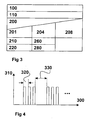
- FIG. 3 a flowchart.
- a short message is received and stored at a second program point 110, in particular in the memory 30.
- the evaluation of the received short message takes place on the basis of one or more message parameters, in the embodiment as Message parameter the phone number of the sender of the message is selected.
- the following cases are then available, for example: a first case provided with the reference numeral 201, which is present when a message is received from the telecommunication terminal 60 to which, for example, the telephone number "0172/4999008" is assigned; a second case provided with the reference numeral 204, which corresponds to the receipt of a message from the device 50, ie, for example, a voice mailbox; a third case provided with the reference numeral 208, which includes all other situations. If it is determined at the third program point 200 that the first case 201 is true, in a fourth program point 210, a not shown first counter is incremented and the new state is displayed in a fifth program point 220 by flashing the LED 15 in the first color.
- a second program point 260 In the event that it is recognized in the third program point 200 that the second case 204 applies, a second program point 260, a second, also not shown counter is incremented and it is in a seventh program point 280, the new state by flashing the LED 15 in the second, for example, another, color displayed. In the event that it is recognized in the third program step 200 that the third case 208 applies, then no further action takes place.
- the evaluation in the evaluation unit 20 is not limited to the number of the sender. It may also refer to the text of the message or short message, the type of message, the number of messages present, or the like.
- selection criteria include the presence or absence of the words "mailbox" or "e-mail" to determine the type of message.
- elements of the SMS header ie the header of an SMS message, or the SMS user data headers are used for selection.
- special user-defined selection criteria which allow certain notifications, that is to say specific messages, to be identified and treated in a special way, for example by a specific signaling being output by the message indicator 15 or by certain messages are stored differently, in particular in memory 30, than other messages.
- the receipt of e-mails via SMS is detected by the detection of certain header elements, which can also be used as selection criteria.
- the received messages can be stored sorted, for example.
- FIG. 4 an example of a signaling of the message indicator 15 is given.
- a flashing sequence is shown, which is characterized in that three times in a first time interval 320 is flashed.
- a single blinking is given by the fact that the intensity 310 of the output signal of the message indicator 15 changes twice, for example, that the intensity 310 is set, for example, from a first value to a second value and - after a certain waiting time - then back to the first Value is set to remain there also a certain additional waiting time.
- the first time interval 320 corresponds to the time interval starting from the intensity change from the first value of the intensity 310 to the second value of the intensity 310 until the end of the further waiting time after the intensity 310 has been readjusted again to the first value.
- the second time interval 330 is provided so that the flashing sequences are distinguishable or separable for the user, for example, by providing the second time interval 330 greater than the first time interval. Further possibilities for configuring the signaling by the message indicator 15 result from the fact that the intensity of the output signal of the message indicator 15 does not change as in FIG FIG. 4 but signaling may also be provided to provide more than two discrete values for the intensity 310 and that the intensity change of the output signal from one of these discrete values to another of these discrete ones Values conveys to the user information about a received message.
- the message indicator 15 in addition to the information about the status of the message input or the receipt of a message, the. Users to transmit other information, in particular operating information.
- information about the state of charge of the battery (not shown) or of the battery, not shown (battery status) in particular, is information about the availability of the battery Mobile network 40 or information about whether the radio 1 is currently booked in the mobile network 40 or not understood.
- Such operating information has previously been communicated to the user by means of a further signaling, in particular via light-emitting diodes.
- the display device is always used in radios, resulting in the disadvantages described, in particular the higher power consumption and the complicated operation of such radios leads.
- the further signaling of operating information to the user and the signaling of information of a content nature i. that is, for example, regarding the receipt of messages to the user, both separately, i. with the message indicator 15 and another, not shown message indicator - for example, with two different light emitting diodes - perform, as well as jointly, i. with the message indicator 15 for signaling both the operational information and for signaling the status of the message input.
- the operating information is signaled exclusively by means of a third color, while the information of a substantive nature are signaled only by means of the first and second colors.
- a radio 1 according to the invention is provided, for example, in such a way that the LED 15 flashes in a relatively low-frequency red color when the radio 1 no longer or only very poorly receives the regular signals of the mobile radio network, ie, for example Case of a supply gap of the mobile network 40. If in this embodiment, the battery is almost empty, the LED 15 flashes high-frequency and also in red, regardless of whether the radio 1 has reception or not. If the radio 1 is both logged in the network and also still receives the regular signals of the mobile network, the LED 15 flashes in green color relatively low frequency.
- the user thus always has the opportunity in this embodiment to recognize whether the radio 1 has reception and whether the battery must be charged urgently - and this regardless of whether the display device is turned on or off or switched to a power-saving mode.
- the invention provides in this case that the light-emitting diode flashes, for example, in blue color.
Landscapes
- Engineering & Computer Science (AREA)
- Signal Processing (AREA)
- Computer Networks & Wireless Communication (AREA)
- Human Computer Interaction (AREA)
- Business, Economics & Management (AREA)
- General Business, Economics & Management (AREA)
- Telephone Function (AREA)
- Mobile Radio Communication Systems (AREA)
- Telephonic Communication Services (AREA)
Applications Claiming Priority (2)
| Application Number | Priority Date | Filing Date | Title |
|---|---|---|---|
| DE10043284A DE10043284C1 (de) | 2000-09-02 | 2000-09-02 | Funkgerät |
| EP01971671A EP1316199B1 (de) | 2000-09-02 | 2001-08-30 | Funkgerät |
Related Parent Applications (1)
| Application Number | Title | Priority Date | Filing Date |
|---|---|---|---|
| EP01971671A Division EP1316199B1 (de) | 2000-09-02 | 2001-08-30 | Funkgerät |
Publications (2)
| Publication Number | Publication Date |
|---|---|
| EP1622348A1 EP1622348A1 (de) | 2006-02-01 |
| EP1622348B1 true EP1622348B1 (de) | 2009-12-09 |
Family
ID=7654755
Family Applications (2)
| Application Number | Title | Priority Date | Filing Date |
|---|---|---|---|
| EP05024181A Expired - Lifetime EP1622348B1 (de) | 2000-09-02 | 2001-08-30 | Funkgerät |
| EP01971671A Expired - Lifetime EP1316199B1 (de) | 2000-09-02 | 2001-08-30 | Funkgerät |
Family Applications After (1)
| Application Number | Title | Priority Date | Filing Date |
|---|---|---|---|
| EP01971671A Expired - Lifetime EP1316199B1 (de) | 2000-09-02 | 2001-08-30 | Funkgerät |
Country Status (5)
| Country | Link |
|---|---|
| US (3) | US7684789B2 (enExample) |
| EP (2) | EP1622348B1 (enExample) |
| JP (2) | JP2004507982A (enExample) |
| DE (3) | DE10043284C1 (enExample) |
| WO (1) | WO2002019676A1 (enExample) |
Families Citing this family (15)
| Publication number | Priority date | Publication date | Assignee | Title |
|---|---|---|---|---|
| DE10043284C1 (de) | 2000-09-02 | 2002-02-07 | Bosch Gmbh Robert | Funkgerät |
| DE10245456B4 (de) * | 2002-09-27 | 2005-07-28 | Gkikas, Karolos, Glyfada | Verfahren, System und Einrichtung zum Versenden und Empfangen von Nachrichten, insbesondere von Multimedia- und/oder Textnachrichten und/oder Dateien, über ein Festnetz |
| US7528974B2 (en) * | 2003-02-28 | 2009-05-05 | Electronics For Imaging, Inc. | Methods and apparatus for providing universal print services and asynchronous message services |
| US7391164B2 (en) * | 2004-09-15 | 2008-06-24 | Research In Motion Limited | Visual notification methods for candy-bar type cellphones |
| DE102005023962A1 (de) * | 2005-05-20 | 2006-11-23 | Vodafone Holding Gmbh | Betreiben eines in einem Telekommunikationsnetz nutzbaren Endgerätes |
| US8396456B2 (en) * | 2005-06-28 | 2013-03-12 | Avaya Integrated Cabinet Solutions Inc. | Visual voicemail management |
| KR100791117B1 (ko) * | 2006-11-09 | 2008-01-02 | 주식회사 서비전자 | 알 에프 통신기기 제어장치 및 방법 |
| KR101633329B1 (ko) * | 2009-08-19 | 2016-06-24 | 엘지전자 주식회사 | 이동 단말기 및 그 제어방법 |
| KR101913176B1 (ko) * | 2011-12-29 | 2018-11-01 | 삼성전자주식회사 | 텔레비전 장치의 전력을 제어하기 위한 방법 및 장치 |
| US9173045B2 (en) | 2012-02-21 | 2015-10-27 | Imation Corp. | Headphone response optimization |
| US9219957B2 (en) | 2012-03-30 | 2015-12-22 | Imation Corp. | Sound pressure level limiting |
| AU2014357329B2 (en) | 2014-06-09 | 2016-08-11 | Razer (Asia-Pacific) Pte. Ltd. | Radio communication systems and radio communication methods |
| WO2015190997A1 (en) * | 2014-06-09 | 2015-12-17 | Razer (Asia-Pacific) Pte. Ltd. | Radio communication devices and methods for controlling a radio communication device |
| WO2015190993A1 (en) | 2014-06-09 | 2015-12-17 | Razer (Asia-Pacific) Pte. Ltd | Radio communication devices and methods for controlling a radio communication device |
| US11113933B1 (en) * | 2020-02-28 | 2021-09-07 | Therm-Omega-Tech, Inc. | Visual indication system for feedback controller |
Family Cites Families (49)
| Publication number | Priority date | Publication date | Assignee | Title |
|---|---|---|---|---|
| DE494525C (de) | 1930-03-24 | Aeg | Anordnung des Endverschlusses von Mehrfachkabeln | |
| US4649563A (en) | 1984-04-02 | 1987-03-10 | R L Associates | Method of and means for accessing computerized data bases utilizing a touch-tone telephone instrument |
| US4633041A (en) | 1984-04-09 | 1986-12-30 | At&T Information Systems Inc. | Station set directory assistance arrangement |
| JPS63211949A (ja) * | 1987-02-27 | 1988-09-05 | Toshiba Corp | 電話装置 |
| GB8809404D0 (en) | 1988-04-21 | 1988-05-25 | Wisepeak Ltd | Upholstered furniture |
| US4975694A (en) * | 1989-03-14 | 1990-12-04 | Motorola, Inc. | Paging receiver with variable color indicators |
| EP0457077A3 (en) | 1990-05-16 | 1993-10-27 | Rolm Co | Accessing alphanumeric information using a numeric keypad |
| GB2251762B (en) | 1991-01-11 | 1994-09-21 | Technophone Ltd | Telephone apparatus with calling line identification |
| SE500239C2 (sv) * | 1992-09-04 | 1994-05-09 | Allgon Ab | Antennfäste på glasruta |
| US5425077A (en) | 1993-07-08 | 1995-06-13 | U.S. West Advanced Technologies, Inc. | Mobile telephone user interface including fixed and dynamic function keys and method of using same |
| DE4332758A1 (de) * | 1993-09-25 | 1995-03-30 | Sel Alcatel Ag | Funkendgerät zum Senden und Empfangen von Kurznachrichten |
| US5550754A (en) | 1994-05-13 | 1996-08-27 | Videoptic Research | Teleconferencing camcorder |
| JP2823182B2 (ja) * | 1994-05-31 | 1998-11-11 | 日本電気株式会社 | 携帯電話装置 |
| US5570025A (en) | 1994-11-16 | 1996-10-29 | Lauritsen; Dan D. | Annunciator and battery supply measurement system for cellular telephones |
| US6088516A (en) * | 1995-03-30 | 2000-07-11 | Kreisel; Glenn M. | Method for cloning a source application with assignment of unique identifier to clone application |
| JP2647055B2 (ja) * | 1995-05-17 | 1997-08-27 | 日本電気株式会社 | 表示機能付き無線選択呼出受信機 |
| JPH08317046A (ja) * | 1995-05-23 | 1996-11-29 | Nitsuko Corp | 留守番電話機 |
| US5797098A (en) * | 1995-07-19 | 1998-08-18 | Pacific Communication Sciences, Inc. | User interface for cellular telephone |
| US5809415A (en) * | 1995-12-11 | 1998-09-15 | Unwired Planet, Inc. | Method and architecture for an interactive two-way data communication network |
| US5737394A (en) * | 1996-02-06 | 1998-04-07 | Sony Corporation | Portable telephone apparatus having a plurality of selectable functions activated by the use of dedicated and/or soft keys |
| US6311282B1 (en) * | 1996-02-27 | 2001-10-30 | Fujitsu Personal Systems, Inc. | Method and apparatus for computing device with status display |
| US5881377A (en) * | 1996-08-29 | 1999-03-09 | Motorola, Inc. | Communication device and display blanking control method therefor |
| US5946636A (en) * | 1996-10-02 | 1999-08-31 | Ericsson Inc. | Quick-recognition visual notification system for use in radiotelephones |
| JPH10126827A (ja) * | 1996-10-18 | 1998-05-15 | Oki Tsushin Syst Kk | 無線呼出受信装置 |
| JP3197496B2 (ja) | 1996-11-28 | 2001-08-13 | 京セラ株式会社 | 移動体通信機 |
| JPH10207796A (ja) * | 1997-01-22 | 1998-08-07 | Casio Comput Co Ltd | 電子メールの処理方法 |
| US6209011B1 (en) * | 1997-05-08 | 2001-03-27 | Microsoft Corporation | Handheld computing device with external notification system |
| US6078612A (en) * | 1997-05-16 | 2000-06-20 | Itt Manufacturing Enterprises, Inc. | Radio architecture for an advanced digital radio in a digital communication system |
| US6125286A (en) | 1997-06-05 | 2000-09-26 | Motorola, Inc. | Communication device having multiple displays and method of operating the same |
| SE517491C2 (sv) * | 1997-06-06 | 2002-06-11 | Ericsson Telefon Ab L M | Mobiltelefonapparat |
| DE19724995A1 (de) * | 1997-06-13 | 1998-12-24 | Marion Wasenitz | Verfahren und Vorrichtung zum Signalisieren von an einem Netz-Anrufbeantworter eingegangenen Anrufen |
| WO1999000962A1 (de) | 1997-06-25 | 1999-01-07 | Siemens Aktiengesellschaft | Mobiltelefon mit audioeinheit |
| US6104923A (en) * | 1997-10-03 | 2000-08-15 | Karen Kite | Remote operational screener |
| US5877695A (en) * | 1997-10-07 | 1999-03-02 | Ericsson, Inc. | Visual alarm for a communication module |
| US6377821B2 (en) * | 1997-10-09 | 2002-04-23 | Avaya Technology Corp. | Display-based interface for a communication device |
| US6473628B1 (en) * | 1997-10-31 | 2002-10-29 | Sanyo Electric Co., Ltd. | Telephone set |
| FI974393L (fi) * | 1997-12-02 | 1999-06-03 | Nokia Mobile Phones Ltd | Menetelmä ja järjestely virran säästämiseksi matkaviestimessä |
| JPH11187151A (ja) * | 1997-12-24 | 1999-07-09 | Sharp Corp | 着信情報報知方法及び装置及び該方法を実行するデータ及びプログラムを格納した記録媒体 |
| US6119014A (en) * | 1998-04-01 | 2000-09-12 | Ericsson Inc. | System and method for displaying short messages depending upon location, priority, and user-defined indicators |
| JPH11341187A (ja) * | 1998-05-29 | 1999-12-10 | Sharp Corp | ショート・メッセージ送信先番号の自動生成装置 |
| JP2000036985A (ja) * | 1998-07-21 | 2000-02-02 | Toshiba Corp | 無線携帯端末装置 |
| DE19857902A1 (de) * | 1998-12-15 | 2000-06-29 | Deutsche Telekom Mobil | Verfahren und Vorrichtung zur Übertragung von Kurznachrichten in Telekommunikationsnetzen |
| JP3462778B2 (ja) * | 1999-02-10 | 2003-11-05 | 三洋電機株式会社 | 携帯電話装置 |
| US6438390B1 (en) * | 1999-05-06 | 2002-08-20 | Motorola, Inc. | Plural status indication control method suitable for use in a communication device |
| SE9902624L (sv) * | 1999-07-08 | 2001-01-09 | Ericsson Telefon Ab L M | Portabel kommunikationsapparat med visuellt indikeringsorgan samt metod för att åstadkomma visuell statusindikering för densamma |
| JP2001217904A (ja) * | 2000-02-03 | 2001-08-10 | Nec Saitama Ltd | 点灯機能付き携帯電話機 |
| DE10043284C1 (de) | 2000-09-02 | 2002-02-07 | Bosch Gmbh Robert | Funkgerät |
| US6720863B2 (en) * | 2001-08-16 | 2004-04-13 | Wildseed Ltd. | Mobile electronic communication device with lights to indicate received messages |
| US7706843B2 (en) * | 2002-09-19 | 2010-04-27 | Kyocera Wireless Corp. | Mobile handset including alert mechanism |
-
2000
- 2000-09-02 DE DE10043284A patent/DE10043284C1/de not_active Expired - Lifetime
-
2001
- 2001-08-30 JP JP2002523843A patent/JP2004507982A/ja active Pending
- 2001-08-30 DE DE50108026T patent/DE50108026D1/de not_active Expired - Lifetime
- 2001-08-30 EP EP05024181A patent/EP1622348B1/de not_active Expired - Lifetime
- 2001-08-30 WO PCT/DE2001/003304 patent/WO2002019676A1/de not_active Ceased
- 2001-08-30 US US10/363,625 patent/US7684789B2/en not_active Expired - Fee Related
- 2001-08-30 DE DE50115257T patent/DE50115257D1/de not_active Expired - Lifetime
- 2001-08-30 EP EP01971671A patent/EP1316199B1/de not_active Expired - Lifetime
-
2010
- 2010-01-29 US US12/696,904 patent/US8923821B2/en not_active Expired - Fee Related
-
2011
- 2011-09-15 JP JP2011201981A patent/JP5542758B2/ja not_active Expired - Lifetime
-
2014
- 2014-12-02 US US14/558,114 patent/US20150156305A1/en not_active Abandoned
Also Published As
| Publication number | Publication date |
|---|---|
| US7684789B2 (en) | 2010-03-23 |
| US20100197280A1 (en) | 2010-08-05 |
| US20150156305A1 (en) | 2015-06-04 |
| JP2012016056A (ja) | 2012-01-19 |
| EP1622348A1 (de) | 2006-02-01 |
| US20040033783A1 (en) | 2004-02-19 |
| EP1316199A1 (de) | 2003-06-04 |
| DE50108026D1 (de) | 2005-12-15 |
| JP2004507982A (ja) | 2004-03-11 |
| US8923821B2 (en) | 2014-12-30 |
| EP1316199B1 (de) | 2005-11-09 |
| JP5542758B2 (ja) | 2014-07-09 |
| WO2002019676A1 (de) | 2002-03-07 |
| DE10043284C1 (de) | 2002-02-07 |
| DE50115257D1 (de) | 2010-01-21 |
Similar Documents
| Publication | Publication Date | Title |
|---|---|---|
| EP1622348B1 (de) | Funkgerät | |
| DE69228164T2 (de) | Rufumleitungstechnik für ankommende Kommunikationen mit Ortsanzeige von angerufenem Teilnehmer | |
| WO1999017521A1 (de) | Verfahren zum melden einer nachricht an einen teilnehmer | |
| EP0667089B1 (de) | Anordnung zur steuerung einer sende-/empfangseinrichtung, insbesondere von basisstationen und mobilteilen eines schnurlos-telefonsystems | |
| DE3877259T3 (de) | Schnurloser Telefonapparat und Steuerungsverfahren dafür. | |
| DE19958777B4 (de) | Mobiles Telekommunikationsendgerät | |
| WO2000007396A1 (de) | Verfahren, vorrichtung und system zum betreiben von mobilen telekommunikationsendgeräten in einem öffentlichen, zellularen mobilfunknetz | |
| DE2015198A1 (de) | Funk-Fernsprechanlage | |
| EP0879543B1 (de) | Verfahren zur herstellung einer sprachverbindung in einem mobilfunknetz | |
| DE60211843T2 (de) | Automatische Übertragung eines Informationsantwortsignals | |
| DE20122148U1 (de) | Funkgerät | |
| EP1170712A2 (de) | Alarmierungssystem zur schnellen Weiterleitung von Alarmmeldungen und zur raschen Alarmierung einer Mindestpersonenzahl | |
| EP0569060A2 (de) | Aus schnurlosen Telefonen gebildete Nebenstellenanlage | |
| WO2002058419A2 (de) | Automatische beantwortung von alphanumerischen nachrichten in einem mobilfunk-kommunikationssystem | |
| DE19613519A1 (de) | Telefonanlage für schnurlose Telefone | |
| DE19826087A1 (de) | Einrichtung einer Endstelle eines Telekommunikationsnetzes | |
| DE60019242T2 (de) | Dialog zwischen zwei Steuereinheiten, insbesondere in einem Dual-Mode DECT/GSM Mobilfunk-Endgerät | |
| DE3308986C2 (de) | Schaltungsanordnung für eine digitale Fernsprechstation | |
| EP0735737B1 (de) | Telekommunikationssystem mit einem als Türsprecheinrichtung ausgebildeten Endgerät | |
| WO1999063778A1 (de) | Verfahren, vorrichtung und system zum betreiben von drahtlosen telekommunikationseinrichtungen in einem zellularen mobilfunknetz | |
| DE10329960A1 (de) | Vorrichtung und Kommunikationssystem zum Verbinden einer Mobilfunk-Endeinrichtung mit einem Festnetz | |
| DE10255489A1 (de) | Kommunikationsanlage und Verfahren zur Steuerung der Weiterschaltung eines Anrufs zwischen einem Mobilfunknetz und einem Festnetz | |
| DE102008050174B3 (de) | Mobiles Endgerät mit varibaler Sendeleistung | |
| DE20011427U1 (de) | Alarmierungssystem zur Weiterleitung von Alarmmeldungen über ein Mobilfunk-/Fernsprechnetz | |
| EP0469476A2 (de) | Nachrichtenübertragungssystem mit Sprach-, Bilddaten- und Textdatenkommunikation zwischen Teilnehmereinrichtungen |
Legal Events
| Date | Code | Title | Description |
|---|---|---|---|
| PUAI | Public reference made under article 153(3) epc to a published international application that has entered the european phase |
Free format text: ORIGINAL CODE: 0009012 |
|
| AC | Divisional application: reference to earlier application |
Ref document number: 1316199 Country of ref document: EP Kind code of ref document: P |
|
| AK | Designated contracting states |
Kind code of ref document: A1 Designated state(s): DE FR GB IT |
|
| 17P | Request for examination filed |
Effective date: 20060801 |
|
| AKX | Designation fees paid |
Designated state(s): DE FR GB IT |
|
| 17Q | First examination report despatched |
Effective date: 20060920 |
|
| RAP1 | Party data changed (applicant data changed or rights of an application transferred) |
Owner name: IPCOM GMBH & CO. KG |
|
| 111Z | Information provided on other rights and legal means of execution |
Free format text: DE FR GB IT Effective date: 20080507 |
|
| GRAP | Despatch of communication of intention to grant a patent |
Free format text: ORIGINAL CODE: EPIDOSNIGR1 |
|
| GRAS | Grant fee paid |
Free format text: ORIGINAL CODE: EPIDOSNIGR3 |
|
| GRAA | (expected) grant |
Free format text: ORIGINAL CODE: 0009210 |
|
| AC | Divisional application: reference to earlier application |
Ref document number: 1316199 Country of ref document: EP Kind code of ref document: P |
|
| AK | Designated contracting states |
Kind code of ref document: B1 Designated state(s): DE FR GB IT |
|
| REG | Reference to a national code |
Ref country code: GB Ref legal event code: FG4D Free format text: NOT ENGLISH |
|
| REF | Corresponds to: |
Ref document number: 50115257 Country of ref document: DE Date of ref document: 20100121 Kind code of ref document: P |
|
| PLBI | Opposition filed |
Free format text: ORIGINAL CODE: 0009260 |
|
| PLAX | Notice of opposition and request to file observation + time limit sent |
Free format text: ORIGINAL CODE: EPIDOSNOBS2 |
|
| 26 | Opposition filed |
Opponent name: RACH, WERNER Effective date: 20100909 |
|
| PLBB | Reply of patent proprietor to notice(s) of opposition received |
Free format text: ORIGINAL CODE: EPIDOSNOBS3 |
|
| PLBP | Opposition withdrawn |
Free format text: ORIGINAL CODE: 0009264 |
|
| PLBD | Termination of opposition procedure: decision despatched |
Free format text: ORIGINAL CODE: EPIDOSNOPC1 |
|
| PLBM | Termination of opposition procedure: date of legal effect published |
Free format text: ORIGINAL CODE: 0009276 |
|
| STAA | Information on the status of an ep patent application or granted ep patent |
Free format text: STATUS: OPPOSITION PROCEDURE CLOSED |
|
| 27C | Opposition proceedings terminated |
Effective date: 20120122 |
|
| REG | Reference to a national code |
Ref country code: GB Ref legal event code: 732E Free format text: REGISTERED BETWEEN 20130530 AND 20130605 |
|
| REG | Reference to a national code |
Ref country code: FR Ref legal event code: GC Effective date: 20130604 |
|
| REG | Reference to a national code |
Ref country code: GB Ref legal event code: 732E Free format text: REGISTERED BETWEEN 20130815 AND 20130821 |
|
| REG | Reference to a national code |
Ref country code: FR Ref legal event code: PLFP Year of fee payment: 16 |
|
| REG | Reference to a national code |
Ref country code: FR Ref legal event code: PLFP Year of fee payment: 17 |
|
| REG | Reference to a national code |
Ref country code: FR Ref legal event code: PLFP Year of fee payment: 18 |
|
| PGFP | Annual fee paid to national office [announced via postgrant information from national office to epo] |
Ref country code: FR Payment date: 20200820 Year of fee payment: 20 Ref country code: GB Payment date: 20200825 Year of fee payment: 20 |
|
| PGFP | Annual fee paid to national office [announced via postgrant information from national office to epo] |
Ref country code: IT Payment date: 20200831 Year of fee payment: 20 |
|
| PGFP | Annual fee paid to national office [announced via postgrant information from national office to epo] |
Ref country code: DE Payment date: 20201029 Year of fee payment: 20 |
|
| REG | Reference to a national code |
Ref country code: DE Ref legal event code: R082 Ref document number: 50115257 Country of ref document: DE |
|
| REG | Reference to a national code |
Ref country code: DE Ref legal event code: R071 Ref document number: 50115257 Country of ref document: DE |
|
| REG | Reference to a national code |
Ref country code: GB Ref legal event code: PE20 Expiry date: 20210829 |
|
| PG25 | Lapsed in a contracting state [announced via postgrant information from national office to epo] |
Ref country code: GB Free format text: LAPSE BECAUSE OF EXPIRATION OF PROTECTION Effective date: 20210829 |