EP1610366A1 - Reinigungsverfahren, verfahren zum entfernen von fremdteilchen, reinigungsvorrichtung und reinigungsflüssigkeit - Google Patents
Reinigungsverfahren, verfahren zum entfernen von fremdteilchen, reinigungsvorrichtung und reinigungsflüssigkeit Download PDFInfo
- Publication number
- EP1610366A1 EP1610366A1 EP04724771A EP04724771A EP1610366A1 EP 1610366 A1 EP1610366 A1 EP 1610366A1 EP 04724771 A EP04724771 A EP 04724771A EP 04724771 A EP04724771 A EP 04724771A EP 1610366 A1 EP1610366 A1 EP 1610366A1
- Authority
- EP
- European Patent Office
- Prior art keywords
- liquid
- particle
- cleaning
- photomask
- high viscosity
- Prior art date
- Legal status (The legal status is an assumption and is not a legal conclusion. Google has not performed a legal analysis and makes no representation as to the accuracy of the status listed.)
- Withdrawn
Links
Images


Classifications
-
- H—ELECTRICITY
- H01—ELECTRIC ELEMENTS
- H01L—SEMICONDUCTOR DEVICES NOT COVERED BY CLASS H10
- H01L21/00—Processes or apparatus adapted for the manufacture or treatment of semiconductor or solid state devices or of parts thereof
- H01L21/02—Manufacture or treatment of semiconductor devices or of parts thereof
- H01L21/02041—Cleaning
- H01L21/02043—Cleaning before device manufacture, i.e. Begin-Of-Line process
- H01L21/02052—Wet cleaning only
-
- B—PERFORMING OPERATIONS; TRANSPORTING
- B08—CLEANING
- B08B—CLEANING IN GENERAL; PREVENTION OF FOULING IN GENERAL
- B08B7/00—Cleaning by methods not provided for in a single other subclass or a single group in this subclass
- B08B7/0014—Cleaning by methods not provided for in a single other subclass or a single group in this subclass by incorporation in a layer which is removed with the contaminants
-
- G—PHYSICS
- G03—PHOTOGRAPHY; CINEMATOGRAPHY; ANALOGOUS TECHNIQUES USING WAVES OTHER THAN OPTICAL WAVES; ELECTROGRAPHY; HOLOGRAPHY
- G03F—PHOTOMECHANICAL PRODUCTION OF TEXTURED OR PATTERNED SURFACES, e.g. FOR PRINTING, FOR PROCESSING OF SEMICONDUCTOR DEVICES; MATERIALS THEREFOR; ORIGINALS THEREFOR; APPARATUS SPECIALLY ADAPTED THEREFOR
- G03F1/00—Originals for photomechanical production of textured or patterned surfaces, e.g., masks, photo-masks, reticles; Mask blanks or pellicles therefor; Containers specially adapted therefor; Preparation thereof
- G03F1/68—Preparation processes not covered by groups G03F1/20 - G03F1/50
- G03F1/82—Auxiliary processes, e.g. cleaning or inspecting
-
- H—ELECTRICITY
- H01—ELECTRIC ELEMENTS
- H01L—SEMICONDUCTOR DEVICES NOT COVERED BY CLASS H10
- H01L21/00—Processes or apparatus adapted for the manufacture or treatment of semiconductor or solid state devices or of parts thereof
- H01L21/67—Apparatus specially adapted for handling semiconductor or electric solid state devices during manufacture or treatment thereof; Apparatus specially adapted for handling wafers during manufacture or treatment of semiconductor or electric solid state devices or components ; Apparatus not specifically provided for elsewhere
- H01L21/67005—Apparatus not specifically provided for elsewhere
- H01L21/67011—Apparatus for manufacture or treatment
- H01L21/6715—Apparatus for applying a liquid, a resin, an ink or the like
-
- C—CHEMISTRY; METALLURGY
- C11—ANIMAL OR VEGETABLE OILS, FATS, FATTY SUBSTANCES OR WAXES; FATTY ACIDS THEREFROM; DETERGENTS; CANDLES
- C11D—DETERGENT COMPOSITIONS; USE OF SINGLE SUBSTANCES AS DETERGENTS; SOAP OR SOAP-MAKING; RESIN SOAPS; RECOVERY OF GLYCEROL
- C11D2111/00—Cleaning compositions characterised by the objects to be cleaned; Cleaning compositions characterised by non-standard cleaning or washing processes
- C11D2111/10—Objects to be cleaned
- C11D2111/14—Hard surfaces
- C11D2111/22—Electronic devices, e.g. PCBs or semiconductors
-
- C—CHEMISTRY; METALLURGY
- C11—ANIMAL OR VEGETABLE OILS, FATS, FATTY SUBSTANCES OR WAXES; FATTY ACIDS THEREFROM; DETERGENTS; CANDLES
- C11D—DETERGENT COMPOSITIONS; USE OF SINGLE SUBSTANCES AS DETERGENTS; SOAP OR SOAP-MAKING; RESIN SOAPS; RECOVERY OF GLYCEROL
- C11D2111/00—Cleaning compositions characterised by the objects to be cleaned; Cleaning compositions characterised by non-standard cleaning or washing processes
- C11D2111/40—Specific cleaning or washing processes
- C11D2111/42—Application of foam or a temporary coating on the surface to be cleaned
Definitions
- the present invention relates to a cleaning method, a particle removing method, a cleaning apparatus and cleaning liquid for removing particles such as dirt adhered to an object such as a photomask or a semiconductor wafer.
- a particle is adhered to a photomask that is used as a mask for fine pattern transfer, which is required when manufacturing semiconductor device such as an LSI or a liquid crystal panel, the particle is transferred as a defect. Therefore, when manufacturing the photomask, a cleaning process for removing the particle is provided as one of important processes.
- the cleaning process executed for manufacturing the photomask includes a step of cleaning a substrate (glass substrate) having no patterned portion, a step of cleaning a substrate formed with a metal thin film thereon for forming a patterned portion on the glass substrate (blanks), and a step of cleaning a substrate (photomask) formed with a pattern thereon.
- the cleaning method used in these cleaning steps includes a physical cleaning and a chemical cleaning.
- the physical cleaning includes a scrub cleaning performed by scrubbing a surface of the substrate using a PVA sponge, a high-pressure water cleaning performed by pressure-applied rinse water, and an ultrasonic wave cleaning using frequencies ranging from KHz to MHz.
- the chemical cleaning includes SPM cleaning (cleaning liquid; H 2 SO 4 /H 2 O 2 , cleaning temperature; 40-100°C), APM cleaning (cleaning liquid; NH 4 OH/H 2 O 2 /H 2 O, cleaning temperature; RT-40°C) (see Non-Patent Document 1).
- Non-Patent Document 2 a method using ozone water including ozone dissolved therein (see Non-Patent Document 2) and a method using electrolytic water.
- ultrasonic wave i.e. physical cleaning is used together, to improve a cleaning effect of the APM cleaning i.e. chemical cleaning. Effective removal of the particle is difficult unless specific cleaning conditions are adequately selected according to the type, size, and adhesion mechanism of the particle to be removed.
- Non-Patent Document 1 M. Takahashi, H. Handa, and H. Shirai, "The knack for reticle cleaning", Proceeding of Photomask and Next-generation Lithography Mask Technology VII, SPIE Vol. 4066, pp.409-415, 2000
- Non-Patent Document 2 Y.S. Son, S.H. Jeong, J.B. Kim and H.S. Kim, "ArF-Half-Tone PSM Cleaning Process Optimization for Next-generation Lithography", Proceeding of Photomask and Next-Generation Lithography Mask Technology VII, SPIE Vol. 4066, pp.416-423, 2000.
- the photomask In association with rapid microminiaturization of a pattern in recent years, the photomask is also required to be free of particles of 0.15 ⁇ m or larger in size on an area where light is transmitted (hereinafter referred to as light-transmitting portion).
- light-transmitting portion In addition, in association with shortening of the wavelength of exposure light, requirements for particles will be increasingly strict in the future. However, it is revealed that fulfillment of such strict requirements with the conventional physical cleaning or the chemical cleaning described above is very difficult. In other words, although countermeasures such as increasing the number of times of cleaning have been taken in order to fulfill the above-described requirements, sufficient effect has not been achieved.
- a specific mask that is, a phase-shift mask
- a phase-shift mask is increasingly used in order to improve a resolution of the photomask.
- a half-tone mask which is one of the phase-shift mask
- a half-tone film (a metal film based on MoSi material), which forms the patterned portion, has low resistivity against liquid having alkaline characteristics. Therefore, problem involved therein is that the APM cleaning which is used for cleaning the photomask cannot be continued for a long time.
- the lower portion of the mask pattern has an undercut shape.
- the particle exists in this undercut portion, it may be hidden under the lower portion of the mask pattern, and hence may not be detected as the foreign substance by a process of detecting the particle on the surface of the photomask.
- exposure light is disturbed (such as scattering and absorption) during using the photomask, and therefore the particle of the undercut portion also needs removing.
- the present invention takes several aspects as follows.
- a method of cleaning an object wherein the object is cleaned by acting a desired force on the surface of the object to be cleaned in a state that liquid having 50 mPa.s or more of viscosity being contacted to at least the surface of the object to be cleaned.
- the cleaning method according to the first aspect is provided, wherein the desired force is a force generated in association with movement of the liquid.
- the cleaning method according to the first aspect is provided, wherein the desired force is a force generated by moving the object and a member different from the object relatively in a non-contact state.
- the cleaning method according to the first aspect is provided, wherein the desired force is an externally applied force.
- the cleaning method according to any one of the first to fourth aspects is provided, wherein the liquid has a predetermined pH value that can control a zeta potential of the object.
- the cleaning method according to the fifth aspect is provided, wherein the pH value of the liquid is at least 6.
- the cleaning method according to any one of the first to sixth aspects is provided, wherein the object is a substrate.
- the cleaning method according to any one of the first to seventh aspects is provided, wherein the object has a patterned structure on the surface.
- the cleaning method according to any one of the first to eighth aspects is provided, wherein the object is a photomask.
- the cleaning method according to either of the eighth aspect or the ninth aspect is provided, wherein the object has a pattern having an undercut shape on the surface thereof.
- a particle removing method for removing an adherent particle from an object wherein the particle is removed by acting a desired force on the surface of the object to be cleaned in the state that liquid having 50 mPa.s or more of viscosity being contacted to at least the surface of the object to be cleaned.
- the particle removing method according to the eleventh aspect is provided, wherein the desired force is a force generated in association with movement of the liquid.
- the particle removing method according to the eleventh aspect is provided, wherein the desired force is a force generated by moving the object and a member different from the object relatively in a non-contact state.
- the particle removing method according to the eleventh aspect is provided, wherein the desired force is an externally applied force.
- the particle removing method for removing an adherent particle from the object comprising:
- a particle removing method for removing an adherent particle from an object comprising:
- the particle removing method according to either of the fourteenth aspect or fifteenth aspect is provided, wherein the viscosity of the liquid is 50 mPa.s or higher.
- the particle removing method according to any one of the eleventh to seventeenth aspects is provided, wherein the liquid has a predetermined pH value that can control a zeta potential of the object.
- the particle removing method according to any one of the eleventh to eighteenth aspects is provided, wherein the object is a substrate.
- the particle removing method according to any one of the eleventh to nineteenth aspects is provided, wherein the object has a patterned structure on the surface.
- the particle removing method according to any one of the eleventh to twentieth aspects is provided, wherein the object is a photomask.
- the particle removing method according to either of the twentieth aspect or the twenty-first aspect is provided, wherein the object has a pattern having an undercut shape on the surface thereof.
- a cleaning apparatus for cleaning an object comprising:
- the cleaning apparatus according to the twenty-third aspect, wherein the means for applying the desired force, with the liquid contacted with the surface of the object, also serves as a means for moving the liquid.
- the cleaning apparatus according to the twenty-fourth aspect, wherein the means for applying the desired force, with the liquid contacted with the surface of the object, also serves as a means for relatively moving the object and a member different from the object in a non-contact state.
- the cleaning apparatus according to the twenty-fifth aspect is provided, wherein the member different from the object has a planer area facing the object.
- the cleaning apparatus according to the twenty-sixth aspect, wherein the planar area of the member different from the object has a rugged surface.
- the cleaning apparatus according to the twenty-third aspect, wherein the means for applying the desired force, with the liquid contacted with the surface of the object also serves as a means for adding an external force.
- the cleaning apparatus according to any one of the twenty-third to twenty-eighth aspect is provided, further comprising a means for changing the viscosity of the liquid.
- the cleaning apparatus according to any one of the twenty-third to twenty-ninth aspect is provided, wherein the cleaning apparatus removes the particle adhered to the object.
- cleaning liquid to be used for cleaning an object wherein the liquid has a viscosity of 50 mPa.s or higher.
- the cleaning liquid according to the thirty-second aspect is provided, wherein the pH value of the liquid is pH6 or higher.
- the desired force by applying the desired force in a contact state between the liquid having high-viscosity such as 50 mPa.s or higher and the object to be cleaned, the desired force can be adjusted to a force within a range which gives less damage to the object and provides a high cleaning capability.
- the desired force described in this specification includes a force generated by liquid itself and a force applied externally by a certain separate member.
- the force generated by the liquid itself includes a viscosity resistance generated in association with movement of the liquid.
- the present invention designed to obtain a large force for cleaning the object not by using other physical force such as an ultrasonic wave or the pressure of sponge, but only by moving the liquid by utilizing a property of the viscosity which increases in association with the increase in the viscosity resistance.
- the means for moving the liquid includes a means for using a centrifugal force generated by the rotation of the object, a means for moving the liquid by moving the object, for example, by tilting the object to cause a gravitational force of the liquid, or a means for moving the liquid by an external force (a pressure or a pressing force).
- a high viscosity liquid can be moved so as to be slid on the surface of the object by using low viscosity liquid having lower viscosity than the high viscosity liquid and causing the low viscosity liquid to act on the high viscosity liquid at a high flow rate (a flow rate at which the high viscosity liquid is moved by a pressure of the liquid or the like before the high viscosity liquid is mixed with the low viscosity liquid), and hence as the means for moving the liquid, a means for causing the low viscosity liquid to act at a high flow rate may be used.
- the type of the low viscosity liquid in this case is not specifically limited, a liquid which does not react to the high viscosity liquid and does not change the physical property thereof such as pH value is preferable since it is somewhat mixed with the high viscosity liquid. More specifically, a liquid of the same type as water or the high viscosity liquid but different only in viscosity is preferable.
- the means for moving the liquid the above-described means may be used independently or in combination of two or more of them.
- the present invention is designed to obtain a large force for cleaning the object in a non-contact state, not using other physical forces such as an ultrasonic wave or the pressure of a sponge or the like, with the liquid interposed between an object and a member different from the object, but relatively moving both of them to cause a shearing stress to be generated, and utilizing the property of the shearing stress which becomes larger as the viscosity of the liquid is increased, thereby generating a larger shearing stress, with the high viscosity liquid interposed.
- the shearing stress increases as well, and the shearing stress can be adjusted by adjusting the speed gradient (dV/Dh) between the surface area S of the object and the object/planer surface, and the vertical direction.
- the high viscosity-liquid is sometimes used. Since the high viscosity liquid generates a damping effect, damage to the object can be reduced more in comparison with the case in which a low viscosity liquid is brought into contact with the surface of the object to be cleaned.
- the particle can be removed without giving any damage to the object by employing a liquid having a viscosity of 50 mPa.s or higher.
- the particle which is adhered to the object relatively stubbornly or entered into and adhered to a minute recess on the surface of the object or the undercut portion and hence is not able to be removed with the conventional method since it may give a damage to the object, can now be removed easily from the object without affecting the object.
- the viscosity of the liquid is preferably 700 mPa.s at maximum. When it exceeds 700 mPa.s, the liquid can hardly be fed by a force of a pump or the like, or hardly be rinsed, and hence practicability is lowered and, in addition, if the object is formed with a fine pattern, the possibility of destruction of the fine pattern is increased.
- the viscosity of the liquid is more preferably in the range from 100 mPa.s to 400 mPa.s, and further preferably, from 200 mPa.s to 300 mPa.s.
- the viscosity of the liquid is selected as needed according to the type of the particle to be removed and the condition of the surface of the object. For example, when the object has the rugged surface, or the finely patterned surface, an adequate viscosity is selected taking into account the size, arrangement and shape of the irregularity or the pattern, or the type, size and adhesion mechanism of the particle. For example, in the fine pattern, when the viscosity is too high, the surface tension increases correspondingly, and hence the liquid may not enter into a recessed portion of the pattern. In such a case, in order to allow the liquid to spread over the recessed portion of the pattern, the liquid may be diluted with a liquid having lower viscosity than the liquid, such as water, to adjust the viscosity.
- the liquid preferably has a predetermined pH value that can control the zeta potential of the object.
- the particle adhered to the surface of the object is normally adhered to the surface of the object in a charged state.
- the zeta potential between the surface of the object and the particle adhered thereon is adjusted to a different positive or negative side (+ and -)
- an attracting force acts between the surface of the object and the particle.
- the zeta potential between the surface of the object and the particle is the same positive or negative side (both are +, or both are -), they repulse against each other, and hence the particle can easily be removed from the surface of the object.
- the adherent particle is removed from the surface of the substrate, by controlling the pH value of the liquid so as to adjust the zeta potential between the surface of the object and the particle to the same positive or negative side, re-adhesion of the particle can be prevented.
- the object has a glass surface such as the photomask
- the zeta potential of the glass is pH 6 or higher and hence can easily be controlled to a minus value
- the particle which is removed from the surface of the object can be prevented from re-adhering to the surface of the photomask, by setting the pH value of the liquid to pH6 or higher.
- the value of pH in the case of the object having the glass surface is more preferably 9 or higher.
- the cleaning liquid is required not to contain particles larger than the particle which must be prevented from adhesion, and in the case of cleaning the photomask, the liquid after having subjected to filtration by a 0.1, ⁇ m filter is used.
- water-based solution containing water soluble compounds such as polymeric glycol group including polyethylene glycol or polypropylene glycol, or ethylene oxide additives or propylene additives of polyatomic alcohol such as glycerin or nonionic surfactant may be preferably exemplified.
- the nonionic surfactant includes polyoxyethylene alkyl ether (R-O(CH 2 CH 2 O)nH), polyoxyethylene alkyl phenyl ether, polyoxyethylene- polyoxypropylene blockpolymer, polyoxyethylene polyoxypropylene alkyl ether, polyoxyethylene glycerine fatty acid ester, polyoxyethylene sorbitan fatty acid ester, polyethylene glycol fatty acid ester, polyglyceryl fatty acid ester, and sorbitan fatty acid ester.
- a nonionic (anionic), amphoteric, and ionic (cationic) surfactants may also be used.
- the aforementioned water soluble compounds may be used independently, or two or more types may be combined.
- the aforementioned surfactants may include alkaline builders (auxiliary agents) such as sodium hydroxide, potassium hydroxide, sodium carbonate, potassium carbonate, sodium silicate, potassium silicate, sodium phosphate, and potassium phosphate.
- alkaline builders auxiliary agents
- One of the alkaline builders given above may be used independently, or two or more of them may be used by combination.
- an alkaline builder is selected in consideration of solubility into the object to be cleaned. For example, when a half-tone-type phase-shift mask having a pattern formed of MoSi series material is cleaned, since the MoSi series material has low resistance to the alkaline solution, it is preferable to use sodium hydroxide and/or potassium hydroxide which is considered to give less damage to the pattern.
- the cleaning apparatus of the present invention for cleaning the object comprises a mechanism to make a contact state between the liquid having the viscosity of 50 mPa.s or more and at least the surface of the object to be cleaned; and a mechanism to add a desired force on the surface, with the surface of the object contacted with the liquid.
- the aforementioned mechanism to make a contact state between the liquid having the viscosity of 50 mPa.s or more and the object to be cleaned examples are given such as a mechanism to supply the liquid to the surface of the object by a nozzle and a mechanism to dip the object into a liquid layer containing the liquid.
- the desired force includes a force generated by the liquid itself and a force externally applied from other members.
- the force generated by liquid itself includes viscosity resistance generated in association with a movement of the liquid. Therefore, as the mechanism to add the desired force, that is, the mechanism to move the liquid on the surface of the object, examples are given such as a rotating mechanism of the object (liquid is moved by a centrifugal force), a tilting mechanism of the object (liquid is moved by a gravitational force), a mechanism to continuously supply the liquid by means of nozzle and shower or the like, a moving mechanism to swing the object in the liquid layer, a circulation mechanism of the liquid in the liquid layer, and a blowing mechanism using air and liquid.
- a rotating mechanism of the object liquid is moved by a centrifugal force
- a tilting mechanism of the object liquid is moved by a gravitational force
- a mechanism to continuously supply the liquid by means of nozzle and shower or the like a moving mechanism to swing the object in the liquid layer
- a circulation mechanism of the liquid in the liquid layer a blowing mechanism using air and liquid.
- a high viscosity liquid can be moved so as to be slid on the surface of the object by using low viscosity liquid having lower viscosity than the high viscosity liquid and causing the low viscosity liquid to act on the high viscosity liquid at a high flow rate (high flow rate at which the high viscosity liquid is moved by a pressure or the like of the liquid before the high viscosity liquid is mixed with the low viscosity liquid). Therefore, as the mechanism to move the liquid, the mechanism to act the low viscosity liquid on the high viscosity liquid at a high flow rate may be used. Furthermore, one or two or more of the above-described mechanisms may be provided together.
- the present invention has a mechanism to interpose the liquid between the object and a member different from the object, and relatively move them.
- the member different from the object in this mechanism may be, for example, a sponge, a resin plate, a metal plate, and so on disposed so as to face the object in a non-contact state.
- the member having elasticity such as sponge is used. This is because even when the object and the member different from the object unexpectedly make contacts with each other for some reason or other, an impact caused thereby is absorbed and a danger of causing damage to the object can be reduced.
- this member has a planar area facing the object, from the viewpoint of effectively using the shearing stress.
- the shearing stress can be adjusted.
- the planar area has the rugged surface, movement of the liquid can be performed efficiently.
- the shearing stress can be properly adjusted, in accordance with a spot on the surface of the object or the kind of the object.
- the shearing stress can be adjusted by adjusting the distance between the object and the member different from the object. Therefore, preferably the apparatus of the present invention has a mechanismt to control a distance between the object and the member different from the object.
- the term "non-contact" indicates that the distance therebetween is larger than zero.
- the distance therebetween is preferably at least 0.1 mm.
- the means to arbitrarily change the viscosity of the liquid examples are given such as a mechanism to supply the low viscosity liquid to the high viscosity liquid by mixing, and a mechanism to entirely or locally supply the low viscosity liquid to the high viscosity liquid already supplied.
- the mechanism to supply the low viscosity liquid also serves as the mechanism to supply the low viscosity liquid for moving the high viscosity liquid and the mechanism to change the flow rate.
- the means to add an externally applied desired force on the surface of the object an example is given such as a means to supply the high pressure liquid thereto in the high-pressure cleaning, such as the sponge or brush, which can be used in contact with the object in the ultrasonic wave or scrub cleaning.
- This means may be used by combining the means for bringing the aforementioned liquid into contact with the surface of the object and the means for moving the liquid on the surface of the object.
- the present invention is applied to any object, it is applied to objects of an electronic device substrate and an optical device substrate, etc., where a minute adherent particle poses a problem in particular.
- the present invention has effects in cleaning a fragile object and removing the particle, which may involve a problem of causing a damage to the object during the cleaning process in particular.
- a lithography mask is given as an example, such as a photomask formed of a thin film and having a fine pattern formed thereon.
- the present invention is effectively applied to the photomask having a fragile pattern such as a pattern having an undercut shape, as seen in a so-called Levenson type phase-shift mask having an undercut on the light-shielding pattern by trenching the substrate.
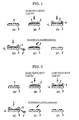
- Fig. 1 is an explanatory view illustrating a particle removing method according to an example 1 of the present invention.
- a photomask 3 to be cleaned is installed on an object holding part (not shown) which fixes and rotates the photomask 3 by a vacuum adsorption device or the like (Fig. 1A), and by a liquid supply part, a high viscosity liquid 2 is supplied to an upper surface of the photomask 3 to be cleaned using a dripping nozzle (not shown) (Fig. 1B).
- the photomask 3 is rotated while supplying the high viscosity liquid 2.
- the high viscosity liquid 2 moves by a centrifugal force (Fig. 1C).
- a rotating speed at this time was set to the speed capable of relatively moving the liquid efficiently with respect to the photomask (approx. 200 rpm).
- a particle 4 is removed, while containing a particle 4 adhered to the photomask 3 in the high viscosity liquid 2.
- the particle thus contained is prevented from re-adhering to the photomask 3, by controlling the zeta potential of the high viscosity liquid 2, and is removed from the photomask 3. (Fig. 1D).
- the high viscosity liquid 2 may be supplied, with the photomask 3 rotated. By controlling the rotating speed, the high viscosity liquid 2 is supplied to the upper surface of the photomask 3, and the liquid 2 thus supplied is made to flow around from the periphery to a lower surface of the photomask 3, thereby cleaning a backside face.
- the photomask with the high viscosity liquid 2 attached thereto is rinsed by pure water or the like to remove the high viscosity liquid 2 therefrom before being dried (Fig. 1E). Then, the photomask 3 is cleaned, rinsed, and dried by using the conventional cleaning method (Fig. 1F).
- the aforementioned high viscosity liquid 2 is prepared by adding purified water or pure water to polyoxyethylene alkyl ether (R-O (CH 2 CH 2 O)nH), i.e. a nonionic surfactant to obtain a viscosity of 250 mPa.s (viscosity at 20°C (substantially the same temperature as the time of usage), adding potassium hydroxide (KOH), i.e. an alkaline builder (auxiliary agent) to obtain pH10, and adjusting the liquid so as to have 250 mPa.s(20°C) of viscosity and 10 in pH value.
- KOH potassium hydroxide
- auxiliary agent auxiliary agent
- the photomask 3 is installed on a device which can perform rotating operation, then the high viscosity liquid 2 is supplied to the surface of the photomask 3 to be cleaned, and then the photomask 3 is rotated to move the high viscosity liquid 2. Therefore, while the high viscosity liquid 2 is moved, the particle 4 is removed, while containing the particle 4 adhered to the photomask 3 in the high viscosity liquid 2. Further, the particle 4 thus contained in the liquid 2 is prevented from re-adhering to the photomask by controlling the zeta potential of the high viscosity liquid 2, and is removed from the photomask 3.
- Fig. 2 is an explanatory view illustrating the particle removing method according to an example 2 of the present invention.
- the particle removing method according to the example 2 will be described hereafter.
- the photomask 3 to be cleaned is installed on the object holding part (not shown) which fixes and rotates the photomask 3 by the vacuum adsorption device or the like (Fig. 2A), and then, the high viscosity liquid 2 which is the same liquid as that used in the example 1 is supplied to the cleaning surface of the photomask 3 through the liquid supply part such as the dripping nozzle or the like, not shown (Fig. 2B).
- vibrations of the ultrasonic wave may be applied to the object by an ultrasonic wave generating device, not shown.
- the high viscosity liquid 2 is moved by injecting a lower viscosity liquid than the high viscosity liquid such as pure rinsing water at a large flow rate, to the photomask surface to be cleaned, so that the high viscosity liquid is moved before mixing with the low viscosity liquid. (Fig. 2C).
- the high viscosity liquid 2 is moved, while containing the particle 4 adhered to the photomask 3 in the high viscosity liquid 2. Then, the particle 4 thus contained in the liquid 2 is prevented from re-adhering to the photomask 3 by controlling the zeta potential of the high viscosity liquid 2, and is removed from the photomask 3. (Fig. 2D).
- a method of moving the high viscosity liquid 2 only by rotation, or a method of moving the high viscosity liquid 2 by dripping, with the photomask rotated may be used. Further, pressure or ultrasonic wave may be applied to the low viscosity liquid such as the pure rinsing water.
- a method of injecting the high viscosity liquid 2 to the upper surface of the photomask 3 by controlling the rotating speed, and making the high viscosity liquid 2 flow around from the periphery to the lower surface of the photomask 3, may be used.
- the photomask having the high viscosity liquid 2 attached thereto is rinsed with pure water or the like to remove the high viscosity liquid 2 therefrom before being dried (Fig. 2E).
- the photomask 3 is cleaned, rinsed, and dried by using the conventional cleaning method (Fig. 2F).
- the photomask 3 to be cleaned is installed on the device which can perform rotating operation, then the high viscosity liquid 2 is supplied to the surface of the photomask to be cleaned. Subsequently, the high viscosity liquid 2 is moved by injecting the lower viscosity liquid than the high viscosity liquid such as pure rinsing water, to the photomask surface to be cleaned at a large flow rate, so that the high viscosity liquid is moved before mixing with the low viscosity liquid. Then, the high viscosity liquid 2 is moved, while containing the particle 4 adhered to the photomask 3 in the high viscosity liquid 2. Further, the particle 4 thus contained in the high viscosity liquid 2 is prevented from re-adhering to the photomask 3 by controlling the zeta potential of the high viscosity liquid 2, and is removed from the photomask 3.
- the high viscosity liquid 2 is moved by injecting the lower viscosity liquid than the high viscosity liquid such as pure r
- This example can cope with various particles by using the low viscosity liquid. Specifically, even when there are a plurality of kinds, sizes, and adhesion mechanisms of the particle to be removed, the particle can be efficiently removed by selecting the high viscosity liquid in accordance with the aforementioned kinds, sizes, and mechanisms, and by combining the high viscosity liquid thus selected with the low viscosity liquid.
- the low viscosity liquid serves as a pH control agent, it becomes possible to efficiently remove the particle and prevent a re-adhesion thereof, and also it becomes possible to remove the high viscosity liquid containing the particle, with the pH value controlled.
- the high viscosity liquid 2 is moved by injecting the low viscosity liquid to the photomask surface at a large flow rate, so that the high viscosity liquid is moved before the high viscosity liquid is mixed with the low viscosity liquid.
- the present invention is not limited thereto, and the high viscosity liquid may be moved by adjusting the viscosity by diluting the high viscosity liquid with the low viscosity liquid.
- Fig. 3 is an explanatory view illustrating the particle removing method according to an example 3 of the present invention.
- the particle removing method in the example 3 will be described.
- the photomask 3 to be cleaned is installed on the object holding part (not shown) which can perform rotating operation (Fig. 3A), and the same high viscosity liquid 2 as that used in the example 1 and the example 2 is supplied to the surface of the photomask to be cleaned by the liquid supply part using the dripping nozzle (not shown) (Fig. 3B).
- a gap (ex. approx. 1 mm) is provided between the photomask 3 and a sponge 5 (such as a circular sponge formed of PVA having diameter of 5 cm), and the sponge 5 is moved (ex. 100 mm/sec.) by an arm (not shown) for holding the sponge on the photomask 3 while keeping a non-contact state by keeping the aforementioned gap, whereby the entire surface of the photomask is scanned (Fig. 3C).
- the sponge itself is also rotated.
- the high viscosity liquid 2 By moving the high viscosity liquid 2, the particle 4 adhered to the phoromask 3 is moved, with the particle 4 contained in the high viscosity liquid 2 ((Fig. 3D).
- the gap between the photomask 3 and the sponge is controlled by the height from the position where the sponge dipped in the high viscosity liquid comes into contact with the photomask.
- the particle 4 contained in the high viscosity liquid 2 is prevented from re-adhering to the photomask 3 by controlling the zeta potential of the high viscosity liquid 2 and is removed from the photomask 3. Since a non-contact state is made between the photomask 3 and the sponge 5, the particle 5 adhered to the sponge 5 or the like can also be prevented from re-adhering to the photomask 3.
- the photomask 3 with the high viscosity liquid 2 adhered thereto is rinsed by pure water or the like to remove the high viscosity liquid 2 therefrom before being dried. Then, the photomask 3 is cleaned, rinsed, and dried by using the conventional cleaning method (Fig. 3E).
- a relatively strong force can be acted on the particle adhered to the photomask 3, when the high viscosity liquid generated by rotating the photomask 3 is moved, and the photomask is scanned by the member such as a sponge different from the photomask (object) in a non-contact state.
- cleaning capability can be adjusted at any part on the photomask by controlling the self rotation of the photomask and the sponge so as to make them rotate in the normal direction or in the reverse direction, or by controlling the rotating speeds thereof, and by controlling the scanning direction or the scanning speed of the sponge.
- the cleaning capability can be controlled by controlling the height of the photomask and the sponge and the surface area of the sponge, and also the cleaning capability can be controlled by properly combining the low viscosity liquid such as that used in the example 2.
- Fig. 4 is an explanatory view illustrating the particle removing method according to an example 4 of the present invention.
- the particle removing method according to the example 4 will be described.
- the photomask 3 to be cleaned is installed on the object holding part (not shown) which can perform rotating operation (Fig. 4A), and the same high viscosity liquid 2 as that used in the examples 1 to 3 is supplied to the surface of the photomask to be cleaned by the liquid supply part using the dripping nozzle (not shown) (Fig. 4B).
- the photomask is scanned as kept in contact with the sponge 5 and so forth (so-called scrub cleaning) (Fig. 4C).
- the particle 4 adhered to the phoromask 3 is moved, with the particle 4 contained in the high viscosity liquid 2. Further, the particle 4 contained in the liquid 2 is prevented from re-adhering to the photomask 3 by controlling the zeta potential of the high viscosity liquid 2, and is removed from the photomask 3.
- the photomask 3 with the high viscosity liquid 2 adhered thereto is rinsed by pure water or the like to remove the high viscosity liquid 2 therefrom (Fig. 4D) before being dried. Then, the photomask 3 is cleaned, rinsed, and dried by using the conventional cleaning method (Fig. 4E).
- the high viscosity liquid 2 is interposed therebetween, and since the high viscosity liquid 2 serves as a damping agent and lubricant, risk of damages due to contact may be efficiently prevented.
- Fig. 5 is an explanatory view illustrating the particle removing method according to an example 5 of the present invention.
- the particle removing method according to the example 5 will be described.
- the same high viscosity liquid 2 as that used in the examples 1 to 4 is put in a dipping tank 1 (Fig. 5A).
- the photomask 3 to be cleaned is dipped in the liquid 2 (Fig. 5B).
- the high viscosity liquid 2 is moved in the direction opposite to the lifting direction by its own weight, so that the particle 4 contained therein is removed from the photomask (Fig. 5C).
- the particle 4 thus removed is prevented from re-adhering to the photomask 3 by controlling the zeta potential of the high viscosity liquid 2, and is removed from the photomask while drifting freely in the high viscosity liquid.
- the photomask 3 is dipped into the high viscosity liquid. Then, by picking up or swinging the photomask, the particle 4 adhered to the photomask is removed and drifted in the high viscosity liquid 2. Further, by controlling the zeta potential, it becomes possible to prevent the particle from re-adhering to the photomask.
- Fig. 6 is an explanatory view illustrating the particle removing method according to an example 6 of the present invention.
- the particle removing method according to the example 6 will be described.
- the same high viscosity liquid 2 as that used in the examples 1 to 5 is put in the dipping tank 1 (Fig. 6A).
- the photomask 3 to be cleaned is dipped in the high viscosity liquid 2, so that the particle to be removed is contained in the high viscosity liquid 2.
- the vertical flow (flow rate) is provided (Fig. 6B).
- the high viscosity liquid 2 allows the particle 4 thus contained therein to be removed from the photomask 3.
- the particle 4 thus removed is prevented from re-adhering to the photomask 3 by controlling the zeta potential of the high viscosity liquid 2, and is removed from the photomask 3 while drifting freely in the high viscosity liquid 2.
- Fig. 7 is an explanatory view illustrating the particle removing method according to an example 7 of the present invention.
- the particle removing method according to the example 7 will be described.
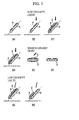
- the photomask 3 is set in a tilted state (Fig. 7A), and the same high viscosity liquid 2 as that used in the embodiments 1 to 6 is dropped from the upper portion of the tilted photomask 3 (Fig. 7B) and the high viscosity liquid 2 is moved on the surface of the photomask 3 to be cleaned (Fig. 7C).
- the particle 4 is removed from the photomask 3, while the high viscosity liquid 2 is moved, while containing the particle 4 adhered to the photomask 3 in the high viscosity liquid 2 (Fig. 7D).
- the particle 4 thus contained in the liquid 2 is prevented from re-adhering to the photomask 3 by controlling the zeta potnential of the liquid 2, and is removed from the photomask 3 by moving to the lower portion of the tilted photomask.
- the moving speed of the high viscosity liquid can be controlled.
- the high viscosity liquid is moved only by the gravitational force in the above-described example, for example, the high viscosity liquid can also be moved by supplying (Fig. 7G) the low viscosity liquid such as pure water at the flow rate so that the high viscosity liquid is moved (Fig. 7H) before the high viscosity liquid is mixed with the low viscosity liquid.
- the photomask 3 with the high viscosity liquid 2 adhered thereto is rinsed by pure water or the like to remove the high viscosity liquid 2 therefrom (Fig. 7E) before being dried. Then, the photomask 3 is cleaned, rinsed, and dried by using the conventional cleaning method (Fig. 7F).
- the photomask 3 is set in a tilted state, and the high viscosity liquid 2 is dropped from the upper portion of the tilted photomask 3, and the high viscosity liquid 2 is moved on the surface of the photomask 3 to be cleaned.
- the particle 4 is removed from the photomask 3 during movement of the high viscosity liquid 2, while containing the particle 4 adhered to the photomask 3 in the high viscosity liquid 2. Further, it becomes possible to prevent a re-adhesion of the particle 4 to the photomask 3 by controlling the zeta potential.
- the particle and the high viscosity liquid are moved by using the gravitational force and therefore moved by a simple apparatus. Accordingly, the particle removing method of this example is made adaptive to an increased size of the substrate. (Example 8)
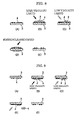
- Fig. 8 is an explanatory view illustrating the particle removing method according to an example 8 of the present invention.
- the particle removing method according to the example 8 will be described.
- the surface of the photomask 3 to be cleaned is faced upward (Fig. 8A), and then the same high viscosity liquid 2 as that used in the examples 1 to 7 is supplied by using the dripping nozzle (not shown) (Fig. 8B).
- the liquid having lower viscosity than the high viscosity liquid such as pure rinsing water
- a high flow rate Fig. 8C
- the particle 4 is removed, while containing the particle 4 adhered to the photomask 3 in the high viscosity liquid 2.
- the particle 4 thus contained in the liquid 2 is prevented from re-adhering to the photomask 3 by controlling the zeta potential of the high viscosity liquid 2, and is removed from the photomask 3.
- the force to move the liquid can be adjusted here by adjusting the pressure (flow rate) of the low viscosity liquid such as pure water. It is also possible to add the ultrasonic wave to the low viscosity liquid. Even in the case where the ultrasonic wave is added to the low viscosity liquid, the damage caused to the photomask is reduced through the high viscosity liquid, in comparison with the conventional ultrasonic wave cleaning.
- the photomask 3 with the high viscosity liquid 2 adhered thereto is rinsed by pure water or the like to remove the high viscosity liquid 2 therefrom before being dried (Fig. 8D). Then, the photomask 3 is cleaned, rinsed, and dried by using the conventional cleaning method (Fig. 8E).
- the surface of the photomask 3 to be cleaned is faced upward, then the high viscosity liquid 2 is supplied.
- the liquid having lower viscosity than the high viscosity liquid such as pure water is injected to the photomask surface to be cleaned, and the high viscosity liquid 2 is moved. Therefore, while the high viscosity liquid 2 is moved, the particle 4 is removed, while containing a particle 4 adhered to the photomask 3 in the high viscosity liquid 2. Then, the particle thus contained is prevented from re-adhering to the photomask 3, by controlling the zeta potential of the high viscosity liquid 2.
- the particle removing method of this example is made adaptive to various particles in the same way as the example 2.
- Fig. 9 is an explanatory view illustrating the particle removing method according to an example 9 of the present invention.
- the particle removing method according to the example 9 will be described.
- the surface of the photomask 3 to be cleaned is faced downward (Fig. 9A), and then the same high viscosity liquid 2 as that used in the examples 1 to 8 is injected (Fig. 9B).
- the liquid having lower viscosity than the high viscosity liquid such as pure rinsing water
- the high viscosity liquid is moved on the surface of the photomask 3 to be cleaned, before the high viscosity liquid is mixed with the low viscosity liquid
- the high viscosity liquid 2 is moved and removed from the photomask 3. Accordingly, the particle is removed in a state of being contained in the high viscosity liquid 2 (Fig. 9D).
- the particle 4 contained in the liquid 2 is prevented from re-adhering to the photomask 3 by controlling the zeta potential of the liquid 2 and removed from the photomask 3.
- the pressure or the ultrasonic wave may be added here to the low viscosity liquid such as pure water.
- the high viscosity liquid 2 may be injected to the upper surface of the photomask 3, or the high viscosity liquid 2 may be supplied to the upper surface of the photomask 3, and the liquid 2 thus supplied is made to flow around from the periphery to the lower surface of the photomask 3.
- the photomask with the high viscosity liquid 2 attached thereto is rinsed by pure water or the like to remove the high viscosity liquid 2 therefrom before being dried. Then, the photomask 3 is cleaned, rinsed, and dried by using the conventional cleaning method (Fig. 9E).
- the surface of the photomask 3 to be cleaned is faced downward, then the high viscosity liquid 2 is injected, and the low viscosity liquid such as rinsing water is injected to the surface of the photomask 3 to be cleaned, and the high viscosity liquid 2 is moved. Accordingly, while the high viscosity liquid 2 is moved, the particle 4 is removed, while containing the particle 4 adhered to the photomask 3 in the high viscosity liquid 2. Further, the particle 4 thus contained is prevented from re-adhering to the photomask 3 by controlling the zeta potential of the high viscosity liquid 2, and is removed from the photomask.
- the particle removing method of this example can be realized with the simple apparatus.
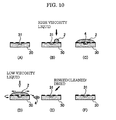
- Fig. 10 is an explanatory view illustrating the particle removing method according to an example 10 of the present invention.
- the particle removing method according to the example 10 will be described.
- the method of the aforementioned example 2 is applied to a mask wherein a phase shift effect is obtained by a level difference which is generated by providing a recessed portion 31 formed on a glass substrate 30 by etching the glass substrate.
- the phase shift mask shown in Fig. 10 is referred to as the Levenson type phase shift mask, and the phase shift mask thus formed has a recessed portion formed on an opening portion of a line and space light shielding film patterns by alternately trenching the glass substrate.
- the recessed portion thus formed, a contrast of a transferred pattern is improved by using a phase difference of the exposure light generated in a trenched part and a non-trenched part.
- the recessed portion has an undercut shape trenched up to an inner side of the dimension of the light shielding film pattern.
- the protruding portion of the light-shielding film has high risk of breakage by cleaning in the conventional cleaning method.
- the particle is adhered to the undercut portion, it is difficult to remove the particle.
- the glass substrate 30 When the particle 4 is adhered to the recessed portion 31 of the glass substrate 30 (Fig. 10A), the glass substrate 30 is installed on the object holding part which can perform rotating operation, and thereafter the high viscosity liquid 2 is supplied to the surface of the glass substrate 30 by using the dripping nozzle (not shown) (Fig. 10B). When the liquid 2 enters into the recessed portion 31 of the glass substrate 30, the particle 4 is also taken into the liquid 2 accordingly (Fig. 10C).
- the high viscosity liquid 2 is moved by injecting a lower viscosity liquid than the high viscosity liquid 2 such as pure rinsing water at a large flow rate, to the photomask surface to be cleaned, so that the high viscosity liquid is moved before mixing with the low viscosity liquid (Fig. 10D).
- a lower viscosity liquid such as pure rinsing water at a large flow rate
- the particle 4 adhered to the recessed portion 31 of the glass substrate 30 is also moved accordingly, with the particle contained in the liquid 2.
- the particle 4 taken into the liquid 2 is prevented from re-adhering to the glass substrate 30 by controlling the zeta potential of the high viscosity liquid 2, and is removed from the glass substrate 30 (Fig. 10E).
- the glass substrate 30 with the high viscosity liquid 2 attached thereto is rinsed by pure water or the like before being dried, and the high viscosity liquid 2 is thereby removed.
- the glass substrate 30 is cleaned, rinsed, and dried by using the conventional cleaning method (Fig. 10F).
- either method may be taken, such as a method of moving the high viscosity liquid 2 by only rotation, or a method of moving the high viscosity liquid 2 by dripping the liquid, with the glass substrate 30 rotated.
- the physical cleaning such as the pressure or the ultrasonic wave can also be added to the low viscosity liquid such as pure rinsing water.
- the method of injecting the high viscosity liquid 2 to the upper surface of the glass substrate 30 by controlling the rotating speed, and making the high viscosity liquid 2 flow around from the peripheral portion to the lower surface of the glass substrate 30, may also be used.
- the example 2 is applied to the phase shift mask.
- the example 1 or examples 3 to 9 there is no problem in applying the example 1 or examples 3 to 9 to the phase shift mask.
- the viscosity of the high viscosity liquid used here is about 250 mPa.s.
- the high viscosity liquid in order to adjust the viscosity of the high viscosity liquid, is diluted with low viscosity water such as purified water or pure water.
- the viscosity can also be adjusted by changing the viscosity under temperature control of the liquid.
- the temperature control of the liquid may be performed in such a way that the temperature of the dipping tank is adjusted, the temperature of the liquid before dripping is controlled, and the temperature of the liquid is also controlled indirectly by previously controlling the temperature of the substrate.
- the viscosity of the liquid may be set to be a suitable viscosity in the temperature at which the particle is removed.
- the high viscosity liquid may be controlled to a required viscosity by mixing the high viscosity liquid and the lower viscosity liquid than the high viscosity liquid, before, immediately before, and simultaneously with making a contact state between the high viscosity liquid and the substrate.
- a mixing method of the high viscosity liquid and the low viscosity liquid such as pure water
- the present invention is applied to cleaning the photomask used in the manufacturing process of the semiconductor and liquid crystal or the like.
- the present invention is also applied to the cleaning of a semiconductor wafer, and particularly to a post-cleaning of CMP (Chemical Mechanical Polishing), which is a polishing process, and also applied to substrates for electronic devices such as liquid crystal substrate.
- CMP Chemical Mechanical Polishing
- the present invention can be applied to cleaning of the photomask used in the process of manufacturing a semiconductor or a liquid crystal, to cleaning of a semiconductor wafer, and especially, to post cleaning of CMP (Chemical Mechanical Polishing), which is a polishing process, and to substrates for electronic devices such as liquid crystal substrate.
- CMP Chemical Mechanical Polishing
Landscapes
- Engineering & Computer Science (AREA)
- Physics & Mathematics (AREA)
- General Physics & Mathematics (AREA)
- Condensed Matter Physics & Semiconductors (AREA)
- Manufacturing & Machinery (AREA)
- Computer Hardware Design (AREA)
- Microelectronics & Electronic Packaging (AREA)
- Power Engineering (AREA)
- Cleaning Or Drying Semiconductors (AREA)
- Cleaning By Liquid Or Steam (AREA)
- Preparing Plates And Mask In Photomechanical Process (AREA)
Applications Claiming Priority (3)
| Application Number | Priority Date | Filing Date | Title |
|---|---|---|---|
| JP2003097092 | 2003-03-31 | ||
| JP2003097092 | 2003-03-31 | ||
| PCT/JP2004/004634 WO2004088735A1 (ja) | 2003-03-31 | 2004-03-31 | 洗浄方法、異物除去方法、洗浄装置及び洗浄液 |
Publications (2)
| Publication Number | Publication Date |
|---|---|
| EP1610366A1 true EP1610366A1 (de) | 2005-12-28 |
| EP1610366A4 EP1610366A4 (de) | 2009-04-15 |
Family
ID=33127538
Family Applications (1)
| Application Number | Title | Priority Date | Filing Date |
|---|---|---|---|
| EP04724771A Withdrawn EP1610366A4 (de) | 2003-03-31 | 2004-03-31 | Reinigungsverfahren, verfahren zum entfernen von fremdteilchen, reinigungsvorrichtung und reinigungsflüssigkeit |
Country Status (6)
| Country | Link |
|---|---|
| US (2) | US20060151008A1 (de) |
| EP (1) | EP1610366A4 (de) |
| JP (1) | JP4518409B2 (de) |
| KR (1) | KR20050119177A (de) |
| TW (1) | TWI248124B (de) |
| WO (1) | WO2004088735A1 (de) |
Cited By (2)
| Publication number | Priority date | Publication date | Assignee | Title |
|---|---|---|---|---|
| CN102190963A (zh) * | 2010-03-10 | 2011-09-21 | 福吉米株式会社 | 抛光组合物及利用该组合物的抛光方法 |
| US11500295B2 (en) * | 2019-12-23 | 2022-11-15 | Waymo Llc | Systems and methods for contact immersion lithography |
Families Citing this family (20)
| Publication number | Priority date | Publication date | Assignee | Title |
|---|---|---|---|---|
| US8323420B2 (en) | 2005-06-30 | 2012-12-04 | Lam Research Corporation | Method for removing material from semiconductor wafer and apparatus for performing the same |
| JP4255478B2 (ja) * | 2005-03-31 | 2009-04-15 | 株式会社カイジョー | 洗浄装置及び洗浄方法 |
| US20070012335A1 (en) * | 2005-07-18 | 2007-01-18 | Chang Hsiao C | Photomask cleaning using vacuum ultraviolet (VUV) light cleaning |
| KR100818851B1 (ko) * | 2005-08-24 | 2008-04-01 | 가부시끼가이샤 도시바 | 마스크 결함 수정 방법 및 반도체 장치의 제조 방법 |
| JP4802937B2 (ja) * | 2006-08-24 | 2011-10-26 | 大日本印刷株式会社 | フォトマスクの洗浄方法 |
| JP2008091576A (ja) * | 2006-09-29 | 2008-04-17 | Kaijo Corp | 乾燥方法 |
| SG192313A1 (en) | 2007-02-08 | 2013-08-30 | Fontana Technology | Particle removal method and composition |
| US20080230092A1 (en) * | 2007-03-23 | 2008-09-25 | Alexander Sou-Kang Ko | Method and apparatus for single-substrate cleaning |
| US9159593B2 (en) * | 2008-06-02 | 2015-10-13 | Lam Research Corporation | Method of particle contaminant removal |
| JP5802407B2 (ja) | 2011-03-04 | 2015-10-28 | 三菱瓦斯化学株式会社 | 基板処理装置および基板処理方法 |
| JP2014113587A (ja) * | 2012-11-15 | 2014-06-26 | Asahi Kasei E-Materials Corp | 洗浄方法、この方法を用いて洗浄したガラス管複合体およびこれを用いたナノインプリント用のモールド |
| JP6116211B2 (ja) * | 2012-11-30 | 2017-04-19 | 富士重工業株式会社 | 金属表面洗浄方法 |
| JP6442359B2 (ja) * | 2015-05-15 | 2018-12-19 | 株式会社Screenホールディングス | 液充填方法および充填材層形成方法 |
| JP6899220B2 (ja) * | 2017-01-11 | 2021-07-07 | 株式会社ダイセル | レジスト除去用組成物 |
| JP7058094B2 (ja) * | 2017-09-19 | 2022-04-21 | 株式会社Screenホールディングス | 基板処理装置および基板処理方法 |
| JP6834908B2 (ja) * | 2017-10-26 | 2021-02-24 | トヨタ自動車株式会社 | ロータの冷却通路における異物除去方法 |
| CN111610693B (zh) * | 2019-02-26 | 2023-08-22 | 中芯国际集成电路制造(天津)有限公司 | 一种掩膜板的修复方法 |
| JP2022115201A (ja) * | 2021-01-28 | 2022-08-09 | 日本特殊陶業株式会社 | 半導体製造装置用部材の洗浄方法及びそれを用いた半導体製造装置用部材の製造方法 |
| JP2022115200A (ja) * | 2021-01-28 | 2022-08-09 | 日本特殊陶業株式会社 | 半導体製造装置用部材の洗浄方法及びそれを用いた半導体製造装置用部材の製造方法 |
| CN114453359A (zh) * | 2022-01-21 | 2022-05-10 | 株洲时代新材料科技股份有限公司 | 一种快速加热去除刮胶盒残胶的装置和方法 |
Family Cites Families (20)
| Publication number | Priority date | Publication date | Assignee | Title |
|---|---|---|---|---|
| JPS62119543A (ja) * | 1985-11-20 | 1987-05-30 | Mitsubishi Electric Corp | 半導体製造装置 |
| DE3542970A1 (de) * | 1985-12-05 | 1987-06-11 | Benckiser Gmbh Joh A | Fluessige sanitaerreinigungs- und entkalkungsmittel und verfahren zu deren herstellung |
| JPH0299175A (ja) * | 1988-10-04 | 1990-04-11 | Hitachi Electron Eng Co Ltd | 排液排出装置 |
| JPH0523648A (ja) * | 1991-07-17 | 1993-02-02 | Japan Field Kk | 被洗浄物の洗浄方法 |
| EP0740698B1 (de) * | 1993-12-30 | 1999-04-14 | Ecolab Inc. | Verfahren zur herstellung von harnstoff enthaltenden festen reinigungsmitteln |
| JPH08298253A (ja) * | 1995-02-28 | 1996-11-12 | Mitsui Petrochem Ind Ltd | ペリクル膜の製造時に使用した基板の洗浄方法 |
| JP3641115B2 (ja) * | 1997-10-08 | 2005-04-20 | 大日本スクリーン製造株式会社 | 基板処理装置 |
| JP2000183003A (ja) * | 1998-10-07 | 2000-06-30 | Toshiba Corp | 銅系金属用研磨組成物および半導体装置の製造方法 |
| JP4516176B2 (ja) * | 1999-04-20 | 2010-08-04 | 関東化学株式会社 | 電子材料用基板洗浄液 |
| TW499696B (en) * | 1999-04-27 | 2002-08-21 | Tokyo Electron Ltd | Processing apparatus and processing method |
| JP3648096B2 (ja) * | 1999-06-25 | 2005-05-18 | 東京エレクトロン株式会社 | 処理装置 |
| US6734121B2 (en) * | 1999-09-02 | 2004-05-11 | Micron Technology, Inc. | Methods of treating surfaces of substrates |
| JP3355324B2 (ja) * | 2000-03-21 | 2002-12-09 | 株式会社スプラウト | 基板の洗浄方法及び洗浄装置並びに基板を洗浄するためのシャーベットの製造方法及び装置 |
| US6676766B2 (en) * | 2000-05-02 | 2004-01-13 | Sprout Co., Ltd. | Method for cleaning a substrate using a sherbet-like composition |
| JP2002009035A (ja) * | 2000-06-26 | 2002-01-11 | Toshiba Corp | 基板洗浄方法及び基板洗浄装置 |
| KR100475172B1 (ko) * | 2001-02-20 | 2005-03-08 | 에스케이 주식회사 | 원유탱크 내의 슬러지 제거 및 오일유분의 회수방법 |
| JP3857082B2 (ja) * | 2001-07-24 | 2006-12-13 | 花王株式会社 | 衣料用洗濯前処理剤組成物 |
| US7022437B2 (en) * | 2003-01-15 | 2006-04-04 | Asml Netherlands B.V. | Perfluoropolyether liquid pellicle and methods of cleaning masks using perfluoropolyether liquid |
| US20040238008A1 (en) * | 2003-03-12 | 2004-12-02 | Savas Stephen E. | Systems and methods for cleaning semiconductor substrates using a reduced volume of liquid |
| US7267726B2 (en) * | 2003-04-22 | 2007-09-11 | Texas Instruments Incorporated | Method and apparatus for removing polymer residue from semiconductor wafer edge and back side |
-
2004
- 2004-03-31 WO PCT/JP2004/004634 patent/WO2004088735A1/ja not_active Ceased
- 2004-03-31 US US10/551,135 patent/US20060151008A1/en not_active Abandoned
- 2004-03-31 TW TW093108836A patent/TWI248124B/zh not_active IP Right Cessation
- 2004-03-31 EP EP04724771A patent/EP1610366A4/de not_active Withdrawn
- 2004-03-31 JP JP2005504272A patent/JP4518409B2/ja not_active Expired - Fee Related
- 2004-03-31 KR KR1020057018636A patent/KR20050119177A/ko not_active Ceased
-
2008
- 2008-06-30 US US12/216,165 patent/US20080271752A1/en not_active Abandoned
Cited By (6)
| Publication number | Priority date | Publication date | Assignee | Title |
|---|---|---|---|---|
| CN102190963A (zh) * | 2010-03-10 | 2011-09-21 | 福吉米株式会社 | 抛光组合物及利用该组合物的抛光方法 |
| EP2365043A3 (de) * | 2010-03-10 | 2011-12-21 | Fujimi Incorporated | Polierzusammensetzung und Polierverfahren dafür |
| US8702472B2 (en) | 2010-03-10 | 2014-04-22 | Fujimi Incorporated | Polishing composition and polishing method using the same |
| CN102190963B (zh) * | 2010-03-10 | 2015-02-18 | 福吉米株式会社 | 抛光组合物及利用该组合物的抛光方法 |
| US11500295B2 (en) * | 2019-12-23 | 2022-11-15 | Waymo Llc | Systems and methods for contact immersion lithography |
| US11892777B2 (en) | 2019-12-23 | 2024-02-06 | Waymo Llc | Systems and methods for contact immersion lithography |
Also Published As
| Publication number | Publication date |
|---|---|
| US20080271752A1 (en) | 2008-11-06 |
| TW200426933A (en) | 2004-12-01 |
| US20060151008A1 (en) | 2006-07-13 |
| KR20050119177A (ko) | 2005-12-20 |
| TWI248124B (en) | 2006-01-21 |
| EP1610366A4 (de) | 2009-04-15 |
| JPWO2004088735A1 (ja) | 2006-07-06 |
| WO2004088735A1 (ja) | 2004-10-14 |
| JP4518409B2 (ja) | 2010-08-04 |
Similar Documents
| Publication | Publication Date | Title |
|---|---|---|
| US20080271752A1 (en) | Cleaning method, particle removing method, cleaning apparatus, and cleaning liquid | |
| JP5148508B2 (ja) | 半導体基板を洗浄するための方法および装置 | |
| KR100591214B1 (ko) | 기판 처리 방법과 기판 처리 장치 | |
| KR100335450B1 (ko) | 반도체 장치의 세정 장비 및 반도체 장치의 세정 방법 | |
| US20090056744A1 (en) | Wafer cleaning compositions and methods | |
| JP2012533649A (ja) | 高度な基板洗浄剤及び洗浄用システム | |
| JPH0871511A (ja) | 洗浄方法および装置 | |
| EP1077474A2 (de) | Rückseite ätzen in einem Schrubber | |
| WO2007078975A2 (en) | Method and system for using a two-phases substrate cleaning compound | |
| US7023099B2 (en) | Wafer cleaning method and resulting wafer | |
| US7067015B2 (en) | Modified clean chemistry and megasonic nozzle for removing backside CMP slurries | |
| KR100977104B1 (ko) | 코랄 필름에 대한 후식각 및 띠 잔여물 제거방법 | |
| EP2053465A1 (de) | Positiv-resistverarbeitungs-flüssigkeitszusammensetzung und flüssigentwickler | |
| JP2007298858A (ja) | マスクブランク用基板の製造方法、マスクブランクの製造方法、及び露光用マスクの製造方法、並びに、マスクブランク、及び露光用マスク | |
| JP2000126704A (ja) | 光学素子の洗浄方法および洗浄装置 | |
| JP2008249854A (ja) | フォトマスクの洗浄方法 | |
| US20070181148A1 (en) | Wafer cleaning apparatus and related method | |
| KR20080094410A (ko) | 기판 세정 장비 및 방법 | |
| US20250235900A1 (en) | Water-based, high-efficiency chemical reagent for substrate surface particle removal | |
| KR100591163B1 (ko) | 화학기계적 연마 공정에서 유기물 제거를 위한 세정 방법 | |
| US7781140B2 (en) | Method of fine pitch bump stripping | |
| CN1873925A (zh) | 避免研磨浆料残留的化学机械研磨方法及设备 | |
| JP3426866B2 (ja) | 半導体装置の製造装置および製造方法 | |
| KR100234401B1 (ko) | 웨이퍼 세정방법 | |
| JP4517805B2 (ja) | 電気光学装置の製造方法 |
Legal Events
| Date | Code | Title | Description |
|---|---|---|---|
| PUAI | Public reference made under article 153(3) epc to a published international application that has entered the european phase |
Free format text: ORIGINAL CODE: 0009012 |
|
| 17P | Request for examination filed |
Effective date: 20051018 |
|
| AK | Designated contracting states |
Kind code of ref document: A1 Designated state(s): AT BE BG CH CY CZ DE DK EE ES FI FR GB GR HU IE IT LI LU MC NL PL PT RO SE SI SK TR |
|
| AX | Request for extension of the european patent |
Extension state: AL LT LV MK |
|
| DAX | Request for extension of the european patent (deleted) | ||
| RBV | Designated contracting states (corrected) |
Designated state(s): DE |
|
| A4 | Supplementary search report drawn up and despatched |
Effective date: 20090318 |
|
| 17Q | First examination report despatched |
Effective date: 20090529 |
|
| STAA | Information on the status of an ep patent application or granted ep patent |
Free format text: STATUS: THE APPLICATION IS DEEMED TO BE WITHDRAWN |
|
| 18D | Application deemed to be withdrawn |
Effective date: 20091009 |