EP1598009A1 - Authentifikationssystem - Google Patents
Authentifikationssystem Download PDFInfo
- Publication number
- EP1598009A1 EP1598009A1 EP04715505A EP04715505A EP1598009A1 EP 1598009 A1 EP1598009 A1 EP 1598009A1 EP 04715505 A EP04715505 A EP 04715505A EP 04715505 A EP04715505 A EP 04715505A EP 1598009 A1 EP1598009 A1 EP 1598009A1
- Authority
- EP
- European Patent Office
- Prior art keywords
- human body
- information
- walking
- living organism
- quasi
- Prior art date
- Legal status (The legal status is an assumption and is not a legal conclusion. Google has not performed a legal analysis and makes no representation as to the accuracy of the status listed.)
- Withdrawn
Links
Images








Classifications
-
- A—HUMAN NECESSITIES
- A61—MEDICAL OR VETERINARY SCIENCE; HYGIENE
- A61B—DIAGNOSIS; SURGERY; IDENTIFICATION
- A61B5/00—Measuring for diagnostic purposes; Identification of persons
- A61B5/117—Identification of persons
-
- H—ELECTRICITY
- H04—ELECTRIC COMMUNICATION TECHNIQUE
- H04B—TRANSMISSION
- H04B13/00—Transmission systems characterised by the medium used for transmission, not provided for in groups H04B3/00 - H04B11/00
- H04B13/005—Transmission systems in which the medium consists of the human body
-
- G—PHYSICS
- G07—CHECKING-DEVICES
- G07C—TIME OR ATTENDANCE REGISTERS; REGISTERING OR INDICATING THE WORKING OF MACHINES; GENERATING RANDOM NUMBERS; VOTING OR LOTTERY APPARATUS; ARRANGEMENTS, SYSTEMS OR APPARATUS FOR CHECKING NOT PROVIDED FOR ELSEWHERE
- G07C9/00—Individual registration on entry or exit
- G07C9/20—Individual registration on entry or exit involving the use of a pass
- G07C9/22—Individual registration on entry or exit involving the use of a pass in combination with an identity check of the pass holder
- G07C9/25—Individual registration on entry or exit involving the use of a pass in combination with an identity check of the pass holder using biometric data, e.g. fingerprints, iris scans or voice recognition
- G07C9/257—Individual registration on entry or exit involving the use of a pass in combination with an identity check of the pass holder using biometric data, e.g. fingerprints, iris scans or voice recognition electronically
-
- G—PHYSICS
- G07—CHECKING-DEVICES
- G07C—TIME OR ATTENDANCE REGISTERS; REGISTERING OR INDICATING THE WORKING OF MACHINES; GENERATING RANDOM NUMBERS; VOTING OR LOTTERY APPARATUS; ARRANGEMENTS, SYSTEMS OR APPARATUS FOR CHECKING NOT PROVIDED FOR ELSEWHERE
- G07C9/00—Individual registration on entry or exit
- G07C9/20—Individual registration on entry or exit involving the use of a pass
- G07C9/28—Individual registration on entry or exit involving the use of a pass the pass enabling tracking or indicating presence
Definitions
- the present invention relates to a communication system and is preferably applicable to a communication system for sending and receiving information via an electric field, for example.
- communication systems have been adapted to send and receive information using a radiation field (radio waves), for example, between mobile telephones, and send and receive information via electromagnetic induction, for example, between the coil in a data reader/writer provided on a ticket checking and collecting machine at a station and the coil in an IC card.
- a radiation field radio waves
- electromagnetic induction for example, between the coil in a data reader/writer provided on a ticket checking and collecting machine at a station and the coil in an IC card.
- Patent document 1 National Publication of International Patent Application No. 11-509380
- Patent document 2 Patent No. 3074644
- Patent document 3 Japanese Patent Laid-Open No. 10-228524
- Patent document 4 Japanese Patent Laid-Open No. 10-229357
- Patent document 5 Japanese Patent Laid-Open No. 2001-308803
- Patent document 6 Japanese Patent Laid-Open No.
- Non-patent document 1 Internet ⁇ URL:http://www.mew.co.jp/press/0103/0103-7.htm> (retrieved on January 20, 2003)
- Non-patent document 2 "Development of Information Communication Device with Human Body Used as Transmission Line" by Keisuke Hachisuka, Anri Nakata, Kenji Shiba, Ken Sasaki, Hiroshi Hosaka and Kiyoshi Itao (Tokyo University); March 1, 2002 (Collected Papers for Academic Lectures on Micromechatronics, Vol., 2002, Spring, pp.
- Non-patent document 3 "Development of Communication System within organism” by Anri Nakata; Keisuke Hachisuka, Kenji Shiba, Ken Sasaki, Hiroshi Hosaka and Kiyoshi Itao (Tokyo University); 2002 (Collected Papers for Academic Lectures for Japan Society of Precision Engineering Conference, Spring, p.640)
- Non-patent document 4 "Review on Modeling of Communication System Utilizing Human Body as Transmission Line” by Katsuyuki Fujii (Chiba University), Koichi Date (Chiba University), Shigeru Tajima (Sony Computer Science Laboratories, Inc.); March 1, 2002 (Technical Reports by The Institute of Image Information and Television Engineers Vol.
- Non-patent document 5 "Development of Information Communication Device with Human Body Used as Transmission Line" by Keisuke Hachisuka, Anri Nakata, Kento Takeda, Ken Sasaki, Hiroshi Hosaka, Kiyoshi Itao (Graduate School of Science of NewRegion Creation, Tokyo University) and Kenji Shiba (Science and Engineering Course, Tokyo University of Science); March 18, 2002 (Micromechatronics Vol. 46; No. 2; pp. 53-64)
- the present invention has been made in consideration of the above problems and proposes a communication system, a communication method and a communication device capable of enhancing the degree of freedom in communication.
- an authentication system comprising a sending device and a receiving device for sending and receiving information via a quasi-electrostatic field
- the sending device is adapted to detect organism information specific to a human body, generate a quasi-electrostatic field modulated according to the organism information and thereby electrify the human body
- the receiving device is adapted to demodulate the organism information based on change in the electrification condition of the human body and identify the human body based on the organism information.
- the authentication system is able to realize sending and receiving of information without directional restrictions in the neighborhood of the user, with confidentiality secured, and without forcing the user to perform a predetermined movement, and it is also able to identify even the relation between the device and the human body based on information specific to the human body.
- the electric field E generated according to the distance r from the antenna can be represented in a simplified formula as shown below: where j is an imaginary unit, A is a constant, and k is the number of waves.
- the electric field E can be roughly separated into a component which is in inverse proportion to the distance r raised to the third power (hereinafter, this component is referred to as a quasi-electrostatic field), a component which is in inverse proportion to the distance r raised to the second power (hereinafter, this component is referred to as an induction field) and a component which is linearly in inverse proportion to the distance r (hereinafter, this component is referred to as a radiation field).
- the radiation field is a component excellent in propagation capability, which does not rapidly attenuate even when the distance r is long, since it is only linearly in inverse proportion to the distance r, and therefore, it has been used as a common information transmission medium in the art of information communication.
- the induction field is a component with little transmission capability, which attenuates in inverse proportion to the distance r raised to the second power as the distance r lengthens, it has recently been used as an information transmission medium in a part of the art of information of communication.
- the quasi-electrostatic field is a component which rapidly attenuates in inverse proportion to the distance r raised to the third power and therefore does not a transmission capability and which appears in close proximity to an oscillation source only as oscillation. Therefore, it has not been utilized in the art of information communication where the radiation field and the induction field are premises.
- the present invention is adapted to send and receive information within a neighbor communication range, with a neighbor communication (hereinafter referred to as near field communication) approach using a quasi-electrostatic field among electric fields.
- near field communication a neighbor communication approach using a quasi-electrostatic field among electric fields.
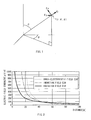
- the electric field E shown in the above formula (1) is represented as an electric field at a position P (r, ⁇ , ⁇ ) at a predetermined distance from the origin as described in Figure 1.
- the electric field E ⁇ is "zero", and this means that there is not generated any electric field in the ⁇ direction from the position P ( Figure 1).
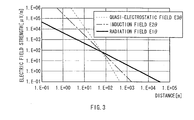
- Figures 2 and 3 shows the results obtained by qualitatively plotting the component's electric field strengths of the radiation field E1 ⁇ , the induction field E2 ⁇ and the quasi-electrostatic field E3 ⁇ based on the formulas (8).
- the component electric field strengths of the radiation field E1 ⁇ , the induction field E2 ⁇ and the quasi-electrostatic field E3 ⁇ are equal at a certain distance r (hereinafter referred to as a boundary point), and the radiation field E1 ⁇ is dominant in the distance from the boundary point.
- the quasi-electrostatic field E3 ⁇ is dominant.
- the distance r from the origin to the boundary point varies according to the wavelength ⁇ . As shown in Figure 4, the longer the wavelength ⁇ is, the wider the range (the distance r from the origin to the boundary point) where the quasi-electrostatic field E3 ⁇ is dominant.
- the quasi-electrostatic field E3 ⁇ is dominant within the range where the distance r from the origin is "r ⁇ /2 ⁇ ", if the relative permittivity of the air ⁇ is assumed to be 1 and the wavelength in the air is assumed to be ⁇ .
- the information is sent and received in the space where the quasi-electrostatic field E3 ⁇ is dominant.
- a human body is very often electrified as suggested by the empirical fact that static electricity is felt in our everyday life.
- a quasi-electrostatic field is generated by electrification of the surface of a human body in response to the movement of the human body, it is not necessary to apply electricity to a human body to cause the human body to generate a quasi-electrostatic field but it is only necessary to electrify the human body.
- a human body is electrified by extremely little movement of charge (current); the electrification change is instantaneously conducted around the surface of the human body; and then an equipotential surface of a quasi-electrostatic field is formed substantially isotropically from the periphery. Furthermore, within the range satisfying the above formula (12) where the quasi-electrostatic field is dominant, the radiation field and the induction field does not have much influence. Consequently, the human body functions efficiently as an antenna. This has already been confirmed from the results of the experiments by the applicant.
- the present information is adapted to modulate a quasi-electrostatic field which is isotropically formed in the neighborhood of a human body by electrifying the human body according to particular information, and as a result, formaquasi-electrostatic field having information in the neighborhood of the human body, through which the information is sent and received.
- a walking quasi-electrostatic field formed as the surface of a human body is electrified by the human body's walking motion (hereinafter, it is referred to as a walking quasi-electrostatic field)
- a walking quasi-electrostatic field not only movement of a charge between the passage surface and the plantar surface but also change in the exfoliation area (or the contact area) of the plantar surface relative to the passage surface and change in the distance between the passage surface and the plantar surface are closely involved.
- the electrification change on the surface of a human body caused by a walking motion of the human body reflects a pattern specific to the individual, which is generated by change in the electrostatic capacity and charge between the feet and the passage surface according to the trajectory of the feet made by the walking motion and in which mutual movements of the right and left feet are combined.
- the pattern of electrification change on the surface of a human body which is generated by a walking motion of the human body reflects the characteristics of the organism (human body), and therefore high accuracy of authentication can be expected therefrom.
- the present invention is adapted to generate organism identification information indicating a walking pattern specific to a human body, based on the pattern of electrification change on the surface of the human body generated by a walking motion of the human body, and use the organism identification information to perform a predetermined authentication process.
- the left foot is completely in contact with the passage surface, irrespective of difference in the walking condition, according to walking characteristics.
- the walking motion described in the invention means a movement of walking on a flat passage surface without being especially conscious of the speed.
- the 8 Hz peak with the highest strength appears in a walking quasi-electrostatic field formed in the neighborhood of a human bodywhen awalkingmotion is performed, therefore, if attempting to electrify a human body to form a quasi-electrostatic field having information in the neighborhood of a the human body, for the purpose of performing near field communication, the information may be destroyed by the 8 Hz peak.
- the present invention is adapted to avoid destruction of information by the 8 Hz peak by electrifying a human body according to information while avoiding the timing when such 8 Hz peak appears.
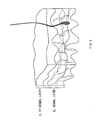
- the subepidermal tissue structure of a human body comprises epidermal layers SL and dermal layers BL constituted of epidermoid cells, as shown in Figure 5, and various proteins are contained in the dermal layers BL, such as collagen classified as structural protein and hemoglobin classified as transport protein. It has been already confirmed by the applicant that the pattern of the subepidermal tissue structure is information specific to an individual.
- the distance md(i) is difficult to accurately determine with limitation only to blood vessels, for example, included in the dermal layers BL, and the presence of subepidermal blood vessels is also reflected in the measured value.
- subepidermal tissue structure indicates characteristics specific to an individual and is permanent in relation to fingerprints, for example, and the same is true on the vein pattern. Accordingly, the potential difference pattern for each microelectrode reflects the characteristics of the living tissue including the subepidermal tissue and veins below the electrode, and therefore high accuracy of authentication can be expected.
- the present invention is adapted to generate living organism identifying information indicating a tissue pattern specific to a human body based on a potential difference pattern characterizing the living tissue, and performs a predetermined authentication process using the living organism identifying information.
- the present invention utilizes the nature of a quasi-electrostatic field and the nature of a human body.
- the sending side within a range where a quasi-electrostatic field is dominant, the sending side generates living organism identifying information indicating a walking pattern obtained based on the electrification change on the surface of a human body, which is caused by a walking motion of the human body, and a living tissue pattern; then electrifies the human body to cause the human body to act as an antenna for the purpose of near field communication while avoiding the timing when the 8 Hz peak appears; and, as a result, forms a quasi-electrostatic field having living organism identifying information in the neighborhood of the human body.
- the receiving side after detecting the living organism identifying information via the quasi-electrostatic field formed in the neighborhood of the human body, performs a predetermined authentication process using registrant information registered in advance.
- reference numeral 1 denotes the entire configuration of an authentication system to which the present invention is applied.
- the authentication system comprises an authentication device 2 provided, for example, at the entrance of a company, and a mobile device (hereinafter referred to as a card device ) 3 attachably and detachably provided on a predetermined position of the arm of a human body (hereinafter referred to as a user) that utilizes the company.
- the authentication device 2 comprises an entrance/exit passage portion 4 provided for entrance and exit, and an exit door 5 openably and closably provided on the exit side of the entrance/exit passage portion 4, and is adapted to perform near field communication with the card device 3 provided on the user who is passing through the entrance/exit passage portion 4 and open the exit door 5 which is closed, as necessary.
- the card device 3 comprises an electric field detection portion 10, a sending portion 20 and an electrification induction portion 30.
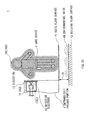
- the electric field detection portion 10 has a field effect transistor (hereinafter referred to as an FET) 11, and the gate of the FET 11 is connected to the user' s epidermis OS, which is a detection target, via an detection electrode 12 and a dielectric 13 sequentially.
- the source and the drain of the FET 11 are connected to an amplifier 14.
- the electric field detection portion 10 is adapted to detect strength change of a walking quasi-electrostatic field HSE ( Figure 7) formed in the neighborhood of a user, which is caused by electrification of the surface of the user coming near to the entrance/exit passage portion 4, via the dielectric 13 and the detection electrode 12 sequentially, and send it to the sending portion 20 as an amplified walking electrification change signal S1 via the amplifier 14.
- HSE walking quasi-electrostatic field
- the electric field detection portion 10 is able to accurately detect the strength change substantially without being influenced by noises such as hum noises.
- the electric field detection portion 10 contacts the dielectric 13 directly with the user's epidermis OS and thereby can detect the strength change of the walking quasi-electrostatic field HSE with high sensitivity. Furthermore, by forming the dielectric 13 with soft vinyl chloride with a high permittivity, for example, the strength change can be detected with more sensitivity.
- the electric field detection portion 10 is provided with a conductive case 15 surrounding the periphery of the FET 11 in condition that the conductive case 15 is electrically separated from the FET 11, and thereby detection other than the detection of the walking quasi-electrostatic field HSE of the user can be avoided to the utmost extent.
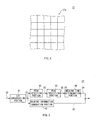
- the electrode surface 12a of the detection electrode 12 faced with the user' s epidermis OS is divided in multiple microelectrodes with almost the same shape and the same size, and an FET and an amplifier (not shown) are connected to each of the divided microelectrodes in the same connection condition as the FET 11 and the amplifier 14 of the detection electrode 12 and in a different route from the route to the FET 11.
- the strength change of the walking quasi-electrostatic field HSE formed on the user's epidermis OS, which is caused by a walking motion of the user, is sent to a low-pass filter (hereinafter referred to as an LPF) 22 via each microelectrode as an amplified walking electrification change signal S1, and the strength change is sent to a tissue information generation portion 21 via each microelectrode as local amplified walking electrification change signals A1 to An.
- LPF low-pass filter
- the walking motion described in this embodiment means a movement of walking on a flat passage surface without being especially conscious of the speed.
- the sending portion 20 comprises the tissue information generation portion 21, the LPF 22, a waveform processing portion 23 and a modulation circuit 24. It inputs the amplified walking electrification change signal A1 to An from among the amplified walking electrification change signal S1 and the amplified walking electrification change signals Al to An supplied by the electric field detection portion 10 to the tissue information generation portion 21, and inputs the amplified walking electrification change signal S1 to the LPF 22.
- the amplified walking electrification change signals A1 to An are potentials of the human body detected by respective microelectrodes as relative potential differences, showing a potential difference pattern indicating the characteristics of the living tissue including the subepidermal tissue and veins below the detection electrode 12.
- the tissue information generation portion 21 performs analog-digital conversion processing on the amplified walking electrification change signals A1 to A based thereon to digitalize them, generates the subepidermal tissue pattern under the detection electrode 12 as two-dimensionally represented tissue information D5 based on each of the digitalized amplified walking electrification change data, and sends it to the modulation circuit 24.
- the LPF 22 abstracts a component with a low frequency at 20 Hz or below, for example, from the amplified walking electrification change signal S1 supplied by the amplifier 14 and sends it to the waveform processing portion 23 as a walking electrification change signal S2.
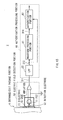
- the waveform processing portion 23 comprises an A/D (analog/digital) conversion portion 41, a peak detection portion 42, a peak prediction portion 43, a masking time determination portion 44 and a walking information generation portion 45.
- the waveform processing portion 23 digitalizes the walking electrification change signal S2 supplied by the LPF 22 with the A/D conversion portion 41 and sends resultant walking electrification change data D1 to the peak detection portion 42 and the walking information generation portion 45.
- the peak detection portion 42 monitors the band of 8 Hz ⁇ 2 Hz in the electrification change waveforms in the walking electrification change data D1 supplied by the A/D conversion portion 41 and detects an 8 Hz peak Px which appears in this band.
- the peak detection portion 42 When detecting the 8 Hz peak Px, the peak detection portion 42 generates the time when the 8 Hz peak Px has been detected (hereinafter referred to as the current time) t(n) based on the clock in the card device 3 as current time data D2 and sends it to the peak prediction portion 43.
- the peak prediction portion 43 generates the future time t (n+1) as predicted time data D3 and sends the predicted time data D3 and the current time data D2 to the masking time determination portion 44.
- the masking time determination portion 44 determines the time zone (hereinafter referred to as a masking time zone) MTZ to be modulated by the modulation circuit 24 ( Figure 7) on the subsequent stage by calculating a start time ST(n) and a finish time FT(n) of the masking time zone MTZ.
- the masking time determination portion 44 determines the masking time zone MTZ, in which the 8 Hz peak Px is avoided, and sends it to the modulation circuit 24 ( Figure 7) as masking time data D4.
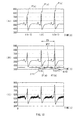
- the walking information generation portion 45 acquires the walking electrification change data D1 supplied by the A/D conversion portion 41, for a predetermined time period, recognizes all the 8 Hz peaks Px ( Figure 10(A)) which appear in the electrification change waveform in the walking electrification change data D1 corresponding to the predetermined time period, and removes such 8 Hz peak intervals PS that are beyond a predetermined allowable range in comparison with peak-interval average-width information stored in advance in the internal memory, from among the 8 Hz peak intervals PS of the recognized 8 Hz peaks Px ( Figure 10(B)).
- the walking information generation portion 45 is able to accurately leave the 8 Hz peak intervals PS corresponding to steady walking motion portions.
- the walking information generation portion 45 cut outs a portion corresponding to the portion from the center position of the 8 Hz peak Px to the immediate position between the 8 Hz peak Px and the 8 Hz peak Px immediately before the 8 Hz peak Px plus the portion from the center position of the 8 Hz peak Px to the immediate position between the 8 Hz peak Px and the 8 Hz peak Px immediately after the 8 Hz peak Px, as a one-step waveform TH, as shown in Figure 11.
- the walking information generation portion 45 is able to accurately cut out the portion as a one-step waveform TH corresponding to an actual one step in a walking motion.
- the walking information generation portion 45 divides the one-step waveform TH into, for example, twenty-one subdivided sections CSU1 to CSU21 with almost equal intervals, in the time axis direction; integrates and normalizes each of the amplitude values (values indicating electrification change strength) for each of the divided subdivision sections CSU1 to CSU21; generates resultant twenty-one integral values as walking information D7 indicating the characteristics (walking pattern) of each portion in the one-step waveform TH; and sends it to the modulation circuit 24 ( Figure 7).
- the modulation circuit 24 performs data modulation processing on ID (IDentifier) information D6 stored in a memory (not shown) in the card device 3 in advance when the card device 3 was manufactured, for example, then performs data modulation processing on the tissue information D5 supplied by the tissue information generation portion 21, and finally performs data modulation processing on the walking information D7 supplied by the walking information generation portion 45.
- the modulation circuit 24 is able to change the order of data on which a data demodulation process should be performed, as required, based on a predetermined setting operation.
- the modulation circuit 24 performs data modulation processing on the ID information D6 (the tissue information D5 or the walking information D7) with a predetermined modulation method to generate a modulated signal HS with a high frequency, and applies the modulated signal HS to an electrification induction electrode 31 only during the masking time zone MTZ in the masking time data D4 supplied by the masking time determination portion 44.
- the electrification induction electrode 31 oscillates according to the frequency of the modulated signal HS supplied by the modulation circuit 24 only during the masking time zone MTZ, and a quasi-electrostatic field (modulated signal HS) is generated from the electrification induction electrode 31 according to the oscillation.
- Such quasi-electrostatic field causes the user to be electrified only during the masking time zone MTZ according to the oscillation (modulated signal HS) of the electrification induction electrode 31 and thereby act as an antenna, and as shown in Figure 10(C), a quasi-electrostatic field according to the oscillation (hereinafter referred to as an information-transmission quasi-electrostatic field) DSE ( Figure 6) isotropically spreads around the surface of the user.
- the sending portion 20 by changing the electrification condition of a user, the user is caused to act as an antenna, and as the result, an information-transmission quasi-electrostatic field DSE is formed on which the ID information D6 (the tissue information D5 or the walking information D7) is superimposed.
- ID information D6 the tissue information D5 or the walking information D7
- the user is electrified during the masking time zone MTZ ( Figure 10), in which the 8 Hz peak Px which appears with the highest strength in the strength change in the walking quasi-electrostatic field HSE is avoided, so that the ID information D6 superimposed on the information-transmission quasi-electrostatic field DSE can be prevented from being destroyed by the 8 Hz peak Px.
- the sending portion 20 is able to propagate, from the electrification induction electrode 31 to the user, a quasi-electrostatic field oscillating in accordance with the frequency f which satisfies the following formula: f ⁇ c 2 ⁇ r which is obtained by substituting the formula (10) into the formula (12) described above and rearranging the resultant formula.
- the sending portion 20 when performing near field communication by causing a user who is passing through the entrance/exit passage portion 4 to act as an antenna, the sending portion 20 is able to form the communication space as space (substantially closed space) where a non-propagating information-transmission quasi-electrostatic field DSE ( Figure 6) is always dominant, as described above with reference to Figures 3 and 4, and as a result, the communication output can be weakened to the extent that the communication contents are not propagated outside the communication space, and therefore, confidentiality of the communication contents can be secured more sufficiently.
- a non-propagating information-transmission quasi-electrostatic field DSE Figure 6
- the sending portion 20 is actually adapted to perform a sending process at the tissue information generation portion 21, the LPF 22, the waveform processing portion 23 and the modulation circuit 24 as software, in accordance with a predetermined sending program, under the control of a control portion not shown.
- the procedure for the sending process will be now described using the flowchart below.
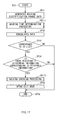
- the sending portion 20 proceeds from the start step of a routine RT1 to the next step SP1, where it abstracts a low-frequency component of an amplified walking electrification change signal S1 supplied by the electric field detection portion 10 to generate a walking electrification change signal S2 and proceeds to the next step SP2.
- the sending portion 20 performs analog-digital conversion based on the walking electrification change signal S2 to generate walking electrification change data D1, and proceeds to a masking time determination processing routine SRT1.
- the sending portion 20 detects the 8 Hz peak Px ( Figure 10 (A) ) based on the walking electrification change data D1 generated at step SP2 ( Figure 12), and after recognizing the current time t(n) thereof, it proceeds to the next step SP12.
- the sending portion 20 predicts the future time t (n+1 ) of an 8 Hz peak Px which will be detected next to the 8 Hz peak Px detected at step SP11 from the above formula (15), and proceeds to the next step SP13.
- the sending portion 20 determines the masking time zone MTZ by calculating the start time ST (n) and the finish time FT (n) from the above formulas (16) and (17), based on the current time t(n) recognized at step SP11 and the future time t(n+1) predicted at step SP12, and proceeds to the next walking information generation processing routine SRT2 ( Figure 12).
- the sending portion 20 acquires the walking electrification change data D1 generated at step SP2 ( Figure 12), corresponding to a predetermined time period, and then proceeds to step SP22.
- the sending portion 20 recognizes all the 8 Hz peaks Px ( Figure 10 (A) ) appearing in the walking electrification change data D1 corresponding to a predetermined time period, acquired at step SP21, and then proceeds to the next step SP23.
- the sending portion 20 removes 8 Hz peak intervals PS that correspond to movements other than steady walking motions, such as walking motions performed when starting or finishing walking and movements performed when stopping walking, from among the 8 Hz peak intervals PS ( Figure 10(B)) of the 8 Hz peaks Px recognized at step SP22, and then proceeds to the next step SP24.
- the sending portion 20 cut outs a one-step waveform TH ( Figure 11) from the waveform in the walking electrification change data D1 corresponding to a steady walking motion portion, and then proceeds to the next step SP25.
- the sending portion 20 divides the one-step waveform TH cut out at step SP24 into, for example, twenty-one subdivided sections CSU1 to CSU21; integrates and normalizes the amplitude values of the subdivided sections CSU1 to CSU21 to generate walking information D7; and then proceeds to the next step SP3 ( Figure 12).
- the sending portion 20 generates tissue information D5 based on the amplified walking electrification change signals A1 to An supplied by the electric field detection portion 10, and then proceeds to the next step SP4.
- the sending portion 20 performs data modulation processing on the ID information D6 supplied from the memory in the card device 3, the tissue information D5 generated at step SP3, or the walking information D7 generated by the walking information generation processing routine SRT2 to generate a modulated signal HS, and then proceeds to the next step SP5.
- step SP5 by applying the modulated signal HS generated at step SP4 to the electrification induction electrode 31 to change the electrification condition of the user during the masking time zone MTZ determined by the masking time determination processing routine SRT1, the sending portion 20 modulates the walking quasi-electrostatic field HSE ( Figure 6) formed in the neighborhood of the user ( Figure 10(C)), and then proceeds to the next step SP6.
- the modulated signal HS generated at step SP4 to the electrification induction electrode 31 to change the electrification condition of the user during the masking time zone MTZ determined by the masking time determination processing routine SRT1
- the sending portion 20 modulates the walking quasi-electrostatic field HSE ( Figure 6) formed in the neighborhood of the user ( Figure 10(C)), and then proceeds to the next step SP6.
- the information-transmission quasi-electrostatic field DSE ( Figure 6) formed isotropically around the surface of the user is acquired by the authentication device 2.
- the sending portion 20 determines whether or not the data modulation processing has been completed at step SP4. If it has not been completed yet, the sending portion 20 returns to step SP4 and performs the data modulation processing again. On the contrary, if it has been completed, the sending portion 20 proceeds to the next step SP7 and ends the sending process.
- the sending portion 20 by changing the electrification condition of a user only during the masking time zone MTZ ( Figure 10), in which the 8 Hz peak Px appears with the highest strength in the strength change in the walking quasi-electrostatic field HSE is avoided, it is possible to cause the user to act as an antenna and form an information-transmission quasi-electrostatic field DSE ( Figure 6) in the neighborhood of the user while avoiding the modulated signal HS is destroyed by the 8 Hz peak Px.
- the authentication device 2 comprises an electric field detection portion 50 and an authentication processing portion 60.
- the electric field detection portion 50 is provided on the internal surface of the entrance/exit passage portion 4 at the entrance side, for example, and comprises a detection electrode 52 without such microelectrodes as described above with reference to Figure 8 (that is, with the electrode surface not divided) instead of the detection electrode 12 in the electric field detection portion 10 ( Figure 7) of the card device 3. Except for this, the configuration is the same as that of the electric field detection portion 10.
- the authentication processing portion 60 comprises an LPF 22 similar to that in the sending portion 20 ( Figure 7) of the card device 3, a waveform processing portion 61 with the same configuration as that of the waveform processing portion 23 without the walking information generation portion 45 ( Figure 9), and an authentication portion 62.
- the authentication device 2 detects strength change in an information-transmission quasi-electrostatic field DSE (a walking quasi-electrostatic field HSE) formed in the neighborhood of a user coming near to the entrance/exit passage portion 4 to pass through it, via the electric field detection portion 50 and the amplifier 14 sequentially as an amplified walking electrification change signal S11, almost at the same time as the card device 3 does; abstracts only a low-frequency component with the LPF 22; and sends it as an electrification change signal S12 to the waveform processing portion 61 and the authentication portion 62.
- DSE an information-transmission quasi-electrostatic field DSE
- HSE walking quasi-electrostatic field HSE
- the waveform processing portion 61 performs each of the processings similar to those described above with reference to Figure 13 based on the electrification change signal S12 at the same time the processes are performed by the card device 3, and after that, it determines the masking time zone MTZ corresponding to the same time zone of the card device 3, and then sends it to the authentication portion 62 as masking time data D14.
- the authentication portion 62 performs a predetermined authentication process based on the masking time data D14 supplied by the waveform processing portion 61 and the electrification change signal S12 supplied by the LPF 22, using an ID list prestored in an internal memory (not shown), registrant tissue information and registrant walking information registered in the internal memory in advance by a predetermined registration process.
- the registration process is performed during a walking motion of the user with a detection electrode (not shown) of a predetermined registration device attached to the same portion of the user's arm where the detection electrode 12 ( Figure 7) of a card device 3 supplied to the user is to be attached, in contact therewith, when a card device 3 is supplied to a user, for example.
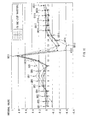
- the registration device generates registrant tissue information that two-dimensionally shows the tissue pattern under the epidermis under the detection electrode and registers it in the internal memory of the authentication device 2, similarly to the card device 3. Furthermore, as shown in Figure 16, for example, the registration device divides each of one-step waveforms TH for five steps into twenty one subdivided sections CSU1 to CSU21 ( Figure 11), and then registers a set of twenty one integral values for the subdivided sections CSU1 to CSU21 (hereinafter referred to as a group of registered parameters) obtained as a result of integration and normalization, in the internal memory of the authentication device 2 as registrant walking information indicating walking characteristics of the registrant, similarly to the card device 3.
- a group of registered parameters a set of twenty one integral values for the subdivided sections CSU1 to CSU21
- the authentication portion 62 first performs demodulation processing on the electrification change signal S12 supplied by LPF 22 in accordance with a predetermined demodulation method only during the masking time zone MTZ in the masking time data D14, and abstracts the ID information D6, the tissue information D5 or the walking information D7 superimposed on the electrification change signal S12 (the information-transmission quasi-electrostatic field DSE).
- the authentication portion 62 then checks the ID list stored in the internal memory against the ID information D6 as the first stage. And then, only when there is information corresponding to the ID information D6 in the ID list, it checks the registrant tissue information stored in the internal memory against the tissue information D5 as the second stage. And then, only when there is registrant tissue information corresponding to the tissue information D5, it checks the registrant walking information stored in the internal memory against the walking information D7 as the third stage. And then, only when there is registrant walking information corresponding to the walking information D7, it opens the exit door 5 of the entrance/exit passage portion 4 ( Figure 7).
- An authentication processing portion 60 is actually adapted to perform the authentication process by the LPF 22, the waveform processing portion 61 and the authentication portion 62 as software, in accordance with a predetermined sending program, under the control of a control portion not shown.
- the procedure for the authentication process will be now described using the flowchart below.
- the authentication processing portion 60 proceeds from the start step of the routine RT2 to the next step SP31, and generates electrification change data by performing each of the same processings as performed at the steps SP1 and SP2 ( Figure 12) by the card device 3 described above, on the amplified walking electrification change signal S11 detected and supplied by the electric field detection portion 50 at the same time when the card device 3 does, and then proceeds to the next masking time determination processing routine SRT11.
- the authentication processing portion 60 determines a masking time zone MTZ by performing each of the same processings of the masking time processing routine SRT1 ( Figure 13) for the card device 3, on the electrification change data generated at step SP31, and then proceeds to the next step SP32.
- the authentication processing portion 60 by performing data demodulation processing on the electrification change data generated at step SP31 during the masking time zone MTZ determined by the masking time determination processing routine SRT11, abstracts the ID information D6, the tissue information D5 or the walking information D7 superimposed on the electrification change data, and then proceeds to the next step SP33.
- the authentication processing portion 60 checks the ID information D6 abstracted at step SP32 against the ID list prestored in the internal memory, and determines whether or not there is information corresponding to the ID information D6 in the ID list.
- the authentication processing portion 60 proceeds to the next step SP36 and ends the authentication process.
- the authentication processing portion 60 proceeds to the next step SP34.
- the authentication processing portion 60 checks the tissue information D5 abstracted at step SP32 against the registrant tissue information registered in the internal memory in advance to determine wither or not there is registrant tissue information corresponding to the tissue information D5.
- the authentication processing portion 60 proceeds to the next step SP36 and ends the authentication process.
- the authentication processing portion 60 proceeds to the next walking checking processing routine SRT13.
- the authentication processing portion 60 determines, for the set of integral values obtained from a one-step waveform detected at step SP32, the Mahalanobis' distance from the center of distribution of registered parameters which are already registered with the authentication processing portion.
- the Mahalanobis' distance is determined for all the registrants.
- the authentication processing portion 60 determines whether or not any of the multiple registrant identification rates calculated at step SP42 is equal to or above 90%. If less than 90%, this indicates that the correspondence rate of the one step of the user relative to the registrant' s step registered in the internal memory is low, that is, the user is not the registrant himself. In this case, the authentication processing portion 60 identifies that the user is not the registrant, and it proceeds to the next step SP36 and ends the authentication process.
- the authentication processing portion 60 recognizes that the user is a person related to the company and proceeds to the step SP35 ( Figure 17).
- the authentication processing portion 60 opens the exit door 5 ( Figure 6) of the entrance/exit passage portion 4, and after that, it proceeds to the next step SP36 and ends the authentication process.
- the authentication processing portion 60 not only determines the identity of the card device 3 based on the ID information D6 but also determines the identity of the user based on the tissue information D5 (living tissue pattern) and the walking information D7 (walking pattern), and thereby it can securely identify the relation between the card device 3 and the user without performing special processing such as encryption processing on the tissue information D5 to D7 on the side of the card device 3.
- the authentication processing portion 60 can even prevent a third person who has stolen a card device 3 from passing through the entrance/exit passage portion 4 instead of the user (a person related to a company).
- the authentication system 1 is provided with a floor surface (hereinafter referred to as a route floor surface) Y1 of the entrance/exit passage portion 4 in such a condition that it is not grounded to the ground (hereinafter referred to as a building floor surface) Y2 but is separated from the building floor surface Y2 by predetermined space dx (a gap).
- a route floor surface a floor surface of the entrance/exit passage portion 4 in such a condition that it is not grounded to the ground (hereinafter referred to as a building floor surface) Y2 but is separated from the building floor surface Y2 by predetermined space dx (a gap).
- the electrostatic capacity between the feet of the user and the building floor surface Y2 can be reduced to be less than the electrostatic capacity between the user and the side-surface electrode 7 by the amount corresponding to the space dx between the route floor surface Y1 and the building floor surface Y2, and thereby leakage of the information-transmission quasi-electrostatic field DSE (walking quasi-electrostatic field HSE) from the feet to the building floor surface Y2 can be prevented.
- DSE walking quasi-electrostatic field HSE
- noises KN caused by inconsistency of the building floor surface Y2
- electrical discharge noises caused by electrically unstable condition due to a gap between joint surfaces of steel material in the building floor surface Y2 or rust of the steel material
- the communication system it is possible to form, in a more stable condition, the equipotential surface of the information-transmission quasi-electrostatic field DSE (walking quasi-electrostatic field HSE) which is formed substantially isotropically from around the surface of the user when the user is electrified and the electrification change momentarily conducts over the periphery of the surface of the user, and therefore it is possible to stable near field communication.
- DSE walking quasi-electrostatic field HSE
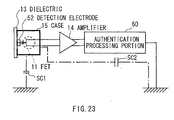
- the authentication device 2 of the authentication system 1 is adapted to prevent leakage of a signal on the route from the detection electrode 52 to the authentication processing portion 60 via the FET 11 and the amplifier 14. Specifically, first, a conductive case 15 is electrically separated from the FET 11; and second, only the authentication processing portion 60 is connected to the ground on the receiving route.
- the authentication device 2 is adapted to reduce the electrostatic capacity SC1 between the FET 11 and the ground in comparison with the electrostatic capacity SC2 on the route from the FET 11 to the ground via the authentication processing portion 60, for example, by increasing the interval (height) between the FET 11 and the ground.
- the authentication device 2 can efficiently induce the information-transmission quasi-electrostatic field DSE (walking quasi-electrostatic field HSE) detected by the detection electrode 52 to the authentication processing portion 60 via the FET 11, and thereby receive the information-transmission quasi-electrostatic field DSE formed around the user with high sensitivity.
- DSE walking quasi-electrostatic field HSE
- the tissue information D5 and the walking information D7 as living organism identifying information are detected from the detection electrode 52 via the FET 11, based on the walking quasi-electrostatic field HSE formed in the neighborhood of the user, during a walking motion of the user which is essentially required for the user to pass through the entrance/exit passage portion 4 ( Figure 6)
- the authentication system 1 it is possible to obtain information with high identifiability specific to the user without controlling the movement of the user and without performing special processing such as encryption.
- the authentication system 1 can be miniaturized. Thereby, uncomfortable feeling of the user can be reduced by reduction of the area to be in contact with the human body.
- a quasi-electrostatic field modulated according to the field information D5 and the walking information D7 (ID information D6) specific to the user is generated to electrify the user, and the information is sent via the information-transmission quasi-electrostatic field DSE with confidentiality which is isotropically formed in the neighborhood of the user.
- the masking time zone MTZ is determined.
- a quasi-electrostatic field generated by electrification or walking of a user is used not only synchronize the sending and receiving sides but also acquire specific tissue information D5 and walking information D7. Furthermore, the tissue information D5 and the walking information D7 are sent and received with the quasi-electrostatic field formed around the user used as an antenna. Thereby, the efficiency of communication can be considerably enhanced.
- the authentication system 1 not only determines the identity of the card device 3 but also determines the identity of the tissue information D5 (living tissue pattern) and the walking information D7 (walking pattern) specific to a user, and thereby even the relation between the card device 3 and the user can be securely identified without providing special processing such as encryption processing on the tissue information D5 to D7 on side of the card device 3.
- a quasi-electrostatic field is used not only to synchronize the sending and receiving sides but also to acquire the tissue information D5 and the walking information D7. Furthermore, the tissue information D5 and the walking information D7 are sent and received using the quasi-electrostatic field generated around the user as an antenna, and thereby, sending and receiving can be realized via the quasi-electrostatic field, without any directional restrictions in the neighborhood of the user, with conf identially secured, and without forcing the user to perform a predetermined movement, and even the relation between the device and the human body can be identified based on information specific to the human body. Thus, the degree of freedom in communication using a quasi-electrostatic field can be enhanced.
- tissue information generation portion 21 for generating tissue information D5 based on amplified walking electrification change signals A1 to An supplied via the detection electrode 12 of the electric field detection portion 10 or the walking information generation portion 45 for generating walking information D7 based on an amplified walking electrification change signal S1 supplied by the detection electrode 12 is applied as living organism information generation means for generating living organism information specific to a human body.
- the present invention is not limited thereto, and other various living information generation means for generating living organism information on various other living organisms such as fingerprints and cells can be applied.
- the 8 Hz peak Px is detected by the walking information generation portion 45 as walking information generation means, from the strength displacement of the walking quasi-electrostatic field HSE formed around a human body in response to a walking motion of the human body.
- the present invention is not limited thereto, and the peak of the electric field displacement may be detected which is generated around the human body by various other bipedal motions such as brisk walking, up-and-down movement on stairs and stepping movement on the same place, that is, such movements that include a state in which the entire plantar surface of one foot is in contact with the ground and the tiptoe of the other foot has just left the ground.
- the amplitude peak in the walking waveform changes according to the speed of the movement performed from when the right foot (left foot) completely gets in contact with the ground until when the tiptoe of the right foot (left foot) has just left the ground. Therefore, by detecting the amplitude peak that appears at the frequency band according to the movement speed from when the right foot (left foot) in a bipedal motion to be detected is completely in contact with the ground until when the tiptoe of the right foot (left foot) has just left the ground as an index instead of the 8 Hz peak, the effect similar to that of the embodiment described above can be obtained.
- the masking time determination portion 44 changes the predicted peak decreasing period ⁇ t1 and the predicted peak increasing period ⁇ t2 based on the frequency band according to the movement speed from when the right foot (left foot) in a bipedal motion to be detected is completely in contact with the ground until when the tiptoe of the right foot (left foot) has just left the ground, then near field communication can be performed in a more stable condition.
- the card device 3 as a sending device is positioned on a predetermined portion of a user' s arm in contact therewith.
- the present invention is not limited thereto, and the card device 3 may be positioned on various other portions of the epidermis of the user in contact therewith. For example, it may be embedded in a stud earring.
- the card device 3 is formed in a card shape.
- the present invention is not limited thereto, and the card device 3 may be formed in various other shapes. After all any shape may be possible only if it is of a mobile type.
- the route floor surface Y1 is provided for the entrance/exit passage portion 4 in a condition that it is separated from the building floor surface Y2 ( Figure 20) by predetermined space dx, as coupling preventing means for preventing a user and the ground from being electrically coupled with each other.
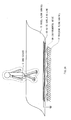
- the present invention is not limited thereto, and there may be provided a noise absorption/grounding line 80 laid on the route floor surface Y1 and grounded to the building floor surface Y2, as shown in Figure 24.
- the change in the electrification condition of the user may be detected by various other detection means such as an induction-electrode-type field strength meter for measuring the voltage induced by induction voltage, an induction-electrode-type modulation-amplification-system field strength meter for AC converting a direct signal obtained by an induction electrode using a chopper circuit, oscillation capacity and the like, an electro-optic-effect-type field strength meter for applying en electric field to material having an electro-optic effect to measure change in the light propagation characteristics caused in the material, and, only for the card device 3, an electrometer, a shunt-resistor-type field strength meter, a current-collection-type field strength meter and the like.
- an induction-electrode-type field strength meter for measuring the voltage induced by induction voltage
- an induction-electrode-type modulation-amplification-system field strength meter for AC converting a direct signal obtained by an induction electrode using a chopper circuit,
- electrification induction means is realized by the modulation circuit 24 and the electrification induction portion 30.
- the present invention is not limited thereto, and the electrification induction means may be realized by various other configurations.
- demodulation means is realized by the LPF 22 and the authentication portion 62.
- the present invention is not limited thereto, and the demodulation means may be realized by various other configurations.
- a user is identified by the authentication portion 62 as identification means based on tissue information D5 and walking information D7 as living organism information.
- the present invention is not limited thereto, and a user may be identified on one of the tissue information D5 and the walking information D7.
- a user may be identified by living organism information such as fingerprints combined with and added to the tissue information D5 and the walking information D7.
- the present invention is not limited thereto and can be broadly applied to authentication systems for various other purposes, such as a communication system with a communication route in the neighborhood of the desk, for opening the door of a desk as necessary when a user comes near to the desk, a communication system with a communication route in the neighborhood of a personal computer, for powering on the personal computer when a user comes near to the personal computer, and a communication system using a conveyance passage for conveying a predetermined identification target as a communication route, for switching conveyance passages as necessary when the identification target is conveyed to a predetermined position, that is, to any authentication system that electrifies a human body according to living organism information specific to the human body to cause the human body to act as an antenna, on the sending side, and acquires identification information from a quasi
- the authentication device 2 as a receiving device can be broadly applied to various other devices provided on or in the neighborhood of a video tape recorder, a television set, electronics such as a mobile telephone or a personal computer, medical equipment, an automobile, a desk, and other control targets to be controlled, for example. In this case, the same effect as that of the embodiment described above can be obtained.
- each of the processings by a sending portion 20 or an authentication processing portion 60 is realized by a program.
- the present invention is not limited thereto, and a part or all of each processing may be realized by hardware means, such as an integrated circuit dedicated the processing.
- the program storage medium to have the program for executing the sending process or the authentication process installed and make it executable may be realized not only by a package media such as a flexible disk, a CD-ROM (Compact Disk-Read Only Memory), and a DVD (Digital Versatile Disc) but also by a semiconductor memory or a magnetic disk in which the program is temporarily or permanently stored.
- a wired or wires communication medium such as a local area network, the Internet, and digital satellite broadcasting, may be utilized, and the analysis program may be stored via various communication interfaces such as a router and a modem.
- the sending device detects living organism information specific to a human body and generates a quasi-electrostatic field modulated according to the living organism information to electrify the human body.
- the receiving device demodulates the living organism information based on change in the electrification condition of the human body and identifies the human body based on the living organism information.
- the present invention is adapted to an authentication system for performing authentication using living organism information specific to a human body, for example, in the case of opening a door provided for a predetermined entrance/exit passage when the human body enters or exits from the entrance/exit passage, in the case of unlocking a drawer provided for a desk as necessary when the human body comes near to the desk, and the like.
Landscapes
- Engineering & Computer Science (AREA)
- Physics & Mathematics (AREA)
- General Physics & Mathematics (AREA)
- Health & Medical Sciences (AREA)
- Life Sciences & Earth Sciences (AREA)
- Computer Networks & Wireless Communication (AREA)
- Signal Processing (AREA)
- Human Computer Interaction (AREA)
- Medical Informatics (AREA)
- Animal Behavior & Ethology (AREA)
- Biomedical Technology (AREA)
- Heart & Thoracic Surgery (AREA)
- Biophysics (AREA)
- Molecular Biology (AREA)
- Surgery (AREA)
- Pathology (AREA)
- General Health & Medical Sciences (AREA)
- Public Health (AREA)
- Veterinary Medicine (AREA)
- Measurement Of The Respiration, Hearing Ability, Form, And Blood Characteristics Of Living Organisms (AREA)
- Near-Field Transmission Systems (AREA)
- Measuring And Recording Apparatus For Diagnosis (AREA)
- Measurement And Recording Of Electrical Phenomena And Electrical Characteristics Of The Living Body (AREA)
- Lock And Its Accessories (AREA)
Applications Claiming Priority (3)
| Application Number | Priority Date | Filing Date | Title |
|---|---|---|---|
| JP2003051869 | 2003-02-27 | ||
| JP2003051869A JP4158097B2 (ja) | 2003-02-27 | 2003-02-27 | 認証システム |
| PCT/JP2004/002378 WO2004075751A1 (ja) | 2003-02-27 | 2004-02-27 | 認証システム |
Publications (2)
| Publication Number | Publication Date |
|---|---|
| EP1598009A1 true EP1598009A1 (de) | 2005-11-23 |
| EP1598009A4 EP1598009A4 (de) | 2009-09-02 |
Family
ID=32923378
Family Applications (1)
| Application Number | Title | Priority Date | Filing Date |
|---|---|---|---|
| EP04715505A Withdrawn EP1598009A4 (de) | 2003-02-27 | 2004-02-27 | Authentifikationssystem |
Country Status (6)
| Country | Link |
|---|---|
| US (1) | US20060158820A1 (de) |
| EP (1) | EP1598009A4 (de) |
| JP (1) | JP4158097B2 (de) |
| KR (1) | KR20050105254A (de) |
| CN (1) | CN100466971C (de) |
| WO (1) | WO2004075751A1 (de) |
Cited By (1)
| Publication number | Priority date | Publication date | Assignee | Title |
|---|---|---|---|---|
| WO2010146490A1 (en) * | 2009-06-18 | 2010-12-23 | Koninklijke Philips Electronics N.V. | Signal-detection with band-pass spectral shaping |
Families Citing this family (47)
| Publication number | Priority date | Publication date | Assignee | Title |
|---|---|---|---|---|
| JP4586618B2 (ja) | 2005-04-18 | 2010-11-24 | ソニー株式会社 | 人体通信システム及び通信装置 |
| US9198608B2 (en) | 2005-04-28 | 2015-12-01 | Proteus Digital Health, Inc. | Communication system incorporated in a container |
| CN102379684B (zh) | 2005-04-28 | 2014-11-19 | 普罗透斯数字保健公司 | 药物信息系统 |
| US8730031B2 (en) | 2005-04-28 | 2014-05-20 | Proteus Digital Health, Inc. | Communication system using an implantable device |
| JP4673234B2 (ja) * | 2005-05-26 | 2011-04-20 | アルプス電気株式会社 | キーレスエントリー装置 |
| EP1920418A4 (de) * | 2005-09-01 | 2010-12-29 | Proteus Biomedical Inc | Implantierbare drahtlose kommunikationssysteme |
| JP4348637B2 (ja) * | 2006-01-16 | 2009-10-21 | ソニー株式会社 | 通信装置 |
| JP4673230B2 (ja) * | 2006-02-01 | 2011-04-20 | アルプス電気株式会社 | キーレスエントリー装置 |
| JP4210953B2 (ja) * | 2006-04-14 | 2009-01-21 | ソニー株式会社 | 電界制御装置及び検出装置 |
| CA2650920C (en) | 2006-05-02 | 2016-10-18 | Proteus Biomedical, Inc. | Patient customized therapeutic regimens |
| JP4673251B2 (ja) * | 2006-05-11 | 2011-04-20 | アルプス電気株式会社 | キーレスエントリー装置 |
| MY158019A (en) | 2006-10-25 | 2016-08-30 | Proteus Digital Health Inc | Controlled activation ingestible identifier |
| US8718193B2 (en) | 2006-11-20 | 2014-05-06 | Proteus Digital Health, Inc. | Active signal processing personal health signal receivers |
| JP4894500B2 (ja) * | 2006-12-22 | 2012-03-14 | ソニー株式会社 | 歩行波形処理方法及び歩行波形処理装置 |
| PT3785599T (pt) | 2007-02-01 | 2022-10-21 | Otsuka Pharma Co Ltd | Sistemas de marcadores de eventos ingeríveis |
| CA2676280C (en) | 2007-02-14 | 2018-05-22 | Proteus Biomedical, Inc. | In-body power source having high surface area electrode |
| WO2008112577A1 (en) | 2007-03-09 | 2008-09-18 | Proteus Biomedical, Inc. | In-body device having a multi-directional transmitter |
| CN101663846B (zh) * | 2007-04-20 | 2013-09-25 | 阿尔卑斯电气株式会社 | 通信设备、接收机及发送机 |
| WO2008136644A2 (en) * | 2007-05-07 | 2008-11-13 | Innozest Inc. | Apparatus and method for recognizing subcutaneous vein pattern |
| US8115618B2 (en) | 2007-05-24 | 2012-02-14 | Proteus Biomedical, Inc. | RFID antenna for in-body device |
| DK2192946T3 (da) | 2007-09-25 | 2022-11-21 | Otsuka Pharma Co Ltd | Kropsintern anordning med virtuel dipol signalforstærkning |
| WO2009070773A1 (en) | 2007-11-27 | 2009-06-04 | Proteus Biomedical, Inc. | Transbody communication systems employing communication channels |
| US8258962B2 (en) | 2008-03-05 | 2012-09-04 | Proteus Biomedical, Inc. | Multi-mode communication ingestible event markers and systems, and methods of using the same |
| CA3039236C (en) | 2008-07-08 | 2022-05-17 | Proteus Digital Health, Inc. | Ingestible event marker data framework |
| US8055334B2 (en) | 2008-12-11 | 2011-11-08 | Proteus Biomedical, Inc. | Evaluation of gastrointestinal function using portable electroviscerography systems and methods of using the same |
| US9659423B2 (en) | 2008-12-15 | 2017-05-23 | Proteus Digital Health, Inc. | Personal authentication apparatus system and method |
| US9439566B2 (en) | 2008-12-15 | 2016-09-13 | Proteus Digital Health, Inc. | Re-wearable wireless device |
| TWI424832B (zh) | 2008-12-15 | 2014-02-01 | 波提亞斯數位康健公司 | 與身體有關的接收器及其方法 |
| SG172846A1 (en) | 2009-01-06 | 2011-08-29 | Proteus Biomedical Inc | Ingestion-related biofeedback and personalized medical therapy method and system |
| JP5141653B2 (ja) * | 2009-08-28 | 2013-02-13 | 株式会社デンソー | 防犯用警報装置 |
| TWI517050B (zh) | 2009-11-04 | 2016-01-11 | 普羅托斯數位健康公司 | 供應鏈管理之系統 |
| BR112012019212A2 (pt) | 2010-02-01 | 2017-06-13 | Proteus Digital Health Inc | sistema de coleta de dados |
| TWI557672B (zh) | 2010-05-19 | 2016-11-11 | 波提亞斯數位康健公司 | 用於從製造商跟蹤藥物直到患者之電腦系統及電腦實施之方法、用於確認將藥物給予患者的設備及方法、患者介面裝置 |
| WO2012125425A2 (en) | 2011-03-11 | 2012-09-20 | Proteus Biomedical, Inc. | Wearable personal body associated device with various physical configurations |
| US9756874B2 (en) | 2011-07-11 | 2017-09-12 | Proteus Digital Health, Inc. | Masticable ingestible product and communication system therefor |
| WO2015112603A1 (en) | 2014-01-21 | 2015-07-30 | Proteus Digital Health, Inc. | Masticable ingestible product and communication system therefor |
| CA2842952C (en) | 2011-07-21 | 2019-01-08 | Proteus Digital Health, Inc. | Mobile communication device, system, and method |
| US9235683B2 (en) | 2011-11-09 | 2016-01-12 | Proteus Digital Health, Inc. | Apparatus, system, and method for managing adherence to a regimen |
| WO2014151929A1 (en) | 2013-03-15 | 2014-09-25 | Proteus Digital Health, Inc. | Personal authentication apparatus system and method |
| JP6511439B2 (ja) | 2013-06-04 | 2019-05-15 | プロテウス デジタル ヘルス, インコーポレイテッド | データ収集および転帰の査定のためのシステム、装置、および方法 |
| KR101654040B1 (ko) * | 2013-09-10 | 2016-09-05 | 주식회사 케이티 | 사용자의 스텝 패턴 입력을 이용하는 전자 기기의 자동 설정 장치, 자동 설정 시스템 및 전자 기기의 자동 설정 방법 |
| CA2924815C (en) | 2013-09-20 | 2017-06-20 | Proteus Digital Health, Inc. | Methods, devices and systems for receiving and decoding a signal in the presence of noise using slices and warping |
| JP2016537924A (ja) | 2013-09-24 | 2016-12-01 | プロテウス デジタル ヘルス, インコーポレイテッド | 事前に正確に把握されていない周波数において受信された電磁信号に関する使用のための方法および装置 |
| US10084880B2 (en) | 2013-11-04 | 2018-09-25 | Proteus Digital Health, Inc. | Social media networking based on physiologic information |
| CN104433261B (zh) * | 2014-11-18 | 2016-08-24 | 龙泉千成电子科技有限公司 | 可调式智能餐桌 |
| JP2017184091A (ja) * | 2016-03-31 | 2017-10-05 | ソニー株式会社 | 通信装置、および通信システム |
| MX2019000888A (es) | 2016-07-22 | 2019-06-03 | Proteus Digital Health Inc | Percepcion y deteccion electromagnetica de marcadores de evento ingeribles. |
Family Cites Families (12)
| Publication number | Priority date | Publication date | Assignee | Title |
|---|---|---|---|---|
| JP4074661B2 (ja) * | 1995-05-08 | 2008-04-09 | マサチューセッツ・インスティテュート・オブ・テクノロジー | 信号伝送媒体として人体を用いた非接触検知及び信号システム |
| DE19547560C2 (de) * | 1995-12-20 | 2000-01-13 | Daimler Chrysler Ag | Einrichtung zur körpergebundenen Datenübertragung zwischen zwei Endgeräten |
| CN1155335C (zh) * | 1996-04-10 | 2004-06-30 | 西门子公司 | 对人的皮肤结构探测的方法 |
| US5796827A (en) * | 1996-11-14 | 1998-08-18 | International Business Machines Corporation | System and method for near-field human-body coupling for encrypted communication with identification cards |
| JP3425347B2 (ja) * | 1996-12-12 | 2003-07-14 | 日本電信電話株式会社 | 人体経由情報伝達装置 |
| US6223018B1 (en) * | 1996-12-12 | 2001-04-24 | Nippon Telegraph And Telephone Corporation | Intra-body information transfer device |
| AU5918399A (en) * | 1998-09-11 | 2000-04-03 | Res Technologies Llc | Measurement of electric and/or magnetic properties in organisms using induced currents |
| DE60102331T2 (de) * | 2000-09-08 | 2005-03-17 | Matsushita Electric Works, Ltd., Kadoma | Datenübertragungssystem unter Verwendung eines menschlichen Körpers als Signalübertragungsweg |
| JP2002197437A (ja) * | 2000-12-27 | 2002-07-12 | Sony Corp | 歩行検出システム、歩行検出装置、デバイス、歩行検出方法 |
| EP1239420A1 (de) * | 2001-03-05 | 2002-09-11 | Siemens Aktiengesellschaft | Identifikationssystem und Codegeber zum Nachweis einer Berechtigung für den Zugang zu einem Objekt oder die Benutzung eines Objekts, insbesondere eines Kraftfahrzeugs |
| DE10132031A1 (de) * | 2001-07-03 | 2003-01-23 | Texas Instruments Deutschland | Verfahren zur Ermöglichung des authentifizierten Zugangs eines Individuums zu einem geschützten Bereich und Sicherheitssystem zur Durchführung des Verfahrens |
| JP4247656B2 (ja) * | 2002-05-09 | 2009-04-02 | ソニー株式会社 | 生体パターン検出方法及び生体パターン検出装置 |
-
2003
- 2003-02-27 JP JP2003051869A patent/JP4158097B2/ja not_active Expired - Fee Related
-
2004
- 2004-02-27 KR KR1020057015894A patent/KR20050105254A/ko not_active Withdrawn
- 2004-02-27 CN CNB2004800054580A patent/CN100466971C/zh not_active Expired - Fee Related
- 2004-02-27 US US10/546,993 patent/US20060158820A1/en not_active Abandoned
- 2004-02-27 EP EP04715505A patent/EP1598009A4/de not_active Withdrawn
- 2004-02-27 WO PCT/JP2004/002378 patent/WO2004075751A1/ja not_active Ceased
Cited By (1)
| Publication number | Priority date | Publication date | Assignee | Title |
|---|---|---|---|---|
| WO2010146490A1 (en) * | 2009-06-18 | 2010-12-23 | Koninklijke Philips Electronics N.V. | Signal-detection with band-pass spectral shaping |
Also Published As
| Publication number | Publication date |
|---|---|
| CN100466971C (zh) | 2009-03-11 |
| JP4158097B2 (ja) | 2008-10-01 |
| KR20050105254A (ko) | 2005-11-03 |
| US20060158820A1 (en) | 2006-07-20 |
| JP2004261243A (ja) | 2004-09-24 |
| CN1753642A (zh) | 2006-03-29 |
| WO2004075751A1 (ja) | 2004-09-10 |
| EP1598009A4 (de) | 2009-09-02 |
Similar Documents
| Publication | Publication Date | Title |
|---|---|---|
| US20060158820A1 (en) | Authentication system | |
| US7443290B2 (en) | Communication system | |
| EP1598964A1 (de) | Kommunikationssystem, kommunikationsverfahren und kommunikationsvorrichtung | |
| JP4507058B2 (ja) | 距離検出システム | |
| US11158149B2 (en) | Personal authentication apparatus system and method | |
| CN1988406B (zh) | 用于处理信息的系统、设备、方法 | |
| Kim et al. | Vibration-based secure side channel for medical devices | |
| US20030072475A1 (en) | Verification techniques for biometric identification systems | |
| JP2004282733A (ja) | 通信システム | |
| EP0824889A1 (de) | Uebertragungssystem in Anwendung des menschlichen Körpers als Wellenleiter | |
| JP2012511274A (ja) | 体結合通信に基づかれるユーザー識別 | |
| JP2012039370A (ja) | 通信システム並びに通信装置 | |
| US20090267735A1 (en) | Fingerprint authentication method in human body communication | |
| US20080012582A1 (en) | Apparatus to measure skin moisture content and method of operating the same | |
| WO2016135437A2 (en) | Biometric authentication device | |
| US20070002815A1 (en) | Communication system, communication method and program | |
| CN107113066A (zh) | 通信设备、通信方法和程序 | |
| US7890055B1 (en) | Touch field compound field detector personal ID | |
| EP1125242A4 (de) | Verfahren und system für biometrische erkennung basiert auf elektrischen und/oder magnetischen eigenschaften | |
| WO2018221429A1 (ja) | 生体認証センサを備えたセキュリティシステムと電子機器 | |
| JP3840463B2 (ja) | 不審者検知システム | |
| WO2000016247A1 (en) | Method and system for biometric recognition using sensors with unique characteristics | |
| WO2009098631A1 (en) | Adaptive capacitive coupling for body-coupled communication | |
| CN106778715A (zh) | 相控阵生物识别信息采集装置及采集方法 | |
| HK1101460B (en) | System, apparatus and method for processing information |
Legal Events
| Date | Code | Title | Description |
|---|---|---|---|
| PUAI | Public reference made under article 153(3) epc to a published international application that has entered the european phase |
Free format text: ORIGINAL CODE: 0009012 |
|
| 17P | Request for examination filed |
Effective date: 20050824 |
|
| AK | Designated contracting states |
Kind code of ref document: A1 Designated state(s): AT BE BG CH CY CZ DE DK EE ES FI FR GB GR HU IE IT LI LU MC NL PT RO SE SI SK TR |
|
| AX | Request for extension of the european patent |
Extension state: AL LT LV MK |
|
| DAX | Request for extension of the european patent (deleted) | ||
| RBV | Designated contracting states (corrected) |
Designated state(s): DE FR GB |
|
| A4 | Supplementary search report drawn up and despatched |
Effective date: 20090803 |
|
| RIC1 | Information provided on ipc code assigned before grant |
Ipc: A61B 5/117 20060101ALI20090728BHEP Ipc: G07C 9/00 20060101AFI20090728BHEP |
|
| STAA | Information on the status of an ep patent application or granted ep patent |
Free format text: STATUS: THE APPLICATION HAS BEEN WITHDRAWN |
|
| 18W | Application withdrawn |
Effective date: 20090909 |