EP1572707B1 - Neue aromatische fluorglycosidderivate, diese verbindungen enthaltende arzneimittel und deren verwendung - Google Patents
Neue aromatische fluorglycosidderivate, diese verbindungen enthaltende arzneimittel und deren verwendung Download PDFInfo
- Publication number
- EP1572707B1 EP1572707B1 EP03795853A EP03795853A EP1572707B1 EP 1572707 B1 EP1572707 B1 EP 1572707B1 EP 03795853 A EP03795853 A EP 03795853A EP 03795853 A EP03795853 A EP 03795853A EP 1572707 B1 EP1572707 B1 EP 1572707B1
- Authority
- EP
- European Patent Office
- Prior art keywords
- alkyl
- phenyl
- hydrogen
- conh
- replaced
- Prior art date
- Legal status (The legal status is an assumption and is not a legal conclusion. Google has not performed a legal analysis and makes no representation as to the accuracy of the status listed.)
- Expired - Lifetime
Links
- 0 COC(C1OC(c2ccccc2)=O)OC(COC(c2ccccc2)=O)C(*)C1OC(c1ccccc1)=O Chemical compound COC(C1OC(c2ccccc2)=O)OC(COC(c2ccccc2)=O)C(*)C1OC(c1ccccc1)=O 0.000 description 1
- ALZWVPLMSWPDQR-UHFFFAOYSA-N COc1ccc(Cc(cccc2)c2O)cc1 Chemical compound COc1ccc(Cc(cccc2)c2O)cc1 ALZWVPLMSWPDQR-UHFFFAOYSA-N 0.000 description 1
Classifications
-
- C—CHEMISTRY; METALLURGY
- C07—ORGANIC CHEMISTRY
- C07H—SUGARS; DERIVATIVES THEREOF; NUCLEOSIDES; NUCLEOTIDES; NUCLEIC ACIDS
- C07H15/00—Compounds containing hydrocarbon or substituted hydrocarbon radicals directly attached to hetero atoms of saccharide radicals
- C07H15/20—Carbocyclic rings
- C07H15/203—Monocyclic carbocyclic rings other than cyclohexane rings; Bicyclic carbocyclic ring systems
-
- A—HUMAN NECESSITIES
- A61—MEDICAL OR VETERINARY SCIENCE; HYGIENE
- A61K—PREPARATIONS FOR MEDICAL, DENTAL OR TOILETRY PURPOSES
- A61K31/00—Medicinal preparations containing organic active ingredients
- A61K31/70—Carbohydrates; Sugars; Derivatives thereof
-
- A—HUMAN NECESSITIES
- A61—MEDICAL OR VETERINARY SCIENCE; HYGIENE
- A61P—SPECIFIC THERAPEUTIC ACTIVITY OF CHEMICAL COMPOUNDS OR MEDICINAL PREPARATIONS
- A61P3/00—Drugs for disorders of the metabolism
-
- A—HUMAN NECESSITIES
- A61—MEDICAL OR VETERINARY SCIENCE; HYGIENE
- A61P—SPECIFIC THERAPEUTIC ACTIVITY OF CHEMICAL COMPOUNDS OR MEDICINAL PREPARATIONS
- A61P3/00—Drugs for disorders of the metabolism
- A61P3/08—Drugs for disorders of the metabolism for glucose homeostasis
- A61P3/10—Drugs for disorders of the metabolism for glucose homeostasis for hyperglycaemia, e.g. antidiabetics
Definitions
- the invention relates to substituted aromatic fluoro-glycoside derivatives, their physiologically acceptable salts and physiologically functional derivatives.
- the object of the invention was to provide novel compounds with which a prevention and treatment of diabetes type 1 and type 2 is possible.
- aromatic fluoroglycoside derivatives increase the effect on SGLT. These compounds are therefore particularly suitable for the prevention and treatment of diabetes type 1 and type 2.
- the invention relates to compounds of the formula I, in the form of their racemates, racemic mixtures and pure enantiomers, and to their diastereomers and mixtures thereof.
- alkyl radicals in the substituents R4, R5, R6, R7, R8 and R9 can be both straight-chain and branched.
- halogen is meant F, Cl, Br, J, preferably F and Cl.
- Suitable pharmaceutically acceptable acid addition salts of the compounds according to the invention are salts of inorganic acids, such as hydrochloric acid, hydrobromic acid, phosphoric acid, metaphosphoric acid, nitric acid and sulfuric acid, and also organic acids, such as, for example, acetic acid, benzenesulfonic, benzoic, citric, ethanesulfonic, fumaric acid. , Gluconic, glycolic, isethionic, lactic, lactobionic, maleic, malic, methanesulfonic, succinic, p-toluenesulfonic and tartaric acids.
- Suitable pharmaceutically acceptable basic salts are ammonium salts, alkali metal salts (such as sodium and potassium salts), alkaline earth salts (such as magnesium and calcium salts), trometamol (2-amino-2-hydroxymethyl-1,3-propanediol), diethanolamine, lysine or ethylenediamine.
- Salts with a non-pharmaceutically acceptable anion are also within the scope of the invention as useful intermediates for the preparation or purification of pharmaceutically acceptable salts and / or for use in non-therapeutic, for example, in vitro applications.
- physiologically functional derivative refers to any physiologically acceptable derivative of a compound of formula I, e.g. an ester which, when administered to a mammal, e.g. humans, is able to form (directly or indirectly) a compound of the formula.I or an active metabolite thereof.
- the physiologically functional derivatives also include prodrugs of the compounds according to the invention, as described, for example, in H. Okada et al., Chem. Pharm. Bull. 1994, 42, 57-61. Such prodrugs can be metabolized in vivo to a compound of the invention. These prodrugs may or may not be effective. Preferred are carbonates at the 6-position of the sugar (see WO 0280936 and WO 0244192), more preferably methyl, and ethyl carbonate.
- the compounds according to the invention can also be present in various polymorphic forms, for example as amorphous and crystalline polymorphic forms. All polymorphic forms of the compounds of the invention are within the scope of the invention and are a further aspect of the invention.
- the compound (s) of the formula (I) can also be administered in combination with other active substances.
- the amount of a compound of Formula I required to achieve the desired biological effect is dependent upon a number of factors, eg, the specific compound chosen, the intended use, the mode of administration, and the clinical condition of the patient.
- the daily dose is in the range of 0.3 mg to 100 mg (typically 3 mg and 50 mg) per day per kilogram of body weight, eg 3-10 mg / kg / day.
- an intravenous dose may range from 0.3 mg to 1.0 mg / kg, which may conveniently be administered as an infusion of 10 ng to 100 ng per kilogram per minute.
- Suitable infusion solutions for these purposes may contain, for example, from 0.1 ng to 10 mg, typically from 1 ng to 10 mg per milliliter.
- Single doses may contain, for example, from 1 mg to 10 g of the active ingredient.
- injectable ampoules, and orally administrable unit dose formulations such as tablets or capsules, may contain, for example, from 1.0 to 1000 mg, typically from 10 to 600 mg.
- the compounds according to formula I can themselves be used as compound, but they are preferably present with a compatible carrier in the form of a pharmaceutical composition.
- the carrier must of course be compatible in the sense that it is compatible with the other ingredients of the composition and is not harmful to the patient.
- the carrier may be a solid or a liquid, or both, and is preferably formulated with the compound as a single dose, for example, as a tablet, which may contain from 0.05% to 95% by weight of the active ingredient.
- Other pharmaceutically active substances may also be present, including further compounds according to formula I.
- the pharmaceutical compositions according to the invention may be prepared according to one of the known Pharmaceutical methods are prepared, which consist essentially in that the ingredients are mixed with pharmacologically acceptable carriers and / or excipients.
- compositions according to the invention are those which are suitable for oral, rectal, topical, peroral (eg sublingual) and parenteral (eg subcutaneous, intramuscular, intradermal or intravenous) administration, although the most suitable mode of administration in each individual case is the type and severity of the treatment to be treated State and on the nature of the particular compound used in accordance with formula I is dependent.
- coated formulations and coated slow release formulations are within the scope of the invention.
- Suitable pharmaceutical compounds for oral administration may be in separate units, such as capsules, cachets, lozenges or tablets, each containing a certain amount of the compound of formula I; as a powder or granules; as a solution or suspension in an aqueous or non-aqueous liquid; or as an oil-in-water or water-in-oil emulsion.
- these compositions may be prepared by any suitable pharmaceutical method comprising a step of contacting the active ingredient and the carrier (which may consist of one or more additional ingredients).
- the compositions are prepared by uniformly and homogeneously mixing the active ingredient with a liquid and / or finely divided solid carrier, after which the product is molded, if necessary.
- a tablet can be made by compressing or molding a powder or granules of the compound, optionally with one or more additional ingredients.
- Pressed tablets may be prepared by tableting the compound in free-flowing form, such as a powder or granules, optionally mixed with a binder, lubricant, inert diluent and / or surfactant / dispersing agent in a suitable machine.
- Molded tablets may be prepared by shaping the powdered compound moistened with an inert liquid diluent in a suitable machine.
- compositions suitable for peroral (sublingual) administration include lozenges containing a compound of formula I with a flavor, usually sucrose and gum arabic or tragacanth, and lozenges containing the compound in an inert base such as gelatin and glycerol or sucrose and gum arabic.
- Suitable pharmaceutical compositions for parenteral administration preferably comprise sterile aqueous preparations of a compound according to formula I which are preferably isotonic with the blood of the intended recipient. These preparations are preferably administered intravenously, although the administration may also be subcutaneous, intramuscular or intradermal as an injection. These preparations may preferably be prepared by mixing the compound with water and rendering the resulting solution sterile and isotonic with the blood. Injectable compositions of the invention generally contain from 0.1% to 5% by weight of the active compound.
- Suitable pharmaceutical compositions for rectal administration are preferably as single dose suppositories. These can be prepared by mixing a compound according to formula I with one or more conventional solid carriers, for example cocoa butter, and shaping the resulting mixture.
- Suitable pharmaceutical compositions for topical application to the skin are preferably as an ointment, cream, lotion, paste, spray, aerosol or oil.
- Vaseline, lanolin, polyethylene glycols, alcohols and combinations of two or more of these substances can be used as the carrier.
- the active ingredient is in generally in a concentration of 0.1 to 15% by weight of the composition, for example from 0.5 to 2%.
- Suitable pharmaceutical compositions for transdermal applications may exist as single patches suitable for long-term close contact with the epidermis of the patient. Such patches suitably contain the active ingredient in an optionally buffered aqueous solution, dissolved and / or dispersed in an adhesive or dispersed in a polymer.
- a suitable active ingredient concentration is about 1% to 35%, preferably about 3% to 15%.
- the active ingredient can be released by electrotransport or iontophoresis as described, for example, in Pharmaceutical Research, 2 (6): 318 (1986).
- the invention furthermore relates to processes for the preparation of the compounds of the general formula I which can be obtained in accordance with the following reaction schemes of the processes A to F:
- the compound (s) of the formula I can also be administered in combination with other active substances.
- Antidiabetics include insulin and insulin derivatives such as Lantus® (see www.lantus.com) or HMR 1964, fast-acting insulins (see US 6,221,633), GLP-1 derivatives such as those described in WO 98/08871 to Novo Nordisk A / S, as well as orally active hypoglycemic agents.
- the orally active hypoglycemic agents preferably include sulfonylureas, biguanidines, meglitinides, oxadiazolidinediones, thiazolidinediones, glucosidase inhibitors, glucagon antagonists, GLP-1 agonists, potassium channel openers such as those described in WO 97/26265 and WO 99/03861 of Novo Nordisk A / S, insulin sensitizers, inhibitors of liver enzymes involved in the stimulation of gluconeogenesis and / or glycogenolysis, modulators of glucose uptake, lipid metabolism altering compounds such as antihyperlipidemic agents and antilipidemic agents, compounds that reduce food intake, PPAR and PXR agonists and drugs that act on the ATP-dependent catium channel of beta cells.
- the compounds of formula I are administered in combination with an HMGCoA reductase inhibitor such as simvastatin, fluvastatin, pravastatin, lovastatin, atorvastatin, cerivastatin, rosuvastatin.
- an HMGCoA reductase inhibitor such as simvastatin, fluvastatin, pravastatin, lovastatin, atorvastatin, cerivastatin, rosuvastatin.
- the compounds of the formula I are administered in combination with a cholesterol absorption inhibitor, such as ezetimibe, tiqueside, pamaqueside.
- a cholesterol absorption inhibitor such as ezetimibe, tiqueside, pamaqueside.
- the compounds of formula I are administered in combination with a PPAR gamma agonist, e.g. Rosiglitazone, pioglitazone, JTT-501, Gl 262570.
- a PPAR gamma agonist e.g. Rosiglitazone, pioglitazone, JTT-501, Gl 262570.
- the compounds of formula I in combination with PPAR alpha agonist e.g. GW 9578, GW 7647.
- the compounds of formula I in combination with a mixed PPAR alpha / gamma agonist e.g. GW 1536, AVE 8042, AVE 8134, AVE 0847, AVE0897 or as described in WO 00/64888, WO 00/64876, WO 03/20269.
- a mixed PPAR alpha / gamma agonist e.g. GW 1536, AVE 8042, AVE 8134, AVE 0847, AVE0897 or as described in WO 00/64888, WO 00/64876, WO 03/20269.
- the compounds of formula I are used in combination with a fibrate, e.g. Fenofibrate. Clofibrate, bezafibrate.
- the compounds of formula I are administered in combination with an MTP inhibitor, e.g. Implitapide, BMS-201038, R-103757.
- an MTP inhibitor e.g. Implitapide, BMS-201038, R-103757.
- the compounds of formula I are used in combination with bile acid resorption inhibitor (see, for example, US 6,245,744 or US 6,221,897), e.g. HMR 1741 administered.
- the compounds of formula I are administered in combination with a CETP inhibitor, e.g. JTT-705.
- a CETP inhibitor e.g. JTT-705.
- the compounds of formula I are administered in combination with a polymeric bile acid adsorbent such as cholestyramine, colesevelam.
- the compounds of formula I are used in combination with an LDL receptor inducer (see US 6,342,512), e.g. HMR1171, HMR1586.
- the compounds of formula I are administered in combination with an ACAT inhibitor, e.g. Avasimibe, administered.
- an ACAT inhibitor e.g. Avasimibe
- the compounds of formula I are used in combination with an antioxidant, e.g. OPC-14117 administered.
- the compounds of formula I in combination with a lipoprotein lipase inhibitor e.g. NO-1886, administered.
- the compounds of formula I are used in combination with an ATP citrate lyase inhibitor, e.g. SB-204990 administered.
- the compounds of formula I are administered in combination with a squalene synthetase inhibitor, e.g. BMS-188494.
- a squalene synthetase inhibitor e.g. BMS-188494.
- the compounds of formula I in combination with a lipoprotein (a) antagonist, e.g. Cl-1027 or nicotinic acid.
- a lipoprotein (a) antagonist e.g. Cl-1027 or nicotinic acid.
- the compounds of formula 1 are used in combination with a lipase inhibitor, e.g. Orlistat, administered.
- a lipase inhibitor e.g. Orlistat
- the compounds of the formula I are administered in combination with insulin.
- the compounds of formula I are administered in combination with a sulphonylurea, such as, for example, tolbutamide, glibenclamide, glipizide or glimepiride.
- the compounds of formula I are used in combination with a biguanide, e.g. Metformin, administered.
- a biguanide e.g. Metformin
- the compounds of formula I are administered in combination with a meglitinide, such as repaglinide.
- the compounds of formula I are used in combination with a thiazolidinedione, such as troglitazone, ciglitazone, pioglitazone, rosiglitazone or those described in WO 97/41097 by Dr. med. Reddy's Research Foundation disclosed compounds, particularly 5 - [[4 - [(3,4-dihydro-3-methyl-4-oxo-2-quinazolinylmethoxy] -phenyl] methyl] -2,4-thiazolidinedione.
- the compounds of formula I are administered in combination with an ⁇ -glucosidase inhibitor, such as miglitol or acarbose.
- the compounds of formula I are administered in combination with an agent that acts on the ATP-dependent potassium channel of beta cells, such as tolbutamide, glibenclamide, glipizide, glimepiride or repaglinide.
- the compounds of the formula I are used in combination with more than one of the abovementioned compounds, for example in combination with a sulphonylurea and metformin, a sulphonylurea and acarbose, repaglinide and metformin, insulin and a sulphonylurea, insulin and metformin, insulin and troglitazone , Insulin and lovastatin, etc. administered.
- the compounds of formula I are used in combination with CART modulators (see “cocaine-amphetamine-regulated transcript-influenced energy metabolism, anxiety and gastric emptying in mice" Asakawa, A., et al., M.: Hormones and Metabolic Research (2001), 33 (9), 554-558), NPY antagonists eg naphthalene-1-sulfonic acid ⁇ 4 - [(4-amino-quinazolin-2-ylamino) -methyl] -cyclohexylmethyl ⁇ -amide; hydrochloride (CGP 71683A)), MC4 agonists (eg, 1-amino-1,2,3,4-tetrahydronaphthalene-2-carboxylic acid [2- (3a-benzyl-2-methyl-3-oxo-2,3 , 3a, 4,6,7-hexahydro-pyrazolo [4.3-c] pyridin-5-yl) -1- (4-chlor
- the further active ingredient is leptin; see, e.g. "Perspectives in the therapeutic use of leptin", Salvador, Javier; Gomez-Ambrosi, Javier; Fruhbeck, Gema, Expert Opinion on Pharmacotherapy (2001). 2 (10), 1615-1622.
- the further active ingredient is dexamphatamine or amphetamine.
- the other active ingredient is fenfluramine or dexfenfluramine.
- the other active ingredient is sibutramine.
- the other active ingredient is orlistat.
- the other active ingredient is mazindol or phentermine.
- the compounds of the formula I are administered in combination with roughage, preferably insoluble fiber (see, for example, Carob / Caromax® (Zunft HJ, et al., Carob pulp preparation for the treatment of hypercholesterolemia, ADVANCES IN THERAPY (2001 Sep-Oct), 18 (5), 230-6.)
- Caromax is a carob-containing product of the company Nutrinova, Nutrition Specialties & Food Ingredients GinbH, Industriepark availability, 65926 Frankfurt / Main)) administered.
- the combination with Caromax® can be carried out in one preparation or by separate administration of compounds of the formula I and Caromax®.
- Caromax® can also be used in the form of foods, such as in baked goods or muesli bars.
- the compounds of the formula I are distinguished by favorable effects on the glucose metabolism, in particular they lower the blood sugar level and are suitable for the treatment of type 1 and type 2 diabetes.
- the compounds can therefore be used alone or in combination with other blood sugar-lowering agents (antidiabetics).
- the compounds of the formula I are also suitable for the prevention and treatment of diabetic late damage, such as nephropathy, retinopathy, neuropathy and syndrome X, obesity, myocardial infarction, peripheral arterial occlusive diseases, thrombosis, atherosclerosis, inflammation, immune disorders, autoimmune diseases such as AIDS, asthma, osteoporosis, cancer, psoriasis, Alzheimer's disease, schizophrenia and infectious diseases, preferred are the treatment of type 1 and type 2 diabetes as well as for the prevention and treatment of diabetic late damage, syndrome X and obesity.
- the preparation of brush border membrane vesicles from the intestinal cells of the small intestine was carried out by the so-called Mg 2+ precipitation method.
- the mucosa from the small intestine was scraped off and suspended in 60 ml ice-cold Tris / HCl buffer (pH 7.1) 300 mM mannitol, 5 mM EGTA. After dilution to 300 ml with ice-cold distilled water was with an Ultraturrax (18-rod, IKA plant Staufen, Germany) 2 x 1 minute at 75% max. Power homogenized with ice cooling.
- the precipitate is taken up in 30 ml of 20 mM Tris / Hepes buffer (pH 7.4) / 280 mM mannitol and homogeneously resuspended by 20 strokes in a Potter Elveihem homogenizer at 1000 rpm. After 30 minutes of centrifugation at 48,000 xg (20,000 rpm, SS-34 rotor), the precipitate was dissolved in 0.5 to 2 ml Tris / Hepes buffer (pH 7.4) / 280 mM mannitol (final concentration 20 mg / ml). ml) and resuspended using a tuberculin syringe with a 27 gauge needle.
- the vesicles were either used immediately after preparation for labeling or transport studies or were stored at -196 ° C in 4 mg portions in liquid nitrogen.
- For the preparation of small-vessel brush border membrane vesicles 6 to 10 male Wistar rats (Aventis Pharma box ground, Aventis Pharma) were sacrificed by cervical dislocation, the small intestine removed and rinsed with cold isotonic saline. The intestines were cut open and the mucosa was scraped off. The work-up for isolating brush border membranes was carried out as described above. To remove cytoskeleton fractions, the rat midgut membrane vesicles were treated with KSCN as a chaotropic ion.
- rabbits were killed by intravenous injection of 0.5 ml of an aqueous solution of 2.5 mg tetracaine HCl, 100 mg of m-butramide and 25 mg of mezoconium iodide.
- the small intestines were removed, rinsed with ice cold physiological saline and frozen in plastic bags under nitrogen at -80 ° C and stored for 4 to 12 weeks.
- the frozen intestines were added to prepare the membrane vesicles Thawed at 30 ° C in a water bath and then scraped off the mucosa. Working up to membrane vesicles was carried out as described above.
- jejunal segments of a freshly slaughtered pig were rinsed with ice cold isotonic saline and frozen in plastic bags under nitrogen at -80 ° C.
- the preparation of the membrane vesicles was carried out as described above.
- the brush border membrane vesicles were prepared from the cortex of the rat kidney by the method of Biber et al.
- the kidneys of 6 to 8 rats (200 to 250 g) were removed and from each kidney, the cortex was removed as a layer about 1 mm thick.
- the kidneys were taken up in 30 ml of ice-cold 12 mM Tris / HCl buffer (pH 7.4) / 300 mM Mannitol and homogenized with ice cooling for 4 ⁇ 30 seconds using an Ultraturrax rod (180 V stage). After adding 42 ml of ice-cold distilled water, 850 ⁇ l of a 1M MgCl 2 solution was added.
- the resulting supernatant was centrifuged for 30 minutes at 16,000 rpm.
- the supernatant was homogenized by 10 strokes in 60 ml of 20 mM Tris / Hepes buffer (pH 7.4) / 280 mM mannitol and the resulting suspension was then centrifuged for 30 minutes at 20,000 rpm.
- the precipitate was resuspended by means of a tuberculin syringe with a 27 gauge needle in 20 mM Tris / HCl buffer (pH 7.4) / 280 mM mannitol and adjusted to a protein concentration of 20 mg / ml.
- the transport process was stopped by the addition of 1 ml ice-cold stop solution (10 mM Tris / Hepes buffer (pH 7.4) / 150 mM KCl) and the vesicle suspension was immediately passed through a membrane filter at a vacuum of 25 to 35 mbar Cellulose nitrate (0.45 microns, 25 mm diameter, Schleicher & Schull) aspirated. The filter was rinsed with 5 ml ice-cold stop solution. Each measuring point was carried out as a double or triple determination.
- the membrane filter was dissolved in 4 ml of a suitable scintillator (Quickszint 361, Zinsser Analytik GmbH, Frankfurt am Main) and the radioactivity was determined by liquid-ice scintillation measurement. The measured values were obtained after calibration of the device with the help of standard samples and after correction of any existing chemiluminescence as dpm (disintegrations per minute).
- a suitable scintillator Quickszint 361, Zinsser Analytik GmbH, Frankfurt am Main
- the activity comparison of the drugs is performed on IC 50 data obtained in the rabbit small intestinal brush border membrane vesicle transport assay for selected substances. (The absolute values may be species- and experiment-dependent) Example no. IC50 [ ⁇ M] phlorizin 16 1 0.5 2 0.7 4 1.5 5 0.4 7 0.9
- corresponding aglycones can be obtained, for example, according to the methods described for compound 7 or 56 .
Landscapes
- Health & Medical Sciences (AREA)
- Chemical & Material Sciences (AREA)
- Organic Chemistry (AREA)
- Life Sciences & Earth Sciences (AREA)
- General Health & Medical Sciences (AREA)
- Engineering & Computer Science (AREA)
- Diabetes (AREA)
- Molecular Biology (AREA)
- Biotechnology (AREA)
- Veterinary Medicine (AREA)
- Genetics & Genomics (AREA)
- Medicinal Chemistry (AREA)
- Biochemistry (AREA)
- Public Health (AREA)
- Pharmacology & Pharmacy (AREA)
- Animal Behavior & Ethology (AREA)
- General Chemical & Material Sciences (AREA)
- Bioinformatics & Cheminformatics (AREA)
- Obesity (AREA)
- Chemical Kinetics & Catalysis (AREA)
- Nuclear Medicine, Radiotherapy & Molecular Imaging (AREA)
- Hematology (AREA)
- Endocrinology (AREA)
- Emergency Medicine (AREA)
- Epidemiology (AREA)
- Pharmaceuticals Containing Other Organic And Inorganic Compounds (AREA)
- Saccharide Compounds (AREA)
- Organic Low-Molecular-Weight Compounds And Preparation Thereof (AREA)
- Acyclic And Carbocyclic Compounds In Medicinal Compositions (AREA)
Abstract
Description
- Die Erfindung betrifft substituierte aromatische Fluorglycosidderivate, deren physiologisch verträgliche Salze sowie physiologisch funktionelle Derivate.
- In der Literatur sind bereits mehrere Substanzklassen mit SGLT-Wirkung bekannt. All diesen Strukturen diente als Leitbild der Naturstoff Phlorizin. Von diesem wurden folgende Klassen abgeleitet, die in den nachfolgenden Schutzrechten beschrieben sind:
- Propiophenonglycoside von Tanabe (WO 0280936, WO 0280935, JP 2000080041 und EP 850948)
- 2-(Glucopyranoslyoxy)-benzylbenzole von Kissei (WO 0244192, WO 0228872 und WO 0168660)
- Glucopyranosyloxy-pyrazole von Kissei und Ajinomoto (WO 0268440, WO 0268439, WO 0236602 und WO 0116147)
- O-Glycosidbenzamide von Bristol-Myers Squibb (WO 0174835 und WO 0174834)
- und C-Arylglycosidewon Bristol-Myers Squibb (WO 0127128 und US 2002137903).
- Alle bekannten Strukturen enthalten als sehr wichtiges Strukturelement die Glucose.
- Ferner sind aus US 2002/132807 Diarylsulfid-Verbindungen zur Behandlung von Entzündungs- und Immun-Erkrankungen bekannt. In EP 0 953 357 A1 werden allgemein Glycosid-Verbindungen als renale Drug-Carrier und in WO 95/23780 4-Hydroxy-phenoxy-hetero-cycloalkyl-Verbindungen als Hautaufheller beschrieben.
- Der Erfindung lag die Aufgabe zugrunde, neue Verbindungen zur Verfügung zu stellen, mit denen eine Prävention und Behandlung von Diabetes Typ 1 und Typ 2 möglich ist. Wir haben nun überraschenderweise gefunden, dass aromatische Fluorglycosidderivate die Wirkung auf SGLT steigern. Diese Verbindungen eignen sich daher besonders zur Prävention und Behandlung von Diabetes Typ 1 und Typ 2.
- Die Erfindung betrifft daher Verbindungen der Formel l,

- R1, R2
- OH, F oder H oder R1 und R2 = F, wobei die drei Kombinationen R1=F, R2=OH und R1=OH, R2=F und R1,R2=OH ausgenommen sind;
- R3
- OH oder F, wobei mindestens einer der Reste R1, R2, R3 F sein muss;
- A
- O, NH, CH2, S oder eine Bindung;
- R4,R5,R6
- Wasserstoff, F, Cl, Br, J, OH, NO2, CN, COOH, CO(C1-C6)-Alkyl, COO(C1-C6)-Alkyl, CONH2, CONH(C1-C6)-Alkyl, CON[(C1-C6)-Alkyl]2, (C1-C6)-Alkyl, (C2-C6)-Alkenyl, (C2-C6)-Alkinyl, (C1-C6)-Alkoxy, HO-(C1-C6)-Alkyl, (C1-C6)-Alkyl-O-(C1-C6)-alkyl, Phenyl, Benzyl, wobei in den Alkyl-, Alkoxy-, Alkenyl- und Alkinylresten ein, mehrere, oder alle Wasserstoff(e) durch Fluor ersetzt sein können;
SO2-NH2, SO2NH(C1-C6)-Alkyl, SO2N[(C1-C6)-Alkyl]2, S-(C1-C6)-Alkyl, S-(CH2)o-Phenyl, SO-(C1-C6)-Alkyl, SO-(CH2)o-Phenyl, SO2-(C1-C6)-Alkyl, SO2-(CH2)o-Phenyl, wobei o = 0 - 6 sein kann und der Phenylrest bis zu zweifach mit F, Cl, Br, OH, CF3, NO2, CN, OCF3, O-(C1-C6)-Alkyl, (C1-C6)-Alkyl, NH2 substituiert sein kann;
NH2, NH-(C1-C6)-Alkyl, N((C1-C6)-Alkyl)2, NH(C1-C7)-Acyl, Phenyl, O-(CH2)o-Phenyl, wobei o = 0 - 6 sein kann, wobei der Phenylring ein bis 3-fach substituiert sein kann mit F, Cl, Br, J, OH, CF3, NO2, CN, OCF3, O-(C1-C6)-Alkyl, (C1-C6)-Alkyl, NH2, NH(C1-C6)-Alkyl, N((C1-C6)-Alkyl)2, SO2 CH3, COOH, COO-(C1-C6)-Alkyl, CONH2; - B
- (C0-C15)-Alkandiyl, wobei ein oder mehrere C-Atome des Alkandiyl-Rests unabhängig voneinander durch -O-, -(C=O)-. -CH=CH-, -C≡C-, -S-, -CH(OH)-, -CHF-, -CF2-, -(S=O)-, -(SO2)-, -N((C1-C6)-Alkyl)-, -N((C1-C6)-Alkyl-Phenyl)- oder -NH- ersetzt sein können;
- n
- eine Zahl von 0 bis 4;
- Cyc1
- ein 3 bis 7 gliedriger gesättigter, teilweise gesättigter oder ungesättigter Ring, wobei 1 C-Atom durch O, N oder S ersetzt sein kann;
- R7, R8, R9
- Wasserstoff, F, Cl, Br, J, OH, CF3, NO2, CN, COOH, COO(C1-C6)-Alkyl, CO(C1-C4)-Alkyl, CONH2, CONH(C1-C6)-Alkyl, CON[(C1-C6)-Alkyl]2,(C1-C6)-Alkyl, (C2-C6)-Alkenyl, (C2-C6)-Alkinyl, (C1-C8)-Alkoxy, (C1-C6)-Alkyl-OH, (C1-C6)-Alkyl-O-(C1-C6)-alkyl, wobei in den Alkylresten ein, mehrere, oder alle Wasserstoff(e) durch Fluor ersetzt sein können;
SO2-NH2, SO2NH(C1-C6)-Alkyl, SO2N[(C1-C6)-Alkyl]2 , S-(C1-C6)-Alkyl, S-(CH2)o-Phenyl, SO-(C1-C6)-Alkyl, SO-(CH2)o-Phenyl, SO2-(C1-C6)-Alkyl, SO2-(CH2)o-Phenyl, wobei o = 0 - 6 sein kann und der Phenylrest bis zu zweifach mit F, Cl, Br, OH, CF3, NO2, CN, OCF3, O-(C1-C6)-Alkyl, (C1-C6)-Alkyl, NH2 substituiert sein kann;
NH2, NH-(C1-C6)-Alkyl, N((C1-C6)-Alkyl)2, NH(C1-C7)-Acyl, Phenyl, O-(CH2)o-Phenyl, wobei o = 0 - 6 sein kann, wobei der Phenylring ein bis 3-fach substituiert sein kann mit F, Cl, Br, J, OH, CF3, NO2, CN, OCF3, (C1- C8)-Alkoxy, (C1-C6)-Alkyl, NH2, NH(C1-C6)-Alkyl, N((C1-C6)-Alkyl)2, SO2-CH3, COOH, COO-(C1-C6)-Alkyl, CONH2;
oder - R8 und R9
- gemeinsam mit den sie tragenden C-Atomen ein 5 bis 7 gliedrigen, gesättigter, teilweise oder vollständig ungesättigter Ring Cyc2, wobei 1 oder 2 C-Atom(e) des Ringes auch durch N, O oder S ersetzt sein können und Cyc2 gegebenenfalls durch (C1-C6)-Alkyl, (C2-C5)-Alkenyl, (C2-C5)-Alkinyl, wobei jeweils eine CH2-Gruppe durch O ersetzt sein kann, oder durch H, F, Cl, OH, CF3, NO2, CN, COO(C1-C4)-Alkyl, CONH2, CONH(C1-C4)-Alkyl, OCF3 substituiert sein kann;
- Die Verknüpfungspunkte von R4, R5, R6 und B an den Phenylring sind frei wählbar. Alle resultierenden Verbindungen der Formel I gehören zur vorliegenden Erfindung. Bevorzugt sind Verbindungen der Formel I, in denen der B-Substituent am Phenylring in ortho-Position. (Nachbarstellung) zu dem A-Substituenten angeordnet ist.
- Bevorzugt sind Verbindungen der Fomnel I, worin bedeuten
- R1, R2
- OH, F oder H oder R1 und R2 = F, wobei einer der Reste R1 oder R2 F sein muss und die Kombinationen R1=F, R2=OH und R1=OH, R2=F und R1,R2=OH ausgenommen sind;
- R3
- OH;
- A
- O oder NH;
- R4,R5,R6
- Wasserstoff, F, Cl, Br, J, OH, CF3, NO2, CN, COOH, CO(C1-C6)-Alkyl, COO(C1-C6)-Alkyl, CONH2, CONH(C1-C6)-Alkyl, CON[(C1-C6)-Alkyl]2, (C1-C6)-Alkyl, (C2-C6)-Alkenyl, (C2-C6)-Alkinyl, (C1-C6)-Alkoxy, HO-(C1-C6)-Alkyl, (C1-C6)-Alkyl-O-(C1-C6)-alkyl, Phenyl, Benzyl, SO-(C1-C6)-Alkyl, wobei in den Alkyl-, Alkoxy-, Alkenyl- und Alkinylresten ein, mehrere, oder alle Wasserstoff(e) durch Fluor ersetzt sein können;
- B
- (C0-C15)-Alkandiyl, wobei ein oder mehrere C-Atom(e) des Alkandiyl-Rests unabhängig voneinander durch -O-, -(C=O)-, -CH=CH-, -C=C-, -S-, -CH(OH)-, -CHF-, -CF2-, -(S=O)-, -(SO2)-, -N((C1-C6)-Alkyl)-, -N((C1-C6)-Alkyl-Phenyl)- oder -NH- ersetzt sein können;
- n
- eine Zahl 0 bis 4;
- Cyc1
- ein 3 bis 7 gliedriger gesättigter, teilweise gesättigter oder ungesättigter Ring, wobei 1 C-Atom durch O, N oder S ersetzt sein kann;
- R7, R8, R9
- Wasserstoff, F, Cl, Br, J, OH, CF3, NO2, CN, COOH, COO(C1-C6)-Alkyl, CO(C1-C4)-Alkyl, CONH2, CONH(C1-C6)-Alkyl, CON[(C1-C6)-Alkyl]2, (C1-C6)-Alkyl, (C2-C6)-Alkenyl, (C2-C6)-Alkinyl, (C1-C8)-Alkoxy, (C1-C6)-Alkyl-OH, (C1-C6)-Alkyl-O-(C1-C6)-alkyl, SO-(C1-C6)-Alkyl, wobei in den Alkylresten ein, mehrere, oder alle Wasserstoff(e) durch Fluor ersetzt sein können;
oder - R8 und R9
- gemeinsam mit den sie tragenden C-Atomen ein 5 bis 7 gliedrigen, gesättigter, teilweise oder vollständig ungesättigter Ring Cyc2, wobei 1 oder 2 C-Atom(e) des Ringes auch durch N, O oder S ersetzt sein können und Cyc2 gegebenenfalls durch (C1-C6)-Alkyl, (C2-C5)-Alkenyl, (C2-C5)-Alkinyl, wobei jeweils eine CH2-Gruppe durch O ersetzt sein kann, oder durch H, F, Cl, OH, CF3, NO2, CN, COO(C1-C4)-Alkyl, CONH2, CONH(C1-C4)-Alkyl, OCF3 substituiert sein kann.
- Bevorzugt sind ferner Verbindungen der Formel I, in denen die Zucker-Reste beta(β)-verknüpft sind und die Stereochemie in 2-,3- und 5-Position des Zuckerrestes D-gluco-konfiguriert ist.
- Besonders bevorzugt sind Verbindungen der Formel I, worin
- R1, R2
- OH, F oder H oder R1 und R2 = F, wobei einer der Reste R1 oder R2 F sein muss und die Kombinationen R1=F, R2=OH und R1=OH, R2=F und R1,R2=OH ausgenommen sind ;
- R3
- OH;
- A
- O;
- R4, R5, R6
- Wasserstoff, OH, (C1-C6)-Alkyl, (C1-C4)-Alkoxy, HO-(C1-C4)-Alkyl, (C1-C4)-Alkyl-O-(C1-C4)-alkyl, F, Cl, Br, J, CF3, OCF3 , OCH2CF3 (C1-C4)-Alkyl-CF2-, Phenyl, Benzyl, (C2-C4)-Alkenyl, (C2-C4)-Alkinyl, COO(C1-C4)-Alkyl;
- B
- (C1-C4)-Alkandiyl, wobei eine CH2-Gruppe auch ersetzt sein kann durch -(C=O)-, -CH(OH)-, -CO-NH-, -CO-N(C1-C6)-Alkyl-, -CHF-, -CF2-, -O-, -NH-;
- n
- eine Zahl 2 oder 3;
- Cyc1
- ungesättigter 5- oder 6-gliedriger Ring, wobei 1 C-Atom durch O, N oder S ersetzt sein kann;
- R7,R8,R9
- Wasserstoff, (C1-C6)-Alkyl, (C1-C8)-Alkoxy, OCF3, OCH2CF3 , OH , (C1-C4)-Alkyl-OH, (C1-C4)-Alkyl-O-(C1-C4)-alkyl, F, Cl, Br oder
- R8 und R9
- gemeinsam -CH=CH-O-, -CH2-CH2-O-,-CH=CH-S-, -CH=CH-CH=CH-, -O-(CH2)p-O-, mit p = 1 oder 2 und
- R7
- Methyl, Ethyl, OMe, F, Cl, Br oder Wasserstoff bedeuten.
- Ganz besonders bevorzugt sind auch Verbindungen der Formel I, worin
- R1
- F und R2 H oder
- R1
- H und R2 F;
- R1
- F und R2 F
- R3
- OH;
- A
- O;
- R4, R5, R6
- Wasserstoff, OH, (C1-C4)-Alkoxy, CF3, (C1-C4)-Alkyl, F, Cl, Br, J,
- B
- -CH2-, -C2H4-, -C3H6, -CH(OH)-, -(C=O)-, -CO-NH-CH2- oder -CO-CH2-CH2-, -O-, -NH-;
- n
- eine Zahl 2 oder 3;
- Cyc1
- ungesättigter 6-gliedriger Ring, wobei 1 C-Atom durch N ersetzt sein kann oder ungesättigter 5-gliedriger Ring, wobei 1 C-Atom durch S ersetzt sein kann;
- R7,R8,R9
- Wasserstoff, OH, (C1-C4)-Alkyl, (C1-C7)-Alkoxy, OCF3, Halogen oder
- R8 und R9
- gemeinsam -CH=CH-O-, -CH2-CH2-O-, -CH=CH-CH=CH- -O-(CH2)p-O-, mit p = 1 oder 2, und
- R7
- Methyl, Ethyl, Methoxy, F, Cl, Br, Wasserstoff bedeuten.
- Ferner sind ganz besonders bevorzugt Verbindungen der Formel la

- R1
- F und R2 H oder
- R1
- H und R2 F oder
- R1
- F und R2 F;
- R3
- OH;
- A
- O;
- R4
- Wasserstoff, (C1-C4)-Alkyl, (C1-C4)-Alkoxy oder OH;
- R5
- Wasserstoff, F, Methoxy oder Ethoxy;
- R6
- Wasserstoff oder OH;
- B
- -CH2-, -CO-NH-CH2-; -O- oder -CO-CH2-CH2-;
- Cyc1
- Phenyl oder Thiophen;
- R7,R8,R9
- Wasserstoff, OH, Cl, OCF3, (C1-C4)-Alkyl oder (C1-C4)-Alkoxy; oder
- R8 und R9
- gemeinsam -CH=CH-O-, -CH=CH-CH=CH- oder -CH2-CH2-O- und
- R7
- Wasserstoff bedeuten.
- Von besonders bevorzugter Bedeutung sind außerdem Verbindungen der Formel Ib

- R1
- F und R2 H oder
- R1
- H und R2 F oder
- R1
- F und R2 F;
- R3
- OH;
- A
- O;
- R4
- Wasserstoff, Methyl, Methoxy oder OH;
- R5
- Wasserstoff, F oder Methoxy;
- R6
- Wasserstoff oder OH;
- B
- -CH2-, -CO-NH-CH2-; -O- oder -CO-CH2-CH2-;
- Cyc1
- Phenyl;
- R7
- Wasserstoff;
- R8
- Wasserstoff, OH, Ethyl, Cl, OCF3 oder Methoxy;
- R9
- Wasserstoff; oder
- R8 und R9
- gemeinsam -CH=CH-O- oder -CH2-CH2-O- bedeuten.
- Außerdem sind solche Verbindungen der Formel I ganz besonders bevorzugt, in den R1 = H und R2 = F ist.
- Die Erfindung bezieht sich auf Verbindungen der Formel l, in Form ihrer Racemate, racemischen Mischungen und reinen Enantiomere sowie auf ihre Diastereomere und Mischungen davon.
- Die Alkylreste in den Substituenten R4, R5, R6, R7, R8 und R9 können sowohl geradkettig wie verzweigt sein. Unter Halogen werden F, Cl, Br, J, bevorzugt F und Cl verstanden.
- Pharmazeutisch verträgliche Salze sind aufgrund ihrer höheren Wasserlöslichkeit gegenüber den Ausgangs- bzw. Basisverbindungen besonders geeignet für medizinische Anwendungen. Diese Salze müssen ein pharmazeutisch verträgliches Anion oder Kation aufweisen. Geeignete pharmazeutisch verträgliche Säureadditionssalze der erfindungsgemäßen Verbindungen sind Salze anorganischer Säuren, wie Salzsäure, Bromwasserstoff-, Phosphor-, Metaphosphor-, Salpeter- und Schwefelsäure sowie organischer Säuren, wie z.B. Essigsäure, Benzolsulfon-, Benzoe-, Zitronen-, Ethansulfon-, Fumar-, Glucon-, Glykol-, Isethion-, Milch-, Lactobion-, Malein-, Äpfel-, Methansulfon-, Bernstein-, p-Toluolsulfon- und Weinsäure.
- Geeignete pharmazeutisch verträgliche basische Salze sind Ammoniumsalze, Alkalimetallsalze (wie Natrium- und Kaliumsalze), Erdalkalisalze (wie Magnesium- und Calciumsalze), Trometamol (2-Amino-2-hydroxymethyl-1,3-propandiol), Diethanolamin, Lysin oder Ethylendiamin.
- Salze mit einem nicht pharmazeutisch verträglichen Anion, wie zum Beispiel Trifluoracetat, gehören ebenfalls in den Rahmen der Erfindung als nützliche Zwischenprodukte für die Herstellung oder Reinigung pharmazeutisch verträglicher Salze und/oder für die Verwendung in nicht-therapeutischen, zum Beispiel in-vitro-Anwendungen.
- Der hier verwendete Begriff "physiologisch funktionelles Derivat" bezeichnet jedes physiologisch verträgliche Derivat einer erfindungsgemäßen Verbindung der Formel I, z.B. einen Ester, der bei Verabreichung an einen Säuger, wie z.B. den Menschen, in der Lage ist, (direkt oder indirekt) eine Verbindung der Formel.I oder einen aktiven Metaboliten hiervon zu bilden.
- Zu den physiologisch funktionellen Derivaten zählen auch Prodrugs der erfindungsgemäßen Verbindungen, wie zum Beispiel in H. Okada et al., Chem. Pharm. Bull. 1994, 42, 57-61 beschrieben. Solche Prodrugs können in vivo zu einer erfindungsgemäßen Verbindung metabolisiert werden. Diese Prodrugs können selbst wirksam sein oder nicht. Bevorzugt sind Carbonate an der 6-Position des Zuckers (siehe WO 0280936 und WO 0244192), besonders bevorzugt Methyl-, und Ethylcarbonat.
- Die erfindungsgemäßen Verbindungen können auch in verschiedenen polymorphen Formen vorliegen, z.B. als amorphe und kristalline polymorphe Formen. Alle polymorphen Formen der erfindungsgemäßen Verbindungen gehören in den Rahmen der Erfindung und sind ein weiterer Aspekt der Erfindung.
- Nachfolgend beziehen sich alle Verweise auf "Verbindung(en) gemäß Formel l" auf Verbindung(en) der Formel l wie vorstehend beschrieben, sowie ihre Salze, Solvate und physiologisch funktionellen Derivate wie hierin beschrieben.
- Die Verbindung(en) der Formel (I) können auch in Kombination mit weiteren Wirkstoffen verabreicht werden.
- Die Menge einer Verbindung gemäß Formel I, die erforderlich ist, um den gewünschten biologischen Effekt zu erreichen, ist abhängig von einer Reihe von Faktoren, z.B. der gewählten spezifischen Verbindung, der beabsichtigten Verwendung, der Art der Verabreichung und dem klinischen Zustand des Patienten. Im allgemeinen liegt die Tagesdosis im Bereich von 0,3 mg bis 100 mg (typischerweise von 3 mg und 50 mg) pro Tag pro Kilogramm Körpergewicht, z.B. 3-10 mg/kg/Tag. Eine intravenöse Dosis kann z.B. im Bereich von 0,3 mg bis 1,0 mg/kg liegen, die geeigneterweise als Infusion von 10 ng bis 100 ng pro Kilogramm pro Minute verabreicht werden kann. Geeignete Infusionslösungen für diese Zwecke können z.B. von 0,1 ng bis 10 mg, typischerweise von 1 ng bis 10 mg pro Milliliter, enthalten. Einzeldosen können z.B. von 1 mg bis 10 g des Wirkstoffs enthalten. Somit können Ampullen für Injektionen beispielsweise von 1 mg bis 100 mg, und oral verabreichbare Einzeldosisformulierungen, wie zum Beispiel Tabletten oder Kapseln, können beispielsweise von 1,0 bis 1000 mg, typischerweise von 10 bis 600 mg enthalten. Zur Therapie der oben genannten Zustände können die Verbindungen gemäß Formel I selbst als Verbindung verwendet werden, vorzugsweise liegen sie jedoch mit einem verträglichen Träger in Form einer pharmazeutischen Zusammensetzung vor. Der Träger muss natürlich verträglich sein, in dem Sinne, dass er mit den anderen Bestandteilen der Zusammensetzung kompatibel ist und nicht gesundheitsschädlich für den Patienten ist. Der Träger kann ein Feststoff oder eine Flüssigkeit oder beides sein und wird vorzugsweise mit der Verbindung als Einzeldosis formuliert, beispielsweise als Tablette, die von 0,05% bis 95 Gew.-% des Wirkstoffs enthalten kann. Weitere pharmazeutisch aktive Substanzen können ebenfalls vorhanden sein, einschließlich weiterer Verbindungen gemäß Formel I. Die erfindungsgemäßen pharmazeutischen Zusammensetzungen können nach einer der bekannten pharmazeutischen Methoden hergestellt werden, die im wesentlichen darin bestehen, dass die Bestandteile mit pharmakologisch verträglichen Träger- und/oder Hilfsstoffen gemischt werden.
- Erfindungsgemäße pharmazeutische Zusammensetzungen sind solche, die für orale, rektale, topische, perorale (z.B. sublinguale) und parenterale (z.B. subkutane, intramuskuläre, intradermale oder intravenöse) Verabreichung geeignet sind, wenngleich die geeignetste Verabreichungsweise in jedem Einzelfall von der Art und Schwere des zu behandelnden Zustandes und von der Art der jeweils verwendeten Verbindung gemäß Formel I abhängig ist. Auch dragierte Formulierungen und dragierte Retardformulierungen gehören in den Rahmen der Erfindung. Bevorzugt sind säure- und magensaftresistente Formulierungen. Geeignete magensaftresistente Beschichtungen umfassen Celluloseacetatphthalat, Poylvinylacetatphthalat, Hydroxypropylmethylcellulosephthalat und anionische Polymere von Methacrylsäure und Methacrylsäuremethylester.
- Geeignete pharmazeutische Verbindungen für die orale Verabreichung können in separaten Einheiten vorliegen, wie zum Beispiel Kapseln, Oblatenkapseln, Lutschtabletten oder Tabletten, die jeweils eine bestimmte Menge der Verbindung gemäß Formel l enthalten; als Pulver oder Granulate; als Lösung oder Suspension in einer wässrigen oder nicht-wässrigen Flüssigkeit; oder als eine Öl-in-Wasser- oder Wasser-in-Öl-Emulsion. Diese Zusammensetzungen können, wie bereits erwähnt, nach jeder geeigneten pharmazeutischen Methode zubereitet werden, die einen Schritt umfasst, bei dem der Wirkstoff und der Träger (der aus einem oder mehreren zusätzlichen Bestandteilen bestehen kann) in Kontakt gebracht werden. Im allgemeinen werden die Zusammensetzungen durch gleichmäßiges und homogenes Vermischen des Wirkstoffs mit einem flüssigen und/oder feinverteilten festen Träger hergestellt, wonach das Produkt, falls erforderlich, geformt wird. So kann beispielsweise eine Tablette hergestellt werden, indem ein Pulver oder Granulat der Verbindung verpresst oder geformt wird, gegebenenfalls mit einem oder mehreren zusätzlichen Bestandteilen. Gepresste Tabletten können durch tablettieren der Verbindung in frei fließender Form, wie beispielsweise einem Pulver oder Granulat, gegebenenfalls gemischt mit einem Bindemittel, Gleitmittel, inertem Verdünner und/oder einem (mehreren) oberflächenaktiven/dispergierenden Mittel in einer geeigneten Maschine hergestellt werden. Geformte Tabletten können durch Formen der pulverförmigen, mit einem inerten flüssigen Verdünnungsmittel befeuchteten Verbindung in einer geeigneten Maschine hergestellt werden.
- Pharmazeutische Zusammensetzungen, die für eine perorale (sublinguale) Verabreichung geeignet sind, umfassen Lutschtabletten, die eine Verbindung gemäß Formel I mit einem Geschmacksstoff enthalten, üblicherweise Saccharose und Gummi arabicum oder Tragant, und Pastillen, die die Verbindung in einer inerten Basis wie Gelatine und Glycerin oder Saccharose und Gummi arabicum umfassen.
- Geeignete pharmazeutische Zusammensetzungen für die parenterale Verabreichung umfassen vorzugsweise sterile wässrige Zubereitungen einer Verbindung gemäß Formel I, die vorzugsweise isotonisch mit dem Blut des vorgesehenen Empfängers sind. Diese Zubereitungen werden vorzugsweise intravenös verabreicht, wenngleich die Verabreichung auch subkutan, intramuskulär oder intradermal als Injektion erfolgen kann. Diese Zubereitungen können vorzugsweise hergestellt werden, indem die Verbindung mit Wasser gemischt wird und die erhaltene Lösung steril und mit dem Blut isotonisch gemacht wird. Injizierbare erfindungsgemäße Zusammensetzungen enthalten im allgemeinen von 0,1 bis 5 Gew.-% der aktiven Verbindung.
- Geeignete pharmazeutische Zusammensetzungen für die rektale Verabreichung liegen vorzugsweise als Einzeldosis-Zäpfchen vor. Diese können hergestellt werden, indem man eine Verbindung gemäß Formel I mit einem oder mehreren herkömmlichen festen Trägern, beispielsweise Kakaobutter, mischt und das entstehende Gemisch in Form bringt.
- Geeignete pharmazeutische Zusammensetzungen für die topische Anwendung auf der Haut liegen vorzugsweise als Salbe, Creme, Lotion, Paste, Spray, Aerosol oder Öl vor. Als Träger können Vaseline, Lanolin, Polyethylenglykole, Alkohole und Kombinationen von zwei oder mehreren dieser Substanzen verwendet werden. Der Wirkstoff ist im allgemeinen in einer Konzentration von 0,1 bis 15 Gew.-% der Zusammensetzung vorhanden, beispielsweise von 0,5 bis 2%.
- Auch eine transdermale Verabreichung ist möglich. Geeignete pharmazeutische Zusammensetzungen für transdermale Anwendungen können als einzelne Pflaster vorliegen, die für einen langzeitigen engen Kontakt mit der Epidermis des Patienten geeignet sind. Solche Pflaster enthalten geeigneterweise den Wirkstoff in einer gegebenenfalls gepufferten wässrigen Lösung, gelöst und/oder dispergiert in einem Haftmittel oder dispergiert in einem Polymer. Eine geeignete Wirkstoff-Konzentration beträgt ca. 1% bis 35 %, vorzugsweise ca. 3% bis 15%. Als eine besondere Möglichkeit kann der Wirkstoff, wie beispielsweise in Pharmaceutical Research, 2(6): 318 (1986) beschrieben, durch Elektrotransport oder lontophorese freigesetzt werden.
- Gegenstand der Erfindung sind weiterhin Verfahren zu Herstellung der Verbindungen der allgemeinen Formel I, die entsprechend den folgenden Reaktionsschemata der Verfahren A bis F erhalten werden können:


- Die dargestellten Schemata der Verfahren A-F sprechen für sich selbst und sind für den Fachmann so ausführbar. Nähere Einzelheiten sind dennoch im Experimentellen Teil angegeben. Gemäß den Verfahren A-F wurden die Verbindungen der Beispiele 1 bis 24 erhalten. Andere Verbindungen der Formel I können entsprechend oder nach bekannten Verfahren erhalten werden.
- Die Verbindung(en) der Formel I können auch in Kombination mit weiteren Wirkstoffen verabreicht werden.
- Als weitere Wirkstoffe für die Kombinationspräparate sind geeignet:
- Alle Antidiabetika, die in der Roten Liste 2001, Kapitel 12 genannt sind. Sie können mit den erfindungsgemäßen Verbindungen der Formel I insbesondere zur synergistischen Wirkungsverbesserung kombiniert werden. Die Verabreichung der Wirkstoffkombination kann entweder durch getrennte Gabe der Wirkstoffe an den Patienten oder in Form von Kombinationspräparaten, worin mehrere Wirkstoffe in einer pharmazeutischen Zubereitung vorliegen, erfolgen. Die meisten der nachfolgend aufgeführten Wirkstoffe sind in USP Dictionary of USAN and International Drug Names, US Pharmacopeia, Rockville 2001, offenbart.
Antidiabetika umfassen Insulin und Insulinderivate, wie z.B. Lantus® (siehe www.lantus.com) oder HMR 1964, schnell wirkende Insuline (siehe US 6.221,633), GLP-1-Derivate wie z.B. diejenigen die in WO 98/08871 von Novo Nordisk A/S offenbart wurden, sowie oral wirksame hypoglykämische Wirkstoffe.
Die oral wirksamen hypoglykämischen Wirkstoffe umfassen vorzugsweise Sulphonylfharnstoffe, Biguanidine, Meglitinide, Oxadiazolidindione, Thiazolidindione, Glukosidase-Inhibitoren, Glukagon-Antagonisten, GLP-1-Agonisten, Kaliumkanalöffner, wie z.B. diejenigen, die in WO 97/26265 und WO 99/03861 von Novo Nordisk A/S offenbart wurden, Insulin-Sensitizer, Inhibitoren von Leberenzymen, die an der Stimulation der Glukoneogenese und/oder Glycogenolyse beteiligt sind, Modulatoren der Glukoseaufnahme, den Fettstoffwechsel verändernde Verbindungen wie antihyperlipidämische Wirkstoffe und antilipidämische Wirkstoffe, Verbindungen, die die Nahrungsmitteleinnahme verringern, PPAR- und PXR-Agonisten und Wirkstoffe, die auf den ATP-abhängigen Katiumkanal der Betazellen wirken. - Bei einer Ausführungsform der Erfindung werden die Verbindungen der Formel I in Kombination mit einem HMGCoA-Reduktase Inhibitor wie Simvastatin, Fluvastatin, Pravastatin, Lovastatin, Atorvastatin, Cerivastatin, Rosuvastatin verabreicht.
- Bei einer Ausführungsform der Erfindung werden die Verbindungen der Formel I in Kombination mit einem Cholesterinresorptionsinhibitor, wie z.B. Ezetimibe, Tiqueside, Pamaqueside, verabreicht.
- Bei einer Ausführungsform der Erfindung werden die Verbindungen der Formel I in Kombination mit einem PPAR gamma Agonist, wie z.B. Rosiglitazon, Pioglitazon, JTT-501, Gl 262570, verabreicht.
- Bei einer Ausführungsform der Erfindung werden die Verbindungen der Formel I in Kombination mit PPAR alpha Agonist, wie z.B. GW 9578, GW 7647, verabreicht.
- Bei einer Ausführungsform der Erfindung werden die Verbindungen der Formel I in Kombination mit einem gemischten PPAR alpha/gamma Agonisten, wie z.B. GW 1536, AVE 8042, AVE 8134, AVE 0847, AVE0897 oder wie in WO 00/64888, WO 00/64876, WO 03/20269 beschrieben verabreicht.
- Bei einer Ausführungsform der Erfindung werden die Verbindungen der Formel I in Kombination mit einem Fibrat, wie z.B. Fenofibrat. Clofibrat, Bezafibrat, verabreicht.
- Bei einer Ausführungsform der Erfindung werden die Verbindungen der Formel I in Kombination mit einem MTP-Inhibitor, wie z.B. lmplitapide , BMS-201038, R-103757, verabreicht.
- Bei einer Ausführungsform der Erfindung werden die Verbindungen der Formel I in Kombination mit Gallensäureresorptionsinhibitor (siehe z.B. US 6,245,744 oder US 6,221,897), wie z.B. HMR 1741, verabreicht.
- Bei einer Ausführungsform der Erfindung werden die Verbindungen der Formel I in Kombination mit einem CETP-Inhibitor, wie z.B. JTT-705 , verabreicht.
- Bei einer Ausführungsform der Erfindung werden die Verbindungen der Formel I in Kombination mit einem polymeren Gallensäureadsorber, wie z.B. Cholestyramin, Colesevelam, verabreicht.
- Bei einer Ausführungsform der Erfindung werden die Verbindungen der Formel I in Kombination mit einem LDL-Rezeptorinducer (siehe US 6,342,512), wie z.B. HMR1171, HMR1586, verabreicht.
- Bei einer Ausführungsform der Erfindung werden die Verbindungen der Formel I in Kombination mit einem ACAT-Inhibitor, wie z.B. Avasimibe, verabreicht.
- Bei einer Ausführungsform der Erfindung werden die Verbindungen der Formel I in Kombination mit einem Antioxidans, wie z.B. OPC-14117, verabreicht.
- Bei einer Ausführungsform der Erfindung werden die Verbindungen der Formel l in Kombination mit einem Lipoprotein-Lipase Inhibitor, wie z.B. NO-1886, verabreicht.
- Bei einer Ausführungsform der Erfindung werden die Verbindungen der Formel I in Kombination mit einem ATP-Citrat-Lyase Inhibitor, wie z.B. SB-204990, verabreicht.
- Bei einer Ausführungsform der Erfindung werden die Verbindungen der Formel I in Kombination mit einem Squalen Synthetase Inhibitor, wie z.B. BMS-188494, verabreicht.
- Bei einer Ausführungsform der Erfindung werden die Verbindungen der Formel I in Kombination mit einem Lipoprotein(a) antagonist, wie z.B. Cl-1027 oder Nicotinsäure, verabreicht.
- Bei einer Ausführungsform der Erfindung werden die Verbindungen der Formel 1 in Kombination mit einem Lipase Inhibitor, wie z.B. Orlistat, verabreicht.
- Bei einer Ausführungsform der Erfindung werden die Verbindungen der Formel I in Kombination mit Insulin verabreicht.
Bei einer Ausführungsform werden die Verbindungen der Formel I in Kombination mit einem Sulphonylharnstoff, wie z.B. Tolbutamid, Glibenclamid, Glipizid oder Glimepirid verabreicht. - Bei einer Ausführungsform werden die Verbindungen der Formel I in Kombination mit einem Biguanid, wie z.B. Metformin, verabreicht.
- Bei wieder einer Ausführungsform werden die Verbindungen der Formel I in Kombination mit einem Meglitinid, wie z.B. Repaglinid, verabreicht.
Bei einer Ausführungsform werden die Verbindungen der Formel I in Kombination mit einem Thiazolidindion, wie z.B. Troglitazon, Ciglitazon, Pioglitazon, Rosiglitazon oder den in WO 97/41097 von Dr. Reddy's Research Foundation offenbarten Verbindungen, insbesondere 5-[[4-[(3,4-Dihydro-3-methyl-4-oxo-2-chinazolinylmethoxy]-phenyl]methyl]-2,4-thiazolidindion, verabreicht.
Bei einer Ausführungsform werden die Verbindungen der Formel I in Kombination mit einem α-Glukosidase-Inhibitor, wie z.B. Miglitol oder Acarbose, verabreicht.
Bei einer Ausführungsform werden die Verbindungen der Formel I in Kombination mit einem Wirkstoff verabreicht, der auf den ATP-abhängigen Kaliumkanal der Betazellen wirkt, wie z.B. Tolbutamid, Glibenclamid, Glipizid, Glimepirid oder Repaglinid. Bei einer Ausführungsform werden die Verbindungen der Formel I in Kombination mit mehr als einer der vorstehend genannten Verbindungen, z.B. in Kombination mit einem Sulphonylhamstoff und Metformin, einem Sulphonylhamstoff und Acarbose, Repaglinid und Metformin, Insulin und einem Sulphonylhamstoff, Insulin und Metformin, Insulin und Troglitazon, Insulin und Lovastatin, etc. verabreicht. - Bei einer weiteren Ausführungsform werden die Verbindungen der Formel I in Kombination mit CART-Modulatoren (siehe "Cocaine-amphetamine-regulated transcript influences energy metabolism, anxiety and gastric emptying in mice" Asakawa, A, et al., M.:Hormone and Metabolic Research (2001), 33(9), 554-558), NPY-Antagonisten z.B. Naphthalin-1-sulfonsäure {4-[(4-amino-quinazolin-2-ylamino)-methyl]-cyclohexylmethyl}- amid; hydrochlorid (CGP 71683A)), MC4-Agonisten (z.B. 1-Amino-1,2,3,4-tetrahydro-naphthalin-2-carbonsäure [2-(3a-benzyl-2-methyl-3-oxo-2,3,3a,4,6,7-hexahydro-pyrazolo[4.3-c]pyridin-5-yl)-1-(4-chloro-phenyl)-2-oxo-ethyl]-amid; (WO 01/91752)), Orexin-Antagonisten (z.B. 1-(2-Methyl-benzoxazol-6-yl)-3-[1,5]naphthyridin-4-yl-harnstoff; hydrochloride (SB-334867-A)), H3-Agonisten (3-Cyclohexyl-1-(4,4-dimethyl-1,4,6,7-tetrahydro-imidazo[4,5-c]pyridin-5-yl)propan-1- on Oxalsäuresalz (WO 00 / 63208)); TNF-Agonisten, CRF-Antagonisten (z.B. [2-Methyl-9-(2,4,6-trimethyl-phenyl)-9H-1,3,9-triaza-fluoren-4-yl]-dipropyl-amin (WO 00/66585)), CRF BP-Antagonisten (z.B. Urocortin), Urocortin-Agonisten, β3-Agonisten (z.B. 1-(4-Chloro-3-methanesulfonylmethyl-phenyl)-2-[2-(2,3-dimethyl-1H-indol-6-yloxy)-ethylamino]-ethanol; hydrochloride (WO 01/83451)), MSH (Melanocyt-stimulierendes Hormon)-Agonisten, CCK-A Agonisten (z.B. {2-[4-(4-Chloro-2,5-dimethoxy-phenyl)-5-(2-cyclohexyl-ethyl)-thiazol-2-ylcarbamoyl]-5,7- dimethyl-indol-1-yl}-acetic acid Trifluoressigsäuresalz (WO 99/15525)); Serotonin-Wiederaufnahme-Inhibitoren (z.B. Dexfenfluramine), gemischte Serotonin- und noradrenerge Verbindungen (z.B. WO 00/71549), 5HT-Agonisten z.B. 1-(3-Ethyl-benzofuran-7-yl)-piperazin Oxalsäuresalz (WO 01/09111), Bombesin-Agonisten, Galanin-Antagonisten, Wachstumshormon (z.B. humanes Wachstumshormon), Wachstumshormon freisetzende Verbindungen (6-Benzyloxy-1-(2-diisopropylamino-ethylcarbamoyl)-3,4-dihydro-1H-isoquinoline-2-carboxylic acid tert-butyl ester (WO 01/85695)), TRH-Agonisten (siehe z.B. EP 0 462 884) entkoppelnde Protein 2- oder 3-Modulatoren, Leptinagonisten (siehe z.B. Lee, Daniel W.; Leinung, Matthew C.; Rozhavskaya-Arena, Marina; Grasso, Patricia. Leptin agonists as a potential approach to the treatment of obesity. Drugs of the Future (2001), 26(9), 873-881),
DA-Agonisten (Bromocriptin, Doprexin), Lipase/Amylase-Inhibitoren (z.B. WO 00/40569), PPAR-Modulatoren (z.B. WO 00/78312), RXR-Modulatoren oder TR-β-Agonisten verabreicht. - Bei einer Ausführungsform der Erfindung ist der weitere Wirkstoff Leptin; siehe z.B. "Perspectives in the therapeutic use of leptin", Salvador, Javier; Gomez-Ambrosi, Javier; Fruhbeck, Gema, Expert Opinion on Pharmacotherapy (2001). 2(10), 1615-1622.
- Bei einer Ausführungsform ist der weitere Wirkstoff Dexamphatamin oder Amphetamin.
Bei einer Ausführungsform ist der weitere Wirkstoff Fenfluramin oder Dexfenfluramin. Bei noch einer Ausführungsform ist der weitere Wirkstoff Sibutramin.
Bei einer Ausführungsform ist der weitere Wirkstoff Orlistat. - Bei einer Ausführungsform ist der weitere Wirkstoff Mazindol oder Phentermin.
- Bei einer Ausführungsform werden die Verbindungen der Formel I in Kombination mit Ballaststoffen, vorzugsweise unlöslichen Ballaststoffen (siehe z.B. Carob/ Caromax® (Zunft H J; et al., Carob pulp preparation for treatment of hypercholesterolemia, ADVANCES IN THERAPY (2001 Sep-Oct), 18(5), 230-6.) Caromax ist ein Carob enthaltendes Produkt der Fa. Nutrinova, Nutrition Specialties &Food Ingredients GinbH, Industriepark Höchst, 65926 Frankfurt / Main)) verabreicht. Die Kombination mit Caromax® kann in einer Zubereitung erfolgen, oder durch getrennte Gabe von Verbindungen der Formel I und Caromax®. Caromax® kann dabei auch in Form von Lebensmitteln, wie z.B. in Backwaren oder Müsliriegeln, verabreicht werden.
- Es versteht sich, dass jede geeignete Kombination der erfindungsgemäßen Verbindungen mit einer oder mehreren der vorstehend genannten Verbindungen und wahlweise einer oder mehreren weiteren pharmakologisch wirksamen Substanzen als unter den Schutzbereich der vorliegenden Erfindung fallend angesehen wird.

- Die nachfolgend aufgeführten Beispiele dienen zur Erläuterung der Erfindung, ohne diese jedoch einzuschränken


- Die Verbindungen der Formel I zeichnen sich durch günstige Wirkungen auf den Glucosestoffwechsel aus, sie senken insbesondere den Blutzuckerspiegel und sind zur Behandlung von Typ 1 und Typ 2 Diabetes geeignet. Die Verbindungen können daher allein oder in Kombination mit weiteren Blutzucker-senkenden Wirkstoffen (Antidiabetika) eingesetzt werden.
Die Verbindungen der Formel I eignen sich weiterhin zur Prävention und Behandlung von Diabetischen Spätschäden, wie z.B. Nephropatie, Retinopathie, Neuropathie sowie Syndrom X, Obesitas, Herzinfarkt, Myocardialem Infarkt, peripheren arteriellen Verschlusskrankheiten, Thrombosen, Arteriosklerose, Entzündungen, lmmunkrankheiten, Autoimmunkrankheiten, wie z.B. AIDS, Asthma, Osteoporose, Krebs, Psoriasis, Alzheimer, Schizophrenie und Infektionskrankheiten, bevorzugt ist die Behandlung von Typ 1 und Typ 2 Diabetes sowie zur Prävention und Behandlung von Diabetischen Spätschäden, Syndrom X und Obesitas. - Die Wirksamkeit der Verbindungen wurde wie folgt getestet:
- Die Präparation von Bürstensaummembran-Vesikeln aus den Darmzellen des Dünndarms erfolgte mit der sog. Mg2+-Präzipitationsmethode. Die Mucosa aus dem Dünndarm wurde abgeschabt und in 60 ml eiskaltem Tris/HCl-Puffer (ph 7,1) 300 mM Mannit, 5 mM EGTA suspendiert. Nach dem Verdünnen auf 300 ml mit eiskaltem destilliertem Wasser wurde mit einem Ultraturrax (18-Stab, IKA Werk Staufen, BRD) 2 x 1 Minute bei 75 % max. Leistung unter Eiskühlung homogenisiert. Nach Zugabe von 3 ml 1M MgCl2-Lösung (Endkonzentration 10 mM) lässt man exakt 15 Minuten bei 0° C stehen: Durch die Zugabe von Mg2+ aggregieren die Zell-membranen und präzipitieren, mit Ausnahme der Bürstensaummembranen. Nach einer 15-minütigen Zentrifugation bei 3 000 x g (5 000 rpm, SS-34-Rotor) wird der Niederschlag verworfen und der Überstand, der die Bürstensaummembranen enthält, 30 Minuten bei 26 700 x g (15 000 rpm, SS-34-Rotor) zentrifugiert. Der Überstand wird verworfen, der Niederschlag in 60 ml 12 mM Tris/HCl-Puffer (ph 7,1) / 60 mM Mannit, 5 mM EGTA mit einem Potter Elvejhem Homogenisator (Braun, Melsungen, 900 rpm, 10 Hübe) rehomogenisiert. Nach Zugabe von 0,1 ml 1 M MgCl2-Lösung und 15-minütiger Inkubation bei 0°C wird erneut 15 Minuten bei 3 000 x g zentrifugiert. Der Überstand wird anschließend nochmals 30 Minuten bei 46 000 x g (20 000 rpm, SS-34-Rotor) zentrifugiert. Der Niederschlag wird in 30 ml 20 mM Tris/Hepes-Puffer (pH 7,4) /280 mM Mannit aufgenommen und durch 20 Hübe in einem Potter Elveihem Homogenisator bei 1 000 rpm homogen resuspendiert. Nach 30-minütiger Zentrifugation bei 48 000 xg (20 000 rpm, SS-34-Rotor) wurde der Niederschlag in 0,5 bis 2 ml Tris/Hepes-Puffer (pH 7,4) / 280 mM Mannit (Endkonzentration 20 mg/ml) aufgenommen und mit Hilfe einer Tuberkulinspritze mit einer 27 Gauge-Nadel resuspendiert.
Die Vesikel wurden entweder unmittelbar nach der Präparation für Markierungs- oder Transportuntersuchungen verwendet oder wurden bei - 196°C in 4 mg Portionen in flüssigem Stickstoff aufbewahrt.
Für die Präparation von Bürstensaummembranvesikeln aus Rattendünndarm wurden 6 bis 10 männliche Wistar-Ratten (Tierzucht Kastengrund, Aventis Pharma), durch zervikale Dislokation getötet, die Dünndärme entnommen und mit kalter isotonischer Kochsalzlösung gespült. Die Därme wurden aufgeschnitten und die Mucosa abgeschabt. Die Aufarbeitung zur Isolierung von Bürstensaummembranen erfolgte wie oben beschrieben. Zur Abtrennung von Cytoskelettanteilen wurden die Bürstensaummembranvesikel aus Rattendünndarm mit KSCN als chaotropem Ion behandelt. - Für die Präparation von Bürstensaummembranen aus Kaninchendünndarm wurden Kaninchen durch intravenöse Injektion von 0,5 ml einer wässrigen Lösung von 2,5 mg Tetracain-HCl, 100 mg m-Butramid und 25 mg Mebezoniumjodid getötet. Die Dünndärme wurden entnommen, mit eiskalter physiologischer Kochsalzlösung gespült und in Kunststoffbeutel unter Stickstoff bei - 80 °C eingefroren und 4 bis 12 Wochen gelagert. Zur Präparation der Membranvesikel wurden die eingefrorenen Därme bei 30°C im Wasserbad aufgetaut und anschließend die Mucosa abgeschabt. Die Aufarbeitung zu Membranvesikeln erfolgte wie oben beschrieben.
- Zur Präparation von Bürstennsaummembranvesikein aus Schweinedarm wurden Jejunumsegmente eines frisch geschlachteten Schweines mit eiskalter isotonischer Kochsalzlösung gespült und in Plastikbeuteln unter Stickstoff bei - 80°C eingefroren. Die Präparation der Membranvesikel erfolgte wie oben beschrieben.
- Die Präparation der Bürstensaummembranvesikel aus dem Kortex der Rattenniere erfolgte nach der Methode von Biber et al. Die Nieren von 6 bis 8 Ratten (200 bis 250 g) wurden entnommen und von jeder Niere wurde der Kortex als ca. 1 mm starke Schicht abgetragen. Die Nieren wurden in 30 ml eiskaltem 12 mM Tris/HC1-Puffer (pH 7,4) / 300mM Mannit aufgenommen und unter Eiskühlung 4 x 30 Sekunden mit einem Ultraturraxstab (Stufe 180 V) homogenisiert. Nach der Zugabe von 42 ml eiskaltem destilliertem Wasser wurden 850 µl einer 1 M MgCl2-Lösung zugegeben. Nach 15-minütiger Inkubation bei 0°C wurde 15 Minuten bei 4 500 rpm (Sorvall SS-34-Rotor) zentrifugiert. Der Niederschlag wurde verworfen, der Überstand 30 Minuten bei 16 000 rpm zentrifugiert. Nach Resuspendierung des Niederschlags in 60 ml 6 mM Tris/HCl-Puffer (pH 7,4) /150 mM Mannit / 2,5 mM EGTA durch 10 Hübe in einem Potter-Elvejhem Homogenisator (900 rpm) wurde nach Zugabe von 720 µl 1 mM MgCl2-Lösung 15 Minuten bei 0°C inkubiert. Nach 15-minütiger Zentrifugation bei 4 500 rpm (SS-34-Rotor) wurde der resultierende Überstand 30 Minuten bei 16000 rpm zentrifugiert. Der Überstand wurde durch 10 Hübe in 60 ml 20 mM Tris/Hepes-Puffer (pH 7,4) /280 mM Mannit homogenisiert und die entstehende Suspension anschließend 30 Minuten bei 20 000 rpm zentrifugiert. Der Niederschlag wurde mit Hilfe einer Tuberkulinspritze mit einer 27 Gauge-Nadel in 20 mM Tris/HCl-Puffer (pH 7,4)/280 mM Mannit resuspendiert und auf eine Proteinkonzentration von 20 mg/ml eingestellt.
- Die Aufnahme von [14C]-markierter Glukose in Bürstensaummembranvesikel wurde mittels der Membranfiltrationsmethode gemessen. 10 µl der Bürstensaummembranvesikelsuspension in 10 mM Tris/Hepes-Puffer (pH 7.4)/300 mM Mannitol wurden bei 30°C zu 90 µl einer Lösung von 10 µM [14C]D-Glukose und den entsprechenden Konzentrationen der betreffenden Hemmstoffe (5-200 µM) in 10 mM Tris/Hepes-Puffer (pH 7.4)/ 100 mM NaCl/100 mM Mannitol gegeben.
Nach 15 sec. Inkubation wurde der Transportprozess durch Zugabe von 1 ml eiskalter Stopplösung (10 mM Tris/Hepes-Puffer (pH 7.4)/150 mM KCI) angehalten und die Vesikelsuspension wurde sofort bei einem Vakuum von 25 bis 35 mbar über ein Membranfilter aus Cellulosenitrat (0,45 µm, 25 mm Durchmesser, Schleicher & Schüll) abgesaugt. Der Filter wurde mit 5 ml eiskalter Stopplösung nachgewaschen.
Jeder Messpunkt wurde als Doppel- oder Dreifachbestimmung ausgeführt.
Zur Messung der Aufnahme radioaktiv markierter Substrate wurde der Membranfilter in 4 ml eines entsprechenden Szintillators (Quickszint 361, Zinsser Analytik GmbH, Frankfurt am Main) aufgelöst und die Radioaktivität durch Flüssigkeisszintillationsmessung bestimmt. Die gemessenen Werte wurden nach Eichung des Gerätes mit Hilfe von Standardproben und nach Korrektur evtl. vorhandener Chemilumiszenz als dpm (Desintegrations per minute) erhalten. - Der Aktivitätsvergleich der Wirkstoffe wird anhand von IC50 Daten durchgeführt, die im Transport-Assay an Dünndarm- Bürstensaummembranvesikeln des Kaninchens für ausgewählte Substanzen erhalten wurden. (Die Absolutwerte können Spezies- und Versuchs-abhängig sein)
Beispiel Nr. IC50 [µM] Phlorizin 16 1 0.5 2 0.7 4 1.5 5 0.4 7 0.9 - Nachfolgend wird die Herstellung verschiedener Beispiele detailliert beschrieben, die übrigen Verbindungen der Formel l wurden analog erhalten:
-


- 5 g (27.5mmol) 4-Deoxy-4-fluoro-D-glucopyranose 1 (Apollo) werden in 50 ml Pyridin und 50 ml Essigsäureanhydrid suspendiert. Die Reaktionslösung wird 4 Stunden bei 45°C gerührt. Dabei erhält man eine klare Reaktionslösung, die dann eingeengt wird. Man erhält 12 g Rohprodukt. Dieses Rohprodukt wird in 160 ml 33 % iger HBr in Eisessig gelöst und 2 Stunden bei Raumtemperatur stehen gelassen. Die Reaktionslösung wird dann auf eine Mischung von 300 g Eis und 300 ml Ethylacetat gegossen. Die organische Phase wird noch zweimal mit wässriger NaCl-Lösung gewaschen, über wenig Kieselgel filtriert und eingeengt. Der Rückstand wird durch Chromatographie an Kieselgel (Ethylacetat/Heptan = 1/1) getrennt. Man erhält 8.19 g (80 % über 2 Stufen) 2 als hellgelben Feststoff.

- 100 mg (0.55 mmol) 3 mit 3.5 ml Pyridin und 3.5 ml Essigsäureanhydrid werden analog der Herstellung von Verbindung 2 umgesetzt. Man erhält 89 mg (44 %) 4 als amorphen Feststoff.

- 335 mg (1.84 mmol) 5 mit 10 ml Pyridin und 10 ml Essigsäureanhydrid werden analog der Herstellung von Verbindung 2 umgesetzt. Man erhält 628 mg (92 %) 6 als amorphen Feststoff.


- 100 mg (0.47 mmol) 2-(4-Methoxy-benzyl)-Phenol 7 und 370 mg (1.17 mmol) Bromid 2 werden in 6 ml Metylenchlorid gelöst. Zu dieser Lösung werden nacheinander 160 mg Bu3BnNCl (PTK = Phasentransferkatalysator), 320 mg K2CO3 und 0.4 ml Wasser zugegeben und anschließend 20 Stunden bei Raumtemperatur gerührt. Die Reaktionslösung wird mit 20 ml Ethylacetat verdünnt und über Kieselgel filtriert. Das Filtrat wird eingeengt und der Rückstand wird durch Chromatographie an Kieselgel (Ethylacetat/Heptan = 1/1) getrennt. Man erhält 72 mg 8 als farblosen Feststoff. Die erhaltenen 72 mg 8 werden in 4 ml Methanol aufgenommen und mit 1 ml 1 N NaOMe/MeOH versetzt. Nach einer Stunde wird mit methanolischer HCl neutralisiert, eingeengt und der Rückstand wird durch Chromatographie an Kieselgel (Methylenchlorid/Methanol/konz.Amoniak. 30/5/1) getrennt. Man erhält 29 mg 9 als farblosen Feststoff. C20H23FO6 (378.40) MS(ESI-) 423.22 (M + CHO2 -).

- 100 mg (0.47 mmol) 2-Benzyl-phenol und 370 mg (1.17 mmol) Bromid 2 werden analog der Synthese von Verbindung 9 umgesetzt und man erhält 31 mg 10 als farblosen Feststoff. C19H21FO5 (348.37) MS(ESI-) 393.15 (M + CHO2 -).

- 200 mg (0.94 mmol) 2-(4-Methoxy-benzyl)-Phenol 7 und 200 mg (0.63 mmol) Bromid 4 werden analog der Synthese von Verbindung 9 umgesetzt und man erhält 110 mg 11 als farblosen Feststoff. C20H23FO6 (378.40) MS(ESI-) 423.22 (M + CHO2 -).


- 90 mg (0.30 mmol) 3-Benzofuran-5-yl-1-(2,6-dihydroxy-4-methyl-phenyl)-propan-1-on 12 und 280 mg (0.76 mmol) Bromid 2 werden analog der Synthese von Verbindung 8 umgesetzt und man erhält 400 mg 13 als Rohprodukt weiches direkt mit NaOMe/MeOH analog der Synthese von Glucosid 9 entschützt wird. Man erhält 75 mg 14 (54 % über 2 Stufen) als farblosen Feststoff. C24H25FO8 (460.46) MS(ESI-) 459.03 (M - H+).

- 100 mg (0.33 mmol) 3-Benzofuran-5-yl-1-(2,6-dihydroxy-4-methyl-phenyl)-propan-1-on 12 und 150 mg (0.40 mmol) Bromid 4 werden analog der Synthese von Verbindung 14 umgesetzt und man erhält 75 mg 15 als farblosen Feststoff. C24H25FO8 (460.46) MS(ESI-) 459.03 (M - H+).

- 150 mg (0.5 mmol) 3-(2,3-Dihydroxy-benzofuran-5-yl-1-(2,6-dihydroxy-4-methylphenyl)-propan-1-on und 150 mg (0.40 mmol) Bromid 4 werden analog der Synthese von Verbindung 14 umgesetzt und man erhält 75 mg 16 als farblosen Feststoff. C24H27FO8 (462.46) MS(ESI-) 461.03 (M - H+).


- 1.0 g (6.0 mmol) 1-(2,6-Dihydroxy-4-methyl-phenyl)ethanon 17 und 1.0 g (2.7 mmol) Bromid 2 werden in 30 ml Methylenchlorid gelöst. Zu dieser Lösung gibt man unter kräftigem Rühren nacheinander 800 mg Benzyl-tributylammonium-chlorid (PTK), 1.6 g Kaliumcarbonat und 1.5 ml Wasser zu. Diese Suspension wird 18 Stunden unter Lichtschutz (Aluminiumfolie) gerührt und dann mit 150 ml Essigester und 150 ml n-Heptan verdünnt. Die festen Bestandteile werden über wenig Kieselgel filtriert und eingeengt. Der Rückstand wird durch Chromatographie an Kieselgel (Ethylacetat/Heptan = 1/2) getrennt. Man erhält 430 mg 18 (schlecht von einem gleich laufenden Nebenprodukt abtrennbar, deshalb nur ungefähr 50 %ige Reinheit. Das Nebenprodukt kann auf der nächsten Stufe leicht abgetrennt werden) als hellgelber Feststoff. C21H25O10F (456.43) MS(ESI-): 455.25 (M - H+).

- 200 mg Verbindung 18 (rund 50 % rein) und 225 mg Anisaldehyd (Fluka) werden in 10 ml Methanol gelöst. Nach Zugabe von 5 ml 1 N NaOMe/MeOH-Lösung läst man die Reaktionslösung 12 Stunden am Rückfluss kochen. Die Reaktionslösung wird mit methanolischer HCl neutralisiert, eingeengt und der Rückstand wird durch Chromatographie an Kieselgel (Methylenchlorid/Methanol/konz.Amoniak, 30/5/1) getrennt. Man erhält 60 mg 19 als gelben Feststoff.

- 60 mg (0.13 mmol) Chalcon 19 und 50 mg Pd/C (10% Pd) werden in 15 ml Methanol suspendiert und unter einer 5 bar Wasserstoffatmosphäre 5 h bei Raumtemperatur hydriert. Die Reaktionslösung wird eingeengt und der Rückstand mit Flashchromatographie (Methylenchlorid/Methanol/konz.Amoniak, 30/5/1) gereinigt. Ausbeute 25 mg (42%) 20 als weißer, amorpher Feststoff. C23H27FO8 (424.47) MS(ESI-): 449.17 (M - H+).

- 200 mg Verbindung 18 (rund 50 % rein) und 350 mg p-Benzyloxy-benzaldehyd (Fluka) werden analog der Synthese von Verbindung 20 umgesetzt. Man erhält 36 mg 21 als farblosen Feststoff. C22H25FO8 (436.44) MS(ESI-) 481.08 (M + CHO2 -).


- 350 mg Bromid 2, 100 mg Phenol 22 und 350 mg p-Benzyloxy-benzaldehyd (Fluka) werden analog der Synthese von Verbindung 21 umgesetzt. Man erhält 40 mg 27 als farblosen Feststoff. C21H23FO9 (438.41) MS(ESI-) 483.15 (M + CHO2 - ).

- 110 mg Bromid 4 80 mg Phenol 22 und 350 mg p-Benzyloxy-benzaldehyd (Fluka) werden analog der Synthese von Verbindung 21 umgesetzt. Man erhält 50 mg 28 als farblosen Feststoff. C21H23FO9 (438.41) MS(ESI-) 483.15 (M + CHO2 -).


- 200 mg Bromid 2 und 300 mg Phenol 29 werden analog der Synthese von Verbindung 14 umgesetzt. Man erhält 40 mg 30 als farblosen Feststoff. C21H24FNO8 (437.43) MS(ESI-) 482.15 (M + CHO2 -).


- 200 mg Bromid 4 und 300 mg Phenol 29 werden analog der Synthese von Verbindung 14 umgesetzt. Man erhält 115 mg 31 als farblosen Feststoff. C21H24FNO8 (437.43) MS(ESI-) 482.15 (M + CHO2 -).


- 200 mg Bromid 2 und 300 mg Phenol 32 werden analog der Synthese von Verbindung 14 umgesetzt. Man erhält 80 mg 33 als farblosen Feststoff. C22H26FNO8 (451.45) MS(ESI-) 496.17 (M + CHO2 -).

- 200 mg Bromid 4 und 300 mg Phenol 32 werden analog der Synthese von Verbindung 14 umgesetzt. Man erhält 130 mg 34 als farblosen Feststoff. C21H24FNO8 (451.45) MS(ESI-) 496.15 (M + CHO2 -).


- 1,62 g (9,75 mmol) 1-(2,6-Dihydroxy-4-methyl-phenyl)-ethanon (35) werden in 30 ml Dimethylformamid gelöst und mit 4,0 ml (33,7 mmol) Benzylbromid und 13,8 g (100 mmol) Kaliumcarbonat versetzt. Das Reaktionsgemisch wird 3 Stunden bei Raumtemperatur gerührt. Danach wird Wasser zugegeben und zweimal mit Essigsäureethylester extrahiert. Die vereinigten organischen Phasen werden mit gesättigter Natriumchloridlösung gewaschen, über Natriumsulfat getrocknet und am Rotationsverdampfer eingeengt. Man erhält 1,35 g (40 %) der Verbindung 36 als farbloses kristallines Produkt. C23H22O3 (346,2) MS (ESI+): 347,15 (M+H+).

Am Rotationsverdampfer wird die Hälfte des Lösungsmittels abgezogen. Unter Eiskühlung wird mit 2 M Salzsäure neutralisiert und danach die Mischung mit Wasser und Essigsäureethylester dreimal ausgeschüttelt. Die organischen Phasen werden vereinigt, mit gesättigter Natriumchlorid-Lösung gewaschen, über Natriumsulfat getrocknet und einrotiert. Das isolierte Öl kristallisiert aus. Die Kristalle werden in Diethylether verrührt, abgesaugt und getrocknet. Man erhält 4,3 g (92%) der Verbindung 37 als farblosen Feststoff. g/mol C31H28O4 (464,2) MS (ESI+): 465,10 (M+H+).
- 1,50 g (3,23 mmol) 1-(2,6-Bis-benzyloxy-4-methyl-phenyl)-ethanon (37) werden in 40 ml Essigsäureethylester gelöst und in Argonatmosphäre 400 mg Palladium auf Aktivkohle, 10% zugegeben Im Hydrierautoklaven wird bei 3 bar und Raumtemperatur 2 Stunden hydriert. Der Katalysator wird danach abfiltriert, mit Essigsäureethylester gewaschen und die erhaltene Lösung wird am Rotationsverdampfer eingeengt. Das Rohprodukt wird durch Säulenchromatgraphie (SiO2. Ethylacetat/ n-Heptan 1:3) gereinigt.
Man isoliert 600 mg des Produktes 38 (65%) als farblosen Feststoff. C17H18O4 286,3 MS (ESI+): 287.10 (M+H+).
- 174,4 mg (0,61 mmol) der Verbindung 38 werden in 50 ml Toluol gelöst und mit 340 mg (0,61 mmol) des Bromids 60 und 421 mg Cadmiumcarbonat (2,44 mmol) versetzt. Das Reaktionsgemisch wird 1 h am Wasserabscheider refluxiert. Cadmiumcarbonat wird abfiltriert und die erhaltene klare Lösung wird am Rotationsverdampfer eingeengt. Das Rohprodukt wird in 25 ml Methanol suspendiert und mit 5,0 ml einer 0,5 M methanolischen NaOMe-Lösung versetzt und 12 h bei Raumtemperatur gerührt. Die Reaktionslösung wird durch Zugabe von methanolischer HCl neutralisiert und flashchromatographisch gereinigt (SiO2, EtOAc / Heptan 1:4 → 1:1) gereinigt. Man erhält 78,8 mg (29%) der Verbindung 20 als farblosen Feststoff. C23H27FO8 450,5 MS (ESI+): 473,15 (M+Na+).
- Auf analoge Weise werden die Verbindungen 40 (Beispiel 15), 41 (Beispiel 16), 42 (Beispiel 17) und 43 (Beispiel 18) dargestellt.


- 3.69 g (7.9 mmol) 1-Methoxy-2,3,6-tri-O-benzyl-α-D-glucose 44 (Tetrahedron Asymmetry 11 (2000) 385-387) werden in 110 ml Methylenchlorid gelöst und unter einer Argonatmosphere werden 3.6 g (8.5 mmol) Dess-Martin-Reagenz (Aldrich) zugetropft. Nach 3 Stunden bei Raumtemperatur wird mit 300 ml Essigester/n-Heptan (1:1) verdünnt und 1 x mit NaHCO3- und 1 x mit Na2S2O3-Lösung gewaschen. Die organische Phase wird über Kieselgel filtriert und eingeengt. Der Rückstand wird durch Chromatographie an Kieselgel (Ethylacetat/n-Heptan 1:1) getrennt. Man erhält 2.9 g (79 %) Keton. Dieses wird in 30 ml Methylenchlorid gelöst und unter einer Argonatmosphere werden 4 ml BAST (Aldrich) zugetroft. Nach 20 Stunden bei Raumtemperatur wird mit 200 ml Essigester verdünnt und mit kalter NaHCO3-Lösung vorsichtig (sprudelt stark) gewaschen. Die organische Phase wird über Kieselgel filtriert und eingeengt. Der Rückstand wird durch Chromatographie an Kieselgel (Ethylacetat/n-Heptan 1:1) getrennt. Man erhält 2.6 g (85 %) 45 als farbloses Öl.

- 2.3 g (4.7 mmol) 45 und 2 g Pd/C (10 % Pd) werden in 150 ml Methanol und 10 ml Essigsäure gelöst und unter einer 5 bar Wasserstoffatmosphäre 16 h bei Raumtemperatur hydriert. Die Reaktionslösung wird eingeengt und der Rückstand mit Flashchromatographie (Methylenchlorid/Methanol/konz.Amoniak, 30/5/1) gereinigt.
Ausbeute 850 mg (83%) 1-Methoxy-4-desoxy-4,4-difluoro-alpha-D-glucose als weißen, amorpher Feststoff. C7H12F2O5 (214.17) MS(DCI): 215.4 (M + H+).
Davon werden 700 mg (3.3 mmol) in 3.5 ml Essigsäure und 6.3 ml Essigsäureanhydrid gelöst. Nach Zugabe von 0.2 ml konz. H2SO4 wird 5 h bei 60 °C gerührt.. Die Reaktionslösung wird dann auf eine Mischung von 30 g Eis und 30 ml Ethylacetat gegossen. Die organische Phase wird noch zweimal mit wässriger NaCl-Lösung gewaschen, über wenig Kieselgel filtriert und eingeengt. Der Rückstand wird durch Chromatographie an Kieselgel (Ethylacetat/n-Heptan 1:1) getrennt. Man erhält 300 mg (25 %) 46 als Anomerengemisch. C14H18F2O9 (368.29) MS(DCI): 369.3 (M + H+).
- 300 mg (0.8 mmol) Tetraacetat 46 werden in 13 ml 33 %-iger HBr in Eisessig gelöst und 6 Stunden bei Raumtemperatur stehen gelassen. Die Reaktionslösung wird dann auf eine Mischung von 10 g Eis und 10 ml Ethylacetat gegossen. Die organische Phase wird noch zweimal mit wässriger NaCl-Lösung gewaschen, über wenig Kieselgel filtriert und eingeengt. Der Rückstand wird durch Chromatographie an Kieselgel (Ethylacetat/Heptan 1:1) getrennt. Man erhält 112 mg (35 %) 47 als farblosen Feststoff. C12H15BrF2O7(389.15) MS(DCI): 389.2 (M + H+).

- 100 mg (0.47 mmol) 2-Benzyl-phenol (Aldrich) und 40 mg (0.10 mmol) Difluor-bromid 47 werden analog der Synthese von Verbindung 9 umgesetzt und man erhält 21 mg 50 als farblosen Feststoff. C19H20F2O5 (366.37) MS(ESI-) 411.15 (M + CHO2 -).


- 1,5g o-Anisaldehyd werden in THF gelöst und auf 0°C gekühlt. 24,2 ml 4-Methoxyphenylmagnesiumbromid (0.5M in THF) werden zum Ansatz gegeben. Die Reaktionslösung wird über Nacht bei Raumtemperatur gerührt, anschließend in 20% NH4Cl-Lösung eingegossen und mit Ethylacetat extrahiert. Man erhält 2,63 g des Produktes, das ohne weitere Aufreinigung eingesetzt werden kann. C15H16O3 (244.29) MS (ESI+) 227.05 (M-OH)+

- 2,63g (4-Methoxy-phenyl)-(2-methoxy-phenyl)-methanol 51 werden in Dichlormethan gelöst und 5,03 g Dess Martin Reagenz zugegeben. Der Ansatz wird für 2 h bei Raumtemperatur gerührt. Dann werden 20% Na2SO3- und NaHCO3-Lsg. zugegeben und das Gemisch mit Diethylether extrahiert. Die organische Phase wird mit ges. NaCl-Lsg. extrahiert und über Natriumsulfat getrocknet. Die Lösung wird im Vakuum eingeengt und durch Säulenfiltration gereinigt. Man erhält 2,61g 52. C15H14O3 (242.28) MS (ESI+) 243.04 (M+H+)
Alternativ dazu kann Oxidation mit Jones-Reagenz erfolgen: - 155 mg (4-Methoxy-phenyl)-(2-methoxy-phenyl)-methanol 51 werden in 10ml Aceton gelöst und 2ml Jones-Reagenz werden tropfenweise zugegeben. Nach 2h bei Raumtemperatur werden 50ml MTB-Ether und 30ml Wasser zum Ansatz gegeben. Die organische Phase wird mehrfach mit Wasser gewaschen, die organische Phase mit gesättigter NaCl-Lsg. extrahiert, über Natriumsulfat getrocknet und zur Trockne eingeengt. Das so erhaltene Produkt (126 mg) besitzt eine für die weitere Umsetzung ausreichende Reinheit.

- 2,61 g (4-Methoxy-phenyl)-(2-methoxy-phenyl)-methanon 52 werden in Dichlormethan gelöst. Der Ansatz wird im Eisbad gekühlt und 3,71 g Bortribromid-Dimethylsulfid Komplex werden zugegeben.Der Ansatz wird auf Raumtemperatur erwärmt und für 3 h rühren lassen. Anschliessend wird die Reaktion durch Eingiessen in Eiswasser abgebrochen, die Dichlormethanphase wird abgetrennt und die wässrige Phase wird mehrfach mit Ethylacetat extrahiert. Die vereinigte organische Phase wird mit Wasser und Natriumchlorid-Lösung. gewaschen, über Natriumsulfat getrocknet und eingeengt. Das Rohprodukt wird mit Ethylacetat / Heptan über Kieselgel chromatographiert. Man erhält 1,26 g des Produktes. C14H12O3 (228.25) MS (DCI) 229.2 (M+H+)

- 0,78g (2-Hydroxy-phenyl)-(4-methoxy-phenyl)-methanon werden in Acetonitril gelöst und auf 0°C gekühlt. 2ml TMSCI werden zum Ansatz getropft und dann 1g Natriumcyanoborhydrid zugeben. Der Ansatz wird für 3 h bei Raumtemperatur gerührt. Die Reaktionslösung wird mit Dichlormethan verdünnt und über Celite filtriert. Die organische Phase wird mit Wasser und ges. Natriumchloridlösung extrahiert, über Natriumsulfat getrocknet und im Vakuum eingeengt. Das Rohprodukt wird mit Ethylacetat / Heptan (1/2) über Kieselgel chromatographiert. Man erhält 0,72 g des gewünschten Produktes. C14H14O2 (214.27) MS (ESI+):232.20 (M+NH4 +)+.


- 1,01 g o-Anisaldehyd werden in THF gelöst und auf 0°C gekühlt. 16,29 ml 4-Ethylphenylmagnesiumbromid (0.5M in THF) werden zum Ansatz gegeben. Die Reaktionslösung wird über Nacht bei Raumtemperatur gerührt, anschließend in 20% NH4Cl-Lösung eingegossen und mit Ethylacetat extrahiert. Man erhält 1,92 g des Produktes, das ohne weitere Aufreinigung eingesetzt werden kann. C16H18O2 (242.32) MS (ESI+) 225.15 (M-OH)+

- 1,34 g (4-Ethyl-phenyl)-(2-methoxy-phenyl)-methanol werden in Acetonitril gelöst und auf 0°C gekühlt. 1,50g Natriumcyanoborhydrid werden zum Ansatz gegeben anschliessend werden 3,00 ml Trimethylsilylchlorid zugegeben. Der Ansatz wird über Nacht bei Raumtemperatur gerührt. Die Reaktionslösung wird über Celite filtriert und mit ges. NaCl -Lösung extrahiert. Die organische Phase wird über Natriumsulfat getrocknet und eingeengt. Das Rohprodukt wird mit Ethylacetat / Heptan (1/12) über Kieselgel chromatographiert. Man erhält 0,83g des Produktes. C16H18O (226.32) MS (DCI) 227.4 (M+H+)

- 0,83g (4-Ethyl-phenyl)-(2-methoxy-phenyl)-methan 55 werden in Dichlormethan gelöst. 11,0 ml Bortribromid (1M in CH2Cl2) werden zum Ansatz getropft. Der Ansatz wird 5 Stunden bei Raumtemperatur.gerührt, mit Wasser versetzt und die DichlormethanPhase abgetrennt. Die wässrige Phase wird mit Ethylacetat extrahiert. Die vereinigten organischen Phasen werden mit Wasser und NaCl-Lsg. gewaschen, über Natriumsulfat getrocknet und eingeengt. Man erhält 0,77g als Rohprodukt, das chromatographisch gereinigt werden kann. C15H16O (212.29) MS (ESI): 235.20 (M+Na+)


- 3g Methyl 2,3,6-Tri-O-benzoyl-α-D-galactopyranosid 57 (Reist et al., J.Org.Chem 1965, 30, 231.2) werden in Dichlormethan vorgelegt und auf -30°C gekühlt. Dann werden 3,06 ml [Bis(2-Methoxyethyl)Amino]Sulfurtrifluorid (BAST) zugetropft. Die Reaktionslösung wird auf Raumtemperatur erwärmt und über Nacht gerührt. Der Ansatz wird mit Dichlormethan verdünnt und die organische Phase mit H2O, NaHCO3-Lsg. und gesättigter NaCl-Lsg. extrahiert. Die organische Phase wird über Na2SO4 getrocknet und eingeengt. Das Rohprodukt wird aus Ethylacetat und Heptan kristallisiert. Man erhält 1,95g 58 als farblosen Feststoff. C28H25FO8 (508.51) MS (ESI+) 526.18 (M+NH4 +). Alternativ kann die Reaktion auch unter Verwendung von 2,8 eq. Diethylaminosulfurtrifluorid (DAST) durchgeführt werden; hierbei wird die Reaktionslösung nach erfolgter Zugabe für 18h refluxiert. Die Aufarbeitung erfolgt analog zu der oben beschriebenen.

- 12 g Methyl-2,3,6-tri-O-benzoyl-4-Fluoro-4-Desoxy-α-D-glucopyranosid 58 werden in 150 ml Essigsäureanhydrid suspendiert. 8,4ml konz. Schwefelsäure werden mit 150 ml Eisessig gemischt und unter Eiskühlung zum Ansatz gegeben. Der Ansatz rührt bei Raumtemperatur für 60 h. Das Reaktionsgemisch wird in NaHCO3-Lsg. gegossen und diese Lösung mit Dichlormethan extrahiert. Die organische Phase wird mit NaCl-Lsg. extrahiert, mit Na2SO4 getrocknet und eingeengt. Der Rückstand wird aus Ethylacetat/Heptan umkristallisiert. Man erhält 5,97 g des Produkts als farblosen Feststoff. C29H25FO9 (536.52) MS (ESI+) 554.15 (M+NH4 +)

- 1,44g 1-O-Acetyl, 2,3,6-Tri-O-benzoyl- 4-Fluoro-4-Desoxy-glucose werden in 20ml Bromwasserstoffsäure in Eisessig (33%) gelöst und bei Raumtemperatur gerührt. Nach 5 Stunden wird der Ansatz auf Eiswasser gegeben, die wässrige Phase wird dreimal mit Dichlormethan extrahiert. Die gesammelte organische Phase wird mit gesättigter Natriumchloridlösung extrahiert, über Natriumsulfat getrocknet und zur Trockne eingeengt. Das Rohprodukt wird mit Ethylacetat/Heptan 70:30 über eine Kieselgelsäule filtriert. Man erhält 1,40g des Produkts als Feststoff. C27H22BrFO7 (557.37) MS (ESI+) 574.05/576.05 (M+NH4 +)


- 1,60 g 1-O-Acetyl-2,3,6-Tri-O-benzoyl- 4-Fluoro-4-Desoxy-glucose werden in Dichlormethan gelöst. Zu dieser Lösung werden 173µl Hydrazin Hydrat gegeben. Nach 16h wird die Reaktionslösung zwischen Dichlormethan und H2O verteilt. Die organische Phase wird mit NaCl-Lsg. extrahiert, über Natriumsulfat getrocknet und zur Trockne eingeengt. Das Rohprodukt wird durch Säulenfiltration gereinigt. Man erhält 1,22g des gewünschten Produktes. C27H23FO8 (494.48) MS (ESI+): 512.15 (M+NH4 +).


- 248 mg 2-(4-Ethyl-benzyl)-phenol (56), 550 mg 2,3,6-Tri-O-benzoyl- 4-Fluoro-4-Desoxy-glucose (61) und 335 mg Triphenylphosphin werden in 2 mL trockenem Dichlormethan unter Argon auf 0°C gekühlt. Langsam werden 0,193 mL Diethylazodicarboxylat zugetropft. Die Lösung wird auf Raumtemeratur gebracht und rührt über Nacht. Die Lösung wird dann mit Dichlormethan verdünnt und mit Wasser, 0,5M NaOH und ges. NaCl-Lösung extrahiert. Die organische Phase wird über Natriumsulfat getrocknet und im Vakuum eingeengt. Der Rückstand wird chromatographisch gereinigt (Heptan:Ethylacetat 3:1). Man erhält 200 mg des gewünschten Produkts. C42H37FO8 (688,76) MS (ESI): 706,30 (M+NH4)+.

- 200 mg 62 werden in 10 mL abs. Methanol aufgenommen und mit 1 mL Natriummethanolat-Lösung (10 mg Natriummethanolat pro mL Methanol) versetzt. Die Lösung rührt für 8 h. Natrium wird durch Zugabe von Amberlyst-15 (H+-Form) entfernt, der lonentauscher wird abfiltriert und der Rückstand gründlich gewaschen. Das erhaltene Produkt wird durch Kieselgelfiltration (Dichlormethan:Methanol 96:4) gereinigt. Man erhält 56 mg des gewünschten Produktes. C21H25FO5 (376,43) MS (ESI): 394,25 (M+NH4 +)
- Folgende Beispiele werden auf analoge Weise wie Beispiel 20 unter Verwendung der entsprechenden Aglycone hergestellt:


- Die entsprechenden Aglycone können beispielsweise nach den für Verbindung 7 oder 56 beschriebenen Verfahren erhalten werden.


- 0,15 mL Guaiacol 67 , 167 mg 4-Fluoracetophenon 68, 335 mg Kaliumcarbonat werden in 5 mL Dimethylsulfoxid in einer Mikrowelle für 10 min. auf 170°C erhitzt. Die Reaktionslösung wird in Wasser eingegossen und die Emulsion wird dreimal mit Methyl tert. Butylether extrahiert. Die kombinierte organische Phse wird zweimal mit 1 N NaOH und einmal mit ges. NaCl-Lösung extrahiert, getrocknet und im Vakuum eingeengt. Man erhält 240 mg des gewünschten Produktes. C15H14O3 (242,28) MS (ESI): 215,10 (M+H+).


- 960 mg 1-[4-(2-Methoxy-phenoxy)-phenyl]-ethanon 69 werden in 20 mL Acetonitril gelöst, im Eisbad gekühlt und mit 1,05 g Natriumcyanoborhydrid und 2,01 mL Trimethylsilylchlorid versetzt. Nach 1 h wird mit Dichlormethan verdünnt, über Celite abfiltriert und die organische Phase wird mit Natriumchloridlösung extrahiert, über Natriumsulfat getrocknet und eingeengt. Der Rückstand wird chromatographisch gereinigt (Heptan:Ethylacetat 7:1). Man erhält 710 mg des gewünschten Produkts. C15H16O2 (228,29) MS (ESI): 246,20 (M+NH4 +).

- 710 mg 2-(4-Ethyl-phenoxy)-methoxybenzol 70 werden in 5 mL abs. Dichlormethan gelöst. 0,6 mL Bortribromid (1M in Dichlormethan) wird zugetropft und die Lösung rührt für 6h. Es wird weiter BBr3 zugegeben und gerührt, bis nach LCMS die Umsetzung nahezu vollständig ist. Die Lösung wird in Eiswasser gegeben, die organische Phase abgetrennt und die wäßrige Phase wird dreimal mit Dichlormethan extrahiert. Die kombinierte organische Phase wird getrocknet, zur Trockne eingeengt und chromatographisch gereinigt. Man erhält 450 mg des gewünschten Produkts. C14H14O2 (214,27) MS (ESI): 215,10 (M+H+).

- Verbindung 61 (466 mg) und Phenol 71 (242 mg) werden analog zur Synthese von Verbindung 62 zur Reaktion gebracht. Das erhaltene Produkt kann säulenchromatographisch gereinigt werden (Heptan:Ethylacetat 4:1). Man erhält 240 mg des gewünschten Produkts. C41H35FO9 (690,73) MS (ESI): 708,25 (M+NH4 +).

- 230 mg von Verbindung 72 werden analog zur Freisetzung von Beispiel 20 mit Natriummethanolat zur Reaktion gebracht. Die Verbindung kann durch Kieslgelchromatographie (Dichlormethan:Methanol 96:4) gereinigt werden. Man erhält 119 mg des gewünschten Produkts. C20H23FO6 (378,40) MS (ESI): 396,15 (M+NH4 +).
Claims (14)
- Verbindungen der Formel I,
 R1, R2 OH, F oder H oder R1 und R2 = F, wobei die drei Kombinationen R1=F, R2=OH und R1=OH, R2=F und R1, R2=OH ausgenommen sind;R3 OH oder F, wobei mindestens einer der Reste R1, R2, R3 F sein muss;A O, NH, CH2, S oder eine Bindung;R4,R5,R6 Wasserstoff, F, Cl, Br, J, OH, NO2, CN, COOH, CO(C1-C6)-Alkyl, COO(C1-C6)-Alkyl, CONH2, CONH(C1-C6)-Alkyl, CON[(C1-C6)-Alkyl]2, (C1-C6)-Alkyl, (C2-C6)-Alkenyl, (C2-C6)-Alkinyl, (C1-C6)-Alkoxy, HO-(C1-C6)-Alkyl, (C1-C6)-Alkyl-O-(C1-C6)-alkyl, Phenyl, Benzyl, wobei in den Alkyl-, Alkoxy-, Alkenyl- und Alkinylresten ein, mehrere, oder alle Wasserstoff(e) durch Fluor ersetzt sein können;
SO2-NH2, SO2NH(C1-C6)-Alkyl, SO2N[(C1-C6)-Alkyl]2 , S-(C1-C6)-Alkyl, S-(CH2)o-Phenyl, SO-(C1-C6)-Alkyl, SO-(CH2)o-Phenyl, SO2-(C1-C6)-Alkyl, SO2-(CH2)o-Phenyl, wobei o = 0 - 6 sein kann und der Phenylrest bis zu zweifach mit F, Cl, Br, OH, CF3, NO2, CN, OCF3, O-(C1-C6)-Alkyl, (C1-C6)-Alkyl, NH2 substituiert sein kann;
NH2, NH-(C1-C6)-Alkyl, N((C1-C6)-Alkyl)2, NH(C1-C7)-Acyl, Phenyl, O-(CH2)o-Phenyl, wobei o = 0 - 6 sein kann, wobei der Phenylring ein bis 3-fach substituiert sein kann mit F, Cl, Br, J, OH, CF3, NO2, CN, OCF3, O-(C1-C6-Alkyl, (C1-C6)-Alkyl, NH2, NH(C1-C6)-Alkyl, N((C1-C6)-Alkyl)2, SO2-CH3, COOH, COO-(C1-C6)-Alkyl, CONH2;B (C0-C15)-Alkandiyl, wobei ein oder mehrere C-Atome des Alkandiyl-Rests unabhängig voneinander durch -O-, -(C=O)-, -CH=CH-, -C≡C-, -S-, -CH(OH)-, -CHF-, -CF2-, -(S=O)-, -(SO2)-, -N((C1-C6)-Alkyl)-, -N((C1-C6)-Alkyl-Phenyl)- oder -NH- ersetzt sein können;n eine Zahl von 0 bis 4;Cyc1 ein 3 bis 7 gliedriger gesättigter, teilweise gesättigter oder ungesättigter Ring, wobei 1 C-Atom durch O, N oder S ersetzt sein kann;R7, R8, R9 Wasserstoff, F, Cl, Br, J, OH, CF3, NO2, CN, COOH, COO(C1-C6)-Alkyl, CO(C1-C4)-Alkyl, CONH2, CONH(C1-C6)-Alkyl, CON[(C1-C6)-Alkyl]2, (C1-C6)-Alkyl, (C2-C6)-Alkenyl, (C2-C6)-Alkinyl, (C1-C8)-Alkoxy, (C1-C6)-Alkyl-OH, (C1-C6)-Alkyl-O-(C1-C6)-alkyl, wobei in den Alkylresten ein, mehrere, oder alle Wasserstoff(e) durch Fluor ersetzt sein können;
SO2-NH2, SO2NH(C1-C6)-Alkyl, SO2N[(C1-C6)-Alkyl]2, S-(C1-C6)-Alkyl, S-(CH2)o-Phenyl, SO-(C1-C6)-Alkyl, SO-(CH2)o-Phenyl, SO2-(C1-C6)-Alkyl, SO2-(CH2)o-Phenyl, wobei o = 0 - 6 sein kann und der Phenylrest bis zu zweifach mit F, Cl, Br, OH, CF3, NO2, CN, OCF3, O-(C1-C6)-Alkyl, (C1-C6)-Alkyl, NH2 substituiert sein kann;
NH2, NH-(C1-C6)-Alkyl, N((C1-C6)-Alkyl)2, NH(C1-C7)-Acyl, Phenyl, O-(CH2)o-Phenyl, wobei o = 0 - 6 sein kann, wobei der Phenylring ein bis 3-fach substituiert sein kann mit F, Cl, Br, J, OH, CF3, NO2, CN, OCF3, (C1-C8)-Alkoxy, (C1-C6)-Alkyl, NH2, NH(C1-C6)-Alkyl, N((C1-C6)-Alkyl)2, SO2-CH3, COOH, COO-(C1-C6)-Alkyl, CONH2;
oderR8 und R9 gemeinsam mit den sie tragenden C-Atomen ein 5 bis 7 gliedrigen, gesättigter, teilweise oder vollständig ungesättigter Ring Cyc2, wobei 1 oder 2 C-Atom(e) des Ringes auch durch N, O oder S ersetzt sein können und Cyc2 gegebenenfalls durch (C1-C6)-Alkyl, (C2-C5)-Alkenyl, (C2-C5)-Alkinyl, wobei jeweils eine CH2-Gruppe durch O ersetzt sein kann, oder durch H, F, Cl, OH, CF3, NO2, CN, COO(C1-C4)-Alkyl, CONH2, CONH(C1-C4)-Alkyl, OCF3 substituiert sein kann;sowie deren pharmazeutisch verträglichen Salze. - Verbindungen der Formel I gemäß Anspruch 1, worin bedeutenR1, R2 OH, F oder H oder R1 und R2 = F, wobei einer der Reste R1 oder R2 F sein muss und die drei Kombinationen R1=F, R2=OH und R1=OH, R2=F und R1,R2=OH ausgenommen sind;R3 OH;A O oder NH;R4,R5,R6 Wasserstoff, F, Cl, Br, J, OH, CF3, NO2, CN, COOH, CO(C1-C6)-Alkyl, COO(C1-C6)-Alkyl, CONH2, CONH(C1-C6)-Alkyl, CON[(C1-C6)-Alkyl]2, (C1-C6)-Alkyl, (C2-C6)-Alkenyl, (C2-C6)-Alkinyl, (C1-C6)-Alkoxy, HO-(C1-C6)-Alkyl, (C1-C6)-Alkyl-O-(C1-C6)-alkyl, Phenyl, Benzyl, SO-(C1-C6)-Alkyl, wobei in den Alkyl-, Alkoxy-, Alkenyl- und Alkinylresten ein, mehrere, oder alle Wasserstoff(e) durch Fluor ersetzt sein können;B (C0-C15)-Alkandiyl, wobei ein oder mehrere C-Atom(e) des Alkandiyl-Rests unabhängig voneinander durch -O-, -(C=O)-, -CH=CH-, -C≡C-, -S-, -CH(OH)-, -CHF-, -CF2-, -(S=O)-, -(SO2)-, -N((C1-C6)-Alkyl)-, -N((C1-C6)-Alkyl-Phenyl)- oder -NH- ersetzt sein können;n eine Zahl 0 bis 4;Cyc1 ein 3 bis 7 gliedriger gesättigter, teilweise gesättigter oder ungesättigter Ring, wobei 1 C-Atom durch O, N oder S ersetzt sein kann;R7, R8, R9 Wasserstoff, F, Cl, Br, J, OH, CF3, NO2, CN, COOH, COO(C1-C6)-Alkyl, CO(C1-C4)-Alkyl, CONH2, CONH(C1-C6)-Alkyl, CON[(C1-C6)-Alkyl]2, (C1-C6)-Alkyl, (C2-C6)-Alkenyl, (C2-C6)-Alkinyl, (C1-C8)-Alkoxy, (C1-C6)-Alkyl-OH, (C1-C6)-Alkyl-O-(C1-C6)-alkyl, SO-(C1-C6)-Alkyl, wobei in den Alkylresten ein, mehrere, oder alle Wasserstoff(e) durch Fluor ersetzt sein können;
oderR8 und R9 gemeinsam mit den sie tragenden C-Atomen ein 5 bis 7 gliedrigen, gesättigter, teilweise oder vollständig ungesättigter Ring Cyc2, wobei 1 oder 2 C-Atom(e) des Ringes auch durch N, O oder S ersetzt sein können und Cyc2 gegebenenfalls durch (C1-C6)-Alkyl, (C2-C5)-Alkenyl, (C2-C5)-Alkinyl, wobei jeweils eine CH2-Gruppe durch O ersetzt sein kann, oder durch H, F, Cl, OH, CF3, NO2, CN, COO(C1-C4)-Alkyl, CONH2, CONH(C1-C4)-Alkyl, OCF3 substituiert sein kann. - Verbindungen der Formel 1, gemäß den Ansprüchen 1 oder 2, in denen die Zucker-Reste beta(β)-verknüpft sind oder solche, in denen der B-Substituent am Phenylring in ortho-Position zu dem A-Substituenten angeordnet ist.
- Verbindungen der Formel I gemäß den Ansprüchen 1 bis 3, worinR1, R2 OH, F oder H oder R1 und R2 = F, wobei einer der Reste R1 oder R2 F sein muss und die drei Kombinationen R1=F, R2=OH und R1=OH, R2=F und R1,R2=OH ausgenommen sind ;R3 OH;A O;R4, R5, R6 Wasserstoff, OH, (C1-C6)-Alkyl, (C1-C4)-Alkoxy, HO-(C1-C4)-Alkyl, (C1-C4)-Alkyl-O-(C1-C4)-alkyl, F, Cl, Br, J, CF3, OCF3, OCH2CF3 (C1-C4)-Alkyl-CF2-, Phenyl, Benzyl, (C2-C4)-Alkenyl, (C2-C4)-Alkinyl, COO(C1-C4)-Alkyl;B (C1-C4-Alkandiyl, wobei eine CH2-Gruppe auch ersetzt sein kann durch -(C=O)-, -CH(OH)-, -CO-NH-, -CO-N(C1-C6)-Alkyl-, -CHF-, -CF2-, -O-, -NH-;n eine Zahl 2 oder 3;Cyc1 ungesättigter 5- oder 6-gliedriger Ring, wobei 1 C-Atom durch O, N oder S ersetzt sein kann;R7,R8,R9 Wasserstoff, (C1-C6)-Alkyl, (C1-C8)-Alkoxy, OCF3, OCH2CF3 , OH , (C1-C4)-Alkyl-OH, (C1-C4)-Alkyl-O-(C1-C4)-alkyl, F, Cl, Br oderR8 und R9 gemeinsam -CH=CH-O-, -CH2-CH2-O-,-CH=CH-S-, -CH=CH-CH=CH-, -O-(CH2)p-O-, mit p = 1 oder 2 undR7 Methyl, Ethyl, OMe, F, Cl, Br oder Wasserstoff bedeuten.
- Verbindungen der Formel I gemäß den Ansprüchen 1 bis 4, worinR1 Fund R2 H oderR1 H und R2 F oderR1 F und R2 F;R3 OH;A O;R4, R5, R6 Wasserstoff, OH, (C1-C4)-Alkoxy , CF3, (C1-C4)-Alkyl, F, Cl, Br, J,B -CH2-, -C2H4-, -C3H6, -CH(OH)-, -(C=O)-, -CO-NH-CH2- oder -CO-CH2-CH2-, -O-, -NH-;n eine Zahl 2 oder 3;Cyc1 ungesättigter 6-gliedriger Ring, wobei 1 C-Atom durch N ersetzt sein kann oder ungesättigter 5-gliedriger Ring, wobei 1 C-Atom durch S ersetzt sein kann;R7,R8,R9 Wasserstoff, OH, (C1-C4)-Alkyl, (C1-C7)-Alkoxy, OCF3, Halogen oderR8 und R9 gemeinsam -CH=CH-O-, -CH2CH2-O-, -CH=CH-CH=CH- -O-(CH2)p-O-, mit p = 1 oder 2, undR7 Methyl, Ethyl, OMe, F, Cl, Br, Wasserstoff bedeuten.
- Verbindungen der Formel la
 R1 F und R2 H oderR1 H und R2 F oderR1 F und R2 F;R3 OH;A O;R4 Wasserstoff, (C1-C4)-Alkyl, (C1-C4)-Alkoxy oder OH;R5 Wasserstoff, F, Methoxy oder Ethoxy;R6 Wasserstoff oder OH;B -CH2-, -CO-NH-CH2-; -O- oder -CO-CH2-CH2-;Cyc1 Phenyl oder Thiophen;R7,R8,R9 Wasserstoff, OH, Cl, OCF3, (C1-C4)-Alkyl oder(C1-C4)-Alkoxy; oderR8 und R9 gemeinsam -CH=CH-O-, -CH=CH-CH=CH- oder -CH2-CH2-O- undR7 Wasserstoff bedeuten.
 - Verbindungen der Formel Ib
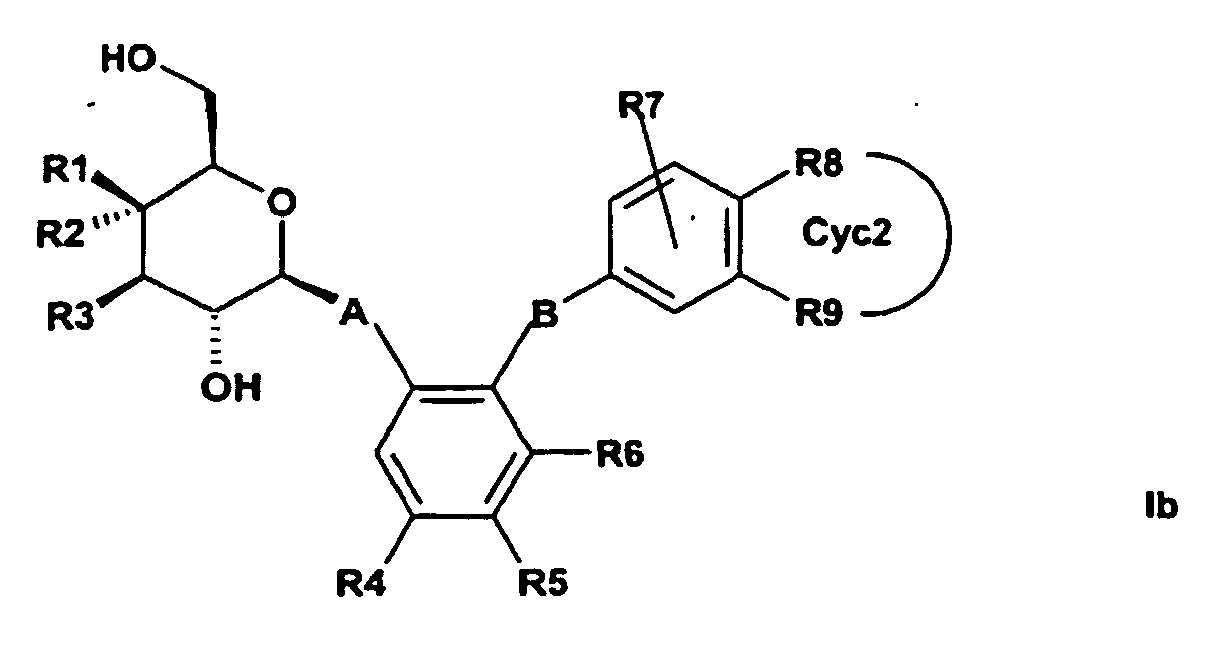 R1 F und R2 H oderR1 H und R2 F oderR1 F und R2 F;R3 OH;A O;R4 Wasserstoff, Methyl, Methoxy oder OH;R5 Wasserstoff, F oder Methoxy;R6 Wasserstoff oder OH;B -CH2-, -CO-NH-CH2-; -O- oder -CO-CH2-CH2-;Cyc1 Phenyl;R7 Wasserstoff;R8 Wasserstoff, OH, Ethyl, Cl, OCF3 oder Methoxy;R9 Wasserstoff; oderR8 und R9 gemeinsam -CH=CH-O- oder -CH2-CH2-O- bedeuten.
 - Arzneimittel enthaltend eine oder mehrere der Verbindungen gemäß einem oder mehreren der Ansprüche 1 bis 7.
- Arzneimittel enthaltend eine oder mehrere der Verbindungen gemäß einem oder mehreren der Ansprüche 1 bis 7 und einen oder mehrere Blutzucker senkende Wirkstoffe.
- Verwendung der Verbindungen gemäß einem oder mehreren der Ansprüche 1 bis 7 zur Herstellung eines Medikamentes zur Behandlung des Typ 1 und Typ 2 Diabetes.
- Verwendung der Verbindungen gemäß einem oder mehreren der Ansprüche 1 bis 7 zur Herstellung eines Medikamentes zur Blutzuckersenkung.
- Verwendung der Verbindungen gemäß einem oder mehreren der Ansprüche 1 bis 7 in Kombination mit mindestens einem weiteren Blutzucker senkenden Wirkstoff zur Herstellung eines Medikamentes zur Behandlung des Typ 1 und Typ 2 Diabetes.
- Verwendung der Verbindungen gemäß einem oder mehreren der Ansprüche 1 bis 7 in Kombination mit mindestens einem weiteren Blutzucker senkenden Wirkstoff zur Herstellung eines Medikamentes zur Blutzuckersenkung.
- Verfahren zur Herstellung eines Arzneimittels enthaltend eine oder mehrere der Verbindungen gemäß einem oder mehreren der Ansprüche 1 bis 7, dadurch gekennzeichnet, dass der Wirkstoff mit einem pharmazeutisch geeigneten Träger vermischt wird und diese Mischung in eine für die Verabreichung geeignete Form gebracht wird.
Priority Applications (1)
| Application Number | Priority Date | Filing Date | Title |
|---|---|---|---|
| SI200330239T SI1572707T1 (sl) | 2002-12-12 | 2003-11-28 | Novi aromatski fluorglikozidni derivati, farmacevtski proizvodi, ki vsebujejo te spojine, in njihova uporaba |
Applications Claiming Priority (3)
| Application Number | Priority Date | Filing Date | Title |
|---|---|---|---|
| DE10258007A DE10258007B4 (de) | 2002-12-12 | 2002-12-12 | Aromatische Fluorglycosidderivate, diese Verbindungen enthaltende Arzneimittel und Verfahren zur Herstellung dieser Arzneimittel |
| DE10258007 | 2002-12-12 | ||
| PCT/EP2003/013454 WO2004052902A1 (de) | 2002-12-12 | 2003-11-28 | Neue aromatische fluorglycosidderivate, diese verbindungen enthaltende arzneimittel und deren verwendung |
Publications (2)
| Publication Number | Publication Date |
|---|---|
| EP1572707A1 EP1572707A1 (de) | 2005-09-14 |
| EP1572707B1 true EP1572707B1 (de) | 2006-03-29 |
Family
ID=32477574
Family Applications (1)
| Application Number | Title | Priority Date | Filing Date |
|---|---|---|---|
| EP03795853A Expired - Lifetime EP1572707B1 (de) | 2002-12-12 | 2003-11-28 | Neue aromatische fluorglycosidderivate, diese verbindungen enthaltende arzneimittel und deren verwendung |
Country Status (35)
| Country | Link |
|---|---|
| US (2) | US7288528B2 (de) |
| EP (1) | EP1572707B1 (de) |
| JP (1) | JP4806192B2 (de) |
| KR (1) | KR101059705B1 (de) |
| CN (1) | CN100368420C (de) |
| AR (1) | AR042438A1 (de) |
| AT (1) | ATE321769T1 (de) |
| AU (1) | AU2003298149B2 (de) |
| BR (1) | BR0316605A (de) |
| CA (1) | CA2508024C (de) |
| CY (1) | CY1105617T1 (de) |
| DE (2) | DE10258007B4 (de) |
| DK (1) | DK1572707T3 (de) |
| ES (1) | ES2259777T3 (de) |
| GT (1) | GT200300269A (de) |
| HN (1) | HN2003000407A (de) |
| HR (1) | HRP20050531B1 (de) |
| IL (1) | IL168924A (de) |
| JO (1) | JO2354B1 (de) |
| MA (1) | MA27559A1 (de) |
| MX (1) | MXPA05005825A (de) |
| MY (1) | MY139303A (de) |
| NO (1) | NO330376B1 (de) |
| PA (1) | PA8592201A1 (de) |
| PE (1) | PE20040909A1 (de) |
| PL (1) | PL210848B1 (de) |
| PT (1) | PT1572707E (de) |
| RS (1) | RS50775B (de) |
| RU (1) | RU2340622C2 (de) |
| SI (1) | SI1572707T1 (de) |
| SV (1) | SV2004001691A (de) |
| TW (1) | TWI320043B (de) |
| UY (1) | UY28123A1 (de) |
| WO (1) | WO2004052902A1 (de) |
| ZA (1) | ZA200503364B (de) |
Families Citing this family (118)
| Publication number | Priority date | Publication date | Assignee | Title |
|---|---|---|---|---|
| CN1020944C (zh) | 1990-01-30 | 1993-05-26 | 阿图尔-费希尔股份公司费希尔厂 | 紧固件 |
| DE10258008B4 (de) * | 2002-12-12 | 2006-02-02 | Sanofi-Aventis Deutschland Gmbh | Heterocyclische Fluorglycosidderivate, diese Verbindungen enthaltende Arzneimittel und Verfahren zur Herstellung dieser Arzneimittel |
| DE10308353A1 (de) | 2003-02-27 | 2004-12-02 | Aventis Pharma Deutschland Gmbh | Diarylcycloalkylderivate, Verfahren zu ihrer Herstellung und ihre Verwendung als Arzneimittel |
| US8785403B2 (en) | 2003-08-01 | 2014-07-22 | Mitsubishi Tanabe Pharma Corporation | Glucopyranoside compound |
| MXPA06001274A (es) | 2003-08-01 | 2006-04-11 | Tanabe Seiyaku Co | Compuestos novedosos que poseen actividad inhibitoria contra transporador dependiente de sodio. |
| EP2360165A3 (de) | 2004-03-16 | 2012-01-04 | Boehringer Ingelheim International GmbH | Glucopyranosyl-substituierte Benzol-Derivate, diese Verbindungen enthaltende Arzneimittel, deren Verwendung und Verfahren zu ihrer Herstellung |
| US7393836B2 (en) | 2004-07-06 | 2008-07-01 | Boehringer Ingelheim International Gmbh | D-xylopyranosyl-substituted phenyl derivatives, medicaments containing such compounds, their use and process for their manufacture |
| TW200606129A (en) | 2004-07-26 | 2006-02-16 | Chugai Pharmaceutical Co Ltd | Novel cyclohexane derivative, its prodrug, its salt and diabetic therapeutic agent containing the same |
| EP1773800A1 (de) * | 2004-07-27 | 2007-04-18 | Boehringer Ingelheim International GmbH | D-glucopyranosyl-phenyl-substituierte cyclen, diese verbindungen enthaltende arzneimittel, deren verwendung und verfahren zu ihrer herstellung |
| DE102004048388A1 (de) | 2004-10-01 | 2006-04-06 | Boehringer Ingelheim Pharma Gmbh & Co. Kg | D-Pyranosyl-substituierte Phenyle, diese Verbindungen enthaltende Arzneimittel, deren Verwendung und Verfahren zu ihrer Herstellung |
| DE102004058449A1 (de) * | 2004-12-03 | 2006-06-14 | Merck Patent Gmbh | Tetrahydropyranderivate |
| WO2006064033A2 (en) | 2004-12-16 | 2006-06-22 | Boehringer Ingelheim International Gmbh | Glucopyranosyl-substituted benzene derivatives, medicaments containing such compounds, their use and process for their manufacture |
| TW200637869A (en) | 2005-01-28 | 2006-11-01 | Chugai Pharmaceutical Co Ltd | The spiroketal derivatives and the use as therapeutical agent for diabetes of the same |
| MY147375A (en) | 2005-01-31 | 2012-11-30 | Mitsubishi Tanabe Pharma Corp | Indole derivatives |
| AR053329A1 (es) * | 2005-01-31 | 2007-05-02 | Tanabe Seiyaku Co | Derivados de indol utiles como inhibidores de los transportadores de glucosa dependientes del sodio (sglt) |
| JP5073948B2 (ja) * | 2005-01-31 | 2012-11-14 | 田辺三菱製薬株式会社 | 医薬組成物 |
| WO2006089872A1 (en) | 2005-02-23 | 2006-08-31 | Boehringer Ingelheim International Gmbh | Glucopyranosyl-substituted ( (hetero)arylethynyl-benzyd-benzene derivatives and use thereof as sodium-dependent glucose cotransporter 2 (sglt2) inhibitors |
| ATE453656T1 (de) | 2005-04-15 | 2010-01-15 | Boehringer Ingelheim Int | Glucopyranosyl-substituierte (heteroaryloxy- benzyl)-benzen-derivate als sglt-inhibitoren |
| UA91546C2 (uk) | 2005-05-03 | 2010-08-10 | Бьорінгер Інгельхайм Інтернаціональ Гмбх | КРИСТАЛІЧНА ФОРМА 1-ХЛОР-4-(β-D-ГЛЮКОПІРАНОЗ-1-ИЛ)-2-[4-((S)-ТЕТРАГІДРОФУРАН-3-ІЛОКСИ)-БЕНЗИЛ]-БЕНЗОЛУ, СПОСІБ ЇЇ ОДЕРЖАННЯ ТА ЇЇ ЗАСТОСУВАННЯ ПРИ ПРИГОТУВАННІ ЛІКАРСЬКИХ ЗАСОБІВ |
| US7723309B2 (en) | 2005-05-03 | 2010-05-25 | Boehringer Ingelheim International Gmbh | Crystalline forms of 1-chloro-4-(β-D-glucopyranos-1-yl)-2-[4-((R)-tetrahydrofuran-3-yloxy)-benzyl]-benzene, a method for its preparation and the use thereof for preparing medicaments |
| US7772191B2 (en) | 2005-05-10 | 2010-08-10 | Boehringer Ingelheim International Gmbh | Processes for preparing of glucopyranosyl-substituted benzyl-benzene derivatives and intermediates therein |
| DE102005026762A1 (de) | 2005-06-09 | 2006-12-21 | Sanofi-Aventis Deutschland Gmbh | Azolopyridin-2-on-derivate als Inhibitoren von Lipasen und Phospholipasen |
| ES2346347T3 (es) | 2005-07-27 | 2010-10-14 | Boehringer Ingelheim International Gmbh | Derivados de ((hetero)cicloalquiletinil-bencil)-benceno y su uso como inhibidores del cotransportador de glucosa dependiente de sodio (sglt). |
| ATE484499T1 (de) | 2005-08-30 | 2010-10-15 | Boehringer Ingelheim Int | Glucopyranosyl-substituierte benzyl-derivate, medikamente mit solchen verbindungen, ihre verwendung und herstellungsverfahren dafür |
| CN101238112A (zh) | 2005-09-08 | 2008-08-06 | 贝林格尔·英格海姆国际有限公司 | 1-氯-4-(β-D-吡喃葡萄糖-1-基)-2-(4-乙炔基-苄基)-苯的晶形、其制备方法及其用于制备药物中的用途 |
| AR056195A1 (es) | 2005-09-15 | 2007-09-26 | Boehringer Ingelheim Int | Procedimientos para preparar derivados de (etinil-bencil)-benceno sustituidos de glucopiranosilo y compuestos intermedios de los mismos |
| AU2007216452A1 (en) | 2006-02-15 | 2007-08-23 | Boehringer Ingelheim International Gmbh | Glucopyranosyl-substituted benzonitrile derivatives, pharmaceutical compositions containing such compounds, their use and process for their manufacture |
| PE20080697A1 (es) | 2006-05-03 | 2008-08-05 | Boehringer Ingelheim Int | Derivados de benzonitrilo sustituidos con glucopiranosilo, composiciones farmaceuticas que contienen compuestos de este tipo, su uso y procedimiento para su fabricacion |
| PE20080251A1 (es) | 2006-05-04 | 2008-04-25 | Boehringer Ingelheim Int | Usos de inhibidores de dpp iv |
| US7803778B2 (en) * | 2006-05-23 | 2010-09-28 | Theracos, Inc. | Glucose transport inhibitors and methods of use |
| DE102006028862A1 (de) | 2006-06-23 | 2007-12-27 | Merck Patent Gmbh | 3-Amino-imidazo[1,2-a]pyridinderivate |
| TWI418556B (zh) | 2006-07-27 | 2013-12-11 | Mitsubishi Tanabe Pharma Corp | 吲哚衍生物 |
| US20080027014A1 (en) * | 2006-07-28 | 2008-01-31 | Tanabe Seiyaku Co., Ltd. | Novel SGLT inhibitors |
| TW200817424A (en) * | 2006-08-04 | 2008-04-16 | Daiichi Sankyo Co Ltd | Benzylphenyl glucopyranoside derivatives |
| BRPI0715160A2 (pt) | 2006-08-08 | 2013-06-11 | Sanofi Aventis | imidazolidina-2,4-dionas substituÍdas por arilamimoaril-alquil-, processo para preparÁ-las, medicamentos compeendendo estes compostos, e seu uso |
| CA2656847A1 (en) | 2006-08-15 | 2008-02-21 | Boehringer Ingelheim International Gmbh | Glucopyranosyl-substituted cyclopropylbenzene derivatives, pharmaceutical compositions containing such compounds, their use as sglt inhibitors and process for their manufacture |
| TWI499414B (zh) | 2006-09-29 | 2015-09-11 | Lexicon Pharmaceuticals Inc | 鈉與葡萄糖第2型共同運輸體(co-transporter 2)的抑制物與其應用方法 |
| EP2086991A1 (de) | 2006-10-27 | 2009-08-12 | Boehringer Ingelheim International GmbH | Kristalline form von 4-(?-d-glucopyranos-1-yl)-1-methyl-2-[4-((s)-tetrahydrofuran-3-yloxy)benzyl]benzol, verfahren zu deren herstellung und deren verwendung zur herstellung von medikamenten |
| JP5298025B2 (ja) * | 2006-12-04 | 2013-09-25 | ジヤンセン・フアーマシユーチカ・ナームローゼ・フエンノートシヤツプ | 抗糖尿病薬としてのチエニル含有グリコピラノシル誘導体 |
| UY30730A1 (es) | 2006-12-04 | 2008-07-03 | Mitsubishi Tanabe Pharma Corp | Forma cristalina del hemihidrato de 1-(b (beta)-d-glucopiranosil) -4-metil-3-[5-(4-fluorofenil) -2-tienilmetil]benceno |
| US7795228B2 (en) * | 2006-12-28 | 2010-09-14 | Theracos, Inc. | Spiroheterocyclic glycosides and methods of use |
| DE102007008420A1 (de) | 2007-02-21 | 2008-08-28 | Merck Patent Gmbh | Benzimidazolderivate |
| US7846945B2 (en) * | 2007-03-08 | 2010-12-07 | Lexicon Pharmaceuticals, Inc. | Piperdine-based inhibitors of sodium glucose co-transporter 2 and methods of their use |
| CN104803957A (zh) * | 2007-04-02 | 2015-07-29 | 泰拉科斯有限公司 | 苄基化糖苷衍生物及其用法 |
| EP2025674A1 (de) | 2007-08-15 | 2009-02-18 | sanofi-aventis | Substituierte Tetrahydronaphthaline, Verfahren zu ihrer Herstellung und ihre Verwendung als Arzneimittel |
| PE20090938A1 (es) | 2007-08-16 | 2009-08-08 | Boehringer Ingelheim Int | Composicion farmaceutica que comprende un derivado de benceno sustituido con glucopiranosilo |
| CN101801371B (zh) | 2007-09-10 | 2012-11-28 | 詹森药业有限公司 | 可用作sglt抑制剂的化合物的制备方法 |
| DE102007048716A1 (de) | 2007-10-11 | 2009-04-23 | Merck Patent Gmbh | Imidazo[1,2-a]pyrimidinderivate |
| JP5272395B2 (ja) * | 2007-12-12 | 2013-08-28 | セントラル硝子株式会社 | 4−デオキシ−4−フルオロ−d−グルコース誘導体の製造方法 |
| UA101004C2 (en) | 2007-12-13 | 2013-02-25 | Теракос, Инк. | Derivatives of benzylphenylcyclohexane and use thereof |
| CL2008003653A1 (es) | 2008-01-17 | 2010-03-05 | Mitsubishi Tanabe Pharma Corp | Uso de un inhibidor de sglt derivado de glucopiranosilo y un inhibidor de dppiv seleccionado para tratar la diabetes; y composicion farmaceutica. |
| CL2009000309A1 (es) * | 2008-02-13 | 2009-06-26 | Sanofi Aventis | Derivados fluoroglicosidos aromaticos, composicion farmaceutica que contenga estos compuestos, procedimiento para prepararla y su uso en el tratamiento de la diabetes tipo 1 y 2. |
| DE102008017590A1 (de) | 2008-04-07 | 2009-10-08 | Merck Patent Gmbh | Glucopyranosidderivate |
| WO2010003624A2 (en) | 2008-07-09 | 2010-01-14 | Sanofi-Aventis | Heterocyclic compounds, processes for their preparation, medicaments comprising these compounds, and the use thereof |
| PT2324002T (pt) * | 2008-08-22 | 2016-11-09 | Theracos Sub Llc | Processos para a preparação de inibidores de sglt2 |
| MX2011002166A (es) * | 2008-08-28 | 2011-04-07 | Pfizer | Derivados de dioxa-biciclo[3.2.1]octano-2,3,1-triol. |
| CN102159561A (zh) * | 2008-09-19 | 2011-08-17 | 诺瓦提斯公司 | 糖苷衍生物及其用途 |
| US9056850B2 (en) | 2008-10-17 | 2015-06-16 | Janssen Pharmaceutica N.V. | Process for the preparation of compounds useful as inhibitors of SGLT |
| WO2010066643A1 (de) * | 2008-12-08 | 2010-06-17 | Sanofi-Aventis | Verfahren zur herstellung von 4-fluoro-4-desoxy-alpha-d-glucopyranoside |
| WO2010077623A1 (en) | 2008-12-08 | 2010-07-08 | Sanofi-Aventis | Intermediates and processes for the preparation of fluoroglycoside derivatives |
| WO2010068601A1 (en) | 2008-12-08 | 2010-06-17 | Sanofi-Aventis | A crystalline heteroaromatic fluoroglycoside hydrate, processes for making, methods of use and pharmaceutical compositions thereof |
| MY161472A (en) | 2009-02-13 | 2017-04-14 | Boehringer Ingelheim Int | Sglt-2 inhibitor for treating type 1 diabetes mellitus, type 2 diabetes mellitus, impaired glucose tolerance or hyperglycemia |
| PL2395983T3 (pl) | 2009-02-13 | 2020-09-07 | Boehringer Ingelheim International Gmbh | Kompozycja farmaceutyczna zawierająca inhibitor sglt2, inhibitor dpp-iv i ewentualnie dalszy środek przeciwcukrzycowy oraz jej zastosowania |
| US20110009347A1 (en) | 2009-07-08 | 2011-01-13 | Yin Liang | Combination therapy for the treatment of diabetes |
| KR101532412B1 (ko) | 2009-07-10 | 2015-06-29 | 얀센 파마슈티카 엔.브이. | 1-(β-D-글루코피라노실)-4-메틸-3-(5-(4-플루오로페닐)-2-티에닐메틸) 벤젠의 결정화 방법 |
| DK2470552T3 (en) | 2009-08-26 | 2014-02-17 | Sanofi Sa | NOVEL, CRYSTALLINE, heteroaromatic FLUORGLYCOSIDHYDRATER, MEDICINES COVERING THESE COMPOUNDS AND THEIR USE |
| HUE029381T2 (en) | 2009-09-30 | 2017-02-28 | Boehringer Ingelheim Int | Method for the preparation of a crystalline form of 1-chloro-4-(beta-d-glucopyranos-1-yl)-2-(4-((s)-tetrahydrofuran-3-yloxy)benzyl)benzene |
| BR112012007085B8 (pt) | 2009-09-30 | 2021-05-25 | Boehringer Ingelheim Int | processos para a preparação de derivados de benzil-benzeno substituídos com glicopiranosila |
| US10610489B2 (en) | 2009-10-02 | 2020-04-07 | Boehringer Ingelheim International Gmbh | Pharmaceutical composition, pharmaceutical dosage form, process for their preparation, methods for treating and uses thereof |
| MX2012003400A (es) * | 2009-10-02 | 2012-04-10 | Sanofi Sa | Uso de compuestos con actividad inhibidora de sglt - 1/sglt - 2 para producir medicamentos para el tratamiento de enfermedades oseas. |
| SG10201500258WA (en) | 2009-10-14 | 2015-03-30 | Janssen Pharmaceutica Nv | Process for the preparation of compounds useful as inhibitors of sglt2 |
| US8163704B2 (en) | 2009-10-20 | 2012-04-24 | Novartis Ag | Glycoside derivatives and uses thereof |
| NZ599945A (en) | 2009-11-02 | 2014-05-30 | Pfizer | Dioxa-bicyclo[3.2.1]octane-2,3,4-triol derivatives |
| MX2012005425A (es) | 2009-11-13 | 2012-06-14 | Astrazeneca Uk Ltd | Formulaciones de metformina de masa reducida. |
| ES2689107T3 (es) | 2009-11-13 | 2018-11-08 | Astrazeneca Ab | Formulaciones de tabletas bicapa |
| CN104825417A (zh) | 2009-11-13 | 2015-08-12 | 阿斯利康(瑞典)有限公司 | 立即释放片剂 |
| WO2011107494A1 (de) | 2010-03-03 | 2011-09-09 | Sanofi | Neue aromatische glykosidderivate, diese verbindungen enthaltende arzneimittel und deren verwendung |
| LT2568988T (lt) | 2010-05-11 | 2016-09-12 | Janssen Pharmaceutica, N.V. | Farmacinės kompozicijos, apimančios 1-(beta-d-gliukopiranozil)-2-tienilmetilbenzeno darinius kaip sglt inhibitorius |
| WO2011153712A1 (en) | 2010-06-12 | 2011-12-15 | Theracos, Inc. | Crystalline form of benzylbenzene sglt2 inhibitor |
| US8933024B2 (en) | 2010-06-18 | 2015-01-13 | Sanofi | Azolopyridin-3-one derivatives as inhibitors of lipases and phospholipases |
| US8530413B2 (en) | 2010-06-21 | 2013-09-10 | Sanofi | Heterocyclically substituted methoxyphenyl derivatives with an oxo group, processes for preparation thereof and use thereof as medicaments |
| TW201215387A (en) | 2010-07-05 | 2012-04-16 | Sanofi Aventis | Spirocyclically substituted 1,3-propane dioxide derivatives, processes for preparation thereof and use thereof as a medicament |
| TW201215388A (en) | 2010-07-05 | 2012-04-16 | Sanofi Sa | (2-aryloxyacetylamino)phenylpropionic acid derivatives, processes for preparation thereof and use thereof as medicaments |
| TW201221505A (en) | 2010-07-05 | 2012-06-01 | Sanofi Sa | Aryloxyalkylene-substituted hydroxyphenylhexynoic acids, process for preparation thereof and use thereof as a medicament |
| EP2600864B1 (de) * | 2010-08-04 | 2019-01-09 | University Of Virginia Patent Foundation | Zusammensetzungen und verfahren zur behandlung von entzündungskrankheiten |
| AU2011295837B2 (en) | 2010-09-03 | 2015-06-18 | Astrazeneca Uk Limited | Drug formulations using water soluble antioxidants |
| BR112013017382B1 (pt) * | 2011-01-05 | 2021-03-16 | National Taiwan University | método de preparação de um composto de fórmula (5) |
| EP2670397B1 (de) | 2011-02-01 | 2020-05-13 | Bristol-Myers Squibb Company | Pharmazeutische formulierungen mit einer aminverbindung |
| UY33937A (es) | 2011-03-07 | 2012-09-28 | Boehringer Ingelheim Int | Composiciones farmacéuticas que contienen inhibidores de dpp-4 y/o sglt-2 y metformina |
| US8809325B2 (en) | 2011-03-08 | 2014-08-19 | Sanofi | Benzyl-oxathiazine derivatives substituted with adamantane and noradamantane, medicaments containing said compounds and use thereof |
| WO2012120050A1 (de) | 2011-03-08 | 2012-09-13 | Sanofi | Neue substituierte phenyl-oxathiazinderivate, verfahren zu deren herstellung, diese verbindungen enthaltende arzneimittel und deren verwendung |
| EP2683703B1 (de) | 2011-03-08 | 2015-05-27 | Sanofi | Neue substituierte phenyl-oxathiazinderivate, verfahren zu deren herstellung, diese verbindungen enthaltende arzneimittel und deren verwendung |
| WO2012120056A1 (de) | 2011-03-08 | 2012-09-13 | Sanofi | Tetrasubstituierte oxathiazinderivate, verfahren zu deren herstellung, ihre verwendung als medikament sowie sie enthaltendes arzneimittel und deren verwendung |
| WO2012120054A1 (de) | 2011-03-08 | 2012-09-13 | Sanofi | Di- und trisubstituierte oxathiazinderivate, verfahren zu deren herstellung, ihre verwendung als medikament sowie sie enthaltendes arzneimittel und deren verwendung |
| EP2766349B1 (de) | 2011-03-08 | 2016-06-01 | Sanofi | Mit carbozyklen oder heterozyklen substituierte oxathiazinderivate, verfahren zu deren herstellung, diese verbindungen enthaltende arzneimittel und deren verwendung |
| US8710050B2 (en) | 2011-03-08 | 2014-04-29 | Sanofi | Di and tri- substituted oxathiazine derivatives, method for the production, method for the production thereof, use thereof as medicine and drug containing said derivatives and use thereof |
| WO2012120058A1 (de) | 2011-03-08 | 2012-09-13 | Sanofi | Mit benzyl- oder heteromethylengruppen substituierte oxathiazinderivate, verfahren zu deren herstellung, ihre verwendung als medikament sowie sie enthaltendes arzneimittel und deren verwendung |
| EP2683704B1 (de) | 2011-03-08 | 2014-12-17 | Sanofi | Verzweigte oxathiazinderivate, verfahren zu deren herstellung, ihre verwendung als medikament sowie sie enthaltendes arzneimittel und deren verwendung |
| AU2012241897C1 (en) | 2011-04-13 | 2017-05-11 | Janssen Pharmaceutica Nv | Process for the preparation of compounds useful as inhibitors of SGLT2 |
| TWI542596B (zh) | 2011-05-09 | 2016-07-21 | 健生藥品公司 | (2s,3r,4r,5s,6r)-2-(3-((5-(4-氟苯基)噻吩-2-基)甲基)-4-甲基苯基)-6-(羥甲基)四氫-2h-哌喃-3,4,5-三醇之l-脯胺酸及檸檬酸共晶體 |
| WO2013037390A1 (en) | 2011-09-12 | 2013-03-21 | Sanofi | 6-(4-hydroxy-phenyl)-3-styryl-1h-pyrazolo[3,4-b]pyridine-4-carboxylic acid amide derivatives as kinase inhibitors |
| WO2013045413A1 (en) | 2011-09-27 | 2013-04-04 | Sanofi | 6-(4-hydroxy-phenyl)-3-alkyl-1h-pyrazolo[3,4-b]pyridine-4-carboxylic acid amide derivatives as kinase inhibitors |
| US9555001B2 (en) | 2012-03-07 | 2017-01-31 | Boehringer Ingelheim International Gmbh | Pharmaceutical composition and uses thereof |
| US9192617B2 (en) | 2012-03-20 | 2015-11-24 | Boehringer Ingelheim International Gmbh | Pharmaceutical composition, methods for treating and uses thereof |
| WO2013152476A1 (en) | 2012-04-10 | 2013-10-17 | Theracos, Inc. | Process for the preparation of benzylbenzene sglt2 inhibitors |
| RU2015133968A (ru) | 2013-01-14 | 2017-02-16 | Басф Се | Способ разрыва подземных пластов |
| CA2812519A1 (en) | 2013-04-05 | 2014-10-05 | Boehringer Ingelheim International Gmbh | Pharmaceutical composition, methods for treating and uses thereof |
| US20140303097A1 (en) | 2013-04-05 | 2014-10-09 | Boehringer Ingelheim International Gmbh | Pharmaceutical composition, methods for treating and uses thereof |
| HRP20190101T1 (hr) | 2013-04-05 | 2019-03-08 | Boehringer Ingelheim International Gmbh | Terapeutske uporabe empagliflozina |
| US11813275B2 (en) | 2013-04-05 | 2023-11-14 | Boehringer Ingelheim International Gmbh | Pharmaceutical composition, methods for treating and uses thereof |
| KR102309654B1 (ko) | 2013-04-18 | 2021-10-08 | 베링거 인겔하임 인터내셔날 게엠베하 | 약제학적 조성물, 치료 방법 및 이의 용도 |
| CN105611920B (zh) | 2013-10-12 | 2021-07-16 | 泰拉科斯萨普有限责任公司 | 羟基-二苯甲烷衍生物的制备 |
| CN104610208B (zh) * | 2013-11-05 | 2017-08-15 | 天津药物研究院有限公司 | (1s)‑1,6‑二脱氧‑1‑[4‑甲氧基‑3‑(反式‑4‑正丙基环己基)甲基苯基]‑d‑吡喃葡萄糖的晶型a及其制备方法和应用 |
| US20170071970A1 (en) | 2015-09-15 | 2017-03-16 | Janssen Pharmaceutica Nv | Co-therapy comprising canagliflozin and phentermine for the treatment of obesity and obesity related disorders |
| CA3039745A1 (en) | 2016-11-10 | 2018-05-17 | Boehringer Ingelheim International Gmbh | Pharmaceutical composition, methods for treating and uses thereof |
| EP3330341A1 (de) | 2016-12-01 | 2018-06-06 | Basf Se | Verfahren zur unterirdischen formationsbrechung |
| WO2019215633A1 (en) | 2018-05-09 | 2019-11-14 | Janssen Pharmaceutica Nv | 5,5-difluoro- and 5-fluoro-5-methyl-c-glycoside derivatives useful as dual sglt1 / sglt2 modulators |
| AU2019318209B2 (en) | 2018-08-10 | 2025-09-25 | Diapin Therapeutics, Llc | Tri-peptides and treatment of metabolic, cardiovascular and inflammatory disorders |
Family Cites Families (46)
| Publication number | Priority date | Publication date | Assignee | Title |
|---|---|---|---|---|
| FR2663336B1 (fr) * | 1990-06-18 | 1992-09-04 | Adir | Nouveaux derives peptidiques, leur procede de preparation et les compositions pharmaceutiques qui les contiennent. |
| CA2102591C (en) * | 1992-11-12 | 2000-12-26 | Kenji Tsujihara | Hypoglycemic agent |
| US6068834A (en) | 1994-03-04 | 2000-05-30 | The Procter & Gamble Company | Skin lightening compositions |
| US5830873A (en) * | 1994-05-11 | 1998-11-03 | Tanabe Seiyaku Co., Ltd. | Propiophenone derivative and a process for preparing the same |
| CZ220498A3 (cs) | 1996-01-17 | 1998-11-11 | Novo Nordisk A/S | Deriváty 1,2,4-thiadiazinu a 1,4-thiazinu, příprava a použití |
| CA2258744A1 (en) | 1996-06-27 | 1997-12-31 | G.D. Searle And Co. | Particles comprising amphiphilic copolymers, having a cross-linked shell domain and an interior core domain, useful for pharmaceutical and other applications |
| JP3149958B2 (ja) | 1996-08-30 | 2001-03-26 | ノボ ノルディスク アクティーゼルスカブ | Glp―1誘導体 |
| JP3055135B2 (ja) * | 1996-12-26 | 2000-06-26 | 田辺製薬株式会社 | プロピオフェノン誘導体及びその製法 |
| TW406086B (en) * | 1996-12-26 | 2000-09-21 | Tanabe Seiyaku Co | Propiophenone derivatives and process for preparing the same |
| DE69723869T2 (de) | 1996-12-31 | 2004-04-22 | Dr. Reddy's Laboratories Ltd. | Heterozyklische verbindungen, verfahren zu ihrer herstellung, pharmazeutische zusammensetzungen die diese enthalten und ihre anwendung in der behandlung von diabetis und verwandten krankheiten |
| WO1998031392A1 (en) * | 1997-01-17 | 1998-07-23 | Drug Delivery System Institute, Ltd. | Nephrotropic drugs |
| DE19726167B4 (de) * | 1997-06-20 | 2008-01-24 | Sanofi-Aventis Deutschland Gmbh | Insulin, Verfahren zu seiner Herstellung und es enthaltende pharmazeutische Zubereitung |
| EP1000066A1 (de) | 1997-07-16 | 2000-05-17 | Novo Nordisk A/S | Kondensierte 1,2,4-thiadiazinderivate, ihre herstellung und verwendung |
| US6545117B1 (en) * | 1997-08-07 | 2003-04-08 | Akzo Noble N.V. | Sprayable coating compositions comprising an oxazolidine functional compound, an isocyanate functional compound, and a compound selected from a mercapto and a sulfonic acid functional compound |
| CO4970713A1 (es) | 1997-09-19 | 2000-11-07 | Sanofi Synthelabo | Derivados de carboxamidotiazoles, su preparacion, composiciones farmaceuticas que los contienen |
| JP2000080041A (ja) * | 1998-03-09 | 2000-03-21 | Tanabe Seiyaku Co Ltd | 医薬組成物 |
| US6221897B1 (en) * | 1998-06-10 | 2001-04-24 | Aventis Pharma Deutschland Gmbh | Benzothiepine 1,1-dioxide derivatives, a process for their preparation, pharmaceuticals comprising these compounds, and their use |
| DE19845405C2 (de) * | 1998-10-02 | 2000-07-13 | Aventis Pharma Gmbh | Arylsubstituierte Propanolaminderivate und deren Verwendung |
| GB9900416D0 (en) | 1999-01-08 | 1999-02-24 | Alizyme Therapeutics Ltd | Inhibitors |
| WO2000063208A1 (en) | 1999-04-16 | 2000-10-26 | Novo Nordisk A/S | Substituted imidazoles, their preparation and use |
| PT1177176E (pt) | 1999-04-28 | 2006-08-31 | Aventis Pharma Gmbh | Derivados de acidos triarilicos como ligandos de receptores ppar. |
| IL145922A0 (en) | 1999-04-28 | 2002-07-25 | Aventis Pharma Gmbh | Di-aryl acid derivatives as ppar receptor ligands |
| CA2371271A1 (en) | 1999-04-30 | 2000-11-09 | Neurogen Corporation | 9h-pyrimido[4,5-b]indole derivatives: crf1 specific ligands |
| GB9911863D0 (en) | 1999-05-21 | 1999-07-21 | Knoll Ag | Therapeutic agents |
| CA2376919C (en) | 1999-06-18 | 2008-11-04 | Merck & Co., Inc. | Arylthiazolidinedione and aryloxazolidinedione derivatives |
| DK1204654T3 (da) | 1999-07-29 | 2003-11-17 | Lilly Co Eli | Benzofurylpiperaziner og benzofurylhomopiperaziner: Serotonin agonister |
| UA71994C2 (en) * | 1999-08-31 | 2005-01-17 | Kissei Pharmaceutical | Glucopyranosyloxypyrazole derivatives, a pharmaceutical composition containing these derivatives and intermediate compounds for the preparation thereof |
| BR0013727A (pt) * | 1999-09-01 | 2002-05-07 | Aventis Pharma Gmbh | Derivados de sulfonilcarboxamida, processo para sua preparação e seu uso como medicamento |
| US6515117B2 (en) * | 1999-10-12 | 2003-02-04 | Bristol-Myers Squibb Company | C-aryl glucoside SGLT2 inhibitors and method |
| PH12000002657B1 (en) * | 1999-10-12 | 2006-02-21 | Bristol Myers Squibb Co | C-aryl glucoside SGLT2 inhibitors |
| US7465712B2 (en) * | 2000-03-17 | 2008-12-16 | Kissei Pharmaceutical Co., Ltd. | Glucopyranosyloxy benzylbenzene derivatives, medicinal compositions containing the same and intermediates for the preparation of the derivatives |
| US6555519B2 (en) * | 2000-03-30 | 2003-04-29 | Bristol-Myers Squibb Company | O-glucosylated benzamide SGLT2 inhibitors and method |
| US6683056B2 (en) * | 2000-03-30 | 2004-01-27 | Bristol-Myers Squibb Company | O-aryl glucoside SGLT2 inhibitors and method |
| PT1277736E (pt) | 2000-04-28 | 2007-10-12 | Asahi Kasei Pharma Corp | Novos compostos bicíclicos |
| JP2004507456A (ja) | 2000-05-11 | 2004-03-11 | ブリストル−マイヤーズ スクイブ カンパニー | 成長ホルモン分泌促進薬として有用なテトラヒドロイソキノリン類縁体 |
| AU2001264977B2 (en) | 2000-05-30 | 2005-04-14 | Merck & Co., Inc. | Melanocortin receptor agonists |
| CN1705649A (zh) * | 2000-06-29 | 2005-12-07 | 艾伯特公司 | 芳基苯基杂环基硫醚衍生物及其作为抑制细胞粘附的抗炎和免疫抑制剂的用途 |
| DE60122193T2 (de) * | 2000-09-29 | 2007-07-05 | Kissei Pharmaceutical Co., Ltd., Matsumoto | Glucopyranosyloxybenzylbenzol derivate und medizinische zusammensetzungen, die diese verbindungen enthalten |
| WO2002036602A1 (en) * | 2000-11-02 | 2002-05-10 | Ajinomoto Co., Inc. | Novel pyrazole derivatives and diabetes remedies containing the same |
| AU2002223127A1 (en) * | 2000-11-30 | 2002-06-11 | Kissei Pharmaceutical Co., Ltd. Intellectual Property | Glucopyranosyloxybenzyl benzene derivatives, medicinal compositions containing the same and intermediates in the production thereof |
| US7087579B2 (en) * | 2001-02-26 | 2006-08-08 | Kissei Pharmaceutical Co., Ltd. | Glucopyranosyloxypyrazole derivatives and medicinal use thereof |
| ES2350084T3 (es) * | 2001-02-27 | 2011-01-18 | Kissei Pharmaceutical Co., Ltd. | Derivados de glucopiranosiloxipirazol y uso médico de los mismos. |
| CA2443325C (en) * | 2001-04-04 | 2011-06-14 | Ortho-Mcneil Pharmaceutical, Inc. | Combination therapy comprising glucose reabsorption inhibitors and retinoid-x receptor modulators |
| JP4590159B2 (ja) * | 2001-04-04 | 2010-12-01 | オーソ−マクニール・フアーマシユーチカル・インコーポレーテツド | グルコース再吸収阻害剤およびpparモジュレーターを含んで成る併用療法 |
| US6884812B2 (en) * | 2001-08-31 | 2005-04-26 | Aventis Pharma Deutschland Gmbh | Diarylcycloalkyl derivatives, processes for their preparation and their use as pharmaceuticals |
| JP4436129B2 (ja) * | 2001-08-31 | 2010-03-24 | サノフィ−アベンティス・ドイチュラント・ゲゼルシャフト・ミット・ベシュレンクテル・ハフツング | ジアリールシクロアルキル誘導体、その製造法及びppar−活性剤としてのその使用 |
-
2002
- 2002-12-12 DE DE10258007A patent/DE10258007B4/de not_active Expired - Fee Related
-
2003
- 2003-11-28 AT AT03795853T patent/ATE321769T1/de active
- 2003-11-28 SI SI200330239T patent/SI1572707T1/sl unknown
- 2003-11-28 DE DE50302843T patent/DE50302843D1/de not_active Expired - Lifetime
- 2003-11-28 JP JP2004557952A patent/JP4806192B2/ja not_active Expired - Fee Related
- 2003-11-28 DK DK03795853T patent/DK1572707T3/da active
- 2003-11-28 PL PL375789A patent/PL210848B1/pl unknown
- 2003-11-28 EP EP03795853A patent/EP1572707B1/de not_active Expired - Lifetime
- 2003-11-28 AU AU2003298149A patent/AU2003298149B2/en not_active Ceased
- 2003-11-28 RS YUP-2005/0394A patent/RS50775B/sr unknown
- 2003-11-28 PT PT03795853T patent/PT1572707E/pt unknown
- 2003-11-28 ES ES03795853T patent/ES2259777T3/es not_active Expired - Lifetime
- 2003-11-28 BR BR0316605-8A patent/BR0316605A/pt not_active IP Right Cessation
- 2003-11-28 HR HRP20050531AA patent/HRP20050531B1/hr not_active IP Right Cessation
- 2003-11-28 KR KR1020057010711A patent/KR101059705B1/ko not_active Expired - Fee Related
- 2003-11-28 CN CNB2003801057115A patent/CN100368420C/zh not_active Expired - Fee Related
- 2003-11-28 WO PCT/EP2003/013454 patent/WO2004052902A1/de not_active Ceased
- 2003-11-28 CA CA2508024A patent/CA2508024C/en not_active Expired - Fee Related
- 2003-11-28 MX MXPA05005825A patent/MXPA05005825A/es active IP Right Grant
- 2003-11-28 RU RU2005121905/04A patent/RU2340622C2/ru not_active IP Right Cessation
- 2003-12-03 GT GT200300269A patent/GT200300269A/es unknown
- 2003-12-09 JO JO2003164A patent/JO2354B1/en active
- 2003-12-10 TW TW092134767A patent/TWI320043B/zh not_active IP Right Cessation
- 2003-12-10 PE PE2003001250A patent/PE20040909A1/es not_active Application Discontinuation
- 2003-12-10 HN HN2003000407A patent/HN2003000407A/es unknown
- 2003-12-11 MY MYPI20034746A patent/MY139303A/en unknown
- 2003-12-11 AR ARP030104575A patent/AR042438A1/es unknown
- 2003-12-12 UY UY28123A patent/UY28123A1/es unknown
- 2003-12-12 PA PA20038592201A patent/PA8592201A1/es unknown
- 2003-12-12 US US10/735,179 patent/US7288528B2/en not_active Expired - Lifetime
- 2003-12-12 SV SV2003001691A patent/SV2004001691A/es not_active Application Discontinuation
-
2005
- 2005-04-26 ZA ZA200503364A patent/ZA200503364B/en unknown
- 2005-06-01 IL IL168924A patent/IL168924A/en not_active IP Right Cessation
- 2005-06-10 MA MA28326A patent/MA27559A1/fr unknown
- 2005-06-30 NO NO20053212A patent/NO330376B1/no not_active IP Right Cessation
-
2006
- 2006-06-07 CY CY20061100810T patent/CY1105617T1/el unknown
-
2007
- 2007-10-29 US US11/926,697 patent/US20080108580A1/en not_active Abandoned
Also Published As
Similar Documents
| Publication | Publication Date | Title |
|---|---|---|
| EP1572708B1 (de) | Neue heterocyclische fluorglykosidderivate, diese verbindungen enthaltende arzneimittel und deren verwendung | |
| DE10258007B4 (de) | Aromatische Fluorglycosidderivate, diese Verbindungen enthaltende Arzneimittel und Verfahren zur Herstellung dieser Arzneimittel | |
| DE10231370B4 (de) | Thiophenglycosidderivate, diese Verbindungen enthaltende Arzneimittel und Verfahren zur Herstellung dieser Arzneimittel | |
| EP1758914B1 (de) | Neue fluorglykosidderivate von pyrazolen, diese verbindungen enthaltende arzneimittel und deren verwendung | |
| EP1907370B1 (de) | Neues 1,4-benzothiazepin-1,1-dioxidderivat mit verbesserten eigenschaften, verfahren zu dessen herstellung, diese verbindung enthaltende arzneimittel und dessen verwendung | |
| EP1862455B1 (de) | 11-((4R,6R)-4,5,6-Trihydroxy-3-(R)-hydroxy-2-(S)-hydroxy-hexylcarbamoyl)-Undekansäure | |
| WO2007009655A1 (de) | 1,4-BENZOTHIAZEPIN-l, 1-DIOXIDDERIVAT, VERFAHREN ZU DESSEN HERSTELLUNG, DIESE VERBINDUNG ENTHALTENDE ARZNEIMITTEL UND DESSEN VERWENDUNG ALS HYPOLIPIDÄMIKUM | |
| DE102004004971B3 (de) | Cycloalkyl substituierte 7-Amino-4-chinolon-3-carbonsäure-Derivate, Verfahren zu ihrer Herstellung und ihre Verwendung als Arnzeimittel | |
| DE10246434B4 (de) | Carboxyalkoxy-substituierte Acyl-carboxyphenyl-harnstoffderivate und ihre Verwendung als Arzneimittel |
Legal Events
| Date | Code | Title | Description |
|---|---|---|---|
| PUAI | Public reference made under article 153(3) epc to a published international application that has entered the european phase |
Free format text: ORIGINAL CODE: 0009012 |
|
| GRAP | Despatch of communication of intention to grant a patent |
Free format text: ORIGINAL CODE: EPIDOSNIGR1 |
|
| 17P | Request for examination filed |
Effective date: 20050712 |
|
| AK | Designated contracting states |
Kind code of ref document: A1 Designated state(s): AT BE BG CH CY CZ DE DK EE ES FI FR GB GR HU IE IT LI LU MC NL PT RO SE SI SK TR |
|
| AX | Request for extension of the european patent |
Extension state: AL LT LV MK |
|
| RAP1 | Party data changed (applicant data changed or rights of an application transferred) |
Owner name: SANOFI-AVENTIS DEUTSCHLAND GMBH |
|
| GRAS | Grant fee paid |
Free format text: ORIGINAL CODE: EPIDOSNIGR3 |
|
| GRAA | (expected) grant |
Free format text: ORIGINAL CODE: 0009210 |
|
| AK | Designated contracting states |
Kind code of ref document: B1 Designated state(s): AT BE BG CH CY CZ DE DK EE ES FI FR GB GR HU IE IT LI LU MC NL PT RO SE SI SK TR |
|
| AX | Request for extension of the european patent |
Extension state: AL LT LV MK |
|
| PG25 | Lapsed in a contracting state [announced via postgrant information from national office to epo] |
Ref country code: IT Free format text: LAPSE BECAUSE OF FAILURE TO SUBMIT A TRANSLATION OF THE DESCRIPTION OR TO PAY THE FEE WITHIN THE PRESCRIBED TIME-LIMIT;WARNING: LAPSES OF ITALIAN PATENTS WITH EFFECTIVE DATE BEFORE 2007 MAY HAVE OCCURRED AT ANY TIME BEFORE 2007. THE CORRECT EFFECTIVE DATE MAY BE DIFFERENT FROM THE ONE RECORDED. Effective date: 20060329 |
|
| REG | Reference to a national code |
Ref country code: GB Ref legal event code: FG4D Free format text: NOT ENGLISH |
|
| REG | Reference to a national code |
Ref country code: CH Ref legal event code: EP |
|
| REG | Reference to a national code |
Ref country code: IE Ref legal event code: FG4D Free format text: LANGUAGE OF EP DOCUMENT: GERMAN |
|
| REF | Corresponds to: |
Ref document number: 50302843 Country of ref document: DE Date of ref document: 20060518 Kind code of ref document: P |
|
| REG | Reference to a national code |
Ref country code: RO Ref legal event code: EPE |
|
| REG | Reference to a national code |
Ref country code: GR Ref legal event code: EP Ref document number: 20060401553 Country of ref document: GR Ref country code: PT Ref legal event code: SC4A Effective date: 20060421 |
|
| REG | Reference to a national code |
Ref country code: SE Ref legal event code: TRGR |
|
| GBT | Gb: translation of ep patent filed (gb section 77(6)(a)/1977) |
Effective date: 20060628 |
|
| REG | Reference to a national code |
Ref country code: HU Ref legal event code: AG4A Ref document number: E000434 Country of ref document: HU |
|
| REG | Reference to a national code |
Ref country code: DK Ref legal event code: T3 |
|
| REG | Reference to a national code |
Ref country code: ES Ref legal event code: FG2A Ref document number: 2259777 Country of ref document: ES Kind code of ref document: T3 |
|
| ET | Fr: translation filed | ||
| PLBE | No opposition filed within time limit |
Free format text: ORIGINAL CODE: 0009261 |
|
| STAA | Information on the status of an ep patent application or granted ep patent |
Free format text: STATUS: NO OPPOSITION FILED WITHIN TIME LIMIT |
|
| 26N | No opposition filed |
Effective date: 20070102 |
|
| PGFP | Annual fee paid to national office [announced via postgrant information from national office to epo] |
Ref country code: MC Payment date: 20091028 Year of fee payment: 7 |
|
| PG25 | Lapsed in a contracting state [announced via postgrant information from national office to epo] |
Ref country code: MC Free format text: LAPSE BECAUSE OF NON-PAYMENT OF DUE FEES Effective date: 20101130 |
|
| PGFP | Annual fee paid to national office [announced via postgrant information from national office to epo] |
Ref country code: BG Payment date: 20130925 Year of fee payment: 11 |
|
| PGFP | Annual fee paid to national office [announced via postgrant information from national office to epo] |
Ref country code: DK Payment date: 20131112 Year of fee payment: 11 |
|
| PGFP | Annual fee paid to national office [announced via postgrant information from national office to epo] |
Ref country code: CH Payment date: 20131112 Year of fee payment: 11 Ref country code: CZ Payment date: 20131107 Year of fee payment: 11 Ref country code: IE Payment date: 20131112 Year of fee payment: 11 Ref country code: AT Payment date: 20131028 Year of fee payment: 11 Ref country code: PT Payment date: 20130528 Year of fee payment: 11 Ref country code: EE Payment date: 20131105 Year of fee payment: 11 Ref country code: SK Payment date: 20131104 Year of fee payment: 11 Ref country code: SE Payment date: 20131112 Year of fee payment: 11 |
|
| PGFP | Annual fee paid to national office [announced via postgrant information from national office to epo] |
Ref country code: SI Payment date: 20131022 Year of fee payment: 11 Ref country code: BE Payment date: 20131113 Year of fee payment: 11 Ref country code: LU Payment date: 20131202 Year of fee payment: 11 Ref country code: IT Payment date: 20131118 Year of fee payment: 11 Ref country code: NL Payment date: 20131109 Year of fee payment: 11 Ref country code: GR Payment date: 20131021 Year of fee payment: 11 Ref country code: HU Payment date: 20131119 Year of fee payment: 11 Ref country code: RO Payment date: 20131011 Year of fee payment: 11 Ref country code: TR Payment date: 20131023 Year of fee payment: 11 Ref country code: ES Payment date: 20131011 Year of fee payment: 11 Ref country code: FI Payment date: 20131112 Year of fee payment: 11 |
|
| PGFP | Annual fee paid to national office [announced via postgrant information from national office to epo] |
Ref country code: CY Payment date: 20131121 Year of fee payment: 11 |
|
| PGFP | Annual fee paid to national office [announced via postgrant information from national office to epo] |
Ref country code: FR Payment date: 20141110 Year of fee payment: 12 Ref country code: DE Payment date: 20141125 Year of fee payment: 12 Ref country code: GB Payment date: 20141126 Year of fee payment: 12 |
|
| REG | Reference to a national code |
Ref country code: PT Ref legal event code: MM4A Free format text: LAPSE DUE TO NON-PAYMENT OF FEES Effective date: 20150528 |
|
| REG | Reference to a national code |
Ref country code: NL Ref legal event code: V1 Effective date: 20150601 |
|
| REG | Reference to a national code |
Ref country code: DK Ref legal event code: EBP Effective date: 20141130 |
|
| PG25 | Lapsed in a contracting state [announced via postgrant information from national office to epo] |
Ref country code: BE Free format text: LAPSE BECAUSE OF NON-PAYMENT OF DUE FEES Effective date: 20141130 Ref country code: LU Free format text: LAPSE BECAUSE OF NON-PAYMENT OF DUE FEES Effective date: 20141128 |
|
| REG | Reference to a national code |
Ref country code: SE Ref legal event code: EUG Ref country code: CH Ref legal event code: PL |
|
| REG | Reference to a national code |
Ref country code: AT Ref legal event code: MM01 Ref document number: 321769 Country of ref document: AT Kind code of ref document: T Effective date: 20141128 Ref country code: EE Ref legal event code: MM4A Ref document number: E000358 Country of ref document: EE Effective date: 20141130 |
|
| REG | Reference to a national code |
Ref country code: LT Ref legal event code: MM9D Effective date: 20141128 |
|
| REG | Reference to a national code |
Ref country code: GR Ref legal event code: ML Ref document number: 20060401553 Country of ref document: GR Effective date: 20150604 |
|
| PG25 | Lapsed in a contracting state [announced via postgrant information from national office to epo] |
Ref country code: SE Free format text: LAPSE BECAUSE OF NON-PAYMENT OF DUE FEES Effective date: 20141129 Ref country code: EE Free format text: LAPSE BECAUSE OF NON-PAYMENT OF DUE FEES Effective date: 20141130 Ref country code: RO Free format text: LAPSE BECAUSE OF NON-PAYMENT OF DUE FEES Effective date: 20141128 Ref country code: CH Free format text: LAPSE BECAUSE OF NON-PAYMENT OF DUE FEES Effective date: 20141130 Ref country code: LI Free format text: LAPSE BECAUSE OF NON-PAYMENT OF DUE FEES Effective date: 20141130 Ref country code: CY Free format text: LAPSE BECAUSE OF NON-PAYMENT OF DUE FEES Effective date: 20141128 Ref country code: BG Free format text: LAPSE BECAUSE OF NON-PAYMENT OF DUE FEES Effective date: 20150630 Ref country code: FI Free format text: LAPSE BECAUSE OF NON-PAYMENT OF DUE FEES Effective date: 20141128 Ref country code: SK Free format text: LAPSE BECAUSE OF NON-PAYMENT OF DUE FEES Effective date: 20141128 Ref country code: PT Free format text: LAPSE BECAUSE OF NON-PAYMENT OF DUE FEES Effective date: 20150528 Ref country code: SI Free format text: LAPSE BECAUSE OF NON-PAYMENT OF DUE FEES Effective date: 20141129 Ref country code: CZ Free format text: LAPSE BECAUSE OF NON-PAYMENT OF DUE FEES Effective date: 20141128 |
|
| REG | Reference to a national code |
Ref country code: SK Ref legal event code: MM4A Ref document number: E 809 Country of ref document: SK Effective date: 20141128 |
|
| REG | Reference to a national code |
Ref country code: IE Ref legal event code: MM4A |
|
| PG25 | Lapsed in a contracting state [announced via postgrant information from national office to epo] |
Ref country code: AT Free format text: LAPSE BECAUSE OF NON-PAYMENT OF DUE FEES Effective date: 20141128 Ref country code: GR Free format text: LAPSE BECAUSE OF NON-PAYMENT OF DUE FEES Effective date: 20150604 Ref country code: NL Free format text: LAPSE BECAUSE OF NON-PAYMENT OF DUE FEES Effective date: 20150601 Ref country code: HU Free format text: LAPSE BECAUSE OF NON-PAYMENT OF DUE FEES Effective date: 20141129 |
|
| REG | Reference to a national code |
Ref country code: SI Ref legal event code: KO00 Effective date: 20150717 |
|
| PG25 | Lapsed in a contracting state [announced via postgrant information from national office to epo] |
Ref country code: IE Free format text: LAPSE BECAUSE OF NON-PAYMENT OF DUE FEES Effective date: 20141128 Ref country code: DK Free format text: LAPSE BECAUSE OF NON-PAYMENT OF DUE FEES Effective date: 20141130 |
|
| REG | Reference to a national code |
Ref country code: ES Ref legal event code: FD2A Effective date: 20151229 |
|
| PG25 | Lapsed in a contracting state [announced via postgrant information from national office to epo] |
Ref country code: IT Free format text: LAPSE BECAUSE OF NON-PAYMENT OF DUE FEES Effective date: 20141128 |
|
| PG25 | Lapsed in a contracting state [announced via postgrant information from national office to epo] |
Ref country code: ES Free format text: LAPSE BECAUSE OF NON-PAYMENT OF DUE FEES Effective date: 20141129 |
|
| REG | Reference to a national code |
Ref country code: DE Ref legal event code: R119 Ref document number: 50302843 Country of ref document: DE |
|
| GBPC | Gb: european patent ceased through non-payment of renewal fee |
Effective date: 20151128 |
|
| REG | Reference to a national code |
Ref country code: FR Ref legal event code: ST Effective date: 20160729 |
|
| PG25 | Lapsed in a contracting state [announced via postgrant information from national office to epo] |
Ref country code: DE Free format text: LAPSE BECAUSE OF NON-PAYMENT OF DUE FEES Effective date: 20160601 Ref country code: GB Free format text: LAPSE BECAUSE OF NON-PAYMENT OF DUE FEES Effective date: 20151128 |
|
| PG25 | Lapsed in a contracting state [announced via postgrant information from national office to epo] |
Ref country code: FR Free format text: LAPSE BECAUSE OF NON-PAYMENT OF DUE FEES Effective date: 20151130 |
|
| PG25 | Lapsed in a contracting state [announced via postgrant information from national office to epo] |
Ref country code: TR Free format text: LAPSE BECAUSE OF NON-PAYMENT OF DUE FEES Effective date: 20141128 |