EP1569263A2 - Verfahren zum Verbinden zweier Wafer und Waferanordnung - Google Patents
Verfahren zum Verbinden zweier Wafer und Waferanordnung Download PDFInfo
- Publication number
- EP1569263A2 EP1569263A2 EP05002608A EP05002608A EP1569263A2 EP 1569263 A2 EP1569263 A2 EP 1569263A2 EP 05002608 A EP05002608 A EP 05002608A EP 05002608 A EP05002608 A EP 05002608A EP 1569263 A2 EP1569263 A2 EP 1569263A2
- Authority
- EP
- European Patent Office
- Prior art keywords
- wafers
- wafer
- contact region
- laser
- laser beam
- Prior art date
- Legal status (The legal status is an assumption and is not a legal conclusion. Google has not performed a legal analysis and makes no representation as to the accuracy of the status listed.)
- Granted
Links
Images
Classifications
-
- H—ELECTRICITY
- H10—SEMICONDUCTOR DEVICES; ELECTRIC SOLID-STATE DEVICES NOT OTHERWISE PROVIDED FOR
- H10P—GENERIC PROCESSES OR APPARATUS FOR THE MANUFACTURE OR TREATMENT OF DEVICES COVERED BY CLASS H10
- H10P90/00—Preparation of wafers not covered by a single main group of this subclass, e.g. wafer reinforcement
- H10P90/19—Preparing inhomogeneous wafers
- H10P90/1904—Preparing vertically inhomogeneous wafers
- H10P90/1906—Preparing SOI wafers
- H10P90/1914—Preparing SOI wafers using bonding
-
- H—ELECTRICITY
- H10—SEMICONDUCTOR DEVICES; ELECTRIC SOLID-STATE DEVICES NOT OTHERWISE PROVIDED FOR
- H10H—INORGANIC LIGHT-EMITTING SEMICONDUCTOR DEVICES HAVING POTENTIAL BARRIERS
- H10H20/00—Individual inorganic light-emitting semiconductor devices having potential barriers, e.g. light-emitting diodes [LED]
- H10H20/01—Manufacture or treatment
- H10H20/011—Manufacture or treatment of bodies, e.g. forming semiconductor layers
- H10H20/018—Bonding of wafers
-
- H—ELECTRICITY
- H10—SEMICONDUCTOR DEVICES; ELECTRIC SOLID-STATE DEVICES NOT OTHERWISE PROVIDED FOR
- H10W—GENERIC PACKAGES, INTERCONNECTIONS, CONNECTORS OR OTHER CONSTRUCTIONAL DETAILS OF DEVICES COVERED BY CLASS H10
- H10W72/00—Interconnections or connectors in packages
- H10W72/071—Connecting or disconnecting
- H10W72/072—Connecting or disconnecting of bump connectors
- H10W72/07231—Techniques
- H10W72/07235—Applying EM radiation, e.g. induction heating or using a laser
-
- H—ELECTRICITY
- H10—SEMICONDUCTOR DEVICES; ELECTRIC SOLID-STATE DEVICES NOT OTHERWISE PROVIDED FOR
- H10W—GENERIC PACKAGES, INTERCONNECTIONS, CONNECTORS OR OTHER CONSTRUCTIONAL DETAILS OF DEVICES COVERED BY CLASS H10
- H10W72/00—Interconnections or connectors in packages
- H10W72/071—Connecting or disconnecting
- H10W72/073—Connecting or disconnecting of die-attach connectors
- H10W72/07331—Connecting techniques
- H10W72/07335—Applying EM radiation, e.g. induction heating or using a laser
Definitions
- the invention relates to a method for connecting two wafers. Moreover, the invention relates to a wafer arrangement.
- US Pat. No. 6,284,998 B1 discloses a method for soldering an electronic component onto a dielectric substrate.
- at least two connection points made of metal, which are each covered with soldering paste are provided on a surface of the substrate.
- the connections of the electronic component are brought into contact with the connection locations on the substrate.
- the beam of a diode laser is then directed so long through the, the connection points opposite side of the substrate on each one of the metallic connection points until the solder paste melts on the connection point.
- the wavelength of the laser beam is chosen so that the laser energy is absorbed mainly by the junction and not by the dielectric substrate. After cooling the connection point there is a solder connection between the connection point and the connection of the electronic component.
- the document DE 103 03 978 A1 describes a method for producing a semiconductor device, wherein a are each on thin-film semiconductor body and carrier solders applied. Thin-film semiconductor body and carrier become then under increased pressure, at a temperature above that Melting point of the solders involved, joined together.
- the object of the present invention is to provide a method for connecting two wafers as simply as possible. It is another object of the invention to provide a wafer arrangement.
- a method for connecting two wafers is given. For this purpose, a contact area between the two wafers formed by the two wafers are superimposed. The connection between the wafers takes place through a local and heating the contact area of the two for a limited time Wafers take place.
- Local heating in this context means that is a significant warming of the wafer in one direction parallel or perpendicular to the contact area, preferably in both directions, remains limited. After cooling, both are Wafers then at their contact area, at the place of local heating, mechanically interconnected.
- two wafers are provided.
- a material On at least one of the wafer surfaces is applied a material.
- the material on the Whole wafer surface can be applied distributed, or the Material is applied in places to selected areas of the wafer surface Applied, or the material will over the entire Wafer surface spread applied and then removed from selected areas, for example etched away.
- a contact area is established between the wafers, by overlaying the wafers that the applied material is between the wafers located. Through a local and temporary heating of the material in the contact area then creates a mechanical Connection between the wafers, mediated by the material between the wafers.
- the material may, for example, suitably chosen so be that material by local heating first melts and on cooling to form a eutectic solidified with the wafer material.
- the materials do not necessarily have to be on the whole Wafer surface can be applied, but also in places, on selected areas of the wafer surface, applied become.
- the two wafers are subsequently superimposed in such a way that the materials are between the wafers are located.
- the materials are then produced in this way Contact area between the wafers limited in time and place heated so that the two different materials connect in the area of heating. This can be, for example This is done by melting the two materials and mix the materials in the melt. Also an increased mobility of the particles due to the Heating is conceivable, so that by particle diffusion Mixing of the materials takes place.
- solders are soldered.
- solders Preferably find the following solders in the process Application: Au, AuSn, Pd, In, Pt.
- solder layer is then a mechanical connection between the wafers.
- the contact area between the wafers is locally heated by means of at least one laser beam.
- the wavelength of the laser and at least one of the wafers are adapted to each other so that at least one of Wafer for the laser beam at least partially transparent is. That means that at most a slight absorption the energy of the laser beam in the wafer takes place.
- the laser beam is then passed through at least one wafer focused on the contact area between the wafers.
- the laser beam is, in a particularly preferred embodiment, in the vast majority of the material or the Materials absorbed at the contact area between the wafers. This can be done, for example, by the materials At the contact area for the laser beam mostly not transparent and absorb the energy of the laser beam. This ensures that the contact area is heated is locally limited around the area, on the focus of the laser beam is directed.
- the performance the laser is preferably sufficiently high to choose so that after cooling a mechanical connection of the two Wafer at the contact area is done.
- the laser can thereby be operated in continuous operation.
- the method is a Laser in pulsed operation appropriate.
- pulse duration and pulse spacing can be the Removal of heat generated at the contact surface optimally be set. So it can be done with a laser Pulse operation the local limit of heating especially be easily reached. Also the desired time limit Heating is on a pulse-powered laser given the limited pulse duration.
- the laser beam is continuously guided over the entire contact area between the wafers. In this way, all areas of the contact area are heated locally and over the entire contact area of both wafers a flat, mechanical connection between the two wafers is produced.
- the local heating of the contact region can be effected in chronological order by a single laser beam or, if a plurality of laser beams are used, at several local regions of the contact region simultaneously.
- the laser is guided over selected regions of the contact region, so that a connection between the two wafers is produced only in these selected regions.
- a connection between both wafers is achieved in selected locations of the contact area, while other areas of the contact area between the wafers remain without a connection made by direct heating.
- the shape, arrangement, number and size of the connection areas and the connection-free areas can be formed depending on the requirements of the product. That is, the shape, arrangement, number and size of connection areas and connection-free areas can be adapted for example to the required temperature resistance, the preferred mechanical stability, the operation of the device, or even the desired cost of the product.
- connection of both wafers at the contact area pointwise.
- To The laser beam is only on individual, predetermined locations focused on the contact area. In these places it comes thereby to a connection between the two wafers.
- there the individual connection points can be advantageous to the Nodes of a regular network can be arranged. Number of connection points and configuration of the network can be adapted to the requirements of the product.
- At least one of the wafers is a semiconductor material.
- At least one of the wafers contains one of the wafers following semiconductor materials: silicon, germanium, gallium arsenide, InP, GaP.
- the method contains at least one of the wafers of at least one of the following metals: Mo, Cu, CuW. Also, at least one of the wafers in another Embodiment of the method contain ceramic materials.
- At least one of the wafers has a plurality of individual layers, wherein at least one of the individual layers is epitaxially applied Layer is.
- the epitaxially deposited layer preferably one of the following Semiconductor materials: GaInN, AlGaAs, AlGaInP, GaP, InP, InGaAs, InGaAsP, GaN, AlGaInN.
- At least a single layer of the wafer is an electronic one or microelectronic device.
- the electronic component is an optoelectronic component forms, for example, a light emitting diode, a semiconductor laser or a detector (e.g., photodiode).
- the invention relates to a wafer arrangement in which two superimposed wafers on selected areas of their Contact area are interconnected.
- This compound may be, for example, a material, or mediates two different materials between the wafers become.
- the wafer arrangement is based on the idea that the connection of both wafers not over the entire contact area both wafers flat, but the two Wafers only at selected points of their contact area with each other are connected. Thereby, the materials that the Communicate between the wafers, either throughout Be applied contact area, or only in those places of the contact area, which is a connection between located on the wafers.
- the two are Wafer at its contact point pointwise, at connection points, connected with each other.
- the sum of the areas the contact area at which the two wafers together are small compared to the sum of the areas of the Contact area where no connection between the two Wafern exists.
- the described Wafer assembly includes at least one of the wafers especially temperature-sensitive layer. It means that the maximum temperature to which this layer without damage can be heated is smaller than, for example the temperature at which the materials are at the contact area connect with each other. In this case, a warming would the entire wafer assembly to the temperature at which the materials combine, the temperature sensitive Damage layer.
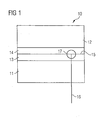
- Figure 1 illustrates a process for producing an AlGaInP Thin-film light-emitting diode 10.
- solder layers 13, 14 may be the surfaces completely cover the respective wafer 11, 12 or applied only to certain areas of the wafer surfaces become. For the described method, it is natural irrelevant which of the soldering metals on which of the two Wafer is applied.
- the laser beam 16 for example a Nd: YAG laser, becomes then at a wavelength through the carrier wafer 11 irradiated, in which the carrier wafer 11 for the laser beam 16 is permeable.
- the laser beam 16 the contact area 15 is focused between the two wafers.
- the power of the laser is selected so that the two solder layers 13, 14 melt locally around the focus of the laser, so that the two solders connect with each other and after cooling and solidification of the locally heated portion 17, a local solder joint between the two wafers 11 and 12 exists.
- the laser can be operated both in continuous operation, as well as pulsed.
- the wavelength of the laser beam to adapt to the carrier wafer is at least partially transparent to the laser beam.
- the epitaxial disc can have a Laser diode layer or a detector layer included.
- the specified method for soldering temperature-sensitive components suitable because the heating not the entire wafer arrangement, but only one locally limited area 17.
- the wafer arrangement After joining the two wafers 11, 12, the wafer arrangement to individual components - for example, individual LED chips - to be isolated. This can be, for example done by sawing or breaking the arrangement.
- the finished one Component can be electrically from the side of the carrier wafer 11 ago be contacted.
- the solders 13, 14 are preferred then electrically conductive.
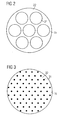
- Figure 2 shows a schematic plan view of the contact area 15 between two wafers.
- the two wafers are only on selected connection regions 21 of the contact region 15th soldered together.
- connection areas 21 find also connection-free areas 22 of the contact area 15, where no connection between the two wafers consists.
- soldering metals either only at the connection areas 21 on the wafer, or the Solders distributed over the entire contact area 15 to apply to the wafer surfaces.
- connection areas 21 and the connection-free areas 22 can thereby, depending on the requirements of the wafer arrangement adapted become.
- FIG. 3 shows a plan view of the contact region 15 of FIG Wafer arrangement described here.
- the connection points 31 are at the Nodes of a regular network arranged.
- the connection-free Area 32 takes a much larger area of the contact area 15 as the total area of the connection points 31 is.
- soldering metals either only at the connection points 31 on the wafers, or the soldering metals over the entire contact area 15 on the wafer surfaces applied.
- connection points 31 are doing the requirements of the wafer arrangement and the requirements of adjusted the manufactured component. After separating The Waferanordung can in this embodiment components resulting from the side of the carrier wafer 11 Her only pointwise electrically contacted.
- the temperature load is particularly low, this wafer arrangement
- at least one of the wafers is a temperature-sensitive component includes. Because with pointwise connection of the two wafers finds only a few places in the wafer arrangement a lower Temperature entry into the wafer instead of and the total temperature entry is very low.
- connection point 31 or per connection area 21 exactly one component results. This means, It is possible that, for example, bodies where the wafer assembly is to be isolated (for example, predetermined breaking points or sawing channels), the wafers 11, 12 not with each other get connected. Only where components are created should then find a connection of the two wafers 11, 12th instead of.
Landscapes
- Wire Bonding (AREA)
- Recrystallisation Techniques (AREA)
Abstract
Description
Nach Abkühlen der Anschlussstelle besteht eine Lötverbindung zwischen der Anschlussstelle und dem Anschluss des elektronischen Bauelements.
Ferner ist es Aufgabe der Erfindung, eine Waferanordnung anzugeben.
Für das Prinzip des Verfahrens ist es dabei unerheblich, ob ein einzelner Laserstrahl in zeitlicher Abfolge, Stelle für Stelle, oder etwa eine Vielzahl von Laserstrahlen gleichzeitig an unterschiedlichen Stellen des Kontaktbereichs zum Einsatz kommen.
Auf diese Weise werden alle Bereiche des Kontaktbereichs örtlich begrenzt erhitzt und es entsteht über den gesamten Kontaktbereich beider Wafer eine flächige, mechanische Verbindung zwischen den beiden Wafern. Die lokalen Erhitzungen des Kontaktbereichs, können dabei in zeitlicher Abfolge durch einen einzelnen Laserstrahl erfolgen oder, bei Verwendung einer Vielzahl von Laserstrahlen, an mehreren lokalen Bereichen des Kontaktbereichs gleichzeitig.
Das heißt, Form, Anordnung, Anzahl und Größe von Verbindungsbereichen und verbindungsfreien Bereichen können beispielsweise der erforderlichen Temperaturbeständigkeit, der bevorzugten mechanischen Stabilität, der Funktionsweise des Bauelements, oder auch den gewünschten Kosten des Produkts angepasst werden.
Der Laser kann dabei sowohl im Dauerbetrieb, als auch gepulst betrieben werden.
Claims (34)
- Verfahren zum Verbinden zweier Wafer (11,12),
bei dem durch Übereinanderlegen der beiden Wafer ein Kontaktbereich (15) zwischen den Wafern (11,12) gebildet wird und bei dem der Kontaktbereich (15) örtlich und zeitlich begrenzt erhitzt wird. - Verfahren nach Anspruch 1,
mit folgenden Schritten:a) Bereitstellen von zwei Wafern (11,12),b) zumindest stellenweises Aufbringen von Material (13,14) auf wenigstens eine der Waferoberflächen,c) Bilden eines Kontaktbereichs (15) zwischen den Wafern (11,12) durch Übereinanderlegen der Wafer (11,12), so dass sich das Material (13,14) zwischen den Wafern (11,12) befindet. - Verfahren nach Anspruch 2,
bei dem das Material (13,14) so beschaffen ist, dass nach Erhitzen und Abkühlen des Materials (13,14) eine mechanische Verbindung zwischen den Wafern (11,12) hergestellt ist. - Verfahren nach Anspruch 2,
bei dem nach Erhitzen und Abkühlen des Materials (13,14) eine Legierung des Materials (13,14) mit wenigstens einem der Wafer (11,12) besteht: - Verfahren nach einem der Ansprüche 1 oder 2,
bei dem Materialien (13,14) auf beide Wafer (11,12) aufgebracht werden, wobei sich das Material (13), das auf den ersten Wafer aufgebracht wird, vom Material (14), das auf den zweiten Wafer aufgebracht wird, unterscheidet. - Verfahren nach Anspruch 5,
bei dem sich die unterschiedlichen Materialien (13,14) bei Erwärmung durchmischen und nach Abkühlung eine mechanische Verbindung zwischen den Wafern (11,12) herstellen. - Verfahren nach einem der Ansprüche 2 bis 6,
bei dem es sich bei den Materialien (13,14) um Lote handelt. - Verfahren nach Anspruch 7,
bei dem die Lote aus den folgenden Materialien (13,14) ausgewählt werden: Au, AuSn, Pd, In, Pt. - Verfahren nach einem der Ansprüche 1 bis 8,
bei dem die lokale Erhitzung des Kontaktbereichs mittels wenigstens eines Laserstrahls (16) vorgenommen wird. - Verfahren nach Anspruch 9,
bei dem die Wellenlänge des Laserstrahls (16) und wenigstens einer der Wafer (11,12) so aneinander angepasst sind, dass der Wafer (11,12) für den Laser zumindest teilweise durchlässig ist. - Verfahren nach einem der Ansprüche 9 oder 10,
bei dem der Laserstrahl (16) durch wenigstens einen der Wafer (11,12) hindurch läuft und auf den Kontaktbereich (15) fokussiert wird. - Verfahren nach einem der Ansprüche 9 bis 11,
bei dem die Leistung des Lasers so gewählt wird, dass am Kontaktbereich (15) eine mechanische Verbindung zwischen den beiden Wafern entsteht. - Verfahren nach einem der Ansprüche 9 bis 12,
bei dem der Laser im Dauerbetrieb betrieben wird. - Verfahren nach einem der Ansprüche 9 bis 12,
bei dem der Laser im Pulsbetrieb betrieben wird. - Verfahren nach einem der Ansprüche 9 bis 14,
bei dem als Laser ein Nd:YAG Laser zum Einsatz kommt. - Verfahren nach einem der Ansprüche 1 bis 15,
bei dem der Laserstrahl (16) kontinuierlich über den gesamten Kontaktbereich (15) geführt wird. - Verfahren nach einem der Ansprüche 1 bis 15,
bei dem der Laserstrahl (16) über ausgewählte Bereiche des Kontaktbereichs (15) geführt wird. - Verfahren nach Anspruch 17,
bei dem der Laserstrahl (16) punktweise auf Bereiche des Kontaktbereichs (15) fokussiert wird, so dass Verbindungspunkte (31) zwischen den Wafern entstehen. - Verfahren nach Anspruch 18,
bei dem die Verbindungspunkte (31) an den Knoten eines regelmäßigen Netzwerks angeordnet werden. - Verfahren nach einem der Ansprüche 18 oder 19,
bei dem die Zahl der Laserstrahlen (16) der Zahl der Verbindungspunkte (31) entspricht. - Verfahren nach einem der Ansprüche 17 bis 20,
bei dem nur an den Bereichen des Kontaktbereichs (15) ein Material aufgebracht ist, die vom Laserstrahl (16) bestrahlt werden. - Verfahren nach einem der Ansprüche 1 bis 21,
bei dem wenigstens einer der Wafer (11,12) wenigstens ein Halbleitermaterial enthält. - Verfahren nach Anspruch 22,
bei dem wenigstens einer der Wafer (11,12) mindestens eines der folgenden Halbleitermaterialien enthält: Silizium, Germanium, Galliumarsenid, InP, GaP. - Verfahren nach einem der Ansprüche 1 bis 21,
bei dem wenigstens einer der Wafer (11,12) eine Mehrzahl von Einzelschichten umfasst. - Verfahren nach Anspruch 24,
bei dem wenigstens eine der Einzelschichten eine epitaktisch aufgebrachte Schicht ist. - Verfahren nach Anspruch 25,
bei dem die epitaktisch aufgebrachte Schicht wenigstens eines der folgenden Halbleitermaterialien enthält: GaInN, AlGaAs, AlGaInP, GaP, InP, InGaAs, InGaAsP, GaN, AlGaInN. - Verfahren nach einem der Ansprüche 23 bis 26,
bei dem wenigstens eine Einzelschicht des Wafers Teil eines optoelektronisches Bauelement ist. - Verfahren nach Anspruch 27,
bei dem das optoelektronische Bauelement eine Leuchtdiode ist. - Verfahren nach Anspruch 27,
bei dem das optoelektronische Bauelement ein Halbleiterlaser ist. - Verfahren nach Anspruch 27,
bei dem das optoelektronische Bauelement ein Detektor ist. - Waferanordnung,
mit zwei übereinanderliegenden Wafern, zwischen denen sich ein Kontaktbereich (15) befindet, wobei die Wafer an ausgewählten Verbindungsbereichen (21) ihres Kontaktbereichs (15) miteinander verbunden sind. - Waferanordnung nach Anspruch 31,
bei der die beiden Wafer an ihrem Kontaktbereich (15) an Verbindungspunkten (31) miteinander verbunden sind. - Waferanordnung nach Anspruch 32,
bei der die Verbindungspunkte (31) an den Knoten eines regelmäßigen Netzwerks angeordnet sind. - Waferanordnung nach einem der Ansprüche 30 bis 33,
bei der mindestens einer der Wafer (11,12) wenigstens eine besonders temperaturempfindliche Schicht beinhaltet.
Applications Claiming Priority (4)
| Application Number | Priority Date | Filing Date | Title |
|---|---|---|---|
| DE102004009625 | 2004-02-27 | ||
| DE102004009625 | 2004-02-27 | ||
| DE102004012013 | 2004-03-11 | ||
| DE102004012013A DE102004012013B4 (de) | 2004-02-27 | 2004-03-11 | Waferanordnung |
Publications (3)
| Publication Number | Publication Date |
|---|---|
| EP1569263A2 true EP1569263A2 (de) | 2005-08-31 |
| EP1569263A3 EP1569263A3 (de) | 2009-05-06 |
| EP1569263B1 EP1569263B1 (de) | 2011-11-23 |
Family
ID=34751394
Family Applications (1)
| Application Number | Title | Priority Date | Filing Date |
|---|---|---|---|
| EP05002608A Ceased EP1569263B1 (de) | 2004-02-27 | 2005-02-08 | Verfahren zum Verbinden zweier Wafer |
Country Status (3)
| Country | Link |
|---|---|
| US (2) | US7872210B2 (de) |
| EP (1) | EP1569263B1 (de) |
| JP (1) | JP2005244241A (de) |
Families Citing this family (2)
| Publication number | Priority date | Publication date | Assignee | Title |
|---|---|---|---|---|
| EP1569263B1 (de) * | 2004-02-27 | 2011-11-23 | OSRAM Opto Semiconductors GmbH | Verfahren zum Verbinden zweier Wafer |
| US10046408B2 (en) | 2015-05-28 | 2018-08-14 | Osram Opto Semiconductors Gmbh | Device comprising a connecting component and method for producing a connecting component |
Family Cites Families (65)
| Publication number | Priority date | Publication date | Assignee | Title |
|---|---|---|---|---|
| US3942244A (en) * | 1967-11-24 | 1976-03-09 | Semikron Gesellschaft Fur Gleichrichterbau Und Elektronik M.B.H. | Semiconductor element |
| US3939556A (en) * | 1971-11-04 | 1976-02-24 | Commissariat A L'energie Atomique | Liquid crystal cell |
| US3933556A (en) * | 1974-01-10 | 1976-01-20 | American Optical Corporation | Fiber optic image shape converter and method of making the same |
| US4772935A (en) * | 1984-12-19 | 1988-09-20 | Fairchild Semiconductor Corporation | Die bonding process |
| FR2576147B1 (fr) * | 1985-01-17 | 1987-11-27 | Flicstein Jean | Procede de depot et de cristallisation d'une couche mince de materiau organique au moyen d'un faisceau d'energie |
| NL8600216A (nl) * | 1986-01-30 | 1987-08-17 | Philips Nv | Werkwijze voor het vervaardigen van een halfgeleiderinrichting. |
| DE69009259T2 (de) * | 1989-02-02 | 1994-10-13 | Matsushita Electric Ind Co Ltd | Verfahren zum Zusammensetzen von Halbleiteranordnungen. |
| GB2244374B (en) * | 1990-05-22 | 1994-10-05 | Stc Plc | Improvements in hybrid circuits |
| EP0539741B1 (de) * | 1991-09-30 | 2003-01-15 | Canon Kabushiki Kaisha | Verfahren für anodische Bindung mit Lichtstrahlung |
| DE4219132A1 (de) * | 1992-06-11 | 1993-12-16 | Suess Kg Karl | Verfahren zum Herstellen von Silizium/Glas- oder Silizium/Silizium-Verbindungen |
| JPH0737911A (ja) * | 1993-07-19 | 1995-02-07 | Mitsubishi Electric Corp | 半導体素子のダイボンド装置、及びダイボンド方法 |
| US5500540A (en) * | 1994-04-15 | 1996-03-19 | Photonics Research Incorporated | Wafer scale optoelectronic package |
| US5460318A (en) * | 1994-06-01 | 1995-10-24 | Gte Laboratories Incorporated | Diebonding geometry for packaging optoelectronics |
| US6952301B2 (en) * | 1995-06-19 | 2005-10-04 | Reflectivity, Inc | Spatial light modulators with light blocking and absorbing areas |
| US6277696B1 (en) * | 1995-06-27 | 2001-08-21 | Hewlett-Packard Company | Surface emitting laser using two wafer bonded mirrors |
| JP3285294B2 (ja) * | 1995-08-08 | 2002-05-27 | 太陽誘電株式会社 | 回路モジュールの製造方法 |
| JPH09193249A (ja) * | 1995-08-15 | 1997-07-29 | Dainippon Ink & Chem Inc | ディスクの貼り合わせ方法及び装置 |
| US5724376A (en) * | 1995-11-30 | 1998-03-03 | Hewlett-Packard Company | Transparent substrate vertical cavity surface emitting lasers fabricated by semiconductor wafer bonding |
| FR2748851B1 (fr) * | 1996-05-15 | 1998-08-07 | Commissariat Energie Atomique | Procede de realisation d'une couche mince de materiau semiconducteur |
| DE19639438A1 (de) * | 1996-09-25 | 1998-04-02 | Siemens Ag | Halbleiterkörper mit Lotmaterialschicht |
| US6096155A (en) * | 1996-09-27 | 2000-08-01 | Digital Optics Corporation | Method of dicing wafer level integrated multiple optical elements |
| US6235141B1 (en) * | 1996-09-27 | 2001-05-22 | Digital Optics Corporation | Method of mass producing and packaging integrated optical subsystems |
| DE19646476C2 (de) * | 1996-11-11 | 2002-03-14 | Fraunhofer Ges Forschung | Verbindungsstruktur |
| TW371364B (en) * | 1998-01-23 | 1999-10-01 | United Microelectronics Corp | Method for making buried diffusion junction |
| JP4085459B2 (ja) * | 1998-03-02 | 2008-05-14 | セイコーエプソン株式会社 | 3次元デバイスの製造方法 |
| JP4126749B2 (ja) * | 1998-04-22 | 2008-07-30 | ソニー株式会社 | 半導体装置の製造方法 |
| EP0964608A3 (de) * | 1998-06-12 | 2001-09-05 | Ford Motor Company | Verfahren zum Laserlöten |
| JP2000003875A (ja) * | 1998-06-12 | 2000-01-07 | Semiconductor Energy Lab Co Ltd | 半導体装置およびその作製方法 |
| EP0981159A1 (de) | 1998-08-18 | 2000-02-23 | Siemens Building Technologies AG | Verfahren zur Herstellung einer Mikroverbindung, mikroelektronisches System sowie nach dem Verfahren hergestellter Infrarotdetektor und dessen Verwendung |
| US6214427B1 (en) * | 1998-08-28 | 2001-04-10 | General Electric Company | Method of making an electronic device having a single crystal substrate formed by solid state crystal conversion |
| US6423613B1 (en) * | 1998-11-10 | 2002-07-23 | Micron Technology, Inc. | Low temperature silicon wafer bond process with bulk material bond strength |
| US6328796B1 (en) * | 1999-02-01 | 2001-12-11 | The United States Of America As Represented By The Secretary Of The Navy | Single-crystal material on non-single-crystalline substrate |
| US6320206B1 (en) * | 1999-02-05 | 2001-11-20 | Lumileds Lighting, U.S., Llc | Light emitting devices having wafer bonded aluminum gallium indium nitride structures and mirror stacks |
| US6280523B1 (en) * | 1999-02-05 | 2001-08-28 | Lumileds Lighting, U.S., Llc | Thickness tailoring of wafer bonded AlxGayInzN structures by laser melting |
| US6406636B1 (en) * | 1999-06-02 | 2002-06-18 | Megasense, Inc. | Methods for wafer to wafer bonding using microstructures |
| JP4465745B2 (ja) * | 1999-07-23 | 2010-05-19 | ソニー株式会社 | 半導体積層基板,半導体結晶基板および半導体素子ならびにそれらの製造方法 |
| DE10051465A1 (de) * | 2000-10-17 | 2002-05-02 | Osram Opto Semiconductors Gmbh | Verfahren zur Herstellung eines Halbleiterbauelements auf GaN-Basis |
| DE10042947A1 (de) * | 2000-08-31 | 2002-03-21 | Osram Opto Semiconductors Gmbh | Strahlungsemittierendes Halbleiterbauelement auf GaN-Basis |
| US6576870B2 (en) * | 2000-11-13 | 2003-06-10 | Hannstar Display Corp. | Apparatus with double laser beams for cutting two bonded glass substrates and method thereof |
| US6594446B2 (en) * | 2000-12-04 | 2003-07-15 | Vortek Industries Ltd. | Heat-treating methods and systems |
| US6746889B1 (en) * | 2001-03-27 | 2004-06-08 | Emcore Corporation | Optoelectronic device with improved light extraction |
| JP2002359426A (ja) * | 2001-06-01 | 2002-12-13 | Hitachi Ltd | 光モジュール及び光通信システム |
| US6784462B2 (en) * | 2001-12-13 | 2004-08-31 | Rensselaer Polytechnic Institute | Light-emitting diode with planar omni-directional reflector |
| US6667225B2 (en) * | 2001-12-17 | 2003-12-23 | Intel Corporation | Wafer-bonding using solder and method of making the same |
| US6869820B2 (en) * | 2002-01-30 | 2005-03-22 | United Epitaxy Co., Ltd. | High efficiency light emitting diode and method of making the same |
| DE10303978A1 (de) | 2002-01-31 | 2003-11-27 | Osram Opto Semiconductors Gmbh | Dünnfilmhalbleiterbauelement und Verfahren zu dessen Herstellung |
| US6762072B2 (en) * | 2002-03-06 | 2004-07-13 | Robert Bosch Gmbh | SI wafer-cap wafer bonding method using local laser energy, device produced by the method, and system used in the method |
| US6939778B2 (en) * | 2002-04-18 | 2005-09-06 | The Regents Of The University Of Michigan | Method of joining an insulator element to a substrate |
| US6767749B2 (en) * | 2002-04-22 | 2004-07-27 | The United States Of America As Represented By The Secretary Of The Navy | Method for making piezoelectric resonator and surface acoustic wave device using hydrogen implant layer splitting |
| FR2839199B1 (fr) * | 2002-04-30 | 2005-06-24 | Soitec Silicon On Insulator | Procede de fabrication de substrats avec detachement d'un support temporaire, et substrat associe |
| WO2003097552A1 (en) * | 2002-04-30 | 2003-11-27 | Agency For Science Technology And Research | A method of wafer/substrate bonding |
| US20030224581A1 (en) * | 2002-06-03 | 2003-12-04 | Robert Bosch Gmbh | Flip chip packaging process using laser-induced metal bonding technology, system utilizing the method, and device created by the method |
| US20040016995A1 (en) * | 2002-07-25 | 2004-01-29 | Kuo Shun Meen | MEMS control chip integration |
| JP3882712B2 (ja) * | 2002-08-09 | 2007-02-21 | 住友電気工業株式会社 | サブマウントおよび半導体装置 |
| US6822326B2 (en) * | 2002-09-25 | 2004-11-23 | Ziptronix | Wafer bonding hermetic encapsulation |
| US6872983B2 (en) * | 2002-11-11 | 2005-03-29 | Finisar Corporation | High speed optical transceiver package using heterogeneous integration |
| JP4115859B2 (ja) * | 2003-02-28 | 2008-07-09 | 株式会社日立製作所 | 陽極接合方法および電子装置 |
| TWI222759B (en) * | 2003-07-03 | 2004-10-21 | Epitech Corp Ltd | Light emitting diode and method for manufacturing the same |
| US7186629B2 (en) * | 2003-11-19 | 2007-03-06 | Advanced Materials Sciences, Inc. | Protecting thin semiconductor wafers during back-grinding in high-volume production |
| TWI234211B (en) * | 2003-12-26 | 2005-06-11 | Advanced Semiconductor Eng | Method for forming an underfilling layer on a bumped wafer |
| US20060194690A1 (en) * | 2004-02-23 | 2006-08-31 | Hideyuki Osuzu | Alumina-based ceramic material and production method thereof |
| EP1569263B1 (de) * | 2004-02-27 | 2011-11-23 | OSRAM Opto Semiconductors GmbH | Verfahren zum Verbinden zweier Wafer |
| US7319048B2 (en) * | 2004-09-03 | 2008-01-15 | Intel Corporation | Electronic assemblies having a low processing temperature |
| US7244630B2 (en) * | 2005-04-05 | 2007-07-17 | Philips Lumileds Lighting Company, Llc | A1InGaP LED having reduced temperature dependence |
| DE102005048196B4 (de) * | 2005-07-29 | 2023-01-26 | OSRAM Opto Semiconductors Gesellschaft mit beschränkter Haftung | Strahlungsemittierender Halbleiterchip |
-
2005
- 2005-02-08 EP EP05002608A patent/EP1569263B1/de not_active Ceased
- 2005-02-25 JP JP2005051965A patent/JP2005244241A/ja not_active Withdrawn
- 2005-02-28 US US11/068,291 patent/US7872210B2/en not_active Expired - Fee Related
-
2010
- 2010-12-13 US US12/966,555 patent/US8471385B2/en not_active Expired - Fee Related
Also Published As
| Publication number | Publication date |
|---|---|
| US20050211678A1 (en) | 2005-09-29 |
| US8471385B2 (en) | 2013-06-25 |
| EP1569263A3 (de) | 2009-05-06 |
| JP2005244241A (ja) | 2005-09-08 |
| EP1569263B1 (de) | 2011-11-23 |
| US20110079911A1 (en) | 2011-04-07 |
| US7872210B2 (en) | 2011-01-18 |
Similar Documents
| Publication | Publication Date | Title |
|---|---|---|
| EP1470573B1 (de) | Verfahren zur herstellung eines halbleiterbauelements | |
| DE112016002417B4 (de) | Optoelektronisches Bauelement und Verfahren zur Herstellung eines optoelektronischen Bauelements | |
| EP0766354B1 (de) | Laserdiodenbauelement mit Wärmesenke | |
| EP1588414B1 (de) | Verfahren zur trennung einer halbleiterschicht mittels laserimpulsen | |
| EP2013917A1 (de) | Strahlungsemittierender halbleiterkörper mit trägersubstrat und verfahren zur herstellung eines solchen | |
| EP1717854B1 (de) | Halbleiterchip mit einer Lötschichtenfolge und Verfahren zum Löten eines Halbleiterchips | |
| WO2000019548A1 (de) | Verfahren zum herstellen eines thermoelektrischen wandlers | |
| DE112013006065B4 (de) | Verfahren zur Herstellung von Halbleiter-Laserelementen und Halbleiter-Laserelement | |
| DE19536434C2 (de) | Verfahren zum Herstellen eines Halbleiterlaser-Bauelements | |
| DE112019006646T5 (de) | Halbleiter-Laservorrichtung | |
| EP1770795B1 (de) | Epitaxiesubstrat, Verfahren zu seiner Herstellung und Verfahren zur Herstellung eines Halbleiterchips | |
| DE1816204A1 (de) | Halbleiterlaser | |
| EP1601026A2 (de) | Optoelektronisches Halbleiterbauteil und Verfahren zu dessen Herstellung | |
| DE10203795B4 (de) | Verfahren zur Herstellung eines Halbleiterbauelements | |
| EP1569263B1 (de) | Verfahren zum Verbinden zweier Wafer | |
| EP2091116B1 (de) | Verfahren zur Herstellung eines Halbleiterlasers sowie Halbleiterlaser | |
| DE102004012013B4 (de) | Waferanordnung | |
| DE10303978A1 (de) | Dünnfilmhalbleiterbauelement und Verfahren zu dessen Herstellung | |
| WO2025051720A1 (de) | Verfahren zur herstellung eines laserdiodenmoduls sowie mehrlagensubstrat und laserverbund zur verwendung in einem verfahren zur herstellung eines laserdiodenmoduls | |
| WO2018077954A1 (de) | Verfahren zur herstellung eines halbleiterlasers und halbleiterlaser | |
| DE10252577B4 (de) | Verfahren zum Erzeugen einer Lotverbindung durch kapillaren Lotfluß | |
| DE10017337A1 (de) | Verfahren zum Herstellen lichtaussendender Halbleiterbauelemente | |
| DE112021004885B4 (de) | Strahlungsemittierendes laserbauteil und verfahren zur herstellung eines strahlungsemittierenden laserbauteils | |
| DE102004016697B4 (de) | Verfahren zum Herstellen von Halbleiterchips umfassend ein Verbindungsverfahren, das Löten mit einem Lot umfasst, und Halbleiterchip | |
| DE2610539A1 (de) | Halbleiterbauelement mit elektrischen kontakten und verfahren zur herstellung solcher kontakte |
Legal Events
| Date | Code | Title | Description |
|---|---|---|---|
| PUAI | Public reference made under article 153(3) epc to a published international application that has entered the european phase |
Free format text: ORIGINAL CODE: 0009012 |
|
| AK | Designated contracting states |
Kind code of ref document: A2 Designated state(s): AT BE BG CH CY CZ DE DK EE ES FI FR GB GR HU IE IS IT LI LT LU MC NL PL PT RO SE SI SK TR |
|
| AX | Request for extension of the european patent |
Extension state: AL BA HR LV MK YU |
|
| RAP1 | Party data changed (applicant data changed or rights of an application transferred) |
Owner name: OSRAM OPTO SEMICONDUCTORS GMBH |
|
| RAP1 | Party data changed (applicant data changed or rights of an application transferred) |
Owner name: OSRAM OPTO SEMICONDUCTORS GMBH |
|
| PUAL | Search report despatched |
Free format text: ORIGINAL CODE: 0009013 |
|
| AK | Designated contracting states |
Kind code of ref document: A3 Designated state(s): AT BE BG CH CY CZ DE DK EE ES FI FR GB GR HU IE IS IT LI LT LU MC NL PL PT RO SE SI SK TR |
|
| AX | Request for extension of the european patent |
Extension state: AL BA HR LV MK YU |
|
| 17P | Request for examination filed |
Effective date: 20090924 |
|
| 17Q | First examination report despatched |
Effective date: 20091104 |
|
| AKX | Designation fees paid |
Designated state(s): DE FR GB |
|
| RBV | Designated contracting states (corrected) |
Designated state(s): DE FR GB |
|
| GRAP | Despatch of communication of intention to grant a patent |
Free format text: ORIGINAL CODE: EPIDOSNIGR1 |
|
| GRAC | Information related to communication of intention to grant a patent modified |
Free format text: ORIGINAL CODE: EPIDOSCIGR1 |
|
| GRAC | Information related to communication of intention to grant a patent modified |
Free format text: ORIGINAL CODE: EPIDOSCIGR1 |
|
| RTI1 | Title (correction) |
Free format text: METHOD FOR JOINING TWO WAFERS |
|
| GRAA | (expected) grant |
Free format text: ORIGINAL CODE: 0009210 |
|
| GRAS | Grant fee paid |
Free format text: ORIGINAL CODE: EPIDOSNIGR3 |
|
| AK | Designated contracting states |
Kind code of ref document: B1 Designated state(s): DE FR GB |
|
| REG | Reference to a national code |
Ref country code: GB Ref legal event code: FG4D Free format text: NOT ENGLISH |
|
| REG | Reference to a national code |
Ref country code: DE Ref legal event code: R096 Ref document number: 502005012161 Country of ref document: DE Effective date: 20120119 |
|
| PLBE | No opposition filed within time limit |
Free format text: ORIGINAL CODE: 0009261 |
|
| STAA | Information on the status of an ep patent application or granted ep patent |
Free format text: STATUS: NO OPPOSITION FILED WITHIN TIME LIMIT |
|
| 26N | No opposition filed |
Effective date: 20120824 |
|
| REG | Reference to a national code |
Ref country code: DE Ref legal event code: R097 Ref document number: 502005012161 Country of ref document: DE Effective date: 20120824 |
|
| REG | Reference to a national code |
Ref country code: FR Ref legal event code: PLFP Year of fee payment: 12 |
|
| REG | Reference to a national code |
Ref country code: FR Ref legal event code: PLFP Year of fee payment: 13 |
|
| REG | Reference to a national code |
Ref country code: FR Ref legal event code: PLFP Year of fee payment: 14 |
|
| PGFP | Annual fee paid to national office [announced via postgrant information from national office to epo] |
Ref country code: GB Payment date: 20180216 Year of fee payment: 14 Ref country code: DE Payment date: 20180219 Year of fee payment: 14 |
|
| PGFP | Annual fee paid to national office [announced via postgrant information from national office to epo] |
Ref country code: FR Payment date: 20180223 Year of fee payment: 14 |
|
| REG | Reference to a national code |
Ref country code: DE Ref legal event code: R119 Ref document number: 502005012161 Country of ref document: DE |
|
| GBPC | Gb: european patent ceased through non-payment of renewal fee |
Effective date: 20190208 |
|
| PG25 | Lapsed in a contracting state [announced via postgrant information from national office to epo] |
Ref country code: GB Free format text: LAPSE BECAUSE OF NON-PAYMENT OF DUE FEES Effective date: 20190208 Ref country code: DE Free format text: LAPSE BECAUSE OF NON-PAYMENT OF DUE FEES Effective date: 20190903 |
|
| PG25 | Lapsed in a contracting state [announced via postgrant information from national office to epo] |
Ref country code: FR Free format text: LAPSE BECAUSE OF NON-PAYMENT OF DUE FEES Effective date: 20190228 |