EP1566842A2 - Festkörperbildsensor und Anzeigevorrichtung mit dem Festkörperbildsensor - Google Patents
Festkörperbildsensor und Anzeigevorrichtung mit dem Festkörperbildsensor Download PDFInfo
- Publication number
- EP1566842A2 EP1566842A2 EP05003185A EP05003185A EP1566842A2 EP 1566842 A2 EP1566842 A2 EP 1566842A2 EP 05003185 A EP05003185 A EP 05003185A EP 05003185 A EP05003185 A EP 05003185A EP 1566842 A2 EP1566842 A2 EP 1566842A2
- Authority
- EP
- European Patent Office
- Prior art keywords
- floating diffusion
- solid
- image pick
- state image
- denoting
- Prior art date
- Legal status (The legal status is an assumption and is not a legal conclusion. Google has not performed a legal analysis and makes no representation as to the accuracy of the status listed.)
- Withdrawn
Links
Images


Classifications
-
- H—ELECTRICITY
- H10—SEMICONDUCTOR DEVICES; ELECTRIC SOLID-STATE DEVICES NOT OTHERWISE PROVIDED FOR
- H10F—INORGANIC SEMICONDUCTOR DEVICES SENSITIVE TO INFRARED RADIATION, LIGHT, ELECTROMAGNETIC RADIATION OF SHORTER WAVELENGTH OR CORPUSCULAR RADIATION
- H10F39/00—Integrated devices, or assemblies of multiple devices, comprising at least one element covered by group H10F30/00, e.g. radiation detectors comprising photodiode arrays
- H10F39/80—Constructional details of image sensors
-
- H—ELECTRICITY
- H10—SEMICONDUCTOR DEVICES; ELECTRIC SOLID-STATE DEVICES NOT OTHERWISE PROVIDED FOR
- H10F—INORGANIC SEMICONDUCTOR DEVICES SENSITIVE TO INFRARED RADIATION, LIGHT, ELECTROMAGNETIC RADIATION OF SHORTER WAVELENGTH OR CORPUSCULAR RADIATION
- H10F39/00—Integrated devices, or assemblies of multiple devices, comprising at least one element covered by group H10F30/00, e.g. radiation detectors comprising photodiode arrays
- H10F39/80—Constructional details of image sensors
- H10F39/803—Pixels having integrated switching, control, storage or amplification elements
- H10F39/8037—Pixels having integrated switching, control, storage or amplification elements the integrated elements comprising a transistor
-
- H—ELECTRICITY
- H10—SEMICONDUCTOR DEVICES; ELECTRIC SOLID-STATE DEVICES NOT OTHERWISE PROVIDED FOR
- H10F—INORGANIC SEMICONDUCTOR DEVICES SENSITIVE TO INFRARED RADIATION, LIGHT, ELECTROMAGNETIC RADIATION OF SHORTER WAVELENGTH OR CORPUSCULAR RADIATION
- H10F39/00—Integrated devices, or assemblies of multiple devices, comprising at least one element covered by group H10F30/00, e.g. radiation detectors comprising photodiode arrays
- H10F39/80—Constructional details of image sensors
- H10F39/805—Coatings
- H10F39/8057—Optical shielding
-
- H—ELECTRICITY
- H10—SEMICONDUCTOR DEVICES; ELECTRIC SOLID-STATE DEVICES NOT OTHERWISE PROVIDED FOR
- H10F—INORGANIC SEMICONDUCTOR DEVICES SENSITIVE TO INFRARED RADIATION, LIGHT, ELECTROMAGNETIC RADIATION OF SHORTER WAVELENGTH OR CORPUSCULAR RADIATION
- H10F39/00—Integrated devices, or assemblies of multiple devices, comprising at least one element covered by group H10F30/00, e.g. radiation detectors comprising photodiode arrays
- H10F39/80—Constructional details of image sensors
- H10F39/807—Pixel isolation structures
-
- H—ELECTRICITY
- H10—SEMICONDUCTOR DEVICES; ELECTRIC SOLID-STATE DEVICES NOT OTHERWISE PROVIDED FOR
- H10F—INORGANIC SEMICONDUCTOR DEVICES SENSITIVE TO INFRARED RADIATION, LIGHT, ELECTROMAGNETIC RADIATION OF SHORTER WAVELENGTH OR CORPUSCULAR RADIATION
- H10F39/00—Integrated devices, or assemblies of multiple devices, comprising at least one element covered by group H10F30/00, e.g. radiation detectors comprising photodiode arrays
- H10F39/80—Constructional details of image sensors
- H10F39/811—Interconnections
-
- H—ELECTRICITY
- H01—ELECTRIC ELEMENTS
- H01L—SEMICONDUCTOR DEVICES NOT COVERED BY CLASS H10
- H01L21/00—Processes or apparatus adapted for the manufacture or treatment of semiconductor or solid state devices or of parts thereof
- H01L21/02—Manufacture or treatment of semiconductor devices or of parts thereof
- H01L21/04—Manufacture or treatment of semiconductor devices or of parts thereof the devices having potential barriers, e.g. a PN junction, depletion layer or carrier concentration layer
- H01L21/18—Manufacture or treatment of semiconductor devices or of parts thereof the devices having potential barriers, e.g. a PN junction, depletion layer or carrier concentration layer the devices having semiconductor bodies comprising elements of Group IV of the Periodic Table or AIIIBV compounds with or without impurities, e.g. doping materials
- H01L21/28—Manufacture of electrodes on semiconductor bodies using processes or apparatus not provided for in groups H01L21/20 - H01L21/268
- H01L21/283—Deposition of conductive or insulating materials for electrodes conducting electric current
- H01L21/285—Deposition of conductive or insulating materials for electrodes conducting electric current from a gas or vapour, e.g. condensation
- H01L21/28506—Deposition of conductive or insulating materials for electrodes conducting electric current from a gas or vapour, e.g. condensation of conductive layers
- H01L21/28512—Deposition of conductive or insulating materials for electrodes conducting electric current from a gas or vapour, e.g. condensation of conductive layers on semiconductor bodies comprising elements of Group IV of the Periodic Table
- H01L21/28525—Deposition of conductive or insulating materials for electrodes conducting electric current from a gas or vapour, e.g. condensation of conductive layers on semiconductor bodies comprising elements of Group IV of the Periodic Table the conductive layers comprising semiconducting material
-
- H—ELECTRICITY
- H01—ELECTRIC ELEMENTS
- H01L—SEMICONDUCTOR DEVICES NOT COVERED BY CLASS H10
- H01L23/00—Details of semiconductor or other solid state devices
- H01L23/52—Arrangements for conducting electric current within the device in operation from one component to another, i.e. interconnections, e.g. wires, lead frames
- H01L23/522—Arrangements for conducting electric current within the device in operation from one component to another, i.e. interconnections, e.g. wires, lead frames including external interconnections consisting of a multilayer structure of conductive and insulating layers inseparably formed on the semiconductor body
- H01L23/532—Arrangements for conducting electric current within the device in operation from one component to another, i.e. interconnections, e.g. wires, lead frames including external interconnections consisting of a multilayer structure of conductive and insulating layers inseparably formed on the semiconductor body characterised by the materials
- H01L23/53204—Conductive materials
- H01L23/53271—Conductive materials containing semiconductor material, e.g. polysilicon
-
- H—ELECTRICITY
- H01—ELECTRIC ELEMENTS
- H01L—SEMICONDUCTOR DEVICES NOT COVERED BY CLASS H10
- H01L2924/00—Indexing scheme for arrangements or methods for connecting or disconnecting semiconductor or solid-state bodies as covered by H01L24/00
- H01L2924/0001—Technical content checked by a classifier
- H01L2924/0002—Not covered by any one of groups H01L24/00, H01L24/00 and H01L2224/00
Definitions
- the present invention relates to a solid-state image pick-up device used for a digital camera, etc., as an image pick-up device for inputting a picture.
- CCD Charge Coupled Device
- MOS type sensors are used.
- the former which has a high sensitivity and a low noise level in comparison with the latter, has been widely used as an image pick-up device of high picture quality
- the former has disadvantages such as a large power consumption, a high drive voltage, a high cost due to the fact that the ordinary semiconductor manufacturing process cannot be applied, and a difficulty in integrating peripheral circuits such as a drive circuit, as a result of which the MOS type solid-state image pick-up device, which is capable of preventing the above described disadvantages, is expected to be employed in the application for portable devices for which new demands are expected.
- the CMOS solid-state image pick-up device which is formed by the CMOS process, has been put in practical use as a representative of the MOS type solid-state image pick-up devices.
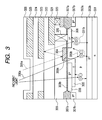
- a pixel circuit of the CMOS solid-state image pick-up device is shown in FIG. 1, a plane layout of the pixel is shown in FIG. 2, and a cross-sectional structure of the pixel is shown in FIG. 3.
- reference numeral 1 denotes a photodiode
- 2 denoting a transfer MOS transistor for transferring a charge of the photodiode
- 3 denoting a floating diffusion for temporarily storing the transferred charge
- 4 denoting a reset MOS transistor for resetting the floating diffusion and the photodiode
- 5 denoting a selection MOS transistor for selecting an arbitrary one line in an array
- 6 denoting a source follower MOS transistor for converting the charge of the floating diffusion into a voltage and for amplifying the voltage by a source follower amplifier
- 7 denoting a read line, which is common to a column, for reading out pixel voltage signals
- 8 denoting a constant current source for making a constant current flow in the read line.
- Incident light is converted into an electric charge by the photodiode 1, and the charge is stored in the floating diffusion 3 by the transfer MOS transistor 2. Since the floating diffusion 3 and the photodiode 1 are reset to a constant potential by turning off the reset MOS transistor 4 and the transfer MOS transistor 2 beforehand, the potential of the floating diffusion 3 is changed in accordance with the charge generated by the incident light. The potential of the floating diffusion 3 is amplified by the source follower MOS transistor 6 and is outputted to the read line 7. The pixel is chosen by turning off the selection MOS transistor 5. An output circuit (not shown) performs a differential operation between the reset potential of the floating diffusion 3 and the potential after the light signal is stored, so as to detect the light signal component.
- FIG. 2 shows an example of a layout of the pixel circuit shown in FIG. 1.
- Reference numeral 10 denotes an active area in which a photodiode is formed, and 11 denotes an active area in which a selection MOS transistor and a source follower transistor are formed.
- Reference numeral 20 denotes an area of a transfer MOS transistor, and 21 denotes a gate line of the transfer MOS transistor.
- An area 30 surrounded by a broken line indicates a portion formed of a PN junction of semiconductor in a floating diffusion.
- Reference numeral 31 also denotes a contact for leading out an electrode from the floating diffusion, 32 denoting a metallic electrode for leading out the floating diffusion, 33 denoting a contact for connecting the metallic electrode 32 to a polysilicon, and 34 denoting a polysilicon electrode.
- Reference numeral 40 denotes a reset MOS transistor area and 41 denoting a contact for connection with a reset power supply.
- Reference numeral 50 denotes a gate area of the selection MOS transistor, 51 denoting a contact for connecting with a VDD power supply, 60 denoting an area of a source follower MOS transistor, of which gate electrode is formed by the polysilicon 34 electrically connected with the floating diffusion.
- Reference numeral 70 denotes an output line configured by a metal electrode.
- Reference numeral 71 denotes a contact for connecting the output line 70 with the main electrode of the source follower MOS transistor 60.
- FIG. 3 is a cross sectional view taken along the line 3-3 in the layout shown in FIG. 2.
- Reference numeral 301 denotes an n-type silicon substrate, 302a denoting a P-type well and 302b denoting a P-type embedded layer, 303a denoting a gate oxide film of the MOS transistor, 303b denoting a thin oxide film on the light receiving section, 304 denoting a gate electrode of the transfer MOS transistor, 305 denoting an N-type cathode of the photodiode 1, 306 denoting a surface P-type region for forming the photodiode into an embedded structure, 307a denoting an LOGOS oxide film for element isolation, 307b denoting a P-type channel stop layer, 308 denoting a N-type high concentration region which forms the floating diffusion 3 and which is also the drain region of the transfer MOS transistor 2, 309 denoting a silicon oxide film for insulating the gate electrode from a metal first layer,
- Light incident from the surface passes through an aperture without the metal third layer to enter into the photodiode.
- the light is absorbed in the N-type anode 305 of the photodiode or in the P-type well 302a to generate electron-hole pairs.
- electrons are stored in the N-type anode region.
- the above described conventional CMOS solid-state image pick-up device has a disadvantage that signal electrons generated by the incident light is mixed into the floating diffusion 3 to cause the output voltage to fluctuate.
- the electrons are attracted from the N-type cathode 305 of the photodiode to the N type high concentration layer 308 constituting the floating diffusion.
- light 331a incident on the gate electrode 304 of the transfer MOS transistor for example, is repeatedly reflected as shown in FIG. 3 to generate electron-hole pairs 331b immediately below the N type high concentration layer 308.
- the electrons are attracted to the N type high concentration layer.
- the electrostatic capacity of the floating diffusion section is increased so as to reduce the charge conversion coefficient, resulting in a problem of degrading an S/N.
- the electrons directly captured in the floating diffusion without passing through the photodiode generate aliasing to cause problems in a solid-state image pick-up device, such as increasing noise, reducing a dynamic range, increasing output and shading in the dark state. For this reason, improving the shading characteristic of the floating diffusion has been a problem to be solved in the conventional CMOS solid-state image pick-up device.
- a source follower amplifier in which the floating diffusion is used at the last stage of the readout circuit, is also generally used.
- a source follower amplifier in which the floating diffusion is used at the last stage of the readout circuit.
- an example is disclosed in Japanese Patent Application Laid-Open No. H03-116840, in which leading-out of electrodes for the source follower amplifier is effected with a polysilicon.
- improvement in the shading characteristic is not described, and also the fact that electrons generated in the silicon flow into the floating diffusion, as described in the above example of the prior art, is not taken into account.
- the layout can be performed without being limited by the pixel area, and hence a special device is not needed.
- the photodiode is arranged close to the floating diffusion because the floating diffusion is present in each pixel, and that a slight gap must be inevitably provided for the metallic electrodes serving as the light shield because the metallic electrodes are also used as wiring of the circuit, etc., the conditions being different from those in the CCD-type solid-state image pick-up device, as a result of which a new structural design is needed.
- a first aspect of the present invention is, in a solid-state image pick-up device in which a plurality of pixels, each provided with a photoelectric conversion section and a signal amplifying section are arranged in an array form, and in which a floating diffusion arranged for each of the pixels or each of a plurality of the pixels serves as an input of the signal amplifying section, characterized in that at least a part of connection from the floating diffusion to the signal amplifying section is effected by using direct contact of the floating diffusion with a polysilicon, and in that the floating diffusion is shaded by a metal layer which is not electrically connected with the floating diffusion.
- a second aspect of the present invention is, in a solid-state image pick-up device in which a plurality of pixels, each provided with a photoelectric conversion section and a signal amplifying section, are arranged in an array form, and in which a floating diffusion arranged for each of the pixels or each of a plurality of the pixels serves as an input of the signal amplifying section, characterized in that at least a part of connection from the floating diffusion to the signal amplifying section is effected by using direct contact of the floating diffusion with a polysilicon, and in that a potential barrier is provided between the photoelectric conversion section and the floating diffusion.
- a third aspect of the present invention is, in the solid-state image pick-up device according to the first and second aspects, characterized in that the connection from the floating diffusion to the input of the signal amplifying section is effected only with the polysilicon.
- a fourth aspect of the present invention is characterized in that a metal layer for shading the floating diffusion is a metal layer closest to the floating diffusion.
- a fifth aspect of the present invention is, in the solid-state image pick-up device according to the fourth aspect, characterized in that the metal layer closest to the floating diffusion is provided with a reflectivity lower than that of other layers of the metal layer.
- a sixth aspect of the present invention is, in the solid-state image pick-up device according to the fourth aspect, characterized in that the polysilicon is configured by a plurality of layers, of which uppermost layer has a transmissivity in the region of visible light lower than that of the other layers of polysilicon.
- a seventh aspect of the present invention is, in the solid-state image pick-up device according to the present invention, characterized in that a potential barrier, for preventing the signal charges generated in the photoelectric conversion section from flowing into the floating diffusion, is provided between the photoelectric conversion section and the floating diffusion.
- a eighth aspect of the present invention is, in the solid-state image pick-up device according to the present invention, characterized in that resetting means and charge transfer means are provided for each pixel, and in that the transfer of the signal charges stored in the photoelectric conversion section to the floating diffusion is simultaneously performed in all pixels after all pixels are reset at the same time, for making the potential of the floating diffusion successively read out.
- an image pick-up system comprising: the solid-state image pick-up device according to the present invention; an image forming optical system for forming light from a subject into an image; and a signal processing circuit for performing digital conversion and processing of output signals from the solid-state image pick-up device.
- the solid-state image pick-up device in which a plurality of pixels, each provided with a photoelectric conversion section and a signal amplifying section, are arranged in an array form, and in which a floating diffusion arranged for each of the pixels or each of a plurality of the pixels serves as an input of the signal amplifying section, since at least a part of connection from the floating diffusion to the signal amplifying section is effected by using direct contact of the floating diffusion with a polysilicon and the floating diffusion is shaded by a metal layer which is not electrically connected with the floating diffusion, the quantity of light directly incident on the floating diffusion can be reduced and the parasitic capacitance of the floating diffusion section which is generated between the metal layer and the other conductive layers is not increased, thereby enabling a high S/N to be maintained.
- a solid-state image pick-up device in which a plurality of pixels, each provided with a photoelectric conversion section and a signal amplifying section, are arranged in an array form, and in which a floating diffusion arranged for each of the pixels or each of a plurality of the pixels serves as an input of the signal amplifying section, since at least a part of connection from the floating diffusion to the signal amplifying section is effected by using direct contact of the floating diffusion with a polysilicon and a potential barrier is provided between the photoelectric conversion section and the floating diffusion, the quantity of light directly incident on the floating diffusion can be reduced by shading the floating diffusion with the first layer metal, and the diffusion of signal charges generated in the silicon into the floating diffusion can be suppressed.
- connection from the floating diffusion to the input of the signal amplifying section is effected only with the polysilicon, shading can be effected without providing a gap in the first layer metal and also a space for connecting from the polysilicon to the first layer metal can be eliminated so as to enable the floating diffusion to be made small.
- the metal layer for shading the floating diffusion is a metal layer closest to the floating diffusion, the amount of light incident from above the floating diffusion can be minimized.
- the lower most metal layer is configured by a plurality of layers and is provided with a reflectivity lower than that of other layers of the metal layer, the quantity of light incident on the floating diffusion due to the light reflected on the base surface of the metal layer can be reduced.
- the polysilicon is configured by a plurality of layers, of which uppermost layer has a transmissivity in the visible light area lower than that of the other layers of polysilicon, so that the quantity of light which is incident on the floating diffusion by repeating reflections after reflected on the surface of the polysilicon, can be reduced.
- the seventh aspect of the present invention since a potential barrier for preventing the signal charges generated in the photoelectric conversion section from flowing into the floating diffusion, is provided between the photoelectric conversion section and the floating diffusion, the diffusion of the signal charges generated in the silicon into the floating diffusion can be suppressed.
- the eighth aspect of the present invention in the first and second aspects of the invention, since resetting means and charge transfer means are provided for each pixel, and the transfer of signal charges stored in the photoelectric conversion section to the floating diffusion is simultaneously performed in all pixels after all pixels are reset at the same time, and then the potential of the floating diffusion is made to be successively read out so as to enable an electronic shutter of whole picture simultaneous storage type to operate, an operation of the electronic shutter for enabling a solid-state image pick-up device to perform imaging of high picture quality can be realized without a complicated pixel circuit.
- the shading characteristic of the floating diffusion of the solid-state image pick-up device can be improved.
- the dynamic range and S/N can be raised without causing shading in the dark state.
- the electronic shutter of all pixels simultaneous storage type with high picture quality can be realized.
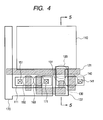
- FIG. 4 shows a layout of a pixel circuit for explaining a first embodiment according to the present invention.
- Reference numeral 110 denotes an active area in which a photodiode is formed
- 111 denotes an active area in which a selection MOS transistor and a source follower transistor are formed.
- Reference numeral 120 denotes an area of a transfer MOS transistor and 121 denotes a gate line of the transfer MOS transistor.
- An area 130 surrounded by a broken line shows a portion formed of a PN junction of semiconductor in the floating diffusion.
- a difference from the prior art form is that leading-out of an electrode from the floating diffusion is effected by a direct contact with a polysilicon 131.
- the polysilicon 131 serves directly as a gate electrode of a source follower MOS transistor with no intermediary of a metallic electrode.
- Reference numeral 132 denotes a shading metal covering over the floating diffusion, which shading metal in the present embodiment covers in oversize over the gate electrode of the transfer transistor section 120 and the P-N junction section 130 of the floating diffusion. In this way, it is possible to shade the floating diffusion in a position close to the silicon by leading out the floating diffusion with the polysilicon.
- the floating diffusion may be made to be in an electrically floating state, or to have a fixed potential by connecting it with a second layer metal or a third layer metal.
- reference numeral 140 denotes a reset MOS transistor area, 141 denoting a contact for connecting with a reset power supply, 150 denoting a gate area of the selection MOS transistor, 151 denoting a contact for connecting with a VDD power supply, 160 denoting the source follower MOS transistor area, of which gate electrode is formed by the polysilicon 131 electrically connected with the floating diffusion.
- Reference numeral 170 denotes an output line formed by a metallic electrode.
- Reference numeral 171 also denotes a contact for connecting the output line 170 with the main electrode of the source follower MOS transistor 160.
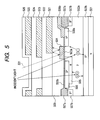
- FIG. 5 is a cross sectional view taken along the line 5-5 in FIG. 4.
- Reference numeral 501 denotes an n-type silicon substrate, 502a denoting a P-type well, 502b denoting a P-type embedded layer, 503a denoting a gate oxide film of a MOS transistor, 503b denoting a thin oxide film on a light receiving section, 504 denoting a gate electrode of a transfer MOS transistor, 505 denoting an N-type cathode of the photodiode 1, 506 denoting a surface P-type region for forming the photodiode into an embedded structure, 507a denoting a LOCOS oxide film for element isolation, 507b denoting a P-type channel stop layer, 508a denoting an N-type high concentration region which forms the floating diffusion and which is also a drain region of the transfer MOS transistor.
- Reference character 508b denotes a polysilicon lead-out electrode brought into direct contact with the N-type high concentration region.
- Reference numeral 509 denotes a silicon oxide film for insulating the gate electrode from a metal first layer, and 521 denotes the metal first layer for shading the floating diffusion section.
- Reference numeral 522 denotes an interlayer insulating film for insulating the metal first layer from a metal second layer, 523 denoting the metal second layer, 524 denoting an interlayer insulating film for insulating the metal second layer from a metal third layer, 525 denoting the metal third layer, and 526 denoting a passivation film.
- a color filter layer (not shown) and also a micro lens for improving the sensibility are further formed on the upper layer of the passivation film 526, as in the prior art.
- the floating diffusion which is covered with a metal without a gap as shown in FIG. 4, has a high light shielding performance for light traveling a path other than that shown in the cross sectional view in FIG. 5.
- the first layer metal is usually formed of aluminum or of an alloy mainly made of aluminum, but in order to make the effects of the present invention remarkable, the lowermost layer of the first layer metal is preferably formed of TiN so as to lower the reflectance to the stray light.
- TiN also serves as a barrier metal, and hence is a material suitable for forming minute electric wirings.
- the shading characteristic of the floating diffusion can be improved, and the effect of the aliasing can be eliminated.
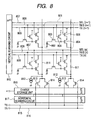
- FIG. 8 is the schematic representation of a circuit configuration in which a number of pixel circuits according to the present invention are two-dimensionally arranged.
- a pixel 801 includes a photodiode 802, a transfer MOS transistor 803, a source follower MOS transistor 804, a reset MOS transistor 805, and a selection MOS transistor 806. Gates of the selection MOS transistors in the same row are connected to a selection line 807, gates of the reset MOS transistors in the same row are connected to a reset line 808 and gates of the transfer MOS transistors in the same row are connected to a transfer line 809, respectively, each of the gates in the same row being scanned and selected by a vertical scanning circuit 801.
- a current source 812 is connected to an output line 811 in the same column, and the potential of the output line can be read out by the source follower operation.
- Light signals are stored in a charge storage section 818 by a light signal transfer MOS transistor 813 selected by a light signal read line 815, and noise signals are stored in the charge storage section 818 by a noise signal transfer MOS transistor 814 selected by a noise signal read line 816, respectively.
- the signals stored in the charge storage section 818 are sequentially scanned and read out by the horizontal scanning circuit, and the difference between the light signal and the noise signal is outputted by a differential amplifier circuit (not shown).
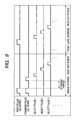
- FIG. 9 shows a timing chart of the operation of the electronic shutter.
- the reset pulse for all rows is put ON and the transfer pulse for all rows is put ON. From the moment that both pulses are put OFF, photodiodes over the entire screen start the storing operation at the same time.
- the transfer pulse for all rows is put ON, the signal charge of each pixel is transferred to the floating diffusion of each pixel simultaneously by putting the transfer pulse for all rows OFF.
- the selection pulse ON/OFF for each row the charge of the floating diffusion is sequentially read out for each row.
- the read-out signals are stored as "S+N" signals in the charge storage section 818 in FIG. 8.
- a row having a long storage period (in this case, the last line) has an output potential shaded by the aliasing entering into the floating diffusion, as compared with a row with a short storage period (in this case, the first line). Since the present invention makes it possible to suppress the aliasing entering into the floating diffusion, such shading is not caused or made to be a level causing no problem.
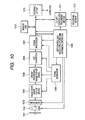
- FIG. 10 shows an example of a circuit block in the case where a solid-state image pick-up device according to the present invention is applied to a camera.
- a shutter 1001 is provided in the front side of a lens 1002 so as to control exposure.
- Light quantity is controlled by a diaphragm 1003 as required, and an image is formed on a solid-state image pick-up device 1004.
- a signal outputted from the solid-state image pick-up device 1004 is processed by a circuit processing image pick-up signal 1005, and is converted from an analog signal into a digital signal by an A/D converter 1006.
- the output signal is further subjected to arithmetic processing by a signal processor 1007.
- the processed digital signal is stored in a memory unit 1010, and is sent to an external device through an external I/F unit 1013.
- the solid-state image pick-up device 1004, the circuit processing image pick-up signal 1005, the A/D converter 1006, and the signal processor 1007 are controlled by a timing generator 1008, and also the whole system is controlled by a unit controlling whole structure and arithmetic operation 1009.
- an output digital signal is recorded through an I/F unit controlling recording medium 1011 controlled by the unit controlling whole structure and arithmetic operation.
- the present invention can be applied to the case where a hole storage type pixel is configured by inverting all other conductivity types in the present embodiment.
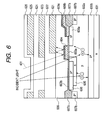
- FIG. 6 is a sectional view of a pixel section of a solid-state image pick-up device of a second embodiment according to the present invention.
- Reference numeral 601 denotes an n-type silicon substrate, 602a denoting a P-type well, 602b denoting a P-type embedded layer, 603a denoting a gate oxide film of a MOS transistor, 603b denoting a thin oxide film on a light receiving section, 604 denoting a gate electrode of a transfer MOS transistor, 605 denoting an N-type cathode of the photodiode 1, 606 denoting a surface P-type region for making the photodiode formed into an embedded structure, 607a denoting a LOGOS oxide film for element isolation, 607b denoting a P-type channel stop layer, and 608a denoting an N-type high concentration region which forms a floating diffusion and which is also formed to be a drain region of the transfer MOS transistor.
- Reference character 608b denotes a polysilicon lead-out electrode brought into direct contact with the N-type high concentration region.
- the top surface of the polysilicon lead-out electrode 608b is formed of a metal.
- Reference character 608c denotes, for example, a silicide formed of Ti, W, or Mo.
- reference numeral 609 denotes silicon oxide film insulating the gate electrode from a metal first layer, 621 denoting the metal first layer shading the floating diffusion section.
- Reference numeral 622 denotes an interlayer insulating film insulating the metal first layer from a metal second layer, 623 denoting the metal second layer, 624 denoting an interlayer insulating film insulating the metal second layer from a metal third layer, 625 denoting the metal third layer and 626 denoting a passivation film.
- light entering into the floating diffusion is further reduced by making the top surface of the polysilicon electrode low in reflection to the visible light. That is, among incident lights, the light incident on the gate electrode 604 of the transfer MOS transistor is not transmitted, so that light directly entering into the silicon is reduced.
- the intensity of the reflected light can also be reduced by suppressing the reflectance of the silicide 608c low. Since the top surface of the polysilicon direct contact 608b is also covered by silicide, even when there is a stray light, components of the light directly passing through the polysilicon can be made small.
- FIG. 7 is a sectional view of a pixel section of a solid-state image pick-up device of a third embodiment according to the present invention.
- Reference numeral 701 denotes an N type silicon substrate, 702 denoting a embedded P-type high concentration layer, 703a denoting an N-type epitaxial layer, 703b denoting an N-type cathode of a photodiode, 704a, 704b, 704c denoting P-type isolation layers, and 705a, 705b, 705c denoting P-type well layers.
- Reference characters 706a, 706b denote channel stop P-type layers below a field oxide film.
- Reference numeral 714 denotes a field stop layer defining a charge transfer path to a floating diffusion to form a potential barrier directly under a transfer MOS transistor, 707 denoting the field oxide film, 708 denoting a gate oxide film of a MOS transistor, 709a denoting a gate polysilicon of the transfer MOS transistor, on which surface a metal silicide layer 709b is provided and 710 denoting a surface P-type layer for forming the photodiode into a embedded type.
- Reference numeral 711 denotes an N-type high concentration diffusion region of the transfer MOS transistor.
- Reference character 712a denotes a polysilicon lead-out electrode brought into direct contact with the N-type high concentration region.
- the top surface of the polysilicon lead-out electrode 712b is formed of a metal silicide.
- Reference numeral 713 also denotes a silicon oxide film insulating the gate electrode from a metal first layer, 721 denoting the metal first layer shading the floating diffusion section.
- Reference numeral 722 denotes an interlayer insulating film insulating the metal first layer from a metal second layer, 723 denoting the metal second layer, 724 denoting an interlayer insulating film insulating the metal second layer from a metal third layer, 725 denoting the metal third layer, and 726 denoting a passivation film.
- the aliasing incident from the top surface on the floating diffusion is reduced by forming the uppermost layer of the polysilicon gate into a metal silicide film, and at the same time, electrons of electron-hole pairs 731b generated at the end of the photodiode by obliquely incident light 731a, are collected to the cathode 703 of the photodiode by P-type isolation layer 704b, P-type well layer 705b and the field stop layer 714, without diffusing into the floating diffusion side.
- the present embodiment it is possible to suppress the diffusion from the inside of the silicon into the floating diffusion.
- the combination of the silicide and the potential barrier makes it possible to eliminate the aliasing more effectively.
- the present invention provides a solid-state image pick-up device without shading in the dark state, and capable of making a dynamic range and a S/N high.
- Reference numeral 505 denotes an N-type cathode of a photodiode
- 506 denoting a surface P-type region for forming the photodiode into an embedded structure
- 508a denoting an N-type high concentration region which forms a floating diffusion and which is also a drain region of a transfer MOS transistor.
- Reference character 508b denotes a polysilicon lead-out electrode brought into direct contact with the N-type high concentration region. Light incident from the surface passes through an aperture without a metal third layer 525 to enter into the photodiode.
Landscapes
- Solid State Image Pick-Up Elements (AREA)
- Transforming Light Signals Into Electric Signals (AREA)
Priority Applications (1)
| Application Number | Priority Date | Filing Date | Title |
|---|---|---|---|
| EP12182192.0A EP2544238A3 (de) | 2004-02-19 | 2005-02-15 | Festkörper-Bildaufnahmevorrichtung und Abbildungssystem damit |
Applications Claiming Priority (2)
| Application Number | Priority Date | Filing Date | Title |
|---|---|---|---|
| JP2004042939 | 2004-02-19 | ||
| JP2004042939A JP4794821B2 (ja) | 2004-02-19 | 2004-02-19 | 固体撮像装置および撮像システム |
Publications (2)
| Publication Number | Publication Date |
|---|---|
| EP1566842A2 true EP1566842A2 (de) | 2005-08-24 |
| EP1566842A3 EP1566842A3 (de) | 2011-05-04 |
Family
ID=34709116
Family Applications (2)
| Application Number | Title | Priority Date | Filing Date |
|---|---|---|---|
| EP05003185A Withdrawn EP1566842A3 (de) | 2004-02-19 | 2005-02-15 | Festkörperbildsensor und Anzeigevorrichtung mit dem Festkörperbildsensor |
| EP12182192.0A Withdrawn EP2544238A3 (de) | 2004-02-19 | 2005-02-15 | Festkörper-Bildaufnahmevorrichtung und Abbildungssystem damit |
Family Applications After (1)
| Application Number | Title | Priority Date | Filing Date |
|---|---|---|---|
| EP12182192.0A Withdrawn EP2544238A3 (de) | 2004-02-19 | 2005-02-15 | Festkörper-Bildaufnahmevorrichtung und Abbildungssystem damit |
Country Status (3)
| Country | Link |
|---|---|
| US (3) | US7307300B2 (de) |
| EP (2) | EP1566842A3 (de) |
| JP (1) | JP4794821B2 (de) |
Cited By (6)
| Publication number | Priority date | Publication date | Assignee | Title |
|---|---|---|---|---|
| WO2007086649A1 (en) * | 2006-01-25 | 2007-08-02 | Siliconfile Technologies Inc. | Image sensor having anti-reflection film and method of manufacturing the same |
| FR2906079A1 (fr) * | 2006-09-19 | 2008-03-21 | E2V Semiconductors Soc Par Act | Capteur d'image en couleur a colorimetrie amelioree |
| CN102549748A (zh) * | 2009-10-09 | 2012-07-04 | 佳能株式会社 | 固态图像拾取器件及其制造方法 |
| CN103454033A (zh) * | 2012-06-01 | 2013-12-18 | 无锡华润华晶微电子有限公司 | 多晶压力传感器芯片及其制备方法 |
| US9985069B2 (en) | 2010-03-12 | 2018-05-29 | Semiconductor Energy Laboratory Co., Ltd. | Semiconductor device |
| EP1935021B1 (de) * | 2005-08-26 | 2020-01-15 | Aptina Imaging Corporation | Implantierte isolationsregion für bildgeber-pixel |
Families Citing this family (54)
| Publication number | Priority date | Publication date | Assignee | Title |
|---|---|---|---|---|
| JP4794821B2 (ja) * | 2004-02-19 | 2011-10-19 | キヤノン株式会社 | 固体撮像装置および撮像システム |
| JP4525235B2 (ja) * | 2004-08-09 | 2010-08-18 | セイコーエプソン株式会社 | 固体撮像装置及びその駆動方法 |
| JP4680552B2 (ja) * | 2004-09-02 | 2011-05-11 | 富士フイルム株式会社 | 固体撮像素子の製造方法 |
| JP4941294B2 (ja) * | 2005-03-28 | 2012-05-30 | 富士通セミコンダクター株式会社 | 撮像装置 |
| JP4718875B2 (ja) * | 2005-03-31 | 2011-07-06 | 株式会社東芝 | 固体撮像素子 |
| US7446357B2 (en) * | 2005-05-11 | 2008-11-04 | Micron Technology, Inc. | Split trunk pixel layout |
| KR100657142B1 (ko) * | 2005-06-03 | 2006-12-13 | 매그나칩 반도체 유한회사 | 이미지센서의 픽셀 쉬링크를 위한 콘택 구조 및 그 제조방법 |
| JP4785433B2 (ja) | 2005-06-10 | 2011-10-05 | キヤノン株式会社 | 固体撮像装置 |
| US20070001100A1 (en) * | 2005-06-30 | 2007-01-04 | Taiwan Semiconductor Manufacturing Company, Ltd. | Light reflection for backside illuminated sensor |
| JP4940607B2 (ja) * | 2005-09-22 | 2012-05-30 | ソニー株式会社 | 固体撮像装置およびその製造方法、並びにカメラ |
| KR100720504B1 (ko) * | 2005-09-28 | 2007-05-22 | 동부일렉트로닉스 주식회사 | 씨모스 이미지 센서의 제조방법 |
| US7683448B2 (en) * | 2005-12-29 | 2010-03-23 | Dongbu Electronics Co., Ltd. | CMOS image sensor |
| US8704277B2 (en) * | 2006-05-09 | 2014-04-22 | Taiwan Semiconductor Manufacturing Company, Ltd. | Spectrally efficient photodiode for backside illuminated sensor |
| US7638852B2 (en) * | 2006-05-09 | 2009-12-29 | Taiwan Semiconductor Manufacturing Company, Ltd. | Method of making wafer structure for backside illuminated color image sensor |
| US7791170B2 (en) | 2006-07-10 | 2010-09-07 | Taiwan Semiconductor Manufacturing Company, Ltd. | Method of making a deep junction for electrical crosstalk reduction of an image sensor |
| JP5132102B2 (ja) * | 2006-08-01 | 2013-01-30 | キヤノン株式会社 | 光電変換装置および光電変換装置を用いた撮像システム |
| KR100789624B1 (ko) * | 2006-08-31 | 2007-12-27 | 동부일렉트로닉스 주식회사 | 시모스 이미지 센서 및 이의 제조 방법 |
| JP4960058B2 (ja) * | 2006-10-04 | 2012-06-27 | 株式会社東芝 | 増幅型固体撮像素子 |
| JP4929981B2 (ja) * | 2006-10-30 | 2012-05-09 | 株式会社Jvcケンウッド | 固体撮像素子 |
| US7732844B2 (en) * | 2006-11-03 | 2010-06-08 | Taiwan Semiconductor Manufacturing Company, Ltd. | Crosstalk improvement through P on N structure for image sensor |
| JP2008153428A (ja) * | 2006-12-18 | 2008-07-03 | Fujifilm Corp | 固体撮像素子及びその製造方法 |
| TW200903790A (en) * | 2007-04-18 | 2009-01-16 | Rosnes Corp | Solid-state imaging device |
| US7544992B2 (en) * | 2007-05-16 | 2009-06-09 | United Microelectronics Corp. | Illuminating efficiency-increasable and light-erasable embedded memory structure |
| US7656000B2 (en) * | 2007-05-24 | 2010-02-02 | Taiwan Semiconductor Manufacturing Company, Ltd. | Photodetector for backside-illuminated sensor |
| US8072015B2 (en) | 2007-06-04 | 2011-12-06 | Sony Corporation | Solid-state imaging device and manufacturing method thereof |
| JP5216259B2 (ja) * | 2007-07-02 | 2013-06-19 | 富士フイルム株式会社 | 固体撮像素子および撮像装置 |
| US7999342B2 (en) | 2007-09-24 | 2011-08-16 | Taiwan Semiconductor Manufacturing Company, Ltd | Image sensor element for backside-illuminated sensor |
| KR100935269B1 (ko) * | 2007-12-27 | 2010-01-06 | 주식회사 동부하이텍 | 이미지 센서 및 그 제조방법 |
| US7940315B2 (en) * | 2008-01-07 | 2011-05-10 | Aptina Imaging Corporation | Method and apparatus for identification and correction of aberrant pixels in an image sensor |
| KR101478248B1 (ko) * | 2008-04-11 | 2014-12-31 | 삼성전자주식회사 | 두 개의 게이트로 이루어진 센싱 트랜지스터를 구비한 이미지 센서의 구동방법 |
| US8003425B2 (en) * | 2008-05-14 | 2011-08-23 | International Business Machines Corporation | Methods for forming anti-reflection structures for CMOS image sensors |
| US7759755B2 (en) | 2008-05-14 | 2010-07-20 | International Business Machines Corporation | Anti-reflection structures for CMOS image sensors |
| US7833819B2 (en) * | 2008-07-23 | 2010-11-16 | Aptina Imaging Corporation | Method and apparatus for decreasing storage node parasitic charge in active pixel image sensors |
| JP5274166B2 (ja) * | 2008-09-10 | 2013-08-28 | キヤノン株式会社 | 光電変換装置及び撮像システム |
| JP2010073906A (ja) * | 2008-09-18 | 2010-04-02 | Sharp Corp | 固体撮像素子および電子情報機器 |
| TWI418023B (zh) * | 2010-05-12 | 2013-12-01 | Himax Imagimg Inc | 影像感測器 |
| US8592244B2 (en) * | 2011-07-25 | 2013-11-26 | International Business Machines Corporation | Pixel sensor cells and methods of manufacturing |
| JPWO2014002353A1 (ja) * | 2012-06-27 | 2016-05-30 | パナソニックIpマネジメント株式会社 | 固体撮像素子及びその製造方法 |
| JP5539458B2 (ja) * | 2012-07-26 | 2014-07-02 | キヤノン株式会社 | 光電変換装置および光電変換装置を用いた撮像システム |
| US20140110805A1 (en) | 2012-10-18 | 2014-04-24 | Infineon Technologies Dresden Gmbh | Silicon light trap devices, systems and methods |
| KR20150087322A (ko) * | 2012-11-22 | 2015-07-29 | 가부시키가이샤 니콘 | 촬상 소자 및 촬상 유닛 |
| JP5971106B2 (ja) | 2012-12-17 | 2016-08-17 | 株式会社デンソー | 光センサ |
| JP5693651B2 (ja) * | 2013-05-10 | 2015-04-01 | キヤノン株式会社 | 光電変換装置及び撮像システム |
| US8957490B2 (en) * | 2013-06-28 | 2015-02-17 | Infineon Technologies Dresden Gmbh | Silicon light trap devices |
| CN111799285B (zh) | 2014-12-18 | 2024-05-14 | 索尼公司 | 成像装置 |
| KR102570346B1 (ko) * | 2016-10-20 | 2023-08-25 | 에스케이하이닉스 주식회사 | 쉴드들을 가진 이미지 센서 및 그 제조 방법 |
| JP7097773B2 (ja) * | 2018-07-26 | 2022-07-08 | キヤノン株式会社 | 固体撮像装置、基板および撮像システム |
| JP7086783B2 (ja) * | 2018-08-13 | 2022-06-20 | 株式会社東芝 | 固体撮像装置 |
| CN109119434A (zh) * | 2018-08-31 | 2019-01-01 | 上海华力集成电路制造有限公司 | 一种像素结构及其制造方法 |
| JP2020088293A (ja) * | 2018-11-29 | 2020-06-04 | キヤノン株式会社 | 光電変換装置、光電変換システム、移動体 |
| JP2021064711A (ja) * | 2019-10-15 | 2021-04-22 | ソニーセミコンダクタソリューションズ株式会社 | 撮像装置 |
| US11152404B2 (en) * | 2019-12-20 | 2021-10-19 | Omnivision Technologies, Inc. | Tunnel contact for a pixel cell in an imaging system |
| JP2021111692A (ja) * | 2020-01-10 | 2021-08-02 | パナソニックIpマネジメント株式会社 | 撮像装置および撮像装置の製造方法 |
| CN119213556A (zh) * | 2022-07-04 | 2024-12-27 | 华为技术有限公司 | 具有高电荷传输能力的固态成像设备 |
Citations (1)
| Publication number | Priority date | Publication date | Assignee | Title |
|---|---|---|---|---|
| US6291280B1 (en) * | 1998-11-12 | 2001-09-18 | Micron Technology, Inc. | CMOS imager cell having a buried contact and method of fabrication |
Family Cites Families (20)
| Publication number | Priority date | Publication date | Assignee | Title |
|---|---|---|---|---|
| JP2827327B2 (ja) | 1989-09-29 | 1998-11-25 | ソニー株式会社 | 電荷転送装置 |
| JPH03165063A (ja) * | 1989-11-24 | 1991-07-17 | Nec Corp | 固体撮像素子 |
| JPH04280680A (ja) * | 1991-03-08 | 1992-10-06 | Sony Corp | 固体撮像装置 |
| JPH08288484A (ja) * | 1995-04-20 | 1996-11-01 | Sony Corp | 固体撮像素子の製造方法 |
| JP3116840B2 (ja) | 1996-10-28 | 2000-12-11 | トヨタ自動車株式会社 | 内燃機関の吸気制御装置 |
| JP3219036B2 (ja) * | 1997-11-11 | 2001-10-15 | 日本電気株式会社 | 固体撮像装置 |
| US6326652B1 (en) * | 1999-06-18 | 2001-12-04 | Micron Technology, Inc., | CMOS imager with a self-aligned buried contact |
| JP3434740B2 (ja) * | 1999-06-30 | 2003-08-11 | Necエレクトロニクス株式会社 | 固体撮像装置 |
| JP3624140B2 (ja) | 1999-08-05 | 2005-03-02 | キヤノン株式会社 | 光電変換装置およびその製造方法、デジタルスチルカメラ又はデジタルビデオカメラ |
| JP4721380B2 (ja) | 2000-04-14 | 2011-07-13 | キヤノン株式会社 | 固体撮像装置および撮像システム |
| JP2002141488A (ja) * | 2000-11-06 | 2002-05-17 | Canon Inc | 固体撮像装置及び固体撮像システム |
| US7139028B2 (en) * | 2000-10-17 | 2006-11-21 | Canon Kabushiki Kaisha | Image pickup apparatus |
| JP2002270810A (ja) * | 2001-03-08 | 2002-09-20 | Sharp Corp | 固体撮像装置 |
| JP2003229556A (ja) | 2002-02-04 | 2003-08-15 | Sony Corp | 固体撮像素子およびその製造方法 |
| JP2003282849A (ja) * | 2002-03-26 | 2003-10-03 | Canon Inc | 放射線検出装置及び放射線検出装置用接続基板の製造方法 |
| JP2004015712A (ja) * | 2002-06-11 | 2004-01-15 | Sony Corp | 固体撮像装置及びその固定パターン雑音除去方法 |
| JP3840203B2 (ja) * | 2002-06-27 | 2006-11-01 | キヤノン株式会社 | 固体撮像装置及び固体撮像装置を用いたカメラシステム |
| JP3840214B2 (ja) * | 2003-01-06 | 2006-11-01 | キヤノン株式会社 | 光電変換装置及び光電変換装置の製造方法及び同光電変換装置を用いたカメラ |
| US7071505B2 (en) * | 2003-06-16 | 2006-07-04 | Micron Technology, Inc. | Method and apparatus for reducing imager floating diffusion leakage |
| JP4794821B2 (ja) * | 2004-02-19 | 2011-10-19 | キヤノン株式会社 | 固体撮像装置および撮像システム |
-
2004
- 2004-02-19 JP JP2004042939A patent/JP4794821B2/ja not_active Expired - Fee Related
-
2005
- 2005-02-10 US US11/054,316 patent/US7307300B2/en not_active Expired - Fee Related
- 2005-02-15 EP EP05003185A patent/EP1566842A3/de not_active Withdrawn
- 2005-02-15 EP EP12182192.0A patent/EP2544238A3/de not_active Withdrawn
-
2007
- 2007-08-02 US US11/833,146 patent/US7755118B2/en not_active Expired - Fee Related
-
2010
- 2010-06-03 US US12/792,943 patent/US8159010B2/en not_active Expired - Fee Related
Patent Citations (1)
| Publication number | Priority date | Publication date | Assignee | Title |
|---|---|---|---|---|
| US6291280B1 (en) * | 1998-11-12 | 2001-09-18 | Micron Technology, Inc. | CMOS imager cell having a buried contact and method of fabrication |
Cited By (12)
| Publication number | Priority date | Publication date | Assignee | Title |
|---|---|---|---|---|
| EP1935021B1 (de) * | 2005-08-26 | 2020-01-15 | Aptina Imaging Corporation | Implantierte isolationsregion für bildgeber-pixel |
| WO2007086649A1 (en) * | 2006-01-25 | 2007-08-02 | Siliconfile Technologies Inc. | Image sensor having anti-reflection film and method of manufacturing the same |
| US7898011B2 (en) | 2006-01-25 | 2011-03-01 | Siliconfile Technologies Inc. | Image sensor having anti-reflection film for reducing crosstalk |
| FR2906079A1 (fr) * | 2006-09-19 | 2008-03-21 | E2V Semiconductors Soc Par Act | Capteur d'image en couleur a colorimetrie amelioree |
| WO2008034838A3 (fr) * | 2006-09-19 | 2008-05-29 | E2V Semiconductors | Capteur d'image en couleur a diaphotie améliorée |
| US8035144B2 (en) | 2006-09-19 | 2011-10-11 | E2V Semiconductors | Color image sensor with improved optical crosstalk |
| CN102549748A (zh) * | 2009-10-09 | 2012-07-04 | 佳能株式会社 | 固态图像拾取器件及其制造方法 |
| EP2487713A4 (de) * | 2009-10-09 | 2013-02-27 | Canon Kk | Festkörperbildaufnahmeelement und herstellungsverfahren dafür |
| CN102549748B (zh) * | 2009-10-09 | 2016-08-24 | 佳能株式会社 | 固态图像拾取器件及其制造方法 |
| US9985069B2 (en) | 2010-03-12 | 2018-05-29 | Semiconductor Energy Laboratory Co., Ltd. | Semiconductor device |
| CN103454033A (zh) * | 2012-06-01 | 2013-12-18 | 无锡华润华晶微电子有限公司 | 多晶压力传感器芯片及其制备方法 |
| CN103454033B (zh) * | 2012-06-01 | 2016-07-06 | 无锡华润华晶微电子有限公司 | 多晶压力传感器芯片及其制备方法 |
Also Published As
| Publication number | Publication date |
|---|---|
| US7755118B2 (en) | 2010-07-13 |
| US7307300B2 (en) | 2007-12-11 |
| US20100237393A1 (en) | 2010-09-23 |
| US20070279502A1 (en) | 2007-12-06 |
| JP2005236013A (ja) | 2005-09-02 |
| EP2544238A2 (de) | 2013-01-09 |
| US8159010B2 (en) | 2012-04-17 |
| EP2544238A3 (de) | 2013-04-17 |
| US20050184322A1 (en) | 2005-08-25 |
| JP4794821B2 (ja) | 2011-10-19 |
| EP1566842A3 (de) | 2011-05-04 |
Similar Documents
| Publication | Publication Date | Title |
|---|---|---|
| EP1566842A2 (de) | Festkörperbildsensor und Anzeigevorrichtung mit dem Festkörperbildsensor | |
| US12177584B2 (en) | Solid-state imaging device, method of driving the same, and electronic apparatus | |
| JP2005236013A5 (de) | ||
| US10115762B2 (en) | Solid-state image pickup device, method of manufacturing thereof, and electronic apparatus | |
| US7642581B2 (en) | Solid-state image sensing device | |
| US8089543B2 (en) | Solid-state image pickup element and solid-state image pickup device | |
| US7265397B1 (en) | CCD imager constructed with CMOS fabrication techniques and back illuminated imager with improved light capture | |
| JP2007157912A (ja) | 固体撮像装置 | |
| JP4155568B2 (ja) | 固体撮像装置及びカメラ | |
| JP4470364B2 (ja) | 固体撮像素子及びカメラ装置 | |
| CN210168124U (zh) | 图像传感器 | |
| JP5225434B2 (ja) | 固体撮像装置および撮像システム |
Legal Events
| Date | Code | Title | Description |
|---|---|---|---|
| PUAI | Public reference made under article 153(3) epc to a published international application that has entered the european phase |
Free format text: ORIGINAL CODE: 0009012 |
|
| AK | Designated contracting states |
Kind code of ref document: A2 Designated state(s): AT BE BG CH CY CZ DE DK EE ES FI FR GB GR HU IE IS IT LI LT LU MC NL PL PT RO SE SI SK TR |
|
| AX | Request for extension of the european patent |
Extension state: AL BA HR LV MK YU |
|
| PUAL | Search report despatched |
Free format text: ORIGINAL CODE: 0009013 |
|
| AK | Designated contracting states |
Kind code of ref document: A3 Designated state(s): AT BE BG CH CY CZ DE DK EE ES FI FR GB GR HU IE IS IT LI LT LU MC NL PL PT RO SE SI SK TR |
|
| AX | Request for extension of the european patent |
Extension state: AL BA HR LV MK YU |
|
| 17P | Request for examination filed |
Effective date: 20111104 |
|
| AKX | Designation fees paid |
Designated state(s): AT BE BG CH CY CZ DE DK EE ES FI FR GB GR HU IE IS IT LI LT LU MC NL PL PT RO SE SI SK TR |
|
| 17Q | First examination report despatched |
Effective date: 20120423 |
|
| STAA | Information on the status of an ep patent application or granted ep patent |
Free format text: STATUS: THE APPLICATION HAS BEEN WITHDRAWN |
|
| 18W | Application withdrawn |
Effective date: 20130522 |