EP1564339B1 - Feuerfestes Formteil zur Anordnung von Installationsteilen oder elektrotechnischen Bauteilen - Google Patents
Feuerfestes Formteil zur Anordnung von Installationsteilen oder elektrotechnischen Bauteilen Download PDFInfo
- Publication number
- EP1564339B1 EP1564339B1 EP20040009626 EP04009626A EP1564339B1 EP 1564339 B1 EP1564339 B1 EP 1564339B1 EP 20040009626 EP20040009626 EP 20040009626 EP 04009626 A EP04009626 A EP 04009626A EP 1564339 B1 EP1564339 B1 EP 1564339B1
- Authority
- EP
- European Patent Office
- Prior art keywords
- housing
- panel element
- profiles
- metal
- metal supporting
- Prior art date
- Legal status (The legal status is an assumption and is not a legal conclusion. Google has not performed a legal analysis and makes no representation as to the accuracy of the status listed.)
- Expired - Lifetime
Links
Images

Classifications
-
- E—FIXED CONSTRUCTIONS
- E04—BUILDING
- E04B—GENERAL BUILDING CONSTRUCTIONS; WALLS, e.g. PARTITIONS; ROOFS; FLOORS; CEILINGS; INSULATION OR OTHER PROTECTION OF BUILDINGS
- E04B1/00—Constructions in general; Structures which are not restricted either to walls, e.g. partitions, or floors or ceilings or roofs
- E04B1/62—Insulation or other protection; Elements or use of specified material therefor
- E04B1/92—Protection against other undesired influences or dangers
- E04B1/94—Protection against other undesired influences or dangers against fire
- E04B1/941—Building elements specially adapted therefor
-
- E—FIXED CONSTRUCTIONS
- E04—BUILDING
- E04B—GENERAL BUILDING CONSTRUCTIONS; WALLS, e.g. PARTITIONS; ROOFS; FLOORS; CEILINGS; INSULATION OR OTHER PROTECTION OF BUILDINGS
- E04B9/00—Ceilings; Construction of ceilings, e.g. false ceilings; Ceiling construction with regard to insulation
- E04B9/001—Ceilings; Construction of ceilings, e.g. false ceilings; Ceiling construction with regard to insulation characterised by provisions for heat or sound insulation
-
- E—FIXED CONSTRUCTIONS
- E04—BUILDING
- E04B—GENERAL BUILDING CONSTRUCTIONS; WALLS, e.g. PARTITIONS; ROOFS; FLOORS; CEILINGS; INSULATION OR OTHER PROTECTION OF BUILDINGS
- E04B9/00—Ceilings; Construction of ceilings, e.g. false ceilings; Ceiling construction with regard to insulation
- E04B9/006—Ceilings; Construction of ceilings, e.g. false ceilings; Ceiling construction with regard to insulation with means for hanging lighting fixtures or other appliances to the framework of the ceiling
-
- E—FIXED CONSTRUCTIONS
- E04—BUILDING
- E04B—GENERAL BUILDING CONSTRUCTIONS; WALLS, e.g. PARTITIONS; ROOFS; FLOORS; CEILINGS; INSULATION OR OTHER PROTECTION OF BUILDINGS
- E04B9/00—Ceilings; Construction of ceilings, e.g. false ceilings; Ceiling construction with regard to insulation
- E04B9/04—Ceilings; Construction of ceilings, e.g. false ceilings; Ceiling construction with regard to insulation comprising slabs, panels, sheets or the like
- E04B9/045—Ceilings; Construction of ceilings, e.g. false ceilings; Ceiling construction with regard to insulation comprising slabs, panels, sheets or the like being laminated
-
- F—MECHANICAL ENGINEERING; LIGHTING; HEATING; WEAPONS; BLASTING
- F21—LIGHTING
- F21V—FUNCTIONAL FEATURES OR DETAILS OF LIGHTING DEVICES OR SYSTEMS THEREOF; STRUCTURAL COMBINATIONS OF LIGHTING DEVICES WITH OTHER ARTICLES, NOT OTHERWISE PROVIDED FOR
- F21V25/00—Safety devices structurally associated with lighting devices
-
- F—MECHANICAL ENGINEERING; LIGHTING; HEATING; WEAPONS; BLASTING
- F21—LIGHTING
- F21S—NON-PORTABLE LIGHTING DEVICES; SYSTEMS THEREOF; VEHICLE LIGHTING DEVICES SPECIALLY ADAPTED FOR VEHICLE EXTERIORS
- F21S8/00—Lighting devices intended for fixed installation
- F21S8/02—Lighting devices intended for fixed installation of recess-mounted type, e.g. downlighters
Definitions
- Such a molding is from the EP-A-0908668 known.
- a layer of mineral wool, especially rock wool, is arranged between the insulating layer and the housing wall.
- the housing may be according to its purpose a large-sized sheet metal housing with one-sided open mouth, the housing is preferably formed cuboid.
- the fire protection material on the one hand a mineral wool layer or rock wool layer and on the other hand has a mineral wool or rock wool layer covering layer of material which inflates under the action of heat and / or fire, a significant advantage is achieved. Due to the combination of these two materials, optimum thermal insulation is achieved with a small wall thickness of the sandwich-type layer. In addition, the weight is kept relatively low, because a lower weight is achieved by the combination of materials; as in the case that the material layer only from the insulating layer forming, under the action of heat or fire inflatable material would consist.
- the production costs are minimized because the relatively expensive, the insulating layer forming inflatable material must be used only in relatively small wall thickness, while the cost-effective mineral wool or rock wool material can be used according to their intended use dimensioned.
- this combination is the Total wall thickness kept relatively low, so that the installation space, which is available in the housing after introducing the material layers, is kept relatively large. In a construction with mineral wool or rock wool alone, the wall layer would be considerably stronger, so that the installation space would be considerably restricted in the housing.
- the housing has a mouth edge and a mineral wool-free edge is provided in the region of the mouth edge of the housing, which is filled by the insulating layer forming material, which is directly connected to the edge of the housing, in particular glued.
- the over-molded front edge acts like a nachCumende sealing lip and ensures the space closure.
- the mineral wool plate material is fixed to the inside of the metal case by the material forming the insulating layer.
- the material forming the insulating layer is applied to the mineral wool layer and the edge of the shell during production as a castable material.
- the invention also relates to a false ceiling for fire protection purposes.
- this consists of a single-layer or preferably multi-layered plate member made of fire and heat resistant material, such as plasterboard, a support member holding the plate member with intersecting laid first and second metal support profiles to which the components of the plate member are secured in a suitable form.
- band-like or anchor-like fastening parts are provided, which are preferably fastened on the one hand to the first metal support profiles and on the other hand can be fastened to the building ceiling or similar supporting parts, so that the construction of a suspended ceiling is realized.
- the plate element has at least one opening, which is covered by a molding according to one of claims 1 to 3. The molding supports on the back of the plate element at this from.
- Rear side of the plate member are adjacent to the opening and adjacent to the edges of the molding, which covers the opening, two mutually parallel third metal support profiles, which are connected to these crossing first metal support profiles, or at least a third metal support profile is arranged with a first or second metal support profile is connected, and is aligned at a distance to a first or second metal profile parallel to this, wherein the third support profiles or laterally surrounding the opening profiles, namely a third support profile and a parallel thereto first or second metal profile in addition by means of fasteners are attached to the plate member and the mouth edge of the molding forming housing is fastened by means of fasteners to a respective adjacent leg of a first, second or third metal support profile.
- band-like or anchor-like fastening elements are arranged on the first or second metal support profiles, specifically in the area of the first metal support profiles adjacent to the wall of the housing, which are fastened to the building ceiling or similar supporting parts.
- the lower edge of the housing is aligned with the contact surface of the first, second and / or third metal support profiles on the plate member.
- screws in particular sheet-metal screws, are arranged as fastening means.
- the sub-ceiling is constructed in a conventional manner, wherein the first and second metal support profiles are attached via anchors or the like to the ceiling or the like support member and the plate elements are fixed to these profiles.
- the molding is positioned above the opening, which is provided for the installation of a lamp or the like.
- the arrangement of third metal support profiles is provided near two mutually parallel edges of the rectangular opening, which intersect the first support profiles and are secured at the intersection point to this.
- the housing with its mouth is level with the bottom edge of the mounting profiles (third metal support profiles) aligned.
- the housing is hung by means of two each attached to its sides, for example screwed or dotted angles on the additional third metal support profiles.
- tapping screws are screwed laterally from the inside or outside, so that a connection of the housing is made to the third metal support profile.
- the third metal support profile is additionally fastened by screws to the plate elements, which penetrate the plate elements, so that a firm fixation of the entire finished component is ensured on the plate member. It is thus not possible to move the molding or push up.
- the front edge of the housing is covered with the insulating layer forming material, so that in case of fire, the space closure is granted.
- the over-molded front edge acts like a nachCumende sealing lip and ensures the space closure.
- the encircling caterpillar made of fire-retardant cement supports this process and additionally causes the parts to stick to the plate material.
- first and second metal support profiles in a common plane and to connect them together or to arrange the metal support profiles on top of each other in two levels and to connect in the crossing area.
- the profiles adjacent to the parallel marginal edges of the rectangular opening can by a third metal support profile and be formed by a first or a second metal support profile.
- the housing is then hung on the profiles and secured thereto in the manner described above, the profiles also being secured in an analogous manner to the panel members.
- the layer of mineral wool 3 is formed by plate-like parts of mineral wool, which are introduced in the form of a bottom part and in the form of wall parts in the housing and which are held in a positionally secured by the insulating layer forming material 2.
- a free edge of mineral wool 3 is provided, which is filled by the material forming the insulating layer 2, which is firmly connected in this area directly to the edge of the housing 1, for example glued.
- This area is designated 4.
- Such a molded part is installed in a false ceiling for fire protection purposes.
- the lower ceiling consists of a preferably two-layered plate element 5, 6 of fire and heat resistant material, such as plasterboard. This plate element 5, 6 is held on a support structure, which in FIGS.
- first metal support profiles 7 and second metal support profiles 8 are provided, which are interconnected at the intersection points.
- the support profiles 7 are fastened by means of band-like or anchor-like fastening parts 9 to a building ceiling or the like.
- the plate element 5, 6 has an opening which is covered by the molded part (1, 2, 3). This is supported on the back of the plate element 5, 6 at this.
- the rear side of the plate element next to the opening and adjacent to the edges of the molded part, which covers the opening the arrangement of two parallel third metal support profiles 10 are provided, which are firmly connected to the crossing these extending first metal support profiles 7 in the crossing region at 11.
- the third support profiles 10 are fastened to the plate element 5, 6 by means of fastening means.
- fastening means 12 serve as fastening means 12, 13 tapping screws.
- the mouth edge of the housing forming the molding 1 is also fastened by means of fastening means 14 to a respective adjacent leg of a third metal support profile 10.
- the fastening means 14 tapping screws. These tapping screws can be inserted from the outside, as in FIG. 1 right, or from the inside, as in FIG. 1 left, where appropriate, a placeholder in the region of the layers 2, 3 is provided in order to position the fastener there after removal of the placeholder can.
- a circumferential bead 15 is applied from fire protection putty.
- additional bracket 16 are attached to the side walls of the housing 1, for example dotted or screwed, which grab in the desired mounting position on legs or webs of the third metal support profiles 10, as in particular FIG. 2 and FIG. 5 is apparent.
- 7 band-like or anchor-like fasteners 17 are arranged on the first metal support profiles, in the next to the wall of the housing 1 located portion of the first metal support profiles 7, wherein these fasteners 17 are attached to the building ceiling or the like.
- the first supports 7 are fastened by means of fastening elements 9 to the ceiling and subsequently the metal support profiles 8 are connected to the metal support profiles 7 at the crossing points.
- the third metal support profiles 10 can be arranged between two metal support profiles 8 and connected at the intersection points with the metal support profiles 7, wherein additional Ceiling fasteners 17 are secured in the region of the metal support profiles 7, which are adjacent to the molded part to be fastened.
- the workflow is in FIGS. 3 and 4 illustrated.
- the molded part in the form of the housing 1 with the brackets 16 are suspended on the third metal support profiles 10, as in FIG. 5 is illustrated.
- connection lines can be guided by perforations of the molding, which are not particularly shown in the drawing.
Landscapes
- Engineering & Computer Science (AREA)
- Architecture (AREA)
- Physics & Mathematics (AREA)
- Electromagnetism (AREA)
- Civil Engineering (AREA)
- Structural Engineering (AREA)
- General Engineering & Computer Science (AREA)
- Building Environments (AREA)
- Casings For Electric Apparatus (AREA)
Description
- Die Erfindung betrifft ein Formteil, insbesondere kastenförmiges oder topfförmiges Formteil, für Brandschutzzwecke mit einer vorderseitigen Öffnung zur Anordnung von Installationsteilen oder elektrotechnischen Bauteilen, insbesondere einer Leuchte, wobei das Formteil aus einem formstabilen Gehäuse aus nichtbrennbarem Material, insbesondere Metallblech, das innenseitig ein eine Dämmschicht bildendes Material aufweist, welches unter Einwirkung von Hitze und/oder Feuer aufbläht und/oder eine Karbonsperrschicht bildet.
- Ein derartiges Formteil ist aus der
EP-A-0908668 bekannt. - Der Erfindung liegt die Aufgabe zu Grunde, ein Formteil gattungsgemäßer Art zu schaffen, welches als komplette Brandschutzeinheit eingesetzt werden kann, einen großen Einbauraum für beliebige Installationsteile oder elektrische Bauteile zur Verfügung stellt, insbesondere für eine großdimensionierte elektrische Leuchteinheit, wobei das Formteil kostengünstig und relativ leichtgewichtig ausgebildet sein soll und eine sichere Brandabschottung ermöglicht.
- Zur Lösung dieser Aufgabe wird vorgeschlagen, dass zwischen der Dämmschicht und der Gehäusewandung eine Schicht aus Mineralwolle, insbesondere Steinwolle, angeordnet ist.
- Das Gehäuse kann entsprechend seinem Einsatzzweck ein großdimensioniertes Blechgehäuse mit einseitiger offener Mündung sein, wobei das Gehäuse vorzugsweise quaderförmig ausgebildet ist. Dadurch, dass als Brandschutzmaterial einerseits eine Mineralwolleschicht bzw. Steinwolleschicht und andererseits eine diese Mineralwolle- oder Steinwolle-Schicht abdeckende Schicht aus Material aufweist, welches unter Einwirkung von Hitze und/oder Feuer aufbläht, wird ein wesentlicher Vorteil erreicht. Durch die Kombination dieser beiden Materialien ist bei geringer Wandstärke der nach Art eines Sandwiches aufgebauten Schicht eine optimale Wärmeisolierung erreicht. Zusätzlich wird das Eigengewicht relativ gering gehalten, weil durch die Materialkombination ein geringeres Eigengewicht erreicht wird; als in dem Fall, dass die Materialschicht lediglich aus dem eine Dämmschicht bildenden, unter Einwirkung von Hitze oder Feuer aufblähbaren Material bestünde. Die Herstellungskosten sind minimiert, weil das relativ teure, die Dämmschicht bildende aufblähbare Material nur in relativ geringer Wandstärke eingesetzt werden muss, während das kostengünstigere Mineralwolle- oder Steinwollematerial ihrem Einsatzzweck entsprechend dimensioniert eingesetzt werden kann. Zudem wird durch diese Kombination die Gesamtwandstärke relativ gering gehalten, so dass der Einbauraum, der im Gehäuse nach Einbringen der Materialschichten zur Verfügung steht, relativ groß gehalten ist. Bei einem Aufbau allein mit Mineralwolle oder Steinwolle wäre die Wandschicht erheblich stärker, so dass der Einbauraum im Gehäuse erheblich eingeschränkt wäre.
- Aus der
DE 93 18 416 U1 ist die Verwendung von auf Basis von Mineralwolle gebildeten Platten zur Wärmeisolierung bekannt. - Bevorzugt ist zudem bei einem Formteil in Form eines mit einem Bodenteil und einem Wandteil bestehenden Gehäuses vorgesehen, dass die Schicht aus Mineralwolle durch plattenartige Teile aus Mineralwolle gebildet ist, die in Form eines Bodenteils und in Form von Wandteilen in das Gehäuse eingebracht sind und durch das die Dämmschicht bildende Material lagegesichert gehalten sind.
- Durch diese Ausbildung ist es möglich, zunächst die Schicht aus Mineralwolle in der Gehäuse einzubringen, in- dem die plattenartigen Teile in das Gehäuse eingebracht werden und allein durch ihre Zuschnittsform in einer Vormontage-Position gehalten sind. Anschließend kann das die Dämmschicht bildende Material aufgebracht werden, wodurch die endgültige Lagesicherung der Teile zueinander erreicht wird.
- Insbesondere ist für die Lagesicherung der Schichten innerhalb des Gehäuses vorgesehen, dass das Gehäuse einen Mündungsrand aufweist und im Bereich des Mündungsrandes des Gehäuses ein von Mineralwolle freier Rand vorgesehen ist, der durch das die Dämmschicht bildende Material gefüllt ist, welches unmittelbar mit dem Rand des Gehäuses verbunden, insbesondere verklebt, ist.
- Dadurch, dass die Frontkante mit dem die Dämmschicht bildenden Material übergossen ist, wird erreicht, dass im Brandfall der Raumabschluss gewährt bleibt. Die übergossene Frontkante wirkt wie eine nachschäumende Dichtlippe und stellt den Raumabschluss sicher. Darüberhinaus wird durch das die Dämmschicht bildende Material das Mineralwolleplattenmaterial an der Innenseite des Metallgehäuses fixiert.
- Das die Dämmschicht bildende Material wird bei der Herstellung als gießfähiges Material auf die Mineralwollschicht und den Gehäuserand aufgetragen.
- Gegenstand der Erfindung ist ferner eine Unterdecke für Brandschutzzwecke. Erfindungsgemäß besteht diese aus einem einlagig oder vorzugsweise mehrlagig ausgebildeten Plattenelement aus feuer- und hitzebeständigem Material, beispielsweise Gipskartonplatten, einer das Plattenelement haltenden Tragkonstruktion mit zueinander kreuzend verlegten ersten und zweiten Metalltragprofilen, an denen die Bestandteile des Plattenelementes in geeigneter Form befestigt sind. Ferner sind bandartige oder ankerartige Befestigungsteile vorgesehen, die einerseits vorzugsweise an den ersten Metalltragprofilen befestigt sind und andererseits an der Gebäudedecke oder dergleichen Tragteilen befestigbar sind, so dass die Konstruktion einer untergehängten Decke realisiert ist. Das Plattenelement weist mindestens eine Öffnung auf, die von einem Formteil nach einem der Ansprüche 1 bis 3 überdeckt ist. Das Formteil stützt sich rückseitig des Plattenelementes an diesem ab. Rückseitig des Plattenelementes sind neben der Öffnung und neben den Rändern des Formteils, welche die Öffnung überdeckt, zwei zueinander parallele dritte Metalltragprofile angeordnet, die mit zu diesen kreuzend verlaufenden ersten Metalltragprofilen oder verbunden sind, oder es ist mindestens ein drittes Metalltragprofil angeordnet, das mit einem ersten oder zweiten Metalltragprofil verbunden ist, und mit Abstand zu einem ersten oder zweiten Metallprofil parallel zu diesem ausgerichtet ist, wobei die dritten Tragprofile oder die die Öffnung seitlich umgebenden Profile, nämlich ein drittes Tragprofil und ein dazu parallel verlaufendes erstes oder zweites Metallprofil zusätzlich mittels Befestigungsmitteln an dem Plattenelement befestigt sind und der Mündungsrand des das Formteil bildenden Gehäuses ist mittels Befestigungsmitteln an einem jeweils benachbarten Schenkel eines ersten, zweiten oder dritten Metalltragprofiles befestigt.
- Bevorzugt ist zudem vorgesehen, dass zwischen dem im Bereich des Mündungsrandes des Gehäuses vorgesehenen, die Dämmschicht bildenden Material und dem diese untergreifenden Bereich des Plattenelementes eine umlaufende Raupe aus Brandschutzkitt aufgebracht ist.
- Des Weiteren ist bevorzugt vorgesehen, dass an den Seitenwänden des Gehäuses Haltewinkel befestigt sind, die über Schenkel oder Stege der dritten Metalltragprofile greifen.
- Zudem ist bevorzugt vorgesehen, dass an den ersten oder zweiten Metalltragprofilen bandartige oder ankerartige Befestigungselemente angeordnet sind, und zwar im neben der Wandung des Gehäuses befindlichen Bereich der ersten Metalltragprofile, die an der Gebäudedecke oder dergleichen Tragteilen befestigt sind.
- Besonders ist bevorzugt, dass die Unterkante des Gehäuses mit der Anlagefläche der ersten, zweiten und/oder dritten Metalltragprofile an dem Plattenelement fluchtet.
- Zudem kann vorgesehen sein, dass als Befestigungsmittel Schrauben, insbesondere Blechschrauben, angeordnet sind.
- Bei der erfindungsgemäßen Konstruktion wird zunächst die Unterdecke in herkömmlicher Art aufgebaut, wobei die ersten und zweiten Metalltragprofile über Anker oder dergleichen an der Decke oder dergleichen Tragteil befestigt werden und die Plattenelemente an diesen Profilen fixiert werden. Über der Öffnung, die für die Installation einer Leuchte oder dergleichen vorgesehen ist, wird das Formteil positioniert. Dabei ist nahe zweier zueinander paralleler Randkanten der rechteckigen Öffnung die Anordnung von dritten Metalltragprofilen vorgesehen, die die ersten Tragprofile kreuzen und im Kreuzungspunkt an diesen befestigt sind. Vorzugsweise wird das Gehäuse mit seiner Mündung niveaugleich zur Unterkante der Befestigungsprofile (dritte Metalltragprofile) ausgerichtet. Zusätzlich wird das Gehäuse mittels jeweils zwei an seinen Seiten befestigten, beispielsweise angeschraubten oder angepunkteten Winkeln auf die zusätzlichen dritten Metalltragprofile gehängt. Um die niveaugleiche Ausrichtung des Gehäuses zu fixieren, werden Blechschrauben seitlich von innen oder außen verschraubt, so dass eine Verbindung des Gehäuses mit dem dritten Metalltragprofil hergestellt ist. Das dritte Metalltragprofil ist zusätzlich durch Schrauben an den Plattenelementen befestigt, die die Plattenelemente durchdringen, so dass eine feste Fixierung des gesamten fertigen Bauteiles an dem Plattenelement gewährleistet ist. Es ist damit nicht möglich, das Formteil zu verschieben oder hochzudrücken. Die Frontkante des Gehäuses ist mit dem die Dämmschicht bildenden Material übergossen, so dass im Brandfall der Raumabschluss gewährt bleibt. Die übergossene Frontkante wirkt wie eine nachschäumende Dichtlippe und stellt den Raumabschluss sicher. Die umlaufende Raupe aus Brandschutzkitt unterstützt diesen Vorgang und bewirkt zusätzlich eine Verklebung der Teile mit dem Plattenmaterial.
- Es ist möglich, die ersten und zweiten Metalltragprofile in einer gemeinsamen Ebene anzuordnen und miteinander zu verbinden oder die Metalltragprofile übereinander in zwei Ebenen anzuordnen und im Kreuzungsbereich zu verbinden.
- Auch können die den parallelen Randkanten der rechteckigen Öffnung benachbarten Profile durch ein drittes Metalltragprofil und durch ein erstes oder ein zweites Metalltragprofil gebildet sein. Das Gehäuse wird dann auf die Profile gehängt und in der oben beschriebenen Weise an diesen befestigt, wobei auch die Profile in analoger Weise mit den Plattenelementen befestigt werden.
- Ein Ausführungsbeispiel der Erfindung ist in der Zeichnung dargestellt und im Folgenden näher beschrieben. Es zeigt:
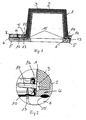
- Figur 1
- ein Formteil, welches an einer Unterdecke befestigt ist, in der Montagesolllage im Schnitt gesehen;
- Figur 2
- eine Ausschnittsvergrößerung II der
Figur 1 ; - Figur 3
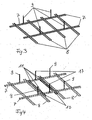
- ein Teil einer Unterdeckenkonstruktion in Ansicht;
- Figur 4
- eine ergänzte Unterdeckenkonstruktion in der Ansicht gemäß
Figur 3 gesehen; - Figur 5
- die Unterdeckenkonstruktion mit eingesetztem Formteil in der Ansicht wie
Figur 3 gesehen. - In der Zeichnung ist ein quaderförmiges Formteil mit sich zur vorderseitigen Öffnung erweiternden Wandteilen gezeigt. Die vorderseitige Öffnung dient zur Installation von elektrotechnischen Bauteilen, beispielsweise einer großflächigen Leuchte. Das Formteil besteht aus einem formstabilen Gehäuse 1 aus Stahlblech. Innenseitig weist das Gehäuse 1 ein eine Dämmschicht bildendes Material 2 auf, welches unter Einwirkung von Hitze und/oder Feuer aufbläht oder eine Karbonsperrschicht bildet. Zwischen der Dämmschicht 2 und der Gehäusewandung des Gehäuses 1 ist eine Schicht 3 aus Mineralwolle oder Steinwolle angeordnet. Vorzugsweise ist die Schicht aus Mineralwolle 3 durch plattenartige Teile aus Mineralwolle gebildet, die in Form eines Bodenteils und in Form von Wandteilen in das Gehäuse eingebracht sind und die durch das die Dämmschicht bildende Material 2 lagegesichert gehalten sind. Im Bereich des Mündungsrandes des Gehäuses 1 ist ein von Mineralwolle 3 freier Rand vorgesehen, der durch das die Dämmschicht bildende Material 2 gefüllt ist, welches in diesem Bereich unmittelbar mit dem Rand des Gehäuses 1 fest verbunden, beispielsweise verklebt ist. Dieser Bereich ist mit 4 bezeichnet. Ein solches Formteil ist in eine Unterdecke für Brandschutzzwecke eingebaut. Die Unterdecke besteht aus einem vorzugsweise zweilagig ausgebildeten Plattenelement 5, 6 aus feuer- und hitzebeständigem Material, beispielsweise Gipskartonplatten. Dieses Plattenelement 5, 6 ist an einer Tragkonstruktion gehalten, die in
Figur 3 bis 5 veranschaulicht ist. Es sind dort zueinander kreuzend verlegte erste Metalltragprofile 7 und zweite Metalltragprofile 8 vorgesehen, die in den Kreuzungspunkten miteinander verbunden sind. An diesen Metalltragprofilen, insbesondere an den Tragprofilen 8, sind die Bestandteile des Plattenelementes 5, 6 befestigt. Vorzugsweise die Tragprofile 7 sind mittels bandartiger oder ankerartiger Befestigungsteile 9 an einer Gebäudedecke oder dergleichen befestigt. Das Plattenelement 5, 6 weist eine Öffnung auf, die von dem Formteil (1, 2, 3) überdeckt ist. Dieses stützt sich rückseitig des Plattenelementes 5, 6 an diesem ab. Dabei ist rückseitig des Plattenelementes neben der Öffnung und neben den Rändern des Formteiles, welches die Öffnung überdeckt, die Anordnung von zwei parallelen dritten Metalltragprofilen 10 vorgesehen, die mit den zu diesen kreuzend verlaufenden ersten Metalltragprofilen 7 im Kreuzungsbereich bei 11 fest verbunden sind. Die dritten Tragprofile 10 sind mittels Befestigungsmitteln an dem Plattenelement 5, 6 befestigt. Im Ausführungsbeispiel dienen als Befestigungsmittel 12, 13 Blechschrauben. Der Mündungsrand des das Formteil bildenden Gehäuses 1 ist ebenfalls mittels Befestigungsmitteln 14 an einem jeweils benachbarten Schenkel eines dritten Metalltragprofils 10 befestigt. Auch hierbei sind die Befestigungsmittel 14 Blechschrauben. Diese Blechschrauben können von außen eingebracht werden, wie inFigur 1 rechts ersichtlich, oder von innen, wie inFigur 1 links ersichtlich, wobei gegebenenfalls ein Platzhalter im Bereich der Schichten 2, 3 vorgesehen ist, um das Befestigungsmittel nach Entfernen des Platzhalters dort positionieren zu können. - Zwischen dem im Bereich des Mündungsrandes des Gehäuses 1 vorgesehenen die Dämmschicht bildenden Material (4) und dem diesen untergreifenden Bereich des Plattenelementes 6 ist eine umlaufende Raupe 15 aus Brandschutzkitt aufgebracht.
- Zur Positionierung des Gehäuses 1 sind an den Seitenwänden des Gehäuses 1 noch zusätzliche Haltewinkel 16 befestigt, beispielsweise angepunktet oder angeschraubt, welche in der Montagesollposition über Schenkel oder Stege der dritten Metalltragprofile 10 greifen, wie insbesondere aus
Figur 2 undFigur 5 ersichtlich ist. Zusätzlich sind an den ersten Metalltragprofilen 7 bandartige oder ankerartige Befestigungsteile 17 angeordnet, und zwar im neben der Wandung des Gehäuses 1 befindlichen Bereich der ersten Metalltragprofile 7, wobei auch diese Befestigungsteile 17 an der Gebäudedecke oder dergleichen befestigt sind. Bei der Herstellung der Unterdecke werden zunächst die ersten Träger 7 mittels Befestigungselementen 9 an der Decke befestigt und nachfolgend die Metalltragprofile 8 an den Kreuzungspunkten mit den Metalltragprofilen 7 verbunden. Es kann dann die Deckenverkleidung in Form der Deckenplatten 5, 6 aufgebracht werden, wobei im Bereich, in dem das Formteil einzusetzen ist, eine entsprechende Öffnung in dem Plattenelement freigelegt wird. Anschließend oder auch vorher können die dritten Metalltragprofile 10 zwischen zwei Metalltragprofilen 8 angeordnet und in den Kreuzungspunkten mit den Metalltragprofilen 7 verbunden werden, wobei zusätzliche Deckenbefestigungselemente 17 in dem Bereich der Metalltragprofile 7 befestigt werden, die dem zu befestigenden Formteil benachbart sind. Der Arbeitsablauf ist inFigur 3 und 4 veranschaulicht. Nachfolgend kann dann das Formteil in Form des Gehäuses 1 mit den Haltewinkeln 16 auf die dritten Metalltragprofile 10 aufgehängt werden, wie inFigur 5 veranschaulicht ist. Nachfolgend erfolgt die Befestigung des Formteils (1) mittels Befestigungsmitteln 14 an den Metalltragprofilen 10, wobei die Metalltragprofile 10 zusätzlich durch die Befestigungsmittel 12, 13 mit den Plattenelementen 5, 6 verschraubt sind. Bevor das Formteil aufgesetzt wird, wird die Raupe aus Brandschutzkitt 15 aufgebracht, so dass der Bereich 4 des die Dämmschicht bildenden Materials 2 mit der Oberseite des Plattenelementes 6 verbunden, insbesondere verklebt ist. - Nach der Installation ist es möglich, in den offenen Raum des Formteiles 1 von unten her eine großformatige Leuchte oder dergleichen unterzubringen. Entsprechende Anschlussleitungen können durch Lochungen des Formteils geführt werden, die in der Zeichnung nicht besonders dargestellt sind.
Claims (9)
- Formteil, insbesondere kastenförmiges oder topfförmiges Formteil, für Brandschutzzwecke mit einer vorderseitigen Öffnung zur Anordnung von Installationsteilen oder elektrotechnischen Bauteilen, insbesondere einer Leuchte, wobei das Formteil aus einem formstabilen Gehäuse (1) aus nichtbrennbarem Material, insbesondere Metallblech, das innenseitig ein eine Dämmschicht bildendes Material (2) aufweist, welches unter Einwirkung von Hitze und/oder Feuer aufbläht und/oder eine Karbonsperrschicht bildet, dadurch gekennzeichnet, dass zwischen der Dämmschicht (2) und der Gehäusewandung eine Schicht (3) aus Mineralwolle, insbesondere Steinwolle, angeordnet ist.
- Formteil nach Anspruch 1 als ein mit einem Bodenteil und einem Wandteil bestehendes Gehäuse (1), dadurch gekennzeichnet, dass die Schicht (3) aus Mineralwolle durch plattenartige Teile aus Mineralwolle gebildet ist, die in Form eines Bodenteils und in Form von Wandteilen in das Gehäuse (1) eingebracht sind und durch das die Dämmschicht bildende Material (2) lagegesichert gehalten sind.
- Formteil nach Anspruch 1 oder 2, dadurch gekennzeichnet, dass das Gehäuse (1) einen Mündungsrand aufweist und im Bereich des Mündungsrandes des Gehäuses (1) ein von Mineralwolle (3) freier Rand vorgesehen ist, der durch das die Dämmschicht bildende Material (2) gefüllt ist, welches unmittelbar mit dem Rand des Gehäuses (1) verbunden, insbesondere verklebt, ist.
- Unterdecke für Brandschutzzwecke, bestehend aus einem einlagig oder vorzugsweise mehrlagig ausgebildeten Plattenelement (5, 6) aus feuer- und hitzebeständigem Material, insbesondere Gipskartonplatten, einer das Plattenelement (5, 6) haltenden Tragkonstruktion mit kreuzend verlegten ersten und zweiten Metalltragprofilen (7, 8), an denen die Bestandteile des Plattenelementes (5, 6) befestigt sind und die mittels bandartiger oder ankerartiger Befestigungsteile (9) an einer Gebäudedecke oder dergleichen Tragteilen befestigt sind, wobei das Plattenelement (5, 6) mindestens eine Öffnung aufweist, die von einem Formteil nach einem der Ansprüche 1 bis 3 überdeckt ist, welches sich rückseitig des Plattenelementes (5, 6) an diesem abstützt, wobei rückseitig des Plattenelementes (5, 6) neben der Öffnung und neben den Rändern des Formteils, welches die Öffnung überdeckt, zwei zueinander parallele dritte Metalltragprofile (10) angeordnet sind, die mit zu diesen kreuzend verlaufenden ersten Metalltragprofilen (7) oder (8) verbunden sind, oder mindestens ein drittes Metalltragprofil (10) angeordnet ist, das mit einem ersten oder zweiten Metalltragprofil (7,8) verbunden ist, und mit Abstand zu einem ersten oder zweiten Metallprofil (7,8) parallel zu diesem ausgerichtet ist, wobei die dritten Tragprofile (10) oder die die Öffnung seitlich umgebenden Profile, nämlich ein drittes Tragprofil (10) und ein dazu parallel verlaufendes erstes oder zweites Metallprofil (7,8) zusätzlich mittels Befestigungsmitteln (12, 13) an dem Plattenelement (5, 6) befestigt sind und der Mündungsrand des das Formteil bildenden Gehäuses (1) mittels Befestigungsmitteln (14) an einem jeweils benachbarten Schenkel eines ersten, zweiten oder dritten Metalltragprofiles (7,8,10) befestigt ist.
- Unterdecke nach Anspruch 4, dadurch gekennzeichnet, dass zwischen dem im Bereich (4) des Mündungsrandes des Gehäuses (1) vorgesehenen, die Dämmschicht bildenden Material (2) und dem diese untergreifenden Bereich des Plattenelementes (5, 6) eine umlaufende Raupe (15) aus Brandschutzkitt aufgebracht ist.
- Unterdecke nach Anspruch 4 oder 5, dadurch gekennzeichnet, dass an den Seitenwänden des Gehäuses (1) Haltewinkel (16) befestigt sind, die über Schenkel oder Stege der dritten Metalltragprofile (10) greifen.
- Unterdecke nach einem der Ansprüche 4 bis 6, dadurch gekennzeichnet, dass an den ersten oder zweiten Metalltragsprofilen (7,8) bandartige oder ankerartige Befestigungselemente(17) angeordnet sind, und zwar im neben der Wandung des Gehäuses (1) befindlichen Bereich der ersten Metalltragprofile (7), die an der Gebäudedecke oder dergleichen Tragteilen befestigt sind.
- Unterdecke nach einem der Ansprüche 4 bis 7, dadurch gekennzeichnet, dass die Unterkante des Gehäuses (1) mit der Anlagefläche der ersten, zweiten und/oder dritten Metalltragprofile (7,8,10) an dem Plattenelement (5, 6) fluchtet.
- Unterdecke nach einem der Ansprüche 4 bis 8, dadurch gekennzeichnet, dass als Befestigungsmittel (14, 12, 13) Schrauben, insbesondere Blechschrauben, angeordnet sind.
Applications Claiming Priority (2)
| Application Number | Priority Date | Filing Date | Title |
|---|---|---|---|
| DE102004007453.4A DE102004007453B4 (de) | 2004-02-13 | 2004-02-13 | Formteil |
| DE102004007453 | 2004-02-13 |
Publications (3)
| Publication Number | Publication Date |
|---|---|
| EP1564339A2 EP1564339A2 (de) | 2005-08-17 |
| EP1564339A3 EP1564339A3 (de) | 2009-04-15 |
| EP1564339B1 true EP1564339B1 (de) | 2012-09-12 |
Family
ID=34684069
Family Applications (1)
| Application Number | Title | Priority Date | Filing Date |
|---|---|---|---|
| EP20040009626 Expired - Lifetime EP1564339B1 (de) | 2004-02-13 | 2004-04-23 | Feuerfestes Formteil zur Anordnung von Installationsteilen oder elektrotechnischen Bauteilen |
Country Status (2)
| Country | Link |
|---|---|
| EP (1) | EP1564339B1 (de) |
| DE (1) | DE102004007453B4 (de) |
Families Citing this family (6)
| Publication number | Priority date | Publication date | Assignee | Title |
|---|---|---|---|---|
| DE202006015399U1 (de) * | 2006-10-06 | 2008-02-14 | Viessmann Kältetechnik AG | Vorgefertigtes Wandpaneel |
| EP2527555B1 (de) | 2011-05-24 | 2016-03-30 | Metalicht B.V. | Paneel für ein abgehängtes Deckensystem |
| CN103374991A (zh) * | 2013-07-25 | 2013-10-30 | 苏州金螳螂建筑装饰股份有限公司 | 造型石膏板吊顶 |
| DE202014105845U1 (de) * | 2014-12-04 | 2016-03-07 | Kaiser Gmbh & Co Kg | Hohldecke mit Brandschutzgehäuse sowie Brandschutzgehäuse |
| DE102018101461A1 (de) * | 2018-01-23 | 2019-07-25 | Matthias Trunk | Brandschutzkoffer |
| CN115042912B (zh) * | 2022-07-15 | 2023-09-26 | 靖江亚泰船用物资有限公司 | 一种船舶上建b15级复合岩棉板的耐火安装结构 |
Family Cites Families (6)
| Publication number | Priority date | Publication date | Assignee | Title |
|---|---|---|---|---|
| US4210070A (en) * | 1978-03-06 | 1980-07-01 | Dayus Barry R | Ceiling fixture with thermal protection |
| DE3622109A1 (de) * | 1986-07-02 | 1988-01-07 | Promat Gmbh | Leuchte fuer brandgefaehrdete raeume |
| DE9318416U1 (de) * | 1993-12-02 | 1994-03-17 | Adelmann-Lichtsysteme Gesellschaft für Licht mbH, 80799 München | Unterdecke für Brandschutzzwecke |
| US6105334A (en) * | 1997-09-16 | 2000-08-22 | Logic Construction Systems, L.L.C. | Fire resistant lighting enclosure |
| GB2345125B (en) * | 1998-12-23 | 2002-05-01 | Tenmat Ltd | Intumescent downlighter cover and method of manufacturing same |
| DE10223904A1 (de) * | 2002-05-29 | 2003-12-11 | Kaiser Gmbh & Co Kg | Unterdecke für Brandschutzzwecke |
-
2004
- 2004-02-13 DE DE102004007453.4A patent/DE102004007453B4/de not_active Expired - Lifetime
- 2004-04-23 EP EP20040009626 patent/EP1564339B1/de not_active Expired - Lifetime
Also Published As
| Publication number | Publication date |
|---|---|
| DE102004007453B4 (de) | 2015-12-03 |
| EP1564339A2 (de) | 2005-08-17 |
| EP1564339A3 (de) | 2009-04-15 |
| DE102004007453A1 (de) | 2005-09-15 |
Similar Documents
| Publication | Publication Date | Title |
|---|---|---|
| DE69428366T2 (de) | Gleitschienenvorrichtung | |
| DE3631993C2 (de) | Feuerabweisende Abdeckung | |
| DE102004007453B4 (de) | Formteil | |
| DE2611033C2 (de) | Feuerbeständige leichte Trennwand für Räume von Gebäuden | |
| EP1367191B1 (de) | Unterdecke, Wand- oder Bodenplatte für Brandschutzzwecke | |
| DE19714625C2 (de) | Holztafelbaustruktur | |
| DE2352444C3 (de) | Zweischalige feuerhemmende Trennwand, insbesondere für den Innenausbau von Schiffen | |
| DE2315213C3 (de) | Vorhangwand und Verfahren zum Anbringen derselben | |
| DE202004002362U1 (de) | Formteil | |
| EP1491702B1 (de) | Revisionsabdeckung | |
| DE3514267C2 (de) | Unterdecke für Gebäuderäume, insbesondere Flure | |
| DE10125349B4 (de) | Holzwandtafel | |
| DE102007027807A1 (de) | Brandschutztrennwandsystem | |
| EP1319790B1 (de) | Fenster- und Türanker | |
| EP4502443B1 (de) | Brandabschottung für leitungen in gebäuden | |
| AT525568B1 (de) | Raumzelle | |
| DE29908680U1 (de) | Deckenaufbau aus Deckenelementen | |
| DE19754179C1 (de) | Schiene zum Anschließen einer Platte an eine mit einem Putz zu versehende und zur Platte senkrecht stehende Wand sowie Wandverkleidung für einen Raum mit derartiger Schiene | |
| DE102004050442B4 (de) | Gehäuse, insbesondere Instrumentenschutzhaus für elektrische Instrumente und Analysegeräte | |
| AT14059U1 (de) | Wandanschluss für ein Brandschutzdeckensystem | |
| AT413721B (de) | Formkörper zur vorbereitung von installationen | |
| AT500659A1 (de) | Brandausbreitungshemmende(r) wand bzw. wandabschnitt auf basis von gipskarton-wandplatten | |
| DE102014208933A1 (de) | Beschlag zur Verbindung eines Kehlbalkens mit einem Dach-Sparren | |
| DE8511738U1 (de) | Unterdeckenbauelement | |
| EP1643050A2 (de) | Brandschutzdecke für Fluchtwege in Gebäuden |
Legal Events
| Date | Code | Title | Description |
|---|---|---|---|
| PUAI | Public reference made under article 153(3) epc to a published international application that has entered the european phase |
Free format text: ORIGINAL CODE: 0009012 |
|
| AK | Designated contracting states |
Kind code of ref document: A2 Designated state(s): AT BE BG CH CY CZ DE DK EE ES FI FR GB GR HU IE IT LI LU MC NL PL PT RO SE SI SK TR |
|
| AX | Request for extension of the european patent |
Extension state: AL HR LT LV MK |
|
| PUAL | Search report despatched |
Free format text: ORIGINAL CODE: 0009013 |
|
| AK | Designated contracting states |
Kind code of ref document: A3 Designated state(s): AT BE BG CH CY CZ DE DK EE ES FI FR GB GR HU IE IT LI LU MC NL PL PT RO SE SI SK TR |
|
| AX | Request for extension of the european patent |
Extension state: AL HR LT LV MK |
|
| RIC1 | Information provided on ipc code assigned before grant |
Ipc: E04B 9/00 20060101ALI20090310BHEP Ipc: F21V 25/12 20060101ALI20090310BHEP Ipc: E04B 1/94 20060101AFI20050610BHEP Ipc: F21V 15/01 20060101ALI20090310BHEP |
|
| 17P | Request for examination filed |
Effective date: 20090430 |
|
| 17Q | First examination report despatched |
Effective date: 20090706 |
|
| AKX | Designation fees paid |
Designated state(s): DE |
|
| REG | Reference to a national code |
Ref country code: DE Ref legal event code: R079 Ref document number: 502004013739 Country of ref document: DE Free format text: PREVIOUS MAIN CLASS: E04B0001940000 Ipc: F21V0025000000 |
|
| GRAP | Despatch of communication of intention to grant a patent |
Free format text: ORIGINAL CODE: EPIDOSNIGR1 |
|
| GRAJ | Information related to disapproval of communication of intention to grant by the applicant or resumption of examination proceedings by the epo deleted |
Free format text: ORIGINAL CODE: EPIDOSDIGR1 |
|
| RIC1 | Information provided on ipc code assigned before grant |
Ipc: E04B 9/00 20060101ALI20120511BHEP Ipc: F21V 25/12 20060101ALI20120511BHEP Ipc: F21V 25/00 20060101AFI20120511BHEP Ipc: F21V 15/01 20060101ALI20120511BHEP Ipc: E04B 1/94 20060101ALI20120511BHEP |
|
| GRAP | Despatch of communication of intention to grant a patent |
Free format text: ORIGINAL CODE: EPIDOSNIGR1 |
|
| GRAS | Grant fee paid |
Free format text: ORIGINAL CODE: EPIDOSNIGR3 |
|
| GRAA | (expected) grant |
Free format text: ORIGINAL CODE: 0009210 |
|
| AK | Designated contracting states |
Kind code of ref document: B1 Designated state(s): DE |
|
| REG | Reference to a national code |
Ref country code: DE Ref legal event code: R081 Ref document number: 502004013739 Country of ref document: DE Owner name: KAISER GMBH & CO. KG, DE Free format text: FORMER OWNER: KAISER GMBH & CO. KOMMANDITGESELLSCHAFT, 58579 SCHALKSMUEHLE, DE |
|
| REG | Reference to a national code |
Ref country code: DE Ref legal event code: R096 Ref document number: 502004013739 Country of ref document: DE Effective date: 20121108 |
|
| PLBE | No opposition filed within time limit |
Free format text: ORIGINAL CODE: 0009261 |
|
| STAA | Information on the status of an ep patent application or granted ep patent |
Free format text: STATUS: NO OPPOSITION FILED WITHIN TIME LIMIT |
|
| 26N | No opposition filed |
Effective date: 20130613 |
|
| REG | Reference to a national code |
Ref country code: DE Ref legal event code: R097 Ref document number: 502004013739 Country of ref document: DE Effective date: 20130613 |
|
| PGFP | Annual fee paid to national office [announced via postgrant information from national office to epo] |
Ref country code: DE Payment date: 20230630 Year of fee payment: 20 |
|
| REG | Reference to a national code |
Ref country code: DE Ref legal event code: R071 Ref document number: 502004013739 Country of ref document: DE |