EP1548904B1 - Dünnschicht aus Siliziumnitrid für optisches Bauelement und Herstellungsverfahren derselben - Google Patents
Dünnschicht aus Siliziumnitrid für optisches Bauelement und Herstellungsverfahren derselben Download PDFInfo
- Publication number
- EP1548904B1 EP1548904B1 EP04018719A EP04018719A EP1548904B1 EP 1548904 B1 EP1548904 B1 EP 1548904B1 EP 04018719 A EP04018719 A EP 04018719A EP 04018719 A EP04018719 A EP 04018719A EP 1548904 B1 EP1548904 B1 EP 1548904B1
- Authority
- EP
- European Patent Office
- Prior art keywords
- silicon nitride
- thin film
- rare earth
- earth elements
- amorphous silicon
- Prior art date
- Legal status (The legal status is an assumption and is not a legal conclusion. Google has not performed a legal analysis and makes no representation as to the accuracy of the status listed.)
- Expired - Lifetime
Links
Images
Classifications
-
- H—ELECTRICITY
- H01—ELECTRIC ELEMENTS
- H01S—DEVICES USING THE PROCESS OF LIGHT AMPLIFICATION BY STIMULATED EMISSION OF RADIATION [LASER] TO AMPLIFY OR GENERATE LIGHT; DEVICES USING STIMULATED EMISSION OF ELECTROMAGNETIC RADIATION IN WAVE RANGES OTHER THAN OPTICAL
- H01S3/00—Lasers, i.e. devices using stimulated emission of electromagnetic radiation in the infrared, visible or ultraviolet wave range
- H01S3/05—Construction or shape of optical resonators; Accommodation of active medium therein; Shape of active medium
- H01S3/06—Construction or shape of active medium
- H01S3/063—Waveguide lasers, i.e. whereby the dimensions of the waveguide are of the order of the light wavelength
- H01S3/0632—Thin film lasers in which light propagates in the plane of the thin film
-
- H—ELECTRICITY
- H10—SEMICONDUCTOR DEVICES; ELECTRIC SOLID-STATE DEVICES NOT OTHERWISE PROVIDED FOR
- H10D—INORGANIC ELECTRIC SEMICONDUCTOR DEVICES
- H10D62/00—Semiconductor bodies, or regions thereof, of devices having potential barriers
- H10D62/10—Shapes, relative sizes or dispositions of the regions of the semiconductor bodies; Shapes of the semiconductor bodies
-
- B—PERFORMING OPERATIONS; TRANSPORTING
- B82—NANOTECHNOLOGY
- B82Y—SPECIFIC USES OR APPLICATIONS OF NANOSTRUCTURES; MEASUREMENT OR ANALYSIS OF NANOSTRUCTURES; MANUFACTURE OR TREATMENT OF NANOSTRUCTURES
- B82Y20/00—Nanooptics, e.g. quantum optics or photonic crystals
-
- H—ELECTRICITY
- H10—SEMICONDUCTOR DEVICES; ELECTRIC SOLID-STATE DEVICES NOT OTHERWISE PROVIDED FOR
- H10D—INORGANIC ELECTRIC SEMICONDUCTOR DEVICES
- H10D62/00—Semiconductor bodies, or regions thereof, of devices having potential barriers
- H10D62/80—Semiconductor bodies, or regions thereof, of devices having potential barriers characterised by the materials
- H10D62/81—Semiconductor bodies, or regions thereof, of devices having potential barriers characterised by the materials of structures exhibiting quantum-confinement effects, e.g. single quantum wells; of structures having periodic or quasi-periodic potential variation
- H10D62/815—Semiconductor bodies, or regions thereof, of devices having potential barriers characterised by the materials of structures exhibiting quantum-confinement effects, e.g. single quantum wells; of structures having periodic or quasi-periodic potential variation of structures having periodic or quasi-periodic potential variation, e.g. superlattices or multiple quantum wells [MQW]
-
- B—PERFORMING OPERATIONS; TRANSPORTING
- B82—NANOTECHNOLOGY
- B82Y—SPECIFIC USES OR APPLICATIONS OF NANOSTRUCTURES; MEASUREMENT OR ANALYSIS OF NANOSTRUCTURES; MANUFACTURE OR TREATMENT OF NANOSTRUCTURES
- B82Y10/00—Nanotechnology for information processing, storage or transmission, e.g. quantum computing or single electron logic
-
- H—ELECTRICITY
- H01—ELECTRIC ELEMENTS
- H01S—DEVICES USING THE PROCESS OF LIGHT AMPLIFICATION BY STIMULATED EMISSION OF RADIATION [LASER] TO AMPLIFY OR GENERATE LIGHT; DEVICES USING STIMULATED EMISSION OF ELECTROMAGNETIC RADIATION IN WAVE RANGES OTHER THAN OPTICAL
- H01S3/00—Lasers, i.e. devices using stimulated emission of electromagnetic radiation in the infrared, visible or ultraviolet wave range
- H01S3/14—Lasers, i.e. devices using stimulated emission of electromagnetic radiation in the infrared, visible or ultraviolet wave range characterised by the material used as the active medium
- H01S3/16—Solid materials
-
- H—ELECTRICITY
- H01—ELECTRIC ELEMENTS
- H01S—DEVICES USING THE PROCESS OF LIGHT AMPLIFICATION BY STIMULATED EMISSION OF RADIATION [LASER] TO AMPLIFY OR GENERATE LIGHT; DEVICES USING STIMULATED EMISSION OF ELECTROMAGNETIC RADIATION IN WAVE RANGES OTHER THAN OPTICAL
- H01S3/00—Lasers, i.e. devices using stimulated emission of electromagnetic radiation in the infrared, visible or ultraviolet wave range
- H01S3/14—Lasers, i.e. devices using stimulated emission of electromagnetic radiation in the infrared, visible or ultraviolet wave range characterised by the material used as the active medium
- H01S3/16—Solid materials
- H01S3/1601—Solid materials characterised by an active (lasing) ion
- H01S3/1603—Solid materials characterised by an active (lasing) ion rare earth
-
- H—ELECTRICITY
- H01—ELECTRIC ELEMENTS
- H01S—DEVICES USING THE PROCESS OF LIGHT AMPLIFICATION BY STIMULATED EMISSION OF RADIATION [LASER] TO AMPLIFY OR GENERATE LIGHT; DEVICES USING STIMULATED EMISSION OF ELECTROMAGNETIC RADIATION IN WAVE RANGES OTHER THAN OPTICAL
- H01S3/00—Lasers, i.e. devices using stimulated emission of electromagnetic radiation in the infrared, visible or ultraviolet wave range
- H01S3/14—Lasers, i.e. devices using stimulated emission of electromagnetic radiation in the infrared, visible or ultraviolet wave range characterised by the material used as the active medium
- H01S3/16—Solid materials
- H01S3/163—Solid materials characterised by a crystal matrix
-
- H—ELECTRICITY
- H01—ELECTRIC ELEMENTS
- H01S—DEVICES USING THE PROCESS OF LIGHT AMPLIFICATION BY STIMULATED EMISSION OF RADIATION [LASER] TO AMPLIFY OR GENERATE LIGHT; DEVICES USING STIMULATED EMISSION OF ELECTROMAGNETIC RADIATION IN WAVE RANGES OTHER THAN OPTICAL
- H01S3/00—Lasers, i.e. devices using stimulated emission of electromagnetic radiation in the infrared, visible or ultraviolet wave range
- H01S3/14—Lasers, i.e. devices using stimulated emission of electromagnetic radiation in the infrared, visible or ultraviolet wave range characterised by the material used as the active medium
- H01S3/16—Solid materials
- H01S3/1685—Ceramics
-
- H—ELECTRICITY
- H01—ELECTRIC ELEMENTS
- H01S—DEVICES USING THE PROCESS OF LIGHT AMPLIFICATION BY STIMULATED EMISSION OF RADIATION [LASER] TO AMPLIFY OR GENERATE LIGHT; DEVICES USING STIMULATED EMISSION OF ELECTROMAGNETIC RADIATION IN WAVE RANGES OTHER THAN OPTICAL
- H01S3/00—Lasers, i.e. devices using stimulated emission of electromagnetic radiation in the infrared, visible or ultraviolet wave range
- H01S3/14—Lasers, i.e. devices using stimulated emission of electromagnetic radiation in the infrared, visible or ultraviolet wave range characterised by the material used as the active medium
- H01S3/16—Solid materials
- H01S3/1691—Solid materials characterised by additives / sensitisers / promoters as further dopants
Definitions
- the present invention relates to a silicon nitride thin film and method for fabricating the same, and more particularly, to a silicon nitride thin film and method for fabricating the same, which comprises rare earth elements and amorphous silicon quantum dots in the silicon nitride thin film to enhance excitation efficiency of the rare earth element, so that it may be effectively applied to an optical device.
- silica based thin films doped with rare earth elements are widely used to fabricate a waveguide optical amplifier.
- an excitation cross sectional area of the rare earth element is very small to a degree of about 1x10 -21 cm -2 , so that the optical efficiency is significantly low in this case.
- excitation efficiency of the rare earth elements becomes higher, because the recombination efficiency of electrons and holes within the nano-dots is very high to thereby effectively excite rare earth elements. For this reason, development and researches for the silicon oxide thin film in which crystalline silicon nano-dots are comprised are conducted in recent years.
- US Patent Application US 2002/0153522 discloses a silicon nitride thin film for an optical device comprising amorphous silicon quantum dots.
- the optical efficiency is not sufficient for application of a light-emitting device so as to have high efficiency, and an oxide based thin film is used, so that an operating voltage of the device is still high.
- the present invention is directed to a silicon nitride thin film wherein rare earth elements are excited by amorphous silicon quantum dots, which are superior to crystalline silicon nano-dots in terms of luminous efficiency to thereby enhance luminous efficiency of rare earth elements.
- the present invention is also directed to a method for fabricating silicon nitride thin film having a relatively small energy gap instead of silicon oxide to enhance operation characteristics of a device when the device is fabricated.
- One aspect of the present invention is to provide a silicon nitride thin film for an optical device, wherein amorphous silicon quantum dots and rare earth elements are comprised in the silicon nitride thin film, and rare earth elements are excited by the amorphous silicon quantum dots to emit light.
- Another aspect of the present invention is to provide a method for fabricating a silicon nitride thin film for an optical device, which comprises steps of growing silicon nitride in which amorphous silicon quantum dots are comprised, and doping rare earth elements within the silicon nitride thin film, wherein rare earth elements are excited by the amorphous silicon quantum dots to emit light.
- Still another aspect of the present invention is to provide a method for fabricating a silicon nitride thin film for an optical device, which comprises doping rare earth elements within the silicon nitride thin film while growing silicon nitride in which amorphous silicon quantum dots are comprised, wherein rare earth elements are excited by the amorphous silicon quantum dots to emit light.
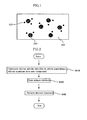
- FIG. 1 is a conceptual view of a silicon nitride thin film for an optical device in accordance with an embodiment of the present invention.
- FIG. 2 is a flow chart for explaining a method for fabricating a silicon nitride thin film for an optical device in accordance with an embodiment of the present invention.
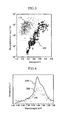
- FIG. 3 is a graph for showing luminous efficiencies of crystalline silicon nano-dots and amorphous silicon quantum dots.
- FIG. 4 is a graph for showing luminous characteristic of erbium doped within a silicon nitride thin film for an optical device, and luminous characteristic of erbium doped within crystalline silicon in accordance with an embodiment of the present invention.
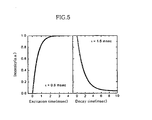
- FIG. 5 is a graph for showing decay and rise phenomena of photoluminescence measured to compute an excitation cross sectional area of erbium in the silicon nitride thin film for the optical device of FIG. 4 in terms of time.
- FIG. 1 is a conceptual view of a silicon nitride thin film for an optical device in accordance with an embodiment of the present invention.
- the silicon nitride thin film for the optical device 500 comprises amorphous silicon quantum dots 510 and rare earth elements 520, which are included, and the rare earth elements 520 are excited by the amorphous silicon quantum dots 510 to emit light.
- One of main features of the present invention is that the silicon nitride thin film having a relatively small energy gap is employed and the amorphous silicon quantum dots 510 and the rare earth elements 520 are included together in the thin film, so that recombination efficiency of electrons and holes within the quantum dots is very high to effectively excite the rare earth elements.
- excitation of the rare earth elements 520 may permit luminous efficiency to be enhanced by means of electron energy delivered from the amorphous silicon quantum dots 510.
- the rare earth elements 520 include erbium, europium, gadolinium, terbium, ytterbium, and so forth.
- the size of the amorphous silicon quantum dot 510 is preferably 1 to 5nanometer.
- FIG. 2 is a flow chart for explaining a method for fabricating a silicon nitride thin film for an optical device in accordance with an embodiment of the present invention.
- a step of forming the silicon nitride thin film in which amorphous silicon quantum dots are included is performed (S410).
- nitride gas having a degree of purity of 99.9999% and 5% silane gas diluted in nitrogen gas may be employed to grow the amorphous silicon quantum dots on a silicon substrate by a plasma enhanced chemical vapor deposition (PECVD) method.
- PECVD plasma enhanced chemical vapor deposition
- the size of the quantum dots fabricated by the above-mentioned method is about 5nm or less.
- the flow of the silane gas is 8 to 10sccm
- growth pressure is 0.5Torr
- plasma power is constantly kept at 6 to 8W.
- Raw materials are deposited under conditions of 300 °C in growth temperature, 500 to 800sccm in flow of the nitride gas, and 2.4 to 3.2nm/min in growth speed.
- erbium is doped within the silicon nitride thin film by ion implanting method (S420).
- the amount of erbium is adjusted to be in a range of 1x10 19 to 1x10 21 cm -3 , and ion-implanting energy is adjusted to be 40 to 130KeV so as to have erbium elements doped only within the thin film, and a number of implanting steps are performed to uniformly dope erbium elements within the thin film.
- the thermal treatment on the silicon nitride thin film into which erbium is implanted may be performed (S430).
- a temperature and a time of the thermal treatment may be adjusted to be in a range of 600 °C to 1000°C, and 10 to 60min, respectively.
- best luminous efficiency of the erbium element is obtained from raw materials that have been thermally treated to meet conditions of 900°C in temperature and 30min in thermal treatment time.
- a nitride atmosphere is kept when the thermal treatment is performed, and a vacuum condition of a chamber is adjusted to be 10 -4 Torr to the most before the thermal treatment is performed so as to suppress oxygen inflow during the thermal treatment.
- rare earth elements may be doped within the silicon nitride thin film while silicon nitride in which amorphous silicon quantum dots are included is deposited by means of CVD equipment to thereby form the silicon nitride thin film for an optical device.
- the silicon nitride thin film for the optical device may be formed injecting metal organic raw materials into the CVD equipment.
- a temperature to be used is in a range of room temperature to about 500°C
- gas to be used includes gas for depositing silicon, nitride gas, or ammonia gas.
- Examples of available erbium metal organic raw materials include ERBIUM III -HEPTAFLUORO-DIMETHYL-OCTANEDIONATE (C 30 H 30 ErF 21 O 6 ), ERBIUM METHOXYETHOXIDE (C 9 H 21 ErO 6 ), ERBIUM 2-PENTANEDIONATE (C 15 H 21 ErO 6 ), ERBIUM -TETRAMETHYL-HEPTANEDIONATE (C 33 H 57 ErO 6 ), ERBIUM TRIS[BIS(TRIMETHYLSILYL)AMIDE] (C 18 H 54 ErN 3 Si 6 ), and so forth.
- FIG. 3 is a graph for showing luminous efficiencies of crystalline silicon nano-dots and amorphous silicon quantum dots.
- Numerical reference 110 indicates a recombination rate of an electron and a hole of the amorphous silicon quantum dot
- numerical reference 120 indicates a recombination rate of the crystalline silicon nano-dots. It can be seen that the recombination rate of the amorphous silicon quantum dots is about 100 to 1000 times as high as that of the crystalline silicon nano-dots. In other words, the amorphous silicon quantum dots have luminous efficiency superior to that of the crystalline silicon nano-dots.
- the silicon nitride thin film for the optical device according to the embodiment of the present invention and the crystalline thin film containing doped erbium according to the related art will be compared.
- FIG. 4 is a graph for showing luminous characteristic 210 of erbium doped within a silicon nitride thin film for an optical device, and luminous characteristic 220 of erbium doped within crystalline silicon in accordance with an embodiment of the present invention.
- the amorphous silicon quantum dots are grown within the silicon nitride and erbium among the rare earth elements is doped thereto so that the silicon nitride thin film for the optical device is fabricated in accordance with the embodiment of the present invention.
- the luminous efficiency of the silicon nitride thin film for the optical device is 10 times superior to that of the erbium doped within the crystalline silicon. This result occurs from the fact that the amorphous silicon quantum dot effectively excites the erbium so that energy delivery from the amorphous silicon quantum dots to the erbium elements is effectively made.
- FIG. 5 is a graph for showing decay and rise phenomena of photoluminescence measured to compute excitation cross sectional area of erbium in the silicon nitride thin film for optical device of FIG. 4 in terms of time.
- the rising time of the photoluminescence of erbium is about 0.6msec
- the decay time is about 1.6msec.
- 1/T on - 1/T decay ⁇ ⁇
- T on is a rising time
- T decay is a decay time
- ⁇ is an excitation cross sectional area
- ⁇ is a laser power for excitation
- the excitation cross sectional area becomes about 1x10 16 cm -2 , which means that the area increases about 100,000 times a general excitation cross sectional area.
- amorphous silicon quantum dots are used as excitation medium to thereby significantly enhance the luminous efficiency of rare earth elements, and the silicon nitride thin film having a relatively small energy gap is employed instead of silicon oxide thin film to thereby provide a margin for improving operation characteristic of the device.
- silicon nitride thin film having a relatively small energy gap is employed instead of silicon oxide thin film to thereby provide a margin for improving operation characteristic of the device.
Landscapes
- Engineering & Computer Science (AREA)
- Physics & Mathematics (AREA)
- Chemical & Material Sciences (AREA)
- Nanotechnology (AREA)
- Electromagnetism (AREA)
- Optics & Photonics (AREA)
- Crystallography & Structural Chemistry (AREA)
- Plasma & Fusion (AREA)
- Theoretical Computer Science (AREA)
- Mathematical Physics (AREA)
- Life Sciences & Earth Sciences (AREA)
- Biophysics (AREA)
- Lasers (AREA)
- Led Devices (AREA)
- Luminescent Compositions (AREA)
- Chemical Vapour Deposition (AREA)
Claims (13)
- Siliziumnitrid-Dünnfilm für eine optische Vorrichtung, der Folgendes umfasst:Quantenpunkte aus amorphem Silizium (510) und Seltene-Erden-Elemente (520), die zusammen enthalten sind,wobei die Seltene-Erden-Elemente durch die Quantenpunkte aus amorphem Silizium angeregt werden, Licht zu emittieren.
- Siliziumnitrid-Dünnfilm wie in Anspruch 1 beansprucht, bei dem die Seltene-Erden-Elemente (520) eines der Elemente Erbium, Europium, Gadolinium, Terbium und Ytterbium enthalten.
- Siliziumnitrid-Dünnfilm wie in Anspruch 1 oder 2 beansprucht, bei dem der Quantenpunkt aus amorphem Silizium (510) eine Größe von 1 bis 5 Nanometer hat.
- Verfahren zur Herstellung eines Siliziumnitrid-Dünnfilm für eine optische Vorrichtung, das die folgenden Schritte umfasst:Aufwachsen von Siliziumnitrid, in dem Quantenpunkte aus amorphem Silizium enthalten sind, undDotieren von Seltene-Erden-Elementen in den Siliziumnitrid-Dünnfilm,wobei die Seltene-Erden-Elemente durch die Quantenpunkte aus amorphem Silizium angeregt werden, Licht zu emittieren.
- Verfahren wie in Anspruch 4 beansprucht, das weiterhin den folgenden Schritt umfasst:Durchführen einer 30 Minuten bis 60 Minuten langen Wärmebehandlung bei einer Temperatur von 600 °C bis 1000 °C, nachdem die Seltene-Erden-Elemente dotiert sind.
- Verfahren wie in Anspruch 4 oder 5 beansprucht, bei dem der Quantenpunkt aus amorphem Silizium eine Größe von 1 bis 5 Nanometer hat.
- Verfahren wie in einem der Ansprüche 4 bis 6 beansprucht, bei dem das Siliziumnitrid, in dem die Quantenpunkte aus amorphem Silizium enthalten sind, aufgewachsen wird durch eines der Verfahren plasmaangereicherte chemische Dampfabscheidung (PECVD) und Sputtern unter Bedingungen von 0,1 bis 10 Torr Abscheidungsdruck, 0,2 bis 1 W/cm2 Plasmaleistung und einer Aufwachstemperatur von Raumtemperatur bis 400 °C.
- Verfahren wie in einem der Ansprüche 4 bis 7 beansprucht, bei dem die Seltene-Erden-Elemente mittels eines lonenimplantationsverfahrens dotiert werden.
- Verfahren zur Herstellung eines Siliziumnitrid-Dünnfilm für eine optische Vorrichtung, das den folgenden Schritt umfasst:Dotieren von Seltene-Erden-Elementen in den Siliziumnitrid-Dünnfilm während Aufwachsen von Siliziumnitrid, in dem Quantenpunkte aus amorphem Silizium enthalten sind,wobei die Seltene-Erden-Elemente durch die Quantenpunkte aus amorphem Silizium angeregt werden, Licht zu emittieren.
- Verfahren wie in Anspruch 9 beansprucht, bei dem die Seltene-Erden-Elemente unter Verwendung von metallorganischen Rohmaterialien in den Siliziumnitrid-Dünnfilm dotiert werden.
- Verfahren wie in Anspruch 9 oder 10 beansprucht, das weiterhin den folgenden Schritt umfasst:Durchführen einer 30 Minuten bis 60 Minuten langen Wärmebehandlung bei einer Temperatur von 600 °C bis 1000 °C, nachdem die Seltene-Erden-Elemente dotiert sind.
- Verfahren wie in einem der Ansprüche 9 bis 11 beansprucht, bei dem der Quantenpunkt aus amorphem Silizium eine Größe von 1 bis 5 Nanometer hat.
- Verfahren wie in einem der Ansprüche 9 bis 12 beansprucht, bei dem das Siliziumnitrid, in dem die Quantenpunkte aus amorphem Silizium verteilt sind, aufgewachsen wird durch eines der Verfahren plasmaangereicherte chemische Dampfabscheidung (PECVD) und Sputtern unter Bedingungen von 0,1 bis 10 Torr Abscheidungsdruck, 0,2 bis 1 W/cm2 Plasmaleistung und einer Aufwachstemperatur von Raumtemperatur bis 400 °C.
Applications Claiming Priority (2)
| Application Number | Priority Date | Filing Date | Title |
|---|---|---|---|
| KR2003097049 | 2003-12-26 | ||
| KR1020030097049A KR100615430B1 (ko) | 2003-12-26 | 2003-12-26 | 광소자용 실리콘 질화물 박막 및 그 제조방법 |
Publications (2)
| Publication Number | Publication Date |
|---|---|
| EP1548904A1 EP1548904A1 (de) | 2005-06-29 |
| EP1548904B1 true EP1548904B1 (de) | 2006-10-18 |
Family
ID=34545910
Family Applications (1)
| Application Number | Title | Priority Date | Filing Date |
|---|---|---|---|
| EP04018719A Expired - Lifetime EP1548904B1 (de) | 2003-12-26 | 2004-08-06 | Dünnschicht aus Siliziumnitrid für optisches Bauelement und Herstellungsverfahren derselben |
Country Status (2)
| Country | Link |
|---|---|
| EP (1) | EP1548904B1 (de) |
| KR (1) | KR100615430B1 (de) |
Families Citing this family (5)
| Publication number | Priority date | Publication date | Assignee | Title |
|---|---|---|---|---|
| KR101924080B1 (ko) * | 2009-11-11 | 2018-11-30 | 삼성 리서치 아메리카 인코포레이티드 | 양자점을 포함하는 디바이스 |
| KR101217707B1 (ko) * | 2010-11-23 | 2013-01-02 | 한국조폐공사 | 양자점 및 희토류 착물이 결합된 나노복합체 및 그의 제조 방법 |
| CN102832267B (zh) * | 2012-09-06 | 2014-11-26 | 西安隆基硅材料股份有限公司 | 含有上转换发光量子点的晶体硅及其制备方法 |
| KR101532946B1 (ko) * | 2013-07-15 | 2015-07-02 | 이준섭 | 이득물질이 구비된 이미지 센서 구조체 |
| CN103509363B (zh) * | 2013-09-10 | 2016-01-13 | 宁波市德明夜光科技有限公司 | 一种夜光塑料注塑件的制备方法 |
Family Cites Families (2)
| Publication number | Priority date | Publication date | Assignee | Title |
|---|---|---|---|---|
| KR100384892B1 (ko) * | 2000-12-01 | 2003-05-22 | 한국전자통신연구원 | 에르븀이 도핑된 실리콘나노점의 형성 방법 |
| US6544870B2 (en) * | 2001-04-18 | 2003-04-08 | Kwangju Institute Of Science And Technology | Silicon nitride film comprising amorphous silicon quantum dots embedded therein, its fabrication method and light-emitting device using the same |
-
2003
- 2003-12-26 KR KR1020030097049A patent/KR100615430B1/ko not_active Expired - Fee Related
-
2004
- 2004-08-06 EP EP04018719A patent/EP1548904B1/de not_active Expired - Lifetime
Also Published As
| Publication number | Publication date |
|---|---|
| EP1548904A1 (de) | 2005-06-29 |
| KR100615430B1 (ko) | 2006-08-25 |
| KR20050065889A (ko) | 2005-06-30 |
Similar Documents
| Publication | Publication Date | Title |
|---|---|---|
| US6544870B2 (en) | Silicon nitride film comprising amorphous silicon quantum dots embedded therein, its fabrication method and light-emitting device using the same | |
| JP4601734B2 (ja) | シリコン−ゲルマニウムゲートを持つトランジスタを得るための方法 | |
| US4481229A (en) | Method for growing silicon-including film by employing plasma deposition | |
| JP2004507107A (ja) | ホウ素拡散障壁層および半導体デバイス製造におけるその使用 | |
| JP2005039172A (ja) | 亜鉛酸化物半導体の製造方法 | |
| JP2011503893A (ja) | アモルファスiii−v族半導体材料及びその製造方法 | |
| JPWO2009118784A1 (ja) | 発光素子およびその製造方法 | |
| US20010042502A1 (en) | Method of self-assembly silicon quantum dots | |
| JP3439994B2 (ja) | 低抵抗n型および低抵抗p型単結晶AlN薄膜の合成法 | |
| EP1548904A1 (de) | Dünnschicht aus Siliziumnitrid für optisches Bauelement und Herstellungsverfahren derselben | |
| JP3322179B2 (ja) | 窒化ガリウム系半導体発光素子 | |
| US7531068B2 (en) | Method for manufacturing silicon nanodot film for light emission in nano-size photonic devices | |
| JP2000164921A (ja) | 半導体発光材料及びその製造方法並びにこれを用いた発光素子 | |
| JPH11310776A (ja) | 発光材料及びその製造方法並びにこれを用いた発光素子 | |
| WO2006038567A1 (ja) | p型Ga2O3膜の製造方法およびpn接合型Ga2O3膜の製造方法 | |
| KR100334344B1 (ko) | 비정질 실리콘 양자점 미세구조를 포함하는 실리콘 질화물 박막 및 이를 이용한 발광소자 | |
| JP3464618B2 (ja) | 高輝度発光半導体材料の作製方法 | |
| CN108417481B (zh) | 氮化硅介电层的处理方法、薄膜晶体管和显示装置 | |
| JP2005045222A (ja) | シリコンの低温窒化 | |
| JP2004006867A (ja) | 半導体層の形成方法 | |
| KR100496266B1 (ko) | 발광 가능한 실리콘 나노점 박막 제조 장치 및 방법 | |
| JPH05206520A (ja) | p型II−VI族化合物半導体の製造方法 | |
| JPH07291790A (ja) | 分子線エピタキシー装置 | |
| KR19990031783A (ko) | Ecr-pecvd 장치 및 박막 증착방법 | |
| JPH05226696A (ja) | 発光を回復するための多孔質シリコンの製造方法 |
Legal Events
| Date | Code | Title | Description |
|---|---|---|---|
| PUAI | Public reference made under article 153(3) epc to a published international application that has entered the european phase |
Free format text: ORIGINAL CODE: 0009012 |
|
| AK | Designated contracting states |
Kind code of ref document: A1 Designated state(s): AT BE BG CH CY CZ DE DK EE ES FI FR GB GR HU IE IT LI LU MC NL PL PT RO SE SI SK TR |
|
| AX | Request for extension of the european patent |
Extension state: AL HR LT LV MK |
|
| 17P | Request for examination filed |
Effective date: 20051124 |
|
| GRAP | Despatch of communication of intention to grant a patent |
Free format text: ORIGINAL CODE: EPIDOSNIGR1 |
|
| RIN1 | Information on inventor provided before grant (corrected) |
Inventor name: SUNG, GUN YONG HANBIT APT. 135-1301 Inventor name: PARK, NAE MAN Inventor name: KIM, TAE YOUB |
|
| AKX | Designation fees paid |
Designated state(s): FR IT |
|
| REG | Reference to a national code |
Ref country code: DE Ref legal event code: 8566 |
|
| GRAS | Grant fee paid |
Free format text: ORIGINAL CODE: EPIDOSNIGR3 |
|
| GRAA | (expected) grant |
Free format text: ORIGINAL CODE: 0009210 |
|
| AK | Designated contracting states |
Kind code of ref document: B1 Designated state(s): FR IT |
|
| PG25 | Lapsed in a contracting state [announced via postgrant information from national office to epo] |
Ref country code: IT Free format text: LAPSE BECAUSE OF FAILURE TO SUBMIT A TRANSLATION OF THE DESCRIPTION OR TO PAY THE FEE WITHIN THE PRESCRIBED TIME-LIMIT;WARNING: LAPSES OF ITALIAN PATENTS WITH EFFECTIVE DATE BEFORE 2007 MAY HAVE OCCURRED AT ANY TIME BEFORE 2007. THE CORRECT EFFECTIVE DATE MAY BE DIFFERENT FROM THE ONE RECORDED. Effective date: 20061018 |
|
| RIN1 | Information on inventor provided before grant (corrected) |
Inventor name: PARK, NAE MAN Inventor name: KIM, TAE YOUB Inventor name: SUNG, GUN YONG, HANBIT APT. 135-1301 |
|
| ET | Fr: translation filed | ||
| PLBE | No opposition filed within time limit |
Free format text: ORIGINAL CODE: 0009261 |
|
| STAA | Information on the status of an ep patent application or granted ep patent |
Free format text: STATUS: NO OPPOSITION FILED WITHIN TIME LIMIT |
|
| 26N | No opposition filed |
Effective date: 20070719 |
|
| PGRI | Patent reinstated in contracting state [announced from national office to epo] |
Ref country code: IT Effective date: 20081001 |
|
| PGFP | Annual fee paid to national office [announced via postgrant information from national office to epo] |
Ref country code: FR Payment date: 20090814 Year of fee payment: 6 |
|
| PGFP | Annual fee paid to national office [announced via postgrant information from national office to epo] |
Ref country code: IT Payment date: 20090814 Year of fee payment: 6 |
|
| REG | Reference to a national code |
Ref country code: FR Ref legal event code: ST Effective date: 20110502 |
|
| PG25 | Lapsed in a contracting state [announced via postgrant information from national office to epo] |
Ref country code: IT Free format text: LAPSE BECAUSE OF NON-PAYMENT OF DUE FEES Effective date: 20100806 |
|
| PG25 | Lapsed in a contracting state [announced via postgrant information from national office to epo] |
Ref country code: FR Free format text: LAPSE BECAUSE OF NON-PAYMENT OF DUE FEES Effective date: 20100831 |