EP1543014B1 - Herstellung von metallkomplexen - Google Patents
Herstellung von metallkomplexen Download PDFInfo
- Publication number
- EP1543014B1 EP1543014B1 EP03795605A EP03795605A EP1543014B1 EP 1543014 B1 EP1543014 B1 EP 1543014B1 EP 03795605 A EP03795605 A EP 03795605A EP 03795605 A EP03795605 A EP 03795605A EP 1543014 B1 EP1543014 B1 EP 1543014B1
- Authority
- EP
- European Patent Office
- Prior art keywords
- group
- process according
- hydrocarbyl
- metal
- hydrogen
- Prior art date
- Legal status (The legal status is an assumption and is not a legal conclusion. Google has not performed a legal analysis and makes no representation as to the accuracy of the status listed.)
- Expired - Lifetime
Links
- 229910052751 metal Inorganic materials 0.000 title claims description 40
- 239000002184 metal Substances 0.000 title claims description 40
- 238000002360 preparation method Methods 0.000 title claims description 5
- 238000000034 method Methods 0.000 claims description 35
- -1 silyl- Chemical group 0.000 claims description 26
- 125000001183 hydrocarbyl group Chemical group 0.000 claims description 25
- 229910052739 hydrogen Inorganic materials 0.000 claims description 20
- 239000001257 hydrogen Substances 0.000 claims description 19
- 239000002879 Lewis base Substances 0.000 claims description 18
- 150000001408 amides Chemical class 0.000 claims description 18
- 239000003446 ligand Substances 0.000 claims description 15
- 125000003118 aryl group Chemical group 0.000 claims description 11
- 239000002841 Lewis acid Substances 0.000 claims description 10
- 125000004429 atom Chemical group 0.000 claims description 10
- 150000007527 lewis bases Chemical class 0.000 claims description 10
- UFHFLCQGNIYNRP-UHFFFAOYSA-N Hydrogen Chemical compound [H][H] UFHFLCQGNIYNRP-UHFFFAOYSA-N 0.000 claims description 9
- 239000003795 chemical substances by application Substances 0.000 claims description 9
- 150000007517 lewis acids Chemical class 0.000 claims description 9
- 150000002431 hydrogen Chemical class 0.000 claims description 8
- 230000007935 neutral effect Effects 0.000 claims description 7
- 125000000217 alkyl group Chemical group 0.000 claims description 6
- 229910052782 aluminium Inorganic materials 0.000 claims description 5
- NFHFRUOZVGFOOS-UHFFFAOYSA-N palladium;triphenylphosphane Chemical compound [Pd].C1=CC=CC=C1P(C=1C=CC=CC=1)C1=CC=CC=C1.C1=CC=CC=C1P(C=1C=CC=CC=1)C1=CC=CC=C1.C1=CC=CC=C1P(C=1C=CC=CC=1)C1=CC=CC=C1.C1=CC=CC=C1P(C=1C=CC=CC=1)C1=CC=CC=C1 NFHFRUOZVGFOOS-UHFFFAOYSA-N 0.000 claims description 5
- JLTRXTDYQLMHGR-UHFFFAOYSA-N trimethylaluminium Chemical group C[Al](C)C JLTRXTDYQLMHGR-UHFFFAOYSA-N 0.000 claims description 5
- 150000001639 boron compounds Chemical class 0.000 claims description 4
- 125000000753 cycloalkyl group Chemical group 0.000 claims description 4
- 229910052735 hafnium Inorganic materials 0.000 claims description 4
- VBJZVLUMGGDVMO-UHFFFAOYSA-N hafnium atom Chemical group [Hf] VBJZVLUMGGDVMO-UHFFFAOYSA-N 0.000 claims description 4
- 125000004404 heteroalkyl group Chemical group 0.000 claims description 4
- 125000004178 (C1-C4) alkyl group Chemical group 0.000 claims description 3
- 150000004820 halides Chemical class 0.000 claims description 3
- 125000001072 heteroaryl group Chemical group 0.000 claims description 3
- 125000004105 2-pyridyl group Chemical group N1=C([*])C([H])=C([H])C([H])=C1[H] 0.000 claims description 2
- BLRPTPMANUNPDV-UHFFFAOYSA-N Silane Chemical group [SiH4] BLRPTPMANUNPDV-UHFFFAOYSA-N 0.000 claims description 2
- 125000000129 anionic group Chemical group 0.000 claims description 2
- 125000005843 halogen group Chemical group 0.000 claims description 2
- 125000000592 heterocycloalkyl group Chemical group 0.000 claims description 2
- 150000004678 hydrides Chemical class 0.000 claims description 2
- 125000004435 hydrogen atom Chemical group [H]* 0.000 claims description 2
- 125000001449 isopropyl group Chemical group [H]C([H])([H])C([H])(*)C([H])([H])[H] 0.000 claims description 2
- 125000002496 methyl group Chemical group [H]C([H])([H])* 0.000 claims description 2
- 125000004469 siloxy group Chemical group [SiH3]O* 0.000 claims description 2
- 125000003808 silyl group Chemical group [H][Si]([H])([H])[*] 0.000 claims description 2
- 150000001805 chlorine compounds Chemical group 0.000 claims 1
- 125000000325 methylidene group Chemical group [H]C([H])=* 0.000 claims 1
- YXFVVABEGXRONW-UHFFFAOYSA-N Toluene Chemical compound CC1=CC=CC=C1 YXFVVABEGXRONW-UHFFFAOYSA-N 0.000 description 9
- 238000006243 chemical reaction Methods 0.000 description 9
- 150000001875 compounds Chemical class 0.000 description 9
- VLKZOEOYAKHREP-UHFFFAOYSA-N n-Hexane Chemical compound CCCCCC VLKZOEOYAKHREP-UHFFFAOYSA-N 0.000 description 9
- 150000001412 amines Chemical class 0.000 description 6
- 239000000203 mixture Substances 0.000 description 6
- 150000001336 alkenes Chemical class 0.000 description 5
- 150000001768 cations Chemical class 0.000 description 5
- 230000008030 elimination Effects 0.000 description 5
- 238000003379 elimination reaction Methods 0.000 description 5
- 238000006116 polymerization reaction Methods 0.000 description 5
- VYPSYNLAJGMNEJ-UHFFFAOYSA-N Silicium dioxide Chemical compound O=[Si]=O VYPSYNLAJGMNEJ-UHFFFAOYSA-N 0.000 description 4
- 125000003368 amide group Chemical group 0.000 description 4
- 239000000178 monomer Substances 0.000 description 4
- 0 *c1c(*)c(*)nc(*N*)c1* Chemical compound *c1c(*)c(*)nc(*N*)c1* 0.000 description 3
- 230000003213 activating effect Effects 0.000 description 3
- 239000003054 catalyst Substances 0.000 description 3
- 150000004696 coordination complex Chemical class 0.000 description 3
- ZYLGGWPMIDHSEZ-UHFFFAOYSA-N dimethylazanide;hafnium(4+) Chemical class [Hf+4].C[N-]C.C[N-]C.C[N-]C.C[N-]C ZYLGGWPMIDHSEZ-UHFFFAOYSA-N 0.000 description 3
- 125000001624 naphthyl group Chemical group 0.000 description 3
- 230000000737 periodic effect Effects 0.000 description 3
- 239000000243 solution Substances 0.000 description 3
- LIKMAJRDDDTEIG-UHFFFAOYSA-N 1-hexene Chemical compound CCCCC=C LIKMAJRDDDTEIG-UHFFFAOYSA-N 0.000 description 2
- KWKAKUADMBZCLK-UHFFFAOYSA-N 1-octene Chemical compound CCCCCCC=C KWKAKUADMBZCLK-UHFFFAOYSA-N 0.000 description 2
- YNQLUTRBYVCPMQ-UHFFFAOYSA-N Ethylbenzene Chemical compound CCC1=CC=CC=C1 YNQLUTRBYVCPMQ-UHFFFAOYSA-N 0.000 description 2
- OFBQJSOFQDEBGM-UHFFFAOYSA-N Pentane Chemical compound CCCCC OFBQJSOFQDEBGM-UHFFFAOYSA-N 0.000 description 2
- 238000005804 alkylation reaction Methods 0.000 description 2
- 150000001450 anions Chemical class 0.000 description 2
- 238000001914 filtration Methods 0.000 description 2
- JRZJOMJEPLMPRA-UHFFFAOYSA-N olefin Natural products CCCCCCCC=C JRZJOMJEPLMPRA-UHFFFAOYSA-N 0.000 description 2
- 239000000047 product Substances 0.000 description 2
- 239000000377 silicon dioxide Substances 0.000 description 2
- 239000007787 solid Substances 0.000 description 2
- 125000003837 (C1-C20) alkyl group Chemical group 0.000 description 1
- NMXLXQGHBSPIDR-UHFFFAOYSA-N 2-(2-methylpropyl)oxaluminane Chemical compound CC(C)C[Al]1CCCCO1 NMXLXQGHBSPIDR-UHFFFAOYSA-N 0.000 description 1
- AQZWEFBJYQSQEH-UHFFFAOYSA-N 2-methyloxaluminane Chemical compound C[Al]1CCCCO1 AQZWEFBJYQSQEH-UHFFFAOYSA-N 0.000 description 1
- JGQBNAFULRKENS-UHFFFAOYSA-N 3H-pyridin-3-ylium-6-ylideneazanide Chemical group [N]C1=CC=CC=N1 JGQBNAFULRKENS-UHFFFAOYSA-N 0.000 description 1
- QGZKDVFQNNGYKY-UHFFFAOYSA-N Ammonia Chemical compound N QGZKDVFQNNGYKY-UHFFFAOYSA-N 0.000 description 1
- DVZWQGLVEOWFOU-UHFFFAOYSA-N C[Hf]C Chemical compound C[Hf]C DVZWQGLVEOWFOU-UHFFFAOYSA-N 0.000 description 1
- VEXZGXHMUGYJMC-UHFFFAOYSA-M Chloride anion Chemical compound [Cl-] VEXZGXHMUGYJMC-UHFFFAOYSA-M 0.000 description 1
- OAKJQQAXSVQMHS-UHFFFAOYSA-N Hydrazine Chemical compound NN OAKJQQAXSVQMHS-UHFFFAOYSA-N 0.000 description 1
- XYFCBTPGUUZFHI-UHFFFAOYSA-N Phosphine Chemical compound P XYFCBTPGUUZFHI-UHFFFAOYSA-N 0.000 description 1
- RTAQQCXQSZGOHL-UHFFFAOYSA-N Titanium Chemical compound [Ti] RTAQQCXQSZGOHL-UHFFFAOYSA-N 0.000 description 1
- 125000001931 aliphatic group Chemical group 0.000 description 1
- 239000002168 alkylating agent Substances 0.000 description 1
- 229940100198 alkylating agent Drugs 0.000 description 1
- 125000003277 amino group Chemical group 0.000 description 1
- 125000002178 anthracenyl group Chemical group C1(=CC=CC2=CC3=CC=CC=C3C=C12)* 0.000 description 1
- 125000006615 aromatic heterocyclic group Chemical group 0.000 description 1
- 239000003849 aromatic solvent Substances 0.000 description 1
- 230000015572 biosynthetic process Effects 0.000 description 1
- 239000006227 byproduct Substances 0.000 description 1
- 125000005626 carbonium group Chemical group 0.000 description 1
- 230000003197 catalytic effect Effects 0.000 description 1
- 239000003153 chemical reaction reagent Substances 0.000 description 1
- 230000009918 complex formation Effects 0.000 description 1
- 238000010668 complexation reaction Methods 0.000 description 1
- 150000001993 dienes Chemical class 0.000 description 1
- ZBCBWPMODOFKDW-UHFFFAOYSA-N diethanolamine Chemical compound OCCNCCO ZBCBWPMODOFKDW-UHFFFAOYSA-N 0.000 description 1
- 238000001035 drying Methods 0.000 description 1
- 238000002474 experimental method Methods 0.000 description 1
- 238000000605 extraction Methods 0.000 description 1
- 229920006158 high molecular weight polymer Polymers 0.000 description 1
- 238000004128 high performance liquid chromatography Methods 0.000 description 1
- REYJJPSVUYRZGE-UHFFFAOYSA-O hydron;octadecan-1-amine Chemical compound CCCCCCCCCCCCCCCCCC[NH3+] REYJJPSVUYRZGE-UHFFFAOYSA-O 0.000 description 1
- 150000002500 ions Chemical class 0.000 description 1
- 238000004519 manufacturing process Methods 0.000 description 1
- 125000001570 methylene group Chemical group [H]C([H])([*:1])[*:2] 0.000 description 1
- TVMXDCGIABBOFY-UHFFFAOYSA-N n-Octanol Natural products CCCCCCCC TVMXDCGIABBOFY-UHFFFAOYSA-N 0.000 description 1
- 239000012299 nitrogen atmosphere Substances 0.000 description 1
- 238000005580 one pot reaction Methods 0.000 description 1
- 230000001590 oxidative effect Effects 0.000 description 1
- 230000002085 persistent effect Effects 0.000 description 1
- 125000003367 polycyclic group Chemical group 0.000 description 1
- 238000001556 precipitation Methods 0.000 description 1
- 230000001737 promoting effect Effects 0.000 description 1
- QQONPFPTGQHPMA-UHFFFAOYSA-N propylene Natural products CC=C QQONPFPTGQHPMA-UHFFFAOYSA-N 0.000 description 1
- 125000004805 propylene group Chemical group [H]C([H])([H])C([H])([*:1])C([H])([H])[*:2] 0.000 description 1
- 125000004076 pyridyl group Chemical group 0.000 description 1
- 230000035484 reaction time Effects 0.000 description 1
- 238000012216 screening Methods 0.000 description 1
- 239000002904 solvent Substances 0.000 description 1
- 238000003756 stirring Methods 0.000 description 1
- 238000003786 synthesis reaction Methods 0.000 description 1
- OBAJXDYVZBHCGT-UHFFFAOYSA-N tris(pentafluorophenyl)borane Chemical compound FC1=C(F)C(F)=C(F)C(F)=C1B(C=1C(=C(F)C(F)=C(F)C=1F)F)C1=C(F)C(F)=C(F)C(F)=C1F OBAJXDYVZBHCGT-UHFFFAOYSA-N 0.000 description 1
- 238000013022 venting Methods 0.000 description 1
Classifications
-
- C—CHEMISTRY; METALLURGY
- C07—ORGANIC CHEMISTRY
- C07F—ACYCLIC, CARBOCYCLIC OR HETEROCYCLIC COMPOUNDS CONTAINING ELEMENTS OTHER THAN CARBON, HYDROGEN, HALOGEN, OXYGEN, NITROGEN, SULFUR, SELENIUM OR TELLURIUM
- C07F7/00—Compounds containing elements of Groups 4 or 14 of the Periodic Table
- C07F7/28—Titanium compounds
-
- C—CHEMISTRY; METALLURGY
- C07—ORGANIC CHEMISTRY
- C07F—ACYCLIC, CARBOCYCLIC OR HETEROCYCLIC COMPOUNDS CONTAINING ELEMENTS OTHER THAN CARBON, HYDROGEN, HALOGEN, OXYGEN, NITROGEN, SULFUR, SELENIUM OR TELLURIUM
- C07F7/00—Compounds containing elements of Groups 4 or 14 of the Periodic Table
Definitions
- This invention relates generally to the preparation of certain Group 4 metal complexes by means of a combination amine elimination/ alkylation process to produce metal complexes. More particularly the present invention relates to a novel process for conversion of initial Group 4 metal amides to the corresponding metal alkyl complexes.
- Group 4 metal amide derivatives and subsequent conversion to the corresponding halide or alkyl metal complexes has been previously taught in US-A-5,312,938, US-A-5,597,935, US-A-5,861,352, US-A-5,880,302, US-A-6,020,444, and US-A-6,232,256, and elsewhere.
- Group 4 metal complexes containing "spectator ligands" such as amino- substituted cyclic amine compounds were prepared through a two step amine elimination/ alkylation process.
- Suitable amide complexes for use in such process include Group 4 metal tetra(N,N-dialkylamido) compounds, especially titanium-, zirconium- or hafnium- tetrakis(N,N-dimethylamide) compounds.
- Suitable alkylating agents include trialkylaluminum compounds, especially trimethylaluminum, and alumoxanes.
- a persistent problem of the foregoing processes is the ability to produce the intermediate diamide complex in high yield and purity. Because the initial exchange step is an equilibrium process, complete conversion generally cannot be attained even after resorting to the use of elevated temperatures and/or venting or vacuum removal of amine byproducts. A process in which complexation of the metal by a ligand is facilitated, thereby resulting in the use of lower reaction temperatures, shorter reaction times, and/or characterized by higher yields, is still desired. In addition, a process in which the multiple steps of the prior art are combined in a single unified or "one-pot" process is desired as well.
- an improved process for the preparation of Group 4 metal hydrocarbyl complexes the steps of the process comprising contacting a Group 4 metal amide with a neutral source of a monovalent or divalent, Lewis base ligand group and a Lewis acid hydrocarbylating agent under conditions to form a Group 4 metal hydrocarbyl complex.
- the products are highly valuable for use as catalysts in combination with activating cocatalysts such as alumoxanes or cation forming agents in the polymerization of olefins to high molecular weight polymers.
- Suitable Group 4 metal amides for use in the present invention correspond to the formula, M(NR 2 ) m X n, wherein M is a Group 4 metal, especially hafnium; R independently in each occurrence is a C 1-20 hydrocarbyl group, a C 1-20 halohydrocarbyl group, or two R groups are joined together thereby forming a divalent derivative; X is an anionic ligand of up to 20 atoms not counting hydrogen or two X groups are joined together thereby forming a divalent derivative, preferably each X group is hydride, halide, or a hydrocarbyl-, silyl-, hydrocarbyloxy- or siloxy- group of up to 10 atoms; most preferably chloride or methyl; m is an integer from 1 to 4 and n is an integer equal to 4-m.
- Group 4 metal amides are Group 4 metal tetrakis(N,N-dihydrocarbyl)-amides, especially Group 4 metal tetrakis(N,N-dimethyl)amides, most especially hafnium tetrakis(N,N-dimethyl)amide.
- Suitable ligand sources are monovalent and divalent compounds of the formula L-H or H-L-H wherein L is a monovalent or divalent Lewis base ligand, in which case the resulting free amine corresponds to the formula NHR 2 .
- suitable sources of Lewis base ligating species include aliphatic and aromatic diamine compounds, and hydrocarbylamine substituted aromatic heterocyclic compounds.
- suitable sources of Lewis base ligating species include the difunctional Lewis base compounds disclosed in WO 02/38628, especially hydrocarbylamine substituted heteroaryl compounds of the formula R 1 HN-T-R 2 (I), wherein R 1 is selected from alkyl, cycloalkyl, heteroalkyl, cycloheteroalkyl, aryl, and inertly substituted derivatives thereof containing from 1 to 30 atoms not counting hydrogen; T is a divalent bridging group of from 1 to 20 atoms other than hydrogen, preferably a mono- or di- C 1-20 hydrocarbyl substituted methylene or silane group, and R 2 is a C 6-20 heteroaryl group, especially a pyridin-2-yl- or substituted pyridin-2-yl group.
- R 1 is selected from alkyl, cycloalkyl, heteroalkyl, cycloheteroalkyl, aryl, and inertly substituted derivatives thereof containing from 1 to 30 atom
- Preferred examples of the foregoing difunctional Lewis base compounds correspond to the formula: wherein R 1 and T are as previously defined, and R 3 , R 4 , R 5 and R 6 are hydrogen, halo, or an alkyl, cycloalkyl, heteroalkyl, heterocycloalkyl, aryl, or silyl group of up to 20 atoms not counting hydrogen, or adjacent R 3 , R 4 , R 5 or R 6 groups may be joined together thereby forming fused ring derivatives.
- R 3 , R 4 , R 5 and R 6 are as previously defined, preferably R 3 , R 4 , and R 5 are hydrogen, or C 1-4 alkyl, and R 6 is C 6-20 aryl, most preferably naphthyl;
- Q 1 , Q 2 , Q 3 , Q 4 , and Q 5 are independently each occurrence hydrogen or C 1-4 alkyl, most preferably Q 1 and Q 5 are isopropyl and Q 2 , Q 3 and Q 4 are hydrogen;
- R 7 and R 8 independently each occurrence are hydrogen or a C 1-20 alkyl or aryl group, most preferably one of R 7 and R 8 is hydrogen and the other is a C 6-20 aryl group, especially a fused polycyclic aryl group, most preferably an anthracenyl group.
- the hydrogen of the 2-position of the naphthyl group substituted at the 6-position of the pyridinyl group is subject to elimination, thereby uniquely forming metal complexes wherein the metal is covalently bonded to both the resulting internal amide group and to the 2-position of the naphthyl group, as well as stabilized by coordination to the pyridinyl nitrogen atom through the electron pair thereof.
- preferred metal complexes contain a difunctional Lewis base ligand additionally coordinated to the metal by means of an electron pair.
- the foregoing reaction is performed in the presence of a Lewis acid hydrocarbylating agent, preferably a tri(C 1-10 hydrocarbyl)aluminum compound, a tri(C 1-10 hydrocarbyl)boron compound, or a halogenated derivative thereof, more preferably, a tri(C 1-4 alkyl)aluminum compound, most preferably trimethylaluminum.
- a Lewis acid hydrocarbylating agent preferably a tri(C 1-10 hydrocarbyl)aluminum compound, a tri(C 1-10 hydrocarbyl)boron compound, or a halogenated derivative thereof, more preferably, a tri(C 1-4 alkyl)aluminum compound, most preferably trimethylaluminum.
- amide groups removed and replaced by -L or -L- ligands not only are amide groups removed and replaced by -L or -L- ligands, but additional remaining amide groups, preferably all remaining amide groups are replaced by hydrocarbyl ligands, thereby forming the desired metal hydrocarbyl complex in one process.
- a stoichiometric excess of hydrocarbylating agent preferably trimethylaluminum is used in order to both sequester amine groups eliminated by the exchange reaction, thereby promoting complex formation, and alkylate the resulting metal complex.
- the Group 4 metal amide and Lewis base compounds are employed in about stoichiometric amounts, preferably in molar ratios (based on amide compound to Lewis base compound) from 1:2 to 2:1.
- the quantity of Lewis acid compound used is preferably from 2:1 to 10:1, more preferably from 4:1 to 6:1 based on Group 4 metal amide compound.
- the resulting metal complex prepared according to the present invention is in high yield and efficiency is:
- the amide elimination and hydrocarbylation conditions used in the present process include moderate temperatures from 0 to 100 °C, especially from 25 to 75 °C, reduced, atmospheric or elevated pressures from 0 to 100 kPa, preferably atmospheric pressure, times from 1 minute to 10 days, preferably from 10 minutes to 2 hours, and use of an aliphatic or aromatic solvent, preferably toluene or ethylbenzene.
- the resulting complexes may be recovered by filtration, extraction, precipitation, or other suitable technique.
- the resulting Group 4 metal complexes are activated to form the actual catalyst composition by combination with a cocatalyst, preferably an aluminoxane, a cation forming cocatalyst, or a combination thereof and desirably employed to polymerize olefins or combinations of olefins, especially ethylene, propylene, 1-butene, 1-hexene, 1-octene; mixtures thereof; mixtures of the foregoing monomers with vinylaromatic monomers or conjugated or non-conjugated dienes; and mixtures of all of the foregoing monomers.
- the process is characterized by low temperatures and pressures, typically from 25 to 50 °C and pressures from atmospheric to 10 MPa.
- Suitable alumoxanes for use herein include polymeric or oligomeric alumoxanes, especially methylalumoxane, triisobutyl aluminum modified methylalumoxane, or isobutylalumoxane; neutral Lewis acid modified polymeric or oligomeric alumoxanes, such as the foregoing alkylalumoxanes modified by addition of a C 1-30 hydrocarbyl substituted Group 13 compound, especially a tri(hydrocarbyl)aluminum- or tri(hydrocarbyl)boron compound, or a halogenated (including perhalogenated) derivative thereof, having from 1 to 10 carbons in each hydrocarbyl or halogenated hydrocarbyl group, more especially a perfluorinated tri(aryl)boron compound or a perfluorinated tri(aryl)aluminum compound.
- the Group 4 metal complexes may also be rendered catalytically active by combination with a cation forming cocatalyst, such as those previously known in the art for use with Group 4 metal olefin polymerization complexes.
- Suitable cation forming cocatalysts for use herein include neutral Lewis acids, such as C 1-30 hydrocarbyl substituted Group 13 compounds, especially tri(hydrocarbyl)aluminum- or tri(hydrocarbyl)boron compounds and halogenated (including perhalogenated) derivatives thereof, having from I to 10 carbons in each hydrocarbyl or halogenated hydrocarbyl group, more especially perfluorinated tri(aryl)boron compounds, and most especially tris(pentafluoro-phenyl)borane; nonpolymeric, compatible, noncoordinating, ion forming compounds (including the use of such compounds under oxidizing conditions), especially the use of ammonium-, phosphonium-, oxonium-, carbon
- a metal complex was prepared according to the following reaction scheme:
- Catalytic activity was confirmed by polymerization of 450 g of propylene monomer in 500 ml hexane in a 2 L polymerization reactor at 90 °C using 1.0 ⁇ mole of catalyst and a hexane solution of methyldi(octadecylammonium) tetrakis(pentafluorophenyl)borate cocatalyst in 1:1 B:Hf molar ratio.
Landscapes
- Chemical & Material Sciences (AREA)
- Organic Chemistry (AREA)
- Transition And Organic Metals Composition Catalysts For Addition Polymerization (AREA)
- Pyridine Compounds (AREA)
Claims (16)
- Ein Verfahren zur Herstellung eines Gruppe-4-Metall-Hydrocarbyl-Komplexes, der einen einbindigen oder zweibindigen Lewis-Base-Liganden enthält, wobei das Verfahren das In-Kontakt-Bringen eines Gruppe-4-Metall-Amids mit einer neutralen Quelle einer einbindigen oder zweibindigen Lewis-Basen-Ligandengruppe und einem Lewis-Säure-Hydrocarbylierungsmittel unter Bedingungen, um den Gruppe-4-Metall-Hydrocarbyl-Komplex zu bilden.
- Ein Verfahren nach Anspruch 1, wobei das Gruppe-4-Metall-Amid der Formel M(NR2)mXn entspricht,
worin M ein Gruppe-4-Metall ist;
R unabhängig voneinander bei jedem Auftreten eine C1-20-Hydrocarbylgruppe, eine C1-20-Halogenhydrocarbylgruppe ist oder zwei R-Gruppen miteinander verknüpft sind und dabei ein zweibindiges Derivat bilden;
X ein anionischer Ligand mit bis zu 20 Atomen ist, wobei Wasserstoffatome nicht mitgezählt werden, oder zwei X-Gruppen miteinander verknüpft sind und dabei ein zweibindiges Derivat bilden;
m eine ganze Zahl von 1 bis 4 ist und
n eine ganze Zahl ist, die 4-m entspricht. - Ein Verfahren nach Anspruch 2, wobei jede X-Gruppe Hydrid, Halogenid oder eine Hydrocarbyl-, Silyl-, Hydrocarbyloxy- oder Siloxygruppe mit bis zu 10 Atomen ist.
- Ein Verfahren nach Anspruch 3, wobei jedes X Chlorid oder Methyl ist.
- Ein Verfahren nach einem der vorhergehenden Ansprüche, wobei M gleich Hafnium ist.
- Ein Verfahren nach einem der vorhergehenden Ansprüche, wobei das Gruppe-4-Metall-Amid ein Gruppe-4-Metall-Tetrakis(N,N-dihydrocarbyl)amid ist.
- Ein Verfahren nach Anspruch 6, wobei das Gruppe-4-Metall-Amid gleich Hafnium-tetrakis(N,N-dimethyl)amid ist.
- Ein Verfahren nach einem der vorhergehenden Ansprüche, wobei die neutrale Quelle einer einbindigen oder zweibindigen Lewis-Base-Ligandengruppe eine difunktionelle hydrocarbylaminsubstituierte Heteroarylkomponente der Formel:
R1HN-T-R2 (I),
ist,
worin R1 ausgewählt ist aus Alkyl, Cycloalkyl, Heteroalkyl, Cycloheteroalkyl, Aryl und inert substituierten Derivativen davon, die von 1 bis 30 Atome enthalten, wobei Wasserstoffatome nicht mitgezählt werden; T eine zweibindige verbrückende Gruppe von 1 bis 20 Atomen ist, die andere sind als Wasserstoff, und
R2 eine C6-20-Heteroarylgruppe ist. - Ein Verfahren nach Anspruch 8, wobei T eine mono- oder di- C1-20-hydrocarbylsubstituierte Methylen- oder Silangruppe ist und R2 eine Pyridin-2-yl- oder substituierte Pyridin-2-yl-Gruppe ist.
- Ein Verfahren nach Anspruch 8 oder Anspruch 9, wobei die difunktionelle Lewis-Basen-Verbindung der Formel:

worin R1 und T wie zuvor definiert sind und
R3, R4, R5 und R6 Wasserstoff, Halogen oder eine Alkyl-, Cycloalkyl-, Heteroalkyl-, Heterocycloalkyl-, Aryl- oder Silylgruppe von bis zu 20 Atomen sind, wobei Wasserstoffatome nicht mitgezählt werden, oder benachbarte R3-, R4-, R5- der R6-Gruppen miteinander verknüpft sein können und dabei anellierte Ringderivate bilden. - Ein Verfahren nach Anspruch 10, wobei die difunktionelle Lewis-Basen-Verbindung der Formel:
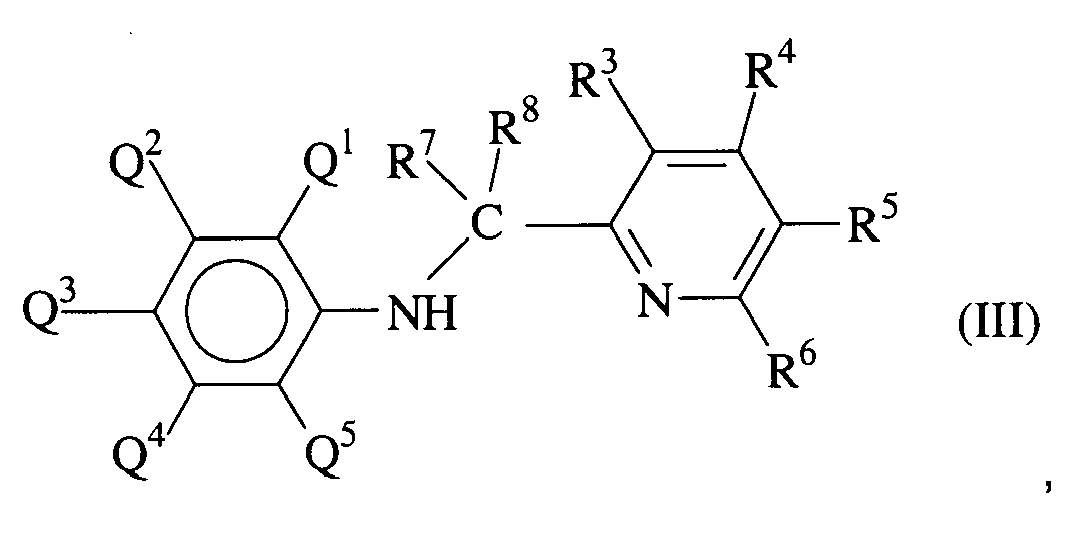
worin R3, R4 und R5 Wasserstoff oder C1-4-Alkyl sind und R6 gleich C6-20-Aryl ist;
Q1 und Q5 Isopropyl sind und Q2, Q3 und Q4 Wasserstoff sind und
eine von R7 und R8 Wasserstoff und die andere eine C6-20-Arylgruppe ist. - Ein Verfahren nach Anspruch 11, wobei die neutrale Quelle einer einbindigen oder zweibindingen Lewis-Basen-Ligandengruppe der Formel entspricht:

- Ein Verfahren nach einem der vorhergehenden Ansprüche, wobei das Lewis-Säure-Hydrocarbylierungsmittel in einem stöchiometrischen Überschuss, bezogen auf die Menge an Gruppe-4-Metall-Amid, eingesetzt wird.
- Ein Verfahren nach einem der vorhergehenden Ansprüche, wobei das Lewis-Säure-Hydrocarbylierungsmittel eine Tri(C1-10-hydrocarbyl)-aluminiumverbindung, eine Tri(C1-10-hydrocarbyl)borverbindung oder ein halogeniertes Derivat davon ist.
- Ein Verfahren nach Anspruch 14, wobei das Lewis-Säure-Hydrocarbylierungsmittel eine Tri(C1-4-alkyl)aluminiumverbindung ist.
- Ein Verfahren nach Anspruch 15, wobei das Lewis-Säure-Hydrocarbylierungsmittel Trimethylaluminium ist.
Applications Claiming Priority (3)
| Application Number | Priority Date | Filing Date | Title |
|---|---|---|---|
| US41061102P | 2002-09-12 | 2002-09-12 | |
| US410611P | 2002-09-12 | ||
| PCT/US2003/025228 WO2004024740A1 (en) | 2002-09-12 | 2003-08-13 | Preparation of metal complexes |
Publications (2)
| Publication Number | Publication Date |
|---|---|
| EP1543014A1 EP1543014A1 (de) | 2005-06-22 |
| EP1543014B1 true EP1543014B1 (de) | 2006-10-04 |
Family
ID=31994167
Family Applications (1)
| Application Number | Title | Priority Date | Filing Date |
|---|---|---|---|
| EP03795605A Expired - Lifetime EP1543014B1 (de) | 2002-09-12 | 2003-08-13 | Herstellung von metallkomplexen |
Country Status (6)
| Country | Link |
|---|---|
| US (1) | US7102006B2 (de) |
| EP (1) | EP1543014B1 (de) |
| JP (1) | JP2005539060A (de) |
| AU (1) | AU2003259792A1 (de) |
| DE (1) | DE60308885T2 (de) |
| WO (1) | WO2004024740A1 (de) |
Families Citing this family (78)
| Publication number | Priority date | Publication date | Assignee | Title |
|---|---|---|---|---|
| WO2004024739A1 (en) * | 2002-09-12 | 2004-03-25 | Dow Global Technologies Inc. | Preparation of metal amide complexes |
| US6953764B2 (en) * | 2003-05-02 | 2005-10-11 | Dow Global Technologies Inc. | High activity olefin polymerization catalyst and process |
| EP2792690B1 (de) | 2004-03-17 | 2019-05-15 | Dow Global Technologies LLC | Katalysatorzusammensetzung mit Kettenübertragungsreagenz (chain shuttling) zur Herstellung von Ethylen-Multiblock-Copolymeren |
| US8273826B2 (en) | 2006-03-15 | 2012-09-25 | Dow Global Technologies Llc | Impact modification of thermoplastics with ethylene/α-olefin interpolymers |
| MX2007011349A (es) | 2005-03-17 | 2007-10-03 | Dow Global Technologies Inc | Modificacion del impacto de termoplasticos con interpolimeros de etileno/a-olefina. |
| EP1858937B1 (de) | 2005-03-17 | 2019-09-25 | Dow Global Technologies LLC | Funktionalisierte ethylen/(alpha)-olefin-interpolymerzusammensetzungen |
| RU2007134379A (ru) | 2005-03-17 | 2009-03-20 | Дау Глобал Текнолоджиз Инк. (Us) | КОМПОЗИЦИИ ПОЛИБЛОЧНОГО ИНТЕРПОЛИМЕРА ЭТИЛЕНА/α-ОЛЕФИНА, ПОДХОДЯЩИЕ ДЛЯ ПЛЕНОК |
| EP2894176B1 (de) | 2005-03-17 | 2022-06-01 | Dow Global Technologies LLC | Katalysatorzusammensetzung mit reversiblem Kettenübertragungsreagenz für die regio-irreguläre Multiblock-Copolymer-Synthese |
| US9410009B2 (en) | 2005-03-17 | 2016-08-09 | Dow Global Technologies Llc | Catalyst composition comprising shuttling agent for tactic/ atactic multi-block copolymer formation |
| US7910658B2 (en) | 2005-03-17 | 2011-03-22 | Dow Global Technologies Llc | Compositions of ethylene/α-olefin multi-block interpolymer for elastic films and laminates |
| CA2600140A1 (en) | 2005-03-17 | 2006-09-28 | Dow Global Technologies Inc. | Catalyst composition comprising shuttling agent for tactic/ atactic multi-block copolymer formation |
| US8287949B2 (en) | 2005-07-07 | 2012-10-16 | Dow Global Technologies Inc. | Aqueous dispersions |
| KR20080055838A (ko) | 2005-09-15 | 2008-06-19 | 다우 글로벌 테크놀로지스 인크. | 다중심 셔틀링제를 통한 중합체 구성 및 분자량 분포의제어 |
| AR058449A1 (es) | 2005-09-15 | 2008-02-06 | Dow Global Technologies Inc | Copolimeros de bloque de olefina cataliticos via un agente de transferencia polimerizable |
| AR058496A1 (es) | 2005-10-26 | 2008-02-06 | Dow Global Technologies Inc | Articulos elasticos de multiples capas |
| US8785531B2 (en) | 2006-07-06 | 2014-07-22 | Dow Global Technologies Llc | Dispersions of olefin block copolymers |
| US8476326B2 (en) | 2006-09-22 | 2013-07-02 | Dow Global Technologies Llc | Fibrillated polyolefin foam |
| KR20090080955A (ko) | 2006-10-30 | 2009-07-27 | 다우 글로벌 테크놀로지스 인크. | 접착성 필름 |
| KR101421762B1 (ko) | 2006-11-01 | 2014-07-22 | 다우 글로벌 테크놀로지스 엘엘씨 | 비극성 폴리올레핀 및 폴리우레탄을 포함하는 물품 및 이것의 제조 방법 및 용도 |
| EP2084313A1 (de) | 2006-11-30 | 2009-08-05 | Dow Global Technologies Inc. | Olefinblockzusammensetzungen für schwere stretch-waren |
| WO2008067538A2 (en) | 2006-11-30 | 2008-06-05 | Dow Global Technologies Inc. | Stretch fabrics with wrinkle resistance and garment |
| MX2009006749A (es) | 2006-12-21 | 2009-08-20 | Dow Global Technologies Inc | Composiciones de poliolefina y articulos preparados a partir de las mismas, y metodos para su elaboracion. |
| KR20090108598A (ko) | 2007-01-16 | 2009-10-15 | 다우 글로벌 테크놀로지스 인크. | 올레핀 블록 조성물의 콘 염색사 |
| WO2008089220A2 (en) | 2007-01-16 | 2008-07-24 | Dow Global Technologies Inc. | Colorfast fabrics and garments of olefin block compositions |
| JP2010520366A (ja) * | 2007-03-06 | 2010-06-10 | エクソンモービル・ケミカル・パテンツ・インク | 超溶液(supersolution)の条件で製造されるポリマー |
| WO2008134186A1 (en) | 2007-04-24 | 2008-11-06 | Dow Global Technologies Inc. | THERMOFORMING, SCRATCH-RESISTANT, LOW GLOSS COMPOSITIONS COMPRISING INTERPOLYMERS OF ETHYLENE/α-OLEFINS |
| ITMI20070878A1 (it) | 2007-05-02 | 2008-11-03 | Dow Global Technologies Inc | Processo per la polimerizzazine di polimeri tattici con l'uso di catalizzatori chirali |
| ITMI20070877A1 (it) | 2007-05-02 | 2008-11-03 | Dow Global Technologies Inc | Processo per la produzione di copolimeri a blocchi multipli con l'utilizzo di solventi polari |
| CN101802151A (zh) | 2007-07-13 | 2010-08-11 | 陶氏环球技术公司 | 润滑剂组合物的粘度指数改性剂 |
| SG183028A1 (en) | 2007-07-13 | 2012-08-30 | Dow Global Technologies Inc | Ethylene/a-olefin interpolymers containing low crystallinity hard blocks |
| US8569422B2 (en) | 2007-07-13 | 2013-10-29 | Dow Global Technologies, Llc | Catalytic olefin block copolymers with controlled block sequence distribution and at least one low crystallinity hard block |
| CN101802150A (zh) | 2007-07-13 | 2010-08-11 | 陶氏环球技术公司 | 润滑剂组合物的粘度指数改性剂 |
| ES2358232T3 (es) | 2007-08-13 | 2011-05-06 | Tesa Se | Agente de separación a base de bloques múltiples de copolímeros de etileno. |
| PL2025506T3 (pl) | 2007-08-13 | 2011-03-31 | Tesa Se | Taśma klejąca z nośnikiem piankowym |
| BRPI0820608B1 (pt) | 2008-02-29 | 2019-04-16 | Dow Global Technologies Inc. | Película orientada |
| CA2727437A1 (en) | 2008-06-18 | 2009-12-23 | Dow Global Technologies Inc. | Processes to control fouling and improve compositions |
| US8674040B2 (en) * | 2008-07-25 | 2014-03-18 | Exxonmobil Chemical Patents Inc. | Pyridyldiamido transition metal complexes, production and use thereof |
| US8710163B2 (en) | 2008-07-25 | 2014-04-29 | Exxonmobil Chemical Patents Inc. | Pyridyldiamido transition metal complexes, production and use thereof |
| US7973116B2 (en) * | 2008-07-25 | 2011-07-05 | Exxonmobil Chemical Patents Inc. | Pyridyldiamido transition metal complexes, production and use thereof |
| US8394902B2 (en) | 2008-07-25 | 2013-03-12 | Exxonmobil Chemical Patents Inc. | Pyridyldiamido transition metal complexes, production and use thereof |
| CN102131837B (zh) | 2008-08-21 | 2014-10-15 | 陶氏环球技术有限责任公司 | 金属-配体配合物和催化剂 |
| US20120046373A1 (en) | 2009-02-25 | 2012-02-23 | Low Bee T | Phylon Processes of Making Foam Articles Comprising Ethylene/alpha-Olefins Block Interpolymers |
| WO2010151433A1 (en) | 2009-06-26 | 2010-12-29 | Dow Global Technologies Inc. | Process selectively polymerizing ethylene and catalyst therefor |
| WO2011014533A1 (en) | 2009-07-29 | 2011-02-03 | Dow Global Technologies Inc. | Multifunctional chain shuttling agents |
| BR112012001948B1 (pt) | 2009-07-29 | 2019-08-20 | Dow Global Technologies Llc | Agente de translado de cadeia, processo para a polimerização de pelo menos um monômero polimerizável por adição, copolímero em multi-bloco e composição de catalisador |
| US20110054122A1 (en) | 2009-08-31 | 2011-03-03 | Jerzy Klosin | Catalyst and process for polymerizing an olefin and polyolefin prepared thereby |
| US8202954B2 (en) | 2010-02-19 | 2012-06-19 | Dow Global Technologies Llc | Metal-ligand complexes and catalysts |
| WO2011102990A2 (en) | 2010-02-19 | 2011-08-25 | Dow Global Technologies Llc | Process for polymerizing an olefin monomer and catalyst therefor |
| SG187848A1 (en) | 2010-08-25 | 2013-03-28 | Dow Global Technologies Llc | Process for polymerizing a polymerizable olefin and catalyst therefor |
| US8907034B2 (en) | 2010-09-30 | 2014-12-09 | Dow Global Technologies Llc | Comb architecture olefin block copolymers |
| WO2012061706A1 (en) | 2010-11-04 | 2012-05-10 | Dow Global Technologies Llc | Double shuttling of polyolefin polymeryl chains |
| CN103890023B (zh) | 2011-10-24 | 2016-11-16 | 三菱化学株式会社 | 热塑性弹性体组合物及其制造方法 |
| US9315526B2 (en) | 2014-03-03 | 2016-04-19 | Exxonmobil Chemical Patents Inc. | Pyridyldiamido transition metal complexes, production and use thereof |
| SG11201705218XA (en) | 2014-12-23 | 2017-07-28 | Dow Global Technologies Llc | Thermoplastic Vulcanizate Including Rubber Block Interpolymer |
| JP6761418B2 (ja) | 2014-12-23 | 2020-09-23 | ダウ グローバル テクノロジーズ エルエルシー | ブロック合成物を含む熱可塑性加硫物 |
| US9598444B2 (en) * | 2015-06-30 | 2017-03-21 | Exxonmobil Chemical Patents Inc. | Transition metal complexes of tridentate dianionic CNN ligands, production and use thereof |
| JP7041621B2 (ja) | 2015-12-15 | 2022-03-24 | ダウ グローバル テクノロジーズ エルエルシー | エチレン/α-オレフィンのインターポリマーから作製された架橋発泡体 |
| CN109641990B (zh) | 2016-07-13 | 2022-08-19 | 埃克森美孚化学专利公司 | 双金属茂催化剂共聚物组合物 |
| CN109641989B (zh) | 2016-07-13 | 2022-05-03 | 埃克森美孚化学专利公司 | 双金属茂催化剂共聚物组合物 |
| WO2018013285A1 (en) | 2016-07-14 | 2018-01-18 | Exxonmobil Chemical Patents Inc. | Dual metallocene-catalyzed bimodal copolymer compositions |
| CN106317385A (zh) * | 2016-08-18 | 2017-01-11 | 天津大学 | 一种聚烯烃/聚酯嵌段共聚物及其制备方法 |
| JP7029448B2 (ja) | 2016-09-30 | 2022-03-03 | ダウ グローバル テクノロジーズ エルエルシー | チェーンシャトリングに有用な封鎖されたマルチまたはデュアルヘッド組成物、およびそれを調製するプロセス |
| EP3519474B1 (de) | 2016-09-30 | 2024-09-25 | Dow Global Technologies LLC | Verfahren zur herstellung von mehrfach- oder doppelkopfzusammensetzungen zur kettenübertragung |
| WO2018064553A1 (en) | 2016-09-30 | 2018-04-05 | Dow Global Technologies Llc | Multi- or dual-headed compositions useful for chain shuttling and process to prepare the same |
| WO2018170248A1 (en) | 2017-03-15 | 2018-09-20 | Dow Global Technologies Llc | Catalyst system for multi-block copolymer formation |
| WO2018170056A1 (en) | 2017-03-15 | 2018-09-20 | Dow Global Technologies Llc | Catalyst system for multi-block copolymer formation |
| EP3596143B1 (de) | 2017-03-15 | 2023-04-26 | Dow Global Technologies LLC | Katalysatorsystem für mehrblockcopolymerbildung |
| EP3596141B1 (de) | 2017-03-15 | 2021-07-28 | Dow Global Technologies LLC | Katalysatorsystem für mehrblockcopolymerbildung |
| SG11201908307XA (en) | 2017-03-15 | 2019-10-30 | Dow Global Technologies Llc | Catalyst system for multi-block copolymer formation |
| EP3638730B1 (de) | 2017-06-14 | 2024-05-01 | ExxonMobil Chemical Patents Inc. | Ethylencopolymermischungen für vernetzungsanwendungen |
| US11613600B2 (en) | 2017-12-29 | 2023-03-28 | Dow Global Technologies Llc | Capped dual-headed organoaluminum compositions |
| US12006423B2 (en) | 2018-08-29 | 2024-06-11 | ExxonMobil Engineering & Technology Company | Methods of making polymer compositions with enhanced elasticity by employing VTP and HMP catalyst systems in parallel processes |
| US20220073540A1 (en) | 2018-12-28 | 2022-03-10 | Dow Global Technologies Llc | Curable compositions comprising unsaturated polyolefins |
| ES3040148T3 (en) | 2018-12-28 | 2025-10-28 | Dow Global Technologies Llc | Organometallic chain transfer agents |
| SG11202107051UA (en) | 2018-12-28 | 2021-07-29 | Dow Global Technologies Llc | Telechelic polyolefins and processes for preparing the same |
| US12590174B2 (en) | 2018-12-28 | 2026-03-31 | Dow Global Technologies Llc | Curable compositions comprising telechelic polyolefins |
| CN113454091A (zh) | 2018-12-28 | 2021-09-28 | 陶氏环球技术有限责任公司 | 包括不饱和聚烯烃的可固化组合物 |
| CN122295349A (zh) | 2023-12-01 | 2026-06-26 | 埃克森美孚技术与工程公司 | 载体结合型活化剂、负载型催化剂体系及使用它们的工艺 |
Family Cites Families (8)
| Publication number | Priority date | Publication date | Assignee | Title |
|---|---|---|---|---|
| US5312938A (en) | 1990-09-20 | 1994-05-17 | The Dow Chemical Company | Homogeneous catalysts and olefin polymerization process |
| US5597935A (en) * | 1994-06-01 | 1997-01-28 | University Of Iowa Research Foundation | Synthesis of ansa-metallocene catalysts |
| IT1272939B (it) | 1995-02-01 | 1997-07-01 | Enichem Spa | Catalizzatore metallocenico supportato per la (co)polimerizzazione delle olefine |
| DE19516803A1 (de) | 1995-05-08 | 1996-11-14 | Hoechst Ag | Organometallverbindung |
| DE19546500A1 (de) | 1995-12-13 | 1997-06-19 | Hoechst Ag | Verfahren zur Herstellung eines Cycloolefincopolymeren |
| EP0933383A1 (de) | 1998-01-29 | 1999-08-04 | Union Carbide Chemicals & Plastics Technology Corporation | Katalysatorzusammensetzung für die Olefinpolymerisation |
| US6727361B2 (en) * | 2000-11-07 | 2004-04-27 | Symyx Technologies, Inc. | Phosphino substituted pyridine amine ligands |
| WO2004024739A1 (en) * | 2002-09-12 | 2004-03-25 | Dow Global Technologies Inc. | Preparation of metal amide complexes |
-
2003
- 2003-08-13 US US10/524,331 patent/US7102006B2/en not_active Expired - Fee Related
- 2003-08-13 WO PCT/US2003/025228 patent/WO2004024740A1/en not_active Ceased
- 2003-08-13 EP EP03795605A patent/EP1543014B1/de not_active Expired - Lifetime
- 2003-08-13 AU AU2003259792A patent/AU2003259792A1/en not_active Abandoned
- 2003-08-13 JP JP2004536025A patent/JP2005539060A/ja active Pending
- 2003-08-13 DE DE60308885T patent/DE60308885T2/de not_active Expired - Fee Related
Also Published As
| Publication number | Publication date |
|---|---|
| US7102006B2 (en) | 2006-09-05 |
| WO2004024740A1 (en) | 2004-03-25 |
| EP1543014A1 (de) | 2005-06-22 |
| DE60308885D1 (de) | 2006-11-16 |
| US20050222443A1 (en) | 2005-10-06 |
| JP2005539060A (ja) | 2005-12-22 |
| DE60308885T2 (de) | 2007-04-12 |
| AU2003259792A1 (en) | 2004-04-30 |
Similar Documents
| Publication | Publication Date | Title |
|---|---|---|
| US7102006B2 (en) | Preparation of metal complexes | |
| EP1539770B1 (de) | Herstellung von metallamid-komplexen | |
| EP1343795B1 (de) | Herstellung von polymerisationskatalysatoren | |
| EP3285923B1 (de) | Verbrückte bi-aromatische liganden und daraus hergestellte olefinpolymerisierungskatalysatoren | |
| WO2002081529A2 (en) | Bimetallic catalysts for olefin polymerization | |
| KR100739396B1 (ko) | 화학 개질된 지지체 및 그로부터 제조된 지지된 촉매 시스템 | |
| EP1088003B1 (de) | Metallkomplex mit einem silsesquioxan-liganden | |
| WO2003042131A1 (en) | Hydrogenation catalyst and catalysed hydrogenation process | |
| TW469272B (en) | Three coordinate fluoroaryl aluminum catalyst activator composition | |
| US6774253B1 (en) | Process for the preparation of titanium complexes | |
| KR101594682B1 (ko) | 촉매 조성물 및 알파-올레핀의 제조 방법 | |
| JP4977322B2 (ja) | オレフィン重合用の新しい触媒構造 | |
| JP2004511632A (ja) | カチオン性第3族触媒システム | |
| US20030158033A1 (en) | Monoamide based catalyst compositions for the polymerization of olefins | |
| US20040102311A1 (en) | Bridged metallocene catalyst component, method of making, polyolefin catalyst having C1, C2, or Cs symmetry, methods of making, methods of polymerizing, olefins and products made thereof | |
| KR100359027B1 (ko) | 1,3-프로필렌 디아미드 지르코늄 착물의 제조방법 | |
| US20080097056A1 (en) | Highly Soluble Ferrocenyl Compounds | |
| WO2007071319A1 (en) | Zwitterionic catalyst comprising a monoanionic bidentate imine ligand |
Legal Events
| Date | Code | Title | Description |
|---|---|---|---|
| PUAI | Public reference made under article 153(3) epc to a published international application that has entered the european phase |
Free format text: ORIGINAL CODE: 0009012 |
|
| 17P | Request for examination filed |
Effective date: 20050412 |
|
| AK | Designated contracting states |
Kind code of ref document: A1 Designated state(s): AT BE BG CH CY CZ DE DK EE ES FI FR GB GR HU IE IT LI LU MC NL PT RO SE SI SK TR |
|
| AX | Request for extension of the european patent |
Extension state: AL LT LV MK |
|
| DAX | Request for extension of the european patent (deleted) | ||
| RBV | Designated contracting states (corrected) |
Designated state(s): DE FR GB NL |
|
| GRAP | Despatch of communication of intention to grant a patent |
Free format text: ORIGINAL CODE: EPIDOSNIGR1 |
|
| GRAC | Information related to communication of intention to grant a patent modified |
Free format text: ORIGINAL CODE: EPIDOSCIGR1 |
|
| RIC1 | Information provided on ipc code assigned before grant |
Ipc: C07F 7/00 20060101AFI20060227BHEP Ipc: C07F 7/28 20060101ALI20060227BHEP |
|
| GRAS | Grant fee paid |
Free format text: ORIGINAL CODE: EPIDOSNIGR3 |
|
| GRAA | (expected) grant |
Free format text: ORIGINAL CODE: 0009210 |
|
| AK | Designated contracting states |
Kind code of ref document: B1 Designated state(s): DE FR GB NL |
|
| REG | Reference to a national code |
Ref country code: GB Ref legal event code: FG4D |
|
| REF | Corresponds to: |
Ref document number: 60308885 Country of ref document: DE Date of ref document: 20061116 Kind code of ref document: P |
|
| EN | Fr: translation not filed | ||
| PGFP | Annual fee paid to national office [announced via postgrant information from national office to epo] |
Ref country code: DE Payment date: 20070809 Year of fee payment: 5 |
|
| PLBE | No opposition filed within time limit |
Free format text: ORIGINAL CODE: 0009261 |
|
| STAA | Information on the status of an ep patent application or granted ep patent |
Free format text: STATUS: NO OPPOSITION FILED WITHIN TIME LIMIT |
|
| 26N | No opposition filed |
Effective date: 20070705 |
|
| PGFP | Annual fee paid to national office [announced via postgrant information from national office to epo] |
Ref country code: GB Payment date: 20070809 Year of fee payment: 5 |
|
| PGFP | Annual fee paid to national office [announced via postgrant information from national office to epo] |
Ref country code: NL Payment date: 20070805 Year of fee payment: 5 |
|
| PG25 | Lapsed in a contracting state [announced via postgrant information from national office to epo] |
Ref country code: FR Free format text: LAPSE BECAUSE OF FAILURE TO SUBMIT A TRANSLATION OF THE DESCRIPTION OR TO PAY THE FEE WITHIN THE PRESCRIBED TIME-LIMIT Effective date: 20070525 |
|
| PG25 | Lapsed in a contracting state [announced via postgrant information from national office to epo] |
Ref country code: FR Free format text: LAPSE BECAUSE OF FAILURE TO SUBMIT A TRANSLATION OF THE DESCRIPTION OR TO PAY THE FEE WITHIN THE PRESCRIBED TIME-LIMIT Effective date: 20061004 |
|
| GBPC | Gb: european patent ceased through non-payment of renewal fee |
Effective date: 20080813 |
|
| NLV4 | Nl: lapsed or anulled due to non-payment of the annual fee |
Effective date: 20090301 |
|
| PG25 | Lapsed in a contracting state [announced via postgrant information from national office to epo] |
Ref country code: NL Free format text: LAPSE BECAUSE OF NON-PAYMENT OF DUE FEES Effective date: 20090301 |
|
| PG25 | Lapsed in a contracting state [announced via postgrant information from national office to epo] |
Ref country code: DE Free format text: LAPSE BECAUSE OF NON-PAYMENT OF DUE FEES Effective date: 20090303 |
|
| PG25 | Lapsed in a contracting state [announced via postgrant information from national office to epo] |
Ref country code: GB Free format text: LAPSE BECAUSE OF NON-PAYMENT OF DUE FEES Effective date: 20080813 |