EP1536484A1 - Organisches halbleiterbauelement und verfahren zu seiner herstellung - Google Patents
Organisches halbleiterbauelement und verfahren zu seiner herstellung Download PDFInfo
- Publication number
- EP1536484A1 EP1536484A1 EP03741311A EP03741311A EP1536484A1 EP 1536484 A1 EP1536484 A1 EP 1536484A1 EP 03741311 A EP03741311 A EP 03741311A EP 03741311 A EP03741311 A EP 03741311A EP 1536484 A1 EP1536484 A1 EP 1536484A1
- Authority
- EP
- European Patent Office
- Prior art keywords
- organic semiconductor
- semiconductor layer
- electrode
- semiconductor device
- source electrode
- Prior art date
- Legal status (The legal status is an assumption and is not a legal conclusion. Google has not performed a legal analysis and makes no representation as to the accuracy of the status listed.)
- Withdrawn
Links
Images





Classifications
-
- H—ELECTRICITY
- H05—ELECTRIC TECHNIQUES NOT OTHERWISE PROVIDED FOR
- H05B—ELECTRIC HEATING; ELECTRIC LIGHT SOURCES NOT OTHERWISE PROVIDED FOR; CIRCUIT ARRANGEMENTS FOR ELECTRIC LIGHT SOURCES, IN GENERAL
- H05B33/00—Electroluminescent light sources
-
- H—ELECTRICITY
- H10—SEMICONDUCTOR DEVICES; ELECTRIC SOLID-STATE DEVICES NOT OTHERWISE PROVIDED FOR
- H10K—ORGANIC ELECTRIC SOLID-STATE DEVICES
- H10K10/00—Organic devices specially adapted for rectifying, amplifying, oscillating or switching; Organic capacitors or resistors having potential barriers
- H10K10/40—Organic transistors
- H10K10/46—Field-effect transistors, e.g. organic thin-film transistors [OTFT]
-
- H—ELECTRICITY
- H10—SEMICONDUCTOR DEVICES; ELECTRIC SOLID-STATE DEVICES NOT OTHERWISE PROVIDED FOR
- H10D—INORGANIC ELECTRIC SEMICONDUCTOR DEVICES
- H10D30/00—Field-effect transistors [FET]
- H10D30/80—FETs having rectifying junction gate electrodes
-
- H—ELECTRICITY
- H10—SEMICONDUCTOR DEVICES; ELECTRIC SOLID-STATE DEVICES NOT OTHERWISE PROVIDED FOR
- H10K—ORGANIC ELECTRIC SOLID-STATE DEVICES
- H10K10/00—Organic devices specially adapted for rectifying, amplifying, oscillating or switching; Organic capacitors or resistors having potential barriers
-
- H—ELECTRICITY
- H10—SEMICONDUCTOR DEVICES; ELECTRIC SOLID-STATE DEVICES NOT OTHERWISE PROVIDED FOR
- H10K—ORGANIC ELECTRIC SOLID-STATE DEVICES
- H10K10/00—Organic devices specially adapted for rectifying, amplifying, oscillating or switching; Organic capacitors or resistors having potential barriers
- H10K10/40—Organic transistors
-
- H—ELECTRICITY
- H10—SEMICONDUCTOR DEVICES; ELECTRIC SOLID-STATE DEVICES NOT OTHERWISE PROVIDED FOR
- H10K—ORGANIC ELECTRIC SOLID-STATE DEVICES
- H10K10/00—Organic devices specially adapted for rectifying, amplifying, oscillating or switching; Organic capacitors or resistors having potential barriers
- H10K10/80—Constructional details
-
- H10P10/00—
-
- H—ELECTRICITY
- H10—SEMICONDUCTOR DEVICES; ELECTRIC SOLID-STATE DEVICES NOT OTHERWISE PROVIDED FOR
- H10K—ORGANIC ELECTRIC SOLID-STATE DEVICES
- H10K85/00—Organic materials used in the body or electrodes of devices covered by this subclass
- H10K85/30—Coordination compounds
- H10K85/311—Phthalocyanine
-
- H—ELECTRICITY
- H10—SEMICONDUCTOR DEVICES; ELECTRIC SOLID-STATE DEVICES NOT OTHERWISE PROVIDED FOR
- H10K—ORGANIC ELECTRIC SOLID-STATE DEVICES
- H10K85/00—Organic materials used in the body or electrodes of devices covered by this subclass
- H10K85/30—Coordination compounds
- H10K85/321—Metal complexes comprising a group IIIA element, e.g. Tris (8-hydroxyquinoline) gallium [Gaq3]
- H10K85/324—Metal complexes comprising a group IIIA element, e.g. Tris (8-hydroxyquinoline) gallium [Gaq3] comprising aluminium, e.g. Alq3
-
- H—ELECTRICITY
- H10—SEMICONDUCTOR DEVICES; ELECTRIC SOLID-STATE DEVICES NOT OTHERWISE PROVIDED FOR
- H10K—ORGANIC ELECTRIC SOLID-STATE DEVICES
- H10K85/00—Organic materials used in the body or electrodes of devices covered by this subclass
- H10K85/60—Organic compounds having low molecular weight
- H10K85/631—Amine compounds having at least two aryl rest on at least one amine-nitrogen atom, e.g. triphenylamine
Definitions
- the present invention relates to an organic semiconductor device provided with an organic semiconductor layer constituted of an organic compound having a carrier transporting property, and a producing method therefor.
- a current can be induced between a pair of electrodes provided on such organic semiconductor layer.
- a gate electrode positioned between a source electrode and a drain electrode sandwiching an organic semiconductor layer, applies a voltage across the thickness of such organic semiconductor layer to switch a current in a direction of thickness of the organic semiconductor layer.
- An SIT as shown in Fig. 1, has a three-terminal structure in which an organic semiconductor layer 13 is sandwiched between a pair of a source electrode 11 and a drain electrode 15 and a gate electrode 14 is formed within the thickness of the organic semiconductor layer.
- a voltage is applied to the gate electrode, and a current between the source electrode and the drain electrode can be controlled by a depletion layer DpL generated in the organic semiconductor layer.
- a carrier displacement across the film thickness between the source electrode and the drain electrode is prevented by plural depletion layers DpL formed in the organic semiconductor layer around plural slat-shaped branches of the gate electrode 14 receiving for example a positive charge.
- the gate electrode has to be formed with a fine-structured mask in order to reduce the gap between the slat-shaped branches of the gate electrode, thereby preventing the carrier displacement and decreasing the leak current.
- the organic semiconductor layer has a thickness in the order of several hundred nanometers and the gate electrode formed between the source electrode and the drain electrode has a thickness of 50 to 100 nm.
- the gate electrode and the organic semiconductor layer by successive film formations in the organic transistor, the shape of the plural slat-shaped branches of the gate electrode is transferred onto the organic semiconductor layer and the drain electrode to be deposited in ensuing steps, thereby forming irregularities on the surface and inducing an increase in the leak current.
- a problem to be solved by the present invention is to provide an organic semiconductor device capable suppressing generation of a leak current between the electrodes.
- the present invention provides an organic semiconductor device comprising: a source electrode; a drain electrode; and a p-type organic semiconductor layer sandwiched between the source electrode and the drain electrode, characterized by further comprising an n-type organic semiconductor layer formed in an intermediate portion of the p-type organic semiconductor layer; and a gate electrode embedded in the n-type organic semiconductor layer.
- the present invention also provides an organic semiconductor device comprising: a source electrode; a drain electrode; and a n-type organic semiconductor layer sandwiched between the source electrode and the drain electrode, characterized by further comprising a p-type organic semiconductor layer formed in an intermediate portion of said n-type organic semiconductor layer and a gate electrode embedded in said p-type organic semiconductor layer.
- the present invention also provides an organic semiconductor device comprising: a source electrode; a drain electrode; and an organic semiconductor layer sandwiched between the source electrode and the drain electrode and having a carrier transporting property, characterized by further comprising a gate electrode constituted of at least two intermediate electrode pieces which are embedded in the organic semiconductor layer, wherein the intermediate electrode pieces are respectively provided in at least two planes separated from and parallel to the source electrode and the drain electrode, and are positioned in a direction across the layer thickness.
- the present invention also provides a method for producing an organic semiconductor device provided with an organic semiconductor layer formed between a source electrode and a drain electrode and embedding a gate electrode therein, the method characterized by comprising:
- Fig. 3 illustrates a cross section of an organic transistor of an SIT structure in an embodiment.
- the organic transistor on a source electrode formed on a substrate 10, there are laminated in succession a first p-type organic semiconductor layer 13p1, a first n-type organic semiconductor layer 13n1, a gate electrode 14, a second n-type organic semiconductor layer 13n2, a second p-type organic semiconductor layer 13p2, and a drain electrode 15.
- These organic semiconductor layers have a carrier transporting property, and the first p-type organic semiconductor layer 13p1 and the second p-type organic semiconductor layer 13p2 are formed by a p-type organic semiconductor material (positive hole transporting), while the first n-type organic semiconductor layer 13n1 and the second n-type organic semiconductor layer 13n2 are formed by an n-type organic semiconductor material (electron transporting).
- Such device includes a pnp junction, of which areas are respectively connected to a source electrode 11, a gate electrode 14 and a drain electrode 15.
- the organic transistor of the present embodiment in its entire configuration constitutes an organic semiconductor device having a p-type organic semiconductor layer sandwiched between the source electrode 11 and the drain electrode 15, and a carrier displacement is controlled by the n-type organic semiconductor layer (first n-type organic semiconductor layer 13n1 and second n-type organic semiconductor layer 13n2) positioned between the p-type organic semiconductor layers (first p-type organic semiconductor layer 13p1 and second p-type organic semiconductor layer 13p2).
- the gate electrode 14 is embedded in the n-type organic semiconductor layer.
- the gate electrode 14 is so formed, when observed from the side of the source electrode 11 or the drain electrode 15, as to cover these electrodes.
- the organic transistor of the present embodiment is produced for example by a following process.
- a source electrode 11 is formed on a substrate 10 as shown in Fig. 5.
- a source electrode 11 of indium tin oxide (ITO) or chromium (Cr) is formed with a thickness of 50 nm by a sputtering method.
- ITO indium tin oxide
- Cr chromium
- Various methods such as evaporation, sputtering or CVD can be utilized for forming not only the source electrodes but also various electrodes.
- a film of 4,4'-bis[N-(1-naphthyl)-N-phenylamino]-biphenyl (so-called a-NPD) is formed with a thickness of 25 nm by a resistance-heated evaporation as the first p-type organic semiconductor layer 13p1.
- a film of a porphyrin compound such as copper phthalocyanine (so-called CuPc) or a quinoline derivative such as tris(8-hydroxyquinoline) aluminum complex (so-called Alq3) is formed with a thickness of 25 nm by a resistance-heated evaporation as the first n-type organic semiconductor layer 13n1.
- the gate electrode 14 is formed in a flat plate shape with a thickness of 50 nm as the gate electrode 14 by a resistance-heated evaporation. Also the entire gate electrode 14 may be covered for example with an electron injection layer of a thickness of several nanometers such as of LiO 2 .
- a film of CuPc or Alq3 same as in the first n-type organic semiconductor layer is formed with a thickness of 25 nm as the second n-type organic semiconductor layer 13n2 by a resistance-heated evaporation.
- a film of a-NPD same as in the first p-type organic semiconductor layer is formed with a thickness of 25 nm as the second p-type organic semiconductor layer 13p2.
- a film of Al is formed with a thickness of 200 nm as the drain electrode 15 by a resistance-heated evaporation, thereby completing an organic transistor.
- a potential of +20 V applied to the gate electrode 14 elevates the barrier thereby turning off the transistor.
- an open state of the gate electrode 14 as shown in Fig. 13 merely leaves junctions of the organic semiconductor layers whereby the transistor is turned on to permit a current therethrough.
- the device is constituted, on a source electrode on a substrate 10 as shown in Fig. 14, of a first n-type organic semiconductor layer 13n1, a first p-type organic semiconductor layer 13p1, a gate electrode 14, a second p-type organic semiconductor layer 13p2, a second n-type organic semiconductor layer 13n2 and a drain electrode 15 laminated in succession.
- the organic transistor can also be so constructed as to include a p-type organic semiconductor layer, constituted of the first p-type organic semiconductor layer 13p1 and the second p-type organic semiconductor layer 13p2, and sandwiched in the n-type organic semiconductor layer constituted of the first and second n-type organic semiconductor layers 13n1, 13n2 which are positioned between the source electrode 11 and the drain electrode 15, and also the gate electrode 14 embedded in the first p-type organic semiconductor layer 13p1 and the second p-type organic semiconductor layer 13p2.
- a p-type organic semiconductor layer constituted of the first p-type organic semiconductor layer 13p1 and the second p-type organic semiconductor layer 13p2
- the n-type organic semiconductor layer constituted of the first and second n-type organic semiconductor layers 13n1, 13n2 which are positioned between the source electrode 11 and the drain electrode 15, and also the gate electrode 14 embedded in the first p-type organic semiconductor layer 13p1 and the second p-type organic semiconductor layer 13p2.
- the gate electrode 14 is formed as flat plate shape, but the gate electrode 14 may also be formed, as shown in Fig. 15, as plural slat-shaped branches in a comb-like or screen-like pattern. In such case, the gate electrode may be formed in any shape that can apply a voltage substantially uniformly to the contacting organic semiconductor layer.
- an electroluminescence device integral with an organic transistor can be constructed, as shown in Fig. 16, by forming the first p-type organic semiconductor layer 13p1 and the second p-type organic semiconductor layer 13p2 as positive hole transport layers and providing an organic light-emitting layer 16 of an electron transporting property between the source electrode 11 and the first p-type organic semiconductor layer 13p1. It is thus rendered possible to form plural organic EL devices, each provided with an active device formed by organic material layers including an organic light-emitting layer constituted of at least a film of an organic compound showing an electroluminescence (EL) or a light emission by a current injection, in a predetermined pattern such as a matrix on a display panel substrate.
- EL electroluminescence
- An organic EL device is formed by laminating organic material layers in succession between a pair of electrode layers which are provided on a substrate and one of which at a light emitting side is constituted of a transparent material.
- the organic light emission layer 16 may be provided between the drain electrode 15 and the second p-type organic semiconductor layer 13p2 in a configuration opposite to that shown in Fig. 16.
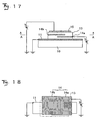
- Fig. 17 shows a cross section of an organic transistor of SIT structure of another embodiment.
- an organic semiconductor layer 13 for example of p-type, having a carrier transporting property, is so provided as to be sandwiched between a source electrode 11 and a drain electrode 15.
- the organic semiconductor layer 13 may be p-type (positive hole transporting) or n-type (electron transporting) and can be constituted of a material having at least either of the positive hole transporting property and the electron transporting property.
- a gate electrode constituted of two intermediate electrode pieces 14a, 14b each having a flat plate shape. The intermediate electrode pieces 14a, 14b are separated in mutually parallel manner between the source electrode 11 and the drain electrode 15. As shown in Fig.
- the intermediate electrode pieces 14a, 14b are mutually connected electrically as a gate electrode 14 and are so formed, when observed from the side of the source electrode 11 or the drain electrode 15, as to cover these electrodes in a mutually complementary manner.
- the intermediate electrode pieces 14a, 14b are provided in a mutually separate manner respectively in two planes between the source electrode 11 and the drain electrode 15, but intermediate electrode pieces may also be provided in three or more planes as long as they are between the source electrode 11 and the drain electrode 15.
- the organic transistor of the present embodiment is produced for example by a following process.
- a source electrode 11 is formed on a substrate 10 as shown in Fig. 19.
- a source electrode 11 of indium tin oxide (ITO) or chromium (Cr) is formed with a thickness of 50 nm by a sputtering method.
- ITO indium tin oxide
- Cr chromium
- Various methods such as evaporation, sputtering or CVD can be utilized for forming not only the source electrodes but also various electrodes.
- a film of 4,4'-bis[N-(1-naphthyl)-N-phenylamino]-biphenyl (so-called a-NPD) is formed with a thickness of 50 nm by a resistance-heated evaporation as the first organic semiconductor layer 13a.
- Al is formed in a flat plate shape with a thickness of 50 nm by a resistance-heated evaporation as the first intermediate electrode piece 14a utilizing a mask, so as to cover a part of the source electrode 11 across the first organic semiconductor layer 13a.
- a film of a-NPD same as in the first organic semiconductor layer is formed with a thickness of about 50 nm as the second organic semiconductor layer 13b.
- the entire substrate 10 is heated equal to or higher than a glass transition point of the organic semiconductor layer but equal to or less than the melting point thereof. More specifically, heating is executed at a temperature by 10 - 50° C than the glass transition temperature (96° C) of a-NPD, for example at 130° C for 10 minutes to embed the first intermediate electrode piece 14a in the second organic semiconductor layer 13b, thereby planarizing the surface thereof.
- the second organic semiconductor layer 13b is softened, and, by gravity and surface tension, fuses with the first organic semiconductor layer 13a.
- the heating process may be executed in the air, but, for the purpose of avoiding material deterioration or contamination, it is preferably executed in a vacuum chamber or in a nitrogen-replaced chamber.
- a softening temperature is about 150°C for an organic material with a glass transition temperature of 96°C, and a heating time required for softening is about 5 minutes.
- the entire substrate is heated by a heater in a reduced-pressure chamber or a vacuum chamber, and for example a halide lamp may be employed as heating means.
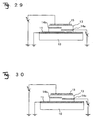
- Al is formed in a flat plate shape with a thickness of 50 nm by a resistance-heated evaporation as the second intermediate electrode piece 14b utilizing a mask, so as to cover another part of the source electrode 11 across the second organic semiconductor layer 13b.
- the second intermediate electrode piece 14b and the first intermediate electrode piece 14a are so formed as to cover the source electrode 11 in a mutually complementary form.
- the first intermediate electrode piece 14a and the second intermediate electrode piece 14b may be so formed, as shown in Fig. 24 as to have overlapping portions DP mutually separated across the second organic semiconductor layer 13b.
- the second intermediate electrode piece 14b is so formed as to be electrically connected with the first intermediate electrode piece 14a thereby realizing a same potential in the gate electrode 14.
- the distance between the first intermediate electrode piece 14a and the second intermediate electrode piece 14b can be made smaller than the gap between the slat-shaped branches of a prior gate electrode formed utilizing a mask in a single plane, and such pieces can be formed in a close relationship separated by the thickness of a film, with a high precision in the distance of the electrode pieces.
- a film of a-NPD same as in the first organic semiconductor layer is formed with a thickness of about 50 nm as the third organic semiconductor layer 13c.
- the entire substrate 10 is heated equal to or higher than a glass transition point of the organic semiconductor layer but equal to or less than the melting point thereof in the same manner as explained before, thereby embedding the second intermediate electrode piece 14b in the third organic semiconductor layer 13c and planarizing the surface.
- a film of Al is formed with a thickness of 200 nm as the drain electrode 15 by a resistance-heated evaporation.
- the heat treatment after the formation of the organic semiconductor layer planarizes the organic semiconductor layer thereby providing an organic transistor having uniform organic semiconductor layers without surface irregularities.
- the first, second and third organic semiconductor layers 13a, 13b, 13c are formed by a-NPD which is a p-type material, but an n-type material may also be employed.
- the organic semiconductor layer may be formed by a material having at least either of the electron transporting property and the positive hole transporting property.
- the intermediate electrode pieces 14a, 14b are formed in a flat plate shape, but it is also possible to form the intermediate electrode pieces 14a, 14b of the gate electrode 14, positioned in two planes between the source electrode 11 and the drain electrode 15, as plural slat-shaped branches in a comb-like or screen-like pattern as shown in Fig. 26. Also in such case, the intermediate electrode pieces 14a, 14b, as shown in Fig. 27, are mutually connected electrically as the gate electrode 14 and are so formed, when observed from the side of the source electrode 11 or the drain electrode 15, as to cover these electrodes in a mutually complementary manner as shown in Fig. 27.
- an electroluminescence device integral with an organic transistor can be constructed, as shown in Fig. 28, by forming the first, second and third organic semiconductor layers 13a, 13b, 13c as positive hole transport layers and providing an organic light-emitting layer 16 of an electron transporting property between the source electrode 11 and the first organic semiconductor layer 13a. It is thus rendered possible to form plural organic EL devices, each provided with an active device formed by organic material layers including an organic light-emitting layer constituted of at least a film of an organic compound showing an electroluminescence (EL) or a light emission by a current injection, in a predetermined pattern such as a matrix on a display panel substrate.
- EL electroluminescence
- An organic EL device is formed by laminating organic material layers in succession between a pair of electrode layers which are provided on a substrate and one of which at a light emitting side is constituted of a transparent material.
- the organic light emission layer 16 may be provided between the drain electrode 15 and the third organic semiconductor layer 13c in a configuration opposite to that shown in Fig. 28.
- the first intermediate electrode piece 14a and the second intermediate electrode piece 14b may be so formed as not to have portions that mutually overlap across the second organic semiconductor layer 13b.
- the intermediate electrode pieces 14a, 14b, 14c of the gate electrode are provided respectively in three planes between the source electrode 11 and the drain electrode 15.
Landscapes
- Thin Film Transistor (AREA)
- Junction Field-Effect Transistors (AREA)
Applications Claiming Priority (5)
| Application Number | Priority Date | Filing Date | Title |
|---|---|---|---|
| JP2002205634A JP2004047881A (ja) | 2002-07-15 | 2002-07-15 | 有機半導体素子及びその製造方法 |
| JP2002205635 | 2002-07-15 | ||
| JP2002205634 | 2002-07-15 | ||
| JP2002205635A JP4331921B2 (ja) | 2002-07-15 | 2002-07-15 | 有機半導体素子 |
| PCT/JP2003/008761 WO2004008545A1 (ja) | 2002-07-15 | 2003-07-10 | 有機半導体素子及びその製造方法 |
Publications (2)
| Publication Number | Publication Date |
|---|---|
| EP1536484A1 true EP1536484A1 (de) | 2005-06-01 |
| EP1536484A4 EP1536484A4 (de) | 2009-01-07 |
Family
ID=30117464
Family Applications (1)
| Application Number | Title | Priority Date | Filing Date |
|---|---|---|---|
| EP03741311A Withdrawn EP1536484A4 (de) | 2002-07-15 | 2003-07-10 | Organisches halbleiterbauelement und verfahren zu seiner herstellung |
Country Status (6)
| Country | Link |
|---|---|
| US (1) | US20060208251A1 (de) |
| EP (1) | EP1536484A4 (de) |
| KR (1) | KR20050028020A (de) |
| CN (1) | CN1669156A (de) |
| AU (1) | AU2003281009A1 (de) |
| WO (1) | WO2004008545A1 (de) |
Families Citing this family (17)
| Publication number | Priority date | Publication date | Assignee | Title |
|---|---|---|---|---|
| US7554121B2 (en) * | 2003-12-26 | 2009-06-30 | Semiconductor Energy Laboratory Co., Ltd. | Organic semiconductor device |
| US7659138B2 (en) * | 2003-12-26 | 2010-02-09 | Semiconductor Energy Laboratory Co., Ltd. | Method for manufacturing an organic semiconductor element |
| GB0400997D0 (en) * | 2004-01-16 | 2004-02-18 | Univ Cambridge Tech | N-channel transistor |
| CN100569036C (zh) * | 2004-02-16 | 2009-12-09 | 独立行政法人科学技术振兴机构 | 发光型晶体管和激光光源 |
| CN100487930C (zh) * | 2004-08-30 | 2009-05-13 | 国立大学法人京都大学 | 有机半导体发光装置及使用它的显示装置 |
| JP5197960B2 (ja) * | 2004-10-25 | 2013-05-15 | パナソニック株式会社 | 電子デバイスおよびその製造方法、ならびにそれを用いた電子機器 |
| KR20060080446A (ko) * | 2005-01-05 | 2006-07-10 | 삼성전자주식회사 | 수직형 유기 박막 트랜지스터 및 유기 발광 트랜지스터 |
| JPWO2007043704A1 (ja) * | 2005-10-14 | 2009-04-23 | パイオニア株式会社 | 発光素子及び表示装置 |
| KR100741102B1 (ko) * | 2005-12-22 | 2007-07-20 | 삼성에스디아이 주식회사 | 유기 박막 트랜지스터의 제조 방법, 유기 박막 트랜지스터및 이를 구비한 평판 표시 장치 |
| KR100794570B1 (ko) * | 2006-04-06 | 2008-01-17 | 서강대학교산학협력단 | 세로형 유기 박막 트랜지스터 및 이의 제조방법 |
| KR20090002787A (ko) * | 2007-07-04 | 2009-01-09 | 삼성전자주식회사 | 트랜지스터 구조를 이용한 발광소자 및 수광소자 |
| JP5347377B2 (ja) * | 2007-08-31 | 2013-11-20 | 大日本印刷株式会社 | 縦型有機トランジスタ、その製造方法及び発光素子 |
| FR2953994B1 (fr) * | 2009-12-15 | 2012-06-08 | Commissariat Energie Atomique | Source de photons resultants d'une recombinaison d'excitons localises |
| DE102010041331A1 (de) * | 2010-09-24 | 2012-03-29 | Siemens Aktiengesellschaft | Ladungsträgermodulation zur Farb- und Helligkeitsabstimmung in organischen Leuchtdioden |
| US9190626B2 (en) * | 2012-05-31 | 2015-11-17 | Lg Chem, Ltd. | Organic light emitting diode having low driving voltage, high brightness, and excellent light emitting efficiencies |
| JP6116018B2 (ja) * | 2015-01-29 | 2017-04-19 | 国立大学法人 東京大学 | 有機半導体素子 |
| US11049948B2 (en) * | 2018-06-29 | 2021-06-29 | Solsona Enterprise, Llc | Vertical thin film transistor with perforated or comb-gate electrode configuration |
Family Cites Families (14)
| Publication number | Priority date | Publication date | Assignee | Title |
|---|---|---|---|---|
| GB2169608B (en) * | 1984-12-28 | 1988-02-24 | Hoechst Gosei Kk | Process for producting electrically conductive composite polymer article |
| JPS6419778A (en) * | 1987-07-15 | 1989-01-23 | Fuji Electric Co Ltd | Electrostatic induction type field-effect transistor |
| JPH01209767A (ja) * | 1988-02-18 | 1989-08-23 | Canon Inc | 電気・電子デバイス素子 |
| DE19534494A1 (de) * | 1995-09-18 | 1997-03-20 | Basf Ag | Elektronische Bauelemente mit Transistorfunktion |
| JP3268993B2 (ja) * | 1997-01-31 | 2002-03-25 | 三洋電機株式会社 | 表示装置 |
| US5917280A (en) * | 1997-02-03 | 1999-06-29 | The Trustees Of Princeton University | Stacked organic light emitting devices |
| US6337492B1 (en) * | 1997-07-11 | 2002-01-08 | Emagin Corporation | Serially-connected organic light emitting diode stack having conductors sandwiching each light emitting layer |
| US6420031B1 (en) * | 1997-11-03 | 2002-07-16 | The Trustees Of Princeton University | Highly transparent non-metallic cathodes |
| JP3403136B2 (ja) * | 1999-12-28 | 2003-05-06 | 株式会社東芝 | スイッチング素子の製造方法、スイッチング素子及びスイッチング素子アレイ |
| US6608323B2 (en) * | 2000-07-24 | 2003-08-19 | Northwestern University | n-type thiophene semiconductors |
| US6884093B2 (en) * | 2000-10-03 | 2005-04-26 | The Trustees Of Princeton University | Organic triodes with novel grid structures and method of production |
| DE10051369A1 (de) * | 2000-10-17 | 2002-05-02 | Fraunhofer Ges Forschung | Polymeres Schaltelement |
| JP3856202B2 (ja) * | 2001-10-05 | 2006-12-13 | 日本電気株式会社 | 有機薄膜トランジスタ |
| EP1367659B1 (de) * | 2002-05-21 | 2012-09-05 | Semiconductor Energy Laboratory Co., Ltd. | Organischer Feldeffekt-Transistor |
-
2003
- 2003-07-10 EP EP03741311A patent/EP1536484A4/de not_active Withdrawn
- 2003-07-10 AU AU2003281009A patent/AU2003281009A1/en not_active Abandoned
- 2003-07-10 CN CNA03816762XA patent/CN1669156A/zh active Pending
- 2003-07-10 WO PCT/JP2003/008761 patent/WO2004008545A1/ja not_active Ceased
- 2003-07-10 US US10/521,442 patent/US20060208251A1/en not_active Abandoned
- 2003-07-10 KR KR1020057000613A patent/KR20050028020A/ko not_active Ceased
Also Published As
| Publication number | Publication date |
|---|---|
| KR20050028020A (ko) | 2005-03-21 |
| US20060208251A1 (en) | 2006-09-21 |
| WO2004008545A1 (ja) | 2004-01-22 |
| EP1536484A4 (de) | 2009-01-07 |
| AU2003281009A1 (en) | 2004-02-02 |
| CN1669156A (zh) | 2005-09-14 |
Similar Documents
| Publication | Publication Date | Title |
|---|---|---|
| EP1536484A1 (de) | Organisches halbleiterbauelement und verfahren zu seiner herstellung | |
| TW589919B (en) | Method for vapor deposition and method for making display device | |
| TWI362229B (en) | Organic light-emitting transistor and display device | |
| KR101074806B1 (ko) | 유기 발광 디스플레이 장치 및 그 제조 방법 | |
| US7492096B2 (en) | Flat panel display device capable of reducing or preventing a voltage drop and method of fabricating the same | |
| US20140285914A1 (en) | Method for manufacturing display device and display device | |
| JP2005005149A (ja) | 有機el素子及びその製造方法 | |
| US9502684B2 (en) | Organic electroluminescence device and method for manufacturing the same | |
| CN102544386A (zh) | 有机发光显示设备及其制造方法 | |
| KR20000058036A (ko) | 유기 el소자와 그 제조방법 | |
| EP1474956A1 (de) | Organisches halbleiterbauelement und verfahren zu seiner herstellung | |
| KR20140055634A (ko) | 유기 전계 발광 표시 패널 및 그의 제조 방법 | |
| US20090135105A1 (en) | Light-emitting element and display apparatus using the same | |
| JP2001100655A (ja) | El表示装置 | |
| JP2000091067A (ja) | 有機エレクトロルミネッセンス素子とその製造方法 | |
| TW200305119A (en) | Electroluminescence display device and method for making the same | |
| KR20150075353A (ko) | 표시 장치 | |
| CN100469201C (zh) | 显示装置及其制造方法 | |
| US7586255B2 (en) | Organic electro-luminescent display of dual-panel type and method for manufacturing the same | |
| JP2003258267A (ja) | 有機薄膜半導体素子及びその製造方法 | |
| CN104992961B (zh) | 有机电致发光晶体管阵列基板及其制作方法、显示装置 | |
| WO2006077767A1 (ja) | 有機el素子の製造方法およびこれにより得られた有機el素子 | |
| KR102037487B1 (ko) | 유기전계 발광소자의 제조 방법 및 그 방법에 의해 제조된 유기전계 발광소자 | |
| JP2004047881A (ja) | 有機半導体素子及びその製造方法 | |
| CN110429185B (zh) | 电致发光器件及其制作方法和应用 |
Legal Events
| Date | Code | Title | Description |
|---|---|---|---|
| PUAI | Public reference made under article 153(3) epc to a published international application that has entered the european phase |
Free format text: ORIGINAL CODE: 0009012 |
|
| 17P | Request for examination filed |
Effective date: 20050114 |
|
| AK | Designated contracting states |
Kind code of ref document: A1 Designated state(s): AT BE BG CH CY CZ DE DK EE ES FI FR GB GR HU IE IT LI LU MC NL PT RO SE SI SK TR |
|
| AX | Request for extension of the european patent |
Extension state: AL LT LV MK |
|
| DAX | Request for extension of the european patent (deleted) | ||
| RBV | Designated contracting states (corrected) |
Designated state(s): DE FR GB |
|
| A4 | Supplementary search report drawn up and despatched |
Effective date: 20081204 |
|
| STAA | Information on the status of an ep patent application or granted ep patent |
Free format text: STATUS: THE APPLICATION HAS BEEN WITHDRAWN |
|
| 18W | Application withdrawn |
Effective date: 20090105 |