EP1533177B1 - Klappsitz - Google Patents
Klappsitz Download PDFInfo
- Publication number
- EP1533177B1 EP1533177B1 EP04257090A EP04257090A EP1533177B1 EP 1533177 B1 EP1533177 B1 EP 1533177B1 EP 04257090 A EP04257090 A EP 04257090A EP 04257090 A EP04257090 A EP 04257090A EP 1533177 B1 EP1533177 B1 EP 1533177B1
- Authority
- EP
- European Patent Office
- Prior art keywords
- seat
- support member
- cushion
- seat back
- framework
- Prior art date
- Legal status (The legal status is an assumption and is not a legal conclusion. Google has not performed a legal analysis and makes no representation as to the accuracy of the status listed.)
- Expired - Lifetime
Links
- 230000007246 mechanism Effects 0.000 claims description 34
- 238000010276 construction Methods 0.000 description 4
- 230000008878 coupling Effects 0.000 description 4
- 238000010168 coupling process Methods 0.000 description 4
- 238000005859 coupling reaction Methods 0.000 description 4
- 238000003466 welding Methods 0.000 description 2
- 230000000717 retained effect Effects 0.000 description 1
- 125000006850 spacer group Chemical group 0.000 description 1
Images









Classifications
-
- B—PERFORMING OPERATIONS; TRANSPORTING
- B60—VEHICLES IN GENERAL
- B60N—SEATS SPECIALLY ADAPTED FOR VEHICLES; VEHICLE PASSENGER ACCOMMODATION NOT OTHERWISE PROVIDED FOR
- B60N2/00—Seats specially adapted for vehicles; Arrangement or mounting of seats in vehicles
- B60N2/24—Seats specially adapted for vehicles; Arrangement or mounting of seats in vehicles for particular purposes or particular vehicles
- B60N2/30—Non-dismountable or dismountable seats storable in a non-use position, e.g. foldable spare seats
- B60N2/3038—Cushion movements
- B60N2/3063—Cushion movements by composed movement
- B60N2/3065—Cushion movements by composed movement in a longitudinal-vertical plane
-
- B—PERFORMING OPERATIONS; TRANSPORTING
- B60—VEHICLES IN GENERAL
- B60N—SEATS SPECIALLY ADAPTED FOR VEHICLES; VEHICLE PASSENGER ACCOMMODATION NOT OTHERWISE PROVIDED FOR
- B60N2/00—Seats specially adapted for vehicles; Arrangement or mounting of seats in vehicles
- B60N2/24—Seats specially adapted for vehicles; Arrangement or mounting of seats in vehicles for particular purposes or particular vehicles
- B60N2/30—Non-dismountable or dismountable seats storable in a non-use position, e.g. foldable spare seats
- B60N2/3002—Non-dismountable or dismountable seats storable in a non-use position, e.g. foldable spare seats back-rest movements
- B60N2/3004—Non-dismountable or dismountable seats storable in a non-use position, e.g. foldable spare seats back-rest movements by rotation only
- B60N2/3009—Non-dismountable or dismountable seats storable in a non-use position, e.g. foldable spare seats back-rest movements by rotation only about transversal axis
- B60N2/3011—Non-dismountable or dismountable seats storable in a non-use position, e.g. foldable spare seats back-rest movements by rotation only about transversal axis the back-rest being hinged on the cushion, e.g. "portefeuille movement"
-
- B—PERFORMING OPERATIONS; TRANSPORTING
- B60—VEHICLES IN GENERAL
- B60N—SEATS SPECIALLY ADAPTED FOR VEHICLES; VEHICLE PASSENGER ACCOMMODATION NOT OTHERWISE PROVIDED FOR
- B60N2/00—Seats specially adapted for vehicles; Arrangement or mounting of seats in vehicles
- B60N2/24—Seats specially adapted for vehicles; Arrangement or mounting of seats in vehicles for particular purposes or particular vehicles
- B60N2/30—Non-dismountable or dismountable seats storable in a non-use position, e.g. foldable spare seats
- B60N2/3072—Non-dismountable or dismountable seats storable in a non-use position, e.g. foldable spare seats on a lower level of a multi-level vehicle floor
-
- B—PERFORMING OPERATIONS; TRANSPORTING
- B60—VEHICLES IN GENERAL
- B60N—SEATS SPECIALLY ADAPTED FOR VEHICLES; VEHICLE PASSENGER ACCOMMODATION NOT OTHERWISE PROVIDED FOR
- B60N2/00—Seats specially adapted for vehicles; Arrangement or mounting of seats in vehicles
- B60N2/24—Seats specially adapted for vehicles; Arrangement or mounting of seats in vehicles for particular purposes or particular vehicles
- B60N2/30—Non-dismountable or dismountable seats storable in a non-use position, e.g. foldable spare seats
- B60N2/3088—Non-dismountable or dismountable seats storable in a non-use position, e.g. foldable spare seats characterised by the mechanical link
- B60N2/309—Non-dismountable or dismountable seats storable in a non-use position, e.g. foldable spare seats characterised by the mechanical link rods
-
- B—PERFORMING OPERATIONS; TRANSPORTING
- B60—VEHICLES IN GENERAL
- B60N—SEATS SPECIALLY ADAPTED FOR VEHICLES; VEHICLE PASSENGER ACCOMMODATION NOT OTHERWISE PROVIDED FOR
- B60N2/00—Seats specially adapted for vehicles; Arrangement or mounting of seats in vehicles
- B60N2/24—Seats specially adapted for vehicles; Arrangement or mounting of seats in vehicles for particular purposes or particular vehicles
- B60N2/32—Seats specially adapted for vehicles; Arrangement or mounting of seats in vehicles for particular purposes or particular vehicles convertible for other use
- B60N2/36—Seats specially adapted for vehicles; Arrangement or mounting of seats in vehicles for particular purposes or particular vehicles convertible for other use into a loading platform
-
- B—PERFORMING OPERATIONS; TRANSPORTING
- B60—VEHICLES IN GENERAL
- B60N—SEATS SPECIALLY ADAPTED FOR VEHICLES; VEHICLE PASSENGER ACCOMMODATION NOT OTHERWISE PROVIDED FOR
- B60N2/00—Seats specially adapted for vehicles; Arrangement or mounting of seats in vehicles
- B60N2/70—Upholstery springs ; Upholstery
- B60N2/72—Attachment or adjustment thereof
-
- B—PERFORMING OPERATIONS; TRANSPORTING
- B60—VEHICLES IN GENERAL
- B60N—SEATS SPECIALLY ADAPTED FOR VEHICLES; VEHICLE PASSENGER ACCOMMODATION NOT OTHERWISE PROVIDED FOR
- B60N2/00—Seats specially adapted for vehicles; Arrangement or mounting of seats in vehicles
- B60N2/80—Head-rests
- B60N2/891—Head-rests with the head-rest being comma-shaped in side view
Definitions
- the present invention relates to retractable seats for a vehicle. More particularly, the present invention relates to retractable seats that can be retracted by tilting seat backs forwardly and superimposing the seat backs on seat cushions.
- a retractable seat of this type is taught, for example, by Japanese Laid-Open Patent Publication No. 2002-264708 .
- the seat includes a seat back and a seat cushion.
- the seat back is rotatably connected to the seat cushion so as to be tilted.
- the seat back is provided with a back panel.
- the back panel is arranged and constructed such that a clearance is formed between the seat back and the back panel.
- the seat back includes a clearance adjusting means.
- the clearance adjusting means is constructed such that the clearance can be changed when the seat back is tilted forwardly and rearwardly. That is, the clearance adjusting means is constructed such that the clearance can be reduced when the seat back is folded forwardly and that the clearance can be increased when the seat back is raised rearwardly.
- the seat back when the seat back is folded, the clearance is reduced and the total thickness of the seat back and the back panel can be somewhat reduced. As a result, the seat can be retracted within a limited retracting space.
- the total thickness is not so reduced because there is a limit to the changing of the clearance.
- the seat cushion or the seat back when the seat cushion or the seat back is folded, the total thickness of the seat back and the back panel can be effectively reduced. As a result, the seat can be retracted within a limited retracting space.
- FIGS. 1 to 27 Four detailed representative embodiments of the present teachings will now be described in further detail with reference to FIGS. 1 to 27 .
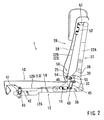
- a retractable seat (rear seat) 1 may include a seat cushion 10 and a seat back 20.
- the seat cushion 10 is generally supported on a vehicle floor (not shown).
- the seat cushion 10 may preferably be constituted of a cushion frame 12, a cushion pad 18 attached to the cushion frame 12, and a skin layer or outer cover 10a ( FIG. 1 ) that covers or encloses the pad 18.
- the seat back 20 may preferably be constituted of a back frame 22, a back pad 28 attached to the back frame 22, and a skin layer or outer cover 20a ( FIG. 1 ) that covers or encloses the pad 28.
- the cushion frame 12 of the seat cushion 10 is rotatably connected to the back frame 22 of the seat back 20 via a pair of seat reclining devices 30 (one of which is shown).
- the reclining device 30, for example, can tilt the seat back 20 forwardly (i.e., counterclockwise) from a normal or use position ( FIGS. 1 and 2 ), superimpose the same on the seat cushion 10, and retain the seat back 20 in that position, i.e., a retracted position ( FIG. 4 ).
- the retractable seat 1 may preferably be designed so as to be retracted into a retracting space S formed in a vehicle floor F when the seat back 20 is superimposed on the seat cushion 10.
- the seat reclining devices 30 allow the back frame 22 to be rotated forward and rearward (i.e., counterclockwise and clockwise) around rotational shafts (i.e., rotational axes) 32, and to be locked in a desired rotational position. This allows the seat back 20 to be adjusted to a desired tilting position relative to the seat cushion 10.
- the back frame 22 can be rotated forward and rearward by normally and reversely driving a motor (not shown).
- each of the seat reclining devices 30 includes a pair of opposing disk-like housings, i.e., a first housing 30a and a second housing 30b, that are arranged and constructed to rotate around the rotational shaft 32.
- the first housing 30a is attached to a lower arm 38 fixed to the rear end of the cushion frame 12 (the framework 12A) by means of an appropriate bonding means such as welding.
- the second housing 30b is attached to an upper arm 36 fixed to the lower end of the back frame 22 by means of an appropriate bonding means such as welding.
- the first and second housings 30a and 30b are circumferentially connected by means of a fastener or clip ring (not shown) so that the second housing 30b can move or rotate relative to the first housing 30a around the rotational shaft 32. Further, the respective rotational shafts 32 are interconnected via a connecting shaft 34.
- the cushion frame 12 may preferably be constituted of an outer frame member or framework 12A and a central or inner support member or pad support 12B for supporting a substantial portion of the cushion pad 18 from a backside (under surface) thereof.
- the back frame 22 may preferably be constituted of an outer frame member or framework 22A and a central or inner frame member or pad support 22B for supporting the cushion pad 28 from a backside (rear surface) thereof.
- the frameworks 12A and 22A are respectively integrally connected to the pad supports 12B and 22B, so as not to permit relative motion therebetween.
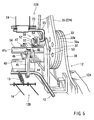
- the frameworks 12A and 22A are respectively separated from the pad supports 12B and 22B and are respectively relatively movably combined therewith. That is, the pad supports 12B and 22B may preferably be movably connected or linked to the frameworks 12A and 22A by means of at least two first linking mechanisms (i.e., coupling means) 40 and at least two second linking mechanisms (i.e., coupling means) 50 (see FIG. 5 , which will be hereinafter described).
- the pad support 12B of the cushion frame 12 may preferably be constituted of an outer rectangular support frame 13 and an inner support net 14.
- the support net 14 may preferably be formed as a crosswise combination of a plurality of spring wires. Further, the support net 14 may preferably be resiliently connected to the support frame 13 by means of plurality of coil springs 15 (one of which is shown).
- the pad support 22B of the back frame 22 may preferably be constituted of an outer rectangular support frame 23 and an inner support net 24.
- the support net 24 may preferably be formed as a crosswise combination of a plurality of spring wires. Further, unlike the support net 14, the support net 24 may preferably be directly connected to the support frame 23.
- each of the first linking mechanisms 40 includes a front link arm 42, a front bracket 41 that is fixed to the framework 12A, a rear drive link arm 45, a rear special arm 47, and a rear bracket 44 that is fixed to the upper arm 36 of the back frame 22 (the framework 22A).
- the front link arm 42 may preferably be rotatably connected to a front bracket 41 via a pivot pin 43. Further, a free end of the front link arm 42 may preferably be pivotally connected to the support frame 13 of the pad support 12B.
- the rear link arm 45 may preferably be rotatably connected to the rear bracket 44 via a pivot pin 46 interleaving the rear special arm 47 therebetween.
- the pivot pin 46 is not aligned with the rotational shaft 32 of the reclining device 30 (i.e., a rotational axis of the seat back 20) and is displaced forwardly therefrom.
- a spacer 48 may preferably be interleaved between the rear link arm 45 and the rear special arm 47 so that the rear link arm 45 and the rear special arm 47 can be appropriately positioned along the pivot pin 46.
- a free end of the rear link arm 45 is movably connected to the support frame 13 of the pad support 12B.
- the support frame 13 of the pad support 12B may preferably be supported by at least four supporting points.
- the rear special arm 47 includes first and second through holes 47a and 47b and a contact projection 47c.
- the first and second through holes 47a and 47b are respectively arranged and constructed to receive the pivot pin 46 and the connecting shaft 34. Therefore, when the back frame 22 is forwardly rotated around the rotational shaft 32 connected to the connecting shaft 34 so that the rear bracket 44 is pivoted around the rotational shaft 32, the rear special arm 47 may also preferably rotate around the connecting shaft 34 (counterclockwise in FIGS. 7-9 ).
- the contact projections 47c of the rear special arms 47 contacts the rear link arms 45 ( FIG. 9 ), thereby urging each rear link arm 45 such that the rear link arm 45 rotates in the corresponding direction (i.e., counterclockwise).
- each of the second linking mechanisms 50 includes an upper link bracket 51 that is fixed to the framework 22A, a lower drive link arm 54, and a lower bracket 53 that is fixed to the lower arm 38 (the framework 12A of the cushion frame 12).
- a free end of the upper link bracket 51 may preferably engage the support frame 23 of the pad support 22B via a spring 52.
- the lower link arm 54 may preferably be rotatably connected to the lower bracket 53 via a pivot pin 55. Further, a free end of the lower link arm 54 is pivotally connected to the support frame 23 of the pad support 22B via a connecting arm 25 that is coupled to the support frame 23 ( FIG. 5 ). That is, the lower link arm 54 is pivotally connected to the connecting arm 25 at a connecting point 57 that is displaced from the pivot pin 55 (i.e., a rotational axis of the lower link arm 54).
- the support frame 23 of the pad support 22B may preferably be supported by at least four supporting points.
- the pad support 12B when the seat 1 is positioned in a use condition, the pad support 12B is positioned in substantially an uppermost position. Also, the pad support 22B is positioned in substantially a forwardmost position. Thus, the seat cushion 10 and the seat back 20 may respectively have a maximum thickness.
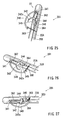
- FIGS. 2 to 4 and 7 to 9 an operation for switching the seat 1 from the use condition to a retracted condition will be described with reference to, in particular, FIGS. 2 to 4 and 7 to 9 . Further, it is noted that the motion of the cushion frame 12 and the back frame 22 is substituted for the corresponding motion of the seat cushion 10 and the seat back 20.
- the back frame 22 (the framework 22A) rotates forward (i.e., counterclockwise) around the rotational shaft 32.
- the back frame 22 (the seat back 20) begins to tilt forwardly toward an intermediate position shown in FIGS. 3 and 8 .
- the rear bracket 44 ( FIG. 5 ) is rotated because the rear bracket 44 is fixed to the upper arm 36 of the back frame 22. Consequently, the pivot pin 46 pivots or moves counterclockwise around the rotational shaft 32 so that the rear special arm 47 rotates counterclockwise around the connecting shaft 34.
- the rear special arm 47 When the back frame 22 (the seat back 20) is further tilted forwardly toward the retracted position shown in FIGS. 4 and 9 , the rear special arm 47 further rotates counterclockwise around the connecting shaft 34 so that the contact projection 47c of the rear special arm 47 contacts the rear link arm 45. Therefore, the rear link arm 45 pivots or moves counterclockwise around the rotational shaft 32 along with the pivot pin 46. Consequently, as will be apparent from comparing FIGS. 3 and 4 , the pad support 12B (the support frame 13) connected to the rear link arm 45 via the coil springs 15 moves toward a backside of the seat cushion 10 while moving rearwardly. Thus, the cushion pad 18 attached to the cushion frame 12 is pulled toward the backside of the seat cushion 10. As a result, the seat cushion 10 may have a reduced thickness when the seat back 22 becomes positioned in the retracted position.
- the lower link arm 54 further rotates counterclockwise around the pivot pin 55. Therefore, the connecting point 57 of the lower link arm 54 and the connecting arm 25 further pivots or moves counterclockwise around the pivot pin 55 so as to further move toward or nearer to the rotational shaft 32. Consequently, as will be apparent from comparing FIGS. 3 and 4 , the pad support 22B connected to the lower link arm 54 via the connecting arm 25 further moves toward the backside of the seat back 20 while moving downwardly. Thus, the cushion pad 28 attached to the back frame 22 is pulled toward the backside of the seat back 20. As a result, the seat back 20 may have a reduced thickness when the seat back 22 becomes positioned in the retracted position.
- the thickness of the seat cushion 10 and the seat back 20 can be respectively effectively reduced when the seat back 20 is tilted from the use position to the retracted position.
- a total thickness of the seat cushion 10 and the seat back 20 can be effectively reduced when the seat 1 is in the retracted condition. Therefore, the seat 1 can be retracted within a reduced or limited retracting space. This may lead to minimization of the retracting space S of the seat 1.
- the reduction of each of thicknesses of the seat cushion 10 and the seat back 20 is approximately 10-35mm.
- first and second linking mechanisms 40 and 50 cannot be actuated when the back frame 22 rotates rearward (i.e., clockwise) from the use position around the rotational shaft 32. Therefore, the thicknesses of the seat cushion 10 and the seat back 20 cannot be respectively reduced even if the seat back 20 is tilted rearward from the use condition.
- the retractable seat 1 is designed such that the thicknesses of both of the seat cushion 10 and the seat back 20 can be reduced. However, if necessary, the seat 1 can be design changed such that a thickness of only one of the seat cushion 10 and the seat back 20 can be reduced.
- a retractable seat 101 may include the seat cushion 10 and the seat back 20.
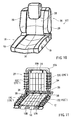
- the cushion pad 18 of the seat cushion 10 includes thickened side portions 19.
- the cushion pad 28 of the seat back 20 includes thickened side portions 29.
- the cushion frame 12 may preferably be constituted of the outer frame member or framework 12A and the inner support member or pad support 12B. Unlike the first embodiment, the inner pad support 12B is integrally connected to the framework 12A.
- the cushion frame 12 may further include a side support member or pad support 12C for supporting the thickened side portions 19 of the cushion pad 18 from a backside (under surface) thereof.
- the side pad support 12C may preferably be separate from the framework 12A and the inner pad support 12B.
- the back frame 22 may preferably be constituted of the outer frame member or framework 22A and the inner frame member or pad support 22B. Unlike the first embodiment, the pad support 22B is integrally connected to the framework 22A.
- the back frame 22 may further include a side support member or pad support 22C for supporting the thickened side portions 29 of the cushion pad 28 from a backside (rear surface) thereof.
- the side pad support 22C may preferably be separate from the framework 22A and the inner pad support 22B.
- the side pad supports 12C and 22C may preferably be linked to the frameworks 12A and 22A by means of at least two first linking mechanisms (i.e., coupling means) 140 and at least two second linking mechanisms (i.e., coupling means) 150 (which will be hereinafter described).
- the inner pad support 12B of the cushion frame 12 may preferably be constituted of only the inner support net 14.
- the inner pad support 22B of the back frame 22 may preferably be constituted of only the inner support net 24.
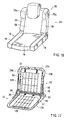
- the side pad support 12C of the cushion frame 12 may preferably be formed as a combination of a plurality of spring wires.
- the side pad support 12C may preferably include a pair of three-dimensional side support portions 12C'.
- the side support portions 12C' may preferably be shaped so as to be substantially identical with the contour of the side portions 19 of the cushion pad 18.
- the side pad support 12C thus constructed may preferably be positioned on the framework 12A such that the side support portions 12C' correspond to the side portions of the framework 12A.
- the side pad support 22C of the back frame 22 may preferably be formed as a combination of a plurality of spring wires.
- the side pad support 22C may preferably include a pair of three-dimensional side support portions 22C'.
- the side support portions 22C' may preferably be shaped so as to be substantially identical with the contour of the side portions 29 of the cushion pad 28.
- the side pad support 22C thus constructed may preferably be positioned on the framework 22A such that the side support portions 22C' correspond to the side portions of the framework 22A.
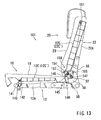
- each of the first linking mechanisms 140 includes a front link arm 142, a front bracket 141 that is fixed to the framework 12A, a rear drive link arm 145, a rear special arm 147, and a rear bracket 144 that is fixed to the upper arm 36 of the back frame 22 (the framework 22A).
- the front link arm 142 may preferably be rotatably connected to a front bracket 141 via a pivot pin 143. Further, a free end of the front link arm 142 may preferably be movably connected to the side pad support 12C.
- the rear link arm 145 may preferably be rotatably connected to the rear bracket 144 via a pivot pin 146 interleaving the rear special arm 147 therebetween.
- the pivot pin 146 is not aligned with the rotational shaft 32 of the reclining device 30 (i.e., a rotational axis of the seat back 20) and is displaced forwardly therefrom.
- a free end of the rear link arm 145 is pivotally connected to the side pad support 12C.
- the side pad support 12C of the cushion frame 12 may preferably be supported by at least four supporting points.
- the rear special arm 147 substantially has the same construction as the rear special arm 47 of the first embodiment. Therefore, when the back frame 22 is forwardly rotated around the rotational shaft 32 connected to the connecting shaft 34 so that the rear bracket 144 is pivoted around the rotational shaft 32, the rear special arm 147 may also preferably rotate around the connecting shaft 34 (counterclockwise in FIGS. 13-15 ). As a result, the contact projections 147c of the rear special arms 147 contacts the rear link arms 145 ( FIG. 9 ), thereby urging each rear link arm 145 such that the rear link arm 145 rotates in the corresponding direction (i.e., counterclockwise).
- each of the second linking mechanisms 150 includes an upper link bracket 151 that is fixed to the framework 22A, a lower drive link arm 154, and a lower bracket 153 that is fixed to the lower arm 38 (the framework 12A of the cushion frame 12).
- a free end of the upper bracket 151 may preferably engage the side pad support 22C of the back frame 22.
- the lower link arm 154 may preferably be rotatably connected to the lower bracket 153 via a pivot pin 155. Further, a free end of the lower link arm 154 is pivotally connected to the side pad support 22C at a connecting point 157.
- the side pad support 22C of the back frame 22 may preferably be supported by at least four supporting points.
- the side support portions 12C' of side pad support 12C is positioned in substantially an uppermost position.
- the side support portions 22C' of side pad support 22C are positioned in substantially a forwardmost position.
- the seat cushion 10 and the seat back 20 may respectively have a maximum thickness.
- the back frame 22 (the framework 22A) rotates forward (i.e., counterclockwise) around the rotational shaft 32.
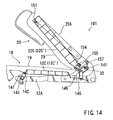
- the back frame 22 (the seat back 20) begins to tilt forwardly toward an intermediate position shown in FIG. 14 .
- the rear bracket 144 ( FIG. 12 ) is rotated because the rear bracket 144 is fixed to the upper arm 36 of the back frame 22. Consequently, the pivot pin 146 pivots or moves counterclockwise around the rotational shaft 32 so that the rear special arm 147 rotates counterclockwise around the connecting shaft 34.
- the rear special arm 147 When the back frame 22 (the seat back 20) is further tilted forwardly toward the retracted position shown in FIG. 15 , the rear special arm 147 further rotates counterclockwise around the connecting shaft 34 so that the contact projection 147c ( FIG. 12 ) of the rear special arm 147 contacts the rear link arm 145. Therefore, the rear link arm 145 pivots or moves counterclockwise around the rotational shaft 32 along with the pivot pin 146. Consequently, as will be apparent from comparing FIGS. 14 and 15 , the side pad support 12C connected to the rear link arm 145 moves toward the backside of the seat cushion 10 while moving rearwardly.
- the side portions 19 of the cushion pad 18 attached to the cushion frame 12 are pulled toward the backside of the seat cushion 10 so that the cushion pad 18 can be effectively flattened.
- the seat cushion 10 may have a reduced thickness when the seat back 22 becomes positioned in the retracted position.
- the lower link arm 154 further rotates counterclockwise around the pivot pin 155. Therefore, the connecting point 157 of the lower link arm 154 further pivots or moves counterclockwise around the pivot pin 155 so as to further move toward or nearer to the rotational shaft 32. Consequently, as will be apparent from comparing FIGS. 14 and 15 , the side pad support 22C connected to the lower link arm 154 further moves toward the backside of the seat back 20 while moving downwardly. Thus, the side portions 29 of the cushion pad 28 attached to the back frame 22 are pulled toward the backside of the seat back 20 so that the cushion pad 28 can be effectively flattened. As a result, the seat back 20 may have a reduced thickness when the seat back 22 becomes positioned in the retracted position.
- the thickness of the seat cushion 10 and the seat back 20 can be respectively effectively reduced when the seat back 20 is tilted from the use position to the retracted position.
- a total thickness of the seat cushion 10 and the seat back 20 can be effectively reduced when the seat 101 is in the retracted condition. Therefore, the seat 101 can be retracted within a reduced or limited retracting space. This may lead to the minimization of a retracting space (not shown) of the seat 101.
- the retractable seat 101 in this embodiment is not designed such that the side portions 19 and 29 of the cushion pad 18 and 28 are laterally or transversely moved when the seat back 20 is tilted. Therefore, the side portions 19 and 29 may have a sufficient side support function.
- the retractable seat 101 is designed such that the thicknesses of both of the seat cushion 10 and the seat back 20 can be reduced.
- the seat 101 can be design changed such that a thickness of only one of the seat cushion 10 and the seat back 20 can be reduced.
- a retractable seat 201 may include the seat cushion 10 and the seat back 20. Similar to the second embodiment, the cushion pad 18 of the seat cushion 10 includes the thickened side portions 19. Also, the cushion pad 28 of the seat back 20 includes the thickened side portions 29. Further, unlike the second embodiment, each of the thickened side portions 29 includes an upper projected portion (i.e., an upper side portion) 29a. As will be appreciated, each of the upper projected portions 29a may preferably be positioned so as to correspond to a shoulder of an occupant (not shown).
- the cushion frame 12 may preferably be constituted of the outer frame member or framework 12A and the inner support member or pad support 12B.
- the inner pad support 12B is connected to the framework 12A via springs 17.
- the back frame 22 may preferably be constituted of the outer frame member or framework 22A and the inner frame member or pad support 22B.
- the pad support 22B is connected to the framework 22A via springs 27.
- the framework 22A of the back frame 22 is provided with a pair of curved upper support members or pad supports 240 attached thereto.
- the upper pad supports 240 may preferably be positioned on both sides of the framework 22A so as to correspond to the upper projected portions 29a of the cushion pads 28.
- each of the upper pad supports 240 may preferably be shaped so as to be substantially identical with the contour of the upper projected portion 29a.
- An upper end of the upper pad support 240 may preferably be rotatably connected to the framework 22A via a hinge pin 241 so that the upper pad support 240 can pivot or rotate forward and rearward therearound. As best shown in FIG.
- the upper pad support 240 is integrally provided with a curved side wall 242 that is positioned adjacent to the framework 22A.
- the side wall 242 is formed with an arcuate guide slot (i.e., a guide mechanism) 243 extending therealong.
- each upper link arm 244 may preferably be rotatably connected to the framework 22A via a hinge pin 245 that is positioned at a lower side of the hinge pin 241.
- the other end of each upper link arm 244 is provided with a guide pin (i.e., the guide mechanism) 246 which slidably engages the guide slot 243.
- the framework 22A of the back frame 22 is further provided with a pair of elongated vertical connecting members or connecting rods (i.e., the linking mechanisms) 250 (one of which is shown).
- Each of the connecting rods 250 may preferably have an upper connecting end 252 and a lower connecting end (i.e. connecting point) 253.
- the upper connecting end 252 may preferably be connected to the guide pin 246 of the upper link arm 244.
- the lower connecting end 253 may preferably be rotatably connected to the lower arm 38 of the cushion frame 12. As will be apparent, the lower connecting end 253 may preferably be displaced upwardly and rearwardly from the rotational shaft 32.
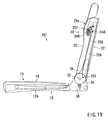
- the guide pin 246 is located in a mid position within the guide slot 243.
- the pad support 240 fully or maximally projects forwardly. That is, the pad support 240 projects forwardly beyond the pad support 22B.
- the upper projected portion 29a may preferably be produced in the thickened side portion 29.
- the back frame 22 (the framework 22A) rotates forward (i.e., counterclockwise) around the rotational shaft 32.
- the back frame 22 (the seat back 20) begins to tilt forwardly toward an intermediate position shown in FIG. 20 .
- the hinge pin 241 of the upper pad support 240 and the hinge pin 245 of the upper link arm 244 are pivoted or moved around the rotational shaft 32.
- the upper connecting end 252 of the connecting rod 250 i.e., the guide pin 246 of the upper link arm 244 is pivoted or moved around the lower connecting end 253 of the connecting rod 250.
- the upper connecting end 252 of the connecting rod 250 may preferably be pulled downwardly (i.e., in the direction shown by arrow in FIG. 23 ) because the lower connecting end 253 is displaced rearwardly from the rotational shaft 32. Consequently, as will be apparent from comparing FIGS. 22 and 23 , the upper link arm 244 rotates counterclockwise around the hinge pin 245.
- the guide pin 246 of the upper link arm 244 slides downward along the guide slot 243 of the upper pad support 240 so that the upper pad support 240 rotates counterclockwise around the hinge pin 241. As a result, the upper pad support 240 substantially moves toward the backside of the seat back 20.
- the upper projected portion 29a of the cushion pad 28 is fully pulled toward the backside of the seat back 20 because the upper pad support 240 corresponds to the upper projected portion 29a.
- the upper projected portion 29a may preferably be eliminated so that the side portion 29 of the cushion pad 28 can be effectively flattened.
- the seat back 20 may have a reduced thickness when the seat back 22 becomes oriented in the retracted position.
- the thickness of the seat back 20 can be respectively effectively reduced when the seat back 20 is tilted from the use position to the retracted position.
- a total thickness of the seat cushion 10 and the seat back 20 can be effectively reduced when the seat 201 is in the retracted condition. Therefore, the seat 201 can be retracted within a reduced or limited retracting space. This may lead to the minimization of a retracting space (not shown) of the seat 201.
- a retractable seat 301 may include the seat cushion 10 and the seat back 20. Similar to the third embodiment, the framework 22A of the back frame 22 is provided with a pair of curved upper pad supports 340 attached thereto (one of which is shown).
- the upper pad supports 340 may preferably be positioned on both sides of the framework 22A so as to correspond to the upper projected portions 29a of the cushion pads 28. Also, each of the upper pad supports 340 may preferably be shaped so as to be substantially identical with the contour of the upper projected portion 29a.
- An upper end of the upper pad support 340 may preferably be rotatably connected to the framework 22A via a hinge pin 341 so that the upper pad support 340 can be rotated forward and rearward therearound.
- the upper pad support 340 is integrally provided with a cam member (i.e., a guide mechanism) 342 that extends downwardly along the rear side of the upper pad support 340.
- a lower end of the upper pad support 340 may preferably be connected to the framework 22A via a spring 360 so that the upper pad support 340 (the cam member 342) can be normally forced counterclockwise around the hinge pin 341.
- the framework 22A of the back frame 22 is also provided with a pair of upper movable members or slide members (i.e., linking mechanisms) 344 (one of which is shown) associated with the cam members 342.
- Each of the slide members 344 includes an upper projected portion (i.e., the guide mechanism) 345 and a lower guide pin 346.
- the projected portion 345 is arranged and constructed to engage a cam surface 342a of the cam member 342.
- the guide pin 346 slidably engages a guide slot 364 that is vertically or longitudinally formed in the framework 22A.
- an upper end of the slide member 344 may preferably be connected to the framework 22A via a return spring 362.
- the return spring 362 is arranged and constructed to upwardly force the slide member 344. As will be easily understood, the return spring 362 may preferably have a spring force greater than the spring 360 of the upper pad support 340.
- the framework 22A of the back frame 22 is further provided with a pair of elongated vertical connecting members or connecting cables (i.e., the linking mechanisms) 350 (one of which is shown).
- An upper end of each connecting cable 350 may preferably be connected to a lower end of the slide member 344.
- a lower end of each connecting cable 350 may preferably be rotatably connected to the lower arm 38 of the cushion frame 12.
- the slide member 344 when the seat 301 is positioned in a use condition, the slide member 344 is retained in an uppermost position by means of the return spring 362. At this time, the projected portion 345 of the slide member 344 may preferably contact an uppermost point of the cam surface 342a of the cam member 342 so that the pad support 340 is fully projected forwardly. Thus, the upper projected portion 29a may preferably be produced in the thickened side portion 29.
- the back frame 22 (the framework 22A) rotates forward (i.e., counterclockwise) around the rotational shaft 32.
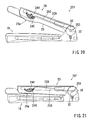
- the back frame 22 (the seat back 20) begins to tilt forwardly toward an intermediate position shown in FIG. 26 .
- the guide pin 346 of the slide member 344 is pulled downwardly via the connecting cable 350 so as to slide downwardly within the guide slot 364.
- the slide member 344 slides downwardly against the spring force of the return spring 362. Therefore, the projected portion 345 of the slide member 344 may preferably slide downwardly along the cam surface 342a of the cam member 342. Consequently, the pad support 340 rotates counterclockwise around the hinge pin 341 so as to substantially move toward the backside of the seat back 20 because the upper pad support 340 may preferably be forced toward the framework 22A via the spring 360.
- the upper projected portion 29a of the cushion pad 28 is fully pulled toward the backside of the seat back 20 because the upper pad support 340 corresponds to the upper projected portion 29a.
- the upper projected portion 29a may preferably be eliminated so that the side portion 29 of the cushion pad 28 can be effectively flattened.
- the seat back 20 may have a reduced thickness when the seat back 22 becomes positioned in the retracted position.
- the pad supports 240 and 340 are respectively designed so as to rotate around the hinge pins 241 and 341.
- the pad supports 240 and 340 can be respectively designed so as to linearly slide toward the backside of the seat back 20.
- the present invention can be applied to a seat in which the seat cushion is tilted or raised.
Landscapes
- Engineering & Computer Science (AREA)
- Aviation & Aerospace Engineering (AREA)
- Transportation (AREA)
- Mechanical Engineering (AREA)
- Seats For Vehicles (AREA)
- Chairs For Special Purposes, Such As Reclining Chairs (AREA)
Claims (14)
- Ein umlegbarer Sitz (1; 101; 201; 301), der ein Sitzkissen (10) und eine Rückenlehne (20) aufweist, die drehbar an dem Sitzkissen gelagert ist, wobei entweder das Sitzkissen oder die Rückenlehne so angeordnet und aufgebaut ist, dass es auf das andere Teil aus dem Sitzkissen und der Rückenlehne faltbar ist, wobei mindestens entweder das Sitzkissen oder die Rückenlehne Folgendes aufweist:einen Rahmen (12, 22),ein Polster (18, 28), undeinen Verbindungsmechanismus (40, 50; 140, 150; 244, 250; 344, 350),wobei der Rahmen ein Rahmenteil (12A, 22A) und ein Lagerteil (12B, 22B; 12C, 22C; 240; 340) umfasst, welches das Polster von einer Rückseite des Polsters her lagert, undwobei der Verbindungsmechanismus (40, 50; 140, 150; 244, 250; 344, 350) das Rahmenteil (12A, 22A) und das Lagerteil (12B, 22B; 12C, 22C; 240; 340) beweglich miteinander verbindet und so angeordnet und aufgebaut ist, dass er das Lagerteil hin zu einer Rückseite mindestens entweder des Sitzkissens oder der Rückenlehne bewegt, wenn das Sitzkissen oder die Rückenlehne in eine umgelegte Position gekippt ist,dadurch gekennzeichnet, dass der Verbindungsmechanismus (50; 150) so angeordnet und aufgebaut ist, dass er das Lagerteil (22B; 22C) eines aus dem Sitzkissen und der Rückenlehne mit dem Rahmenteil (12A) des anderen aus dem Sitzkissen und der Rückenlehne an einem Verbindungspunkt (57; 157) verbindet, der gegenüber einer Drehachse (32) des Rahmenteils des Sitzkissens oder der Rückenlehne versetzt ist,und dadurch, dass der Verbindungsmechanismus (50; 150) so angeordnet und aufgebaut ist, dass sich der Verbindungspunkt (57; 157) näher zu der Drehachse hinbewegt, wodurch er das Lagerteil in einer Dickenrichtung entweder des Sitzkissens oder der Rückenlehne bewegt, wenn das Sitzkissen oder die Rückenlehne zu der umgelegten Position hin gekippt ist.
- Umlegbarer Sitz nach Anspruch 1, wobei der Verbindungsmechanismus (50; 150) einen Verbindungsarm (54; 154) umfasst, der in dem Verbindungspunkt (57; 157) des Lagerteils mit dem Rahmenteil positioniert ist, und wobei der Verbindungsarm (54; 154) drehbar mit dem Lagerteil und dem Rahmenteil verbunden ist.
- Umlegbarer Sitz nach Anspruch 1, wobei der Verbindungsmechanismus (50) einen Verbindungsarm (25) aufweist, der so angeordnet und aufgebaut ist, dass er sich dreht, wenn das Sitzkissen oder die Rückenlehne gekippt ist, und wobei der Verbindungsarm (25) mit dem Lagerteil des Sitzkissens oder der Rückenlehne verbunden ist.
- Umlegbarer Sitz nach Anspruch 3, wobei der Verbindungsmechanismus (50) einen Verbindungshalter (51) aufweist, der auf einer Seite gegenüber einer Drehachse (32) des Rahmenteils des Sitzkissens oder der Rückenlehne positioniert ist und drehbar mit dem Rahmenteil verbunden ist, wobei der Verbindungshalter (51) ein freies Ende aufweist, das mit dem Lagerteil (22B) verbunden ist, und wobei der Verbindungsarm (25) so angeordnet und aufgebaut ist, dass er das Lagerteil (22B) des Sitzkissens oder der Rückenlehne hin zur Drehachse (32) des Rahmenteils des Sitzkissens oder der Rückenlehne zieht, wenn das Sitzkissen oder die Rückenlehne hin zu der umgelegten Position gekippt ist.
- Umlegbarer Sitz nach einem der Ansprüche 1-4, wobei das Lagerteil ein zentrales Lagerteil (12B, 22B) aufweist, das von dem Rahmenteil getrennt ist, und wobei das zentrale Lagerteil so angeordnet und aufgebaut ist, dass es einen wesentlichen Abschnitt des Polsters (18, 28) lagert.
- Umlegbarer Sitz nach einem der Ansprüche 1-4, wobei das Lagerteil ein seitliches Lagerteil (12C, 22C) aufweist, das von dem Rahmenteil getrennt ist, und wobei das seitliche Lagerteil so angeordnet und aufgebaut ist, dass es einen seitlichen Abschnitt (19, 29) des Polsters (18, 28) lagert.
- Umlegbarer Sitz nach Anspruch 1, wobei mindestens entweder das Sitzkissen oder die Rückenlehne die Rückenlehne (20) umfasst, wobei das Lagerteil ein oberes Lagerteil (240; 340) aufweist, das einen oberen seitlichen Abschnitt (29a) des Polsters (28) lagert, und wobei der Verbindungsmechanismus (244, 250; 344, 350) so angeordnet und aufgebaut ist, dass er das Lagerteil hin zu einer Rückseite der Rückenlehne bewegt.
- Umlegbarer Sitz nach Anspruch 7, wobei das Lagerteil weiterhin ein zentrales Lagerteil (22B) aufweist, das einen wesentlichen Abschnitt des Polsters (28) von der Rückseite des Polsters her lagert, und wobei der Verbindungsmechanismus (244, 250; 344, 350) so angeordnet und aufgebaut ist, dass das obere Lagerteil (240; 340) über das zentrale Lagerteil (22B) hinaus nach vorne vorsteht.
- Umlegbarer Sitz nach Anspruch 7 oder 8, wobei der Verbindungsmechanismus ein bewegliches Teil (244; 344) aufweist, das beweglich mit dem Rahmenteil (22A) verbunden ist und wirksam in das obere Lagerteil (240; 340) eingreift, und ein Verbindungsteil (250; 350), das mit dem beweglichen Teil (244; 344) verbunden ist und mit einem Verbindungspunkt (253) verbunden ist, der gegenüber einer Drehachse (32) des Rahmenteils (12A, 22A) des Sitzkissens oder Rückenlehne versetzt ist, und wobei das bewegliche Teil (244; 344) über das Verbindungsteil (250; 350) so betätigt ist, dass sich das obere Lagerteil (240; 340) hin zur Rückseite der Rückenlehne (20) bewegt, wenn das Sitzkissen oder die Rückenlehne in die umgelegte Position gekippt wird.
- Umlegbarer Sitz nach einem der Ansprüche 7-9, wobei das obere Lagerteil (240; 340) drehbar mit dem Rahmenteil (22A) verbunden ist, wobei der Verbindungsmechanismus (244, 250; 344, 350) einen Führungsmechanismus (243, 246; 342, 345) aufweist, der so angeordnet und aufgebaut ist, dass er das obere Lagerteil (240; 340) hin zur Rückseite der Rückenlehne (20) bewegt, wenn das bewegliche Teil (244; 344) über das Verbindungsteil (250; 350) betätigt wird.
- Umlegbarer Sitz nach Anspruch 10, wobei der Führungsmechanismus einen Führungsschlitz (243) aufweist, der in dem oberen Lagerteil (240) gebildet ist, und einen Führungsstift (246), der an dem beweglichen Teil (244) angebracht ist, und wobei der Führungsstift (246) gleitend mit dem Führungsschlitz (243) in Eingriff ist.
- Umlegbarer Sitz nach Anspruch 10, wobei der Führungsmechanismus ein Nockenteil (342) aufweist, das an dem oberen Lagerteil (340) angebracht ist, und einen vorstehenden Abschnitt (345), der in dem beweglichen Teil (344) gebildet ist, und wobei der vorstehende Abschnitt (345) gleitend mit dem Nockenteil (342) in Eingriff ist.
- Umlegbarer Sitz nach einem der Ansprüche 1-12, wobei der Sitz einen Rücksitz umfasst.
- Umlegbarer Sitz nach einem der Ansprüche 1-12, wobei der Sitz so angeordnet und aufgebaut ist, dass er in einen Umlegeraum (S) umlegbar ist, der in einem Fahrzeugboden (F) gebildet ist.
Applications Claiming Priority (10)
| Application Number | Priority Date | Filing Date | Title |
|---|---|---|---|
| JP2003390865 | 2003-11-20 | ||
| JP2003390865 | 2003-11-20 | ||
| JP2004059096 | 2004-03-03 | ||
| JP2004059096 | 2004-03-03 | ||
| JP2004137344 | 2004-05-06 | ||
| JP2004137344 | 2004-05-06 | ||
| JP2004300202A JP4639747B2 (ja) | 2003-11-20 | 2004-10-14 | 格納シート |
| JP2004300203A JP4442386B2 (ja) | 2004-05-06 | 2004-10-14 | 格納シート |
| JP2004300202 | 2004-10-14 | ||
| JP2004300203 | 2004-10-14 |
Publications (3)
| Publication Number | Publication Date |
|---|---|
| EP1533177A2 EP1533177A2 (de) | 2005-05-25 |
| EP1533177A3 EP1533177A3 (de) | 2007-10-10 |
| EP1533177B1 true EP1533177B1 (de) | 2009-10-21 |
Family
ID=34437778
Family Applications (1)
| Application Number | Title | Priority Date | Filing Date |
|---|---|---|---|
| EP04257090A Expired - Lifetime EP1533177B1 (de) | 2003-11-20 | 2004-11-16 | Klappsitz |
Country Status (4)
| Country | Link |
|---|---|
| US (1) | US7367625B2 (de) |
| EP (1) | EP1533177B1 (de) |
| CN (1) | CN100439150C (de) |
| DE (1) | DE602004023681D1 (de) |
Families Citing this family (21)
| Publication number | Priority date | Publication date | Assignee | Title |
|---|---|---|---|---|
| FR2874868B1 (fr) * | 2004-09-06 | 2006-12-01 | Grupo Antolin Ingenieria Sa Sa | Siege escamotable |
| US7766430B2 (en) | 2005-09-15 | 2010-08-03 | Intier Automotive Seating Systems Gmbh | Second row seat assembly having fold flat mechanism with forward cushion movement |
| JP3958772B2 (ja) * | 2005-10-17 | 2007-08-15 | トヨタ自動車株式会社 | シート構造 |
| JP4105190B2 (ja) * | 2005-11-16 | 2008-06-25 | トヨタ自動車株式会社 | シート構造 |
| US7703851B2 (en) * | 2006-09-21 | 2010-04-27 | Mazda Motor Corporation | Seat device |
| DE112008003251B4 (de) * | 2007-12-03 | 2017-07-27 | Toyota Boshoku K.K. | Fahrzeugsitz |
| JP5119910B2 (ja) * | 2007-12-26 | 2013-01-16 | トヨタ紡織株式会社 | 車両用シート |
| KR101209993B1 (ko) * | 2010-12-03 | 2012-12-07 | 현대자동차주식회사 | 자동차용 시트의 폴드 앤 다이브 구조 |
| CA2779920C (en) | 2011-06-16 | 2018-10-23 | Magna Seating Inc. | In-line recliner return mechanism |
| CN103029610A (zh) * | 2011-10-06 | 2013-04-10 | 李尔公司 | 具有可折叠的垫子支撑组件的座椅组件 |
| US8939510B2 (en) * | 2011-10-06 | 2015-01-27 | Lear Corporation | Seat assembly having a collapsible cushion support assembly |
| US8746772B2 (en) * | 2011-12-20 | 2014-06-10 | Honda Motor Co., Ltd. | Seating assembly for a vehicle |
| DE102012014381A1 (de) * | 2012-04-25 | 2013-10-31 | Keiper Gmbh & Co. Kg | Sitzneigungsverstellung, Fahrzeugsitz und Montageverfahren für den Fahrzeugsitz |
| CN103061283B (zh) * | 2013-01-08 | 2015-05-06 | 威海怡和专用车有限公司 | 路锥自动布放回收车 |
| US9937836B2 (en) * | 2015-02-17 | 2018-04-10 | Ford Global Technologies, Llc | Seatback with collapsible internal support unit |
| DE102016224625A1 (de) | 2016-12-09 | 2018-06-14 | Brose Fahrzeugteile Gmbh & Co. Kg, Coburg | Fahrzeugsitz mit Sperrmechanimus zur Sperrung eines zumindest abschnittsweise absenkbaren Polsterträgers bei einer Verstellung einer Rückenlehne |
| CN107031464A (zh) * | 2017-05-27 | 2017-08-11 | 长春富维安道拓汽车饰件系统有限公司 | 一种座椅靠背角度调节机构 |
| US10993541B2 (en) * | 2017-10-12 | 2021-05-04 | American Leather Operations, Llc | Convertible furniture |
| US10633096B1 (en) * | 2018-10-15 | 2020-04-28 | Ami Industries, Inc. | Supplemental recline panel for aircraft cabin attendant seat |
| US10843599B2 (en) * | 2019-03-20 | 2020-11-24 | GM Global Technology Operations LLC | Vehicle seat assembly |
| CN114393373B (zh) * | 2022-01-06 | 2023-09-05 | 无锡曙光精密工业有限公司 | 一种折叠式儿童座椅制造工艺及其折叠式儿童座椅 |
Family Cites Families (14)
| Publication number | Priority date | Publication date | Assignee | Title |
|---|---|---|---|---|
| JPS60168633A (ja) | 1984-02-13 | 1985-09-02 | Fuji Photo Film Co Ltd | 熱可塑性樹脂製容器の製造方法 |
| JPH054429Y2 (de) * | 1987-03-30 | 1993-02-03 | ||
| WO1999008894A1 (en) | 1997-08-18 | 1999-02-25 | Prefix Corporation | Collapsible seat |
| SE511299C2 (sv) * | 1998-02-16 | 1999-09-06 | Volvo Ab | Fordonssäte |
| JP2000041784A (ja) | 1998-07-30 | 2000-02-15 | Ikeda Bussan Co Ltd | 車両用ヒンジ付きシート装置 |
| JP4174908B2 (ja) | 1999-05-12 | 2008-11-05 | トヨタ紡織株式会社 | 車両用シート |
| FR2815303B1 (fr) | 2000-10-18 | 2003-02-21 | Peugeot Citroen Automobiles Sa | Assise de siege pour vehicule automobile |
| DE10055205C2 (de) * | 2000-11-07 | 2003-04-03 | Grammer Ag | Rücksitz-Mittelteil für einen Personenkraftwagen |
| CA2432585A1 (en) * | 2000-12-20 | 2002-07-18 | Intier Automotive Inc. | Seat assembly with displaceable seat back recliner pivot |
| JP2002264708A (ja) | 2001-03-09 | 2002-09-18 | Nissan Motor Co Ltd | 車両用シート構造 |
| DE10149858C2 (de) * | 2001-10-10 | 2003-10-02 | Johnson Controls Gmbh | Fahrzeugsitz mit schwenkbarer Rückenlehne |
| DE60328508D1 (de) * | 2002-11-08 | 2009-09-03 | Johnson Controls Tech Co | Klappbarer dünnprofilsitz für fahrzeuge |
| ATE531294T1 (de) * | 2003-01-22 | 2011-11-15 | L & P Property Management Co | Automatisch betätigbares ergonomisches stützsystem für einen herunterklappbaren sitz |
| DE10351157B3 (de) * | 2003-11-03 | 2005-06-09 | Faurecia Autositze Gmbh & Co. Kg | Kraftfahrzeugsitz |
-
2004
- 2004-11-16 DE DE602004023681T patent/DE602004023681D1/de not_active Expired - Lifetime
- 2004-11-16 EP EP04257090A patent/EP1533177B1/de not_active Expired - Lifetime
- 2004-11-17 US US10/990,601 patent/US7367625B2/en not_active Expired - Fee Related
- 2004-11-22 CN CNB2004100974471A patent/CN100439150C/zh not_active Expired - Fee Related
Also Published As
| Publication number | Publication date |
|---|---|
| US20050110324A1 (en) | 2005-05-26 |
| CN1618655A (zh) | 2005-05-25 |
| US7367625B2 (en) | 2008-05-06 |
| CN100439150C (zh) | 2008-12-03 |
| EP1533177A2 (de) | 2005-05-25 |
| DE602004023681D1 (de) | 2009-12-03 |
| EP1533177A3 (de) | 2007-10-10 |
Similar Documents
| Publication | Publication Date | Title |
|---|---|---|
| US7367625B2 (en) | Retractable seats | |
| EP0960766B1 (de) | Kraftfahrzeugsitz mit einer elektrisch betägtigten Beinstütze | |
| KR102775067B1 (ko) | 차량용 후석 시트 | |
| EP1646528B1 (de) | Verstellbare seitenpolster | |
| EP1558459B1 (de) | Klappbarer dünnprofilsitz für fahrzeuge | |
| EP1558460B1 (de) | Sitzkissenhalter für einen klappsitz | |
| CN111216606B (zh) | 车辆座椅的高度调节装置 | |
| JPH059863Y2 (de) | ||
| US6986542B2 (en) | Retractable seats | |
| RU2695548C2 (ru) | Сиденье транспортного средства (варианты) и гибкий закрывающий элемент | |
| US20250178507A1 (en) | Automatic pop-up device for vehicle legrest | |
| EP1470023B1 (de) | Fahrzeugsitz mit kopfstütze welche unabhängig von der rückenlehne ist | |
| US6974174B2 (en) | Retractable seats | |
| US7815258B2 (en) | Present invention relates to a vehicle seat support mechanism | |
| JP5313480B2 (ja) | チルト機構組込みサスペンション機構 | |
| JP2016049961A (ja) | 車両用後席シートリクライニング装置 | |
| JP2002186540A (ja) | 電動オットマン装置 | |
| CN116033851A (zh) | 交通工具用座椅 | |
| JP3965945B2 (ja) | 車両用シート | |
| JPH0811603A (ja) | パワーコンフォートシート構造 | |
| WO2008072728A1 (ja) | 車両用シート装置 | |
| JP2000175763A (ja) | 電動オットマン装置 | |
| JP2021187313A (ja) | フロアロック解除機構 | |
| JP2002264708A (ja) | 車両用シート構造 | |
| JPH0731720Y2 (ja) | シート装置 |
Legal Events
| Date | Code | Title | Description |
|---|---|---|---|
| PUAI | Public reference made under article 153(3) epc to a published international application that has entered the european phase |
Free format text: ORIGINAL CODE: 0009012 |
|
| AK | Designated contracting states |
Kind code of ref document: A2 Designated state(s): AT BE BG CH CY CZ DE DK EE ES FI FR GB GR HU IE IS IT LI LU MC NL PL PT RO SE SI SK TR |
|
| AX | Request for extension of the european patent |
Extension state: AL HR LT LV MK YU |
|
| PUAL | Search report despatched |
Free format text: ORIGINAL CODE: 0009013 |
|
| AK | Designated contracting states |
Kind code of ref document: A3 Designated state(s): AT BE BG CH CY CZ DE DK EE ES FI FR GB GR HU IE IS IT LI LU MC NL PL PT RO SE SI SK TR |
|
| AX | Request for extension of the european patent |
Extension state: AL HR LT LV MK YU |
|
| 17P | Request for examination filed |
Effective date: 20080307 |
|
| AKX | Designation fees paid |
Designated state(s): DE FR GB |
|
| 17Q | First examination report despatched |
Effective date: 20080729 |
|
| GRAP | Despatch of communication of intention to grant a patent |
Free format text: ORIGINAL CODE: EPIDOSNIGR1 |
|
| GRAS | Grant fee paid |
Free format text: ORIGINAL CODE: EPIDOSNIGR3 |
|
| GRAA | (expected) grant |
Free format text: ORIGINAL CODE: 0009210 |
|
| AK | Designated contracting states |
Kind code of ref document: B1 Designated state(s): DE FR GB |
|
| REG | Reference to a national code |
Ref country code: GB Ref legal event code: FG4D |
|
| REF | Corresponds to: |
Ref document number: 602004023681 Country of ref document: DE Date of ref document: 20091203 Kind code of ref document: P |
|
| PLBE | No opposition filed within time limit |
Free format text: ORIGINAL CODE: 0009261 |
|
| STAA | Information on the status of an ep patent application or granted ep patent |
Free format text: STATUS: NO OPPOSITION FILED WITHIN TIME LIMIT |
|
| 26N | No opposition filed |
Effective date: 20100722 |
|
| PGFP | Annual fee paid to national office [announced via postgrant information from national office to epo] |
Ref country code: DE Payment date: 20131113 Year of fee payment: 10 Ref country code: FR Payment date: 20131108 Year of fee payment: 10 Ref country code: GB Payment date: 20131113 Year of fee payment: 10 |
|
| REG | Reference to a national code |
Ref country code: DE Ref legal event code: R119 Ref document number: 602004023681 Country of ref document: DE |
|
| GBPC | Gb: european patent ceased through non-payment of renewal fee |
Effective date: 20141116 |
|
| REG | Reference to a national code |
Ref country code: FR Ref legal event code: ST Effective date: 20150731 |
|
| PG25 | Lapsed in a contracting state [announced via postgrant information from national office to epo] |
Ref country code: DE Free format text: LAPSE BECAUSE OF NON-PAYMENT OF DUE FEES Effective date: 20150602 Ref country code: GB Free format text: LAPSE BECAUSE OF NON-PAYMENT OF DUE FEES Effective date: 20141116 |
|
| PG25 | Lapsed in a contracting state [announced via postgrant information from national office to epo] |
Ref country code: FR Free format text: LAPSE BECAUSE OF NON-PAYMENT OF DUE FEES Effective date: 20141201 |