EP1532158B1 - Neutral metallic dendrimer complexes - Google Patents
Neutral metallic dendrimer complexes Download PDFInfo
- Publication number
- EP1532158B1 EP1532158B1 EP03791036A EP03791036A EP1532158B1 EP 1532158 B1 EP1532158 B1 EP 1532158B1 EP 03791036 A EP03791036 A EP 03791036A EP 03791036 A EP03791036 A EP 03791036A EP 1532158 B1 EP1532158 B1 EP 1532158B1
- Authority
- EP
- European Patent Office
- Prior art keywords
- group
- light
- organometallic dendrimer
- organometallic
- dendrite
- Prior art date
- Legal status (The legal status is an assumption and is not a legal conclusion. Google has not performed a legal analysis and makes no representation as to the accuracy of the status listed.)
- Expired - Lifetime
Links
Images




Classifications
-
- C—CHEMISTRY; METALLURGY
- C07—ORGANIC CHEMISTRY
- C07F—ACYCLIC, CARBOCYCLIC OR HETEROCYCLIC COMPOUNDS CONTAINING ELEMENTS OTHER THAN CARBON, HYDROGEN, HALOGEN, OXYGEN, NITROGEN, SULFUR, SELENIUM OR TELLURIUM
- C07F15/00—Compounds containing elements of Groups 8, 9, 10 or 18 of the Periodic Table
- C07F15/0006—Compounds containing elements of Groups 8, 9, 10 or 18 of the Periodic Table compounds of the platinum group
- C07F15/0033—Iridium compounds
-
- C—CHEMISTRY; METALLURGY
- C07—ORGANIC CHEMISTRY
- C07F—ACYCLIC, CARBOCYCLIC OR HETEROCYCLIC COMPOUNDS CONTAINING ELEMENTS OTHER THAN CARBON, HYDROGEN, HALOGEN, OXYGEN, NITROGEN, SULFUR, SELENIUM OR TELLURIUM
- C07F15/00—Compounds containing elements of Groups 8, 9, 10 or 18 of the Periodic Table
-
- H—ELECTRICITY
- H10—SEMICONDUCTOR DEVICES; ELECTRIC SOLID-STATE DEVICES NOT OTHERWISE PROVIDED FOR
- H10K—ORGANIC ELECTRIC SOLID-STATE DEVICES
- H10K85/00—Organic materials used in the body or electrodes of devices covered by this subclass
- H10K85/30—Coordination compounds
- H10K85/341—Transition metal complexes, e.g. Ru(II)polypyridine complexes
- H10K85/342—Transition metal complexes, e.g. Ru(II)polypyridine complexes comprising iridium
-
- C—CHEMISTRY; METALLURGY
- C09—DYES; PAINTS; POLISHES; NATURAL RESINS; ADHESIVES; COMPOSITIONS NOT OTHERWISE PROVIDED FOR; APPLICATIONS OF MATERIALS NOT OTHERWISE PROVIDED FOR
- C09K—MATERIALS FOR MISCELLANEOUS APPLICATIONS, NOT PROVIDED FOR ELSEWHERE
- C09K2211/00—Chemical nature of organic luminescent or tenebrescent compounds
- C09K2211/10—Non-macromolecular compounds
- C09K2211/1003—Carbocyclic compounds
- C09K2211/1007—Non-condensed systems
-
- C—CHEMISTRY; METALLURGY
- C09—DYES; PAINTS; POLISHES; NATURAL RESINS; ADHESIVES; COMPOSITIONS NOT OTHERWISE PROVIDED FOR; APPLICATIONS OF MATERIALS NOT OTHERWISE PROVIDED FOR
- C09K—MATERIALS FOR MISCELLANEOUS APPLICATIONS, NOT PROVIDED FOR ELSEWHERE
- C09K2211/00—Chemical nature of organic luminescent or tenebrescent compounds
- C09K2211/18—Metal complexes
- C09K2211/185—Metal complexes of the platinum group, i.e. Os, Ir, Pt, Ru, Rh or Pd
-
- H—ELECTRICITY
- H10—SEMICONDUCTOR DEVICES; ELECTRIC SOLID-STATE DEVICES NOT OTHERWISE PROVIDED FOR
- H10K—ORGANIC ELECTRIC SOLID-STATE DEVICES
- H10K2101/00—Properties of the organic materials covered by group H10K85/00
- H10K2101/10—Triplet emission
-
- H—ELECTRICITY
- H10—SEMICONDUCTOR DEVICES; ELECTRIC SOLID-STATE DEVICES NOT OTHERWISE PROVIDED FOR
- H10K—ORGANIC ELECTRIC SOLID-STATE DEVICES
- H10K50/00—Organic light-emitting devices
- H10K50/10—OLEDs or polymer light-emitting diodes [PLED]
- H10K50/11—OLEDs or polymer light-emitting diodes [PLED] characterised by the electroluminescent [EL] layers
-
- H—ELECTRICITY
- H10—SEMICONDUCTOR DEVICES; ELECTRIC SOLID-STATE DEVICES NOT OTHERWISE PROVIDED FOR
- H10K—ORGANIC ELECTRIC SOLID-STATE DEVICES
- H10K85/00—Organic materials used in the body or electrodes of devices covered by this subclass
- H10K85/10—Organic polymers or oligomers
- H10K85/111—Organic polymers or oligomers comprising aromatic, heteroaromatic, or aryl chains, e.g. polyaniline, polyphenylene or polyphenylene vinylene
- H10K85/113—Heteroaromatic compounds comprising sulfur or selene, e.g. polythiophene
- H10K85/1135—Polyethylene dioxythiophene [PEDOT]; Derivatives thereof
-
- Y—GENERAL TAGGING OF NEW TECHNOLOGICAL DEVELOPMENTS; GENERAL TAGGING OF CROSS-SECTIONAL TECHNOLOGIES SPANNING OVER SEVERAL SECTIONS OF THE IPC; TECHNICAL SUBJECTS COVERED BY FORMER USPC CROSS-REFERENCE ART COLLECTIONS [XRACs] AND DIGESTS
- Y02—TECHNOLOGIES OR APPLICATIONS FOR MITIGATION OR ADAPTATION AGAINST CLIMATE CHANGE
- Y02E—REDUCTION OF GREENHOUSE GAS [GHG] EMISSIONS, RELATED TO ENERGY GENERATION, TRANSMISSION OR DISTRIBUTION
- Y02E10/00—Energy generation through renewable energy sources
- Y02E10/50—Photovoltaic [PV] energy
- Y02E10/549—Organic PV cells
-
- Y—GENERAL TAGGING OF NEW TECHNOLOGICAL DEVELOPMENTS; GENERAL TAGGING OF CROSS-SECTIONAL TECHNOLOGIES SPANNING OVER SEVERAL SECTIONS OF THE IPC; TECHNICAL SUBJECTS COVERED BY FORMER USPC CROSS-REFERENCE ART COLLECTIONS [XRACs] AND DIGESTS
- Y10—TECHNICAL SUBJECTS COVERED BY FORMER USPC
- Y10S—TECHNICAL SUBJECTS COVERED BY FORMER USPC CROSS-REFERENCE ART COLLECTIONS [XRACs] AND DIGESTS
- Y10S428/00—Stock material or miscellaneous articles
- Y10S428/917—Electroluminescent
Definitions
- This invention relates to dendrimers, a process for forming them, and their use in electro-optic devices, in particular light-emitting devices.
- OLEDs organic light-emitting diodes
- EL organic electroluminescent
- an OLED comprises a thin organic layer or stack of organic layers sandwiched between two electrodes, such that when a voltage is applied visible or other light is emitted. At least one of the electrodes must be transparent to light. For display applications the light must of course be visible to the eye, and therefore at least one of the electrodes must be transparent to visible light.
- Dendrimers are branched macromolecules with a core and attached dendrons (also called dendrites).
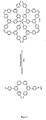
- Dendrons are branched structures comprising branching units and optionally linking units. The generation of a dendron is defined by the number of sets of branching points; see Figure 1 .
- Dendrons of a higher generation, or order can be composed of the same structural units (branching and linking units) but have an additional level of branching, i.e. an additional repetition of these branching and linking units. Alternatively higher generations can have an additional level of branching but different branching and linking units at the higher generation. There can be surface groups on the periphery of the dendrons.
- Light-emitting dendrimers typically have a luminescent core and in many cases at least partially conjugated dendrons. Further examples of light-emitting dendrimers include those found in P. W. Wang, et al Adv. Mater., 1996, 8, 237 ; M. Halim, et al Adv. Mater., 1999, 11, 371 ; A. W. Freeman, et al J. Am. Chem. Soc., 2000, 122, 12385 ; A. Adronov, et al Chem. Comm., 2000, 1701 .; C. C. Kwok, et al Macromolecules, 2001, 34, 6821 .
- Light-emitting dendrimers have the advantage over light-emitting polymers that the light-emitting properties and the processing properties can be independently optimised as the nature of the core, dendrons and surface groups can be independently altered. For example, the emission colour of a dendrimer can be changed by simply changing the core.
- Such light-emitting dendrimers can be useful in electro-optic devices, particularly OLEDs.
- Organometallic dendrimers have previously been used in OLED applications as a single component in a film (i.e. a neat film) or in a blend with a molecular material or in a blend of more than one dendrimer of different type (i.e. different cores), e.g. J.M. Lupton et al. Adv. Funct. Mater., 2001, 11, 287 and J. P. J. Markham, et al Appl. Phys. Lett., 2002, 80, 2645 .
- the photoluminescence quantum yield of the second generation, 2 is higher than for the first, 1, but both are less than when the measurement is carried out in dilute solution where dendrimer intermolecular interactions are not present.
- the dendrons are attached to one component of the bidentate ligand, namely the phenyl ring, and the facial ( fac ) isomers are formed. This combination leaves one face of the core unprotected by dendrons allowing potentially detrimental core-core interactions.
- the present invention relates to organometallic dendrimers that are neutral, i.e. those in which the ligands directly coordinated/bonded to the metal balance the charge.
- the dendrimer structure can be changed.
- One way of doing this is to attach more than one dendron to more than one ligand complexed to the metal cation.
- a dendron could be attached to both the phenyl and pyridyl rings and then two or more of these ligands complexed to the metal cation.
- the organometallic dendrimers contain more than one dendron attached to each ligand.
- a second way of controlling the intermolecular core-core interactions is by using different isomers. For example, for an octahedral fac -iridium (III) complex with 2-phenylpyridine ligands with dendrons attached to the phenyl rings one face of the core is not protected by the dendron. By using the meridinal ( mer ) isomer the dendrons are more evenly distributed around the core and as a consequence the core is more protected by the dendrons.
- the present invention relates to dendrimers, processes of preparing them and opto-electronic devices, in particular OLEDs, containing them, that solve some of the problems in the prior art.
- the invention seeks to overcome the intermolecular interactions that are detrimental for OLED performance.
- the present invention accordingly provides a charge-neutral organometallic dendrimer of formula (II): M-[X(DENDRITE(-Q) a ) y ] x Y z (II) in which M represents a metal cation, x represents an integer of 2 or more, y represents an integer of 2 or more, each X which may be the same or different represents a mono-, bi- or tri-dentate coordinating group, z represents 0 or an integer of 1 or more, and each Y which may be the same or different represents a coordinating group, the total of (b.x) + (c.z) being equal to the number of coordination sites on M, wherein b is the number of coordination sites on X and c is the number of coordination sites on Y; each DENDRITE which may be the same or different represents a dendritic molecular structure bonded to a group X, wherein each X terminates in the first single bond which is connected to a branching group or branching atom
- the present invention also provides an organic light-emitting device comprising, in sequence, layers of an optional substrate, an electrode, a first optional charge-transporting layer, a light-emissive layer, a second optional charge-transporting layer and a counter electrode, wherein at least one of the light-emissive layer, first optional charge-transporting layer and second optional charge-transporting layers is a film comprising an organometallic dendrimer according to the invention.
- the light-emissive layer is a film comprising an organometallic dendrimer according to the invention.
- the film comprising the organometallic dendrimer may contain one or more additional species, which may comprise light-emitting dopants, charge-transporting species and/or additional molecular, dendritic and/or polymeric materials.
- the present invention is directed towards controlling intermolecular core-core interactions of organometallic cored dendrimers by controlling the number of dendrons attached to the core and their spatial distribution and the use of these dendrimer in OLEDs.
- one or more surface groups may be attached at distal ends of the dendrons.
- the core of the dendrimers terminates at the first single bond attached to a branching group or branching atom of the dendron.
- the branching group or branching atom is an aryl or heteroaryl group or N to which more than one branching chain is attached.
- the ligands attached to the metal cation must be such that the co-ordination requirements of the metal cation are fulfilled and the organometallic dendrimer is neutral, i.e., no extra counter-anions are required to balance the charge of the dendrimer. The presence of counter-anions can be detrimental to device performance.
- the metal cation chosen can give rise to fluorescent or phosphorescent dendrimers although phosphorescent dendrimers are preferred. Phosphorescence can be observed from metal complexes of some d and f block elements and dendrimer based on iridium, platinum, and rhenium are preferred. Rhodium may also be used.
- the ligands attached to the metal can be mono-, di- or tri-dentate with bidentate being preferred.
- an organometallic dendrimer is one in which at least one organic ligand is coordinated to the metal.
- Such dendrimers do not necessarily contain a metal-carbon bond, because the organic ligand may be coordinated to the metal through an atom other than carbon, e.g. a nitrogen atom.
- dendrimers which contain at least one metal-carbon bond are preferred.
- at least one of the dendrons is attached to a ligand that is bonded to the metal via at least one metal-carbon bond.
- the dendron may be attached to a ligand that is part of a cyclometallated ring.
- the dendrimers are preferably of the type disclosed in WO-A-02/66552 or in WO-A-03/79736 , to which reference should be made for further details, but possessing at least two DENDRITE groups and being of formula (II) as defined above.
- Each DENDRITE which may be the same or different, preferably represents an inherently at least partially conjugated dendritic molecular structure comprising aryl and/or heteroaryl groups or nitrogen and, optionally, vinyl or acetylenyl groups connected via sp 2 or sp hybridised carbon atoms of said (hetero)aryl, vinyl and acetylenyl groups or via single bonds between N and (hetero)aryl groups, each coordinating group X terminating in the first single bond which is connected to an sp 2 hybridised (ring) carbon atom of the first (hetero)aryl group or nitrogen to which more than one at least partially conjugated dendritic branch is attached, said ring carbon atom or N forming part of said DENDRITE.
- an inherently at least partially conjugated dendritic structure is one in which there is conjugation between the groups making up the dendritic structure, but the ⁇ system is not necessarily fully delocalised. The delocalisation of they system is dependent on the regiochemistry of the attachments.
- Such dendritic structures can also be termed conjugated dendritic structures.
- At least one DENDRITE represents a dendritic molecular structure comprising at least one nitrogen atom which forms part of an aromatic ring system or is directly bonded to at least two aromatic groups, e.g. of the type described in WO-A-03/79736 , each coordinating group X terminating in the single bond to the first nitrogen atom or aromatic ring to which more than one dendritic chain is attached, said nitrogen atom or ring forming part of said DENDRITE.
- Z 1 is such that the 5 or 6 membered aryl or heteroaryl ring which can optionally be part of a fused ring system is selected from phenyl, pyridyl, thiophenyl, naphthyl, anthryl, phenanthryl, benzamidazolyl, carbazolyl, fluorenyl, pyrimidinyl, pyrazinyl, pyridazinyl, quinolinyl, isoquinolinyl, quinoxalinyl, benzothiophenyl, phthalazinyl, quinazolinyl, imidazolyl, pyrazolinyl, oxazolinyl, oxadiazolinyl, triazolyl, triazinyl, thiadiazolyl, benzimidazolyl, benzoxazolyl, phenanthridinyl, furyl and benzothiophenyl.
- Z 2 is such that the 5 or 6 membered aryl or heteroaryl ring which can optionally be part of a fused ring system is selected from pyridine, pyrimidine, pyrazine, pyridazine, quinoline, isoquinoline, quinoxaline, phthalazine, quinazoline, naphtholidine, cinnoline, pyrimidine, phenanthroline, imidazole, pyrazole, oxazole, oxadiazole, triazole, pyrimidine, phenanthroline, imidazole, pyrazole, oxazole, oxadiazole, triazole, thiadiazole, benzimidazole, benzoxazole, benzthiazole and phenanthridine.
- Suitable optional substituents on the (hetero)aryl rings include halo, alkyl (C1 to 15), haloalkyl (e.g. CF 3 , CF 2 CF 3 ), alkyloxy, aryloxyaryl, alkyloxyaryl, aryl, alkylaryl, cyano, amino, dialkylamino, diarylamino, alkylthio, arylthio, sulfinyl, sulfonyl, aryloxy, alkylarylamino, benzylic alcohol and aldehyde.
- halo alkyl (C1 to 15)
- haloalkyl e.g. CF 3 , CF 2 CF 3
- alkyloxy, aryloxyaryl, alkyloxyaryl, aryl, alkylaryl cyano, amino, dialkylamino, diarylamino, alkylthio, arylthio, sulfiny
- Preferred ligands Y include ligands of formula (IV): in which Z 1 and Z 2 are as defined above and * represents a bond to M.
- Other preferred ligands Y include ⁇ -diketonates, 2-carboxylpyridines, such as picolinic acid, triarylphosphines, such as triphenylphosphine, trialkylphosphines, ethylenediamine, cyanide, carbon monoxide and carbon monosulfide.
- the dendrons can comprise non-conjugated units, a combination of conjugated and non-conjugated units, e.g. as in Fréchet type dendrons, or conjugated units.
- a dendrimer that contains more than one dendron can have a combination of these types although conjugated dendrons are preferred.
- the dendrons do not contain oxygen atoms in the linking units, although oxygen atoms may be present in the surface groups.
- the conjugated dendrons comprise branching and optionally linking units.
- Branching groups have three or more attachments.
- the branching units can be aryl and/or heteroaryl units and/or a nitrogen atom.
- Linking units can be aryl, heteroaryl, vinyl or acetylenyl.
- the aryl or heteroaryl units can be fused ring systems.
- the organometallic dendrimers with conjugated dendrons can be formed in two main ways.
- the dendron can be attached to the ligand and then the ligand can be attached to the metal cation in the desired arrangement for the organometallic dendrimers herein described as part of the invention.
- the ligand or ligands with suitable reactive moieties which may be the same or different can be complexed to the metal cation and the complex so formed can then be reacted with one or more dendrons with suitable reactive functionality at their foci.
- the complementary component can contain a group such as a boronic acid, boronate ester, stannane, or vinylic or acetylenyl group such that the two can be coupled using palladium catalysis.
- a boronic acid such as bromine or iodine
- stannane such as stannane
- vinylic or acetylenyl group such that the two can be coupled using palladium catalysis.
- more than one dendron is attached to a ligand in the final dendrimer one or more can be added to the ligand before complexation to the metal cation with the remaining dendrons being added after complexation to a point of the ligand that carries a suitable reactive moiety.
- the organometallic dendrimers are capable of emitting visible light.
- the organometallic dendrimers have charge-transporting properties. It should be noted that the dendrimer that emit light can also transport charge. Also some organometallic dendrimers can emit light at wavelengths suitable for optical communications.
- the surface groups Q are preferably of the type disclosed in WO-A-02/66552 , to which reference should be made for further details. Suitable surface groups include branched and unbranched alkyl, especially t-butyl, branched and unbranched alkoxy, for example 2-ethylhexyloxy, hydroxy, alkylsilane, carboxy, carbalkoxy, and vinyl.
- a more comprehensive list includes a further-reactable alkene, (meth)acrylate, sulphur-containing, or silicon-containing group; sulphonyl group; polyether group; C 1 -to-C 15 alkyl (preferably t-butyl) group; amine group; mono-, di- or tri-C 1 -to-C 15 alkyl amine group; -COOR group wherein R is hydrogen mono-, di- or tri-C 1 -to-C 15 alkyl amine group; -COOR group wherein R is hydrogen or C 1 -to-C 15 alkyl; -OR group wherein R is hydrogen, aryl, or C 1 -to-C 15 alkyl or alkenyl; -O 2 SR group wherein R is C 1 -to-C 15 alkyl or alkenyl; -SR group wherein R is aryl, or C 1 -to-C 15 alkyl or alkenyl; and -SiR 3 group wherein the
- t -butyl and alkoxy groups are used. Different surface groups may be present on different dendrons or different distal groups of a dendron.
- the distal groups of the dendron to which the surface groups are attached are preferably (hetero)aryl groups. Where t -butyl groups are the surface groups attached to phenyl rings it is preferable that more than one is attached to each of the distal phenyl units.
- the surface groups of the organometallic dendrimers are generally selected so that the dendrimer blend is soluble in solvents suitable for solution processing, e.g. THF, toluene, chloroform, chlorobenzene, xylenes and alcoholic solvents such as methanol.
- solvents suitable for solution processing e.g. THF, toluene, chloroform, chlorobenzene, xylenes and alcoholic solvents such as methanol.
- the surface groups can also be chosen such that the dendrimer can be patterned.
- a crosslinkable group can be chosen, which can be crosslinked upon irradiation or by chemical reaction.
- the surface groups can comprise protecting groups that can be removed to leave crosslinkable groups.
- the properties of dendrimers make them ideal for solution processing.
- the dendrimers can be dissolved in a solvent, the solution deposited onto a substrate, and the solvent removed to leave a solid film.
- Conventional solution-processing techniques can be used, for example spin-coating, printing (e.g. ink-jet printing) and dip-coating.
- a solid film containing the organometallic dendrimers can be either fluorescent or phosphorescent.
- the solid film is preferably formed on one side of a substrate and the thickness of the solid film is preferably less than 2 microns.
- the present invention also provides an OLED incorporating a solid film comprising one or more of the organometallic dendrimers.
- an organic light-emitting or electroluminescent device can be formed from a light-emitting layer sandwiched between two electrodes, at least one of which is transparent to the emitted light. Often there are one or more hole-transporting layers between the anode and the light-emitting layer and/or one or more electron-transporting layers between the light-emitting layer and the cathode.
- the film comprising the organometallic dendrimer forms the light-emitting layer in an OLED. It is particularly preferred that the dendrimers are the light-emitting species in this light-emitting layer.
- the film comprising the organometallic dendrimer forms a charge-transporting layer in an OLED.
- Such a device can have a conventional arrangement comprising a transparent substrate layer, e.g. a glass or PET layer, a transparent electrode layer, a light-emitting layer and a second electrode.
- the anode which is generally transparent, is preferably made from indium tin oxide (ITO) although other similar materials including indium oxide/tin oxide, tin oxide/antimony, zinc oxide/aluminium, gold and platinum can also be used, as can conducting polymers such as PANI (polyaniline) or PEDOT/PSS.
- the cathode is normally made of a low work function metal or alloy such as Al, Ca, Mg, Li or MgAl or optionally with an additional layer of LiF.
- the substrate may be made of an opaque material such as silicon and light is emitted through the opposing electrode.
- the OLED devices may be actively or passively addressed.
- a solution containing the organometallic dendrimer can be applied over a transparent electrode layer, the solvent evaporated and then subsequent charge-transporting layers can be applied.
- the thickness of the dendrimer layer in the OLED is typically 10nm to 1000nm, preferably no more than 200nm, more preferably 30nm to 120nm.
- An OLED device incorporating an emissive layer comprising the organometallic dendrimer may optionally have an adjacent first and/or second charge-transporting layer.
- organometallic dendrimers it has been found that it is particularly beneficial to have a hole-blocking/electron-transporting layer between the light-emitting dendrimer layer and the cathode.
- Suitable materials for such a hole-blocking/electron-transporting layer include 2,9-dimethyl-4,7-diphenyl-1,10-phenanthroline (BCP), 1,3,5- tris [2-N-phenylbenzimidazolyl)benzene (TPBI), 2-biphenyl-5(4'- t -butylphenyl)oxadiazole (PBD), aluminium tris (8-hydroxyquinolate) (Alq), and aluminium bis (2-methyl-8-quinolato)-4-phenylphenolate (BAlq).
- BCP 2,9-dimethyl-4,7-diphenyl-1,10-phenanthroline
- TPBI 1,3,5- tris
- TPBI 1,3,5- tris
- TPBI 2-N-phenylbenzimidazolyl)benzene
- PBD 2-biphenyl-5(4'- t -butylphenyl)oxadiazole
- Alq aluminium tris (8-
- additional emissive (fluorescent or phosphorescent) or charge-transporting species may optionally be added to the layer of the organometallic dendrimers to improve device characteristics, e.g. efficiency and lifetime. It may further be of benefit to include one or more other molecular and/or dendrimeric and/or polymeric species in the blend of dendrimers to give improved performance.
- additional components form a part of the total blend from 95 to 5 mol%.
- the additional components form greater than 50%, more preferably greater than 70%, by weight of the blend.
- the additional molecular, dendritic or polymeric species can transport charge in their own right, for example a conjugated polymer or dendrimer.
- additional components form less than 50%, more preferably less than 30%, by weight of the blend.
- additional charge-transporting components for use with the light-emitting dendrimers include TPBI, PBD, BCP, 4,4'- bis (N-carbazole)biphenyl (CBP), 4,4',4"- tris ( N- carbazolyl)triphenylamine (TCTA), and tris -4-( N -3-methylphenyl- N- phenyl)phenylamine (MTDATA), and substituted derivatives thereof.
- dendrimers can also be used in other device applications such as photovoltaic cells which can contain one or more layers. When used in photovoltaic cells the dendrimers must be capable of absorbing light and/or transporting charge.
- the dendrimer may be used as a homogeneous layer in a photovoltaic device or blended with other molecular and/or dendritic and/or polymeric materials. The dendrimer may be used in one or more layers of the photovoltaic device.
- 3,5-dibromobenzaldehyde (16.1 g, 61.0 mmol) was added to a cold (ice-water bath) solution of tert -butoxide (13.0 g, 116 mmol), (1,3-dioxolan-2-ylmethyl)tri-n-butylphosphine bromide salt (4.5 M, 32 cm 3 , 144 mmol) in 400 cm 3 of ether under argon.
- the mixture was stirred at 0-2 °C for 2 h.
- 1.0M HCl (aq) 300 cm 3 ) was added to the mixture.
- the reaction was gradually warmed to room temperature and stirred at room temperature for 21h. The two layers were separated.
- the aqueous layer was extracted with ether (3 x 200 cm 3 ).
- the organic layer and the ether extracts were combined, washed with brine (1 x 300 cm 3 ) and dried over anhydrous magnesium sulfate. The solvents were completely removed to leave a yellow solid.
- the mixture was allowed to cool to ambient temperature and then diluted with water (5 cm 3 ) and ether (6 cm 3 ). The two phases were separated. The aqueous layer was extracted with ether (3 x 5 cm 3 ). The organic layer and the ether extracts were combined, washed with brine (1 x 10 cm 3 ) and dried over anhydrous magnesium sulfate. The solvents were completely removed. The residue was purified by column sulfate. The solvents were completely removed.
- the aqueous layer was extracted with ether (3 x 6 cm 3 ). The organic layer and the ether extracts were combined, washed with brine (1 x 18 cm 3 ) and dried over anhydrous sodium sulfate. The solvents were completely removed.
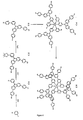
- a mixture of the ligand A-5 (200 mg, 0.178 mmol), Ir(acac) 3 (12.4 mg, 0.025 mmol) and glycerol (1 cm 3 ) was degassed and then heated with heating mantle at 220 °C for 14 h. The mixture was allowed to cool to ambient temperature. The mixture was dissolved into acetone (8 cm 3 ) and DCM (3 cm 3 ). The solution was left to stand and the layer containing the dendrimer was separated from the glycerol layer.
- Tris (dibenzylideneacetone)di-palladium (0) [Pd 2 (dba) 3 ] (198 mg, 0.217 mmol) and tri- tert -butylphosphine (10% in hexane, 4.4 cm 3 ) were added to a degassed (Schlenk line, evacuated and then back-filled with argon) mixture of 3,6-di[4'-(2"-ethylhexyloxy)phenyl]carbazole DEHP-Car (2.50 g, 4.34 mmol), 1-bromo-3-iodobenzene (4.91 g, 17.4 mmol), sodium tert -butoxide (834 mg, 8.68 mmol), and distilled toluene (12 cm 3 ).
- the mixture was degassed again before being heated at reflux with bath temperature of 110 °C under argon for 63 h.
- the resultant was allowed to cool to room temperature and diluted with H 2 O (20 cm 3 ) and ether (25 cm 3 ).
- the two phases were separated.
- the aqueous layer was extracted with ether (3 x 20 cm 3 ).
- the organic layer and the ether extracts were combined, washed with brine (1 x 40 cm 3 ) and dried over anhydrous sodium sulfate. The solvents were completely removed to leave an orange oil.
- the two phases were separated.
- the aqueous layer was extracted with ether (3 x 10 cm 3 ).
- the organic layer and the ether extracts were combined, washed with brine (1 x 30 cm 3 ) and dried over anhydrous sodium sulfate and the solvents were completely removed.
- the photoluminescence quantum yields (PLQYs) of thin films of A-8 and B-4 were measured and found to be 32% and 70% respectively. This should be compared to the PLQYs of first, IrppyD1, (22%) and second, IrppyD2, (31 %) generation dendrimers that have the same dendrons attached to only the same position of the phenyl ring of the ligand ( J. P. J. Markham, et al Appl. Phys. Lett., 2002, 80, 2645 ). That is, putting a second first generation dendron onto the ligands improves the PLQY by 50-140%. This demonstrates that the invention controls the undesirable intermolecular interactions.
- a two layer device was prepared with A-8 by the following method.
- the ITO on glass was cleaned using an Emitech plasma Asher. O 2 flow rate was set to 10, RF power to 70 watts and duration of cleaning was 4 min. Substrates were then loaded into a spin-coater straight away and A-8 in chloroform at a concentration of 10 mg/ml was spin-coated at 2000 rpm for 60 sec.
- the device was completed by sequential evaporation of TPBI, LiF, and A1 to give a device structure of: ITO/ A-8 /TPBI(50nm)/LiF(0.9nm)/Al(60nm).
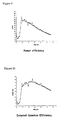
- the device properties are shown in Figures 7 to 10 ; the maximum efficiency was 22 lm/W at 3.5V.
- a two layer device was prepared with B-4 that had the structure ITO / B-4 /TPBI/ LiF 90.8 nm) / Al (100 nm). It was fabricated using the same procedures used for the device containing A-8 , although the dendrimer was spin-coated from a 20 mg/ml solution at 2000 rpm. The maximum efficiency of this device was 38 lm/W. At 100 cd/m 2 and 4.8 V the EQE was 13.2%, 45 cd/A and power efficiency was 30 lm/W.
- the efficiency of the device containing B-4 is even higher than the efficiency of the device containing A-8 . It should be noted that both dendrimers can be used as a single component in the light emitting layer and do not need to be blended with a host material to give high efficiency devices which further illustrates the advantages of the current invention.
Landscapes
- Chemical & Material Sciences (AREA)
- Organic Chemistry (AREA)
- Crystallography & Structural Chemistry (AREA)
- Inorganic Chemistry (AREA)
- Engineering & Computer Science (AREA)
- Materials Engineering (AREA)
- Electroluminescent Light Sources (AREA)
- Pyridine Compounds (AREA)
- Plural Heterocyclic Compounds (AREA)
- Inorganic Compounds Of Heavy Metals (AREA)
Applications Claiming Priority (3)
| Application Number | Priority Date | Filing Date | Title |
|---|---|---|---|
| GB0219987 | 2002-08-28 | ||
| GBGB0219987.5A GB0219987D0 (en) | 2002-08-28 | 2002-08-28 | Intramolecular interactions in organometallics |
| PCT/GB2003/003725 WO2004020448A1 (en) | 2002-08-28 | 2003-08-28 | Neutral metallic dendrimer complexes |
Publications (2)
| Publication Number | Publication Date |
|---|---|
| EP1532158A1 EP1532158A1 (en) | 2005-05-25 |
| EP1532158B1 true EP1532158B1 (en) | 2008-10-15 |
Family
ID=9943092
Family Applications (1)
| Application Number | Title | Priority Date | Filing Date |
|---|---|---|---|
| EP03791036A Expired - Lifetime EP1532158B1 (en) | 2002-08-28 | 2003-08-28 | Neutral metallic dendrimer complexes |
Country Status (10)
| Country | Link |
|---|---|
| US (2) | US7799917B2 (https=) |
| EP (1) | EP1532158B1 (https=) |
| JP (2) | JP4801350B2 (https=) |
| KR (1) | KR101011661B1 (https=) |
| CN (1) | CN100354285C (https=) |
| AT (1) | ATE411328T1 (https=) |
| AU (1) | AU2003259375A1 (https=) |
| DE (1) | DE60324156D1 (https=) |
| GB (1) | GB0219987D0 (https=) |
| WO (1) | WO2004020448A1 (https=) |
Cited By (1)
| Publication number | Priority date | Publication date | Assignee | Title |
|---|---|---|---|---|
| US8728631B2 (en) | 2003-09-12 | 2014-05-20 | Sumitomo Chemical Company, Limited | Dendrimer compound and organic luminescent device employing the same |
Families Citing this family (38)
| Publication number | Priority date | Publication date | Assignee | Title |
|---|---|---|---|---|
| GB0220092D0 (en) * | 2002-08-29 | 2002-10-09 | Isis Innovation | Reactive dendrimers |
| GB0219987D0 (en) * | 2002-08-28 | 2002-10-09 | Isis Innovation | Intramolecular interactions in organometallics |
| GB0311234D0 (en) | 2003-05-16 | 2003-06-18 | Isis Innovation | Organic phosphorescent material and organic optoelectronic device |
| GB0411572D0 (en) | 2004-05-24 | 2004-06-23 | Cambridge Display Tech Ltd | Light-emitting device |
| JP4934035B2 (ja) * | 2004-06-09 | 2012-05-16 | イー・アイ・デュポン・ドウ・ヌムール・アンド・カンパニー | 有機金属化合物およびかかる化合物で形成された素子 |
| DE102004032527A1 (de) | 2004-07-06 | 2006-02-02 | Covion Organic Semiconductors Gmbh | Elektrolumineszierende Polymere |
| TWI385193B (zh) * | 2004-12-07 | 2013-02-11 | Sumitomo Chemical Co | 高分子材料及使用該高分子材料之元件 |
| US9078330B2 (en) | 2005-03-15 | 2015-07-07 | Isis Innovation Limited | Highly branched dendrimers |
| US7344583B2 (en) * | 2005-03-31 | 2008-03-18 | 3M Innovative Properties Company | Methods of making metal particles within cored dendrimers |
| US9118020B2 (en) | 2006-04-27 | 2015-08-25 | Global Oled Technology Llc | Electroluminescent devices including organic eil layer |
| JP5144666B2 (ja) | 2006-09-19 | 2013-02-13 | スリーエム イノベイティブ プロパティズ カンパニー | 鋳型化された金属酸化物粒子及び製造方法 |
| US8119255B2 (en) * | 2006-12-08 | 2012-02-21 | Universal Display Corporation | Cross-linkable iridium complexes and organic light-emitting devices using the same |
| US8778508B2 (en) * | 2006-12-08 | 2014-07-15 | Universal Display Corporation | Light-emitting organometallic complexes |
| JP2008218988A (ja) | 2007-02-06 | 2008-09-18 | Sumitomo Chemical Co Ltd | 組成物及び該組成物を用いてなる発光素子 |
| JP5358962B2 (ja) | 2007-02-06 | 2013-12-04 | 住友化学株式会社 | 組成物及び該組成物を用いてなる発光素子 |
| JP5446096B2 (ja) | 2007-02-06 | 2014-03-19 | 住友化学株式会社 | 組成物及び該組成物を用いてなる発光素子 |
| JP2008218987A (ja) | 2007-02-06 | 2008-09-18 | Sumitomo Chemical Co Ltd | 組成物及び該組成物を用いてなる発光素子 |
| JP2008218986A (ja) | 2007-02-06 | 2008-09-18 | Sumitomo Chemical Co Ltd | 組成物及び該組成物を用いてなる発光素子 |
| US9130177B2 (en) | 2011-01-13 | 2015-09-08 | Universal Display Corporation | 5-substituted 2 phenylquinoline complexes materials for light emitting diode |
| TWI510598B (zh) * | 2007-03-08 | 2015-12-01 | Universal Display Corp | 磷光材料 |
| JP5458890B2 (ja) * | 2007-11-08 | 2014-04-02 | コニカミノルタ株式会社 | 有機エレクトロルミネッセンス素子、表示装置及び照明装置 |
| WO2009073246A1 (en) * | 2007-12-06 | 2009-06-11 | Universal Display Corporation | Method for the synthesis of iridium (iii) complexes with sterically demanding ligands |
| JP2010034528A (ja) | 2008-06-23 | 2010-02-12 | Sumitomo Chemical Co Ltd | 組成物及び該組成物を用いてなる発光素子 |
| JP2010031249A (ja) | 2008-06-23 | 2010-02-12 | Sumitomo Chemical Co Ltd | 組成物及び該組成物を用いてなる発光素子 |
| JP2010031250A (ja) | 2008-06-23 | 2010-02-12 | Sumitomo Chemical Co Ltd | 組成物及び該組成物を用いてなる発光素子 |
| KR20110018376A (ko) | 2008-06-23 | 2011-02-23 | 스미또모 가가꾸 가부시키가이샤 | 조성물 및 상기 조성물을 이용하여 이루어지는 발광 소자 |
| JP2010031248A (ja) | 2008-06-23 | 2010-02-12 | Sumitomo Chemical Co Ltd | 組成物及び該組成物を用いてなる発光素子 |
| JP5544775B2 (ja) | 2008-07-29 | 2014-07-09 | 住友化学株式会社 | 燐光発光性化合物を含む組成物及び該組成物を用いてなる発光素子 |
| US8993754B2 (en) | 2009-08-27 | 2015-03-31 | National Institute Of Advanced Industrial Science And Technology | Iridium complex and light emitting material formed from same |
| EP2471889A4 (en) | 2009-08-27 | 2013-06-26 | Sumitomo Chemical Co | METAL COMPLEX COMPOSITION AND COMPLEX POLYMER |
| WO2011049241A1 (ja) | 2009-10-22 | 2011-04-28 | 住友化学株式会社 | 有機エレクトロルミネッセンス素子 |
| CN102695775B (zh) * | 2009-11-27 | 2015-12-02 | 辛诺拉有限公司 | 电致发光器件中的官能化三线态发射体 |
| US9478744B2 (en) | 2010-11-30 | 2016-10-25 | Sumitomo Chemical Company, Limited | High molecular compound, method for producing same, and light-emitting element |
| US10008677B2 (en) | 2011-01-13 | 2018-06-26 | Universal Display Corporation | Materials for organic light emitting diode |
| EP2543685A1 (de) * | 2011-07-08 | 2013-01-09 | cynora GmbH | Verfahren zur kovalenten Bindung eines Metallkomplexes an ein Polymer |
| US10276799B2 (en) * | 2015-01-23 | 2019-04-30 | Taiyuan University Of Technology | White-light hyperbranched conjugated polymer, method for preparing the same and it's use |
| CN108658948A (zh) * | 2017-03-29 | 2018-10-16 | 中国科学院长春应用化学研究所 | 一种树枝状有机金属配合物、其制备方法及应用 |
| US11476430B2 (en) * | 2018-10-15 | 2022-10-18 | Universal Display Corporation | Organic electroluminescent materials and devices |
Citations (1)
| Publication number | Priority date | Publication date | Assignee | Title |
|---|---|---|---|---|
| WO2002044189A1 (fr) * | 2000-11-30 | 2002-06-06 | Canon Kabushiki Kaisha | Element luminescent et afficheur |
Family Cites Families (7)
| Publication number | Priority date | Publication date | Assignee | Title |
|---|---|---|---|---|
| FI20001694A0 (fi) | 2000-07-20 | 2000-07-20 | Asm Microchemistry Oy | Menetelmä ohutkalvon kasvattamiseksi substraatille |
| EP1313559B2 (en) * | 2000-08-10 | 2012-10-24 | Trustees of Boston College | Recyclable metathesis catalysts |
| EP1366113B1 (en) * | 2001-02-20 | 2011-04-13 | Isis Innovation Limited | Metal-containing dendrimers |
| DE10116962A1 (de) | 2001-04-05 | 2002-10-10 | Covion Organic Semiconductors | Rhodium- und Iridium-Komplexe |
| JP4220767B2 (ja) * | 2001-12-04 | 2009-02-04 | 日本放送協会 | 有機化合物、有機el素子およびディスプレイ |
| AU2003214421A1 (en) | 2002-03-18 | 2003-09-29 | Isis Innovation Limited | Phosphorescent dendrimers for use in light-emitting devices |
| GB0219987D0 (en) | 2002-08-28 | 2002-10-09 | Isis Innovation | Intramolecular interactions in organometallics |
-
2002
- 2002-08-28 GB GBGB0219987.5A patent/GB0219987D0/en not_active Ceased
-
2003
- 2003-08-28 CN CNB03824781XA patent/CN100354285C/zh not_active Expired - Fee Related
- 2003-08-28 WO PCT/GB2003/003725 patent/WO2004020448A1/en not_active Ceased
- 2003-08-28 EP EP03791036A patent/EP1532158B1/en not_active Expired - Lifetime
- 2003-08-28 US US10/525,687 patent/US7799917B2/en not_active Expired - Fee Related
- 2003-08-28 JP JP2004532299A patent/JP4801350B2/ja not_active Expired - Fee Related
- 2003-08-28 KR KR1020057003257A patent/KR101011661B1/ko not_active Expired - Fee Related
- 2003-08-28 AT AT03791036T patent/ATE411328T1/de not_active IP Right Cessation
- 2003-08-28 DE DE60324156T patent/DE60324156D1/de not_active Expired - Lifetime
- 2003-08-28 AU AU2003259375A patent/AU2003259375A1/en not_active Abandoned
-
2010
- 2010-08-11 US US12/854,288 patent/US8536333B2/en not_active Expired - Fee Related
- 2010-11-24 JP JP2010261450A patent/JP5509045B2/ja not_active Expired - Fee Related
Patent Citations (2)
| Publication number | Priority date | Publication date | Assignee | Title |
|---|---|---|---|---|
| WO2002044189A1 (fr) * | 2000-11-30 | 2002-06-06 | Canon Kabushiki Kaisha | Element luminescent et afficheur |
| EP1348711A1 (en) * | 2000-11-30 | 2003-10-01 | Canon Kabushiki Kaisha | Luminescent element and display |
Cited By (3)
| Publication number | Priority date | Publication date | Assignee | Title |
|---|---|---|---|---|
| US8728631B2 (en) | 2003-09-12 | 2014-05-20 | Sumitomo Chemical Company, Limited | Dendrimer compound and organic luminescent device employing the same |
| US9966532B2 (en) | 2003-09-12 | 2018-05-08 | Sumitomo Chemical Company, Limited | Dendrimer compound and organic luminescent device employing the same |
| US10854818B2 (en) | 2003-09-12 | 2020-12-01 | Sumitomo Chemical Company, Limited | Dendrimer compound and organic luminescent device employing the same |
Also Published As
| Publication number | Publication date |
|---|---|
| KR101011661B1 (ko) | 2011-01-31 |
| AU2003259375A8 (en) | 2004-03-19 |
| KR20050059115A (ko) | 2005-06-17 |
| JP2011046740A (ja) | 2011-03-10 |
| HK1076111A1 (en) | 2006-01-06 |
| CN100354285C (zh) | 2007-12-12 |
| JP4801350B2 (ja) | 2011-10-26 |
| US20110127496A1 (en) | 2011-06-02 |
| JP5509045B2 (ja) | 2014-06-04 |
| DE60324156D1 (de) | 2008-11-27 |
| GB0219987D0 (en) | 2002-10-09 |
| US20060119254A1 (en) | 2006-06-08 |
| WO2004020448A1 (en) | 2004-03-11 |
| EP1532158A1 (en) | 2005-05-25 |
| US8536333B2 (en) | 2013-09-17 |
| JP2005537321A (ja) | 2005-12-08 |
| CN1694891A (zh) | 2005-11-09 |
| AU2003259375A1 (en) | 2004-03-19 |
| ATE411328T1 (de) | 2008-10-15 |
| US7799917B2 (en) | 2010-09-21 |
Similar Documents
| Publication | Publication Date | Title |
|---|---|---|
| EP1532158B1 (en) | Neutral metallic dendrimer complexes | |
| Lo et al. | A light‐blue phosphorescent dendrimer for efficient solution‐processed light‐emitting diodes | |
| JP5473326B2 (ja) | 安定oled材料及び改善された安定性を有するデバイス | |
| JP4343838B2 (ja) | 有機発光材料及びデバイス | |
| EP1763902B1 (en) | Stable and efficient electroluminescent materials | |
| EP1491074B1 (en) | Phosphorescent dendrimers for use in light-emitting devices | |
| CN109438520B (zh) | 环金属化四齿Pt(II)配合物 | |
| Beucher et al. | Highly efficient green solution processable organic light-emitting diodes based on a phosphorescent κ3-(N^ C^ C) gold (iii)-alkynyl complex | |
| US20090123720A1 (en) | Solution processed organometallic complexes and their use in electroluminescent devices | |
| JP2008528646A (ja) | 金属錯体 | |
| WO2005013388A2 (en) | Materials and structures for enhancing the performance of organic light emitting devices | |
| JP2006513278A6 (ja) | 有機発光材料及びデバイス | |
| Ma et al. | Recent progress in sublimable cationic iridium (III) complexes for organic light‐emitting diodes | |
| WO2004029134A1 (en) | Fluorene-containing dendrimers | |
| WO2009005272A2 (en) | Organometallic complex compounds for organic light emitting display device and organic light emitting display device including the same | |
| HK1076111B (en) | Neutral metallic dendrimer complexes | |
| Djurovich et al. | Synthesis and Characterization of Phosphorescent Cyclometalated Platinum Complexes | |
| KR20070112823A (ko) | 용액 처리된 유기 금속 착물 및 이를 전기 발광 소자에이용하는 방법 |
Legal Events
| Date | Code | Title | Description |
|---|---|---|---|
| PUAI | Public reference made under article 153(3) epc to a published international application that has entered the european phase |
Free format text: ORIGINAL CODE: 0009012 |
|
| 17P | Request for examination filed |
Effective date: 20050304 |
|
| AK | Designated contracting states |
Kind code of ref document: A1 Designated state(s): AT BE BG CH CY CZ DE DK EE ES FI FR GB GR HU IE IT LI LU MC NL PT RO SE SI SK TR |
|
| AX | Request for extension of the european patent |
Extension state: AL LT LV MK |
|
| DAX | Request for extension of the european patent (deleted) | ||
| REG | Reference to a national code |
Ref country code: HK Ref legal event code: DE Ref document number: 1076111 Country of ref document: HK |
|
| GRAP | Despatch of communication of intention to grant a patent |
Free format text: ORIGINAL CODE: EPIDOSNIGR1 |
|
| RIC1 | Information provided on ipc code assigned before grant |
Ipc: H01L 51/00 20060101ALI20080417BHEP Ipc: C07F 15/00 20060101AFI20080417BHEP Ipc: H05B 33/00 20060101ALI20080417BHEP |
|
| GRAS | Grant fee paid |
Free format text: ORIGINAL CODE: EPIDOSNIGR3 |
|
| GRAA | (expected) grant |
Free format text: ORIGINAL CODE: 0009210 |
|
| AK | Designated contracting states |
Kind code of ref document: B1 Designated state(s): AT BE BG CH CY CZ DE DK EE ES FI FR GB GR HU IE IT LI LU MC NL PT RO SE SI SK TR |
|
| REG | Reference to a national code |
Ref country code: GB Ref legal event code: FG4D Ref country code: CH Ref legal event code: EP |
|
| REG | Reference to a national code |
Ref country code: IE Ref legal event code: FG4D |
|
| REF | Corresponds to: |
Ref document number: 60324156 Country of ref document: DE Date of ref document: 20081127 Kind code of ref document: P |
|
| REG | Reference to a national code |
Ref country code: HK Ref legal event code: GR Ref document number: 1076111 Country of ref document: HK |
|
| NLV1 | Nl: lapsed or annulled due to failure to fulfill the requirements of art. 29p and 29m of the patents act | ||
| PG25 | Lapsed in a contracting state [announced via postgrant information from national office to epo] |
Ref country code: BG Free format text: LAPSE BECAUSE OF FAILURE TO SUBMIT A TRANSLATION OF THE DESCRIPTION OR TO PAY THE FEE WITHIN THE PRESCRIBED TIME-LIMIT Effective date: 20090115 Ref country code: AT Free format text: LAPSE BECAUSE OF FAILURE TO SUBMIT A TRANSLATION OF THE DESCRIPTION OR TO PAY THE FEE WITHIN THE PRESCRIBED TIME-LIMIT Effective date: 20081015 Ref country code: ES Free format text: LAPSE BECAUSE OF FAILURE TO SUBMIT A TRANSLATION OF THE DESCRIPTION OR TO PAY THE FEE WITHIN THE PRESCRIBED TIME-LIMIT Effective date: 20090126 |
|
| PG25 | Lapsed in a contracting state [announced via postgrant information from national office to epo] |
Ref country code: SI Free format text: LAPSE BECAUSE OF FAILURE TO SUBMIT A TRANSLATION OF THE DESCRIPTION OR TO PAY THE FEE WITHIN THE PRESCRIBED TIME-LIMIT Effective date: 20081015 Ref country code: PT Free format text: LAPSE BECAUSE OF FAILURE TO SUBMIT A TRANSLATION OF THE DESCRIPTION OR TO PAY THE FEE WITHIN THE PRESCRIBED TIME-LIMIT Effective date: 20090316 Ref country code: FI Free format text: LAPSE BECAUSE OF FAILURE TO SUBMIT A TRANSLATION OF THE DESCRIPTION OR TO PAY THE FEE WITHIN THE PRESCRIBED TIME-LIMIT Effective date: 20081015 Ref country code: NL Free format text: LAPSE BECAUSE OF FAILURE TO SUBMIT A TRANSLATION OF THE DESCRIPTION OR TO PAY THE FEE WITHIN THE PRESCRIBED TIME-LIMIT Effective date: 20081015 |
|
| PG25 | Lapsed in a contracting state [announced via postgrant information from national office to epo] |
Ref country code: EE Free format text: LAPSE BECAUSE OF FAILURE TO SUBMIT A TRANSLATION OF THE DESCRIPTION OR TO PAY THE FEE WITHIN THE PRESCRIBED TIME-LIMIT Effective date: 20081015 Ref country code: RO Free format text: LAPSE BECAUSE OF FAILURE TO SUBMIT A TRANSLATION OF THE DESCRIPTION OR TO PAY THE FEE WITHIN THE PRESCRIBED TIME-LIMIT Effective date: 20081015 Ref country code: BE Free format text: LAPSE BECAUSE OF FAILURE TO SUBMIT A TRANSLATION OF THE DESCRIPTION OR TO PAY THE FEE WITHIN THE PRESCRIBED TIME-LIMIT Effective date: 20081015 Ref country code: DK Free format text: LAPSE BECAUSE OF FAILURE TO SUBMIT A TRANSLATION OF THE DESCRIPTION OR TO PAY THE FEE WITHIN THE PRESCRIBED TIME-LIMIT Effective date: 20081015 |
|
| PLBE | No opposition filed within time limit |
Free format text: ORIGINAL CODE: 0009261 |
|
| STAA | Information on the status of an ep patent application or granted ep patent |
Free format text: STATUS: NO OPPOSITION FILED WITHIN TIME LIMIT |
|
| PG25 | Lapsed in a contracting state [announced via postgrant information from national office to epo] |
Ref country code: SE Free format text: LAPSE BECAUSE OF FAILURE TO SUBMIT A TRANSLATION OF THE DESCRIPTION OR TO PAY THE FEE WITHIN THE PRESCRIBED TIME-LIMIT Effective date: 20090115 Ref country code: IT Free format text: LAPSE BECAUSE OF FAILURE TO SUBMIT A TRANSLATION OF THE DESCRIPTION OR TO PAY THE FEE WITHIN THE PRESCRIBED TIME-LIMIT Effective date: 20081015 Ref country code: CZ Free format text: LAPSE BECAUSE OF FAILURE TO SUBMIT A TRANSLATION OF THE DESCRIPTION OR TO PAY THE FEE WITHIN THE PRESCRIBED TIME-LIMIT Effective date: 20081015 |
|
| 26N | No opposition filed |
Effective date: 20090716 |
|
| PG25 | Lapsed in a contracting state [announced via postgrant information from national office to epo] |
Ref country code: SK Free format text: LAPSE BECAUSE OF FAILURE TO SUBMIT A TRANSLATION OF THE DESCRIPTION OR TO PAY THE FEE WITHIN THE PRESCRIBED TIME-LIMIT Effective date: 20081015 |
|
| PG25 | Lapsed in a contracting state [announced via postgrant information from national office to epo] |
Ref country code: MC Free format text: LAPSE BECAUSE OF NON-PAYMENT OF DUE FEES Effective date: 20090831 |
|
| REG | Reference to a national code |
Ref country code: CH Ref legal event code: PL |
|
| PG25 | Lapsed in a contracting state [announced via postgrant information from national office to epo] |
Ref country code: LI Free format text: LAPSE BECAUSE OF NON-PAYMENT OF DUE FEES Effective date: 20090831 Ref country code: CH Free format text: LAPSE BECAUSE OF NON-PAYMENT OF DUE FEES Effective date: 20090831 |
|
| REG | Reference to a national code |
Ref country code: FR Ref legal event code: ST Effective date: 20100430 |
|
| PG25 | Lapsed in a contracting state [announced via postgrant information from national office to epo] |
Ref country code: FR Free format text: LAPSE BECAUSE OF NON-PAYMENT OF DUE FEES Effective date: 20090831 Ref country code: IE Free format text: LAPSE BECAUSE OF NON-PAYMENT OF DUE FEES Effective date: 20090828 |
|
| PG25 | Lapsed in a contracting state [announced via postgrant information from national office to epo] |
Ref country code: GR Free format text: LAPSE BECAUSE OF FAILURE TO SUBMIT A TRANSLATION OF THE DESCRIPTION OR TO PAY THE FEE WITHIN THE PRESCRIBED TIME-LIMIT Effective date: 20090116 |
|
| PG25 | Lapsed in a contracting state [announced via postgrant information from national office to epo] |
Ref country code: LU Free format text: LAPSE BECAUSE OF NON-PAYMENT OF DUE FEES Effective date: 20090828 |
|
| PG25 | Lapsed in a contracting state [announced via postgrant information from national office to epo] |
Ref country code: HU Free format text: LAPSE BECAUSE OF FAILURE TO SUBMIT A TRANSLATION OF THE DESCRIPTION OR TO PAY THE FEE WITHIN THE PRESCRIBED TIME-LIMIT Effective date: 20090416 |
|
| PG25 | Lapsed in a contracting state [announced via postgrant information from national office to epo] |
Ref country code: TR Free format text: LAPSE BECAUSE OF FAILURE TO SUBMIT A TRANSLATION OF THE DESCRIPTION OR TO PAY THE FEE WITHIN THE PRESCRIBED TIME-LIMIT Effective date: 20081015 |
|
| PG25 | Lapsed in a contracting state [announced via postgrant information from national office to epo] |
Ref country code: CY Free format text: LAPSE BECAUSE OF FAILURE TO SUBMIT A TRANSLATION OF THE DESCRIPTION OR TO PAY THE FEE WITHIN THE PRESCRIBED TIME-LIMIT Effective date: 20081015 |
|
| REG | Reference to a national code |
Ref country code: DE Ref legal event code: R081 Ref document number: 60324156 Country of ref document: DE Owner name: OXFORD UNIVERSITY INNOVATION LIMITED, GB Free format text: FORMER OWNERS: ISIS INNOVATION LTD., SUMMERTOWN, OXFORD, GB; THE UNIVERSITY COURT OF THE UNIVERSITY OF ST. ANDREWS, ST. ANDREWS, GB Ref country code: DE Ref legal event code: R081 Ref document number: 60324156 Country of ref document: DE Owner name: THE UNIVERSITY COURT OF THE UNIVERSITY OF ST. , GB Free format text: FORMER OWNERS: ISIS INNOVATION LTD., SUMMERTOWN, OXFORD, GB; THE UNIVERSITY COURT OF THE UNIVERSITY OF ST. ANDREWS, ST. ANDREWS, GB Ref country code: DE Ref legal event code: R082 Ref document number: 60324156 Country of ref document: DE Representative=s name: LORENZ SEIDLER GOSSEL RECHTSANWAELTE PATENTANW, DE Ref country code: DE Ref legal event code: R081 Ref document number: 60324156 Country of ref document: DE Owner name: CAMBRIDGE DISPLAY TECHNOLOGY LIMITED, GODMANCH, GB Free format text: FORMER OWNERS: ISIS INNOVATION LTD., SUMMERTOWN, OXFORD, GB; THE UNIVERSITY COURT OF THE UNIVERSITY OF ST. ANDREWS, ST. ANDREWS, GB Ref country code: DE Ref legal event code: R082 Ref document number: 60324156 Country of ref document: DE Representative=s name: GRUENECKER PATENT- UND RECHTSANWAELTE PARTG MB, DE |
|
| REG | Reference to a national code |
Ref country code: DE Ref legal event code: R081 Ref document number: 60324156 Country of ref document: DE Owner name: CAMBRIDGE DISPLAY TECHNOLOGY LIMITED, GODMANCH, GB Free format text: FORMER OWNERS: OXFORD UNIVERSITY INNOVATION LIMITED, OXFORD, OXFORDSHIRE, GB; THE UNIVERSITY COURT OF THE UNIVERSITY OF ST. ANDREWS, ST. ANDREWS, GB Ref country code: DE Ref legal event code: R082 Ref document number: 60324156 Country of ref document: DE Representative=s name: GRUENECKER PATENT- UND RECHTSANWAELTE PARTG MB, DE Ref country code: DE Ref legal event code: R081 Ref document number: 60324156 Country of ref document: DE Owner name: CAMBRIDGE DISPLAY TECHNOLOGY LIMITED, GODMANCH, GB Free format text: FORMER OWNERS: OXFORD UNIVERSITY INNOVATION LIMITED, OXFORD, GB; THE UNIVERSITY COURT OF THE UNIVERSITY OF ST. ANDREWS, ST. ANDREWS, GB |
|
| PGFP | Annual fee paid to national office [announced via postgrant information from national office to epo] |
Ref country code: GB Payment date: 20180726 Year of fee payment: 16 |
|
| GBPC | Gb: european patent ceased through non-payment of renewal fee |
Effective date: 20190828 |
|
| PG25 | Lapsed in a contracting state [announced via postgrant information from national office to epo] |
Ref country code: GB Free format text: LAPSE BECAUSE OF NON-PAYMENT OF DUE FEES Effective date: 20190828 |
|
| PGFP | Annual fee paid to national office [announced via postgrant information from national office to epo] |
Ref country code: DE Payment date: 20210713 Year of fee payment: 19 |
|
| REG | Reference to a national code |
Ref country code: DE Ref legal event code: R119 Ref document number: 60324156 Country of ref document: DE |
|
| PG25 | Lapsed in a contracting state [announced via postgrant information from national office to epo] |
Ref country code: DE Free format text: LAPSE BECAUSE OF NON-PAYMENT OF DUE FEES Effective date: 20230301 |