EP1530949B1 - Instrument und verfahren zur biodetektion und identifizierungseinrichtung mit biosensorischer funktion - Google Patents
Instrument und verfahren zur biodetektion und identifizierungseinrichtung mit biosensorischer funktion Download PDFInfo
- Publication number
- EP1530949B1 EP1530949B1 EP02765554A EP02765554A EP1530949B1 EP 1530949 B1 EP1530949 B1 EP 1530949B1 EP 02765554 A EP02765554 A EP 02765554A EP 02765554 A EP02765554 A EP 02765554A EP 1530949 B1 EP1530949 B1 EP 1530949B1
- Authority
- EP
- European Patent Office
- Prior art keywords
- image
- living
- obtaining
- fingerprint
- secretion product
- Prior art date
- Legal status (The legal status is an assumption and is not a legal conclusion. Google has not performed a legal analysis and makes no representation as to the accuracy of the status listed.)
- Expired - Lifetime
Links
Images


Classifications
-
- G—PHYSICS
- G06—COMPUTING OR CALCULATING; COUNTING
- G06V—IMAGE OR VIDEO RECOGNITION OR UNDERSTANDING
- G06V40/00—Recognition of biometric, human-related or animal-related patterns in image or video data
- G06V40/10—Human or animal bodies, e.g. vehicle occupants or pedestrians; Body parts, e.g. hands
- G06V40/12—Fingerprints or palmprints
- G06V40/1335—Combining adjacent partial images (e.g. slices) to create a composite input or reference pattern; Tracking a sweeping finger movement
-
- G—PHYSICS
- G06—COMPUTING OR CALCULATING; COUNTING
- G06V—IMAGE OR VIDEO RECOGNITION OR UNDERSTANDING
- G06V40/00—Recognition of biometric, human-related or animal-related patterns in image or video data
- G06V40/10—Human or animal bodies, e.g. vehicle occupants or pedestrians; Body parts, e.g. hands
- G06V40/12—Fingerprints or palmprints
- G06V40/1382—Detecting the live character of the finger, i.e. distinguishing from a fake or cadaver finger
- G06V40/1388—Detecting the live character of the finger, i.e. distinguishing from a fake or cadaver finger using image processing
Definitions
- the present invention relates to an apparatus and a method of detecting whether or not a subject of which biometric information should be acquired is a living body in an authenticating apparatus for employing biometric information such as, for example, a fingerprint, a palmprint, and a blood vessel pattern, thereby to make personal authentication.
- the present invention relates to an authenticating apparatus for employing biometric information such as, for example, a fingerprint, a palmprint, and a blood vessel pattern, thereby to make personal authentication, and more particularly to an authenticating apparatus having a living-body detecting function for detecting whether or not a subject, being an object of biometric information acquisition, is a living body in acquiring biometric information from a person to be authenticated.
- biometric information such as, for example, a fingerprint, a palmprint, and a blood vessel pattern
- Small-sized information appliances such as a mobile telephone and a PDA (Personal Digital Assistant) have been allowed to be connected to a network in some cases, or to file a large capacity of personal information etc. in some cases, accompanied by their highly-developed functions of recent years, and a demand for improving a security performance in these appliances have been augmented exceedingly.
- PDA Personal Digital Assistant
- the fingerprint (a pattern which is comprised of ridges, which can touch an obtaining plane of a fingerprint sensor, and valleys, which do not touch the identical obtaining plane) is obtained as image information from a finger of a person to be authenticated with a capacitance type fingerprint sensor or an optical fingerprint sensor.
- characteristic information for example, position information of bifurcations or end-points
- foreground for example, ridge images
- characteristic information is extracted from the foreground (for example, ridge images) of its fingerprint image to compare the extracted characteristic information with registered characteristic information of a person to be authenticated, which was pre-registered, and thereby to make a determination as to whether or not the person to be authenticated is a person who has performed the registration of the registered characteristic information, that is, personal authentication.
- the capacitance type fingerprint sensor has no operation of obtaining the fingerprint images from an artificial finger made of silicon or an artificial finger made of rubber. Also, the optical fingerprint sensor as well is not able to obtain the fingerprint image basically from the artificial finger made of silicon or the artificial finger made of rubber.
- gummi which is obtained by gelling aqueous solution of gelatin
- the composition is extremely akin to that of the integument of a human being
- the capacitance type fingerprint sensor or the optical fingerprint sensor to obtain the fingerprint image from the artificial finger made of gummi because the gummi is pervious to electricity, thus enabling the unjust utilization by an action of the successful impersonation.
- Japanese Patent Laid-open (Kokai) No. 2000-123143 or Japanese Patent Laid-open (Kokai) No. HEI 10-302047 it is determined whether or not the subject is a living body by means of an electric current value, an electrostatic capacity, an electric resistance, etc. of the subject, so it is impossible to exclude the forged fingerprint of the artificial finger made of gummi which is pervious to electricity as described above. Also, the forged fingerprint is determined by whether or not the capacitance type sensor makes a reaction in the technology disclosed in Japanese Patent Laid-open (Kokai) No.
- the forged fingerprint is determined by a frequency characteristic of impedance, being an electric characteristic, in the technology disclosed in Japanese PatentLaid-open (Kokai) No. 2000-172833 , so it is impossible for either of these technologies to exclude the forged fingerprint of the artificial finger made of gummi which is pervious to electricity.
- the present invention has been originated in consideration of such problems, and a first object thereof is to provide a living-body detecting apparatus and method allowing a detection as to whether or not the subject is a living body to be made securely, thus making it possible to securely identify a non-living body such as, for example, the artificial finger made of gummi.
- the present invention has a second object of providing an authenticating apparatus having a living-body detecting function which allows a detection as to whether or not the subject, being an object of biometric information acquisition, is a living body to be made securely in acquiring biometric information from a person to be authenticated for purposes of employing biometric information such as, for example, a fingerprint and a palm print, thereby to make personal authentication, securely identifies, for example, the artificial finger made of gummi, securely excludes the unjust utilization by an action of successful impersonation employing the forged fingerprint, and realizes personal authentication having a higher reliability.
- biometric information such as, for example, a fingerprint and a palm print
- WO 01/24700 A1 discloses a biometric sensing system and techniques for detecting spoofs of a living finger. Unique biological and physical characteristics of a finger are captured by a fingerprint sensor over a sequence of images and interpreted from the captured images. The characteristics are extracted from an electrical representation of the finger in what, in the past, was considered "noise" in the electrical representation.
- One system comprises an image capture device configured to sample an applied object and create an electrical representation of the applied object and a spoof detection module configured to analyze the electrical representation of the applied object for relative intensity, density, geometric, or temporal anomalies indicative of a non-living applied object. Methods are disclosed for the same end, the methods including: average intensity, pixel density, rate of warming, ridge uniformity, ridge signal strength, water droplet differential, finger-print vitality, and inverted spoof techniques.
- WO 01/09816 A1 discloses a biometric recognition method, in which changes in a fingerprint image resulting from unconscious variations in pressure or variations in pressure arising as a result of specific instructions of movements of a fingerpad on a bearing surface of a fingerprint sensor are recorded in order to recognize living beings and/or persons by means of said fingerprint sensor.
- a pattern formed on the integument which is comprised of ridges which can touch the obtaining plane, and valleys which do not touch the obtaining plane, may be obtained together with the secretion product, which adheres to the obtaining plane, as an image of the integument surface.
- a weighted average image of a plurality of the images to be obtained continuously (successively) by the image obtaining means may be calculated to detect existence of the secretion product, based upon a temporal change in the calculated weighted average image, and in this case, a change in a sensitivity value accompanied by a lapse of time in the weighted average image may be employed to recognize its change part as a part to which the secretion product adheres, in the discretion plane, thereby to detect existence of the secretion product.
- a contact type semiconductor sensor which is typified by a capacitance type sensor, or an optical sensor may be employed as the image obtaining means.
- the pattern may be a fingerprint and yet the exocrine gland may be a sweat gland, and in this case, a sweep type fingerprint sensor for, while moving a finger (finger of the person to be authenticated) as the subject relatively to the obtaining plane, obtaining partial images of the fingerprint of the finger continuously may be employed as the image obtaining means.
- the authenticating apparatus having a living-body detecting function of the present invention in acquiring biometric information from a person to be authenticated for purposes of employing biometric information such as, for example, a fingerprint, a palm print, and a blood vessel pattern, thereby to make personal authentication, the technique similar to that of the foregoing living-body detecting apparatuses and methods is employed to investigate presence of the secretion product, and the person is authenticated in a case where existence of the secretion product was detected and yet it was determined that the obtained characteristic information coincided with the registered characteristic information.
- biometric information such as, for example, a fingerprint, a palm print, and a blood vessel pattern
- the living-body detection can be made by employing the existing image obtaining means for obtaining biometric information as it stands, whereby there is no necessity for newly adding appliances (hardware) for making the living-body detection, and the living-body detecting function can be realized without incurring an increase in facility cost etc.
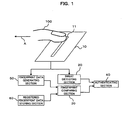
- Fig. 1 is a block diagram illustrating a configuration of an authenticating apparatus having a living-body detecting function as one embodiment of the present invention.
- the authenticating apparatus of this embodiment to be illustrated in this Fig. 1 which is for employing a fingerprint (biometric information) of a person to be authenticated, thereby to authenticate this person, comprises a capacitance and sweep type fingerprint sensor (image obtaining means) 10, a sweat detecting section (secretion product detecting means) 20, a fingerprint comparing section (comparing means) 30, an authenticating section (authenticating means) 40, a fingerprint data generating section 50, and a registered fingerprint data storing section 60.
- the capacitance and sweep type fingerprint sensor (image obtaining means) 10 is for continuously obtaining images of an integument surface of a person to be authenticated, which moves while touching an obtaining plane (a sensor plane) 11, and more specifically, for, while moving a finger 100 of the person to be authenticated relatively to the obtaining plane 11, obtaining partial images of the fingerprint of its finger 100 continuously.
- the so-called fingerprint which was formed on an integument of the person to be authenticated (finger; subject), is a pattern, which is comprised of ridges (contact part), which can touch the obtaining plane 11, and valleys (non-contact part/gap part), which do not touch the obtaining plane 11.
- the fingerprint sensor 10 utilizes the fact that a difference of the detection sensitivity exists between the ridge part, which touches the obtaining plane 11, and the valley part, which does not touch the obtaining plane 11, thereby to obtain the fingerprint image as a multi-level image.
- brightness differs responding to a distance from the sensor, normally, the ridge part having a short distance to the sensor is displayed in low brightness, and the valley part having a comparatively long distance to the sensor is displayed in high brightness.
- the secretion products such as sweat, sebum, and vapor are secreted from these sweat glands at any time.
- the finger 100 is moved/caused to touch the obtaining plane 11 for purpose of obtaining the fingerprint image, the secretion products from the sweat glands adhere to the obtaining plane 11 without fail so long as its finger is a living body.
- the fingerprint sensor 10 translates the secretion products, which adhere to the obtaining plane 11 as described above, into images similarly to the ridge part, and obtains them as a low-brightness pattern in the above-mentioned partial images.
- a general fingerprint sensor for obtaining the fingerprint image from the person to be authenticated has a sensor plane (obtaining plane) larger than the size of the finger.
- the size of the sensor plane has been made smaller than the size of the finger to integrate a plurality of the partial images obtained continuously through its sensor plane for obtaining the image of the entirety of the fingerprint.
- the capacitance and sweep type fingerprint sensor 10 to be employed in this embodiment which is a fingerprint sensor responding to such a situation, is sufficiently shorter in length than the finger 100, and has a small-area and rectangular obtaining plane (sensor plane/imaging plane) 11 as shown in Fig. 1 .
- the fingerprint sensor 10 is adapted to continuously obtain a plurality of the partial images relating to the fingerprint of the finger 100 while the finger 100 is moved to the obtaining plane 11, or while the obtaining plane 11 (fingerprint sensor 10) is moved to the finger 100, and the fingerprint data generating section 50 is adapted to reconstruct the entirety of the fingerprint image of the finger 100 from a plurality of the obtained partial images.
- a relative movement of the finger 100 to the obtaining plane 11 as described above is called a sweep.
- the fingerprint data generating section 50 reconstructs the entirety of the fingerprint image as described above, and extracts/generates information of minutiae (bifurcations or end-points of the ridge) as fingerprint data (obtained characteristic information of the person to be authenticated) necessary for comparison from its fingerprint image.
- the sweat detecting section (secretion product detecting means) 20 which is for detecting existence of the secretion product to be secreted from the exocrine gland (sweat gland) of the finger 100, based upon a plurality of the partial images obtained continuously by the fingerprint sensor 10, calculates a weighted average image of the above-mentioned plurality of the partial images, and detects existence of the secretion product, based upon a temporal change in the calculated weighted average image.
- the brightness value of the ridge or the secretion product becomes lower than that of the circumference in the weighted average image which was calculated, whereby it is defined that the lower the brightness of the image is, the higher the sensitivity to the secretion product is.
- the optical sensor was employed, the brightness value of the ridge or the secretion product becomes higher than that of the circumference, whereby it is defined that the higher the brightness of the image is, the higher the sensitivity to the secretion product is.
- the sweat detecting section 20 of this embodiment recognizes a part in which a change from a high sensitivity value to a low sensitivity value with a lapse of time is slow as compared with that of the circumference, in the weighted average image which was calculated, as a part to which the secretion product adheres, in the obtaining plane 11, and detects existence of the secretion product.
- sweat, sebum, vapor, etc. are considered as the secretion products as described above; however the sweat is represented herein, and hereinafter, the secretion product is described as "sweat".
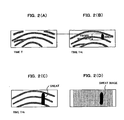
- Fig. 2(A) to Fig. 2 (D) are views illustrating examples of the partial images which were imaged by the fingerprint sensor 10 at the time of T, T+t, and T+k (k>t>0) respectively
- Fig. 2 (D) is a view illustrating the weighted average image (that is, the weighted average image of the partial images obtained at the time of T to T+k) of the partial images shown in Fig. 2 (A) to Fig. 2 (C)
- Fig. 3 is a graph illustrating a temporal change in the image intensity (sensitivity value) of the fingerprint and the sweat, which is obtained by the fingerprint sensor 10.
- the sweat detecting section 20 In order to detect a pattern, which is not a moving image like the ridge, as sweat etc. which was secreted from the living body (finger 100) and adhered to the obtaining plane 11, the sweat detecting section 20 employs the weighted average image of a plurality of the partial images, thereby to separate the fingerprint image (ridge image) from the sweat image in a plurality of the partial images of the fingerprint which were imaged by the fingerprint sensor 10.
- the sweat image secretion product
- the finger 100 moves with time, so the ridge image changes its position every moment as shown in Fig 2 (A) to Fig. 2 (C) .
- the possibility that the identical pattern (ridge image) comes out at the identical position of each partial image is very low, so the image, which corresponds to the ridge, is averaged in the weighted average image (superposed image) obtained from a plurality of the partial images as shown in Fig. 2 (D) , and image information (image intensity) of the ridge results in being thinned down.
- the image which was obtained by multiplying an input image F(i,j,K-k) by a weight w(k) to calculate the weighted average image G(i,j,K) in regard to n sheets of the partial images employing such an equation (1), is regard as the non-moving pattern (i.e. sweat image), where n may be defined as the number of images to be acquired within a predetermined time, or may be defined as the number of images acquired within a predetermined distance. Also, the weight w(k) is set so that the newer the partial image is (i.e. the smaller k is), the larger it becomes.
- the sweat detecting section 20 of this embodiment recognizes a part in which a change from a low sensitivity value to a high sensitivity value occurs as time elapses, in the weighted average image G (i, j, K) calculated with the equation (1), as a part to which sweat etc. adheres, in the obtaining plane 11, and detects existence of the secretion product.
- the weighted average image G (i, j, K) may be calculated by employing, for example, the following equation (2) instead of the above equation (1).
- G i j K ⁇ w k ⁇ F ⁇ i , j , K - l + G ⁇ i , j , K - 1
- the finger 100 is caused to move from its ball part toward the fingertip.
- the ridge exists almost in parallel to the sweep direction (the direction of the arrow A of Fig. 1 ) in the part of the ball of the finger 100, and the ridge exists in an intersecting direction to the sweep direction in the tip part of the finger 100.
- the image intensity of the ridge is extremely high in the average image of the ball side of the finger 100 and the intensity of the sweat image is low, whereby it is difficult to separate the sweat image from the partial images.
- the image intensity of the ridge becomes low and the intensity of the sweat image becomes high in the tip side of the finger 100, whereby it becomes possible to easily separate/recognize the sweat image from the partial images.
- a partial image group of the fingertip side which does not receive an influence of the ridge image, is preferably employed to calculate the weighted average image, and to detect existence of sweat (secretion product).
- the fingerprint comparing section (comparing means) 30 is for comparing obtained fingerprint data (obtained characteristic information of the person to be authenticated), which was obtained by the fingerprint data generating section 50, with registered fingerprint data (registered characteristic information) of the person to be authenticated, which was pre-registered in the registered finger data storing section 60, thereby to determine whether or not this obtained fingerprint data coincides with the registered fingerprint data.
- the authenticating section 40 authenticates the person. That is, in a case where existence of the secretion product such as sweat etc. was not detected by the sweat detecting section 20 (in a case where it is impossible to confirm that the subject, which touched the obtaining plane 11, is a living body), the authenticating section 40 of this embodiment makes it a rule to output failure in authentication (non-authentication information that the person to be authenticated is not a person who has performed the registration of the registered fingerprint data) at any time regardless of a fingerprint comparison result by the comparing section 30.
- the forgoing authenticating apparatus of this embodiment is realized by attaching the capacitance and sweep type fingerprint sensor 10, for example, to a personal computer.
- functions as the sweat detecting section 20, the fingerprint comparing section 30, the authenticating section 40, and the fingerprint data generating section 50 are realized by executing a predetermined program with a CPU (Central Processing Unit) within the personal computer, and a function as the registered fingerprint data storing section 60 is realized with a memory device (for example, a hard disk, a RAM, a ROM, etc.) within the personal computer, a memory device etc. externally attached to the personal computer, or the like.
- a memory device for example, a hard disk, a RAM, a ROM, etc.
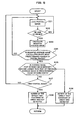
- an initial adjustment of the fingerprint sensor 10 is made (step S10).
- this initial adjustment for example, a gain adjustment etc. is made for suitably detecting finger information.
- the person to be authenticated moves the finger (subject) 100 in a predetermined direction while causing it to touch the obtaining plane 11 of the fingerprint sensor 10, and the fingerprint sensor 10 continuously obtains the fingerprint images of the finger 100 which moves while touching the obtaining plane 11 (step S20).
- the secretion product such as sweat etc. to be secreted inevitably from the exocrine gland such as the sweat gland etc. adheres to the obtaining plane 11, and the image of the secretion product which adheres hereto is imaged together with the partial images of the fingerprint, and is contained in the partial images.
- the sweat detecting section 20 executes a living-body detecting process (sweat detecting process: step S30) to be described later, and detects whether or not sweat to be secreted from the exocrine gland (sweat gland) of the finger 100 exists, based upon the partial images obtained continuously by the fingerprint sensor 10.
- the sweat detecting section 20 loads the partial images, which were obtained by the fingerprint sensor 10, one by one (step S31), and determines whether or not its partial images belong to the tip side of the finger 100 (step S32).
- the reason why such a determination is made is that, as described above while a reference was made to Fig. 3 , so as to securely detect existence of sweat (discretion product), it is desirable to employ the partial images of the fingertip side, which do not receive an influence of the ridge image.
- the determination in the step S32 is made, for example, by determining whether or not a lapse time after starting the fingerprint acquisition reached a predetermined time, or whether or not the number of the obtained partial images reached a predetermined number.
- the operation returns to the step S31 to load the next partial images, and to make a determination by the step S32.
- the above equation (1) or the above equation (2) is employed to calculate the weighted average image (step S33).
- step S34 it is determined whether or not the weighted average images were calculated based upon a predetermined number (n in the above equations (1) and (2)) of the partial images (step S34), and in a case where the number of the partial images employed for the calculation did not reach a predetermined number (NO route in the step S34), the operation returns to the step S31 to load the next partial images, and to perform the process (steps S32 to S34) similar to the forgoing.
- step S35 it is determined whether or not a part (a part in which a change from a low sensitivity value to a high sensitivity value occurred), in which the image intensity (sensitivity value) became larger than that of the weighted average image obtained last time, exists in the weighted average image obtained this time (step S35).
- Such a change part is a part corresponding to the image (sweat image) which was imaged at the moment that the secretion product such as sweat etc. adhered to the obtaining plane 11, as explained while a reference was made to Fig. 2 (A) to Fig. 2 (D) . Accordingly, to make an existence determination of the above-mentioned change part is to determine whether or not the secretion product such as sweat etc. is secreted from the subject (finger 100), that is, to determine whether or not the subject (finger 100) is a living body.
- the sweat detecting section 20 notifies the authenticating section 40 of the effect that existence of sweat was detected (that is, the effect that finger 100 of the subject is a living body) (step S36).
- the sweat detecting section 20 determines whether or not the last partial image was loaded (step S37), in a case where the partial images were not loaded to the last (NO route in the step S37), the operation returns to the step S31 to repeatedly execute the processes (steps S31 to S37) similar to the foregoing. Also, in a case where the partial images were loaded to the last (YES route in the step S37), the sweat detecting section 20 notified the authenticating section 40 of the effect that it was impossible to detect existence of sweat (that is, the effect that the finger 100 of the subject is not a living body) (step S38).
- the entirety of the fingerprint image is reconstructed from the partial images obtained continuously by the fingerprint sensor 10, and information of the characteristic points (the diverging point or the end point of the ridge) is extracted/generated as fingerprint data (obtained characteristic information of the person to be authenticated) necessary for comparison from its fingerprint image (step S40).
- the authentication section 40 recognizes whether or not the subject (finger 100) is a living body, based upon the notification from the sweat detecting section 20 (step S50). In a case where the notification saying the effect that it was impossible to detect existence of sweat was received from the sweat detecting section 20, it is recognized that the subject (finger 100) is not a living body (NO route in the step S50), and the effect that the authentication failed (non-authentication information that the person is not authenticated) is notified to the person, or a system manager etc. (step S100). At this time, the effect that the subject (finger 100) was not a living body, that is, the effect that the forged fingerprint was used may be notified to the system manager etc.
- the fingerprint comparing section 30 In a case where the notification saying the effect that existence of sweat was detected was received from the sweat detecting section 20, it is recognized that the subject (finger 100) is a living body (YES route in the step S50) and the fingerprint comparison is made by the fingerprint comparing section 30. That is, in the fingerprint comparing section 30, the registered fingerprint data of the person to be authenticated was read out from the registered fingerprint data storing section 60 (step S60), this registered fingerprint data is compared with the obtained fingerprint data from the fingerprint data generating section 50 (step S40) (step S70), and it is determined whether or not this obtained fingerprint data coincides with the registered fingerprint data (step S80).
- step S90 the person is authenticated, and its effect is notified to the person, or the system manager etc.
- step S100 the effect that the authentication failed (non-authentication information that the person is not authenticated) is notified to the person, or the system manager etc.
- the person to be authenticated in acquiring the fingerprint image from the person to be authenticated for purposes of employing the fingerprint, thereby to make personal authentication like this embodiment, presence of sweat is investigated, and in a case where existence of sweat was detected and yet it was determined that the comparison result coincided, the person is authenticated. Accordingly, it can be securely detected whether or not the subject (finger 100), being an object of biometric information acquisition, is a living body, for example, the artificial finger made of gummi is securely identified, the unjust utilization by an action of successful impersonation employing the forged fingerprint is securely excluded, and the personal authentication having a higher reliability can be realized.
- the living-body detection can be made by employing the capacitance and sweep type fingerprint sensor 10 for obtaining the fingerprint image as it stands, whereby there is no necessity for newly adding appliances (hardware) for making the living-body detection, so the living-body detecting function can be realized without incurring an increase in facility cost etc.
- the present invention is not restricted hereto, also in a case where a palm print image or a blood vessel pattern image, etc. is obtained as biometric information from the palm as a subject, the present invention applies similarly to the foregoing, and the operational effect similar to the foregoing can be obtained. Also, the present invention applies similarly to the foregoing also in case where a muzzle print image is obtained as biometric information from a muzzle of a cattle etc. as a subject, and the operational effect similar to the foregoing can be obtained.
- the fingerprint sensor was of capacitance type; however the optical fingerprint sensor maybe employed.
- the sweep type fingerprint sensor having a small-area and rectangular obtaining plane was employed as the fingerprint sensor; however a general fingerprint sensor having an obtaining plane larger than the size of the finger may be employed.
- the finger is caused to move on the obtaining plane of the fingerprint sensor by an appropriate amount, thereby to detect existence of the secretion product such as sweat etc. similarly to the foregoing for making the living-body detection.
- the present invention is preferred in applying to the authenticating apparatus for employing biometric information such as, for example, the fingerprint and the palm print, thereby to make personal authentication, and it is believed that its usefulness is extremely high.
Landscapes
- Engineering & Computer Science (AREA)
- Human Computer Interaction (AREA)
- Physics & Mathematics (AREA)
- General Physics & Mathematics (AREA)
- Multimedia (AREA)
- Theoretical Computer Science (AREA)
- Computer Vision & Pattern Recognition (AREA)
- Measurement Of The Respiration, Hearing Ability, Form, And Blood Characteristics Of Living Organisms (AREA)
- Image Input (AREA)
- Measuring And Recording Apparatus For Diagnosis (AREA)
- Image Processing (AREA)
Claims (18)
- Vorrichtung zum Detektieren eines lebenden Körpers, umfassend:ein Bilderlangungsmittel (10) zum sukzessiven Erlangen von Bildern einer Hautoberfläche eines Subjektes, wobei sich das Subjekt bewegt, während es eine Erlanqungsebene (11) des Erlangungsmittels (10) berührt; undein Absonderungsproduktdetektionsmittel (20) zum Detektieren der Existenz eines Absonderungsproduktes, das von einer exokrinen Drüse der Haut abgesondert wird,dadurch gekennzeichnet, dass:solch eine Detektion auf dem Identifizieren eines hervorgehobenen Abschnittes bei Überlagerung einer Vielzahl der erlangten Bilder basiert.
- Vorrichtung zum Detektieren eines lebenden Körpers nach Anspruch 1, bei der das obige Bilderlangungsmittel (10) ein auf dcr Hautoberfläche gebildetes Muster zusammen mit dem Absonderungsprodukt, das an der Erlangungsebene (11) haftet, als Bild der Hautoberfläche erlangt, wobei das Muster Kämme umfasst, die die Erlangungsebene (11) berühren könnten, und Täler (11), die die Erlangungsebene (11) nicht berühren.
- Vorrichtung zum Detektieren eines lebenden Körpers nach Anspruch 2, bei der das Absonderungsproduktdetektionsmittel (20) ein gewichtetes Durchschnittsbild einer Vielzahl der Bilder berechnet, die durch das Bilderlangungsmittel (10) sukzessive erlangt werden, und die Existenz des Absonderungsproduktes auf der Basis einer zeitlichen Veränderung des berechneten gewichteten Durchschnittsbildes detektiert.
- Vorrichtung zum Detektieren eines lebenden Körpers nach Anspruch 3, bei der das Absonderungsproduktdetektionsmittel (20) einen Teil, in dem eine Veränderung von einem niedrigen Empfindlichkeitswert zu einem hohen Empfindlichkeitswert im Laufe der Zeit auftritt, in dem gewichteten Durchschnittsbild als Teil der Erlangungsebene (11) erkennt, an dem das Absonderungsprodukt haftet, um dadurch die Existenz des Absonderungsproduktes zu detektieren.
- Vorrichtung zum Detektieren eines lebenden Körpers nach einem der Ansprüche 1 bis 4, bei der das Bilderlangungsmittel (10) ein Halbleitersensor des Kontakttyps ist, welcher Halbleitersensor des Kontakttyps durch einen Sensor des Kapazitätstyps verkörpert wird.
- Vorrichtung zum Detektieren eines lebenden Körpers nach einem der Ansprüche 1 bis 4, bei der das Bilderlangungsmittel (10) ein optischer Sensor ist.
- Vorrichtung zum Detektieren eines lebenden Körpers nach einem der Ansprüche 1 bis 6, bei der das Muster ein Fingerabdruck ist und dic exokrine Drüse eine Schweißdrüse ist.
- Vorrichtung zum Detektieren eines lebenden Körpers nach Anspruch 7, bei der das Bilderlangungsmittel (10) ein Fingerabdrucksensor des Überstreichtyps zum sukzessiven Erlangen von partiellen Bildern des Fingerabdrucks des Fingers ist, während ein Finger als das genannte Subjekt relativ zur Erlangungsebene (11) bewegt wird.
- Verfahren zum Detektieren eines lebenden Körpers, umfassend:einen Bilderlangungsschritt zum sukzessiven Erlangen von Bildern einer Hautoberfläche eines Subjektes durch ein Bilderlangungsmittel (10), wobei sich das Subjekt bewegt, während es eine Erlangungsebene (11) des Erlangungsmittels (10) berührt; undeinen Absonderungsproduktdetektionsschritt zum Detektieren eines Absonderungsproduktes, das von einer exokrinen Drüse der Haut abgesondert wird,gekennzeichnet durch:Detektieren des Absonderungsproduktes auf der Basis des Identifizierens eines hervorgehobenen Abschnittes bei Überlagerung einer Vielzahl der erlangten Bilder.
- Verfahren zum Detektieren eines lebenden Körpers nach Anspruch 9, bei dem ein auf der Haut gebildetes Muster zusammen mit dem Absonderungsprodukt, das an der Erlangungsebene (11) haftet, als Bild der Hautoberfläche bei dem Bilderlangungsschritt erlangt wird, wobei das Muster Kämme umfasst, die die Erlangungsebene (11) berühren können, und Täler (11), die die Erlangungsebene (11) nicht berühren.
- Verfahren zum Detektieren eines lebenden Körpers nach Anspruch 10, bei dem ein gewichtetes Durchschnittsbild einer Vielzahl der Bilder, die bei dem Bilderlangungsschritt sukzessive zu erlangen sind, berechnet wird, um die Existenz des Absonderungsproduktes auf der Basis einer zeitlichen Veränderung des berechneten gewichteten Durchschnittsbildes bei dem Absonderungsproduktdetektionsschritt zu detektieren.
- Verfahren zum Detektieren eines lebenden Körpers nach Anspruch 11, bei dem ein Teil, in dem eine Veränderung von einem niedrigen Empfindlichkeitswert zu einem hohen Empfindlichkeitswert im Laufe der Zeit auftritt, in dem gewichteten Durchschnittsbild als Teil der Erlangungsebene (11) erkannt wird, an dem das Absonderungsprodukt haftet, um dadurch die Existenz des Absonderungsproduktes bei dem Absonderungsproduktdetektionsschritt zu detektieren.
- Verfahren zum Detektieren eines lebenden Körpers nach einem der Ansprüche 9 bis 12, bei dem das Bilderlangungsmittel (10) ein Halbleitersensor des Kontakttyps ist, welcher Halbleitersensor des Kontakttyps durch einen Sensor des Kapazitätstyps verkörpert wird.
- Verfahren zum Detektieren eines lebenden Körpers nach einem der Ansprüche 9 bis 12, bei dem das Bilderlangungsmittel (10) ein optischer Sensor ist.
- Verfahren zum Detektieren eines lebenden Körpers nach einem der Ansprüche 9 bis 14, bei dem das Muster ein Fingerabdruck ist und die exokrine Drüse eine Schweißdrüse ist.
- Verfahren zum Detektieren eines lebenden Körpers nach Anspruch 15, bei dem das Bilderlangungsmittel (10) ein Fingerabdrucksensor des Überstreichtyps zum sukzessiven Erlangen von partiellen Bildern des Fingerabdrucks des Fingers ist, während ein Finger als das genannte Subjekt relativ zur Erlangungsebene (11) bewegt wird.
- Authentisierungsvorrichtung mit einer Funktion zum Detektieren eines lebenden Körpers, welche Vorrichtung umfasst:eine Vorrichtung zum Detektieren eines lebenden Körpers nach einem der Ansprüche 1 bis 8;ein Vergleichsmittel (30) zum Vergleichen von erlangten charakteristischen Informationen des Subjektes, welche erlangten charakteristischen Informationen von einer Vielzahl der Bilder erlangt werden, die durch das Bilderlangungsmittel (10) sukzessive erlangt werden, mit registrierten charakteristischen Informationen der Person, welche registrierten charakteristischen Informationen im Voraus registriert wurden, um dadurch zu bestimmen, ob die erlangten charakteristischen Informationen mit den registrierten charakteristischen Informationen koinzidieren oder nicht; undein Authentisierungsmittel (40), um in dem Fall, wenn die Existenz des Absondcrungsproduktes durch das Absonderungsproduktdetektionsmittel (20) detektiert wurde und außerdem durch das Vergleichsmittel (30) bestimmt wurde, dass die erlangten charakteristischen Informationen mit den registrierten charakteristischen Informationen koinzidieren, das Subjekt zu authentisieren.
- Authentisierungsvorrichtung mit einer Funktion zum Detektieren eines lebenden Körpers nach Anspruch 17, bei der das genannte Subjekt eine Person ist.
Applications Claiming Priority (1)
| Application Number | Priority Date | Filing Date | Title |
|---|---|---|---|
| PCT/JP2002/009467 WO2004023999A1 (ja) | 2002-09-13 | 2002-09-13 | 生体検知装置および方法並びに生体検知機能を有する認証装置 |
Publications (3)
| Publication Number | Publication Date |
|---|---|
| EP1530949A1 EP1530949A1 (de) | 2005-05-18 |
| EP1530949A4 EP1530949A4 (de) | 2007-11-14 |
| EP1530949B1 true EP1530949B1 (de) | 2010-11-10 |
Family
ID=31986108
Family Applications (1)
| Application Number | Title | Priority Date | Filing Date |
|---|---|---|---|
| EP02765554A Expired - Lifetime EP1530949B1 (de) | 2002-09-13 | 2002-09-13 | Instrument und verfahren zur biodetektion und identifizierungseinrichtung mit biosensorischer funktion |
Country Status (7)
| Country | Link |
|---|---|
| US (1) | US7362888B2 (de) |
| EP (1) | EP1530949B1 (de) |
| JP (1) | JP4088625B2 (de) |
| CN (1) | CN100352399C (de) |
| AU (1) | AU2002330406A1 (de) |
| DE (1) | DE60238280D1 (de) |
| WO (1) | WO2004023999A1 (de) |
Families Citing this family (42)
| Publication number | Priority date | Publication date | Assignee | Title |
|---|---|---|---|---|
| DE60238280D1 (de) * | 2002-09-13 | 2010-12-23 | Fujitsu Ltd | Instrument und verfahren zur biodetektion und identifizierungseinrichtung mit biosensorischer funktion |
| JP2006221514A (ja) * | 2005-02-14 | 2006-08-24 | Canon Inc | 生体認証装置及び画像取得方法 |
| US20090304237A1 (en) * | 2005-06-29 | 2009-12-10 | Kyocera Corporation | Biometric Authentication Apparatus |
| JP4911317B2 (ja) * | 2005-06-30 | 2012-04-04 | 日本電気株式会社 | 指紋画像背景検出装置及び検出方法 |
| JP4500760B2 (ja) * | 2005-10-19 | 2010-07-14 | 日立オムロンターミナルソリューションズ株式会社 | Icカード内認証システム |
| JP4740743B2 (ja) * | 2006-01-06 | 2011-08-03 | 富士通株式会社 | 生体情報入力装置 |
| JP4757071B2 (ja) | 2006-03-27 | 2011-08-24 | 富士通株式会社 | 指紋認証装置および情報処理装置 |
| US20070237365A1 (en) * | 2006-04-07 | 2007-10-11 | Monro Donald M | Biometric identification |
| US8090163B2 (en) | 2006-10-10 | 2012-01-03 | West Virginia University Research Corp. | Multi-resolutional texture analysis fingerprint liveness systems and methods |
| JP2008123207A (ja) * | 2006-11-10 | 2008-05-29 | Sony Corp | 登録装置、照合装置、登録方法、照合方法及びプログラム |
| EP2137599A1 (de) * | 2007-03-14 | 2009-12-30 | AXSionics AG | Druckmessvorrichtung und entsprechendes verfahren |
| KR101082626B1 (ko) * | 2007-11-09 | 2011-11-10 | 후지쯔 가부시끼가이샤 | 생체 정보 판독 장치, 생체 정보 판독 방법 및 생체 정보 판독 프로그램을 기록한 컴퓨터 판독가능한 기록 매체 |
| JP5120013B2 (ja) | 2008-03-27 | 2013-01-16 | 富士通株式会社 | 認証装置、認証方法及び認証プログラム |
| JP5282477B2 (ja) * | 2008-08-12 | 2013-09-04 | 富士通株式会社 | 認証方法、プログラム、及び認証装置 |
| JP5560547B2 (ja) | 2008-09-05 | 2014-07-30 | 富士通株式会社 | 生体認証装置 |
| JP5451540B2 (ja) * | 2009-10-16 | 2014-03-26 | 日立オムロンターミナルソリューションズ株式会社 | 生体認証装置および生体認証方法 |
| EP2511871B1 (de) * | 2009-12-09 | 2018-05-09 | Fujitsu Limited | Kapazitiver sensor und verfahren zur erzeugung eines biologischen bildes |
| JP5403147B2 (ja) * | 2010-03-10 | 2014-01-29 | 富士通株式会社 | 生体認証装置及び生体認証方法 |
| WO2012009443A1 (en) | 2010-07-13 | 2012-01-19 | Scott Mcnulty | System, method and apparatus for sensing biometric information |
| CN102446268A (zh) * | 2010-09-30 | 2012-05-09 | 神盾股份有限公司 | 指纹防伪装置及其方法 |
| JP5080660B2 (ja) * | 2011-01-05 | 2012-11-21 | エイエスディ株式会社 | 指紋読取りセンサ |
| US9218472B2 (en) * | 2012-12-20 | 2015-12-22 | Google Technology Holdings LLP | Piezo based fingerprint sensor structure |
| US9432366B2 (en) * | 2013-04-01 | 2016-08-30 | AMI Research & Development, LLC | Fingerprint based smartphone user verification |
| US9754149B2 (en) | 2013-04-01 | 2017-09-05 | AMI Research & Development, LLC | Fingerprint based smart phone user verification |
| US10121049B2 (en) | 2013-04-01 | 2018-11-06 | AMI Research & Development, LLC | Fingerprint based smart phone user verification |
| KR101869624B1 (ko) | 2013-11-22 | 2018-06-21 | 선전 구딕스 테크놀로지 컴퍼니, 리미티드 | 안전한 인체 지문 센서 |
| WO2015081326A1 (en) | 2013-11-27 | 2015-06-04 | Shenzhen Huiding Technology Co., Ltd. | Wearable communication devices for secured transaction and communication |
| US9886613B2 (en) | 2014-07-07 | 2018-02-06 | Shenzhen GOODIX Technology Co., Ltd. | Integration of touch screen and fingerprint sensor assembly |
| US10339296B2 (en) * | 2014-07-22 | 2019-07-02 | Lg Electronics Inc. | Terminal apparatus and control method for terminal apparatus |
| CN104598870A (zh) * | 2014-07-25 | 2015-05-06 | 北京智膜科技有限公司 | 基于智能移动信息设备的指纹活体检测方法 |
| CN104951748B (zh) * | 2015-04-28 | 2018-12-07 | 广东光阵光电科技有限公司 | 一种假指纹识别方法及装置 |
| USD776664S1 (en) * | 2015-05-20 | 2017-01-17 | Chaya Coleena Hendrick | Smart card |
| US10331936B2 (en) * | 2015-07-14 | 2019-06-25 | Idex Asa | Duplicate pattern reconstructions |
| CN105205451B (zh) * | 2015-08-25 | 2018-12-25 | 东莞酷派软件技术有限公司 | 指纹验证方法、指纹验证装置和终端 |
| CN105389542B (zh) | 2015-10-19 | 2017-12-08 | 广东欧珀移动通信有限公司 | 一种终端指纹传感器表面异物的判定方法和装置 |
| WO2017143571A1 (zh) * | 2016-02-25 | 2017-08-31 | 深圳市汇顶科技股份有限公司 | 指纹识别方法、装置和终端 |
| CN105893978A (zh) * | 2016-04-25 | 2016-08-24 | 联想(北京)有限公司 | 一种信息获取方法及电子设备 |
| WO2018082011A1 (zh) * | 2016-11-04 | 2018-05-11 | 深圳市汇顶科技股份有限公司 | 活体指纹识别方法及装置 |
| US10524726B2 (en) | 2016-11-17 | 2020-01-07 | Biointellisense, Inc. | Medication adherence and/or counterfeit detection wearable electronic device |
| US10783346B2 (en) * | 2017-12-11 | 2020-09-22 | Invensense, Inc. | Enhancing quality of a fingerprint image |
| CN109144360B (zh) * | 2018-05-31 | 2021-04-23 | 北京小米移动软件有限公司 | 屏幕点亮方法、电子设备和存储介质 |
| CN116959123A (zh) * | 2022-12-22 | 2023-10-27 | 腾讯科技(深圳)有限公司 | 一种人脸活体检测方法、装置、设备及存储介质 |
Family Cites Families (32)
| Publication number | Priority date | Publication date | Assignee | Title |
|---|---|---|---|---|
| FR2551873B1 (fr) * | 1983-09-13 | 1986-02-21 | Oreal | Appareil de mesure " in vivo " des caracteristiques visco-elastiques de la peau |
| JPS6063039A (ja) * | 1983-09-19 | 1985-04-11 | 株式会社肌粧品科学開放研究所 | 皮膚等の水分測定装置 |
| JPH021243A (ja) | 1988-06-08 | 1990-01-05 | Nec Corp | 偽造指紋検出方法および装置 |
| US5177802A (en) | 1990-03-07 | 1993-01-05 | Sharp Kabushiki Kaisha | Fingerprint input apparatus |
| JP2796428B2 (ja) * | 1990-11-26 | 1998-09-10 | シャープ株式会社 | 指紋入力装置 |
| US5416573A (en) * | 1993-09-10 | 1995-05-16 | Indentix Incorporated | Apparatus for producing fingerprint images which are substantially free of artifacts attributable to moisture on the finger being imaged |
| US5757278A (en) * | 1994-12-26 | 1998-05-26 | Kabushiki Kaisha Toshiba | Personal verification system |
| JP2990495B2 (ja) | 1996-03-25 | 1999-12-13 | 富士通電装株式会社 | 指紋照合に於ける生体認識方法 |
| BR9706596A (pt) * | 1996-04-10 | 1999-07-20 | Siemens Ag | Processo para identificação pessoal |
| JP2947210B2 (ja) | 1997-02-28 | 1999-09-13 | 日本電気株式会社 | 生体識別装置 |
| JPH10302047A (ja) | 1997-04-25 | 1998-11-13 | Sony Corp | 指紋照合装置 |
| JP2000123143A (ja) | 1998-10-13 | 2000-04-28 | Sony Corp | Icカード |
| JP2000172833A (ja) | 1998-12-10 | 2000-06-23 | Omron Corp | 指紋照合装置 |
| JP4245093B2 (ja) | 1998-12-25 | 2009-03-25 | 三菱電機株式会社 | 指紋照合装置及びその処理方法 |
| JP3138694B2 (ja) * | 1999-01-14 | 2001-02-26 | 日本電気株式会社 | 指紋検出方法 |
| JP2001005972A (ja) * | 1999-06-25 | 2001-01-12 | Toshiba Corp | 個人認証装置と個人認証方法 |
| JP4174923B2 (ja) * | 1999-07-23 | 2008-11-05 | コニカミノルタホールディングス株式会社 | 装着型カメラ |
| WO2001009816A1 (de) * | 1999-08-03 | 2001-02-08 | Siemens Aktiengesellschaft | Verfahren zur biometrischen erkennung |
| AU1330501A (en) * | 1999-10-07 | 2001-05-10 | Veridicom, Inc. | Spoof detection for biometric sensing systems |
| JP2001167268A (ja) * | 1999-12-07 | 2001-06-22 | Nec Corp | 指紋入力装置 |
| JP3356144B2 (ja) | 1999-12-08 | 2002-12-09 | 日本電気株式会社 | バイオメトリクスを用いるユーザ認証装置及びそれに用いるユーザ認証方法 |
| US6643389B1 (en) * | 2000-03-28 | 2003-11-04 | Stmicroelectronics, Inc. | Narrow array capacitive fingerprint imager |
| JP4426733B2 (ja) | 2000-03-31 | 2010-03-03 | 富士通株式会社 | 指紋データ合成方法,指紋データ合成装置,指紋データ合成プログラムおよび同プログラムを記録したコンピュータ読取可能な記録媒体 |
| JP2002236666A (ja) | 2001-02-09 | 2002-08-23 | Matsushita Electric Ind Co Ltd | 個人認証装置 |
| WO2002096181A2 (en) * | 2001-05-25 | 2002-12-05 | Biometric Informatics Technology, Inc. | Fingerprint recognition system |
| US6757411B2 (en) * | 2001-08-16 | 2004-06-29 | Liska Biometry Inc. | Method and system for fingerprint encoding and authentication |
| US6872916B2 (en) * | 2001-11-13 | 2005-03-29 | Cross Match Technologies, Inc. | System and method for biometric image capturing |
| DE60238280D1 (de) * | 2002-09-13 | 2010-12-23 | Fujitsu Ltd | Instrument und verfahren zur biodetektion und identifizierungseinrichtung mit biosensorischer funktion |
| ATE381739T1 (de) * | 2003-08-29 | 2008-01-15 | Koninkl Philips Electronics Nv | Biometrische identifikationseinrichtung |
| US8016811B2 (en) * | 2003-10-24 | 2011-09-13 | Altea Therapeutics Corporation | Method for transdermal delivery of permeant substances |
| JP4261375B2 (ja) * | 2004-01-15 | 2009-04-30 | 富士フイルム株式会社 | 押し形の採取方法 |
| JP4740743B2 (ja) * | 2006-01-06 | 2011-08-03 | 富士通株式会社 | 生体情報入力装置 |
-
2002
- 2002-09-13 DE DE60238280T patent/DE60238280D1/de not_active Expired - Lifetime
- 2002-09-13 WO PCT/JP2002/009467 patent/WO2004023999A1/ja not_active Ceased
- 2002-09-13 JP JP2004535855A patent/JP4088625B2/ja not_active Expired - Lifetime
- 2002-09-13 AU AU2002330406A patent/AU2002330406A1/en not_active Abandoned
- 2002-09-13 EP EP02765554A patent/EP1530949B1/de not_active Expired - Lifetime
- 2002-09-13 CN CNB02829601XA patent/CN100352399C/zh not_active Expired - Fee Related
-
2005
- 2005-01-18 US US11/036,390 patent/US7362888B2/en not_active Expired - Lifetime
Also Published As
| Publication number | Publication date |
|---|---|
| WO2004023999A1 (ja) | 2004-03-25 |
| US7362888B2 (en) | 2008-04-22 |
| EP1530949A1 (de) | 2005-05-18 |
| CN100352399C (zh) | 2007-12-05 |
| DE60238280D1 (de) | 2010-12-23 |
| CN1668245A (zh) | 2005-09-14 |
| JPWO2004023999A1 (ja) | 2006-01-05 |
| US20050123177A1 (en) | 2005-06-09 |
| JP4088625B2 (ja) | 2008-05-21 |
| EP1530949A4 (de) | 2007-11-14 |
| AU2002330406A1 (en) | 2004-04-30 |
Similar Documents
| Publication | Publication Date | Title |
|---|---|---|
| US7362888B2 (en) | Living-body detecting apparatus and method, and authenticating apparatus having living-body detecting function | |
| JP4883185B2 (ja) | 生体情報読取装置,生体情報読取方法,及び生体情報読取プログラム | |
| US10782821B2 (en) | Method of classifying a finger touch in respect of finger pressure and fingerprint sensing system | |
| US20160321492A1 (en) | Fingerprint scanning method | |
| WO2001024700A1 (en) | Spoof detection for biometric sensing systems | |
| CN111201537B (zh) | 在指纹分析中通过机器学习来区分活体手指与欺骗手指 | |
| US10366271B2 (en) | Method and apparatus for authenticating fingerprints using reflected wave | |
| JP2002112980A (ja) | 指紋センサー用容量性指検知 | |
| WO2019030700A1 (en) | BIOMETRIC LIFE DETECTION THROUGH A BIOCOMPATIBLE CAPACITIVE SENSOR | |
| WO2005069212A1 (ja) | 生体情報による認証装置 | |
| US11216681B2 (en) | Fake finger detection based on transient features | |
| Nurhudatiana et al. | The individuality of relatively permanent pigmented or vascular skin marks (RPPVSM) in independently and uniformly distributed patterns | |
| KR102570385B1 (ko) | 사용자 접속 허용 여부를 결정하기 위한 방법 및 전자 디바이스 | |
| CN112492090A (zh) | 智能手机上融合滑动轨迹和动力学特征的持续身份认证方法 | |
| CN114333075A (zh) | 动态手写签名识别方法、装置及电子设备 | |
| KR100648548B1 (ko) | 생체 검출 장치 및 방법 및 생체 검출 기능을 갖는 인증장치 | |
| Sadasivuni et al. | Anti-spoofing device for biometric fingerprint scanners | |
| JP2017091276A (ja) | 操作許可判定装置、操作許可判定システム、操作許可判定方法、及び操作許可判定用プログラム | |
| KR102335851B1 (ko) | 미세 땀의 시간적 분비특성을 이용한 생체 인증 방법 및 이를 이용한 생체인증 위조를 방지하는 생체 인증장치 | |
| Gona et al. | IoT-based multimodal liveness detection using the fusion of ECG and fingerprint | |
| Nguyen et al. | Combining touched fingerprint and finger-vein of a finger, and its usability evaluation | |
| Li et al. | The self-detection method of the puppet attack in biometric fingerprinting | |
| De Marsico et al. | Biopen–Fusing password choice and biometric interaction at presentation level | |
| Anusha et al. | Fingerprint liveness detection analysis using hardware and software parameters to avoid spoofing | |
| Murthy | User Identification and Validation for Interpretation-A Review. |
Legal Events
| Date | Code | Title | Description |
|---|---|---|---|
| PUAI | Public reference made under article 153(3) epc to a published international application that has entered the european phase |
Free format text: ORIGINAL CODE: 0009012 |
|
| 17P | Request for examination filed |
Effective date: 20050315 |
|
| AK | Designated contracting states |
Kind code of ref document: A1 Designated state(s): AT BE BG CH CY CZ DE DK EE ES FI FR GB GR IE IT LI LU MC NL PT SE SK TR |
|
| AX | Request for extension of the european patent |
Extension state: AL LT LV MK RO SI |
|
| DAX | Request for extension of the european patent (deleted) | ||
| RBV | Designated contracting states (corrected) |
Designated state(s): DE FR GB |
|
| A4 | Supplementary search report drawn up and despatched |
Effective date: 20071016 |
|
| 17Q | First examination report despatched |
Effective date: 20081125 |
|
| GRAP | Despatch of communication of intention to grant a patent |
Free format text: ORIGINAL CODE: EPIDOSNIGR1 |
|
| RIC1 | Information provided on ipc code assigned before grant |
Ipc: G06K 9/00 20060101AFI20100324BHEP |
|
| GRAS | Grant fee paid |
Free format text: ORIGINAL CODE: EPIDOSNIGR3 |
|
| GRAA | (expected) grant |
Free format text: ORIGINAL CODE: 0009210 |
|
| AK | Designated contracting states |
Kind code of ref document: B1 Designated state(s): DE FR GB |
|
| REG | Reference to a national code |
Ref country code: GB Ref legal event code: FG4D |
|
| REF | Corresponds to: |
Ref document number: 60238280 Country of ref document: DE Date of ref document: 20101223 Kind code of ref document: P |
|
| PLBE | No opposition filed within time limit |
Free format text: ORIGINAL CODE: 0009261 |
|
| STAA | Information on the status of an ep patent application or granted ep patent |
Free format text: STATUS: NO OPPOSITION FILED WITHIN TIME LIMIT |
|
| 26N | No opposition filed |
Effective date: 20110811 |
|
| REG | Reference to a national code |
Ref country code: DE Ref legal event code: R097 Ref document number: 60238280 Country of ref document: DE Effective date: 20110811 |
|
| REG | Reference to a national code |
Ref country code: FR Ref legal event code: PLFP Year of fee payment: 15 |
|
| REG | Reference to a national code |
Ref country code: FR Ref legal event code: PLFP Year of fee payment: 16 |
|
| REG | Reference to a national code |
Ref country code: FR Ref legal event code: PLFP Year of fee payment: 17 |
|
| PGFP | Annual fee paid to national office [announced via postgrant information from national office to epo] |
Ref country code: DE Payment date: 20190903 Year of fee payment: 18 Ref country code: FR Payment date: 20190815 Year of fee payment: 18 |
|
| PGFP | Annual fee paid to national office [announced via postgrant information from national office to epo] |
Ref country code: GB Payment date: 20190912 Year of fee payment: 18 |
|
| REG | Reference to a national code |
Ref country code: DE Ref legal event code: R119 Ref document number: 60238280 Country of ref document: DE |
|
| GBPC | Gb: european patent ceased through non-payment of renewal fee |
Effective date: 20200913 |
|
| PG25 | Lapsed in a contracting state [announced via postgrant information from national office to epo] |
Ref country code: FR Free format text: LAPSE BECAUSE OF NON-PAYMENT OF DUE FEES Effective date: 20200930 Ref country code: DE Free format text: LAPSE BECAUSE OF NON-PAYMENT OF DUE FEES Effective date: 20210401 |
|
| PG25 | Lapsed in a contracting state [announced via postgrant information from national office to epo] |
Ref country code: GB Free format text: LAPSE BECAUSE OF NON-PAYMENT OF DUE FEES Effective date: 20200913 |