EP1529037B1 - Verfahren zur herstellung von 2-alkylcystein, 2-(dihydroxyphenyl)-4-alkylimidosäuren und deren derivaten - Google Patents
Verfahren zur herstellung von 2-alkylcystein, 2-(dihydroxyphenyl)-4-alkylimidosäuren und deren derivaten Download PDFInfo
- Publication number
- EP1529037B1 EP1529037B1 EP03753073A EP03753073A EP1529037B1 EP 1529037 B1 EP1529037 B1 EP 1529037B1 EP 03753073 A EP03753073 A EP 03753073A EP 03753073 A EP03753073 A EP 03753073A EP 1529037 B1 EP1529037 B1 EP 1529037B1
- Authority
- EP
- European Patent Office
- Prior art keywords
- carboxylic acid
- substituted
- alkylated
- thiazoline carboxylic
- group
- Prior art date
- Legal status (The legal status is an assumption and is not a legal conclusion. Google has not performed a legal analysis and makes no representation as to the accuracy of the status listed.)
- Expired - Lifetime
Links
- 125000001997 phenyl group Chemical group [H]C1=C([H])C([H])=C(*)C([H])=C1[H] 0.000 title claims description 8
- 238000003786 synthesis reaction Methods 0.000 title abstract description 13
- 230000015572 biosynthetic process Effects 0.000 title abstract description 11
- -1 aryl nitrile Chemical class 0.000 claims abstract description 84
- 238000000034 method Methods 0.000 claims abstract description 44
- RFKAGFYMWORAGT-UHFFFAOYSA-N 4,5-dihydro-1,3-thiazole-2-carboxylic acid Chemical class OC(=O)C1=NCCS1 RFKAGFYMWORAGT-UHFFFAOYSA-N 0.000 claims description 41
- 125000000217 alkyl group Chemical group 0.000 claims description 25
- 125000003118 aryl group Chemical group 0.000 claims description 20
- 239000002253 acid Substances 0.000 claims description 17
- HBAQYPYDRFILMT-UHFFFAOYSA-N 8-[3-(1-cyclopropylpyrazol-4-yl)-1H-pyrazolo[4,3-d]pyrimidin-5-yl]-3-methyl-3,8-diazabicyclo[3.2.1]octan-2-one Chemical class C1(CC1)N1N=CC(=C1)C1=NNC2=C1N=C(N=C2)N1C2C(N(CC1CC2)C)=O HBAQYPYDRFILMT-UHFFFAOYSA-N 0.000 claims description 12
- 150000001875 compounds Chemical class 0.000 claims description 10
- 150000003839 salts Chemical class 0.000 claims description 10
- 125000004432 carbon atom Chemical group C* 0.000 claims description 9
- 238000005859 coupling reaction Methods 0.000 claims description 7
- 230000008878 coupling Effects 0.000 claims description 5
- 238000010168 coupling process Methods 0.000 claims description 5
- 125000002496 methyl group Chemical group [H]C([H])([H])* 0.000 claims description 5
- WQDUMFSSJAZKTM-UHFFFAOYSA-N Sodium methoxide Chemical compound [Na+].[O-]C WQDUMFSSJAZKTM-UHFFFAOYSA-N 0.000 claims description 4
- 230000002152 alkylating effect Effects 0.000 claims description 4
- 229910052799 carbon Inorganic materials 0.000 claims description 4
- ZCYVEMRRCGMTRW-UHFFFAOYSA-N 7553-56-2 Chemical group [I] ZCYVEMRRCGMTRW-UHFFFAOYSA-N 0.000 claims description 3
- 239000011630 iodine Substances 0.000 claims description 3
- 229910052740 iodine Inorganic materials 0.000 claims description 3
- NOOLISFMXDJSKH-BBBLOLIVSA-N (1s,2r,5r)-5-methyl-2-propan-2-ylcyclohexan-1-ol Chemical compound CC(C)[C@H]1CC[C@@H](C)C[C@@H]1O NOOLISFMXDJSKH-BBBLOLIVSA-N 0.000 claims description 2
- 125000004178 (C1-C4) alkyl group Chemical group 0.000 claims description 2
- NOOLISFMXDJSKH-UHFFFAOYSA-N DL-menthol Natural products CC(C)C1CCC(C)CC1O NOOLISFMXDJSKH-UHFFFAOYSA-N 0.000 claims description 2
- 230000003301 hydrolyzing effect Effects 0.000 claims description 2
- LPNYRYFBWFDTMA-UHFFFAOYSA-N potassium tert-butoxide Chemical compound [K+].CC(C)(C)[O-] LPNYRYFBWFDTMA-UHFFFAOYSA-N 0.000 claims description 2
- ODZPKZBBUMBTMG-UHFFFAOYSA-N sodium amide Chemical compound [NH2-].[Na+] ODZPKZBBUMBTMG-UHFFFAOYSA-N 0.000 claims description 2
- QDRKDTQENPPHOJ-UHFFFAOYSA-N sodium ethoxide Chemical compound [Na+].CC[O-] QDRKDTQENPPHOJ-UHFFFAOYSA-N 0.000 claims description 2
- 125000000151 cysteine group Chemical class N[C@@H](CS)C(=O)* 0.000 claims 2
- XUJNEKJLAYXESH-UHFFFAOYSA-N cysteine Natural products SCC(N)C(O)=O XUJNEKJLAYXESH-UHFFFAOYSA-N 0.000 abstract description 25
- 235000018417 cysteine Nutrition 0.000 abstract description 24
- 235000001014 amino acid Nutrition 0.000 abstract description 13
- 150000001413 amino acids Chemical class 0.000 abstract description 12
- 238000006243 chemical reaction Methods 0.000 abstract description 5
- 150000002148 esters Chemical group 0.000 abstract description 5
- 125000002769 thiazolinyl group Chemical group 0.000 abstract description 5
- 239000013543 active substance Substances 0.000 abstract description 2
- 229940075525 iron chelating agent Drugs 0.000 abstract description 2
- 239000000797 iron chelating agent Substances 0.000 abstract description 2
- MJWAGSZZOQMRNY-SNVBAGLBSA-N chembl11301 Chemical compound OC(=O)[C@@]1(C)CSC(C=2C(=CC=CN=2)O)=N1 MJWAGSZZOQMRNY-SNVBAGLBSA-N 0.000 abstract 1
- CEIPQQODRKXDSB-UHFFFAOYSA-N ethyl 3-(6-hydroxynaphthalen-2-yl)-1H-indazole-5-carboximidate dihydrochloride Chemical compound Cl.Cl.C1=C(O)C=CC2=CC(C3=NNC4=CC=C(C=C43)C(=N)OCC)=CC=C21 CEIPQQODRKXDSB-UHFFFAOYSA-N 0.000 abstract 1
- 150000002505 iron Chemical class 0.000 abstract 1
- 239000012038 nucleophile Substances 0.000 abstract 1
- 125000002924 primary amino group Chemical group [H]N([H])* 0.000 abstract 1
- LFQSCWFLJHTTHZ-UHFFFAOYSA-N Ethanol Chemical compound CCO LFQSCWFLJHTTHZ-UHFFFAOYSA-N 0.000 description 42
- ZMANZCXQSJIPKH-UHFFFAOYSA-N Triethylamine Chemical compound CCN(CC)CC ZMANZCXQSJIPKH-UHFFFAOYSA-N 0.000 description 32
- JFDZBHWFFUWGJE-UHFFFAOYSA-N benzonitrile Chemical compound N#CC1=CC=CC=C1 JFDZBHWFFUWGJE-UHFFFAOYSA-N 0.000 description 28
- WYURNTSHIVDZCO-UHFFFAOYSA-N Tetrahydrofuran Chemical compound C1CCOC1 WYURNTSHIVDZCO-UHFFFAOYSA-N 0.000 description 24
- 229960002433 cysteine Drugs 0.000 description 21
- XUJNEKJLAYXESH-REOHCLBHSA-N L-Cysteine Chemical compound SC[C@H](N)C(O)=O XUJNEKJLAYXESH-REOHCLBHSA-N 0.000 description 19
- 239000002585 base Substances 0.000 description 18
- 125000006239 protecting group Chemical group 0.000 description 16
- VEXZGXHMUGYJMC-UHFFFAOYSA-N Hydrochloric acid Chemical compound Cl VEXZGXHMUGYJMC-UHFFFAOYSA-N 0.000 description 15
- KWYUFKZDYYNOTN-UHFFFAOYSA-M Potassium hydroxide Chemical compound [OH-].[K+] KWYUFKZDYYNOTN-UHFFFAOYSA-M 0.000 description 12
- YLQBMQCUIZJEEH-UHFFFAOYSA-N tetrahydrofuran Natural products C=1C=COC=1 YLQBMQCUIZJEEH-UHFFFAOYSA-N 0.000 description 12
- NZBONMFLYFGTAC-BYPYZUCNSA-N (2r)-2-amino-2-methyl-3-sulfanylpropanoic acid Chemical class SC[C@@](N)(C)C(O)=O NZBONMFLYFGTAC-BYPYZUCNSA-N 0.000 description 11
- NZBONMFLYFGTAC-SCSAIBSYSA-N (2s)-2-amino-2-methyl-3-sulfanylpropanoic acid Chemical compound SC[C@](N)(C)C(O)=O NZBONMFLYFGTAC-SCSAIBSYSA-N 0.000 description 11
- 229940024606 amino acid Drugs 0.000 description 10
- 239000000203 mixture Substances 0.000 description 10
- OKKJLVBELUTLKV-UHFFFAOYSA-N Methanol Chemical compound OC OKKJLVBELUTLKV-UHFFFAOYSA-N 0.000 description 9
- 239000000839 emulsion Substances 0.000 description 9
- IJGRMHOSHXDMSA-UHFFFAOYSA-N Atomic nitrogen Chemical compound N#N IJGRMHOSHXDMSA-UHFFFAOYSA-N 0.000 description 8
- YMWUJEATGCHHMB-UHFFFAOYSA-N Dichloromethane Chemical compound ClCCl YMWUJEATGCHHMB-UHFFFAOYSA-N 0.000 description 8
- KXDAEFPNCMNJSK-UHFFFAOYSA-M benzenecarboximidate Chemical compound [NH-]C(=O)C1=CC=CC=C1 KXDAEFPNCMNJSK-UHFFFAOYSA-M 0.000 description 8
- 238000002425 crystallisation Methods 0.000 description 8
- 230000008025 crystallization Effects 0.000 description 8
- 239000000047 product Substances 0.000 description 8
- 239000000126 substance Substances 0.000 description 8
- GETQZCLCWQTVFV-UHFFFAOYSA-N trimethylamine Chemical compound CN(C)C GETQZCLCWQTVFV-UHFFFAOYSA-N 0.000 description 8
- QOSSAOTZNIDXMA-UHFFFAOYSA-N Dicylcohexylcarbodiimide Chemical compound C1CCCCC1N=C=NC1CCCCC1 QOSSAOTZNIDXMA-UHFFFAOYSA-N 0.000 description 7
- 125000001072 heteroaryl group Chemical group 0.000 description 7
- HOZQYTNELGLJMC-UHFFFAOYSA-N 2-phenyl-4,5-dihydro-1,3-thiazol-3-ium-4-carboxylate Chemical compound OC(=O)C1CSC(C=2C=CC=CC=2)=N1 HOZQYTNELGLJMC-UHFFFAOYSA-N 0.000 description 6
- XEKOWRVHYACXOJ-UHFFFAOYSA-N Ethyl acetate Chemical compound CCOC(C)=O XEKOWRVHYACXOJ-UHFFFAOYSA-N 0.000 description 6
- XEEYBQQBJWHFJM-UHFFFAOYSA-N Iron Chemical compound [Fe] XEEYBQQBJWHFJM-UHFFFAOYSA-N 0.000 description 6
- KFZMGEQAYNKOFK-UHFFFAOYSA-N Isopropanol Chemical compound CC(C)O KFZMGEQAYNKOFK-UHFFFAOYSA-N 0.000 description 6
- BZLVMXJERCGZMT-UHFFFAOYSA-N Methyl tert-butyl ether Chemical compound COC(C)(C)C BZLVMXJERCGZMT-UHFFFAOYSA-N 0.000 description 6
- JGFZNNIVVJXRND-UHFFFAOYSA-N N,N-Diisopropylethylamine (DIPEA) Chemical compound CCN(C(C)C)C(C)C JGFZNNIVVJXRND-UHFFFAOYSA-N 0.000 description 6
- ZMXDDKWLCZADIW-UHFFFAOYSA-N N,N-Dimethylformamide Chemical compound CN(C)C=O ZMXDDKWLCZADIW-UHFFFAOYSA-N 0.000 description 6
- 150000008359 benzonitriles Chemical class 0.000 description 6
- OEUUFNIKLCFNLN-LLVKDONJSA-N chembl432481 Chemical compound OC(=O)[C@@]1(C)CSC(C=2C(=CC(O)=CC=2)O)=N1 OEUUFNIKLCFNLN-LLVKDONJSA-N 0.000 description 6
- UAOMVDZJSHZZME-UHFFFAOYSA-N diisopropylamine Chemical compound CC(C)NC(C)C UAOMVDZJSHZZME-UHFFFAOYSA-N 0.000 description 6
- 125000000623 heterocyclic group Chemical group 0.000 description 6
- 125000001424 substituent group Chemical group 0.000 description 6
- WPYMKLBDIGXBTP-UHFFFAOYSA-N benzoic acid Chemical compound OC(=O)C1=CC=CC=C1 WPYMKLBDIGXBTP-UHFFFAOYSA-N 0.000 description 5
- 125000003178 carboxy group Chemical group [H]OC(*)=O 0.000 description 5
- 150000001732 carboxylic acid derivatives Chemical class 0.000 description 5
- UGJSEILLHZKUBG-HNCPQSOCSA-M chembl63540 Chemical compound [Na+].[O-]C(=O)[C@@]1(C)CSC(C=2C(=CC=CN=2)O)=N1 UGJSEILLHZKUBG-HNCPQSOCSA-M 0.000 description 5
- 229910052736 halogen Inorganic materials 0.000 description 5
- 150000002367 halogens Chemical class 0.000 description 5
- 239000007787 solid Substances 0.000 description 5
- MAGCVRLGTQSVGF-PGMHMLKASA-N (2s)-2-amino-2-methyl-3-sulfanylpropanoic acid;hydrochloride Chemical compound Cl.SC[C@](N)(C)C(O)=O MAGCVRLGTQSVGF-PGMHMLKASA-N 0.000 description 4
- JFZAJWBGISKERI-UHFFFAOYSA-N 2,4-dihydroxybenzonitrile Chemical compound OC1=CC=C(C#N)C(O)=C1 JFZAJWBGISKERI-UHFFFAOYSA-N 0.000 description 4
- FLAKUVQNFZVTSA-UHFFFAOYSA-N 4-methyl-2-phenyl-5h-1,3-thiazole-4-carboxylic acid Chemical compound OC(=O)C1(C)CSC(C=2C=CC=CC=2)=N1 FLAKUVQNFZVTSA-UHFFFAOYSA-N 0.000 description 4
- ROSDSFDQCJNGOL-UHFFFAOYSA-N Dimethylamine Chemical compound CNC ROSDSFDQCJNGOL-UHFFFAOYSA-N 0.000 description 4
- ZRALSGWEFCBTJO-UHFFFAOYSA-N Guanidine Chemical compound NC(N)=N ZRALSGWEFCBTJO-UHFFFAOYSA-N 0.000 description 4
- 150000001412 amines Chemical class 0.000 description 4
- 150000001735 carboxylic acids Chemical class 0.000 description 4
- INQOMBQAUSQDDS-UHFFFAOYSA-N iodomethane Chemical compound IC INQOMBQAUSQDDS-UHFFFAOYSA-N 0.000 description 4
- 229910052757 nitrogen Inorganic materials 0.000 description 4
- 239000000243 solution Substances 0.000 description 4
- 239000002904 solvent Substances 0.000 description 4
- 239000000725 suspension Substances 0.000 description 4
- XLYOFNOQVPJJNP-UHFFFAOYSA-N water Substances O XLYOFNOQVPJJNP-UHFFFAOYSA-N 0.000 description 4
- RQEUFEKYXDPUSK-SSDOTTSWSA-N (1R)-1-phenylethanamine Chemical compound C[C@@H](N)C1=CC=CC=C1 RQEUFEKYXDPUSK-SSDOTTSWSA-N 0.000 description 3
- VHYFNPMBLIVWCW-UHFFFAOYSA-N 4-Dimethylaminopyridine Chemical compound CN(C)C1=CC=NC=C1 VHYFNPMBLIVWCW-UHFFFAOYSA-N 0.000 description 3
- QTBSBXVTEAMEQO-UHFFFAOYSA-N Acetic acid Chemical compound CC(O)=O QTBSBXVTEAMEQO-UHFFFAOYSA-N 0.000 description 3
- CSCPPACGZOOCGX-UHFFFAOYSA-N Acetone Chemical compound CC(C)=O CSCPPACGZOOCGX-UHFFFAOYSA-N 0.000 description 3
- WEVYAHXRMPXWCK-UHFFFAOYSA-N Acetonitrile Chemical compound CC#N WEVYAHXRMPXWCK-UHFFFAOYSA-N 0.000 description 3
- 239000005711 Benzoic acid Substances 0.000 description 3
- JUJWROOIHBZHMG-UHFFFAOYSA-N Pyridine Chemical class C1=CC=NC=C1 JUJWROOIHBZHMG-UHFFFAOYSA-N 0.000 description 3
- HEMHJVSKTPXQMS-UHFFFAOYSA-M Sodium hydroxide Chemical compound [OH-].[Na+] HEMHJVSKTPXQMS-UHFFFAOYSA-M 0.000 description 3
- 239000002168 alkylating agent Substances 0.000 description 3
- 229940100198 alkylating agent Drugs 0.000 description 3
- 230000008901 benefit Effects 0.000 description 3
- 235000010233 benzoic acid Nutrition 0.000 description 3
- 150000001768 cations Chemical class 0.000 description 3
- 239000007822 coupling agent Substances 0.000 description 3
- 125000004122 cyclic group Chemical group 0.000 description 3
- 238000001035 drying Methods 0.000 description 3
- 125000001495 ethyl group Chemical group [H]C([H])([H])C([H])([H])* 0.000 description 3
- 125000000524 functional group Chemical group 0.000 description 3
- 229910052742 iron Inorganic materials 0.000 description 3
- 239000010410 layer Substances 0.000 description 3
- 239000003444 phase transfer catalyst Substances 0.000 description 3
- 239000002244 precipitate Substances 0.000 description 3
- BDERNNFJNOPAEC-UHFFFAOYSA-N propan-1-ol Chemical compound CCCO BDERNNFJNOPAEC-UHFFFAOYSA-N 0.000 description 3
- MXXLVWLUEGLRQI-MRXNPFEDSA-N propan-2-yl (4s)-2-(2,4-dimethoxyphenyl)-4-methyl-5h-1,3-thiazole-4-carboxylate Chemical compound COC1=CC(OC)=CC=C1C1=N[C@@](C)(C(=O)OC(C)C)CS1 MXXLVWLUEGLRQI-MRXNPFEDSA-N 0.000 description 3
- 125000000999 tert-butyl group Chemical group [H]C([H])([H])C(*)(C([H])([H])[H])C([H])([H])[H] 0.000 description 3
- ILWRPSCZWQJDMK-UHFFFAOYSA-N triethylazanium;chloride Chemical compound Cl.CCN(CC)CC ILWRPSCZWQJDMK-UHFFFAOYSA-N 0.000 description 3
- QDVOTUMWXFYWOS-VIFPVBQESA-N (4r)-2-(2,4-dimethoxyphenyl)-4,5-dihydro-1,3-thiazole-4-carboxylic acid Chemical compound COC1=CC(OC)=CC=C1C1=N[C@H](C(O)=O)CS1 QDVOTUMWXFYWOS-VIFPVBQESA-N 0.000 description 2
- 0 *C1(C(O)=O)N=C(*)SC1 Chemical compound *C1(C(O)=O)N=C(*)SC1 0.000 description 2
- XKRFYHLGVUSROY-UHFFFAOYSA-N Argon Chemical compound [Ar] XKRFYHLGVUSROY-UHFFFAOYSA-N 0.000 description 2
- CIWBSHSKHKDKBQ-JLAZNSOCSA-N Ascorbic acid Chemical compound OC[C@H](O)[C@H]1OC(=O)C(O)=C1O CIWBSHSKHKDKBQ-JLAZNSOCSA-N 0.000 description 2
- ZCTQGTTXIYCGGC-UHFFFAOYSA-N Benzyl salicylate Chemical compound OC1=CC=CC=C1C(=O)OCC1=CC=CC=C1 ZCTQGTTXIYCGGC-UHFFFAOYSA-N 0.000 description 2
- CPELXLSAUQHCOX-UHFFFAOYSA-M Bromide Chemical compound [Br-] CPELXLSAUQHCOX-UHFFFAOYSA-M 0.000 description 2
- RTZKZFJDLAIYFH-UHFFFAOYSA-N Diethyl ether Chemical compound CCOCC RTZKZFJDLAIYFH-UHFFFAOYSA-N 0.000 description 2
- IAZDPXIOMUYVGZ-UHFFFAOYSA-N Dimethylsulphoxide Chemical compound CS(C)=O IAZDPXIOMUYVGZ-UHFFFAOYSA-N 0.000 description 2
- QUSNBJAOOMFDIB-UHFFFAOYSA-N Ethylamine Chemical compound CCN QUSNBJAOOMFDIB-UHFFFAOYSA-N 0.000 description 2
- PMDCZENCAXMSOU-UHFFFAOYSA-N N-ethylacetamide Chemical compound CCNC(C)=O PMDCZENCAXMSOU-UHFFFAOYSA-N 0.000 description 2
- CHJJGSNFBQVOTG-UHFFFAOYSA-N N-methyl-guanidine Natural products CNC(N)=N CHJJGSNFBQVOTG-UHFFFAOYSA-N 0.000 description 2
- PXHVJJICTQNCMI-UHFFFAOYSA-N Nickel Chemical compound [Ni] PXHVJJICTQNCMI-UHFFFAOYSA-N 0.000 description 2
- QAOWNCQODCNURD-UHFFFAOYSA-N Sulfuric acid Chemical compound OS(O)(=O)=O QAOWNCQODCNURD-UHFFFAOYSA-N 0.000 description 2
- IPNBHSCJCMEBFX-UHFFFAOYSA-N Thiangazole Natural products O1C(C)=C(C(=O)NC)N=C1C1(C)N=C(C2(C)N=C(SC2)C2(C)N=C(C=CC=3C=CC=CC=3)SC2)SC1 IPNBHSCJCMEBFX-UHFFFAOYSA-N 0.000 description 2
- 150000007513 acids Chemical class 0.000 description 2
- 125000003158 alcohol group Chemical group 0.000 description 2
- 125000002877 alkyl aryl group Chemical group 0.000 description 2
- 150000001408 amides Chemical class 0.000 description 2
- 239000000010 aprotic solvent Substances 0.000 description 2
- 239000007864 aqueous solution Substances 0.000 description 2
- 125000003710 aryl alkyl group Chemical group 0.000 description 2
- 239000012298 atmosphere Substances 0.000 description 2
- 125000004429 atom Chemical group 0.000 description 2
- 125000001797 benzyl group Chemical group [H]C1=C([H])C([H])=C(C([H])=C1[H])C([H])([H])* 0.000 description 2
- HTZCNXWZYVXIMZ-UHFFFAOYSA-M benzyl(triethyl)azanium;chloride Chemical compound [Cl-].CC[N+](CC)(CC)CC1=CC=CC=C1 HTZCNXWZYVXIMZ-UHFFFAOYSA-M 0.000 description 2
- PFKFTWBEEFSNDU-UHFFFAOYSA-N carbonyldiimidazole Chemical compound C1=CN=CN1C(=O)N1C=CN=C1 PFKFTWBEEFSNDU-UHFFFAOYSA-N 0.000 description 2
- 150000003857 carboxamides Chemical class 0.000 description 2
- 238000002655 chelation therapy Methods 0.000 description 2
- 239000013078 crystal Substances 0.000 description 2
- ZJUGSKJHHWASAF-UHFFFAOYSA-N cyclohexylazanium;chloride Chemical compound [Cl-].[NH3+]C1CCCCC1 ZJUGSKJHHWASAF-UHFFFAOYSA-N 0.000 description 2
- 150000001944 cysteine derivatives Chemical class 0.000 description 2
- MHDVGSVTJDSBDK-UHFFFAOYSA-N dibenzyl ether Chemical compound C=1C=CC=CC=1COCC1=CC=CC=C1 MHDVGSVTJDSBDK-UHFFFAOYSA-N 0.000 description 2
- HPNMFZURTQLUMO-UHFFFAOYSA-N diethylamine Chemical compound CCNCC HPNMFZURTQLUMO-UHFFFAOYSA-N 0.000 description 2
- 229940043279 diisopropylamine Drugs 0.000 description 2
- SWSQBOPZIKWTGO-UHFFFAOYSA-N dimethylaminoamidine Natural products CN(C)C(N)=N SWSQBOPZIKWTGO-UHFFFAOYSA-N 0.000 description 2
- DMBHHRLKUKUOEG-UHFFFAOYSA-N diphenylamine Chemical compound C=1C=CC=CC=1NC1=CC=CC=C1 DMBHHRLKUKUOEG-UHFFFAOYSA-N 0.000 description 2
- OSKMKCVTJUPNBV-NSHDSACASA-N ethyl (4r)-2-(2,4-dimethoxyphenyl)-4,5-dihydro-1,3-thiazole-4-carboxylate Chemical compound CCOC(=O)[C@@H]1CSC(C=2C(=CC(OC)=CC=2)OC)=N1 OSKMKCVTJUPNBV-NSHDSACASA-N 0.000 description 2
- 238000001914 filtration Methods 0.000 description 2
- 229910052739 hydrogen Inorganic materials 0.000 description 2
- SHFJWMWCIHQNCP-UHFFFAOYSA-M hydron;tetrabutylazanium;sulfate Chemical compound OS([O-])(=O)=O.CCCC[N+](CCCC)(CCCC)CCCC SHFJWMWCIHQNCP-UHFFFAOYSA-M 0.000 description 2
- 239000012535 impurity Substances 0.000 description 2
- 238000002955 isolation Methods 0.000 description 2
- BDAGIHXWWSANSR-UHFFFAOYSA-N methanoic acid Natural products OC=O BDAGIHXWWSANSR-UHFFFAOYSA-N 0.000 description 2
- OSWPMRLSEDHDFF-UHFFFAOYSA-N methyl salicylate Chemical compound COC(=O)C1=CC=CC=C1O OSWPMRLSEDHDFF-UHFFFAOYSA-N 0.000 description 2
- IPNBHSCJCMEBFX-WMXIMKIMSA-N n,5-dimethyl-2-[(4r)-4-methyl-2-[(4s)-4-methyl-2-[(4s)-4-methyl-2-[(e)-2-phenylethenyl]-5h-1,3-thiazol-4-yl]-5h-1,3-thiazol-4-yl]-5h-1,3-thiazol-4-yl]-1,3-oxazole-4-carboxamide Chemical compound O1C(C)=C(C(=O)NC)N=C1[C@@]1(C)N=C([C@@]2(C)N=C(SC2)[C@@]2(C)N=C(\C=C\C=3C=CC=CC=3)SC2)SC1 IPNBHSCJCMEBFX-WMXIMKIMSA-N 0.000 description 2
- 229930014626 natural product Natural products 0.000 description 2
- 125000003367 polycyclic group Chemical group 0.000 description 2
- 239000002243 precursor Substances 0.000 description 2
- 239000003586 protic polar solvent Substances 0.000 description 2
- 239000011541 reaction mixture Substances 0.000 description 2
- 238000010992 reflux Methods 0.000 description 2
- 239000007858 starting material Substances 0.000 description 2
- 238000003756 stirring Methods 0.000 description 2
- CBDKQYKMCICBOF-UHFFFAOYSA-N thiazoline Chemical compound C1CN=CS1 CBDKQYKMCICBOF-UHFFFAOYSA-N 0.000 description 2
- JOXIMZWYDAKGHI-UHFFFAOYSA-N toluene-4-sulfonic acid Chemical compound CC1=CC=C(S(O)(=O)=O)C=C1 JOXIMZWYDAKGHI-UHFFFAOYSA-N 0.000 description 2
- 125000002088 tosyl group Chemical group [H]C1=C([H])C(=C([H])C([H])=C1C([H])([H])[H])S(*)(=O)=O 0.000 description 2
- RIOQSEWOXXDEQQ-UHFFFAOYSA-N triphenylphosphine Chemical compound C1=CC=CC=C1P(C=1C=CC=CC=1)C1=CC=CC=C1 RIOQSEWOXXDEQQ-UHFFFAOYSA-N 0.000 description 2
- 125000002221 trityl group Chemical group [H]C1=C([H])C([H])=C([H])C([H])=C1C([*])(C1=C(C(=C(C(=C1[H])[H])[H])[H])[H])C1=C([H])C([H])=C([H])C([H])=C1[H] 0.000 description 2
- RQEUFEKYXDPUSK-ZETCQYMHSA-N (1S)-1-phenylethanamine Chemical compound C[C@H](N)C1=CC=CC=C1 RQEUFEKYXDPUSK-ZETCQYMHSA-N 0.000 description 1
- ZCDYTNZJBGSKFI-MRVPVSSYSA-N (1r)-1-(2-methylphenyl)ethanamine Chemical compound C[C@@H](N)C1=CC=CC=C1C ZCDYTNZJBGSKFI-MRVPVSSYSA-N 0.000 description 1
- HGENVWDJZZWESY-SNVBAGLBSA-N (1r)-1-(2-methylphenyl)propan-1-amine Chemical compound CC[C@@H](N)C1=CC=CC=C1C HGENVWDJZZWESY-SNVBAGLBSA-N 0.000 description 1
- AQFLVLHRZFLDDV-SECBINFHSA-N (1r)-1-phenylpropan-1-amine Chemical compound CC[C@@H](N)C1=CC=CC=C1 AQFLVLHRZFLDDV-SECBINFHSA-N 0.000 description 1
- ZCDYTNZJBGSKFI-QMMMGPOBSA-N (1s)-1-(2-methylphenyl)ethanamine Chemical compound C[C@H](N)C1=CC=CC=C1C ZCDYTNZJBGSKFI-QMMMGPOBSA-N 0.000 description 1
- HGENVWDJZZWESY-JTQLQIEISA-N (1s)-1-(2-methylphenyl)propan-1-amine Chemical compound CC[C@H](N)C1=CC=CC=C1C HGENVWDJZZWESY-JTQLQIEISA-N 0.000 description 1
- FVNWUYQOYIRKKK-LURJTMIESA-N (2R)-2-(ethylamino)-2-methyl-3-sulfanylpropanoic acid Chemical compound C(C)N[C@@](CS)(C(=O)O)C FVNWUYQOYIRKKK-LURJTMIESA-N 0.000 description 1
- WTKQMHWYSBWUBE-UHFFFAOYSA-N (3-nitropyridin-2-yl) thiohypochlorite Chemical group [O-][N+](=O)C1=CC=CN=C1SCl WTKQMHWYSBWUBE-UHFFFAOYSA-N 0.000 description 1
- 125000000008 (C1-C10) alkyl group Chemical group 0.000 description 1
- 125000003088 (fluoren-9-ylmethoxy)carbonyl group Chemical group 0.000 description 1
- DSUISJUOSZOKBY-UHFFFAOYSA-N 1,3-dibromo-5-[(3,5-dibromophenyl)methoxymethyl]benzene Chemical compound BrC1=CC(Br)=CC(COCC=2C=C(Br)C=C(Br)C=2)=C1 DSUISJUOSZOKBY-UHFFFAOYSA-N 0.000 description 1
- ITFCEERPJPLHPQ-UHFFFAOYSA-N 1,3-dichloro-2-[(2,6-dichlorophenyl)methoxymethyl]benzene Chemical compound ClC1=CC=CC(Cl)=C1COCC1=C(Cl)C=CC=C1Cl ITFCEERPJPLHPQ-UHFFFAOYSA-N 0.000 description 1
- SGUVLZREKBPKCE-UHFFFAOYSA-N 1,5-diazabicyclo[4.3.0]-non-5-ene Chemical compound C1CCN=C2CCCN21 SGUVLZREKBPKCE-UHFFFAOYSA-N 0.000 description 1
- FQXZUHVJHRZATF-UHFFFAOYSA-N 1-bromo-2-[(2-bromophenyl)methoxymethyl]benzene Chemical compound BrC1=CC=CC=C1COCC1=CC=CC=C1Br FQXZUHVJHRZATF-UHFFFAOYSA-N 0.000 description 1
- YZUPZGFPHUVJKC-UHFFFAOYSA-N 1-bromo-2-methoxyethane Chemical compound COCCBr YZUPZGFPHUVJKC-UHFFFAOYSA-N 0.000 description 1
- HJRJRUMKQCMYDL-UHFFFAOYSA-N 1-chloro-2,4,6-trinitrobenzene Chemical compound [O-][N+](=O)C1=CC([N+]([O-])=O)=C(Cl)C([N+]([O-])=O)=C1 HJRJRUMKQCMYDL-UHFFFAOYSA-N 0.000 description 1
- 125000001637 1-naphthyl group Chemical group [H]C1=C([H])C([H])=C2C(*)=C([H])C([H])=C([H])C2=C1[H] 0.000 description 1
- 238000005160 1H NMR spectroscopy Methods 0.000 description 1
- RYRZSQQELLQCMZ-UHFFFAOYSA-N 2,4-dimethoxybenzonitrile Chemical compound COC1=CC=C(C#N)C(OC)=C1 RYRZSQQELLQCMZ-UHFFFAOYSA-N 0.000 description 1
- UFBJCMHMOXMLKC-UHFFFAOYSA-N 2,4-dinitrophenol Chemical compound OC1=CC=C([N+]([O-])=O)C=C1[N+]([O-])=O UFBJCMHMOXMLKC-UHFFFAOYSA-N 0.000 description 1
- 125000001917 2,4-dinitrophenyl group Chemical group [H]C1=C([H])C(=C([H])C(=C1*)[N+]([O-])=O)[N+]([O-])=O 0.000 description 1
- NGNBDVOYPDDBFK-UHFFFAOYSA-N 2-[2,4-di(pentan-2-yl)phenoxy]acetyl chloride Chemical compound CCCC(C)C1=CC=C(OCC(Cl)=O)C(C(C)CCC)=C1 NGNBDVOYPDDBFK-UHFFFAOYSA-N 0.000 description 1
- YMDZDFSUDFLGMX-UHFFFAOYSA-N 2-chloro-n-(2-chloroethyl)ethanamine;hydron;chloride Chemical compound [Cl-].ClCC[NH2+]CCCl YMDZDFSUDFLGMX-UHFFFAOYSA-N 0.000 description 1
- CKMRQPQTHYMMPY-UHFFFAOYSA-N 2-chloro-n-ethylethanamine Chemical compound CCNCCCl CKMRQPQTHYMMPY-UHFFFAOYSA-N 0.000 description 1
- ONRREFWJTRBDRA-UHFFFAOYSA-N 2-chloroethanamine;hydron;chloride Chemical compound [Cl-].[NH3+]CCCl ONRREFWJTRBDRA-UHFFFAOYSA-N 0.000 description 1
- LQLJZSJKRYTKTP-UHFFFAOYSA-N 2-dimethylaminoethyl chloride hydrochloride Chemical compound Cl.CN(C)CCCl LQLJZSJKRYTKTP-UHFFFAOYSA-N 0.000 description 1
- JENCQZUEOOGQSJ-UHFFFAOYSA-N 2-ethynoxyethyl(trimethyl)silane Chemical group C[Si](C)(C)CCOC#C JENCQZUEOOGQSJ-UHFFFAOYSA-N 0.000 description 1
- 125000002941 2-furyl group Chemical group O1C([*])=C([H])C([H])=C1[H] 0.000 description 1
- CHZCERSEMVWNHL-UHFFFAOYSA-N 2-hydroxybenzonitrile Chemical compound OC1=CC=CC=C1C#N CHZCERSEMVWNHL-UHFFFAOYSA-N 0.000 description 1
- PMUNIMVZCACZBB-UHFFFAOYSA-N 2-hydroxyethylazanium;chloride Chemical compound Cl.NCCO PMUNIMVZCACZBB-UHFFFAOYSA-N 0.000 description 1
- 125000001622 2-naphthyl group Chemical group [H]C1=C([H])C([H])=C2C([H])=C(*)C([H])=C([H])C2=C1[H] 0.000 description 1
- INYWZIMQKOYAJV-UHFFFAOYSA-N 2-phenyl-4,5-dihydro-1,3-thiazole Chemical class S1CCN=C1C1=CC=CC=C1 INYWZIMQKOYAJV-UHFFFAOYSA-N 0.000 description 1
- UYWWLYCGNNCLKE-UHFFFAOYSA-N 2-pyridin-4-yl-1h-benzimidazole Chemical compound N=1C2=CC=CC=C2NC=1C1=CC=NC=C1 UYWWLYCGNNCLKE-UHFFFAOYSA-N 0.000 description 1
- 125000004105 2-pyridyl group Chemical group N1=C([*])C([H])=C([H])C([H])=C1[H] 0.000 description 1
- 125000000175 2-thienyl group Chemical group S1C([*])=C([H])C([H])=C1[H] 0.000 description 1
- LJQNMDZRCXJETK-UHFFFAOYSA-N 3-chloro-n,n-dimethylpropan-1-amine;hydron;chloride Chemical compound Cl.CN(C)CCCCl LJQNMDZRCXJETK-UHFFFAOYSA-N 0.000 description 1
- 125000003682 3-furyl group Chemical group O1C([H])=C([*])C([H])=C1[H] 0.000 description 1
- 125000003349 3-pyridyl group Chemical group N1=C([H])C([*])=C([H])C([H])=C1[H] 0.000 description 1
- 125000001541 3-thienyl group Chemical group S1C([H])=C([*])C([H])=C1[H] 0.000 description 1
- OSWFIVFLDKOXQC-UHFFFAOYSA-N 4-(3-methoxyphenyl)aniline Chemical compound COC1=CC=CC(C=2C=CC(N)=CC=2)=C1 OSWFIVFLDKOXQC-UHFFFAOYSA-N 0.000 description 1
- 125000006181 4-methyl benzyl group Chemical group [H]C1=C([H])C(=C([H])C([H])=C1C([H])([H])[H])C([H])([H])* 0.000 description 1
- OXCVIPGXPILNPT-LLVKDONJSA-N 4-methylaeruginoic acid Chemical compound OC(=O)[C@@]1(C)CSC(C=2C(=CC=CC=2)O)=N1 OXCVIPGXPILNPT-LLVKDONJSA-N 0.000 description 1
- 125000000339 4-pyridyl group Chemical group N1=C([H])C([H])=C([*])C([H])=C1[H] 0.000 description 1
- KDDQRKBRJSGMQE-UHFFFAOYSA-N 4-thiazolyl Chemical group [C]1=CSC=N1 KDDQRKBRJSGMQE-UHFFFAOYSA-N 0.000 description 1
- CWDWFSXUQODZGW-UHFFFAOYSA-N 5-thiazolyl Chemical group [C]1=CN=CS1 CWDWFSXUQODZGW-UHFFFAOYSA-N 0.000 description 1
- RZNPQHBRWQKLRT-UHFFFAOYSA-N 6-ethyl-6-hydroxycyclohexa-2,4-diene-1-carboxylic acid Chemical compound CCC1(O)C=CC=CC1C(O)=O RZNPQHBRWQKLRT-UHFFFAOYSA-N 0.000 description 1
- QTBSBXVTEAMEQO-UHFFFAOYSA-M Acetate Chemical compound CC([O-])=O QTBSBXVTEAMEQO-UHFFFAOYSA-M 0.000 description 1
- PAYRUJLWNCNPSJ-UHFFFAOYSA-N Aniline Chemical compound NC1=CC=CC=C1 PAYRUJLWNCNPSJ-UHFFFAOYSA-N 0.000 description 1
- KXDAEFPNCMNJSK-UHFFFAOYSA-N Benzamide Chemical class NC(=O)C1=CC=CC=C1 KXDAEFPNCMNJSK-UHFFFAOYSA-N 0.000 description 1
- WKBOTKDWSSQWDR-UHFFFAOYSA-N Bromine atom Chemical compound [Br] WKBOTKDWSSQWDR-UHFFFAOYSA-N 0.000 description 1
- OYPRJOBELJOOCE-UHFFFAOYSA-N Calcium Chemical compound [Ca] OYPRJOBELJOOCE-UHFFFAOYSA-N 0.000 description 1
- OKTJSMMVPCPJKN-UHFFFAOYSA-N Carbon Chemical compound [C] OKTJSMMVPCPJKN-UHFFFAOYSA-N 0.000 description 1
- 239000004215 Carbon black (E152) Substances 0.000 description 1
- VEXZGXHMUGYJMC-UHFFFAOYSA-M Chloride anion Chemical compound [Cl-] VEXZGXHMUGYJMC-UHFFFAOYSA-M 0.000 description 1
- ZAMOUSCENKQFHK-UHFFFAOYSA-N Chlorine atom Chemical compound [Cl] ZAMOUSCENKQFHK-UHFFFAOYSA-N 0.000 description 1
- 239000005046 Chlorosilane Substances 0.000 description 1
- KRKNYBCHXYNGOX-UHFFFAOYSA-K Citrate Chemical compound [O-]C(=O)CC(O)(CC([O-])=O)C([O-])=O KRKNYBCHXYNGOX-UHFFFAOYSA-K 0.000 description 1
- RYGMFSIKBFXOCR-UHFFFAOYSA-N Copper Chemical compound [Cu] RYGMFSIKBFXOCR-UHFFFAOYSA-N 0.000 description 1
- 241000192700 Cyanobacteria Species 0.000 description 1
- XBPCUCUWBYBCDP-UHFFFAOYSA-N Dicyclohexylamine Chemical compound C1CCCCC1NC1CCCCC1 XBPCUCUWBYBCDP-UHFFFAOYSA-N 0.000 description 1
- GYCKQBWUSACYIF-UHFFFAOYSA-N Ethyl salicylate Chemical compound CCOC(=O)C1=CC=CC=C1O GYCKQBWUSACYIF-UHFFFAOYSA-N 0.000 description 1
- TZXKOCQBRNJULO-UHFFFAOYSA-N Ferriprox Chemical compound CC1=C(O)C(=O)C=CN1C TZXKOCQBRNJULO-UHFFFAOYSA-N 0.000 description 1
- BDAGIHXWWSANSR-UHFFFAOYSA-M Formate Chemical compound [O-]C=O BDAGIHXWWSANSR-UHFFFAOYSA-M 0.000 description 1
- 208000031886 HIV Infections Diseases 0.000 description 1
- UFHFLCQGNIYNRP-UHFFFAOYSA-N Hydrogen Chemical compound [H][H] UFHFLCQGNIYNRP-UHFFFAOYSA-N 0.000 description 1
- DGAQECJNVWCQMB-PUAWFVPOSA-M Ilexoside XXIX Chemical compound C[C@@H]1CC[C@@]2(CC[C@@]3(C(=CC[C@H]4[C@]3(CC[C@@H]5[C@@]4(CC[C@@H](C5(C)C)OS(=O)(=O)[O-])C)C)[C@@H]2[C@]1(C)O)C)C(=O)O[C@H]6[C@@H]([C@H]([C@@H]([C@H](O6)CO)O)O)O.[Na+] DGAQECJNVWCQMB-PUAWFVPOSA-M 0.000 description 1
- PMGCQNGBLMMXEW-UHFFFAOYSA-N Isoamyl salicylate Chemical compound CC(C)CCOC(=O)C1=CC=CC=C1O PMGCQNGBLMMXEW-UHFFFAOYSA-N 0.000 description 1
- JLVVSXFLKOJNIY-UHFFFAOYSA-N Magnesium ion Chemical compound [Mg+2] JLVVSXFLKOJNIY-UHFFFAOYSA-N 0.000 description 1
- AAZNLXXTBVTBKQ-UHFFFAOYSA-N Mirabazole C Natural products C1SC(C(C)C)=NC1(C)C1=NC(C)(C=2SCC(C)(N=2)C=2SC=CN=2)CS1 AAZNLXXTBVTBKQ-UHFFFAOYSA-N 0.000 description 1
- 241001529936 Murinae Species 0.000 description 1
- OKIZCWYLBDKLSU-UHFFFAOYSA-M N,N,N-Trimethylmethanaminium chloride Chemical compound [Cl-].C[N+](C)(C)C OKIZCWYLBDKLSU-UHFFFAOYSA-M 0.000 description 1
- 206010028980 Neoplasm Diseases 0.000 description 1
- 229910019142 PO4 Inorganic materials 0.000 description 1
- 208000031306 Rare hereditary hemochromatosis Diseases 0.000 description 1
- 241000186988 Streptomyces antibioticus Species 0.000 description 1
- QAOWNCQODCNURD-UHFFFAOYSA-L Sulfate Chemical compound [O-]S([O-])(=O)=O QAOWNCQODCNURD-UHFFFAOYSA-L 0.000 description 1
- DQTRTKWROSDCPR-UHFFFAOYSA-N Tantazole A Natural products O1C(C)=C(C(=O)NC)N=C1C1(C)N=C(C2(C)N=C(SC2)C2N=C(SC2)C2(C)N=C(SC2)C(C)C)SC1 DQTRTKWROSDCPR-UHFFFAOYSA-N 0.000 description 1
- HCHKCACWOHOZIP-UHFFFAOYSA-N Zinc Chemical compound [Zn] HCHKCACWOHOZIP-UHFFFAOYSA-N 0.000 description 1
- 239000003377 acid catalyst Substances 0.000 description 1
- 238000005903 acid hydrolysis reaction Methods 0.000 description 1
- 125000002252 acyl group Chemical group 0.000 description 1
- 150000001298 alcohols Chemical class 0.000 description 1
- 125000002723 alicyclic group Chemical group 0.000 description 1
- 229910001413 alkali metal ion Inorganic materials 0.000 description 1
- 150000001371 alpha-amino acids Chemical class 0.000 description 1
- 235000008206 alpha-amino acids Nutrition 0.000 description 1
- 150000003927 aminopyridines Chemical class 0.000 description 1
- MMCPOSDMTGQNKG-UHFFFAOYSA-N anilinium chloride Chemical compound Cl.NC1=CC=CC=C1 MMCPOSDMTGQNKG-UHFFFAOYSA-N 0.000 description 1
- 125000000129 anionic group Chemical group 0.000 description 1
- 150000001450 anions Chemical class 0.000 description 1
- 239000002518 antifoaming agent Substances 0.000 description 1
- 229910052786 argon Inorganic materials 0.000 description 1
- 150000003975 aryl alkyl amines Chemical class 0.000 description 1
- 229940072107 ascorbate Drugs 0.000 description 1
- 235000010323 ascorbic acid Nutrition 0.000 description 1
- 239000011668 ascorbic acid Substances 0.000 description 1
- 150000003935 benzaldehydes Chemical class 0.000 description 1
- HUMNYLRZRPPJDN-UHFFFAOYSA-N benzenecarboxaldehyde Natural products O=CC1=CC=CC=C1 HUMNYLRZRPPJDN-UHFFFAOYSA-N 0.000 description 1
- 150000001558 benzoic acid derivatives Chemical class 0.000 description 1
- VJGNLOIQCWLBJR-UHFFFAOYSA-M benzyl(tributyl)azanium;chloride Chemical compound [Cl-].CCCC[N+](CCCC)(CCCC)CC1=CC=CC=C1 VJGNLOIQCWLBJR-UHFFFAOYSA-M 0.000 description 1
- KXHPPCXNWTUNSB-UHFFFAOYSA-M benzyl(trimethyl)azanium;chloride Chemical compound [Cl-].C[N+](C)(C)CC1=CC=CC=C1 KXHPPCXNWTUNSB-UHFFFAOYSA-M 0.000 description 1
- 125000001584 benzyloxycarbonyl group Chemical group C(=O)(OCC1=CC=CC=C1)* 0.000 description 1
- 125000002619 bicyclic group Chemical group 0.000 description 1
- 230000004071 biological effect Effects 0.000 description 1
- BWBZTXSPTHTBBM-UHFFFAOYSA-L bis(3-methylimidazol-3-ium-1-yl)methanone;trifluoromethanesulfonate Chemical compound [O-]S(=O)(=O)C(F)(F)F.[O-]S(=O)(=O)C(F)(F)F.CN1C=C[N+](C(=O)[N+]2=CN(C)C=C2)=C1 BWBZTXSPTHTBBM-UHFFFAOYSA-L 0.000 description 1
- GDTBXPJZTBHREO-UHFFFAOYSA-N bromine Substances BrBr GDTBXPJZTBHREO-UHFFFAOYSA-N 0.000 description 1
- 229910052794 bromium Inorganic materials 0.000 description 1
- 125000003865 brosyl group Chemical group [H]C1=C([H])C(=C([H])C([H])=C1Br)S(*)(=O)=O 0.000 description 1
- WYTJOVJKSCLAKT-UHFFFAOYSA-N butyl 2-hydroxybenzoate;pentyl 2-hydroxybenzoate Chemical compound CCCCOC(=O)C1=CC=CC=C1O.CCCCCOC(=O)C1=CC=CC=C1O WYTJOVJKSCLAKT-UHFFFAOYSA-N 0.000 description 1
- ZNFYPPCUDSCDPR-UHFFFAOYSA-M butyl(triethyl)azanium;bromide Chemical compound [Br-].CCCC[N+](CC)(CC)CC ZNFYPPCUDSCDPR-UHFFFAOYSA-M 0.000 description 1
- 239000011575 calcium Substances 0.000 description 1
- 229910001424 calcium ion Inorganic materials 0.000 description 1
- 125000002837 carbocyclic group Chemical group 0.000 description 1
- 150000001733 carboxylic acid esters Chemical class 0.000 description 1
- 238000009903 catalytic hydrogenation reaction Methods 0.000 description 1
- 238000006555 catalytic reaction Methods 0.000 description 1
- 230000009920 chelation Effects 0.000 description 1
- 239000003153 chemical reaction reagent Substances 0.000 description 1
- 239000000460 chlorine Substances 0.000 description 1
- 229910052801 chlorine Inorganic materials 0.000 description 1
- 150000001805 chlorine compounds Chemical class 0.000 description 1
- KOPOQZFJUQMUML-UHFFFAOYSA-N chlorosilane Chemical class Cl[SiH3] KOPOQZFJUQMUML-UHFFFAOYSA-N 0.000 description 1
- 229910017052 cobalt Inorganic materials 0.000 description 1
- 239000010941 cobalt Substances 0.000 description 1
- GUTLYIVDDKVIGB-UHFFFAOYSA-N cobalt atom Chemical compound [Co] GUTLYIVDDKVIGB-UHFFFAOYSA-N 0.000 description 1
- 238000009833 condensation Methods 0.000 description 1
- 230000005494 condensation Effects 0.000 description 1
- 238000001816 cooling Methods 0.000 description 1
- 229910052802 copper Inorganic materials 0.000 description 1
- 239000010949 copper Substances 0.000 description 1
- 125000001162 cycloheptenyl group Chemical group C1(=CCCCCC1)* 0.000 description 1
- 125000000582 cycloheptyl group Chemical group [H]C1([H])C([H])([H])C([H])([H])C([H])([H])C([H])(*)C([H])([H])C1([H])[H] 0.000 description 1
- 125000002100 cyclohexa-1,3-dienyl group Chemical group [H]C1([*])C([H])=C([H])C([H])=C([H])C1([H])[H] 0.000 description 1
- 125000002150 cyclohexa-1,4-dienyl group Chemical group [H]C1=C([H])C([H])(*)C([H])=C([H])C1([H])[H] 0.000 description 1
- 125000000596 cyclohexenyl group Chemical group C1(=CCCCC1)* 0.000 description 1
- 125000000113 cyclohexyl group Chemical group [H]C1([H])C([H])([H])C([H])([H])C([H])(*)C([H])([H])C1([H])[H] 0.000 description 1
- 125000001944 cycloocta-2,4,6-trienyl group Chemical group [H]\C1=C(/[H])\C(\[H])=C([H])/C([H])(*)C([H])([H])\C([H])=C/1\[H] 0.000 description 1
- 125000000522 cyclooctenyl group Chemical group C1(=CCCCCCC1)* 0.000 description 1
- 125000000640 cyclooctyl group Chemical group [H]C1([H])C([H])([H])C([H])([H])C([H])([H])C([H])(*)C([H])([H])C([H])([H])C1([H])[H] 0.000 description 1
- 125000002433 cyclopentenyl group Chemical group C1(=CCCC1)* 0.000 description 1
- 125000001511 cyclopentyl group Chemical group [H]C1([H])C([H])([H])C([H])([H])C([H])(*)C1([H])[H] 0.000 description 1
- 231100000135 cytotoxicity Toxicity 0.000 description 1
- 230000003013 cytotoxicity Effects 0.000 description 1
- 229960003266 deferiprone Drugs 0.000 description 1
- 238000007872 degassing Methods 0.000 description 1
- AQEFLFZSWDEAIP-UHFFFAOYSA-N di-tert-butyl ether Chemical compound CC(C)(C)OC(C)(C)C AQEFLFZSWDEAIP-UHFFFAOYSA-N 0.000 description 1
- TXFOLHZMICYNRM-UHFFFAOYSA-N dichlorophosphoryloxybenzene Chemical compound ClP(Cl)(=O)OC1=CC=CC=C1 TXFOLHZMICYNRM-UHFFFAOYSA-N 0.000 description 1
- ZBCBWPMODOFKDW-UHFFFAOYSA-N diethanolamine Chemical compound OCCNCCO ZBCBWPMODOFKDW-UHFFFAOYSA-N 0.000 description 1
- FAMRKDQNMBBFBR-BQYQJAHWSA-N diethyl azodicarboxylate Substances CCOC(=O)\N=N\C(=O)OCC FAMRKDQNMBBFBR-BQYQJAHWSA-N 0.000 description 1
- HDITUCONWLWUJR-UHFFFAOYSA-N diethylazanium;chloride Chemical compound [Cl-].CC[NH2+]CC HDITUCONWLWUJR-UHFFFAOYSA-N 0.000 description 1
- IQDGSYLLQPDQDV-UHFFFAOYSA-N dimethylazanium;chloride Chemical compound Cl.CNC IQDGSYLLQPDQDV-UHFFFAOYSA-N 0.000 description 1
- GPAYUJZHTULNBE-UHFFFAOYSA-N diphenylphosphine Chemical compound C=1C=CC=CC=1PC1=CC=CC=C1 GPAYUJZHTULNBE-UHFFFAOYSA-N 0.000 description 1
- GCSAXWHQFYOIFE-UHFFFAOYSA-N dipyridin-2-yl carbonate Chemical compound C=1C=CC=NC=1OC(=O)OC1=CC=CC=N1 GCSAXWHQFYOIFE-UHFFFAOYSA-N 0.000 description 1
- 239000003814 drug Substances 0.000 description 1
- 230000000694 effects Effects 0.000 description 1
- 239000003480 eluent Substances 0.000 description 1
- HCFPRFJJTHMING-UHFFFAOYSA-N ethane-1,2-diamine;hydron;chloride Chemical compound [Cl-].NCC[NH3+] HCFPRFJJTHMING-UHFFFAOYSA-N 0.000 description 1
- 150000002170 ethers Chemical class 0.000 description 1
- KLKFAASOGCDTDT-UHFFFAOYSA-N ethoxymethoxyethane Chemical compound CCOCOCC KLKFAASOGCDTDT-UHFFFAOYSA-N 0.000 description 1
- YVKSGVDJQXLXDV-BYPYZUCNSA-N ethyl (2r)-2-amino-3-sulfanylpropanoate Chemical compound CCOC(=O)[C@@H](N)CS YVKSGVDJQXLXDV-BYPYZUCNSA-N 0.000 description 1
- FAMRKDQNMBBFBR-UHFFFAOYSA-N ethyl n-ethoxycarbonyliminocarbamate Chemical compound CCOC(=O)N=NC(=O)OCC FAMRKDQNMBBFBR-UHFFFAOYSA-N 0.000 description 1
- 229940005667 ethyl salicylate Drugs 0.000 description 1
- 238000001704 evaporation Methods 0.000 description 1
- 230000008020 evaporation Effects 0.000 description 1
- 235000019253 formic acid Nutrition 0.000 description 1
- 125000002485 formyl group Chemical group [H]C(*)=O 0.000 description 1
- 229940083124 ganglion-blocking antiadrenergic secondary and tertiary amines Drugs 0.000 description 1
- 231100001261 hazardous Toxicity 0.000 description 1
- 125000005842 heteroatom Chemical group 0.000 description 1
- GNOIPBMMFNIUFM-UHFFFAOYSA-N hexamethylphosphoric triamide Chemical compound CN(C)P(=O)(N(C)C)N(C)C GNOIPBMMFNIUFM-UHFFFAOYSA-N 0.000 description 1
- 229930195733 hydrocarbon Natural products 0.000 description 1
- 125000001183 hydrocarbyl group Chemical group 0.000 description 1
- 239000001257 hydrogen Substances 0.000 description 1
- XMBWDFGMSWQBCA-UHFFFAOYSA-N hydrogen iodide Chemical compound I XMBWDFGMSWQBCA-UHFFFAOYSA-N 0.000 description 1
- XLYOFNOQVPJJNP-UHFFFAOYSA-M hydroxide Chemical compound [OH-] XLYOFNOQVPJJNP-UHFFFAOYSA-M 0.000 description 1
- 125000002887 hydroxy group Chemical group [H]O* 0.000 description 1
- 125000002962 imidazol-1-yl group Chemical group [*]N1C([H])=NC([H])=C1[H] 0.000 description 1
- RAXXELZNTBOGNW-UHFFFAOYSA-N imidazole Substances C1=CNC=N1 RAXXELZNTBOGNW-UHFFFAOYSA-N 0.000 description 1
- 230000005764 inhibitory process Effects 0.000 description 1
- 150000002500 ions Chemical class 0.000 description 1
- 239000012948 isocyanate Substances 0.000 description 1
- 150000002513 isocyanates Chemical class 0.000 description 1
- 125000001449 isopropyl group Chemical group [H]C([H])([H])C([H])(*)C([H])([H])[H] 0.000 description 1
- 231100001231 less toxic Toxicity 0.000 description 1
- 239000007788 liquid Substances 0.000 description 1
- 230000007774 longterm Effects 0.000 description 1
- 229910001425 magnesium ion Inorganic materials 0.000 description 1
- WPBNNNQJVZRUHP-UHFFFAOYSA-L manganese(2+);methyl n-[[2-(methoxycarbonylcarbamothioylamino)phenyl]carbamothioyl]carbamate;n-[2-(sulfidocarbothioylamino)ethyl]carbamodithioate Chemical compound [Mn+2].[S-]C(=S)NCCNC([S-])=S.COC(=O)NC(=S)NC1=CC=CC=C1NC(=S)NC(=O)OC WPBNNNQJVZRUHP-UHFFFAOYSA-L 0.000 description 1
- 238000004519 manufacturing process Methods 0.000 description 1
- 229960001047 methyl salicylate Drugs 0.000 description 1
- NQMRYBIKMRVZLB-UHFFFAOYSA-N methylamine hydrochloride Chemical compound [Cl-].[NH3+]C NQMRYBIKMRVZLB-UHFFFAOYSA-N 0.000 description 1
- 125000004170 methylsulfonyl group Chemical group [H]C([H])([H])S(*)(=O)=O 0.000 description 1
- 125000004108 n-butyl group Chemical group [H]C([H])([H])C([H])([H])C([H])([H])C([H])([H])* 0.000 description 1
- 125000004123 n-propyl group Chemical group [H]C([H])([H])C([H])([H])C([H])([H])* 0.000 description 1
- 229910052759 nickel Inorganic materials 0.000 description 1
- 125000004433 nitrogen atom Chemical group N* 0.000 description 1
- 230000003287 optical effect Effects 0.000 description 1
- 239000012044 organic layer Substances 0.000 description 1
- 229910052760 oxygen Inorganic materials 0.000 description 1
- 125000000636 p-nitrophenyl group Chemical group [H]C1=C([H])C(=C([H])C([H])=C1*)[N+]([O-])=O 0.000 description 1
- 125000001037 p-tolyl group Chemical group [H]C1=C([H])C(=C([H])C([H])=C1*)C([H])([H])[H] 0.000 description 1
- QNGNSVIICDLXHT-UHFFFAOYSA-N para-ethylbenzaldehyde Natural products CCC1=CC=C(C=O)C=C1 QNGNSVIICDLXHT-UHFFFAOYSA-N 0.000 description 1
- 238000007911 parenteral administration Methods 0.000 description 1
- 239000000816 peptidomimetic Substances 0.000 description 1
- UYWQUFXKFGHYNT-UHFFFAOYSA-N phenylmethyl ester of formic acid Natural products O=COCC1=CC=CC=C1 UYWQUFXKFGHYNT-UHFFFAOYSA-N 0.000 description 1
- NBIIXXVUZAFLBC-UHFFFAOYSA-K phosphate Chemical compound [O-]P([O-])([O-])=O NBIIXXVUZAFLBC-UHFFFAOYSA-K 0.000 description 1
- 239000010452 phosphate Substances 0.000 description 1
- 125000005936 piperidyl group Chemical group 0.000 description 1
- 229910001414 potassium ion Inorganic materials 0.000 description 1
- 238000002360 preparation method Methods 0.000 description 1
- 238000002953 preparative HPLC Methods 0.000 description 1
- 102000004196 processed proteins & peptides Human genes 0.000 description 1
- 108090000765 processed proteins & peptides Proteins 0.000 description 1
- RLJNRKUVVRSAIS-LBPRGKRZSA-N propan-2-yl (4r)-2-(2,4-dimethoxyphenyl)-4,5-dihydro-1,3-thiazole-4-carboxylate Chemical compound COC1=CC(OC)=CC=C1C1=N[C@H](C(=O)OC(C)C)CS1 RLJNRKUVVRSAIS-LBPRGKRZSA-N 0.000 description 1
- 238000000746 purification Methods 0.000 description 1
- 125000004307 pyrazin-2-yl group Chemical group [H]C1=C([H])N=C(*)C([H])=N1 0.000 description 1
- UMJSCPRVCHMLSP-UHFFFAOYSA-N pyridine Natural products COC1=CC=CN=C1 UMJSCPRVCHMLSP-UHFFFAOYSA-N 0.000 description 1
- 229920006395 saturated elastomer Polymers 0.000 description 1
- 238000013341 scale-up Methods 0.000 description 1
- 125000002914 sec-butyl group Chemical group [H]C([H])([H])C([H])([H])C([H])(*)C([H])([H])[H] 0.000 description 1
- 239000011734 sodium Substances 0.000 description 1
- 229910001415 sodium ion Inorganic materials 0.000 description 1
- 125000000547 substituted alkyl group Chemical group 0.000 description 1
- 150000003462 sulfoxides Chemical class 0.000 description 1
- 229910052717 sulfur Inorganic materials 0.000 description 1
- 125000004354 sulfur functional group Chemical group 0.000 description 1
- 239000004094 surface-active agent Substances 0.000 description 1
- JRMUNVKIHCOMHV-UHFFFAOYSA-M tetrabutylammonium bromide Chemical compound [Br-].CCCC[N+](CCCC)(CCCC)CCCC JRMUNVKIHCOMHV-UHFFFAOYSA-M 0.000 description 1
- HWCKGOZZJDHMNC-UHFFFAOYSA-M tetraethylammonium bromide Chemical compound [Br-].CC[N+](CC)(CC)CC HWCKGOZZJDHMNC-UHFFFAOYSA-M 0.000 description 1
- RXMRGBVLCSYIBO-UHFFFAOYSA-M tetramethylazanium;iodide Chemical compound [I-].C[N+](C)(C)C RXMRGBVLCSYIBO-UHFFFAOYSA-M 0.000 description 1
- 229940124597 therapeutic agent Drugs 0.000 description 1
- 150000003573 thiols Chemical class 0.000 description 1
- 125000003944 tolyl group Chemical group 0.000 description 1
- 238000006257 total synthesis reaction Methods 0.000 description 1
- 229910001428 transition metal ion Inorganic materials 0.000 description 1
- QTNZUCWMRAIYCB-UHFFFAOYSA-M tributyl(ethyl)azanium;bromide Chemical compound [Br-].CCCC[N+](CC)(CCCC)CCCC QTNZUCWMRAIYCB-UHFFFAOYSA-M 0.000 description 1
- IPILPUZVTYHGIL-UHFFFAOYSA-M tributyl(methyl)azanium;chloride Chemical compound [Cl-].CCCC[N+](C)(CCCC)CCCC IPILPUZVTYHGIL-UHFFFAOYSA-M 0.000 description 1
- IMFACGCPASFAPR-UHFFFAOYSA-N tributylamine Chemical compound CCCCN(CCCC)CCCC IMFACGCPASFAPR-UHFFFAOYSA-N 0.000 description 1
- HHLJUSLZGFYWKW-UHFFFAOYSA-N triethanolamine hydrochloride Chemical compound Cl.OCCN(CCO)CCO HHLJUSLZGFYWKW-UHFFFAOYSA-N 0.000 description 1
- IMNIMPAHZVJRPE-UHFFFAOYSA-N triethylenediamine Chemical compound C1CN2CCN1CC2 IMNIMPAHZVJRPE-UHFFFAOYSA-N 0.000 description 1
- 125000001889 triflyl group Chemical group FC(F)(F)S(*)(=O)=O 0.000 description 1
- 125000000026 trimethylsilyl group Chemical group [H]C([H])([H])[Si]([*])(C([H])([H])[H])C([H])([H])[H] 0.000 description 1
- 238000002525 ultrasonication Methods 0.000 description 1
- 229910052725 zinc Inorganic materials 0.000 description 1
- 239000011701 zinc Substances 0.000 description 1
Classifications
-
- C—CHEMISTRY; METALLURGY
- C07—ORGANIC CHEMISTRY
- C07C—ACYCLIC OR CARBOCYCLIC COMPOUNDS
- C07C227/00—Preparation of compounds containing amino and carboxyl groups bound to the same carbon skeleton
- C07C227/14—Preparation of compounds containing amino and carboxyl groups bound to the same carbon skeleton from compounds containing already amino and carboxyl groups or derivatives thereof
- C07C227/18—Preparation of compounds containing amino and carboxyl groups bound to the same carbon skeleton from compounds containing already amino and carboxyl groups or derivatives thereof by reactions involving amino or carboxyl groups, e.g. hydrolysis of esters or amides, by formation of halides, salts or esters
-
- A—HUMAN NECESSITIES
- A61—MEDICAL OR VETERINARY SCIENCE; HYGIENE
- A61P—SPECIFIC THERAPEUTIC ACTIVITY OF CHEMICAL COMPOUNDS OR MEDICINAL PREPARATIONS
- A61P11/00—Drugs for disorders of the respiratory system
- A61P11/06—Antiasthmatics
-
- A—HUMAN NECESSITIES
- A61—MEDICAL OR VETERINARY SCIENCE; HYGIENE
- A61P—SPECIFIC THERAPEUTIC ACTIVITY OF CHEMICAL COMPOUNDS OR MEDICINAL PREPARATIONS
- A61P29/00—Non-central analgesic, antipyretic or antiinflammatory agents, e.g. antirheumatic agents; Non-steroidal antiinflammatory drugs [NSAID]
-
- A—HUMAN NECESSITIES
- A61—MEDICAL OR VETERINARY SCIENCE; HYGIENE
- A61P—SPECIFIC THERAPEUTIC ACTIVITY OF CHEMICAL COMPOUNDS OR MEDICINAL PREPARATIONS
- A61P31/00—Antiinfectives, i.e. antibiotics, antiseptics, chemotherapeutics
- A61P31/12—Antivirals
-
- A—HUMAN NECESSITIES
- A61—MEDICAL OR VETERINARY SCIENCE; HYGIENE
- A61P—SPECIFIC THERAPEUTIC ACTIVITY OF CHEMICAL COMPOUNDS OR MEDICINAL PREPARATIONS
- A61P7/00—Drugs for disorders of the blood or the extracellular fluid
- A61P7/02—Antithrombotic agents; Anticoagulants; Platelet aggregation inhibitors
-
- C—CHEMISTRY; METALLURGY
- C07—ORGANIC CHEMISTRY
- C07C—ACYCLIC OR CARBOCYCLIC COMPOUNDS
- C07C229/00—Compounds containing amino and carboxyl groups bound to the same carbon skeleton
- C07C229/02—Compounds containing amino and carboxyl groups bound to the same carbon skeleton having amino and carboxyl groups bound to acyclic carbon atoms of the same carbon skeleton
- C07C229/34—Compounds containing amino and carboxyl groups bound to the same carbon skeleton having amino and carboxyl groups bound to acyclic carbon atoms of the same carbon skeleton the carbon skeleton containing six-membered aromatic rings
- C07C229/36—Compounds containing amino and carboxyl groups bound to the same carbon skeleton having amino and carboxyl groups bound to acyclic carbon atoms of the same carbon skeleton the carbon skeleton containing six-membered aromatic rings with at least one amino group and one carboxyl group bound to the same carbon atom of the carbon skeleton
-
- C—CHEMISTRY; METALLURGY
- C07—ORGANIC CHEMISTRY
- C07C—ACYCLIC OR CARBOCYCLIC COMPOUNDS
- C07C255/00—Carboxylic acid nitriles
- C07C255/49—Carboxylic acid nitriles having cyano groups bound to carbon atoms of six-membered aromatic rings of a carbon skeleton
- C07C255/53—Carboxylic acid nitriles having cyano groups bound to carbon atoms of six-membered aromatic rings of a carbon skeleton containing cyano groups and hydroxy groups bound to the carbon skeleton
-
- C—CHEMISTRY; METALLURGY
- C07—ORGANIC CHEMISTRY
- C07C—ACYCLIC OR CARBOCYCLIC COMPOUNDS
- C07C255/00—Carboxylic acid nitriles
- C07C255/49—Carboxylic acid nitriles having cyano groups bound to carbon atoms of six-membered aromatic rings of a carbon skeleton
- C07C255/54—Carboxylic acid nitriles having cyano groups bound to carbon atoms of six-membered aromatic rings of a carbon skeleton containing cyano groups and etherified hydroxy groups bound to the carbon skeleton
-
- C—CHEMISTRY; METALLURGY
- C07—ORGANIC CHEMISTRY
- C07C—ACYCLIC OR CARBOCYCLIC COMPOUNDS
- C07C257/00—Compounds containing carboxyl groups, the doubly-bound oxygen atom of a carboxyl group being replaced by a doubly-bound nitrogen atom, this nitrogen atom not being further bound to an oxygen atom, e.g. imino-ethers, amidines
- C07C257/04—Compounds containing carboxyl groups, the doubly-bound oxygen atom of a carboxyl group being replaced by a doubly-bound nitrogen atom, this nitrogen atom not being further bound to an oxygen atom, e.g. imino-ethers, amidines without replacement of the other oxygen atom of the carboxyl group, e.g. imino-ethers
- C07C257/08—Compounds containing carboxyl groups, the doubly-bound oxygen atom of a carboxyl group being replaced by a doubly-bound nitrogen atom, this nitrogen atom not being further bound to an oxygen atom, e.g. imino-ethers, amidines without replacement of the other oxygen atom of the carboxyl group, e.g. imino-ethers having carbon atoms of imino-carboxyl groups bound to carbon atoms of six-membered aromatic rings
-
- C—CHEMISTRY; METALLURGY
- C07—ORGANIC CHEMISTRY
- C07C—ACYCLIC OR CARBOCYCLIC COMPOUNDS
- C07C319/00—Preparation of thiols, sulfides, hydropolysulfides or polysulfides
- C07C319/02—Preparation of thiols, sulfides, hydropolysulfides or polysulfides of thiols
-
- C—CHEMISTRY; METALLURGY
- C07—ORGANIC CHEMISTRY
- C07C—ACYCLIC OR CARBOCYCLIC COMPOUNDS
- C07C319/00—Preparation of thiols, sulfides, hydropolysulfides or polysulfides
- C07C319/02—Preparation of thiols, sulfides, hydropolysulfides or polysulfides of thiols
- C07C319/06—Preparation of thiols, sulfides, hydropolysulfides or polysulfides of thiols from sulfides, hydropolysulfides or polysulfides
-
- C—CHEMISTRY; METALLURGY
- C07—ORGANIC CHEMISTRY
- C07C—ACYCLIC OR CARBOCYCLIC COMPOUNDS
- C07C319/00—Preparation of thiols, sulfides, hydropolysulfides or polysulfides
- C07C319/02—Preparation of thiols, sulfides, hydropolysulfides or polysulfides of thiols
- C07C319/12—Preparation of thiols, sulfides, hydropolysulfides or polysulfides of thiols by reactions not involving the formation of mercapto groups
-
- C—CHEMISTRY; METALLURGY
- C07—ORGANIC CHEMISTRY
- C07C—ACYCLIC OR CARBOCYCLIC COMPOUNDS
- C07C319/00—Preparation of thiols, sulfides, hydropolysulfides or polysulfides
- C07C319/14—Preparation of thiols, sulfides, hydropolysulfides or polysulfides of sulfides
- C07C319/20—Preparation of thiols, sulfides, hydropolysulfides or polysulfides of sulfides by reactions not involving the formation of sulfide groups
-
- C—CHEMISTRY; METALLURGY
- C07—ORGANIC CHEMISTRY
- C07D—HETEROCYCLIC COMPOUNDS
- C07D277/00—Heterocyclic compounds containing 1,3-thiazole or hydrogenated 1,3-thiazole rings
- C07D277/02—Heterocyclic compounds containing 1,3-thiazole or hydrogenated 1,3-thiazole rings not condensed with other rings
- C07D277/08—Heterocyclic compounds containing 1,3-thiazole or hydrogenated 1,3-thiazole rings not condensed with other rings having one double bond between ring members or between a ring member and a non-ring member
- C07D277/12—Heterocyclic compounds containing 1,3-thiazole or hydrogenated 1,3-thiazole rings not condensed with other rings having one double bond between ring members or between a ring member and a non-ring member with hetero atoms or with carbon atoms having three bonds to hetero atoms with at the most one bond to halogen, e.g. ester or nitrile radicals, directly attached to ring carbon atoms
-
- C—CHEMISTRY; METALLURGY
- C07—ORGANIC CHEMISTRY
- C07D—HETEROCYCLIC COMPOUNDS
- C07D303/00—Compounds containing three-membered rings having one oxygen atom as the only ring hetero atom
- C07D303/02—Compounds containing oxirane rings
- C07D303/12—Compounds containing oxirane rings with hydrocarbon radicals, substituted by singly or doubly bound oxygen atoms
- C07D303/18—Compounds containing oxirane rings with hydrocarbon radicals, substituted by singly or doubly bound oxygen atoms by etherified hydroxyl radicals
- C07D303/20—Ethers with hydroxy compounds containing no oxirane rings
- C07D303/24—Ethers with hydroxy compounds containing no oxirane rings with polyhydroxy compounds
-
- C—CHEMISTRY; METALLURGY
- C07—ORGANIC CHEMISTRY
- C07B—GENERAL METHODS OF ORGANIC CHEMISTRY; APPARATUS THEREFOR
- C07B2200/00—Indexing scheme relating to specific properties of organic compounds
- C07B2200/07—Optical isomers
Definitions
- Alpha-amino acids are useful starting materials in the synthesis of peptides, as well as non-peptidal, peptidomimetic pharmaceutically active agents.
- Non-naturally occurring amino acids typically differ from natural amino acids by their stereochemistry (e.g., enantiomers), by the addition of alkyl groups or other functionalities, or both.
- the enantiomers of naturally occurring amino acids are much more expensive than the naturally occurring amino acids.
- Non-naturally occurring amino acids of interest include the (R)- and (S)-isomers of 2-methylcysteine, which are used in the design of pharmaceutically active moieties.
- These natural products include desferrithiocin, from Streptomyces antibioticus; as well as tantazole A, mirabazole C, and thiangazole, all from blue-green algae. These compounds have diverse biological activities ranging from iron chelation to murine solid tumor-selective cytotoxicity to inhibition of HIV-1 infection.
- Ehrler et al (Synlett, 102-104 (1994 )) describes a total synthesis of thiangazole, which utilizes ethyl (R)-2-methyl-cysteine obtained by preparative HPLC reparation of the racemic 2-phenyl thiazoline derivative followed by acidic hydrolysis.
- Desferrithiocin, deferiprone, and related compounds represent an advance in iron chelation therapy for subjects suffering from iron overload diseases.
- Present therapeutic agents such as desferroxamine require parenteral administration and have a very short half-life in the body, so that patient compliance and treatment cost are serious problems for subjects receiving long-term chelation therapy.
- Desferrithiocin and related compounds are effective when orally administered, thereby reducing patient compliance issues.
- (S)-2-methylcysteine which is a precursor to the more active and/or less toxic forms of desferrithiocin and related compounds, remains a synthetic challenge. Therefore, there is a need for novel methods of producing 2-methylcysteine at a reasonable cost, and means of isolating the desired enantiomer.
- a useful and efficient method of preparing 2-alkylcysteine involves condensing cysteine with an aryl nitrile to form a 2-arylthiazoline-4-carboxylic acid, esterifying the 2-arylthiazoline-4-carboxylic acid using a substituted or unsubstituted alcohol group comprising one or more chiral carbons, and alkylating at the 4-position of the thiazoline ring to form a 2-aryl-4-alkyl-thiazoline-4-carboxylic acid ester. Esterifying a carboxylic acid with a chiral alcohol results in the formation of a chiral template.
- the chiral templates present in the thiazoline carboxylic acid ester can provide face selectivity, and consequently stereochemical control, during the delivery of an alkyl group to the 4-position of the thiazoline ring.
- the chiral templates present in the thiazoline carboxylic acid ester produces an enantiomeric excess of one isomer.
- the invention relates to a method of preparing an optically active 2-alkylated cysteine represented by Structural Formula (XV): or a salt thereof, wherein R 1 is a substituted or unsubstituted alkyl group, the method comprising:
- the methods described above may additionally comprise the step of purifying or ultrapurifying the alkylated substituted thiazoline carboxylic acid or the alkylated substituted thiazoline carboxylic acid ester.
- Purifying the ester or the acid can comprise further resolving the enantiomers or diasteromers of the alkylated substituted thiazoline carboxylic acid or the alkylated substituted thiazoline carboxylic acid ester.
- the methods can comprise the isolation of the enantiomers of the synthesis products.
- the (S)-enantiomer of 2-alkylcysteine is isolated (or the corresponding 4-alkyl-2-arylthiazoline carboxylic acid or salt or ester thereof), for example, (S)-2-methylcysteine.
- Advantages of the present invention include the facile synthesis of a 2-alkylcysteine and/or a 2-aryl-4-alkylthiazole-4-carboxylic acid from inexpensive and readily available starting materials.
- 2-Methylcysteine prepared by the method of the present invention can be coupled to 2,4-dihydroxybenzonitrile to form 4'-hydroxydesazadesferrithiocin, also referred to as 4,5-dihydro-2-(2,4-dihydroxyphenyl)-4-methylthiazole-4(S)-carboxylic acid, an iron chelating agent.
- a useful and efficient method of preparing 2-alkylcysteine involves condensing cysteine with an aryl nitrile to form a 2-arylthiazoline-4-carboxylic acid, esterifying the 2-arylthiazoline-4-carboxylic acid using a substituted or unsubstituted alcohol group comprising one or more chiral carbons, and alkylating at the 4-position of the thiazoline ring to form a 2-aryl-4-alkyl-thiazoline-4-carboxylic acid ester.
- the chiral templates present in the thiazoline carboxylic acid ester can provide face selectivity, and consequently desired stereochemistry, during the delivery of an alkyl group to the 4-position of the thiazoline ring.
- the resulting enantiomers of the product can be further purified and isolated into pure or substantially pure enantiomer components by a number of methods.
- aryl nitriles typically occur in a polar, protic solvent in the presence of an excess of base.
- the aryl nitrile and cysteine are refluxed together for several hours, such as 1-20 hours, 2-15 hours, 4-10 hours, or 6-8 hours.
- Refluxing preferably occurs in an inert atmosphere, such as nitrogen or argon.
- Preferred aryl nitriles include aryl nitriles where the aryl group is a substituted or unsubstituted phenyl group. Unsubstituted phenyl and substituted phenyl containing such groups as -OH or alkyl are preferred.
- Suitable polar, protic solvents include water, methanol, ethanol, formic acid, acetic acid, dimethylformamide, N-ethylacetamide, formaldehyde diethyl acetal, and long chain alcohols (e.g., propanol and isopropanol), An alcohol, such as methanol or ethanol, is a preferred solvent
- Suitable bases include secondary and tertiary amines such as dimethylamine, diethylamine, trimethylamine, triethylamine, diisopropylamine, and diisopropylethylamine. The base can be added in excess, such as one or more equivalents relative to the amount of cysteine.
- Suitable amounts of base have at least about one equivalent of base, and range from about 1 to about 10, about 1 to about 5, about 1 to about 3, and about 1 to about 2 equivalents, relative to the amount of cysteine.
- cysteine, benzonitrile, and 5 equivalents of triethylamine are refluxed in ethanol for about 6-8 hours to obtain a 2-phenylthiazoline-4-carboxylic acid.
- an aryl imidate e.g., a benzimidate, where the benzene ring can have one or more substituents, as described below
- the substituted thiazoline carboxylic acid can be formed by coupling an aryl imidate, such as benzimidate, with a cysteine, such as the cysteine represented by Structural Formula (XVI).
- a cysteine or a 2-alkylcysteine with an aryl imidate includes reacting a cysteine (or a related compound) with the aryl imidate under basic conditions.
- Acceptable bases include trimethylamine; triethylamine; dimethylamine; diethylamine; diphenylamine; diisopropylamine; diisopropylethylamine; 1,4-diazabicyclo[2.2.2]octane (DABCO); 1,5-diazabicyclo-[4.3.0]-non-5-ene (DBN).
- Aryl imidates can be prepared, for example, for aryl nitriles, aryl carboxylic acids, and aryl amides. Methods of forming aryl imidates are discussed in co-filed U.S. Patent Application No. 60/380,909, filed May 15, 2002 .
- an aryl carboxylic acid e.g., benzoic acid
- an aryl nitrile is converted into an aryl imidate through reaction with an alcohol in the presence of an acid, as is described below.
- An ester of a carboxylic acid can be produced using, for example, an alcohol.
- a substituted thiazoline carboxylic acid ester represented by Structural Formula (XVIII) is formed with a chiral alcohol represented by R*-OH wherein R* is a substituted or unsubstituted alkyl group comprising one or more chiral carbon atoms.
- R* is a primary or secondary substituted or unsubstituted alkyl group. More preferably, R* is a substituted or unsubstituted cyclic or polycyclic (e.g., bicyclic tricyclic) alkyl group.
- the chiral alcohol used is substantially optically pure (1R, 2R, 3R, 5S)-(-)-isopinocamphenol or (1S, 2R, 5R)-(+)-isomenthol.
- the substituted thiazoline carboxylic acid ester may be formed through various means.
- a substituted thiazoline carboxylic acid ester is produced through the acid catalyzed reaction of a substituted thiazoline carboxylic acid with a chiral alcohol.
- Common acid catalysts include sulfuric acid and p-toluenesulfonic acid.
- a substituted thiazoline carboxylic acid ester can also be produced via intermediate reactive acid derivatives such as acid chlorides.
- a substituted thiazoline carboxylic acid is treated with a chiral alcohol in the presence of a coupling agent.
- Coupling agents include dicyclohexylcarbodiimide (DCC); alkyl chloroformate and triethylamine; pyridinium salts and tributylamine; Amberlyst-15; phenyl dichlorophosphate; diethyl azodicarboxylate and triphenyl phosphine; DCC and an aminopyridine; 2-chloro-1,3,5-trinitrobenzene and pyridine; 1,1'-carbonylbis(3-methylimidazolium) triflate; di-2-pyridyl carbonate, polystyryl diphenylphosphine; (trimethylsilyl)ethoxyacetylene; chlorasulfonyl isocyanate; chlorosilanes, MeSO 2 Cl-Et 3 N; Ph 3 P-CCL 4 -Et 3 N
- dicyclohexylcarbodiimide is the coupling agent
- a substituted thiazoline carboxylic acid may be treated with a chiral alcohol, DCC, and 4-(dimethylamino)pyridine (DMAP) in tetrahydrofuran (THF) at room temperature or higher to form a substituted thiazoline carboxylic acid ester.
- DCC dicyclohexylcarbodiimide
- DMAP 4-(dimethylamino)pyridine
- THF tetrahydrofuran
- the 2-arylthiazoline-4-carboxylic acid ester can be alkylated in the presence of one or more bases, an alkylating agent, and optionally a phase transfer catalyst.
- the 2-arylthiazoline-4 carboxylic acid ester is reacted with one or more equivalents (e.g., about 1 to 10, about 1 to 5, about 1 to 3, or about 1.5 to 2.5 equivalents) of base and one or more equivalents (e.g., about 1 to 5, about 1 to 2, about 1 to 1.5, or about 1 to 1.1 equivalents) of an alkylating agent in a polar, aprotic solvent at about -80 to 40°C, about -50 to 25°C, about -20 to 10°C, or about -5 to 5°C.
- Alkylating agents are of the formula R 1 X, where R 1 and X are as defined above.
- R 1 , groups include substituted or unsubstituted C1-C4 alkyl groups, for example, methyl or benzyl.
- the leaving group X is typically a weak base. Suitable leaving groups include halogen, tosyl, mesyl, triflyl, brosyl, p-nitrophenyl, and 2,4-dinitrophenyl groups. Halogens include bromine, chlorine, and iodine. Iodine is a preferred leaving group.
- Preferred bases include potassium t-butoxide, sodium methoxide, sodium ethoxide, and sodium amide.
- Suitable polar, aprotic solvents include, but are not limited to, dimethylformamide, dimethyl sulfoxide, acetonitrile, acetone, tetrahydrofuran (THF), and hexamethylphosphoramide. Tetrahydrofuran (THF) is a preferred solvent.
- a 2-phenylthiazoline-4 carboxylic acid ester (e.g., the ethyl, methyl, t-butyl, or isopropyl ester) is reacted with about 2 equivalents of base and about 1 equivalent of methyl iodide in tetrahydrofuran (THF) at 0°C to form a C4 position n-alkylated 2-phenyl-4-carboxylic acid ester (e.g., the ethyl, methyl, t-butyl, or isopropyl ester).
- THF tetrahydrofuran
- the 2-arylthiazoline-4-carboxylic acid ester can be alkylated in the presence of a phase transfer catalyst.
- phase transfer catalysts include benzyl triethyl ammonium chloride, benzyl trimethyl ammonium chloride, benzyl tributyl ammonium chloride, tetrabutyl ammonium bromide, tetraethyl ammonium bromide, tetrabutyl ammonium hydrogen sulfate, tetramethyl ammonium iodide, tetramethyl ammonium chloride, triethylbutyl ammonium bromide, tributyl ethyl ammonium bromide, tributyl methyl ammonium chloride, 2-chloroethylamine chloride HCl, bis(2-chloroethyl)amine HCl, 2-dimethylaminoethyl chloride HCl, 2-ethylamino
- the 2-aryl-4-alkyl-thiazoline-4-carboxylic acid ester can be hydrolyzed with either base or acid to form a 2-aryl-4-alkyl-thiazoline-4-carboxylic acid.
- the 2-aryl-4-alkyl-thiazoline-4-carboxylic acid then can be reacted with acid to form a 2-alkylcysteine, such as 2-methylcysteine.
- the products, either enantiomers or diastereomers, of the above noted syntheses can be purified or ultrapurified before or after any protecting groups are removed.
- the 2-alkylcysteine derivative e.g., 2-methylcysteine
- the 2-alkylcysteine derivative is purified by resolution into the (R)- and (S)-isomers based on the cysteine 2-carbon position.
- the 2-alkylcysteine derivative can be purified or ultrapurified using the technique of emulsion crystallization. Emulsion crystallization may be used to purify acids and functionalized derivative of acids such as esters and amides.
- the protective groups are removed after purification to form an unprotected (S)-, or (R)-, 2-alkylcysteine (e.g., 2-methylcysteine) or an (S)-, or (R)--, 2-alkylcysteine derivative.
- protective groups are removed from the 2-alkylcysteine derivative to form an unprotected 2-alkylcysteine prior to further resolution.
- protective groups are removed from a protected 2-methylcysteine to form an unprotected 2-methylcysteine, the unprotected 2-methylcysteine is resolved into its (R)- and (S)-isomers, and an (S)-2-alkylcysteine is isolated.
- the 2-alkylcysteine can be resolved into its (R)- and (S)-isomers using the technique of emulsion crystallization, or the 2-alkylcysteine can be resolved into its enantiomers by forming a diastereomeric salt.
- emulsion crystallization is a process for separating a desired substance from an aggregate mixture. The process involves forming a three phase system, the first phase comprising the aggregate mixture, the second phase being liquid and comprising a transport phase, and the third phase comprising a surface upon which the desired substance can crystallize.
- a solution of the racemic mixture is supersaturated (by either cooling, adding a solvent in which one or more components are sparingly soluble or by evaporation of the solution). Ultrasonication eventually helps the process of forming an emulsion.
- the mixture is then seeded with crystals of the desired, optically active acid along with an additional quantity of surfactant and an anti-foaming agent.
- the desired product usually crystallizes out and can be separated by filtration.
- Chiral carboxylic acids also can be purified through further resolution by forming a diastereomeric salt with the chiral carboxylic acid and a chiral amine.
- Suitable chiral amines include arylalkylamines such as 1-alkyl-l-aminoalkanes and 1-aryl-1-aminoalkanes.
- Examples include (R)-1-phenylethylamine, (S)-1-phenylethylamine, (R)-1-tolylethylamine, (S)-1-tolylethylamine, (R)-1-phenylpropylamine, (S)-1-propylamine, (R)-1-tolylpropylamine, and (S)-1-tolylpropylamine.
- (R)-1-phenylethylamine is used to further resolve the chiral carboxylic acid mixture. Resolution of chiral compounds using diastereomeric salts is further described in CRC Handbook of Optical Resolutions via Diastereomeric Salt Formation by David Kozma (CRC Press, 2001 ).
- the desired isomer can be isolated.
- the (S)-isomer is isolated.
- protected or unprotected (S)-2-methylcysteine, (S)-2-alkylcysteines, or (S)-2-alkylcysteine derivatives are isolated.
- a protected (S)-2-methylcysteine is isolated.
- a protected (S)-2-methylcysteine is formed and isolated.
- (S)-2-methylcysteine can then be formed by removing any protecting groups present, for example, by treating the protected (S)-2-methylcysteine with acid to remove protecting groups.
- Cysteine or a 2-alkylcysteine such as (S)-2-methylcysteine can be coupled to a substituted or unsubstituted aryl nitrile such as a substituted or unsubstituted benzonitrile.
- the substituents on benzonitrile will not interfere with the coupling reaction.
- (S)-2-methylcysteine is coupled to 2,4-dihydroxybenzonitrile to form 4,5-dihydro-2-(2,4-dihydroxyphenyl)-4-methylthiazole-4(S)-carboxylic acid (also known as 4'-hydroxydesazadesferrithiocin).
- (S)-2-methylcysteine is coupled to 2-hydroxybenzonitrile to form 4,5-dihydro-2-(2-hydroxyphenyl)-4-methylthiazole-4(S)-carboxylic acid (also known as desazadesferrithiocin).
- coupling of cysteine or a 2-alkylcysteine and a substituted or unsubstituted benzonitrile includes converting the benzonitrile into a benzimidate.
- the benzimidate can be formed, for example, by reacting the benzonitrile with an alcohol such as methanol, ethanol, n-propanol, or isopropanol in the presence of an acid such as hydrochloric acid.
- the benzimidate is then reacted with the cysteine (or related compound) under basic conditions.
- Acceptable bases include trimethylamine, triethylamine or phenylamine.
- the reaction between the benzimidate and the cysteine results in the thiazoline (or 4,5-dihydrothiazole) containing product.
- the hydroxyl groups are advantageously protected (e.g., with a substituted or unsubstituted alkyl or arylalkyl group such as a benzyl group).
- the protecting groups are subsequently cleaved, typically by catalytic hydrogenation.
- Suitable benzonitriles and benzimidates for use in the above coupling reaction can be synthesized by methods described in co-pending U.S. Patent Application No. 60/381,013 , entitled “Synthesis of Benzonitriles from Substituted Benzoic Acid,” filed May 15, 2002, co-pending U.S. Patent Application No. 60/380,878 , entitled “Synthesis of Benzonitriles from Substituted Benzaldehyde,” filed May 15, 2002, and co-pending U.S. Patent Application No. 60/380,909 , entitled “synthesis of Benzimidate from Benzoic Acid,” filed May 15, 2002.
- the methods of the claimed invention can be used to manufacture other related desferrithiocin analogs and derivatives.
- Examples of such analogs include those described in U.S. Patent Nos. 5,840,739 , 6,083,966 , 6,159,983 , 6,521,652 and 6,525,080 , all issued to Bergeron. Additional examples can be found in International Application Nos. PCT/US93/10936 , published as WO 94/1137 on May 5, 1994 ; PCT/US97/04666 , published as WO 97/36885 on October 9, 1997 ; and PCT/US99/19691 , published as WO 00/12493 on March 9, 2000 .
- alkyl group is a hydrocarbon in a molecule that is bonded to one other group in the molecule through a single covalent bond from one of its carbon atoms.
- Alkyl groups can be cyclic, branched or unbranched, and/or saturated or unsaturated. Typically, an alkyl group has one to about 24 carbons atoms, or one to about 12 carbon atoms. Lower alkyl groups have one to four carbon atoms and include methyl, ethyl, n -propyl, iso -propyl, n -butyl, sec -butyl and tert -butyl.
- a cycloaliphatic group is cyclic, non-aromatic, consists solely of carbon and hydrogen and may optionally contain one or more units of unsaturation, e.g., double and/or triple bonds.
- a cycloaliphatic group can have one or more rings, which can be fused together.
- a cycloaliphatic group has one to about 24 carbons atoms, or about 1 to about 12 carbon atoms.
- cycloaliphatic groups include cyclopentyl, cyclohexyl, cycloheptyl, cyclooctyl, cyclodecyl, cyclopentenyl, cyclopenta-1,3-dienyl, cyclohexenyl, cyclohexa-1,3-dienyl, cyclohexa-1,4-dienyl, cycloheptenyl, cyclooctenyl, cycloocta-1,3-dienyl, and cycloocta-1,3,5-trienyl.
- a heterocyclic group is a cycloaliphatic group where one or more of the carbon atoms is replaced by a heteroatom such as S, O, or N.
- heterocyclic groups include oxiryl, oxetyl, oxolyl, oxyl, aziridyl, azetidyl, pyrrolidyl, piperidyl, tetrahydrothiophyl, and tetrahydrothiopyryl.
- Aromatic (or aryl) groups include carbocyclic aromatic groups such as phenyl, p-tolyl, 1-naphthyl, 2-naphthyl, 1-anthracyl and 2-anthracyl.
- Aromatic groups also include heteroaromatic groups such as N -imidazolyl, 2-imidazole, 2-thienyl, 3-thienyl, 2-furanyl, 3-furanyl, 2-pyridyl, 3-pyridyl, 4-pyridyl, 2-pyrimidyl, 4-pyrimidyl, 2-pyranyl, 3-pyranyl, 3-pyrazolyl, 4-pyrazolyl, 5-pyrazolyl, 2-pyrazinyl, 2-thiazolyl, 4-thiazolyl, 5-thiazolyl, 2-oxazolyl, 4-oxazolyl and 5-oxazolyl.
- Aromatic groups also include fused polycyclic aromatic ring systems in which a carbocyclic, alicyclic, aromatic ring or heteroaryl ring is fused to one or more other heteroaryl or aryl rings.
- Examples include 2-benzothienyl, 3-benzothienyl, 2-benzofuranyl, 3-benzofuranyl, 2-indolyl, 3-indolyl, 2-quinolinyl, 3-quinolinyl, 2-benzothiazole, 2-benzooxazole, 2-benzimidazole, 2-quinolinyl, 3-quinolinyl, 1-isoquinolinyl, 3-quinolinyl, 1-isoindolyl and 3-isoindolyl.
- Each R' is independently an alkyl group or an aromatic group.
- Alkyl and cycloaliphatic groups can additionally be substituted by a heterocyclic, aromatic, or heteroaromatic group (e.g. an alkyl group can be substituted with an aromatic group to form an arylalkyl group).
- a substituted alkyl or cycloaliphatic group can have more than one substituent.
- Each R' is independently an alkyl group or an aromatic group.
- Heterocyclic, aromatic, and heteroaromatic groups can additionally be substituted by an alkyl or cycloaliphatic group (e.g. an aryl group can be substituted with an alkyl group to form an alkylaryl group such as tolyl).
- a substituted heterocyclic, aromatic, or heteroaromatic group can have more than one substituent.
- salts of the disclosed carboxylic acids can also be present in the anionic, or conjugate base, form, in combination with a cation.
- Suitable cations include alkali metal ions, such as sodium and potassium ions; alkaline earth ions, such as calcium and magnesium ions; and unsubstituted and substituted (primary, secondary, tertiary and quaternary) ammonium ions.
- Suitable cations also include transition metal ions such as manganese, copper, nickel, iron, cobalt, and zinc.
- Basic groups such as amines can also be protonated with a counter anion, such as hydroxide, halogens (chloride, bromide, and iodide), acetate, formate, citrate, ascorbate, sulfate or phosphate.
- a counter anion such as hydroxide, halogens (chloride, bromide, and iodide), acetate, formate, citrate, ascorbate, sulfate or phosphate.
- Functional groups of the present invention can be protected with a protecting group.
- a protecting group reduces or eliminates the ability of a functional group to react with another functional group.
- a thiol or an alcohol can be protected with an acyl group.
- an alcohol can be protected by a tosyl or a trimethylsilyl group.
- An amine can, for example, be protected by an Fmoc group or a Boc group. Additional protecting groups, methods of adding a protecting group, and methods of removing a protecting group are taught in " Protective Groups in Organic Synthesis, 3rd Edition" by Peter G. M. Wuts and Theodora W. Greene, Wiley-Interscience, 1999 .
- Protecting groups for basic nitrogen atoms include formyl; 4-toluenesulfonyl; t-butyloxycarbonyl; 2,4-dinitrophenol; benzyloxymethyl; trityl; t-butoxymethyl; 2-chlorobenzyloxy-carbonyl; allyloxycarbonyl; benzyloxycarbonyl (Z); mesitylene-2-sulfonyl; 4-methyloxy-2,3,6-trimethyl- benzyenesulfonyl; 2,2,5,7,8-pentamethyl-chroma n-6-sulfonyl; 9-xanthenyl; and 2,4,6-trimethoxybenzyL
- Protecting groups for basic sulfur groups include 4-methylbenzyl, 3-nitro-2-pyridinesulfenyl; trityl; 2,4,6-trimethoxybenzyl; acetamidomethyl; trimethylacetaminomethyl; t-butylsulfonyl; and sulfoxide.
- Protecting groups for basic oxide groups include benzyl ether, t-butyl ether, benzyl ether; 2,6-dichlorobenzyl ether; 2-bromobenzyl ether, and 3,5-dibromobenzyl ether.
- Carboxyl groups can be protected, for example, as ethers or as carboxamides.
- a carboxyl group when a carboxyl group is protected as an ether, it takes the form of-COOR wherein R is a substituted or unsubstituted C1 to C10 alkyl group, a substituted or unsubstituted up to C30 alkyl group, or a substituted or unsubstituted alkyl-aryl group wherein the alkyl group is C1 to C5 and the aryl group is up to C30.
- R When a carboxyl group is protected as a carboxamide, it takes the form of-CONR' wherein R' is -H or as in R above.
- the solution was adjusted to pH 7.5 with 1.20 ml 20 % KOH and was extracted two times each with 20 mL methyl t-butyl ether (MTBE).
- MTBE methyl t-butyl ether
- the aqueous layer was separated, adjusted with 20 % KOH to pH 11 and again extracted two times each with 20 mL MTBE.
- the pH was set with concentrated HC1 to 7.5 and traces of MTBE were distilled off.
- the aqueous solution was acidified with 1.50 ml concentrated HCl to pH 1.5.
- the product precipitated This suspension was stirred at 4 °C for 1 hour.
- the precipitate was filtered, washed two times each with 10 mL water (5°C) and dried at 45°C under vacuum.
- the 2-phenyl-4-methylthiazoline-4 carboxylic acid can be resolved and isolated as the (S)-enantiomer using emulsion crystallization, and subsequently hydrolyzed with hydrochloric acid, thereby obtaining (S)-2-methylcysteine hydrochloride.
- Example 15 The procedure of Example 15 is followed, such that a mixture of(R)- and (S)-2-methylcysteine hydrochloride is obtained.
- Classical chemical resolution with (R)-phenylethylamine at a suitable pH is able to resolve the (R)- and (S)-enantiomers of 2-methylcysteine.
- Subsequent isolation of the resolved products yields substantially enantiomerically pure (R)-2-methylcysteine and (S)-2-methylcysteine.
- Ethyl-2-(2,4-dimethoxyphenyl)-4,5-dihydro-thiazole-4-(R)-carboxylate is refluxed with aqueous sodium hydroxide in methyl tertiary-butyl ether (MTBE) to form 2-(2,4-dimethoxyphenyl)-4,5-dihydro-thiazole-4-(R)-carboxylic acid.
- MTBE methyl tertiary-butyl ether
- Isopropyl-2-(2,4-dimethoxyphenyl)-4,5-dihydro-thiazolc-4-carboxylate is reacted with 50% potassium hydroxide and excess methyl iodide in dichloromethane in the presence of O(9)-allyl-N-9-anthracenylmethylcinchonidium bromide to form isopropyl-2-(2,4-dimethoxyphenyl)-4-methyl-4,5-dihydro-thiazole-4-(S)-carboxylate in enantiomeric excess.
- the isopropyl-2-(2,4-dimethoxyphenyl)-4-methyl-4,5-dihydro-thiazole-4-(S)-carboxylate is purified by further resolving the enantiomers using emulsion crystallization.
- Isopropyl-2-(2,4-dimethoxyphenyl)-4-methyl-4,5-dihydro-thiazole-4-(S)-carboxylate is then reacted with excess hydrochloric acid to form 2-(2,4-dihydroxyphenyl)-4-methyl-4,S-dihydrothiazole-4-(S)-carboxylic acid.
Landscapes
- Chemical & Material Sciences (AREA)
- Organic Chemistry (AREA)
- Health & Medical Sciences (AREA)
- Chemical Kinetics & Catalysis (AREA)
- Life Sciences & Earth Sciences (AREA)
- General Health & Medical Sciences (AREA)
- Veterinary Medicine (AREA)
- General Chemical & Material Sciences (AREA)
- Medicinal Chemistry (AREA)
- Nuclear Medicine, Radiotherapy & Molecular Imaging (AREA)
- Public Health (AREA)
- Pharmacology & Pharmacy (AREA)
- Animal Behavior & Ethology (AREA)
- Bioinformatics & Cheminformatics (AREA)
- Engineering & Computer Science (AREA)
- Pulmonology (AREA)
- Hematology (AREA)
- Virology (AREA)
- Communicable Diseases (AREA)
- Oncology (AREA)
- Pain & Pain Management (AREA)
- Rheumatology (AREA)
- Diabetes (AREA)
- Organic Low-Molecular-Weight Compounds And Preparation Thereof (AREA)
- Thiazole And Isothizaole Compounds (AREA)
- Low-Molecular Organic Synthesis Reactions Using Catalysts (AREA)
- Pharmaceuticals Containing Other Organic And Inorganic Compounds (AREA)
- Heterocyclic Carbon Compounds Containing A Hetero Ring Having Nitrogen And Oxygen As The Only Ring Hetero Atoms (AREA)
Claims (12)
- Verfahren zur Herstellung eines optisch aktiven 2-alkylierten Cysteins der Strukturformel (XV):

worin R1 für eine substituierte oder unsubstituierte Alkylgruppe steht,
wobei das Verfahren umfasst:a) Kuppeln einer Verbindung der Strukturformel (XVI):
 b) Verestern der substituierten Thiazolincarbonsäure mit R*-OH, wobei R* für eine substituierte oder unsubstituierte Alkylgruppe steht, die ein oder mehrere chirale Kohlenstoffatome umfasst; wodurch ein substituierter Thiazolincarbonsäureester der Strukturformel (XVIII) gebildet wird:
 c) Alkylieren des substituierten Thiazolincarbonsäureesters mit einer oder mehreren Basen und R1X, wobei X für eine Abgangsgruppe steht und R1 wie oben definiert ist; wodurch ein alkylierter substituierter Thiazolincarbonsäureester der Strukturformel (XIX) gebildet wird:
 d)Hydrolysieren des alkylierten substituierten Thiazolincarbonsäureesters mit einer Base oder Säure, wodurch eine alkylierte substituierte Thiazolincarbonsäure der Strukturformel (XX) gebildet wird:
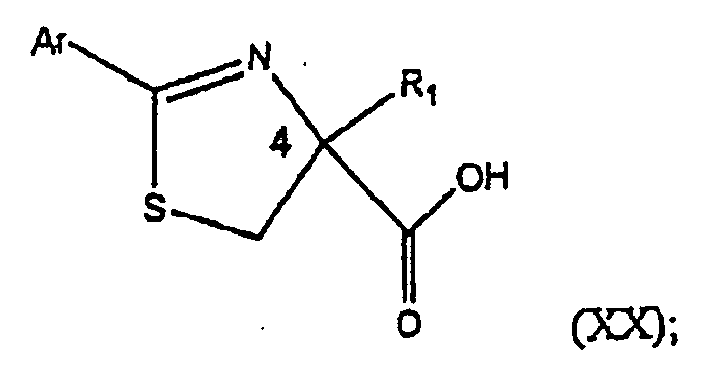 e) Umsetzen der alkylierten substituierten Thiazolincarbonsäure mit einer Säure, wodurch das 2-alkylierte Cystein der Strukturformel (XV) gebildet wird.
 - Verfahren nach Anspruch 1, wobei Ar für eine substituierte oder unsubstituierte Phenylgruppe steht.
- Verfahren nach Anspruch 2, wobei Ar für Phenyl steht.
- Verfahren nach Anspruch 1, wobei R*-OH aus der Gruppe von (1R,2R,3R,5S)-(-)-Isopinocamphenol und (1S,2R,5R)-(+)-Isomenthol ausgewählt ist.
- Verfahren nach Anspruch 1, wobei die eine oder mehreren Basen von Stufe (c) aus der Gruppe von Kalium-tert-butoxid, Natriummethoxid, Natriumethoxid und Natriumamid ausgewählt sind.
- Verfahren nach Anspruch 1, wobei R1 für eine substituierte oder unsubstituierte C1-C4-Alkylgruppe steht.
- Verfahren nach Anspruch 6, wobei R1 für Methyl steht.
- Verfahren nach Anspruch 1, wobei X für Iod steht.
- Verfahren nach Anspruch 1, das ferner die Stufe des Reinigens des alkylierten substituierten Thiazolincarbonsäureesters durch Auftrennen der Enantiomere des alkylierten substituierten Thiazolincarbonsäureesters umfasst.
- Verfahren nach Anspruch 9, wobei das (S)-Isomer, bezogen auf das Kohlenstoffatom 4, das in der Strukturformel (XIX) angegeben ist, des alkylierten substituierten Thiazolincarbonsäureesters aus den Enantiomeren des alkylierten substituierten Thiazolincarbonsäureesters isoliert wird.
- Verfahren nach Anspruch 1, das ferner die Stufe des Reinigens der alkylierten substituierten Thiazolincarbonsäure durch Auftrennen der Enantiomere der alkylierten substituierten Thiazolincarbonsäure umfasst.
- Verfahren nach Anspruch 11, wobei das (S)-Isomer der alkylierten substituierten Thiazolincarbonsäure aus den Enantiomeren der alkylierten substituierten Thiazolincarbonsäure isoliert wird.
Applications Claiming Priority (25)
| Application Number | Priority Date | Filing Date | Title |
|---|---|---|---|
| US38088002P | 2002-05-15 | 2002-05-15 | |
| US38089502P | 2002-05-15 | 2002-05-15 | |
| US38102102P | 2002-05-15 | 2002-05-15 | |
| US38090302P | 2002-05-15 | 2002-05-15 | |
| US38089402P | 2002-05-15 | 2002-05-15 | |
| US38101702P | 2002-05-15 | 2002-05-15 | |
| US38101202P | 2002-05-15 | 2002-05-15 | |
| US38090902P | 2002-05-15 | 2002-05-15 | |
| US38091002P | 2002-05-15 | 2002-05-15 | |
| US38101302P | 2002-05-15 | 2002-05-15 | |
| US38087802P | 2002-05-15 | 2002-05-15 | |
| US380910P | 2002-05-15 | ||
| US381021P | 2002-05-15 | ||
| US381012P | 2002-05-15 | ||
| US380895P | 2002-05-15 | ||
| US380894P | 2002-05-15 | ||
| US380878P | 2002-05-15 | ||
| US380909P | 2002-05-15 | ||
| US380903P | 2002-05-15 | ||
| US380880P | 2002-05-15 | ||
| US381017P | 2002-05-15 | ||
| US381013P | 2002-05-15 | ||
| US39283302P | 2002-06-27 | 2002-06-27 | |
| US392833P | 2002-06-27 | ||
| PCT/US2003/015553 WO2003097622A2 (en) | 2002-05-15 | 2003-05-15 | Synthesis of 2-alkylcysteines, 2-(hydroxylated phenyl)-4-alkylthiazoline-4-carboxylic acids and derivatives thereof |
Publications (2)
| Publication Number | Publication Date |
|---|---|
| EP1529037A2 EP1529037A2 (de) | 2005-05-11 |
| EP1529037B1 true EP1529037B1 (de) | 2009-07-15 |
Family
ID=29554649
Family Applications (2)
| Application Number | Title | Priority Date | Filing Date |
|---|---|---|---|
| EP03734040A Expired - Lifetime EP1506162B1 (de) | 2002-05-15 | 2003-05-15 | Verfahren zur herstellung von benzonitrilen und benzimidosäure-derivaten |
| EP03753073A Expired - Lifetime EP1529037B1 (de) | 2002-05-15 | 2003-05-15 | Verfahren zur herstellung von 2-alkylcystein, 2-(dihydroxyphenyl)-4-alkylimidosäuren und deren derivaten |
Family Applications Before (1)
| Application Number | Title | Priority Date | Filing Date |
|---|---|---|---|
| EP03734040A Expired - Lifetime EP1506162B1 (de) | 2002-05-15 | 2003-05-15 | Verfahren zur herstellung von benzonitrilen und benzimidosäure-derivaten |
Country Status (6)
| Country | Link |
|---|---|
| US (17) | US6903220B2 (de) |
| EP (2) | EP1506162B1 (de) |
| JP (3) | JP2005538950A (de) |
| AT (1) | ATE415387T1 (de) |
| AU (2) | AU2003239472A1 (de) |
| WO (2) | WO2003097622A2 (de) |
Families Citing this family (39)
| Publication number | Priority date | Publication date | Assignee | Title |
|---|---|---|---|---|
| AT500490A1 (de) * | 2001-10-16 | 2006-01-15 | Dsm Fine Chem Austria Gmbh | Verfahren zur herstellung von substituierten thiazolinen und deren zwischenprodukte |
| US20080086494A1 (en) * | 2006-09-11 | 2008-04-10 | Apple Computer, Inc. | Transfer and synchronization of media data |
| US6903220B2 (en) * | 2002-05-15 | 2005-06-07 | Genzyme Corporation | Synthesis of chiral 2-alkyl amino acids |
| US7394410B1 (en) * | 2004-02-13 | 2008-07-01 | Samplify Systems, Inc. | Enhanced data converters using compression and decompression |
| DE602005023466D1 (de) * | 2004-07-22 | 2010-10-21 | Mitsubishi Gas Chemical Co | Asymmetrische l-aminosäureamid-hydrolase und dafür codierende dna |
| DE102005054362A1 (de) | 2004-12-01 | 2006-06-08 | Degussa Ag | Verfahren zur Herstellung von Amino- oder Hydroxybenzonitrilen |
| CA2602336A1 (en) * | 2005-03-31 | 2006-10-05 | Ucb Pharma S.A. | Compounds comprising an oxazole or thiazole moiety, processes for making them, and their uses |
| EP1879567A1 (de) | 2005-04-28 | 2008-01-23 | Pfizer Limited | Aminosäurederivate |
| JP2006312614A (ja) * | 2005-05-09 | 2006-11-16 | Ajinomoto Co Inc | チアゾリン化合物および光学活性α−アルキルシステインの製造方法 |
| WO2008051552A2 (en) * | 2006-10-25 | 2008-05-02 | Northwestern University | Organic semiconductor materials and methods of preparing and use thereof |
| US7799934B2 (en) * | 2007-06-29 | 2010-09-21 | University Of South Florida | Enantioselective ring-opening of aziridines |
| EP2334620B1 (de) * | 2008-09-05 | 2018-09-05 | Max-Planck-Gesellschaft zur Förderung der Wissenschaften e.V. | Verfahren zur enantioselektiven trennung chiraler systeme mit verbindungsbildung unter anwendung von zwei aufeinanderfolgenden kristallisationsschritten |
| US8765817B1 (en) | 2008-12-03 | 2014-07-01 | Arrowhead Center, Inc. | Selective inhibitors of EG5 motors and methods of use |
| US8349899B1 (en) | 2008-12-03 | 2013-01-08 | Arrowhead Center, Inc. | Selective inhibitors of EG5 motors and methods of use |
| CN102549138B (zh) * | 2009-06-29 | 2015-04-01 | 伊诺莱克斯投资公司 | 不含石化衍生中性氨基酸酯的阳离子型乳化剂及其组合物和方法 |
| US9828324B2 (en) | 2010-10-20 | 2017-11-28 | Sirrus, Inc. | Methylene beta-diketone monomers, methods for making methylene beta-diketone monomers, polymerizable compositions and products formed therefrom |
| US10414839B2 (en) | 2010-10-20 | 2019-09-17 | Sirrus, Inc. | Polymers including a methylene beta-ketoester and products formed therefrom |
| US9279022B1 (en) | 2014-09-08 | 2016-03-08 | Sirrus, Inc. | Solution polymers including one or more 1,1-disubstituted alkene compounds, solution polymerization methods, and polymer compositions |
| EP2630191A4 (de) * | 2010-10-20 | 2015-05-20 | Sirrus Inc | Synthese substantiell verunreinigungsfreier methylen-malonate |
| US9249265B1 (en) | 2014-09-08 | 2016-02-02 | Sirrus, Inc. | Emulsion polymers including one or more 1,1-disubstituted alkene compounds, emulsion methods, and polymer compositions |
| CA2853073A1 (en) | 2011-10-19 | 2013-04-25 | Bioformix Inc. | Methylene beta-diketone monomers, methods for making methylene beta-diketone monomers, polymerizable compositions and products formed therefrom |
| CN102775399A (zh) * | 2011-12-27 | 2012-11-14 | 盛世泰科生物医药技术(苏州)有限公司 | arylhydrocarbon受体(AHR)的内源性配体,2-(1’H3’-吲哚羰基)噻唑-4-羧酸甲酯的合成新方法 |
| US9181365B2 (en) | 2012-03-30 | 2015-11-10 | Sirrus, Inc. | Methods for activating polymerizable compositions, polymerizable systems, and products formed thereby |
| US9234107B2 (en) | 2012-03-30 | 2016-01-12 | Sirrus, Inc. | Ink coating formulations and polymerizable systems for producing the same |
| US10913875B2 (en) | 2012-03-30 | 2021-02-09 | Sirrus, Inc. | Composite and laminate articles and polymerizable systems for producing the same |
| US10047192B2 (en) | 2012-06-01 | 2018-08-14 | Sirrus, Inc. | Optical material and articles formed therefrom |
| EP2920231B1 (de) | 2012-11-16 | 2020-05-06 | Sirrus, Inc. | Kunststoffverbindungssysteme und verfahren |
| CN105164797B (zh) | 2012-11-30 | 2019-04-19 | 瑟拉斯公司 | 用于电子应用的复合组合物 |
| WO2014110388A1 (en) | 2013-01-11 | 2014-07-17 | Bioformix Inc. | Method to obtain methylene malonate via bis(hydroxymethyl) malonate pathway |
| US9315597B2 (en) | 2014-09-08 | 2016-04-19 | Sirrus, Inc. | Compositions containing 1,1-disubstituted alkene compounds for preparing polymers having enhanced glass transition temperatures |
| US9416091B1 (en) | 2015-02-04 | 2016-08-16 | Sirrus, Inc. | Catalytic transesterification of ester compounds with groups reactive under transesterification conditions |
| US10501400B2 (en) | 2015-02-04 | 2019-12-10 | Sirrus, Inc. | Heterogeneous catalytic transesterification of ester compounds with groups reactive under transesterification conditions |
| US9334430B1 (en) | 2015-05-29 | 2016-05-10 | Sirrus, Inc. | Encapsulated polymerization initiators, polymerization systems and methods using the same |
| US9217098B1 (en) | 2015-06-01 | 2015-12-22 | Sirrus, Inc. | Electroinitiated polymerization of compositions having a 1,1-disubstituted alkene compound |
| US9518001B1 (en) | 2016-05-13 | 2016-12-13 | Sirrus, Inc. | High purity 1,1-dicarbonyl substituted-1-alkenes and methods for their preparation |
| US9617377B1 (en) | 2016-06-03 | 2017-04-11 | Sirrus, Inc. | Polyester macromers containing 1,1-dicarbonyl-substituted 1 alkenes |
| US9567475B1 (en) | 2016-06-03 | 2017-02-14 | Sirrus, Inc. | Coatings containing polyester macromers containing 1,1-dicarbonyl-substituted 1 alkenes |
| US10428177B2 (en) | 2016-06-03 | 2019-10-01 | Sirrus, Inc. | Water absorbing or water soluble polymers, intermediate compounds, and methods thereof |
| US10196481B2 (en) | 2016-06-03 | 2019-02-05 | Sirrus, Inc. | Polymer and other compounds functionalized with terminal 1,1-disubstituted alkene monomer(s) and methods thereof |
Family Cites Families (35)
| Publication number | Priority date | Publication date | Assignee | Title |
|---|---|---|---|---|
| IT1050117B (it) | 1969-09-17 | 1981-03-10 | Godo Shusei Kk | Metodo per la sintesi dell acido aeruginoico |
| DE2020866A1 (de) | 1970-04-29 | 1971-11-18 | Basf Ag | Verfahren zur Herstellung von Hydroxy- und Aminobenzonitrilen |
| DE3002989A1 (de) | 1980-01-29 | 1981-07-30 | Hoechst Ag, 6000 Frankfurt | Hydroxyphenyl-thiazol, -thiazolin und -thiazolidin-carbonsaeuren, verfahren zu ihrer herstellung und ihre verwendung zur beeinflussung des kollagenstoffwechsels |
| DE3170401D1 (en) | 1980-07-28 | 1985-06-13 | Ciba Geigy Ag | Triazoline derivatives and processes for their preparation |
| GB9126832D0 (en) * | 1991-12-18 | 1992-02-19 | Sandoz Ltd | Separation process |
| US5840739A (en) | 1992-11-16 | 1998-11-24 | University Of Florida Research Foundation, Inc. | Thiazoline acid derivatives |
| WO1994011367A1 (en) | 1992-11-16 | 1994-05-26 | University Of Florida Research Foundation Inc. | 2-(pyrid-2'-yl)-2-thiazoline-4(s)-carboxylic acid derivatives |
| CA2155130C (en) * | 1993-02-26 | 1994-09-01 | Janice M Hitchcock | Xanthine derivatives as adenosine a1 receptor antagonists |
| US5554753A (en) | 1993-08-25 | 1996-09-10 | Indiana University Foundation | Catalytic enantioselective synthesis of α-amino acid derivatives by phase-transfer catalysis |
| US5859001A (en) * | 1996-01-11 | 1999-01-12 | University Of Florida Research Foundation, Inc. | Neuroprotective effects of polycyclic phenolic compounds |
| US6319914B1 (en) * | 1993-11-05 | 2001-11-20 | Apollo Biopharmaceuticals, Inc. | Cytoprotective effect of polycyclic phenolic compounds |
| US5877169A (en) * | 1993-11-05 | 1999-03-02 | University Of Florida Research Foundation, Inc. | Methods of treatment of ischemic damage |
| US5554601A (en) * | 1993-11-05 | 1996-09-10 | University Of Florida | Methods for neuroprotection |
| US6197833B1 (en) * | 1995-07-24 | 2001-03-06 | Apollo Biopharmaceutics, Inc. | Neuroprotective effects of polycyclic phenolic compounds |
| US6350739B1 (en) * | 1999-08-11 | 2002-02-26 | University Of Florida Resarch Foundation, Inc. | Methods of prevention and treatment of ischemic damage |
| US5665890A (en) | 1995-03-14 | 1997-09-09 | President And Fellows Of Harvard College | Stereoselective ring opening reactions |
| DE69714297T2 (de) | 1996-03-10 | 2003-03-27 | Reuter Chemische Apparatebau Kg | Trennverfahren |
| JP2002501482A (ja) * | 1997-01-16 | 2002-01-15 | ユニバーシティ・オブ・フロリダ・リサーチ・ファンデーション・インコーポレーテッド | 抗酸化剤との相乗的相互作用を通じて多環式フェノール化合物の細胞保護効果を強化するための組成物 |
| EP1011838B1 (de) | 1997-09-06 | 2006-05-24 | Reuter Chemische Apparatebau KG | Trennverfahren |
| WO1999026630A1 (en) * | 1997-11-24 | 1999-06-03 | University Of Florida Research Foundation, Incorporated | Testosterone inhibitors and use for the protection of neurons |
| US6407281B1 (en) * | 1998-01-13 | 2002-06-18 | Kaneka Corporation | Process for producing optically active cysteine derivatives |
| US5929252A (en) * | 1998-06-15 | 1999-07-27 | The Scripps Research Institute | Aziridination of olefins |
| US6765109B1 (en) * | 1998-06-29 | 2004-07-20 | Roche Colorado Corporation | Preparation of S-aryl-cysteine and its derivatives |
| EP1115702A4 (de) | 1998-07-03 | 2002-04-17 | Millennium Pharm Inc | Durch stickstoff und schwefel substituierte alicyklische verbindungen und verfahren zu ihrer herstellung |
| US6083966A (en) | 1998-08-31 | 2000-07-04 | University Of Florida | Thiazoline acid derivatives |
| US6159983A (en) | 1998-09-18 | 2000-12-12 | University Of Florida | Method and composition for treatment of inflammatory bowel disease |
| EP1143951A3 (de) | 1998-09-21 | 2002-02-06 | University Of Florida Research Foundation, Inc. | Mittel gegen malaria |
| KR20010075000A (ko) * | 1998-10-09 | 2001-08-09 | 에가시라 구니오 | 시스테인 유도체 |
| US6326365B1 (en) * | 1999-07-20 | 2001-12-04 | Apollo Biopharmaceutics, Inc. | Methods of prevention and treatment of ischemic damage |
| US6339078B1 (en) * | 1999-07-20 | 2002-01-15 | University Of Florida Research Foundation, Inc. | Methods of prevention and treatment of ischemic damage |
| DE20000122U1 (de) * | 2000-01-05 | 2000-04-20 | ABT Advanced Bioanalytical Technology GmbH & Co KG, 01454 Radeberg | Mobiles Handgerät mit wiederverwendbarem Biosensor |
| WO2001051477A1 (en) | 2000-01-14 | 2001-07-19 | H. Lundbeck A/S | Method for the preparation of 5-cyanophthalide |
| AT500490A1 (de) | 2001-10-16 | 2006-01-15 | Dsm Fine Chem Austria Gmbh | Verfahren zur herstellung von substituierten thiazolinen und deren zwischenprodukte |
| US6903220B2 (en) | 2002-05-15 | 2005-06-07 | Genzyme Corporation | Synthesis of chiral 2-alkyl amino acids |
| ITVR20020062A1 (it) * | 2002-06-03 | 2003-12-03 | Andrea Pretto | Preparazione estemporanea di periossiacidi organici stabili nel tempo |
-
2003
- 2003-05-15 US US10/439,313 patent/US6903220B2/en not_active Expired - Lifetime
- 2003-05-15 AU AU2003239472A patent/AU2003239472A1/en not_active Abandoned
- 2003-05-15 US US10/439,342 patent/US6846958B2/en not_active Expired - Lifetime
- 2003-05-15 US US10/439,341 patent/US6875882B2/en not_active Expired - Lifetime
- 2003-05-15 JP JP2004505355A patent/JP2005538950A/ja active Pending
- 2003-05-15 EP EP03734040A patent/EP1506162B1/de not_active Expired - Lifetime
- 2003-05-15 US US10/438,757 patent/US7115769B2/en not_active Expired - Lifetime
- 2003-05-15 EP EP03753073A patent/EP1529037B1/de not_active Expired - Lifetime
- 2003-05-15 AT AT03734040T patent/ATE415387T1/de not_active IP Right Cessation
- 2003-05-15 AU AU2003247374A patent/AU2003247374A1/en not_active Abandoned
- 2003-05-15 US US10/439,282 patent/US6878828B2/en not_active Expired - Lifetime
- 2003-05-15 US US10/438,770 patent/US7002036B2/en not_active Expired - Fee Related
- 2003-05-15 JP JP2004505315A patent/JP4414331B2/ja not_active Expired - Fee Related
- 2003-05-15 US US10/439,263 patent/US6982335B2/en not_active Expired - Lifetime
- 2003-05-15 US US10/439,286 patent/US6875883B2/en not_active Expired - Lifetime
- 2003-05-15 US US10/439,265 patent/US7038073B2/en not_active Expired - Lifetime
- 2003-05-15 WO PCT/US2003/015553 patent/WO2003097622A2/en not_active Ceased
- 2003-05-15 US US10/438,745 patent/US6861532B2/en not_active Expired - Lifetime
- 2003-05-15 WO PCT/US2003/015339 patent/WO2003097582A2/en not_active Ceased
- 2003-05-15 US US10/438,744 patent/US6794515B2/en not_active Expired - Lifetime
-
2004
- 2004-12-09 US US11/008,084 patent/US7294718B2/en not_active Expired - Lifetime
-
2005
- 2005-03-21 US US11/085,824 patent/US7285676B2/en not_active Expired - Lifetime
- 2005-10-03 US US11/242,640 patent/US7285670B2/en not_active Expired - Lifetime
- 2005-11-28 US US11/287,891 patent/US20060142586A1/en not_active Abandoned
- 2005-12-16 US US11/305,305 patent/US7576234B2/en not_active Expired - Fee Related
-
2006
- 2006-08-23 US US11/508,679 patent/US20060281926A1/en not_active Abandoned
- 2006-08-28 JP JP2006231196A patent/JP2007001986A/ja active Pending
Also Published As
Similar Documents
| Publication | Publication Date | Title |
|---|---|---|
| US6878828B2 (en) | Synthesis of 2-alkylcysteine via substituted thiazoline ester | |
| USRE46555E1 (en) | Deuterated catecholamine derivatives and medicaments comprising said compounds | |
| JP2014167018A (ja) | 4−アルコキシ−シクロヘキサン−1−アミノ−カルボン酸 | |
| EP0510168A1 (de) | Verfahren zur racematgeltung von chiralen hydantoinen. | |
| CN101489983A (zh) | 用于制备光学活性胺的方法 | |
| HK1230580A1 (en) | Deuterated catecholamine derivatives and medicaments comprising said compounds | |
| EP2938595A1 (de) | Verfahren zur synthese eines hydrazin zur behandlung des papillomavirus |
Legal Events
| Date | Code | Title | Description |
|---|---|---|---|
| PUAI | Public reference made under article 153(3) epc to a published international application that has entered the european phase |
Free format text: ORIGINAL CODE: 0009012 |
|
| 17P | Request for examination filed |
Effective date: 20041213 |
|
| AK | Designated contracting states |
Kind code of ref document: A2 Designated state(s): AT BE BG CH CY CZ DE DK EE ES FI FR GB GR HU IE IT LI LU MC NL PT RO SE SI SK TR |
|
| AX | Request for extension of the european patent |
Extension state: AL LT LV MK |
|
| DAX | Request for extension of the european patent (deleted) | ||
| RIN1 | Information on inventor provided before grant (corrected) |
Inventor name: CHORGHADE, MUKUND, S. Inventor name: CHANDA, BHANUBUNGALOW NO. 30, BUEN MONTE Inventor name: GURJAR, MUKUND, K.BUNGALOW B-2 Inventor name: MCDONNELL, PETER, D. Inventor name: GIMI, RAYOMAND, H. Inventor name: MOHAPATRA, DEDENDARA, K. Inventor name: WOLSTENHOME-HOGG, PAUL Inventor name: CHERIAN, JOSEPH Inventor name: MHASKAR, SUNIL, V. |
|
| RIN1 | Information on inventor provided before grant (corrected) |
Inventor name: CHORGHADE, MUKUND, S. Inventor name: MCDONNELL, PETER, D. Inventor name: MHASKAR, SUNIL, V. Inventor name: GURJAR, MUKUND, K.BUNGALOW B-2 Inventor name: WOLSTENHOME-HOGG, PAUL Inventor name: GIMI, RAYOMAND, H. Inventor name: CHANDA, BHANUBUNGALOW NO. 30, BUEN MONTE Inventor name: CHERIAN, JOSEPH Inventor name: MOHAPATRA, DEDENDARA, K. |
|
| 17Q | First examination report despatched |
Effective date: 20080215 |
|
| GRAP | Despatch of communication of intention to grant a patent |
Free format text: ORIGINAL CODE: EPIDOSNIGR1 |
|
| GRAS | Grant fee paid |
Free format text: ORIGINAL CODE: EPIDOSNIGR3 |
|
| GRAA | (expected) grant |
Free format text: ORIGINAL CODE: 0009210 |
|
| AK | Designated contracting states |
Kind code of ref document: B1 Designated state(s): AT BE BG CH CY CZ DE DK EE ES FI FR GB GR HU IE IT LI LU MC NL PT RO SE SI SK TR |
|
| REG | Reference to a national code |
Ref country code: CH Ref legal event code: EP Ref country code: GB Ref legal event code: FG4D |
|
| REG | Reference to a national code |
Ref country code: IE Ref legal event code: FG4D |
|
| REF | Corresponds to: |
Ref document number: 60328395 Country of ref document: DE Date of ref document: 20090827 Kind code of ref document: P |
|
| PG25 | Lapsed in a contracting state [announced via postgrant information from national office to epo] |
Ref country code: FI Free format text: LAPSE BECAUSE OF FAILURE TO SUBMIT A TRANSLATION OF THE DESCRIPTION OR TO PAY THE FEE WITHIN THE PRESCRIBED TIME-LIMIT Effective date: 20090715 Ref country code: AT Free format text: LAPSE BECAUSE OF FAILURE TO SUBMIT A TRANSLATION OF THE DESCRIPTION OR TO PAY THE FEE WITHIN THE PRESCRIBED TIME-LIMIT Effective date: 20090715 Ref country code: ES Free format text: LAPSE BECAUSE OF FAILURE TO SUBMIT A TRANSLATION OF THE DESCRIPTION OR TO PAY THE FEE WITHIN THE PRESCRIBED TIME-LIMIT Effective date: 20091026 Ref country code: SE Free format text: LAPSE BECAUSE OF FAILURE TO SUBMIT A TRANSLATION OF THE DESCRIPTION OR TO PAY THE FEE WITHIN THE PRESCRIBED TIME-LIMIT Effective date: 20090715 |
|
| PG25 | Lapsed in a contracting state [announced via postgrant information from national office to epo] |
Ref country code: SI Free format text: LAPSE BECAUSE OF FAILURE TO SUBMIT A TRANSLATION OF THE DESCRIPTION OR TO PAY THE FEE WITHIN THE PRESCRIBED TIME-LIMIT Effective date: 20090715 |
|
| PG25 | Lapsed in a contracting state [announced via postgrant information from national office to epo] |
Ref country code: PT Free format text: LAPSE BECAUSE OF FAILURE TO SUBMIT A TRANSLATION OF THE DESCRIPTION OR TO PAY THE FEE WITHIN THE PRESCRIBED TIME-LIMIT Effective date: 20091115 Ref country code: BG Free format text: LAPSE BECAUSE OF FAILURE TO SUBMIT A TRANSLATION OF THE DESCRIPTION OR TO PAY THE FEE WITHIN THE PRESCRIBED TIME-LIMIT Effective date: 20091015 |
|
| PG25 | Lapsed in a contracting state [announced via postgrant information from national office to epo] |
Ref country code: DK Free format text: LAPSE BECAUSE OF FAILURE TO SUBMIT A TRANSLATION OF THE DESCRIPTION OR TO PAY THE FEE WITHIN THE PRESCRIBED TIME-LIMIT Effective date: 20090715 Ref country code: EE Free format text: LAPSE BECAUSE OF FAILURE TO SUBMIT A TRANSLATION OF THE DESCRIPTION OR TO PAY THE FEE WITHIN THE PRESCRIBED TIME-LIMIT Effective date: 20090715 Ref country code: RO Free format text: LAPSE BECAUSE OF FAILURE TO SUBMIT A TRANSLATION OF THE DESCRIPTION OR TO PAY THE FEE WITHIN THE PRESCRIBED TIME-LIMIT Effective date: 20090715 Ref country code: CZ Free format text: LAPSE BECAUSE OF FAILURE TO SUBMIT A TRANSLATION OF THE DESCRIPTION OR TO PAY THE FEE WITHIN THE PRESCRIBED TIME-LIMIT Effective date: 20090715 |
|
| PLBE | No opposition filed within time limit |
Free format text: ORIGINAL CODE: 0009261 |
|
| STAA | Information on the status of an ep patent application or granted ep patent |
Free format text: STATUS: NO OPPOSITION FILED WITHIN TIME LIMIT |
|
| PG25 | Lapsed in a contracting state [announced via postgrant information from national office to epo] |
Ref country code: SK Free format text: LAPSE BECAUSE OF FAILURE TO SUBMIT A TRANSLATION OF THE DESCRIPTION OR TO PAY THE FEE WITHIN THE PRESCRIBED TIME-LIMIT Effective date: 20090715 |
|
| 26N | No opposition filed |
Effective date: 20100416 |
|
| PG25 | Lapsed in a contracting state [announced via postgrant information from national office to epo] |
Ref country code: GR Free format text: LAPSE BECAUSE OF FAILURE TO SUBMIT A TRANSLATION OF THE DESCRIPTION OR TO PAY THE FEE WITHIN THE PRESCRIBED TIME-LIMIT Effective date: 20091016 |
|
| PG25 | Lapsed in a contracting state [announced via postgrant information from national office to epo] |
Ref country code: MC Free format text: LAPSE BECAUSE OF NON-PAYMENT OF DUE FEES Effective date: 20100531 |
|
| REG | Reference to a national code |
Ref country code: CH Ref legal event code: PL |
|
| PG25 | Lapsed in a contracting state [announced via postgrant information from national office to epo] |
Ref country code: LI Free format text: LAPSE BECAUSE OF NON-PAYMENT OF DUE FEES Effective date: 20100531 Ref country code: CH Free format text: LAPSE BECAUSE OF NON-PAYMENT OF DUE FEES Effective date: 20100531 |
|
| PG25 | Lapsed in a contracting state [announced via postgrant information from national office to epo] |
Ref country code: IT Free format text: LAPSE BECAUSE OF FAILURE TO SUBMIT A TRANSLATION OF THE DESCRIPTION OR TO PAY THE FEE WITHIN THE PRESCRIBED TIME-LIMIT Effective date: 20090715 |
|
| PG25 | Lapsed in a contracting state [announced via postgrant information from national office to epo] |
Ref country code: CY Free format text: LAPSE BECAUSE OF FAILURE TO SUBMIT A TRANSLATION OF THE DESCRIPTION OR TO PAY THE FEE WITHIN THE PRESCRIBED TIME-LIMIT Effective date: 20090715 |
|
| PG25 | Lapsed in a contracting state [announced via postgrant information from national office to epo] |
Ref country code: LU Free format text: LAPSE BECAUSE OF NON-PAYMENT OF DUE FEES Effective date: 20100515 Ref country code: HU Free format text: LAPSE BECAUSE OF FAILURE TO SUBMIT A TRANSLATION OF THE DESCRIPTION OR TO PAY THE FEE WITHIN THE PRESCRIBED TIME-LIMIT Effective date: 20100116 |
|
| PG25 | Lapsed in a contracting state [announced via postgrant information from national office to epo] |
Ref country code: TR Free format text: LAPSE BECAUSE OF FAILURE TO SUBMIT A TRANSLATION OF THE DESCRIPTION OR TO PAY THE FEE WITHIN THE PRESCRIBED TIME-LIMIT Effective date: 20090715 |
|
| REG | Reference to a national code |
Ref country code: FR Ref legal event code: PLFP Year of fee payment: 14 |
|
| REG | Reference to a national code |
Ref country code: FR Ref legal event code: PLFP Year of fee payment: 15 |
|
| REG | Reference to a national code |
Ref country code: FR Ref legal event code: PLFP Year of fee payment: 16 |
|
| PGFP | Annual fee paid to national office [announced via postgrant information from national office to epo] |
Ref country code: GB Payment date: 20180329 Year of fee payment: 16 |
|
| PGFP | Annual fee paid to national office [announced via postgrant information from national office to epo] |
Ref country code: BE Payment date: 20180314 Year of fee payment: 16 |
|
| PGFP | Annual fee paid to national office [announced via postgrant information from national office to epo] |
Ref country code: IE Payment date: 20180509 Year of fee payment: 16 Ref country code: DE Payment date: 20180502 Year of fee payment: 16 |
|
| PGFP | Annual fee paid to national office [announced via postgrant information from national office to epo] |
Ref country code: FR Payment date: 20180411 Year of fee payment: 16 Ref country code: NL Payment date: 20180514 Year of fee payment: 16 |
|
| REG | Reference to a national code |
Ref country code: DE Ref legal event code: R119 Ref document number: 60328395 Country of ref document: DE |
|
| REG | Reference to a national code |
Ref country code: NL Ref legal event code: MM Effective date: 20190601 |
|
| GBPC | Gb: european patent ceased through non-payment of renewal fee |
Effective date: 20190515 |
|
| REG | Reference to a national code |
Ref country code: BE Ref legal event code: MM Effective date: 20190531 |
|
| PG25 | Lapsed in a contracting state [announced via postgrant information from national office to epo] |
Ref country code: NL Free format text: LAPSE BECAUSE OF NON-PAYMENT OF DUE FEES Effective date: 20190601 Ref country code: DE Free format text: LAPSE BECAUSE OF NON-PAYMENT OF DUE FEES Effective date: 20191203 Ref country code: IE Free format text: LAPSE BECAUSE OF NON-PAYMENT OF DUE FEES Effective date: 20190515 Ref country code: GB Free format text: LAPSE BECAUSE OF NON-PAYMENT OF DUE FEES Effective date: 20190515 |
|
| PG25 | Lapsed in a contracting state [announced via postgrant information from national office to epo] |
Ref country code: BE Free format text: LAPSE BECAUSE OF NON-PAYMENT OF DUE FEES Effective date: 20190531 |
|
| PG25 | Lapsed in a contracting state [announced via postgrant information from national office to epo] |
Ref country code: FR Free format text: LAPSE BECAUSE OF NON-PAYMENT OF DUE FEES Effective date: 20190531 |