EP1528579A2 - Cellule solaire sensibilisée par colorant basée sur des fibres ultra-fines d'oxyde de titanium filées électriquement et méthode de fabrication - Google Patents
Cellule solaire sensibilisée par colorant basée sur des fibres ultra-fines d'oxyde de titanium filées électriquement et méthode de fabrication Download PDFInfo
- Publication number
- EP1528579A2 EP1528579A2 EP04256687A EP04256687A EP1528579A2 EP 1528579 A2 EP1528579 A2 EP 1528579A2 EP 04256687 A EP04256687 A EP 04256687A EP 04256687 A EP04256687 A EP 04256687A EP 1528579 A2 EP1528579 A2 EP 1528579A2
- Authority
- EP
- European Patent Office
- Prior art keywords
- titanium dioxide
- ultra
- electrolyte
- dye
- substrate
- Prior art date
- Legal status (The legal status is an assumption and is not a legal conclusion. Google has not performed a legal analysis and makes no representation as to the accuracy of the status listed.)
- Granted
Links
Images



Classifications
-
- H—ELECTRICITY
- H10—SEMICONDUCTOR DEVICES; ELECTRIC SOLID-STATE DEVICES NOT OTHERWISE PROVIDED FOR
- H10F—INORGANIC SEMICONDUCTOR DEVICES SENSITIVE TO INFRARED RADIATION, LIGHT, ELECTROMAGNETIC RADIATION OF SHORTER WAVELENGTH OR CORPUSCULAR RADIATION
- H10F10/00—Individual photovoltaic cells, e.g. solar cells
-
- H—ELECTRICITY
- H01—ELECTRIC ELEMENTS
- H01G—CAPACITORS; CAPACITORS, RECTIFIERS, DETECTORS, SWITCHING DEVICES, LIGHT-SENSITIVE OR TEMPERATURE-SENSITIVE DEVICES OF THE ELECTROLYTIC TYPE
- H01G9/00—Electrolytic capacitors, rectifiers, detectors, switching devices, light-sensitive or temperature-sensitive devices; Processes of their manufacture
- H01G9/20—Light-sensitive devices
- H01G9/2027—Light-sensitive devices comprising an oxide semiconductor electrode
- H01G9/2031—Light-sensitive devices comprising an oxide semiconductor electrode comprising titanium oxide, e.g. TiO2
-
- B—PERFORMING OPERATIONS; TRANSPORTING
- B82—NANOTECHNOLOGY
- B82Y—SPECIFIC USES OR APPLICATIONS OF NANOSTRUCTURES; MEASUREMENT OR ANALYSIS OF NANOSTRUCTURES; MANUFACTURE OR TREATMENT OF NANOSTRUCTURES
- B82Y30/00—Nanotechnology for materials or surface science, e.g. nanocomposites
-
- C—CHEMISTRY; METALLURGY
- C01—INORGANIC CHEMISTRY
- C01G—COMPOUNDS CONTAINING METALS NOT COVERED BY SUBCLASSES C01D OR C01F
- C01G23/00—Compounds of titanium
- C01G23/04—Oxides; Hydroxides
- C01G23/047—Titanium dioxide
- C01G23/053—Producing by wet processes, e.g. hydrolysing titanium salts
-
- C—CHEMISTRY; METALLURGY
- C09—DYES; PAINTS; POLISHES; NATURAL RESINS; ADHESIVES; COMPOSITIONS NOT OTHERWISE PROVIDED FOR; APPLICATIONS OF MATERIALS NOT OTHERWISE PROVIDED FOR
- C09C—TREATMENT OF INORGANIC MATERIALS, OTHER THAN FIBROUS FILLERS, TO ENHANCE THEIR PIGMENTING OR FILLING PROPERTIES ; PREPARATION OF CARBON BLACK ; PREPARATION OF INORGANIC MATERIALS WHICH ARE NO SINGLE CHEMICAL COMPOUNDS AND WHICH ARE MAINLY USED AS PIGMENTS OR FILLERS
- C09C1/00—Treatment of specific inorganic materials other than fibrous fillers; Preparation of carbon black
- C09C1/36—Compounds of titanium
- C09C1/3607—Titanium dioxide
- C09C1/3669—Treatment with low-molecular organic compounds
-
- H—ELECTRICITY
- H01—ELECTRIC ELEMENTS
- H01G—CAPACITORS; CAPACITORS, RECTIFIERS, DETECTORS, SWITCHING DEVICES, LIGHT-SENSITIVE OR TEMPERATURE-SENSITIVE DEVICES OF THE ELECTROLYTIC TYPE
- H01G9/00—Electrolytic capacitors, rectifiers, detectors, switching devices, light-sensitive or temperature-sensitive devices; Processes of their manufacture
- H01G9/20—Light-sensitive devices
-
- H—ELECTRICITY
- H01—ELECTRIC ELEMENTS
- H01G—CAPACITORS; CAPACITORS, RECTIFIERS, DETECTORS, SWITCHING DEVICES, LIGHT-SENSITIVE OR TEMPERATURE-SENSITIVE DEVICES OF THE ELECTROLYTIC TYPE
- H01G9/00—Electrolytic capacitors, rectifiers, detectors, switching devices, light-sensitive or temperature-sensitive devices; Processes of their manufacture
- H01G9/20—Light-sensitive devices
- H01G9/2004—Light-sensitive devices characterised by the electrolyte, e.g. comprising an organic electrolyte
- H01G9/2009—Solid electrolytes
-
- H—ELECTRICITY
- H10—SEMICONDUCTOR DEVICES; ELECTRIC SOLID-STATE DEVICES NOT OTHERWISE PROVIDED FOR
- H10F—INORGANIC SEMICONDUCTOR DEVICES SENSITIVE TO INFRARED RADIATION, LIGHT, ELECTROMAGNETIC RADIATION OF SHORTER WAVELENGTH OR CORPUSCULAR RADIATION
- H10F71/00—Manufacture or treatment of devices covered by this subclass
-
- H—ELECTRICITY
- H10—SEMICONDUCTOR DEVICES; ELECTRIC SOLID-STATE DEVICES NOT OTHERWISE PROVIDED FOR
- H10F—INORGANIC SEMICONDUCTOR DEVICES SENSITIVE TO INFRARED RADIATION, LIGHT, ELECTROMAGNETIC RADIATION OF SHORTER WAVELENGTH OR CORPUSCULAR RADIATION
- H10F77/00—Constructional details of devices covered by this subclass
- H10F77/20—Electrodes
-
- H—ELECTRICITY
- H10—SEMICONDUCTOR DEVICES; ELECTRIC SOLID-STATE DEVICES NOT OTHERWISE PROVIDED FOR
- H10K—ORGANIC ELECTRIC SOLID-STATE DEVICES
- H10K30/00—Organic devices sensitive to infrared radiation, light, electromagnetic radiation of shorter wavelength or corpuscular radiation
- H10K30/10—Organic devices sensitive to infrared radiation, light, electromagnetic radiation of shorter wavelength or corpuscular radiation comprising heterojunctions between organic semiconductors and inorganic semiconductors
- H10K30/15—Sensitised wide-bandgap semiconductor devices, e.g. dye-sensitised TiO2
- H10K30/151—Sensitised wide-bandgap semiconductor devices, e.g. dye-sensitised TiO2 the wide bandgap semiconductor comprising titanium oxide, e.g. TiO2
-
- C—CHEMISTRY; METALLURGY
- C01—INORGANIC CHEMISTRY
- C01P—INDEXING SCHEME RELATING TO STRUCTURAL AND PHYSICAL ASPECTS OF SOLID INORGANIC COMPOUNDS
- C01P2002/00—Crystal-structural characteristics
- C01P2002/70—Crystal-structural characteristics defined by measured X-ray, neutron or electron diffraction data
- C01P2002/72—Crystal-structural characteristics defined by measured X-ray, neutron or electron diffraction data by d-values or two theta-values, e.g. as X-ray diagram
-
- C—CHEMISTRY; METALLURGY
- C01—INORGANIC CHEMISTRY
- C01P—INDEXING SCHEME RELATING TO STRUCTURAL AND PHYSICAL ASPECTS OF SOLID INORGANIC COMPOUNDS
- C01P2004/00—Particle morphology
- C01P2004/01—Particle morphology depicted by an image
- C01P2004/03—Particle morphology depicted by an image obtained by SEM
-
- C—CHEMISTRY; METALLURGY
- C01—INORGANIC CHEMISTRY
- C01P—INDEXING SCHEME RELATING TO STRUCTURAL AND PHYSICAL ASPECTS OF SOLID INORGANIC COMPOUNDS
- C01P2004/00—Particle morphology
- C01P2004/10—Particle morphology extending in one dimension, e.g. needle-like
-
- H—ELECTRICITY
- H01—ELECTRIC ELEMENTS
- H01G—CAPACITORS; CAPACITORS, RECTIFIERS, DETECTORS, SWITCHING DEVICES, LIGHT-SENSITIVE OR TEMPERATURE-SENSITIVE DEVICES OF THE ELECTROLYTIC TYPE
- H01G9/00—Electrolytic capacitors, rectifiers, detectors, switching devices, light-sensitive or temperature-sensitive devices; Processes of their manufacture
- H01G9/20—Light-sensitive devices
- H01G9/2004—Light-sensitive devices characterised by the electrolyte, e.g. comprising an organic electrolyte
- H01G9/2013—Light-sensitive devices characterised by the electrolyte, e.g. comprising an organic electrolyte the electrolyte comprising ionic liquids, e.g. alkyl imidazolium iodide
-
- H—ELECTRICITY
- H10—SEMICONDUCTOR DEVICES; ELECTRIC SOLID-STATE DEVICES NOT OTHERWISE PROVIDED FOR
- H10K—ORGANIC ELECTRIC SOLID-STATE DEVICES
- H10K85/00—Organic materials used in the body or electrodes of devices covered by this subclass
- H10K85/30—Coordination compounds
- H10K85/341—Transition metal complexes, e.g. Ru(II)polypyridine complexes
- H10K85/344—Transition metal complexes, e.g. Ru(II)polypyridine complexes comprising ruthenium
-
- Y—GENERAL TAGGING OF NEW TECHNOLOGICAL DEVELOPMENTS; GENERAL TAGGING OF CROSS-SECTIONAL TECHNOLOGIES SPANNING OVER SEVERAL SECTIONS OF THE IPC; TECHNICAL SUBJECTS COVERED BY FORMER USPC CROSS-REFERENCE ART COLLECTIONS [XRACs] AND DIGESTS
- Y02—TECHNOLOGIES OR APPLICATIONS FOR MITIGATION OR ADAPTATION AGAINST CLIMATE CHANGE
- Y02E—REDUCTION OF GREENHOUSE GAS [GHG] EMISSIONS, RELATED TO ENERGY GENERATION, TRANSMISSION OR DISTRIBUTION
- Y02E10/00—Energy generation through renewable energy sources
- Y02E10/50—Photovoltaic [PV] energy
- Y02E10/542—Dye sensitized solar cells
-
- Y—GENERAL TAGGING OF NEW TECHNOLOGICAL DEVELOPMENTS; GENERAL TAGGING OF CROSS-SECTIONAL TECHNOLOGIES SPANNING OVER SEVERAL SECTIONS OF THE IPC; TECHNICAL SUBJECTS COVERED BY FORMER USPC CROSS-REFERENCE ART COLLECTIONS [XRACs] AND DIGESTS
- Y02—TECHNOLOGIES OR APPLICATIONS FOR MITIGATION OR ADAPTATION AGAINST CLIMATE CHANGE
- Y02E—REDUCTION OF GREENHOUSE GAS [GHG] EMISSIONS, RELATED TO ENERGY GENERATION, TRANSMISSION OR DISTRIBUTION
- Y02E10/00—Energy generation through renewable energy sources
- Y02E10/50—Photovoltaic [PV] energy
- Y02E10/549—Organic PV cells
Definitions
- the present invention relates to a dye-sensitized solar cell to convert solar energy into electric energy by a photo-electrochemical process and to a fabrication method thereof, and particularly, to a dye-sensitized solar comprising a semiconductor electrode consisting of electrospun ultra-fine titanium dioxide fibers and to a fabrication method thereof.
- the dye-sensitized solar cell by Grätzel et al. is a photo-electrochemical solar cell using an oxide semiconductor electrode comprising photosensitive dye molecules that can absorb light within visible region, thereby to generate an electron-hole pair and nano crystalline titanium dioxide that can transfer the generated electron.
- the dye-sensitized solar cell is much expected as a solar light conversion element due to its higher energy conversion efficiency, while its fabrication cost is relatively low compared to a conventional silicon solar cell.
- one object of the present invention is to provide a dye-sensitized solar cell comprising a semiconductor electrode consisting of electrospun ultra-fine fibrous crystalline titanium dioxide, which can solve electron mobility problems throughout particles occurring in the conventional dye-sensitized solar cell using an electrode made of sintered nanocrystalline titanium dioxide, and which can also improve adhesiveness with solid electrolyte and element characteristics.
- Another object of the present invention is to provide a method for fabricating the dye-sensitized solar cell comprising electrospun ultra-fine fibrous titanium dioxide.
- the inventors of the present invention has made great efforts to solve the problems in the conventional dye-sensitized solar cell and finally developed an semiconductor electrode consisting of an electrospun ultra-fine fibrous titanium dioxide, so as to provide a new dye-sensitized solar cell having a titanium dioxide layer in one dimensional structure that can facilitate infiltration of a non-liquid electrolyte and can effectively transfer electrons.
- a dye-sensitized solar cell comprising a semiconductor electrode containing an electrospun ultra-fine fibrous titanium dioxide layer; a counter electrode; and electrolyte infiltrated between the semiconductor electrode and the counter electrode.
- the semiconductor electrode consists of a glass substrate, ITO or FTO transparent conductive layer, and an electrospun ultra-fine fibrous titanium dioxide layer onto which dye molecules are adsorbed.
- the electrospun ultra-fine fibrous titanium dioxide layer has a thickness of 5 - 20 ⁇ m.
- the counter electrode can include a glass substrate, ITO or FTO transparent conductive layer and a platinum layer.
- the electrolyte is a liquid electrolyte containing iodine, and preferably, an electrolyte of 0.1M lithium iodide (Lil), 0.05M iodine (I 2 ), 0.6M 1,2-dimethyl-3-propyl-imidazolium iodide and 0.5 M tert-butyl pyridine in acetonitrile, or a polymer gel electrolyte containing at least one polymers selected from the group consisting of poly(vinylidenefluoride)-co-poly(hexafluoropropylene), poly(acrylonitrile), poly(ethyleneoxide) and poly(alkylacrylate).
- the polymer gel electrolyte contains one or more polymers as mentioned above in an amount of 5-20 % by weight of a mixture of propylene carbonate and ethylene carbonate.
- the ultra-fine titanium dioxide fibers are electrospun so as to have 50-1000 nm in thickness.
- the pre-treatment can be performed such a manner that i) the substrate is pre-processed with vapor of acetone or dimethylformamide for 1-3 hours in a closed container; ii) the substrate is immersed in acetone or dimethylformamide solvent for 1 hour, or iii) methods i) and ii) are combined.
- the thermal treatment is performed at 450°C-500°C for 30 minutes.
- Figure 1 illustrates the construction of a dye-sensitized solar cell comprising a semiconductor electrode consisting of electrospun ultra-fine titanium dioxide fibers in accordance with the present invention.
- the dye-sensitized solar cell comprises a semiconductor electrode 10, a counter electrode 20 and an electrolyte 30 interposed therebetween.
- the semiconductor electrode 10 comprises a glass substrate 11, an indium tin oxide (ITO) or fluorine-doped tin oxide (FTO) transparent conductive layer 12 and an electrospun ultra-fine fibrous titanium dioxide layer 13.
- the ultra-fine fibrous titanium dioxide layer 13 includes ultra-fine titanium dioxide fibers having a diameter of about 50-1000 nm which are formed with a bunch of fine fibrins having a thickness of about 10-30 nm one-dimensionally arranged by electrospinning. In order to effectively generate photocurrent, the titanium dioxide layer 13 preferably has a thickness of about 5-20 ⁇ m. Ruthenium-based dye molecules are adsorbed onto the ultra-fine titanium dioxide fibers.
- the counter electrode 20 comprises a glass substrate 21, an ITO or FTO transparent conductive layer 22 and a platinum layer 23.
- the platinum layer 23 of the counter electrode 20 is disposed to face the fibrous titanium dioxide layer 13 of the semiconductor electrode 10.
- a polymer gel electrolyte in which one or more polymers selected from the group consisting of poly(vinylidenefluoride)-co-poly(hexafluoropropylene), poly(acrylonitrile), poly-(ethyleneoxide) and poly(alkylacrylate) are contained in an amount of 5-20% by weight of a mixture of propylene carbonate and ethylene carbonate can be used.
- a method for fabricating a dye-sensitized solar cell comprising a semiconductor electrode consisting of electrospun ultra-fine titanium dioxide fibers in accordance with the present invention will be described below.
- the electrospun ultra-fine titanium dioxide fibers are fabricated.
- a solution for an electrospinning is prepared by a sol-gel reaction of titanium isopropoxide.
- polyvinylacetate having an excellent affinity to titanium dioxide is dissolved in dimethylformamide, acetone, tetrahydrofuran, toluene or a mixture thereof, to prepare a 5-20 wt% polymer solution to be able to give a viscosity suitable for electrospinning.
- Polyvinylacetate having a weight average molecular weight of 100,000-1,000,000 g/mol is used.
- polyvinylpyrrolidone, polyvinylalcohol, polyethyleneoxide and the like can be used to prepare a polymer solution.
- titanium isopropoxide is added into the polyvinylacetate polymer solution in an amount of 5-25 wt % of the polyvinylacetate polymer solution, to which acetic acid is added as a catalyst in an amount of 20-60 wt % of the titanium isopropoxide.
- the resulting mixture was then reacted for 1-5 hours at room temperature so as to obtain a solution for electrospinning. This solution is required to maintain a suitable viscosity required for electrospinning.
- the polymer is completely decomposed by a thermal treatment at 450°C or higher, and residual titanium dioxide is converted into an anatase type crystal structure.
- a generally used electrospinning apparatus includes a spinning nozzle connected to a quantizing pump that can introduce a solution to be spun quantitatively, a high voltage generator, an electrode for forming a layer of fibers to be spun.
- An earthed transparent conductive glass substrate, specifically a transparent conductive glass substrate onto which ITO or FTO are coated and which have conductivity of 5-30 ⁇ is used as an anode, and the spinning nozzle equipped with a pump which can control discharging amount per time is used as a cathode.
- a pre-treatment is performed such that the transparent conductive substrate, onto which the film made of the electrospun ultra-fine titanium dioxide fibers is formed, is treated with vapor of acetone or dimethylformamide, which has been used as solvent for the polymer solution, for 1-3 hours in a closed container or immersed the substrate in acetone or dimethyl formamide for 1 hour.
- the electrospun ultra-fine titanium dioxide fibers are in the form of a film mixed with a polymer on the substrate (referred to as 'polymer-titanium dioxide composite film', hereinafter).
- the substrate on which electrospun titanium dioxide film is formed it is necessary for the substrate on which electrospun titanium dioxide film is formed to be subjected to a thermal treatment at a temperature of 450°C or higher, thereby to remove the polymer binder completely and to convert residual ultra-fine titanium dioxide fibers into anatase type crystal structure.
- a thermal treatment at a temperature of 450°C or higher, thereby to remove the polymer binder completely and to convert residual ultra-fine titanium dioxide fibers into anatase type crystal structure.
- a polymer-titanium dioxide composite film formed by a conventional electrospinning is thermally treated at such a high temperature in the air, the transparent conductive substrate and the titanium dioxide film are separated (refer to Figure 5A), and therefore, it can not be used as an electrode for a preferable dye-sensitized solar cell.
- the polymer-titanium dioxide composite film formed by electrospinning is subjected to a pre-treatment so as to form a firm titanium dioxide film (refer to Figure 5B).
- the pre-treatment is to dissolve the polymer portion of the polymer-titanium dioxide composite fibers by treat the electrospun ultra-fine titanium dioxide fibers in which polymer and titanium dioxide are mixed (referred to as 'polymer-titanium dioxide composite fiber', hereinafter) with a solvent.
- 'polymer-titanium dioxide composite fiber' hereinafter
- the pre-treatment includes the method of treating the electrospun polymer-titanium dioxide composite film with vapor of acetone or dimethylformamide used as a solvent for the polymer solution for 1-3 hours, the method of immersing the electrospun polymer-titanium dioxide composite film in acetone or dimethyl formamide, and the method of employing both methods.
- the pre-processed transparent conductive substrate is thermally treated at 450-500°C for 30 minutes in the air to thermally decompose residual polymer so as to completely remove the same, by which crystalline structure of the titanium dioxide is converted into anatase type.
- the substrate was then washed with ethyl alcohol and then dried, to obtain the semiconductor electrode 10 comprising dye-adsorbed electrospun ultra-fine titanium dioxide fibers.
- the platinum layer 23 is coated onto an ITO or FTO-coated transparent conductive glass substrate.
- the counter electrode 20, the cathode, and the semiconductor electrode 10, the anode are assembled such that each conductive surface of the cathode and anode comes inward so as to make the platinum layer 23 and the fibrous titanium dioxide layer 13 faced with each other.
- the two electrodes are attached with a spacer 40 having a thickness of about 20 ⁇ m, which is made of a thermoplastic SurlynTM (available from Du Pont Co.) and inserted the above two electrodes.
- liquid electrolyte or polymer gel electrolyte is filled in spaces between the two electrodes.
- the electrolyte solution of I 3 - /I - obtained by dissolving 0.1M of lithium iodine (Lil), 0.05M of iodine (I 2 ), 0.6M of 1,2-dimethyl-3-propyl-imidazolium iodide and 0.5M of tert-butyl pyridine in acetonitrile.
- polymer gel electrolyte a mixture obtained by dissolving one or more polymers selected from the group consisting of poly(vinylidenefluoride)-co-poly(hexafluoropropylene), poly(acrylonitrile), poly(ethyleneoxide) and poly(alkylacrylate) in a mixture of propylene carbonate and ethylene carbonate in amount of 5-20 wt % of the solvent mixture can be used.
- Example 1 Fabrication of an electrospun titanium dioxide fiber layer
- Electrospinning was performed with the electrospinning apparatus shown in Figure 2, wherein a FTO-coated transparent conductive substrate (having the size of 10cm x 10cm) was used as a cathode and a metallic needle (No. 24) having a pump, which can control discharge rate, attached thereto was used as an anode, to which 15 kV of voltage was applied. While discharge rate of the spinning solution was maintained at 30 ⁇ l/min, electrospinning was performed until the total discharge amount of the spinning solution reaches 5,000 ⁇ l, to form a layer of ultra-fine titanium dioxide fibers onto the FTO-coated transparent conductive substrate.
- Example 2 Pre-treatment and thermal treatment of the substrate on which a layer of titanium dioxide fibers was formed fabricated in Example 1
- the layer of titanium dioxide fibers fabricated in Example 1 includes polymer and titanium dioxide mixed therein.
- the substrate in order to use the polymer-titanium dioxide composite film-formed substrate as a semiconductor electrode of a dye-sensitized solar cell, the substrate should be thermally treated at a high temperature to remove polyvinylacetate, a polymer binder, and the spun ultra-fine titanium dioxide fibers should be converted into a crystal form.
- the substrate fabricated in Example 1 is thermally treated at a high temperature without pre-treatment, the titanium dioxide film would not be attached on the FTO-coated substrate but be separated therefrom, and thus, it cannot be used as a semiconductor electrode for a dye-sensitized solar cell.
- the substrate, on which the polymer-titanium dioxide composite film fabricated in Example 1 has been formed was treated only with acetone vapor for 1 hour, without being directly contacted with acetone in a closed container, and then, thermally treated in an electric furnace of 450°C in the air for 30 minutes, thereby to stably form titanium dioxide film on the FTO-coated transparent conductive substrate.
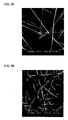
- Figures 3A to 3C are scanning electron microscopic photographs of the electrospun titanium dioxide fiber layer in stages fabricated in accordance with the present invention. Specifically, Figure 3A is a scanning electron microscopic photograph of the titanium dioxide fiber layer after electrospinning but before pre-treatment, Figure 3B is a scanning electron microscopic photograph of the titanium dioxide fiber layer after pre-treatment, and Figure 3C is a scanning electron microscopic photograph of the titanium dioxide fiber layer after pre-treatment and thermal treatment.
- the ultra-fine fibrous titanium dioxide layer obtained after the pre-treatment and subsequent thermal treatment shows that the layer of individual fibers were well adhered to each other, so as to enable electron transfer to be more effective in a solar cell device.
- Figure 4 is a transmission electron microscopic photograph of the electrospun titanium dioxide fiber layer fabricated in accordance with the present invention, and especially shows fine structure of the ultra-fine titanium dioxide fibers remaining after removing polymer by the pre-treatment and subsequent thermal treatment at 450°C.
- the fibrous titanium dioxide crystal arranged one-dimensionally increases movement photocurrent in the solar cell, which are intended by the present invention, thereby to remarkably improve performance of the element.
- Figures 5A and 5B are photographs of transparent conductive substrate with the electrospun titanium dioxide fiber layer formed thereon after the substrate was thermally treated in accordance with the present invention.
- Figures 5A is for the substrate without performing the pre-treatment thereon, and
- Figure 5B is for the pre-treated substrate.
- Figure 6 is a graph showing X-ray diffraction peaks after the electrospun ultra-fine titanium dioxide fibers were thermally treated in accordance with the present invention. It can be seen from Figure 6 that the crystalline structure of the titanium dioxide was converted into the anatase type after the thermal treatment.
- Example 3 Fabrication of a dye-sensitized solar cell using the titanium dioxide fiber layer fabricated in Example 2
- Dye molecules were adsorbed onto the ultra-fine titanium dioxide fibers in the substrate fabricated in Example 2.
- the resulting substrate was washed with ethanol several times and then dried, thereby to give a semiconductor electrode.
- a platinum layer was coated onto a FTO-coated transparent conductive glass substrate to obtain a counter electrode.
- a spacer having a thickness of about 20 ⁇ m was located between the semiconductor electrode and the counter electrode fabricated as described above, and a certain pressure was applied thereto at 120°C so as to attach the above two electrodes. Iodine-based liquid electrolyte was then filled in the space between the above two electrodes, and the resultant was sealed to obtain the dye-sensitized solar cell in accordance with the present invention.
- Liquid electrolyte used was prepared by dissolving 0.25g of iodine, 0.26g of lithium iodide, 3.70g of 1,2-dimethyl-3-propyl-imidazolium iodide and 1.34g of tert-butyl pyridine in 20 ml of acetonitrile.
- the dye-sensitized solar cell was also fabricated in the same manner as described in Example 1 to Example 3, except for using a polymer gel electrolyte instead of the liquid electrolyte.
- the polymer get electrolyte used in this case was prepared by dissolving 0.125g of poly(vinylidene fluoride)-co-poly(hexafluoropropylene) (Kynar 2801), 0.13g of 1-hexyl-2,3-dimethyl imidazolum iodide (Im), and 0.008g of iodine in a mixture of 0.75g of propylene carbonate and 0.5g of ethylene carbonate at 80°C.
- Figure 7 is a graph showing current-voltage characteristics of the dye-sensitized solar cell fabricated in the above Examples in accordance with the present invention.
- the liquid electrolyte and the gel electrolyte prepared as described in Example 3 were respectively used.
- Table 1 below shows photoelectrochemical characteristics which were calculated with current-voltage curves relative to the types of the electrolytes, namely, photocurrent density (J sc ), voltage (V oc ), fill factor (ff) and energy conversion efficiency ( ⁇ ).
- the dye-sensitized solar cell comprising a semiconductor electrode consisting of the electrospun ultra-fine titanium dioxide fibers according to the present invention exhibits energy conversion efficiency of above 90% even in using gel electrolyte relative to that of the cell using liquid electrolyte.
- the dye-sensitized solar cell in accordance with the present invention comprises a semiconductor electrode comprising electrospun ultra-fine titanium dioxide fibers, and therefore, the non-liquid electrolyte such as a polymer gel electrolyte or the like having low fluidity, as well as a liquid electrolyte, can even be easily infiltrated thereinto.
- the non-liquid electrolyte such as a polymer gel electrolyte or the like having low fluidity, as well as a liquid electrolyte
- electrons can be effectively transferred because titanium dioxide crystals are arranged one-dimensionally.
Landscapes
- Engineering & Computer Science (AREA)
- Chemical & Material Sciences (AREA)
- Power Engineering (AREA)
- Microelectronics & Electronic Packaging (AREA)
- Organic Chemistry (AREA)
- Electrochemistry (AREA)
- Chemical Kinetics & Catalysis (AREA)
- Nanotechnology (AREA)
- Physics & Mathematics (AREA)
- Inorganic Chemistry (AREA)
- General Life Sciences & Earth Sciences (AREA)
- Composite Materials (AREA)
- Condensed Matter Physics & Semiconductors (AREA)
- General Physics & Mathematics (AREA)
- Materials Engineering (AREA)
- Crystallography & Structural Chemistry (AREA)
- Geology (AREA)
- Environmental & Geological Engineering (AREA)
- Life Sciences & Earth Sciences (AREA)
- Electromagnetism (AREA)
- Hybrid Cells (AREA)
- Photovoltaic Devices (AREA)
Applications Claiming Priority (2)
| Application Number | Priority Date | Filing Date | Title |
|---|---|---|---|
| KR2003076964 | 2003-10-31 | ||
| KR1020030076964A KR100543218B1 (ko) | 2003-10-31 | 2003-10-31 | 전기방사된 초극세 산화티타늄 섬유로 이루어진 반도체전극을 가지는 염료감응형 태양전지 및 그 제조방법 |
Publications (3)
| Publication Number | Publication Date |
|---|---|
| EP1528579A2 true EP1528579A2 (fr) | 2005-05-04 |
| EP1528579A3 EP1528579A3 (fr) | 2011-07-20 |
| EP1528579B1 EP1528579B1 (fr) | 2018-01-03 |
Family
ID=34420694
Family Applications (1)
| Application Number | Title | Priority Date | Filing Date |
|---|---|---|---|
| EP04256687.7A Expired - Lifetime EP1528579B1 (fr) | 2003-10-31 | 2004-10-29 | Cellule solaire sensibilisée par colorant basée sur des fibres ultra-fines d'oxyde de titanium filées électriquement et méthode de fabrication |
Country Status (3)
| Country | Link |
|---|---|
| US (2) | US20050109385A1 (fr) |
| EP (1) | EP1528579B1 (fr) |
| KR (1) | KR100543218B1 (fr) |
Cited By (9)
| Publication number | Priority date | Publication date | Assignee | Title |
|---|---|---|---|---|
| WO2007073111A1 (fr) * | 2005-12-23 | 2007-06-28 | Korea Institute Of Science And Technology | Capteur de gaz d'oxyde metallique ultrasensible et son procede de fabrication |
| EP2031613A3 (fr) * | 2007-08-29 | 2011-09-14 | Korea Institute of Science and Technology | Cellule solaire sensibilisée aux colorants avec une couche d'oxyde de métal contenant des nanoparticules d'oxyde de métal produites par électrofilature et son procédé de fabrication |
| CN102280591A (zh) * | 2011-08-08 | 2011-12-14 | 华南师范大学 | 一种在空气中制备有机-无机复合太阳能电池的方法 |
| EP1801909A4 (fr) * | 2004-10-15 | 2012-08-15 | Bridgestone Corp | Électrode semi-conductrice en oxyde de métal sensibilisé par teinture et procédé de fabrication idoine, et cellule solaire sensibilisée par teinture |
| GB2501247A (en) * | 2012-04-11 | 2013-10-23 | Univ Swansea | Counter Electrode for a Dye-Sensitised Solar Cell |
| US9281131B2 (en) | 2008-08-29 | 2016-03-08 | Solvay Sa | Electrolyte-comprising polymer nanofibers fabricated by electrospinning method and high performance dye-sensitized solar cells device using same |
| CN107195786A (zh) * | 2017-06-02 | 2017-09-22 | 新乡学院 | 一种氧化钛纳米纤维基钙钛矿柔性太阳能电池的制备方法 |
| RU2698533C1 (ru) * | 2018-10-02 | 2019-08-28 | Федеральное Государственное Бюджетное Учреждение Науки Институт Биохимической Физики Им. Н.М. Эмануэля Российской Академии Наук (Ибхф Ран) | Металлооксидный солнечный элемент |
| CN115367789A (zh) * | 2022-10-10 | 2022-11-22 | 上海纳米技术及应用国家工程研究中心有限公司 | 一种钛酸镁@超氧钛酸镁电池材料的制备方法及其产品和应用 |
Families Citing this family (38)
| Publication number | Priority date | Publication date | Assignee | Title |
|---|---|---|---|---|
| KR100554179B1 (ko) * | 2004-06-09 | 2006-02-22 | 한국전자통신연구원 | 전도성 금속 기판을 포함하는 구부림이 가능한 염료감응태양전지 |
| US7252083B2 (en) | 2005-07-18 | 2007-08-07 | Arizona Public Service Company | Structure for supporting energy conversion modules and solar energy collection system |
| JP5028804B2 (ja) * | 2006-01-19 | 2012-09-19 | ソニー株式会社 | 機能デバイス |
| KR101174887B1 (ko) * | 2006-01-20 | 2012-08-17 | 삼성에스디아이 주식회사 | 담지촉매를 이용한 태양 전지용 대향 전극 |
| CN100412129C (zh) * | 2006-02-21 | 2008-08-20 | 中国科学院化学研究所 | 化学交联凝胶网络聚合物电解液的制备方法 |
| EP2045868B1 (fr) * | 2006-07-13 | 2015-12-02 | Teijin Dupont Films Japan Limited | Cellule solaire à colorant, électrode et film multicouche associés |
| TWI458103B (zh) * | 2006-07-17 | 2014-10-21 | Teijin Dupont Films Japan Ltd | Pigment sensitized solar cells and used electrodes and laminated films |
| KR100898280B1 (ko) * | 2007-07-30 | 2009-05-19 | 주식회사 솔켐 | 전기방사법에 의해 제조된 고분자 나노섬유를 포함하는고체 전해질 및 이를 이용한 염료감응형 태양전지 |
| KR101013155B1 (ko) | 2007-08-03 | 2011-02-10 | 한국기계연구원 | 전도성 고분자 투명전극을 이용한 유기 태양전지 및 그제조 방법 |
| TWI487182B (zh) * | 2007-10-17 | 2015-06-01 | Iner Aec Executive Yuan | 染料敏化電池用之類固態電解質 |
| US7910015B2 (en) * | 2007-10-22 | 2011-03-22 | Institute Of Nuclear Energy Research | Polymer electrolyte for dye sensitized solar cell |
| KR20090051597A (ko) | 2007-11-19 | 2009-05-22 | 한국전자통신연구원 | 전도성 섬유 전극을 사용하는 염료감응 태양전지 |
| JP2009245705A (ja) * | 2008-03-31 | 2009-10-22 | Koito Mfg Co Ltd | 色素増感型太陽電池 |
| KR101032791B1 (ko) * | 2009-02-09 | 2011-05-06 | 한국과학기술연구원 | 전기방사된 고분자 나노섬유와 분사된 금속나노입자로 이루어진 유무기 하이브리드 복합체를 포함하는 광전극과 그 제조방법, 및 이를 이용한 염료감응 태양전지 |
| WO2010107795A1 (fr) * | 2009-03-17 | 2010-09-23 | Konarka Technologies, Inc. | Substrat de métal pour une pile photovoltaïque à colorant |
| CN102484152B (zh) * | 2009-04-09 | 2015-11-25 | 加利福尼亚大学董事会 | 具有纳米级结构的三维染料敏化太阳能电池 |
| KR101097252B1 (ko) * | 2009-11-17 | 2011-12-21 | 삼성에스디아이 주식회사 | 광전변환소자 |
| KR101117700B1 (ko) * | 2009-11-19 | 2012-02-24 | 삼성에스디아이 주식회사 | 광전변환소자 |
| US20110203644A1 (en) * | 2010-02-22 | 2011-08-25 | Brite Hellas Ae | Quasi-solid-state photoelectrochemical solar cell formed using inkjet printing and nanocomposite organic-inorganic material |
| KR101095464B1 (ko) | 2010-04-16 | 2011-12-16 | 주식회사 상보 | 질소가 도핑된 이산화티탄을 이용한 태양전지의 제조방법 |
| KR101196819B1 (ko) | 2010-04-21 | 2012-11-06 | 성균관대학교산학협력단 | 1-차원 기공을 가지는 염료감응형 태양전지용 광전극, 상기 광전극의 제조방법, 및 상기 광전극을 포함하는 염료감응형 태양전지 |
| CN101894913B (zh) * | 2010-06-11 | 2011-09-07 | 吉林大学 | 一种超高电荷迁移率的高分子场效应晶体管的制备方法 |
| CN102071540A (zh) * | 2010-11-17 | 2011-05-25 | 无锡中科光远生物材料有限公司 | 一种气体传感器纤维膜及其制备方法 |
| US20140076404A1 (en) * | 2010-12-15 | 2014-03-20 | Mei-Chee Tan | Ir-activated photoelectric systems |
| KR101718548B1 (ko) * | 2011-01-26 | 2017-04-04 | 서울시립대학교 산학협력단 | 염료감응형 태양전지 및 그 제조방법 |
| TWI455334B (zh) * | 2011-06-01 | 2014-10-01 | Taiwan Textile Res Inst | 用於染料敏化太陽能電池之光陽極的製造方法 |
| US20130042911A1 (en) * | 2011-08-19 | 2013-02-21 | Electronics And Telecommunications Research Institute | Solar cell and method of fabricating the same |
| US10071907B2 (en) * | 2011-09-26 | 2018-09-11 | The Hong Kong Polytechnic University | Bilayer dye sensitized solar cell and fabrication method thereof |
| WO2013126385A1 (fr) | 2012-02-21 | 2013-08-29 | Northwestern University | Composés photoluminescents |
| US9455093B2 (en) | 2012-05-14 | 2016-09-27 | The Hong Kong Polytechnic University | Dye-sensitized solar cell based on indirect charge transfer |
| CN103972398B (zh) * | 2014-04-11 | 2017-03-29 | 哈尔滨工业大学深圳研究生院 | 一种有机无机杂化太阳能电池及其制备方法 |
| EP3132472A1 (fr) * | 2014-04-15 | 2017-02-22 | Northwestern University | Cellules photovoltaïques à pérovskite organique-inorganique d'halogénure à semi-conducteurs sans plomb |
| WO2015164731A1 (fr) | 2014-04-24 | 2015-10-29 | Northwestern University | Cellules solaires dotées de couches de sensibilisation à la lumière à base de pérovskite |
| CN105118930A (zh) * | 2015-08-03 | 2015-12-02 | 深圳市华星光电技术有限公司 | 有机电致发光器件的制备方法及有机电致发光器件 |
| JP2018152516A (ja) * | 2017-03-14 | 2018-09-27 | 株式会社豊田中央研究所 | 太陽電池、太陽電池モジュール及び太陽電池の製造方法 |
| CN116504535A (zh) * | 2018-09-21 | 2023-07-28 | 环境光子学公司 | 染料敏化的光伏电池 |
| CN115188595B (zh) * | 2022-07-29 | 2025-01-10 | 复旦大学 | 一种碳基对电极及其制备和在纤维染料敏化太阳能电池中的应用 |
| CN117534458B (zh) * | 2022-08-02 | 2025-12-23 | 中国科学院大连化学物理研究所 | 一种陶瓷隔膜、制备方法及其应用 |
Family Cites Families (12)
| Publication number | Priority date | Publication date | Assignee | Title |
|---|---|---|---|---|
| DE69415350T2 (de) * | 1994-05-02 | 1999-07-01 | Ecole Polytechnique Federale De Lausanne (Epfl), Lausanne | Phosphonierte polypyridyl-verbindungen und ihre metall-komplexe |
| US6586763B2 (en) * | 1996-06-25 | 2003-07-01 | Northwestern University | Organic light-emitting diodes and methods for assembly and emission control |
| JP4298799B2 (ja) * | 1997-05-07 | 2009-07-22 | エコール ポリテクニーク フェデラル ドゥ ローザンヌ | 金属複合体光増感剤および光起電力セル |
| US6649824B1 (en) | 1999-09-22 | 2003-11-18 | Canon Kabushiki Kaisha | Photoelectric conversion device and method of production thereof |
| US6800155B2 (en) * | 2000-02-24 | 2004-10-05 | The United States Of America As Represented By The Secretary Of The Army | Conductive (electrical, ionic and photoelectric) membrane articlers, and method for producing same |
| US7414188B2 (en) * | 2002-01-25 | 2008-08-19 | Konarka Technologies, Inc. | Co-sensitizers for dye sensitized solar cells |
| JP4278080B2 (ja) * | 2000-09-27 | 2009-06-10 | 富士フイルム株式会社 | 高感度受光素子及びイメージセンサー |
| JP2002356400A (ja) * | 2001-03-22 | 2002-12-13 | Canon Inc | 酸化亜鉛の針状構造体の製造方法及びそれを用いた電池、光電変換装置 |
| US7323635B2 (en) * | 2001-06-15 | 2008-01-29 | University Of Massachusetts | Photovoltaic cell |
| JP2003297446A (ja) * | 2002-01-29 | 2003-10-17 | Nippon Shokubai Co Ltd | 色素増感太陽電池 |
| US7794833B2 (en) * | 2002-06-21 | 2010-09-14 | Board Of Regents, The University Of Texas System | Electrospun mesoporous molecular sieve fibers |
| JP2005538573A (ja) * | 2002-09-05 | 2005-12-15 | ナノシス・インク. | ナノ構造及びナノ複合材をベースとする組成物 |
-
2003
- 2003-10-31 KR KR1020030076964A patent/KR100543218B1/ko not_active Expired - Fee Related
-
2004
- 2004-10-22 US US10/971,236 patent/US20050109385A1/en not_active Abandoned
- 2004-10-29 EP EP04256687.7A patent/EP1528579B1/fr not_active Expired - Lifetime
-
2010
- 2010-05-12 US US12/779,012 patent/US8691325B2/en not_active Expired - Fee Related
Non-Patent Citations (9)
| Title |
|---|
| CHEM. LETT., vol. 30, 2001, pages 26 |
| CHEM. LETT., vol. 31, 2002, pages 948 |
| D LI ET AL.: "Fabrication of Titania Nanofibers by Electrospinning", NANO LETTERS, vol. 3, no. 8, 1 August 2003 (2003-08-01) |
| ELECTROCHEMICA ACTA, vol. 47, 2002, pages 2801 |
| J. AM. CHEM. SOC., vol. 125, 2003, pages 1166 |
| J. PHYS, CHEM. B, vol. 107, 2003, pages 4374 |
| LANGMUIR, vol. 19, 2003, pages 3572 |
| S J LIMMER ET AL.: "Sol-Gel Electrophoretic Deposition for the Growth of Oxide Nanorods", ADVANCED MATERIALS, vol. 14, no. 5, 4 March 2003 (2003-03-04) |
| SCIENCE, vol. 295, 2002, pages 2425 |
Cited By (11)
| Publication number | Priority date | Publication date | Assignee | Title |
|---|---|---|---|---|
| EP1801909A4 (fr) * | 2004-10-15 | 2012-08-15 | Bridgestone Corp | Électrode semi-conductrice en oxyde de métal sensibilisé par teinture et procédé de fabrication idoine, et cellule solaire sensibilisée par teinture |
| WO2007073111A1 (fr) * | 2005-12-23 | 2007-06-28 | Korea Institute Of Science And Technology | Capteur de gaz d'oxyde metallique ultrasensible et son procede de fabrication |
| CN101091111B (zh) * | 2005-12-23 | 2010-12-01 | 韩国科学技术研究院 | 超灵敏的金属氧化物气体传感器及其制作方法 |
| EP2031613A3 (fr) * | 2007-08-29 | 2011-09-14 | Korea Institute of Science and Technology | Cellule solaire sensibilisée aux colorants avec une couche d'oxyde de métal contenant des nanoparticules d'oxyde de métal produites par électrofilature et son procédé de fabrication |
| US9281131B2 (en) | 2008-08-29 | 2016-03-08 | Solvay Sa | Electrolyte-comprising polymer nanofibers fabricated by electrospinning method and high performance dye-sensitized solar cells device using same |
| CN102280591A (zh) * | 2011-08-08 | 2011-12-14 | 华南师范大学 | 一种在空气中制备有机-无机复合太阳能电池的方法 |
| CN102280591B (zh) * | 2011-08-08 | 2013-07-10 | 华南师范大学 | 一种在空气中制备有机-无机复合太阳能电池的方法 |
| GB2501247A (en) * | 2012-04-11 | 2013-10-23 | Univ Swansea | Counter Electrode for a Dye-Sensitised Solar Cell |
| CN107195786A (zh) * | 2017-06-02 | 2017-09-22 | 新乡学院 | 一种氧化钛纳米纤维基钙钛矿柔性太阳能电池的制备方法 |
| RU2698533C1 (ru) * | 2018-10-02 | 2019-08-28 | Федеральное Государственное Бюджетное Учреждение Науки Институт Биохимической Физики Им. Н.М. Эмануэля Российской Академии Наук (Ибхф Ран) | Металлооксидный солнечный элемент |
| CN115367789A (zh) * | 2022-10-10 | 2022-11-22 | 上海纳米技术及应用国家工程研究中心有限公司 | 一种钛酸镁@超氧钛酸镁电池材料的制备方法及其产品和应用 |
Also Published As
| Publication number | Publication date |
|---|---|
| EP1528579A3 (fr) | 2011-07-20 |
| KR100543218B1 (ko) | 2006-01-20 |
| US20100221863A1 (en) | 2010-09-02 |
| KR20050041707A (ko) | 2005-05-04 |
| EP1528579B1 (fr) | 2018-01-03 |
| US8691325B2 (en) | 2014-04-08 |
| US20050109385A1 (en) | 2005-05-26 |
Similar Documents
| Publication | Publication Date | Title |
|---|---|---|
| EP1528579B1 (fr) | Cellule solaire sensibilisée par colorant basée sur des fibres ultra-fines d'oxyde de titanium filées électriquement et méthode de fabrication | |
| EP2031613B1 (fr) | Cellule solaire sensibilisée aux colorants avec une couche d'oxyde de métal contenant des nanoparticules d'oxyde de métal produites par électrofilature et son procédé de fabrication | |
| US9281131B2 (en) | Electrolyte-comprising polymer nanofibers fabricated by electrospinning method and high performance dye-sensitized solar cells device using same | |
| Palomares et al. | Control of charge recombination dynamics in dye sensitized solar cells by the use of conformally deposited metal oxide blocking layers | |
| US7939749B2 (en) | Solar cell and method of manufacturing the same | |
| KR100869802B1 (ko) | 염료감응 태양전지용 전해질, 이를 포함하는 염료감응태양전지, 및 이의 제조방법 | |
| EP1801909A1 (fr) | Électrode semi-conductrice en oxyde de métal sensibilisé par teinture et procédé de fabrication idoine, et cellule solaire sensibilisée par teinture | |
| US20090032104A1 (en) | Dye-sensitized solar cell having improved energy conversion efficiency and method of fabricating the same | |
| EP2530691A2 (fr) | Procédé de fabrication d'une structure de photo-électrode et structure de photo-électrode résultante | |
| US20090114278A1 (en) | Dye-sensitized solar cell and fabrication method thereof | |
| KR101381705B1 (ko) | 전기 방사 및 분무 공정에 의해 제조된 하이브리드 나노 섬유 매트릭스를 고분자 전해질에 포함하는 염료감응형 태양전지 및 이의 제조방법 | |
| EP2073226A2 (fr) | Cellule solaire sensibiliée au colorant et méthode pour sa fabrication | |
| KR100825730B1 (ko) | 전도성 입자가 분산된 고분자 전해질을 포함하는 염료감응태양전지 및 그 제조 방법 | |
| KR101448923B1 (ko) | 전기 방사에 의해 제조된 하이브리드 나노 섬유 매트릭스를 고분자 전해질에 포함하는 염료감응형 태양전지 및 이의 제조방법 | |
| JP4050535B2 (ja) | 色素増感型太陽電池の製造方法 | |
| US20120305067A1 (en) | Method of manufacturing photoelectrode structure and the resulting photoelectrode structure | |
| TWI389372B (zh) | 含觸媒之電極的形成方法及其應用 | |
| KR101289790B1 (ko) | 이온성 고분자를 이용한 염료감응형 태양전지의 광전극 및 이의 제조방법 | |
| KR20090128893A (ko) | 복수개의 나노막대 또는 브리지 나노막대형 금속산화물이일 방향으로 정렬된 광흡수층을 구비하는 염료감응태양전지 및 그의 제조방법 | |
| KR20100072784A (ko) | 염료감응형 태양전지용 고효율 반도체 전극 및 그를 채용한염료감응형 태양전지 | |
| CN111627712B (zh) | 掺杂型染料敏化太阳能电池对电极材料及其制备方法、应用 | |
| KR101382361B1 (ko) | 복합 분리막을 포함하는 염료감응 태양전지 및 그의 제조방법 | |
| KR20090123531A (ko) | 복수개의 나노튜브 또는 브리지 나노튜브형 금속산화물이일 방향으로 정렬된 광흡수층을 구비하는 염료감응태양전지 및 그의 제조방법 | |
| KR20120105260A (ko) | 염료감응 태양전지용 전극의 제조방법 및 이를 이용한 염료감응 태양전지의 제조방법 |
Legal Events
| Date | Code | Title | Description |
|---|---|---|---|
| PUAI | Public reference made under article 153(3) epc to a published international application that has entered the european phase |
Free format text: ORIGINAL CODE: 0009012 |
|
| 17P | Request for examination filed |
Effective date: 20041115 |
|
| AK | Designated contracting states |
Kind code of ref document: A2 Designated state(s): AT BE BG CH CY CZ DE DK EE ES FI FR GB GR HU IE IT LI LU MC NL PL PT RO SE SI SK TR |
|
| AX | Request for extension of the european patent |
Extension state: AL HR LT LV MK |
|
| PUAL | Search report despatched |
Free format text: ORIGINAL CODE: 0009013 |
|
| RIC1 | Information provided on ipc code assigned before grant |
Ipc: H01M 14/00 20060101ALI20110607BHEP Ipc: H01L 51/40 20060101ALI20110607BHEP Ipc: C01G 23/053 20060101ALI20110607BHEP Ipc: H01G 9/20 20060101AFI20050302BHEP |
|
| AK | Designated contracting states |
Kind code of ref document: A3 Designated state(s): AT BE BG CH CY CZ DE DK EE ES FI FR GB GR HU IE IT LI LU MC NL PL PT RO SE SI SK TR |
|
| AX | Request for extension of the european patent |
Extension state: AL HR LT LV MK |
|
| AKX | Designation fees paid |
Designated state(s): CH DE GB LI |
|
| 17Q | First examination report despatched |
Effective date: 20120417 |
|
| GRAP | Despatch of communication of intention to grant a patent |
Free format text: ORIGINAL CODE: EPIDOSNIGR1 |
|
| STAA | Information on the status of an ep patent application or granted ep patent |
Free format text: STATUS: GRANT OF PATENT IS INTENDED |
|
| INTG | Intention to grant announced |
Effective date: 20170629 |
|
| RIN1 | Information on inventor provided before grant (corrected) |
Inventor name: KIM, DO-KYUN Inventor name: SONG, MI-YEON Inventor name: LEE, WHA-SEOP Inventor name: KIM, DONG-YOUNG Inventor name: JO, SEONG-MU |
|
| GRAS | Grant fee paid |
Free format text: ORIGINAL CODE: EPIDOSNIGR3 |
|
| GRAJ | Information related to disapproval of communication of intention to grant by the applicant or resumption of examination proceedings by the epo deleted |
Free format text: ORIGINAL CODE: EPIDOSDIGR1 |
|
| GRAL | Information related to payment of fee for publishing/printing deleted |
Free format text: ORIGINAL CODE: EPIDOSDIGR3 |
|
| STAA | Information on the status of an ep patent application or granted ep patent |
Free format text: STATUS: EXAMINATION IS IN PROGRESS |
|
| GRAR | Information related to intention to grant a patent recorded |
Free format text: ORIGINAL CODE: EPIDOSNIGR71 |
|
| STAA | Information on the status of an ep patent application or granted ep patent |
Free format text: STATUS: GRANT OF PATENT IS INTENDED |
|
| GRAA | (expected) grant |
Free format text: ORIGINAL CODE: 0009210 |
|
| STAA | Information on the status of an ep patent application or granted ep patent |
Free format text: STATUS: THE PATENT HAS BEEN GRANTED |
|
| INTC | Intention to grant announced (deleted) | ||
| INTG | Intention to grant announced |
Effective date: 20171123 |
|
| AK | Designated contracting states |
Kind code of ref document: B1 Designated state(s): CH DE GB LI |
|
| REG | Reference to a national code |
Ref country code: GB Ref legal event code: FG4D |
|
| REG | Reference to a national code |
Ref country code: CH Ref legal event code: EP Ref country code: CH Ref legal event code: NV Representative=s name: E. BLUM AND CO. AG PATENT- UND MARKENANWAELTE , CH |
|
| REG | Reference to a national code |
Ref country code: DE Ref legal event code: R096 Ref document number: 602004052243 Country of ref document: DE |
|
| REG | Reference to a national code |
Ref country code: DE Ref legal event code: R097 Ref document number: 602004052243 Country of ref document: DE |
|
| PLBE | No opposition filed within time limit |
Free format text: ORIGINAL CODE: 0009261 |
|
| STAA | Information on the status of an ep patent application or granted ep patent |
Free format text: STATUS: NO OPPOSITION FILED WITHIN TIME LIMIT |
|
| 26N | No opposition filed |
Effective date: 20181005 |
|
| GBPC | Gb: european patent ceased through non-payment of renewal fee |
Effective date: 20181029 |
|
| PG25 | Lapsed in a contracting state [announced via postgrant information from national office to epo] |
Ref country code: GB Free format text: LAPSE BECAUSE OF NON-PAYMENT OF DUE FEES Effective date: 20181029 |
|
| PGFP | Annual fee paid to national office [announced via postgrant information from national office to epo] |
Ref country code: DE Payment date: 20230920 Year of fee payment: 20 Ref country code: CH Payment date: 20231102 Year of fee payment: 20 |
|
| REG | Reference to a national code |
Ref country code: DE Ref legal event code: R071 Ref document number: 602004052243 Country of ref document: DE |
|
| REG | Reference to a national code |
Ref country code: CH Ref legal event code: PL |