EP1523486B1 - Tetracyklische arylsulfonylindole mit affinität zum serotonin rezeptor - Google Patents
Tetracyklische arylsulfonylindole mit affinität zum serotonin rezeptor Download PDFInfo
- Publication number
- EP1523486B1 EP1523486B1 EP03760857A EP03760857A EP1523486B1 EP 1523486 B1 EP1523486 B1 EP 1523486B1 EP 03760857 A EP03760857 A EP 03760857A EP 03760857 A EP03760857 A EP 03760857A EP 1523486 B1 EP1523486 B1 EP 1523486B1
- Authority
- EP
- European Patent Office
- Prior art keywords
- indol
- isothiazolo
- dioxide
- dimethylaminoethyl
- benzo
- Prior art date
- Legal status (The legal status is an assumption and is not a legal conclusion. Google has not performed a legal analysis and makes no representation as to the accuracy of the status listed.)
- Expired - Lifetime
Links
- 0 *C(**C[Re]c1c(-c2c3c(c(*)c(*)*(*)c4*)c4[n]2S2(=O)=O)c2c(*)c(*#C)c1*)(*C3(*)O*)N Chemical compound *C(**C[Re]c1c(-c2c3c(c(*)c(*)*(*)c4*)c4[n]2S2(=O)=O)c2c(*)c(*#C)c1*)(*C3(*)O*)N 0.000 description 9
Classifications
-
- C—CHEMISTRY; METALLURGY
- C07—ORGANIC CHEMISTRY
- C07D—HETEROCYCLIC COMPOUNDS
- C07D513/00—Heterocyclic compounds containing in the condensed system at least one hetero ring having nitrogen and sulfur atoms as the only ring hetero atoms, not provided for in groups C07D463/00, C07D477/00 or C07D499/00 - C07D507/00
- C07D513/02—Heterocyclic compounds containing in the condensed system at least one hetero ring having nitrogen and sulfur atoms as the only ring hetero atoms, not provided for in groups C07D463/00, C07D477/00 or C07D499/00 - C07D507/00 in which the condensed system contains two hetero rings
- C07D513/04—Ortho-condensed systems
-
- A—HUMAN NECESSITIES
- A61—MEDICAL OR VETERINARY SCIENCE; HYGIENE
- A61P—SPECIFIC THERAPEUTIC ACTIVITY OF CHEMICAL COMPOUNDS OR MEDICINAL PREPARATIONS
- A61P1/00—Drugs for disorders of the alimentary tract or the digestive system
- A61P1/04—Drugs for disorders of the alimentary tract or the digestive system for ulcers, gastritis or reflux esophagitis, e.g. antacids, inhibitors of acid secretion, mucosal protectants
-
- A—HUMAN NECESSITIES
- A61—MEDICAL OR VETERINARY SCIENCE; HYGIENE
- A61P—SPECIFIC THERAPEUTIC ACTIVITY OF CHEMICAL COMPOUNDS OR MEDICINAL PREPARATIONS
- A61P1/00—Drugs for disorders of the alimentary tract or the digestive system
- A61P1/08—Drugs for disorders of the alimentary tract or the digestive system for nausea, cinetosis or vertigo; Antiemetics
-
- A—HUMAN NECESSITIES
- A61—MEDICAL OR VETERINARY SCIENCE; HYGIENE
- A61P—SPECIFIC THERAPEUTIC ACTIVITY OF CHEMICAL COMPOUNDS OR MEDICINAL PREPARATIONS
- A61P25/00—Drugs for disorders of the nervous system
-
- A—HUMAN NECESSITIES
- A61—MEDICAL OR VETERINARY SCIENCE; HYGIENE
- A61P—SPECIFIC THERAPEUTIC ACTIVITY OF CHEMICAL COMPOUNDS OR MEDICINAL PREPARATIONS
- A61P25/00—Drugs for disorders of the nervous system
- A61P25/06—Antimigraine agents
-
- A—HUMAN NECESSITIES
- A61—MEDICAL OR VETERINARY SCIENCE; HYGIENE
- A61P—SPECIFIC THERAPEUTIC ACTIVITY OF CHEMICAL COMPOUNDS OR MEDICINAL PREPARATIONS
- A61P25/00—Drugs for disorders of the nervous system
- A61P25/08—Antiepileptics; Anticonvulsants
-
- A—HUMAN NECESSITIES
- A61—MEDICAL OR VETERINARY SCIENCE; HYGIENE
- A61P—SPECIFIC THERAPEUTIC ACTIVITY OF CHEMICAL COMPOUNDS OR MEDICINAL PREPARATIONS
- A61P25/00—Drugs for disorders of the nervous system
- A61P25/14—Drugs for disorders of the nervous system for treating abnormal movements, e.g. chorea, dyskinesia
-
- A—HUMAN NECESSITIES
- A61—MEDICAL OR VETERINARY SCIENCE; HYGIENE
- A61P—SPECIFIC THERAPEUTIC ACTIVITY OF CHEMICAL COMPOUNDS OR MEDICINAL PREPARATIONS
- A61P25/00—Drugs for disorders of the nervous system
- A61P25/14—Drugs for disorders of the nervous system for treating abnormal movements, e.g. chorea, dyskinesia
- A61P25/16—Anti-Parkinson drugs
-
- A—HUMAN NECESSITIES
- A61—MEDICAL OR VETERINARY SCIENCE; HYGIENE
- A61P—SPECIFIC THERAPEUTIC ACTIVITY OF CHEMICAL COMPOUNDS OR MEDICINAL PREPARATIONS
- A61P25/00—Drugs for disorders of the nervous system
- A61P25/18—Antipsychotics, i.e. neuroleptics; Drugs for mania or schizophrenia
-
- A—HUMAN NECESSITIES
- A61—MEDICAL OR VETERINARY SCIENCE; HYGIENE
- A61P—SPECIFIC THERAPEUTIC ACTIVITY OF CHEMICAL COMPOUNDS OR MEDICINAL PREPARATIONS
- A61P25/00—Drugs for disorders of the nervous system
- A61P25/20—Hypnotics; Sedatives
-
- A—HUMAN NECESSITIES
- A61—MEDICAL OR VETERINARY SCIENCE; HYGIENE
- A61P—SPECIFIC THERAPEUTIC ACTIVITY OF CHEMICAL COMPOUNDS OR MEDICINAL PREPARATIONS
- A61P25/00—Drugs for disorders of the nervous system
- A61P25/22—Anxiolytics
-
- A—HUMAN NECESSITIES
- A61—MEDICAL OR VETERINARY SCIENCE; HYGIENE
- A61P—SPECIFIC THERAPEUTIC ACTIVITY OF CHEMICAL COMPOUNDS OR MEDICINAL PREPARATIONS
- A61P25/00—Drugs for disorders of the nervous system
- A61P25/24—Antidepressants
-
- A—HUMAN NECESSITIES
- A61—MEDICAL OR VETERINARY SCIENCE; HYGIENE
- A61P—SPECIFIC THERAPEUTIC ACTIVITY OF CHEMICAL COMPOUNDS OR MEDICINAL PREPARATIONS
- A61P25/00—Drugs for disorders of the nervous system
- A61P25/28—Drugs for disorders of the nervous system for treating neurodegenerative disorders of the central nervous system, e.g. nootropic agents, cognition enhancers, drugs for treating Alzheimer's disease or other forms of dementia
-
- A—HUMAN NECESSITIES
- A61—MEDICAL OR VETERINARY SCIENCE; HYGIENE
- A61P—SPECIFIC THERAPEUTIC ACTIVITY OF CHEMICAL COMPOUNDS OR MEDICINAL PREPARATIONS
- A61P25/00—Drugs for disorders of the nervous system
- A61P25/30—Drugs for disorders of the nervous system for treating abuse or dependence
-
- A—HUMAN NECESSITIES
- A61—MEDICAL OR VETERINARY SCIENCE; HYGIENE
- A61P—SPECIFIC THERAPEUTIC ACTIVITY OF CHEMICAL COMPOUNDS OR MEDICINAL PREPARATIONS
- A61P3/00—Drugs for disorders of the metabolism
- A61P3/04—Anorexiants; Antiobesity agents
-
- A—HUMAN NECESSITIES
- A61—MEDICAL OR VETERINARY SCIENCE; HYGIENE
- A61P—SPECIFIC THERAPEUTIC ACTIVITY OF CHEMICAL COMPOUNDS OR MEDICINAL PREPARATIONS
- A61P43/00—Drugs for specific purposes, not provided for in groups A61P1/00-A61P41/00
Definitions
- the present invention relates to novel tetracyclic arylsulfonyl indoles, their tautomeric forms, their stereoisomers, their polymorphs, their pharmaceutically acceptable salts, their pharmaceutically acceptable solvates, novel intermediates described herein and pharmaceutically acceptable compositions containing them.
- the present invention also relates to the process for preparing the compounds of general formula (I), their tautomeric forms, their stereoisomers, their geometric forms, their N-oxides, their polymorphs, their pharmaceutically acceptable salts, their pharmaceutically acceptable solvates, novel intermediates described herein and pharmaceutically acceptable compositions containing them.
- the compounds of the general formula (I) of this invention are 5-HT (Serotonin) ligands e.g. agonists or antagonists.
- compounds of general formula (I) of this invention are useful for treating diseases wherein modulation of 5-HT (Serotonin) activity is desired.
- the compounds of this invention are useful in the treatment and / or prophylaxis of psychosis, paraphrenia, psychotic depression, mania, schizophrenia, schizophreniform disorders; anxiety, migraine headache, depression, drug addiction, convulsive disorders, personality disorders, hypertension, autism, post-traumatic stress syndrome, alcoholism, panic attacks, obsessive-compulsive disorders and sleep disorders.
- the compounds of general formula (I) of this invention are also useful to treat psychotic, affective, vegetative and psychomotor symptoms of schizophrenia and the extrapyramidal motor side effects of other antipsychotic drugs.
- the compounds of general formula (I) of this invention are also useful to treat neurodegenerative disorders like Alzheimer's disease, Parkinsonism and Huntington's chorea and chemotherapy-induced vomiting.
- the compounds of general formula (I) of this invention are also useful in modulation of eating behavior and thus are useful in reducing the morbidity and mortality associated with excess weight.
- Serotonin has been implicated in a number of diseases and conditions, which originate in the central nervous system, these include diseases and conditions related to sleeping, eating, perceiving pain, controlling body temperature, controlling blood pressure, depression, anxiety, schizophrenia and other bodily states.
- diseases and conditions related to sleeping, eating, perceiving pain, controlling body temperature, controlling blood pressure, depression, anxiety, schizophrenia and other bodily states.
- the compounds which have receptor specific agonism and/or antagonism for the treatment of a wide range of disorders including anxiety, depression, hypertension, migraine, obesity, compulsive disorders, schizophrenia, autism, neurodegenerative disorders like Alzheimer's disease, Parkinsonism and Huntington's chorea and chemotherapy-induced vomiting (References: Gershon M. D. et al., The peripheral actions of 5-Hydroxytryptamine (1989), 246 ; Saxena P. R. et. al., Journal of Cardiovascular Pharmacology (1990), supplement 7, 15 ).
- the major classes of serotonin receptors (5-HT 1-7 ) contain fourteen to eighteen separate receptors that have been formally classified (References: Glennon et al, Neuroscience and Behavioral Reviews (1990), 14, 35 and Hoyer D. et al, Pharmacol. Rev. (1994), 46, 157-203 ). Recently discovered information regarding sub-type identity, distribution, structure and function suggests that it is possible to identify novel, sub-type specific agents having improved therapeutic profiles with lesser side effects.
- the 5-HT 6 receptor was identified in 1993 (References: Monsma et al, Mol. Pharmacol. (1993), 43, 320-327 and Ruat M. et al, Biochem. Biophys. Res. Com. (1993), 193, 269-276 ).
- 5-HT 6 receptor has been linked to generalized stress and anxiety states (Reference: Yoshioka et al, Life Sciences (1998), 17/18, 1473-1477 ). Together these studies and observations suggest that compounds that antagonize the 5-HT 6 receptor will be useful in treating various disorders of the central nervous system.
- British Patent 2,035,310 refers to 3-aminoalkyl-1 H -indole-5-thioamides and carboxamides. The compounds are said to be useful in treating hypertension, Raymond's disease and migraine.
- European Patent Publication 303,506 refers to 3-polyhydropyridyl-5-substituted-1H-indoles. The compounds are said to have 5-HT 1 receptor agonists and vasoconstrictor activity and to be useful in treating migraine.
- European Patent Publication 354,777 refers to N-piperidinylindolylethyl-alkane sulfonamide derivatives. The compounds are said to be 5-HT 1 receptor agonists and have vasoconstrictor activity and are useful in treating cephalic pain.
- European Patent Publication 438,230 refers to indole-substituted five-membered heteroaromatic compounds. The compounds are said to have "5-HT 1 -like" receptor agonist activity and to be useful in the treatment of migraine and other disorders for which a selective agonist of these receptors is indicated.
- European Patent Publication 313,397 refers to 5-heterocyclic indole derivatives.
- the compounds are said to have exceptional properties for the treatment and prophylaxis of migraine, cluster headache and headache associated with vascular disorders. These compounds are also said to have exceptional "5-HT 1 -like" receptor agonism.
- European Patent Publication 457,701 refers to aryloxy amine derivatives as having high affinity for 5-HT 1D serotonin receptors. These compounds are said to be useful for treating diseases related to serotonin receptor dysfunction, for example, migraine.
- European Patent Publication 497,512 A2 refers to a class of imidazole, triazole and tetrazole derivatives which are selective agonists for "5-HT 1 -like" receptors. These compounds are said to be useful for treating migraine and associated disorders.
- Schoeffter P. et al. refer to methyl 4- ⁇ 4-[4-(1,1,3-trioxo-2H-1,2-benzoisothiazol-2-yl)butyl]-1-piperazinyl ⁇ 1H-indole-3-carboxylate as a selective antagonist for the 5-HT 1A receptor in their paper " SDZ216-525, a selective and potent 5-HT1A receptor antagonist" European Journal of Pharmacology, 244, 251-257 (1993) .
- the present invention relates to novel tetracyclic arylsulfonyl indoles, their tautomeric forms, their stereoisomers, their polymorphs, their pharmaceutically acceptable salts, their pharmaceutically acceptable solvates, novel intermediates described herein and pharmaceutically acceptable compositions containing them.
- the present invention relates to novel tetracyclic arylsulfonyl indoles of the general formula (I), their tautomeric forms, their stereoisomers, their polymorphs, their pharmaceutically acceptable salts, their pharmaceutically acceptable solvates, novel intermediates described herein and pharmaceutically acceptable compositions containing them and use of these compounds in medicine.
- R 1 , R 2 , R 3 , R 4 , R 5 , R 6 , R 7 , R 8 , Rg, R 10 , R 11 and R 12 may be same or different and each independently represent hydrogen, halogen, oxo, thio, perhaloalkyl, hydroxy, amino, nitro, cyano, formyl, amidino, guanidino, substituted or unsubstituted groups such as linear or branched (C 1 -C 12 )alkyl, (C 2 -C 12 )alkenyl, (C 2 -C 12 )alkynyl, (C 3 -C 7 )cycloalkyl, (C 3 -C 7 )cycloalkenyl, bicycloalkyl, bicycloalkenyl, (C 1 -C 12 )alkoxy, cyclo(C 3 -C 7 )alkoxy, aryl, aryloxy, aralkyl, aral
- R 13 and R 14 may be same or different and each independently represents hydrogen, substituted or unsubstituted groups such as linear or branched (C 1 -C 12 )alkyl, (C 2 -C 12 )alkenyl, (C 2 C 12 )alkynyl, (C 2 -C 12 )alkanoyl (C 3 -C 7 )cycloalkyl, (C 3 -C 7 )cycloalkenyl, bicycloalkyl, bicycloalkenyl, aryl, aralkyl, heteroaryl, heterocyclylalkyl; optionally R 13 and R 14 along with the nitrogen atom, may form a 3, 4, 5, 6 or 7-membered heterocyclic ring, wherein the ring may be further substituted, and it may have either one, two or three double bonds or "additional heteroatoms", as defined above.
- n is an integer ranging from 1 to 8. It is preferred that n be 1 to 4.
- the carbon chains which "n” represents may be either linear or branched.
- the present invention also envisages some useful bio-active metabolites of the compounds of general formula (I).
- the compounds of general formula (I) of this invention are useful in the treatment and/ or prophylaxis of a condition wherein modulation of 5-HT activity is desired.
- the present invention provides for use of the compounds of general formula (I) according to above, for the manufacture of the medicaments for the potential use in the treatment and/ or prophylaxis of certain CNS disorders such as, anxiety, depression, convulsive disorders, obsessive-compulsive disorders, migraine headache, cognitive memory disorders e.g. Alzheimer's disease and age-related cognitive decline, ADHD (Attention Deficient Disorder/ Hyperactivity Syndrome), personality disorders, psychosis, paraphrenia, psychotic depression, mania, schizophrenia, schizophreniform disorders, withdrawal from drug abuse such as cocaine, ethanol, nicotine and benzodiazepines, panic attacks, sleep disorders (including disturbances of Circadian rhythm) and also disorders associated with spinal trauma and / or head injury such as hydrocephalus.
- Compounds of the invention are further expected to be of use in the treatment of mild cognitive impairment and other neurodegenerative disorders like Alzheimer's disease, Parkinsonism and Huntington's chorea.
- the compounds of the invention are also expected to be of use in the treatment of certain GI (Gastrointestinal) disorders such as IBS (Irritable bowel syndrome) or chemotherapy induced emesis.
- the compounds of the invention are also expected to be of use in the modulation of eating behavior and these compounds can also be used to reduce morbidity and mortality associated with the excess weight.
- the present invention provides a method for the treatment of a human or a animal subject suffering from certain CNS disorders such as, anxiety, depression, convulsive disorders, obsessive-compulsive disorders, migraine headache, cognitive memory disorders e.g. Alzheimer's disease and age-related cognitive decline, ADHD (Attention Deficient Hyperactivity Disorder), personality disorders, psychosis, paraphrenia, psychotic depression, mania, schizophrenia, schizophreniform disorders, withdrawal from drug abuse such as cocaine, ethanol, nicotine and benzodiazepines, panic attacks, sleep disorders (including disturbances of Circadian rhythm) and also disorders associated with spinal trauma and /or head injury such as hydrocephalus.
- Compounds of the invention are further expected to be of use in the treatment of mild cognitive impairment and other neurodegenerative disorders like Alzheimer's disease, Parkinsonism and Huntington's chorea.
- the present invention also provides a method for modulating 5-HT receptor function desired in certain cases.
- the present invention also includes a isotopically-labelled compounds, which are identical to those defined in the general formula (I), but for the fact that one or more atoms are replaced by an atom having an atomic mass or mass number different from the atomic mass or mass number found usually in nature.
- isotopes that can be incorporated into compounds of the invention include isotopes of hydrogen, carbon, nitrogen, oxygen, phosphorus, fluorine, chlorine, iodine, bromine and mTecnitium, exemplified by 2 H, 3 H, 11 C, 13 C, 14 C, 13 N, 15 N, 15 O, 18 F, 99m Tc, 31 P, S, 123 I and 125 I.
- Compounds of present invention and pharmaceutically acceptable salts and prodrugs of said compounds that contain the aforementioned isotopes and/or other isotopes of other atoms are within the scope of this invention.
- Isotopically labelled compounds of the present invention are useful in drug and/or substrate tissue distribution and target occupancy assays.
- isotopically labelled compounds are particularly useful in SPECT (single photon emission computed tomography) and in PET (positron emission tomography).
- An effective amount of a compound of general formula (I) or its salt is used for producing medicaments of the present invention, along with conventional pharmaceutical auxiliaries, carriers and additives.
- the present invention also relates to a pharmaceutical composition for treating and/or prophylaxis of disorders, a condition wherein modulation of 5-HT is desired in a mammal, preferably a human, comprising:
- the present invention also relates to a method of treatment and/or prophylaxis of disorders, a condition wherein modulation of 5-HT is desired in a mammal, preferably a human, comprising:
- the present invention also relates to a process for the preparation of the above said novel compounds, their tautomeric forms, their stereoisomers, their geometric forms, their N-oxides, their polymorphs, their pharmaceutically acceptable salts, their pharmaceutically acceptable solvates, novel intermediates described herein and pharmaceutical compositions containing them.
- the present invention relates to novel tetracyclic arylsulfonyl indoles, their tautomeric forms, their stereoisomers, their polymorphs, their pharmaceutically acceptable salts, their pharmaceutically acceptable solvates, novel intermediates described herein and pharmaceutically acceptable compositions containing them.
- the present invention relates to novel tetracyclic arylsulfonyl indoles of the general formula (I), their tautomeric forms, their stereoisomers, their polymorphs, their pharmaceutically acceptable salts, their pharmaceutically acceptable solvates, novel intermediates described herein and pharmaceutically acceptable compositions containing them and use of these compounds in medicine.
- R 1 , R 2 , R 3 , R 4 , R 5 , R 6 , R 7 , R 8 , R 9 , R 10 , R 11 and R 12 may be same or different and each independently represent hydrogen, halogen, oxo, thio, perhaloalkyl, hydroxy, amino, nitro, cyano, formyl, amidino, guanidino, substituted or unsubstituted groups such as linear or branched (C 1 -C 12 )alkyl, (C 2 -C 12 )alkenyl, (C 2 -C 12 )alkynyl, (C 3 -C 7 )cycloalkyl, (C 3 -C 7 )cycloalkenyl, bicycloalkyl, bicycloalkenyl, (C 1 -C 12 )alkoxy, cyclo(C 3 -C 7 )alkoxy, aryl, aryloxy, aralkyl, a
- R 13 and R 14 may be same or different and each independently represents hydrogen, substituted or unsubstituted groups such as linear or branched (C 1 -C 12 )alkyl, (C 2 -C 12 )alkenyl, (C 2 -C 12 )alkynyl, (C 2 -C 12 )alkanoyl (C 3 -C 7 )cycloalkyl, (C 3 -C 7 )cycloalkenyl, bicycloalkyl, bicycloalkenyl, aryl, aralkyl, heteroaryl, heterocyclylalkyl; optionally R 13 and R 14 along with the nitrogen atom, may form a 3, 4, 5, 6 or 7-membered heterocyclic ring, wherein the ring may be further substituted, and it may have either one, two or three double bonds or "additional heteroatoms", as defined above.
- n is an integer ranging from 1 to 8. It is preferred that n be 1 to 4.
- the carbon chains which "n” represents may be either linear or branched.
- Suitable groups represented by R 1 , R 2 , R 3 , R 4 , R 5 , R 6 , R 7 , R 8 , R 9 , R 10 , R 11 and R 12 may be a halogen atom such as fluorine, chlorine, bromine or iodine; perhaloalkyl particularly perhato(C 1 -C 6 )alkyl such as fluoromethyl, difluoromethyl, trifluoromethyl, trifluoroethyl, fluoroethyl, difluoroethyl and the like; substituted or unsubstituted (C 1 -C 12 )alkyl group, linear or branched (C 1 -C 8 )alkyl group, such as methyl, ethyl, n-propyl, iso-propyl, n-butyl, iso-butyl, t-butyl, n-pentyl, iso-pentyl, hexy
- Suitable cyclic structures formed by the-two adjacent groups like R 1 and R 2 or R 2 and R 3 or R 3 and R 4 or R 5 and R 6 or R 6 and R 7 or R 7 and R 8 together with carbon atoms to which they are attached may form a five or a six membered ring, which may further optionally contain one or more double bonds and/or one or more heteroatoms such as the group "Oxygen", “Nitrogen”, “Sulfur” or “Selenium” or a combination of one or more double bonds and hetero atoms.
- the cyclic structures may be optionally substituted phenyl, naphthyl, pyridyl, furanyl, thienyl, pyrrolyl, imidazolyl, pyrimidinyl, pyrazinyl and the like.
- Suitable substituents on the cyclic structure formed by R 1 and R 2 or R 2 and R 3 or R 3 and R 4 or R 5 and R 6 or R 6 and R 7 or R 7 and R 8 together with the adjacent carbon atoms to which they are attached include oxo, hydroxy, halogen atom such as chlorine, bromine and iodine; nitro, cyano, amino, formyl, (C 1 -C 3 )alkyl, (C 1 -C 3 )alkoxy, thioalkyl, alkylthio phenyl or benzyl groups.
- R 13 and R 14 represents hydrogen, substituted or unsubstituted linear or branched (C 1 -C 12 )alkyl such as methyl, ethyl, n-propyl, iso-propyl, n-butyl, iso-butyl, pentyl, hexyl, octyl and the like; (C 2 -C 12 )alkanoyl such as acetyl, propanoyl and the like; aryl group such as phenyl or naphthyl, the aryl group may be substituted; cyclo(C 3 -C 7 )alkyl group such as cyclopropyl, cyclobutyl, cyclopentyl, cyclohexyl, cycloheptyl, the cycloalkyl group may be substituted; the aralkyl group may be substituted and the substituted aralkyl is a group such as CH 3 C 6 H 4 CH 2
- Suitable hetero cyclic rings formed between R 13 and R 14 along with "Nitrogen atom” be such as pyrrolyl, pyrrolidinyl, piperidinyl, pyridine, 1,2,3,4-Tetrahydro-pyridine, imidazolyl, pyrimidinyl, pyrazinyl, piperazinyl, diazolinyl and the like; the heterocyclyl group may be substituted; heteroaryl group such as pyridyl, imidazolyl, tetrazolyl and the like, the-heteroaryl group may be substituted; heterocyclo(C 1 -C 6 )alkyl, such as pyrrolidinealkyl, piperidinealkyl, morpholinealkyl, thiomorpholinealkyl, oxazolinealkyl and the like, the heterocyclo(C 1 -C 6 )alkyl group may be substituted; heteroaralkyl group such as furanmethyl, pyr
- the present invention relates to the D-form, the L-form and D,L- mixtures and in the case of a number of asymmetric carbon atoms, the diastereomeric forms and the invention extends to each of these stereoisomeric forms and to mixtures thereof including racemates.
- Those compounds of general formula (I) which have an asymmetric carbon and as a rule are obtained as racemates can be separated one from the other by the usual methods, or any given isomer may be obtained by stereospecific or asymmetric synthesis.
- the present invention relates to all of the possible tautomeric forms and the possible mixture thereof.
- Suitable pharmaceutically acceptable acid addition salts of compounds of the general formula (I) can be prepared of the aforementioned base compounds of this invention are those which form non-toxic acid addition salts, includes, salts containing pharmacologically acceptable anions, such as the hydrochloride, hydrobromide, hydroiodide, nitrate, sulfate, bisulfate, phosphate, acid phosphate, acetate, lactate, citrate, acid citrate, tartrate, bitartrate, succinate, maleate, fumarate, gluconate, saccharate, benzoate, methanesulfonate, ethanesulfonate, benezenesulfonate, p-tolunesulfonate, palmoate and oxalate.
- pharmacologically acceptable anions such as the hydrochloride, hydrobromide, hydroiodide, nitrate, sulfate, bisulfate, phosphate, acid phosphate, acetate,
- Suitable pharmaceutically acceptable base addition salts of compounds of the general formula (I) can be prepared of the aforementioned acid compounds of this invention are those which form non-toxic base addition salts, includes, salts containing pharmaceutically acceptable cations, such as lithium, sodium, potassium, calcium and magnesium, salts of organic bases such as lysine, arginine, guanidine, diethanolamine, choline, tromethamine and the like; ammonium or substituted ammonium salts.
- salts of the compound of formula (I) can be obtained by converting derivatives which have tertiary amino groups into the corresponding quartemary ammonium salts in the methods known in the literature by using quartemizing agents.
- Possible quartemizing agents are, for example, alkyl halides such as methyl iodide, ethyl bromide and n-propyl chloride, including arylalkyl halides such as benzyl chloride or 2-phenylethyl bromide.
- salts are included in the invention. They may serve as intermediates in the purification of the compounds, in the preparation of other salts, or in the identification and characterization of the compounds or intermediates.
- the pharmaceutically acceptable salts of compounds of formula (I) may exists as solvates, such as with water, methanol, ethanol, dimethylformamide, ethyl acetate, and the like. Mixtures of such solvates can also be prepared.
- the source of such solvate can be from the solvent of crystallization, inherent in the solvent preparation or crystallization, or adventitious to such solvent Such solvates are within the scope of this invention.
- The-invention also encompasses the-pharmaceutically acceptable prodrugs of the compounds of the formula (I).
- a prodrug is a drug which has been chemically modified and may be biologically in-active at the site of action, but which may be degraded or modified by one or more enzymatic or other in-vivo processes to the parent form.
- This prodrug should have a different pharmacokinetic profile than the parent, enabling easier absorption across the mucosal epithelium, better salt formation, or solubility, and/or improved systemic stability (an increase in the plasma half-life, for example).
- such chemical modifications include the following:
- Compounds of general formula (I) can be prepared by any of the methods described below.
- the present invention also provides processes for preparing compounds of general formula (I) as defined above, their tautomeric forms, their stereoisomers, their geometric forms, their polymorphs, their pharmaceutically acceptable salts and their pharmaceutically acceptable solvates, novel intermediates described herein, where R 1 , R 2 , R 3 , R 4 , R 6 , R 6 , R 7 , R 8 , R 9 , R 10 , R 11 , R 12 , R 13 , R 14 and "n" are as defined previously can be prepared by any of the methods described below:
- This cyclization reaction can be achieved using variety of Palladium catalysts.
- the reaction may be affected in the presence of a base such as CH 3 COOK.
- This reaction may be carried out in the presence of solvents such as THF, DMF, DMSO, DMA, DME, acetone and the like and preferably using Dimethylacetamide.
- the inert atmosphere may be maintained by using inert gases such as N 2 , Ar or He.
- the reaction temperature may range from 50 °C to 200 °C based on the choice of solvent and preferably at a temperature of 160 °C.
- the duration of the reaction may range from 1 to 24 hours, preferably from 10 to 20 hours.
- Compounds of general formula (I), may be prepared by reacting a compound of formula (III) given below, wherein R 1' R 2 , R 3 , R 4 , R 5 , R 6 , R 7 , R 8 , R 9 , R 10 , R 11 , R 12 and "n" are as defined previously, with a suitable alkylating agent such as R 13 X or R 14 X or XR 13 R 14 X in successive steps or in one step, wherein X is good leaving group such as halogen, hydroxyl and the like.
- a suitable alkylating agent such as R 13 X or R 14 X or XR 13 R 14 X in successive steps or in one step, wherein X is good leaving group such as halogen, hydroxyl and the like.
- the reaction is preferably carried in an organic solvent inert to the conditions of the reaction, such as acetone, THF or DMF and the like or mixtures thereof.
- the inert atmosphere may be maintained by using inert gases such as N 2 , Ar or He.
- the reaction may be affected in the presence of a base such as K 2 CO 3 , Na 2 CO 3 , TEA or mixtures thereof.
- the reaction temperature may range from 20 °C to 200 °C based on the solvent employed and preferably at a temperature in the range from 30 °C to 150 °C.
- the duration of the reaction may range from 1 to 24 hours, preferably from 2 to 6 hours.
- Compounds of general formula (I) may be prepared by reacting a compound of formula (IV) given below, wherein R 1 , R 2 , R 3 , R 4 , R 5 , R 6 , R 7 , R 8 and "n" are as defined previously, with formaldehyde and a compound of formula (V) given below, NHR 13 R 14 (V) wherein R 13 and R 14 are as defined earlier.
- the above reaction is preferably carried out at a temperature of 50 °C to 150 °C.
- the formaldehyde can be in the form of as aqueous solution i.e. 40 % formalin solution, or a polymeric form of formaldehyde such as paraformaldehyde or trioxymethylene.
- a molar excess of mineral acid for example hydrochloric acid, is added to regenerate the free aldehyde from the polymer.
- the reaction is preferably carried in an organic solvent inert to the conditions of the reaction, such as methanol, ethanol or 3-methylbutanol and the like or a mixture thereof, and preferably using either acetone or DMF.
- the inert atmosphere may be maintained by using inert gases such as N 2 , Ar or He.
- the reaction temperature may range from 20 °C to 150 °C based on the choice of solvent and preferably at a temperature in the range from 30 °C to 100 °C.
- the duration of the reaction may range from 1 to 24 hours, preferably from 2 to 6 hours.
- R 1 , R 2 , R 3 , R 4 , R 5 , R 6 , R 7 , R 8 , R 9 , R 10 , R 11 and R 12 may be same or different and each independently represent hydrogen, halogen, oxo, thio, perhaloalkyl, hydroxy, amino, nitro, cyano, formyl, amidino, guanidino, substituted or unsubstituted groups such as linear or branched (C 1 -C 12 )alkyl, (C 2 -C 12 )alkenyl, (C 2 -C 12 )alkynyl, (C 3 -C 7 )cycloalkyl, (C 3 -C 7 )cycloalkenyl, bicycloalkyl, bicycloalkenyl, (C 1 -C 12 )alkoxy, cyclo(C 3 -C 7 )alkoxy, aryl, aryloxy, aralkyl, aral
- R 13 and R 14 may be same-or different and each independently represents hydrogen, substituted or unsubstituted groups such as linear or branched (C 1 -C 12 )alkyl, (C 2 -C 12 )alkenyl, (C 2 -C 12 )alkynyl, (C 2 -C 12 )alkanoyl (C 4 -C 7 )cycloalkyl, (C 3 -C 7 )cycloalkenyl, bicycloalkyl, bicycloalkenyl, aryl, aralkyl, heteroaryl, heterocyclylalkyl; optionally R 13 and R 14 along with the nitrogen atom, may form a 3, 4, 5, 6 or 7-membered heterocyclic ring, wherein the ring may be further substituted, and it may have either one, two or three double bonds or "additional heteroatoms", as defined above.
- n is an integer ranging from 1 to 8. It is preferred that n be 1 to 4.
- the carbon chains which "n” represents may be either linear or branched.
- the present invention also provides processes for preparing the novel intermediate represented by the general formula (II).
- R 1 , R 2 , R 3 , R 4 , R 9 , R 10 , R 11 , R 12 , R 13 and R 14 are as defined in relation to formula (I); with a compound of formula (VII) where R 5 , R 6 , R 7 and R 8 are as defined in relation to formula (I) and X is a halogen, preferably chloro, bromo or iodo.
- This reaction may be carried out in the presence of solvents such as THF, DMF, DMSO, DME, acetone and the like and preferably using either acetone or DMF.
- solvents such as THF, DMF, DMSO, DME, acetone and the like and preferably using either acetone or DMF.
- the inert atmosphere may be maintained by using inert gases such as N 2 , Ar or He.
- the reaction may be affected in the presence of a base such as K 2 CO 3 , Na 2 CO 3 , NaH, KH or mixtures thereof.
- the reaction temperature may range from 20 °C to 150 °C based on the choice of solvent and preferably at a temperature in the range from 30 °C to 100 °C.
- the duration of the reaction may range from 1 to 24 hours, preferably from 2 to 6 hours. (Reference: Bio Org. Med Chem. 2000. 10, 2295-2299 ).
- substituents selected for the compounds of formula (VI) and (VII) are either not affected by the reaction conditions or else the sensitive groups are protected using suitable groups.
- Route - 2 Compounds of general formula (II) may be prepared by the following route
- R represents either of hydrogen or a group such as, wherein X is halogen such as chloro, bromo or iodo;
- R 5 , R 6 , R 7 and R 8 are as defined earlier; in presence of amine hydrochloride and formaldehyde.
- the above reaction is preferably carried out at a temperature of 50 °C to 150 °C.
- the formaldehyde can be in the form of as aqueous solution i.e. 40 % formalin solution, or a polymeric form of formaldehyde such as paraformaldehyde or trioxymethylene.
- a molar excess of mineral acid, for example hydrochloric acid is added to regenerate the free aldehyde from the polymer.
- the reaction is preferably carried in an organic solvent inert to the conditions of the reaction, such as methanol, ethanol or 3-methylbutanol and the like or a mixture thereof.
- the inert atmosphere may be maintained by using inert gases such as N 2 , Ar or He.
- the reaction temperature may range from 20 °C to 150 °C based on the choice of solvent and preferably at a temperature in the range from 30 °C to 100 °C.
- the duration of the reaction may range from 1 to 24 hours, preferably from 2 to 6 hours.
- R represents either of hydrogen or a group such as, wherein X is halogen such as chloro, bromo or iodo;
- R 5 , R 6 , R 7 and R 8 are as defined earlier, by use of known various methods of either catalytic (for example, palladium/carbon), chemical (for example, sodium borohydride) or enzymatic reduction.
- R 1 , R 2 , R 3 , R 4 , R 11 , R 12 , R 13 , R 14 and n are as defined in relation to formula (I);
- R represents either of hydrogen or a group such as, wherein X is halogen such as chloro, bromo or iodo;
- R 5 , R 6 , R 7 and R 8 are as defined earlier.
- the first step is well-known halogen reaction, which is followed by conversion of cyano to acid and lastly acid to amide.
- the first step involves addition of aqueous solution of sodium bisulfite in the presence of sodium cyanide in a suitable aqueous solvent
- the latter two conversions are very-well documented in the literature.
- Route - 5 Compounds of general formula (II) may be prepared by the following route
- R 1 , R 2 , R 3 , R 4 , R 11 , R 12 , R 13 , R 14 and n are as defined in relation to formula (I);
- R represents either of hydrogen or a group such as, wherein X is halogen such as chloro, bromo or iodo;
- R 5 , R 6 , R 7 and R 8 are as defined earlier.
- the first step is well-known conversion of chloro to cyano, which is followed by conversion of cyano to acid and lastly acid to amide.
- R 1 , R 2 , R 3 , R 4 , R 11 , R 12 , R 13 , R 14 and n are as defined in relation to formula (I);
- R represents either of hydrogen or a group such as, wherein X is halogen such as chloro, bromo or iodo;
- R 5 , R 6 , R 7 and R 8 are as defined earlier.
- the first step is bromination using suitable agent such as bromine, pyridinium-bromide and the like in a suitable solvent.
- bromine is displaced by amine according to the methods known.
- Route - 7 Compounds of general formula (II) may be prepared by the following route,
- R 0 is hydrogen or alkyl group.
- Route 3 i.e. reducing the carbonyl bond to hydroxyl
- Route 6 i.e. bromination
- Novel intermediates of general formula (III) are represented as given below, wherein R 1 , R 2 , R 3 , R 4 , R 5 , R 6 , R 7 , R 8 , R 9 , R 10 , R 11 and R 12 may be same or different and each independently represent hydrogen, halogen, oxo, thio, perhaloalkyl, hydroxy, amino, nitro, cyano, formyl, amidino, guanidino, substituted or unsubstituted groups such as linear or branched (C 1 -C 12 )alkyl, (C 2 -C 12 )alkenyl, (C 2 -C 12 )alkynyl, (C 3 -C 7 )cycloalkyl, (C 3 -C 7 )cycloalkenyl, bicycloalkyl, bicycloalkenyl, (C 1 -C 12 )alkoxy, cyclo(C 4 -C 7 )alkoxy,
- n is an integer ranging from 1 to 8. It is preferred that n be 1 to 4.
- the carbon chains which "n” represents may be either linear or branched.
- the present invention also provides a process for preparing the novel intermediate represented by the general formula (III).
- Substituted indole compounds can be alkylated with 1-dimethylamino-2-nitroethylene in the presence of trifluoroacetic acid, which can reduced with lithium aluminium hydride to give substituted tryptamines. All steps are described in J. Med. Chem., 1993, 36, 4069 and J. Med Chem., 2000, 43, 1011-1018 .
- the compounds of formula (II) can be methylated through reductive alkylation using formaldehyde, sodium cyanoborohydride in acetonitrile stirring at room temperature to produce compounds of formula (I).
- Novel intermediates of general formula (IV) are represented as given below, wherein R 1 , R 2 , R 3 , R 4 , R 5 , R 6 , R 7 and R 8 are as may be same or different and each independently represent hydrogen, halogen, oxo, thio, perhaloalkyl, hydroxy, amino, nitro, cyano, formyl, amidino, guanidino, substituted or unsubstituted groups such as linear or branched (C 1 -C 12 )alkyl, (C 2 -C 12 )alkenyl, (C 2 -C 12 )alkynyl, (C 3 -C 7 )cycloalkyl, (C 3 -C 7 )cycloalkenyl, bicycloalkyl, bicycloalkenyl, (C 1 -C 12 )alkoxy, cyclo(C 3 -C 7 )alkoxy, aryl, aryloxy, aralkyl,
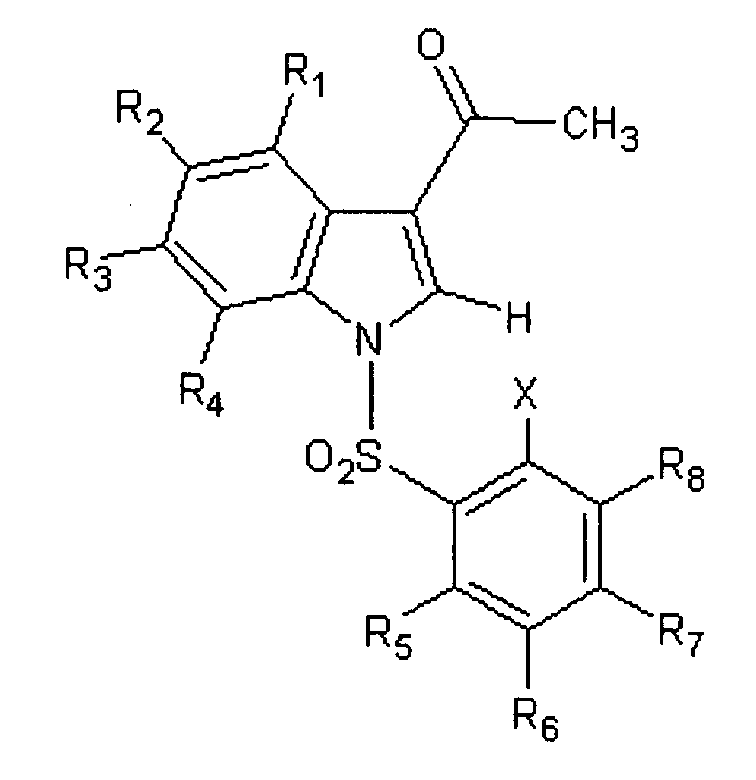
- the present invention also provides method to prepare intermediate by general formula (IV), which comprises of cyclizing compounds of formula (VIII), wherein R 1 , R 2 , R 3 , R 4 , R 5 , R 6 , R 7 and R 8 are as defined above; using a Pd(0) or Pd (II) derivative as a catalyst, for example tetrakis triphenylphosphine palladium, (Bis-tri-o-tolylphosphine) palladium and the like in a suitable solvent.
- a Pd(0) or Pd (II) derivative as a catalyst, for example tetrakis triphenylphosphine palladium, (Bis-tri-o-tolylphosphine) palladium and the like in a suitable solvent.
- any of the above synthetic sequences it may be necessary and/or desirable to protect sensitive or reactive groups on any of the molecules concerned. This may be achieved by means of conventional protecting groups, such as those described in Protective Groups In Organic Chemistry, Ed J. F. W. McOmie, Plenum Press, 1973 ; and T. W. Greene & P. G. M. Wuts, Protective Groups in Organic Synthesis, John Wiley & Sons, 1991 .
- suitable protecting groups for the piperazine group include BOC, COCCl 3 , COCF 3 .
- the protecting groups may be removed according to the standard procedures.
- the protecting groups may be removed at a convenient subsequent stage using methods known from the art.
- the compounds of the present invention may contain one or more asymmetric centers and therefore they also exist as stereoisomers.
- the stereoisomers of the compounds of the present invention may be prepared by one or more ways presented below:
- Chiral acids that can be employed may be tartaric acid, mandelic acid, lactic acid, camphorsulfonic acid, amino acids and the like.
- Chiral bases that can be employed may be cinchona alkaloids, brucine or a basic amino acid such as lysine, arginine and the like.
- the pharmaceutically acceptable salts forming a part of this invention may be prepared by treating the compound of formula (I) with 1-6 equivalents of a base such as Lithium, ammonia, substituted ammonia, sodium hydride, sodium methoxide, sodium ethoxide, sodium hydroxide, potassium t-butoxide, calcium hydroxide, calcium acetate, calcium chloride, magnesium hydroxide, magnesium chloride and the like.
- Solvents such as water, acetone, ether, THF, methanol, ethanol, t-butanol, dioxane, isopropanol, isopropyl ether or mixtures thereof may be used.
- Organic bases such lysine, arginine, methyl benzylamine, ethanolamine, diethanolamine, tromethamine, choline, guanidine and their derivatives may be used.
- Acid addition salts wherever applicable may be prepared by treatment with acids such as tartaric acid, mandelic acid, fumaric acid, maleic acid, lactic acid, salicyclic acid, citric acid, ascorbic acid, benzene sulfonic acid, p-toluene sulfonic acid, hydroxynaphthoic acid, methane sulfonic acid, malic acid, acetic acid, benzoic acid, succinic acid, palmitic acid, oxalic acid, hydrochloric acid, hydrobromic acid, sulfuric acid, nitric acid and the like in solvents such as water, alcohols, ethers, ethyl acetate, dioxane, DMF or a lower alkyl ketone such as acetone,
- Different polymorphs may be prepared by crystallization of compounds of general formula (I) under different conditions such as different solvents or solvent mixtures in varying proportions for recrystallization, various ways of crystallization such as slow cooling, fast cooling or a very fast cooling or a gradual cooling during crystallization. Different polymorphs may also be obtained by heating the compound, melting the compound and solidification by gradual or fast cooling, heating or melting under vacuum or under inert atmosphere and cooling under either vacuum or inert atmosphere.
- the various polymorphs may be identified by either one or more of the following techniques such as differential scanning calorimeter, powder X-ray diffraction, IR spectroscopy, solid probe NMR spectroscopy and thermal microscopy.
- Another aspect of the present invention comprises of a pharmaceutical composition, containing at least one of the compounds of the general formula (I), their tautomeric forms, their stereoisomers, their geometric forms, their polymorphs, their pharmaceutically acceptable salts, their pharmaceutically acceptable solvates thereof as an active ingredient, together with pharmaceutically employed carriers, auxiliaries and the like.
- compositions of the present invention may be formulated in a conventional manner using one or more pharmaceutically acceptable carriers.
- the active compounds of the invention may be formulated for oral, buccal, intranasal, parental (e.g., intravenous, intramuscular or subcutaneous) or rectal administration or a form suitable for administration by inhalation or insufflation.
- the dose of the active compounds can vary depending on factors such as the route of administration, age and weight of patient, nature and severity of the disease to be treated and similar factors. Therefore, any reference herein to a pharmacologically effective amount of the compounds of general formula (I) refers to the aforementioned factors.
- the pharmaceutical compositions may take the form of, for example, tablets or capsules prepared by conventional means with pharmaceutically acceptable excipients such as binding agents (e.g., pregelatinised maize starch, polyvinylpyrrolidone or hydroxypropyl methylcellulose); fillers (e.g., lactose, microcrystalline cellulose or calcium phosphate); lubricants (e.g., magnesium stearate, talc or silica); disintegrants (e.g., potato starch or sodium starch glycolate); or wetting agents (e.g., sodium lauryl sulphate).
- binding agents e.g., pregelatinised maize starch, polyvinylpyrrolidone or hydroxypropyl methylcellulose
- fillers e.g., lactose, microcrystalline cellulose or calcium phosphate
- lubricants e.g., magnesium stearate, talc or silica
- disintegrants e.g., potato starch or sodium
- Liquid preparations for oral administration may take the form of, for example, solutions, syrups or suspensions, or they may be presented as a dry product for constitution with water or other suitable vehicle before use.
- Such liquid preparations may be prepared by conventional means with pharmaceutically acceptable additives such as suspending agents (e.g., sorbitol syrup, methyl cellulose or hydrogenated edible fats); emulsifying agents (e.g., lecithin or acacia); non-aqueous vehicles (e.g., almond oil, oily esters or ethyl alcohol); and preservatives (e.g., methyl or propyl p-hydroxybenzoates or sorbic acid).
- suspending agents e.g., sorbitol syrup, methyl cellulose or hydrogenated edible fats
- emulsifying agents e.g., lecithin or acacia
- non-aqueous vehicles e.g., almond oil, oily esters or ethyl alcohol
- the composition may take the form of tablets or lozenges formulated in conventional manner.
- the active compounds of the invention may be formulated for parenteral administration by injection, including using conventional catheterization techniques or infusion.
- Formulations for injection may be presented in unit dosage form, e.g., in ampoules or in multi-dose containers, with an added preservative.
- the compositions may take such forms as suspensions, solutions or emulsions in oily or aqueous vehicles, and may contain formulating agents such as suspending, stabilizing and/or dispersing agents.
- the active ingredient may be in powder form for reconstitution with a suitable vehicle, e.g., sterile pyrogen-free water, before use.
- the active compounds of the invention may also be formulated in rectal compositions such as suppositories or retention enemas, e.g., containing conventional suppository bases such as cocoa butter or other glycerides.
- the active compounds of the invention are conveniently delivered in the form of an aerosol spray from a pressurized container or a nebulizer, or from a capsule using a inhaler or insufflator.
- a suitable propellant e.g., dichlorodifluoromethane, trichlorofluoromethane, dichlorotetrafluoroethane, carbon dioxide or other suitable gas and the dosage unit may be determined by providing a valve to deliver a metered amount.
- the medicament for pressurized container or nebulizer may contain a solution or suspension of the active compound while for a capsule it preferably should be in the form of powder.
- Capsules and cartridges for use in an inhaler or insufflator may be formulated containing a powder mix of a compound of the invention and a suitable powder base such as lactose or starch.
- a proposed dose of the active compounds of this invention, for either oral, parenteral, nasal or buccal administration, to an average adult human, for the treatment of the conditions referred to above, is 0.1 to 200 mg of the active ingredient per unit dose which could be administered, for example, 1 to 4 times per day.
- Aerosol formulations for treatment of the conditions referred to above are preferably arranged so that each metered dose or "puff" of aerosol contains 20 ⁇ g to 1000 ⁇ g of the compound of the invention.
- the overall daily dose with an aerosol will be within the range 100 ⁇ g to 10 mg.
- Administration may be several times daily, for example 2, 3, 4 or 8 times, giving for example, 1, 2 or 3 doses each time.
- affinities of the compound of this invention for the various serotonin receptors are evaluated using standard radioligand binding assays and are described here.
- Radioligand binding assays for various 5-HT receptor sub-types are described in detail below.
- Reactions are carried out in 50 mM TRIS-HCl (pH 7.4) containing 10 mM MgSO 4 , 0.5 mM EDTA and 0.1 % Ascorbic acid at room temperature for 1 hour.
- the reaction is terminated by rapid vacuum filtration onto glass fiber filters. Radioactivity trapped onto the filters is determined and compared to control values in order to ascertain any interactions of test compound with the 5HT 1A binding site.
- Reactions are carried out in 50 mM TRIS-HCl (pH 7.4) containing 60 ⁇ M (-) isoproterenol at 37°C for 60 minutes. The reaction is terminated by rapid vacuum filtration onto glass fiber filters. Radioactivity trapped onto the filters is determined and compared to control values in order to ascertain any interactions of test compound with the 5HT 1B binding site.
- Reactions are carried out in 50 mM TRIS-HCl (pH 7.7) containing 4 mM CaCl 2 , 100 nM 8-OH-DPAT, 100 nM Mesulergine, 10 uM Pargyline and 0.1% ascorbic acid at 25 °C for 60 minutes.
- the reaction is terminated by rapid vacuum filtration onto glass fiber filters. Radioactivity trapped onto the filters is determined and compared to control values in order to ascertain any interactions of test compound with the cloned 5HT 1D binding site.
- Reactions are carried out in 50 mM TRIS-HCl (pH 7.5) at room temperature for 90 minutes. The reaction is terminated by rapid vacuum filtration onto glass fiber filters. Radioactivity trapped onto the filters is determined and compared to control values in order to ascertain any interactions of test compound with the 5HT 2A binding site.
- Reactions are carried out in 50 mM TRIS-HCl (pH 7.7) containing 4 mM CaCl 2 and 0.1% ascorbic acid at 37 °C for 60 minutes. The reaction is terminated by rapid vacuum filtration onto glass fiber filters. Radioactivity trapped onto the filters is determined and compared to control values in order to ascertain any interactions of test compound with the 5HT 2C binding site.
- Reactions are carried out in 20 mM HEPES (pH 7.4) containing 150 mM NaCl at 25 °C for 60 minutes. The reaction is terminated by rapid vacuum filtration onto glass fiber filters. Radioactivity trapped onto the filters is determined and compared to control values in order to ascertain any interactions of test compound with the 5HT 3 binding site.
- Reactions are carried out in 50 mM HEPES (pH 7.4) at 370C for 60 minutes. The reaction is terminated by rapid vacuum filtration onto glass fiber filters. Radioactivity trapped onto the filters is determined and compared to control values in order to ascertain any interactions of test compound with the 5HT 4 binding site.
- Reactions are carried out in 50 mM TRIS-HCl (pH 7.4) containing 10 mM MgSO 4 and 0.5 mM EDTA at 37 °C for 60 minutes. The reaction is terminated by rapid vacuum filtration onto glass fiber filters. Radioactivity trapped onto the filters is determined and compared to control values in order to ascertain any interactions of test compound with the cloned 5HT 5A binding site.
- Reactions are carried out in 50 mM TRIS-HCl (pH 7.4) containing 10 mM MgCl 2 , 0.5 mM EDTA for 60 minutes at 37 °C.
- the reaction is terminated by rapid vacuum filtration onto glass fiber filters. Radioactivity trapped onto the filters is determined and compared to control values in order to ascertain any interactions of test compound(s) with the cloned serotonin - 5HT 6 binding site.
- Reactions are carried out in 50 mM TRIS-HCl (pH 7.4) containing 10 mM MgCl 2 , 0.5 mM EDTA for 60 minutes at 37 °C.
- the reaction is terminated by rapid vacuum filtration onto glass fiber filters. Radioactivity trapped onto the filters is determined and compared to control values in order to ascertain any interactions of test compound(s) with the cloned, serotonin - 5HT 7 binding site.
- the crude residue was purified by silica gel column chromatography using 30 % methanol in ethyl acetate as a mobile phase, to obtain the intermediate, N,N-Dimethyl-1-(2'-bromophenylsulfonyl)tryptamine, which was identified by IR, NMR and mass spectral analyses.
- reaction mass is filtered over hyflow, washed with ethyl acetate, and the combined filtrate was diluted with cold water.
- the aqueous layer was extracted with ethyl acetate (3 X 50 mL). Combined ethyl acetate layer was washed with brine, dried over sodium sulfate and evaporated under reduced pressure, below 50 °C.
- 1-(2'-bromophenylsulfonyl)-N,N-dimethyltryptamine (0.286 moles) was taken in a 100 mL 3 necked round bottomed flask, along with N,N-dimethyl acetamide (40 mL), potassium acetate (0.286 moles, -0.281 g.) and dichloro bis(tri-o-tolylphosphine)palladium (0.0143 moles, 0.0126 g.).
- the reaction mixture was maintained under nitrogen atmosphere and was heated to 160 °C with stirring for 16 hrs. After the completion of reaction (TLC), excess of dimethyl acetamide was distilled off under reduced pressure.
- the residue obtained was purified by silica gel column chromatography using 20 % methanol in ethyl acetate as an eluent, to afford the title compound, which was identified by IR, NMR and mass spectral analyses.
- the final desired compound of general formula (I) can be further purified by preparation of their acid addition salts.
- Example no. 5 (19.8 mg) was dissolved in 3 mL ether. To this clear solution a mixture of isopropylalcohol-hydrochloric acid (1 mL) was added. Immediately a white precipitate separates out, which was filtered, washed with ether and dried. Melting range (°C) : >250 (dec).
- Example - 7 6-(2-N,N-Dimethylaminoethyl)-4-methylbenzo[d]isothiazolo[3,2-a]indol-S,S-dioxide maleic acid salt
- Example no. 5 (19.4 mg) was dissolved in 3 mL ether. To this clear solution a solution of maleic acid (7,3 mg, dissolved in 3 mL ether 0.5 mL methanol) was added. Immediately a white precipitate separates out, which was filtered, washed with ether and dried. Melting range (°C) : 192 -194 (dec).
- Example - 8 6-(2-N,N-Dimethylaminoethyl)-4-methylbenzo[d]isothiazolo[3,2-a]indol-S,S-dioxide D,L-malic acid salt
- Example no. 5 (19.8 mg) was dissolved in 3 mL ether. To this clear solution a solution of D,L- malic acid (8.4 mg, dissolved in 3 mL ether:0.5 mL methanol) was added. Immediately a white precipitate separates out, which was filtered, washed with ether and dried. Melting range (°C) : 202 - 204 (dec).
- Example no. 5 (19.7 mg) was dissolved in 3 mL ether. To this clear solution a solution of oxalic acid (8.1 mg, dissolved in 3 mL ether:0.5 mL methanol) was added. Immediately a white precipitate separates out, which was filtered, washed with ether and dried. Melting range (°C) : 226 - 228 (dec).
- Example no. 5 (20.2 mg) was dissolved in 3 mL ether. To this clear solution a solution of citric acid (12.0 mg, dissolved in 3 mL ether:0.5 mL methanol) was added. Immediately a white precipitate separates out, which was filtered, washed with ether and dried. Melting range (°C) : 184 - 186 (dec).
- Example -15 6-(2-N,N-Dimethylaminoethyl)-4-fluoro-8-methoxybenzo[d]isothiazolo[3,2-a]indol-S,S-dioxide
- Example-17 6-(2-N,N-Dimethylaminoethyl)-4,8-dimethoxybenzo[d]isothiazolo[3,2-a]indol-S,S-dioxide
- Example - 48 6-(2-(N,N-Dimethylamino-1-hydroxy-1-yl)benzo[d]isothiazolo[3,2-a]indol-S,S-dioxide.
- Example - 49 4-Bromo-6-(2-(N,N-Dimethylamino-1-hydroxy-1-yl)benzo[d]isothiazolo[3,2-a]indol-S,S-dioxide.
- Example - 50 6-(2-(N,N-Dimethylaminoethyl)-2,4-difluoro-8-Methoxybenzo[d]isothiazolo[3,2-a]indol-S,S-dioxide.
- Example - 51 6-(2-(N,N-Dimethylamino-2-methylethyl)benzo[d]isothiazolo[3,2-a]indol-S,S-dioxide.
- Example - 52 6-(2-(N,N-Dimethylaminoethyl)-4-chloro-8-methylbenzo[d]isothiazolo[3,2-a]indol-S,S-dioxide.
- Example - 53 8-(2-(N,N-Difnethy)aminoethyl)benzo[d]isothiazoto[3,2-a]benzo(g)indol-S,S-dioxide.
Landscapes
- Health & Medical Sciences (AREA)
- Organic Chemistry (AREA)
- Chemical & Material Sciences (AREA)
- Bioinformatics & Cheminformatics (AREA)
- Engineering & Computer Science (AREA)
- General Chemical & Material Sciences (AREA)
- General Health & Medical Sciences (AREA)
- Nuclear Medicine, Radiotherapy & Molecular Imaging (AREA)
- Chemical Kinetics & Catalysis (AREA)
- Pharmacology & Pharmacy (AREA)
- Life Sciences & Earth Sciences (AREA)
- Animal Behavior & Ethology (AREA)
- Medicinal Chemistry (AREA)
- Public Health (AREA)
- Veterinary Medicine (AREA)
- Biomedical Technology (AREA)
- Neurosurgery (AREA)
- Neurology (AREA)
- Psychiatry (AREA)
- Pain & Pain Management (AREA)
- Psychology (AREA)
- Hospice & Palliative Care (AREA)
- Child & Adolescent Psychology (AREA)
- Hematology (AREA)
- Diabetes (AREA)
- Addiction (AREA)
- Obesity (AREA)
- Otolaryngology (AREA)
- Anesthesiology (AREA)
- Pharmaceuticals Containing Other Organic And Inorganic Compounds (AREA)
- Nitrogen Condensed Heterocyclic Rings (AREA)
- Nitrogen And Oxygen Or Sulfur-Condensed Heterocyclic Ring Systems (AREA)
- Medicinal Preparation (AREA)
- Medicines That Contain Protein Lipid Enzymes And Other Medicines (AREA)
- Indole Compounds (AREA)
- Steroid Compounds (AREA)
Claims (23)
- Verbindung der allgemeinen Formel (1),

"n" eine Ganzzahl von 1 bis 8 ist, vorzugsweise von 1 bis 4, und entweder eine lineare oder eine verzweigte Kohlenstoffkette repräsentiert. - Verbindung nach Anspruch 1, ausgewählt aus der Gruppe, bestehend aus:6-(2-N,N-Dimethylaminoethyl)-benzo[d]isothiazolo[3,2-a]indol-S,S-dioxid;4-Brom-6-(2-N,N-dimethylaminoethyl)-benzo[d]isothiazolo[3,2-a]indol-S,S-dioxid;4-Chlor-6-(2-N,N-dimethylaminoethyl)-benzo[d]isothiazolo[3,2-a]indol-S,S-dioxid;6-(2-N,N-Dimethylaminoethyl)-4-fluorbenzo[d]isothiazolo[3,2-a]indol-S,S-dioxid;6-(2-N,N-Dimethylaminoethyl)-4-methylbenzo[d]isothiazolo[3,2-a]indol-S,S-dioxid;6-(2-N,N-Dimethylaminoethyl)-4-methylbenzo[d]isothiazolo[3,2-a]indol-S,S-dioxid-hydrochlorid-Salz;6-(2-N,N-Dimethylaminoethyl)-4-methylbenzo[d]isothiazolo[3,2-a]indol-S,S-dioxid-maleat-Salz;6-(2-N,N-Dimethylaminoethyl)-4-methylbenzo[d]isothiazolo[3,2-a]indol-S,S-dioxid-D,L-Äpfelsäure-Salz;6-(2-N,N-Dimethylaminoethyl)-4-methylbenzo[d]isothiazolo[3,2-a]indol-S,S-dioxid-oxalat-Salz6-(2-N,N-Dimethylaminoethyl)-4-methylbenzo[d]isothiazolo[3,2-a]indol-S,S-dioxid-citrat-Salz6-(2-N,N-Dimethylaminoethyl)-4-methoxybenzo[d]isothiazolo[3,2-a]indol-S,S-dioxid;6-(2-N,N-Dimethylaminoethyl)-8-methoxybenzo[d]isothiazolo[3,2-a]indol-S,S-dioxid;4-Brom-6-(2-N,N-dimethylaminoethyl)-8-methoxybenzo[d]isothiazolo[3,2-a]indol-S,S-dioxid;4-Chlor-6-(2-N,N-dimethylaminoethyl)-8-methoxybenzo[d]isothiazolo[3,2-a]indol-S,S-dioxid;6-(2-N,N-Dimethylaminoethyl)-4-fluor-8-methoxybenzo[d]isothiazolo[3,2-a]indol-S,S-dioxid;6-(2-N,N-Dimethylaminoethyl)-4-methyl-8-methoxybenzo[d]isothiazolo[3,2-a]indol-S,S-dioxid;6-(2-N,N-Dimethylaminoethyl)-4,8-dimethoxybenzo[d]isothiazolo[3,2-a]indol-S,S-dioxid;6-(2-N,N-Dimethylaminoethyl)-2-ethylbenzo[d]isothiazolo[3,2-a]indol-S,S-dioxid;2-Chlor-6-(2-N,N-dimethylaminoethyl)-benzo[d]isothiazolo[3,2-a]indol-S,S-dioxid;2,4-Dichlor-6-(2-N,N-dimethylaminoethyl)-benzo[d]Isothiazolo[3,2-a]indol-S,S-dioxid;2,3-Dichlor-6-(2-N, N-dimethylaminoethyl)-benzo[d]isothiazolo[3,2-a]indol-S,S-dioxid;5-Chlor-6-(2-N,N-dimethylaminoethyl)-2-methylbenzo[d]isothiazolo[3,2-a]indol-S,S-dioxid;2,4,5-Trichlor-6-(2-N, N-dimethylaminoethyl)-benzo[d]isothiazolo[3,2-a]indol-S,S-dioxid;6-(2-N,N-Dimethylaminoethyl)-2,4-difluorbenzo[d]isothiazolo[3,2-a]indol-S,S-dioxid;6-(2-N,N-Dimethylaminoethyl)-4-fluor-8-methylbenzo[d]isothiazolo[3,2-a]indol-S,S-dioxid;2,4-Difluor-6-(2-N,N-dimethylaminoethyl)-8-methylbenzo[d]isothiazolo(3,2-a]indol-S,S-dioxid;6-(2-N,N-Dimethylaminoethyl)-2-methoxybenzo[d]isothiazolo[3,2-a]indol-S,S-dioxid;6-(2-N,N-Dimethylaminoethyl)-2,8-dimethoxybenzo[d]isothiazolo[3,2-a]indol-S,S-dioxid;6-(2-N,N-Dimethylaminoethyl)-8-methylbenzo[d]isothiazolo[3,2-a]indol-S,S-dioxid;6-(3-N, N-Dimethylamino-1-hyd roxyprop-1-yl)-benzo[d]isothiazolo[3,2-a]indol-S,S-dioxid;4-Brom-6-(3-N,N-dimethylamino-1-hydroxyprop-1-yl)-benzo[d]isothiazolo[3,2-a]indol-S,S-dioxid;6-(3-N,N-Dimethylamino-1-hydroxyprop-1-yl)-8-methoxybenzo[d]isothiazolo[3,2-a]indol-S,S-dioxid;6-(3-N,N-Dimethylamino-1-hydroxyprop-1-yl)-8-methylbenzo[d]isothiazolo[3,2-a]indol-S,S-dioxid;4-Brom-6-(3-N,N-dimethylamino-1-hydroxyprop-1-yl)-8-methoxybenzo[d]isothiazolo[3,2-a]indol-S,S-dioxid;6-(2-(4-Methylpiperazin-1-yl)-ethyl)-benzo[d]isothiazolo[3,2-a]indol-S,S-dioxid;6-(2-Morpholin-4-yl-ethyl)-benzo[d]isothiazolo[3,2-a]indol-S,S-dioxid;6-(2-Pyrrolidin-1-yl-ethyl)-benzo[d]isothiazolo[3,2-a]indol-S,S-dioxid;6-(2-Piperidin-1-yl-ethyl)-benzo[d]isothiazolo[3,2-a]indol-S,S-dioxid;4-Brom-6-(2-morpholin-4-yl-ethyl)-benzo[d]isothiazolo[3,2-a]indol-S,S-dioxid;4-Brom-6-(2-pyrrolidin-1-yl-ethyl)-benzo[d]isothiazolo[3,2-a]indol-S,S-dioxid;4-Brom-6-(2-(4-methylpiperazin-1-yl)-ethyl)-benzo[d]isothiazolo[3,2-a]indol-S,S-dioxid;6-(3-(Piperidin-1-yl)-1-hydroxyprop-1-yl)-benzo[d]isothiazolo[3,2-a]indol-S,S-dioxid;6-(3-(Piperidin-1-yl)-1-hydroxyprop-1-yl)-8-methoxybenzo[d]isothiazolo[3,2-a]indol-S,S-dioxid;4-Brom-6-(3-(piperidin-1-yl)-1-hydroxyprop-1-yl)-benzo[d]isothiazolo[3,2-a]indol-S,S-dioxid;4-Brom-6-(3-(piperidin-1-yl)-1-hydroxyprop-1-yl)-8-methoxybenzo[d]isothiazolo[3,2-a]indol-S,S-dioxid;6-(3-(Pyrrolidin-1-yl)-1-hydroxyprop-1-yl)-benzo[d]isothiazolo[3,2-a]indol-S,S-dioxid;6-(3-(Pyrrolidin-1-yl)-1-hydroxyprop-1-yl)-8-methoxybenzo[d]isothiazolo[3,2-a]indol-S,S-dioxid;6-(2-(N,N-Diethylamino)-2-methylethyl)-benzo[d]isothiazolo[3,2-a]indol-S,S-dioxid;6-(2-(N,N-Dimethylamino-1-hydroxy-1-yl)-benzo[d]isothiazolo[3,2-a]indol-S, S-dioxid;4-Bromo-6-(2-(N,N-Dimethylamino-1-hydroxy-1-yl)-benzo[d]isothiazolo[3,2-a]indol-S,S-dioxid;6-(2-(N,N-Dimethylaminoethyl)-2,4-difluor-8-methoxybenzo[d]isothiazolo[3,2-a]indol-S,S-dioxid;6-(2-(N,N-Dimethylamino-2-methylethyl)-benzo[d]isothiazolo[3,2-a]indol-S,S-dioxid;4-Chlor-6-(2-(N,N-Dimethylaminoethyl)-8-methylbenzo[d]isothiazolo[3,2-a]indol-S,S-dioxid;8-(2-(N,N-Dimethylaminoethyl)-benzo[d]isothiazolo[3,2-a]benzo[g]indol-S,S-dioxid; und ihre Stereoisomere, ihre N-Oxide, ihre Modifikationen, ihre pharmazeutisch zulässigen Salze und Solvate.
- Pharmazeutische Zusammensetzung, umfassend einen pharmazeutisch zulässigen Carrier, Verdünnungsmittel, Hilfsstoffe oder Solvate, zusammen mit einer therapeutisch wirksamen Menge einer Verbindung nach Anspruch 1, ihre tautomeren Formen, ihre Stereoisomere, ihre geometrischen Isomere, ihre N-Oxide, ihre Modifikationen, ihre pharmazeutisch zulässigen Salze oder Solvate.
- Pharmazeutische Zusammensetzung nach Anspruch 3, in Form einer Tablette, Kapsel, Pulver, Pastillen, Suppositorien, Sirup, Lösung, Suspension oder zur Injektion, verabreicht als einzelne Dosis oder in mehreren Dosen.
- Verwendung der Verbindung der allgemeinen Formel (I) nach Anspruch 1, oder einer pharmazeutischen Zusammensetzung nach Anspruch 3, zur Zubereitung von Medikamenten.
- Verwendung nach Anspruch 5 einer Verbindung der allgemeinen Formel (I) nach Anspruch 1, oder einer pharmazeutischen Zusammensetzung nach Anspruch 3, zur Zubereitung eines Medikaments zur Modulation der 5-HT-Aktivität.
- Verwendung nach Anspruch 5 einer Verbindung nach Anspruch 1 zur Herstellung eines Medikaments zur Behandlung und/oder Prävention von Krankheitsbildern, für welche eine selektive Wirkung auf 5-HT-Rezeptoren angezeigt ist.
- Verwendung nach Anspruch 5 einer Verbindung nach Anspruch 1 zur Zubereitung eines Medikaments zur Behandlung und/oder Prävention von Krankheitsbildern wie Angststörungen, Depressionen, Anfallsleiden, Zwangserkrankungen, Migränekopfschmerz, kognitive Gedächtnisstörungen, ADHS (Aufmerksamkeitsdefizit- / Hyperaktivitätssyndrom), Persönlichkeitsstörungen, Psychose, Paraphrenie, psychotische Depressionen, Manie, Schizophrenie, schizophreniforme Störungen, Entzug bei Betäubungsmittelmissbrauch, Panikattacken, Schlafstörungen sowie Störungen in Zusammenhang mit Spinaltrauma und/oder Kopfverletzungen.
- Verwendung nach Anspruch 5 einer Verbindung nach Anspruch 1 zur Zubereitung eines Medikaments zur Behandlung leichter kognitiver Behinderung und anderer neurodegenerativer Erkrankungen wie der Alzheimer-Krankheit, Parkinson-Krankheit und Chorea Huntington.
- Verwendung nach Anspruch 5 einer Verbindung nach Anspruch 1 zur Zubereitung eines Medikaments zur Behandlung bestimmter Gl-(gastrointestinaler) Erkrankungen wie beispielsweise RDS (Reizdarmsyndrom) oder Chemotherapie-induzierter Emesis.
- Verwendung nach Anspruch 5 einer Verbindung nach Anspruch 1 zur Zubereitung eines Medikaments zur Verringerung von Morbidität und Mortalität in Zusammenhang mit Übergewicht.
- Verwendung einer radioaktiv markierten Verbindung nach Anspruch 1 als diagnostisches Werkzeug zur Modulation der 5-HT-Rezeptorfunktion.
- Verwendung Verbindung nach Anspruch 1 in Kombination mit einem 5-HT-Wiederaufnahmehemmer und / oder einem pharmazeutisch zulässigen Salz davon zur Zubereitung einer pharmazeutischen Zusammensetzung zur Behandlung eines Krankheitsbildes, wo eine Modulation 0 + 5H erwünscht ist.
- Verbindung der allgemeinen Formel (1) nach Anspruch 1, ihre tautomeren Formen, ihre Stereoisomere, ihre Modifikationen, ihre pharmazeutisch zulässigen Salze und ihre pharmazeutisch zulässigen Solvate zur Zubereitung eines Medikaments.
- Verfahren zur Darstellung einer Verbindung der allgemeinen Formel (I) nach Anspruch 1, wobei R1, R2, R3, R4, R5, R6, R7, R8, R9, R10, R11 und R12 gleich oder verschieden sein können und jeweils unabhängig voneinander repräsentieren: Wasserstoff, Halogen, Oxo, Thio, Perhalogenalkyl, Hydroxy, Amino, Nitro, Cyano, Formyl, Amidino, Guanidino, substituierte oder unsubstituierte Gruppen wie lineares oder verzweigtes (C1-C12)-Alkyl, (C2-C12)-Alkenyl, (C2-C12)-Alkinyl, (C3-C7)-Cycloalkyl, (C3-C7)-Cycloalkenyl, Bicycloalkyl, Bicycloalkenyl, (C1-C12)-Alkoxy, Cyclo-(C3-C7)-alkoxy, Aryl, Aryloxy, Aralkyl, Aralkoxy, Heterocyclyl, Heteroaryl, Heterocyclylalkyl, Heteroaralkyl, Heteroaryloxy, Heteroaralkoxy, Heterocyclylalkoxy, Acyl, Acyloxy, Acylamino, Monoalkylamino, Dialkylamino, Arylamino, Diarylamino, Aralkylamino, Alkoxycarbonyl, Aryloxycarbonyl, Aralkoxycarbonyl, Heterocyclylalkoxycarbonyl, Heteroaryloxycarbonyl, Hydroxyalkyl, Aminoalkyl, Monoalkylaminoalkyl, Dialkylaminoalkyl, Alkoxyalkyl, Aryloxyalkyl, Aralkoxyalkyl, Alkylthio, Thioalkyl, Alkoxycarbonylamino, Aryloxycarbonylamino, Aralkoxycarbonylamino, Aminocarbonylamino, Alkylaminocarbonylamino, Dialkylaminocarbonylamino, Alkylamidino, Alkylguanidino, Dialkylguanidino, Hydrazino, Hydroxylamino, Carbonsäure, Sulfonsäuren, Phosphorsäure; oder die benachbarten Gruppen wie R1 und R2 oder R2 und R3 oder R3 und R4 oder R5 und R6 oder R6 und R7 oder R7 und R8, zusammen mit Kohlenstoffatomen, mit denen sie verbunden sind, einen 5-, 6- oder 7-gliedrigen Ring bilden können, welcher ferner optional eine oder mehrere Doppelbindungen und/oder ein oder mehrere Heteroatome, wie beispielsweise die Gruppe "Sauerstoff", "Stickstoff", "Schwefel" oder "Selen", und Kombinationen von Doppelbindung und "Heteroatomen" enthalten kann; oder R9 und R10 oder R11 und R12 zusammen eine Doppelbindung repräsentieren, verknüpft mit "Sauerstoff" und "Schwefel"; oder R9 und R10 oder R11 und R12, zusammen mit den Kohlenstoffatomen, mit denen sie verbunden sind, einen 3-, 4-, 5- oder 6- gliedrigen Ring bilden können, welcher ferner optional eine oder mehrere Doppelbindungen und/oder ein oder mehrere Heteroatome wie die Gruppe "Sauerstoff", "Stickstoff", "Schwefel" oder "Selen" enthalten kann, wie oben definiert;
R13 und R14 gleich oder verschieden sein können und jeweils unabhängig voneinander repräsentieren: Wasserstoff, substituierte oder unsubstituierte Gruppen wie lineares oder verzweigtes (C1-C12)-Alkyl, (C2-C12)-Alkenyl, (C2-C12)-Alkinyl, (C2-C12)-Alkanoyl, (C3-C7)-Cycloalkyl, (C3-C7)-Cycloalkenyl, Bicycloalkyl, Bicycloalkenyl, Aryl, Aralkyl, Heteroaryl, Heterocyclylalkyl; R13 und R14, zusammen mit dem Stickstoffatom, optional einen 3-, 4-, 5-, 6- oder 7-gliedrigen heterocyclischen Ring bilden können, wobei der Ring ferner substituiert sein kann, und entweder eine, zwei oder drei Doppelbindungen oder "zusätzliche Heteroatome" aufweisen kann, wie oben definiert; und
"n" eine Ganzzahl von 1 bis 8 ist, vorzugsweise von 1 bis 4, und entweder eine lineare oder verzweigte Kohlenstoffkette repräsentieren kann; umfassend die Cyclisierung einer Verbindung der unten angegebenen Formel (II),
- Verfahren zur Darstellung einer Verbindung der allgemeinen Formel (I),

"n" eine Ganzzahl von 1 bis 8 ist, vorzugsweise 1 bis 4, und entweder eine lineare oder eine verzweigte Kohlenstoffkette repräsentiert; umfassend die Reaktion einer unten angegebenen Verbindung (III),
- Verfahren zur Darstellung einer Verbindung der allgemeinen Formel (1),
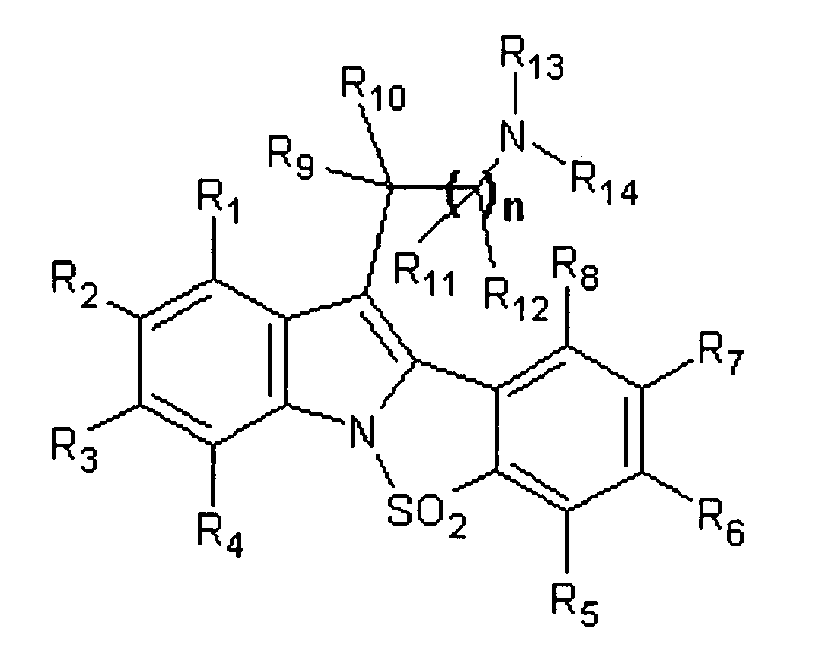
"n" eine Ganzzahl von 1 bis 8 ist, vorzugsweise 1 bis 4, und entweder eine lineare oder eine verzweigte Kohlenstoffkette repräsentiert; umfassend die Reaktion einer unten angegebenen Verbindung (IV),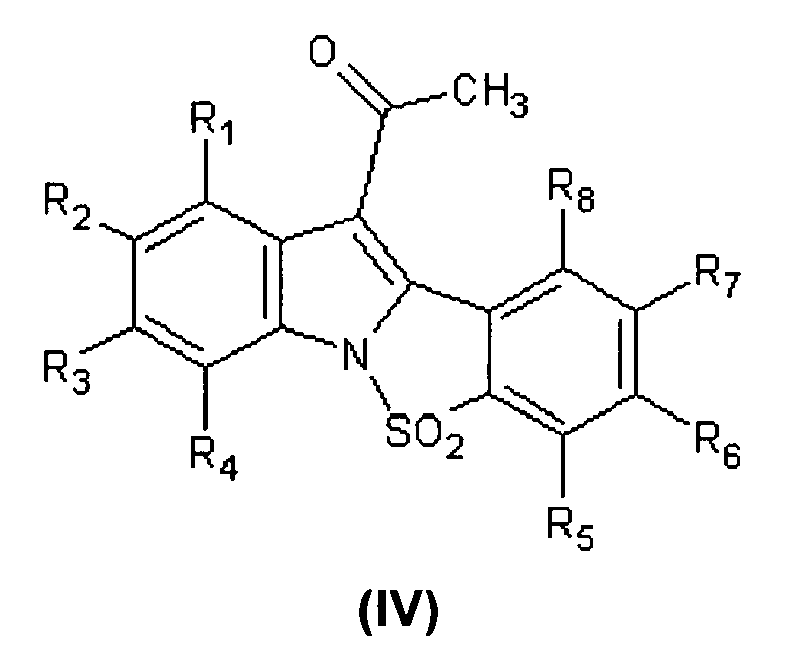
NHR13R14 (V)
wobei R13 und R14 definiert sind wie oben. - Verfahren zur Darstellung einer Verbindung der Formel (I) nach den Ansprüchen 15 bis 17, umfassend entweder das chemische oder das katalytische Reduzieren von Verbindungen, enthaltend =C(O)-Gruppe(n) in der Seitenkette, zu der entsprechenden -C(OH,H)- oder -C(H,H)-Verbindung.
- Verfahren nach den Ansprüchen 15 bis 18, umfassend die Durchführung eines oder mehrerer der folgenden optionalen Schritte: i) Abspaltung aller Schutzgruppen; ii) Auftrennen des racemischen Gemischs in reine Enantiomere mittels bekannter Verfahren und iii) Darstellen eines pharmazeutisch zulässigen Salzes der Verbindung nach Formel (1) und/oder iv) Darstellen eines pharmazeutisch zulässigen Pro-Pharmakons davon.
- Intermediate der unten dargestellten allgemeinen Formel (III),

"n" eine Ganzzahl von 1 bis 8 ist. Bevorzugt ist, dass n 1 bis 4 ist. Die Kohlenstoffkette, welche "n" repräsentiert, kann entweder linear oder verzweigt sein. - Verfahren zur Darstellung von Intermediaten der allgemeinen Formel (III) nach Anspruch 20, umfassend die Cyclisierung einer geeigneten Verbindung der Formel (II).

- Intermediate der allgemeinen Formel (IV),

- Verfahren, bereitgestellt für die Darstellung von Intermediaten der allgemeinen Formel (IV),

Applications Claiming Priority (3)
| Application Number | Priority Date | Filing Date | Title |
|---|---|---|---|
| INMA04782002 | 2002-06-21 | ||
| IN478CH2002 | 2002-06-21 | ||
| PCT/IN2003/000222 WO2004000849A2 (en) | 2002-06-21 | 2003-06-19 | Tetracyclic arylsulfonyl indoles having serotonin receptor affinity |
Publications (2)
| Publication Number | Publication Date |
|---|---|
| EP1523486A2 EP1523486A2 (de) | 2005-04-20 |
| EP1523486B1 true EP1523486B1 (de) | 2007-11-07 |
Family
ID=29798513
Family Applications (1)
| Application Number | Title | Priority Date | Filing Date |
|---|---|---|---|
| EP03760857A Expired - Lifetime EP1523486B1 (de) | 2002-06-21 | 2003-06-19 | Tetracyklische arylsulfonylindole mit affinität zum serotonin rezeptor |
Country Status (16)
| Country | Link |
|---|---|
| US (1) | US7649097B2 (de) |
| EP (1) | EP1523486B1 (de) |
| JP (1) | JP4473120B2 (de) |
| CN (1) | CN100378108C (de) |
| AT (1) | ATE377603T1 (de) |
| AU (1) | AU2003249582B2 (de) |
| BR (1) | BR0312176A (de) |
| CA (1) | CA2490254C (de) |
| DE (1) | DE60317333T2 (de) |
| DK (1) | DK1523486T3 (de) |
| ES (1) | ES2297216T3 (de) |
| MX (1) | MXPA04012832A (de) |
| NZ (1) | NZ537770A (de) |
| RU (1) | RU2340619C2 (de) |
| WO (1) | WO2004000849A2 (de) |
| ZA (1) | ZA200409886B (de) |
Families Citing this family (17)
| Publication number | Priority date | Publication date | Assignee | Title |
|---|---|---|---|---|
| US7507835B2 (en) * | 2002-11-28 | 2009-03-24 | Suven Life Sciences Ltd. | N-arylsulfonyl-3-aminoalkoxyindoles |
| JP4571507B2 (ja) * | 2002-12-18 | 2010-10-27 | スベン ライフ サイエンシズ リミティド | セロトニン受容体親和性を有する四環系3−置換インドール |
| ATE430752T1 (de) | 2004-01-02 | 2009-05-15 | Suven Life Sciences Ltd | Neue indenoä2,1-aüindene und isoindolä2,1-aüindol |
| CA2561733A1 (en) * | 2004-04-01 | 2005-10-13 | Cardiome Pharma Corp. | Pegylated ion channel modulating compounds |
| KR101097415B1 (ko) * | 2005-03-08 | 2011-12-23 | 수벤 라이프 사이언시스 리미티드 | 치환된 벤조티아지노인돌의 제조 방법 |
| WO2021134086A1 (en) | 2019-12-26 | 2021-07-01 | Gilgamesh Pharmaceuticals, Inc. | Arylcyclohexylamine derivatives and their use in the treatment of psychiatric disorders |
| LT4084791T (lt) | 2020-02-18 | 2025-02-25 | Gilgamesh Pharmaceuticals, Inc. | Specifiniai triptaminai, skirti nuotaikos sutrikimams gydyti |
| IL297861A (en) | 2020-05-08 | 2023-01-01 | Psilera Inc | Novel compositions of matter and pharmaceutical compositions |
| IL312785B2 (en) | 2020-05-19 | 2026-06-01 | Cybin Irl Ltd | Deuterated tryptamine derivatives and methods of use |
| BR112022025306A2 (pt) | 2020-06-12 | 2023-02-28 | Beckley Psytech Ltd | Composição compreendendo um sal benzoato de 5-metóxin, n-dimetiltriptamina |
| EP4277894A1 (de) | 2021-01-15 | 2023-11-22 | Beckley Psytech Limited | Tryptamin-analoga |
| EP4396162A4 (de) | 2021-09-03 | 2025-11-12 | Alexander Shulgin Res Institute Inc | Asymmetrische allyltryptamine |
| GB202212116D0 (en) | 2022-08-19 | 2022-10-05 | Beckley Psytech Ltd | Pharmaceutically acceptable salts and Compositions thereof |
| US12264131B2 (en) | 2022-08-19 | 2025-04-01 | Beckley Psytech Limited | Pharmaceutically acceptable salts and compositions thereof |
| US12246005B2 (en) | 2023-06-13 | 2025-03-11 | Beckley Psytech Limited | 5-methoxy-n,n-dimethyltryptamine (5-MeO-DMT) formulations |
| US12157722B1 (en) | 2023-08-03 | 2024-12-03 | Gilgamesh Pharmaceuticals, Inc. | Crystalline hydrochloride salts of N-ethyl-2-(5-fluoro-1H-indol-3-yl)-N-methylethan-1-amine |
| US12129234B1 (en) | 2023-08-03 | 2024-10-29 | Gilgamesh Pharmaceuticals, Inc. | Crystalline salts of N-ethyl-(5-fluoro-1H-indol-3-yl)-N-methylethan-1-amine |
Family Cites Families (21)
| Publication number | Priority date | Publication date | Assignee | Title |
|---|---|---|---|---|
| US3487091A (en) * | 1967-12-18 | 1969-12-30 | American Home Prod | 1-(benzyl- or substituted-benzyl)-3-(2-substituted-ethyl) indoles |
| ZA795239B (en) | 1978-10-12 | 1980-11-26 | Glaxo Group Ltd | Heterocyclic compounds |
| ZA815541B (en) * | 1980-08-12 | 1983-03-30 | Glaxo Group Ltd | Heterocyclic compounds |
| GB8600397D0 (en) * | 1986-01-08 | 1986-02-12 | Glaxo Group Ltd | Chemical compounds |
| GB8719167D0 (en) | 1987-08-13 | 1987-09-23 | Glaxo Group Ltd | Chemical compounds |
| GB8724912D0 (en) | 1987-10-23 | 1987-11-25 | Wellcome Found | Indole derivatives |
| GB8819024D0 (en) | 1988-08-10 | 1988-09-14 | Glaxo Group Ltd | Chemical compounds |
| IL96891A0 (en) | 1990-01-17 | 1992-03-29 | Merck Sharp & Dohme | Indole-substituted five-membered heteroaromatic compounds,their preparation and pharmaceutical compositions containing them |
| CA2042295A1 (fr) | 1990-05-15 | 1991-11-16 | Jacques Chauveau | Derives de mediateurs endogenes, leurs sels, procede de preparation, applications, et compositions les renfermant |
| CZ288351B6 (en) | 1990-06-07 | 2001-05-16 | Astrazeneca Ab | Nitrogenous heterocyclic compound, process of its preparation and use as well as a medicament containing thereof |
| CZ283018B6 (cs) | 1991-02-01 | 1997-12-17 | Merck Sharp And Dohme Limited | Deriváty imidazolu, triazolu a tetrazolu a farmaceutické přípravky na jejich bázi |
| GB9113802D0 (en) | 1991-06-26 | 1991-08-14 | Smithkline Beecham Plc | Medicaments |
| US5206382A (en) * | 1991-06-27 | 1993-04-27 | Fidia Georgetown Institute For The Neurosciences | Indole derivatives, pharmaceutical compositions and methods of treating neurological and psychiatric disorders |
| FR2686878B1 (fr) * | 1992-01-30 | 1995-06-30 | Sanofi Elf | Derives du n-sulfonyl oxo-2 indole, leur preparation, les compositions pharmaceutiques en contenant. |
| GB9210400D0 (en) | 1992-05-15 | 1992-07-01 | Merck Sharp & Dohme | Therapeutic agents |
| KR940007001A (ko) | 1992-09-16 | 1994-04-26 | 최승주 | 새로운 n-신나모일-2-메틸-5-메톡시-3-인돌 아세트산 에스테르, 그 제조방법 및 이를 함유하는 약학적 제제 |
| DE69814690T2 (de) * | 1997-12-03 | 2004-01-29 | Taisho Pharmaceutical Co Ltd | Stickstoffenthaltende tetracyclische verbindungen |
| JP2000026471A (ja) | 1998-07-10 | 2000-01-25 | Nippon Soda Co Ltd | 11−ホルミル−インドロ[1,2−b][1,2]ベンズイソチアゾールおよび農園芸用殺菌剤 |
| GB9820113D0 (en) * | 1998-09-15 | 1998-11-11 | Merck Sharp & Dohme | Therapeutic agents |
| AU767009B2 (en) * | 1998-12-11 | 2003-10-30 | Virginia Commonwealth University | Selective 5-HT6 receptor ligands |
| ES2566056T3 (es) | 2001-03-29 | 2016-04-08 | Eli Lilly And Company | N-(2-ariletil)bencilaminas como antagonistas del receptor 5-HT6 |
-
2003
- 2003-06-19 ES ES03760857T patent/ES2297216T3/es not_active Expired - Lifetime
- 2003-06-19 MX MXPA04012832A patent/MXPA04012832A/es active IP Right Grant
- 2003-06-19 RU RU2005101344/04A patent/RU2340619C2/ru not_active IP Right Cessation
- 2003-06-19 CA CA2490254A patent/CA2490254C/en not_active Expired - Fee Related
- 2003-06-19 AT AT03760857T patent/ATE377603T1/de active
- 2003-06-19 BR BR0312176-3A patent/BR0312176A/pt not_active IP Right Cessation
- 2003-06-19 JP JP2004515418A patent/JP4473120B2/ja not_active Expired - Fee Related
- 2003-06-19 NZ NZ537770A patent/NZ537770A/en not_active IP Right Cessation
- 2003-06-19 EP EP03760857A patent/EP1523486B1/de not_active Expired - Lifetime
- 2003-06-19 US US10/519,219 patent/US7649097B2/en not_active Expired - Fee Related
- 2003-06-19 DK DK03760857T patent/DK1523486T3/da active
- 2003-06-19 WO PCT/IN2003/000222 patent/WO2004000849A2/en not_active Ceased
- 2003-06-19 CN CNB038146029A patent/CN100378108C/zh not_active Expired - Fee Related
- 2003-06-19 DE DE60317333T patent/DE60317333T2/de not_active Expired - Lifetime
- 2003-06-19 AU AU2003249582A patent/AU2003249582B2/en not_active Ceased
-
2004
- 2004-12-07 ZA ZA200409886A patent/ZA200409886B/en unknown
Also Published As
| Publication number | Publication date |
|---|---|
| AU2003249582A1 (en) | 2004-01-06 |
| US20050203154A1 (en) | 2005-09-15 |
| RU2005101344A (ru) | 2005-08-20 |
| CN100378108C (zh) | 2008-04-02 |
| JP4473120B2 (ja) | 2010-06-02 |
| ZA200409886B (en) | 2006-07-26 |
| RU2340619C2 (ru) | 2008-12-10 |
| HK1074843A1 (en) | 2005-11-25 |
| CA2490254A1 (en) | 2003-12-31 |
| US7649097B2 (en) | 2010-01-19 |
| EP1523486A2 (de) | 2005-04-20 |
| NZ537770A (en) | 2007-03-30 |
| WO2004000849A3 (en) | 2004-03-25 |
| WO2004000849A2 (en) | 2003-12-31 |
| MXPA04012832A (es) | 2005-05-27 |
| BR0312176A (pt) | 2005-04-05 |
| DE60317333T2 (de) | 2008-08-28 |
| CA2490254C (en) | 2011-11-01 |
| AU2003249582B2 (en) | 2006-08-03 |
| ES2297216T3 (es) | 2008-05-01 |
| JP2005535621A (ja) | 2005-11-24 |
| ATE377603T1 (de) | 2007-11-15 |
| CN1662544A (zh) | 2005-08-31 |
| DK1523486T3 (da) | 2008-03-03 |
| DE60317333D1 (de) | 2007-12-20 |
Similar Documents
| Publication | Publication Date | Title |
|---|---|---|
| US7649097B2 (en) | Tetracyclic arylsulfonyl indoles having serotonin receptor affinity useful as therapeutic agents, process for their preparation and pharmaceutical compositions containing them | |
| EP1581538B1 (de) | Tetrazyklische 3-substituierte indole mit serotoninrezeptoraffinität | |
| US7297711B2 (en) | Arylalkyl indoles having serotonin receptor affinity useful as therapeutic agents, process for their preparation and pharmaceutical compositions containing them | |
| EP1517909B1 (de) | Tetracyclische arylcarbonyl indole mit serotoninrezeptoraffinität als arzneimittel, verfahren zu ihrer herstellung und pharmazeutische zubereitungen | |
| HK1074843B (en) | Tetracyclic arylsulfonyl indoles having serotonin receptor affinity | |
| HK1074630B (en) | Novel tetracyclic arylcarbonyl indoles having serotonin receptor affinity useful as therapeutic agents, process for their preparation and pharmaceutical compositions containing them | |
| BRPI0312176B1 (pt) | Composto, composição farmacêutica, uso de um composto, processo para a preparação de um composto, novo intermediário e processo para a preparação de um novo intermediario | |
| HK1074842B (en) | Arylalkyl indoles having serotonin receptor affinity useful as therapeutic agents, process for their preparation and pharmaceutical compositions containing them |
Legal Events
| Date | Code | Title | Description |
|---|---|---|---|
| REG | Reference to a national code |
Ref country code: SE Ref legal event code: TRGR |
|
| PUAI | Public reference made under article 153(3) epc to a published international application that has entered the european phase |
Free format text: ORIGINAL CODE: 0009012 |
|
| 17P | Request for examination filed |
Effective date: 20050117 |
|
| AK | Designated contracting states |
Kind code of ref document: A2 Designated state(s): AT BE BG CH CY CZ DE DK EE ES FI FR GB GR HU IE IT LI LU MC NL PT RO SE SI SK TR |
|
| AX | Request for extension of the european patent |
Extension state: AL LT LV MK |
|
| DAX | Request for extension of the european patent (deleted) | ||
| REG | Reference to a national code |
Ref country code: HK Ref legal event code: DE Ref document number: 1074843 Country of ref document: HK |
|
| GRAP | Despatch of communication of intention to grant a patent |
Free format text: ORIGINAL CODE: EPIDOSNIGR1 |
|
| GRAS | Grant fee paid |
Free format text: ORIGINAL CODE: EPIDOSNIGR3 |
|
| GRAA | (expected) grant |
Free format text: ORIGINAL CODE: 0009210 |
|
| AK | Designated contracting states |
Kind code of ref document: B1 Designated state(s): AT BE BG CH CY CZ DE DK EE ES FI FR GB GR HU IE IT LI LU MC NL PT RO SE SI SK TR |
|
| REG | Reference to a national code |
Ref country code: GB Ref legal event code: FG4D |
|
| REG | Reference to a national code |
Ref country code: IE Ref legal event code: FG4D |
|
| REG | Reference to a national code |
Ref country code: CH Ref legal event code: EP |
|
| REF | Corresponds to: |
Ref document number: 60317333 Country of ref document: DE Date of ref document: 20071220 Kind code of ref document: P |
|
| REG | Reference to a national code |
Ref country code: DK Ref legal event code: T3 |
|
| REG | Reference to a national code |
Ref country code: ES Ref legal event code: FG2A Ref document number: 2297216 Country of ref document: ES Kind code of ref document: T3 |
|
| PG25 | Lapsed in a contracting state [announced via postgrant information from national office to epo] |
Ref country code: SI Free format text: LAPSE BECAUSE OF FAILURE TO SUBMIT A TRANSLATION OF THE DESCRIPTION OR TO PAY THE FEE WITHIN THE PRESCRIBED TIME-LIMIT Effective date: 20071107 Ref country code: BG Free format text: LAPSE BECAUSE OF FAILURE TO SUBMIT A TRANSLATION OF THE DESCRIPTION OR TO PAY THE FEE WITHIN THE PRESCRIBED TIME-LIMIT Effective date: 20080207 |
|
| REG | Reference to a national code |
Ref country code: CH Ref legal event code: NV Representative=s name: R. A. EGLI & CO. PATENTANWAELTE |
|
| REG | Reference to a national code |
Ref country code: HK Ref legal event code: GR Ref document number: 1074843 Country of ref document: HK |
|
| PG25 | Lapsed in a contracting state [announced via postgrant information from national office to epo] |
Ref country code: CZ Free format text: LAPSE BECAUSE OF FAILURE TO SUBMIT A TRANSLATION OF THE DESCRIPTION OR TO PAY THE FEE WITHIN THE PRESCRIBED TIME-LIMIT Effective date: 20071107 |
|
| ET | Fr: translation filed | ||
| PG25 | Lapsed in a contracting state [announced via postgrant information from national office to epo] |
Ref country code: RO Free format text: LAPSE BECAUSE OF FAILURE TO SUBMIT A TRANSLATION OF THE DESCRIPTION OR TO PAY THE FEE WITHIN THE PRESCRIBED TIME-LIMIT Effective date: 20071107 Ref country code: SK Free format text: LAPSE BECAUSE OF FAILURE TO SUBMIT A TRANSLATION OF THE DESCRIPTION OR TO PAY THE FEE WITHIN THE PRESCRIBED TIME-LIMIT Effective date: 20071107 |
|
| PLBE | No opposition filed within time limit |
Free format text: ORIGINAL CODE: 0009261 |
|
| STAA | Information on the status of an ep patent application or granted ep patent |
Free format text: STATUS: NO OPPOSITION FILED WITHIN TIME LIMIT |
|
| PG25 | Lapsed in a contracting state [announced via postgrant information from national office to epo] |
Ref country code: PT Free format text: LAPSE BECAUSE OF FAILURE TO SUBMIT A TRANSLATION OF THE DESCRIPTION OR TO PAY THE FEE WITHIN THE PRESCRIBED TIME-LIMIT Effective date: 20080407 |
|
| 26N | No opposition filed |
Effective date: 20080808 |
|
| PG25 | Lapsed in a contracting state [announced via postgrant information from national office to epo] |
Ref country code: MC Free format text: LAPSE BECAUSE OF NON-PAYMENT OF DUE FEES Effective date: 20080630 Ref country code: GR Free format text: LAPSE BECAUSE OF FAILURE TO SUBMIT A TRANSLATION OF THE DESCRIPTION OR TO PAY THE FEE WITHIN THE PRESCRIBED TIME-LIMIT Effective date: 20080208 |
|
| PG25 | Lapsed in a contracting state [announced via postgrant information from national office to epo] |
Ref country code: CY Free format text: LAPSE BECAUSE OF NON-PAYMENT OF DUE FEES Effective date: 20080619 |
|
| PG25 | Lapsed in a contracting state [announced via postgrant information from national office to epo] |
Ref country code: EE Free format text: LAPSE BECAUSE OF FAILURE TO SUBMIT A TRANSLATION OF THE DESCRIPTION OR TO PAY THE FEE WITHIN THE PRESCRIBED TIME-LIMIT Effective date: 20071107 |
|
| PG25 | Lapsed in a contracting state [announced via postgrant information from national office to epo] |
Ref country code: HU Free format text: LAPSE BECAUSE OF FAILURE TO SUBMIT A TRANSLATION OF THE DESCRIPTION OR TO PAY THE FEE WITHIN THE PRESCRIBED TIME-LIMIT Effective date: 20080508 |
|
| PG25 | Lapsed in a contracting state [announced via postgrant information from national office to epo] |
Ref country code: TR Free format text: LAPSE BECAUSE OF FAILURE TO SUBMIT A TRANSLATION OF THE DESCRIPTION OR TO PAY THE FEE WITHIN THE PRESCRIBED TIME-LIMIT Effective date: 20071107 |
|
| REG | Reference to a national code |
Ref country code: DE Ref legal event code: R082 Ref document number: 60317333 Country of ref document: DE Representative=s name: GODEMEYER BLUM LENZE PARTNERSCHAFT, PATENTANWA, DE Ref country code: DE Ref legal event code: R082 Ref document number: 60317333 Country of ref document: DE Representative=s name: GODEMEYER BLUM LENZE PATENTANWAELTE, PARTNERSC, DE |
|
| REG | Reference to a national code |
Ref country code: FR Ref legal event code: PLFP Year of fee payment: 14 |
|
| REG | Reference to a national code |
Ref country code: FR Ref legal event code: PLFP Year of fee payment: 15 |
|
| REG | Reference to a national code |
Ref country code: FR Ref legal event code: PLFP Year of fee payment: 16 |
|
| PGFP | Annual fee paid to national office [announced via postgrant information from national office to epo] |
Ref country code: IT Payment date: 20190624 Year of fee payment: 17 Ref country code: FI Payment date: 20190620 Year of fee payment: 17 Ref country code: IE Payment date: 20190621 Year of fee payment: 17 Ref country code: DK Payment date: 20190621 Year of fee payment: 17 Ref country code: NL Payment date: 20190619 Year of fee payment: 17 Ref country code: DE Payment date: 20190619 Year of fee payment: 17 Ref country code: LU Payment date: 20190619 Year of fee payment: 17 |
|
| PGFP | Annual fee paid to national office [announced via postgrant information from national office to epo] |
Ref country code: FR Payment date: 20190619 Year of fee payment: 17 Ref country code: SE Payment date: 20190619 Year of fee payment: 17 Ref country code: BE Payment date: 20190619 Year of fee payment: 17 |
|
| PGFP | Annual fee paid to national office [announced via postgrant information from national office to epo] |
Ref country code: CH Payment date: 20190619 Year of fee payment: 17 |
|
| PGFP | Annual fee paid to national office [announced via postgrant information from national office to epo] |
Ref country code: GB Payment date: 20190619 Year of fee payment: 17 Ref country code: AT Payment date: 20190621 Year of fee payment: 17 Ref country code: ES Payment date: 20190719 Year of fee payment: 17 |
|
| REG | Reference to a national code |
Ref country code: DE Ref legal event code: R119 Ref document number: 60317333 Country of ref document: DE |
|
| REG | Reference to a national code |
Ref country code: FI Ref legal event code: MAE |
|
| REG | Reference to a national code |
Ref country code: DK Ref legal event code: EBP Effective date: 20200630 |
|
| PG25 | Lapsed in a contracting state [announced via postgrant information from national office to epo] |
Ref country code: FI Free format text: LAPSE BECAUSE OF NON-PAYMENT OF DUE FEES Effective date: 20200619 |
|
| REG | Reference to a national code |
Ref country code: CH Ref legal event code: PL |
|
| REG | Reference to a national code |
Ref country code: NL Ref legal event code: MM Effective date: 20200701 |
|
| REG | Reference to a national code |
Ref country code: AT Ref legal event code: MM01 Ref document number: 377603 Country of ref document: AT Kind code of ref document: T Effective date: 20200619 |
|
| GBPC | Gb: european patent ceased through non-payment of renewal fee |
Effective date: 20200619 |
|
| PG25 | Lapsed in a contracting state [announced via postgrant information from national office to epo] |
Ref country code: LU Free format text: LAPSE BECAUSE OF NON-PAYMENT OF DUE FEES Effective date: 20200619 |
|
| REG | Reference to a national code |
Ref country code: BE Ref legal event code: MM Effective date: 20200630 |
|
| PG25 | Lapsed in a contracting state [announced via postgrant information from national office to epo] |
Ref country code: GB Free format text: LAPSE BECAUSE OF NON-PAYMENT OF DUE FEES Effective date: 20200619 Ref country code: FR Free format text: LAPSE BECAUSE OF NON-PAYMENT OF DUE FEES Effective date: 20200630 Ref country code: NL Free format text: LAPSE BECAUSE OF NON-PAYMENT OF DUE FEES Effective date: 20200701 Ref country code: LI Free format text: LAPSE BECAUSE OF NON-PAYMENT OF DUE FEES Effective date: 20200630 Ref country code: IE Free format text: LAPSE BECAUSE OF NON-PAYMENT OF DUE FEES Effective date: 20200619 Ref country code: CH Free format text: LAPSE BECAUSE OF NON-PAYMENT OF DUE FEES Effective date: 20200630 |
|
| PG25 | Lapsed in a contracting state [announced via postgrant information from national office to epo] |
Ref country code: DE Free format text: LAPSE BECAUSE OF NON-PAYMENT OF DUE FEES Effective date: 20210101 Ref country code: BE Free format text: LAPSE BECAUSE OF NON-PAYMENT OF DUE FEES Effective date: 20200630 Ref country code: AT Free format text: LAPSE BECAUSE OF NON-PAYMENT OF DUE FEES Effective date: 20200619 Ref country code: SE Free format text: LAPSE BECAUSE OF NON-PAYMENT OF DUE FEES Effective date: 20200620 |
|
| PG25 | Lapsed in a contracting state [announced via postgrant information from national office to epo] |
Ref country code: DK Free format text: LAPSE BECAUSE OF NON-PAYMENT OF DUE FEES Effective date: 20200630 |
|
| REG | Reference to a national code |
Ref country code: SE Ref legal event code: EUG |
|
| PG25 | Lapsed in a contracting state [announced via postgrant information from national office to epo] |
Ref country code: IT Free format text: LAPSE BECAUSE OF NON-PAYMENT OF DUE FEES Effective date: 20200619 |
|
| REG | Reference to a national code |
Ref country code: ES Ref legal event code: FD2A Effective date: 20211102 |
|
| PG25 | Lapsed in a contracting state [announced via postgrant information from national office to epo] |
Ref country code: ES Free format text: LAPSE BECAUSE OF NON-PAYMENT OF DUE FEES Effective date: 20200620 |