EP1520822B1 - Verfahren und Vorrichtung für das Überlappung von Bogen - Google Patents
Verfahren und Vorrichtung für das Überlappung von Bogen Download PDFInfo
- Publication number
- EP1520822B1 EP1520822B1 EP04256075A EP04256075A EP1520822B1 EP 1520822 B1 EP1520822 B1 EP 1520822B1 EP 04256075 A EP04256075 A EP 04256075A EP 04256075 A EP04256075 A EP 04256075A EP 1520822 B1 EP1520822 B1 EP 1520822B1
- Authority
- EP
- European Patent Office
- Prior art keywords
- roll
- sheet
- assembly
- sheets
- nip
- Prior art date
- Legal status (The legal status is an assumption and is not a legal conclusion. Google has not performed a legal analysis and makes no representation as to the accuracy of the status listed.)
- Expired - Lifetime
Links
Images



Classifications
-
- B—PERFORMING OPERATIONS; TRANSPORTING
- B65—CONVEYING; PACKING; STORING; HANDLING THIN OR FILAMENTARY MATERIAL
- B65H—HANDLING THIN OR FILAMENTARY MATERIAL, e.g. SHEETS, WEBS, CABLES
- B65H45/00—Folding thin material
- B65H45/12—Folding articles or webs with application of pressure to define or form crease lines
- B65H45/24—Interfolding sheets, e.g. cigarette or toilet papers
-
- B—PERFORMING OPERATIONS; TRANSPORTING
- B65—CONVEYING; PACKING; STORING; HANDLING THIN OR FILAMENTARY MATERIAL
- B65H—HANDLING THIN OR FILAMENTARY MATERIAL, e.g. SHEETS, WEBS, CABLES
- B65H29/00—Delivering or advancing articles from machines; Advancing articles to or into piles
- B65H29/66—Advancing articles in overlapping streams
- B65H29/6609—Advancing articles in overlapping streams forming an overlapping stream
- B65H29/6618—Advancing articles in overlapping streams forming an overlapping stream upon transfer from a first conveyor to a second conveyor advancing at slower speed
-
- B—PERFORMING OPERATIONS; TRANSPORTING
- B65—CONVEYING; PACKING; STORING; HANDLING THIN OR FILAMENTARY MATERIAL
- B65H—HANDLING THIN OR FILAMENTARY MATERIAL, e.g. SHEETS, WEBS, CABLES
- B65H45/00—Folding thin material
- B65H45/12—Folding articles or webs with application of pressure to define or form crease lines
- B65H45/28—Folding in combination with cutting
Definitions
- the present invention relates to interfolding processes for sheet-type material, and more specifically to an assembly for overlapping sheets of material to create or form an interfolded stack of sheets.
- the sheets of material forming the stack must be offset or lapped such that each individual sheet can be folded and releasably engaged with adjacent sheets.
- a number of different processes have been developed. In the majority of these processes, problems arise in that the mechanisms utilized to lap the sheets are overly complicated or the mechanisms do not function appropriately to properly offset the sheets in a generally continuous manner for an extended period of time.
- US-A-3490762 upon which the pre-characterising clause of claim 1 is based, discloses a machine for lapping first and second sheets of material having first and second lapping rolls which rotate at different speeds, the sheets being successively transferred from a faster roll to a slower roll to achieve a lapping effect.
- US-A-3338575 also discloses a web-lapping apparatus.
- an assembly for lapping a first sheet of material with a consecutive second sheet of a material comprising: a first roll rotating at a first speed for conveying sheets of material; a second roll positioned adjacent the first roll and rotating at a second speed and a roller assembly defining a nip with the second roll, wherein the first and second rolls in combination with the roller assembly are operable to overlap the first sheet of material and the second sheet of material by feeding the leading end of each sheet into the nip while maintaining the sheet in engagement with the first roll, wherein the nip is operable to engage the leading edge of the sheet with the second roll while the trailing edge of the sheet remains in engagement with the first roll; characterised in that the roller assembly is movable relative to the second roll so as to vary the location of the nip relative to the surface of the second roll .
- the present invention further provides a interfolding machine to fold sheets of material, comprising: a cutting assembly to cut the material into a series of sheets including a first sheet and a successive second sheet; an overlap assembly according to the invention; and a first and second folding roll configured to receive the overlapped sheets of material from the overlap assembly and to fold the sheets of material into a stack of interfolded sheets.
- the present invention still further provides a method for overlapping a first sheet of material and a successive second sheet of material, the method comprising the acts of supplying the first and second sheets to a first roll rotating at a first speed; transferring a leading edge of the first sheet from the first roll to a second roll rotating at a second speed slower than the first speed; creating a deflection in the first sheet using a roller assembly located adjacent to the second roll; transferring a leading edge of the successive second sheet along the first roll into engagement with the second roll; and holding a trailing edge of the first sheet with the roller assembly) as the second roll moves the leading edge of the second sheet beneath the trailing edge of the first sheet; disengaging the trailing edge of the first sheet from the roller assembly into engagement with the second sheet positioned beneath; characterised by the step of selectively moving the roller assembly relative to the second roll so as to vary the location of the nip relative to the surface of the second roll.
- the first roll is the bed roll which cooperates with a knife roll to sever the web material into sheets
- the second roll is a retard roll located adjacent the bed roll.
- First and second sheets of material are held to a circumference of the first and second rolls by a vacuum at a plurality of passages extending radially to the circumference of the first and second rolls.
- the roller assembly referred to as a "nip" roller assembly, is located adjacent the second roll, i.e. the retard roll, of the interfolding machine.
- the nip roller assembly operates to provide positive control of the leading edge of the sheet while the trailing edge of the sheet is being pulled out of the way by the bed roll.
- the nip roller assembly ensures that registration of the leading edge of the sheet is not lost while the trailing edge of the sheet is peeled off of the bedroll.
- the overlapped sheets of material are transferred to folding rollers located downstream of the nip roller assembly. The folding rollers fold the overlapped sheets of material into a desired interfolded stack of sheets.
- the nip roller assembly generally includes one or more wheels, each of which is rotatably mounted to an outer end defined by a pin.
- the nip roller assembly further includes a housing, and an inner end defined by each pin is mounted to the housing via a stop that secures the pin in the housing. The stop is preferably adjustably coupled at the inner end of the pin.
- the nip roller assembly further includes a collar mounted to the pin, and a compression spring mounted on the pin and disposed between the collar and the housing.
- a shroud is positioned adjacent to the one or more wheels. The shroud includes one or more openings to receive a portion of the circumference of the one or more wheels.
- the preferred shroud includes a generally U-shaped plate structure having a first leg and a second leg to receive the one or more wheels therebetween.
- the shroud extends generally parallel to the first and second rolls.
- the U-shaped shroud includes a generally curvilinear portion to receive a trailing edge of the first and second sheets, and a generally linear portion opposite the generally curvilinear portion. This configuration allows the roller assembly to be easily adjusted to engage the sheets of material in varying locations, in order to provide an offset or overlap of varying lengths to accommodate varying interfolded stack configurations and sheets of various types.
- an interfolding machine 25 is operable to convert a web of material 30 into a stack of interfolded sheets of material shown at 32.
- Interfolding machine 25 incorporates the nip roller overlap assembly of the present invention, and generally includes a first pull roll 35 and a second pull roll 40 that receive the web of material 30 along a path (illustrated by an arrow 42 in FIG. 2 ) from a supply roll (not shown) into the interfolding machine 20.
- the first and second pull rolls 35 and 40 define a nip through which the web of material 30 passes, and function to unwind the web of material 30 and feed the web of material 30 in a path (illustrated by an arrow 44 in FIG.
- the knife roll 50 cuts the web of material into sheets, each of which has a predetermined length, and the bed roll 45 carries the sheets of material along a path (illustrated by arrow 52 in FIG. 2 ) toward and through a nip defined between bed roll 45 and a retard roll 55, which rotates at a slower speed of rotation than the bed roll 45.
- the retard roll 55 cooperates with a nip roller assembly 60 ( FIG. 2 ) in accordance with the present invention to form an overlap between the consecutive sheets of material.
- the retard roll 55 carries the overlapped sheets of material along a path (illustrated by arrow 68 in FIG. 2 ) to a lap roll 65.
- the lap roll 65 works in combination with a count roll 75 to eliminate the overlap between adjacent sheets of material at a predetermined sheet count, so as to create a separation in the stack 32 of interfolded sheets discharged from the interfolding machine 25.
- the lap roll 55 carries the overlapped sheets of material 30 along a path (illustrated by arrow 78 in FIG. 2 ) toward a nip defined between a first assist roll 80 and an adjacent second assist roll 85.
- the first and second assist rolls 80 and 85 feed the sheets of the material to a nip defined between a first folding roll 90 and a second folding roll 95.
- the first and second folding rolls 90 and 95 generally rotate in opposite directions (illustrated by arrows 96 and 98, respectively, in FIG. 2 ) to receive the overlapped sheets of the material therebetween.
- the periphery of the first folding roll 90 generally includes a series of the gripper assemblies 100 and a series of tucker assemblies 105 uniformly and alternately spaced to interact with a series of gripper and tucker assemblies 100 and 105, respectively, of the adjacent second folding roll 95.
- the series of alternately spaced gripper assemblies 100 and tucker assemblies 105 of the first and second folding rolls 90 and 95 interact to grip, carry, and release the sheets of material in a desired manner so as to form the desired interfolded relationship in the sheets of material and to form stack 32 of interfolded sheets.
- the folding rolls 90 and 95 may be driven by a drive system 110 having a drive belt assembly 115 ( FIG. 1 ).
- the stack 32 of interfolded sheets is discharged from between the first and second folding rolls 90 and 95 in a generally vertically-aligned fashion.
- the stack 32 of interfolded sheets may be supplied to a discharge and transfer system (not shown), which guides and conveys the stack 32 from the generally vertically-aligned orientation at the discharge of the interfolding machine 25 to a generally horizontally-aligned movement.
- a discharge and transfer system is described in U.S. Patent No. 6,712,746 entitled “Discharge and Transfer System for Interfolded Sheets," filed May 5, 2000.
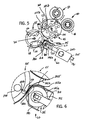
- the overlap assembly 20 in accordance with the present invention generally includes the retard roll 55, the bed roll 45, and the nip roll assembly 60.
- Retard roll 55 is mounted to a shaft 125 that rotates in a counter-clockwise direction (illustrated by arrow 68) and is positioned adjacent to the bed roll 45.
- Bed roll 45 is mounted on a shaft 135 that rotates in a counter-clockwise direction (illustrated by arrow 52).
- the speed of rotation of the shaft 125 and the retard roll 55 is approximately two-thirds of the speed of rotation of the shaft 135 and the bed roll 45, for reasons which will later be explained.
- a gap 140 is defined between the retard roll 55 and bed roll 45, and is dimensioned such that a consecutive series of sheets, such as shown at 145a and 145b having respective leading edges 150a and 150b and trailing edges 155a and 155b, can pass between the retard roll 55 and the bed roll 45.
- the consecutive sheets such as 145a and 145b are initially held on the bed roll 45 by a number of radial suction passages 160, each of which is connected by an axial vacuum passage 165 to a vacuum source (not shown), in a manner as is known.
- the vacuum supplied through the axial passages 165 and radial passages 160 serves to hold the sheets such as 145a and 145b at the circumference of the bed roll 45 as the bed roll 45 rotates in the counterclockwise direction 52.
- leading edges 150a and 150b of sheets 145a and 145b, respectively, are rotated into the nip or gap 140 between the bed roll 45 and the retard roll 55, the leading edges 150a and 150b are simultaneously disengaged by the suction passages 160 of the bed roll 45 and are engaged by one of a series of radial suction passages 170 formed in the retard roll 55.
- the retard roll suction passages 170 are connected to a series of axial vacuum passages 175, which are also connected to the vacuum source described above in a manner as is known.
- the retard roll suction passages 170 engage and hold the leading edges of the sheets, such as 150a and 150b downstream of the nip or gap 140, while the remainder of each sheet located upstream of the nip or gap 140 is maintained in engagement with bed roll 45 via a bed roll suction passage 160 that engages the trailing edge of each sheet.
- the bed roll suction passages 160 that engage the trailing edge of each sheet are supplied with vacuum to a point in the rotation of bed roll 45 downstream of nip or gap 140, to maintain each sheet trailing edge in engagement with bed roll 45 downstream of nip or gap 140.
- the leading edge such as 150b of each upstream sheet such as 145b is positioned forwardly of the trailing edge such as 155a of the next adjacent downstream sheet such as 145a.
- the nip roller assembly 60 includes a series of nip rolls 185 which are positioned adjacent the retard roll 55 and spaced apart from the bed roll 45.
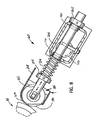
- Each nip roll 185 is formed of a rubber covered idler wheel 190 affixed to one end of an idler pin 195, and is located immediately adjacent to the retard roll 55.
- Each idler pin 195 is supported by a housing 200.
- Each pin 195 is held in engagement with the housing 200 by an adjustable stop 205 and a compression spring 210.
- the adjustable stop 205 is secured to the end of the pin 195 opposite the wheel 190.
- the compression spring 210 is located opposite the stop 205 and is disposed between the housing 200 and a collar 215.
- the nip roll assembly 60 also includes a shroud 218 positioned around the wheels 190 in order to ensure that the bubble created by the differential in speed between the bed roll 45 and the retard roll 55 is not prematurely sucked into the nip created by the retard rollers 185 and the retard roll55.
- the shroud 218 includes a series of spaced slots 219, and each nip roll 185 extends through one of slots 219 so as to face retard roll 55 and to form a nip or gap 220 therebetween.
- the leading edge 150a of a downstream sheet 145a is engaged with retard roll 55 via vacuum supplied to one of retard roll vacuum passages 170.
- the leading edge 150a enters the nip 220 formed by the retard roll 55 and nip rolls 185, the leading edge 150a is firmly held on the retard roll 55 by suction passages 170. Due to the difference in rotational speed between the retard roll 55 and the bed roll 45 (with the retard roll 55 rotating at a slower speed than the bed roll 45), the leading edge 150a moves toward the nip 220 at a rate slower than the rate of advancement of the trailing edge 155a, which is retained in engagement on the bed roll 45 by one of the bed roll vacuum passages 160.
- This difference in the rate of advancement of the sheet 145 consequently forms a deflection or bubble 225 in the sheet 145 at a location upstream of nip rolls 185, as shown in Fig. 3 .
- the presence of the deflection 225 enables the leading edge 150b of the successive sheet 145b to move along the bed roll 45 into engagement with the retard roll 55 via another of retard roll vacuum passages 170, so that the leading edge 150b of sheet 145b is positioned beneath the trailing edge 155a of the previous sheet 145a.
- the trailing edge 155a of the downstream sheet 145a is maintained on the bed roll 130 during continued advancement by rotation of bed roll 45, and is then released or disengaged from the bed roll 45 when bed roll 45 reaches a predetermined point in its rotation.
- Such continued movement of sheet 145a first reduces and then eliminates deflection or bubble 225 in its entirety, when the trailing edge 155a of sheet 145a is released from engagement with bed roll 45.
- the trailing edge 155a then falls into contact with the shroud 218 and is directed toward and through the nip 220.
- the leading edge 150b of the upstream sheet 145b is advanced toward nip 220 by virtue of its engagement with retard roll 55 via retard roll vacuum passage 170, which results in the formation of an overlap between sheets 145a and 145b in the area between the leading edge 150b of sheet 145b and the trailing edge 155a of sheet 145a, as shown in FIG. 6 .
- the trailing edge 155b of the upstream sheet 145b remains in engagement with bed roll 45, causing the formation of a deflection or bubble 225 in sheet 145b, in the same manner as described previously with respect to sheet 145a.
- the shroud 218 is designed to prevent the bubble or deflection 225 in each sheet from passing into the nip created between the retard roll nip roller185 and the retard roll 55 until the bed roll 45 has pulled the trailing end of sheet completely out of the way, and maintains the sheet bubble or deflection 225 intact until the trailing end of the sheet is advanced to a location at which it is released from engagement with bed roll 45.
- the idler pins 195 are slidably mounted within the housing 200 for movement toward and away from retard roll 55. As shown in FIG. 8 , the position of stop 205 on idler pin 195 can be adjusted, to ensure that each nip roll 185 provides the desired dimension of nip 220 between retard roll 55 and nip roll 185.
- Idler pin 195 extends through a pair of bushings or collars 221, which are mounted within aligned openings in opposite walls of housing 200 and which accommodate such axial adjustment in the position of idler pin 185 relative to housing 200.
- Compression spring 210 applies an axial biasing force on idler pin 195 that urges idler pin 195 toward the surface of retard roll 55.
- compression spring 210 can be compressed in the event an obstruction passes through nip 220, to enable nip rolls 185 to temporarily move away from the surface of retard roll 55.
- spring 210 consistently urges the wheel 190 towards the retard roll 55 with a generally constant amount of force, with a minimum or desired distance between the wheel 190 and the retard roll 55 forming the nip 220 maintained by the location of the stop 205 on the idler pin 195.
- the housing 200 is mounted on a pivot 230 defined by a pair of stub shafts that extend outwardly from the opposite ends of housing 200. Pivot 230 enables the idler pins 195 to pivot, which varies the position of the idler wheels relative to the circumference of retard roll 55, to thereby enable adjustment in the position of nip roll 185 relative to bed roll 55.
- idler pins 195 When the position of idler pins 195 is adjusted in this manner, the length of idler pin 195 outwardly of housing 200 is adjusted by means of stop 205, to provide precise control of the dimension of nip 220 between nip rolls 185 and retard roll 55.
Landscapes
- Engineering & Computer Science (AREA)
- Mechanical Engineering (AREA)
- Folding Of Thin Sheet-Like Materials, Special Discharging Devices, And Others (AREA)
- Sheets, Magazines, And Separation Thereof (AREA)
- Delivering By Means Of Belts And Rollers (AREA)
- Diaphragms For Electromechanical Transducers (AREA)
- Manufacturing Of Electric Cables (AREA)
Claims (12)
- Anordnung (20) zum Überlappen einer ersten Materiallage mit einer folgenden zweiten Materiallage, mit:einer ersten Walze (45), die sich mit einer ersten Drehzahl dreht, um Materiallagen zu befördern;einer zweiten Walze (55), die benachbart zu der ersten Rolle angeordnet ist und sich mit einer zweiten Drehzahl dreht; undeine Walzenanordnung (60), die mit der zweiten Walze (55) einen Walzenspalt definiert,wobei die ersten und zweiten Walzen (45, 55) in Kombination mit der Walzenanordnung (60) betriebsfähig sind, die erste Materiallage (145a) und die zweite Materiallage (145b) zur Überlappung zu bringen, indem der voreilende Rand jeder Lage in den Walzenspalt geführt wird, wobei die Lage in Wirkverbindung mit der ersten Walte (45) gehalten wird, wobei der Walzenspalt betriebsfähig ist, am voreilenden Rand der Lage mit der zweiten Rolle (55) anzugreifen, während der nacheilende Rand der Lage in Wirkverbindung mit der ersten Walze (45) bleibt;
dadurch gekennzeichnet, dass die Walzenanordnung (60) relativ zu der zweiten Walze (55) bewegbar ist, um so die Lage des Walzenspalts relativ zu der Oberfläche der zweiten Walze (55) zu variieren. - Anordnung nach Anspruch 1, bei der die ersten und zweiten Walzen (45, 55) jeweils eine Mehrzahl von sich radial erstrekkenden Durchgängen (160, 170) aufweisen, die zu einem Umfang führen, der von jeder der ersten und zweiten Walzen (45, 55) definiert ist, und bei der die aufeinander folgenden ersten und zweiten Materiallagen (145a, 145b) an dem Umfang der ersten und zweiten Walzen (45, 55) in zeitlich festgelegter Weise mittels eines Vakuums an den sich radial erstreckenden Durchgängen (160, 170) gehalten werden.
- Anordnung nach Anspruch 1 oder Anspruch 2, bei der die Walzenanordnung umfasst:ein oder mehrere Räder (190); einen Stift (195), der jedes der Räder (190) abstützt, wobei jeder Stift (195) ein erstes Ende und ein zweites Ende hat, wobei ein Rad (190) an dem ersten Ende jedes Stifts (195) befestigt ist; undein Gehäuse (200), das konfiguriert ist, um die Stifte (195) zu befestigen, wobei das Gehäuse (200) um eine Schwenkachse (230) schwenkbar ist, die sich parallel zur Drehachse der zweiten Walze (55) erstreckt, wobei eine Schwenkbewegung des Gehäuses (200) um die Schwenkachse (230) betriebsfähig ist, die Lage des Walzenspalts relativ zu der Oberfläche der zweiten Walze (55) zu variieren.
- Anordnung nach Anspruch 3, bei der die Walzenanordung (60) ferner aufweist:einen Kragen (215), der an jedem Stift (195) befestigt ist; und eine Druckfeder (210), die an dem Stift (195) befestigt und zwischen dem Kragen (215) und dem Gehäuse (200) angeordnet ist, um das Rad (190) in Richtung auf die zweite Walze (55) vorzuspannen.
- Anordnung nach Anspruch 3 oder Anspruch 4, ferner mit einem einstellbaren Positionsanschlag (205), der mit jedem Stift (195) verbunden ist und mit dem Gehäuse (200) in Wirkverbindung steht, um jeden Stift (195) einstellbar zu befestigen.
- Anordnung nach einem der Ansprüche 3 bis 5, bei der die Walzenanordung (60) ferner aufweist:ein Abdeckblech (218), das benachbart zu dem einen oder den mehreren Rädern (190) positioniert ist, wobei das Abdeckblech (218) eine oder mehrere Öffnungen (219) aufweist, um einen Teil des Umfangs von jedem des einen oder der mehreren Räder (190) aufzunehmen.
- Anordnung nach Anspruch 6, bei der das Abdeckblech (218) eine im Allgemeinen U-förmige Plattenstruktur mit einem ersten Schenkel und einem zweiten Schenkel aufweist, um das eine oder die mehreren Räder (190) dazwischen aufzunehmen.
- Anordnung nach Anspruch 6, bei der das Abdeckblech (218) einen im Allgemeinen krummlinigen Teil und einen im Allgemeinen linearen Teil benachbart zu der zweiten Walze aufweist, wobei der krummlinige Teil konfiguriert ist, einen nacheilenden Rand (155a) der ersten Lage (145a) und den überlappenden Teil einer benachbarten zweiten Lage (145b) aufzunehmen, wobei der lineare Teil konfiguriert ist, den nacheilenden Rand (18a) der ersten Lage (145a) von dem Abdeckblech (218) zu trennen.
- Faltmaschine zum Falten von Materiallagen, mit:einer Schneidanordnung (50), um das Material in eine Reihe von Lagen zu schneiden, die eine erste Lage (145a) und eine nachfolgende zweite Lage (145b) aufweist;einer Überlappungsanordnung (20) gemäß einem der vorherigen Ansprüche; undeiner ersten und zweiten Faltwalze (96, 98), die konfiguriert sind, die überlappten Materiallagen (145a, 145b) von der Überlappungsanordnung (20) aufzunehmen und die Materiallagen (145a, 145b) in einen Stapel von ineinander gefalteten Lagen zu falten.
- Verfahren zum Überlappen einer ersten Materiallage (145a) und einer nachfolgenden Materiallage (145b), wobei das Verfahren die Schritte umfasst:Zuführen der ersten und zweiten Lagen (145a, 145b) zu einer ersten Walze (45), die sich mit einer ersten Drehzahl dreht;Überführen eines voreilenden Randes (150a) der ersten Lage (145a) von der ersten Walze (45) zu einer zweiten Walze (55), die sich mit einer zweiten Drehzahl dreht, die kleiner als die erste Drehzahl ist;Erzeugen einer Biegung in der ersten Lage (145a) unter Verwendung einer Walzenanordnung (60), die benachbart zu der zweiten Walze (55) angeordnet ist;Überführen eines voreilenden Randes (150b) der nachfolgenden zweiten Lage (145b) entlang der ersten Walze (45) in Wirkverbindung mit der zweiten Walze (55); undHalten eines nacheilenden Randes (155a) der ersten Lage (145a) mit der Walzenanordnung (60), wenn die zweite Walze (55) den voreilenden Rand (150b) der zweiten Lage (145b) unter den nacheilenden Rand (155a) der ersten Lage (145a) bewegt; Trennen des nacheilenden Randes (155a) der ersten Lage (145a) von der Walzenanordnung (60) in eine Wirkverbindung mit der zweiten Lage (145b), die darunter angeordnet ist;gekennzeichnet durch den Schritt
selektive Bewegungen der Walzenanordnung (60) relativ zu der zweiten Walze (55), um die Lage des Walzenspalts relativ zu der Oberfläche der zweiten Walze (55) zu variieren. - Verfahren nach Anspruch 10, bei dem der Schritt, die Biegung in der ersten Lage zu erzeugen, umfasst:Halten des voreilenden Randes (150a) der ersten Lage (145a) zwischen der zweiten Walze (55) und einer Reihe von Rädern (190), die einen Teil der Walzenanordnung (60) bilden; undHalten des nacheilenden Randes (155a) der ersten Lage (145a) mit der ersten Walze (145).
- Verfahren nach Anspruch 10, bei dem der Schritt, den voreilenden Rand (150a) der ersten Lage (145a) zwischen der zweiten Rolle (55) und der Reihe von Rädern (190) der Walzenanordnung (60) zu halten, umfasst, eine einstellbare Kraft auf die Reihe von Rädern (190) auszuüben, die den voreilenden Rand der ersten Lage in einem Walzenspalt hält, der durch einen Abstand zwischen der zweiten Walze (55) und den Rädern (190) der Walzenanordnung definiert ist.
Applications Claiming Priority (4)
| Application Number | Priority Date | Filing Date | Title |
|---|---|---|---|
| US50779203P | 2003-10-01 | 2003-10-01 | |
| US507792P | 2003-10-01 | ||
| US10/953,175 US7407161B2 (en) | 2003-10-01 | 2004-09-29 | Method of and assembly for lapping consecutive sheets of web material |
| US953175 | 2004-09-29 |
Publications (3)
| Publication Number | Publication Date |
|---|---|
| EP1520822A2 EP1520822A2 (de) | 2005-04-06 |
| EP1520822A3 EP1520822A3 (de) | 2005-06-22 |
| EP1520822B1 true EP1520822B1 (de) | 2008-03-05 |
Family
ID=34316837
Family Applications (1)
| Application Number | Title | Priority Date | Filing Date |
|---|---|---|---|
| EP04256075A Expired - Lifetime EP1520822B1 (de) | 2003-10-01 | 2004-09-30 | Verfahren und Vorrichtung für das Überlappung von Bogen |
Country Status (5)
| Country | Link |
|---|---|
| US (1) | US7407161B2 (de) |
| EP (1) | EP1520822B1 (de) |
| AT (1) | ATE388113T1 (de) |
| DE (1) | DE602004012202T2 (de) |
| ES (1) | ES2301945T3 (de) |
Families Citing this family (16)
| Publication number | Priority date | Publication date | Assignee | Title |
|---|---|---|---|---|
| US7452321B2 (en) * | 2005-10-07 | 2008-11-18 | C.G. Bretting Manufacturing Company, Inc. | High speed interfolder |
| EP1826165B1 (de) * | 2006-02-28 | 2009-09-16 | M T C - Macchine Trasformazione Carta S.r.l. | Modulare Ineinanderfaltmaschine geeignet für einfache Formatänderungen |
| ITBO20080002A1 (it) * | 2008-01-03 | 2009-07-04 | Gdm Spa | Macchina e metodo per la piegatura di sbozzati per la realizzazione di pannolini. |
| ES2792374T3 (es) * | 2008-05-23 | 2020-11-11 | Mtc Macch Trasformazione Carta S R L | Estructura de máquina de plegado múltiple |
| US9132982B2 (en) | 2010-12-17 | 2015-09-15 | Kimberly-Clark Worldwide, Inc. | Folding apparatus and method of folding a product |
| US8602198B2 (en) | 2010-12-17 | 2013-12-10 | Kimberly-Clark Worldwide, Inc. | Vacuum roll and method of use |
| US8617040B2 (en) | 2010-12-17 | 2013-12-31 | Kimberly-Clark Worldwide, Inc. | Folding apparatus and method of folding a product |
| US9132983B2 (en) | 2010-12-17 | 2015-09-15 | Kimberly-Clark Worldwide, Inc. | Folding apparatus having rolls with variable surface speeds and a method of folding a product |
| US9371209B2 (en) | 2012-05-01 | 2016-06-21 | C.G. Bretting Manufacturing Co., Inc. | Single path single web single-fold interfolder and methods |
| US8939445B2 (en) | 2013-05-30 | 2015-01-27 | Kimberly-Clark Worldwide, Inc. | Vacuum roll with internal rotary valve |
| ITUB20159653A1 (it) | 2015-12-23 | 2017-06-23 | Mtc Macch Trasformazione Carta S R L | Unita? di avanzamento di nastri, o fogli di carta in macchine per la trasformazione della carta e macchina piegatrice e impilatrice che adotta tale unita? di avanzamento |
| US10449746B2 (en) | 2016-06-27 | 2019-10-22 | C. G. Bretting Manufacturing Co., Inc. | Web processing system with multiple folding arrangements fed by a single web handling arrangement |
| IT201900001579A1 (it) | 2019-02-04 | 2020-08-04 | Mtc Macch Trasformazione Carta S R L | Unita’ di piega, o interfogliatura, di fogli di carta per una macchina per la trasformazione della carta |
| IT202100012539A1 (it) | 2021-05-14 | 2022-11-14 | Koerber Tissue Fold S R L | Macchina per la produzione di prodotti laminari in materiale cartaceo, in particolare pacchi di tovaglioli, fazzoletti, o simili prodotti e relativo metodo di produzione |
| CN118043274A (zh) | 2021-08-20 | 2024-05-14 | 维美德造纸有限公司 | 用于生产由纸质材料制成的层状产品、特别是餐巾、纸巾或类似产品的包装的机器以及相关生产方法 |
| IT202300021915A1 (it) | 2023-10-20 | 2025-04-20 | Valmet Tissue Converting S R L | Macchina per la trasformazione della carta e prodotto di fogli piegati o interfogliati ottenibile con tale macchina |
Family Cites Families (21)
| Publication number | Priority date | Publication date | Assignee | Title |
|---|---|---|---|---|
| US1624985A (en) | 1922-10-18 | 1927-04-19 | R Hoe And Co Inc | Slow-down mechanism for printed products |
| US1886312A (en) | 1929-11-30 | 1932-11-01 | Nat Paper Products Company | Paper folding machine |
| US2092952A (en) | 1934-11-26 | 1937-09-14 | Samuel J Campbell | Paper interfolding machine |
| US3096977A (en) | 1959-12-05 | 1963-07-09 | Berkley Machine Co | Apparatus for squamiform lapping of blanks |
| US3338575A (en) | 1965-03-10 | 1967-08-29 | Paper Converting Machine Co | Web lapping apparatus |
| US3490762A (en) | 1967-09-07 | 1970-01-20 | Paper Converting Machine Co | Web-lapping machine |
| US4163548A (en) | 1978-01-23 | 1979-08-07 | Paper Converting Machine Company | Method of lapping webs and product |
| US4254947A (en) | 1979-05-30 | 1981-03-10 | C. G. Bretting Mfg. Co. Inc. | Sheet overlap device |
| US4279411A (en) | 1979-06-18 | 1981-07-21 | Paper Converting Machine Company | Method of lapping webs |
| DE3524246A1 (de) | 1985-07-06 | 1987-01-08 | Will E C H Gmbh & Co | Verfahren und vorrichtung zum zick-zack-falten endloser materialbahnen |
| FR2626564A1 (fr) | 1988-01-29 | 1989-08-04 | Alcatel Satmam | Plieuse universelle |
| US4991831A (en) | 1989-08-14 | 1991-02-12 | Green Ronald J | Paper sheet feeding apparatus |
| NL8902476A (nl) | 1989-10-05 | 1991-05-01 | Hadewe Bv | Werkwijze en inrichting voor het vouwen van vellen. |
| US6090467A (en) | 1993-10-12 | 2000-07-18 | Kimberly-Clark Australia Pty Limited | Method and apparatus to manufacture a towel or tissue stack |
| US5899447A (en) | 1997-09-02 | 1999-05-04 | The Procter & Gamble Company | Apparatus for stacking pop-up towels |
| US6165116A (en) | 1999-01-12 | 2000-12-26 | Green Bay Engineering Corp. | Method and apparatus for creating a discontinuity in a stack interfolded sheets |
| DE19903120A1 (de) | 1999-01-27 | 2000-08-03 | Roland Man Druckmasch | Vorrichtung zur Verlangsamung von Produkten |
| DE10024018B4 (de) * | 2000-05-16 | 2006-05-24 | Man Roland Druckmaschinen Ag | Vorrichtung zum Bilden eines Bogenstroms von sich schuppenartig teilweise überdeckenden Bogen |
| US6689038B2 (en) | 2002-06-10 | 2004-02-10 | Fpna Acquisition Corporation | Method and apparatus for interrupting interfolded sheets created by a lapping interfolder |
| DE10250562A1 (de) | 2002-10-30 | 2004-05-19 | Wella Ag | Verwendung von Zein für kosmetische Zwecke |
| US7121994B2 (en) * | 2003-09-30 | 2006-10-17 | Fpna Acquisition Corporation | Assembly for and method of adjusting the phasing of folding rolls to create a fold in sheets of material |
-
2004
- 2004-09-29 US US10/953,175 patent/US7407161B2/en not_active Expired - Fee Related
- 2004-09-30 AT AT04256075T patent/ATE388113T1/de not_active IP Right Cessation
- 2004-09-30 DE DE602004012202T patent/DE602004012202T2/de not_active Expired - Lifetime
- 2004-09-30 ES ES04256075T patent/ES2301945T3/es not_active Expired - Lifetime
- 2004-09-30 EP EP04256075A patent/EP1520822B1/de not_active Expired - Lifetime
Also Published As
| Publication number | Publication date |
|---|---|
| ATE388113T1 (de) | 2008-03-15 |
| DE602004012202D1 (de) | 2008-04-17 |
| US20050073090A1 (en) | 2005-04-07 |
| ES2301945T3 (es) | 2008-07-01 |
| US7407161B2 (en) | 2008-08-05 |
| DE602004012202T2 (de) | 2009-03-12 |
| EP1520822A2 (de) | 2005-04-06 |
| EP1520822A3 (de) | 2005-06-22 |
Similar Documents
| Publication | Publication Date | Title |
|---|---|---|
| US7407161B2 (en) | Method of and assembly for lapping consecutive sheets of web material | |
| US8671810B2 (en) | Folder for adjustably tensioning a web as the web is cut | |
| US4856725A (en) | Web winding machine and method | |
| EP0199286B1 (de) | Vorrichtung und Verfahren zum Wickeln von Bahnen | |
| US4962897A (en) | Web winding machine and method | |
| JPS605501B2 (ja) | シ−ト取扱い装置 | |
| EP1943092B1 (de) | Hochgeschwindigkeitsinterfalzmaschine | |
| JP4191732B2 (ja) | 輪転印刷機用折機 | |
| JPH0584696A (ja) | ロータリシヤ | |
| JP2002540041A (ja) | シート材料の加工処理 | |
| EP1119453A1 (de) | Mit hoher geschwindigkeit arbeitende maschine zum falten von papier | |
| EP1520818B1 (de) | Vorrichtung und Verfahren zum Verstellen der Phase von Falzwalzen in einer Ineinanderfaltmaschine | |
| JP4968835B2 (ja) | 多重シートの生産装置 | |
| EP2337686B1 (de) | Bauteil zum transportieren von druckprodukten mit verschiedenen umrissformen in einem druckpressenfalter | |
| WO2010044850A1 (en) | Incremental velocity changing apparatus for transporting printed products in a printing press folder | |
| AU2012211378B2 (en) | A device and method for processing sheets of paper or of another flexible material | |
| CA2483175C (en) | Method of and assembly for lapping consecutive sheets of web material | |
| EP1520823B1 (de) | Ventilsystem für die Zählrolle einer Ineinanderfaltmaschine | |
| JP2003341906A (ja) | シート出し装置 | |
| EP0296360B1 (de) | Falzapparat | |
| JP4387582B2 (ja) | シート状物の排出装置 | |
| JP2514826Y2 (ja) | 輪転印刷機の折丁分配装置 | |
| JP2008081229A (ja) | 輪転印刷機の折機 |
Legal Events
| Date | Code | Title | Description |
|---|---|---|---|
| PUAI | Public reference made under article 153(3) epc to a published international application that has entered the european phase |
Free format text: ORIGINAL CODE: 0009012 |
|
| AK | Designated contracting states |
Kind code of ref document: A2 Designated state(s): AT BE BG CH CY CZ DE DK EE ES FI FR GB GR HU IE IT LI LU MC NL PL PT RO SE SI SK TR |
|
| AX | Request for extension of the european patent |
Extension state: AL HR LT LV MK |
|
| PUAL | Search report despatched |
Free format text: ORIGINAL CODE: 0009013 |
|
| AK | Designated contracting states |
Kind code of ref document: A3 Designated state(s): AT BE BG CH CY CZ DE DK EE ES FI FR GB GR HU IE IT LI LU MC NL PL PT RO SE SI SK TR |
|
| AX | Request for extension of the european patent |
Extension state: AL HR LT LV MK |
|
| 17P | Request for examination filed |
Effective date: 20051003 |
|
| AKX | Designation fees paid |
Designated state(s): AT BE BG CH CY CZ DE DK EE ES FI FR GB GR HU IE IT LI LU MC NL PL PT RO SE SI SK TR |
|
| GRAP | Despatch of communication of intention to grant a patent |
Free format text: ORIGINAL CODE: EPIDOSNIGR1 |
|
| GRAS | Grant fee paid |
Free format text: ORIGINAL CODE: EPIDOSNIGR3 |
|
| GRAA | (expected) grant |
Free format text: ORIGINAL CODE: 0009210 |
|
| AK | Designated contracting states |
Kind code of ref document: B1 Designated state(s): AT BE BG CH CY CZ DE DK EE ES FI FR GB GR HU IE IT LI LU MC NL PL PT RO SE SI SK TR |
|
| REG | Reference to a national code |
Ref country code: GB Ref legal event code: FG4D |
|
| REG | Reference to a national code |
Ref country code: CH Ref legal event code: EP |
|
| REG | Reference to a national code |
Ref country code: IE Ref legal event code: FG4D |
|
| REF | Corresponds to: |
Ref document number: 602004012202 Country of ref document: DE Date of ref document: 20080417 Kind code of ref document: P |
|
| REG | Reference to a national code |
Ref country code: ES Ref legal event code: FG2A Ref document number: 2301945 Country of ref document: ES Kind code of ref document: T3 |
|
| PG25 | Lapsed in a contracting state [announced via postgrant information from national office to epo] |
Ref country code: FI Free format text: LAPSE BECAUSE OF FAILURE TO SUBMIT A TRANSLATION OF THE DESCRIPTION OR TO PAY THE FEE WITHIN THE PRESCRIBED TIME-LIMIT Effective date: 20080305 |
|
| PG25 | Lapsed in a contracting state [announced via postgrant information from national office to epo] |
Ref country code: AT Free format text: LAPSE BECAUSE OF FAILURE TO SUBMIT A TRANSLATION OF THE DESCRIPTION OR TO PAY THE FEE WITHIN THE PRESCRIBED TIME-LIMIT Effective date: 20080305 |
|
| NLV1 | Nl: lapsed or annulled due to failure to fulfill the requirements of art. 29p and 29m of the patents act | ||
| PG25 | Lapsed in a contracting state [announced via postgrant information from national office to epo] |
Ref country code: PL Free format text: LAPSE BECAUSE OF FAILURE TO SUBMIT A TRANSLATION OF THE DESCRIPTION OR TO PAY THE FEE WITHIN THE PRESCRIBED TIME-LIMIT Effective date: 20080305 Ref country code: BE Free format text: LAPSE BECAUSE OF FAILURE TO SUBMIT A TRANSLATION OF THE DESCRIPTION OR TO PAY THE FEE WITHIN THE PRESCRIBED TIME-LIMIT Effective date: 20080305 Ref country code: SI Free format text: LAPSE BECAUSE OF FAILURE TO SUBMIT A TRANSLATION OF THE DESCRIPTION OR TO PAY THE FEE WITHIN THE PRESCRIBED TIME-LIMIT Effective date: 20080305 |
|
| PG25 | Lapsed in a contracting state [announced via postgrant information from national office to epo] |
Ref country code: CZ Free format text: LAPSE BECAUSE OF FAILURE TO SUBMIT A TRANSLATION OF THE DESCRIPTION OR TO PAY THE FEE WITHIN THE PRESCRIBED TIME-LIMIT Effective date: 20080305 Ref country code: SE Free format text: LAPSE BECAUSE OF FAILURE TO SUBMIT A TRANSLATION OF THE DESCRIPTION OR TO PAY THE FEE WITHIN THE PRESCRIBED TIME-LIMIT Effective date: 20080605 Ref country code: SK Free format text: LAPSE BECAUSE OF FAILURE TO SUBMIT A TRANSLATION OF THE DESCRIPTION OR TO PAY THE FEE WITHIN THE PRESCRIBED TIME-LIMIT Effective date: 20080305 Ref country code: NL Free format text: LAPSE BECAUSE OF FAILURE TO SUBMIT A TRANSLATION OF THE DESCRIPTION OR TO PAY THE FEE WITHIN THE PRESCRIBED TIME-LIMIT Effective date: 20080305 Ref country code: PT Free format text: LAPSE BECAUSE OF FAILURE TO SUBMIT A TRANSLATION OF THE DESCRIPTION OR TO PAY THE FEE WITHIN THE PRESCRIBED TIME-LIMIT Effective date: 20080805 |
|
| ET | Fr: translation filed | ||
| PG25 | Lapsed in a contracting state [announced via postgrant information from national office to epo] |
Ref country code: RO Free format text: LAPSE BECAUSE OF FAILURE TO SUBMIT A TRANSLATION OF THE DESCRIPTION OR TO PAY THE FEE WITHIN THE PRESCRIBED TIME-LIMIT Effective date: 20080305 |
|
| REG | Reference to a national code |
Ref country code: GB Ref legal event code: 732E |
|
| PLBE | No opposition filed within time limit |
Free format text: ORIGINAL CODE: 0009261 |
|
| STAA | Information on the status of an ep patent application or granted ep patent |
Free format text: STATUS: NO OPPOSITION FILED WITHIN TIME LIMIT |
|
| PG25 | Lapsed in a contracting state [announced via postgrant information from national office to epo] |
Ref country code: DK Free format text: LAPSE BECAUSE OF FAILURE TO SUBMIT A TRANSLATION OF THE DESCRIPTION OR TO PAY THE FEE WITHIN THE PRESCRIBED TIME-LIMIT Effective date: 20080305 |
|
| 26N | No opposition filed |
Effective date: 20081208 |
|
| PG25 | Lapsed in a contracting state [announced via postgrant information from national office to epo] |
Ref country code: BG Free format text: LAPSE BECAUSE OF FAILURE TO SUBMIT A TRANSLATION OF THE DESCRIPTION OR TO PAY THE FEE WITHIN THE PRESCRIBED TIME-LIMIT Effective date: 20080605 Ref country code: EE Free format text: LAPSE BECAUSE OF FAILURE TO SUBMIT A TRANSLATION OF THE DESCRIPTION OR TO PAY THE FEE WITHIN THE PRESCRIBED TIME-LIMIT Effective date: 20080305 Ref country code: MC Free format text: LAPSE BECAUSE OF NON-PAYMENT OF DUE FEES Effective date: 20080930 |
|
| REG | Reference to a national code |
Ref country code: CH Ref legal event code: PL |
|
| PG25 | Lapsed in a contracting state [announced via postgrant information from national office to epo] |
Ref country code: IE Free format text: LAPSE BECAUSE OF NON-PAYMENT OF DUE FEES Effective date: 20080930 |
|
| REG | Reference to a national code |
Ref country code: FR Ref legal event code: TP |
|
| PG25 | Lapsed in a contracting state [announced via postgrant information from national office to epo] |
Ref country code: CY Free format text: LAPSE BECAUSE OF FAILURE TO SUBMIT A TRANSLATION OF THE DESCRIPTION OR TO PAY THE FEE WITHIN THE PRESCRIBED TIME-LIMIT Effective date: 20080305 |
|
| PG25 | Lapsed in a contracting state [announced via postgrant information from national office to epo] |
Ref country code: CH Free format text: LAPSE BECAUSE OF NON-PAYMENT OF DUE FEES Effective date: 20080930 Ref country code: LI Free format text: LAPSE BECAUSE OF NON-PAYMENT OF DUE FEES Effective date: 20080930 |
|
| PG25 | Lapsed in a contracting state [announced via postgrant information from national office to epo] |
Ref country code: HU Free format text: LAPSE BECAUSE OF FAILURE TO SUBMIT A TRANSLATION OF THE DESCRIPTION OR TO PAY THE FEE WITHIN THE PRESCRIBED TIME-LIMIT Effective date: 20080906 Ref country code: LU Free format text: LAPSE BECAUSE OF NON-PAYMENT OF DUE FEES Effective date: 20080930 |
|
| PG25 | Lapsed in a contracting state [announced via postgrant information from national office to epo] |
Ref country code: TR Free format text: LAPSE BECAUSE OF FAILURE TO SUBMIT A TRANSLATION OF THE DESCRIPTION OR TO PAY THE FEE WITHIN THE PRESCRIBED TIME-LIMIT Effective date: 20080305 |
|
| PG25 | Lapsed in a contracting state [announced via postgrant information from national office to epo] |
Ref country code: GR Free format text: LAPSE BECAUSE OF FAILURE TO SUBMIT A TRANSLATION OF THE DESCRIPTION OR TO PAY THE FEE WITHIN THE PRESCRIBED TIME-LIMIT Effective date: 20080606 |
|
| PGFP | Annual fee paid to national office [announced via postgrant information from national office to epo] |
Ref country code: IT Payment date: 20100928 Year of fee payment: 7 |
|
| PGFP | Annual fee paid to national office [announced via postgrant information from national office to epo] |
Ref country code: GB Payment date: 20110928 Year of fee payment: 8 Ref country code: FR Payment date: 20111005 Year of fee payment: 8 Ref country code: DE Payment date: 20110928 Year of fee payment: 8 Ref country code: ES Payment date: 20110720 Year of fee payment: 8 |
|
| GBPC | Gb: european patent ceased through non-payment of renewal fee |
Effective date: 20120930 |
|
| REG | Reference to a national code |
Ref country code: FR Ref legal event code: ST Effective date: 20130531 |
|
| PG25 | Lapsed in a contracting state [announced via postgrant information from national office to epo] |
Ref country code: DE Free format text: LAPSE BECAUSE OF NON-PAYMENT OF DUE FEES Effective date: 20130403 Ref country code: GB Free format text: LAPSE BECAUSE OF NON-PAYMENT OF DUE FEES Effective date: 20120930 |
|
| PG25 | Lapsed in a contracting state [announced via postgrant information from national office to epo] |
Ref country code: FR Free format text: LAPSE BECAUSE OF NON-PAYMENT OF DUE FEES Effective date: 20121001 Ref country code: IT Free format text: LAPSE BECAUSE OF NON-PAYMENT OF DUE FEES Effective date: 20120930 |
|
| REG | Reference to a national code |
Ref country code: DE Ref legal event code: R119 Ref document number: 602004012202 Country of ref document: DE Effective date: 20130403 |
|
| REG | Reference to a national code |
Ref country code: ES Ref legal event code: FD2A Effective date: 20131021 |
|
| PG25 | Lapsed in a contracting state [announced via postgrant information from national office to epo] |
Ref country code: ES Free format text: LAPSE BECAUSE OF NON-PAYMENT OF DUE FEES Effective date: 20121001 |