EP1520177B1 - Procede et reactif destines a l'identification specifique et a la quantification d'au moins une proteine dans un echantillon - Google Patents
Procede et reactif destines a l'identification specifique et a la quantification d'au moins une proteine dans un echantillon Download PDFInfo
- Publication number
- EP1520177B1 EP1520177B1 EP03760636.5A EP03760636A EP1520177B1 EP 1520177 B1 EP1520177 B1 EP 1520177B1 EP 03760636 A EP03760636 A EP 03760636A EP 1520177 B1 EP1520177 B1 EP 1520177B1
- Authority
- EP
- European Patent Office
- Prior art keywords
- peptides
- group
- proteins
- reagent
- protein
- Prior art date
- Legal status (The legal status is an assumption and is not a legal conclusion. Google has not performed a legal analysis and makes no representation as to the accuracy of the status listed.)
- Expired - Lifetime
Links
Images

Classifications
-
- G—PHYSICS
- G01—MEASURING; TESTING
- G01N—INVESTIGATING OR ANALYSING MATERIALS BY DETERMINING THEIR CHEMICAL OR PHYSICAL PROPERTIES
- G01N33/00—Investigating or analysing materials by specific methods not covered by groups G01N1/00 - G01N31/00
- G01N33/48—Biological material, e.g. blood, urine; Haemocytometers
- G01N33/50—Chemical analysis of biological material, e.g. blood, urine; Testing involving biospecific ligand binding methods; Immunological testing
- G01N33/68—Chemical analysis of biological material, e.g. blood, urine; Testing involving biospecific ligand binding methods; Immunological testing involving proteins, peptides or amino acids
- G01N33/6803—General methods of protein analysis not limited to specific proteins or families of proteins
- G01N33/6848—Methods of protein analysis involving mass spectrometry
Definitions
- the present invention relates to a method and a reagent suitable for carrying it out, which have reproducible systematic, qualitative and quantitative proteomic characterization using non-isotope metal-encoded markers, and the like. state-of-the-art mass spectrometric tandem methods.
- proteomics is concerned with the systematic identification of all proteins that have been expressed in a cell or tissue and the characterization of their essential properties, such as amount, degree of Modification, integration into multi-protein complexes, etc. Protein databases or cell maps are created in which protein sequences are archived. In the meantime, many thousands of sequences with often known functions are available.
- proteome analysis as a fast and parallel method compared to classical protein chemistry is becoming more and more popular in basic biological research, biotechnology and medical research. It is to be expected that this analysis will be established by default in a few years. How effectively a proteome analysis can actually be carried out is crucially dependent on how well analytical methods are able to identify and quantify so-called "low-copy" proteins, since these are often of crucial biological importance play in the cell process.
- Tandem MS instruments such as the triple quadrupole device, ion trap, and hybrid quadrupole time-of-flight (Q-TOF) device are routinely used in LC-MS / MS or nanospray electro-ray ionization (ESI) experiments ) are used to generate peptide fragment ion spectra that search for protein identification via a database sequence are suitable.
- Q-TOF hybrid quadrupole time-of-flight
- the protein or genome database search is just as important a tool to which proteomics research has made its progress.
- the developed computer search algorithms are now very sophisticated. Goodlett et al. could demonstrate that the exact mass of a peptide, along with limiting search criteria such as the molecular weight of the protein from which the peptide is derived and the indication of the specific protease to cleave the protein, may be sufficient to uniquely identify a protein through a database search.
- the high workload and often cross-laboratory non-reproducible wedge of 2DGE technology makes it almost impossible to automate this method.
- Gel-free systems are increasingly arousing the interest of proteomics researchers. Many different gel-free systems can be devised, all based on the combination of two or more different chromatographic separation methods.
- the chromatographic separation of proteins is a central component of any protein research and thus an obvious method in proteome research. Thanks to many years of development and optimization, chromatographic separations are characterized by high reproducibility. However, even the combination of two different chromatographic methods does not have the separation capacity required in proteome research, because complex protein mixtures are difficult to separate into individual purified protein fractions due to their properties.
- a coupling of chromatography to mass spectrometry brings with mass analysis another separation dimension, which, however, applied to proteins only a very limited benefit. Only when analyzing peptides, as listed below, is this approach promising.
- proteome analysis is disclosed, which is particularly useful for the quantitative analysis of protein expression in complex biological samples, such as cells and tissues, for the detection and quantitation of specific proteins in complex protein mixtures and for the quantitative determination of specific enzyme activities. It uses a new class of chemical reagents, coded affinity tags (CATs), in this case the so-called isotope-encoded affinity tags (ICATs) and mass spectrometric methods.
- CATs coded affinity tags
- ICATs isotope-encoded affinity tags
- mass spectrometric methods mass spectrometric methods.
- the ICAT reagent consists of the affinity tag, which selectively noncovalently binds to a corresponding counter-reagent and permits column chromatographic separation of the affinity tagged peptides or substrates from the remainder of the mixture.
- the affinity tag is linked via a linker, which may be isotope-labeled, to a reactive group that selectively reacts with a specific protein function.
- the proteins are labeled at specific binding sites by the ICAT reagent.
- These are e.g. a functional group that has a specific reactivity for sulfhydryl groups and binds exclusively to cysteine-containing proteins.
- the cysteine-containing peptides are selectively isolated, this means a considerable simplification of the complexity of the resulting peptide mixture, since less than one-tenth of all peptides which have arisen, for example, by tryptic cleavage from the entire yeast proteome, contain a cysteine-containing radical.
- Another significant advantage is that in this way proteins that occur in very small amounts can be enriched. Despite the great simplification of the complexity of the system, however, the quantification and identification of the proteins is guaranteed.
- ICAT reagents To quantitatively determine relative amounts of protein in one or more protein samples, different isotope-coded ICAT reagents are now used. Each sample is treated with a different isotopically labeled, but otherwise chemically identical ICAT reagent.
- the samples which may be derived, for example, from cell cultures of one species at different stages of development, are subsequently combined and hydrolyzed enzymatically.
- the labeled peptides are separated by affinity chromatography from the mixture and separated by HPLC.
- a pair of identical but different peptide-derived peptides are simultaneously eluted from the HPLC column. In the mass spectrum However, these peptides do not have the same mass to charge ratio, but they differ by the characteristic mass difference of different isotopically labeled tags.
- the ratio of the relative ion intensities of such a (CAT-tagged peptide pair in the mass spectrum quantitatively reflects the relative proportions of the parent proteins from the original cells or tissue, using a tandem mass spectrometry (MS / MS) then the peptide sequence of the ICAT-labeled peptide by fragmentation
- MS / MS tandem mass spectrometry
- this object is achieved by a method for the mass spectrometric identification and quantification of one or more proteins in a sample containing a mixture of proteins.
- the method of the invention comprises the steps of: a) providing a sample containing a mixture of proteins; b) provide a reagent for the analysis of peptides, the general formula AY-PRG wherein A represents at least one functional group for reversible, covalent or non-covalent bonding to a support material which comprises at least one affinity function for selective binding to a support material, Y is a group comprising at least one macrocyclic lanthanide chelate complex, and PRG one and PRG is a reactive group for selectively binding to peptides or other biomolecules to be analyzed, c) cleaving the proteins in the sample to produce peptides; d) coupling the peptides with the reagent from step b), e) selecting the peptides labeled in step d) using the
- the method of the present invention is for the differential study of the proteome of one, two or more cell, tissue or body fluid samples during analysis. Furthermore, other protein-containing samples can be examined, such as protein fractions of organelles or other compartments of cells.
- the method is a novel alternative to the ICAT method (isotope-coded affinity tags) mentioned above and avoids some of the disadvantages of ICAT. It represents a new alternative and complementary technology for proteome research.
- the process of the present invention will hereinafter be referred to as MeCAT (Metal-chelate-complex-codedaffinity-tag).
- the samples to be compared are reacted with MeCAT reagents which differ in the chelated metal ions. Subsequently, for example, an affinity purification of the labeled biomolecules takes place, for example via biotin-streptavidin, or a "fishing" by specific chemical reaction with a carrier material with subsequent re-release.
- the labeled biomolecules are separated by multi-dimensional chromatography and then subjected to on-line or off-line differential analysis with relative quantification of protein / peptide by mass spectrometry.
- the corresponding peptides of the individual samples are difficult marks vary depending on the metal employed and can "be assigned to each sample quantitatively n connection with a sequence analysis (identification) of the biomolecules (peptides) by MS so i.
- Cleavage may involve hydrolysis using known proteases such as trypsin, Asp-N protease, pepsin, Lys-C, Glu-C, Arg-C proteinase, Asp-N endopeptidase, BNPS skatoles, caspases, chymotrypsin , Clostripain, factor Xa, glutamyl endopeptidase, granzyme B, proline endopeptidase, proteinase K, staphlococcal peptidase A, thermolysin, thrombin, carboxypeptidases and combinations thereof.
- the chemical cleavage can be carried out by means of partial acid hydrolysis CNBr, formic acid, iodosobenzoic acid, NTCB (2-nitro-5-thiocyanobenzoic acid), hydroxyl
- a method according to the invention is preferred in which the labeled peptides are separated from one another by chromatography after release from the carrier material and before their mass spectrometric analysis, in particular by HPLC.
- the chromatographic technique is chosen according to the desired degree of resolution.
- a method according to the invention which is characterized in that several samples containing protein and / or peptides are analyzed together. This can be achieved in particular by the different labeling of different samples from different cell materials.
- the labeled peptides are subjected to a subsequent sequencing. With the sequence information of the labeled peptides then databases can be searched to infer conclusions about the parent protein can.
- a method for mass spectrometry detection of the relative expression of proteins in a sample containing proteins comprising the steps of: a) providing a biological sample containing proteins; b) Providing a reagent for analysis of peptides, which is the general formula AY-PRG wherein A represents at least one functional group for reversible, covalent or non-covalent attachment to a support material, Y is a group comprising at least one macrocyclic lanthanide chelate complex, and PRG is a reactive group for selective binding to peptides or others to be analyzed Biomolecules is; c) cleaving the proteins in the sample to produce peptides; d) coupling the peptides with the reagent from step b); e) selection of the peptides labeled in step d) using at least one functional group for reversible, covalent or non-covalent binding to a carrier material and removal of unbound peptides;
- the arrangement of groups A, X and PRG may be reversed.
- the reagent according to the invention may be differently oriented in its various constituents, as long as all the functional requirements for carrying out MeCAT are still present.
- the labeled peptides are detected in the method of the invention by tandem techniques, such as matrix-assisted laser desorption / ionization (MALDI) time-of-flight (TOF) -TOF-MS and electrospray ionization (ESI) MSs.
- MALDI matrix-assisted laser desorption / ionization
- TOF time-of-flight
- ESI electrospray ionization
- the invention encompasses both the MeCAT process and the synthesis of the novel MeCAT compounds.
- the arrangement of groups A, X and PRG may be reversed.
- the reagent according to the invention may be differently oriented in its various constituents, as long as all the functional requirements for carrying out MeCAT are still met.
- the function PRG is selected from a sulfhydryl-reactive group, an amine-reactive group and an enzyme substrate. More preferably, PRG is selected from the group consisting of an amine-reactive pentafluorophenyl ester group, an amine-reactive N-hydroxysuccinimide ester group, sulfonyl halide, isocyanate, isothiocyanate, active ester, tetrafluorophenyl ester, an acid halide and an acid anhydride, a homoserine lactone-reactive primary amine group and a carboxylic acid-reactive amine, alcohol or 2,3,5,6-tetrafluorophenyl trifluoroacetate, a iodoacetylamide group, an epoxide, an ⁇ -haloacyl group, a nitrile, a sulfonated alkyl, an arylthiol and a maleimide.
- a reagent of the invention wherein A is selected from biotin or modified biotin, a 1,2-diol, glutathione, maltose, a nitrilotriacetic acid group, an oligohistidine or a hapten.
- the reagent can be coupled to a streptavidin group for convenient isolation to be able to.
- streptavidin-labeled column matrix or coated beads particularly preferred.
- A is a reactive group which is coupled to a carrier material and which can be split off again from the carrier material.
- Disulfide bonds S-S
- S-S Disulfide bonds
- this comprises a chemically and / or enzymatically cleavable linker between the groups A, X and / or PRG.
- this linker may be composed of CH 2 groups located between and linking the groups A, X and / or PRG.
- One or more of the CH 2 groups may be substituted, the character of the substitutions being irrelevant, as long as the functions of the groups A, Y and PRG are not affected.
- other functions can be introduced via the linkers, such as, for example, the abovementioned chemical and / or enzymatic cleavability.
- substitutions are alkyl, alkenyl and alkoxy groups, aryl groups substituted with one or more alkyl, alkenyl and alkoxy groups, aryl groups, acidic groups and basic groups.
- double and triple bonds may be present in the linker and heteroatoms, such as O, S and N, may be included, such as in the form of a linker containing a disulfide group.
- Y is selected from a lanthanide macrocyclic chelate complex, a functionalized tetraazoacrocycle, a polyazo-polyacetic acid, DOTA, a DOTA derivative, NOTA, a NOTA derivative, EDTA, DTPA-BP, DTPA, DO3A, HP-DO3A and DTPA-BMA.
- Particularly preferred compounds are 1,4,7,10,13,16,19,22-octaazacyclotetracosane-1,4,7,10,13,16,19,22-octaacetic acid (OTEC) and 1,4,7,10 , 14-17, 20, 23-Octaacacylohexacosane-1,4,7,10,14,17,20,23-octaacetic acid (OHEC).
- the metals that can be bound with the chelating function of the reagent can be selected from a variety of metals, giving flexibility in use of the reagent according to the present invention significantly improved.
- the metal bound by the chelate complex can be selected from Ce, Dy, Er, Eu, Gd, Ho, La, Lu, Nd, Pr, Sm, Tb, Tm, and Yb.
- the chelating group may be labeled with several different lanthanides .
- the biological sample may be a directly sampled or pre-fractionated sample for differential analysis of the proteome of one, two or more cell, tissue or body fluid samples.
- other protein-containing samples can be examined, such as protein fractions of organelles or other compartments of cells.
- the method is preferably used in the course of diagnosing or monitoring diseases of an animal, in particular of humans, by detecting the relative expression of proteins in a sample taken from the animal and containing proteins.
- a further aspect of the present invention relates to a kit for diagnosis which comprises at least one reagent according to the present invention together with other substances suitable for detecting peptides in a biological sample and / or the relative expression of proteins in a protein / or enzymes, in particular an internal standard.
- a proteome marking can be carried out, the products of which can then be sent to a central analysis laboratory for mass spectrometric analysis.
- radioactive metal ions are well known to those skilled in the art of radiochemistry and can be obtained from any conventional textbook of chemistry, such as for example the Römpp-Lexikon Chemie, 10th edition, Thieme Verlag, Stuttgart , are taken.
- the ICAT process has by no means exhausted all possibilities of rapid quantitative protein or protein function analysis.
- the core of this class of reagents presented here is the clever combination of three different functions in one molecule; i) the ability to specifically bind to a protein, ii) the possibility of easy separation of the labeled from the unlabelled peptides after enzymatic or chemical hydrolysis, and iii) the possibility of relative quantitation of peptide pairs derived from different samples (eg Cells of a species in different developmental phases), about the mass difference of corresponding peptides in the mass spectrum.
- the first two functions are used in many common analytical separation methods.
- the third feature is linked to the most advanced MS technologies in conjunction with the latest computer-aided database search programs, which make it possible to identify a protein based on the amino acid sequence of a single or a few peptides (for example, cysteine-containing peptides).
- the present invention provides the incorporation of a metal chelate complex into the reagent as an alternative.
- Metal ions are available in much greater variety and cheaper. It is only a question of finding suitable and cleverly packing them in the amino acid-specific reagent without being lost by dissociation or exchange reactions.
- the candidate chelating ligand must stabilize the metal ion so well that the complex remains completely intact throughout the process, its stability is guaranteed even with larger pH changes, and no exchange processes with the peptides as potential ligands can take place.
- the solubility properties of the complex may differ from those of the other reagent components, i. the protein-reactive functional group and the molecular moiety for chromatographic separation purposes, not fundamentally different.
- the entire molecule must preferably be soluble in the sample fluid to ensure efficient interaction of the tag with the specific protein binding sites.
- the metal ion-specific reagent may have a molecular component for column chromatographic separation of the labeled peptides after hydrolysis of the protein.
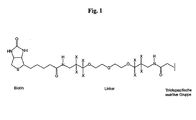
- Fig.1 the preferred strategy for quantifying protein expression using metal-specific labeled reagents (MeCATs / MeCODs) is shown schematically.
- chelates are particularly suitable for macrocyclic ligands because of their high thermodynamic stability and kinetic inertness with respect to dissociation. Owing to their topological peculiarities, macrocycles possess a large number of strategically distributed donor atoms, which, with suitable conformation and size of the ligand, can interact effectively with the metal ion.
- a "statistical stabilization" follows from the very low probability of a simultaneous break of all metal-ligand donor bonds. Similar to the receptor binding sites of enzymes, many, in particular only weak, coordinative interactions with a suitable molecular architecture cause a not only stable but also selective binding of the metal ion. As a result, in contrast to open-chain ligands, exchange with biologically relevant metal ions is effectively prevented (see Table 1).
- the present invention relates to a method and a reagent suitable for carrying it out, which include a reproducible systematic, qualitative and quantitative proteomic characterization using non-isotope metal-encoded markers and, among other things, most modern mass spectrometric tandem methods.
- the metal code is a macrocyclic lanthanide chelate complex based on DOTA (1,4,7,10-tetraazcyclododecane-1,4,7,10-tetraacetic acid) or a transition metal complex based on NOTA (1,4,7-triazacyclononane-1 , 4,7-triacetic acid), which must be equipped with an amino acid-specific functional group and another molecular component for the chromatographic separation of the labeled peptides.
- the marker to be synthesized must be characterized by good water solubility and high kinetic stability. Compounds with different lanthanide ions should not differ significantly in their chemical reactivity and physical properties.
- the metal-coded markers are characterized in terms of their structure, their thermodynamic properties in aqueous solution and their reaction behavior towards peptides. Their reproducible applicability in proteome analysis has to be tested on model experiments and real samples in connection with multidimensional chromatography, MS / MS and database analysis.
- the metal-coded markers are covalently bound site-specifically to the proteins of cell lysates. Subsequent to the proteolysis of the proteins, the metal-labeled peptides are chromatographically isolated and further separated, and then mass-spectrometrically quantified and sequenced in the second step. By means of a direct quantitative comparison of well-determined states, differences in the protein composition are highlighted, which finally have to be correlated with biological effects.
- the protein-reactive group and the function for peptide isolation may be incorporated into the carbon backbone of the macrocyclic ligand, or the metal chelate complex may be linked via a linker to the protein reactive group and the peptide isolation function.
- Suitable metal ions for the NOTA ligand are transition metal ions such as copper (II), nickel (II) and zinc (II).
- DOTA 1,4,7,10-tetraazacyclododecane-1,4,7,10 -Tetraacetic acid
- DOTA Gadolimum (III) complex led to the successful application of the DOTA Gadolimum (III) complex as a contrast agent in magnetic resonance imaging.
- the kinetic stability of the complex is far more important than its thermodynamic stability.
- An inert complex does not undergo ligand or metal exchange reactions, even if the thermodynamic stability constant is not very high.
- DOTA-lanthanoid complexes are both very stable and inert is the optimal size ratio between the metal ion and the cavity provided by the ligand.
- Metal ion and ligand are a rigid, well-closed structure that dissociates extremely slowly under physiological conditions and can only be attacked by protons in an acidic medium.
- ligand LD 50 a log log log log log C sel K GdL K cal K CuL K ZnL EDTA 0.3 4.23 17.7 10.61 18.78 16.5 DTPA-BP 2.8 5.32 16.83 DTPA 5.6 7.04 22.46 10.75 21.38 18.29 DOTA 11 8.3 24.6 17.23 22.63 21.05 DO3A 7-9 4.13 21.0 11.74 22.87 19.26 HP DO3A 12 6.95 23.8 14.83 22.84 19.37 DTPA-BMA 17.8 9.04 16.85 7.17 13.03 12.04 a) Intravenous LD 50 rate in mice, mmol / kg Relative atomic log mass [g / mol] K LnDOTA Log 1 M NaCl, 37 ° K LnDOTA Log 0,1MKC1,25 ° K LnDOTA , other works La 138.91 20.7 22.9 21.7 (0.1M KCL, 25 °) Ce 140.12 21.6 23.4 pr 140.91 22.4 23.0 Nd 144.24
- An important aspect of the present invention is the synthesis, characterization, and application-directed study of dinuclear macrocyclic lanthanide chelate complexes designed as potential MRI contrast agents for medical diagnostics.
- DOTA 1,4,7,10-tetraazacyclododecane-1,4,7,10-tetraacetate
- DOTA-derived compounds water-soluble and water-stable, polynuclear macrocyclic lanthanide chelate complexes are only very well known known in very limited numbers.
- the X-ray analyzes provide information on the number of coordinated water molecules in the first coordination sphere, which make an important contribution to the effectiveness of the contrast agent.
- the size of the ionic radius of the metals influences decisively the conformation of the ligand in the complex and thus also the properties as an MRI contrast agent.
- the aim of the synthesis is the preparation of a double C-substituted tetraazamacrocycle.
- the peptide-linked di-lysine derivative (3) is obtained by reacting two equivalents with one equivalent of ethylenediamine.
- the depletion of two amino functions provides one component for the cyclization reaction, the mesylation of ethylene glycol the other.
- the doubly C-substituted tetraazadicarbonyl cycle (4) is obtained.
- the tetraazacycle (1) is ultimately obtained, which can be further functionalized at the two side chains.
- the aim of these experiments was the synthesis and application of new functional markers for the identification and quantification of cell proteins.
- the markers should: 1. be bound to specific amino acid groups of denatured proteins, 2. be isolated from a large pool of peptides using affinity chromatography and other separation methods, and 3. allow identification and quantification of parent proteins using labeled peptide fragments using mass spectrometry and database analysis.
- the core of the proposed markers are macrocycles based on polyazapolyacetic acids (DOTA / NOTA), whose metal complexes have the required stability. These macrocycles had to be synthesized in sufficient quantity and equipped with one or two binding sites for the other building blocks of the markers or to link the macrocycles via a suitable linker with the other MeCAT components.
- the preferred method is based on amino acids the Me-CAT components on C atoms of the macrocycle takes place.
- the macrocycle is linked to the remaining MeCAT components via a suitable linker.
- the synthesis is carried out according to the solid-phase peptide synthesis on a peptide synthesizer and subsequent intramolecular tosylamide ring closure.
- the MeCAT reagents were in turn bound to C atoms of the azamacrocycle.
- the purification of the peptides was carried out by preparative HPLC.
Landscapes
- Life Sciences & Earth Sciences (AREA)
- Health & Medical Sciences (AREA)
- Engineering & Computer Science (AREA)
- Molecular Biology (AREA)
- Physics & Mathematics (AREA)
- Bioinformatics & Cheminformatics (AREA)
- Bioinformatics & Computational Biology (AREA)
- Chemical & Material Sciences (AREA)
- Urology & Nephrology (AREA)
- Immunology (AREA)
- Biomedical Technology (AREA)
- Hematology (AREA)
- Cell Biology (AREA)
- Medicinal Chemistry (AREA)
- Proteomics, Peptides & Aminoacids (AREA)
- Microbiology (AREA)
- Biophysics (AREA)
- Spectroscopy & Molecular Physics (AREA)
- Food Science & Technology (AREA)
- Biotechnology (AREA)
- Analytical Chemistry (AREA)
- Biochemistry (AREA)
- General Health & Medical Sciences (AREA)
- General Physics & Mathematics (AREA)
- Pathology (AREA)
- Other Investigation Or Analysis Of Materials By Electrical Means (AREA)
- Investigating Or Analysing Biological Materials (AREA)
Claims (20)
- Procédé pour l'identification et la quantification par spectrométrie de masse d'une ou de plusieurs protéine(s) dans un échantillon contenant un mélange de protéines, où ledit procédé comprend les étapes qui consistent à :a) fournir un échantillon qui contient un mélange de protéines ;b) fournir un réactif pour l'analyse de peptides qui répond à la formule générale suivante :
A-Y-PRG
dans laquelle
A constitue au moins un groupe fonctionnel destiné à la liaison réversible, covalente ou non covalente à un matériau support,
Y est un groupe comprenant au moins un complexe de chélate de lanthanide macrocyclique, et
PRG est un groupe réactif destiné à la liaison sélective à des peptides ou à d'autres biomolécules à analyser ;c) cliver les protéines dans l'échantillon afin de produire des peptides ;d) coupler les peptides au réactif de l'étape b) ;e) sélectionner les peptides marquées dans l'étape d) en employant un groupe fonctionnel pour la liaison réversible covalente ou non covalente à un matériau support et en éliminant les peptides non liés ;f) libérer les peptides liés du matériau support et les éluer de la matrice ; etg) détecter et identifier les peptides marqués au moyen d'une spectrométrie de masse. - Procédé selon la revendication 1, dans lequel le clivage des peptides est effectué par voie enzymatique ou chimique.
- Procédé selon la revendication 1 ou 2, dans lequel les peptides marqués, après leur libération du matériau support et avant leur analyse par spectrométrie de masse, sont séparés l'un de l'autre, en particulier au moyen d'une Chromatographie Liquide à Haute Performance HPLC.
- Procédé selon l'une des revendications 1 à 3, caractérisé en ce que plusieurs échantillons contenant des peptides et/ou des protéines sont analysés ensemble.
- Procédé selon l'une des revendications 1 à 4, comprenant en outre le séquençage des peptides marqués.
- Procédé pour la détection spectrométrique de masse de l'expression relative des protéines dans un échantillon contenant des protéines, dans lequel ledit procédé comprend les étapes qui consistent à :a) fournir un échantillon biologique qui contient des protéines ;b) fournir un réactif pour l'analyse des peptides qui répond à la formule générale suivante :
A-Y-PRG
dans laquelle
A constitue au moins un groupe fonctionnel destiné à la liaison réversible covalente ou non covalente à un matériau support,
Y est un groupe comprenant au moins un complexe de chélate de lanthanide macrocyclique, et PRG est un groupe réactif destiné à la liaison sélective à des peptides ou à d'autres biomolécules à analyser ;c) cliver les protéines dans l'échantillon afin de produire des peptides ;d) coupler les peptides au réactif de l'étape b) ;e) sélectionner les peptides marquées dans l'étape d) en employant un groupe fonctionnel destiné à la liaison réversible covalente ou non covalente à un matériau support et en éliminant les peptides non liés ;f) libérer les peptides liés du matériau support et les éluer de la matrice ; etg) détecter et identifier les peptides marqués au moyen d'une spectrométrie de masse ;h) mesurer l'apparition relative aux peptides marqués de manière différente en tant que pics distincts d'ions afin de déterminer l'expression relative de la protéine, à partir de laquelle le peptide marqué par affinité est dérivé. - Procédé selon l'une des revendications 1 à 6, caractérisé en ce que l'agencement des groupes A, Y et PRG est interchangeable.
- Procédé selon l'une des revendications 1 à 7, caractérisé en ce que les peptides marqués sont détectés au moyen des techniques en tandem, comme par exemple, une désorption/ionisation laser assistée par matrice (MALDI), une spectrométrie de masse à temps de vol (TOF) dite TOF-MS et une spectrométrie de masse à ionisation par électronébulisation (ESI)-MS.
- Réactif pour l'analyse multiplex spectroscopique de masse des peptides qui répond à la formule générale suivante :
A-Y-PRG
dans laquelle
A constitue au moins un groupe fonctionnel destiné à la liaison réversible covalente ou non covalente à un matériau support,
Y est un groupe comprenant au moins un complexe de chélate de lanthanide macrocyclique, et
PRG est un groupe réactif destiné à la liaison sélective à des peptides ou à d'autres biomolécules à analyser, qui doit être analysé ; - Réactif selon la revendication 9, dans lequel l'agencement des groupes A, Y et PRG est interchangeable.
- Réactif selon la revendication 9 ou 10, dans lequel le PRG est choisi dans le groupe constitué d'un groupe réagissant avec les sulfhydryles, d'un groupe réagissant avec les amines et d'un substrat d'enzyme.
- Réactif selon la revendication 11, dans lequel le PRG est choisi dans le groupe constitué d'un groupe ester de pentafluorophényle réagissant avec les amines, d'un groupe ester de N-hydroxysuccinimide réagissant avec les amines, d'halogénure de sulfonyle, d'isocyanate, d'isothiocyanate, d'ester actif, d'ester de tétrafluorophényle, d'halogénure d'acide et d'anhydride d'acide, d'un groupe amine primaire réagissant avec l'homosérine lactone et d'amine réagissant avec un acide carboxylique, d'alcool ou de 2,3,5,6-tétrafluorophényltrifluoroacétate, d'un groupe acétylamide d'iode, d'un époxyde, d'un groupe α-haloacyle, de nitrile, d'alkyle sulfoné, d'arylthiol et de maléimide.
- Réactif selon l'une des revendications 9 à 12, dans lequel A est choisi dans le groupe constitué de biotine ou de biotine modifiée, d'un 1,2-diol, de glutathion, de maltose, d'un groupe acide nitrilotriacétique, d'une oligohistidine et d'un haptène ou d'autres agents réactifs permettant une liaison réversible à un matériau support.
- Réactif selon l'une des revendications 9 à 13, comprenant en outre un agent de liaison entre les groupes A, Y et/ou PRG, qui est susceptible d'être clivé par voie chimique et/ou enzymatique et/ou par exposition à un rayonnement ou à une lumière.
- Réactif selon la revendication 14, dans lequel l'agent de liaison contient un groupe disulfure.
- Réactif selon l'une des revendications 9 à 15, dans lequel le lanthanide lié par le complexe chélate est choisi parmi Ce, Dy, Er, Eu, Gd, Ho, La, Lu, Nd, Pr, Sm, Tb, Tm et Yb.
- Réactif selon l'une des revendications 9 à 16, dans lequel le groupe formant un chélate est marqué avec plusieurs lanthanides différents.
- Utilisation d'un réactif selon l'une des revendications 9 à 16 pour la détection de peptides dans un échantillon biologique et/ou pour une détermination de l'expression relative de protéines dans un échantillon contenant des protéines.
- Utilisation d'un réactif selon l'une des revendications 9 à 16 pour le diagnostic in vitro des maladies d'un animal, en particulier de l'être humain, par détection de l'expression relative de protéines dans un échantillon contenant des protéines prélevé sur l'animal.
- Trousse de diagnostic, contenant un réactif selon 1"une des revendications 9 à 16 conjointement avec des substances et/ou des enzymes supplémentaires appropriées pour la détection de peptides dans un échantillon biologique et/ou la détermination de l'expression relative de protéines dans un échantillon contenant des protéines, en particulier contenant un étalon interne.
Applications Claiming Priority (3)
| Application Number | Priority Date | Filing Date | Title |
|---|---|---|---|
| DE10227599 | 2002-06-20 | ||
| DE10227599A DE10227599B4 (de) | 2002-06-20 | 2002-06-20 | Verfahren und Reagenz zur spezifischen Identifizierung und Quantifizierung von einem oder mehreren Proteinen in einer Probe |
| PCT/EP2003/006391 WO2004001420A2 (fr) | 2002-06-20 | 2003-06-17 | Procede et reactif destines a l'identification specifique et a la quantification d'au moins une proteine dans un echantillon |
Publications (3)
| Publication Number | Publication Date |
|---|---|
| EP1520177A2 EP1520177A2 (fr) | 2005-04-06 |
| EP1520177B1 true EP1520177B1 (fr) | 2014-05-07 |
| EP1520177B8 EP1520177B8 (fr) | 2014-06-25 |
Family
ID=29761313
Family Applications (1)
| Application Number | Title | Priority Date | Filing Date |
|---|---|---|---|
| EP03760636.5A Expired - Lifetime EP1520177B8 (fr) | 2002-06-20 | 2003-06-17 | Procede et reactif destines a l'identification specifique et a la quantification d'au moins une proteine dans un echantillon |
Country Status (7)
| Country | Link |
|---|---|
| US (1) | US20060246530A1 (fr) |
| EP (1) | EP1520177B8 (fr) |
| JP (1) | JP4597665B2 (fr) |
| AU (1) | AU2003242721B2 (fr) |
| CA (1) | CA2490271A1 (fr) |
| DE (1) | DE10227599B4 (fr) |
| WO (1) | WO2004001420A2 (fr) |
Families Citing this family (15)
| Publication number | Priority date | Publication date | Assignee | Title |
|---|---|---|---|---|
| DE102004007005A1 (de) * | 2004-02-12 | 2005-09-08 | Bruker Daltonik Gmbh | Massenspektrometrische Häufigkeitsbestimmungen von Proteinen |
| JP4569236B2 (ja) * | 2004-09-15 | 2010-10-27 | 株式会社島津製作所 | タンパク質又はペプチドをスルホン酸誘導体化する方法、及びタンパク質又はペプチドのアミノ酸配列を決定する方法 |
| DE102006001793A1 (de) * | 2006-01-12 | 2007-07-26 | Forschungsgesellschaft für Arbeitsphysiologie und Arbeitsschutz e.V. | Verfahren und diagnostisches Kit zur simultanen Identifizierung und Quantifizierung von einzelnen oder in Gemischen vorliegenden Biomolekülen und deren Modifikationen |
| US20070190560A1 (en) * | 2006-02-13 | 2007-08-16 | Olga Ornatsky | Element-tagged olignucleotide gene expression analysis |
| WO2007118712A1 (fr) * | 2006-04-14 | 2007-10-25 | Proteome Factory Ag | Procédé et réactif pour l'identification spécifique et la quantification spécifique d'une ou plusieurs protéines dans un échantillon en utilisant la spectrométrie de masse associée à une source à plasma à couplage inductif |
| CA2658787C (fr) | 2006-08-15 | 2013-04-09 | Alexei Antonov | Appareil et procede pour l'analyse elementaire de particules par spectrometrie de masse |
| JP5415000B2 (ja) * | 2008-02-07 | 2014-02-12 | 株式会社住化分析センター | アミノ末端修飾ペプチドの分離方法および分離用組成物 |
| WO2013165252A1 (fr) | 2012-05-03 | 2013-11-07 | Erasmus University Medical Center Rotterdam | Culture de cellules souches mésenchymateuses |
| DE102012104504B4 (de) * | 2012-05-24 | 2021-10-07 | Bundesrepublik Deutschland, vertreten durch das Bundesministerium für Wirtschaft und Technologie, dieses vertreten durch den Präsidenten der BAM, Bundesanstalt für Materialforschung und -prüfung | Polypeptidmarker |
| DE102014107300B4 (de) | 2014-05-23 | 2018-02-15 | Leibniz - Institut Für Analytische Wissenschaften - Isas - E.V. | Verfahren zur quantitativen Analyse von organischen Molekülen in einer Probe |
| DE102015121187A1 (de) | 2015-12-04 | 2017-06-08 | Bundesrepublik Deutschland, Vertreten Durch Den Bundesminister Für Wirtschaft Und Energie, Dieser Vertreten Durch Den Präsidenten Der Bundesanstalt Für Materialforschung Und -Prüfung (Bam) | Baukasten für ein Multiplex-Drug Discovery System mit High-Throughput Eigenschaften |
| FR3102850B1 (fr) * | 2019-11-05 | 2021-10-08 | Commissariat Energie Atomique | utilisation d’un complexe de NOTA comme marqueur de la mobilité électroosmotique lors de l’utilisation de l’électrophorèse capillaire en couplage avec un spectromètre optique ou de masse |
| CN112326850B (zh) * | 2020-11-05 | 2022-07-29 | 青岛理工大学 | 一种水中络合剂氮川三乙酸三钠的分析检测方法与应用 |
| CN114062565B (zh) * | 2022-01-14 | 2022-03-29 | 北京先通国际医药科技股份有限公司 | 一种检测样品中含dota环或nota环的化合物的方法 |
| US20240036055A1 (en) * | 2022-06-15 | 2024-02-01 | Wisconsin Alumni Research Foundation | Multiplexed DiLeu-Biotin-Azide (DBA) Tag Enabled Isobaric Tandem Orthogonal Proteolysis Activity-Based Protein Profiling (isoBOP-ABPP) Platform For High-Throughput Quantitative Pan-PTM Analysis |
Family Cites Families (11)
| Publication number | Priority date | Publication date | Assignee | Title |
|---|---|---|---|---|
| FI961349A7 (fi) * | 1994-07-25 | 1996-03-25 | Roche Diagnostics Gmbh | Metallikompleksit, joissa on varautunut linkkeri |
| US6087452A (en) * | 1998-06-02 | 2000-07-11 | University Of Utah | Metal-chelating surfacant |
| AU8366398A (en) * | 1998-07-07 | 2000-01-24 | Department Of Radiation Oncology University Of Washington | Trifunctional reagent for conjugation to a biomolecule |
| DE69912444T3 (de) * | 1998-08-25 | 2010-05-06 | University Of Washington, Seattle | Schnelle quantitative analyse von proteinen oder proteinfunktionen in komplexen gemischen |
| AUPP856399A0 (en) * | 1999-02-08 | 1999-03-04 | Australian Membrane And Biotechnology Research Institute | Improved compounds for protein binding |
| DE60029572T2 (de) * | 1999-03-23 | 2007-07-26 | Biovation Ltd. | Isolierung und analyse von proteinen |
| US6391649B1 (en) * | 1999-05-04 | 2002-05-21 | The Rockefeller University | Method for the comparative quantitative analysis of proteins and other biological material by isotopic labeling and mass spectroscopy |
| ATE344456T1 (de) * | 2000-05-05 | 2006-11-15 | Purdue Research Foundation | Durch affinität ausgewählte unterschriftspeptide zur identifizierung und quantifizierung von proteinen |
| DE10048417A1 (de) * | 2000-09-29 | 2002-04-11 | Roche Diagnostics Gmbh | Verbindungen mit verzweigtem Linker |
| SE0003566D0 (sv) * | 2000-10-02 | 2000-10-02 | Amersham Pharm Biotech Ab | A method for the quantitative determination of one or more compounds |
| WO2004097372A2 (fr) * | 2003-04-28 | 2004-11-11 | The Regents Of The University Of California | Marqueurs d'affinite codes par elements |
-
2002
- 2002-06-20 DE DE10227599A patent/DE10227599B4/de not_active Expired - Lifetime
-
2003
- 2003-06-13 US US10/518,727 patent/US20060246530A1/en not_active Abandoned
- 2003-06-17 EP EP03760636.5A patent/EP1520177B8/fr not_active Expired - Lifetime
- 2003-06-17 AU AU2003242721A patent/AU2003242721B2/en not_active Ceased
- 2003-06-17 JP JP2004514754A patent/JP4597665B2/ja not_active Expired - Fee Related
- 2003-06-17 WO PCT/EP2003/006391 patent/WO2004001420A2/fr not_active Ceased
- 2003-06-17 CA CA002490271A patent/CA2490271A1/fr not_active Abandoned
Also Published As
| Publication number | Publication date |
|---|---|
| AU2003242721A1 (en) | 2004-01-06 |
| JP4597665B2 (ja) | 2010-12-15 |
| DE10227599A1 (de) | 2004-01-22 |
| WO2004001420A2 (fr) | 2003-12-31 |
| EP1520177A2 (fr) | 2005-04-06 |
| WO2004001420A3 (fr) | 2004-03-04 |
| US20060246530A1 (en) | 2006-11-02 |
| JP2005530166A (ja) | 2005-10-06 |
| DE10227599B4 (de) | 2005-04-28 |
| AU2003242721B2 (en) | 2009-12-03 |
| CA2490271A1 (fr) | 2003-12-31 |
| EP1520177B8 (fr) | 2014-06-25 |
| WO2004001420A8 (fr) | 2005-02-03 |
Similar Documents
| Publication | Publication Date | Title |
|---|---|---|
| EP1520177B1 (fr) | Procede et reactif destines a l'identification specifique et a la quantification d'au moins une proteine dans un echantillon | |
| DE69912444T3 (de) | Schnelle quantitative analyse von proteinen oder proteinfunktionen in komplexen gemischen | |
| DE60320207T2 (de) | N- oder C-terminale Peptid-Auswahlmethode für Proteomics | |
| DE60117849T2 (de) | Säureempfindliches isotop-codiertes extrahiermittel (alice) in massenspectrometrieanalyse | |
| DE60223696T2 (de) | Massenmarker | |
| DE69817211T2 (de) | Charakterisierung von polypeptiden | |
| DE69823525T2 (de) | Verfahren zur hochauflösenden identifizierung von lösungsmittel-zugänglichen amidhydrogenen in polypeptiden | |
| DE60215498T2 (de) | Verfahren zur bestimmung von polypeptiden | |
| DE602005001302T2 (de) | Bestimmung von analytcharakteristika auf der grundlage von bindungseigenschaften | |
| DE60119580T2 (de) | Schnelle und quantitative proteomanalyse und damit zusammenhängende verfahren | |
| DE60109490T2 (de) | Umgekehrtes labelierungsverfahren zur schnellen identifikation von marker/ziel-proteinen | |
| DE102012104504B4 (de) | Polypeptidmarker | |
| DE60206526T2 (de) | Nicht auf affinität basierende, isotopenmarkierte peptide und verfahren zu deren anwendung | |
| EP1330655B1 (fr) | Procede d'analyse de proteines | |
| US20100167262A1 (en) | Method and reagent for the specific identification and quantification of one or more proteins in a sample using in particular inductively coupled plasma-mass spectrometry | |
| DE60317904T2 (de) | Ein verfahren zum identifizierung von arzneimittelzielen | |
| CN111024867A (zh) | 一类基于稳定同位素的高通量蛋白质组学定量试剂 | |
| CN101535812A (zh) | 蛋白水解加工的质谱法分析 | |
| DE60218208T2 (de) | Verfahren zur selektiven alkylierung von sh-gruppen in proteinen und peptiden zur untersuchung komplexer proteinmischungen | |
| EP1504267B1 (fr) | Analyse spectroscopique et spectrometrique de melanges biologiques complexes assistee par des phases solides | |
| EP1361438A1 (fr) | Analyse spectroscopique et spectrométrique de mélanges de peptides complexes assisté par phase solide | |
| DE69631054T2 (de) | Verfahren zur charakterisierung der feinstruktur von proteinbindungsstellen | |
| EP3176581A1 (fr) | Kit de construction pour un système multiplex de découverte de médicament ayant des propriétés de haute capacité | |
| DE102006001793A1 (de) | Verfahren und diagnostisches Kit zur simultanen Identifizierung und Quantifizierung von einzelnen oder in Gemischen vorliegenden Biomolekülen und deren Modifikationen | |
| DE10220804A1 (de) | Festphasenassistierte spektroskopische und spektrometrische Analyse komplexer Biopolymergermische |
Legal Events
| Date | Code | Title | Description |
|---|---|---|---|
| PUAI | Public reference made under article 153(3) epc to a published international application that has entered the european phase |
Free format text: ORIGINAL CODE: 0009012 |
|
| 17P | Request for examination filed |
Effective date: 20041210 |
|
| AK | Designated contracting states |
Kind code of ref document: A2 Designated state(s): AT BE BG CH CY CZ DE DK EE ES FI FR GB GR HU IE IT LI LU MC NL PT RO SE SI SK TR |
|
| AX | Request for extension of the european patent |
Extension state: AL LT LV MK |
|
| DAX | Request for extension of the european patent (deleted) | ||
| 17Q | First examination report despatched |
Effective date: 20060804 |
|
| RIN1 | Information on inventor provided before grant (corrected) |
Inventor name: KRAUSE, DR. MARTIN Inventor name: LINSCHEID, MICHAEL Inventor name: SCHELER, CHRISTIAN Inventor name: BOETTGER, ULRIKE Inventor name: WEISSHOFF, HARDY |
|
| RAP1 | Party data changed (applicant data changed or rights of an application transferred) |
Owner name: PROTEOME FACTORY AG Owner name: HUMBOLDT UNIVERSITAET ZU BERLIN |
|
| GRAP | Despatch of communication of intention to grant a patent |
Free format text: ORIGINAL CODE: EPIDOSNIGR1 |
|
| RIN1 | Information on inventor provided before grant (corrected) |
Inventor name: SCHELER, CHRISTIAN Inventor name: KRAUSE, MARTIN, DR. Inventor name: LINSCHEID, MICHAEL Inventor name: WEISSHOFF, HARDY Inventor name: BOETTGER, ULRIKE |
|
| INTG | Intention to grant announced |
Effective date: 20131126 |
|
| GRAS | Grant fee paid |
Free format text: ORIGINAL CODE: EPIDOSNIGR3 |
|
| GRAA | (expected) grant |
Free format text: ORIGINAL CODE: 0009210 |
|
| AK | Designated contracting states |
Kind code of ref document: B1 Designated state(s): AT BE BG CH CY CZ DE DK EE ES FI FR GB GR HU IE IT LI LU MC NL PT RO SE SI SK TR |
|
| REG | Reference to a national code |
Ref country code: GB Ref legal event code: FG4D Free format text: NOT ENGLISH |
|
| REG | Reference to a national code |
Ref country code: AT Ref legal event code: REF Ref document number: 667072 Country of ref document: AT Kind code of ref document: T Effective date: 20140515 |
|
| GRAT | Correction requested after decision to grant or after decision to maintain patent in amended form |
Free format text: ORIGINAL CODE: EPIDOSNCDEC |
|
| RBV | Designated contracting states (corrected) |
Designated state(s): AT BE BG CH CY CZ DK EE ES FI FR GB GR HU IE IT LI LU MC NL PT RO SE SI SK TR |
|
| REG | Reference to a national code |
Ref country code: IE Ref legal event code: FG4D Free format text: LANGUAGE OF EP DOCUMENT: GERMAN |
|
| REG | Reference to a national code |
Ref country code: CH Ref legal event code: NV Representative=s name: NOVAGRAAF INTERNATIONAL SA, CH |
|
| REG | Reference to a national code |
Ref country code: DE Ref legal event code: R107 Ref document number: 50315046 Country of ref document: DE Effective date: 20140703 Ref country code: DE Ref legal event code: R108 Ref document number: 50315046 Country of ref document: DE Effective date: 20140326 |
|
| REG | Reference to a national code |
Ref country code: NL Ref legal event code: T3 |
|
| PG25 | Lapsed in a contracting state [announced via postgrant information from national office to epo] |
Ref country code: CY Free format text: LAPSE BECAUSE OF FAILURE TO SUBMIT A TRANSLATION OF THE DESCRIPTION OR TO PAY THE FEE WITHIN THE PRESCRIBED TIME-LIMIT Effective date: 20140507 Ref country code: GR Free format text: LAPSE BECAUSE OF FAILURE TO SUBMIT A TRANSLATION OF THE DESCRIPTION OR TO PAY THE FEE WITHIN THE PRESCRIBED TIME-LIMIT Effective date: 20140808 Ref country code: FI Free format text: LAPSE BECAUSE OF FAILURE TO SUBMIT A TRANSLATION OF THE DESCRIPTION OR TO PAY THE FEE WITHIN THE PRESCRIBED TIME-LIMIT Effective date: 20140507 |
|
| PG25 | Lapsed in a contracting state [announced via postgrant information from national office to epo] |
Ref country code: ES Free format text: LAPSE BECAUSE OF FAILURE TO SUBMIT A TRANSLATION OF THE DESCRIPTION OR TO PAY THE FEE WITHIN THE PRESCRIBED TIME-LIMIT Effective date: 20140507 Ref country code: SE Free format text: LAPSE BECAUSE OF FAILURE TO SUBMIT A TRANSLATION OF THE DESCRIPTION OR TO PAY THE FEE WITHIN THE PRESCRIBED TIME-LIMIT Effective date: 20140507 |
|
| PG25 | Lapsed in a contracting state [announced via postgrant information from national office to epo] |
Ref country code: PT Free format text: LAPSE BECAUSE OF FAILURE TO SUBMIT A TRANSLATION OF THE DESCRIPTION OR TO PAY THE FEE WITHIN THE PRESCRIBED TIME-LIMIT Effective date: 20140908 |
|
| PG25 | Lapsed in a contracting state [announced via postgrant information from national office to epo] |
Ref country code: DK Free format text: LAPSE BECAUSE OF FAILURE TO SUBMIT A TRANSLATION OF THE DESCRIPTION OR TO PAY THE FEE WITHIN THE PRESCRIBED TIME-LIMIT Effective date: 20140507 Ref country code: EE Free format text: LAPSE BECAUSE OF FAILURE TO SUBMIT A TRANSLATION OF THE DESCRIPTION OR TO PAY THE FEE WITHIN THE PRESCRIBED TIME-LIMIT Effective date: 20140507 Ref country code: SK Free format text: LAPSE BECAUSE OF FAILURE TO SUBMIT A TRANSLATION OF THE DESCRIPTION OR TO PAY THE FEE WITHIN THE PRESCRIBED TIME-LIMIT Effective date: 20140507 Ref country code: RO Free format text: LAPSE BECAUSE OF FAILURE TO SUBMIT A TRANSLATION OF THE DESCRIPTION OR TO PAY THE FEE WITHIN THE PRESCRIBED TIME-LIMIT Effective date: 20140507 Ref country code: CZ Free format text: LAPSE BECAUSE OF FAILURE TO SUBMIT A TRANSLATION OF THE DESCRIPTION OR TO PAY THE FEE WITHIN THE PRESCRIBED TIME-LIMIT Effective date: 20140507 |
|
| PLBE | No opposition filed within time limit |
Free format text: ORIGINAL CODE: 0009261 |
|
| STAA | Information on the status of an ep patent application or granted ep patent |
Free format text: STATUS: NO OPPOSITION FILED WITHIN TIME LIMIT |
|
| REG | Reference to a national code |
Ref country code: IE Ref legal event code: MM4A |
|
| 26N | No opposition filed |
Effective date: 20150210 |
|
| PG25 | Lapsed in a contracting state [announced via postgrant information from national office to epo] |
Ref country code: IE Free format text: LAPSE BECAUSE OF NON-PAYMENT OF DUE FEES Effective date: 20140617 |
|
| PG25 | Lapsed in a contracting state [announced via postgrant information from national office to epo] |
Ref country code: SI Free format text: LAPSE BECAUSE OF FAILURE TO SUBMIT A TRANSLATION OF THE DESCRIPTION OR TO PAY THE FEE WITHIN THE PRESCRIBED TIME-LIMIT Effective date: 20140507 |
|
| PG25 | Lapsed in a contracting state [announced via postgrant information from national office to epo] |
Ref country code: MC Free format text: LAPSE BECAUSE OF FAILURE TO SUBMIT A TRANSLATION OF THE DESCRIPTION OR TO PAY THE FEE WITHIN THE PRESCRIBED TIME-LIMIT Effective date: 20140507 |
|
| REG | Reference to a national code |
Ref country code: FR Ref legal event code: PLFP Year of fee payment: 14 |
|
| PG25 | Lapsed in a contracting state [announced via postgrant information from national office to epo] |
Ref country code: BG Free format text: LAPSE BECAUSE OF FAILURE TO SUBMIT A TRANSLATION OF THE DESCRIPTION OR TO PAY THE FEE WITHIN THE PRESCRIBED TIME-LIMIT Effective date: 20140507 |
|
| PG25 | Lapsed in a contracting state [announced via postgrant information from national office to epo] |
Ref country code: LU Free format text: LAPSE BECAUSE OF NON-PAYMENT OF DUE FEES Effective date: 20140617 Ref country code: TR Free format text: LAPSE BECAUSE OF FAILURE TO SUBMIT A TRANSLATION OF THE DESCRIPTION OR TO PAY THE FEE WITHIN THE PRESCRIBED TIME-LIMIT Effective date: 20140507 Ref country code: BE Free format text: LAPSE BECAUSE OF FAILURE TO SUBMIT A TRANSLATION OF THE DESCRIPTION OR TO PAY THE FEE WITHIN THE PRESCRIBED TIME-LIMIT Effective date: 20140630 Ref country code: HU Free format text: LAPSE BECAUSE OF FAILURE TO SUBMIT A TRANSLATION OF THE DESCRIPTION OR TO PAY THE FEE WITHIN THE PRESCRIBED TIME-LIMIT; INVALID AB INITIO Effective date: 20030617 |
|
| REG | Reference to a national code |
Ref country code: FR Ref legal event code: PLFP Year of fee payment: 15 |
|
| REG | Reference to a national code |
Ref country code: FR Ref legal event code: PLFP Year of fee payment: 16 |
|
| PGFP | Annual fee paid to national office [announced via postgrant information from national office to epo] |
Ref country code: NL Payment date: 20190521 Year of fee payment: 17 |
|
| PGFP | Annual fee paid to national office [announced via postgrant information from national office to epo] |
Ref country code: IT Payment date: 20190619 Year of fee payment: 17 |
|
| PGFP | Annual fee paid to national office [announced via postgrant information from national office to epo] |
Ref country code: FR Payment date: 20190528 Year of fee payment: 17 |
|
| PGFP | Annual fee paid to national office [announced via postgrant information from national office to epo] |
Ref country code: CH Payment date: 20190524 Year of fee payment: 17 |
|
| PGFP | Annual fee paid to national office [announced via postgrant information from national office to epo] |
Ref country code: AT Payment date: 20190521 Year of fee payment: 17 Ref country code: GB Payment date: 20190524 Year of fee payment: 17 |
|
| REG | Reference to a national code |
Ref country code: CH Ref legal event code: PL |
|
| REG | Reference to a national code |
Ref country code: NL Ref legal event code: MM Effective date: 20200701 |
|
| REG | Reference to a national code |
Ref country code: AT Ref legal event code: MM01 Ref document number: 667072 Country of ref document: AT Kind code of ref document: T Effective date: 20200617 |
|
| GBPC | Gb: european patent ceased through non-payment of renewal fee |
Effective date: 20200617 |
|
| PG25 | Lapsed in a contracting state [announced via postgrant information from national office to epo] |
Ref country code: CH Free format text: LAPSE BECAUSE OF NON-PAYMENT OF DUE FEES Effective date: 20200630 Ref country code: LI Free format text: LAPSE BECAUSE OF NON-PAYMENT OF DUE FEES Effective date: 20200630 Ref country code: FR Free format text: LAPSE BECAUSE OF NON-PAYMENT OF DUE FEES Effective date: 20200630 Ref country code: GB Free format text: LAPSE BECAUSE OF NON-PAYMENT OF DUE FEES Effective date: 20200617 Ref country code: NL Free format text: LAPSE BECAUSE OF NON-PAYMENT OF DUE FEES Effective date: 20200701 |
|
| PG25 | Lapsed in a contracting state [announced via postgrant information from national office to epo] |
Ref country code: AT Free format text: LAPSE BECAUSE OF NON-PAYMENT OF DUE FEES Effective date: 20200617 |
|
| PG25 | Lapsed in a contracting state [announced via postgrant information from national office to epo] |
Ref country code: IT Free format text: LAPSE BECAUSE OF NON-PAYMENT OF DUE FEES Effective date: 20200617 |