EP1520058B1 - Alliage d'acier - Google Patents
Alliage d'acier Download PDFInfo
- Publication number
- EP1520058B1 EP1520058B1 EP03729791A EP03729791A EP1520058B1 EP 1520058 B1 EP1520058 B1 EP 1520058B1 EP 03729791 A EP03729791 A EP 03729791A EP 03729791 A EP03729791 A EP 03729791A EP 1520058 B1 EP1520058 B1 EP 1520058B1
- Authority
- EP
- European Patent Office
- Prior art keywords
- percent
- weight
- alloy
- steel
- steel alloy
- Prior art date
- Legal status (The legal status is an assumption and is not a legal conclusion. Google has not performed a legal analysis and makes no representation as to the accuracy of the status listed.)
- Expired - Lifetime
Links
Images


Classifications
-
- C—CHEMISTRY; METALLURGY
- C22—METALLURGY; FERROUS OR NON-FERROUS ALLOYS; TREATMENT OF ALLOYS OR NON-FERROUS METALS
- C22C—ALLOYS
- C22C38/00—Ferrous alloys, e.g. steel alloys
- C22C38/18—Ferrous alloys, e.g. steel alloys containing chromium
- C22C38/40—Ferrous alloys, e.g. steel alloys containing chromium with nickel
- C22C38/58—Ferrous alloys, e.g. steel alloys containing chromium with nickel with more than 1.5% by weight of manganese
-
- C—CHEMISTRY; METALLURGY
- C22—METALLURGY; FERROUS OR NON-FERROUS ALLOYS; TREATMENT OF ALLOYS OR NON-FERROUS METALS
- C22C—ALLOYS
- C22C33/00—Making ferrous alloys
- C22C33/02—Making ferrous alloys by powder metallurgy
- C22C33/0257—Making ferrous alloys by powder metallurgy characterised by the range of the alloying elements
- C22C33/0278—Making ferrous alloys by powder metallurgy characterised by the range of the alloying elements with at least one alloying element having a minimum content above 5%
- C22C33/0285—Making ferrous alloys by powder metallurgy characterised by the range of the alloying elements with at least one alloying element having a minimum content above 5% with Cr, Co, or Ni having a minimum content higher than 5%
-
- C—CHEMISTRY; METALLURGY
- C22—METALLURGY; FERROUS OR NON-FERROUS ALLOYS; TREATMENT OF ALLOYS OR NON-FERROUS METALS
- C22C—ALLOYS
- C22C38/00—Ferrous alloys, e.g. steel alloys
- C22C38/001—Ferrous alloys, e.g. steel alloys containing N
-
- C—CHEMISTRY; METALLURGY
- C22—METALLURGY; FERROUS OR NON-FERROUS ALLOYS; TREATMENT OF ALLOYS OR NON-FERROUS METALS
- C22C—ALLOYS
- C22C38/00—Ferrous alloys, e.g. steel alloys
- C22C38/18—Ferrous alloys, e.g. steel alloys containing chromium
- C22C38/40—Ferrous alloys, e.g. steel alloys containing chromium with nickel
- C22C38/42—Ferrous alloys, e.g. steel alloys containing chromium with nickel with copper
-
- C—CHEMISTRY; METALLURGY
- C22—METALLURGY; FERROUS OR NON-FERROUS ALLOYS; TREATMENT OF ALLOYS OR NON-FERROUS METALS
- C22C—ALLOYS
- C22C38/00—Ferrous alloys, e.g. steel alloys
- C22C38/18—Ferrous alloys, e.g. steel alloys containing chromium
- C22C38/40—Ferrous alloys, e.g. steel alloys containing chromium with nickel
- C22C38/44—Ferrous alloys, e.g. steel alloys containing chromium with nickel with molybdenum or tungsten
Definitions
- the present invention relates to the field of stainless high alloy steels used in the watch industry.
- the polishability of a steel is thereby the most important component of the design, in particular of the watch case.
- the result for the steel supplier is the requirement to offer a material that has to be highly polishable. Of the austenitic steels used in the watch industry today, this requirement is met only to a limited extent. Therefore, special metallurgical measures are required to achieve this goal.
- the polishability of a steel is decisively influenced by the grain size. Coarse-grained steels cause a so-called "orange peel" during polishing, which is completely unacceptable for polished surfaces. This is due to the different properties of the randomly arranged in different directions Grains (crystals). If the particle size measured according to ASTM E112 falls below 4 ( ⁇ 80 ⁇ m), the human eye can recognize the differently ablated crystal surfaces as punctiform surfaces and the result is the image of an "orange peel".
- a good corrosion resistance, especially against saline media is also taking into account the requirement for a limited nickel release of a maximum of 0.5 ⁇ g per cm 2 and week according to standard DIN EN 1811 another main requirement of a watch steel.
- Wristwatches have direct skin contact and are particularly susceptible to corrosion due to aggressive body perspiration. The degree of purity of a steel has a great influence on the corrosion resistance.
- Rough and line-shaped nonmetallic Inclusions are a weak point on the surface, where the pitting can begin and then continues unhindered.
- austenitic steels can be controlled by addition of metallic elements such as nickel or manganese in their chemical and mechanical properties and also the austenite can be stabilized.
- Nickel is an austenite former and improves corrosion resistance. However, it is an expensive alloying element, therefore the Ni content is always set by the steelworks to the lowest possible standard limit.
- Chromium has a passivating effect on the steel and therefore represents the main alloying element for stainless steels.
- chromium is a ferrite former.
- Molybdenum increases corrosion resistance and resistance to pitting in the presence of halide ions. On the other hand, it is a ferrite former.
- Manganese is an austenite former and makes austenitic steels difficult to convert to martensite.
- Nitrogen is a strong austenite former and is used instead of nickel for austenite stabilization. It improves corrosion resistance. Since the yield strength and the solidification tendency are increased by N addition, the N content is usually limited to 0.2%. N additives are said to markedly delay the onset of M 23 C 6 excretion (Levey PR, van Bennekom, A., Corrosion 51, 911-921 (1995)).
- Copper is alloyed in austenitic steels to improve corrosion resistance, cold crushability and machinability. Since copper has only a slight influence on austenite stabilization, it is not normally used for austenite stabilization. Cu contents> 1.5% can form low-melting phases at the grain boundaries and cause problems in hot working.
- the two-dimensional micrograph of the chromium-nickel steels allows a rough estimation of which microstructure (austenite, ⁇ -ferrite, martensite or mixtures thereof) depends on the Cr content (plotted on the x-axis in the diagram) and on the Ni content (in the diagram) the y-axis applied) forms.
- This microstructure can be extended by considering further elements; however, the additional elements are only considered summarily and estimated in the form of additional nickel or chromium equivalents. In this form it is known as the Schaeffler diagram (AL Schaeffler: MS Thesis, Univ.
- a rudimentary estimation of the resistance of a Cr / Mo steel to pitting corrosion can also be obtained from a two-dimensional plot (Gräfen, H., Chem. Ing. Techn. 54, pp. 108-119 (1982)).
- the dependence of off current density potential curves certain limit potential for the beginning of pitting (Y-axis) against the Cr content (X-axis) applied.
- the content of molybdenum is thereby taken into account in the form of chromium equivalents (ibid, and Lorenz, K., Medawar, G., Thyssen Research 1, pp. 97-108 (1969)).
- An approximately linear correlation between the limit potential and the Cr (Mo) content is observed.
- this diagram does not consider any other alloying elements, and it does not allow conclusions on the ferrite, the machinability and polishability of such a steel.
- Table 1 gives an overview of five previously known concrete steels (indicated by their material numbers) and their contents of important alloying elements in weight percentages. Specified are those steels that are commonly used in the watch industry In addition to the standardized as Swiss watch steel material 1.4435 occasionally still less resistant to corrosion 1.4404 is used. The steels 1.4439 and 1.4539 are higher alloyed and have a better pitting resistance, especially in chlorine-containing media. Because of the additional higher demands on the polishability, they are additionally remelted and are therefore used only for the higher price segment.
- the object of the present invention is to provide a ⁇ -ferrite free steel which minimizes the risk of polishing defects comparable to steel no. 1.4435 having mechanical properties and showing improved corrosion resistance to pitting and crevice corrosion.
- Figure 1 shows microscopic differential interference-contrast images (50 times magnified) to Nomarski of a ground and polished surface a) of a prior art alloy no. 1.4435, due to the surface caused by the visible, perpendicular ferrite line surface rejection of the relevant Alloy lot led by the watch industry, and b) of a steel alloy according to the invention.
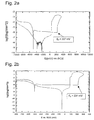
- FIG. 2 shows current density-potential curves a) of a prior art timepiece No. 1.4435 (Staybrite® 4435) and b) of an alloy according to the invention. Measurement conditions: 3.2% NaCl, pH 4.0, 40 ° C.
- X-axis potential in mV versus saturated calomel electrode (SCE) as reference electrode; Y axis: the logarithm of the measured current density.
- SCE saturated calomel electrode
- FIG. 3 shows a) the positional sketch of the sample area of 200 mm 2 (hatched) used in Example 2 for the determination of the areal fraction ⁇ -ferrite within a rolled sheet, the thick arrow indicating the rolling direction; and b) a microscopic photograph of that part of this sample surface with the highest proportion of ⁇ -ferrite.
- high-alloy in the context of the present application has the usual meaning in the art, i. It refers to a steel in which the alloying elements occur in total of 5 weight percent or more.
- the metallic alloying elements manganese, chromium, molybdenum, nickel and copper can be added to the alloys according to the invention by admixing suitable amounts of the pure elements to a pig iron or to a crude steel by customary processes.
- manganese is present in at most 2.00% by weight, preferably in 1.00 to 1.50% by weight and more preferably in about 1.8% by weight, based on the finished alloy.
- chromium is present in at least 17.0 and less than 19.0 percent by weight, based on the finished alloy.
- the term "less than 19.0 percent by weight” may here mean about “up to 18.9 percent by weight", although levels even closer to 19 percent by weight are also possible.
- the content of chromium is preferably from 17.1 to 17.6 percent by weight and more preferably about 17.5 percent by weight, based on the finished alloy.
- molybdenum is present in more than 2.5% by weight and in at most 3.0% by weight, based on the finished alloy.
- the term "more than 2.50 weight percent” here may mean about “at least 2.55 weight percent,” although levels closer to 2.50 weight percent are also possible. Rather preferably, the content of molybdenum is 2.60 to 2.80 weight percent and more preferably about 2.6 weight percent, based on the alloy.
- nickel is present in 12.5 to 15.0 percent by weight, more preferably in 13.0 to 13.5 percent by weight and particularly preferably in about 13.0 percent by weight, based on the alloy.
- copper is present in 0.50 to 1.50 weight percent, preferably in 0.50 to 1.00 weight percent and more preferably in about 0.75 weight percent, based on the alloy.
- Nitrogen can be supplied by melting the steel alloy in a nitrogen atmosphere (nitriding) or by adding high-nitrogen-containing master alloys. Nitrogen solubility in austenitic steel is increased by Cr, Mn and Mo additions. In the case of melting of CrNi steels under nitrogen of about 1 atmosphere pressure, a maximum solubility of N up to a content of about 0.5 percent by weight of the finished alloy is possible. To achieve the inventive contents of 0.11 to 0.25 percent by weight, based on the finished alloy, the melting can be achieved with lower nitrogen pressure and / or by shorter melting times.
- the inventively preferred minimum content of nitrogen may also be 0.12 percent by weight, based on the alloy, and the maximum content is preferably at most 0.20 percent by weight. It is particularly preferably about 0.15 weight percent.
- Carbon is noticeable from the smelting process as admixture in the pig iron itself (4 to 4.5%) and can then, as usual in the art, by adding oxygen or suitable amounts of iron oxides to the molten steel (conversion of the carbon to carbon monoxide) are virtually arbitrarily reduced. According to the invention, it may preferably be present in at most 0.03 percent by weight, and more preferably in the highest 0.01 percent by weight, based on the alloy.
- Sulfur comes from the smelting process (content of iron ore to iron sulfides) and is present in pig iron mainly as manganese sulfide.
- the alloys according to the invention it may preferably be present in amounts of at most 0.03 percent by weight, based on the alloy.
- a typical content may be about 0.02 to 0.03 weight percent, based on the alloy.
- it can also be present in an amount of at most 0.005 percent by weight, based on the alloy, with the highest demands on the polishability and the corrosion resistance. Achieving so low levels of sulfur can be achieved by desulfurizing the melt with, for example, mixtures of CaO and metallic magnesium.
- the sulfur content may also be increased to about 0.02 to about 0.03 weight percent (so-called IMA grades).
- IMA grades weight percent
- a special melt metallurgy with the addition of CaSi powder is preferably used, which converts the hard alumina inclusions into relatively soft mixed oxides of the type CaSiAl and forms finely divided manganese sulfides, which breaks the chip in the mechanical processing and thus the Tool life is extended.
- the corrosion resistance is only slightly reduced by the controlled addition of sulfur.
- Phosphorus is originally derived from apatite or other phosphate-containing minerals found in iron ore. During smelting, phosphate can be reduced to iron phosphide (mainly Fe 2 P) and as such occur in pig iron or later steel.
- the inventively preferred low content of phosphorus of at most 0.045 weight percent, more preferably at most 0.02 weight percent, based on the alloy can be reduced in the production of the inventive alloys as usual in the art, for example, by adding CaO in the smelting of the ore , whereby the phosphate-containing minerals are separated in the slag.
- the inventive aluminum content of at most 0.01 percent by weight, preferably at most 0.005 percent by weight, based on the alloy, can be achieved if the deoxidation required in the melting process is not carried out with aluminum but with silicon or in the AOD or VOD process (see below).
- the inventive content of silicon is at most 1.00 weight percent, based on the alloy. Silicon may be appreciably present as SiO 2 (for example from the above deoxidation) in the alloy, eg in amounts of from about 0.2 to about 0.8 weight percent. Preferably, the content of silicon is about 0.20 to 0.50 weight percent, based on the alloy. Its content can be reduced to the inventively preferred amounts, for example, by mechanically moving or shaking the molten steel under protective gas. As a result, the SiO 2 coagulates and increases due to the lower density of the slag surface.
- carbon, silicon and phosphorus are simultaneously removed as usual in the art by adding fresh gaseous oxygen (conversion into oxides) and adding CaO.
- Excess oxygen can then be removed as usual by performing the refining in the form of VOD (Vacuum Oxygen Decarburization) or AOD (Argon Oxygen Decarburization) (removal of the excess oxygen by degassing in vacuo or by blowing out with argon).
- the adjustment of the contents of titanium according to the invention of at most 0.01% by weight, preferably 0.005% by weight and of niobium of at most 0.05% by weight, preferably of at most 0.01% by weight, based on the alloy, can be achieved by controlled scrap insertion (avoidance of Ti - or Nb-containing scrap) are made possible.
- Ti contaminants in the lining of the converters used in the melting process can be avoided.
- the term "remainder essentially iron” is intended in the context of the present application to mean that the remaining percent by weight of the alloy according to one of claims 1 to 10, ie the percentages by weight which are not contributed by elements named in the corresponding claim, almost exclusively of iron (Typically at least 90 weight percent, preferably at least 95 weight percent and more preferably at least 99 of the remainder or more) originate.
- novel alloys can be prepared by conventional methods.
- Heat treatments in the form of homogenization anneals at temperatures> 1100 ° C. during the thermoforming process are preferably carried out during the production of the steel alloys according to the invention, as is customary in the art, in order to avoid the selective accumulation of individual structural constituents and the associated formation of inhomogeneities and dendrites.
- the so-called "soaking" of the hot rolling slabs or extended preheating times before hot rolling are suitable.
- the grain size of less than 80 ⁇ m (measured to ASTM E112), which is important for the polishability of the steel alloy according to the invention, can be achieved by carrying out a final heat treatment, for example in the form of solution annealing, followed by quenching in water or in air. Temperature and holding time of this heat treatment are chosen as low as possible. The temperature of this heat treatment may typically be about 1030 ° C to 1050 ° C during a hold time, as is usual for solution annealing in prior art austenitic stainless steels. The temperature of the Heat treatment can be a little lower for a longer holding time and slightly higher for a shorter holding time.
- the low content of coarse-grained non-metallic inclusions which is important for the polishability, is caused on the one hand by the low content of aluminum, titanium and niobium (no substantial formation of aluminum oxide, titanium oxide or titanium carbide and niobium carbide).
- the grain size of such oxide or carbide inclusions can be significantly reduced by the electro-slag remelting (ESR) process customary in the art.
- ESR electro-slag remelting
- Embodiments of the steel alloy according to the invention in which maximum size indicators of the globular oxides (GO) of not more than 8.4.9.4 are found by method M of standard DIN 50602 are preferred. Ringauge is hereby referred to in its entirety.
- the tendency to form ⁇ -ferrite in the steel alloys according to the invention is reduced or completely prevented with sufficiently high stabilization of the austenite.
- the chemical composition of the steel alloy according to the invention is sufficiently safe in the austenite region.
- the steel alloys according to the invention may preferably have an areal proportion of not more than 1%, preferably not more than 0.5% of ⁇ -ferrite.
- the sampling area for this measurement can be taken in accordance with the requirements of standard DIN 50602, pages 2 and 3.
- the procedure for the actual determination of the proportion of surface area ⁇ -ferrite on the sample surface can, as in Example 2 from the 2nd section be described.
- the areal percentage fraction of ⁇ -ferrite determined by the measuring method of this example can be regarded as an average value for the investigated test area.
- the volume fraction of ⁇ -ferrite in a certain volume is the average value for all areal proportions of ⁇ -ferrite in this volume, if this volume is divided into infinitely many, parallel infinitesimal parallel surfaces and on each of these surfaces the areal fraction ⁇ Total ferrite (not just the upper limit on each surface) would determine.
- the volumetric proportion of ⁇ -ferrite of the steel alloy according to the invention can be determined, for example, via its permeability number. The relationship between permeability and volume fraction ⁇ -ferrite in any steel alloy is known, and it can thus be determined from the permeability measurement of the volume fraction ⁇ -ferrite.
- a commercially available measuring device which determines in this way the volume proportion of ⁇ -ferrite, is the Fischer Ferritescope FE8 (Helmut Fischer GmbH + Co., Sindelfingen, Germany).
- the steel alloys according to the invention may have a preferred volume content of ⁇ -ferrite of not more than 0.2% by volume in view of their use as non-magnetic clock steels, whereby a magnetic effect is practically excluded.
- the alloys according to the invention can be reproducibly polished by means of the usual method in the watch industry up to a surface finish, as shown in FIG. 1b, and would therefore be accepted as starting material in the watch industry.
- the steel alloys according to the invention are slightly superior in terms of resistance to pitting corrosion to the prior art watch steel no. 1.4435 (Ep 234 mV compared to 227 mV in the previously known 1.4435, see current density-potential curves of FIGS. 2a and 2b).
- the steel alloys according to the invention typically have the following mechanical properties of Table 2 (pretreatment of the sample and measurement instructions as in the case of steel No. 1.4435 mentioned in the introduction): Table 2 properties hot-rolled cold rolled Yield strength R p0.2 (MPa) 290 287 Tensile strength R m (MPa) 621 606 Elongation at break A 80 (%) 52 52 Hardness HB (DIN 17440) 180 175
- novel alloys are thus comparable to the standard steel no. 1.4435.
- the alloys according to the invention have the same color, which is between chrome and silver gloss, and appeals to the customer's taste, as does steel No. 1.4435.
- the steel alloys according to the invention have a nickel output measured below that according to the DIN EN 1811 standard 0.5 micrograms per cm 2 and week on and are therefore comparable in this respect to the previously known watch steels.
- the alloys according to the invention can be used in the watch industry for the production of components such as housings, housing bases, bracelets and the like. be used.
- a "component" in the context of the present application both the component as it occurs in the finished clock, as well as any blank or semifinished product thereof, by further processing with optional co-use of other materials or semi-finished products of the inventive alloy or other materials be further processed to the finished component.
- the inventive steel alloy is also ideal for the powder metallurgical production of watch components according to the MIM process (Metal Injection Molding) in particular because during the compaction process (sintering) under nitrogen atmosphere, the required nitrogen content for austenite stabilization can be fed easily.
- MIM method is known per se in the watchmaking art.
- a steel alloy which contains the required elements in the final amounts but which is at most still undersaturated with nitrogen is ground into powder and slurried with a liquid binder. This slurry is pressed by means of, for example, an extruder into a hollow mold whose cavity has the shape of the part to be produced.
- the binder is preferably evaporated by applying a vacuum and the powder residue remaining in the mold is sintered.
- a nitrogen atmosphere of suitable pressure so that the alloy still receives nitrogen during sintering.
- Example 1 (typical production example of a sheet of the steel alloy according to the invention):
- step d) The chemical analysis of step d) gave the following values (in weight percent based on the alloy): Si 0.31; Mn 1.26; Cr 17.4; Mo, 2.68; Ni 13.5; N 0.11; Cu 0.75; Ti ⁇ 0.001; Al 0.003; Nb 0.01; C 0.015; S 0.003; P 0.017; Rest essentially iron.
- step i) cold rolling was carried out.
- the annealing temperature in step j) was 1030 ° C.
- the examination of the polishing ability of step m) gave an image as in FIG. 1b). Testing of the mechanical properties of step n) gave the values of the right column of Table 2.
- the polished surface was etched with a mixture of 30 ml of HCl, 30 ml of HNO 3 and 30 ml of H 2 O at 40 ° C for 10 seconds, whereby the existing on the ground surface Shares of ⁇ -ferrite were darkened.
- the steel alloys according to the invention showed surface areas of ⁇ -ferrite which, as a rule (typically in 99% of cases), are below the detection limit of the measuring method of about 0.5 percent.
- an areal proportion of ⁇ 2.2% ⁇ -ferrite was determined (see also FIG. 3b for the microscopic section with the highest proportion of ⁇ -ferrite of this previously known alloy, with horizontally extending ferrite lines).
Landscapes
- Chemical & Material Sciences (AREA)
- Engineering & Computer Science (AREA)
- Materials Engineering (AREA)
- Mechanical Engineering (AREA)
- Metallurgy (AREA)
- Organic Chemistry (AREA)
- Treatment Of Steel In Its Molten State (AREA)
- Manufacture Of Alloys Or Alloy Compounds (AREA)
- Powder Metallurgy (AREA)
- Laminated Bodies (AREA)
Claims (14)
- Alliage d'acier fortement allié comprenant, sur la base de l'alliage, au maximum 1,00 pour cent en poids de silicium, au maximum 2,00 pour cent en poids de manganèse, au moins 17,0 pour cent en poids et moins de 19,0 pour cent en poids de chrome, plus de 2,50 pour cent en poids et au maximum 3,00 pour cent en poids de molybdène, 12,5 à 15,0 pour cent en poids de nickel, 0,11 à 0,25 pour cent en poids d'azote, 0,50 à 1,50 pour cent en poids de cuivre, au maximum 0,03% en poids de soufre, au maximum 0,01 pour cent en poids de titane, au maximum 0,01 pour cent en poids d'aluminium, au maximum 0,05 pour cent en poids de niobium, et, pour le reste, essentiellement du fer.
- Alliage d'acier selon la revendication 1, comprenant 0,20 à 0,50 pour cent en poids de silicium, 1,00 à 1,50 pour cent en poids de manganèse, 17,1 à 17,6 pour cent en poids de chrome, 2,60 à 2,80 pour cent en poids de molybdène, 13,0 à 13,5 pour cent en poids de nickel, 0,12 à 0,20 pour cent en poids d'azote et 0,50 à 1,00 pour cent en poids de cuivre.
- Alliage d'acier selon la revendication 1 ou 2, comprenant de l'ordre de 17,5 pour cent en poids de chrome, de l'ordre de 2,60 pour cent en poids de molybdène, de l'ordre de 13,0 pour cent en poids de nickel, de l'ordre de 0,15 pour cent en poids d'azote et de l'ordre de 0,75 pour cent en poids de cuivre.
- Alliage d'acier selon l'une quelconque des revendications précédentes, comprenant, sur la base de l'alliage, au maximum 0,03 pour cent en poids de carbone et au maximum 0,045 pour cent en poids de phosphore.
- Alliage d'acier selon l'une quelconque des revendications précédentes, comprenant de l'ordre de 1,8 pour cent en poids de manganèse.
- Alliage d'acier selon l'une quelconque des revendications précédentes, comprenant de 0,02 à 0,03 pour cent en poids de soufre.
- Alliage d'acier selon l'une quelconque des revendications précédentes, comprenant au maximum 0,01 pour cent en poids de carbone, au maximum 0,02 pour cent en poids de phosphore, au maximum 0,005 pour cent en poids de titane, au maximum 0,005 pour cent en poids d'aluminium et au maximum 0,01 pour cent en poids de niobium.
- Alliage d'acier selon l'une quelconque des revendications précédentes, comprenant au maximum 1 pour cent en surface de δ-ferrite.
- Alliage d'acier selon l'une quelconque des revendications précédentes, comportant au maximum 0,2 pour cent en volume de δ-ferrite.
- Alliage d'acier selon l'une quelconque des revendications précédentes, caractérisé en ce qu'il comprend des indications maximales de dimension des oxydes globulaires (GO) de maximum 8.4, 9.4, ces indications de dimension étant définies selon la méthode M de la norme DIN 50602.
- Composant de montre constitué d'un acier selon l'une quelconque des revendications 1 à 10.
- Composant selon la revendication 11, sous forme d'un boîtier de montre, d'un fond de montre ou d'un bracelet de montre.
- Utilisation d'un alliage d'acier selon l'une quelconque des revendications 1 à 10, pour la fabrication de composants de montres.
- Procédé de fabrication d'un composant pour montres, caractérisé en ce qu'un alliage d'acier sous forme de poudre selon l'une quelconque des revendications 1 à 10, qui peut cependant présenter éventuellement un déficit d'azote, est mis en suspension avec un liant liquide, en ce que la suspension est versée dans un moule creux correspondant au composant, en ce que le liant est vaporisé et en ce que le résidu de poudre est fritté dans le moule, étant entendu que, lorsque l'alliage sous forme de poudre présente un déficit en azote, le frittage est réalisé dans une atmosphère azotée.
Applications Claiming Priority (3)
| Application Number | Priority Date | Filing Date | Title |
|---|---|---|---|
| CH11552002 | 2002-07-02 | ||
| CH115502 | 2002-07-02 | ||
| PCT/CH2003/000438 WO2004005571A1 (fr) | 2002-07-02 | 2003-07-02 | Alliages d'acier |
Publications (3)
| Publication Number | Publication Date |
|---|---|
| EP1520058A1 EP1520058A1 (fr) | 2005-04-06 |
| EP1520058B1 true EP1520058B1 (fr) | 2006-01-04 |
| EP1520058B9 EP1520058B9 (fr) | 2006-05-03 |
Family
ID=30005577
Family Applications (1)
| Application Number | Title | Priority Date | Filing Date |
|---|---|---|---|
| EP03729791A Expired - Lifetime EP1520058B9 (fr) | 2002-07-02 | 2003-07-02 | Alliage d'acier |
Country Status (6)
| Country | Link |
|---|---|
| EP (1) | EP1520058B9 (fr) |
| JP (1) | JP2005536631A (fr) |
| AT (1) | ATE315113T1 (fr) |
| AU (1) | AU2003240376A1 (fr) |
| DE (1) | DE50302125D1 (fr) |
| WO (1) | WO2004005571A1 (fr) |
Cited By (1)
| Publication number | Priority date | Publication date | Assignee | Title |
|---|---|---|---|---|
| US12385116B2 (en) | 2021-06-17 | 2025-08-12 | Cummins Inc. | Steel alloy and method of manufacture exhibiting enhanced combination of high temperature strength, oxidation resistance, and thermal conductivity |
Families Citing this family (4)
| Publication number | Priority date | Publication date | Assignee | Title |
|---|---|---|---|---|
| JP5423086B2 (ja) * | 2009-03-24 | 2014-02-19 | セイコーエプソン株式会社 | 金属粉末および焼結体 |
| CN104294179B (zh) * | 2014-10-27 | 2017-09-01 | 江门市佳久新材料科技有限公司 | 一种压缩机用平衡块及其制造方法 |
| KR102173302B1 (ko) * | 2018-11-12 | 2020-11-03 | 주식회사 포스코 | 비자성 오스테나이트계 스테인리스강 및 그 제조방법 |
| MX2023006635A (es) | 2020-12-10 | 2023-08-10 | Spm Oil & Gas Inc | Composiciones de acero mecanicamente resilientes y resistentes al desgaste y bombas de alta presión y componentes de bombas formados por las mismas. |
Family Cites Families (10)
| Publication number | Priority date | Publication date | Assignee | Title |
|---|---|---|---|---|
| US3563729A (en) * | 1968-04-16 | 1971-02-16 | Crucible Inc | Free-machining corrosion-resistant stainless steel |
| CH642110A5 (en) * | 1979-10-30 | 1984-03-30 | Nippon Metal Ind | Austenitic rust-free machining steel |
| JPH068485B2 (ja) * | 1988-12-23 | 1994-02-02 | 新日本製鐵株式会社 | 耐食性の優れた煙突・煙道および脱硫装置用高合金ステンレス鋼 |
| JPH04276042A (ja) * | 1991-02-28 | 1992-10-01 | Hitachi Metals Ltd | オーステナイト系ステンレス鋼およびその製造方法 |
| JPH06322490A (ja) * | 1993-03-19 | 1994-11-22 | Sumitomo Metal Ind Ltd | 加工性および被削性に優れた高純度ガス用ステンレス鋼 |
| JPH07138713A (ja) * | 1993-11-15 | 1995-05-30 | Daido Steel Co Ltd | Fe基合金粉末及び高耐食性焼結体の製造方法 |
| JP3923163B2 (ja) * | 1998-01-26 | 2007-05-30 | 日新製鋼株式会社 | 廃棄物焼却炉 |
| EP0964071A1 (fr) * | 1998-06-12 | 1999-12-15 | Asulab S.A. | Acier inoxydable ferritique et pièce extérieure d'habillement pour montre réalisée en un tel acier |
| JP2000054081A (ja) * | 1998-08-10 | 2000-02-22 | Kawasaki Steel Corp | 表面光沢むらのないオーステナイト系ステンレス鋼板およびその製造方法 |
| JP2002038244A (ja) * | 2000-05-15 | 2002-02-06 | Daido Steel Co Ltd | 磁気記憶装置に用いるネジ用高硬度ステンレス鋼 |
-
2003
- 2003-07-02 AT AT03729791T patent/ATE315113T1/de not_active IP Right Cessation
- 2003-07-02 AU AU2003240376A patent/AU2003240376A1/en not_active Abandoned
- 2003-07-02 EP EP03729791A patent/EP1520058B9/fr not_active Expired - Lifetime
- 2003-07-02 JP JP2004518349A patent/JP2005536631A/ja active Pending
- 2003-07-02 DE DE50302125T patent/DE50302125D1/de not_active Expired - Lifetime
- 2003-07-02 WO PCT/CH2003/000438 patent/WO2004005571A1/fr not_active Ceased
Cited By (1)
| Publication number | Priority date | Publication date | Assignee | Title |
|---|---|---|---|---|
| US12385116B2 (en) | 2021-06-17 | 2025-08-12 | Cummins Inc. | Steel alloy and method of manufacture exhibiting enhanced combination of high temperature strength, oxidation resistance, and thermal conductivity |
Also Published As
| Publication number | Publication date |
|---|---|
| AU2003240376A1 (en) | 2004-01-23 |
| DE50302125D1 (de) | 2006-03-30 |
| WO2004005571A1 (fr) | 2004-01-15 |
| EP1520058B9 (fr) | 2006-05-03 |
| EP1520058A1 (fr) | 2005-04-06 |
| JP2005536631A (ja) | 2005-12-02 |
| ATE315113T1 (de) | 2006-02-15 |
| HK1074647A1 (en) | 2005-11-18 |
Similar Documents
| Publication | Publication Date | Title |
|---|---|---|
| DE60313763T2 (de) | Hochwertiger rostfreier duplexstahl mit stark unterdrückter bildung von intermetallischen phasen und hervorragender korrosionsbeständigkeit, versprödungsbeständigkeit, giessbarkeit und warmumformbarkeit | |
| DE69811200T2 (de) | Einsatzstahl mit hervorragender verhinderung der sekundärrekristallisation während der aufkohlung, verfahren zu dessen herstellung, halbzeug für aufzukohlende teile | |
| EP0091897B1 (fr) | Acier au manganèse du type Hadfield, austénitique et durcissant par écrouissage et procédé pour sa fabrication | |
| DE68919693T2 (de) | Fe-mn-a1-c-legierungen und deren behandlungen. | |
| DE69606061T2 (de) | Hochfestes, kerbzähes ausscheidungshärtbarer rostfreies stahl | |
| DE69517533T2 (de) | Korrosionsfestes magnetmaterial | |
| DE69805278T2 (de) | Verfahren zum verbessern der magnetischen eigenschaften ferritischer, rostfreier automatenstähle | |
| CH694401A5 (de) | Nickelarmer, molybdänarmer, biokompatibler, nicht Allergie auslösender, korrosionsbeständiger austenitischer Stahl. | |
| EP2935635A1 (fr) | Procédé de traitement thermique d'un produit en acier au manganèse et produit en acier au manganèse | |
| DE4498699B4 (de) | Verwendung eines Rostfreien Stahls mit ausgezeichnetem Korrosionswiderstand gegenüber Salzschmelzen | |
| KR102074715B1 (ko) | 열간 단조용 강 및 열간 단조품 | |
| DE60319197T2 (de) | Maraging-Stahl und Verfahren zu dessen Herstellung | |
| EP1546427B1 (fr) | Alliage d'acier ferritique | |
| DE112022000191T5 (de) | Nickelbasislegierung mit hervorragenden Oberflächeneigenschaften und Verfahren zur Herstellung derselben | |
| DE69410555T2 (de) | Nichtmagnetische Eisenlegierung mit ausgezeichneter Korrosionsbeständigkeit und Bearbeitbarkeit | |
| EP1520058B9 (fr) | Alliage d'acier | |
| DE102009014442B4 (de) | Verfahren zur Herstellung einer Feder aus einer CoNiCr-Legierung | |
| KR20060083228A (ko) | 강괴의 제조 방법 | |
| EP0141804A1 (fr) | Acier dur au manganèse et procédé pour sa fabrication | |
| DE2013728A1 (de) | Zusammengesetzte Hartgußeisen-Walzwerkwalzen mit verbesserter Absplitterungsfestigkeit | |
| DE112021003995T5 (de) | Hochkorrosionsbeständiger austenitischer rostfreier stahl und verfahren zur herstellung desselben | |
| AT526638B1 (de) | Ausscheidungsgehärteter martensitischer, nichtrostender Stahl mit ausgezeichneter Schweissbarkeit, und Verfahren zur Herstellung desselben | |
| KR20210008732A (ko) | 비자성 오스테나이트계 스테인리스강 | |
| DE69617680T2 (de) | Zerspanbarer austenitischer rostfreier stahl | |
| JP2001152279A (ja) | 快削鋼 |
Legal Events
| Date | Code | Title | Description |
|---|---|---|---|
| PUAI | Public reference made under article 153(3) epc to a published international application that has entered the european phase |
Free format text: ORIGINAL CODE: 0009012 |
|
| 17P | Request for examination filed |
Effective date: 20050117 |
|
| AK | Designated contracting states |
Kind code of ref document: A1 Designated state(s): AT BE BG CH CY CZ DE DK EE ES FI FR GB GR HU IE IT LI LU MC NL PT RO SE SI SK TR |
|
| AX | Request for extension of the european patent |
Extension state: AL LT LV MK |
|
| RTI1 | Title (correction) |
Free format text: STEEL ALLOY |
|
| GRAP | Despatch of communication of intention to grant a patent |
Free format text: ORIGINAL CODE: EPIDOSNIGR1 |
|
| GRAS | Grant fee paid |
Free format text: ORIGINAL CODE: EPIDOSNIGR3 |
|
| REG | Reference to a national code |
Ref country code: HK Ref legal event code: DE Ref document number: 1074647 Country of ref document: HK |
|
| GRAA | (expected) grant |
Free format text: ORIGINAL CODE: 0009210 |
|
| AK | Designated contracting states |
Kind code of ref document: B1 Designated state(s): AT BE BG CH CY CZ DE DK EE ES FI FR GB GR HU IE IT LI LU MC NL PT RO SE SI SK TR |
|
| PG25 | Lapsed in a contracting state [announced via postgrant information from national office to epo] |
Ref country code: IT Free format text: LAPSE BECAUSE OF FAILURE TO SUBMIT A TRANSLATION OF THE DESCRIPTION OR TO PAY THE FEE WITHIN THE PRESCRIBED TIME-LIMIT;WARNING: LAPSES OF ITALIAN PATENTS WITH EFFECTIVE DATE BEFORE 2007 MAY HAVE OCCURRED AT ANY TIME BEFORE 2007. THE CORRECT EFFECTIVE DATE MAY BE DIFFERENT FROM THE ONE RECORDED. Effective date: 20060104 Ref country code: RO Free format text: LAPSE BECAUSE OF FAILURE TO SUBMIT A TRANSLATION OF THE DESCRIPTION OR TO PAY THE FEE WITHIN THE PRESCRIBED TIME-LIMIT Effective date: 20060104 Ref country code: SI Free format text: LAPSE BECAUSE OF FAILURE TO SUBMIT A TRANSLATION OF THE DESCRIPTION OR TO PAY THE FEE WITHIN THE PRESCRIBED TIME-LIMIT Effective date: 20060104 Ref country code: IE Free format text: LAPSE BECAUSE OF FAILURE TO SUBMIT A TRANSLATION OF THE DESCRIPTION OR TO PAY THE FEE WITHIN THE PRESCRIBED TIME-LIMIT Effective date: 20060104 Ref country code: FI Free format text: LAPSE BECAUSE OF FAILURE TO SUBMIT A TRANSLATION OF THE DESCRIPTION OR TO PAY THE FEE WITHIN THE PRESCRIBED TIME-LIMIT Effective date: 20060104 Ref country code: NL Free format text: LAPSE BECAUSE OF FAILURE TO SUBMIT A TRANSLATION OF THE DESCRIPTION OR TO PAY THE FEE WITHIN THE PRESCRIBED TIME-LIMIT Effective date: 20060104 Ref country code: SK Free format text: LAPSE BECAUSE OF FAILURE TO SUBMIT A TRANSLATION OF THE DESCRIPTION OR TO PAY THE FEE WITHIN THE PRESCRIBED TIME-LIMIT Effective date: 20060104 |
|
| REG | Reference to a national code |
Ref country code: GB Ref legal event code: FG4D Free format text: NOT ENGLISH |
|
| REG | Reference to a national code |
Ref country code: CH Ref legal event code: EP Ref country code: CH Ref legal event code: NV Representative=s name: A. BRAUN, BRAUN, HERITIER, ESCHMANN AG PATENTANWAE |
|
| REG | Reference to a national code |
Ref country code: IE Ref legal event code: FG4D Free format text: LANGUAGE OF EP DOCUMENT: GERMAN |
|
| REG | Reference to a national code |
Ref country code: HK Ref legal event code: GR Ref document number: 1074647 Country of ref document: HK |
|
| GBT | Gb: translation of ep patent filed (gb section 77(6)(a)/1977) |
Effective date: 20060223 |
|
| REF | Corresponds to: |
Ref document number: 50302125 Country of ref document: DE Date of ref document: 20060330 Kind code of ref document: P |
|
| PG25 | Lapsed in a contracting state [announced via postgrant information from national office to epo] |
Ref country code: BG Free format text: LAPSE BECAUSE OF FAILURE TO SUBMIT A TRANSLATION OF THE DESCRIPTION OR TO PAY THE FEE WITHIN THE PRESCRIBED TIME-LIMIT Effective date: 20060404 Ref country code: DK Free format text: LAPSE BECAUSE OF FAILURE TO SUBMIT A TRANSLATION OF THE DESCRIPTION OR TO PAY THE FEE WITHIN THE PRESCRIBED TIME-LIMIT Effective date: 20060404 Ref country code: SE Free format text: LAPSE BECAUSE OF FAILURE TO SUBMIT A TRANSLATION OF THE DESCRIPTION OR TO PAY THE FEE WITHIN THE PRESCRIBED TIME-LIMIT Effective date: 20060404 |
|
| PG25 | Lapsed in a contracting state [announced via postgrant information from national office to epo] |
Ref country code: ES Free format text: LAPSE BECAUSE OF FAILURE TO SUBMIT A TRANSLATION OF THE DESCRIPTION OR TO PAY THE FEE WITHIN THE PRESCRIBED TIME-LIMIT Effective date: 20060415 |
|
| PG25 | Lapsed in a contracting state [announced via postgrant information from national office to epo] |
Ref country code: PT Free format text: LAPSE BECAUSE OF FAILURE TO SUBMIT A TRANSLATION OF THE DESCRIPTION OR TO PAY THE FEE WITHIN THE PRESCRIBED TIME-LIMIT Effective date: 20060605 |
|
| NLV1 | Nl: lapsed or annulled due to failure to fulfill the requirements of art. 29p and 29m of the patents act | ||
| PG25 | Lapsed in a contracting state [announced via postgrant information from national office to epo] |
Ref country code: MC Free format text: LAPSE BECAUSE OF NON-PAYMENT OF DUE FEES Effective date: 20060731 |
|
| REG | Reference to a national code |
Ref country code: IE Ref legal event code: FD4D |
|
| ET | Fr: translation filed | ||
| PLBI | Opposition filed |
Free format text: ORIGINAL CODE: 0009260 |
|
| PLAX | Notice of opposition and request to file observation + time limit sent |
Free format text: ORIGINAL CODE: EPIDOSNOBS2 |
|
| 26 | Opposition filed |
Opponent name: BOEHLER EDELSTAHL GMBH Effective date: 20061004 |
|
| PGFP | Annual fee paid to national office [announced via postgrant information from national office to epo] |
Ref country code: BE Payment date: 20061221 Year of fee payment: 4 |
|
| PLBB | Reply of patent proprietor to notice(s) of opposition received |
Free format text: ORIGINAL CODE: EPIDOSNOBS3 |
|
| PG25 | Lapsed in a contracting state [announced via postgrant information from national office to epo] |
Ref country code: AT Free format text: LAPSE BECAUSE OF NON-PAYMENT OF DUE FEES Effective date: 20060702 |
|
| PLCK | Communication despatched that opposition was rejected |
Free format text: ORIGINAL CODE: EPIDOSNREJ1 |
|
| RAP2 | Party data changed (patent owner data changed or rights of a patent transferred) |
Owner name: HEMPEL SPECIAL METALS AG |
|
| BERE | Be: lapsed |
Owner name: FIRTH A.G. Effective date: 20070731 |
|
| APAH | Appeal reference modified |
Free format text: ORIGINAL CODE: EPIDOSCREFNO |
|
| APBP | Date of receipt of notice of appeal recorded |
Free format text: ORIGINAL CODE: EPIDOSNNOA2O |
|
| APBQ | Date of receipt of statement of grounds of appeal recorded |
Free format text: ORIGINAL CODE: EPIDOSNNOA3O |
|
| PG25 | Lapsed in a contracting state [announced via postgrant information from national office to epo] |
Ref country code: GR Free format text: LAPSE BECAUSE OF FAILURE TO SUBMIT A TRANSLATION OF THE DESCRIPTION OR TO PAY THE FEE WITHIN THE PRESCRIBED TIME-LIMIT Effective date: 20060405 Ref country code: CZ Free format text: LAPSE BECAUSE OF FAILURE TO SUBMIT A TRANSLATION OF THE DESCRIPTION OR TO PAY THE FEE WITHIN THE PRESCRIBED TIME-LIMIT Effective date: 20060104 |
|
| REG | Reference to a national code |
Ref country code: CH Ref legal event code: PFA Owner name: FIRTH AG Free format text: FIRTH AG#ZUERICHSTRASSE 128#8600 DUEBENDORF (CH) -TRANSFER TO- FIRTH AG#ZUERICHSTRASSE 128#8600 DUEBENDORF (CH) |
|
| PG25 | Lapsed in a contracting state [announced via postgrant information from national office to epo] |
Ref country code: EE Free format text: LAPSE BECAUSE OF FAILURE TO SUBMIT A TRANSLATION OF THE DESCRIPTION OR TO PAY THE FEE WITHIN THE PRESCRIBED TIME-LIMIT Effective date: 20060104 |
|
| PG25 | Lapsed in a contracting state [announced via postgrant information from national office to epo] |
Ref country code: TR Free format text: LAPSE BECAUSE OF FAILURE TO SUBMIT A TRANSLATION OF THE DESCRIPTION OR TO PAY THE FEE WITHIN THE PRESCRIBED TIME-LIMIT Effective date: 20060104 Ref country code: LU Free format text: LAPSE BECAUSE OF NON-PAYMENT OF DUE FEES Effective date: 20060702 Ref country code: HU Free format text: LAPSE BECAUSE OF FAILURE TO SUBMIT A TRANSLATION OF THE DESCRIPTION OR TO PAY THE FEE WITHIN THE PRESCRIBED TIME-LIMIT Effective date: 20060705 |
|
| PG25 | Lapsed in a contracting state [announced via postgrant information from national office to epo] |
Ref country code: BE Free format text: LAPSE BECAUSE OF NON-PAYMENT OF DUE FEES Effective date: 20070731 |
|
| PG25 | Lapsed in a contracting state [announced via postgrant information from national office to epo] |
Ref country code: CY Free format text: LAPSE BECAUSE OF FAILURE TO SUBMIT A TRANSLATION OF THE DESCRIPTION OR TO PAY THE FEE WITHIN THE PRESCRIBED TIME-LIMIT Effective date: 20060104 |
|
| APAH | Appeal reference modified |
Free format text: ORIGINAL CODE: EPIDOSCREFNO |
|
| APBU | Appeal procedure closed |
Free format text: ORIGINAL CODE: EPIDOSNNOA9O |
|
| PLBN | Opposition rejected |
Free format text: ORIGINAL CODE: 0009273 |
|
| STAA | Information on the status of an ep patent application or granted ep patent |
Free format text: STATUS: OPPOSITION REJECTED |
|
| PLAB | Opposition data, opponent's data or that of the opponent's representative modified |
Free format text: ORIGINAL CODE: 0009299OPPO |
|
| 27O | Opposition rejected |
Effective date: 20090514 |
|
| PGFP | Annual fee paid to national office [announced via postgrant information from national office to epo] |
Ref country code: CH Payment date: 20100723 Year of fee payment: 8 |
|
| PGFP | Annual fee paid to national office [announced via postgrant information from national office to epo] |
Ref country code: DE Payment date: 20100715 Year of fee payment: 8 Ref country code: FR Payment date: 20100802 Year of fee payment: 8 |
|
| PGFP | Annual fee paid to national office [announced via postgrant information from national office to epo] |
Ref country code: GB Payment date: 20100702 Year of fee payment: 8 |
|
| REG | Reference to a national code |
Ref country code: CH Ref legal event code: PL |
|
| GBPC | Gb: european patent ceased through non-payment of renewal fee |
Effective date: 20110702 |
|
| REG | Reference to a national code |
Ref country code: FR Ref legal event code: ST Effective date: 20120330 |
|
| PG25 | Lapsed in a contracting state [announced via postgrant information from national office to epo] |
Ref country code: DE Free format text: LAPSE BECAUSE OF NON-PAYMENT OF DUE FEES Effective date: 20120201 Ref country code: FR Free format text: LAPSE BECAUSE OF NON-PAYMENT OF DUE FEES Effective date: 20110801 Ref country code: LI Free format text: LAPSE BECAUSE OF NON-PAYMENT OF DUE FEES Effective date: 20110731 Ref country code: CH Free format text: LAPSE BECAUSE OF NON-PAYMENT OF DUE FEES Effective date: 20110731 |
|
| REG | Reference to a national code |
Ref country code: DE Ref legal event code: R119 Ref document number: 50302125 Country of ref document: DE Effective date: 20120201 |
|
| PG25 | Lapsed in a contracting state [announced via postgrant information from national office to epo] |
Ref country code: GB Free format text: LAPSE BECAUSE OF NON-PAYMENT OF DUE FEES Effective date: 20110702 |