EP1517901B1 - Verfahren für den start eines epoxierungsprozesses und epoxidierungsverfahren für olefine - Google Patents
Verfahren für den start eines epoxierungsprozesses und epoxidierungsverfahren für olefine Download PDFInfo
- Publication number
- EP1517901B1 EP1517901B1 EP03762055A EP03762055A EP1517901B1 EP 1517901 B1 EP1517901 B1 EP 1517901B1 EP 03762055 A EP03762055 A EP 03762055A EP 03762055 A EP03762055 A EP 03762055A EP 1517901 B1 EP1517901 B1 EP 1517901B1
- Authority
- EP
- European Patent Office
- Prior art keywords
- catalyst
- feed
- mole
- temperature
- oxygen
- Prior art date
- Legal status (The legal status is an assumption and is not a legal conclusion. Google has not performed a legal analysis and makes no representation as to the accuracy of the status listed.)
- Revoked
Links
Images
Classifications
-
- C—CHEMISTRY; METALLURGY
- C07—ORGANIC CHEMISTRY
- C07D—HETEROCYCLIC COMPOUNDS
- C07D301/00—Preparation of oxiranes
- C07D301/02—Synthesis of the oxirane ring
- C07D301/03—Synthesis of the oxirane ring by oxidation of unsaturated compounds, or of mixtures of unsaturated and saturated compounds
- C07D301/04—Synthesis of the oxirane ring by oxidation of unsaturated compounds, or of mixtures of unsaturated and saturated compounds with air or molecular oxygen
- C07D301/08—Synthesis of the oxirane ring by oxidation of unsaturated compounds, or of mixtures of unsaturated and saturated compounds with air or molecular oxygen in the gaseous phase
- C07D301/10—Synthesis of the oxirane ring by oxidation of unsaturated compounds, or of mixtures of unsaturated and saturated compounds with air or molecular oxygen in the gaseous phase with catalysts containing silver or gold
Definitions
- the invention relates to a method for the start-up of a process for the epoxidation of an olefin, which process employs a silver-based highly selective epoxidation catalyst.
- the invention also relates to a process for the epoxidation of an olefin, which process includes the start-up method of this invention.
- the selectivity determines to a large extent the economical attractiveness of an epoxidation process. For example, one percent improvement in the selectivity of the epoxidation process can reduce the yearly operating costs of a large scale ethylene oxide plant substantially.
- the olefin oxide produced by the epoxidation process may be reacted with water, an alcohol or an amine to form a 1,2-diol, a 1,2-diol ether or an alkanolamine.
- 1,2-diols, 1,2-diol ethers and alkanolamines may be produced in a multi-step process comprising olefin epoxidation and converting the formed olefin oxide with water, an alcohol or an amine. Any improvement in the selectivity of the epoxidation process can also reduce the yearly operating costs in the overall process for the production of a 1,2-diol, a 1,2-diol ether or an alkanolamine.
- Such highly selective catalysts comprise, in addition to silver, a selectivity enhancing dopant which may be selected from rhenium, molybdenum, tungsten and nitrate- or nitrite-forming compounds, cf. for example US-A-4761394 and US-A-4766105 .
- a reaction modifier for example an organic halide
- the reaction modifier suppresses the undesirable oxidation of olefin or olefin oxide to carbon dioxide and water, relative to the desired formation of olefin oxide, by a so-far unexplained mechanism.
- EP-A-352850 teaches that there is an optimum in the selectivity as a function of the concentration of organic halide in the feed, at a constant oxygen conversion level and given set of reaction conditions.
- the catalyst experiences the so-called "break-through phase" during which the oxygen conversion is very high, the selectivity is very low, even in the presence of a reaction modifier, and the epoxidation process is difficult to control. It might take a long time in the start-up of a commercial epoxidation process for the conversion to drop so that the reaction can more easily be controlled at an attractive level of the selectivity. It goes without saying that there is an economical incentive to shorten the start-up period and make the catalyst operate at a high selectivity with a minimum delay.
- US-A-5155242 relates to the start-up of an epoxidation process wherein a conventional catalyst is employed.
- a conventional catalyst is employed.
- this patent document there is disclosed an improved start-up procedure wherein the conventional catalyst is subjected to a pre-soak period in the presence of the organic halide at a temperature less than the operating temperature of the reactor.
- US-A-4874879 relates to the start-up of an epoxidation process wherein a highly selective catalyst is employed.
- a highly selective catalyst is employed in this patent document.
- This procedure may alleviate to some extent the problems associated with the duration of the start-up.
- it has been experienced that, still, it takes several days for the catalyst to pass through the break-through phase. This results in considerable losses of olefin oxide production, as described hereinbefore.
- WO-95/05896 proposes a silver-based catalyst which comprise, as a further component, a selected quantity of chloride. Such catalysts have improved start-up characteristics over catalysts which do not comprise chloride.
- the present invention provides a method for the start-up of a process for the epoxidation of ethylene which method comprises
- the start-up method is a part of an epoxidation process.
- the present invention also provides a process for the epoxidation of ethylene, which process comprises
- the invention also provides a process for producing a 1,2-diol, 1,2-diol ether, or an alkanolamine, comprising converting an olefin oxide into the 1,2-diol, the 1,2-diol ether, or the alkanolamine, wherein the olefin oxide has been obtained by a process for the epoxidation of ethylene according to this invention.
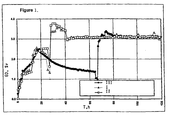
- Figure 1 shows the concentration of ethylene oxide in a reactor outlet stream ("EO, %v") in %v, relative to the total outlet stream, as a function of the Runhour (“T, h”), as observed in Example 1 ("I"), Example 2 (“II”) and Example 3 (“III”), hereinafter.
- the start-up of an epoxidation process wherein a highly selective catalyst is employed can be improved considerably by subjecting the catalyst during the break-through phase to a feed comprising oxygen at a temperature above 260 °C.
- the selectivity of the catalyst increases. Further, there is no longer a need of a pre-soak period, so that the operation in the start-up becomes less complicated.
- the Example of US-A-4874879 relates to the start-up of a commercial scale epoxidation process.
- the reactor coolant temperature was initially at a temperature of 450 °F (232 °C), later at 480 °F (249 °C).
- the observed maximum catalyst temperature of 525 °F (274 °C), as disclosed, is in all likelihood the temperature of only a small portion of the catalyst bed (i.e. a local "hot spot", of which the occurrence immediately after initiation of the epoxidation is a well known phenomenom).
- the relatively low coolant temperature ensures that this was a short duration temperature excursion and that the catalyst bed as a whole did not experience the temperature excursion.
- the invention may be practiced in many ways, it is preferred to practice it as a gas phase process, i.e. a process in which the feed is contacted in the gas phase with the catalyst which is present as a solid material, typically in a packed bed positioned in a reactor, which may be a tubular reactor.
- the process of the invention may involve a quantity of catalyst which is at least 10 kg, for example at least 20 kg, frequently in the range of from 10 2 to 10 7 kg, more frequently in the range of from 10 3 to 10 6 kg.
- the reactor is typically equipped with heat exchange facilities to heat or cool the catalyst.
- the feed is considered to be the composition which is contacted with the catalyst.
- the catalyst temperature or the temperature of the catalyst bed is deemed to be the weight average temperature of the catalyst particles.
- a highly selective silver-based catalyst is generally a catalyst which, when operated fresh, can exhibit in the gas phase epoxidation of ethylene a theoretical selectivity at zero oxygen conversion, So, of at least 6/7 or 85.7 %. More in particular, this theoretical selectivity can be accomplished at a reaction temperature of 260 °C.
- the value of So for a given catalyst is found by operating the catalyst, in particular at a temperature of 260 °C, in a range of gas hourly space velocities, resulting in a range of selectivity values and oxygen conversion values corresponding to the range of gas hourly space velocities employed. The selectivity values found are then extrapolated back to the theoretical selectivity at zero oxygen conversion, So.
- the selectivity is the fraction of the converted olefin yielding the olefin oxide.
- the highly selective silver-based catalyst is a supported catalyst.
- the support may be selected from a wide range of inert support materials.
- Such support materials may be natural or artificial inorganic materials and they include silicon carbide, clays, pumice, zeolites, charcoal and alkaline earth metal carbonates, such as calcium carbonate.
- Preferred are refractory support materials, such as alumina, magnesia, zirconia and silica. The most preferred support material is ⁇ -alumina.
- the support material is preferably porous and has preferably a surface area, as measured by the B.E.T. method, of at most 20 m 2 /g and in particular from 0.05 to 20 m 2 /g. More preferably the B.E.T. surface area of the support is in the range of 0.1 to 10, in particular from 0.1 to 3.0 m 2 /g. As used herein, the B.E.T. surface area is deemed to have been measured by the method as described in Brunauer, Emmet and Teller in J. Am. Chem. Soc. 60 (1938) 309-316 .
- the highly selective silver-based catalysts comprise, in addition to silver, a Group IA metal, and one or more selectivity enhancing dopants selected from rhenium, molybdenum, and tungsten.
- Silver is suitably present in a quantity of from 10 to 500 g/kg on the total catalyst.
- the Group IA metals, as well as the selectivity enhancing dopants may each be present in a quantity of from 0.01 to 500 mmole/kg, calculated as the element (rhenium, molybdenum, tungsten, or Group IA metal) on the total catalyst,
- the Group IA metal is selected from lithium, potassium, rubidium, and cesium.
- Rhenium, molybdenum, or tungsten may suitably be provided as an oxyanion, for example, as a perrhenate, molybdate, or tungstate; in salt or acid form.
- the quantity of silver related to the surface area of the support is at most 0.22 g/m 2 , more typically at most 0.2 g/m 2 .
- the quantity of silver relative to the surface area of the support is frequently at least 0.01 g/m 2 , more frequently at least 0.02 g/m 2 .
- the silver-based catalysts which comprise rhenium, in addition to silver.
- Such catalysts are known from US-A-4761394 and US-A-4766105 , which are incorporated herein by reference. Broadly, they comprise silver, rhenium or compound thereof, a further metal or compound thereof and optionally a rhenium co-promoter which may be selected from one or more of sulfur, phosphorus, boron, and compounds thereof, on the support material.
- the further metal is selected from the group of Group IA metals, Group IIA metals, molybdenum, tungsten, chromium, titanium, hafnium, zirconium, vanadium, thallium, thorium, tantalum, niobium, gallium and germanium and mixtures thereof.
- the further metal is selected from the Group IA metals such as lithium, potassium, rubidium and cesium and/or from the Group IIA metals such as calcium and barium. Most preferably it is lithium, potassium and/or cesium.
- rhenium, the further metal or the rhenium co-promoter is provided as an oxyanion, in salt or acid form.
- the preparation of the catalysts is known in the art and the known methods are applicable to this invention.
- Methods of preparing the catalyst include impregnating the support with a silver compound and with other catalyst ingredients, and performing a reduction to form metallic silver particles.
- Suitable catalysts for use in this invention are, for example, the S-879, S-881 and S-882 catalysts, commercially available from CRI Catalyst Company.
- This invention may be applied to new catalyst, as well as to aged catalysts which, due to a plant shutdown, have been subjected to a prolonged shut-in period.
- the invention may also be applied to a precursor of the catalyst.
- a precursor of the catalyst is meant the supported composition which comprises the silver in unreduced, i.e. cationic form, and which further comprises the components necessary for obtaining after reduction the intended highly selective catalyst.
- the reduction will be effected during the contacting with the feed comprising oxygen at a temperature of from 265 to 300°C.
- the epoxidation process may be air-based or oxygen-based, see Kirk-Othmer's Encyclopedia of Chemical Technology, 3rd ed., Vol. 9, 1980, p. 445-447 .
- air or air enriched with oxygen is employed as the source of the oxidizing agent while in the oxygen-based processes high-purity (>95 mole-%) oxygen is employed as the source of the oxidizing agent.
- high-purity >95 mole-%) oxygen is employed as the source of the oxidizing agent.
- oxygen-based plants are oxygen-based and this is a preferred embodiment of the present invention.
- Oxygen is typically applied at a concentration which avoids the flammable regime.
- concentration of oxygen in the feed may be adjusted as the concentration of the ethylene is changed so as to remain outside the flammable regime.
- the actual sate operating ranges depend, along with the feed composition, also on the epoxidation conditions such as the catalyst temperature and the pressure.
- the organic halide is in particular an organic bromide, and more in particular an organic chloride.
- Preferred organic halides are chlorohydrocarbons or bromohydrocarbons. More preferably they are selected from the group of methyl chloride ethyl chloride, ethylene dichloride; ethylene dibromide, vinyl chloride or a mixture thereof. Most preferred reaction modifiers are ethyl chloride and ethylene dichloride.
- the organic halide may be supplied as a single compound, upon contact with the catalyst a variety of compounds may be formed which function as reaction modifier, and which may be present in the feed if a recycle, is applied.
- the feed when applying ethyl chloride in an ethylene oxide process, the feed may in practice comprises ethyl chloride, vinyl chloride, ethylene dichloride and methyl chloride.
- organic halide is employed as the single reaction modifier.
- nitrate- or nitrite-forming compounds e.g. nitrogen oxides and/or organic nitrogen compounds, are used as reaction modifier together with the organic halide, in particular an organic chloride.
- Suitable nitrogen oxides are of the general formula NO x wherein x, which denotes the ratio of the number of oxygen atoms to the number of nitrogen atoms, is in the range of from 1 to 2. These nitrogen oxides include for example NO, N 2 O 3 and N 2 O 4 .
- Suitable organic nitrogen compounds are nitro compounds, nitroso compounds, amines, nitrates and nitrites, for example nitromethane, 1-nitropropane or 2-nitropropane. Hydrazine, hydroxylamine or ammonia may be employed as well. It is frequently considered that under the operating conditions of olefin epoxidation the nitrogen containing reaction modifiers are precursors of nitrates or nitrites, i.e. they are so-called nitrate- or nitrite-forming compounds (cf. e.g. EP-A-3642 , US-A-4822900 , which are incorporated herein by reference).
- the feed may contain one or more optional components, such as carbon dioxide, inert gases and saturated hydrocarbons.
- Carbon dioxide is a by-product in the epoxidation process. However, carbon dioxide generally has an adverse effect on the catalyst activity, and high concentrations of carbon dioxide are therefore typically avoided.
- the inert gas may be, for example, nitrogen or argon, or a mixture thereof.
- Suitable saturated hydrocarbons are propane and cyclopropane, and in particular methane and ethane. Saturated hydrocarbons may be added to the feed in order to increase the oxygen flammability limit.
- the sweeping gas is typically an inert gas, for example nitrogen or argon, or mixtures comprising nitrogen and/or argon.
- the high catalyst temperature converts a significant portion of organic nitrogen compounds which may have been used in the manufacture of the catalysts to nitrogen containing gases which are swept up in the gas stream and removed from the catalyst. In addition, any moisture may be removed from the catalyst.
- the temperature of the catalyst is brought up to 200 to 250 °C and the gas flow is passed over the catalyst.
- the start-up of used catalysts may or may not require the use of a sweeping gas, but it may frequently be used. Further details on these procedures may be found in US-A-4874879 , which is incorporated herein by reference.
- the practice of this invention involves the step of contacting the catalyst with a feed comprising oxygen at a temperature of from 265 to 300°C.
- This step may be considered the break-through phase of the process, and, for the sake of clarity only, this step of the process will be indicated hereinafter by the term "break-through phase".
- the temperature of the catalyst is in the range of from 265 to 290 °C, more preferably from 265 to 280 °C.
- the catalyst temperature may be maintained for a period of from 1 to 100 hours, preferably to 40 hours, more preferably from 1 to 30 hours, in particular from 2 to 20 hours, for example less than 10 hours. In general, a relatively short period is preferred, as this will shorten the time involved in the start-up method, and it also tends to result in the catalyst being more active after the break-through phase.
- the feed which may be employed in the break-through phase may be any oxygen containing feed, which may be pure oxygen or it may comprise additional components which are inert or non-inert under the prevailing conditions.
- the feed is a mixture of oxygen with an inert gas, such as argon, helium, and nitrogen, or a saturated hydrocarbon.
- Such mixtures may be, for example, air, oxygen enriched air, or air/methane mixtures.
- the quantity of oxygen in the feed is preferably in the range of from 0.5 to 30 %v, in particular from 1 to 25 %v, more in particular 1.5 to 15 %v, relative to the total feed.
- the inert and non-inert components may be selected amongst those which may be components of the feed of an epoxidation process as described hereinbefore, and the quantities in which they may be present may be in the ranges as described hereinafter.
- the feed may comprise ethylene, in which case the ethylene will at least partly be converted into the corresponding epoxide. This is advantageous as it yields valuable product and the heat of formation of the olefin oxide may assist in accomplishing and controlling the desired temperature.
- Another advantage of having an olefin present in the break-through phase is that the improvement in selectivity of the catalyst may be monitored by monitoring the rate of conversion of the olefin: for example, in a continuous process a stabilization of a declining rate indicates that the selectivity improvement is near completion.
- the feed may comprise, in addition to oxygen, one or more components selected from ethylene, carbon dioxide, the inert gases and reaction modifiers, such as organic halides, optionally in the additional presence of nitrate- or nitrite-forming compounds.
- one or more components selected from ethylene, carbon dioxide, the inert gases and reaction modifiers, such as organic halides optionally in the additional presence of nitrate- or nitrite-forming compounds.
- reaction modifiers such as organic halides
- the reactor inlet pressure is typically at most 4000 kPa, more typically at most 3500 kPa absolute, most typically at most 2500 kPa absolute.
- the reactor inlet pressure is typically at least 1000 kPa absolute.
- "GHSV" or Gas Hourly Spate Velocity is the unit volume of gas at normal temperature and pressure (0 °C, 1 atm, i.e. 101.3 kPa) passing over one unit volume of packed catalyst per hour.
- the GHSV is in the break-through phase in the range of from 500 to 10000 N1/(1.h).
- the start-up method may include prior to the break-thorough phase several steps, as follows. Firstly, the catalyst may be contacted with the feed comprising ethylene and optionally a saturated hydrocarbon, in particular ethylene and optionally methane, at a temperature of at most 260 °C, preferably at a temperature in the range of from 200 to 250 °C.
- the organic halide may then be added to the feed. Subsequently oxygen may be added to the feed. Within a few minutes of the addition of oxygen the epoxidation reaction may initiate. Typically, all of the catalyst may be contacted with the organic halide before the oxygen is added to the feed.
- oxygen may be added to the feed simultaneously with the organic halide, which practically eliminates the pre-soak period and makes the start-up method shorter and less complicated.
- the feed comprises typically ethylene in a quantity of from 5 to 70 mole-%, more typically from 10 to 50 mole-%; the saturated hydrocarbon in a quantity of from 0 to 70 mole-%, more topically from 10 to 60 mole-%; and oxygen in a quantity of from 0.5 to 15 mole-%, more typically from 1 to 12 mole-%. It may be advantageous to apply prior to and during the break-through phase a lower oxygen concentration and a lower ethylene concentration in the feed, compared with the feed composition in later stages of the process during thermal olefin oxide production.
- the concentration of organic halide in the feed is typically maintained at from 0.05 ⁇ 10 -4 to 50 ⁇ 10 -4 mole-%, in particular from 0.2 ⁇ 10 -4 to 30 ⁇ 10 -4 mole-%, in particular from 0.5 ⁇ 10 -4 to 20 ⁇ 10 -4 mole-%, calculated on the basis of the halogen content, relative to the total feed.
- the quantity of the organic halide in the feed may be expressed relative to the quantity of the hydrocarbon in the feed by the relative quantity Q, as explained hereinafter.
- the value of Q is in the range of from 0.2 ⁇ 10 -6 to 200 ⁇ 10 -6 , in particular from 1 ⁇ 10 -6 to 100 ⁇ 10 -6 , more in particular from 5 ⁇ 10 -6 to 60 ⁇ 10 -6 . It is an advantage of this invention that the concentration of organic halide may be relatively high during the break-through phase, so that there may not be a need for changing the concentration when entering the break-through phase or leaving the break-through phase.
- the concentration of the organic halide may be at least 1 ⁇ 10 -4 mole-%, in particular from 1 ⁇ 10 -4 to 30 ⁇ 10 -4 mole-%, more in particular from 1.5 ⁇ 10 -4 to 20 ⁇ 20 -4 mole-%, calculated on the basis of the halogen content, relative to the total feed, in which case the value of Q may typically be at least 3 ⁇ 10 -6 , in particular from 3 ⁇ 10 -6 to 100 ⁇ 10 -6 , more in particular from 5 ⁇ 10 -6 to 60 ⁇ 10 -6 .
- the catalyst temperature is decreased to a value of at most 260 °C.
- the phase of the epoxidation process after the break-through phase will be indicated herein by the term "post-break-through phase".
- the invention may be practiced by using methods known in the art of epoxidation processes. Reference may be made, for example to US-A-4761394 , US-A-4766105 , US-B1-6372925 , US-A-4874879 and US-A-5155242 , which are incorporated herein by reference.
- the catalyst temperature is in the range of from 180 to 260 °C, more typically in the range of from 200 to 255 °C.
- Such temperatures are in particular suitable as long as the catalyst has not yet substantially been subject to an aging-related performance decline. Such aging manifests itself by a reduction in the activity of the catalyst.
- the catalyst temperature may be increased in order to compensate for the reduction in activity.
- the catalyst temperature may ultimately be increased to values above 260 °C, for example up to a temperature of 325 °C, typically in the range of from 270 to 300 °C.
- the catalyst temperature may be increased until it becomes undesirably high, at which point in time the catalyst is deemed to be at the end of its lifetime, and would need to be exchanged.
- the concentration of the components in the feed may be selected within wide ranges, as described hereinafter.
- the ethylene concentration in the feed is in the range of from 5 to 70 mole-%, in particular from 10 to 50 mole-%. relative to the total feed. If desired, the ethylene concentration may be increased during the lifetime of the catalyst, by which the selectivity may be improved in an operating phase wherein the catalyst has aged (cf. US-B1-6372925 , which is incorporated herein by reference).
- the concentration of oxygen is within the range of from 1 to 15 mole-%, more typically from 2 to 12 mole-% of the total feed.
- concentrations of carbon dioxide in the feed in excess of 20 mole-%, preferably in excess of 10 mole-%, more preferably in excess of 5 mole-%, relative to the total feed, are avoided during the epoxidation process and its start-up.
- a concentration of carbon dioxide as low as 1 mole-% or lower, relative to the total feed, may be employed.
- Inert gas may be present in the feed in a concentration of from 0.5 to 95 mole-%.
- inert gas may be present in the feed in a concentration of from 30 to 90 mole-%, typically from 40 to 80 mole-%.
- inert gas may be present in the feed in a concentration of from 0.5 to 30 mole-%, typically from 1 to 15 mole-%. If saturated hydrocarbons are present, they may be present in a quantity of up to 70 mole-%, typically in a quantity in the range of from 10 to 60 mole-%, relative to the total feed.
- the organic halides are generally effective as reaction modifier when used in low concentration in the feed, for example up to 0.1 mole-%, calculated on the basis of the halogen content, relative to the total feed, for example from 0.01 ⁇ 10 -4 to 0.01 mole-%.
- the organic halide is present in the feed at a concentration of from 0.05 ⁇ 10 -4 to 50 ⁇ 10 -4 mole-%, in particular from 0.2 ⁇ 10 -4 to 30 ⁇ 10 -4 mole-%, more in particular from 0.5 ⁇ 10 -4 to 20 ⁇ 10 -4 mole-%, calculated on the basis of the halogen content, relative to the total feed.
- the relative quantity Q of the reaction modifiers is the ratio of the effective molar quantity of active species of the reaction modifier present in the feed to the effective molar quantity of hydrocarbons present in the feed, both molar quantities being expressed in the same units, for example as mole-%, based on the total feed.
- the reaction modifier is a halogen compound
- the number of active species is deemed to be the number of halogen atoms present
- the reaction modifier is a nitrate- or nitrate-forming compound
- the number of active species is deemed to be the number of nitrogen atoms present. This implies, for example, that 1 mole of ethylene dichloride provides 2 moles of active species, i.e. all of the chlorine atoms present provide an active species.
- reaction modifiers which are methyl compounds, such as methyl chloride and methyl bromide, are less responsive and therefore from 2 to 5 moles, in particular from 2.5 to 3.5 moles, suitably 3 moles of the methyl compounds may be deemed to provide 1 mole of the active species.
- This number may be determined and verified by routine experimentation, and -without wishing to be bound by theory- it is believed that this number is higher as the methyl compound in question has a lesser ability to split off the heteroatom in question (for example the halogen or nitrogen atom).
- the effective molar quantity of active species of the reaction modifier present in the feed may be calculated by multiplying the molar quantity of each of the reaction modifiers present in the feed with a factor, and adding up the multiplication products, wherein each factor represents the number of active heteroatoms, in particular halogen atoms and/or nitrogen atoms, present per molecule of the reaction modifier in question, on the understanding that the factor for a reaction modifier which is a methyl compound may be in the range of from 1 / 5 to 1 ⁇ 2, more typically from 1 / 3.5 to 1 / 2.5 , suitably 1 ⁇ 3.
- the hydrocarbons present in the feed comprise the olefin and any saturated hydrocarbon present.
- the hydrocarbons present in the feed are deemed to have the ability to remove/strip reaction modifier from the catalyst surface and the extent to which they have this ability may differ for the various hydrocarbons. In order to account for these differences (relative to ethylene), the molar quantity of each of the hydrocarbons present is multiplied with a factor, before the molar quantities are added up to calculate the effective molar quantity of the hydrocarbons.
- the factor of ethylene is 1, by definition; the factor for methane may be in the range of from 0.1 to 0.5, or lower, for example down to 0, more typically from 0.2 to 0.4; the factor for ethane may be in the range of from 50 to 150, more typically from 70 to 120; and the factor for higher hydrocarbons (i.e. having at least 3 carbon atoms) may be in the range of from 10 to 10000, more typically from 50 to 2000.
- the factor for methane may be in the range of from 0.1 to 0.5, or lower, for example down to 0, more typically from 0.2 to 0.4
- the factor for ethane may be in the range of from 50 to 150, more typically from 70 to 120
- the factor for higher hydrocarbons i.e. having at least 3 carbon atoms
- Such factors may be determined and verified by routine experimentation, and -without wishing to be bound by theory- it is believed that the factor is higher as the hydrocarbon in question has a greater ability to form radicals.
- Suitable factors for methane, ethane, propane and cyclopropane, relative to ethylene are 0.3, 85, 1000 and 60, respectively.
- the effective molar quantity of the hydrocarbons equals the actual molar quantity, and that the addition of ethane or higher hydrocarbons to an ethylene feed contributes significantly to the effective molar quantity, whereas there is relatively little contribution from any methane added.
- the factor for methane may be taken as 0, thus neglecting, for example for reasons of convenience, the influence of methane.
- Eligible values of Q are at least 0.2 ⁇ 10 -6 , in particular at least 1 ⁇ 10 -6 , and more in particular at least 2 ⁇ 10 -6 . Eligible values of Q are at most 200 ⁇ 10 -6 , in particular at most 100 ⁇ 10 -6 , and in more particular at most 60 ⁇ 10 -6 .
- the value of Q may be adjusted so as to achieve an optimal selectivity towards the olefin oxide formation.
- the value of Q may be adjusted by adjusting the quantity of the reaction modifier present in the feed, while not changing the hydrocarbon concentrations in the feed.
- the value of B is typically in the range of from 0.01 ⁇ 10 -6 , to 1 ⁇ 10 -6 , in particular from 0.1 ⁇ 10 -6 to 0.5 ⁇ 10 -6 .
- a suitable value of B amounts to 0.22 ⁇ 10 -6 , in particular when used in combination with the numbers and factors employed in the example calculations of the effective molar quantity of active species of the reaction modifier and the effective molar quantity of the hydrocarbons, as given hereinbefore.
- the reactor inlet pressure is typically at most 4000 kPa, more typically at most 3500 kPa absolute, most typically at most 2500 kPa absolute.
- the reactor inlet pressure is typically at least 1000 kPa absolute.
- the GHSV is in the range of from 500 to 10000 N1/(1.h). Typically, the pressure and the GHSV will not be changed when leaving the break-through phase.
- the work rate is in the range of from 0.5 to 10 kmole olefin oxide produced per m 3 of catalyst per hour, in particular 0.7 to 8 kmole olefin oxide produced per m 3 of catalyst per hour, for example 5 kmole olefin oxide produced per m 3 of catalyst per hour.
- the work rate is the amount of the olefin oxide produced per unit volume of catalyst per hour and the selectivity is the molar quantity of the olefin oxide formed relative to the molar quantity of the olefin converted.
- the olefin oxide produced may be recovered from the reactor product by using methods known in the art, for example by absorbing the olefin oxide from a reactor outlet stream in water and optionally recovering the olefin oxide from the aqueous solution by distillation. At least a portion of the aqueous solution containing the olefin oxide may be applied in a subsequent process for converting the olefin oxide into a 1,2-diol or a 1,2-diol ether.
- the olefin oxide produced in the present epoxidation process may be converted into a 1,2-diol, a 1,2-diol ether, or an alkanolamine.
- this invention leads to a more attractive process for the production of the olefin oxide, it concurrently leads to a more attractive process which comprises producing the olefin oxide in accordance with the invention and the subsequent use of the obtained olefin oxide in the manufacture of the 1, 2-diol, 1,2-diol ether and/or alkanolamine.
- the conversion into the 1,2-diol or the 1,2-diol ether may comprise, for example, reacting the olefin oxide with water, suitably using an acidic or a basic catalyst.
- the olefin oxide may be reacted with a ten fold molar excess of water, in a liquid phase reaction in presence of an acid catalyst, e.g. 0.5-1.0 %w sulfuric acid, based on the total reaction mixture, at 50-70 °C at 1 bar absolute, or in a gas phase reaction at 130-240 °C and 20-40 bar absolute, preferably in the absence of a catalyst.
- an acid catalyst e.g. 0.5-1.0 %w sulfuric acid
- the 1,2-diol ethers thus produced may be a di-ether, tri-ether, tetra-ether or a subsequent ether.
- Alternative 1,2-diol ethers may be prepared by converting the olefin oxide with an alcohol, in particular a primary alcohol, such as methanol or ethanol, by replacing at least a portion of the water by the alcohol.
- the conversion into the alkanolamine may comprise, for example, reacting the olefin oxide with ammonia.
- Anhydrous or aqueous ammonia may be used, although anhydrous ammonia is typically used to favour the production of monoalkanolamine.
- US-A-4845296 for methods applicable in the conversion of the olefin oxide into the alkanolamine, reference may be made to, for example US-A-4845296 , which is incorporated herein by reference.
- the 1,2-diol and the 1,2-diol ether may be used in a large variety of industrial applications, for example in the fields of food, beverages, tobacco, cosmetics, thermoplastic polymers, curable resin systems, detergents, heat transfer systems, etc.
- the alkanolamine may be used, for example, in the treating ("sweetening") of natural gas.
- the organic compounds mentioned herein for example the olefins, 1,2-diols, 1,2-diol ethers and reaction modifiers, have typically at most 40 carbon atoms, more typically at most 20 carbon atoms, in particular at most 10 carbon atoms, more in particular at most 6 carbon atoms.
- ranges for numbers of carbon atoms include the numbers specified for the limits of the ranges.
- a catalyst as defined in US-A-4766105 , comprising silver, rhenium and cesium on ⁇ -alumina, was employed in the following experiments.
- the relative quantity Q was 8.7 ⁇ 10 -6 .
- the GHSV was 3300 Nl/l.h.
- the reactor inlet pressure was 1530 kPa absolute. These conditions were maintained for 2 hours.
- Example 1 involved a 5-hours heating at 270 °C (cf. step 14 hereinafter), as follows: Step Runhour Catalyst temperature (°C) Ethyl chloride in feed (ppmv) Time (h) 4 13 245 2.4 1 5 14 248 2.1 1 6 15 250 1.8 1 7 16 253 1.5 1 8 17 255 1.2 1 9 18 258 1.0 1 10 19 260 0.9 2 11 21 263 0.9 2 12 23 265 0.9 2 13 25 268 0.9 2 14 27 270 0.9 5 15 32 250 1.2 *) 2 16 34 250 1.8 2 17 36 250 2.2 2 18 38 ⁇ 250 **) 2.2 20 19 58 ⁇ 250 **) 2.6 16 20 74 ⁇ 250 **) 3.0 10 21 84 ⁇ 250 **) 2.6 Hold *) The feed composition was changed to oxygen/ethylene/carbon dioxide/nitrogen volume ratio 8/30/2/60 **) The catalyst temperature was adjusted so as to maintain 3.1 %v ethylene oxide in the reactor outlet stream; steps 12
- Example 2 (according to the invention) was carried out as Example 1, except for the application of an ethyl chloride concentration of 3.0 ppmv in steps 4-14.
- Example 3 (for comparison) involved a 48-hours heating at 260 °C (cf. step 14 hereinafter), as follows: Step Runhour Catalyst temperature (°C) Ethyl chloride in feed (ppmv) Time (h) 4 13 245 2.4 1 5 14 248 2.1 1 6 15 250 1.8 1 7 16 253 1.5 1 8 17 255 1.2 1 9 18 258 1.0 1 10 19 260 0.9 48 11-17 67 As in steps 15-21 of Example 1
- the three catalysts exhibited similar performance in selectivity and activity in steps 21 of Examples 1 and 2 and step 17 of Example 3, as in these Examples the same catalyst temperature (about 246 °C) and the same concentration of ethyl chloride in the feed led to approximately the similar work rates and selectivities (about 86.5 %-mole).
- FIG. 1 The Figure shows that in Example 1 and, in particular, in Example 2 (at a higher ethyl chloride concentration), in the time span from Runhour 27 to Runhour 43 there was a higher than targeted ethylene oxide production, followed by the targeted production from Runhour 43 (in these Examples the targeted ethylene oxide production is represented by 3.1 %v ethylene oxide in the reactor outlet stream).
- the corresponding higher than targeted ethylene oxide production effect was substantially smaller in Example 3, Runhour 69-81, and the targeted production started at Runhour 81.
- Figure 1 also shows that in Example 3 during the break-through phase 48 hours at 260 °C were needed for the catalyst to stabilise the ethylene oxide production under the prevailing circumstances (from Runhours 19 to 27), and during these Runhour the ethylene oxide production was substantially below the target production, whereas in Examples 1 and 2 the corresponding period lasted only 5 hours (at 270 °C). This resulted in a higher overall ethylene oxide production in Examples 1 and 2, compared with Example 3: at Runhour 120 the cumulative ethylene oxide production was about 24 T/m 3 catalyst in Example 1 and 2, but it was about 19 T/m 3 catalyst in Example 3.
Landscapes
- Chemical & Material Sciences (AREA)
- Organic Chemistry (AREA)
- Chemical Kinetics & Catalysis (AREA)
- Epoxy Compounds (AREA)
- Catalysts (AREA)
- Low-Molecular Organic Synthesis Reactions Using Catalysts (AREA)
Claims (10)
- Verfahren für den Start eines Epoxidierungsprozesses für Ethylen, welches Verfahren umfasst- das In-Kontakt-Bringen eines gepackten Katalysatorbetts, umfassend einen auf Silber basierenden Epoxidierungskatalysator, welcher zusätzlich zu Silber ein Gruppe IA-Metall und ein oder mehrere die Selektivität erhöhende Dotierungsmittel, ausgewählt unter Rhenium, Molybdän und Wolfram, umfasst, oder einen Vorläufer des Katalysators, umfassend das Silber in kationischer Form, mit einem Sauerstoff umfassenden Einsatzmaterial bei einer Temperatur des Itatalysatorbetts von 265 bis 300°C während einer Dauer von ein bis höchstens 150 Stunden, und- das darauffolgende Verringern der Temperatur des Katalysatorbetts auf einen Wert von höchstens 260°C.
- Verfahren nach Anspruch 1, wobei der Katalysator zusätzlich zu Silber, Rhenium oder einer Verbindung hievon, ein weiteres Metall oder eine weitere Verbindung hievon, ausgewählt von der Gruppe der Gruppe IA-Metalle, der Gruppe IIA-Metalle, Molybdän, Wolfram, Chrom, Titan, Hafnium, Zirkonium, Vanadium, Thallium, Thorium, Tantal, Niob, Gallium und Germanium und Gemischen hievon, und wahlweise einen Rhenium-Co-Prcmotor, ausgewählt unter einen oder mehreren von Schwefel, Phosphor, Bor und Verbindungen hievon, auf einem Trägermaterial umfasst.
- Verfahren nach Anspruch 1 oder 2, wobei die Temperatur von 265 bis 280°C beträgt.
- Verfahren nach einem der Ansprüche 1 bis 3, wobei die Katalysatortemperatur von 265°C oder darüber während einer Dauer von 1 bis 30 Stunden, insbesondere von 2 bis 20 Stunde beibehalten wird.
- Verfahren nach einem der Ansprüche 1 bis 4, wobei das Einsatzmaterial, welches mit, dem Katalysator bei einer Temperatur von 265°C oder darüber in Kontakt gebracht wird, Ethylen in einer Menge von 5 bis 70 Mol.-%, insbesondere von 10 bis 50 Mol.-%; einen gesättigten Kohlenwasserstoff, sofern vorhanden, in einer Menge von 0 bis 70 Mol.-%, insbesondere von 10 bis 60 Mol.-%; und Sauerstoff in einer Menge von 0,5 bis 15 Mol.-%, insbesondere von 1 bis 12 Mol.-% umfasst.
- Verfahren nach Anspruch 1, wobei das Einsatzmaterial zusätzlich ein organisches Halogenid, insbesondere einen Chlorkohlenwasserstoff, in einer Konzentration im Bereich von 1x10⁻⁴ bis 30x10-4 Mol.-%, insbesondere von 1.5x10⁻⁴ bis 20x20-4 Mol.-%, berechnet auf Basis des Halogengehalts, relativ zum Gesamteinsatzmaterial, umfasst.
- Verfahren nach Anspruch 6, wobei Sauerstoff dem Einsatzmaterial gleichzeitig mit dem organischen Halogenid zugesetzt wird.
- Verfahren zur Epoxidierung von Ethylen, welches Verfahren umfasst- das In-Kontakt-Bringen eines Katalysatorbetts, umfassend einen auf Silber basierenden, hochselektiven Epoxidierungskatalysator, oder einen Vorläufer des Katalysators, umfassend das Silber in kationischer Form, mit einem Sauerstoff umfassenden Einsatzmaterial bei einer Temperatur des Katalysatörbetts von 265 bis 300°C während einer Dauer von 1 bis höchstens 150 Stunden, und- das darauffolgende Verringern der Temperatur der Katalysatorbetts auf einen Wert von höchstens 260°C und das In-Kontakt-Bringen des Katalysators mit dem Ethylen und Sauerstoff umfassenden Einsatzmaterial.
- Verfahren nach Anspruch 8, wobei das Ethylen und Sauerstoff umfassende Einsatzmaterial zusätzlich ein organisches Chlorid und wahlweise eine Nitrat- oder Nitrit-bildende Verbindung umfasst.
- Verfahren zur Herstellung eines 1,2-Diols, eines 1,2-Diolethers oder eines Alkanolamins, umfassend das Umwandeln eines Olefinoxids in den 1, 2-Diol, den 1,2-Diolether oder das Alkanolamin, wobei das Olefinoxid durch ein Verfahren zur Epoxidierung von Ehtylen gemäß Anspruch 8 oder Anspruch 9 erhalten wird.
Applications Claiming Priority (3)
| Application Number | Priority Date | Filing Date | Title |
|---|---|---|---|
| US39267902P | 2002-06-28 | 2002-06-28 | |
| US392679P | 2002-06-28 | ||
| PCT/US2003/020095 WO2004002972A2 (en) | 2002-06-28 | 2003-06-24 | A method for the start-up of an epoxidation process and a process for the epoxidation of an olefin |
Publications (2)
| Publication Number | Publication Date |
|---|---|
| EP1517901A2 EP1517901A2 (de) | 2005-03-30 |
| EP1517901B1 true EP1517901B1 (de) | 2010-07-07 |
Family
ID=30000918
Family Applications (1)
| Application Number | Title | Priority Date | Filing Date |
|---|---|---|---|
| EP03762055A Revoked EP1517901B1 (de) | 2002-06-28 | 2003-06-24 | Verfahren für den start eines epoxierungsprozesses und epoxidierungsverfahren für olefine |
Country Status (15)
| Country | Link |
|---|---|
| US (1) | US7102022B2 (de) |
| EP (1) | EP1517901B1 (de) |
| JP (1) | JP4578967B2 (de) |
| KR (1) | KR101057864B1 (de) |
| CN (1) | CN1665797B (de) |
| AU (1) | AU2003247652A1 (de) |
| BR (2) | BR0312010A (de) |
| CA (1) | CA2494767C (de) |
| DE (1) | DE60333292D1 (de) |
| IN (1) | IN2004DE03899A (de) |
| MX (1) | MX245604B (de) |
| MY (1) | MY135031A (de) |
| RU (1) | RU2005102097A (de) |
| TW (1) | TWI283242B (de) |
| WO (1) | WO2004002972A2 (de) |
Families Citing this family (58)
| Publication number | Priority date | Publication date | Assignee | Title |
|---|---|---|---|---|
| JP4537848B2 (ja) * | 2002-06-28 | 2010-09-08 | シエル・インターナシヨナル・リサーチ・マートスハツペイ・ベー・ヴエー | 触媒の選択性を改善する方法及びオレフィンのエポキシ化方法 |
| EP1517901B1 (de) | 2002-06-28 | 2010-07-07 | Shell Internationale Research Maatschappij B.V. | Verfahren für den start eines epoxierungsprozesses und epoxidierungsverfahren für olefine |
| TWI346574B (en) | 2003-03-31 | 2011-08-11 | Shell Int Research | A catalyst composition, a process for preparing the catalyst composition and a use of the catalyst composition |
| US7348444B2 (en) | 2003-04-07 | 2008-03-25 | Shell Oil Company | Process for the production of an olefin oxide |
| US8148555B2 (en) | 2003-06-26 | 2012-04-03 | Shell Oil Company | Method for improving the selectivity of a catalyst and a process for the epoxidation of an olefin |
| CA2578941C (en) * | 2004-09-01 | 2014-07-08 | Shell Internationale Research Maatschappij B.V. | An olefin epoxidation process, a catalyst for use in the process, a carrier for use in preparing the catalyst, and a process for preparing the carrier |
| US7459589B2 (en) * | 2005-12-22 | 2008-12-02 | Shell Oil Company | Process for the preparation of an alkylene glycol |
| US20070203350A1 (en) * | 2005-12-22 | 2007-08-30 | Bolk Jeroen W | Method Of Installing An Epoxidation Catalyst In A Reactor, A Method Of Preparing An Epoxidation Catalyst, An Epoxidation Catalyst, A Process For The Preparation Of An Olefin Oxide Or A Chemical Derivable From An Olefin Oxide, And A Reactor Suitable For Such A Process |
| US20070197808A1 (en) * | 2005-12-22 | 2007-08-23 | Bolk Jeroen W | Method Of Installing An Epoxidation Catalyst In A Reactor, A Method Of Preparing An Epoxidation Catalyst, An Epoxidation Catalyst, A Process For The Preparation Of An Olefin Oxide Or A Chemical Derivable From An Olefin Oxide, And A Reactor Suitable For Such A Process |
| US8357812B2 (en) * | 2005-12-22 | 2013-01-22 | Shell Oil Company | Process for preparing a rejuvenated epoxidation catalyst |
| US20070213545A1 (en) * | 2005-12-22 | 2007-09-13 | Bolk Jeroen W | Method Of Installing An Epoxidation Catalyst In A Reactor, A Method Of Preparing An Epoxidation Catalyst, An Epoxidation Catalyst, A Process For The Preparation Of An Olefin Oxide Or A Chemical Derivable From An Olefin Oxide, And A Reactor Suitable For Such A Process |
| US20070197801A1 (en) * | 2005-12-22 | 2007-08-23 | Bolk Jeroen W | Method of installing an epoxidation catalyst in a reactor, a method of preparing an epoxidation catalyst, an epoxidation catalyst, a process for the preparation of an olefin oxide or a chemical derivable from an olefin oxide, and a reactor suitables for such a process |
| US20070154377A1 (en) * | 2005-12-22 | 2007-07-05 | Rekers Dominicus M | Process for the removal of combustible volatile contaminant materials from a process stream |
| US7704908B2 (en) * | 2005-12-22 | 2010-04-27 | Shell Oil Company | Method for reusing rhenium from a donor spent epoxidation catalyst |
| US20070151451A1 (en) * | 2005-12-22 | 2007-07-05 | Rekers Dominicus M | Process for the cooling, concentration or purification of ethylene oxide |
| US20070203348A1 (en) * | 2005-12-22 | 2007-08-30 | Bolk Jeroen W | Method Of Installing An Epoxidation Catalyst In A Reactor, A Method Of Preparing An Epoxidation Catalyst, An Epoxidation Catalyst, A Process For The Preparation Of An Olefin Oxide Or A Chemical Derivable From An Olefin Oxide, And A Reactor Suitable For Such A Process |
| TW200744749A (en) * | 2005-12-22 | 2007-12-16 | Shell Int Research | A process for the preparation of a chemical derivable from an olefin oxide, and a reactor suitable for such a process |
| US20070203349A1 (en) * | 2005-12-22 | 2007-08-30 | Bolk Jeroen W | Method Of Installing An Epoxidation Catalyst In A Reactor, A Method Of Preparing An Epoxidation Catalyst, An Epoxidation Catalyst, A Process For The Preparation Of An Olefin Oxide Or A Chemical Derivable From An Olefin Oxide, And A Reactor Suitable For Such A Process |
| US20070203352A1 (en) * | 2005-12-22 | 2007-08-30 | Bolk Jeroen W | Method Of Installing An Epoxidation Catalyst In A Reactor, A Method Of Preparing An Epoxidation Catalyst, An Epoxidation Catalyst, A Process For The Preparation Of An Olefin Oxide Or A Chemical Derivable From An Olefin Oxide, And A Reactor Suitable For Such A Process |
| CN101410178A (zh) * | 2006-02-03 | 2009-04-15 | 国际壳牌研究有限公司 | 催化剂的处理方法,催化剂和催化剂的用途 |
| US7553795B2 (en) | 2006-03-21 | 2009-06-30 | Sd Lizenzverwertungsgesellschaft Mbh & Co. Kg | Activation of high selectivity ethylene oxide catalyst |
| US7977274B2 (en) | 2006-09-29 | 2011-07-12 | Sd Lizenzverwertungsgesellschaft Mbh & Co. Kg | Catalyst with bimodal pore size distribution and the use thereof |
| US20080154052A1 (en) * | 2006-12-20 | 2008-06-26 | Jeroen Willem Bolk | Method of installing an epoxidation catalyst in a reactor, a method of preparing an epoxidation catalyst, an epoxidation catalyst, a process for the preparation of an olefin oxide or a chemical derivable from an olefin oxide, and a reactor suitable for such a process |
| US20080154051A1 (en) * | 2006-12-20 | 2008-06-26 | Jeroen Willem Bolk | Method of installing an epoxidation catalyst in a reactor, a method of preparing an epoxidation catalyst, an epoxidation catalyst, a process for the preparation of an olefin oxide or a chemical derivable from an olefin oxide, and a reactor suitable for such a process |
| US20080254218A1 (en) * | 2007-04-16 | 2008-10-16 | Air Products And Chemicals, Inc. | Metal Precursor Solutions For Chemical Vapor Deposition |
| WO2008141030A1 (en) | 2007-05-09 | 2008-11-20 | Shell Oil Company | A process for the production of an olefin oxide, a 1,2-diol, a 1,2-diol ether, a 1,2-carbonate, or an alkanolamine |
| CN103599798B (zh) | 2007-05-09 | 2015-11-18 | 国际壳牌研究有限公司 | 环氧化催化剂及其制备方法和生产环氧烷、1,2-二醇、1,2-二醇醚、1,2-碳酸酯或烷醇胺的方法 |
| RU2452564C2 (ru) * | 2007-05-11 | 2012-06-10 | Барри Дж. БИЛЛИГ | Активация высокоселективных катализаторов в установках синтеза оксидов олефинов |
| US7553980B2 (en) * | 2007-09-26 | 2009-06-30 | Sd Lizenzverwertungsgesellschaft Mbh & Co. Kg | Process for initiating a highly selective ethylene oxide catalyst |
| PL2297125T3 (pl) | 2008-05-07 | 2013-12-31 | Shell Int Research | Sposób wytwarzania tlenku olefiny, 1,2-diolu, eteru 1,2-diolu, 1,2-węglanu albo alkanoloaminy |
| CN102056909B (zh) * | 2008-05-07 | 2014-03-05 | 国际壳牌研究有限公司 | 环氧化工艺的开车方法及环氧乙烷、1,2-二醇、1,2-二醇醚、1,2-碳酸酯或链烷醇胺的制备方法 |
| CN102414187B (zh) | 2009-04-21 | 2016-06-01 | 陶氏技术投资有限公司 | 采用催化剂随其老化而制备环氧烷的方法 |
| CA2759390C (en) | 2009-04-21 | 2017-08-22 | Dow Technology Investments Llc | Methods for enhancing the efficiency of rhenium-promoted epoxidation catalysts and epoxidation methods utilizing these |
| EP2421841B1 (de) | 2009-04-21 | 2018-12-26 | Dow Technology Investments LLC | Verbessertes verfahren zur herstellung und aufrechterhaltung eines spezifischen parameters für die alkylenoxidherstellung mit einem hocheffizienten katalysator |
| MX2012007043A (es) * | 2009-12-17 | 2012-07-20 | Scient Design Co | Proceso para el arranque de epoxidacion. |
| JP2013515730A (ja) * | 2009-12-23 | 2013-05-09 | サイエンティフィック・デザイン・カンパニー・インコーポレーテッド | 高選択性酸化エチレン触媒の開始工程 |
| JP2012522061A (ja) | 2009-12-28 | 2012-09-20 | ダウ テクノロジー インベストメンツ リミティド ライアビリティー カンパニー | アルキレンオキサイドの製造における銀触媒上への塩化銀の生成の制御方法 |
| TW201213013A (en) | 2010-05-17 | 2012-04-01 | Scient Design Co | Method for preparing an epoxidation catalyst |
| TW201208763A (en) | 2010-05-17 | 2012-03-01 | Scient Design Co | Method for making a highly selective ethylene oxide catalyst |
| EP2621910B1 (de) | 2010-09-29 | 2017-10-25 | Shell Oil Company | Verbesserte eo-prozesssteuerung |
| US8742146B2 (en) * | 2010-12-08 | 2014-06-03 | Shell Oil Company | Process for improving the selectivity of an EO catalyst |
| US8742147B2 (en) | 2010-12-08 | 2014-06-03 | Shell Oil Company | Process for improving the selectivity of an EO catalyst |
| SG190901A1 (en) | 2010-12-15 | 2013-07-31 | Dow Technology Investments Llc | Method of starting-up a process of producing an alkylene oxide using a high-efficiency catalyst |
| WO2012141942A1 (en) * | 2011-04-11 | 2012-10-18 | Dow Technology Investments Llc | Process for conditioning a high efficiency ethylene oxide catalyst |
| WO2012149098A1 (en) * | 2011-04-29 | 2012-11-01 | Shell Oil Company | Process for improving the selectivity of an eo catalyst |
| CN108707125A (zh) * | 2011-10-18 | 2018-10-26 | 哈桑·伊萨·阿拉哈迈迪 | 具有添加缓和剂的环氧化方法 |
| EP2788337B1 (de) | 2011-12-09 | 2016-03-02 | Dow Technology Investments LLC | Verfahren zur beibehaltung des wertes eines alkylenoxidproduktionsparameters in einem verfahren zur herstellung eines alkylenoxids unter anwendung eines hochleistungskatalysators |
| CN104884443B (zh) * | 2012-12-31 | 2017-07-04 | 科学设计公司 | 用于环氧乙烷催化剂的启动方法 |
| WO2014105924A1 (en) * | 2012-12-31 | 2014-07-03 | Scientific Design Company, Inc. | Calcination process for producing an improved ethylene oxide catalyst |
| EP2943477B1 (de) | 2013-01-11 | 2018-03-07 | Scientific Design Company Inc. | Epoxidierungsverfahren mit einem nachkonditionierungsschritt |
| US9221776B2 (en) | 2013-12-23 | 2015-12-29 | Scientific Design Company, Inc. | Epoxidation process |
| CN105618036B (zh) * | 2014-11-03 | 2018-10-16 | 中国石油化工股份有限公司 | 银催化剂的制备方法、银催化剂以及生产环氧乙烷的方法 |
| CN105618046B (zh) * | 2014-11-03 | 2018-10-16 | 中国石油化工股份有限公司 | 银催化剂的制备方法、银催化剂以及生产环氧乙烷的方法 |
| TWI712577B (zh) | 2015-06-02 | 2020-12-11 | 美商科學設計有限公司 | 具有增強的孔結構的多孔體 |
| TWI774707B (zh) * | 2016-12-02 | 2022-08-21 | 荷蘭商蜆殼國際研究所 | 用於調節乙烯環氧化催化劑之方法及用於製造環氧乙烷之相關方法 |
| US10449520B2 (en) | 2017-05-15 | 2019-10-22 | Scientific Design Company, Inc. | Porous bodies with enhanced crush strength |
| US11439986B2 (en) | 2017-12-13 | 2022-09-13 | Scientific Design Company, Inc. | Silver impregnation solution containing high-boiling oxygenated additive and its use in ethylene oxide catalyst preparation |
| US11931725B2 (en) | 2022-07-19 | 2024-03-19 | Scientific Design Company, Inc. | Ethylene oxide high selectivity catalyst conditioning process |
Family Cites Families (46)
| Publication number | Priority date | Publication date | Assignee | Title |
|---|---|---|---|---|
| US2219575A (en) | 1939-06-16 | 1940-10-29 | Carbide & Carbon Chem Corp | Catalyst and process for making olefin oxides |
| GB1170663A (en) * | 1967-03-22 | 1969-11-12 | Shell Int Research | Process for preparing Silver Catalysts |
| GB1191983A (en) | 1968-04-11 | 1970-05-13 | Sir Soc Italiana Resine Spa | Preparation of Ethylene Oxide |
| GB1491447A (en) | 1973-12-05 | 1977-11-09 | Ici Ltd | Alkylene oxide production and catalysts therefor |
| GB1489335A (en) | 1973-10-26 | 1977-10-19 | Shell Int Research | Catalyst for the production of ethylene oxide |
| DE2967112D1 (en) | 1978-02-10 | 1984-08-23 | Ici Plc | Production of olefine oxides |
| JPS57107240A (en) | 1980-12-26 | 1982-07-03 | Nippon Shokubai Kagaku Kogyo Co Ltd | Production of silver catalyst for producing ethylene oxide |
| US4845296A (en) | 1983-12-13 | 1989-07-04 | Union Carbide Corporation | Process for preparing alkanolamines |
| GB8423044D0 (en) | 1984-09-12 | 1984-10-17 | Ici Plc | Production of ethylene oxide |
| IN169589B (de) * | 1986-10-31 | 1991-11-16 | Shell Int Research | |
| US4766105A (en) * | 1986-10-31 | 1988-08-23 | Shell Oil Company | Ethylene oxide catalyst and process for preparing the catalyst |
| US4761394A (en) | 1986-10-31 | 1988-08-02 | Shell Oil Company | Ethylene oxide catalyst and process for preparing the catalyst |
| US4950773A (en) | 1988-01-28 | 1990-08-21 | Eastman Kodak Company | Selective epoxidation of olefins |
| US4874879A (en) * | 1988-07-25 | 1989-10-17 | Shell Oil Company | Process for starting-up an ethylene oxide reactor |
| CA1339317C (en) | 1988-07-25 | 1997-08-19 | Ann Marie Lauritzen | Process for producing ethylene oxide |
| US5102848A (en) | 1990-09-28 | 1992-04-07 | Union Carbide Chemicals & Plastics Technology Corporation | Catalyst composition for oxidation of ethylene to ethylene oxide |
| DK0480538T3 (da) | 1990-10-12 | 1998-11-02 | Union Carbide Chem Plastic | Alkylenoxidkatalysatorer med forøget aktivitet og/eller stabilitet |
| US5100859A (en) | 1991-01-22 | 1992-03-31 | Norton Company | Catalyst carrier |
| US5155242A (en) | 1991-12-05 | 1992-10-13 | Shell Oil Company | Process for starting-up an ethylene oxide reactor |
| CA2089510C (en) | 1992-02-27 | 1998-09-01 | Shinichi Nagase | Silver catalyst for production of ethylene oxide and method for production of the catalyst |
| CA2078480A1 (en) | 1992-04-20 | 1993-10-21 | Bennie Albert Horrell Jr. | Improved process for ethylene epoxidation |
| US5407888A (en) | 1992-05-12 | 1995-04-18 | Basf Aktiengesellschaft | Silver catalyst |
| US6184175B1 (en) | 1993-03-01 | 2001-02-06 | Scientic Design Company, Inc. | Process for preparing silver catalyst |
| JP4245191B2 (ja) | 1993-08-23 | 2009-03-25 | シエル・インターナシヨネイル・リサーチ・マーチヤツピイ・ベー・ウイ | エチレンオキシド触媒 |
| US5380697A (en) | 1993-09-08 | 1995-01-10 | Shell Oil Company | Ethylene oxide catalyst and process |
| US5418202A (en) | 1993-12-30 | 1995-05-23 | Shell Oil Company | Ethylene oxide catalyst and process |
| JP3748888B2 (ja) | 1994-08-09 | 2006-02-22 | サイエンティフィック・デザイン・カンパニー・インコーポレーテッド | 銀触媒の調製法 |
| US5504052A (en) | 1994-12-02 | 1996-04-02 | Scientific Design Company, Inc. | Silver catalyst preparation |
| EP0716884B2 (de) | 1994-12-15 | 2009-09-23 | Shell Internationale Researchmaatschappij B.V. | Verfahren zur Herstellung von Äthylenoxid-Katalysatoren |
| US5739075A (en) | 1995-10-06 | 1998-04-14 | Shell Oil Company | Process for preparing ethylene oxide catalysts |
| US5801259A (en) | 1996-04-30 | 1998-09-01 | Shell Oil Company | Ethylene oxide catalyst and process |
| US5736483A (en) | 1996-10-25 | 1998-04-07 | Scientific Design Co., Inc. | Niobium or tantalum promoted silver catalyst |
| US5780656A (en) | 1997-04-14 | 1998-07-14 | Scientific Design Company, Inc. | Ethylene oxide catalyst and process |
| US5770746A (en) * | 1997-06-23 | 1998-06-23 | Arco Chemical Technology, L.P. | Epoxidation process using supported silver catalysts pretreated with organic chloride |
| US5854167A (en) | 1997-09-02 | 1998-12-29 | Scientific Design Company, Inc. | Ethylene oxide catalyst |
| DE19803890A1 (de) * | 1998-01-31 | 1999-08-05 | Erdoelchemie Gmbh | Silberhaltige Trägerkatalysatoren und Katalysator-Zwischenprodukte, Verfahren zu ihrer Herstellung und ihre Verwendung |
| RU2232049C2 (ru) | 1998-09-14 | 2004-07-10 | Шелл Интернэшнл Рисерч Маатсхаппий Б.В. | Способ удаления ионизируемых частиц с поверхности катализатора для улучшения каталитических свойств |
| TR200100749T2 (tr) | 1998-09-14 | 2001-10-22 | Shell Internationale Research Maatschappij B.V. | Epoksitleme katalizörü taşıyıcı, bunun hazırlanması ve kullanılması |
| US6455713B1 (en) | 1998-09-14 | 2002-09-24 | Eastman Chemical Company | Reactivation of Cs-promoted, Ag catalysts for the selective epoxidation of butadiene to 3,4-epoxy-1-butene |
| ATE391552T1 (de) | 1998-09-14 | 2008-04-15 | Shell Int Research | Verfahren zur herstellung von katalysatoren mit verbesserten katalytischen eigenschaften |
| TW460325B (en) | 1998-11-17 | 2001-10-21 | Nippon Catalytic Chem Ind | Carrier for catalyst for use in production of ethylene oxide, catalyst for use in production of ethylene oxide, and method for production of ethylene oxide |
| KR20030003257A (ko) | 2000-05-01 | 2003-01-09 | 사이언티픽 디자인 컴파니 인코포레이티드 | 에틸렌 옥시드 촉매 |
| US6372925B1 (en) | 2000-06-09 | 2002-04-16 | Shell Oil Company | Process for operating the epoxidation of ethylene |
| US6750173B2 (en) | 2002-04-08 | 2004-06-15 | Scientific Design Company, Inc. | Ethylene oxide catalyst |
| EP1517901B1 (de) | 2002-06-28 | 2010-07-07 | Shell Internationale Research Maatschappij B.V. | Verfahren für den start eines epoxierungsprozesses und epoxidierungsverfahren für olefine |
| US7348444B2 (en) | 2003-04-07 | 2008-03-25 | Shell Oil Company | Process for the production of an olefin oxide |
-
2003
- 2003-06-24 EP EP03762055A patent/EP1517901B1/de not_active Revoked
- 2003-06-24 CN CN038153157A patent/CN1665797B/zh not_active Expired - Lifetime
- 2003-06-24 RU RU2005102097/04A patent/RU2005102097A/ru not_active Application Discontinuation
- 2003-06-24 BR BR0312010-4A patent/BR0312010A/pt active IP Right Grant
- 2003-06-24 MX MXPA04012743 patent/MX245604B/es active IP Right Grant
- 2003-06-24 AU AU2003247652A patent/AU2003247652A1/en not_active Abandoned
- 2003-06-24 KR KR1020047021329A patent/KR101057864B1/ko not_active Expired - Lifetime
- 2003-06-24 DE DE60333292T patent/DE60333292D1/de not_active Expired - Lifetime
- 2003-06-24 CA CA2494767A patent/CA2494767C/en not_active Expired - Lifetime
- 2003-06-24 JP JP2004517843A patent/JP4578967B2/ja not_active Expired - Lifetime
- 2003-06-24 BR BRPI0312010-4A patent/BRPI0312010B1/pt not_active IP Right Cessation
- 2003-06-24 WO PCT/US2003/020095 patent/WO2004002972A2/en not_active Ceased
- 2003-06-26 MY MYPI20032404A patent/MY135031A/en unknown
- 2003-06-26 TW TW092117442A patent/TWI283242B/zh not_active IP Right Cessation
- 2003-06-26 US US10/607,346 patent/US7102022B2/en not_active Expired - Lifetime
-
2004
- 2004-12-08 IN IN3899DE2004 patent/IN2004DE03899A/en unknown
Also Published As
| Publication number | Publication date |
|---|---|
| CA2494767A1 (en) | 2004-01-08 |
| CN1665797A (zh) | 2005-09-07 |
| TWI283242B (en) | 2007-07-01 |
| BR0312010A (pt) | 2005-03-22 |
| WO2004002972A2 (en) | 2004-01-08 |
| DE60333292D1 (de) | 2010-08-19 |
| JP2006504642A (ja) | 2006-02-09 |
| KR101057864B1 (ko) | 2011-08-19 |
| US7102022B2 (en) | 2006-09-05 |
| JP4578967B2 (ja) | 2010-11-10 |
| MX245604B (es) | 2007-05-04 |
| US20040110971A1 (en) | 2004-06-10 |
| CN1665797B (zh) | 2011-09-14 |
| KR20050087726A (ko) | 2005-08-31 |
| MY135031A (en) | 2008-01-31 |
| WO2004002972A3 (en) | 2004-06-10 |
| CA2494767C (en) | 2012-07-17 |
| IN2004DE03899A (en) | 2009-11-20 |
| RU2005102097A (ru) | 2005-08-27 |
| AU2003247652A1 (en) | 2004-01-19 |
| TW200415144A (en) | 2004-08-16 |
| EP1517901A2 (de) | 2005-03-30 |
| BRPI0312010B1 (pt) | 2017-11-28 |
| MXPA04012743A (es) | 2005-08-15 |
Similar Documents
| Publication | Publication Date | Title |
|---|---|---|
| EP1517901B1 (de) | Verfahren für den start eines epoxierungsprozesses und epoxidierungsverfahren für olefine | |
| EP1532125B1 (de) | Verfahren zum initiieren eines epoxidationsverfahrens, katalysator und verfahren zur epoxidation eines olefins | |
| EP1517751B2 (de) | Verfahren zur verbesserung der selektivität eines katalysators und verfahren zum epoxidieren eines olefins | |
| US6717001B2 (en) | Process for operating the epoxidation of ethylene | |
| EP1620414B2 (de) | Verfahren zur herstellung eines olefinoxids | |
| EP2297124B1 (de) | Verfahren zum einleiten eines epoxidierungsverfahrens, verfahren zur herstellung von ethylenoxid, einem 1,2-diol, einem 1,2-diolether, einem 1,2-carbonat oder einem alkanolamin | |
| US8148555B2 (en) | Method for improving the selectivity of a catalyst and a process for the epoxidation of an olefin |
Legal Events
| Date | Code | Title | Description |
|---|---|---|---|
| PUAI | Public reference made under article 153(3) epc to a published international application that has entered the european phase |
Free format text: ORIGINAL CODE: 0009012 |
|
| 17P | Request for examination filed |
Effective date: 20041222 |
|
| AK | Designated contracting states |
Kind code of ref document: A2 Designated state(s): AT BE BG CH CY CZ DE DK EE ES FI FR GB GR HU IE IT LI LU MC NL PT RO SE SI SK TR |
|
| AX | Request for extension of the european patent |
Extension state: AL LT LV MK |
|
| DAX | Request for extension of the european patent (deleted) | ||
| RBV | Designated contracting states (corrected) |
Designated state(s): BE DE FR GB IT NL |
|
| GRAP | Despatch of communication of intention to grant a patent |
Free format text: ORIGINAL CODE: EPIDOSNIGR1 |
|
| RAP1 | Party data changed (applicant data changed or rights of an application transferred) |
Owner name: SHELL INTERNATIONALE RESEARCH MAATSCHAPPIJ B.V. |
|
| GRAS | Grant fee paid |
Free format text: ORIGINAL CODE: EPIDOSNIGR3 |
|
| GRAA | (expected) grant |
Free format text: ORIGINAL CODE: 0009210 |
|
| AK | Designated contracting states |
Kind code of ref document: B1 Designated state(s): BE DE FR GB IT NL |
|
| REG | Reference to a national code |
Ref country code: GB Ref legal event code: FG4D |
|
| REF | Corresponds to: |
Ref document number: 60333292 Country of ref document: DE Date of ref document: 20100819 Kind code of ref document: P |
|
| REG | Reference to a national code |
Ref country code: NL Ref legal event code: T3 |
|
| PLBI | Opposition filed |
Free format text: ORIGINAL CODE: 0009260 |
|
| PLAX | Notice of opposition and request to file observation + time limit sent |
Free format text: ORIGINAL CODE: EPIDOSNOBS2 |
|
| 26 | Opposition filed |
Opponent name: SCIENTIFIC DESIGN COMPANY INC. Effective date: 20110407 Opponent name: BASF SE Effective date: 20110407 |
|
| PG25 | Lapsed in a contracting state [announced via postgrant information from national office to epo] |
Ref country code: IT Free format text: LAPSE BECAUSE OF FAILURE TO SUBMIT A TRANSLATION OF THE DESCRIPTION OR TO PAY THE FEE WITHIN THE PRESCRIBED TIME-LIMIT Effective date: 20100707 |
|
| REG | Reference to a national code |
Ref country code: DE Ref legal event code: R026 Ref document number: 60333292 Country of ref document: DE Effective date: 20110407 |
|
| PLAF | Information modified related to communication of a notice of opposition and request to file observations + time limit |
Free format text: ORIGINAL CODE: EPIDOSCOBS2 |
|
| PLBB | Reply of patent proprietor to notice(s) of opposition received |
Free format text: ORIGINAL CODE: EPIDOSNOBS3 |
|
| REG | Reference to a national code |
Ref country code: FR Ref legal event code: ST Effective date: 20120229 |
|
| PG25 | Lapsed in a contracting state [announced via postgrant information from national office to epo] |
Ref country code: FR Free format text: LAPSE BECAUSE OF NON-PAYMENT OF DUE FEES Effective date: 20110630 |
|
| PGFP | Annual fee paid to national office [announced via postgrant information from national office to epo] |
Ref country code: GB Payment date: 20120601 Year of fee payment: 10 |
|
| RDAF | Communication despatched that patent is revoked |
Free format text: ORIGINAL CODE: EPIDOSNREV1 |
|
| APBM | Appeal reference recorded |
Free format text: ORIGINAL CODE: EPIDOSNREFNO |
|
| APBP | Date of receipt of notice of appeal recorded |
Free format text: ORIGINAL CODE: EPIDOSNNOA2O |
|
| APAH | Appeal reference modified |
Free format text: ORIGINAL CODE: EPIDOSCREFNO |
|
| GBPC | Gb: european patent ceased through non-payment of renewal fee |
Effective date: 20130624 |
|
| PG25 | Lapsed in a contracting state [announced via postgrant information from national office to epo] |
Ref country code: GB Free format text: LAPSE BECAUSE OF NON-PAYMENT OF DUE FEES Effective date: 20130624 |
|
| PLAB | Opposition data, opponent's data or that of the opponent's representative modified |
Free format text: ORIGINAL CODE: 0009299OPPO |
|
| R26 | Opposition filed (corrected) |
Opponent name: BASF SE Effective date: 20110407 |
|
| RAP2 | Party data changed (patent owner data changed or rights of a patent transferred) |
Owner name: SHELL INTERNATIONALE RESEARCH MAATSCHAPPIJ B.V. |
|
| APAH | Appeal reference modified |
Free format text: ORIGINAL CODE: EPIDOSCREFNO |
|
| PLAB | Opposition data, opponent's data or that of the opponent's representative modified |
Free format text: ORIGINAL CODE: 0009299OPPO |
|
| R26 | Opposition filed (corrected) |
Opponent name: SCIENTIFIC DESIGN COMPANY INC. Effective date: 20110407 |
|
| APBU | Appeal procedure closed |
Free format text: ORIGINAL CODE: EPIDOSNNOA9O |
|
| REG | Reference to a national code |
Ref country code: DE Ref legal event code: R103 Ref document number: 60333292 Country of ref document: DE Ref country code: DE Ref legal event code: R064 Ref document number: 60333292 Country of ref document: DE |
|
| RDAE | Information deleted related to despatch of communication that patent is revoked |
Free format text: ORIGINAL CODE: EPIDOSDREV1 |
|
| RDAF | Communication despatched that patent is revoked |
Free format text: ORIGINAL CODE: EPIDOSNREV1 |
|
| STAA | Information on the status of an ep patent application or granted ep patent |
Free format text: STATUS: THE PATENT HAS BEEN GRANTED |
|
| PGFP | Annual fee paid to national office [announced via postgrant information from national office to epo] |
Ref country code: DE Payment date: 20210525 Year of fee payment: 19 Ref country code: NL Payment date: 20210615 Year of fee payment: 19 |
|
| PGFP | Annual fee paid to national office [announced via postgrant information from national office to epo] |
Ref country code: BE Payment date: 20210518 Year of fee payment: 19 |
|
| RDAG | Patent revoked |
Free format text: ORIGINAL CODE: 0009271 |
|
| STAA | Information on the status of an ep patent application or granted ep patent |
Free format text: STATUS: PATENT REVOKED |
|
| 27W | Patent revoked |
Effective date: 20210614 |