EP1511179A1 - Adaptiver regler - Google Patents
Adaptiver regler Download PDFInfo
- Publication number
- EP1511179A1 EP1511179A1 EP02730824A EP02730824A EP1511179A1 EP 1511179 A1 EP1511179 A1 EP 1511179A1 EP 02730824 A EP02730824 A EP 02730824A EP 02730824 A EP02730824 A EP 02730824A EP 1511179 A1 EP1511179 A1 EP 1511179A1
- Authority
- EP
- European Patent Office
- Prior art keywords
- delay
- time
- unit
- signal
- reference signal
- Prior art date
- Legal status (The legal status is an assumption and is not a legal conclusion. Google has not performed a legal analysis and makes no representation as to the accuracy of the status listed.)
- Granted
Links
Images





Classifications
-
- H—ELECTRICITY
- H03—ELECTRONIC CIRCUITRY
- H03F—AMPLIFIERS
- H03F1/00—Details of amplifiers with only discharge tubes, only semiconductor devices or only unspecified devices as amplifying elements
- H03F1/32—Modifications of amplifiers to reduce non-linear distortion
-
- H—ELECTRICITY
- H03—ELECTRONIC CIRCUITRY
- H03F—AMPLIFIERS
- H03F1/00—Details of amplifiers with only discharge tubes, only semiconductor devices or only unspecified devices as amplifying elements
- H03F1/02—Modifications of amplifiers to raise the efficiency, e.g. gliding Class A stages, use of an auxiliary oscillation
-
- H—ELECTRICITY
- H03—ELECTRONIC CIRCUITRY
- H03F—AMPLIFIERS
- H03F1/00—Details of amplifiers with only discharge tubes, only semiconductor devices or only unspecified devices as amplifying elements
- H03F1/32—Modifications of amplifiers to reduce non-linear distortion
- H03F1/3241—Modifications of amplifiers to reduce non-linear distortion using predistortion circuits
- H03F1/3247—Modifications of amplifiers to reduce non-linear distortion using predistortion circuits using feedback acting on predistortion circuits
-
- H—ELECTRICITY
- H03—ELECTRONIC CIRCUITRY
- H03F—AMPLIFIERS
- H03F1/00—Details of amplifiers with only discharge tubes, only semiconductor devices or only unspecified devices as amplifying elements
- H03F1/34—Negative-feedback-circuit arrangements with or without positive feedback
- H03F1/345—Negative-feedback-circuit arrangements with or without positive feedback using hybrid or directional couplers
-
- H—ELECTRICITY
- H03—ELECTRONIC CIRCUITRY
- H03F—AMPLIFIERS
- H03F3/00—Amplifiers with only discharge tubes or only semiconductor devices as amplifying elements
- H03F3/20—Power amplifiers, e.g. Class B amplifiers, Class C amplifiers
- H03F3/24—Power amplifiers, e.g. Class B amplifiers, Class C amplifiers of transmitter output stages
-
- H—ELECTRICITY
- H04—ELECTRIC COMMUNICATION TECHNIQUE
- H04B—TRANSMISSION
- H04B1/00—Details of transmission systems, not covered by a single one of groups H04B3/00 - H04B13/00; Details of transmission systems not characterised by the medium used for transmission
- H04B1/02—Transmitters
- H04B1/04—Circuits
- H04B2001/0408—Circuits with power amplifiers
- H04B2001/045—Circuits with power amplifiers with means for improving efficiency
Definitions
- This invention relates to an adaptive control apparatus and, more particularly, to an adaptive control apparatus having a function for adjusting delay time so as to the null the delay time between a reference signal and a feedback signal.
- the apparatus In an apparatus for performing adaptive control using a feedback signal, the apparatus generally calculates the difference between a reference signal and a feedback signal, performs adaptive control so as to diminish the difference and produces an output upon reflecting the result of adaptive control in the reference signal.
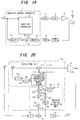
- Fig. 19 is a block diagram of an adaptive control apparatus 1 for compensating for distortion that occurs in a power amplifier.
- the apparatus includes an error calculation unit 1a for calculating the difference between a transmit signal x(t), which is a reference signal, and a feedback signal y(t); delay units 1b, 1c for delaying these signals so as to null the delay time between the reference signal and the feedback signal; and an adaptive controller 1d for performing adaptive control so as to diminish the error e(t) and for causing the result of adaptive control to be reflected in the reference signal.
- the signal obtained by reflecting the result of adaptive control in the reference signal is input to a modulator 2 by the adaptive controller 1d, the modulator 2 applies modulation processing to the input signal, a DA converter 3 converts the modulated signal to an analog signal and inputs the analog signal to a power amplifier 4, and the power amplifier 4 amplifies the input signal and then releases it into space from an antenna 5.
- a directional coupler 6 extracts part of the output of the power amplifier and inputs it to a demodulator 8 via an AD converter 7.
- the demodulator 8 applies demodulation processing to the input signal and inputs the demodulated signal to the adaptive control apparatus 1.
- the error calculation unit 1a calculates the difference e(t) between a reference signal x'(t) and a feedback signal y'(t) that enter via the delay units 1b, 1c, and the adaptive controller 1d performs adaptive control so as to diminish the error e(t) and causes the result of adaptive control to be reflected in the next reference signal.
- the feedback signal can be made to agree with a distortion-free reference signal. That is, the distortion produced by the power amplifier 4 can be compensated for and a distortion-free signal can be transmitted.
- Fig. 20 is a diagram useful in describing the operation of the adaptive controller.
- the adaptive controller has a reflecting unit 11 for reflecting the result of adaptive control in the reference signal x(t) and outputting the resultant signal, and an adaptive control calculation unit 12.
- a multiplier (predistortion unit) 11a multiplies the transmit signal x(t) by a distortion compensation coefficient h n (p) and outputs the result of multiplication.
- a delay unit 11d generates a write address A W of the distortion compensation coefficient memory 11b.
- the distortion compensation coefficient h n (p) is read out from the address A R indicated by the power p of the transmit signal x(t) and a prescribed period of time is required until the next distortion compensation coefficient h n+1 (p) is found. Accordingly, the delay unit 11d is adapted so as to delay the generation of the write address for this period of time so that the old distortion compensation coefficient h n (p) can be updated by the new distortion compensation coefficient h n+1 (p).
- a multiplier 12a performs multiplication between the difference signal e(t), which represents the difference between the reference signal x'(t) and the feedback signal y'(t), and a step-size parameter ⁇ ( ⁇ 1), and a complex-conjugate signal output unit 12b outputs a complex conjugate signal y*(t).
- a multiplier 12c performs multiplication between the distortion compensation coefficient h n (p) and y*(t)
- a multiplier 12d performs multiplication between ⁇ e(t) and u*(t).
- a delay unit 12e adjusts the timing at which the distortion compensation coefficient h n (p) is output, and an adder 12f adds the distortion compensation coefficient h n (p) and ⁇ e(t)u* and outputs the new distortion compensation coefficient h n+1 (p).
- the power amplifier 4 has a distortion function f(p).
- 2 h* n (p)h n (p) 1 where x, y, f, h, u, e represent complex numbers and * signifies a complex conjugate.
- the distortion compensation coefficient h n (p) is updated and eventually converges to the optimum distortion compensation coefficient so that compensation is made for the distortion in the power amplifier 4.
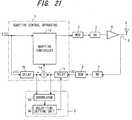
- a delay-time controller 9 is provided, as shown in Fig. 21, and controls the delay time of the delay unit 1c so that the timings at which the reference signal and feedback signal enter the error calculation unit 1a will agree.
- the delay-time controller 9 uses a correlator 9a to calculate the correlation between the reference signal output from the delay unit 1b and the feedback signal output from the delay unit 1c, and uses a delay-time setting unit 9b to obtain the delay time for which the correlation is maximized and to set this delay time in the delay unit 1c.
- a correlator 9a to calculate the correlation between the reference signal output from the delay unit 1b and the feedback signal output from the delay unit 1c
- a delay-time setting unit 9b uses a delay-time setting unit 9b to obtain the delay time for which the correlation is maximized and to set this delay time in the delay unit 1c.
- the delay time of the feedback signal varies depending upon the frequency band and bandwidth, etc., of the reference signal. No problems arise, therefore, if the frequency component of the reference signal x(t) is constant. If the frequency component varies, however, then the delay time until the reference signal x(t) arrives at the error calculation unit 1a and the delay time until the feedback signal y(t) arrives at the error calculation unit 1a will no longer be equal and adaptive control can no longer be performed favorably. For example, if the power amplifier is subjected to distortion compensation by adaptive control, the distortion compensation coefficient will not converge in optimum fashion and the noise floor will rise. It should be noted that even if the delay-time controller 9 controls delay time in real time, delay-time control will not be able to follow up the change in frequency and be executed at high speed, as a result of which the problems mentioned above will arise.
- the number of carriers and carrier placement vary depending upon whether or not each of the transmit signals is present, and the delay time of the feedback signal changes owing to this variation.
- the delay time of the feedback signal varies also depending upon the power of each carrier signal and the temperature inside the apparatus.
- an object of the present invention is to make it possible to equalize the delay time until the reference signal x(t) arrives at an error calculation unit and the delay time until the feedback signal y(t) arrives at the error calculation unit even in a case where the frequency component of the reference signal varies, thereby enabling adaptive control to be performed in excellent fashion.
- Another object of the present invention is to make it possible to equalize the delay time until the reference signal x(t) arrives at an error calculation unit and the delay time until the feedback signal y(t) arrives at the error calculation unit even in a case where the number of carriers and carrier placement vary, thereby enabling adaptive control to be performed in excellent fashion.
- a further object of the present invention is to make it possible to equalize the delay time until the reference signal x(t) arrives at an error calculation unit and the delay time until the feedback signal y(t) arrives at the error calculation unit even if there is a change in the power of each carrier signal or in temperature inside the apparatus in multicarrier transmission, thereby enabling adaptive control to be performed in excellent fashion.
- a further object of the present invention is to make it possible to equalize the delay time until the reference signal x(t) arrives at an error calculation unit and the delay time until the feedback signal y(t) arrives at the error calculation unit even in a case where carrier frequency varies, thereby enabling adaptive control to be performed in excellent fashion.
- the present invention relates to an adaptive control apparatus for calculating the difference between a reference signal and a feedback signal, applying adaptive control so as to diminish the difference, reflect the results of adaptive control in the reference signal and output the resultant signal.
- a first adaptive control apparatus comprises 1 ⁇ a delay unit for delaying at least one of a reference signal and feedback signal by a set delay time in such a manner that the reference signal and feedback signal will be input simultaneously to an arithmetic unit (error calculation unit) that calculates the error; 2 ⁇ a frequency-component detecting unit for detecting a frequency component of the reference signal; 3 ⁇ a delay-time acquisition unit for acquiring the delay time based upon the frequency component; and 4 ⁇ a delay-time setting unit for setting the acquired delay time in the delay unit.
- the reference signal and feedback signal can be made to arrive at the error calculation unit simultaneously even in a case where the frequency component of the reference signal varies. This makes it possible to perform adaptive control in excellent fashion.
- a second adaptive control apparatus comprises 1 ⁇ a delay unit for delaying at least one of a reference signal and feedback signal by a set delay time in such a manner that the reference signal and feedback signal will be input simultaneously to an error calculation unit; 2 ⁇ a delay-time acquisition unit for acquiring the delay time based upon number of carriers and carrier placement if the reference signal is a multicarrier signal; and 3 ⁇ a delay-time setting unit for setting the acquired delay time in the delay unit.
- the delay time until the reference signal arrives at an error calculation unit and the delay time until the feedback signal arrives at the error calculation unit can be equalized even if the number of carriers and carrier placement vary. As a result, adaptive control can be performed in excellent fashion.
- the delay time is acquired and set in the delay unit based upon the number of carriers and carrier placement of a multicarrier signal serving as the reference signal and the power of each carrier signal, then the delay time until the reference signal arrives at the error calculation unit and the delay time until the feedback signal arrives at the error calculation unit can be equalized even in a case where the number of carriers, carrier placement and power vary. As a result, adaptive control can be performed in excellent fashion.
- the delay time is acquired and set in the delay unit based upon the number of carriers and carrier placement of a multicarrier signal serving as the reference signal and the temperature inside the apparatus, then the delay time until the reference signal arrives at the error calculation unit and the delay time until the feedback signal arrives at the error calculation unit can be equalized even in a case where the number of carriers, carrier placement and temperature inside the apparatus vary. As a result, adaptive control can be performed in excellent fashion.
- a third adaptive control apparatus comprises 1 ⁇ a delay unit for delaying at least one of a reference signal and feedback signal by a set delay time in such a manner that the reference signal and feedback signal will be input simultaneously to an error calculation unit; 2 ⁇ a delay-time acquisition unit for acquiring the delay time based upon a prescribed carrier frequency if the reference signal, in which result of adaptive control has been reflected, is carried by a carrier of the prescribed frequency; and 3 ⁇ a delay-time setting unit for setting the acquired delay time in the delay unit.
- the delay time until the reference signal arrives at a difference calculation unit and the delay time until the feedback signal arrives at the a difference calculation unit can be equalized even if the carrier frequency varies. As a result, adaptive control can be performed in excellent fashion.
- a fourth adaptive control apparatus comprises 1 ⁇ a delay-time-difference detecting unit for measuring the difference between delay times it takes for a reference signal and feedback signal to enter an error calculation unit, measurement being performed while changing the frequency of the reference signal; 2 ⁇ a delay-time-difference characteristic creating unit for creating a reference-signal frequency vs. delay-time-difference characteristic; 3 ⁇ a complex filter for applying prescribed filtering processing to the feedback signal and inputting the resultant signal to the error calculation unit; and a coefficient decision unit for deciding complex filter coefficients so as obtain a characteristic that is the inverse of the delay-time-difference characteristic and setting these coefficients in the complex filter.
- the reference signal and feedback signal can be made to arrive at the difference calculation unit simultaneously even in a case where the frequency component of the reference signal varies. This makes it possible to perform adaptive control in excellent fashion.
- Fig. 1 is a block diagram of an adaptive control apparatus according to a first embodiment. This is an example in which the invention is applied to a case where compensation is made for distortion in a power amplifier.
- An adaptive control apparatus 51 includes an error calculation unit 51a for calculating the difference between the transmit signal x(t), which is a reference signal, and the feedback signal y(t); delay units 51b, 51c for delaying these signals so as to null the delay-time difference between the reference signal and the feedback signal that are input to the error calculation unit 51a; an adaptive controller 51d for performing adaptive control so as to diminish the error e(t) and for causing the result of adaptive control to be reflected in the reference signal; and a delay-time controller 51e for controlling the delay time of the delay unit 51c and exercising control in such a manner that the reference signal and feedback signal will enter the error calculation unit 51a simultaneously.
- the delay unit 51c has a shift register 61 for storing the digital feedback signal y(t), which arrives at the clock period, while successively shifting the signal; a first selector 62 for extracting the transmit signal from a prescribed shift position of the shift register 61 and inputting it to the error calculation unit 51a; and a second selector 63 for extracting the transmit signal from a prescribed shift position of the shift register 61 and inputting it to a correlator in the delay-time controller 51e.
- the second selector 63 controls the delay-time difference with respect to the transmit signal by changing over the position of the shift register 61 for extracting the feedback signal y(t).
- the shift length of the shift register 61 is decided so as to be greater than the maximum delay time between the reference signal and feedback signal.
- the feedback signal is delayed by m ⁇ T (where T represents the clock period) at the mth shift position from the leading end.
- the delay-time controller 51e has a frequency detector 71, a delay-time table storage unit 72, a delay-time acquisition unit 73, a delay-time setting unit 74 and a sliding correlator 75.
- the frequency detector 71 which is constituted by an FFT or the like, detects the frequency component of the reference signal x(t).
- the delay-time table storage unit 72 stores, in association with reference-signal frequency, the difference between the delay times it takes for the reference signal and feedback signal, respectively, to enter the error calculation unit 51a. Since the difference between the delay times it takes for the reference signal and feedback signal, respectively, to enter the error calculation unit 51a varies depending upon the frequency component (frequency, bandwidth, etc.) of the reference signal, this relationship is measured in advance and the delay-time differences are registered in the delay-time table storage unit 72 beforehand in association with the frequencies of the reference signal.
- the delay-time acquisition unit 73 extracts the delay-time difference that conforms to the frequency component of the reference signal from the delay-time table storage unit 72 and inputs it to the delay-time setting unit 74.
- the latter initially sets the delay time that has entered from the delay-time acquisition unit 73 in the first selector 62.
- the delay-time setting unit 74 controls the second selector 63 of the delay unit 51c and changes over the shift position of the shift register 61 that extracts the feedback signal y(t), thereby changing the delay time of the feedback signal.
- the delay-time setting unit 74 stores the correlation value calculated by the sliding correlator 75 at each delay time, obtains the delay time for which the correlation value is maximized and sets this delay time in the first selector 62 of the delay unit 51c again.
- the sliding correlator 75 multiplies the transmit signal, which has been delayed by a prescribed period of time, and the feedback signal, which is output from the delay unit 51c, together one clock at a time, accumulates the results of multiplication and calculates the correlation between both signals.
- the sliding correlator 75 comprises a multiplier 75a, a 1-clock delay device 75b, and an adder 75c for adding the accumulated value thus far and the present result of multiplication and outputs the result.
- the adaptive controller 51d When a transmit signal is input, the adaptive controller 51d inputs a signal, which is obtained by reflecting the result of adaptive control in the reference signal x(t), to a modulator 52.
- the latter applies modulation processing to the input signal
- a DA converter 53 converts the modulated signal to an analog signal and inputs the analog signal to a power amplifier 54
- the power amplifier 54 amplifies the input signal and then releases it into space from an antenna 55.
- a directional coupler 56 extracts part of the output of the power amplifier and inputs it to a demodulator 58 via an AD converter 57.
- the demodulator 58 applies demodulation processing to the input signal and inputs the demodulated signal to the adaptive control apparatus 51.
- the frequency detector 71 detects the frequency component of the reference signal and the delay-time acquisition unit 73 acquires the delay time that conforms to the frequency component of the reference signal from the delay-time table storage unit 72 and inputs this delay time to the delay-time setting unit 74.
- the latter initially sets the delay time that has entered from the delay-time acquisition unit 73 in the first selector 62 of the delay unit 51c.
- the feedback signal y(t) is delayed by the delay time that has been set in the delay unit 51c and the overall delay time of the feedback signal becomes substantially equal to the overall delay time it takes for the reference signal x(t) to arrive at the error calculation unit 51a via the delay unit 51b.
- the error calculation unit 51a calculates the difference e(t) between reference signal x'(t) and feedback signal y'(t) that enter via the delay units 51b, 51c, and the adaptive controller 51d performs adaptive control so as to diminish the difference e(t) and causes the result of adaptive control to be reflected in the next reference signal. This operation is thenceforth repeated.
- the delay times of the reference signal and feedback signal can be made equal and therefore excellent adaptive control becomes possible and distortion in the power amplifier can be compensated for in excellent fashion.
- Fine adjustment of delay time is performed in parallel with the above operation. Specifically, in order to obtain the maximum correlation, the delay-time setting unit 74 controls the second selector 63 of the delay unit 51c and changes over the shift position of the shift register 61 that extracts the feedback signal y(t), thereby changing the delay time of the feedback signal.
- the delay-time setting unit 74 stores the correlation value calculated by the sliding correlator 75 at each delay time, obtains the delay time for which the correlation value is maximized and sets this delay time in the first selector 62 of the delay unit 51c again.
- the shift range for when the maximum correlation is obtained is a small range in the neighborhood of the initially set delay time.
- the delay time of the delay unit 51c is finely adjusted quickly in real time and the arrival times of the feedback signal and reference signal at the error calculation unit can be made to agree with high precision, thereby making possible excellent adaptive control.
- a table that indicates the correlation between reference-signal frequencies and delay times is obtained in advance and registered in the delay-time table storage unit 72.
- this table is created and delay time is subsequently controlled by a method similar to that of the first embodiment.
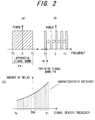
- Fig. 2 is a diagram useful in describing the principle of creation of a delay-time table. It is assumed that the signal band of the apparatus is FA, which extends from f 0 to f 3 , as shown in (A) of Fig. 2. Training signals are input to the apparatus. The training signals are such that the center frequency gradually increases from f 0 to f 3 in a bandwidth FB shown at (B) in Fig. 2.
- a delay-time difference for which the correlation value is maximized is obtained with respect to each training signal. If this is plotted, a frequency vs. delay characteristic shown at (C) of Fig. 2 is obtained. It is assumed that the training signal is one that employs a narrow-band signal with respect to the signal band of the apparatus. In addition, FA ⁇ FB holds, where FA represents the band of the apparatus signal and FB the band of the training signal.
- Fig. 3 is a block diagram of an adaptive control apparatus according to the second embodiment, in which components identical with those of the first embodiment in Fig. 1 are designated by like reference characters.
- This embodiment differs in that it is additionally provided with components for creating a delay-time table, such as a communication controller 59, switch 60 and delay-time table creating unit 76.
- the delay unit 51c has a structure identical with that of the delay unit 51c in Fig. 1.
- the delay-time table is created before the transmit signal is transmitted.
- the communication controller 59 exercises control in such a manner that the training signal is selected by the switch 60 and instructs the delay-time controller 51e to create the delay-time table.
- the communication controller 59 then generates a first training signal having a center frequency f 0 and inputs the center frequency f 0 to the delay-time table creating unit 76.
- the delay-time setting unit 74 controls the second selector 63 (see Fig. 1) of the delay unit 51c and changes over the shift position of the shift register 61 that extracts the feedback signal y(t), thereby changing the delay time of the feedback signal.
- the delay-time setting unit 74 stores the correlation value calculated by the sliding correlator 75 at each delay time, obtains the delay time for which the correlation value is maximized and inputs this delay time to the delay-time table creating unit 76. The latter stores the entered delay time in association with the center frequency f 0 .
- the communication controller 59 thenceforth generates the narrow-band training signals in such a manner that frequency increases successively from f 0 to f 3 , and the delay-time table creating unit 76 stores the obtained delay times in association with the frequencies in the manner described above. When frequency vs. delay times are obtained with regard to the full band, these are set in the delay-time table storage unit 72, thereby completing the processing for creating the table.
- the communication controller 59 causes the transmit signal to be selected by the switch according to the table. Delay-time control and adaptive control is thenceforth carried out in a manner similar to that of the first embodiment.
- the first and second embodiments put the correspondence between reference-signal frequency and delay time into table form, obtains delay time from the table and sets it in the delay unit.
- it can also be so arranged that correspondence between frequencies at several points and delay times is stored, the correspondence between these is linearized and expressed by a linear equation, delay time is obtained by calculation and then is set in the delay unit.
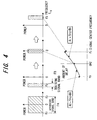
- Fig. 4 is a diagram useful in describing a third embodiment.
- the center frequency of the training signals is varied in the manner f 0 , 0, f 3 and the delay times (amount of delay) of the feedback signal are found and stored when the center frequencies prevail.
- Two linear equations (A 0 ⁇ frq + B 0 , A 1 ⁇ frq + B 1 ) involving center frequency and amount of delay are generated using the three sets of center frequencies and amounts of delay found, amount of delay conforming to the reference-signal frequency is found from a prescribed equation when the reference-signal frequency is changed, and this amount of delay is set in the delay unit.
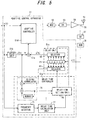
- Fig. 5 is a block diagram of an adaptive control apparatus according to the third embodiment, in which components identical with those of the first embodiment in Fig. 1 are designated by like reference characters.
- This embodiment differs in that a delay-time calculation unit 77 is provided so that delay time may be obtained by calculation. Before a transmit signal is transmitted, training signals are input and delay times conforming to several frequencies are obtained by the method shown in Fig. 3, and these are input to the delay-time calculation unit 77 in advance.
- the adaptive controller 51d inputs a signal, which is obtained by reflecting the results of adaptive control in the reference signal x(t), to the modulator 52.
- the latter applies modulation processing to the input signal
- the DA converter 53 converts the modulated signal to an analog signal and inputs the analog signal to the power amplifier 54
- the power amplifier 54 amplifies the input signal and then releases it into space from the antenna 55.
- the directional coupler 56 extracts part of the output of the power amplifier and inputs it to the demodulator 58 via the AD converter 57.
- the demodulator 58 applies demodulation processing to the input signal and inputs the demodulated signal to the adaptive control apparatus 51.
- the frequency detector 71 detects the frequency component of the reference signal and inputs it to the delay-time calculation unit 77.
- the latter calculates delay time using a linear equation conforming to a range to which the frequency component of the reference signal belongs and inputs this delay time to the delay-time setting unit 74.
- the latter initially sets the delay time that has entered from the delay-time calculation unit 77 in the first selector 62 of the delay unit 51c.
- the feedback signal y(t) is delayed by the delay unit 51c in accordance with the set delay time and the overall delay time of the feedback signal becomes substantially equal to the overall delay time it takes for the reference signal x(t) to arrive at the error calculation unit 51a via the delay unit 51b.
- the error calculation unit 51a calculates the difference e(t) between the reference signal x'(t) and the feedback signal y'(t) that enter via the delay units 51b, 51c, and the adaptive controller 51d performs adaptive control so as to diminish the difference e(t) and causes the result of adaptive control to be reflected in the next reference signal. This operation is thenceforth repeated.
- the delay times of the reference signal and feedback signal can be made equal and therefore excellent adaptive control becomes possible.
- Fine adjustment of delay time is performed in parallel with the above operation by a method similar to that of the first embodiment.
- the delay-time setting unit 74 controls the second selector 63 (see Fig. 1) of the delay unit 51c and changes over the shift position of the shift register 61 that extracts the feedback signal y(t), thereby changing the delay time of the feedback signal.
- the delay-time setting unit 74 stores the correlation value calculated by the sliding correlator 75 at each delay time, obtains the delay time for which the correlation value is maximized and sets this delay time in the first selector 62 of the delay unit 51c again.
- the shift range for when the maximum correlation is obtained is a small range in the neighborhood of the initially set delay time.
- the delay time of the delay unit 51c is finely adjusted quickly in real time and the arrival times of the feedback signal and reference signal at the error calculation unit can be made to agree with high precision, thereby making possible excellent adaptive control.
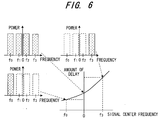
- the first to third embodiments are for a case where transmission is by a single carrier. However, there are also cases where transmission is performed using a multicarrier signal. In such cases, the delay time of the feedback signal y(t) varies in accordance with a center frequency specified by number of carriers (which corresponds to the bandwidth used) and carrier placement, as shown in Fig. 6. According to a fourth embodiment, delay times are measured beforehand and registered in a delay-time table storage unit in association with combinations of number of carriers and carrier placement, or in association with center frequencies, a delay time that corresponds to an actual combination of number of carriers and carrier placement or to center frequency is found from the table and this is set in the delay unit.
- Fig. 7 is a block diagram of the fourth embodiment, in which components identical with those of the first embodiment in Fig. 1 are designated by like reference characters. This embodiment differs from the first embodiment in the following points:
- the delay unit 51c has a structure identical with that of the delay unit 51c in Fig. 1.
- the digital frequency-multiplexed transmit signal x(t) corresponds to the single-carrier transmit signal x(t). This is followed by performing adaptive control and delay-time control similar to that of the case of the single carrier.
- the adaptive controller 51d inputs a signal, which is obtained by reflecting the result of adaptive control in the reference signal x(t), to the modulator 52.
- the latter applies modulation processing to the input signal
- the DA converter 53 converts the modulated signal to an analog signal and inputs the analog signal to the power amplifier 54
- the power amplifier 54 amplifies the input signal and then releases it into space from the antenna 55.
- the directional coupler 56 extracts part of the output of the power amplifier and inputs it to the demodulator 58 via the AD converter 57.
- the demodulator 58 applies demodulation processing to the input signal and inputs the demodulated signal to the adaptive control apparatus 51.
- the delay-time acquisition unit 73 acquires a combination of number of carriers and carrier placement or a center frequency specified by number of carriers and carrier placement from the communication controller 59.
- the delay-time acquisition unit 73 acquires a delay time that corresponds to the acquired combination of number of carriers and carrier placement or center frequency from the delay-time table storage unit 72 and inputs it to the delay-time setting unit 74.
- the latter initially sets the delay time that has entered from the delay-time acquisition unit 73 in the first selector 62 (see Fig. 1) of the delay unit 51c.
- the feedback signal y(t) arrives at the error calculation unit 51a upon being delayed by the delay unit 51c in accordance with the set delay time.
- the overall delay time of the feedback signal becomes substantially equal to the overall delay time it takes for the transmit signal x(t), which is the reference signal, to arrive at the error calculation unit 51a via the delay unit 51b.
- the error calculation unit 51a calculates the difference e(t) between the reference signal x'(t) and the feedback signal y'(t) that enter via the delay units 51b, 51c, and the adaptive controller 51d performs adaptive control so as to diminish the difference e(t) and causes the result of adaptive control to be reflected in the next transmit signal. This operation is thenceforth repeated.
- the delay times of the reference signal and feedback signal can be made equal and therefore excellent adaptive control becomes possible.
- Fine adjustment of delay time is performed in parallel with the above operation by a method similar to that of the first embodiment.
- the delay-time setting unit 74 controls the second selector 63 (see Fig. 1) of the delay unit 51c and changes over the shift position of the shift register 61 that extracts the feedback signal y(t), thereby changing the delay time of the feedback signal.
- the delay-time setting unit 74 stores the correlation value calculated by the sliding correlator 75 at each delay time, obtains the delay time for which the correlation value is maximized and sets this delay time in the first selector 62 of the delay unit 51c again. It will suffice if the shift range for when the maximum correlation is obtained is a small range in the neighborhood of the initially set delay time. As a result, the delay time of the delay unit 51c is finely adjusted quickly in real time and the arrival times of the feedback signal and reference signal at the error calculation unit can be made to agree with high precision, thereby making possible excellent adaptive control.
- Delay time is acquired from table in the description rendered above.
- delay time can also be acquired using a calculation formula for calculating delay time from number of carriers and carrier placement in a manner similar to that of the third embodiment. For example, amounts of delay corresponding to center frequencies of a multicarrier are found discretely beforehand, a calculation formula for calculating amount of delay from center frequency is set up using these amounts of delay, center frequency is obtained from the actual number of carriers and carrier placement and the amount of delay is calculated using this calculation formula.
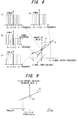
- the delay time of a feedback signal varies depending upon the number of carriers and carrier placement and varies also in dependence upon the power of each carrier.
- A represents a characteristic curve that indicates the relationship between carrier center frequency and amount of delay
- B represents a characteristic curve indicating the relationship between power and amount of delay. If the amounts of delay at (1), (2) for the same number of carriers but different power are compared, it will be understood that the amount of delay at (1) is larger than that at (2) for which power at f 2 , f 3 on the high-frequency side of the center frequency is small.
- a first table indicating amounts of delay corresponding to combinations of number of carriers and carrier placement or center frequencies specified by these
- amounts of delay are acquired from these tables.
- a curve B is a characteristic of power ratio vs. rate of increase/decrease in amount of delay. If the power ratio is ⁇ 0 , the rate of increase/decrease will be - ⁇ 0 . Therefore, if ⁇ represents the delay time found from the first table, then delay time that takes power into account will be ⁇ (1- ⁇ 0 ).
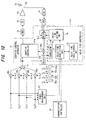
- Fig. 10 is a block diagram of an adaptive control apparatus according to the fifth embodiment, in which components identical with those of the fourth embodiment of Fig. 7 are designated by like reference characters. This embodiment differs in the following points:
- the delay-time acquisition unit 73 acquires, from the communication controller 59, a combination of number of carriers and carrier placement or a center frequency obtained from the number of carriers and carrier placement and acquires the delay time ⁇ corresponding thereto from the first table.
- the delay-time acquisition unit 73 calculates the power ratio between the high-frequency-side power and low-frequency-side power based upon the power of each carrier, obtains the rate ⁇ of increase/decrease in amount of delay conforming to this power ratio from the second table, finds a delay time that takes power into account according to the following formula: ⁇ (1+ ⁇ ) and sets this in the delay-time setting unit 74.
- the latter initially sets the delay time that has entered from the delay-time acquisition unit 73 in the first selector 62 (see Fig. 1) of the delay unit 51c.
- the feedback signal y(t) arrives at the error calculation unit 51a upon being delayed by the delay unit 51c in accordance with the set delay time.
- the overall delay time of the feedback signal becomes substantially equal to the overall delay time it takes for the transmit signal x(t), which is the reference signal, to arrive at the error calculation unit 51a via the delay unit 51b.
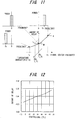
- the delay time of a feedback signal varies depending upon the number of carriers and carrier placement and varies also in dependence upon the temperature inside the apparatus.
- A represents a characteristic curve that indicates the relationship between carrier center frequency and amount of delay
- B represents a characteristic curve indicating the relationship between temperature in the apparatus and amount of delay
- Fig. 12 is a characteristic curve indicating the relationship between temperature and amount of delay at a temperature T 0 . It will be understood from Figs. 11 and 12 that delay time increases when the temperature rises and decreases when the temperature falls.
- a first table indicating amounts of delay corresponding to combinations of number of carriers and carrier placement or center frequencies specified by these
- a second table indicating amounts of increase or decrease in amounts of delay corresponding to temperature, and amounts of delay are acquired from these tables.
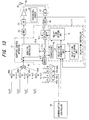
- Fig. 13 is a block diagram of an adaptive control apparatus according to the sixth embodiment, in which components identical with those of the fourth embodiment of Fig. 7 are designated by like reference characters. This embodiment differs in the following points:
- the delay-time acquisition unit 73 acquires, from the communication controller 59, a combination of number of carriers and carrier placement or a center frequency specified by the number of carriers and carrier placement and acquires the delay time ⁇ corresponding thereto from the first table.
- the delay-time acquisition unit 73 obtains, from the second table, an amount ⁇ of increase/decrease in amount of delay conforming to temperature inside the apparatus, finds a delay time that takes temperature inside the apparatus into account according to the following formula: ⁇ + ⁇ and sets this in the delay-time setting unit 74.
- the latter initially sets the delay time that has entered from the delay-time acquisition unit 73 in the first selector 62 (see Fig. 1) of the delay unit 51c.
- the feedback signal y(t) arrives at the error calculation unit 51a upon being delayed by the delay unit 51c in accordance with the set delay time. Accordingly, the overall delay time of the feedback signal becomes substantially equal to the overall delay time it takes for the transmit signal x(t), which is the reference signal, to arrive at the error calculation unit 51a via the delay unit 51b.
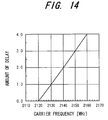
- Fig. 14 is a diagram showing the relationship between carrier frequency and delay time. The higher the carrier frequency, the greater the amount of delay. According to a seventh embodiment, the correspondence between carrier frequency and delay time is put into table form, delay time conforming to the actual carrier frequency is obtained from the table and is set in the delay unit.
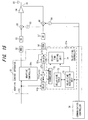
- Fig. 15 is a block diagram of an adaptive control apparatus according to the seventh embodiment, in which components identical with those of the first embodiment in Fig. 1 are designated by like reference characters. This embodiment differs in the following points:
- the delay unit 51c has a structure identical with that of the delay unit 51c in Fig. 1.
- the adaptive controller 51d inputs a signal, which is obtained by reflecting the results of adaptive control in the reference signal x(t), to the modulator 52.
- the latter applies modulation processing to the input signal and the DA converter 53 converts the modulated signal to an analog signal.
- An oscillator 83 of the frequency converter oscillates at the carrier frequency specified by the communication controller 59, and a multiplier 85 multiplies a baseband signal, which is output from the DA converter, by the carrier-frequency signal to effect a frequency conversion to a radio signal and inputs the radio signal to the power amplifier 54.
- the latter amplifies the input signal and then releases it into space from the antenna 55.
- the directional coupler 56 extracts part of the output of the power amplifier, and a multiplier 86 multiplies the radio signal by a carrier-frequency signal generated by an oscillator 84, thereby effecting a frequency conversion to a baseband signal.
- the AD converter 57 converts the baseband signal output from the multiplier 86 to a digital signal and inputs the digital signal to the demodulator 58.
- the demodulator 58 applies demodulation processing to the input signal and inputs the demodulated signal to the adaptive control apparatus 51.
- the delay-time acquisition unit 73 obtains the carrier frequency from the communication controller 59, acquires the delay time conforming to the carrier frequency from the delay-time table storage unit 72 and sets this delay time in the delay-time setting unit 74.
- the latter initially sets the delay time that has entered from the delay-time acquisition unit 73 in the first selector 62 (see Fig. 1) of the delay unit 51c.
- the feedback signal y(t) arrives at the error calculation unit 51a upon being delayed by the delay unit 51c in accordance with the set delay time.
- the overall delay time of the feedback signal up to arrival at the error calculation unit 51a becomes substantially equal to the overall delay time it takes for the reference signal x(t) to arrive at the error calculation unit 51a via the delay unit 51b.
- the error calculation unit 51a calculates the difference e(t) between the reference signal x'(t) and the feedback signal y'(t) that enter via the delay units 51b, 51c, and the adaptive controller 51d performs adaptive control so as to diminish the difference e(t) and causes the result of adaptive control to be reflected in the next reference signal. This operation is thenceforth repeated. By virtue of the control above, excellent adaptive control becomes possible.
- Fine adjustment of delay time is performed in parallel with the above operation. Specifically, in order to obtain the maximum correlation, the delay-time setting unit 74 controls the second selector 63 (see Fig. 1) of the delay unit 51c and changes over the shift position of the shift register 61 that extracts the feedback signal y(t), thereby changing the delay time of the feedback signal.
- the delay-time setting unit 74 stores the correlation value calculated by the sliding correlator 75 at each delay time, obtains the delay time for which the correlation value is maximized and sets this delay time in the first selector 62 of the delay unit 51c again.
- the shift range for when the maximum correlation is obtained is a small range in the neighborhood of the initially set delay time.
- the delay time of the delay unit 51c is finely adjusted quickly in real time and the arrival times of the feedback signal and reference signal at the error calculation unit can be made to agree with high precision, thereby making possible excellent adaptive control.
- the difference between the delay times it takes for the reference signal and feedback signal to enter the error calculation unit is obtained, the difference is set in the delay unit and control is exercised so as to null the difference.
- a characteristic of reference-signal frequency vs. delay-time difference can be created in advance, a characteristic that is the inverse of this characteristic can be set in a complex filter and control can be exercised so as to null the delay-time difference.
- Fig. 16 is a block diagram of an eighth embodiment, in which components identical with those of the first embodiment in Fig. 1 are designated by like reference characters. This embodiment differs from the first embodiment in the following points:
- the delay unit 51c has a structure identical with that of the delay unit 51c in Fig. 1.
- Fig. 17 is a diagram illustrating the structure of the complex filter.
- the transmit signal and feedback signal are complex signals, though this is not illustrated clearly in Fig. 16.
- the complex filter 51f comprises four FIR filters 101 to 104 and adders 105, 106.
- the real part of the feedback signal is input to the FIR filters 101, 103, and the imaginary part of the feedback signal is input to the FIR filters 102, 104.
- the adder 105 combines the outputs of the FIR filters 101, 102 and outputs the real part
- the adder 106 combines the outputs of the FIR filters 103, 104 and outputs the imaginary part.
- the adders 105, 106 output the following: ⁇ (Ren + jIMn) ⁇ (Cn + jDn)
- a prescribed delay characteristic can be impressed upon the input signal by the coefficients of the complex filter 51f.
- the coefficients of the complex filter are decided and input to the complex filter 51f before the transmit signal is transmitted. That is, in a manner similar to that of the second embodiment, the communication controller 59 exercises control in such a manner that the training signal is selected by the switch 60 and instructs the delay-time controller 51e to create the delay-time table. The communication controller 59 then generates a first training signal (see Fig. 2) having a center frequency f 0 and inputs the center frequency f 0 to the delay-time-characteristic creating unit 91. It should be noted that the complex filter 51f is set in such a manner that it will be a filter whose delay characteristic is flat and for which the coefficient of the imaginary part is zero when the delay characteristic is acquired.
- the delay-time setting unit 74 controls the second selector 63 (see Fig. 1) of the delay unit 51c and changes over the shift position of the shift register 61 that extracts the feedback signal y(t), thereby changing the delay time of the feedback signal.
- the delay-time setting unit 74 stores the correlation value calculated by the sliding correlator 75 at each delay time, obtains the delay time for which the correlation value is maximized and inputs this delay time to the delay-time-characteristic creating unit 91. The latter stores the entered delay time in association with the center frequency f 0 .
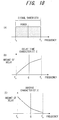
- the communication controller 59 thenceforth generates the narrow-band training signals in such a manner that frequency increases successively from f 0 to f 3 in the amount of the signal bandwidth shown at (A) in Fig. 18, and the delay-time-characteristic creating unit 91 stores the delay times in association with the frequencies and creates the delay-time characteristic in the manner described above. As a result, a delay-time characteristic of the kind shown at (B) in Fig. 18 is obtained.
- the inverse-characteristic creating unit 92 creates a characteristic that is the inverse of the delay-time characteristic, as shown at (C) in Fig. 18, and the complex-filter-coefficient decision unit 93 decides the filter coefficients of the complex filter 51f so as to indicate the inverse characteristic and sets them in the complex filter 51f.
- the communication controller 59 causes the input signal to be applied to the adaptive control apparatus by the switch 60.
- the adaptive controller 51d reflects the result of adaptive control in the transmit signal x(t)
- the modulator 52 applies modulation processing to the signal in which adaptive control has been reflected
- the DA converter 53 converts the modulated signal to an analog signal and inputs the analog signal to the power amplifier 54
- the power amplifier 54 amplifies the input signal and then releases it into space from the antenna 55.
- the directional coupler 56 detects part of the output of the power amplifier, the AD converter 57 converts the detected signal to a digital signal and inputs the digital signal to the demodulator 58, and the latter applies demodulation processing to the input signal and inputs the demodulated signal to the adaptive control apparatus 51.
- the complex filter 51f of the adaptive control apparatus applies filtering processing to the feedback signal so as to null the delay-time difference.
- the error calculation unit 51a calculates the difference e(t) between the reference signal x'(t) and the feedback signal y'(t) that enter via the delay unit 51b and complex filter 51f, and the adaptive controller 51d performs adaptive control so as to diminish the difference e(t) and causes the result of adaptive control to be reflected in the next reference signal. This operation is thenceforth repeated.
- the foregoing illustrates an example in which the invention is applied to a case where compensation is made for distortion produced by a power amplifier.
- the invention is not limited to such a case and can be applied to a case where noise is reduced by adaptive control.
- the correlator can be constructed using a matched filter.
Landscapes
- Engineering & Computer Science (AREA)
- Power Engineering (AREA)
- Physics & Mathematics (AREA)
- Nonlinear Science (AREA)
- Transmitters (AREA)
- Amplifiers (AREA)
Priority Applications (3)
| Application Number | Priority Date | Filing Date | Title |
|---|---|---|---|
| EP07114818.3A EP1863184B1 (de) | 2002-05-31 | 2002-05-31 | Vorrichtung mit adaptiver Steuerung |
| EP07114819.1A EP1855386B1 (de) | 2002-05-31 | 2002-05-31 | Vorrichtung mit adaptiver Steuerung |
| EP07114817A EP1855385A3 (de) | 2002-05-31 | 2002-05-31 | Vorrichtung mit adaptiver Steuerung |
Applications Claiming Priority (1)
| Application Number | Priority Date | Filing Date | Title |
|---|---|---|---|
| PCT/JP2002/005324 WO2003103164A1 (ja) | 2002-05-31 | 2002-05-31 | 適応制御装置 |
Related Child Applications (6)
| Application Number | Title | Priority Date | Filing Date |
|---|---|---|---|
| EP07114818.3A Division EP1863184B1 (de) | 2002-05-31 | 2002-05-31 | Vorrichtung mit adaptiver Steuerung |
| EP07114819.1A Division EP1855386B1 (de) | 2002-05-31 | 2002-05-31 | Vorrichtung mit adaptiver Steuerung |
| EP07114817A Division EP1855385A3 (de) | 2002-05-31 | 2002-05-31 | Vorrichtung mit adaptiver Steuerung |
| EP07114819.1 Division-Into | 2007-08-23 | ||
| EP07114817.5 Division-Into | 2007-08-23 | ||
| EP07114818.3 Division-Into | 2007-08-23 |
Publications (3)
| Publication Number | Publication Date |
|---|---|
| EP1511179A1 true EP1511179A1 (de) | 2005-03-02 |
| EP1511179A4 EP1511179A4 (de) | 2006-10-04 |
| EP1511179B1 EP1511179B1 (de) | 2013-07-03 |
Family
ID=29606635
Family Applications (1)
| Application Number | Title | Priority Date | Filing Date |
|---|---|---|---|
| EP02730824.6A Expired - Lifetime EP1511179B1 (de) | 2002-05-31 | 2002-05-31 | Adaptiver regler |
Country Status (4)
| Country | Link |
|---|---|
| US (1) | US7496152B2 (de) |
| EP (1) | EP1511179B1 (de) |
| JP (1) | JP3923978B2 (de) |
| WO (1) | WO2003103164A1 (de) |
Cited By (1)
| Publication number | Priority date | Publication date | Assignee | Title |
|---|---|---|---|---|
| CN101800517A (zh) * | 2009-02-05 | 2010-08-11 | 富士通株式会社 | 预失真器及失真补偿方法 |
Families Citing this family (16)
| Publication number | Priority date | Publication date | Assignee | Title |
|---|---|---|---|---|
| JP4323968B2 (ja) * | 2004-01-14 | 2009-09-02 | 株式会社日立コミュニケーションテクノロジー | 無線通信装置のタイミング調整方法 |
| JP4516973B2 (ja) * | 2005-01-04 | 2010-08-04 | 富士通株式会社 | Dcオフセット補償方法及びdcオフセット補償装置 |
| US7542519B2 (en) * | 2005-12-29 | 2009-06-02 | Crestcom, Inc. | Radio frequency transmitter and method therefor |
| JP4388943B2 (ja) * | 2006-10-23 | 2009-12-24 | Okiセミコンダクタ株式会社 | 相関器 |
| JP2008205759A (ja) * | 2007-02-20 | 2008-09-04 | Japan Radio Co Ltd | 歪補償装置 |
| EP2270993B1 (de) * | 2008-04-21 | 2018-07-11 | Nippon Telegraph and Telephone Corporation | Funkkommunikationssystem und funkkommunikationsverfahren |
| JP4721074B2 (ja) * | 2008-04-23 | 2011-07-13 | ソニー株式会社 | 受信装置および受信方法、並びにプログラム |
| US7847646B2 (en) | 2008-05-27 | 2010-12-07 | Favepc, Inc. | Carrier generator with LC network |
| KR20120084789A (ko) | 2009-12-15 | 2012-07-30 | 후지쯔 가부시끼가이샤 | 전원 장치 |
| US9128496B2 (en) * | 2011-10-26 | 2015-09-08 | The United States Of America As Represented By Secretary Of The Navy | Auto-ranging for time domain extraction of perturbations to sinusoidal oscillation |
| JP2015220739A (ja) | 2014-05-21 | 2015-12-07 | 富士通株式会社 | 歪補償装置及び歪補償方法 |
| JP6311457B2 (ja) * | 2014-05-30 | 2018-04-18 | 富士通株式会社 | 制御装置、dc−dcコンバータ、スイッチング電源装置及び情報処理装置 |
| JP2016167781A (ja) * | 2015-03-10 | 2016-09-15 | 富士通株式会社 | 無線通信装置及び無線通信装置の制御方法 |
| JP2017200147A (ja) * | 2016-04-28 | 2017-11-02 | 富士通株式会社 | 無線装置及び係数更新方法 |
| US11770145B2 (en) | 2021-08-27 | 2023-09-26 | Samsung Electronics Co., Ltd | System and method for efficient initialization of memory digital pre-distorter coefficients to reduce calibration time |
| WO2024084629A1 (en) * | 2022-10-19 | 2024-04-25 | Tokyo Institute Of Technology | System for compensating the non-linear distortion introduced by a radio power amplifier based on harmonic analysis |
Family Cites Families (13)
| Publication number | Priority date | Publication date | Assignee | Title |
|---|---|---|---|---|
| US4217586A (en) * | 1977-05-16 | 1980-08-12 | General Electric Company | Channel estimating reference signal processor for communication system adaptive antennas |
| KR950000761B1 (ko) * | 1992-01-15 | 1995-01-28 | 삼성전자 주식회사 | 직렬 입력신호의 동기회로 |
| JP3582809B2 (ja) * | 1996-03-12 | 2004-10-27 | ローランド株式会社 | 効果装置 |
| US6133789A (en) * | 1997-12-10 | 2000-10-17 | Nortel Networks Corporation | Method and system for robustly linearizing a radio frequency power amplifier using vector feedback |
| JPH11202028A (ja) * | 1998-01-14 | 1999-07-30 | Mitsubishi Electric Corp | Icテスタ |
| JP4288777B2 (ja) * | 1999-08-11 | 2009-07-01 | ソニー株式会社 | マルチキャリア信号送信装置及びマルチキャリア信号受信装置 |
| JP4014343B2 (ja) * | 1999-12-28 | 2007-11-28 | 富士通株式会社 | 歪補償装置 |
| US6275106B1 (en) * | 2000-02-25 | 2001-08-14 | Spectrian Corporation | Spectral distortion monitor for controlling pre-distortion and feed-forward linearization of rf power amplifier |
| JP4326673B2 (ja) * | 2000-06-06 | 2009-09-09 | 富士通株式会社 | 非線形歪補償装置を有する通信装置の起動方法 |
| AU2000274105A1 (en) | 2000-08-18 | 2002-03-04 | Nokia Corporation | Multicarrier transmitter circuit arrangement with predistortion linearisation method |
| JP3752137B2 (ja) | 2000-08-31 | 2006-03-08 | 三菱電機株式会社 | データ送信装置及びデータ送信方法 |
| JP2002077285A (ja) * | 2000-08-31 | 2002-03-15 | Hitachi Kokusai Electric Inc | 送信機 |
| DE10054075A1 (de) * | 2000-10-31 | 2002-05-08 | Heidenhain Gmbh Dr Johannes | Verfahren zur Positionsbestimmung und Positionsmesseinrichtung |
-
2002
- 2002-05-31 JP JP2004510127A patent/JP3923978B2/ja not_active Expired - Fee Related
- 2002-05-31 WO PCT/JP2002/005324 patent/WO2003103164A1/ja not_active Ceased
- 2002-05-31 EP EP02730824.6A patent/EP1511179B1/de not_active Expired - Lifetime
-
2004
- 2004-10-26 US US10/976,290 patent/US7496152B2/en not_active Expired - Fee Related
Cited By (3)
| Publication number | Priority date | Publication date | Assignee | Title |
|---|---|---|---|---|
| CN101800517A (zh) * | 2009-02-05 | 2010-08-11 | 富士通株式会社 | 预失真器及失真补偿方法 |
| EP2221962A1 (de) * | 2009-02-05 | 2010-08-25 | Fujitsu Limited | Vorverzerrer und Verzerrungskompensationsverfahren |
| US8619905B2 (en) | 2009-02-05 | 2013-12-31 | Fujitsu Limited | Predistorter and distortion compensation method |
Also Published As
| Publication number | Publication date |
|---|---|
| US7496152B2 (en) | 2009-02-24 |
| JPWO2003103164A1 (ja) | 2005-10-06 |
| WO2003103164A1 (ja) | 2003-12-11 |
| EP1511179B1 (de) | 2013-07-03 |
| EP1511179A4 (de) | 2006-10-04 |
| US20050058220A1 (en) | 2005-03-17 |
| JP3923978B2 (ja) | 2007-06-06 |
Similar Documents
| Publication | Publication Date | Title |
|---|---|---|
| EP1511179A1 (de) | Adaptiver regler | |
| JP3857652B2 (ja) | 歪補償装置 | |
| US6567478B2 (en) | Radio apparatus having distortion compensating function | |
| EP1791310B1 (de) | Verzerrungskompensations-Vorrichtung | |
| JP4014343B2 (ja) | 歪補償装置 | |
| EP2221962B1 (de) | Vorverzerrer und Verzerrungskompensationsverfahren | |
| US8442157B2 (en) | Wireless apparatus and signal processing method | |
| US20080095265A1 (en) | Digital pre-distortion technique using non-linear filters | |
| JP2008546261A (ja) | ベースバンドデジタル信号に予め歪を与える装置及び方法 | |
| US20060067424A1 (en) | Device, system and method of I/Q mismatch correction | |
| US20030231058A1 (en) | Transmission amplifier | |
| EP1855386A2 (de) | Vorrichtung mit adaptiver Steuerung | |
| EP0999651B1 (de) | Einrichtung zur Schätzung der Eigenschaften eines Kanals | |
| JP4480711B2 (ja) | 適応制御装置 | |
| US5530721A (en) | Equalizer and terminal device for mobile communications | |
| KR100856615B1 (ko) | 왜곡 보상 장치 | |
| JP3559428B2 (ja) | 受信装置 | |
| EP1848108B1 (de) | Verzerrungsausgleichsvorrichtung und Verfahren | |
| JP4335250B2 (ja) | 適応制御装置 | |
| JP4127639B2 (ja) | 非線形補償器 | |
| JP2007082264A (ja) | 適応制御装置 | |
| JPH07264082A (ja) | 無線送信装置における歪み補償装置 |
Legal Events
| Date | Code | Title | Description |
|---|---|---|---|
| PUAI | Public reference made under article 153(3) epc to a published international application that has entered the european phase |
Free format text: ORIGINAL CODE: 0009012 |
|
| 17P | Request for examination filed |
Effective date: 20041122 |
|
| AK | Designated contracting states |
Kind code of ref document: A1 Designated state(s): AT BE CH CY DE DK ES FI FR GB GR IE IT LI LU MC NL PT SE TR |
|
| RBV | Designated contracting states (corrected) |
Designated state(s): DE FR GB IT |
|
| A4 | Supplementary search report drawn up and despatched |
Effective date: 20060906 |
|
| 17Q | First examination report despatched |
Effective date: 20070202 |
|
| GRAP | Despatch of communication of intention to grant a patent |
Free format text: ORIGINAL CODE: EPIDOSNIGR1 |
|
| GRAS | Grant fee paid |
Free format text: ORIGINAL CODE: EPIDOSNIGR3 |
|
| GRAA | (expected) grant |
Free format text: ORIGINAL CODE: 0009210 |
|
| AK | Designated contracting states |
Kind code of ref document: B1 Designated state(s): DE FR GB IT |
|
| REG | Reference to a national code |
Ref country code: GB Ref legal event code: FG4D |
|
| REG | Reference to a national code |
Ref country code: DE Ref legal event code: R096 Ref document number: 60245167 Country of ref document: DE Effective date: 20130822 |
|
| PLBE | No opposition filed within time limit |
Free format text: ORIGINAL CODE: 0009261 |
|
| STAA | Information on the status of an ep patent application or granted ep patent |
Free format text: STATUS: NO OPPOSITION FILED WITHIN TIME LIMIT |
|
| PGFP | Annual fee paid to national office [announced via postgrant information from national office to epo] |
Ref country code: FR Payment date: 20140113 Year of fee payment: 13 |
|
| 26N | No opposition filed |
Effective date: 20140404 |
|
| PGFP | Annual fee paid to national office [announced via postgrant information from national office to epo] |
Ref country code: GB Payment date: 20140303 Year of fee payment: 13 |
|
| REG | Reference to a national code |
Ref country code: DE Ref legal event code: R097 Ref document number: 60245167 Country of ref document: DE Effective date: 20140404 |
|
| PGFP | Annual fee paid to national office [announced via postgrant information from national office to epo] |
Ref country code: IT Payment date: 20140227 Year of fee payment: 13 Ref country code: DE Payment date: 20140204 Year of fee payment: 13 |
|
| REG | Reference to a national code |
Ref country code: DE Ref legal event code: R119 Ref document number: 60245167 Country of ref document: DE |
|
| GBPC | Gb: european patent ceased through non-payment of renewal fee |
Effective date: 20150531 |
|
| PG25 | Lapsed in a contracting state [announced via postgrant information from national office to epo] |
Ref country code: IT Free format text: LAPSE BECAUSE OF NON-PAYMENT OF DUE FEES Effective date: 20150531 |
|
| REG | Reference to a national code |
Ref country code: FR Ref legal event code: ST Effective date: 20160129 |
|
| PG25 | Lapsed in a contracting state [announced via postgrant information from national office to epo] |
Ref country code: DE Free format text: LAPSE BECAUSE OF NON-PAYMENT OF DUE FEES Effective date: 20151201 Ref country code: GB Free format text: LAPSE BECAUSE OF NON-PAYMENT OF DUE FEES Effective date: 20150531 |
|
| PG25 | Lapsed in a contracting state [announced via postgrant information from national office to epo] |
Ref country code: FR Free format text: LAPSE BECAUSE OF NON-PAYMENT OF DUE FEES Effective date: 20150601 |