EP1510472A1 - Poche et dispositif de conditionnement comportant une poche - Google Patents
Poche et dispositif de conditionnement comportant une poche Download PDFInfo
- Publication number
- EP1510472A1 EP1510472A1 EP04292085A EP04292085A EP1510472A1 EP 1510472 A1 EP1510472 A1 EP 1510472A1 EP 04292085 A EP04292085 A EP 04292085A EP 04292085 A EP04292085 A EP 04292085A EP 1510472 A1 EP1510472 A1 EP 1510472A1
- Authority
- EP
- European Patent Office
- Prior art keywords
- family
- layers
- layer
- bottle
- Prior art date
- Legal status (The legal status is an assumption and is not a legal conclusion. Google has not performed a legal analysis and makes no representation as to the accuracy of the status listed.)
- Granted
Links
Images
Classifications
-
- B—PERFORMING OPERATIONS; TRANSPORTING
- B65—CONVEYING; PACKING; STORING; HANDLING THIN OR FILAMENTARY MATERIAL
- B65D—CONTAINERS FOR STORAGE OR TRANSPORT OF ARTICLES OR MATERIALS, e.g. BAGS, BARRELS, BOTTLES, BOXES, CANS, CARTONS, CRATES, DRUMS, JARS, TANKS, HOPPERS, FORWARDING CONTAINERS; ACCESSORIES, CLOSURES, OR FITTINGS THEREFOR; PACKAGING ELEMENTS; PACKAGES
- B65D23/00—Details of bottles or jars not otherwise provided for
- B65D23/02—Linings or internal coatings
-
- B—PERFORMING OPERATIONS; TRANSPORTING
- B05—SPRAYING OR ATOMISING IN GENERAL; APPLYING FLUENT MATERIALS TO SURFACES, IN GENERAL
- B05B—SPRAYING APPARATUS; ATOMISING APPARATUS; NOZZLES
- B05B11/00—Single-unit hand-held apparatus in which flow of contents is produced by the muscular force of the operator at the moment of use
- B05B11/01—Single-unit hand-held apparatus in which flow of contents is produced by the muscular force of the operator at the moment of use characterised by the means producing the flow
- B05B11/02—Membranes or pistons acting on the contents inside the container, e.g. follower pistons
- B05B11/026—Membranes separating the content remaining in the container from the atmospheric air to compensate underpressure inside the container
-
- B—PERFORMING OPERATIONS; TRANSPORTING
- B65—CONVEYING; PACKING; STORING; HANDLING THIN OR FILAMENTARY MATERIAL
- B65D—CONTAINERS FOR STORAGE OR TRANSPORT OF ARTICLES OR MATERIALS, e.g. BAGS, BARRELS, BOTTLES, BOXES, CANS, CARTONS, CRATES, DRUMS, JARS, TANKS, HOPPERS, FORWARDING CONTAINERS; ACCESSORIES, CLOSURES, OR FITTINGS THEREFOR; PACKAGING ELEMENTS; PACKAGES
- B65D83/00—Containers or packages with special means for dispensing contents
- B65D83/771—Containers or packages with special means for dispensing contents for dispensing fluent contents by means of a flexible bag or a deformable membrane or diaphragm
Definitions
- the present invention relates to a packaging device in composite plastic material having increased sealing characteristics. She finds more particularly its use in the field of the devices of conditioning of sensitive cosmetic products, of liquid consistency to pastes, such as coloring and / or discolouring oxidants, creams of care, or sunscreens, which should not be in contact with air than when they are used. Indeed, the contact with the air generates reducing reactions degrading said cosmetics, which makes them ineffective at the time of their use.
- Optimal use is usually made of devices with a bottle inside of which is disposed a deformable inner bag, the product being stored at inside the pocket.
- these devices are then equipped with means for dispensing the product without air intake.
- pockets may be provided whose wall is formed by a complex structure, at least three-layer.
- the complex structure then forms a laminated laminated material having an impermeable first layer in a first material, for example polyethylene, and a second layer impermeable material made of a second material, for example polyamide, distinct from the first material.
- the two layers are then glued to each other by means of a third uniform and intermediate layer of binder or glue to allow adhesion between these two first layers.
- This structure complex is then cut into panels, the panels being then assembled together to form said pocket.
- tubes or flasks used in particular in cosmetics, are made of thermoplastic material.
- polyolefins are used, which are recyclable and are not polluting.
- the polyolefin packages are prepared by extrusion, more particularly by extrusion blow molding, as taught in US-4,179,251.
- Polyolefins have good impermeability properties to gases and water vapor and have the advantage of being compatible with most products chemical.
- micro-hole we mean a hole such as the impermeability of a surface in which it is made is no longer ensured locally and brutally, with respect to the overall impermeability of the said area. Indeed, when the packages are made by extrusion blow molding, micro-holes, caused by impurities in the plastic at moment of its transformation, appear. The appearance of these micro-holes is all the more important as the thickness of the wall made is fine.
- the invention it is sought to manufacture such a device according to a manufacturing process, simple, easy to implement and inexpensive, preferably using the same manufacturing process to form the bottle and the internal pocket of the device.
- a leak test of a pocket consists in placing the cavity in an overpressure formed by the pocket, and then to measure, after a determined period of time, the variation of the pressure inside the pocket. If no decrease in inner pressure of the pocket is observed, then the pocket is considered as not fleeting. The problem with performing this type of testing is that they do not allow effective detection of leaks.
- the subject of the invention is a packaging device for which the bottle and the inner bag may in particular be obtained by the same method, and such that one can dispense with the need to test the tightness of the internal pocket, by choosing a structure of this inner layer to guarantee it the absence of micro-holes.
- the process for obtaining the bag and the bottle is extrusion blow molding.
- the pouch being flexible, to allow a retraction of the pocket on itself, inside the bottle, it is imperative that during the manufacturing process, there is no adhesion between the inner wall of the bottle and the outer wall of the pocket.
- the bottle is made in a first material, and the inner pocket is made of a second material.
- the first material is incompatible with the second material. So during cooling of these materials, the inner bag does not adhere to the bottle.
- the innovative structural feature of the pocket is to provide pocket whose wall comprises at least two layers contiguous to each other, without intermediate binder or glue, to stay both simple while guaranteeing the absence of micro-holes.
- physico-chemically compatible materials includes materials that when brought into contact with each other in the state melted, are able to create physico-chemical bonds that produce adhesion of the two materials with each other.
- the cohesion of the layers between them is de facto provided, and the integrity of the pocket is thus obtained.
- a direct physico-chemical reaction it is understood that the reaction produced between the materials, under given conditions of temperature and pressure, allows the joining and the adhesion of the layers between them, the layers being respectively formed from each of these materials.
- the reactions direct physicochemicals exclude reactions requiring the implementation of a binder between the materials.
- the physicochemical reactions have at temperatures close to the melting temperatures of different materials. It is then a matter of heat-sealing or thermofusion of the materials of the different layers between them.
- the internal pocket comprises only layers made of the same material and directly attached to each other.
- each of the two layers comprises at least 80% of its mass represented by the same compound or several compounds of a same chemical family, in all cases the compound (s) chosen for the realization of each of these layers belongs (s) all to the same family chemical.
- chemical family is meant a group of molecules characterized by the presence of a particular chemical function on each of the molecules of the group.
- the two layers are physico-chemically compatible between them and adhere perfectly to each other. They remain welded one to the other to form, after cooling, the wall of the inner pocket.
- said chemical family is chosen from one of chemical families of thermoplastic polymers: the family of polyolefins, the polyvinyl chloride family and their derivatives, the family of styrenics, the family of polyoxymethylenes, the family of polyamides, the family saturated polyesters, the family of polycarbonates, the family of polymers sulfonates, the polyphenylene oxide family, the cellulosic family, and the family of polyurethanes.
- the two coextruded layers of the internal pocket are made from the same compound, representing more than 80% of their mass.
- This same compound is for example from the family of polyamides, and in this case, preferably polyamide 11.
- the two coextruded layers of the inner pocket are each made from two distinct compounds, nevertheless derived from the same chemical family.
- a first layer of this inner pocket comprises at least 80% of a compound of the family of polyamides, for example polyamide 6,6, whereas a second layer of this inner pocket comprises it, at least 80% of another compound of this family of polyamides, by example the polyamide 11.
- one of the layers forming the internal pocket has a charge, colored or not, so as to color or opaque said layer of the internal pocket.
- This change in the appearance of one of the layers makes it possible forming a presence detection means of the inner bag in the bottle.
- the pocket if it is colored, is easier to detect by cameras installed on the production line and whose images are analyzed in real time on the line of production.
- adjuvants or other molecules with properties antistatic for example, can be incorporated in the composition of said layers.
- Additives can represent up to 20% by weight of the composition of each of the layers of the inner pocket.
- Another advantage of placing the coloring filler, or any other type of additive, in only one of the layers of the pocket is to save on the amount of coloring filler or additive to be used.
- the coloring filler and / or additives are incorporated into the composition of the inner layer of the pocket, which layer does not come in contact with the inner wall of the bottle, said inner layer being able to come possibly in contact with the product to be stored.
- This provision allows for to avoid interference with the inner wall of the bottle, and in particular avoids the phenomena of adhesion, not sought, and only caused by the presence of these additives or dyes.
- the layers of the pocket are coextruded.
- the internal pocket is obtained by an extrusion blow molding process.
- the inner bag and the bottle are coextruded simultaneously through the same extrusion blow molding process.
- the bottle may also be made of a material having at least one compound of one of the chemical polymer families thermoplastics mentioned above. In this case, it is made from one or several compounds from chemical families different from that within which more than 80% by weight of the constituent compound (s) the internal pocket.
- the bottle is made from a material having a low adhesion with an outer layer of the inner pocket, especially when of the extrusion blow molding process, to guarantee the non-adhesion between the layer outer of the inner pouch and an inner wall of the vial.
- the vial can be made from a compound selected in the family of polyolefins, and the pocket is then made from one or more compound (s) chosen from the family of polyamides.
- the bottle can be made of high-density polyethylene, and at least one of the layers of the inner bag with at least 80% by mass of polyamide 11.
- the wall of the inner pocket has a thickness of between 1 / 10th and 3 / 10th of a millimeter.
- the thicknesses of the different layers may be equal to each other, or different, and in the latter case the outer layer is usually thicker than the inner layer.
- the internal pocket has an opening arranged so that it is circumscribed in the opening of the bottle.
- the product can be inserted and removed from the device through these openings.
- the product is stored in the internal pocket.
- the device is provided with a dispensing means, for example of the type of pumps without air intake, generally called “airless” pumps.
- airless pumps are widely used, particularly in the field of cosmetics for distribution of skincare products as a single phase, generally liquid, including body milks, moisturizers or sunscreen.
- Such distributors are particularly advantageous in that they allow in particular to keep the product isolated from the air. Because of their instability in the presence of air, staining and / or discolouration products capillary can be advantageously distributed by such pump systems without air intake.
- the pump may be of the piston, membrane or valve type. Such pumps are well known, and therefore do not require any additional detailed description.
- the volume of the bottle pocket on which it is mounted decreases by one corresponding to the volume of the dispensed dose, so that the product occupies, throughout the life of the device, substantially the entire volume available from the internal pocket.
- the bottle has a recovery port of air so that the outer periphery of the inner pocket is always subject to ambient pressure.
- the device is simply provided with a plug for sealingly and hermetically sealing said openings of the inner pocket and the bottle.
- a stopper is then planned for the storage phase of the device.
- the product is intended to contain a product of the type of skin care products and or hair.
- the flexible pouch has only layers made of the same material and directly attached to each other.
- the at least two layers are adjacent, such as each of the two layers each comprise at least 80% of their mass represented by the same compound or several compounds of the same family the compound (s) chosen for the realization of these at least two layers belonging to the same chemical family.
- the chemical family is chosen from one of the following thermoplastic polymer chemical families: the family of polyolefins, the polyvinyl chloride family and their derivatives, the family of styrenics, the family of polyoxymethylenes, the family of polyamides, the family saturated polyesters, the family of polycarbonates, the family of polymers sulfonates, the polyphenylene oxide family, the cellulosic family, and the family of polyurethanes.
- the two layers are made from a same compound, for example from the family of polyamides, in particular the polyamide 11.
- a first layer of the pocket is made from a compound of the family of polyamides, for example polyamide 6,6, and a second layer of said pocket is made from a compound different from this same family of polyamides, for example polyamide 11.
- one of the layers forming the inner pocket may comprise a filler, colored or otherwise, so as to color or make said layer opaque of the flexible pouch.
- the flexible pouch forms a wall of a thickness between 1/10 th and 3/10 th of millimeters, which notably guarantees its flexibility.
- the bag is obtained by a method of extrusion blow molding.
- a material is considered adhesive when it is able to ensure a connection between two physico-chemically incompatible materials with each other, because of their polar or apolar nature, or because of the absence in each said group materials capable of creating chemical bonds with each other.
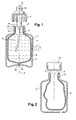
- Figure 1 shows a device 1 according to the invention.
- Device 1 comprises a substantially cylindrical bottle 2 of axis X.
- the bottle 2 is made of polyethylene.
- the bottle 2 has an opening 3 orthogonal to the X axis.
- bottle 2 is surmounted by a distribution means 4 of a product P contained in an inner bag 5 disposed inside the bottle 2.
- the inner pocket 5 is flexible wall and deformable. It has a first inner layer 6 in contact with the product, and a second layer 7 which can possibly be brought into contact with the inner wall 8 of the bottle 2.
- the inner 6 and outer layers 7 are made in a same material, for example polyamide.
- the two layers 6 and 7 are perfectly contiguous and apart from their formation in two layers, the existence of a joint plane between these two layers remains invisible to the naked eye because they are each performed simultaneously, in the same material and in the absence of a binder interposed between these layers.
- the plane of seal is visible in a cross-sectional view of the wall of the pocket.
- a joint plane can also be detected by means of a microscope during an analysis of a transverse sectional plane of the wall.
- the pocket 5 can be made by joining together a plurality of layers of the same material.
- the pocket 5 may comprise three layers, two of them being made of an identical material so that a layer intermediate between these two identical layers is carried out in a physico-chemically compatible material and able to react directly with these two layers.
- the pocket 5 has two layers of polyamide 6.6 between which is disposed a layer of polyamide 11.
- the pocket 5 may comprise a first layer of low density polyethylene confined by direct physicochemical reaction to a layer of high polyethylene density itself contiguous by direct physicochemical reaction to a layer of polypropylene.
- the low-density polyethylene chosen could also be able to react physico-chemically directly with the polypropylene.
- the different layers are each physico-chemically compatible respectively in pairs with others layers.
- An opening 9 of the bag 5 is circumscribed in the opening 3 of the bottle 2.
- the pocket 5 has a border 10 falling over a periphery 11 of the opening 3.
- the bottle 2 preferably comprises a collar 12 defining in particular said opening 3.
- the neck 12 is threaded to retain the 4.
- the collar 12 is also threaded to receive a cap 13 able to ensure sealing shutter the opening 3 of the bottle 2 and the opening 9 of the bag 5.
- the distribution means 4 is a pump having an actuating surface 14 perpendicular to the X axis, a nozzle 15 of the pump orienting a jet of product along an orthogonal trajectory to the X axis.
- a pump is mounted without air intake on the device 1.
- the internal volume of the inner bag 5 decreases by a volume equal to that of the dispensed dose.
- the bottle 2 comprises an air intake port 16. Through this orifice 16, the outer periphery 17 of the inner pocket 5 is always subjected to atmospheric pressure, and the pocket internal 5 can thus be drained as and when by the pump 4 without air intake.
- the dispensing means 4 optionally comprises a dip tube T, in depending on the filling mode, whether or not the product P is empty in the pocket internal 5.
- the pump 4 is screwed, but it can alternately to be slammed, crimped or strengthened.
- the device 1 when the product P in pocket 5 must previously mixed with another composition before being distributed, then the device 1 is initially closed by the plug 13, and only after realization of said mixture, a dispensing means such as 4 is mounted on the neck 12.
- the pump delivered separately from device 1 is intended to be for example screwed around the neck 12, instead of the plug 13 obturator initially the bottle 2.
- the pocket 5 is closed at a level 18. At this level, the materials of the bottle 2 and the pocket 5 being incompatible, an opening is maintained, it can for example play the role of the air intake port 16.
Landscapes
- Engineering & Computer Science (AREA)
- Mechanical Engineering (AREA)
- Packages (AREA)
- Laminated Bodies (AREA)
- Supplying Of Containers To The Packaging Station (AREA)
- Containers Having Bodies Formed In One Piece (AREA)
- Basic Packing Technique (AREA)
- Containers And Packaging Bodies Having A Special Means To Remove Contents (AREA)
- Bag Frames (AREA)
- Investigating Or Analyzing Non-Biological Materials By The Use Of Chemical Means (AREA)
Abstract
Description
- un flacon, et
- une poche interne disposée à l'intérieur du flacon et apte à contenir ledit produit, la poche étant librement déformable à l'intérieur du flacon,
- i) soit au moins deux couches (6, 7) réalisées en un même matériau et accolées l'une à l'autre par réaction physico-chimique directe entre les matériaux desdites au moins deux couches ;
- ii) soit des première et seconde couches (6, 7), réalisées en au moins deux matériaux différents, physico-chimiquement compatibles entre eux, la première couche (6) étant au contact du produit, la seconde couche (7) définissant la paroi extérieure de la poche, les première et seconde couches étant accolées l'une à l'autre par réaction physico-chimique directe entre le matériau de la première couche et le matériau de la deuxième couche.
- un flacon, et
- une poche interne disposée à l'intérieur du flacon et apte à contenir ledit produit, la poche étant librement déformable à l'intérieur du flacon,
- un flacon, et
- une poche interne disposée à l'intérieur du flacon et apte à contenir ledit produit, la poche interne étant librement déformable à l'intérieur du flacon,
- Figure 1 : un dispositif selon l'invention dans un premier mode de réalisation;
- Figure 2 : un dispositif selon l'invention dans un deuxième mode de réalisation.
Claims (28)
- Dispositif (1) de conditionnement d'un produit (P), notamment d'un produit cosmétique, comportantcaractérisé en ce que la poche interne comporte :un flacon (2), etune poche interne (5) disposée à l'intérieur du flacon et apte à contenir ledit produit, la poche étant librement déformable à l'intérieur du flacon,i) soit au moins deux couches (6, 7) réalisées en un même matériau et accolées l'une à l'autre par réaction physico-chimique directe entre les matériaux desdites au moins deux couches;ii) soit des première et seconde couches (6, 7), réalisées en au moins deux matériaux différents, physico-chimiquement compatibles entre eux, la première couche (6) étant au contact du produit, la seconde couche (7) étant au contact d'un espace défini entre la poche et une paroi interne du flacon, les première et seconde couches étant accolées l'une à l'autre par réaction physico-chimique directe entre le matériau de la première couche et le matériau de la deuxième couche.
- Dispositif selon la revendication 1 caractérisé en ce que la poche interne ne comporte que des couches (6, 7) réalisées en un même matériau et directement accolées les unes aux autres.
- Dispositif selon la revendication 1 ou 2 caractérisé en ce que chacune des couches comporte chacune au moins 80% de leur masse représentée par un même composé ou plusieurs composés d'une même famille chimique, le ou les composé(s) choisi(s) pour la réalisation de ces au moins deux couches appartenant à la même famille chimique.
- Dispositif selon la revendication 3 caractérisé en ce que la famille chimique est choisie parmi l'une des familles chimiques suivantes : la famille des polyoléfines, la famille des polychlorure de vinyle et leurs dérivés, la famille des styréniques, la famille des polyoxyméthylènes, la famille des polyamides, la famille des polyesters saturés, la famille des polycarbonates, la famille des polymères sulfoniques, la famille des polyphénylène oxyde, la famille des cellulosiques, et la famille des polyuréthannes.
- Dispositif selon l'une des revendications 1 à 4 caractérisé en ce que les deux couches sont réalisées à partir d'un même composé, par exemple de la famille des polyamides, en particulier le polyamide 11.
- Dispositif selon l'une des revendications 1 à 4 caractérisé en ce qu'une première couche de la poche est réalisée à partir d'un composé de la famille des polyamides, par exemple le polyamide 6,6, et une deuxième couche de ladite poche est réalisée à partir d'un composé différent de cette même famille des polyamides, par exemple le polyamide 11.
- Dispositif selon l'une des revendications 1 à 6 caractérisé en ce que l'une des couches formant la poche interne comporte une charge, colorée ou non, de façon à colorer ou à rendre opaque ladite couche de la poche interne, de manière à former un moyen de détection de présence de la poche interne dans le flacon.
- Dispositif selon la revendication 7 caractérisé en ce qu'une couche intérieure (6) de la poche interne comporte ladite charge, colorée ou non,
- Dispositif selon l'une des revendications 1 à 8 caractérisé en ce que les couches de la poche interne sont coextrudées.
- Dispositif selon l'une des revendications 1 à 9 caractérisé en ce que la poche interne est obtenue par un procédé d'extrusion soufflage.
- Dispositif selon l'une des revendications 1 à 10 caractérisé en ce que la poche interne et le flacon sont coextrudés.
- Dispositif selon l'une des revendications 1 à 11 caractérisé en ce que le flacon est réalisé à partir d'un matériau ayant une faible adhérence avec une couche extérieure (7) de la poche interne, notamment lors du procédé d'extrusion soufflage, pour garantir la non-adhérence entre la couche extérieure de la poche interne et une paroi intérieure (8) du flacon.
- Dispositif selon l'une des revendications 1 à 12 caractérisé en ce que le flacon est réalisé à partir d'un composé choisi dans la famille des polyoléfines, et la poche est réalisée à partir d'un ou plusieurs composé(s) choisi(s) dans la famille des polyamides.
- Dispositif selon l'une des revendications 1 à 13 caractérisé en ce que la poche interne forme une paroi d'une épaisseur comprise entre 1/10ème et 3/10ème de millimètres.
- Dispositif selon l'une des revendications 1 à 14 caractérisé en ce qu'une ouverture (9) de la poche est circonscrite dans une ouverture (3) du flacon.
- Dispositif selon l'une des revendications 1 à 15 caractérisé en ce qu'il comporte un moyen de distribution (4) du produit contenu dans la poche, notamment du type des pompes sans reprise d'air.
- Dispositif selon l'une des revendications 1 à 15 caractérisé en ce qu'il comporte un bouchon (13) pour obturer une ouverture (9) de la poche.
- Dispositif selon l'une des revendications 1 à 17 caractérisé en ce que le produit contenu est un produit de soin de la peau et ou des cheveux.
- Poche souple (5) apte à contenir un produit, notamment d'un produit cosmétique, caractérisé en ce que la poche comporte :i) soit au moins deux couches (6, 7) réalisées en un même matériau et accolées l'une à l'autre par réaction physico-chimique directe entre les matériaux desdites au moins deux couches ;ii) soit des première et seconde couches (6, 7), réalisées en au moins deux matériaux différents, physico-chimiquement compatibles entre eux, la première couche (6) étant au contact du produit, la seconde couche (7) définissant la paroi extérieure de la poche, les première et seconde couches étant accolées l'une à l'autre par réaction physico-chimique directe entre le matériau de la première couche et le matériau de la deuxième couche.
- Dispositif selon la revendication 19 caractérisé en ce que la poche souple ne comporte que des couches (6, 7) réalisées en un même matériau et directement accolées les unes aux autres.
- Poche selon la revendication 19 caractérisée en ce qu'elle comporte au moins deux couches (6, 7) adjacentes, chacune des deux couches comportant chacune au moins 80% de leur masse représentée par un même composé ou plusieurs composés d'une même famille chimique, le ou les composé(s) choisi(s) pour la réalisation de ces au moins deux couches appartenant à la même famille chimique.
- Poche selon la revendication 21 caractérisée en ce que la famille chimique est choisie parmi l'une des familles chimiques de polymères thermoplastiques suivantes : la famille des polyoléfines, la famille des polychlorure de vinyle et leurs dérivés, la famille des styréniques, la famille des polyoxyméthylènes, la famille des polyamides, la famille des polyesters saturés, la famille des polycarbonates, la famille des polymères sulfoniques, la famille des polyphénylène oxyde, la famille des cellulosiques, et la famille des polyuréthannes.
- Poche selon l'une des revendications 19 à 22 caractérisée en ce que les deux couches sont réalisées à partir d'un même composé, par exemple de la famille des polyamides, en particulier le polyamide 11.
- Poche selon l'une des revendications 19 ou 23 caractérisée en ce qu'une première couche de la poche est réalisée à partir d'un composé de la famille des polyamides, par exemple le polyamide 6,6, et une deuxième couche de ladite poche est réalisée à partir d'un composé différent de cette même famille des polyamides, par exemple le polyamide 11.
- Poche selon l'une des revendications 19 à 24 caractérisée en ce que l'une des couches formant la poche interne comporte une charge, colorée ou non, de façon à colorer ou à rendre opaque ladite couche de la poche souple.
- Poche selon l'une des revendications 19 à 25 caractérisée en ce que la poche souple forme une paroi d'une épaisseur comprise entre 1/10ème et 3/10ème de millimètres.
- Poche selon l'une des revendications 19 à 26 caractérisée en ce qu'elle est obtenue par un procédé d'extrusion soufflage.
- Dispositif (1) de conditionnement d'un produit (P), notamment d'un produit cosmétique, comportantcaractérisé en ce que la poche interne comporte plusieurs couches réalisées dans des matériaux différents et physico-chimiquement compatibles entre eux tels que chacune des couches est apte à être accolée à n'importe quelle autre couche de la poche par réaction physico-chimique directe entre lesdits matériaux constituant respectivement chacune de ces couches.un flacon (2), etune poche interne (5) disposée à l'intérieur du flacon et apte à contenir ledit produit, la poche étant librement déformable à l'intérieur du flacon,
Applications Claiming Priority (2)
| Application Number | Priority Date | Filing Date | Title |
|---|---|---|---|
| FR0310325 | 2003-08-29 | ||
| FR0310325A FR2859188B1 (fr) | 2003-08-29 | 2003-08-29 | Poche et dispositif de conditionnement comportant une poche |
Publications (2)
| Publication Number | Publication Date |
|---|---|
| EP1510472A1 true EP1510472A1 (fr) | 2005-03-02 |
| EP1510472B1 EP1510472B1 (fr) | 2009-10-14 |
Family
ID=34089879
Family Applications (1)
| Application Number | Title | Priority Date | Filing Date |
|---|---|---|---|
| EP04292085A Expired - Lifetime EP1510472B1 (fr) | 2003-08-29 | 2004-08-24 | Poche et dispositif de conditionnement comportant une poche |
Country Status (6)
| Country | Link |
|---|---|
| US (1) | US20050067432A1 (fr) |
| EP (1) | EP1510472B1 (fr) |
| AT (1) | ATE445551T1 (fr) |
| DE (1) | DE602004023574D1 (fr) |
| ES (1) | ES2333121T3 (fr) |
| FR (1) | FR2859188B1 (fr) |
Cited By (3)
| Publication number | Priority date | Publication date | Assignee | Title |
|---|---|---|---|---|
| FR3066890A1 (fr) * | 2017-06-06 | 2018-12-07 | Albea Services | Utilisation d'un materiau dans des packagings cosmetiques et systeme de distribution d'un produit sous pression comprenant au moins une piece constituee de ou comprenant ledit materiau |
| WO2019057344A1 (fr) * | 2017-09-19 | 2019-03-28 | Inotech Kunststofftechnik Gmbh | Contenant distributeur |
| CN110897303A (zh) * | 2018-09-14 | 2020-03-24 | M&L实验室 | 含有化妆品的一次性可变形的胶囊 |
Families Citing this family (27)
| Publication number | Priority date | Publication date | Assignee | Title |
|---|---|---|---|---|
| FR2878835B1 (fr) * | 2004-12-02 | 2008-07-04 | Shiseido Internat France Soc P | Ensemble de distribution de produit fluide |
| US20070235472A1 (en) * | 2006-04-05 | 2007-10-11 | Mcfarland C J | Spray Bottle Bladder |
| US20110062185A1 (en) * | 2006-04-05 | 2011-03-17 | Mcfarland C Justin | Spray bottle assembly |
| FR2902083B1 (fr) * | 2006-06-13 | 2010-12-31 | Productions Realisations Plastiques | Recipient a double paroi et procede pour la realisation d'un tel recipient |
| ITMI20071936A1 (it) * | 2007-10-08 | 2008-01-07 | Lumson Spa | Metodo per la realizzazione di un dispositivo per contenere a tenuta d'aria e per erogare sostanze fluide e dispositivo cosi' ottenuto |
| GB0721983D0 (en) * | 2007-11-09 | 2007-12-19 | Reckitt Benckiser Nv | Device |
| US8123078B2 (en) * | 2008-04-28 | 2012-02-28 | Fres-Co System Usa, Inc. | Flexible packages for connection to a dispensing system and clamping devices for releasably connecting such packages to the inlet tube of a dispensing system and methods of dispensing flowable materials from flexible packages |
| US20100059545A1 (en) * | 2008-09-10 | 2010-03-11 | Novus Products Company, Llc | Liquid dispenser system |
| US9744680B2 (en) | 2008-10-17 | 2017-08-29 | The Gillette Company | Fluid dispensing hair removal device |
| ES2606562T3 (es) * | 2008-10-17 | 2017-03-24 | The Gillette Company Llc | Dispositivo de eliminación de pelo dispensador de fluido |
| SG177551A1 (en) | 2009-07-09 | 2012-02-28 | Advanced Tech Materials | Substantially rigid collapsible liner and flexible gusseted or non-gusseted liners and methods of manufacturing the same and methods for limiting choke-off in liners |
| IT1397891B1 (it) * | 2010-01-15 | 2013-02-04 | Lumson Spa | Contenitore decorato associabile a pompe airless e metodo per la sua realizzazione. |
| MX2012011838A (es) * | 2010-04-15 | 2012-11-09 | Guillette Company | Dispositivo dispensador de fluido para la eliminacion de pelo. |
| WO2012051093A2 (fr) * | 2010-10-11 | 2012-04-19 | Advanced Technology Materials, Inc. | Revêtement escamotable sensiblement rigide, récipient et/ou revêtement permettant de remplacer des bouteilles en verre, et revêtements flexibles améliorés |
| WO2012118527A1 (fr) | 2011-03-01 | 2012-09-07 | Advanced Technology Materials, Inc. | Enveloppe externe et garniture interne imbriquées moulées par soufflage et procédés de fabrication de celles-ci |
| NL2006908C2 (en) | 2011-06-08 | 2012-12-11 | Kinetic Inv S B V | Method to discharge a fluid from a container and container. |
| KR101258142B1 (ko) * | 2011-06-30 | 2013-04-25 | (주)연우 | 내용물의 리필이 가능한 지관용기 |
| KR101280934B1 (ko) * | 2011-11-01 | 2013-07-02 | 강성일 | 진공용기와 그 제조방법 |
| CN102763973A (zh) * | 2012-08-09 | 2012-11-07 | 昆山宏凌电子有限公司 | 一种香水瓶 |
| EP3366598B1 (fr) | 2013-11-27 | 2021-01-20 | Kyoraku Co., Ltd. | Récipient pouvant être délaminé |
| JP6531371B2 (ja) * | 2013-11-27 | 2019-06-19 | キョーラク株式会社 | 積層剥離容器 |
| WO2015178917A1 (fr) * | 2014-05-22 | 2015-11-26 | Colgate-Palmolive Company | Cartouche de recharge, système comprenant la cartouche de recharge et distributeur à pompe |
| US9950827B1 (en) * | 2014-11-03 | 2018-04-24 | Lawrence Michael Lau | Hydration container with self-adjusting drink and storage compartments |
| JP6973908B2 (ja) * | 2017-01-30 | 2021-12-01 | 株式会社吉野工業所 | 積層剥離容器 |
| JP6808584B2 (ja) * | 2017-06-30 | 2021-01-06 | 株式会社吉野工業所 | 吐出具付き容器 |
| USD839674S1 (en) | 2017-12-04 | 2019-02-05 | Charlene Lyu | Bottle |
| US20230150710A1 (en) * | 2020-04-06 | 2023-05-18 | Nissei Asb Machine Co., Ltd. | Peeling container and method for manufacturing peeling container |
Citations (4)
| Publication number | Priority date | Publication date | Assignee | Title |
|---|---|---|---|---|
| US4265949A (en) * | 1978-06-29 | 1981-05-05 | Mitsui Petrochemical Industries, Ltd. | Multilayer bag structure for packaging |
| US4686814A (en) * | 1985-06-03 | 1987-08-18 | Yanase Waitch K.K. | Bag for containing flowable foodstuff |
| DE4331270A1 (de) * | 1992-12-01 | 1994-06-09 | Daiwa Gravure Co | Flüssigkeitsspender-Gerät und Beutel zum Gebrauch mit dem Gerät |
| US5505338A (en) * | 1992-04-30 | 1996-04-09 | L'oreal | Product dispenser with deformable bag |
Family Cites Families (9)
| Publication number | Priority date | Publication date | Assignee | Title |
|---|---|---|---|---|
| DE2558780B2 (de) * | 1975-12-24 | 1978-11-09 | Kautex Werke Reinold Hagen Gmbh, 5300 Bonn-Holzlar | Vorrichtung zum Herstellen von Hohlkörpern aus thermoplastischem Kunststoff im Extrusions-Blasverfahren |
| JPS5512061A (en) * | 1978-07-12 | 1980-01-28 | Toyo Seikan Kaisha Ltd | Squeezing container |
| US4659408A (en) * | 1984-05-29 | 1987-04-21 | American Can Company | Multi-layer sheet structure, method of making same and containers made therefrom |
| US4842165A (en) * | 1987-08-28 | 1989-06-27 | The Procter & Gamble Company | Resilient squeeze bottle package for dispensing viscous products without belching |
| US5108007A (en) * | 1990-03-09 | 1992-04-28 | Allergan, Inc. | Valve controlled squeezable fluid dispenser |
| US5305920A (en) * | 1991-11-20 | 1994-04-26 | The Procter & Gamble Company | Bag-in-bottle package with reusable resilient squeeze bottle and disposable inner receptacle which inverts upon emptying without attachment near its midpoint to squeeze bottle |
| JP2999071B2 (ja) * | 1992-08-12 | 2000-01-17 | 麒麟麦酒株式会社 | バッグインボックス用袋体及びバッグインボックス |
| FR2765560B1 (fr) * | 1997-07-02 | 1999-08-13 | Oreal | Distributeur pour un produit liquide ou pateux comportant des moyens de pompage ameliores |
| JP2001130598A (ja) * | 1999-08-26 | 2001-05-15 | Daiwa Gravure Co Ltd | 収納袋 |
-
2003
- 2003-08-29 FR FR0310325A patent/FR2859188B1/fr not_active Expired - Fee Related
-
2004
- 2004-08-24 ES ES04292085T patent/ES2333121T3/es not_active Expired - Lifetime
- 2004-08-24 EP EP04292085A patent/EP1510472B1/fr not_active Expired - Lifetime
- 2004-08-24 DE DE602004023574T patent/DE602004023574D1/de not_active Expired - Lifetime
- 2004-08-24 AT AT04292085T patent/ATE445551T1/de not_active IP Right Cessation
- 2004-08-26 US US10/926,079 patent/US20050067432A1/en not_active Abandoned
Patent Citations (4)
| Publication number | Priority date | Publication date | Assignee | Title |
|---|---|---|---|---|
| US4265949A (en) * | 1978-06-29 | 1981-05-05 | Mitsui Petrochemical Industries, Ltd. | Multilayer bag structure for packaging |
| US4686814A (en) * | 1985-06-03 | 1987-08-18 | Yanase Waitch K.K. | Bag for containing flowable foodstuff |
| US5505338A (en) * | 1992-04-30 | 1996-04-09 | L'oreal | Product dispenser with deformable bag |
| DE4331270A1 (de) * | 1992-12-01 | 1994-06-09 | Daiwa Gravure Co | Flüssigkeitsspender-Gerät und Beutel zum Gebrauch mit dem Gerät |
Cited By (11)
| Publication number | Priority date | Publication date | Assignee | Title |
|---|---|---|---|---|
| FR3066890A1 (fr) * | 2017-06-06 | 2018-12-07 | Albea Services | Utilisation d'un materiau dans des packagings cosmetiques et systeme de distribution d'un produit sous pression comprenant au moins une piece constituee de ou comprenant ledit materiau |
| EP3412699A1 (fr) * | 2017-06-06 | 2018-12-12 | Albéa Services | Utilisation d'un matériau dans des packagings cosmétiques et système de distribution d'un produit sous pression comprenant au moins une pièce constituée de ou comprenant ledit matériau |
| EP3981821A1 (fr) * | 2017-06-06 | 2022-04-13 | Silgan Dispensing Systems le Treport | Utilisation d'un matériau dans des packagings cosmétiques et système de distribution d'un produit sous pression comprenant au moins une pièce constituée de ou comprenant ledit matériau |
| WO2019057344A1 (fr) * | 2017-09-19 | 2019-03-28 | Inotech Kunststofftechnik Gmbh | Contenant distributeur |
| CN110603206A (zh) * | 2017-09-19 | 2019-12-20 | 伊诺泰克塑料技术有限公司 | 分配器容器 |
| JP2020528850A (ja) * | 2017-09-19 | 2020-10-01 | イノテック クンストシュトフテヒニク ゲーエムベーハーInotech Kunststofftechnik Gmbh | ディスペンサ容器 |
| EP3609808B1 (fr) * | 2017-09-19 | 2021-06-30 | INOTECH Kunststofftechnik GmbH | Contenant distributeur |
| US11185878B2 (en) | 2017-09-19 | 2021-11-30 | Inotech Kunststofftechnik Gmbh | Dispenser container |
| CN110603206B (zh) * | 2017-09-19 | 2022-03-04 | 伊诺泰克塑料技术有限公司 | 分配器容器 |
| US11904331B2 (en) | 2017-09-19 | 2024-02-20 | Inotech Kunststofftechnik Gmbh | Dispenser container |
| CN110897303A (zh) * | 2018-09-14 | 2020-03-24 | M&L实验室 | 含有化妆品的一次性可变形的胶囊 |
Also Published As
| Publication number | Publication date |
|---|---|
| FR2859188B1 (fr) | 2007-06-15 |
| US20050067432A1 (en) | 2005-03-31 |
| EP1510472B1 (fr) | 2009-10-14 |
| FR2859188A1 (fr) | 2005-03-04 |
| ES2333121T3 (es) | 2010-02-17 |
| DE602004023574D1 (de) | 2009-11-26 |
| ATE445551T1 (de) | 2009-10-15 |
Similar Documents
| Publication | Publication Date | Title |
|---|---|---|
| EP1510472B1 (fr) | Poche et dispositif de conditionnement comportant une poche | |
| EP0427588B1 (fr) | Conditionnement pour l'administration de liquides stériles, notamment liquides pharmaceutiques, nutritifs ou énergétiques | |
| EP1467932B1 (fr) | DISPOSITIF A RECIPIENT RIGIDE ET POCHES MULTIPLES SOUPLES POUR LE CONDITIONNEMENT ET LA DISTRIBUTION DE FLUIDES. | |
| CA2553282C (fr) | Poche souple deformable et dispositif pour le conditionnement et la distribution de produits fluides | |
| EP3481737B1 (fr) | Poche souple 3d à emplir pour fluides biopharmaceutiques, et procédé pour réaliser une telle poche | |
| CA2507610C (fr) | Pompe doseuse a actionnement manuel | |
| FR2675123A1 (fr) | Tube de distribution, notamment de pate dentifrice. | |
| EP1513617B1 (fr) | Dispositif de distribution de plusieurs fluides comportant au moins deux poches souples et deux pompes. | |
| FR2488582A1 (fr) | Procede et dispositif de remplissage et de fermeture etanche de sacs en matiere plastique formant recipients de fluide et produit ainsi obtenu | |
| FR2539713A1 (fr) | Conditionnement souple a plusieurs compartiments | |
| WO2012052971A2 (fr) | Emballage flexible fabriqué par soudage et contenant une matière recyclée ou issue de ressources renouvelables | |
| WO2013160608A2 (fr) | Dispositif de conditionnement et de distribution de produits fluides à pompe manuelle. | |
| FR2944780A1 (fr) | Dispositif de conditionnement et de distribution du type flacon-poche. | |
| FR3076206A1 (fr) | Recipient pour produits medicaux et/ou pharmaceutiques avec interstice | |
| EP1232092B1 (fr) | Procede d'encapsulation d'une composition topique | |
| EP1707495A1 (fr) | Dispositif pour la mise en contact extemporanée de deux produits | |
| EP1638855B1 (fr) | Dispositif applicateur de produit liquide | |
| WO2009095554A2 (fr) | Recipient pour produit fluide | |
| FR2887530A1 (fr) | Ensemble de conditionnement et de distribution | |
| WO2003011713A1 (fr) | Dispositif a recipient rigide et poche cylindrique souple pour le conditionnement de fluides. | |
| FR3121625A1 (fr) | Flacon destiné à contenir un produit, notamment cosmétique | |
| FR2951919A1 (fr) | Dispositif de conditionnement d'un produit cosmetique, avec systeme de relargage de gaz | |
| CN111050590A (zh) | 固定带 | |
| WO2008056056A1 (fr) | Joints d'etancheite en materiau multicouche pour moyen de bouchage, typiquement pour une capsule de bouchage | |
| EP4302962A1 (fr) | Structure multicouche de tube plastique |
Legal Events
| Date | Code | Title | Description |
|---|---|---|---|
| PUAI | Public reference made under article 153(3) epc to a published international application that has entered the european phase |
Free format text: ORIGINAL CODE: 0009012 |
|
| AK | Designated contracting states |
Kind code of ref document: A1 Designated state(s): AT BE BG CH CY CZ DE DK EE ES FI FR GB GR HU IE IT LI LU MC NL PL PT RO SE SI SK TR |
|
| AX | Request for extension of the european patent |
Extension state: AL HR LT LV MK |
|
| 17P | Request for examination filed |
Effective date: 20050902 |
|
| AKX | Designation fees paid |
Designated state(s): AT BE BG CH CY CZ DE DK EE ES FI FR GB GR HU IE IT LI LU MC NL PL PT RO SE SI SK TR |
|
| 17Q | First examination report despatched |
Effective date: 20080508 |
|
| GRAP | Despatch of communication of intention to grant a patent |
Free format text: ORIGINAL CODE: EPIDOSNIGR1 |
|
| GRAS | Grant fee paid |
Free format text: ORIGINAL CODE: EPIDOSNIGR3 |
|
| GRAA | (expected) grant |
Free format text: ORIGINAL CODE: 0009210 |
|
| AK | Designated contracting states |
Kind code of ref document: B1 Designated state(s): AT BE BG CH CY CZ DE DK EE ES FI FR GB GR HU IE IT LI LU MC NL PL PT RO SE SI SK TR |
|
| REG | Reference to a national code |
Ref country code: GB Ref legal event code: FG4D Free format text: NOT ENGLISH |
|
| REG | Reference to a national code |
Ref country code: CH Ref legal event code: EP |
|
| REG | Reference to a national code |
Ref country code: IE Ref legal event code: FG4D |
|
| REF | Corresponds to: |
Ref document number: 602004023574 Country of ref document: DE Date of ref document: 20091126 Kind code of ref document: P |
|
| REG | Reference to a national code |
Ref country code: ES Ref legal event code: FG2A Ref document number: 2333121 Country of ref document: ES Kind code of ref document: T3 |
|
| NLV1 | Nl: lapsed or annulled due to failure to fulfill the requirements of art. 29p and 29m of the patents act | ||
| PG25 | Lapsed in a contracting state [announced via postgrant information from national office to epo] |
Ref country code: PT Free format text: LAPSE BECAUSE OF FAILURE TO SUBMIT A TRANSLATION OF THE DESCRIPTION OR TO PAY THE FEE WITHIN THE PRESCRIBED TIME-LIMIT Effective date: 20100215 Ref country code: SE Free format text: LAPSE BECAUSE OF FAILURE TO SUBMIT A TRANSLATION OF THE DESCRIPTION OR TO PAY THE FEE WITHIN THE PRESCRIBED TIME-LIMIT Effective date: 20091014 Ref country code: FI Free format text: LAPSE BECAUSE OF FAILURE TO SUBMIT A TRANSLATION OF THE DESCRIPTION OR TO PAY THE FEE WITHIN THE PRESCRIBED TIME-LIMIT Effective date: 20091014 |
|
| REG | Reference to a national code |
Ref country code: IE Ref legal event code: FD4D |
|
| PG25 | Lapsed in a contracting state [announced via postgrant information from national office to epo] |
Ref country code: PL Free format text: LAPSE BECAUSE OF FAILURE TO SUBMIT A TRANSLATION OF THE DESCRIPTION OR TO PAY THE FEE WITHIN THE PRESCRIBED TIME-LIMIT Effective date: 20091014 Ref country code: SI Free format text: LAPSE BECAUSE OF FAILURE TO SUBMIT A TRANSLATION OF THE DESCRIPTION OR TO PAY THE FEE WITHIN THE PRESCRIBED TIME-LIMIT Effective date: 20091014 |
|
| PG25 | Lapsed in a contracting state [announced via postgrant information from national office to epo] |
Ref country code: AT Free format text: LAPSE BECAUSE OF FAILURE TO SUBMIT A TRANSLATION OF THE DESCRIPTION OR TO PAY THE FEE WITHIN THE PRESCRIBED TIME-LIMIT Effective date: 20091014 |
|
| PG25 | Lapsed in a contracting state [announced via postgrant information from national office to epo] |
Ref country code: DK Free format text: LAPSE BECAUSE OF FAILURE TO SUBMIT A TRANSLATION OF THE DESCRIPTION OR TO PAY THE FEE WITHIN THE PRESCRIBED TIME-LIMIT Effective date: 20091014 Ref country code: BG Free format text: LAPSE BECAUSE OF FAILURE TO SUBMIT A TRANSLATION OF THE DESCRIPTION OR TO PAY THE FEE WITHIN THE PRESCRIBED TIME-LIMIT Effective date: 20100114 Ref country code: RO Free format text: LAPSE BECAUSE OF FAILURE TO SUBMIT A TRANSLATION OF THE DESCRIPTION OR TO PAY THE FEE WITHIN THE PRESCRIBED TIME-LIMIT Effective date: 20091014 Ref country code: IE Free format text: LAPSE BECAUSE OF FAILURE TO SUBMIT A TRANSLATION OF THE DESCRIPTION OR TO PAY THE FEE WITHIN THE PRESCRIBED TIME-LIMIT Effective date: 20091014 Ref country code: EE Free format text: LAPSE BECAUSE OF FAILURE TO SUBMIT A TRANSLATION OF THE DESCRIPTION OR TO PAY THE FEE WITHIN THE PRESCRIBED TIME-LIMIT Effective date: 20091014 |
|
| PLBE | No opposition filed within time limit |
Free format text: ORIGINAL CODE: 0009261 |
|
| STAA | Information on the status of an ep patent application or granted ep patent |
Free format text: STATUS: NO OPPOSITION FILED WITHIN TIME LIMIT |
|
| PG25 | Lapsed in a contracting state [announced via postgrant information from national office to epo] |
Ref country code: SK Free format text: LAPSE BECAUSE OF FAILURE TO SUBMIT A TRANSLATION OF THE DESCRIPTION OR TO PAY THE FEE WITHIN THE PRESCRIBED TIME-LIMIT Effective date: 20091014 Ref country code: CZ Free format text: LAPSE BECAUSE OF FAILURE TO SUBMIT A TRANSLATION OF THE DESCRIPTION OR TO PAY THE FEE WITHIN THE PRESCRIBED TIME-LIMIT Effective date: 20091014 |
|
| 26N | No opposition filed |
Effective date: 20100715 |
|
| PG25 | Lapsed in a contracting state [announced via postgrant information from national office to epo] |
Ref country code: GR Free format text: LAPSE BECAUSE OF FAILURE TO SUBMIT A TRANSLATION OF THE DESCRIPTION OR TO PAY THE FEE WITHIN THE PRESCRIBED TIME-LIMIT Effective date: 20100115 |
|
| PGFP | Annual fee paid to national office [announced via postgrant information from national office to epo] |
Ref country code: ES Payment date: 20100915 Year of fee payment: 7 |
|
| PGFP | Annual fee paid to national office [announced via postgrant information from national office to epo] |
Ref country code: DE Payment date: 20100818 Year of fee payment: 7 Ref country code: FR Payment date: 20100824 Year of fee payment: 7 Ref country code: IT Payment date: 20100820 Year of fee payment: 7 |
|
| PGFP | Annual fee paid to national office [announced via postgrant information from national office to epo] |
Ref country code: GB Payment date: 20100818 Year of fee payment: 7 |
|
| BERE | Be: lapsed |
Owner name: L'OREAL Effective date: 20100831 |
|
| PG25 | Lapsed in a contracting state [announced via postgrant information from national office to epo] |
Ref country code: MC Free format text: LAPSE BECAUSE OF NON-PAYMENT OF DUE FEES Effective date: 20100831 |
|
| REG | Reference to a national code |
Ref country code: CH Ref legal event code: PL |
|
| PG25 | Lapsed in a contracting state [announced via postgrant information from national office to epo] |
Ref country code: CH Free format text: LAPSE BECAUSE OF NON-PAYMENT OF DUE FEES Effective date: 20100831 Ref country code: LI Free format text: LAPSE BECAUSE OF NON-PAYMENT OF DUE FEES Effective date: 20100831 |
|
| PG25 | Lapsed in a contracting state [announced via postgrant information from national office to epo] |
Ref country code: BE Free format text: LAPSE BECAUSE OF NON-PAYMENT OF DUE FEES Effective date: 20100831 |
|
| GBPC | Gb: european patent ceased through non-payment of renewal fee |
Effective date: 20110824 |
|
| REG | Reference to a national code |
Ref country code: FR Ref legal event code: ST Effective date: 20120430 |
|
| PG25 | Lapsed in a contracting state [announced via postgrant information from national office to epo] |
Ref country code: IT Free format text: LAPSE BECAUSE OF NON-PAYMENT OF DUE FEES Effective date: 20110824 |
|
| REG | Reference to a national code |
Ref country code: DE Ref legal event code: R119 Ref document number: 602004023574 Country of ref document: DE Effective date: 20120301 |
|
| PG25 | Lapsed in a contracting state [announced via postgrant information from national office to epo] |
Ref country code: FR Free format text: LAPSE BECAUSE OF NON-PAYMENT OF DUE FEES Effective date: 20110831 Ref country code: GB Free format text: LAPSE BECAUSE OF NON-PAYMENT OF DUE FEES Effective date: 20110824 Ref country code: CY Free format text: LAPSE BECAUSE OF FAILURE TO SUBMIT A TRANSLATION OF THE DESCRIPTION OR TO PAY THE FEE WITHIN THE PRESCRIBED TIME-LIMIT Effective date: 20091014 |
|
| PG25 | Lapsed in a contracting state [announced via postgrant information from national office to epo] |
Ref country code: HU Free format text: LAPSE BECAUSE OF FAILURE TO SUBMIT A TRANSLATION OF THE DESCRIPTION OR TO PAY THE FEE WITHIN THE PRESCRIBED TIME-LIMIT Effective date: 20100415 Ref country code: LU Free format text: LAPSE BECAUSE OF NON-PAYMENT OF DUE FEES Effective date: 20100824 Ref country code: NL Free format text: LAPSE BECAUSE OF FAILURE TO SUBMIT A TRANSLATION OF THE DESCRIPTION OR TO PAY THE FEE WITHIN THE PRESCRIBED TIME-LIMIT Effective date: 20091014 |
|
| PG25 | Lapsed in a contracting state [announced via postgrant information from national office to epo] |
Ref country code: TR Free format text: LAPSE BECAUSE OF FAILURE TO SUBMIT A TRANSLATION OF THE DESCRIPTION OR TO PAY THE FEE WITHIN THE PRESCRIBED TIME-LIMIT Effective date: 20091014 |
|
| PG25 | Lapsed in a contracting state [announced via postgrant information from national office to epo] |
Ref country code: DE Free format text: LAPSE BECAUSE OF NON-PAYMENT OF DUE FEES Effective date: 20120301 |
|
| REG | Reference to a national code |
Ref country code: ES Ref legal event code: FD2A Effective date: 20131029 |
|
| PG25 | Lapsed in a contracting state [announced via postgrant information from national office to epo] |
Ref country code: ES Free format text: LAPSE BECAUSE OF NON-PAYMENT OF DUE FEES Effective date: 20110825 |