EP1495035B1 - Verfahren zur herstellung von bis(perfluoralkyl)phosphinsäuren und deren salze - Google Patents
Verfahren zur herstellung von bis(perfluoralkyl)phosphinsäuren und deren salze Download PDFInfo
- Publication number
- EP1495035B1 EP1495035B1 EP03712030A EP03712030A EP1495035B1 EP 1495035 B1 EP1495035 B1 EP 1495035B1 EP 03712030 A EP03712030 A EP 03712030A EP 03712030 A EP03712030 A EP 03712030A EP 1495035 B1 EP1495035 B1 EP 1495035B1
- Authority
- EP
- European Patent Office
- Prior art keywords
- bis
- perfluoroalkyl
- phosphorane
- salts
- difluorotris
- Prior art date
- Legal status (The legal status is an assumption and is not a legal conclusion. Google has not performed a legal analysis and makes no representation as to the accuracy of the status listed.)
- Expired - Lifetime
Links
Classifications
-
- C—CHEMISTRY; METALLURGY
- C07—ORGANIC CHEMISTRY
- C07F—ACYCLIC, CARBOCYCLIC OR HETEROCYCLIC COMPOUNDS CONTAINING ELEMENTS OTHER THAN CARBON, HYDROGEN, HALOGEN, OXYGEN, NITROGEN, SULFUR, SELENIUM OR TELLURIUM
- C07F9/00—Compounds containing elements of Groups 5 or 15 of the Periodic Table
- C07F9/02—Phosphorus compounds
- C07F9/28—Phosphorus compounds with one or more P—C bonds
- C07F9/30—Phosphinic acids [R2P(=O)(OH)]; Thiophosphinic acids ; [R2P(=X1)(X2H) (X1, X2 are each independently O, S or Se)]
-
- B—PERFORMING OPERATIONS; TRANSPORTING
- B01—PHYSICAL OR CHEMICAL PROCESSES OR APPARATUS IN GENERAL
- B01J—CHEMICAL OR PHYSICAL PROCESSES, e.g. CATALYSIS OR COLLOID CHEMISTRY; THEIR RELEVANT APPARATUS
- B01J31/00—Catalysts comprising hydrides, coordination complexes or organic compounds
- B01J31/02—Catalysts comprising hydrides, coordination complexes or organic compounds containing organic compounds or metal hydrides
- B01J31/0231—Halogen-containing compounds
-
- B—PERFORMING OPERATIONS; TRANSPORTING
- B01—PHYSICAL OR CHEMICAL PROCESSES OR APPARATUS IN GENERAL
- B01J—CHEMICAL OR PHYSICAL PROCESSES, e.g. CATALYSIS OR COLLOID CHEMISTRY; THEIR RELEVANT APPARATUS
- B01J31/00—Catalysts comprising hydrides, coordination complexes or organic compounds
- B01J31/02—Catalysts comprising hydrides, coordination complexes or organic compounds containing organic compounds or metal hydrides
- B01J31/0277—Catalysts comprising hydrides, coordination complexes or organic compounds containing organic compounds or metal hydrides comprising ionic liquids, as components in catalyst systems or catalysts per se, the ionic liquid compounds being used in the molten state at the respective reaction temperature
- B01J31/0278—Catalysts comprising hydrides, coordination complexes or organic compounds containing organic compounds or metal hydrides comprising ionic liquids, as components in catalyst systems or catalysts per se, the ionic liquid compounds being used in the molten state at the respective reaction temperature containing nitrogen as cationic centre
- B01J31/0281—Catalysts comprising hydrides, coordination complexes or organic compounds containing organic compounds or metal hydrides comprising ionic liquids, as components in catalyst systems or catalysts per se, the ionic liquid compounds being used in the molten state at the respective reaction temperature containing nitrogen as cationic centre the nitrogen being a ring member
- B01J31/0284—Catalysts comprising hydrides, coordination complexes or organic compounds containing organic compounds or metal hydrides comprising ionic liquids, as components in catalyst systems or catalysts per se, the ionic liquid compounds being used in the molten state at the respective reaction temperature containing nitrogen as cationic centre the nitrogen being a ring member of an aromatic ring, e.g. pyridinium
-
- B—PERFORMING OPERATIONS; TRANSPORTING
- B01—PHYSICAL OR CHEMICAL PROCESSES OR APPARATUS IN GENERAL
- B01J—CHEMICAL OR PHYSICAL PROCESSES, e.g. CATALYSIS OR COLLOID CHEMISTRY; THEIR RELEVANT APPARATUS
- B01J31/00—Catalysts comprising hydrides, coordination complexes or organic compounds
- B01J31/02—Catalysts comprising hydrides, coordination complexes or organic compounds containing organic compounds or metal hydrides
- B01J31/0277—Catalysts comprising hydrides, coordination complexes or organic compounds containing organic compounds or metal hydrides comprising ionic liquids, as components in catalyst systems or catalysts per se, the ionic liquid compounds being used in the molten state at the respective reaction temperature
- B01J31/0287—Catalysts comprising hydrides, coordination complexes or organic compounds containing organic compounds or metal hydrides comprising ionic liquids, as components in catalyst systems or catalysts per se, the ionic liquid compounds being used in the molten state at the respective reaction temperature containing atoms other than nitrogen as cationic centre
- B01J31/0288—Phosphorus
-
- B—PERFORMING OPERATIONS; TRANSPORTING
- B01—PHYSICAL OR CHEMICAL PROCESSES OR APPARATUS IN GENERAL
- B01J—CHEMICAL OR PHYSICAL PROCESSES, e.g. CATALYSIS OR COLLOID CHEMISTRY; THEIR RELEVANT APPARATUS
- B01J31/00—Catalysts comprising hydrides, coordination complexes or organic compounds
- B01J31/02—Catalysts comprising hydrides, coordination complexes or organic compounds containing organic compounds or metal hydrides
- B01J31/0277—Catalysts comprising hydrides, coordination complexes or organic compounds containing organic compounds or metal hydrides comprising ionic liquids, as components in catalyst systems or catalysts per se, the ionic liquid compounds being used in the molten state at the respective reaction temperature
- B01J31/0287—Catalysts comprising hydrides, coordination complexes or organic compounds containing organic compounds or metal hydrides comprising ionic liquids, as components in catalyst systems or catalysts per se, the ionic liquid compounds being used in the molten state at the respective reaction temperature containing atoms other than nitrogen as cationic centre
- B01J31/0289—Sulfur
-
- B—PERFORMING OPERATIONS; TRANSPORTING
- B01—PHYSICAL OR CHEMICAL PROCESSES OR APPARATUS IN GENERAL
- B01J—CHEMICAL OR PHYSICAL PROCESSES, e.g. CATALYSIS OR COLLOID CHEMISTRY; THEIR RELEVANT APPARATUS
- B01J31/00—Catalysts comprising hydrides, coordination complexes or organic compounds
- B01J31/02—Catalysts comprising hydrides, coordination complexes or organic compounds containing organic compounds or metal hydrides
- B01J31/0277—Catalysts comprising hydrides, coordination complexes or organic compounds containing organic compounds or metal hydrides comprising ionic liquids, as components in catalyst systems or catalysts per se, the ionic liquid compounds being used in the molten state at the respective reaction temperature
- B01J31/0287—Catalysts comprising hydrides, coordination complexes or organic compounds containing organic compounds or metal hydrides comprising ionic liquids, as components in catalyst systems or catalysts per se, the ionic liquid compounds being used in the molten state at the respective reaction temperature containing atoms other than nitrogen as cationic centre
- B01J31/0291—Catalysts comprising hydrides, coordination complexes or organic compounds containing organic compounds or metal hydrides comprising ionic liquids, as components in catalyst systems or catalysts per se, the ionic liquid compounds being used in the molten state at the respective reaction temperature containing atoms other than nitrogen as cationic centre also containing elements or functional groups covered by B01J31/0201 - B01J31/0274
-
- C—CHEMISTRY; METALLURGY
- C07—ORGANIC CHEMISTRY
- C07C—ACYCLIC OR CARBOCYCLIC COMPOUNDS
- C07C211/00—Compounds containing amino groups bound to a carbon skeleton
- C07C211/62—Quaternary ammonium compounds
- C07C211/63—Quaternary ammonium compounds having quaternised nitrogen atoms bound to acyclic carbon atoms
-
- C—CHEMISTRY; METALLURGY
- C07—ORGANIC CHEMISTRY
- C07D—HETEROCYCLIC COMPOUNDS
- C07D231/00—Heterocyclic compounds containing 1,2-diazole or hydrogenated 1,2-diazole rings
- C07D231/02—Heterocyclic compounds containing 1,2-diazole or hydrogenated 1,2-diazole rings not condensed with other rings
- C07D231/10—Heterocyclic compounds containing 1,2-diazole or hydrogenated 1,2-diazole rings not condensed with other rings having two or three double bonds between ring members or between ring members and non-ring members
- C07D231/12—Heterocyclic compounds containing 1,2-diazole or hydrogenated 1,2-diazole rings not condensed with other rings having two or three double bonds between ring members or between ring members and non-ring members with only hydrogen atoms, hydrocarbon or substituted hydrocarbon radicals, directly attached to ring carbon atoms
-
- C—CHEMISTRY; METALLURGY
- C07—ORGANIC CHEMISTRY
- C07D—HETEROCYCLIC COMPOUNDS
- C07D233/00—Heterocyclic compounds containing 1,3-diazole or hydrogenated 1,3-diazole rings, not condensed with other rings
- C07D233/54—Heterocyclic compounds containing 1,3-diazole or hydrogenated 1,3-diazole rings, not condensed with other rings having two double bonds between ring members or between ring members and non-ring members
-
- C—CHEMISTRY; METALLURGY
- C07—ORGANIC CHEMISTRY
- C07D—HETEROCYCLIC COMPOUNDS
- C07D233/00—Heterocyclic compounds containing 1,3-diazole or hydrogenated 1,3-diazole rings, not condensed with other rings
- C07D233/54—Heterocyclic compounds containing 1,3-diazole or hydrogenated 1,3-diazole rings, not condensed with other rings having two double bonds between ring members or between ring members and non-ring members
- C07D233/56—Heterocyclic compounds containing 1,3-diazole or hydrogenated 1,3-diazole rings, not condensed with other rings having two double bonds between ring members or between ring members and non-ring members with only hydrogen atoms or radicals containing only hydrogen and carbon atoms, attached to ring carbon atoms
-
- C—CHEMISTRY; METALLURGY
- C07—ORGANIC CHEMISTRY
- C07D—HETEROCYCLIC COMPOUNDS
- C07D249/00—Heterocyclic compounds containing five-membered rings having three nitrogen atoms as the only ring hetero atoms
- C07D249/02—Heterocyclic compounds containing five-membered rings having three nitrogen atoms as the only ring hetero atoms not condensed with other rings
- C07D249/08—1,2,4-Triazoles; Hydrogenated 1,2,4-triazoles
-
- C—CHEMISTRY; METALLURGY
- C07—ORGANIC CHEMISTRY
- C07F—ACYCLIC, CARBOCYCLIC OR HETEROCYCLIC COMPOUNDS CONTAINING ELEMENTS OTHER THAN CARBON, HYDROGEN, HALOGEN, OXYGEN, NITROGEN, SULFUR, SELENIUM OR TELLURIUM
- C07F9/00—Compounds containing elements of Groups 5 or 15 of the Periodic Table
- C07F9/02—Phosphorus compounds
- C07F9/28—Phosphorus compounds with one or more P—C bonds
- C07F9/30—Phosphinic acids [R2P(=O)(OH)]; Thiophosphinic acids ; [R2P(=X1)(X2H) (X1, X2 are each independently O, S or Se)]
- C07F9/301—Acyclic saturated acids which can have further substituents on alkyl
-
- C—CHEMISTRY; METALLURGY
- C07—ORGANIC CHEMISTRY
- C07F—ACYCLIC, CARBOCYCLIC OR HETEROCYCLIC COMPOUNDS CONTAINING ELEMENTS OTHER THAN CARBON, HYDROGEN, HALOGEN, OXYGEN, NITROGEN, SULFUR, SELENIUM OR TELLURIUM
- C07F9/00—Compounds containing elements of Groups 5 or 15 of the Periodic Table
- C07F9/02—Phosphorus compounds
- C07F9/28—Phosphorus compounds with one or more P—C bonds
- C07F9/54—Quaternary phosphonium compounds
-
- C—CHEMISTRY; METALLURGY
- C07—ORGANIC CHEMISTRY
- C07F—ACYCLIC, CARBOCYCLIC OR HETEROCYCLIC COMPOUNDS CONTAINING ELEMENTS OTHER THAN CARBON, HYDROGEN, HALOGEN, OXYGEN, NITROGEN, SULFUR, SELENIUM OR TELLURIUM
- C07F9/00—Compounds containing elements of Groups 5 or 15 of the Periodic Table
- C07F9/02—Phosphorus compounds
- C07F9/28—Phosphorus compounds with one or more P—C bonds
- C07F9/54—Quaternary phosphonium compounds
- C07F9/5456—Arylalkanephosphonium compounds
-
- B—PERFORMING OPERATIONS; TRANSPORTING
- B01—PHYSICAL OR CHEMICAL PROCESSES OR APPARATUS IN GENERAL
- B01J—CHEMICAL OR PHYSICAL PROCESSES, e.g. CATALYSIS OR COLLOID CHEMISTRY; THEIR RELEVANT APPARATUS
- B01J2531/00—Additional information regarding catalytic systems classified in B01J31/00
- B01J2531/90—Catalytic systems characterized by the solvent or solvent system used
- B01J2531/98—Phase-transfer catalysis in a mixed solvent system containing at least 2 immiscible solvents or solvent phases
-
- C—CHEMISTRY; METALLURGY
- C09—DYES; PAINTS; POLISHES; NATURAL RESINS; ADHESIVES; COMPOSITIONS NOT OTHERWISE PROVIDED FOR; APPLICATIONS OF MATERIALS NOT OTHERWISE PROVIDED FOR
- C09K—MATERIALS FOR MISCELLANEOUS APPLICATIONS, NOT PROVIDED FOR ELSEWHERE
- C09K23/00—Use of substances as emulsifying, wetting, dispersing, or foam-producing agents
- C09K23/14—Derivatives of phosphoric acid
Definitions
- the present invention relates to a process for the preparation of bis (perfluoroalkyl) phosphinic acids comprising at least the reaction of at least one difluorotris (perfluoroalkyl) phosphorane or at least one trifluorobis (perfluoroalkyl) phosphorane with hydrogen fluoride in a suitable reaction medium and heating the resulting reaction mixture.
- the invention also relates to salts of bis (perfluoroalkyl) phosphinic acids and their uses.
- Bis (perfluoroalkyl) phosphinic acids have been known for a long time and are suitable for the preparation of various chemicals, such as, for example, corresponding methyl esters, which are powerful methylating reagents ( NV Pavlenko et al., Journal of General Chemistry of the USSR, 59, No. 3 (1989), pages 474-476 ).
- the bis (perfluoroalkyl) phosphinic acids and their corresponding salts are also used because of their surface-active action ( DE-OS 22 33 941 ; NN Kalibabchuk et al., Theoretical and Experimental Chemistry, 11, No. 6 (1975), pages 700-703 ; NN Kalibabchuk et al., Soviet Progress in Chemistry., 44, No. 1 (1978), pages 65-67 ) as well as in fuel cells ( T. Mahmood, Inorganic Chemistry, 25 (1986), pages 3128-3131 ).
- the lithium salt of bis (pentafluoroethyl) phosphinic acid is a promising candidate for use as conductive salt in lithium batteries (US Pat. F. Kita et al., Proc. Electrochem. Soc., 99-25, (2000), pages 480-484 ; Kita, F. et al., J. Power Sources, 90, No. 1 (2000), pages 27-32 ).
- the reaction of a difluorotris (perfluoroalkyl) phosphorane with hexamethyldisiloxane to give the corresponding phosphine oxide.
- the hydrolysis then follows to the corresponding bis (perfluoroalkyl) phosphinic acid.
- This process has the disadvantage that the temperature must be very precisely controlled and regulated during the hydrolysis and usually only very small amounts of the desired bis (perfluoroalkyl) phosphinic acid are obtained ( T. Mahmood, Inorganic Chemistry, 25 (1986), pages 3128-3131 ; USSR patent, 498.311 ; Pages 57-61; T. Mahmood et al., Inorganic Chemistry, 27 (1988), pages 2913-2916 ).
- Another method is the direct hydrolysis of difluorotris (perfluoroalkyl) phosphoranes to bis (perfluoroalkyl) phosphinic acids known ( Mahmoud et al, Inorganic Chemistry, 27 (1988), pages 2913-2916 ).
- a disadvantage of this method is that the hydrolysis due to the very poor miscibility of the phosphoranes with water, especially the phosphoranes with long alkyl chains, runs only very slowly and usually leads to very complex product mixtures.
- the object of the present invention was therefore to provide a process which enables the simple and inexpensive preparation of bis (perfluoroalkyl) phosphinic acids in good yields.
- the Bis (perfluoroalkyl) phosphinic acids are obtained in high purity.
- Another object was to provide salts of bis (perfluoroalkyl) phosphinic acids.
- difluorotris (perfluoroalkyl) phosphoranes and trifluorobis (perfluoroalkyl) phosphoranes can be carried out by customary methods known to the person skilled in the art.
- these compounds are prepared by electrochemical fluorination of suitable starting compounds, as described in V. Ya. Semenii et al., Journal of General Chemistry of the USSR, 55, No. 12 (1985), pages 2415-2417 ; Ignatiev, J. of Fluorine Chem., 103 (2000), pages 57-61 as well as the WO 00/21969 described.
- the corresponding descriptions are hereby incorporated by reference and are considered part of the disclosure.
- difluorotris (perfluoroalkyl) phosphorane compounds can be selected from the group consisting of difluorotris (pentafluoroethyl) phosphorane, difluorotris (n-nonafluorobutyl) phosphorane and difluorotris (n-heptafluoropropyl) phosphorane.
- trifluorobis (perfluoroalkyl) phosphorane compound trifluorobis (n-nonafluorobutyl) phosphorane can be used in the process according to the invention.
- the reaction of at least one difluorotris (perfluoroalkyl) phosphorane or at least one trifluorobis (perfluoroalkyl) phosphorane with hydrogen fluoride in a suitable reaction medium preferably takes place according to a process as described in US Pat WO 03/002579 is described. The corresponding description is hereby incorporated by reference and is considered part of the disclosure.
- the temperature for heating the reaction mixture obtained in process step a) in process step b) is preferably from room temperature to 150 ° C, more preferably from 100 ° C to 145 ° C and most preferably from 135 to 140 ° C.
- reaction mixture obtained according to process step a) according to process step b) for 1 to 150 hours, more preferably heated for 10 to 25 hours, and most preferably for 18 to 22 hours.
- reaction mixture may be added some of the same or a different reaction medium to the reaction mixture during the heating according to process step b).
- the reaction mixture obtained according to process step a) may preferably also be used in a closed, pressure-tight device, such as e.g. an autoclave at elevated temperature, preferably from 140 ° C to 200 ° C heated.
- a closed, pressure-tight device such as e.g. an autoclave at elevated temperature, preferably from 140 ° C to 200 ° C heated.
- reaction products In addition to the desired bis (perfluoroalkyl) phosphinic acids, hydrogen fluoride and in each case the corresponding monohydroperfluoroalkane are obtained after the reaction according to the process of the invention as further reaction products. If appropriate, these reaction products can be separated off by customary methods known to the person skilled in the art, optionally collected and optionally isolated, for example by condensation in suitable cold traps.
- Hydrogen fluoride and monohydroperfluoroalkanes themselves represent valuable chemical raw materials that can be put to meaningful use. Thus, it is possible, inter alia, to capture the hydrogen fluoride and to recycle it so that it is available for the reaction according to process step a). If necessary, the preparation of bis (perfluoroalkyl) phosphinic acids by the process according to the invention may be followed by purification and, if appropriate, isolation of these compounds by customary methods familiar to the person skilled in the art.
- the purification is carried out by distillation, preferably under reduced pressure at elevated temperatures.
- the isolation of the respective salts of bis (perfluoroalkyl) phosphinic acid can preferably be carried out by the neutralization of the bis (perfluoroalkyl) phosphinic acids.
- the preparation of the salts from the respective bis (perfluoroalkyl) phosphinic acid is carried out by reaction with at least one customary, known in the art base, preferably in solution.
- the bis (perfluoroalkyl) phosphinic acids are neutralized with bases, preferably selected from the group of hydroxides, oxides, hydrides, amides, carbonates, phosphines or amines.
- the resulting salt is treated in a manner known to those skilled in the art.
- the salt can be washed and then dried.
- these salts can be used as ionic liquids, phase transfer catalysts or surfactants.
- the process according to the invention for the preparation of bis (perfluoroalkyl) -phosphinic acids enables the simple, inexpensive and safe preparation of these compounds in very good yields.
- the bis (perfluoroalkyl) phosphinic acids are obtained without further complicated purification steps in high purity. By reaction with bases, salts can be obtained that were previously unavailable
- a further advantage is that the by-products obtained by the process according to the invention, namely hydrogen fluoride and monohydroperfluoroalkanes, themselves represent valuable raw materials that can be supplied to a meaningful use. As a result, the environmental impact is kept low during the implementation of the inventive method and reduces the cost of the inventive method.
- the bis (pentafluoroethyl) phosphinic acid was distilled under reduced pressure at 125 Pa. The boiling point was 63-64 ° C.
- the yield was 78.8%, based on the difluorotris (pentafluoroethyl) phosphorane used.
- the product thus obtained was characterized by 19 F-NMR spectroscopy. The corresponding signals were in accordance with the signals mentioned under Example 1a.
- the bis (n-nonafluorobutyl) phosphinic acid was distilled under reduced pressure at 125 Pa. The boiling point was 124 ° C. Upon cooling, the resulting bis (n-nonafluorobutyl) phosphinic acid solidifies to a solid having a melting point of 103-104 ° C.
- the reaction mixture became 15 Stirred at room temperature for hours and then heated at an oil bath temperature of 110 ° C for 35 hours at reflux (after 17 hours, an additional 0.6 g of water and after 25 hours another 1.2 g of water were added to the reaction mixture).
- water-HF solution was distilled off from the reaction mixture, whereby 6.34 g of nearly pure bis (n-nonafluorobutyl) phosphinic acid were obtained.
- the yield was 83.2%, based on the trifluorobis (n-nonafluorobutyl) phosphorane used.
- the product thus obtained was characterized by means of 19 F-NMR spectroscopy. The corresponding signals were in accordance with the signals mentioned under Example 2a.
- Bis (pentafluoroethyl) phosphinic acid was neutralized in 50 cm 3 of water with 7.48 g of a 20% strength by weight aqueous solution of tetraethylammonium hydroxide. Subsequently, the water was evaporated and the residue thus obtained under reduced pressure of 120 Pa at 70 ° C (bath temperature) dried. There were obtained 4.38 g of white solid of tetraethylammonium bis (pentafluoroethyl) phosphinate having a melting point of 100-102 ° C. The yield is almost quantitative, based on the bis (pentafluoroethyl) phosphinic acid used.
- Bis (pentafluoroethyl) phosphinic acid was neutralized in 20 cm 3 of water with 0.577 g of potassium carbonate. Subsequently, the water was evaporated and the residue thus obtained under reduced pressure at 120 Pa and a bath temperature of 100 ° C dried. There was obtained 2.83 g of white solid of potassium bis (pentafluoroethyl) phosphinate. The yield is almost quantitative, based on the bis (pentafluoroethyl) phosphinic acid used. The salt decomposed at a temperature of 203-205 ° C.
Landscapes
- Chemical & Material Sciences (AREA)
- Organic Chemistry (AREA)
- Engineering & Computer Science (AREA)
- Materials Engineering (AREA)
- Chemical Kinetics & Catalysis (AREA)
- Life Sciences & Earth Sciences (AREA)
- Health & Medical Sciences (AREA)
- Biochemistry (AREA)
- General Health & Medical Sciences (AREA)
- Molecular Biology (AREA)
- Organic Low-Molecular-Weight Compounds And Preparation Thereof (AREA)
- Fireproofing Substances (AREA)
- Catalysts (AREA)
- Pharmaceuticals Containing Other Organic And Inorganic Compounds (AREA)
- Saccharide Compounds (AREA)
Description
- Die vorliegende Erfindung betrifft ein Verfahren zur Herstellung von Bis(perfluoralkyl)phosphinsäuren umfassend zumindest die Umsetzung wenigstens eines Difluortris(perfluoralkyl)phosphorans oder wenigstens eines Trifluorbis(perfluoralkyl)phosphorans mit Fluorwasserstoff in einem geeigneten Reaktionsmedium und das Erhitzen des so erhaltenen Reaktionsgemisches. Die Erfindung betrifft auch Salze der Bis(perfluoralkyl)phosphinsäuren sowie deren Verwendungen.
- Bis(perfluoralkyl)phosphinsäuren sind seit langem bekannt und eignen sich zur Herstellung verschiedener Chemikalien, wie beispielsweise entsprechender Methylester, die starke Methylierungsreagenzien darstellen (N. V. Pavlenko et al., Journal of General Chemistry of the USSR, 59, Nr. 3 (1989), Seiten 474-476).
- Die Bis(perfluoralkyl)phosphinsäuren und ihre entsprechenden Salze finden ferner Verwendung aufgrund ihrer oberflächenaktiven Wirkung (
DE-OS 22 33 941 ; N.N. Kalibabchuk et al., Theoretical and Exprimental Chemistry, 11, Nr. 6 (1975), Seiten 700-703; N.N. Kalibabchuk et al., Soviet Progress in Chemistry., 44, Nr. 1 (1978), Seiten 65-67) sowie in Brennstoffzellen (T. Mahmood, Inorganic Chemistry, 25 (1986), Seiten 3128-3131). - Das Lithiumsalz der Bis(pentafluorethyl)phosphinsäure ist ein vielversprechender Kandidat für die Verwendung als Leitsalz in Lithiumbatterien (F. Kita et al., Proc. Electrochem. Soc., 99-25, (2000), Seiten 480-484; F. Kita et al., J. Power Sources, 90, Nr. 1 (2000), Seiten 27-32).
- Die Herstellung von Bis(trifluormethyl)phosphinsäure gelingt durch die Hydrolyse von schwer zugänglichem Bis(trifluormethyl)phosphortrichlorid
- (H. J. Emeleus et al., J. Chem. Soc. (1955), Seiten 563-574). Die höheren Homologen der Bis(trifluormethyl)phosphinsäure wurden aus den entsprechenden Difluortris(perfluoralkyl)phosphoranen gewonnen (V. Ya. Semenii et al., U.S.S.R.-Patent
498,311 - In der Literatur sind im wesentlichen zwei verschiedene Verfahren zur Herstellung von Bis(perfluoralkyl)phosphinsäuren bekannt.
- Gemäß dem ersten Verfahren erfolgt in einem ersten Schritt die Umsetzung eines Difluortris(perfluoralkyl)phosphorans mit Hexamethyldisiloxan zu dem entsprechenden Phosphinoxid. In einem zweiten Schritt folgt dann die Hydrolyse zu der entsprechenden Bis(perfluoralkyl)phosphinsäure. Dieses Verfahren weist den Nachteil auf, daß die Temperatur während der Hydrolyse sehr exakt kontrolliert und geregelt werden muß und üblicherweise nur geringste Mengen der gewünschten Bis(perfluoralkyl)phosphinsäure erhalten werden (T. Mahmood, Inorganic Chemistry, 25 (1986), Seiten 3128-3131; U.S.S.R.-Patent,
498,311 - Als weiteres Verfahren ist die direkte Hydrolyse von Difluortris(perfluoralkyl)phosphoranen zu Bis(perfluoralkyl)phosphinsäuren bekannt (T. Mahmood et al, Inorganic Chemistry, 27 (1988), Seiten 2913-2916). Nachteilig ist bei diesem Verfahren, daß die Hydrolyse aufgrund der sehr schlechten Mischbarkeit der Phosphorane mit Wasser, insbesondere der Phosphorane mit langen Alkylketten, nur sehr langsam abläuft und üblicherweise zu sehr komplexen Produktgemischen führt.
- Die Aufgabe der vorliegenden Erfindung bestand daher darin, ein Verfahren zur Verfügung zu stellen, welches die einfache und kostengünstige Herstellung von Bis(perfluoralkyl)phosphinsäuren in guten Ausbeuten ermöglicht. Vorzugsweise sollen die Bis(perfluoralkyl)phosphinsäuren in hoher Reinheit erhalten werden. Eine weitere Aufgabe bestand in der Bereitstellung von Salzen der Bis(perfluoralkyl)phosphinsäuren.
- Diese Aufgabe wurde durch das erfindungsgemäße Verfahren zur Herstellung von Bis(perfluoralkyl)phosphinsäuren gelöst, welches zumindest die folgenden Verfahrensschritte umfaßt:
- a) Umsetzung wenigstens eines Difluortris(perfluoralkyl)phosphorans oder wenigstens eines Trifluorbis(perfluoralkyl)phosphorans mit Fluorwasserstoff in einem geeigneten Reaktionsmedium, und
- b) Erhitzen des gemäß a) erhaltenen Reaktionsgemisches.
- Die Herstellung der Difluortris(perfluoralkyl)phosphorane und Trifluorbis(perfluoralkyl)phosphorane kann nach üblichen, dem Fachmann bekannten Methoden erfolgen.
Vorzugsweise werden diese Verbindungen durch elektrochemische Fluorierung geeigneter Ausgangsverbindungen, hergestellt, wie in V. Ya. Semenii et al., Journal of General Chemistry of the USSR, 55, Nr. 12 (1985), Seiten 2415-2417; N. Ignatiev, J. of Fluorine Chem., 103 (2000), Seiten 57-61 sowie derWO 00/21969 - Es können auch Mischungen aus zwei oder mehr Difluortris(perfluoralkyl)phosphoranen und/oder zwei oder mehr Trifluorbis(perfluoralkyl)phosphoranen in dem erfindungsgemäßen Verfahren zum Einsatz kommen. Vorzugsweise kommt jeweils nur ein Difluortris(perfluoralkyl)phosphoran oder ein Trifluorbis(perfluoralkyl)phosphoran in dem erfindungsgemäßen Verfahren zum Einsatz.
- In einer bevorzugten Ausführungsform des erfindungsgemäßen Verfahrens kommt wenigstens ein Difluortris(perfluoralkyl)phosphoran oder wenigstens ein Trifluorbis(perfluoralkyl)phosphoran der allgemeinen Formel I

- Besonders bevorzugte Difluortris(perfluoralkyl)phosphoranverbindungen können ausgewählt werden aus der Gruppe bestehend aus Difluortris(pentafluorethyl)phosphoran, Difluortris(n-nonafluorbutyl)phosphoran und Difluortris(n-heptafluorpropyl)phosphoran.
- Als besonders bevorzugte Trifluorbis(perfluoralkyl)phosphoranverbindung kann Trifluorbis(n-nonafluorbutyl)phosphoran in dem erfindungsgemäßen Verfahren zum Einsatz kommen.
Die Umsetzung wenigstens eines Difluortris(perfluoralkyl)phosphorans oder wenigstens eines Trifluorbis(perfluoralkyl)phosphorans mit Fluorwasserstoff in einem geeigneten Reaktionsmedium erfolgt bevorzugt gemäß einem Verfahren, wie es in derWO 03/002579 - Die Temperatur für das Erhitzen des gemäß Verfahrensschritt a) erhaltenen Reaktionsgemisches im Verfahrensschritt b) beträgt bevorzugt Raumtemperatur bis 150 °C, besonders bevorzugt 100 °C bis 145 °C und ganz besonders bevorzugt 135 bis 140 °C.
- Vorzugsweise wird das nach Verfahrensschritt a) erhaltene Reaktionsgemisch gemäß Verfahrensschritt b) für 1 bis 150 Stunden, besonders bevorzugt für 10 bis 25 Stunden und ganz besonders bevorzugt für 18 bis 22 Stunden erhitzt.
- Gegebenenfalls kann es vorteilhaft sein während des Erhitzens gemäß Verfahrensschritt b) erneut etwas von dem gleichen oder einem anderen Reaktionsmedium zu der Reaktionsmischung zu geben.
- Um die Hydrolyse zu beschleunigen, kann man das gemäß Verfahrensschritt a) erhaltene Reaktionsgemisch bevorzugt auch in einer geschlossenen, druckdichten Vorrichtung, wie z.B. einem Autoklaven bei erhöhter Temperatur, vorzugsweise von 140 °C bis 200 °C erhitzen.
- Neben den gewünschten Bis(perfluoralkyl)phosphinsäuren werden nach der Umsetzung gemäß dem erfindungsgemäßen Verfahren als weitere Reaktionsprodukte Fluorwasserstoff und jeweils das entsprechende Monohydroperfluoralkan erhalten.
Diese Reaktionsprodukte können nach üblichen, dem Fachmann geläufigen Verfahren ggf. abgetrennt, ggf. aufgefangen und ggf. isoliert werden, beispielsweise durch Kondensation in geeigneten Kühlfallen. - Fluorwasserstoff und Monohydroperfluoralkane stellen selbst wertvolle chemische Rohstoffe dar, die einer sinnvollen Nutzung zugeführt werden können. So ist es u.a. möglich, den Fluorwasserstoff aufzufangen und zu rezyklieren, so daß dieser für die Umsetzung gemäß Verfahrensschritt a) zur Verfügung steht.
Sofern erforderlich, kann sich an die Herstellung von Bis(perfluoralkyl)-phosphinsäuren nach dem erfindungsgemäßen Verfahren eine Reinigung und ggf. Isolierung dieser Verbindungen nach üblichen, dem Fachmann geläufigen Verfahren anschließen. - Vorzugsweise erfolgt die Reinigung durch Destillation, vorzugsweise unter vermindertem Druck bei erhöhten Temperaturen.
- Die Isolierung der jeweiligen Salze der Bis(perfluoralkyl)phosphinsäure kann bevorzugt durch die Neutralisation der Bis(perfluoralkyl)phosphinsäuren erfolgen.
- Die Darstellung der Salze aus der jeweiligen Bis(perfluoralkyl)phosphinsäure erfolgt durch Umsetzung mit wenigstens einer üblichen, dem Fachmann bekannten Base, vorzugsweise in Lösung.
- Zur Darstellung der Salze werden die Bis(perfluoralkyl)phosphinsäuren mit Basen, vorzugsweise ausgewählt aus der Gruppe der Hydroxide, Oxide, Hydride, Amide, Carbonate, Phosphine oder Amine, neutralisiert.
- Nach der Neutralisation wird das anfallende Salz, in dem Fachmann bekannter Weise, aufbereitet. Das Salz kann gewaschen und anschließend getrocknet werden.
- Gegenstand der Anmeldung sind auch Salze der Bis(perfluoralkyl)phosphinsäuren, ausgewählt aus der Gruppe der teil- und peralkylierten Ammonium-, Phosphonium-, Sulfonium-, Pyridinium-, Pyridazinium-, Pyrimidinium-, Pyrazinium-, Imidazolium-, Pyrazolium-, Thiazolium-, Oxazolium- und Triazollumsalze-salze außer Triethylmethylammoniumbis(heptafluorpropyl)phosphinat und außer N-Methyl-2-trifluormethylbenzthiazoliumbis(heptafluorpropyl) phosphinat, die aus JOURNAL OF GENERAL CHEMISTRY OF THE USSR, 1989, 59(3), 474-476 bekannt sind. Bevorzugt werden Salze der Bis(perfluoralkyl)phosphinsäuren mit einem Kation ausgewählt aus der Gruppe

- H,
- Halogen, wobei die Halogene nicht direkt mit N verbunden werden,
- Alkylrest (C1 bis C8) der teilweise oder vollständig durch weitere Gruppen, vorzugsweise F, Cl, N(CnF(2n+1-x)Hx)2, O(CnF(2n+1-x)Hx), SO2(CnF(2n+1-x)Hx), CnF(2n+1-x)Hx mit 1<n<6 und 0<x≤2n+1 substituiert sein kann, dargestellt.
- Überraschend wurde gefunden, daß diese Salze als ionische Flüssigkeiten, Phasen-Transfer-Katalysatoren oder Tenside verwendet werden können.
- Das erfindungsgemäße Verfahren zur Herstellung von Bis(perfluoralkyl)-phosphinsäuren ermöglicht die einfache, kostengünstige und sichere Herstellung dieser Verbindungen in sehr guten Ausbeuten. Üblicherweise werden die Bis(perfluoralkyl)phosphinsäuren ohne weitere aufwendige Reinigungsschritte in hoher Reinheit erhalten. Durch die Umsetzung mit Basen können Salze gewonnen werden, die bisher nicht verfügbar waren
- Vorteilhaft ist ferner, daß die gemäß dem erfindungsgemäßen Verfahren erhaltenen Nebenprodukte, nämlich Fluorwasserstoff und Monohydroperfluoralkane, selbst wertvolle Rohstoffe darstellen, die einer sinnvollen Nutzung zugeführt werden können. Hierdurch wird die Umweltbelastung bei der Umsetzung nach dem erfindungsgemäßen Verfahren gering gehalten und die Kosten für das erfindungsgemäße Verfahren reduziert.
- Im folgenden wird die Erfindung anhand von Beispielen erläutert. Diese Beispiele dienen lediglich der Erläuterung der Erfindung und schränken den allgemeinen Erfindungsgedanken nicht ein.
- Die NMR-Spektren wurden mit einem Bruker Avance 300 NMR Spektrometer bei folgenden Frequenzen aufgenommen:
- 300,1 MHz 1H
- 282,4 MHz für 19F und
- 121,5 MHz für 31P.
- Zu 2,93 g 40 % Gew.-iger Flusssäure (entsprechend 58,6 mmol HF) in einem FEP-(Fluorethylen-Polymer)-Kolben wurden 3,53 g Wasser gegeben (entsprechend einer Gesamtmenge an Wasser in der Mischung von 294 mmol). Die so erhaltene Mischung wurde dann mit einem Eisbad gekühlt. Anschließend wurden unter Rühren mit einem Magnetrührer 25,03 g (58,7 mmol) Difluortris(pentafluorethyl)phosphoran, (C2F5)3PF2, innerhalb von 3 Minuten zugegeben. Innerhalb von weiteren drei Minuten ging das Difluortris(pentafluorethyl)phosphoran vollständig in Lösung und es wurde eine farblose, klare Lösung von H+[(C2F5)3PF3]- in Wasser erhalten.
- Die so erhaltene Lösung wurde weitere 15 Minuten bei Raumtemperatur gerührt und anschließend bei einer Ölbadtemperatur von 135 bis 140 °C für 14 Stunden am Rückfluß erhitzt. Anschließend wurden weitere 4,83 g Wasser zu der Lösung gegeben und weitere 6 Stunden bei derselben Temperatur am Rückfluß erhitzt. Nach dem Abkühlen auf Raumtemperatur wurden 24,81 g einer klaren Lösung erhalten.
- In einer zwischengeschalteten Falle, die mit Trockeneis gekühlt wurde, wurden 3,95 g einer zweiphasigen Flüssigkeit aufgefangen. Diese Flüssigkeit enthielt 2,11 g C2F5H, 1,5 g HF und 0,34 g der Ausgangsverbindung Difluortris(penta-fluorethyl)phosphoran.
- Zur Isolierung der Bis(pentafluorethyl)phosphinsäure wurde wäßrige Fluorwasserstoff-Lösung aus dem Reaktionsgemisch abdestilliert, dabei wurden 15,13 g von nahezu reiner Bis(pentafluorethyl)phosphinsäure gewonnen. Die Ausbeute betrug 86,5 %, bezogen auf das eingesetzte Difluortris(pentafluorethyl)phosphoran.
- Zur weiteren Reinigung wurde die Bis(pentafluorethyl)phosphinsäure unter vermindertem Druck bei 125 Pa destilliert. Der Siedepunkt betrug 63-64 °C.
- Die so erhaltene Bis(pentafluorethyl)phosphinsäure wurde mittels 19F-, 31P- und 1H-NMR-Spektroskopie sowie durch Elementaranalyse charakterisiert:
- 19F-NMR-Spektrum; δ, ppm:
- (Lösungsmittel Aceton-D6, Referenz CCI3F)
- -80,55 s (CF3); -125,37 d (CF2); J2 P,F = 78,2 Hz
- 1H-NMR-Spektrum; δ, ppm:
- (Lösungsmittel Aceton-D6 Referenz TMS)
- 12,71 br. s (OH)
- 31P-NMR-Spektrum; δ, ppm:
- (Lösungsmittel Aceton-D6, Referenz 85 Gew.-%ige H3PO4)
- -0,03 quin; J2 P,F = 78,3 Hz
- Die Werte der gefundenen chemischen Verschiebungen entsprechen den aus der Veröffentlichung von T. Mahmood, Inorganic Chemistry, 25 (1986), Seiten 3128-3131 bekannten Werten.
- Elementaranalyse:
- Gefunden: C 15,76 %; H 0,40 %
- Berechnet für ((C2F5)2P(O)OH): C 15,91 %; H 0,33 %
- Zu 0,834 g einer 40-Gew.%-igen, wässrigen Fluorwasserstoff-Säure (entsprechend 16,7 mmol HF) in einem FEP-Kolben wurden 2,50 g Wasser gegeben (entsprechend einer Gesamtmenge an Wasser in der Mischung von 166,5 mmol). Die so erhaltene Mischung wurde dann mit einem Eisbad gekühlt. Abschließend wurden unter Rühren mit einem Magnetrührer 7,11 g (16,7 mmol) Difluortris(pentafluorethyl)phosphoran, (C2F5)3PF2, innerhalb von drei Minuten zugegeben. Innerhalb von weiteren drei Minuten ging das Difluortris(pentafluorethyl)phosphoran vollständig in Lösung und es wurde eine farblose, klare Lösung von H+[(C2F5)3PF3]- in Wasser erhalten. Die Reaktionsmischung wurde bei einer Ölbadtemperatur von 115 °C - 120 °C für 108 Stunden am Rückfluß erhitzt. Zur Isolierung der Bis(pentafluorethyl)phosphinsäure wurden Wasser-HF Lösung aus der Reaktionsmischung abdestilliert, wobei 3,97 g von nahezu reiner Bis(pentafluorethyl)phosphinsäure, (C2F5)2P(O)OH, gewonnen wurden. Die Ausbeute betrug 78,8 %, bezogen auf das eingesetzte Difluortris(pentafluorethyl)phosphoran. Das so erhaltene Produkt wurde mittels 19F-NMR-Spektroskopie charakterisiert. Die entsprechenden Signale stimmten mit den unter Beispiel 1a genannten Signalen überein.
- 2,59 g (56,2 mmol) Ethanol wurden in einem FEP-Gefäß mit einem Eisbad gekühlt. Unter Rühren mit einem Magnetrührer wurden zuerst 0,49 g (24,5 mmol) Fluorwasserstoff (HF) langsam zu dem Ethanol gegeben und innerhalb von drei weiteren Minuten 9,59 g (22,5 mmol) Difluortris(pentafluorethyl)phosphoran, (C2F5)3PF2, zur Reaktionsmischung hinzugefügt. Nach dem Auflösen des Phosphorans wurden 2,21 g (122,6 mmol) Wasser zu der Lösung gegeben und Reaktionsmischung wurden bei einer Ölbadtemperatur von 120 °C für 144 Stunden am Rückfluß erhitzt (nach dem 44 Stunden wurden 2,1 g Wasser und nach 94 Stunden noch einmal 2,0 g Wasser zu der Reaktionsmischung gegeben).
- Zur Isolierung der Bis(pentafluorethyl)phosphinsäure wurden Ethanol-Wasser-HF Lösing aus der Reaktionsmischung abbdestilliert, wobei 5.21 g von nahezu reiner Bis(pentafluorethyl)phosphinsäure, (C2F5)2P(O)OH, gewonnen wurden. Die Ausbeute betrug 76,6 %, bezogen auf das eingesetzte Difluortris(pentafluorethyl)phosphoran. Das so erhaltene Produkt wurde mittels 19F-NMR-Spektroskopie charakterisiert. Die entsprechenden Signale stimmten mit den unter Beispiel 1 a angegebenen Signalen überein.
- Zu 4,07 g einer 40-Gew.-%-igen Flusssäure (entsprechend 81,4 mol HF) in einem FEP-(Fluorethylen-Polymer)-Kolben wurden 4,25 g Wasser gegeben (entsprechend einer Gesamtmenge an Wasser in der Mischung von 371 mmol). Die so erhaltene Mischung wurde dann mit einem Eisbad gekühlt. Anschließend wurden unter Rühren mit einem Magnetrührer 51,42
- g (70,8 mmol) Difluortris(n-nonafluorbutyl)phosphoran, (n-C4F9)3PF2, innerhalb von 10 Minuten zugegeben.
- Die so erhaltene Lösung wurde weitere 20 Minuten bei Raumtemperatur gerührt und anschließend bei einer Ölbadtemperatur von 135 bis 140 °C für 11,5 Stunden am Rückfluß erhitzt. Anschließend wurden weitere 5,00 g Wasser zu der Lösung gegeben und weitere 8,5 Stunden bei derselben Temperatur am Rückfluß erhitzt. Nach dem Abkühlen auf Raumtemperatur wurden 46,47 g einer klaren Lösung erhalten.
In einer zwischengeschalteten Falle, die mit Trockeneis gekühlt wurde, wurden 15,03 g einer zweiphasigen Flüssigkeit aufgefangen. Diese Flüssigkeit enthielt 13,06 g n-C4F9H und 1,97 g HF (obere Phase). - Zur Isolierung der Bis(n-nonafluorbutyl)phosphinsäure wurde wäßrige Fluorwasserstoff-Lösung aus dem Reaktionsgemisch bei einer Ölbadtemperatur von 145 °C abdestilliert, und 34,62 g nahezu reiner Bis(n-nonafluorbutyl)phosphinsäure als Feststoff gewonnen. Die Ausbeute betrug 97,4 %, bezogen auf das eingesetzte Difluortris(n-nonafluorbutyl)phosphoran.
- Zur weiteren Reinigung wurde die Bis(n-nonafluorbutyl)phosphinsäure unter vermindertem Druck bei 125 Pa destilliert. Der Siedepunkt betrug 124 °C. Beim Abkühlen erstarrt die so erhaltene Bis(n-nonafluorbutyl)phosphinsäure zu einem Feststoff mit einem Schmelzpunkt von 103-104 °C.
- In der Literaturveröffentlichung von T. Mahmood, Inorganic Chemistry, 25 (1986), Seiten 3128-3131 wird die Bis(n-nonafluorbutyl)phosphinsäure als nichtflüchtige Flüssigkeit beschrieben, wobei es sich wahrscheinlich um eine hydratisierte Form dieser Verbindung handelt.
- Die Bis(n-nonafluorbutyl)phosphinsäure wurde mittels 19F-, 31P- und 1H-NMR-Spektroskopie sowie durch Elementaranalyse charakterisiert:
- 19F-NMR-Spektrum; δ, ppm:
- (Lösungsmittel Aceton-D6, Referenz CCl3F)
- -80,90 t (CF3); -120,50 br. s (CF2); -121,38 d (CF2); -125,58 m (CF2); J2 P,F = 79,5 Hz, J4 F,F = 9,9 Hz
- 1H-NMR-Spektrum; δ, ppm:
- (Lösungsmittel Aceton-D6, Referenz TMS)
- 9,25 br. s (OH)
- 31P-NMR-Spektrum; δ, ppm:
- (Lösungsmittel Aceton-D6, Referenz 85 Gew.-%ige H3PO4)
- 1,74 quin; J2 P,F = 79,0 Hz
- Die Werte der gefundenen chemischen Verschiebungen entsprechen den aus der Veröffentlichung von T. Mahmood, Inorganic Chemistry, 25 (1986), Seiten 3128-3131 bekannten Werten.
- Elementaranalyse:
- Gefunden: C 19,05 %; H 0,20 %
- Berechnet für ((n-C4F9)2P(O)OH): C 19,14 %; H 0,20 %
- Zu 1,08 g einer 40-Gew.%-igen, wässrigen Fluorwasserstoff-Säure (entsprechend 21,6 mmol HF) in einem FEP-Kolben wurden 1,45 g Wasser gegeben (entsprechend einer Gesamtmenge an Wasser in der Mischung von 116,1 mmol). Die so erhaltene Mischung wurde dann mit einem Eisbad gekühlt. Abschließend wurden unter Rühren mit einem Magnetrührer 7,98 g (15.2 mmol) Trifluorbis(n-nonafluorbutyl)phosphoran, (C4F9)2PF3, innerhalb von 10 Minuten zugegeben. Die Reaktionsmischung wurde 15 Stunden bei Raumtemperatur gerührt und anschließend bei einer Ölbadtemperatur von 110°C für 35 Stunden am Rückfluß erhitzt (nach 17 Stunden wurden weitere 0,6 g Wasser und nach 25 Stunden weitere 1,2 g Wasser zu der Reaktionsmischung gegeben). Zur Isolierung der Bis(n-nonafluorbutyl)phosphinsäure wurden Wasser-HF Lösung aus der Reaktionsmischung abdestilliert, wobei 6,34 g von nahezu reiner Bis(n-nonafluorobutyl)phosphinsäure gewonnen wurden. Die Ausbeute betrug 83,2 %, bezogen auf das eingesetzte Trifluorbis(n-nonafluorbutyl)phosphoran. Das so erhaltene Produkt wurde mittels 19F-NMR-Spektroskopie charakterisiert. Die entsprechenden Signale stimmten mit den unter Beispiel 2a genannten Signalen überein.
- Bis(pentafluorethyl)phosphinsäure wurden in 50 cm3 Wasser mit 7,48 g einer 20 Gew.-%igen, wäßrigen Lösung von Tetraethylammoniumhydroxid neutralisiert. Anschließend wurde das Wasser abgedampft und der so erhaltene Rückstand unter vermindertem Druck von 120 Pa bei 70 °C (Badtemperatur) getrocknet.
Es wurden 4,38 g weißer Feststoff von Tetraethylammonium-bis(pentafluorethyl)phosphinat mit einem Schmelzpunkt von 100-102 °C erhalten. Die Ausbeute ist nahezu quantitativ, bezogen auf die eingesetzte Bis(pentafluorethyl)phosphinsäure. - Das Tetraethylammoniumbis(pentafluorethyl)phosphinat wurde mittels 19F-, 31P- und 1H-NMR-Spektroskopie sowie durch Elementaranalyse charakterisiert:
- 19F-NMR-Spektrum; δ ppm:
- (Lösungsmittel Aceton-D6, Referenz CCl3F)
- -80,23 s (CF3); -124,90 d (CF2); J2 P,F = 64,8 Hz
- 1H-NMR-Spektrum; δ, ppm:
- (Lösungsmittel Aceton-D6, Referenz TMS)
- 1,36 tm (CH3); 3,48 q (CH2); J3 H,H = 7,3 Hz
- 31P-NMR-Spektrum; δ, ppm:
- (Lösungsmittel Acoton-D6, Referenz 85 Gew.-%ige H3PO4)
- 0,28 quin, J2 P,F = 64,5 Hz
- Elementaranalyse:
- Gefunden: C 33,36 %; H 4,60 %; N 3,22 %
- Berechnet für (C2F5)2P(O)ON(C2H5)4: C 33,42 %; H 4,67 %; N 3,25 %
- Bis(pentafluorethyl)phosphinsäure wurden in 20 cm3 Wasser mit 0,577 g Kaliumcarbonat neutralisiert. Anschließend wurde das Wasser verdampft und der so erhaltene Rückstand unter vermindertem Druck bei 120 Pa und einer Badtemperatur von 100 °C getrocknet. Es wurden 2,83 g weißer Feststoff von Kaliumbis(pentafluorethyl)phosphinat erhalten. Die Ausbeute ist nahezu quantitativ, bezogen auf die eingesetzte Bis(pentafluorethyl)phosphinsäure. Das Salz zersetzte sich bei einer Temperatur von 203-205 °C.
- Das Kallumbis(pentafluorethyl)phosphinat wurde mittels 19F- und 31P-NMR-Spektroskopie sowie durch Elementaranalyse charakterisiert:
- 19F-NMR-Spektrum; δ, ppm:
- (Lösungsmittel Aceton-D6, Referenz CCl3F)
- -80,40 m (CF3); -125,11 d (CF2); J2 P,F=67,4 Hz
- 31P-NMR-Spektrum; δ, ppm:
- (Lösungsmittel Aceton-D6, Referenz 85 Gew.-%ige H3PO4)
- 0,73 quin; J2 P,F = 67,2 Hz
- Elementaranalyse:
- Gefunden: C 14,6 %;
- Berechnet für (C2F5)2P(O)OK: C 14,13 %
- 4,00 g der gemäß Beispiel 2 hergestellten Bis(n-nonafluorbutyl)-phosphinsäure wurden in 50 cm3 Wasser mit 5,86 g einer 20 Gew.-%-igen wäßrigen Lösung von Tetraethylammoniumhydroxid neutralisiert. Hierbei bildete sich ein weißer Niederschlag, der abfiltriert und bei vermindertem Druck von 120 Pa und einer Badtemperatur von 70 °C getrocknet wurde. Es wurden 4,93 g weißer Feststoff von Tetraethylammoniumbis-(n-nonafluorbutyl)phosphinat mit einem Schmelzpunkt von 99-100 °C erhalten. Die Ausbeute betrug 98 %, bezogen auf die eingesetzte Bis(n-nonafluorethyl)phosphinsäure.
- Das Tetraethylammoniumbis(n-nonafluorbutyl)phosphinat wurde mittels 19F-, 31P- und 1H-NMR-Spektroskopie sowie durch Elementaranalyse charakterisiert:
- 19F-NMR-Spektrum; δ, ppm:
- (Lösungsmittel Aceton-D6 Referenz CCl3F)
- -80,75 tt (CF3); -120,35 m (CF2); -121,17 dm (CF2); -125,30 m (CF2); J2 P,F = 65,0 Hz; J4 F,F = 9,9 Hz, JF,F = 3,1 Hz
- 1H-NMR-Spektrum; δ, ppm:
- (Lösungsmittel Aceton-D6, Referenz TMS)
- 1,37 tm (CH3), 3,48 q (CH2); J3 H,H = 7,3 Hz
- 31P-NMR-Spektrum; δ, ppm:
- (Lösungsmittel Aceton-D6, Referenz 85 Gew.-%ige H3PO4)
- 1,70 quin; J2 P,F = 64,9 Hz
- Elementaranalyse:
- Gefunden: C 30,32 %; H 3,05 %, N 2,10
- Berechnet für (n-C4F9)2P(O)ON(C2H5)4: C 30,44 %; H 3,19 %, N 2,22
- 1,93 g (6,39 mmol) der gemäß Beispiel 1 hergestellten Bis(pentafluorethyl)-phosphinsäure wurden in 50 cm3 Wasser mit einer Lösung von 0,371 g (3,19 mmol) 1,6-Diaminohexan in 15 cm3 Wasser neutralisiert. Das Wasser wurde abgedampft und der so erhaltene Rückstand unter vermindertem Druck bei 120 Pa und einer Badtemperatur von 100 °C getrocknet. Es wurden 2,21 g weißer Feststoff von Hexamethylen-1,6-Diammoniumbis(pentafluorethyl)phosphinat mit einem Schmelzpunkt von 208-210 °C erhalten. Die Ausbeute betrug 96,1 %, bezogen auf die eingesetzte Bis(pentafluorethyl)phosphinsäure.
- Das Hexamethylen-1,6-Diammoniumbis(pentafluorethyl)phosphinat wurde mittels 19F-, 31P- und 1H-NMR-Spektroskopie sowie durch Elementaranalyse charakterisiert:
- 19F-NMR-Spektrum; δ, ppm:
- (Lösungsmittel DMSO-D6, Referenz CCl3F)
- -79,59 m (CF3); -124,66 ppm d (CF2); J2 P,F = 65,6 Hz
- 1H-NMR-Spektrum; δ ppm:
- (Lösungsmittel DMSO-D6, Referenz TMS)
- 1,30 m (2CH2); 1,51 m (2CH2); 2,76 m (2CH2), 7,53 br. s (2NH3 +)
- 31P-NMR-Spektrum, δ, ppm:
- (Lösungsmittel OMSO-D6, Referenzsubstanz 85 Gew.-%ige H3PO4)
- -2,15 quin; J2 P,F = 65,5 Hz
- Elementaranalyse:
- Gefunden: C 23,61 %; H 2,49 %, N: 4,07 %
- Berechnet für [(C2F5)2P(O)O]2 2- [H3N(CH2)6NH3]2+ C 23,35 %; H 2,52 %; N 3,89 %
- 2,80 g (5,58 mmol) der gemäß Beispiel 2 hergestellten Bis(n-nonafluorbutyl)-phosphinsäure wurden in 50 cm3 Wasser mit einer Lösung von 0,324 g
(2,79 mmol) 1,6-Diaminohexan in 15 cm3 Wasser neutralisiert. Hierbei bildete sich ein weißer Niederschlag, der abfiltriert und unter vermindertem Druck bei 120 Pa und einer Badtemperatur von 100 °C getrocknet wurde. Es wurden 2,87 g weißer Feststoff von Hexamethylen 1,6-Diammoniumbis(n-nonafluorbutyl)-phosphinat mit einem Schmelzpunkt > 250 °C erhalten. Die Ausbeute betrug 92 %, bezogen auf die eingesetzte Bis(n-nonafluorbutyl)phosphinsäure. - Das Hexamethylen-1,6-Diammoniumbis(n-nonafluorbutyl)phosphinat wurde mittels 19F-, 31P- und 1H-NMR-Spektroskopie sowie durch Elementaranalyse charakterisiert:
- 19F-NMR-Spektrum; δ, ppm:
- (Lösungsmittel DMSO-D6, Referenz CCl3F)
- -80,03 t (CF3); -120,46 m (CF2); -121,28 dm (CF2), -125,11 m (CF2), J2 P,F = 65,6 Hz, J4 F,F = 9,5 Hz
- 1H-NMR-Spektrum; δ, ppm:
- (Lösungsmittel DMSO-D6, Referenz TMS)
- 1,29 m (2CH2); 1,51 m (2CH2); 2,76 m (2CH2), 7,61 br. s (2NH3 +)
- 31P-NMR-Spektrum; δ, ppm:
- (Lösungsmittel DMSO-D6, Referenz 85 Gew.-%ige H3PO4)
- -0,76 quin; J2 P,F = 65,5 Hz
- Elementaranalyse:
- Gefunden: C 23,76 %; H 1,58 %; N 2,48 %
- Berechnet für: [(C4F9)2P(O)O]2 2- [H3N(CH2)6NH3]2+ C 25,59; H 1,62 %; N 2,50 %
- 2,23 g (4,44 mmol) der gemäß Beispiel 2 hergestellten Bis(n-nonafluorbutyl)-phosphinsäure wurden in 50 cm3 Wasser mit einer Lösung von 1,20 g (4,45 mmol) Tri-n-Hexylamin in 20 cm3 eines 1:1 (Vol/Vol) Wasser/Ethanol-Gemisches neutralisiert. Anschließend wurden 15 cm3 Ethanol zugegeben und 5 Minuten am Rückfluß gekocht.
Nach dem Abkühlen auf Raumtemperatur bildete sich ein weißer Niederschlag, der abfiltriert und unter vermindertem Druck bei 120 Pa und einer Badtemperatur von 60 °C getrocknet wurde. Es wurden 3,22 g weißer Feststoff von Tri-n-Hexylammoniumbis(n-nonafluorbutyl)phosphinat mit einem Schmelzpunkt von 74-75 °C erhalten. Die Ausbeute betrug 93,9 %, bezogen auf die eingesetzte Bis(n-nonafluorbutyl)phosphinsäure.
Das Tri-n-Hexylammoniumbis(n-nonafluorbutyl)phosphinat wurde mittels 19F, 31P- und 1H-NMR-Spektroskopie sowie durch Elementaranalyse charakterisiert: - 19F-NMR-Spektrum; δ, ppm:
- (Lösungsmittel Aceton-D6, Referenz CCl3F)
- -80,82 tt (CF3); -120,36 m (CF2); -121,32 dm (CF2), -125,53 m (CF2); J2 P,F = 70,1 Hz; J4 F,F = 9,9 Hz, JF,F = 3,0 Hz
- 1H-NMR-Spektrum; δ, ppm:
- (Lösungsmittel Aceton-D6, Referenz TMS)
- 0,89 m (3CH2); 1,35 m (9CH2); 1,82 m (3CH2); 3,21 m (2CH2); 9,62 br. s (NH+)
- 31P-NMR-Spektrum, δ, ppm:
- (Lösungsmittel Aceton-D6, Referenz 85 Gew.-%ige H3PO4)
- 1,76 quin; J2 P,F = 70,1 Hz
- Elementaranalyse:
- Gefunden: C 40,51 %; H 5,20 %; N 1,80 %
- Berechnet für (C4F9)P(O)O- +HN(C6H13)3: C 40,45 %; H 5,22%; N 1,82 %
- 1,55 g (3,09 mmol) der gemäß Beispiel 2 hergestellten Bis(n-nonafluorbutyl)phosposinsäure werden in 15 cm3 Wasser mit einer Lösung von 1,20 g (3,09 mmol) Triphenyl-Benzylphosphoniumchlorid in 30 cm3 Wasser gemischt und 5 min bei Raumtemperatur gerührt. Hierbei bildete sich ein weißer Niederschlag, der abfiltriert und unter verminderten Druck bei 120 Pa und einer Badtemperatur von 60 °C getrocknet wird. Es werden 2,50 g weißer Feststoff von Triphenyl-Benzylphosphoniumbis(n-nonafluorbutyl)phosphinat mit einem Schmelzpunkt von 138-139 °C erhalten. Die Ausbeute beträgt 95,1 % auf die eingesetzte Bis(n-nonafluorbutyl)phosphinsäure,
- Triphenylbenzylphosphoniumbis(n-nonafluorbutyl)phosphinat wird mittels 19F-, 31P- und 1H-NMR-Spektroskopie sowie durch Elementaranalyse charakterisiert:
- 19F NMR spectrum, δ, ppm:
- (Lösungsmittel: Aceton-D6 ; Referenz: CCl3F):
- -80.76 t (CF3); -120.36 m (CF2); -121.21 dm (CF2); -125.38 m (CF2) ; J2 P,F=65.9 Hz, J4 F,F=9.9 Hz.
- (Lösungsmittel: Aceton-D6 ; Referenz: CCl3F):
- 1H NMR spectrum, δ, ppm:
- (Lösungsmittel: Aceton-D6 ; Referenz: TMS):
- 5.22 d (CH2, PhCH2) ; 7.11-7.17 m (2H, PhCH2) ; 7.19-7.27 m (2H, PhCH2)
- 7.30-7.37 m (iH, PhCH2) ; 7.72-7.87 m (12H, 3Ph) ; 7.91-7.99 m (3H, 3Ph) J2 P,H=15.1 Hz.
- (Lösungsmittel: Aceton-D6 ; Referenz: TMS):
- 31P NMR spectrum, δ, ppm:
- (Lösungsmittel: Aceton-D6 ; Referenz:85 Gew-%ige H3PO4):
- 1.78 quin; 25.68 br.s ; J2 P,F=65.8Hz
- (Lösungsmittel: Aceton-D6 ; Referenz:85 Gew-%ige H3PO4):
- Elementaranalyse:
- Gefunden: C 46.10%; H 2.48%.
- Berechnet für [(C4F9)2P(O)O]- [(C6H5)3C6H5CH2P]+: C 46.39 % ; H 2.60 %.
- Zu 4,05 g (11,9 mmol) der gemäß Beispiel 4 hergestellten Kalium-bis(pentafluoroethyl)phosphinat in 15 cm3 Wasser wird unter ständigem Rühren eine Lösung von 2,08 g (11,9 mmol) 1-Butyl-3-methylimidazoliumchloride in 3 cm3 Wasser bei Raumtemperatur gegeben. Hierbei bildete sich ein öliger Niederschlag. Das Wasser wird unter vermindertem Druck abgedampft und der so erhaltene Rückstand unter vermindertem Druck von 120 Pa und einer Badtemperatur von 60 °C für 1 Stunde getrocknet. Anschließend werden 10 cm3 Isopropylalkohol zum Rückstand gegeben und ein weißer Niederschlag abfiltriert, der zwei Mal mit 5 cm3 Isopropylalkohol gewaschen wird. Der Isopropylalkohol wird unter vermindertem Druck abgedampft und der so erhaltene Rückstand unter vermindertem Druck von 120 Pa und einer Badtemperatur von 80 °C für 2 Stunden getrocknet.
Es werden 4.99 g einer öliger Flüssigkeit von 1-Butyl-3-methylimidazoliumbis(pentafluoroethyl)phosphinat gewonnen. Die Ausbeute beträgt 95,4 % , bezogen auf das eingesetzte Kaliumbis(pentafluoroethyl)-phosphinat.
1-Butyl-3-methylimidazoliumbis(pentafluoroethyl)phosphinat wurde mittels 19F, 31P und 1H-NMR-Spektroskopie charakterisiert: - 19 F NMR spectrum, ppm :
- (Lösungsmittel: Acetonitril-D3 ; Referenz: CCl3F):
- 80,19 m (CF3) ; -124,93 d (CF2) ; J2 P,F = 66.9 Hz .
- (Lösungsmittel: Acetonitril-D3 ; Referenz: CCl3F):
- 1H NMR spectrum, ppm:
- (Lösungsmittel: Acetonitril-D3 ; Referenz: TMS):
- 0,93 t (3H, CH3) ; 1,33 tq (2H, CH2) ; 1,83 tt (2H, CH2) ; 3,87 s (3H, CH3) ; 4,17 t (2H, CH2) ; 7.48 dd (1H) ; 7.54 dd (1H) ; 8.99 s (1H) ; J3 H,H = 1.6 Hz;
- J3 H,H = 7.3 Hz ; J3 H,H = 7.6 Hz.
- (Lösungsmittel: Acetonitril-D3 ; Referenz: TMS):
- 31P NMR spectrum, ppm:
- (Lösungsmittel: Acetonitril-D3 ; Referenz: 85 % H3PO4):
- 1.86 quin ; .J2 P,F =66.8 Hz.
- (Lösungsmittel: Acetonitril-D3 ; Referenz: 85 % H3PO4):
Claims (13)
- Verfahren zur Herstellung von Bis(perfluoralkyl)phosphinsäuren bzw. deren Salzen umfassend zumindest die folgenden Verfahrensschritte:a) Umsetzung wenigstens eines Difluortris(perfluoralkyl)phosphorans oder wenigstens eines Trifluorbis(perfluoralkyl)phosphorans mit Fluorwasserstoff in einem geeigneten Reaktionsmedium, undb) Erhitzen des gemäß a) erhaltenen Reaktionsgemisches.
- Verfahren zur Herstellung von Bis(perfluoralkyl)phosphinsäuren bzw. deren Salzen gemäß Anspruch 1, dadurch gekennzeichnet, daß die Salze durch anschließende Neutralisation dargestellt werden.
- Verfahren gemäß Anspruch 1, dadurch gekennzeichnet, daß als Difluortris(perfluoralkyl)phosphoran oder Trifluorbis(perfluoralkyl)phosphoran eine Verbindung der allgemeinen Formel I

- Verfahren gemäß Anspruch 1, dadurch gekennzeichnet, daß als Difluortris(perfluoralkyl)phosphoran eine Verbindung ausgewählt aus der Gruppe bestehend aus Difluortris(pentafluorethyl)phosphoran, Difluortris(n-nonafluorbutyl)phosphoran und Difluortris(n-heptafluorpropyl)phosphoran eingesetzt wird.
- Verfahren gemäß Anspruch 1, dadurch gekennzeichnet, daß als Trifluorbis(perfluoralkyl)phosphoranverbindung Trifluorbis-(n-nonafluorbutyl)phosphoran eingesetzt wird.
- Verfahren gemäß Anspruch 1, dadurch gekennzeichnet, daß die Temperatur während des Erhitzens gemäß Verfahrensschritt b) Raumtemperatur bis 150 °C, vorzugsweise 100 °C bis 145 °C, besonders bevorzugt 135 bis 140 °C, beträgt.
- Verfahren gemäß Anspruch 1, dadurch gekennzeichnet, daß die Dauer des Erhitzens gemäß Verfahrensschritt b) 1 bis 150 Stunden, vorzugsweise 10 bis 25 Stunden, besonders bevorzugt 18 bis 22 Stunden beträgt.
- Verfahren gemäß Anspruch 1, dadurch gekennzeichnet, daß das Reaktionsmedium Wasser oder ein auf Wasser basierendes Gemisch ist.
- Verfahren gemäß Anspruch 2, dadurch gekennzeichnet, daß zur Darstellung der Salze Basen, vorzugsweise Hydroxide, Oxide, Hydride, Amide, Carbonate, Phosphine oder Amine, verwendet werden.
- Salze der Bis(perfluoralkyl)phosphinsäuren ausgewählt aus der Gruppe der teil- und peralkylierten Ammonium-, Phosphonium-, Sulfonium-, Pyridinium-, Pyridazinium-, Pyrimidinium-, Pyrazinium-, Imidazolium-, Pyrazolium-, Thiazolium-, Oxazolium- und Triazoliumsalze-salze außer Triethylmethylammoniumbis-(heptafluorpropyl)phosphinat und außer N-methyl-2-trifluormethylbenzthiazoliumbis(heptafluorpropyl)phosphinat.
- Salze der Bis(perfluoralkyl)phosphinsäuren gemäß Anspruch 10, mit einem Kation ausgewählt aus der Gruppe
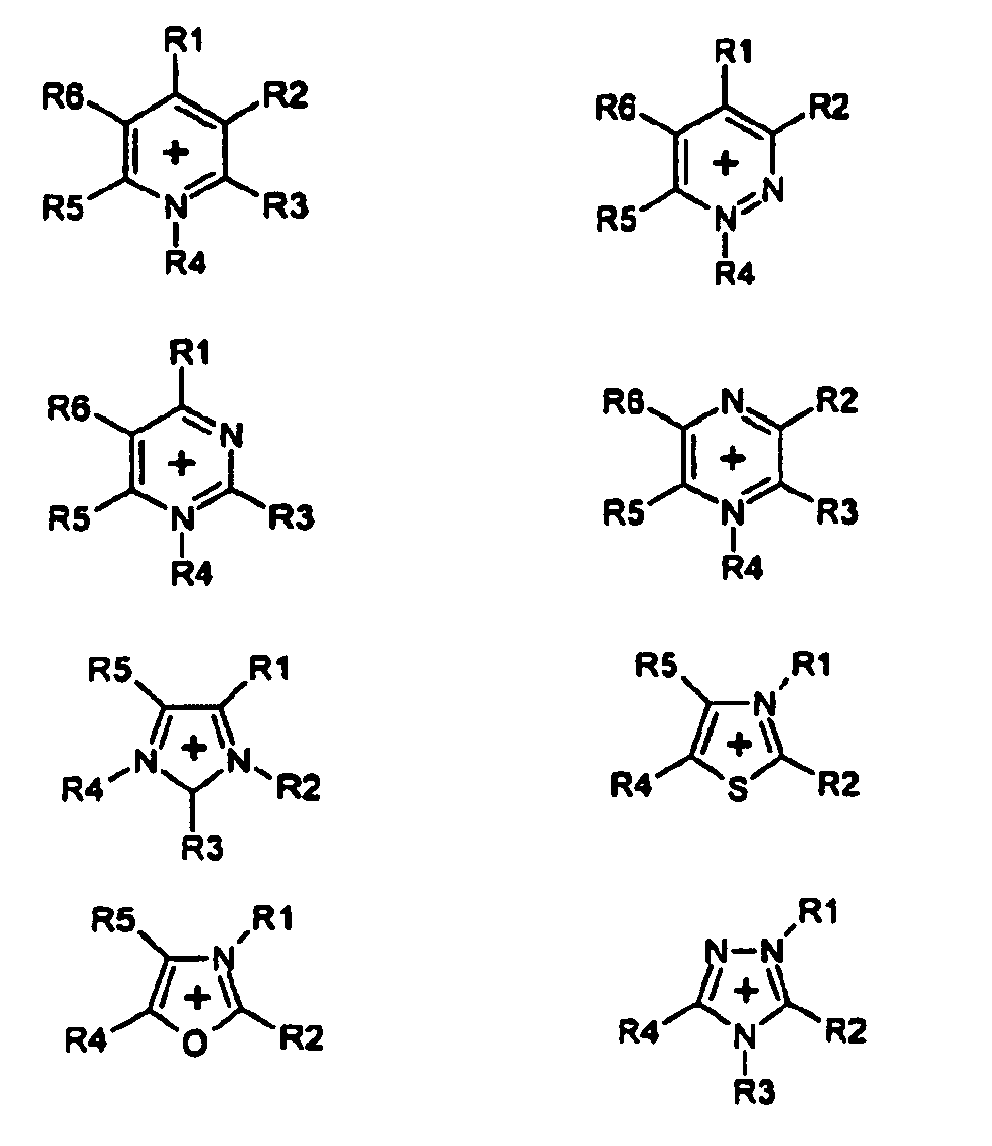 - H,- Halogen, wobei die Halogene nicht direkt mit N verbunden werden,- Alkylrest (C1 bis C8) der teilweise oder vollständig durch weitere Gruppen, vorzugsweise F, Cl, N(CnF(2n+1-x)Hx)2, O(CnF(2n+1-x)Hx), SO2(CnF(2n+1-x)Hx), CnF(2n+1-x)Hx mit 1<n<6 und 0<x≤2n+ substituiert sein kann,außer N-methyl-2-trifluormethylbenzthiazoliumbis(heptafluorpropyl)phosphinat.
 - Verwendung der Salze der Bis(perfluoralkyl)phosphinsäuren gemäß Anspruch 10 oder 11 als ionische Flüssigkeiten.
- Verwendung der Salze der Bis(perfluoralkyl)phosphinsäuren gemäß Anspruch 10 oder 11 als Phasen-Transfer-Katalysator oder Tenside.
Applications Claiming Priority (3)
| Application Number | Priority Date | Filing Date | Title |
|---|---|---|---|
| DE10216997 | 2002-04-16 | ||
| DE10216997A DE10216997A1 (de) | 2002-04-16 | 2002-04-16 | Verfahren zur Herstellung von Bis(perfluoralkyl)phosphinsäuren und deren Salze |
| PCT/EP2003/002740 WO2003087110A1 (de) | 2002-04-16 | 2003-03-17 | Verfahren zur herstellung von bis(perfluoralkyl)phosphinsäuren und deren salze |
Publications (2)
| Publication Number | Publication Date |
|---|---|
| EP1495035A1 EP1495035A1 (de) | 2005-01-12 |
| EP1495035B1 true EP1495035B1 (de) | 2010-06-30 |
Family
ID=28685133
Family Applications (1)
| Application Number | Title | Priority Date | Filing Date |
|---|---|---|---|
| EP03712030A Expired - Lifetime EP1495035B1 (de) | 2002-04-16 | 2003-03-17 | Verfahren zur herstellung von bis(perfluoralkyl)phosphinsäuren und deren salze |
Country Status (14)
| Country | Link |
|---|---|
| US (1) | US7202379B2 (de) |
| EP (1) | EP1495035B1 (de) |
| JP (2) | JP4550429B2 (de) |
| KR (1) | KR100937125B1 (de) |
| CN (1) | CN1646546A (de) |
| AT (1) | ATE472368T1 (de) |
| AU (1) | AU2003218774A1 (de) |
| BR (1) | BR0309222A (de) |
| CA (1) | CA2482656A1 (de) |
| DE (2) | DE10216997A1 (de) |
| RU (1) | RU2004133373A (de) |
| TW (1) | TWI325427B (de) |
| WO (1) | WO2003087110A1 (de) |
| ZA (1) | ZA200409160B (de) |
Families Citing this family (20)
| Publication number | Priority date | Publication date | Assignee | Title |
|---|---|---|---|---|
| EA006053B1 (ru) * | 2001-12-24 | 2005-08-25 | Тева Фармасьютикал Индастриес Лтд. | Твёрдая лекарственная форма, способ её изготовления и устройство |
| US20040052843A1 (en) * | 2001-12-24 | 2004-03-18 | Lerner E. Itzhak | Controlled release dosage forms |
| EP1628952B1 (de) | 2003-06-02 | 2014-09-03 | Merck Patent GmbH | Ionische flüssigkeiten mit uronium- oder thiouronium-kationen |
| DE10353758A1 (de) | 2003-11-17 | 2005-06-23 | Merck Patent Gmbh | Verfahren zur Herstellung von organischen Salzen mit Bis(perfluoralkyl)phosphinat-Anionen |
| DE10353759A1 (de) * | 2003-11-17 | 2005-06-16 | Merck Patent Gmbh | Verfahren zur Herstellung von Mono- und Bis/perfluoralkyl)phosphoranen und korrespondierenden Phosphaten |
| DE102004060075A1 (de) * | 2004-12-14 | 2006-07-06 | Merck Patent Gmbh | Verfahren zur Herstellung von Onium-Salzen mit Dialkylphosphat-, Dialkylphosphinat oder (O-Alkyl)-alkyl- oder Alkyl-phosphonat-Anionen mit geringem Halogenid-Gehalt |
| DE102005025315A1 (de) * | 2005-06-02 | 2006-12-14 | Merck Patent Gmbh | Ionische Flüssigkeiten mit niedriger Viskosität |
| KR100750158B1 (ko) | 2006-01-20 | 2007-08-17 | 삼성전자주식회사 | Ap에서의 ra, rs 메시지 전송 방법 및 장치 |
| DE102006005579A1 (de) * | 2006-02-06 | 2007-08-09 | Cognis Ip Management Gmbh | Verfahren zur Herstellung organischer Substanzen |
| DE102006023649A1 (de) | 2006-05-17 | 2008-01-03 | Philipps-Universität Marburg | Hydrophobe ionische Flüssigkeiten |
| DE102007004698A1 (de) * | 2007-01-31 | 2008-08-07 | Merck Patent Gmbh | Verbindungen enthaltend Organofluorochlorophosphatanionen |
| CN101092412B (zh) * | 2007-07-24 | 2012-12-12 | 中国科学院长春应用化学研究所 | 四氢噻吩鎓类离子液体、制备方法及用途 |
| DE102007058600A1 (de) * | 2007-12-04 | 2009-06-10 | Merck Patent Gmbh | Verwendung von Phosphinsäuren und/oder Phosphonsäuren in Polymerisationsverfahren |
| EP2303898B1 (de) | 2008-07-25 | 2014-05-07 | Merck Patent GmbH | Verfahren zur herstellung von bis(fluoralkyl)phosphinsäurechloriden oder fluoralkylphosphonsäuredichloriden |
| DE102008035174A1 (de) * | 2008-07-28 | 2010-02-11 | Merck Patent Gmbh | Verfahren zur Herstellung von Bis(fluoralkyl)-phosphinsäure oder Fluoralkylphosphonsäure |
| DE102009058969A1 (de) * | 2009-12-18 | 2011-06-22 | Merck Patent GmbH, 64293 | Verbindung mit (Perfluoralkyl)fluorohydrogenphosphat - Anionen |
| DE102011108324A1 (de) | 2011-07-25 | 2013-01-31 | Merck Patent Gmbh | Verfahren zur Herstellung von Bis(perfluoralkyl)phosphinsäureanhydriden |
| DE102012013071A1 (de) | 2012-07-02 | 2014-01-02 | Merck Patent Gmbh | Verfahren zur Herstellung von Tris(perfluoralkyl)phosphinoxiden und Bis(perfluoralkyl)phosphinsäuren |
| WO2016074757A1 (de) | 2014-11-11 | 2016-05-19 | Merck Patent Gmbh | Verfahren zur herstellung von mono- und bis(perfluoralkyl)fluorophosphatsalzen und deren säuren |
| CN115286587B (zh) * | 2022-07-06 | 2024-02-23 | 珠海中科先进技术研究院有限公司 | 一种高离域的碱金属化合物及其制备方法和应用 |
Family Cites Families (6)
| Publication number | Priority date | Publication date | Assignee | Title |
|---|---|---|---|---|
| SU498311A1 (ru) | 1973-02-16 | 1976-01-05 | Институт Органической Химии Ан Усср | Способ получени бис-(перфторалкил)фосфиновых кислот |
| DE3804499A1 (de) | 1988-02-13 | 1989-08-24 | Delbrouck Franz Gmbh | Verfahren zum sortieren von kaesten fuer getraenkeflaschen sowie kasten zur verwendung bei diesem verfahren und vorrichtung zur durchfuehrung des verfahrens |
| DE4416671A1 (de) | 1994-05-11 | 1995-12-07 | Steinle Karin | Verfahren und Vorrichtung zum Auspacken von Kunststoffflaschen aus Flaschenkästen |
| DE19500290C2 (de) | 1994-09-09 | 1997-07-24 | Baumueller Anlagen Systemtech | Verfahren zum Aufeinanderstapeln von mit einer Greifeinrichtung erfaßbaren, nach oben offenen Behältern sowie Greifeinrichtung zum Auf- und Abstapeln von nach oben offenen Behältern |
| DE10130940A1 (de) | 2001-06-27 | 2003-01-16 | Merck Patent Gmbh | Supersäuren, Herstellverfahren und Verwendungen |
| DE10220547A1 (de) * | 2002-04-16 | 2003-11-06 | Merck Patent Gmbh | Verfahren zur Herstellung von Monohydro-Pefluoralkanen, Perfluoralkylphosphinaten und Perfluoralkylphosphonaten |
-
2002
- 2002-04-16 DE DE10216997A patent/DE10216997A1/de not_active Withdrawn
-
2003
- 2003-03-17 CA CA002482656A patent/CA2482656A1/en not_active Abandoned
- 2003-03-17 US US10/511,157 patent/US7202379B2/en not_active Expired - Fee Related
- 2003-03-17 EP EP03712030A patent/EP1495035B1/de not_active Expired - Lifetime
- 2003-03-17 RU RU2004133373/04A patent/RU2004133373A/ru not_active Application Discontinuation
- 2003-03-17 CN CNA038084910A patent/CN1646546A/zh active Pending
- 2003-03-17 KR KR1020047016411A patent/KR100937125B1/ko not_active Expired - Fee Related
- 2003-03-17 DE DE50312844T patent/DE50312844D1/de not_active Expired - Lifetime
- 2003-03-17 AT AT03712030T patent/ATE472368T1/de active
- 2003-03-17 JP JP2003584066A patent/JP4550429B2/ja not_active Expired - Fee Related
- 2003-03-17 AU AU2003218774A patent/AU2003218774A1/en not_active Abandoned
- 2003-03-17 BR BR0309222-4A patent/BR0309222A/pt not_active Application Discontinuation
- 2003-03-17 WO PCT/EP2003/002740 patent/WO2003087110A1/de not_active Ceased
- 2003-04-14 TW TW092108542A patent/TWI325427B/zh not_active IP Right Cessation
-
2004
- 2004-11-11 ZA ZA200409160A patent/ZA200409160B/en unknown
-
2010
- 2010-02-22 JP JP2010036014A patent/JP5307747B2/ja not_active Expired - Fee Related
Non-Patent Citations (2)
| Title |
|---|
| KALIBABCHUK N.N. ET AL: "The effect of charge of the counterion on micellar and thermodynamic characteristics of anion-active SAM", SOVIET PROGRESS IN CHEMISTRY, vol. 44, no. 1, 1978, pages 65 - 67, XP009085719, ISSN: 0038-5743 * |
| KALIBABCHUK N.N. ET AL: "Use of 19F NMR for the investigation of micelle formation in aqueous solutions of ammonium perfluoroalkylphosphonate", THEORETICAL AND EXPERIMENTAL CHEMISTRY, vol. 11, no. 6, 1975, pages 700 - 703, XP009085723, ISSN: 0040-5760 * |
Also Published As
| Publication number | Publication date |
|---|---|
| JP5307747B2 (ja) | 2013-10-02 |
| KR100937125B1 (ko) | 2010-01-18 |
| AU2003218774A1 (en) | 2003-10-27 |
| RU2004133373A (ru) | 2005-06-10 |
| BR0309222A (pt) | 2005-02-09 |
| EP1495035A1 (de) | 2005-01-12 |
| US20050256334A1 (en) | 2005-11-17 |
| TW200306981A (en) | 2003-12-01 |
| ZA200409160B (en) | 2005-05-31 |
| JP2005522510A (ja) | 2005-07-28 |
| CA2482656A1 (en) | 2003-10-23 |
| ATE472368T1 (de) | 2010-07-15 |
| DE10216997A1 (de) | 2003-10-30 |
| JP2010180211A (ja) | 2010-08-19 |
| KR20050000505A (ko) | 2005-01-05 |
| US7202379B2 (en) | 2007-04-10 |
| DE50312844D1 (de) | 2010-08-12 |
| WO2003087110A1 (de) | 2003-10-23 |
| TWI325427B (en) | 2010-06-01 |
| CN1646546A (zh) | 2005-07-27 |
| JP4550429B2 (ja) | 2010-09-22 |
Similar Documents
| Publication | Publication Date | Title |
|---|---|---|
| EP1495035A1 (de) | Verfahren zur herstellung von bis(perfluoralkyl)phosphinsäuren und deren salze | |
| EP1480956B1 (de) | Halogenfreie ionische flüssigkeiten | |
| EP1711472B1 (de) | Herstellungsmethode für ionische flüssigkeiten | |
| DE60022897T2 (de) | Verfahren zur herstellung von bei umgebungstemperatur flüssigen ionischen flüssigkeiten | |
| WO2003022812A1 (de) | Organische sulfate als ionische flüssigkeiten | |
| EP2295398A1 (de) | Verfahren zur Herstellung ionischer Flüssigkeiten, ionischer Feststoffe oder Gemische derselben | |
| EP3655413B1 (de) | Herstellung von glufosinat durch umsetzung von 3-[n-butoxy(methyl)phosphoryl]-1-cyanopropylacetat zu einer mischung aus n-butyl(3-amino-3-cyanopropyl)-methylphosphinat und (3-amino-3-cyanopropyl)-methylphosphinsäure ammoniumsalz | |
| EP2079707B1 (de) | Verfahren zur umsetzung von 1,3-hetero-aromatischen 2-carboxylaten mit wasser | |
| EP2079705B1 (de) | Verfahren zur herstellung quarternärer carbonate | |
| DE3514450A1 (de) | Verfahren zur herstellung von imidaten sowie neue arylsubstituierte imidate | |
| DE102004043631A1 (de) | Verfahren zur Herstellung heterocyclischer quartärer Ammonium- Verbindungen und/oder Guanidinium- Verbindungen hoher Reinheit | |
| EP1495036B1 (de) | Verfahren zur herstellung von monohydro-perfluoralkanen, bis(perfluoralkyl)phosphinaten und perfluoralkylphosphonaten | |
| EP1685095B1 (de) | Verfahren zur herstellung von organischen salzen mit bis(perfluoralkyl)phosphinat-anionen | |
| DE69917443T2 (de) | Methoden zur hochselektiven o-alkylierung von amiden mit hilfe von kupfersalzen | |
| EP1979361B1 (de) | Oxonium- und sulfoniumsalze | |
| DE10220547A1 (de) | Verfahren zur Herstellung von Monohydro-Pefluoralkanen, Perfluoralkylphosphinaten und Perfluoralkylphosphonaten | |
| DE2417615A1 (de) | Cyclische ketone und verfahren zu ihrer herstellung | |
| EP1024140B1 (de) | Verfahren zur N-Alkylierung von cyclischen Cyanamidinen | |
| EP2513123B1 (de) | Verbindungen mit (perfluoralkyl)fluorohydrogenphosphat-anionen | |
| EP0022959B1 (de) | Verfahren zur Herstellung von Diazoniumtetrafluoroboraten in verdünnter wässriger Lösung | |
| DE69813388T2 (de) | Verfahren zur Herstellung von 2,4-Oxazolidindion | |
| EP1902004B1 (de) | Verfahren zur herstellung von onium-alkylsulfonaten | |
| EP1902035B1 (de) | Verfahren zur herstellung von onium-alkylsulfiten | |
| EP0101996B1 (de) | Verfahren zur Herstellung von E-Isomeren von 1-Cyclohexyl-2-(1,2,4-triazol-1-yl)-1-penten-3-on-Derivaten | |
| DE1008316B (de) | Verfahren zur Herstellung von 2-Oxo-1, 3, 2-dioxaphospholanen und 2-Oxo-1, 3, 2-dioxaphosphorinanen |
Legal Events
| Date | Code | Title | Description |
|---|---|---|---|
| PUAI | Public reference made under article 153(3) epc to a published international application that has entered the european phase |
Free format text: ORIGINAL CODE: 0009012 |
|
| 17P | Request for examination filed |
Effective date: 20040821 |
|
| AK | Designated contracting states |
Kind code of ref document: A1 Designated state(s): AT BE BG CH CY CZ DE DK EE ES FI FR GB GR HU IE IT LI LU MC NL PT RO SE SI SK TR |
|
| AX | Request for extension of the european patent |
Extension state: AL LT LV MK |
|
| RIN1 | Information on inventor provided before grant (corrected) |
Inventor name: WILLNER, HELGE Inventor name: IGNATYEV, NIKOLAI Inventor name: SARTORI, PETER Inventor name: KUCHERYNA, ANDRIY Inventor name: WEIDEN, MICHAEL Inventor name: HEIDER, UDO Inventor name: WELZ-BIERMANN, URS |
|
| 17Q | First examination report despatched |
Effective date: 20070704 |
|
| GRAP | Despatch of communication of intention to grant a patent |
Free format text: ORIGINAL CODE: EPIDOSNIGR1 |
|
| RIC1 | Information provided on ipc code assigned before grant |
Ipc: C07D 249/08 20060101ALI20091217BHEP Ipc: C07D 233/56 20060101ALI20091217BHEP Ipc: C07D 233/54 20060101ALI20091217BHEP Ipc: C07F 9/54 20060101ALI20091217BHEP Ipc: C07D 231/12 20060101ALI20091217BHEP Ipc: B01F 17/00 20060101AFI20091217BHEP Ipc: B01J 31/02 20060101ALI20091217BHEP Ipc: C07F 9/30 20060101ALI20091217BHEP Ipc: C07C 211/63 20060101ALI20091217BHEP |
|
| GRAS | Grant fee paid |
Free format text: ORIGINAL CODE: EPIDOSNIGR3 |
|
| GRAA | (expected) grant |
Free format text: ORIGINAL CODE: 0009210 |
|
| AK | Designated contracting states |
Kind code of ref document: B1 Designated state(s): AT BE BG CH CY CZ DE DK EE ES FI FR GB GR HU IE IT LI LU MC NL PT RO SE SI SK TR |
|
| REG | Reference to a national code |
Ref country code: CH Ref legal event code: EP Ref country code: GB Ref legal event code: FG4D Free format text: NOT ENGLISH |
|
| REG | Reference to a national code |
Ref country code: IE Ref legal event code: FG4D Free format text: LANGUAGE OF EP DOCUMENT: GERMAN |
|
| REF | Corresponds to: |
Ref document number: 50312844 Country of ref document: DE Date of ref document: 20100812 Kind code of ref document: P |
|
| REG | Reference to a national code |
Ref country code: NL Ref legal event code: VDEP Effective date: 20100630 |
|
| PG25 | Lapsed in a contracting state [announced via postgrant information from national office to epo] |
Ref country code: SE Free format text: LAPSE BECAUSE OF FAILURE TO SUBMIT A TRANSLATION OF THE DESCRIPTION OR TO PAY THE FEE WITHIN THE PRESCRIBED TIME-LIMIT Effective date: 20100630 |
|
| PG25 | Lapsed in a contracting state [announced via postgrant information from national office to epo] |
Ref country code: FI Free format text: LAPSE BECAUSE OF FAILURE TO SUBMIT A TRANSLATION OF THE DESCRIPTION OR TO PAY THE FEE WITHIN THE PRESCRIBED TIME-LIMIT Effective date: 20100630 Ref country code: SI Free format text: LAPSE BECAUSE OF FAILURE TO SUBMIT A TRANSLATION OF THE DESCRIPTION OR TO PAY THE FEE WITHIN THE PRESCRIBED TIME-LIMIT Effective date: 20100630 |
|
| PG25 | Lapsed in a contracting state [announced via postgrant information from national office to epo] |
Ref country code: GR Free format text: LAPSE BECAUSE OF FAILURE TO SUBMIT A TRANSLATION OF THE DESCRIPTION OR TO PAY THE FEE WITHIN THE PRESCRIBED TIME-LIMIT Effective date: 20101001 |
|
| PG25 | Lapsed in a contracting state [announced via postgrant information from national office to epo] |
Ref country code: EE Free format text: LAPSE BECAUSE OF FAILURE TO SUBMIT A TRANSLATION OF THE DESCRIPTION OR TO PAY THE FEE WITHIN THE PRESCRIBED TIME-LIMIT Effective date: 20100630 Ref country code: NL Free format text: LAPSE BECAUSE OF FAILURE TO SUBMIT A TRANSLATION OF THE DESCRIPTION OR TO PAY THE FEE WITHIN THE PRESCRIBED TIME-LIMIT Effective date: 20100630 |
|
| REG | Reference to a national code |
Ref country code: IE Ref legal event code: FD4D |
|
| PG25 | Lapsed in a contracting state [announced via postgrant information from national office to epo] |
Ref country code: CZ Free format text: LAPSE BECAUSE OF FAILURE TO SUBMIT A TRANSLATION OF THE DESCRIPTION OR TO PAY THE FEE WITHIN THE PRESCRIBED TIME-LIMIT Effective date: 20100630 Ref country code: PT Free format text: LAPSE BECAUSE OF FAILURE TO SUBMIT A TRANSLATION OF THE DESCRIPTION OR TO PAY THE FEE WITHIN THE PRESCRIBED TIME-LIMIT Effective date: 20101102 Ref country code: SK Free format text: LAPSE BECAUSE OF FAILURE TO SUBMIT A TRANSLATION OF THE DESCRIPTION OR TO PAY THE FEE WITHIN THE PRESCRIBED TIME-LIMIT Effective date: 20100630 Ref country code: CY Free format text: LAPSE BECAUSE OF FAILURE TO SUBMIT A TRANSLATION OF THE DESCRIPTION OR TO PAY THE FEE WITHIN THE PRESCRIBED TIME-LIMIT Effective date: 20100630 Ref country code: RO Free format text: LAPSE BECAUSE OF FAILURE TO SUBMIT A TRANSLATION OF THE DESCRIPTION OR TO PAY THE FEE WITHIN THE PRESCRIBED TIME-LIMIT Effective date: 20100630 |
|
| PG25 | Lapsed in a contracting state [announced via postgrant information from national office to epo] |
Ref country code: IT Free format text: LAPSE BECAUSE OF FAILURE TO SUBMIT A TRANSLATION OF THE DESCRIPTION OR TO PAY THE FEE WITHIN THE PRESCRIBED TIME-LIMIT Effective date: 20100630 |
|
| PG25 | Lapsed in a contracting state [announced via postgrant information from national office to epo] |
Ref country code: DK Free format text: LAPSE BECAUSE OF FAILURE TO SUBMIT A TRANSLATION OF THE DESCRIPTION OR TO PAY THE FEE WITHIN THE PRESCRIBED TIME-LIMIT Effective date: 20100630 Ref country code: IE Free format text: LAPSE BECAUSE OF FAILURE TO SUBMIT A TRANSLATION OF THE DESCRIPTION OR TO PAY THE FEE WITHIN THE PRESCRIBED TIME-LIMIT Effective date: 20100630 |
|
| PLBE | No opposition filed within time limit |
Free format text: ORIGINAL CODE: 0009261 |
|
| STAA | Information on the status of an ep patent application or granted ep patent |
Free format text: STATUS: NO OPPOSITION FILED WITHIN TIME LIMIT |
|
| 26N | No opposition filed |
Effective date: 20110331 |
|
| PG25 | Lapsed in a contracting state [announced via postgrant information from national office to epo] |
Ref country code: ES Free format text: LAPSE BECAUSE OF FAILURE TO SUBMIT A TRANSLATION OF THE DESCRIPTION OR TO PAY THE FEE WITHIN THE PRESCRIBED TIME-LIMIT Effective date: 20101011 |
|
| REG | Reference to a national code |
Ref country code: DE Ref legal event code: R097 Ref document number: 50312844 Country of ref document: DE Effective date: 20110330 |
|
| BERE | Be: lapsed |
Owner name: MERCK PATENT G.M.B.H. Effective date: 20110331 |
|
| PG25 | Lapsed in a contracting state [announced via postgrant information from national office to epo] |
Ref country code: MC Free format text: LAPSE BECAUSE OF NON-PAYMENT OF DUE FEES Effective date: 20110331 |
|
| REG | Reference to a national code |
Ref country code: CH Ref legal event code: PL |
|
| PG25 | Lapsed in a contracting state [announced via postgrant information from national office to epo] |
Ref country code: BE Free format text: LAPSE BECAUSE OF NON-PAYMENT OF DUE FEES Effective date: 20110331 |
|
| PG25 | Lapsed in a contracting state [announced via postgrant information from national office to epo] |
Ref country code: CH Free format text: LAPSE BECAUSE OF NON-PAYMENT OF DUE FEES Effective date: 20110331 Ref country code: LI Free format text: LAPSE BECAUSE OF NON-PAYMENT OF DUE FEES Effective date: 20110331 |
|
| REG | Reference to a national code |
Ref country code: AT Ref legal event code: MM01 Ref document number: 472368 Country of ref document: AT Kind code of ref document: T Effective date: 20110317 |
|
| PG25 | Lapsed in a contracting state [announced via postgrant information from national office to epo] |
Ref country code: AT Free format text: LAPSE BECAUSE OF NON-PAYMENT OF DUE FEES Effective date: 20110317 |
|
| PG25 | Lapsed in a contracting state [announced via postgrant information from national office to epo] |
Ref country code: LU Free format text: LAPSE BECAUSE OF NON-PAYMENT OF DUE FEES Effective date: 20110317 |
|
| PG25 | Lapsed in a contracting state [announced via postgrant information from national office to epo] |
Ref country code: BG Free format text: LAPSE BECAUSE OF FAILURE TO SUBMIT A TRANSLATION OF THE DESCRIPTION OR TO PAY THE FEE WITHIN THE PRESCRIBED TIME-LIMIT Effective date: 20100930 Ref country code: TR Free format text: LAPSE BECAUSE OF FAILURE TO SUBMIT A TRANSLATION OF THE DESCRIPTION OR TO PAY THE FEE WITHIN THE PRESCRIBED TIME-LIMIT Effective date: 20100630 |
|
| PG25 | Lapsed in a contracting state [announced via postgrant information from national office to epo] |
Ref country code: HU Free format text: LAPSE BECAUSE OF FAILURE TO SUBMIT A TRANSLATION OF THE DESCRIPTION OR TO PAY THE FEE WITHIN THE PRESCRIBED TIME-LIMIT Effective date: 20100630 |
|
| REG | Reference to a national code |
Ref country code: FR Ref legal event code: PLFP Year of fee payment: 14 |
|
| PGFP | Annual fee paid to national office [announced via postgrant information from national office to epo] |
Ref country code: DE Payment date: 20160308 Year of fee payment: 14 |
|
| PGFP | Annual fee paid to national office [announced via postgrant information from national office to epo] |
Ref country code: FR Payment date: 20160208 Year of fee payment: 14 Ref country code: GB Payment date: 20160316 Year of fee payment: 14 |
|
| REG | Reference to a national code |
Ref country code: DE Ref legal event code: R119 Ref document number: 50312844 Country of ref document: DE |
|
| GBPC | Gb: european patent ceased through non-payment of renewal fee |
Effective date: 20170317 |
|
| REG | Reference to a national code |
Ref country code: FR Ref legal event code: ST Effective date: 20171130 |
|
| PG25 | Lapsed in a contracting state [announced via postgrant information from national office to epo] |
Ref country code: FR Free format text: LAPSE BECAUSE OF NON-PAYMENT OF DUE FEES Effective date: 20170331 Ref country code: DE Free format text: LAPSE BECAUSE OF NON-PAYMENT OF DUE FEES Effective date: 20171003 |
|
| PG25 | Lapsed in a contracting state [announced via postgrant information from national office to epo] |
Ref country code: GB Free format text: LAPSE BECAUSE OF NON-PAYMENT OF DUE FEES Effective date: 20170317 |