EP1490322B1 - Verfahren zur herstellung von 2,2-dichloro- oder dibromo-phenylessigsäurealkylestern - Google Patents
Verfahren zur herstellung von 2,2-dichloro- oder dibromo-phenylessigsäurealkylestern Download PDFInfo
- Publication number
- EP1490322B1 EP1490322B1 EP03708200.5A EP03708200A EP1490322B1 EP 1490322 B1 EP1490322 B1 EP 1490322B1 EP 03708200 A EP03708200 A EP 03708200A EP 1490322 B1 EP1490322 B1 EP 1490322B1
- Authority
- EP
- European Patent Office
- Prior art keywords
- formula
- nitrile
- hcl
- alcohol
- water
- Prior art date
- Legal status (The legal status is an assumption and is not a legal conclusion. Google has not performed a legal analysis and makes no representation as to the accuracy of the status listed.)
- Expired - Lifetime
Links
- -1 dibromo-phenyl Chemical group 0.000 title claims description 11
- 238000004519 manufacturing process Methods 0.000 title claims description 4
- 150000001242 acetic acid derivatives Chemical class 0.000 title 1
- LFQSCWFLJHTTHZ-UHFFFAOYSA-N Ethanol Chemical compound CCO LFQSCWFLJHTTHZ-UHFFFAOYSA-N 0.000 claims description 81
- VEXZGXHMUGYJMC-UHFFFAOYSA-N Hydrochloric acid Chemical compound Cl VEXZGXHMUGYJMC-UHFFFAOYSA-N 0.000 claims description 75
- XLYOFNOQVPJJNP-UHFFFAOYSA-N water Substances O XLYOFNOQVPJJNP-UHFFFAOYSA-N 0.000 claims description 49
- VLKZOEOYAKHREP-UHFFFAOYSA-N n-Hexane Chemical compound CCCCCC VLKZOEOYAKHREP-UHFFFAOYSA-N 0.000 claims description 48
- 150000002825 nitriles Chemical class 0.000 claims description 38
- CPELXLSAUQHCOX-UHFFFAOYSA-N Hydrogen bromide Chemical compound Br CPELXLSAUQHCOX-UHFFFAOYSA-N 0.000 claims description 32
- 238000006243 chemical reaction Methods 0.000 claims description 28
- 239000000460 chlorine Substances 0.000 claims description 20
- 238000000034 method Methods 0.000 claims description 20
- 238000002360 preparation method Methods 0.000 claims description 20
- 229910052801 chlorine Inorganic materials 0.000 claims description 19
- 239000007789 gas Substances 0.000 claims description 17
- ZAMOUSCENKQFHK-UHFFFAOYSA-N Chlorine atom Chemical compound [Cl] ZAMOUSCENKQFHK-UHFFFAOYSA-N 0.000 claims description 16
- NLXLAEXVIDQMFP-UHFFFAOYSA-N Ammonia chloride Chemical compound [NH4+].[Cl-] NLXLAEXVIDQMFP-UHFFFAOYSA-N 0.000 claims description 14
- 125000000217 alkyl group Chemical group 0.000 claims description 14
- 239000000203 mixture Substances 0.000 claims description 14
- 239000012071 phase Substances 0.000 claims description 13
- 239000011541 reaction mixture Substances 0.000 claims description 13
- YXFVVABEGXRONW-UHFFFAOYSA-N Toluene Chemical compound CC1=CC=CC=C1 YXFVVABEGXRONW-UHFFFAOYSA-N 0.000 claims description 12
- SUSQOBVLVYHIEX-UHFFFAOYSA-N phenylacetonitrile Chemical class N#CCC1=CC=CC=C1 SUSQOBVLVYHIEX-UHFFFAOYSA-N 0.000 claims description 10
- OKKJLVBELUTLKV-UHFFFAOYSA-N Methanol Chemical compound OC OKKJLVBELUTLKV-UHFFFAOYSA-N 0.000 claims description 9
- 229910052739 hydrogen Inorganic materials 0.000 claims description 9
- 239000001257 hydrogen Substances 0.000 claims description 9
- 239000012074 organic phase Substances 0.000 claims description 9
- 239000002904 solvent Substances 0.000 claims description 9
- RTZKZFJDLAIYFH-UHFFFAOYSA-N Diethyl ether Chemical compound CCOCC RTZKZFJDLAIYFH-UHFFFAOYSA-N 0.000 claims description 8
- IMNFDUFMRHMDMM-UHFFFAOYSA-N N-Heptane Chemical compound CCCCCCC IMNFDUFMRHMDMM-UHFFFAOYSA-N 0.000 claims description 8
- 239000008346 aqueous phase Substances 0.000 claims description 8
- 150000002431 hydrogen Chemical group 0.000 claims description 8
- 239000000243 solution Substances 0.000 claims description 8
- 235000019270 ammonium chloride Nutrition 0.000 claims description 7
- 229910052794 bromium Inorganic materials 0.000 claims description 7
- YMWUJEATGCHHMB-UHFFFAOYSA-N Dichloromethane Chemical compound ClCCl YMWUJEATGCHHMB-UHFFFAOYSA-N 0.000 claims description 6
- BZLVMXJERCGZMT-UHFFFAOYSA-N Methyl tert-butyl ether Chemical compound COC(C)(C)C BZLVMXJERCGZMT-UHFFFAOYSA-N 0.000 claims description 6
- WYURNTSHIVDZCO-UHFFFAOYSA-N Tetrahydrofuran Chemical compound C1CCOC1 WYURNTSHIVDZCO-UHFFFAOYSA-N 0.000 claims description 6
- 239000006227 byproduct Substances 0.000 claims description 6
- 125000003118 aryl group Chemical group 0.000 claims description 5
- 125000004104 aryloxy group Chemical group 0.000 claims description 5
- 238000009835 boiling Methods 0.000 claims description 5
- 229910052736 halogen Chemical group 0.000 claims description 5
- 150000002367 halogens Chemical group 0.000 claims description 5
- 125000001072 heteroaryl group Chemical group 0.000 claims description 5
- WKBOTKDWSSQWDR-UHFFFAOYSA-N Bromine atom Chemical group [Br] WKBOTKDWSSQWDR-UHFFFAOYSA-N 0.000 claims description 4
- XTHFKEDIFFGKHM-UHFFFAOYSA-N Dimethoxyethane Chemical compound COCCOC XTHFKEDIFFGKHM-UHFFFAOYSA-N 0.000 claims description 4
- LRHPLDYGYMQRHN-UHFFFAOYSA-N N-Butanol Chemical compound CCCCO LRHPLDYGYMQRHN-UHFFFAOYSA-N 0.000 claims description 4
- GDTBXPJZTBHREO-UHFFFAOYSA-N bromine Chemical group BrBr GDTBXPJZTBHREO-UHFFFAOYSA-N 0.000 claims description 4
- 239000003795 chemical substances by application Substances 0.000 claims description 4
- MVPPADPHJFYWMZ-UHFFFAOYSA-N chlorobenzene Chemical compound ClC1=CC=CC=C1 MVPPADPHJFYWMZ-UHFFFAOYSA-N 0.000 claims description 4
- 125000001997 phenyl group Chemical group [H]C1=C([H])C([H])=C(*)C([H])=C1[H] 0.000 claims description 4
- LUCUKMQQOXOQTM-UHFFFAOYSA-N 2,2-dibromo-2-phenylacetonitrile Chemical compound N#CC(Br)(Br)C1=CC=CC=C1 LUCUKMQQOXOQTM-UHFFFAOYSA-N 0.000 claims description 3
- 230000001476 alcoholic effect Effects 0.000 claims description 3
- 230000003197 catalytic effect Effects 0.000 claims description 3
- 150000002148 esters Chemical class 0.000 claims description 3
- 150000002170 ethers Chemical class 0.000 claims description 3
- 238000000605 extraction Methods 0.000 claims description 3
- 150000007524 organic acids Chemical class 0.000 claims description 3
- 238000000746 purification Methods 0.000 claims description 3
- YLQBMQCUIZJEEH-UHFFFAOYSA-N tetrahydrofuran Natural products C=1C=COC=1 YLQBMQCUIZJEEH-UHFFFAOYSA-N 0.000 claims description 3
- RYHBNJHYFVUHQT-UHFFFAOYSA-N 1,4-Dioxane Chemical compound C1COCCO1 RYHBNJHYFVUHQT-UHFFFAOYSA-N 0.000 claims description 2
- CPELXLSAUQHCOX-UHFFFAOYSA-M Bromide Chemical compound [Br-] CPELXLSAUQHCOX-UHFFFAOYSA-M 0.000 claims description 2
- 230000008878 coupling Effects 0.000 claims description 2
- 238000010168 coupling process Methods 0.000 claims description 2
- 238000005859 coupling reaction Methods 0.000 claims description 2
- 238000007865 diluting Methods 0.000 claims description 2
- 238000010790 dilution Methods 0.000 claims description 2
- 239000012895 dilution Substances 0.000 claims description 2
- PNDPGZBMCMUPRI-UHFFFAOYSA-N iodine Chemical group II PNDPGZBMCMUPRI-UHFFFAOYSA-N 0.000 claims description 2
- 238000005191 phase separation Methods 0.000 claims description 2
- 229910000041 hydrogen chloride Inorganic materials 0.000 claims 16
- IXCSERBJSXMMFS-UHFFFAOYSA-N hydrogen chloride Substances Cl.Cl IXCSERBJSXMMFS-UHFFFAOYSA-N 0.000 claims 16
- LSKUGLNYEFXFCG-UHFFFAOYSA-N 2,2-dibromo-2-phenylacetic acid Chemical class OC(=O)C(Br)(Br)C1=CC=CC=C1 LSKUGLNYEFXFCG-UHFFFAOYSA-N 0.000 claims 12
- 125000004209 (C1-C8) alkyl group Chemical group 0.000 claims 5
- 125000004178 (C1-C4) alkyl group Chemical group 0.000 claims 1
- 125000000229 (C1-C4)alkoxy group Chemical group 0.000 claims 1
- VOCGYYOMSGYEJV-UHFFFAOYSA-N benzene cyanide Chemical class N#[C-].C1=CC=CC=C1 VOCGYYOMSGYEJV-UHFFFAOYSA-N 0.000 claims 1
- NNQIBXKOCAMOOS-UHFFFAOYSA-N phenyl hypofluorite Chemical group FOC1=CC=CC=C1 NNQIBXKOCAMOOS-UHFFFAOYSA-N 0.000 claims 1
- NAKVVPIOOXQHNR-UHFFFAOYSA-N 2-(6,6-dichlorocyclohexa-2,4-dien-1-yl)acetonitrile Chemical compound ClC1(Cl)C=CC=CC1CC#N NAKVVPIOOXQHNR-UHFFFAOYSA-N 0.000 description 16
- CANXLAXDRLYESO-UHFFFAOYSA-N ethyl 2-(2,3-dichlorophenyl)acetate Chemical compound CCOC(=O)CC1=CC=CC(Cl)=C1Cl CANXLAXDRLYESO-UHFFFAOYSA-N 0.000 description 14
- HEMHJVSKTPXQMS-UHFFFAOYSA-M Sodium hydroxide Chemical compound [OH-].[Na+] HEMHJVSKTPXQMS-UHFFFAOYSA-M 0.000 description 12
- 239000000047 product Substances 0.000 description 11
- 238000005660 chlorination reaction Methods 0.000 description 10
- 239000007795 chemical reaction product Substances 0.000 description 5
- 238000004090 dissolution Methods 0.000 description 5
- 239000007787 solid Substances 0.000 description 5
- 230000007062 hydrolysis Effects 0.000 description 4
- 238000006460 hydrolysis reaction Methods 0.000 description 4
- FAQJJMHZNSSFSM-UHFFFAOYSA-N phenylglyoxylic acid Chemical compound OC(=O)C(=O)C1=CC=CC=C1 FAQJJMHZNSSFSM-UHFFFAOYSA-N 0.000 description 4
- 125000004432 carbon atom Chemical group C* 0.000 description 3
- 239000012043 crude product Substances 0.000 description 3
- 230000026030 halogenation Effects 0.000 description 3
- 238000005658 halogenation reaction Methods 0.000 description 3
- 125000000951 phenoxy group Chemical group [H]C1=C([H])C([H])=C(O*)C([H])=C1[H] 0.000 description 3
- 239000000725 suspension Substances 0.000 description 3
- 239000002912 waste gas Substances 0.000 description 3
- IJGRMHOSHXDMSA-UHFFFAOYSA-N Atomic nitrogen Chemical compound N#N IJGRMHOSHXDMSA-UHFFFAOYSA-N 0.000 description 2
- PXGOKWXKJXAPGV-UHFFFAOYSA-N Fluorine Chemical compound FF PXGOKWXKJXAPGV-UHFFFAOYSA-N 0.000 description 2
- AMQJEAYHLZJPGS-UHFFFAOYSA-N N-Pentanol Chemical compound CCCCCO AMQJEAYHLZJPGS-UHFFFAOYSA-N 0.000 description 2
- GJQBHOAJJGIPRH-UHFFFAOYSA-N benzoyl cyanide Chemical compound N#CC(=O)C1=CC=CC=C1 GJQBHOAJJGIPRH-UHFFFAOYSA-N 0.000 description 2
- 230000015572 biosynthetic process Effects 0.000 description 2
- 150000001875 compounds Chemical class 0.000 description 2
- 210000003298 dental enamel Anatomy 0.000 description 2
- ZUOUZKKEUPVFJK-UHFFFAOYSA-N diphenyl Chemical compound C1=CC=CC=C1C1=CC=CC=C1 ZUOUZKKEUPVFJK-UHFFFAOYSA-N 0.000 description 2
- 239000012467 final product Substances 0.000 description 2
- 239000011737 fluorine Substances 0.000 description 2
- 229910052731 fluorine Inorganic materials 0.000 description 2
- ZSIAUFGUXNUGDI-UHFFFAOYSA-N hexan-1-ol Chemical compound CCCCCCO ZSIAUFGUXNUGDI-UHFFFAOYSA-N 0.000 description 2
- 125000004123 n-propyl group Chemical group [H]C([H])([H])C([H])([H])C([H])([H])* 0.000 description 2
- BDERNNFJNOPAEC-UHFFFAOYSA-N propan-1-ol Chemical compound CCCO BDERNNFJNOPAEC-UHFFFAOYSA-N 0.000 description 2
- YBYIRNPNPLQARY-UHFFFAOYSA-N 1H-indene Natural products C1=CC=C2CC=CC2=C1 YBYIRNPNPLQARY-UHFFFAOYSA-N 0.000 description 1
- XIZKVUAAALSKKK-UHFFFAOYSA-N 2-(6,6-dichlorocyclohexa-2,4-dien-1-yl)acetamide Chemical compound NC(=O)CC1C=CC=CC1(Cl)Cl XIZKVUAAALSKKK-UHFFFAOYSA-N 0.000 description 1
- KZBUYRJDOAKODT-UHFFFAOYSA-N Chlorine Chemical compound ClCl KZBUYRJDOAKODT-UHFFFAOYSA-N 0.000 description 1
- KFZMGEQAYNKOFK-UHFFFAOYSA-N Isopropanol Chemical compound CC(C)O KFZMGEQAYNKOFK-UHFFFAOYSA-N 0.000 description 1
- 239000002253 acid Substances 0.000 description 1
- 150000001298 alcohols Chemical class 0.000 description 1
- 125000005907 alkyl ester group Chemical group 0.000 description 1
- 150000007962 benzene acetonitriles Chemical class 0.000 description 1
- 125000004196 benzothienyl group Chemical group S1C(=CC2=C1C=CC=C2)* 0.000 description 1
- WLJVXDMOQOGPHL-UHFFFAOYSA-N benzyl-alpha-carboxylic acid Natural products OC(=O)CC1=CC=CC=C1 WLJVXDMOQOGPHL-UHFFFAOYSA-N 0.000 description 1
- 235000010290 biphenyl Nutrition 0.000 description 1
- 239000004305 biphenyl Substances 0.000 description 1
- 230000031709 bromination Effects 0.000 description 1
- 238000005893 bromination reaction Methods 0.000 description 1
- 229910052799 carbon Inorganic materials 0.000 description 1
- 125000001309 chloro group Chemical group Cl* 0.000 description 1
- HRYZWHHZPQKTII-UHFFFAOYSA-N chloroethane Chemical compound CCCl HRYZWHHZPQKTII-UHFFFAOYSA-N 0.000 description 1
- 125000004122 cyclic group Chemical group 0.000 description 1
- 125000000950 dibromo group Chemical group Br* 0.000 description 1
- 125000003963 dichloro group Chemical group Cl* 0.000 description 1
- 238000004821 distillation Methods 0.000 description 1
- 229920001971 elastomer Polymers 0.000 description 1
- 239000000806 elastomer Substances 0.000 description 1
- 230000032050 esterification Effects 0.000 description 1
- 238000005886 esterification reaction Methods 0.000 description 1
- 229960003750 ethyl chloride Drugs 0.000 description 1
- 125000001495 ethyl group Chemical group [H]C([H])([H])C([H])([H])* 0.000 description 1
- 238000002474 experimental method Methods 0.000 description 1
- 125000003983 fluorenyl group Chemical group C1(=CC=CC=2C3=CC=CC=C3CC12)* 0.000 description 1
- 125000002541 furyl group Chemical group 0.000 description 1
- 150000008282 halocarbons Chemical class 0.000 description 1
- 125000004051 hexyl group Chemical group [H]C([H])([H])C([H])([H])C([H])([H])C([H])([H])C([H])([H])C([H])([H])* 0.000 description 1
- 125000004435 hydrogen atom Chemical group [H]* 0.000 description 1
- 229910000039 hydrogen halide Inorganic materials 0.000 description 1
- 239000012433 hydrogen halide Substances 0.000 description 1
- 125000002883 imidazolyl group Chemical group 0.000 description 1
- 125000003454 indenyl group Chemical group C1(C=CC2=CC=CC=C12)* 0.000 description 1
- 125000001041 indolyl group Chemical group 0.000 description 1
- 239000012442 inert solvent Substances 0.000 description 1
- 239000000543 intermediate Substances 0.000 description 1
- ZXEKIIBDNHEJCQ-UHFFFAOYSA-N isobutanol Chemical compound CC(C)CO ZXEKIIBDNHEJCQ-UHFFFAOYSA-N 0.000 description 1
- 238000002955 isolation Methods 0.000 description 1
- 125000001449 isopropyl group Chemical group [H]C([H])([H])C([H])(*)C([H])([H])[H] 0.000 description 1
- 125000001786 isothiazolyl group Chemical group 0.000 description 1
- 238000009533 lab test Methods 0.000 description 1
- 125000002496 methyl group Chemical group [H]C([H])([H])* 0.000 description 1
- 125000004108 n-butyl group Chemical group [H]C([H])([H])C([H])([H])C([H])([H])C([H])([H])* 0.000 description 1
- 125000001624 naphthyl group Chemical group 0.000 description 1
- 229910052757 nitrogen Inorganic materials 0.000 description 1
- 125000004433 nitrogen atom Chemical group N* 0.000 description 1
- 125000002347 octyl group Chemical group [H]C([*])([H])C([H])([H])C([H])([H])C([H])([H])C([H])([H])C([H])([H])C([H])([H])C([H])([H])[H] 0.000 description 1
- 125000005447 octyloxy group Chemical group [H]C([H])([H])C([H])([H])C([H])([H])C([H])([H])C([H])([H])C([H])([H])C([H])([H])C([H])([H])O* 0.000 description 1
- 235000005985 organic acids Nutrition 0.000 description 1
- 229910052760 oxygen Inorganic materials 0.000 description 1
- 125000004430 oxygen atom Chemical group O* 0.000 description 1
- 239000000575 pesticide Substances 0.000 description 1
- 229960003424 phenylacetic acid Drugs 0.000 description 1
- 239000003279 phenylacetic acid Substances 0.000 description 1
- UHZYTMXLRWXGPK-UHFFFAOYSA-N phosphorus pentachloride Chemical compound ClP(Cl)(Cl)(Cl)Cl UHZYTMXLRWXGPK-UHFFFAOYSA-N 0.000 description 1
- 125000004076 pyridyl group Chemical group 0.000 description 1
- 125000000714 pyrimidinyl group Chemical group 0.000 description 1
- 125000000168 pyrrolyl group Chemical group 0.000 description 1
- 125000005493 quinolyl group Chemical group 0.000 description 1
- 239000002994 raw material Substances 0.000 description 1
- 238000007086 side reaction Methods 0.000 description 1
- 239000007858 starting material Substances 0.000 description 1
- 229910052717 sulfur Inorganic materials 0.000 description 1
- 125000004434 sulfur atom Chemical group 0.000 description 1
- 125000000999 tert-butyl group Chemical group [H]C([H])([H])C(*)(C([H])([H])[H])C([H])([H])[H] 0.000 description 1
- 125000001544 thienyl group Chemical group 0.000 description 1
- 231100000331 toxic Toxicity 0.000 description 1
- 230000002588 toxic effect Effects 0.000 description 1
- 238000004073 vulcanization Methods 0.000 description 1
Classifications
-
- C—CHEMISTRY; METALLURGY
- C07—ORGANIC CHEMISTRY
- C07C—ACYCLIC OR CARBOCYCLIC COMPOUNDS
- C07C67/00—Preparation of carboxylic acid esters
- C07C67/18—Preparation of carboxylic acid esters by conversion of a group containing nitrogen into an ester group
- C07C67/22—Preparation of carboxylic acid esters by conversion of a group containing nitrogen into an ester group from nitriles
Definitions
- 2,2-Dichloro or dibromo-phenylacetic acid alkyl esters are used as intermediates, for example in the preparation of pesticides or as vulcanization accelerators for elastomers.
- 2,2-dichlorophenylacetonitrile is reacted with water and an alcohol in the presence of a hydrogen halide, preferably gaseous HCl, at a temperature of 0 to 80 ° C, preferably from 15 to 50 ° C.
- a hydrogen halide preferably gaseous HCl
- the invention accordingly provides an improved process for the preparation of 2,2-dichloro- or dibromo-phenylacetic acid alkyl ester of the formula in which X is Cl or Br, n can be an integer from 1 to 5, R is hydrogen, C 1 -C 8 -alkyl, aryl, heteroaryl, C 1 -C 8 -alkoxy, aryloxy or halogen and R 1 is C 1 - C 8 alkyl, which is characterized in that a 2,2-dichloro- or dibromophenylacetonitrile of the formula in which X, n and R are as defined above,
- a 2,2-dichloro or dibromophenylacetonitrile of the formula (II) is reacted with water, alcohol R 1 OH and HCl or HBr, if appropriate in the presence of a solvent which is inert under the reaction conditions, to give the corresponding 2,2-dichloro or dibromo reacted phenylacetic acid alkyl ester of the formula (I),
- X is chlorine or bromine, preferably chlorine, n stands for an integer from 1 to 5.
- R may be hydrogen, C 1 -C 8 -alkyl, aryl, heteroaryl, C 1 -C 8 -alkoxy, aryloxy or halogen.
- C 1 -C 8 -alkyl here are linear or branched alkyl radicals having 1 to 8 C atoms, such as, for example, methyl, ethyl, isopropyl, n-propyl, n-butyl, tert-butyl, n-propyl, hexyl or octyl, to understand.
- C 1 -C 8 -alkoxy is to be understood as meaning alkoxy radicals having 1 to 8 C atoms, where the alkyl part may be linear or branched, such as, for example, methyloxy, ethyloxy, i-propyloxy, n-propyloxy, n-butyloxy, tert. Butyloxy, n-propyloxy, hexyloxy or octyloxy. Preference is given to linear or branched C 1 -C 4 -alkoxy radicals.
- Aryl and aryloxy are preferably aromatic radicals having 6 to 20 C atoms, such as phenyl, biphenyl, naphthyl, indenyl, fluorenyl, phenoxy and the like. to understand.
- Preferred aromatic radicals are phenyl and phenoxy.
- Heteroaryl is aromatic radicals which contain at least one S, O or N atom in the ring or ring system. These are, for example, furyl, pyridyl, pyrimidyl, thienyl, isothiazolyl. Imidazolyl, quinolyl, benzothienyl, indolyl, pyrrolyl and the like.
- halogen is meant fluorine, chlorine, bromine and iodine, with fluorine, bromine and chlorine being preferred.
- n is preferably an integer from 1 to 3, more preferably 1 or 2.
- R is preferably hydrogen, an unsubstituted, linear or branched C 1 -C 4 -alkyl or alkoxy radical, unsubstituted phenyl or phenoxy, or chlorine. More preferably, R is hydrogen.
- the educts of the formula (II) used for the process according to the invention can be purchased or can be prepared, for example, from benzyl cyanide, for example according to EP 0 518 412 , getting produced.
- nitriles of the formula (II) are used according to the invention with 0.8 to 2 moles of water per mole of nitrile of the formula (II), 1 to 8 moles of alcohol of the formula R1OH (III) per mole of nitrile of the formula (II) and 1 to 3 mol HCl or HBr per mole of nitrile of the formula (II).
- Suitable alcohols of the formula (III) are those in which R 1 is C 1 -C 8 -alkyl. Examples thereof are methanol, ethanol, n-propanol, i-propanol, i-butanol, n-pentanol or n-hexanol.
- the choice of alcohol depends on the desired ester in the final product.
- the alcohol of the formula (III) used is preferably methanol, ethanol or n-butanol, particularly preferably ethanol.
- the alcohol of the formula (III) is employed in an amount of from 1 to 8 mol per mol of nitrile of the formula (II), preferably from 3 to 5 mol per mol of nitrile of the formula (II). If desired, larger amounts of alcohol can also be used, but are not useful for economic reasons.
- Suitable solvents are, for example, ethers, such as methyl tert-butyl ether (MTBE), diethyl ether, tetrahydrofuran (THF), dioxane or higher ethers, such as ethylene glycol dimethyl ether, etc. or optionally halogenated hydrocarbons, such as toluene, hexane, heptane, dichloromethane, chlorobenzene and the like.
- ethers such as methyl tert-butyl ether (MTBE), diethyl ether, tetrahydrofuran (THF), dioxane or higher ethers, such as ethylene glycol dimethyl ether, etc.
- THF tetrahydrofuran
- dioxane or higher ethers such as ethylene glycol dimethyl ether, etc.
- optionally halogenated hydrocarbons such as toluene, hexane, heptane, dichlor
- Water is added to the reaction mixture in an amount of 0.8 to 2 moles per mole of nitrile of formula (II), preferably from 0.9 to 1.5 moles per mole of nitrile of formula (II).
- the nitrile of the formula (II) can first be dissolved in the desired alcohol of the formula (III), if appropriate under a reaction inert solvent and in water, whereupon gaseous HCl or HBr is introduced.
- the gaseous HCl or HBr may also be the benzyl cyanide which is optionally substituted in the chlorination with chlorine gas, or bromination with Br 2, to give the desired nitriles of the formula (II), for example according to EP 0 518 412 , HC1 or HBr exhaust gas are introduced, whereby a direct coupling of the preparation of Nitrileduktes of formula (II) to the preparation of the desired dichloro or Dibromo-phenylessigklaklaters of formula (I) can be achieved.
- Another object of the invention is therefore a process for the preparation of 2,2-dichloro or Dibromo-phenylessigklaklaster of formula (I), which is characterized in that in a 1st stage, an optionally substituted benzyl cyanide of the formula with chlorine, in the presence of catalytic amounts of hydrochloric acid, or with a brominating agent to the corresponding nitrile of the formula (II) is reacted, and the forming HCl or HBr exhaust gas in the second stage for the implementation of the nitrile of the formula (II ) is used to the corresponding 2,2-dichloro or Dibromophenylessig acid alkyl ester of the formula (I).
- Level 1 can be analogous EP 0 518 412 be performed.
- nitrile of the formula (II) an alcohol / water / HCl or. HBr mixture used.
- This mixture of three can be obtained by introducing hydrochloric acid gas or HBr into a mixture of water and alcohol.
- the alcohol / water / HCl or HBr mixture is particularly preferably obtained by reacting the benzyl cyanides which are optionally substituted in the halogenation with Cl 2 or Br 2 to give the desired nitriles of the formula (II), for example according to EP 0 518 412 , obtained HCl or.
- HBr exhaust gas is passed into a mixture of water and alcohol.
- the mixture can also be obtained by introducing HCl or HBr, or HCl or HBr exhaust gas into a solution of alcohol and aqueous HCl or HBr or in alcohol, followed by dilution with water.
- the desired molar ratio in the Drelergemisch can optionally by diluting the aqueous, alcoholic HCl or HBr solution with. Alcohol and / or water can be adjusted.
- the reaction in the first phase is carried out at a temperature of 35 to 55 ° C.
- reaction mixture is then stirred for a few minutes to several hours, preferably from 30 minutes to 5 hours, at this temperature.
- the reaction mixture is heated to 60 to 100 ° C, preferably to 65 to 80 ° C and again for a few minutes to several hours, preferably from 30 minutes to 10 hours, stirred at this temperature.
- the reaction mixture is cooled to 20 to 40 ° C and added so much water that the precipitated ammonium chloride or bromide is just dissolved and a phase separation occurs. Then, if desired, the aqueous phase can be extracted by means of conventional extractants, such as hexane, heptane, toluene, ether, or esters. The extract is then combined with the organic phase.
- extractants such as hexane, heptane, toluene, ether, or esters.
- the isolation of the end product can be carried out, for example, by initially low-boiling 90 ° C or extraction solvent, water and alcohol and then under vacuum low boilers or by-products phenylglyoxylic, Phenylglyoxylklareethylester, Phenylessigklareethylester (from incomplete halogenation) and monochlor - or Monobromphenylessigcicreester be distilled off until reaching a constant boiling temperature, so that the corresponding end product of formula (I) remains in the bottom.
- the product can be distilled overhead. After combination of the organic phases, however, the water can first be separated off at the water separator and then distilled off at normal pressure, alcohol and optionally extracting agent.
- the crude end product still contains too much organic acid, which is formed by the hydrolysis of the product, then the crude product is treated once more with one of the above-unguided extractants and alcohol and worked up again by distillation, with reesterification taking place.
- the process according to the invention gives 2,2-dichloro or dibromophenylacetic acid alkyl esters of the formula (I) higher yields and higher purities in comparison with the prior art, substantially less emissions than conventional processes and, moreover, fewer raw materials due to the exhaust gas utilization needed.
- the remaining waste gas was introduced into 2 consecutively connected scrubbers with 10% sodium hydroxide solution.
- the mixture was stirred until complete dissolution of the solid (ammonium chloride). Thereafter, the organic phase was separated and the remaining aqueous phase extracted with 18 g of hexane.
- the organic extract was combined with the previously obtained product phase and first distilled at atmospheric pressure to remove ethanol, water and hexane. It was then distilled at 10 mbar until reaching a constant boiling temperature of 128 ° C.
- the mixture was stirred until complete dissolution of the solid (ammonium chloride). Thereafter, the organic phase was separated and the remaining aqueous phase extracted with 18 g of hexane.
- the organic extract was combined with the product phase previously obtained and first the water was separated on a water separator. It was then distilled at atmospheric pressure to remove ethanol and hexane. It was then distilled at 10 mbar until reaching a constant boiling temperature of 128 ° C.
- the exhaust valve was closed and stirred for 3 hours at 60-63 ° C. Thereafter, the kettle was depressurized, and passed to expel chlorine and HCl gas nitrogen.
- the remaining waste gas was introduced directly into the sodium hydroxide scrubber described above.
- the resulting suspension was added to 570 L of water and stirred until complete dissolution of the solid (ammonium chloride). Thereafter, the organic phase was separated and the remaining aqueous phase extracted with 80kg of hexane. The organic extract was combined with the previously obtained product phase and first distilled at atmospheric pressure to 90 ° C (to separate ethanol, water and hexane) and then fractionated at 7 mbar to 135 ° C.
- the resulting suspension was added to 570 L of water and stirred until complete dissolution of the solid (ammonium chloride). Subsequently, the organic phase was separated and the remaining aqueous phase extracted with 80kg of hexane. The organic extract was combined with the product phase previously obtained and first distilled at 20-25 ° C and a slight reduced pressure (to separate ethanol, water and hexane) and then fractionated at 7 mbar to 135 ° C.
- the resulting suspension was added to 570 L of water and stirred until complete dissolution of the solid (ammonium chloride). Subsequently, the organic phase was separated and the remaining aqueous phase extracted with 80kg of hexane.
- the organic extract was combined with the previously obtained product phase and first distilled at atmospheric pressure to 120 ° C (to separate ethanol, water and hexane). Since the crude product contained too much organic acids (from hydrolysis of the product), 40kg of hexane and 20kg of ethanol were added and again distilled at normal pressure to 120 ° C. Subsequently, the crude product was fractionated at 7 mbar to 135 ° C.
Landscapes
- Chemical & Material Sciences (AREA)
- Organic Chemistry (AREA)
- Organic Low-Molecular-Weight Compounds And Preparation Thereof (AREA)
- Low-Molecular Organic Synthesis Reactions Using Catalysts (AREA)
Description
- 2,2-Dichloro-oder Dibromo-phenylessigsäurealkylester werden als Intermediate beispielsweise bei der Herstellung von Pestiziden oder als Vulkanisationsbeschleuniger für Elastomere eingesetzt.
- Die Herstellung dieser Verbindungen erfolgte anfänglich, wie beispielsweise in
EP 0 075 356 beschrieben wird, durch Reaktion von Phosphorpentachlorid mit einem Phenylglyoxylsäureester, der aus Benzoylcyanid erhalten wurde. Da Benzoylcyanid ein sehr teures Edukt war, wurde als Alternative Benzylcyanid als Edukt für die Herstellung von 2,2-Dichlorphenylacetonitril verwendet, beispielsweise analogEP 0 518 412 , das sodann gemäßEP 0 075 356 in den gewünschten 2,2-Dichlorophenylessigsäurealkylester überführt wird. - Dabei wird 2,2-Dichlorphenylacetonitril mit Wasser und einem Alkohol in Gegenwart eines Halogenwasserstoffes, bevorzugt gasförmige HCl, bei einer Temperatur von 0 bis 80°C, bevorzugt von 15 bis 50°C umgesetzt.
- Ein Problem bei der in
EP 0 075 356 beschriebenen Verfahrensweise ist die Bildung des Nebenproduktes 2,2-Dichlorphenylacetamid, das sodann aus dem Reaktionsgemisch abgetrennt werden muss und die Ausbeute an der gewünschten Endverbindung deutlich mindert. Ein weiteres Problem ist, bei Verwendung von Ethanol als Alkohol und HCl, die Bildung von Ethylchlorid, einem giftigen, leicht entzündlichem Nebenprodukt, das nicht emittiert werden darf. Weitere Nebenreaktionen sind die Hydrolyse des Endproduktes zum entsprechenden Phenylglyoxylsäureester bzw. zu Phenylglyoxylsäure. Um den Spezifikationen für die Weiterverarbeitung zu genügen, dürfen diese Nebenprodukte, wie etwa Phenylglyoxylsäure, jedoch nur in äußerst geringen Mengen im Endprodukt vorhanden sein. - Bei der Herstellung der 2,2-Dichlorophenylessigsäurealkylester unter den in
EP 0 075 356 beschriebenen Parametern und Verfahrensablauf wird das gewünschte Endprodukt zudem in Ausbeuten von lediglich bis zu 75% und mit hohen Anteilen an den verschiedensten Nebenprodukte erhalten. - Aufgabe der vorliegenden Erfindung war es demnach ein verbessertes Verfahren zur Herstellung von 2,2-Dichloro- oder Dibromo-phenylessigsäurealkylestern zu finden, das die gewünschten Produkte in höheren Ausbeuten und mit höherer Reinheit erhältlich macht.
- Gegenstand der Erfindung ist demnach ein verbessertes Verfahren zur Herstellung von 2,2-Dichloro- oder Dibromo-phenylessigsäurealkylester der Formel


- in 0,8 bis 2 mol Wasser pro mol Nitril der Formel (II), 1 bis 8 mol Alkohol der Formel
R1OH (III)
in der R1 wie oben definiert ist, pro mol Nitril der Formel (II) und - in Gegenwart von 1 bis 3 mol HCl oder HBr pro mol Nitril der Formel (II), gegebenenfalls in Anwesenheit eines unter den Reaktionsbedingungen inerten Lösungsmittels zu dem entsprechenden 2,2-Dichloro- oder Dibromo-phenylessigsäurealkylester der Formel (I) umgesetzt wird, wobei die Reaktionstemperatur in der ersten Phase der Umsetzung bei 35 bis 55°C und in der zweiten Phase bei 60 bis 100°C liegt worauf nach erfolgter Umsetzung das Reaktionsgemisch auf 20 bis 40°C abgekühlt, mit Wasser verdünnt wird, und der entsprechende 2,2-Dichloro- oder Dibromo-phenylessigsäurealkylester der Formel (I) isoliert wird.
- Bei dem erfindungsgemäßen Verfahren wird ein 2,2-Dichlor- oder Dibromphenylacetonitril der Formel (II) mit Wasser, Alkohol R1OH und HCl oder HBr, gegebenenfalls in Anwesenheit eines unter den Reaktionsbedingungen inerten Lösungsmittels zu dem entsprechenden 2,2-Dichloro- oder Dibromo-phenylessigsäurealkylester der Formel (I) umgesetzt,
- In der Formel (II) bedeutet X Chlor oder Brom, bevorzugt Chlor,
n steht für eine ganze Zahl von 1 bis 5. - R kann dabei Wasserstoff, C1-C8-Alkyl, Aryl, Heteroaryl, C1-C8-Alkoxy, Aryloxy oder Halogen bedeuten.
- Unter C1-C8-Alkyl sind dabei lineare oder verzweigte Alkylreste mit 1 bis 8 C~Atomen, wie etwa Methyl, Ethyl, i-Propyl, n-Propyl, n-Butyl, tert,-Butyl, n-Propyl, Hexyl oder Octyl, zu verstehen.
- Bevorzugt sind lineare oder verzweigte C1-C4-Alkylreste.
- Unter C1-C8-Alkoxy sind Alkoxyreste mit 1 bis 8 C-Atomen zu verstehen, wobei der Alkylteil linear oder verzweigt sein kann, wie etwa Methyloxy, Ethyloxy, i-Propyloxy-, n-Propyloxy, n-Butyloxy, tert.-Butyloxy, n-Propyloxy, Hexyloxy oder Octyloxy. Bevorzugt sind lineare oder verzweigte C1-C4-Alkoxyreste.
- Unter Aryl und Aryloxy sind bevorzugt aromatische Reste mit 6 bis 20 C-Atomen, wie Phenyl, Biphenyl, Naphthyl, Indenyl, Fluorenyl, Phenoxy u.s.w. zu verstehen. Bevorzugt sind als aromatische Reste Phenyl und Phenoxy.
- Unter Heteroaryl sind aromatische Reste, die zumindest ein S-, O- oder N-Atom im Ring oder Ringsystem enthalten. Dies sind beispielsweise Furyl, Pyridyl, Pyrimidyl, Thienyl, Isothiazolyl. Imidazolyl, Chinolyl, Benzothienyl, Indolyl, Pyrrolyl u.s.w..
- Unter Halogen sind Fluor, Chlor, Brom und Iod zu verstehen, wobei Fluor, Brom und Chlor bevorzugt sind.
- Falls R nicht Wasserstoff ist, darin bedeutet n bevorzugt eine ganze Zahl von 1 bis 3, besonders bevorzugt 1 oder 2.
- Bevorzugt bedeutet R Wasserstoff, einen unsubstituierten, linearen oder verzweigten C1-C4-Alkyl- oder Alkoxyrest, unsubstituiertes Phenyl oder Phenoxy, oder Chlor. Besonders bevorzugt bedeutet R Wasserstoff.
- Die für das erfindungsgemäße Verfahren eingesetzten Edukte der Formel (II) sind käuflich erwerbbar oder können beispielsweise aus Benzylcyanid, etwa gemäß
EP 0 518 412 , hergestellt werden. - Die Nitrile der Formel (II) werden erfindungsgemäß mit 0,8 bis 2 mol Wasser pro mol Nitril der Formel (II), 1 bis 8 mol Alkohol der Formel R1OH (III) pro mol Nitril der Formel (II) und 1 bis 3 mol HCl bzw. HBr pro mol Nitril der Formel (II) umgesetzt.
- Als Alkohol der Formel (III) eignen sich solche worin R1 C1-C8-Alkyl bedeutet. Beispiele dafür sind Methanol, Ethanol, n-Propanol, i-Propanol, i-Butanol, n-Pentanol oder n-Hexanol.
- Die Auswahl des Alkohols hängt dabei vom gewünschten Ester im Endprodukt ab. Bevorzugt wird als Alkohol der Formel (III) Methanol, Ethanol oder n-Butanol, besonders bevorzugt Ethanol eingesetzt.
- Der Alkohol der Formel (III) wird dabei in einer Menge von 1 bis 8 mol pro mol Nitril der Formel (II), bevorzugt von 3 bis 5 mol pro mol Nitril der Formel (II), eingesetzt. Größere Mengen an Alkohol können gewünschtenfalls auch eingesetzt werden, sind jedoch aus wirtschaftlichen Gründen nicht sinnvoll.
- Wird der Alkohol in einer Menge von 1 bis etwa 3 mol pro mol Nitril eingesetzt, so ist es von Vorteil ein zusätzliches, unter den Reaktionsbedingungen inertes Lösungsmittel einzusetzen. Geeignete Lösungsmittel sind beispielsweise Ether, wie etwa Methyl-tert.butylether (MTBE), Diethylether, Tetrahydrofuran (THF), Dioxan oder höhere Ether, wie etwa Ethylenglykoldimethylether u.s.w. oder gegebenenfalls halogenierte Kohlenwasserstoffe, wie etwa Toluol, Hexan, Heptan, Dichlormethan, Chlorbenzol u.s.w..
- Wasser wird dem Reaktionsgemisch in einer Menge von 0,8 bis 2 mol pro mol Nitril der Formel (II), bevorzugt von 0,9 bis 1,5 mol pro mol Nitril der Formel (II), zugesetzt.
- Weiters werden 1 bis 3 mol HCl bzw. HBr pro mol Nitril der Formel (II) zugegeben.
- Bei dem erfindungsgemäßen Verfahren kann das Nitril der Formel (II) zuerst in dem gewünschten Alkohol der Formel (III), gegebenenfalls einem unter den Reaktionsbedingungen inerten Lösungsmittel und in Wasser gelöst werden, worauf anschließend gasförmige HCl bzw. HBr eingeleitet wird. Als gasförmige HCl bzw. HBr kann dabei auch das bei der Chlorierung mit Chlorgas, bzw. Bromierung mit Br2 von gegebenenfalls substituierten Benzylcyanid zu den gewünschten Nitrilen der Formel (II), beispielsweise gemäß
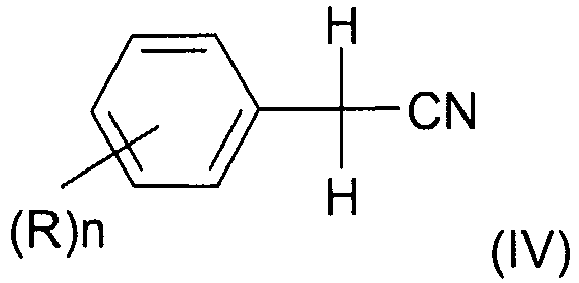
EP 0 518 412 , erhaltenen HCl- bzw. HBr-Abgas eingeleitet werden, wodurch eine direkte Kopplung der Herstellung des Nitrileduktes der Formel (II) an die Herstellung des gewünschten Dichloro- oder Dibromo-phenylessigsäurealkylesters der Formel (I) erzielt werden kann. - Ein weiterer Gegenstand der Erfindung ist demnach ein Verfahren zur Herstellung von 2,2-Dichloro- oder Dibromo-phenylessigsäurealkylester der Formel (I), das dadurch gekennzeichnet ist, dass in einer 1. Stufe ein gegebenenfalls substituiertes Benzylcyanid der Formel
- Stufe 1 kann dabei analog
EP 0 518 412 durchgeführt werden. - In einer bevorzugen Variante wird für die Umsetzung des Nitrils der Formel (II) ein Alkohol/Wasser/HCl-bzw. HBr-Gemisch verwendet.
- Dieses Dreiergemisch kann dadurch erhalten werden, dass in eine Mischung aus Wasser und Alkohol Salzsäuregas bzw. HBr eingeleitet wird.
- Besonders bevorzugt wird das Alkohol/Wasser/HCl-bzw, HBr-Gemisch dadurch erhalten, dass das bei der Halogenierung mit Cl2 oder Br2 von gegebenenfalls substituierten Benzylcyaniden zu den gewünschten Nitrilen der Formel (II), beispielsweise gemäß
EP 0 518 412 , erhaltene HCl-bzw. HBr-Abgas in ein Gemisch aus Wasser und Alkohol geleitet wird. Dies hat den Vorteil, dass die Herstellung des Nitrils der Formel (II) nicht direkt mit der Herstellung des Dichloro-bzw. Dibromo-phenylessigsäurealkylesters der Formel (I) gekoppelt werden muss. HCl bzw. HBr, die als Abgas aus der Halogenierung erhalten werden, können somit auch in Form einer wässrig, alkoholischen Lösung zwischengelagert werden. - Das Gemisch kann aber auch durch Einleiten von HCl oder HBr, bzw. von HCl oder HBr-Abgas in eine Lösung aus Alkohol und wässriger HCl bzw. HBr oder in Alkohol mit anschließendem Verdünnen mit Wasser erhalten werden.
- Das gewünschte Molverhältnis im Drelergemisch kann gegebenenfalls durch Verdünnen der vorhandenen wässrig, alkoholischen HCl- bzw. HBr-Lösung mit. Alkohol und/oder Wasser eingestellt werden.
- Wird bei dem erfindungsgemäßen Verfahren ein Alkohol/Wasser/HCl-bzw. HBrGemisch eingesetzt, so kann zuerst das Nitril der Formel (II) vorgelegt und anschileßend das Dreiergemisch zudosiert werden. Es kann jedoch auch das Dreiergemisch vorgelegt und dann das Nitril der Formel (II) zugegeben werden.
- Bei dem erfindungsgemäßen Verfahren erfolgt die Umsetzung in der ersten Phase bei einer Temperatur von 35 bis 55°C.
- Dazu wird beispielsweise entweder das Nitril der Formel (II) oder das Dreiergemisch vorgelegt, auf 35 bis 55°C erwärmt und anschließend bei dieser Temperatur die fehlende Reaktionskomponente zudosiert. Das so erhaltenen. Reaktionsgemisch wird sodann noch für einige Minuten bis zu mehreren Stunden, bevorzugt von 30 Minuten bis zu 5 Stunden, bei dieser Temperatur gerührt.
- In der zweiten Phase wird das Reaktionsgemisch auf 60 bis 100°C, bevorzugt auf 65 bis 80°C erhitzt und wiederum noch für einige Minuten bis zu mehreren Stunden, bevorzugt von 30 Minuten bis zu 10 Stunden, bei dieser Temperatur gerührt.
- Nach Kontrolle der vollständigen Umsetzung wird das Reaktionsgemisch auf 20 bis 40°C abgekühlt und soviel Wasser zugesetzt, dass das ausgefallene Ammoniumchlorid oder -bromid gerade gelöst wird und eine Phasentrennung eintritt. Anschließend kann die wässrigen Phase gewünschtenfalls mittels üblicher Extraktionsmittel, wie etwa Hexan, Heptan, Toluol, Ether, oder Estern extrahiert werden. Der Extrakt wird dann mit der organischen Phase vereinigt.
- Die Isolierung des Endproduktes kann beispielsweise dadurch erfolgen, dass zunächst bei Normaldruck und einer Temperatur bis max, 90°C ggf. Extraktionsmittel, Wasser und Alkohol und sodann unter Vakuum Leichtsieder bzw. die Nebenprodukte Phenylglyoxylsäure, Phenylglyoxylsäureethylester, Phenylessigsäureethylester (aus unvollständiger Halogenierung) und Monochlor- oder Monobromphenylessigsäureester, bis zu einem Erreichen einer konstanten Siedetemperatur abdestilliert werden, sodass das entsprechende Endprodukt der Formel (I) im Sumpf verbleibt. Zur weiteren Reinigung kann das Produkt über Kopf destilliert werden. Nach Vereinigung der organischen Phasen kann jedoch auch zuerst das Wasser am Wasserscheider abgetrennt werden und dann bei Normaldruck Alkohol und ggf. Extraktionsmittel abdestilliert werden.
- Einhält das rohe Endprodukt noch zuviel organische Säuren, die durch die Hydrolyse des Produktes entstehen, so wird das Rohprodukt noch einmal mit einem der oben ungeführten Extraktionsmittel und Alkohol versetzt und erneut destillativ aufgearbeitet, wobei eine Rückveresterung erfolgt.
- Durch das erfindungsgemäße Verfahren werden 2,2-Dichloro- oder Dibromophenylessig-säurealkylester der Formel (I) im Vergleich zum Stand der Technik höheren Ausbeuten und höheren Reinheiten erhalten, wobei wesentlich weniger Emissionen als bei bisher üblichen Verfahren entstehen und zudem durch die Abgasverwertung weniger Rohstoffe benötigt werden.
- 1436g (12,27 mol) Benzylcyanid wurden in einen zuvor inertisierten Email-Autoklaven chargiert. Danach wurden 239g (6,55 mol = 0,533 Äq.) Salzsäuregas bei geöffnetem Abgasventil eingeleitet, danach das Abgasventil geschlossen und auf 40°C erwärmt.
- Anschließend wurden 1830g (25,77 mol = 2,10 Äq.) Chlor über 6 Stunden bei 60-65°C und 3 bar eingeleitet. Dabei stieg die Temperatur innerhalb der ersten Minuten rasch an, blieb dann aber in Abhängigkeit von der Einleitgeschwindigkeit annähernd konstant. Bei Erreichen eines Innendruckes von 3 bar wurde das Abgasventil leicht geöffnet, sodass der Druck konstant bei 3 bar blieb.
- Gegen Ende der Reaktion sanken Temperatur und Druck leicht ab. Nach Ende des Chloreinleitens wurde das Abgasventil geschlossen und 30 Minuten bei 55°C gerührt.
- Danach wurde der Autoklav entspannt, und zum Austreiben von Chlor und HCl-Gas Stickstoff durchgeleitet.
- Der Abgaswäscher wurde mit 2823g (61,3 mol = 5Äq.) Ethanol und 340g konzentrierter Salzsäure (12,27 mol = 1 Äq. entsprechend 221g Wasser und 3,26 mol = 0,266 Äq. = 119g Salzsäure) beschickt und das Abgas aus der Chlorierung bei 10-15°C zu 95% (solange kein Chlor (max. 3%) im Abgas war) eingeleitet. Dahinter war ein Sicherheitswäscher (mit 10%iger Natronlauge beschickt) geschaltet.
- Das restliche Abgas wurde in 2 hintereinander geschaltene Wäscher mit 10%iger Natronlauge eingeleitet.
-
- 2200g 2,2-Dichlorphenylacetonitril (96,3% d.Th.)
- 3950g 24,5%ige ethanolische Salzsäure (Ausbeute an HCl aus der Chlorierung: 73% d.Th.)
- 70,0g (0,38 Mol) destilliertes 2,2-Dichlorphenylacetonitril, hergestellt nach Beispiel 1, wurden auf 40°C erwärmt.
- Dann wurden innerhalb von 30 Minuten 123,57g einer aus einer Chlorierung analog Beispiel 1 erhaltenen ethanolischen Salzsäure (30,22g = 0,83 mol entsprechend 2,18Äq. Salzsäure, 6,77g = 3,76 mol = 0,99 Äq. Wasser und 86,6g = 1,88 mol = 4,95 Äq. Ethanol) bei 40°C zudosiert und nach erfolgter Zugabe weitere 2 Stunden bei 40°C gerührt. Danach wurde auf 75°C erhitzt und weitere 3 Stunden gerührt. Nach Kontrolle der vollständigen Umsetzung wurde das Reaktionsgemisch auf 30°C abgekühlt und 115g Wasser zugegeben.
- Das Gemisch wurde bis zum vollständigen Lösen des Feststoffes (Ammoniumchlorid) gerührt. Danach wurde die organische Phase abgetrennt und die verbleibende wässrige Phase mit 18g Hexan extrahiert. Der organische Extrakt wurde mit der zuvor erhaltenen Produktphase vereinigt und zunächst bei Normaldruck zur Abtrennung von Ethanol, Wasser und Hexan destilliert. Anschließend wurde bei 10 mbar bis zum Erreichen einer konstanten Siedetemperatur von 128°C andestilliert.
- Der verbleibende Sumpf enthielt 97,8% w/w 2,2-Dichlorphenylessigsäureethylester.
- Ausbeute: 83,6g 2,2-Dichlorphenylessigsäureethylester (95% d.Th.) 97,8% w/w
- 123,57g einer aus einer Chlorierung analog Beispiel 1 erhaltenen ethanolischen Salzsäure (30,22g = 0,83 mol = 2,18Äq. Salzsäure; 6,77g = 3,76 mol = 0,99 Äq. Wasser; 86,6g = 1,88 mol = 4,95 Äq. Ethanol) wurden auf 40°C erwärmt.
- Dann wurden innerhalb von 30 Minuten 70,0g (0,38 mol) 2,2-Dichlorphenylacetonitril bei 40°C zudosiert und nach erfolgter Zugabe weitere 2 Stunden bei 40°C gerührt. Danach wurde auf 75°C erhitzt und weitere 3 Stunden gerührt. Nach Kontrolle der vollständigen Umsetzung wurde das Reaktionsgemisch auf 30°C abgekühlt und 115g Wasser zugegeben.
- Das Gemisch wurde bis zum vollständigen Lösen des Feststoffes (Ammoniumchlorid) gerührt. Danach wurde die organische Phase abgetrennt und die verbleibende wässrige Phase mit 18g Hexan extrahiert. Der organische Extrakt wurde mit der zuvor erhaltenen Produktphase vereinigt und zunächst das Wasser am Wasserabscheider abgetrennt. Danach wurde bei Normaldruck zur Abtrennung von Ethanol und Hexan destilliert. Anschließend wurde bei 10 mbar bis zum Erreichen einer konstanten Siedetemperatur von 128°C andestilliert.
- Der verbleibende Sumpf enthielt 93,9% w/w 2,2-Dichlorphenylessigsäureethylester Zur weiteren Reinigung wurde das Produkt über Kopf destilliert.
- Ausbeute: 70g 2,2-Dichlorphenylessigsäureethylester (80% d.Th.) 99,4%w/w
- 400kg (3385 mol) Benzylcyanid wurden in einen zuvor inertisierten Email-Kessel chargiert, danach wurden während einer Stunde bei 40-50°C 40kg (1096 mol = 0,324 Äq.) Salzsäuregas bei geöffnetem Abgasventil eingeleitet und dann das Abgasventil geschlossen.
- Anschließend wurden 487kg (6859 mol = 2,026 Äq.) Chlor über 15 Stunden bei 55-60°C und 3-3,5 bar eingeleitet.
- Nach Ende des Chloreinleitens wurde das Abgasventil geschlossen und 3 Stunden bei 60-63°C gerührt. Danach wurde der Kessel entspannt, und zum Austreiben von Chlor und HCl-Gas Stickstoff durchgeleitet.
- Der Abgaswäscher wurde mit 475kg (10326 mol = 3,05Äq.) Ethanol und 94kg konzentrierter Salzsäure (3394 mol = 1 Äq. = 61,1kg Wasser und 901 Mol = 0,266 Äq. = 32,9kg Salzsäure) beschickt und das Abgas aus der Chlorierung bei 10-15°C bis zu einer Chlorkonzentration von max. 3% im Abgas eingeleitet. Dahinter war ein Sicherheitswäscher (mit 10%iger Natronlauge beschickt) geschaltet.
- Das restliche Abgas wurde direkt in den oben beschriebenen Natronlauge-Wäscher eingeleitet.
-
- 636kg 2,2-Dichlorphenylacetonitril (∼theoretische Ausbeute)
- 825kg 35,2%ige ethanolische Salzsäure (Ausbeute an HCl aus der Chlorierung: 89% d.Th.)
- 410kg der gemäß Beispiel 4 erhaltenen ethanolischen Salzsäure (143,5kg = 3932 mol = 2,31Äq. Salzsäure; 30,5kg = 1694 mol = 1 Äq. Wasser; 236kg = 5130 mol =3,02 Äq. Ethanol) wurden mit 100kg (2174 mol = 1,28 Äq.) Ethanol verdünnt und auf 40°C erwärmt.
- Dann wurden innerhalb von 2 Stunden 316kg (1699 mol) 2,2-Dichlorphenylacetonitril bei 40°C zudosiert und nach erfolgter Zugabe eine weitere Stunde bei 40°C gerührt. Danach wurde auf 70°C erhitzt und weitere 6 Stunden gerührt. Nach Kontrolle der vollständigen Umsetzung wurde das Reaktionsgemisch auf 30°C abgekühlt.
- Die erhaltene Suspension wurde in 570I Wasser eingetragen und bis zum vollständigen Lösen des Feststoffes (Ammoniumchlorid) gerührt. Danach wurde die organische Phase abgetrennt und die verbleibende wässrige Phase mit 80kg Hexan extrahiert. Der organische Extrakt wurde mit der zuvor erhaltenen Produktphase vereinigt und zunächst bei Normaldruck bis 90°C andestilliert (zur Abtrennung von Ethanol, Wasser und Hexan) und anschließend bei 7 mbar bis 135°C fraktioniert.
- Ausbeute: 325kg 2,2-Dichlorphenylessigsäureethylester (82% d.Th.) 98,8% w/w
- 325,3kg (1749 mol) 2,2-Dichlorphenylacetonitril wurden mit 100kg (2174 mol = 1,28 Äq.) Ethanol verdünnt und auf 40°C erwärmt.
- Dann wurden innerhalb von 3 Stunden 410kg der gemäß Beispiel 4 erhaltenen ethanolischen Salzsäure (143,5kg = 3932 mol = 2,25Äq. Salzsäure; 30,5kg = 1694 mol = 0,97 Äq. Wasser; 236kg = 5130 mol = 2,93 Äq. Ethanol) bei 40°C zudosiert und nach erfolgter Zugabe weitere 3 Stunden bei 40°C gerührt. Danach wurde auf 70°C erhitzt und weitere 6 Stunden gerührt. Nach Kontrolle der vollständigen Umsetzung wurde das Reaktionsgemisch auf 30°C abgekühlt.
- Die erhaltene Suspension wurde in 570I Wasser eingetragen und bis zum vollständigen Lösen des Feststoffes (Ammoniumchlorid) gerührt. Anschließend wurde die organische Phase abgetrennt und die verbleibende wässrige Phase mit 80kg Hexan extrahiert. Der organische Extrakt wurde mit der zuvor erhaltenen Produktphase vereinigt und zunächst bei 20-25°C und leichtem Unterdruck andestilliert (zur Abtrennung von Ethanol, Wasser und Hexan) und anschließend bei 7 mbar bis 135°C fraktioniert.
- Ausbeute: 346,4kg 2,2-Dichlorphenylessigsäureethylester (85% d.Th.) 98,9% w/w
- 375kg der bei der Chlorierung gemäß Beispiel 4 erhaltenen ethanolischen Salzsäure (136,7kg = 3745 mol = 2,16 Äq. Salzsäure; 28,2kg = 1567,5 mol = 0,91 Äq. Wasser; 210,1kg = 4567 mol =2,64 Äq. Ethanol) wurden mit 100kg (2174 mol = 1,26 Äq.) Ethanol verdünnt und auf 40°C erwärmt.
- Dann wurden innerhalb von 2 Stunden 322kg (1732 mol) 2,2-Dichlorphenylacetonitril bei 40°C zudosiert und nach erfolgter Zugabe eine weitere Stunde bei 40°C gerührt. Danach wurde auf 70°C erhitzt und weitere 6 Stunden gerührt. Nach Kontrolle der vollständigen Umsetzung wurde das Reaktionsgemisch auf 30°C abgekühlt.
- Die erhaltene Suspension wurde in 570I Wasser eingetragen und bis zum vollständigen Lösen des Feststoffes (Ammoniumchlorid) gerührt. Anschließend wurde die organische Phase abgetrennt und die verbleibende wässrige Phase mit 80kg Hexan extrahiert. Der organische Extrakt wurde mit der zuvor erhaltenen Produktphase vereinigt und zunächst bei Normaldruck bis 120°C andestilliert (zur Abtrennung von Ethanol, Wasser und Hexan). Da das Rohprodukt zu viel organische Säuren (aus Hydrolyse des Produktes) enthielt, wurden 40kg Hexan und 20kg Ethanol zugegeben und erneut bei Normaldruck bis 120°C destilliert. Anschließend wurde das Rohprodukt bei 7 mbar bis 135°C fraktioniert.
- Ausbeute: 329kg 2,2-Dichlorphenylessigsäureethylester (81,5% d.Th.) 98,0% w/w
- 11,3g 2,2-Dichlorphenylessigsäureethylester mit einem Gehalt von 0,13% w/w Phenylglyoxylsäure (einem Hydrolyseprodukt von 2,2-Dichlorphenylessigsäureethylester) wurden mit 2ml Hexan und 0,5ml Ethanol für 2 Stunden auf 70°C erhitzt. Danach wurden die Lösungsmittel abdestilliert.
- Ergebnis: Der Gehalt an Phenylglyoxylsäure sinkt auf 0,01% w/w
Claims (10)
- Verbessertes Verfahren zur Herstellung von 2,2-Dichloro- oder Dibromo-phenylessigsäurealkylester der Formel


in 0,8 bis 2 mol Wasser pro mol Nitril der Formel (ii), 1 bis 8 mol Alkohol der Formel
R1OH (III)
in der R1 wie oben definiert ist, pro mol Nitril der Formel (II) und
in Gegenwart von 1 bis 3 mol HCl oder HBr pro mol Nitril der Formel (II), gegebenenfalls in Anwesenheit eines unter den Reaktionsbedingungen inerten Lösungsmittels zu dem entsprechenden 2,2-Dichloro- oder Dibromophenylessigsäurealkylester der Formel (I) umgesetzt wird, wobei die Reaktionstemperatur in der ersten Phase der Umsetzung bei 35 bis 55°C und in der zweiten Phase bei 60 bis 100°C liegt, worauf nach erfolgter Umsetzung das Reakitonsgemisch auf 20 bis 40°C abgekühit und mit Wasser verdünnt wird, und der entsprechende 2,2-Dichloro- oder Dibromo-phenylessigsäurealkylester der Formel (I) isoliert wird. - Verfahren nach Anspruch 1, dadurch gekennzeichnet, dass in der Formel (I) R Wasserstoff, C1-C4-Alkyl, C1-C4-Alkoxy, Phenyl, Phenoxy, Fluor, Brom oder Jod bedeutet und n, falls R nicht Wasserstoff ist, eine ganze Zahl von 1 bis 3 ist.
- Verfahren nach Anspruch 1, dadurch gekennzeichnet, dass als Alkohol der Formel (III) Methanol, Ethanol oder n-Butanol eingesetzt wird.
- Verfahren nach Anspruch 1, dadurch gekennzeichnet, dass für den Fall, dass der Alkohol der Formel (III) in einer Menge von 1 bis zu 3 mol pro mol Nitril der Formel (II) eingesetzt wird, die Umsetzung in Gegenwart eines unter den Reaktionsbedingungen inerten Lösungsmittel aus der Gruppe Methyl-tert.butylether, Diethylether, Tetrahydrofuran, Dioxan, Ethylenglykoldimethylether. Toluol, Hexan; Heptan, Dichlormethan oder Chlorbenzol durchgeführt wird.
- Verfahren nach Anspruch 1, dadurch gekennzeichnet, dass als HCl oder HBr das HCl- bzw. HBr-Abgas, das bei der Umsetzung von gegebenenfalls substituierten Benzylcyanid der Formel

- Verfahren zur Herstellung von 2,2-Dichloro- oder Dibromo-phenylessigsäurealkylester der Formel (I), dadurch gekennzeichnet, dass in einer 1. Stufe ein gegebenenfalls substituiertes Benzylcyanid der Formel

mit Chlor, in Gegenwart katalytischer Mengen an Salzsäuregas, bzw, mit einem Bromierungsmittel zu dem korrespondierenden Nitril der Formel
umgesetzt wird und das sich bildende HCl- bzw, HBr-Abgas in der zweiten Stufe zur Umsetzung des Nitrils der Formen (II) zu dem entsprochenden 2,2-Dichloro- oder Dibromo-phenylessig-saürealkylester der Formel
R1OH (III)
in der R1 wie oben definiert ist, pro mol Nitril der Formel (II) und:
mit bis 3 mol HCl- bzw. HBr in Form des Abgases aus der 1. Stufe pro mol Nitril der Formel (II), gegebenenfalls in Anwesenheit eines unter den Reaktionsbedingungen inerten Lösungsmittels erfolgt und die Reaktionstemperatur in der ersten Phase der Umsetzung bei 35 bis 55°C und in der zweiten Phase bei 60 bis 100°C liegt, worauf nach erfolgter Umsetzung das Reaktionsgemisch auf 20 bis 40°C abgekühlt und mit Wasser verdünnt wird, und der entsprechende 2,2-Dichloro- oder Dibromo-phenylessigsäurealkylester der Formel (I) isoliert wird. - Verfahren nach Anspruch 1, dadurch gekennzeichnet, dass zur Umsetzung des Nitrils der Formel (II) ein Alkohol/Wasser/HCl- bzw. HBr-Gemisch verwendet wird, das durch Einleiten von HCl-Gas bzw. HBr-Gas in eine Mischung aus Wasser und Alkohol, oder durch Einleiten von HCl-Gas bzw. HBr-Gas in eine Lösung aus Alkohol und wässriger HCl bzw. HBr, oder durch Einleiten von HCl-Gas bzw. HBr-Gas in Alkohol mit anschließendem Verdünnen mit Wasser erhalten wird, wobei das gewünschte Molyerhältnis im Alkohol/Wasser/HCl- bzw. HBr-Gemisch gegebenenfalls durch Verdünnen der vorhandenen wässrigen, alkoholischen HCl- bzw. HBr-Lösung mit Alkohol und/oder Wasser eingestellt werden kann.
- Verfahren nach Anspruch 7, dadurch gekennzeichnet dass als HCl-Gas bzw. HBr-Gas ein gemäß Anspruch 5 erhaltenes Abgas aus der Umsetzung eines Benzylcyanids der Formel (IV) zu dem korrespondierenden Nitril der Formel (II) eingesetzt wird, wodurch die Herstellung des Nitril der Formel (II) nicht direkt mit der Herstellung des 2,2-Dichloro- oder Dibromo-phenylessigsäurealkylesters der Formel (I) gekoppelt werden muss, und HCl bzw. HBr, die als Abgas bei der Herstellung des Nitrils der Formel (II) erhalten werden auch in Form des Alkohol/Wasser/HCl- bzw. HBr-Gemisches zwischengelagert werden können.
- Verfahren nach Anspruch 1, dadurch gekennzeichnet, dass zur Isolierung der entsprechenden 2,2-Dichloro- oder Dibromo-phenylessigsäurealkylester der Formel (I) soviel Wasser zugesetzt wird, dass das ausgefallene Ammoniumchlorid bzw. -bromid gerade gelöst wird und eine Phasentrennung eintritt, worauf, gegebenenfalls nach Extraktion der wässrigen Phase, von der organischen Phase zunächst bei Normaldruck und einher Temperatur bis maximal 90°C Wasser, Alkohol und gegebenenfalls vorhandenes Extraktionsmittel und anschließend unter Vakuum Nebenprodukte bis zum Erreichen einer konstanten Siedetemperatur abdestilliert werden, sodass der entsprechende 2,2-Dichloro- oder Dibromophenylessigsäurealkylester der Formel (I) im Sumpf verbleibt, der gegebenenfalls zur weiteren Reinigung über Kopf destilliert werden kann, oder worauf, gegebenenfalls nach Extraktion der wassugen Phase, von der organischen Phase zuerst das Wasser am Wasserscheider abgetrennt wird und anschließend bei Normal-druck Alkohol und gegebenenfalls vorhandenes Extraktionsmittel abdestilliert wird.
- Verfahren nach Anspruch 9, dadurch gekennzeichnet, dass der rohe 2,2-Dichloro- oder Dibromo-phenylessäurealkylester der Formel (I) für den Fall, dass dieser zuviel organische Säure enthält, mit einem Extraktionsmittel aus der Gruppe Hexan, Heptan, Toluol, Ether oder Ester und dem entsprechenden Alkohol der Formel (III) versetzt wird und erneut destillativ aufgearbeitet wird.
Applications Claiming Priority (3)
| Application Number | Priority Date | Filing Date | Title |
|---|---|---|---|
| AT5232002 | 2002-04-04 | ||
| AT0052302A AT500469B1 (de) | 2002-04-04 | 2002-04-04 | Verbessertes verfahren zur herstellung von 2,2-dichlorophenylessigsäurealkylestern |
| PCT/EP2003/002407 WO2003084918A1 (de) | 2002-04-04 | 2003-03-10 | Verfahren zur herstellung von 2,2-dichloro-oder dibromo-phenylessigsäurealkylestern |
Publications (2)
| Publication Number | Publication Date |
|---|---|
| EP1490322A1 EP1490322A1 (de) | 2004-12-29 |
| EP1490322B1 true EP1490322B1 (de) | 2015-07-29 |
Family
ID=28679361
Family Applications (1)
| Application Number | Title | Priority Date | Filing Date |
|---|---|---|---|
| EP03708200.5A Expired - Lifetime EP1490322B1 (de) | 2002-04-04 | 2003-03-10 | Verfahren zur herstellung von 2,2-dichloro- oder dibromo-phenylessigsäurealkylestern |
Country Status (13)
| Country | Link |
|---|---|
| US (1) | US20050131246A1 (de) |
| EP (1) | EP1490322B1 (de) |
| JP (1) | JP4686129B2 (de) |
| CN (1) | CN100516015C (de) |
| AT (1) | AT500469B1 (de) |
| AU (1) | AU2003212321B2 (de) |
| BR (2) | BR0308929A (de) |
| CA (1) | CA2479643C (de) |
| ES (1) | ES2549401T3 (de) |
| IL (1) | IL163964A (de) |
| PL (1) | PL215180B1 (de) |
| RU (1) | RU2320639C2 (de) |
| WO (1) | WO2003084918A1 (de) |
Families Citing this family (4)
| Publication number | Priority date | Publication date | Assignee | Title |
|---|---|---|---|---|
| CN102911057B (zh) * | 2011-08-04 | 2016-01-27 | 浙江九洲药业股份有限公司 | 一种酮洛芬乙酯的制备方法 |
| CN109020834A (zh) * | 2018-08-30 | 2018-12-18 | 南平铭正医药化学有限公司 | 一种2,2-二氯苯乙腈的制备方法 |
| CN109485566B (zh) * | 2018-11-23 | 2019-10-11 | 宁波江润化工有限公司 | 一种氧代苯乙酸酯的新合成方法 |
| CN118791400B (zh) * | 2024-06-05 | 2025-02-18 | 辽宁众辉生物科技有限公司 | 一种(e)-2-(2-氯甲基苯基)-2-甲氧亚胺基乙酸甲酯的新合成方法 |
Family Cites Families (4)
| Publication number | Priority date | Publication date | Assignee | Title |
|---|---|---|---|---|
| DE2827977A1 (de) * | 1978-06-26 | 1980-01-17 | Bayer Ag | Verfahren zur herstellung von mandelsaeureestern |
| NL8104287A (nl) * | 1981-09-17 | 1983-04-18 | Stamicarbon | De bereiding van derivaten van dichloorazijnzure esters. |
| NL8104286A (nl) * | 1981-09-17 | 1983-04-18 | Stamicarbon | Werkwijze voor de bereiding van 2,2-dichloorfenylazijnzure esters. |
| NL9100979A (nl) * | 1991-06-07 | 1993-01-04 | Dsm Nv | Werkwijze voor de alpha-chlorering van fenylacetonitrillen. |
-
2002
- 2002-04-04 AT AT0052302A patent/AT500469B1/de not_active IP Right Cessation
-
2003
- 2003-03-10 EP EP03708200.5A patent/EP1490322B1/de not_active Expired - Lifetime
- 2003-03-10 JP JP2003582117A patent/JP4686129B2/ja not_active Expired - Fee Related
- 2003-03-10 ES ES03708200.5T patent/ES2549401T3/es not_active Expired - Lifetime
- 2003-03-10 PL PL374094A patent/PL215180B1/pl unknown
- 2003-03-10 RU RU2004132213/04A patent/RU2320639C2/ru not_active IP Right Cessation
- 2003-03-10 CA CA2479643A patent/CA2479643C/en not_active Expired - Fee Related
- 2003-03-10 BR BR0308929-0A patent/BR0308929A/pt not_active IP Right Cessation
- 2003-03-10 AU AU2003212321A patent/AU2003212321B2/en not_active Ceased
- 2003-03-10 WO PCT/EP2003/002407 patent/WO2003084918A1/de not_active Ceased
- 2003-03-10 US US10/507,305 patent/US20050131246A1/en not_active Abandoned
- 2003-03-10 BR BRPI0308929-0A patent/BRPI0308929B1/pt unknown
- 2003-03-10 CN CNB038074966A patent/CN100516015C/zh not_active Expired - Fee Related
-
2004
- 2004-09-08 IL IL163964A patent/IL163964A/en not_active IP Right Cessation
Also Published As
| Publication number | Publication date |
|---|---|
| WO2003084918A1 (de) | 2003-10-16 |
| US20050131246A1 (en) | 2005-06-16 |
| PL215180B1 (pl) | 2013-10-31 |
| BRPI0308929B1 (pt) | 2019-04-24 |
| PL374094A1 (en) | 2005-09-19 |
| AT500469A1 (de) | 2006-01-15 |
| IL163964A (en) | 2011-02-28 |
| CA2479643A1 (en) | 2003-10-16 |
| RU2004132213A (ru) | 2005-04-20 |
| IL163964A0 (en) | 2005-12-18 |
| CN1642898A (zh) | 2005-07-20 |
| AU2003212321A1 (en) | 2003-10-20 |
| JP2006508024A (ja) | 2006-03-09 |
| BR0308929A (pt) | 2005-01-04 |
| CA2479643C (en) | 2011-01-25 |
| CN100516015C (zh) | 2009-07-22 |
| ES2549401T3 (es) | 2015-10-27 |
| JP4686129B2 (ja) | 2011-05-18 |
| RU2320639C2 (ru) | 2008-03-27 |
| AU2003212321B2 (en) | 2009-05-28 |
| EP1490322A1 (de) | 2004-12-29 |
| AT500469B1 (de) | 2007-04-15 |
Similar Documents
| Publication | Publication Date | Title |
|---|---|---|
| EP1658299B1 (de) | Verfahren zur herstellung von cyclischen phosphons ureanhydr iden | |
| EP0918047B1 (de) | Verfahren zur C-Alkylierung von Malonsäureestern | |
| EP0370391A2 (de) | Verfahren zur Herstellung von 4,5-Dichlor-6-ethylpyrimidin | |
| AT500469B1 (de) | Verbessertes verfahren zur herstellung von 2,2-dichlorophenylessigsäurealkylestern | |
| DE112007003065B4 (de) | Verfahren zur Herstellung von Fluoralkanester | |
| EP0439745B1 (de) | Verfahren zur Herstellung von 2-Chlor-5-methyl-pyridin | |
| EP1819659A1 (de) | Verfahren zur herstellung von phthalsauredichlorid | |
| DE10208955A1 (de) | Verfahren zur Herstellung von 2-Halogenalkylnicotinsäuren | |
| EP3452446B1 (de) | Verfahren zur herstellung von cis-alkoxysubstituierten spirocyclischen 1-h-pyrrolidin-2,4-dion- derivaten | |
| EP1296962B1 (de) | Verfahren zur herstellung von substituierten 5-amino-n-phenyl-1,2,4-triazol-3-sulfonamiden | |
| EP0679627B1 (de) | Ein Verfahren zur Herstellung von halogenierten Ethern | |
| DE69214914T2 (de) | Verfahren zur Herstellung von 4-Amino-3-Fluorobenzotrifluorid | |
| EP1232151A1 (de) | Verfahren zur herstellung von benzofuranonoximen | |
| DE102004040702B4 (de) | Verfahren zur Herstellung eines Dioxazin-Derivats | |
| EP0537534A1 (de) | Verfahren zur Herstellung von N-(Hydroxyalkyl)-carbamidsäure- alkylestern | |
| EP1037875B1 (de) | Verfahren zur herstellung von salzen cyclischer amidine | |
| DE2828011A1 (de) | Verfahren zur herstellung von mandelsaeureestern | |
| EP1832568A1 (de) | Verfahren zur Herstellung von Chlor-1,4-Dimethoxybenzol | |
| DE69227890T2 (de) | Verfahren zur herstellung von 5-amino-3-methylpyrazol | |
| EP1863752A1 (de) | Verfahren zur herstellung von 5-halo-2,4,6-trifluorisophthalsäure | |
| DE2800504A1 (de) | Verfahren zur herstellung von furancarbonsaeureanilid | |
| EP0926140A1 (de) | Verfahren zu Herstellung von 2-Mercaptothiazol | |
| DE10328888A1 (de) | Verbessertes Verfahren zur Herstellung von 1,2-disubstituierten Hexahydropyridazin-3-carbonsäuren und deren Estern | |
| WO2002008167A1 (de) | Verfahren zur herstellung von 3-oxocarbonsäureestern | |
| EP0006539A1 (de) | Verfahren zur Herstellung von Mandelsäureestern |
Legal Events
| Date | Code | Title | Description |
|---|---|---|---|
| PUAI | Public reference made under article 153(3) epc to a published international application that has entered the european phase |
Free format text: ORIGINAL CODE: 0009012 |
|
| 17P | Request for examination filed |
Effective date: 20040910 |
|
| AK | Designated contracting states |
Kind code of ref document: A1 Designated state(s): AT BE BG CH CY CZ DE DK EE ES FI FR GB GR HU IE IT LI LU MC NL PT RO SE SI SK TR |
|
| AX | Request for extension of the european patent |
Extension state: AL LT LV MK |
|
| 17Q | First examination report despatched |
Effective date: 20100802 |
|
| GRAP | Despatch of communication of intention to grant a patent |
Free format text: ORIGINAL CODE: EPIDOSNIGR1 |
|
| INTG | Intention to grant announced |
Effective date: 20150209 |
|
| GRAS | Grant fee paid |
Free format text: ORIGINAL CODE: EPIDOSNIGR3 |
|
| GRAA | (expected) grant |
Free format text: ORIGINAL CODE: 0009210 |
|
| AK | Designated contracting states |
Kind code of ref document: B1 Designated state(s): AT BE BG CH CY CZ DE DK EE ES FI FR GB GR HU IE IT LI LU MC NL PT RO SE SI SK TR |
|
| REG | Reference to a national code |
Ref country code: GB Ref legal event code: FG4D Free format text: NOT ENGLISH |
|
| REG | Reference to a national code |
Ref country code: CH Ref legal event code: EP |
|
| REG | Reference to a national code |
Ref country code: DE Ref legal event code: R081 Ref document number: 50315314 Country of ref document: DE Owner name: ESIM CHEMICALS GMBH, AT Free format text: FORMER OWNER: DSM FINE CHEMICALS AUSTRIA NFG GMBH & CO KG, LINZ, AT |
|
| REG | Reference to a national code |
Ref country code: AT Ref legal event code: REF Ref document number: 739139 Country of ref document: AT Kind code of ref document: T Effective date: 20150815 |
|
| REG | Reference to a national code |
Ref country code: IE Ref legal event code: FG4D Free format text: LANGUAGE OF EP DOCUMENT: GERMAN |
|
| REG | Reference to a national code |
Ref country code: DE Ref legal event code: R096 Ref document number: 50315314 Country of ref document: DE |
|
| REG | Reference to a national code |
Ref country code: ES Ref legal event code: FG2A Ref document number: 2549401 Country of ref document: ES Kind code of ref document: T3 Effective date: 20151027 |
|
| REG | Reference to a national code |
Ref country code: NL Ref legal event code: FP |
|
| PG25 | Lapsed in a contracting state [announced via postgrant information from national office to epo] |
Ref country code: FI Free format text: LAPSE BECAUSE OF FAILURE TO SUBMIT A TRANSLATION OF THE DESCRIPTION OR TO PAY THE FEE WITHIN THE PRESCRIBED TIME-LIMIT Effective date: 20150729 Ref country code: GR Free format text: LAPSE BECAUSE OF FAILURE TO SUBMIT A TRANSLATION OF THE DESCRIPTION OR TO PAY THE FEE WITHIN THE PRESCRIBED TIME-LIMIT Effective date: 20151030 |
|
| REG | Reference to a national code |
Ref country code: FR Ref legal event code: PLFP Year of fee payment: 14 |
|
| REG | Reference to a national code |
Ref country code: CH Ref legal event code: PUE Owner name: ESIM CHEMICALS GMBH, AT Free format text: FORMER OWNER: DPX FINE CHEMICALS AUSTRIA GMBH AND CO. KG, AT Ref country code: CH Ref legal event code: PFA Owner name: DPX FINE CHEMICALS AUSTRIA GMBH AND CO. KG, AT Free format text: FORMER OWNER: DSM FINE CHEMICALS AUSTRIA NFG GMBH AND CO KG, AT |
|
| PG25 | Lapsed in a contracting state [announced via postgrant information from national office to epo] |
Ref country code: PT Free format text: LAPSE BECAUSE OF FAILURE TO SUBMIT A TRANSLATION OF THE DESCRIPTION OR TO PAY THE FEE WITHIN THE PRESCRIBED TIME-LIMIT Effective date: 20151130 Ref country code: SE Free format text: LAPSE BECAUSE OF FAILURE TO SUBMIT A TRANSLATION OF THE DESCRIPTION OR TO PAY THE FEE WITHIN THE PRESCRIBED TIME-LIMIT Effective date: 20150729 |
|
| REG | Reference to a national code |
Ref country code: GB Ref legal event code: 732E Free format text: REGISTERED BETWEEN 20160218 AND 20160224 |
|
| PG25 | Lapsed in a contracting state [announced via postgrant information from national office to epo] |
Ref country code: EE Free format text: LAPSE BECAUSE OF FAILURE TO SUBMIT A TRANSLATION OF THE DESCRIPTION OR TO PAY THE FEE WITHIN THE PRESCRIBED TIME-LIMIT Effective date: 20150729 Ref country code: CZ Free format text: LAPSE BECAUSE OF FAILURE TO SUBMIT A TRANSLATION OF THE DESCRIPTION OR TO PAY THE FEE WITHIN THE PRESCRIBED TIME-LIMIT Effective date: 20150729 Ref country code: DK Free format text: LAPSE BECAUSE OF FAILURE TO SUBMIT A TRANSLATION OF THE DESCRIPTION OR TO PAY THE FEE WITHIN THE PRESCRIBED TIME-LIMIT Effective date: 20150729 Ref country code: SK Free format text: LAPSE BECAUSE OF FAILURE TO SUBMIT A TRANSLATION OF THE DESCRIPTION OR TO PAY THE FEE WITHIN THE PRESCRIBED TIME-LIMIT Effective date: 20150729 |
|
| REG | Reference to a national code |
Ref country code: ES Ref legal event code: PC2A Owner name: ESIM CHEMICALS GMBH Effective date: 20160425 Ref country code: DE Ref legal event code: R081 Ref document number: 50315314 Country of ref document: DE Owner name: ESIM CHEMICALS GMBH, AT Free format text: FORMER OWNER: DSM FINE CHEMICALS AUSTRIA NFG GMBH & CO KG, LINZ, AT |
|
| REG | Reference to a national code |
Ref country code: DE Ref legal event code: R097 Ref document number: 50315314 Country of ref document: DE |
|
| PG25 | Lapsed in a contracting state [announced via postgrant information from national office to epo] |
Ref country code: RO Free format text: LAPSE BECAUSE OF FAILURE TO SUBMIT A TRANSLATION OF THE DESCRIPTION OR TO PAY THE FEE WITHIN THE PRESCRIBED TIME-LIMIT Effective date: 20150729 |
|
| PLBE | No opposition filed within time limit |
Free format text: ORIGINAL CODE: 0009261 |
|
| STAA | Information on the status of an ep patent application or granted ep patent |
Free format text: STATUS: NO OPPOSITION FILED WITHIN TIME LIMIT |
|
| REG | Reference to a national code |
Ref country code: DE Ref legal event code: R082 Ref document number: 50315314 Country of ref document: DE Representative=s name: PRUEFER & PARTNER MBB PATENTANWAELTE RECHTSANW, DE Ref country code: DE Ref legal event code: R082 Ref document number: 50315314 Country of ref document: DE |
|
| REG | Reference to a national code |
Ref country code: FR Ref legal event code: TP Owner name: ESIM CHEMICALS GMBH, AT Effective date: 20160531 Ref country code: FR Ref legal event code: CD Owner name: ESIM CHEMICALS GMBH, AT Effective date: 20160531 |
|
| 26N | No opposition filed |
Effective date: 20160502 |
|
| REG | Reference to a national code |
Ref country code: DE Ref legal event code: R082 Ref document number: 50315314 Country of ref document: DE Representative=s name: PRUEFER & PARTNER MBB PATENTANWAELTE RECHTSANW, DE |
|
| REG | Reference to a national code |
Ref country code: CH Ref legal event code: PK Free format text: BERICHTIGUNG INHABER |
|
| PG25 | Lapsed in a contracting state [announced via postgrant information from national office to epo] |
Ref country code: SI Free format text: LAPSE BECAUSE OF FAILURE TO SUBMIT A TRANSLATION OF THE DESCRIPTION OR TO PAY THE FEE WITHIN THE PRESCRIBED TIME-LIMIT Effective date: 20150729 Ref country code: BE Free format text: LAPSE BECAUSE OF NON-PAYMENT OF DUE FEES Effective date: 20160331 |
|
| PG25 | Lapsed in a contracting state [announced via postgrant information from national office to epo] |
Ref country code: LU Free format text: LAPSE BECAUSE OF FAILURE TO SUBMIT A TRANSLATION OF THE DESCRIPTION OR TO PAY THE FEE WITHIN THE PRESCRIBED TIME-LIMIT Effective date: 20160310 Ref country code: MC Free format text: LAPSE BECAUSE OF FAILURE TO SUBMIT A TRANSLATION OF THE DESCRIPTION OR TO PAY THE FEE WITHIN THE PRESCRIBED TIME-LIMIT Effective date: 20150729 |
|
| REG | Reference to a national code |
Ref country code: IE Ref legal event code: MM4A |
|
| PG25 | Lapsed in a contracting state [announced via postgrant information from national office to epo] |
Ref country code: IE Free format text: LAPSE BECAUSE OF NON-PAYMENT OF DUE FEES Effective date: 20160310 |
|
| REG | Reference to a national code |
Ref country code: FR Ref legal event code: PLFP Year of fee payment: 15 |
|
| REG | Reference to a national code |
Ref country code: AT Ref legal event code: MM01 Ref document number: 739139 Country of ref document: AT Kind code of ref document: T Effective date: 20160310 |
|
| PG25 | Lapsed in a contracting state [announced via postgrant information from national office to epo] |
Ref country code: AT Free format text: LAPSE BECAUSE OF NON-PAYMENT OF DUE FEES Effective date: 20160310 |
|
| REG | Reference to a national code |
Ref country code: FR Ref legal event code: PLFP Year of fee payment: 16 |
|
| PG25 | Lapsed in a contracting state [announced via postgrant information from national office to epo] |
Ref country code: CY Free format text: LAPSE BECAUSE OF FAILURE TO SUBMIT A TRANSLATION OF THE DESCRIPTION OR TO PAY THE FEE WITHIN THE PRESCRIBED TIME-LIMIT Effective date: 20150729 Ref country code: HU Free format text: LAPSE BECAUSE OF FAILURE TO SUBMIT A TRANSLATION OF THE DESCRIPTION OR TO PAY THE FEE WITHIN THE PRESCRIBED TIME-LIMIT; INVALID AB INITIO Effective date: 20030310 |
|
| PG25 | Lapsed in a contracting state [announced via postgrant information from national office to epo] |
Ref country code: TR Free format text: LAPSE BECAUSE OF FAILURE TO SUBMIT A TRANSLATION OF THE DESCRIPTION OR TO PAY THE FEE WITHIN THE PRESCRIBED TIME-LIMIT Effective date: 20150729 |
|
| PG25 | Lapsed in a contracting state [announced via postgrant information from national office to epo] |
Ref country code: BG Free format text: LAPSE BECAUSE OF FAILURE TO SUBMIT A TRANSLATION OF THE DESCRIPTION OR TO PAY THE FEE WITHIN THE PRESCRIBED TIME-LIMIT Effective date: 20150729 |
|
| PGFP | Annual fee paid to national office [announced via postgrant information from national office to epo] |
Ref country code: DE Payment date: 20200330 Year of fee payment: 18 Ref country code: NL Payment date: 20200323 Year of fee payment: 18 Ref country code: GB Payment date: 20200325 Year of fee payment: 18 Ref country code: IT Payment date: 20200325 Year of fee payment: 18 |
|
| PGFP | Annual fee paid to national office [announced via postgrant information from national office to epo] |
Ref country code: CH Payment date: 20200325 Year of fee payment: 18 |
|
| PGFP | Annual fee paid to national office [announced via postgrant information from national office to epo] |
Ref country code: FR Payment date: 20200325 Year of fee payment: 18 |
|
| PGFP | Annual fee paid to national office [announced via postgrant information from national office to epo] |
Ref country code: ES Payment date: 20200421 Year of fee payment: 18 |
|
| REG | Reference to a national code |
Ref country code: DE Ref legal event code: R119 Ref document number: 50315314 Country of ref document: DE |
|
| REG | Reference to a national code |
Ref country code: CH Ref legal event code: PL |
|
| REG | Reference to a national code |
Ref country code: NL Ref legal event code: MM Effective date: 20210401 |
|
| GBPC | Gb: european patent ceased through non-payment of renewal fee |
Effective date: 20210310 |
|
| PG25 | Lapsed in a contracting state [announced via postgrant information from national office to epo] |
Ref country code: CH Free format text: LAPSE BECAUSE OF NON-PAYMENT OF DUE FEES Effective date: 20210331 Ref country code: LI Free format text: LAPSE BECAUSE OF NON-PAYMENT OF DUE FEES Effective date: 20210331 Ref country code: NL Free format text: LAPSE BECAUSE OF NON-PAYMENT OF DUE FEES Effective date: 20210401 Ref country code: GB Free format text: LAPSE BECAUSE OF NON-PAYMENT OF DUE FEES Effective date: 20210310 Ref country code: FR Free format text: LAPSE BECAUSE OF NON-PAYMENT OF DUE FEES Effective date: 20210331 Ref country code: DE Free format text: LAPSE BECAUSE OF NON-PAYMENT OF DUE FEES Effective date: 20211001 |
|
| PG25 | Lapsed in a contracting state [announced via postgrant information from national office to epo] |
Ref country code: IT Free format text: LAPSE BECAUSE OF NON-PAYMENT OF DUE FEES Effective date: 20210310 |
|
| REG | Reference to a national code |
Ref country code: ES Ref legal event code: FD2A Effective date: 20220523 |
|
| PG25 | Lapsed in a contracting state [announced via postgrant information from national office to epo] |
Ref country code: ES Free format text: LAPSE BECAUSE OF NON-PAYMENT OF DUE FEES Effective date: 20210311 |