EP1457550B1 - Composition for removing residues from the microstructure of an object - Google Patents
Composition for removing residues from the microstructure of an object Download PDFInfo
- Publication number
- EP1457550B1 EP1457550B1 EP04011792A EP04011792A EP1457550B1 EP 1457550 B1 EP1457550 B1 EP 1457550B1 EP 04011792 A EP04011792 A EP 04011792A EP 04011792 A EP04011792 A EP 04011792A EP 1457550 B1 EP1457550 B1 EP 1457550B1
- Authority
- EP
- European Patent Office
- Prior art keywords
- composition according
- additive
- fluoride
- solvent
- residues
- Prior art date
- Legal status (The legal status is an assumption and is not a legal conclusion. Google has not performed a legal analysis and makes no representation as to the accuracy of the status listed.)
- Expired - Lifetime
Links
Images


Classifications
-
- H—ELECTRICITY
- H10—SEMICONDUCTOR DEVICES; ELECTRIC SOLID-STATE DEVICES NOT OTHERWISE PROVIDED FOR
- H10P—GENERIC PROCESSES OR APPARATUS FOR THE MANUFACTURE OR TREATMENT OF DEVICES COVERED BY CLASS H10
- H10P50/00—Etching of wafers, substrates or parts of devices
- H10P50/20—Dry etching; Plasma etching; Reactive-ion etching
- H10P50/24—Dry etching; Plasma etching; Reactive-ion etching of semiconductor materials
- H10P50/242—Dry etching; Plasma etching; Reactive-ion etching of semiconductor materials of Group IV materials
-
- C—CHEMISTRY; METALLURGY
- C11—ANIMAL OR VEGETABLE OILS, FATS, FATTY SUBSTANCES OR WAXES; FATTY ACIDS THEREFROM; DETERGENTS; CANDLES
- C11D—DETERGENT COMPOSITIONS; USE OF SINGLE SUBSTANCES AS DETERGENTS; SOAP OR SOAP-MAKING; RESIN SOAPS; RECOVERY OF GLYCEROL
- C11D7/00—Compositions of detergents based essentially on non-surface-active compounds
- C11D7/02—Inorganic compounds
-
- B—PERFORMING OPERATIONS; TRANSPORTING
- B08—CLEANING
- B08B—CLEANING IN GENERAL; PREVENTION OF FOULING IN GENERAL
- B08B7/00—Cleaning by methods not provided for in a single other subclass or a single group in this subclass
- B08B7/0021—Cleaning by methods not provided for in a single other subclass or a single group in this subclass by liquid gases or supercritical fluids
-
- C—CHEMISTRY; METALLURGY
- C11—ANIMAL OR VEGETABLE OILS, FATS, FATTY SUBSTANCES OR WAXES; FATTY ACIDS THEREFROM; DETERGENTS; CANDLES
- C11D—DETERGENT COMPOSITIONS; USE OF SINGLE SUBSTANCES AS DETERGENTS; SOAP OR SOAP-MAKING; RESIN SOAPS; RECOVERY OF GLYCEROL
- C11D7/00—Compositions of detergents based essentially on non-surface-active compounds
- C11D7/02—Inorganic compounds
- C11D7/04—Water-soluble compounds
-
- C—CHEMISTRY; METALLURGY
- C11—ANIMAL OR VEGETABLE OILS, FATS, FATTY SUBSTANCES OR WAXES; FATTY ACIDS THEREFROM; DETERGENTS; CANDLES
- C11D—DETERGENT COMPOSITIONS; USE OF SINGLE SUBSTANCES AS DETERGENTS; SOAP OR SOAP-MAKING; RESIN SOAPS; RECOVERY OF GLYCEROL
- C11D7/00—Compositions of detergents based essentially on non-surface-active compounds
- C11D7/02—Inorganic compounds
- C11D7/04—Water-soluble compounds
- C11D7/10—Salts
-
- C—CHEMISTRY; METALLURGY
- C11—ANIMAL OR VEGETABLE OILS, FATS, FATTY SUBSTANCES OR WAXES; FATTY ACIDS THEREFROM; DETERGENTS; CANDLES
- C11D—DETERGENT COMPOSITIONS; USE OF SINGLE SUBSTANCES AS DETERGENTS; SOAP OR SOAP-MAKING; RESIN SOAPS; RECOVERY OF GLYCEROL
- C11D7/00—Compositions of detergents based essentially on non-surface-active compounds
- C11D7/22—Organic compounds
- C11D7/32—Organic compounds containing nitrogen
- C11D7/3209—Amines or imines with one to four nitrogen atoms; Quaternized amines
-
- C—CHEMISTRY; METALLURGY
- C11—ANIMAL OR VEGETABLE OILS, FATS, FATTY SUBSTANCES OR WAXES; FATTY ACIDS THEREFROM; DETERGENTS; CANDLES
- C11D—DETERGENT COMPOSITIONS; USE OF SINGLE SUBSTANCES AS DETERGENTS; SOAP OR SOAP-MAKING; RESIN SOAPS; RECOVERY OF GLYCEROL
- C11D7/00—Compositions of detergents based essentially on non-surface-active compounds
- C11D7/22—Organic compounds
- C11D7/32—Organic compounds containing nitrogen
- C11D7/3218—Alkanolamines or alkanolimines
-
- C—CHEMISTRY; METALLURGY
- C11—ANIMAL OR VEGETABLE OILS, FATS, FATTY SUBSTANCES OR WAXES; FATTY ACIDS THEREFROM; DETERGENTS; CANDLES
- C11D—DETERGENT COMPOSITIONS; USE OF SINGLE SUBSTANCES AS DETERGENTS; SOAP OR SOAP-MAKING; RESIN SOAPS; RECOVERY OF GLYCEROL
- C11D7/00—Compositions of detergents based essentially on non-surface-active compounds
- C11D7/50—Solvents
- C11D7/5004—Organic solvents
-
- G—PHYSICS
- G03—PHOTOGRAPHY; CINEMATOGRAPHY; ANALOGOUS TECHNIQUES USING WAVES OTHER THAN OPTICAL WAVES; ELECTROGRAPHY; HOLOGRAPHY
- G03F—PHOTOMECHANICAL PRODUCTION OF TEXTURED OR PATTERNED SURFACES, e.g. FOR PRINTING, FOR PROCESSING OF SEMICONDUCTOR DEVICES; MATERIALS THEREFOR; ORIGINALS THEREFOR; APPARATUS SPECIALLY ADAPTED THEREFOR
- G03F7/00—Photomechanical, e.g. photolithographic, production of textured or patterned surfaces, e.g. printing surfaces; Materials therefor, e.g. comprising photoresists; Apparatus specially adapted therefor
- G03F7/26—Processing photosensitive materials; Apparatus therefor
- G03F7/42—Stripping or agents therefor
- G03F7/422—Stripping or agents therefor using liquids only
-
- G—PHYSICS
- G03—PHOTOGRAPHY; CINEMATOGRAPHY; ANALOGOUS TECHNIQUES USING WAVES OTHER THAN OPTICAL WAVES; ELECTROGRAPHY; HOLOGRAPHY
- G03F—PHOTOMECHANICAL PRODUCTION OF TEXTURED OR PATTERNED SURFACES, e.g. FOR PRINTING, FOR PROCESSING OF SEMICONDUCTOR DEVICES; MATERIALS THEREFOR; ORIGINALS THEREFOR; APPARATUS SPECIALLY ADAPTED THEREFOR
- G03F7/00—Photomechanical, e.g. photolithographic, production of textured or patterned surfaces, e.g. printing surfaces; Materials therefor, e.g. comprising photoresists; Apparatus specially adapted therefor
- G03F7/26—Processing photosensitive materials; Apparatus therefor
- G03F7/42—Stripping or agents therefor
- G03F7/422—Stripping or agents therefor using liquids only
- G03F7/425—Stripping or agents therefor using liquids only containing mineral alkaline compounds; containing organic basic compounds, e.g. quaternary ammonium compounds; containing heterocyclic basic compounds containing nitrogen
-
- H—ELECTRICITY
- H10—SEMICONDUCTOR DEVICES; ELECTRIC SOLID-STATE DEVICES NOT OTHERWISE PROVIDED FOR
- H10P—GENERIC PROCESSES OR APPARATUS FOR THE MANUFACTURE OR TREATMENT OF DEVICES COVERED BY CLASS H10
- H10P50/00—Etching of wafers, substrates or parts of devices
- H10P50/20—Dry etching; Plasma etching; Reactive-ion etching
- H10P50/28—Dry etching; Plasma etching; Reactive-ion etching of insulating materials
- H10P50/282—Dry etching; Plasma etching; Reactive-ion etching of insulating materials of inorganic materials
- H10P50/283—Dry etching; Plasma etching; Reactive-ion etching of insulating materials of inorganic materials by chemical means
-
- H—ELECTRICITY
- H10—SEMICONDUCTOR DEVICES; ELECTRIC SOLID-STATE DEVICES NOT OTHERWISE PROVIDED FOR
- H10P—GENERIC PROCESSES OR APPARATUS FOR THE MANUFACTURE OR TREATMENT OF DEVICES COVERED BY CLASS H10
- H10P50/00—Etching of wafers, substrates or parts of devices
- H10P50/20—Dry etching; Plasma etching; Reactive-ion etching
- H10P50/28—Dry etching; Plasma etching; Reactive-ion etching of insulating materials
- H10P50/286—Dry etching; Plasma etching; Reactive-ion etching of insulating materials of organic materials
- H10P50/287—Dry etching; Plasma etching; Reactive-ion etching of insulating materials of organic materials by chemical means
-
- C—CHEMISTRY; METALLURGY
- C11—ANIMAL OR VEGETABLE OILS, FATS, FATTY SUBSTANCES OR WAXES; FATTY ACIDS THEREFROM; DETERGENTS; CANDLES
- C11D—DETERGENT COMPOSITIONS; USE OF SINGLE SUBSTANCES AS DETERGENTS; SOAP OR SOAP-MAKING; RESIN SOAPS; RECOVERY OF GLYCEROL
- C11D2111/00—Cleaning compositions characterised by the objects to be cleaned; Cleaning compositions characterised by non-standard cleaning or washing processes
- C11D2111/10—Objects to be cleaned
- C11D2111/14—Hard surfaces
- C11D2111/22—Electronic devices, e.g. PCBs or semiconductors
-
- H—ELECTRICITY
- H10—SEMICONDUCTOR DEVICES; ELECTRIC SOLID-STATE DEVICES NOT OTHERWISE PROVIDED FOR
- H10P—GENERIC PROCESSES OR APPARATUS FOR THE MANUFACTURE OR TREATMENT OF DEVICES COVERED BY CLASS H10
- H10P70/00—Cleaning of wafers, substrates or parts of devices
- H10P70/10—Cleaning before device manufacture, i.e. Begin-Of-Line process
- H10P70/15—Cleaning before device manufacture, i.e. Begin-Of-Line process by wet cleaning only
-
- H—ELECTRICITY
- H10—SEMICONDUCTOR DEVICES; ELECTRIC SOLID-STATE DEVICES NOT OTHERWISE PROVIDED FOR
- H10P—GENERIC PROCESSES OR APPARATUS FOR THE MANUFACTURE OR TREATMENT OF DEVICES COVERED BY CLASS H10
- H10P72/00—Handling or holding of wafers, substrates or devices during manufacture or treatment thereof
- H10P72/04—Apparatus for manufacture or treatment
- H10P72/0402—Apparatus for fluid treatment
- H10P72/0418—Apparatus for fluid treatment for etching
- H10P72/0422—Apparatus for fluid treatment for etching for wet etching
- H10P72/0426—Apparatus for fluid treatment for etching for wet etching with the semiconductor substrates being dipped in baths or vessels
Definitions
- the present invention relates to a composition for removing residues from the microstructure of an object.
- the present invention specifically relates to a composition for removing residues, such as resists, generated during a semiconductor manufacturing process from a semiconductor wafer surface having a fine structure of convex and concave portions.
- residues such as photoresists, UV-hardened resists, X-ray hardened resists, ashed resists, carbon-fluorine containing polymer, plasma etch residues, and organic or inorganic contaminants from the other steps of the manufacturing process.
- the dry and wet removal methods are commonly used.
- the semiconductor wafer is dipped in an agent, such as a water solution, including a remover to remove residues from the surface of semiconductor wafer.
- an agent such as a water solution
- a remover to remove residues from the surface of semiconductor wafer.
- supercritical CO 2 is used as such an agent because of its low viscosity.
- compositions for removing residues from the microstructure of an object are also known from WO 0133613-A, US 6242165 B, US 6306564 B, WO 0215251-A and US 5709756A.
- An object of the present invention is, therefore, to provide a composition for effectively removing residues from the microstructure of an object.
- a composition for removing residues from the object, comprising carbon dioxide; an additive for removing the residues comprising a fluoride having the formula NR 1 R 2 R 3 R 4 F, where R 1 , R 2 , R 3 and R 4 are a hydrogen or an alkyl group; and a co-solvent for dissolving said additive in said carbon dioxide at a pressurized fluid condition.
- the present invention is applied to the microstructure of an object, e.g., a semiconductor wafer having a fine structure of convex and concave portions on its surface, and a substrate made of a metal, plastic or ceramic which forms or remains continuous or noncontinuous layer of materials different therefrom.
- an object e.g., a semiconductor wafer having a fine structure of convex and concave portions on its surface, and a substrate made of a metal, plastic or ceramic which forms or remains continuous or noncontinuous layer of materials different therefrom.
- the pressurized CO 2 of the present invention As the pressurized CO 2 is not enough by itself to remove residues, the pressurized CO 2 of the present invention, to which an additive and a co-solvent are added, is used as a remover for removing residues from the object.
- the additive used for this purpose can remove residues but cannot substantially dissolve in CO 2 by itself.
- the co-solvent used for this purpose can make the additive dissolved or dispersed homogeneously in CO 2 .
- the pressurized CO 2 has a high dispersion rate and enables the dissolved residues to disperse therein. If CO 2 is converted to a supercritical condition, it penetrates into fine pattern portions of the object more effectively. By this feature, the additive is conveyed into pores or concave portions on a surface of the object due to the low viscosity of CO 2 .
- the CO 2 is pressurized to 5 MPa or more, but not less than 7.1 MPa at a temperature of 31°C to convert the CO 2 to a supercritical fluid condition.
- the composition for removing residues from the microstructure of an object comprises an additive for removing the residues which comprises a fluoride having the formula NR 1 R 2 R 3 R 4 F, where R 1 , R 2 , R 3 and R 4 are a hydrogen or an alkyl group. It is preferable to use the fluoride with Rs being alkyl groups.
- the fluoride having the formula NR 1 R 2 R 3 R 4 F is selected from the group consisting of tetramethylammonium fluoride (hereinafter referred to as TMAF), tetraethylammonium fluoride, tetrapropylammonium fluoride, tetrabutylammonium fluoride and choline fluoride.
- TMAF tetramethylammonium fluoride
- TMAF tetramethylammonium fluoride
- tetraethylammonium fluoride tetrapropylammonium fluoride
- tetrabutylammonium fluoride choline fluoride
- the additive may further comprise a basic compound because it effectively hydrolyzes polymers typically used as a resist in manufacturing a semiconductor.
- the basic compound is preferably at least one element selected from the group consisting of quaternary ammoniumhydroxide, alkylamine, alkanolamine, and hydroxylamine. It is preferred to use a compound including at least one of quaternary ammoniumhydroxide, and hydroxylamine to remove novolac phenol resists from a semiconductor wafer.
- the quaternary ammoniumhydroxide may be any quaternary ammoniumhydroxide, e.g.
- the alkylamine may be any alkylamine, e.g. methylamine, dimethylamine, ethylamine, diethylamine, triethylamine, and propylamine, dipropylamine.
- the alkanolamine may be any alkanolamine, e.g., monoethanolamine, diethanolamine, and triethanolamine.
- the additive is preferably added in a ratio of not less than 0.001 wt. % of the remover, more preferably in a ratio of not less than 0.002 wt. %.
- the co-solvent should be added more, but the amount of CO 2 is decreased according to the amount of the added co-solvent, which decreases the penetration of CO 2 into a surface of the object.
- the upper range of the additive is 8 wt. %, preferably 6 wt. %, and more preferably 4 wt. %.
- the co-solvent is added to CO 2 together with the additive.
- the co-solvent of the present invention is a compound having an affinity to both CO 2 and the additive. Such a co-solvent dissolves or disperses the additive homogeneously in the pressurized CO 2 in fluid condition.
- An alcohol, dimethylsulfoxide or a mixture thereof is used as the co-solvent.
- the alcohol may be any alcohol, e.g.
- ethanol methanol, n-propanol, iso-propanol, n-butanol, iso-butanol, diethyleneglycolmonomethyleter, diethyleneglycolmonoethyleter, and hexafluoro isopropanol, preferably ethanol and methanol.
- the kind and amount of the co-solvent are selected depending on the kind and amount of the additive to CO 2 .
- the amount of the co-solvent is preferably five times or more than that of the additive because the remover easily becomes homogeneous and transparent.
- the remover may include the co-solvent in a range of 1 wt. % to 50 wt. %. If more than 50 wt. % of the co-solvent is added, the penetration rate of the remover decreases due to less amount of CO 2 .
- a remover including CO 2 , alcohol as the co-solvent, quaternary ammoniumfluoride and quaternary ammoniumhydroxide as the additive because these additives are well dissolved in CO 2 by alcohol and are CO 2 -philic.
- the fluoride may be any fluoride of formula NR1R2R3R4F where R represents a hydrogen or alkyl group, e.g. ammonium fluoride, tetramethylammoniumfluoride, and tetraethylammoniumfluoride. It is preferable to use the fluoride with Rs being alkyl groups, such as tetramethylammoniumfluoride and tetraethylammoniumfluoride because such fluorides are CO 2 -philic.
- the remover may include the fluoride preferably in the range from 0.001 wt % to 5 wt % of the remover, more preferably in the range from 0.002 wt % to 0.02 wt % of the remover.
- the co-solvent is preferably a compound having a hydroxyl group, e.g., alcohol (such as ethanol, methanol, n-propanol, isopropanol, n-butanol and isobutanol , phenol), glycol (such as ethylenglycol and methylenglycol and polyethylenglycol).
- alcohol such as ethanol, methanol, n-propanol, isopropanol, n-butanol and isobutanol , phenol
- glycol such as ethylenglycol and methylenglycol and polyethylenglycol
- ethanol is preferable because a larger amount of the fluoride, such as TMAF, can be dissolved in supercritical CO 2 by the presence of the ethanol.
- the concentration of the compound in supercritical CO 2 depends on the kind and concentration of the fluoride, and the kind of the residue. Approximately, the compound is preferably included in supercritical CO 2 in the range from 1 wt % to 20 wt % of the remover.
- the supercritical CO 2 further comprises dimethylacetamide (hereinafter referred to as "DMAC").
- DMAC dimethylacetamide
- the DMAC contained in the CO 2 is preferably six to seventy times of the fluoride contained in the CO 2 by weight. Further, it is preferable that the supercritical CO 2 includes substantially no water, which is a hindrance for manufacturing semiconductor wafers.
- FIG. 1 shows a simplified schematic drawing of an apparatus used for removing residues.
- the semiconductor wafer having residues on its surface is introduced to and placed in a high pressure vessel 9, then CO 2 is supplied from a CO 2 cylinder 1 to the high pressure vessel 9 by a high pressure pump 2.
- the high pressure vessel 9 is thermostated at a specific temperature by a thermostat 10 in order to maintain the pressurized CO 2 in the high pressure vessel 9 at the supercritical condition.
- An additive and a co-solvent are supplied to the high pressure vessel 9 from tanks 3 and 6 by high pressure pumps 4 and 7, respectively, while the additive and co-solvent are mixed by a line mixer 11 on the way to the high pressure vessel 9.
- the flow rates of the additive and the co-solvent are adjusted by valves 5 and 8, respectively in order to set to the predetermined values.
- the CO 2 , the additive and the co-solvent may be supplied continuously.
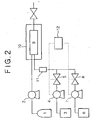
- Figure 2 shows another embodiment of the apparatus for removing residues.
- the additive is mixed with the co-solvent by the line mixer 11 before being fed into the high pressure vessel 9 in order to avoid heterogeneously contacting.
- the ratio of the additive and the co-solvent to be fed into the high pressure vessel 9 is controlled by a ratio controller 12, which regulates the feeding rate(s) of the additive and/or the co-solvent to the supercritical CO 2 in the high pressure vessel 9.
- the removing process is performed at a temperature in the range from 31°C to 210°C, and at a pressure ranged from 5 M Pa to 30 M Pa, preferably, from 7.1 M Pa to 20 M Pa.
- the time required for removing the residues depends on the size of the object, the kind and amount of the residues, which is usually in the range from a minute to several ten minutes.
- This experiment is carried out by dipping an object in an additive shown in table 1 at an atmospheric pressure at a temperature in the range of from 40°C to 100°C for 20 minutes.
- the object for this experiment is a silicon wafer having a SiO 2 layer coated with a novolac phenol type resist, patterned by a development, and treated to form microstructures on its surface by dry etching of a fluorine gas.
- a rate of removing residues is estimated as a ratio of an area of the surface adhering with residues after removing and before removing by a microscope.
- the term “ ⁇ ” and the term “O” mean that the rate is less than 90%, and 90% or more, respectively.
- the therm " ⁇ " means the rate is 90% or more when the additive is diluted ten times by a co-solvent such as dimethylsulfoxide.
- alkylamine such as methylamine and ethylamine
- alkanolamine such as monoethanolamine
- quaternary ammonium hydroxide such as TMAH and choline
- hydroxylamine and ammonium fluoride
- quaternary ammonium hydroxide,hydroxylamine, and ammonium fluoride have a superior rate for removing residues.
- experiment No. 2-1-2-9 As shown in table 2, in experiment No. 2-1-2-9, the effects of co-solvents are confirmed.
- the conditions in experiment No. 2-1-2-9 observed through the window are transparent, homogenous, and without two phases.
- This experiment for removing residues from the surface of semiconductor wafers is carried out by using a remover including additives H, I, G, J, L, and K which include the fluoride of formula NR1R2R3R4F (R represents a hydrogen or alkyl group).
- the compositions of the additives are listed in Table 4.
- silicon wafers A, B and C are used. These silicon wafers have different patterns on their surfaces and the removing characteristics of their resists are also different.
- the silicon wafers are prepared to generate the thermal oxides of silicon on the surface thereof and broken into chips (1cm x 1cm). The chips are etched in the fluoride gas. Then the resists on the chips are ashed by a plasma to generate ashed resists.
- the chips are placed in the high pressure vessel 9.
- the solutions of additives H, I, G, J, K and L are prepared such that the fluoride is dissolved in the other components listed in the table 4, respectively. Then, such additives are introduced with CO 2 and ethanol into the high pressure vessel in Fig. 1.
- the temperature of CO 2 in the high pressure vessel 9 is 40°C
- the pressure is 15 M Pa
- the time for making the chips contact with CO 2 is 3 minutes. After taken out from the high pressure vessel 9, the chips are observed with an electron microscope.
- the ashed resists on the wafer-A are cleaned by both 0.05wt% of H and I with 5wt% ethanol dissolved in the supercritical CO 2 .
- the term "Excellent” means that there is no residues on the surface of the silicon wafer (chips).
- the term “Fair” means that there are a few residues on the surface or a little disappearance of the pattern.
- a water rinse is needed to remove residue since a water-soluble residue newly appears on the surface of the silicon wafer (chips).
- Runs 1 to 7 and 9 to 14 the water rinsing step subsequent to the removing step is not needed. In these cases, a solvent including CO 2 and alcohol, e.g.
- Wafer-C contains more difficult ashed resists to be removed from the surface of the silicon wafer (chips). In order to remove this resist, longer removing time (three times longer than wafer-B) is required. The result is excellent.
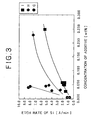
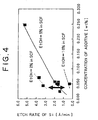
- the silicon wafers are prepared to generate the thermal oxides of silicon on their surface and are broken into chips.
- the chips are placed in the high pressure vessel 9 in Fig. 1.
- a remover including CO 2 , the additives, and ethanol is introduced into the high pressure vessel 9.
- the chips are taken out and the thickness of the thermal oxides on the chips is measured by an ellipseometer.
- the etch rate of the thermal oxides is determined by dividing the decrease of the thickness per the treatment time.
- the temperature of CO 2 at the supercritical condition is 40C
- the pressure is 15 M Pa
- the treatment time is 20 to 60 minutes.
Landscapes
- Chemical & Material Sciences (AREA)
- Life Sciences & Earth Sciences (AREA)
- Engineering & Computer Science (AREA)
- Chemical Kinetics & Catalysis (AREA)
- Oil, Petroleum & Natural Gas (AREA)
- Wood Science & Technology (AREA)
- Organic Chemistry (AREA)
- Inorganic Chemistry (AREA)
- Physics & Mathematics (AREA)
- General Physics & Mathematics (AREA)
- Cleaning Or Drying Semiconductors (AREA)
- Detergent Compositions (AREA)
- Extraction Or Liquid Replacement (AREA)
- Crystals, And After-Treatments Of Crystals (AREA)
- Silicon Compounds (AREA)
- Ceramic Products (AREA)
- Cleaning By Liquid Or Steam (AREA)
- Drying Of Solid Materials (AREA)
- Solid-Sorbent Or Filter-Aiding Compositions (AREA)
- Physical Or Chemical Processes And Apparatus (AREA)
- Micromachines (AREA)
Applications Claiming Priority (3)
| Application Number | Priority Date | Filing Date | Title |
|---|---|---|---|
| JP2001034337A JP2002237481A (ja) | 2001-02-09 | 2001-02-09 | 微細構造体の洗浄方法 |
| JP2001034337 | 2001-02-09 | ||
| EP02736487A EP1358670B1 (en) | 2001-02-09 | 2002-02-08 | Process for removing residues from the microstructure of an object |
Related Parent Applications (1)
| Application Number | Title | Priority Date | Filing Date |
|---|---|---|---|
| EP02736487A Division EP1358670B1 (en) | 2001-02-09 | 2002-02-08 | Process for removing residues from the microstructure of an object |
Publications (3)
| Publication Number | Publication Date |
|---|---|
| EP1457550A2 EP1457550A2 (en) | 2004-09-15 |
| EP1457550A3 EP1457550A3 (en) | 2004-11-03 |
| EP1457550B1 true EP1457550B1 (en) | 2006-07-05 |
Family
ID=18897963
Family Applications (2)
| Application Number | Title | Priority Date | Filing Date |
|---|---|---|---|
| EP04011792A Expired - Lifetime EP1457550B1 (en) | 2001-02-09 | 2002-02-08 | Composition for removing residues from the microstructure of an object |
| EP02736487A Expired - Lifetime EP1358670B1 (en) | 2001-02-09 | 2002-02-08 | Process for removing residues from the microstructure of an object |
Family Applications After (1)
| Application Number | Title | Priority Date | Filing Date |
|---|---|---|---|
| EP02736487A Expired - Lifetime EP1358670B1 (en) | 2001-02-09 | 2002-02-08 | Process for removing residues from the microstructure of an object |
Country Status (10)
| Country | Link |
|---|---|
| US (3) | US20020164873A1 (enExample) |
| EP (2) | EP1457550B1 (enExample) |
| JP (2) | JP2002237481A (enExample) |
| KR (2) | KR100482496B1 (enExample) |
| CN (2) | CN1243366C (enExample) |
| AT (2) | ATE332571T1 (enExample) |
| DE (2) | DE60212937T2 (enExample) |
| SG (1) | SG125957A1 (enExample) |
| TW (1) | TW569328B (enExample) |
| WO (1) | WO2002080233A2 (enExample) |
Families Citing this family (45)
| Publication number | Priority date | Publication date | Assignee | Title |
|---|---|---|---|---|
| US7064070B2 (en) * | 1998-09-28 | 2006-06-20 | Tokyo Electron Limited | Removal of CMP and post-CMP residue from semiconductors using supercritical carbon dioxide process |
| KR100693691B1 (ko) * | 2000-04-25 | 2007-03-09 | 동경 엘렉트론 주식회사 | 금속 필름의 침착방법 및 초임계 건조/세척 모듈을포함하는 금속침착 복합공정장치 |
| JP3978023B2 (ja) * | 2001-12-03 | 2007-09-19 | 株式会社神戸製鋼所 | 高圧処理方法 |
| US7326673B2 (en) | 2001-12-31 | 2008-02-05 | Advanced Technology Materials, Inc. | Treatment of semiconductor substrates using long-chain organothiols or long-chain acetates |
| US7557073B2 (en) * | 2001-12-31 | 2009-07-07 | Advanced Technology Materials, Inc. | Non-fluoride containing supercritical fluid composition for removal of ion-implant photoresist |
| WO2003064065A1 (en) * | 2002-01-25 | 2003-08-07 | Supercritical Systems Inc. | Method for reducing the formation of contaminants during supercritical carbon dioxide processes |
| JP2003224099A (ja) * | 2002-01-30 | 2003-08-08 | Sony Corp | 表面処理方法 |
| US6924086B1 (en) | 2002-02-15 | 2005-08-02 | Tokyo Electron Limited | Developing photoresist with supercritical fluid and developer |
| WO2003070846A2 (en) * | 2002-02-15 | 2003-08-28 | Supercritical Systems Inc. | Drying resist with a solvent bath and supercritical co2 |
| US7270941B2 (en) * | 2002-03-04 | 2007-09-18 | Tokyo Electron Limited | Method of passivating of low dielectric materials in wafer processing |
| US7387868B2 (en) | 2002-03-04 | 2008-06-17 | Tokyo Electron Limited | Treatment of a dielectric layer using supercritical CO2 |
| JP4031440B2 (ja) * | 2002-03-22 | 2008-01-09 | 東京エレクトロン株式会社 | 超臨界処理を用いる汚染物の除去 |
| US7169540B2 (en) * | 2002-04-12 | 2007-01-30 | Tokyo Electron Limited | Method of treatment of porous dielectric films to reduce damage during cleaning |
| US6764552B1 (en) * | 2002-04-18 | 2004-07-20 | Novellus Systems, Inc. | Supercritical solutions for cleaning photoresist and post-etch residue from low-k materials |
| JP2003318810A (ja) * | 2002-04-26 | 2003-11-07 | Kobe Steel Ltd | 無線データ収集システム,無線データ中継装置 |
| US6669785B2 (en) * | 2002-05-15 | 2003-12-30 | Micell Technologies, Inc. | Methods and compositions for etch cleaning microelectronic substrates in carbon dioxide |
| US20030217764A1 (en) * | 2002-05-23 | 2003-11-27 | Kaoru Masuda | Process and composition for removing residues from the microstructure of an object |
| US6800142B1 (en) * | 2002-05-30 | 2004-10-05 | Novellus Systems, Inc. | Method for removing photoresist and post-etch residue using activated peroxide followed by supercritical fluid treatment |
| JP2004128251A (ja) * | 2002-10-03 | 2004-04-22 | Elpida Memory Inc | 塗布機及び塗布方法 |
| US7485611B2 (en) * | 2002-10-31 | 2009-02-03 | Advanced Technology Materials, Inc. | Supercritical fluid-based cleaning compositions and methods |
| US7223352B2 (en) * | 2002-10-31 | 2007-05-29 | Advanced Technology Materials, Inc. | Supercritical carbon dioxide/chemical formulation for ashed and unashed aluminum post-etch residue removal |
| JP2004158534A (ja) * | 2002-11-05 | 2004-06-03 | Kobe Steel Ltd | 微細構造体の洗浄方法 |
| US20040177867A1 (en) * | 2002-12-16 | 2004-09-16 | Supercritical Systems, Inc. | Tetra-organic ammonium fluoride and HF in supercritical fluid for photoresist and residue removal |
| US20040112409A1 (en) * | 2002-12-16 | 2004-06-17 | Supercritical Sysems, Inc. | Fluoride in supercritical fluid for photoresist and residue removal |
| JP4248903B2 (ja) | 2003-03-19 | 2009-04-02 | 大日本スクリーン製造株式会社 | 高圧処理装置および高圧処理方法 |
| US20040231707A1 (en) * | 2003-05-20 | 2004-11-25 | Paul Schilling | Decontamination of supercritical wafer processing equipment |
| KR100505693B1 (ko) * | 2003-06-26 | 2005-08-03 | 삼성전자주식회사 | 미세 전자 소자 기판으로부터 포토레지스트 또는 유기물을세정하는 방법 |
| JP2005033135A (ja) * | 2003-07-11 | 2005-02-03 | Kobe Steel Ltd | 微細構造体の洗浄装置 |
| US20050022850A1 (en) * | 2003-07-29 | 2005-02-03 | Supercritical Systems, Inc. | Regulation of flow of processing chemistry only into a processing chamber |
| US7163380B2 (en) | 2003-07-29 | 2007-01-16 | Tokyo Electron Limited | Control of fluid flow in the processing of an object with a fluid |
| US20050039775A1 (en) * | 2003-08-19 | 2005-02-24 | Whitlock Walter H. | Process and system for cleaning surfaces of semiconductor wafers |
| JP4757452B2 (ja) * | 2004-04-02 | 2011-08-24 | 昭和炭酸株式会社 | 気液分離装置 |
| US7195676B2 (en) * | 2004-07-13 | 2007-03-27 | Air Products And Chemicals, Inc. | Method for removal of flux and other residue in dense fluid systems |
| US7307019B2 (en) | 2004-09-29 | 2007-12-11 | Tokyo Electron Limited | Method for supercritical carbon dioxide processing of fluoro-carbon films |
| US20060081273A1 (en) * | 2004-10-20 | 2006-04-20 | Mcdermott Wayne T | Dense fluid compositions and processes using same for article treatment and residue removal |
| US7491036B2 (en) | 2004-11-12 | 2009-02-17 | Tokyo Electron Limited | Method and system for cooling a pump |
| US7291565B2 (en) | 2005-02-15 | 2007-11-06 | Tokyo Electron Limited | Method and system for treating a substrate with a high pressure fluid using fluorosilicic acid |
| US7550075B2 (en) * | 2005-03-23 | 2009-06-23 | Tokyo Electron Ltd. | Removal of contaminants from a fluid |
| US7399708B2 (en) | 2005-03-30 | 2008-07-15 | Tokyo Electron Limited | Method of treating a composite spin-on glass/anti-reflective material prior to cleaning |
| US7442636B2 (en) | 2005-03-30 | 2008-10-28 | Tokyo Electron Limited | Method of inhibiting copper corrosion during supercritical CO2 cleaning |
| US7789971B2 (en) | 2005-05-13 | 2010-09-07 | Tokyo Electron Limited | Treatment of substrate using functionalizing agent in supercritical carbon dioxide |
| JP2007142335A (ja) * | 2005-11-22 | 2007-06-07 | Dainippon Screen Mfg Co Ltd | 高圧処理方法 |
| JP4179378B2 (ja) * | 2007-01-04 | 2008-11-12 | トヨタ自動車株式会社 | 車両の駆動制御装置、および、車両 |
| JP6682272B2 (ja) | 2013-01-15 | 2020-04-15 | ローレンス リバモア ナショナル セキュリティー, エルエルシー | レーザー駆動の熱水処理 |
| FR3021554A1 (fr) * | 2014-05-28 | 2015-12-04 | Dfd Dense Fluid Degreasing | Procede et dispositif de traitement par fluide supercritique avec injection d'additif |
Family Cites Families (23)
| Publication number | Priority date | Publication date | Assignee | Title |
|---|---|---|---|---|
| US5456759A (en) * | 1992-08-10 | 1995-10-10 | Hughes Aircraft Company | Method using megasonic energy in liquefied gases |
| US5339844A (en) * | 1992-08-10 | 1994-08-23 | Hughes Aircraft Company | Low cost equipment for cleaning using liquefiable gases |
| KR0137841B1 (ko) * | 1994-06-07 | 1998-04-27 | 문정환 | 식각잔류물 제거방법 |
| JPH08330266A (ja) * | 1995-05-31 | 1996-12-13 | Texas Instr Inc <Ti> | 半導体装置等の表面を浄化し、処理する方法 |
| US5868856A (en) * | 1996-07-25 | 1999-02-09 | Texas Instruments Incorporated | Method for removing inorganic contamination by chemical derivitization and extraction |
| KR19980018262A (ko) * | 1996-08-01 | 1998-06-05 | 윌리엄 비.켐플러 | 입출력포트 및 램 메모리 어드레스 지정기술 |
| US5989353A (en) * | 1996-10-11 | 1999-11-23 | Mallinckrodt Baker, Inc. | Cleaning wafer substrates of metal contamination while maintaining wafer smoothness |
| US5908510A (en) * | 1996-10-16 | 1999-06-01 | International Business Machines Corporation | Residue removal by supercritical fluids |
| US6118000A (en) * | 1996-11-04 | 2000-09-12 | Hydrochem Industrial Services, Inc. | Methods for preparing quaternary ammonium salts |
| US5709756A (en) * | 1996-11-05 | 1998-01-20 | Ashland Inc. | Basic stripping and cleaning composition |
| US6306564B1 (en) * | 1997-05-27 | 2001-10-23 | Tokyo Electron Limited | Removal of resist or residue from semiconductors using supercritical carbon dioxide |
| US6500605B1 (en) * | 1997-05-27 | 2002-12-31 | Tokyo Electron Limited | Removal of photoresist and residue from substrate using supercritical carbon dioxide process |
| US5983082A (en) * | 1997-10-31 | 1999-11-09 | Motorola, Inc. | Phase quadrature signal generator having a variable phase shift network |
| US6200943B1 (en) * | 1998-05-28 | 2001-03-13 | Micell Technologies, Inc. | Combination surfactant systems for use in carbon dioxide-based cleaning formulations |
| US6242165B1 (en) * | 1998-08-28 | 2001-06-05 | Micron Technology, Inc. | Supercritical compositions for removal of organic material and methods of using same |
| SG77710A1 (en) * | 1998-09-09 | 2001-01-16 | Tokuyama Corp | Photoresist ashing residue cleaning agent |
| US6277753B1 (en) * | 1998-09-28 | 2001-08-21 | Supercritical Systems Inc. | Removal of CMP residue from semiconductors using supercritical carbon dioxide process |
| CA2255413A1 (en) * | 1998-12-11 | 2000-06-11 | Fracmaster Ltd. | Foamed nitrogen in liquid co2 for fracturing |
| US6828289B2 (en) * | 1999-01-27 | 2004-12-07 | Air Products And Chemicals, Inc. | Low surface tension, low viscosity, aqueous, acidic compositions containing fluoride and organic, polar solvents for removal of photoresist and organic and inorganic etch residues at room temperature |
| KR100559017B1 (ko) * | 2000-08-14 | 2006-03-10 | 동경 엘렉트론 주식회사 | 초임계 이산화탄소를 이용하는 반도체로부터의포토레지스트 및 포토레지스트 잔사의 제거법 |
| US6425956B1 (en) * | 2001-01-05 | 2002-07-30 | International Business Machines Corporation | Process for removing chemical mechanical polishing residual slurry |
| US7326673B2 (en) * | 2001-12-31 | 2008-02-05 | Advanced Technology Materials, Inc. | Treatment of semiconductor substrates using long-chain organothiols or long-chain acetates |
| US20030217764A1 (en) * | 2002-05-23 | 2003-11-27 | Kaoru Masuda | Process and composition for removing residues from the microstructure of an object |
-
2001
- 2001-02-09 JP JP2001034337A patent/JP2002237481A/ja active Pending
-
2002
- 2002-02-08 AT AT02736487T patent/ATE332571T1/de not_active IP Right Cessation
- 2002-02-08 US US10/067,773 patent/US20020164873A1/en not_active Abandoned
- 2002-02-08 TW TW091102499A patent/TW569328B/zh not_active IP Right Cessation
- 2002-02-08 CN CNB028002741A patent/CN1243366C/zh not_active Expired - Fee Related
- 2002-02-08 SG SG200402533A patent/SG125957A1/en unknown
- 2002-02-08 KR KR10-2002-7013494A patent/KR100482496B1/ko not_active Expired - Fee Related
- 2002-02-08 KR KR10-2004-7006269A patent/KR100490506B1/ko not_active Expired - Fee Related
- 2002-02-08 CN CNA2004100447914A patent/CN1542910A/zh active Pending
- 2002-02-08 WO PCT/US2002/003608 patent/WO2002080233A2/en not_active Ceased
- 2002-02-08 EP EP04011792A patent/EP1457550B1/en not_active Expired - Lifetime
- 2002-02-08 DE DE60212937T patent/DE60212937T2/de not_active Expired - Lifetime
- 2002-02-08 DE DE60212999T patent/DE60212999T2/de not_active Expired - Fee Related
- 2002-02-08 US US10/240,848 patent/US20030106573A1/en not_active Abandoned
- 2002-02-08 EP EP02736487A patent/EP1358670B1/en not_active Expired - Lifetime
- 2002-02-08 JP JP2002578549A patent/JP3996513B2/ja not_active Expired - Fee Related
- 2002-02-08 AT AT04011792T patent/ATE332355T1/de not_active IP Right Cessation
-
2004
- 2004-04-09 US US10/820,695 patent/US20040198627A1/en not_active Abandoned
Also Published As
| Publication number | Publication date |
|---|---|
| WO2002080233A3 (en) | 2002-11-14 |
| EP1457550A3 (en) | 2004-11-03 |
| ATE332355T1 (de) | 2006-07-15 |
| JP2004519863A (ja) | 2004-07-02 |
| US20020164873A1 (en) | 2002-11-07 |
| CN1243366C (zh) | 2006-02-22 |
| CN1457502A (zh) | 2003-11-19 |
| EP1358670A2 (en) | 2003-11-05 |
| US20040198627A1 (en) | 2004-10-07 |
| KR100482496B1 (ko) | 2005-04-14 |
| ATE332571T1 (de) | 2006-07-15 |
| DE60212937T2 (de) | 2007-12-06 |
| DE60212999D1 (de) | 2006-08-17 |
| CN1542910A (zh) | 2004-11-03 |
| EP1358670B1 (en) | 2006-07-05 |
| DE60212937D1 (de) | 2006-08-17 |
| KR20020093896A (ko) | 2002-12-16 |
| US20030106573A1 (en) | 2003-06-12 |
| EP1358670A4 (en) | 2004-11-17 |
| SG125957A1 (en) | 2006-10-30 |
| KR20040040490A (ko) | 2004-05-12 |
| JP2002237481A (ja) | 2002-08-23 |
| EP1457550A2 (en) | 2004-09-15 |
| KR100490506B1 (ko) | 2005-05-19 |
| WO2002080233A2 (en) | 2002-10-10 |
| JP3996513B2 (ja) | 2007-10-24 |
| TW569328B (en) | 2004-01-01 |
| DE60212999T2 (de) | 2006-12-28 |
Similar Documents
| Publication | Publication Date | Title |
|---|---|---|
| EP1358670B1 (en) | Process for removing residues from the microstructure of an object | |
| EP1619557B1 (en) | Composition for removing photoresist and/or etching residue from a substrate and use thereof | |
| US7888301B2 (en) | Resist, barc and gap fill material stripping chemical and method | |
| EP1914296B1 (en) | Stripper containing an acetal or a ketal for removing post-etched phot-resist, etch polymer and residue | |
| EP1453080B1 (en) | Process and composition for removing residues from the microstructure of an object | |
| EP3602606B1 (en) | Surface treatment methods and compositions therefor | |
| EP1688798B1 (en) | Aqueous based residue removers comprising fluoride | |
| US20040050406A1 (en) | Compositions and method for removing photoresist and/or resist residue at pressures ranging from ambient to supercritical | |
| US20040112409A1 (en) | Fluoride in supercritical fluid for photoresist and residue removal | |
| CN115044375A (zh) | 蚀刻组合物 | |
| KR20020031159A (ko) | 반도체 장치용의 유기 및 플라즈마 식각된 잔사의 세척을위한 락탐 조성물 | |
| EP3599633B1 (en) | Post etch residue cleaning compositions and methods of using the same | |
| CN100346453C (zh) | 清洗微结构的方法 | |
| US6683008B1 (en) | Process of removing ion-implanted photoresist from a workpiece | |
| JP2005048189A (ja) | 残留物除去用組成物 | |
| JP4167257B2 (ja) | 残留物除去用組成物 | |
| US20080060682A1 (en) | High temperature spm treatment for photoresist stripping | |
| KR102397091B1 (ko) | 레지스트 박리액 조성물 및 이를 이용한 레지스트의 박리방법 |
Legal Events
| Date | Code | Title | Description |
|---|---|---|---|
| PUAI | Public reference made under article 153(3) epc to a published international application that has entered the european phase |
Free format text: ORIGINAL CODE: 0009012 |
|
| AC | Divisional application: reference to earlier application |
Ref document number: 1358670 Country of ref document: EP Kind code of ref document: P |
|
| AK | Designated contracting states |
Kind code of ref document: A2 Designated state(s): AT BE CH CY DE DK ES FI FR GB GR IE IT LI LU MC NL PT SE TR |
|
| PUAL | Search report despatched |
Free format text: ORIGINAL CODE: 0009013 |
|
| RAP1 | Party data changed (applicant data changed or rights of an application transferred) |
Owner name: AIR PRODUCTS AND CHEMICALS, INC. |
|
| AK | Designated contracting states |
Kind code of ref document: A3 Designated state(s): AT BE CH CY DE DK ES FI FR GB GR IE IT LI LU MC NL PT SE TR |
|
| RIC1 | Information provided on ipc code assigned before grant |
Ipc: 7G 03F 7/42 B Ipc: 7B 08B 3/00 B Ipc: 7C 11D 7/32 B Ipc: 7H 01L 21/00 B Ipc: 7C 11D 11/00 B Ipc: 7C 11D 1/00 B Ipc: 7C 11D 3/37 A |
|
| 17P | Request for examination filed |
Effective date: 20041216 |
|
| 17Q | First examination report despatched |
Effective date: 20050503 |
|
| AKX | Designation fees paid |
Designated state(s): AT BE CH CY DE DK ES FI FR GB GR IE IT LI LU MC NL PT SE TR |
|
| GRAP | Despatch of communication of intention to grant a patent |
Free format text: ORIGINAL CODE: EPIDOSNIGR1 |
|
| GRAS | Grant fee paid |
Free format text: ORIGINAL CODE: EPIDOSNIGR3 |
|
| GRAA | (expected) grant |
Free format text: ORIGINAL CODE: 0009210 |
|
| AC | Divisional application: reference to earlier application |
Ref document number: 1358670 Country of ref document: EP Kind code of ref document: P |
|
| AK | Designated contracting states |
Kind code of ref document: B1 Designated state(s): AT BE CH CY DE DK ES FI FR GB GR IE IT LI LU MC NL PT SE TR |
|
| PG25 | Lapsed in a contracting state [announced via postgrant information from national office to epo] |
Ref country code: IT Free format text: LAPSE BECAUSE OF FAILURE TO SUBMIT A TRANSLATION OF THE DESCRIPTION OR TO PAY THE FEE WITHIN THE PRESCRIBED TIME-LIMIT;WARNING: LAPSES OF ITALIAN PATENTS WITH EFFECTIVE DATE BEFORE 2007 MAY HAVE OCCURRED AT ANY TIME BEFORE 2007. THE CORRECT EFFECTIVE DATE MAY BE DIFFERENT FROM THE ONE RECORDED. Effective date: 20060705 Ref country code: BE Free format text: LAPSE BECAUSE OF FAILURE TO SUBMIT A TRANSLATION OF THE DESCRIPTION OR TO PAY THE FEE WITHIN THE PRESCRIBED TIME-LIMIT Effective date: 20060705 Ref country code: FI Free format text: LAPSE BECAUSE OF FAILURE TO SUBMIT A TRANSLATION OF THE DESCRIPTION OR TO PAY THE FEE WITHIN THE PRESCRIBED TIME-LIMIT Effective date: 20060705 Ref country code: LI Free format text: LAPSE BECAUSE OF FAILURE TO SUBMIT A TRANSLATION OF THE DESCRIPTION OR TO PAY THE FEE WITHIN THE PRESCRIBED TIME-LIMIT Effective date: 20060705 Ref country code: CH Free format text: LAPSE BECAUSE OF FAILURE TO SUBMIT A TRANSLATION OF THE DESCRIPTION OR TO PAY THE FEE WITHIN THE PRESCRIBED TIME-LIMIT Effective date: 20060705 Ref country code: AT Free format text: LAPSE BECAUSE OF FAILURE TO SUBMIT A TRANSLATION OF THE DESCRIPTION OR TO PAY THE FEE WITHIN THE PRESCRIBED TIME-LIMIT Effective date: 20060705 |
|
| REG | Reference to a national code |
Ref country code: GB Ref legal event code: FG4D |
|
| REG | Reference to a national code |
Ref country code: CH Ref legal event code: EP |
|
| REG | Reference to a national code |
Ref country code: IE Ref legal event code: FG4D |
|
| REF | Corresponds to: |
Ref document number: 60212999 Country of ref document: DE Date of ref document: 20060817 Kind code of ref document: P |
|
| PG25 | Lapsed in a contracting state [announced via postgrant information from national office to epo] |
Ref country code: DK Free format text: LAPSE BECAUSE OF FAILURE TO SUBMIT A TRANSLATION OF THE DESCRIPTION OR TO PAY THE FEE WITHIN THE PRESCRIBED TIME-LIMIT Effective date: 20061005 Ref country code: SE Free format text: LAPSE BECAUSE OF FAILURE TO SUBMIT A TRANSLATION OF THE DESCRIPTION OR TO PAY THE FEE WITHIN THE PRESCRIBED TIME-LIMIT Effective date: 20061005 |
|
| PG25 | Lapsed in a contracting state [announced via postgrant information from national office to epo] |
Ref country code: ES Free format text: LAPSE BECAUSE OF FAILURE TO SUBMIT A TRANSLATION OF THE DESCRIPTION OR TO PAY THE FEE WITHIN THE PRESCRIBED TIME-LIMIT Effective date: 20061016 |
|
| ET | Fr: translation filed | ||
| PG25 | Lapsed in a contracting state [announced via postgrant information from national office to epo] |
Ref country code: PT Free format text: LAPSE BECAUSE OF FAILURE TO SUBMIT A TRANSLATION OF THE DESCRIPTION OR TO PAY THE FEE WITHIN THE PRESCRIBED TIME-LIMIT Effective date: 20061205 |
|
| PGFP | Annual fee paid to national office [announced via postgrant information from national office to epo] |
Ref country code: GB Payment date: 20070105 Year of fee payment: 6 |
|
| PGFP | Annual fee paid to national office [announced via postgrant information from national office to epo] |
Ref country code: NL Payment date: 20070108 Year of fee payment: 6 |
|
| PG25 | Lapsed in a contracting state [announced via postgrant information from national office to epo] |
Ref country code: MC Free format text: LAPSE BECAUSE OF NON-PAYMENT OF DUE FEES Effective date: 20070228 |
|
| PLBE | No opposition filed within time limit |
Free format text: ORIGINAL CODE: 0009261 |
|
| STAA | Information on the status of an ep patent application or granted ep patent |
Free format text: STATUS: NO OPPOSITION FILED WITHIN TIME LIMIT |
|
| 26N | No opposition filed |
Effective date: 20070410 |
|
| PGFP | Annual fee paid to national office [announced via postgrant information from national office to epo] |
Ref country code: IT Payment date: 20070525 Year of fee payment: 6 |
|
| PG25 | Lapsed in a contracting state [announced via postgrant information from national office to epo] |
Ref country code: IE Free format text: LAPSE BECAUSE OF NON-PAYMENT OF DUE FEES Effective date: 20070208 |
|
| PG25 | Lapsed in a contracting state [announced via postgrant information from national office to epo] |
Ref country code: GR Free format text: LAPSE BECAUSE OF FAILURE TO SUBMIT A TRANSLATION OF THE DESCRIPTION OR TO PAY THE FEE WITHIN THE PRESCRIBED TIME-LIMIT Effective date: 20061006 |
|
| PGFP | Annual fee paid to national office [announced via postgrant information from national office to epo] |
Ref country code: FR Payment date: 20070201 Year of fee payment: 6 |
|
| GBPC | Gb: european patent ceased through non-payment of renewal fee |
Effective date: 20080208 |
|
| NLV4 | Nl: lapsed or anulled due to non-payment of the annual fee |
Effective date: 20080901 |
|
| PG25 | Lapsed in a contracting state [announced via postgrant information from national office to epo] |
Ref country code: NL Free format text: LAPSE BECAUSE OF NON-PAYMENT OF DUE FEES Effective date: 20080901 |
|
| REG | Reference to a national code |
Ref country code: FR Ref legal event code: ST Effective date: 20081031 |
|
| PG25 | Lapsed in a contracting state [announced via postgrant information from national office to epo] |
Ref country code: FR Free format text: LAPSE BECAUSE OF NON-PAYMENT OF DUE FEES Effective date: 20080229 |
|
| PGFP | Annual fee paid to national office [announced via postgrant information from national office to epo] |
Ref country code: DE Payment date: 20090227 Year of fee payment: 8 |
|
| PG25 | Lapsed in a contracting state [announced via postgrant information from national office to epo] |
Ref country code: GB Free format text: LAPSE BECAUSE OF NON-PAYMENT OF DUE FEES Effective date: 20080208 |
|
| PG25 | Lapsed in a contracting state [announced via postgrant information from national office to epo] |
Ref country code: LU Free format text: LAPSE BECAUSE OF NON-PAYMENT OF DUE FEES Effective date: 20070208 Ref country code: IT Free format text: LAPSE BECAUSE OF NON-PAYMENT OF DUE FEES Effective date: 20080208 Ref country code: CY Free format text: LAPSE BECAUSE OF FAILURE TO SUBMIT A TRANSLATION OF THE DESCRIPTION OR TO PAY THE FEE WITHIN THE PRESCRIBED TIME-LIMIT Effective date: 20060705 |
|
| PG25 | Lapsed in a contracting state [announced via postgrant information from national office to epo] |
Ref country code: TR Free format text: LAPSE BECAUSE OF FAILURE TO SUBMIT A TRANSLATION OF THE DESCRIPTION OR TO PAY THE FEE WITHIN THE PRESCRIBED TIME-LIMIT Effective date: 20060705 |
|
| PG25 | Lapsed in a contracting state [announced via postgrant information from national office to epo] |
Ref country code: DE Free format text: LAPSE BECAUSE OF NON-PAYMENT OF DUE FEES Effective date: 20100901 |