EP1349454B1 - Antimicrobial compositions containing quaternary ammonium compounds, silanes and other disinfectants with furanones - Google Patents
Antimicrobial compositions containing quaternary ammonium compounds, silanes and other disinfectants with furanones Download PDFInfo
- Publication number
- EP1349454B1 EP1349454B1 EP01273631A EP01273631A EP1349454B1 EP 1349454 B1 EP1349454 B1 EP 1349454B1 EP 01273631 A EP01273631 A EP 01273631A EP 01273631 A EP01273631 A EP 01273631A EP 1349454 B1 EP1349454 B1 EP 1349454B1
- Authority
- EP
- European Patent Office
- Prior art keywords
- composition
- furanone
- amount
- quaternary ammonium
- sparing
- Prior art date
- Legal status (The legal status is an assumption and is not a legal conclusion. Google has not performed a legal analysis and makes no representation as to the accuracy of the status listed.)
- Expired - Lifetime
Links
- 239000000203 mixture Substances 0.000 title claims description 115
- 230000000845 anti-microbial effect Effects 0.000 title claims description 51
- 150000003856 quaternary ammonium compounds Chemical class 0.000 title claims description 50
- 239000000645 desinfectant Substances 0.000 title claims description 15
- 150000002241 furanones Chemical class 0.000 title description 45
- 150000004756 silanes Chemical class 0.000 title 1
- RHDGNLCLDBVESU-UHFFFAOYSA-N but-3-en-4-olide Chemical compound O=C1CC=CO1 RHDGNLCLDBVESU-UHFFFAOYSA-N 0.000 claims description 77
- 150000001282 organosilanes Chemical class 0.000 claims description 59
- 230000002195 synergetic effect Effects 0.000 claims description 24
- 241000233866 Fungi Species 0.000 claims description 15
- 238000000034 method Methods 0.000 claims description 15
- XLYOFNOQVPJJNP-UHFFFAOYSA-N water Substances O XLYOFNOQVPJJNP-UHFFFAOYSA-N 0.000 claims description 13
- 241000894006 Bacteria Species 0.000 claims description 12
- 238000004140 cleaning Methods 0.000 claims description 12
- 239000004094 surface-active agent Substances 0.000 claims description 11
- 241000191967 Staphylococcus aureus Species 0.000 claims description 9
- RUPBZQFQVRMKDG-UHFFFAOYSA-M Didecyldimethylammonium chloride Chemical compound [Cl-].CCCCCCCCCC[N+](C)(C)CCCCCCCCCC RUPBZQFQVRMKDG-UHFFFAOYSA-M 0.000 claims description 8
- 244000005700 microbiome Species 0.000 claims description 8
- 229940123208 Biguanide Drugs 0.000 claims description 7
- 150000001412 amines Chemical class 0.000 claims description 7
- 240000004808 Saccharomyces cerevisiae Species 0.000 claims description 6
- 239000002904 solvent Substances 0.000 claims description 6
- 241000223602 Alternaria alternata Species 0.000 claims description 5
- XNCOSPRUTUOJCJ-UHFFFAOYSA-N Biguanide Chemical compound NC(N)=NC(N)=N XNCOSPRUTUOJCJ-UHFFFAOYSA-N 0.000 claims description 5
- 241001149955 Cladosporium cladosporioides Species 0.000 claims description 5
- 229960000686 benzalkonium chloride Drugs 0.000 claims description 5
- 229960004670 didecyldimethylammonium chloride Drugs 0.000 claims description 5
- FSYKKLYZXJSNPZ-UHFFFAOYSA-N sarcosine Chemical compound C[NH2+]CC([O-])=O FSYKKLYZXJSNPZ-UHFFFAOYSA-N 0.000 claims description 5
- 241000223678 Aureobasidium pullulans Species 0.000 claims description 4
- 241001507673 Penicillium digitatum Species 0.000 claims description 4
- CADWTSSKOVRVJC-UHFFFAOYSA-N benzyl(dimethyl)azanium;chloride Chemical compound [Cl-].C[NH+](C)CC1=CC=CC=C1 CADWTSSKOVRVJC-UHFFFAOYSA-N 0.000 claims description 4
- 150000001720 carbohydrates Chemical class 0.000 claims description 4
- WSFMFXQNYPNYGG-UHFFFAOYSA-M dimethyl-octadecyl-(3-trimethoxysilylpropyl)azanium;chloride Chemical compound [Cl-].CCCCCCCCCCCCCCCCCC[N+](C)(C)CCC[Si](OC)(OC)OC WSFMFXQNYPNYGG-UHFFFAOYSA-M 0.000 claims description 4
- 125000003844 furanonyl group Chemical group 0.000 claims description 4
- 239000002736 nonionic surfactant Substances 0.000 claims description 4
- 241000222122 Candida albicans Species 0.000 claims description 3
- 108010077895 Sarcosine Proteins 0.000 claims description 3
- 125000000217 alkyl group Chemical group 0.000 claims description 3
- 229940095731 candida albicans Drugs 0.000 claims description 3
- 239000003093 cationic surfactant Substances 0.000 claims description 3
- 239000008139 complexing agent Substances 0.000 claims description 3
- 239000012530 fluid Substances 0.000 claims description 3
- 230000014759 maintenance of location Effects 0.000 claims description 3
- 229940043230 sarcosine Drugs 0.000 claims description 3
- 239000003352 sequestering agent Substances 0.000 claims description 3
- JMHWNJGXUIJPKG-UHFFFAOYSA-N CC(=O)O[SiH](CC=C)OC(C)=O Chemical compound CC(=O)O[SiH](CC=C)OC(C)=O JMHWNJGXUIJPKG-UHFFFAOYSA-N 0.000 claims description 2
- SCXCDVTWABNWLW-UHFFFAOYSA-M decyl-dimethyl-octylazanium;chloride Chemical compound [Cl-].CCCCCCCCCC[N+](C)(C)CCCCCCCC SCXCDVTWABNWLW-UHFFFAOYSA-M 0.000 claims description 2
- AXPYABZPAWSUMG-UHFFFAOYSA-M didecyl-methyl-(3-trimethoxysilylpropyl)azanium;chloride Chemical compound [Cl-].CCCCCCCCCC[N+](C)(CCC[Si](OC)(OC)OC)CCCCCCCCCC AXPYABZPAWSUMG-UHFFFAOYSA-M 0.000 claims description 2
- IQDGSYLLQPDQDV-UHFFFAOYSA-N dimethylazanium;chloride Chemical compound Cl.CNC IQDGSYLLQPDQDV-UHFFFAOYSA-N 0.000 claims description 2
- 239000003205 fragrance Substances 0.000 claims description 2
- 239000004615 ingredient Substances 0.000 claims description 2
- 125000006177 alkyl benzyl group Chemical group 0.000 claims 1
- 239000002280 amphoteric surfactant Substances 0.000 claims 1
- 230000005764 inhibitory process Effects 0.000 description 45
- 150000001875 compounds Chemical class 0.000 description 19
- 230000012010 growth Effects 0.000 description 17
- 238000009472 formulation Methods 0.000 description 15
- -1 silicon quaternary ammonium compound Chemical class 0.000 description 13
- 239000012085 test solution Substances 0.000 description 11
- LFQSCWFLJHTTHZ-UHFFFAOYSA-N Ethanol Chemical compound CCO LFQSCWFLJHTTHZ-UHFFFAOYSA-N 0.000 description 10
- 229940027983 antiseptic and disinfectant quaternary ammonium compound Drugs 0.000 description 10
- 230000002401 inhibitory effect Effects 0.000 description 10
- 238000012360 testing method Methods 0.000 description 10
- 230000001580 bacterial effect Effects 0.000 description 7
- 239000000243 solution Substances 0.000 description 7
- 241000228245 Aspergillus niger Species 0.000 description 6
- KFZMGEQAYNKOFK-UHFFFAOYSA-N Isopropanol Chemical compound CC(C)O KFZMGEQAYNKOFK-UHFFFAOYSA-N 0.000 description 6
- 239000011521 glass Substances 0.000 description 6
- 239000004480 active ingredient Substances 0.000 description 5
- 239000004599 antimicrobial Substances 0.000 description 5
- 229960001484 edetic acid Drugs 0.000 description 5
- 229920001817 Agar Polymers 0.000 description 4
- KCXVZYZYPLLWCC-UHFFFAOYSA-N EDTA Chemical compound OC(=O)CN(CC(O)=O)CCN(CC(O)=O)CC(O)=O KCXVZYZYPLLWCC-UHFFFAOYSA-N 0.000 description 4
- QJPWUUJVYOJNMH-VKHMYHEASA-N L-homoserine lactone Chemical compound N[C@H]1CCOC1=O QJPWUUJVYOJNMH-VKHMYHEASA-N 0.000 description 4
- UIIMBOGNXHQVGW-UHFFFAOYSA-M Sodium bicarbonate Chemical compound [Na+].OC([O-])=O UIIMBOGNXHQVGW-UHFFFAOYSA-M 0.000 description 4
- 239000008272 agar Substances 0.000 description 4
- 238000003556 assay Methods 0.000 description 4
- 239000002738 chelating agent Substances 0.000 description 4
- 230000003247 decreasing effect Effects 0.000 description 4
- 230000002538 fungal effect Effects 0.000 description 4
- 238000003756 stirring Methods 0.000 description 4
- 238000011282 treatment Methods 0.000 description 4
- 241000192125 Firmicutes Species 0.000 description 3
- OKKJLVBELUTLKV-UHFFFAOYSA-N Methanol Chemical compound OC OKKJLVBELUTLKV-UHFFFAOYSA-N 0.000 description 3
- 230000000694 effects Effects 0.000 description 3
- 239000000126 substance Substances 0.000 description 3
- UKAUYVFTDYCKQA-UHFFFAOYSA-N -2-Amino-4-hydroxybutanoic acid Natural products OC(=O)C(N)CCO UKAUYVFTDYCKQA-UHFFFAOYSA-N 0.000 description 2
- HZAXFHJVJLSVMW-UHFFFAOYSA-N 2-Aminoethan-1-ol Chemical compound NCCO HZAXFHJVJLSVMW-UHFFFAOYSA-N 0.000 description 2
- 241000195493 Cryptophyta Species 0.000 description 2
- 241001519550 Delisea Species 0.000 description 2
- QPCDCPDFJACHGM-UHFFFAOYSA-N N,N-bis{2-[bis(carboxymethyl)amino]ethyl}glycine Chemical compound OC(=O)CN(CC(O)=O)CCN(CC(=O)O)CCN(CC(O)=O)CC(O)=O QPCDCPDFJACHGM-UHFFFAOYSA-N 0.000 description 2
- 229920002257 Plurafac® Polymers 0.000 description 2
- 230000003373 anti-fouling effect Effects 0.000 description 2
- 150000004283 biguanides Chemical class 0.000 description 2
- 239000003139 biocide Substances 0.000 description 2
- 230000032770 biofilm formation Effects 0.000 description 2
- 125000004432 carbon atom Chemical group C* 0.000 description 2
- 239000008367 deionised water Substances 0.000 description 2
- 229910021641 deionized water Inorganic materials 0.000 description 2
- 230000000249 desinfective effect Effects 0.000 description 2
- 238000002474 experimental method Methods 0.000 description 2
- 230000009931 harmful effect Effects 0.000 description 2
- 239000000463 material Substances 0.000 description 2
- GRVDJDISBSALJP-UHFFFAOYSA-N methyloxidanyl Chemical compound [O]C GRVDJDISBSALJP-UHFFFAOYSA-N 0.000 description 2
- 229960003330 pentetic acid Drugs 0.000 description 2
- 239000008191 permeabilizing agent Substances 0.000 description 2
- 239000001965 potato dextrose agar Substances 0.000 description 2
- 230000008569 process Effects 0.000 description 2
- 125000001453 quaternary ammonium group Chemical group 0.000 description 2
- 230000018612 quorum sensing Effects 0.000 description 2
- 150000003839 salts Chemical group 0.000 description 2
- 230000011664 signaling Effects 0.000 description 2
- 229910000030 sodium bicarbonate Inorganic materials 0.000 description 2
- 235000017557 sodium bicarbonate Nutrition 0.000 description 2
- 241000894007 species Species 0.000 description 2
- 239000003381 stabilizer Substances 0.000 description 2
- 238000006467 substitution reaction Methods 0.000 description 2
- WMDZKDKPYCNCDZ-UHFFFAOYSA-N 2-(2-butoxypropoxy)propan-1-ol Chemical compound CCCCOC(C)COC(C)CO WMDZKDKPYCNCDZ-UHFFFAOYSA-N 0.000 description 1
- URDCARMUOSMFFI-UHFFFAOYSA-N 2-[2-[bis(carboxymethyl)amino]ethyl-(2-hydroxyethyl)amino]acetic acid Chemical compound OCCN(CC(O)=O)CCN(CC(O)=O)CC(O)=O URDCARMUOSMFFI-UHFFFAOYSA-N 0.000 description 1
- GUUULVAMQJLDSY-UHFFFAOYSA-N 4,5-dihydro-1,2-thiazole Chemical class C1CC=NS1 GUUULVAMQJLDSY-UHFFFAOYSA-N 0.000 description 1
- 241000223600 Alternaria Species 0.000 description 1
- 241000228212 Aspergillus Species 0.000 description 1
- 241000223651 Aureobasidium Species 0.000 description 1
- 241001474374 Blennius Species 0.000 description 1
- 241000222120 Candida <Saccharomycetales> Species 0.000 description 1
- OKTJSMMVPCPJKN-UHFFFAOYSA-N Carbon Chemical group [C] OKTJSMMVPCPJKN-UHFFFAOYSA-N 0.000 description 1
- 241000222290 Cladosporium Species 0.000 description 1
- 241000122827 Delisea pulchra Species 0.000 description 1
- 241000588914 Enterobacter Species 0.000 description 1
- 241000588722 Escherichia Species 0.000 description 1
- 241000588724 Escherichia coli Species 0.000 description 1
- VEXZGXHMUGYJMC-UHFFFAOYSA-N Hydrochloric acid Chemical compound Cl VEXZGXHMUGYJMC-UHFFFAOYSA-N 0.000 description 1
- 206010020751 Hypersensitivity Diseases 0.000 description 1
- DGAQECJNVWCQMB-PUAWFVPOSA-M Ilexoside XXIX Chemical compound C[C@@H]1CC[C@@]2(CC[C@@]3(C(=CC[C@H]4[C@]3(CC[C@@H]5[C@@]4(CC[C@@H](C5(C)C)OS(=O)(=O)[O-])C)C)[C@@H]2[C@]1(C)O)C)C(=O)O[C@H]6[C@@H]([C@H]([C@@H]([C@H](O6)CO)O)O)O.[Na+] DGAQECJNVWCQMB-PUAWFVPOSA-M 0.000 description 1
- 241000122235 Junco hyemalis Species 0.000 description 1
- 241000588748 Klebsiella Species 0.000 description 1
- 241000588915 Klebsiella aerogenes Species 0.000 description 1
- 241000588747 Klebsiella pneumoniae Species 0.000 description 1
- 108091077107 LuxS family Proteins 0.000 description 1
- KFNNRSFTPLQQPO-UHFFFAOYSA-N O1C(CC=C1)=O.O1C(CC=C1)=O Chemical compound O1C(CC=C1)=O.O1C(CC=C1)=O KFNNRSFTPLQQPO-UHFFFAOYSA-N 0.000 description 1
- 241000228143 Penicillium Species 0.000 description 1
- ABLZXFCXXLZCGV-UHFFFAOYSA-N Phosphorous acid Chemical class OP(O)=O ABLZXFCXXLZCGV-UHFFFAOYSA-N 0.000 description 1
- ZLMJMSJWJFRBEC-UHFFFAOYSA-N Potassium Chemical compound [K] ZLMJMSJWJFRBEC-UHFFFAOYSA-N 0.000 description 1
- 241000588769 Proteus <enterobacteria> Species 0.000 description 1
- 241000588770 Proteus mirabilis Species 0.000 description 1
- 241000589516 Pseudomonas Species 0.000 description 1
- 241000589517 Pseudomonas aeruginosa Species 0.000 description 1
- 241000607142 Salmonella Species 0.000 description 1
- 241001354013 Salmonella enterica subsp. enterica serovar Enteritidis Species 0.000 description 1
- 241000607768 Shigella Species 0.000 description 1
- 241000607760 Shigella sonnei Species 0.000 description 1
- VYPSYNLAJGMNEJ-UHFFFAOYSA-N Silicium dioxide Chemical compound O=[Si]=O VYPSYNLAJGMNEJ-UHFFFAOYSA-N 0.000 description 1
- 241001279361 Stachybotrys Species 0.000 description 1
- 241001279364 Stachybotrys chartarum Species 0.000 description 1
- 241000191940 Staphylococcus Species 0.000 description 1
- 241000223238 Trichophyton Species 0.000 description 1
- 241000223229 Trichophyton rubrum Species 0.000 description 1
- 150000001298 alcohols Chemical class 0.000 description 1
- 238000004458 analytical method Methods 0.000 description 1
- 125000000129 anionic group Chemical group 0.000 description 1
- 239000003429 antifungal agent Substances 0.000 description 1
- 229940121375 antifungal agent Drugs 0.000 description 1
- 239000012736 aqueous medium Substances 0.000 description 1
- 208000006673 asthma Diseases 0.000 description 1
- 230000015572 biosynthetic process Effects 0.000 description 1
- 239000004566 building material Substances 0.000 description 1
- 125000000484 butyl group Chemical group [H]C([*])([H])C([H])([H])C([H])([H])C([H])([H])[H] 0.000 description 1
- 150000004657 carbamic acid derivatives Chemical class 0.000 description 1
- 125000002091 cationic group Chemical group 0.000 description 1
- 230000008568 cell cell communication Effects 0.000 description 1
- 230000010261 cell growth Effects 0.000 description 1
- 239000012141 concentrate Substances 0.000 description 1
- 235000008504 concentrate Nutrition 0.000 description 1
- 238000011109 contamination Methods 0.000 description 1
- 239000007822 coupling agent Substances 0.000 description 1
- 239000000839 emulsion Substances 0.000 description 1
- 238000005516 engineering process Methods 0.000 description 1
- 229940092559 enterobacter aerogenes Drugs 0.000 description 1
- 230000007613 environmental effect Effects 0.000 description 1
- 150000002169 ethanolamines Chemical class 0.000 description 1
- 239000004744 fabric Substances 0.000 description 1
- 150000002191 fatty alcohols Chemical class 0.000 description 1
- 238000007306 functionalization reaction Methods 0.000 description 1
- 239000007789 gas Substances 0.000 description 1
- 239000000499 gel Substances 0.000 description 1
- 229930182478 glucoside Natural products 0.000 description 1
- 150000008131 glucosides Chemical class 0.000 description 1
- 150000002334 glycols Chemical class 0.000 description 1
- 239000001963 growth medium Substances 0.000 description 1
- 230000005802 health problem Effects 0.000 description 1
- 150000001469 hydantoins Chemical class 0.000 description 1
- 125000001183 hydrocarbyl group Chemical group 0.000 description 1
- 238000011534 incubation Methods 0.000 description 1
- 238000004519 manufacturing process Methods 0.000 description 1
- 238000000386 microscopy Methods 0.000 description 1
- 230000004001 molecular interaction Effects 0.000 description 1
- MGFYIUFZLHCRTH-UHFFFAOYSA-N nitrilotriacetic acid Chemical compound OC(=O)CN(CC(O)=O)CC(O)=O MGFYIUFZLHCRTH-UHFFFAOYSA-N 0.000 description 1
- QJGQUHMNIGDVPM-UHFFFAOYSA-N nitrogen group Chemical group [N] QJGQUHMNIGDVPM-UHFFFAOYSA-N 0.000 description 1
- 239000003921 oil Substances 0.000 description 1
- 244000039328 opportunistic pathogen Species 0.000 description 1
- 239000003002 pH adjusting agent Substances 0.000 description 1
- 230000001717 pathogenic effect Effects 0.000 description 1
- 125000001997 phenyl group Chemical group [H]C1=C([H])C([H])=C(*)C([H])=C1[H] 0.000 description 1
- 235000013824 polyphenols Nutrition 0.000 description 1
- 229910052700 potassium Inorganic materials 0.000 description 1
- 239000011591 potassium Substances 0.000 description 1
- 230000003389 potentiating effect Effects 0.000 description 1
- 238000010791 quenching Methods 0.000 description 1
- 230000001105 regulatory effect Effects 0.000 description 1
- 230000026206 response to starvation Effects 0.000 description 1
- 238000012216 screening Methods 0.000 description 1
- 229940115939 shigella sonnei Drugs 0.000 description 1
- 230000019491 signal transduction Effects 0.000 description 1
- 239000000741 silica gel Substances 0.000 description 1
- 229910002027 silica gel Inorganic materials 0.000 description 1
- 229910052710 silicon Inorganic materials 0.000 description 1
- 239000010703 silicon Substances 0.000 description 1
- 229910052708 sodium Inorganic materials 0.000 description 1
- 239000011734 sodium Substances 0.000 description 1
- 239000002689 soil Substances 0.000 description 1
- 239000007787 solid Substances 0.000 description 1
- 235000020354 squash Nutrition 0.000 description 1
- 239000000758 substrate Substances 0.000 description 1
- 239000000725 suspension Substances 0.000 description 1
- 239000001974 tryptic soy broth Substances 0.000 description 1
- 108010050327 trypticase-soy broth Proteins 0.000 description 1
Images




Classifications
-
- A—HUMAN NECESSITIES
- A01—AGRICULTURE; FORESTRY; ANIMAL HUSBANDRY; HUNTING; TRAPPING; FISHING
- A01N—PRESERVATION OF BODIES OF HUMANS OR ANIMALS OR PLANTS OR PARTS THEREOF; BIOCIDES, e.g. AS DISINFECTANTS, AS PESTICIDES OR AS HERBICIDES; PEST REPELLANTS OR ATTRACTANTS; PLANT GROWTH REGULATORS
- A01N43/00—Biocides, pest repellants or attractants, or plant growth regulators containing heterocyclic compounds
- A01N43/02—Biocides, pest repellants or attractants, or plant growth regulators containing heterocyclic compounds having rings with one or more oxygen or sulfur atoms as the only ring hetero atoms
- A01N43/04—Biocides, pest repellants or attractants, or plant growth regulators containing heterocyclic compounds having rings with one or more oxygen or sulfur atoms as the only ring hetero atoms with one hetero atom
- A01N43/06—Biocides, pest repellants or attractants, or plant growth regulators containing heterocyclic compounds having rings with one or more oxygen or sulfur atoms as the only ring hetero atoms with one hetero atom five-membered rings
- A01N43/08—Biocides, pest repellants or attractants, or plant growth regulators containing heterocyclic compounds having rings with one or more oxygen or sulfur atoms as the only ring hetero atoms with one hetero atom five-membered rings with oxygen as the ring hetero atom
Definitions
- This invention relates to antimicrobial compositions.
- this invention relates to synergistic antimicrobial compositions offering superior performance, containing combinations of furanones with other disinfectants, such as, for example, quaternary ammonium compounds and/or organosilanes with quaternary ammonium functionality ("quaternized organosilanes").
- quaternized organosilanes quaternized organosilanes
- biguanides and disinfectant amines also may be advantageously combined with furanones in an antimicrobial composition.
- quaternary ammonium compounds The bacterial properties of quaternary ammonium compounds are generally known. Such compounds have been used extensively in cleaning compositions for domestic and industrial applications. However, it would be preferable to use small amounts of these compounds in cleaning compositions since they can be harmful to the environment in large amounts.
- Quaternized organosilanes also have antimicrobial activity, and can be used to treat mold and mildew in buildings; however, it is necessary to stabilize them before they can be used in cleaning compositions.
- U.S. Patent No. 5,411,585 to Avery, et al. teaches that certain organosilanes containing hydrolyzable groups, especially quaternized organosilanes, can form clear solutions in aqueous media that are stable over extended periods of time. These solutions are formed without the use of emulsion technology involving the application of high shear forces, by further including a water soluble organic, non-silicon quaternary ammonium compound along with nonionic, amphoteric, sarcosine anionic or certain cationic surfactants.
- U.S. Patent No. 6,087,319 also teaches that organosilanes, including quaternized organosilanes, can be stabilized using saccharides, sometimes with an additional nonionic co-surfactant. Stabilized organosilanes remain stable over a broad pH range. They can then be particularly useful as coupling agents in household and industrial cleaning compositions where an antimicrobial and soil-releasing substrate is desired. However, given that quaternized organosilanes are expensive, it may not be economical to use this compound exclusively to impart antimicrobial activity to a household or industrial cleaning solution.
- furanones particularly halogenated furanones, which can be derived from natural sources, such as seaweed, or synthesized, are also known to inhibit the growth of microorganisms.
- U.S. Patent No. 6,060,046 relates to an antifouling composition that comprises an effective amount of a halogenated furanone compound having a specified structure.
- the compounds all share a basic carbon skeleton consisting of a furanone moiety with a butyl side chain at the 3-position and other substitutions at other points on the basic structure.
- the antifouling compositions are intended to be used to combat the settlement and subsequent growth of marine organisms on submerged surfaces such as boat hulls or oil and gas platforms. These furanones are said to be extremely active against fouling organisms, for example, such as invertebrates and bacteria.
- WO 96/29392 is directed to methods and culture media including furanones for inhibiting homoserine lactone (HSL) and/or acylated homoserine lactone (AHL) regulated processes in microorganisms, including bacteria, fungi and algae.
- HSL homoserine lactone
- AHL acylated homoserine lactone
- the disclosed compounds are structurally related furanones having a basic furanone moiety with an alkyl side chain at the 3-position of the basic structure.
- the basic structure is preferably halogenated and has other possible substitutions that are disclosed in the patent document.
- Furanone-like 5-membered ring compounds recently have been identified in varied microorganisms (i.e., not only marine microorganisms), as being universal signal compounds that, like acetylated homoserine lactones, are involved in quorum sensing, namely the process that allows microorganisms to assess their environment, such as the density of organisms that surround them. Unlike acetylated homoserine lactones, however, these furanone-like 5-membered ring compounds appear not to be species-specific, and they appear to be active in very diverse types of microorganisms. (See S.
- halogenated furanone compounds in particular, and possibly other structurally similar compounds, may act by competitively inhibiting these furanone-like 5-membered ring signal compounds.
- the inhibitory activity of, for example, the halogenated furanone compounds (and other compounds like them) interfere with growth and biofilm formation of various Grain positive and Gram negative bacteria, as well as of yeasts and fungi. Therefore, hereinafter, when using the term "furanone" in this application, we have in mind those furanones, such as halogenated furanones and furanones noted in the patent documents discussed earlier, which exhibit such inhibitory activity.
- furanones are more friendly to the environment since they are derived from a naturally-occurring group of compounds that can be isolated from red marine algae, such as Delisea fimbriata, Delisea elegans and Delisea pulchra , they can be expensive to use in the amounts necessary to be effective in antimicrobial cleaning compositions.
- one aspect of the invention provides a composition comprising: (a) a sparing amount of at least one furanone; and (b) a sparing amount of at least one stable quaternized organosilane, wherein the amount of each of components (a) and (b) is sufficient to form, in combination, a synergistic, antimicrobial composition.
- compositions comprising: (a) a sparing amount of at least one furanone; (b) a sparing amount of at least one quaternized organosilane; and (c) a sparing amount of at least one quaternary ammonium compound, wherein the amount of each of components (a), (b) and (c) is sufficient to form, in combination, a synergistic antimicrobial composition.
- a composition of the invention comprises: (a) a sparing amount of at least one furanone; and (b) a sparing amount of at least one quaternary ammonium compound, wherein the amount of each of components (a) and (b) is sufficient to form, in combination, a synergistic antimicrobial composition.
- a composition of the invention comprises: (a) a sparing amount of at least one furanone; and (b) a sparing amount of at least one disinfectant selected from the group consisting of a quaternized organosilane, a quaternary ammonium compound, a disinfectant amine, and a biguanide, wherein, the amount of each of components (a) and (b) is sufficient to form, in combination, a synergistic antimicrobial composition.
- Our invention also provides a method of cleaning a surface, or a reservoir or conduit that is fluid-filled using a synergistic antimicrobial composition comprising any of the combinations of components described above.
- Figures 1A, 1B and 1C are photographic images of the zone of inhibition results obtained in the zone of inhibition assay using Staphylococcus aureus described in Example 3.
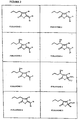
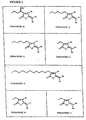
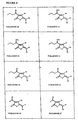
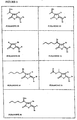
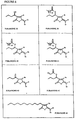
- Figures 2-8 depict chemical structures of various furanones that could be used in the inventive synergistic antimicrobial composition described herein.
- fungi and yeasts can become a significant nuisance in most domestic and industrial contexts.
- the following fungi and yeast species represent major problem organisms in the domestic context: Aureobasidium species (e.g., such as Aureobasidium pullulans ), Alternaria species (e.g., such as Alternaria alternata ), Penicillium species (e.g., such as Penicillium digitatum ), Aspergillus species (e.g., such as Aspergillus niger ), Stachybotrys species, (e.g., such as Stachybotrys atra ), Trichophyton species (e.g., such as Trichophyton rubrum ), Cladosporium species (e.g., such as Cladosporium cladosporioides ), and Candida species (e.g., such as Candida albicans ).
- Aureobasidium species e.g., such as Aureobasidium pullulans
- Fungi may be found and sporulate on damp household surfaces (e.g., in the bathroom), and so it is useful to destroy them since they may cause health problems. Alternaria alternata , for example, may only occasionally be found in households, but can cause asthma and allergic reactions. Cladosporium cladosporioides and other fungi may be pathogenic, as are yeasts such as Candida albicans .
- Bacteria such as Staphylococcus species (e.g., such as Staphylococcus aureus), Escherichia species (e.g. such as Escherichia coli ), Salmonella species (e.g., such as Salmonella enteritidis), Shigella species (e.g., such as Shigella sonnei), Klebsiella species (e.g., such as Klebsiella pneumoniae ), Proteus species (e.g., such as Proteus mirabilis ), Pseudomonas species (e.g., such as Pseudomonas aeruginosa), Enterobacter species (e.g., such as Enterobacter aerogenes ) and others are opportunistic pathogens and thus may be problematic in the domestic and industrial contexts.
- Staphylococcus species e.g., such as Staphylococcus aureus
- Escherichia species e.g. such
- compositions that require remarkably small amounts (i.e., sparing amounts) of active ingredients (compared to that which has been used in the past) to be effective. Because such small amounts of active ingredients need to be used for these inventive synergistic antimicrobial compositions, the compositions are environmentally friendly. These compositions have properties that include those of the separate compounds but go beyond them in efficacy and scope of application. The extremely low levels, and hence increased efficacy, of the active compounds or ingredients make this invention very desirable.
- our invention is directed to a novel composition that combines furanones together with other disinfectants, such as, quaternary ammonium compounds and/or quaternized organosilanes, such that lesser quantities of furanone, quaternary ammonium compounds and/or quaternized organosilanes than would normally be necessary for an antimicrobial composition are used to achieve excellent cleaning and disinfecting results.
- Other disinfectants such as, quaternary ammonium compounds and/or quaternized organosilanes, such that lesser quantities of furanone, quaternary ammonium compounds and/or quaternized organosilanes than would normally be necessary for an antimicrobial composition are used to achieve excellent cleaning and disinfecting results.
- higher concentrations of these components can be used if this is desired for certain applications. Higher concentrations of each component might be used, for example, if a concentrated product to be diluted by the consumer were to be prepared.
- Concentrated products also are used in solid toilet bowl cleaners, such as in toilet bowl rim
- the amount of furanones to be used in the synergistic antimicrobial composition of this invention is between about 1.0 x 10 -7 weight percent of the composition (i.e., 1 ⁇ g/L) and up to about 0.5 weight percent of the composition (i.e., 5000 mg/L). The higher end of this stated range might be used to prepare a concentrated product that would be diluted prior to use.
- the amount of furanone to be used in this invention is preferably between about 0.00001 weight percent and about 0.01 weight percent of the composition, more preferably between about 0.0005 weight percent and about 0.005 weight percent of the composition, and most preferably about 0.001 weight percent of the composition.
- the amount of quaternized organosilane should be between about 0.001 weight percent and about 5.0 weight percent of the composition. The higher end of this range might apply if the composition were formulated as a concentrate, for example, to be dilutable or automatically dischargeable as an automatic toilet bowl cleaner.
- the amount of quaternized organosilane to be used in this invention is preferably between about 0.001 weight percent and about 3.0 weight percent of the composition, more preferably, between about 0.03 weight percent and about 0.22 weight percent of the composition. Most preferably, the amount of quaternized organosilane should be about 0.15 weight percent of the composition.
- the amount of quaternary ammonium compound should be between about 0.01 weight percent and about 10.0 weight percent of the composition. As with the other components, the higher end of this stated range of quaternary ammonium compound might be used to prepare a concentrated product that would be diluted prior to use.
- the amount of quaternary ammonium compound to be used in this invention is preferably between about 0.01 weight percent and about 1.0 weight percent of the composition, and more preferably between about 0.1 weight percent and about 0.5 weight percent of the composition. Most preferably, the amount of quaternary ammonium compound to be used is about 0.22 weight percent of the composition.
- U.S. Patent Nos. 5,411,585 and 6,087,319 set out methods by which a quaternized organosilane can be stabilized, namely, using: (1) a quaternary ammonium compound and at least one nonionic, amphoteric, anionic (i.e., sarcosine-based), and cationic surfactants; or (2) using a saccharide-based surfactant and optionally an additional nonionic co-surfactant.
- a stabilizer such as a quaternary ammonium compound, a saccharide-based surfactant or another surfactant is often necessary for water-based formulations. However, if a formulation contains a substantial amount of solvent, such as isopropanol (as shown in Table 3 below) or ethanol, then one of the mentioned stabilizers may not be required.
- a three-component composition if a three-component composition is to be formed containing a quaternized organosilane, a quaternary ammonium compound and a furanone, these components can be combined in the following manner. With good stirring, a quaternary ammonium compound and any necessary surfactants and solvents can be combined. A quaternized organosilane can be added thereafter, followed by a furanone. It should be noted, however, that the addition order is not critical.
- quaternized organosilane could nonetheless still be stabilized using the method described in U.S. Patent No. 6,087,319 noted above.
- the quaternized organosilane could be stabilized using a solvent or a surfactant in appropriate amounts. Suitable surfactants include those set out in U.S. Patent Nos. 5,411,585 and 6,087,319.
- Useful solvents include, for example, alcohols (such as isopropanol or ethanol), glycols (such as dipropylene glycol n-butyl ether), and alcohol amines (such as ethanolamine).
- Useful surfactants include, for example, a nonionic surfactant such as PLURAFAC® (made by BASF Aktiengesellschaft) which is a fatty alcohol alkoxylate, or glucosides. Once the quaternized organosilane is stabilized, a furanone could be added thereafter by stirring to produce a synergistic antimicrobial composition.
- furanones are generally in crystalline form, they are preferably added to the composition in small amounts of ethanol or another suitable solvent.
- Furanone 30 is sparingly soluble in water, this furanone might be added in water.
- quaternized organosilane compounds that can be used in this invention are described in U.S. Patent No. 5,411,585.
- the quaternized organosilanes useful in the present invention fall within a group of water soluble organosilanes of the formula: A 3-x B X SiD wherein:
- quaternary ammonium compounds that can be used in this invention also is described in U.S. Patent No. 5,411,585.
- one or more of the following quaternary ammonium compounds could be used: didecyl dimethyl ammonium chloride, dioctyl dimethyl ammonium chloride, octyl decyl dimethyl ammonium chloride, benzalkonium chloride (i.e., which is a mixture of benzyl alkyl dimethyl ammonium chlorides), or alkyl benzyl alkyl dimethyl ammonium chloride. It would be preferable but certainly not necessary to use a quaternary ammonium compound such as benzalkonium chloride or didecyl dimethyl ammonium chloride.
- Furanone compounds as a class examples of which are set out in Figures 2 to 8, and that are described in more detail in U.S. Patent No. 6,060,046, International Patent Publication No. WO 96/29392, International Patent Publication No. WO 99/53915, International Patent Publication No. WO 99/54323, and International Patent Publication No. WO 01/68091, can also be used in combination with quaternized organosilanes and/or quaternary ammonium compounds to produce synergistic antimicrobial compositions.
- Furanones 2, 19, 30 and 34 The chemical structures for these furanones are found in Figures 2, 5 and 6 of this application. Furanone compounds can be obtained from Unisearch Ltd., Kensington, New South Wales, Australia.
- Furanone 30 because it is generally active across a broad range of species of fungi and inhibits Gram positive bacteria.
- Furanones 26 and 27 also have shown synergistic antimicrobial activity when combined with a quaternized organosilane and a quaternary ammonium compound.
- the chemical structures of Furanones 26, 27 and 30 can be seen in Figures 4 and 5 of this application, and also in Figure 2 of International Patent Publication No. WO 99/53915. Furanones 26 and 27 are often supplied as a mixture.
- furanones When used in conjunction with ethylenediamine-tetraacetic acid (EDTA) and/or other permeabilizing agents, furanones competitively inhibit the HSL, AHL-signaling/biofilm starvation response system in Gram-negative bacteria. By doing so, furanones inhibit growth and biofilm formation of Gram-negative bacteria. While Gram-positive bacteria do not have the same type of signaling system, these organisms nevertheless respond well to furanones even in the absence of permeabilizing agents.
- EDTA ethylenediamine-tetraacetic acid
- furanones can be very selective in their inhibitory action, this does not mean that the synergistic antimicrobial compositions can only be formed with certain furanones. Rather, we believe that the activity of most if not all furanones can be synergistically enhanced by combining the furanone with a quaternary ammonium compound and/or a quaternized organosilane. In this way, it is generally possible to render effective furanones that otherwise are ineffective against certain microorganisms.
- quaternary ammonium, quaternized organosilane and furanone compounds can interact non-covalently in the synergistic antimicrobial composition.
- Each of the components is known to exhibit antimicrobial activity in its own right, although it was not known that they would exhibit unexpectedly high levels of synergy when combined in small amounts.
- a quaternary ammonium compound, a quaternized organosilane and a furanone are combined, we theorize that the antimicrobial benefits of the quaternary ammonium compound and/or the quaternized organosilane are enhanced by the presence of the furanone.
- the use of quaternized organosilanes is known to impart residual antimicrobial properties to suitable surfaces. Quaternary ammonium compounds, however, tend to impart much weaker residual antimicrobial properties.
- a preferred formulation of the synergistic antimicrobial composition of the present invention might include the following components: Furanone 30, a quaternary ammonium compound such as BTC 1010 (didecyl dimethyl ammonium chloride)(80% active), and quaternized organosilane such as AEM 5772 Antimicrobial MUP which is 3-(trimethoxysilyl)-propyldimethyloctadecyl ammonium chloride at a 72% actives level (in methanol).
- a furanone could be combined with a disinfectant amine (e.g., as sold by Lonza) or a biguanide (e.g., as sold by Avecia) to produce an effective antimicrobial composition.
- a disinfectant amine e.g., as sold by Lonza
- a biguanide e.g., as sold by Avecia
- sparing amounts of active ingredients should be used.
- the range of amounts of furanone to be used in this embodiment is the same as described in the earlier embodiment.
- the range of amounts of disinfectant amine or biguanide to be used in this embodiment is in the same range as noted as regards the quaternary ammonium compound in the earlier embodiment.
- component amounts should be consulted for both concentrated and non-concentrated products, and for "preferable”, “more preferable”, and “most preferable” amounts of furanone, and disinfectant amine or biguanide in an effective antimicrobial composition of this invention.
- the following additional compounds may optionally be added to the synergistic antimicrobial composition in appropriate amounts known to those having ordinary skill in the art: water, sequestering or complexing agents (e.g., such as ethylenediamine-tetraacetic acid (EDTA)-based chelating agents, diethylenetriamine-pentaacetic acid (DTPA)-based chelating agents, N-(hydroxyethyl)-ethylenediamine-tetraacetic acid (HEDTA)-based chelating agents, nitrilotriacetic acid (NTA)-based chelating agents, or phosphonates, including salts, such as sodium, potassium, and monoethanolamine salts thereof), fragrance, additional disinfectants (e.g., such as phenolics, isothiazolins, iodofors, carbamates and hydantoins), and a pH adjuster such as sodium bicarbonate.
- sequestering or complexing agents are advantageous since they tend
- Example 1 Zone of Inhibition Assay Using Various Fungi
- Fungi used Alternaria alternata, Aureobasidium pullulans, Cladosporium cladosporioides, Penicillium digitatum
- Base formulas for A, B, C and D were prepared as described in Table 1 below.
- B C D Deionized Water (336701) 95.00 92.70 93.00 94.70
- Plurafac B25-5 non-ionic surfactant, biodegradable
- BTC 1010 (Didecyl dimethyl ammonium chloride)(80% active) ⁇ 2.00 2.00 ⁇
- test solutions were prepared either by: (1) taking a furanone or a base formula alone; or (2) by adding small amounts of suitably solubilized furanone (i.e., normally using ethanol) to a base formula so as to deliver a series of furanone concentrations in the test solutions (i.e., 10 ug/ml, 5 ug/ml, 1 ug/ml, 500 ng/ml, 100 ng/ml and 10 ng/ml).
- a series of furanone concentrations in the test solutions i.e., 10 ug/ml, 5 ug/ml, 1 ug/ml, 500 ng/ml, 100 ng/ml and 10 ng/ml.
- test solutions were prepared, 10 ⁇ l of each test solution was spotted onto TLC plates.
- the plates were overlaid with agar containing fungal spores.
- the TLC plates were incubated in a high humidity environment until growth could be observed visually.
- At inhibitory furanone concentrations a zone of inhibition where no fungal growth was observed formed above the test solution spot.
- Lower furanone concentrations resulting in a zone of inhibition correspond to higher test solution efficacy.
- Sterile glass microscopy slides were dipped into the above Formulas E, F, G and H. Excess solution was allowed to drain off. When thoroughly dry, the slides were hung into large, sterile beakers filled with 800 ml of trypticase soy broth and also containing a magnetic stir bar. Each beaker held eight identically coated slides. An additional beaker contained eight untreated sterile slides as controls. The beakers were placed on a multiposition magnetic stir plate and inoculated with 1 ml of an overnight culture of Staphylococcus aureus .
- Example 3 Zone of Inhibition Assay Using Staphylococcus aureus
- Organism used Staphylococcus aureus
- a sterile filter paper was placed on an agar plate (TSA) and inoculated with 1 ml of a diluted (10%) overnight culture of Staphylococcus aureus.
- TSA agar plate
- One side of a glass slide (1" x 2") was wetted with formulations E, F, G or H as prepared in accordance with the formulations in Table 3 (set out in Example 2).
- Formulation H (containing quaternary ammonium compound, quaternized organosilane and furanone) shown in Figure 1C shows the greatest zone of inhibition around the plate.
- Figure 1A shows no zone of inhibition for the control plate containing untreated glass slides.
- the plates containing slides treated with Formulation E (containing quaternized organosilane only) and Formulation G (containing furanone only) also had no zone of inhibition, and appeared essentially as seen in Figure 1A for the controls.
- Figure 1B shows slight zones of inhibition around the glass slides treated with Formulation F (containing quaternary ammonium compound and quaternized organosilane). (See photographic images in Figures 1A to 1C which show zones of inhibition.)
- Results The largest zone of inhibition appeared on the slide shown in Figure 1C that previously had been treated with a composition containing quaternary ammonium compound, a quaternized organosilane and a furanone.
- the size of the zone of inhibition may be directly linked to efficacy, as the concentrations of the test solutions are very much alike, and so the test solutions should not differ significantly with respect to their solubilities. Therefore, the widest zone of inhibition is indicative of the greatest efficacy.
- Example 4 Zone of Inhibition Assay Using Aspergillus niger
- Organism used Aspergillus niger
- test surface 5 ⁇ l of each test material was applied to the center of a 2.5 x 2.5 cm piece of a flexible silica gel TLC plate (Whatman PE SilG, 250 micrometer layer, Catalog #4410-221). The samples were allowed to dry for 30 minutes and then placed gel side up in the middle of an 88 mm Petri dish containing about 10 ml of 2% water agar as a source of moisture during incubation. Six drops of a suspension of Aspergillus niger in molten potato dextrose agar (PDA) was applied to the surface of the TLC plate. The plates were incubated at 28°C for 10 days with observations taken periodically throughout this period.
- PDA molten potato dextrose agar
- This invention has applicability to a variety of industrial and household cleaners intended to inhibit the growth of fungi (mold and mildew) and bacteria on surfaces, and in reservoirs or conduits that are fluid-filled.
- this invention is useful for toilet cleaners, bathroom and shower cleaners, kitchen cleaners, floor cleaners and drain cleaners.
- Other applications may include treatment of furnishings and fabrics, water circulating systems, air ducts, building materials, outdoor structures and the exteriors of ships.
- the inventive composition can be prepared in a concentrated or regular strength format for both domestic and industrial use.
- the benefits to the consumer of using the synergistic antimicrobial composition of this invention is that surfaces stay clean longer, growth of bacteria, mold and biofilm is inhibited, and treated surfaces are easier to clean. Environmental benefits result from the overall lower use of active ingredients.
Landscapes
- Life Sciences & Earth Sciences (AREA)
- Wood Science & Technology (AREA)
- Agronomy & Crop Science (AREA)
- Plant Pathology (AREA)
- Health & Medical Sciences (AREA)
- Engineering & Computer Science (AREA)
- Dentistry (AREA)
- Pest Control & Pesticides (AREA)
- Zoology (AREA)
- General Health & Medical Sciences (AREA)
- Environmental Sciences (AREA)
- Agricultural Chemicals And Associated Chemicals (AREA)
- Detergent Compositions (AREA)
- Cleaning In General (AREA)
- Cleaning By Liquid Or Steam (AREA)
- Acyclic And Carbocyclic Compounds In Medicinal Compositions (AREA)
Applications Claiming Priority (5)
| Application Number | Priority Date | Filing Date | Title |
|---|---|---|---|
| US24925300P | 2000-11-17 | 2000-11-17 | |
| US249253P | 2000-11-17 | ||
| US986301 | 2001-11-08 | ||
| US09/986,301 US6528472B2 (en) | 2000-11-17 | 2001-11-08 | Antimicrobial compositions containing quaternary ammonium compounds, silanes and other disinfectants with furanones |
| PCT/US2001/043886 WO2002080677A1 (en) | 2000-11-17 | 2001-11-16 | Antimicrobial compositions containing quaternary ammonium compounds, silanes and other disinfectants with furanones |
Publications (2)
| Publication Number | Publication Date |
|---|---|
| EP1349454A1 EP1349454A1 (en) | 2003-10-08 |
| EP1349454B1 true EP1349454B1 (en) | 2005-11-02 |
Family
ID=26939928
Family Applications (1)
| Application Number | Title | Priority Date | Filing Date |
|---|---|---|---|
| EP01273631A Expired - Lifetime EP1349454B1 (en) | 2000-11-17 | 2001-11-16 | Antimicrobial compositions containing quaternary ammonium compounds, silanes and other disinfectants with furanones |
Country Status (11)
| Country | Link |
|---|---|
| US (1) | US6528472B2 (enExample) |
| EP (1) | EP1349454B1 (enExample) |
| JP (1) | JP4223814B2 (enExample) |
| AR (1) | AR031478A1 (enExample) |
| AT (1) | ATE308243T1 (enExample) |
| CA (1) | CA2428789A1 (enExample) |
| DE (1) | DE60114665T2 (enExample) |
| ES (1) | ES2247011T3 (enExample) |
| MX (1) | MXPA03004359A (enExample) |
| TW (1) | TWI244394B (enExample) |
| WO (1) | WO2002080677A1 (enExample) |
Cited By (1)
| Publication number | Priority date | Publication date | Assignee | Title |
|---|---|---|---|---|
| DE102005020759A1 (de) * | 2005-05-02 | 2006-11-09 | Henkel Kgaa | Halomethylen-Alkanone und Furanone als Biofilmblocker |
Families Citing this family (48)
| Publication number | Priority date | Publication date | Assignee | Title |
|---|---|---|---|---|
| US6716805B1 (en) * | 1999-09-27 | 2004-04-06 | The Procter & Gamble Company | Hard surface cleaning compositions, premoistened wipes, methods of use, and articles comprising said compositions or wipes and instructions for use resulting in easier cleaning and maintenance, improved surface appearance and/or hygiene under stress conditions such as no-rinse |
| US6814088B2 (en) * | 1999-09-27 | 2004-11-09 | The Procter & Gamble Company | Aqueous compositions for treating a surface |
| US20100160445A1 (en) * | 2002-01-17 | 2010-06-24 | Carlson Paul E | Synergistic Mixtures of OPP and DGH |
| US6928664B2 (en) * | 2002-10-24 | 2005-08-16 | Gary L. Price | Microbiostatic garment |
| US8309117B2 (en) * | 2002-12-19 | 2012-11-13 | Novartis, Ag | Method for making medical devices having antimicrobial coatings thereon |
| US20050087216A1 (en) * | 2003-10-23 | 2005-04-28 | Dudjak Scott B. | Exterior surface cleaner and method of use |
| US8257780B2 (en) * | 2003-10-31 | 2012-09-04 | Resource Development L.L.C. | Therapeutic composition containing an organosilane quaternary compound and hydrogen peroxide for treating skin disorders and methods of using |
| US6994890B2 (en) * | 2003-10-31 | 2006-02-07 | Resource Development L.L.C. | Cleaning and multifunctional coating composition containing an organosilane quaternary compound and hydrogen peroxide |
| CN101001635A (zh) * | 2003-12-04 | 2007-07-18 | 生物膜策略公司 | 预防生物膜形成、减少现有生物膜和减少细菌群的方法和组合物 |
| US8999363B2 (en) * | 2005-02-07 | 2015-04-07 | Sishield Technologies, Inc. | Methods and compositions for antimicrobial surfaces |
| EP1887863A2 (en) * | 2005-02-07 | 2008-02-20 | SiShield Technologies | Methods and compositions for biocidal treatments |
| US7754004B2 (en) * | 2005-07-06 | 2010-07-13 | Resource Development, L.L.C. | Thickened surfactant-free cleansing and multifunctional liquid coating compositions containing nonreactive abrasive solid particles and an organosilane quaternary compound and methods of using |
| US20070163964A1 (en) * | 2005-11-07 | 2007-07-19 | Williamson J K | Methods and compositions for filtration media |
| US7262159B2 (en) * | 2005-12-20 | 2007-08-28 | S.C. Johnson & Son, Inc. | Odor elimination composition for use on soft surfaces |
| US7307053B2 (en) * | 2005-12-20 | 2007-12-11 | S.C. Johnson & Son, Inc. | Combination air sanitizer, soft surface deodorizer/sanitizer and hard surface disinfectant |
| US8022026B2 (en) | 2005-12-20 | 2011-09-20 | S.C. Johnson & Son, Inc. | Odor elimination composition comprising triethylene glycol for use on soft surfaces |
| EP2107948A4 (en) * | 2006-12-14 | 2010-08-04 | Church & Dwight Co Inc | STABLE ACIDIC SOLUTIONS FROM QUATERNARY SILANAMONIUM COMPOUNDS |
| US8728540B2 (en) | 2006-12-14 | 2014-05-20 | Church & Dwight Co., Inc. | Stable aqueous solutions of silane quat ammonium compounds |
| US7589054B2 (en) * | 2007-01-02 | 2009-09-15 | Resource Development L.L.C. | Clathrates of an organosilane quaternary ammonium compound and urea and methods of use |
| EP2173175A4 (en) * | 2007-03-07 | 2013-05-29 | Thomas L Higgins | Compositions of organic silane, non-ionic compound and water-stable quaternary ammonium compound and process |
| CA2684153A1 (en) * | 2007-05-14 | 2008-11-27 | Tyco Healthcare Group Lp | Furanone copolymers |
| KR20100051672A (ko) * | 2007-07-25 | 2010-05-17 | 고쿠리츠다이가쿠호진 히로시마다이가쿠 | 고형화된 세정제 조성물 및 이의 제조방법 |
| GB0818869D0 (en) * | 2008-10-15 | 2008-11-19 | Byotrol Plc | Anti-microbial composition |
| GB201003531D0 (en) | 2010-03-03 | 2010-04-21 | Arcis Biotechnology Ltd | Composition and method |
| US8735618B2 (en) | 2010-05-07 | 2014-05-27 | Resource Development L.L.C. | Solvent-free organosilane quaternary ammonium compositions, method of making and use |
| AU2012201690A1 (en) | 2011-03-24 | 2012-10-11 | Lululemon Athletica Canada Inc. | Exercise mat |
| KR20140044805A (ko) | 2011-04-27 | 2014-04-15 | 라이프스트로 에스에이 | 정수장치 |
| EP2797749A4 (en) * | 2011-12-28 | 2015-06-24 | Lululemon Athletica Canada Inc | TRAINING MAT |
| US9877875B2 (en) | 2012-10-09 | 2018-01-30 | Parasol Medical LLC | Antimicrobial hydrogel formulation |
| US11053141B2 (en) | 2013-10-28 | 2021-07-06 | Vestergaard Sa | Water purification device |
| WO2015139074A1 (en) * | 2014-03-17 | 2015-09-24 | Air Sanz Holdings Pty Ltd | Antimicrobial air sanitizer compositions and their use |
| KR101743089B1 (ko) | 2015-05-13 | 2017-06-05 | 대한민국 | 신규 클라도스포리움 클라도스포리오이데스 m2231 균주 및 이의 용도 |
| USD783773S1 (en) | 2015-07-14 | 2017-04-11 | Lifestraw Sa | Water purifier |
| USD782609S1 (en) | 2015-07-14 | 2017-03-28 | Lifestraw Sa | Water purifier |
| USD782610S1 (en) | 2015-11-09 | 2017-03-28 | Lifestraw Sa | Water purifier |
| US10295489B2 (en) | 2016-09-12 | 2019-05-21 | Ecolab Usa Inc. | Deposit monitor |
| US10816285B2 (en) | 2017-02-24 | 2020-10-27 | Ecolab Usa Inc. | Thermoelectric deposit monitor |
| US10967082B2 (en) | 2017-11-08 | 2021-04-06 | Parasol Medical, Llc | Method of limiting the spread of norovirus within a cruise ship |
| US10822502B2 (en) * | 2018-03-06 | 2020-11-03 | Parasol Medical LLC | Antimicrobial solution to apply to a hull and an interior of a boat |
| US10864058B2 (en) | 2018-03-28 | 2020-12-15 | Parasol Medical, Llc | Antimicrobial treatment for a surgical headlamp system |
| US20200068896A1 (en) * | 2018-09-04 | 2020-03-05 | Parasol Medical LLC | Cleaning composition including both a disinfectant and a long-lasting antimicrobial component |
| US11305033B2 (en) | 2019-03-05 | 2022-04-19 | Parasol Medical, Llc | Splinting system including an antimicrobial coating and a method of manufacturing the same |
| US11953458B2 (en) | 2019-03-14 | 2024-04-09 | Ecolab Usa Inc. | Systems and methods utilizing sensor surface functionalization |
| WO2021222722A1 (en) * | 2020-04-30 | 2021-11-04 | Pison Stream Solutions, Llc | High performance antimicrobial composition |
| WO2021234463A1 (en) * | 2020-05-08 | 2021-11-25 | 2 V Industries, Inc. | Fortified sanitizing composition having antimicrobial characteristics |
| CN112640903B (zh) * | 2020-12-23 | 2021-12-14 | 北京瞬行生物科技有限公司 | 一种复合季铵盐消毒剂及其制备方法 |
| ES2947432B2 (es) * | 2022-02-04 | 2024-01-02 | Ancor Tecnologica Canaria S L | Producto biocida con aditivo marcador luminiscente y su aplicacionen superficies duras no porosas |
| ES2952081B2 (es) * | 2022-03-18 | 2024-03-06 | Ancor Tecnologica Canaria S L | Producto biocida con aditivo marcador luminiscente para superficies textiles o similares |
Family Cites Families (14)
| Publication number | Priority date | Publication date | Assignee | Title |
|---|---|---|---|---|
| US5411585A (en) | 1991-02-15 | 1995-05-02 | S. C. Johnson & Son, Inc. | Production of stable hydrolyzable organosilane solutions |
| AUPM666694A0 (en) | 1994-07-06 | 1994-07-28 | Unisearch Limited | Natural antifouling compositions |
| AUPN191295A0 (en) | 1995-03-23 | 1995-04-27 | Unisearch Limited | Microbiocide or microbial regulator |
| US6087319A (en) | 1996-03-04 | 2000-07-11 | S. C. Johnson & Son, Inc. | Stable aqueous silane solutions for cleaning hard surfaces |
| DE19700062A1 (de) | 1997-01-03 | 1998-07-09 | Bayer Ag | S-Aryl-dithiazindioxide |
| US5906825A (en) | 1997-10-20 | 1999-05-25 | Magellan Companies, Inc. | Polymers containing antimicrobial agents and methods for making and using same |
| GB2331758B (en) | 1997-11-28 | 2002-04-17 | Reckitt & Colman Inc | Disinfectant compositions |
| AUPP297898A0 (en) | 1998-04-16 | 1998-05-07 | Unisearch Limited | Production of furanones |
| AUPP303498A0 (en) | 1998-04-17 | 1998-05-14 | Unisearch Limited | Inhibition of gram positive bacteria |
| AU3887500A (en) | 1999-03-16 | 2000-10-04 | Coating Systems Laboratories, Inc. | Antimicrobial skin preparations containing organosilane quaternaries |
| AUPQ475599A0 (en) | 1999-12-17 | 2000-01-20 | Unisearch Limited | Inhibition of two-component transduction systems |
| AUPQ629000A0 (en) | 2000-03-16 | 2000-04-15 | Unisearch Limited | Inhibition of fungi |
| AUPQ629200A0 (en) * | 2000-03-16 | 2000-04-15 | Unisearch Limited | Microbial inhibitory compositions |
| US6559176B1 (en) | 2000-05-10 | 2003-05-06 | Princeton University | Compounds and methods for regulating bacterial growth and pathogenesis |
-
2001
- 2001-11-08 US US09/986,301 patent/US6528472B2/en not_active Expired - Lifetime
- 2001-11-16 CA CA002428789A patent/CA2428789A1/en not_active Abandoned
- 2001-11-16 DE DE60114665T patent/DE60114665T2/de not_active Expired - Fee Related
- 2001-11-16 JP JP2002578725A patent/JP4223814B2/ja not_active Expired - Fee Related
- 2001-11-16 EP EP01273631A patent/EP1349454B1/en not_active Expired - Lifetime
- 2001-11-16 ES ES01273631T patent/ES2247011T3/es not_active Expired - Lifetime
- 2001-11-16 MX MXPA03004359A patent/MXPA03004359A/es unknown
- 2001-11-16 AT AT01273631T patent/ATE308243T1/de not_active IP Right Cessation
- 2001-11-16 WO PCT/US2001/043886 patent/WO2002080677A1/en not_active Ceased
- 2001-11-19 AR ARP010105393A patent/AR031478A1/es unknown
- 2001-11-19 TW TW090128625A patent/TWI244394B/zh not_active IP Right Cessation
Cited By (1)
| Publication number | Priority date | Publication date | Assignee | Title |
|---|---|---|---|---|
| DE102005020759A1 (de) * | 2005-05-02 | 2006-11-09 | Henkel Kgaa | Halomethylen-Alkanone und Furanone als Biofilmblocker |
Also Published As
| Publication number | Publication date |
|---|---|
| JP4223814B2 (ja) | 2009-02-12 |
| ES2247011T3 (es) | 2006-03-01 |
| WO2002080677A1 (en) | 2002-10-17 |
| MXPA03004359A (es) | 2005-04-19 |
| JP2004524367A (ja) | 2004-08-12 |
| DE60114665T2 (de) | 2006-07-20 |
| DE60114665D1 (de) | 2005-12-08 |
| TWI244394B (en) | 2005-12-01 |
| US20020111282A1 (en) | 2002-08-15 |
| US6528472B2 (en) | 2003-03-04 |
| ATE308243T1 (de) | 2005-11-15 |
| CA2428789A1 (en) | 2002-10-17 |
| EP1349454A1 (en) | 2003-10-08 |
| AR031478A1 (es) | 2003-09-24 |
Similar Documents
| Publication | Publication Date | Title |
|---|---|---|
| US6528472B2 (en) | Antimicrobial compositions containing quaternary ammonium compounds, silanes and other disinfectants with furanones | |
| KR100397259B1 (ko) | 상승작용성 살균 조성물 및 이를 사용하는 방법 | |
| US5276047A (en) | Liquid 1,2-benzoisothiazoline-3-one preparation | |
| AU2001297743B2 (en) | Antimicrobial compositions containing quaternary ammonium compounds, silanes and other disinfectants with furanones | |
| AU2001297743A1 (en) | Antimicrobial compositions containing quaternary ammonium compounds, silanes and other disinfectants with furanones | |
| KR100858023B1 (ko) | 항미생물 조성물 | |
| JP4395879B2 (ja) | 紙パルプ工業用抗菌剤組成物及びそれを用いた抗菌方法 | |
| JP2004099529A (ja) | 抗微生物剤組成物 | |
| EP1924140A2 (en) | Microbicidal composition | |
| JP4387587B2 (ja) | ドデシルモルホリンまたはその塩およびドデシルアミンまたはその塩を含有する相乗的抗微生物組成物 | |
| EP1017636A1 (en) | Use of amino methyl phosphonic acids or their salts to inhibit bacteria from adering to a submergible surface and to control biofouling | |
| JP2622473B2 (ja) | 工業用殺菌防腐剤 | |
| JP3728452B2 (ja) | 工業用殺菌・静菌剤および工業的殺菌・静菌方法 | |
| DE102005020759A1 (de) | Halomethylen-Alkanone und Furanone als Biofilmblocker | |
| JP2002338412A (ja) | 工業用殺菌剤組成物および殺菌方法 | |
| JP2000256112A (ja) | 防藻剤組成物 | |
| JP2002284612A (ja) | 抗微生物剤組成物 | |
| JP2000273006A (ja) | 抗微生物剤組成物 | |
| JP2002128609A (ja) | 抗微生物剤組成物 | |
| JP2004099530A (ja) | 抗微生物剤組成物 | |
| JP2002128608A (ja) | 抗微生物剤組成物 | |
| JP2001213708A (ja) | 抗微生物剤組成物 | |
| JPH07258002A (ja) | 還元性物質含有水系用殺菌剤 | |
| JPH0747781A (ja) | 印刷版用湿し水 | |
| JP2008019215A (ja) | 殺菌剤組成物 |
Legal Events
| Date | Code | Title | Description |
|---|---|---|---|
| PUAI | Public reference made under article 153(3) epc to a published international application that has entered the european phase |
Free format text: ORIGINAL CODE: 0009012 |
|
| 17P | Request for examination filed |
Effective date: 20030530 |
|
| AK | Designated contracting states |
Kind code of ref document: A1 Designated state(s): AT BE CH CY DE DK ES FI FR GB GR IE IT LI LU MC NL PT SE TR |
|
| AX | Request for extension of the european patent |
Extension state: AL LT LV MK RO SI |
|
| GRAP | Despatch of communication of intention to grant a patent |
Free format text: ORIGINAL CODE: EPIDOSNIGR1 |
|
| GRAS | Grant fee paid |
Free format text: ORIGINAL CODE: EPIDOSNIGR3 |
|
| GRAA | (expected) grant |
Free format text: ORIGINAL CODE: 0009210 |
|
| AK | Designated contracting states |
Kind code of ref document: B1 Designated state(s): AT BE CH CY DE DK ES FI FR GB GR IE IT LI LU MC NL PT SE TR |
|
| PG25 | Lapsed in a contracting state [announced via postgrant information from national office to epo] |
Ref country code: AT Free format text: LAPSE BECAUSE OF FAILURE TO SUBMIT A TRANSLATION OF THE DESCRIPTION OR TO PAY THE FEE WITHIN THE PRESCRIBED TIME-LIMIT Effective date: 20051102 Ref country code: FI Free format text: LAPSE BECAUSE OF FAILURE TO SUBMIT A TRANSLATION OF THE DESCRIPTION OR TO PAY THE FEE WITHIN THE PRESCRIBED TIME-LIMIT Effective date: 20051102 Ref country code: LI Free format text: LAPSE BECAUSE OF FAILURE TO SUBMIT A TRANSLATION OF THE DESCRIPTION OR TO PAY THE FEE WITHIN THE PRESCRIBED TIME-LIMIT Effective date: 20051102 Ref country code: NL Free format text: LAPSE BECAUSE OF FAILURE TO SUBMIT A TRANSLATION OF THE DESCRIPTION OR TO PAY THE FEE WITHIN THE PRESCRIBED TIME-LIMIT Effective date: 20051102 Ref country code: BE Free format text: LAPSE BECAUSE OF FAILURE TO SUBMIT A TRANSLATION OF THE DESCRIPTION OR TO PAY THE FEE WITHIN THE PRESCRIBED TIME-LIMIT Effective date: 20051102 Ref country code: CH Free format text: LAPSE BECAUSE OF FAILURE TO SUBMIT A TRANSLATION OF THE DESCRIPTION OR TO PAY THE FEE WITHIN THE PRESCRIBED TIME-LIMIT Effective date: 20051102 Ref country code: TR Free format text: LAPSE BECAUSE OF FAILURE TO SUBMIT A TRANSLATION OF THE DESCRIPTION OR TO PAY THE FEE WITHIN THE PRESCRIBED TIME-LIMIT Effective date: 20051102 Ref country code: IT Free format text: LAPSE BECAUSE OF FAILURE TO SUBMIT A TRANSLATION OF THE DESCRIPTION OR TO PAY THE FEE WITHIN THE PRESCRIBED TIME-LIMIT;WARNING: LAPSES OF ITALIAN PATENTS WITH EFFECTIVE DATE BEFORE 2007 MAY HAVE OCCURRED AT ANY TIME BEFORE 2007. THE CORRECT EFFECTIVE DATE MAY BE DIFFERENT FROM THE ONE RECORDED. Effective date: 20051102 |
|
| REG | Reference to a national code |
Ref country code: GB Ref legal event code: FG4D |
|
| REG | Reference to a national code |
Ref country code: CH Ref legal event code: EP |
|
| PG25 | Lapsed in a contracting state [announced via postgrant information from national office to epo] |
Ref country code: IE Free format text: LAPSE BECAUSE OF NON-PAYMENT OF DUE FEES Effective date: 20051116 Ref country code: CY Free format text: LAPSE BECAUSE OF FAILURE TO SUBMIT A TRANSLATION OF THE DESCRIPTION OR TO PAY THE FEE WITHIN THE PRESCRIBED TIME-LIMIT Effective date: 20051116 |
|
| PG25 | Lapsed in a contracting state [announced via postgrant information from national office to epo] |
Ref country code: MC Free format text: LAPSE BECAUSE OF NON-PAYMENT OF DUE FEES Effective date: 20051130 |
|
| REF | Corresponds to: |
Ref document number: 60114665 Country of ref document: DE Date of ref document: 20051208 Kind code of ref document: P |
|
| PG25 | Lapsed in a contracting state [announced via postgrant information from national office to epo] |
Ref country code: LU Free format text: LAPSE BECAUSE OF NON-PAYMENT OF DUE FEES Effective date: 20060102 |
|
| PG25 | Lapsed in a contracting state [announced via postgrant information from national office to epo] |
Ref country code: GR Free format text: LAPSE BECAUSE OF FAILURE TO SUBMIT A TRANSLATION OF THE DESCRIPTION OR TO PAY THE FEE WITHIN THE PRESCRIBED TIME-LIMIT Effective date: 20060202 Ref country code: DK Free format text: LAPSE BECAUSE OF FAILURE TO SUBMIT A TRANSLATION OF THE DESCRIPTION OR TO PAY THE FEE WITHIN THE PRESCRIBED TIME-LIMIT Effective date: 20060202 Ref country code: GB Free format text: LAPSE BECAUSE OF NON-PAYMENT OF DUE FEES Effective date: 20060202 Ref country code: SE Free format text: LAPSE BECAUSE OF FAILURE TO SUBMIT A TRANSLATION OF THE DESCRIPTION OR TO PAY THE FEE WITHIN THE PRESCRIBED TIME-LIMIT Effective date: 20060202 |
|
| REG | Reference to a national code |
Ref country code: ES Ref legal event code: FG2A Ref document number: 2247011 Country of ref document: ES Kind code of ref document: T3 |
|
| PG25 | Lapsed in a contracting state [announced via postgrant information from national office to epo] |
Ref country code: PT Free format text: LAPSE BECAUSE OF FAILURE TO SUBMIT A TRANSLATION OF THE DESCRIPTION OR TO PAY THE FEE WITHIN THE PRESCRIBED TIME-LIMIT Effective date: 20060403 |
|
| NLV1 | Nl: lapsed or annulled due to failure to fulfill the requirements of art. 29p and 29m of the patents act | ||
| REG | Reference to a national code |
Ref country code: CH Ref legal event code: PL |
|
| ET | Fr: translation filed | ||
| REG | Reference to a national code |
Ref country code: IE Ref legal event code: MM4A |
|
| PLBE | No opposition filed within time limit |
Free format text: ORIGINAL CODE: 0009261 |
|
| STAA | Information on the status of an ep patent application or granted ep patent |
Free format text: STATUS: NO OPPOSITION FILED WITHIN TIME LIMIT |
|
| 26N | No opposition filed |
Effective date: 20060803 |
|
| GBPC | Gb: european patent ceased through non-payment of renewal fee |
Effective date: 20060202 |
|
| PGFP | Annual fee paid to national office [announced via postgrant information from national office to epo] |
Ref country code: ES Payment date: 20071126 Year of fee payment: 7 |
|
| PGFP | Annual fee paid to national office [announced via postgrant information from national office to epo] |
Ref country code: FR Payment date: 20071119 Year of fee payment: 7 |
|
| PGFP | Annual fee paid to national office [announced via postgrant information from national office to epo] |
Ref country code: DE Payment date: 20071221 Year of fee payment: 7 |
|
| REG | Reference to a national code |
Ref country code: FR Ref legal event code: ST Effective date: 20090731 |
|
| PG25 | Lapsed in a contracting state [announced via postgrant information from national office to epo] |
Ref country code: DE Free format text: LAPSE BECAUSE OF NON-PAYMENT OF DUE FEES Effective date: 20090603 |
|
| REG | Reference to a national code |
Ref country code: ES Ref legal event code: FD2A Effective date: 20081117 |
|
| PG25 | Lapsed in a contracting state [announced via postgrant information from national office to epo] |
Ref country code: ES Free format text: LAPSE BECAUSE OF NON-PAYMENT OF DUE FEES Effective date: 20081117 |
|
| PG25 | Lapsed in a contracting state [announced via postgrant information from national office to epo] |
Ref country code: FR Free format text: LAPSE BECAUSE OF NON-PAYMENT OF DUE FEES Effective date: 20081130 |