EP1325057B1 - Procede de fabrication de polyamides - Google Patents
Procede de fabrication de polyamides Download PDFInfo
- Publication number
- EP1325057B1 EP1325057B1 EP01974426A EP01974426A EP1325057B1 EP 1325057 B1 EP1325057 B1 EP 1325057B1 EP 01974426 A EP01974426 A EP 01974426A EP 01974426 A EP01974426 A EP 01974426A EP 1325057 B1 EP1325057 B1 EP 1325057B1
- Authority
- EP
- European Patent Office
- Prior art keywords
- flow
- acid
- mixture
- condensation
- process according
- Prior art date
- Legal status (The legal status is an assumption and is not a legal conclusion. Google has not performed a legal analysis and makes no representation as to the accuracy of the status listed.)
- Expired - Lifetime
Links
- 238000000034 method Methods 0.000 title claims abstract description 87
- 229920002647 polyamide Polymers 0.000 title claims abstract description 49
- 239000004952 Polyamide Substances 0.000 title claims abstract description 47
- 239000000203 mixture Substances 0.000 claims abstract description 109
- 150000004985 diamines Chemical class 0.000 claims abstract description 74
- 230000008569 process Effects 0.000 claims abstract description 66
- 239000000178 monomer Substances 0.000 claims abstract description 65
- 150000001412 amines Chemical group 0.000 claims abstract description 47
- 239000002253 acid Substances 0.000 claims abstract description 44
- 238000004519 manufacturing process Methods 0.000 claims abstract description 34
- 238000002156 mixing Methods 0.000 claims abstract description 29
- 238000006068 polycondensation reaction Methods 0.000 claims abstract description 23
- 239000007864 aqueous solution Substances 0.000 claims abstract description 21
- NAQMVNRVTILPCV-UHFFFAOYSA-N hexane-1,6-diamine Chemical compound NCCCCCCN NAQMVNRVTILPCV-UHFFFAOYSA-N 0.000 claims description 77
- 239000002243 precursor Substances 0.000 claims description 72
- 238000009833 condensation Methods 0.000 claims description 55
- 230000005494 condensation Effects 0.000 claims description 54
- WNLRTRBMVRJNCN-UHFFFAOYSA-N adipic acid Chemical compound OC(=O)CCCCC(O)=O WNLRTRBMVRJNCN-UHFFFAOYSA-N 0.000 claims description 48
- 239000000047 product Substances 0.000 claims description 48
- 238000004458 analytical method Methods 0.000 claims description 47
- 239000000243 solution Substances 0.000 claims description 43
- 238000006116 polymerization reaction Methods 0.000 claims description 30
- 235000011037 adipic acid Nutrition 0.000 claims description 24
- 239000001361 adipic acid Substances 0.000 claims description 24
- 150000002500 ions Chemical class 0.000 claims description 19
- 238000002360 preparation method Methods 0.000 claims description 19
- 239000000374 eutectic mixture Substances 0.000 claims description 13
- 239000007859 condensation product Substances 0.000 claims description 11
- 239000007787 solid Substances 0.000 claims description 11
- 238000007792 addition Methods 0.000 claims description 7
- 230000008878 coupling Effects 0.000 claims description 7
- 238000010168 coupling process Methods 0.000 claims description 7
- 238000005859 coupling reaction Methods 0.000 claims description 7
- 238000001320 near-infrared absorption spectroscopy Methods 0.000 claims description 7
- 238000011084 recovery Methods 0.000 claims description 7
- 230000004913 activation Effects 0.000 claims description 5
- 150000001991 dicarboxylic acids Chemical class 0.000 claims description 3
- BDJRBEYXGGNYIS-UHFFFAOYSA-N nonanedioic acid Chemical compound OC(=O)CCCCCCCC(O)=O BDJRBEYXGGNYIS-UHFFFAOYSA-N 0.000 claims description 3
- PWGJDPKCLMLPJW-UHFFFAOYSA-N 1,8-diaminooctane Chemical compound NCCCCCCCCN PWGJDPKCLMLPJW-UHFFFAOYSA-N 0.000 claims description 2
- GKXVJHDEWHKBFH-UHFFFAOYSA-N [2-(aminomethyl)phenyl]methanamine Chemical compound NCC1=CC=CC=C1CN GKXVJHDEWHKBFH-UHFFFAOYSA-N 0.000 claims description 2
- 230000003213 activating effect Effects 0.000 claims description 2
- 125000003277 amino group Chemical group 0.000 claims description 2
- YQLZOAVZWJBZSY-UHFFFAOYSA-N decane-1,10-diamine Chemical compound NCCCCCCCCCCN YQLZOAVZWJBZSY-UHFFFAOYSA-N 0.000 claims description 2
- QFTYSVGGYOXFRQ-UHFFFAOYSA-N dodecane-1,12-diamine Chemical compound NCCCCCCCCCCCCN QFTYSVGGYOXFRQ-UHFFFAOYSA-N 0.000 claims description 2
- PWSKHLMYTZNYKO-UHFFFAOYSA-N heptane-1,7-diamine Chemical compound NCCCCCCCN PWSKHLMYTZNYKO-UHFFFAOYSA-N 0.000 claims description 2
- SXJVFQLYZSNZBT-UHFFFAOYSA-N nonane-1,9-diamine Chemical compound NCCCCCCCCCN SXJVFQLYZSNZBT-UHFFFAOYSA-N 0.000 claims description 2
- KLNPWTHGTVSSEU-UHFFFAOYSA-N undecane-1,11-diamine Chemical compound NCCCCCCCCCCCN KLNPWTHGTVSSEU-UHFFFAOYSA-N 0.000 claims description 2
- KKEYFWRCBNTPAC-UHFFFAOYSA-N Terephthalic acid Chemical compound OC(=O)C1=CC=C(C(O)=O)C=C1 KKEYFWRCBNTPAC-UHFFFAOYSA-N 0.000 claims 2
- QQVIHTHCMHWDBS-UHFFFAOYSA-N isophthalic acid Chemical compound OC(=O)C1=CC=CC(C(O)=O)=C1 QQVIHTHCMHWDBS-UHFFFAOYSA-N 0.000 claims 2
- WLJVNTCWHIRURA-UHFFFAOYSA-N pimelic acid Chemical compound OC(=O)CCCCCC(O)=O WLJVNTCWHIRURA-UHFFFAOYSA-N 0.000 claims 2
- CXMXRPHRNRROMY-UHFFFAOYSA-N sebacic acid Chemical compound OC(=O)CCCCCCCCC(O)=O CXMXRPHRNRROMY-UHFFFAOYSA-N 0.000 claims 2
- TYFQFVWCELRYAO-UHFFFAOYSA-N suberic acid Chemical compound OC(=O)CCCCCCC(O)=O TYFQFVWCELRYAO-UHFFFAOYSA-N 0.000 claims 2
- RTBFRGCFXZNCOE-UHFFFAOYSA-N 1-methylsulfonylpiperidin-4-one Chemical compound CS(=O)(=O)N1CCC(=O)CC1 RTBFRGCFXZNCOE-UHFFFAOYSA-N 0.000 claims 1
- QFGCFKJIPBRJGM-UHFFFAOYSA-N 12-[(2-methylpropan-2-yl)oxy]-12-oxododecanoic acid Chemical compound CC(C)(C)OC(=O)CCCCCCCCCCC(O)=O QFGCFKJIPBRJGM-UHFFFAOYSA-N 0.000 claims 1
- OFOBLEOULBTSOW-UHFFFAOYSA-N Malonic acid Chemical compound OC(=O)CC(O)=O OFOBLEOULBTSOW-UHFFFAOYSA-N 0.000 claims 1
- JFCQEDHGNNZCLN-UHFFFAOYSA-N anhydrous glutaric acid Natural products OC(=O)CCCC(O)=O JFCQEDHGNNZCLN-UHFFFAOYSA-N 0.000 claims 1
- XTBMQKZEIICCCS-UHFFFAOYSA-N hexane-1,5-diamine Chemical compound CC(N)CCCCN XTBMQKZEIICCCS-UHFFFAOYSA-N 0.000 claims 1
- 150000001875 compounds Chemical class 0.000 abstract description 7
- 238000010924 continuous production Methods 0.000 abstract description 2
- XLYOFNOQVPJJNP-UHFFFAOYSA-N water Substances O XLYOFNOQVPJJNP-UHFFFAOYSA-N 0.000 description 37
- 238000009434 installation Methods 0.000 description 36
- 150000003839 salts Chemical class 0.000 description 22
- 238000005259 measurement Methods 0.000 description 19
- 239000012266 salt solution Substances 0.000 description 17
- 230000001105 regulatory effect Effects 0.000 description 16
- 230000033228 biological regulation Effects 0.000 description 14
- 239000000523 sample Substances 0.000 description 14
- 229920000642 polymer Polymers 0.000 description 13
- 230000004907 flux Effects 0.000 description 12
- 239000007789 gas Substances 0.000 description 12
- 229920002302 Nylon 6,6 Polymers 0.000 description 10
- 238000006243 chemical reaction Methods 0.000 description 10
- 239000000463 material Substances 0.000 description 10
- 238000010438 heat treatment Methods 0.000 description 9
- BDAGIHXWWSANSR-UHFFFAOYSA-N methanoic acid Natural products OC=O BDAGIHXWWSANSR-UHFFFAOYSA-N 0.000 description 8
- -1 des ions Chemical class 0.000 description 7
- 230000002378 acidificating effect Effects 0.000 description 6
- 230000003068 static effect Effects 0.000 description 6
- 239000004677 Nylon Substances 0.000 description 5
- 238000010586 diagram Methods 0.000 description 5
- 229910052757 nitrogen Inorganic materials 0.000 description 5
- 229920001778 nylon Polymers 0.000 description 5
- OSWFIVFLDKOXQC-UHFFFAOYSA-N 4-(3-methoxyphenyl)aniline Chemical compound COC1=CC=CC(C=2C=CC(N)=CC=2)=C1 OSWFIVFLDKOXQC-UHFFFAOYSA-N 0.000 description 4
- IJGRMHOSHXDMSA-UHFFFAOYSA-N Atomic nitrogen Chemical compound N#N IJGRMHOSHXDMSA-UHFFFAOYSA-N 0.000 description 4
- 230000008020 evaporation Effects 0.000 description 4
- 238000001704 evaporation Methods 0.000 description 4
- 238000011049 filling Methods 0.000 description 4
- 235000019253 formic acid Nutrition 0.000 description 4
- 125000002924 primary amino group Chemical group [H]N([H])* 0.000 description 4
- 239000011541 reaction mixture Substances 0.000 description 4
- 230000003595 spectral effect Effects 0.000 description 4
- 238000011144 upstream manufacturing Methods 0.000 description 4
- UFFRSDWQMJYQNE-UHFFFAOYSA-N 6-azaniumylhexylazanium;hexanedioate Chemical compound [NH3+]CCCCCC[NH3+].[O-]C(=O)CCCCC([O-])=O UFFRSDWQMJYQNE-UHFFFAOYSA-N 0.000 description 3
- 238000013019 agitation Methods 0.000 description 3
- 238000011938 amidation process Methods 0.000 description 3
- 230000005496 eutectics Effects 0.000 description 3
- 239000007788 liquid Substances 0.000 description 3
- 239000013307 optical fiber Substances 0.000 description 3
- 238000004611 spectroscopical analysis Methods 0.000 description 3
- 238000001228 spectrum Methods 0.000 description 3
- 239000000126 substance Substances 0.000 description 3
- 241001080024 Telles Species 0.000 description 2
- 150000007513 acids Chemical class 0.000 description 2
- 150000001413 amino acids Chemical class 0.000 description 2
- QVGXLLKOCUKJST-UHFFFAOYSA-N atomic oxygen Chemical compound [O] QVGXLLKOCUKJST-UHFFFAOYSA-N 0.000 description 2
- 230000015572 biosynthetic process Effects 0.000 description 2
- VHRGRCVQAFMJIZ-UHFFFAOYSA-N cadaverine Chemical compound NCCCCCN VHRGRCVQAFMJIZ-UHFFFAOYSA-N 0.000 description 2
- 230000015556 catabolic process Effects 0.000 description 2
- 210000004027 cell Anatomy 0.000 description 2
- 230000001276 controlling effect Effects 0.000 description 2
- 238000006731 degradation reaction Methods 0.000 description 2
- JBKVHLHDHHXQEQ-UHFFFAOYSA-N epsilon-caprolactam Chemical compound O=C1CCCCCN1 JBKVHLHDHHXQEQ-UHFFFAOYSA-N 0.000 description 2
- 238000005469 granulation Methods 0.000 description 2
- 230000003179 granulation Effects 0.000 description 2
- 238000002329 infrared spectrum Methods 0.000 description 2
- 150000003951 lactams Chemical class 0.000 description 2
- 238000000691 measurement method Methods 0.000 description 2
- 230000008018 melting Effects 0.000 description 2
- 238000002844 melting Methods 0.000 description 2
- 239000002184 metal Substances 0.000 description 2
- 239000001301 oxygen Substances 0.000 description 2
- 229910052760 oxygen Inorganic materials 0.000 description 2
- 238000012545 processing Methods 0.000 description 2
- KIDHWZJUCRJVML-UHFFFAOYSA-N putrescine Chemical compound NCCCCN KIDHWZJUCRJVML-UHFFFAOYSA-N 0.000 description 2
- 239000002994 raw material Substances 0.000 description 2
- 230000029058 respiratory gaseous exchange Effects 0.000 description 2
- 230000000630 rising effect Effects 0.000 description 2
- 238000000926 separation method Methods 0.000 description 2
- 239000002904 solvent Substances 0.000 description 2
- 230000000087 stabilizing effect Effects 0.000 description 2
- 238000007619 statistical method Methods 0.000 description 2
- 238000012360 testing method Methods 0.000 description 2
- 230000001052 transient effect Effects 0.000 description 2
- RNLHGQLZWXBQNY-UHFFFAOYSA-N 3-(aminomethyl)-3,5,5-trimethylcyclohexan-1-amine Chemical compound CC1(C)CC(N)CC(C)(CN)C1 RNLHGQLZWXBQNY-UHFFFAOYSA-N 0.000 description 1
- GVNWZKBFMFUVNX-UHFFFAOYSA-N Adipamide Chemical compound NC(=O)CCCCC(N)=O GVNWZKBFMFUVNX-UHFFFAOYSA-N 0.000 description 1
- 101100206919 Arabidopsis thaliana TL29 gene Proteins 0.000 description 1
- 238000004566 IR spectroscopy Methods 0.000 description 1
- 238000004497 NIR spectroscopy Methods 0.000 description 1
- 101100379386 Oryza sativa subsp. japonica APX4 gene Proteins 0.000 description 1
- 238000002835 absorbance Methods 0.000 description 1
- WNLRTRBMVRJNCN-UHFFFAOYSA-L adipate(2-) Chemical compound [O-]C(=O)CCCCC([O-])=O WNLRTRBMVRJNCN-UHFFFAOYSA-L 0.000 description 1
- 230000009435 amidation Effects 0.000 description 1
- 238000007112 amidation reaction Methods 0.000 description 1
- 230000005540 biological transmission Effects 0.000 description 1
- 150000001732 carboxylic acid derivatives Chemical class 0.000 description 1
- 210000005056 cell body Anatomy 0.000 description 1
- 238000009614 chemical analysis method Methods 0.000 description 1
- 239000007795 chemical reaction product Substances 0.000 description 1
- 239000003153 chemical reaction reagent Substances 0.000 description 1
- 238000006482 condensation reaction Methods 0.000 description 1
- 238000002425 crystallisation Methods 0.000 description 1
- 230000008025 crystallization Effects 0.000 description 1
- 238000009795 derivation Methods 0.000 description 1
- 230000037213 diet Effects 0.000 description 1
- 235000005911 diet Nutrition 0.000 description 1
- 238000007599 discharging Methods 0.000 description 1
- 238000001035 drying Methods 0.000 description 1
- 238000000605 extraction Methods 0.000 description 1
- 239000000835 fiber Substances 0.000 description 1
- 239000012530 fluid Substances 0.000 description 1
- 150000002311 glutaric acids Chemical class 0.000 description 1
- 125000004836 hexamethylene group Chemical group [H]C([H])([*:2])C([H])([H])C([H])([H])C([H])([H])C([H])([H])C([H])([H])[*:1] 0.000 description 1
- 239000003317 industrial substance Substances 0.000 description 1
- 239000000155 melt Substances 0.000 description 1
- KYTZHLUVELPASH-UHFFFAOYSA-N naphthalene-1,2-dicarboxylic acid Chemical compound C1=CC=CC2=C(C(O)=O)C(C(=O)O)=CC=C21 KYTZHLUVELPASH-UHFFFAOYSA-N 0.000 description 1
- 238000004940 physical analysis method Methods 0.000 description 1
- 238000005064 physico chemical analysis method Methods 0.000 description 1
- 239000000843 powder Substances 0.000 description 1
- 238000001556 precipitation Methods 0.000 description 1
- 238000011027 product recovery Methods 0.000 description 1
- 230000003134 recirculating effect Effects 0.000 description 1
- 230000002040 relaxant effect Effects 0.000 description 1
- 230000004044 response Effects 0.000 description 1
- 229910052594 sapphire Inorganic materials 0.000 description 1
- 239000010980 sapphire Substances 0.000 description 1
- 230000006641 stabilisation Effects 0.000 description 1
- 238000011105 stabilization Methods 0.000 description 1
- 229910001220 stainless steel Inorganic materials 0.000 description 1
- 239000010935 stainless steel Substances 0.000 description 1
- 238000003756 stirring Methods 0.000 description 1
- 238000003860 storage Methods 0.000 description 1
- 238000001356 surgical procedure Methods 0.000 description 1
- 229920006345 thermoplastic polyamide Polymers 0.000 description 1
- 238000012549 training Methods 0.000 description 1
- 238000000411 transmission spectrum Methods 0.000 description 1
Images


Classifications
-
- C—CHEMISTRY; METALLURGY
- C08—ORGANIC MACROMOLECULAR COMPOUNDS; THEIR PREPARATION OR CHEMICAL WORKING-UP; COMPOSITIONS BASED THEREON
- C08G—MACROMOLECULAR COMPOUNDS OBTAINED OTHERWISE THAN BY REACTIONS ONLY INVOLVING UNSATURATED CARBON-TO-CARBON BONDS
- C08G69/00—Macromolecular compounds obtained by reactions forming a carboxylic amide link in the main chain of the macromolecule
- C08G69/02—Polyamides derived from amino-carboxylic acids or from polyamines and polycarboxylic acids
- C08G69/26—Polyamides derived from amino-carboxylic acids or from polyamines and polycarboxylic acids derived from polyamines and polycarboxylic acids
- C08G69/28—Preparatory processes
-
- B—PERFORMING OPERATIONS; TRANSPORTING
- B01—PHYSICAL OR CHEMICAL PROCESSES OR APPARATUS IN GENERAL
- B01J—CHEMICAL OR PHYSICAL PROCESSES, e.g. CATALYSIS OR COLLOID CHEMISTRY; THEIR RELEVANT APPARATUS
- B01J19/00—Chemical, physical or physico-chemical processes in general; Their relevant apparatus
- B01J19/18—Stationary reactors having moving elements inside
- B01J19/1862—Stationary reactors having moving elements inside placed in series
-
- B—PERFORMING OPERATIONS; TRANSPORTING
- B01—PHYSICAL OR CHEMICAL PROCESSES OR APPARATUS IN GENERAL
- B01J—CHEMICAL OR PHYSICAL PROCESSES, e.g. CATALYSIS OR COLLOID CHEMISTRY; THEIR RELEVANT APPARATUS
- B01J19/00—Chemical, physical or physico-chemical processes in general; Their relevant apparatus
- B01J19/0006—Controlling or regulating processes
-
- B—PERFORMING OPERATIONS; TRANSPORTING
- B01—PHYSICAL OR CHEMICAL PROCESSES OR APPARATUS IN GENERAL
- B01J—CHEMICAL OR PHYSICAL PROCESSES, e.g. CATALYSIS OR COLLOID CHEMISTRY; THEIR RELEVANT APPARATUS
- B01J19/00—Chemical, physical or physico-chemical processes in general; Their relevant apparatus
- B01J19/18—Stationary reactors having moving elements inside
- B01J19/1856—Stationary reactors having moving elements inside placed in parallel
-
- B—PERFORMING OPERATIONS; TRANSPORTING
- B01—PHYSICAL OR CHEMICAL PROCESSES OR APPARATUS IN GENERAL
- B01J—CHEMICAL OR PHYSICAL PROCESSES, e.g. CATALYSIS OR COLLOID CHEMISTRY; THEIR RELEVANT APPARATUS
- B01J19/00—Chemical, physical or physico-chemical processes in general; Their relevant apparatus
- B01J19/18—Stationary reactors having moving elements inside
- B01J19/1868—Stationary reactors having moving elements inside resulting in a loop-type movement
- B01J19/1881—Stationary reactors having moving elements inside resulting in a loop-type movement externally, i.e. the mixture leaving the vessel and subsequently re-entering it
-
- C—CHEMISTRY; METALLURGY
- C08—ORGANIC MACROMOLECULAR COMPOUNDS; THEIR PREPARATION OR CHEMICAL WORKING-UP; COMPOSITIONS BASED THEREON
- C08G—MACROMOLECULAR COMPOUNDS OBTAINED OTHERWISE THAN BY REACTIONS ONLY INVOLVING UNSATURATED CARBON-TO-CARBON BONDS
- C08G69/00—Macromolecular compounds obtained by reactions forming a carboxylic amide link in the main chain of the macromolecule
- C08G69/02—Polyamides derived from amino-carboxylic acids or from polyamines and polycarboxylic acids
- C08G69/04—Preparatory processes
-
- B—PERFORMING OPERATIONS; TRANSPORTING
- B01—PHYSICAL OR CHEMICAL PROCESSES OR APPARATUS IN GENERAL
- B01J—CHEMICAL OR PHYSICAL PROCESSES, e.g. CATALYSIS OR COLLOID CHEMISTRY; THEIR RELEVANT APPARATUS
- B01J2219/00—Chemical, physical or physico-chemical processes in general; Their relevant apparatus
- B01J2219/00002—Chemical plants
- B01J2219/00027—Process aspects
- B01J2219/00033—Continuous processes
-
- B—PERFORMING OPERATIONS; TRANSPORTING
- B01—PHYSICAL OR CHEMICAL PROCESSES OR APPARATUS IN GENERAL
- B01J—CHEMICAL OR PHYSICAL PROCESSES, e.g. CATALYSIS OR COLLOID CHEMISTRY; THEIR RELEVANT APPARATUS
- B01J2219/00—Chemical, physical or physico-chemical processes in general; Their relevant apparatus
- B01J2219/00002—Chemical plants
- B01J2219/00027—Process aspects
- B01J2219/0004—Processes in series
-
- B—PERFORMING OPERATIONS; TRANSPORTING
- B01—PHYSICAL OR CHEMICAL PROCESSES OR APPARATUS IN GENERAL
- B01J—CHEMICAL OR PHYSICAL PROCESSES, e.g. CATALYSIS OR COLLOID CHEMISTRY; THEIR RELEVANT APPARATUS
- B01J2219/00—Chemical, physical or physico-chemical processes in general; Their relevant apparatus
- B01J2219/00049—Controlling or regulating processes
- B01J2219/00051—Controlling the temperature
- B01J2219/00054—Controlling or regulating the heat exchange system
- B01J2219/00056—Controlling or regulating the heat exchange system involving measured parameters
- B01J2219/00058—Temperature measurement
- B01J2219/00063—Temperature measurement of the reactants
-
- B—PERFORMING OPERATIONS; TRANSPORTING
- B01—PHYSICAL OR CHEMICAL PROCESSES OR APPARATUS IN GENERAL
- B01J—CHEMICAL OR PHYSICAL PROCESSES, e.g. CATALYSIS OR COLLOID CHEMISTRY; THEIR RELEVANT APPARATUS
- B01J2219/00—Chemical, physical or physico-chemical processes in general; Their relevant apparatus
- B01J2219/00049—Controlling or regulating processes
- B01J2219/00051—Controlling the temperature
- B01J2219/00074—Controlling the temperature by indirect heating or cooling employing heat exchange fluids
- B01J2219/00076—Controlling the temperature by indirect heating or cooling employing heat exchange fluids with heat exchange elements inside the reactor
- B01J2219/00081—Tubes
-
- B—PERFORMING OPERATIONS; TRANSPORTING
- B01—PHYSICAL OR CHEMICAL PROCESSES OR APPARATUS IN GENERAL
- B01J—CHEMICAL OR PHYSICAL PROCESSES, e.g. CATALYSIS OR COLLOID CHEMISTRY; THEIR RELEVANT APPARATUS
- B01J2219/00—Chemical, physical or physico-chemical processes in general; Their relevant apparatus
- B01J2219/00049—Controlling or regulating processes
- B01J2219/00051—Controlling the temperature
- B01J2219/00074—Controlling the temperature by indirect heating or cooling employing heat exchange fluids
- B01J2219/00087—Controlling the temperature by indirect heating or cooling employing heat exchange fluids with heat exchange elements outside the reactor
- B01J2219/00094—Jackets
-
- B—PERFORMING OPERATIONS; TRANSPORTING
- B01—PHYSICAL OR CHEMICAL PROCESSES OR APPARATUS IN GENERAL
- B01J—CHEMICAL OR PHYSICAL PROCESSES, e.g. CATALYSIS OR COLLOID CHEMISTRY; THEIR RELEVANT APPARATUS
- B01J2219/00—Chemical, physical or physico-chemical processes in general; Their relevant apparatus
- B01J2219/00049—Controlling or regulating processes
- B01J2219/00162—Controlling or regulating processes controlling the pressure
-
- B—PERFORMING OPERATIONS; TRANSPORTING
- B01—PHYSICAL OR CHEMICAL PROCESSES OR APPARATUS IN GENERAL
- B01J—CHEMICAL OR PHYSICAL PROCESSES, e.g. CATALYSIS OR COLLOID CHEMISTRY; THEIR RELEVANT APPARATUS
- B01J2219/00—Chemical, physical or physico-chemical processes in general; Their relevant apparatus
- B01J2219/00049—Controlling or regulating processes
- B01J2219/00164—Controlling or regulating processes controlling the flow
-
- B—PERFORMING OPERATIONS; TRANSPORTING
- B01—PHYSICAL OR CHEMICAL PROCESSES OR APPARATUS IN GENERAL
- B01J—CHEMICAL OR PHYSICAL PROCESSES, e.g. CATALYSIS OR COLLOID CHEMISTRY; THEIR RELEVANT APPARATUS
- B01J2219/00—Chemical, physical or physico-chemical processes in general; Their relevant apparatus
- B01J2219/00049—Controlling or regulating processes
- B01J2219/00177—Controlling or regulating processes controlling the pH
-
- B—PERFORMING OPERATIONS; TRANSPORTING
- B01—PHYSICAL OR CHEMICAL PROCESSES OR APPARATUS IN GENERAL
- B01J—CHEMICAL OR PHYSICAL PROCESSES, e.g. CATALYSIS OR COLLOID CHEMISTRY; THEIR RELEVANT APPARATUS
- B01J2219/00—Chemical, physical or physico-chemical processes in general; Their relevant apparatus
- B01J2219/00049—Controlling or regulating processes
- B01J2219/00182—Controlling or regulating processes controlling the level of reactants in the reactor vessel
-
- B—PERFORMING OPERATIONS; TRANSPORTING
- B01—PHYSICAL OR CHEMICAL PROCESSES OR APPARATUS IN GENERAL
- B01J—CHEMICAL OR PHYSICAL PROCESSES, e.g. CATALYSIS OR COLLOID CHEMISTRY; THEIR RELEVANT APPARATUS
- B01J2219/00—Chemical, physical or physico-chemical processes in general; Their relevant apparatus
- B01J2219/00049—Controlling or regulating processes
- B01J2219/00186—Controlling or regulating processes controlling the composition of the reactive mixture
Definitions
- the present invention relates to a continuous process for the manufacture of polyamides.
- the polyamides are of the type obtained from diacids and diamines.
- the invention relates more particularly to the start-up phase of manufacture of polyamides.
- Polyamides are polymers of industrial and commercial interest important.
- Thermoplastic polyamides are obtained either by reaction between two different monomers, or by polycondensation of a single monomer.
- the invention applies to polyamides from two different monomers, including the most important is poly (hexamethylene adipamide).
- these polyamides can be obtained from a mixture of diacids and diamines. So, in the case of poly (hexamethylene adipamide), the main monomers are hexamethylene diamine and adipic acid.
- these monomers can comprise up to 25% in moles of other diamine or diacid monomers or even monomers amino acids or lactams.
- This class of polyamides from two different monomers is generally manufactured using as raw material an amine acid salt obtained by mixing in a stoichiometric amount and in a solvent such as water of a diacid with a diamine.
- adipic acid is mixed with hexamethylenediamine in water to obtain an adipate of hexamethylene diamine better known as nylon salt or "salt N".
- the salt solution N is optionally concentrated by evaporation of the water.
- the polyamide is obtained by heating at high temperature and pressure a Nylon salt solution to evaporate water while avoiding any phase formation solid to avoid caking.
- the obligation to heat at a high temperature under pressure can cause the formation of degradation compounds that alter the performance of the manufactured polyamide, particularly with regard to the characteristics mechanical and its color.
- the document WO 99/61511 describes a process in which mixture of adipic acid (AdOH) fused with hexamethylenediamine (HMD) liquid or in very concentrated solution.
- AdOH adipic acid
- HMD hexamethylenediamine
- the mixture is introduced into a reactor at recirculation provided with heating means.
- the flows of the monomers are slaved to the analysis of the quantity of acid terminal groups and terminal groups amines in the compound obtained.
- An analysis method described is spectroscopy Near Infra-Red (PIR).
- PIR spectroscopy Near Infra-Red
- WO 00/77075 describes the mixing of two streams of unbalanced mixtures M2 and M3, each including respectively more and less diacid than diamine, in ratios of diacid / diamine included between 1.005 and 1.2 and between 0.8 and 0.995, respectively.
- An analysis method described is also Near Infrared Spectroscopy (IRP).
- Mixtures M2 and M3 can respectively be obtained by mixing a diacid / diamine mixture, composition close to 81:19 in mass and of a diamine: this diamine is introduced respectively in default and in excess of the amount of diacid in the mixtures M2 and M3. The start-up phase of the process is not described.
- the polyamide is of the type obtained from monomers of the type dicarboxylic acids and diamine-type monomers.
- the process comprises at least one mixing operation of a flow of a precursor rich in diacid terminal groups, and a flow of a precursor rich in diamine terminal groups.
- the mixing operation can be implemented in a specially designed installation for this purpose, for example in an area of static mixers. It can be implemented in a facility where other operations, for example an operation of condensation. It may for example be a stirred or recirculating reactor in which the two flows are introduced simultaneously.
- the installation in which the mixture is called a mixing plant.
- the mixture is subjected to a condensation operation, i.e. an operation during which monomers or oligomers react to form chains macromolecular, or polyamide oligomers.
- a condensation operation i.e. an operation during which monomers or oligomers react to form chains macromolecular, or polyamide oligomers.
- the condensation operation is usually performed at temperatures above 180 ° C and at a pressure greater than 5 bar, preferably at temperatures above 220 ° C and at a pressure of between and 20 bars.
- the pressure indications of the present invention are pressures absolute, as opposed to relative pressures.
- the condensation product presents preferably a degree of polycondensation greater than 10, preferably greater than 20.
- the product resulting from this operation may be called a prepolymer, if its degree of polycondensation does not exceed 100.
- the installation, or installations, in which is Condensation implementation is called condensation plant. If the installations where the mixing and condensation are made are one, installation is called a mixing plant or
- a stream of the product resulting from the condensation operation is recovered.
- the flow of material from this flow is substantially equal, in terms of amount of material, at the sum of the flow rates of the precursor streams.
- the analysis can also be performed on the mixture of flow, or on a product being polycondensed. As an indication, the margin of preferred variation of this molar ratio compared with the desired value is more or less 0.0005.
- a particularly advantageous method of analysis for the implementation of the process is Near Infrared spectrometry.
- This technique of determining a property of a polymer has for example been described in US Patent 5,532,487 and WO 96/16107.
- the method of spectrometric analysis by Near Infra Red is used for determination of concentrations of functions acid and amine end-products in a polyamide in the solid state, for example on a wire, or on diacid / diamine anhydrous mixtures.
- the patent WO 96116107 describes the use of a method of analysis Near Infrared spectrometry to determine the concentration of functions acid endings and / or amines in a polyamide at the outlet of the reactor in a molten medium.
- the analyzed polyamide is substantially anhydrous.
- this determination of the concentration in acid and / or amine terminal functions is carried out by analysis of the reaction mass containing the water resulting from the amidification reaction, for example in a main flow bypass loop, in an optional flow derivation in a recirculation loop of a reactor.
- the recovered product can be introduced in flashing and / or finishing installations, in order to further increase said degree polycondensation.
- the flashing operation is intended to bring the product back to atmospheric pressure. It is usually followed by separation of produced water during condensation. The separation can be implemented in a open gas installation, for example a cyclone separator. Steps successive flashing and finishing operations include rapid evaporation of water from condensation contained in the polyamide leaving the polymerization reactor, obtained for example, by relaxing the polyamide flow.
- the polyamide is then maintained for a specified time at a pressure polymerization temperature atmospheric, or under reduced pressure, to obtain the degree of polycondensation longed for.
- Facilities may also include means to convey flow of materials, or to place them under the conditions of temperature and pressure mentioned, such as pumps, valves, heat exchangers, control devices and pressure regulation, instrumentation for analysis ...
- aqueous solution comprising dicarboxylate ions and diammonium ions, in molar proportions between 0.99 and 1.01, preferably between 0.995 and 1.005.
- the solution is not considered as a rich precursor in acidic or amine terminal groups.
- it can be a solution aqueous hexamethylene diammonium adipate at a concentration by weight between 40% and 65%.
- This first feeding is carried out so as to fill the facilities at least partially. Valves to cut the recovery of products below the conderization facilities may be closed during this first feeding.
- the diet can include several phases, for example a preliminary feeding phase with water, then a phase with a solution comprising the ions, or with a salt in solid form, or with acidic and amine monomers, to obtain the solution.
- Stoichiometry dicarboxylate and diammonium ions can for example be controlled by pH-metry or near infrared spectrometry.
- the condensation plant After the solution supply, the condensation plant is started up. temperature and pressure such that there is condensation from the ions initially included in the solution.
- the solution comprising salt hexamethylene diammonium is preferably heated to a higher temperature at 180 ° C and at a pressure above 5 bar.
- This operation is advantageously implemented in a reactor under pressure.
- Facilities may include devices specially designed for the implementation of this phase, such as devices for evacuating water and / or working under pressure. Such conditions, depending on the types of facilities are known to those skilled in the art.
- phase of supply in solution and condensation from the solution can be implemented on continuous flows.
- Flows of solution or condensation product that does not yet correspond to the desired level of condensation may be disposed of, stored, or reintroduced into the facilities. These flows do not correspond to the recovered flow of the condensation product.
- a third step operations are carried out allowing the process of operate according to the steady state.
- This supplies the facilities, possibly via a mixing plant, in a flow of precursors, and activate the system of analysis and servocontrol of at least one of the flows of these flux.
- Feeding precursor streams and activating the analysis and enslavement can be successive or simultaneous.
- the analysis is advantageously implemented by Near Infrared spectrometry.
- at least a part of the flow of the condensation product from the solution is recovered and used to calibrate the Near Infra Red spectrometer within the desired range of terminal group and / or two feed streams, the analysis and control being activated after this surgery.
- the method of metered additions can be used: in the product of known quantities of diacid and / or diamine and spectrometer on the response obtained.
- Feeding into a precursor stream can be understood as feeding a precursor previously prepared in another installation. It can also be understood as the activation of a system of analysis of a flow and enslavement to this analysis of flow preparation parameters. The fed flow can thus pass progressively from a product flow that is not considered the precursor to steady state, to a product stream constituting the precursor.
- the product recovered gradually passes from a product obtained by polycondensation starting mainly from the aqueous solution, to a product obtained by polycondensation starting mainly from the mixture of the two streams of precursors.
- This process makes it possible to quickly reach a steady state control permanent, without loss of product, the product recovered at the beginning of the process to a polyamide obtained from a salt solution, in proportions substantially stoichiometric.
- the second and the third step can be realized simultaneously or successively.
- condensation conditions can vary significantly during this step.
- preferential conditions of temperature and condensation pressure for step 1 and for steady state are identical.
- the process of the invention can be used for the manufacture of poly (hexamethylene adipamide), from adipic acid as the diacid and hexamethylene monomer diamine as the diamine monomer.
- the process of the invention also makes it possible to manufacture other polyamides from diacid monomers selected from the group consisting of glutaric acids, suberic, sebacic, dodecanedioic, isophthalic, terephthalic, azelaic, pimelic, naphthalene dicarboxylic, for example.
- diacid monomers selected from the group consisting of glutaric acids, suberic, sebacic, dodecanedioic, isophthalic, terephthalic, azelaic, pimelic, naphthalene dicarboxylic, for example.
- diamine monomers in addition to hexamethylene diamine, mention may be made of also heptamethylene diamine, tetramethylene diamine, octamethylene diamine, nonamethylene diamine, decamethylene diamine, methyl-2 pentamethylene diamine, undecamethylene diamine, dodecamethylene diamine, xylylene diamine, isophorone diamine.
- the invention applies preferentially to the manufacture of polyamide from diacid and diamine monomers of which at least 80 mol% are respectively the acid adipic acid and hexamethylene diamine.
- polyamides from monomers diacids and diamines comprising a small proportion (less than 20 mol%) amino acid or lactam. It is thus possible to mention the manufacture of copolyamide PA 6.6 / 6, from adipic acid / hexamethylenediamine monomers containing a quantity determined caprolactam.
- the precursor rich in acid terminal groups is a melted mixture of diacid and diamine, with a diacid / diamine molar ratio of between 0.8 and 0.995, preferably between 0.8 and 0.99;
- the precursor rich in amino terminal groups is a molten mixture of diacid and diamine, with a diacid / diamine molar ratio of between 1.005 and 1.2, preferably between 1.01 and 1.2.
- Condensing installations include preferably a stirred polymerization reactor.
- the diacid / diamine molar ratio of the precursor rich in terminal groups diacids is preferably between 0.95 and 0.99.
- the diacid / diamine molar ratio precursor rich in amine terminal groups is preferably between 1.01 and 1.05.
- Facilities may include flashing and finishing downstream of the polymerization reactor.
- the mixtures constituting the precursors are anhydrous.
- anhydrous include mixtures which may contain up to 10% by weight of water.
- anhydrous is used in the present description in opposition to the process conventional which uses an aqueous solution of salt NYLON in steady state.
- the mixtures constituting the two precursor streams can be prepared in reactors, at a temperature advantageously between 100 and 260 ° C under at least slightly above atmospheric pressure, preferably at temperature between 220 ° C and 260 ° C at a pressure of 5 and 20 bar.
- the reactors where the precursors are prepared as well as the polymerization reactor can for example be mechanically stirred reactors or jet reactors. external recirculation. In the latter case, the precursor feed and / or extraction of the product and / or the heating can advantageously be carried out in the recirculation loop.
- the heating of the reactors can be carried out using a double jacket device and / or internal coil. The reactors can no longer be open to gases.
- the precursors are prepared by mixing in the state liquid of a diacid with diamine, in the presence of a small amount of water, with heating at moderate temperature for a precursor rich in terminal groups diacids or diamines.
- the precursors are heated to a higher temperature with water removal to obtain products of condensation, oligomers or prepolymers, with acid terminations for the first precursor and amine terminations for the second precursor.
- the temperature is advantageously between 180 ° C and 250 ° C, under pressure between 5 and 20 bar.
- the degree of polycondensation of the precursors is preferably less than 20.
- the precursors are then mixed with each other and introduced into the polymerization reactor, where the degree of polymerization is increased.
- the condensation produced in the reactor of polymerization is carried out under autogenous or regulated pressure to avoid any loss of diamine or at least reduce them to a minimum.
- the facilities may include means of recovery from the diamine possibly volatilized at the same time as water, and means introducing the diamine recovered in the polymerization plant.
- the polymerization carried out in the polymerization reactor is carried out under autogenous or regulated pressure to avoid any loss of diamine or at least reduce them to a minimum.
- the process can be used for the manufacture of poly (hexamethylene adipamide), from adipic acid as the diacid monomer and hexamethylenediamine as monomer diamine.
- poly (hexamethylene) is manufactured adipamide) (polyamide 6,6), and the precursors are prepared from an acid mixture Adipic acid (AdOH) / hexamethylenediamine (HMD) of composition close to the eutectic, that is, 19% by weight of HMD and 81% by weight of AdOH.
- AdOH Adipic acid
- HMD hexamethylenediamine
- the eutectic mixture is introduced into two reactors in which introduced hexamethylenediamine to obtain respectively a first mixture rich in diacid (diacid / diamine ratio between 1.01 and 1.2) and a second mixture rich in diamine (diacid / diamine ratio between 0.8 and 0.99).
- the process for preparing the eutectic mixture may be similar to that described in US Patent 4,131,712 for the preparation of acid-rich mixtures.
- the eutectic mixture is advantageously prepared in installations in upstream of precursor preparation facilities. It can for example be a installation equipped with stirring means, heating, which can be pressurized. A single eutectic mixing plant can be used to feed two facilities (usually reactors) for preparing precursors.
- the diacid / diamine ratios of the precursors are controlled by chemical or potentiometric analyzes.
- these diacid / diamine ratios are determined by an analysis. near infrared spectrometric.
- the eutectic mixture can be prepared by mixing adipic acid in the form solid or fused, and hexamethylenediamine, in pure form or in solution concentrated, the mixture being carried out at temperatures above 100 ° C, under pressure at least slightly above atmospheric pressure.
- the preparation temperature of the precursors is advantageously greater than 100 ° C to obtain an amidification reaction and therefore a product partially condensed, acid-terminated or amine-terminated according to the precursor.
- the precursor streams are collected and introduced into a reactor of stirred polymerization. It is possible to provide static mixers in the conduit supplying the polymerization reactor and / or a premixing reactor.
- the flow rate of each precursor stream is determined to obtain a ratio between the amino and acid functions closest to the desired value.
- Flow rate is controlled and adjusted by enslavement to the result of the analysis of the relationship between acid and amine functions present either in the reaction mass formed by the mixing of the two streams, for example in the premix reactor or after static mixers, either in the reaction mass present in the reactor of polymerization or at the outlet of said polymerization reactor.
- the regulation of the flow of entry in the various reactors can be put in by means of pumps or expansion valves.
- the analysis of the functions acids and amines is performed continuously by Near Infrared spectrometric analysis.
- the enslavement can also be related to stoichiometric ratio measurement in both streams of precursors.
- An aqueous solution comprising dicarboxylate ions and diammonium ions the polymerization reactor and possibly the device mix, precursor preparation facilities, and preparation of a eutectic mixture. It is preferably a solution of hexamethylene diammonium concentration between 40 and 65% by weight.
- a product recovery valve downstream of the polymerization reactor is preferably closed.
- the salt solution is heated in the reactor of polymerization at a temperature above 100 ° C under a pressure of preference between 1 and 10 bar.
- the polymerization reactor is fed with a mixture of precursors.
- the precursors are already prepared, in the respective proportions steady state.
- the precursors are not yet prepared at the start of the installations, the installations for their preparation containing a salt solution.
- the second variant we gradually reach the proportions of the steady state in acid monomers and amines respectively for precursors, by feeding diacids or eutectic mixture and / or diamine in precursor preparation plants.
- the mixture of precursors passes then progressively from a mixture obtained from salt solutions, to a mixture obtained from precursors respectively rich in acid terminal groups and amines.
- the condensation product obtained from the polymerization reactor is recovered and activates the analysis and control system.
- the temperature is advantageously between 100 and 180 ° C, with a pressure of between 1 and 10 bar, so that the salt solution is liquid. There may be an onset of condensation in these facilities.
- the preparation installations precursors contain at the beginning of the process a salt solution, the reports diacid / diamine being substantially equal to 1. These ratios are modified by supply in installations of different quantities (different flow rates) from compounds rich in diamines and compounds rich in diacids, in each of preparation facilities. As explained above, a compound rich in diacids preferred for the preparation of the precursors is an eutectic mixture.
- the eutectic mixture can be prepared in facilities upstream of precursor preparation facilities.
- the installation is for example a tank equipped with mixing and heating means. According to a characteristic preferentially it feeds in the first place the preparation plant of the mixture eutectic in an aqueous solution of salt.
- the mixture is heated to a temperature between 100 and 150 ° C.
- the plant is supplied with diacid, for example under solid form, and possibly diamine, with corresponding feed rates the stoichiometry of the eutectic mixture, and the product obtained is withdrawn.
- Time to residence in the facility is preferably chosen so that the diacid, if is in solid form has time to melt and / or dissolve.
- the temperature in the installation is greater than the melting temperature of the mixture.
- the mixture may contain water, either added continuously, preferably in less than 10% by weight, resulting from the initial feed in salt solution.
- the water from the initial feed in salt solution is removed, either by evaporation, before diacid feeding, either by exhaustion, when racking the prepared mixture, starting the process.
- the precursor rich in acid terminal groups is a difunctional carboxylic acid diacid
- the precursor rich in amino terminal groups is a diamine in the melt phase, or in concentrated solution.
- Condensation plants preferably include two reactors, a reactor not open to gas and a reactor open to gases.
- the facilities include a mixing plant, for example a static mixers.
- the two streams are mixed so that the quantities diacids and diamines are equivalent.
- Facilities may include devices to ensure that the diacid is not in contact with oxygen.
- the diacid is adipic acid from preferably introduced at a temperature close to 170 ° C.
- the diamine is hexamethylene diamine, preferably introduced at a temperature close to 70 ° C, optionally in concentrated solution in water (preferably less than 10% of water).
- the condensation temperature in the reactor not open to gases is preferably between 220 ° and 300 ° C under a pressure between 5 and 20 bar.
- the residence time of the flow of material in the reactor is advantageously between 1 minute and 30 minutes. minutes.
- the condensation in the reactor is such that no more than 10% of free monomers remain in the flow leaving this reactor.
- the flow coming from the non-gas-open reactor can then be introduced into a open gas reactor.
- the residence time of the material in this reactor is advantageously between 1 minute and 60 minutes.
- the opening to gases of this reactor allows the water from the condensation reaction to volatilize. Degree polymerization also increases in this reactor.
- a stream of the condensation product is recovered.
- a part of the product stream is reintroduced into the reactor that is not open to gases, temperatures and pressures mentioned above, in the presence of the mixture of precursors.
- This recirculation of the product is preferably such that the flow of recirculation is between ten and twenty times greater than the mixture flow introduced into the reactor not open to gases.
- the degree of polycondensation at the time of the opening of this valve is advantageously greater than 10, preferably greater at 20.
- This recirculation can make it possible to obtain degrees of polycondensation large enough to produce agitation and heat the material.
- the flow from the gas-open reactor is analyzed to determine the quantities acidic terminal groups and amines.
- the precursor streams, molten diacid or diamine are enslaved to the analysis of the quantities of end groups and / or their ratio.
- the relationship between acidic terminal groups and amine terminal groups is preferably close to 1, with advantageously a precision greater than 0.5.
- the analyzes can also be performed on a recirculation flow.
- the recovered product stream can be advantageously introduced into a device flashing then a finishing device, allowing to further increase the degree of polymerization.
- the reactor open to gases can be provided with means of recovery of the diamine monomers possibly volatilized with water. These Monomers can be reintroduced into installations.
- the condensing plants are supplied, and possibly mixture, in an aqueous solution of a diacid / diamine salt, preferably a solution aqueous hexamethylene diammonium from 40% to 65% by weight.
- This operation is a first step.
- the solution included in the installation is heated condensation, for example a reactor not open to gases, at a temperature greater than 180 ° C at a pressure above 5 bar, preferably at a temperature of greater than 220 ° C and a pressure of between 5 and 20 bar.
- condensation for example a reactor not open to gases
- the salt solution included in the mixing plant is advantageously heated to a temperature of 180 ° C.
- the mixing plant is fed with precursor streams, with flow rates such as that the introduced proportions of monomers are substantially stoichiometric.
- the mixture flow is fed into condensation plant, for example the reactor not open to gas, and recovers a stream of condensation product.
- the material resulting from the mixture of precursors replaces in the installations the material resulting from the solution of salt N.
- the water is gradually eliminated either in a gas-fired reactor or by exhaustion with the recovered product.
- This mixture M1 can contain a small amount of water, for example of the order of 7% by weight relative to the mixture diacid monomer / diamine monomer.
- the mixture is kept at a temperature about 126 ° C.
- the mixture M1 is fed by withdrawal from the reactor 101 through the conduits 102 and 103 respectively in two stirred reactors 104 and 105.
- the mixture M1 of the reactor 101 can be fed into a storer and then it fed into the reactors 104 and 105 to allow a more flexible driving of the process.
- the reactor 104 is maintained at 228 ° C. under a pressure of 15 bar, the mixture flow M1 supplied by line 102 is 41 kg / h.
- a solution of hexamethylenediamine (HMD) containing 10% of water is fed by line 112 at a controlled rate to obtain in reactor 104 a M2 mixture comprising a ratio of acid functions to functions amines equal to 1.03.
- HMD hexamethylenediamine
- the acid / amine ratio is measured continuously in reactor 104 or, as illustrated at the output of this reactor, by a method of analysis described below Infra Red below.
- the result of this analysis is treated by a servo system which controls the flow rates of the mixture flows M1 and HMD solution fed into the reactor 104.
- the dotted lines represent, on the one hand, the servocontrols flows to near infrared measurements and, on the other hand, analyzes of flow compositions by near infrared.
- the residence time of the mixture in reactor 104 is about 48 minutes.
- the reactor 104 comprises an outlet 106 for discharging the water contained and / or formed in the reactor.
- the discharge rate of this water in the form of steam is 7.6 kg / h.
- the mixture M2 withdrawn from the reactor 104 is a pre-acidified adipic acid / HMD mixture rich in acid functions.
- a second M3 adipic acid / preamidified HMD mixture is produced in the reactor 105, similarly to the manufacture of the mixture M2 in the reactor 104. However, the flow rate of the mixture flows M1 and of hexamethylenediamine solution fed by the conduit 113 are determined and controlled to obtain in the reactor 105 a mixture having a ratio of acid functions to functions amines equal to 0.98.
- the temperature and pressure conditions are identical to those of reactor 104.
- the flows of the mixture flows M1 and HMD are enslaved to the result of the continuous measurement of the ratio acid function / function amine in the M3 mixture, by a method of analysis by Near Infra Red described below.
- reactors 104 and 105 are introduced into a polycondensation reactor 107, maintained at a temperature of 248 ° C under a pressure of 17.5 bar absolute.
- the two mixture streams M2 and M3 are fed into a premixer 108 consisting, in the example, of a set of static mixers arranged in a leads.
- a premixer 108 consisting, in the example, of a set of static mixers arranged in a leads.
- Other mixing means such as a stirred tank can be used.
- the flows of the mixture streams M2 and M3 are controlled to obtain in the reactor 107 a mixture having a ratio of acidic functions to amine functions determined according to the characteristics of the polyamide to be manufactured.
- these flows are determined to obtain a mixture in the reactor 107 having a difference between the concentrations of acids and amines (GTC - GTA) at the outlet of the reactor 107 close to 50 meq / kg.
- This difference in concentrations, or the ratio of acid functions to amine functions, is measured continuously by a spectrometric analysis method in the Near Infra Red, flow rates of the M2 and M3 mixture flows fed into the premixer 108 being enslaved to this measure to maintain the difference value between two values deposit.
- the residence time of the mixture or prepolymer in the reactor 107 is close to 30 minutes.
- the reactors 104, 105 and 107 are equipped with an expansion valve 106, 109 for allow to evacuate a portion of the water formed by the amidification reaction.
- the flow of The water vapor evacuated by the expansion valve 109 is equal to 4.5 kg / h on average.
- the analysis and control of the composition of the stream 114 withdrawn from the reactor 107 makes it possible to control the degree of progress of the amidification reaction and therefore the degree of polycondensation of the prepolymer withdrawn from the reactor 107.
- the average rate of withdrawal of the prepolymer from reactor 107 through line 194 is 102 kg / h.
- the prepolymer thus recovered has a mean molar mass of number close to 3800 and contains about 5% water. Its measured viscosity index in formic acid diluted in accordance with the conditions and recommendations of the international standard ISO 307-1984 is 33.5 mUg.
- the process illustrated makes it possible to produce, continuously, a prepolymer 153 at the outlet of the reactor 107 having a concentration in terminal amine groups (GTA) equal in average, at 238.2 meq / kg, and a concentration in acid end groups (GTC) equal on average to 289.5 meq / kg, ie a difference between concentrations in acid function and amine function of 51.3 meq / kg, for a set value and desired 50 meq / kg.
- GTA terminal amine groups
- GTC concentration in acid end groups
- the prepolymer thus produced is converted into molar mass polyamide desired and compatible with the usual uses by addition in a flow of manufacture of a polyamide from a process of manufacture of polyamide 6,6 to from adipate hexamethylenediamine salt.
- the process of the invention thus makes it possible to manufacture a compatible polyamide for be engaged as a raw material in the usual uses, such as manufacturing of yarns, fibers, films or manufacture of molded parts.
- the measurement method for spectrometric analysis in the near infra-red spectral range consists of carrying out a continuous transmission measurement on the reaction mixture: the light wave is emitted by the spectrometer lamp, conveyed by single-stranded optical fiber up to to the emitting probe directly in contact with the reaction mixture.
- the light information is partially absorbed by the product passed through and then picked up by the receiving probe rigorously aligned with the emitter probe, conveyed by a second single-stranded optical fiber and then collected by the detector of the spectrometer.
- the spectral acquisition software reconstructs the entire transmission spectrum to transform it into a spectrum in absorbance.
- the acquisition of the spectra is thus done in a range of wave numbers from 4600 to 9000 cm -1 with a resolution of 16 cm -1 : each spectrum results from the average of 32 scans made at the average speed of 128 scans per second. minute.
- Spectral information collected by continuous analysis is transcribed into concentration of acid and amine terminal groups per kg of dry product (respectively GTC and GTA) as well as GTC-GTA gap from developed models by calibration with samples analyzed by analytical methods potentiometric, for example described in "Encyclopedia of Industrial Chemical Analysis ", 1973, Volume 17, page 293.
- the whole of the near infrared measuring device is dimensioned so to withstand an internal pressure of 150 bars and a temperature of 300 ° C. All consists of an APX4 stainless steel cell supplied by messes MEcaniques Péagois (AMEP), Toll of Roussillon, France.
- the cell body is electrically heated, the heating being regulated by a measure temperature in the metal mass and in the polymer. An alarm on the gap of temperature makes it possible to detect a defection of the heating device.
- the circulation line of the analyzed product is cylindrical, with a diameter of 1 cm. This flow is intercepted perpendicularly by the probes directly screwed to the body of the cell.
- the probes used are of FCP-080 Cross Line Probe type provided by Axiom Analytical Incorporated, Irvine, California. These probes are screwed into the probe holders in order to achieve a metal-metal conical seal, the sapphire of about 8 mm flush with the end of the probe holder. The spacing between the emitting probe and the probe the receiver is thus done by a symmetrical adjustment by screwing the two probe holders into vis-à-vis: it is fixed at 4 mm and remains constant during the calibration and prediction in continuous use.
- the probes are connected to the spectrometer via a optical fiber up to 50 meters.
- the spectrometer itself is connected to a computer in the control room that reports in real time the result of the on-line analysis.
- the measurement carried out on the M2 and M3 mixtures at the outlet of the reactors 104 and 105 has a standard prediction error of 10.1 meq / kg for GTA, 13.0 meq / kg for the GTC and 12.7 meq / kg for the difference GTC-GTA with coefficients of correlation greater than 0.99.
- the degree of precision achieved by this statistical analysis of near-infrared spectra red allows an adjustment of the ratio between the acid terminal groups and amines in mixtures M2 and M3 by servocontrolling the flows of the fluids fed respectively in the reactors 104 and 105.
- the measurement made at the outlet of the reactor 107 presents a standard error of prediction of 4.6 meq / kg for the GTA, 5.1 meq / kg for the GTC and 4.7 meq / kg for the GTC-GTA difference with correlation coefficients of 0.990 for the GTA, 0.991 for the GTC and 0.995 for the difference GTC-GTA.
- the degree of precision achieved by this statistical analysis of near-infrared spectra red also allows an adjustment of the ratio between acid terminal groups and amines by controlling the flow of mixtures M2 and M3 fed into the premixer or reactor 107.
- this method of analysis by spectrometry in the near infrared also makes it possible to determine the composition of the mixture M1 and to enslave the flow rates monomers fed into the reactor 101.
- the location of the probes in the process may be different depending on the layout reactors or the presence of reactors or storage units.
- the number of analysis points on the process may vary from one to several. So, he it is possible to have only a control of the composition of the prepolymer at the outlet of the reactor 107 and to enslave to this measurement the flow rates of the mixtures M2 and M3 and / or the flow rates of the solution of HMD and of the mixture M1 in the reactors 104 and 105, without departing from the scope of the invention. However, for better control of method, it is preferable to have a control of the composition of each of the mixtures M1 to M4 and enslave the feed rates of the reagents in each reactor of manufacture of these mixtures.
- the method of the invention applies preferentially to the manufacture of PA 6.6, but it can also be used for manufacture of other polyamides obtained from diacid and diamine monomers, and especially for the manufacture of copolyamides such as copolyamides PA 6.6 / 6.
- the start uses 62% concentrated N salt. It is prepared from a water source 254, adipic acid 252, and hexamethylenediamine 251.
- the 62% concentrated N salt solution is manufactured in the 224 workshop. This is fed continuously by at least two buffer tanks of type 215 and 216 emptying alternatively by breathing between a maximum level and a minimum level. These Inert nitrogen tanks are equipped with an external recirculation agitation mode to to homogenize the contents and to control the pH and the concentration before supply of the polycondensation unit.
- the exit valves of the various reactors are initially closed to allow filling and open.
- the facilities include means of regulating levels.
- the outgoing solution stream is reintroduced into the facilities.
- the reactors operate at the feed temperature of N Salt 62% under an almost atmospheric autogenous pressure of 1.05 bar to avoid entry oxygen.
- the feed rate in salt N 62% is reduced to 110 L / h ( ⁇ 120 kg / h) so as to allow the concentration of N salt 62% to 75% using heat exchange surfaces arranged in each of the agitated reactors.
- the temperature Reactors 201, 204, 205 and 207 are set at 115 ° C. Autogenous pressure corresponding is then regulated at 1.05 bar.
- the Temperature setpoints are set to 180 ° C in reactors 204, 205 and 207.
- the Autogenous pressure is then regulated to 5 bar.
- the concentration of salt N in the reactor 207 is 88%. This step is immediately chained with the next one as soon as the 180 ° C is reached in the reactor 207.
- the reactor 207 Once the temperature set point of 180 ° C has been reached in the reactor 207, the latter it is set at 227 ° C. The autogenous pressure is then regulated at 15 bar.
- the temperature setpoints are set at 228, 226 and 248 ° C respectively for the reactors 204, 205 and 207.
- the autogenous pressures are then regulated at 15 bar in the reactors 204 and 205 and 17.5 bars in the reactor 207.
- the molar mass number average measured on a dry extract of the outflow of reactor 207 is about 4000 g / mol.
- This stream feeds continuously downstream of the polycondensation process constituted by a series association of a flasheur, a vapor / prepolymer separator and a finisher.
- the polymer obtained at the end of the finisher has an index of viscosity measured in formic acid diluted according to the conditions and recommendations of the international standard ISO 307-1984 of 135 mUg.
- the product leaving the cascade of stirred reactors is a prepolymer which after rising in mass, to a polymer of viscosity index suitable for the most processing applications, either directly at the finisher output or after granulation and then remelting.
- This step is advantageously used for the calibration of the measurement points of near infra-red stoichiometry as described in Example 2
- the regulation of stoichiometry from online measurements by near infra red is activated on all cascade reactors: the coupling between the regulation of the output flow stoichiometry and the regulation of the level of each of the reactors 201, 204, 205 and 207 makes it possible to adjust the flow rates of the two feed streams of each of the reactors, one of these streams being systematically rich in functions amines and the other rich in acid functions.
- This mode of starting the direct amidation process from a solution aqueous solution of monomers makes it possible to reach the steady state described at the beginning of this example 1 by allowing the calibration of the measuring points of the stoichiometry by near infrared and minimizing, in the calibration and calibration phases, the risks of off-specification polymer production.
- EXAMPLE 2 Example of a procedure for calibrating a near infra-red spectrometer for the implementation of the method.
- the measurement can be made on the main circulation pipe of the product, the measurement is performed on a bypass loop.
- a second, closed bypass loop connected to the first loop is used. This loop is used to calibrate and calibrate the Near Infra Red spectrometer.
- the product obtained from the condensation from the salt N whose characteristics are known.
- the second bypass loop being connected to the spectrometer, it calibrates the latter in the range desired using reference measurements made on samples taken from the loop, following various metered additions of known amounts of adipic acid and / or of hexamethylene diamine (metered addition method) in the loop.
- the M5 mixture is introduced into the recirculation loop of a stirred reactor 405: it is provided with a heat exchanger 406 and ensures by the pump 410 a recirculation rate 20 times greater than the feed rate of the M5 mixture.
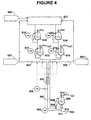
- the reactor 405 operates at a temperature of 255 ° C under a controlled pressure of 15 ° C. bars. It is equipped with an external device for partial recovery of diamine losses volatility driven by water vapor not shown in Figure 3. The level of filling is such that the estimated residence time is about 20 minutes.
- a fraction of the flow exiting the reactor 405 is withdrawn via line 411. measuring point continuously by near infrared located in this pipe 411 allows to control the stoichiometry and the chemical advancement of the product. If necessary, it affects a new setpoint at the near infrared measurement point 408 located on the driving 407.
- the prepolymer 453 thus produced is converted into molar mass polyamide desired and compatible with the usual uses by addition in a flow of manufacture of a polyamide from a process of manufacture of polyamide 6,6 to from adipate hexamethylenediamine salt.
- An alternative may also be to pass the reaction mixture in a flasher, a finisher qualified low viscosity where the prepolymer comes out with a viscosity number, measured in formic acid diluted according to the conditions and recommendations of the international standard ISO 307-1977, around 60 mL / g so that it can be granulated. Drying accompanied by post-condensation at the solid state then makes it possible to reach the level of viscosity required for the polymer.
- the start uses 62% concentrated N salt. It is prepared from a water source 554, adipic acid 552, and hexamethylenediamine 551.
- the 62% concentrated N salt solution is manufactured in the 521 workshop. This is fed continuously by at least two buffer tanks of type 515 and 516 emptying alternatively by breathing between a maximum level and a minimum level. These Inert nitrogen tanks are equipped with an external recirculation agitation mode to to homogenize the contents and to control the pH and the concentration before supply of the polycondensation unit.
- the water supply is replaced by a feed of one 62% N salt solution introduced at 109 ° C. into one of the two stirred reactors 513 and 514.
- These two reactors are equipped with a recirculation loop consisting of a pump, a heat exchanger and a near infrared measuring point. coupled at buffer tanks 515 and 516, they function alternately to feed continuously stirred reactor 505 through its recirculation loop 504.
- the instructions for Reactor temperatures 513, 514, and 505 are set at 180 ° C. Autogenous pressure corresponding is then regulated at 6 bar absolute.
- the concentration of the salt N at the outlet of the reactor 505 is 90%.
- the reactor 505 Once the temperature set point of 180 ° C. has been reached in the reactor 505, the latter it is set to 260 ° C and the levels are regulated to obtain a residence time estimated about 40 minutes. The autogenous pressure is then regulated at 15 bar. The The number-average molar mass measured on a solids content is about 3800 g / mol.
- This stream feeds continuously the downstream of the polycondensation process constituted by a series combination of a flasher, a vapor / prepolymer separator and a finisher. The polymer obtained at the end of the finisher has a viscosity index measured in formic acid diluted according to the conditions and recommendations of the standard International Standard ISO 307-1984 of 130 mUg.
- the product leaving the cascade of stirred reactors is a prepolymer which after rising in mass, to a polymer of viscosity index suitable for the most processing applications, either directly at the finisher output or after granulation and then remelting.
- This step can be advantageously used for the calibration of the points of measurement of stoichiometry by near infrared as a description is made in example 2.
- the N 62% feed at the inlet of the reactor type 513 or 514 is replaced by a continuous supply of the mixture M5 previously described at the entrance to the mixing zone 503.
- the residence time set to about 20 minutes.
- the regulation of stoichiometry from online measurements by near infra red is activated: the coupling between the regulation of the stoichiometry of the output flow of the reactor 505 and its level regulation makes it possible to adjust the flows of the two flows 501 and 502 power supply.
- This mode of starting the direct amidation process from a solution aqueous solution of monomers makes it possible to reach the steady state described at the beginning of this example 3 by allowing the calibration of the measuring points of the stoichiometry by near infra-red and minimizing, in the calibration phase, the risks of off-specification polymer production.
- Example 2 For near infra-red spectrometry measurements and calibration, the primary and secondary branch device described in Example 2.
- This calibration procedure can be used judiciously for any of the measuring points 508, 509, 517, 518, 519 or 520 mentioned in FIG. online control of stoichiometry, or even moisture content, regardless of the rate polycondensation progress, from the monomers and the salt N up to prepolymer leaving the last reactor and, further downstream, the polymer leaving the finisher.
Landscapes
- Chemical & Material Sciences (AREA)
- Organic Chemistry (AREA)
- Chemical Kinetics & Catalysis (AREA)
- Health & Medical Sciences (AREA)
- Medicinal Chemistry (AREA)
- Polymers & Plastics (AREA)
- Polyamides (AREA)
- Organic Low-Molecular-Weight Compounds And Preparation Thereof (AREA)
- Processing And Handling Of Plastics And Other Materials For Molding In General (AREA)
- Artificial Filaments (AREA)
Description
Les procédés décrits dans ces documents comportent les étapes suivantes :
- mélange en continu de deux flux de précurseurs du polyamide, un flux riche en groupements terminaux acides, et un flux riche en groupements terminaux amines,
- condensation à partir du mélange des deux flux,
le mélange et la condensation étant mis en oeuvre dans une même installation ou dans des installations différentes, - récupération d'un flux de produit issu de l'opération de condensation,
au moins un des débits des flux de précurseur étant asservi au résultat de l'analyse des teneurs en groupements terminaux acides et amines du mélange, du milieu de condensation ou du flux récupéré, de manière à maintenir ces teneurs et/ou leur rapport entre deux valeurs de consigne.
- étape 1:
- Alimentation de l'installation de condensation en une solution aqueuse comprenant des ions dicarboxylates et des ions diammoniums, en proportions telles que leur rapport molaire soit compris entre 0,99 et 1,01, de préférence entre 0,995 et 1,005
- Mise en régime de l'installation de condensation dans des conditions de température et de pression telles qu'il y ait condensation à partir des ions dicarboxylates et des ions diammoniums initialement compris dans la solution aqueuse
- étape 2: récupération d'un flux du produit de condensation
- étape 3: alimentation en flux de précurseurs et activation de l'analyse et de l'asservissement.
- des monomères de type diacides purs (c'est à dire exempts de monomères de type diamines), sous forme solide ou fondue, ou en solution concentrée (éventuellement sous forme ionisée).
- des mélanges de monomères de type diacides et de monomères de type diamines, en proportion non stoechiométrique, comprenant plus de monomères de type diacides que de monomères de type diamines, sous forme fondue et/ou en solution concentrée (éventuellement sous forme ionisée) .
- des produits d'amidification, obtenus à partir de mélanges de monomères de type diacides et de monomères de type diamines, présentant une quantité de groupements terminaux acides supérieure à la quantité de groupements terminaux amines, de préférence avec un degré de polymérisation inférieur à 20.
- des monomères de type diamines purs (c'est à dire exempts de monomères de type diacides), sous forme solide ou fondue, ou en solution concentrée (éventuellement sous forme ionisée).
- des mélanges de monomères de type diacides et de monomères de type diamines, en proportion non stoechiométrique, comprenant plus de monomères de type diamines que de monomères de type diacides, sous forme fondue et/ou en solution concentrée (éventuellement sous forme ionisée).
- des produits d'amidification, obtenus à partir de mélanges de monomères de type diacides et de monomères de type diamines, présentant une quantité de groupements terminaux amines supérieure à la quantité de groupements terminaux acides, de préférence avec un degré de polymérisation inférieur à 20.
Le mélange M2 soutiré du réacteur 104 est un mélange acide adipique / HMD préamidifié riche en fonctions acides.
Claims (20)
- Procédé de fabrication en continu de polyamide, à partir de diacides carboxyliques et de diamines, comprenant en régime permanent les étapes suivantes:le mélange et la condensation étant mis en oeuvre dans une même installation ou dans des installations différentes,mélange en continu de deux flux de précurseurs du polyamide, un flux riche en groupements terminaux acides, et un flux riche en groupements terminaux amines,condensation à partir du mélange des deux flux,au moins un des débits des flux de précurseur étant asservi au résultat de l'analyse des teneurs en groupements terminaux acides et amines du mélange, du milieu de condensation ou du flux récupéré, de manière à maintenir ces teneurs et/ou leur rapport entre deux valeurs de consigne,récupération d'un flux de produit issu de l'opération de condensation,
caractérisé en ce que la phase de démarrage comprend les étapes suivantes:étape 1:Alimentation de l'installation de condensation en une solution aqueuse comprenant des ions dicarboxylates et des ions diammoniums, en proportions telles que leur rapport molaire soit compris entre 0,99 et 1,01, de préférence entre 0,995 et 1,005Mise en régime de l'installation de condensation dans des conditions de température et de pression telles qu'il y ait condensation à partir des ions dicarboxylates et des ions diammoniums initialement compris dans la solution aqueuseétape 2: récupération d'un flux du produit de condensationétape 3: alimentation en flux de précurseurs et activation de l'analyse et de l'asservissement. - Procédé selon la revendication 1 caractérisé en ce que le flux de produit récupéré est alimenté dans des installations de flashage et/ou de finition de manière à obtenir un polyamide de degré de polymérisation désiré.
- Procédé selon l'une des revendications 1 ou 2 caractérisé en ce que la condensation à partir de la solution aqueuse est réalisée à température supérieure à 180°C, à pression supérieure à 5 bars, le produit récupéré présentant un degré de polycondensation supérieur à 10, de préférence supérieur à 20, et en ce que la température et la pression sont identiques à la température et à la pression en régime permanent.
- Procédé selon l'une des revendications 1 ou 2, caractérisé en ce que l'analyse est réalisée par spectrométrie Proche Infra-Rouge.
- Procédé selon la revendication 4 caractérisé en ce qu'au moins une partie du flux du produit de condensation à partir de la solution est récupérée et utilisée pour calibrer le spectromètre Proche Infra-Rouge dans la gamme désirée de teneurs en groupements terminaux et/ou en rapports des teneurs, l'alimentation en deux flux, l'analyse et l'asservissement étant activés après cette opération.
- Procédé selon la revendication 4 caractérisé en ce que la calibration est effectuée par la méthode des ajouts dosés dans la partie du flux récupérée à cet effet.
- Procédé selon l'une des revendications précédentes, caractérisé en ce que les monomères diacides sont choisis dans la liste comprenant les acides adipique, glutarique, subérique, sébacique, dodécanedioïque, isophtalique, téréphtalique, azélaïque, pimélique.
- Procédé selon l'une des revendications précédentes, caractérisé en ce que les monomères diamines sont choisis dans la liste comprenant l'hexaméthylène diamine, l'heptaméthylène diamine, l'octaméthylène diamine, la nonaméthylène diamine, la décaméthylène diamine, la méthyl-5 pentaméthylène diamine, l'undécaméthylène diamine, la dodécaméthylène diamine, la xylylène diamine.
- Procédé selon l'une des revendications précédentes, caractérisé en ce que le monomère diacide comprend au moins 80 % en mole d'acide adipique.
- Procédé selon l'une des revendications précédentes, caractérisé en ce que le monomère diamine comprend au moins 80 % en mole d'hexaméthylène diamine.
- Procédé selon l'une des revendications précédentes caractérisé en ce que :le flux riche en groupement terminaux acides est un mélange M2 de diacide et de diamine avec un rapport molaire diacide/diamine compris entre 1,005 et 1,2, de préférence entre 1,01 et 1,2le flux riche en groupement terminaux amines est un mélange M3 de diacide et de diamine avec un rapport molaire diacide/diamine compris entre 0,8 et 0,995, de préférence entre 0,8 et 0,99les deux flux sont alimentés sous forme fondue dans un réacteur de polymérisation agité dans lequel la condensation est effectuéele produit de condensation est un prépolymère alimenté dans des étapes de flashage et/ou de finition pour obtenir le degré de polymérisation désiré
- Procédé selon la revendication 11 caractérisé en ce que les deux flux sont mélangés avant l'alimentation dans l'installation de condensation
- Procédé selon l'une des revendications 11 ou 12 caractérisé en ce que le réacteur de polymérisation fonctionne sous une pression autogène ou une pression régulée.
- Procédé selon l'une des revendication 11 à 13 caractérisé en ce que les précurseurs M2 et M3 sont obtenus, en régime permanent, par mélange d'une solution de monomère diamine avec un mélange M1 riche en monomère diacide
- Procédé selon la revendication 14 caractérisé en ce qu'au moins un des débits des flux d'entrée en solution de monomères diamines et en mélangé M1 riche en monomère diacide est asservi au résultat de l'analyse en continu des fonctions acides et amines dans les précurseurs M2 et M3.
- Procédé selon l'une des revendications 11 à 15, caractérisé en ce que les précurseurs sont préparés en régime permanent par mélange d'un flux d'hexaméthylène diamine avec un mélange eutectique acide adipique / hexaméthylène diamine.
- Procédé selon la revendication 15 ou 16 caractérisé en ce que les précurseurs sont préparés par un procédé comprenant les étapes suivantes :Alimentation de chacune des installations de préparation des précurseurs en une solution aqueuse comprenant des ions dicarboxylates et des ions diammoniums, en proportions telles que leur rapport molaire soit compris entre 0,99 et 1,01, de préférence entre 0,995 et 1,005Mise en régime des installations de préparation des précurseurs dans les conditions de température et de pression du régime permanentdans chacune des installations de préparation de précurseurs, alimentation en flux de mélange M1 riche en monomère diacide, en flux d'hexaméthylène diamine, activation de l'asservissement d'au moins un des flux, alimentation du produit obtenu dans l'installation de mélange ou de condensation
- Procédé selon l'une des revendications 15 à 17 caractérisé en ce que le mélange eutectique M1 est préparé par mélange d'un flux d'acide adipique fondu ou solide, et d'un flux d'hexaméthylène diamine sous forme pure ou sous forme d'une solution aqueuse concentrée, avec asservissement d'au moins un des flux au résultat de l'analyse de la teneur en groupements acides et amines dans le mélange M1, le procédé comprenant les étapes suivantes :Alimentation de l'installation de préparation du mélange eutectique en une solution aqueuse comprenant des ions dicarboxylates et des ions diammoniums, en proportions telles que leur rapport molaire soit compris entre 0,99 et 1,01, de préférence entre 0,995 et 1,005Mise en régime dans les conditions de température et de pression du régime permanentalimentation en flux d'acide adipique, en flux d'hexaméthylène diamine, activation de l'asservissement d'au moins un des flux, alimentation du produit obtenu dans les installations de préparation des précurseurs.
- Procédé selon l'une des revendications 1 à 10 caractérisé en ce que :le flux riche en groupements terminaux acides est un diacide carboxylique sous forme fondue,le flux riche en groupements terminaux amines est une diamine sous forme pure ou sous forme de solution aqueuse concentrée,
- Procédé selon la revendication 18 caractérisé en ce que le diacide est l'acide adipique et la diamine est l'hexaméthylène diamine.
Applications Claiming Priority (3)
| Application Number | Priority Date | Filing Date | Title |
|---|---|---|---|
| FR0012678 | 2000-10-04 | ||
| FR0012678A FR2814747B1 (fr) | 2000-10-04 | 2000-10-04 | Procede de fabrication de polyamides |
| PCT/FR2001/003045 WO2002028942A1 (fr) | 2000-10-04 | 2001-10-03 | Procede de fabrication de polyamides |
Publications (2)
| Publication Number | Publication Date |
|---|---|
| EP1325057A1 EP1325057A1 (fr) | 2003-07-09 |
| EP1325057B1 true EP1325057B1 (fr) | 2005-12-14 |
Family
ID=8854994
Family Applications (1)
| Application Number | Title | Priority Date | Filing Date |
|---|---|---|---|
| EP01974426A Expired - Lifetime EP1325057B1 (fr) | 2000-10-04 | 2001-10-03 | Procede de fabrication de polyamides |
Country Status (21)
| Country | Link |
|---|---|
| US (1) | US6995233B2 (fr) |
| EP (1) | EP1325057B1 (fr) |
| JP (1) | JP3887310B2 (fr) |
| KR (1) | KR100580350B1 (fr) |
| CN (1) | CN1197897C (fr) |
| AT (1) | ATE312865T1 (fr) |
| AU (1) | AU2001293947A1 (fr) |
| BR (1) | BR0114522B1 (fr) |
| CA (1) | CA2424985C (fr) |
| DE (1) | DE60115934T2 (fr) |
| ES (1) | ES2250482T3 (fr) |
| FR (1) | FR2814747B1 (fr) |
| HU (1) | HUP0303365A3 (fr) |
| IL (1) | IL155232A (fr) |
| MX (1) | MX237616B (fr) |
| PL (1) | PL210249B1 (fr) |
| RU (1) | RU2247130C2 (fr) |
| SK (1) | SK4192003A3 (fr) |
| TW (1) | TWI265941B (fr) |
| UA (1) | UA74846C2 (fr) |
| WO (1) | WO2002028942A1 (fr) |
Families Citing this family (29)
| Publication number | Priority date | Publication date | Assignee | Title |
|---|---|---|---|---|
| RU2415156C2 (ru) * | 2006-01-26 | 2011-03-27 | ДСМ АйПи АССЕТС Б.В. | Полукристаллический полуароматический полиамид |
| FR2914308B1 (fr) * | 2007-03-27 | 2009-05-01 | Rhodia Recherches & Tech | Procede de fabrication de polyamide |
| FR2916756B1 (fr) * | 2007-06-04 | 2009-07-17 | Rhodia Recherches & Tech | Procede de fabrication d'une solution de sels de diacides/diamines |
| EP2788400A1 (fr) | 2011-12-05 | 2014-10-15 | Invista Technologies S.a r.l. | Procédé de préparation de polyamides |
| WO2013107425A1 (fr) * | 2012-01-20 | 2013-07-25 | 北京伊克希德化工技术有限公司 | Procédé de polymérisation en continu et dispositifs pour nylons comme le nylon 66 utilisant comme matière première un monomère bi-composant |
| CN104130396B (zh) | 2013-05-01 | 2018-05-29 | 英威达纺织(英国)有限公司 | 使用补充二胺的尼龙盐溶液制备方法 |
| TW201446836A (zh) | 2013-05-01 | 2014-12-16 | Invista Tech Sarl | 用於製備部分平衡之酸性溶液之方法 |
| CN104130132B (zh) | 2013-05-01 | 2017-10-03 | 英威达科技公司 | 用于尼龙盐溶液制备方法的前馈工序控制和在线pH值反馈 |
| TW201443103A (zh) | 2013-05-01 | 2014-11-16 | Invista Tech Sarl | 自部分平衡之酸性溶液製備尼龍鹽溶液的方法 |
| CN110938205A (zh) * | 2013-05-01 | 2020-03-31 | 英威达纺织(英国)有限公司 | 包括多个后端的聚酰胺合成 |
| CN104130403B (zh) | 2013-05-01 | 2018-05-29 | 英威达纺织(英国)有限公司 | 用于生产尼龙盐溶液的二羧酸粉末的计量方法 |
| TW201512225A (zh) * | 2013-05-01 | 2015-04-01 | Invista Tech Sarl | 將添加劑直接注入高壓釜中 |
| CN104130133B (zh) | 2013-05-01 | 2018-01-19 | 英威达纺织(英国)有限公司 | 尼龙盐溶液制备方法中的前馈工序控制 |
| TW201446811A (zh) | 2013-05-01 | 2014-12-16 | Invista Tech Sarl | 尼龍鹽溶液製備方法之前饋程序控制及ph反饋 |
| CN104130136B (zh) | 2013-05-01 | 2017-10-24 | 英威达科技公司 | 尼龙盐溶液制备方法中的前馈和后馈工序控制 |
| EP3057938A1 (fr) * | 2013-10-18 | 2016-08-24 | Henkel AG & Co. KGaA | Procédé de vieillissement du mélange réactionnel dans un procédé de sulfonation |
| CN104569025B (zh) * | 2013-10-29 | 2017-01-04 | 中国石油化工股份有限公司 | 一种检测尼龙盐预聚温度的方法 |
| TW201529640A (zh) | 2013-12-17 | 2015-08-01 | Invista Tech Sarl | 以具有分散器桿頭之容器製造供生產尼龍鹽之部分平衡酸溶液之方法 |
| JPWO2015093611A1 (ja) * | 2013-12-20 | 2017-03-23 | 株式会社堀場エステック | 連続反応装置及びこれを用いる連続重合方法 |
| JP6739434B2 (ja) | 2014-12-22 | 2020-08-12 | パフォーマンス・ポリアミデス,エスアエス | シクロアルカンの酸化触媒並びにアルコール及びケトンの製造方法 |
| EP3436504B1 (fr) * | 2016-04-01 | 2020-05-06 | Solvay Specialty Polymers USA, LLC. | (co)polyamides pouvant etre obtenus a partir d'acide 1,4-cyclohexanedicarboxylique et d'une diamine de formule h2n-(ch2)2-o-(ch2)2-o-(ch2)2-nh2 |
| TWI787251B (zh) * | 2017-04-13 | 2022-12-21 | 英商英威達紡織(英國)有限公司 | 製備用於聚醯胺化製程之前體之單體平衡控制 |
| JP6902157B2 (ja) * | 2017-08-01 | 2021-07-14 | アドバンシックス・レジンズ・アンド・ケミカルズ・リミテッド・ライアビリティ・カンパニーAdvansix Resins & Chemicals Llc | ポリアミドの環状オリゴマーを重合するための方法 |
| EP3556794A1 (fr) * | 2018-04-17 | 2019-10-23 | SABIC Global Technologies B.V. | Contrôle de st chiométrie de polycondensation |
| CN113474354A (zh) * | 2019-02-28 | 2021-10-01 | 国立大学法人东京工业大学 | 酰胺的制造方法 |
| CN114364715A (zh) * | 2019-09-12 | 2022-04-15 | 宇部兴产株式会社 | 共聚聚酰胺的制造方法 |
| RU2767395C1 (ru) * | 2020-09-11 | 2022-03-17 | Акционерное общество "Государственный Ордена Трудового Красного Знамени научно-исследовательский институт химии и технологии элементоорганических соединений" (АО "ГНИИХТЭОС") | Способ получения сополиамидов |
| CN116535638A (zh) * | 2023-05-22 | 2023-08-04 | 浙江智英石化技术有限公司 | 一种反应与分离相耦合的聚酰胺连续缩聚方法 |
| CN118341331A (zh) * | 2024-05-20 | 2024-07-16 | 浙江新和成尼龙材料有限公司 | 尼龙盐溶液的配制装置和配制工艺 |
Family Cites Families (10)
| Publication number | Priority date | Publication date | Assignee | Title |
|---|---|---|---|---|
| JPH05222178A (ja) * | 1992-02-14 | 1993-08-31 | Fuji Photo Film Co Ltd | 反応制御方法 |
| US5403910A (en) * | 1993-03-25 | 1995-04-04 | E. I. Du Pont De Nemours & Company | Low temperature nylon polymerization process |
| US5532487A (en) * | 1994-11-23 | 1996-07-02 | E. I. Du Pont De Nemours And Company | Near-infrared measurement and control of polyamide processes |
| US5674974A (en) * | 1994-11-23 | 1997-10-07 | E. I. Du Pont De Nemours And Company | Continuous polymerization process for polyamides |
| EP0984830B1 (fr) * | 1997-05-29 | 2002-12-04 | E.I. Du Pont De Nemours And Company | Procede de commande de processus pour dispositif de polymerisation avec mise a l'air libre |
| CN1231522C (zh) * | 1998-05-29 | 2005-12-14 | 索罗蒂亚公司 | 连续聚酰胺化的方法 |
| US6169162B1 (en) * | 1999-05-24 | 2001-01-02 | Solutia Inc. | Continuous polyamidation process |
| FR2794760B1 (fr) * | 1999-06-11 | 2001-08-17 | Rhodianyl | Procede de fabrication de polyamides |
| DE60119595T2 (de) * | 2000-01-21 | 2006-09-14 | Mitsubishi Gas Chemical Co., Inc. | Verfahren zur Herstellung von Polyamid |
| JP2002194079A (ja) * | 2000-12-22 | 2002-07-10 | Mitsubishi Gas Chem Co Inc | ポリアミドの製造方法 |
-
2000
- 2000-10-04 FR FR0012678A patent/FR2814747B1/fr not_active Expired - Fee Related
-
2001
- 2001-03-10 UA UA2003042935A patent/UA74846C2/uk unknown
- 2001-10-03 DE DE60115934T patent/DE60115934T2/de not_active Expired - Lifetime
- 2001-10-03 SK SK419-2003A patent/SK4192003A3/sk unknown
- 2001-10-03 JP JP2002532520A patent/JP3887310B2/ja not_active Expired - Fee Related
- 2001-10-03 AT AT01974426T patent/ATE312865T1/de not_active IP Right Cessation
- 2001-10-03 WO PCT/FR2001/003045 patent/WO2002028942A1/fr not_active Ceased
- 2001-10-03 HU HU0303365A patent/HUP0303365A3/hu unknown
- 2001-10-03 CA CA2424985A patent/CA2424985C/fr not_active Expired - Fee Related
- 2001-10-03 KR KR1020037004877A patent/KR100580350B1/ko not_active Expired - Fee Related
- 2001-10-03 PL PL362557A patent/PL210249B1/pl not_active IP Right Cessation
- 2001-10-03 IL IL15523201A patent/IL155232A/en not_active IP Right Cessation
- 2001-10-03 AU AU2001293947A patent/AU2001293947A1/en not_active Abandoned
- 2001-10-03 EP EP01974426A patent/EP1325057B1/fr not_active Expired - Lifetime
- 2001-10-03 US US10/398,250 patent/US6995233B2/en not_active Expired - Fee Related
- 2001-10-03 CN CNB018188168A patent/CN1197897C/zh not_active Expired - Fee Related
- 2001-10-03 BR BRPI0114522-3A patent/BR0114522B1/pt not_active IP Right Cessation
- 2001-10-03 ES ES01974426T patent/ES2250482T3/es not_active Expired - Lifetime
- 2001-10-03 MX MXPA03003001 patent/MX237616B/es active IP Right Grant
- 2001-10-03 RU RU2003112623/04A patent/RU2247130C2/ru not_active IP Right Cessation
- 2001-10-04 TW TW090124518A patent/TWI265941B/zh not_active IP Right Cessation
Also Published As
| Publication number | Publication date |
|---|---|
| BR0114522A (pt) | 2003-09-16 |
| HUP0303365A2 (hu) | 2004-01-28 |
| PL362557A1 (en) | 2004-11-02 |
| MX237616B (es) | 2006-06-08 |
| KR20030063355A (ko) | 2003-07-28 |
| US6995233B2 (en) | 2006-02-07 |
| FR2814747B1 (fr) | 2002-12-06 |
| TWI265941B (en) | 2006-11-11 |
| US20040019179A1 (en) | 2004-01-29 |
| DE60115934T2 (de) | 2006-07-27 |
| ATE312865T1 (de) | 2005-12-15 |
| SK4192003A3 (en) | 2003-09-11 |
| PL210249B1 (pl) | 2011-12-30 |
| HUP0303365A3 (en) | 2004-03-01 |
| ES2250482T3 (es) | 2006-04-16 |
| CN1197897C (zh) | 2005-04-20 |
| JP3887310B2 (ja) | 2007-02-28 |
| IL155232A (en) | 2008-01-06 |
| FR2814747A1 (fr) | 2002-04-05 |
| IL155232A0 (en) | 2003-11-23 |
| WO2002028942A1 (fr) | 2002-04-11 |
| MXPA03003001A (es) | 2004-12-06 |
| CA2424985A1 (fr) | 2002-04-11 |
| CN1474843A (zh) | 2004-02-11 |
| CA2424985C (fr) | 2010-07-13 |
| EP1325057A1 (fr) | 2003-07-09 |
| AU2001293947A1 (en) | 2002-04-15 |
| RU2247130C2 (ru) | 2005-02-27 |
| UA74846C2 (en) | 2006-02-15 |
| BR0114522B1 (pt) | 2011-05-03 |
| JP2004519531A (ja) | 2004-07-02 |
| DE60115934D1 (de) | 2006-01-19 |
| KR100580350B1 (ko) | 2006-05-16 |
Similar Documents
| Publication | Publication Date | Title |
|---|---|---|
| CA2424985C (fr) | Procede de fabrication de polyamides | |
| EP1194474B1 (fr) | Procede de fabrication de polyamides | |
| EP2155648B1 (fr) | Procede de fabrication d'une solution de sels de diacides/diamines | |
| CA2681357C (fr) | Procede de fabrication de polyamide | |
| EP2417186B1 (fr) | Procede de fabrication d'une solution de sels de diacides/diamine(s) | |
| WO2003006529A1 (fr) | Procede discontinu de fabrication d'un polyamide |
Legal Events
| Date | Code | Title | Description |
|---|---|---|---|
| PUAI | Public reference made under article 153(3) epc to a published international application that has entered the european phase |
Free format text: ORIGINAL CODE: 0009012 |
|
| 17P | Request for examination filed |
Effective date: 20030407 |
|
| AK | Designated contracting states |
Designated state(s): AT BE CH CY DE DK ES FI FR GB GR IE IT LI LU MC NL PT SE TR |
|
| AX | Request for extension of the european patent |
Extension state: AL LT LV MK RO SI |
|
| GRAP | Despatch of communication of intention to grant a patent |
Free format text: ORIGINAL CODE: EPIDOSNIGR1 |
|
| GRAS | Grant fee paid |
Free format text: ORIGINAL CODE: EPIDOSNIGR3 |
|
| GRAA | (expected) grant |
Free format text: ORIGINAL CODE: 0009210 |
|
| AK | Designated contracting states |
Kind code of ref document: B1 Designated state(s): AT BE CH CY DE DK ES FI FR GB GR IE IT LI LU MC NL PT SE TR |
|
| PG25 | Lapsed in a contracting state [announced via postgrant information from national office to epo] |
Ref country code: IT Free format text: LAPSE BECAUSE OF FAILURE TO SUBMIT A TRANSLATION OF THE DESCRIPTION OR TO PAY THE FEE WITHIN THE PRESCRIBED TIME-LIMIT;WARNING: LAPSES OF ITALIAN PATENTS WITH EFFECTIVE DATE BEFORE 2007 MAY HAVE OCCURRED AT ANY TIME BEFORE 2007. THE CORRECT EFFECTIVE DATE MAY BE DIFFERENT FROM THE ONE RECORDED. Effective date: 20051214 Ref country code: AT Free format text: LAPSE BECAUSE OF FAILURE TO SUBMIT A TRANSLATION OF THE DESCRIPTION OR TO PAY THE FEE WITHIN THE PRESCRIBED TIME-LIMIT Effective date: 20051214 Ref country code: IE Free format text: LAPSE BECAUSE OF FAILURE TO SUBMIT A TRANSLATION OF THE DESCRIPTION OR TO PAY THE FEE WITHIN THE PRESCRIBED TIME-LIMIT Effective date: 20051214 Ref country code: FI Free format text: LAPSE BECAUSE OF FAILURE TO SUBMIT A TRANSLATION OF THE DESCRIPTION OR TO PAY THE FEE WITHIN THE PRESCRIBED TIME-LIMIT Effective date: 20051214 |
|
| REG | Reference to a national code |
Ref country code: GB Ref legal event code: FG4D Free format text: NOT ENGLISH |
|
| REG | Reference to a national code |
Ref country code: CH Ref legal event code: EP |
|
| REG | Reference to a national code |
Ref country code: IE Ref legal event code: FG4D Free format text: LANGUAGE OF EP DOCUMENT: FRENCH |
|
| REF | Corresponds to: |
Ref document number: 60115934 Country of ref document: DE Date of ref document: 20060119 Kind code of ref document: P |
|
| PG25 | Lapsed in a contracting state [announced via postgrant information from national office to epo] |
Ref country code: GR Free format text: LAPSE BECAUSE OF FAILURE TO SUBMIT A TRANSLATION OF THE DESCRIPTION OR TO PAY THE FEE WITHIN THE PRESCRIBED TIME-LIMIT Effective date: 20060314 Ref country code: SE Free format text: LAPSE BECAUSE OF FAILURE TO SUBMIT A TRANSLATION OF THE DESCRIPTION OR TO PAY THE FEE WITHIN THE PRESCRIBED TIME-LIMIT Effective date: 20060314 Ref country code: DK Free format text: LAPSE BECAUSE OF FAILURE TO SUBMIT A TRANSLATION OF THE DESCRIPTION OR TO PAY THE FEE WITHIN THE PRESCRIBED TIME-LIMIT Effective date: 20060314 |
|
| GBT | Gb: translation of ep patent filed (gb section 77(6)(a)/1977) |
Effective date: 20060221 |
|
| REG | Reference to a national code |
Ref country code: ES Ref legal event code: FG2A Ref document number: 2250482 Country of ref document: ES Kind code of ref document: T3 |
|
| PG25 | Lapsed in a contracting state [announced via postgrant information from national office to epo] |
Ref country code: PT Free format text: LAPSE BECAUSE OF FAILURE TO SUBMIT A TRANSLATION OF THE DESCRIPTION OR TO PAY THE FEE WITHIN THE PRESCRIBED TIME-LIMIT Effective date: 20060515 |
|
| REG | Reference to a national code |
Ref country code: IE Ref legal event code: FD4D |
|
| PLBE | No opposition filed within time limit |
Free format text: ORIGINAL CODE: 0009261 |
|
| STAA | Information on the status of an ep patent application or granted ep patent |
Free format text: STATUS: NO OPPOSITION FILED WITHIN TIME LIMIT |
|
| PG25 | Lapsed in a contracting state [announced via postgrant information from national office to epo] |
Ref country code: MC Free format text: LAPSE BECAUSE OF NON-PAYMENT OF DUE FEES Effective date: 20061031 Ref country code: CH Free format text: LAPSE BECAUSE OF NON-PAYMENT OF DUE FEES Effective date: 20061031 Ref country code: LI Free format text: LAPSE BECAUSE OF NON-PAYMENT OF DUE FEES Effective date: 20061031 |
|
| 26N | No opposition filed |
Effective date: 20060915 |
|
| REG | Reference to a national code |
Ref country code: CH Ref legal event code: PL |
|
| PG25 | Lapsed in a contracting state [announced via postgrant information from national office to epo] |
Ref country code: LU Free format text: LAPSE BECAUSE OF NON-PAYMENT OF DUE FEES Effective date: 20061003 |
|
| PG25 | Lapsed in a contracting state [announced via postgrant information from national office to epo] |
Ref country code: CY Free format text: LAPSE BECAUSE OF FAILURE TO SUBMIT A TRANSLATION OF THE DESCRIPTION OR TO PAY THE FEE WITHIN THE PRESCRIBED TIME-LIMIT Effective date: 20051214 |
|
| PGFP | Annual fee paid to national office [announced via postgrant information from national office to epo] |
Ref country code: TR Payment date: 20120919 Year of fee payment: 12 |
|
| PGFP | Annual fee paid to national office [announced via postgrant information from national office to epo] |
Ref country code: GB Payment date: 20121003 Year of fee payment: 12 |
|
| PGFP | Annual fee paid to national office [announced via postgrant information from national office to epo] |
Ref country code: BE Payment date: 20131014 Year of fee payment: 13 |
|
| GBPC | Gb: european patent ceased through non-payment of renewal fee |
Effective date: 20131003 |
|
| PG25 | Lapsed in a contracting state [announced via postgrant information from national office to epo] |
Ref country code: GB Free format text: LAPSE BECAUSE OF NON-PAYMENT OF DUE FEES Effective date: 20131003 |
|
| PG25 | Lapsed in a contracting state [announced via postgrant information from national office to epo] |
Ref country code: BE Free format text: LAPSE BECAUSE OF NON-PAYMENT OF DUE FEES Effective date: 20141031 |
|
| REG | Reference to a national code |
Ref country code: FR Ref legal event code: PLFP Year of fee payment: 15 |
|
| PG25 | Lapsed in a contracting state [announced via postgrant information from national office to epo] |
Ref country code: TR Free format text: LAPSE BECAUSE OF NON-PAYMENT OF DUE FEES Effective date: 20131003 |
|
| PGFP | Annual fee paid to national office [announced via postgrant information from national office to epo] |
Ref country code: ES Payment date: 20150916 Year of fee payment: 15 |
|
| PGFP | Annual fee paid to national office [announced via postgrant information from national office to epo] |
Ref country code: FR Payment date: 20150908 Year of fee payment: 15 |
|
| PGFP | Annual fee paid to national office [announced via postgrant information from national office to epo] |
Ref country code: IT Payment date: 20151026 Year of fee payment: 15 Ref country code: DE Payment date: 20150929 Year of fee payment: 15 |
|
| PGFP | Annual fee paid to national office [announced via postgrant information from national office to epo] |
Ref country code: NL Payment date: 20150909 Year of fee payment: 15 |
|
| REG | Reference to a national code |
Ref country code: DE Ref legal event code: R119 Ref document number: 60115934 Country of ref document: DE |
|
| REG | Reference to a national code |
Ref country code: NL Ref legal event code: MM Effective date: 20161101 |
|
| REG | Reference to a national code |
Ref country code: FR Ref legal event code: ST Effective date: 20170630 |
|
| PG25 | Lapsed in a contracting state [announced via postgrant information from national office to epo] |
Ref country code: DE Free format text: LAPSE BECAUSE OF NON-PAYMENT OF DUE FEES Effective date: 20170503 Ref country code: FR Free format text: LAPSE BECAUSE OF NON-PAYMENT OF DUE FEES Effective date: 20161102 |
|
| PG25 | Lapsed in a contracting state [announced via postgrant information from national office to epo] |
Ref country code: NL Free format text: LAPSE BECAUSE OF NON-PAYMENT OF DUE FEES Effective date: 20161101 |
|
| PG25 | Lapsed in a contracting state [announced via postgrant information from national office to epo] |
Ref country code: IT Free format text: LAPSE BECAUSE OF NON-PAYMENT OF DUE FEES Effective date: 20161003 |
|
| PG25 | Lapsed in a contracting state [announced via postgrant information from national office to epo] |
Ref country code: ES Free format text: LAPSE BECAUSE OF FAILURE TO SUBMIT A TRANSLATION OF THE DESCRIPTION OR TO PAY THE FEE WITHIN THE PRESCRIBED TIME-LIMIT Effective date: 20051214 |
|
| REG | Reference to a national code |
Ref country code: ES Ref legal event code: FD2A Effective date: 20181122 |
|
| RIC2 | Information provided on ipc code assigned after grant |
Ipc: C08G 69/04 20060101ALI20020413BHEP Ipc: B01J 19/00 20060101ALI20020413BHEP Ipc: C08G 69/28 20060101AFI20020413BHEP |
|
| PG25 | Lapsed in a contracting state [announced via postgrant information from national office to epo] |
Ref country code: ES Free format text: LAPSE BECAUSE OF FAILURE TO SUBMIT A TRANSLATION OF THE DESCRIPTION OR TO PAY THE FEE WITHIN THE PRESCRIBED TIME-LIMIT Effective date: 20161004 |