EP1315680B1 - Glaskeramikmasse und verwendung der glaskeramikmasse - Google Patents
Glaskeramikmasse und verwendung der glaskeramikmasse Download PDFInfo
- Publication number
- EP1315680B1 EP1315680B1 EP01969262A EP01969262A EP1315680B1 EP 1315680 B1 EP1315680 B1 EP 1315680B1 EP 01969262 A EP01969262 A EP 01969262A EP 01969262 A EP01969262 A EP 01969262A EP 1315680 B1 EP1315680 B1 EP 1315680B1
- Authority
- EP
- European Patent Office
- Prior art keywords
- oxide
- glass
- ceramic
- glass ceramic
- material according
- Prior art date
- Legal status (The legal status is an assumption and is not a legal conclusion. Google has not performed a legal analysis and makes no representation as to the accuracy of the status listed.)
- Expired - Lifetime
Links
Images
Classifications
-
- C—CHEMISTRY; METALLURGY
- C03—GLASS; MINERAL OR SLAG WOOL
- C03C—CHEMICAL COMPOSITION OF GLASSES, GLAZES OR VITREOUS ENAMELS; SURFACE TREATMENT OF GLASS; SURFACE TREATMENT OF FIBRES OR FILAMENTS MADE FROM GLASS, MINERALS OR SLAGS; JOINING GLASS TO GLASS OR OTHER MATERIALS
- C03C14/00—Glass compositions containing a non-glass component, e.g. compositions containing fibres, filaments, whiskers, platelets, or the like, dispersed in a glass matrix
-
- C—CHEMISTRY; METALLURGY
- C03—GLASS; MINERAL OR SLAG WOOL
- C03C—CHEMICAL COMPOSITION OF GLASSES, GLAZES OR VITREOUS ENAMELS; SURFACE TREATMENT OF GLASS; SURFACE TREATMENT OF FIBRES OR FILAMENTS MADE FROM GLASS, MINERALS OR SLAGS; JOINING GLASS TO GLASS OR OTHER MATERIALS
- C03C14/00—Glass compositions containing a non-glass component, e.g. compositions containing fibres, filaments, whiskers, platelets, or the like, dispersed in a glass matrix
- C03C14/004—Glass compositions containing a non-glass component, e.g. compositions containing fibres, filaments, whiskers, platelets, or the like, dispersed in a glass matrix the non-glass component being in the form of particles or flakes
-
- C—CHEMISTRY; METALLURGY
- C03—GLASS; MINERAL OR SLAG WOOL
- C03C—CHEMICAL COMPOSITION OF GLASSES, GLAZES OR VITREOUS ENAMELS; SURFACE TREATMENT OF GLASS; SURFACE TREATMENT OF FIBRES OR FILAMENTS MADE FROM GLASS, MINERALS OR SLAGS; JOINING GLASS TO GLASS OR OTHER MATERIALS
- C03C8/00—Enamels; Glazes; Fusion seal compositions being frit compositions having non-frit additions
- C03C8/14—Glass frit mixtures having non-frit additions, e.g. opacifiers, colorants, mill-additions
Definitions
- the invention relates to a glass ceramic mass with at least an oxide ceramic, the barium, titanium and at least one Has rare earth metal Rek, and at least one Glass material containing at least one oxide with boron, at least one Oxide with silicon and at least one oxide with at least has a divalent metal Me2 +.
- the Glass ceramic mass becomes a use of the glass ceramic mass specified.
- a glass ceramic mass of the type mentioned is known from US Pat. No. 5,264,403.
- the oxide ceramic of the known glass ceramic mass is produced from barium oxide (BaO), titanium dioxide (TiO 2 ), a trioxide of a rare earth metal (Rek 2 O 3 ) and possibly bismuth trioxide (Bi 2 O 3 ).
- the rare earth metal Rek is, for example, neodymium.
- the glass material of the glass ceramic mass consists of boron trioxide (B 2 O 3 ), silicon dioxide and zinc oxide (ZnO).
- a ceramic portion of the oxide ceramic in the glass ceramic mass is, for example, 90% and a glass portion of the glass material is 10%.
- EP-A-577 067 describes a glass ceramic mass and a ceramic body with a BaNdTi 4 O 12 oxide ceramic and a glass which has oxides of Si, B, Al, La, and Bi and / or Pb.
- the glass ceramic mass is compacted at a sintering temperature of approximately 950 ° C.
- the glass ceramic mass is therefore suitable for use in LTCC (low temperature cofired ceramics) technology.
- LTCC technology is described, for example, in DL Wilcox et al, Proc. 1997 ISAM, Philadelphia, pages 17 to 23.
- LTCC technology is a ceramic multilayer process in which a passive electrical component can be integrated in the volume of a ceramic multilayer body.
- the passive electrical component is, for example, an electrical conductor track, a coil, an induction or a capacitor.
- Integration is achieved, for example, by printing a metal structure corresponding to the component on one or more ceramic green foils, stacking the printed ceramic green foils on top of one another to form a composite, and sintering the composite. Since ceramic green foils with a low-sintering glass ceramic mass are used, low-melting, electrically highly conductive elemental metal Me0 such as silver or copper can be sintered in combination with the ceramic green foils.
- the functionality of the component integrated with the help of LTCC technology is crucially dependent on the dielectric material property of the glass ceramic used. Such a material property is, for example, the permittivity ( ⁇ r ), a quality (Q) and a temperature response of the frequency (Tkf).
- the proportion of glass is relative low, so that the densification of the glass ceramic mass through reactive liquid phase sintering takes place.
- a liquid glass phase forms from the glass material (Glass melt).
- the dissolves Oxide ceramics in the glass melt until one Saturation concentration is reached and it becomes a Re-exemption is coming.
- the oxide ceramic can Composition of the oxide ceramic and thus that of Change the glass phase or the glass material.
- the It can cool down in addition to crystallization from the Glass melt are coming. For example, there remains one Part of the oxide ceramic after cooling in the Glass phase. If by compaction the composition the oxide ceramic and that of the glass material changes, it is difficult to compress the material properties Determine glass ceramic mass and thus the functionality of the component integrated using LTCC technology guarantee.
- the object of the present invention is a Specify glass ceramic mass with an oxide ceramic, the Composition substantially the same during sintering remains.
- the glass ceramic mass is a glass ceramic composition and regardless of their condition.
- the glass ceramic mass can exist as a ceramic green body.
- a green body for example a green sheet, can be a powder of Oxide ceramics and a powder of the glass material with the help of a organic binder.
- the glass ceramic mass as a powder mixture of Oxide ceramic and the glass material is present.
- the glass ceramic mass as a sintered ceramic body available. For example, there is a sintering process produced ceramic multilayer body from the Glass ceramic mass. This ceramic multilayer body can be sent to another sintering process.
- the oxide ceramic can be present as a single phase. she can but also consist of several phases. Is conceivable for example, that the oxide ceramic from phases with a each has a different composition. The Oxide ceramics are therefore a mixture of different ones Oxide ceramics. It is also conceivable that one or more Starting compounds of an oxide ceramic are present during of sintering first converted to the actual oxide ceramic become.
- the glass material can also be a single phase.
- the phase is a glass melt Boron trioxide, silicon dioxide, zinc oxide and bismuth trioxide. It is also conceivable that the glass material consists of several phases consists.
- the glass material consists of a Powder mixture of the specified oxides. Forms from the oxides a common glass melt occurs during the sintering. It is also conceivable that the glass material is a Is the crystallization product of the glass melt. This means, that the glass material does not, for example, after sintering only as a glass melt, but also in crystalline form can be present.
- the basic idea of the present invention is to use a bismuth oxide, in particular bismuth trioxide, in the glass material.
- An advantage here is that a softening temperature T soft of the glass material can be reduced. The lower the glass transition point, the lower the sintering temperature or a sealing firing temperature of the corresponding glass ceramic mass. At the sealing firing temperature, almost complete densification of the glass ceramic mass can be achieved in a short time.
- Bismuth trioxide also influences the dissolving and Redeposition of the oxide ceramics in the glass melt during sintering in a particularly favorable manner (for example due to the lower sealing firing temperature). It almost takes place no removal of individual components of the oxide ceramic instead of. The composition of the oxide ceramic does not change or only slightly and can therefore be preset very well become.
- bismuth is present in the oxide ceramic is, at an elevated temperature with elemental silver responding.
- a bismuth-containing oxide ceramic in LTCC technology using silver as electrically conductive material can result in a undesirable, the functionality of the manufactured Component adverse reaction come.
- Bismuth dioxide contained in the glass material decreases the sealing firing temperature. Sintering can occur at lower Temperatures take place.
- a reaction between Bismuth or bismuth trioxide and elemental silver suppressed.
- the glass content is relatively low, too relatively little bismuth present, so a noticeable Reaction between bismuth and silver does not take place.
- the oxide ceramic has a formal composition BaRek 2 Ti 4 O 12 .
- the oxide ceramic of the composition mentioned is referred to as microwave ceramic because its material properties (permittivity, quality, Tkf value) are very well suited for use in microwave technology.
- the glass material has at least one oxide with at least one rare earth metal Reg.
- the rare earth metal Reg is present, for example, as trioxide Reg 2 O 3 .
- the permittivity of the glass material which contributes to the permittivity of the entire glass ceramic mass, can be adapted to the permittivity of the oxide ceramic. This makes a glass ceramic mass accessible that has a permittivity of 20 to 80 or even higher.
- the rare earth metal is Rek and / or that Rare earth metal Reg from the group lanthanum and / or neodymium and / or samarium selected. Others are also conceivable Lantanide or actinide.
- the rare earth metals Rek and Reg can be identical, but it can also be different Be rare earth metals.
- the oxide ceramic has the divalent metal Me2 +.
- the divalent metal Me2 + is selected from the group beryllium, magnesium, calcium, strontium, barium, copper and / or zinc.
- the divalent metal Me2 + can exist as its own oxidic phase.
- the divalent metal Me2 + is a doping of the oxide ceramic.
- the divalent metal Me2 + brings about a significant reduction in the sintering temperature of the oxide ceramic.
- the dielectric material properties of the oxide ceramic can be controlled.
- the oxide ceramic of the composition BaRek 2 Ti 4 O 12 is doped with zinc.
- the divalent metal Me2 + can suppress the removal of individual components of the oxide ceramic during sintering. It has been shown that it is particularly advantageous if the oxide ceramic is doped with the divalent metal Me2 +, which also occurs in the glass material. Zinc in particular should be mentioned here as the divalent metal Me2 +. Zinc has a particularly favorable influence on the reactive liquid phase sintering and a dissolving and redeposition process that occurs in the process.
- the glass material has, in addition to the oxide of silicon as a tetravalent metal, at least one oxide of at least one other tetravalent metal Me4 +.
- the glass material has at least one other dioxide of a tetravalent metal.
- the further tetravalent metal Me4 + is selected in particular from the group germanium and / or tin and / or titanium and / or zirconium.
- the oxides of the tetravalent metals mentioned support a glassiness of the glass material.
- a viscosity-temperature characteristic of the glass material is controlled.
- the softening temperature T soft of the glass material can be set. Crystallization of the glass material can also be influenced.
- 100 vol% of the Glass ceramic mass composed of a ceramic part of the Oxide ceramic that is selected from the range between including 70 vol% up to and including 95 vol%, and one Glass portion of the glass material selected from the Range between 30% and 5% inclusive vol%.
- the oxide ceramic and / or the glass material have a powder with an average particle size (D 50 value) which is selected from the range between 0.1 ⁇ m and 1.5 ⁇ m inclusive.
- the average particle size is also referred to as the half-value particle size.
- Powders with the specified particle sizes are particularly advantageous for maintaining a very low proportion of glass without any restrictions with regard to the dissolution and re-excretion behavior.
- the powders have a large reactive surface which is necessary for reactive liquid phase sintering.
- the present Invention is a lead oxide content and / or Cadmium oxide content in the glass ceramic mass and / or Oxide ceramic and / or the glass material maximum 0.1%, in particular a maximum of 1 ppm. It is preferably off Environmental aspects of the proportion of lead oxide and cadmium oxide almost zero. With the present invention this is achieved without significant limitation of the material properties of the Glass ceramic mass.
- the ceramic mass has a Sealing firing temperature of a maximum of 950 ° C and in particular of maximum 910 ° C or 890 ° C.
- the Glass ceramic mass is with these material properties excellent for use in microwave technology suitable.
- the ceramic body has at least an elemental metal Me0 from the group Gold and / or silver and / or copper is selected.
- the ceramic body is a ceramic multilayer body.
- To the Manufacturing the ceramic body is the one described above Glass ceramic mass used.
- bismuth-containing glass material can be a sintering of the Glass ceramic mass already under 890 ° C.
- At a Burning process occurs in the presence of elemental silver not a disturbing interdiffusion.
- a ceramic body in the form of a ceramic Multi-layer body can be produced.
- the glass ceramic mass is used especially in ceramic green foils in LTCC technology used. So the LTCC technology Glass ceramic masses provided, with excellent Material properties for the production of microwave components.
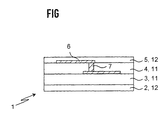
- the figure shows a schematic, not to scale cross section of a ceramic body with the glass ceramic mass in Multi-layer construction.
- the glass ceramic mass 11 is a powder made of an oxide ceramic and a powder of a glass material.
- the oxide ceramic has the formal composition BaRek 2 Ti 4 O 12 .
- the rare earth metal Rek is neodymium.
- the oxide ceramic has a divalent metal Me2 + in the form of zinc as doping.
- appropriate amounts of barium oxide, titanium dioxide and neodymium trioxide are mixed with about 1% by weight zinc oxide, calcined or sintered and then ground to the corresponding powder.
- the glass material contains boron, bismuth, silicon and zinc.
- the glass material is characterized by the following composition from: 27.5 mol% boron trioxide, 34.8 mol% bismuth oxide, 32.5 mol% Zinc oxide and 6 mol% silicon dioxide.
- 100 vol% of the glass ceramic mass is made up of 90 vol% of the ceramic material and 10 vol% of the glass material. Ceramic material and glass material have a D 50 value of 0.8 ⁇ m.
- the sealing firing temperature of the glass ceramic mass is 900 ° C.
- the permittivity of the glass ceramic mass is 64, the grade 820, and the Tkf value 4 ppm / K.
- the presented glass ceramic mass 11 is used to with Using the LTCC technology in the volume of a ceramic Multilayer body 1 is a passive electrical component 6 and 7 to integrate.
- Ceramic multilayer body 1 has ceramic layers 3 and 4 on that made of ceramic green foils with the glass ceramic mass 11 are manufactured.
- the ceramic layers 2 and 5 have another one different from the glass ceramic mass 11 Glass ceramic mass 12.
- the electrically conductive material of the electronic components is elemental metal Me0 in Form of silver.
Landscapes
- Chemical & Material Sciences (AREA)
- Engineering & Computer Science (AREA)
- Materials Engineering (AREA)
- Chemical Kinetics & Catalysis (AREA)
- General Chemical & Material Sciences (AREA)
- Geochemistry & Mineralogy (AREA)
- Life Sciences & Earth Sciences (AREA)
- Organic Chemistry (AREA)
- Ceramic Engineering (AREA)
- Dispersion Chemistry (AREA)
- Glass Compositions (AREA)
- Compositions Of Oxide Ceramics (AREA)
- Inorganic Insulating Materials (AREA)
- Ceramic Capacitors (AREA)
Description
- Die Zusammensetzung der Oxidkeramik bleibt während des Sinterns der Glaskeramikmasse im Wesentlichen konstant. Somit lassen sich die Materialeigenschaften der Glaskeramikmasse definiert voreinstellen.
- Ein nahezu komplettes Verdichten (Dichtsintern) der Glaskeramikmasse ist bei einer Temperatur von unter 910°C und sogar unter 890°C möglich.
- Durch geeignete (oxidische) Zusätze zur Oxidkeramik und zum Glasmaterial lassen sich das Sinterverhalten der Glaskeramikmasse und Materialeigenschaften der Glaskeramikmasse gezielt und nahezu beliebig einstellen. So können beispielsweise Permittivität, Güte und Tkf-Wert in einem jeweils weiten Bereich eingestellt werden unter Einhaltung einer niedrigen Dichtbrandtemperatur.
- Das Verdichten gelingt ohne Einsatz von Bleioxid und/oder Cadmiumoxid.
Claims (16)
- Glaskeramikmasse mitdadurch gekennzeichnet, dassmindestens einer Oxidkeramik, die Barium, Titan und mindestens ein Seltenerdmetall Rek aufweist, undmindestens einem Glasmaterial, das mindestens ein Oxid mit Bor, mindestens ein Oxid mit Silizium, mindestens ein Oxid mit mindestens einem zweiwertigen Metall Me2+ undmindestens ein Oxid mit Bismut aufweist,ein Bleioxidanteil und/oder ein Cadmiumoxidanteil der Glaskeramikmasse und/oder der Oxidkeramik und/oder des Glasmaterials maximal 0,1 % beträgt.
- Glaskeramikmasse nach Anspruch 1, wobei die Oxidkeramik eine formale Zusammensetzung BaRek2Ti4O12 aufweist.
- Glaskeramikmasse nach Anspruch 1 oder 2, wobei das Glasmaterial mindestens ein Oxid mit mindestens einem Seltenerdmetall Reg aufweist.
- Glaskeramikmasse nach einem der Ansprüche 1 bis 3 , wobei das Seltenerdmetall Rek und/oder das Seltenerdmetall Reg aus der Gruppe Lanthan und/oder Neodym und/oder Samarium ausgewählt sind.
- Glaskeramikmasse nach einem der Ansprüche 1 bis 4, wobei die Oxidkeramik das zweiwertige Metall Me2+ aufweist.
- Glaskeramikmasse nach einem der Ansprüche 1 bis 5, wobei das zweiwertige Metall Me2+ aus der Gruppe Beryllium, Magnesium, Calcium, Strontium, Barium, Kupfer und/oder Zink ausgewählt ist.
- Glaskeramikmasse nach einem der Ansprüche 1 bis 6, wobei das Glasmaterial neben dem Oxid des Siliziums als vierwertiges Metall mindestens ein Oxid mit mindestens einem weiteren vierwertigen Metall Me4+ aufweist.
- Glaskeramikmasse nach Anspruch 7, wobei das weitere vierwertige Metall Me4+ aus der Gruppe Germanium und/oder Zinn und/oder Titan und/oder Zirkonium ausgewählt ist.
- Glaskeramikmasse nach einem der Ansprüche 1 bis 8, wobei sich 100 vol% der Glaskeramikmasse zusammensetzen aus einem Keramikanteil der Oxidkeramik, der ausgewählt ist aus dem Bereich zwischen einschließlich 70 vol% bis einschließlich 95 vol%, und einem Glasanteil des Glasmaterials, der ausgewählt ist aus dem Bereich zwischen einschließlich 30 vol% bis einschließlich 5 vol%.
- Glaskeramikmasse nach einem der Ansprüche 1 bis 9, wobei die Oxidkeramik und/oder das Glasmaterial ein Pulver mit einer mittlere Partikelgröße aufweisen, die aus dem Bereich zwischen einschließlich 0,1 µm und einschließlich 1,5 µm ausgewählt ist.
- Glaskeramikmasse nach einem der Ansprüche 1 bis 10, wobei der Bleioxidanteil und/oder der Cadmiumoxidanteil maximal 1 ppm beträgt.
- Glaskeramikmasse nach einem der Ansprüche 1 bis 11, mit einer Dichtbrandtemperatur von maximal 950°C, insbesondere von maximal 890°C.
- Glaskeramikmasse nach Anspruch 12, miteiner Permittivität, die aus dem Bereich von einschließlich 20 bis einschließlich 80 ausgewählt ist,einer Güte, die aus dem Bereich von einschließlich 800 bis einschließlich 5000 ausgewählt ist, undeinem Tkf-Wert, der aus dem Bereich von einschließlich - 20 ppm/K bis einschließlich + 20 ppm/K ausgewählt ist.
- Keramikkörper mit einer Glaskeramikmasse nach einem der Ansprüche 1 bis 13.
- Keramikkörper nach Anspruch 14, mit mindestens einem elementaren Metall Me0, das aus der Gruppe Gold und/oder Silber und/oder Kupfer ausgewählt ist.
- Keramikkörper nach Anspruch 13 oder 14, wobei der Keramikkörper ein keramischer Mehrschichtkörper ist.
Applications Claiming Priority (3)
| Application Number | Priority Date | Filing Date | Title |
|---|---|---|---|
| DE10043196A DE10043196B4 (de) | 2000-09-01 | 2000-09-01 | Glaskeramikmasse und Verwendung der Glaskeramikmasse |
| DE10043196 | 2000-09-01 | ||
| PCT/DE2001/003340 WO2002032824A1 (de) | 2000-09-01 | 2001-08-31 | Glaskeramikmasse und verwendung der glaskeramikmasse |
Publications (2)
| Publication Number | Publication Date |
|---|---|
| EP1315680A1 EP1315680A1 (de) | 2003-06-04 |
| EP1315680B1 true EP1315680B1 (de) | 2004-12-08 |
Family
ID=7654694
Family Applications (1)
| Application Number | Title | Priority Date | Filing Date |
|---|---|---|---|
| EP01969262A Expired - Lifetime EP1315680B1 (de) | 2000-09-01 | 2001-08-31 | Glaskeramikmasse und verwendung der glaskeramikmasse |
Country Status (16)
| Country | Link |
|---|---|
| US (1) | US7030050B2 (de) |
| EP (1) | EP1315680B1 (de) |
| JP (1) | JP2004511419A (de) |
| KR (1) | KR100522288B1 (de) |
| CN (1) | CN100369843C (de) |
| AT (1) | ATE284370T1 (de) |
| CA (1) | CA2419569C (de) |
| CZ (1) | CZ299939B6 (de) |
| DE (2) | DE10043196B4 (de) |
| ES (1) | ES2234879T3 (de) |
| HU (1) | HUP0300879A3 (de) |
| MX (1) | MXPA03001714A (de) |
| NO (1) | NO20030881L (de) |
| PT (1) | PT1315680E (de) |
| TW (1) | TWI243806B (de) |
| WO (1) | WO2002032824A1 (de) |
Families Citing this family (9)
| Publication number | Priority date | Publication date | Assignee | Title |
|---|---|---|---|---|
| WO2004032824A2 (en) | 2002-10-10 | 2004-04-22 | Yeda Research And Development Co. Ltd. | Basic esters of fatty alcohols and their use as anti-inflammatory or immunomodulatory agents |
| EP1732862B1 (de) * | 2004-03-30 | 2015-10-14 | Siemens Aktiengesellschaft | Glas-keramik-zusammensetzung, elektrisches bauelement mit der glas-keramik-zusammensetzung und keramischer mehrschichtkörper mit dem elektrischen bauelement |
| CN101139168B (zh) * | 2007-08-18 | 2010-12-08 | 青岛大学 | 一种微波介电玻璃陶瓷的制备方法 |
| CN101148323B (zh) * | 2007-09-06 | 2010-06-16 | 北京科技大学 | 一种低温共烧堇青石系玻璃-陶瓷基板粉料及其制备方法 |
| KR100916071B1 (ko) * | 2007-11-16 | 2009-09-08 | 삼성전기주식회사 | 글래스 조성물, 이를 포함하는 유전체 조성물 및 이를이용한 적층 세라믹 커패시터 내장형 저온동시소성 세라믹기판 |
| US8663429B2 (en) * | 2008-03-06 | 2014-03-04 | Kristina E. Lipinska-Kalita | Hollow glass microsphere candidates for reversible hydrogen storage, particularly for vehicular applications |
| CN101857423B (zh) * | 2010-05-07 | 2013-01-16 | 清华大学 | 发光低温共烧陶瓷粉和其制备方法、及发光低温共烧陶瓷 |
| CN101857375B (zh) * | 2010-05-11 | 2011-12-28 | 清华大学 | 一种介电常数可调的低温共烧玻璃陶瓷复合材料及其制备方法 |
| ES2403536B2 (es) * | 2013-01-15 | 2014-01-30 | Vernis, S.A. | Fritas coloreadas con efecto lustre |
Family Cites Families (11)
| Publication number | Priority date | Publication date | Assignee | Title |
|---|---|---|---|---|
| US3988498A (en) * | 1968-09-26 | 1976-10-26 | Sprague Electric Company | Low temperature fired electrical components and method of making same |
| JPS5485399A (en) * | 1977-12-21 | 1979-07-06 | Hitachi Ltd | Dielectric paste |
| FR2522870A1 (fr) * | 1982-03-02 | 1983-09-09 | Europ Composants Electron | Composition ceramique dielectrique a base de titanate de baryum stable en fonction de la temperature et condensateur utilisant cette composition |
| US5264403A (en) * | 1991-09-27 | 1993-11-23 | Ngk Insulators, Ltd. | Dielectric ceramic composition containing ZnO-B2 O3 -SiO2 glass |
| JP2711618B2 (ja) * | 1992-06-30 | 1998-02-10 | ティーディーケイ株式会社 | 誘電体組成物、多層配線基板および積層セラミックコンデンサ |
| US5439852A (en) * | 1994-08-01 | 1995-08-08 | E. I. Du Pont De Nemours And Company | Cadmium-free and lead-free thick film conductor composition |
| JP3624405B2 (ja) * | 1994-08-31 | 2005-03-02 | 日本電気硝子株式会社 | ガラスセラミックス誘電体材料 |
| JP3216967B2 (ja) * | 1995-03-20 | 2001-10-09 | 日本特殊陶業株式会社 | 低温焼成誘電体磁器及びその製造方法 |
| CN1116246C (zh) * | 1997-08-11 | 2003-07-30 | 意大利库劳比公司 | 玻璃陶瓷、其制备方法和用途 |
| JPH11310455A (ja) * | 1998-02-27 | 1999-11-09 | Murata Mfg Co Ltd | 誘電体磁器組成物およびそれを用いたセラミック電子部品 |
| JP3709752B2 (ja) * | 1999-01-26 | 2005-10-26 | 株式会社村田製作所 | 誘電体セラミック組成物及びセラミック多層基板 |
-
2000
- 2000-09-01 DE DE10043196A patent/DE10043196B4/de not_active Expired - Fee Related
-
2001
- 2001-08-30 TW TW090121437A patent/TWI243806B/zh not_active IP Right Cessation
- 2001-08-31 ES ES01969262T patent/ES2234879T3/es not_active Expired - Lifetime
- 2001-08-31 JP JP2002536015A patent/JP2004511419A/ja not_active Ceased
- 2001-08-31 HU HU0300879A patent/HUP0300879A3/hu unknown
- 2001-08-31 US US10/363,312 patent/US7030050B2/en not_active Expired - Fee Related
- 2001-08-31 EP EP01969262A patent/EP1315680B1/de not_active Expired - Lifetime
- 2001-08-31 AT AT01969262T patent/ATE284370T1/de active
- 2001-08-31 MX MXPA03001714A patent/MXPA03001714A/es not_active Application Discontinuation
- 2001-08-31 PT PT01969262T patent/PT1315680E/pt unknown
- 2001-08-31 KR KR10-2003-7003048A patent/KR100522288B1/ko not_active Expired - Fee Related
- 2001-08-31 DE DE2001504773 patent/DE50104773D1/de not_active Expired - Lifetime
- 2001-08-31 CN CNB018182577A patent/CN100369843C/zh not_active Expired - Fee Related
- 2001-08-31 CZ CZ20030910A patent/CZ299939B6/cs not_active IP Right Cessation
- 2001-08-31 WO PCT/DE2001/003340 patent/WO2002032824A1/de not_active Ceased
- 2001-08-31 CA CA002419569A patent/CA2419569C/en not_active Expired - Fee Related
-
2003
- 2003-02-25 NO NO20030881A patent/NO20030881L/no not_active Application Discontinuation
Also Published As
| Publication number | Publication date |
|---|---|
| KR20030040432A (ko) | 2003-05-22 |
| CZ2003910A3 (cs) | 2004-12-15 |
| ATE284370T1 (de) | 2004-12-15 |
| JP2004511419A (ja) | 2004-04-15 |
| EP1315680A1 (de) | 2003-06-04 |
| PT1315680E (pt) | 2005-02-28 |
| MXPA03001714A (es) | 2004-09-10 |
| NO20030881D0 (no) | 2003-02-25 |
| CA2419569C (en) | 2007-02-06 |
| CN100369843C (zh) | 2008-02-20 |
| HUP0300879A2 (hu) | 2003-09-29 |
| DE10043196A1 (de) | 2002-03-28 |
| CA2419569A1 (en) | 2003-02-27 |
| KR100522288B1 (ko) | 2005-10-19 |
| DE10043196B4 (de) | 2008-10-02 |
| NO20030881L (no) | 2003-04-25 |
| CZ299939B6 (cs) | 2008-12-29 |
| US20040014585A1 (en) | 2004-01-22 |
| HUP0300879A3 (en) | 2010-01-28 |
| TWI243806B (en) | 2005-11-21 |
| US7030050B2 (en) | 2006-04-18 |
| ES2234879T3 (es) | 2005-07-01 |
| CN1662463A (zh) | 2005-08-31 |
| WO2002032824A1 (de) | 2002-04-25 |
| DE50104773D1 (de) | 2005-01-13 |
Similar Documents
| Publication | Publication Date | Title |
|---|---|---|
| DE3317963C2 (de) | Keramikkondensator mit Schichtaufbau | |
| DE69225450T2 (de) | Verfahren zur Herstellung einer bei tiefer Temperatur brennbaren dielektrischen keramischen Zusammensetzung | |
| DE4010827C2 (de) | Monolithischer keramischer Kondensator | |
| DE69611892T2 (de) | Dielektrisches porzellan, verfahren zu seiner herstellung und elektronische teile daraus | |
| DE69209417T2 (de) | Nichtreduzierbare dielektrische keramische Zusammensetzung | |
| DE69814577T2 (de) | Dielektrische keramische Zusammensetzung und keramische elektronische Bauteile, die diese enthalten | |
| DE69304034T2 (de) | Nichtreduzierbare, dielektrische keramische Zusammensetzung | |
| DE68923781T2 (de) | Keramische Zusammensetzung mit hoher Dielektrizitätskonstante und keramische Kondensatorelemente. | |
| WO2002018285A1 (de) | Glaskeramikmasse und verwendung der glaskeramikmasse | |
| DE69907084T2 (de) | Dielektrische Porzellanzusammensetzung | |
| DE112009000012T5 (de) | Glaskeramikzusammensetzung, Glaskeramik-Sinterkörper und keramisches Mehrschicht-Elektronikbauteil | |
| DE69025923T4 (de) | Keramische zusammensetzung und elektronisches teil daraus | |
| DE112008002221T5 (de) | Keramikzusammensetzung, Verfahren zum Erzeugen derselben, Keramiksubstrat und Verfahren zum Erzeugen einer keramischen Grünschicht | |
| DE10035172B4 (de) | Keramikmasse und Kondensator mit der Keramikmasse | |
| DE4005505A1 (de) | Monolithischer keramischer kondensator | |
| DE10043196B4 (de) | Glaskeramikmasse und Verwendung der Glaskeramikmasse | |
| DE3327768C2 (de) | ||
| DE4406812C1 (de) | Niedrig sinternde keramische Dielektrika mit hohen DK-Werten für Green-Tape-Systeme | |
| DE68914484T2 (de) | Gesinterte Ferrit-Materialien und Teile von Chips. | |
| DE19749858C1 (de) | Reduktionsstabile Keramikmassen, Verfahren zur Herstellung und Verwendung | |
| DE4005507A1 (de) | Dielektrische keramische zusammensetzung | |
| DE3541517C2 (de) | ||
| DE69501754T2 (de) | Dielektrische keramische Zusammensetzung | |
| EP1732862B1 (de) | Glas-keramik-zusammensetzung, elektrisches bauelement mit der glas-keramik-zusammensetzung und keramischer mehrschichtkörper mit dem elektrischen bauelement | |
| DE3541516C2 (de) |
Legal Events
| Date | Code | Title | Description |
|---|---|---|---|
| PUAI | Public reference made under article 153(3) epc to a published international application that has entered the european phase |
Free format text: ORIGINAL CODE: 0009012 |
|
| 17P | Request for examination filed |
Effective date: 20030318 |
|
| AK | Designated contracting states |
Designated state(s): AT BE CH CY DE DK ES FI FR GB GR IE IT LI LU MC NL PT SE |
|
| AX | Request for extension of the european patent |
Extension state: SI |
|
| RIN1 | Information on inventor provided before grant (corrected) |
Inventor name: PREU, GABRIELE Inventor name: DERNOVSEK, OLIVER Inventor name: MODES, CHRISTINA Inventor name: GEMEINERT, MARION Inventor name: SCHILLER, WOLFANG, ARNO Inventor name: FRITZ, ULRICH Inventor name: EBERSTEIN, MARKUS Inventor name: WERSING, WOLFRAM |
|
| RAP1 | Party data changed (applicant data changed or rights of an application transferred) |
Owner name: BUNDESANSTALT FUER MATERIALFORSCHUNG UND -PRUFUNG Owner name: W.C. HERAEUS GMBH & CO. KG |
|
| GRAP | Despatch of communication of intention to grant a patent |
Free format text: ORIGINAL CODE: EPIDOSNIGR1 |
|
| GRAS | Grant fee paid |
Free format text: ORIGINAL CODE: EPIDOSNIGR3 |
|
| GRAA | (expected) grant |
Free format text: ORIGINAL CODE: 0009210 |
|
| RAP1 | Party data changed (applicant data changed or rights of an application transferred) |
Owner name: W.C. HERAEUS GMBH & CO. KG Owner name: BUNDESANSTALT FUER MATERIALFORSCHUNG UND -PRUFUNG |
|
| AK | Designated contracting states |
Kind code of ref document: B1 Designated state(s): AT BE CH CY DE DK ES FI FR GB GR IE IT LI LU MC NL PT SE |
|
| REG | Reference to a national code |
Ref country code: GB Ref legal event code: FG4D Free format text: NOT ENGLISH |
|
| REG | Reference to a national code |
Ref country code: CH Ref legal event code: EP |
|
| REG | Reference to a national code |
Ref country code: IE Ref legal event code: FG4D Free format text: GERMAN |
|
| REF | Corresponds to: |
Ref document number: 50104773 Country of ref document: DE Date of ref document: 20050113 Kind code of ref document: P |
|
| RAP2 | Party data changed (patent owner data changed or rights of a patent transferred) |
Owner name: W.C. HERAEUS GMBH Owner name: BUNDESANSTALT FUER MATERIALFORSCHUNG UND -PRUFUNG |
|
| REG | Reference to a national code |
Ref country code: SE Ref legal event code: TRGR |
|
| REG | Reference to a national code |
Ref country code: PT Ref legal event code: SC4A Free format text: AVAILABILITY OF NATIONAL TRANSLATION Effective date: 20041216 |
|
| NLT2 | Nl: modifications (of names), taken from the european patent patent bulletin |
Owner name: W.C. HERAEUS GMBH EN BUNDESANSTALT FUER MATERIALFO |
|
| GBT | Gb: translation of ep patent filed (gb section 77(6)(a)/1977) |
Effective date: 20050208 |
|
| PG25 | Lapsed in a contracting state [announced via postgrant information from national office to epo] |
Ref country code: DK Free format text: LAPSE BECAUSE OF FAILURE TO SUBMIT A TRANSLATION OF THE DESCRIPTION OR TO PAY THE FEE WITHIN THE PRESCRIBED TIME-LIMIT Effective date: 20050308 Ref country code: GR Free format text: LAPSE BECAUSE OF FAILURE TO SUBMIT A TRANSLATION OF THE DESCRIPTION OR TO PAY THE FEE WITHIN THE PRESCRIBED TIME-LIMIT Effective date: 20050308 |
|
| REG | Reference to a national code |
Ref country code: ES Ref legal event code: FG2A Ref document number: 2234879 Country of ref document: ES Kind code of ref document: T3 |
|
| PG25 | Lapsed in a contracting state [announced via postgrant information from national office to epo] |
Ref country code: LI Free format text: LAPSE BECAUSE OF NON-PAYMENT OF DUE FEES Effective date: 20050831 Ref country code: CY Free format text: LAPSE BECAUSE OF FAILURE TO SUBMIT A TRANSLATION OF THE DESCRIPTION OR TO PAY THE FEE WITHIN THE PRESCRIBED TIME-LIMIT Effective date: 20050831 Ref country code: LU Free format text: LAPSE BECAUSE OF NON-PAYMENT OF DUE FEES Effective date: 20050831 Ref country code: BE Free format text: LAPSE BECAUSE OF NON-PAYMENT OF DUE FEES Effective date: 20050831 Ref country code: MC Free format text: LAPSE BECAUSE OF NON-PAYMENT OF DUE FEES Effective date: 20050831 Ref country code: CH Free format text: LAPSE BECAUSE OF NON-PAYMENT OF DUE FEES Effective date: 20050831 |
|
| PLBE | No opposition filed within time limit |
Free format text: ORIGINAL CODE: 0009261 |
|
| STAA | Information on the status of an ep patent application or granted ep patent |
Free format text: STATUS: NO OPPOSITION FILED WITHIN TIME LIMIT |
|
| 26N | No opposition filed |
Effective date: 20050909 |
|
| ET | Fr: translation filed | ||
| REG | Reference to a national code |
Ref country code: CH Ref legal event code: PL |
|
| BERE | Be: lapsed |
Owner name: *BUNDESANSTALT FUR MATERIALFORSCHUNG UND -PRUFUNG Effective date: 20050831 Owner name: W.C. *HERAEUS G.M.B.H. & CO. K.G. Effective date: 20050831 |
|
| REG | Reference to a national code |
Ref country code: NL Ref legal event code: TD Owner name: HERAEUS PRECIOUS METALS GMBH & CO.KG, DE Free format text: FORMER OWNER: W.C. HERAEUS GMBH,DE; FURTHER OWNER: BUNDESANSTALT FUER MATERIALFORSCHUNG UND -PRUEFUNG (BAM) Effective date: 20111110 |
|
| REG | Reference to a national code |
Ref country code: PT Ref legal event code: PC4A Owner name: HERAEUS PRECIOUS METALS GMBH & CO. KG, DE Effective date: 20120112 |
|
| REG | Reference to a national code |
Ref country code: DE Ref legal event code: R081 Ref document number: 50104773 Country of ref document: DE Owner name: HERAEUS PRECIOUS METALS GMBH & CO. KG, DE Free format text: FORMER OWNER: BUNDESANSTALT FUER MATERIALFORSC, HERAEUS MATERIALS TECHNOLOGY GM, , DE Effective date: 20120109 Ref country code: DE Ref legal event code: R081 Ref document number: 50104773 Country of ref document: DE Owner name: BUNDESANSTALT FUER MATERIALFORSCHUNG UND -PRUE, DE Free format text: FORMER OWNER: W.C. HERAEUS GMBH, BUNDESANSTALT FUER MATERIALFORSC, , DE Effective date: 20111219 Ref country code: DE Ref legal event code: R081 Ref document number: 50104773 Country of ref document: DE Owner name: HERAEUS PRECIOUS METALS GMBH & CO. KG, DE Free format text: FORMER OWNER: W.C. HERAEUS GMBH, BUNDESANSTALT FUER MATERIALFORSC, , DE Effective date: 20111219 Ref country code: DE Ref legal event code: R081 Ref document number: 50104773 Country of ref document: DE Owner name: BUNDESANSTALT FUER MATERIALFORSCHUNG UND -PRUE, DE Free format text: FORMER OWNER: BUNDESANSTALT FUER MATERIALFORSC, HERAEUS MATERIALS TECHNOLOGY GM, , DE Effective date: 20120109 Ref country code: DE Ref legal event code: R081 Ref document number: 50104773 Country of ref document: DE Owner name: BUNDESANSTALT FUER MATERIALFORSCHUNG UND -PRUE, DE Free format text: FORMER OWNERS: W.C. HERAEUS GMBH, 63450 HANAU, DE; BUNDESANSTALT FUER MATERIALFORSCHUNG UND -PRUEFUNG (BAM), 12205 BERLIN, DE Effective date: 20111219 Ref country code: DE Ref legal event code: R081 Ref document number: 50104773 Country of ref document: DE Owner name: HERAEUS PRECIOUS METALS GMBH & CO. KG, DE Free format text: FORMER OWNERS: BUNDESANSTALT FUER MATERIALFORSCHUNG UND -PRUEFUNG (BAM), 12205 BERLIN, DE; HERAEUS MATERIALS TECHNOLOGY GMBH & CO. KG, 63450 HANAU, DE Effective date: 20120109 Ref country code: DE Ref legal event code: R081 Ref document number: 50104773 Country of ref document: DE Owner name: BUNDESANSTALT FUER MATERIALFORSCHUNG UND -PRUE, DE Free format text: FORMER OWNERS: BUNDESANSTALT FUER MATERIALFORSCHUNG UND -PRUEFUNG (BAM), 12205 BERLIN, DE; HERAEUS MATERIALS TECHNOLOGY GMBH & CO. KG, 63450 HANAU, DE Effective date: 20120109 Ref country code: DE Ref legal event code: R081 Ref document number: 50104773 Country of ref document: DE Owner name: HERAEUS PRECIOUS METALS GMBH & CO. KG, DE Free format text: FORMER OWNERS: W.C. HERAEUS GMBH, 63450 HANAU, DE; BUNDESANSTALT FUER MATERIALFORSCHUNG UND -PRUEFUNG (BAM), 12205 BERLIN, DE Effective date: 20111219 |
|
| REG | Reference to a national code |
Ref country code: FR Ref legal event code: CJ Effective date: 20120127 |
|
| REG | Reference to a national code |
Ref country code: FR Ref legal event code: TP Owner name: HERAEUS PRECIOUS METALS GMBH & CO. KG, DE Effective date: 20120308 |
|
| REG | Reference to a national code |
Ref country code: ES Ref legal event code: PC2A Owner name: HERAEUS PRECIOUS METALS GMBH & CO.KG Effective date: 20120605 |
|
| PGFP | Annual fee paid to national office [announced via postgrant information from national office to epo] |
Ref country code: IE Payment date: 20130829 Year of fee payment: 13 Ref country code: ES Payment date: 20130829 Year of fee payment: 13 Ref country code: SE Payment date: 20130821 Year of fee payment: 13 Ref country code: PT Payment date: 20130228 Year of fee payment: 13 Ref country code: DE Payment date: 20130821 Year of fee payment: 13 Ref country code: AT Payment date: 20130813 Year of fee payment: 13 Ref country code: NL Payment date: 20130815 Year of fee payment: 13 Ref country code: FI Payment date: 20130813 Year of fee payment: 13 |
|
| PGFP | Annual fee paid to national office [announced via postgrant information from national office to epo] |
Ref country code: GB Payment date: 20130821 Year of fee payment: 13 Ref country code: FR Payment date: 20130823 Year of fee payment: 13 |
|
| PGFP | Annual fee paid to national office [announced via postgrant information from national office to epo] |
Ref country code: IT Payment date: 20130826 Year of fee payment: 13 |
|
| REG | Reference to a national code |
Ref country code: DE Ref legal event code: R119 Ref document number: 50104773 Country of ref document: DE |
|
| REG | Reference to a national code |
Ref country code: PT Ref legal event code: MM4A Free format text: LAPSE DUE TO NON-PAYMENT OF FEES Effective date: 20150302 |
|
| REG | Reference to a national code |
Ref country code: NL Ref legal event code: V1 Effective date: 20150301 |
|
| REG | Reference to a national code |
Ref country code: AT Ref legal event code: MM01 Ref document number: 284370 Country of ref document: AT Kind code of ref document: T Effective date: 20140831 |
|
| GBPC | Gb: european patent ceased through non-payment of renewal fee |
Effective date: 20140831 |
|
| PG25 | Lapsed in a contracting state [announced via postgrant information from national office to epo] |
Ref country code: PT Free format text: LAPSE BECAUSE OF NON-PAYMENT OF DUE FEES Effective date: 20150302 Ref country code: FI Free format text: LAPSE BECAUSE OF NON-PAYMENT OF DUE FEES Effective date: 20140831 Ref country code: NL Free format text: LAPSE BECAUSE OF NON-PAYMENT OF DUE FEES Effective date: 20150301 Ref country code: IT Free format text: LAPSE BECAUSE OF NON-PAYMENT OF DUE FEES Effective date: 20140831 |
|
| REG | Reference to a national code |
Ref country code: SE Ref legal event code: EUG |
|
| PG25 | Lapsed in a contracting state [announced via postgrant information from national office to epo] |
Ref country code: AT Free format text: LAPSE BECAUSE OF NON-PAYMENT OF DUE FEES Effective date: 20140831 Ref country code: SE Free format text: LAPSE BECAUSE OF NON-PAYMENT OF DUE FEES Effective date: 20140901 |
|
| REG | Reference to a national code |
Ref country code: FR Ref legal event code: ST Effective date: 20150430 |
|
| REG | Reference to a national code |
Ref country code: DE Ref legal event code: R119 Ref document number: 50104773 Country of ref document: DE Effective date: 20150303 Ref country code: IE Ref legal event code: MM4A |
|
| PG25 | Lapsed in a contracting state [announced via postgrant information from national office to epo] |
Ref country code: GB Free format text: LAPSE BECAUSE OF NON-PAYMENT OF DUE FEES Effective date: 20140831 Ref country code: DE Free format text: LAPSE BECAUSE OF NON-PAYMENT OF DUE FEES Effective date: 20150303 |
|
| PG25 | Lapsed in a contracting state [announced via postgrant information from national office to epo] |
Ref country code: FR Free format text: LAPSE BECAUSE OF NON-PAYMENT OF DUE FEES Effective date: 20140901 Ref country code: IE Free format text: LAPSE BECAUSE OF NON-PAYMENT OF DUE FEES Effective date: 20140831 |
|
| REG | Reference to a national code |
Ref country code: ES Ref legal event code: FD2A Effective date: 20150925 |
|
| PG25 | Lapsed in a contracting state [announced via postgrant information from national office to epo] |
Ref country code: ES Free format text: LAPSE BECAUSE OF NON-PAYMENT OF DUE FEES Effective date: 20140901 |