EP1311492B1 - Verfahren zur herstellung von lamotrigin aus alpha-oxo-2,3-dichlorphenylacetamidino-aminoguanidino-hydrazon durch ringschlussreaktion - Google Patents
Verfahren zur herstellung von lamotrigin aus alpha-oxo-2,3-dichlorphenylacetamidino-aminoguanidino-hydrazon durch ringschlussreaktion Download PDFInfo
- Publication number
- EP1311492B1 EP1311492B1 EP02758308A EP02758308A EP1311492B1 EP 1311492 B1 EP1311492 B1 EP 1311492B1 EP 02758308 A EP02758308 A EP 02758308A EP 02758308 A EP02758308 A EP 02758308A EP 1311492 B1 EP1311492 B1 EP 1311492B1
- Authority
- EP
- European Patent Office
- Prior art keywords
- compound
- formula
- salt
- lamotrigine
- reaction
- Prior art date
- Legal status (The legal status is an assumption and is not a legal conclusion. Google has not performed a legal analysis and makes no representation as to the accuracy of the status listed.)
- Expired - Lifetime
Links
- PYZRQGJRPPTADH-UHFFFAOYSA-N lamotrigine Chemical compound NC1=NC(N)=NN=C1C1=CC=CC(Cl)=C1Cl PYZRQGJRPPTADH-UHFFFAOYSA-N 0.000 title claims abstract description 43
- 229960001848 lamotrigine Drugs 0.000 title claims abstract description 39
- 238000007363 ring formation reaction Methods 0.000 title claims abstract description 23
- 238000004519 manufacturing process Methods 0.000 title claims abstract description 11
- 150000007857 hydrazones Chemical class 0.000 title abstract description 3
- 150000001875 compounds Chemical class 0.000 claims description 53
- 150000003839 salts Chemical class 0.000 claims description 38
- 238000000034 method Methods 0.000 claims description 29
- 125000003118 aryl group Chemical group 0.000 claims description 10
- LFQSCWFLJHTTHZ-UHFFFAOYSA-N Ethanol Chemical compound CCO LFQSCWFLJHTTHZ-UHFFFAOYSA-N 0.000 claims description 9
- 239000002253 acid Substances 0.000 claims description 9
- 125000000217 alkyl group Chemical group 0.000 claims description 9
- 239000012458 free base Substances 0.000 claims description 7
- XFXPMWWXUTWYJX-UHFFFAOYSA-N Cyanide Chemical compound N#[C-] XFXPMWWXUTWYJX-UHFFFAOYSA-N 0.000 claims description 4
- HAMNKKUPIHEESI-UHFFFAOYSA-N aminoguanidine Chemical compound NNC(N)=N HAMNKKUPIHEESI-UHFFFAOYSA-N 0.000 claims description 4
- 238000010438 heat treatment Methods 0.000 claims description 2
- 238000006243 chemical reaction Methods 0.000 description 24
- ZMXDDKWLCZADIW-UHFFFAOYSA-N N,N-Dimethylformamide Chemical compound CN(C)C=O ZMXDDKWLCZADIW-UHFFFAOYSA-N 0.000 description 21
- VEXZGXHMUGYJMC-UHFFFAOYSA-N Hydrochloric acid Chemical compound Cl VEXZGXHMUGYJMC-UHFFFAOYSA-N 0.000 description 20
- HEMHJVSKTPXQMS-UHFFFAOYSA-M Sodium hydroxide Chemical compound [OH-].[Na+] HEMHJVSKTPXQMS-UHFFFAOYSA-M 0.000 description 12
- 230000015572 biosynthetic process Effects 0.000 description 11
- 238000004128 high performance liquid chromatography Methods 0.000 description 11
- 238000003786 synthesis reaction Methods 0.000 description 11
- OKKJLVBELUTLKV-UHFFFAOYSA-N Methanol Chemical compound OC OKKJLVBELUTLKV-UHFFFAOYSA-N 0.000 description 9
- XLYOFNOQVPJJNP-UHFFFAOYSA-N water Substances O XLYOFNOQVPJJNP-UHFFFAOYSA-N 0.000 description 9
- FIBBFBXFASKAON-UHFFFAOYSA-N 2,3-dichlorobenzoyl cyanide Chemical compound ClC1=CC=CC(C(=O)C#N)=C1Cl FIBBFBXFASKAON-UHFFFAOYSA-N 0.000 description 7
- -1 aralkyl radical Chemical class 0.000 description 7
- 238000002844 melting Methods 0.000 description 7
- 230000008018 melting Effects 0.000 description 7
- 239000002904 solvent Substances 0.000 description 7
- KFZMGEQAYNKOFK-UHFFFAOYSA-N Isopropanol Chemical compound CC(C)O KFZMGEQAYNKOFK-UHFFFAOYSA-N 0.000 description 6
- 239000000047 product Substances 0.000 description 6
- KXZJHVJKXJLBKO-UHFFFAOYSA-N chembl1408157 Chemical compound N=1C2=CC=CC=C2C(C(=O)O)=CC=1C1=CC=C(O)C=C1 KXZJHVJKXJLBKO-UHFFFAOYSA-N 0.000 description 5
- DOBRDRYODQBAMW-UHFFFAOYSA-N copper(i) cyanide Chemical compound [Cu+].N#[C-] DOBRDRYODQBAMW-UHFFFAOYSA-N 0.000 description 5
- 239000011541 reaction mixture Substances 0.000 description 5
- 0 *C([C@](CC=C1)C(N)=C1N)=*O Chemical compound *C([C@](CC=C1)C(N)=C1N)=*O 0.000 description 4
- DTUJCEDNSUQKIC-UHFFFAOYSA-N 1-(2,3-dichlorophenyl)-n-phenylmethanimine oxide Chemical compound C=1C=CC=CC=1[N+]([O-])=CC1=CC=CC(Cl)=C1Cl DTUJCEDNSUQKIC-UHFFFAOYSA-N 0.000 description 4
- QGZKDVFQNNGYKY-UHFFFAOYSA-N Ammonia Chemical compound N QGZKDVFQNNGYKY-UHFFFAOYSA-N 0.000 description 4
- IAZDPXIOMUYVGZ-UHFFFAOYSA-N Dimethylsulphoxide Chemical compound CS(C)=O IAZDPXIOMUYVGZ-UHFFFAOYSA-N 0.000 description 4
- 239000000543 intermediate Substances 0.000 description 4
- 238000002360 preparation method Methods 0.000 description 4
- LMBFAGIMSUYTBN-MPZNNTNKSA-N teixobactin Chemical compound C([C@H](C(=O)N[C@@H]([C@@H](C)CC)C(=O)N[C@@H](CO)C(=O)N[C@H](CCC(N)=O)C(=O)N[C@H]([C@@H](C)CC)C(=O)N[C@@H]([C@@H](C)CC)C(=O)N[C@@H](CO)C(=O)N[C@H]1C(N[C@@H](C)C(=O)N[C@@H](C[C@@H]2NC(=N)NC2)C(=O)N[C@H](C(=O)O[C@H]1C)[C@@H](C)CC)=O)NC)C1=CC=CC=C1 LMBFAGIMSUYTBN-MPZNNTNKSA-N 0.000 description 4
- FNVXJMKKNKMNHH-UHFFFAOYSA-N 2-(2,3-dichlorophenyl)-2-phenyliminoethanimidamide;hydrochloride Chemical compound Cl.C=1C=CC(Cl)=C(Cl)C=1C(C(=N)N)=NC1=CC=CC=C1 FNVXJMKKNKMNHH-UHFFFAOYSA-N 0.000 description 3
- UHOVQNZJYSORNB-UHFFFAOYSA-N Benzene Chemical compound C1=CC=CC=C1 UHOVQNZJYSORNB-UHFFFAOYSA-N 0.000 description 3
- YMWUJEATGCHHMB-UHFFFAOYSA-N Dichloromethane Chemical compound ClCCl YMWUJEATGCHHMB-UHFFFAOYSA-N 0.000 description 3
- YXFVVABEGXRONW-UHFFFAOYSA-N Toluene Chemical compound CC1=CC=CC=C1 YXFVVABEGXRONW-UHFFFAOYSA-N 0.000 description 3
- 238000009835 boiling Methods 0.000 description 3
- 239000012535 impurity Substances 0.000 description 3
- 125000001997 phenyl group Chemical group [H]C1=C([H])C([H])=C(*)C([H])=C1[H] 0.000 description 3
- 238000010992 reflux Methods 0.000 description 3
- OUQPQFKAEYRVBH-UHFFFAOYSA-N 2,3-dichloro-n-phenylbenzenecarboximidoyl cyanide Chemical compound ClC1=CC=CC(C(=NC=2C=CC=CC=2)C#N)=C1Cl OUQPQFKAEYRVBH-UHFFFAOYSA-N 0.000 description 2
- CSCPPACGZOOCGX-UHFFFAOYSA-N Acetone Chemical compound CC(C)=O CSCPPACGZOOCGX-UHFFFAOYSA-N 0.000 description 2
- 230000001476 alcoholic effect Effects 0.000 description 2
- 229910021529 ammonia Inorganic materials 0.000 description 2
- 239000002585 base Substances 0.000 description 2
- 238000004140 cleaning Methods 0.000 description 2
- 239000013078 crystal Substances 0.000 description 2
- 238000002425 crystallisation Methods 0.000 description 2
- 230000008025 crystallization Effects 0.000 description 2
- 230000003670 easy-to-clean Effects 0.000 description 2
- 230000007062 hydrolysis Effects 0.000 description 2
- 238000006460 hydrolysis reaction Methods 0.000 description 2
- 239000000203 mixture Substances 0.000 description 2
- SQDFHQJTAWCFIB-UHFFFAOYSA-N n-methylidenehydroxylamine Chemical compound ON=C SQDFHQJTAWCFIB-UHFFFAOYSA-N 0.000 description 2
- 239000008194 pharmaceutical composition Substances 0.000 description 2
- 238000000746 purification Methods 0.000 description 2
- 229920006395 saturated elastomer Polymers 0.000 description 2
- 238000004611 spectroscopical analysis Methods 0.000 description 2
- 239000000126 substance Substances 0.000 description 2
- FYSNRJHAOHDILO-UHFFFAOYSA-N thionyl chloride Chemical compound ClS(Cl)=O FYSNRJHAOHDILO-UHFFFAOYSA-N 0.000 description 2
- CWGBFIRHYJNILV-UHFFFAOYSA-N (1,4-diphenyl-1,2,4-triazol-4-ium-3-yl)-phenylazanide Chemical compound C=1C=CC=CC=1[N-]C1=NN(C=2C=CC=CC=2)C=[N+]1C1=CC=CC=C1 CWGBFIRHYJNILV-UHFFFAOYSA-N 0.000 description 1
- PQQZYNVQDUZLTQ-UHFFFAOYSA-N (2,3-dichlorobenzoyl) 2,3-dichlorobenzoate Chemical compound ClC1=CC=CC(C(=O)OC(=O)C=2C(=C(Cl)C=CC=2)Cl)=C1Cl PQQZYNVQDUZLTQ-UHFFFAOYSA-N 0.000 description 1
- FMCAFXHLMUOIGG-IWFBPKFRSA-N (2s)-2-[[(2s)-2-[[(2s)-2-[[(2r)-2-formamido-3-sulfanylpropanoyl]amino]-3-methylbutanoyl]amino]-3-(4-hydroxy-2,5-dimethylphenyl)propanoyl]amino]-4-methylsulfanylbutanoic acid Chemical compound O=CN[C@@H](CS)C(=O)N[C@@H](C(C)C)C(=O)N[C@H](C(=O)N[C@@H](CCSC)C(O)=O)CC1=CC(C)=C(O)C=C1C FMCAFXHLMUOIGG-IWFBPKFRSA-N 0.000 description 1
- OTXHZHQQWQTQMW-UHFFFAOYSA-N (diaminomethylideneamino)azanium;hydrogen carbonate Chemical compound OC([O-])=O.N[NH2+]C(N)=N OTXHZHQQWQTQMW-UHFFFAOYSA-N 0.000 description 1
- BXDSJOGMJUKSAE-UHFFFAOYSA-N 2,3-dichloro-n-(diaminomethylideneamino)benzenecarboximidoyl cyanide Chemical compound NC(=N)NN=C(C#N)C1=CC=CC(Cl)=C1Cl BXDSJOGMJUKSAE-UHFFFAOYSA-N 0.000 description 1
- YBONBWJSFMTXLE-UHFFFAOYSA-N 2,3-dichlorobenzoyl chloride Chemical compound ClC(=O)C1=CC=CC(Cl)=C1Cl YBONBWJSFMTXLE-UHFFFAOYSA-N 0.000 description 1
- UBDZFAGVPPMTIT-UHFFFAOYSA-N 2-aminoguanidine;hydron;chloride Chemical compound [Cl-].NC(N)=N[NH3+] UBDZFAGVPPMTIT-UHFFFAOYSA-N 0.000 description 1
- KCBMTQFJTZRMIP-UHFFFAOYSA-N 5-chloro-6-(2,3-dichlorophenyl)-3-methylsulfanyl-1,2,4-triazine Chemical compound ClC1=NC(SC)=NN=C1C1=CC=CC(Cl)=C1Cl KCBMTQFJTZRMIP-UHFFFAOYSA-N 0.000 description 1
- QTBSBXVTEAMEQO-UHFFFAOYSA-M Acetate Chemical compound CC([O-])=O QTBSBXVTEAMEQO-UHFFFAOYSA-M 0.000 description 1
- FEWJPZIEWOKRBE-JCYAYHJZSA-N Dextrotartaric acid Chemical compound OC(=O)[C@H](O)[C@@H](O)C(O)=O FEWJPZIEWOKRBE-JCYAYHJZSA-N 0.000 description 1
- HQQARYRCDMYLHW-UHFFFAOYSA-N N,N-diethyl-2-[(2-methoxy-5-methylsulfonylbenzoyl)amino]ethanamine oxide Chemical compound CC[N+]([O-])(CC)CCNC(=O)C1=CC(S(C)(=O)=O)=CC=C1OC HQQARYRCDMYLHW-UHFFFAOYSA-N 0.000 description 1
- UMDMRZLWMDIASX-FRKPEAEDSA-N NC(/C(/c(cccc1Cl)c1Cl)=N/NC(N)=N)=N Chemical compound NC(/C(/c(cccc1Cl)c1Cl)=N/NC(N)=N)=N UMDMRZLWMDIASX-FRKPEAEDSA-N 0.000 description 1
- DFPAKSUCGFBDDF-UHFFFAOYSA-N Nicotinamide Chemical group NC(=O)C1=CC=CN=C1 DFPAKSUCGFBDDF-UHFFFAOYSA-N 0.000 description 1
- CTQNGGLPUBDAKN-UHFFFAOYSA-N O-Xylene Chemical compound CC1=CC=CC=C1C CTQNGGLPUBDAKN-UHFFFAOYSA-N 0.000 description 1
- 229910019142 PO4 Inorganic materials 0.000 description 1
- 230000002411 adverse Effects 0.000 description 1
- 125000003545 alkoxy group Chemical group 0.000 description 1
- 150000008064 anhydrides Chemical class 0.000 description 1
- 239000012062 aqueous buffer Substances 0.000 description 1
- 150000005840 aryl radicals Chemical class 0.000 description 1
- 125000001797 benzyl group Chemical group [H]C1=C([H])C([H])=C(C([H])=C1[H])C([H])([H])* 0.000 description 1
- 239000000872 buffer Substances 0.000 description 1
- 244000309464 bull Species 0.000 description 1
- 239000006227 byproduct Substances 0.000 description 1
- 210000003169 central nervous system Anatomy 0.000 description 1
- 239000000812 cholinergic antagonist Substances 0.000 description 1
- 238000011109 contamination Methods 0.000 description 1
- 238000001816 cooling Methods 0.000 description 1
- 239000006184 cosolvent Substances 0.000 description 1
- 239000012043 crude product Substances 0.000 description 1
- 125000000113 cyclohexyl group Chemical group [H]C1([H])C([H])([H])C([H])([H])C([H])(*)C([H])([H])C1([H])[H] 0.000 description 1
- 201000010099 disease Diseases 0.000 description 1
- 208000037265 diseases, disorders, signs and symptoms Diseases 0.000 description 1
- 239000003814 drug Substances 0.000 description 1
- 206010015037 epilepsy Diseases 0.000 description 1
- 125000001495 ethyl group Chemical group [H]C([H])([H])C([H])([H])* 0.000 description 1
- 229910052736 halogen Inorganic materials 0.000 description 1
- 150000002367 halogens Chemical class 0.000 description 1
- 125000002887 hydroxy group Chemical group [H]O* 0.000 description 1
- 239000005457 ice water Substances 0.000 description 1
- 229910052500 inorganic mineral Inorganic materials 0.000 description 1
- 125000000959 isobutyl group Chemical group [H]C([H])([H])C([H])(C([H])([H])[H])C([H])([H])* 0.000 description 1
- 125000001449 isopropyl group Chemical group [H]C([H])([H])C([H])(*)C([H])([H])[H] 0.000 description 1
- 125000002496 methyl group Chemical group [H]C([H])([H])* 0.000 description 1
- 239000011707 mineral Substances 0.000 description 1
- 229910000402 monopotassium phosphate Inorganic materials 0.000 description 1
- 235000019796 monopotassium phosphate Nutrition 0.000 description 1
- 125000004108 n-butyl group Chemical group [H]C([H])([H])C([H])([H])C([H])([H])C([H])([H])* 0.000 description 1
- 125000004123 n-propyl group Chemical group [H]C([H])([H])C([H])([H])C([H])([H])* 0.000 description 1
- 125000001624 naphthyl group Chemical group 0.000 description 1
- 150000002825 nitriles Chemical group 0.000 description 1
- 125000000449 nitro group Chemical group [O-][N+](*)=O 0.000 description 1
- 239000012074 organic phase Substances 0.000 description 1
- 239000003960 organic solvent Substances 0.000 description 1
- 239000010452 phosphate Substances 0.000 description 1
- NBIIXXVUZAFLBC-UHFFFAOYSA-K phosphate Chemical compound [O-]P([O-])([O-])=O NBIIXXVUZAFLBC-UHFFFAOYSA-K 0.000 description 1
- 239000008363 phosphate buffer Substances 0.000 description 1
- PJNZPQUBCPKICU-UHFFFAOYSA-N phosphoric acid;potassium Chemical compound [K].OP(O)(O)=O PJNZPQUBCPKICU-UHFFFAOYSA-N 0.000 description 1
- 230000035484 reaction time Effects 0.000 description 1
- 238000001953 recrystallisation Methods 0.000 description 1
- 238000006798 ring closing metathesis reaction Methods 0.000 description 1
- 239000011877 solvent mixture Substances 0.000 description 1
- 125000001424 substituent group Chemical group 0.000 description 1
- 229940095064 tartrate Drugs 0.000 description 1
- 125000000999 tert-butyl group Chemical group [H]C([H])([H])C(*)(C([H])([H])[H])C([H])([H])[H] 0.000 description 1
- 239000008096 xylene Substances 0.000 description 1
Classifications
-
- C—CHEMISTRY; METALLURGY
- C07—ORGANIC CHEMISTRY
- C07D—HETEROCYCLIC COMPOUNDS
- C07D253/00—Heterocyclic compounds containing six-membered rings having three nitrogen atoms as the only ring hetero atoms, not provided for by group C07D251/00
- C07D253/02—Heterocyclic compounds containing six-membered rings having three nitrogen atoms as the only ring hetero atoms, not provided for by group C07D251/00 not condensed with other rings
- C07D253/06—1,2,4-Triazines
- C07D253/065—1,2,4-Triazines having three double bonds between ring members or between ring members and non-ring members
- C07D253/07—1,2,4-Triazines having three double bonds between ring members or between ring members and non-ring members with hetero atoms, or with carbon atoms having three bonds to hetero atoms with at the most one bond to halogen, e.g. ester or nitrile radicals, directly attached to ring carbon atoms
- C07D253/075—Two hetero atoms, in positions 3 and 5
-
- C—CHEMISTRY; METALLURGY
- C07—ORGANIC CHEMISTRY
- C07C—ACYCLIC OR CARBOCYCLIC COMPOUNDS
- C07C255/00—Carboxylic acid nitriles
- C07C255/61—Carboxylic acid nitriles containing cyano groups and nitrogen atoms being part of imino groups bound to the same carbon skeleton
-
- C—CHEMISTRY; METALLURGY
- C07—ORGANIC CHEMISTRY
- C07C—ACYCLIC OR CARBOCYCLIC COMPOUNDS
- C07C257/00—Compounds containing carboxyl groups, the doubly-bound oxygen atom of a carboxyl group being replaced by a doubly-bound nitrogen atom, this nitrogen atom not being further bound to an oxygen atom, e.g. imino-ethers, amidines
- C07C257/10—Compounds containing carboxyl groups, the doubly-bound oxygen atom of a carboxyl group being replaced by a doubly-bound nitrogen atom, this nitrogen atom not being further bound to an oxygen atom, e.g. imino-ethers, amidines with replacement of the other oxygen atom of the carboxyl group by nitrogen atoms, e.g. amidines
- C07C257/14—Compounds containing carboxyl groups, the doubly-bound oxygen atom of a carboxyl group being replaced by a doubly-bound nitrogen atom, this nitrogen atom not being further bound to an oxygen atom, e.g. imino-ethers, amidines with replacement of the other oxygen atom of the carboxyl group by nitrogen atoms, e.g. amidines having carbon atoms of amidino groups bound to acyclic carbon atoms
-
- C—CHEMISTRY; METALLURGY
- C07—ORGANIC CHEMISTRY
- C07C—ACYCLIC OR CARBOCYCLIC COMPOUNDS
- C07C281/00—Derivatives of carbonic acid containing functional groups covered by groups C07C269/00 - C07C279/00 in which at least one nitrogen atom of these functional groups is further bound to another nitrogen atom not being part of a nitro or nitroso group
- C07C281/16—Compounds containing any of the groups, e.g. aminoguanidine
- C07C281/18—Compounds containing any of the groups, e.g. aminoguanidine the other nitrogen atom being further doubly-bound to a carbon atom, e.g. guanylhydrazones
-
- C—CHEMISTRY; METALLURGY
- C07—ORGANIC CHEMISTRY
- C07C—ACYCLIC OR CARBOCYCLIC COMPOUNDS
- C07C291/00—Compounds containing carbon and nitrogen and having functional groups not covered by groups C07C201/00 - C07C281/00
- C07C291/02—Compounds containing carbon and nitrogen and having functional groups not covered by groups C07C201/00 - C07C281/00 containing nitrogen-oxide bonds
Definitions
- the present invention relates to a method for producing lamotrigine and in intermediates used in this process.
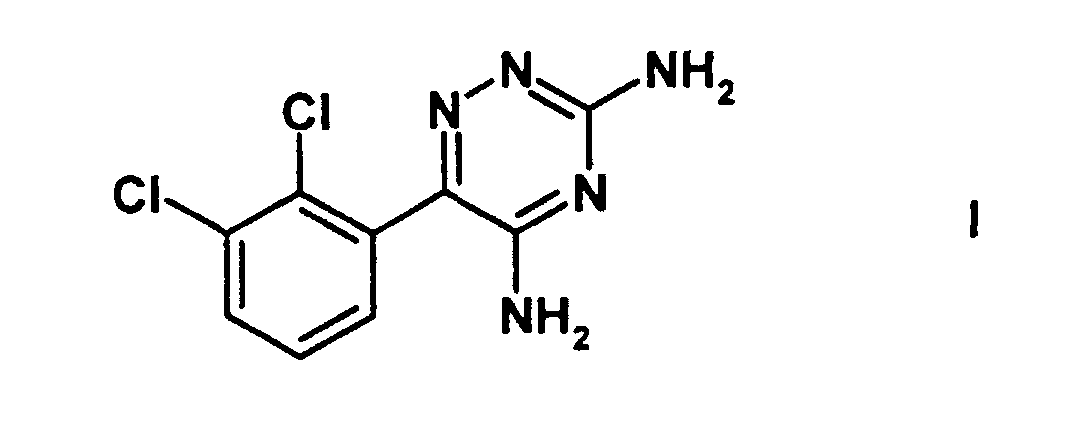
- Lamotrigine (3,5-diamino-6- (2,3-dichforphenyl) -1,2,4-triazine) has the formula I.
- This compound disclosed for example in EP-A-0 021 121, is suitable for Treatment of diseases of the central nervous system, especially epilepsy, having been used in antispasmodic drugs in numerous countries since 1990 is.
- 2,3-dichlorobenzoic anhydride is obtained as an impurity in the synthesis of 2,3-dichlorobenzoyl cyanide (formula VI).
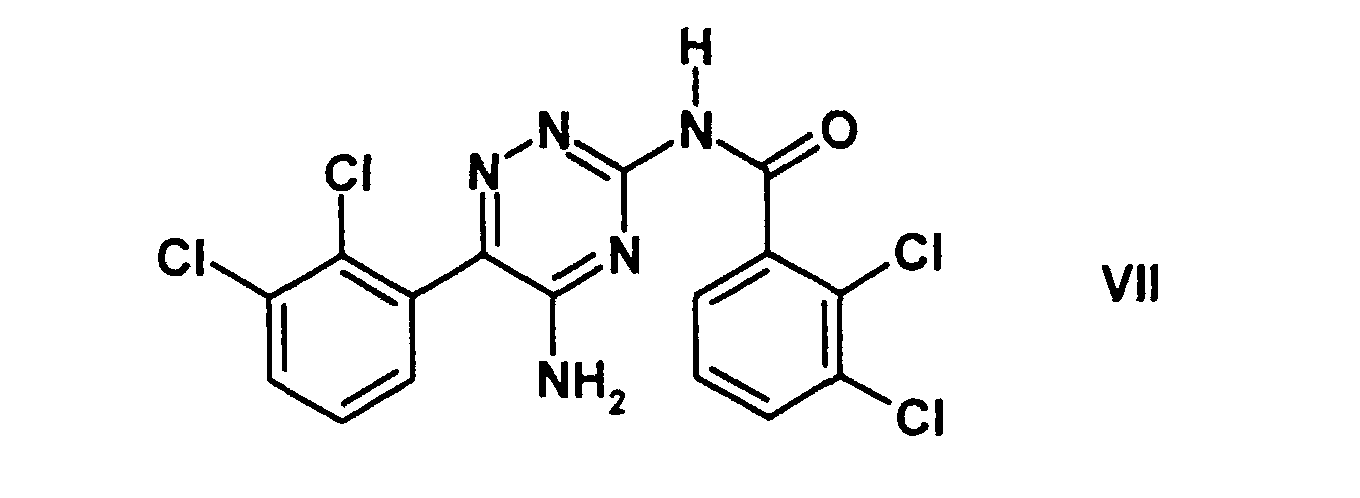
- this anhydride can be further reacted with lamotrigine to form a compound of formula VII react, which is an undesirable contamination.
- EP-A-0 963 980 mentions a compound of the formula VIII as an additional undesirable impurity caused by hydrolysis of lamotrigine under alkaline conditions.
- WO 96/20935 discloses a process for the production of lamotrigine from 6- (2,3-dichlorophenyl) -3-methylthio-5-chloro-1,2,4-triazine. When reworking this procedure In addition to lamotrigine, larger amounts were also possible in the reaction mixture by means of HPLC unknown by-products are detected.
- An object of the present invention was therefore to provide a method for To provide manufacture of lamotrigine that complies with the aforementioned Overcomes disadvantages.
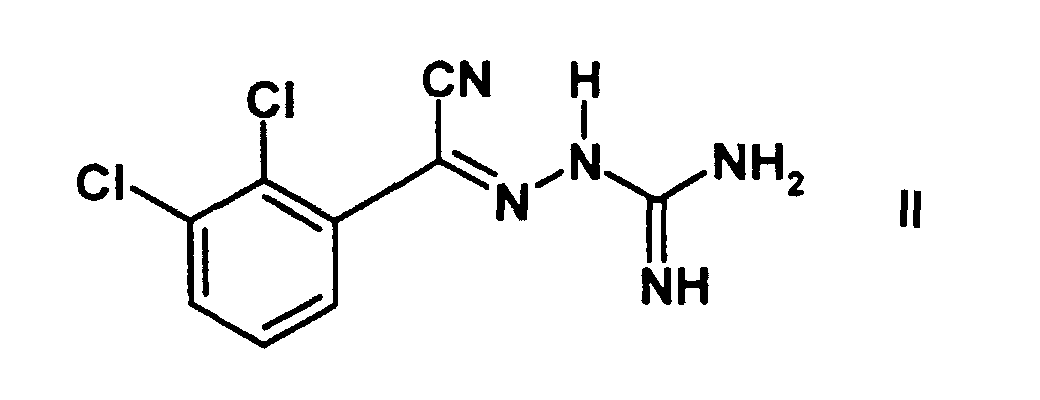
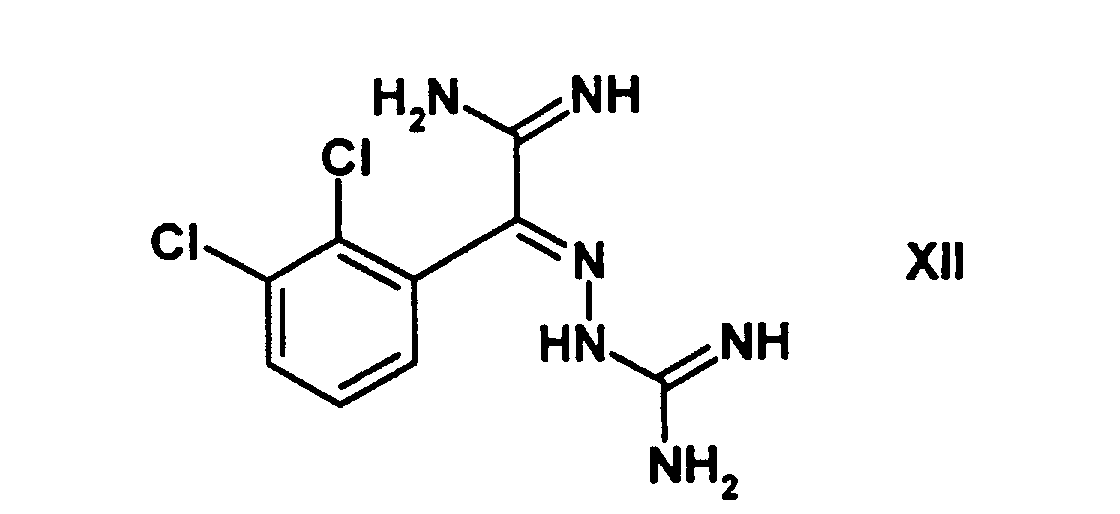
- the present invention thus relates to a process for the preparation of lamotrigine or a pharmaceutically acceptable salt thereof, in which with a compound of formula XII or a salt thereof, a ring closure reaction is carried out and, if appropriate, the free base is released from the salt of the compound of formula I thus obtained and, if desired, it is converted into a pharmaceutically acceptable salt.
- the ring closure reaction according to the invention with the compound XII leads to lamotrigine this under mild conditions in high yield and particularly high purity receive.
- the compound of formula XII has a simple Syntheseweg is easily accessible and is easy to clean by crystallization.
- Ring closure reaction can be a particularly high purity of the desired lamotrigine towards a purity necessary for pharmaceuticals without the need for more elaborate Cleaning steps can be achieved.
- those described in EP-A-0 963 980 mentioned impurities of formulas VII and VIII in according to the invention Processed lamotrigine not proven.
- the ring closure reaction can be carried out under mild conditions by heating, for example to a temperature in the range of 100 ° -170 ° C, preferably 130 ° -170 ° C. become.
- the ring closure reaction is preferably carried out in solution.
- a solvent for the compound of formula XII all organic solvents are suitable, none have a negative influence on the reaction, preferably dimethyl sulfoxide or Dimethylformamide. Those solvents which are particularly preferred are those in which boil the desired temperature range, the reaction then at the boiling temperature of the solvent can take place under reflux.
- Solvent mixtures for example of dimethyl sulfoxide, can also be at the boiling point or dimethylformamide can be used with benzene, toluene or xylene.
- dimethylformamide used as a solvent.
- the ring closure reaction should be in the absence of water or at least essentially be carried out in the absence of water.
- the ring closure reaction can be carried out with the free base of the compound of formula XII or with an acid addition salt of this compound.
- an acid addition salt dihydrochloride is preferred.
- the product is the acid addition salt of Lamotrigine.
- the free lamotrigine base in one of the A person skilled in the art for example with aqueous sodium hydroxide solution in Dimethylformamide, can be obtained in almost quantitative yield.
- the reaction time required for the ring closure reaction depends on the Process conditions and in particular the temperature at which the reaction is carried out from. For example, it can be in the range of 1-24 hours. A optimal duration can easily be determined by a specialist.
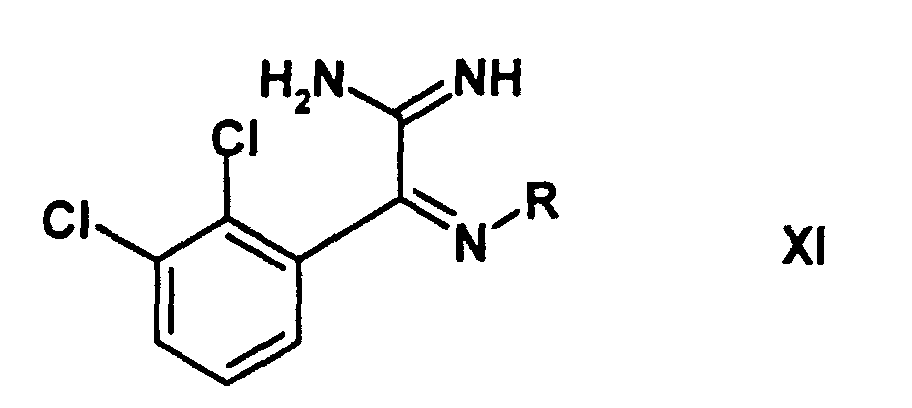
- the compound of the formula XII required for the ring closure reaction is obtained by reacting a compound of the formula XI where R represents an optionally substituted straight-chain, branched or cyclic alkyl, aryl or aralkyl radical, or a salt thereof with aminoguanidine or a salt thereof.
- R can be a straight-chain, branched or cyclic alkyl radical, preferably C 1-20 , in particular C 1-10 alkyl radical, such as, for example, methyl, ethyl, n-propyl, isopropyl, n-butyl , iso-butyl, tert-butyl or cyclohexyl.
- Preferred aryl radicals for R are phenyl and naphthyl, in particular phenyl.
- Preferred aralkyl radicals for R are aryl-C 1-5 -alkyl radicals, in which aryl is as defined above, and in particular benzyl.
- alkyl, aryl and aralkyl radicals can optionally carry one or more, in particular 1 or 2, substituents such as, for example, halogen, hydroxy, C 1-6 alkoxy or nitro.
- substituents such as, for example, halogen, hydroxy, C 1-6 alkoxy or nitro.
- the aryl and aralkyl radicals can additionally or alternatively be substituted by C 1-6 alkyl.
- R is preferably phenyl
- the compound of formula XII with Aminoguanidine or a salt thereof, preferably with aminoguanidine hydrochloride, implemented.
- the reaction preferably takes place in the presence of a strong mineral acid, for example hydrochloric acid instead.
- a strong mineral acid for example hydrochloric acid instead.
- any suitable solvent Solvent that does not adversely affect the reaction.
- The is preferred Reaction carried out in water or an alcohol.
- the reaction temperature is not further restricted and can for example be in a range of 40 ° -120 ° C.
- the dihydrochloride of the compound of formula XII is obtained.
- Lamotrigine hydrochloride can be reacted or, if desired, the free base beforehand the compound of formula XII in a manner known to those skilled in the art, for example with aqueous sodium hydroxide solution can be obtained.
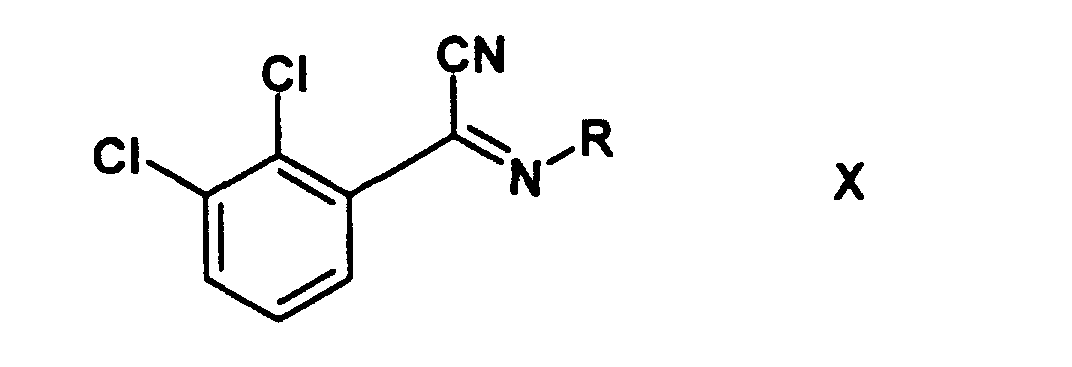
- the compound of the formula XI or a salt thereof is reacted by reacting a compound of the formula X where R is as defined above, first with an alcoholic solution of hydrohalic acid and then with NH 3 .
- This reaction route is particularly advantageous because the compound of formula X is surprisingly stable and easy to clean by crystallization.
- the compound of formula X is crystalline and stable, so that it can be easily cleaned.
- the method according to the invention therefore enables the production of a particularly pure lamotrigine at this point in the synthesis route, since the intermediates can already be obtained in a particularly pure form.
- the compound of the formula X can be obtained by reaction with sodium cyanide instead of the copper cyanide required in the prior art for the synthesis of 2,3-dichlorobenzoyl cyanide. Since sodium cyanide is cheaper in comparison to copper cyanide, the synthesis of the lamotrigine by means of the method according to the invention can thus be carried out overall particularly inexpensively and economically.
- reaction of the compound of the formula X to the compound of the formula XI takes place in two stages, first with an alcoholic solution of a hydrohalic acid, preferably a methanolic or ethanolic hydrochloric acid solution, and then with NH 3 , for example by adding ethanol saturated with ammonia becomes. Both reaction steps can be carried out, for example, in a temperature range from -30 ° to + 10 ° C.
- a hydrohalic acid preferably a methanolic or ethanolic hydrochloric acid solution
- NH 3 for example by adding ethanol saturated with ammonia becomes.
- ⁇ -iminonitriles of the formula X are easily accessible, for example, as described in German Offenlegungsschrift No. 2 221 771.
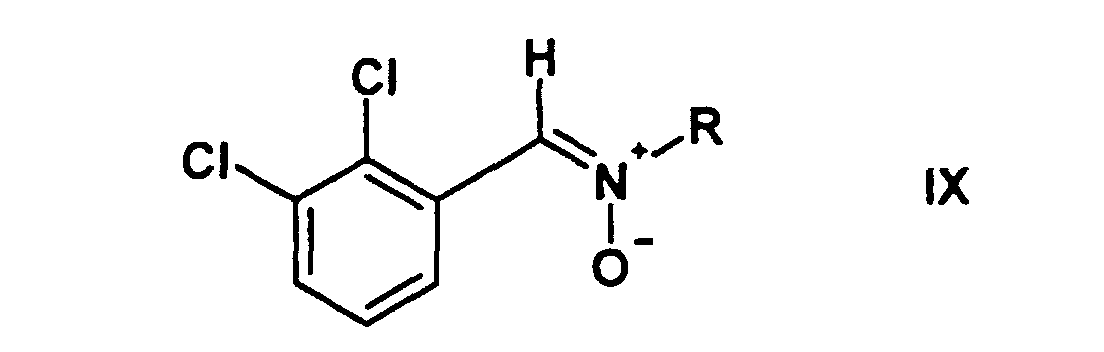
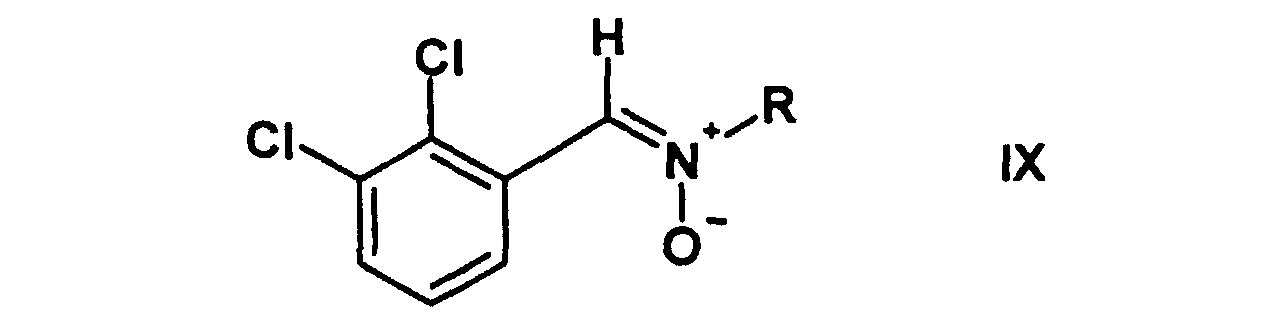
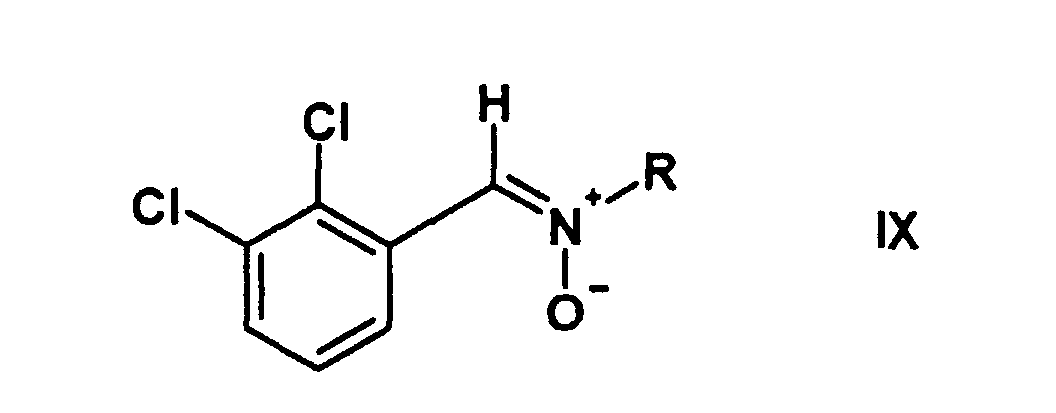
- a nitron of the formula IX is used to prepare the compound of the formula X. wherein R is as defined above, reacted with a cyanide.
- This process variant has the advantage over the processes for the production of lamotrigine known in the prior art that, for example, sodium cyanide can be used as the cyanide, which is cheaper and easier to handle than the copper cyanide used in the processes of the prior art.
- the reaction of the nitrone of the formula IX with the cyanide can, for example, in an aqueous buffer, e.g. a phosphate, acetate or tartrate buffer, in particular a phosphate buffer, for example at a pH in the range from 4-8.
- a phosphate buffer e.g. a phosphate, acetate or tartrate buffer, in particular a phosphate buffer, for example at a pH in the range from 4-8.
- a lower alcohol is advantageous as a co-solvent, preferably methanol used.
- Implementation can be in a wide range Temperature range for example from room temperature to about 80 ° C.
- nitrone of Formula IX can be prepared by the method described by M.P. Grammaticakis in Bull. Soc. Chim. [1951], p. 971 can be obtained.
- the present invention also relates to compounds of the formulas IX, X, XI and XII and their salts, which are intermediates in the process according to the invention occur.
- the present invention relates to the use of Compounds of the formulas IX, X, XI and XII or salts thereof for the preparation of Lamotrigine.
- the lamotrigine produced by the process according to the invention is suitable for Manufacture of pharmaceutical compositions, in particular pharmaceutically acceptable salts of lamotrigine are used.
- suitable pharmaceutically acceptable salts and suitable pharmaceutical compositions are described, for example, in EP-A-0 021 121, EP-A-0 247 892 and WO 96/20935.
- the NMR spectroscopic data correspond to the chemical structure.
- the NMR spectroscopic data correspond to the chemical structure.
- the free lamotrigine base can be released in the usual way with aqueous Sodium hydroxide solution in dimethylformamide can be obtained in almost quantitative yield.
Landscapes
- Chemical & Material Sciences (AREA)
- Organic Chemistry (AREA)
- Organic Low-Molecular-Weight Compounds And Preparation Thereof (AREA)
- Pharmaceuticals Containing Other Organic And Inorganic Compounds (AREA)
Abstract
Description




- Ausbeute:
- 157 g
- Reinheit:
- 99,0% (HPLC)
- Schmelzpunkt:
- 65°-67°C
- Ausbeute:
- 166,7 g
- Reinheit:
- 99,7% (HPLC)
- Schmelzpunkt:
- 263°-267°C
- Ausbeute:
- 160,0 g (91,5%)
- Reinheit:
- 99,0% (HPLC)
- Schmelzpunkt:
- 218°-220°C (Zers.)
- Schmelzpunkt:
- 200°-203°C
- Ausbeute:
- 10,6 g (60,5 %)
- Reinheit:
- 99,5 % (HPLC)
- Schmelzpunkt:
- 233°-235°C (Zers.)
- Ausbeute:
- 5,1 g (66,7 %)
- Reinheit:
- 99,9 % (HPLC)
- Schmelzpunkt:
- 215,5°-216,5°C (Zers.)
Claims (15)
- Verfahren zur Herstellung einer Verbindung der Formel Ioder eines pharmazeutisch verträglichen Salzes davon, worin mit einer Verbindung der Formel XII
 oder einem Salz davon eine Ringschlußreaktion durchgeführt wird und gegebenenfalls aus dem dabei erhaltenen Salz der Verbindung der Formel I die freie Base freigesetzt wird und, falls gewünscht, diese in ein pharmazeutisch verträgliches Salz überführt wird.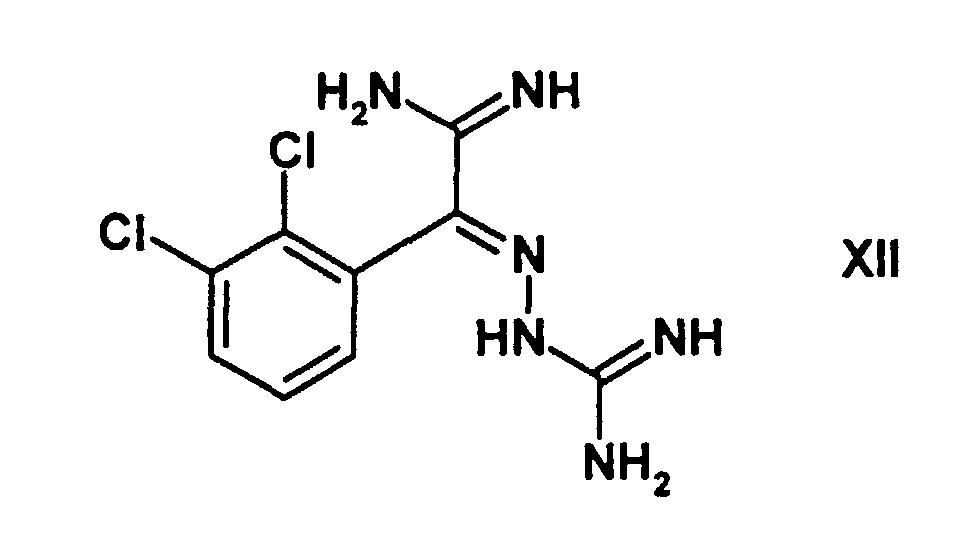
- Verfahren nach Anspruch 1, worin die Ringschlußreaktion durch Erwärmen durchgeführt wird.
- Verfahren nach Anspruch 2, worin die Ringschlußreaktion bei einer Temperatur im Bereich von 100° bis 170°C durchgeführt wird.
- Verfahren nach einem der vorhergehenden Ansprüche, worin die Ringschlußreaktion mit einem Säureadditionssalz, vorzugsweise dem Dihydrochlorid der Verbindung der Formel XII durchgeführt wird.
- Verfahren nach einem der vorhergehenden Ansprüche, worin die Verbindung der Formel XII oder ein Salz davon durch Umsetzung einer Verbindung der Formel XIwobei R für einen gegebenenfalls substituierten geradkettigen, verzweigten oder cyclischen Alkyl-, Aryl- oder Aralkyl-Rest steht, oder einem Salz davon mit Aminoguanidin oder einem Salz davon erhalten wird.

- Verfahren nach Anspruch 5, worin die Verbindung der Formel XI oder ein Salz davon durch Umsetzung einer Verbindung der Formel Xwobei R wie in Anspruch 5 definiert ist, zunächst mit einer alkoholischen Lösung einer Halogenwasserstoffsäure und anschließend mit NH3 erhalten wird.

- Verfahren nach Anspruch 6, worin die Verbindung der Formel X oder ein Salz davon durch Umsetzung einer Verbindung der Formel IXwobei R wie in Anspruch 5 definiert ist, mit einem Cyanid erhalten wird.
- Verbindung der Formel IXwobei R für einen gegebenenfalls substituierten geradkettigen, verzweigten oder cyclischen Alkyl-, Aryl- oder Aralkyl-Rest steht, oder ein Salz davon.

- Verbindung der Formel Xwobei R für einen gegebenenfalls substituierten geradkettigen, verzweigten oder cyclischen Alkyl-, Aryl- oder Aralkyl-Rest steht, oder ein Salz davon.

- Verbindung der Formel XIwobei R für einen gegebenenfalls substituierten geradkettigen, verzweigten oder cyclischen Alkyl-, Aryl- oder Aralkyl-Rest steht, oder ein Salz davon.

- Verbindung der Formel XIIoder ein Salz davon.

- Verwendung einer Verbindung der Formel IXwobei R für einen gegebenenfalls substituierten geradkettigen, verzweigten oder cyclischen Alkyl-, Aryl- oder Aralkyl-Rest steht, oder einem Salz davon zur Herstellung von Lamotrigin oder einem pharmazeutisch verträglichen Salz davon.
- Verwendung einer Verbindung der Formel Xwobei R für einen gegebenenfalls substituierten geradkettigen, verzweigten oder cyclischen Alkyl-, Aryl- oder Aralkyl-Rest steht, oder einem Salz davon zur Herstellung von Lamotrigin oder einem pharmazeutisch verträglichen Salz davon.
- Verwendung einer Verbindung der Formel XIwobei R für einen gegebenenfalls substituierten geradkettigen, verzweigten oder cyclischen Alkyl-, Aryl- oder Aralkyl-Rest steht, oder einem Salz davon zur Herstellung von Lamotrigin oder einem pharmazeutisch verträglichen Salz davon.

- Verwendung einer Verbindung der Formel XIIoder einem Salz davon zur Herstellung von Lamotrigin oder einem pharmazeutisch verträglichen Salz davon.
Applications Claiming Priority (3)
| Application Number | Priority Date | Filing Date | Title |
|---|---|---|---|
| DE10134980A DE10134980C2 (de) | 2001-07-17 | 2001-07-17 | Verfahren zur Herstellung von Lamotrigin |
| DE10134980 | 2001-07-17 | ||
| PCT/EP2002/007433 WO2003008393A1 (de) | 2001-07-17 | 2002-07-04 | Verfahren zur herstellung von lamotrigin aus alpha-oxo-2,3-dichlorphenylacetamidino-aminoguanidino-hydrazon durch ringschlussreaktion |
Publications (2)
| Publication Number | Publication Date |
|---|---|
| EP1311492A1 EP1311492A1 (de) | 2003-05-21 |
| EP1311492B1 true EP1311492B1 (de) | 2004-09-08 |
Family
ID=7692239
Family Applications (1)
| Application Number | Title | Priority Date | Filing Date |
|---|---|---|---|
| EP02758308A Expired - Lifetime EP1311492B1 (de) | 2001-07-17 | 2002-07-04 | Verfahren zur herstellung von lamotrigin aus alpha-oxo-2,3-dichlorphenylacetamidino-aminoguanidino-hydrazon durch ringschlussreaktion |
Country Status (6)
| Country | Link |
|---|---|
| US (1) | US6683182B2 (de) |
| EP (1) | EP1311492B1 (de) |
| CA (1) | CA2417435C (de) |
| DE (1) | DE10134980C2 (de) |
| ES (1) | ES2224074T3 (de) |
| WO (1) | WO2003008393A1 (de) |
Families Citing this family (3)
| Publication number | Priority date | Publication date | Assignee | Title |
|---|---|---|---|---|
| GB0613836D0 (en) | 2006-07-13 | 2006-08-23 | Univ Greenwich | New medical use of triazine derivatives |
| GB0800741D0 (en) * | 2008-01-16 | 2008-02-20 | Univ Greenwich | Cyclic triazo and diazo sodium channel blockers |
| GB2471713A (en) * | 2009-07-08 | 2011-01-12 | Univ Greenwich | 1,2,4-triazine derivatives and their use as sodium channel blockers |
Family Cites Families (4)
| Publication number | Priority date | Publication date | Assignee | Title |
|---|---|---|---|---|
| WO1996020934A1 (en) * | 1994-12-30 | 1996-07-11 | The Wellcome Foundation Limited | Process for the preparation of lamotrigine |
| GB9812413D0 (en) | 1998-06-10 | 1998-08-05 | Glaxo Group Ltd | Compound and its use |
| CZ20011949A3 (cs) * | 1998-12-14 | 2001-09-12 | Torrent Pharmacauticals Ltd | Zlepšený způsob výroby 3,5-diamino-6-(2,3-dichlorfenyl)-1,2,4-triazinu |
| WO2001049669A1 (en) | 2000-01-03 | 2001-07-12 | Rpg Life Sciences Limited | A process for the preparation of 6-(2,3-dichlorophenyl)-1,2,4-triazine-3,5-diamine, commonly known as lamotrigine |
-
2001
- 2001-07-17 DE DE10134980A patent/DE10134980C2/de not_active Expired - Fee Related
-
2002
- 2002-07-04 WO PCT/EP2002/007433 patent/WO2003008393A1/de not_active Ceased
- 2002-07-04 US US10/343,225 patent/US6683182B2/en not_active Expired - Fee Related
- 2002-07-04 CA CA002417435A patent/CA2417435C/en not_active Expired - Fee Related
- 2002-07-04 EP EP02758308A patent/EP1311492B1/de not_active Expired - Lifetime
- 2002-07-04 ES ES02758308T patent/ES2224074T3/es not_active Expired - Lifetime
Also Published As
| Publication number | Publication date |
|---|---|
| WO2003008393A1 (de) | 2003-01-30 |
| EP1311492A1 (de) | 2003-05-21 |
| CA2417435A1 (en) | 2003-01-30 |
| CA2417435C (en) | 2004-01-13 |
| ES2224074T3 (es) | 2005-03-01 |
| DE10134980A1 (de) | 2003-02-13 |
| US6683182B2 (en) | 2004-01-27 |
| DE10134980C2 (de) | 2003-05-28 |
| US20030191310A1 (en) | 2003-10-09 |
Similar Documents
| Publication | Publication Date | Title |
|---|---|---|
| DE69431751T2 (de) | Benzylaminochinuclidinen mit ein durch ein heteronom substituiertes alkyl als substanz p antagoniste | |
| DE3751978T2 (de) | Dihydropyridin-Derivate, ihre Herstellung und ihre Anwendung | |
| CH629778A5 (de) | Verfahren zur herstellung neuer 1,4-dihydropyridinderivate. | |
| CH633544A5 (de) | Verfahren zur herstellung von thiazolessigsaeureverbindungen. | |
| DE1967325B2 (de) | Isomere 3,4-Dihydro-2H-1,2-benzothiazin-1,1-dioxide | |
| DE1620501A1 (de) | Neue Sydnonimin-Derivate und Verfahren zu ihrer Herstellung | |
| DE2452691A1 (de) | 2,6-disubstituierte phenylaminoguanidinverbindungen | |
| DE2505297A1 (de) | Neue 2-arylamino-2-imidazolinderivate und ein verfahren zu deren herstellung | |
| DE2749988A1 (de) | N-substituierte imidazolcarboxamide, verfahren zu deren herstellung und dieselben enthaltendes mittel | |
| DE10134980C2 (de) | Verfahren zur Herstellung von Lamotrigin | |
| DE2424670A1 (de) | Triazolo-isoindol-derivate und verfahren zu deren herstellung | |
| EP0471262B1 (de) | Verfahren zur Herstellung von substituierten 3-Aminoacrylestern | |
| DE60309899T2 (de) | Verfahren zur synthese von hochreinem 3,5-diamino-6-(2,3-dichlorphenyl)-1,2,4-triazin | |
| DE2943286C2 (de) | ||
| EP0083729B1 (de) | Substituierte 1-Benzoyl-2-phenylimino-imidazolidine, deren Säureadditionssalze, Verfahren zu deren Herstellung und diese enthaltende Arzneimittel | |
| DE2533211A1 (de) | Verfahren zur herstellung von imidazolderivaten | |
| DE1770490B2 (de) | 2,4-Diamino-6-nitrosamino-chinazolinverbindungen und Verfahren zu ihrer Herstellung | |
| DE3204074C2 (de) | ||
| DE2747122A1 (de) | Derivate von 6-(m-aminophenyl)-2, 3,5,6-tetrahydroimidazo eckige klammer auf 2,1-b eckige klammer zu -thiazol, verfahren zu ihrer herstellung und ihre verwendung | |
| DD233373A5 (de) | Verfahren zur herstellung von imidazolidinderivaten | |
| DE2628469A1 (de) | Gamma-aminoalkohole und verfahren zu ihrer herstellung | |
| DE69911462T2 (de) | Ein verbessertes verfahren zur herstellung von 3,5-diamino-6-(2,3-dichlorophenyl)-1,2,4-triazin | |
| DE1643265C3 (de) | Kernsubstituierte 2-Aminomethylbenzhydrole, Verfahren zu deren Herstellung und Arzneimittel auf der Basis dieser Verbindungen | |
| DE69002217T2 (de) | Dibenzodioxazecin- und Dibenzodioxaazacycloundecin-Derivate. | |
| EP0102929B1 (de) | Propylamin-Derivate, Verfahren zu ihrer Herstellung, pharmazeutische Präparate enthaltend diese Verbindungen, sowie ihre therapeutische Verwendung |
Legal Events
| Date | Code | Title | Description |
|---|---|---|---|
| PUAI | Public reference made under article 153(3) epc to a published international application that has entered the european phase |
Free format text: ORIGINAL CODE: 0009012 |
|
| 17P | Request for examination filed |
Effective date: 20030116 |
|
| AK | Designated contracting states |
Designated state(s): AT BE BG CH CY CZ DE DK EE ES FI FR GB GR IE IT LI LU MC NL PT |
|
| AX | Request for extension of the european patent |
Extension state: AL LT LV MK RO SI |
|
| GRAJ | Information related to disapproval of communication of intention to grant by the applicant or resumption of examination proceedings by the epo deleted |
Free format text: ORIGINAL CODE: EPIDOSDIGR1 |
|
| GRAP | Despatch of communication of intention to grant a patent |
Free format text: ORIGINAL CODE: EPIDOSNIGR1 |
|
| GRAP | Despatch of communication of intention to grant a patent |
Free format text: ORIGINAL CODE: EPIDOSNIGR1 |
|
| GRAS | Grant fee paid |
Free format text: ORIGINAL CODE: EPIDOSNIGR3 |
|
| RBV | Designated contracting states (corrected) |
Designated state(s): ES FR GB IT |
|
| REG | Reference to a national code |
Ref country code: DE Ref legal event code: 8566 |
|
| GRAA | (expected) grant |
Free format text: ORIGINAL CODE: 0009210 |
|
| RIN1 | Information on inventor provided before grant (corrected) |
Inventor name: GARACZI, SAENDOR Inventor name: NYERGES, MIKLUS Inventor name: LUKACS, FERENC Inventor name: MATE, ATTILA, GERGELY Inventor name: ONDI, LEVENTE Inventor name: GEGOE, CSABA, LEHEL Inventor name: SCHNEIDER, GEZA |
|
| AK | Designated contracting states |
Kind code of ref document: B1 Designated state(s): ES FR GB IT |
|
| REG | Reference to a national code |
Ref country code: GB Ref legal event code: FG4D Free format text: NOT ENGLISH |
|
| GBT | Gb: translation of ep patent filed (gb section 77(6)(a)/1977) |
Effective date: 20040908 |
|
| REG | Reference to a national code |
Ref country code: IE Ref legal event code: FG4D Free format text: GERMAN |
|
| LTIE | Lt: invalidation of european patent or patent extension |
Effective date: 20040908 |
|
| REG | Reference to a national code |
Ref country code: ES Ref legal event code: FG2A Ref document number: 2224074 Country of ref document: ES Kind code of ref document: T3 |
|
| ET | Fr: translation filed | ||
| REG | Reference to a national code |
Ref country code: IE Ref legal event code: FD4D |
|
| PLBE | No opposition filed within time limit |
Free format text: ORIGINAL CODE: 0009261 |
|
| STAA | Information on the status of an ep patent application or granted ep patent |
Free format text: STATUS: NO OPPOSITION FILED WITHIN TIME LIMIT |
|
| 26N | No opposition filed |
Effective date: 20050609 |
|
| PGFP | Annual fee paid to national office [announced via postgrant information from national office to epo] |
Ref country code: FR Payment date: 20060719 Year of fee payment: 5 |
|
| PGFP | Annual fee paid to national office [announced via postgrant information from national office to epo] |
Ref country code: GB Payment date: 20060721 Year of fee payment: 5 |
|
| PGFP | Annual fee paid to national office [announced via postgrant information from national office to epo] |
Ref country code: ES Payment date: 20060724 Year of fee payment: 5 |
|
| PGFP | Annual fee paid to national office [announced via postgrant information from national office to epo] |
Ref country code: IT Payment date: 20060731 Year of fee payment: 5 |
|
| GBPC | Gb: european patent ceased through non-payment of renewal fee |
Effective date: 20070704 |
|
| PG25 | Lapsed in a contracting state [announced via postgrant information from national office to epo] |
Ref country code: GB Free format text: LAPSE BECAUSE OF NON-PAYMENT OF DUE FEES Effective date: 20070704 |
|
| REG | Reference to a national code |
Ref country code: FR Ref legal event code: ST Effective date: 20080331 |
|
| PG25 | Lapsed in a contracting state [announced via postgrant information from national office to epo] |
Ref country code: FR Free format text: LAPSE BECAUSE OF NON-PAYMENT OF DUE FEES Effective date: 20070731 |
|
| REG | Reference to a national code |
Ref country code: ES Ref legal event code: FD2A Effective date: 20070705 |
|
| PG25 | Lapsed in a contracting state [announced via postgrant information from national office to epo] |
Ref country code: ES Free format text: LAPSE BECAUSE OF NON-PAYMENT OF DUE FEES Effective date: 20070705 |
|
| PG25 | Lapsed in a contracting state [announced via postgrant information from national office to epo] |
Ref country code: IT Free format text: LAPSE BECAUSE OF NON-PAYMENT OF DUE FEES Effective date: 20070704 |