EP1295935B1 - Waschmittelzusammensetzung - Google Patents
Waschmittelzusammensetzung Download PDFInfo
- Publication number
- EP1295935B1 EP1295935B1 EP01273201A EP01273201A EP1295935B1 EP 1295935 B1 EP1295935 B1 EP 1295935B1 EP 01273201 A EP01273201 A EP 01273201A EP 01273201 A EP01273201 A EP 01273201A EP 1295935 B1 EP1295935 B1 EP 1295935B1
- Authority
- EP
- European Patent Office
- Prior art keywords
- chain
- carbon atoms
- straight
- branched
- alkyl group
- Prior art date
- Legal status (The legal status is an assumption and is not a legal conclusion. Google has not performed a legal analysis and makes no representation as to the accuracy of the status listed.)
- Expired - Lifetime
Links
- 239000000203 mixture Substances 0.000 title claims abstract description 105
- 239000003599 detergent Substances 0.000 title claims description 18
- 238000004140 cleaning Methods 0.000 claims abstract description 116
- 125000004432 carbon atom Chemical group C* 0.000 claims abstract description 76
- 125000000217 alkyl group Chemical group 0.000 claims abstract description 70
- 150000001875 compounds Chemical class 0.000 claims abstract description 51
- 239000002736 nonionic surfactant Substances 0.000 claims abstract description 47
- 125000004435 hydrogen atom Chemical group [H]* 0.000 claims abstract description 36
- 239000004094 surface-active agent Substances 0.000 claims description 66
- 150000002148 esters Chemical class 0.000 claims description 26
- 125000001997 phenyl group Chemical group [H]C1=C([H])C([H])=C(*)C([H])=C1[H] 0.000 claims description 22
- XLYOFNOQVPJJNP-UHFFFAOYSA-N water Substances O XLYOFNOQVPJJNP-UHFFFAOYSA-N 0.000 claims description 19
- 239000002202 Polyethylene glycol Substances 0.000 claims description 8
- MTHSVFCYNBDYFN-UHFFFAOYSA-N diethylene glycol Chemical compound OCCOCCO MTHSVFCYNBDYFN-UHFFFAOYSA-N 0.000 claims description 8
- 229920001223 polyethylene glycol Polymers 0.000 claims description 8
- 150000003839 salts Chemical class 0.000 claims description 7
- 125000003342 alkenyl group Chemical group 0.000 claims description 5
- 125000002887 hydroxy group Chemical group [H]O* 0.000 claims description 5
- 125000002252 acyl group Chemical group 0.000 claims description 3
- 230000007613 environmental effect Effects 0.000 abstract description 6
- 230000004907 flux Effects 0.000 description 22
- 238000000034 method Methods 0.000 description 19
- 229910000679 solder Inorganic materials 0.000 description 17
- RTZKZFJDLAIYFH-UHFFFAOYSA-N Diethyl ether Chemical compound CCOCC RTZKZFJDLAIYFH-UHFFFAOYSA-N 0.000 description 12
- 239000007864 aqueous solution Substances 0.000 description 12
- -1 hydrocarbon halide Chemical class 0.000 description 12
- 229910052751 metal Inorganic materials 0.000 description 11
- 239000002184 metal Substances 0.000 description 11
- 230000000694 effects Effects 0.000 description 8
- 239000000758 substrate Substances 0.000 description 7
- 239000002562 thickening agent Substances 0.000 description 7
- 239000013008 thixotropic agent Substances 0.000 description 7
- WVDDGKGOMKODPV-UHFFFAOYSA-N Benzyl alcohol Chemical compound OCC1=CC=CC=C1 WVDDGKGOMKODPV-UHFFFAOYSA-N 0.000 description 6
- 239000000919 ceramic Substances 0.000 description 6
- 230000003749 cleanliness Effects 0.000 description 6
- 230000000052 comparative effect Effects 0.000 description 6
- CYSGHNMQYZDMIA-UHFFFAOYSA-N 1,3-Dimethyl-2-imidazolidinon Chemical compound CN1CCN(C)C1=O CYSGHNMQYZDMIA-UHFFFAOYSA-N 0.000 description 5
- 239000008237 rinsing water Substances 0.000 description 5
- 239000000243 solution Substances 0.000 description 5
- SVCRDVHXRDRHCP-UHFFFAOYSA-N 1-phenyl-1-hexanol Natural products CCCCCC(O)C1=CC=CC=C1 SVCRDVHXRDRHCP-UHFFFAOYSA-N 0.000 description 4
- PXHVJJICTQNCMI-UHFFFAOYSA-N Nickel Chemical compound [Ni] PXHVJJICTQNCMI-UHFFFAOYSA-N 0.000 description 4
- 230000002378 acidificating effect Effects 0.000 description 4
- 239000000654 additive Substances 0.000 description 4
- 238000005238 degreasing Methods 0.000 description 4
- 235000014113 dietary fatty acids Nutrition 0.000 description 4
- 239000000194 fatty acid Substances 0.000 description 4
- 229930195729 fatty acid Natural products 0.000 description 4
- 239000004615 ingredient Substances 0.000 description 4
- NFJSYLMJBNUDNG-UHFFFAOYSA-N 1,3-dipropylimidazolidin-2-one Chemical compound CCCN1CCN(CCC)C1=O NFJSYLMJBNUDNG-UHFFFAOYSA-N 0.000 description 3
- 0 C(C1)*C11CCCC1 Chemical compound C(C1)*C11CCCC1 0.000 description 3
- 230000006378 damage Effects 0.000 description 3
- 239000006260 foam Substances 0.000 description 3
- 238000007654 immersion Methods 0.000 description 3
- 239000002563 ionic surfactant Substances 0.000 description 3
- 230000007935 neutral effect Effects 0.000 description 3
- 239000003921 oil Substances 0.000 description 3
- 239000002245 particle Substances 0.000 description 3
- 229920001515 polyalkylene glycol Polymers 0.000 description 3
- 238000012360 testing method Methods 0.000 description 3
- NYCCIHSMVNRABA-UHFFFAOYSA-N 1,3-diethylimidazolidin-2-one Chemical compound CCN1CCN(CC)C1=O NYCCIHSMVNRABA-UHFFFAOYSA-N 0.000 description 2
- HQRWWHIETAKIMO-UHFFFAOYSA-N 1-phenylbutan-1-ol Chemical compound CCCC(O)C1=CC=CC=C1 HQRWWHIETAKIMO-UHFFFAOYSA-N 0.000 description 2
- WAPNOHKVXSQRPX-UHFFFAOYSA-N 1-phenylethanol Chemical compound CC(O)C1=CC=CC=C1 WAPNOHKVXSQRPX-UHFFFAOYSA-N 0.000 description 2
- DQYSALLXMHVJAV-UHFFFAOYSA-M 3-heptyl-2-[(3-heptyl-4-methyl-1,3-thiazol-3-ium-2-yl)methylidene]-4-methyl-1,3-thiazole;iodide Chemical compound [I-].CCCCCCCN1C(C)=CS\C1=C\C1=[N+](CCCCCCC)C(C)=CS1 DQYSALLXMHVJAV-UHFFFAOYSA-M 0.000 description 2
- RSWGJHLUYNHPMX-UHFFFAOYSA-N Abietic-Saeure Natural products C12CCC(C(C)C)=CC2=CCC2C1(C)CCCC2(C)C(O)=O RSWGJHLUYNHPMX-UHFFFAOYSA-N 0.000 description 2
- IAYPIBMASNFSPL-UHFFFAOYSA-N Ethylene oxide Chemical compound C1CO1 IAYPIBMASNFSPL-UHFFFAOYSA-N 0.000 description 2
- OVGORFFCBUIFIA-UHFFFAOYSA-N Fenipentol Chemical compound CCCCC(O)C1=CC=CC=C1 OVGORFFCBUIFIA-UHFFFAOYSA-N 0.000 description 2
- CBENFWSGALASAD-UHFFFAOYSA-N Ozone Chemical compound [O-][O+]=O CBENFWSGALASAD-UHFFFAOYSA-N 0.000 description 2
- 241000282320 Panthera leo Species 0.000 description 2
- DYUQAZSOFZSPHD-UHFFFAOYSA-N Phenylpropanol Chemical compound CCC(O)C1=CC=CC=C1 DYUQAZSOFZSPHD-UHFFFAOYSA-N 0.000 description 2
- 229920003171 Poly (ethylene oxide) Polymers 0.000 description 2
- KHPCPRHQVVSZAH-HUOMCSJISA-N Rosin Natural products O(C/C=C/c1ccccc1)[C@H]1[C@H](O)[C@@H](O)[C@@H](O)[C@@H](CO)O1 KHPCPRHQVVSZAH-HUOMCSJISA-N 0.000 description 2
- 230000000996 additive effect Effects 0.000 description 2
- 150000005215 alkyl ethers Chemical class 0.000 description 2
- 125000002947 alkylene group Chemical group 0.000 description 2
- XPNGNIFUDRPBFJ-UHFFFAOYSA-N alpha-methylbenzylalcohol Natural products CC1=CC=CC=C1CO XPNGNIFUDRPBFJ-UHFFFAOYSA-N 0.000 description 2
- 235000015278 beef Nutrition 0.000 description 2
- 235000019445 benzyl alcohol Nutrition 0.000 description 2
- 239000003795 chemical substances by application Substances 0.000 description 2
- 239000000356 contaminant Substances 0.000 description 2
- 230000007797 corrosion Effects 0.000 description 2
- 238000005260 corrosion Methods 0.000 description 2
- 150000005690 diesters Chemical class 0.000 description 2
- 238000002845 discoloration Methods 0.000 description 2
- 150000004665 fatty acids Chemical class 0.000 description 2
- 229960005035 fenipentol Drugs 0.000 description 2
- 239000004519 grease Substances 0.000 description 2
- IPCSVZSSVZVIGE-UHFFFAOYSA-N hexadecanoic acid Chemical compound CCCCCCCCCCCCCCCC(O)=O IPCSVZSSVZVIGE-UHFFFAOYSA-N 0.000 description 2
- 150000002500 ions Chemical class 0.000 description 2
- 239000000463 material Substances 0.000 description 2
- 229910052759 nickel Inorganic materials 0.000 description 2
- WVDDGKGOMKODPV-ZQBYOMGUSA-N phenyl(114C)methanol Chemical compound O[14CH2]C1=CC=CC=C1 WVDDGKGOMKODPV-ZQBYOMGUSA-N 0.000 description 2
- 238000012545 processing Methods 0.000 description 2
- 239000003760 tallow Substances 0.000 description 2
- KHPCPRHQVVSZAH-UHFFFAOYSA-N trans-cinnamyl beta-D-glucopyranoside Natural products OC1C(O)C(O)C(CO)OC1OCC=CC1=CC=CC=C1 KHPCPRHQVVSZAH-UHFFFAOYSA-N 0.000 description 2
- OYHQOLUKZRVURQ-NTGFUMLPSA-N (9Z,12Z)-9,10,12,13-tetratritiooctadeca-9,12-dienoic acid Chemical compound C(CCCCCCC\C(=C(/C\C(=C(/CCCCC)\[3H])\[3H])\[3H])\[3H])(=O)O OYHQOLUKZRVURQ-NTGFUMLPSA-N 0.000 description 1
- WRIDQFICGBMAFQ-UHFFFAOYSA-N (E)-8-Octadecenoic acid Natural products CCCCCCCCCC=CCCCCCCC(O)=O WRIDQFICGBMAFQ-UHFFFAOYSA-N 0.000 description 1
- BOSAWIQFTJIYIS-UHFFFAOYSA-N 1,1,1-trichloro-2,2,2-trifluoroethane Chemical compound FC(F)(F)C(Cl)(Cl)Cl BOSAWIQFTJIYIS-UHFFFAOYSA-N 0.000 description 1
- AZLXQBNSOMJQEJ-UHFFFAOYSA-N 1,3-di(propan-2-yl)imidazolidin-2-one Chemical compound CC(C)N1CCN(C(C)C)C1=O AZLXQBNSOMJQEJ-UHFFFAOYSA-N 0.000 description 1
- FXCPLDHPNOXGOM-UHFFFAOYSA-N 1,3-dibutylimidazolidin-2-one Chemical compound CCCCN1CCN(CCCC)C1=O FXCPLDHPNOXGOM-UHFFFAOYSA-N 0.000 description 1
- ZMILFFCHDFUZDB-UHFFFAOYSA-N 1,3-dipentylimidazolidin-2-one Chemical compound CCCCCN1CCN(CCCCC)C1=O ZMILFFCHDFUZDB-UHFFFAOYSA-N 0.000 description 1
- SCUNLHZXPOZZJQ-UHFFFAOYSA-N 1-(2-methylpropyl)imidazolidin-2-one Chemical compound CC(C)CN1CCNC1=O SCUNLHZXPOZZJQ-UHFFFAOYSA-N 0.000 description 1
- PMWDTAOVZVAFIS-UHFFFAOYSA-N 1-(3-methylbutyl)imidazolidin-2-one Chemical compound CC(C)CCN1CCNC1=O PMWDTAOVZVAFIS-UHFFFAOYSA-N 0.000 description 1
- MDHYEYINZBIBMY-UHFFFAOYSA-N 1-butyl-3-ethylimidazolidin-2-one Chemical compound CCCCN1CCN(CC)C1=O MDHYEYINZBIBMY-UHFFFAOYSA-N 0.000 description 1
- XFPRAPMGYIQRIT-UHFFFAOYSA-N 1-butyl-3-methylimidazolidin-2-one Chemical compound CCCCN1CCN(C)C1=O XFPRAPMGYIQRIT-UHFFFAOYSA-N 0.000 description 1
- MQUNEIHOCJVWPL-UHFFFAOYSA-N 1-butylimidazolidin-2-one Chemical compound CCCCN1CCNC1=O MQUNEIHOCJVWPL-UHFFFAOYSA-N 0.000 description 1
- UZXXRFKXXJEKJA-UHFFFAOYSA-N 1-ethyl-3-methylimidazolidin-2-one Chemical compound CCN1CCN(C)C1=O UZXXRFKXXJEKJA-UHFFFAOYSA-N 0.000 description 1
- JTGAKJMNVQWOCW-UHFFFAOYSA-N 1-ethyl-3-propylimidazolidin-2-one Chemical compound CCCN1CCN(CC)C1=O JTGAKJMNVQWOCW-UHFFFAOYSA-N 0.000 description 1
- NSPYRFXQDUFQOM-UHFFFAOYSA-N 1-ethylimidazolidin-2-one Chemical compound CCN1CCNC1=O NSPYRFXQDUFQOM-UHFFFAOYSA-N 0.000 description 1
- TXEHFCCNNIQSIO-UHFFFAOYSA-N 1-methyl-3-pentylimidazolidin-2-one Chemical compound CCCCCN1CCN(C)C1=O TXEHFCCNNIQSIO-UHFFFAOYSA-N 0.000 description 1
- BTXWBRFMGNZXBM-UHFFFAOYSA-N 1-methyl-3-propylimidazolidin-2-one Chemical compound CCCN1CCN(C)C1=O BTXWBRFMGNZXBM-UHFFFAOYSA-N 0.000 description 1
- JTPZTKBRUCILQD-UHFFFAOYSA-N 1-methylimidazolidin-2-one Chemical compound CN1CCNC1=O JTPZTKBRUCILQD-UHFFFAOYSA-N 0.000 description 1
- LYFADTFKQMNOQN-UHFFFAOYSA-N 1-pentylimidazolidin-2-one Chemical compound CCCCCN1CCNC1=O LYFADTFKQMNOQN-UHFFFAOYSA-N 0.000 description 1
- RTPNQRLGWKMEEK-UHFFFAOYSA-N 1-propan-2-ylimidazolidin-2-one Chemical compound CC(C)N1CCNC1=O RTPNQRLGWKMEEK-UHFFFAOYSA-N 0.000 description 1
- GMWOIURKQPTGNF-UHFFFAOYSA-N 1-propylimidazolidin-2-one Chemical compound CCCN1CCNC1=O GMWOIURKQPTGNF-UHFFFAOYSA-N 0.000 description 1
- NNLSFZRGCINZSL-UHFFFAOYSA-N 2,2-dimethyl-1-phenylpentan-1-ol Chemical compound CCCC(C)(C)C(O)C1=CC=CC=C1 NNLSFZRGCINZSL-UHFFFAOYSA-N 0.000 description 1
- YBVRFTBNIZWMSK-UHFFFAOYSA-N 2,2-dimethyl-1-phenylpropan-1-ol Chemical compound CC(C)(C)C(O)C1=CC=CC=C1 YBVRFTBNIZWMSK-UHFFFAOYSA-N 0.000 description 1
- DIQBDPMYDMETFL-UHFFFAOYSA-N 2,3-dimethyl-1-phenylpentan-1-ol Chemical compound CCC(C)C(C)C(O)C1=CC=CC=C1 DIQBDPMYDMETFL-UHFFFAOYSA-N 0.000 description 1
- WMOXOVYJENYVRD-UHFFFAOYSA-N 2-[2-[dodecyl-[2-[2-(2-hydroxyethoxy)ethoxy]ethyl]amino]ethoxy]ethanol Chemical compound CCCCCCCCCCCCN(CCOCCO)CCOCCOCCO WMOXOVYJENYVRD-UHFFFAOYSA-N 0.000 description 1
- XYYQWQIEEXLXDX-UHFFFAOYSA-N 2-methyl-1-phenylbutan-1-ol Chemical compound CCC(C)C(O)C1=CC=CC=C1 XYYQWQIEEXLXDX-UHFFFAOYSA-N 0.000 description 1
- AKMRXUUGAJOMFO-UHFFFAOYSA-N 2-methyl-1-phenylpentan-1-ol Chemical compound CCCC(C)C(O)C1=CC=CC=C1 AKMRXUUGAJOMFO-UHFFFAOYSA-N 0.000 description 1
- GMDYDZMQHRTHJA-UHFFFAOYSA-N 2-methyl-1-phenylpropan-1-ol Chemical compound CC(C)C(O)C1=CC=CC=C1 GMDYDZMQHRTHJA-UHFFFAOYSA-N 0.000 description 1
- LQJBNNIYVWPHFW-UHFFFAOYSA-N 20:1omega9c fatty acid Natural products CCCCCCCCCCC=CCCCCCCCC(O)=O LQJBNNIYVWPHFW-UHFFFAOYSA-N 0.000 description 1
- PCWKVEYADSGEHI-UHFFFAOYSA-N 3,3-dimethyl-1-phenylbutan-1-ol Chemical compound CC(C)(C)CC(O)C1=CC=CC=C1 PCWKVEYADSGEHI-UHFFFAOYSA-N 0.000 description 1
- KWXSTAUVUZAMGW-UHFFFAOYSA-N 3-methyl-1-phenylbutan-1-ol Chemical compound CC(C)CC(O)C1=CC=CC=C1 KWXSTAUVUZAMGW-UHFFFAOYSA-N 0.000 description 1
- KHCFEAPMSDSNTE-UHFFFAOYSA-N 3-methyl-1-phenylpentan-1-ol Chemical compound CCC(C)CC(O)C1=CC=CC=C1 KHCFEAPMSDSNTE-UHFFFAOYSA-N 0.000 description 1
- CQGNELSSDLGEQT-UHFFFAOYSA-N 4-methyl-1-phenylpentan-1-ol Chemical compound CC(C)CCC(O)C1=CC=CC=C1 CQGNELSSDLGEQT-UHFFFAOYSA-N 0.000 description 1
- QSBYPNXLFMSGKH-UHFFFAOYSA-N 9-Heptadecensaeure Natural products CCCCCCCC=CCCCCCCCC(O)=O QSBYPNXLFMSGKH-UHFFFAOYSA-N 0.000 description 1
- 229910001369 Brass Inorganic materials 0.000 description 1
- 239000004215 Carbon black (E152) Substances 0.000 description 1
- 229940126062 Compound A Drugs 0.000 description 1
- RYGMFSIKBFXOCR-UHFFFAOYSA-N Copper Chemical compound [Cu] RYGMFSIKBFXOCR-UHFFFAOYSA-N 0.000 description 1
- 101100256637 Drosophila melanogaster senju gene Proteins 0.000 description 1
- NLDMNSXOCDLTTB-UHFFFAOYSA-N Heterophylliin A Natural products O1C2COC(=O)C3=CC(O)=C(O)C(O)=C3C3=C(O)C(O)=C(O)C=C3C(=O)OC2C(OC(=O)C=2C=C(O)C(O)=C(O)C=2)C(O)C1OC(=O)C1=CC(O)=C(O)C(O)=C1 NLDMNSXOCDLTTB-UHFFFAOYSA-N 0.000 description 1
- 239000005642 Oleic acid Substances 0.000 description 1
- ZQPPMHVWECSIRJ-UHFFFAOYSA-N Oleic acid Natural products CCCCCCCCC=CCCCCCCCC(O)=O ZQPPMHVWECSIRJ-UHFFFAOYSA-N 0.000 description 1
- 235000021314 Palmitic acid Nutrition 0.000 description 1
- 229920001213 Polysorbate 20 Polymers 0.000 description 1
- GOOHAUXETOMSMM-UHFFFAOYSA-N Propylene oxide Chemical compound CC1CO1 GOOHAUXETOMSMM-UHFFFAOYSA-N 0.000 description 1
- 235000021355 Stearic acid Nutrition 0.000 description 1
- 229930006000 Sucrose Natural products 0.000 description 1
- WYURNTSHIVDZCO-UHFFFAOYSA-N Tetrahydrofuran Chemical compound C1CCOC1 WYURNTSHIVDZCO-UHFFFAOYSA-N 0.000 description 1
- XSTXAVWGXDQKEL-UHFFFAOYSA-N Trichloroethylene Chemical group ClC=C(Cl)Cl XSTXAVWGXDQKEL-UHFFFAOYSA-N 0.000 description 1
- HCHKCACWOHOZIP-UHFFFAOYSA-N Zinc Chemical compound [Zn] HCHKCACWOHOZIP-UHFFFAOYSA-N 0.000 description 1
- SHJMLBMJMRHDFU-UHFFFAOYSA-N [Pb].[Ni].[Zn] Chemical compound [Pb].[Ni].[Zn] SHJMLBMJMRHDFU-UHFFFAOYSA-N 0.000 description 1
- 239000002253 acid Substances 0.000 description 1
- 239000003513 alkali Substances 0.000 description 1
- 150000001408 amides Chemical class 0.000 description 1
- 150000001412 amines Chemical class 0.000 description 1
- 150000003863 ammonium salts Chemical class 0.000 description 1
- 125000000129 anionic group Chemical group 0.000 description 1
- 239000003963 antioxidant agent Substances 0.000 description 1
- 230000003078 antioxidant effect Effects 0.000 description 1
- 230000000712 assembly Effects 0.000 description 1
- 238000000429 assembly Methods 0.000 description 1
- 239000010951 brass Substances 0.000 description 1
- 125000002091 cationic group Chemical group 0.000 description 1
- 239000011248 coating agent Substances 0.000 description 1
- 238000000576 coating method Methods 0.000 description 1
- 238000011109 contamination Methods 0.000 description 1
- 229920001577 copolymer Polymers 0.000 description 1
- 229910052802 copper Inorganic materials 0.000 description 1
- 239000010949 copper Substances 0.000 description 1
- 239000010730 cutting oil Substances 0.000 description 1
- YPHMISFOHDHNIV-FSZOTQKASA-N cycloheximide Chemical compound C1[C@@H](C)C[C@H](C)C(=O)[C@@H]1[C@H](O)CC1CC(=O)NC(=O)C1 YPHMISFOHDHNIV-FSZOTQKASA-N 0.000 description 1
- 229940028356 diethylene glycol monobutyl ether Drugs 0.000 description 1
- USIUVYZYUHIAEV-UHFFFAOYSA-N diphenyl ether Chemical compound C=1C=CC=CC=1OC1=CC=CC=C1 USIUVYZYUHIAEV-UHFFFAOYSA-N 0.000 description 1
- 238000003912 environmental pollution Methods 0.000 description 1
- 238000005530 etching Methods 0.000 description 1
- 238000009472 formulation Methods 0.000 description 1
- 239000011521 glass Substances 0.000 description 1
- 229930195733 hydrocarbon Natural products 0.000 description 1
- YAMHXTCMCPHKLN-UHFFFAOYSA-N imidazolidin-2-one Chemical compound O=C1NCCN1 YAMHXTCMCPHKLN-UHFFFAOYSA-N 0.000 description 1
- 238000011835 investigation Methods 0.000 description 1
- 238000004255 ion exchange chromatography Methods 0.000 description 1
- QXJSBBXBKPUZAA-UHFFFAOYSA-N isooleic acid Natural products CCCCCCCC=CCCCCCCCCC(O)=O QXJSBBXBKPUZAA-UHFFFAOYSA-N 0.000 description 1
- 239000011133 lead Substances 0.000 description 1
- 231100000053 low toxicity Toxicity 0.000 description 1
- 150000002739 metals Chemical class 0.000 description 1
- 238000002156 mixing Methods 0.000 description 1
- WQEPLUUGTLDZJY-UHFFFAOYSA-N n-Pentadecanoic acid Natural products CCCCCCCCCCCCCCC(O)=O WQEPLUUGTLDZJY-UHFFFAOYSA-N 0.000 description 1
- QIQXTHQIDYTFRH-UHFFFAOYSA-N octadecanoic acid Chemical compound CCCCCCCCCCCCCCCCCC(O)=O QIQXTHQIDYTFRH-UHFFFAOYSA-N 0.000 description 1
- OQCDKBAXFALNLD-UHFFFAOYSA-N octadecanoic acid Natural products CCCCCCCC(C)CCCCCCCCC(O)=O OQCDKBAXFALNLD-UHFFFAOYSA-N 0.000 description 1
- ZQPPMHVWECSIRJ-KTKRTIGZSA-N oleic acid Chemical compound CCCCCCCC\C=C/CCCCCCCC(O)=O ZQPPMHVWECSIRJ-KTKRTIGZSA-N 0.000 description 1
- 235000021313 oleic acid Nutrition 0.000 description 1
- JCGNDDUYTRNOFT-UHFFFAOYSA-N oxolane-2,4-dione Chemical compound O=C1COC(=O)C1 JCGNDDUYTRNOFT-UHFFFAOYSA-N 0.000 description 1
- 239000003002 pH adjusting agent Substances 0.000 description 1
- 229920001521 polyalkylene glycol ether Polymers 0.000 description 1
- 239000000256 polyoxyethylene sorbitan monolaurate Substances 0.000 description 1
- 235000010486 polyoxyethylene sorbitan monolaurate Nutrition 0.000 description 1
- 229920001451 polypropylene glycol Polymers 0.000 description 1
- 159000000001 potassium salts Chemical class 0.000 description 1
- 238000002360 preparation method Methods 0.000 description 1
- 238000011160 research Methods 0.000 description 1
- 159000000000 sodium salts Chemical class 0.000 description 1
- 239000002904 solvent Substances 0.000 description 1
- 239000007921 spray Substances 0.000 description 1
- 239000008117 stearic acid Substances 0.000 description 1
- 239000000126 substance Substances 0.000 description 1
- 125000001424 substituent group Chemical group 0.000 description 1
- 239000005720 sucrose Substances 0.000 description 1
- 150000005846 sugar alcohols Polymers 0.000 description 1
- TUNFSRHWOTWDNC-HKGQFRNVSA-N tetradecanoic acid Chemical compound CCCCCCCCCCCCC[14C](O)=O TUNFSRHWOTWDNC-HKGQFRNVSA-N 0.000 description 1
- 125000000383 tetramethylene group Chemical group [H]C([H])([*:1])C([H])([H])C([H])([H])C([H])([H])[*:2] 0.000 description 1
- 230000008719 thickening Effects 0.000 description 1
- 230000001988 toxicity Effects 0.000 description 1
- 231100000419 toxicity Toxicity 0.000 description 1
- UBOXGVDOUJQMTN-UHFFFAOYSA-N trichloroethylene Natural products ClCC(Cl)Cl UBOXGVDOUJQMTN-UHFFFAOYSA-N 0.000 description 1
- 239000002351 wastewater Substances 0.000 description 1
- 229910052725 zinc Inorganic materials 0.000 description 1
- 239000011701 zinc Substances 0.000 description 1
Classifications
-
- C—CHEMISTRY; METALLURGY
- C11—ANIMAL OR VEGETABLE OILS, FATS, FATTY SUBSTANCES OR WAXES; FATTY ACIDS THEREFROM; DETERGENTS; CANDLES
- C11D—DETERGENT COMPOSITIONS; USE OF SINGLE SUBSTANCES AS DETERGENTS; SOAP OR SOAP-MAKING; RESIN SOAPS; RECOVERY OF GLYCEROL
- C11D1/00—Detergent compositions based essentially on surface-active compounds; Use of these compounds as a detergent
- C11D1/66—Non-ionic compounds
- C11D1/72—Ethers of polyoxyalkylene glycols
-
- C—CHEMISTRY; METALLURGY
- C11—ANIMAL OR VEGETABLE OILS, FATS, FATTY SUBSTANCES OR WAXES; FATTY ACIDS THEREFROM; DETERGENTS; CANDLES
- C11D—DETERGENT COMPOSITIONS; USE OF SINGLE SUBSTANCES AS DETERGENTS; SOAP OR SOAP-MAKING; RESIN SOAPS; RECOVERY OF GLYCEROL
- C11D1/00—Detergent compositions based essentially on surface-active compounds; Use of these compounds as a detergent
- C11D1/86—Mixtures of anionic, cationic, and non-ionic compounds
-
- C—CHEMISTRY; METALLURGY
- C11—ANIMAL OR VEGETABLE OILS, FATS, FATTY SUBSTANCES OR WAXES; FATTY ACIDS THEREFROM; DETERGENTS; CANDLES
- C11D—DETERGENT COMPOSITIONS; USE OF SINGLE SUBSTANCES AS DETERGENTS; SOAP OR SOAP-MAKING; RESIN SOAPS; RECOVERY OF GLYCEROL
- C11D3/00—Other compounding ingredients of detergent compositions covered in group C11D1/00
- C11D3/16—Organic compounds
- C11D3/20—Organic compounds containing oxygen
- C11D3/2003—Alcohols; Phenols
- C11D3/2006—Monohydric alcohols
- C11D3/2034—Monohydric alcohols aromatic
-
- C—CHEMISTRY; METALLURGY
- C11—ANIMAL OR VEGETABLE OILS, FATS, FATTY SUBSTANCES OR WAXES; FATTY ACIDS THEREFROM; DETERGENTS; CANDLES
- C11D—DETERGENT COMPOSITIONS; USE OF SINGLE SUBSTANCES AS DETERGENTS; SOAP OR SOAP-MAKING; RESIN SOAPS; RECOVERY OF GLYCEROL
- C11D3/00—Other compounding ingredients of detergent compositions covered in group C11D1/00
- C11D3/16—Organic compounds
- C11D3/26—Organic compounds containing nitrogen
- C11D3/28—Heterocyclic compounds containing nitrogen in the ring
-
- C—CHEMISTRY; METALLURGY
- C23—COATING METALLIC MATERIAL; COATING MATERIAL WITH METALLIC MATERIAL; CHEMICAL SURFACE TREATMENT; DIFFUSION TREATMENT OF METALLIC MATERIAL; COATING BY VACUUM EVAPORATION, BY SPUTTERING, BY ION IMPLANTATION OR BY CHEMICAL VAPOUR DEPOSITION, IN GENERAL; INHIBITING CORROSION OF METALLIC MATERIAL OR INCRUSTATION IN GENERAL
- C23G—CLEANING OR DE-GREASING OF METALLIC MATERIAL BY CHEMICAL METHODS OTHER THAN ELECTROLYSIS
- C23G5/00—Cleaning or de-greasing metallic material by other methods; Apparatus for cleaning or de-greasing metallic material with organic solvents
- C23G5/02—Cleaning or de-greasing metallic material by other methods; Apparatus for cleaning or de-greasing metallic material with organic solvents using organic solvents
- C23G5/032—Cleaning or de-greasing metallic material by other methods; Apparatus for cleaning or de-greasing metallic material with organic solvents using organic solvents containing oxygen-containing compounds
- C23G5/036—Cleaning or de-greasing metallic material by other methods; Apparatus for cleaning or de-greasing metallic material with organic solvents using organic solvents containing oxygen-containing compounds having also nitrogen
-
- C—CHEMISTRY; METALLURGY
- C11—ANIMAL OR VEGETABLE OILS, FATS, FATTY SUBSTANCES OR WAXES; FATTY ACIDS THEREFROM; DETERGENTS; CANDLES
- C11D—DETERGENT COMPOSITIONS; USE OF SINGLE SUBSTANCES AS DETERGENTS; SOAP OR SOAP-MAKING; RESIN SOAPS; RECOVERY OF GLYCEROL
- C11D1/00—Detergent compositions based essentially on surface-active compounds; Use of these compounds as a detergent
- C11D1/02—Anionic compounds
- C11D1/34—Derivatives of acids of phosphorus
- C11D1/345—Phosphates or phosphites
-
- C—CHEMISTRY; METALLURGY
- C11—ANIMAL OR VEGETABLE OILS, FATS, FATTY SUBSTANCES OR WAXES; FATTY ACIDS THEREFROM; DETERGENTS; CANDLES
- C11D—DETERGENT COMPOSITIONS; USE OF SINGLE SUBSTANCES AS DETERGENTS; SOAP OR SOAP-MAKING; RESIN SOAPS; RECOVERY OF GLYCEROL
- C11D1/00—Detergent compositions based essentially on surface-active compounds; Use of these compounds as a detergent
- C11D1/38—Cationic compounds
- C11D1/42—Amino alcohols or amino ethers
- C11D1/44—Ethers of polyoxyalkylenes with amino alcohols; Condensation products of epoxyalkanes with amines
-
- C—CHEMISTRY; METALLURGY
- C11—ANIMAL OR VEGETABLE OILS, FATS, FATTY SUBSTANCES OR WAXES; FATTY ACIDS THEREFROM; DETERGENTS; CANDLES
- C11D—DETERGENT COMPOSITIONS; USE OF SINGLE SUBSTANCES AS DETERGENTS; SOAP OR SOAP-MAKING; RESIN SOAPS; RECOVERY OF GLYCEROL
- C11D2111/00—Cleaning compositions characterised by the objects to be cleaned; Cleaning compositions characterised by non-standard cleaning or washing processes
- C11D2111/10—Objects to be cleaned
- C11D2111/14—Hard surfaces
- C11D2111/22—Electronic devices, e.g. PCBs or semiconductors
Definitions
- the present invention relates to a cleaning composition and more particularly to a cleaning composition for use in removing a solder flux used in the preparation of flip chip devices and containing a thickener and a thixotropic agent in large amounts and for use in degreasing or cleaning metal parts, ceramic parts and the like, and to a method of using the cleaning composition.
- hydrocarbon halide such as trichloroethylene and trichlorotrifluoroethane have been used as an industrial detergent.
- such detergent can not be used today due to a problem of environmental pollution including the destruction of ozone layer.
- halogen-free cleaning composition essentially containing a specific glycol ether compound, a nonionic surfactant and a polyoxyalkylenephosphoric ester surfactant (Japanese Patent No.1832450).
- a variety of halogen-free detergents heretofore developed contain an ionic surfactant and the like in general and are superior in detergency and in alleviating problems of toxicity, odor, flammability and influence on an article to be cleaned.
- JP 08-073893 A discloses a composition containing a glycol ether based compound, a non-ionic surfactant, a polyoxyalkylene-phosphoric acid ester-based surfactant and a polyoxyalkyleneamine based surfactant.
- the detergent composition so obtained is suitable for removing rosin solder fluxes for assemblies.
- JP 09-311467 A disclosed a resist removing agent containing 1,3-dimethyl-2-imidazolidinone as an effective component.
- the agent has low toxicity, no corrosiveness and emits little odour.
- Halogen-free detergents recently developed are used as follows. After cleaning the article with the halogen-free detergent, the article is subjected to a water-rinsing treatment (generally comprising a step of pre-rinsing the article for removal of dirt components and a succeeding step of finish-rinsing the article for removal of the detergent components), whereby the article can be cleaned to achieve a high extent of cleanliness.
- a water-rinsing treatment generally comprising a step of pre-rinsing the article for removal of dirt components and a succeeding step of finish-rinsing the article for removal of the detergent components
- the rinsing water when the rinsing water is repeatedly used in such water-rinsing treatment, the rinsing water is thickened with the cleaning components (chiefly an ionic surfactant) and is thereby made alkaline or acidic, so that the materials of article to be cleaned may partly discolor and/or corrode.
- the discoloration and corrosion of the materials occur at the water-rinsing treatment, especially at the pre-rinsing step for removing the dirt components from the article.
- a thick coating of glass used in a hybrid IC for vehicles or for communications causes bluing in an acidic aqueous solution and becomes partly dissolved and turned white in an alkaline aqueous solution.
- the acid or alkali corrodes or discolors portions of metals such as nickel, brass, solder or the like of the surface of the article to be cleaned.
- An object of the invention is to provide a cleaning composition which is excellent in detergency and which is substantially satisfactory in respect of properties for environmental protection, reduction in odor and flammability, etc.
- the present inventors conducted extensive research to achieve the object and found that a cleaning composition given below is excellent in detergency and is satisfactory in respect of properties for environmental protection, lowered odor and flammability, etc.
- a cleaning composition comprising, as effective components, a compound (A) represented by the formula (1) and a nonionic surfactant (B): wherein R 1 represents a hydrogen atom or a straight-chain or branched-chain alkyl group having 1 to 5 carbon atoms and R 2 represents a hydrogen atom or a straight-chain or branched-chain alkyl group having 1 to 5 carbon atoms.
- the present invention was completed after making further investigations based on the above novel finding and provides the following cleaning compositions and method of cleaning an article to be cleaned and the like.
- the cleaning composition of the invention comprises, as effective components, a compound (A) represented by the formula (1) and a nonionic surfactant (B): wherein R 1 represents a hydrogen atom or a straight-chain or branched-chain alkyl group having 1 to 5 carbon atoms and R 2 represents a hydrogen atom or a straight-chain or branched-chain alkyl group having 1 to 5 carbon atoms.
- the compound (A) achieves a main aim of a detergent of dissolving the dirt components.
- Examples of the compound (A) represented by the formula (1) are 2-imidazolidone, 1,3-dimethyl-2-imidazolidinone, 1,3-diethyl-2-imidazolidinone, 1,3-dipropyl-2-imidazolidinone, 1,3-dibutyl-2-imidazolidinone, 1,3-dipentyl-2-imidazolidinone, 1,3-diisopropyl-2-imidazolidinone, 1-isopropyl-2-imidazolidinone, 1-isobutyl-2-imidazolidinone, 1-isopentyl-2-imidazolidinone, 1-methyl-2 -imidazolidinone, 1-ethyl-2-imidazolidinone, 1-propyl-2-imidazolidinone, 1-butyl-2-imidazolidinone, 1-pentyl-2-imidazolidin
- preferred compound are those wherein R 1 and R 2 are the same or different and each represent an alkyl group having 1 to 3 carbon atoms in order to retain the solubility in water of the cleaning composition and to attain a good water rinsability.
- R 1 and R 2 are the same or different and each represent an alkyl group having 1 to 3 carbon atoms in order to retain the solubility in water of the cleaning composition and to attain a good water rinsability.
- 1, 3-dimethyl-2-imidazolidinone, 1,3-diethyl-2-imidazolidinone and 1,3-dipropyl-2-imidazolidinone are more preferable because of their high detergency.
- the nonionic surfactant (B) is capable of retaining the dirt components in water while the article to be cleaned is rinsed. There is no limitation on the nonionic surfactant (B) insofar as it is nonionic. A wide variety of known nonionic surfactants can be used as the surfactant (B).
- the surfactant (B) are polyoxyalkylenealkyl (an alkyl group having 6 or more carbon atoms) ether, polyoxyalkylenephenyl ether, polyoxyalkylenealkyl phenyl ether and like polyoxyalkylene glycol ether type nonionic surfactants; polyalkylene glycol monoester, polyalkylene glycol diester and like polyalkylene glycol ester type nonionic surfactants; alkylene oxide adducts of fatty acid amide; sorbitan fatty acid ester, sucrose fatty acid ester and like polyhydric alcohol nonionic surfactants; fatty acid alkanol amide and the like. These nonionic surfactants (B) can be used either alone or in a suitable combination.
- alkylene used herein refers to ethylene, propylene or butylene.
- polyoxyalkylene used herein refers to polyoxyethylene, polyoxypropylene, polyoxybutylene and a copolymer of at least two of ethylene oxide, propylene oxide and butylene oxide.
- nonionic surfactant (B) a polyalkylene glycol ether type nonionic surfactant is preferable in view of its detergency.
- polyethylene glycol ether type nonionic surfactants among which polyoxyethylenealkyl ether represented by the formula (2) is more preferable: R 3 -O-(CH 2 -CH 2 -O) m -H (2) wherein R 3 represents a straight-chain or branched-chain alkyl group having 6 to 20 carbon atoms, a phenyl group or a phenyl group substituted with a straight-chain or branched-chain alkyl group having 7 to 12 carbon atoms and m represents an integer of 2 to 20.
- R 3 is a straight-chain or branched-chain alkyl group having 6 to 20 carbon atoms, and more preferred group of R 3 is a straight-chain or branched-chain alkyl group having 10 to 16 carbon atoms.
- m is preferably an integer of 3 to 16.
- the cleaning composition of the invention may contain a polyoxyalkylenephosphoric ester surfactant (C) and a polyoxyalkyleneamine surfactant (D) in addition to the compound (A) represented by the formula (1) and the nonionic surfactant (B).
- the cleaning composition of the invention containing the polyoxyalkylenephosphoric ester surfactant (C) exhibits greatly improved detergency when diluted with water.
- the polyoxyalkylenephosphoric ester surfactant (C) is contained in the cleaning composition, the rinsing water is made acidic, and the article to be cleaned is liable to discolor although depending on the article to be cleaned.
- the polyoxyalkyleneamine surfactant (D) is preferably added as a pH adjuster.
- polyoxyalkylenephosphoric ester surfactant (C) can be used as the polyoxyalkylenephosphoric ester surfactant (C) without limitation.
- Such known polyoxyalkylenephosphoric ester surfactants include, for example, "PLYSURF” series (trade name, manufactured by Dai-ichi Kogyo Seiyaku Co., Ltd.).
- R 4 represents a straight-chain or branched-chain alkyl group having 5 to 20 carbon
- R 4 in the formula (3) is a straight-chain or branched-chain alkyl group having 5 to 20 carbon atoms, and more preferred group of R 4 is a straight-chain or branched-chain alkyl group having 7 to 16 carbon atoms.
- n is preferably an integer of 3 to 16.
- R 5 is preferably an alkyl group and more preferably an alkyl group having 6 to 16 carbon atoms.
- n is more preferably an integer of 1 to 8.
- polyoxyalkylenephosphoric ester surfactants (C) can be used either alone or in a suitable combination.
- polyoxyethylenephosphoric ester surfactants of the formula (3) or salts thereof are commercially available, for example, under trade names "PLYSURF” series (manufactured by Dai-ichi Kogyo Seiyaku Co., Ltd.), and "N-1000 FCP", "RA-574" and “RA-579” (manufactured by Nippon Nyukazai Co., Ltd.).
- the polyoxyalkyleneamine surfactants (D) are limitless and include various known surfactants, such as "ETHOMEEN” (trade name, manufactured by LION Corp.). From the viewpoints of detergency, properties for environmental protection and suppressed flammability, preferred examples of the polyoxyalkyleneamine surfactants (D) are polyoxyethyleneamine surfactants represented by the formula (5) wherein R 6 represents a hydrogen atom or a straight-chain or branched-chain alkyl group having 1 to 22 carbon atoms or a straight-chain or branched-chain alkenyl group having 2 to 22 carbon atoms, Y represents a hydrogen atom or a straight-chain or branched-chain alkyl group having 1 to 4 carbon atoms or a straight-chain or branched-chain acyl group having 1 to 4 carbon atoms, p represents an integer of 1 to 15 and q represents an integer of 0 to 15.
- R 6 is a straight-chain or branched-chain alkyl group or alkenyl group having 8 to 18 carbon atoms, and more preferred group of R 6 is a straight-chain or branched-chain alkyl group or alkenyl group having 14 to 18 carbon atoms.
- Y is preferably a hydrogen atom.
- the sum of p and q is an integer of 2 to 15.
- polyoxyalkyleneamine surfactants (D) can be used either alone or in a suitable combination.
- polyoxyethylenealkylamine surfactants represented by the formula (5) are commercially available, for example, under trade names "Newcol 405" and "Newcol 410” (both manufactured by Nippon Nyukazai Co., Ltd.), "Pionin D-3104" and “Pionin D-3110” (both manufactured by Takemoto OIL&FAT Co. Ltd.), and "ETHOMEEN T/15", “ETHOMEEN T/25" (both manufactured by LION Corp.), etc.
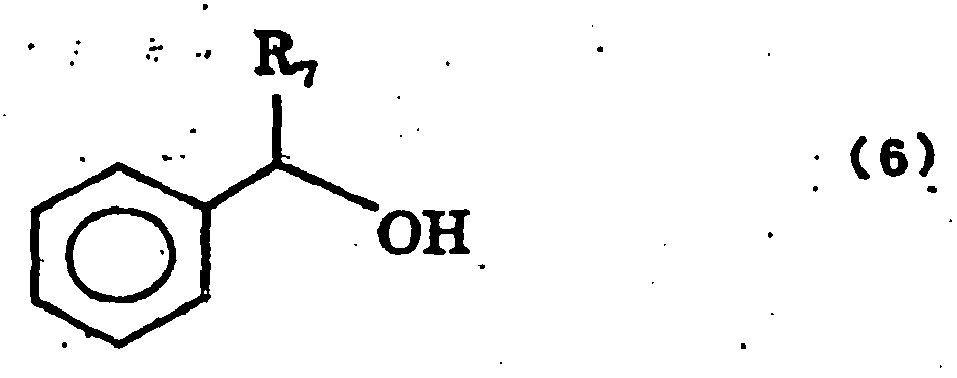
- the cleaning composition of the present invention may contain a compound (E) represented by the formula (6) wherein R 7 represents a hydrogen atom or a straight-chain or branched-chain alkyl group having 1 to 5 carbon atoms in order to increase the foam breakability.
- Examples of the compounds (E) are benzyl alcohol, 1-phenylethanol, 1-phenylpropanol, 1-phenylbutanol, 1-phenylpentanol, 1-phenylhexanol, 1-phenyl-3-methylbutanol, 1-phenyl-3-methylpentanol, 1-phenyl-4-methylpentanol, 1-phenyl-2-methylpentanol, 1-phenyl-2,3-dimethylpentanol, 1-phenyl-2,2-dimethylpentanol, 1-phenyl-2-methylpropanol, 1-phenyl-2-methylbutanol, 1-phenyl-3,3-dimethylbutanol, 1-phenyl-2,2-dimethylpropanol, etc.
- benzyl alcohol 1-phenylethanol, 1-phenylpropanol, 1-phenylbutanol, 1-phenylpentanol, 1-phenylhexanol and the like for their high foam breakability.
- benzyl alcohol is more preferred.
- the proportions of the compound (A) and the nonionic surfactant (B) to be used are not limited but are preferably about 0.1 to about 97% by weight of the compound (A) and about 0.1 to about 97% by weight of the nonionic surfactant (B), more preferably about 0.5 to about 80% by weight of the compound (A) and about 0.5 to about 80% by weight of the nonionic surfactant (B).
- each of the polyoxyalkylenephosphoric ester surfactant (C) and the polyoxyalkylenealkylamine surfactant (D) may be incorporated to provide the cleaning composition of the invention comprising the compound (A), the nonionic surfactant (B), the polyoxyalkylenephosphoric ester surfactant (C) and the polyoxyalkylenealkylamine surfactant (D).
- the compound (E) represented by the formula (6) can be added to provide the cleaning composition of the invention comprising the compound (A), the nonionic surfactant (B), the polyoxyalkylenephosphoric ester surfactant (C), the polyoxyalkylenealkylamine surfactant (D) and the compound (E).
- the compound (A) achieves an essential effect of a detergent of dissolving the dirt components.
- the required amount of the compound (A) varies depending on the kind of an article to be cleaned (kind of contaminants) and on the cleaning method, the compound (A) needs to be contained in an amount of at least 0.1% by weight based on the cleaning composition.
- the amount of the compound (A) to be contained is about 0.1 to about 97% by weight, preferably about 0.5 to about 80% by weight, based on the cleaning composition.
- the amount of the compound (A) to be used is 65% by weight or more, high cleanliness is achieved irrespectively of the kind of an article to be cleaned and the cleaning method.
- the nonionic surfactant (B) is capable of retaining the dirt components in water when rinsing the article to be cleaned.
- the necessary amount of the surfactant (B) is variable depending on the kind of an article to be cleaned (kind of contamination) and on the cleaning method
- the nonionic surfactant (B) needs to be contained in the cleaning composition in an amount of at least 0.1% by weight based on the cleaning composition.
- the amount of the nonionic surfactant (B) to be contained is about 0.1 to about 97% by weight, preferably about 0.5 to about 80% by weight, based on the cleaning composition.
- the amount of the nonionic surfactant (B) to be used is 4% by weight or more, excellent detergency is exhibited irrespectively of the kind of an article to be cleaned and the cleaning method.
- the polyoxyalkylenephosphoric ester surfactant (C) increases the detergency especially when the detergent is used as diluted with water.
- the amount of the polyoxyalkylenephosphoric ester surfactant (C) to be contained is about 0.01 to about 85% by weight, preferably about 0.1 to about 60% by weight, based on the cleaning composition.
- the amount of the surfactant (C) to be contained exceeds 85% by weight, a higher effect is not achieved and what is worse, the article to be cleaned may corrode.
- the polyoxyalkyleneamine surfactant (D) increases the detergency especially when the detergent is used as diluted with water. Therefore, the polyoxyalkyleneamine surfactant (D), when incorporated into the cleaning composition of the invention, needs to be contained in an amount of at least 0.01% by weight based on the cleaning composition.
- the amount of the polyoxyalkylenealkylamine surfactant (D) to be contained is about 0.01 to about 85% by weight, preferably about 0.1 to about 60% by weight, based on the cleaning composition. When the amount of the surfactant (D) to be contained exceeds 85% by weight, a higher effect is not achieved and what is worse, the article to be cleaned may corrode.
- the cleaning composition of the invention can be used as such or as dissolved in water, i.e. as an aqueous solution although depending on the kind of an article to be cleaned (kind of contaminants) or on the cleaning method.
- the cleaning composition in the form of an aqueous solution can reduce the risk of ignition and can lower the load of disposal of waste water.
- the cleaning composition is preferably used in the form of an aqueous solution in a concentration of about 70 to about 98% by weight irrespectively of the formulations or compositions to be employed.
- high detergency is achieved in removing the solder flux containing a thixotropic agent and a thickener in large amounts.
- the proportions of components in the cleaning composition of the invention in the form of an aqueous solution containing the effective ingredients in a concentration of 1% by weight so that the pH is brought to a neutral range of about 6 to about 8.
- the pH is brought to a neutral range of about 6 to about 8.
- the pH of the cleaning composition of the invention can be controlled chiefly by the proportions of the anionic polyoxyalkylenephosphoric ester surfactant (C) and the cationic polyoxyalkyleneamine surfactant (D). Accordingly, the pH can be adjusted by properly varying the proportions thereof.
- the pH of the cleaning composition although different depending on the kind of surfactants to be used, may be the pH which is attained by the polyoxyalkyleneamine surfactant (D) and the polyoxyalklenephophoric ester surfactant (C) at a weight ratio ranging from about 0.1-about 10 to 1 of the former to the latter, preferably from about 0.2-about 5 to 1 of the former to the latter.
- etching effects may be expected by adjusting the pH to an acidic or alkaline range in an aqueous solution of the cleaning composition containing the effective ingredients in a concentration of 1% by weight although depending on the article to be cleaned.
- the cleaning composition of the invention is not limited to one in which an aqueous solutions in a concentration of 1% by weight would exhibit a pH in a neutral range.
- the cleaning composition of the present invention may contain additives such as an antifoamer, antioxidant and the like when so required.
- the additive is used in an amount of about 0.1% by weight or less based on the cleaning composition.
- the cleaning composition of the present invention shows high detergency in cleaning various processed metal parts, ceramic parts, electronic parts and the like.
- the cleaning composition of the present invention shows remarkable detergency compared with known glycol ether detergent, especially when used for cleaning flip chip devices having thereon large amounts of residual thixotropic agent, thickener and the like, such as PGA, BGA, CSP and MCM, and particularly a wafer level CSP produced by a printing method using a solder paste, interposer and the like.
- a suitable method is selected from a wide variety of methods such as a method wherein an electronic part is cleaned by directly immersing the part in the cleaning composition; a method wherein an electronic part is flushed with an aqueous solution of the cleaning composition by a spray device; a method wherein an electronic part is brushed by mechanical means, etc.
- a detergent must be passed through an interstice of 50 ⁇ m or less. Consequently, it is the most suitable to clean the substrate with Direct Pass cleaning machine (trade name, product of ARAKAWA CHEMICAL INDUSTRIES. Ltd., Japanese Pat. No.2621800).
- the conditions for cleaning with the cleaning composition of the invention may be suitably selected according to the concentrations of components constituting the cleaning composition, proportions of components, kind of flux to be removed and the like.
- the cleaning composition of the invention is brought into contact with the flux under the conditions of effective temperature and time required for removing the flux.
- the cleaning composition is used at a temperature of about 20 to about 80°C. If the temperature is lower than 20°C, the flux is dissolved in a less degree. On the other hand, the temperature of higher than 80°C improves the detergency but vaporizes the water more rapidly, whereby ignition becomes likely to occur and control of safety becomes difficult.
- a preferred temperature is about 50 to about 70°C.
- the solder flux can be sufficiently removed from the electronic part by immersion of electronic part in the cleaning composition of the invention for about 1 to about 20 minutes, generally.
- the electronic part may be subjected to, as a finishing treatment, a water-rinsing treatment (a pre-rinsing treatment and a finish-rinsing treatment) to remove the potentially remaining cleaning composition substantially or completely.
- a water-rinsing treatment a pre-rinsing treatment and a finish-rinsing treatment
- Such rinsing treatment significantly enhances the cleanliness of the substrate.
- the invention can achieve the following effects.
- 11-1) The cleaning composition of the invention shows such high detergency that a high degree of cleaning can be attained.
- 11-2) The cleaning composition of the invention shows remarkable detergency when it is used in cleaning a flip chip device by removing a flux containing large amounts of a thixotropic agent and a thickener.
- 11-3) High degrees of degreasing and cleaning can be accomplished by the cleaning composition of the invention in the form of even a dilute solution containing the effective ingredients (the compound (A) and the nonionic surfactant (B)) in a concentration of about 1% by weight.
- 11-4) The cleaning composition of the invention which is halogen-free poses no problem on the destruction of ozone layer unlike freon detergent.
- the cleaning composition of the invention is satisfactory also in other respects such as environmental destruction, flammability, rinsability and odor.
- a cleaning composition was prepared by mixing together the following components in the proportions described below:
- Example 2 The cleaning compositions of Examples 2 to 9 and Comparative Example were prepared in the same manner as in Example 1 with the exception of replacing the components shown in Table 1.
- Table 1 Kind of Components Proportion (wt.%) A B C D E A B C D E Water Ex. 1 a1 b1 c1 d1 - 82 10 2 3 0 3 Ex. 2 a1 b1 c1 d1 - 70 20 2 3 0 5 Ex. 3 a1 b2 c1 d2 - 82 10 2 3 0 3 Ex. 4 a1 b2 c1 d2 - 70 20 2 3 0 5 Ex. 5 a2 b2 c2 d3 - 82 10 2 3 0 3 Ex.
- the substrates for use in (i), (ii) and (iii) of Table 2 were immersed in the cleaning composition at 70°C for 10 minutes, and the degree of removal of flux was visually evaluated according to the following criteria.
- the substrate tested for detergency was washed with water and dried and the cleanliness (amount of remaining ions) of the substrate was measured by ion chromatography IC7000 (manufactured by YOKOGAWA Co., Ltd.). The results are shown in Table 3.
- An aqueous solution of the cleaning composition in a concentration of 5% by weight was prepared and was heated to 40°C. Then, each piece of nickel, zinc and lead was immersed in the solution for 1 hour. The change of metal surface before and after immersion was visually evaluated according to the following criteria.
- the cleaning compositions prepared in Examples 1 to 9 and Comparative Example were diluted with pure water to provide an aqueous solution containing the effective components (the compound (A) and the nonionic surfactant (B)) in a concentration of 1% by weight.
- the dilute solution was subjected to the following tests.
- a terminal made of copper having a cutting oil adhering thereto (article A to be cleaned) or an electronic part made of ceramics having grease adhering thereto (article B to be cleaned) was set in a supersonic cleaning device (40 kHz, 600 W).
- the article A or B to be cleaned was cleaned with the dilute solutions in a concentration of 1% by weight (Examples 1 to 9 and Comparative Example) at 75°C for 5 minutes. Then the article was rinsed with pure water for 5 minutes and was dried by hot air at 70°C for 5 minutes.
- the degree of removal of oil (or grease) was visually evaluated according to the following criteria
- the cleaning composition of the invention can be suitably used for removing solder flux, used in a flip chip devices, containing a thixotropic agent and a thickener in large amounts and for degreasing and cleaning metal parts and ceramic parts.
Landscapes
- Chemical & Material Sciences (AREA)
- Organic Chemistry (AREA)
- Engineering & Computer Science (AREA)
- Chemical Kinetics & Catalysis (AREA)
- Life Sciences & Earth Sciences (AREA)
- Wood Science & Technology (AREA)
- Oil, Petroleum & Natural Gas (AREA)
- Mechanical Engineering (AREA)
- General Chemical & Material Sciences (AREA)
- Emergency Medicine (AREA)
- Materials Engineering (AREA)
- Health & Medical Sciences (AREA)
- Metallurgy (AREA)
- Detergent Compositions (AREA)
- Cleaning And De-Greasing Of Metallic Materials By Chemical Methods (AREA)
- Manufacturing Of Printed Wiring (AREA)
Claims (13)
- Reinigungszusammensetzung umfassend als wirksame Bestandteile eine durch die Formel (1) dargestellte Verbindung (A):

ein nicht-ionisches Tensid (B); und
eine durch die Formel (6) dargestellte Verbindung (E)
- Reinigungszusammensetzung nach Anspruch 1, in der das nicht-ionische Tensid (B) ein durch die Formel (2) dargestelltes nicht-ionisches Polyethylenglycolether-Tensid ist
R3-O-(CH2-CH2-O)m-H (2)
worin R3 eine geradkettige oder verzweigtkettige Alkylgruppe mit 6 bis 20 Kohlenstoffatomen, eine Phenylgruppe oder eine Phenylgruppe substituiert mit einer geradkettigen oder verzweigtkettigen Alkylgruppe mit 7 bis 12 Kohlenstoffatomen darstellt und m eine ganze Zahl von 2 bis 20 darstellt. - Reinigungszusammensetzung nach Anspruch 1, die ferner Wasser enthält.
- Reinigungszusammensetzung umfassend eine durch die Formel (1) dargestellte Verbindung (A), ein nicht-ionisches Tensid (B), ein Polyoxyalkylenphosphorsäureester-Tensid (C) und ein Polyoxyalkylenamin-Tensid (D):

- Reinigungszusammensetzung nach Anspruch 4, in der das nicht-ionische Tensid (B) ein durch die Formel (2) dargestelltes nicht-ionisches Polyethylenglycolether-Tensid ist
R3-O-(CH2-CH2-O)m-H (2)
worin R3 eine geradkettige oder verzweigtkettige Alkylgruppe mit 6 bis 20 Kohlenstoffatomen, eine Phenylgruppe oder eine Phenylgruppe substituiert mit einer geradkettigen oder verzweigtkettigen Alkylgruppe mit 7 bis 12 Kohlenstoffatomen darstellt und m eine ganze Zahl von 2 bis 20 darstellt. - Reinigungszusammensetzung nach Anspruch 4, in der das Polyoxyalkylenphosphorsäureester-Tensid (C) ein durch die Formel (3) dargestelltes Polyoxyethylenphosphorsäureester-Tensid oder ein Salz davon ist:

R-O(CH2-CH2-O)n- (4)
worin R5 eine geradkettige oder verzweigtkettige Alkylgruppe mit 5 bis 20 Kohlenstoffatomen, eine Phenylgruppe oder eine Phenylgruppe substituiert mit einer geradkettigen oder verzweigtkettigen Alkylgruppe mit 7 bis 12 Kohlenstoffatomen darstellt und n eine ganze Zahl von 0 bis 20 darstellt. - Reinigungszusammensetzung nach Anspruch 4, in der das Polyoxyalkylenamin-Tensid (D) ein durch die Formel (5) dargestelltes Polyoxyethylenamin-Tensid ist:

- Reinigungszusammensetzung nach Anspruch 4, welche 0,1 bis 97 Gew.-% der Verbindung (A), 0,1 bis 97 Gew.-% des nicht-ionischen Tensids (B), 0,01 bis 85 Gew.-% des Polyoxyalkylenphosphorsäureester-Tensids (C) und 0,01 bis 85 Gew.-% des Polyoxyalkylenamin-Tensids (D) umfasst.
- Reinigungszusammensetzung nach Anspruch 4, welche ferner eine durch die Formel (6) dargestellte Verbindung (E) umfasst
- Reinigungszusammensetzung nach Anspruch 4, die ferner Wasser enthält.
- Reinigungszusammensetzung nach Anspruch 1, die zur Reinigung von Flip-Chip-Vorrichtungen verwendet wird.
- Verwendung der Zusammensetzung nach Anspruch 4 zur Reinigung von Flip-Chip-Vorrichtungen.
- Verwendung einer Zusammensetzung als Reinigungsmittel, die umfasst eine Mischung von einer Reinigungszusammensetzung umfassend als wirksame Bestandteile eine durch die Formel (1) dargestellte Verbindung (A):

ein nicht-ionisches Tensid (B); und
eine durch die Formel (6) dargestellte Verbindung (E)
Applications Claiming Priority (3)
| Application Number | Priority Date | Filing Date | Title |
|---|---|---|---|
| JP2001000303A JP4025953B2 (ja) | 2001-01-05 | 2001-01-05 | 洗浄剤組成物 |
| JP2001000303 | 2001-01-05 | ||
| PCT/JP2001/011618 WO2002055645A1 (fr) | 2001-01-05 | 2001-12-28 | Composition detergente |
Publications (3)
| Publication Number | Publication Date |
|---|---|
| EP1295935A1 EP1295935A1 (de) | 2003-03-26 |
| EP1295935A4 EP1295935A4 (de) | 2004-06-09 |
| EP1295935B1 true EP1295935B1 (de) | 2007-03-21 |
Family
ID=18869116
Family Applications (1)
| Application Number | Title | Priority Date | Filing Date |
|---|---|---|---|
| EP01273201A Expired - Lifetime EP1295935B1 (de) | 2001-01-05 | 2001-12-28 | Waschmittelzusammensetzung |
Country Status (9)
| Country | Link |
|---|---|
| US (1) | US7018964B2 (de) |
| EP (1) | EP1295935B1 (de) |
| JP (1) | JP4025953B2 (de) |
| KR (1) | KR100564900B1 (de) |
| CN (1) | CN100480365C (de) |
| AT (1) | ATE357493T1 (de) |
| DE (1) | DE60127405D1 (de) |
| TW (1) | TWI246534B (de) |
| WO (1) | WO2002055645A1 (de) |
Families Citing this family (23)
| Publication number | Priority date | Publication date | Assignee | Title |
|---|---|---|---|---|
| JP4154999B2 (ja) * | 2002-11-01 | 2008-09-24 | 東ソー株式会社 | 洗浄方法 |
| KR100516886B1 (ko) * | 2002-12-09 | 2005-09-23 | 제일모직주식회사 | 실리콘 웨이퍼의 최종 연마용 슬러리 조성물 |
| US7238653B2 (en) * | 2003-03-10 | 2007-07-03 | Hynix Semiconductor Inc. | Cleaning solution for photoresist and method for forming pattern using the same |
| JP2007219009A (ja) | 2006-02-14 | 2007-08-30 | Az Electronic Materials Kk | レジスト基板用処理液とそれを用いたレジスト基板の処理方法 |
| JP5452020B2 (ja) * | 2006-03-17 | 2014-03-26 | 荒川化学工業株式会社 | 鉛フリーハンダフラックス除去用洗浄剤組成物、鉛フリーハンダフラックス除去用すすぎ剤、及び鉛フリーハンダフラックスの除去方法 |
| KR101530321B1 (ko) * | 2007-08-08 | 2015-06-19 | 아라까와 가가꾸 고교 가부시끼가이샤 | 무연 땜납 플럭스 제거용 세정제 조성물 및 무연 땜납 플럭스의 제거 방법 |
| JP5789194B2 (ja) * | 2008-12-08 | 2015-10-07 | ハンツマン ペトロケミカル エルエルシーHuntsman Petrochemical LLC | アミン溶媒溶液に存在するアミン由来汚染物質および/またはアミン溶媒溶液の分解の低下 |
| US9221081B1 (en) | 2011-08-01 | 2015-12-29 | Novellus Systems, Inc. | Automated cleaning of wafer plating assembly |
| US9228270B2 (en) | 2011-08-15 | 2016-01-05 | Novellus Systems, Inc. | Lipseals and contact elements for semiconductor electroplating apparatuses |
| US10066311B2 (en) | 2011-08-15 | 2018-09-04 | Lam Research Corporation | Multi-contact lipseals and associated electroplating methods |
| US9988734B2 (en) | 2011-08-15 | 2018-06-05 | Lam Research Corporation | Lipseals and contact elements for semiconductor electroplating apparatuses |
| JP5696981B2 (ja) * | 2011-09-02 | 2015-04-08 | 荒川化学工業株式会社 | はんだ付けフラックス用洗浄剤組成物 |
| DE102011082136B4 (de) * | 2011-09-05 | 2013-04-11 | Vacuumschmelze Gmbh & Co. Kg | Reinigungsmittelzusammensetzung sowie ein Verfahren zum Entfernen von ausgehärteten Gießharzen, Klebstoffen, Montageschäumen, Lackfilmen und Lackresten |
| SG11201406133WA (en) * | 2012-03-28 | 2014-10-30 | Novellus Systems Inc | Methods and apparatuses for cleaning electroplating substrate holders |
| TWI609100B (zh) | 2012-03-30 | 2017-12-21 | 諾發系統有限公司 | 使用反向電流除鍍以清洗電鍍基板夾持具 |
| CN102989712B (zh) * | 2012-10-17 | 2014-11-12 | 张志明 | 抽油烟机洗涤方法 |
| US10416092B2 (en) | 2013-02-15 | 2019-09-17 | Lam Research Corporation | Remote detection of plating on wafer holding apparatus |
| US9746427B2 (en) | 2013-02-15 | 2017-08-29 | Novellus Systems, Inc. | Detection of plating on wafer holding apparatus |
| KR102135187B1 (ko) | 2013-12-26 | 2020-07-17 | 동우 화인켐 주식회사 | 포토레지스트 박리액 조성물 |
| US9637677B2 (en) | 2014-09-04 | 2017-05-02 | Ideal Energy Solutions IP Control, LLC | Aqueous cleaning composition and method |
| KR20160084038A (ko) | 2015-01-05 | 2016-07-13 | 황보기만 | 침출성 세제볼 및 그제법 |
| US10053793B2 (en) | 2015-07-09 | 2018-08-21 | Lam Research Corporation | Integrated elastomeric lipseal and cup bottom for reducing wafer sticking |
| CN106807117A (zh) * | 2016-12-27 | 2017-06-09 | 广东中联邦精细化工有限公司 | 一种线路板清洗专用消泡剂 |
Family Cites Families (28)
| Publication number | Priority date | Publication date | Assignee | Title |
|---|---|---|---|---|
| US3673099A (en) | 1970-10-19 | 1972-06-27 | Bell Telephone Labor Inc | Process and composition for stripping cured resins from substrates |
| US4428871A (en) | 1981-09-23 | 1984-01-31 | J. T. Baker Chemical Company | Stripping compositions and methods of stripping resists |
| US4664721A (en) | 1981-12-07 | 1987-05-12 | Intercontinental Chemical Corporation | Printing screen cleaning and reclaiming compositions |
| JPS6191299A (ja) | 1984-10-12 | 1986-05-09 | 川研ファインケミカル株式会社 | 硬質表面洗浄剤 |
| DK600484D0 (da) | 1984-12-14 | 1984-12-14 | Cps Kemi Aps | Vaeske til fortynding og/eller fjernelse af trykkeri- og serigrafifarver |
| JPH0715110B2 (ja) | 1986-04-30 | 1995-02-22 | 花王株式会社 | 繊維類のしみおよび着色除去用組成物 |
| US4744834A (en) | 1986-04-30 | 1988-05-17 | Noor Haq | Photoresist stripper comprising a pyrrolidinone, a diethylene glycol ether, a polyglycol and a quaternary ammonium hydroxide |
| JPH0715111B2 (ja) | 1986-05-01 | 1995-02-22 | 花王株式会社 | ガラスクリ−ナ−組成物 |
| JPS6350838A (ja) | 1986-08-21 | 1988-03-03 | Japan Synthetic Rubber Co Ltd | 剥離液 |
| US4812255A (en) | 1987-03-04 | 1989-03-14 | Gaf Corporation | Paint removing compositions |
| US5006279A (en) | 1988-08-24 | 1991-04-09 | Grobbel William J | Water-based coating removers |
| EP0389829A1 (de) | 1989-03-13 | 1990-10-03 | BASF Corporation | Abbeizmittel für auf Wasser basierende Lacke und für Firnis auf Holz |
| US5024780A (en) | 1989-08-30 | 1991-06-18 | A.G.P. Systems, Inc. | Cleaner for treating a surface |
| DE4004630A1 (de) | 1990-02-15 | 1991-08-22 | Beutelrock Geb Wehrmann Caroli | Mittel zur lackentfernung |
| JPH0434000A (ja) * | 1990-05-30 | 1992-02-05 | Hitachi Ltd | フラックス洗浄剤およびそれを用いた半田付け電子部品の洗浄方法 |
| JPH0540000A (ja) | 1991-08-06 | 1993-02-19 | Yokohama Rubber Co Ltd:The | レドーム |
| WO1993016160A1 (en) | 1992-02-10 | 1993-08-19 | Isp Investments Inc. | Defluxing composition and use thereof |
| JPH06287596A (ja) | 1993-03-30 | 1994-10-11 | Kawaken Fine Chem Co Ltd | 衣料用洗浄剤組成物 |
| JP3208223B2 (ja) | 1993-05-19 | 2001-09-10 | 花王株式会社 | 硬表面用洗浄剤組成物 |
| JP2813862B2 (ja) * | 1994-07-05 | 1998-10-22 | 荒川化学工業株式会社 | 洗浄剤組成物 |
| ES2163462T3 (es) * | 1994-08-22 | 2002-02-01 | Kao Corp | Composicion detergente para superficie dura. |
| JPH09311467A (ja) | 1996-05-21 | 1997-12-02 | Nitto Denko Corp | レジスト剥離剤 |
| US5798323A (en) * | 1997-05-05 | 1998-08-25 | Olin Microelectronic Chemicals, Inc. | Non-corrosive stripping and cleaning composition |
| JP4071845B2 (ja) | 1997-05-12 | 2008-04-02 | 三菱化学株式会社 | 熱可塑性樹脂成形体の溶解方法または洗浄方法 |
| KR100286860B1 (ko) * | 1998-12-31 | 2001-07-12 | 주식회사 동진쎄미켐 | 포토레지스트 리무버 조성물 |
| US6103680A (en) * | 1998-12-31 | 2000-08-15 | Arch Specialty Chemicals, Inc. | Non-corrosive cleaning composition and method for removing photoresist and/or plasma etching residues |
| JP2001232647A (ja) | 2000-02-23 | 2001-08-28 | Tosoh Corp | 洗浄用組成物 |
| JP2001355000A (ja) | 2000-06-14 | 2001-12-25 | Kao Corp | 農業施設用洗浄剤組成物 |
-
2001
- 2001-01-05 JP JP2001000303A patent/JP4025953B2/ja not_active Expired - Lifetime
- 2001-12-28 CN CNB018060943A patent/CN100480365C/zh not_active Expired - Fee Related
- 2001-12-28 KR KR1020027011591A patent/KR100564900B1/ko not_active Expired - Fee Related
- 2001-12-28 AT AT01273201T patent/ATE357493T1/de not_active IP Right Cessation
- 2001-12-28 US US10/240,608 patent/US7018964B2/en not_active Expired - Fee Related
- 2001-12-28 EP EP01273201A patent/EP1295935B1/de not_active Expired - Lifetime
- 2001-12-28 WO PCT/JP2001/011618 patent/WO2002055645A1/ja not_active Ceased
- 2001-12-28 DE DE60127405T patent/DE60127405D1/de not_active Expired - Lifetime
- 2001-12-31 TW TW090133372A patent/TWI246534B/zh not_active IP Right Cessation
Also Published As
| Publication number | Publication date |
|---|---|
| EP1295935A1 (de) | 2003-03-26 |
| WO2002055645A1 (fr) | 2002-07-18 |
| TWI246534B (en) | 2006-01-01 |
| US20030181349A1 (en) | 2003-09-25 |
| ATE357493T1 (de) | 2007-04-15 |
| CN1411502A (zh) | 2003-04-16 |
| CN100480365C (zh) | 2009-04-22 |
| JP2002201492A (ja) | 2002-07-19 |
| EP1295935A4 (de) | 2004-06-09 |
| US7018964B2 (en) | 2006-03-28 |
| KR20020075471A (ko) | 2002-10-04 |
| KR100564900B1 (ko) | 2006-03-30 |
| DE60127405D1 (de) | 2007-05-03 |
| JP4025953B2 (ja) | 2007-12-26 |
Similar Documents
| Publication | Publication Date | Title |
|---|---|---|
| EP1295935B1 (de) | Waschmittelzusammensetzung | |
| CA2131001C (en) | Stabilization of silicate solutions | |
| JP5452020B2 (ja) | 鉛フリーハンダフラックス除去用洗浄剤組成物、鉛フリーハンダフラックス除去用すすぎ剤、及び鉛フリーハンダフラックスの除去方法 | |
| US5433885A (en) | Stabilization of silicate solutions | |
| KR100241565B1 (ko) | 송진-기재 땜납 융제 세척용 세제 및 방법 | |
| EP0426943B1 (de) | Zusammensetzung und Verfahren zur Entfernung von Lotflussmittel auf Kolophoniumbasis | |
| JP6822440B2 (ja) | 鉛フリーはんだフラックス用洗浄剤組成物、鉛フリーはんだフラックスの洗浄方法 | |
| KR100907568B1 (ko) | 땜납 플럭스 제거용 세정제 및 땜납 플럭스 세정 방법 | |
| JP2813862B2 (ja) | 洗浄剤組成物 | |
| JP4399709B2 (ja) | スズ含有合金製部品用洗浄剤組成物および洗浄方法 | |
| KR101128865B1 (ko) | 리플로우 공정에 따른 플럭스 잔사 세정제 조성물 및 이를 이용한 세정방법 | |
| JP2973379B2 (ja) | 電子部品洗浄用水性液体洗浄剤組成物 | |
| USRE35017E (en) | Method for removing soldering flux with alkaline salts, an alkali metal silicate and anionic polymer | |
| JPH0457900A (ja) | ロジン系ハンダフラックスの先浄剤および該洗浄剤を用いてなるロジン系ハンダフラックスの洗浄方法 | |
| JPH05125396A (ja) | 洗浄剤 | |
| JP2916800B2 (ja) | ロジン系ハンダフラックスの洗浄剤および該洗浄剤を用いてなるロジン系ハンダフラックスの洗浄方法 | |
| JP2893497B2 (ja) | 精密部品又は治工具類用洗浄剤組成物 | |
| JPH05148499A (ja) | 水性液体洗浄剤組成物 | |
| JP3227023B2 (ja) | 洗浄剤組成物 | |
| KR20110023482A (ko) | 무연땜납 플럭스 세정제 조성물 | |
| KR20100125772A (ko) | 무연땜납 플럭스 세정제 조성물 | |
| JPH0491199A (ja) | ロジン系ハンダフラックスの洗浄剤および該洗浄剤を用いてなるロジン系ハンダフラックスの洗浄方法 |
Legal Events
| Date | Code | Title | Description |
|---|---|---|---|
| PUAI | Public reference made under article 153(3) epc to a published international application that has entered the european phase |
Free format text: ORIGINAL CODE: 0009012 |
|
| 17P | Request for examination filed |
Effective date: 20021015 |
|
| AK | Designated contracting states |
Designated state(s): AT BE CH CY DE DK ES FI FR GB GR IE IT LI LU MC NL PT SE TR Kind code of ref document: A1 Designated state(s): AT BE CH CY DE DK ES FI FR GB GR IE IT LI LU MC NL PT SE TR |
|
| A4 | Supplementary search report drawn up and despatched |
Effective date: 20040428 |
|
| RIC1 | Information provided on ipc code assigned before grant |
Ipc: 7C 11D 1/86 B Ipc: 7C 11D 3/20 B Ipc: 7C 23G 5/036 B Ipc: 7C 11D 11/00 B Ipc: 7C 11D 3/28 B Ipc: 7C 11D 1/72 A |
|
| 17Q | First examination report despatched |
Effective date: 20050224 |
|
| GRAP | Despatch of communication of intention to grant a patent |
Free format text: ORIGINAL CODE: EPIDOSNIGR1 |
|
| GRAS | Grant fee paid |
Free format text: ORIGINAL CODE: EPIDOSNIGR3 |
|
| GRAA | (expected) grant |
Free format text: ORIGINAL CODE: 0009210 |
|
| AK | Designated contracting states |
Kind code of ref document: B1 Designated state(s): AT BE CH CY DE DK ES FI FR GB GR IE IT LI LU MC NL PT SE TR |
|
| PG25 | Lapsed in a contracting state [announced via postgrant information from national office to epo] |
Ref country code: LI Free format text: LAPSE BECAUSE OF FAILURE TO SUBMIT A TRANSLATION OF THE DESCRIPTION OR TO PAY THE FEE WITHIN THE PRESCRIBED TIME-LIMIT Effective date: 20070321 Ref country code: FI Free format text: LAPSE BECAUSE OF FAILURE TO SUBMIT A TRANSLATION OF THE DESCRIPTION OR TO PAY THE FEE WITHIN THE PRESCRIBED TIME-LIMIT Effective date: 20070321 Ref country code: CH Free format text: LAPSE BECAUSE OF FAILURE TO SUBMIT A TRANSLATION OF THE DESCRIPTION OR TO PAY THE FEE WITHIN THE PRESCRIBED TIME-LIMIT Effective date: 20070321 Ref country code: AT Free format text: LAPSE BECAUSE OF FAILURE TO SUBMIT A TRANSLATION OF THE DESCRIPTION OR TO PAY THE FEE WITHIN THE PRESCRIBED TIME-LIMIT Effective date: 20070321 Ref country code: BE Free format text: LAPSE BECAUSE OF FAILURE TO SUBMIT A TRANSLATION OF THE DESCRIPTION OR TO PAY THE FEE WITHIN THE PRESCRIBED TIME-LIMIT Effective date: 20070321 Ref country code: NL Free format text: LAPSE BECAUSE OF FAILURE TO SUBMIT A TRANSLATION OF THE DESCRIPTION OR TO PAY THE FEE WITHIN THE PRESCRIBED TIME-LIMIT Effective date: 20070321 |
|
| REG | Reference to a national code |
Ref country code: GB Ref legal event code: FG4D |
|
| REG | Reference to a national code |
Ref country code: CH Ref legal event code: EP |
|
| REF | Corresponds to: |
Ref document number: 60127405 Country of ref document: DE Date of ref document: 20070503 Kind code of ref document: P |
|
| REG | Reference to a national code |
Ref country code: IE Ref legal event code: FG4D |
|
| PG25 | Lapsed in a contracting state [announced via postgrant information from national office to epo] |
Ref country code: SE Free format text: LAPSE BECAUSE OF FAILURE TO SUBMIT A TRANSLATION OF THE DESCRIPTION OR TO PAY THE FEE WITHIN THE PRESCRIBED TIME-LIMIT Effective date: 20070621 |
|
| PG25 | Lapsed in a contracting state [announced via postgrant information from national office to epo] |
Ref country code: ES Free format text: LAPSE BECAUSE OF FAILURE TO SUBMIT A TRANSLATION OF THE DESCRIPTION OR TO PAY THE FEE WITHIN THE PRESCRIBED TIME-LIMIT Effective date: 20070702 |
|
| PG25 | Lapsed in a contracting state [announced via postgrant information from national office to epo] |
Ref country code: PT Free format text: LAPSE BECAUSE OF FAILURE TO SUBMIT A TRANSLATION OF THE DESCRIPTION OR TO PAY THE FEE WITHIN THE PRESCRIBED TIME-LIMIT Effective date: 20070821 |
|
| ET | Fr: translation filed | ||
| REG | Reference to a national code |
Ref country code: CH Ref legal event code: PL |
|
| NLV1 | Nl: lapsed or annulled due to failure to fulfill the requirements of art. 29p and 29m of the patents act | ||
| PLBE | No opposition filed within time limit |
Free format text: ORIGINAL CODE: 0009261 |
|
| STAA | Information on the status of an ep patent application or granted ep patent |
Free format text: STATUS: NO OPPOSITION FILED WITHIN TIME LIMIT |
|
| PG25 | Lapsed in a contracting state [announced via postgrant information from national office to epo] |
Ref country code: DK Free format text: LAPSE BECAUSE OF FAILURE TO SUBMIT A TRANSLATION OF THE DESCRIPTION OR TO PAY THE FEE WITHIN THE PRESCRIBED TIME-LIMIT Effective date: 20070321 Ref country code: DE Free format text: LAPSE BECAUSE OF FAILURE TO SUBMIT A TRANSLATION OF THE DESCRIPTION OR TO PAY THE FEE WITHIN THE PRESCRIBED TIME-LIMIT Effective date: 20070622 |
|
| 26N | No opposition filed |
Effective date: 20071227 |
|
| PG25 | Lapsed in a contracting state [announced via postgrant information from national office to epo] |
Ref country code: IT Free format text: LAPSE BECAUSE OF FAILURE TO SUBMIT A TRANSLATION OF THE DESCRIPTION OR TO PAY THE FEE WITHIN THE PRESCRIBED TIME-LIMIT Effective date: 20070321 Ref country code: GR Free format text: LAPSE BECAUSE OF FAILURE TO SUBMIT A TRANSLATION OF THE DESCRIPTION OR TO PAY THE FEE WITHIN THE PRESCRIBED TIME-LIMIT Effective date: 20070622 |
|
| PG25 | Lapsed in a contracting state [announced via postgrant information from national office to epo] |
Ref country code: MC Free format text: LAPSE BECAUSE OF NON-PAYMENT OF DUE FEES Effective date: 20071231 |
|
| PG25 | Lapsed in a contracting state [announced via postgrant information from national office to epo] |
Ref country code: CY Free format text: LAPSE BECAUSE OF FAILURE TO SUBMIT A TRANSLATION OF THE DESCRIPTION OR TO PAY THE FEE WITHIN THE PRESCRIBED TIME-LIMIT Effective date: 20070321 |
|
| PG25 | Lapsed in a contracting state [announced via postgrant information from national office to epo] |
Ref country code: LU Free format text: LAPSE BECAUSE OF NON-PAYMENT OF DUE FEES Effective date: 20071228 |
|
| PG25 | Lapsed in a contracting state [announced via postgrant information from national office to epo] |
Ref country code: TR Free format text: LAPSE BECAUSE OF FAILURE TO SUBMIT A TRANSLATION OF THE DESCRIPTION OR TO PAY THE FEE WITHIN THE PRESCRIBED TIME-LIMIT Effective date: 20070321 |
|
| PGFP | Annual fee paid to national office [announced via postgrant information from national office to epo] |
Ref country code: IE Payment date: 20101110 Year of fee payment: 10 Ref country code: FR Payment date: 20101210 Year of fee payment: 10 |
|
| PGFP | Annual fee paid to national office [announced via postgrant information from national office to epo] |
Ref country code: GB Payment date: 20101222 Year of fee payment: 10 |
|
| GBPC | Gb: european patent ceased through non-payment of renewal fee |
Effective date: 20111228 |
|
| REG | Reference to a national code |
Ref country code: FR Ref legal event code: ST Effective date: 20120831 |
|
| REG | Reference to a national code |
Ref country code: IE Ref legal event code: MM4A |
|
| PG25 | Lapsed in a contracting state [announced via postgrant information from national office to epo] |
Ref country code: GB Free format text: LAPSE BECAUSE OF NON-PAYMENT OF DUE FEES Effective date: 20111228 Ref country code: IE Free format text: LAPSE BECAUSE OF NON-PAYMENT OF DUE FEES Effective date: 20111228 |
|
| PG25 | Lapsed in a contracting state [announced via postgrant information from national office to epo] |
Ref country code: FR Free format text: LAPSE BECAUSE OF NON-PAYMENT OF DUE FEES Effective date: 20120102 |