EP1294675B1 - Kupplung von anilin und nitrobenzol mit basisches material enthaltenden zeolithträger - Google Patents
Kupplung von anilin und nitrobenzol mit basisches material enthaltenden zeolithträger Download PDFInfo
- Publication number
- EP1294675B1 EP1294675B1 EP01946568A EP01946568A EP1294675B1 EP 1294675 B1 EP1294675 B1 EP 1294675B1 EP 01946568 A EP01946568 A EP 01946568A EP 01946568 A EP01946568 A EP 01946568A EP 1294675 B1 EP1294675 B1 EP 1294675B1
- Authority
- EP
- European Patent Office
- Prior art keywords
- tma
- zeolite
- reaction
- base material
- nitrobenzene
- Prior art date
- Legal status (The legal status is an assumption and is not a legal conclusion. Google has not performed a legal analysis and makes no representation as to the accuracy of the status listed.)
- Expired - Lifetime
Links
- LQNUZADURLCDLV-UHFFFAOYSA-N nitrobenzene Chemical compound [O-][N+](=O)C1=CC=CC=C1 LQNUZADURLCDLV-UHFFFAOYSA-N 0.000 title claims abstract description 230
- PAYRUJLWNCNPSJ-UHFFFAOYSA-N Aniline Chemical compound NC1=CC=CC=C1 PAYRUJLWNCNPSJ-UHFFFAOYSA-N 0.000 title claims abstract description 196
- 239000000463 material Substances 0.000 title claims abstract description 88
- 239000010457 zeolite Substances 0.000 title claims description 123
- HNPSIPDUKPIQMN-UHFFFAOYSA-N dioxosilane;oxo(oxoalumanyloxy)alumane Chemical compound O=[Si]=O.O=[Al]O[Al]=O HNPSIPDUKPIQMN-UHFFFAOYSA-N 0.000 title claims description 119
- 229910021536 Zeolite Inorganic materials 0.000 title claims description 113
- 238000005859 coupling reaction Methods 0.000 title description 60
- 230000008878 coupling Effects 0.000 title description 17
- 238000010168 coupling process Methods 0.000 title description 17
- 238000006243 chemical reaction Methods 0.000 claims abstract description 109
- 238000000034 method Methods 0.000 claims abstract description 94
- 238000011068 loading method Methods 0.000 claims abstract description 84
- ATGUVEKSASEFFO-UHFFFAOYSA-N p-aminodiphenylamine Chemical compound C1=CC(N)=CC=C1NC1=CC=CC=C1 ATGUVEKSASEFFO-UHFFFAOYSA-N 0.000 claims abstract description 68
- 230000008569 process Effects 0.000 claims abstract description 63
- 239000007787 solid Substances 0.000 claims abstract description 44
- 239000000203 mixture Substances 0.000 claims abstract description 30
- 239000000543 intermediate Substances 0.000 claims abstract description 25
- 230000007704 transition Effects 0.000 claims abstract description 16
- 239000002585 base Substances 0.000 claims description 91
- XLYOFNOQVPJJNP-UHFFFAOYSA-N water Substances O XLYOFNOQVPJJNP-UHFFFAOYSA-N 0.000 claims description 65
- 229910001868 water Inorganic materials 0.000 claims description 54
- 239000002002 slurry Substances 0.000 claims description 46
- 238000001035 drying Methods 0.000 claims description 38
- 239000003054 catalyst Substances 0.000 claims description 33
- 238000005984 hydrogenation reaction Methods 0.000 claims description 33
- -1 alkali metal alkoxides Chemical class 0.000 claims description 28
- 239000001257 hydrogen Substances 0.000 claims description 18
- 229910052739 hydrogen Inorganic materials 0.000 claims description 18
- 238000004519 manufacturing process Methods 0.000 claims description 16
- WGTYBPLFGIVFAS-UHFFFAOYSA-M tetramethylammonium hydroxide Chemical compound [OH-].C[N+](C)(C)C WGTYBPLFGIVFAS-UHFFFAOYSA-M 0.000 claims description 16
- UFHFLCQGNIYNRP-UHFFFAOYSA-N Hydrogen Chemical compound [H][H] UFHFLCQGNIYNRP-UHFFFAOYSA-N 0.000 claims description 15
- 238000005342 ion exchange Methods 0.000 claims description 14
- KDLHZDBZIXYQEI-UHFFFAOYSA-N Palladium Chemical compound [Pd] KDLHZDBZIXYQEI-UHFFFAOYSA-N 0.000 claims description 12
- 239000000243 solution Substances 0.000 claims description 10
- VYPSYNLAJGMNEJ-UHFFFAOYSA-N Silicium dioxide Chemical compound O=[Si]=O VYPSYNLAJGMNEJ-UHFFFAOYSA-N 0.000 claims description 9
- 125000003118 aryl group Chemical group 0.000 claims description 9
- BASFCYQUMIYNBI-UHFFFAOYSA-N platinum Chemical compound [Pt] BASFCYQUMIYNBI-UHFFFAOYSA-N 0.000 claims description 9
- 125000000217 alkyl group Chemical group 0.000 claims description 8
- 125000001424 substituent group Chemical group 0.000 claims description 8
- 229910052783 alkali metal Inorganic materials 0.000 claims description 7
- 239000003444 phase transfer catalyst Substances 0.000 claims description 7
- 239000011541 reaction mixture Substances 0.000 claims description 7
- CBCKQZAAMUWICA-UHFFFAOYSA-N 1,4-phenylenediamine Chemical class NC1=CC=C(N)C=C1 CBCKQZAAMUWICA-UHFFFAOYSA-N 0.000 claims description 6
- OKTJSMMVPCPJKN-UHFFFAOYSA-N Carbon Chemical compound [C] OKTJSMMVPCPJKN-UHFFFAOYSA-N 0.000 claims description 6
- 235000011114 ammonium hydroxide Nutrition 0.000 claims description 6
- 239000007864 aqueous solution Substances 0.000 claims description 6
- 239000008262 pumice Substances 0.000 claims description 6
- PXHVJJICTQNCMI-UHFFFAOYSA-N Nickel Chemical compound [Ni] PXHVJJICTQNCMI-UHFFFAOYSA-N 0.000 claims description 5
- PNEYBMLMFCGWSK-UHFFFAOYSA-N aluminium oxide Inorganic materials [O-2].[O-2].[O-2].[Al+3].[Al+3] PNEYBMLMFCGWSK-UHFFFAOYSA-N 0.000 claims description 5
- 125000003710 aryl alkyl group Chemical group 0.000 claims description 5
- 229910052751 metal Inorganic materials 0.000 claims description 5
- 239000002184 metal Substances 0.000 claims description 5
- RYGMFSIKBFXOCR-UHFFFAOYSA-N Copper Chemical compound [Cu] RYGMFSIKBFXOCR-UHFFFAOYSA-N 0.000 claims description 4
- 229910052802 copper Inorganic materials 0.000 claims description 4
- 239000010949 copper Substances 0.000 claims description 4
- 229910000510 noble metal Inorganic materials 0.000 claims description 4
- 229910052697 platinum Inorganic materials 0.000 claims description 4
- 239000000377 silicon dioxide Substances 0.000 claims description 4
- VHUUQVKOLVNVRT-UHFFFAOYSA-N Ammonium hydroxide Chemical class [NH4+].[OH-] VHUUQVKOLVNVRT-UHFFFAOYSA-N 0.000 claims description 3
- ZOKXTWBITQBERF-UHFFFAOYSA-N Molybdenum Chemical compound [Mo] ZOKXTWBITQBERF-UHFFFAOYSA-N 0.000 claims description 3
- RIOSMNKWWSAFGT-UHFFFAOYSA-N [O--].[Cu++].[Ce+3] Chemical compound [O--].[Cu++].[Ce+3] RIOSMNKWWSAFGT-UHFFFAOYSA-N 0.000 claims description 3
- WQHONKDTTOGZPR-UHFFFAOYSA-N [O-2].[O-2].[Mn+2].[Fe+2] Chemical compound [O-2].[O-2].[Mn+2].[Fe+2] WQHONKDTTOGZPR-UHFFFAOYSA-N 0.000 claims description 3
- 150000008044 alkali metal hydroxides Chemical class 0.000 claims description 3
- 150000001340 alkali metals Chemical class 0.000 claims description 3
- 150000004703 alkoxides Chemical class 0.000 claims description 3
- 150000001412 amines Chemical class 0.000 claims description 3
- WUPZNKGVDMHMBS-UHFFFAOYSA-N azane;dihydrate Chemical group [NH4+].[NH4+].[OH-].[OH-] WUPZNKGVDMHMBS-UHFFFAOYSA-N 0.000 claims description 3
- 239000006229 carbon black Substances 0.000 claims description 3
- 238000009903 catalytic hydrogenation reaction Methods 0.000 claims description 3
- SYBFKRWZBUQDGU-UHFFFAOYSA-N copper manganese(2+) oxygen(2-) Chemical compound [O--].[O--].[Mn++].[Cu++] SYBFKRWZBUQDGU-UHFFFAOYSA-N 0.000 claims description 3
- 150000003983 crown ethers Chemical class 0.000 claims description 3
- 125000000524 functional group Chemical group 0.000 claims description 3
- SLLGSVYJOJWVMY-UHFFFAOYSA-N magnesium silver oxygen(2-) Chemical compound [O-2].[Mg+2].[Ag+] SLLGSVYJOJWVMY-UHFFFAOYSA-N 0.000 claims description 3
- 229910052750 molybdenum Inorganic materials 0.000 claims description 3
- 239000011733 molybdenum Substances 0.000 claims description 3
- LPNYRYFBWFDTMA-UHFFFAOYSA-N potassium tert-butoxide Chemical compound [K+].CC(C)(C)[O-] LPNYRYFBWFDTMA-UHFFFAOYSA-N 0.000 claims description 3
- 125000001453 quaternary ammonium group Chemical group 0.000 claims description 3
- 229910052759 nickel Inorganic materials 0.000 claims description 2
- 229910052763 palladium Inorganic materials 0.000 claims description 2
- MPXCPPIJRDRZES-UHFFFAOYSA-N 4-amino-4-imino-2-oxo-3-phenylbutanoic acid Chemical compound OC(=O)C(=O)C(C(=N)N)C1=CC=CC=C1 MPXCPPIJRDRZES-UHFFFAOYSA-N 0.000 claims 2
- KSOCVFUBQIXVDC-FMQUCBEESA-N p-azophenyltrimethylammonium Chemical compound C1=CC([N+](C)(C)C)=CC=C1\N=N\C1=CC=C([N+](C)(C)C)C=C1 KSOCVFUBQIXVDC-FMQUCBEESA-N 0.000 description 143
- OIJHFHYPXWSVPF-UHFFFAOYSA-N para-Nitrosodiphenylamine Chemical compound C1=CC(N=O)=CC=C1NC1=CC=CC=C1 OIJHFHYPXWSVPF-UHFFFAOYSA-N 0.000 description 35
- XXYMSQQCBUKFHE-UHFFFAOYSA-N 4-nitro-n-phenylaniline Chemical compound C1=CC([N+](=O)[O-])=CC=C1NC1=CC=CC=C1 XXYMSQQCBUKFHE-UHFFFAOYSA-N 0.000 description 31
- VEPOHXYIFQMVHW-XOZOLZJESA-N 2,3-dihydroxybutanedioic acid (2S,3S)-3,4-dimethyl-2-phenylmorpholine Chemical compound OC(C(O)C(O)=O)C(O)=O.C[C@H]1[C@@H](OCCN1C)c1ccccc1 VEPOHXYIFQMVHW-XOZOLZJESA-N 0.000 description 25
- PCNDJXKNXGMECE-UHFFFAOYSA-N Phenazine Natural products C1=CC=CC2=NC3=CC=CC=C3N=C21 PCNDJXKNXGMECE-UHFFFAOYSA-N 0.000 description 25
- IJGRMHOSHXDMSA-UHFFFAOYSA-N Atomic nitrogen Chemical compound N#N IJGRMHOSHXDMSA-UHFFFAOYSA-N 0.000 description 18
- 150000007530 organic bases Chemical class 0.000 description 17
- 230000015572 biosynthetic process Effects 0.000 description 16
- 239000013078 crystal Substances 0.000 description 16
- 239000002904 solvent Substances 0.000 description 14
- 238000002411 thermogravimetry Methods 0.000 description 14
- 239000000047 product Substances 0.000 description 13
- 239000000725 suspension Substances 0.000 description 13
- DMLAVOWQYNRWNQ-UHFFFAOYSA-N azobenzene Chemical compound C1=CC=CC=C1N=NC1=CC=CC=C1 DMLAVOWQYNRWNQ-UHFFFAOYSA-N 0.000 description 12
- 238000000354 decomposition reaction Methods 0.000 description 12
- 230000000694 effects Effects 0.000 description 12
- 238000004566 IR spectroscopy Methods 0.000 description 11
- 239000008367 deionised water Substances 0.000 description 11
- 229910021641 deionized water Inorganic materials 0.000 description 11
- 239000012071 phase Substances 0.000 description 11
- 238000001704 evaporation Methods 0.000 description 10
- 238000002474 experimental method Methods 0.000 description 10
- 238000012360 testing method Methods 0.000 description 10
- GAUZCKBSTZFWCT-UHFFFAOYSA-N azoxybenzene Chemical compound C=1C=CC=CC=1[N+]([O-])=NC1=CC=CC=C1 GAUZCKBSTZFWCT-UHFFFAOYSA-N 0.000 description 9
- 238000002156 mixing Methods 0.000 description 9
- 229910052757 nitrogen Inorganic materials 0.000 description 9
- 239000011148 porous material Substances 0.000 description 9
- 150000003839 salts Chemical class 0.000 description 9
- HEMHJVSKTPXQMS-UHFFFAOYSA-M Sodium hydroxide Chemical compound [OH-].[Na+] HEMHJVSKTPXQMS-UHFFFAOYSA-M 0.000 description 8
- 150000004686 pentahydrates Chemical class 0.000 description 8
- 238000010926 purge Methods 0.000 description 8
- 150000001448 anilines Chemical class 0.000 description 7
- 239000011159 matrix material Substances 0.000 description 7
- 238000002360 preparation method Methods 0.000 description 7
- 230000009467 reduction Effects 0.000 description 7
- 238000006722 reduction reaction Methods 0.000 description 7
- 239000007790 solid phase Substances 0.000 description 7
- OKKJLVBELUTLKV-UHFFFAOYSA-N Methanol Chemical compound OC OKKJLVBELUTLKV-UHFFFAOYSA-N 0.000 description 6
- KWYUFKZDYYNOTN-UHFFFAOYSA-M Potassium hydroxide Chemical compound [OH-].[K+] KWYUFKZDYYNOTN-UHFFFAOYSA-M 0.000 description 6
- JUJWROOIHBZHMG-UHFFFAOYSA-N Pyridine Chemical compound C1=CC=NC=C1 JUJWROOIHBZHMG-UHFFFAOYSA-N 0.000 description 6
- 229910052782 aluminium Inorganic materials 0.000 description 6
- XAGFODPZIPBFFR-UHFFFAOYSA-N aluminium Chemical compound [Al] XAGFODPZIPBFFR-UHFFFAOYSA-N 0.000 description 6
- 239000003153 chemical reaction reagent Substances 0.000 description 6
- 230000008020 evaporation Effects 0.000 description 6
- 239000012065 filter cake Substances 0.000 description 6
- 239000000706 filtrate Substances 0.000 description 6
- NLRKCXQQSUWLCH-UHFFFAOYSA-N nitrosobenzene Chemical compound O=NC1=CC=CC=C1 NLRKCXQQSUWLCH-UHFFFAOYSA-N 0.000 description 6
- TVMXDCGIABBOFY-UHFFFAOYSA-N octane Chemical compound CCCCCCCC TVMXDCGIABBOFY-UHFFFAOYSA-N 0.000 description 6
- 229910052710 silicon Inorganic materials 0.000 description 6
- 239000010703 silicon Substances 0.000 description 6
- IAZDPXIOMUYVGZ-UHFFFAOYSA-N Dimethylsulphoxide Chemical compound CS(C)=O IAZDPXIOMUYVGZ-UHFFFAOYSA-N 0.000 description 5
- SECXISVLQFMRJM-UHFFFAOYSA-N N-Methylpyrrolidone Chemical compound CN1CCCC1=O SECXISVLQFMRJM-UHFFFAOYSA-N 0.000 description 5
- 230000008901 benefit Effects 0.000 description 5
- 238000009792 diffusion process Methods 0.000 description 5
- 150000004683 dihydrates Chemical class 0.000 description 5
- 239000000376 reactant Substances 0.000 description 5
- 238000001228 spectrum Methods 0.000 description 5
- 239000007858 starting material Substances 0.000 description 5
- FZERHIULMFGESH-UHFFFAOYSA-N N-phenylacetamide Chemical compound CC(=O)NC1=CC=CC=C1 FZERHIULMFGESH-UHFFFAOYSA-N 0.000 description 4
- 230000001419 dependent effect Effects 0.000 description 4
- 239000000284 extract Substances 0.000 description 4
- 239000012458 free base Substances 0.000 description 4
- 230000006870 function Effects 0.000 description 4
- 150000004820 halides Chemical class 0.000 description 4
- 150000002500 ions Chemical group 0.000 description 4
- 239000002245 particle Substances 0.000 description 4
- BWHMMNNQKKPAPP-UHFFFAOYSA-L potassium carbonate Chemical compound [K+].[K+].[O-]C([O-])=O BWHMMNNQKKPAPP-UHFFFAOYSA-L 0.000 description 4
- QEMXHQIAXOOASZ-UHFFFAOYSA-N tetramethylammonium Chemical class C[N+](C)(C)C QEMXHQIAXOOASZ-UHFFFAOYSA-N 0.000 description 4
- GETQZCLCWQTVFV-UHFFFAOYSA-N trimethylamine Chemical compound CN(C)C GETQZCLCWQTVFV-UHFFFAOYSA-N 0.000 description 4
- CSCPPACGZOOCGX-UHFFFAOYSA-N Acetone Chemical compound CC(C)=O CSCPPACGZOOCGX-UHFFFAOYSA-N 0.000 description 3
- UHOVQNZJYSORNB-UHFFFAOYSA-N Benzene Chemical compound C1=CC=CC=C1 UHOVQNZJYSORNB-UHFFFAOYSA-N 0.000 description 3
- WMFOQBRAJBCJND-UHFFFAOYSA-M Lithium hydroxide Chemical compound [Li+].[OH-] WMFOQBRAJBCJND-UHFFFAOYSA-M 0.000 description 3
- 230000004913 activation Effects 0.000 description 3
- 239000006227 byproduct Substances 0.000 description 3
- 239000003795 chemical substances by application Substances 0.000 description 3
- 150000001875 compounds Chemical class 0.000 description 3
- 150000002431 hydrogen Chemical class 0.000 description 3
- 239000011261 inert gas Substances 0.000 description 3
- 150000002576 ketones Chemical class 0.000 description 3
- 239000007788 liquid Substances 0.000 description 3
- 230000037361 pathway Effects 0.000 description 3
- UMJSCPRVCHMLSP-UHFFFAOYSA-N pyridine Natural products COC1=CC=CN=C1 UMJSCPRVCHMLSP-UHFFFAOYSA-N 0.000 description 3
- 230000002829 reductive effect Effects 0.000 description 3
- 238000003786 synthesis reaction Methods 0.000 description 3
- 238000001757 thermogravimetry curve Methods 0.000 description 3
- YBQZXXMEJHZYMB-UHFFFAOYSA-N 1,2-diphenylhydrazine Chemical compound C=1C=CC=CC=1NNC1=CC=CC=C1 YBQZXXMEJHZYMB-UHFFFAOYSA-N 0.000 description 2
- ZPVFWPFBNIEHGJ-UHFFFAOYSA-N 2-octanone Chemical compound CCCCCCC(C)=O ZPVFWPFBNIEHGJ-UHFFFAOYSA-N 0.000 description 2
- CZGCEKJOLUNIFY-UHFFFAOYSA-N 4-Chloronitrobenzene Chemical compound [O-][N+](=O)C1=CC=C(Cl)C=C1 CZGCEKJOLUNIFY-UHFFFAOYSA-N 0.000 description 2
- ALYNCZNDIQEVRV-UHFFFAOYSA-N 4-aminobenzoic acid Chemical compound NC1=CC=C(C(O)=O)C=C1 ALYNCZNDIQEVRV-UHFFFAOYSA-N 0.000 description 2
- FFWSICBKRCICMR-UHFFFAOYSA-N 5-methyl-2-hexanone Chemical compound CC(C)CCC(C)=O FFWSICBKRCICMR-UHFFFAOYSA-N 0.000 description 2
- DGAQECJNVWCQMB-PUAWFVPOSA-M Ilexoside XXIX Chemical compound C[C@@H]1CC[C@@]2(CC[C@@]3(C(=CC[C@H]4[C@]3(CC[C@@H]5[C@@]4(CC[C@@H](C5(C)C)OS(=O)(=O)[O-])C)C)[C@@H]2[C@]1(C)O)C)C(=O)O[C@H]6[C@@H]([C@H]([C@@H]([C@H](O6)CO)O)O)O.[Na+] DGAQECJNVWCQMB-PUAWFVPOSA-M 0.000 description 2
- NTIZESTWPVYFNL-UHFFFAOYSA-N Methyl isobutyl ketone Chemical compound CC(C)CC(C)=O NTIZESTWPVYFNL-UHFFFAOYSA-N 0.000 description 2
- UIHCLUNTQKBZGK-UHFFFAOYSA-N Methyl isobutyl ketone Natural products CCC(C)C(C)=O UIHCLUNTQKBZGK-UHFFFAOYSA-N 0.000 description 2
- YNAVUWVOSKDBBP-UHFFFAOYSA-N Morpholine Chemical compound C1COCCN1 YNAVUWVOSKDBBP-UHFFFAOYSA-N 0.000 description 2
- UFWIBTONFRDIAS-UHFFFAOYSA-N Naphthalene Chemical compound C1=CC=CC2=CC=CC=C21 UFWIBTONFRDIAS-UHFFFAOYSA-N 0.000 description 2
- BPQQTUXANYXVAA-UHFFFAOYSA-N Orthosilicate Chemical compound [O-][Si]([O-])([O-])[O-] BPQQTUXANYXVAA-UHFFFAOYSA-N 0.000 description 2
- YTPLMLYBLZKORZ-UHFFFAOYSA-N Thiophene Chemical compound C=1C=CSC=1 YTPLMLYBLZKORZ-UHFFFAOYSA-N 0.000 description 2
- 229960001413 acetanilide Drugs 0.000 description 2
- 125000003545 alkoxy group Chemical group 0.000 description 2
- 125000002877 alkyl aryl group Chemical group 0.000 description 2
- 150000004645 aluminates Chemical class 0.000 description 2
- 229910000323 aluminium silicate Inorganic materials 0.000 description 2
- QGZKDVFQNNGYKY-UHFFFAOYSA-O ammonium group Chemical group [NH4+] QGZKDVFQNNGYKY-UHFFFAOYSA-O 0.000 description 2
- 238000004458 analytical method Methods 0.000 description 2
- 125000002490 anilino group Chemical group [H]N(*)C1=C([H])C([H])=C([H])C([H])=C1[H] 0.000 description 2
- 239000000010 aprotic solvent Substances 0.000 description 2
- QVGXLLKOCUKJST-UHFFFAOYSA-N atomic oxygen Chemical group [O] QVGXLLKOCUKJST-UHFFFAOYSA-N 0.000 description 2
- 125000004432 carbon atom Chemical group C* 0.000 description 2
- 230000003197 catalytic effect Effects 0.000 description 2
- 239000007795 chemical reaction product Substances 0.000 description 2
- 239000003085 diluting agent Substances 0.000 description 2
- DMBHHRLKUKUOEG-UHFFFAOYSA-N diphenylamine Chemical compound C=1C=CC=CC=1NC1=CC=CC=C1 DMBHHRLKUKUOEG-UHFFFAOYSA-N 0.000 description 2
- 238000009826 distribution Methods 0.000 description 2
- 230000008030 elimination Effects 0.000 description 2
- 238000003379 elimination reaction Methods 0.000 description 2
- 238000011067 equilibration Methods 0.000 description 2
- 230000001747 exhibiting effect Effects 0.000 description 2
- 238000000605 extraction Methods 0.000 description 2
- 238000011049 filling Methods 0.000 description 2
- DYDNPESBYVVLBO-UHFFFAOYSA-N formanilide Chemical compound O=CNC1=CC=CC=C1 DYDNPESBYVVLBO-UHFFFAOYSA-N 0.000 description 2
- KWIUHFFTVRNATP-UHFFFAOYSA-N glycine betaine Chemical compound C[N+](C)(C)CC([O-])=O KWIUHFFTVRNATP-UHFFFAOYSA-N 0.000 description 2
- 238000010438 heat treatment Methods 0.000 description 2
- 230000036571 hydration Effects 0.000 description 2
- 238000006703 hydration reaction Methods 0.000 description 2
- 150000004679 hydroxides Chemical class 0.000 description 2
- 125000002887 hydroxy group Chemical group [H]O* 0.000 description 2
- 230000006872 improvement Effects 0.000 description 2
- 238000002329 infrared spectrum Methods 0.000 description 2
- 238000002386 leaching Methods 0.000 description 2
- 229940043265 methyl isobutyl ketone Drugs 0.000 description 2
- 230000004048 modification Effects 0.000 description 2
- 238000012986 modification Methods 0.000 description 2
- 238000005580 one pot reaction Methods 0.000 description 2
- 238000005457 optimization Methods 0.000 description 2
- RZXMPPFPUUCRFN-UHFFFAOYSA-N p-toluidine Chemical compound CC1=CC=C(N)C=C1 RZXMPPFPUUCRFN-UHFFFAOYSA-N 0.000 description 2
- 229920000642 polymer Polymers 0.000 description 2
- 229910000027 potassium carbonate Inorganic materials 0.000 description 2
- 230000008929 regeneration Effects 0.000 description 2
- 238000011069 regeneration method Methods 0.000 description 2
- 239000011343 solid material Substances 0.000 description 2
- 150000005622 tetraalkylammonium hydroxides Chemical class 0.000 description 2
- UMGDCJDMYOKAJW-UHFFFAOYSA-N thiourea Chemical compound NC(N)=S UMGDCJDMYOKAJW-UHFFFAOYSA-N 0.000 description 2
- HVLLSGMXQDNUAL-UHFFFAOYSA-N triphenyl phosphite Chemical compound C=1C=CC=CC=1OP(OC=1C=CC=CC=1)OC1=CC=CC=C1 HVLLSGMXQDNUAL-UHFFFAOYSA-N 0.000 description 2
- 230000004580 weight loss Effects 0.000 description 2
- DMLAVOWQYNRWNQ-BUHFOSPRSA-N (E)-azobenzene Chemical compound C1=CC=CC=C1\N=N\C1=CC=CC=C1 DMLAVOWQYNRWNQ-BUHFOSPRSA-N 0.000 description 1
- VOZKAJLKRJDJLL-UHFFFAOYSA-N 2,4-diaminotoluene Chemical compound CC1=CC=C(N)C=C1N VOZKAJLKRJDJLL-UHFFFAOYSA-N 0.000 description 1
- AVYGCQXNNJPXSS-UHFFFAOYSA-N 2,5-dichloroaniline Chemical compound NC1=CC(Cl)=CC=C1Cl AVYGCQXNNJPXSS-UHFFFAOYSA-N 0.000 description 1
- MFGOFGRYDNHJTA-UHFFFAOYSA-N 2-amino-1-(2-fluorophenyl)ethanol Chemical compound NCC(O)C1=CC=CC=C1F MFGOFGRYDNHJTA-UHFFFAOYSA-N 0.000 description 1
- UVRRJILIXQAAFK-UHFFFAOYSA-N 2-bromo-4-methylaniline Chemical compound CC1=CC=C(N)C(Br)=C1 UVRRJILIXQAAFK-UHFFFAOYSA-N 0.000 description 1
- DHYHYLGCQVVLOQ-UHFFFAOYSA-N 3-bromoaniline Chemical compound NC1=CC=CC(Br)=C1 DHYHYLGCQVVLOQ-UHFFFAOYSA-N 0.000 description 1
- YBRVSVVVWCFQMG-UHFFFAOYSA-N 4,4'-diaminodiphenylmethane Chemical compound C1=CC(N)=CC=C1CC1=CC=C(N)C=C1 YBRVSVVVWCFQMG-UHFFFAOYSA-N 0.000 description 1
- QSNSCYSYFYORTR-UHFFFAOYSA-N 4-chloroaniline Chemical compound NC1=CC=C(Cl)C=C1 QSNSCYSYFYORTR-UHFFFAOYSA-N 0.000 description 1
- TYMLOMAKGOJONV-UHFFFAOYSA-N 4-nitroaniline Chemical compound NC1=CC=C([N+]([O-])=O)C=C1 TYMLOMAKGOJONV-UHFFFAOYSA-N 0.000 description 1
- CPELXLSAUQHCOX-UHFFFAOYSA-M Bromide Chemical compound [Br-] CPELXLSAUQHCOX-UHFFFAOYSA-M 0.000 description 1
- 239000007848 Bronsted acid Substances 0.000 description 1
- VEXZGXHMUGYJMC-UHFFFAOYSA-M Chloride anion Chemical compound [Cl-] VEXZGXHMUGYJMC-UHFFFAOYSA-M 0.000 description 1
- 229910017488 Cu K Inorganic materials 0.000 description 1
- 229910017541 Cu-K Inorganic materials 0.000 description 1
- RWSOTUBLDIXVET-UHFFFAOYSA-N Dihydrogen sulfide Chemical compound S RWSOTUBLDIXVET-UHFFFAOYSA-N 0.000 description 1
- JOYRKODLDBILNP-UHFFFAOYSA-N Ethyl urethane Chemical compound CCOC(N)=O JOYRKODLDBILNP-UHFFFAOYSA-N 0.000 description 1
- KRHYYFGTRYWZRS-UHFFFAOYSA-M Fluoride anion Chemical compound [F-] KRHYYFGTRYWZRS-UHFFFAOYSA-M 0.000 description 1
- VEXZGXHMUGYJMC-UHFFFAOYSA-N Hydrochloric acid Chemical compound Cl VEXZGXHMUGYJMC-UHFFFAOYSA-N 0.000 description 1
- 239000002841 Lewis acid Substances 0.000 description 1
- AFBPFSWMIHJQDM-UHFFFAOYSA-N N-methyl-N-phenylamine Natural products CNC1=CC=CC=C1 AFBPFSWMIHJQDM-UHFFFAOYSA-N 0.000 description 1
- 229910002651 NO3 Inorganic materials 0.000 description 1
- 229910019142 PO4 Inorganic materials 0.000 description 1
- KJTLSVCANCCWHF-UHFFFAOYSA-N Ruthenium Chemical compound [Ru] KJTLSVCANCCWHF-UHFFFAOYSA-N 0.000 description 1
- 229910020175 SiOH Inorganic materials 0.000 description 1
- XSQUKJJJFZCRTK-UHFFFAOYSA-N Urea Natural products NC(N)=O XSQUKJJJFZCRTK-UHFFFAOYSA-N 0.000 description 1
- 238000002441 X-ray diffraction Methods 0.000 description 1
- 238000010521 absorption reaction Methods 0.000 description 1
- 239000002253 acid Substances 0.000 description 1
- 239000003377 acid catalyst Substances 0.000 description 1
- 230000002378 acidificating effect Effects 0.000 description 1
- 230000002411 adverse Effects 0.000 description 1
- 238000005054 agglomeration Methods 0.000 description 1
- 230000002776 aggregation Effects 0.000 description 1
- 150000001299 aldehydes Chemical class 0.000 description 1
- 150000007824 aliphatic compounds Chemical class 0.000 description 1
- 230000002152 alkylating effect Effects 0.000 description 1
- 230000029936 alkylation Effects 0.000 description 1
- 238000005804 alkylation reaction Methods 0.000 description 1
- 229960004050 aminobenzoic acid Drugs 0.000 description 1
- UYJXRRSPUVSSMN-UHFFFAOYSA-P ammonium sulfide Chemical compound [NH4+].[NH4+].[S-2] UYJXRRSPUVSSMN-UHFFFAOYSA-P 0.000 description 1
- CGBPAAHLSCDWNT-UHFFFAOYSA-N aniline octane Chemical compound NC1=CC=CC=C1.CCCCCCCC CGBPAAHLSCDWNT-UHFFFAOYSA-N 0.000 description 1
- 230000003466 anti-cipated effect Effects 0.000 description 1
- 238000005452 bending Methods 0.000 description 1
- RPHKINMPYFJSCF-UHFFFAOYSA-N benzene-1,3,5-triamine Chemical compound NC1=CC(N)=CC(N)=C1 RPHKINMPYFJSCF-UHFFFAOYSA-N 0.000 description 1
- 229960003237 betaine Drugs 0.000 description 1
- HUCVOHYBFXVBRW-UHFFFAOYSA-M caesium hydroxide Inorganic materials [OH-].[Cs+] HUCVOHYBFXVBRW-UHFFFAOYSA-M 0.000 description 1
- 238000001354 calcination Methods 0.000 description 1
- 230000000711 cancerogenic effect Effects 0.000 description 1
- 229910052799 carbon Inorganic materials 0.000 description 1
- 231100000315 carcinogenic Toxicity 0.000 description 1
- 239000003060 catalysis inhibitor Substances 0.000 description 1
- 238000012512 characterization method Methods 0.000 description 1
- 239000003638 chemical reducing agent Substances 0.000 description 1
- 238000010960 commercial process Methods 0.000 description 1
- 238000006482 condensation reaction Methods 0.000 description 1
- 238000010924 continuous production Methods 0.000 description 1
- 239000007822 coupling agent Substances 0.000 description 1
- 125000004122 cyclic group Chemical group 0.000 description 1
- 230000006378 damage Effects 0.000 description 1
- 230000008021 deposition Effects 0.000 description 1
- 238000013461 design Methods 0.000 description 1
- 238000005906 dihydroxylation reaction Methods 0.000 description 1
- 238000006471 dimerization reaction Methods 0.000 description 1
- 230000003292 diminished effect Effects 0.000 description 1
- 239000000839 emulsion Substances 0.000 description 1
- 230000002349 favourable effect Effects 0.000 description 1
- 238000001914 filtration Methods 0.000 description 1
- 230000009969 flowable effect Effects 0.000 description 1
- 239000007789 gas Substances 0.000 description 1
- NJZRLXNBGZBREL-UHFFFAOYSA-N glycine betaine hydrate Chemical compound [OH-].C[N+](C)(C)CC(O)=O NJZRLXNBGZBREL-UHFFFAOYSA-N 0.000 description 1
- 230000005484 gravity Effects 0.000 description 1
- 238000004128 high performance liquid chromatography Methods 0.000 description 1
- 150000004677 hydrates Chemical class 0.000 description 1
- IXCSERBJSXMMFS-UHFFFAOYSA-N hydrogen chloride Substances Cl.Cl IXCSERBJSXMMFS-UHFFFAOYSA-N 0.000 description 1
- 229910000041 hydrogen chloride Inorganic materials 0.000 description 1
- 229910000037 hydrogen sulfide Inorganic materials 0.000 description 1
- 125000002768 hydroxyalkyl group Chemical class 0.000 description 1
- 238000005470 impregnation Methods 0.000 description 1
- 238000011065 in-situ storage Methods 0.000 description 1
- 239000003112 inhibitor Substances 0.000 description 1
- 150000007529 inorganic bases Chemical class 0.000 description 1
- 238000007689 inspection Methods 0.000 description 1
- 229910052741 iridium Inorganic materials 0.000 description 1
- GKOZUEZYRPOHIO-UHFFFAOYSA-N iridium atom Chemical compound [Ir] GKOZUEZYRPOHIO-UHFFFAOYSA-N 0.000 description 1
- 150000007517 lewis acids Chemical class 0.000 description 1
- 239000007791 liquid phase Substances 0.000 description 1
- YNESATAKKCNGOF-UHFFFAOYSA-N lithium bis(trimethylsilyl)amide Chemical compound [Li+].C[Si](C)(C)[N-][Si](C)(C)C YNESATAKKCNGOF-UHFFFAOYSA-N 0.000 description 1
- 239000000395 magnesium oxide Substances 0.000 description 1
- CPLXHLVBOLITMK-UHFFFAOYSA-N magnesium oxide Inorganic materials [Mg]=O CPLXHLVBOLITMK-UHFFFAOYSA-N 0.000 description 1
- AXZKOIWUVFPNLO-UHFFFAOYSA-N magnesium;oxygen(2-) Chemical compound [O-2].[Mg+2] AXZKOIWUVFPNLO-UHFFFAOYSA-N 0.000 description 1
- 230000007246 mechanism Effects 0.000 description 1
- 150000002739 metals Chemical class 0.000 description 1
- 239000012229 microporous material Substances 0.000 description 1
- 239000011268 mixed slurry Substances 0.000 description 1
- 230000003472 neutralizing effect Effects 0.000 description 1
- 125000000449 nitro group Chemical group [O-][N+](*)=O 0.000 description 1
- 238000007339 nucleophilic aromatic substitution reaction Methods 0.000 description 1
- VMPITZXILSNTON-UHFFFAOYSA-N o-anisidine Chemical compound COC1=CC=CC=C1N VMPITZXILSNTON-UHFFFAOYSA-N 0.000 description 1
- 150000004689 octahydrates Chemical class 0.000 description 1
- 239000001301 oxygen Substances 0.000 description 1
- 229910052760 oxygen Inorganic materials 0.000 description 1
- BHAAPTBBJKJZER-UHFFFAOYSA-N p-anisidine Chemical compound COC1=CC=C(N)C=C1 BHAAPTBBJKJZER-UHFFFAOYSA-N 0.000 description 1
- 150000004989 p-phenylenediamines Chemical class 0.000 description 1
- 235000021317 phosphate Nutrition 0.000 description 1
- 150000003013 phosphoric acid derivatives Chemical class 0.000 description 1
- 229920000768 polyamine Polymers 0.000 description 1
- 239000000843 powder Substances 0.000 description 1
- 239000012429 reaction media Substances 0.000 description 1
- 238000011084 recovery Methods 0.000 description 1
- 238000005932 reductive alkylation reaction Methods 0.000 description 1
- 230000001105 regulatory effect Effects 0.000 description 1
- 229910052703 rhodium Inorganic materials 0.000 description 1
- 239000010948 rhodium Substances 0.000 description 1
- MHOVAHRLVXNVSD-UHFFFAOYSA-N rhodium atom Chemical compound [Rh] MHOVAHRLVXNVSD-UHFFFAOYSA-N 0.000 description 1
- 229910052707 ruthenium Inorganic materials 0.000 description 1
- 125000005372 silanol group Chemical group 0.000 description 1
- 229910052979 sodium sulfide Inorganic materials 0.000 description 1
- GRVFOGOEDUUMBP-UHFFFAOYSA-N sodium sulfide (anhydrous) Chemical compound [Na+].[Na+].[S-2] GRVFOGOEDUUMBP-UHFFFAOYSA-N 0.000 description 1
- 239000012265 solid product Substances 0.000 description 1
- 230000003595 spectral effect Effects 0.000 description 1
- 239000000126 substance Substances 0.000 description 1
- 150000003568 thioethers Chemical class 0.000 description 1
- 229930192474 thiophene Natural products 0.000 description 1
- 238000012546 transfer Methods 0.000 description 1
- 150000004684 trihydrates Chemical class 0.000 description 1
- 238000007738 vacuum evaporation Methods 0.000 description 1
- 238000005406 washing Methods 0.000 description 1
- 239000002699 waste material Substances 0.000 description 1
- 229910009112 xH2O Inorganic materials 0.000 description 1
Images




Classifications
-
- C—CHEMISTRY; METALLURGY
- C07—ORGANIC CHEMISTRY
- C07C—ACYCLIC OR CARBOCYCLIC COMPOUNDS
- C07C209/00—Preparation of compounds containing amino groups bound to a carbon skeleton
-
- C—CHEMISTRY; METALLURGY
- C07—ORGANIC CHEMISTRY
- C07C—ACYCLIC OR CARBOCYCLIC COMPOUNDS
- C07C209/00—Preparation of compounds containing amino groups bound to a carbon skeleton
- C07C209/30—Preparation of compounds containing amino groups bound to a carbon skeleton by reduction of nitrogen-to-oxygen or nitrogen-to-nitrogen bonds
- C07C209/32—Preparation of compounds containing amino groups bound to a carbon skeleton by reduction of nitrogen-to-oxygen or nitrogen-to-nitrogen bonds by reduction of nitro groups
- C07C209/36—Preparation of compounds containing amino groups bound to a carbon skeleton by reduction of nitrogen-to-oxygen or nitrogen-to-nitrogen bonds by reduction of nitro groups by reduction of nitro groups bound to carbon atoms of six-membered aromatic rings in presence of hydrogen-containing gases and a catalyst
-
- B—PERFORMING OPERATIONS; TRANSPORTING
- B01—PHYSICAL OR CHEMICAL PROCESSES OR APPARATUS IN GENERAL
- B01J—CHEMICAL OR PHYSICAL PROCESSES, e.g. CATALYSIS OR COLLOID CHEMISTRY; THEIR RELEVANT APPARATUS
- B01J29/00—Catalysts comprising molecular sieves
- B01J29/04—Catalysts comprising molecular sieves having base-exchange properties, e.g. crystalline zeolites
- B01J29/06—Crystalline aluminosilicate zeolites; Isomorphous compounds thereof
- B01J29/40—Crystalline aluminosilicate zeolites; Isomorphous compounds thereof of the pentasil type, e.g. types ZSM-5, ZSM-8 or ZSM-11, as exemplified by patent documents US3702886, GB1334243 and US3709979, respectively
-
- B—PERFORMING OPERATIONS; TRANSPORTING
- B01—PHYSICAL OR CHEMICAL PROCESSES OR APPARATUS IN GENERAL
- B01J—CHEMICAL OR PHYSICAL PROCESSES, e.g. CATALYSIS OR COLLOID CHEMISTRY; THEIR RELEVANT APPARATUS
- B01J29/00—Catalysts comprising molecular sieves
- B01J29/04—Catalysts comprising molecular sieves having base-exchange properties, e.g. crystalline zeolites
- B01J29/06—Crystalline aluminosilicate zeolites; Isomorphous compounds thereof
- B01J29/40—Crystalline aluminosilicate zeolites; Isomorphous compounds thereof of the pentasil type, e.g. types ZSM-5, ZSM-8 or ZSM-11, as exemplified by patent documents US3702886, GB1334243 and US3709979, respectively
- B01J29/42—Crystalline aluminosilicate zeolites; Isomorphous compounds thereof of the pentasil type, e.g. types ZSM-5, ZSM-8 or ZSM-11, as exemplified by patent documents US3702886, GB1334243 and US3709979, respectively containing iron group metals, noble metals or copper
- B01J29/44—Noble metals
-
- B—PERFORMING OPERATIONS; TRANSPORTING
- B01—PHYSICAL OR CHEMICAL PROCESSES OR APPARATUS IN GENERAL
- B01J—CHEMICAL OR PHYSICAL PROCESSES, e.g. CATALYSIS OR COLLOID CHEMISTRY; THEIR RELEVANT APPARATUS
- B01J31/00—Catalysts comprising hydrides, coordination complexes or organic compounds
- B01J31/02—Catalysts comprising hydrides, coordination complexes or organic compounds containing organic compounds or metal hydrides
- B01J31/0234—Nitrogen-, phosphorus-, arsenic- or antimony-containing compounds
- B01J31/0235—Nitrogen containing compounds
- B01J31/0239—Quaternary ammonium compounds
-
- B—PERFORMING OPERATIONS; TRANSPORTING
- B01—PHYSICAL OR CHEMICAL PROCESSES OR APPARATUS IN GENERAL
- B01J—CHEMICAL OR PHYSICAL PROCESSES, e.g. CATALYSIS OR COLLOID CHEMISTRY; THEIR RELEVANT APPARATUS
- B01J31/00—Catalysts comprising hydrides, coordination complexes or organic compounds
- B01J31/02—Catalysts comprising hydrides, coordination complexes or organic compounds containing organic compounds or metal hydrides
- B01J31/0234—Nitrogen-, phosphorus-, arsenic- or antimony-containing compounds
- B01J31/0235—Nitrogen containing compounds
- B01J31/0254—Nitrogen containing compounds on mineral substrates
-
- B—PERFORMING OPERATIONS; TRANSPORTING
- B01—PHYSICAL OR CHEMICAL PROCESSES OR APPARATUS IN GENERAL
- B01J—CHEMICAL OR PHYSICAL PROCESSES, e.g. CATALYSIS OR COLLOID CHEMISTRY; THEIR RELEVANT APPARATUS
- B01J2229/00—Aspects of molecular sieve catalysts not covered by B01J29/00
- B01J2229/10—After treatment, characterised by the effect to be obtained
- B01J2229/26—After treatment, characterised by the effect to be obtained to stabilize the total catalyst structure
-
- B—PERFORMING OPERATIONS; TRANSPORTING
- B01—PHYSICAL OR CHEMICAL PROCESSES OR APPARATUS IN GENERAL
- B01J—CHEMICAL OR PHYSICAL PROCESSES, e.g. CATALYSIS OR COLLOID CHEMISTRY; THEIR RELEVANT APPARATUS
- B01J2229/00—Aspects of molecular sieve catalysts not covered by B01J29/00
- B01J2229/30—After treatment, characterised by the means used
- B01J2229/42—Addition of matrix or binder particles
-
- B—PERFORMING OPERATIONS; TRANSPORTING
- B01—PHYSICAL OR CHEMICAL PROCESSES OR APPARATUS IN GENERAL
- B01J—CHEMICAL OR PHYSICAL PROCESSES, e.g. CATALYSIS OR COLLOID CHEMISTRY; THEIR RELEVANT APPARATUS
- B01J2531/00—Additional information regarding catalytic systems classified in B01J31/00
- B01J2531/90—Catalytic systems characterized by the solvent or solvent system used
- B01J2531/98—Phase-transfer catalysis in a mixed solvent system containing at least 2 immiscible solvents or solvent phases
- B01J2531/985—Phase-transfer catalysis in a mixed solvent system containing at least 2 immiscible solvents or solvent phases in a water / organic solvent system
Definitions
- This invention relates to a zeolite support loaded with a base material, its method of manufacture and a process in which it is used for making 4-aminodiphenylamine (4-ADPA), an important intermediate in the production of substituted paraphenylenediamine (PPD) antidegradants for polymers, especially rubber.
- 4-aminodiphenylamine (4-ADPA) an important intermediate in the production of substituted paraphenylenediamine (PPD) antidegradants for polymers, especially rubber.
- 4-ADPA by way of a nucleophilic aromatic substitution mechanism, wherein an aniline derivative replaces halide.
- This method involves preparation of a 4-ADPA intermediate, namely 4-nitrodiphenylamine (4-NDPA) followed by reduction of the nitro moiety.
- the 4-NDPA is prepared by reacting p-chloronitrobenzene with an aniline derivative, such as formanilide or an alkali metal salt thereof, in the presence of an acid acceptor or neutralizing agent, such as potassium carbonate, and, optionally, utilizing a catalyst. See, for example, U.S. Pat. Nos.
- 4-ADPA by hydrogenating p-nitrosodiphenylhydroxylamine which can be prepared by catalytic dimerization of nitrosobenzene utilizing, as a reducing agent, aliphatic compounds, benzene, naphthalene or ethylenically unsaturated compounds. See, for example, U.S. Pat. Nos. 4,178,315 and 4,404,401. It is also known to prepare p-nitrosodiphenylamine from diphenylamine and an alkyl nitrate in the presence of excess hydrogen chloride. See, for example, U.S. Pat. Nos. 4,518,803 and 4,479,008.
- U.S. Patent No. 5,420,354 shows another process for the preparation of p-aminodiphenylamine by contacting nitrobenzene with hydrogen and aniline in the presence of a hydrogenation catalyst, a hydrogenation inhibitor and an acid catalyst. While this latter process is described as a one-step process, selectivity to the desired product is relatively low.
- US 5,932,768 disclose the use of simple zeolite/TMAOH mixtures.
- the zeolite is, however, not loaded with the base and the mixture is only used to hydrogenate nitrosobenzene.
- WO 9856751 WO 9959956, and US 5,453,541 relate to the preparation of 4-ADPA, but a process is used without any zeolite.
- the process of the present invention produces an intermediate of 4-ADPA or 4-ADPA directly in a novel manner employing a zeolite support loaded with a base material.
- the disclosure comprises a composition suitable for use in a reaction zone where aniline is reacted with nitrobenzene to obtain intermediates of 4-aminodiphenylamine.
- the composition comprises a solid zeolite support having interior channels with base material employed in the reaction loaded into the channels.
- the cross-sectional dimensions of the channels are such as to provide a restricted transition state with regard to the reaction and to improve the selectivity of the reaction in favor of the intermediates.
- the disclosure comprises a method of making the above composition comprising:
- this invention provides a process for preparing an intermediate of 4-ADPA by reacting aniline with nitrobenzene in a reaction zone containing a solid zeolite support loaded with a base material.
- the zeolite solid support has interior channels with base material employed in the reaction loaded into the channels.
- the cross-sectional dimensions of the channels are such as to provide a restricted transition state with regard to the reaction and to improve the selectivity of the reaction in favor of the intermediate.
- the present invention is a one-step process for preparing 4-aminodiphenylamine (4-ADPA) comprising charging nitrobenzene into a reaction zone under hydrogen pressure and in the presence of a base material loaded on a zeolite solid support and a hydrogenation catalyst.
- the zeolite solid support has interior channels with base material employed in the reaction loaded into the channels. The cross-sectional dimensions of the channels such as to provide a restricted transition state with regard to the reaction and to improve the selectivity of the reaction in favor of 4-ADPA.
- the disclosure is a process for the hydrogenation of nitrobenzene to 4-aminodiphenylamine (4-ADPA) comprising:
- TMA(OH) The impregnation or loading of TMA(OH) leads to reduced levels of water which would indicate a marked increase in selectivity.
- a suitable zeolite framework is chosen, other by-products such as phenazine, and even azobenzene may be eliminated because of the molecular-shape selective zeolites.
- the shape-selectivity arises from a restricted transition state, where due to steric hindrance, bulkier molecules, such as phenazine, are prevented from forming within the restricted intracrystalline channels/cavity of certain zeolites.
- the subject method for producing intermediates of 4-ADPA comprises charging nitrobenzene to a reaction zone, and in the presence of a suitable base loaded on a zeolite support.
- Suitable bases include, but are not limited to, inorganic bases such as, for example, alkali metal hydroxides, such as lithium hydroxide, sodium hydroxide, cesium hydroxide and potassium hydroxide, including mixtures thereof, and strong organic bases, such as potassium t-butoxide, alkali metal alkoxides, preferably alkali metal C 1 -C 6 alkoxides and quaternary ammonium hydroxides, i.e., tetra-substituted ammonium hydroxides, each substituent of which may be independently selected from alkyl, aryl or arylalkyl groups, which groups may each optionally contain a functional group, such as a hydroxyl group, for example, in the form of a hydroxyalkyl group, such as tetraalkylammonium hydroxides, aryl trialkylammonium hydroxides, arylalkyl trialkylammonium hydroxides, hydroxyalkyl trialkylammonium hydro
- More preferred materials for use as bases are tetraalkylammonium hydroxides such as tetramethylammonium hydroxide (TMA(OH)).
- TMA(OH) tetramethylammonium hydroxide
- the amount of base utilized in the present process can vary over a wide range and is dependent, for example, on, among other factors, the degree to which a specific reaction product is desired to be enhanced or minimized.
- the reaction can be conducted in a manner which is limiting in base or the reaction can be conducted in a manner which is limiting in nitrobenzene or aniline.
- the base be used in an amount sufficient to achieve a molar ratio of nitrobenzene to TMA(OH) of not greater than about 18.
- Phase transfer catalysts may be used in conjunction with the above base source, in particular with hydroxides.
- Phase transfer catalysts include aryl, alkyl and arylalkyl ammonium salts, crown ethers and the like, and amine bases, such as lithium bis(trimethylsilyl) amide, and mixtures thereof.
- TMA (OH) may function both as a base and a phase transfer catalyst.
- Zwitterions may also be used in conjunction with the above base source forming zwitterion salts, for example, a combination of betaine or betaine hydrate with sodium or potassium hydroxide.
- An appropriate zeolite solid support is one having interior channels with cross-sectional dimensions being such as to provide a restricted transition state with regard to the coupling reaction and to improve the selectivity of the reaction in favor of the intermediates of 4-ADPA.
- Suitable supports are pillared clays, aluminosilicates and silica alumina phosphates. From that group, a zeolite support is used. Suitable zeolite materials, which may be used and be expected to generate equally good selectivity and conversion results include mordenites, highly siliceous ZSM-5 type materials (high silicon to aluminum ratio zeolites), beta zeolites and expanded clays such as montomorillonite that are propped by agents such as metals. Of these, the class of ZSM-5 type and mordenites are preferred.
- Zeolite ZSM-5 is a unique class of alumino silicates with a crystal structural framework consisting of two types of intersecting channels: a straight type channel with elliptical openings of 0.51 to 0.58 nm that runs parallel to the b-axis of the orthorhombic unit cell.
- the other type has a near circular channel with 0.54 to 0.56 nm openings that is sinusoidal (zigzag) and directed along the z-axis.
- the crystal structure building block is a pentasil unit with 10-membered oxygen rings.
- the channels in the framework intersect in a manner that offers a larger space of about 0.9 nm.
- the role of diffusion can further enhance the product ratio, 4-NODPA/4-NDPA.
- the mole ratio of aniline to nitrobenzene is perhaps larger compared to when TMA(OH) is unsupported by a zeolite framework, especially when nitrobenzene is limited as in a dropwise addition to the aniline ion within the restricted intracrystalline channel.
- the base component may be added as TMA(OH) loaded on a zeolite support.
- TMA(OH) loaded on a zeolite support.
- ZSM-5 zeolite which is a preferred embodiment. This is not, however, intended to be limiting thereto in any manner as other zeolites are equally well suited for use herein as stated above.
- the TMA(OH)/ZSM-5 system functions as a coupling agent for the coupling reaction of nitrobenzene to aniline, and as stated above, results in enhanced selectivity.
- the use of the TMA(OH)-loaded ZSM-5 eliminates the formation of phenazine and reduces the azobenzene yield. This is significant given the carcinogenic character of phenazine, which is difficult to separate from the product and may thus require costly post-reaction removal.
- the reaction instead produces 4-nitrosodiphenylamine and 4-nitrodiphenylamine.
- the ratio of 4-nitrosodiphenylamine to 4-nitrodiphenylamine is increased, the importance of which is seen in that the 4-nitrosodiphenylamine intermediate is more easily and readily hydrogenated to 4-ADPA, as compared to the hydrogenation of 4-nitrodiphenylamine.
- a successful loading of TMA(OH) onto ZSM-5 will eliminate the formation of phenazine and significantly reduce the formation of azobenzene.
- the loading allows the TMA(OH) to fill in the pore channels of ZSM-5.
- the pore channels have dimensions of about 5 to 6 Angstroms and can accommodate reactions that have kinetic diameters that will properly match these dimensions. Products that proceed through a transition state that effectually produce a compound larger than the kinetic diameter of the ZSM-5 channels are prevented.
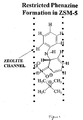
- Figure 1 shows the free base ortho-attack of the anilide salt on nitrobenzene. All of these conformations are relatively stable but yet have kinetic diameters that are larger than that allowed for in ZSM-5 pore channels.
- Figure 2 shows a conformation of a transition state of phenazine that nearly fits the ZSM-5 channel. This refers to TMA(OH) loaded onto a ZSM-5 pore channel.
- this transition state requires a large activation energy so that, in all probability, this transition state may be difficult to form, and 2.) the kinetic diameter of this transition state is slightly larger than the pore size due largely to the structure of the molecule.
- TMA(OH) The technique of loading TMA(OH) into a protonated zeolite is unique and careful attention to procedure is important especially at higher loadings. Without intending to be bound to any particular theory, it is conjectured that the coupling reaction proceeds by formation of the anilide salt inside the channel. With nitrobenzene, the Meisenheimer salt is formed inside the channel as well (see Figure 3.) The surface areas of pores are larger than those external to the zeolite. Azobenzene is formed at very low levels and it is believed that this formation is due to TMA(OH) that is located external to the zeolite crystal surface (not in the pores).
- the ZSM-5 zeolite provides still another advantage over the use of the TMA(OH) alone.
- TMA(OH) is generally prone to decomposition to trimethylamine and methanol, especially in the absence of water. Base decomposition is undesireable for reasons which include the abatement of decomposed products such as trimethylamine and methanol. Further considerations related to the cost of TMA(OH) make up are also of importance.
- the ZSM-5 support however, stabilizes the TMA(OH) and eliminates this unwanted decomposition.
- TMA(OH)/ZSM-5 it is possible to achieve 100% selectivity and 100% conversion using the TMA(OH)/ZSM-5 system. This represents an improvement over the use of TMA(OH) without the zeolite support, which still achieved good selectivity at about 95-96%.
- the improved results have been achieved using a 15wt.% loading of TMA(OH) on a ZSM-5 zeolite support. It is expected that a TMA(OH) loading not greater than about 25wt.% will afford similarly positive results. Loading greater than 25% can cause structural collapse of the zeolite structure. The higher loading is preferred because it will require less reactor volume. It will also be relatively easy to keep the solids suspended. For similar production requirements as the free base, low loadings will increase the solids content and cause difficulty in maintaining solids suspension and mixing. Loading amounts will likely depend on the silicon to aluminum ratio. It is conjectured that at higher silicon to aluminum ratios, the loading may be higher than 25% without obtaining structural collapse.
- ZSM-5 in particular, can
- TMA(OH) be loaded onto the ZSM-5 support prior to addition to the reaction zone.
- Straight addition of ZSM-5 to a mixture of aniline, nitrobenzene and TMA(OH) does not produce the same selectivity as the TMA(OH) loaded ZSM-5.
- the anilide salt formed reacts readily with nitrobenzene to form the Meisenheimer complex and its diffusion rate in the intracrystalline channel is relatively slow.
- the rate of ortho attack of the anilide salt on nitrobenzene to form phenazine is relatively faster than the diffusive rate. Therefore a simple addition of the zeolite on the coupling reaction mixture will not offer any advantage.
- a diluent or solvent may be employed in the process of the invention, provided that it does not extract the base from the solid support.
- the only solvent known to be suitable is aniline.
- An amount of aniline in excess of that needed for the reaction may be charged to the reaction zone, in which case this excess of aniline serves as the solvent.
- the loading of the base on ZSM-5 is non-trivial. Loading is accomplished by:
- the process of the present invention may be practiced in two steps which employ two reaction zones, in the first zone a condensation reaction in which intermediates of 4-ADPA are generated, followed by a catalytic hydrogenation reaction in the second zone that produces 4-ADPA.
- the process may also be carried out in one step in which 4-ADPA is generated directly from a single reaction zone.
- the nitrobenzene As the nitrobenzene is hydrogenated it generates aniline in situ, which reacts with a portion of the nitrobenzene to produce 4-ADPA intermediates, specifically salts of 4-nitrodiphenylamine (4-NDPA) and 4-nitrosodiphenylamine (4-NODPA), among other reaction products.
- the hydrogenation reaction further converts these 4-NDPA and 4-NODPA intermediates to 4-ADPA as the reaction proceeds.
- the capability to achieve 4-ADPA in a one-step, or one-pot, reaction process is advantageous.
- a key to obtaining high yield and selectivity to 4-aminodiphenylamine is to push the reaction to make more aniline; otherwise, the yield of nitrobenzene is lost to azoxybenzene or another step will be required to recover aniline from azoxybenzene as in the catalytic hydrogenation of azoxybenzene.
- the subject method includes the further step of hydrogenating the 4-ADPA intermediates to effect conversion to 4-ADPA.
- the subject method includes the step of reductively alkylating the 4-ADPA produced above to obtain the alkylated PPD, an antidegradant/antiozonant for polymers, particularly rubber.
- a primary factor is loading of the strong organic base on a zeolite support. Use of the base in this manner results in one-hundred percent (100%) conversion.
- Another factor involves control of the molar ratio of nitrobenzene to the TMA(OH) base material. This ratio should be no greater than about 18.0.
- One more factor which can be controlled to affect optimization of 4-ADPA yield and selectivity is the molar ratio of aniline to nitrobenzene available in the reaction zone.
- the molar ratio of aniline to nitrobenzene can vary from a large excess of nitrobenzene to a large excess of aniline.
- the reaction is conducted utilizing an excess of aniline, but not less than a molar ratio of aniline to nitrobenzene of about 5.0.
- the ratio of 4-NDPA to 4-NODPA produced in the reaction of the present invention can be controlled by varying the ratio of aniline to nitrobenzene. For example, the higher the ratio of aniline to nitrobenzene, the higher the ratio of 4-NODPA to 4-NDPA.
- nitrobenzene Preferable in the one-step process embodiment is the charging of nitrobenzene, and aniline if charged, in the presence of hydrogen, to achieve a molar ratio of aniline to nitrobenzene also not less than about 5.0.
- This is preferable because control of selectivity to higher levels of 4-ADPA can be easily achieved.
- some amount of nitrobenzene will be lost to nitrobenzene reduction products, i.e., azoxybenzene, azobenzene, and diphenylhydrazine.
- the hydrogen pressure in the reaction zone mentioned herein provides a driving force to effect hydrogenation during the method of the invention.
- the gauge pressure is preferably between 0 and 7000 kPa under either hydrogen flow control or pressure control.
- the rate of hydrogen uptake during flow control is equally important in affecting the selectivity to 4-nitrosodiphenyl-amine, and eventually to 4-aminodiphenylamine. The flow rate used will be dependent upon the type and level of catalyst.
- Hydrogenation catalysts are well known in the art. There are a variety of catalyst types that are appropriate as reduction catalysts for the present invention. Among these are at least one of copper, silver-magnesium oxide, copper-cerium oxide, copper-manganese oxide, iron-manganese oxide, platinum, nickel, molybdenum, sulfided noble metals, palladium, rhodium, ruthenium, iridium and platinum.
- the metal may be present on a suitable support selected from the group consisting of alumina, pumice, silica, activated carbon, and carbon black, and the catalyst may be separate from the base loaded zeolite.
- preferred catalysts include copper on alumina or pumice; silver-magnesium oxide on pumice; copper-cerium oxide on pumice; copper-manganese oxide or iron-manganese oxide on pumice; copper on silica; platinum on activated carbon or carbon black; nickel on silica or kieselguhr; molybdenum or palladium on carbon or alumina using catalyst inhibitors such as thiophene, thiourea, triphenyl phosphite, polyamines, magnesium oxide, morpholine, and thioethers; and sulfided noble metal catalysts using sulfiding agents such as hydrogen sulfide, sodium sulfide, ammonium sulfide, and dimethyl sulfoxide.
- the choice of catalyst should be that which retards or inhibits the direct hydrogenation of nitrobenzene to a terminal product, such as azoxybenzene.
- the flow can be regulated to lower pressures (such as those lower than 700 kPa) and higher levels of tetramethylammonium hydroxide, TMA(OH), which consequently increase the yield of nitrobenzene to 4-ADPA.
- pressures such as those lower than 700 kPa
- TMA(OH) tetramethylammonium hydroxide
- the catalyst will be associated with the loaded solid support.
- the solid support may comprise a cylindrical extrudate having a hollow section along its longitudinal axis with the remainder of the extrudate comprising a structure with base loaded interior channels, the hollow section being loaded with the hydrogenation catalyst.
- the hydrogenation catalyst may comprise free metal loaded into the interior channels of the solid support with the base material.
- the invention allows for the production of 4-ADPA with only nitrobenzene, hydrogen, an organic base and an hydrogenation catalyst as starting materials.
- the reaction events such as the head-to-tail coupling of aniline and nitrobenzene and the hydrogenation of the salts of 4-NODPA and 4-NDPA to 4-ADPA, need not be separated.
- optimal selectivity to 4-ADPA can be achieved without continuous removal of protic material, such as water. Protic material removal can, however, enhance selectivities in some reaction modes.
- protic removal is not necessary so long as the requirements are satisfied for increased selectivity to 4-ADPA, which includes choosing the proper aniline to nitrobenzene and nitrobenzene to organic base molar ratios and the weight ratios of organic base to the hydrogenation catalyst.
- the water removal can be effected to further improve the selectivity using a different reactor set up, such as a continuous fixed bed of hydrogenation catalyst where the water removal does not require vacuum conditions.
- the production of 4-ADPA in the present invention requires elevated pressures without significant regard to the removal of the protic material, such as water.
- the process of the invention may be carried out in a semi-batch mode with nitrobenzene charged to the reaction zone gradually over a period of time sufficient to achieve high selectivity to 4-ADPA and a charge of aniline is charged to the reaction zone initially with the nitrobenzene.
- the nitrobenzene may be charged to the reaction zone gradually, over a period of time, usually over from 0.1 to 10 hours.
- the temperature in the reaction zone is preferably 90°C and is held isothermally.
- the hydrogen gauge pressure at either flow or pressure control is 0 to about 3000 kPa gauge. At constant hydrogen pressure, near the end of the process, the pressure might be lower than 5.0 kPa gauge.
- nitrobenzene in a semi-batch mode, can be charged over time to achieve the highest possible selectivity to 4-ADPA.
- the amount of organic base, such as TMA(OH), relative to nitrobenzene is larger, and with an appropriate amount of hydrogenation catalyst present, a higher selectivity to 4-ADPA can be obtained.
- the end point for the reaction is determined by the amount of water produced in the coupling reaction, because at high water content the head-to-tail coupling of aniline and nitrobenzene is diminished and the reaction shifts to favor the formation of azoxybenzene.
- the selectivity to 4-ADPA can also be enhanced by manipulating the hydrogen flow control so that the head-to-tail coupling of aniline and nitrobenzene is effected against the direct hydrogenation of nitrobenzene to the terminal product, such as azoxybenzene.
- This hydrogenation flow rate is controlled so that the pressure is in the lower portion of the range.
- the process may be carried out in batch mode with the entire charge of nitrobenzene supplied to the reaction zone at one time.
- the process of the invention may also be carried out as a continuous process with a fixed bed of hydrogenation catalyst fed continuously with a charge of excess aniline, nitrobenzene, hydrogen and with the base material loaded on a solid support.
- nitrobenzene and aniline are recited as reactants, the method is also applicable to the use of nitrobenzene, nitrosobenzene or substituted aniline derivatives, including compounds containing one or more nuclear substituents which do not interfere with the reaction.
- substituted aniline derivatives means aniline containing one or more electron withdrawing or electron releasing substituents on the aromatic ring.
- Applicable substituents include, but are not limited to, halides, --NO 2 , --NH 2 , alkyl groups, alkoxy groups, --SO 3 , --COOH and aryl, aralkyl or alkaryl groups containing at least one --NH 2 group.
- Halides are selected from the group consisting of chloride, bromide and fluoride.
- the preferred alkyl and alkoxy groups contain from 1 to about 6 carbon atoms.
- the preferred aryl, aralkyl and alkaryl groups contain from about 6 to about 18 carbon atoms.
- substituted aniline derivatives include, but are not limited to, 2-methoxyaniline, 4-methoxyaniline, 4-chloroaniline, p-toluidine, 4-nitroaniline, 3-bromoaniline, 3-bromo-4-aminotoluene, p-aminobenzoic acid, 2,4-diaminotoluene, 2,5-dichloroaniline, 1,4-phenylene diamine, 4,4'-methylene dianiline, 1,3,5-triaminobenzene and mixtures thereof.
- the reaction comprising the one-step process is conducted at a suitable temperature that can vary over a wide range.
- the temperature can fall within a range of from about 20°C to about 180°C, such as from about 80°C to about 100°C, preferably from about 80°C to about 90°C.
- a most preferred temperature for conducting the reaction of the present invention is from about 80°C to about 90°C, such as at 85°C.
- the preferred temperature in the first step reaction can fall within a range of from about 10°C to about 150°C and in the second step from about 50°C to about 150°C.
- TMA(OH) is regenerated in the one-step process.
- This scheme is cyclic in nature as depicted in Figure 5.
- the regeneration of TMA(OH) can be effective as it may not need recovery using a centrifugal liquid/liquid extractor.
- the design of the base (TMA(OH)) loaded on Pd/Zeolite will require a configuration such that the base should encapsulate the Pd/Zeolite. Pd loading on the zeolite is such that it is highly dispersed.
- Reductive alkylation of 4-ADPA to produce antiozonants can be conducted by any one of several well known methods. See, for example, U.S. Pat. No. 4,900,868.
- 4-ADPA and a suitable ketone or aldehyde are reacted in the presence of hydrogen and platinum-on-carbon as catalyst.
- Suitable ketones include methylisobutyl ketone (MIBK), acetone, methylisoamylketone and 2-octanone.
- MIBK methylisobutyl ketone
- reduction of the 4-ADPA intermediates and alkylation of the reduced material can be conducted in the same reaction vessel utilizing the ketone as a solvent. See, for example, U.S. Pat. No. 4,463,191, and Banerjee et al, J. Chem. Soc. Chem. Comm. 18, 1275-76 (1988).
- Contemplated equivalents of the reactants and reagents set forth above are reactants and reagents otherwise corresponding thereto and having the same general properties wherein one or more of the various groups, e.g., NO 2 , are simple variations.
- a substituent is designated as, or can be, a hydrogen
- the exact chemical nature of a substituent which is other than hydrogen at that position is not critical so long as it does not adversely affect the overall activity and/or synthesis procedure.
- zeolite ZSM-5 was employed because of its unique intracrystalline pore structure, where it is supposed that crystals of TMA(OH) dihydrate are encapsulated. It is interesting to note that in the synthesis of ZSM-5, the organic base tetrapropylammonium hydroxide was utilized as a template for creating the unique crystal structure. Hence, it was anticipated that TMA(OH) would be encapsulated inside the ZSM-5 channels.
- the ZSM-5 used in the experiments were the ammonium form (from PQ Corporation / CBV 5000 series). Other forms, such as protonated or sodium form would be just as acceptable.
- Two silicon to aluminum ratios (Si/Al) were used e.g., 50 and 150. The coupling experiments, however, did not show effects of the Si/Al ratio on the product selectivity and conversion.
- the low Si/Al ratio denotes a more acidic zeolite and are found to be slightly more prone to structural collapse, especially if the loaded TMA(OH) is "overdried".
- these zeolites Prior to loading, these zeolites were calcined using the following temperature programming in a muffle furnace that was equipped with a continuous flow of air: 50°C/min to 400°C, 180 min at 400°C, ramp to 450°C at 10°C/min, 180 min at 450°C, 180 min at 450°C.
- the calcination was done to convert the ammonium form to the protonated form of ZSM-5 and at the same time burn off the organics that were not removed in the zeolite synthesis.
- the temperature was capped at 450°C to prevent the zeolite structure from disintegration via a thermal dealumination process which involves the conversion of a Bronsted acid type zeolite to a Lewis acid type zeolite and where dehydroxylation had occurred.
- Structural collapse may be characterized for a thoroughly water-washed loaded ZSM-5 by X-ray diffraction patterns (Cu-K ⁇ ) relative to an unloaded ZSM-5.
- the dried ion-exchanged material was weighed. From this weight, the appropriate amount of from about 5 to about 25 (w)% TMA(OH) was added to make-up a slurry of not greater than about 38% solids to achieve the desired loading. Water was then evaporated from the zeolite slurry under vacuum conditions and a water bath at a temperature not exceeding about 40°C. A rotary evaporator that was equipped with a vacuum pump was found as an ideal evaporation apparatus. After evaporation, the moist zeolite cake underwent further drying under a 40°C vacuum (desiccator) and with a continuous flow of nitrogen.
- a 40°C vacuum desiccator
- a slurry solution was made up of 50 gms of calcined and protonated ZSM-5, 45 gms of 25% aqueous TMA(OH) and 300 ml of deionized water.
- the resulting solution was dried overnight at about 40 to 44°C using a continously stirred vessel heated with an electric hot plate.
- the resulting solution was a thick slurry and most of the water was dried out.
- the thick slurry was transferred to a vacuum desiccator to dry further for about three hours.
- the vacuum desiccator was kept at 40 °C with a nitrogen purge.
- the dried material was hard and appeared to have another continous solid layer.
- the material although it was not hard and therefore easier to grind failed the coupling reaction test which consisted of reacting aniline and nitrobenzene in that it produced significant amounts of phenazine. It is estimated that the material used in the coupling reaction test had a TMA(OH) content of about 33 wt.%. It is apparent that TMA(OH) loading at such a high level causes the ZSM-5 crystal structure to collapse.
- aqueous TMA(OH) 86.24 gms of 25% aqueous TMA(OH) was added to 102.8 ml of deionized water. 107.8 gm of calcined and protonated ZSM-5 was added to form a slurry that was mixed vigorously at 40°C for 3 hours and 15 minutes. The ion-exchanged material was filtered. The filtrate was kept aside for use in subsequent loadings. To make a 20% loading of TMA(OH) in the zeolite, 154.8 gms of 25% by weight of aqueous TMA(OH) was added to the cake. The resulting slurry was transferred to a rotary evaporator.
- the temperature of the heating medium was controlled at 40°C and the rotary evaporator was equipped with a vacuum pump.
- the drying time was adjusted depending on the vacuum pressure at given temperature. It is preferred to run the drying temperature of not nore than 80°C. The most suitable temperature is 40°C to reduce the level of TMA(OH) decomposition.
- the pressure was controlled at 13 mm Hg at 40°C. Drying was allowed to proceed for about an hour and 10 minutes. The resulting material produced a thick paste that was flowable. This material was transferred to a flat evaporating dish and allowed to further dry at about 35°C for 15 hours in a vacuum desiccator. The dried solid was not hard and very easy to grind.
- the coupling reaction test which consists of reacting aniline and nitrobenzene did not produce phenazine using the above prepared material.
- An ion exchange mixture was prepared of 90.6 gms of 25% aqueous TMA(OH), 113 ml of of deionized water and 113.2 gm of calcined and protonated ZSM-5.
- the ion-exchange was carried out at 40°C with vigorous mixing for about three hours.
- the tetramethylammonium ZSM-5 was filtered and the filtrate was reused for subsequent loading or ion-exchange.
- 122.2 gms of 25% aqueous TMA(OH) was added into a vessel that was connected to an assembly that is similar to a rotary evaporator.
- the hot water bath was maintained at about 35°C and the drying/evaporating process was conducted for about three hours at vacuum pressures between 12 and 31 mm Hg.
- the dried material was removed from the vessel and transferred to a flat dish for further drying in a vacuum desiccator.
- the drying in the vacuum desiccator was kept at 40 °C for about 15 hours.
- the resulting dried material was fluffy when dried.
- a coupling reaction test based on reacting aniline and nitrobenzene failed to show the presence of phenazine.
- the dried material was transferred to a flat dish and placed in a vacuum desiccator with an inert gas purge.
- the vacuum desiccator was maintained at 40°C and drying was allowed for 4 days.
- the resulting dried material was hard, difficult to grind and consisted of what appeared to be two solid phases when ground.
- a coupling reaction test based on reacting aniline and nitrobenzene showed appreciable amounts of phenazine.
- the dried material was treated with 216.3 gms of 25% aqueous TMA(OH) for a 20% target loading of TMA(OH).
- the resulting slurry was dried in a rotary evaporator set-up for several hours until it was moist dry.
- the rotary evaporator was run at 35°C and 4 to 35 mm Hg.
- the dried material was transferred to a flat dish and placed in a vacuum desiccator with an inert gas purge.
- the vacuum desiccator is maintained at 40°C and drying was allowed for several hours (48 hours or less).
- the resulting dried material was not hard, and easy to grind and consisted of what appears to be one phase when ground.
- a coupling reaction test based on reacting aniline and nitrobenzene failed to produce phenazine.
- This example is similar to TMA(OH) loading Example No. 7 except that the slurry contained 262.4 gms of calcined and protonated ZSM-5, 211.4 gms. Of 25% aqueous TMA(OH) and 262 ml of deionized water. The ion exchange was conducted at 40°C for three hours. The filter cake after ion exchange was dried using a vacuum desiccator without a nitrogen purge overnight at room temperature. The drier cake was further dried in a vacuum desiccator at 35°C for 2.5 hours using a nitrogen purge.
- the amount of the residual water in the loaded zeolite is critical to the success of the loading. Allowing material to be dried beyond the dihydrate within the zeolite channels will collapse the structure. It is estimated that for an optimum loading preparation the residual water in the ZSM-5 should be limited to a level corresponding to a range of from a pentahydrate down to a trihydrate.
- the minimum residual water should be about 7.9% while at 25% loading of the base, the minimum is about 9.9% to avoid the risk of structural collapse.
- the optimum upper limit for the residual water in the base loaded in the zeolite should correspond to a pentahydrate. For a 20% base loading this corresponds to a maximum residual water of 19.8% and for a 25% loading, the maximum residual loading is about 24.7%. It is believed that beyond these numbers, the loaded zeolite will require further drying during the coupling reaction which would increase the cycle time.
- Drying time is difficult to fix due to the differences in application of techniques in evaporation and final drying.
- One is the first "fast" stage where unbound water is liberated from the loaded zeolite until it reaches the more stable hydrate form of the base crystals within the intracrystalline channels.
- the drying time slows down as more TMA(OH)-crystal bound water is taken away. This is the slow second drying stage. It is thought that the diffusion time for water out of the zeolite structure is not as critical as the release of water from the base crystals.
- An estimate of average drying time for loading example No. 8 shows the first stage to be about 1.107 gm/min, while in the slow second stage, the rate is about 0.5 gm/min.
- Slurry instability may also be caused by leaching of TMA(OH).
- 1-methyl-2-pyrolidinone was added to the aniline-TMA(OH)/ZSM-5 slurry. The addition caused the slurry suspension to become unstable and produces an effect similar to the one described above. It is surmised that 1-methyl-2-pyrolidinone extracts TMA(OH) away from the zeolite matrix.
- a well-suspended slurry of aniline-TMA(OH)/ZSM-5 therefore, indicates the absence of TMA(OH) leaching and also implies that the TMA salt of the aniline ion formed appears to reside inside the zeolite intracrystalline pores.
- a mixture was made of 8.0 gms of octane, 8.3 gms of aniline and 4.9 gms of 20% TMA(OH).
- Octane and aniline are basically soluble in each other at 70°C, which is the typical coupling reaction temperature.
- TMA(OH) loaded ZSM-5 was slowly added to the hot aniline-octane mixture, octane separated out on top and the aniline preferred the TMA(OH) loaded ZSM-5.
- the temperature dropped.
- the volume of the octane phase increased and the TMA(OH) loaded ZSM-5 thickened to a viscous glue-like texture as a separate phase. At this point, there was hardly a coupling reaction with nitrobenzene.
- Adding deionized water caused formation of three phases, namely: a water phase where most of the TMA(OH) loaded ZSM-5 was concentrated, an aniline phase and an octane phase.
- the reaction steps employed were similar to those disclosed in US Patent No. 5,453,541, with certain exceptions.
- the first exception was a reaction vessel having dimensions such that the aspect ratio (height to diameter) was greater than 0.79 and there was a symmetric internal baffle to reduce vortex formation.
- the second exception was charging the reaction vessel with a dry solid prepared from several of the above examples comprising TMA(OH) loaded ZSM-5. Before the solid was charged to the liquid in the reaction vessel, the agitator was kept at high speed, typically between 200 to 500 RPM and heat was added to the slurry to reach a temperature typical of the reaction rate for the head-to-tail coupling of nitrobenzene.
- the solid was slowly added so that clumping was prevented. This was accomplished by a vibratory feed motion of solid into the reaction vessel and so that the solid was well distributed over the surface of the reaction media. Base drying was not necessary as the loaded TMA(OH) on ZSM-5 corresponded to very small amounts of water.
- the water of hydration for loaded TMA(OH) zeolite is less than about 5 moles of water per mole of tetramethylammonium hydroxide at the start of the reaction.
- the mixture when starting with 25% TMA(OH) the mixture must be dried from 15 moles to about 5 moles of water per mole of TMA(OH) before the reaction may proceed. Therefore, in all head-to-tail coupling of aniline and nitrobenzene using TMA(OH) loaded zeolite, base drying time is drastically reduced or completely eliminated and nitrobenzene addition may be immediately started as soon as all the loaded TMA(OH) zeolite is added to the reaction vessel. While nitrobenzene is being added, the vacuum system may be initiated and kept at 70 mm Hg or so to further remove the water.
- the molar ratios of AN/NB for the above coupling reactions are high. This is due to zeolite settling when lower ratios are used.
- the aspect ratio is close to 2 with solids content that range from 6.3% to 13.6%. This is very low solids loading and therefore suggested the use of diluents/solvents to decrease the AN/NB ratio and still maintain slurry suspension.
- the coupling reaction given in example 6 employs materials prepared from techniques established in TMA(OH) loading example No. 7. If the loading preparation does not allow sufficient pore-filling equilibration as in slow drying for several hours (48 hours), some organic base would settle on the crystal surface of the zeolite. Typical of these are high vacuum and high heat rate for rapid water evaporation.
- TMA(OH) deposits on the crystal surface resulting from inadequate equilibration may be observed in Table V which shows the presence of azobenzene and lower molar ratio of 4-NODPA to 4-NDPA compared to those given in the coupling reaction of Example 6.
- the zeolite encapsulated organic base contains small amounts of moisture. A practical amount is equivalent to about a dihydrate of the organic base. It is believed that water of hydration less than the dihydrate may cause the zeolite structure to collapse. Because the amount of water is small, the coupling reaction may be conducted at higher pressure (there is no need to remove water) which allows a more direct one-step process for the production of 4-ADPA.
- Table VI shows an example of a comparison of low and high pressure where for about similar conversion, both pressures yield similar selectivity values.
- TGA was conducted of the TMA(OH)loaded ZSM-5 to characterize the TMA(OH) loading and verify the amount of TMA(OH) deposited. Moreover, the TGA of ZSM-5 (Fig. 6), 25 (w) % TMA (OH) (Fig. 7) and TMA(OH) pentahydrate (Fig. 8) were obtained to provide a basis of comparison and analysis.
- Figures 9,10 and 11 show typical TGA for TMA(OH) loaded ZSM-5 at 10%, 15% and 25% loadings, respectively.
- Figures 7-11 also show curves of the derivatives of the wt.% vs. temperature curves to clearly establish where peak temperatures occur.
- the peaks that occur past 150°C, typically in the 180°C temperature range correspond to primarily a TMA(OH) decomposition, because at those temperatures, most of the water has been desorbed. Hence, the weight loss in this temperature regime is approximately equal to weight loss at the ⁇ peaks.
- the presence of multiple peaks in the high temperature regime may be caused either by diffusion or the difference in activation energy of TMA(OH) decomposition in the Zeolite (heterogeneous surface). The presence of stable TMA(OH) hydrates at those temperatures could also explain the existence of the multiple ⁇ peaks.
- the TGA spectrum for aqueous 25 (w)% TMA(OH) reveals two distinct peaks, which suggests that the activation for the decomposition of TMA(OH) is dependent upon the amount of water present.
- the higher peak temperature decomposition (152°C) corresponds to a less hydrated form of TMA(OH).
- the TGA spectrum for the pentahydrate is similar to the 25 (w)% TMA(OH), except that the ⁇ peak is 132°C (20°C lower than the 25(w)% TMA(OH)). This difference in the ⁇ peak temperatures can be accounted for by the decomposition of the most stable form of the TMA(OH) hydrate.
- the most stable hydrate is TMA(OH) ⁇ 2.3 H 2 O at the ⁇ peak.
- the 2.3 moles H 2 O per mole TMA(OH) is perhaps a lower bound estimate because, some TMA(OH) could have decomposed at temperature less than 152°C, although this number should not deviate very much from the actual number.
- the most stable hydrate is TMA(OH) ⁇ 3.3 H 2 O.
- the ⁇ peak temperatures for the "free" TMA(OH) as shown in Fig. 7 does not vary significantly. For example, for the 25(w) % or 15.2 moles H 2 O, the ⁇ peak temperature is at 80°C, while for the pentahydrate, it is about 75°C with a shoulder at about 89°C.
- the ⁇ peak could be interpreted as the evaporation of unbound (or "excess") water with small amounts of TMA(OH) decomposition. These numbers also imply that once the unbound water is evaporated, the resulting hydrate is much more difficult to decompose, especially if the hydrate is of a lower form.
- the higher ⁇ peak temperatures as shown in following Table VII and Fig.
- TMA(OH)/ZSM-5 vs. free TMA(OH) could imply that either TMA(OH) exists in its "almost free water state" or that the resulting TMA(OH) ⁇ xH 2 O is tightly bound inside the ZSM-5 intracrystalline channels, or both.
- x must be a small number, perhaps ⁇ 2.3. It should be noted that as the loaded ZSM-5 gets thoroughly dried, structural collapse would occur as the temperature ramping progresses. But in spite of this structural collapse, the ⁇ peak temperature is nevertheless high, denoting a tightly bound TMA(OH).
- Table VII TGA RESULTS, TMA(OH)/ZSM-5 Sample No. ⁇ Peak Temp. C Weight % Loss ⁇ ⁇ Peak Temp.
- IR spectroscopys of both calcined (protonated form) and the loaded ZSM-5 were obtained and are shown in Figure 12.
- the IR specimens were not degassed so that water of absorption is visible in the IR spectra. Typically this occurs at 3450 and 1640cm -1 , where the physically absorbed water is on the oxygen framework.
- the protonated form would show structural (or framework) hydroxyl groups at 3745cm -1 for the terminal silanol (SiOH), exhibiting very weak acidity and another IR band at 3610cm -1 for the Si-OH-Al groups, exhibiting very strong acidity.
Landscapes
- Chemical & Material Sciences (AREA)
- Organic Chemistry (AREA)
- Chemical Kinetics & Catalysis (AREA)
- Engineering & Computer Science (AREA)
- Materials Engineering (AREA)
- Crystallography & Structural Chemistry (AREA)
- Organic Low-Molecular-Weight Compounds And Preparation Thereof (AREA)
- Low-Molecular Organic Synthesis Reactions Using Catalysts (AREA)
- Silicates, Zeolites, And Molecular Sieves (AREA)
- Catalysts (AREA)
- Compositions Of Macromolecular Compounds (AREA)
- Solid-Sorbent Or Filter-Aiding Compositions (AREA)
Claims (26)
- Verfahren zur Herstellung von Zwischenprodukten von 4-ADPA, umfassend:(a) Beladen eines Zeoliths mit basischem Material durch Ionenaustausch, indem man den Zeolith mit einer wässrigen Lösung des basischen Materials in Kontakt bringt;(b) Trocknen des aus Schritt (a) zurückgewonnenen Zeoliths;(c) Hinzufügen von zusätzlichem basischem Material in wässriger Lösung zu dem getrockneten Zeolith aus Schritt (b), wobei man eine Zeolithaufschlämmung erhält; und(d) Zurückgewinnen des Zeoliths aus der Zeolithaufschlämmung mit der gewünschten Beladung an basischem Material;Umsetzen von Anilin mit Nitrobenzol in einer Reaktionszone, wobei die Reaktionszone den mit dem basischen Material beladenen Zeolith enthält, wobei der Zeolith innere Kanäle aufweist, wobei die Kanäle mit basischem Material beladen sind, das in der Reaktion eingesetzt wird, wobei die Querschnittsabmessungen der Kanäle so groß sind, dass man einen restringierten Übergangszustand in Bezug auf die Reaktion erhält und die Selektivität der Reaktion zugunsten der Zwischenprodukte verbessert wird.
- Verfahren gemäß Anspruch 1, wobei der Träger einen ZSM-5-Zeolith umfasst.
- Verfahren gemäß Anspruch 2, wobei die Menge der Feststoffe in dem Reaktionsgemisch nicht größer als 50 Gew.-% ist und das Aspektverhältnis im Reaktor größer als 0,79 ist.
- Verfahren gemäß Anspruch 1, wobei das basische Material aus der Gruppe ausgewählt ist, die aus Alkalimetall-C1-C6-alkoxiden, quartären Ammoniumhydroxiden und Gemischen davon besteht.
- Verfahren gemäß Anspruch 1, wobei das basische Material aus der Gruppe ausgewählt ist, die aus Alkalimetallhydroxiden, Kalium-t-butoxid, Alkalimetallalkoxiden, vierfach substituierten Ammoniumhydroxiden, bei denen jeder Substituent unabhängig aus Alkyl-, Aryl- oder Arylalkylgruppen ausgewählt sein kann, wobei die Gruppen jeweils gegebenenfalls eine funktionelle Gruppe enthalten können, quartären Diammoniumhydroxiden und Gemischen davon besteht.
- Verfahren gemäß Anspruch 1, wobei die basischen Materialien in Verbindung mit einem Phasentransferkatalysator verwendet werden.
- Verfahren gemäß Anspruch 6, wobei der Phasentransferkatalysator aus der Gruppe ausgewählt ist, die aus Aryl-, Alkyl- und Arylalkylammoniumsalzen, Kronenethern und Aminbasen besteht.
- Verfahren gemäß Anspruch 2, wobei es sich bei dem basischen Material um Tetramethylammoniumhydroxid (TMA(OH)) handelt.
- Verfahren gemäß Anspruch 1, wobei das Stoffmengenverhältnis von Nitrobenzol zu dem basischen Material nicht größer als 18,0 ist.
- Verfahren gemäß Anspruch 1, wobei die Zwischenprodukte von 4-ADPA, die in der Reaktionszone entstehen, in einer zweiten Reaktionszone durch eine katalytische Hydrierungsreaktion in 4-ADPA umgewandelt werden.
- Verfahren gemäß Anspruch 1, wobei die Zwischenprodukte von 4-ADPA in einem einstufigen Verfahren zur Herstellung von 4-Aminodiphenylamin (4-ADPA) in 4-ADPA umgewandelt werden, das Folgendes umfasst: das Bringen von Nitrobenzol in eine Reaktionszone unter Wasserstoffdruck und in Gegenwart des basischen Materials, mit dem der Zeolithträger beladen ist, und eines Hydrierungskatalysators, wobei der Zeolithträger innere Kanäle aufweist, wobei die Kanäle mit basischem Material beladen sind, das in der Reaktion eingesetzt wird, wobei die Querschnittsabmessungen der Kanäle so groß sind, dass man einen restringierten Übergangszustand in Bezug auf die Reaktion erhält und die Selektivität der Reaktion zugunsten von 4-ADPA verbessert wird.
- Verfahren gemäß Anspruch 11, wobei das 4-ADPA weiter unter Bildung von alkyliertem Paraphenylendiamin reduktiv alkyliert wird.
- Verfahren gemäß Anspruch 11, wobei das basische Material aus der Gruppe ausgewählt ist, die aus Alkalimetall-C1-C6-alkoxiden, quartären Ammoniumhydroxiden und Gemischen davon besteht.
- Verfahren gemäß Anspruch 11, wobei das basische Material aus der Gruppe ausgewählt ist, die aus Alkalimetallhydroxiden, Kalium-t-butoxid, Alkalimetallalkoxiden, vierfach substituierten Ammoniumhydroxiden, bei denen jeder Substituent unabhängig aus Alkyl-, Aryl- oder Arylalkylgruppen ausgewählt sein kann, wobei die Gruppen jeweils gegebenenfalls eine funktionelle Gruppe enthalten können, quartären Diammoniumhydroxiden und Gemischen davon besteht.
- Verfahren gemäß Anspruch 11, wobei die basischen Materialien in Verbindung mit einem Phasentransferkatalysator verwendet werden.
- Verfahren gemäß Anspruch 15, wobei der Phasentransferkatalysator aus der Gruppe ausgewählt ist, die aus Aryl-, Alkyl- und Arylalkylammoniumsalzen, Kronenethern und Aminbasen besteht.
- Verfahren gemäß Anspruch 11, wobei es sich bei dem basischen Material um Tetramethylammoniumhydroxid handelt.
- Verfahren gemäß Anspruch 17, wobei das Stoffmengenverhältnis von Nitrobenzol zu Tetramethylammoniumhydroxid nicht größer als 18,0 ist.
- Verfahren gemäß Anspruch 11, wobei Anilin so in die Reaktionszone gegeben wird, dass das Verfahren in einem Überschuss von Anilin durchgeführt wird.
- Verfahren gemäß Anspruch 19, wobei das Stoffmengenverhältnis von Anilin zu Nitrobenzol nicht kleiner als 5,0 ist.
- Verfahren gemäß Anspruch 11, wobei der Hydrierungskatalysator von dem basischen Material, mit dem ein fester Träger beladen ist, getrennt ist und wenigstens einen der Katalysatoren Kupfer, Silber-Magnesiumoxid, Kupfer-Ceroxid, Kupfer-Manganoxid, Eisen-Manganoxid, Platin, Nickel, Molybdän, Palladium oder sulfidierte Edelmetalle umfasst, wobei das Metall auf einem geeigneten Träger vorliegt, der aus der Gruppe ausgewählt ist, die aus Aluminiumoxid, Bimsstein, Siliciumoxid, Aktivkohle und Ruß besteht.
- Verfahren gemäß Anspruch 11, wobei der Träger ZSM-5 umfasst.
- Verfahren gemäß Anspruch 22, wobei die Menge der Feststoffe in dem Reaktionsgemisch nicht größer als 50 Gew.-% ist und das Aspektverhältnis in dem Reaktor größer als 0,79 ist.
- Verfahren gemäß Anspruch 11, wobei der feste Träger ein zylindrisches Extrudat umfasst, das einen hohlen Abschnitt entlang seiner Längsachse aufweist, wobei der Rest des Extrudats eine Struktur mit basenbeladenen inneren Kanälen umfasst, wobei der hohle Abschnitt mit dem Hydrierungskatalysator beladen ist.
- Verfahren gemäß Anspruch 24, wobei der Hydrierungskatalysator freies Metall umfasst, mit dem die inneren Kanäle des festen Trägers mit dem basischen Material beladen sind.
- Verfahren gemäß einem der Ansprüche 1 bis 25, wobei es sich bei dem Zeolith um ZSM-5 und bei dem basischen Material um TMA(OH) handelt, wobei die Aufschlämmung von Schritt (c) hergestellt wird, indem man eine ausreichende Menge an TMA(OH)-Lösung, die eine TMA(OH)-Konzentration von nicht mehr als 28 Gew.-% hat, bei einer Temperatur von nicht mehr als 40 °C zu dem getrockneten ionenausgetauschten ZSM-5 gibt, wobei man eine Beladung des ZSM-5-Zeoliths mit TMA(OH) von nicht mehr als 25 Gew.-% erhält, und bei einer Temperatur von nicht mehr als 40 °C trocknet, wobei man einen TMA(OH)-beladenen ZSM-5-Zeolith mit einem Stoffmengenverhältnis von Wasser zu Base in dem geladenen TMA(OH) von 2,0 bis 5,0 erhält.
Applications Claiming Priority (3)
| Application Number | Priority Date | Filing Date | Title |
|---|---|---|---|
| US598155 | 1996-02-07 | ||
| US09/598,155 US6495723B1 (en) | 2000-06-21 | 2000-06-21 | Zeolite support loaded with a base material for use in the coupling of aniline and nitrobenzene |
| PCT/US2001/019666 WO2001098252A2 (en) | 2000-06-21 | 2001-06-20 | Zeolite support loaded with a base material for use in the coupling of aniline and nitrobenzene |
Publications (2)
| Publication Number | Publication Date |
|---|---|
| EP1294675A2 EP1294675A2 (de) | 2003-03-26 |
| EP1294675B1 true EP1294675B1 (de) | 2006-11-22 |
Family
ID=24394460
Family Applications (1)
| Application Number | Title | Priority Date | Filing Date |
|---|---|---|---|
| EP01946568A Expired - Lifetime EP1294675B1 (de) | 2000-06-21 | 2001-06-20 | Kupplung von anilin und nitrobenzol mit basisches material enthaltenden zeolithträger |
Country Status (14)
| Country | Link |
|---|---|
| US (1) | US6495723B1 (de) |
| EP (1) | EP1294675B1 (de) |
| JP (1) | JP2004500981A (de) |
| KR (1) | KR100841873B1 (de) |
| CN (1) | CN1285566C (de) |
| AT (1) | ATE346033T1 (de) |
| AU (1) | AU2001268596A1 (de) |
| BR (1) | BR0111872A (de) |
| CA (1) | CA2413409A1 (de) |
| DE (1) | DE60124709D1 (de) |
| MX (1) | MXPA03000083A (de) |
| RU (1) | RU2280506C2 (de) |
| TW (1) | TW593221B (de) |
| WO (1) | WO2001098252A2 (de) |
Families Citing this family (24)
| Publication number | Priority date | Publication date | Assignee | Title |
|---|---|---|---|---|
| PT1645555E (pt) | 2003-07-04 | 2011-11-28 | Jiangsu Sinorgchem Tech Co Ltd | Um método para produzir 4-aminodifenilamina |
| US8686188B2 (en) | 2003-07-04 | 2014-04-01 | Jiangsu Sinorgchem Technology Co., Ltd. | Process for preparing 4-aminodiphenylamine |
| US8486223B2 (en) * | 2003-07-04 | 2013-07-16 | Jiangsu Sinorgchem Technology Co., Ltd. | Falling film evaporator |
| JP4500302B2 (ja) * | 2003-07-04 | 2010-07-14 | チアンス・シノケム・テクノロジー・カンパニー・リミテッド | 4−アミノジフェニルアミンの製造方法 |
| WO2005103025A1 (en) * | 2004-04-21 | 2005-11-03 | Novogen Research Pty Ltd | Isoflavene synthetic method and catalyst |
| JP4876707B2 (ja) * | 2006-05-10 | 2012-02-15 | 住友化学株式会社 | 4−ニトロソジフェニルアミン及び4−ニトロジフェニルアミンの製造方法 |
| NZ588052A (en) * | 2008-03-04 | 2013-11-29 | Univ Massachusetts | Catalytic pyrolysis of solid biomass and related biofuels, aromatic, and olefin compounds |
| CN101381315B (zh) * | 2008-10-17 | 2010-12-08 | 山西翔宇化工有限公司 | 一种制备对氨基二苯胺的方法 |
| BR112012005379B1 (pt) | 2009-09-09 | 2019-03-06 | University Of Massachusetts | Sistemas e processos para pirólise catalítica de biomassa e materiais hidrocarboníferos para produção de aromáticos com reciclagem de olefina opcional e catalisadores tendo tamanho de partícula selecionado para pirólise catalítica. |
| CN102259029B (zh) | 2010-05-24 | 2014-12-10 | 江苏圣奥化学科技有限公司 | 固体碱催化剂 |
| US8835341B2 (en) | 2011-09-07 | 2014-09-16 | Chevron Phillips Chemical Company Lp | Processed support and methods of making and using same |
| IN2014KN01593A (de) | 2012-03-07 | 2015-10-23 | Nocil Ltd | |
| EP2698198A1 (de) * | 2012-08-14 | 2014-02-19 | Saudi Basic Industries Corporation | Verfahren zur Vorbehandlung einer Katalysatorzusammensetzung |
| RU2502725C1 (ru) * | 2012-10-22 | 2013-12-27 | Российская Федерация, От Имени Которой Выступает Министерство Промышленности И Торговли Российской Федерации | Способ получения n-алкил-n'-фенил-пара-фенилендиаминов |
| RU2553984C2 (ru) * | 2013-02-28 | 2015-06-20 | Олег Александрович ГОДЗОЕВ | Способ получения 4-аминодифениламина и его алкилированных производных |
| CN103232402B (zh) * | 2013-06-04 | 2015-09-16 | 山西翔宇化工有限公司 | 一种从rt培司废料中提取精制吩嗪的方法 |
| CN103992281B (zh) * | 2014-05-29 | 2016-07-06 | 山西翔宇化工有限公司 | 一种从rt培司副产废料中提取高纯度吩嗪的方法 |
| CN108558675A (zh) * | 2018-04-25 | 2018-09-21 | 南通理工学院 | 一种4-氨基二苯胺的合成方法 |
| CN110624602A (zh) * | 2018-06-25 | 2019-12-31 | 中国石油化工股份有限公司 | 一种固体碱催化剂制备方法及应用 |
| CN110627660A (zh) * | 2018-06-25 | 2019-12-31 | 中国石油化工股份有限公司 | 一种固体碱法rt培司制备方法 |
| US20240124683A1 (en) | 2022-09-28 | 2024-04-18 | The Goodyear Tire & Rubber Company | Rubber - forming additives from biomass through syngas production |
| US20240117149A1 (en) | 2022-09-28 | 2024-04-11 | The Goodyear Tire & Rubber Company | Rubber - forming additives from end of life tires through syngas production |
| US20250163236A1 (en) | 2023-11-21 | 2025-05-22 | The Goodyear Tire & Rubber Company | Production of rubber compositions from end of life tires |
| CN119751312B (zh) * | 2024-12-27 | 2026-01-16 | 南京大学 | 一种硝基苯加氢选择性制备氧化偶氮苯或1,2-二苯肼的方法 |
Family Cites Families (28)
| Publication number | Priority date | Publication date | Assignee | Title |
|---|---|---|---|---|
| US3509042A (en) * | 1961-10-05 | 1970-04-28 | Mobil Oil Corp | Shape selective zeolite having a metal component therein |
| US3393066A (en) | 1964-09-21 | 1968-07-16 | Exxon Research Engineering Co | Process for reduction of iron ore in staged fluid beds without bogging |
| BE789273A (fr) | 1971-09-28 | 1973-03-26 | Bayer Ag | Procede de preparation de derives de nitrodiphenylamine |
| GB1440767A (en) | 1972-11-24 | 1976-06-23 | Ici Ltd | Oxidation process for the manufacture of 4-aminodiphenylamine and related higher amines |
| DE2633811C2 (de) | 1976-07-28 | 1983-11-10 | Bayer Ag, 5090 Leverkusen | Verfahren zur Herstellung von Nitrodiphenylaminen |
| DE2713602C3 (de) | 1977-03-28 | 1980-03-20 | Akzo Gmbh, 5600 Wuppertal | Verfahren zur Herstellung von Nitrosobenzol |
| US5182090A (en) * | 1977-04-04 | 1993-01-26 | Mobil Oil Corp. | Synthesis of large crystal size zsm-5 |
| US4187248A (en) | 1977-11-23 | 1980-02-05 | Monsanto Company | Making a nitrodiarylamine by reacting an alkali metal salt of a formamide with a nitrohaloarene |
| US4209463A (en) | 1977-12-27 | 1980-06-24 | Monsanto Company | Promoting the formation of nitrodiarylamines from nitrohaloarenes, activated aryl amines and sodium carbonates |
| US4187249A (en) | 1977-12-27 | 1980-02-05 | Monsanto Company | Promoting the reaction of sodium salts of formyl derivatives of aromatic amines to form nitrodiarylamines |
| US4140716A (en) | 1978-01-05 | 1979-02-20 | Monsanto Company | Process for making an amide of formic acid and forming nitrodiarylamine therefrom |
| US4155936A (en) | 1978-03-08 | 1979-05-22 | The Goodyear Tire & Rubber Company | Para-nitrodiphenylamines synthesis using Polyethers and macrocyclic esters as solubilizing agents |
| US4196146A (en) | 1978-03-13 | 1980-04-01 | Monsanto Company | Making nitrodiarylamines from formyl derivatives of aromatic amines and nitrohaloarenes by admixing with certain aqueous salt solutions |
| US4404401A (en) | 1979-02-23 | 1983-09-13 | Akzona Incorporated | Process for the preparation of para-amino-diphenylamine |
| US4900868A (en) | 1982-01-18 | 1990-02-13 | Monsanto Company | Process for producing N,N'-disubstituted paraphenylene diamine mixtures by sequential reductive alkylation |
| US4479008A (en) | 1982-09-30 | 1984-10-23 | Uniroyal, Inc. | Preparation of p-nitrosodiphenylamine |
| US4518803A (en) | 1982-09-30 | 1985-05-21 | Uniroyal, Inc. | Process for the preparation of p-nitrosodiphenylamine |
| US4463191A (en) | 1983-09-26 | 1984-07-31 | The Goodyear Tire & Rubber Company | Process for the reductive alkylation of aromatic nitro-containing compounds with ketones or aldehydes |
| US4614817A (en) | 1983-12-19 | 1986-09-30 | Monsanto Company | Making nitrodiarylamines |
| DE3504479A1 (de) | 1985-02-09 | 1986-08-14 | Bayer Ag, 5090 Leverkusen | Verfahren zur herstellung von 4-nitrodiphenylaminen |
| US4683332A (en) | 1985-05-20 | 1987-07-28 | The Goodyear Tire & Rubber Company | Para-nitrodiphenylamine synthesis |
| US4760186A (en) | 1986-09-15 | 1988-07-26 | Monsanto Company | Preparation of substituted aromatic amines |
| US5117063A (en) | 1991-06-21 | 1992-05-26 | Monsanto Company | Method of preparing 4-aminodiphenylamine |
| US5420354A (en) | 1994-10-06 | 1995-05-30 | Uniroyal Chemical Company, Inc. | Process of preparing para phenylamines |
| DE19709124A1 (de) | 1997-03-06 | 1998-09-10 | Bayer Ag | Verfahren zur Herstellung von 4-Aminodiphenylamin |
| US5977411A (en) * | 1997-06-10 | 1999-11-02 | Flexsys America L.P. | Catalytic hydrogeneration of nitrobenzene to 4-aminodiphenylamine in the presence of a hydroxyl compound and a solvent |
| TW500712B (en) * | 1997-08-06 | 2002-09-01 | Bayer Ag | Process for the preparation of 4-aminodiphenylamine |
| US6140538A (en) * | 1998-05-18 | 2000-10-31 | Flexsys America L.P. | Process for preparing 4-aminodiphenylamines |
-
2000
- 2000-06-21 US US09/598,155 patent/US6495723B1/en not_active Expired - Fee Related
-
2001
- 2001-06-20 BR BR0111872-2A patent/BR0111872A/pt not_active IP Right Cessation
- 2001-06-20 CN CNB018115543A patent/CN1285566C/zh not_active Expired - Fee Related
- 2001-06-20 CA CA002413409A patent/CA2413409A1/en not_active Abandoned
- 2001-06-20 DE DE60124709T patent/DE60124709D1/de not_active Expired - Lifetime
- 2001-06-20 AU AU2001268596A patent/AU2001268596A1/en not_active Abandoned
- 2001-06-20 RU RU2003101406/04A patent/RU2280506C2/ru not_active IP Right Cessation
- 2001-06-20 EP EP01946568A patent/EP1294675B1/de not_active Expired - Lifetime
- 2001-06-20 WO PCT/US2001/019666 patent/WO2001098252A2/en not_active Ceased
- 2001-06-20 KR KR1020027017408A patent/KR100841873B1/ko not_active Expired - Fee Related
- 2001-06-20 AT AT01946568T patent/ATE346033T1/de not_active IP Right Cessation
- 2001-06-20 JP JP2002504208A patent/JP2004500981A/ja active Pending
- 2001-06-20 MX MXPA03000083A patent/MXPA03000083A/es not_active Application Discontinuation
- 2001-07-24 TW TW090115160A patent/TW593221B/zh not_active IP Right Cessation
Non-Patent Citations (2)
| Title |
|---|
| KO A.-N. ET AL: "Efficient direct synthesis of 2-ethylhexanal from n-butyraldehyde and hydrogen using palladium modified base catalysts", APPLIED CATALYSIS A: GENERAL, vol. 184, 1999, pages 211 - 217, XP004271889 * |
| SATTERLY B.W. ET AL: "Zeolite-catalyzed chlorination of toluene by sulfuryl chloride", ZEOLITES, vol. 19, 1997, pages 434 - 440, XP004100792 * |
Also Published As
| Publication number | Publication date |
|---|---|
| KR20030017553A (ko) | 2003-03-03 |
| CA2413409A1 (en) | 2001-12-27 |
| EP1294675A2 (de) | 2003-03-26 |
| BR0111872A (pt) | 2003-07-29 |
| KR100841873B1 (ko) | 2008-06-27 |
| CN1285566C (zh) | 2006-11-22 |
| AU2001268596A1 (en) | 2002-01-02 |
| MXPA03000083A (es) | 2003-05-27 |
| ATE346033T1 (de) | 2006-12-15 |
| US6495723B1 (en) | 2002-12-17 |
| RU2280506C2 (ru) | 2006-07-27 |
| TW593221B (en) | 2004-06-21 |
| WO2001098252A3 (en) | 2002-03-14 |
| DE60124709D1 (de) | 2007-01-04 |
| WO2001098252A2 (en) | 2001-12-27 |
| CN1437573A (zh) | 2003-08-20 |
| JP2004500981A (ja) | 2004-01-15 |
Similar Documents
| Publication | Publication Date | Title |
|---|---|---|
| US6495723B1 (en) | Zeolite support loaded with a base material for use in the coupling of aniline and nitrobenzene | |
| EP0107389B1 (de) | Zeolith L-Reformierkatalysator | |
| KR910002943B1 (ko) | 디메틸아민의 제조방법 | |
| EP0002899A1 (de) | Verfahren zur Herstellung von Aluminosilikaten und deren Verwendung als Katalysatorträger und Katalysatoren | |
| JPH06508630A (ja) | 4−アミノジフェニルアミンの製造法 | |
| CN103889572B (zh) | 用于制备介孔化催化剂的方法、由此获得的催化剂及其在催化工艺中的用途 | |
| EP0988277B1 (de) | Katalytische hydrierung von nitrobenzol zu 4-amino-diphenylamin in gegenwart einer hydroxyl-verbindung und eines lösungsmittels | |
| RU2003101406A (ru) | Цеолитный носитель с введенным основанием для применения при сочетании анилина и нитробензола | |
| Kalbasi et al. | Facile one-pot tandem reductive amination of aldehydes from nitroarenes over a hierarchical ZSM-5 zeolite containing palladium nanoparticles | |
| JP2017523159A (ja) | ジフェニルメタンシリーズのジアミンおよびポリアミンの製造方法 | |
| JP4707798B2 (ja) | ジアミノジフェニルメタンとその高級同族体の製造方法 | |
| EP1741699B1 (de) | Prozess zur Herstellung von E-Caprolactam | |
| EP3619190B1 (de) | Verfahren zur umwandlung von ethylenoxid in monoethanolamin und ethylendiamin mit einem zeolith | |
| KR101595826B1 (ko) | 함산소화물로부터 프로필렌 제조용 제올라이트 촉매 및 이의 제조방법 | |
| WO2009062742A2 (en) | Porous solid acid catalysts, methods of manufacturing the same, and methods of manufacturing organics molecules using the same | |
| CN107801392B (zh) | 烃的直接胺化 | |
| US7442840B2 (en) | Synthesis of severely sterically hindered amino-ether alcohols and diaminopolyalkenyl ethers using a high activity powder catalyst | |
| JP4243360B2 (ja) | アミンの製造方法 | |
| CN114042472B (zh) | 一种高分散性亚纳米型双功能催化剂及其制备方法与应用 | |
| EP1294481B1 (de) | Verfahren zur regenerierung von festen sauren katalysatoren | |
| RU2048196C1 (ru) | Способ приготовления катализатора ароматизации углеводородов | |
| JP2002028492A (ja) | ジアルカノールアミンの製造方法、ジアルカノールアミン製造用触媒およびその製造方法 | |
| JPH09249619A (ja) | メチルアミン類の製造方法 | |
| CN113441174A (zh) | 一种催化剂的制备方法、得到的催化剂以及烷基化反应方法 | |
| JP2008161738A (ja) | ゼオライト触媒の活性回復方法 |
Legal Events
| Date | Code | Title | Description |
|---|---|---|---|
| PUAI | Public reference made under article 153(3) epc to a published international application that has entered the european phase |
Free format text: ORIGINAL CODE: 0009012 |
|
| 17P | Request for examination filed |
Effective date: 20021203 |
|
| AK | Designated contracting states |
Kind code of ref document: A2 Designated state(s): AT BE CH CY DE DK ES FI FR GB GR IE IT LI LU MC NL PT SE TR |
|
| AX | Request for extension of the european patent |
Extension state: AL LT LV MK RO SI |
|
| 17Q | First examination report despatched |
Effective date: 20040301 |
|
| GRAP | Despatch of communication of intention to grant a patent |
Free format text: ORIGINAL CODE: EPIDOSNIGR1 |
|
| RTI1 | Title (correction) |
Free format text: COUPLING OF ANILINE AND NITROBENZENE USING ZEOLITE SUPPORT LOADED WITH A BASE MATERIAL |
|
| GRAS | Grant fee paid |
Free format text: ORIGINAL CODE: EPIDOSNIGR3 |
|
| GRAA | (expected) grant |
Free format text: ORIGINAL CODE: 0009210 |
|
| AK | Designated contracting states |
Kind code of ref document: B1 Designated state(s): AT BE CH CY DE DK ES FI FR GB GR IE IT LI LU MC NL PT SE TR |
|
| PG25 | Lapsed in a contracting state [announced via postgrant information from national office to epo] |
Ref country code: FI Free format text: LAPSE BECAUSE OF FAILURE TO SUBMIT A TRANSLATION OF THE DESCRIPTION OR TO PAY THE FEE WITHIN THE PRESCRIBED TIME-LIMIT Effective date: 20061122 Ref country code: IT Free format text: LAPSE BECAUSE OF FAILURE TO SUBMIT A TRANSLATION OF THE DESCRIPTION OR TO PAY THE FEE WITHIN THE PRESCRIBED TIME-LIMIT;WARNING: LAPSES OF ITALIAN PATENTS WITH EFFECTIVE DATE BEFORE 2007 MAY HAVE OCCURRED AT ANY TIME BEFORE 2007. THE CORRECT EFFECTIVE DATE MAY BE DIFFERENT FROM THE ONE RECORDED. Effective date: 20061122 Ref country code: NL Free format text: LAPSE BECAUSE OF FAILURE TO SUBMIT A TRANSLATION OF THE DESCRIPTION OR TO PAY THE FEE WITHIN THE PRESCRIBED TIME-LIMIT Effective date: 20061122 Ref country code: AT Free format text: LAPSE BECAUSE OF FAILURE TO SUBMIT A TRANSLATION OF THE DESCRIPTION OR TO PAY THE FEE WITHIN THE PRESCRIBED TIME-LIMIT Effective date: 20061122 Ref country code: BE Free format text: LAPSE BECAUSE OF FAILURE TO SUBMIT A TRANSLATION OF THE DESCRIPTION OR TO PAY THE FEE WITHIN THE PRESCRIBED TIME-LIMIT Effective date: 20061122 Ref country code: CH Free format text: LAPSE BECAUSE OF FAILURE TO SUBMIT A TRANSLATION OF THE DESCRIPTION OR TO PAY THE FEE WITHIN THE PRESCRIBED TIME-LIMIT Effective date: 20061122 Ref country code: LI Free format text: LAPSE BECAUSE OF FAILURE TO SUBMIT A TRANSLATION OF THE DESCRIPTION OR TO PAY THE FEE WITHIN THE PRESCRIBED TIME-LIMIT Effective date: 20061122 |
|
| REG | Reference to a national code |
Ref country code: GB Ref legal event code: FG4D |
|
| REG | Reference to a national code |
Ref country code: CH Ref legal event code: EP |
|
| REG | Reference to a national code |
Ref country code: IE Ref legal event code: FG4D |
|
| REF | Corresponds to: |
Ref document number: 60124709 Country of ref document: DE Date of ref document: 20070104 Kind code of ref document: P |
|
| PG25 | Lapsed in a contracting state [announced via postgrant information from national office to epo] |
Ref country code: DK Free format text: LAPSE BECAUSE OF FAILURE TO SUBMIT A TRANSLATION OF THE DESCRIPTION OR TO PAY THE FEE WITHIN THE PRESCRIBED TIME-LIMIT Effective date: 20070222 Ref country code: SE Free format text: LAPSE BECAUSE OF FAILURE TO SUBMIT A TRANSLATION OF THE DESCRIPTION OR TO PAY THE FEE WITHIN THE PRESCRIBED TIME-LIMIT Effective date: 20070222 |
|
| PG25 | Lapsed in a contracting state [announced via postgrant information from national office to epo] |
Ref country code: DE Free format text: LAPSE BECAUSE OF FAILURE TO SUBMIT A TRANSLATION OF THE DESCRIPTION OR TO PAY THE FEE WITHIN THE PRESCRIBED TIME-LIMIT Effective date: 20070223 |
|
| PG25 | Lapsed in a contracting state [announced via postgrant information from national office to epo] |
Ref country code: ES Free format text: LAPSE BECAUSE OF FAILURE TO SUBMIT A TRANSLATION OF THE DESCRIPTION OR TO PAY THE FEE WITHIN THE PRESCRIBED TIME-LIMIT Effective date: 20070305 |
|
| PG25 | Lapsed in a contracting state [announced via postgrant information from national office to epo] |
Ref country code: PT Free format text: LAPSE BECAUSE OF FAILURE TO SUBMIT A TRANSLATION OF THE DESCRIPTION OR TO PAY THE FEE WITHIN THE PRESCRIBED TIME-LIMIT Effective date: 20070423 |
|
| NLV1 | Nl: lapsed or annulled due to failure to fulfill the requirements of art. 29p and 29m of the patents act | ||
| REG | Reference to a national code |
Ref country code: CH Ref legal event code: PL |
|
| EN | Fr: translation not filed | ||
| PLBE | No opposition filed within time limit |
Free format text: ORIGINAL CODE: 0009261 |
|
| STAA | Information on the status of an ep patent application or granted ep patent |
Free format text: STATUS: NO OPPOSITION FILED WITHIN TIME LIMIT |
|
| 26N | No opposition filed |
Effective date: 20070823 |
|
| PG25 | Lapsed in a contracting state [announced via postgrant information from national office to epo] |
Ref country code: MC Free format text: LAPSE BECAUSE OF NON-PAYMENT OF DUE FEES Effective date: 20070630 |
|
| GBPC | Gb: european patent ceased through non-payment of renewal fee |
Effective date: 20070620 |
|
| PG25 | Lapsed in a contracting state [announced via postgrant information from national office to epo] |
Ref country code: GR Free format text: LAPSE BECAUSE OF FAILURE TO SUBMIT A TRANSLATION OF THE DESCRIPTION OR TO PAY THE FEE WITHIN THE PRESCRIBED TIME-LIMIT Effective date: 20070223 Ref country code: FR Free format text: LAPSE BECAUSE OF FAILURE TO SUBMIT A TRANSLATION OF THE DESCRIPTION OR TO PAY THE FEE WITHIN THE PRESCRIBED TIME-LIMIT Effective date: 20070713 |
|
| PG25 | Lapsed in a contracting state [announced via postgrant information from national office to epo] |
Ref country code: GB Free format text: LAPSE BECAUSE OF NON-PAYMENT OF DUE FEES Effective date: 20070620 Ref country code: IE Free format text: LAPSE BECAUSE OF NON-PAYMENT OF DUE FEES Effective date: 20070620 |
|
| PG25 | Lapsed in a contracting state [announced via postgrant information from national office to epo] |
Ref country code: FR Free format text: LAPSE BECAUSE OF FAILURE TO SUBMIT A TRANSLATION OF THE DESCRIPTION OR TO PAY THE FEE WITHIN THE PRESCRIBED TIME-LIMIT Effective date: 20061122 |
|
| PG25 | Lapsed in a contracting state [announced via postgrant information from national office to epo] |
Ref country code: LU Free format text: LAPSE BECAUSE OF NON-PAYMENT OF DUE FEES Effective date: 20070620 Ref country code: CY Free format text: LAPSE BECAUSE OF FAILURE TO SUBMIT A TRANSLATION OF THE DESCRIPTION OR TO PAY THE FEE WITHIN THE PRESCRIBED TIME-LIMIT Effective date: 20061122 |
|
| PG25 | Lapsed in a contracting state [announced via postgrant information from national office to epo] |
Ref country code: TR Free format text: LAPSE BECAUSE OF FAILURE TO SUBMIT A TRANSLATION OF THE DESCRIPTION OR TO PAY THE FEE WITHIN THE PRESCRIBED TIME-LIMIT Effective date: 20061122 |