EP1276807B1 - Curable silicone resin composition and reactive silicon compounds - Google Patents
Curable silicone resin composition and reactive silicon compounds Download PDFInfo
- Publication number
- EP1276807B1 EP1276807B1 EP01940358A EP01940358A EP1276807B1 EP 1276807 B1 EP1276807 B1 EP 1276807B1 EP 01940358 A EP01940358 A EP 01940358A EP 01940358 A EP01940358 A EP 01940358A EP 1276807 B1 EP1276807 B1 EP 1276807B1
- Authority
- EP
- European Patent Office
- Prior art keywords
- group
- silicone resin
- groups
- linkage
- mmol
- Prior art date
- Legal status (The legal status is an assumption and is not a legal conclusion. Google has not performed a legal analysis and makes no representation as to the accuracy of the status listed.)
- Expired - Lifetime
Links
- 229920002050 silicone resin Polymers 0.000 title claims abstract description 30
- 239000011342 resin composition Substances 0.000 title claims abstract description 11
- 150000003377 silicon compounds Chemical class 0.000 title description 2
- 150000001875 compounds Chemical class 0.000 claims abstract description 29
- 125000002887 hydroxy group Chemical group [H]O* 0.000 claims abstract description 13
- 229910008051 Si-OH Inorganic materials 0.000 claims abstract description 7
- 229910006358 Si—OH Inorganic materials 0.000 claims abstract description 7
- 125000000524 functional group Chemical group 0.000 claims abstract description 7
- 150000002430 hydrocarbons Chemical group 0.000 claims abstract description 7
- 229910052739 hydrogen Inorganic materials 0.000 claims abstract description 7
- 239000004215 Carbon black (E152) Substances 0.000 claims abstract description 6
- 229930195733 hydrocarbon Natural products 0.000 claims abstract description 6
- 239000001257 hydrogen Substances 0.000 claims abstract description 5
- 125000004435 hydrogen atom Chemical class [H]* 0.000 claims abstract description 5
- SCPYDCQAZCOKTP-UHFFFAOYSA-N silanol Chemical compound [SiH3]O SCPYDCQAZCOKTP-UHFFFAOYSA-N 0.000 claims abstract description 5
- 239000002904 solvent Substances 0.000 claims description 29
- 239000000203 mixture Substances 0.000 claims description 21
- 238000000034 method Methods 0.000 claims description 13
- ZJBHFQKJEBGFNL-UHFFFAOYSA-N methylsilanetriol Chemical compound C[Si](O)(O)O ZJBHFQKJEBGFNL-UHFFFAOYSA-N 0.000 claims description 13
- 125000000843 phenylene group Chemical group C1(=C(C=CC=C1)*)* 0.000 claims description 12
- HSFWRNGVRCDJHI-UHFFFAOYSA-N alpha-acetylene Natural products C#C HSFWRNGVRCDJHI-UHFFFAOYSA-N 0.000 claims description 11
- 125000002534 ethynyl group Chemical group [H]C#C* 0.000 claims description 11
- 229940089952 silanetriol Drugs 0.000 claims description 11
- 125000001183 hydrocarbyl group Chemical group 0.000 claims description 10
- 125000001140 1,4-phenylene group Chemical group [H]C1=C([H])C([*:2])=C([H])C([H])=C1[*:1] 0.000 claims description 8
- 125000003118 aryl group Chemical group 0.000 claims description 8
- 125000003545 alkoxy group Chemical group 0.000 claims description 7
- 125000000217 alkyl group Chemical group 0.000 claims description 6
- 239000000758 substrate Substances 0.000 claims description 6
- 238000002156 mixing Methods 0.000 claims description 5
- 125000003342 alkenyl group Chemical group 0.000 claims description 4
- 125000003710 aryl alkyl group Chemical group 0.000 claims description 4
- LLCSWKVOHICRDD-UHFFFAOYSA-N buta-1,3-diyne Chemical compound C#CC#C LLCSWKVOHICRDD-UHFFFAOYSA-N 0.000 claims description 4
- 238000000576 coating method Methods 0.000 claims description 4
- 125000005678 ethenylene group Chemical group [H]C([*:1])=C([H])[*:2] 0.000 claims description 4
- 239000011248 coating agent Substances 0.000 claims description 3
- 125000004122 cyclic group Chemical group 0.000 claims description 3
- 150000003961 organosilicon compounds Chemical class 0.000 claims description 3
- 229910007157 Si(OH)3 Inorganic materials 0.000 claims description 2
- 125000004432 carbon atom Chemical group C* 0.000 claims description 2
- 239000012745 toughening agent Substances 0.000 claims 1
- 229910014307 bSiO Inorganic materials 0.000 abstract 1
- HEDRZPFGACZZDS-MICDWDOJSA-N Trichloro(2H)methane Chemical compound [2H]C(Cl)(Cl)Cl HEDRZPFGACZZDS-MICDWDOJSA-N 0.000 description 78
- IAZDPXIOMUYVGZ-WFGJKAKNSA-N Dimethyl sulfoxide Chemical compound [2H]C([2H])([2H])S(=O)C([2H])([2H])[2H] IAZDPXIOMUYVGZ-WFGJKAKNSA-N 0.000 description 52
- 239000000725 suspension Substances 0.000 description 43
- QTBSBXVTEAMEQO-UHFFFAOYSA-N Acetic acid Chemical compound CC(O)=O QTBSBXVTEAMEQO-UHFFFAOYSA-N 0.000 description 36
- RTZKZFJDLAIYFH-UHFFFAOYSA-N Diethyl ether Chemical compound CCOCC RTZKZFJDLAIYFH-UHFFFAOYSA-N 0.000 description 36
- 238000005160 1H NMR spectroscopy Methods 0.000 description 30
- WYURNTSHIVDZCO-UHFFFAOYSA-N Tetrahydrofuran Chemical compound C1CCOC1 WYURNTSHIVDZCO-UHFFFAOYSA-N 0.000 description 28
- OFBQJSOFQDEBGM-UHFFFAOYSA-N Pentane Chemical compound CCCCC OFBQJSOFQDEBGM-UHFFFAOYSA-N 0.000 description 26
- 229920005989 resin Polymers 0.000 description 26
- 239000011347 resin Substances 0.000 description 26
- 239000007787 solid Substances 0.000 description 23
- 238000005133 29Si NMR spectroscopy Methods 0.000 description 21
- UHOVQNZJYSORNB-UHFFFAOYSA-N Benzene Chemical compound C1=CC=CC=C1 UHOVQNZJYSORNB-UHFFFAOYSA-N 0.000 description 21
- ZMANZCXQSJIPKH-UHFFFAOYSA-N Triethylamine Chemical compound CCN(CC)CC ZMANZCXQSJIPKH-UHFFFAOYSA-N 0.000 description 21
- 238000001644 13C nuclear magnetic resonance spectroscopy Methods 0.000 description 18
- OKKJLVBELUTLKV-UHFFFAOYSA-N Methanol Chemical compound OC OKKJLVBELUTLKV-UHFFFAOYSA-N 0.000 description 18
- YXFVVABEGXRONW-UHFFFAOYSA-N Toluene Chemical compound CC1=CC=CC=C1 YXFVVABEGXRONW-UHFFFAOYSA-N 0.000 description 18
- 239000003921 oil Substances 0.000 description 17
- 235000019198 oils Nutrition 0.000 description 17
- VYPSYNLAJGMNEJ-UHFFFAOYSA-N Silicium dioxide Chemical compound O=[Si]=O VYPSYNLAJGMNEJ-UHFFFAOYSA-N 0.000 description 16
- CSCPPACGZOOCGX-UHFFFAOYSA-N Acetone Chemical compound CC(C)=O CSCPPACGZOOCGX-UHFFFAOYSA-N 0.000 description 14
- 239000000047 product Substances 0.000 description 11
- 239000011541 reaction mixture Substances 0.000 description 11
- LFQSCWFLJHTTHZ-UHFFFAOYSA-N Ethanol Chemical compound CCO LFQSCWFLJHTTHZ-UHFFFAOYSA-N 0.000 description 10
- YMWUJEATGCHHMB-UHFFFAOYSA-N Dichloromethane Chemical compound ClCCl YMWUJEATGCHHMB-UHFFFAOYSA-N 0.000 description 9
- IAZDPXIOMUYVGZ-UHFFFAOYSA-N Dimethylsulphoxide Chemical compound CS(C)=O IAZDPXIOMUYVGZ-UHFFFAOYSA-N 0.000 description 9
- JRXXLCKWQFKACW-UHFFFAOYSA-N biphenylacetylene Chemical group C1=CC=CC=C1C#CC1=CC=CC=C1 JRXXLCKWQFKACW-UHFFFAOYSA-N 0.000 description 9
- VLKZOEOYAKHREP-UHFFFAOYSA-N n-Hexane Chemical compound CCCCCC VLKZOEOYAKHREP-UHFFFAOYSA-N 0.000 description 9
- -1 phenylene, diphenylene Chemical group 0.000 description 9
- 239000000843 powder Substances 0.000 description 9
- XLYOFNOQVPJJNP-UHFFFAOYSA-N water Substances O XLYOFNOQVPJJNP-UHFFFAOYSA-N 0.000 description 9
- 238000006460 hydrolysis reaction Methods 0.000 description 8
- 239000000377 silicon dioxide Substances 0.000 description 8
- 239000003054 catalyst Substances 0.000 description 7
- 238000001723 curing Methods 0.000 description 7
- 239000002243 precursor Substances 0.000 description 7
- UEXCJVNBTNXOEH-UHFFFAOYSA-N Ethynylbenzene Chemical group C#CC1=CC=CC=C1 UEXCJVNBTNXOEH-UHFFFAOYSA-N 0.000 description 6
- ZHNUHDYFZUAESO-UHFFFAOYSA-N Formamide Chemical compound NC=O ZHNUHDYFZUAESO-UHFFFAOYSA-N 0.000 description 6
- 238000004458 analytical method Methods 0.000 description 6
- 238000003860 storage Methods 0.000 description 6
- JOXIMZWYDAKGHI-UHFFFAOYSA-N toluene-4-sulfonic acid Chemical compound CC1=CC=C(S(O)(=O)=O)C=C1 JOXIMZWYDAKGHI-UHFFFAOYSA-N 0.000 description 6
- 125000005369 trialkoxysilyl group Chemical group 0.000 description 6
- ZQGCIQRBNOTUKL-UHFFFAOYSA-N (4-bromophenyl)-methyl-di(propan-2-yloxy)silane Chemical compound CC(C)O[Si](C)(OC(C)C)C1=CC=C(Br)C=C1 ZQGCIQRBNOTUKL-UHFFFAOYSA-N 0.000 description 5
- UNMBSPSLHROROY-UHFFFAOYSA-N (4-ethynylphenyl)-trimethoxysilane Chemical group CO[Si](OC)(OC)C1=CC=C(C#C)C=C1 UNMBSPSLHROROY-UHFFFAOYSA-N 0.000 description 5
- FYYHWMGAXLPEAU-UHFFFAOYSA-N Magnesium Chemical compound [Mg] FYYHWMGAXLPEAU-UHFFFAOYSA-N 0.000 description 5
- 238000006243 chemical reaction Methods 0.000 description 5
- 238000001914 filtration Methods 0.000 description 5
- 230000007062 hydrolysis Effects 0.000 description 5
- 229910052749 magnesium Inorganic materials 0.000 description 5
- 239000011777 magnesium Substances 0.000 description 5
- RNTYMNVZOUMTRD-UHFFFAOYSA-N (4-iodophenyl)-dimethoxy-methylsilane Chemical compound CO[Si](C)(OC)C1=CC=C(I)C=C1 RNTYMNVZOUMTRD-UHFFFAOYSA-N 0.000 description 4
- PAYRUJLWNCNPSJ-UHFFFAOYSA-N Aniline Chemical compound NC1=CC=CC=C1 PAYRUJLWNCNPSJ-UHFFFAOYSA-N 0.000 description 4
- QUPKMEWBEFLUBR-UHFFFAOYSA-N CC(C)O[SiH](CCl)OC(C)C Chemical compound CC(C)O[SiH](CCl)OC(C)C QUPKMEWBEFLUBR-UHFFFAOYSA-N 0.000 description 4
- 238000009833 condensation Methods 0.000 description 4
- YNHIGQDRGKUECZ-UHFFFAOYSA-N dichloropalladium;triphenylphosphanium Chemical compound Cl[Pd]Cl.C1=CC=CC=C1[PH+](C=1C=CC=CC=1)C1=CC=CC=C1.C1=CC=CC=C1[PH+](C=1C=CC=CC=1)C1=CC=CC=C1 YNHIGQDRGKUECZ-UHFFFAOYSA-N 0.000 description 4
- 229910052751 metal Inorganic materials 0.000 description 4
- 239000002184 metal Substances 0.000 description 4
- 239000003960 organic solvent Substances 0.000 description 4
- NFHFRUOZVGFOOS-UHFFFAOYSA-N palladium;triphenylphosphane Chemical compound [Pd].C1=CC=CC=C1P(C=1C=CC=CC=1)C1=CC=CC=C1.C1=CC=CC=C1P(C=1C=CC=CC=1)C1=CC=CC=C1.C1=CC=CC=C1P(C=1C=CC=CC=1)C1=CC=CC=C1.C1=CC=CC=C1P(C=1C=CC=CC=1)C1=CC=CC=C1 NFHFRUOZVGFOOS-UHFFFAOYSA-N 0.000 description 4
- 125000001997 phenyl group Chemical group [H]C1=C([H])C([H])=C(*)C([H])=C1[H] 0.000 description 4
- BWHMMNNQKKPAPP-UHFFFAOYSA-L potassium carbonate Chemical compound [K+].[K+].[O-]C([O-])=O BWHMMNNQKKPAPP-UHFFFAOYSA-L 0.000 description 4
- SITVYBQUZUHZGY-UHFFFAOYSA-N trimethoxy-[4-(4-trimethoxysilylphenyl)phenyl]silane Chemical group C1=CC([Si](OC)(OC)OC)=CC=C1C1=CC=C([Si](OC)(OC)OC)C=C1 SITVYBQUZUHZGY-UHFFFAOYSA-N 0.000 description 4
- COIOYMYWGDAQPM-UHFFFAOYSA-N tris(2-methylphenyl)phosphane Chemical compound CC1=CC=CC=C1P(C=1C(=CC=CC=1)C)C1=CC=CC=C1C COIOYMYWGDAQPM-UHFFFAOYSA-N 0.000 description 4
- PXDIIXCXCVILQI-UHFFFAOYSA-N (4-ethenylphenyl)-dimethoxy-methylsilane Chemical compound CO[Si](C)(OC)C1=CC=C(C=C)C=C1 PXDIIXCXCVILQI-UHFFFAOYSA-N 0.000 description 3
- LPWKTPIGZASSSU-UHFFFAOYSA-N (4-ethynylphenyl)-dimethoxy-methylsilane Chemical group CO[Si](C)(OC)C1=CC=C(C#C)C=C1 LPWKTPIGZASSSU-UHFFFAOYSA-N 0.000 description 3
- HKGDCHDPFDDPPL-UHFFFAOYSA-N (4-iodophenyl)-methyl-di(propan-2-yloxy)silane Chemical compound CC(C)O[Si](C)(OC(C)C)C1=CC=C(I)C=C1 HKGDCHDPFDDPPL-UHFFFAOYSA-N 0.000 description 3
- 238000005033 Fourier transform infrared spectroscopy Methods 0.000 description 3
- ZMXDDKWLCZADIW-UHFFFAOYSA-N N,N-Dimethylformamide Chemical compound CN(C)C=O ZMXDDKWLCZADIW-UHFFFAOYSA-N 0.000 description 3
- HEMHJVSKTPXQMS-UHFFFAOYSA-M Sodium hydroxide Chemical compound [OH-].[Na+] HEMHJVSKTPXQMS-UHFFFAOYSA-M 0.000 description 3
- CZLCLQYJMGPQII-UHFFFAOYSA-N [4-[2-[4-[dimethoxy(methyl)silyl]phenyl]ethenyl]phenyl]-dimethoxy-methylsilane Chemical compound C1=CC([Si](C)(OC)OC)=CC=C1C=CC1=CC=C([Si](C)(OC)OC)C=C1 CZLCLQYJMGPQII-UHFFFAOYSA-N 0.000 description 3
- 239000008346 aqueous phase Substances 0.000 description 3
- 230000005494 condensation Effects 0.000 description 3
- 239000010779 crude oil Substances 0.000 description 3
- 229960001760 dimethyl sulfoxide Drugs 0.000 description 3
- 229920001971 elastomer Polymers 0.000 description 3
- 238000001704 evaporation Methods 0.000 description 3
- 230000008020 evaporation Effects 0.000 description 3
- 239000000706 filtrate Substances 0.000 description 3
- 230000009477 glass transition Effects 0.000 description 3
- 238000002360 preparation method Methods 0.000 description 3
- 238000012360 testing method Methods 0.000 description 3
- PPDADIYYMSXQJK-UHFFFAOYSA-N trichlorosilicon Chemical group Cl[Si](Cl)Cl PPDADIYYMSXQJK-UHFFFAOYSA-N 0.000 description 3
- BKGXDDRMHPXVDW-UHFFFAOYSA-N trihydroxy-[4-(4-trihydroxysilylphenyl)phenyl]silane Chemical group C1=CC([Si](O)(O)O)=CC=C1C1=CC=C([Si](O)(O)O)C=C1 BKGXDDRMHPXVDW-UHFFFAOYSA-N 0.000 description 3
- NJPIZNXUDAFINV-UHFFFAOYSA-N trimethoxy-[4-[2-(4-trimethoxysilylphenyl)ethenyl]phenyl]silane Chemical compound C1=CC([Si](OC)(OC)OC)=CC=C1C=CC1=CC=C([Si](OC)(OC)OC)C=C1 NJPIZNXUDAFINV-UHFFFAOYSA-N 0.000 description 3
- IUBUCQFXRGKVFS-UHFFFAOYSA-N (4-bromophenyl)-dimethoxy-methylsilane Chemical compound CO[Si](C)(OC)C1=CC=C(Br)C=C1 IUBUCQFXRGKVFS-UHFFFAOYSA-N 0.000 description 2
- ZLRLHTVXSARHDM-UHFFFAOYSA-N (4-ethenylphenyl)-methyl-di(propan-2-yloxy)silane Chemical compound CC(C)O[Si](C)(OC(C)C)C1=CC=C(C=C)C=C1 ZLRLHTVXSARHDM-UHFFFAOYSA-N 0.000 description 2
- SWJPEBQEEAHIGZ-UHFFFAOYSA-N 1,4-dibromobenzene Chemical compound BrC1=CC=C(Br)C=C1 SWJPEBQEEAHIGZ-UHFFFAOYSA-N 0.000 description 2
- XKRFYHLGVUSROY-UHFFFAOYSA-N Argon Chemical compound [Ar] XKRFYHLGVUSROY-UHFFFAOYSA-N 0.000 description 2
- QUSNBJAOOMFDIB-UHFFFAOYSA-N Ethylamine Chemical compound CCN QUSNBJAOOMFDIB-UHFFFAOYSA-N 0.000 description 2
- KFZMGEQAYNKOFK-UHFFFAOYSA-N Isopropanol Chemical compound CC(C)O KFZMGEQAYNKOFK-UHFFFAOYSA-N 0.000 description 2
- 235000019502 Orange oil Nutrition 0.000 description 2
- NBIIXXVUZAFLBC-UHFFFAOYSA-N Phosphoric acid Chemical compound OP(O)(O)=O NBIIXXVUZAFLBC-UHFFFAOYSA-N 0.000 description 2
- PPBRXRYQALVLMV-UHFFFAOYSA-N Styrene Chemical compound C=CC1=CC=CC=C1 PPBRXRYQALVLMV-UHFFFAOYSA-N 0.000 description 2
- DKGAVHZHDRPRBM-UHFFFAOYSA-N Tert-Butanol Chemical compound CC(C)(C)O DKGAVHZHDRPRBM-UHFFFAOYSA-N 0.000 description 2
- GEAMMUIZTPNJLJ-UHFFFAOYSA-N [4-[2-[4-[dihydroxy(methyl)silyl]phenyl]ethenyl]phenyl]-dihydroxy-methylsilane Chemical compound C1=CC([Si](O)(O)C)=CC=C1C=CC1=CC=C([Si](C)(O)O)C=C1 GEAMMUIZTPNJLJ-UHFFFAOYSA-N 0.000 description 2
- LWGWTZDIATWCKU-UHFFFAOYSA-N [4-[4-[dihydroxy(methyl)silyl]phenyl]phenyl]-dihydroxy-methylsilane Chemical group C1=CC([Si](O)(O)C)=CC=C1C1=CC=C([Si](C)(O)O)C=C1 LWGWTZDIATWCKU-UHFFFAOYSA-N 0.000 description 2
- 125000004423 acyloxy group Chemical group 0.000 description 2
- 150000004945 aromatic hydrocarbons Chemical class 0.000 description 2
- HUCVOHYBFXVBRW-UHFFFAOYSA-M caesium hydroxide Chemical compound [OH-].[Cs+] HUCVOHYBFXVBRW-UHFFFAOYSA-M 0.000 description 2
- 239000011203 carbon fibre reinforced carbon Substances 0.000 description 2
- 238000005266 casting Methods 0.000 description 2
- BULLHNJGPPOUOX-UHFFFAOYSA-N chloroacetone Chemical compound CC(=O)CCl BULLHNJGPPOUOX-UHFFFAOYSA-N 0.000 description 2
- 229960001231 choline Drugs 0.000 description 2
- 238000013005 condensation curing Methods 0.000 description 2
- TXCDCPKCNAJMEE-UHFFFAOYSA-N dibenzofuran Chemical group C1=CC=C2C3=CC=CC=C3OC2=C1 TXCDCPKCNAJMEE-UHFFFAOYSA-N 0.000 description 2
- XLFFRQQBXIZDDB-UHFFFAOYSA-N dimethoxymethyl-[4-(dimethoxymethylsilyl)-1-phenylcyclohexa-2,4-dien-1-yl]silane Chemical group COC(OC)[SiH2]C1(CC=C(C=C1)[SiH2]C(OC)OC)C1=CC=CC=C1 XLFFRQQBXIZDDB-UHFFFAOYSA-N 0.000 description 2
- WYCNMJQFHMADDJ-UHFFFAOYSA-N dimethoxymethyl-[4-(dimethoxymethylsilyl)phenyl]silane Chemical compound COC(OC)[SiH2]C1=CC=C(C=C1)[SiH2]C(OC)OC WYCNMJQFHMADDJ-UHFFFAOYSA-N 0.000 description 2
- 238000001035 drying Methods 0.000 description 2
- 125000001495 ethyl group Chemical group [H]C([H])([H])C([H])([H])* 0.000 description 2
- 238000010348 incorporation Methods 0.000 description 2
- 238000004519 manufacturing process Methods 0.000 description 2
- 239000000463 material Substances 0.000 description 2
- 238000013017 mechanical damping Methods 0.000 description 2
- 125000002496 methyl group Chemical group [H]C([H])([H])* 0.000 description 2
- BFXIKLCIZHOAAZ-UHFFFAOYSA-N methyltrimethoxysilane Chemical compound CO[Si](C)(OC)OC BFXIKLCIZHOAAZ-UHFFFAOYSA-N 0.000 description 2
- 239000010502 orange oil Substances 0.000 description 2
- YJVFFLUZDVXJQI-UHFFFAOYSA-L palladium(ii) acetate Chemical compound [Pd+2].CC([O-])=O.CC([O-])=O YJVFFLUZDVXJQI-UHFFFAOYSA-L 0.000 description 2
- 229920000642 polymer Polymers 0.000 description 2
- 229910000027 potassium carbonate Inorganic materials 0.000 description 2
- 239000002244 precipitate Substances 0.000 description 2
- 229920002379 silicone rubber Polymers 0.000 description 2
- 239000004945 silicone rubber Substances 0.000 description 2
- WGTYBPLFGIVFAS-UHFFFAOYSA-M tetramethylammonium hydroxide Chemical compound [OH-].C[N+](C)(C)C WGTYBPLFGIVFAS-UHFFFAOYSA-M 0.000 description 2
- PJOFKUSVJPRCJZ-UHFFFAOYSA-N trihydroxy-[4-[2-(4-trihydroxysilylphenyl)ethenyl]phenyl]silane Chemical compound C1=CC([Si](O)(O)O)=CC=C1C=CC1=CC=C([Si](O)(O)O)C=C1 PJOFKUSVJPRCJZ-UHFFFAOYSA-N 0.000 description 2
- ZNOCGWVLWPVKAO-UHFFFAOYSA-N trimethoxy(phenyl)silane Chemical compound CO[Si](OC)(OC)C1=CC=CC=C1 ZNOCGWVLWPVKAO-UHFFFAOYSA-N 0.000 description 2
- LTQBNYCMVZQRSD-UHFFFAOYSA-N (4-ethenylphenyl)-trimethoxysilane Chemical compound CO[Si](OC)(OC)C1=CC=C(C=C)C=C1 LTQBNYCMVZQRSD-UHFFFAOYSA-N 0.000 description 1
- UOCLXMDMGBRAIB-UHFFFAOYSA-N 1,1,1-trichloroethane Chemical compound CC(Cl)(Cl)Cl UOCLXMDMGBRAIB-UHFFFAOYSA-N 0.000 description 1
- 125000004958 1,4-naphthylene group Chemical group 0.000 description 1
- HQJQYILBCQPYBI-UHFFFAOYSA-N 1-bromo-4-(4-bromophenyl)benzene Chemical group C1=CC(Br)=CC=C1C1=CC=C(Br)C=C1 HQJQYILBCQPYBI-UHFFFAOYSA-N 0.000 description 1
- KTZVZZJJVJQZHV-UHFFFAOYSA-N 1-chloro-4-ethenylbenzene Chemical compound ClC1=CC=C(C=C)C=C1 KTZVZZJJVJQZHV-UHFFFAOYSA-N 0.000 description 1
- 125000004959 2,6-naphthylene group Chemical group [H]C1=C([H])C2=C([H])C([*:1])=C([H])C([H])=C2C([H])=C1[*:2] 0.000 description 1
- CUDYYMUUJHLCGZ-UHFFFAOYSA-N 2-(2-methoxypropoxy)propan-1-ol Chemical compound COC(C)COC(C)CO CUDYYMUUJHLCGZ-UHFFFAOYSA-N 0.000 description 1
- IQHSSYROJYPFDV-UHFFFAOYSA-N 2-bromo-1,3-dichloro-5-(trifluoromethyl)benzene Chemical group FC(F)(F)C1=CC(Cl)=C(Br)C(Cl)=C1 IQHSSYROJYPFDV-UHFFFAOYSA-N 0.000 description 1
- POAOYUHQDCAZBD-UHFFFAOYSA-N 2-butoxyethanol Chemical compound CCCCOCCO POAOYUHQDCAZBD-UHFFFAOYSA-N 0.000 description 1
- WGKZYJXRTIPTCV-UHFFFAOYSA-N 2-butoxypropan-1-ol Chemical compound CCCCOC(C)CO WGKZYJXRTIPTCV-UHFFFAOYSA-N 0.000 description 1
- YTTFFPATQICAQN-UHFFFAOYSA-N 2-methoxypropan-1-ol Chemical compound COC(C)CO YTTFFPATQICAQN-UHFFFAOYSA-N 0.000 description 1
- HOSGXJWQVBHGLT-UHFFFAOYSA-N 6-hydroxy-3,4-dihydro-1h-quinolin-2-one Chemical group N1C(=O)CCC2=CC(O)=CC=C21 HOSGXJWQVBHGLT-UHFFFAOYSA-N 0.000 description 1
- ZCYVEMRRCGMTRW-UHFFFAOYSA-N 7553-56-2 Chemical compound [I] ZCYVEMRRCGMTRW-UHFFFAOYSA-N 0.000 description 1
- 235000008733 Citrus aurantifolia Nutrition 0.000 description 1
- SNRUBQQJIBEYMU-UHFFFAOYSA-N Dodecane Natural products CCCCCCCCCCCC SNRUBQQJIBEYMU-UHFFFAOYSA-N 0.000 description 1
- 239000007818 Grignard reagent Substances 0.000 description 1
- 238000007341 Heck reaction Methods 0.000 description 1
- FXHOOIRPVKKKFG-UHFFFAOYSA-N N,N-Dimethylacetamide Chemical compound CN(C)C(C)=O FXHOOIRPVKKKFG-UHFFFAOYSA-N 0.000 description 1
- CTQNGGLPUBDAKN-UHFFFAOYSA-N O-Xylene Chemical compound CC1=CC=CC=C1C CTQNGGLPUBDAKN-UHFFFAOYSA-N 0.000 description 1
- ATTZFSUZZUNHBP-UHFFFAOYSA-N Piperonyl sulfoxide Chemical compound CCCCCCCCS(=O)C(C)CC1=CC=C2OCOC2=C1 ATTZFSUZZUNHBP-UHFFFAOYSA-N 0.000 description 1
- BLRPTPMANUNPDV-UHFFFAOYSA-N Silane Chemical compound [SiH4] BLRPTPMANUNPDV-UHFFFAOYSA-N 0.000 description 1
- PJANXHGTPQOBST-VAWYXSNFSA-N Stilbene Natural products C=1C=CC=CC=1/C=C/C1=CC=CC=C1 PJANXHGTPQOBST-VAWYXSNFSA-N 0.000 description 1
- QAOWNCQODCNURD-UHFFFAOYSA-N Sulfuric acid Chemical compound OS(O)(=O)=O QAOWNCQODCNURD-UHFFFAOYSA-N 0.000 description 1
- 235000011941 Tilia x europaea Nutrition 0.000 description 1
- RTAQQCXQSZGOHL-UHFFFAOYSA-N Titanium Chemical compound [Ti] RTAQQCXQSZGOHL-UHFFFAOYSA-N 0.000 description 1
- 238000002441 X-ray diffraction Methods 0.000 description 1
- HCHKCACWOHOZIP-UHFFFAOYSA-N Zinc Chemical compound [Zn] HCHKCACWOHOZIP-UHFFFAOYSA-N 0.000 description 1
- QCWXUUIWCKQGHC-UHFFFAOYSA-N Zirconium Chemical compound [Zr] QCWXUUIWCKQGHC-UHFFFAOYSA-N 0.000 description 1
- FLFPQKQWRPBPMW-UHFFFAOYSA-N [4-[2-[4-[dihydroxy(methyl)silyl]phenyl]ethynyl]phenyl]-dihydroxy-methylsilane Chemical group C1=CC([Si](O)(O)C)=CC=C1C#CC1=CC=C([Si](C)(O)O)C=C1 FLFPQKQWRPBPMW-UHFFFAOYSA-N 0.000 description 1
- NCAWGXKNYCIFNO-UHFFFAOYSA-N [4-[2-[4-[dimethoxy(methyl)silyl]phenyl]ethynyl]phenyl]-dimethoxy-methylsilane Chemical group C1=CC([Si](C)(OC)OC)=CC=C1C#CC1=CC=C([Si](C)(OC)OC)C=C1 NCAWGXKNYCIFNO-UHFFFAOYSA-N 0.000 description 1
- OSSQPVMQSUBBQM-UHFFFAOYSA-N [4-[4-[dimethoxy(methyl)silyl]phenyl]phenyl]-dimethoxy-methylsilane Chemical group C1=CC([Si](C)(OC)OC)=CC=C1C1=CC=C([Si](C)(OC)OC)C=C1 OSSQPVMQSUBBQM-UHFFFAOYSA-N 0.000 description 1
- 238000005299 abrasion Methods 0.000 description 1
- 239000002253 acid Substances 0.000 description 1
- 238000005903 acid hydrolysis reaction Methods 0.000 description 1
- 150000001298 alcohols Chemical class 0.000 description 1
- 150000004703 alkoxides Chemical class 0.000 description 1
- 125000005370 alkoxysilyl group Chemical group 0.000 description 1
- 229910000147 aluminium phosphate Inorganic materials 0.000 description 1
- 150000001408 amides Chemical class 0.000 description 1
- 150000001412 amines Chemical class 0.000 description 1
- 229910052786 argon Inorganic materials 0.000 description 1
- 239000012300 argon atmosphere Substances 0.000 description 1
- 125000000732 arylene group Chemical group 0.000 description 1
- 125000004429 atom Chemical group 0.000 description 1
- 239000012455 biphasic mixture Substances 0.000 description 1
- 229940045348 brown mixture Drugs 0.000 description 1
- YHWCPXVTRSHPNY-UHFFFAOYSA-N butan-1-olate;titanium(4+) Chemical compound [Ti+4].CCCC[O-].CCCC[O-].CCCC[O-].CCCC[O-] YHWCPXVTRSHPNY-UHFFFAOYSA-N 0.000 description 1
- 125000000484 butyl group Chemical group [H]C([*])([H])C([H])([H])C([H])([H])C([H])([H])[H] 0.000 description 1
- 150000001721 carbon Chemical group 0.000 description 1
- 229910052799 carbon Inorganic materials 0.000 description 1
- 150000007942 carboxylates Chemical class 0.000 description 1
- 239000007795 chemical reaction product Substances 0.000 description 1
- 239000003153 chemical reaction reagent Substances 0.000 description 1
- CBVJWBYNOWIOFJ-UHFFFAOYSA-N chloro(trimethoxy)silane Chemical compound CO[Si](Cl)(OC)OC CBVJWBYNOWIOFJ-UHFFFAOYSA-N 0.000 description 1
- 239000002131 composite material Substances 0.000 description 1
- 238000006482 condensation reaction Methods 0.000 description 1
- 238000004132 cross linking Methods 0.000 description 1
- 239000013078 crystal Substances 0.000 description 1
- 238000002425 crystallisation Methods 0.000 description 1
- 238000005520 cutting process Methods 0.000 description 1
- RLJHDCMUFNVFPQ-UHFFFAOYSA-N cyclopenta-1,4-dien-1-yl(trihydroxy)silane iron(2+) Chemical compound [Fe++].O[Si](O)(O)[c-]1cccc1.O[Si](O)(O)[c-]1cccc1 RLJHDCMUFNVFPQ-UHFFFAOYSA-N 0.000 description 1
- NXXUIADBFLWSCR-UHFFFAOYSA-N cyclopenta-1,4-dien-1-yl(trimethoxy)silane iron(2+) Chemical compound [Fe++].CO[Si](OC)(OC)[c-]1cccc1.CO[Si](OC)(OC)[c-]1cccc1 NXXUIADBFLWSCR-UHFFFAOYSA-N 0.000 description 1
- ZSWFCLXCOIISFI-UHFFFAOYSA-N cyclopentadiene Chemical group C1C=CC=C1 ZSWFCLXCOIISFI-UHFFFAOYSA-N 0.000 description 1
- 238000013016 damping Methods 0.000 description 1
- 239000003989 dielectric material Substances 0.000 description 1
- MTHSVFCYNBDYFN-UHFFFAOYSA-N diethylene glycol Chemical compound OCCOCCO MTHSVFCYNBDYFN-UHFFFAOYSA-N 0.000 description 1
- IJKVHSBPTUYDLN-UHFFFAOYSA-N dihydroxy(oxo)silane Chemical compound O[Si](O)=O IJKVHSBPTUYDLN-UHFFFAOYSA-N 0.000 description 1
- 125000003438 dodecyl group Chemical group [H]C([H])([H])C([H])([H])C([H])([H])C([H])([H])C([H])([H])C([H])([H])C([H])([H])C([H])([H])C([H])([H])C([H])([H])C([H])([H])C([H])([H])* 0.000 description 1
- 239000000839 emulsion Substances 0.000 description 1
- 150000002148 esters Chemical class 0.000 description 1
- KTWOOEGAPBSYNW-UHFFFAOYSA-N ferrocene Chemical compound [Fe+2].C=1C=C[CH-]C=1.C=1C=C[CH-]C=1 KTWOOEGAPBSYNW-UHFFFAOYSA-N 0.000 description 1
- 239000000835 fiber Substances 0.000 description 1
- 230000009970 fire resistant effect Effects 0.000 description 1
- 239000012530 fluid Substances 0.000 description 1
- 150000004795 grignard reagents Chemical class 0.000 description 1
- 229910052735 hafnium Inorganic materials 0.000 description 1
- VBJZVLUMGGDVMO-UHFFFAOYSA-N hafnium atom Chemical compound [Hf] VBJZVLUMGGDVMO-UHFFFAOYSA-N 0.000 description 1
- 150000008282 halocarbons Chemical class 0.000 description 1
- 238000010438 heat treatment Methods 0.000 description 1
- 125000004051 hexyl group Chemical group [H]C([H])([H])C([H])([H])C([H])([H])C([H])([H])C([H])([H])C([H])([H])* 0.000 description 1
- 238000009815 homocoupling reaction Methods 0.000 description 1
- 230000000977 initiatory effect Effects 0.000 description 1
- 239000011229 interlayer Substances 0.000 description 1
- 229910052740 iodine Inorganic materials 0.000 description 1
- 239000011630 iodine Substances 0.000 description 1
- 125000000959 isobutyl group Chemical group [H]C([H])([H])C([H])(C([H])([H])[H])C([H])([H])* 0.000 description 1
- 125000001449 isopropyl group Chemical group [H]C([H])([H])C([H])(*)C([H])([H])[H] 0.000 description 1
- 239000004571 lime Substances 0.000 description 1
- YXLVGINZBGVEHL-UHFFFAOYSA-M magnesium;bromobenzene;bromide Chemical compound [Mg+2].[Br-].BrC1=CC=[C-]C=C1 YXLVGINZBGVEHL-UHFFFAOYSA-M 0.000 description 1
- 125000000956 methoxy group Chemical group [H]C([H])([H])O* 0.000 description 1
- HLXDKGBELJJMHR-UHFFFAOYSA-N methyl-tri(propan-2-yloxy)silane Chemical compound CC(C)O[Si](C)(OC(C)C)OC(C)C HLXDKGBELJJMHR-UHFFFAOYSA-N 0.000 description 1
- 239000003607 modifier Substances 0.000 description 1
- 125000004108 n-butyl group Chemical group [H]C([H])([H])C([H])([H])C([H])([H])C([H])([H])* 0.000 description 1
- 230000003287 optical effect Effects 0.000 description 1
- 150000007524 organic acids Chemical class 0.000 description 1
- 230000010355 oscillation Effects 0.000 description 1
- 239000012071 phase Substances 0.000 description 1
- PAYRUJLWNCNPSJ-UHFFFAOYSA-O phenylazanium Chemical class [NH3+]C1=CC=CC=C1 PAYRUJLWNCNPSJ-UHFFFAOYSA-O 0.000 description 1
- 238000013001 point bending Methods 0.000 description 1
- 239000003495 polar organic solvent Substances 0.000 description 1
- 239000002798 polar solvent Substances 0.000 description 1
- 229920001296 polysiloxane Polymers 0.000 description 1
- 238000010125 resin casting Methods 0.000 description 1
- 239000000523 sample Substances 0.000 description 1
- 229910000077 silane Inorganic materials 0.000 description 1
- 238000001228 spectrum Methods 0.000 description 1
- PJANXHGTPQOBST-UHFFFAOYSA-N stilbene Chemical compound C=1C=CC=CC=1C=CC1=CC=CC=C1 PJANXHGTPQOBST-UHFFFAOYSA-N 0.000 description 1
- 235000021286 stilbenes Nutrition 0.000 description 1
- 238000003756 stirring Methods 0.000 description 1
- 239000001117 sulphuric acid Substances 0.000 description 1
- 235000011149 sulphuric acid Nutrition 0.000 description 1
- YLQBMQCUIZJEEH-UHFFFAOYSA-N tetrahydrofuran Natural products C=1C=COC=1 YLQBMQCUIZJEEH-UHFFFAOYSA-N 0.000 description 1
- 239000010409 thin film Substances 0.000 description 1
- 229910052719 titanium Inorganic materials 0.000 description 1
- 239000010936 titanium Substances 0.000 description 1
- 230000007704 transition Effects 0.000 description 1
- DWAWYEUJUWLESO-UHFFFAOYSA-N trichloromethylsilane Chemical compound [SiH3]C(Cl)(Cl)Cl DWAWYEUJUWLESO-UHFFFAOYSA-N 0.000 description 1
- ZDHXKXAHOVTTAH-UHFFFAOYSA-N trichlorosilane Chemical compound Cl[SiH](Cl)Cl ZDHXKXAHOVTTAH-UHFFFAOYSA-N 0.000 description 1
- 239000005052 trichlorosilane Substances 0.000 description 1
- QQUBYBOFPPCWDM-UHFFFAOYSA-N trihydroxy-(4-trihydroxysilylphenyl)silane Chemical compound O[Si](O)(O)C1=CC=C([Si](O)(O)O)C=C1 QQUBYBOFPPCWDM-UHFFFAOYSA-N 0.000 description 1
- CSHPSMVSBIUXJX-UHFFFAOYSA-N trihydroxy-[4-[2-(4-trihydroxysilylphenyl)ethynyl]phenyl]silane Chemical group C1=CC([Si](O)(O)O)=CC=C1C#CC1=CC=C([Si](O)(O)O)C=C1 CSHPSMVSBIUXJX-UHFFFAOYSA-N 0.000 description 1
- NSLKBOFIMGEABS-UHFFFAOYSA-N trihydroxy-[4-[4-(4-trihydroxysilylphenyl)buta-1,3-diynyl]phenyl]silane Chemical compound C1=CC([Si](O)(O)O)=CC=C1C#CC#CC1=CC=C([Si](O)(O)O)C=C1 NSLKBOFIMGEABS-UHFFFAOYSA-N 0.000 description 1
- FDKMYWXNDIQJJT-UHFFFAOYSA-N trimethoxy-[4-[2-(4-trimethoxysilylphenyl)ethynyl]phenyl]silane Chemical group C1=CC([Si](OC)(OC)OC)=CC=C1C#CC1=CC=C([Si](OC)(OC)OC)C=C1 FDKMYWXNDIQJJT-UHFFFAOYSA-N 0.000 description 1
- NQBWZWQGUWPGHU-UHFFFAOYSA-N trimethoxy-[4-[2-[4-[2-(4-trimethoxysilylphenyl)ethynyl]phenyl]ethynyl]phenyl]silane Chemical compound C1=CC([Si](OC)(OC)OC)=CC=C1C#CC1=CC=C(C#CC=2C=CC(=CC=2)[Si](OC)(OC)OC)C=C1 NQBWZWQGUWPGHU-UHFFFAOYSA-N 0.000 description 1
- SOHMJTZHJJJSNB-UHFFFAOYSA-N trimethoxy-[4-[4-(4-trimethoxysilylphenyl)buta-1,3-diynyl]phenyl]silane Chemical compound C1=CC([Si](OC)(OC)OC)=CC=C1C#CC#CC1=CC=C([Si](OC)(OC)OC)C=C1 SOHMJTZHJJJSNB-UHFFFAOYSA-N 0.000 description 1
- PZJJKWKADRNWSW-UHFFFAOYSA-N trimethoxysilicon Chemical group CO[Si](OC)OC PZJJKWKADRNWSW-UHFFFAOYSA-N 0.000 description 1
- CWMFRHBXRUITQE-UHFFFAOYSA-N trimethylsilylacetylene Chemical group C[Si](C)(C)C#C CWMFRHBXRUITQE-UHFFFAOYSA-N 0.000 description 1
- 239000008096 xylene Substances 0.000 description 1
- 229910052725 zinc Inorganic materials 0.000 description 1
- 239000011701 zinc Substances 0.000 description 1
- CHJMFFKHPHCQIJ-UHFFFAOYSA-L zinc;octanoate Chemical compound [Zn+2].CCCCCCCC([O-])=O.CCCCCCCC([O-])=O CHJMFFKHPHCQIJ-UHFFFAOYSA-L 0.000 description 1
- 229910052726 zirconium Inorganic materials 0.000 description 1
Images

Classifications
-
- C—CHEMISTRY; METALLURGY
- C08—ORGANIC MACROMOLECULAR COMPOUNDS; THEIR PREPARATION OR CHEMICAL WORKING-UP; COMPOSITIONS BASED THEREON
- C08K—Use of inorganic or non-macromolecular organic substances as compounding ingredients
- C08K5/00—Use of organic ingredients
- C08K5/54—Silicon-containing compounds
- C08K5/541—Silicon-containing compounds containing oxygen
- C08K5/5415—Silicon-containing compounds containing oxygen containing at least one Si—O bond
- C08K5/5419—Silicon-containing compounds containing oxygen containing at least one Si—O bond containing at least one Si—C bond
-
- C—CHEMISTRY; METALLURGY
- C07—ORGANIC CHEMISTRY
- C07F—ACYCLIC, CARBOCYCLIC OR HETEROCYCLIC COMPOUNDS CONTAINING ELEMENTS OTHER THAN CARBON, HYDROGEN, HALOGEN, OXYGEN, NITROGEN, SULFUR, SELENIUM OR TELLURIUM
- C07F7/00—Compounds containing elements of Groups 4 or 14 of the Periodic Table
- C07F7/02—Silicon compounds
- C07F7/08—Compounds having one or more C—Si linkages
- C07F7/0834—Compounds having one or more O-Si linkage
- C07F7/0836—Compounds with one or more Si-OH or Si-O-metal linkage
-
- C—CHEMISTRY; METALLURGY
- C08—ORGANIC MACROMOLECULAR COMPOUNDS; THEIR PREPARATION OR CHEMICAL WORKING-UP; COMPOSITIONS BASED THEREON
- C08L—COMPOSITIONS OF MACROMOLECULAR COMPOUNDS
- C08L83/00—Compositions of macromolecular compounds obtained by reactions forming in the main chain of the macromolecule a linkage containing silicon with or without sulfur, nitrogen, oxygen or carbon only; Compositions of derivatives of such polymers
- C08L83/04—Polysiloxanes
-
- C—CHEMISTRY; METALLURGY
- C09—DYES; PAINTS; POLISHES; NATURAL RESINS; ADHESIVES; COMPOSITIONS NOT OTHERWISE PROVIDED FOR; APPLICATIONS OF MATERIALS NOT OTHERWISE PROVIDED FOR
- C09D—COATING COMPOSITIONS, e.g. PAINTS, VARNISHES OR LACQUERS; FILLING PASTES; CHEMICAL PAINT OR INK REMOVERS; INKS; CORRECTING FLUIDS; WOODSTAINS; PASTES OR SOLIDS FOR COLOURING OR PRINTING; USE OF MATERIALS THEREFOR
- C09D183/00—Coating compositions based on macromolecular compounds obtained by reactions forming in the main chain of the macromolecule a linkage containing silicon, with or without sulfur, nitrogen, oxygen, or carbon only; Coating compositions based on derivatives of such polymers
- C09D183/04—Polysiloxanes
-
- C—CHEMISTRY; METALLURGY
- C08—ORGANIC MACROMOLECULAR COMPOUNDS; THEIR PREPARATION OR CHEMICAL WORKING-UP; COMPOSITIONS BASED THEREON
- C08G—MACROMOLECULAR COMPOUNDS OBTAINED OTHERWISE THAN BY REACTIONS ONLY INVOLVING UNSATURATED CARBON-TO-CARBON BONDS
- C08G77/00—Macromolecular compounds obtained by reactions forming a linkage containing silicon with or without sulfur, nitrogen, oxygen or carbon in the main chain of the macromolecule
- C08G77/42—Block-or graft-polymers containing polysiloxane sequences
- C08G77/44—Block-or graft-polymers containing polysiloxane sequences containing only polysiloxane sequences
Definitions
- This invention relates to curable silicone resin compositions and to reactive silicon compounds useful in such curable compositions.
- Curable silicone resins such as silsesquioxane resins are used in applications which take advantage of their heat and fire resistant properties, for example in fibre reinforced composites for electrical laminates and structural components for automotive, aircraft and naval use, and as interlayer dielectric materials and as abrasion resistant coatings.
- the resins cure to a rigid product.
- silicone resin compositions of improved mechanical properties such as increased flexural strength, fracture toughness, modulus and/or mechanical damping, without substantial loss of heat and fire resistance.
- the toughness of a silicone resin has been increased by a rubber component, as described in US 5747608 or US 5830950 or by a silicone fluid as described in US 5034061 or CA 691206.
- GB1101589 describes a process for the production of an organosilicon resin by heating in the presence of a solvent a compound of the formula R1(R2) 2 Si-R-Si(R2) 2 R1 where R is phenylene, diphenylene or diphenylene oxide, R1 is a monovalent hydrocarbon or substituted hydrocarbon group and R2 is alkoxy or hydroxy, with a compound of the formula R4(R3) 2 SiR-Si(R3) 2 R4 where each R3 is a monovalent hydrocarbon or substituted hydrocarbon group and R4 is acyloxy, alkoxy or hydroxy.
- a curable silicone resin composition according to the present invention comprises (A) an uncured silicone resin having units of the formula (R*) a (R ) b SiO (4-a-b)/2 , where each R* is a functional group capable of reacting with Si-OH and/or Si-alkoxy groups and each R is a nonfunctional monovalent hydrocarbon group, a+b is from 0.8 to 1.6 and each molecule of uncured silicone resin contains an average of at least two groups R*, and (B) a silanol or hydrolysable compound of the formula where each R' represents a hydroxyl group or a hydrolysable group; each R" represents hydrogen, a monovalent hydrocarbon which optionally is substituted, or a group within the above definition of R'; and Ar is a substantially nonflexible linkage including at least one para-arylene moiety, so that the groups (R') 2 R"Si- are spatially separated.
- the compound (B) reacts with the functional groups R* of the silicone resin to crosslink the resin (A) to a structure having improved mechanical properties and generally less brittle than that obtained by curing the resin (A) alone.
- the groups (R') 2 R"Si- are spatially separated by the nonflexible linkage Ar so that intramolecular self-reaction of the groups (R') 2 R"Si- is avoided.
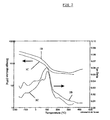
- Figure 1 is a graph showing the dynamic mechanical analysis results of Example 21.
- Figure 2 is a graph showing the dynamic mechanical analysis results of Example 22.
- the nonflexible linkage Ar can be a simple p-phenylene moiety or can contain two or more phenylene groups linked in an array in such a way that the array is held in a substantially linear conformation, that is the linkage between the phenylene groups does not contain any atoms about which the parts of the molecule can freely rotate, such as a carbon atom positioned between two C-C single bonds.
- the p-phenylene groups can be part of a fused ring system such as a 1,4-naphthylene or 1,10-anthracene linkage, and the term "para-arylene moiety" includes other fused ring aromatic linkages in which the (R') 2 R"Si- groups are maintained spatially separated such as a 1,5- or 2,6-naphthylene linkage or even a metallocene, e.g. ferrocene linkage in which the (R') 2 R"Si- groups are bonded to different cyclopentadiene rings.
- a fused ring system such as a 1,4-naphthylene or 1,10-anthracene linkage
- para-arylene moiety includes other fused ring aromatic linkages in which the (R') 2 R"Si- groups are maintained spatially separated such as a 1,5- or 2,6-naphthylene linkage or even a metallocene, e.g
- the compounds (B) in which the group R" is a hydroxyl group and Ar contains two or more phenylene groups per molecule are new compounds.
- the invention thus includes an organosilicon compound of the formula (HO) 3 Si-Ar'-Si(OH) 3 wherein Ar' is a linkage containing two or more phenylene moieties held in a substantially linear conformation so that the (R') 3 Si- groups are spatially separated.
- All the compounds (B) in which Ar comprises two or more para-arylene moieties joined by an organic linkage which does not allow free rotation are new compounds.
- the invention thus includes an organosilicon compound of the formula wherein R' and R" are defined as in Claim 1, each Ap is a para-arylene moiety, and X is a substantially inflexible linkage having at least two carbon atoms so that the groups (R') 2 R"Si- are spatially separated.
- linkage X is such that in combination with the adjacent phenylene groups there is provided a substantially linear rigid-rod array. It is preferred that there are from 2 to 4 phenylene groups, more preferably only 2 phenylene groups, per molecule.
- the phenylene groups are generally positioned trans- to one another; although this arrangement is not strictly linear, it holds the para-(hydroxysilyl) subtituents on the phenylene groups apart from each other and is "substantially linear" within the terms of this invention.
- the para-phenylene groups Ph or any phenylene group within linkage Ar can be substituted by one or more alkyl, for example methyl, ethyl, butyl, hexyl or dodecyl, aryl, aralkyl or alkenyl group, although the phenylene groups are preferably unsubstituted.
- Examples of preferred organobis(silane triol)s according to the invention include 4,4'-bis(trihydroxysilyl)biphenyl, 4,4'-bis(trihydroxysilyl)stilbene, bis(4-trihydroxysilylphenyl)acetylene and 1,4-bis(4-trihydroxysilylphenyl)butadiyne.
- the organobis(silane triol)s of the invention can be prepared by, for example, the hydrolysis of corresponding organobis(trialkoxysilyl) and organobis(trichlorosilyl) compounds.
- An organobis(trialkoxysilyl) precursor can for example be hydrolysed by the methods described by Hyde as disclosed in J.Am.Chem.Soc. 1953, 75, at page 2166 or Tyler as disclosed in J.Am.Chem.Soc. 1955, 77, at page 770.
- organobis(trialkoxysilyl) compounds which can be used as compound (B) include 4,4'-bis(trimethoxysilyl)biphenyl, 4,4'-bis (trimethoxysilyl) stilbene, bis(4-trimethoxysilylphenyl)acetylene and 1,4-bis(4-trimethoxysilylphenyl)butadiyne
- Bis(trimethoxysilylphenyl)-substituted acetylenic compounds can be prepared from the condensation reaction of para-bromo(trimethoxysilyl) benzene or para-iodo(trimethoxysilyl) benzene with para-(trimethoxysilyl)phenylacetylene.
- Bis(trimethoxysilyl) substituted diphenylbutadiynes can be prepared by the homo coupling reaction of para-(trimethoxysilyl)phenylacetylene.
- Hydrolysis can take place under mild conditions, even by the use of water alone, although it is preferred that a catalyst such as an organic acid, particularly acetic acid, is present in order to facilitate the hydrolysis reaction. It is preferred that from 0.1 to 5% by weight of catalyst based on the weight of water present is used in the reaction mixture, more preferably from 0.25 to 2%.
- a catalyst such as an organic acid, particularly acetic acid
- the relative proportions of water and organobis(trialkoxysilyl) precursor may vary between wide limits. Generally at least 6 moles water is present per mole of organobis(trialkoxysilane) and sufficient water may be used for the bis(trihydroxysilyl)arene product to dissolve in the aqueous phase.
- the hydrolysis of the organobis(trialkoxysilane) is preferably carried out in the presence of solvent, most preferably a dipolar aprotic organic solvent such as diethyl ether or dichloromethane.
- solvent most preferably a dipolar aprotic organic solvent such as diethyl ether or dichloromethane.
- the reaction temperature is preferably in the range from 0°C to 40°C, for example ambient temperatures.
- the water and catalyst may be incorporated separately into the reaction mixture or can be pre-mixed prior to addition to the organobis(trialkoxysilyl) precursor.
- the reaction period for the hydrolysis to reach completion is generally from about 30 minutes up to 1 month and the preferred reaction period is from about 1 hour to about 4 days, most preferably from 4 to 24 hours.
- the organobis(silane triol) may be recovered from the reaction mixture by conventional means, for example, by filtration or evaporation.
- organobis(trialkoxysilane) in ether is added drop-wise quickly to a 0.5 % acetic acid/water solution at 20°C. The mixture is then stirred thoroughly until the resulting organobis(silane triol) precipitates out in the aqueous phase. After filtration and drying overnight at 25°C the organobis(silane triol) is recovered.
- An alternative method of making the organobis(silane triol) is from a organobis(trichlorosilyl) precursor.
- This method includes the hydrolysis reaction of an organobis(trichlorosilyl) compound with a water/aniline mixture to form the organobis(silane triol). The reaction is based on the method of Takiguchi as disclosed in J.Am.Chem.Soc. 1959, 81, at page 2359.
- Organobis(trichlorosilane) can be dissolved in dry diethyl ether and added drop-wise to an emulsion of a stoichiometric amount of water and aniline at a temperature of 0°C.
- organobis(silane triol) is recovered.
- the bis((hydrocarbyldihydroxysilyl)phenyl) compounds that is those compounds (B) in which R" is a monovalent hydrocarbon group, can be prepared by analogous procedures.
- bis(4-(methyldimethoxysilyl)phenyl)acetylene can be prepared by condensation of para-bromo(methyldimethoxysilyl)benzene with para-(methyldimethoxysilyl)phenylacetylene and can be hydrolysed to bis(4-(methyldihydroxysilyl)phenyl)acetylene by the procedures described above.
- the compounds (B) according to this invention are effective in crosslinking the silicone resin (A) and have high stability against intramolecular self-condensation.
- the invention thus includes a process for forming a cured resin composition comprising mixing (A) and (B) and curing the resulting composition under conditions such that (A) and (B) are copolymerised.
- (A) is an uncured silicone resin having units of the formula (R*) a (R) b SiO (4-a-b)/2 , where each R* is a functional group capable of reacting with Si-OH and/or Si-alkoxy groups and each R is a nonfunctional monovalent hydrocarbon group and a+b is from 0.8 to 1.6.
- Each molecule of uncured silicone resin contains an average of at least two groups R*.
- the groups R* can be -OH groups, alkoxy groups or H atoms bonded to Si.
- R is selected from alkyl and aryl groups. Suitable alkyl groups include methyl, ethyl, isopropyl, n-butyl and isobutyl.
- Suitable aryl groups are exemplified by phenyl.
- Organosilicone resins particularly those prepared by acid hydrolysis and condensation, generally include a considerable concentration of residual hydroxyl groups which can react with the hydroxysilyl or alkoxysilyl groups of the compound (B) through a condensation cure system.
- the amount of (A) in the curable system is generally 5 to 96%, preferably 50 to 95%, by weight. Most preferably, the weight ratio of (A) to (B) is 5:1 to 20:1.
- the curable silicone resin composition of the invention preferably contains a catalyst so that condensation curing can be carried out at reduced, e.g. ambient temperature.
- the catalyst can be a metal ester or alkoxide of a Group IVB metal such as zirconium, hafnium or titanium, for example titanium tetrabutoxide, a metal carboxylate such as zinc octoate, choline octoate, a strong acid such as sulphuric or phosphoric acid or a base such as KOH, CsOH, a metal silanolate, calcined lime or an amine or quaternary base, for example tetramethyl ammonium hydroxide.
- the catalyst can generally be used at up to 2% by weight based on reagents, preferably 0.02 to 0.4%.
- the curable composition may additionally contain a silicone rubber, for example a rubber as described in US5747608 or US5830950.
- the rubber generally has terminal functional groups capable of reacting with the hydroxyl groups of silicone resin (A).
- the silicone rubber if used, can be present at up to 30% by weight, for example 5 to 20%.
- the curable composition can optionally contain a solvent at up to 90%, preferably up to 60% of the composition.
- a substrate having a cure silicone resin coated thereon can be prepared by mixing (A) and (B) in a solvent, coating the resulting solution on the substrate, and drying the coating and subjecting it to curing conditions.
- a moulded cured silicone resin can be produced by mixing (A) and (B) in a solvent, casting the resulting solution in a mould, removing the solvent and curing the composition in the mould.
- the solvent is generally a polar organic solvent, for example an amide such as formamide, dimethylformamide or dimethylacetamide, a halogenated hydrocarbon such as dichloromethane or 1,1,1-trichloroethane, an alcohol such as methanol, ethanol, isopropanol or t-butanol, an aromatic hydrocarbon such as toluene or xylene, a glycol ether such as 2-methoxypropanol, 2-butoxypropanol, butoxyethanol or dipropylene glycol methyl ether, or a sulphoxide such as dimethyl sulphoxide.
- the more polar solvents such as alcohols, formamide or dimethyl sulphoxide may be required to dissolve the organobis(silanetriol)s.
- the curable composition can be coated on a substrate, for example as a solution, and cured to form a thin film on the substrate, or can be cured in a mould to form a shaped silicone resin article.
- novel compounds of the formula (R') 3 Si-Ar'-Si(R') 3 can also be cured alone to produce strong solid resins by condensation of the R' groups. If curing is carried out in a solvent such as formamide, a gel is produced which can be powdered and dried to recover the solid resin, which contains extended chains containing arylene linkages and silicate crosslinks.
- the compounds (B), particularly the bis(trihydroxysilyl)arene compounds and the bis(dihydroxysilyl)arene compounds, have X-ray patterns showing that they are ordered in the solid state. It is believed that resins formed by polymerisation of the bis(trihydroxysilyl)arene compounds are also ordered in the solid state, and that the cured compositions of the invention formed from a silicone resin and compound (B) also show ordering in the solid state. These polymers and cured resin compositions thereby give optical effects which can be utilised in electro-optic products.
- 4,4'-bis-(trimethoxysilyl)stilbene was prepared as follows : A solution of 4-(trimethoxysilyl)styrene (1.5g, 6.7 mmol, prepared as described by Corriu et al., Chem. Comm, (1996), 15, 1845-1846) and 4-bromo(1-trimethoxysilyl)benzene were dissolved in dry toluene (15 ml).
- Example 2 The procedure of Example 1 was repeated employing 4,4'-bis(trimethoxysilyl)stilbene) in place of bis(trimethoxysilyl)biphenyl (2g, 4.75 mmol) and using a 1% acetic acid solution (9 ml) to give a ratio of 2.94 equivalents of stilbene to 1 equivalent of acetic acid.
- the reaction mixture was stirred for a period of 10 days and a yellow coloured powder was recovered at 70% yield.(1.12g, 3.32mmol)
- the yellow suspension was filtered on silanized silica and concentrated under vacuum.
- the expected product was obtained as a fine yellow powder (1.88 g, 4.49 mmol) in 97 % yield.
- 4,4'-bis(methyldihydroxysilyl)stilbene was prepared from 4,4'bis-(methyldimethoxysilyl)stilbene by the procedure of Example 16.
- 4,4'bis-(methyldihydroxysilyl)stilbene had 1 H NMR (DMSO-d 6 , ⁇ , ppm) 7.68 (4H, d); 7.59 (4H, d), 7.29 (2H, s), 6.37 (4H, s); 0.39 (6H, s).
- Example 19 1,4-bis(dimethoxymethylsilyl)benzene prepared in Example 13; solvent tetrahydrofuran (THF)
- Example 20 4,4'-bis(trimethoxysilyl)biphenyl prepared as described by Corriu et al., Chem. Mater., (1992), 4, 1217-1224; solvent toluene.
- Example 21 4,4'-bis(trihydroxysilyl)diphenylbut-1,3-diyne prepared in Example 8; solvent dimethylsulphoxide (DMSO)
- a base resin casting without addition of compound (B) was also cured and analysed in the same way as a comparison.
- Example 19 Cured base resin
- Example 20 Young's Modulus (GPa) 1.82 1.88 1.73 Strain at break % 2.80 2.46 2.54 Flexural strength (MPa) 37.8 37.7 33.9 Fracture toughness K Ic , (MPam 1/2 ) 0.260 0.253 0.308 Fracture Energy (J/m 2 ) 42.5 38.3 54.8
- each compound (B) into the resin structure slightly lowers the resin's Young's modulus, but increases the fracture toughness (K Ic ) and the critical energy release rate G Ic .
- the fracture toughness K Ic measures the difficulty of initiating a crack in the material, while the G Ic measures how much energy per unit area it needs to propagate a crack in the material once the crack is initiated.
- the modified resin of Example 19 is slightly tougher than the unmodified resin, and the modified resin of Example 20 is substantially tougher than the unmodified resin.
- Example 21 the storage modulus (1A) and loss factor(tan ⁇ , (2A)) of the modified resin are plotted in Figure 1, together with the storage modulus (1C) and loss factor (2C) of the unmodified resin.
- the high temperature transition peak of the tan ⁇ curve was much enhanced by the incorporation of the 4,4'-bis(trihydroxysilyl)diphenylbut-1,3-diyne.
- the addition of this modifier significantly enhances the mechanical damping capability of the resin in the temperature range 150-350oC. This damping capability is important for applications where mechanical vibration needs to be mitigated.
- Example 22 the storage modulus (1B) and loss factor(2B) of the modified resin are plotted in Figure 2, together with the storage modulus (1C) and loss factor (2C) of the unmodified resin.
- the storage modulus is much higher, approximately twice that of the unmodified resin throughout the whole temperature range, even though the modulus dependence on temperature was quite similar and no obvious shift of glass transition temperature was seen. Both had a glass transition temperature at about 100 °C. The much higher modulus above the glass transition temperature indicated a higher crosslink density in the modified resin.
Landscapes
- Chemical & Material Sciences (AREA)
- Organic Chemistry (AREA)
- Chemical Kinetics & Catalysis (AREA)
- Health & Medical Sciences (AREA)
- Medicinal Chemistry (AREA)
- Polymers & Plastics (AREA)
- Life Sciences & Earth Sciences (AREA)
- Engineering & Computer Science (AREA)
- Materials Engineering (AREA)
- Wood Science & Technology (AREA)
- Compositions Of Macromolecular Compounds (AREA)
- Silicon Polymers (AREA)
- Macromonomer-Based Addition Polymer (AREA)
Priority Applications (1)
| Application Number | Priority Date | Filing Date | Title |
|---|---|---|---|
| EP01940358A EP1276807B1 (en) | 2000-04-27 | 2001-04-24 | Curable silicone resin composition and reactive silicon compounds |
Applications Claiming Priority (4)
| Application Number | Priority Date | Filing Date | Title |
|---|---|---|---|
| EP00401160 | 2000-04-27 | ||
| EP00401160 | 2000-04-27 | ||
| EP01940358A EP1276807B1 (en) | 2000-04-27 | 2001-04-24 | Curable silicone resin composition and reactive silicon compounds |
| PCT/EP2001/004606 WO2001083608A1 (en) | 2000-04-27 | 2001-04-24 | Curable silicone resin composition and reactive silicon compounds |
Publications (2)
| Publication Number | Publication Date |
|---|---|
| EP1276807A1 EP1276807A1 (en) | 2003-01-22 |
| EP1276807B1 true EP1276807B1 (en) | 2005-10-12 |
Family
ID=8173660
Family Applications (1)
| Application Number | Title | Priority Date | Filing Date |
|---|---|---|---|
| EP01940358A Expired - Lifetime EP1276807B1 (en) | 2000-04-27 | 2001-04-24 | Curable silicone resin composition and reactive silicon compounds |
Country Status (7)
| Country | Link |
|---|---|
| US (1) | US6780471B2 (enExample) |
| EP (1) | EP1276807B1 (enExample) |
| JP (1) | JP2003531942A (enExample) |
| AT (1) | ATE306518T1 (enExample) |
| AU (1) | AU2001273963A1 (enExample) |
| DE (1) | DE60120147T2 (enExample) |
| WO (1) | WO2001083608A1 (enExample) |
Families Citing this family (4)
| Publication number | Priority date | Publication date | Assignee | Title |
|---|---|---|---|---|
| US8492469B2 (en) | 2008-05-07 | 2013-07-23 | Sumitomo Bakelite Co., Ltd. | Positive-type photosensitive resin composition, cured film, protective film, insulating film, and semiconductor device and display device including the cured film |
| KR101266290B1 (ko) * | 2008-12-30 | 2013-05-22 | 제일모직주식회사 | 레지스트 하층막용 하드마스크 조성물 및 이를 이용한 반도체 집적회로 디바이스의 제조방법 |
| KR101266291B1 (ko) * | 2008-12-30 | 2013-05-22 | 제일모직주식회사 | 레지스트 하층막용 조성물 및 이를 이용한 반도체 집적회로디바이스의 제조방법 |
| JP7406300B2 (ja) * | 2018-11-12 | 2023-12-27 | 信越化学工業株式会社 | ヨウ素含有ケイ素化合物の製造方法 |
Family Cites Families (11)
| Publication number | Priority date | Publication date | Assignee | Title |
|---|---|---|---|---|
| CA691206A (en) | 1964-07-21 | Dow Corning Corporation | Method of damping vibration | |
| GB1119666A (en) | 1965-08-06 | 1968-07-10 | Ici Ltd | Organosilicon polymers |
| GB1101589A (en) | 1965-09-09 | 1968-01-31 | Ici Ltd | Organosilicon resins |
| JPS6131461A (ja) * | 1984-07-24 | 1986-02-13 | Shin Etsu Chem Co Ltd | 室温硬化性オルガノシロキサン組成物 |
| JPS6164753A (ja) * | 1984-09-06 | 1986-04-03 | Shin Etsu Chem Co Ltd | 室温硬化性オルガノシロキサン組成物 |
| US5034061A (en) | 1990-03-15 | 1991-07-23 | General Electric Company | Transparent shatter-resistant silicone coating |
| JP2001506283A (ja) * | 1993-12-17 | 2001-05-15 | ハイトコ カーボン コンポジッツ インコーポレイテッド | 高温抵抗性を有するシリコーン複合体 |
| JP3277749B2 (ja) * | 1995-04-03 | 2002-04-22 | 信越化学工業株式会社 | シリコーンゲル組成物及びポッティング材 |
| US5747608A (en) | 1996-12-31 | 1998-05-05 | Dow Corning Corporation | Rubber-modified rigid silicone resins and composites produced therefrom |
| US5830950A (en) | 1996-12-31 | 1998-11-03 | Dow Corning Corporation | Method of making rubber-modified rigid silicone resins and composites produced therefrom |
| JP3518399B2 (ja) * | 1999-03-12 | 2004-04-12 | 信越化学工業株式会社 | 室温硬化性オルガノポリシロキサン組成物 |
-
2001
- 2001-04-24 AU AU2001273963A patent/AU2001273963A1/en not_active Abandoned
- 2001-04-24 US US10/258,722 patent/US6780471B2/en not_active Expired - Fee Related
- 2001-04-24 JP JP2001580225A patent/JP2003531942A/ja active Pending
- 2001-04-24 AT AT01940358T patent/ATE306518T1/de not_active IP Right Cessation
- 2001-04-24 EP EP01940358A patent/EP1276807B1/en not_active Expired - Lifetime
- 2001-04-24 DE DE60120147T patent/DE60120147T2/de not_active Expired - Fee Related
- 2001-04-24 WO PCT/EP2001/004606 patent/WO2001083608A1/en not_active Ceased
Also Published As
| Publication number | Publication date |
|---|---|
| US20030130389A1 (en) | 2003-07-10 |
| EP1276807A1 (en) | 2003-01-22 |
| AU2001273963A1 (en) | 2001-11-12 |
| DE60120147T2 (de) | 2006-09-28 |
| WO2001083608A1 (en) | 2001-11-08 |
| DE60120147D1 (de) | 2006-07-06 |
| JP2003531942A (ja) | 2003-10-28 |
| ATE306518T1 (de) | 2005-10-15 |
| US6780471B2 (en) | 2004-08-24 |
Similar Documents
| Publication | Publication Date | Title |
|---|---|---|
| JP4470738B2 (ja) | シルセスキオキサン誘導体 | |
| JP4751570B2 (ja) | オルガノポリシロキサン変性多糖類およびその製造方法 | |
| WO2001046295A1 (en) | Polyhedral oligomeric-silsesquioxanes, -silicates and -siloxanes bearing ring-strained olefinic functionalities | |
| JP2001064393A (ja) | 縮合反応硬化性シルセスキオキサン樹脂組成物並びにその合成及び硬化方法 | |
| JP2011190413A (ja) | シロキサンポリマー架橋硬化物 | |
| US4665147A (en) | Novel methacrylated siloxanes | |
| EP0130731A2 (en) | Methacrylated siloxanes | |
| JPH0532677A (ja) | 有機ケイ素化合物及びその製造方法 | |
| JPH11343347A5 (enExample) | ||
| EP1276807B1 (en) | Curable silicone resin composition and reactive silicon compounds | |
| JP4370831B2 (ja) | 官能基を有するシルセスキオキサン誘導体 | |
| US4083861A (en) | Unsaturated silicon organic compounds containing keto groups | |
| JP4079314B2 (ja) | シルセスキオキサン化合物の製造方法 | |
| JP3459985B2 (ja) | ボラジン含有ケイ素系ポリマーの薄膜の製造方法及びボラジン含有ケイ素ポリマー | |
| JPS6352061B2 (enExample) | ||
| JPS6352629B2 (enExample) | ||
| US5130461A (en) | 1,3-bis(p-hydroxybenzyl)-1,1,3,3-tetramethyldisiloxane and method for making | |
| CN101585850B (zh) | 一种含硅芳香氰酸酯单体及其制备方法 | |
| KR20020095236A (ko) | 경화성 실리콘 수지 조성물 및 반응성 규소 화합물 | |
| JPH04252228A (ja) | シリコーン含有エポキシ化合物及びその製法 | |
| CN116332982A (zh) | 液体可加工的二邻苯二甲腈单体和树脂 | |
| JPH0717981A (ja) | 有機ケイ素化合物及びその製造方法 | |
| EP0413520B1 (en) | A silane compound and a method of manufacturing the same | |
| JP4061132B2 (ja) | フッ素含有ポリシラン化合物 | |
| KR20200024718A (ko) | 향상된 충격 강도를 갖는 프탈로니트릴계 수지 |
Legal Events
| Date | Code | Title | Description |
|---|---|---|---|
| PUAI | Public reference made under article 153(3) epc to a published international application that has entered the european phase |
Free format text: ORIGINAL CODE: 0009012 |
|
| 17P | Request for examination filed |
Effective date: 20021008 |
|
| AK | Designated contracting states |
Kind code of ref document: A1 Designated state(s): AT BE CH CY DE DK ES FI FR GB GR IE IT LI LU MC NL PT SE TR |
|
| AX | Request for extension of the european patent |
Free format text: AL;LT;LV;MK;RO;SI |
|
| 17Q | First examination report despatched |
Effective date: 20030711 |
|
| GRAP | Despatch of communication of intention to grant a patent |
Free format text: ORIGINAL CODE: EPIDOSNIGR1 |
|
| GRAS | Grant fee paid |
Free format text: ORIGINAL CODE: EPIDOSNIGR3 |
|
| GRAA | (expected) grant |
Free format text: ORIGINAL CODE: 0009210 |
|
| AK | Designated contracting states |
Kind code of ref document: B1 Designated state(s): AT BE CH CY DE DK ES FI FR GB GR IE IT LI LU MC NL PT SE TR |
|
| PG25 | Lapsed in a contracting state [announced via postgrant information from national office to epo] |
Ref country code: IT Free format text: LAPSE BECAUSE OF FAILURE TO SUBMIT A TRANSLATION OF THE DESCRIPTION OR TO PAY THE FEE WITHIN THE PRESCRIBED TIME-LIMIT;WARNING: LAPSES OF ITALIAN PATENTS WITH EFFECTIVE DATE BEFORE 2007 MAY HAVE OCCURRED AT ANY TIME BEFORE 2007. THE CORRECT EFFECTIVE DATE MAY BE DIFFERENT FROM THE ONE RECORDED. Effective date: 20051012 Ref country code: LI Free format text: LAPSE BECAUSE OF FAILURE TO SUBMIT A TRANSLATION OF THE DESCRIPTION OR TO PAY THE FEE WITHIN THE PRESCRIBED TIME-LIMIT Effective date: 20051012 Ref country code: CH Free format text: LAPSE BECAUSE OF FAILURE TO SUBMIT A TRANSLATION OF THE DESCRIPTION OR TO PAY THE FEE WITHIN THE PRESCRIBED TIME-LIMIT Effective date: 20051012 Ref country code: BE Free format text: LAPSE BECAUSE OF FAILURE TO SUBMIT A TRANSLATION OF THE DESCRIPTION OR TO PAY THE FEE WITHIN THE PRESCRIBED TIME-LIMIT Effective date: 20051012 Ref country code: FI Free format text: LAPSE BECAUSE OF FAILURE TO SUBMIT A TRANSLATION OF THE DESCRIPTION OR TO PAY THE FEE WITHIN THE PRESCRIBED TIME-LIMIT Effective date: 20051012 Ref country code: AT Free format text: LAPSE BECAUSE OF FAILURE TO SUBMIT A TRANSLATION OF THE DESCRIPTION OR TO PAY THE FEE WITHIN THE PRESCRIBED TIME-LIMIT Effective date: 20051012 Ref country code: NL Free format text: LAPSE BECAUSE OF FAILURE TO SUBMIT A TRANSLATION OF THE DESCRIPTION OR TO PAY THE FEE WITHIN THE PRESCRIBED TIME-LIMIT Effective date: 20051012 |
|
| REG | Reference to a national code |
Ref country code: GB Ref legal event code: FG4D |
|
| RIN1 | Information on inventor provided before grant (corrected) |
Inventor name: CERVEAU, GENEVIEVE MARIE-LOUISE EMILE Inventor name: CORRIU, ROBERT, JEAN-PIERRE Inventor name: DABIENS, BERTRAND FRANCOIS Inventor name: ZHU, BIZHONG Inventor name: MACKINNON, IAIN, A. Inventor name: CHEVALIER, PIERRE |
|
| REG | Reference to a national code |
Ref country code: CH Ref legal event code: EP |
|
| REG | Reference to a national code |
Ref country code: IE Ref legal event code: FG4D |
|
| PG25 | Lapsed in a contracting state [announced via postgrant information from national office to epo] |
Ref country code: SE Free format text: LAPSE BECAUSE OF FAILURE TO SUBMIT A TRANSLATION OF THE DESCRIPTION OR TO PAY THE FEE WITHIN THE PRESCRIBED TIME-LIMIT Effective date: 20060112 Ref country code: DK Free format text: LAPSE BECAUSE OF FAILURE TO SUBMIT A TRANSLATION OF THE DESCRIPTION OR TO PAY THE FEE WITHIN THE PRESCRIBED TIME-LIMIT Effective date: 20060112 Ref country code: GR Free format text: LAPSE BECAUSE OF FAILURE TO SUBMIT A TRANSLATION OF THE DESCRIPTION OR TO PAY THE FEE WITHIN THE PRESCRIBED TIME-LIMIT Effective date: 20060112 |
|
| PG25 | Lapsed in a contracting state [announced via postgrant information from national office to epo] |
Ref country code: ES Free format text: LAPSE BECAUSE OF FAILURE TO SUBMIT A TRANSLATION OF THE DESCRIPTION OR TO PAY THE FEE WITHIN THE PRESCRIBED TIME-LIMIT Effective date: 20060123 |
|
| PG25 | Lapsed in a contracting state [announced via postgrant information from national office to epo] |
Ref country code: PT Free format text: LAPSE BECAUSE OF FAILURE TO SUBMIT A TRANSLATION OF THE DESCRIPTION OR TO PAY THE FEE WITHIN THE PRESCRIBED TIME-LIMIT Effective date: 20060313 |
|
| NLV1 | Nl: lapsed or annulled due to failure to fulfill the requirements of art. 29p and 29m of the patents act | ||
| PG25 | Lapsed in a contracting state [announced via postgrant information from national office to epo] |
Ref country code: IE Free format text: LAPSE BECAUSE OF NON-PAYMENT OF DUE FEES Effective date: 20060424 |
|
| REG | Reference to a national code |
Ref country code: CH Ref legal event code: PL |
|
| PG25 | Lapsed in a contracting state [announced via postgrant information from national office to epo] |
Ref country code: MC Free format text: LAPSE BECAUSE OF NON-PAYMENT OF DUE FEES Effective date: 20060430 |
|
| ET | Fr: translation filed | ||
| REF | Corresponds to: |
Ref document number: 60120147 Country of ref document: DE Date of ref document: 20060706 Kind code of ref document: P |
|
| PLBE | No opposition filed within time limit |
Free format text: ORIGINAL CODE: 0009261 |
|
| STAA | Information on the status of an ep patent application or granted ep patent |
Free format text: STATUS: NO OPPOSITION FILED WITHIN TIME LIMIT |
|
| 26N | No opposition filed |
Effective date: 20060713 |
|
| REG | Reference to a national code |
Ref country code: IE Ref legal event code: MM4A |
|
| PG25 | Lapsed in a contracting state [announced via postgrant information from national office to epo] |
Ref country code: LU Free format text: LAPSE BECAUSE OF NON-PAYMENT OF DUE FEES Effective date: 20060424 Ref country code: TR Free format text: LAPSE BECAUSE OF FAILURE TO SUBMIT A TRANSLATION OF THE DESCRIPTION OR TO PAY THE FEE WITHIN THE PRESCRIBED TIME-LIMIT Effective date: 20051012 |
|
| PG25 | Lapsed in a contracting state [announced via postgrant information from national office to epo] |
Ref country code: CY Free format text: LAPSE BECAUSE OF FAILURE TO SUBMIT A TRANSLATION OF THE DESCRIPTION OR TO PAY THE FEE WITHIN THE PRESCRIBED TIME-LIMIT Effective date: 20051012 |
|
| PGFP | Annual fee paid to national office [announced via postgrant information from national office to epo] |
Ref country code: DE Payment date: 20090420 Year of fee payment: 9 Ref country code: FR Payment date: 20090417 Year of fee payment: 9 |
|
| PGFP | Annual fee paid to national office [announced via postgrant information from national office to epo] |
Ref country code: GB Payment date: 20090422 Year of fee payment: 9 |
|
| GBPC | Gb: european patent ceased through non-payment of renewal fee |
Effective date: 20100424 |
|
| REG | Reference to a national code |
Ref country code: FR Ref legal event code: ST Effective date: 20101230 |
|
| PG25 | Lapsed in a contracting state [announced via postgrant information from national office to epo] |
Ref country code: DE Free format text: LAPSE BECAUSE OF NON-PAYMENT OF DUE FEES Effective date: 20101103 |
|
| PG25 | Lapsed in a contracting state [announced via postgrant information from national office to epo] |
Ref country code: GB Free format text: LAPSE BECAUSE OF NON-PAYMENT OF DUE FEES Effective date: 20100424 |
|
| PG25 | Lapsed in a contracting state [announced via postgrant information from national office to epo] |
Ref country code: FR Free format text: LAPSE BECAUSE OF NON-PAYMENT OF DUE FEES Effective date: 20100430 |