EP1272725B1 - Vitrage isolant et son procede de fabrication - Google Patents
Vitrage isolant et son procede de fabrication Download PDFInfo
- Publication number
- EP1272725B1 EP1272725B1 EP01923792A EP01923792A EP1272725B1 EP 1272725 B1 EP1272725 B1 EP 1272725B1 EP 01923792 A EP01923792 A EP 01923792A EP 01923792 A EP01923792 A EP 01923792A EP 1272725 B1 EP1272725 B1 EP 1272725B1
- Authority
- EP
- European Patent Office
- Prior art keywords
- glazing unit
- insert
- unit according
- insulating glazing
- glazing
- Prior art date
- Legal status (The legal status is an assumption and is not a legal conclusion. Google has not performed a legal analysis and makes no representation as to the accuracy of the status listed.)
- Expired - Lifetime
Links
Images

Classifications
-
- E—FIXED CONSTRUCTIONS
- E06—DOORS, WINDOWS, SHUTTERS, OR ROLLER BLINDS IN GENERAL; LADDERS
- E06B—FIXED OR MOVABLE CLOSURES FOR OPENINGS IN BUILDINGS, VEHICLES, FENCES OR LIKE ENCLOSURES IN GENERAL, e.g. DOORS, WINDOWS, BLINDS, GATES
- E06B3/00—Window sashes, door leaves, or like elements for closing wall or like openings; Layout of fixed or moving closures, e.g. windows in wall or like openings; Features of rigidly-mounted outer frames relating to the mounting of wing frames
- E06B3/66—Units comprising two or more parallel glass or like panes permanently secured together
- E06B3/67—Units comprising two or more parallel glass or like panes permanently secured together characterised by additional arrangements or devices for heat or sound insulation or for controlled passage of light
-
- E—FIXED CONSTRUCTIONS
- E06—DOORS, WINDOWS, SHUTTERS, OR ROLLER BLINDS IN GENERAL; LADDERS
- E06B—FIXED OR MOVABLE CLOSURES FOR OPENINGS IN BUILDINGS, VEHICLES, FENCES OR LIKE ENCLOSURES IN GENERAL, e.g. DOORS, WINDOWS, BLINDS, GATES
- E06B3/00—Window sashes, door leaves, or like elements for closing wall or like openings; Layout of fixed or moving closures, e.g. windows in wall or like openings; Features of rigidly-mounted outer frames relating to the mounting of wing frames
- E06B3/66—Units comprising two or more parallel glass or like panes permanently secured together
- E06B3/663—Elements for spacing panes
- E06B3/66309—Section members positioned at the edges of the glazing unit
-
- E—FIXED CONSTRUCTIONS
- E06—DOORS, WINDOWS, SHUTTERS, OR ROLLER BLINDS IN GENERAL; LADDERS
- E06B—FIXED OR MOVABLE CLOSURES FOR OPENINGS IN BUILDINGS, VEHICLES, FENCES OR LIKE ENCLOSURES IN GENERAL, e.g. DOORS, WINDOWS, BLINDS, GATES
- E06B3/00—Window sashes, door leaves, or like elements for closing wall or like openings; Layout of fixed or moving closures, e.g. windows in wall or like openings; Features of rigidly-mounted outer frames relating to the mounting of wing frames
- E06B3/66—Units comprising two or more parallel glass or like panes permanently secured together
- E06B3/6621—Units comprising two or more parallel glass or like panes permanently secured together with special provisions for fitting in window frames or to adjacent units; Separate edge protecting strips
-
- E—FIXED CONSTRUCTIONS
- E06—DOORS, WINDOWS, SHUTTERS, OR ROLLER BLINDS IN GENERAL; LADDERS
- E06B—FIXED OR MOVABLE CLOSURES FOR OPENINGS IN BUILDINGS, VEHICLES, FENCES OR LIKE ENCLOSURES IN GENERAL, e.g. DOORS, WINDOWS, BLINDS, GATES
- E06B3/00—Window sashes, door leaves, or like elements for closing wall or like openings; Layout of fixed or moving closures, e.g. windows in wall or like openings; Features of rigidly-mounted outer frames relating to the mounting of wing frames
- E06B3/66—Units comprising two or more parallel glass or like panes permanently secured together
- E06B3/663—Elements for spacing panes
- E06B3/66309—Section members positioned at the edges of the glazing unit
- E06B3/66371—Section members positioned at the edges of the glazing unit positioned entirely outside the gap between the panes
-
- E—FIXED CONSTRUCTIONS
- E06—DOORS, WINDOWS, SHUTTERS, OR ROLLER BLINDS IN GENERAL; LADDERS
- E06B—FIXED OR MOVABLE CLOSURES FOR OPENINGS IN BUILDINGS, VEHICLES, FENCES OR LIKE ENCLOSURES IN GENERAL, e.g. DOORS, WINDOWS, BLINDS, GATES
- E06B3/00—Window sashes, door leaves, or like elements for closing wall or like openings; Layout of fixed or moving closures, e.g. windows in wall or like openings; Features of rigidly-mounted outer frames relating to the mounting of wing frames
- E06B3/66—Units comprising two or more parallel glass or like panes permanently secured together
- E06B3/673—Assembling the units
- E06B3/67326—Assembling spacer elements with the panes
-
- E—FIXED CONSTRUCTIONS
- E06—DOORS, WINDOWS, SHUTTERS, OR ROLLER BLINDS IN GENERAL; LADDERS
- E06B—FIXED OR MOVABLE CLOSURES FOR OPENINGS IN BUILDINGS, VEHICLES, FENCES OR LIKE ENCLOSURES IN GENERAL, e.g. DOORS, WINDOWS, BLINDS, GATES
- E06B3/00—Window sashes, door leaves, or like elements for closing wall or like openings; Layout of fixed or moving closures, e.g. windows in wall or like openings; Features of rigidly-mounted outer frames relating to the mounting of wing frames
- E06B3/66—Units comprising two or more parallel glass or like panes permanently secured together
- E06B3/663—Elements for spacing panes
- E06B3/66309—Section members positioned at the edges of the glazing unit
- E06B2003/6638—Section members positioned at the edges of the glazing unit with coatings
-
- E—FIXED CONSTRUCTIONS
- E06—DOORS, WINDOWS, SHUTTERS, OR ROLLER BLINDS IN GENERAL; LADDERS
- E06B—FIXED OR MOVABLE CLOSURES FOR OPENINGS IN BUILDINGS, VEHICLES, FENCES OR LIKE ENCLOSURES IN GENERAL, e.g. DOORS, WINDOWS, BLINDS, GATES
- E06B3/00—Window sashes, door leaves, or like elements for closing wall or like openings; Layout of fixed or moving closures, e.g. windows in wall or like openings; Features of rigidly-mounted outer frames relating to the mounting of wing frames
- E06B3/66—Units comprising two or more parallel glass or like panes permanently secured together
- E06B3/673—Assembling the units
- E06B3/67304—Preparing rigid spacer members before assembly
- E06B3/67321—Covering spacer elements, e.g. with sealants
-
- E—FIXED CONSTRUCTIONS
- E06—DOORS, WINDOWS, SHUTTERS, OR ROLLER BLINDS IN GENERAL; LADDERS
- E06B—FIXED OR MOVABLE CLOSURES FOR OPENINGS IN BUILDINGS, VEHICLES, FENCES OR LIKE ENCLOSURES IN GENERAL, e.g. DOORS, WINDOWS, BLINDS, GATES
- E06B3/00—Window sashes, door leaves, or like elements for closing wall or like openings; Layout of fixed or moving closures, e.g. windows in wall or like openings; Features of rigidly-mounted outer frames relating to the mounting of wing frames
- E06B3/66—Units comprising two or more parallel glass or like panes permanently secured together
- E06B3/673—Assembling the units
- E06B3/67339—Working the edges of already assembled units
- E06B3/67356—Covering the edges with bands or profiles
Definitions
- the subject of the invention is an insulating glazing unit and its method of manufacture.
- the spacer frame is bonded to the glass sheets by a butyl rubber elastomer bead applied directly to the profiles by extrusion through a nozzle. Each corner of the spacer frame is also packed at the corner piece with butyl rubber.
- the elastomeric sealing bead plays a role in temporarily holding the glass sheets.
- a crosslinkable sealant of the polysulfide or polyurethane type which completes the mechanical assembly of the glass sheets.
- Butyl rubber mainly has the role of sealing the interior of the glazing with water vapor, while the sealant provides a seal with liquid water or solvents.
- a disadvantage posed by such manufacture is that of the storage of materials. In order to be operational for any new order placed for insulating glass, many batches of each material must be available, which does not participate in a simple and fast management of the supply and storage of these materials.
- the invention therefore aims to obviate these disadvantages by providing an insulating glazing whose choice of materials facilitates the management of their manufacturing flow and simplify assembly operations.
- the insulating glazing unit comprises, at least two glass sheets spaced by a gas blade, an interlayer for spacing the two glass sheets and having an inner face facing the gas strip and an outer face opposite, as well as sealing means vis-à-vis the interior of said glazing, is characterized in that the interlayer has a linear buckling resistance of at least 400 N / m, and is in the form a substantially flat profile which surrounds the periphery of the glazing being plated by its inner face against the edges of the glass sheets, and held fixed by securing means, the glazing having no spacing element arranged in the space inside between the glass sheets.
- This type of profile and its arrangement on the glazing slices have the particular advantage of increasing the visibility through the glazing since the spacer is no longer visible at the periphery.
- the sealing means of the glazing which have gas, dust and liquid water sealing properties, are arranged at least on the outer face of the spacer.
- These sealing means consist of a metal coating, preferably of stainless steel or aluminum, which has a thickness of between 2 and 50 microns.
- the interlayer is based on thermoplastic material with or without reinforcing fibers such as cut or continuous glass fibers.
- the free ends of the spacer are assembled to surround the entire glazing so that one end overlaps the other, complementary sealing means being provided to seal side sections made open by the recovery.
- the free ends of the spacer have complementary shapes adapted to cooperate mutually to achieve their assembly according to an abutment.
- Adhesive tape or gas and steam-tight glue will preferably be applied to the abutment area.
- the interlayer is present before its introduction in the form of a wound tape which is intended to be unwound, stretched and cut to the length substantially corresponding to the perimeter of the glazing, while the fastening means of the type glue are deposited on the ribbon stretching by injection means.
- the desiccant is deposited on the stretching tape during the application of the securing means.
- the insertion of the interlayer is effected by applying it by compression to a priming point and against the slices of a first side of the glazing, the belting being effected from this point priming and placing the ribbon on the corners of the glazing being performed by heating the outer face of the insert beforehand to help its folding around the corners and marry perfectly their outline.
- the initiation point is located at one side of the glazing so as to apply and compress the interlayer simultaneously in two opposite directions to surround the perimeter of the glazing along two perimeter halves, which saves manufacturing time.
- the priming point may be located rather at an angle of the glazing.
- the insertion of the interlayer is effected by applying two ribbons by compression at two points of initiation using means of distribution and compression, and the belting s' performs from these points of initiation by translational movements of the glazing and / or distribution means.
- This variant allows very advantageously, combined with the profile of the invention, to provide a glazing having a complex shape, in particular with curved parts.
- all glazing manufacturing operations can be performed in a chamber filled with the gas to be contained in the glazing.
- a gas supply device which is inserted between the two glass sheets to deliver gas while the glazing surround is performed, and which is removed just before the end of the belting.
- the figure 1 illustrates a single insulating glazing unit 1 obtained by a manufacturing process which will be described later with regard to its device visible at the figure 2 .
- the glazing 1 comprises two sheets of glass 10 and 11 spaced apart by a gas blade 12, a spacer 2 which serves to space the two sheets of glass and has in order to ensure the mechanical maintenance of the entire glazing, as well as sealing means 3 for sealing the glazing with liquid water, solvents and water vapor.
- the insert 2 is in the form of a substantially flat profile approximately 1 mm thick and of substantially parallelepiped section.
- This profile advantageously has a low mechanical inertia, that is to say that it can be easily wound by having a small winding radius of 10 cm for example.
- the profile surrounds the perimeter of the glazing. It is arranged in the manner of a ribbon on the slices 10a and 11a of the glass sheets and guarantees the mechanical assembly of the glazing through securing means 4 which ensure its total adhesion to the glass.
- the profile is rigid enough to perform the mechanical holding function of the two spaced glass sheets. Its rigidity is defined by the very nature of its constituent material, whose linear buckling resistance must be at least 400 N / m.
- the nature of the material of said profile is also chosen so that during the glass manufacturing process, the profile may have sufficient flexibility for the operation of belting the glass slices, in particular during the curling angles.
- the spacer is entirely metallic, the material chosen being preferably stainless steel or aluminum. During the process, the edges are bent by means of machines well known to those skilled in the art of processing metal materials.
- the interlayer In order to guarantee a minimum linear resistance to buckling of 400N / m, the interlayer must have a thickness of at least 0.1 mm for stainless steel and 0.15 mm for aluminum.
- the interlayer 2 is based on plastic material with or without reinforcement fibers cut or continuous.
- a material may be styrene acrylonitrile (SAN) associated with cut glass fibers, marketed for example under the name LURAN ⁇ by the company BASF, or polypropylene reinforced with continuous glass fibers, sold under the name TWINTEX ⁇ by the company VETROTEX.
- SAN styrene acrylonitrile
- the desiccant may be a molecular sieve such as zeolite powder, which may be up to 20% by weight or about 10% by volume.
- the amount of desiccant is a function of the lifetime that we want to assign to the glazing.
- the plastic material being much less heat-conducting than the metal, the thermal insulation of the entire glazing is only better when the glazing is for example exposed to strong sunlight.
- the spacer 2 has a thickness of at least 0.25 mm when it is made of thermoplastic material and reinforcing fibers.
- the width of the spacer 2 is adapted to the total thickness of the glazing which can be multiple by including several glass sheets spaced by gas strips.
- the interlayer of the invention only requires knowledge of the total width of the glazing and not the separation distances of the glass sheets.
- the separation distances for a multiple glazing may vary, which necessarily entails in the case of the use of spacers according to those of the state of the art to have available for the manufacture of glazing several interleaves for the different separations, and different widths of inserts according to separation distances.
- the insert or profile 2 comprises an inner face 20 and an opposite outer face 21, the inner face 20 being intended to be plated, and maintained, by its edges in the case of a single insulating glazing unit, against the slices 10a and 11a of the glass sheets by the securing means 4.
- the inner face 20 of the profile has in its central portion 22 and facing the gas blade 12 the properties of those of a desiccant which aims to absorb the water molecules that can be trapped in the gas blade .
- These desiccant properties can result from the nature of the interlayer material, whose composition itself incorporates a molecular sieve.
- the desiccant element will rather be obtained by a deposit of molecular sieve on the central portion 22 before the introduction of the spacer on the slices of the glazing, as we will see in the following description.
- the edges of the inner face 20 are covered with an adhesive which constitutes the securing means 4.
- the adhesive is of the glue type; it is impervious to gases, water vapor. Tests carried out in accordance with the American standard ASTM 96-63T on 1.5 mm thick adhesive samples have shown that an adhesive exhibiting a coefficient of permeability to water vapor of 35 g / 24h.m 2 such that of the silicone is suitable. Of course, an adhesive having a coefficient of permeability of 4 g / 24h.m 2, such as polyurethane, or even lower, is more suitable because the seal is further improved, a lesser amount of desiccant is then expected.
- the adhesive must also withstand takeoff by liquid water, ultraviolet as well as traction that can be exerted perpendicular to the faces of the glazing and commonly called shear stresses, and by pulling in parallel with the force of the weight glazing.
- a satisfactory adhesive must withstand stripping stresses of at least 0.45 MPa.
- the adhesive has fast gluing properties, of the order of a few seconds; it is an adhesive which is taken by chemical reaction, whether or not activated by heat or pressure, or by cooling if the adhesive consists of a material hot-melt type hot melt, for example based on polyurethane crosslinkable with the humidity of the air.
- the outer face 21 of the interlayer made of reinforced plastic material is covered with a metal protective coating 21a of the aluminum or stainless steel strip type having a thickness of between 2 and 50 ⁇ m, this coating constituting the sealing means 3.
- the strip particularly when made of stainless steel, effectively protects the profile against abrasion, for example during handling or transport. Finally, it promotes the exchange of heat with the thermoplastic material when it comes to soften the latter during the manufacturing process.
- the metal coating 21a could be large enough to cover the outer face 21 and be folded over the edges of the inner face 20.
- the glass sheets 10 and 11 are conveyed edge by usual means to a chamber that can enclose the gas to be introduced into the glazing.
- the glass sheets 10 and 11 are held at the desired spacing by means of suction pads disposed on the outer faces of the glazing and controlled by pneumatic cylinders.
- the figure 2 schematically illustrates the manufacturing device of the glazing enclosed in the chamber C.
- a coil 50 constitutes the store of the section 2 which is unwound and stretched, using a non-visible stretching device, in the form of a ribbon which is cut to a length equivalent to the perimeter of the glazing, the width of the ribbon corresponding to the total thickness of the glazing.
- the adhesive 4 is deposited using injection means 51, such as a nozzle, on the internal face 20 of the ribbon intended to be applied to the edge of the glazing.
- the ribbon comprises the desiccant inherently on its inner side, the desiccant having been incorporated as a powder or granules to the reinforced thermoplastic material during the manufacture of the profile.
- the desiccant and the adhesive when it comes to adding the desiccant subsequently to the manufacture of the profile, it is preferable to set up the desiccant and the adhesive during a single operation with the aid of three injection nozzles , two lateral nozzles for the edges of the tape for the deposition of the adhesive in order to be facing the slices of the glazing and a central nozzle injecting the desiccant on the central portion 22 of the ribbon for the purpose of being screwed to the gas blade.
- At least one pressure roller 54 controlled by a not shown articulated arm performs the application and compression of the ribbon 2 against the edge of the glazing 1 over its entire perimeter. To save time in the operation of belting, it will preferably be provided two rollers 54 which will be driven in two opposite directions and will simultaneously flank two halves of the perimeter.
- Heating means 55 such as two heating wire resistors are provided for heating the profile before folding and its application at the corners of the glazing.
- the operation of the device is as follows.
- the two sheets of glass 10, 11 kept apart are positioned fixed in the center of the chamber C.
- the two pressure rollers 54 are brought into contact with the tape to apply it to a midpoint of the lower horizontal side of the glazing. Once the ribbon pressed against the wafer of the glazing, the curling is initiated at this midpoint which thus ensures the power of the ribbon.
- rollers 54 then progress in opposite directions to the lower left 13 and right 14 corners of the glazing.
- the rollers 54 are stopped momentarily while the heating son 55 are disposed downstream of the rollers, close and opposite the metal strip 21 has the profile for heating the thermoplastic material intended for be applied against angles ( figure 3 ).
- the pressure rollers 54 are again put into operation to fold the profile and properly border the corners 13 and 14 of the glazing. Then the rollers continue to traverse the perimeter of the glazing to the upper corners 15 and 16 of the glazing where the heating operation of the profile is reiterated by means of the heating wires 55.
- the pinch rollers 54 end to border the last side of the glazing.
- one of the rollers is stopped while the other roller continues to crush the section until the free end 23 of the profile associated with the roller in operation covers the other end 24 of the profile put in place ( figure 4 ).
- the belting operation is then completed, the pressure rollers 54 are released from the glazing.
- complementary sealing means such as glue are injected so as to close off said sections 25.
- An unillustrated assembly variant of the two ends of the ribbon may consist not in covering them but in abutting them to one another when they comprise complementary shapes adapted to cooperate mutually, in the manner of a tenon and of a mortise.
- glue or water and vapor-tight adhesive tape such as stainless steel tape, will be added to the butting area.
- junction of the two ends of the ribbon is performed on one side of the glazing, it is also possible to alternatively make this junction at an angle of the glazing.
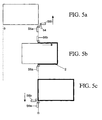
- the glazing entered in the chamber C which is not illustrated here, is disposed between the position 1 corresponding to the front of the glazing and the position 2 corresponding to the rear of the glazing.
- the movable head 56b starts at a lower angle of the glazing corresponding to the position 1, and is actuated upwards to follow the vertical front side of the glazing.
- the head 56b rotates 90 ° and is immobilized, the two heads being then vis-à-vis.
- the glazing is then translated from left to right, that is to say that the rear of the glazing passes from the position 2 to the position 1, so as to simultaneously perform the belting of the horizontal sides of the glazing respectively by each heads ( figure 5b ).
- the rear of the glazing is immobilized in position 1, and the vertical side is surrounded by the movable head which has rotated 90 ° at the upper corner of the glazing to descend to the lower angle ( figure 5c ).
- the fastening of the two ribbons is then performed in the lower corners of the glazing by overlapping or abutment.
- This combination of translational movement of the glazing and at least one ribbon dispensing head saves time to surround the glazing.
- a gas supply device such as a pipe which is inserted between the two glasses and which delivers gas as the edges of the glazing are girdled and sealed. The device is removed just before closing the last side of the glazing.
- the profile of the invention has a generally flat and parallelepipedal shape, nevertheless alternative embodiments are possible. It may for example be envisaged to provide the inner face 20 of the profile opposite to that comprising the metal coating, centering and positioning means such as longitudinal projections or lugs regularly distributed along two longitudinal lines spaced by a width equivalent to the separation of the two glass sheets so as to guide and properly position the profile against the edge of the glazing, the projections or lugs inserting inside the glazing and being pressed against the inner walls.
Landscapes
- Engineering & Computer Science (AREA)
- Civil Engineering (AREA)
- Structural Engineering (AREA)
- Securing Of Glass Panes Or The Like (AREA)
- Joining Of Glass To Other Materials (AREA)
- Glass Compositions (AREA)
- Insulating Bodies (AREA)
- Extrusion Moulding Of Plastics Or The Like (AREA)
- Moulding By Coating Moulds (AREA)
- Inorganic Insulating Materials (AREA)
Applications Claiming Priority (3)
| Application Number | Priority Date | Filing Date | Title |
|---|---|---|---|
| FR0005012 | 2000-04-13 | ||
| FR0005012A FR2807783B1 (fr) | 2000-04-13 | 2000-04-13 | Vitrage isolant et son procede de fabrication |
| PCT/FR2001/001106 WO2001079644A1 (fr) | 2000-04-13 | 2001-04-11 | Vitrage isolant et son procede de fabrication |
Publications (2)
| Publication Number | Publication Date |
|---|---|
| EP1272725A1 EP1272725A1 (fr) | 2003-01-08 |
| EP1272725B1 true EP1272725B1 (fr) | 2010-04-28 |
Family
ID=8849396
Family Applications (1)
| Application Number | Title | Priority Date | Filing Date |
|---|---|---|---|
| EP01923792A Expired - Lifetime EP1272725B1 (fr) | 2000-04-13 | 2001-04-11 | Vitrage isolant et son procede de fabrication |
Country Status (23)
| Country | Link |
|---|---|
| US (1) | US7141282B2 (enExample) |
| EP (1) | EP1272725B1 (enExample) |
| JP (1) | JP4949588B2 (enExample) |
| KR (1) | KR100768503B1 (enExample) |
| CN (1) | CN1193158C (enExample) |
| AT (1) | ATE466160T1 (enExample) |
| AU (1) | AU2001250480A1 (enExample) |
| BR (1) | BR0109986A (enExample) |
| CA (1) | CA2405528C (enExample) |
| CZ (1) | CZ20023390A3 (enExample) |
| DE (1) | DE60141951D1 (enExample) |
| EE (1) | EE05029B1 (enExample) |
| ES (1) | ES2344886T3 (enExample) |
| FR (1) | FR2807783B1 (enExample) |
| HU (1) | HU228323B1 (enExample) |
| MX (1) | MXPA02010063A (enExample) |
| NO (1) | NO20024705D0 (enExample) |
| PL (1) | PL206995B1 (enExample) |
| PT (1) | PT1272725E (enExample) |
| RU (1) | RU2267001C2 (enExample) |
| SK (1) | SK287596B6 (enExample) |
| WO (1) | WO2001079644A1 (enExample) |
| ZA (1) | ZA200206727B (enExample) |
Families Citing this family (43)
| Publication number | Priority date | Publication date | Assignee | Title |
|---|---|---|---|---|
| US7976916B2 (en) * | 1999-05-25 | 2011-07-12 | Saint-Gobain Vitrage | Refrigerated display case having a transparent insulating glazing unit |
| FR2846029B1 (fr) * | 2002-10-17 | 2005-07-01 | Saint Gobain | Vitrage isolant |
| FR2849795B1 (fr) | 2003-01-15 | 2006-01-13 | Saint Gobain | Dispositif porte-outil pour cooperer avec du verre |
| DE10350312B4 (de) * | 2003-10-28 | 2005-12-01 | Peter Lisec | Verfahren und Vorrichtung zum Applizieren eines elastoplastischen Bandes beim Herstellen einer Isolierglasscheibe |
| PT2439372T (pt) * | 2004-02-04 | 2018-10-19 | Quanex Ig Systems Inc | Método para formar uma unidade de vidro isolante |
| FR2878885B1 (fr) * | 2004-12-03 | 2008-08-22 | Saint Gobain | Dispositif de remplissage de gaz d'un vitrage isolant |
| FR2881819B1 (fr) | 2005-02-09 | 2012-11-23 | Saint Gobain | Guichet ouvrant en verre pour une installation refrigeree telle qu'un refrigerateur et installation refrigeree equipee d'un tel guichet |
| FR2893972B1 (fr) * | 2005-11-30 | 2009-03-27 | Saint Gobain | Procede de remplissage de gaz d'un vitrage isolant, dispositif de mise en oeuvre et vitrage isolant obtenu |
| FR2895427B1 (fr) * | 2005-12-23 | 2009-06-12 | Saint Gobain | Paroi en verre |
| KR100697112B1 (ko) * | 2006-02-14 | 2007-03-21 | 광건티앤씨(주) | 크린룸용 투명창 구조 |
| FR2898149B1 (fr) * | 2006-03-03 | 2009-12-18 | Lapeyre | Element de menuiserie apte a recevoir une partie vitree et element a fonction verriere correspondant |
| FR2898150B1 (fr) * | 2006-03-03 | 2009-10-23 | Saint Gobain | Ensemble constitue d'un vitrage multiple et d'un profile, et profile destine a un vitrage |
| FR2902999B1 (fr) | 2006-07-03 | 2012-09-28 | Oreal | Utilisation de derives c-glycoside a titre d'actif prodesquamant |
| WO2009064915A1 (en) * | 2007-11-13 | 2009-05-22 | Infinite Edge Technologies, Llc | Reinforced window spacer |
| FR2955915B1 (fr) | 2010-02-01 | 2012-03-09 | Saint Gobain | Vitrage multiple lumineux a diodes electroluminescentes |
| DE102010035748B4 (de) * | 2010-04-29 | 2013-01-03 | Bystronic Lenhardt Gmbh | Verfahren zum Zusammenbauen von Isolierglasscheiben, die drei zueinander parallele Glasplatten haben |
| FR2964138B1 (fr) | 2010-09-01 | 2012-08-24 | Saint Gobain | Vitrage multiple eclairant a diodes electroluminescentes |
| FR2970671B1 (fr) | 2011-01-21 | 2016-12-30 | Saint Gobain | Vitrage lumineux |
| US9005737B2 (en) * | 2011-03-21 | 2015-04-14 | Apogee Enterprises, Inc. | Coated articles and methods of making same |
| US9578944B2 (en) | 2011-11-09 | 2017-02-28 | L'oreal | Compositions and methods for altering the appearance of hair |
| US9565915B2 (en) | 2011-11-09 | 2017-02-14 | L'oreal | Compositions and methods for altering the appearance of hair |
| CN103172278A (zh) * | 2011-12-22 | 2013-06-26 | 徐林波 | 具有防渗和安全性能的中空及真空玻璃 |
| WO2013160263A2 (en) | 2012-04-24 | 2013-10-31 | L'oreal | Dyeing process using a mixture comprising a thickening polymer, obtained from an aerosol device, and device therefor |
| FR2989578A1 (fr) | 2012-04-24 | 2013-10-25 | Oreal | Procede de coloration mettant en oeuvre un melange comprenant un polyol ramifie en c6-c12, obtenu a partir d'un dispositif aerosol et dispositif |
| US9855198B2 (en) | 2012-04-24 | 2018-01-02 | L'oreal | Dyeing process using a mixture obtained from an aerosol device comprising a nonionic fatty amide, and device therefor |
| ES2634292T3 (es) | 2012-04-24 | 2017-09-27 | L'oréal | Proceso de teñido usando una mezcla obtenida de un dispositivo de aerosol que comprende un tensioactivo de éter de ácido carboxílico glicerolado u oxialquilenado, y dispositivo para el mismo |
| ES2634788T3 (es) | 2012-04-24 | 2017-09-29 | L'oréal | Proceso de teñido usando una mezcla obtenida de un dispositivo de aerosol que comprende un alcohol graso líquido y tensioactivos |
| WO2013181257A1 (en) | 2012-05-29 | 2013-12-05 | Quanex Ig Systems, Inc. | Spacer for insulating glazing unit |
| FR2991370B1 (fr) | 2012-06-04 | 2014-05-16 | Saint Gobain | Joint de liaison pour paroi vitree et paroi vitree |
| FR2993203B1 (fr) | 2012-07-11 | 2014-07-18 | Saint Gobain | Vitrage lumineux |
| AT513390B1 (de) * | 2012-10-22 | 2014-04-15 | Lisec Austria Gmbh | Verfahren und Vorrichtung zum automatisierten Wechseln von Abstandhaltern |
| EP2916916B1 (en) | 2012-11-09 | 2018-01-10 | L'Oréal | Methods for altering the color and appearance of hair |
| BR112015010447B1 (pt) | 2012-11-09 | 2019-12-03 | Oreal | método de alteração da aparência do cabelo |
| CN103043889A (zh) * | 2013-01-30 | 2013-04-17 | 徐林波 | 中空及真空玻璃的激光熔封新方法及新工艺 |
| RU2620241C1 (ru) | 2016-03-30 | 2017-05-23 | Общество с ограниченной ответственностью "Теплориум" | Энергоэффективная светопрозрачная конструкция |
| US10253552B2 (en) | 2016-04-21 | 2019-04-09 | Erdman Automation Corporation | High speed parallel process insulated glass manufacturing line |
| US10526836B2 (en) | 2017-01-30 | 2020-01-07 | GS Research LLC | Adhesive-attached window glazing assembly, multi-glazed window assembly and method therefor |
| CN114364857B (zh) * | 2019-06-26 | 2023-06-30 | 拉斯洛·赫希勒 | 绝热玻璃面板 |
| FR3100155B1 (fr) * | 2019-08-30 | 2021-09-03 | Saint Gobain | Vitrage isolant chauffant a faible puissance et resistance mecanique elevee |
| PL3990743T3 (pl) | 2020-06-25 | 2024-04-08 | Hirschler Laszlo | Szklany panel termoizolacyjny |
| CN116056925A (zh) * | 2020-08-07 | 2023-05-02 | 旭硝子欧洲玻璃公司 | 包括窗户保持器的车辆窗户 |
| US12467311B2 (en) | 2022-01-12 | 2025-11-11 | Erdman Automation Corporation | Insulated glass unit manufacturing station and assembly line with controlled heating of spacer |
| CN116394526B (zh) * | 2023-06-07 | 2023-08-04 | 山东华建铝业集团有限公司 | 一种铝合金塑形机构 |
Family Cites Families (20)
| Publication number | Priority date | Publication date | Assignee | Title |
|---|---|---|---|---|
| US2213468A (en) * | 1935-12-26 | 1940-09-03 | Libbey Owens Ford Glass Co | Multiple glass sheet glazing unit |
| US2235680A (en) * | 1937-07-14 | 1941-03-18 | Libbey Owens Ford Glass Co | Multiple glass sheet glazing unit and method of making the same |
| US2618819A (en) * | 1947-05-02 | 1952-11-25 | Libbey Owens Ford Glass Co | Edging strip |
| FR1439844A (fr) * | 1964-05-25 | 1966-05-27 | Saint Gobain | Perfectionnement à la fabrication des vitrages multiples |
| US3669785A (en) * | 1970-03-26 | 1972-06-13 | Ppg Industries Inc | Method for fabricating a multiple glazed unit |
| LU62150A1 (enExample) * | 1970-11-27 | 1972-08-03 | ||
| US3758996A (en) * | 1972-05-05 | 1973-09-18 | Ppg Industries Inc | Multiple glazed unit |
| JPS4964619A (enExample) * | 1972-10-25 | 1974-06-22 | ||
| US3919023A (en) * | 1973-09-24 | 1975-11-11 | Ppg Industries Inc | Multiple glazed unit |
| US4109431A (en) * | 1974-03-25 | 1978-08-29 | Ppg Industries, Inc. | Sealing and spacing unit for multiple glazed windows |
| CA1134125A (en) * | 1978-06-14 | 1982-10-26 | Theo Janssens | Hollow panels and method of and apparatus for manufacturing same |
| JPS6027628A (ja) * | 1983-07-21 | 1985-02-12 | Showa Denko Kk | 複層ガラス |
| US4622249A (en) * | 1985-04-15 | 1986-11-11 | Ppg Industries, Inc. | Multiple pane unit having a flexible spacing and sealing assembly |
| CA1290624C (en) * | 1986-10-31 | 1991-10-15 | Kenneth R. Parker | Insulating glass unit |
| US5079054A (en) * | 1989-07-03 | 1992-01-07 | Ominiglass Ltd. | Moisture impermeable spacer for a sealed window unit |
| US5270084A (en) * | 1989-09-28 | 1993-12-14 | Parker Design Limited | Insulating glass unit |
| JP2875595B2 (ja) * | 1990-06-21 | 1999-03-31 | 日本板硝子株式会社 | 複層ガラス |
| IT1274337B (it) * | 1994-03-07 | 1997-07-17 | Vianello Fortunato D N | Procedimento e macchina per il convogliamento di pannelli di vetro isolante successivamente alla fase di sigillatura |
| FR2774625B1 (fr) * | 1998-02-10 | 2000-03-10 | Seva | Procede de pliage de profiles comportant un corps creux et une feuille de revetement,et profile plie par ce procede |
| RU15489U1 (ru) * | 2000-07-06 | 2000-10-20 | Савин Владимир Константинович | Клееный стеклопакет |
-
2000
- 2000-04-13 FR FR0005012A patent/FR2807783B1/fr not_active Expired - Fee Related
-
2001
- 2001-04-11 EP EP01923792A patent/EP1272725B1/fr not_active Expired - Lifetime
- 2001-04-11 PT PT01923792T patent/PT1272725E/pt unknown
- 2001-04-11 HU HU0300537A patent/HU228323B1/hu not_active IP Right Cessation
- 2001-04-11 RU RU2002130273/03A patent/RU2267001C2/ru not_active IP Right Cessation
- 2001-04-11 US US10/239,859 patent/US7141282B2/en not_active Expired - Fee Related
- 2001-04-11 KR KR1020027011923A patent/KR100768503B1/ko not_active Expired - Fee Related
- 2001-04-11 CA CA002405528A patent/CA2405528C/fr not_active Expired - Fee Related
- 2001-04-11 CZ CZ20023390A patent/CZ20023390A3/cs unknown
- 2001-04-11 DE DE60141951T patent/DE60141951D1/de not_active Expired - Lifetime
- 2001-04-11 MX MXPA02010063A patent/MXPA02010063A/es active IP Right Grant
- 2001-04-11 SK SK1465-2002A patent/SK287596B6/sk not_active IP Right Cessation
- 2001-04-11 CN CNB018080332A patent/CN1193158C/zh not_active Expired - Fee Related
- 2001-04-11 EE EEP200200587A patent/EE05029B1/xx not_active IP Right Cessation
- 2001-04-11 PL PL358092A patent/PL206995B1/pl not_active IP Right Cessation
- 2001-04-11 AU AU2001250480A patent/AU2001250480A1/en not_active Abandoned
- 2001-04-11 ES ES01923792T patent/ES2344886T3/es not_active Expired - Lifetime
- 2001-04-11 AT AT01923792T patent/ATE466160T1/de active
- 2001-04-11 BR BR0109986-8A patent/BR0109986A/pt not_active Application Discontinuation
- 2001-04-11 JP JP2001577018A patent/JP4949588B2/ja not_active Expired - Fee Related
- 2001-04-11 WO PCT/FR2001/001106 patent/WO2001079644A1/fr not_active Ceased
-
2002
- 2002-08-22 ZA ZA200206727A patent/ZA200206727B/en unknown
- 2002-10-01 NO NO20024705A patent/NO20024705D0/no not_active Application Discontinuation
Also Published As
Similar Documents
| Publication | Publication Date | Title |
|---|---|---|
| CA2405528C (fr) | Vitrage isolant et son procede de fabrication | |
| EP1436481B1 (fr) | Vitrage isolant et son procede de fabrication | |
| JP2003531091A5 (enExample) | ||
| EP0060202B1 (fr) | Vitrage multiple à joints en matières plastiques améliorés | |
| EP2066861B1 (fr) | Association a l'aide d'un connecteur, de deux extremites creuses de profiles en matiere synthetique | |
| EP0334721B1 (fr) | Vitrage isolant | |
| FR3046415A1 (fr) | Procede et installation de fabrication d'un vitrage isolant | |
| FR2811933A1 (fr) | Corps creux composite et son procede de fabrication | |
| EP3436654A2 (fr) | Procédé et installation de fabrication d'un vitrage multiple | |
| FR2728616A1 (fr) | Vitrage multiple et procede de fabrication d'un tel vitrage | |
| EP2855815B1 (fr) | Panneau de vitrage comprenant des feuilles de verre associées ensemble par l'intermédiaire d'espaceurs et procédé de fabrication correspondants | |
| EP1052362A2 (fr) | Panneau à double vitrage | |
| EP1552100A1 (fr) | Vitrage isolant | |
| WO2018234035A1 (fr) | Procédé et installation de fabrication de vitrage isolant | |
| EP0981433A1 (fr) | Procede de pliage de profiles comportant un corps creux et une feuille de revetement, et profile plie par ce procede | |
| CA1190015A (fr) | Vitrage multiple a joints en matieres plastiques ameliores | |
| FR3084391A1 (fr) | Vitrage isolant, espaceur pour la realisation d'un cadre espaceur de vitrage isolant et procede de remplissage d'un vitrage isolant avec du gaz isolant | |
| FR3111154A1 (fr) | Vitrage isolant et procede d’assemblage d’un tel vitrage isolant | |
| EP1738047A2 (fr) | Connecteur pour raccorder deux extremites creuses de profile | |
| FR2893972A1 (fr) | Procede de remplissage de gaz d'un vitrage isolant, dispositif de mise en oeuvre et vitrage isolant obtenu | |
| WO2019129972A1 (fr) | Procede et installation de fabrication d'un vitrage multiple | |
| FR3087813A1 (fr) | Sous-ensemble de vitrage isolant pret a etre rempli avec du gaz isolant | |
| FR2771033A1 (fr) | Reservoir pour gaz naturel pour vehicule, et procede de fabrication de reservoir |
Legal Events
| Date | Code | Title | Description |
|---|---|---|---|
| PUAI | Public reference made under article 153(3) epc to a published international application that has entered the european phase |
Free format text: ORIGINAL CODE: 0009012 |
|
| 17P | Request for examination filed |
Effective date: 20021008 |
|
| AK | Designated contracting states |
Kind code of ref document: A1 Designated state(s): AT BE CH CY DE DK ES FI FR GB GR IE IT LI LU MC NL PT SE TR |
|
| AX | Request for extension of the european patent |
Free format text: AL;LT;LV;MK;RO;SI |
|
| 17Q | First examination report despatched |
Effective date: 20080606 |
|
| GRAP | Despatch of communication of intention to grant a patent |
Free format text: ORIGINAL CODE: EPIDOSNIGR1 |
|
| GRAS | Grant fee paid |
Free format text: ORIGINAL CODE: EPIDOSNIGR3 |
|
| GRAA | (expected) grant |
Free format text: ORIGINAL CODE: 0009210 |
|
| AK | Designated contracting states |
Kind code of ref document: B1 Designated state(s): AT BE CH CY DE DK ES FI FR GB GR IE IT LI LU MC NL PT SE TR |
|
| REG | Reference to a national code |
Ref country code: GB Ref legal event code: FG4D Free format text: NOT ENGLISH |
|
| REG | Reference to a national code |
Ref country code: CH Ref legal event code: EP |
|
| REG | Reference to a national code |
Ref country code: IE Ref legal event code: FG4D Free format text: LANGUAGE OF EP DOCUMENT: FRENCH |
|
| REF | Corresponds to: |
Ref document number: 60141951 Country of ref document: DE Date of ref document: 20100610 Kind code of ref document: P |
|
| REG | Reference to a national code |
Ref country code: CH Ref legal event code: NV Representative=s name: KIRKER & CIE S.A. |
|
| REG | Reference to a national code |
Ref country code: NL Ref legal event code: T3 |
|
| REG | Reference to a national code |
Ref country code: PT Ref legal event code: SC4A Free format text: AVAILABILITY OF NATIONAL TRANSLATION Effective date: 20100728 |
|
| REG | Reference to a national code |
Ref country code: ES Ref legal event code: FG2A Ref document number: 2344886 Country of ref document: ES Kind code of ref document: T3 |
|
| PG25 | Lapsed in a contracting state [announced via postgrant information from national office to epo] |
Ref country code: SE Free format text: LAPSE BECAUSE OF FAILURE TO SUBMIT A TRANSLATION OF THE DESCRIPTION OR TO PAY THE FEE WITHIN THE PRESCRIBED TIME-LIMIT Effective date: 20100428 |
|
| REG | Reference to a national code |
Ref country code: IE Ref legal event code: FD4D |
|
| PG25 | Lapsed in a contracting state [announced via postgrant information from national office to epo] |
Ref country code: FI Free format text: LAPSE BECAUSE OF FAILURE TO SUBMIT A TRANSLATION OF THE DESCRIPTION OR TO PAY THE FEE WITHIN THE PRESCRIBED TIME-LIMIT Effective date: 20100428 |
|
| PG25 | Lapsed in a contracting state [announced via postgrant information from national office to epo] |
Ref country code: GR Free format text: LAPSE BECAUSE OF FAILURE TO SUBMIT A TRANSLATION OF THE DESCRIPTION OR TO PAY THE FEE WITHIN THE PRESCRIBED TIME-LIMIT Effective date: 20100729 Ref country code: CY Free format text: LAPSE BECAUSE OF FAILURE TO SUBMIT A TRANSLATION OF THE DESCRIPTION OR TO PAY THE FEE WITHIN THE PRESCRIBED TIME-LIMIT Effective date: 20100428 |
|
| PG25 | Lapsed in a contracting state [announced via postgrant information from national office to epo] |
Ref country code: DK Free format text: LAPSE BECAUSE OF FAILURE TO SUBMIT A TRANSLATION OF THE DESCRIPTION OR TO PAY THE FEE WITHIN THE PRESCRIBED TIME-LIMIT Effective date: 20100428 Ref country code: IE Free format text: LAPSE BECAUSE OF FAILURE TO SUBMIT A TRANSLATION OF THE DESCRIPTION OR TO PAY THE FEE WITHIN THE PRESCRIBED TIME-LIMIT Effective date: 20100428 |
|
| PLBE | No opposition filed within time limit |
Free format text: ORIGINAL CODE: 0009261 |
|
| STAA | Information on the status of an ep patent application or granted ep patent |
Free format text: STATUS: NO OPPOSITION FILED WITHIN TIME LIMIT |
|
| 26N | No opposition filed |
Effective date: 20110131 |
|
| PG25 | Lapsed in a contracting state [announced via postgrant information from national office to epo] |
Ref country code: MC Free format text: LAPSE BECAUSE OF NON-PAYMENT OF DUE FEES Effective date: 20110430 |
|
| PGFP | Annual fee paid to national office [announced via postgrant information from national office to epo] |
Ref country code: DE Payment date: 20120425 Year of fee payment: 12 Ref country code: NL Payment date: 20120413 Year of fee payment: 12 Ref country code: CH Payment date: 20120412 Year of fee payment: 12 Ref country code: LU Payment date: 20120412 Year of fee payment: 12 |
|
| PGFP | Annual fee paid to national office [announced via postgrant information from national office to epo] |
Ref country code: BE Payment date: 20120531 Year of fee payment: 12 Ref country code: GB Payment date: 20120411 Year of fee payment: 12 Ref country code: FR Payment date: 20120424 Year of fee payment: 12 |
|
| PGFP | Annual fee paid to national office [announced via postgrant information from national office to epo] |
Ref country code: IT Payment date: 20120418 Year of fee payment: 12 |
|
| PGFP | Annual fee paid to national office [announced via postgrant information from national office to epo] |
Ref country code: ES Payment date: 20120510 Year of fee payment: 12 |
|
| PGFP | Annual fee paid to national office [announced via postgrant information from national office to epo] |
Ref country code: PT Payment date: 20120403 Year of fee payment: 12 |
|
| PGFP | Annual fee paid to national office [announced via postgrant information from national office to epo] |
Ref country code: AT Payment date: 20120327 Year of fee payment: 12 |
|
| PG25 | Lapsed in a contracting state [announced via postgrant information from national office to epo] |
Ref country code: TR Free format text: LAPSE BECAUSE OF FAILURE TO SUBMIT A TRANSLATION OF THE DESCRIPTION OR TO PAY THE FEE WITHIN THE PRESCRIBED TIME-LIMIT Effective date: 20100428 |
|
| REG | Reference to a national code |
Ref country code: PT Ref legal event code: MM4A Free format text: LAPSE DUE TO NON-PAYMENT OF FEES Effective date: 20131011 |
|
| BERE | Be: lapsed |
Owner name: SAINT-GOBAIN GLASS FRANCE Effective date: 20130430 |
|
| REG | Reference to a national code |
Ref country code: NL Ref legal event code: V1 Effective date: 20131101 |
|
| REG | Reference to a national code |
Ref country code: CH Ref legal event code: PL |
|
| GBPC | Gb: european patent ceased through non-payment of renewal fee |
Effective date: 20130411 |
|
| PG25 | Lapsed in a contracting state [announced via postgrant information from national office to epo] |
Ref country code: GB Free format text: LAPSE BECAUSE OF NON-PAYMENT OF DUE FEES Effective date: 20130411 Ref country code: LI Free format text: LAPSE BECAUSE OF NON-PAYMENT OF DUE FEES Effective date: 20130430 Ref country code: DE Free format text: LAPSE BECAUSE OF NON-PAYMENT OF DUE FEES Effective date: 20131101 Ref country code: BE Free format text: LAPSE BECAUSE OF NON-PAYMENT OF DUE FEES Effective date: 20130430 Ref country code: PT Free format text: LAPSE BECAUSE OF NON-PAYMENT OF DUE FEES Effective date: 20131011 Ref country code: CH Free format text: LAPSE BECAUSE OF NON-PAYMENT OF DUE FEES Effective date: 20130430 |
|
| REG | Reference to a national code |
Ref country code: FR Ref legal event code: ST Effective date: 20131231 |
|
| REG | Reference to a national code |
Ref country code: DE Ref legal event code: R119 Ref document number: 60141951 Country of ref document: DE Effective date: 20131101 |
|
| PG25 | Lapsed in a contracting state [announced via postgrant information from national office to epo] |
Ref country code: FR Free format text: LAPSE BECAUSE OF NON-PAYMENT OF DUE FEES Effective date: 20130430 Ref country code: IT Free format text: LAPSE BECAUSE OF NON-PAYMENT OF DUE FEES Effective date: 20130411 Ref country code: NL Free format text: LAPSE BECAUSE OF NON-PAYMENT OF DUE FEES Effective date: 20131101 |
|
| REG | Reference to a national code |
Ref country code: ES Ref legal event code: FD2A Effective date: 20140606 |
|
| PG25 | Lapsed in a contracting state [announced via postgrant information from national office to epo] |
Ref country code: ES Free format text: LAPSE BECAUSE OF NON-PAYMENT OF DUE FEES Effective date: 20130412 |
|
| REG | Reference to a national code |
Ref country code: AT Ref legal event code: MM01 Ref document number: 466160 Country of ref document: AT Kind code of ref document: T Effective date: 20140411 |
|
| PG25 | Lapsed in a contracting state [announced via postgrant information from national office to epo] |
Ref country code: AT Free format text: LAPSE BECAUSE OF NON-PAYMENT OF DUE FEES Effective date: 20140411 |
|
| PG25 | Lapsed in a contracting state [announced via postgrant information from national office to epo] |
Ref country code: LU Free format text: LAPSE BECAUSE OF NON-PAYMENT OF DUE FEES Effective date: 20130411 |