EP1270321A2 - Scheinwerfer fuer Fahrzeuge - Google Patents
Scheinwerfer fuer Fahrzeuge Download PDFInfo
- Publication number
- EP1270321A2 EP1270321A2 EP02012956A EP02012956A EP1270321A2 EP 1270321 A2 EP1270321 A2 EP 1270321A2 EP 02012956 A EP02012956 A EP 02012956A EP 02012956 A EP02012956 A EP 02012956A EP 1270321 A2 EP1270321 A2 EP 1270321A2
- Authority
- EP
- European Patent Office
- Prior art keywords
- light module
- receiving part
- actuator
- adjusting device
- headlamp
- Prior art date
- Legal status (The legal status is an assumption and is not a legal conclusion. Google has not performed a legal analysis and makes no representation as to the accuracy of the status listed.)
- Granted
Links
- 230000003287 optical effect Effects 0.000 claims description 6
- 238000006073 displacement reaction Methods 0.000 claims 1
- 230000004913 activation Effects 0.000 description 1
- 230000005540 biological transmission Effects 0.000 description 1
- 230000001419 dependent effect Effects 0.000 description 1
- 239000007858 starting material Substances 0.000 description 1
Images
Classifications
-
- B—PERFORMING OPERATIONS; TRANSPORTING
- B60—VEHICLES IN GENERAL
- B60Q—ARRANGEMENT OF SIGNALLING OR LIGHTING DEVICES, THE MOUNTING OR SUPPORTING THEREOF OR CIRCUITS THEREFOR, FOR VEHICLES IN GENERAL
- B60Q1/00—Arrangement of optical signalling or lighting devices, the mounting or supporting thereof or circuits therefor
- B60Q1/02—Arrangement of optical signalling or lighting devices, the mounting or supporting thereof or circuits therefor the devices being primarily intended to illuminate the way ahead or to illuminate other areas of way or environments
- B60Q1/04—Arrangement of optical signalling or lighting devices, the mounting or supporting thereof or circuits therefor the devices being primarily intended to illuminate the way ahead or to illuminate other areas of way or environments the devices being headlights
- B60Q1/06—Arrangement of optical signalling or lighting devices, the mounting or supporting thereof or circuits therefor the devices being primarily intended to illuminate the way ahead or to illuminate other areas of way or environments the devices being headlights adjustable, e.g. remotely-controlled from inside vehicle
- B60Q1/08—Arrangement of optical signalling or lighting devices, the mounting or supporting thereof or circuits therefor the devices being primarily intended to illuminate the way ahead or to illuminate other areas of way or environments the devices being headlights adjustable, e.g. remotely-controlled from inside vehicle automatically
- B60Q1/12—Arrangement of optical signalling or lighting devices, the mounting or supporting thereof or circuits therefor the devices being primarily intended to illuminate the way ahead or to illuminate other areas of way or environments the devices being headlights adjustable, e.g. remotely-controlled from inside vehicle automatically due to steering position
- B60Q1/122—Arrangement of optical signalling or lighting devices, the mounting or supporting thereof or circuits therefor the devices being primarily intended to illuminate the way ahead or to illuminate other areas of way or environments the devices being headlights adjustable, e.g. remotely-controlled from inside vehicle automatically due to steering position with electrical actuating means
-
- B—PERFORMING OPERATIONS; TRANSPORTING
- B60—VEHICLES IN GENERAL
- B60Q—ARRANGEMENT OF SIGNALLING OR LIGHTING DEVICES, THE MOUNTING OR SUPPORTING THEREOF OR CIRCUITS THEREFOR, FOR VEHICLES IN GENERAL
- B60Q1/00—Arrangement of optical signalling or lighting devices, the mounting or supporting thereof or circuits therefor
- B60Q1/02—Arrangement of optical signalling or lighting devices, the mounting or supporting thereof or circuits therefor the devices being primarily intended to illuminate the way ahead or to illuminate other areas of way or environments
- B60Q1/04—Arrangement of optical signalling or lighting devices, the mounting or supporting thereof or circuits therefor the devices being primarily intended to illuminate the way ahead or to illuminate other areas of way or environments the devices being headlights
- B60Q1/06—Arrangement of optical signalling or lighting devices, the mounting or supporting thereof or circuits therefor the devices being primarily intended to illuminate the way ahead or to illuminate other areas of way or environments the devices being headlights adjustable, e.g. remotely-controlled from inside vehicle
- B60Q1/068—Arrangement of optical signalling or lighting devices, the mounting or supporting thereof or circuits therefor the devices being primarily intended to illuminate the way ahead or to illuminate other areas of way or environments the devices being headlights adjustable, e.g. remotely-controlled from inside vehicle by mechanical means
-
- B—PERFORMING OPERATIONS; TRANSPORTING
- B60—VEHICLES IN GENERAL
- B60Q—ARRANGEMENT OF SIGNALLING OR LIGHTING DEVICES, THE MOUNTING OR SUPPORTING THEREOF OR CIRCUITS THEREFOR, FOR VEHICLES IN GENERAL
- B60Q1/00—Arrangement of optical signalling or lighting devices, the mounting or supporting thereof or circuits therefor
- B60Q1/02—Arrangement of optical signalling or lighting devices, the mounting or supporting thereof or circuits therefor the devices being primarily intended to illuminate the way ahead or to illuminate other areas of way or environments
- B60Q1/04—Arrangement of optical signalling or lighting devices, the mounting or supporting thereof or circuits therefor the devices being primarily intended to illuminate the way ahead or to illuminate other areas of way or environments the devices being headlights
- B60Q1/06—Arrangement of optical signalling or lighting devices, the mounting or supporting thereof or circuits therefor the devices being primarily intended to illuminate the way ahead or to illuminate other areas of way or environments the devices being headlights adjustable, e.g. remotely-controlled from inside vehicle
- B60Q1/076—Arrangement of optical signalling or lighting devices, the mounting or supporting thereof or circuits therefor the devices being primarily intended to illuminate the way ahead or to illuminate other areas of way or environments the devices being headlights adjustable, e.g. remotely-controlled from inside vehicle by electrical means including means to transmit the movements, e.g. shafts or joints
Definitions
- the invention relates to a headlamp for vehicles with a light module, which by a first adjustment to a horizontal and through a second adjusting device is pivotable about a vertical axis, wherein the light module on a receiving part and the receiving part on a Carrier element is pivotally mounted.
- Such a headlamp for vehicles is known from DE-U-87 13 122.
- the light module has a lens in the front area and is in this Area surrounded by a frame-like receiving part.
- the light module is pivotable about a vertical axis on the frame-like receiving part stored.
- the vertical axis passes through the front area of the Headlamps through.
- a second adjustment device attached to the a manual actuator and a remote controllable actuator for a Curve lighting control exists.
- the adjusting device and the actuator have a common actuator, which is transverse to the vertical axis and is coupled via a worm gear with the reflector.
- the Light module is in the vertical direction only at the axis defining Bearings of the receiving part held.
- the bearings and the be frame-like receiving part are in its front area about a horizontal Axis pivotally mounted on the support element.
- the horizontal axis cuts the optical axis of the light module in the same point as the vertical axis.
- On the support element is a second adjustment device attached, through which the light module manually together with the Receiving part is pivotable about the horizontal axis.
- the second Adjustment device has a Bowden cable, so that the light module from Vehicle interior is adjustable. If a variant of the headlamp Without curve light control is desired, the light module can not together with another component of the headlamp as a standard assembly be used.
- a headlight for vehicles is known, the one cup-shaped carrier element, whose front side by a translucent lens is completed.
- a light module which is a projection module, arranged.
- the Projection module is attached to a receiving part, which in the Headlight housing is pivotally mounted about a horizontal axis.
- the Receiving part is by a remotely operable first actuator to the vertical Headlamp leveling of the headlamp can be swiveled around the horizontal axis.
- the projection module is on the receiving part about a vertical axis adjustable and mounted by a mounted on the receiving part remote controllable second actuator for cornering light about this vertical axis pivotable.
- the vertical axis passes through the front edge area of the cup-shaped reflector or in the vicinity of a front lens of the Projection module.
- the second remote-controlled actuator is controlled by an external electrical control unit depending on the orientation of the front wheels of the vehicle relative to its axis and in dependence of other parameters, such as the vehicle speed, the operation of turn signals, etc., controlled.
- the heavy one Projection module is only supported at the bearing points of the receiving part and only as a standard component for a headlamp with or without Curve lighting control can be used.
- the light module together with the receiving part as a standard part be used for a headlamp with and without cornering light. Only the support element is then with different second adjustment devices to provide. For a bend headlight then points the second Adjustment device in addition to an adjustable actuator yet another remote controllable actuator for the curve light control on.
- the orientation of the Light module for cornering light is generally dependent on the Direction of the front wheels of the vehicle, relative to its axis, as well controlled by other parameters, such as the vehicle speed of the Vehicle, the activation of direction indicators, etc.
- the serving for headlamp leveling remotely controllable actuator and the adjustable first actuator of one single remote-controlled actuator are formed, with the only actuator for Adjusting the light module in a basic setting with a not one volatile memory comprehensive control unit for storing a the Basic setting of the light module defining setting value is connected.
- the light module is by a corresponding control of the actuator by the control unit based on the set value in its legal prescribed basic setting, which is why a mechanical Adjustment device is not needed.
- a secure and stable mounting of the light module to the receiving part is even given an elongated heavy projection module, though the actuator of the first adjusting device in its adjustment direction transverse to horizontal axis and transverse to the optical axis of the light module, wherein the actuator is disposed in a rear portion of the light module and the horizontal axis extends in a front region of the light module.
- the receiving part in his Main expansion direction is horizontal and in the front two Retaining arms with bearings for the light module and in the rear area a Holding device for the first adjusting, wherein the Light module in the front area is surrounded by a holding frame, the attached to the front edge of the reflector and with the bearings of the Holding arms of the receiving part cooperates.
- the light module and the Receiving part together are a stable unit, since the light module to three Points connected to the receiving part.
- the function of the remotely operable actuator is also the case of the large driving vertical forces sure, because of the vertical course of the adjustment the actuator no torque on the actuator or the remotely operable friendshipr works. For this reason, a much lower performer friendshipr be used and the headlight can be both smaller Dimensions as well as have a lower mass.
- the first adjustment device is simple and safe in function, if the remote controllable first actuator from the manual first Actuator is supported on the receiving part and between the actuator the first adjuster and one at the outer edge of the reflector mounted joint part is a hinged connection.
- the module is both around the vertical axis for cornering light as well as manually pivotable when the between the receiving part and the support element existing second adjustment for a curve light control serving remote controllable second adjuster and a manual second Have adjusting device with a common actuator.
- a steller can serve an electric drive.
- the light module is stable together with the receiving part with the Carrier element connected when the vertical axis through a single Bearing is defined in the mounting position of the headlamp below the Light module is arranged, wherein the carrier element in a horizontal Distance to the bearing at least one bearing surface for the Receiving part has.
- a smooth pivoting of the light module to the vertical axis is safe, since above the light module none are vertical Axis defining bearing point exists.
- the area above the light module For a storage location is critical, since these are at high temperatures can deform and then is difficult to adjust.
- the light module is formed by a heavy projection module, this is stably connected to the support element when the support surface is arranged below the rear portion of the light module and the vertical passes through a front region of the light module, wherein between the receiving part and the carrier element at least one Holding element consists of the receiving part in the adjustment of the Carrier element holds.
- the convex front side portion of the light module can from the front of Lens and / or a surrounding the lens cover frame may be formed.
- a headlamp for vehicles has a cup-shaped housing made of plastic and a light disc terminating the front side of the housing (not shown).
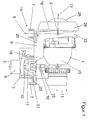
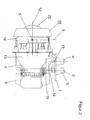
- a first light module 1 (see FIGS. 1 and 2) is arranged in the inner space formed by the housing and the lens.
- the light module 1 is a projection module, which consists of an ellipsoidal reflector 13, at least one light-dark boundary generating aperture (not shown) and arranged in the light exit direction of the reflector 13 lens 25 which is connected via a lens holder with the front edge of the reflector 13th connected is.
- the light module 1 can be designed for one or more adjustable light functions.
- the light module 1 is attached to a carrier element 7, which is rigidly connected to the housing or is formed by the housing itself.
- the carrier element 7 is arranged in the mounting position of the headlamp in a lower region of the interior of the headlamp.
- the bearing 19 is arranged in the front region of the light module 1 below the light module 1.
- the bearing 19 is formed by an integrally formed on the support member 7 sleeve and an inserted from above into the sleeve hollow bearing pin of the receiving part 6.
- the receiving part 6 is located in the region of the bearing 19 and in a rear area on one of the support surfaces 20 of the support member 7 and is vertically locked by a plurality of holding elements 21 on the support member 7.
- One of the holding element 21 is arranged on the rear area of the receiving part 6 and is formed by a laterally open groove of the carrier element 7. The groove can also be introduced into the receiving part.
- the receiving part 6 of the light module 1 is pivotable about the vertical axis 5 by a second adjusting device 4.
- the second adjusting device 4 is fastened to the carrier element 7 and has an actuating element 18 which extends in its longitudinal extent parallel to the horizontal axis 3 and is coupled via a hinge-like connection to the receiving part 6.
- the second adjusting device 4 has a manual second adjusting device (not shown) with an actuating element arranged on the headlight, by means of which the receiving part 6 can be adjusted about the vertical axis 5.
- the second adjusting device 4 (not shown) on a remotely operable second actuator, which is formed by an electric drive and through which the receiving part 6 for cornering light control about the vertical axis 5 is pivotable.
- the light module 1 is in its front region about the horizontal axis 3 at the receiving part 6 pivotally mounted.
- the horizontal and vertical axis 3 and 5 intersect at the same point on the optical axis 12 of the light module 1.
- the horizontal axis 3 is of two bearings defined between vertically upwardly directed support arms 16 of the Shooting part 6 and one the light module 1 in its front area surrounding holding frame 22 consist.
- the holder frame 22 is over Support arms rigidly connected to the front edge of the reflector 13.
- the Light module 1 is by a first adjusting device 5 to the horizontal Axis 3 swiveling.
- the first adjusting device 5 consists of a remotely operable first actuator 8 and a manual first actuator 9.
- the actuator 8 is in the rear area laterally adjacent to the reflector thirteenth arranged and attached to a holding device 17 of the receiving part 6.
- the actuator 8 is formed by an electric drive and has together with the first adjusting device 9, an actuator 10.
- the actuator 10 extends vertically and points upwards with its free end. Between this free End and a fixed to the front edge of the reflector 13 joint part 14th there is a hinged connection 15 consisting of a ball head and a Joint shell consists, in which the ball head parallel to the optical axis 12 is slidably guided.
- the manual first actuator 9 is about a Gear (not shown) connected to the actuator 10.
- the light module 1 is adjustable about the horizontal axis 3.
- the remotely operable first actuator 8 is used for cornering light control.
- a second light module 1 is shown in FIG.
- the second light module 1 has opposite to the first light module 1 substantially below described differences.
- the remotely operable first actuator 8 is of the Manual first adjusting device 9 is carried on the receiving part 6.
- the remotely operable first actuator 8 is of the Manual first adjusting device 9 is carried on the receiving part 6.
- the remotely operable first actuator 8 is of the Manual first adjusting device 9 is carried on the receiving part 6.
- the remotely operable first actuator 8 is of the Manual first adjusting device 9 is carried on the receiving part 6.
- the heavily operable first actuator 8 is of the Manual first adjusting device 9 is carried on the receiving part 6.
- the heavily operable first actuator 8 is of the Manual first adjusting device 9 is carried on the receiving part 6.
- the heavily operable first actuator 8 is of the Manual first adjusting device 9 is carried on the receiving part 6.
- the heavily operable first actuator 8 is of the Manual first adjusting device 9 is carried on the receiving part 6.
- the heavily operable first actuator 8 is of the Manual first adjusting device 9 is carried on the receiving part
- the horizontal and vertical axes 3 and 5 both go through the geometric center of a convex frontal section of the light module 1, which from the front of the lens 25 surrounding Cover frame 26 is formed.
Landscapes
- Engineering & Computer Science (AREA)
- Mechanical Engineering (AREA)
- Lighting Device Outwards From Vehicle And Optical Signal (AREA)
- Non-Portable Lighting Devices Or Systems Thereof (AREA)
Abstract
Description
- das Lichtmodul und das Aufnahmeteil durch die horizontale Achse und das Aufnahmeteil und das Trägerelement durch die vertikale Achse miteinander verbunden sind,
- die erste Einstellvorrichtung einen zur Leuchtweiteregelung dienenden fernbetätigbaren ersten Steller und eine justierbare erste Stelleinrichtung mit einem gemeinsamen Stellglied aufweisen, welches ein das Lichtmodul an dem Aufnahmeteil tragendes Bauteil ist.
- Fig. 1
- in einer Seitenansicht ein erstes Lichtmodul eines Fahrzeugs und
- Fig. 2
- in einer Draufsicht das Lichtmodul in Fig.1 und
- Fig. 3
- in einer perspektivischen Rückansicht ein zweites Lichtmodul eines Fahrzeugs.
Das Lichtmodul 1 ist an ein Trägerelement 7 angebracht, das starr mit dem Gehäuse verbunden ist bzw. von dem Gehäuse selbst gebildet ist. Das Trägerelement 7 ist in Anbaulage des Scheinwerfers in einem unteren Bereich des Innenraums des Scheinwerfers angeordnet. Ein Aufnahmeteil 6 des Lichtmoduls 1, dessen Hauptausdehnungsrichtung horizontal verläuft, liegt auf mehreren Auflageflächen 20 des Trägerelements 7 auf und ist an dem Trägerelement 7 um eine einzige Lagerstelle 19 schwenkbar. Die Lagerstelle 19 ist im vorderen Bereich des Lichtmoduls 1 unterhalb des Lichtmoduls 1 angeordnet. Die Lagerstelle 19 ist von einer an das Trägerelement 7 angeformten Hülse und eine von oben in die Hülse eingesteckten hohlen Lagerzapfen des Aufnahmeteils 6 gebildet. Das Aufnahmeteil 6 liegt im Bereich der Lagerstelle 19 und in einem hinteren Bereich auf einer der Auflageflächen 20 des Trägerelements 7 auf und ist vertikal durch mehrere Halteelemente 21 an dem Trägerelement 7 arretiert. Eines der Halteelement 21 ist an dem hinteren Bereich des Aufnahmeteils 6 angeordnet ist und von einer seitlich geöffneten Nut des Trägerelements 7 gebildet. Die Nut kann auch in das Aufnahmeteil eingebracht sein. Das Aufnahmeteil 6 des Lichtmoduls 1 ist durch eine zweite Einstellvorrichtung 4 um die vertikale Achse 5 schwenkbar. Die zweite Einstellvorrichtung 4 ist an dem Trägerelement 7 befestigt und weist ein Stellelement 18 auf, das in seiner Längsausdehnung parallel zur horizontalen Achse 3 verläuft und über eine gelenkartige Verbindung mit dem Aufnahmeteil 6 gekoppelt ist. Die zweite Einstellvorrichtung 4 weist eine manuelle zweite Stelleinrichtung (nicht dargestellt) mit einem am Scheinwerfer angeordneten Betätigungselement auf, durch das das Aufnahmeteil 6 um die vertikale Achse 5 justierbar ist. Weiterhin weist die zweite Einstellvorrichtung 4 einen fernbetätigbaren zweiten Steller (nicht dargestellt) auf, der von einem elektrischen Antrieb gebildet ist und durch den das Aufnahmeteil 6 zur Kurvenlichtregelung um die vertikale Achse 5 schwenkbar ist.
- 1.
- Lichtmodul
- 2.
- erste Einstellvorrichtung
- 3.
- horizontale Achse
- 4.
- zweite Einstellvorrichtung
- 5.
- vertikale Achse
- 6.
- Aufnahmeteil
- 7.
- Trägerelement
- 8.
- erster Steller
- 9.
- erste Stelleinrichtung
- 10.
- Stellglied
- 11.
- Verstellrichtung
- 12.
- optische Achse
- 13.
- Reflektor
- 14.
- Gelenkteil
- 15.
- gelenkartige Verbindung
- 16.
- Haltearm
- 17.
- Haltevorrichtung
- 18.
- Stellelement
- 19.
- Lagerstelle
- 20.
- Auflagefläche
- 21.
- Halteelement
- 22.
- Halterahmen
- 23.
- Anschlüsse
- 24.
- Halterung
- 25.
- Linse
- 26.
- Abdeckrahmen
Claims (14)
- Scheinwerfer für Fahrzeuge mit einem Lichtmodul (1), welches durch eine erste Einstellvorrichtung (2) um eine horizontale Achse (3) und durch ein zweite Einstellvorrichtung (4) um eine vertikale Achse (5) schwenkbar ist, wobei das Lichtmodul (1) an einem Aufnahmeteil (6) und das Aufnahmeteil (6) an einem Trägerelement (7) schwenkbar gelagert ist,
dadurch gekennzeichnet, dassdas Lichtmodul (1) und das Aufnahmeteil (6) durch die horizontale Achse (3) und das Aufnahmeteil (6) und das Trägerelement (7) durch die vertikale Achse (5) miteinander verbunden sind,die erste Einstellvorrichtung (4) einen zur Leuchtweiteregelung dienenden fernbetätigbaren ersten Steller (8) und eine justierbare erste Stelleinrichtung (9) mit einem gemeinsamen Stellglied (10) aufweisen, welches ein das Lichtmodul (1) an dem Aufnahmeteil (6) tragendes Bauteil ist. - Scheinwerfer nach Anspruch 1, dadurch gekennzeichnet, dass das Stellglied (10) der ersten Einstellvorrichtung (2) in seiner Verstellrichtung (11) quer zur horizontalen Achse (3) und quer zur optischen Achse (12) des Lichtmoduls (1) verläuft, wobei das Stellglied (10) in einem hinteren Bereich des Lichtmoduls (1) angeordnet ist und die horizontale Achse (3) in einem vorderen Bereich des Lichtmoduls (1) verläuft.
- Scheinwerfer nach Anspruch 2, dadurch gekennzeichnet, dass zwischen dem Stellglied (10) der ersten Einstellvorrichtung (2) und einem an dem äußeren Rand des Reflektors (13) angebrachten Gelenkteil (14) eine gelenkige Verbindung (15) besteht.
- Scheinwerfer nach Anspruch 3, dadurch gekennzeichnet, dass der fernbetätigbare erste Steller (8) von einer manuellen ersten Stelleinrichtung (9) an dem Aufnahmeteil (6) getragen ist.
- Scheinwerfer nach einem der Ansprüche 1 bis 4, dadurch gekennzeichnet, dass das Aufnahmeteil (6) in seiner Hauptausdehnungsrichtung horizontal verläuft und im vorderen Bereich des Lichtmoduls (1) zwei Haltearme (16) mit die horizontale Achse (3) definierenden Lagerstellen und im hinteren Bereich eine Haltevorrichtung (17) für die erste Einstellvorrichtung (2) aufweist.
- Scheinwerfer nach Anspruch 5, dadurch gekennzeichnet, dass das Lichtmodul (1) im vorderen Bereich von einem Halterahmen (22) umgeben ist, der an dem vorderen Rand des Reflektors (13) befestigt ist und mit den Lagerstellen der Haltearme (16) des Aufnahmeteils (6) zusammenwirkt.
- Scheinwerfer nach einem der Ansprüche 1 bis 6, dadurch gekennzeichnet, dass die zwischen dem Aufnahmeteil (6) und dem Trägerelement (7) bestehende zweite Einstellvorrichtung (4) einen zur Kurvenlichtregelung dienenden fernbetätigbaren zweiten Steller und eine manuelle zweite Stelleinrichtung mit einem gemeinsamen Stellelement (18) aufweisen.
- Scheinwerfer nach einer der Ansprüche 1 bis 8, dadurch gekennzeichnet, dass die vertikale Achse (5) durch eine einzige Lagerstelle (19) definiert ist, die in Anbaulage des Scheinwerfers unterhalb des Lichtmoduls (1) angeordnet ist, wobei das Trägerelement (7) in einem Abstand zu der Lagerstelle (19) mindestens eine Auflagefläche (20) für das Aufnahmeteil (6) aufweist.
- Scheinwerfer nach Anspruch 8, dadurch gekennzeichnet, dass zumindest eine der Auflageflächen (20) unterhalb des hinteren Bereichs des Lichtmoduls (1) angeordnet ist und die vertikale Achse (5) durch einen vorderen Bereich des Lichtmoduls (1) hindurch verläuft.
- Scheinwerfer nach einem der Anspruch 1 bis 10, dadurch gekennzeichnet, dass zwischen dem Aufnahmeteil (6) und dem Trägerelement (7) mindestens ein Halteelement (21) besteht, welches das Aufnahmeteil (6) in Verstellrichtung (11) an dem Trägerelement (7) haltert.
- Scheinwerfer nach einem der Ansprüche 1 bis 10, dadurch gekennzeichnet, dass die vertikale Achse (5) durch den geometrischen Zentrumsbereich eines konvexen Vorderseitenabschnitts des Lichtmoduls (1) hindurchgeht.
- Scheinwerfer nach Anspruch 11, dadurch gekennzeichnet, dass der konvexe Vorderseitenabschnitt des Lichtmoduls die konvexe Vorderseite der Linse (25) ist.
- Scheinwerfer nach Anspruch 11 oder 12, dadurch gekennzeichnet, dass der konvexe Vorderseitenabschnitt des Lichtmoduls die konvexe Vorderseite eines die Linse (25) umgebenden Abdeckrahmens (26) ist.
- Scheinwerfer nach einem der Ansprüche 1 bis 13, dadurch gekennzeichnet, dass der zur Leuchtweiteregelung dienende fernbetätigbare Steller (8) und die justierbare erste Stelleinrichtung (9) von einem einzigen fernbetätigbaren Steller gebildet sind, wobei der einzige Steller zum Justieren des Lichtmoduls (1) in einer Grundeinstellung mit einem einen nicht flüchtigen Speicher umfassenden Steuergerät zur Speicherung eines die Grundeinstellung des Lichtmoduls definierenden Einstellwertes verbunden ist.
Applications Claiming Priority (2)
| Application Number | Priority Date | Filing Date | Title |
|---|---|---|---|
| DE10131099A DE10131099A1 (de) | 2001-06-27 | 2001-06-27 | Scheinwerfer für Fahrzeuge |
| DE10131099 | 2001-06-27 |
Publications (3)
| Publication Number | Publication Date |
|---|---|
| EP1270321A2 true EP1270321A2 (de) | 2003-01-02 |
| EP1270321A3 EP1270321A3 (de) | 2004-08-04 |
| EP1270321B1 EP1270321B1 (de) | 2007-04-25 |
Family
ID=7689708
Family Applications (1)
| Application Number | Title | Priority Date | Filing Date |
|---|---|---|---|
| EP02012956A Expired - Lifetime EP1270321B1 (de) | 2001-06-27 | 2002-06-12 | Scheinwerfer für Fahrzeuge |
Country Status (3)
| Country | Link |
|---|---|
| EP (1) | EP1270321B1 (de) |
| AT (1) | ATE360554T1 (de) |
| DE (2) | DE10131099A1 (de) |
Cited By (7)
| Publication number | Priority date | Publication date | Assignee | Title |
|---|---|---|---|---|
| FR2838086A1 (fr) * | 2002-03-12 | 2003-10-10 | Automotive Lighting Reutlingen | Bloc optique pour vehicules |
| FR2869388A1 (fr) * | 2004-04-27 | 2005-10-28 | Valeo Vision Sa | Dispositif projecteur avec bloc actionneur multifonctions pour vehicule automobile |
| EP1450099A3 (de) * | 2003-02-18 | 2006-06-28 | Hella KGaA Hueck & Co. | Projektions-Scheinwerfer für Fahrzeuge |
| DE102004061483A1 (de) * | 2004-12-21 | 2006-06-29 | Hella Kgaa Hueck & Co. | Scheinwerfer für Fahrzeuge |
| DE102004061484A1 (de) * | 2004-12-21 | 2006-11-30 | Hella Kgaa Hueck & Co. | Haltevorrichtung für ein Lichtmodul und Montageverfahren |
| FR2952870A1 (fr) * | 2009-11-26 | 2011-05-27 | Valeo Vision | Module d'eclairage pivotant et support correspondant pour vehicule automobile |
| EP2338728A1 (de) * | 2009-12-25 | 2011-06-29 | Koito Manufacturing Co., Ltd. | Fahrzeugscheinwerfer |
Families Citing this family (3)
| Publication number | Priority date | Publication date | Assignee | Title |
|---|---|---|---|---|
| DE20303166U1 (de) | 2003-02-27 | 2003-06-12 | Skf Ab | Schwenkbarer Scheinwerfer |
| CN103692959B (zh) * | 2013-12-16 | 2016-01-27 | 江苏大学 | 一种汽车前大灯自动随行两自由度转向直驱系统 |
| CN103692956B (zh) * | 2013-12-16 | 2016-01-20 | 江苏大学 | 一种汽车前大灯智能转向直驱系统 |
Citations (2)
| Publication number | Priority date | Publication date | Assignee | Title |
|---|---|---|---|---|
| DE8713122U1 (de) | 1987-09-30 | 1987-12-03 | View Transportation Co., Ltd., Taichung | Kraftfahrzeug mit den Lenkausschlägen folgenden Scheinwerfern |
| DE19802023A1 (de) | 1997-02-21 | 1998-08-27 | Valeo Vision | Beleuchtungssystem mit Scheinwerfern für ein Nahlichtbündel des Typs Abblendlicht und ein komplementäres Kurvenlichtbündel |
Family Cites Families (15)
| Publication number | Priority date | Publication date | Assignee | Title |
|---|---|---|---|---|
| FR1572244A (de) * | 1968-02-16 | 1969-06-27 | ||
| FR2568525B1 (fr) * | 1984-08-01 | 1987-01-30 | Manzoni Stephane | Dispositif de reglage de la position de projecteurs de vehicules |
| DE3884631T2 (de) * | 1987-01-14 | 1994-01-27 | Ichiko Industries Ltd | Vorrichtung zum Einstellen der optischen Achse eines Fahrzeugscheinwerfers. |
| DE3811523C1 (en) * | 1988-04-06 | 1989-08-31 | Vs Entwicklungs- Und Projektierungs Gmbh, 6360 Friedberg, De | Swivel-tilt device for optical equipment |
| DE3844269A1 (de) * | 1988-12-30 | 1990-07-05 | Bosch Gmbh Robert | Scheinwerfer fuer kraftfahrzeuge |
| FR2695709B1 (fr) * | 1992-09-17 | 1994-12-02 | Valeo Vision | Projecteur comportant un dispositif correcteur et des moyens de réglage du zéro du dispositif correcteur. |
| IT1256983B (it) * | 1992-10-27 | 1995-12-27 | Carello Spa | Proiettore per autoveicoli. |
| JP3095971B2 (ja) * | 1995-02-07 | 2000-10-10 | 本田技研工業株式会社 | 車両用前照灯装置 |
| US5806956A (en) * | 1996-09-18 | 1998-09-15 | Hyun-Jo; Lee | Searchlight |
| DE19810480B4 (de) * | 1998-03-11 | 2005-08-18 | Bayerische Motoren Werke Ag | Fahrzeugscheinwerfer mit einem verstellbaren Reflektor |
| ITTO980401A1 (it) * | 1998-05-12 | 1999-11-12 | Magneti Marelli Spa | Dispositivo regolatore d'assetto per un faro di un veicolo. |
| DE29907483U1 (de) * | 1999-04-29 | 2000-04-06 | Kennleuchten - Technische - Anlagen GmbH, 17309 Jatznick | Scheinwerfer, insbesondere zum Aufbau auf Fahrzeuge |
| DE19933663B4 (de) * | 1999-07-17 | 2012-05-03 | Automotive Lighting Reutlingen Gmbh | Scheinwerfer für Fahrzeuge |
| FR2807982B1 (fr) * | 2000-04-19 | 2002-07-05 | Valeo Vision | Systeme d'eclairage pour projecteur de vehicule automobile |
| DE10021040A1 (de) * | 2000-04-28 | 2001-10-31 | Hella Kg Hueck & Co | Scheinwerfer für Fahrzeuge |
-
2001
- 2001-06-27 DE DE10131099A patent/DE10131099A1/de not_active Withdrawn
-
2002
- 2002-06-12 EP EP02012956A patent/EP1270321B1/de not_active Expired - Lifetime
- 2002-06-12 AT AT02012956T patent/ATE360554T1/de not_active IP Right Cessation
- 2002-06-12 DE DE50210014T patent/DE50210014D1/de not_active Expired - Lifetime
Patent Citations (2)
| Publication number | Priority date | Publication date | Assignee | Title |
|---|---|---|---|---|
| DE8713122U1 (de) | 1987-09-30 | 1987-12-03 | View Transportation Co., Ltd., Taichung | Kraftfahrzeug mit den Lenkausschlägen folgenden Scheinwerfern |
| DE19802023A1 (de) | 1997-02-21 | 1998-08-27 | Valeo Vision | Beleuchtungssystem mit Scheinwerfern für ein Nahlichtbündel des Typs Abblendlicht und ein komplementäres Kurvenlichtbündel |
Cited By (10)
| Publication number | Priority date | Publication date | Assignee | Title |
|---|---|---|---|---|
| FR2838086A1 (fr) * | 2002-03-12 | 2003-10-10 | Automotive Lighting Reutlingen | Bloc optique pour vehicules |
| EP1450099A3 (de) * | 2003-02-18 | 2006-06-28 | Hella KGaA Hueck & Co. | Projektions-Scheinwerfer für Fahrzeuge |
| FR2869388A1 (fr) * | 2004-04-27 | 2005-10-28 | Valeo Vision Sa | Dispositif projecteur avec bloc actionneur multifonctions pour vehicule automobile |
| EP1591313A1 (de) * | 2004-04-27 | 2005-11-02 | Valeo Vision | Kraftfahrzeugscheinwerfer mit einer mehrfunktionalen Antrieb-Einheit |
| US7452116B2 (en) | 2004-04-27 | 2008-11-18 | Valeo Vision | Headlamp device with multifunction actuator block for a motor vehicle |
| DE102004061483A1 (de) * | 2004-12-21 | 2006-06-29 | Hella Kgaa Hueck & Co. | Scheinwerfer für Fahrzeuge |
| DE102004061484A1 (de) * | 2004-12-21 | 2006-11-30 | Hella Kgaa Hueck & Co. | Haltevorrichtung für ein Lichtmodul und Montageverfahren |
| DE102004061484B4 (de) * | 2004-12-21 | 2010-04-08 | Hella Kgaa Hueck & Co. | Haltevorrichtung für ein Lichtmodul und Montageverfahren |
| FR2952870A1 (fr) * | 2009-11-26 | 2011-05-27 | Valeo Vision | Module d'eclairage pivotant et support correspondant pour vehicule automobile |
| EP2338728A1 (de) * | 2009-12-25 | 2011-06-29 | Koito Manufacturing Co., Ltd. | Fahrzeugscheinwerfer |
Also Published As
| Publication number | Publication date |
|---|---|
| EP1270321B1 (de) | 2007-04-25 |
| DE50210014D1 (de) | 2007-06-06 |
| EP1270321A3 (de) | 2004-08-04 |
| ATE360554T1 (de) | 2007-05-15 |
| DE10131099A1 (de) | 2003-01-09 |
Similar Documents
| Publication | Publication Date | Title |
|---|---|---|
| EP1391347B1 (de) | Scheinwerfer für Fahrzeuge | |
| DE102007053081B4 (de) | Ausrichtungsvorrichtung für Beleuchtungsvorrichtungen für Fahrzeuge | |
| DE4306316A1 (en) | Reflector positioner e.g. for varying vehicle headlamp light distribution - involves servomotor in controlled movement of reflector guided by pins engaging in grooves of fixed plate | |
| DE102005046037B4 (de) | Beleuchtungseinrichtung für einspurige Kraftfahrzeuge | |
| DE10211816B4 (de) | Fahrzeugscheinwerfer | |
| DE202005014393U1 (de) | Haltebügel für Scheinwerfer | |
| EP1270321A2 (de) | Scheinwerfer fuer Fahrzeuge | |
| DE10029029B4 (de) | Fahrzeugleuchte mit einem verstellbaren Reflektor | |
| EP1149731A2 (de) | Scheinwerfer für Fahrzeuge | |
| DE10131098A1 (de) | Scheinwerfer für Fahrzeuge | |
| DE2056996B2 (de) | Beleuchtungseinrichtung fuer kraftfahrzeuge | |
| DE69309590T2 (de) | Scheinwerfer mit Korrektureinheit und Rückstelleinrichtung | |
| WO2016141926A1 (de) | Verstellvorrichtung für scheinwerfer | |
| DE2353322B2 (de) | Scheinwerfer für Kraftfahrzeuge | |
| DE19923968B4 (de) | Fahrzeugscheinwerfer | |
| DE102005031809A1 (de) | Scheinwerfer für Fahrzeuge | |
| DE19507586A1 (de) | Scheinwerfer für Fahrzeuge | |
| DE102004058269A1 (de) | Scheinwerfer für Fahrzeuge | |
| DE9312695U1 (de) | Einstellanordnung für die Verschwenkbarkeit eines Reflektors eines Kraftfahrzeugscheinwerfers | |
| EP2789502B1 (de) | Fahrzeugscheinwerfer | |
| DE69306075T2 (de) | Scheinwerfer mit Korrektureinheit und drehbarem Ausgang | |
| DE69617179T2 (de) | Schiebevorrichtung für bewegliche, optisch wirksame Elemente zur Modifizierung des Lichtbündels eines Kfz-Scheinwerfers | |
| EP1491400B1 (de) | Scheinwerfer für Fahrzeuge | |
| DE3941031C2 (de) | Fahrzeugscheinwerfer | |
| EP1722162B1 (de) | Scheinwerfer für Fahrzeuge |
Legal Events
| Date | Code | Title | Description |
|---|---|---|---|
| PUAI | Public reference made under article 153(3) epc to a published international application that has entered the european phase |
Free format text: ORIGINAL CODE: 0009012 |
|
| AK | Designated contracting states |
Kind code of ref document: A2 Designated state(s): AT BE CH CY DE DK ES FI FR GB GR IE IT LI LU MC NL PT SE TR |
|
| AX | Request for extension of the european patent |
Free format text: AL;LT;LV;MK;RO;SI |
|
| PUAL | Search report despatched |
Free format text: ORIGINAL CODE: 0009013 |
|
| AK | Designated contracting states |
Kind code of ref document: A3 Designated state(s): AT BE CH CY DE DK ES FI FR GB GR IE IT LI LU MC NL PT SE TR |
|
| AX | Request for extension of the european patent |
Extension state: AL LT LV MK RO SI |
|
| RIC1 | Information provided on ipc code assigned before grant |
Ipc: 7B 60Q 1/12 B Ipc: 7B 60Q 1/10 A |
|
| RAP1 | Party data changed (applicant data changed or rights of an application transferred) |
Owner name: DAIMLERCHRYSLER AG Owner name: HELLA KGAA HUECK & CO. |
|
| 17P | Request for examination filed |
Effective date: 20041207 |
|
| AKX | Designation fees paid |
Designated state(s): AT DE ES FR IT |
|
| 17Q | First examination report despatched |
Effective date: 20050330 |
|
| GRAP | Despatch of communication of intention to grant a patent |
Free format text: ORIGINAL CODE: EPIDOSNIGR1 |
|
| RIN1 | Information on inventor provided before grant (corrected) |
Inventor name: HERBERS, THOMAS Inventor name: HENSCHEL, MATHIAS Inventor name: JOCHER, RAINER Inventor name: WILLEKE, FRANZ-GEORG Inventor name: ZEHANCIUC, MARIO Inventor name: SCHOENING, FRANK |
|
| GRAS | Grant fee paid |
Free format text: ORIGINAL CODE: EPIDOSNIGR3 |
|
| GRAA | (expected) grant |
Free format text: ORIGINAL CODE: 0009210 |
|
| RAP1 | Party data changed (applicant data changed or rights of an application transferred) |
Owner name: HELLA KGAA HUECK & CO. Owner name: DAIMLERCHRYSLER AG |
|
| AK | Designated contracting states |
Kind code of ref document: B1 Designated state(s): AT DE ES FR IT |
|
| REF | Corresponds to: |
Ref document number: 50210014 Country of ref document: DE Date of ref document: 20070606 Kind code of ref document: P |
|
| PG25 | Lapsed in a contracting state [announced via postgrant information from national office to epo] |
Ref country code: ES Free format text: LAPSE BECAUSE OF FAILURE TO SUBMIT A TRANSLATION OF THE DESCRIPTION OR TO PAY THE FEE WITHIN THE PRESCRIBED TIME-LIMIT Effective date: 20070805 |
|
| RAP2 | Party data changed (patent owner data changed or rights of a patent transferred) |
Owner name: DAIMLER AG Owner name: HELLA KGAA HUECK & CO. |
|
| PLBE | No opposition filed within time limit |
Free format text: ORIGINAL CODE: 0009261 |
|
| STAA | Information on the status of an ep patent application or granted ep patent |
Free format text: STATUS: NO OPPOSITION FILED WITHIN TIME LIMIT |
|
| 26N | No opposition filed |
Effective date: 20080128 |
|
| PG25 | Lapsed in a contracting state [announced via postgrant information from national office to epo] |
Ref country code: IT Free format text: LAPSE BECAUSE OF FAILURE TO SUBMIT A TRANSLATION OF THE DESCRIPTION OR TO PAY THE FEE WITHIN THE PRESCRIBED TIME-LIMIT Effective date: 20070425 |
|
| PGFP | Annual fee paid to national office [announced via postgrant information from national office to epo] |
Ref country code: AT Payment date: 20080620 Year of fee payment: 7 |
|
| PGFP | Annual fee paid to national office [announced via postgrant information from national office to epo] |
Ref country code: FR Payment date: 20080618 Year of fee payment: 7 |
|
| REG | Reference to a national code |
Ref country code: FR Ref legal event code: ST Effective date: 20100226 |
|
| PG25 | Lapsed in a contracting state [announced via postgrant information from national office to epo] |
Ref country code: FR Free format text: LAPSE BECAUSE OF NON-PAYMENT OF DUE FEES Effective date: 20090630 |
|
| PG25 | Lapsed in a contracting state [announced via postgrant information from national office to epo] |
Ref country code: AT Free format text: LAPSE BECAUSE OF NON-PAYMENT OF DUE FEES Effective date: 20090612 |
|
| REG | Reference to a national code |
Ref country code: DE Ref legal event code: R084 Ref document number: 50210014 Country of ref document: DE |
|
| REG | Reference to a national code |
Ref country code: DE Ref legal event code: R082 Ref document number: 50210014 Country of ref document: DE Representative=s name: FIEDLER, OSTERMANN & SCHNEIDER - PATENTANWAELT, DE Ref country code: DE Ref legal event code: R082 Ref document number: 50210014 Country of ref document: DE Representative=s name: PATENTANWAELTE FIEDLER, OSTERMANN & SCHNEIDER, DE Ref country code: DE Ref legal event code: R081 Ref document number: 50210014 Country of ref document: DE Owner name: DAIMLER AG, DE Free format text: FORMER OWNERS: DAIMLER AG, 70327 STUTTGART, DE; HELLA KGAA HUECK & CO., 59557 LIPPSTADT, DE Ref country code: DE Ref legal event code: R081 Ref document number: 50210014 Country of ref document: DE Owner name: HELLA GMBH & CO. KGAA, DE Free format text: FORMER OWNERS: DAIMLER AG, 70327 STUTTGART, DE; HELLA KGAA HUECK & CO., 59557 LIPPSTADT, DE |
|
| PGFP | Annual fee paid to national office [announced via postgrant information from national office to epo] |
Ref country code: DE Payment date: 20210518 Year of fee payment: 20 |
|
| REG | Reference to a national code |
Ref country code: DE Ref legal event code: R071 Ref document number: 50210014 Country of ref document: DE |